Tag: Cyril Ramaphosa

  • COP-27: South Africa President criticises international funders

    The president of South Africa, Cyril Ramaphosa, criticised international funders for making it difficult for poorer nations to access aid to fight climate change.

    According to a UN-backed report released Tuesday, developing countries and emerging economies need investments well beyond $2 trillion annually by 2030.

    Speaking at the COP27 summit on Tuesday, Cyril Ramaphosa, asked for a clear roadmap.

    “We need a clear roadmap to deliver on the Glasgow decision to double adaptation financing by 2025, our emphasis must be on the health, wellbeing and food and water security of the most vulnerable people in the world. We are already scaling up investment in renewable energy and are on a course to retire a number of ageing coal-fired power stations. The amount of money that is needed for South Africa to embark on this difficult journey are close on to $90 trillion”, said Ramaphosa.

    Also on Tuesday, security had to escort Egyptian pro-government lawmaker Amr Darwish after he disrupted a press conference led by the sister of a jailed British-Egyptian activist currently on hunger strike.

    “We are talking about an Egyptian citizen detained for a criminal offense, he is not a political prisoner”, said Amr Darwish, Egyptian pro-government parliamentarian

    The sister of the jailed activist appealed to the British prime-minister, Rishi Sunak.

    “I don’t know if after COP Alaa will be alive or not. I trust that the (British, Ed.) prime minister will do his best, that Rishi Sunak will do his best”, pleaded Sanaa Seif, sister of jailed activist Alaa Abdel Fattah.

    The activist, currently serving a five-year sentence was accused of spreading disinformation after denouncing police brutality in social networks.


    Source: Africa News
  • Farm scandal: South Africa’s Ramaphosa denies wrongdoing

    The president was speaking to a parliamentary committee formed to investigate the theft of $4 million in cash from his game farm.

    President Cyril Ramaphosa of South Africa has denied wrongdoing in testimony to a parliamentary panel investigating whether he should face impeachment over an alleged cover-up of a heist at his farmhouse, according to his office.

    Ramaphosa “categorically denies that he violated this oath in any way, and denies that he is guilty of any of the allegations made against him,” the presidency said on Monday in written responses provided to the independent panel on Sunday.

    The scandal erupted in June after South Africa’s former national spy boss filed a complaint with the police alleging that robbers broke into Phala Phala, the president’s farm in the northeast of the country, and stole $4m in cash stashed in furniture.

    The complaint alleged that Ramaphosa hid the robbery from the authorities and instead organised for the robbers to be kidnapped and bribed into silence.

    The scandal risks derailing Ramaphosa’s bid for a second term as president of the African National Congress (ANC) as the ruling party heads to hotly contested internal polls in December.

    Ramaphosa’s office said he has always made it a point “to abide by his oath of office and set an example in his respect for the constitution”.

    The independent panel, which was appointed by the National Assembly speaker last month, includes an ex-chief justice, a former prominent high court judge, and a lawyer.

    It was established after a motion tabled by a legislator from The African Transformation Movement, one of the country’s opposition parties, and is set to report its findings in mid-November.

    Impeaching a president requires a two-thirds majority vote in South Africa’s National Assembly, where Ramaphosa’s ANC commands more than two-thirds of the seats. But in June, he was heckled in parliament by opposition legislators.


  • Zuma accuses the South African president of “buying” his way into office

    In a new attack on the country’s impending presidential election, Jacob Zuma, the former president of South Africa, charged Cyril Ramaphosa on Sunday with “buying” his position as leader of the governing ANC party. The election is less than a month away.

    The African National Congress (ANC) is due to meet in mid-December to decide whether or not to invest Mr Ramaphosa as a candidate for a second term in the 2024 presidential election by re-electing him as party president.

    “Cyril Ramaphosa has clearly been accused of spending a lot of money to buy his position as ANC president,” Zuma told supporters in Durban. Dancing on stage and chanting “Amandla!” (“Power!”), he accused the current head of state of having “manipulated the democratic process”.

    The financing of Mr Ramaphosa’s campaign for the ANC leadership in 2017 caused controversy. He was accused of lying to parliament about a 500,000 rand (about 28,000 euros) donation from an industrial group.

    Mr Ramaphosa, 69, was finally cleared by the Constitutional Court and took over the reins of the country after the resignation 2018 of Jacob Zuma, mired in scandal.

    Sentenced to 15 months in prison for stubbornly refusing to answer an anti-corruption commission, Mr Zuma, 80, finished serving his sentence last month. He was on conditional release for health reasons.

    His incarceration in July 2021 triggered a wave of deadly violence and looting in a difficult socio-economic context.

    The former president, who remains Cyril Ramaphosa’s biggest political rival, had already made a violent accusation against him last month, accusing him of “treason” and of being “corrupt”.

    Mr Ramaphosa was elected on a promise to eradicate corruption and has been in turmoil for several months. He is the target of an investigation into mysterious cash found during a break-in at one of his properties.

    An independent commission appointed by parliament is due to report back next week. The results of the enquiry could lead to a possible vote in parliament to remove Ramaphosa from office, who has denounced it as a political move.


    Source: Africa News

  • ‘Our king’: Ramaphosa acknowledges South Africa’s new Zulu ruler

    After a legal battle over succession, South Africa’s president officially recognised King Misuzulu.

    President Cyril Ramaphosa has officially recognised South Africa’s new Zulu king, Misuzulu kaZwelithini, as the head of the country’s most powerful traditional monarchy in the first Zulu coronation since 1971.

    The ceremony recognising the new king, who has promised to unite his country and uphold tradition, brings an end to the legal squabble over his succession to the throne.

    “Our king is indeed officially the king of the Zulu nation and the only king of the Zulu nation,” said Ramaphosa on Saturday.

    The head of South Africa’s largest ethnic group was crowned in August but needed official recognition from Ramaphosa to fully access and use government resources and support.

    In March 2021, former King Zwelithini, Misuzulu’s father, died after reigning since 1971. The coronation was to recognise Misuzulu, 48, as the rightful heir after his late father.

    “This historic moment only comes once in a lifetime, many of us will never see this historic moment again,” said Ramaphosa.

    “You have picked up the mighty spear that has fallen. May your steady hand guide and bring stability to the kingship of AmaZulu,” Ramaphosa said, adding that his government was committed to working with the new king to help transform rural areas into places of prosperity.

    Although the title of king does not bestow executive power, the monarchs wield great moral influence over more than 11 million Zulus, who make up nearly a fifth of South Africa’s population of 60 million.

    King Misuzulu reigns over a divided royal family, with another faction, that includes some of his late father’s wives and some of his siblings from the other palaces, recognising King Zwelithini’s first-born son Prince Simakade as king.

    Misuzulu was chosen as the rightful heir through the will of his mother, the late Queen Mantfombi Dlamini Zulu, who became interim leader after the death of her husband King Zwelithini. The queen passed away almost two months after Zwelithini.

    “I commit to developing the country and the economy and promoting peace and reconciliation first among the Zulus and also among the South Africans and Africans,” King Misuzulu said after taking his oath.

    The king controls vast swaths of land, estimated at about 3 million hectares (7.4 million acres), in KwaZulu-Natal under an entity called the Ingonyama Trust.

    Khaya Ndwandwe, a Zulu historian, said at the stadium that recognition of the new king by the government as “the real king of the Zulu people” means “now the king will be more than protected”.

    “It’s a great day for the Zulu nation. It’s a day of great joy for the Zulu people, for every


  • Zulu coronation: South Africa’s obsession with King Misuzulu

    South Africans are not big fans of royalty, but the upcoming official coronation of the new Zulu king has the country captivated – and marks a watershed moment in the country’s history.

    The event will include a number of firsts for the country.

    President Cyril Ramaphosa will formally recognise King Misuzulu ka Zwelithini as monarch, marking the first time a black president has been involved in a Zulu coronation.

    It will be the first Zulu coronation since South Africa became a democracy in 1994. It will also finally put an end to the fierce family feud that dogged his succession to the throne – an embarrassing battle played out in public.

    The last coronation took place on a rainy day back in 1971 under the apartheid government, when King Goodwill Zwelithini ka Bhekuzulu was crowned.

    Then, as now, South Africa’s traditional leadership was regulated by the government. But the white-minority authorities at the time expected the young monarch to wear Western attire.

    He attended the event in a suit – a leopard skin sash the only nod to Zulu couture.

    As the crowds gather at the Mabhida Stadium in the coastal city of Durban on Saturday for his son’s government-backed coronation, they will be hoping for a more ostentatious display of Zulu culture when President Ramaphosa hands over the certificate that endorses Misuzulu as the ninth Zulu king.

    “It’s a joyous occasion, the beginning of a new era,” explains Sihawukele Ngubane, a professor of African languages at the University of KwaZulu-Natal and expert on Zulu culture.

    “The apartheid-era government bestowed the certificate to the king back then. This time we expect our king to wear his traditional garb because we now live in a democracy and there’s absolutely no obligation for his majesty to wear British-inspired clothing.”

    In first, the coronation is going to be broadcast live on national television.

    A fifth of South Africa’s population is Zulu – the country’s largest ethnic group -and its monarchy has a yearly taxpayer-funded budget of more than $3.6 (£3.2m).

    It is the money that tends to put South Africans off royalty – given the country has eight monarchs officially recognised by the government, all funded by taxpayers.

    Many question the seemingly lavish lives that some of the traditional leaders lead, with luxury cars and large properties.

    Saturday’s state coronation comes two months after a traditional one that took place for King Misuzulu at KwaKhangelamankengane Palace in KwaZulu-Natal province – with festivities attended by thousands of people.

    The Zulu royal household receives one of the biggest budget allocations, though KwaZulu-Natal’s provincial government states that this money is not just spent on the family – it also covers staff salaries, maintenance of palaces, and programmes that deal with traditional ceremonies and social cohesion.

    Political parties across the divide have welcomed the new king, including the Economic Freedom Fighters, led by controversial politician Julius Malema. The Zulu Inkatha Freedom Party says it has put aside its difference with the governing African National Congress (ANC) ahead of the event.

    Only the South African Communist Party seems unhappy, its members plan to picket the event to raise awareness about the political situation in neighbouring Eswatini, as its absolute monarch, King Mswati III, is attending the coronation of King Misuzulu, his nephew.

    The media fanfare that followed the succession saga has brought King Misuzulu to the attention of the South African nation – and endeared him to some.

    He trended on social media as young South Africans felt they could identify with him, casually teasing him when he fluffed his first speech.

    He made it a few months after his father had died and before his official succession had been resolved. It was a powerful appeal to people in KwaZulu-Natal to stop the looting and riots that broke out in July 2021 following the arrest of former President Jacob Zuma, a proud Zulu, for contempt of court.

    It was the worst violence the country had witnessed since the end of apartheid, but as he tried to read the speech in Zulu, he struggled and he ended up reading it much more fluently in English.

    For Prof Ngubane, it shows that although King Misuzulu may only hold a ceremonial position, he is considered someone that many look up to as a moral authority.

    “In Zulu, we say: ‘Umlomo ongathethi manga’, which means ‘What the king says goes’.”

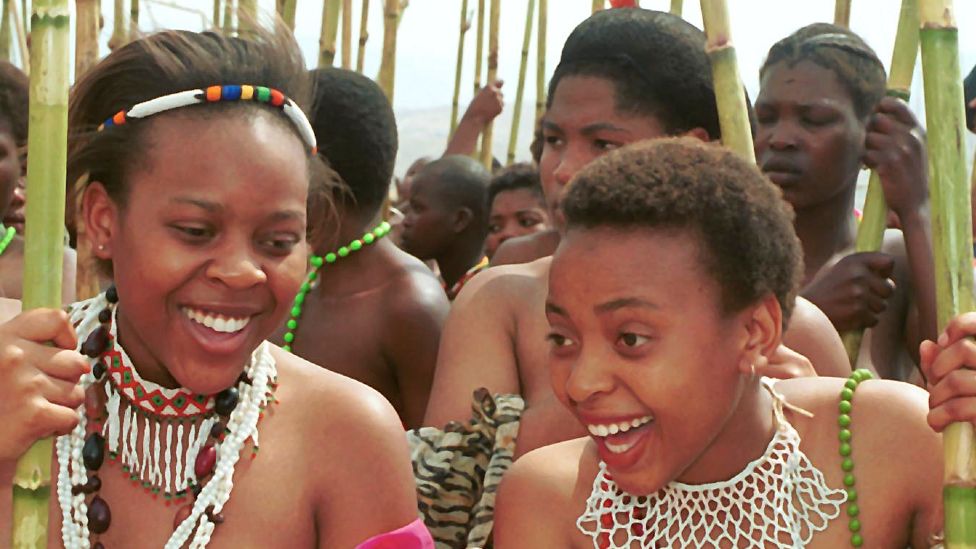
    And when he oversaw last month’s Reed Dance – a rite of passage ceremony for teenage girls – the monarch spoke out against gender violence in a country that has one of the world’s highest rates of rapes and sexual assaults.

    Girls at a Zulu Reed Dance ceremony - archive shot
    IMAGE SOURCE,AFP Image caption, The Reed Dance is a rite of passage for young Zulu women and teenage girls

    “Violence against women and children is an embarrassment to our nation. A woman is to be respected and protected. We must do better as men,” he said.

    On the side-lines of those rehearsing for the Durban coronation, some young women tell us why the event means so much to their generation.

    “We are excited to attend to show him that we are 100% behind him as king,” one of them says.

    Who is Misuzulu ka Zwelithini?

    • Born on 23 September 1974 in Kwahlabisa
    • Educated privately at St Charles College in Pietermaritzburg
    • Studied at Jacksonville University in the US, where he lived for several years
    • Married to two wives, with three sons
  • South Africa president scraps free electricity, water for ministers

    South Africa’s President Cyril Ramaphosa has withdrawn controversial perks for cabinet ministers and their deputies that saw their homes supplied with free electricity and water.

    The benefits caused a public outcry as they were considered insensitive at a time South Africans are struggling with daily power cuts and rising cost of living.

    In a press briefing on Monday evening, a spokesman said the president “acknowledges and appreciates the public sentiments on the matter”.

    The ministerial handbook, which outlines ministerial benefits, will be “aligned to the realities that many South Africans face”, presidential spokesman Vincent Magwenya said.

    He said the intention behind the perks was “not a nefarious one”.

    “The intention was to try and find some form of balance between what ministers could afford versus some of the costs that they have,” he is quoted as saying the by the state news agency.


  • King Charles III to host South African leader in state visit

    King Charles III will welcome South African President Cyril Ramaphosa to the U.K. for three days of high-level talks next month.

    This is to celebrate the first state visit of his reign with the leader of a Commonwealth member with close ties to the royal family.

    Ramaphosa has accepted Charles’s invitation for a state visit from Nov. 22-24, Buckingham Palace said Monday. The South African leader will be accompanied by his wife, Dr. Tshepo Motsepe.

    Charles has visited South Africa on several occasions since 1997. At Nelson Mandela’s funeral in 2013, he said the world would be a “poorer place” without the man who led South Africa’s transition from apartheid to multi-ethnic democracy, adding that Mandela was owed “an enormous debt of gratitude” for his achievements.

    The King and Camilla, the queen consort then the Prince of Wales and the Duchess of Cornwall welcomed former South African President Jacob Zuma to the U.K. at the start of a state visit in 2010.

    Charles’ sons, Princes William and Harry, have also visited South Africa a number of times.


    Source: Africanews

  • King Charles to host SA’s Ramaphosa

    Next month, King Charles III will host South African President Cyril Ramaphosa for three days of high-level negotiations in the United Kingdom. This will be the first official visit since the king succeeded his late mother Queen Elizabeth II last month.

    In a statement on Monday, Buckingham Palace announced that Ramaphosa has accepted Charles’s invitation for a state visit from November 22 to 24.

    The South African leader will be accompanied by First Lady Tshepo Motsepe.

    South Africa is a member of the Commonwealth, a political association of 56 countries, mostly former British colonies.

    Ramaphosa’s predecessors Nelson Mandela, Thabo Mbeki, and Jacob Zuma, the other presidents the country has had since its first multi-ethnic elections in April 1994, have also previously made state visits to the UK.

    While still the prince of Wales and the Duchess of Cornwall, Charles, and Camilla, the queen consort, welcomed former South African President Jacob Zuma to the UK at the start of a state visit in 2010.

    The new monarch has visited South Africa on several occasions since 1997. At Mandela’s funeral in 2013, he said the world would be a “poorer place” without the man who led South Africa’s transition from apartheid to multi-ethnic democracy, adding that Mandela was owed “an enormous debt of gratitude” for his achievements.

    The visit comes as Ramaphosa faces a huge scandal back at home. Arthur Fraser, the former head of the country’s spy agency has accused the president of kidnapping, bribery, money laundering, and “concealing a crime” in relation to the alleged theft of $4m in cash found at his Phala Phala game ranch in northern South Africa.

    The country’s parliament has opened investigations into the matter and Ramaphosa could face an impeachment vote in the coming weeks.

  • Ramaphosa appoints anti-corruption advisory team

    President Cyril Ramaphosa has appointed nine people to form an anti-corruption advisory council to help in the fight against corruption.

    The National Anti-Corruption Advisory Council has been tasked with preventing a recurrence of state capture in South Africa.

    The team will help with the effective implementation of the anti-corruption strategy by the government, civil society and the private sector.

    The panel will also guide the president on the government’s response to implementing the recommendations of the Zondo Commission report.

    President Ramaphosa has until 22 October to report to parliament on how his administration will implement the report’s findings.

    Source: BBC

  • Cyril Ramaphosa: Arthur Fraser accuses South Africa president of kidnapping and bribery

    South Africa’s former spy chief has accused President Cyril Ramaphosa of kidnapping and bribery in a case he has registered with the police.

    Arthur Fraser said the case related to the alleged attempted theft of $4m (£3.2m) in 2020 at one of the president’s properties and the alleged efforts to conceal what happened.

    Mr Ramaphosa said “there is no basis for the claims of criminal conduct”.

    Mr Fraser is seen by some as an ally of former President Jacob Zuma.

    Some believe the allegations could be linked to wrangles within the ruling African National Congress (ANC) ahead of a leadership race in December.

    The police have confirmed that a case has been registered with them and that “due processes will follow”, which includes an initial investigation.

    Mr Fraser, who ran the country’s State Security Agency (SSA) between 2016 and 2018, has said he has handed photographs, bank account details and video footage over to the police.

    In a statement, he alleged that criminals broke into a farm in Limpopo province in February 2020 to steal more than $4m. They were then detained and interrogated on the property and paid to keep quiet about what had happened, the statement alleges.

    In response, Mr Ramaphosa’s office confirmed that there was a robbery at his farm in Limpopo “in which proceeds from the sale of game were stolen”.

    The president, who was out of the country at the time, reported the incident to the police’s presidential protection unit, the statement from his office said.

    He “stands ready to cooperate with any law enforcement investigation of these matters”, it added.

    After running the SSA, Mr Fraser went on to head the country’s prison service. Last September, he was responsible for ordering Zuma’s release on medical parole nearly two months into his 15-month prison sentence for contempt of court – a decision which was criticised by many South Africans.

    He has also been accused of enabling graft while he was running the SSA by witnesses at an inquiry into corruption in the country during the Zuma presidency known as the Zondo commission. Mr Fraser has accused the witnesses of lying about him.

    Mr Ramaphosa became president in February 2018 after Zuma resigned in the face of numerous corruption allegations, which he denied. The ANC remains divided between supporters of the two men. It is due to choose later this year who will be its presidential candidate for the 2024 elections.

    The president has made combatting corruption a priority of his government. But his commitment to this has been questioned as the misuse of state funds, especially over money earmarked for fighting Covid-19, has continued during his presidency.

    Before he became deputy president in 2014, Mr Ramaphosa was a prominent businessman with stakes in mining, telecoms, media, beverage and fast food companies.

    In 2014, he declared to parliament that he owned $5m in shares as well as 30 townhouses. But it is widely believed that his wealth is greater than that.

    Source: BBC

  • Infrastructure development set to help turn around economy – South African President

    Infrastructure development projects were set to play an important role in turning around South Africa’s stagnant economy, President Cyril Ramaphosa said on Tuesday at the opening of a hotel and conference centre in Johannesburg east.

    He said the government planned to focus on new infrastructure developments, a move which would be critical in job creation.

    “Our economy has been plunged into turmoil, people have lost their jobs and many promising investments have been put on hold or shelved,” he said. “Fast-tracking infrastructure projects-both public and private-is critical if we are to get the wheels of economic activity turning again.”

    He said while the economy had suffered due to the pandemic, he was optimistic of growth. “It is vital that we do so to recover the jobs that have been lost during the pandemic and create new ones,” he said, adding that as much as the country needed foreign investment, local investors should take a lead.

    President Ramaphosa earlier unveiled a nine-meter statue of OR Tambo in Kempton Park, where he mentioned that both events would attract tourists to the country.

    “I do not doubt that having now opened your doors, you will soon be attracting business travellers, domestic travellers and residents of the city,” he said.

    Source: GNA

  • Ramaphosa warns of ‘difficult decisions ahead’

    South Africa’s President Cyril Ramaphosa has warned of “difficult decisions and difficult days” ahead in dealing with the economic effects of the Coronavirus pandemic.

    He also said there are “no quick-fixes” to recovery even as the government gradually reopens the economy following three months of restrictions.

    The president, in a statement, said the finance minister will this week table a revised budget in parliament which would prioritise some programmes and scale back on others.

    Businesses have been retrenching staff because of heavy losses while others are closing permanently. President Ramaphosa acknowledged the challenge of balancing safety measures and saving businesses from collapse.

    “We would urge that the difficult decisions to be taken are taken with care and with due regard to balancing the sustainability of companies and the livelihoods of workers. It is important that whatever is done is underpinned by ensuring a just transition to all concerned,” he said.

    Source: bbc.com

  • Ramaphosa condemns theft of food meant for the poor

    South African President Cyril Ramaphosa has condemned the alleged theft of food packages meant to cushion the poor from hunger during the coronavirus pandemic.

    The president said the reports were “disturbing and disgusting” adding that the individuals involved in the hoarding, selling or diverting of food aid would be dealt with “harshly”.

    “Over the past three weeks, we have been confronted with distressing images of desperate people clamouring for food parcels at distribution centres and of community protests against food shortages,” the president wrote in his weekly bulletin.

    President Ramaphosa also said the government would increase welfare provision to the poor who live “below the poverty line” but did not specify how that would be done.

    Economists and labour unions in the country have been in the past quoted by local media asking for increased social grants.

    Source: bbc.com

  • Wealth fund to bolster struggling SA economy

    President Cyril Ramaphosa says South Africa’s economy has stalled and public finances are under severe pressure.

    In his State of the Nation address on Thursday, he blamed persistent power shortages for the faltering economy, and said several state-owned enterprises were in distress.

    He said South Africa would establish a sovereign wealth fund and set up a state bank to extend access to financial services.

    Several state firms, including South African Airways and the power company Eskom, are in crisis, partly due to mismanagement.

  • Government cannot fix SA’s economy on its own – Ramaphosa

    President Cyril Ramaphosa has admitted that government will not be able to fix South Africa’s economic woes on its own.

    This comes as the country faces possible downgrades due to low economic growth, a growing debt burden and upward revision of the fiscal deficit.

    In November last year, ratings agency Moody’s maintained its investment-grade rating on South Africa, but changed the country’s sovereign credit rating outlook from stable to negative.

    Speaking during his State of the Nation Address on Thursday evening in Parliament, Ramaphosa said the country needed to be frank and admit that the government could not solve the country’s economic challenges alone.

    “Even if we were to marshal every single resource at our disposal, and engage on a huge expenditure of public funds, we would not alone be able to guarantee employment to the millions of people who are out of work,” he said.

    Ramaphosa said that, through the Jobs Summit, the government had brought labour, business and communities together to find solutions to the unemployment crisis. He added that all stakeholders would continue to meet at the beginning of every month to remove blockages and drive interventions that would save and create jobs.

    Procurement of emergency power

    Addressing Eskom, he said government would start the procurement of emergency power from projects that could deliver electricity into the grid within three to 12 months from approval. He added that municipalities would be able to procure their own power from independent power producers, to much applause from the DA MPs.

    Last year, the DA in the City of Cape Town went to the courts to seek permission to buy electricity directly from independent power producers (IPPs), due to the ongoing blackouts in the country.

    Acting Mayor Ian Neilson told News24 earlier that the City was seeking permission from the judge president of the Gauteng High Court for an expedited hearing on its energy case, asking the Mineral Resources and Energy Minister Gwede Mantashe and the National Energy Regulator of South Africa (Nersa) to allow it to buy energy from the IPPs.

    Ramaphosa also promised to modernise the Passenger Rail Agency of South Africa’s (Prasa) rail network by investing R1.4bn in the central line in the Western Cape and the Mabopane line in Pretoria.

    He skimmed through intervention measures for the beleaguered South African Airways (SAA) which was placed under business rescue, only saying that the business rescue practitioners were expected to unveil their plans for restructuring the airline in the next few weeks.

    On education, he said government would build nine TVET college campuses in KwaZulu-Natal and the Eastern Cape and a new science and technology university in the City of Ekurhuleni.

    Another great leap for the Department of Education would be the introduction of two new subjects, coding and robotics, he said. These two subjects would be introduced to 200 primary schools, becoming fully implemented in 2022.

    SOurce: new24.com