Tag: Debt

  • Public debt-to-GDP ratio hits 42.2% in February 

    Public debt-to-GDP ratio hits 42.2% in February 

    The Bank of Ghana’s May 2026 Summary of Economic and Financial Data, has disclosed that Ghana’s public debt stock increased to GH¢674.1 billion which is equivalent to US$61.3 billion as of February 2026. This is equivalent to 42.2% of Gross Domestic Product (GDP). US$63.1 billion in February 2026. 

    Meanwhile, the International Monetary Fund (IMF) has projected a 17% increase in Ghana’s debt-to-GDP ratio, rising from 45.3% recorded in 2025 to 53.0% by the end of 2026.

    The projection was included in the financial watchdog’s Fiscal Monitor Report, released on the sidelines of the 2026 Spring Meetings of the IMF and World Bank in Washington, DC.

    While the report did not indicate what drivers are likely to cause the projected increase, it noted that “Government debt and interest rate projections are based on a post-debt restructuring scenario.”

    A report by the Bank of Ghana (BoG) showed that Ghana’s debt-to-GDP ratio two years ago stood at 61.8% with total debt pegged at GH¢726.7 billion. By 2025, the ratio had eased to 45.3%, with total debt declining to GH¢641 billion.

    Despite recent improvements, analysts say the outlook remains uncertain and could change depending on borrowing levels, exchange rate movements, and economic growth.

    Some market watchers argue that increased borrowing or further depreciation of the cedi could alter the debt trajectory, while slower economic growth could also weigh on the debt-to-GDP ratio.

    In April 2026, the government secured approximately GH¢2.7 billion through the issuance of a 7-year bond, marking a return to long-term domestic borrowing following the Debt Exchange Programme. The bond was issued at a coupon rate of 12.5% and is scheduled to mature on March 29, 2033.

    The International Monetary Fund (IMF) has projected that Ghana’s debt-to-GDP ratio will decline further to 50.7% in 2027.

    Data from the Ghana Statistical Service indicates that the size of the economy is now estimated at GH¢1.4 trillion, up from GH¢1.1 trillion in 2024.

    In the 2026 Budget Statement, Finance Minister Dr Cassiel Ato Forson outlined several measures aimed at sustaining debt stability. These include expanding access to concessional borrowing, rebuilding the Sinking Fund, implementing debt reprofiling and buyback programmes, and strengthening transparency in public debt reporting.

    He said the strategy is aimed at “managing debt, not being managed by it,” adding that Ghana’s goal is to return to a moderate risk of debt distress by 2028.

    Ghana remains classified as a debt-distressed country by the IMF, although recent improvements have been acknowledged. The Fund expects Ghana to reach a moderate risk status by 2028 if current reforms are sustained.

    Globally, the IMF warns that public debt pressures are rising, with worldwide debt projected to reach 100% of GDP by 2029, driven by higher spending needs and rising interest costs.

    The Fund has called for “credible, well-sequenced fiscal adjustment” across countries to address growing vulnerabilities in the global financial system.

    Meanwhile, Ghana’s domestic debt rose moderately from GH¢309.8 billion to GH¢333.8 billion by the end of 2025, according to the Bank of Ghana. However, despite the increase, the debt burden eased as a share of the economy due to strong growth in the country’s Gross Domestic Product, which led to a decline in the domestic debt-to-GDP ratio.

    According to the March 2026 Monetary Policy Report by the Bank of Ghana, the increase in domestic debt came largely from the short-term instruments marking the government’s plan to borrow to build buffers to meet its financial obligations.

    Also, the external debt increased in foreign currency terms to reflect new loan disbursement.

    However, in local currency terms, it decreased from GH¢416.8 billion in December 2024 to GH¢307.2 billion in December 2025.

    The downturn was attributed to the appreciation of the cedi alongside servicing of Eurobond and multilateral obligations, resulting in a reduction in the external debt stock denominated in local currency by GH¢125.2 billion (9% of estimated GDP).

    Meanwhile, the provisional debt stock of the central government and guaranteed debt stood at GH¢640.99 billion (45.3% of GDP) at end-December 2025 from GH¢726.7 billion (61.8% of GDP) at end-December 2024.

    Out of the total public debt, external debt was GH¢307.2 billion (21.7% of GDP) and domestic debt totalled GH¢333.8 billion (23.6% of GDP).

    According to the Bank of Ghana, the sharp decline is reflected in both external and domestic debt-to-GDP ratios.
  • Ghana to finalize bilateral agreements on $5.1bn debt restructure in June – Finance Ministry

    Ghana to finalize bilateral agreements on $5.1bn debt restructure in June – Finance Ministry

    Ghana is set to conclude bilateral agreements for the restructuring of its $5.1 billion official bilateral debt by June, a goal that Finance Minister Dr. Cassiel Ato Forson has described as “ambitious.” 

    This follows the signing of a Memorandum of Understanding (MoU) with the Official Creditor Committee (OCC) on January 28.

    This information is outlined in the 2025 Budget Statement and Economic Policy, which highlights Ghana’s fiscal strategies, including debt restructuring efforts aimed at stabilizing the economy.

    Highlighting the importance of this process, the Finance Minister stated, “We look forward to the support of this august House in achieving this objective within the established timeframe.”

    The agreement formalizes the key terms of the restructuring, which were outlined in an Agreement in Principle (AIP) reached on January 12, 2024. It includes an extension of debt service repayments and provides approximately $2.8 billion in debt relief. Additionally, the MoU establishes a cut-off date of December 31, 2022, and imposes limits on disbursements during Ghana’s IMF-supported program from 2023 to 2026.

    The signing of the MoU paves the way for negotiations with individual OCC member countries. As part of the process, Ghana has commenced data reconciliation and validation exercises with several creditors in preparation for the bilateral agreements.
    In addition to official bilateral debt restructuring, the government is engaging commercial creditors, including Chinese commercial lenders, plurilateral institutions, and private banks, to restructure approximately $2.7 billion in commercial debt. Discussions on draft Non-Disclosure Agreements (NDAs) are already underway, with a financial proposal for restructuring expected to be presented soon.

    Furthermore, Ghana’s Domestic Debt Exchange Programme (DDEP), launched in December 2022, has significantly influenced the domestic debt market. The government has relied on short-term securities to finance the budget, raising GH¢45.4 billion in net proceeds from treasury bill issuances.

    The government remains committed to honoring its debt obligations, having successfully paid GH¢19.0 billion in DDEP bond coupons in 2024 and an additional GH¢9.5 billion in February 2025. The Finance Ministry believes these efforts, coupled with effective engagement with market participants, will enhance transparency, restore investor confidence, and stabilize the financial market.

    The 2025 Budget Statement also notes an improvement in investor sentiment, reflected in declining interest rates on treasury bills. By the end of December 2024, the 91-day, 182-day, and 364-day treasury bill rates stood at 28.04%, 28.68%, and 30.07%, respectively—lower than the corresponding rates in 2023.

    The government has also updated its 2024 Debt Sustainability Analysis (DSA) to align with the revised medium-term fiscal framework and the third IMF Review macro-framework. The DSA assessed Ghana’s public debt distress by evaluating macro-fiscal developments and agreements reached with the OCC and Eurobond holders. It examined Ghana’s solvency and liquidity status, considering current and future debt service obligations and their impact on the country’s debt dynamics in the medium- to long-term.

    According to the analysis, Ghana’s external and public debt risk rating remains at ‘high risk’ of debt distress. The Present Value (PV) of the total debt-to-GDP ratio and the external debt service-to-revenue ratio are still above DSA thresholds in the near term but are projected to return to sustainable levels by 2028.

    Beyond bilateral debt, Ghana is actively engaging commercial creditors, including Chinese commercial lenders, plurilateral institutions, and private banks, to restructure approximately $2.7 billion in commercial debt. Discussions on draft Non-Disclosure Agreements (NDAs) are underway, with a financial proposal for restructuring expected to be presented soon.

    Additionally, the Domestic Debt Exchange Programme (DDEP), launched in December 2022, continues to impact Ghana’s debt landscape. In 2024, the government honored DDEP bond coupon payments totaling GH¢19.0 billion, including GH¢12.1 billion in cash payments and GH¢6.9 billion in payment-in-kind (PIK) payments. In February 2025, the fourth coupon payment of GH¢9.5 billion (including GH¢3.5 billion in PIK payments) was successfully honored. To finance the budget, the government issued short-term securities, raising GH¢45.4 billion in net proceeds from treasury bill issuances.

    Ghana’s domestic debt market has shown signs of improvement, with a gradual decline in interest rates due to improved investor confidence. By the end of December 2024, the 91-day, 182-day, and 364-day treasury bill rates stood at 28.04%, 28.68%, and 30.07%, respectively—lower than the corresponding rates in 2023, which were 29.36%, 31.95%, and 32.49%.

    The government remains committed to ensuring effective communication with market participants, increasing transparency, and restoring investor confidence, which will be crucial in sustaining economic stability.

  • External debt at $27.6bn; GHC761.0bn total debt as of Nov 2024 – BoG

    External debt at $27.6bn; GHC761.0bn total debt as of Nov 2024 – BoG

    Ghana’s total public debt stood at GHC761.0 billion by November 2024, reflecting a month-on-month decrease of GH¢24.1 billion, according to the Bank of Ghana’s January 2025 Summary of Financial and Economic Data.

    This decline in the overall debt was attributed to the successful restructuring of the country’s external debt, which significantly reduced its external debt component.

    In dollar terms, Ghana’s total debt was valued at US$47.9 billion as of November 2024, a decrease from US$51.6 billion recorded in the same month the previous year. This level of debt equates to 72.2% of the nation’s Gross Domestic Product (GDP).

    The external debt, which plays a significant role in the country’s financial structure, was reported at US$27.6 billion in November 2024. This figure is notably lower than the US$30 billion recorded in November 2023, and represents a decrease from US$32.0 billion in both September and October 2024.

    Conversely, domestic debt saw an upward trend, rising to GH¢311.7 billion as of November 2024, which accounts for about 30.5% of GDP. This increase is attributed to the government’s persistent borrowing from the treasury market, with domestic debt sitting at GH¢275.8 billion in February 2024.

    Although data from August 2024 to December 2024 on government fiscal operations was not available, the fiscal deficit to GDP stood at 3.9% as of July 2024, while the primary balance reflected a deficit of 1.8% of GDP during the same period.

    As of November 2024, Ghana’s economy was valued at GH¢1.020 trillion, with continued fiscal challenges and external debt restructuring efforts forming the core of the country’s ongoing economic management strategy.

  • Finance Minister blames Parliament for failure to complete IPPs debt restructuring agreement

    Finance Minister blames Parliament for failure to complete IPPs debt restructuring agreement

    The Minister of Finance, Dr. Mohammed Amin Adam, has attributed delays in finalizing the debt restructuring agreement with some Independent Power Producers (IPPs) to the ongoing parliamentary impasse.

    Speaking during the Finance Ministry’s monthly economic briefing, Dr. Amin Adam explained that while three IPPs—AKSA, Asogli, and Zenit—have either signed or are close to signing agreements, the process has stalled for Cen Power and Amandi. He noted that these agreements require parliamentary approval to proceed.

    “We concluded negotiations with the Independent Power Producers and some of them have signed off. For example, AKSA has signed off, and Asogli and Zenit are also about to sign off. What is outstanding is the one with Cen Power and Amandi because those two PPAs are required to go to parliament for parliamentary approval,” he said.

    Parliament was adjourned indefinitely following a Majority-led suit challenging the Speaker’s decision to declare four seats vacant, effectively halting legislative activities. Dr. Amin Adam expressed concern over the impasse, stating, “We all know the story with parliament. Until parliament returns and approves those two PPAs, they will remain outstanding.”

    Despite the challenges, the Minister emphasized that the government has fulfilled its commitments to the IPPs. “Meanwhile, for government, we have met our side of the obligation,” he stressed. “We have done everything, we haven’t missed a dollar. While we wait for parliament to approve those restructuring PPAs, I can say that we have been very religious with our side of the bargain,” he added.

    The agreements with the IPPs are critical to averting potential power shutdowns, as some producers had earlier threatened to halt operations over unpaid debts. However, the unresolved parliamentary situation continues to hinder the process, raising concerns about the timely resolution of the restructuring efforts.

    Meanwhile, Parliament will resume on December 16, after the elections to address critical matters and ensure a seamless transition to the 9th Parliament of the Fourth Republic.

  • E.S.L.A. PLC to redeem outstanding bonds worth GHS3.47bn

    E.S.L.A. PLC to redeem outstanding bonds worth GHS3.47bn

    As part of its ongoing efforts to restructure Ghana’s energy sector debt, E.S.L.A. PLC has announced plans to redeem approximately GH¢3.47 billion in outstanding bonds.

    This decision is in line with the country’s broader debt restructuring initiatives.

    In a statement released on Tuesday, November 5, E.S.L.A. PLC confirmed that it would engage its bondholders for the redemption of these bonds at par value on December 2, 2024.

    This move is part of a larger strategy to address Ghana’s energy sector debt challenges.

    The redemption follows a significant milestone earlier in October when E.S.L.A. PLC completed a 90% buyback of GH¢1.04 billion worth of bonds, effectively reducing the company’s liabilities.

    The bonds that are set for redemption include Tranches E2, E3, E4, and E5, with maturity dates spanning from 2027 to 2033.

    The company hopes this initiative will alleviate the debt burden in the energy sector and provide relief to bondholders.

    “This meeting aims to authorise modification of the final maturity or redemption date and interest payment dates of all the company’s outstanding bonds to Monday, 2nd December 2024,” the company stated in a formal notice to investors.

    E.S.L.A. PLC was founded in 2017 as a special purpose vehicle designed to tackle Ghana’s energy sector debt.

    By issuing debt securities backed by an energy debt recovery levy under the Energy Sector Levy Act of 2015, the company has raised over GH¢10.5 billion.

    As of December 2022, approximately GH¢8.4 billion of this remains outstanding.

    On November 26, 2024, a virtual meeting for bondholders will take place. During this meeting, stakeholders will discuss proposed changes to the bond maturity dates and interest payment schedules to align with the planned redemption.

    Bondholders will also have the opportunity to vote on the proposal to advance the redemption date.

    According to the company’s formal notice, the purpose of the meeting is to secure approval for modifying the final maturity and redemption dates of all outstanding bonds, setting them to December 2, 2024.

    The company’s improved financial position supports its buyback efforts. Unaudited financial statements for September 2024 show assets of GH¢5.32 billion, with GH¢3.79 billion in cash.

    E.S.L.A. PLC also reported a decline in liabilities from GH¢5.03 billion in September 2023 to GH¢4.81 billion in September 2024. Additionally, the company saw significant profit growth, reaching GH¢165.75 million in the third quarter of 2024, compared to GH¢51.90 million during the same period in 2023.

    This improved financial standing is in alignment with Ghana’s broader debt sustainability goals, particularly through the government’s Domestic Debt Exchange Programme (DDEP). Under this initiative, bondholders were offered new government bonds in exchange for E.S.L.A. PLC bonds, helping to reduce overall debt and allowing bondholders to settle earlier than originally scheduled.

    Bondholders are encouraged to attend the upcoming virtual meeting, either in person or via proxies, as it aims to finalize the company’s debt restructuring plan. This effort will ensure greater financial stability for E.S.L.A. PLC while contributing to resolving Ghana’s long-standing energy sector debt issues.

  • Ghana’s credit rating climbs to Caa2

    Ghana’s credit rating climbs to Caa2

    Moody’s Ratings has upgraded Ghana’s long-term issuer ratings in both local and foreign currencies from Caa3 and Ca to Caa2, while also changing the outlook from stable to positive.

    The upgrade to Caa2 reflects significant progress in Ghana’s debt treatment, which has alleviated the government’s financial strain.

    “Since seeking relief through the G20 common framework for debt treatment in 2022, the government of Ghana restructured local currency debt and debt owed to bilateral official-sector creditors and concluded the exchange of Eurobonds on 9 October rating”, the rating note said.

    Moody’s highlighted that since seeking assistance through the G20 common framework for debt treatment in 2022, the Ghanaian government has successfully restructured its local currency debt and the debt owed to bilateral official-sector creditors. This restructuring included an exchange of Eurobonds completed on October 9.

    According to Moody’s, the government’s debt burden has decreased from a peak of 93% of GDP in 2022 to an anticipated 81% in 2024. However, the agency cautioned that challenges remain, such as the resumption of debt service payments, fiscal risks leading up to the December elections, and reliance on costly short-term debt, which contribute to ongoing liquidity risks that constrain the rating.

    The positive outlook indicates potential for an easing of liquidity risk, bolstered by ongoing fiscal consolidation efforts supported by an International Monetary Fund (IMF) program. Analysts suggest that if the identified risk factors diminish, Ghana’s rating could further improve. Despite setbacks in institutional credibility due to financial difficulties, the country’s remaining institutional capacity presents opportunities for a relatively rapid recovery in credit trends. The IMF program is expected to enhance policy credibility and improve Ghana’s access to affordable funding from official sources.

    Moody’s has also upgraded Ghana’s local and foreign currency senior unsecured Medium-Term Note (MTN) program ratings to (P)Caa2 from (P)Caa3 and (P)Ca, respectively. Additionally, a Caa2 rating was assigned to senior unsecured instruments issued as part of the recent debt exchange.

    No changes were made to outstanding debt instruments; however, Moody’s plans to withdraw ratings for these obligations once they are settled. Furthermore, the agency raised Ghana’s local currency (LC) and foreign currency (FC) country ceilings by one notch to B2 and B3, respectively, reflecting the upgrade of the sovereign local currency ratings.

    Moody’s notes that non-diversifiable risks are incorporated in the LC ceiling, which stands three notches above the sovereign rating. This assessment considers factors such as predictable institutions and government actions, limited domestic political risk, and low geopolitical risk, balanced against a significant government presence in the economy and financial system, as well as external imbalances.

    The FC country ceiling, which is one notch below the LC ceiling, takes into account the authorities’ historical access to foreign exchange, despite limitations on capital account openness and ineffective policy measures.

    Moody’s emphasizes that Ghana’s comprehensive debt restructuring has considerably alleviated the government’s financial burdens, which was a key reason for the ratings upgrade. Since the debt treatment began in December 2022 under the Common Framework, it has addressed 55% of the total outstanding debt, including a 37% principal haircut on most Eurobonds, representing 20% of total debt. Local currency debt (excluding Treasury Bills) and bilateral official-sector debt were also restructured through extended maturities and reduced coupon rates.

    To enhance financial stability, the government utilized a Financial Stability Fund to support local financial institutions involved in the debt exchange. Analysts project that, following the restructuring and the debt service moratorium, the government’s debt will drop to an estimated 81% of GDP in 2024, down from 93% in 2022.

    Despite this positive trajectory, foreign exchange risks remain significant, with nearly half of the government debt denominated in foreign currencies. The fiscal outlook is contingent on the government’s ability to maintain its consolidation efforts, ensuring continued access to funding. With the upcoming elections in December 2024, the possibility of fiscal arrears accumulating poses a risk.

    Assuming no significant arrears occur, Moody’s forecasts a balanced primary budget for 2024 and a return to a primary surplus of approximately 1.3% of GDP in 2025, similar to the surplus achieved in 2023. The government primarily relies on issuing Treasury Bills, with rates closely aligned to the central bank’s policy rate of 27%, which is notably higher than the inflation rate of 21%. Consequently, elevated liquidity risks continue to constrain the rating.

    The positive outlook indicates that liquidity risk may decrease as ongoing fiscal consolidation progresses under the IMF program. The combination of significant fiscal risks ahead of the December elections, resumption of debt service payments, reliance on costly short-term debt, and downward currency pressures represent ongoing challenges. Should these risks dissipate, Ghana’s rating could be elevated.

    Moody’s anticipates that gradual disinflation and fiscal improvements will pave the way for a normalization of interest rates on local currency debt, which is the primary borrowing source for the government. This shift would address Ghana’s debt affordability issues and alleviate liquidity risks.

    Additionally, with the IMF program in place, official-sector funding may improve, and recent robust gold exports could contribute to a more stable currency, according to the rating note.

    Despite Ghana’s recent default undermining institutional credibility, the country’s institutional capacity remains strong enough to potentially reverse the credit trend quickly. The prompt and transparent management of the debt restructuring has bolstered the authorities’ credibility. Current fiscal data for 2024 indicate improved revenue and spending performance compared to the years preceding the restructuring.

    Overall, Ghana’s rankings under the Worldwide Governance Indicators for policy effectiveness, rule of law, and control of corruption continue to be relatively strong. Moody’s asserts that the IMF program will help strengthen policy credibility and facilitate Ghana’s access to affordable funding from official-sector sources, thereby mitigating liquidity risks that are constraining the rating.

  • Ghana’s national debt hits GHS761.2bn

    Ghana’s national debt hits GHS761.2bn

    As of July 2024, Ghana’s debt stock has soared to GH₵761.2 billion, accounting for 75.7 percent of the nation’s gross domestic product (GDP).

    In comparison, the debt stock at the same time last year was GH₵587.7 billion, which represented 70.3 percent of GDP.

    This information was revealed in the latest Summary of Economic and Financial Data published by the Bank of Ghana in September 2024.

    The report indicated that the external portion of the debt increased to US$31.6 billion, up from US$30 billion during the same period last year, making up 46.1 percent of GDP.

    Meanwhile, the domestic debt stood at GH₵290.9 billion, which is 28.5 percent of GDP.

    When divided by the current population, each Ghanaian is estimated to owe approximately GH₵22,076 as of the end of July 2024.

    Ghana under IMF support

    Ghana is presently engaged in an International Monetary Fund (IMF) program, aiming for a US$3 billion bailout to support its economic recovery efforts.

    Following a positive assessment of the country’s progress, Ghana received a third tranche of US$360 million on Monday, July 1, 2024.

    The IMF has noted that Ghana’s overall performance under the program has been largely strong.

    Third review underway

    The International Monetary Fund (IMF) has begun its third review of Ghana’s progress under the program, which is necessary for the release of the next tranche of funding.

    Dr. Ernest Addison, Governor of the Bank of Ghana, earlier urged government officials to focus on meeting the criteria outlined for the review.

    He warned that any delays in achieving the set benchmarks could undermine progress and negatively impact the third review, which is particularly important as the year draws to a close.

    Dr. Addison issued this reminder during a joint press conference with the Ministry of Finance and the IMF on July 2, 2024.

  • Ghana’s central govt debt rises to   GHS761.1bn

    Ghana’s central govt debt rises to GHS761.1bn

    Ghana’s central government debt has reached GHS761.1 billion (USD51.1 billion) by July 31, 2024, marking a substantial rise from the earlier level of GHS587.7 billion (USD53.5 billion).

    This information was shared by Finance Minister Dr. Mohammed Amin Adam.

    During the presentation of the latest monthly Economic Update at the Finance Ministry, Dr. Amin Adam emphasized that the increase in debt, when measured in cedis, is largely attributed to the cedi’s depreciation against the US dollar, among other contributing factors.

    4o“As of July 31, 2024, Ghana’s provisional nominal central government debt stood at GHS761.1 billion, equivalent to USD51.1 billion. This represents a nominal increase from the previous amount of GHS587.7 billion, equivalent to USD53.5 billion,” he said.

    Dr. Amin Adam further elaborated on how currency fluctuations have affected the debt profile, stating, “The increase in cedi terms and decrease in US dollar terms is attributed to a combination of factors, including cedi depreciation, disbursements from multilateral institutions, and domestic financing of the budget.”

  • 12 small credit and debt recovery courts inaugurated by Chief Justice

    12 small credit and debt recovery courts inaugurated by Chief Justice

    Chief Justice, Gertrude Torkonoo, has inaugurated 12 specialized courts aimed at handling small claims and debt recovery cases.

    Of these new courts, eight are located in the Greater Accra Region and four in the Ashanti Region.

    The establishment of these courts follows a notable increase in small claims filed at district courts in Ghana, largely due to the volume of cases from Bills MicroCredit.

    Justice Torkonoo revealed that over 70% of the cases filed by Bills MicroCredit involved claims under GHC 5,000.

    This surge has significantly increased the workload of district courts, which were already facing challenges with the court shift system implemented by the Judicial Service.

    To address this issue, the Judicial Service, with support from Bills MicroCredit, has set up these small claims and debt recovery courts. These courts will operate every weekday afternoon and on Saturdays.

    “For the Greater Accra Region, District Court, Ashaiman, District Court, Teshie, District Court, Kasoa and District Court, La, will operate as the Saturday courts while District Court, Weija, District Court, Sowutuom, District Court ‘2’, Adenta and District Court, Gbese will operate as the weekday afternoon courts,” Chief Justice Torkonoo noted during the opening of the courts.


    At the La District Court’s opening, Chief Justice Torkonoo thanked Bills MicroCredit for their support in establishing the new courts.

    CEO of Bills MicroCredit, Richard Quaye, emphasized the benefits of these courts for their business.

    He noted that his company has filed 30,000 cases nationwide and highlighted the challenges of managing the large volume of defaulters.

    ‘One significant challenge we have faced is the sheer volume of defaulters resulting in our need to resort to the courts for recovery — over 30,000 — filed by our company seeking expedited hearings.

    “The establishment of the new Small Claims Court will greatly alleviate the burden on our judicial system, ensuring that cases are resolved more quickly and efficiently,” Richard Quaye said at the opening of the courts.

  • COCOBOD addresses loan default claims, clarifies debt status

    COCOBOD addresses loan default claims, clarifies debt status

    The Ghana Cocoa Board (COCOBOD) has addressed allegations of repeated loan defaults, providing clarity on its financial obligations and repayment status.

    As of December 31, 2022, COCOBOD’s total debt to the Bank of Ghana was reported at GH¢8.24 billion.

    This debt includes a GH¢1.99 billion loan facility with a 10-year term and an overdrawn Cocoa Bills Retirement Account totaling GH¢6.86 billion.

    COCOBOD clarified that the GH¢1.99 billion loan, secured in 2013, was meant to cover outstanding cocoa bills from the 2010/2011 season. The loan included a moratorium until 2018 due to cash flow issues worsened by low cocoa prices during the COVID-19 pandemic.

    Although there have been delays in repaying the principal, COCOBOD has consistently met interest payments and has set up a revised repayment plan to start in October 2024. The Board firmly denied any default on this loan.

    For the overdrawn Cocoa Bills Retirement Account, COCOBOD attributed the deficit to non-marketable cocoa bills from the 2016/2017 season, which were crucial for maintaining cocoa production amid falling international prices and changing agricultural trends.

    These bills were rolled over at elevated interest rates due to prevailing economic conditions.

    During the 2023 Domestic Debt Exchange Program, the government assumed a substantial portion of this debt, providing COCOBOD with a 50% discount. The remaining debt balance is still noted but does not reflect the initial amount claimed.

    COCOBOD’s Public Affairs Department emphasizes that the Board has not defaulted on its commitments and is managing its debt obligations responsibly.

    Read full response in the statement below:

  • Debt challenges persist despite Restructuring – Fitch reports

    Debt challenges persist despite Restructuring – Fitch reports

    A recent report by Fitch has highlighted that Ghana’s economy continues to grapple with substantial financing difficulties despite the government’s debt restructuring efforts.

    Consequently, the rating agency has maintained Ghana’s rating at a level that signifies the country is effectively in default on its foreign debts.

    The rating, termed ‘RD’ or ‘Restricted Default,’ indicates that Ghana has missed payments on certain international loans, notably its Eurobonds.

    Nevertheless, the report acknowledged that the country is striving to restructure its debts and collaborate with international creditors to enhance its financial standing.

    Approximately $478 million of this sum is projected to be paid to Eurobond holders with whom Ghana recently finalized a debt restructuring agreement. “We are fully aware of the upcoming payments, and our cash flow projections show that we have made provisions for this specific obligation.”

    Dr. Addison confirmed, “Indeed, we have built reserves to manage some of these substantial payments as part of our financial planning.”

    Ghana’s gross international reserves increased to $6.86 billion in the first half of the year, up from $5.34 billion during the same period in 2023. Fitch has also upgraded Ghana’s rating to ‘CCC’ for its capacity to repay debts in its local currency.

    This suggests that, while Ghana is struggling with international debts, it is somewhat better positioned to meet its domestic financial obligations.

    The report points out that Ghana is actively negotiating with its lenders and working on strategies to reduce its debt burden, which may enhance its financial stability in the future.

    As of June 2024, Ghana’s total debt was GH¢742.0 billion, equivalent to 70.6% of GDP.

    Ghana’s economy is burdened with unsustainable public debt, prompting the country to seek assistance from the International Monetary Fund (IMF).

    Under a three-year program with the IMF, the government has been tasked with restructuring both domestic and external debt, aiming to reduce the debt-to-GDP ratio to 55% by 2026.

    The Domestic Debt Exchange Programme, initiated in December 2022, involved swapping old bonds valued at approximately GH¢82 billion for 12 new bonds with lower coupon rates and extended tenors.

    Since then, the government has settled payments for all local individual bondholders who opted out of the DDEP, with payments to local institutional bondholders still ongoing.

    During the mid-year budget presentation, Finance Minister Dr. Mohammed Amin Adam reported that the government had paid around GH¢12 billion to bondholders participating in the DDEP, reflecting its commitment to the program.

    He noted that the government had completed two coupon payments and scheduled a third payment of GH¢6.1 billion for August. This contributed to Fitch’s improved rating on Ghana’s ability to service domestic debt.

    Externally, the government recently signed a Memorandum of Understanding with the Official Bilateral Committee to restructure about $5.1 billion in bilateral debts.

    The country is awaiting formal agreements from individual countries. On the commercial front, Ghana has reached a deal with the Eurobond holder committee to restructure approximately $13 billion in bonds, involving a 37% reduction in principal and a suspension of coupon payments until 2026.

    The debt restructuring involves $4.7 billion in cancellations and $4.4 billion in debt service savings from 2023 to 2026.

    Later this month, the government plans to launch a consent solicitation and exchange memorandum in the international capital market. This will allow it to seek Eurobond investors’ approval to amend the terms of the bonds.

    Two new bond options are available: the PAR bond, with a limit of $1.6 billion, and the DISCO bond, which offers three new instruments (Bond short, Bond long, and Down Payment Bond). Consenting holders will receive a PDI Bond and a consent fee.

    Fitch expects the consent solicitation to be launched soon and the Eurobond exchange to be completed by September 2024, though delays might occur due to ongoing negotiations regarding the International Development Association (IDA)-partially guaranteed bond.

    Fitch noted, “We anticipate the completion of the external debt restructuring by the end of 2024.”

    Regarding Eurobond repayments, Fitch’s affirmation of the LTFC IDR at ‘RD’ reflects that Ghana remains in default on its Eurobonds following the lapse of the grace period for a missed coupon payment in February 2023.

    At a recent Monetary Policy Committee press briefing, Bank of Ghana Governor Dr. Ernest Addison confirmed that the country has sufficient reserves to meet its Eurobond repayment obligations in the second half of the year.

    Despite the suspension of coupon payments until 2026 as a result of negotiations, Ghana is expected to make principal payments. IC Africa Research estimates that Ghana will make debt service payments between $600 million and $800 million this year.

    About $478 million of this amount is expected to be paid to Eurobond holders who the country recently concluded a debt restructuring deal with. “We are very much aware of the upcoming payments, if you look at the cash flow projections, you would see that provisions have been made for this particular payment.”

    So yes, we have built up reserves to meet some of these lumpy payments in the outlook,” Dr Addison said.

    Ghana’s gross international reserves increased to $6.86 billion in the first half of the year, up from $5.34 billion during the same period in 2023.

  • Commercial drivers in Kumasi accepts reintroduction of road tolls

    Commercial drivers in Kumasi accepts reintroduction of road tolls

    Commercial drivers at Doctor Mensah in Kumasi, Ashanti Region, have shown support for Finance Minister Dr. Mohammed Amin Adam’s plan to reintroduce road toll taxes.

    Dr. Mohammed Amin Adam unveiled the road toll reintroduction during the mid-year budget review on Tuesday, July 23, 2024, with implementation slated for 2025.

    The drivers believe that this toll system will benefit them by funding better road infrastructure and promoting trade development.

    In an interview with OTEC NEWS reporter Maame Akosuah Gyamfuaa on Sunday, July 24, 2024, they emphasized the need for the government to address potential traffic delays that could arise from toll collection.

    Concerns were also raised about potential corruption among tax collectors, with suggestions for an electronic payment system to ensure transparency and proper handling of funds.

    The drivers called on the government to use the additional toll revenue for road construction and maintenance to ensure that the funds effectively improve the road network.

  • How Ghana accumulated GHS742b national debt – What the data shows

    How Ghana accumulated GHS742b national debt – What the data shows

    The Minister of Finance, Dr. Mohammed Amin Adam, during the presentation of the 2024 Mid-Year Budget Review statement in Parliament, announced that Ghana’s national debt stock stood at GH¢742 billion as of June 2024, which is more than 70% of the country’s Gross Domestic Product (GDP).

    This means that Ghana is so indebted that the country would need 70% of the value of all goods and services it produces to settle its debts.

    This also means that given Ghana’s population of approximately 31 million, every Ghanaian owes about GH¢24,000.

    But how did we get here? Were all the debts accumulated under this current government?

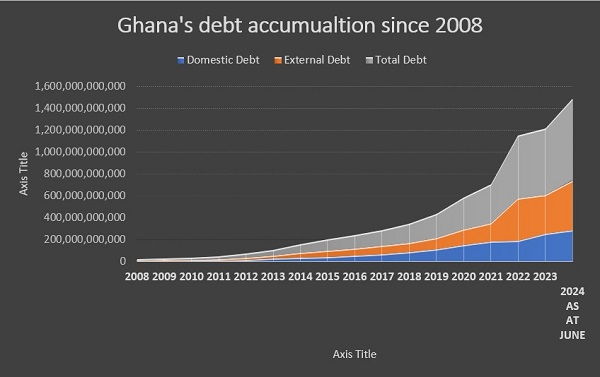
    Here is a breakdown of Ghana’s debt

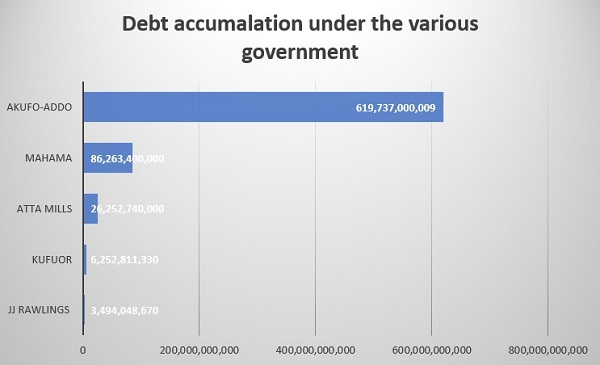
    Ghana’s total debt accumulation stood at almost $10 billion, which translated to more than GH¢3.5 billion (using the 2008 exchange rate stated in the 2009 budget – ¢3,500.70 per $1) under the first president of the 4th Republic, the late Jerry John Rawlings. These debts included those accumulated in his 8 years of democratic rule (1993 to 2000), his 12 years of military rule, and possibly the country’s debt accumulated before his coup.

    Then came the John Agyekum Kufuor government under which the country’s debt rose from the $10 billion (GH¢3.5 billion) to more than $8 billion, which translates to more than GH¢9.7 billion using the exchange rate at that time. Ghana’s debt level rose to this height under Kufuor’s regime despite the fact that about 66% of the country’s debt, which translates to almost $6.3 billion, was cancelled through the Highly Indebted Poor Country (HIPC) programme the government entered into, which also came with a lot of grants and other benefits.

    Under the late John Evans Atta Mills administration, whose later years were completed by John Dramani Mahama, Ghana’s debt stock rose from GH¢9.7 billion to nearly GH¢36 billion.

    As can be gleaned from the diagram above, the country’s debt started increasing by huge margins after the late Prof. Atta Mills era.


    Data from the Ministry of Finance:

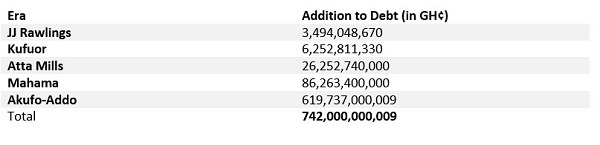
    Under the John Dramani Mahama administration, Ghana’s debt stock rose from GH¢36 billion to more than GH¢122 billion, meaning more than GH¢86 billion was added to the country’s debt stock under Mahama’s administration.

    The debt stock has increased from GH¢122 billion to over GH¢742 billion under the Nana Addo Dankwa Akufo-Addo government, as announced by the current finance minister. This shows that nearly GH¢620 billion has been added to Ghana’s debt stock under the Akufo-Addo government.

    Addition to Ghana’s debt stock in the various eras:

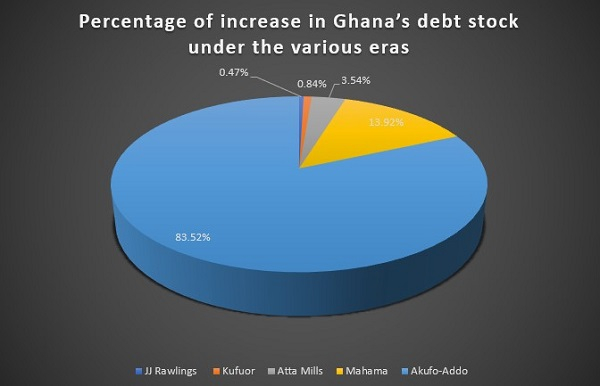
    The figures above indicate that more debts have been accumulated under the Akufo-Addo government than any other government, nearly 84 percent of Ghana’s total debt stock. The next government to see more debt accumulation was that of Mahama, with nearly 14% of the country’s debt accumulated under it.

    It is instructive to note that the accumulation of debts under the various regimes does not necessarily mean that they borrowed more to reach the debt levels recorded. In other words, the debt stock levels recorded under the regimes are not made up of only new funds borrowed.

    Other important factors affect a country’s debt stock, including the depreciation of the country’s currency, which in itself is a function of economic management. This is because the external debts of a country are denominated in foreign currency, and if its currency depreciates, the debt level would go up. So, if the economy is performing badly and a nation’s currency continues to depreciate, its debt level would go up.

    The accumulation of arrears for debts incurred by previous regimes also adds to a country’s debt stock.

    Also, as economic theory has it that borrowing or accumulating debt is not necessarily a bad thing because public debt can be vital for economic development. It can help countries grow faster by financing productive investment – and the keyword here is ‘productive investment’.

    Advanced countries, including the United States of America (USA), all borrow and have huge debt stock. The national debt for the USA, for instance, is more than $32 trillion, and that of Germany is nearly $3 trillion. What matters is the kind of investment this money goes into to propel the needed development for the betterment of the lives of the citizenry.

    In addition, borrowing and accumulating debt beyond what a country would be able to service is likely to lead to a debt crisis, which would have serious consequences on the economy and the livelihood of the citizenry.

    Source: GhanaWeb

  • Every citizen owes GHS19k due to external debt – Mahama explains

    Every citizen owes GHS19k due to external debt – Mahama explains

    Nearly eight years after transferring power to the ruling New Patriotic Party (NPP), John Mahama claims that Ghana’s external debt has increased fourfold.

    The National Democratic Congress’ presidential candidate asserts that this surge in debt, coupled with rising unemployment, has worsened the hardships faced by ordinary Ghanaians.

    Speaking to the media on July 24, he illustrated that “In 2016, if you shared the public debt of GH₵120 billion among 30 million Ghanaians, each Ghanaian owed GH₵4,000. Today if you divide the debt of GH₵577 billion by 30 million Ghanaians all of us sitting here owe GH₵19,000.”

    Ghana’s soaring debt levels have alarmed economists, raising concerns about the country’s financial stability and debt management for future administrations.

    With the debt increasing to GH₵742 billion from GH₵680 billion in 2023, experts warn that without effective interventions and sound fiscal policies, Ghana’s economic progress, particularly under the International Monetary Fund, could be jeopardized.

    Mr. Mahama is concerned that Ghana’s debt repayment difficulties have led to downgrades by credit rating agencies.

    Furthermore, escalating inflation has forced many Ghanaians to adopt the “001” approach, where “0” signifies no meals and “1” indicates having had a meal.

    The NDC flagbearer also expressed concern that the high debt levels are problematic, as they impede investment in social and economic development projects across the country.

  • Next gov’t will have to begin another debt restructuring – CSJ

    Next gov’t will have to begin another debt restructuring – CSJ

    A finance expert and fellow of the finance pillar at the Centre for Social Justice (CSJ), Haruna Alhassan, has advised the future government of Ghana to initiate another round of debt restructuring starting in 2025.

    This recommendation comes amid concerns that without strategic investment of borrowed funds, the nation will continue to face bankruptcy.

    On July 1, 2022, President Nana Akufo-Addo instructed then-Finance Minister Ken Ofori-Atta to engage the International Monetary Fund (IMF) for a debt-restructuring programme, effectively declaring the country bankrupt.

    This move resulted in significant financial challenges for bondholders.

    “We may come out [of the bankruptcy] temporarily because of debt restructuring, but overall, we will still have a debt burden that we will struggle to pay. Going into 2025 to 2028, if you look at the payment profile of the restructured bonds, we cannot run away from having a second round of debt restructuring and we must start that engagement right from 2025,” Alhassan asserted during his keynote address at the 13th edition of the Leadership Dialogue Series (LDS) organized by CSJ.

    Themed “Ghana’s Economy from 2025 – 2028: The Hard Choices,” the LDS 13 discussions offered numerous proposals for the next government to help restore Ghana’s economic stability.

    Alhassan emphasized that the next administration must avoid the criticized practice of “borrowing for consumption” and focus instead on productive investments to avoid perpetual bankruptcy.

    Alhassan also warned of the tough road ahead for any incoming government tasked with addressing the current economic challenges, marked by unprecedented hardship.

    “The road ahead will be tough. Tough, rough and bumpy,” he cautioned, advocating for leadership by an experienced individual from 2025 onward.

    The domestic debt exchange programme has faced widespread criticism for its chaotic and insensitive implementation, particularly its impact on pension funds.

    Studies indicate that the programme could reduce the wealth and income of individual households, both directly and indirectly, through retail holdings and shares in mutual and pension funds. To mitigate these issues, Alhassan stressed the importance of starting negotiations early in the next round of debt restructuring.

    The Leadership Dialogue Series, CSJ’s flagship civic education platform, aims to foster mass political participation and patriotic values through engaging discussions with experts and national leaders. CSJ, a think tank with a left-of-centre leaning, advocates for greater social inclusion in the distribution of wealth, privileges, and opportunities in society.

  • Ghana sees another ‘breakthrough’ in its international debt treatment

    Ghana sees another ‘breakthrough’ in its international debt treatment

    The Ministry of Finance has announced that Ghana’s debt treatment with Eurobond holders adheres to the Comparability of Treatment principle, as confirmed by the country’s Official Creditor Committee (OCC). I

    n a statement issued to the Ghana News Agency on Monday, July 8, the Ministry highlighted this as part of the OCC Common Framework for debt restructuring.

    The Comparability of Treatment principle necessitates that Ghana meets comparable treatment of debt obligations to all other external creditors within the restructuring scope.

    This approach aims to restore debt sustainability and prevent disorderly default by providing significant relief during the three-year International Monetary Fund (IMF) programme implementation.

    “The Government intends to continue proactive engagement with the Steering Committees to finalize documentation and proceed promptly with the consent solicitation,” the statement read. Additionally, the government expressed gratitude to its official partners and representatives from the two Bondholders’ Committees for their constructive engagement over the past weeks.

    On July 1, Ghana received a third tranche of US$360 million as part of the IMF loan-support programme. This follows an agreement reached last month with Eurobond holders, who have agreed to forego US$4.7 billion in debt, providing an additional US$4.4 billion in relief to the country.

    The debt restructuring and relief efforts are critical components of Ghana’s strategy to achieve economic stability and sustainable growth.

  • The next administration will be saddled with a significant debt burden – Seth Terkper

    The next administration will be saddled with a significant debt burden – Seth Terkper

    Former Finance Minister Seth Terkper has raised a red flag over the substantial debt burden that awaits Ghana’s next government in 2024.

    During a recent media briefing on the country’s International Monetary Fund (IMF) programme and debt restructuring efforts, Seth Terkper expressed deep concerns about the depletion of the nation’s financial reserves and buffers, which are essential for maintaining economic stability.

    Mr Terkper emphasized the severity of the situation, stating, “The next administration will be saddled with a significant debt burden. Our reserves and financial buffers, which provide essential leverage for economic management, have been nearly exhausted.”

    He attributed this precarious state to the country’s reliance on the Primary Balance, which, according to IMF data, could lead to a false sense of security and complacency.

    Highlighting the inadequacies in the current fiscal framework, Terkper pointed out that the criteria based on non-interest expenditure fail to address critical components of Ghana’s economic challenges, such as interest payments, arrears, and amortization.

    “Using the Primary Balance as a measure of fiscal health excludes critical elements like interest payments, arrears, and debt repayments,” he explained.

    He noted that arrears, including those in the energy and banking sectors, were estimated to be GHC 53 billion in 2021, and a portion of this has been added to the public debt without being reflected in the fiscal framework’s ‘financing’ section.

    Seth Terkper also cautioned against premature celebrations of perceived economic progress, noting that any apparent improvements are primarily based on the sacrifices of domestic and external lenders who have endured, and will continue to endure, financial losses.

    “There is no need to be jubilant,” Terkper warned.

    “The view that we have made progress is premised on the sacrifices and largesse of domestic and external lenders. Our legacy may not make us third-time lucky. After HIPC (forgiveness), we should not have defaulted again. We should have continued on the PRMA path, managing crises with significant inflows from our oilfields and the recent IMF tranches and donor support.”

    The IMF reported that Ghana’s primary fiscal balance improved by over 4 percent of GDP last year, but Terkper’s analysis suggests that deeper, more comprehensive measures are needed to secure the nation’s financial future.

  • Establish debt limits, borrow prudently – Prof. Peter Quartey to govt

    Establish debt limits, borrow prudently – Prof. Peter Quartey to govt

    Executive Director of the Institute for Statistical, Social and Economic Research (ISSER), Professor Peter Quartey, underscored the importance for the government to set a debt ceiling proportionate to the nation’s GDP.

    During the Quarterly Economic Roundtable, Prof. Quartey proposed that the government establish a maximum debt threshold aligned with the country’s economic output.

    Drawing from recommendations by the International Monetary Fund (IMF) and the Economic Community of West African States (ECOWAS), Prof. Quartey highlighted sustainable debt-to-GDP ratios of 50% and 75%, respectively, as benchmarks for Ghana to consider.

      “IMF reports show that each year our debt as a ratio of GDP has been unsustainable. For the IMF, the sustainable debt cap for a country is 50%, and for the ECOWAS it is 75%.

      “So there has to be a discussion on where we are going to cap our debt level as a ratio of GDP, whereby we choose our optimal debt level,” he noted.

      The professor emphasized the significance of responsible borrowing, which entails judiciously investing borrowed funds and ensuring timely repayment.

      He urged for a private sector model in government borrowing, emphasizing the necessity for comprehensive appraisal and evaluation reports.

      “We have to borrow responsibly, ensuring we can repay, and borrowing to invest. We need a private sector mindset in borrowing, where there are appraisal reports, evaluation reports, among others,” he emphasized.

      Before the Domestic Debt Exchange Programme (DDEP), Ghana’s debt surpassed 100% of its GDP.

      Following the implementation of domestic and external debt restructuring, alongside fiscal consolidation measures under the IMF’s $3 billion Extended Credit Facility (ECF) program, the debt-to-GDP ratio is projected to decline to 55% by 2028.

    1. Eurobond holders agree to restructure Ghana’s $13bn international debt

      Eurobond holders agree to restructure Ghana’s $13bn international debt

      Ghana is on the verge of finalizing an agreement in principle with its Eurobond holders for the restructuring of $13 billion worth of international debt, Reuters reported on Thursday, citing three sources.

      This development follows a recent deal concluded with official creditors earlier this month.

      The restructuring deal is expected to involve bondholders accepting a haircut on principal of up to 37% and the lengthening of the maturity of the bonds, according to two of the sources.

      Ghana faced challenges with its external debt, defaulting on most of its $30 billion debt in 2022 due to the strain of the COVID-19 pandemic, the war in Ukraine, and higher global interest rates leading to surging debt levels.

      Similar to Zambia, Ghana sought debt treatment under the G20 Common Framework, a process aimed at facilitating quick debt overhauls and involving China, the newest large bilateral lender.

      “We can expect an announcement by next week,” said one of the sources, while the other two indicated that an announcement could come as soon as Friday. The finance ministry of Ghana and the Paris Club, an alliance of creditor nations, could not be immediately reached for comment.

      Formal talks with two groups of bondholders began in mid-March, including Western asset managers, hedge funds, and regional African banks. However, negotiations stalled in April after the proposed deal did not meet the International Monetary Fund’s (IMF) debt sustainability analysis requirements, prompting both sides to regroup.

      According to the sources, the deal now aligns with a revised IMF debt framework for Ghana, leading to the agreement in principle. Earlier this month, Ghana reached an agreement with its official creditor committee to formalize a debt restructuring deal reached in January.

      These developments pave the way for the IMF executive board to convene on June 28 to consider a second review of Ghana’s $3 billion loan, three-year package, and the release of the next tranche of $360 million.

      Ghana, the world’s second-largest cocoa producer, is navigating a complex debt restructuring process as it seeks to address its debt challenges and ensure financial stability.

    2. Debt relief agreement opens door for essential infrastructure investment

      Debt relief agreement opens door for essential infrastructure investment

      The government has obtained debt service relief, which will unlock resources for essential infrastructure projects.

      At a press briefing, Minister of Finance Dr. Mohammed Amin Adam announced that the agreement, formalized through a memorandum of understanding (MoU) with bilateral creditors, reschedules debt payments due between 2023 and 2026. This rescheduling allows the government to reallocate funds initially set aside for debt servicing to crucial public services.

      “The MoU will provide significant flow relief to the Republic of Ghana. And what this means is that debt service that was due between 2023 and 2026 are being rescheduled. It means that we will not have to pay, we will not have to service our debts due between 2023 and 2026,” Dr. Adam stated.

      The reallocated funds will be directed towards vital infrastructure projects such as healthcare, education, road construction, and social programs designed to assist vulnerable populations.

      Dr. Adam highlighted the transformative impact of this relief, explaining, “The money we would have used to service the debts, to pay to our official creditors as a result of the facilities they advanced to us, will now be available to the government, for the government to spend on critical infrastructure.”

      Additionally, the Ministry of Finance intends to submit a proposal to the Cabinet outlining the best investment strategies for these funds, including creating a buffer to aid in debt repayment after 2026. This approach is designed to lessen the future fiscal strain on the budget.

      “It has always been the government intention to put in efforts, extra efforts at reaching this agreement in order that we can get the relief as a result of the resumption of disbursement towards these projects so that these projects can be completed for the use of the Ghanaian public. And so these three benefits that our country will derive from the agreement that we have reached, you can all tell are very important benefits because they speak directly to our economy. They speak directly to our development efforts,” Dr. Adam noted.

      This comes as the Ministry, on Tuesday, June 11, 2024 announced via a communique that the government had attained formalisation of a memorandum of understanding (MoU) with its Official Creditor Committee (OCC) regarding the debt treatment agreement reached earlier this year.

      The formalised agreement with the OCC, which is co-chaired by China and France, it said, will not only accelerate debt restructuring efforts but also paves the way for further financial support and economic reforms, according to the ministry of finance.

      The MoU solidifies the preliminary agreement made in January 2024, laying a foundation for a restoration of long-term debt sustainability by restructuring approximately US$5.4billion in obligations.

      The financial terms remain consistent, providing substantial debt service relief during the period, supported by the International Monetary Fund (IMF) programme.

      Dr. Adam, in the communique announcing the agreement highlighted its importance, stating: “The Ministry of Finance on behalf of the Republic of Ghana extends our gratitude to all members of the OCC, particularly the Committee’s co-chairs – China and France – for their unwavering commitment to assisting our country in resolving its debt issues.

      “This landmark agreement marks an extraordinary milestone in Ghana’s debt-restructuring journey and will further strengthen our ambitious reform agenda with the strong support of our development partners,” he added.

      The OCC agreement’s formalisation is anticipated to facilitate approval of the IMF’s Post Covid-19 Programme for Economic Growth’s (PC-PEG) second review by its Executive Board.

      This approval will enable disbursement of the next tranche of IMF financing, amounting to US$360million; an injection that should provide temporary relief for the cedi, which has fared unfavourably since turn of the year.

      Additionally, it is expected to unlock further financial assistance from key development partners – notably the World Bank.

      Dr. Adam underscored the agreement’s broader implications, noting that it will enhance ongoing negotiations with private creditors.

      “We are committed to engaging with all commercial external creditors in good faith. Our aim is to finalise restructuring agreements that respect Ghana’s need for debt relief and adhere to the comparability of treatment principle,” he said.

      Following the agreement, each official creditor will undertake their internal procedures to sign the MoU. Upon signing, the terms will be implemented through bilateral agreements with each member of the OCC.

      IMF Managing Director Kristalina Georgieva, in a tweet on the X platform said: “Congratulations to Ghana for reaching agreement with its official bilateral creditors on a Memorandum of Understanding for a debt treatment. This will support IMF Executive Board consideration of the programme’s second review later this month”.

      The government has encouraged these creditors to accelerate their internal procedures to ensure the prompt execution of the agreed terms.

      Currently, the government has restated its dedication to resolving outstanding debts with external commercial creditors until mutually agreeable arrangements are reached.

      This stance is vital to guaranteeing that all restructuring endeavors comply with the principle of treating all creditors equally.

      Analysts regard the signing of this MoU as a critical milestone in endeavors to stabilize the economy and lay the groundwork for enduring growth.

      They remain vigilant for further indications of the government’s efforts to enact essential reforms and cooperate with international partners in addressing the ongoing financial difficulties.

    3. Govt secures historic debt accord with Official Creditors Committee

      Govt secures historic debt accord with Official Creditors Committee

      The government has reached a Memorandum of Understanding (MoU) with the Official Creditor Committee (OCC) concerning the debt resolution terms agreed upon in January 2024.

      According to the Ministry of Finance, the OCC, co-chaired by China and France, was key in achieving this milestone.

      The Ministry explained that the MoU formalizes the preliminary agreement from January, representing a crucial step towards reestablishing Ghana’s long-term fiscal stability.

      This agreement also signifies that completing the Official Creditor Committee’s terms will allow for the International Monetary Fund’s (IMF) endorsement, unlocking the next IMF funding installment of US$360 million.

      The IMF Board’s approval is expected to lead to additional financial support from development partners, notably the World Bank. Furthermore, this accord is anticipated to strengthen ongoing discussions with private creditors, as Ghana seeks to secure a similar settlement soon.

      The Ministry, in a statement said, “Each official creditor will now follow its internal procedures to sign the MoU. Once signed, the agreed terms will be implemented through bilateral agreements with each OCC member We call upon our official creditors to fast-track their internal processes towards the signing of the bilateral agreements.”

      “Ghana continues to engage in good faith with all commercial external creditors, striving to finalise restructuring agreements that respect Ghana’s need for debt relief and the comparability of treatment principle. Ghana also reiterates its firm commitment to remain in arrears with its external commercial creditors until agreements compatible with the comparability of treatment principle are reached,” it added.

      The Ministry called on the official creditors to speed up their internal processes for finalizing these bilateral agreements.

      Dr. Mohammed Amin Adam, the Finance Minister, conveyed the Ministry of Finance’s sincere gratitude to all OCC members, particularly the co-chairs, China and France, for their unwavering commitment to helping Ghana resolve its financial difficulties.

      “The Ministry of Finance on behalf of the Republic of Ghana extends our gratitude to all members of the OCC. particularly the committee’s co-chairs. China and France, for their unwavering commitment to assisting our country in resolving its debt issues,” it added.

      He noted that this landmark agreement marks a major milestone in Ghana’s debt restructuring efforts and is set to enhance the country’s reform initiatives, supported by the strong backing of its development partners.

    4. Ghana sees debt service relief after agreement with Official Creditors Committee

      Ghana sees debt service relief after agreement with Official Creditors Committee

      The Government of Ghana has reached an agreement on a Memorandum of Understanding (MoU) with its Official Creditor Committee (OCC) in its debt restructuring efforts.

      This development pertains to the debt treatment plan agreed upon in January 2024. The OCC, co-chaired by China and France, was instrumental in reaching this milestone.

      The MoU formalizes the agreement in principle established with Official Creditors in January, representing a critical step towards restoring Ghana’s long-term debt sustainability.

      “The financial terms of the agreement remain unchanged, providing significant debt service relief during the Fund-supported program period,” the Finance Minister, Dr Mohammed Amin Adam, said.

      This relief will enable the redirection of financial resources towards critical sectors such as infrastructure, healthcare, and education.

      The formalization of the OCC agreement is expected to pave the way for the IMF Executive Board to approve the second review of the Fund-supported Post-COVID-19 Programme for Economic Growth (PC-PEG).

      This approval will facilitate the disbursement of the next tranche of IMF financing, amounting to US$360 million.

      Furthermore, the IMF Board’s approval is anticipated to trigger additional financial assistance from development partners, particularly the World Bank.

      The agreement will also strengthen ongoing discussions with private creditors, with whom Ghana is committed to securing a comparable agreement as soon as possible.

      “Each official creditor will now follow its internal procedures to sign the MoU. Once signed, the agreed terms will be implemented through bilateral agreements with each OCC member.

      “We call upon our official creditors to fast-track their internal processes towards the signing of the bilateral agreements,” Dr Adam said.

      Dr. Adam expressed his gratitude to the OCC members, especially the committee’s co-chairs, China and France, for their unwavering support.

      “This landmark agreement marks an extraordinary milestone in Ghana’s debt restructuring journey and will further strengthen our ambitious reform agenda with the strong support of our development partners,” he noted.

      This landmark agreement is anticipated to lay a solid foundation for Ghana’s economic recovery and sustainable development, reinforcing the nation’s commitment to transforming its economy beyond reliance on aid.

    5. Ghana’s public debt grew by GHS46.4bn in Jan-Feb 2024 – BoG

      Ghana’s public debt grew by GHS46.4bn in Jan-Feb 2024 – BoG

      Recent data from the Bank of Ghana revealed that the country’s public debt stock increased by GH¢46.4 billion in the first two months of 2024, reaching GH¢658.6 billion ($53.1 billion).

      In terms of Gross Domestic Product (GDP), Ghana’s total public debt now stands at 62.7 percent.

      The BoG’s Summary of Economic and Financial Data for May 2024 indicated that the country’s debt was GH¢611.2 billion at the end of 2023, rose to GH¢626.0 billion in January 2024, and further increased to GH¢658.6 billion in February 2024.

      This rise in public debt is attributed to the persistent depreciation of the cedi, coupled with increased government borrowing in the domestic treasury bills market.

      On the domestic debt front, the data showed an increase of GH¢18.5 billion in the first two months of 2024, representing approximately 36.1 percent of GDP.

      As of February 2024, domestic debt stood at GH¢278.7 billion, also representing 36.1 percent of GDP.

      Regarding external debt, it rose by GH¢28.9 billion due to the cedi’s depreciation against major trading currencies during this period.

      Additionally, the external component of the total public debt stock was $30.6 billion (GH¢350.3 billion) in February 2024, equivalent to 36.1 percent of GDP.

      The Central Bank’s Summary of Economic and Financial Data for May 2024 also showed that government fiscal operations were on track, with a deficit-to-GDP ratio of 2.6 percent in the first quarter of 2024, compared to 1.8 percent during the same period in 2023.

      Meanwhile, the primary balance showed a deficit of 1.4 percent of GDP in March 2024.

    6. Ghana officially bankrupt – Mahama’s comment on external debt default in 2022

      Ghana officially bankrupt – Mahama’s comment on external debt default in 2022

      On December 20, 2022, former President John Dramani Mahama declared Ghana as bankrupt.

      His statement came after the government announced its inability to fulfill certain categories of its external debt repayments as per the agreed terms.

      Former President John Dramani Mahama responded to the government’s announcement regarding its inability to fulfill certain categories of its external debt repayments.

      In a statement dated Monday, December 19, the Ministry of Finance announced the suspension of all debt service payments under specific categories of the country’s external debt component.

      The government stated that this move is an interim emergency measure pending further agreements with the relevant creditors, while some analysts have described it as Ghana effectively defaulting on its external debt.

      Former President Mahama’s response was conveyed through a tweet posted on his official handle, consisting of just four words, “Tragic! Ghana officially bankrupt.”

      What else the Finance Ministry statement said:

      GhanaWeb Business was able to obtain a copy of the Ministry’s announcement, which stated that the decision is subject to an orderly restructuring of the relevant debt obligations.

      It clarified that payments on Ghana’s commercial term loans, Eurobonds, and a sizable amount of its bilateral debt will all be suspended.

      “This suspension will not include the payments of our multilateral debt, new debts (whether multilateral or otherwise) contracted after 19th December 2022 or debts related to certain short-term trade facilities,” the statement noted.

      “We are also evaluating certain specific debts related to projects with the highest socio-economic impact for Ghana which may have to be excluded. This suspension is an interim emergency measure pending future agreements with all relevant creditors,” it added.

      However, the Finance Ministry emphasized that the government is committed to engaging with its external creditors to conduct a transparent, equitable, and comprehensive debt restructuring process in accordance with international standards.

      Additionally, it stated that the Ministry of Finance will host an investor presentation at a date to be announced in the near future.

    7. Ghana launches short-term debt market amid  restructuring efforts

      Ghana launches short-term debt market amid restructuring efforts

      Ghana has initiated a platform for trading short-term debt, which expands upon the fixed income market established over eight years ago.

      This development coincides with the country’s efforts to restructure debt to ensure sustainability under an International Monetary Fund program.

      The commercial paper market facilitates the buying and selling of debt, offering companies and organizations the opportunity to issue debt quickly and investors the chance to access improved creditworthiness, stated Abena Amoah, Managing Director of the Ghana Stock Exchange, in the capital city, Accra.

      “I’m excited to see the diverse business community here and I believe that this CP market we are launching today will provide you with viable solutions to meet some of your short-term financing needs,” Amoah said Friday.


      The commercial paper market has been present in Ghana for some time but has operated on a limited scale, characterized by low liquidity and minimal regulation.

      Its formal launch is intended to complement the fixed income market introduced in August 2015, which facilitates the trading of government and corporate bonds. This launch coincides with Ghana’s ongoing restructuring of its debt, valued at $43.6 billion, as part of conditions outlined in a $3 billion program with the IMF.

      Ghana, having completed a domestic debt restructuring last year and reached a preliminary agreement with bilateral lenders earlier this year, aims to finalize a comprehensive debt restructuring agreement on $13 billion with Eurobond investors by the end of May. An earlier agreement with bondholders was rejected by the IMF for failing to meet debt sustainability criteria.

      Companies seeking to issue on the market must possess a net worth of 5 million cedis ($357,485), according to Wilson Nelson, President of the Ghana Securities Industry Association. Additionally, they must be prepared to offer a minimum of 1 million cedis worth of instruments, with durations ranging from as short as 15 days to 275 days.

      “With the introduction of the commercial paper market in Ghana, the plan to diversify the investment space and investor base is now fully on course,” Ernest Addison, Governor of the Bank of Ghana said in a speech read on his behalf. “This diversification helps small and medium-scale enterprises and emerging businesses struggling to access the traditional financial channels.”

    8. Africa will be shut out of development finance if nothing is done about its debts – Seth Terkper

      Africa will be shut out of development finance if nothing is done about its debts – Seth Terkper

      Former Minister of Finance, Seth Terkper, has called on African governments to ensure the sustainability of their debts in order to attract development finance assistance.

      Development finance refers to financial resources to support economic development and growth in countries, particularly in low- and middle-income regions.

      Mr. Terkper, who is also the Executive Director of Public Financial Management (PFM) Tax Africa Network, a consulting firm, made the comment when he held a virtual engagement with journalists following the conclusion of the International Monetary Fund/World Bank Group (WBG) annual meetings in Washington, US.

      During the session, he noted that many African countries have transitioned to lower and middle-income status, reducing their access to grants and concessional financing for sustainable development and poverty alleviation.

      He emphasized the importance of development finance going forward and urged African governments to diligently address their debt burdens to attract such support.

      “Africa must do something about its debt, otherwise, we might be shut out of development finance,” Mr Terkper said. Per reports, he led Ghana’s 16th International Monetary Fund (IMF) loan-support programme,

      The IMF’s April 2024 Regional Economic Outlook for Sub-Saharan Africa noted a gradual improvement in the region after four turbulent years.

      The region’s growth is projected to increase from 3.4 per cent in 2023 to 3.8 per cent in 2024. However, the report highlighted that “not all is favourable,” as the funding squeeze persisted.

      Governments in the region are still facing challenges such as financing shortages, high borrowing costs, and impending debt repayments, which need to be addressed.

      “Amid these challenges, sub-Saharan African countries will need additional support from the international community to develop a more inclusive, sustainable, and prosperous future,” the report noted.

      Mr. Abebe Aemro Selassie, from the African Department of the IMF, emphasized the importance of African governments continuing to improve public finances, with a focus on domestic revenue mobilization. He made these remarks during the release of the April IMF Regional Economic Outlook for Sub-Saharan Africa last week.

      He also encouraged a sustained effort to reduce inflation and suggested implementing reforms to enhance skill development, stimulate innovation, improve the business environment, and promote trade integration. These measures aim to secure more affordable and stable financing for the region.

    9. Debt service likely to affect Ghana’s economic growth – Economist

      Debt service likely to affect Ghana’s economic growth – Economist

      An economist at the University of Ghana Business School, Professor Lord Mensah, says the Finance Minister-designate, Dr Mohammed Amin Adam should have exercised caution before assuring Ghanaians that the economy was rebounding.

      At the IMF and World Bank Spring Meetings in Washington on April 21, Dr. Mohammed Amin Adam announced that Ghana’s economy was moving towards stability, citing robust economic progress and strong recovery as key factors.

      Dr. Adam emphasized the significant improvement in Ghana’s economic indicators, noting that the primary deficit, which was 4.3% of GDP at the end of 2022, had decreased substantially.

      He highlighted that by the end of 2023, the primary deficit had reduced to just 0.3%, marking a remarkable four-percentage point decrease.

      However, according to Professor Mensah, a comprehensive assessment of the economy should consider all indicators, including full-scale external debt service. Therefore, it might be premature to assert that the economy is rebounding without considering these factors.

      In an interview on Joy FM’s Midday News on April 22, he said “The economy may be rebounding but then we have to also take into perspective (that) this is an economy that is not in full scale of its external debt service. We have suspended our external debt service and whatever the case may be, external debt service will require dollar so there will be more demand on the dollar which will call for a high price for the dollar and as a result we get the currency reacting to it.

      “So effectively I would have waited to get the government fully in its debt service before I can comment on some of these indicators because you know these indicators are related.”

      “When you talk about inflation the first true effect of the exchange rate is inflation. Obviously, once you are not servicing your debt and there is no full-scale demand of dollar on the market, we can’t comment that much on the exchange rate and then the inflation that we are recording,” he added.

      The Finance Minister-designate expressed optimism about Ghana’s ability to secure IMF board approval by June for a much-awaited $360 million release.

      According to Professor Mensah, this achievement is feasible because the government has reached a level of understanding with external creditors, making the June timeline realistic.

    10. Government disburses overdue payments to Institutional Suppliers

      Government disburses overdue payments to Institutional Suppliers

      The government has initiated the process of settling outstanding payments owed to the National Association of Institutional Suppliers, following an agreement reached with the Ministry of Education.

      This initiative commenced on Monday, April 4, in response to a demonstration staged by the suppliers.

      The Public Relations Officer for the National Association of Institutional Suppliers, Emmanuel Ayivor, confirmed in an interview with Citi News that the government has commenced disbursing the overdue payments to members of the association.

      “The government promised that our payment would be done for those in the final year by Wednesday and for those in the second year, part would also be paid by Wednesday. And truly, to their words, they have begun payment and most of the members have confirmed on the platform that they are paying.

      “Monday will be the day we agreed from both parties to meet at the ministry to assess the payment and how far they have gotten.”

    11. Minority goes after BoG for ‘illegally’ writing off GH¢48bn state debt

      Minority goes after BoG for ‘illegally’ writing off GH¢48bn state debt

      The Minority in Parliament has accused the management of the Bank of Ghana (BoG) of engaging in illegal activities related to the write-off of approximately GH¢48 billion in government debt.

      The caucus alleges that these actions have resulted in the insolvency of the central bank.

      During the final debate on the State of the Nation Address (SONA) on Monday, March 11, Dr. Cassiel Ato Forson, the Minority Leader, stressed the importance of holding the BoG’s management accountable.

      “The Bank of Ghana is now bankrupt and exists merely in name. In 2022, the Central Bank recorded a colossal loss of over GHȼ60.8 billion and a negative equity of over GHȼ55 billion.

      “The Governor of the Bank of Ghana and his two deputies illegally and excessively printed money to finance the government’s over-bloated expenditures. Mr Speaker, the Governor of the Bank of Ghana and his two deputies, without recourse to Parliament, wrote off about GHȼ48.4 billion of government debt.”

      The Minority leader urged Ghanaians not to overlook it, and called for accountability from the leadership of the Bank of Ghana.

      “These are the cardinal sins for which the Governor and his two deputies must be held accountable, however long it takes,” he asserted.

      In 2023, banks in Ghana recorded a significant improvement in their bad debt situation, with GH¢4.33 billion being written off, marking a substantial 79.2% reduction compared to the previous year.

      This bad debt, categorized as loan losses, depreciation, and other factors, contributed to a total estimated bad debt of GH¢20.8 billion for the year.

      The Bank of Ghana reports that banks reported lower impairments on financial assets in 2023. Total provisions and impairments decreased by 79.2% in December 2023, following a sharp increase in December 2022 due to significant impairments on restructured bonds.

    12. ECG set to disconnect electricity supply to 91 hospitals over unpaid bills

      ECG set to disconnect electricity supply to 91 hospitals over unpaid bills


      The National Taskforce of the Electricity Company of Ghana (ECG) is ready to disconnect electricity supply to 91 hospitals nationwide due to unpaid bills.

      These medical facilities collectively owe GH₵261 million to the power distributor.

      According to information from ECG obtained by Citi News, these hospitals will be disconnected within 48 hours of receiving a “demand notice.”

      Notable hospitals facing potential disconnection include Korle Bu Teaching Hospital, 37 Military Hospital, Ridge Hospital in the Greater Accra region, Komfo Anokye and Manhyia Government Hospitals in the Ashanti region, Ho Teaching Hospital in the Volta region, and Kibi Government Hospital in the Eastern region.

      This action is part of ECG’s efforts to recover outstanding debts and improve operational efficiency. Below is a summary of the hospitals at risk of disconnection due to unpaid bills:

      Volta Region:

      Total: GH¢15,163,879

      Notable hospitals: Kpeve Government Hospital, Ho Municipal Hospital, Ho Teaching Hospital, Hohoe Municipal Hospital, Keta Municipal Hospital, Ketu South Hospital, Sogakope District Hospital, Worawora Government Hospital

      Accra East Region:

      Total: GH¢66,643,680.32

      Notable hospitals: 37 Military Hospital, Police Hospital, Dodowa District Hospital, Pantang Hospital, Lekma Hospital, La General Hospital, University of Ghana Hospital, Achimota Hospital, Kwabenya Hospital

      Tema Region:

      Total: GH¢8,227,299.48

      Notable hospitals: Community 22 Polyclinic, Akuse Government Hospital, Battor Hospital, General Hospital, Kpone Health Center, Ministry of Health, Municipal Health, Polyclinic Nungua, Sege Polyclinic, Somanya District Hospital, Urban Health

      Accra West Region:

      Total: GH¢55,782,569.71

      Notable hospitals: Bortianor Polyclinic, Korle Bu Teaching Hospital, Nsawam Hospital, Oduman Polyclinic, Ridge Regional Hospital

      Central Region:

      Total: GH¢21,313,839.75

      Notable hospitals: Ankaful Psychiatric Hospital, Cape Coast Municipal Hospital, Central Regional Hospital, District Hospital, Trauma Hospital Winneba, Twifo Praso New Hospital, Winneba Government Hospital

      Eastern Region:

      Total: GH¢21,031,322

      Notable hospitals: Abirim District Hospital, Government Hospital, Asamankese Hospital, Begoro Government Hospital, Kibi Government Hospital, Government Hospital, Koforidua SDA Hospital, Kwahu Government Hospital, St. Dominic Hospital

      Ashanti Region:

      Total: GH¢50,045,753.72

      Notable hospitals: Agogo Hospital, Konongo Government Hospital, Kumawu District Hospital, Mamhya Government Hospital, Mampong Maternity Hospital, Bekwai District Hospital, Government Hospital, Fomena Government Hospital, Obuasi Government Hospital, Atonsu Government Hospital, Bibiani Government Hospital, Komfo Anokye Teaching Hospital, SDA Hospital Kwadaso, St. Patrick Hospital Offinso, Suntreso Government Hospital

      Western Region:

      Total: GH¢22,312,253

      Notable hospitals: Bogoso Hospital, Takoradi Hospital, Tarkwa Government Hospital, Tarkwa Hospital Apinto, Wassa Dunkwa Hospital, Government Hospital, Nsuaem Hospital, Kwasimintim Hospital, Essikado Government Hospital, Elubo Hospital, Akwantombra Hospital

      These hospitals collectively owe a substantial amount to ECG, and if not settled, they will face disconnection from the national grid.

    13. Zambia actively pursuing a resolution for unresolved debt

      Zambia actively pursuing a resolution for unresolved debt

      Zambia continues to grapple with nearly $7 billion in debt, despite a previous agreement with bilateral lenders last year that addressed over $6 billion of the debt.

      The remaining $7 billion is owed to bondholders and commercial banks.

      The country’s efforts to secure debt relief have been arduous, with a deal to restructure approximately $3 billion of debt with bondholders being rejected by official creditors in October.

      Led by France, China, and South Africa, these creditors argued that the terms agreed upon by Zambia with bondholders did not align with the concessions granted by the official lenders.

      Zambia’s journey through these challenges is closely monitored by Ethiopia and Ghana, who are next in line for debt restructuring.

      Andrew Chibuye, the Country Senior Partner at PWC in Zambia, joins our show to shed light on the lengthy pursuit of debt relief by the copper-producing nation.

      In other news, trade between China and Africa reached $282 billion in 2023, marking the 15th consecutive year that Beijing has been the continent’s largest trading partner.

      Chinese exports to African nations increased by 7.5% to $173 billion, while imports from Africa saw a 6.7% decline to $109 billion, resulting in a trade surplus of $64 billion for China.

      Meanwhile, Cameroon recently hosted a ‘Made in Africa’ expo, highlighting efforts by African countries to reduce reliance on the export of raw materials and commodities.

      The event showcased manufacturers exploring opportunities presented by the African Continental Free Trade Area (AfCFTA) and foreign markets as they work towards industrialization amidst global challenges such as pandemics and conflicts.

    14. Parliament to face total blackout over GHC23M ECG debt

      Parliament to face total blackout over GHC23M ECG debt

      The Electricity Company of Ghana (ECG) is contemplating disconnecting power supply to the Parliament of Ghana on Wednesday, February 21, over an unpaid debt exceeding GH₵23 million.

      This action is part of the ongoing “Operation Zero Balance” initiative aimed at recovering outstanding debts from various customers.

      The inclusion of Parliament in the disconnection targets has raised concerns given its crucial role in national governance.

      Sources indicate that the accumulated debt poses a significant challenge for ECG’s operations and impairs its ability to meet the demands of power producers.

      This potential move comes after a similar disconnection at Accra Academy Senior High School on February 19th, where power was cut due to an outstanding debt of GH¢400,000.

    15. Ghana, 27 developing countries broke; no escape anytime soon – World Bank

      Ghana, 27 developing countries broke; no escape anytime soon – World Bank

      The World Bank has revealed that 28 developing economies, including Ghana, with the weakest credit ratings, are currently trapped in a cycle of debt with little prospect of breaking free in the near future.

      The Bretton Woods institution noted that these countries had an average debt-to-Gross Domestic Product ratio of nearly 75% by the end of 2023, which is 20 points higher than the average for developing economies.

      In an article, “A silent debt crisis is engulfing developing economies with weak credit ratings”, however, it said some developing economies are finally seeing the light at the end of the tunnel, global inflation is receding and global interest rates appear to have peaked, prompting a bond-issuance rush by these economies to refinance their debt before the opportunity vanishes.

      “In early January, Mexico, Indonesia, and several other developing economies easily raised more than $50 billion from bond investors. Yet 28 developing economies—those with the weakest credit ratings— remain stuck in a debt trap with no hope of escape anytime soon. Their average debt-to-GDP ratio was nearly 75% at the end of 2023—20 points greater than the typical developing economy”.

      “They account for a quarter of all developing economies with credit ratings and 16.0% of the global population. However, their collective economic activity constitutes a mere 5.0% of global output, which makes it easy for the rest of the world to ignore their predicament. Their debt crisis, as a result, is silent—and it could intensify”, it added. 

      The World Bank emphasized that these economies require urgent assistance from the international community.

      This assistance should include debt relief for some countries and an improvement in the global debt restructuring framework, as the current framework has provided little relief to the countries most in need.

      “A good start would be to build the fiscal space necessary for economic growth and resilience. Overlapping crises of the past five years deepened the debt challenges, but fiscal imprudence was often the original cause of their troubles. Before they lost access to capital markets, their governments had borrowed too much, especially in foreign currencies—the equivalent of nearly 30% of their GDP on average”, it added. 

      Meanwhile, Ghana, one of the affected countries, remains in debt distress, according to the Debt Sustainability Analysis. Additionally, the analysis by the World Bank and the International Monetary Fund indicates that Ghana’s debt is unsustainable.

      “Given the ongoing debt restructuring and large and protracted breaches to the DSA thresholds, Ghana is currently in debt distress and the debt sustainability analysis shows that debt is unsustainable.”

      It continued that “Ghana lost international market access in late 2021, and the macroeconomic situation became more challenging in 2022, with large losses in international reserves, sharp depreciation of the exchange rate, and soaring inflation. The deterioration of market sentiment widened Eurobond spreads to above 2900 basis points at end-December 2022, and they have remained in distressed territory”.

      However, with the existence of the IMF program, there are expectations that Ghana’s debt situation will change and become sustainable by 2026.

    16. Debt-to-GDP is 66% – Bawumia

      Debt-to-GDP is 66% – Bawumia

      Vice President Dr Mahamudu Bawumia has noted that Ghana’s debt-to-GDP ratio as of 2023 stood at 66.4 percent.

      This is marginal growth following the 76.6% recorded in 2021.

      The debt-to-GDP ratio is a measure used to assess a country’s debt burden relative to its economic output. A higher ratio suggests that the country may have difficulty servicing its debt obligations, while a lower ratio indicates a healthier fiscal position.

      Addressing the nation on his vision for Ghana while speaking at the University of Professional Studies (UPSA) in Accra today said macroeconomic variable “shows that the economy is recovering from the crisis we faced.”

      Inflation has declined from 54% in January to 23% in December 2023. Economic growth is rebounding, spending is under control with the fiscal deficit as a percentage of GDP has declined from 10.8% in 2020 to 4.2% in 2023.

      On the country’s exchange rate depreciation, the Vice President noted that the loss of the local currency has slowed down
      sharply since February 2023.

      “Whereas the exchange rate depreciated by 30% in 2022, between February and December 2023, it only depreciated by 9%,” he added.

      The International Monetary Fund (IMF) forecast a decline in Ghana’s debt-to-Gross Domestic Product (GDP) ratio from 92.4% in 2022 to 84.9% in 2023.

      According to its October 2023 Fiscal Monitor, the country’s total debt-to-GDP ratio is expected to fall consistently in the next five years.

      In 2024, the debt-to-GDP ratio is estimated at 81.5%, whilst that of 2025, 2026, 2027 and 2028 are pegged at 78.8%, 75.8%, 72.8% and 70.0%.

      This will follow the expected external debt restructuring where the country’s debt is expected to go down.

    17. Akufo-Addo is burying Ghana in debt – Prof Hanke

      Akufo-Addo is burying Ghana in debt – Prof Hanke

      Renowned US economist Professor Steve Hanke has once again condemned President Akufo-Addo over the current state of the economy.

      In an X post on January 24, Prof. Hanke noted that Ghana is wallowing in debt due to deliberate actions taken by the President.

      “Pres. Akufo-Addo is burying Ghana in debt,” he wrote.

      Ghana’s public debt has increased to GH₵575.5 billion as of June 2023, representing 71.9% of Gross Domestic Debt (GDP).

      Previously, the Professor slammed President Akufo-Addo over Ghana’s economic crisis, calling him a “masterclass of economic incompetence.”

      In a tweet on Saturday, September 23, Prof. Hanke said the ongoing #OccupyJulorbiHouse protests stem from the president’s mismanagement of the economy.

      “The #OccupyJulorbiHouse protests in Ghana are rolling right along. Ghanaians have completely blocked off the 37 Roundabout, also known as the Akuafo Intersection, in Accra. PRESIDENT AKUFO-ADDO = A MASTERCLASS IN ECONOMIC INCOMPETENCE,” he wrote.

      Meanwhile, Prof. Steve Hanke has predicted the fate of poor countries highly indebted to the IMF.

      He avers that the International Monetary Fund (IMF) gets ‘hostages’ by way of poor countries that become heavily indebted to it.

      Currently, Ghana is restructuring its debt to receive more funds from the IMF.

    18. Fitch projects Ghana’s debt to GDP to fall to 87% by end of the year

      Fitch projects Ghana’s debt to GDP to fall to 87% by end of the year

      Fitch, the rating agency, forecasts that Ghana’s public debt will decrease to 87% of Gross Domestic Product (GDP) by the close of 2023, down from 89% in 2022.

      Fitch had previously projected that Ghana’s gross public debt for 2023 would amount to 99% of GDP.

      This reduction will primarily be influenced by the 50% debt reduction agreed upon for the Bank of Ghana’s (BoG) nonmarketable debt holdings, equivalent to 4.2% of the estimated 2023 Gross Domestic Product.

      Fitch anticipates that this decline will be somewhat offset by a 33% year-on-year depreciation of the cedi, as compared to the end of 2022, and the primary deficit.

      “Assuming a 30% haircut on external debt considered for the restructuring, year-on-year cedi depreciation of 20% in 2024 and 9% in 2025 and a GDP deflator of 21% and 10% respectively, public debt would fall to 78% by 2025, although there is a high degree of uncertainty surrounding the definitive external debt restructuring parameters”, it added.

      Under the IMF program, Ghana has pledged to carry out a primary fiscal adjustment, based on commitments, amounting to 5.1 percentage points of GDP by 2026 when compared to the levels in 2022.

      Fitch estimates that the primary fiscal adjustment will reach 3.1 percentage points in 2023, leading to a decrease in the primary deficit from 3.7% in 2022 to 0.6% of GDP. This reduction is expected to be driven by cutbacks in capital expenditure, the wage bill, and other current expenditure, including transfers to the energy and financial sectors.

    19. Power sector may face impending crisis as debt soars – Randy Abbey hints

      Power sector may face impending crisis as debt soars – Randy Abbey hints

      Host of Metro TV’s “Good Morning Ghana,” Dr. Randy Abbey, has issued a caution about a potential power sector crisis if the government does not promptly address the substantial debt burdening the industry.

      Dr. Randy Abbey’s warning centers on the government’s focus on supplying electricity to the people while neglecting to tackle the escalating costs associated with power generation.

      He expresses concern that if the power sector debt continues to grow at its current rate, it could eventually spiral out of control, leading to an unprecedented crisis.

      Drawing parallels between the government’s handling of the economic crisis and the looming power crisis, Dr. Randy Abbey notes that rather than acknowledging the issue and taking measures to mitigate it, the government has delayed action until the situation becomes untenable.

      “If we say that with all the refrain that we’ve kept the lights on, at what cost have we kept the light on? I worried about this because prior to us going to the IMF we had the same refrain about Free SHS, teacher and nursing trainee allowance, we were paying salaries, economy was still going on. The question was at what cost? We didn’t answer that question until it became so debilitating that we had to go to the IMF in the situation that we went through. We had to declare ourselves bankrupt.

      “Same with this energy crisis, we are currently at $ 3 billion debt. We don’t have the money to pay but the companies keep producing and we keep increasing this debt. We are told that it makes sense for the companies to produce for us to owe than for them to shut down but is it sustainable?

      “At certain point in time, they will have no choice than to stop. Are we waiting for the time to realize that despite having the lights on, if we don’t deal with this issue we could have a situation where what we could get into will be worse than ever?, he said.

      Dr. Abbey has expressed his concerns on his show on several occasions. These concerns stem from the nationwide power outages that occurred on Thursday, October 26, and Friday, October 27.

      Major power outages occurred in most of the nation; the GRIDCO blamed the low gas supply from WAPCO for the outages.

      “This will affect power supply to consumers in some parts of the country. The inconvenience caused is deeply regretted,” the statement added.

      Recently, there have been worries about unannounced outages, or dumsor as they are called locally.

      Even though the outage was announced, there was no timeline detailing the affected areas or the estimated time frame for the return of regular supply.

    20. Ghana’s properties in UK to be sold to pay off debt

      Ghana’s properties in UK to be sold to pay off debt

      The High Commissioner of Ghana to the United Kingdom (UK), Papa Owusu-Ankomah, has confirmed the looming threat of the sale of Government of Ghana properties in the UK due to a failure to settle a judgment debt owed to GPGC, a subsidiary of international commodities company, Trafigura.

      In an interview on JoyNews on October 23, 2023, Papa Owusu-Ankomah revealed that only one Government of Ghana property has been attached so far, with the rest enjoying diplomatic immunity. He expressed his disappointment at the situation, citing the government’s current financial constraints, which have made it unable to meet its debt obligations.

      Owusu-Ankomah clarified, “As far as I am aware, it’s only Regina House which is used for commercial purposes because it’s been rented by the Ghana International Bank, two other banks, and another commercial entity. That is the one that has been attached. All other properties are diplomatic properties and covered by immunity. I heard you talk about the High Commissioner’s residence, but that’s being used for diplomatic purposes; likewise, the other building you’re talking about, that’s the chancery, has not been attached. But I am sure the government is taking steps to liquidate that debt.”

      He acknowledged the seriousness of the situation, expressing embarrassment as the High Commissioner, and emphasized that the Ministry of Finance is working diligently to reach an agreement with the creditor to prevent the sale of Ghanaian properties.

      Background:

      The issue stems from a UK court awarding a $140 million arbitral award against Ghana in 2021 over the termination of a power deal with GPGC, a subsidiary of Trafigura. The court ruled that Ghana must pay the full value of the Early Termination Payment of $134,348,661, along with additional costs. The government is not only required to pay the debt but also the accrued interest, arbitration costs, and GPGC’s legal fees. Trafigura now holds the authority to sell Ghana’s assets in the UK to recover the owed amount.

    21. Ghana, IMF nearing deal on debt restructuring

      The IMF expects Ghanaian authorities and the Official Creditor Committee to reach an agreement soon.

      According to Julie Kozack, the IMF’s Director of Communications, it is critical for Ghana to complete debt restructuring talks with both domestic and external creditors.

      “The next steps on debt restructuring are for the Official Creditor Committee to agree with the authorities on the specific modalities of debt relief and for the authorities to continue to engage with their external private creditors for relief on their external debt. These discussions are ongoing, and we hope that the OCC, the Official Creditor Committee, and the Ghanaian authorities will find an agreement soon. The government has recently finalized the restructuring of its domestic debt,” Julie Kozack said.

      Over half of Ghana’s total debt, which includes Eurobond obligations, is attributed to external creditors, totaling approximately $52.3 billion. This underscores the vital need for the country to ensure the sustainability of its debt.

      Despite being formed in May 2023, the creditor committee has not yet reached definitive decisions regarding the extent of debt reductions (haircuts) to be offered to Ghana.

      Meanwhile, an IMF delegation is presently in Ghana, evaluating the nation’s economic performance. They are also preparing a report that will determine Ghana’s eligibility for the next installment of the $3 billion loan.

      Ghana’s debt owed to external creditors makes up more than half of the country’s total debts, including Eurobond holders.

      External debts add up to about $52.3 billion of the country’s total debts, making it a necessary requirement for the country to make its debts sustainable.

      The creditor committee, which was formed in May 2023, is however yet to reach concrete conclusions on how much haircuts to give Ghana.

      However, an IMF team is currently in Ghana to assess the country’s performance and also to present a report to qualify the country for the next tranche of the $3 billion loan.

    22. Ghana’s debt stock rises to GHC575.5 billion

      Ghana’s debt has reached GHS 575.5 billion, which is equivalent to 71.9% of the Gross Domestic Product (GDP), according to the Bank of Ghana (BoG) as of the first half of 2023.

      This represents an increase of GHS 27.7 billion compared to the GHS 547.8 billion debt recorded in January 2023, making it the highest level since January 2023.

      The external portion of the debt, which was GHS 315.8 billion in January (equivalent to 39.4% of GDP), has risen to GHS 328.6 billion in June, constituting 41% of GDP.

      Meanwhile, the domestic component, which stood at GHS 232.0 billion in January (29% of GDP), has increased to GHS 246.9 billion in June, accounting for 30.8% of GDP.

      It’s noteworthy that Ghana’s debt is increasing while the government is implementing a three-year US$3 billion International Monetary Fund (IMF) loan-support program aimed at ensuring the sustainability of the country’s debt.

      “The recent increment in our debt stock is mainly as a result of the weak performance of the cedi against the dollar, Dr Daniel Anim Prempeh, Chief Economist, Policy Initiative for Economic Development (PIED), said.

      “The high debt we’re incurring is because the cedi is not performing well, so, once you convert your debt to the prevailing dollar rate, you should expect increases in the value. Therefore, once the cedi depreciates, you expect the value of most of the dollar denominated debts to increase,” he explained.

      The domestic debt decreased from GHS 247.9 billion in April 2023 to GHS 246.9 billion in June, primarily due to the implementation of the Domestic Debt Exchange Programme (DDEP), as pointed out by economists.

      “We’re hoping that our external creditors will agree for the kind of restructuring that the Government wants to do, and if that’s done, there will be room for us to be able to sustain the high debt that we’re incurring,” Dr Anim-Prempeh said.

      “The impact of the IMF first tranche will not be immediate. It’s until the end of the fiscal year when the analysis is done before we’ll be able to see any significant impact that it might have had within the domestic economy,” he said.

      He urged the Government to reduce its appetite for both domestic and external debt to balance the credibility and investor confidence associated with the implementation of the IMF programme.

      He added that: “Even if all the US$3bn is released, it will not bring about any immediate growth and stability within the macroeconomic environment, it will take a certain time to actually feel the impact.”

      Dr Anim-Prempeh urged government to “focus on policies that will bring about macroeconomic stability by being fiscally disciplined as we enter into an election year in 2024.”

    23. Ghana engaging official creditors on cut-off date for debt restructuring – Sources

      Ghana engaging official creditors on cut-off date for debt restructuring – Sources

      Ghana is currently in negotiations with its official creditors to establish cut-off dates for the exclusion of new loans from the restructuring of the country’s foreign debt, according to two sources with knowledge of the matter who preferred to remain anonymous due to the confidential nature of the discussions.

      Recent meetings of the official creditor committee, co-chaired by France and China, have considered December 2022 and March 2020 as potential cut-off dates. These dates are significant as Ghana is undergoing debt restructuring within the framework of the G20 Common Framework platform after defaulting in early 2022 following a series of credit rating downgrades. The country faced rising borrowing costs and debt servicing expenses, exacerbating an economic crisis characterized by currency devaluation and soaring inflation.

      While December 31, 2022, aligns closely with Ghana’s default date, March 24, 2020, is also under consideration as a cut-off date. This is because it corresponds with the introduction of the G20 Debt Service Suspension Initiative (DSSI), designed to assist the world’s poorest countries in coping with the impact of the COVID-19 crisis. However, Ghana did not apply for the DSSI, which was utilized by 48 countries and had the support of the International Monetary Fund (IMF) and the World Bank.

      The sources revealed that there is no definitive decision yet, with Ghana and the IMF favoring December 2022 due to the Debt Sustainability Analysis (DSA) being based on that date.

      If a March 2020 cut-off date is chosen, it could result in the exclusion of loans such as Afreximbank’s $750 million commercial loan due in July 2022.

      The sources did not provide specific estimates for the different debt relief scenarios related to the cut-off dates.

      In discussions with bilateral creditors, Ghana has presented a “priority list of projects” that it wishes to exclude from the restructuring. However, the source did not disclose the details or the value of these projects. Removing these projects would align with the March 2020 cut-off date since most of them were signed after that time.

      Ghana is in the process of restructuring both its domestic and external debt following a $3 billion bailout from the IMF secured in May. The country is aiming for $10.5 billion in external debt service relief from 2023 to 2026 as it negotiates the restructuring of $20 billion of its foreign debt with bilateral creditors, including China, Paris Club members, and overseas bondholders.

      Ghana is in the process of restructuring both its domestic and external debt following a $3 billion bailout from the IMF secured in May. The country is aiming for $10.5 billion in external debt service relief from 2023 to 2026 as it negotiates the restructuring of $20 billion of its foreign debt with bilateral creditors, including China, Paris Club members, and overseas bondholders.

    24. Government’s debt to IPPs rises to US$ 2.3b, triggers emergency meeting

      Government’s debt to IPPs rises to US$ 2.3b, triggers emergency meeting

      Due to the government’s failure to pay arrears owed to Independent Power Producers (IPPs), the producers have called for an emergency meeting as the debt has escalated from US$2 billion to approximately US$2.3 billion.

      The meeting is scheduled to take place tomorrow, Thursday, July 27, 2023.

      One month ago, the IPPs had planned to shut down their power plants supplying the national grid but postponed the action due to what they considered fruitful engagements with the Electricity Company of Ghana.

      Despite the agreements reached, sources from Citi Business News suggest that the government has breached the agreements, causing disappointment among the IPPs.

      The primary objective of the meeting is to devise a strategy to address the government’s outstanding debts and avoid a potential power crisis.

      The IPPs have refrained from disclosing further details about their challenges but have promised to provide more information after the emergency meeting.

    25. Debt, energy, food security, education take center stage in mid-year review

      Debt, energy, food security, education take center stage in mid-year review

      As the mid-year budget review approaches, a consensus among experts from various sectors is that while it will adhere to the framework of the International Monetary Fund (IMF) program, the government must not overlook a crucial opportunity to address persistent economic issues.

      These experts voiced their opinions during a roundtable discussion hosted by the Economic Governance Platform. The session centered on the theme ‘The 17th IMF bailout: What did Ghana sign up for? Considerations for the 2023 mid-year budget review.’

      They strongly emphasized that neglecting domestic concerns will only worsen negative sentiments and prolong the economic recovery process.

      External debt restructuring in the footsteps of Zambia

      Dr. Theo Acheampong, a petroleum economist and political risk analyst, emphasized that Ghana can draw valuable lessons from Zambia’s recent success in negotiating external debt as discussions with bilateral and private creditors continue.

      Although Zambia’s debt-to-Gross Domestic Product (GDP) ratio did not decrease significantly in nominal terms as a result of the deal, the country secured a three-year grace period for principal repayment and successfully negotiated reduced interest rates ranging from 1% to 2.5%, compared to an average of 9%. These favorable rates will remain in effect until 2037.

      Furthermore, Dr. Acheampong highlighted a novel conditional clause in Zambia’s debt deal, wherein interest rates can increase to 4% if the economy exceeds projections and demonstrates improved debt-carrying capacity. This innovative approach is something that Ghana should seriously consider.

      Dr. Acheampong urged local authorities to promptly initiate negotiations with bilateral and private creditors and strive to conclude such arrangements before the presentation of the 2024 budget.

      “The substance of the deal that Zambia has negotiated is what Ghana can look to emulate. I think we should do the same, and in the next 6 months it is possible for us to put forward and conclude some of these things ahead of the budget for 2024,” he noted.

      Energy sector challenges and the delayed energy sector recovery programme

      Benjamin Boakye, an energy governance expert and Executive Director at the Africa Centre for Energy Policy (ACEP), expressed concerns over the seeming lack of urgency in presenting the Energy Sector Recovery Programme (ESRP II) second phase, which should have been delivered by the end of June – describing it as “alarming”.

      This comes as the potential revenue contributions from energy exports, estimated at approximately US$1.4 billion which could have alleviated the budget deficit, seem unlikely due to the falling prices of oil globally.

      “It baffles me that we have not been aggressive in putting out the programme to improve under-recoveries. Even though government has pledged to address the challenges, there have been no engagements with local stakeholders… Our initial estimate of generating US$1.4billion from energy exports might not be met due to the expected price of US$88/barrel not materialising. As a result, we may face a deficit of approximately US$500million considering our half-year revenue receipts amount to around US$500million,” he elaborated.

      Furthermore, imposition of the 1 percent Growth and Sustainability Levy on the gross production of companies in the extractives industry has caused consternation, as government failed to engage in good faith negotiations with the companies who have stability agreements in place, he added.

      “It would have been expected that there’d be some good faith negotiations to establish a reasonable timeframe for their support in the recovery effort. Unfortunately, the power-play involved seems to have hindered progress,” he said, stating that he expects positive developments in this regard.

      He also expects much-needed clarity on the ‘gold for oil’ programme. Previously, revenues were generated through the purchase of gold with a 1.5 percent tax applied.

      However, this tax has been waived since the Bank of Ghana (BoG) started purchasing gold from the Precious Minerals Marketing Company (PMMC). This move has resulted in a loss of much-needed revenue, Mr. Boakye noted.

      “If we are not careful, we risk institutionalising a process that makes it difficult for us to accurately track the quantity of gold produced. In the past, disparities have been observed between our export data and the import data from other countries involved in gold-buying. It is crucial to address this issue in order to ensure transparency and effective revenue management,” he added.

      Food security and inflation concerns

      Dr. Charles Kwowe Nyaaba, Executive Director-Peasant Farmers Association of Ghana (PFAG), for his part, called for a strong message in the interim budget to address food insecurity.

      He said this is pertinent with as much as 5.2 percent of the population facing severe food insecurity, and 6.5 percent experiencing moderate food insecurity.

      This comes as consumer inflation rose to 42.50 percent in June 2023 from 42.2 percent the previous month, driven primarily by food inflation which accounted for 54.2 percent of the headline inflation figure – further increasing from 51.8 percent in May.

      Education disbursement regime, provision of desks and textbooks

      Kofi Asare, Executive Director of Education Watch (Eduwatch), stressed the need for clarity in the disbursement regime for education grants; saying stakeholders need assurance of a clear disbursement roadmap to address accountability issues. Additionally, accumulated arrears in the education sector need urgent attention as many school administrators face financial challenges due to unpaid loans.

      Mr. Asare emphasized the critical shortage of desks in the basic education sector, which is negatively impacting over two million children.

      The lack of desks presents one of the most significant challenges in the basic education sector, with more than 2 million children affected. To address this pressing issue adequately, an urgent requirement for approximately 1 million dual desks has been identified.

      However, Mr. Asare explained that the approved budget allocated by parliament for desks is only GH¢15 million, which falls short of the funding needed to procure the required number of desks. With this funding, a maximum of 35,000 desks can be purchased, leaving a substantial gap in meeting the students’ needs.

      Furthermore, Mr. Asare highlighted that even after four years into the current basic school curriculum, textbooks are available for only 3 out of 10 subjects, and they are still limited in quantity. This exacerbates the challenges faced in providing quality education to the students.

      “However, a more pressing concern arises at the junior high school level. As we enter year 3, students who are currently in JHS 2 and moving to JHS 3 at the end of this year began their education 2 years ago, yet they have not been provided with any textbooks. It is crucial to address this situation promptly as they will be writing their BECE next year,” he said, adding that the budget must address the “unrealistic” school feeding allocation.

      Campaign funding

      Director of Advocacy and Policy Engagement-Ghana Centre for Democratic Development (CDD-Ghana), Dr. Kojo Asante, stressed the significance of addressing the issue of campaign financing; particularly with the impending elections next year, saying leaving the space unregulated continues to breed corruption and impede economic growth. However, it is not directly within the IMF programme’s purview and is likely not to be mentioned in the upcoming interim budget presentation.

    26. Govt fully settles bondholders’ outstanding arrears

      Govt fully settles bondholders’ outstanding arrears

      In a statement released by the Finance Ministry, confirms that the government has completed the settlement of all outstanding arrears to members of the Individual Bondholders’ Forum.

      The payment includes all coupons and principals that were due up to June 19, and instructions for the payment of coupons until July 10, 2023, have been dispatched.

      The government also expressed its commitment to maintaining continuous and constructive engagement with the leadership of the Coalition of Individual Bondholders Groups (CIBG).

      They emphasized their dedication to implementing the terms outlined in the Memorandum of Understanding (MOU).

      Previously, the CIBG, consisting of the Ghana Individual Bondholders Forum and the Individual Bondholders Association of Ghana, had threatened to stage a protest at the Finance Ministry, demanding the payment of outstanding principals and coupons.

      They expressed disappointment in the government’s failure to uphold the agreed payment plan specified in the MOU.

      However, the government has fulfilled its commitment by paying all arrears on coupons for bonds maturing by May 31, 2023, as well as coupons falling due from June 1, 2023, in accordance with the terms of the MOU.

      “The Ministry of Finance takes this opportunity to thank all bondholders for their continuous support during this period of tight liquidity. Government is confident that in working with all stakeholders, we shall restore macroeconomic stability, achieve inclusive economic growth, and transform the Republic”, the statement added.

    27. Reconsider your decision to shut plants on July 1 – John Jinapor to IPPs

      Reconsider your decision to shut plants on July 1 – John Jinapor to IPPs

      The ranking member for mines and energy, John Jinapor, has urged the independent power producers (IPPs) to revisit their decision to cease operations on July 1 in an effort to prevent an impending energy crisis.

      According to him the manner in which the government is handling the situation, particularly criticizing the Finance Minister’s approach.

      He also raised concerns about the selective and discriminatory nature of the payments being made to certain preferred IPPs, while neglecting others.

      “The Finance Minister instead of dealing with the Chamber of IPPs is engaged in selective and discriminatory payment, selecting some preferred IPPs, paying them and leaving them to their own fate,” he stated.

      Mr Jinapor called on the government to display dedication in resolving the pressing debt problem that has led to this dire situation.

      The IPPs, responsible for 50 percent of Ghana’s power generation, have issued a warning that they will cease operations unless the government makes an interim payment of 30 percent of the outstanding debt, which amounts to $1.7 billion, owed to them.

      Understanding the seriousness of the matter, Jinapor appealed to the IPPs to grant the government and the nation additional time to address their grievances.

      “Please reconsider your decision towards shutting your plants on July 1. Please give the government and the nation some more time,” Jinapor appealed.

      Jinapor stressed the urgency of the situation and urged the government, specifically the President, to intervene promptly and ensure a swift resolution.

      He emphasized that the outstanding debt amounted to around $1.7 billion, causing significant losses for the Electricity Company of Ghana (ECG) and substantial foreign exchange losses.

      “The debt as we speak now is about $1.7 billion, and it keeps compounding. ECG’s losses today are over 30 percent, forex losses alone account for more than $300 million, fuel supplied that has not been paid runs into hundreds of millions of dollars,” he said.


    28. IPPs to meet govt next week over unpaid debt

      IPPs to meet govt next week over unpaid debt

      The government and Independent Power Producers (IPPs) are scheduled to hold a meeting to address the issue of outstanding debts owed to the producers.

      The Independent Power Producers (IPPs) in a letter threatened to suspend power supply from July 1, 2023, if an interim payment of 30% of the outstanding debts is not made.

      The IPPs have expressed their inability to continue powering the national grid beyond June 30 unless they receive the outstanding payment.

      To avert a potential shutdown that could have severe consequences for the power supply, the government has recognized the urgency of the situation and arranged a meeting with the Minister of Finance, which is set to take place next week.

      The Chief Executive Officer of the Independent Power Producers, Distributors, and Bulk Consumers, Elikplim Kwabla Apetorgbor, has expressed his frustration over the delay in payment.

      He emphasized that the IPPs expect to receive a payment within the agreed credit days for the services they have provided.

      However, there have been issues with the CashWaterFall system, and the Ministry of Finance has now assumed responsibility for energy sector payments, prompting the IPPs to direct their communication to that department.

      Given the IPPs’ concerns and their reliance on timely payments, the upcoming meeting with the Minister of Finance aims to establish a payment plan that will address the outstanding debts and ensure an uninterrupted power supply to the national grid.

      The IPPs are eager to find a resolution to safeguard the sustainability of the power supply and mitigate any potential negative consequences that could arise from a shutdown.

    29. Kenya calls for reassessment of harsh international debt standards

      Kenya calls for reassessment of harsh international debt standards

      In order to provide equal access to resources, Kenya’s President William Ruto has requested that the World Bank and the International Monetary Fund (IMF) relax their strict loan requirements for African nations.

      “Africa does not want anything for free. But we need a new financial model where power is not in the hands of the few,” said Mr Ruto.

      Mr Ruto, who spoke when he met with Franch President Emmanuel Macron, IMF chief Kristalina Georgieva, and World Bank Group president Ajay Banga in Paris on Thursday, urged world leaders attending the New Global Financial Pact Summit to support his call.

      Mr Ruto’s administration received $600m (£470m) from the IMF in the autumn and winter of 2022.

      It also got $993m from the World Bank in May to help the government fund the budget.

      Most African countries struggle with foreign debts due to ballooning inflation and increased borrowing.

    30. 25% of Ghana’s debt mostly owed by SOEs – Ofori-Atta

      25% of Ghana’s debt mostly owed by SOEs – Ofori-Atta

      Ghana’s Finance Minister, Ken Ofori-Atta, has stated that State Owned Enterprises (SOEs) like COCOBOD and those in the energy sector account for around 25% of the country’s estimated debt load.

      According to him, the government’s ability to institute better governance standards for these institutions will address their liabilities and promote their growth.

      Speaking at a recent press conference, Mr. Ofori-Atta said all must remain committed to the agreed wide-ranging and strong structural reforms designed to address structural weaknesses and build resilience in key areas including tax policy and tax administration, expenditure commitment control and arrears clearance, financial stability, financial sector plans, review of statutory funds, governance and corruption, debt management, fiscal credibility, and energy sector/cocoa sector SOEs reformation.

      Other structural reforms to entrench fiscal discipline and bolster transparency that the Finance Minister said include reforms to enhance revenue administration and tax policy, operationalisation of the Human Resource Management Information System, enhancing spending controls and prevention of arrears build-up, and streamlining of earmarked funds.

      In addition, Mr. Ofori-Atta said the government is transitioning from central government reporting to general government, and from cash to accrual reporting.

      Furthermore, he said “our commitment to these reforms is matched by our relentless pursuit of innovation and strengthened partnerships”.

      He added that backed by the renewed drive for reforms, the government is working towards securing significant support from the country’s multilateral partners.

    31. Ghana’s debt management schemes face criticism from journalists

      Ghana’s debt management schemes face criticism from journalists

      Concerns have been raised by journalists in the Sekondi-Takoradi Metropolis regarding Ghana’s escalating debt, coupled with a perceived lack of viable repayment strategies.

      They also said successive governments have failed to cut down public expenditure, conduct proper monitoring and evaluation on projects to eliminate procurement breaches and dealt with government officials found culpable of financial abuses.

      The journalists expressed these sentiments at a media town hall meeting organized by the Africa Centre for Energy Policy (ACEP) on the need for a debt sustainability plan to save the country the growing debt of over GH¢575 billion.

      Mr. Akwasi Anim, Citi News correspondent queried why successive governments continue to organize huge ceremonies even on sod cutting for roads and other projects, asking “can’t these projects be awarded and inaugurated without the flamboyance associated with them?”.

      Though the participants agreed that government needed such bonds and loans for development, they also argued that the debt level should be tolerable hinging on sound economic policies, need for other revenues potentials and proper management of the debts are save for the future of the country.

      Awo Efua Assifuah a journalist, also encouraged leadership; the government and state institutions to be more disciplined and committed to judiciously use of state resources for the betterment of the country.

      Mr. Clement Boye, of Ghanaian Times Newspaper intimated the need for successive governments to be committed in paying the accrued debts rather than only servicing the interest and allowing the capital to swell.

      He called for strong monitoring systems, transparency and strict enforcement of the laws of the country to serve as deterrent to other unpatriotic citizens.

      Dr. Charles Gyamfi Ofori, Policy Lead at the African Centre for Energy Policy, who led the discussions noted how critical it had become to address the governance inefficiencies as well as other drivers of public debt.

      ACEP, he said, conducted a study that identified and analyzed the primary drivers of Ghana’s debt and proposed long-term solutions aimed at preventing a repetitive cycle of relying on IMF assistance.

      He said the engagement sought to increase media, and by extension, public, understanding of the primary causes of Ghana’s current debt and the required fiscal measures necessary to engender long-term debt sustainability.

      Dr. Ofori said over the years, Ghana had had to borrow for various purposes such as project finance, budgetary support, or facilitating lending to State-Owned Enterprises (SOEs) and the private sector.

      He said, in recent years, Ghana had witnessed a steady rise in its public debt adding, “As of November 2022, the total public debt of Ghana stood at GH¢575 billion, comprising GH¢382.7 billion in external debt and GH¢193.1 billion in domestic debt.

      The increasing public debt has resulted in substantial interest payments, which have consumed a significant portion of Ghana’s domestic revenues.

      By September 2022, interest payments constituted around 49 per cent of the total domestic revenue, marking a rise from 34 per cent in 2017.

      This, combined with employee compensation which accounted for 94 percent of the revenue posed challenges for the country in financing development projects or repaying its debt.

      “This is why expected demand-side accountability is expected to enforce fiscal prudence in the management of the IMF funds,” the Policy Lead added.

    32. Paul Dogboe refutes mother and daughters sexual affairs allegations

      Paul Dogboe refutes mother and daughters sexual affairs allegations

      Paul Dogboe, the father and former trainer of Ghanaian boxer Isaac Dogboe, has strongly denied rumors suggesting that he engaged in a sexual relationship with a mother and her two daughters.

      In an interview with Dornu’s Corner, Dogboe dismissed these claims as fake news and attributed them to a particular prophet who he believes is intentionally trying to ruin his marriage and his relationship with Isaac.

      Furthermore, Dogboe expressed his frustration with the same prophet for spreading false information about him owing money to residents of Anyako.

      He emphasized that these allegations are baseless and aimed at tarnishing his reputation.

      “When you trust and they mess you up and they make people believe other things …. Even in my own village, I go out of that village clean, helping the village people so much so that I went back to England having nothing.

      When I came back I had people going around saying that I owed people from the village.

      “They go around using my name to extort money from people. They were saying that I’ve slept with a mother and her two daughters.

      Can you imagine? This is just to mess me up. This is the kind of stuff that a man God says about me.

      “If God talks to you, you should know that what you are saying is not true. It’s so bad. The lies you can tell to destroy somebody and his wife and kids,” he said.

      Isaac and his dad and former manager

      Paul Dogboe in the same interview implored his son to settle some debts he owed certain investors who contributed to his success in the sport.

      “One of the fights, against Cesar Juarez, we had tickets that we obtained on credit for $40,000 from Islam, who usually provides us with complimentary tickets. I owed Jerere $5000, and I paid him.

      I settled with Patrick as well, so there were small debts that I managed to clear. The only outstanding petty debt is $6,000 owed to Cephas,” Paul Dogboe revealed.

      Paul continued, recounting the conversation he had with his son when Isaac informed him that he no longer wanted him to manage his career. “I said, ‘Okay, I have given you my blessing, but remember there are debts.’

      I sent him a text listing all the debts, and he called John Marfo, promising to settle them. So, how is it that he then approached Uncle Mitch for a $70,000 loan?”

      Paul Dogboe expressed his disappointment, stating, “There was a time he said he would send me money, but I told him I didn’t need it; he should pay off the debts instead. He gave me a thumbs-up, so I thought my son was being responsible and clearing his debts.”

      A former British military officer, Paul revealed that he sometimes regrets leaving his well-paid job to devote himself to his son’s boxing career.

      He further revealed that individuals he had brought in to assist with his son’s training spread falsehoods and encouraged Isaac Dogboe to distance himself from his father.

      “You are surrounded by people whom I introduced you to, yet they harbored ill intentions towards me while I had nothing but good intentions for you.

      I sacrificed my lucrative job to support you,” Paul expressed with a tinge of regret.

      Paul Dogboe disclosed that his life has taken a downward spiral, resulting in the sale of his house in England following his divorce from Isaac’s mother. The proceeds, he says were used to secure another property with a new mortgage.

      “I sold my house recently because I divorced my wife and we split the money and I put the money in another mortgage,” he stated.