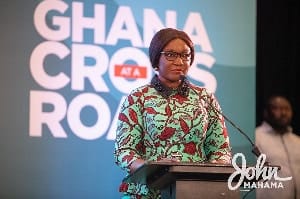
An aide to former president John Dramani Mahama, Joyce Bawah Mogtari, has criticised the Akufo-Addo administration for leveraging from the COVID-19 pandemic to exploit from Ghanaians.
She alleges that government used funds realised for the fight against the pandemic to support campaigns.
She added that the Electronic Transactions Levy (E-Levy) was another revenue stream that was misused eventually used to justify the decision to seek an International Monetary Fund (IMF) programme.
Flowing from the two economic reasons she presented, Bawah Mogtari classified the government as a threat to Ghana’s democracy.
“The NPP weaponised covid-19, profiting from the pandemic; using Covid funds to support political campaigns,weaponized E-Levy and used it as a bait for going to the IMF; now they are playing God and demonising their opponents. This NPP admin. is a threat to our democracy,” her tweet of May 30, 2023 read.
Last month, the IMF approved a $3 billion economic recovery facility for Ghana, which has faced severe economic pressure since late 2019.
The government largely attributes the economic challenges to theCOVID-19pandemic and the Russia-Ukraine War, but the opposition believes the situation is due to mismanagement of the economy by the government.
An initial tranche of US$600 million has since been released by the global lender.
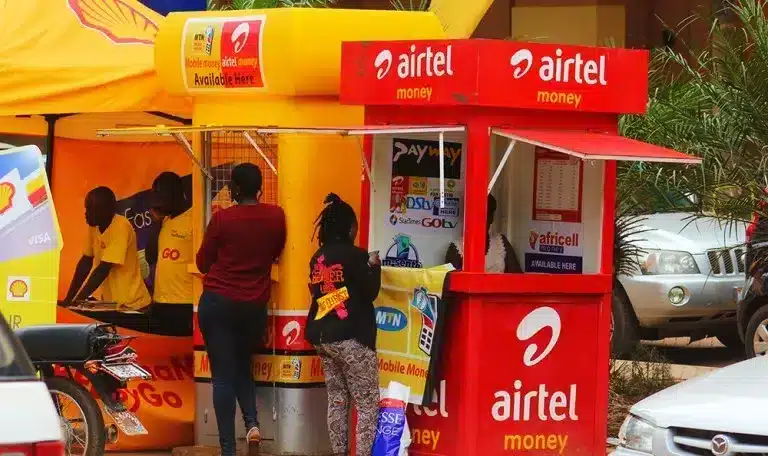
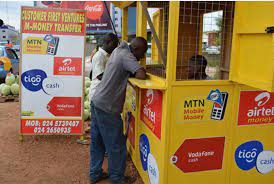
Mobile money transactions have signalled a recovery after having dipped following introduction of the Electronic Transaction Levy (E-levy), Head of Products and Innovations at Mobile Money Limited-MTN Ghana, Sylvia Otuo-Acheampong, has revealed.
The levy’s introduction on electronic transactions impacted mobile money usage as it increased the cost of transactions for users. Consequently, some users became reluctant to use the service. The E-levy was introduced in 2022 and initially set at a rate of 1.75 percent on the value of transactions over GHȼ100.
However, later in 2022 government announced a revision of the e-levy rate following public outcry, which reduced the rate to 1.5 to percent. Currently, the rate has been reduced to 1 percent across all transactions – without exemptions, unlike in 2022.
The Head of Products and Innovations noted that like any other business, introduction of the E-levy led to a reduction in demand as the increase in price led to revenue reductions. However, despite the impact, Mobile Money Limited has noted a resurgence as customers return to digital payments amid a revised rate on e-levy transactions.
“We saw in the statistics that we track…the number of customers which are using the service, and also revenue at the end of the day. So we saw this in the core metrics that we measure, but after a while we saw the whole customer-patronage really picking up again. So before we ended last year, we had seen customers come back; and also after the E-levy was lowered from 1.5 to 1 percent, we have seen the numbers coming up. So I would say we are now getting to where we were previously,” said Ms. Otuo-Acheampong.
MTN Mobile Money Limited now counts over 13 million Ghanaians using its platform, with over 140,000 merchants using it as a form of payment – including face-to-face and remote transactions. Additionally, the platform has over 15,000 point-of-sale (POS) machines across the country that accept mobile money transactions, with 240,000 agents nationwide supporting the ecosystem.
While the platform has seen significant success, Otuo-Acheampong also discussed the issue of fraud. The platform has been working to educate staff on fraud prevention and detection, both internally and through partnerships with security agencies, with the goal of protecting customer funds.
However, Otuo-Acheampong noted that the biggest challenge remains educating vulnerable customers and encouraging them to keep their personal identification numbers (PINs) confidential.
“There are certain metrics we have to fulfil, and so they [regulators] will come in to ensure you’re actually putting in place the right mechanisms, the right tools to curb fraudulent activities; and so it is a joint kind of ownership with the regulators… we can put all these measures in place, but if an individual chooses to share their PIN there is really nothing we can do from there,” said Ms. Otuo-Acheampong.
Mobile Money Limited is not only committed to combatting fraud but also advocating cheaper transaction fees for customers. According to Otuo-Acheampong, this is achievable by reducing the cost of technology from government’s perspective, including decreasing taxes on technology products and encouraging vendors to offer affordable alternatives to perform similar transactions.
“We have to find a way to reduce the cost of technology… it could also be the vendors themselves finding ways to bring in cheaper technology that performs the same transaction or delivers the same services… I think it is a multi-form approach,” said Ms. Otuo-Acheampong.
Mobile Money Limited is committed to continuing its growth and success in the Ghanaian market, with further emphasis on fraud prevention and advocating more affordable options for customers.
Finance Minister, Ken Ofori-Atta, has hinted at hikes in electricity tariffs and tax reforms.
These were made known by the Minister as he outlined five key measures necessary for the government to pursue in order to secure an International Monetary Fund (IMF) support programme.
They are electricity tariff hikes which have brought the cumulative increase to 60% since August 2022 and Comprehensive set of revenue-enhancing measures, including increase in the Value Added Tax rate and the review of the Electronic Transaction Levy (E-levy).
The rest are the enactment of an ambitious 2023 Budget, with a frontloading of the fiscal consolidation programme, continued monetary policy tightening to bring inflation under control and comprehensive set of structural reforms, notably public expenditure review.
These were captured in the Investors Presentation by the Finance Minister and supported by the Governor of the Bank of Ghana, Dr. Ernest Addison.
With regard to fiscal and debt sustainability, the Finance Minister said the government has undertaken fiscal adjustment with revenue and expenditure measures to improve debt sustainability and restore macroeconomic stability.
This is expected to address structural bottlenecks including contingent liabilities of State Owned Enterprises, commitment controls and arrears accumulation as well as domestic revenue mobilization.
On monetary and financial sector reforms, Mr Ofori-Atta said government is committed to rebuilding reserve buffers, mobilize external concessional financing from multilateral and bilateral partners, and suspend external debt service payments.
With regard to social protection and structural reforms, the Finance Minister said government will safeguard social protection programmes and ensure the burden of adjustment is fairly distributed.
Again, it will reinforce and improve the targeting of social spending to protect the most vulnerable from the impact of the economic crisis as well as fast-track the implementation of growth-oriented socio-economic policies, such as Ghana CARES to mitigate the impact of the pandemic and support economic recovery.
Government outlines 5 ambitious macroeconomic targets
Meanwhile, the government has outlined five ambitious macroeconomic objectives in the medium term as part of securing a programme from the International Monetary Fund.
They are reaching a 1.5% of Gross Domestic Product primary surplus in the medium term, bringing inflation below 8% in the medium-term and restoring external buffers with gross international reserves reaching 3 months of import cover by 2026.
The rest are reaching a real Gross Domestic Product growth target of 5% over the medium-term and enhancing competitiveness with exports surpassing 37% of GDP in the medium run.
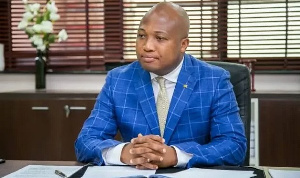
The Member of Parliament for North Tongu, Samuel Okudzeto Ablakwa, has asked the government to cancel the Electronic Transfer Levy (E-Levy) now that the government is planning to reintroduce road tolls.
According to him, the government made it clear before implementing the E-Levy that it was a replacement for road tolls.
He observed that the government does not properly consider its policies before implementing them.
The lawmaker stated that the government cannot have it both ways.
He said you cannot have in place the E-Levy and reintroduce the toll.
“The government told us that they were introducing the E-Levy because they had removed road tolls. They can’t have it both ways if they want to reinstate the toad toll. “The E-Levy must be repealed.”
He asserted that Ghanaians must demand answers from the government because one of the reasons and justifications for this poorly thought out policy was that we would have to pay E-Levy.
The MP made these remarks in response to a press statement by the Minister of Finance indicating that tolls would be reinstated.
He was speaking in an interview with Rainbow Radio’s parliamentary correspondent Philomina Kuntu Blankson.
The finance minister wrote to the Ministry of Roads and Highways to confirm the approved fees as tolls on roads and bridges will be reintroduced this year.
According to Ken Ofori-Atta, “It is provided under Section 6 of Act 1080 for the Minister to amend the schedules of the Act to include or exclude MDAs and/or adjust the fees and charges collected by MDCs for their services through a Legislative Instrument when necessary.”
“Accordingly, this ministry has initiated steps to provide for foundational rates for tolling of roads and highways as part of the amendments of the Act, pending completion of the process to identify the rods and highways to be affected by the reintroduction of the road tolls as stated in the budget,” he added.
The approved fees for motorbike users will pay 50 pesewas instead of 19 pesewas. Saloon car users will pay a fee of GH¢1 rather than the previous 50 pesewas fee.
Pick-ups/4×4 vehicles and light bus users will be charged GH¢1.50 pesewas when the toll booth reopens.
Drivers of heavy buses will also pay GH¢ 2 instead of the GH¢1.50 pesewas they used to pay.
For drivers of medium and heavy goods trucks up to 4 axles, the fee to be paid will be GH¢3 instead of GH¢2.
In response, Okudzeto Ablakwa slammed the government, accusing it of failing to properly consider its policies.
“I must state unequivocally that this government does not carefully consider its policies before implementing them. As a public policy student, I can say that this government does not have the ability to consult widely and to be scientific or empirical in its policy implementation.
Unfortunately, our government is uninterested in consulting. All of their policies have been a disaster. Several examples, including the luxury car tax and the benchmark at ports, have all been disasters. We advised them against eliminating the toll, but they did not listen.”
In the wake of the reintroduction of road tolls, the government, according to Samuel Amoah, Deputy PRO of the Ghana Private Road Transport Union(GPRTU), must ensure robust accountability.
Mr. Amoah was certain that the government must make it clear how the funds it has collected will be used, and that the reintroduction should be able to ease traffic congestion.
“Now that they’re bringing it (road tolls), our expectation is that, as a major stakeholder, there has to be some engagement and also to explain to us and to convince us that now, with this new measure that they’re bringing in is going to help in terms of traffic congestion issues, in terms of the leakage that they were talking about.
“But if today, they just wake and say they’re bringing it without these explanations, or without letting we that we’re going to pay, the assurance of paying the money and what the money is also coming to do for us. That is our problem,” he said.
Mr. Amoah also indicated that the association does not have a problem with the increment percentage, however, the rollout of the prices must effect some positive change.
But he explained that during a meeting with the government, the association proposed a 50 per cent increment, saying that a percentage higher than that would be outrageous, in that the government could not sufficiently account for the previous rate when collected.
He added that with the rollout of new prices, the quality of roads must improve and help decongest traffic situations on the roads.
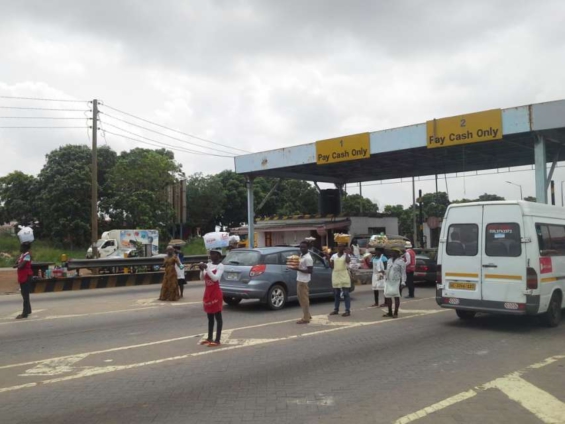
After announcing the discontinuation of road tolls in exchange forE-Levyas a measure to resuscitate the embattled economy, the government has now made a u-turn on its decision.
On Tuesday, March 14, it was announced that roll tolls are set to return but with a revised rate of 88 per cent increment.
This decision may come to add to government’s quest to find solutions to the country’s fiscal challenges, especially as a request for an IMF bailout and a recent request by the government for external creditors to cancel its debt seem to be in limbo.
Meanwhile, since the E-Levy which sought to lay taxes on electronic transactions came to replace road tolls, there are now discussions as to whether or not the E-Levy should be scrapped in wake of the reintroduction.
The 2023 Budget Statement has received praise from Vitus Azeem, the chairman of the Tax Justice Coalition Ghana, who also asserts that the government has to implement more progressive tax policies to give Ghanaians some respite.
Addressing in Accra at a meeting on the 2023 annual budget analysis, he encouraged the government to work with its creditors to pursue a comprehensive external debt restructure in order to enable the nation get back on the path to debt sustainability.
He claims that this is the only option to address the debt problem and macroeconomic crisis facing the nation.
The analysis of the 2023 Budget Statement and Economic Policy of the government is a partnership between the Tax Justice Coalition Ghana and ActionAid, as part of an advocacy programme between the two organizations for a progressive tax regime for the country.
At a media engagement in Accra, the Chairman of Tax Justice Coalition-Ghana, Mr. Vitus Azeem, said the external debt restructuring is necessary to bring stability to the Ghanaian economy.
Mr. Azeem said through the proposals to freeze new tax waivers for foreign companies and to review tax exemption for free zones, mining and oil and gas companies, some of the proposed revenue measures in the budget pointed to the conclusion that Ghana’s tax system remained more regressive than progressive.
He said the tax measures, such as the increase in VAT, E-Levy and Communication Service Tax, would increase transport fares, food prices and worsen the country’s inflation. The coalition commended the government for continuing with its social interventions such as doubling the LEAP amount and increasing the number of beneficiaries as well as continuing the free SHS.
It said however it would be imperative to put in place adequate measures towards addressing the weaknesses in their implementations. It suggested a review of the free SHS to ensure some targeting of the most vulnerable groups for the intervention rather than trying unsuccessfully to cover the entire country.
Such measures, it says, must include avoiding politicization, intensifying monitoring and supervision and the prompt release of funds for implementation. The Country Director of ActionAid, Mr. John Nkaw, said in the external debt restructuring, Ghana could negotiate for total debt forgiveness, cancellation or relief.
Notwithstanding a recent decrease in the rate from 1.5% to 1%, the Tax Justice Coalition(TJC) has urged the government to quickly abolish Electronic Transfer Levy (E-Levy).
The coalition said the levy has now become a “nuisance” tax.
The reduction came into effect after the levy failed to meet the set revenue target in the heat of the economic crisis caused by the global pandemic and Putin’s war in Ukraine.
Players in the telco space have also been raising concerns over the low-running and ineffective mobile money service.
The Finance Minister Ken Ofori-Atta first announced the decision to reduce the levy from 1.5% to 1% on Thursday (24 November 2022) during the 2023 Budget Statement presentation in Parliament.
Addressing a news conference in Accra on Thursday (9 March) on the theme: “An analysis of the 2023 annual budget and economic policy” in Accra, the chairperson of TJC, Vitus Azeem, said E-Levy is now defeating the government’s cashless agenda.
“TJC Ghana particularly calls on the government not to implement the 15% VAT increase and totally scrap the E-Levy and focus more seriously on implementing the more progressive taxation of income, wealth and property,” he said.
“TJC Ghana also recommends that the social intervention continue as proposed,” Azeem added.
Private legal practitioner, Gabby Asare Otchere-Darko has advanced reasons for which individual bondholders are supposed to welcome the debt restructuring offer from the government.
According to him, the Ghanaian economy could crash if the bondholders do not quickly accept the offer as outlined by the Ministry of Finance.
Gabby, in a series of posts on social media, warned against the agitations surrounding the deal and encouraged the bondholders to play their role in the Domestic Debt Exchange Programme (DDEP).
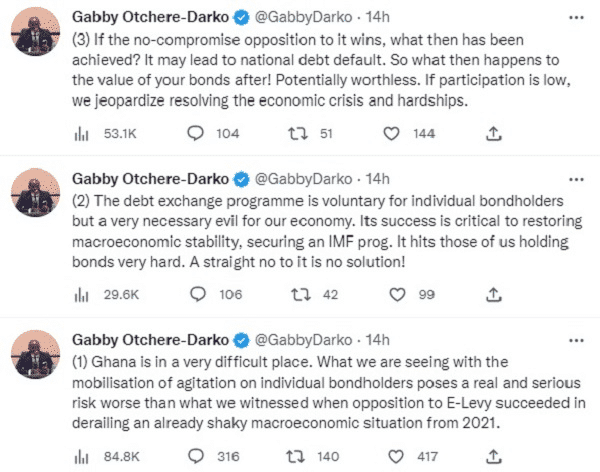
“Ghana is in a very difficult place. What we are seeing with the mobilisation of agitation on individual bondholders poses a real and serious risk worse than what we witnessed when opposition to E-levy succeeded in derailing an already shaky macroeconomic situation from 2021,” portions of his tweets read.
“The debt exchange programme is voluntary for individual bondholders but a very necessary evil for our economy.
“Its success is critical to restoring macroeconomic stability, securing an IMF programme. It hits those of us holding bonds very hard. A straight no to it is no solution!”, Mr Otchere-Darko stressed.
“If the no-compromise opposition to it wins, what then has been achieved? It may lead to national debt default.
“So what then happens to the value of your bonds after! Potentially worthless. If participation is low, we jeopardize resolving the economic crisis and hardships”, he wrote.
Gabby Otchere-Darko concluded his tweet storm by reminding Ghanaians that the country’s economy is not in a good shape and that certain uncomfortable measures ought to be taken to restore it.
“I’m sorry but we have to face the hard/painful truths. We ain’t sitting pretty. Our focus must be on how the burden to individual bondholders may be possibly eased; but not to take the hardline position of simply saying no to participation. It will come back to hit us harder!”.
Meanwhile, the invitation to the Domestic Debt Exchange Programme (DDEP) expires today, Monday, January 16, 2023, at 4:00 p.m.
This comes after two extensions of the expiration date by the Finance Ministry.
The decision to include individual bondholders was necessitated after government was forced by labour unions to abandon plans to include pensions in the debt exchange programme which was first announced in December 2022.
The new tax plan, he said, won’t determine Ghana’s future, but it will give Ghana independence.
He said, “It is not that we are hanging our whole future on E-Levy but we know that E-Levy is even expanding more,” during a town hall gathering in Tamale.
Read the complete article as it appeared on ClassFM on February 22, 2022.
Ghana’s future is independent of the proposed tax on electronic transactions, according to Finance Minister Ken Ofori-Atta.
“It is not that we are hanging our whole future on E-Levy but we know that E-Levy is even growing more,” the Finance Minister said while speaking at the government’s town hall meeting on Thursday, 10 February 2022 in the Northern Regional capital, Tamale.
The Minister also questioned those opposed to the levy.
Mr Ofori-Atta said: “Should we just let it go? Do you just not want to participate in the reconstruction of our country? Is that what it is about? Or is it because you’re another party, you don’t want this to happen?”
He indicated that, although Tamale is not one of the New Patriotic Party’s (NPP) stronghold, it does not mean the government will not invest in its development.
“I don’t know the last time we won seats in Tamale. I think Mustapha Ali won it twice or something, but it does not mean we are not going to put resources in Tamale or the Northern Region, that does not mean that”, Mr Ofori-Atta.
The town hall meeting is the third being held by the government to sensitize citizens on the E-levy.
It is expected that the feedback received from the town hall meetings will help the government in its implementation of the levy.
The revised Electronic Transaction Levy (e-levy) rate of 1.0% is expected to take effect today, January 11, 2022, as announced by the Ghana Chamber of Telecommunications.
A statement from the chamber confirming the implementation noted that “as captured in the Electronic Transfer Levy (Amendment) Act, 2022, Act 1089 which has been passed by parliament and assented to by the President, the levy on electronic transfers has been reduced from 1.5% to 1%, while the GH₵100 threshold remains unchanged.”
The directive is in line with policies outlined by the Finance Minister in the 2023 Budget Statement and Economic Policy.
Reading the Budget Statement, Mr Ofori-Atta noted the E-Levy Act will be reviewed “and more specifically, the headline rate will be reduced from 1.5% to 1% of the transaction value.”
He also announced the removal of the daily threshold of GH₵100, however, after debating the matter, Parliament approved only the revised rate.
The E-levy since its implementation has been greeted with mixed reactions from the public. While it’s implementers believed it was the surest way to raise revenue for the state, the tax measure was highly criticised by another section of the public who argued that it was not only a way of double taxing citizens or Mobile Money (MoMo) users, but also, it had the tendency of collapsing the MoMo business.
Nonetheless, the levy was approved by Parliament in a dramatic way, after which its implementation took effect on May 1, 2022.
Fews months later, the government disclosed that the tax did not rake in the expected revenue and a leading member of the New Patriotic Party (NPP), Gabby Otchere-Darko, stated that the levy generated only 10% of the expected revenue.
“After 5 months of stalemate and bashing, the e-levy, after implementation, is delivering only 10% of estimated revenues; our revenues remain very low as compared to the rest of the world; debt levels dangerously high, cedi, like most currencies, struggling against the US dollar,” he wrote in tweet.
Meanwhile, the Chamber has given the public the assurance that its members are working feverishly with theGhana Revenue Authority and other crucial institutions to ensure a smooth implementation of the updated electronic transfer levy.
The Electronic Transaction Levy (E-levy), according to the Ghana Chamber of Telecommunications, had a negative effect on financial technology enterprises, raising doubts about the government’s capacity to fulfill its updated revenue target for the levy in 2022.
The revenue forecast for the levy was changed by the government in the 2022 Mid-Year Budget from the initial yearly prediction of GHS6.96 billion to GHS6.11 million.
Dr. Ken Ashigbey, the chief executive of the Chamber, claimed in an interview with Joy Business that the government had taken a discriminating approach to implementing the tax handle, which is why it frequently missed the mark.
“A lot of the things that if they [government] have listened, we would have been in a better place. So the ¢6.9 billion did not happen, I’m not too sure the revised target [¢611 million] would be met.
The E-levy itself has impacted apart from the challenges we saw in the 3rd quarter – the turbulent in the market – the e-levy also had a major impact [negative] on the digital economy; a lot of investments. Fintechs had various investments conversations that because of the e-levy itself did not materialized”.
Dr. Ashigbey also made the point that many fintech companies experienced high operating costs as a result of inflation and were unable to generate the income they had projected for 2022.
“What is happening is that it’s not only government that is not meeting its revenue target, the revenues of these EMIs and other fintechs were also impacted which means that with the inflationary pressures that we saw, costs also ballooned.”
“Most of these businesses might not make the profit that we saw the prior year [2021]. It’s really been a difficult year and the 1% reduction still does not do it. We were hoping that government would have listened to putting a cap on the e-levy”, he added.
Continuing, he said volume did not drop as much as value because those sending high values did not pay much for e-levy.
“So what you saw in 2022, volume did not drop as much as value because for those who send high values, the industry is structured in such a way that when you send money beyond a particular limit you did not pay too much fee. For Vodafone, there is no charge, but for MTN, AirtelTigo, Zeepay, G Money, when you send above a ¢1000 you just pay ¢7.5, but if you send ¢5000, you will pay ¢7.5 but you will also be paying ¢75”.
Before the House adjourns for the holiday break, Parliament is anticipated to approve the E-Levy amendment bill later today.
Following warnings from the Minority, finance minister Ken Ofori-Atta decided to reinstate the 100 cedi daily barrier exemption.
When the Bill is passed, the levy’s rate will drop from 1.5 to 1 percent.
Starr News sources claim that following the government’s compromise, the minority has now opted to back the bill’s approval.
The 2.5 percent increase in the VAT rate is one additional revenue strategy that the NDC MPs have not yet mentioned.
Barring any changes, the VAT amendment bill is expected to be brought on the floor.
Already Ken Ofori-Atta has appealed to parliament not to frustrate any government revenue measure announced in the 2023 budget warning such a move will further exacerbate the economic crisis.
Joe Jackson, a financial analyst at Dalex Finance, claimed that the government’s financial crisis made the E-Levy crucial.
Ghana remains insolvent! 50% of our revenue is used to pay interest, and 55% goes toward salaries.
The government must raise taxes if it wants to continue borrowing money. The suggested E-levy is the result.
He tweeted, “#TaxTheWealthy #HardDecisions #BrokeGhana.
Mr Jackson said the introduction of the E-levy is meant to generate revenue for government expenditure as part of the move to widen the tax net.
“Ghana is still broke! We spend 50% of revenue on interest payments and 55 % on Salaries. Govt needs to increase tax revenue else we may not be able to even borrow more. Hence the proposed E-levy. #TaxTheWealthy #HardDecisions #BrokeGhana,” he tweeted.
Finance Minister Ken Ofori-Atta announced a new levy to be charged by the government in 2022 on all electronic transactions to widen the tax net and rope in the informal sector.
“After considerable deliberations, government has decided to place a levy on all electronic transactions to widen the tax net and rope in the informal sector. This shall be known as the ‘Electronic Transaction Levy or E-Levy’.”
He explained that the new E-levy will be a 1.75 per cent charge on all electronic transactions covering mobile money payments, bank transfers, merchant payments and inward remittances to be borne by the sender except inward remittances, which will be borne by the recipient.
This will, however, not affect transactions that add up to GH¢100 pr less per day.
“A portion of the proceeds from the E-Levy will be used to support entrepreneurship, youth employment, cyber security, digital and road infrastructure among others.”
This new levy is scheduled to start Saturday, January 1, 2022.
In 2020, the total value of transactions was estimated to be over GH¢500 million with mobile money subscribers and users growing by 16 percent in 2019.
According to a Bank of Ghana report, Ghana saw an increase of over 120 percent in the value of digital transactions between February 2020 and February 2021 compared to 44 percent for the period February 2019 to February 2020 due to the convenience they offer.
This was definitely heightened by the advent of Covid-19, especially during the lockdown.
But the proposal has met resistance from the Minority in Parliament.
Their leader, Leader Haruna Iddrisu said the E-levy is a disincentive to the growth of the digital economy. To that end, he said, the Minority will not support it.
Speaking at a post-budget workshop in Ho on Saturday, November 20, he said “Mr Speaker, understandably, we see that the Minister of Finance seeks to introduce some measures including the now popularly declared e-levy or digital levy as some have quite named it.
“Mr Speaker, our concern is whether the e-levy itself is not and will not be a disincentive to the growth of the digital economy in our country. We are convinced that the e-levy may as well even be a disincentive to investment and a disincentive to private sector development in our country. We in the minority may not and will not support the government with the introduction of that particular e-levy. We are unable to build a national consensus on that particular matter.”
Meanwhile, Mr Ofori Atta indicated at a press conference on Monday December 6 said that consultations were still going on regarding the proposal in order to reach a consensus.
“On the matter of the E-levy, having regard to its serious fiscal implications, we will continue our consultations with the Minority Caucus in Parliament and other relevant stakeholders, with a view to achieving consensus and reverting to the House in the shortest possible time,” he said.
Government’s decision to eliminate the daily limit on electronic money transactions that will be subject to the Electronic Transfer Levy(E-Levy) has been opposed by the National Communications Officer of the Convention People’s Party (CPP), Sylvester Sarpong.
The Electronic Transfer Levy (E-Levy), which is currently imposed at a rate of 1.5%, will be reduced to 1.0 percent, according to Finance Minister Ken Ofori-Atta, who also noted that the GH100 threshold would not applicable with the new rate.
Reacting to this, Sylvester Sarpong, popularly known as Soprano questioned the rationale behind the removal of the threshold.
He argued that the creation of the threshold sought to protect the poor in society, per comments by government officials, hence its removal implies that the poor no longer exist in the country.
“We are asking them (the government) to bring the E-Levy rate to 0.5 (percent) so that Ghanaians can support it. We also want to ask whether we no longer have poor people in this country. I am talking to Queen Ursula of Dansoman.
“Honourable Queen Ursula of Dansoman previously stated that people who are able to spend GH¢100 in Ghana are not poor and that those who spend less are poor people. So, I’m asking Queen Ursula whether every Ghanaian is now rich for the government to remove the breathing space it gave on the E-Levy,” he said in the local parlance.
The Minister for Communication and Digitalisaion, Ursula Owusu-Ekuful, prior to the approval of the E-levy Bill explained that anyone who has more than GH¢100 on them in a day for transactions should not be considered poor and should pay taxes on their digital transactions.
“We have made it a part of this policy that up to a GH¢100 a day per a person is exempt. This, the state is saying, if you’re sending up to a GH¢100 a day, cumulatively, you can send up to GH¢3000 a month, that is all going to be tax-free.
“Now, if you have more than a GH¢100 to send a day, then you’re not poor. So, if you really are poor and you are in a position to send GH¢100 a day, then we need to re-classify the definition of who the real beneficiaries of these are, and it is only the sender who pays, not the receiver,” she clarified.
Beginning the next year, the government will begin using abandoned toll booths along important roadways in the nation as part of its strategy to generate cash.
The 2023 Budget statement’s paragraph 462 states that “the fiscal policy measures to support the 2023 Budget for consideration and approval by Parliament include the reintroduction of tolls on selected public roads and highways with a renewed focus on leveraging technology in the collection to address the inefficiencies characterized by the prior toll collection regime.”
Tolling was removed in the 2022 budget as the government moved to introduce the Electronic Transaction Levy (E-Levy) which revenue generation measure was dogged by controversies from its passage to its implementation.
The Minority’s ranking member on Transport in Parliament, Governs Kwame Agbodza, has welcomed the reintroduction of tolls but with a condition that monies raised will be strictly used for purposes of maintaining the roads.
“We welcome the decision by the Roads Minister to bring back road tolls. We take no pride in saying we told you so.
Mr. Speaker, it was populist, unnecessary and they were there shouting we are going to do it because we have e-levy…today they have brought a law here that they want to bring back road toll,” he said on the floor of the House.
John Asiedu Nketia, the general secretary of the NDC, said: “I am not saying perpetually electronic transactions should not be charged in the future…but presently, in such difficult times, it is a mark of insensitivity to apply this tax.
NDC’s Johnson Asiedu Nketia says the introduction of the electronic levy (E-Levy) on mobile money (MoMo) and other digital transactions by the government in the 2022 budget is absolutely “needless”; for now.
He said the recent hardship on Ghanaians with the E-levy introduction will worsen the situation after the government failed to fulfill its heaven-on-earth promises.
To him, perhaps in the future when the economy is stable, the E-levy can be reintroduced.
“E-levy is not needed now, that is my argument. I am not saying perpetually electronic transactions should not be taxed in future….but currently, in such challenging times, it is a mark of insensitivity to impose this tax,” NDC’s General Secretary, John Asiedu Nketia said in an interview with NEAT FM.
E-Levy To Widen Tax Net
Finance Minister Ken Ofori-Atta, last week, announced that the government intends to introduce an electronic transaction levy (e-levy) in the 2022 budget.
He said this was to “widen the tax net and rope in the informal sector”.
Reservations About E-Levy
But several Ghanaians have expressed concern over the proposal.
They said the introduction of the levy in the 2022 Budget would compound the high cost of living in the country.
E-Levy Details
The proposed levy, which will come into effect on 1 February 2022, is a charge of 1.75% of the value of electronic transactions.
It covers mobile money payments, bank transfers, merchant payments, and inward remittances. The originator of the transactions will bear the charge except for inward remittances, which will be borne by the recipient. There is an exemption for transactions up to GH¢100 ($16) per day.
According to the finance minister, the total digital transactions for 2020 were estimated to be over GH¢500 billion (about $81 billion) compared to GH¢78 billion ($12.5 billion) in 2016. The huge growth in just five years.
Difficult Times Currently
However, the move has been criticized by many people, with some saying levies were taking all their earnings and making the cost of living very high.
The NDC, together with some opposition parties, appear to be in that bracket.
The review of the Electronic Transaction Levy (E-Levy) was received with disappointment by some Cape Coast residents in the Central Region, and they renewed their requests for the government to rescind the policy entirely.
They bemoaned that the already shaky economy would not be improved by the proposed revision of the revenue collection policy.
The E-Levy was implemented by the government in 2022 as part of efforts to boost revenue. It is a 1.5 percent deduction from a set list of electronic transactions with a daily threshold of 100 Cedis.
In view of this, Finance Minister Ken Ofori-Atta, while presenting the 2023 budget in Parliament on Thursday, November 24, announced a reduction in the rate of the policy from 1.5 percent to one percent without the threshold.
The review, among other fiscal and austerity measures, is targeted at salvaging the country’s southbound economy.
This means that subject to approval by Parliament, Ghanaians will pay E-Levy of one percent on all affected forms of transactions despite the amount involved.
Speaking to some citizens on the development, they expressed disappointment at the policy and questioned the sensitivity of government to their plights.
Madam Abigail Mensah, a trader at the Kotokuraba Market, said she did not want the policy in any form and that it must be scrapped off immediately.
“Already, we can barely afford to feed ourselves and our families and the best government can do is to push us off the cliff with taxes?” she queried with a visibly livid expression.
Comparing the E-levy in its current form to the proposed review, Madam Lordina Ackah, also a trader, preferred it to be left untouched because the percentage removed was an insult.
In an interesting twist, another market woman, Madam Gertrude Dadzie who also called for the levy to be scrapped, suggesting that the government found better means of easing the plight of Ghanaians.
A taxi driver, Mr Francis Awotwe, called on the government to cancel the E-Levy and bring back the tollbooths.
Lamenting the hardship in the economy, he said he made nothing from his taxi business because every money he made went into buying fuel.
“I buy a gallon of petrol for more than 80 Cedis and I do not make up to 300 Cedis in a day. How much do I give my car owner and how much do I take home to cater for my family?” he retorted.
“In spite of this, the government still wants to take away the small money I send to my poor old mother in the village.”
Meanwhile, some mobile money vendors have said the development would collapse their businesses even further.
Mr Nii Armah Tagoe indicated to the Ghana News Agency that his average daily profit of 80 Cedis had dropped to 20 Cedis since the introduction of the levy.
He said even though transactions conducted were not affected by E-Levy, customers’ activities had dropped significantly due to the lack of proper education on the policy.
“We have not made any profit since the E-Levy came and the trend now is that many people no more do withdrawals and deposits than money transfer.
“The review is worse, and it is going to kill us more,” he added.
Another vendor, Mr Ahmed Yussif, said he did not expect any significant effect on his business, adding that the impact, if any, would be felt after a month.
The fact that the current administration has cut the contentious Electronic Transfer Levy (E-levy), according to deputy finance minister Dr. John Kumah, shows that they are a receptive government.
The fact that the rate was lowered to 1%, he remarked, “shows that we are a listening government.”
E-levy
The Ghc100 daily threshold has been eliminated, which has resulted in the e-levy rate dropping from 1.5% to 1%, according to Finance Minister Ken Ofori Atta, who presented the 2023 budget statement.
“Review the E-Levy Act and more specifically, reduce the headline rate from 1.5% to 1% of the transaction value as well as removal of the daily threshold,” Ken Ofori-Atta said.
It may be recalled that the government introduced “this to enhance domestic tax mobilization and expand the tax base and provide an opportunity for everyone to contribute towards national development”. However, according to government the estimated money to be accrued as far as the levy is concerned, has not been reached.
John Kumah Speaks
Speaking on Joy Newsfile programme, Saturday, John Kumah who doubles as the Member of Parliament for Ejisu constituency claims: “we still have challenges because not all operators channel their system through the common platform that has been created. So a lot of compliance issues…but having reduced the rate to 1% means that we are a listening government.”
According to him, “per the data I have seen, there is some 60% growth in terms of the usage of MoMo and its impacts on the revenue we are generating under e-levy”.
Ken Ofori-Atta said, “Through technology, therefore, we can find a means of ensuring that everybody contributes to this national reconstruction [economic recovery] that we have to do and recognise that this is the moment in our history, and to tackle these issues. Will it be uncomfortable? Of course, it will be uncomfortable. But where is the shared burden for us to move across? he asked.
“So, I listen to social media and then I look at the statistics. Since we brought the national ID [Identification Card] to the Ghana Revenue Authority, I can find some 60,000 of the people who live in my nice neighbourhood [Labone, Cantonments etc.] – accountants doctors, lawyers – who always blame the informal sector- masons etc. And these 60,000 people are paying nothing and they have been able to convince you that E-Levy is bad because it’s a tax on tax etc”, he added.
READ FULL STORY OF THE FINANCE MINISTER KEN OFORI ATTA BELOW
He said he’s amazed at how these professionals have been able to convince the informal sector to ‘reject’ the newly introduced e-levy in the 2022 budget.
Speaking at the TUC Economic Dialogue on the 2022 budget, Ken Ofori-Atta said, the introduction of the 1.75% levy on all electronic devices is a way to get everyone to contribute their quota towards the recovery of the local economy.
He said about 60,000 professionals have been highlighted in the Ghana Revenue Authority (GRA) as persons who do not pay tax.
Ken Ofori-Atta said, “Through technology, therefore, we can find a means of ensuring that everybody contributes to this national reconstruction [economic recovery] that we have to do and recognise that this is the moment in our history, and to tackle these issues. Will it be uncomfortable? Of course, it will be uncomfortable. But where is the shared burden for us to move across? he asked.
“So, I listen to social media and then I look at the statistics. Since we brought the national ID [Identification Card] to the Ghana Revenue Authority, I can find some 60,000 of the people who live in my nice neighbourhood [Labone, Cantonments etc.] – accountants doctors, lawyers – who always blame the informal sector- masons etc. And these 60,000 people are paying nothing and they have been able to convince you that E-Levy is bad because it’s a tax on tax etc”, he added.
On November 17, 2021, Finance Minister, Ken Ofori-Atta, during the 2022 budget reading in parliament, announced the introduction of 1.75% tax on all electronic transactions.
According to him, this new directive forms part of strategies to widen the country’s tax net.
He added that the 1.75% tax is also to enhance financial inclusion and protect the vulnerable in the country.
Though this e-levy has received public backlash, the Finance Minister, Ken Ofori-Atta, has said government will find a way to win the cooperation of the Minority in parliament to accept the e-levy.
Broadcaster Bridget Otoo has bemoaned the move by the government to remove the daily limits to electronic money transfers that will attract the Electronic Transfer Levy (E-Levy).
The Minister for Finance, Ken Ofori-Atta, has announced a proposal to review the Electronic Transfer Levy (E-Levy) from its current rate of 1.5 per cent to 1.0 percent.
In addition to the reduction of the rate, Ofori-Atta also proposed the removal of limits on transfers that will attract the levy.
“Review the E-Levy Act and more specifically, reduce the headline rate from 1.5% to one percent (1%) of the transaction value as well as the removal of the daily threshold,” he said.
Reacting to this in a series of tweets on Thursday, November 24, Bright Otto said that the government, after promising that the poor would not be affected by the levy, now wants to charge all transactions.
She berated persons who supported the government’s implementation of the level when questions were raised about how it would affect the poor.
“All the town hall meetings about e-levy protecting the poor were just a waste of public funds to feed lies to an already impoverished people.
“When we called gov’t out on its 100 cedi threshold lies, fool soldiers were up on their key boards defending. Here we are!
“So, the footsoldiers I hope you heard him? E levy was already being charged on 5 cedis. Now 1 pesewa sef, it would be charged,” parts of her tweet read.
This was announced by the Finance Minster, Ken Ofori-Atta, during the 2023 budget statement read in Parliament on Thursday, November 24, 2022.
The e-levywas formerly at a rate of 1.75% during its proposal stage. It was however, reduced to 1.5% when passed into law.
The GH100 daily threshold, which has been in effect since the tax measure’s adoption in May of this year, will also be eliminated, Mr Ofori-Atta continued.
“Mr. Speaker, we will undertake the following actions, initiatives, and interventions under the seven-point agenda. To aggressively mobilize domestic revenue, we will among others: Increase the VAT rate by 2.5 percent to directly support our roads and digitalization agenda; Fast-track the implementation of the Unified Property Rate Platform programme in 2023; and Review the E-Levy Act and more specifically, reduce the headline rate from 1.5% to one percent (1%) of the transaction value as well as the removal of the daily threshold,” he said.
The implementation of the e-levy commenced in May 2022. Since its presence, government has been unable to rake in the expected revenue due to opposition from some members of the public.
To remedy this challenge, experts called on the government to reduce the rate.
The presentation of the budget is in accordance with Article 179 of the 1992 Constitution and section 21 of the Public Financial Management Act, 2016 (Act 921).
The “Nkabom budget” has been delivered in a year that has experienced what can be called the worst economic downturns in the fourth republic.
The Member of Parliament (MP) for Asante Akyem North, Andy Kwame Appiah-Kubi, has said that the stubbornness of Finance Minister Ken Ofori-Atta is what has led to the poor performance of the Electronic Transfer Levy (E-Levy).
According to him, the minister refused to listen to the advice of New Patriotic Party (NPP) MPs to reduce the rate of the levy from the proposed 1.75 percent to 1 percent.
In an Oyerepa TV interview monitored by GhanaWeb, Andy Appiah said that should the minister have agreed to reduce the rate to 1 percent, MPs from both the minority and majority caucus would have supported the implementation of the levy and the clashes seen in the House would not have happened.
“The thing is that if you want to evaluate a process you should not be partial with it…we had the E-Levy discussion at Ho, and we (the NPP MPs) were of the view that the 1.75 (percent) rate was too high and it will meet public resistance; so it should be reduced.
He added, “We all agreed that if it was brought to 1 percent both the minority and the majority will agree and approve. And we will be able to collectively market it to the acceptance of the stakeholders. The intransigent at that ministry that exists till date is what brought the fights on the E-Levy.”
“After some time, he (Ofori-Atta) said he had reduced the rate to 1.5 percent but the 1.5 was still not feasible. But he continued to give us hope that we can deliver with the 1.5,” he said in the Twi dialect.
“This guy does not listen to anyone. So, the minority rejected the levy in Parliament because there was no consensus and this is what characterised our debate to the point it got to. Was it necessary,” Andy Appiah, who is one of the NPP MPs calling for Ofori-Atta’s removal, added.
The Chief Executive Officer of the Ghana Telecommunications Chamber has called for the reduction of the electronic transactions levy (E-levy) from 1.5% to 0.1%.
According to Dr Ken Ashigbey, the introduction of the e-levy at 1.5% has proven counterproductive to both the government and the development of Ghana’s digital economy.
He explained that while calling for a total scrap of the tax measure would be insensitive considering the government’s dire need for money amidst economic turmoil, reducing it to 0.1% would revamp the digital economy thus generating more revenue for government.
Speaking on JoyNews’ PM Express Business Edition, he said, “Our proposition is the fact that, you know, they should scrap it. But we need to be real, government needs money at this particular stage.
“The deficit position is not good for the industry, it affects the industry, it’s one of the things that would account for the depreciation of the cedi. The macros would be destabilised.
So we think that the best thing to do is to reduce the level. Some in the industry have talked about 0.5, but I have said that the best thing to do is to do 0.1%.”
He added that while the government reduces the rate, it should also place a cap on it.
Dr Ken Ashigbey suggested that transactions that are 5,000 cedis and above should only attract a fixed e-levy rate to attract more large transactions on mobile money platforms.
According to him, the current cap-less system makes it most undesirable to transact business with large sums of money via digital platforms.
“You know, push the level down to 0.1 and then put a cap on it. Say ¢5,000. At ¢5,000 the levy is fixed so that if anybody wants to send ¢10,000, you know, that will happen,” he said.
“Take out the discrimination between the ¢20,000 that you give to the banks and then you give to mobile money so that the discrimination is not based on that,” he added
On the other hand, Dr Ashigbey is calling on the government to place a cap on the amount of cash that can be used in a transaction.
According to him, when physical transactions are capped at ¢2,000, for instance, people will be forced to transact business via mobile money platforms for large transactions.
“Another innovative thing that we would say is that put a cap on any transaction that can be done by cash, so let’s say ¢2,000. If you want to do any transaction above ¢2,000 use a digital means for mobile money, for the banks and all of that.
“What will happen is that a lot of the things that happen underground… a lot of that you’ll be able to take them off and then you’ll be able to see a lot of movement in terms of cash and that also will help,” he said.
“And then in terms of government payments, make sure that all government payments mandatorily are made simple and let people be able to pay so that tolls that people pay in the market and all that will use these digital means. And if you’re going to do that make sure that it is seamless, it’s not difficult to do,” he added.
Finance Minister, Ken Ofori-Atta has partly blamed the late passage of the electronic transaction levy (E-levy) for the prevailing economic challenges.
According to him, the delay in passing the tax policy impacted the confidence of the international community in the economy which led to loss of investors.
Appearing before the Parliament’s Adhoc Committee on Friday, Mr Ofori-Atta said the delayed passage of the e-levy also contributed to the ensuing downgrade in Ghana’s sovereign credit rating in January 2022, “which resulted in Ghana not being able to issue its Eurobonds it traditionally does in the first quarter.”
Mr. Ofori-Atta said the Minority frustrated the efforts to raise revenue through the levy to support the financial stability of the economy.
“We saw the dire consequences when the House for months refused to pass the major revenue generation item introduced by this government to support the fiscal stability of the economy.
“Sadly the Minority Leader when this government was compelled to approach the Fund (IMF) this year, triumphantly took credit for frustrating governments efforts to meet its half-year revenue,” he said.
Ghana’s economy is currently under pressure, which has resulted in a high cost of living and what some have described as ‘galloping inflation.’
The country’s currency is also volatile in relation to the US dollar and other major trading currencies worldwide.
But the Finance Minister said the e-levy was borne “out of this heightened need to mobilise resources sufficient for managing the preeminent challenges of our time, physical consolidation, debt sustainability and reduce the unemployment.”
It would be recalled that the passage of the e-levy which requires 1.5% on all electronic transfers met stiff opposition from the Minority Group in Parliament.
It was however rolled out by the Ghana Revenue Authority (GRA) on May 1, after the E-levy Bill was passed by Parliament and subsequently assented to by President Akufo-Addo.
Meanwhile, the Finance Minister has apologised to Ghanaians for the hardship being suffered in recent times.
According to him, the brunt borne by the populace due to the ongoing economic turmoil is unfortunate.
“Let me use this opportunity to say to the Ghanaian people what I believe, with courage, every Finance Minister around the world may wish to say to their people now. I am truly sorry,” he told the committee.
The implementation of a new tax on electronic transactions was announced by Finance Minister Ken Ofori-Atta a year ago during the presentation of the 2022 budget.
The government has chosen to impose a fee on all electronic transactions to broaden the tax net and include the informal sector, the minister said as he delivered the 2022 budget statement to Parliament.
The “Electronic Transaction Levy or E-Levy” will be used to refer to this.
With the exception of inward remittances, which will be the recipient’s responsibility, all electronic transactions, including mobile money payments, bank transfers, merchant payments, and inward remittances, will be taxed at an applicable rate of 1.75%, he said.
The Public Relations Officer (PRO) for the Ministry of Food and Agriculture, Bagbara Tanko has urged Ghanaians to remain calm as the increase in food prices is not an indicator of possible food shortages in the coming days.
According to him, the country experienced a prolonged drought last year and that affected yield, however, he disclosed the government managed to hold the country down and properly managed food resources.
“This year, we have survived on last year’s yield up till the point where southern Ghana harvested from its major season. Although some challenges were faced, we had some harvests from the major season.
“We have started the minor season for southern Ghana and are experiencing very good rains so our anticipation is that at the end of the minor season for the sector, we are going to have a bumper harvest,” he told Samuel Eshun on the Happy Morning Show.
“Reports received from our regional directors on the participation from the Planting for Food and Jobs and even commercial participation show that there will be a bumper harvest.
“We will not be hungry and the increased harvest is sure to reduce the price of food because we will soon be in the midst of plenty. Northern Ghana has started harvesting and the crop season has been excellent. The floods didn’t have a significant effect on crop harvest.”
Informing Ghanaians of other factors responsible for the increase in food prices, he stated, “Let’s also not forget that fuel prices can make the prices of goods and services soar and that we have no control over. But form our end as the Ministry of Agriculture, we are giving Ghanaians the assurance that there is no way we will be hungry or suffer famine.
The communication officer of the Ministry clarified that the Minister for the sector has never disputed the fact that food prices have increased, but rather sought to justify the increase.
Ghana in recent months has witnessed a sharp increase in food prices, including staples produce like beans, maize and millet.
While some have attributed the increment to the hike in fuel prices, others believe it is the currency’s depreciation.
But the government insists that food prices have not increased.
The Food and Agriculture Minister, Dr Owusu Afriyie Akoto, has disputed claims that food prices have skyrocketed.
Speaking at a swearing-in ceremony of the newly appointed members of the Irrigation Company of Upper Region (ICOUR), Dr Akoto stressed that statistics available to his outfit do not support the increment claims; thus, “it is a wrong perception.”
Agric Minister said there was a “heavy drought” in the southern part of the country in 2020.
Therefore, affecting the production of the cereal crop and other foodstuffs this year.
In an interview with CitiNews, the tax analyst said, “E-levy as it stands, I would say it has failed and it’s got to the point where the government has to review it, probably reduction in rates if it’s not to be abolished. The government needs to look at reducing the rates to make it less attractive for people not to pay.
“But as it stands, if you spend about GH¢5000 and you’re going to pay maybe an E-Levy of close to GH¢100, surely the person would rather spend time and go to the bank to do physical transactions and you also need to look at what impact this is having on the broader economy,” he added.
He opined that Ghana’s problems could only be solved if the country has substantial domestic revenue.
Dr Ampaabeng listed property tax as a means the country can depend on to rake in more money to stabilize the wobbling economy.
“What will solve Ghana’s problem is having substantial domestic revenue. We need a revenue base that will guarantee every year in and year out. IMF is going to be a one-off package to support the economy but post-IMF what happens? And that is why we keep slipping back. The country is not generating enough and it is time for us to do a proper system audit, and look at which areas can we really generate revenue. Property tax is one,” the tax analyst stated.
It would be recalled that government, in March this year, imposed a 1.5% charge on all electronic transfers above GH¢100.
Meanwhile, the charging entities for the E-Levy are telecommunications companies, commercial banks, special deposit-taking institutions and Payment Service Providers (PSPs).
Mobile Money (MoMo) transaction since the introduction of the tax policy has witnessed a decline in business, MoMo Association has said.
As of September this year, data from the GRA showed that about GH¢328 million has been collected as E-Levy.
Government’s target for E-Levy by end of 2022 is GH¢600 million.
Total Mobile Money transactions as of August 2022 compared to the same period in 2021 fell by ¢13.3 billion, about 2.02%, the latest Summary of Financial and Economic Data by the Bank of Ghana has revealed.
This indicates that the implementation of the Electronic Transaction Levy has had a marginal impact on the biggest payment system in Ghana.
But the question is why government is failing to rake in the needed revenue from the indirect tax based on the numbers from the Central Bank.
There were earlier fears that a sizeable number of consumers were going to boycott Mobile Money, following the implementation of the E-Levy in May 2022.
So, it is not clear why the government is not raking in much revenue from the Mobile Money Transactions.
From the data, Mobile Money transactions have been surging since its implementation in May 2022.
It went up from ¢71.4 billion in May 2022 to ¢77.4 billion in June 2022, but remain relatively same at ¢77.2 billion in July 2022.
It however shot up significantly by ¢9.9 billion to ¢87.1 billion in August 202.
In May 2021, June 2021, July 2021 and August 2021, Mobile Money transactions were estimated at ¢86.5 billion, ¢89.1 billion, ¢99.1 billion and ¢81.8 billion.
The government had initially projected ¢6.9 billion from E-Levy collections for 2022, but revised it to ¢4.9 billion and later to ¢611 million.
Mobile Money Transactions in 8 months of 2021 and 2022
Chief Executive of the Ghana Chamber of Telecommunications, Ken Ashigbey, has revealed that the recently implemented Electronic Transaction Levy (E-Levy) is gradually becoming a threat to the government’s digitalization agenda.
Mr Ashigbey said, as per data available to the Chamber, revenue generated from the levy, at a rate of 1.5%, is below the belt and is unable to substantially contribute to the growth of the digital agenda.
Speaking at the Bank of Ghana’s Regulatory Sandbox Engagement Forumin Accra on Wednesday, October 5, 2022, he said, “if you look at the data, E-Levy currently, the way it is situated is slowing down [our] own digital agenda and possibly also having a negative impact on government’s own revenues.”
The E-levyis one of the domestic initiatives implemented by the Akufo-Addo government to help raise more revenue to address the current economic difficulties.
According to reports, because the levy was met with strong public opposition prior to its implementation, less than the projected revenue of GH600 million has been generated in a month.
Mr Ashigbeyhas urged the public to help the government increase its ability to make money from the digital environment.
“Let’s take advantage of this opportunity that has been given to us to find ways in which we can support the government with the challenges that abound. And also to help our people within this economy, we find ourselves”, he stated.
The IMF and Ghana’s E-levy Earlier this month, while speaking with the press about the progress of the Ghana-IMF negotiations, Finance Minister Ken Ofori-Attarevealed that the E-levy will be reviewed by the government.
“Such exercises form part of an ongoing drive to ensure we take significant steps forward in remedying long-standing challenges with domestic revenue mobilization, indiscipline, corruption and leakages,” he said.
“Of course, heightened tax compliance and increased tax audit exercises will continue to be complemented by policy initiatives that allow us to tap into a wider pool of taxpayers in the years ahead.
Therefore, we are looking at areas around the E-Levy to ensure its efficient implementation,” the Minister mentioned.
Per information from the Finance Ministry, the government is raking in just 10 percent of the estimated amount from the E-levy.
Since the government is currently negotiating with the IMF, Mr. Amidu has called nationalists and crusading civil society organizations to insist on and demand openness and accountability from them.
Mr. Amidu has therefore urged patriots and crusading civil society organizations to insist and demand transparency and accountability from the government in the manner the negotiation with the IMF is being undertaken now.
“This year, the International Monetary Fund is to be the excuse for Ghanaians being asked to tighten their belts while the political elite loosens theirs and feed fat on our sweat. We should not wait for the IMF to be used by the authors of our economic hardships to blackmail the nation and ram an austerity budget down our throats without any consultation for our inputs into and acceptance of the proposals. We must ask for transparency and accountability now. The 1992 Constitution gives us the right to do so and put Ghana First,” he wrote in a statement.
The finance minister is upbeat that the negotiation with the IMF “will be fast-tracked to ensure that key aspects of the programme are reflected in the 2023 Annual Budget Statement in November 2022.”
Mr. Ofori-Atta has also disclosed that a team of government officials will from this weekend travel to Washington, DC in the USA for two weeks to continue negotiations with the Fund to fast-track the deal.
But the former Special Prosecutor argued the People are entitled to know the content of the dialogue with the Bretton Woods Institution billed to form part of the Minister for Finance’s 2023 Budget Statement to Parliament.
He said the government has refused to be guided by the resistance its unpopular economic policies such as the E-levy were met with in the past.
“In the November 2021 Budget for the year 2022, this government rammed down our throats the E-Levy that went to Parliament without any prior consultation with the generality of the people and stakeholders. It is an understatement to say that a majority of Ghanaians were against the E-Levy but with arrogance and impunity, the government corruptly bought its way with the political elite to approve and enact the E-Levy into law. The consequent reaction from Ghanaians is there for all to see how successful a reception that policy received and is receiving.” Martin Amidu added.
Dr. Joshua Bampo, a tax expert, has urged the government against reviewing the 1.5% levy on all electronic payments over GHC 100 each day.
He believed that given the ongoing economic crisis and rising debt levels, it was not the appropriate moment for the government to change its taxation policies.
The tax expert explained that the implementation of the E-Levy was done in order to increase revenue for the government and pay for the majority of the expenses included in the 2022 budget on TV3’s Ghana Tonight program.
He pointed out that, “This will not be the right time for us to make a case for a withdrawal of the E-Levy. We all know where we are as a nation in terms of economic challenges we are facing, the E-Levy was part of our revenue budget in order to use to meet our budgeted expenses.”
“If you look at our current budget, just financing of it is in debt and payment of public salaries, it takes a big chunk of that projected revenue…You are then left with almost little for capital projects that are needed to stimulate the economy and create job opportunities. So taking away or withdrawing E-Levy I don’t think it is something that should be considered at this point,” he added.
It would be recalled that the Finance Minister, Ken Ofori-Atta, on Wednesday, September 28, 2022, hinted that government will soon review the Electronic Transfer Levy (E-Levy).
The proceeds from the E-Levy, he said, were woefully below projected numbers with only about 10% of the projected GH¢600 million monthly being realized.
Speaking at a briefing in Accra on Wednesday, September 28, 2022, Ken Ofori-Atta said that the review of the E-Levy forms part of measures to help improve the government’s domestic revenue mobilisation.
He added that the review will also rope in many Ghanaians in this tax policy.
Finance Minister Ken Ofori-Atta has hinted that government will soon review the Electronic Transfer Levy (E-Levy).
Currently, all electronic money users including mobile money customers are charged 1.5 percent of accumulative transfers that exceed GH¢ 100 in a day.
According to the Ministry of Finance, the proceeds from the E-Levy are woefully below projected numbers with only about 10 percent of the projected GH¢600 million monthly being realised.
Speaking at a briefing in Accra on Wednesday, Ken Ofori-Atta said that the review of the E-Levy forms part of measures to help improve the government’s domestic revenue mobilisation.
He added that the review is also targeted at ensuring that a lot of Ghanaians pay the levy.
“Such exercises form part of an ongoing drive to ensure we take significant steps forward in remedying long-standing challenges with domestic revenue mobilization, indiscipline, corruption and leakages.
“Of course, heightened tax compliance and increased tax audit exercises will continue to be complemented by policy initiatives that allow us to tap into a wider pool of taxpayers in the years ahead.
“Towards this therefore we are looking at areas around the E-Levy to ensure its efficient implementation,” he said.
Ghana’s introduction of a 1.5% tax on mobile money transactions in May 2022 has been watched closely by policymakers across Africa. The proponents of the electronic transaction levy (E-Levy) argue that taxes on mobile money – commonly referred to in Ghana as MoMo – present an opportunity for cash-strapped governments to raise funds in the complex post-pandemic context.
In Ghana, the ‘E-levy’ has been linked to the current administration’s ‘Ghana Beyond Aid’ strategy for reducing aid-dependence.
Taxes on MoMo in Ghana and elsewhere have also been justified as a way to “capture” those working in the informal economy, who are perceived as being untaxed. Critics have pointed out, however, that informal workers (who make up 89% of total employment in Ghana) already pay a range of fees and taxes. Therefore, they may be disproportionately affected by this new tax.
Despite much speculation about the E-levy’s impact, there has been little empirical evidence. In particular, it is important to consider how informal workers actually use mobile money; how the levy affects them; and how they perceive it.
Our recent study looked at the likely impact of the levy on high and low earners in the informal economy. It was based on a representative survey of 2,700 informal sector operators – employers and own-account workers – in Accra before the tax was introduced. We found that despite the minimum threshold shielding some users, the tax likely has a negative impact on equity. We also found that informal workers’ scepticism about the tax was rooted in concerns about equity and in mistrust of government more widely.
Assumption 1: E-levy will target higher earners
One of the assumptions prior to implementation of the E-levy was that it would be an efficient way to target higher-earning segments of the informal sector. These segments are perceived as being under-taxed and more likely than lower-income earners to use mobile money.
A key question, therefore, is whether mobile money usage is concentrated among higher-income earners. This assumption only partially stands up to the evidence. We found that about half (51%) of the informal sector operators in Accra use mobile money. It is widely used by women and men, by different occupational groups and across the earnings distribution range – but distribution of the actual monthly transaction amounts is revealing (Figure 1).
As expected, the top-earning group (quintile 5) reported transacting most on the MoMo platform (about 500 and 700 cedis for female and male workers respectively). However, lower-income earners will also be affected by the E-levy. This is because informal workers in the lowest earning group transacted more than those in several of the higher earnings categories.
About 41% of MoMo users in the informal sector do not have a bank account. Mobile money transfers may be particularly important for the unbanked, who typically account for the lower-earning and more vulnerable segments of the workforce. We found 43% in the lowest earning quintile had bank accounts compared with 54% in the highest earning quintile.
Assumption 2: excluding small transactions will make the levy fair
It was anticipated that the exemption for transactions below 100 cedis per day would shield lower-income earners. It was expected to limit the negative impacts of the tax on the poor.
Based on MoMo usage data, we were able to estimate E-levy liability according to whether mobile money transactions in the previous month exceeded the 100 cedis threshold. Sixty-one percent of the users reported that they would be liable for some amount of E-levy payment based on their past MoMo transaction patterns and amounts. Here, our results provide some support for government’s suggestion that the threshold would protect about 40% of MoMo users from taxation.
However, when the mobile money transaction amounts over the threshold are calculated as a share of earnings, it is clear that the levy is still a highly regressive tax (Figure 2) – meaning the tax burden is highest on the lowest earners.
Lower earners bear a disproportionate share of the levy. The tax would account for just over 8% and 6% of monthly earnings for men and women respectively in the lowest-earning quintile. Among the top-earning quintile, in contrast, the projected tax would be less than 1% of earnings for both women and men.
Assumption 3: support for the E-levy would vary on political lines
As other surveys have highlighted, the E-levy is highly unpopular in Ghana. We found that 83% of Accra’s informal workers disapproved of it. They worried about how it would affect the poor, that it would be unfair or raise an already high tax burden.
The levy was the subject of verbal and even physical fights in parliament between the two main parties. The New Patriotic Party administration blamed public opposition to the levy on alleged propaganda by the minority National Democratic Congress. This might suggest that support for the levy would broadly fall along party lines. Our study found that supporters of the New Patriotic Party were indeed more likely to support the levy. But only 32% of them approved. Overall, perceptions of government and its performance influenced opinions on the levy.
We also found that women were more critical of the E-levy, even when we controlled for a range of demographic and political features. Only 12% of women approved of it, compared with 21% of men. This striking difference highlights the importance of further research in this area, particularly to explore the relative impacts on men and women.
Implications for policy
The designers of Ghana’s E-levy argued that it would lead to a better distribution of the tax burden, by bringing ostensibly untaxed informal sector workers into the tax net (fairness) while shielding the poorest (equity). While the threshold is successful in shielding some lower-income users, we found the E-levy is still highly regressive.
Our evidence suggests that the threshold should be raised and regularly adjusted for inflation. More generally, revenue authorities should focus on other ways of taxing high income workers in the informal economy, including professionals. At the very least, revenues from the E-levy should be used in a way that offsets its distributional impacts. This could mean targetting new spending on public infrastructure, goods and services which benefit informal workers. Government could also subsidise premiums paid by informal sector workers to join the National Health Insurance Scheme or contributions to the National Pension Scheme.
Our data suggest that key decisions about policy design and implementation were founded on assumptions that are not backed by empirical evidence. Continued research on the impacts of the E-levy in the coming months and years will help ensure that policymaking is evidence-based, with a more complete understanding of how the levy affects citizens and workers.
Source:
The Authors
Prof. Mike Rogan is an Associate Professor at Rhodes University in South Africa and a Research Associate with the Urban Policies Programme in WIEGO (Women in Informal Employment: Globalising and Organising).
Dr. Max Gallien is a Research Fellow at the Institute of Development Studies (IDS) and the International Centre for Tax and Development (ICTD).
Prof. Nana Akua Anyidoho is an Associate Professor at the Institute of Statistical, Social and Economic Research (ISSER) and Director of the Centre for Social Policy Studies, both at the University of Ghana.
Dr. Vanessa van den Boogaard is a Research Fellow at the International Centre for Tax and Development (ICTD) and the University of Toronto.
Ghana’sintroduction of a 1.5% tax on mobile money transactions in May 2022 has been watched closely by policymakers across Africa. The proponents of the electronic transaction levy (E-Levy) argue that taxes on mobile money – commonly referred to in Ghana as MoMo – present an opportunity for cash-strapped governments to raise funds in the complex post-pandemic context.
In Ghana, the ‘E-levy’ has been linked to the current administration’s ‘Ghana Beyond Aid’ strategy for reducing aid-dependence.
Taxes on MoMo in Ghana and elsewhere have also been justified as a way to “capture” those working in the informal economy, who are perceived as being untaxed. Critics have pointed out, however, that informal workers (who make up 89% of total employment in Ghana) already pay a range of fees and taxes. Therefore, they may be disproportionately affected by this new tax.
Despite much speculation about the E-levy’s impact, there has been little empirical evidence. In particular, it is important to consider how informal workers actually use mobile money; how the levy affects them; and how they perceive it.
Our recent study looked at the likely impact of the levy on high and low earners in the informal economy. It was based on a representative survey of 2,700 informal sector operators – employers and own-account workers – in Accra before the tax was introduced. We found that despite the minimum threshold shielding some users, the tax likely has a negative impact on equity. We also found that informal workers’ scepticism about the tax was rooted in concerns about equity and in mistrust of government more widely.
Assumption 1: E-levy will target higher earners
One of the assumptions prior to implementation of the E-levy was that it would be an efficient way to target higher-earning segments of the informal sector. These segments are perceived as being under-taxed and more likely than lower-income earners to use mobile money.
A key question, therefore, is whether mobile money usage is concentrated among higher-income earners. This assumption only partially stands up to the evidence. We found that about half (51%) of the informal sector operators in Accra use mobile money. It is widely used by women and men, by different occupational groups and across the earnings distribution range – but distribution of the actual monthly transaction amounts is revealing (Figure 1).
As expected, the top-earning group (quintile 5) reported transacting most on the MoMo platform (about 500 and 700 cedis for female and male workers respectively). However, lower-income earners will also be affected by the E-levy. This is because informal workers in the lowest earning group transacted more than those in several of the higher earnings categories.
About 41% of MoMo users in the informal sector do not have a bank account. Mobile money transfers may be particularly important for the unbanked, who typically account for the lower-earning and more vulnerable segments of the workforce. We found 43% in the lowest earning quintile had bank accounts compared with 54% in the highest earning quintile.
Assumption 2: excluding small transactions will make the levy fair
It was anticipated that the exemption for transactions below 100 cedis per day would shield lower-income earners. It was expected to limit the negative impacts of the tax on the poor.
Based on MoMo usage data, we were able to estimate E-levy liability according to whether mobile money transactions in the previous month exceeded the 100 cedis threshold. Sixty-one percent of the users reported that they would be liable for some amount of E-levy payment based on their past MoMo transaction patterns and amounts. Here, our results provide some support for government’s suggestion that the threshold would protect about 40% of MoMo users from taxation.
However, when the mobile money transaction amounts over the threshold are calculated as a share of earnings, it is clear that the levy is still a highly regressive tax (Figure 2) – meaning the tax burden is highest on the lowest earners.
Lower earners bear a disproportionate share of the levy. The tax would account for just over 8% and 6% of monthly earnings for men and women respectively in the lowest-earning quintile. Among the top-earning quintile, in contrast, the projected tax would be less than 1% of earnings for both women and men.
Assumption 3: support for the E-levy would vary on political lines
As other surveys have highlighted, the E-levy is highly unpopular in Ghana. We found that 83% of Accra’s informal workers disapproved of it. They worried about how it would affect the poor, that it would be unfair or raise an already high tax burden.
The levy was the subject of verbal and even physical fights in parliament between the two main parties. The New Patriotic Party administration blamed public opposition to the levy on alleged propaganda by the minority National Democratic Congress. This might suggest that support for the levy would broadly fall along party lines. Our study found that supporters of the New Patriotic Party were indeed more likely to support the levy. But only 32% of them approved. Overall, perceptions of government and its performance influenced opinions on the levy.
We also found that women were more critical of the E-levy, even when we controlled for a range of demographic and political features. Only 12% of women approved of it, compared with 21% of men. This striking difference highlights the importance of further research in this area, particularly to explore the relative impacts on men and women.
Implications for policy
The designers of Ghana’s E-levy argued that it would lead to a better distribution of the tax burden, by bringing ostensibly untaxed informal sector workers into the tax net (fairness) while shielding the poorest (equity). While the threshold is successful in shielding some lower-income users, we found the E-levy is still highly regressive.
Our evidence suggests that the threshold should be raised and regularly adjusted for inflation. More generally, revenue authorities should focus on other ways of taxing high income workers in the informal economy, including professionals. At the very least, revenues from the E-levy should be used in a way that offsets its distributional impacts. This could mean targetting new spending on public infrastructure, goods and services which benefit informal workers. Government could also subsidise premiums paid by informal sector workers to join the National Health Insurance Scheme or contributions to the National Pension Scheme.
Our data suggest that key decisions about policy design and implementation were founded on assumptions that are not backed by empirical evidence. Continued research on the impacts of the E-levy in the coming months and years will help ensure that policymaking is evidence-based, with a more complete understanding of how the levy affects citizens and workers.
Source:
The Authors
Prof. Mike Rogan is an Associate Professor at Rhodes University in South Africa and a Research Associate with the Urban Policies Programme in WIEGO (Women in Informal Employment: Globalising and Organising).
Dr. Max Gallien is a Research Fellow at the Institute of Development Studies (IDS) and the International Centre for Tax and Development (ICTD).
Prof. Nana Akua Anyidoho is an Associate Professor at the Institute of Statistical, Social and Economic Research (ISSER) and Director of the Centre for Social Policy Studies, both at the University of Ghana.
Dr. Vanessa van den Boogaard is a Research Fellow at the International Centre for Tax and Development (ICTD) and the University of Toronto.
The country’s road building would have benefited from the electronic transaction levy, according to Minister of Roads and Highways Kwasi Amoako-Attah, if the necessary funding had been provided.
The minister lamented that the sector’s failure to start construction projects was due in part to a lack of funding.
The minister reportedly said those things on August 30, 2022, when he appeared before the Government Assurances Committee of Parliament, according to sources from myjoyonline.com.
“One of the key areas of the E-Levy was the road sector. So, if it had been, for instance, supported it could have helped,†he said.
The presence of metal contaminants in agricultural soils and subsequent uptake by food crops can pose serious human health risks.
In this study, the scientists assessed the levels of toxic metals like arsenic, chromium, copper, iron, manganese, nickel, and zinc in soils and some edible root tuber crops from two gold mining and two non-mining communities in Ghana to evaluate the potential human health risks associated with exposure to these metals.
They sought to evaluate the potential human health risks associated with exposure to these metals.
The concentrations of the metals in 154 soil and edible root tuber samples were then analyzed. The scientists found the levels of the metals were generally higher in the gold mining communities than in the non-mining communities.
The contamination indices indicated low to moderate contamination of the soil and food crops. Bio accessibility for the metals varied from 1.7% (Fe) to 62.3 (Mn),†lead scientist. Prof. Godfred Darko said.
They however concluded the levels of metals in the root tubers posed a low risk to humans.
“Overall, the risks posed by the metals upon consumption of the tubers were low,†he emphasized.
The government introduced the e-levy on May 1, 2022, in a bid to widen the tax net.
However, a large majority of Ghanaians think it is a bad idea and will mean a greater tax burden on citizens.
The study shows that many do not trust that the government will use the revenues generated to fund development programmes, and citizens are almost evenly split as to whether they will continue to use electronic financial platforms.
The study also indicates that a majority of Ghanaians believe there are several important goals that a tax revenue system must achieve, including ensuring that people understand the taxes they owe, reducing the tax burden, using tax revenues more effectively, and ensuring that citizens and businesses pay taxes.
Key findings
Three-fourths of Ghanaians disapprove of the e-levy, including 67% who “strongly disapprove†of it (Figure 1). Only two in 10 (19%) endorse the new tax.
A similar proportion (76%) think the e-levy is a bad idea because it will increase the tax burden on the poor and ordinary citizens (Figure 2). This includes 63% who “strongly agree†with this view.
Three-quarters are also “not very confident†(24%) or “not at all confident†(51%) that the government will fulfill its pledge to use the revenues generated by the e-levy to fund development programmes.
Faced with the e-levy, Ghanaians are about evenly split as to whether they will continue to use electronic financial transactions (47%) or avoid using them (49%)
A majority of Ghanaians agree that there are several important goals that a tax revenue system must achieve, including ensuring that people understand the taxes they owe (82%), reducing the tax burden (81%), using tax revenues more effectively (83%), and ensuring that citizens and businesses pay taxes (79%).
Former Finance Minister, Seth Terkper, has once again bemoaned the negative impact of the Electronic Transfer Levy (E-Levy) on ordinary Ghanaians.
According to him, apart from being poorly designed and inequitable, the controversial tax policy adds to the operational costs of new and innovative businesses within the technology space.
A member of the governing New Patriotic Party (NPP), Gabby Asare Otchere-Darko, recently stated that the e-levy introduced by the government to generate additional cash for the government is raking in only 10% of estimated revenue.
This has led to calls for the levy to, among other things, be scrapped.
Commenting on the E-levy ahead of the presentation of the mid-year budget review, Mr. Terkper urged the government to look for ways to provide new businesses with incentives to facilitate their growth.
“They are the ones who should get tax concessions. They are not the ones who should suffer the tax.â€
But he complained that Ghana is currently “doing the reverse.â€
“You have old industries, and you keep renewing their incentives and when new industries come, we rather tax them instead of providing them with incentives,†Mr. Terkper said.
The Ghana Revenue Authority (GRA) has debunked misleading reports on social media that imply that from 1st July 2022, the GRA will begin charging E-Levy on merchant SIMs.
The misleading reports also suggest that Cash-Ins or deposits made through a merchant or vendor will attract E-Levy.
The GRA in a press statement stressed that “the Levy does not apply to Specified Merchant Payments. It added that Specified Merchant Payments are payments made to merchants through a payment service to a person registered with the GRA for the purposes of Income Tax or Value Added Tax (VAT). Customers making payments to such specified merchants will NOT be charged the E-Levyâ€.
According to the GRA, the E-Levy does not apply to Cash-Outs or cash withdrawals and Cash-Ins or cash deposits either at the bank or at a mobile money agent or vendor point.
The GRA in a statement explained that that Cash-Ins or deposits do not attract E-Levy hence customers are NOT to pay any amount as E-Levy.
“The general public should note that E-Levy is NOT charged on merchant SIMs, as is being purported. The E-Levy is only charged on a transfer from a customer to a Specified Merchant if the merchant is NOT registered with GRA for Income Tax or VAT purposes,†a statement said.
Majority of Ghanaians are said to have changed their behavior towards the electronic transfer of funds since the E-Levy kicked in back in May this year.
According to a study, 83% of the populace felt compelled to do so in order to adjust to the limits introduced by the said levy as far as their livelihoods are concerned.
These were part of research findings on the effect of the new tax slapped on citizens geared towards shoring up revenue for the government.
“To assess the impact of the e-levy on the use of digital financial services, we first assessed how often people use digital financial services accounts (such as mobile money) in a typical week and then asked further questions on how it has affected the volume of mobile money transactions they make.â€
Highlights of the report revealed that out of the 83% who reassessed their electronic financial dealings nearly half of them reduced the rate at which they engaged in MoMo transactions.
“Of this number, about 47% indicated that they had reduced the number of mobile money transactions by about 51% to 100%,â€
“Another 25% indicated that they had reduced their transactions by about 10% to 50%. Only about 1.6% of respondents indicated that their transaction volumes have stayed or increased their volume.â€
Meanwhile, in terms of the regularity of transfers, the results were even.
The June 22 report also found that “about 31% of respondents indicated that they make between 1-2, 3-5 or more than five transfers per week.â€
The study conducted by IMANI Centre for Policy and Education in collaboration with Deutsche Gesellschaft für Internationale Zusammenarbeit (GIZ).
It has been 30 days since the implementation of E-Levy. The Ghana Revenue Authority noted that measures that were employed by the Authority led to a smooth implementation.
Even though the Authority said the implementation was smooth, there have been complaints of wrongful deductions by users.
In this light, the Head of Communication and Public Affairs at the GRA, Florence Asante is urging users with complaints to call the Authority to have them addressed.
“From the side of the Ghana Revenue Authority, the implementation of the Electronic Transfer Levy has generally been very smooth. We commenced implementation on Sunday, May 1. We had a lot of collaboration with our charging entities, and they are the banks, electronic money issuers, payment service providers, and specialized deposit-taking institutions.â€
“So, we went into collaborations with all these institutions and businesses, and together with them, we planned on how we were going to implement the levy, and that accounted for the smooth introduction of the levy.â€
Mrs. Asante also stated that the charging entities are being engaged to enhance the efficiency of platforms being used for the collection of the levy.
The E-Levy was implemented on May 1. It is a 1.5% levy on all electronic transfers after GH¢100.
The implementation was however characterized by complaints from users as they claimed wrongful deductions were been made.
The Authority stated that it had begun reimbursement of these deductions.
The Ghana Private Road Transport Union (GPRTU) has revealed that it hopes to adjust transportation fares upwards by 30%.
According to the Union, the increment will take effect from Friday, May 13.
The decision, GPRTU explains, is due to the hike in fuel prices over the last few months.
In April, the Union asked government to scrap some taxes on petroleum products to cushion drivers and commuters, but President Akufo-Addo rejected the proposal.
The President said it will cost the nation ¢4 billion in revenue if that happens.
Reacting in an interview on an Accra-based Citi News, the Industrial Relations Officer for GPRTU, Abass Imoro, said efforts to reach the Ministry have proven futile.
“We have been forced to make a decision. We were thinking of being sympathetic. We never wanted to take this decision, but government has not cooperated with us.
“Fuel prices keep shooting up, we wrote to the Transport Minister about our plans to increase transport fares, but we received no feedback. We are thus going to take a decision that will help us as well. We will announce the new prices by next Friday.â€
Transport fares increased by 15 per cent in February 2022, when fuel prices averaged GH¢6.4 per litre.
A litre of fuel now sells around ¢10 after crossing the ¢8 per litre mark in the first week of March 2022.
The Union argues that the move has become necessary due to the increase in the prices of petroleum products.
Both commercial and private drivers and other stakeholders mounted pressure on government to scrap some taxes on fuel to cushion consumers.
The Supreme Court by a unanimous decision has dismissed an application for an injunction at the Supreme Court to stop the implementation of the Electronic Transfer Levy (E-Levy).
Three Members of Parliament; Minority Leader, Haruna Iddrisu; Mahama Ayariga, the MP for Bawku Central; and Samuel Okudzeto Ablakwa, the MP for North Tongu; are demanding that the Apex Court restrains the Ghana Revenue Authority (GRA) from implementing the E-Levy until the final determination of their suit challenging the constitutionality of its passage by Parliament.
The injunction application filed by their lawyer, Godwin Kudzo Tameklo, on April 19, 2022, “avers that millions of people will suffer irreparable harm if the E-Levy Act is not put on hold and the court determines that its passage was unconstitutional.”
According to the suit, GRA would be unable to reimburse the millions who would have paid the E-Levy while the 1992 constitution, which is the supreme law of the land, would have been undermined.
The court dismissed the application stating that should the substantive case be heard and ruled as unconstitutional, the GRA should keep accurate record for reimbursement.
The case was presided over by a seven-member panel made up of Justices Nene Amegatcher, Prof. Nii Ashie Kotey, Mariama Owusu, Avril Lovelace Johnson, Gertrude Torkornoo, Henrietta Mensa-Bonsu, Yonny Kulendi
Commissioner-General of the Ghana Revenue Authority(GRA), Rev Dr. Ammishaddai Owusu-Amoah, has denied allegations that the authority has contracted the services of a third party to monitor the collection of the E-Levy.
He said that the GRA has not signed a contract with any entity worth US$40.
He added that the authority will not engage in activities that are contrary to the Electronic Transfer E-Levy (E-Levy) Act.
“Clause 6.2 of the E-Levy Act does state that the Commissioner-General shall not for the purpose of this act engage a 3rd party service provider for a fee or a commission for the purpose of ensuring revenue monitoring and revenue assurance.
“As far as GRA is concerned we will always want to ensure that we are obeying the law … So, I want to assure that as much as the law describes and prescribes this, we will be compliant with the law and we want to assure Ghanaians that we will abide by the law.
“We have not signed any contract with anybody to pay $40 million as I have heard in some platforms for such purpose and therefore it is inaccurate for anybody to say that we have signed a contract to pay $40 million,†he said in a JoyNews interview monitored by GhanaWeb.
He also explained that the E-Levy law does not prohibit the authority from engaging people to come up with a system to collect the levy and that the authority will use one of the systems it has acquired for the implementation of the levy.
“… as an entity (GRA), we have in house software developers, we have other third-party organisations that work with us … as so whatever we do it in the name of GRA,†he added.
Meanwhile, Ningo-Prampram MP, Sam Nartey George, has questioned the rationale behind the alleged plans of the government to purchase a system worth US$ 40 million for the implementation of the Electronic Transfer Levy (E-Levy).
In a tweet shared on April 21, 2022, Sam George said that there is no need to purchase the system because the government has a system at the National Communication Authority (NCA) which can perform the same function.
According to the Member of Parliament (MP), the system will be bought from ExpressPay and will be to the benefit of some officials of the Ghana Revenue Authority and the finance ministry.
Commissioner-General of the Ghana Revenue Authority (GRA), Rev Dr. Ammishaddai Owusu-Amoah, has insisted that the authority has put all the necessary measures in place to ensure that the implementation of the E-Levy starts on May 1, 2022, contrary to assertions in the media.
In a JoyNews interview monitored by GhanaWeb, Dr. Owusu-Amoah said that all the technologies needed to ensure the successful implementation of the E-Levy (Electrotonic Transfer Levy) have been acquired.
He added that the only thing left to do is for the Mobile Money Issuers (MMIs) and the Electronic Money Issuer (EMI) which includes Telecommunication Companies (Telcos) and Banks to integrate into the system.
“… this system is already available and the then application programme interface which is the APIs have also been made available. We have had several engagements with the various stakeholders in terms of what we call the charging entities (The EMIs, the banks, the Telcos) who will be charging the money and transferring the money to the consolidated fund through the Ghana.gov platform. And so, what the entities will have to do is to ensure that they have taken the necessary protocols and will be able to interface with the system.
“The system is available, the API is available, an end-to-end test has been done successfully with a number of transactions that have gone through successfully without any failure. So we are confident that it beholds on the charging entities to do the integration,†he said.
The Commissioner-General explained that the system for the implementation of the levy is a common platform and it has been designed to identify transactions that need to be charged.
“Currently, the team has been camped in a particular location where anybody who has a challenge as far as the integration done is also working with them,†he added.
Meanwhile, Ningo-Prampram MP, Sam Nartey George, has indicated that the government is not ready to implement the Electronic Transfer Levy (E-Levy) by the May 1, 2022 deadline.
The MP added that “the architecture for the system is still not complete and has not been given to the industry players (MNOS and EMIS) less than ten days to start of [the] project. No stress test has been carried out on the intended system to ascertain (the) robustness of the infrastructure to be used.”
A study by Global Info Analytics has said about 40 percent of Ghanaians sampled in a survey have indicated they will only conduct electronic money transactions when necessary.
The development comes after the firm sought to inquire about how Ghanaians are responding to the approval of the controversial Electronic Transfer Levy which is set to take off from May 1, 2022.
An earlier study conducted by the Ghanaian-based polling firm showed that some 73 percent of Ghanaians sampled were against the passage of the levy.
But the latest findings by Global Info Analytics published on April 20, 2022 showed that the approval of the E-Levy will have no effect on 9 percent of the respondents sampled.
The study also showed that 18 percent of the 5,182 respondents sampled for the survey have said they will find an alternative the avoid the tax policy while 26 percent of respondents said they will be withdrawing their funds from their respective mobile money wallets.
In addition to the sampled respondents, some 7 percent said they do not use Mobile Money services on their mobile phones.
Watch the latest episode of BizTech below:
BizTech: Experts speak on financial principles of life, generational wealth creation
BizTech: Saving money and creating generational wealth through financial literacy. Many people do not know how to save their monies, and for those who save, they leave the money to sit in their accounts without investing them to accrue some interests. This is because they either have no or little knowledge about financial literacy. Now, how do we become financially literate? What should we look out for before investing in a project? On this Friday’s edition of BizTech, our host, Ernestina Serwaa Asante sits with two financial experts; Michael Adjei and Des Amey to give us an insight on this topic. They’ll also teach us how to create generational wealth and the need to have multiple streams of income.
The minority has petitioned the Supreme Court for an order of interlocutory injunction to restrain the Nana Addo Dankwa Akufo-Addo-led government through the Ghana Revenue Authority (GRA) from commencing with the implementation of the Electronic Transfer Levy (E-Levy) on the 1st of May 2022.
The plaintiffs are Minority leader Haruna Iddrisu, MP for North Tongu, Samuel Okudzeto Ablakwa, and Bawku Central MP, Mahama Ayariga.
The three have filed an earlier suit at the apex court challenging the passage of the e-Levy bill by a one-sided parliament.
They claim the number of legislators in the chamber when the bill was passed did not form a quorum as declared by the Supreme Court.
The opposition MPs want the Supreme Court to set aside the passage of the e-levy bill by the 136 Members of Parliament of the Majority Caucus present in the chamber of parliament on 29 March 2022 as unconstitutional, null, and void.
The new writ seeks to stop the commencement of the levy until the final determination of the first case of declaring the levy as null and void.
The Minority Leader in Parliament, Haruna Iddrisu, and two other NDC MPs, have filed an injunction at the Supreme Court against the implementation of the Electronic Transfer Levy (e-levy).
Mr Iddrisu, Mahama Ayariga and Samuel Okudzeto Ablakwa are urging the apex court to restrain the Ghana Revenue Authority (GRA) from implementing the e-levy until the final determination of their suit challenging the constitutionality of its passage by Parliament.
Reasons
The injunction application filed by their lawyer , Godwin Kudzo Tameklo, today (April 19, 2020) avers that millions of people will suffer irreparable harm if the E-Levy Act is not put on hold and the court determines that its passage was unconstitutional.
According to them, the GRA would be unable to reimburse the millions who have paid the e-levy while the 1992 Constitution which is the supreme law of the land would have been undermined.
“That the Plaintiffs having raised an allegation of a breach of the Constitution in the passage of the Electronic Transfer Levy Act, 2022(Act 1075), in order to avoid an incalculable damage, injury and inconvenience not only to the people of Ghana but as well as undermining the Constitution which is the supreme law of the land, the justice of the case demands that the implementation of the Electronic Transfer Levy Act, 2022(Act 1075) is put on hold until the final determination of the instant suit,†the injunction application stated.
Substantive case
The three MPs in their substantive suit want the apex court to declare the passage of the e-levy as unconstitutional and therefore null and void.
It is their case that Parliament did not have the right quorum to pass the e-levy as stipulated under Article 104(1) of the 1992 Constitution which had recently been interpreted by the Supreme Court.
According to them, as at the time the second reading for the passage of the e-Levy was done , there were only 136 MPs present in Parliament instead of the required 138.
They want the court to therefore declare the whole proceedings including the second reading, third reading and voting ti pass the e-levy as unconstitutional, null , void and of no effect.
The plaintiffs are also seeking an order from the court to set aside the passage of the e-levy by Parliament.
President Nana Addo Dankwa Akufo-Addo has reiterated the commitment of the government to ensure transparency and judicious use of revenue mobilized through the implementation of the electronic transaction levy Act to engender confidence among taxpayers.
According to the President, “government agenda to introduce the electronic levy bill, is now electronic transfer levy Act 2022 “Act 1075″ is a strategic decision to boost our revenue mobilization drive in order to grow our economy by ourselves to improve social, economic and infrastructural development in the republic of Ghana. The controversies which emanated from the inception of the electronic levy bill was a healthy one for our democracy as a nation”.
President Akufo-Addo, therefore, assured that “the government is committed to ensuring the Judicious administration and implementation and the same time reporting of all revenues collected under the newly introduced electronic levy Act to impose a confidence in the government”.
This was contained in a speech read on behalf of the President by the Eastern Regional Minister Seth Kwame Acheampong during the 60th-anniversary celebration of Rev. Friederich Monninger Memorial Presbyterian Church in Akosombo under the theme “Jesus Christ the light of the world”,
He assured the congregants that the “government remains resolute and alive to serve all well-meaning Ghanaians despite the global economic challenges. We are focused on sustaining and growing the economy to make it an enviable one hence the need to continue to invest in the future the benefit for the generations unborn.”
President Akufo-Addo said the Free Senior High, Vocational, and Technical Education policy is the special purpose vehicle to churn out the needed human capital for accelerated development.
“I am very optimistic the legacy to ensure every school-going child of this country attains a minimum of secondary education has overly been achieved the data is available to show. The free senior high school and the free technical vocational and education training are the best vehicles we have devised to take us to the realization of our goal of an educated and skilled workforce,” he explained.
He added that “considering our current dispensation of technological advancement, every school-going child will continue to be given the requisite education to be equipped to run a modern and digitalize economy, and also the pursue to achieve Ghana beyond aid is very promising especially when the government is poised to become self-reliant to win itself from over-reliance of foreign taste”.
Asuogyaman MP
The Member of Parliament for the Asuogyaman Constituency, Thomas Ampem Nyarko, haven been honoured with a citation for his immense contribution to the growth and development of the Rev. Monninger Memorial Presbyterian Church lauded congregation for their feat in Christianity. He, however, urged the church to pay attention to unemployment among the youth to roll out interventions to address the menace.
“The church must also pay a little attention to helping to solve unemployment among the youth in the church; if the church can complement government and state institutions’ efforts in this regard, I believe that it will go a long way to reduce the current unemployment situation bedevilling the country” he added.
Meanwhile, Rev. Oware Raynox Ankamah, who is the district minister and also the minister in charge of Rev. Friederich Monninger Memorial Presbyterian Church, urged Christians to portray the values of Jesus Christ in all their endeavour.
The Vice President, Dr. Mahamudu Bawumia, is set to speak on the economic state of the country later on Thursday, April 7, 2022.
He is the main speaker at a National Tertiary Students Confederacy (TESCON) Training and Orientation Conference at Kasoa in the Central Region.
As the head of Ghana’s Economic Management Team, he is expected to touch on issues such as the continuous price hikes on fuel and commodities, the depreciation of the cedi, and the controversial E-Levy, among others.
The Economic and Organised Crime Office (EOCO) has arrested four persons who have been engaged in SIM swap fraud.
The action was undertaken by the EOCO in collaboration with the Ghana Association of Banks.
According to hdfc.com, SIM swap fraud means changing mobile SIM cards.
If this is done without your knowledge, then it is probably done for some fraudulent activity.
Under SIM swap fraud, fraudsters get a new SIM card issued against your registered mobile number via the mobile service provider.
With the help of this new SIM, they can get One Time Password (OTP) and other alerts required to carry out financial transactions through your bank account.
Ransford Nana Addo Jnr, a representative of the Association of Banks, said the suspects were picked up at various locations in the country for colluding and illegally accessing the accounts of some Ghanaians from which they stole various amounts.
It emerged that they managed to withdraw an amount of about GH¢200,000 in their modus operandi before their cover was blown and subsequently apprehended by the security agency which was working closely with the banks.
CitiNewsroom reports have stated that the suspects are due for interrogation and will be arraigned before court later this week on various charges.
Executive Director of EOCO, COP Maame Yaa Tiwaa Addo-Danquah (Mrs) had earlier met with Mr. John Awuah CEO of the Ghana Association of Banks to deliberate on ways to be able to eliminate fraud in the banking sector.
Mr. John Awuah has however lauded the efforts of personnel who were able to nab the fraudsters, and caution miscreants of the dangers involved in attempting to perform fraudulent operations.