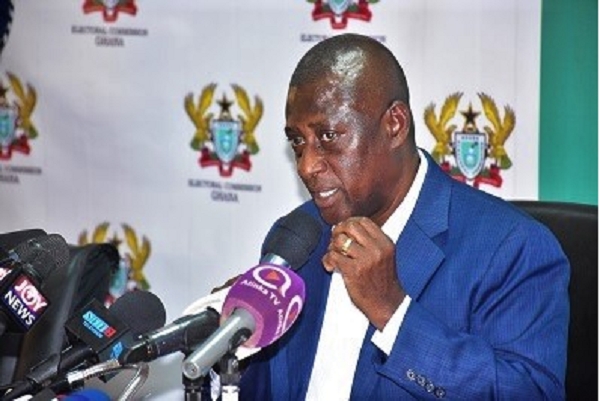
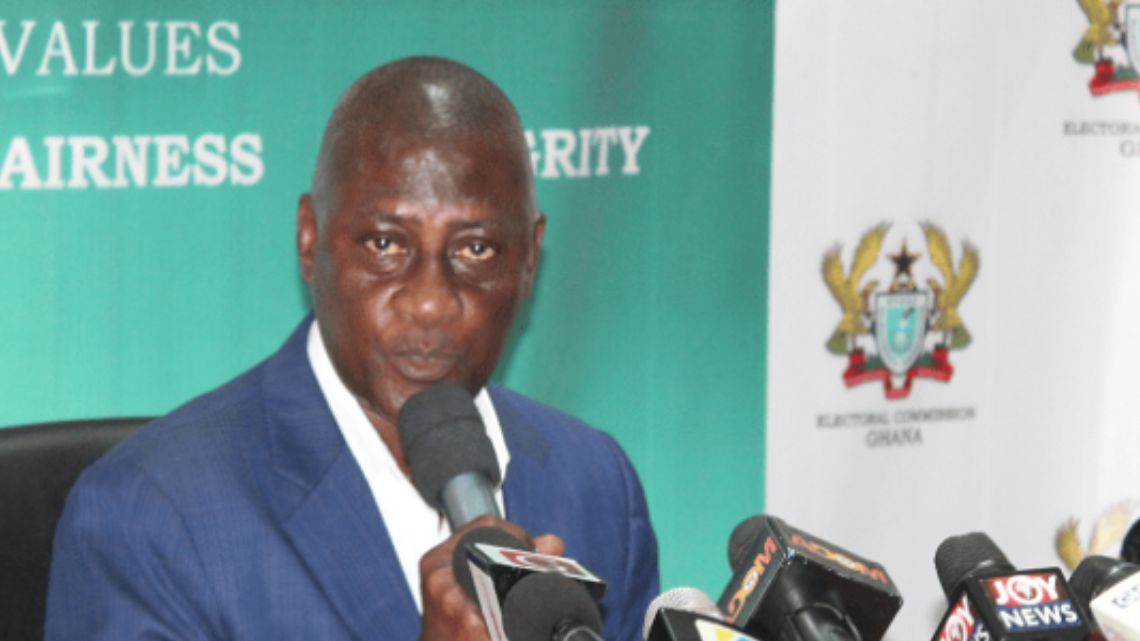
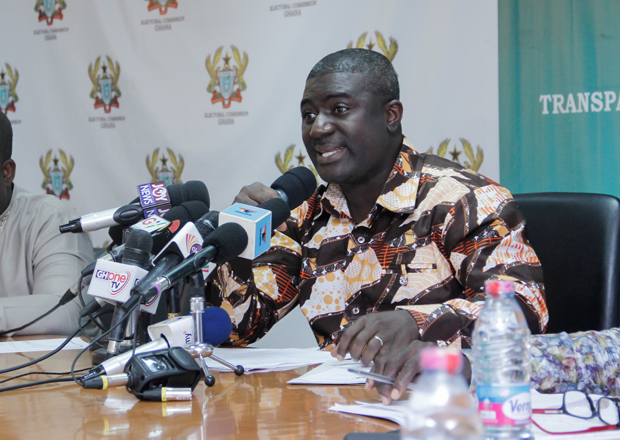
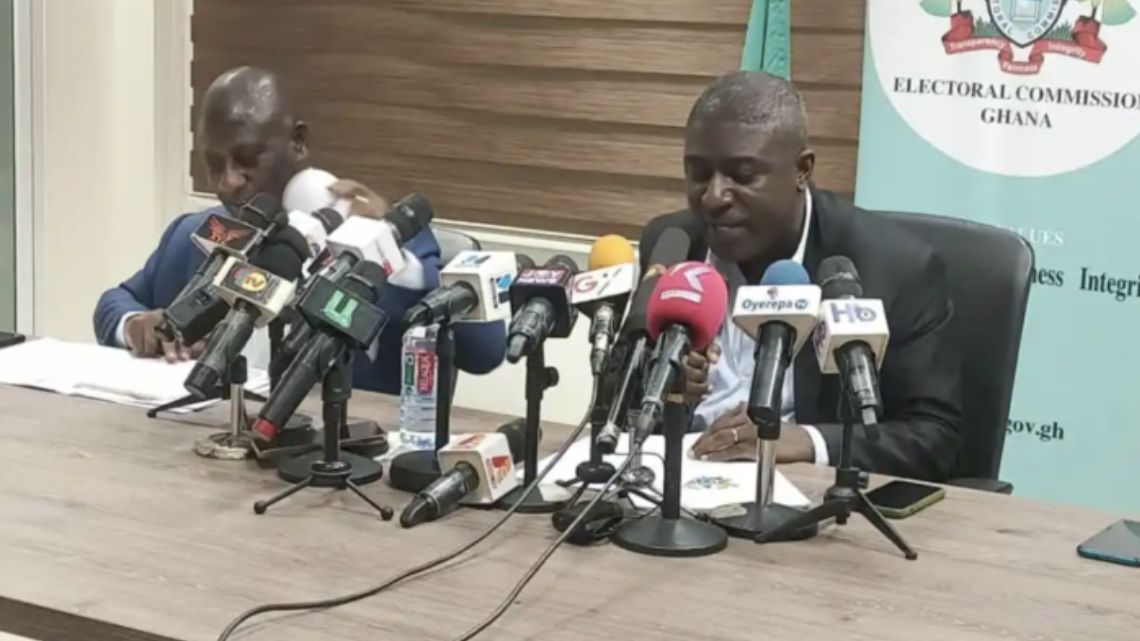
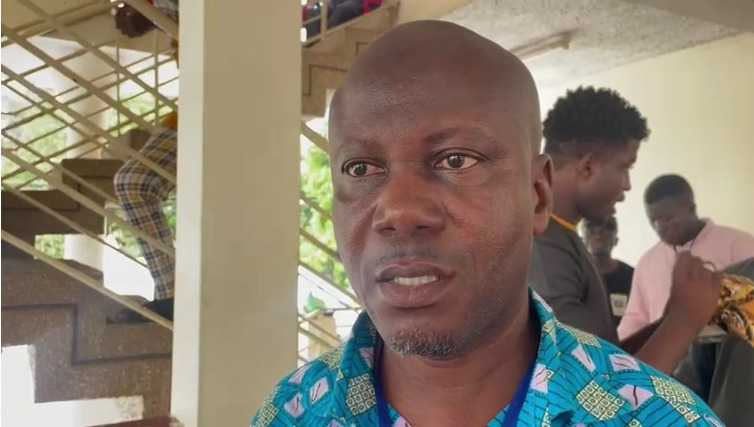
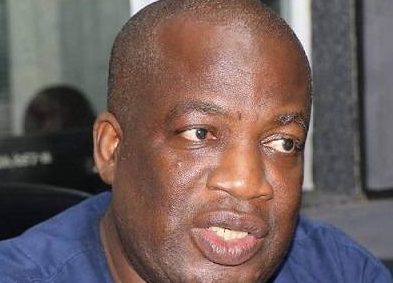
The Director of Electoral Services at the Electoral Commission (EC), Dr. Serebour Quaicoe, has emphasized that the EC does not harbor any animosity towards the National Democratic Congress (NDC).
He noted that the NDC, being a key stakeholder in Ghana’s elections, frequently raises concerns when it perceives issues in electoral processes and procedures.
In an interview on JoyNews Pulse on May 24, Dr. Quaicoe explained that once the EC addresses these concerns, the NDC moves past them and continues to engage constructively.
He highlighted that such interactions are typical for political parties and should not be seen as personal attacks on individuals within the EC.
“I want to put on record that the Electoral Commission and the NDC, we are not enemies. When you come and meet some of them, we all attended the same schools and we are nice….
“Normally, they will come and make the allegations and we will come and refute them. Once we refute them, it ends the case. I believe some of them maybe, they don’t understand how the system works, that is why they will make those allegations but we are not enemies with them,” he said.
For weeks, the NDC and the EC have been engaged in intense exchanges over the NDC’s allegations of the theft of several Biometric Voter Registration (BVR) devices from the Commission’s offices.
Initially, the EC denied these allegations but later admitted, albeit reluctantly, that some equipment was indeed missing.
Despite this, the Commission assured the public that the incident would not impact the upcoming polls in any way.
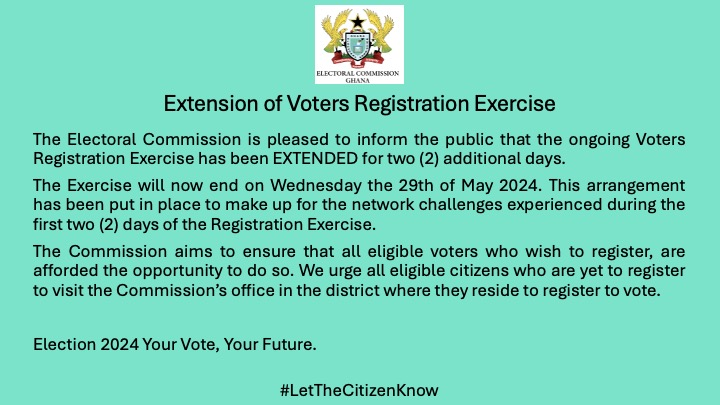
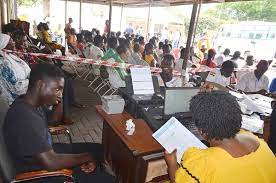
Electoral Commission (EC)has declared an extension to the limited voters registration exercise, adding two more days to the schedule.
Consequently, the exercise will conclude on Wednesday, May 29, 2024.
A statement issued by the EC explained that, “this arrangement has been put in place to make up for the network challenges experienced during the first two(2) days of the registration exercise.
“The Commission aims to ensure that all eligible voters who wish to registrar, are afforded the opportunity to do so.
We urge all eligible citizens who are yet to register to visit the Commission’s officein the district where they reside to register to vote.”
Originally scheduled to end on May 27, the exercise will now conclude on May 29. The EC announced this extension in a public notice, citing network challenges that caused delays as the reason for the extension.
“The exercise will now end on Wednesday the 29th of May 2024. This arrangement has been put in place to make up for the network challenges experienced during the first two (2) days of the registration exercise,” the notice read.
“We urge all eligible citizens who are yet to register to visit the Commission’s office in the district where they reside to register to vote,” it added.
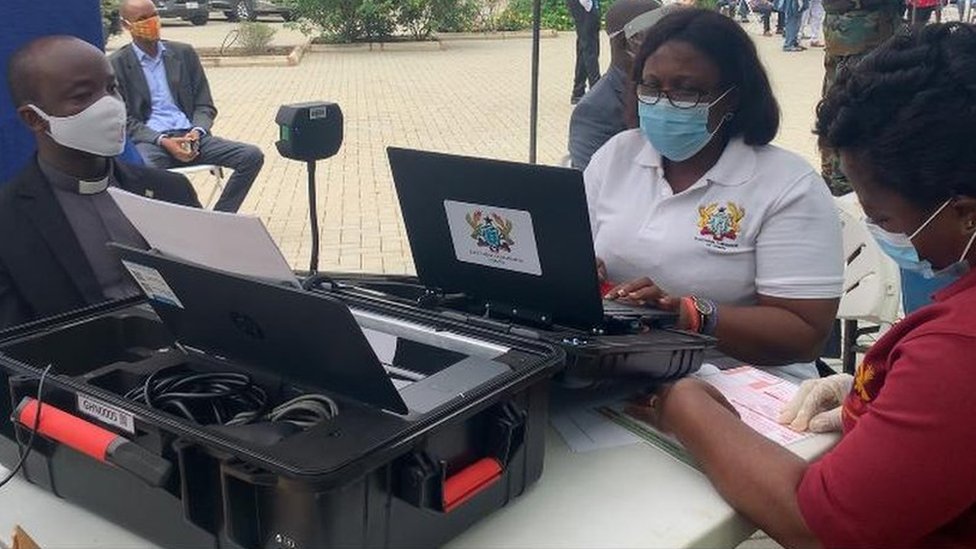
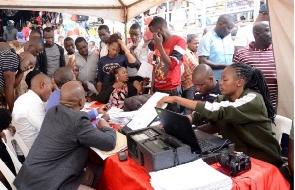
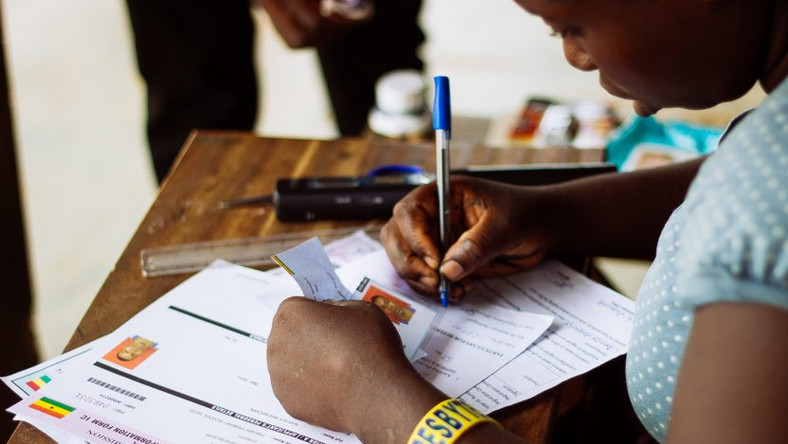
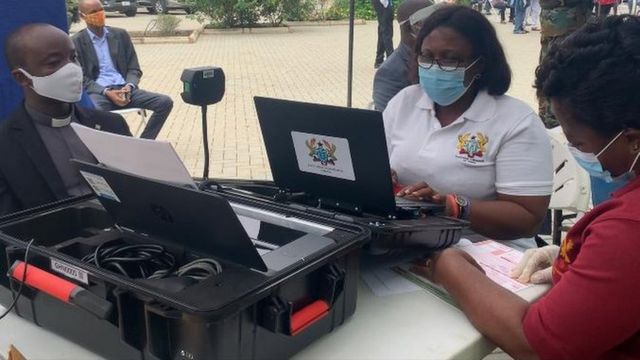
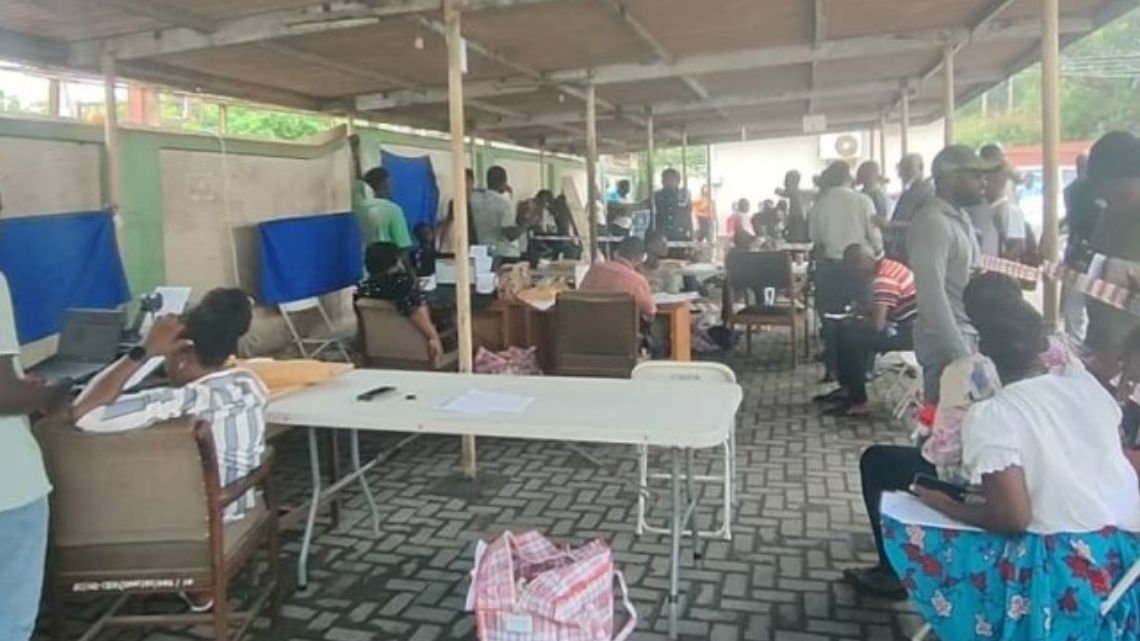
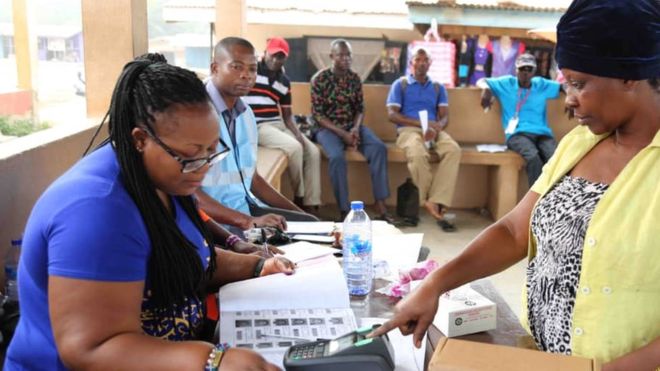
The ongoing limited voter registration exercise, which commenced on May 7, is designed to enable first-time voters and other eligible individuals to obtain voter cards.
Despite encountering challenges such as network issues and the registration of minors and foreigners, the Electoral Commission (EC) has remained transparent, keeping the public informed and taking corrective actions to mitigate these issues.
The ruling New Patriotic Party (NPP) has announced that an upcoming leadership meeting will determine whether the party will push for an extension of the limited voter registration period.
This decision will hinge on a review of the registrations conducted by the Electoral Commission (EC) up to now.
Various political parties and civil society organizations have called for extending the limited voter registration exercise, scheduled to end on Monday, May 27, 2024.
However, the EC has stated that extending the registration period is not feasible.
Evans Nimako, the Director of Elections and Research for the NPP, expressed the party’s contentment with the registration process in an interview with Citi TV.
He emphasized that the party will thoroughly evaluate the current registration figures before making any further decisions.
“Our position is that as many as people are qualified under the law, they should be given the opportunity to register.”
“So if we are saying that they [EC] are expecting 632,000 and at the end of the day, 700,000 people come out, does it mean that the excess of 77,000, they are not going to register them?”
“Our position is that as many as people are qualified under the law, they should be given the opportunity to register.”
“So if we are saying that they [EC] are expecting 632,000 and at the end of the day, 700,000 people come out, does it mean that the excess of 77,000, they are not going to register them?”
Dr. Rashid Tanko, Deputy Director of Elections and IT for the opposition NDC has called for the dismissal of the team responsible for generating and publishing infographics of data in the ongoing limited voter registration exercise.
This comes after the Electoral Commission (EC) announced a change in the team.
According to the Commission, this change aims to prevent the dissemination of erroneous figures.
Speaking at a press conference on Tuesday, Deputy Commissioner in Charge of Operations, Mr. Samuel Tettey, stated that rigorous mechanisms have been implemented to avoid future errors.
“The Commission apologises for the error,” he added.
However, Dr. Rashid Tanko expressed dissatisfaction with the assurances provided by the Commission. He argued that individuals found complicit should be dismissed rather than reassigned.
“It is not enough for us. Heads should roll at the Electoral Commission. Changing the team is not enough. It is not the answer. What is the quality assurance going on at the Electoral Commission that led them to churn out those fake figures?
“The one who presided over all that should step aside. That is what a serious country should be built on, not just asking that people should be changed. What is the meaning of that?”
Meanwhile, the EC reports that the Volta region has recorded the highest number of challenged cases, while the Ashanti region leads in overall registered voters.
The Electoral Commission (EC) has announced a change in the team responsible for generating and publishing infographics of data in the ongoing limited voter registration exercise.
According to the Commission, this change aims to prevent the dissemination of erroneous figures.
Speaking at a press conference on Tuesday, Deputy Commissioner in Charge of Operations, Mr. Samuel Tettey, stated that rigorous mechanisms have been implemented to avoid future errors.
“The Commission apologises for the error,” he added.
However, Dr. Rashid Tanko, Deputy Director of Elections and IT for the opposition NDC, expressed dissatisfaction with the assurances provided by the Commission.
He argued that individuals found complicit should be dismissed rather than reassigned.
“It is not enough for us. Heads should roll at the Electoral Commission. Changing the team is not enough. It is not the answer. What is the quality assurance going on at the Electoral Commission that led them to churn out those fake figures?
“The one who presided over all that should step aside. That is what a serious country should be built on, not just asking that people should be changed. What is the meaning of that?”
Meanwhile, the EC reports that the Volta region has recorded the highest number of challenged cases, while the Ashanti region leads in overall registered voters.
The accusations were leveled by a group named Election Watch Ghana, alleging that the EC was covertly registering voters with stolen BVR kits.
Samuel Tetteh, the Deputy Commissioner in charge of Operations at the EC, addressed these claims during a press conference in Accra on Tuesday.
He vehemently denied the allegations and urged the public to disregard them.
“The attention of the commission has been drawn to a press conference organised by a group called Election Watch Ghana during which one Mark Ewusi alleged that the EC was using stolen BVR kits to register people secretly. The commission urges the public to ignore these baseless and unfounded allegations as they are without merit,” he stated.
Mr. Tetteh clarified that the commission had reported five missing laptops, which are components of the BVR kits, to the security agencies, not the entire kits.
He suggested that referring to the missing laptops as BVR kits was a deliberate attempt to mislead the public.
“…The commission has never reported that BVR kits have been stolen. The Commission reported to the security agencies that five laptops were missing. The commission informed all stakeholders about the missing laptops.
“Describing the missing laptops as BVRs is a deliberate attempt by certain groups to deceive the public in order to sustain their unfounded allegations…the five missing laptops on their own cannot be used to register voters,” he stated.
Juapong District of the Electricity Company of Ghana (ECG), situated under Tema, has issued a stern warning to the public against meddling with the power distributor’s network, citing potential risks to the company, customers, and the general populace.
The caution comes following the district’s identification of a fuse burnout in a 200KVA transformer located in Asikuma, a town within its jurisdiction. This fuse, designed to safeguard the transformer, was discovered to be damaged on Saturday, May 18, 2024.
The company’s attention was drawn to this issue after observing frequent tampering with the distribution network, particularly by individuals, possibly non-company electricians, during outages in attempts to restore power.
However, such actions pose significant hazards, as these individuals may lack familiarity with the specific network design of the area.
Ing. Rejoice Garfo, the Juapong District Engineer, reiterated this warning on a stakeholder WhatsApp platform for residents of the district.
She urged that “if such interference continues, the entire transformer could be damaged. This would result in customers being without power until a new transformer is installed.”
The Juapong District Manager, Ing. William Ahenkorah, mentioned that “replacing these transformers consumes significant company resources, diverting funds from other projects and straining the company’s finances.”
Ing. Ahenkorah also stressed that before any work is done on the distribution network, the team ensures that power is switched off when necessary.
He explained, “This is crucial to prevent accidents, injuries, and potential fatalities. Just imagine if an unauthorized individual attempts to work on the network during an outage and the power is suddenly restored. This could result in loss of life.”
Engineer Ahenkorah advises customers and the general public to report any power supply issues, outages, or related problems directly to the ECG for resolution, rather than attempting to resolve them independently.
The oppositionNational Democratic Congress (NDC)has rejected the Electoral Commission’s (EC) proposal to switch to offline voter registration if the current online system continues to face challenges.
Instead, the NDC has urged the Commission to promptly fix and restore data connectivity at all registration centers to ensure continuous registration, timely data verification, and enhanced transparency.
The registration exercise, which began on May 7, 2024, and is expected to conclude on May 27, has encountered numerous issues, including poor internet connectivity and malfunctioning biometric machines.
In response to these challenges, the Commission instructed its officers to switch to offline registration if necessary.
However, at a news conference in Accra on Thursday (May 16), NDC General Secretary Fifi Kwetey voiced strong opposition to the offline registration mode, labeling it as deficient.
He argued that offline registration could undermine the integrity of the electoral process, expose the system to exploitation, and introduce errors that could skew the outcome.
“This approach lacks real-time oversight, making it difficult to verify data promptly and transparently, thereby opening the door to potential biases and manipulations—particularly in targeted districts and regions to the disadvantage of the NDC. These actions compromise transparency and trust,” Kwetey stated.
He acknowledged that technical challenges are an inevitable aspect of any large-scale logistical operation, but emphasized that registering voters offline is not the ideal solution.
He urged the EC to promptly address the systemic issues to ensure the efficiency and reliability of the electoral process.
“We demand that the EC be proactive in implementing robust preventive measures rather than resorting to offline registration,” the General Secretary emphasized.
Kwetey also raised concerns about incorrect figures released by the Commission during the ongoing voter registration exercise.
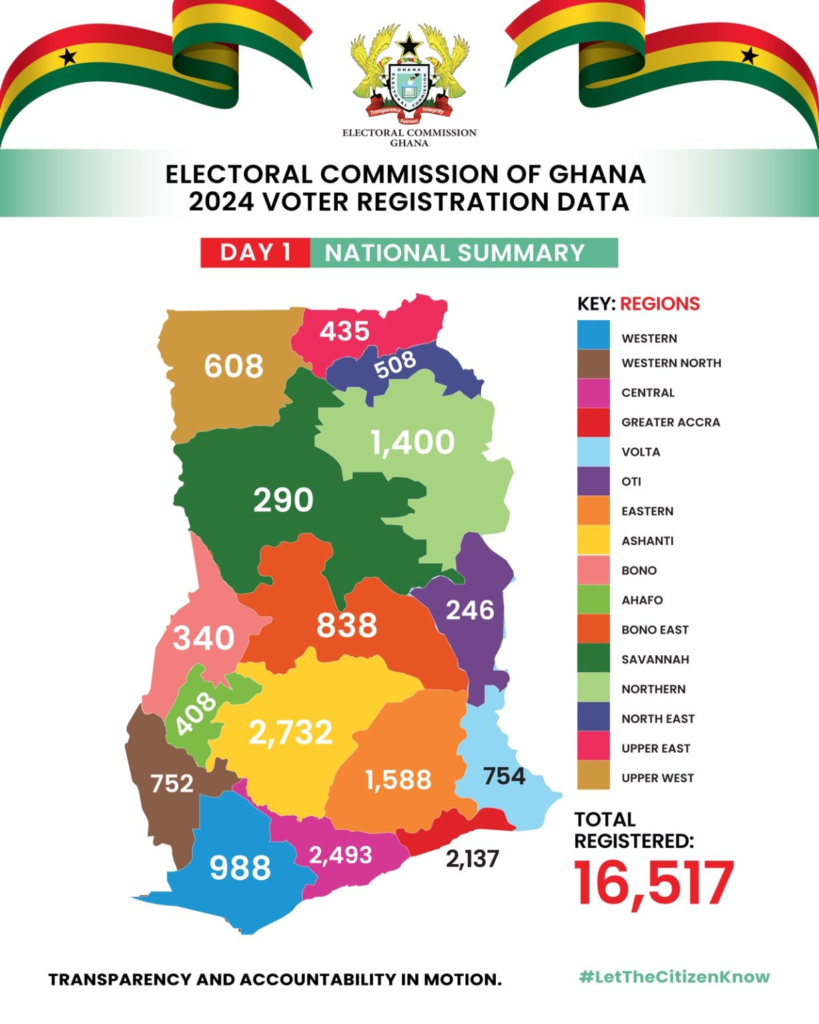
For example, he noted that on May 11, 2024, the Party alerted the Commission to anomalies in figures published on its website and social media handles. Although the EC acknowledged the issue on May 12 and made corrections, Kwetey claimed the “corrected” figures still contained errors.
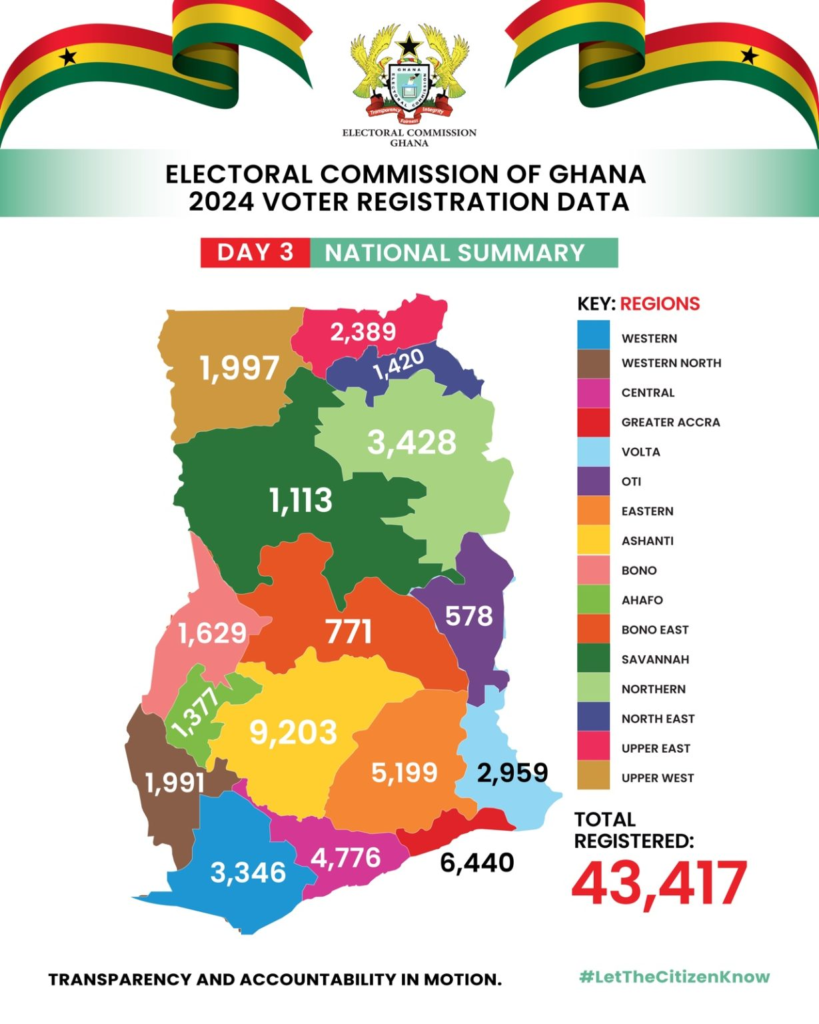
In the Oti Region, for instance, he alleged that the Day Two figure of 578 was “erroneously” swapped with the Day Three figure of 1,515. If these figures were aligned correctly, the Day Two national total would be 18,330, not 19,267, and Day Three’s total would be 49,553, not 48,616, as stated by the Commission.
“Similarly, the Day Three figure for Bono East in their corrected data is 771. However, this is incorrect. Bono East recorded 2,252 per our provisional data. This discrepancy will affect the total registered voters of 5,118 for Bono East for the four days as stated by the EC,” he added.
“This situation exemplifies what we term ‘transpositional rigging,’ where figures are shuffled between categories without affecting the overall total,” he explained.
He urged the EC to promptly rectify the inaccuracies in the data released on May 12, 2024, noting that such discrepancies could raise suspicions among parties.
“We expect a thorough review and correction of all figures to prevent further errors and uphold the integrity of our electoral process,” he stressed.
Heassured Ghanaians that the NDC remains vigilant and committed to safeguarding all votes, promising that every ballot cast on December 7 would be accounted for.
Kwetey reiterated calls for an independent investigation into the missing biometric verification kits to eliminate any mistrust among stakeholders.
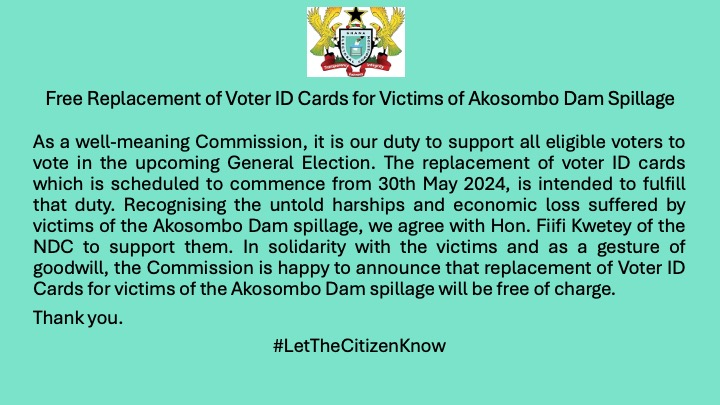
The Electoral Commission (EC) has announced that individuals affected by the Akosombo Dam spillage will receive a free replacement of their voter identification (ID) cards.
The EC reaffirmed its commitment to assisting all eligible voters in participating in the upcoming general election, acknowledging the significant challenges faced by those affected.
The replacement process for voter ID cards is scheduled to commence on May 30, ensuring ample time for affected individuals to obtain their new IDs before the election
“As a well-meaning Commission, it is our duty to support all eligible voters to vote in the upcoming general election. The replacement of the Voter ID Cards which is scheduled to commence on May 30, is intended to fulfill that duty. Recognising the untold hardship and economic loss suffered by the victims of the Akosombo Dam spillage, we agree with Fifi Kwetey of the NDC to support them.
“In solidarity with the victims and as a gesture of goodwill, the Commission is happy to announce that replacement of voter ID cards for victims of the Akosombo Dam spillage will be free of charge.”
Fifi Kwetey, the General Secretary of the National Democratic Congress (NDC), made an appeal to the Electoral Commission (EC) to issue replacement voter ID cards free of charge to individuals impacted by the recent Akosombo dam spillage.
During a press conference on May 16, Mr. Kwetey underlined the importance of swift action and urged the EC to show empathy towards those affected by this situation.
Electoral Commission (EC) has firmly denied allegations of disenfranchising the people of Santrokofi, Akpafu, Lolobi, and Likpe (SALL) during the 2020 parliamentary elections.
The EC has urged the public to disregard the claims made by Franklin Cudjoe, President of IMANI Africa, who has been perpetuating the false narrative that the EC disenfranchised SALL voters in 2020.
Cudjoe accused the EC of failing to ensure the participation of SALL residents in the voting process, thereby disenfranchising them.
However, the EC refuted these allegations in a statement issued on Wednesday, May 15, insisting that it did not disenfranchise the residents of the newly formed Guan Constituency at any point.
The EC reiterated its commitment to ensuring that all eligible voters are able to participate in the electoral process.
Franklin Cudjoe argued that the EC’s December 6, 2020 statement that excluded “voters in the SALL Traditional Areas from voting in the election for a Member of Parliament was a flagrant violation of the right to vote of the said voters, which amounts to being disenfranchised.”
However, the EC in its statement issued on Thursday, May 16, once again denied that it disfranchised the people of SALL, stressing that it is not in the interest of the Commission to disenfranchise any citizen.
“The General Public is urged once again to ignore the campaign of Franklin Cudjoe to perpetuate the false narrative that the Electoral Commission disenfranchised SALL voters in 2020.
“As indicated in our previous statement, it is not in the interest of the Commission to disenfranchise any citizen. The blame does not lie with the Electoral Commission which only performed its constitutional duties following the creation of the Guan District. The discerning public can, based on the facts outlined above, ascertain the truth for themselves.
“In spite of the Electoral Commission’s Press Statement on 15th May 2024, backed by documents, refuting the false and unfounded allegations by the President of Imani to the effect that, the Commission disenfranchised voters in the Guan Constituency (SALL), Franklin Cudjoe has continued to misinform and mislead the public by making reference to a public statement issued by the Commission on 6th December 2020.
“We note also that other citizens, such as Prof. Kwaku Asare, have also made reference to the 6th December 2020 statement issued by the Commission.”
The Ghana Federation of Disability Organisations (GFD) has urged the Electoral Commission (EC) and the Ghana Police Service to prioritize the safety of persons with disabilities (PwDs) during the ongoing voter registration exercise.
The call comes in response to reported incidents of violence at some registration centers, particularly in Kukuom (Ahafo region), Cape Coast (Central region), and Adugyama (Ashanti region).
While acknowledging that the exercise has been generally peaceful nationwide, the GFD expressed concern that such incidents could intimidate PwDs and deter them from participating in the registration process.
“The news as reported by some media outlets, falls short of informing the public about the safety measures to assure persons with disabilities to participate in the process,” said the federation.
“The GFD wishes to call on the security agencies and the Electoral Commission to prioritise the safety of vulnerable groups, including persons with disabilities at all times during the registration process,” the federation said in a statement signed and issued by its national president, Joseph Atsu Hormadzi.
“Persons with disabilities are deemed to be greatly affected in situations of emergencies and violence. The current atmosphere of violence at registration centres is a crucial factor that can lead to the disenfranchisement of persons with disabilities and other marginalised groups, thereby jeopardising their right to participate in the upcoming 2024 general election,” it said.
The federation said: “Ghana as a state party to the United Nations Convention on the Rights of Persons with Disabilities (UNCRPD), particularly under Article 29, must guarantee the safety and equal rights of persons with disabilities to access political opportunities devoid of obstacles.”
“It needs to be emphasised that inclusion is not just a fundamental human right, but also essential for the sustainable development of Ghana under the principle of “Leaving No One Behind,” it stressed.
The Ghana Federation of Disability Organisations (GFD) strongly condemned the recent violence reported at several voter registration centers, expressing deep concern about its impact on persons with disabilities (PwDs) who have consistently faced barriers to their political participation.
The GFD emphasized that political violence has been a significant deterrent for PwDs, hindering their ability to exercise their right to vote. The federation highlighted the urgent need for intervention to ensure that PwDs are not excluded from the electoral process, as this would violate their fundamental human rights.
Calling on all stakeholders, including political party leaders, the GFD urged for immediate action to create a safe and secure environment for PwDs at registration centers. The federation emphasized that political promises of inclusion are meaningless without tangible efforts to protect PwDs’ lives and ensure their full participation.
The GFD reaffirmed its commitment to advocating for the rights and inclusion of PwDs in all aspects of society, urging collaborative efforts from all stakeholders to uphold the rights of every citizen, including persons with disabilities.
The National Peace Council (NPC) has urged political parties and stakeholders in Ghana’s democracy to trust and have confidence in the Electoral Commission (EC) when resolving challenges or issues related to the electoral process.
The council highlighted the EC’s comprehensive processes for resolving challenges related to voter registration and election conduct, emphasizing that these processes should be utilized to address any concerns from stakeholders.
“We must be careful the way and manner we portray the EC in our efforts to ensure transparency, fairness and credibility in its processes. Let us be careful not to push the EC into a situation where Ghanaians do not trust whatever the EC does,” the Executive Secretary of the NPC, George Amoh, told the Daily Graphic in an exclusive interview.
He emphasized that for the country to conduct credible elections, all Ghanaians, including Civil Society Organisations (CSOs), have a role to play. He encouraged the use of the Electoral Commission’s elaborate systems and procedures to address any problems or concerns.
Regarding the ongoing limited voters’ registration exercise, he advised political parties and their agents not to judge individuals’ eligibility based on their size or height.
Instead, he urged them to use the established procedure to challenge registrations if they believe someone is a minor or a foreigner.
“We do not need to fight at registration centres,” he said.
Mr. Amoh emphasized the importance of encouraging eligible individuals to register instead of preventing them from doing so. He cautioned against generalizing limited issues of violence, arrests, and intimidation in some registration centers to the entire process.
“We should all be law-abiding and allow the systems to work,” he said, adding that the cost implications of deploying not only security personnel but political party agents was huge.
He suggested that the country should engage in a conversation after the elections to address and resolve any outstanding issues.
The Electoral Commission has refuted allegations made by IMANI President, Franklin Cudjoe, accusing the Commission of deliberately disenfranchising the people of Santrokofi, Apkafu, Lolobi, and Lipke (SALL).
It will be recalled that on December 6, 2020, just a day before the general election, the EC directed that residents in the SALL areas could only vote in the presidential election, resulting in the constituents being without representation in Parliament since then.
IMANI Africa is holding the EC responsible for this, but Deputy Chairperson of the Electoral Commission, Dr. Bossman Asare, has stated that the Commission cannot be held responsible for the situation.
He noted that Parliament should be held accountable.
“If you want someone to blame for that process, [it should be] the parliament. The time the Parliament began the process of creating the LI that created Guan, they should have known that it wasn’t possible that a constituency would be created for them to vote in the Parliamentary election,” he is quoted by MyJoyOnline.com to have said.
“Clearly, anyone who blames the EC for what happened in the Guan – for them not electing a member of Parliament – the person doesn’t understand the processes of Parliament,” he added.
African Electoral Institute (AEI) is urging the Electoral Commission (EC) to exercise diligence in collating and publishing data to prevent the dissemination of inaccurate and erroneous information during the ongoing Limited Voter Registration Exercise.
In a statement dated May 14, 2024, the AEI highlighted instances where the EC previously released incorrect figures from the Limited Voter Registration Exercise, which later had to be corrected.
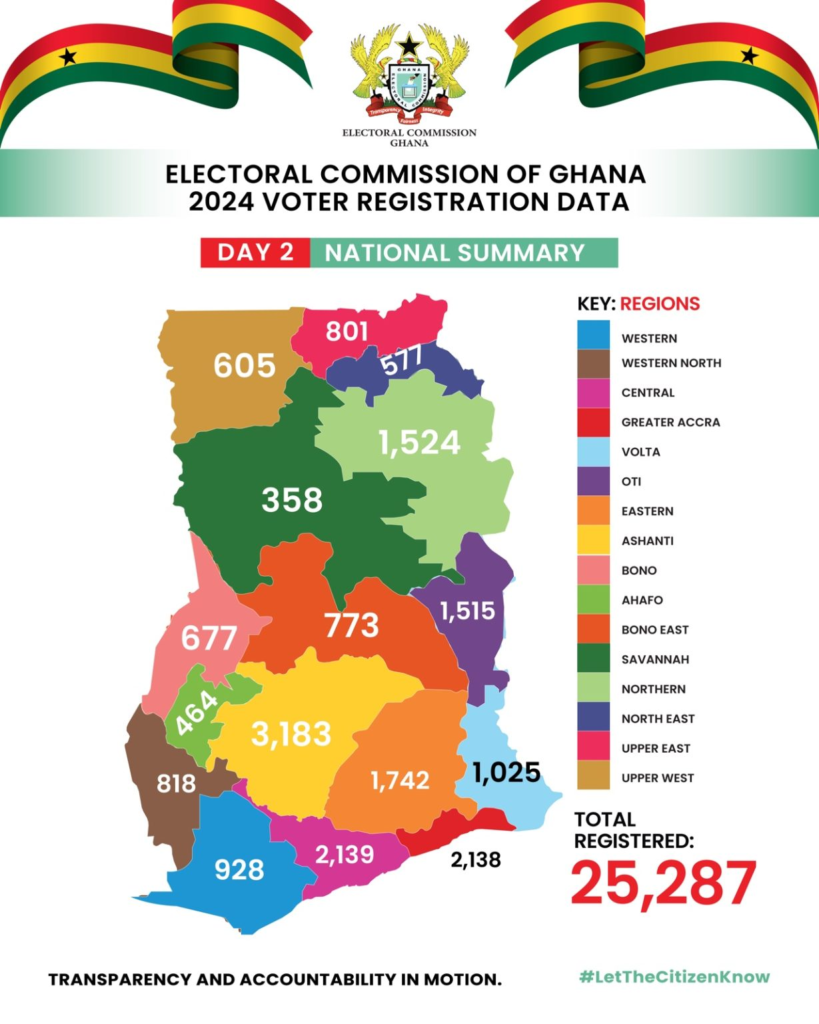
“From African Electoral Institute’s (AEI) Research Desk, the number of registered voters for Day 2 was 19,267 registrants as has been published by the EC, however, the EC published the summation of all the regional figures as 25,287 instead of 19,267. Similarly, the number of voters registered on Day 3 was reported by the EC to be 48,616, instead of 43,417,” part of the statement read.
The AEI believes that the EC is a human institution and as such is prone to errors, therefore, the group advised the election organising body to ensure strict quality control and should not be in a hurry to announce figures.
“African Electoral Institute acknowledges the fact that the EC is a human institution and thereby admonishes the EC to be meticulous and diligent in the compilation of their figures. The EC may have to adopt strict quality control measures to prevent such blunders, because if it must be done, it must be done well.
“The African Electoral Institutebelieves that there is no need by the EC to be in such a hurry to publish figures as they are not in competition with any other institution to be the first to publish the collated registration results.
“Therefore, a few hours of delay to ensure that the collated figures are accurate will not hurt anyone and would go a long way in preventing avoidable mistakes and subsequent corrections, which impact negatively on the reputation of the Commission,” it added.
The Limited Voter Registration Exercise started on Tuesday, May 7, 2024, and will end on May 27, 2024.
Below is the full statement by the African Electoral Institute
PRESS RELEASE
TO: ALL MEDIA HOUSES
DATE: 14TH MAY,2024
AFRICAN ELECTORAL INSTITUTE (AEI) IMPLORES THE ELECTORAL COMMISSION (EC) TO BE METICULOUS AND DILIGENT TO AVOID ERRONEOUS AND INACCURATE FIGURES TO THE PUBLIC
African Electoral Institute (AEI) beseech the Electoral Commission (EC) to be diligent and meticulous in its data collation and publication of same to the general public.
The AEI has cited figures that are statistically inaccurate from the EC and subsequently changed by the EC to reflect the accurate figures in the on-going Limited Voter Registration Exercise.
From African Electoral Institute’s (AEI) Research Desk, the number of registered voters for Day 2 was 19,267 registrants as has been published by the EC, however, the EC published the summation of all the regional figures as 25,287 instead of 19,267.
Similarly, the number of voters registered on Day 3 was reported by the EC to be 48,616, instead of 43,417.
The Institute has also observed the banter between the two major political parties on these changes of figures by the EC on major news media.
African Electoral Institute acknowledges the fact that the EC is a human institution and thereby admonishes the EC to be meticulous and diligent in the compilation of their figures. The EC may have to adopt strict quality control measures to prevent such blunders, because if it must be done, it must be done well.
The African Electoral Institute believes that there is no need by the EC to be in such a hurry to publish figures as they are not in competition with any other institution to be the first to publish the collated registration results. Therefore, a few hours of delay to ensure that the collated figures are accurate will not hurt anyone and would go a long way in preventing avoidable mistakes and subsequent corrections, which impact negatively on the reputation of the Commission.
African Electoral Institute urges theEC to continue to work with the Inter Party Advisory Committee (IPAC) to deliver a credible election and to instill confidence in its operations by the Ghanaian voter.
SIGNED:
Seyram Mankra
Electoral Research Department.
Tel: 0244747128
Augustus Eshun
Director of Communications and External Relations
Tel: 024-460 9891
Nii Adjin Adjin-Tettey
Deputy Director of Communications and External Relations
Tel: 0540904550
Emmanuel Biri
3rd Dep. Director of Communications and External Relations
Tel: 0538421573 (WESTERN REGION AND CENTRAL REGION)
Ex WO1 Alhaji Yussif Mahamah, Head- Electoral Security Department
The Electoral Commission (EC) has refuted allegations made by Franklin Cudjoe, the president of IMANI Africa, regarding the disenfranchisement of the people of Santrokofi, Apkafu, Lolobi, and Lipke (SALL).
In a statement issued on Wednesday, May 15, the EC clarified that it did not disenfranchise the people in the newly established Guan Constituency.
The EC emphasized that it followed all legal procedures in creating the constituency and did not disenfranchise anyone in the process.
The EC has provided the facts surrounding the inability of the residents of SALL now the Guan Constituency, to vote in the 2020 Parliamentary Election.
1. The Legislative Instrument (L. I. 2416) which created the Guan District (SALL) was laid in Parliament on the 6th of October, 2020 by the Ministry of Local Government and Rural Development (MLGRD). It matured on the 9th of November, 2020, roughly a month to the 2020 General Elections.
2. Parliament went on recess on the 9th of November, 2020, the same day the L.I. creating the Guan District matured and returned on the 14th of December, 2020, one week after the 2020 General Elections.
3. On the 10th of November 2020, the Electoral Commission received a letter from the Ministry of Local Government and Rural Development informing it of the creation of the Guan District (SALL). The letter requested the Commission to take steps to create a new Constituency.
4. The Commission drafted a new Constitutional Instrument (C.I.) to bring into force the Guan Constituency and forwarded the draft C.I. to the Attorney General’s Department for its review on the 13th of November, 2020 as required by law.
5. It is important to state that for a C.I. to mature and come into force, the law requires the Electoral Commission to lay the C.I. in Parliament for twenty-one (21) sitting days. This means that Parliament should be in session during the twenty-one (21) day period when the C.I. is laid.
6. With Parliament on recess, the Commission could not lay the C.I. to bring the Guan Constituency into effect as required by law.
7. The question is, how could the Commission proceed to create a new Constituency when Parliament was on recess and when the law required the Commission to lay the C.I. before Parliament for twenty-one (21) sitting days?
Franklin Cudjoe, the president of IMANI Africa, has criticized the Electoral Commission’s (EC) denial of disenfranchising the people of Santrokofi, Apkafu, Lolobi, and Lipke (SALL) during the 2020 parliamentary elections, calling it brazenly dishonest.
The Electoral Commission (EC) has refuted allegations made by Franklin Cudjoe, the president of IMANI Africa, regarding the disenfranchisement of the people of Santrokofi, Apkafu, Lolobi, and Lipke (SALL).
In a statement issued on Wednesday, May 15, the EC clarified that it did not disenfranchise the people in the newly established Guan Constituency. The EC emphasized that it followed all legal procedures in creating the constituency and did not disenfranchise anyone in the process.
The EC labeled the allegations as false and advised the public to disregard them.
“It is unfortunate that IMANI continues to peddle falsehood and untruths about the Commission at every point and turn. His [Franklin Cudjoe’s] narrative that the Commission disenfranchised the people of SALL, now the Guan Constituency, is FALSE. We urge the public to verify information put out by IMANI, with the Commission for the truth and the facts.”
Franklin Cudjoe in a counterstatement, insisted that the inability of the SALL residents to partake in the 2020 parliamentary elections lies solely at the doorstep of the EC because “it is a matter of public record that in the evening of 6th December 2020, the Electoral Commission issued a public statement to the effect that voters in the SALL Traditional areas could not vote in the Parliamentary elections scheduled for 7th December 2020.”
Franklin Cudjoe added that the EC’s December 6, 2020 statement that excluded “voters in the SALL Traditional Areas from voting in the election for a Member of Parliament was a flagrant violation of the right to vote of the said voters, which amounts to being disenfranchised.”
“The exclusion of voters in the SALL Traditional Areas from voting in the election for a Member of Parliament was a flagrant violation of the right to vote of the said voters, which amounts to being disenfranchised. As a consequence, the people of the SALL Traditional Areas do not have representation in the 8th Parliament of the 4th Republic. This has rightly been described by Prof. Kwaku Asare as “the cardinal sin” of the 8th Parliament.
“It is brazenly dishonest on the part of the Electoral Commission to refer to my statement about the people of SALL being disenfranchised as “falsehood and misinformation” or “falsehood and untruths about the Commission”. None of the so-called “facts surrounding the inability of the residents of SALL now the Guan Constituency, to vote in the 2020 Parliamentary Election” that are recited in the 14th May 2024 statement of the Electoral Commission, can take away the simple, indisputable fact that, on the eve of the 2020 elections, the Electoral Commission publicly announced that the people of SALL could not vote in the Parliamentary election.
As of the close of business on Sunday, May 12, 2024, the Electoral Commission (EC) registered a total of 251,149 new voters, averaging 45,000 registrations per day.
Of this total, 135,898 (54.11 per cent) are female, and 115,251 (45.89 per cent) are male. The EC also registered 400 persons with disabilities nationwide.
In terms of regional breakdown, the Greater Accra region registered 33,899 voters (13.5 per cent); North East, 6,928 (2.8 per cent); Upper East, 10,646 (4.2 per cent); Northern, 19,491 (7.8 per cent); Bono, 8,972 (3.6 per cent); Bono East, 9,681 (3.9 per cent); Volta, 12,190 (4.9 per cent); Upper West, 8,474 (3.4 per cent); Eastern, 25,625 (10.2 per cent); Central, 27,984 (11.1 per cent); and Ahafo, 6,273 (2.5 per cent).
The remaining registrations are Ashanti, 44,232 (17.6 per cent); Western North, 9,134 (3.6 per cent); Oti, 7,259 (2.9 per cent); Savannah, 5,261 (2.1 per cent); and Western Region, 15,100 (6.0 per cent).
Dr. Bossman Eric Asare, a Deputy Chair of the EC in-charge of Corporate Services, noted that first-time voters, aged 18 to 21, constituted the majority of registered voters, with 221,066 registrations within the first six days.
During the first five days of the registration exercise, 98,926 applicants (39.39 per cent) used the Ghana Card, while 622 applicants (0.25 per cent) used a passport. The guarantor system was used by 151,601 applicants (60.36 per cent).
Regarding challenges, out of a total of 2,935 cases, the Greater Accra Region recorded the highest number with 524 challenged cases.
“The guarantor system continues to dominate the forms of identification. This is something the Commission is not proud of because it is used by political parties and certain persons to facilitate the registration of unqualified persons such as minors and foreigners,” he said.
Dr. Asare expressed the Commission’s hope that in future registration exercises, the guarantor system would not be the sole identity document, aiming to reduce chaos in registration centers regarding the ages and nationalities of applicants.
The Commission also appealed to political parties to refrain from using violence to challenge the eligibility of applicants, urging them to use appropriate procedures to resolve such cases.
Furthermore, the Commission appealed to parents to ensure that their children under 18 years old do not attempt to register.
A Deputy Chair of the EC in charge of Corporate Services, Dr. Bossman Eric Asare, has noted that the guarantor system continues to dominate the forms of identification, posing a threat to the validity of the voter register.
He explained that “this is something the Commission is not proud of because it is used by political parties and certain persons to facilitate the registration of unqualified persons such as minors and foreigners.”
Dr. Asare expressed the Commission’s hope that in future registration exercises, the guarantor system would not be the sole identity document, aiming to reduce chaos in registration centers regarding the ages and nationalities of applicants.
The Commission also appealed to political parties to refrain from using violence to challenge the eligibility of applicants, urging them to use appropriate procedures to resolve such cases.
Furthermore, the Commission appealed to parents to ensure that their children under 18 years old do not attempt to register.
As of the close of business on Sunday, May 12, 2024, the Electoral Commission (EC) registered a total of 251,149 new voters, averaging 45,000 registrations per day.
Of this total, 135,898 (54.11 per cent) are female, and 115,251 (45.89 per cent) are male. The EC also registered 400 persons with disabilities nationwide.
In terms of regional breakdown, the Greater Accra region registered 33,899 voters (13.5 per cent); North East, 6,928 (2.8 per cent); Upper East, 10,646 (4.2 per cent); Northern, 19,491 (7.8 per cent); Bono, 8,972 (3.6 per cent); Bono East, 9,681 (3.9 per cent); Volta, 12,190 (4.9 per cent); Upper West, 8,474 (3.4 per cent); Eastern, 25,625 (10.2 per cent); Central, 27,984 (11.1 per cent); and Ahafo, 6,273 (2.5 per cent).
The remaining registrations are Ashanti, 44,232 (17.6 per cent); Western North, 9,134 (3.6 per cent); Oti, 7,259 (2.9 per cent); Savannah, 5,261 (2.1 per cent); and Western Region, 15,100 (6.0 per cent).
Dr. Bossman Eric Asare noted that first-time voters, aged 18 to 21, constituted the majority of registered voters, with 221,066 registrations within the first six days.
During the first five days of the registration exercise, 98,926 applicants (39.39 per cent) used the Ghana Card, while 622 applicants (0.25 per cent) used a passport. The guarantor system was used by 151,601 applicants (60.36 per cent).
Regarding challenges, out of a total of 2,935 cases, the Greater Accra Region recorded the highest number with 524 challenged cases.
The Electoral Commission (EC) has corrected errors in its publication of the daily voter registration figures for the ongoing limited voter registration exercise.
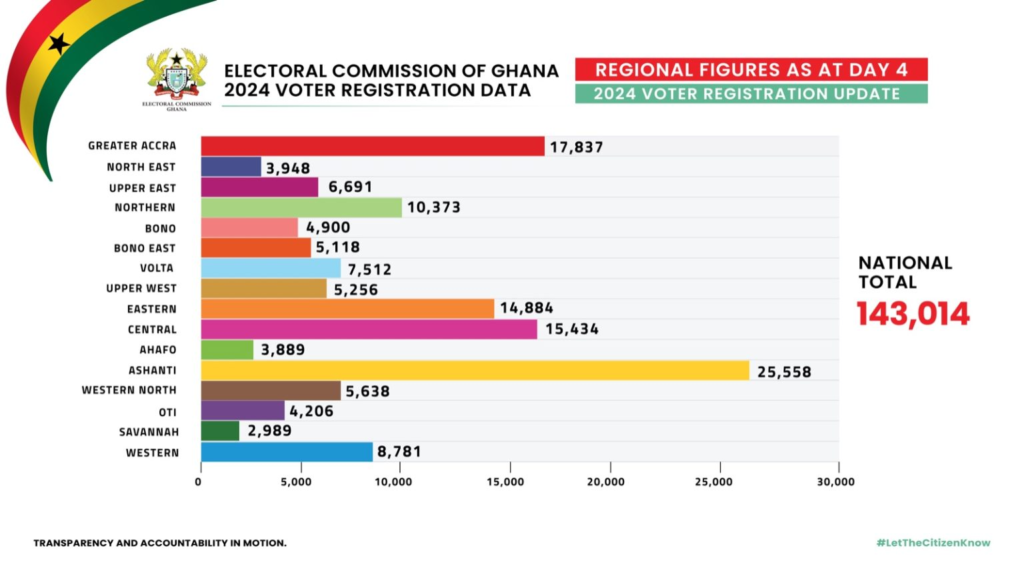
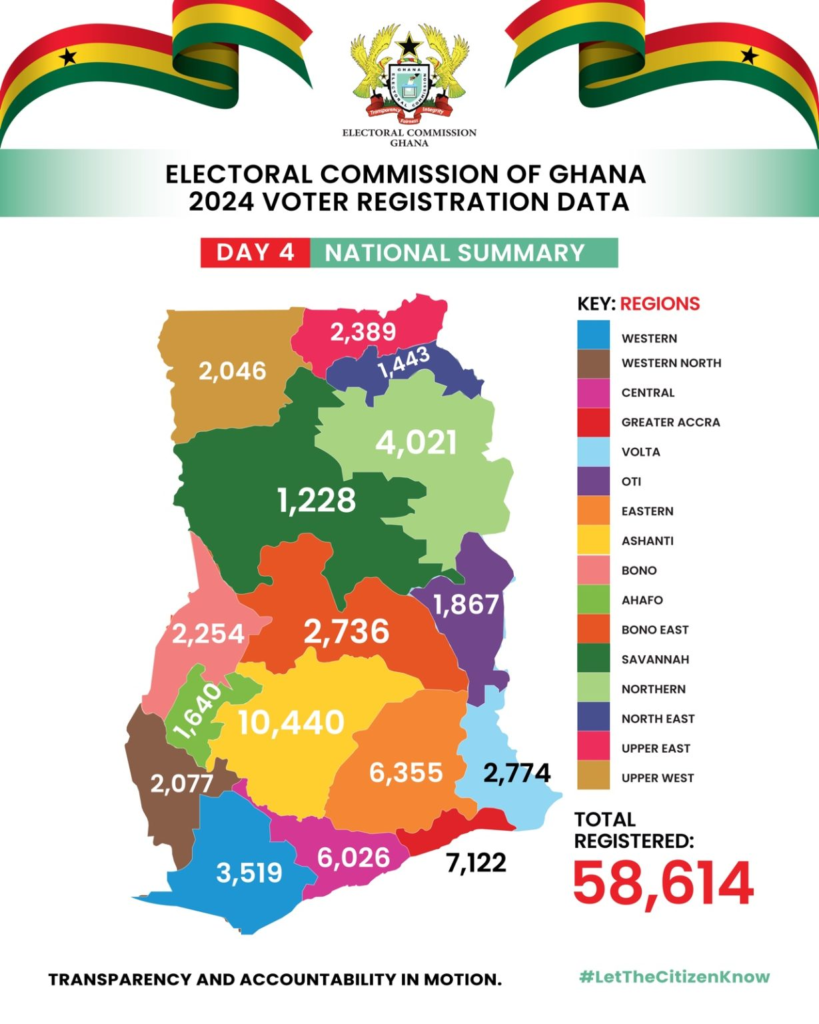
In a press release issued at the end of day four of the exercise, the EC initially reported that 143,014 eligible voters had been registered.
However, less than 24 hours later, the EC released a follow-up statement acknowledging that there was an error in the figures for day three, specifically for the Upper East region, which had been repeated.
“The Electoral Commission has noted some mistakes in the daily voter registration figures earlier published. The mistakes appeared in the total registered figures stated for days two and three although the individual regional figures were accurate, while the day three figure for Upper East was repeated for day four. All these have been corrected.”
The EC, however, added that the errors did not affect its total tabulation and so “at the end of the four days the total number of registered voters remain 143, 014.”
The voter registration exercise, which began on Tuesday, May 7, aims to register first-time voters and individuals seeking to obtain a voter card. Scheduled to last 21 days, the exercise is set to conclude on May 27, 2024.
Here is a breakdown of the registration figures by region:
Greater Accra: 17,837
North East: 3,948
Upper East: 6,691
Northern: 10,373
Bono: 4,900
Bono East: 5,118
Volta: 7,512
Upper West: 5,256
Eastern: 14,884
Central: 15,434
Ahafo: 3,889
Ashanti: 25,558
Western North: 5,638
Oti: 4,206
Savannah: 2,989
Western: 8,781
The Electoral Commission (EC) is working towards achieving its registration target before the conclusion of the exercise on May 27, 2024.
A father living in Koforidua known as Yaw Boateng has shared a humiliating story of how his son ended up in the grips of the police because some unknown individuals illegitimately registered him for the purpose of voting.
Mr Yaw explained that his sons were registered in his absence, however when he returned he followed up to ensure that their names were cancelled from the voter register.
He mentioned signing affidavits and following a cancellation process, but four years later, it appears that the EC officials failed to fulfill their duties.
As his son reached the age of 18 and attempted to register as a voter, he was shocked to find himself arrested by the police.
“Four years ago in 2020 somewhere in July. I returned one day and realized that my kids have been registered. My daughter is 12 years and she has been registered. My son was 14 years at that time and he was also registered. By unknown persons in Koforidua I realized minors were being registered to suit certain agenda. I don’t do politics so I don’t engage myself. So quickly I wrote a letter to the Municipal director of the EC petitioning of what has happened and asking him to delete the name. I wrote a letter on 23rd July 2020.”
“I have the letter here. Fast forward, they invited me and I met a panel and they made me do an affidavit swearing that the kids were my kids, the date of birth given to them were legitimate and they agreed that they have been registered. They collected the cards from me and assured me that they will delete the names. Fast forward 4 years later my boy turns 18. He comes here, he joins the queue to register and gets me a call that he has been arrested.”
“I rushed and brought the letter, and they asked that I come and meet the EC on Monday for further discussion. I find it weird because my son has gone through a lot of trauma. He called me shivering, frightened because he has been arrested by the police when he has done nothing wrong but also because someone neglected his duty. 4 years?!”
“its weird. And for the trauma that my boy has been through, I think on Monday the EC will have some questions to answer. Because phytologically he is not stable. He is in SHS 3 getting ready for exams. Look at the humiliation he’s been through. He’s been humiliated in public and people are calling me. Lets assume I was not in Koforidua, What will happen?,” Mr Yaw Boateng explained to the media.
Look at this. Just look at the level of negligence of this electoral commission. Now, all they will do is to frustrate this man and rubbish the case.
A father living in Koforidua known as Yaw Boateng has shared a humiliating story of how his son ended up in the grips of the police because some unknown individuals illegitimately registered him for the purpose of voting.
Mr Yaw explained that his sons were registered in his absence, however when he returned he followed up to ensure that their names were cancelled from the voter register.
He mentioned signing affidavits and following a cancellation process, but four years later, it appears that the EC officials failed to fulfill their duties.
As his son reached the age of 18 and attempted to register as a voter, he was shocked to find himself arrested by the police.
“Four years ago in 2020 somewhere in July. I returned one day and realized that my kids have been registered. My daughter is 12 years and she has been registered. My son was 14 years at that time and he was also registered. By unknown persons in Koforidua I realized minors were being registered to suit certain agenda. I don’t do politics so I don’t engage myself. So quickly I wrote a letter to the Municipal director of the EC petitioning of what has happened and asking him to delete the name. I wrote a letter on 23rd July 2020.”
“I have the letter here. Fast forward, they invited me and I met a panel and they made me do an affidavit swearing that the kids were my kids, the date of birth given to them were legitimate and they agreed that they have been registered. They collected the cards from me and assured me that they will delete the names. Fast forward 4 years later my boy turns 18. He comes here, he joins the queue to register and gets me a call that he has been arrested.”
“I rushed and brought the letter, and they asked that I come and meet the EC on Monday for further discussion. I find it weird because my son has gone through a lot of trauma. He called me shivering, frightened because he has been arrested by the police when he has done nothing wrong but also because someone neglected his duty. 4 years?!”
“its weird. And for the trauma that my boy has been through, I think on Monday the EC will have some questions to answer. Because phytologically he is not stable. He is in SHS 3 getting ready for exams. Look at the humiliation he’s been through. He’s been humiliated in public and people are calling me. Lets assume I was not in Koforidua, What will happen?,” Mr Yaw Boateng explained to the media.
Look at this. Just look at the level of negligence of this electoral commission. Now, all they will do is to frustrate this man and rubbish the case.
The Electoral Commission (EC) has urged the National Democratic Congress (NDC) to have faith in its dedication and capability to fulfill its responsibilities effectively.
The NDC has expressed concerns regarding the EC’s operations, particularly regarding the ongoing limited voter registration exercise, reports of missing laptops, and the request for serial numbers of the Biometric Voter Registration (BVR) kits.
Speaking on The Big Issue on Citi TV on Saturday, Dr. Serebour Quaicoe, Director of Electoral Services at the EC, sought to reassure the NDC and the public.
He stated, “…They should trust us. As we have been doing, we will continue to do it and when 2024 is done whatever the results will be, you will agree that we have done a good job.”
He responded to the NDC’s concerns regarding the transparency and integrity of the electoral process, including the ongoing limited voter registration exercise.
“…I want them to relax. They should train their agents very well. They should follow the registration and pick all the data with respect to the start of day record and end of day record. We are doing it for 21 days.
“So, if you put all your end of day records for 21 days it should give you the total number of people who were registered during this exercise,” he added.
Despite the Electoral Commission’s denial of their request, some representatives from the New Patriotic Party (NPP) and the National Democratic Congress (NDC) claim they are still documenting the serial numbers of Biometric Verification Registration (BVR) kits used in the ongoing limited voter registration exercise.
The EC rejected the request, citing concerns that it could jeopardise the ongoing process.
However, with a surge in first-time voters observed, agents from both parties managed to obtain the serial numbers of the Biometric Verification kits.
Musah Ahmed, the NDC Youth Organiser for Ayawaso North, stated, “From day one, we have been recording the BVR system’s serial numbers, and we are closely monitoring. If they are changed again, we will capture them and report to our superiors.”
When asked if the serial numbers were captured with the permission of the electoral officials, Ahmed Musah said, ‘we sought their permission, and they allowed us to take it.”
The NPP’s Augustin Ofori Gyebi said, “When we need it, we can get it.”. He added, “We have it; they showed us everything.”. Agents who obtained the serial numbers did so without the approval of the District Director of Elections for Ayawaso North, Apostle Tizor Watson.
He said, “I’ve not heard of anybody asking for a serial number from our outfit.”
His position was also corroborated by Lydia Anom, the Municipal Election Director, who also said her office had not given permission for the recording of serial numbers of BVR kits.
It would be recalled that speaking at a press conference on May 9, the National Chairman of the NDC, Johnson Asiedu Nketiah, urged the party’s agent to record the serial numbers despite the EC’s stance against it.
The limited registration exercise entered its fourth day with the Commission shuffling between offline and online registrations as a result of intermittent network challenges.
Meanwhile, as participation increases, top political figures, including government officials, have been visiting the various centres.
The Electoral Commission (EC) has issued a warning to individuals and political party agents, cautioning against disruptions or disturbances during the ongoing Limited Voter Registration Exercise.
The warning comes after the Ghana Police Service arrested three individuals—Abass Abukari, George Vinor, and Abdul Karim—in Tepa, Ashanti Region, on Wednesday. They were apprehended for allegedly disrupting the registration process and causing disturbances.
The individuals responsible for the sabotage are currently in police custody, assisting the Ghana Police Service with their investigations.
Benjamin Bannor Bio, the Ashanti Regional EC boss, emphasized that security personnel have been deployed to the various registration centers and are prepared to deal with any individuals or groups attempting to disrupt the process.
“They will not even allow them to get closer to our centres as we indicated in Tepa and we will not leave any stone unturned to ensure that the right people are registered. I can assure you, we will not also permit anybody to try to adversely affect the smooth process of our registration exercise.”
“The commission issues a directive that we go offline. We will be using offline until the connectivity issue is restored.”
The Majority Leader in Parliament, Alexander Afenyo Markin, has voiced concerns about the ongoing network issues affecting the limited voter registration exercise in the Effutu constituency in the Central Region.
“The frustration and the delays must be addressed. So I am urging the Electoral Commission to ensure that they have a backup system. We are told that previously they used to have a system where even when the network was down, they had an offline system which was readily available for registration. So that when the system comes up, it picks immediately.
“I am told that the new system is a bit cumbersome. So if they can work at it and ensure that they have an effective offline system which will allow for registration when the network is down, because as of now, the frustrations are one too many,” he said.
The Electoral Commission (EC) has responded to the National Democratic Congress’s (NDC) request for the serial numbers of Biometric Voter Registration (BVR) kits deployed for the Limited Voters Registration Exercise.
The Commission’s Director of Public Affairs stated that releasing such information could pose a security risk.
In a statement released on May 9, 2024, the EC emphasized the critical role of BVR Kits in the electoral process, noting their unique serial numbers are essential for generating activation codes and tracking their location and movement.
Therefore, disclosing these serial numbers to external parties, including political entities like the NDC, could jeopardize the security and integrity of registration processes.
“The serial numbers are integral to the security framework of the BVR Kits. Disclosure of these numbers could potentially allow unauthorized access to the devices, thereby compromising integrity of the voter registration process,” Michael Boadu said in the release.
Additionally, “serial numbers could be used to facilitate fraudulent activities, including phishing attacks, where a criminal with the serial number can trick EC personnel into believing they are registration officials, potentially leading to unauthorized disclosures and access to sensitive information.”
The Electoral Commission (EC) cites operational integrity and targeted manipulation issues as reasons for not disclosing the serial numbers of Biometric Voter Registration (BVR) Kits deployed for the Limited Voters Registration Exercise.
The EC’s statement referenced Section 7, Subsection 1 (j) of the Right to Information Act, 2019 (Act 989), which exempts information from disclosure if its release could endanger systems, including computer and communication systems, where security is reasonably required.
Despite this, the EC assured the public of a transparent process and listed several measures implemented to ensure transparency.
The Electoral Commission (EC) has responded to concerns regarding an error on a registration slip circulating on social media.
The slip showed conflicting information, stating that the individual registered in Kasoa, Central Region, while their district was listed as Ayawaso North, located in the Greater Accra Region.
In a statement issued on Wednesday, May 8, in response to the viral photo, the EC clarified that the discrepancy on the registration slip does not reflect on the actual Voter Identification card of the applicant in question.
The commission emphasized, “The error is confined to the Registration Slip, which is used merely as a reference for instances where an Applicant might need to replace his/her Voter ID Card. Importantly, this error has no bearing on the voter’s eligibility to vote.”
Meanwhile, the EC has directed its officers to switch to offline mode in response to extensive network issues that occurred on the second day of the ongoing voter registration drive.
“The Commission wishes to inform all its stakeholders and the General Public that some challenges were experienced with the network this afternoon, affecting the Online mode of registration. The Commission has directed its District Officers to switch to the Offline mode of registration beginning tomorrow, the 9th of May, 2024.
“The Commission apologizes for the delays experienced this afternoon,” the statement added.
The commission also promised to guarantee an extension to the May 27 deadline in the event that the challenge interferes with the 21-day exercise.
The New Patriotic Party (NPP) has called on the Electoral Commission (EC) to swiftly resolve the challenges faced during the initial day of the limited voter registration exercise.
The party expressed worry that if these issues are not addressed promptly, they could result in voter disenfranchisement.
Various challenges, including machine malfunctions and network issues, were reported nationwide on the first day of the 21-day voter registration period.
Evans Nimako, the NPP’s Director of Elections and Research, emphasized the importance of the EC taking necessary steps to ensure that all eligible individuals are registered by the end of the exercise.
“Today is day one and it is expected that all those who are of age, the EC must come clear to us and let us know what is really happening. I mean, as I said, we can’t work out this situation where people have moved from their homes to registration centres only to be treated in this manner.
“It is the reason I am saying that the EC must walk the talk and let us know what the challenges are.”
The Electoral Commission (EC) has suggested that it might extend the limited voters’ registration period if necessary to accommodate all eligible citizens.
During an interview on JoyNews’ PM Express, the EC’s Director of Electoral Services, Dr. Serebour Quaicoe, emphasized that the decision to extend the registration period would hinge on the turnout and the number of people remaining in the queue at the end of the scheduled registration period.
This follows the Commission’s experience of internet connectivity issues and other challenges on the first day of the exercise, causing delays in various parts of the country for several hours.
“Extending the number of days for registration will depend. If at the end of the registration period, there are a lot of people in the queue, we will get to know them and address them,” he said on Tuesday.
Dr. Serebour Quaicoe, the Director of Electoral Services
Dr. Quaicoe clarified that while the option of extending the registration period is not completely off the table, it will depend on the circumstances at the end of the registration exercise.
He reassured the public that the EC remains committed to ensuring that all eligible voters have the opportunity to register and participate in the electoral process.
In response, Gildfred Asiamah, the Team Lead for Election Anti-Corruption and Rule of Law at CDD-Ghana, urged the Commission to make timely decisions regarding the potential extension of the registration period.
Mr. Asiamah emphasized the importance of prompt communication with the public, noting that delaying a decision until the second day of the registration exercise may discourage some individuals from participating.
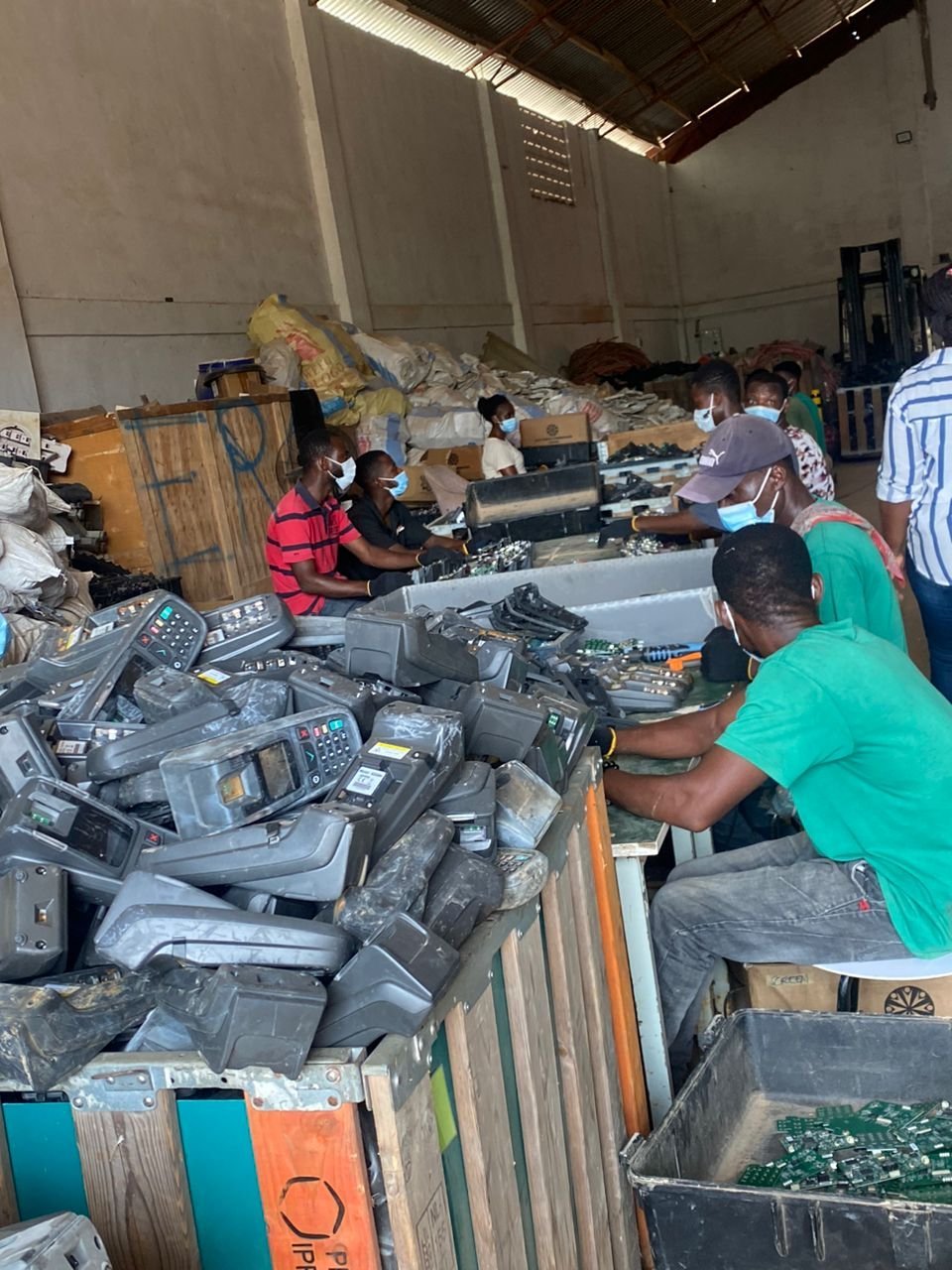
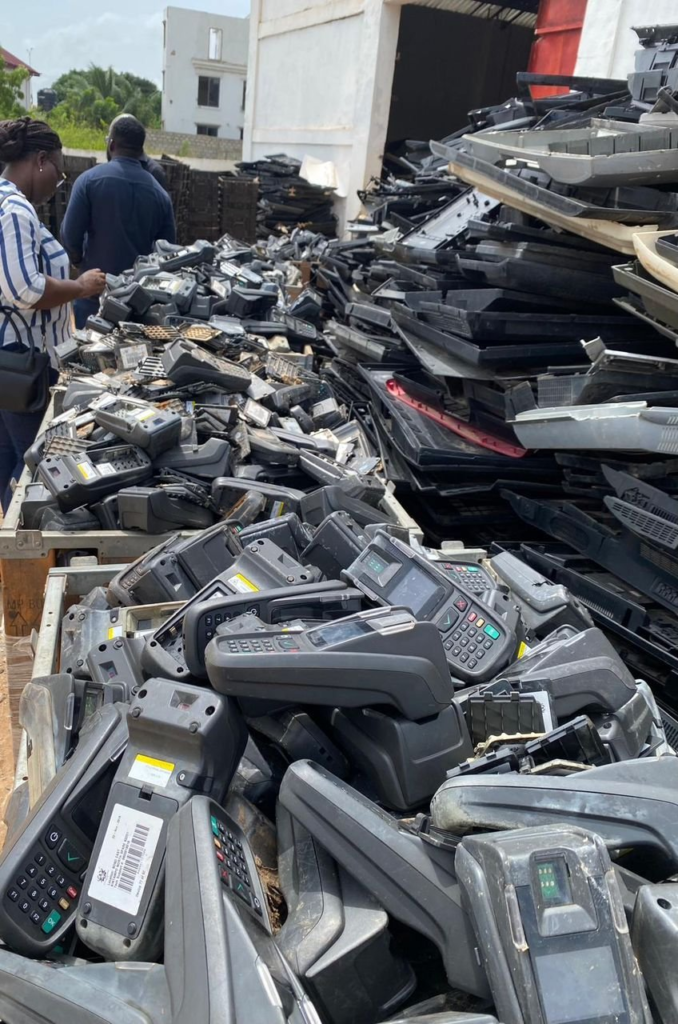
Director of Electoral Services at the Electoral Commission (EC), Dr. Serebour Quaicoe, has defended the commission’s decision to auction obsolete Biometric Verification Devices (BVDs).
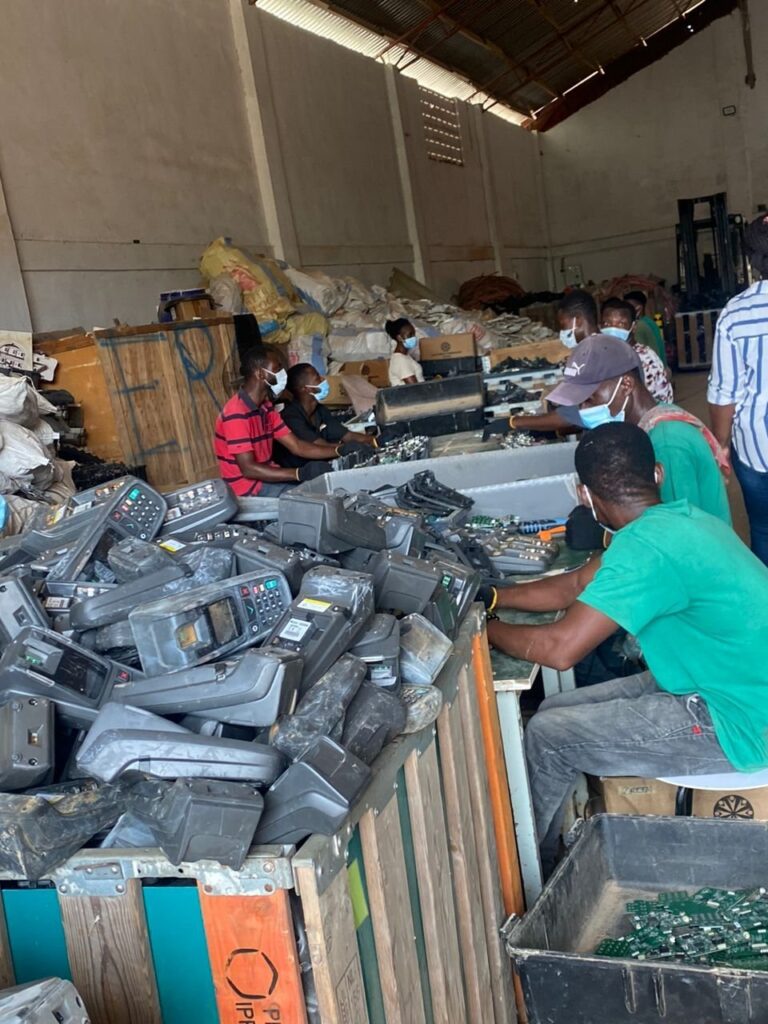
The IMANI Center for Policy and Education has called for an investigation into the auctioning of the BVDs after 10 of them were found at a recycling facility in Madina.
Despite the Electoral Commission’s explanation that the BVDs were outdated and lawfully auctioned, Franklin Cudjoe, President of IMANI Africa, argues that such actions amount to a misappropriation of state resources and require an investigation.
In a Face to Face interview on Citi TV, Dr. Quaicoe stated that they obtained permission from the Finance Ministry to auction their obsolete equipment, including the BVDs, and that they acted within the law.
He explained that the auction was properly advertised in the Daily Graphic and that the recycling company in Madina, one of six auctioneers, was selected after an interview process.
“Obsolete” BVDs currently at Madina
“I want to put on record that the BVDs and BVRs were those which were used before 2020, we acquired new ones. So, once we acquired new ones, these ones were obsolete, we’re not using them. They were still occupying space, so the Commission wrote to the district valuer, STC, they did the evaluation of all the materials, and we have documentation to that effect.
“We sent permission to the Ministry of Finance seeking permission to dispose of. They also replied and gave us the permission to go ahead. The Commission interviewed six auctioneers and one of them was picked. And a little recycling company bought them located at Oyarifa, they have EPA approval to do all those things. The auctioneer advertised it, look for February 1, 2024, Daily Graphic.”
When questioned if the EC violated any law in the process of disposing of the machines, he responded, “Not at all, State valuer assessed it, we wrote to the finance ministry, approval was given, and the items were valued.
“They did interviews and the auctioneers auctioned the items. All the money generated was paid into the Consolidated Fund. We went through the legal means.”
He added that the commission is not concerned about the controversy surrounding the auctioneering because they have not committed any offense.
“We’re not worried because we have not committed any offence. The documents are there.”
The Director of Electoral Services at the Electoral Commission (EC), Dr. Serebour Quaicoe, has assured the public of a smoother registration process starting from Wednesday, May 8.
This assurance follows challenges experienced on the first day of the limited voters’ registration exercise, which caused delays in various parts of the country.
Dr. Quaicoe, speaking on JoyNews’ PM Express, attributed the challenges on the opening day primarily to internet connectivity issues.
Despite equipping personnel with necessary tools such as turbonets and data, some devices failed to function properly in the morning, leading to difficulties.
However, by midday, most of the connectivity challenges had been addressed, resulting in a significant improvement in the registration process. Dr. Quaicoe expressed confidence that going forward, such issues would be effectively mitigated, ensuring a seamless registration exercise.
“So for now, everything is working smoothly, so going forward from tomorrow, I don’t think they would have that issue.
“Aside from the internet connectivity issue, there were no other issues, so now that the only issue has been resolved, we are going to have a smoother registration exercise tomorrow,” he promised.
Registration of first-time voters has yet to commence at the former head office of the Electoral Commission (EC) at North Ridge in the Korley Klottey constituency due to technical difficulties.
This centre caters to Korle Klottey and other constituencies as part of the ongoing limited voter registration exercise.
Prospective voters are urging the EC to swiftly resolve all issues hindering the start of registration.
As of 11:30 am on Monday, no prospective voters had been registered due to concerns about faulty machines and network issues.
The 21-day exercise, which aims to register over half a million voters nationwide, began on May 7 and will conclude on May 28, 2024.
Speaking to Citi News, a 21-year-old nursing mother who arrived at the centre at 8 am expressed frustration with the process and appealed to the EC to promptly address the challenges.
“I came here like 8 a.m., and the machine too is not working and they said they were bringing a new machine to do it for us and what they are doing here is not good and I feel so bad. We want them to come and do the registration for us.”
Efforts to obtain comments from officials of the Electoral Commission regarding the delay were unsuccessful.
Registration of first-time voters has not yet begun at the former head office of the Electoral Commission (EC) at North Ridge in the Korley Klottey constituency due to a technical hitch.
This center serves Korle Klottey and other constituencies as part of the ongoing limited voter registration exercise.
Prospective voters are urging the EC to resolve all issues hindering the commencement of registration. As of 11:30 am on Monday, not a single prospective voter had been registered due to concerns about faulty machines and network issues.
The 21-day exercise aims to register over half a million voters nationwide. It began today, May 7, and will end on May 28, 2024.
Expressing her frustration to Citi News in an interview, a 21-year-old nursing mother who arrived at the center at 8 am appealed to the EC to promptly resolve the challenges.
“I came here like 8 am and the machine too is not working and they said they were bringing a new machine to do it for us and what they are doing here is not good and I feel so bad. We want them to come and do the registration for us.”
Attempts to get officials of the Electoral Commission to comment on the delay proved futile, according to Citinewsroom.com.
The limited voter registration exercise in Bimbilla, Northern Region, faced an unexpected halt due to a technical issue affecting the printing of voter cards.
Despite the registration kick-off, not a single card had been printed, attributed to a nationwide technical problem, according to the Electoral Commission (EC) boss.
Meanwhile, tension flared between supporters of the New Patriotic Party (NPP) and National Democratic Congress (NDC) in Awutu Senya West over registration priority.
The exercise, which commenced smoothly on Tuesday morning, saw confusion arise as both parties sought to prioritize their members’ registration.
Adom News’ Kofi Adjei reported a queue system in place for applicants, but NPP executives allegedly attempted to have their supporters registered first, citing early arrival.
The NDC resisted, leading to heated exchanges, ultimately requiring police intervention to restore order at the registration center.
The Electoral Commission faces a new hurdle in Bimbilla registration, leading to a sudden halt in the process.
Surprisingly, despite the registration kick-off, not a single card has been printed. The EC Boss attributes this setback to a nationwide technical issue. pic.twitter.com/enDADN101E
Ghana’s Electoral Commission (EC) has assured the public of a smooth limited voter registration exercise scheduled for Tuesday, May 7, 2024, across the nation despite the power crisis.
Chairperson of the Electoral Commission, Jean Mensa, disclosed these plans during a press briefing on Monday, May 6, 2024.
To mitigate potential disruptions due to power challenges, commonly known as “dumsor,” the EC has secured generators for all district offices. These generators will ensure continuous voter registration services in case of power outages.
Ms. Mensa explained that the commission is taking every precaution to avoid any interruptions. However, in unforeseen circumstances, the EC has a contingency plan. Its offices will switch to an “offline” mode, registering voters manually and storing their details on a pen drive.
“We are trying hard to, we’ve made arrangements to ensure that we don’t have challenges because of dumsor. What we’ve done is to have all our district offices rent generators so that in the event where there’s dumsor, that can kick in.
“However, should there be the unexpected, we would switch on to the offline and by offline it means the voters will be registered and their details will be put on a pen drive and that will be copied in our offices when the light returns, so the registration will not be disrupted.”
The upcoming limited voter registration exercise targets approximately 623,000 first-time voters nationwide.
Registration will occur in all 258 district offices of the commission, along with an additional 785 centers to assist those facing accessibility challenges.
Furthermore, 25 public universities have been designated as registration venues.
The Electoral Commission (EC) begins the limited voter registration for individuals venturing into voting for the first time and those aspiring to obtain a voter card today.
This 21-day endeavor will conclude on May 27, 2024. Madam Jean Mensa, the Chairperson of the EC, underscores that the objective of this exercise is to register an estimated 623,000 first-time voters nationwide.
“The registration will be from 7 a.m. to 6 p.m. daily. And that gives us the figure of 623,000 that we have put there. That is not to say that we cannot go beyond that. We did mention that in 2023, we projected 700,000 people to visit our registration centres.”
Jean Mensa further said the commission has arranged for all district offices to rent generators in case of power outages, these generators will kick in to ensure continuous voter registration services.
She explained that its offices will switch to an “offline” mode, where voters will be registered manually, and their details will be stored on a pen drive if the generators fail.
“We are trying hard to, we’ve made arrangements to ensure that we don’t have challenges because of dumsor. What we’ve done is to have all our district offices rent generators so that in the event where there’s dumsor, that can kick in.
“However, should there be the unexpected, we would switch on to the offline and by offline it means the voters will be registered and their details will be put on a pen drive that will be copied in our offices when the light returns, so the registration will not be disrupted.”
Director of Electoral Services at theElectoral Commission (EC), Dr. Serebour Quaicoe, has criticised policy think tank IMANI Africa for its approach to addressing issues concerning state institutions.
He argued that their tendency to criticise state institutions without providing substantiated information, which ultimately undermines these entities, is a concerning trend that impedes state development.
Dr. Quaicoe dismissed IMANI Africa’s allegations that the EC auctioned off 10 out of 70,000 devices, labelling such claims as unfounded and advising the public to disregard them.
Speaking on Newsfile on JoyNews, Dr. Quaicoe cautioned that if IMANI does not exercise caution in its statements, it risks losing its credibility and transitioning into a mere “talk tank” rather than a think tank.
During the interview, Samson Lardy Anyenini inquired, “IMANI asked the question that you had said that you auctioned only 10 out of over 70,000 devices. Why 10? They also said they had been relying on documents from parliament because you deal with them.”
Responding to the allegations, Dr. Serebour Quaicoe challenged, “I want to know which document said we had auctioned 10 devices. We should be careful not to destroy institutions in the country without just cause.
“If you rely on the information on the internet to draw conclusions at the end of the day, you will be exposed… My concern is that I know IMANI to be a think tank. If care is not taken, they will become a talk tank.”
The Electoral Commission (EC)has come under scrutiny following reports alleging that some of its electoral devices were sold through auction.
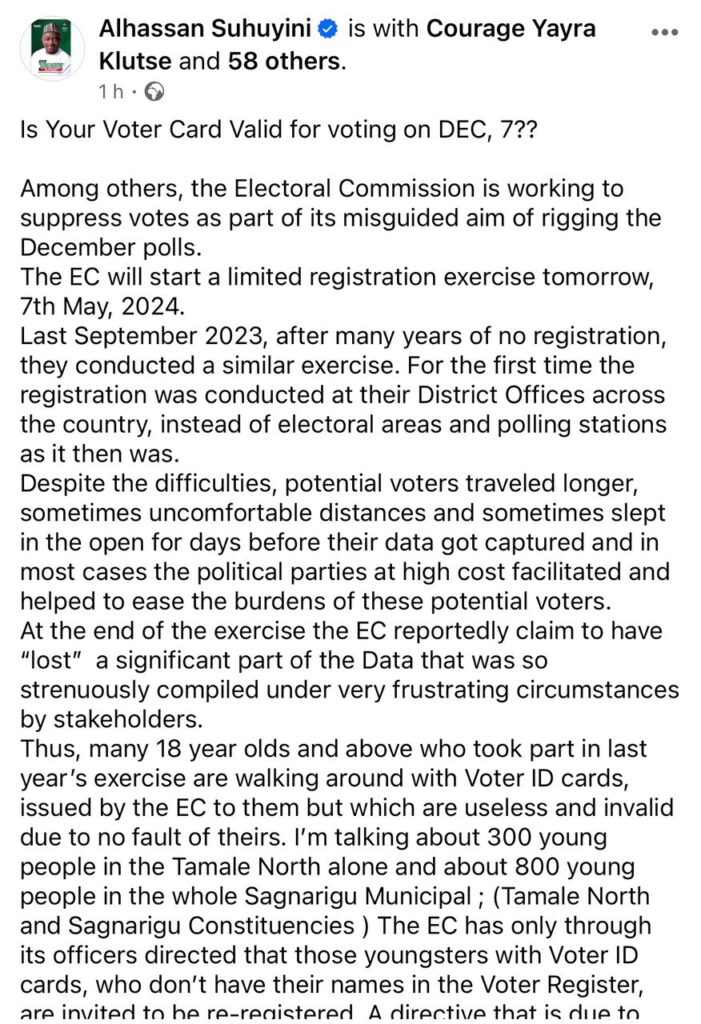
Tamale North Member of Parliament, Alhassan Suhuyini, has accused the Electoral Commission (EC) of attempting to suppress votes as part of a scheme to rig the 2024 December 7 elections.
Mr. Suhuyini claims that the EC suppressed around 50,000 votes, roughly 250 votes per constituency. He expressed these concerns on his social media pages, urging political parties to stay vigilant and challenge the EC’s alleged move.
He criticized the EC for not conducting last year’s limited voter registration exercise across all polling centers, opting instead for registration only at its district offices.
He argued that this decision prevented many potential registrants from participating, ultimately disenfranchising them for the upcoming December 2024 general elections.
Mr. Suhuyini‘s accusation comes amidst growing tension surrounding the fairness and transparency of the electoral process. He emphasized the importance of ensuring that all eligible voters have the opportunity to register and cast their votes without hindrance or suppression.
He called on political parties to safeguard the democratic process and ensure that every vote counts, viewing the EC’s alleged actions as a threat to the integrity of the electoral system. He called for collective action to address these concerns.
“Among others, the Electoral Commission is working to suppress votes as part of its misguided aim of rigging the December polls. The EC will start a limited registration exercise tomorrow, 7th May, 2024.”
“Last September 2023, after many years of no registration, they conducted a similar exercise. For the first time the registration was conducted at their District Offices across the country, instead of electoral areas and polling stations as it then was.”
“Despite the difficulties, potential voters traveled longer, sometimes uncomfortable distances and sometimes slept in the open for days before their data got captured and in most cases the political parties at high cost facilitated and helped to ease the burdens of these potential voters,” an excerpt of his post said.
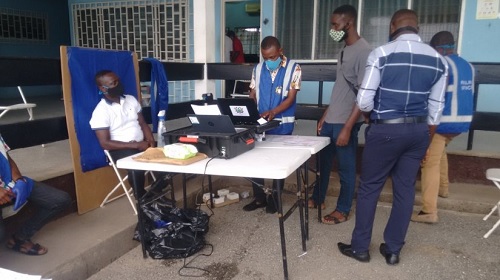
The Electoral Commission (EC) has deployed Biometric Voter Registration (BVR) kits and other logistical support to its regional and district offices in preparation for the voter registration exercise scheduled to commence tomorrow.
Included in the deployed logistics are Turbonet devices, Registration Forms 1A and 1C, and laminators.
The Chairperson of the EC, Jean Mensa, disclosed in an exclusive interview with the Daily Graphic that a total of 3,277 personnel had been engaged for the 21-day exercise, which will conclude on May 27, 2024.
The registration will be conducted in all 268 district offices of the EC, including Santrokofi, Akpafu, Lolobi, and Likpe (SALL) in the Guan Constituency in the Oti Region.
The registration, scheduled from May 7 to May 27, 2024, is the EC’s regular voters’ registration exercise for the year, ahead of the December 7 polls.
Mrs. Mensa stated that 775 registration centers would be opened in distant and riverine areas that are not close to the district offices, with mobile registration teams deployed to handle those communities.
Registration centers will also be set up in 25 public universities, but none will be opened in senior high schools (SHS).
Mrs. Mensa provided a breakdown of the personnel, including 496 supervisors, 831 registration officers, 831 data entry clerks, technicians, and laminators. For the mobile registration teams, 228 registration supervisors, 228 registration officers, 228 data entry clerks, and 228 laminators have been engaged.
For the 25 public universities where registration will also take place, 25 registration officers, 25 data entry clerks, and 25 laminators will be involved in the exercise.
The EC anticipates registering approximately 623,000 new applicants. Mrs. Mensa noted that political parties, through the Inter-Party Advisory Committee (IPAC), were informed ahead of the schedule, based on which IPAC recommended the increase in the number of registration centers after extensive discussions.
She mentioned that extensive training had been conducted for both permanent and non-permanent staff to meet expectations.
Technicians have been trained for each district to troubleshoot and fix any challenges that may arise with the BVR kits. Additionally, each district has been provided with enough backup BVR kits to replace any equipment that might break down.
Mrs. Mensa called on all citizens to exercise their civic responsibility not only to register but also to ensure that minors and foreigners do not register to vote on December 7, 2024, and beyond. She appealed to all stakeholders to cooperate with the officials to ensure a successful exercise.
According to its calendar of activities, the EC plans to submit the provisional voters register to the political parties between July 9 and 18, 2024, and mount an exhibition of the voters’ register between July 15 and 24, 2024.
The final voters’ register is expected to be submitted to the political parties between August 30 and September 5, 2024.
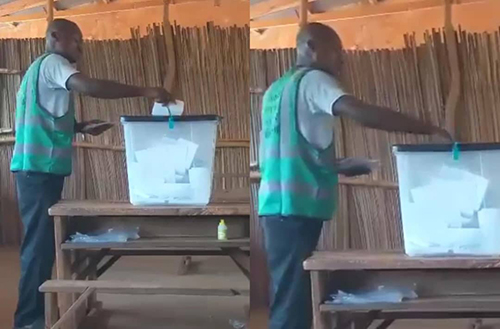
The Electoral Commission (EC) has clarified that the individual shown in a viral video stuffing ballot papers into a ballot box is neither its staff nor was the incident related to the Ejisu by-election.
In a statement dated Thursday, May 2, 2024, the EC stated that the video “is unrelated to the operations of Ghana’s Electoral Commission, let alone the Ejisu by-election.”
The Commission pointed out discrepancies in the video, noting that the individual in question was wearing a green vest, while EC staff typically wear blue vests.
Additionally, another person in the video was seen wearing an orange vest, further indicating that the incident was not related to EC operations.
The EC also highlighted that its polling stations are usually located in open spaces, whereas the polling station in the video appeared to be in an enclosed area.
Moreover, the statement emphasized that each polling station in Ejisu was manned by at least six police officers, in addition to candidate agents, a situation not reflected in the video.
Member of Alan Kyerematen’s Movement for Change (M4C), Hopeson Adorye, has called for the immediate arrest and prosecution of Kingsley Nyarko, the New Patriotic Party (NPP)Member of Parliament for Kwadaso.
Adorye’s demand comes in the wake of allegations of bribery during the recently concluded Ejisu by-election, sparked by a viral video showing Nyarko handing a white envelope to Electoral Commission (EC) officials at a polling station in Fumesua.
Condemning the actions captured in the video, Adorye labeled them as criminal, emphasizing that such behavior undermines the integrity of the electoral process and cannot be tolerated.
Speaking in an interview with Citi News on April 30, 2024, Adorye argued that Nyarko’s actions violated electoral laws and therefore warranted legal action.
He further contended that since the EC was responsible for providing lunch for its staff, Nyarko’s actions constituted a crime, and he called for police intervention to arrest and prosecute Nyarko accordingly.
“I say they need to arrest him and prosecute him. He has broken the law; it is a crime. You don’t need to do that at the polling station but because he is an NPP MP, they are closing their eyes.
If they don’t arrest him, in December, we are all going to do the same thing at the polling station,” he stated.
The Electoral Commission (EC) has acknowledged the incident at the Fumesua Pentecost Church polling station, where the MP was seen placing an envelope on the table occupied by the presiding officer and the ballot issuer.
In a statement released on April 30, 2024, and signed by Samuel Tettey, the Deputy Chairman of Operations, the EC announced the suspension of the two temporary staff pending an investigation into the matter.
The Electoral Commission (EC) has suspended two officials who were allegedly caught accepting a bribe during the ongoing Ejisu by-election.
The accusation involves Kingsley Nyarko, the New Patriotic Party (NPP) Member of Parliament for Kwadaso, who was seen in a viral video handing what appeared to be an envelope to the EC officials.
The EC has taken swift action by temporarily suspending and withdrawing the two officials from their duties in the by-election.
“The Electoral Commission has taken immediate steps and has withdrawn the two (2) temporary staff while investigations take place.
“The commission upholds the principles and values of integrity, truth and transparency. These values are reinforced during the training of all temporary staff.
“The commission will not countenance acts which cast a slur on the integrity of the institutions and will not hesitate to sanction its officials who violate its laws,” the Commission stated.
However, the NPP leadership is yet to officially comment on the matter.
The Ejisu by-election has been closely watched as NPP’s Kwabena Boateng competes against five other candidates, including Kwabena Owusu Aduomi, who is running independently after leaving the NPP.
Ejisu by-election:
Watch this video carefully and check what's happening in the background. 🤔 That’s Hon. Kingsley Nyarko
Both the EC official and the MP must face the law.
The Electoral Commission (EC) will, on Tuesday, April 30, 2024, hold the Ejisu by-election as slated following the conclusion of an injunction application.
The High Court in Kumasi, Ashanti Region, has dismissed an injunction application against the by-election in Ejisu after the plaintiff, Emmanuel Gallo, withdrew the case.
Gallo, the former Ashanti Regional Chairman of the Convention People’s Party (CPP), had filed for an interlocutory injunction to stop the Ejisu by-election scheduled for April 30.
His aim was to halt the election until a lawsuit against the Electoral Commission (EC), which sought to prevent Esther Osei from representing the party in the poll, was resolved.
Gallo claimed that the party had officially informed the EC of its decision not to participate in the by-election on April 18.
However, he later withdrew the case, citing calls from notable individuals, including the former party chair and current Paramount Chief of Nandom Traditional Area, Naa Prof. Edmund N. Dele Chii VIII.
Gallo stated that he withdrew the case to promote cohesion and unity among CPP members.
“The same introspection the Plaintiff considers to help with the unity and cohesion within the party. Based on these happenings and calls, the Plaintiff prays to withdraw the instant application and the Suit even though it is clear that the Defendant cannot legally conduct the elections with an illegitimate candidate purporting to be a constitutionally elected parliamentary candidate in the Ejisu bye-election. I pray accordingly,” the plaintiff told the court.
This is after the Convention People’s Party (CPP) clarified that it has not placed any injunction on the parliamentary by-election process in Ejisu.
In response, the court presided over by Her Ladyship ELLEN L. S. Mireku, said, “The application for Injunction against the Electoral Commission is struck out as withdrawn. The suit is also struck out as withdrawn. No order as to cost.”
An Accra High Court has granted bail to Joseph Blankson Adumadzie, one of the four individuals arrested in connection with the theft of laptops and Biometric Voter Registration (BVR) kits belonging to the Electoral Commission (EC).
Adumadzie, a Database Administrator, was granted bail by the High Court last week. His counsel informed the Dansoman Circuit Court that they were in the process of serving the High Court proceedings on the Police to execute the bail, which is why Adumadzie was not present in court.
Meanwhile, the other three accused persons—Philip Tettey, a 26-year-old casual worker; Benjamin Fienyi, a security man; and Clifford Yeboah, a student—were remanded into lawful custody by the Dansoman Circuit Court.
At the latest proceedings at the Dansoman Circuit Court, Clifford Yeboah’s lawyer reiterated an application for bail for his client, noting that Yeboah had forfeited his examinations due to the case. The defence counsel pointed out the High Court’s decision to grant bail to Adumadzie.
The prosecution, led by Chief Inspector Christopher Wonder, objected to bail for the accused persons, citing the nature of the case, which is of national interest. Chief Inspector Wonder highlighted that the Dell Laptop Computers stolen from the EC had not been retrieved and contained important data.
The court, presided over by Halima Abdul El Lawal Basit, adjourned the matter to May 6, 2024.
The accused persons have been jointly charged with conspiracy to steal and stealing, while Yeboah has been charged with dishonestly receiving the stolen equipment. All the accused persons have pleaded not guilty to the charges.
According to the prosecution, the theft was discovered during a maintenance exercise on March 9, 2024, when it was noticed that five Dell laptops belonging to the EC had been stolen from the BVR kits. The matter was reported to the National Security, leading to the arrest of the accused persons.
The prosecution revealed that three HP laptops of the EC were retrieved from Yeboah, and an HP printer and three Biometric Verification Devices (BVD) were retrieved from Fienyi. It was also alleged that Fienyi and Adumadzie planned to steal printers during the relocation of materials from the EC’s old Head Office to a new warehouse in Accra in March 2023.
Additionally, Tettey was accused of stealing three HP laptops and giving them to Yeboah for repair, while Adumadzie allegedly stole an HP printer and gave it to Fienyi. Fienyi was also said to have taken three BVD printer chargers home.
The prosecution stated that investigations are ongoing, and they will soon present further evidence to the court.
The Electoral Commission (EC) has urged the policy think tank, IMANI Africa, to avoid going to the media with concerns about the electoral body.
Instead, Dr. Serebour Quaicoe, the Director of Electoral Services, encouraged IMANI to utilize due processes and legal channels to address any issues.
Dr. Quaicoe made this statement during an interview on Adom FM’s morning show, Dwaso Nsem, on Monday.
“People must be patient to understand issues. Even if we have faulted, why do they always run to the media? Why the attacks in the media? There are procedures they can use to seek redress. The media attacks are unnecessary,” he lamented.
Following IMANI Africa’s concerns raised on social media and in media reports regarding the discovery of 10 obsolete biometric verification devices (BVDs) at a recycling company in Madina, the Electoral Commission (EC) has responded.
The EC clarified that these devices were legally auctioned and had been acquired before the 2012 elections. However, IMANI Africa has continued to question the EC’s explanation.
Franklin Cudjoe, President of IMANI Africa, raised doubts about the number of BVDs auctioned off and the disposal process of the remaining devices.
He expressed concerns about the EC’s leadership and the transparency of their actions, suggesting a pattern of misconduct and misinformation.
Mr Cudjoe called on the media to conduct further investigations to address these questions, emphasizing the importance of maintaining the credibility of the electoral process in Ghana.
IMANI Africahas expressed reservations regarding the Ghana Electoral Commission’s explanation concerning the unearthing of 10 outdated biometric verification devices (BVDs) at a recycling plant.
In response to the EC’s assertion that the BVDs were antiquated and lawfully auctioned, IMANI Africa has called for additional details regarding the auction process.
They are seeking clarification on the licensing of the auctioneers, the auction methodology, and the identities of the successful bidders.
Moreover, IMANI Africa questions the wisdom behind procuring obsolete devices specifically tailored for electoral use and the involvement of a commercial recycling plant in managing potentially sensitive data.
The think tank underscores the significance of transparency in the disposal of these BVDs to maintain public confidence in the electoral system.
Key inquiries from IMANI Africa include the identities of auctioneers and successful bidders, the advertisement of the auction, and the authorization for recycling these devices in a facility lacking secure data-handling capabilities.
“The EC claims that the 10 BVDs were auctioned and that they just somehow then found their way into a recycling plant. Who were the auctioneers? Are they registered auctioneers licensed to conduct auctions by the Auctioneers Registration Board?”
“Who were the successful bidders? How was the auction advertised? Why would anyone want to buy ten used biometric devices that the EC claims have been “hard-coded” for electoral purposes, for which reason it has refused to use the thousands of devices bought in recent years?”
“Why would a commercial recycling plant be interested in just ten devices? Who authorised the recycling of the devices in a facility without adequate secure data handling capabilities?” IMANI asked.
“The EC says that only ten biometric verification devices (BVDs) were ‘auctioned’. And that they ‘found their way’ into a recycling plant. The obvious questions that the media ought to ask are: a) Before the EC jettisoned the existing system, it had told Parliament that it had implemented a ‘2 BVDs per polling station’ policy and, therefore, had more than 70,000 BVDs in stock.
“Then, in 2020, it proceeded to buy a brand-new set of biometric voter registration (BVR) kits with corresponding BVD kits and swore (despite video evidence collected by Bright Simons) that they never used any of the pre-existing devices in the 2020 mass voter registration exercise. Why, then, did they auction only 10 out of the over 70,000 devices? Why ’10’, and not 5, 100, or 1000?” IMANI wondered.
“How have the remaining tens of thousands of devices been disposed of? Ghanaians who have been paying attention to the EC’s strange conduct under the current leadership know that the EC admitted to having lost some BVRs recently, but when pushed it insisted that they were only five in number. There is a clear pattern here. What exactly is going on?” the think tank asked.
Bright Simons, the Vice President of IMANI Africa, has raised concerns about the Electoral Commission’s disposal of Biometric Verification Devices (BVDs), claiming that the devices were sold for recycling at a loss to the state.
Mr Simons in a series of posts on X platform criticized the EC’s assertion that the devices were obsolete, arguing that they were only used during elections and therefore could not be considered scrap.
In a series of tweets, Simons shared documents from Parliament, the Auditor-General, and the Ministry of Finance, which he claims expose the EC’s actions.
He pointed out that millions of dollars were spent on the devices, which are now being sold for scrap at significantly lower prices. He also highlighted that thousands of devices purchased in 2016 and 2018 could not have been obsolete as they are only used during elections.
2/ Study the documents carefully. A. You will see that millions of $ were spent on these gadgets. They are now being sold for scrap at few 1000s of GHS. B. 1000s of gadgets were bought in 2016 & 2018 & could not have been obsolete as they are used only during elections. #SHAMEpic.twitter.com/0JNIXdozQs
However, the Electoral Commission has denied these allegations, stating that the 10 BVDs discovered at a recycling company in Madina, Accra, were outdated devices that had been legally auctioned.
The Commission clarified that the devices were acquired before the 2012 elections and were used in the 2019 District Level Elections (DLE).
Despite a previous administration’s plan to refurbish the devices, the current Commission decided to procure new equipment instead, citing the advice of its Biometric Infrastructure managers that the equipment was obsolete and no longer useful.
The Commission emphasized that the auction of the devices was conducted transparently, with the proceeds duly deposited into the Consolidated Fund. It rejected any claims of wrongdoing and criticized IMANI Africa for allegedly misinforming the public.
The Electoral Commission has denied allegations that it discreetly disposed of 10 Biometric Verification Devices (BVDs) for recycling at a loss to the state.
In a statement issued on Friday, April 26, the Commission clarified that the 10 BVDs discovered at a recycling company in Madina, Accra, were outdated devices that had been legally auctioned.
According to the Commission, these obsolete BVDs were acquired before the 2012 elections and were used in the 2019 District Level Elections (DLE).
The statement explained that the previous administration had planned to refurbish the outdated devices for the 2018 referendum and the 2019 DLE, despite being advised by the Commission’s Biometric Infrastructure managers that the equipment was obsolete and no longer useful.
Contrary to the refurbishment plan, the current Commission decided to procure new equipment instead of repairing the obsolete 2012 devices.
This decision was made to ensure the prudent use of resources and the integrity of the electoral process, ultimately saving the state millions of cedis.
The Commission emphasized that the auction of the obsolete devices was conducted transparently, and the proceeds were duly deposited into the Consolidated Fund.
It strongly refuted any claims of misconduct and criticized civil society group IMANI Africa for allegedly misinforming the public about the issue.
Bright Simons, the Vice President of IMANI Africa, has raised concerns about the Electoral Commission’s disposal of Biometric Verification Devices (BVDs), claiming that the devices were sold for recycling at a loss to the state.
Mr Simons in a series of posts on X platform criticized the EC’s assertion that the devices were obsolete, arguing that they were only used during elections and therefore could not be considered scrap.
In a series of tweets, Simons shared documents from Parliament, the Auditor-General, and the Ministry of Finance, which he claims expose the EC’s actions.
He pointed out that millions of dollars were spent on the devices, which are now being sold for scrap at significantly lower prices. He also highlighted that thousands of devices purchased in 2016 and 2018 could not have been obsolete as they are only used during elections.
The Electoral Commission (EC) has refuted former President John Mahama’s allegations that it employed New Patriotic Party members as returning and deputy returning officers for the 2024 election in December.
The EC stated that the recruitment process for these roles was not only public but also conducted openly, fairly, and transparently.
According to a press statement, the Commission published a vacancy announcement in the Daily Graphic on February 5, 2024, and received a total of 20,561 applications.
“An in-house Committee was established to shortlist suitable applicants to be interviewed. For the information of the general public, all successful applicants at the interview have no less than 8 years of working experience with the Commission as Temporal Election Officials.”
“The allegation by former President Mahama that Ministers and DCEs were asked “to write the names of party apparatchiks and present them so that they would be appointed as the returning officers” IS NOT TRUE. The Commission rejects this unfounded allegation coming from the former President,” the statement read.
Following former President John Mahama’s interview at the London School of Economics and Political Science, where he accused the government of politicizing the Electoral Commission, the EC has called on all stakeholders to communicate and disseminate information accurately and responsibly in this election year.
“As a Commission, we reaffirm our commitment to spearheading transparent, credible, and fair elections – upholding the highest standards of integrity as we commit to protecting the sanctity of Ghana’s electoral process.”
Electoral Commission (EC) has refuted allegations made by National Democratic Congress (NDC) flagbearer, John Dramani Mahama, regarding the appointment of Returning Officers for the 2024 polls.
During a recent interview at the London School of Economics and Political Science, Mr. Mahama accused the New Patriotic Party (NPP) government of appointing its members to the EC and expressed concerns about the EC’s impartiality in the upcoming elections.
He alleged that the election management body had requested MPs and DCEs to disclose the names of NPP members during the recruitment of Returning Officers and their deputies.
However, Fred Tetteh, the Deputy Director of Research, Monitoring, and Evaluation, rebuffed these claims in a statement dated April 25. He criticized Mahama for condemning a practice he had employed during his term.
The EC clarified that the recruitment process for Returning Officers and their Deputies was conducted fairly and transparently, countering Mahama’s assertions.
“Per the attached public announcement, the Commission invited ALL interested Ghanaians to apply for the positions of Returning Officers and Deputy Returning Officers. The allegation by former President Mahama that Ministers and DCEs were asked ‘to write the names of party apparatchiks and present them so that they would be appointed as the returning officers’ IS NOT TRUE.
“The Commission rejects this unfounded allegation coming from the former President. The process of recruiting Returning Officers and their Deputies was conducted in an open, fair, and transparent manner. Following the publication of the vacancy announcement in the Daily Graphic on the 5th of February 2024, the Commission received a total of 20,561 applications.
“An in-house Committee was established to shortlist suitable applicants to be interviewed.For the information of the general public, all successful applicants at the interview have no less than 8 years of working experience with the Commission as Temporal Election Officials,” the statement said.