Tag: flood

  • Why Accra’s current flood strategy may not be future-proof for the city of 2035

    Why Accra’s current flood strategy may not be future-proof for the city of 2035

    Accra’s flood challenge is no longer simply a problem of blocked drains or inadequate culverts. It is becoming a structural consequence of rapid urbanisation, population growth, uncontrolled land conversion, increasing solid waste generation, and the gradual loss of the natural systems that historically protected the city from flooding. 

    The behaviour and discipline of citizens through responsible waste disposal, compliance with land-use regulations, and maintenance of private drainage, amongst others, cannot be overlooked.

    Whilst not a prime contributor in isolation, such behaviours help keep drainage systems functional and reduce the pressures placed on urban flood management infrastructure.

    By 2035, Greater Accra’s population is projected to rise from approximately 5.6 million today to about 6.5 million people, an increase of roughly 900,000 additional residents within a decade. 

    This growth will place enormous pressure on land, housing, infrastructure, and waste management systems. 

    At the same time, daily solid waste generation could rise towards 4,000 tonnes per day, increasing the risks of drain obstruction, pollution of waterways, and reduced effectiveness of existing flood infrastructure.

    Against this background, the current flood mitigation approach, including the Greater Accra Resilient and Integrated Development (GARID) Project and wetland demolition exercises, must be examined against the scale of the future challenge.

    Construction& Maintenance

    1. Demolition of structures on wetlands does not automatically restore flood protection

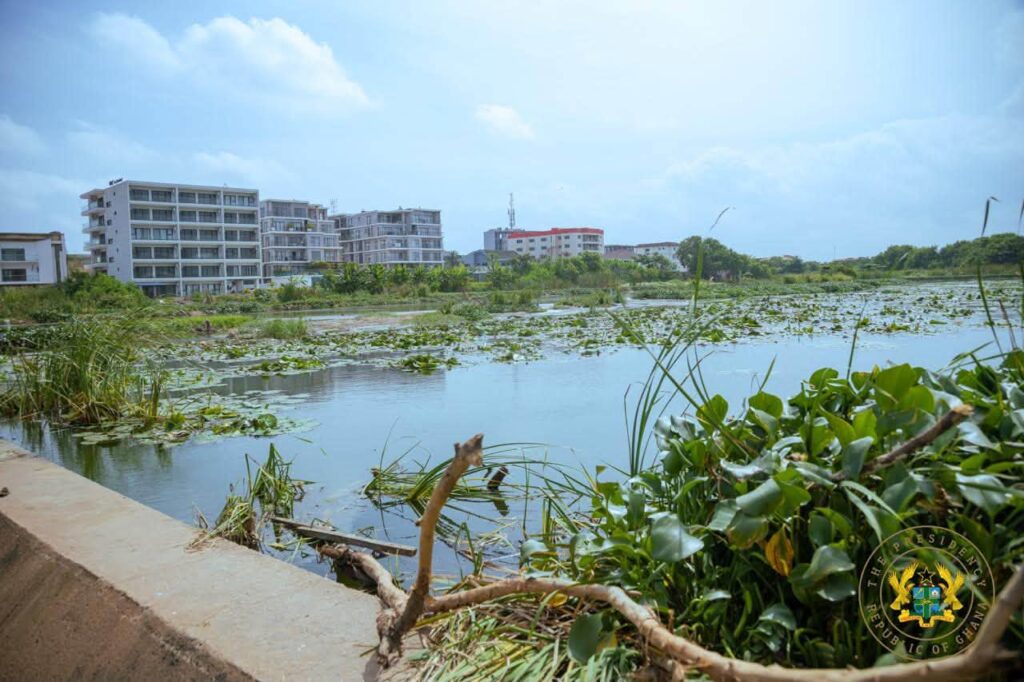
    It has been reported by the anti-flood task force that thousands of structures have been constructed on wetlands, waterways, and Ramsar-designated areas. One response has been the removal of buildings from these environmentally sensitive locations.

    However, demolition alone does not restore the original flood protection function of these ecosystems.

    In many cases, wetlands and waterways have already been altered before construction takes place. Land is filled, raised, compacted, and reclaimed before buildings are constructed. When structures are demolished, the following may remain:

    • imported fill material;
    • foundations and concrete slabs;
    • altered soil profiles;
    • blocked natural drainage pathways;
    • reduced water storage capacity.

    Therefore, demolition may remove the visible structure but not necessarily restore the land’s ability to absorb, retain, and slowly release stormwater.

    A wetland that has been physically transformed into urban land cannot simply return to its original condition through demolition alone. Restoration requires engineering, ecological rehabilitation, removal of illegal fill material where feasible, reopening of drainage channels, and long-term protection.

    2. The time gap between demolition and restoration creates a future vulnerability

    Flood restoration projects are often slow because they require significant financial resources, technical studies, land management, and sustained political commitment.

    This creates a major vulnerability.

    If restoration takes several years while Accra’s population continues to grow by approximately 900,000 people over the next decade, pressure on available land will intensify. The same economic and housing pressures that encouraged development on wetlands in the first place will remain.

    Without permanent protection mechanisms, reclaimed flood-prone land may again become attractive for settlement, commercial development, or political intervention.

    3. Weak enforcement creates a risk of repeating the same cycle

    Accra’s flooding problem has historically been worsened by inconsistent enforcement of planning regulations. A demolition programme may initially receive public support, but its long-term success depends on whether future administrations maintain the same commitment.

    Political transitions create risks:

    • enforcement priorities may change;
    • illegal developments may gradually return;
    • communities may wait for political conditions to change before reoccupying restricted areas.

    This creates a cycle where enforcement becomes reactive rather than preventive: demolish after disasters occur, rebuild after attention fades, and repeat the process after the next flood.

    A sustainable flood strategy must therefore move beyond periodic demolition and establish permanent systems of land protection, monitoring, and enforcement.

    4. GARID addresses important problems but may not match the scale of Accra’s future growth

    GARID is a necessary intervention because it improves drainage infrastructure, flood management capacity, solid waste management and resilience in vulnerable communities. However, the projected growth trajectory suggests that it cannot be viewed as a complete solution.

    The challenge is that flood risk is increasing from several directions simultaneously:

    • more people producing more waste;
    • more impermeable surfaces from urban development;
    • greater stormwater runoff;
    • loss of wetlands and natural retention areas;
    • increasing pressure on existing drainage systems.

    A drainage improvement project can increase capacity, but it cannot fully compensate for the continued loss of natural flood buffers or unlimited urban expansion.

    The city could therefore find itself in a situation where upgraded drainage infrastructure is repeatedly overwhelmed because the underlying causes of flooding continue expanding.

    5. Accra needs a metropolitan-scale flood engineering strategy

    The future protection of Accra requires moving from a project-based approach to a comprehensive metropolitan flood management system.

    This should include:

    • restoration and permanent protection of wetlands and waterways;
    • aggressive waste reduction, recycling, and collection expansion;
    • strict land-use controls;
    • expanded stormwater infrastructure;
    • flood forecasting and early warning systems;
    • climate-resilient urban design.

    However, given Accra’s level of urbanisation and limited remaining natural drainage capacity, conventional drainage improvements may not be sufficient on their own.

    Large-scale engineering solutions should therefore be investigated, including underground stormwater conveyance systems, tunnels, retention infrastructure, and other forms of major flood-control engineering used in highly urbanised cities worldwide.

    The principle is simple: as Accra becomes denser, it has less space to manage water naturally above ground. The city may increasingly require engineered systems capable of moving large volumes of stormwater rapidly away from vulnerable urban areas.

    Conclusion

    Accra’s flood problem cannot be solved through demolition alone, nor through drainage upgrades alone. By 2035, the City will be larger, denser, and generating significantly more waste than it does today.

    A strategy based mainly on removing buildings after wetlands have already been reclaimed risks treating the symptoms rather than the causes. Likewise, drainage improvements without addressing urban growth, waste generation, and land-use failures will provide only temporary relief.

    The future flood resilience of Accra requires an integrated approach: protecting the city’s remaining natural flood systems, restoring degraded wetlands where possible, permanently enforcing land-use regulations, expanding waste management capacity, and investing in major engineering solutions capable of managing the runoff generated by a metropolis of 6.5 million.

    The central policy question is therefore not simply “How does Accra remove buildings from flood-prone areas?” 

    “How does Accra redesign itself to safely manage water in a rapidly growing megacity where natural flood protection is declining, and urban pressures are increasing?”

  • Gov’t to deploy backhoes for effective drain desilting, flood control

    Gov’t to deploy backhoes for effective drain desilting, flood control

    Additional backhoes and other specialised equipment are expected to be procured by the government in the coming days to improve drain desilting and help prevent flooding.

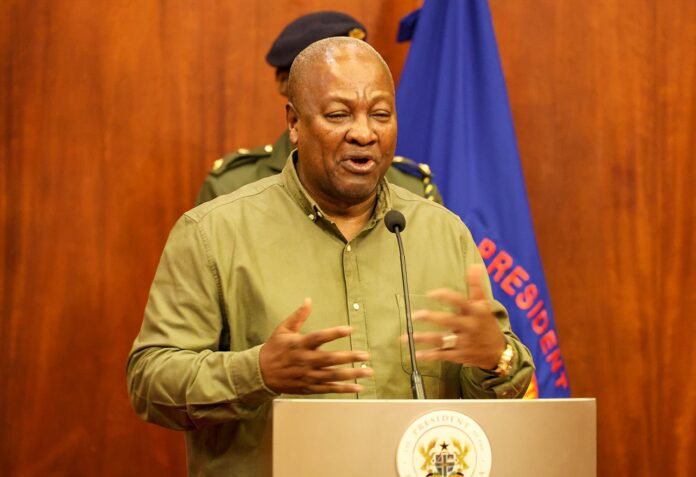
    The specialised equipment will assist the military in removing silt and waste excavated from drains and transport the debris to designated dumping sites. President John Dramani Mahama announced after participating in a nationwide environmental clean-up exercise organised by the government today, July 10. 

    According to him, “So we’re going to get some more backhoes for the military so that all the garbage and the silts that we have taken out of the drains, they’ll be able to gather it and go and dump it somewhere”. 

    “We also have to get specialised machines like backhoes to take the silts that we have taken out of the drains and put them in a tipper truck to take them away”. 

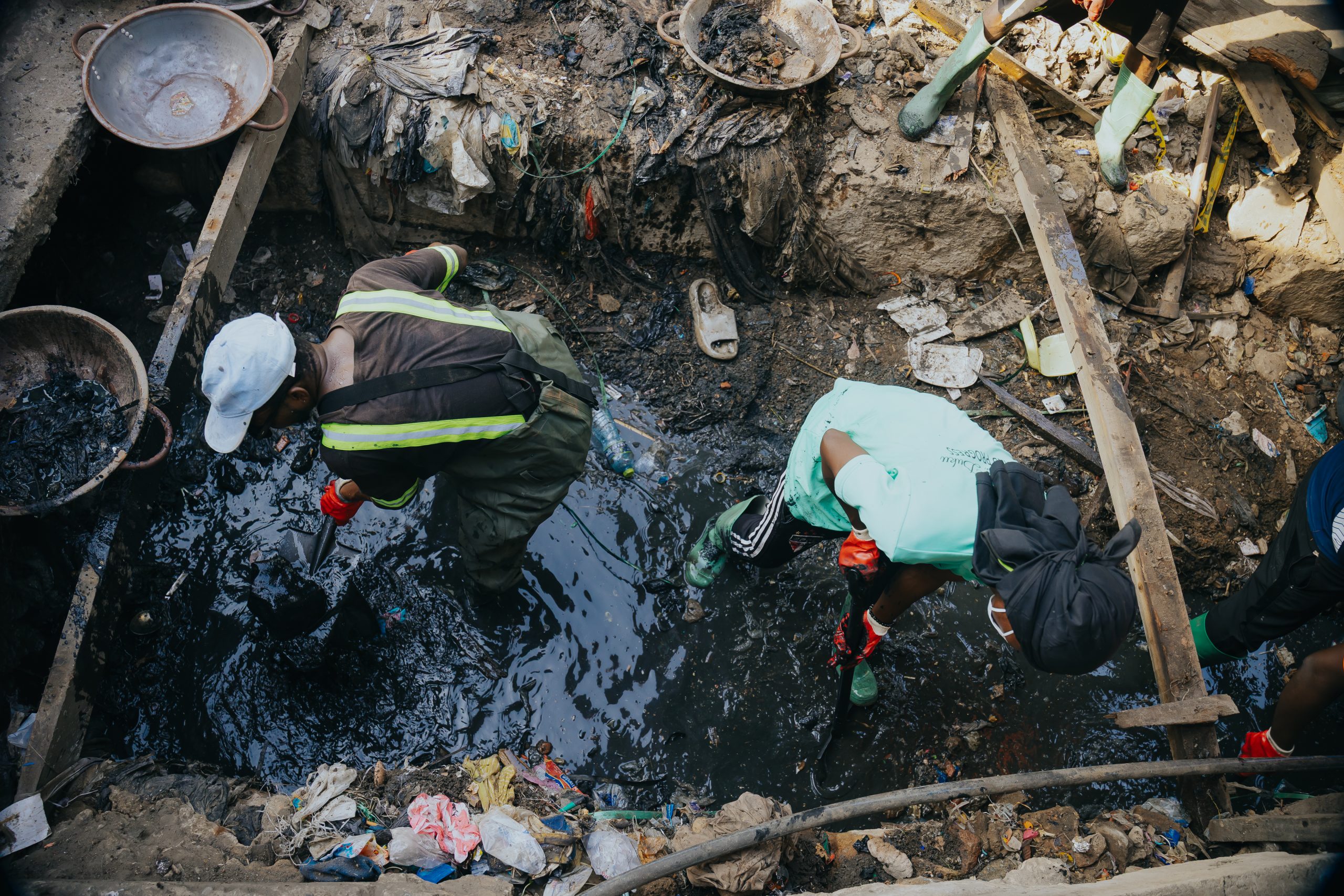
    Also speaking during an inspection of the Alajo drains as part of the National Clean-Up Exercise, President Mahama cautioned the public against dumping unwanted items into drains, warning that such practices contribute to flooding incidents.

    According to him, the National Clean-Up Exercise has come to stay to promote a cleaner environment and encourage citizens to take responsibility for proper sanitation practices.

    “We have to clear the drains. We just worked on this Alajo drain. It’s part of the outdoor stream. And there are two problems in it. There’s silt, and then there’s also plastics and household waste.

    “You find in a drain like this, there are Indian blocks. People discard an Indian block and throw it in the drain. Old furniture, dining tables, everything you can find in that drain.The drains are not garbage instruments. If you want to dispose of something, you know how to dispose of it,” he said.

    The government’s initiative is to help improve sanitation and reduce the risk of future flooding. In a statement issued on Monday, July 6, government spokesperson Felix Kwakye Ofosu announced that Friday, July 10, and Saturday, July 11, have been declared National General Cleaning Days across the seven regions affected by the devastating June 29 floods, following a directive from President John Dramani Mahama.

    Part of the statement read, “This is a critical, nationwide exercise and all citizens are strongly encouraged to fully participate in it. For far too long, indiscriminate littering and plastic pollution have clogged our drainage systems, contributing to devastating, preventable floods that destroy livelihoods and claim precious Ghanaian lives”.

    Ministers of State, Chief Executive Officers, Members of Parliament, Metropolitan, Municipal and District Chief Executives (MMDCEs), and heads of public institutions in the affected regions have been directed to oversee the exercise.

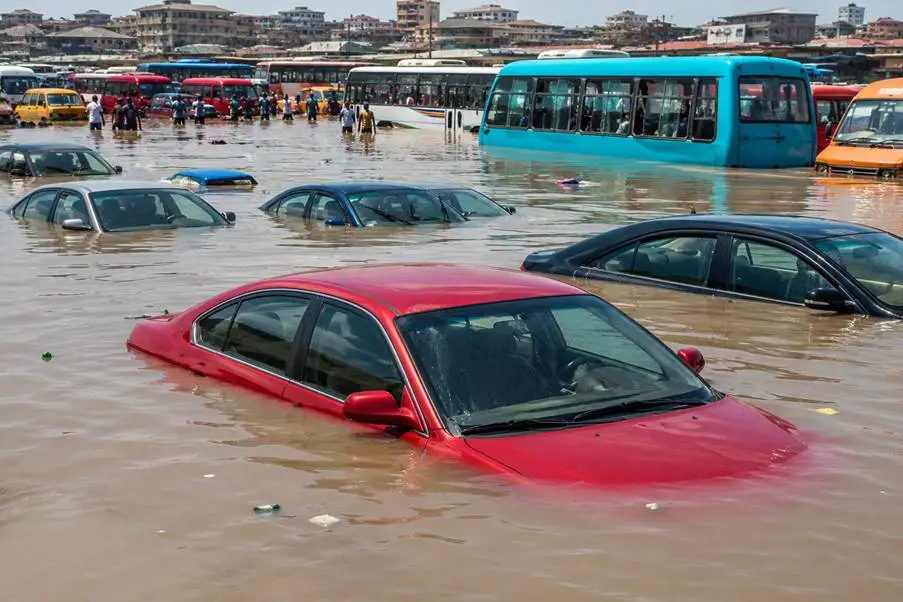
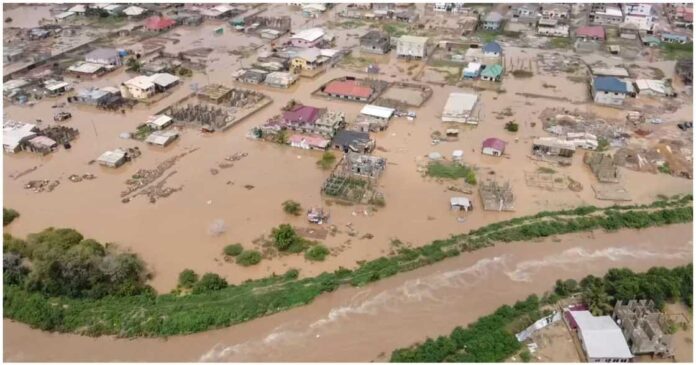
    Ghana witnessed a series of flooding incidents on Monday, June 29, in parts of the Greater Accra Region and other regions following heavy rains.

    The rains, which started late on Sunday, June 28, left commuters stranded, brought traffic to a standstill, resulted in the deaths of several individuals and destruction of properties.

    While some victims managed to salvage a few belongings, many suffered devastating losses as floodwaters submerged their homes and properties.

    The current death toll from the flooding incidents, as confirmed by the Ghana National Fire Service Public Relations Department, stands at 34. Meanwhile, the Finance Minister has realised a sum of GH¢300 million from the Contingency Fund for individuals affected by the incident following President John Dramani Mahama’s directive.

    The directive forms part of the government’s response to the flooding of parts of Accra and other communities in the southern sector of the country after hours of unusually heavy rainfall.

    In Ghana, the Contingency Fund is a constitutional fund set aside to meet urgent and unforeseen government expenses that cannot wait for the normal budget approval process.

    It is established under Article 177 of the 1992 Constitution of Ghana.In a statement issued on behalf of the President by the Spokesperson to the President and Minister for Government Communications, Felix Kwakye Ofosu, it was indicated that the GH¢300 million will be divided into two, with portions designated to provide relief and implement measures to mitigate flooding.

    “President John Dramani Mahama has directed the Minister for Finance to release GHS 300 million from the Contingency Fund to finance urgent flood relief and mitigation efforts.

    GHS 150 million out of the amount will finance urgent relief efforts for flood-affected persons and communities in the southern sector of the country. Another GHS 150 million will be spent on flood mitigation measures aimed at reducing incidents of flooding,” parts of the statement read.

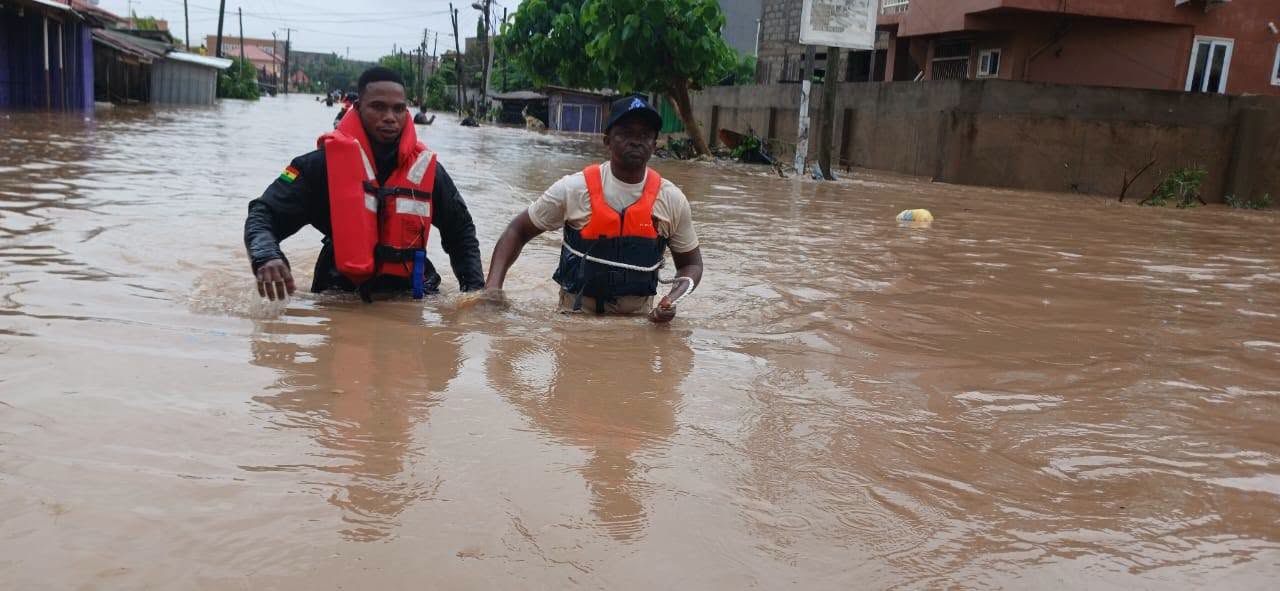
    Also, due to the scale of destruction and the effects of the floods, President Mahama has ordered that additional support be provided by the Ghana Armed Forces and other security services for the rescue operations ongoing across the city.

    “The President has also directed the deployment of personnel of the Ghana Armed Forces and Police to work with NADMO and other security services in the rescue and relief operations currently underway across the city,” adding that, “the President earlier today undertook an aerial tour of the flooded areas to assess the full extent of the situation and announced a raft of steps being taken to safeguard residents and prevent further flooding.”
  • In pictures: Oyarifa structures marked for removal after flood assessment

    In pictures: Oyarifa structures marked for removal after flood assessment

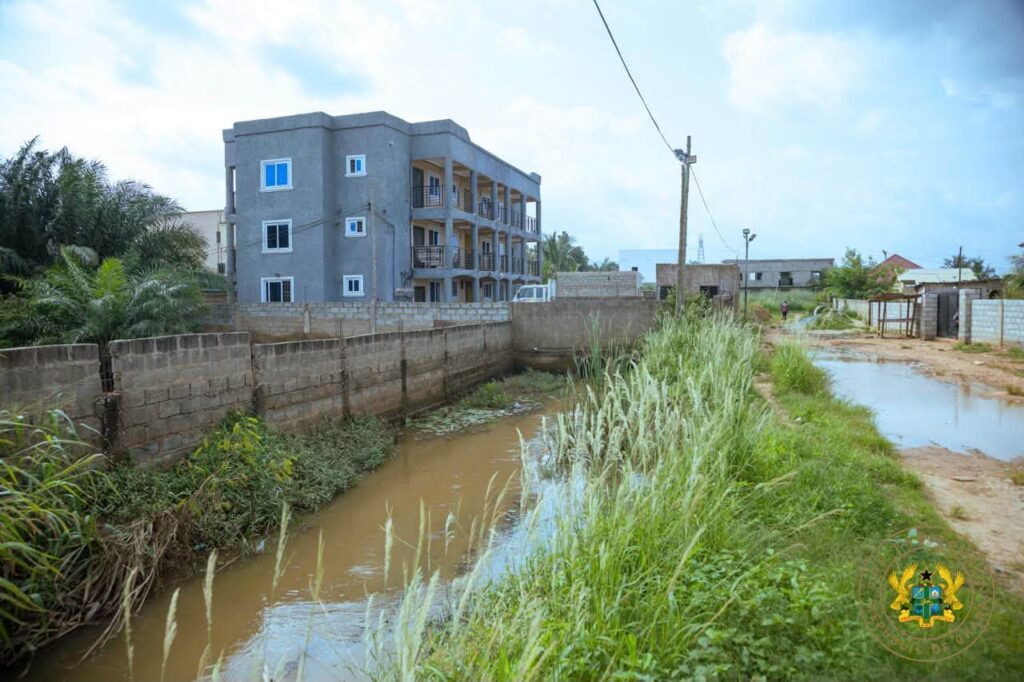
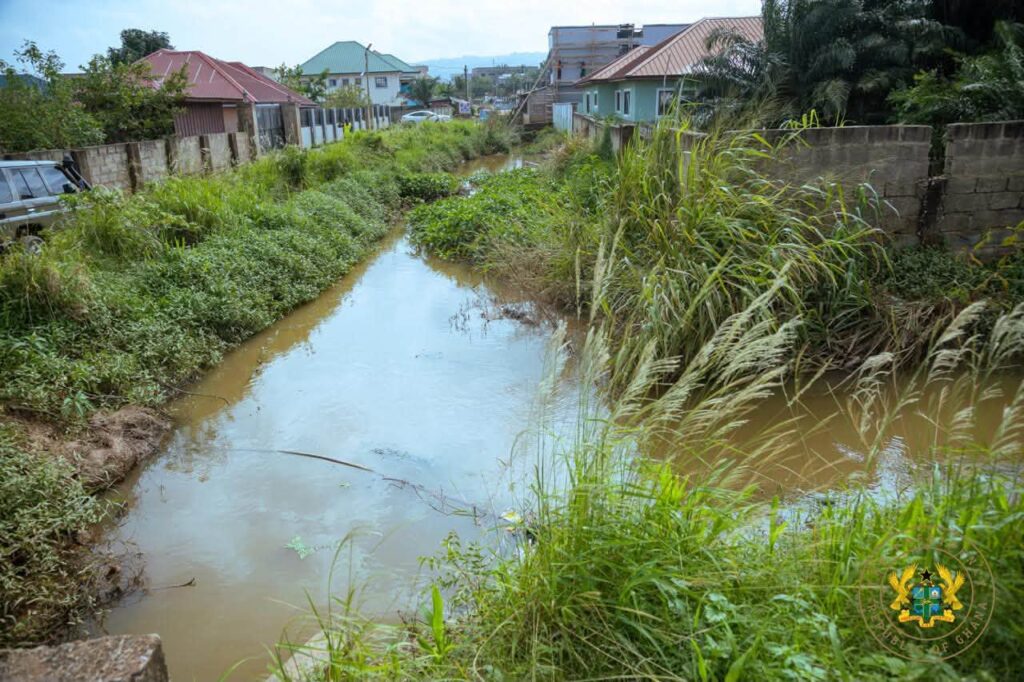
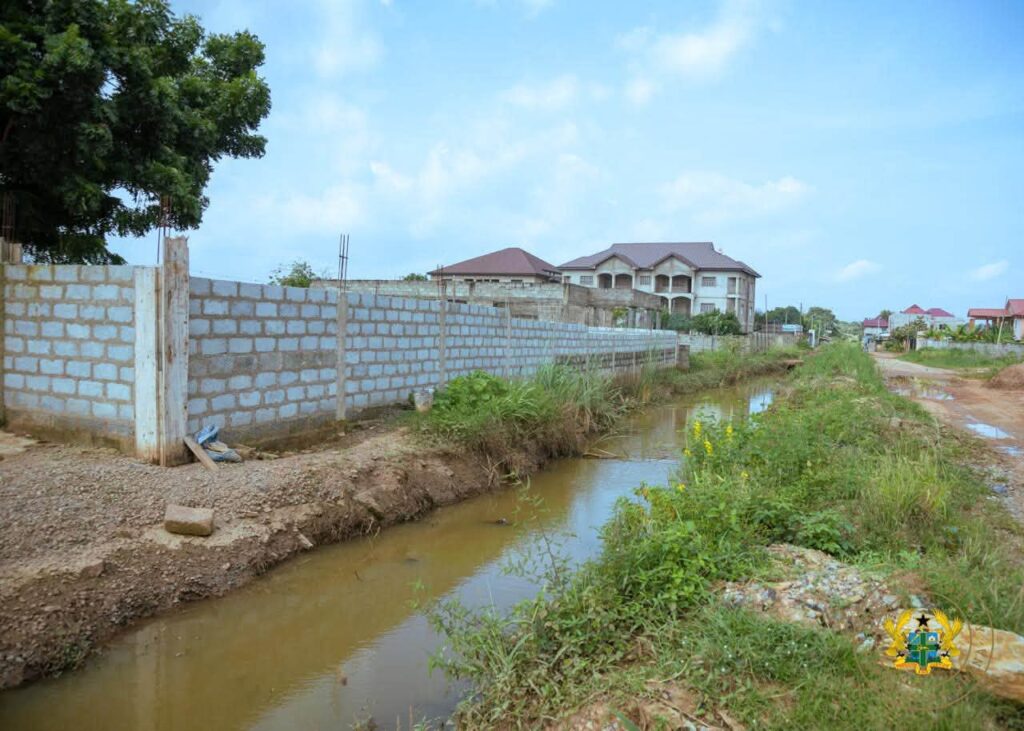
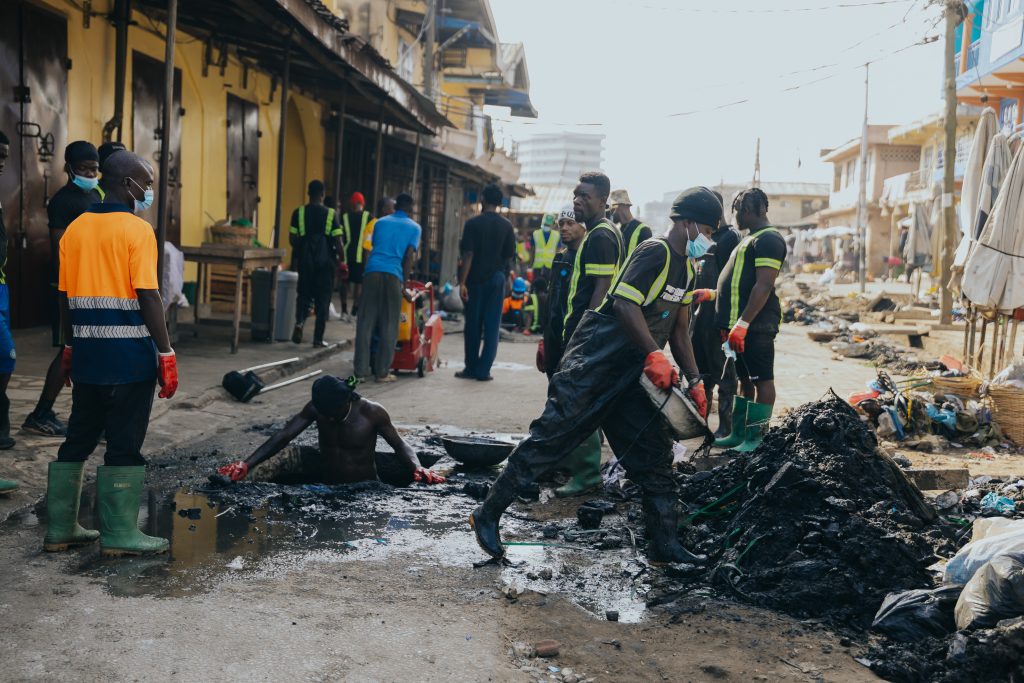
    Several inappropriately sited structures in Oyarifa in the Greater Accra Region have been marked for demolition in the coming days. This forms part of the government’s plan to reduce the risk of flooding incidents.

    According to flood assessors, the structures blocked a water channel and diverted the natural flow of water uphill.

    Check photos below:

    The previous Akufo-Addo administration diverted $65 million from a World Bank-funded flood protection project to cover expenses related to the government’s response to the Covid-19 pandemic, according to the Finance Ministry.

    Technical Advisor at the Ministry of Finance, Frederick Amissah $65 million allocated under the Greater Accra Resilient and Integrated Development (GARID) Project was one of several World Bank loan projects contracted by the state.

    He added, “There was a project called the Ghana Economic Transformation (GET) Project, and almost ¢1 billion was spent on travelling in 2024. In one year alone, a billion Ghana cedis was used to travel for a World Bank project. Nearly half of the $137 million went into COVID expenditure; it was redirected to COVID. Even the $65 million that was transferred for the purpose of COVID, only $60.8 million has been successfully retired. About $4.2 million remains unretired.”

    This revelation comes amid mounting pressure on President John Dramani Mahama to address the country’s recurring flooding problem. Meanwhile, the Coordinator of the GARID Project, Dr. Ohene Sarfoh, says Ghana is failing to achieve zero flooding in Accra due to political interference.

    Speaking to the media on Tuesday, June 30, he noted that, he explained that influential individuals often prevent enforcement agencies from consistently applying Ghana’s physical planning and development laws to shield offenders.

    “We should get away from this patronage system where one person gets into a problem and then an uncle, a father, a mother or somebody intervenes, thereby undermining the law,” he said.

    According to him, it’s about time the right thing is done; thus, persons found guilty of undermining efforts to protect waterways and prevent illegal developments must face the law.

    “We also have to do development control. We need to keep development away from certain areas. Perhaps there should be more emphasis on prevention than demolition.”His comments are a reaction to the recent heavy rains that have left parts of Ghana’s capital flooded.

    Ghana witnessed a series of flooding incidents on Monday, June 29, in parts of the Greater Accra Region and other regions following heavy rains.

    The rains, which started late on Sunday, June 28, left commuters stranded, brought traffic to a standstill, resulted in the deaths of several individuals, and the destruction of properties.

    While some victims managed to salvage a few belongings, many suffered devastating losses as floodwaters submerged their homes and properties.

    The current death toll from the flooding incidents, as confirmed by the Ghana National Fire Service Public Relations Department, stands at 34. Meanwhile, the Finance Minister has realised a sum of GH¢300 million from the Contingency Fund for individuals affected by the incident following President John Dramani Mahama’s directive.

    The directive forms part of the government’s response to the flooding of parts of Accra and other communities in the southern sector of the country after hours of unusually heavy rainfall.

    In Ghana, the Contingency Fund is a constitutional fund set aside to meet urgent and unforeseen government expenses that cannot wait for the normal budget approval process.

    It is established under Article 177 of the 1992 Constitution of Ghana.In a statement issued on behalf of the President by the Spokesperson to the President and Minister for Government Communications, Felix Kwakye Ofosu, it was indicated that the GH¢300 million will be divided into two, with portions designated to provide relief and implement measures to mitigate flooding.

    “President John Dramani Mahama has directed the Minister for Finance to release GHS 300 million from the Contingency Fund to finance urgent flood relief and mitigation efforts.

    GHS 150 million out of the amount will finance urgent relief efforts for flood-affected persons and communities in the southern sector of the country. Another GHS 150 million will be spent on flood mitigation measures aimed at reducing incidents of flooding,” parts of the statement read.

    Also, due to the scale of destruction and the effects of the floods, President Mahama has ordered that additional support be provided by the Ghana Armed Forces and other security services for the rescue operations ongoing across the city.

    “The President has also directed the deployment of personnel of the Ghana Armed Forces and Police to work with NADMO and other security services in the rescue and relief operations currently underway across the city,” adding that, “the President earlier today undertook an aerial tour of the flooded areas to assess the full extent of the situation and announced a raft of steps being taken to safeguard residents and prevent further flooding.”
  • Flood-hit regions to undergo cleaning exercise on July 10–11

    Flood-hit regions to undergo cleaning exercise on July 10–11

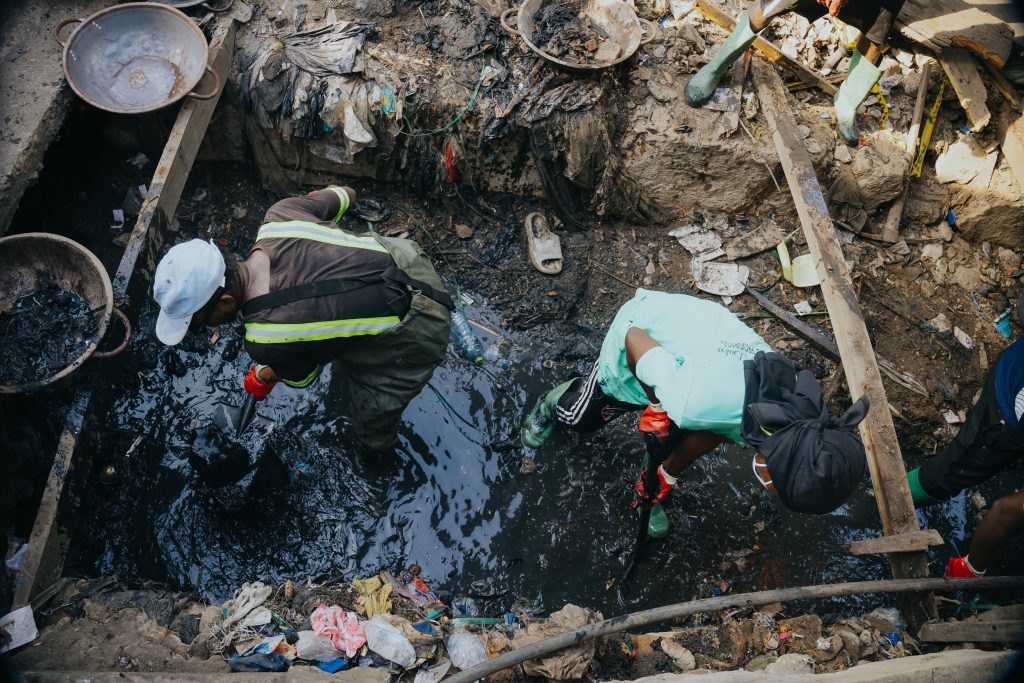
    The government has intensified efforts to improve sanitation and reduce the risk of future flooding. In a statement issued on Monday, July 6, government spokesperson Felix Kwakye Ofosu announced that Friday, July 10, and Saturday, July 11, have been declared National General Cleaning Days across the seven regions affected by the devastating June 29 floods, following a directive from President John Dramani Mahama.

    Part of the statement read, “This is a critical, nationwide exercise and all citizens are strongly encouraged to fully participate in it. For far too long, indiscriminate littering and plastic pollution have clogged our drainage systems, contributing to devastating, preventable floods that destroy livelihoods and claim precious Ghanaian lives”. 

    Ministers of State, Chief Executive Officers, Members of Parliament, Metropolitan, Municipal and District Chief Executives (MMDCEs), and heads of public institutions in the affected regions have been directed to oversee the exercise.

    Ghana witnessed a series of flooding incidents on Monday, June 29, in parts of the Greater Accra Region and other regions following heavy rains.

    The rains, which started late on Sunday, June 28, left commuters stranded, brought traffic to a standstill, resulted in the deaths of several individuals and destruction of properties.

    While some victims managed to salvage a few belongings, many suffered devastating losses as floodwaters submerged their homes and properties.

    The current death toll from the flooding incidents, as confirmed by the Ghana National Fire Service Public Relations Department, stands at 34. Meanwhile, the Finance Minister has realised a sum of GH¢300 million from the Contingency Fund for individuals affected by the incident following President John Dramani Mahama’s directive.

    The directive forms part of the government’s response to the flooding of parts of Accra and other communities in the southern sector of the country after hours of unusually heavy rainfall.

    In Ghana, the Contingency Fund is a constitutional fund set aside to meet urgent and unforeseen government expenses that cannot wait for the normal budget approval process.

    It is established under Article 177 of the 1992 Constitution of Ghana.In a statement issued on behalf of the President by the Spokesperson to the President and Minister for Government Communications, Felix Kwakye Ofosu, it was indicated that the GH¢300 million will be divided into two, with portions designated to provide relief and implement measures to mitigate flooding.

    “President John Dramani Mahama has directed the Minister for Finance to release GHS 300 million from the Contingency Fund to finance urgent flood relief and mitigation efforts.

    GHS 150 million out of the amount will finance urgent relief efforts for flood-affected persons and communities in the southern sector of the country. Another GHS 150 million will be spent on flood mitigation measures aimed at reducing incidents of flooding,” parts of the statement read.

    Also, due to the scale of destruction and the effects of the floods, President Mahama has ordered that additional support be provided by the Ghana Armed Forces and other security services for the rescue operations ongoing across the city.

    “The President has also directed the deployment of personnel of the Ghana Armed Forces and Police to work with NADMO and other security services in the rescue and relief operations currently underway across the city,” adding that, “the President earlier today undertook an aerial tour of the flooded areas to assess the full extent of the situation and announced a raft of steps being taken to safeguard residents and prevent further flooding.”
  • June 29 floodwaters swept away over GHS25m goods at Tema warehouse – CEO

    June 29 floodwaters swept away over GHS25m goods at Tema warehouse – CEO

    Individuals continue to recount losses following the heavy rains on Monday, June 29. Adding to the growing list of affected persons is the CEO of Three Dreamers, a warehouse located along the Tema Motorway, Bismark Offei Ansah, who says goods valued at over twenty-five (25) million cedis at the facility were washed away by the floods.

    Speaking to the media, he expressed gratitude that no lives were lost despite the losses.

    “Last Monday, the rains that fell were unlike anything we have seen since 2018. We don’t know how it started or how it came about, but the rainfall was extremely heavy. The construction around the Tema Motorway has an underbridge. We saw the water coming heavily from the motorway area, breaking down a wall of a company close to ours and then moving straight to our warehouse.

    “We have lost a lot. Our goods worth over GH¢25 million have all gone to waste, apart from machines that were also damaged.“We thank God that no life was lost. We could not risk lives for material things. We thank God that no life was lost. We could not risk lives for material things,” he stressed.


    While some affected persons are still counting their losses, others resorted to salvaging goods washed out of warehouses along the Tema Motorway and surrounding communities. Footage showed individuals retrieving items such as foodstuffs, toiletries, gas cylinders, and electrical appliances.


    The rains, which started late on Sunday, June 28, left commuters stranded, brought traffic to a standstill, resulted in the deaths of several individuals, and caused the destruction of properties.


    At the Odawna Garage in Accra, about 1,500 apprentices now risk losing their training opportunities and livelihoods after more than 1,000 vehicles were submerged, disrupting operations and threatening the survival of numerous businesses.


    The Odawna Garage is the largest automobile repair centre in the country and serves as a major training ground for young mechanics. Speaking to the media on Thursday, July 2, Chairman of the Odawna Garage, Sampson Prempeh, said they did everything possible to save most of the vehicles, but their efforts proved unsuccessful.


    He added, “On that day, we called the ECG office to turn off the light in the area because of the flood, and also to help us be able to at least get access. When we finally got access, we could count to say that at the time, about 1,000 vehicles had been submerged in the flood. We have about 1,500 apprentices who are in training. Many of them reside at the premises, so they were able to move a few of the cars to safe havens”.


    Other areas affected by the floodwaters include parts of the N1 Highway, Apenkwa towards Tesano, the Accra–Kasoa stretch, Weija, Mallam, Achimota, Spintex, Atomic in Madina, Kaneshie, Darkuman Junction, portions of the Kwame Nkrumah Interchange, and other surrounding communities.


    The current death toll from the flooding incidents, as confirmed by the Ghana National Fire Service Public Relations Department, stands at 12.
    Meanwhile, the Finance Minister has realised a sum of GH¢300 million from the Contingency Fund for individuals affected by the incident following President John Dramani Mahama’s directive.


    The directive forms part of the government’s response to the flooding of parts of Accra and other communities in the southern sector of the country after hours of unusually heavy rainfall.


    In Ghana, the Contingency Fund is a constitutional fund set aside to meet urgent and unforeseen government expenses that cannot wait for the normal budget approval process.


    It is established under Article 177 of the 1992 Constitution of Ghana.
    In a statement issued on behalf of the President by the Spokesperson to the President and Minister for Government Communications, Felix Kwakye Ofosu, it was indicated that the GH¢300 million will be divided into two, with portions designated to provide relief and implement measures to mitigate flooding.


    “President John Dramani Mahama has directed the Minister for Finance to release GHS 300 million from the Contingency Fund to finance urgent flood relief and mitigation efforts.


    GHS 150 million out of the amount will finance urgent relief efforts for flood-affected persons and communities in the southern sector of the country. Another GHS 150 million will be spent on flood mitigation measures aimed at reducing incidents of flooding,” parts of the statement read.


    Also, due to the scale of destruction and the effects of the floods, President Mahama has ordered that additional support be provided by the Ghana Armed Forces and other security services for the rescue operations ongoing across the city.


    “The President has also directed the deployment of personnel of the Ghana Armed Forces and Police to work with NADMO and other security services in the rescue and relief operations currently underway across the city,” adding that, “the President earlier today undertook an aerial tour of the flooded areas to assess the full extent of the situation and announced a raft of steps being taken to safeguard residents and prevent further flooding.”
  • NADMO begins nationwide flood relief distribution

    NADMO begins nationwide flood relief distribution

    Individuals affected by the recent flooding across the country have begun receiving relief items from the National Disaster Management Organization (NADMO).

    The exercise which began on Saturday, July 4 and expected to continue in the days ahead efforts to support displaced families and communities.

    Addressing the media, the Minister of State in charge of Government Communications, Felix Kwakye Ofosu, noted that “As we navigate the aftermath of this disaster, we urge all citizens to remain vigilant, adhere to safety warnings and report emergencies”.

    The Finance Ministry has disbursed GHC 350 million from the Contingency Fund to the respective National Disaster Management Committee accounts to finance urgent flood relief and mitigation efforts, as earlier directed by President John Dramani Mahama following the devastating June 29 floods in Accra and southern Ghana.

    In Ghana, the Contingency Fund is a constitutional fund set aside to meet urgent and unforeseen government expenses that cannot wait for the normal budget approval process.

    It is established under Article 177 of the 1992 Constitution of Ghana.

    The President issued the directive after conducting an aerial assessment of the extent of damage caused by the floods and announced the intervention in line with Article 177 of the 1992 Constitution.

    The exercise comes shortly after the Finance Minister secured parliamentary approval through the Finance Committee for the withdrawal from the Contingency Fund.

    Following Parliament’s approval, the Minister for Finance authorised the Controller and Accountant-General to release and transfer GH¢350 million from the Contingency Fund to the National Disaster Management Committee in Accra on Tuesday, June 30, to implement the National Emergency Response Programme and support flood relief efforts.

    Acting on the Minister’s instructions, the Controller and Accountant-General established a dedicated account for the National Disaster Management Committee at the Bank of Ghana and subsequently transferred the approved GH¢350 million into it, completing the full disbursement.

    The allocation comprises GH¢200 million for immediate relief assistance to flood victims and affected communities, while the remaining GH¢150 million has been earmarked for flood prevention and mitigation interventions to help minimise the occurrence and impact of future flooding.

    The flood emergency, providing timely assistance to transfer, gives effect to President Mahama’s directive for an immediate government response to the affected communities while supporting long-term measures to reduce the impact of future flooding.

    Death toll after Monday June 29 downpour

    So far, Ghana has recorded 12 deaths following Monday’s, June 29, devastating floods that swept across large parts of the Greater Accra Region. Earlier, the Ghana National Fire Service (GNFS) reported nine (9) deaths.

    Addressing the media, a member of the Public Relations Department of the Ghana National Fire Service, Alex King Nartey, said the Service has been leading rescue efforts in some of the worst-hit communities.

    “So at this time now, the confirmable or confirmed figures that I have, the only case is in the case of about nine people,” he stated.

    Parts of Accra were submerged following heavy rains that started late on Sunday, June 28, and continued into the morning of Monday, June 29, 2026. This caused commuters to be stranded and disrupted traffic flow.

    Affected areas include parts of the N1 Highway, Apenkwa towards Tesano, the Accra–Kasoa stretch, Weija, Mallam, Achimota, Spintex, Atomic in Madina, Kaneshie, Darkuman Junction, portions of the Kwame Nkrumah Interchange, and other surrounding communities, according to residents and road users.

    Weeks ago, several commuters were left stranded following a heavy downpour in Accra on June 3. The incident disrupted traffic flow as a result of flooding from the rain.

    Commuters using routes from Ashaiman to neighbouring communities including Sakumono, Kaneshe, and Adjei Kojo were left stranded for hours as floodwaters submerged key sections of the road.

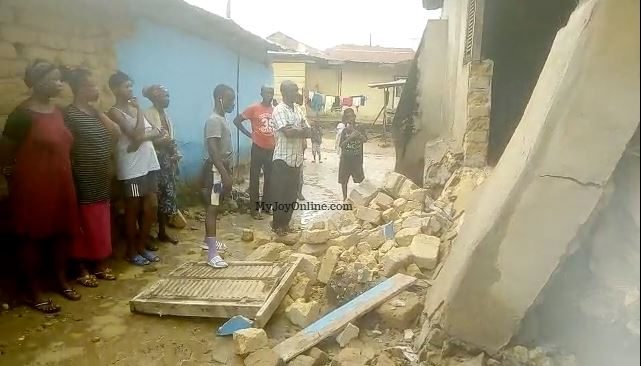
    Also, the heavy downpour on Monday, June 29, led to the collapse of a three-storey, seven-bedroom house at Tabora No. 9.

    The unfortunate incident occurred around 9 p.m. in Accra, when the 90 percent-complete structure gave way and collapsed to the ground.

    Speaking to Adom News, the landlady, Serwaa Prempeh, said she heard something fall, followed by a sound similar to that of an avocado dropping to the ground.

    She then asked her children to check what had fallen, only to learn that a block had fallen from the top of the building. They quickly ran to safety and escaped unharmed before the structure caved in.

    “When I asked my children to pick it up, they discovered it was actually a block that had fallen from one of the building’s pillars,” she narrated.

    Although no casualties were recorded, some property remains buried under the rubble.


    TV

  • Flood prevention failing due to political interference – GARID

    Flood prevention failing due to political interference – GARID

    The Coordinator of the Greater Accra Resilient and Integrated Development (GARID) Project, Dr. Ohene Sarfoh, says Ghana is failing to achieve zero flooding in Accra due to political interference.

    Speaking to the media on Tuesday, June 30, he noted that, he explained that influential individuals often prevent enforcement agencies from consistently applying Ghana’s physical planning and development laws to shield offenders.

    “We should get away from this patronage system where one person gets into a problem and then an uncle, a father, a mother or somebody intervenes, thereby undermining the law,” he said.

    According to him, it’s about time the right thing is done, thus persons found guilty of undermining efforts to protect waterways and prevent illegal developments must face the law.

    “We also have to do development control. We need to keep development away from certain areas. Perhaps there should be more emphasis on prevention than demolition.”

    His comments are a reaction to the recent heavy rains that have left parts of Ghana’s capital flooded.

    Ghana has recorded more than 9 deaths following Monday’s, June 29, devastating floods that swept across large parts of the Greater Accra Region.

    This information was made known by the Ghana National Fire Service (GNFS) on Tuesday, June 30. Addressing the media, a member of the Public Relations Department of the Ghana National Fire Service, Alex King Nartey, said the Service has been leading rescue efforts in some of the worst-hit communities.

    “So at this time now, the confirmable or confirmed figures that I have, the only case is in the case of about nine people,” he stated.

    parts of Accra have submerged following heavy rains that started late on Sunday, June 28, and continued into the morning of Monday, June 29, 2026. This has caused commuters stranded and traffic flow at a standstill.

    Affected areas include parts of the N1 Highway, Apenkwa towards Tesano, the Accra–Kasoa stretch, Weija, Mallam, Achimota, Spintex, Atomic in Madina, Kaneshie, Darkuman Junction, portions of the Kwame Nkrumah Interchange, and other surrounding communities, according to residents and road users.

    Weeks ago, several commuters were left stranded following a heavy downpour in Accra on June 3. The incident disrupted traffic flow as a result of flooding from the rain.

    Commuters using routes from Ashaiman to neighbouring communities including Sakumono, Kaneshe, and Adjei Kojo were left stranded for hours as floodwaters submerged key sections of the road.

    Last year, some parts of the country’s capital, Accra, were flooded following a four-hour heavy rainfall on Sunday, May 18.

    The downpour disrupted traffic and daily activities. Weija, Kaneshie, Adabraka, Tema, and Adentan-Dodowa are a few of the areas that have been affected.

    Over the years, the country has been battling severe flooding whenever there are heavy rains, particularly in Accra.

    According to NADMO, the canker results from poor hygiene practices and poor drainage infrastructure.

    “Most of the problems we have observed are that there is a lack of drainage in some communities, some of the areas are filled with filth…In some of the areas, we also have engineering defects,” he explained.

    Gov’t’s move to end perennial flooding

    President John Dramani Mahama has reaffirmed his commitment to tackling Ghana’s persistent flooding challenges by ordering the demolition of illegally constructed buildings blocking waterways.

    Speaking at the 2025 National Eid-ul-Fitr celebration at Black Star Square, he blamed the increasing flood disasters on poor urban planning and unauthorized developments in wetlands, waterways, and Ramsar sites.

    The President made it clear that his administration would take drastic action against encroachers, stressing that all structures obstructing natural drainage systems would be removed to prevent further destruction.

    Minister for Works, Housing and Water Resources, Hon. Kenneth Gilbert Adjei, has also revealed that approximately six billion dollars would be required to implement a comprehensive national flood control programme.

    He cited both natural and human-induced factors as contributing causes to flooding.

    In his address, the minister described flooding as one of Ghana’s most persistent and destructive hazards, often resulting in the loss of lives, displacement of families, damaged infrastructure, and broader economic disruption.

    He pointed to several regions that have been hit by recent floods, including Greater Accra, Ashanti, Western, Northern, and Volta. “The floods were triggered by intense rainfall, in some cases exceeding historical averages,” he said.

    As part of the government’s immediate response, the minister said the Ministry is focused on improving drainage systems and strengthening community preparedness.

    He also announced that the ministry is working with private sector partners to implement green and nature-based solutions, including wetland protection, afforestation, rainwater harvesting, and the use of permeable pavements. Pilot projects are being initiated in selected river catchments to serve as models for future interventions.

    He highlighted the ongoing Greater Accra Resilient and Integrated Development (GARID) project, which is supported by the World Bank. The project aims to reduce flood risk and improve solid waste management in the Odaw Basin and surrounding communities.

    He, however, called for the support of Parliament, stakeholders, and the general public in building sustainable and inclusive infrastructure while protecting the environment.

    Member of Parliament for Ahafo Ano North and former Director General of the National Disaster Management Organization (NADMO), Hon. Eric Nana Agyemang-Prempeh, urged government to release funds to enable the dredging of flood-prone areas.

    He also called for action on the ongoing tidal wave challenges affecting parts of the Volta Region.

    Member of Parliament for Builsa North, Hon. James Agalga, added that the Ministry of Finance should expedite the release of funds to NADMO to support its response efforts.

    Several downpour incidents in the country so far this year have led to the destruction of lives and property—as encountered in previous years.

    Flooding that was caused by a downpour on Sunday, May 18, claimed the lives of five individuals.

    Many citizens believe that the successive governments have paid lip service to addressing the canker.

    But the incumbent has insisted that it will work to address the challenges associated with flooding.

  • Death toll from Accra floods rises to 9 – GNFS

    Death toll from Accra floods rises to 9 – GNFS

    Ghana has recorded 9 deaths following Monday’s, June 29, devastating floods that swept across large parts of the Greater Accra Region.

    This information was made known by the Ghana National Fire Service (GNFS) on Tuesday, June 30. Addressing the media, a member of the Public Relations Department of the Ghana National Fire Service, Alex King Nartey, said the Service has been leading rescue efforts in some of the worst-hit communities.

    “So at this time now, the confirmable or confirmed figures that I have, the only case is in the case of about nine people,” he stated.

    Parts of Accra have submerged following heavy rains that started late on Sunday, June 28, and continued into the morning of Monday, June 29, 2026. This has caused commuters stranded and traffic flow at a standstill.

    Affected areas include parts of the N1 Highway, Apenkwa towards Tesano, the Accra–Kasoa stretch, Weija, Mallam, Achimota, Spintex, Atomic in Madina, Kaneshie, Darkuman Junction, portions of the Kwame Nkrumah Interchange, and other surrounding communities, according to residents and road users.

    Weeks ago, several commuters were left stranded following a heavy downpour in Accra on June 3. The incident disrupted traffic flow as a result of flooding from the rain.

    Commuters using routes from Ashaiman to neighbouring communities including Sakumono, Kaneshe, and Adjei Kojo were left stranded for hours as floodwaters submerged key sections of the road.

    Last year, some parts of the country’s capital, Accra, were flooded following a four-hour heavy rainfall on Sunday, May 18.

    The downpour disrupted traffic and daily activities. Weija, Kaneshie, Adabraka, Tema, and Adentan-Dodowa are a few of the areas that have been affected.

    Over the years, the country has been battling severe flooding whenever there are heavy rains, particularly in Accra.

    According to NADMO, the canker results from poor hygiene practices and poor drainage infrastructure.

    “Most of the problems we have observed are that there is a lack of drainage in some communities, some of the areas are filled with filth…In some of the areas, we also have engineering defects,” he explained.

    Gov’t’s move to end perennial flooding

    President John Dramani Mahama has reaffirmed his commitment to tackling Ghana’s persistent flooding challenges by ordering the demolition of illegally constructed buildings blocking waterways.

    Speaking at the 2025 National Eid-ul-Fitr celebration at Black Star Square, he blamed the increasing flood disasters on poor urban planning and unauthorized developments in wetlands, waterways, and Ramsar sites.

    The President made it clear that his administration would take drastic action against encroachers, stressing that all structures obstructing natural drainage systems would be removed to prevent further destruction.

    Minister for Works, Housing and Water Resources, Hon. Kenneth Gilbert Adjei, has also revealed that approximately six billion dollars would be required to implement a comprehensive national flood control programme.

    He cited both natural and human-induced factors as contributing causes to flooding.

    In his address, the minister described flooding as one of Ghana’s most persistent and destructive hazards, often resulting in the loss of lives, displacement of families, damaged infrastructure, and broader economic disruption.

    He pointed to several regions that have been hit by recent floods, including Greater Accra, Ashanti, Western, Northern, and Volta. “The floods were triggered by intense rainfall, in some cases exceeding historical averages,” he said.

    As part of the government’s immediate response, the minister said the Ministry is focused on improving drainage systems and strengthening community preparedness.

    He also announced that the ministry is working with private sector partners to implement green and nature-based solutions, including wetland protection, afforestation, rainwater harvesting, and the use of permeable pavements. Pilot projects are being initiated in selected river catchments to serve as models for future interventions.

    He highlighted the ongoing Greater Accra Resilient and Integrated Development (GARID) project, which is supported by the World Bank. The project aims to reduce flood risk and improve solid waste management in the Odaw Basin and surrounding communities.

    He, however, called for the support of Parliament, stakeholders, and the general public in building sustainable and inclusive infrastructure while protecting the environment.

    Member of Parliament for Ahafo Ano North and former Director General of the National Disaster Management Organization (NADMO), Hon. Eric Nana Agyemang-Prempeh, urged government to release funds to enable the dredging of flood-prone areas.

    He also called for action on the ongoing tidal wave challenges affecting parts of the Volta Region.

    Member of Parliament for Builsa North, Hon. James Agalga, added that the Ministry of Finance should expedite the release of funds to NADMO to support its response efforts.

    Several downpour incidents in the country so far this year have led to the destruction of lives and property—as encountered in previous years.

    Flooding that was caused by a downpour on Sunday, May 18, claimed the lives of five individuals.

    Many citizens believe that the successive governments have paid lip service to addressing the canker.

    But the incumbent has insisted that it will work to address the challenges associated with flooding.


  • Heavy rains to continue till afternoon – GMet

    Heavy rains to continue till afternoon – GMet

    The Ghana Meteorological Agency (GMet) has urged the public to stay safe as heavy rains are expected to continue until this afternoon, Monday, June 29.

    This was disclosed in a forecast shared on its official social media pages on June 29, 2026. Part of the post read “The rain, with or without thunder, of varying intensity currently affecting parts of the coast and a few inland areas is expected to persist throughout the forecast period amidst patches of mist or fog over the forest and mountainous regions.”

    It added, “The rain-bearing clouds currently affecting the southeastern parts of the country are expected to persist, producing rain with occasional thunder of varying intensities.

    “As the day progresses, these clouds are also expected to spread westward, bringing thunderstorms or rain to the southwestern parts of the country from this afternoon into the evening. Northern Ghana will experience intervals of sunshine. However, thunderstorms or rain are expected over parts of the northern sector from late afternoon into the evening”.

    Meanwhile, parts of Accra have submerged following heavy rains that started late on Sunday, June 28, and continued into the morning of Monday, June 29, 2026. This has caused commuters stranded and traffic flow at a standstill.

    Affected areas include parts of the N1 Highway, Apenkwa towards Tesano, the Accra–Kasoa stretch, Weija, Mallam, Achimota, Spintex, Atomic in Madina, Kaneshie, Darkuman Junction, portions of the Kwame Nkrumah Interchange, and other surrounding communities, according to residents and road users.

    Weeks ago, several commuters were left stranded following a heavy downpour in Accra on June 3. The incident disrupted traffic flow as a result of flooding from the rain.

    Commuters using routes from Ashaiman to neighbouring communities including Sakumono, Kaneshe, and Adjei Kojo were left stranded for hours as floodwaters submerged key sections of the road.

    Last year, some parts of the country’s capital, Accra, were flooded following a four-hour heavy rainfall on Sunday, May 18.

    The downpour disrupted traffic and daily activities. Weija, Kaneshie, Adabraka, Tema, and Adentan-Dodowa are a few of the areas that have been affected.

    Over the years, the country has been battling severe flooding whenever there are heavy rains, particularly in Accra.

    According to NADMO, the canker results from poor hygiene practices and poor drainage infrastructure.

    “Most of the problems we have observed are that there is a lack of drainage in some communities, some of the areas are filled with filth…In some of the areas, we also have engineering defects,” he explained.

    Gov’t’s move to end perennial flooding

    President John Dramani Mahama has reaffirmed his commitment to tackling Ghana’s persistent flooding challenges by ordering the demolition of illegally constructed buildings blocking waterways.

    Speaking at the 2025 National Eid-ul-Fitr celebration at Black Star Square, he blamed the increasing flood disasters on poor urban planning and unauthorized developments in wetlands, waterways, and Ramsar sites.

    The President made it clear that his administration would take drastic action against encroachers, stressing that all structures obstructing natural drainage systems would be removed to prevent further destruction.

    Minister for Works, Housing and Water Resources, Hon. Kenneth Gilbert Adjei, has also revealed that approximately six billion dollars would be required to implement a comprehensive national flood control programme.

    He cited both natural and human-induced factors as contributing causes to flooding.

    In his address, the minister described flooding as one of Ghana’s most persistent and destructive hazards, often resulting in the loss of lives, displacement of families, damaged infrastructure, and broader economic disruption.

    He pointed to several regions that have been hit by recent floods, including Greater Accra, Ashanti, Western, Northern, and Volta. “The floods were triggered by intense rainfall, in some cases exceeding historical averages,” he said.

    As part of the government’s immediate response, the minister said the Ministry is focused on improving drainage systems and strengthening community preparedness.

    He also announced that the ministry is working with private sector partners to implement green and nature-based solutions, including wetland protection, afforestation, rainwater harvesting, and the use of permeable pavements. Pilot projects are being initiated in selected river catchments to serve as models for future interventions.

    He highlighted the ongoing Greater Accra Resilient and Integrated Development (GARID) project, which is supported by the World Bank. The project aims to reduce flood risk and improve solid waste management in the Odaw Basin and surrounding communities.

    He, however, called for the support of Parliament, stakeholders, and the general public in building sustainable and inclusive infrastructure while protecting the environment.

    Member of Parliament for Ahafo Ano North and former Director General of the National Disaster Management Organization (NADMO), Hon. Eric Nana Agyemang-Prempeh, urged government to release funds to enable the dredging of flood-prone areas.

    He also called for action on the ongoing tidal wave challenges affecting parts of the Volta Region.

    Member of Parliament for Builsa North, Hon. James Agalga, added that the Ministry of Finance should expedite the release of funds to NADMO to support its response efforts.

    Several downpour incidents in the country so far this year have led to the destruction of lives and property—as encountered in previous years.

    Flooding that was caused by a downpour on Sunday, May 18, claimed the lives of five individuals.

    Many citizens believe that the successive governments have paid lip service to addressing the canker.

    But the incumbent has insisted that it will work to address the challenges associated with flooding.


  • Heavy rains submerge roads in parts of Accra

    Heavy rains submerge roads in parts of Accra

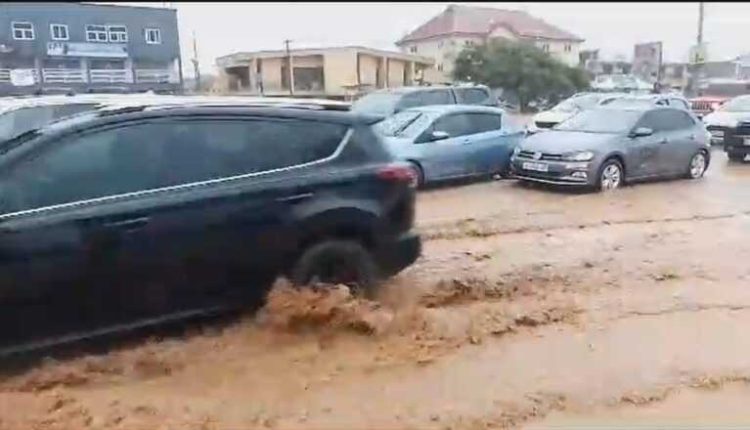
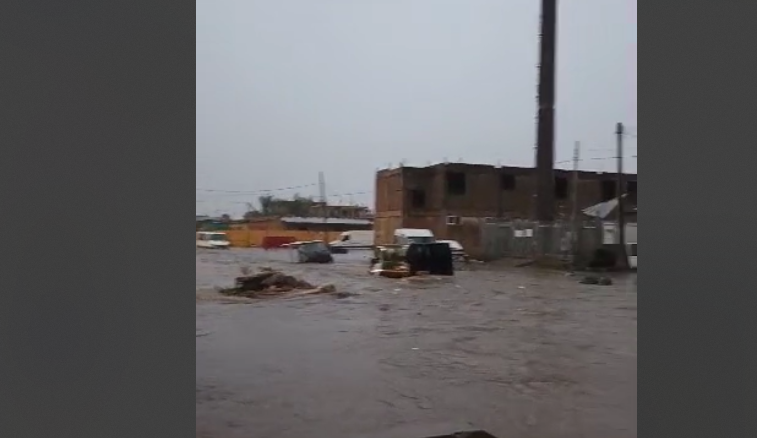
    Parts of Accra have submerged following heavy rains that started late on Sunday, June 28, and continued into the morning of Monday, June 29, 2026. This has caused commuters stranded and traffic flow at a standstill.

    Affected areas include parts of the N1 Highway, Apenkwa towards Tesano, the Accra–Kasoa stretch, Weija, Mallam, Achimota, Spintex, Atomic in Madina, Kaneshie, Darkuman Junction, portions of the Kwame Nkrumah Interchange, and other surrounding communities, according to residents and road users.

    Weeks ago, several commuters were left stranded following a heavy downpour in Accra on June 3. The incident disrupted traffic flow as a result of flooding from the rain.

    Commuters using routes from Ashaiman to neighbouring communities including Sakumono, Kaneshe, and Adjei Kojo were left stranded for hours as floodwaters submerged key sections of the road.

    Last year, some parts of the country’s capital, Accra, were flooded following a four-hour heavy rainfall on Sunday, May 18.

    The downpour disrupted traffic and daily activities. Weija, Kaneshie, Adabraka, Tema, and Adentan-Dodowa are a few of the areas that have been affected.

    Over the years, the country has been battling severe flooding whenever there are heavy rains, particularly in Accra.

    According to NADMO, the canker results from poor hygiene practices and poor drainage infrastructure.

    “Most of the problems we have observed are that there is a lack of drainage in some communities, some of the areas are filled with filth…In some of the areas, we also have engineering defects,” he explained.

    Gov’t’s move to end perennial flooding

    President John Dramani Mahama has reaffirmed his commitment to tackling Ghana’s persistent flooding challenges by ordering the demolition of illegally constructed buildings blocking waterways.

    Speaking at the 2025 National Eid-ul-Fitr celebration at Black Star Square, he blamed the increasing flood disasters on poor urban planning and unauthorized developments in wetlands, waterways, and Ramsar sites.

    The President made it clear that his administration would take drastic action against encroachers, stressing that all structures obstructing natural drainage systems would be removed to prevent further destruction.

    Minister for Works, Housing and Water Resources, Hon. Kenneth Gilbert Adjei, has also revealed that approximately six billion dollars would be required to implement a comprehensive national flood control programme.

    He cited both natural and human-induced factors as contributing causes to flooding.

    In his address, the minister described flooding as one of Ghana’s most persistent and destructive hazards, often resulting in the loss of lives, displacement of families, damaged infrastructure, and broader economic disruption.

    He pointed to several regions that have been hit by recent floods, including Greater Accra, Ashanti, Western, Northern, and Volta. “The floods were triggered by intense rainfall, in some cases exceeding historical averages,” he said.

    As part of the government’s immediate response, the minister said the Ministry is focused on improving drainage systems and strengthening community preparedness.

    He also announced that the ministry is working with private sector partners to implement green and nature-based solutions, including wetland protection, afforestation, rainwater harvesting, and the use of permeable pavements. Pilot projects are being initiated in selected river catchments to serve as models for future interventions.

    He highlighted the ongoing Greater Accra Resilient and Integrated Development (GARID) project, which is supported by the World Bank. The project aims to reduce flood risk and improve solid waste management in the Odaw Basin and surrounding communities.

    He, however, called for the support of Parliament, stakeholders, and the general public in building sustainable and inclusive infrastructure while protecting the environment.

    Member of Parliament for Ahafo Ano North and former Director General of the National Disaster Management Organization (NADMO), Hon. Eric Nana Agyemang-Prempeh, urged government to release funds to enable the dredging of flood-prone areas.

    He also called for action on the ongoing tidal wave challenges affecting parts of the Volta Region.

    Member of Parliament for Builsa North, Hon. James Agalga, added that the Ministry of Finance should expedite the release of funds to NADMO to support its response efforts.

    Several downpour incidents in the country so far this year have led to the destruction of lives and property—as encountered in previous years.

    Flooding that was caused by a downpour on Sunday, May 18, claimed the lives of five individuals.

    Many citizens believe that the successive governments have paid lip service to addressing the canker.

    But the incumbent has insisted that it will work to address the challenges associated with flooding.

  • Accra’s floods are not natural disasters; they’re human-made tragedies

    Accra’s floods are not natural disasters; they’re human-made tragedies

    Every year, the rains come. Every year, homes are submerged, businesses are destroyed, families are displaced, and innocent lives are lost. Then, when the floodwaters recede, the promises begin. Committees are formed. Blame is assigned. Speeches are made.

    Yet when the next rainy season arrives, the same tragedy repeats itself.

    The painful truth is that Accra’s flooding crisis is no longer simply a problem of rainfall. It is a crisis of attitude, indiscipline, poor planning, weak enforcement of laws, and a collective refusal to do what is right. Until these behaviours change, no amount of drainage projects, government spending, or emergency interventions will permanently solve the problem.

    The Real Solution to Flooding in Accra

    For decades, the people of Ghana have watched with sadness as torrential rains turn parts of Accra into rivers. Families lose homes, businesses suffer devastating losses, roads become impassable, and lives are tragically cut short. Every rainy season brings renewed anxiety, especially for residents living in flood-prone communities.

    After every disaster, the same questions are asked. Why does Accra continue to flood? Why do lives continue to be lost? Why has a lasting solution remained elusive despite years of discussions, studies, and promises?

    Many people point to climate change and increasing rainfall intensity. Others blame successive governments for failing to invest sufficiently in drainage infrastructure. While these explanations contain some truth, they do not fully explain the problem.

    The uncomfortable reality is that many of the devastating floods in Accra today are largely the result of human actions and inactions.
    Across the city, drains designed to carry stormwater are routinely clogged with plastic waste, discarded household items, and other forms of refuse. During heavy rains, these blocked drainage systems become incapable of handling the volume of water flowing through them. The water then spills into streets, homes, schools, shops, and workplaces.
    This situation is not caused by nature alone. It is caused by behaviour.

    How can a city successfully manage floods when some citizens continue to treat gutters and waterways as dumping sites?

    Equally troubling is the persistent construction of buildings on waterways, wetlands, and flood-prone lands. In many cases, structures that should never have been approved are allowed to remain standing. Natural channels through which water once flowed freely have been blocked by houses, walls, and commercial developments.

    When heavy rains arrive, water simply attempts to reclaim its natural path.
    The result is predictable: “flooding, destruction, and suffering.”

    Unfortunately, responsibility for this problem cannot be placed solely on ordinary citizens. Regulatory institutions, planning authorities, local assemblies, traditional leaders, and public officials also have important roles to play.
    Questions must be asked.
    How do buildings continue to appear on waterways?
    How are permits granted for developments in high-risk areas?
    Why are illegal structures often allowed to remain until disaster strikes?

    The enforcement of planning regulations must become stronger, more transparent, and more consistent. Rules that exist only on paper cannot protect lives.
    Yet even stricter enforcement alone will not solve the problem.
    A broader change in national attitude is required.

    Many Ghanaians become concerned about flooding only when a disaster occurs. Once the floodwaters disappear and life returns to normal, public attention fades. The urgency that existed during the crisis is forgotten until the next rainy season arrives.
    This cycle must end.

    Flood prevention should not be a seasonal discussion. It must become a year-round commitment involving citizens, businesses, community leaders, and government institutions alike.
    Every resident has a role to play.

    Every person who disposes of waste responsibly contributes to a safer city.
    Every community that keeps its drains clean helps reduce flood risks.
    Every developer who respects planning regulations protects lives and property.
    Every public official who refuses corruption strengthens public safety.

    In addition to addressing immediate causes, Ghana must also confront some of the deeper structural issues contributing to Accra’s growing vulnerability.
    One major factor is excessive rural-to-urban migration.
    For decades, Accra has attracted people from all parts of the country in search of jobs, education, healthcare, and better opportunities. As the population continues to grow rapidly, demand for housing increases. This pressure often encourages uncontrolled development and settlement in unsafe locations.
    The long-term solution lies in balanced national development.

    The government must continue efforts to decentralise economic opportunities by creating industries, businesses, educational institutions, and public services across all regions of the country. When meaningful opportunities exist outside Accra, fewer people will feel compelled to relocate to the capital.
    Transportation infrastructure is equally important.

    An efficient railway network connecting Accra to surrounding towns and regions could significantly reduce population pressure within the city. Many people would gladly live in safer and less congested communities if reliable transportation allowed them to commute comfortably to work and back.

    Countries around the world have demonstrated that effective transportation systems can ease urban congestion while improving the quality of life.

    Accra can achieve similar results through long-term planning and investment.
    Ultimately, the solution to flooding is not simply about constructing larger drains or dredging waterways. Those measures are important, but they address symptoms rather than causes.

    The deeper challenge is one of responsibility.
    Floods do not become disasters because rain falls.
    They become disasters when drains are neglected.
    They become disasters when waste is dumped indiscriminately.
    They become disasters when waterways are blocked.
    They become disasters when laws are ignored, and enforcement is weak.
    If Ghana is serious about ending the annual cycle of destruction, then citizens and leaders alike must embrace a new culture of discipline, accountability, and long-term thinking.
    A cleaner environment.

    A more responsible citizenry.
    A stronger planning system.
    A more decentralised economy.
    An efficient transportation network.

    These are the foundations upon which a flood-resilient Accra can be built.
    The rains will continue to come, just as they do in cities across the world.
    The real question is whether we will finally change the attitudes and behaviours that turn a natural event into a national tragedy.
    The solution to flooding in Accra begins with all of us.

    DISCLAIMER: The Views, Comments, Opinions, Contributions and Statements made by Readers and Contributors on this platform do not necessarily represent the views or policy of The Independent Ghana.

  • Rice farms in Gomoa Okyereko destroyed by flooding

    Rice farms in Gomoa Okyereko destroyed by flooding

    The recent release of a temporary bridge blockage by a contractor working on the Kasoa-Winneba Highway dualization has led to the flooding of over 100 acres of rice farms in Gomoa Okyereko, Gomoa East District.

    Farmers in the area reported that the contractor, who had initially blocked River Ayensu for the construction of a modern bridge, failed to inform them before releasing the blockage.

    As a result, the sudden influx of water submerged vast portions of their rice fields, damaging crops that had been cultivated through significant investment.

    In a conversation with Adom News, several farmers expressed their distress, revealing that many had taken out loans to finance their farming activities.

    They emphasized that the unexpected water release has left them with enormous losses and no time to prepare.

    These farmers are now calling on the government for immediate intervention, requesting emergency support and compensation to help them recover from the calamity.

    They warned that the damage not only jeopardizes their livelihoods but also threatens local food production and economic stability in the area.

    Margaret Naana Ackon, the District Chief Executive for Gomoa East, acknowledged the scale of the damage and assured the farmers that the Assembly would offer assistance.

    She committed to engaging with relevant stakeholders to provide relief and explore possible compensation avenues for the affected farmers.

  • Plastic ban key to ending flooding in Accra – Parliament’s Works Committee Chair

    Plastic ban key to ending flooding in Accra – Parliament’s Works Committee Chair

    Chairman of Parliament’s Works and Housing Committee, Vincent Oppong Asamoah, is urging the government to impose a nationwide prohibition on the use of plastics.

    He citeD their detrimental impact on the environment and their significant role in worsening Accra’s flooding challenges.

    He made this appeal during an inspection tour of the Odawna drainage infrastructure under the Greater Accra Resilient and Integrated Development (GARID) Project.

    The initiative, supported by a $200 million World Bank grant since 2020, is designed to tackle frequent flooding, particularly within the Odaw River catchment area.

    Vincent Oppong Asamoah highlighted how plastic waste continues to block key drainage systems, impeding the project’s progress. He stressed that completely banning plastics would significantly ease the burden.

    A global survey by Ipsos lends weight to his call. The poll found that “85% of respondents support a global ban on single-use plastics,” with “87% in favour of reducing plastic production” and “90% backing a ban on dangerous chemicals found in plastics.” There was also strong public backing for encouraging alternatives that are recyclable or reusable.
    Asamoah’s recommendation aligns with global appeals for legally enforceable action to address plastic waste—an issue that international bodies such as the World Wildlife Fund (WWF) and Plastic Free Foundation have also taken up.

    In a related development, the Ranking Member of the Committee, Martin Adjei Mensah Korsah, called for tougher enforcement, saying people who dump garbage into drains must face legal consequences.
    He noted, “It’s a criminal offence and one of the leading causes of flooding in this country.”
  • Rebuild Mepe and other flood-affected areas – Bagbin tells gov’t

    Rebuild Mepe and other flood-affected areas – Bagbin tells gov’t

    Speaker of Parliament Alban Sumana Kingsford Bagbin has called on the government, urging ministers, Members of Parliament (MPs), District Chief Executives (DCEs), and other leaders to prioritize the rebuilding of Mepe and other communities impacted by recent floods.

    He emphasized that challenges affecting even a single community in the Volta Region pose a threat to the safety and stability of the entire region.

    This appeal was delivered on his behalf during the 68th Aƒenorto Festival, where the Speaker stressed the critical need for leadership to actively engage in recovery efforts.

    According to Bagbin, the assistance required for these communities is not merely a luxury but a necessity in times of crisis.

    On October 15, 2023, the operational capacity of the dam was exceeded on account of rising water levels, as a result of an increased rate of heavy rains this year.

    It was necessary for the Volta River Authority (VRA) to release water from the Akosombo Dam to prevent the dam from overflowing which can lead to even more disastrous consequences.

    However, this led to the high rising levels of the Volta River, and the water inflow flooded low-lying communities along the river. North and Central Tongu districts were the most hit in areas such as Mepe, Battor, Sogakope, Mafi, Adidome and Ada

    Bagbin also called on the Volta River Authority (VRA) to implement safer technical measures during future spillage exercises, ensuring that such actions benefit the people of Mepe and surrounding areas rather than causing further hardship.

    As the country approaches the 2024 elections, the Speaker urged all citizens to approach the period with a sense of peace and unity, underscoring the importance of national stability during this crucial time.

    In a separate address, Humphrey A. Williams, Executive Chairman of Oswal Investments Group, highlighted the devastating impact of the floods on Mepe.

    Mr Williams noted that while the disaster brought immense challenges, it also revealed the resilience of the community, which united in the spirit of Aƒenorto to rebuild and recover.

    He reminded attendees that the journey to recovery is ongoing, with key projects such as the completion of the Mepe Health Centre, development of the Mepe Community Center, and the establishment of TVET institutions and an Astroturf still in progress. He called on the sons and daughters of Mepe to continue supporting these initiatives, which are vital to the community’s future.

    “This festival is more than a celebration,” Williams remarked. “It symbolizes our resilience and a commitment to the future. Let us take pride in our progress and continue to work together to overcome the challenges ahead.”

    The Aƒenorto Festival, celebrated annually, provides the people of Mepe an opportunity to reflect on their history, celebrate their culture, and plan for the future. This year’s event underscored the community’s determination to rebuild and secure a brighter future for generations to come.

  • GHS1.5m allocated by govt for flood mitigation – Oppong-Nkrumah

    GHS1.5m allocated by govt for flood mitigation – Oppong-Nkrumah

    The government of Ghana has launched the Built Environment National Conference on Housing and Hydrology (BENCHH) 2024 to tackle ongoing flooding and housing challenges.

    Taking place over three days at the Labadi Beach Hotel, the event was inaugurated on July 2, 2024, by the Minister for Works and Housing, Kojo Oppong Nkrumah.

    During the opening ceremony, Minister Oppong Nkrumah introduced the Ghana Hydrological Fund, aimed at mitigating flood risks and improving water management nationwide. The government has allocated GH¢1.5 million as initial funding for this initiative.

    “The government, through the Ministry of Works and Housing, has prioritized an allocation of 1.5 million Ghana Cedis as seed money for the fund,” he stated.

    Addressing a gathering of government officials, industry experts, and development partners, Minister Oppong Nkrumah stressed the importance of sustainable funding to effectively address Ghana’s flooding challenges.

    He called on all stakeholders, including development partners, to contribute to the fund, highlighting its critical role in accelerating essential projects such as drainage construction and dredging.

    Pointing to Ghana’s severe flooding issues, especially during the rainy season, Minister Oppong-Nkrumah cited inadequate drainage infrastructure and worsening impacts of climate change as exacerbating factors.

    He noted that only 2% of the required concrete lining for drainage channels in the Greater Accra Region has been completed, underscoring the urgent need for comprehensive action.

    The Minister also addressed Ghana’s housing deficit, currently at 1.8 million units. He acknowledged the obstacles faced by affordable housing programs, including funding constraints and project delays inherited from previous administrations.

    To address this, he advocated for robust public-private partnerships and incentives to encourage large-scale affordable housing developments by private developers.

    Throughout the BENCHH 2024 conference, participants will engage in discussions focused on regulatory reforms and the establishment of a Works Inspectorate Unit to ensure adherence to building and safety standards.

  • Today in history: 9 years on since the June 3rd fire and flood catastrophe

    Today in history: 9 years on since the June 3rd fire and flood catastrophe

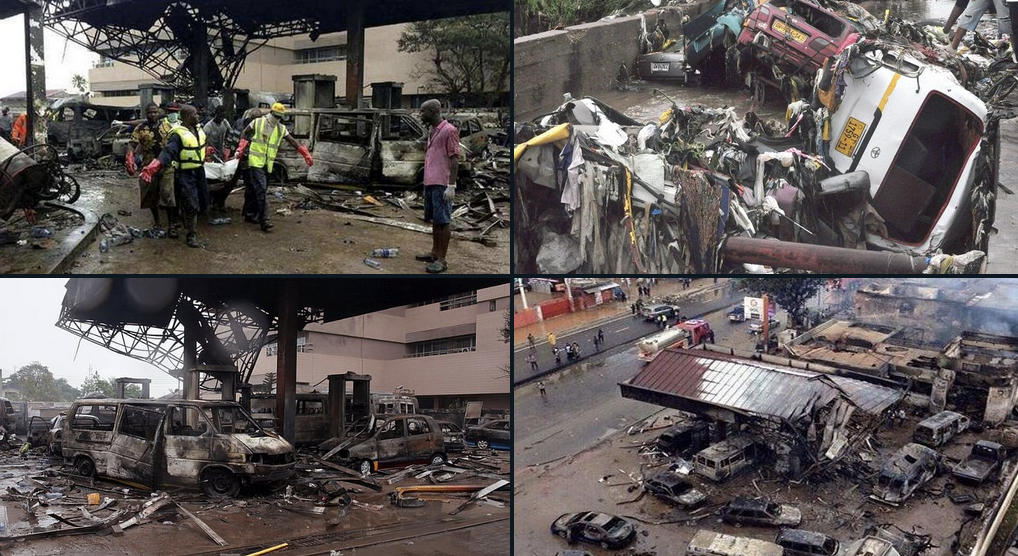
    On this day, nine years ago, Ghana experienced one of the most harrowing disasters in its history. The June 3rd disaster, a catastrophic event that combined a raging fire with devastating floods, claimed the lives of over 150 people and left a scar on the nation’s collective memory.

    The tragedy unfolded at a fuel station in Accra, where many had sought refuge from the relentless downpour that led to severe flooding.

    In a cruel twist of fate, the station became the epicenter of an explosion and subsequent inferno that spread rapidly, consuming everything in its path.

    The disaster not only took lives but also exposed the dire need for improved urban planning and infrastructure to prevent such calamities. It served as a wake-up call for the entire country, prompting calls for action to enhance safety regulations and enforce strict building codes.

    As we mark the ninth anniversary of this dark day, it is a time for reflection, remembrance, and a renewed commitment to ensuring the safety and well-being of all Ghanaians.

    The lessons learned from the June 3rd disaster continue to resonate, reminding us of the importance of preparedness and the value of human life.

    Today, we honor the memory of those who perished, and extend our sympathies to the families still grieving. May the lessons of June 3rd guide us towards a safer and more secure future.

  • Watch nurses struggle to ‘save’ patients as rainwater gushes into ward at Nsawam government hospital

    Watch nurses struggle to ‘save’ patients as rainwater gushes into ward at Nsawam government hospital

    Ghana’s ongoing rainy season has once again spotlighted the country’s infrastructure issues.

    A viral video reportedly captured at Nsawam Government Hospital shows nurses urgently moving patients to avoid water pouring in through a severely leaking roof during a rainstorm.

    The footage reveals the roof of the hospital ward unable to withstand the heavy rain, leading to water flooding the area. Nurses are seen pushing a bed with a patient to a safer location as water gushes in.

    The exact timing of the video remains unclear, but the recent rains have brought multiple infrastructure problems to light. Flooding incidents across Ghana have caused deaths and significant property damage since the rainy season began.

  • Residents of Alajo rescue man swept away by flood

    Residents of Alajo rescue man swept away by flood


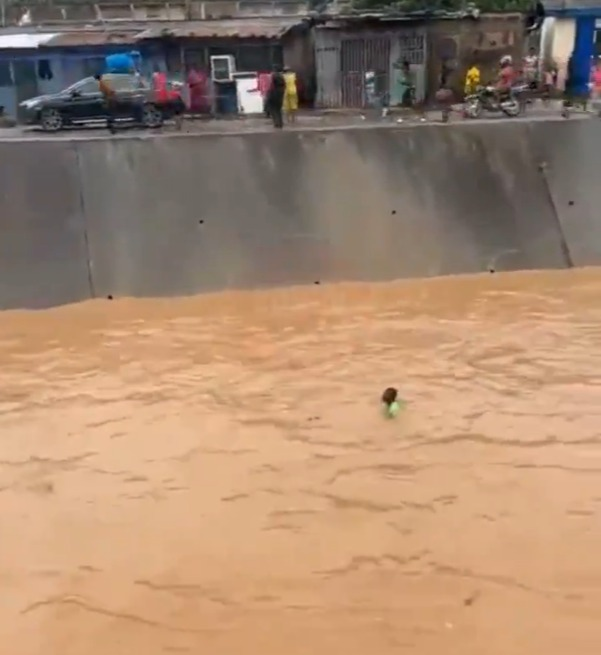
    Today, in Alajo-Accra, residents united to save a young man from drowning in a substantial drain following heavy rainfall that led to severe flooding in the area.

    The swift response and collaborative effort of community members secured the man’s safety amidst the adverse conditions.

    According to gathered reports, the man fell into the fast-flowing floodwaters while attempting to cross the drainage system.

    Because of the strong current, he found it difficult to keep himself above water.

    Witnessing the alarming situation, certain residents promptly requested assistance.

    Approximately three individuals bravely entered the water in an effort to rescue the struggling man.

    While the endeavor seemed hopeless at first, the combined efforts of additional bystanders ultimately led to the successful retrieval of the man and the three rescuers.

    Watch video below:

  • 12-year-old boy swept away by flash flood in Tanoso

    12-year-old boy swept away by flash flood in Tanoso

    A 12-year-old boy tragically lost his life after being swept away by a flash flood in Tanoso, located in the Kwadaso Municipality of the Ashanti Region.

    According to witnesses, the victim, Emmanuel Opoku, was playing with friends in the rain on Wednesday, May 22, 2024, when he was carried away by fast-flowing water.

    Aaron Nandie, the Assembly member for the Tanoso Electoral Area, disclosed that the boy fell into a gutter while playing near the river. Despite his brother’s attempt to rescue him, he was unable to prevent the tragedy.

    Fortunately, the brother survived but sustained severe injuries and was treated at a hospital before being discharged. Meanwhile, the police have deposited the deceased’s body at a morgue.

  • VIDEO: Cow carried by flood water at Achimota during Wednesday’s downpour

    VIDEO: Cow carried by flood water at Achimota during Wednesday’s downpour

    The rainstorm observed over southern Togo that drifted westward and affected areas in southern Ghana on Wednesday left several locations flooded.

    The affected areas include Aflao, Keta, Anloga, Ho, Akatsi, Somanya, Tema, Accra, Koforidua, and Begoro.

    In several videos shared on X, citizens documented the harrowing experiences they encounter whenever there is a relatively heavy rainstorm.

    As a result, individuals were left stranded as portions of the roads were submerged by water, and vehicles were broken down in the middle of the street.

    A recent video shows that animals were not spared from the downpour. A helpless cow was carried by flood waters at Achimota. It is unknown if the livestock managed to survive or not as well as its current location.

  • GMet to launch weather forecast app to aid access to weather updates and help planning

    Ghana Meteorological Agency (GMet) has announced its intention to launch a new application software designed to provide weather forecast information to the public.

    Frustration often arises among Ghanaians when heavy rains lead to frequent flooding in various parts of the country.

    According to the Head of Central Analysis and Forecast at GMet,Felicity Ahafianyo the upcoming app will offer Ghanaians the convenience of accessing weather updates regardless of their location.

    This initiative aims to assist individuals in planning their daily activities effectively, taking into account prevailing weather conditions.

    “Currently we are trying to come up with an app where every Ghanaian irrespective of where you find yourself you will be able to have access to information” she said during an interview with the media on May 23, 2024 amid the recent floods particularly in Accra and other regions. 

    She noted that the first app which was introduced was mainly to assist residents in the capital, Accra but the one which is yet to be launched will be for all irrespective of one’s region or location.

    “The first pilot we did was my Accra Flooding App which is basically for Accra. 

    We are going to expand it to cover the entire country and then any other forecast will also be attached. 

    So that wherever you find yourself just like Google people are doing, we will also be doing similar things but with a higher accuracy rate” she added.

    Earlier, on May 6, 2024, a storm wreaked havoc in parts of Accra, causing flooding and trees to collapse onto vehicles around the Airport Residential area.

    On May 13, 2024, Kasoa and its surrounding areas were thrown into chaos as heavy rainfall led to severe traffic congestion and flooding. 

    The West Hills Mall Car Park near Weija along the Accra–Cape Coast Highway was submerged under floodwaters, while the Electricity Company of Ghana (ECG) office in Bortianor faced a similar fate.

    In response to these challenges, the Ghana Hydrological Authority has unveiled plans to tackle the persistent flooding on the Mallam-Kasoa Highway. 

    The authority aims to construct storm drains along the road, with the project expected to be completed within 17 months. 

    This initiative seeks to alleviate siltation and minimise flooding incidents in the area.

  • Wednesday’s rainstorm leaves parts of Accra flooded; traffic jam looms

    Wednesday’s rainstorm leaves parts of Accra flooded; traffic jam looms

    The rainstorm observed over southern Togo that drifted westward and affected areas in southern Ghana has left several locations flooded.

    The affected areas include Aflao, Keta, Anloga, Ho, Akatsi, Somanya, Tema, Accra, Koforidua, and Begoro.

    In several videos shared on X, citizens have documented the harrowing experiences they encounter whenever there is a relatively heavy rainstorm.

    As a result, individuals have been left stranded as portions of the roads have been submerged by water, and vehicles have broken down in the middle of the street.

    It is anticipated that as night draws near, traffic congestion will build up as many people leave their workplaces, and schools for home.

    Motorists and pedestrians are urged to be cautious and extra vigilant as they commute to their respective destinations.

    Meanwhile, another rainstorm over Burkina Faso is expected to bring cloudiness over parts of the upper west region of Ghana, with varying intensities of rain.

  • Maintenace works on old Winneba road as alternative to flood-prone Weija-SCC road begin

    Maintenace works on old Winneba road as alternative to flood-prone Weija-SCC road begin

    The Ga South Municipal Roads Engineer, Dr. Daniel Sowah, has revealed that a contractor is presently engaged in maintenance activities on the Old Winneba Road.

    This effort serves as an alternative route to the flood-prone SCC–Weija–Old Barrier sandy silt route, with the goal of alleviating flooding along the Mallam-Kasoa Highway.

    The maintenance works are intended to redirect traffic to the Old Winneba road during periods of flooding along the SCC–Weija–Old barrier section of the national highway in Accra.

    The N1 highway corridor, which links Greater Accra to Kasoa in the Central Region, is regularly plagued by traffic congestion during rainy seasons.

    The municipal roads engineer attributed the persistent floods on the highway to the loss of vegetation, largely due to extensive concrete building constructions in the area, particularly on the surrounding hills.

    In an interview on the Citi Breakfast Show, on Tuesday, Dr Sowah said, “It is a result of erosion, anytime it rains, it washes the surface of the soil. Remember, everybody is building in Accra. Hitherto, all those areas were covered with vegetation but now there is construction going on all over. You cut the surface of the soil and you lose the texture…, anytime it rains, it [soil] is just at the mercy of the water and it comes down.”

    Dr. Sowah further stated that the immediate engineering solution to the problem is the construction of a storm drain in the area, a project that has already commenced.

    “There are gutters but not enough and we are now constructing a storm drain at Baba Dogo to contain the water, and it will lead the water to the Sunda Factory area and around the Old Melcom, we are also working on another drain to help with the situation,” the municipal engineer added.

    Following a downpour around 4 pm on Monday, May 13, commuters were left stranded as vehicular traffic persisted into Tuesday morning.

    Residents had to wade through the floodwaters to reach their homes. The traffic congestion was caused by silt washed onto the road by the rain, obstructing both sides of the road.

    Additionally, several vehicles had broken down along the stretch, further exacerbating the situation.

  • Afghanistan flash floods claim hundreds of lives

    Afghanistan flash floods claim hundreds of lives

    Flash flooding in northern Afghanistan has claimed hundreds of lives, with concerns that the death toll may escalate due to further storms in the region.

    Taliban officials report at least 150 fatalities, while the World Food Programme indicates that the toll exceeds 300 following heavy rainfall in five districts of Baghlan province on Friday night.

    Social media images depict torrents of water engulfing houses in numerous villages, leaving widespread devastation.

    The country has experienced unusually intense rainfall in recent weeks, resulting in numerous flood-related fatalities since mid-April.

    Abdul Mateen Qani, a spokesperson for Afghanistan’s interior ministry, informed the BBC of at least 131 deaths in Baghlan province and 20 in Takhar.

    Rana Deraz, a communications officer for the UN’s World Food Programme, informed the AFP news agency of 311 fatalities in Baghlan, along with the destruction of 2,011 houses and damage to 2,800 more. Additionally, three mosques and four schools were impacted.

    Many casualties occurred in the Borka district of Baghlan province, where over 200 individuals were trapped in their homes.

    Severe damage is also reported in the provinces of Badakhshan, Ghor, and western Herat.

    Local official Hedayatullah Hamdard told AFP news agency emergency personnel including the army were “searching for any possible victims under the mud and rubble”.


    Some families who lost their homes received tents, blankets, and food, according to the official.

    The primary road linking Kabul to northern Afghanistan has been shut down.

    Last month’s flooding in the west resulted in numerous deaths and left thousands in need of humanitarian assistance.

    Flash flooding occurs when rainfall exceeds the capacity of drainage systems.

    Experts note that a relatively dry winter has hampered the soil’s ability to absorb rainwater, leading to extensive flooding of farmland.

    Torrential rain and flooding claim lives annually in Afghanistan, particularly affecting poorly constructed homes in remote rural areas.

    Afghanistan ranks among the world’s most vulnerable nations to climate change impacts.

    Decades of warfare, culminating in the 2021 Taliban resurgence following the withdrawal of a US-led coalition, have left Afghanistan one of the world’s poorest countries.

    Various factors contribute to flooding, but climate change-induced warming increases the likelihood of extreme rainfall.

    Global temperatures have already risen by approximately 1.1°C since the onset of the industrial era, with further increases projected unless governments worldwide enact significant emissions reductions.

  • Kenya declares national holiday to mourn victims of flooding

    Kenya declares national holiday to mourn victims of flooding


    Kenya’s President William Ruto has proclaimed Friday as a public holiday to mourn the loss of 238 lives due to persistent flooding.

    In an announcement made on Wednesday, the president specified that the day will be dedicated to national tree planting initiatives aimed at addressing climate change impacts.

    Floods have inundated Kenya, along with other regions in East Africa, resulting in over 235,000 individuals being displaced and seeking refuge in numerous camps.

    President Ruto has also declared the nationwide reopening of schools, following a two-week delay caused by intense rains that inflicted substantial damage to hundreds of educational institutions.

    The government has earmarked funds for repairing over 1,000 schools affected by the torrential rains and subsequent flooding.

    According to the meteorological department’s daily weather forecasts, moderate to heavy rainfall is anticipated across most parts of the country.

    The government is currently undertaking compulsory evacuations of residents residing in flood-prone zones and areas adjacent to rivers and dams, as water levels in the country’s primary hydroelectric reservoirs surge to unprecedented heights.

    This week, authorities used bulldozers to demolish residences in informal settlements such as Mathare and Mukuru in the capital city of Nairobi. In response to the missed deadline for evacuation amidst hazardous rainfall, the president assured displaced families a relocation assistance package equivalent to $75.

  • Holiday declared in Kenya in honour of flood victims

    Holiday declared in Kenya in honour of flood victims

    Kenya has declared this Friday a national holiday to commemorate those who lost their lives in the ongoing floods and to encourage tree planting.

    The severe flooding has claimed over 200 lives nationwide, affecting more than 250 million people.

    President William Ruto announced on Wednesday that this day will be dedicated to tree planting to counter the impacts of climate change, which has exacerbated the flooding.

    Government spokesperson Isaac Mwaura stated that a special notice would designate Friday as National Tree Growing Day, with further directives from the environment minister.

    Last year, Kenya initiated a special holiday to plant 100 million trees, marking the beginning of an ambitious plan to plant 15 billion trees over a decade.

  • Emergency response efforts intensify as floods ravage Western Kenya

    Emergency response efforts intensify as floods ravage Western Kenya


    Ongoing air and aquatic operations are underway to rescue numerous families stranded in their homes in Kenya’s western Nyando region amid incessant floods engulfing the country.

    The River Nyando overflowed its banks on Saturday, inundating numerous villages and halting traffic on the bustling Kisumu-Nairobi highway.

    Local media reported that over 1,000 households were compelled to evacuate their residences.

    While no immediate casualties were reported, local authorities noted that water levels continued to rise.

    A collaborative effort involving the Kenya Red Cross, Kenya Coast Guard Services, and Kenya Wildlife Service (KWS) is utilizing boats and helicopters to access submerged villages.

    A KWS helicopter is airlifting rescued individuals, with concerns mounting that many families endured a cold night in the affected villages.

    Meanwhile, the government is evacuating additional individuals from flood-prone regions.

    President William Ruto announced on Monday that each affected family would receive $70 (£60) from the government to assist them in securing alternative accommodations for three months.

    Nationwide, floods have resulted in the deaths of 228 individuals since March, with 72 individuals still unaccounted for, according to government data.

    Kenya and neighboring Tanzania were spared significant damage from Cyclone Hidaya, which weakened after reaching land on Saturday.

  • Severe flooding kills 11 in Kenya

    Severe flooding kills 11 in Kenya

    Heavy rainfall in Kenya, including the capital Nairobi, has led to widespread flooding. The deluge has claimed the lives of at least 11 individuals and displaced over 17,000 others.

    Since the onset of the rainy season in mid-March, homes and agricultural lands have suffered extensive damage.

    The affected populace is urgently requesting government aid, as they face the looming threats of hunger and disease.

    The Kenya Red Cross is actively assisting displaced individuals and advising residents in low-lying areas to seek refuge. The rainfall is expected to persist until early next week.

  • “Sites have been cleared, contractors have come” – Volta Regional Minister on resettlement program for flood victims

    “Sites have been cleared, contractors have come” – Volta Regional Minister on resettlement program for flood victims

    The government, through the Ministry of Housing, has initiated a resettlement program for communities affected by floods caused by the spillage of the Akosombo and Kpong dams along the upper Volta in 2023.

    The program aims to provide suitable housing units for people whose homes were destroyed by the floods, rendering them uninhabitable.

    Preliminary data indicates that approximately 5,200 households were affected by the floods in 19 districts along the Volta River in the Volta, Eastern, Greater Accra, and Oti Regions. In the Volta Region, communities in the North, Central, and South Tongu, Anloga, Keta, North and South Dayi Districts, as well as Kpando and Ketu South Municipalities, were impacted.

    During a stakeholder engagement, the Volta Regional Minister, Dr. Archibald Yao Letsa, revealed that nine sites have been identified in the affected areas and cleared for the construction of housing units.

    “We have started the process for resettlement, the sites have been cleared, contractors have come. The [Housing] Minister is here for us to validate the assessment that we have done”, he said.

    The Minister-designate for Works and Housing, Kojo Oppong-Nkrumah, headed a delegation to engage stakeholders and inspect construction sites in the Central and North Tong.

    He conducted a ceremonial sod-cutting at New Bakpa and Mepe sites, two of the nine earmarked for the housing project in the region. He assured that the units would be ready in six months.

    Oppong-Nkrumah clarified that due to government policy decisions guiding the project’s implementation, the housing units would not be identical to what the victims had before the disaster.

    “We must also understand that there would be a policy decision around the resettlement because not everybody will get exactly what they had before the disaster, but we have to be able to bring some.

    “May I say, uniformity and basic to the intervention that government has provided. That is why we also need the cooperation and collaboration of the potential beneficiaries”, he said.

    “We also want to ask the potential beneficiaries that all the data that we need for this exercise must have integrity. Now is not the time for people to play friendly games in an attempt to get more than what ought to be made available to them.

    He also mentioned that the National Intelligence Bureau has deployed officers in various districts to work with them to ensure the integrity of the data collected for the resettlement project is maintained.

    Mr. Oppong-Nkrumah appealed to traditional authorities to provide land for the construction of housing units to facilitate the successful implementation of the resettlement program.

    In a related development, the Manklalo of the Mepe Traditional Area, Torgbe Korsi Nego VI, called for the judicious use of the lands allocated for the housing projects. He also appealed for the reconstruction of roads affected by the floods.

    He further urged the government to carry out extensive preventative measures, such as constructing and dredging drains and building defense walls, in the affected areas.

  • GHS80m released by govt to support Akosombo flood victims – Akufo-Addo

    GHS80m released by govt to support Akosombo flood victims – Akufo-Addo

    The Ministry of Finance, on behalf of the government, has disbursed GH¢80 million to aid the victims of the Akosombo Dam spillage.

    This was made known by President Akufo-Addo during the 67th Independence Day parade in the Eastern region on Wednesday March 6, 2024.

    The released funds constitute part of the GH¢220 million earmarked to support the ongoing rehabilitation efforts in the affected communities.

    President Akufo-Addo assured that the government is fully committed to restoring normalcy to the lives and livelihoods of all affected individuals.

    “Government will stop at nothing to restore normalcy to the lives and livelihoods of all affected persons,” he assured.

    This announcement follows criticism from North Tongu Member of Parliament (MP) Samuel Okudzeto Ablakwa, who expressed disappointment in the President for not addressing the victims in his State of the Nation Address (SONA).

    Mr Ablakwa, representing a constituency severely impacted by the spillage in October 2023, condemned the President’s perceived neglect as un-Ghanaian.

    President Akufo-Addo, in his Independence Day address, covered various achievements of his administration, including the Free Senior High School (SHS) policy, the Bawku conflict, constitution amendment, Ghana’s IMF deal, health, and the upcoming 2024 elections.

    However, he did not address the plight of the victims who have suffered losses in livelihoods and properties due to the spillage caused by the Volta River Authority (VRA).

    In response to the omission, Ablakwa highlighted the unfortunate situation for Ghana, particularly for the 40,000 victims, some of whom have been living in tents for the past five months.

  • California faces “catastrophic” flood

    California faces “catastrophic” flood

    Heavy rain, floods, and powerful winds are hitting southern California for the second day in a row. This is causing a lot of damage in one of the busiest areas of the US.

    There will be a lot of rain around Los Angeles, up to 1 inch (2. 54cm) an hour, for at least 24 hours starting on Monday.

    The big storms are bringing a lot of rain, wind, and snow to parts of the state.

    A serious situation has been announced in 10 counties of the state.

    Experts say there will be heavy rain in California on Monday.

    The Weather Prediction Service gave a high-level warning for heavy rain in southern California on Sunday.

    The WPC warned that very dangerous flash floods could happen in Los Angeles and the surrounding area. The report said that there could be mudslides and debris flows.

    The center said that there will be a lot of snow in the Sierra Nevada mountains, and it will be very hard to travel there.

    The NWS warned that very strong winds could cause more power cuts and trees to fall, but the winds will calm down by Monday night.

    Big, steep waves could make the areas near the coast very unsafe, it said.

    On Sunday, planes couldn’t fly from Santa Barbara Airport and people stuck in their cars because of flooding in Los Angeles had to be saved by rescuers.

    Many people lost electricity because the storm damaged power lines.

    Officials in Orange County said that some areas may need to evacuate soon, and the order could happen very quickly.

    The storm is happening because of lots of wet air moving through the sky.

    Atmospheric rivers are like long streams of water in the sky that are carried by the wind.

    Last week, a big storm hit California. The new round of bad weather is happening because of another storm.

    Governor Gavin Newsom announced a state of emergency in eight counties, including Los Angeles and Orange. He said that the storm is very serious and could be dangerous and life-threatening.

    California has lots of emergency resources ready to help with the storm’s effects. ”

    Two more states have said they are in a state of emergency.

    The NWS said Monday’s weather would be very dramatic and memorable.

    NWS experts told people in areas at risk to listen to evacuation orders, avoid driving on freeways, and get ready for possible power outages.

  • 2 arrested for duping donors of VRA-induced flood victims 

    2 arrested for duping donors of VRA-induced flood victims 

    Two persons are in the grips of the police for duping donors of the VRA-induced flood victims.

    Their arrest, according to the North Tongu MP, Samuel Okudzeto Ablakwa, was facilitated by the Ministry of National Security and the National Signals Bureau.

    In a tweet announcing their arrest, the MP said he received several complaints about the operations of the two suspects, Promise Ahorgah and Mawuli Kwaotse.

    “A good number of Ghanaians both home and abroad have reported to me about how these two deceived them through elaborate impersonation methods and collected hundreds of thousands of Ghana Cedis which were not handed over to flood victims as the donors intended,” he said. 

    He, thus, commended the agencies that made the arrest possible for the prompt response to his complaint.

    “I wish to commend the Ministry of National Security and the National Signals Bureau for their prompt response to my complaint by tracking and apprehending two unscrupulous individuals who corrupted my disaster fundraising flyers and duped many unsuspecting Ghanaians,” he added.

    Further, he revealed that an Accra High Court presided by Her Ladyship Lydia Osei-Marfo on Friday, December 15, 2023, ordered their continuous detention. 

    “The duo are to reappear in court on the 9th of January, 2024,” he added. 

    The MP who unequivocally condemned the move by the two suspects said: “It is sheer evil for heartless characters to take advantage of the trauma and devastation of fellow Ghanaians to defraud and exploit compassionate citizens who seek to offer empathetic assistance to their compatriots in distress.”

    “May I add that all those criminals out there scamming Ghanaians in my name through fake social media accounts and those promising protocol recruitments and other dubious opportunities at outrageous amounts should know that their days are numbered. We shall get them!” he said.

    The MP ended with a note of caution to the general public to be extra vigilant.

  • NADMO Officer accused of withholding relief items meant for flood victims in Ketu South constituency

    NADMO Officer accused of withholding relief items meant for flood victims in Ketu South constituency

    Assemblyman for Ketu South Constituency, Mawufemor Kofi Folivi, has accused the National Disaster Management Organization (NADMO) officer in the constituency, Paul Alosode, of withholding relief items meant for flood victims in the area.

    Allegedly, this decision was prompted by the fact that other organizations had directly donated items to community leaders without involving the NADMO office.

    In a phone interview with GhanaWeb, the Assemblyman claimed that Paul Alosode, the NADMO officer, withheld the aid as a form of punishment.

    According to Kofi Folivi, when the flooding crisis began, some relief items were brought to the NADMO office, but not all affected individuals received assistance.

    Upon addressing this issue with the NADMO officer, Alosode explained that the initial items were insufficient and that he intended to distribute more once additional relief supplies arrived.

    However, Ghana Gas Company Limited and the Member of Parliament for the area delivered additional aid. The Assemblyman suggested combining these new items with the existing ones at the NADMO office to provide relief to everyone in the affected communities.

    Nevertheless, NADMO officer Alosode refused, stating that since the donations from Ghana Gas and the Member of Parliament had not passed through his office, he could not allocate them.

    “His claim is that they were supposed to pass the items through his office and once they didn’t do that, those of us who received the times, he said he is punishing us. He read to me the things he wanted to give me at the time he called me. Those were 10 plastic bowls, 10 pieces of rubber cups for two communities. Also , there are some wellenting boots for the Sukoladzi community and some for the Zongo community as well. Those were the same items I went back to him to ask for, I didn’t request any other things from him,” the assemblyman stated.

    The assemblyman representing Ketu South Constituency also voiced his dissatisfaction with this decision, pointing out that the relief goods were supposed to come from the NADMO office and that their distribution of the goods under their control would have supplemented the assistance from other organizations.

    He clarified that he attempted to bring the Municipal Chief Executive (MCE) into the situation, but the MCE said he was not sure how to handle it.

    “This is something that was supposed to come from your office, and is it my fault the MP and Ghana Gas came to donate the affected people. Even though what they brought were not enough, if you added the ones that the NADMO office was supposed to give us, it would have complimented whatever we are doing and people would have felt a bit relieved. He said no, I can’t decide for him what he should do.

    “I called the MCE [Maxwell Kopelugudor] and told him that this is what the NADMO officer is doing, he also told me he doesn’t know how to deal with the issue now but he will give him a call and get back to me. I tried reaching out to the MCE for an update on the issue but he didn’t pick my calls,” he added.

    He continued “If your office is supposed to help and you are refusing to do that and other people are helping, it is necessary that they pass it through you, is it for you to keep them?” he asked.

  • Put aside ego and consider the country in a state of emergency – Minority to  govt over flood victims

    Put aside ego and consider the country in a state of emergency – Minority to govt over flood victims

    The National Democratic Congress (NDC), in opposition, has announced its intention to inquire about the government and the Volta River Authority’s (VRA) handling of what they describe as the inadequate management of the Akosombo Dam overflow and the subsequent flooding in areas within the Volta region and its neighboring regions.

    Addressing flood victims after distributing relief supplies on behalf of John Mahama, the NDC’s National Chairman, Johnson Asiedu Nketiah, asserted that once the floodwaters subside and the affected individuals have received appropriate support, the party will initiate a series of actions to seek explanations.

    “I am not a scientist, I am not an engineer but I have very serious questions to ask because the Dam was not constructed yesterday and flooding, when water is flowing into the Lake, even if it is from Burkina Faso, it doesn’t flow to Volta region within 24 hours and so if we are doing our work well as s scientists, we should know that when there is heavy rainfall and water is entering the rivers that feed that Dam, we should know that within some one month or two months the effect could be calculated and preventive action should be taken.

    “This is not the first time the dam has been opened for water to spill. We must ask how come in all the previous years that we have had cause to spill water, the effects have not been this devastating? There are questions that we should ask. Let us chase away the cat at the appropriate time, we will have to tame the mouse. We will have to find answers to serious questions,” he said.

    He underscored the significance of implementing swift actions to avert future incidents of this nature in the country. Additionally, he expressed bewilderment at the government’s failure to declare a state of emergency, despite numerous recommendations.

    Nketiah suggested that if the government lacks the necessary resources to address the situation, it should “put aside its ego and reach out to the international community for urgent assistance.”

    “We have as a nation, found reason to go and donate to other countries that have found themselves in crisis like this.”

  • Tanker Owners Union donate GHS500,000 worth of items to flood victims at Aveyime, Adidome, and Mepe

    Tanker Owners Union donate GHS500,000 worth of items to flood victims at Aveyime, Adidome, and Mepe

    Many houses have been flooded and money wasted as a result of the Volta River Authority’s (VRA) water leak from the Akosombo Dam.

    The’scarcity’ of food that has ravaged North, South, and Central Tongu has left these displaced citizens homeless.

    In an effort to lessen their hardship, the Tanker Owners Union has given these impacted residents of Aveyime, Adidome, and Mepe goods valued at GH¢500,000.

    Ignatius Koku Doe, the executive secretary of the Tanker Owners Union, claims that the action was taken to uplift and encourage the group.

    “Our hope is that we have been able to alleviate part of their suffering because in the midst of all these, there will be hunger. People don’t have access to food now…so we believe that this is a small token that the Tanker Owners Union, as well as, our drivers who are supportive of our job to present to our brothers and sisters, mothers, chiefs, elders and all of North Tongu, Central Tongu and South Tongu,” he said.

    He added that, “We pray that this kind of disasters which we sometimes create on our own…at least, an amount of care should have be taken to avert some of this kind of thing. Especially when they have been informed ahead of it.”

    Ignatius Koku Doe urged the government to make sure that organizations were alert to prevent similar tragedies in the future.

    “We want to appeal to government so that they prevail upon all institutions to do their work…we can say that somebody somewhere have not done their part of the work,” he stated.

    In the meantime, the villagers received relief supplies including 100 boxes of cooking oil, 600 bags of rice, 60 sardine boxes, and 3,000 packs of water.

  • More rainfall expected in Lower Volta Basin – GMeT

    More rainfall expected in Lower Volta Basin – GMeT

    The Ghana Meteorological Agency (GMeT) has issued a warning indicating that additional rainfall is anticipated in the lower Volta Basin, the area which has been severely affected by the release of water from the Akosombo Dam.

    Consequently, the agency has called on the National Disaster Management Organization (NADMO) and other relevant authorities to take immediate measures to relocate affected individuals to safer areas.

    The Head of Central Analysis and Forecasting for GMeT, Felicity Ahafianyo, emphasized the importance of flood victims adhering to NADMO’s guidance and promptly relocating to reduce the risks associated with ongoing and anticipated rainfall in the region.

    She explained that the weather forecast indicates the likelihood of rain in the North Tongu area and its surroundings until the 23rd of October.

    “Rain is still in the forecast for North Tongu and its environs. Between now and the 23rd of October, rain is still in the forecast over the lower Volta basin area,” she said.

    “I think from our point, we will also add our voice for our brothers and sisters to relocate, and listen to the authorities, NADMO, VRA, and all other authorities. They should relocate to a safer place,” she added.

    Currently, residents in Mepe, located in the North Tongu district and various parts of the Volta region, are grappling with the repercussions of the recent spillage from the Akosombo Dam, leading to the flooding of their homes and resulting in significant losses.

    The decision by the Volta River Authority (VRA) to release excess water from the Akosombo and Kpong hydroelectric dams, although necessary for dam integrity, has presented a range of challenges for the affected communities.

    Homes, farms, and even cemeteries have been submerged in floodwaters, disrupting essential services, including water and electricity supply, and necessitating the relocation of residents to higher ground for safety.

    The VRA has justified the controlled spillage due to the rapid filling of both dams to capacity, primarily from upstream rainfall.

    Engineers at the VRA have underlined the critical significance of maintaining water levels within the dams to prevent potential dam failure, emphasizing the necessity of this controlled spillage to protect the structural integrity of the dams.

  • Severe flooding in North East Region renders 6000 people homeless

    Severe flooding in North East Region renders 6000 people homeless

    The North East Region of Ghana has experienced devastating flooding, leaving more than 1,000 houses submerged in water and over 6,000 people displaced following a 12-hour downpour that struck last Wednesday. The deluge also caused the collapse of a crucial bridge connecting the East Mamprusi Municipality and the West Mamprusi Municipality, stranding travelers at Tinguri-Gbane.

    Mr. Alhassan John Kwaku, the North East Regional Director of the National Disaster Management Organization (NADMO), revealed these distressing statistics during a recent tour of the affected area by Hajia Lariba Zuweira Abudu, the Member of Parliament for the Walewale Constituency and the Minister of Children, Gender, and Social Protection, along with officials from the Ghana Highway Authority.

    As a result of this catastrophe, many affected residents have been forced to seek shelter with friends and family, while others have taken refuge in local school buildings and churches. Mr. Kwaku cautioned that these numbers are still being assessed and could be higher.

    However, he assured that all affected victims would receive assistance, even as they work to contact individuals who may be overseas and impacted by the disaster.

    Meanwhile, Mr. Eric Nana Agyeman-Prempeh, the Director General of NADMO, took proactive steps by presenting relief items to the North East Regional Minister, Mr. Yidana Zakaria, the Member of Parliament for the West Mamprusi Constituency, Hajia Zuweira Lariba Abudu, and the Municipal Chief Executive (MCE) for the West Mamprusi Municipal Assembly, Mr. Aremeyaw Somo Lucky. These relief items included bags of rice, rubber buckets, plastic cups, plates, boxes of Maggi spices, boxes of salt, cooking oil, boxes of mackerel, and bales of used clothing.

    Mr. Agyeman-Prempeh explained that this gesture was part of the efforts made by the Ghana Air Force to provide emergency aid to the flood victims, with more items slated for delivery through government and benevolent organizations. He emphasized the President’s immediate concern and his directive to mobilize aid for those affected by the disaster.

    Although some natural disasters are unavoidable, Mr. Agyeman-Prempeh pointed out that certain preventative measures could be taken. The North East Region is known for its vulnerability to floods, often due to the construction of buildings in waterways and wetland areas. He urged residents to refrain from building in these areas to avert future disasters.

    Mr. Agyeman-Prempeh further called for cooperation between the North East Regional Coordinating Council and NADMO officials to ensure the smooth distribution of relief items to the victims.

    In conclusion, he commended Hajia Lariba Zuweira Abudu, the MP for Walewale Constituency, for promptly reporting the disaster to the President, which prompted his rapid intervention.

    The North East Regional Minister, Mr. Yidana Zakaria, expressed gratitude for NADMO’s swift response and urged for continued support. He called on NGOs, philanthropists, civil service organizations, and both natives and indigenes of the region to come to the aid of the flood victims in this trying time.

  • Meteo warns of perennial flooding in Accra

    The Ghana Meteorological Agency (GMeT) has issued a warning to Accra residents, anticipating additional flooding incidents due to heavy rains.

    This follows last Friday’s torrential downpour that flooded various areas of Accra.

    Joseph Portuphy, Head of Forecasting at GMeT, explained that the recorded rainfall during the downpour reached a significant 78 millimeters, contributing to extensive flooding in the city.

    Portuphy emphasized that Accra would experience severe flooding whenever rainfall exceeded 50 millimeters within a span of two to three hours.

    “If we have rain above 50 millimetres within two to three hours, Accra will be flooded, and that was what happened,” he stated.

    Portuphy also mentioned that, while the city is now in the minor rainy season, the rains are predicted to become more intense.

    Meanwhile, the National Disaster Management Organization (NADMO) has encouraged residents to be cautious in the face of impending heavy rains. NADMO’s Public Relations Officer (PRO), George Ayisi, emphasized the agency’s ongoing interaction with the Ghana Meteorological Agency (GMet) for weather reports.

    GMet has forecast further heavy rains in the following days, prompting Ayisi to urge caution, particularly for travelers and those living in flood-prone areas.

    “We are in constant touch with GMeT, and they keep updating us every time. They say the rains are going to be severe, they are going to be heavy, so we should be careful,” Ayisi stated. He cautioned individuals to exercise care when travelling, particularly in areas with trees, and to be mindful of structures with subpar roofing.

    Ayisi also recommended identifying safe areas within the city and relocating to them, particularly for those residing in flood-prone regions.

    Areas impacted by the recent heavy rain included the Tema Motorway, Kwame Nkrumah Interchange, Kaneshie, North Kaneshie, Alajo, Adabraka, Accra Central, Tema, Tema station-Accra, Osu, among others.

    Following nearly an hour of continuous rainfall, numerous homes and vehicles became submerged, while drainage systems overflowed, worsening the flooding. Additionally, the downpour enlarged and deepened potholes on roadways.

  • South Africa: Flooding affects homes, roads within Western Cape as storm damage surge

    South Africa: Flooding affects homes, roads within Western Cape as storm damage surge

    The intense weather that was experienced in South Africa on Saturday September 23, has brought a host of challenges to the Western Cape, including uprooted trees, flooding in both informal and formal settlements, road closures, and power outages.

    In Cape Town, specific areas affected by flooding include Shuku-Shukma, Sir Lowry’s Pass Village, Rasta Camp, Riemvasmaak, 7de Laan Sandvlei Macassar, Old Faure Driftsands, Mfuleni, and Bellville South.

    “Flooding of houses has been reported in several areas including Durbanville, Bo-Kaap, Schaapkraal, Bellville South, Belhar, Sandvlei Macassar, Strand, Gordon’s Bay and Knorhoek. Emergency services have assisted four people trapped in a house in Strand and evacuated them to Strand fire station.

    “The roof was blown off a private property in the CBD, while a dwelling in Hout Bay was damaged due to wind,” said Charlotte Powell, spokesperson for Cape Town disaster risk management.

    Assessments will persist to gauge the extent of damage.

    Widespread flooding is reported in the city, with the N2 at Victoria Road in Strand experiencing severe disruption.

    “Denehof and Sunset Boulevard in Gordon’s Bay is closed, as well as Sir Lowry’s Pass and Baden Powell Drive. Traffic services are in attendance.

    “At Wemmershoek dam the sluice gate has been opened to mitigate downstream flooding. The Lourens and Eerste rivers have burst their banks.

    “Reports have been received from Hout Bay Main Road, Macassar, Rondebosch East, Durbanville, Kuilsriver, Woodstock, Klipheuwel IFS and Malmesbury farms,” said Powell.

    When conditions permit, Mitchells Plain’s experts will endeavor to restore electricity.

    https://www.youtube.com/watch?v=g_hMJH15uJU
  • Hundreds of people protest in eastern Libya over recent flooding

    Hundreds of people protest in eastern Libya over recent flooding

    In the eastern Libyan city of Derna, hundreds of residents have taken to the streets in protest against local authorities, following devastating floods that claimed thousands of lives in the city.

    The protesters directed their criticism towards Aguila Saleh, the leader of eastern Libya’s parliament, and local officials, holding them responsible for the floods, which have resulted in nearly 4,000 casualties according to revised UN estimates.

    During the demonstration outside the city’s primary mosque on Monday, the protesters issued a joint statement, demanding swift investigations into the disaster and legal actions against the responsible leaders.

    They also called for compensation, inquiries into the city’s financial situation, and the reconstruction of Derna.

    It’s worth noting that eastern Libya operates under a parallel government distinct from the UN-recognized government in Libya’s capital, Tripoli.

    Various experts and humanitarian organizations have suggested that the floods could have been prevented had local authorities evacuated residents or adequately communicated warnings about Storm Daniel.

    Neglecting the city’s dams was also cited as a key factor in their rupture and the subsequent flooding.

    The protesters escalated their discontent by setting fire to the residence of Derna’s mayor, Abdulmenam al-Ghaithi. As a response, Prime Minister Osama Hammad of eastern Libya suspended Mr. Ghaithi, along with other municipal officials from Derna.

  • Libya flood: Don’t bury the dead in mass graves – WHO

    Libya flood: Don’t bury the dead in mass graves – WHO

    The World Health Organization (WHO) and various aid agencies have issued a plea to Libyan authorities, urging them to cease the practice of burying flood victims in mass graves.

    According to a UN report, over 1,000 individuals have already been interred in mass graves.

    The joint statement stressed the importance of laying victims to rest in clearly marked and documented graves. It highlighted that hurried burials can result in prolonged emotional distress for bereaved family members.

    The catastrophic flooding has resulted in the complete destruction of neighborhoods in Derna, with thousands losing their lives and many more still unaccounted for.

    Rescue and relief teams are engaged in a challenging effort to aid survivors and locate casualties five days after a catastrophic flood struck eastern Libya.

    This disaster unfolded when two dams gave way in the aftermath of Storm Daniel, resulting in the complete inundation of entire neighborhoods within the city of Derna.

    The death toll figures vary, with estimates ranging from approximately 6,000 to 11,000 casualties. Furthermore, thousands of individuals remain unaccounted for, leading the city’s mayor to express concerns that the final toll could potentially reach as high as 20,000 victims.

    Survivors recount harrowing stories, including entire families perishing together and dramatic escapes. Some witnessed people being swept away before their very eyes during the deluge.

    The United Nations’ World Meteorological Organization points out that a significant portion of these tragic deaths could have been prevented had timely warnings been issued.

    In the wake of this disaster, around 30,000 people have been left without shelter, according to the International Organization for Migration. The UN’s humanitarian agency has also sounded an alarm about the potential health risks stemming from contaminated water sources in the affected areas.

  • Flood claims live of 5-year-old in Kumasi

    Flood claims live of 5-year-old in Kumasi

    A heavy rainfall on Tuesday, 12 September 2023, has claimed the life of a five-year-old girl in Moshie Zongo, a community in the Kumasi Metropolis of the Ashanti Region.

    The identity of the young girl remains unknown, but she was a student at Utopia International School situated in the Pankrano Estate.

    Following the torrential rain, the lifeless body of the girl was discovered floating in a drain, still clad in her school uniform.

    Mr. Emmanuel Nti Kyei, the local Assembly Member for the area, reported that residents and the police collaborated to recover the girl’s body from the floodwaters.

    Upon being informed of the tragedy, the school authorities promptly notified the child’s parents and assisted in transporting her remains to a morgue.

    The police have launched an investigation into the incident, seeking to unravel the circumstances that led to the young girl’s unfortunate demise as a result of the flooding.

  • More than 5,000 people buried in mass graves in Libyan city destroyed by ‘tsunami’ flood

    More than 5,000 people buried in mass graves in Libyan city destroyed by ‘tsunami’ flood

    Many people died in a very bad flood in Libya and their bodies were buried together in large graves.

    Over 5,000 people have been reported dead in the tragedy that happened in Derna on Sunday. There are concerns that 10,000 people are missing and cannot be found.

    The flood happened because of a strong storm that broke the dams close by. This let out a lot of water that destroyed at least a quarter of the city by the Mediterranean Sea.

    The floods caused both buildings and the people who lived in them to be washed away.

    On Monday, the director of a hospital in the city shared that they have counted 1,700 dead bodies at their hospital. Additionally, 500 more bodies have been buried in a different area of the city.
    Around 10,000 people are thought to be missing, and it is believed that many have been taken out to sea.

    Mohammed Qamaty, a person who helps out for free in Derna, said people who save others were still looking for the people who got hurt or died.

    He asked all the young people in Libya with a degree or medical experience to come and assist them.

    ‘We don’t have enough nurses, so we need assistance. ‘

    Videos after the event show lots of water flowing through the tall buildings that are still standing and cars that have been turned over. Later, there are dead bodies on the side of the road covered with blankets, ready to be buried.

    People who live there said that the only sign that something bad was happening was the loud noise that happened when the dams were breaking. There was no system in place to alert them about the danger or a plan to get them to safety.

    According to reports, many bodies were placed on the floor in hospital hallways. People are still searching for their missing family members as more dead bodies were brought in.
    One person from Derna named Mustafa Salem said that he has already lost 30 members of his family.

    Today, trucks with bulldozers and aid supplies were going to the city.

    The flood caused a lot of damage, turning over and damaging cars and leaving the streets of Derna filled with rubble, mud, and debris.

    Pictures taken from space of the city before and after the disaster reveal that a previously small river running through the middle of the city has become much wider. All the buildings that used to be next to the river are now gone.

    There is a lot of damage in different parts of the city where flood waters came out, and buildings are missing.

    The cities of Soussa, Al-Marj, and Misrata were also impacted by the storm on Sunday.

    The rescue missions become difficult because Libya is divided politically.
    The officially recognized government called Government of National Unity (GNU) is located in Tripoli, which is in the western part of the country. Derna is located in the east, where there is a separate administration and Commander Khalifa Haftar’s Libyan National Army has power and control.

    On Tuesday, Libya’s Prime Minister Abdulhamid al-Dbeibah, who leads the government in Tripoli, said that the floods were a huge and unusual disaster. The leader of Libya’s Presidential Council, Mohammed al-Menfi, is asking for all the people in the country to work together and be unified.

    Derna is a town located around 250km to the east of Benghazi, alongside the coast. It is surrounded by the nearby hills of the fertile Jabal Akhdar region.

    The city was once a place where fighters from the Islamic State group established themselves in Libya, following the downfall of Gaddafi.

    The United Nations (U. N) The Office for the Coordination of Humanitarian Affairs said that teams were sent to help immediately. Qatar and Turkey governments have quickly sent help to Libya.

  • Devastating floods in Libya: 10,000 people still missing – IFRC

    Devastating floods in Libya: 10,000 people still missing – IFRC

    About 10,000 people are believed to be missing after big floods in Libya, as stated by an official from the International Federation of the Red Cross and Red Crescent Societies (IFRC).

    “We have received news from reliable sources that the number of people who are missing has reached 10,000,” explained Tamer Ramadan, who leads the IFRC team in Libya.

    Heavy rain has caused flooding and landslides, ruining lots of houses and roads.

    The area that suffered the most damage is the port of Derna. A lot of it is now underwater because two dams and four bridges broke.

    Mr Ramadan said that a lot of people have died, and it’s possible that the number of deaths could be in the thousands.

    The IFRC may ask for immediate money to help the people affected by floods in Libya.

  • At least 2,000 people killed and thousands more missing in Libya as ‘catastrophic’ flood breaches dams

    At least 2,000 people killed and thousands more missing in Libya as ‘catastrophic’ flood breaches dams

    About 2,000 people have lost their lives and many more are missing following Storm Daniel. The storm caused a large amount of rainfall in Libya‘s northeast, which led to the collapse of two dams. This caused water to flow into areas that were already flooded.

    Othman Abduljalil, who is the health minister in Libya’s government supported by the parliament in the east, visited the city of Derna on Monday. He described some areas of Derna as a “ghost town. “

    Abduljalil said that the situation in Derna was very bad. Dead bodies are still in many places.

    Some families are still trapped in their houses and there are people buried under destroyed buildings. I think some people may have been carried away by the sea, and tomorrow morning we will find many of them,” he said.

    Around 6,000 people are currently unaccounted for in Derna, according to Abduljalil. However, this is just one area that has been impacted by flooding in multiple cities located near the Mediterranean Sea in the country’s northeast.

    There are worries that giving help might be made difficult by political disagreements in the country. This country has had a long-lasting fight for control between two different governments – one in the east and the other in the west.

    The heavy rain happened because of a strong low-pressure system. It caused a lot of flooding in Greece and then moved into the Mediterranean Sea. It turned into a tropical-like cyclone called a medicane. The weather system is like storms in the Atlantic or Pacific oceans.

    According to a message on social media, on Monday, the Red Crescent Society of Libya said that over 300 people have died in Derna.

    Ahmed Mismari, who speaks for the Libyan National Army in the eastern part of Libya, said that two dams broke due to flooding.

    As a result, three bridges were broken. The water moved quickly and washed away whole neighborhoods, then left them in the ocean,” he said.

    The leader of Libya’s Emergency and Ambulance authority, Osama Aly, told CNN that when the dam broke, all the water flowed towards a place close to Derna, which is a hilly region near the coast.

    The strong muddy currents washed away houses in valleys and also carried vehicles and debris. The phone lines in the city are not working, which is making it harder to rescue people. Aly said that the workers cannot go into Derna because there is a lot of damage there.

    Aly said that the people in charge didn’t expect the disaster to be so big.

    Aly said that the weather conditions were not well looked into. They did not study the levels of seawater, amount of rainfall, or wind speeds. They also did not evacuate families who could be affected by the storm and living in valleys.

    Libya was not ready for a big disaster like that. It has never seen such a disastrous event before. We acknowledge that there were mistakes, even though this is the first time we have experienced such a major disaster,” Aly said in an interview with Al Hurra channel.

    Mismari, who speaks for the LNA, said that many cities have been affected by the floods. These include Al-Bayda, Al-Marj, Tobruk, Takenis, Al-Bayada, and Battah. The floods have also caused damage along the eastern coast all the way to Benghazi.

    Libya is a country with six million people. It has been divided into groups that are fighting against each other since 2014, after a rebellion supported by NATO in 2011 to remove Moammar Gadhafi from power.

    There is still a disagreement between rival governments in the city of Benghazi and the capital city Tripoli. Abdulhamid Dbeibeh leads the government of National Unity (GNU) that has the support of the United Nations. They are in charge in the capital city. On the other hand, Khalifa Haftar controls the eastern part of the country along with his Libyan National Army (LNA). They support the parliament led by Osama Hamad, which is based in the east.

    Derna, a city that is about 300 kilometers (190 miles) away from Benghazi, is currently governed by Haftar and his administration in the eastern region.

    According to a report from Libyan News Agency (LANA), Hamad referred to the situation as “terrible and never seen before. “

    Videos posted on social media showed cars underwater, buildings that had fallen down, and a lot of water flowing through the streets.

    The hospitals in the eastern city of Bayda were emptied because of heavy rain that caused flooding, as shown in videos posted on Facebook by the Medical Center of Bayda.

    The United Nations in Libya is keeping a close eye on the emergency situation caused by bad weather in the eastern region of the country, according to a post by the United Nations Support Mission in Libya on X.

    Many countries have sent their sympathies and help to Libya as rescue teams rush to find people alive under the collapsed buildings and wreckage.

    On Tuesday, Turkey’s Emergency Management Authority (AFAD) reported that Turkish planes carrying aid for people in need have arrived in Libya.

    The Turkish President, Recep Tayyip Erdogan, announced that Turkey will be sending 168 teams to help find and rescue people in Benghazi. They will also be providing aid to help with the situation. The news was reported by the state-run news agency, Anadoulu Agency, on Tuesday.

    The US Embassy in Libya said on a social media platform called Twitter that they were talking to the United Nations and Libya’s government to figure out how to quickly provide help where it is most needed.

    The President of the United Arab Emirates, Zayed Al Nahyan, has ordered help and rescue teams to be sent to the affected area. He also expressed his sympathy to those affected by the tragedy, according to the state news agency.

    Egypt’s President, Abdel-Fattah El-Sisi, expressed his sympathy to Libya. El-Sisi said on social media that he hopes the injured people get better soon and wants the crisis in Libya to end quickly with everyone coming together in unity.

    The weather system will slowly move to the east and head towards the northern part of Egypt. Rainfall in the next two days might be 50mm, which is a lot compared to the usual 10mm in September.

  • More than 1000 dead over Libyan floods

    More than 1000 dead over Libyan floods

    A senior official who recently visited the eastern port of Derna in Libya has reported a staggering death toll exceeding 1,000 from the floods in that city alone.

    According to the minister representing the eastern-based government, the situation is dire, with bodies strewn throughout the area. Derna, a city with approximately 100,000 residents, has been inundated due to the collapse of two dams and four bridges.

    These devastating floods, which have also caused widespread destruction in other coastal regions, are the aftermath of Storm Daniel, which struck the area on Sunday.

    “The number of bodies recovered in Derna is more [than] 1,000,” Hichem Chkiouat, the aviation minister and part of the eastern government’s emergency response committee, told Reuters by phone.

    He said the final death toll was expected to be much higher.

    “I am not exaggerating when I say that 25% of the city has disappeared. Many, many buildings have collapsed.”

    The flooding has also impacted the eastern cities of Benghazi, Sousse, and Al-Marj. Earlier, Eastern Prime Minister Osama Hamad reported to a Libyan TV channel that an estimated 2,000 people had lost their lives, and thousands were still missing. He described the situation, stating that “Entire neighborhoods in Derna have disappeared, along with their residents, swept away by water.”

    In addition to the eastern regions, the western city of Misrata has also been affected by the devastating floods.

    Libya has been mired in political turmoil since the overthrow and killing of long-serving ruler Col Muammar Gaddafi in 2011. This has left the country effectively divided, with an interim government recognized internationally operating from the capital, Tripoli, and another government in the east.

    According to Libyan journalist Abdulkader Assad, this political divide is hindering rescue efforts, as the various authorities struggle to respond effectively to a natural disaster.

  • Floods claim 5 lives in North East

    Heavy rainfall in various parts of the North East Region, has claimed five lives as well as leaving several injuries.

    The disaster unfolded with four individuals losing their lives in the floodwaters of the East Mamprusi and West Mamprusi municipalities.

    Additionally, a person was tragically killed when a building collapsed in the Yunyoo/Nansuan District.

    The victims’ bodies were discovered days after the torrential downpour wreaked havoc across the region, with drainage systems and ponds becoming their final resting places.

    The North East Regional Director of the National Disaster Management Organisation (NADMO), John Kwaku Alhassan, confirmed these distressing events to the media.

    He added that the deceased have been handed over to their grieving families for proper burial rites.

    Alhassan’s team is actively assessing the extent of the devastation caused by the floods. The goal is to provide prompt emergency relief to the affected individuals.

    Alhassan noted the grim reality that the flooding situation is worsening, causing extensive property damage throughout the region.

    “The situation is not too good because some of the areas are being cut off, with other buildings collapsing,” he stated.

    NADMO is also proactively engaged in raising awareness among residents living along the White Volta. Through community announcements in churches and markets, people are being urged to relocate to higher ground to preempt further catastrophes.

    Background:

    The aftermath of the downpour resulted in severe inundation of parts of the West Mamprusi and East Mamprusi municipalities.

    Notably, Walewale, the capital of the West Mamprusi Municipality, became isolated from Nalerigu, the regional capital.

    This isolation was caused by the destruction of a bridge and a dam at Tinguri due to the floods, rendering the primary road connecting the two towns impassable.

    The repercussions of this disaster left residents of the affected areas without homes, while travelers between Walewale and Nalerigu were stranded due to the inaccessibility of the route. Countless individuals were displaced, and valuable assets including houses, farmlands, livestock, and property were swept away by the deluge.

    Among the affected communities are Gaagbini, Tinguri, Mimima, Kuruguduri, Walewale, Nalerigu, Yunyoo, and Chereponi.

  • Collapsed building kills one person in North East

    Collapsed building kills one person in North East

    A building collapsed in the Nyonyo Nasuan District of the North-East Region, killing one person and injuring another.

    The survivor is currently receiving medical care at the regional hospital in Bolgatanga.

    According to Regional Director of the National Disaster Management Organisation (NADMO), Alhassan John Kwaku flooding is getting worse and causing property damage.

    Many homes in the area have been submerged by floodwaters.

    However, because the flood is still causing more damage to other communities, residents have been given temporary housing.

    “The situation is not too good because some of the areas are being cut off, with other buildings collapsing,” he said.

    “Because of the nature of the rooms we have in this area, there was a situation where the building fell on somebody and he died, and there was another incident where he the person was injured,” he added.

    He is therefore pleading with charitable organisations and individuals to provide aid for the impacted people.

    According to Joy News’ Eliasu Tanko, the Regional Coordinating Council authorities are doing their best to reach out to residents in communities that have been cut off in order to offer them assistance.

    The North-East Regional Minister, Yidana Zakaria, said his team would be visiting the areas that have been cut off to assess the extent of the flooding.

    He said that their focus for Monday would be to reach accessible areas.

    “Only four districts in the Nort-East region were initially affected. Now it appears that all of the districts in the North-East have been inundated, so if we mention figures now, we will be providing incorrect figures, but I believe we will be able to update our records by tomorrow [Tuesday].”

  • Pictures from Typhoon Doksuri depict terrifying floods in China, Philippines

    Pictures from Typhoon Doksuri depict terrifying floods in China, Philippines

    Large areas of East Asia have been inundated by storms that brought unusually heavy rain and fierce gusts so early in the north Pacific typhoon season, with China among the worst affected nations.

    The quantity of rain that fell during the last week in Beijing alone surpassed a record that had stood for 140 years.

    As Doksuri, a previous super typhoon, flooded China’s northeast, residents of Beijing and the nearby province of Hebei fled their houses on inflatable boats and trucks.

    Authorities have evacuated millions of people, and at least 10 individuals have perished and 18 are still missing.

    People stand on a front loader travelling through floodwaters after the rains and floods brought by remnants of Typhoon Doksuri, in Zhuozhou, Hebei province, China
    Image caption,People stand on a front loader after the rains and floods in Zhuozhou, Hebei province, China
    Firefighters use a stretcher to transfer an elderly man from Shuiyuzui Village in flood-hit Mentougou District on August 1, 2023 in Beijing, China.
    Image caption,Mentougou District, Beijing, China
    Rescuers evacuate residents in a flooded area after Typhoon Doksuri landfall in Quanzhou, in China's eastern Fujian province on July 28, 2023.
    Image caption,An evacuation in Quanzhou, Fujian province, China
    Rescue workers help evacuate an elderly woman after remnants of Typhoon Doksuri brought rains and floods in Beijing, China August 2, 2023. REUTERS/Tingshu Wang TPX IMAGES OF THE DAY
    Image caption,Beijing, China
    residents rest at a temporary shelter in Longquan Primary School of Mentougou district on August 1, 2023 in Beijing, China.
    Image caption,A temporary shelter in Longquan Primary School of Mentougou district, Beijing, China.

    The floods damaged roads and bridges, submerged cars and destroyed construction sites.

    Doksuri slammed into China last weekend and drenched the north-east for most of the week. The region had barely recovered from typhoon Talim the week prior.

    Then, there’s the threat of typhoon Khanun out at sea off China’s east coast, which threatens to intensify rains in areas hit by Doksuri.

    A view on a damaged bridge following strong rains and floods in Fengtai district, west of Beijing, China, 03 August 2023. Beijing recorded its heaviest rainfall in 140 years brought by Typhoon Dosksuri causing floods, evacuation of thousands of people and 21 deaths.
    Image caption,Fengtai District, west of Beijing, China
    Cars are immersed in flood water in a neighbourhood where days of heavy rain from remnants of Typhoon Doksuri have caused heavy damage in Beijing, China, August 1, 2023.
    Image caption,Beijing, China
    Aerial photograph of uncompleted residential buildings with stagnant water after rainstorm, Beihai, Guangxi, China, on August 2, 2023.
    Image caption,Uncompleted residential buildings were swamped in Beihai, Guangxi, China

    In areas where the floods have subsided, residents have started shovelling mud out of their homes. The following three photos were also taken in Beijing.

    Residents clean up the street in the aftermath of the flooding at a village following heavy rains in Beijing on August 3, 2023.
    Men shovel mud outside a store in Mentougou District, west of Beijing, China, 01 August 2023. Heavy rains brought by Typhoon Doksuri caused floods in northern China and left two dead and thousands being evacuated as Beijing experienced its heaviest rainfall of the year.
    A resident holding bottles of water as she walks back to a residential compound, after remnants of Typhoon Doksuri brought rains and floods in Beijing, China August 2, 2023. REUTERS/Tingshu Wang

    The waterlogged scenes also played out in the Philippines, where Khanun, Doksuri and Talim exacerbated seasonal monsoon rains.

    While storm-weary Filipinos went about with as much of their daily routines as they could, the typhoons highlighted perennial problems of flooding in the capital, Manila, and its suburbs of Bulacan and Pampanga.

    A man stands in front of a flooded house caused by monsoon rains and the recent typhoon Doksuri, in Balagtas, Bulacan province, Philippines, July 29, 2023.
    Image caption,Balagtas, Bulacan province, Philippines
    People wade through a flooded road, due to monsoon rains and typhoon Doksuri, in Balagtas, Bulacan province, Philippines, July 29, 2023
    Image caption,Balagtas, Bulacan province, Philippines
    A woman walks past a flooded market caused by monsoon rains and the recent typhoon Doksuri, in Balagtas, Bulacan province, Philippines, July 29, 2023.
    Image caption,Balagtas, Bulacan province, Philippines
    A man collects washed up rubbish along the shore of Manila Bay, Philippines, 26 July 2023 during typhoon Doksuri
    Image caption,A man collects washed up rubbish along the shore of Manila Bay, Philippines
    An aerial view of the floods caused by monsoon rains enhanced by a recent typhoon in Calumpit, Bulacan Province, Philippines, August 1, 2023.
    Image caption,Calumpit, Bulacan Province, Philippines

    Slow-moving Khanun lashed Okinawa in the middle of the week and threatens to curve back to mainland Japan while intensifying rains in China.

    It cut power to one-third of Okinawa in its wake and shut the airport for a day during peak tourism season.

    Typhoon Khanun led to offices and schools being shut for a day in Taiwan.

    A tree lies uprooted on a street as typhoon Khanun batters the area in Naha, Okinawa Prefecture Japan in this photo taken by Kyodo on August 2, 2023.
    Image caption,Naha, Okinawa
    A man crosses the street as it rains at a commercial area where most stores are closed amid warnings of floods and high winds in northern Taiwan due to Typhoon Khanun, in Taipei, Taiwan, August 3, 2023.
    Image caption,Most stores are closed in this residential area of Taipei, Taiwan

    Meanwhile, India is in the middle of a heavy monsoon season that has waterlogged parts of the country.

    In the first two weeks of July alone, floods and landslides there have killed almost 100 people in the north.

    A man checks his phone while riding a bullock cart along a waterlogged road following a rainfall on the outskirts of Ajmer on August 3, 2023.
    Image caption,Ajmer, India
    School students are seen making their way through a flooded road in Kolkata , India , on 2 August 2023.
    Image caption,Kolkata, India
    A family is seen making their way through a flooded street in Kolkata , India , on 2 August 2023 . Overnight rain caused many parts of Kolkata to be waterlogged , causing chaos during peak office hour of the day.
    Image caption,Kolkata, India
  • Ho hit by worst floods in 30 years after heavy rain

    Ho hit by worst floods in 30 years after heavy rain

    Ho, the regional capital of Volta, was submerged in floods last Saturday, after a downpour that was the heaviest in three decades.

    The rain, which lasted for six hours, measured 189.2 millimetres, according to the Environmental Protection Agency (EPA). The second highest rainfall recorded in Ho during the period was 152.2 millimetres in 2006.

    The floods affected several areas, including Ho-Bankoe, Ho-Donokodzi, Ho Barracks-New Town, Ho-Adzimakope, and Ho-Powerhouse. More than 1,000 people were displaced and many properties were damaged.

    The EPA and the Ho District Meteorological Office attributed the floods to choked and narrow drains, as well as structures built on waterways.

    The EPA Regional Director, Hope Smith Lomotey, warned that the people living in low-lying areas along water courses must relocate to higher grounds as soon as possible, as more rains were expected in the coming days.

    He also urged the residents to respect the environment and dispose of their rubbish properly to avoid blocking the gutters.

    He said the final destination of flowing water was the sea and once its course was blocked the result was often disastrous.

    “We must all respect the environment to avoid a repetition of this kind of horror in future,” he said.

    The Ho Central MP, Benjamin Kpodo, blamed the Ho Municipal Assembly for failing to enforce its environmental by-laws and building regulations.

    He said the assembly was negligent in allowing people to build on waterways and not clearing the drains regularly.

    He called on the assembly to take immediate action to prevent further floods in the area.

    The National Disaster Management Organisation (NADMO) is still assessing the damage caused by the floods and providing relief to the affected people.