France is removing its soldiers from Niger because the junta ordered them to, according to the AFP news agency.
“The spokesperson for the French chief of staff said that the initial group of soldiers has departed. ”
Before, the army of Niger said that they would start leaving on Tuesday with the help and protection of Nigerien forces.
The two countries started having problems in July because of a takeover that removed the president, Mohamed Bazoum, who was elected by the people and was an ally of France.
Around 1,500 French soldiers are helping to fight against Islamist militants.
Tag: France
-
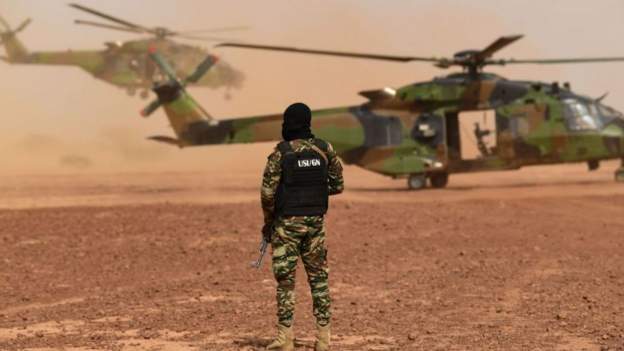
First French forces have reportedly left Niger
-

Algeria acts to stop spread of bedbugs from France
The government of Algeria is taking stricter actions to prevent the spread of bedbugs, which have become a problem in France.
The health department in a country in North Africa said it will start checking and cleaning airplanes, ships, and vehicles at the places where they come into the country.
This is happening because lots of people from France travel to Algeria, and there is worry that the blood-sucking insects might also come along.
The government department said that there have been no reports of bedbugs infesting the country, but they advised people to stay alert.
Morocco, the country next to it, has already said that it will do things to prevent bedbugs from moving into its area.
There are more and more bedbugs in Paris and other cities in France, which is worrying because people are concerned about health and safety during the upcoming Olympic Games next year. -
France to start removing its troops from Niger
France is planning to start moving its soldiers out of Niger beginning this week.
There was a problem between the two countries after a takeover in a country in West Africa two months ago.
France said it did not accept or recognize the new military government in the country that used to be its colony. This caused people to come out and protest in the capital city, Niamey.
After saying no for a long time, France now seems eager to convey that it wants to leave Niger as quickly as it can.
Over 400 soldiers near the border with Mali will be the first to leave, possibly starting Thursday.
An additional 1,000 soldiers are at a military base in Niamey. They are there because protesters have been staying there for many weeks, asking them to leave. The protesters believe that the soldiers have not been able to stop attacks by Islamist rebels.
Last year, fewer people died in terror attacks in Niger. However, it is not known how much the French helped Niger’s armed forces while fighting against groups connected to Islamic State and al-Qaeda.
It is too soon to tell if their leaving will make security worse.
The United States still has a place to operate drones in that area, and the forces from Niger are some of the most well-prepared in the surrounding area.
Since the coup, there have been many attacks by rebels. In addition, violence has increased greatly because foreign forces left Mali.
Western countries have given a lot of money to Niger to help with security. Niger is the only country in the region that supports them. -
Homeless people in Paris relocated as France gets ready for Olympics
It’s 6:30 a.m., a late summer morning in Paris. Amid the noise emanating from the Stalingrad metro station, northeast of the French capital, hundreds of migrants, most of the men, slept huddled under a viaduct. Some lay on pieces of cardboard and old mattresses behind urine-soaked fences, others lay awake at the edge of the road.
There were rumors that a government bus was about to pick them up. Some waited impatiently, hoping that they would eventually be accommodated, most were confused and scared, fearing they would be forced to leave Paris. For months, the French government has been trying to speed up the transfer of homeless Parisians to other parts of the country, as part of a plan to relieve some of the pressure on emergency housing services. capital level. According to the government, each week, between 50 and 150 people are taken to one of 10 locations across France.
Despite the government denying any connection to the Olympics, which Paris will host in the summer of 2024, some NGOs and elected officials believe the Games are part of the reason. due to which this relocation plan was recently activated.
“We heard they were coming to take us today, but I don’t know where to go,” Obsa, a 31-year-old Ethiopian political refugee, told CNN. He wishes to be identified under a pseudonym for fear of reprisals. Obsa made the dangerous journey to France in 2017, from Ethiopia to Sudan and Libya, then across the Mediterranean to Italy.
He now has a full-time job in Paris, but even after many years of living in the city, he still cannot find permanent housing, largely due to the extremely high cost of rent in the capital. capital and the supply of more affordable social housing is very limited. . . Obsa was considering emergency accommodation in a hotel, but claims she kicked him out after his wife went with him. “They simply refused. They said:
we don’t have room for your wife,” he recalled.Obsa is not the only one to have this experience. According to Paul Alauzy of Médecins Du Monde, an NGO that works with homeless migrants, as next year’s Olympics approach, Paris hotels have begun canceling emergency housing contracts with government to make room for the expected influx of tourists.
According to the Fédération des Acteurs Solidaires, which brings together local associations and charities, in 2022 around 50,000 homeless people were housed each night in hotels in Ile-de-France, where of Paris. This year, at least 5,000 previously vacant hotel spaces were cancelled, CNN affiliate BFMTV reported, which may partly explain why refugees like Obsa and his wife were pushed out into the street.
The Paris prefecture told CNN that the actual loss of emergency lodging was closer to 2,000 as the city sought alternatives to compensate for canceled hotel rooms. However, wasting hotel rooms is not the main problem facing homeless people in France. About half of the country’s homeless population is concentrated in Ile-de-France, where they have access to more charities, employment opportunities and more personal connections.
According to figures from the Ministry of Housing, of the more than 200,000 homeless people housed each night across the country, 100,000 are in Ile-de-France. Simply put, there is not enough emergency accommodation in Paris to accommodate everyone.
As Obsa spoke to CNN, dozens of French police approached and surrounded the area. Several large white buses parked and blocked the road. One of the buses carries the sign “Bordeaux”, another “Marseille”, the cities are located hundreds of kilometers from the capital.
Staff and volunteers from local humanitarian organizations and Paris police spoke to migrants who appeared distressed by what was happening.
Authorities informed the migrants over loudspeakers that they could board one of the buses to go to Marseille or Bordeaux, where they would be housed. Those wishing to stay in the capital are encouraged to demonstrate that they have a long-term employment contract. But even then, they will not be guaranteed a roof over their heads. Obsa, who works as an IT administrator, said: “I can’t leave, I have a one-year labor contract. “At least I have to stay in Ile-de-France.”
In total, 1,800 homeless people, the majority of whom are migrants, have been displaced outside Paris since April, according to figures compiled by the Inter-Ministerial Delegation on Accommodation and Access to Housing (Dihal), the government in charge of national policy revealed to CNN. access to housing.
According to Dihal, about 10 regional temporary shelters, known as SAS, have been set up across the country to welcome new arrivals outside Paris. Each SAS can accommodate up to 50 people. “All of this comes at a critical time, where there is also a preparing for the Olympics”. immigrant’. with the reality of what is happening on the streets of Paris, which means continuing to leave the thousands of people who have arrived on our territory without any support.
In 2022, France received 155,773 asylum requests, according to the government. Interior Minister Gérald Darmanin said in several television interviews that France would openly welcome political refugees, but its doors would remain closed to any migrants arriving in the country. are illegal and do not face repression in their homeland. According to government figures, in 2022 there will be nearly 20,000
Utopia 56’s Manzi thinks the resettlement effort could be a good idea in principle, but says the problem is that shelters in the area will only house people for three weeks, depending on which city responsible for hosting them and what happens after that is yet to be determined. . uncertain.
In SAS, some people get help finding housing and jobs for which they qualify, depending on their legal status, but this doesn’t work for everyone. “On average, 25 to 30 percent (of people) return to the streets,” Manzi said. “They find themselves after these three weeks without any solution, and therefore on the sidewalk again.”
In Bordeaux, one of the cities chosen to host SAS, this number is up to 40%. “They are disappearing,” Harmonie Lecerf-Meunier, deputy mayor of Bordeaux, told CNN. “We think they are returning to Paris.”
According to Dihal, in recent weeks the number of people leaving the SAS where they were posted has been around 17%.
Another problem is the lack of emergency accommodation in the areas where migrants are being transferred. “So people will find themselves on the streets again, but not in Paris. We take them out of Paris and put them on the streets in other places… we just solve the problem, we don’t solve it,” Brice said.
In a press release from May 2023, the government said that the Minister of Housing had “asked counties to work on establishing these centers in conjunction with local elected officials and associations.” . But the city halls of Lyon and Bordeaux, the two cities hosting the SAS, told CNN they were never consulted by the government. “We discovered it the day before,” said Lecerf-Meunier in Bordeaux.
Similarly, Lyon deputy mayor Sandrine Runel told CNN that the government rushed to calm the situation in Paris and Ile-de-France without ensuring the availability of appropriate resources elsewhere. “The Olympics are an excuse to direct people to regions without thinking and without even checking the available reception capacity of the regions,” she declared.
“The issue of welcoming foreigners is a difficult one politically and socially,” Brice said, referring to migrants. “And so the government chose not to talk about it, which I think was a mistake.”
Brice believes that sharing reception responsibilities between regions, if done well, could allow France to provide more thoughtful, humane and ultimately effective assistance to the thousands of migrants arriving. this country every year. However, for the system to work, it must be well-funded and well-managed, Brice said. Most importantly, as activists and host cities argue, everyone involved – from resettled migrants to the cities asked to receive them – must be fully informed. believe and actively participate in planning.
“If the government fails to take responsibility and provide itself with the appropriate means, it risks defeating the only useful solution to welcoming foreigners in this country,” Brice concluded.
Back at the homeless camp under the Stalingrad metro station, Abdullatif, 29, from Afghanistan, seemed tense. “I heard we have to leave Paris but I don’t want to. Finally I started training as an electrician and I had to stay here,” said Abdullatif, who only wanted to give his first name. He decided to stay in Paris.
But the fate of those who decide to stay in the capital is also uncertain. “Either you accept what they offer you, or you go back to the streets,” explains Alauzy, of Médecins Du Monde, who has now witnessed some resettlement activities.
And, if departures to the regions are voluntary, many
-
France to deport any women discovered in lorry
A French public prosecutor said that four out of the six women who were saved from a truck in France need to go out of the country in the next 30 days.
The police found four women from Vietnam and two women from Iraq after they got into a truck, thinking it was going to the UK.
It’s not clear which of the four women will be sent away.
The other two have been given permission to remain in France while they wait for a decision on their asylum requests, according to a statement from the prosecutor.
According to Laetitia Francart, a public prosecutor at the judicial court of Villefranche-sur-Saône, the women got into the lorry, believing that it would take them to England. The lorry was registered in Ireland.
Actually, the truck was bringing a load of bananas to Dunkirk and would later go to Italy.
When the women, who are believed to be migrants, realized that the lorry had gone in a different direction by checking their phone locations, they became very scared.
One of the women found it hard to breathe and was able to reach out to a reporter from BBC to explain what they were going through. Then, Khue Luu was able to inform the French authorities.
Meanwhile, the lorry driver started to think that there might be people inside the trailer. He heard voices that seemed to be coming from there.
The driver pulled over to the side of the road and called the police, according to the prosecutor.
The French authorities found six women inside a refrigerated trailer after connecting the reports to the lorry and investigating the vehicle.
The temperature was 6 degrees Celsius or 42 degrees Fahrenheit when it was opened, the prosecutor explained. However, all the women were reported to be healthy.
The driver was arrested when the women were found, but the prosecutor said he didn’t think the driver did anything wrong. -
Two French stores to sell petrol at market price
France‘s largest supermarket chains have announced that they will sell fuel at its original price to assist individuals in managing their living expenses.
Carrefour and E. Leclerc took action prior to a meeting between the government and fuel sellers.
ELeclerc, a company that sold fuel at a cheap price during weekends in the summer, announced that it will continue doing the same thing every day starting from Friday.
Carrefour will continue doing the same thing until the year ends.
Carrefour said on a social media platform, called X (formerly known as Twitter), that they are having their biggest ever fuel sale at the lowest price.
Michel-Edouard Leclerc, who is the president of the chain called Leclerc, said they did this to show support for customers who are scared of the rising prices and have less money to spend.
The fourth largest supermarket group in France, Systeme U, has announced that it will sell products at cost price. However, this will only happen on certain weekends because the company cannot afford to do it every day.
The CEO, Dominique Schelcher, said that the profit made from fuel is about two euro cents per liter on average.
Over the weekend, French president Emmanuel Macron announced that he plans to request the fuel industry to sell their products at the same price they purchased them for. Additionally, he also intends to offer 100 euro grants to the workers with low income who rely on driving to their workplaces.
The president said he will meet with industry representatives this week to request that they don’t make a profit from selling fuel. The government suggested changing the law to allow selling fuel at a cheaper price, but distributors strongly disagreed with the plan. -
‘France takes us for fools’ – Nigerien protesters
Niger, a country in West Africa, has a high number of deadly attacks by jihadist groups. After a takeover by the military in July, people are worried that if the order is given for 1,500 French soldiers to leave the country, it could make the rebels feel more confident and stronger.
Mayeni Jones from the BBC was able to visit Niger and talk to the government, people who support it, and people who are against it.
A brief gray line for presentation purposes.
Adama Zourkaleini Maiga speaks quietly, but her eyes show strong determination.
The single mother has two children and lives in a peaceful area of Niger’s capital city, Niamey. However, she comes from Tillabéry, a region that has been severely affected by violence.
“She told me during lunch that my mom’s cousin was the leader of a village named Téra. ” “He was killed just seven months ago. ”
The bad people were searching for him, and when they discovered that he had borrowed a car to escape, they caught him and ended his life. They cut his throat. Our whole family was really surprised.
Adama holds France responsible for not being able to control the violence, even though they had 1,500 soldiers in the area to fight against Islamist militants.
“She says that they are not able to say that the French army was victorious. ” “I don’t get how they can claim to be aiding people in fighting terrorism, but the problem keeps getting worse each year. ”
Niger was considered the final Western friend in the Sahel, a mostly dry area that has become the main location of violent extremism. France and the United States both have military soldiers in Niger. Niger is also where the United States has its largest drone base.
However, when France declined to acknowledge the new military government in Niger, the existing anger towards what the people saw as unwanted French involvement in their country’s affairs became intense.
Many people in Niger think that France has had special access to the country’s leaders and natural resources for a long time. They view the coup as an opportunity to start fresh, regain control over their own country, and remove the influence of France.
Adama says that the army in Niger has never remained in control for a long time. He is talking about the five times where the army took over the government since the country gained independence from France in 1960.
“The military will eventually go back to their bases and give control to a more effective civilian government that will lead Niger to its future,” she says.
People in France got very mad when they said no to Niger’s new leader. This got worse when the people in charge told their soldiers and ambassador to leave the country.
French President Emmanuel Macron at first said no, but now he says he’s decided to say yes to the demands of the junta because the Nigerien authorities are not interested in fighting terrorism anymore.
‘France thinks we are stupid’Hundreds of people have been staying outside a military base in Niamey that has French soldiers. They have been there for many weeks and are preventing supplies from reaching the soldiers.
The protesters gather and sit in prayer on Fridays. In the hot afternoon, Imam Abdoulaziz Abdoulaye Amadou tells the people to wait calmly.
He tells the people that just like it takes time for a man and a woman to get a divorce, it will also take time for Niger to separate from France.After he finished speaking to the people, I asked him why the people of Niger are very mad at the French even though they worked closely together for many years.
He says that Niger is the best partner for France in the entire Sahel region. France is not agreeing with what we want and that is causing tension.
France had the option to leave without causing any trouble after the coup, and then returned later to have discussions with the people who staged the coup. Why is Emmanuel Macron currently saying that he does not acknowledge our authorities, when he has previously supported coups in other nations such as Gabon and Chad.
“We are angry because of this, and we believe that France thinks we are foolish. ”
During the prayers, there is a lot of noise and excitement because a large car with armed guards arrives.
The recently chosen leader of Niamey, General Abdou Assoumane Harouna, commonly referred to as Plaquette, goes outside. He is a very tall man, measuring 6 feet 5 inches, and he is wearing clothes typically worn by soldiers and a green hat.
As we try to talk to him for an interview, he points to my producer and says to everyone: “Some people claim that we don’t like white people, but that’s not true. We actually welcome them warmly. ”
He says that the people in Niger want a country that is successful, proud and in control of its own decisions, and that those from other places should honor their desires. When I ask if the junta can make sure his country is safe from terrorists, he says that the Nigerien forces have always kept their people safe, and can continue to do so without any help from other countries.
But people who don’t support the government are really worried that if French troops leave, it could be really bad for Niger and the surrounding area.
Idrissa Waziri, who used to speak for the removed President Mohamed Bazoum, tells me through Zoom that France is an important ally in the battle against terrorists. They provide the majority of the information that helps us defeat the terrorists.
The French leaving quickly has made safety in Mali and Burkina Faso worse. Nowadays, people are using France as a target to blame for all the issues we face, which causes protests on the streets.
“France is not the issue, the current problem is the attempted coup in Niger, which is a big setback. ”
Fahiraman Rodrigue Koné, who manages the Sahel project at the Institute for Security Studies in South Africa, says it is too soon to determine if France leaving will cause more insecurity in Niger and the Sahel region.
In Mali, after foreign and UN troops left, there has been an increase in violence from both Islamist insurgents and rebel groups. But Mr Koné says the countries are very different from each other.
He says that the French army helped the troops in Niger in a smaller way compared to how they helped the troops in Mali. The Nigerien army has had a lot of practice battling terrorist groups, particularly against Boko Haram in the eastern region.
He says that the military of Niger is more spread out throughout their land than the military of Mali. In Mali, there were areas in the northern part of the country where the government and army were not present and terror groups took control of a significant amount of land.
After Ecowas said it would invade Niger if President Bazoum was not returned, Mali, Burkina Faso, and Niger formed an alliance on September 16th.
In the Sahel security alliance, the countries have agreed to support each other when there are fights against their governments and attacks from outside forces. Koné believes that this could make a significant difference in the situation.
He said that one reason why terror groups could easily move from one place to another was because the three countries did not work together. These three countries have already worked together in two or three military operations. This increased team effort is making things very difficult for the rebels.
He believes the alliance could share good ideas from Niger with the other two countries.
According to the Global Terrorism Index, there was a 79% decrease in terror-related deaths in Niger last year. However, Mali and Burkina Faso, which are close by, experienced the highest number of terror attacks. Around 90% of the violence that happened last year in the Sahel region was connected to Islamist extremism, and it mainly occurred in two countries.
Mr Koné says that the Bazoum administration was able to reduce deaths in Niger because they used a well-rounded approach. This approach included using military strategies, involving the community, and focusing on improving the socio-economic conditions.
However, even though this process was somewhat successful, not everyone liked it. Some people in the military thought that it made the government seem weak on terrorists and that it encouraged lawlessness. We don’t know if the junta will keep going in the same direction.
It’s difficult to know how many people in Niamey support President Bazoum.
Many people are upset that he is very close with the French government, but we had a hard time finding any of his supporters or people against the decision to kick out France, who would talk to us on the record. Most people seemed really afraid of what might happen because of their actions.
The junta watched the BBC team closely and knew what the people we interviewed were saying, and this wasn’t helpful.
France leaving doesn’t automatically mean Niger won’t work with western countries anymore. There are soldiers from other countries, including the United States, who are still present in Niger.
On Monday, US Defence Secretary Lloyd Austin said in Kenya that his country hadn’t made any important changes to its military presence in Niger yet.
However, he mentioned that they will keep looking at how things are going there and any actions they take in the future will focus on both their goals of supporting democracy and maintaining security.
The Sahel is in the front line of the war on terror. The choices made by the ruling groups there will be very important for the spread of Islamist extremism to other nearby areas. -
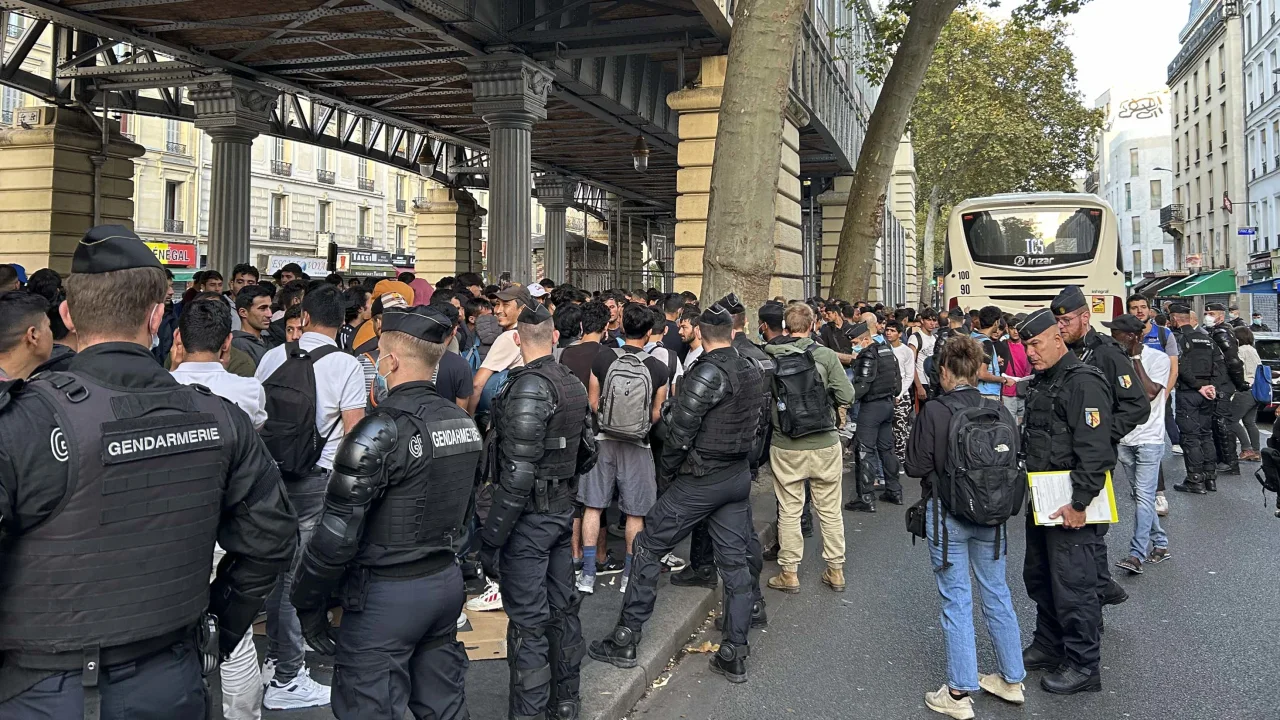
Homeless individuals being removed from Paris by France
It is 6:30 in the morning. One sunny morning in Paris during the end of summer. In the Stalingrad Métro station in northeastern Paris, many migrants, mostly men, sleep crowded under a bridge. Some people sleep on cardboard and old mattresses behind a smelly fence, while others stay awake by the side of the street.
News is going around that the government buses will come soon to pick them up. Some people are excited and hoping to be given a place to live. However, many others are unsure and scared because they think they might have to leave Paris.
Over the last few months, the French government has been trying to move homeless people from Paris to other areas in the country. They want to lessen the strain on emergency shelters in the capital city. Every week, the government takes about 50 to 150 people to different places in France.
Even though the government says it is not connected, some groups and officials think the Olympics are why the relocation plan was started.
Obsa, a 31-year-old political refugee from Ethiopia, told CNN that he heard that someone was coming to take them today, but he doesn’t know where they are being taken to. He wants to use a fake name because he is worried about getting punished.
Obsa went to France in 2017. He traveled from Ethiopia to Sudan and Libya, and then he crossed the Mediterranean Sea to Italy.
He has a job in Paris, but he can’t find a permanent place to live because it’s too expensive and there aren’t many cheap options available. Obsa had been staying in emergency housing at a hotel, but they told him to leave once his wife came to stay with him. They said no. They told us that they didn’t have enough space for my wife.
Obsa is not the only one who has had that experience. Before the upcoming Olympic Games next year, hotels in Paris are cancelling their agreements with the government for emergency accommodations. This is being done to make room for the large number of tourists expected to arrive. According to Paul Alauzy from Medecins Du Monde, an organization that helps homeless migrants, this is happening.In 2022, about 50,000 individuals without homes were staying in hotels every night in the Ile-de-France area, which includes Paris. This information comes from the Federation of Solidarity Actors, a group that brings together local associations and charitable organizations. This year, around 5,000 hotel spots that were available for people have been canceled, according to BFMTV, a news source connected to CNN. This might be one reason why refugees like Obsa and his wife ended up homeless.
The Paris government said to CNN that around 2,000 emergency housing spots were lost, but they found other ways to make up for the canceled hotel rooms.
However, the shortage of hotel rooms is not the main issue for homeless people in France. Approximately half of the people without homes in the country are focused in the Ile-de-France area. This region offers more resources like charities, work options, and personal relationships to help them.
The Ministry of Housing says that out of the more than 200,000 homeless people sleeping in the country every night, 100,000 of them are in the Ile-de-France. In simple words, there are not enough places for people to stay safe in Paris when there is an emergency.
While speaking with CNN, many French police officers come near and surround the place. Several big white buses park and stop traffic on the street. One bus says “Bordeaux” and another says “Marseille. ” These cities are very far from the capital.
Members of local charity groups and the police in Paris speak with migrants who seem confused and unsure about what is going on.
The authorities use a loudspeaker to tell the migrants they can get on a bus to go to Marseille or Bordeaux, where they will have a place to stay. People who want to live in the capital are encouraged to prove that they have a job that will last for a long time.
But still, they may not have a place to live. “I am unable to go because I have a job contract for one year,” said Obsa, who is employed as an IT administrator. “I need to stay in the Ile-de-France region, at least for some time. ”
Since April, around 1,800 homeless people, most of whom are migrants, have been relocated from Paris. This information was given to CNN by the Interministerial Delegation for Accommodation and Access to Housing (a government group that includes the Ministry of Interior and Ministry of Housing).
According to the Dihal, there are 10 temporary shelters called SAS that have been established in various regions of the country to accommodate people who are arriving in France but not in Paris. Each SAS can hold a maximum of 50 individuals.Yann Manzi, who started a French organization called Utopia 56 that helps homeless migrants, said that all of this is happening during an important time when preparations for the Olympic Games are also taking place. He also mentioned that the government is unable to handle the situation on the streets of Paris and continues to neglect the thousands of people who have arrived in the country without any support.
According to the government, France got 155,773 requests for safety in 2022. The Minister of Interior Gerald Darmanin said in a few TV interviews that France will gladly accept political refugees. However, France will not allow any migrants to enter illegally unless they are in danger in their homeland. According to the government, about 20,000 people who came to the country illegally were sent back in 2022.
During a TV interview on Sunday, the President of France, Emmanuel Macron, said that France is contributing its share in assisting migrants who come to Europe. This includes spending about 2 billion euros every year on temporary housing for homeless people. But he thinks the country can’t help everyone who is sad.
The Dihal told CNN that the relocation plan is not related to the upcoming Olympic Games. They said the plan is meant to reduce the pressure on the Ile-de-France area and provide better support for homeless people in other regions.
A representative from Paris 2024 told CNN that the relocation plan is not related to the ongoing Games or Rugby World Cup in France.
“The problem of providing emergency housing in the Ile-de-France region is not new and has become worse in the past few months. This is a concerning situation, even though the region will be hosting the Paris 2024 Games next year,” stated the spokesperson.
Manzi, from Utopia 56, believes the idea of moving people to new locations could be a good plan, but the issue is that the shelters in those areas will only provide housing for three weeks, as stated by the cities responsible for hosting them, and it is unclear what will happen afterward.
In the SAS, certain individuals get assistance in finding housing and work that they qualify for according to their legal status. However, this support doesn’t always work for everyone. Manzi said that about 25 to 30% of people return to living on the streets. “They reach the end of these three weeks without finding any solution, so they end up back on the sidewalks. ”
In Bordeaux, a city chosen to host a SAS, the percentage is as high as 40%. “They vanish,” said Harmonie Lecerf-Meunier, the deputy mayor of Bordeaux, in response to CNN. “We think they return to Paris. ”
Recently, about 17% of the people who were sent to the SAS have left, as reported by the Dihal.
The second issue is that there are not enough places for migrants to stay temporarily in the regions they are being moved to. So, people will be out on the streets again, but not in Paris. We take them out of Paris and put them on other streets. we are just moving the problem around, without fixing it,” said Brice.
In a statement in May 2023, the government said the housing minister asked local officials and organizations to help create these centers. However, the mayors of Lyon and Bordeaux, where two centers are located, told CNN that they were not consulted by the government. Lecerf-Meunier from Bordeaux said, “We discovered this information one day before. ”
Similarly, Sandrine Runel, a deputy mayor in Lyon, said to CNN that the government acted quickly to help in Paris and the Ile-de-France, but they didn’t make sure that the necessary resources were available in other places. She said that the Olympics are an excuse to send people to different regions without considering or checking if the regions can handle the additional people.
Brice said it’s hard to agree on whether or not to welcome foreigners, and this is especially true for migrants. The government has decided not to discuss it, and I think they made a mistake.
Brice thinks that if France shares reception duties between different areas, it could provide better care and help to the many migrants who come to the country each year. This would be helpful as long as it is done well. Brice said that in order for the system to function properly, it needs to have enough money and be well overseen. The most important thing is that everyone involved, like activists and cities hosting migrants, need to know and be actively part of making plans.Brice said, “If the government doesn’t take responsibility and provide the necessary resources, they might ruin the only effective solution for welcoming foreigners in this country. ”
In the homeless camp under Stalingrad Métro station, there is a man named Abdullatif who is 29 years old and from Afghanistan. He appears to be feeling very worried. I heard that we have to leave Paris, but I really don’t want to go. “I am excited to begin my electrician training and I must remain in this place,” said Abdullatif, who preferred not to share his full name. He chooses to stay in Paris.
However, we are not sure what will happen to those who choose to remain in the capital. “Alauzy, from Medecins Du Monde, said that if you don’t accept what they give you, you will be homeless again. ”
Also, when people decide to leave for different areas, they can choose to do so. However, several organizations that are helping with the moving plan told CNN that a lot of the individuals who are migrating are not being given enough information about what they will encounter at their new location before they leave. The mayors of Lyon and Bordeaux agreed with this statement. They said that people came to their cities with a promise of a permanent place to stay, but in reality, there is no guarantee of this after the first three weeks in the local SAS.
Abdullatif and Obsa, as well as other people who chose not to move, are put on a bus named “Paris” without knowing where it will take them.
A few days later, CNN got in touch with Obsa again. He said he didn’t have a home and was staying with a friend in Paris for now. He said that the authorities had once again refused to provide him and his wife with emergency social housing.
They said I don’t belong here, not even in the Ile-de-France area. It’s hard to believe. How can a whole area not have enough room for two people. -

France to withdraw its troops from Niger by the end of 2023 – Macron
French President Emmanuel Macron announced on Sunday that France will withdraw its military from Niger by the end of 2023. This decision comes as the relationship between the two countries has been strained since a military junta took over Niger in July.
“We are stopping our military cooperation with the people in charge of Niger because they don’t want to fight terrorism anymore,” Macron said about the military leaders who took control of the northwest African country.
France does not accept or acknowledge Niger’s military leaders. They still consider Mohamed Bazoum, who was removed from power in the coup, as the only rightful leader of the country.
Macron said we are ending our “cooperation” because we don’t want to be involved in their internal politics and be controlled by the military group.
He said that the withdrawal will be planned and arranged in the weeks ahead.
“They will return in a well-organized way in the upcoming weeks and months, and we will work together with the rebels because we want this to happen peacefully,” stated Macron.
Niger’s military government said it is happy that France will remove its soldiers from the country. This was mentioned in a statement on Niger’s state television, Tele Sahel.
This Sunday, we are celebrating another progress towards Niger’s independence. French soldiers and the French representative will be departing Niger before the year ends, as mentioned in the statement. We do not want imperialist and neo-colonialist forces in our country anymore.
“We will continue to strongly oppose and confront any organization or system that tries to question or go against the best interests of our country. ”
France decided to send soldiers to Niger because it is a peaceful country in a troubled region with lots of political problems and terrorism. The soldiers are there to help fight terrorism. This information was reported by CNN.
About 1,500 soldiers are still present.
Macron said that by the end of 2023, there will be no more French soldiers in Niger.
CNN reported earlier this month that the United States might start taking its soldiers out of Niger soon. About half of the around 1,100 US troops in Niger may be removed from the country, according to two officials.
The president of France also mentioned that he has chosen to bring back the country’s ambassador to Niger, Sylvain Itte, to France.
Macron said that France has decided to bring back its ambassador. In a few hours, our ambassador and some diplomats are coming back to France.
Just over a week ago, Macron said the ambassador was being kept against their will at the French embassy and food could not be delivered to the embassy in Niamey, the capital.
After the military took over in July, they told Itte to leave the country. Later on, they canceled his permission to stay and told the police to kick him out.
But according to the French president, the diplomat stayed where they were, and the French government said again that they do not accept the junta’s power.
Earlier this month, the French Foreign Minister Catherine Colonna said that Itte is still working. She also mentioned that he will continue working for as long as we want him to. Moreover, she stated that Itte’s return was a decision made by Macron. -

Niger: Macron urges France to remove its ambassador and troops after coup
In the aftermath of a coup, President Emmanuel Macron has said that France will revoke its ambassador and halt all military cooperation with Niger.
“France has decided to withdraw its ambassador. In the next hours our ambassador and several diplomats will return to France,” Mr Macron said.
He added that military co-operation was “over” and French troops would leave in “the months to come”.
The military coup that took over Niger in July applauded the decision.
“This Sunday we celebrate a new step towards the sovereignty of Niger,” the junta said, in a statement quoted by AFP news agency.
After months of tension and protests against the French presence in Niger, particularly in the capital city of Niamey, Paris has made a significant decision. This decision has dealt a severe blow to France’s efforts against Islamist militants in the broader Sahel region and its influence in the area. President Macron, however, emphasized that France would not allow itself to be controlled by the coup leaders, stating this during interviews with France’s TF1 and France 2 television stations.
President Macron continued to recognize Mohamed Bazoum, the ousted President of Niger, who is currently being held captive by the coup leaders, as the legitimate authority of the country. He described Bazoum as a “hostage” of the situation and attributed the coup to his courageous reform efforts and a complex web of ethnic rivalries and political cowardice.
Niger is one of several former French colonies in West Africa where military takeovers have occurred recently, following similar incidents in Burkina Faso, Guinea, Mali, and Chad. Gabon also experienced a coup in August.
Anti-French sentiment has been on the rise in the region, with local politicians accusing France of pursuing neocolonialist policies, a charge that France has consistently denied. There have also been concerns about the increasing influence of Russia’s Wagner mercenary group in the Sahel, which is accused of human rights abuses and has been cooperating with some of the newly established military regimes.
The Economic Community of West African States (Ecowas), with France’s support, has threatened military intervention in Niger to reinstate President Bazoum, but as of now, no action has been taken.
In response to the coup, Niger’s military leaders demanded the departure of French ambassador Sylvain Itte, but France refused to comply or recognize the legitimacy of the military regime, even after a 48-hour ultimatum issued in August.
President Macron’s statement comes shortly after the coup leaders in Niger banned “French aircraft” from flying over the country. Niger’s airspace, as noted by the regional air safety organization ASECNA, is now open to all national and international commercial flights except for French aircraft or those chartered by France, including those operated by Air France. Military, operational, and special flights will also require prior authorization to access the airspace. Air France confirmed that it is currently avoiding Niger’s airspace.
-

Royals from France and United Kingdom attend banquet at Versailles with King Charles
The King and Queen were incredibly impressed and amazed by a grand feast to celebrate the conclusion of their first day visiting France.
It has been half a year since we had to change our plans to visit Paris because there were big protests happening everywhere in the country.
They arrived at Orly Airport today, and were welcomed by French Prime Minister Elisabeth Borne and other diplomats.
A special group of people were waiting to welcome them, and President Emmanuel Macron expressed his excitement online: “You came as a special person, and now you are returning as a very important and respected person. ” Hello, Your Majesty, welcome.
Charles and Camilla met with Mr Macron, who is 45 years old, and his wife Brigitte, who is 70 years old, for a ceremony to remember something and lay a wreath at the Arc de Triomphe.
The King gave Mr Macron a book with pictures of them together.
Charles was asked to turn on a special flame that never goes out. It remembers the people who died in the First and Second World Wars.
Then, everyone went to the Elysee Palace, which is where the president lives. Charles and Mr. Macron had a discussion there.
King Charles mentioned the deceased Queen during his official visit speech given in French.The King also gave Mr Macron a whole set of Voltaire’s writings when he went to the Elysee Palace.
In response, Mr. Macron gave the King a special golden coin with a picture of Charles on it, along with a book from France that had won a prize.
Tonight, the royals are special guests at a fancy dinner in the Hall of Mirrors in the Palace of Versailles.
Charles and Mr Macron will speak to 160 guests, who are important people selected because they have helped improve the relationship between the UK and France.
Tomorrow, Charles, who is the first British king, will speak in France’s senate chamber to senators and members of the national assembly.
The king and queen will also meet famous athletes as France organizes the Rugby World Cup.
In Bordeaux, both the UK and French military will come together to share how they are working together in defense.
The royal couple’s tour was delayed until now because there were violent protests happening across the whole country last March.
Protesters set Bordeaux’s town hall on fire shortly before the planned trip.
They went to Germany instead. -

Artists from Niger refuse to allow their culture be “taken away” in French Visa debate
A Nigerien flutist and singer has a message for France, his country’s former colonial power, which has banned cultural venues from collaborating with artists from Niger.
Yacouba Moumouni expresses his discontent, saying, “The French should respect us. If we say, ‘I’m not going to give a visa,’ that’s like saying to a child, ‘If you don’t do that, I can’t buy you a sweet.’ We are not at that level; we have gone beyond that.”
This sentiment is shared by many artists in Niger who are reacting to France’s decision to suspend visa issuance to Nigerien nationals.
Rachid Ramane, President of the Federation of Artistic and Cultural Associations of Niger, emphasizes that they won’t beg and asserts that Nigerien artists are part of the global artistic community. He adds, “We can’t remove our cultures from the world’s culture.”
Ramane also points out that Niger, Burkina Faso, and Mali are facing significant challenges and are simply seeking independence and autonomy. He urges understanding from others.
The French General Directorates for Cultural Affairs issued a letter instructing national drama and choreography centers to halt all projects involving nationals from Niger, Mali, and Burkina Faso.
Garba Mahamane Lawali, director of the Niger musical training and promotion center, believes that cultures that remain closed and isolated are destined to decline. He highlights Africa’s openness to the world and suggests that France needs to adapt to this new era intelligently.
Currently, Niger, Mali, and Burkina Faso are experiencing diplomatic tensions with France due to political turmoil led by military juntas that ousted democratically elected leaders. France has suspended development aid and budget support operations with these countries, escalating the situation.
-

Visas for students from Mali, Niger and Burkina Faso suspended by France
France has temporarily halted the issuance of new visas for students from Mali, Niger, and Burkina Faso who were planning to continue their studies in the country.
This decision is a result of the closure of French consular services in these nations.
The suspension of visas follows mass protests in Niger’s capital, Niamey, where demonstrators demanded the withdrawal of France’s ambassador and troops from the West African country.
France had previously suspended cooperation with Niger and Burkina Faso on July 29 and August 6, respectively, in response to the coup in Niger. In November 2022, a similar decision was made for Mali.
Burkina Faso and Mali have expressed solidarity with the military authorities in Niger.
The French embassy in Niger has been closed since the military takeover on July 26, and the French consulate is unable to issue visas. The French Ministry of Research and Higher Education has stated that the suspension of visa services and civil cooperation was forced by security concerns. However, existing collaborations with universities and scientific institutions will continue.
The visa suspension has created challenges for many students, including those who have been accepted to French universities and have paid their registration fees, as well as those still waiting for responses from universities.
France currently hosts around 3,000 Malian, 2,500 Burkinabé, and 1,200 Nigerien students in its higher education institutions.
The Council of Nigeriens in France has called on authorities in Niger and France to find a solution for the affected students. The Union des Scolaires Nigériens has urged students to be patient and realistic, given the diplomatic tensions between Niger and France.
It remains uncertain when France will resume the issuance of visas to students from Mali, Niger, and Burkina Faso.
-
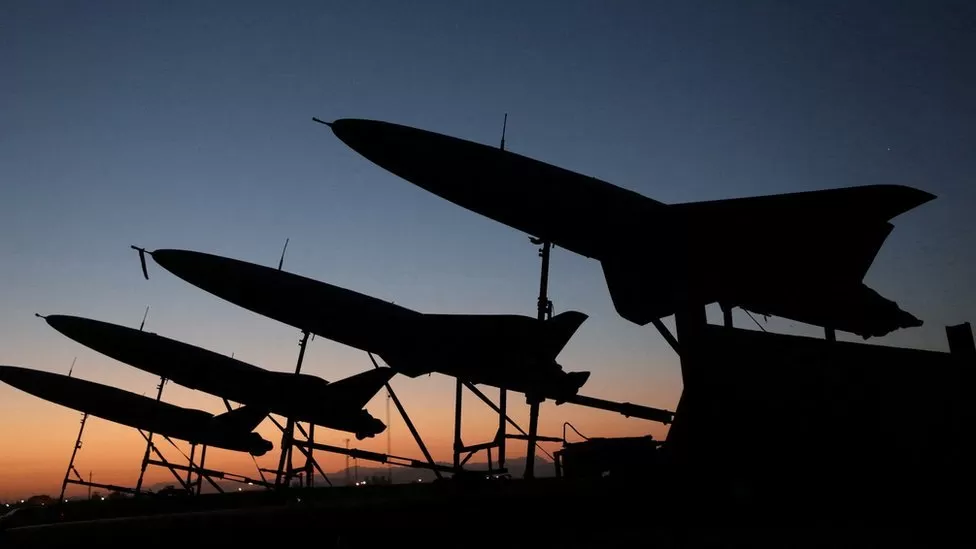
Nuclear sanctions against Iran upheld by UK, France and Germany
The UK, France, and Germany have decided to maintain sanctions on Iran in an effort to dissuade Tehran from selling drones and missiles to Russia.
Iran had agreed to a nuclear deal in 2015, and some sanctions were scheduled to be lifted next month. However, the European nations believe Iran violated the deal by enriching and storing uranium.
Iran counters that this move is “illegal and provocative” and “clearly violated” the deal’s terms. The European powers, collectively known as E3, aim to incorporate expiring UN sanctions into their own laws.
These sanctions target nuclear proliferation-related measures, as well as arms and missile embargoes. Despite these sanctions, Russia has utilized many drones produced in Iran in its war against Ukraine.
In a separate move, the UK has imposed sanctions on officials responsible for Iran’s mandatory hijab legislation ahead of the first anniversary of Mahsa Amini’s death. Her death after being arrested for allegedly breaking hijab rules sparked protests.
Iran entered into the Joint Comprehensive Plan of Action (JCPOA) with several world powers, known as the P5+1, eight years ago.
Under the 2015 accord, Iran agreed to limit its nuclear activities and allow international inspectors in exchange for the lifting of economic sanctions.
The JCPOA prohibits the purchase, sale, or transfer of drones and missiles to and from Iran. The agreement envisioned a “transition day” when remaining sanctions on Iran related to ballistic missiles and nuclear activities would be lifted.
Russia and China will no longer be bound by these restrictions if they do not adopt sanctions similar to those of the UK, France, and Germany before October 18.
The E3 stated that the sanctions would persist until Iran fully complies with the JCPOA. Iran argued that the decision violated the E3’s obligations under the JCPOA and UN Security Council Resolution 2231.
-

iPhone 12 to be updated in France over radiation
Apple is set to release a software update for its iPhone 12 in France due to concerns about radiation levels, according to the country’s digital minister, Jean-Noel Barrot.
Sales of the iPhone 12 were temporarily halted in France after regulators detected elevated electromagnetic radiation levels. Apple was instructed to address the issue.
The upcoming update will be specifically for iPhone users in France, as the company stated that the concern was related to a unique testing protocol in the country. Apple emphasized that the radiation findings did not pose a safety risk.
This development raises questions about Apple’s plans for the iPhone 12 in other countries, as the device was released just three years ago.
Mr. Barrot mentioned that the French radio frequency regulator (ANFR) would assess the new update for compliance before permitting the iPhone 12 to resume sales in France.
The World Health Organization has previously stated that there is no evidence to suggest that exposure to low-level electromagnetic fields from mobile phones is harmful to humans.
In a statement sent to AFP news agency, Apple said the radiation finding in France was “related to a specific testing protocol used by French regulators and not a safety concern”.
It said the iPhone 12 complied with emissions rules worldwide, but it would “issue a software update for users in France to accommodate the protocol used by French regulators”.
The ANFR previously told Apple that if it could not resolve the issue via a software update, it would have to recall every iPhone 12 sold in the country.
The regulator found iPhone 12’s Specific Absorption Rate (SAR) to be above what is legally allowed in France.
The iPhone 12 smartphone was first released in September 2020 and it is still sold worldwide.
Apple recently stated to BBC News that it was challenging the ANFR’s review. The company maintained that it had provided the regulator with lab results from both its own tests and third-party assessments, demonstrating compliance with all relevant regulations.
However, Mr. Barrot imposed a two-week deadline on Apple and expressed concerns that France’s findings might have a cascading impact as they are shared with regulators across the European Union (EU). Regulatory authorities in Belgium, the Netherlands, and Germany have also initiated investigations into the matter.
Germany’s BNetzA network agency informed the BBC that the French inquiry could lead to measures applicable to all EU member states. In contrast, no actions have been announced by the UK and the US following the French ban.
-

Warning for French iPhone 12: European authorities investigate radiation alert
Some European countries are looking into worries that the iPhone 12 is giving off too much electromagnetic radiation. France has told Apple to stop selling the phone.
Belgium, the Netherlands, and Germany are now investigating the problem as well.
France’s regulator has told the tech giant it has two weeks to reply to an investigation. If the investigation finds wrongdoing, other countries in Europe may take similar actions.
Apple said that it had shown evidence that it was following the rules on radiation.
France’s National Frequencies Agency (ANFR) reported that radiation levels detected in the iPhone 12 exceeded the permissible limits.
The French sales stoppage could have a big effect, says French digital economy minister Jean-Noël Barrot to Le Parisien newspaper. The ANFR will now give its results to regulators in other countries in the EU.
The government of Belgium has told its regulator to check whether the iPhone 12, which came out in 2020, can be dangerous for our health.
It is my job to respond and make sure that everyone in the kingdom is kept safe and protected from any possible harm. Belgian state secretary for digitalisation, Mathieu Michel, said that health is a very important matter and should never be ignored.
He told Le Soir that he requested the regulator to check all Apple models and then other brands as well.
The RDI, which is responsible for digital infrastructure in the Netherlands, stated that the French tests proved that radiation levels were definitely too high. The RDI said they would talk to Apple, but they said there is no urgent danger to safety.
In simpler words, the German network agency called BNetzA told the BBC that the French investigation could result in actions that would affect all countries in the European Union.
The UK hasn’t said what they will do after France banned something.
Apple disagreed with the findings from France and said they were contesting them. They also mentioned that they had given the French agency lab results from Apple and other companies, which proved that the device met the regulations.
The Minister in charge of France’s digital economy said that he believes Apple will be able to solve the problem by releasing an update for their software.
If that method didn’t work, Apple would need to take back all the iPhone 12 devices they sold in France, as stated by the ANFR.
The regulator checks two radiation tests: one measures a phone when it touches a person’s body, like when it is held or placed in a pocket; the other test is done when the phone is in a pocket or bag but a bit further away.
The iPhone 12 did well in the second test, but it went beyond the limits set by EU rules in the first test, according to the ANFR.
The watchdog organization said it will inspect Apple stores and other sellers to ensure they have stopped selling the specific model.
Smartphones were removed from stores in France before due to radiation tests, but this is the first occasion where an iPhone was impacted.
The World Health Organization states that many studies have been conducted over the years to understand if using mobile phones can have any negative effects on our health.
On its website, it says that there have been no known negative health effects linked to using mobile phones. -
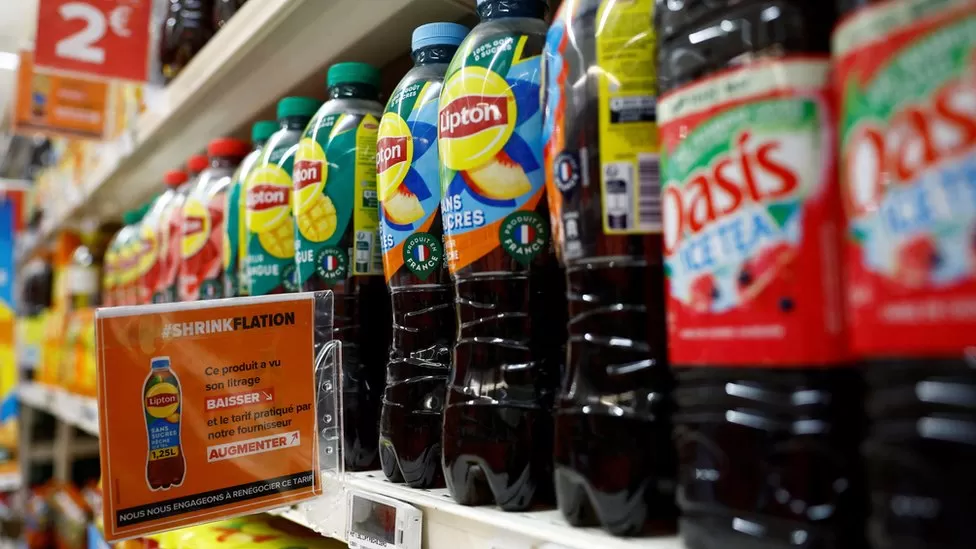
Carrefour in France posts warnings about ‘shrinkflation’
The French supermarket Carrefour has placed stickers on its shelves this week to warn customers about “shrinkflation. ” This means that the amount of product in a packet is decreasing, but the price remains the same.
Lipton Ice Tea, Lindt chocolate, and Viennetta ice cream are some of the products that are being criticized and exposed.
Shoppers are being informed if bottles are smaller or if pack contents weigh less.
Carrefour wants to make the companies that make the products lower their prices.
“According to Stefen Bompais, the director of client communications at Carrefour, the goal of stigmatizing these products is to make manufacturers reconsider their prices. ”
Carrefour found that 26 products have become smaller in size, but their prices haven’t been lowered. These products are made by big food companies like Nestle, PepsiCo, and Unilever.
Carrefour said that Nestle’s Guigoz infant milk formula used to come in a pack size of 900g, but now it has been reduced to 830g.
The supermarket said that a bottle of sugar-free peach-flavored Lipton Ice Tea made by PepsiCo became smaller. It used to be 1. 5 liters, but now it is only 1. 25 liters
Viennetta, a product made by Unilever, used to weigh 350g but now it weighs 320g, meaning it has become smaller.
Carrefour, the second biggest supermarket in France, is putting signs on the shelves to show customers that certain products have become more expensive and have reduced in size.
Unilever, Pepsico, and Nestle have not said anything about Carrefour’s decision.
French retailers and food manufacturers are being asked to lower their prices, similar to what is happening in the UK, due to the difficulty shoppers are facing with the sudden increase in prices.
In June, the French Finance Minister, Bruno Le Maire, called a meeting with 75 retailers and consumer groups to talk about prices. He accused manufacturers of not following the rules on inflation.
British consumer groups are also saying that the value of everyday items like cat food and chocolate biscuits is getting smaller.
According to retail expert Ged Futter, UK supermarkets are unlikely to imitate Carrefour because it may damage relationships between retailers and food firms.
“He said this is a very straightforward way of attempting to compete. ” “To accomplish that with the people who make your products, it won’t be beneficial. ”
Supermarkets use a tactic called “shrinkflation” with their own-label products. This means they try to keep the price of the products at a certain point, like £1, by using cheaper ingredients or making the portions smaller to deal with increasing costs.
He said that criticizing brands for doing the same thing would be like hypocrites judging others while having the same flaws. -
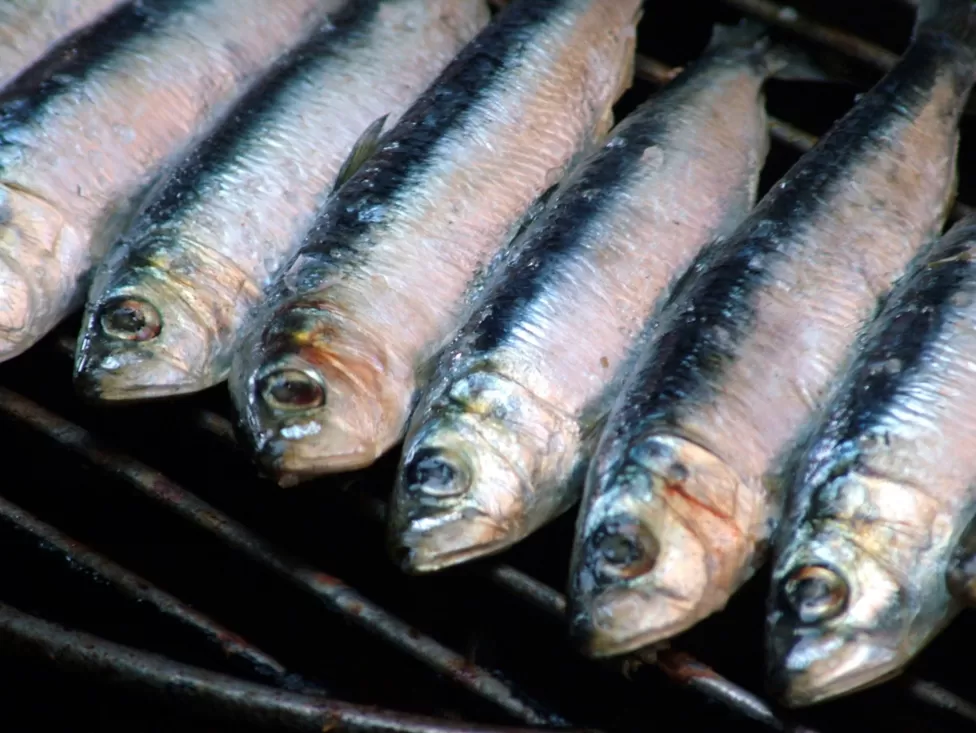
British and Irish citizens unwell after eating Bordeaux sardines in France
Some British and Irish people have gotten sick from eating sardines in a French restaurant and are now in the hospital.
A 32-year-old woman has passed away and a few other people are getting medical care because of a rare illness caused by contaminated food in Bordeaux.
The government health group in France, called Santé publique France, said the person who owns a wine bar in France had stored homemade sardines.
The Irish Embassy in Paris is telling people who ate at the restaurant and feel sick to see a doctor right away.
This tweet cannot be seen on your browser. Please turn on Javascript or use a different web browser to see the original content on Twitter.
The UK Health Security Agency (UKHSA) was told that a few British people went to a bar called Tchin Tchin Wine Bar in Bordeaux from September 4th to September 10th.
People who the French authorities have found and who have come back to the UK are getting medical help.
The statement says that there might be more people in the UK who ate at the Bordeaux restaurant, but the French authorities cannot find them.
Ireland’s Health Service Executive (HSE) said they knew about a few Irish people who were affected and getting treated in France.
Both health organizations advise anyone who went to the restaurant from September 4th to 10th and currently feels sick to go and see a doctor right away.
According to the NHS, botulism is a serious and rare condition that can be life-threatening. It is caused by toxins made by bacteria. These toxins usually develop when food is not preserved correctly.
These harmful substances can damage the nervous system and lead to paralysis. This can then move to the muscles that help us breathe.
It takes some time for this illness to show symptoms, which can be as short as a few hours or as long as a few days. If it’s not treated correctly, it can cause death in 5 to 10% of cases.
People who really like something a lot and live in the same place
Bordeaux is hosting some Rugby World Cup games. There are many Irish fans in the city for the team’s match against Romania on 9 September.
A doctor at Pellegrin hospital in France said that they are treating people from Ireland, America, and Canada.
Benjamin Clouzeau said that a person from Germany and a person from Barcelona had gone back to their homes to get treatment for the sickness.
Five out of the 12 patients who were getting treated needed help with their breathing as of Wednesday morning. -
Portsmouth City Council continues to exert pressure over proposed Aquind Interconnector
The leader of a council has promised to keep opposing a proposed £1. 2 billion electricity connection between two countries, as a final decision approaches.
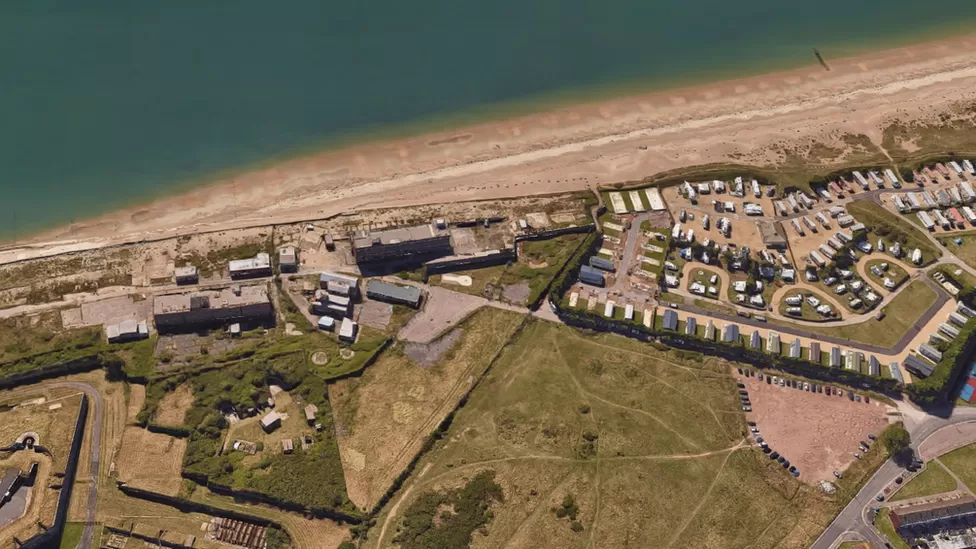
Aquind Ltd wants to connect Portsmouth and Normandy in France by placing cables.
Portsmouth City Council recently made an agreement with a company to make sure their sea defense work is not negatively affected by the plans.
But leader Steve Pitt has said the authority will keep fighting against the interconnector scheme.
The ideas were first presented in 2019. The High Court reversed a government decision from 2022 that had blocked the project.
This means that the plans were returned to the ministers who will soon make a final decision.
Mr Pitt thinks that the suggested route is not possible and not good, and he wants them to think the same and say no to the idea.
The cable would come to the shore at Eastney and be laid through Portsmouth and the countryside of Hampshire to Lovedean.
MrPitt said that it will greatly affect the daily lives and well-being of our residents and also have a negative impact on our environment.
He said that the recent agreement with Aquind was a necessary process that was done without any negative impact.
This document explains how the council and Aquind would cooperate to prevent conflicts between the ongoing fourth and fifth phases of the North Portsea Island Coastal Defence Scheme and the construction of the interconnector.
Earlier this month, the director of Aquind, Richard Glasspool, said that signing the agreement demonstrated that the company was prepared to work collaboratively with the council and other organizations.
A company representative said before that the interconnector is very important infrastructure. It can give up to 5% of the electricity that Britain uses in a year, which is enough to power five million homes.
However, campaigners, councillors, and local MPs expressed their worries about problems like harm to the environment and disturbance happening throughout the city. -
France asserts that its soldiers will remain in Niger
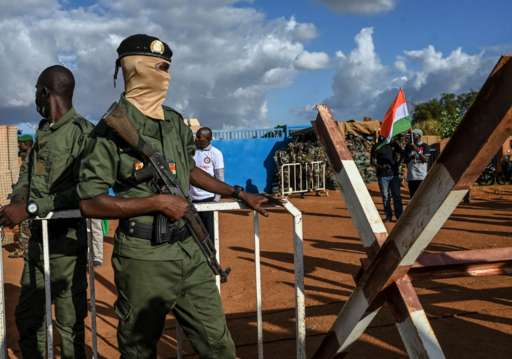
France’s Foreign Minister has reaffirmed her country’s commitment to retaining troops in Niger and maintaining the presence of the French ambassador.
The military leadership in Niamey had previously demanded the expulsion of the French ambassador more than a week ago.
Catherine Colonna, speaking to Le Monde newspaper, emphasized that Ambassador Sylvain Itte represented France to Niger’s “legitimate authorities,” referring to the deposed government of President Mohamed Bazoum.
This statement came amid ongoing protests in Niamey, where tens of thousands of demonstrators have taken to the streets for the third consecutive day near a French military base. These demonstrators continue to call for France, their former colonial power, to withdraw its troops.
France currently has approximately 1,500 soldiers stationed in Niger, primarily to assist in addressing the Islamist insurgency in the Sahel region.
-
Thousands demonstrate in Niger to insist on French troops removal
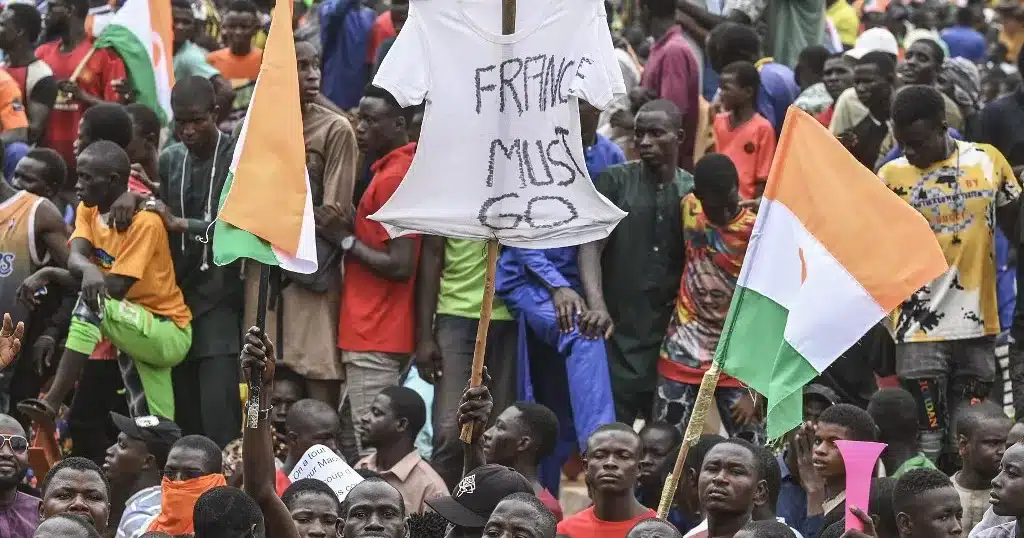
Thousands of demonstrators gathered in Niamey on Saturday to demand the withdrawal of French troops from Niger, as advocated by the junta that seized power in late June.
The protesters assembled near a base housing French soldiers in response to a call from several civic organizations that are critical of the French military presence in the West African nation.
Amidou Gourou, one of the protesters, stated, “We are here to express our determination, commitment, and dedication to removing the French military force and all military bases from our national territory.”
Niger’s military regime had launched a fresh verbal attack on France on Friday, accusing Paris of “blatant interference” for supporting the ousted president, Mohamed Bazoum.
In early August, the regime had announced the cancellation of military agreements with France, despite the presence of approximately 1,500 French soldiers in the country assisting in the fight against jihadism in the region.
Paris disregarded this move, citing legitimacy.
The military rulers had also declared the “expulsion” of the French ambassador, Sylvain Itte, and revoked his diplomatic immunity, citing his presence as a threat to public order.
French President Emmanuel Macron, however, praised Itte’s work in Niger on Monday and announced that he would remain in the country, despite being given a 48-hour deadline to leave Niger a week earlier.
-
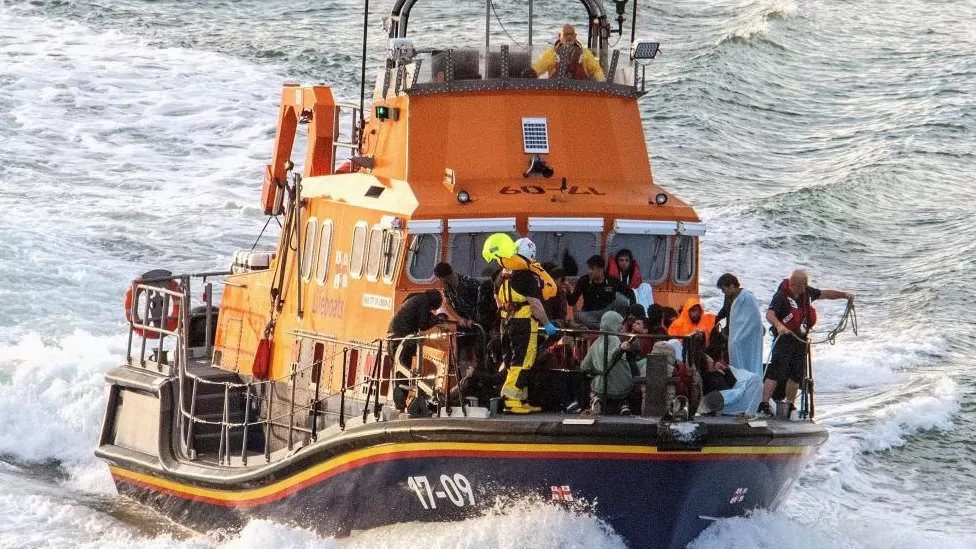
Ministers under increased pressure about boat crossings
After six migrants perished when a boat capsized off the coast of France on Saturday, ministers are under increased pressure to address boat crossings in the English Channel.
Those who smuggle people are “running rings” around the government, according to Labour, while the UK has a “moral duty to act,” according to a Tory backbencher.
“Stopping the boats” is one of the government’s top five priorities.
Investigations into the event that occurred on Saturday, in which 59 people were saved, and two may still be missing, are ongoing.
The overloaded craft, one of several migrant boats that left on Saturday in the goal of reaching the UK, came into trouble and capsized 12 miles (20 km) off Sangatte.
On the same day, 54 more migrants were saved by French coast guards after another migrant boat capsized 6 miles (10 km) off the shore of Calais. They arrived at Dunkirk’s port.
A opposition cabinet minister named Bridget Phillipson said that organised crime groups were “running rings” around the government and blamed their behaviour on the “completely out of control” backlog in refugee applications.
The administration, according to her, was running a “increasingly shambolic and completely incompetent” home office.
“There is a complete failure to carry out the fundamentals: process cases, hastily reach choices so that you can act. If people aren’t legally authorised to be in this nation, you can ensure that those who are may move on and lead happy lives for the rest of their days, she told BBC Breakfast.
Action has also been requested from the Conservative Party. Sir Jake Berry, a backbench MP and former party leader, remarked that “only radical changes can truly turn the tide.”
He stated in a piece for the Sunday Express that “We have a moral duty, both to our own citizens and those asylum seekers, to act.”
He argued that the European Convention on Human Rights would continue to thwart “any and all attempts to stop the boats” and advocated for the UK to withdraw from it.
The Refugee Council issued a dire warning that “more people will die” until new secure routes to the UK are established, while the refugee charity Care4Calais called the incident a “appalling and preventable tragedy.”
The fatalities were described as a “tragic loss of life” by Home Secretary Suella Braverman, who presided over a meeting with UK Border Force representatives on Saturday.
The government’s intentions to restrict small boats from crossing the Channel are centred on the new Illegal Migration Bill, which Ms. Braverman is the primary proponent of. The home secretary is legally required to hold and expel anyone entering the UK unlawfully.
The UK will pay £500 million to France over three years to build a new detention facility and extra patrol personnel, according to a new arrangement the UK is proposing with France.
The English Channel’s lengthy coastline makes it extremely challenging for the coastguard to stop all small boat crossings, French authorities have previously noted.
With 600 tankers and 200 ferries travelling through it each day, the English Channel is one of the busiest and most dangerous shipping waterways in the whole world.
Before a French patrol boat was sent to the boat in danger, according to French police, a commercial vessel discovered the migrant boat.
“While we mourn these victims… it is the responsibility of human traffickers – of criminals – who send young people, women, and adults to their deaths on these maritime routes that are dangerous and lethal,” stated French Minister of the Sea Hervé Berville.
Investigators are searching for any data that could point them in the direction of the smuggling organisation that planned the crossing.
65 or 66 migrants were on the boat, according to those who were rescued.
According to a volunteer rescuer, migrants were using their shoes to bail water out of the sinking boat.
Two people who may still be missing have had their search suspended awaiting the discovery of new information.
It is thought that many of the migrants on board are from Sudan and Afghanistan, respectively. It was also aware that some of them were kids.
More migrants have reportedly arrived in recent weeks, living in squalor along the shoreline, according to aid workers in Calais. Many of them, they claim, are adamant on travelling to the UK despite being warned about the risks involved.
The pressure on the ministers comes in response to complaints that 39 asylum seekers had to be removed off the Bibby Stockholm barge after Legionella bacteria were found in the water supply.
-
Russia cautions ECOWAS against using force
Following the announcement by regional organisation ECOWAS that it would build a standby force, Russia issued a warning that military intervention in Niger would result in a “protracted confrontation.”
The Russian foreign ministry warned that such an intervention would cause instability throughout the Sahel region.
formally supporting the coup. Russia does not.
The US, meanwhile, which supports efforts to reinstate ousted leader Mohammed Bazoum, claims that its Wagner mercenary force is profiting from the unrest.
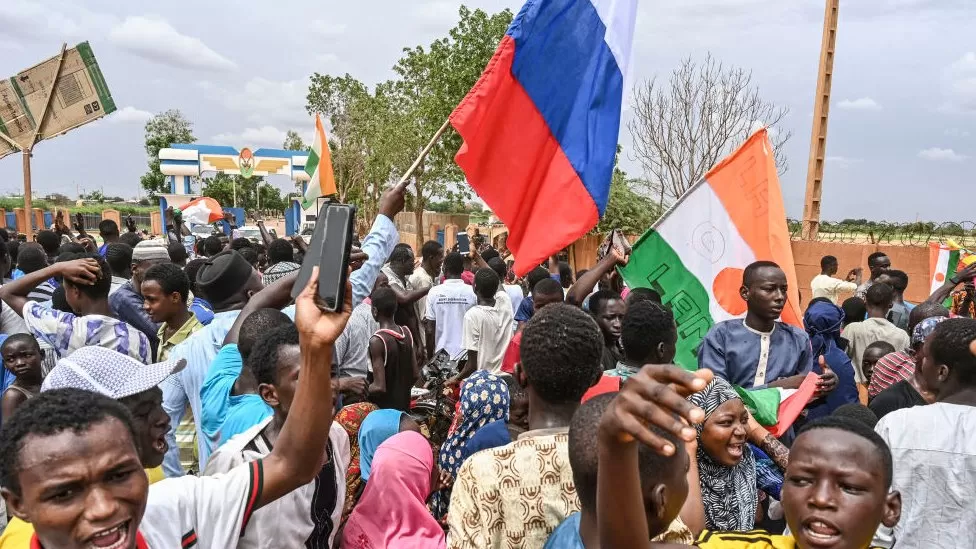
At a French military installation close to the capital of Niamey on Friday, coup sympathisers demonstrated with some carrying Russian flags and yelling “down with France, down with ECOWAS.”
In Niger, military outposts operated by the US and France have been used to start operations against Islamist groups elsewhere in the area.
According to reports, military representatives from Ecowas nations will meet on Saturday to develop plans for a military intervention.
However, Nigeria’s President Bola Tinubu declared on Thursday that “no option is taken off the table, including the use of force as a last resort.” The bloc has stated that it is still open to finding a diplomatic solution to the problem.
The US has urged the junta to step down and allow the restoration of the nation’s democratic constitution without expressly endorsing military intervention.
The most recent declarations from Ecowas leaders have received no response from the Niger junta.
Fears are mounting for Mr. Bazoum’s health and safety as he is being held captive since the military overthrew the government on July 26.
According to Josep Borrell, the head of EU foreign policy, he and his family had been “deprived of food, electricity, and medical care for several days.”
Volker Turk, the UN’s commissioner for human rights, stated that he had reliable information that the custody conditions “could amount to inhuman and degrading treatment”.
According to the rights organisation Human Rights Watch, Mr. Bazoum informed them last week that he and his family were subjected to “inhuman and cruel” treatment.
According to Mr. Bazoum, “My son is sick, has a serious heart condition, and needs to see a doctor,” he told them, according to HRW.
-

Niger defence summit in West Africa postponed
The West African chiefs of defence staff conference that was scheduled to discuss the coup in Niger has been abruptly postponed.
The regional organisation, Ecowas, had scheduled the talks, which were supposed to take place on Saturday in Accra, Ghana.
The delay was not explained. The activation of a military force in standby to restore civilian government in Niger was ordered by West African leaders on Thursday.
Friday in Niamey, large groups of coup sympathisers rallied close to a French military post to protest Ecowas and France.
The family of the ousted president of Niger has drawn the deep concern of US Secretary of State Antony Blinken, who claims they are being imprisoned in deplorable circumstances.
-

Australia capt Sam Kerr will start against France if in a good condition – Coach Gustavsson
Australia’s coach, Tony Gustavsson, expressed his unwavering readiness to reintegrate Sam Kerr (29) into the starting lineup for the Women’s World Cup quarterfinal clash against France this Saturday, provided she receives clearance from the team’s medical staff.
Having been sidelined due to a calf injury, the esteemed captain of Australia made a brief appearance from the bench during the 2-0 victory over Denmark.
This cameo appearance has fueled optimism among home supporters for her increased involvement in the upcoming match against France at Brisbane’s Lang Park.
Australia has performed commendably in Kerr’s absence, with the exception of a surprising 3-2 loss to Nigeria.
They have managed to score six goals in their last two matches.
Gustavsson reassured fans that he harbours no concerns about disrupting the Matildas’ current momentum by opting to start Kerr in the lineup.
“I definitely would never ever see Sam as a disturbance to the team,” the Swede told a press conference on Friday.
“And I want to be very clear here and now to say that if Sam is fit to play 90 minutes, she is starting. That’s not even a question, and the team knows it.
“We’re talking about Sam Kerr. Whether she is ready to play 90 minutes plus extra time, that’s to be decided tonight.”
Gustavsson had all of his squad training at their last session, including striker Kyah Simon, who has carried a long-term knee injury into the tournament and not played a minute.
Simon’s availability will also be assessed by medical staff later on Friday, Gustavsson said.
Having never made the semi-finals at a World Cup, Australia will break new ground if they beat France.
France were knocked out of the quarterfinals as hosts of the 2019 tournament by a champion United States team that featured Gustavsson as an assistant to then-coach Jill Ellis.
France manager Herve Renard remarked this week that the pressure will be on Australia as co-hosts on Saturday.
The match will draw a capacity crowd to Lang Park and be broadcast live on free-to-air TV, coast-to-coast.
Thousands of fans will flock to live sites in Australia’s major cities, while crowds going to watch Australian Rules football matches in Sydney and Melbourne will be able to watch the Matildas on big screens at the stadiums.
Australia defender Ellie Carpenter said the nation’s support was a motivation for the Matildas than pressure.
France, however, would see their campaign as a failure if eliminated on Saturday, the Lyon fullback added.
“Their mentality is that if they’re out in a quarterfinal, that’s not good enough for them,” she said.
“They’re going to be confident tomorrow. Of course, they’re going to come out and show that they are confident. But that doesn’t bother us at all.”
-
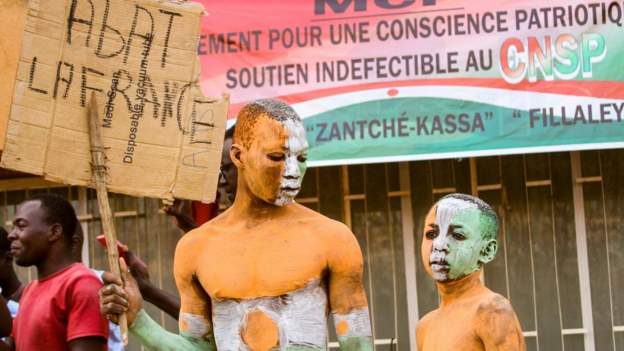
Niger accuses France of causing instability in the country
The former colonial power France is being accused of attempting to undermine Niger by the country’s military dictatorship.
It claimed that a French aircraft had violated the country’s closed airspace.
Additionally, it claimed that in order to assault military targets, French soldiers had released detained jihadists.
The French government has not yet responded.
Mohamed Bazoum, the legitimately elected president of Niger, was deposed at the end of last month, and since then, the coup leaders have resisted diplomatic efforts to end the conflict.
US Secretary of State Antony Blinken had claimed to have spoken with Mr. Bazoum and given him assurances of continued support.
On Thursday, the regional bloc Ecowas, which has threatened military involvement, is expected to convene to discuss its next course of action.
-

Nine bodies discovered after fire at holiday home in France
A fire at a vacation rental in France that was housing persons with learning impairments resulted in the discovery of nine bodies, and two more people are now thought dead.
After emergency services were notified of the fire in La Forge at 07:30 local time (04:30 GMT) on Wednesday, around 80 firefighters were dispatched to the scene.
According to a local official, the missing people are thought to be “potentially deceased”.
Although the fire has already been put out, its origin is still unknown.
A minimum of one person has been taken to the hospital, and seventeen individuals were evacuated from the premises.
According to the leader of the rescue effort, a search is currently being conducted for the bodies of the two victims who are still missing.
Earlier, Interior Minister Gérald Darmanin said it was possible that the fire caused a number of casualties.
About 70 kilometres (50 miles) south of Strasbourg, in the vicinity of Wintzenheim, which is close to the German border, the fire first appeared.
The Haut-Rhin region’s local administration provided an update at noon local time, stating that two groups of adults from two different charities for individuals with disabilities were using the cottage.
One group was from Nancy, another city in eastern France, according to an earlier announcement.
76 firefighters and four fire engines were dispatched to put out the fire. Despite the intensity of the fire, it was immediately brought under control, the statement continued.
All 11 people who were first listed as missing after the fire, according to the director of the Bas-Rhin prefecture, are now thought to be “potentially deceased,” according to AFP.
According to Christophe Marot, those on the ground floor were able to immediately exit the building, but those in the upper floors were unable to do so.
The emergency services were congratulated for their quick response to the “tragedy” by French President Emmanuel Macron, who expressed his sympathies for the victims and their families.
Elisabeth Borne, the French prime minister, and Aurore Bergé, the minister for families, are in route to Wintzenheim.
Pictures captured early on Wednesday morning in La Forge show the partially wooden residence practically totally flames.
The structure is an ancient barn that has been transformed into a three-story vacation home. Before they were able to put it out, the fire department reported that two-thirds of it was on fire.
-
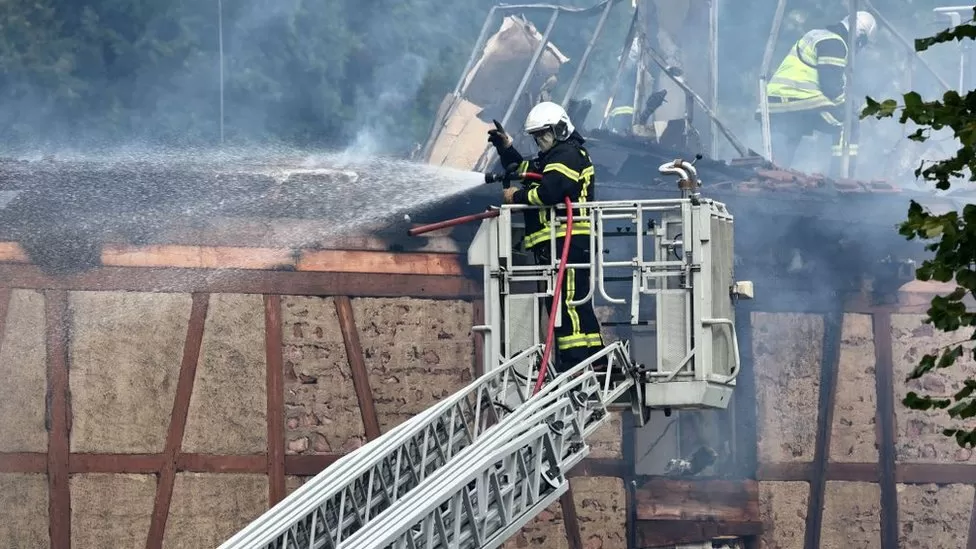
France: 11 killed in fire outbreak in vacation home for disabilities
A tragic fire has destroyed a vacation residence catering to adults with disabilities in eastern France, resulting in the loss of 11 lives, according to an official statement.
The deputy prosecutor for Colmar, Nathalie Kielwasser, revealed that the inferno trapped 11 individuals who were asleep on the upper floor and mezzanine of the private accommodation situated in Wintzenheim.
In contrast, five managed to escape the flames. Twelve occupants staying on the ground floor were able to evacuate.
The vacationers, who had “mild intellectual disabilities,” were partaking in a sponsored holiday organized by two specialized associations, Kielwasser explained. Investigations are currently underway to ascertain the fire’s origin and whether the building adhered to required safety standards. One survivor suffered significant injuries and was transported to a hospital.
French Prime Minister, Elisabeth Borne visited the scene to demonstrate the government’s solidarity with the victims’ families, as well as the courageous firefighters and rescuers. Lt. Col. Philippe Hauwiller, leading the firefighter rescue operation, indicated that the fire likely initiated on the upper level.
The building’s lower part was constructed from stone, while the upper section followed the region’s traditional wooden design, potentially contributing to the rapid spread of the blaze.
The fire erupted at 6:30 a.m., as reported by the local administration of the Haut-Rhin region. Christophe Marot, the secretary general of the local administration, conveyed that among the deceased were ten disabled individuals and a group escort.
The victims primarily hailed from the city of Nancy in eastern France.
A total of 76 firefighters, along with four fire engines and ambulances, were deployed to combat the fire’s progress and provide medical care. Additionally, 40 police officers were mobilized to assist.
By Wednesday morning, the fire had been successfully brought under control.
-

Dispute over past president’s legacy lies at heart of Niger’s coup
The culmination of months of tension between President Mohamed Bazoum and his chief guard drove the coup in Niger. Individuals familiar with the situation stated that this friction stemmed from Bazoum’s attempts to escape the shadow of his predecessor.
Since assuming office in 2021, succeeding his political mentor Mahamadou Issoufou, Bazoum aimed to assert his dominance over the West African nation. This endeavor involved sidelining influential figures in both the military and public administration. However, this assertiveness eventually led to his downfall.
General Abdourahamane Tiani, the head of the influential presidential guard, sensed the possibility of his own sidelining and subsequently turned against Bazoum. Tiani believed that other military commanders would eventually align with his cause. This account of the coup’s unfolding is drawn from insights gleaned from 15 interviews conducted with Nigerien security officials, politicians, as well as current and former Western government officials.
Neither Tiani nor Bazoum could be reached for comment. In his first statement following the July 26 coup, Tiani claimed to have removed the president for the nation’s benefit.
After ascending to power, Bazoum bolstered military cooperation with France and the United States, restricted the autonomy of Nigerien army commanders, and initiated anti-corruption campaigns targeting associates of Issoufou, notably within the oil sector. This approach led to the formation of adversaries.
Tiani, who had served as the head of Issoufou’s guard for a decade and played a role in foiling a coup shortly before Bazoum’s rise to power, continued in his role under the new president. He commanded Niamey’s most formidable and well-equipped force.
However, in recent months, Bazoum reduced the size of the presidential guard, which consisted of about 700 members during the coup. Additionally, he began scrutinizing the guard’s budget.
Eager to secure his position, Tiani, a figure who had risen through the ranks and been bestowed the rank of general by Issoufou, discreetly discussed his coup plans with select commanders. This was an effort to ensure that other military branches would not resist him, as per individuals familiar with the coup plotter’s thinking.
Reuters could not ascertain which commanders were briefed by Tiani.
Moreover, Tiani strategically waited until a substantial number of troops had been dispatched from Niamey to Diffa, a remote location 20 hours away in southeastern Niger. This move coincided with the Independence Day celebrations slated for August 3, according to information from two sources.
Collision Course
On July 27, a day after Tiani’s presidential guard detained Bazoum at his residence, Niger’s army command announced its support for the coup, aiming to avoid a potentially lethal conflict between different factions.
Spokespersons for the junta and the army command did not respond to messages seeking comment.
However, the ongoing internal resistance to Tiani assuming the role of head of state dwindled. Yet, the new administration of the country is still heading for a confrontation with the 15-member Economic Community of West African States (ECOWAS).
This marks the fifth coup in Niger within the last 50 years and deals a blow to former colonial power France and the United States. These nations maintain over 2,000 troops in the country, utilizing it as a base for counteracting jihadists in the expansive and unstable Sahel region.
This coup follows military takeovers in neighboring Mali and Burkina Faso over the past three years, which prompted France to withdraw thousands of troops. This move allowed Russia to increase its influence in the region.
It remains unclear from the Reuters interviews whether Tiani had discussed his plans with Issoufou, a towering political figure in West Africa who wields significant sway in Niger.
Issoufou was elected in 2011, a year following a previous military coup. He garnered praise for voluntarily stepping down in 2021 after two terms, facilitating the first democratic transition to a new leader in Niger since independence.
Speculation circulated in the capital after the coup, as Issoufou remained silent for several days, suggesting he might have been aware of Tiani’s intentions.
Issoufou had grown increasingly frustrated with Bazoum’s attempts to chart his own course, according to individuals familiar with the matter. Two allies of Issoufou recalled hearing him voice dissatisfaction with Bazoum’s reluctance to heed his advice on governing the country, particularly in the oil sector.
Reuters was unable to reach Issoufou for comment. A person close to the former president stated that he initially refrained from publicly discussing the rebellion due to his efforts to mediate between Tiani and Bazoum.
This individual, who chose not to be identified, denied any involvement of Issoufou in the coup. They pointed to the junta’s decision to apprehend his son, the oil and energy minister, on July 31, as evidence that the former president did not collude with Tiani.
On July 30, four days into the coup, Issoufou broke his silence. He used social media to indicate his involvement in mediation efforts and called for Bazoum’s reinstatement.
Issoufou has since provided no further information about his activities.
Safe Room
July 26 commenced as a routine day for Bazoum. He began with breakfast at his residence, situated within the compound of the presidential guard in central Niamey. According to various current and former Western officials who spoke with the president by phone afterward, Bazoum was preparing to proceed to his nearby office when he sensed something amiss: Tiani’s soldiers had encircled his home. Responding to this situation, the president promptly retreated to the residence’s secure room, equipped with confidential communications.
After several hours passed without any signs of rescue, Bazoum rejoined his family in the main part of the residence, which remained besieged.
Following the detention of Bazoum, Tiani instructed General Salifou Mody, who had previously been stripped of his role as chief of staff of the Niger Armed Forces by the president in April, to liaise with other branches of the security services and secure their support. This directive was relayed by four sources familiar with the matter.
Mody, designated as Niger’s representative to the United Arab Emirates in June—an assignment widely perceived as a demotion—nevertheless remained in Niger and did not undertake the new role. It is unclear whether Mody, listed as a deputy to Tiani in the junta’s organizational chart, was one of the few commanders briefed before the coup. Reuters was unable to reach Mody for comment.
Simultaneously, as news of the coup circulated within Niamey, former president Issoufou contacted Tiani. He extended an offer to mediate, as shared by two sources familiar with the situation. Subsequently, Issoufou met with Bazoum, sharing his assessment that Tiani had succumbed to a “mood swing,” a condition he believed he could help resolve, according to a person close to Issoufou.
As the events unfolded, with Niger’s prime minister absent from the country, Foreign Minister Hassoumi Massaoudou took the lead in attempting to secure Bazoum’s release, according to individuals with knowledge of the matter. Massaoudou did not respond to messages seeking comment.
Around midday on July 26, a social media post from an account linked to the Nigerien presidency assured the public that Bazoum and his family were safe. The post conveyed that the army and national guard were prepared to confront the rebellious soldiers if they did not stand down.
Subsequently, hundreds of Bazoum’s supporters gathered at a central square in Niamey, later marching towards the presidential palace. These demonstrators called for the mutineers to release the president and return to their barracks.
Later that day, National Guard troops assumed positions around the compound where Bazoum was held. However, at approximately 9 p.m., the mutineers broadcasted a video on state television. A little-known colonel, Amadou Abdramane, clad in a blue military jacket and flanked by nine officers, announced that Bazoum had been ousted from power. The video also declared the suspension of all institutions of the republic and the closure of Niger’s borders.
The group comprised members from nearly all branches of Niger’s security apparatus, including the police, army, air force, and presidential guard. Ahmad Sidien, second-in-command of the National Guard, was also present.
On the subsequent day, the Nigerien military command declared support for the junta, and the National Guard lifted its siege of the presidential guard compound—aligning with Tiani’s intended outcome.
Tiani, who chose to remain discreet until he garnered public support from other commanders, as per two sources knowledgeable about the plot, made a television appearance on July 28. In his brief statement, he attributed the junta’s motivations to safeguarding the homeland. He attributed the coup to Niger’s government’s failure to address security concerns.
However, with ECOWAS threatening potential military intervention if the coup isn’t reversed by Sunday, Tiani could soon confront an entirely different challenge.
Reported by Moussa Aksar in Niamey, David Lewis in Nairobi, and David Gauthier-Villars in Istanbul. Additional contributions by Michel Rose in Paris and Edward McAllister in Dakar. Edited by Alexandra Zavis and David Clarke.
-

France stops funding Burkina Faso
All budgetary and development assistance from France to Burkina Faso has been halted.
The announcement follows a statement from the military administration in Burkina Faso that any use of force against the coup leaders in the adjacent Niger would constitute a declaration of war.
The similar stance has been adopted by the Mali military government.
It happens after a deadline set by the West African bloc Ecowas for the military coup leaders in Niger to reinstate ousted President Mohamed Bazoum and restore constitutional order expired on Sunday night.
Regarding the next course of action, which could involve military intervention, Ecowas has not yet made a statement.
This would be the “last option” if all other political and diplomatic measures were unsuccessful, according to the grouping previously.
-
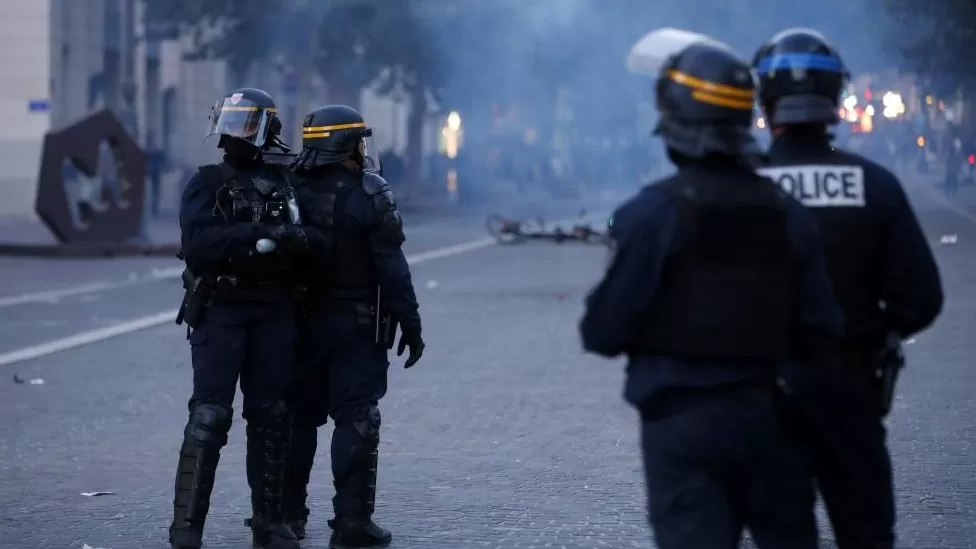
French officer admits firing riot pistol during dispute
A French policeman who is suspected of opening fire while Marseille was experiencing riots a month ago has admitted shooting a 22-year-old man in the head with a rubber bullet.
Hedi, an assistant restaurant manager, suffered severe injuries and disfigurement as a result of the “flash ball”.
Since the officer has been detained for weeks, colleagues in Marseille and elsewhere have expressed outrage.
On Thursday, the public defender requested that the court retain him in custody.
The officer’s attorney has filed an appeal for his release, but the prosecutor said that it was necessary to consider the possibility of “fraudulent collusion” among coworkers.
The suspect is one of four police officers who are being investigated for their alleged involvement in riots that broke out across France at the beginning of July.
After a 17-year-old named Nahel was fatally shot by a police during a traffic stop in Nanterre, close to Paris, they broke out.
Hedi, a North African immigrant who was hit in the head but survived, suffered headaches, lost vision in his left eye, and had to walk with a helmet on. He also lost a portion of his skull.
The officer, known only as Christophe, said in a statement to the court in Aix-en-Provence that he made the decision to fire once with his LBD launcher when he noticed two people in hood.
When asked by his attorney if Hedi was hit by the shot, the officer responded, “There’s no proof.”
Although the officer’s version was wholly nonsensical, Hedi’s attorney Jacques Preziosi later said that “finally we have a confession that he fired the LBD… until now everyone denied it.”
Olivier Véran, a government spokesman, called Hedi earlier this week to wish him well.
The 22-year-old has described to French media how he met his friend Lilian after finishing work at a restaurant early on July 2. Four members of a police anti-crime brigade (BAC) confronted them as they were walking along the riot’s edge.
We wished the officers a good night but soon discovered they were agitated and uninterested in speaking.
Hedi was shot in the head and collapsed on the ground while his friend was able to escape. He recalls being tortured for as long as five minutes while being dragged around the ground and beaten: “I felt something enormous in my skull that was burning me.”
One of the four police officers engaged in the Marseille incident was remanded by magistrates, which was a rare decision that has infuriated other cops.
In response to his imprisonment, an estimated 5% of officers have either used their sick days or worked on call.
According to Frédéric Veaux, the national police chief, cops shouldn’t be regarded like criminals or thugs.
“A police officer has no place in prison before an eventual trial, even if he may have committed faults or grave error in his work,” he stated.
While acknowledging the strong feelings among officers, President Emmanuel Macron declared that “no one in the Republic is above the law.”
The incident has once again brought attention to French police’s controversial use of “flash-ball” rubber bullets, which have resulted in numerous fatalities and life-altering injuries in recent years.
Mohamed Bendriss, 27, was shot in the chest during the protests in Marseille the same evening that Hedi was hurt. He had a heart arrest and passed away.
Although two marks on the scooter delivery driver’s chest and thigh that are consistent with the impact of a “flash ball” were discovered, prosecutors are still looking into whether an LBD was to blame for his demise.
Abdelkarim, his cousin, may lose one of his eyesight after being struck in the eye the previous evening.
During a protest in Nantes in April against the government’s pension reforms, a man lost a testicle.
-
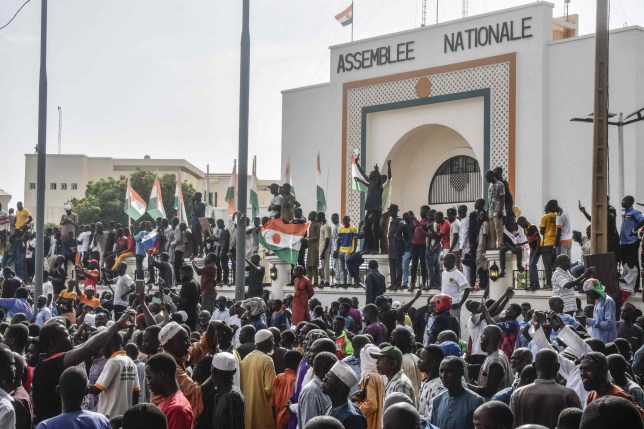
Prime Minister of Niger pleads for international assistance in light of military coup
In order to reverse a military coup, Niger‘s first democratically elected president has appealed for international assistance.
Undoing the coup, said to Prime Minister Ouhoumoudou Mahamadou, is essential to protect democracy in West Africa.
Mr. Mahamadou is currently in France because, when borders closed as a result of the coup, he was abroad for international meetings.
He claimed that protecting countries further south “against the spread of terrorism” and supporting democracy in the area should be anchored by Niger.
Because Niger is a vulnerable nation, Mr. Mahamadou called the coup a calamity. Nearly four million individuals already reside in this nation with food insecurity.
A 300,000-strong number of internally displaced individuals live in this nation.
Last week, coup leaders announced the removal of democratically elected President Mohamed Bazoum on live television.
According to the constitution of Niger, the president has a wide range of authorities, including the choice of the prime minister.
On Sunday, the ECOWAS regional organisation in West Africa issued travel and economic restrictions against Niger and threatened to use force if the coup leaders did not restore Mr. Bazoum within a week.
Spain, Italy, and France all declared citizen evacuations on Tuesday.
Mr. Mahamadou pointed out that since 2020, there have been three comparable instances in Guinea, Burkina Faso, and Mali.
The whole of West Africa’s democracy is in jeopardy if a fourth coup is verified, he continued, adding that there is no reason why a fifth coup shouldn’t occur, followed by a sixth.
For the ECOWAS nations, survival is at stake. It’s a credibility issue for the entire world community. Niger must continue to be a democratic nation.
One of the West’s final democratic allies in the fight against Islamic radicals in West Africa was his administration.
In terms of security, not just for the rest of Africa but also for the rest of the world, Niger is a crucial nation, And Mr. Mahamadou.
Because “the armed forces are preoccupied with issues other than ensuring the country’s security, you can understand that this will enable the jihadists to move forward on the ground,” he cautioned that Niger’s current instability “could encourage the further development of insecurity linked to jihadists.”
The president “is definitely a hostage,” according to Mr. Mahamadou, who added that he is in contact with Mr. Bazoum and that the president is “in good spirits” and “ready to face the situation.”
Because they claim to be “patriots,” he thought the coup leaders would accept the ECOWAS request to reinstate Mr. Bazoum rather than risk military involvement.
-

Residents in Niger react to evacuation plan for French nationals
Residents of Niamey, the capital of Niger, are responding to the recent announcement of France’s intention to evacuate its nationals from the country.
On Tuesday, both France and Italy made preparations to airlift their citizens and other European residents from Niger.
This decision comes six days after a coup resulted in the ousting of President Mohammed Bazoom, who was considered one of the last pro-Western leaders in the Sahel region, which has been facing challenges from jihadist group
“I dare say that we live in symbiosis with this French population living in Niger, so they really have no reason to repatriate them. As far as we’re concerned, this is yet another failure on the part of French politicians, and one that we all condemn.” Idrissa Adamou Kimba, resident of Niamey
“We don’t have a problem with the French, European nationals, we have problems with European governments, if they said they were going to repatriate their population, they only have to repatriate their army first.” Hamidou Ali, resident of Niamey
Amid the deteriorating security situation in Niamey, the French embassy conveyed a message to its citizens, stating that an air evacuation operation is being organized, taking advantage of the relatively calm conditions in the area.
The evacuations are expected to occur promptly within a short timeframe.
The initial flight from Paris has already departed, and it was reported that unarmed military transporters, capable of accommodating more than 200 people, would be used for the evacuation.
The French foreign ministry estimated that there were about 600 French nationals in Niger but did not disclose the number of individuals wishing to leave.
Meanwhile, an Italian government spokesperson in Rome mentioned that a “special flight” would be provided for Italians who wanted to leave the country, although they emphasized that it was not classified as an evacuation.
In Niamey, one resident, Almoctar Boukari, expressed discontent and held France responsible for the challenges faced by Africans in Niger, urging them to leave the country.
The situation in Niger has drawn regional and international attention. The Economic Community of West African States (ECOWAS) imposed sanctions on Niger and warned of possible military intervention if the coup leaders do not reinstate President Bazoum. The junta accused France of seeking military intervention, which France denied, while neighboring countries under junta rule, Mali and Burkina Faso, warned that any military intervention in Niger would be considered an act of war against them.
Niger is experiencing instability in a nation that has faced multiple coups since gaining independence in 1960. President Bazoum had previously survived two attempted coups before the recent events that led to his detention by the Presidential Guard. However, the junta’s claim to leadership has been rejected internationally by various organizations and countries, including ECOWAS, the African Union, the United Nations, France, the United States, and the European Union.
The coup in Niger has raised concerns among Western nations dealing with a jihadist insurgency that began in northern Mali in 2012 and spread into Niger and Burkina Faso. This insurgency threatens the stability of fragile states in the Gulf of Guinea region and has resulted in significant loss of life and displacement of populations. France and the United States have had military deployments in the region, with France reconfiguring its force and focusing on Niger last year after withdrawing troops from Mali and Burkina Faso.
The military takeovers in the Sahel region have been accompanied by anti-French and pro-Russian sentiments, with Mali forging closer ties with Russia, leading to the deployment of Russian military hardware and paramilitaries, which Western nations claim to be Wagner mercenaries. The situation remains concerning and complex as regional and international stakeholders seek to address the security challenges in the region.
-
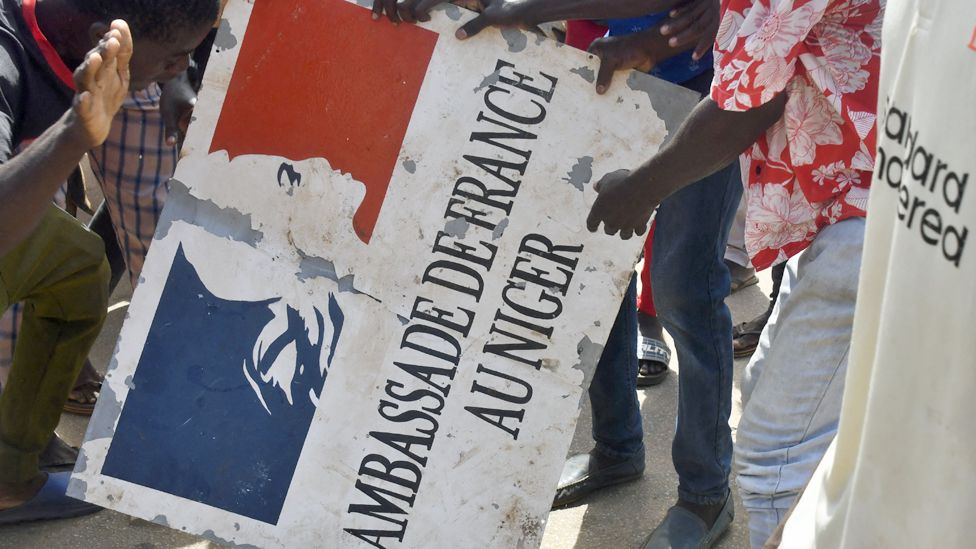
Niger coup: France citizens to be evacuated after attack on embassy
France is making preparations to evacuate its citizens from Niger, a West African nation, due to rising anti-French sentiment following a recent coup.
In addition to assisting its own citizens, France has also announced its intention to help other European nationals leave the country.
The coup has triggered protests against France, the former colonial power, with even the French embassy coming under attack.
This development coincides with warnings from the neighboring countries of Burkina Faso and Mali.
The juntas in these countries have cautioned that any attempt to forcefully reinstate the ousted president in Niger would be considered a declaration of war.
Burkina Faso and Mali, both former French colonies, have moved away from France and aligned themselves with Russia after experiencing their own coups.
This situation adds complexity to an already volatile region grappling with an Islamist militant insurgency.
Niger, being rich in uranium, has been a vital ally for Western nations, including France and the US, in their efforts to combat jihadist extremism in the Sahel.
France had previously shifted its counter-terror operations to Niger following Mali’s partnership with Russian Wagner mercenaries in 2021.
Protests outside the French embassy in Niamey, Niger’s capital, saw demonstrators expressing support for Russia and President Putin while expressing disdain for France. They also set fire to the embassy compound walls.
Due to the closure of Niger’s airspace, French citizens were unable to leave the country independently, leading to the decision to conduct evacuations starting on Tuesday. Italy’s foreign minister also confirmed that Italian citizens were being offered special flights to leave Niamey for Italy.
Earlier, France had welcomed an ultimatum from the West African bloc Ecowas, which demanded that Niger’s junta reinstate the elected President Mohamed Bazoum within a week.
Chad’s President Mahamat Idris Déby mediated efforts on behalf of Ecowas and was pictured with Mr. Bazoum.
Burkina Faso and Mali responded to the possibility of Ecowas military intervention by threatening to withdraw from the bloc and defend their eastern neighbor.
They believe such intervention would be disastrous and destabilizing. These countries are already suspended from Ecowas due to previous coups.
Niger’s junta has not yet commented on the demand from Ecowas but asserted its commitment to defending the country from any aggression by regional or Western powers, accusing France of planning military intervention.
However, the French Foreign Minister refuted this allegation.
The situation in Niamey appears calm as preparations for evacuations begin, and a crisis meeting is underway at the French foreign ministry in coordination with the embassy in Niamey.
Despite the evacuations, French nuclear fuel company Orano’s operations in Niger are not expected to be significantly affected, as most of its staff consists of Nigerien nationals.
-
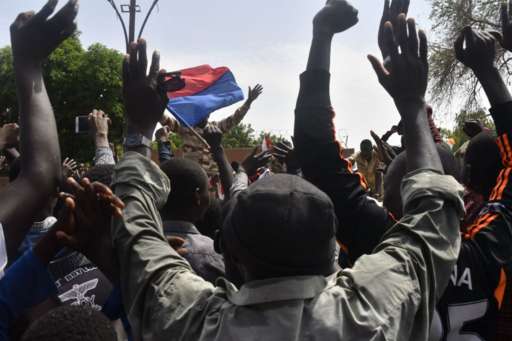
France will ‘soon’ repatriate its citizens from Niger
The French foreign ministry has announced its plans to promptly initiate the evacuation of its citizens in Niger following the recent coup.
Amid the deteriorating security situation, the French embassy in Niamey conveyed that preparations for air evacuations were underway and would occur within a very limited timeframe, according to the AFP report.
Last week, Niger President Mohamed Bazoum was overthrown when troops from his presidential guard seized power.
Notably, this is the third Sahelian country, following Burkina Faso and Mali, to experience a coup in less than three years.
These incidents have been accompanied by growing anti-French sentiments, leading these nations to strengthen their ties with Russia.
-

British woman killed in horrific crash in France identified as mother-of-10
A horrific collision involving two cars and a van in northern France claimed the life of a British woman.
One of the three people who perished on the A26, south of Lens, has been identified as Miriam Posen, a resident of the Orthodox Jewish neighbourhood of Stamford Hill, London.
Her two girls and their father were hurt in the collision and are undergoing medical attention, according to the Jewish Chronicle.
The mother of ten was reportedly travelling with seven family members when the incident occurred.
Seven Britons were reportedly inside the van when the crash occurred last night shortly after 6 o’clock, according to the local media.
Children are among those who were injured, according to an emergency services representative.
They said, “One of the three vehicles involved in the crash was a van with a British family of seven people on board.”
Along with two other passengers in another car, a 40-year-old British woman perished instantaneously.
The remaining travellers, who ranged in age from six to 48, were transferred to hospitals in Arras and Cambrai.
It has been determined that two people who were riding in one of the cars—a 75-year-old woman and a 45-year-old man—died.
A 79-year-old man who is in a “critical condition” and a 14-year-old boy who were the other two occupants in this vehicle.
Three children, the youngest of whom was six years old, were among the four occupants in the third car at the time of the collision.
Soon after, 60 firefighters and other emergency services rushed to the area.
The collision occurred between the towns of Neuville-Saint-Vaast and Thélus on a stretch of the highway when construction was being done on the roads.
‘We are in contact with the local authorities following a road traffic accident in France and have given our assistance to the family,’ an FCDO representative stated.
-
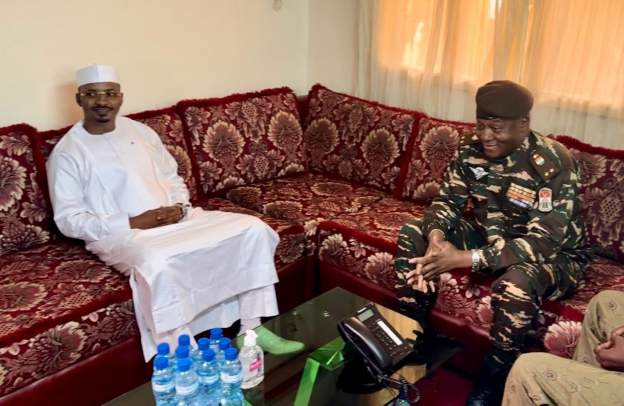
Niger junta accuses France of plot to reinstate ousted President Mohamed Bazoum
Niger’s junta has made accusations against France, their former colonial ruler, alleging that France has intentions of intervening militarily to reinstate ousted President Mohamed Bazoum.
In a statement broadcast on national TV, the junta accused France of planning a strike on them with the assistance of some officials from the deposed government.
Last week, soldiers in Niger announced a coup on national TV, declaring the dissolution of the constitution, suspension of all institutions, and the closure of all borders.
The coup received widespread condemnation, including from France, the UN, and the West African regional body Ecowas.
President Mohamed Bazoum has been detained by the junta inside his presidential palace in Niamey, and the junta has previously warned against any foreign attempts to extract him.
Chad’s transitional President, Mahamat Idriss Deby, held talks with the Niger junta leader and Mr. Bazoum on Sunday in an effort to help resolve the political crisis in Niger.
-
Tragic Lens accident claims lives of UK woman and injures children
In a horrific collision involving two cars and a van in northern France, a British woman perished.
On the A26, south of Lens, at least three deaths have been officially confirmed.
Seven British citizens were in the van when the crash occurred just after 6 p.m. last night, according to local media.
Children are among those who have been harmed, according to a representative for the emergency services.
One of the three vehicles involved in the collision was a van with a British family of seven people inside, they continued.
‘A British woman, 40, and two other passengers in another car both passed away instantly.
“The other passengers, who ranged in age from six to 48, were transported to hospitals in Arras and Cambrai.”
It has been determined that two people who were riding in one of the cars—a 75-year-old woman and a 45-year-old man—died.
A 79-year-old man who is in a “critical condition” and a 14-year-old boy who were the other two occupants in this vehicle.
Three children, the youngest of whom was six years old, were among the four occupants in the third car at the time of the collision.
Soon after, 60 firefighters and other emergency services rushed to the area.
The collision occurred between the towns of Neuville-Saint-Vaast and Thélus on a stretch of the highway when construction was being done on the roads.
-
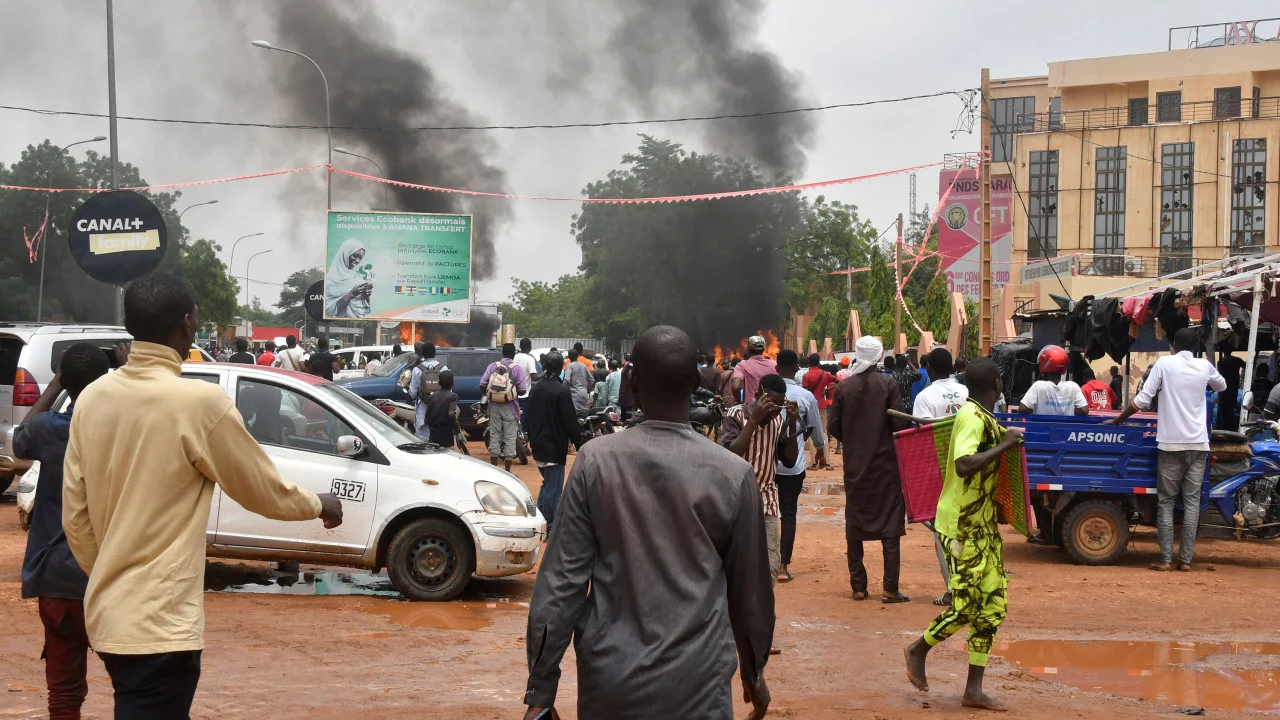
France and the EU stopped funding Niger over military coup
Following the overthrow of Niger’s democratically elected president by a coup, France and the EU have stopped providing financial assistance to the West African nation.
The former colonial power of Niger, France, added to the growing international pressure on the coup plotters by calling for the “immediate return to the Nigerien constitutional order” in a statement.
The action was taken shortly after the European Union said earlier on Saturday that it would no longer be providing financial support and cease any security cooperation with Niger. One of the poorest nations in the world, Niger receives aid worth hundreds of millions of dollars annually.
After President Mohamed Bazoum was detained earlier this week, Abdourahamane Tiani, a general who oversees the nation’s presidential guard, was sworn in as the new president.
According to Josep Borell, head of foreign affairs for the EU, “this unacceptable attack on the integrity of Niger’s republican institutions will not remain without consequences for the partnership and cooperation between the European Union and Niger, in all its various aspects.”
“President Bazoum was democratically chosen and is still Niger’s only legal leader. He must be released immediately and without conditions.
The release of Bazoum has been demanded by leaders from Washington to Moscow, but to no avail.
The Nigerien military was ordered to “immediately and unconditionally return to their barracks and restore constitutional authority” by the African Union on Saturday. If the rights of political detainees are not protected, the AU threatened to “take necessary action, including punitive measures against the perpetrators.”
If the Economic Community of West African States decides to impose penalties against Niger, both Borell and French President Emmanuel Macron stated that they would be ready to support them.
It is unknown to what extent those aiming to grab power would be influenced by foreign pressure.
An aide who supported the ousted president told CNN that the conspirators were fighting among themselves. The military of Niger has supported the coup, though.
The Sahel region of Africa, which includes Mali and Burkina Faso, has experienced multiple power grabs recently. Niger is located in the centre of this region.
-

Leaders of coup in Niger accuse France of ‘bypassing’ border restrictions
France is accused of disobeying laws preventing travelers from entering or departing the nation, according to the military commander who led the coup that ousted Nigerien President Mohamed Bazoum.
It comes in response to Communiqué Number 3’s directive to close all land and air borders, which was given on July 26.
Colonel-major Amadou Abdramane announced: “It has been noted that the French partner is bypassing this by landing an A401 military aircraft at Niamey international airport [Thursday morning] at 06:30.”
“The CNSP calls once and for all for strict compliance with the provisions of communiqué number 3.”
On Thursday, the army gave its support to the coup leaders who have been holding President Mohamed Bazoum in Niamey.
It comes as supporters of the coup gathered in Niamey to call for the departure of what they called “foreign forces” an military leaders called for calm after incidents during demonstrations by its supporters.
Some protesters waved Russian flags and called for strengthened ties with Mali and Burkina Faso.
One demonstrator, Anas Djibril, said: “The foreign forces that are with us, the foreign bases, the people who are squandering must leave us. Niger alone.
“Our army is an army of reference that made Niger proud in the first Gulf War, that made Niger proud in the first rebellion, the second rebellion and in the sub-region everywhere we are a pride. This army is a source of pride.”
Another protester, Hama Maiga, added: “We want them to improve cooperation ties with Mali and Burkina, with whom we share the same common enemy, to combat the terrorism raging in the Sahel.”
As crowds took to the streets – some people burning French flags – the coup leaders announced “the suspension of political party activities until further notice”.
Earlier, President Bazoum had rejected the coup. “The hard-won gains will be safeguarded. All Nigeriens who love democracy and freedom will see to it,” he declared on Twitter.
In a press release, the Economic Community of West African States (ECOWAS) said it “demands the immediate release of President Mohamed Bazoum, who remains the legitimate and legal President of Niger recognised by ECOWAS.”
-

Six times the legal drinking limit drunk pilot arrested
An airline pilot was discovered to be six times above the legal drinking limit and received a one-year sentence with probation.
After failing an alcohol breathalyser test, the 63-year-old United Airlines pilot was removed off a Boeing 777 by French authorities and brought into jail.
Police claimed the American pilot had a “pasty mouth, glassy eyes, and difficulty expressing himself” when they discovered him.
His blood alcohol content was 0.59 mg/l and 0.56 mg/l, which is six times the French limit for flight crew.
He was scheduled to be the pilot of flight UA331 to Washington, DC, but was detained moments before takeoff.
It was necessary to abruptly cancel the flight.
The pilot’s allegation that he had only two glasses of wine before being arrested was disputed by the judges.
He received a €4,500 fine and a 12-month flight ban to and from France.
The safety of our passengers and employees is always our top priority, United Airlines informed PYOK.
We have a strong no-tolerance alcohol policy and demand the highest standards of all of our personnel.
“This employee was terminated from employment immediately, and we are fully cooperating with local authorities,” the company stated.
-
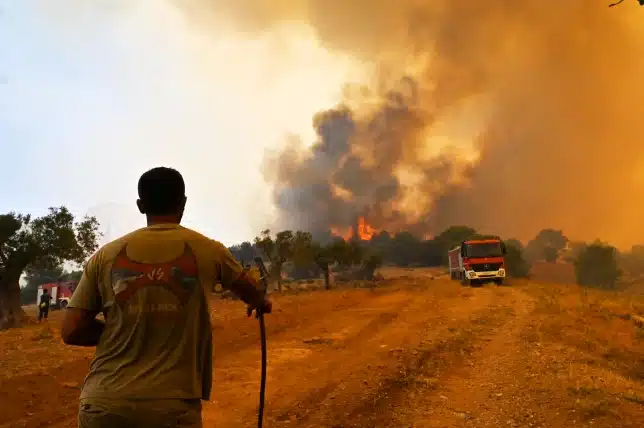
Saharan heatwave surpasses 40ºC, making it the hottest site in Europe 40ºC
If you hadn’t noticed, mainland Europe is presently suffering an unprecedented heatwave.
‘Unprecedented’ weather has caused certain countries to experience highs of over 40 °C, grabbing the media for some time now.
With temperatures much above average, people are finding it difficult to handle the severe heat of both the Charon anticyclone, named after the ferrymen of the dead, and the Cerberus heatwave, which was first and was named after the hound that guarded the gates of hell.
From France to Italy, Spain to Germany, people are doing everything they can to stay cool and hydrated, seeking refuge in air-conditioned buildings or finding shade under trees.
So, what are temperatures like at the moment, and what is each country doing about it?
Here is what you need to know.
Where is the hottest place in Europe?
According to AccuWeather, today, Athens will be the hottest capital city in Europe, clocking in at highs of an astonishing 37ºC.
Rome is finishing a close second at 36ºC, with Bucharest coming in third with 32ºC temperatures.
Win a seven-day cruise around the Mediterranean with Virgin Voyages
You could win a glorious trip to the Med for two with Virgin Voyages.
Our lucky winner will be sailing around the Mediterranean on a superyacht-inspired ship with five-star food whenever you want it, top-drawer entertainment on tap, exercise classes, pool, hot tubs, the works… all thrown in as part of the package.
With two packages to choose between, you can opt for French Daze And Ibiza Nights, where you get to mix stop-offs to the beautiful beaches of the south of France and Ibiza and sample some of the party island’s famous nightlife.
Or you can take it easier on the Irresistible Med cruise, which combines Provençal heritage, the intriguing island of Corsica and the famous countryside of Tuscany.
Ready to set sail? Click here and answer the question to be in with a chance of winning this fabulous prize.
In the meantime, don’t forget to sign up to The Getaway, Metro’s fabulous weekly newsletter, to receive all the latest travel news, advice and inspiration straight to your inbox. Plus you can opt to receive even more fantastic offers and deals.
You have until midnight on August 11 2023 to enter. Good luck!
This is unsurprising, as Italy, Spain, and Greece have all been experiencing some of the most severe temperatures Cerberus has had to offer, with the Foreign Office issuing travel warnings for Spain and Greece.
Hotest capital cities in Europe
As of today, the top 10 hottest capitals in Europe have forecasted highs of:
- Athens – 37ºC
- Rome – 36ºC
- Bucharest – 35ºC
- Marseille – 32ºC
- Madrid – 32ºC
- Kyiv – 26ºC
- Lisbon – 26ºC
- Budapest – 25ºC
- Paris – 25ºC
- Vienna – 24ºC
How hot will London get today?
Britons hoping for a heat blast will need to keep waiting as the UK capital is only forecasted highs of 21ºC.
How is the heatwave affecting each country?
Each country has been undertaking different efforts in its battle to keep its citizens safe from the heat, with some even experiencing dangerous spreads of wildfires.
Southern Europe is undoubtedly seeing the worst of the temperatures, with some places having hit north of 45ºC.
The Foreign Office’s advice remains that travelling to Europe is generally safe, but to check with your travel provider and follow the advice of local authorities.
Spain
Parts of Spain have hit highs of 45ºC this week, with Spanish authorities reporting that around 300 people have died due to the intense temperatures over the three weeks from June to July.
The Spanish island of La Palm saw 4,000 citizens evacuated as firefighters battled to control wildfires.
Italy
Southern Italy has seen some of the worst of the heatwave so far, with temperatures expected to climb to 48ºC on the islands of Sicily and Sardinia this summer.
iNews report that the Italian Weather Service predicts Sardinia will be at the heatwave’s ‘epicentre’.
Earlier in the week, Italy put 23 cities on ‘red alert’ for the extreme temperatures.
Greece
Greece has seen some of the worst wildfires during this period of extreme weather, with fires across the country often burning for days.
Firefighters utilised air-water bombers to combat blazes west of Athens, which prompted evacuations earlier in the week but is now contained.
A densely wooded area on the island of Rhodes is still alight, with firefighters struggling to control the fire, which has seen people forced to leave their homes.
Cyprus
A second heatwave is expected to hit Cyprus and much of Greece this weekend
Those flying into Paphos can currently expect temperatures of about 37ºC (98.6F).
According to the Cyprus Department of Meteorology the maximum temperature is expected to reach around 40ºC over inland areas and around 32ºC (89.6F) over the highest mountainous areas.
Croatia
Throughout Croatia, you can expect mid-to-low 30ºCs, with areas around Split currently the hottest.
The country will be hit by even warmer weather as the weekend approaches, but it is currently not included in the UK heightened travel advice.
Wildfires in Grebastica have also caused damage, and six people have died after storms tore through Croatia and the Balkans where strong winds and heavy rain hammered the region in the wake of the heatwave.
France
Temperatures have come down considerably in France since the beginning of the Cerberus heatwave, but an orange weather warning – the second-highest alert – has been issued for some areas along the Mediterranean coast. with Marseille currently at around 31ºC.
Paris meanwhile is staying slightly cooler at around 25ºC.
Germany
Those looking to travel to Germany should expect temperatures to rise in the country as well.
While Germany has not been hit with as extreme weather as much of southern Europe, the Bavaria region has recorded temperatures of around 38ºC.
-

Greece blocks highways to prevent wildfires from encroaching on an oil refinery
Authorities in Greece have now forced to restrict highways to prevent wildfires from reaching an oil refinery.
Tonight, low-flying water-dropping aircraft and helicopters battled two wildfires to the west of Athens.
To assist Greece, Italy and France each sent two firefighting aircraft.
Popular vacation destinations were evacuated just yesterday due to wildfires.
The planes and their teams are part of an EU civil protection mechanism, and they will join some 30 Romanian firefighters already stationed in Greece.
Forecasters have indicated more extreme heat is on the way, with temperatures so hot that the Acropolis was closed.
Fire Service spokesman Vassilis Varthakoyiannis said the main fire near Athens rapidly became a major crisis.
‘The Fire Service had to intervene in many instances to get people out of their homes,’ the spokesman said.
Officials cancelled holidays and leave for firefighters, while Greek prime minister Kyriakos Mitsotakis cut short a visit to Brussels and returned to Athens to meet with the heads of the Fire Service and Civil Protection Agency.
Wildfires continued to burn out of control on Tuesday to the north and west of Athens, including a blaze near the resort town of Loutraki, where more homes were damaged and evacuations were expanded.
In Mandra, west of Athens, police ran through narrow streets to help residents into cars as the flames approached.
Earlier, police helped nuns leave a hilltop Orthodox Christian monastery that was also under threat.
Several smaller fires also broke out closer to the capital, where winds remained moderate but where scrub and forest land were dried out by extreme temperatures last week.
Authorities said sections of two motorways linking Athens to the western city of Corinth were closed to give firefighters better access to the fires and to stop the flames from approaching a major oil refinery.
Greece also activated a rapid mapping evaluation system, which uses EU satellite data to assess fire damage.
A second heatwave is expected on Thursday, with temperatures as high as 44C expected in central and southern parts of the country by the end of the week.
-

France emerges from turbulent period with renewed hopes for World Cup
France, often considered underachievers in women’s international football, are aiming to salvage their World Cup campaign with the appointment of Herve Renard as coach.Despite a turbulent few months that threatened to derail their progress, the late appointment of Renard is hoped to make France genuine contenders.
Renard made the decision to leave his lucrative contract with the Saudi Arabia men’s team in order to respond to his country’s call after Corinne Diacre was dismissed in March.
Diacre had been in charge since 2017 but faced criticism after France’s quarterfinal exit as hosts in the previous World Cup in 2019, losing to the United States.
Leading players’ revolt further contributed to Diacre’s departure, rendering her position untenable.
Captain Wendie Renard had effectively said she would not go to the World Cup, which starts next week, if Diacre stayed because she could “no longer support the current system”.
Fellow stars Kadidiatou Diani and Marie-Antoinette Katoto followed her lead in making their dislike for Diacre clear, and a change had to be made if Les Bleues were to stand any chance of going far in Australia and New Zealand.
The 54-year-old Renard, who is no relation to the France skipper, accepted a deal which will also see him lead the team at the Paris Olympics.
He immediately set about turning the page on the mutiny that cost his predecessor her job.
“I am focused on the present and the future,” he told AFP.
“I have not looked at what happened in the past. I have a fresh view on things having come from outside,” added the man who led Saudi to a stunning victory over Lionel Messi’s Argentina in the group stage of the Qatar World Cup.
Big paycut
Renard knows what it takes to win a major international tournament, having lifted the Africa Cup of Nations twice, with Zambia in 2012 and Ivory Coast in 2015.
He admitted to taking an enormous pay cut to leave the Saudi position.
“If we are talking after tax it is 20 times less,” he said, before adding: “I never hesitated. That is not what will allow me to progress in football, even if it is important.
“What matters to me is the challenge and this is one I have taken on for other reasons. I am convinced I was right to take it.”
France will be expected to advance to the last 16 as group winners as they aim to at least match their best Women’s World Cup performance yet, of fourth place in 2011.
They have gone out of the last two World Cups in the last eight and lost in the semi-finals of last year’s Euro.
If they are to do better this time they will need to overcome injuries, especially to Lyon winger Delphine Cascarino, who was voted the best player in the French league last season.
She is out of the World Cup with a ruptured ACL.
“The absence of Delphine is a huge loss,” admitted Renard.
Prolific striker Katoto has also not recovered from a knee injury in time, while PSG midfielder Oriane Jean-Francois pulled out with an adductor problem.
-

We are ready to beat Guinea in today’s game – Black Queens
Black Queens Deputy Captain, Janet Egyir, has expressed the team’s determination to secure victory against Guinea in their upcoming match.
The Ghana women’s senior national team is set to face Guinea in the first leg of the first round of African qualifiers for the 2024 Olympic Games in Paris, France.
During a pre-match press conference on Thursday, defender Janet Egyir emphasized the Black Queens’ eagerness to triumph over their opponents.
She highlighted that the team’s objective is to develop and reclaim their position as one of the top teams on the continent.
“Tomorrow’s game is a mission we want to accomplish. It is going to be one step close to our mission. The target is to find our way back to the top,” Janet Egyir said.
The Black Queens’ deputy captain further emphasized, “We will exert every effort to foster that goal and secure qualification for the Olympic Games in Paris.”
The match between Guinea and Ghana is scheduled to commence at 16:00 GMT at Stade de Generale Lansana Conte.
-
Police provide update on missing 2-year-old kid in France
A two-year-old toddler who vanished from his grandparents’ garden has not been located by police.
The last four days have seen intense searches in the area, but on Wednesday night, the search was called off.
In the Alpes-de-Haute-Provence region of France, a little village near Le Vernet is where Émile was last observed on Saturday afternoon as he was playing outside the house.
He vanished as they were all preparing to go on an excursion, prompting a massive search that including a helicopter, drones, and sniffing dogs.
His parents – who have not been named – were at their home near Marseille, 200 miles away, for the summer holidays.
An emergency services source said: ‘Émile was always chasing butterflies, and could have got a long way away, before hiding somewhere for a nap.’
And during a news conference held yesterday, police admitted they ‘have no clues’ about the young boy’s whereabouts.
Public prosecutor Rémy Avon told journalists: ‘At the moment we have no clue, no information, no element that can help us understand this disappearance.’
He stressed while ‘the investigation continues’ no progress had been made since Émile’s disappearance.
‘We are at the same point as the day before yesterday after receiving the two testimonies’, Mr Avon said. ‘We are really pushing the investigations on the ground as much as we can’.
He added: ‘Medically we are told that beyond a period of 48 hours, given the young age of the child, given his constitution, and the possibility that he will be deprived of water and food with the current heat, the vital prognosis is very very committed.’
‘Either the body was concealed after an accident, or it was removed’, a gendarmerie spokesperson said, adding the sniffer dogs would have found a body in the region by now.
‘It is obvious that, after 48 hours, we have switched to another dimension. Hearings are underway.’
The search continued with a helicopter broadcasting the voice of Émile’s mum in the hope of finding the young boy.
On Wednesday investigators worked on the telephone boundary to identify people who would have passed near the hamlet at the time of the disappearance.
The extended search was upgraded from ‘regional’ to ‘national’ and the number of investigators increased from 15 to 20.
Investigators have received 1,200 calls after putting out a call for witnesses, Le Parisian reports.
Officials are investigating whether the young boy could have been hit by a tractor or car and his body taken away, according to La Provence.
Another theory is Émile was known to chase butterflies and could have chased one for a long distance before taking a nap.
Police are also exploring a hypothesis that he could have been kidnapped – despite ruling this out just 24 hours earlier.
Mr Avon, told the same press conference: ‘All the hypotheses remain valid, none is favoured or excluded.
‘We are committed to carrying out investigations on all levels.’
-

Blood discovered on a car during search for missing two-year-old in France
In an area of France where a toddler vanished four days ago, blood has been found on the front of a car, according to police.
In the little village near Le Vernet in the Alpes-de-Haute-Provence, Émile, age 2, was last seen playing outside his grandparents’ house on Saturday afternoon.
He has still not been located after 48 hours of thorough searching of the area.
Since his disappearance, there have been a number of theories about what really happened, including that the little boy was accidentally killed by a car or a tractor, and the driver hiding his body.

The two-year-old disappeared on July 8 (Picture: AFP) Police have now sent traces of blood found on a car for scientific analysis to see if they are human and might be linked to the missing child.
‘At the moment we don’t even know if it is human blood,’ said an investigating source.
‘It might be a very old trace too, so everybody is being very cautious about the find.’
It was also confirmed that Émile’s parents’ house in the town of La Bouilladisse, near Marseille, was searched by police on Monday.
Officers were looking into the family’s background,’ one judicial source working on the case said.
He said that the parents had lived in the house for a year, along with Émile and his baby sister, who was born earlier this year.
‘They are a very traditional family – high Catholics who prefer the Latin mass to the modern one,’ said the source.
‘The parents are passionate about sacred church music.’
This comes as police revealed there were at least 10 other family members staying in the Vernet house at the time of Émile’s disappearance.
A police source said: ‘A family reunion was taking place, with several uncles and aunts of the child, of all ages, including some minors.
‘Émile was seen on Saturday morning, along with other children.’
-

How France is paying you to fix your clothes and shoes
Do you have a pile of clothes and shoes that need some TLC? Don’t throw them away if you live in France, where the government will pay you a “repair bonus” to have them fixed in a new scheme aimed at cutting waste.
France wants to reduce the amount of textiles that end up in landfill every year. An estimated 700,000 tonnes of clothing is thrown away in France annually, two-thirds of which is wasted.
That’s why, from October, you will be able to claim back between €6 and €25 of the cost of mending clothes and shoes in workshops or at cobblers that have joined the scheme.
Bérangère Couillard, the secretary of state for ecology, announced the financial incentives during a visit to a responsible fashion hub in Paris.
The repair bonus will be paid from a €154m fund the government has set aside for the next five years, she said.
She invited all sewing workshops and shoemakers to join the scheme, which will be run by the eco-organisation Refashion. “The goal is to support those who carry out repairs,” Couillard said during the visit.
“This would encourage workshops and retailers to offer repair services with “the hope of recreating jobs”.
More than 100bn textiles – the terms covers clothing, shoes and household linen – are sold worldwide annually. In France, this amounts to about 10.5kgs a year for each person.
Refashion aims to encourage you not only to repair and reuse, but to reduce the amount of textiles you buy and to donate those you no longer want. It says about 56% of the donations can be used again and 32% can be recycled into something new.
The repair bonus scheme is part of a wider push by the French government, starting at the end of last year, to reform the textile industry, one of the most polluting on the planet, and to combat what is termed fast fashion.
Clothing and textile shops must also label items with the material used and the country where it was produced and manufactured.
Measures to encourage you to repair, reuse and recycle clothing follow a similar scheme offering bonuses to those who have household appliances repaired.
In 2020, France passed a law aimed at changing production methods and consumption habits in relation to household goods in order to cut down on waste, conserve natural resources and limit damage to biodiversity while addressing the climate crisis.
The legislation takes the form of a six-year plan that began with an education and information campaign outlining targets for the reduction, reuse and recycling of products, including targets for eliminating single-use plastics.
New measures are introduced under the legislation each year.
In 2022, public buildings including railway stations, hospitals and schools were required to install a water fountain, and at the beginning of this year restaurants with more than 20 seats and fast-food outlets were banned from using disposable cutlery, plates and cups for meals consumed on site.
France in 2016 banned supermarkets from destroying unsold food instead of donating it for redistribution.
Companies are now also required to be more open about the planned obsolescence of goods they produce and encourage the publication of a “repairability index” to detail the ease or difficulty with which a product could be mended.
Further restrictions on products containing microplastics, including cosmetics, shampoos, hair dyes and shower gels, and the use of plastic wrappings will come into effect in the next three years.
-
French police acknowledge they have ‘no clues’ in their search for missing two-year-old
A two-year-old toddler who vanished from his grandparents’ garden has not been located by police.
In the Alpes-de-Haute-Provence region of France, a little village near Le Vernet is where Émile was last observed on Saturday afternoon as he was playing outside the house.
He vanished as they were all preparing to go on an excursion, prompting a massive search that including a helicopter, drones, and sniffing dogs.
His parents – who have not been named – were at their home near Marseille, 200 miles away, for the summer holidays.
During a news conference held yesterday, police admitted they ‘have no clues’ about the young boy’s whereabouts.
Public prosecutor Rémy Avon told journalists: ‘At the moment we have no clue, no information, no element that can help us understand this disappearance.’
He stressed while ‘the investigation continues’ no progress had been made since Émile’s disappearance.
‘We are at the same point as the day before yesterday after receiving the two testimonies’, Mr Avon said. ‘We are really pushing the investigations on the ground as much as we can’.
He added: ‘Medically we are told that beyond a period of 48 hours, given the young age of the child, given his constitution, and the possibility that he will be deprived of water and food with the current heat, the vital prognosis is very very committed.’
‘Either the body was concealed after an accident, or it was removed’, a gendarmerie spokesperson said, adding the sniffer dogs would have found a body in the region by now.
‘It is obvious that, after 48 hours, we have switched to another dimension. Hearings are underway.’
The search continued with a helicopter broadcasting the voice of Émile’s mum in the hope of finding the young boy.
It will be expanded today and investigators are working on the telephone boundary to identify people who would have passed near the hamlet at the time of the disappearance.
The extended search will be upgraded from ‘regional’ to ‘national’ and will see the number of investigators increase from 15 to 20.
Investigators have received 1,200 calls after putting out a call for witnesses, Le Parisian reports.
Officials are investigating whether the young boy could have been hit by a tractor or car and his body taken away, according to La Provence.
Another theory is Émile was known to chase butterflies and could have chased one for a long distance before taking a nap.
Police are also exploring a hypothesis that he could have been kidnapped – despite ruling this out just 24 hours earlier.
Mr Avon, told the same press conference: ‘All the hypotheses remain valid, none is favoured or excluded.
‘We are committed to carrying out investigations on all levels.’
-
Huge hunt underway in France for two-year-old boy who disappeared from grandparents’ garden
A two-year-old boy went missing from the garden of his grandparents in the south of France, prompting a large search to be conducted.
In the Alpes-de-Haute-Provence, a small community near Le Vernet, Émile was last observed on Saturday afternoon playing in front of the family home.
Le Vernet mayor François Balique said on French television that as everyone was getting ready to leave for an outing, Émile “took advantage of this fleeting moment of inattention to leave.”
He added there has been nothing to indicate the toddler, who is a good walker for his age, has been abducted.
Mr Balique said: ‘It’s a small village with 20 or so houses … we see everything. He could have gone some distance and perhaps got lost or was hiding.’
The police were called at about 5.15pm and officers, gendarmes and firefighters began a huge search operation with a helicopter, drones and sniffer dogs.
Many locals have stepped up to help, including Marie-Laure, who co-runs a bistrot in Le Vernet.
She told La Provence newspaper: ‘We were preparing for the evening service when we were told the child had gone missing.
‘We all went to see what we could do to help as quickly as possible. We have looked in places where he could be, we have really looked everywhere for him.’
Two people reportedly saw the little boy leaving the house but then lost ‘trace of him’, public prosecutor Rémy Avon said.
The search zone, which initially covered more than 1,200 acres, was enlarged this morning.
The gendarmerie has appealed for witnesses to come forward with any information they might have.
Émile was wearing white shorts and a yellow top when he vanished.