Tag: Free SHS

  • Minority claims govt owes companies, individuals over GH¢6bn in Free SHS policy

    Minority claims govt owes companies, individuals over GH¢6bn in Free SHS policy

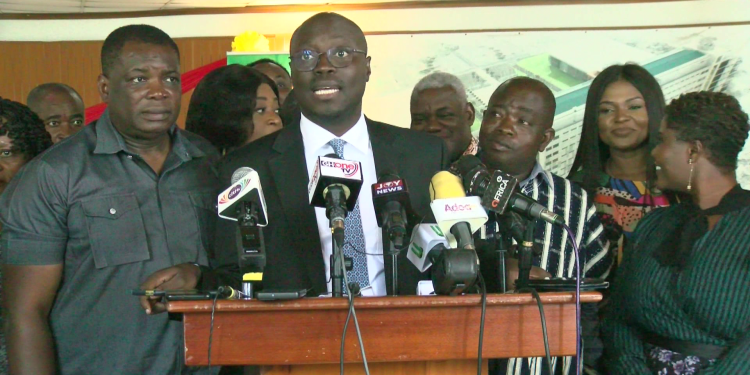
    Minority in Parliament has disclosed that the government is indebted to the tune of over GH6 billion to companies, individuals and organisations in relation to the Free Senior High School policy.

    The caucus reveals that the government has failed to reimburse over GH¢300 million funds used in the procurement of the GH¢1.3 million tablets for the ‘One Student One laptop initiative’.

    Addressing journalists in Accra, on Wednesday July 17, the Ranking Member on the Education Committee of Parliament, Peter Nortsu Kotoe, said,

    “Free SHS is a very laudable programme, it has provided access to secondary education for quite a large number of people who wouldn’t have had the opportunity, looking at the cost involved at that time.

    “However, the programme is facing a lot of challenges and one of them has to do with Finance. As we speak now, the financial challenges are becoming too much and it’s going through the roof. I can say that the information available to me indicates that over GHC6 billion is being owed to companies, individuals and organisations in relation to Free SHS.

    “This year, they launched the tablets for SHSs, because this is going to reduce the burden on the printing of textbooks. So, the idea is fine, we support it, when you look at the NDC 2020 manifesto, it’s there, we even added tertiary institutions.

    “You have asked somebody to supply GH¢1.3 million tablets, to cover all students and you’re not paying for it. The man has gone for a loan which is at the cost of GH¢37 million and you’re not paying…

    You have paid him less than 10%; how will the person pay the loan? As a minority, we’re concerned. If we do this, we’re killing businesses of individuals and companies in the country. So, there’s a need for us to intervene.”

    The Minority adds that the government owes the West African Examinations Council (WAEC) a total amount of GH¢224 million, frustrating plans towards the conduct of WASSCE.

    “Government still owes WAEC, exams will start in August, [but] government has not released any money to WAEC, they owe them a total of GH¢224 million, so WAEC is unable to talk again, we shouldn’t be going on that tangent.”

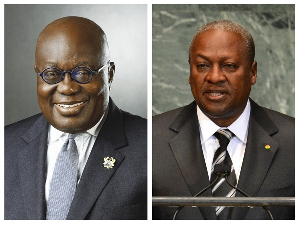
  • We’re laying a strong foundation; I want to be remembered as the Education President – Akufo-Addo

    President Akufo-Addo has expressed his delight over the progress Ghana is making in education, emphasizing his desire to be remembered as the “Education President.”

    This declaration was made during the 31st Congregation and Third Special Congregation of Valley View University (VVU) in Accra, where he was honored with an Honorary Doctorate Degree for his significant contributions to public service, justice, and national development.

    In addition to President Akufo-Addo, the University conferred Honorary Doctorate Degrees on Mr. Thomas Svaniker, an automotive industry leader and business strategist, and Kwame Osei-Prempeh, a former Deputy Attorney-General and Minister of Justice.

    Both were recognized for their exemplary leadership and significant contributions to their respective fields, enhancing humanity’s cause.

    The University’s citation for President Akufo-Addo highlighted his pivotal role in advocating for peace in sub-Saharan Africa, regional stability, media freedom, and significant legal and foreign policy reforms.

    “Your illustrious career has been marked by an unwavering commitment to the rule of law, justice, and democracy,” the citation noted.

    It also praised his Administration’s educational policies, particularly the flagship ‘Free Senior High School (SHS)’ Programme, which has expanded educational opportunities for many Ghanaian youth.

    President Akufo-Addo, in his speech, noted the historic student enrolment of 503,000 for 2024 at the SHS level, the highest in the nation’s history.

    Since its inception in 2017, the Free SHS Programme has benefited over four million children, with the Government investing over 12 billion Ghana Cedis. The President asserted that this programme has been crucial in training the human resources necessary for Ghana’s future development.

    The Government’s focus also includes expanding technical and vocational training, as well as Science, Technology, Engineering, and Mathematics (STEM) education.

    “We aim to equip the youth with the knowledge, expertise, and skills needed for their survival under the Fourth Industrial Revolution,” he stated.

    To ensure quality education, President Akufo-Addo assured continued investment in teacher training, infrastructural development, and the provision of necessary teaching and learning materials.

    “We are laying a strong foundation for the future of our nation,” he emphasized.

    Furthermore, the President revealed plans to establish four new universities in Asante-Mampong, Akrodie, Bunso, and Kintampo, aimed at increasing access to higher education.

    The Government is also working on paying the required research allowances to university lecturers to promote quality research and foster innovative ideas crucial for national growth.

  • How Mahama, Asiedu Nketiah went to Court to stop Free SHS implementation – Mac Manu

    How Mahama, Asiedu Nketiah went to Court to stop Free SHS implementation – Mac Manu

    Former National Chair of the New Patriotic Party (NPP), Peter Mac Manu, has alleged that former President John Dramani Mahama and National Democratic Congress’ (NDC) Chairman, Johnson Asiedu Nketiah, employed various tactics to obstruct the implementation of the Free Senior High School (Free SHS) program.

    In an interview with TV3, Mac Manu claimed that the NDC organized multiple demonstrations aimed at derailing the NPP’s policy. 

    He further stated that the NDC ultimately took their grievances to the Supreme Court in an effort to block the program.

    According to him, he has documentation to support his claims.

    “I have evidence of him and his General Secretary, people, speaking, making demonstrations, and going to the extent of even going to the Supreme Court to stop the Free SHS from being implemented. I will not admit that Mahama initiated the Free SHS program,” he added.

    The Free SHS initiative, a cornerstone policy of the NPP, was launched by President Akufo-Addo in 2017, aiming to provide free secondary education to all Ghanaian students. 


    The policy has been a significant point of political contention, with various parties debating its feasibility and impact.

    While many Ghanaians have benefited from the policy, challenges such as funding, infrastructure, and educational quality continue to be areas of concern.

    Meanwhile, in a media engagement on July 7, 2024, Mahama refuted claims that he opposed the Free SHS program. 

    He asserted that as the originator of the progressive Free SHS initiative, he has always supported efforts to enhance its benefits.

    “I support any bill that will improve our education to make it sustainable, to afford quality education for our children. So yes, any bill that would achieve this is something that I will support,” Mahama stated.

    But president Akufo-Addo has dismissed former President John Dramani Mahama’s claim that he initiated the free Senior High School (SHS) policy, labeling it as “ridiculous.”

    He highlighted previous criticisms from the NDC leadership regarding the policy’s feasibility.

    Speaking at the official unveiling of the New Patriotic Party (NPP) flagbearer’s running mate for the 2024 elections in Kumasi on July 9, 2024, Akufo-Addo asserted that the NDC is not a credible alternative for Ghanaians.

    “Today, the free Senior High School, the same people that criticized it and said all sorts of things about it, are claiming that they implemented it. We will take it like that,” Akufo-Addo said.

    “We will take it like that because as God is alive, He is not asleep.”

    Akufo-Addo criticized Mahama for what he sees as a reversal on the policy.

    “This leader criticized us when we said we were going to implement the Free SHS policy. Now that Ghanaians have accepted the policy, he is saying he is the one who introduced Free SHS. Have you ever heard such a thing?”

    He continued, “He indeed said that we are forgetful people. Will we forget this too? Today, the leader of the NDC claims he is the one who introduced Free SHS.

    “If he introduced the policy, why did he criticize us when we intended to introduce it? He said if he had 2 billion cedis, he would not invest it in free education.”

  • How is “wealthy” grandson of Akufo Addo benefitting from Free SHS – Brig. Gen. Nunoo Mensah asks

    How is “wealthy” grandson of Akufo Addo benefitting from Free SHS – Brig. Gen. Nunoo Mensah asks

    Former National Security Advisor to the late President John Evans Atta Mills, Brigadier General (Rtd) Joseph Nunoo Mensah, has voiced strong disapproval of the current implementation of the Free Senior High School (SHS) policy, describing it as “nonsensical” and in need of immediate reform.

    At a press conference on Friday, July 12, 2024, organized by Nana Kwame Bediako, the New Force leader running as an independent candidate in the 2024 elections, General Nunoo Mensah asserted that the Free SHS policy was originally intended to assist underprivileged families unable to afford secondary education.

    He criticized the policy’s application to wealthy families, including President Akufo-Addo’s grandchildren, arguing that it deviates from the policy’s original objective.

    “The system we had was that the policy should absolve the fee of the ordinary people, fishermen, poor people. How could I have become a CDS today, a fisherman’s son, if you don’t get anybody to push you?

    “The whole idea was to help the children of poor people and it wasn’t meant for the children of rich people. How can President Akufo-Addo’s grandson or granddaughter get free education? It is rubbish and nonsensical. It is for people at Teshie, Nungua,” he said.

    General Nunoo Mensah criticized the current administration’s approach, asserting that the policy should not benefit those who can afford to pay for education.

    “People like Nunoo Mensah, my mother was selling plantain yet I became Chief of Defence Staff. There was no way she could have paid my fees. So, the Free SHS is not for ministers who are driving land cruisers, not for the president. It doesn’t make sense, it is stupid, so let us make policies that make sense,” he added.

  • NDC’s Sammy Gyamfi clashes with NPP’s Miracles Aboagye over Free SHS

    NDC’s Sammy Gyamfi clashes with NPP’s Miracles Aboagye over Free SHS

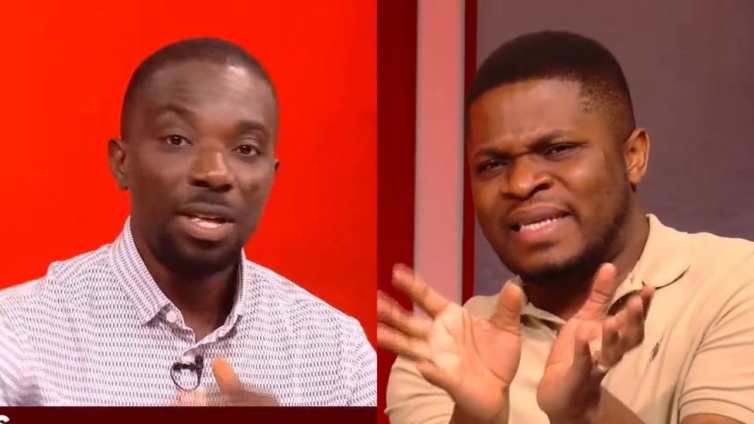
    A heated debate erupted on JoyNews’ Newsfile today between the Communications Officer for the National Democratic Congress (NDC), Sammy Gyamfi, and the Communications Officer for the New Patriotic Party (NPP), Miracles Aboagye, over the Free Senior High School policy.

    During the show, Mr. Gyamfi defended former President John Mahama, claiming that it was under Mahama’s leadership, in accordance with constitutional provisions, that the groundwork for the Free SHS policy was established.

    He argued that Mahama had initiated the program and had always supported accessible education for all Ghanaians.

    However, Mr. Aboagye strongly disagreed. He asserted that Mahama had criticised the policy and lacked any substantial implementation plans.

    The debate became particularly contentious, prompting the host, Samson, to intervene after a moment of intense verbal exchange between the two representatives.

  • You claim you introduced Free SHS but you opposed us when we started – Akufo-Addo to Mahama

    You claim you introduced Free SHS but you opposed us when we started – Akufo-Addo to Mahama

    President Nana Addo Dankwa Akufo-Addo has called on John Mahama, the National Democratic Congress’s flagbearer, to recognize his efforts in implementing the Free SHS policy.

    President Akufo-Addo highlighted that when he first introduced the Free SHS policy, then-President Mahama was critical of the idea, but he now seems to want to take credit for it.

    President Akufo-Addo made this statement in response to Mr. Mahama’s claim that his administration initiated the Free SHS policy in 2015.

    During a media interaction on Sunday, July 7, Mr. Mahama denied accusations that he opposed the Free SHS policy, insisting that his government had started the program.

    However, at the unveiling ceremony of Dr. Matthew Opoku Prempeh as the NPP’s running mate, President Akufo-Addo urged Mr. Mahama to give him the recognition he deserves if he now sees the policy’s benefits.

    “This man criticized us when we said we were going to implement the Free SHS policy. Now that Ghanaians have accepted the policy, he is saying he is the one who introduced Free SHS. Have you ever heard such a thing?”

    “He indeed said that we are forgetful people. Will we forget this too?” President Akufo-Addo said.

    “Today, the leader of the NDC claims he is the one who introduced Free SHS. If he introduced the policy, why did he criticize us when we intended to introduce it? He said if he had 2 billion cedis, he would not invest it in free education. If today he has seen the importance of the policy, he should give me my stone,” he stated.

  • Acknowledge my efforts if you now support Free SHS – Akufo-Addo to Mahama

    Acknowledge my efforts if you now support Free SHS – Akufo-Addo to Mahama

    President Nana Addo Dankwa Akufo-Addo has called on John Mahama, the National Democratic Congress’s flagbearer, to recognize his efforts in implementing the Free SHS policy.

    President Akufo-Addo highlighted that when he first introduced the Free SHS policy, then-President Mahama was critical of the idea, but he now seems to want to take credit for it.

    President Akufo-Addo made this statement in response to Mr. Mahama’s claim that his administration initiated the Free SHS policy in 2015.

    During a media interaction on Sunday, July 7, Mr. Mahama denied accusations that he opposed the Free SHS policy, insisting that his government had started the program.

    However, at the unveiling ceremony of Dr. Matthew Opoku Prempeh as the NPP’s running mate, President Akufo-Addo urged Mr. Mahama to give him the recognition he deserves if he now sees the policy’s benefits.

    “This man criticized us when we said we were going to implement the Free SHS policy. Now that Ghanaians have accepted the policy, he is saying he is the one who introduced Free SHS. Have you ever heard such a thing?”

    “He indeed said that we are forgetful people. Will we forget this too?” President Akufo-Addo said.

    “Today, the leader of the NDC claims he is the one who introduced Free SHS. If he introduced the policy, why did he criticize us when we intended to introduce it? He said if he had 2 billion cedis, he would not invest it in free education. If today he has seen the importance of the policy, he should give me my stone,” he stated.

  • I launched Free SHS, I can’t be against it – Mahama

    I launched Free SHS, I can’t be against it – Mahama

    Former President John Dramani Mahama, flagbearer of the National Democratic Congress (NDC), has stated unequivocally that he is a firm believer in the Free Senior High School (SHS) policy.

    According to him, there would have not been such a policy if not for him. According to Mahama, he launched the Free SHS policy during his administration from 2013 to 2016.

    He reaffirmed his commitment to Ghana’s Free Senior High School (SHS) policy while pledging to improve it if re-elected in the upcoming elections.

    “How can the person who launched free SHS be against it?” he said.

    Addressing journalists in Accra, Mahama emphasized the importance of the Free SHS policy in ensuring equal educational opportunities for all Ghanaian students.

    “The Free SHS policy has come to stay, and I am committed to improving it,” Mahama stated, dispelling assertions that he opposes the policy and underscoring his stance to enhance it to effectively address current challenges.

    Regarding the proposed Free SHS Bill, which is yet to be presented in Parliament, Mahama expressed willingness to support it if aimed at improving and sustaining the policy.

    Meanwhile, the National Association of Graduate Teachers (NAGRAT) has raised significant concerns about the draft Free SHS Bill currently under parliamentary consideration.

    NAGRAT highlighted a lack of consultation with key stakeholders, including teacher unions, in the formulation of the proposed bill.

    The association expressed disappointment with Education Minister Dr. Yaw Osei-Adutwum over plans to separate Junior High School (JHS) from Primary School and abolish the Basic Education Certificate Examination (BECE) as a prerequisite for SHS admission.

    According to NAGRAT, these proposed changes are pivotal and necessitate extensive engagement with all relevant stakeholders to ensure effective implementation.

    Mahama’s remarks come amidst preparations for the 2024 elections, where education policy, particularly the Free SHS initiative, remains a critical issue of debate and reform in Ghanaian politics.

  • I will improve Free SHS policy – Mahama debunks removal claims

    I will improve Free SHS policy – Mahama debunks removal claims

    Former President John Dramani Mahama, flagbearer of the National Democratic Congress (NDC), has reaffirmed his commitment to Ghana’s Free Senior High School (SHS) policy while pledging to improve it if re-elected in the upcoming elections.

    Addressing journalists in Accra, Mahama, who previously served as Ghana’s President from 2012 to 2017, emphasized the importance of the Free SHS policy in ensuring equal educational opportunities for all Ghanaian students.

    “The Free SHS policy has come to stay, and I am committed to improving it,” Mahama stated, dispelling assertions that he opposes the policy and underscoring his stance to enhance it to effectively address current challenges.

    Regarding the proposed Free SHS Bill, which is yet to be presented in Parliament, Mahama expressed willingness to support it if aimed at improving and sustaining the policy.

    Meanwhile, the National Association of Graduate Teachers (NAGRAT) has raised significant concerns about the draft Free SHS Bill currently under parliamentary consideration.

    NAGRAT highlighted a lack of consultation with key stakeholders, including teacher unions, in the formulation of the proposed bill. The association expressed disappointment with Education Minister Dr. Yaw Osei-Adutwum over plans to separate Junior High School (JHS) from Primary School and abolish the Basic Education Certificate Examination (BECE) as a prerequisite for SHS admission.

    According to NAGRAT, these proposed changes are pivotal and necessitate extensive engagement with all relevant stakeholders to ensure effective implementation.

    Mahama’s remarks come amidst preparations for the 2024 elections, where education policy, particularly the Free SHS initiative, remains a critical issue of debate and reform in Ghanaian politics. His commitment to enhancing the policy aims to address current shortcomings while ensuring its sustainability for future generations of Ghanaian students.

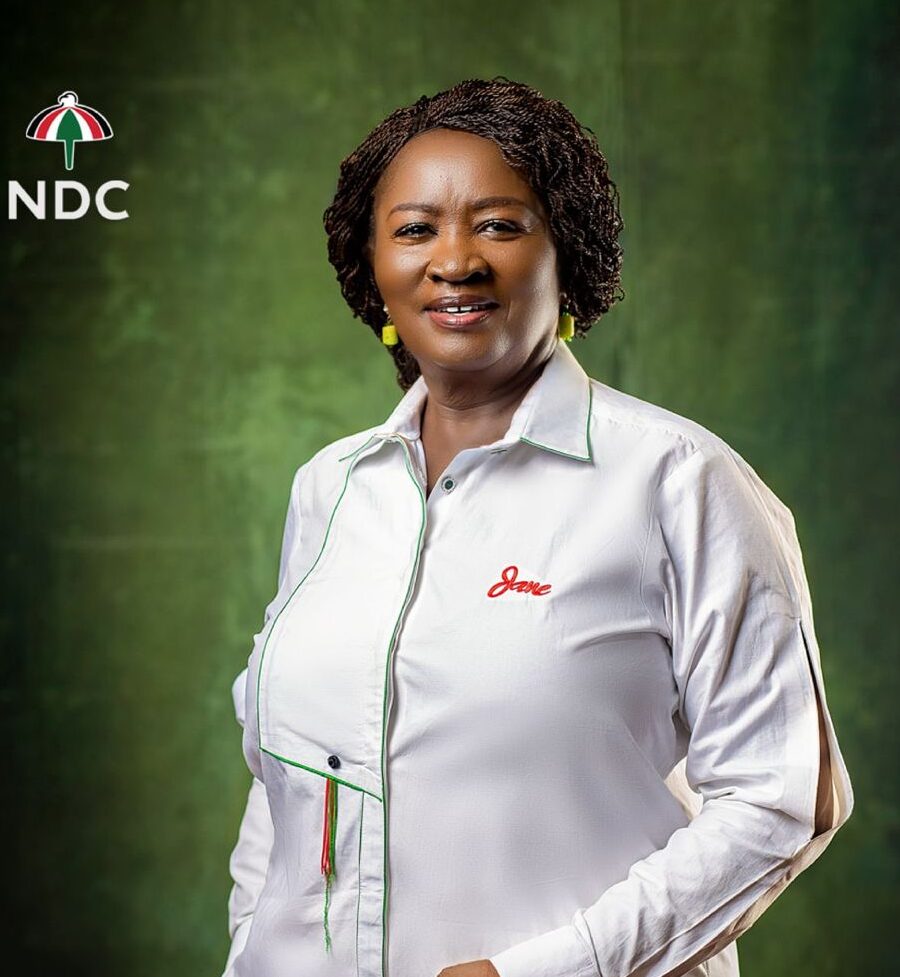
  • Don’t take NPP seriously, they can’t prove Mahama will scrap Free SHS – Naana Jane to public

    Don’t take NPP seriously, they can’t prove Mahama will scrap Free SHS – Naana Jane to public

    Professor Jane Naana Opoku Agyemang, the running mate to John Mahama, the flagbearer of the National Democratic Congress (NDC), has issued a challenge to the governing New Patriotic Party (NPP) to provide evidence supporting claims that the NDC intends to cancel the Free Senior High School (SHS) program if elected into power.

    Speaking during her tour of the Abuakwa North constituency in Akyem-Tafo, Eastern Region, Professor Opoku Agyemang emphasized that the NDC’s stance on the Free SHS program is centered on reviewing and addressing the challenges it currently faces.

    She dismissed allegations of plans to scrap the program as mere political rhetoric aimed at misleading the public.

    “Anybody who has evidence that John Mahama had said anywhere that he will cancel Free SHS should provide it. If the person is unable to do so, let no one take that person seriously. We haven’t said anything like that,” she asserted.

    Professor Opoku Agyemang pointed out that during the NDC’s previous administration, their approach was to introduce the progressively free SHS initiative, aimed at easing the financial burden on parents while ensuring all children had access to education.

    She highlighted improvements made during that time, such as addressing supply shortages for educational materials like books and providing support for students’ essential needs.

    Addressing a gathering at the Saviour Church of Ghana headquarters in Osiem, she reiterated the NDC’s commitment to enhancing the Free SHS program, drawing on their past initiatives to illustrate their dedication to improving educational access and quality.

    During her visit to Akyem-Tafo, Professor Opoku Agyemang also visited the site of a palm oil extraction factory that had recently suffered a devastating fire. She pledged support for the affected community, donating fifty thousand cedis to aid in rebuilding the factory and restoring livelihoods.

    Her tour of Abuakwa North constituency included meetings with local leaders and stakeholders, where she discussed various issues affecting the region and outlined the NDC’s vision for addressing them. The visit concluded with a warm reception from enthusiastic party supporters in Akyem-Tafo.

  • “Free SHS is not an intelligent policy” – Prof Akilagpa Sawyerr opines

    “Free SHS is not an intelligent policy” – Prof Akilagpa Sawyerr opines

    Former Vice Chancellor of the University of Ghana, Prof Akilagpa Sawyerr, has criticized the implementation of the Free Senior High School (SHS) policy as unintelligent.

    He acknowledges that the policy is a wise one but government cannot afford, yet continues to fund.

    Speaking to the media on June 22, he said that while the policy seems fair, it benefits those who can afford to pay fees, while other students still study under trees.

    Therefore, he emphasized that the policy does not make sense.

    “The notion of free education is a loudable one but the suit of that objective without costing, without working out the lines of movement, without working out the impact of other parts of the economy very carefully, for me is a failure of policy not the objective. The notion that my children under this instance could go to a boarding school and get free food, free fees and free everything, when there are other younger student5s under trees. How does that make sense?” the professor said.

    Watch the video below:

  • Government is yet to present Free SHS bill before parliament – Minority

    Government is yet to present Free SHS bill before parliament – Minority

    Minority Leader, Dr. Cassiel Ato Forson has called on the government to promptly present the Free SHS bill to the House, emphasizing the minority’s support for any legislation aimed at improving and sustaining the Free SHS policy.

    Addressing the media, Dr. Forson debunked claims that the minority will oppose the Free Senior High School (SHS) bill, which is yet to be presented before Parliament.

    “We are here to address a major desperation on the ruling NPP and the members of parliament working for the government, particularly the majority leader. In the last few days, the majority leader is on record to have accused the NDC minority of not supporting the Free SHS bill. Let me put on record that there is no such bill before Parliament.”

    “We are hearing from him, for the first time, that the government is considering a bill to be presented to Parliament called the Free SHS bill. As we speak, there is no bill. It is important for us to reiterate that we cannot oppose a bill we have not seen. We have not said anywhere that we are going to oppose such a bill. We are rather urging the NPP to hurry up in presenting such a bill to Parliament.”

    He further highlighted that this is the first time the minority is hearing about the government’s consideration of a Free SHS bill.

    “The minority will at all times support any legislation that seeks to improve and sustain the Free SHS policy,” he stated.

    He also addressed accusations regarding the NDC’s stance on the policy, pointing out that Vice President Dr. Mahamudu Bawumia is on record expressing skepticism about the need for a Free SHS law.


    “In fact, if there is anybody in this country who is on record to have said that he does not believe in the Free SHS law, it is rather Dr. Bawumia. He is on record to have said that there is no need for a law or a bill to regulate Free SHS, not the NDC. All he said we need is commitment.”

  • Exercise caution on Free SHS Bill –  Joshua Alabi tells govt

    Exercise caution on Free SHS Bill – Joshua Alabi tells govt

    The ex-Rector of UPSA in Accra, Prof Joshua Alabi, has advised the government to proceed cautiously with the proposed legislation concerning the Free Senior High School (SHS) policy.

    This bill, anticipated to be presented in Parliament by the Education Minister, aims to legally mandate future administrations to uphold the policy.

    During an interview with Citi News in Accra on Thursday, Prof Alabi suggested that the government should prioritize periodic evaluations of the program to ensure its optimal effectiveness.

    “In the first place we are not saying the Free SHS is not good. We have never said that all that we are saying is that the way it is being run is not the best for our people and that is why we kept in the word review and they told the whole world that we were going to stop it and that was just very unfortunate.

    “Everything needs development, So, you can’t put something in the constitution which will just [be] cast in stone.”

    “I think what we have to do is to make sure that we give an opportunity for reviews to develop and progress. So, I don’t know exactly what the bill is going to look like, but I think that we should tread cautiously,” he stated.

  • Free SHS’ influence on poverty reduction minimal – Study

    Free SHS’ influence on poverty reduction minimal – Study

    A recent study by three institutions has found that the Free Senior High School (Free SHS) policy, introduced by the government in 2017, has had a less significant impact on poverty reduction than initially expected.

    The study attributes this to the policy’s universal approach, which does not adequately address the significant disparities in access to secondary education between wealthy and disadvantaged households.

    The research was conducted by the World Bank, Oxfam in Ghana, and the Institute of Statistical, Social and Economic Research (ISSER) at the University of Ghana. It aimed to assess the impact of the government’s fiscal interventions on Ghanaian society.

    Titled “Fiscal Interventions and Welfare in Ghana: A Commitment to Equity (CEQ) Assessment Using the Ghana Living Standards Survey (Round 7),” the study’s findings were presented during the launch of an analytical simulation tool designed to monitor and understand living conditions in the country.

    The tool, known as the Microsimulation Tool on Fiscal Incidence Analysis, is based on the Ghana Living Standards Survey (GLSS).

    Economic Growth

    Presenting the study’s findings in Accra last Friday, researchers from the International Centre for Evaluation and Research highlighted that Ghana experienced a steady economic growth rate of over six percent on average from 2005 to 2017 (World Development Indicators, 2022).

    However, Dr. Kwadwo Danso-Mensah, Director of Research at the International Centre for Evaluation and Research, noted that the benefits of this growth were not equitably distributed. This inequity has the potential to undermine the extent of poverty reduction and welfare improvement that high economic growth could otherwise achieve.

    Dr. Danso-Mensah pointed out that while poverty rates have declined, inequality has been rising.

    Government’s Role

    Dr. Danso-Mensah emphasized that the government’s role in ensuring that economic growth leads to significant welfare gains through improved income distribution and poverty reduction cannot be overstated. The government wields substantial control over the economy, particularly through fiscal policy measures, which can either promote inclusive growth or indirectly lead to significant changes that benefit welfare outcomes in both the short and long term.

    He stressed the importance of comprehensively investigating how various government spending and taxation measures impact poverty and inequality.

    “This brings to the fore the need to investigate in a comprehensive manner, the extent to which various governments’ spending and taxation instruments independently or together impact on poverty and inequality.

    “An analysis such as is done in this study provides evidence on key factors that promote or limit the redistribution and poverty reduction effect of government’s fiscals,” he said.

    Methodology

    The study employed the Commitment to Equity (CEQ) assessment framework, developed by the CEQ Institute and detailed in the CEQ Handbook. Unlike other approaches for fiscal incidence analysis that focus on specific taxes or expenditures, the CEQ framework accommodates multiple fiscal policy elements simultaneously, providing a comprehensive analysis of their redistributive impacts.

    Dr. Danso-Mensah explained that the framework allows for the allocation of benefits from various fiscal interventions and government programs to households in a micro-level socio-economic survey, comparing different income concepts within the CEQ building blocks of fiscal incidence analysis.

    Findings

    The simulation results for the Free SHS policy indicated that, in the short term (without considering any behavioral responses to the policy), poverty rates decreased marginally by 0.07 percentage points and 0.22 percentage points at the national lower and upper poverty lines, respectively.

    The Gini coefficient, a measure of income inequality, also reduced by 0.10 percentage points when households incurred some education expenses. A higher Gini coefficient indicates greater income inequality.

    However, Dr. Danso-Mensah noted that the Free SHS policy was less progressive than if there were no Free SHS. This outcome is expected, given the policy’s universal nature and the fact that wealthier households had better access to secondary education when the policy was introduced.

    “This result, however, comes with a strong caveat that the analysis is static and does not incorporate behavioral responses which may reflect increased access or enrollment rates for the poor,” Dr. Danso-Mensah said.

    Microsimulation Tool

    Paul Coral, Senior Economist at the World Bank, explained that the tool is built on the GLSS round seven, the most recent data on living standards in the country.

    “The tool allows us to assess the distributional impacts of policies and reforms and their effects on the poor, the vulnerable, and the population at large. It helps identify progressive versus regressive impacts,” he added.
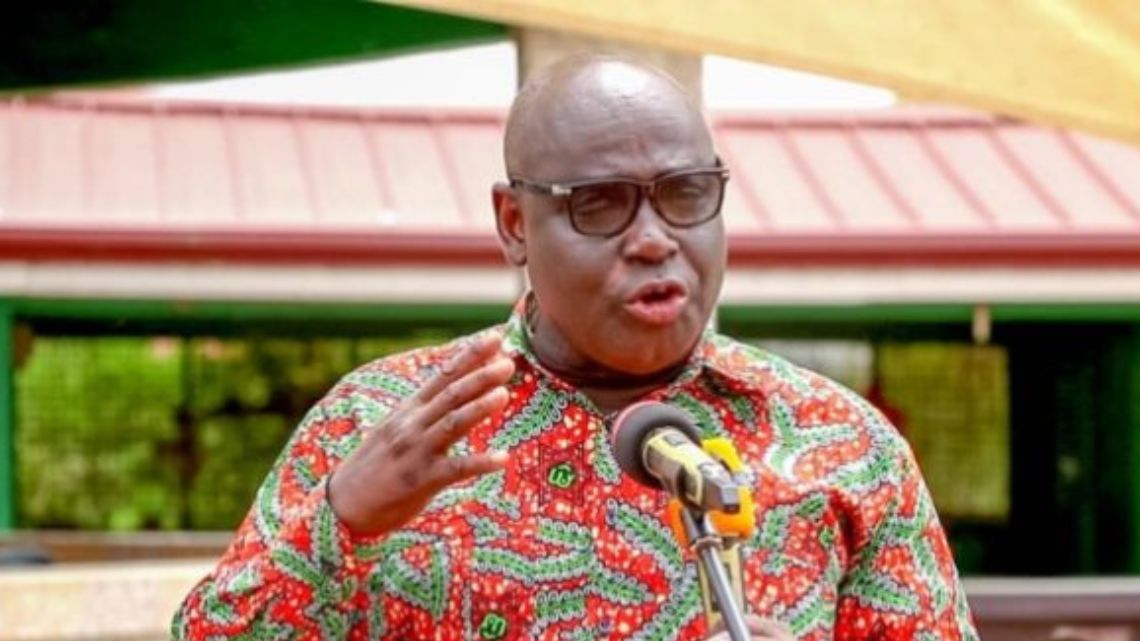
  • We will thoroughly assess Free SHS Bill – Minority

    We will thoroughly assess Free SHS Bill – Minority

    The Minority Caucus in Parliament has announced its plan to advocate for a dedicated funding mechanism for the Free Senior High School (SHS) policy in an upcoming proposed government legislation.

    This decision comes in response to a statement made by Majority Leader Alexander Afenyo-Markin on Tuesday, June 11, regarding the government’s intention to introduce a bill aimed at sustaining the Free SHS policy.

    Peter Nortsu-Kotoe, Ranking Member on the Education Committee of Parliament, emphasized the Minority’s commitment to thoroughly scrutinizing the bill once it reaches the house.

    He underscored the necessity of ensuring that the provisions of the bill secure the long-term viability and efficacy of the Free SHS policy.

    “Is there going to be any dedicated funding for the free SHS? I will demand that, and that will be my first preoccupation. Because you just don’t come and bring a bill, and then the bill says that no government should change anything about the Free SHS.”

    “You cannot do that. Only the constitution can make entrenched provisions, but not an act of Parliament, so we will look at all those things when the bill is presented.”

    He highlighted that only constitutional provisions are entrenched, not parliamentary acts, and all aspects will be scrutinized during the bill’s presentation.

    Mr. Nortsu-Kotoe asserted that the government’s motive is to utilize the policy as a political tool against the NDC. Nonetheless, he affirmed that the Minority will conduct thorough evaluations when the bill is tabled in parliament.

    “You have six months to leave office, then you are coming to give it [Free SHS] legal backing to tie the hands of any government that will succeed you. That is what they want to do. And then thinking that they will use it as a political tool, or that when they bring it to Parliament, NDC will oppose it,” he added.

  • No one is asking for Free SHS policy to be abolished – Alex Segbefia

    No one is asking for Free SHS policy to be abolished – Alex Segbefia

    A former Health Minister, Alexander Segbefia, has emphasized the need to review the government’s Free Senior High School (SHS) policy to ensure its sustainability and effectiveness.

    Speaking on Joy FM’s Super Morning Show, Mr. Segbefia acknowledged the policy as a beneficial social intervention but stressed that it requires evaluation to address its associated challenges.

    Mr. Segbefia critiqued the New Patriotic Party’s (NPP) proposed Free SHS Bill, arguing that it seeks to entrench the policy rather than address its issues.

    “The Free SHS policy should be reviewable. So if the NPP is bringing a Free SHS Bill that will be looking at these issues and addressing them, which a policy document can do anyway, then it makes sense. But it seems the Bill is to protect the Free SHS policy which makes no sense. And that is where the NDC [National Democratic Congress] or minority has a problem,” he stated.

    He further accused the NPP of engaging in political mischief by misleading the public into believing that opponents of the Bill want to abolish the Free SHS policy.

    “Nobody has ever said that the Free SHS is a bad thing. As for the review, it is necessary and even the IMF has made it part of the programme that the government should look at the Free SHS policy. Nobody has said scrap, review is review,” he emphasized.

    Mr. Segbefia also pointed out that the initial call for a review of the Free SHS policy came from within the NPP itself, specifically from former Finance Minister Ken Ofori-Atta.

    He cited Mr. Ofori-Atta’s suggestion that the policy should be targeted at those with genuine needs rather than benefiting everyone indiscriminately.

    “He looked at the books and made it abundantly clear that it is not in the country’s interest that there is no payment scheme that can help the course,” Segbefia noted.

    The Free SHS programme was a major campaign promise by then-Presidential candidate Nana Akufo-Addo in 2016 and has since become an integral part of Ghana’s educational system following its launch in 2017.

  • We’re not against Free SHS Bill – Minority

    We’re not against Free SHS Bill – Minority

    The Minority in Parliament has declared its endorsement of the Free Senior High School (FSHS) Bill, pending its presentation to Parliament.

    This decision is aimed at dispelling speculations suggesting that the National Democratic Congress (NDC) intends to revoke the policy if it assumes power in the future.

    Member of Parliament for Builsa South and Deputy Ranking Member on the Education Committee, Dr. Clement Apaak, highlighted in a statement that the Minority does not oppose FSHS and welcomes the proposed bill.

    He emphasized that the bill would bind future governments to uphold the policy. Dr. Apaak also referenced former President John Dramani Mahama’s commitment to enhancing the implementation of FSHS, addressing issues such as inadequate infrastructure, food quality, and irregular academic calendars.

    While awaiting the details of the bill, Mr. Apaak stated that the Minority supports the initiative in principle, aiming to secure the future of FSHS.

    The government is poised to introduce the Free Senior High School (SHS) Bill to Parliament shortly, with the objective of regulating the policy and ensuring its sustainability.

    During a Leaders’ Media Briefing on Tuesday, June 11, Majority Leader Alexander Afenyo-Markin revealed that the bill aims to enhance the effectiveness and sustainability of the policy, aligning with the principles outlined in Chapter 5 of the Constitution.

    Find below the statement by the Minority

    WE ARE NOT OPPOSED TO A BILL ON FSHS BILL

    We are not opposed to FSHS and therefore can not be opposed to a proposed bill to bind future government to it. As John Dramani Mahama noted during his meeting with the national leadership of CHASS on May 8th, 2024, he will work with them and all stakeholders to make FSHS better.

    Our Flagbearer, John Dramani Mahama, has indicated time without number that, the FSHS policy is a good policy bedevilled with implementation challenges: inadequate academic and residential infrastructure; inadequate and poor quality food; inadequate furniture; erratic academic calendar, among others. John Dramani Mahama has pledged to address these challenges to make FSHS better.

    So, while we wait to see the proposed bill and examine its contents in detail, in principle, we have no challenge supporting a bill seeking to ensure its future.

    Dr. Clement Apaak
    MP, Builsa South and Deputy Ranking Member, Education Committee of Parliament.

  • There is no policy document on Free SHS, what will be the basis of the law? – Nortsu-Kotoe quizzes gov’t

    There is no policy document on Free SHS, what will be the basis of the law? – Nortsu-Kotoe quizzes gov’t

    Mr Peter Nortsu-Kotoe, the Ranking Member on Parliament’s Education Committee, has expressed criticism towards the government’s proposal to introduce a bill on Free Senior High School (SHS), calling it unnecessary.

    Mr Nortsu-Kotoe questioned the rationale behind the need for a law to regulate or entrench the Free SHS program, noting the absence of an official policy document on free SHS despite requests made to both previous and current education ministers over the past several years.

    In contrast, Majority Leader Alexander Afenyo-Markin argued that enacting a Free SHS Act would elevate the policy from a mere aspiration to a justifiable right, enabling citizens to seek legal redress if the policy is not implemented.

    However, in an interview with JoyNews on June 11, Mr Nortsu-Kotoe cited the constitution’s provision, Act 25 (1b), which mandates that secondary education, including technical and vocational training, should be progressively made free—a process that commenced in 2015.

    He suggested that the current government’s implementation of the Free SHS policy aligns with public expectations, implying that additional legal protections are unnecessary.

    “There is no need for any law to regulate or entrench the Free SHS programme. As a committee on education, we have asked the previous minister and the current one that we want to see a Free Senior High School policy or document and for seven to eight years now we have not been able to provide the committee with the policy document. If you don’t even have a policy on what basis are you going to pass the law?” Nortsu-Kotoe questioned.

    He further explained, “In any case, the constitution has a provision, Act 25 (1b), that secondary education in all forms including technical and vocational should be progressively made free and that is what we started in 2015.

    “So, for this government to have come to office and implemented it as they wanted, I don’t think any Ghanaian has a problem with that. For me, enacting a law to protect it or whatever is neither here nor there.”

  • Free pre-tertiary education is already law, Free SHS bill serves as NPP’s political legacy – EduWatch

    Free pre-tertiary education is already law, Free SHS bill serves as NPP’s political legacy – EduWatch

    Africa Education Watch (Eduwatch), a leading educational policy think tank, has expressed apprehension regarding the proposed government Free Senior High School (SHS) Bill, suggesting that it is being positioned more as a political legacy than a sustainable educational reform.

    The bill, slated to be presented to Parliament soon, aims to regulate the Free SHS policy and ensure its long-term sustainability.

    This policy, a cornerstone of the Akufo-Addo administration, aims to eliminate financial barriers to secondary education by covering fees, textbooks, boarding, and meals.

    While the initiative has garnered praise for improving access to education, particularly for girls, Eduwatch contends that the timing of the bill and the government’s approach suggest a focus on political gains rather than long-term educational benefits.

    In an interview on Eyewitness News on Citi FM, Kofi Asare, the Executive Director of Eduwatch, pointed out that the Free SHS policy was already covered under the Pre-Tertiary Education Act. Therefore, he questioned the necessity for a new law on the matter.

    Asare also highlighted that the bill was addressing the least of the challenges faced by the Free SHS policy, emphasizing the need for urgent attention to more pressing issues.

    “I am a bit lost because in December 2020 Parliament passed a law called the Pre Tertiary Education Law which is Act 10(49). This law which was assented on 29th December 2020 has free SHS captured under section 3 which says that ‘Secondary education in its different forms including TVET shall be free and accessible to all eligible candidates. So this provision in the pre-tertiary education law is to give legal effect, is to give binding effect.”

    “…I think that perhaps the only reason is, it is a legacy reason. It looks more political legacy kind of style. But in reality, if you ask me the top 10 challenges or problems that require urgent attention on the Free SHS policy, the law would not be in the [space] of 10,” he stated.

  • I will engage Cabinet to include PTAs in Free SHS food distribution – Bawumia

    I will engage Cabinet to include PTAs in Free SHS food distribution – Bawumia

    On Thursday, June 6, 2024, Vice President Dr. Mahamudu Bawumia announced plans to engage Cabinet regarding the potential involvement of parents in overseeing food distribution for students enrolled in the free SHS program.

    Concerns have been raised about the quality of food provided to students, as well as reports of some school authorities misappropriating food items for personal use.

    Additionally, recent issues with food supply shortages have been highlighted, with the National Food Buffer Stock citing government arrears.

    During a meeting with clergy members as part of his Greater Accra Region tour on Wednesday, June 5, Vice President Bawumia was urged by a clergy member to consider involving Parent-Teacher Associations (PTAs) in supervising food distribution to schools if he assumes the presidency.

    Dr. Bawumia expressed support for the idea, noting that he had already written on the proposal. He pledged to inform Cabinet about the initiative during their meeting on Thursday.

    Acknowledging the potential for misuse in the current system, Dr. Bawumia emphasized the importance of implementing effective solutions. He cited his longstanding interest in improving governance and efficiency, referencing his past writings on similar topics.

    Additionally, Dr. Bawumia highlighted the importance of commercial agriculture in addressing high food prices. He proposed expanding food production through technology-driven precision agriculture, mechanization, and irrigation to reduce food costs.

    “If they get five bags, they may declare one bag. If nobody is looking. And so, this is a brilliant, really, suggestion. So, tomorrow I’ll be in Cabinet with the Education Minister and this is one of the first things I’m going to tell him that we are going to have to do. This makes a lot of sense,” Dr. Bawumia noted.

    “I’ve even written a book in 2010 on some of these things. And you’ll find some of these ideas. These are the ideas that keep playing in my mind. I’m always thinking of how to get things done, how to do things better, and all of that. So, I take your point very well.”

    Furthermore, he mentioned plans to explore electric vehicles for public transportation as part of broader efforts to address environmental and economic challenges.

    “Going forward, this is why I’m focusing on a few areas. First of all, I think agriculture and the expansion in food production will bring down food prices so that the hunger that we feel will come down. So Agric becomes very important in bringing down food prices.

    “This is why I believe that commercial agriculture, technology-driven precision agriculture, irrigated agriculture, mechanized agriculture is the way for Ghana to go, as many countries will do. I’ve also made a suggestion. We hope to start experimenting this year for public transport to move towards electric vehicles,” he explained.

  • UNESCO places Ghana’s secondary education 137th out of 167 counties

    UNESCO places Ghana’s secondary education 137th out of 167 counties

    Ghana’s efforts to expand access to secondary education have been commendable, as highlighted in the recent Legatum Prosperity Index.

    Ranked 137th out of 167 countries, Ghana has significantly increased its secondary school enrollment from 42.5% in 2013 to 57.2% in recent years, according to UNESCO.

    This improvement represents a significant step forward from its 2013 ranking of 144. However, despite this progress, there remains a stark reality: the quality of secondary education in Ghana is a major concern, ranking 166th out of 167 countries in the Legatum Prosperity Index.

    The Legatum Prosperity Index, an annual ranking developed by the Legatum Institute, provides a comprehensive assessment of nations’ prosperity across various indicators, including education.

    While Ghana has made commendable progress in increasing enrollment rates, the significant gap in educational quality underscores the urgent need for reform and investment to improve the overall learning experience.

    Ghana’s tertiary education sector fares somewhat better, ranking 94th out of 167 countries. While this is a more favorable position compared to secondary education, there is still room for improvement to ensure that tertiary institutions meet global standards of excellence and relevance.

    The challenges facing Ghana’s education system are complex. Despite efforts to expand access to schooling, persistent issues such as inadequate infrastructure, lack of teaching resources, and a mismatch between curricula and industry needs continue to affect the quality of education at all levels.

    Addressing these challenges requires a coordinated effort from policymakers, educators, and stakeholders.

    Investment in education should not only focus on increasing enrollment rates but also prioritize initiatives to improve teaching quality, curriculum relevance, and infrastructure development.

    Collaborative partnerships between government agencies, educational institutions, and the private sector can play a crucial role in driving meaningful reforms and fostering innovation in Ghana’s education sector.

    Furthermore, leveraging technology and digital resources can provide transformative opportunities to supplement traditional teaching methods, expand access to quality educational materials, and bridge learning gaps across geographical boundaries.

    As Ghana seeks to enhance its global standing and develop a skilled workforce capable of driving sustainable development, investing in the future of its education system is crucial.

    By prioritizing both access and quality in education, Ghana can pave the way for prosperity, empowerment, and inclusive growth for its citizens.

  • Free SHS needs improvement – Bawumia

    Free SHS needs improvement – Bawumia

    The New Patriotic Party’s (NPP) flagbearer has acknowledged the achievements of the government’s Free Senior High School (SHS) policy, while also recognizing the need for further improvements.

    He has reaffirmed his commitment to ensuring the policy’s sustainability under his leadership.

    Despite challenges, including promises from the National Democratic Congress’s flagbearer, John Dramani Mahama, to review it upon assuming power, the Vice President emphasized the Free SHS’s significant success.

    In an interview with Africa Watch Magazine, Dr. Bawumia stated, “The policy has therefore been a resounding success. That does not mean it is without problems. There is more to be done to improve it.

    “I am committed to the Free SHS policy, and I believe it would be safe and sustainable in my hands,” Dr Bawumia noted.

    Dr. Bawumia pledged to bolster the policy by constructing additional infrastructure such as classroom blocks, dormitories, and dining facilities for schools across Ghana. He also committed to investing in teacher training and professional development to enhance curriculum relevance and alignment with workforce needs.

    “My government will build more infrastructure like classroom blocks, dormitories, and dining facilities for the schools. My government will also invest in teacher training and professional development, enhancing curriculum relevance and alignment with workforce needs,” he promised.

    Furthermore, he highlighted the policy’s significant impact on student enrollment in Senior High Schools, particularly in underserved regions.

    He noted that Ghana has achieved gender parity in SHS education, with an increase in enrollment not compromising quality.

    He concluded by stating that the policy’s success underscores the need for ongoing improvements and enhancements to ensure its effectiveness in providing accessible and quality education to all Ghanaian youth.

    “The programme is a cornerstone of our government’s commitment to expanding access to quality education for all Ghanaian youth. It is probably one of the most successful social intervention programmes ever implemented in Ghana.

    “It has dramatically boosted student enrollment in senior high schools across the country. What is more important, the highest enrollments are coming from the poorest regions of Ghana, like the five northern regions.

    “Furthermore, Ghana has now attained gender parity in senior high-school education as more girls than boys have accessed the programme. Also, the increase in enrollment has not resulted in a reduction in quality.

    “In fact, the performance of the students in the West African Senior School Certificate Examination last year shows that the free SHS beneficiaries attained the best results since 2014. The policy has therefore been a resounding success. That does not mean it is without problems. There is more to be done to improve it.”

  • We are not seeing quality education due to Free SHS – Prof. Gyampo

    We are not seeing quality education due to Free SHS – Prof. Gyampo

    A political science lecturer at the University of Ghana, Professor Ransford Gyampo, has voiced his criticism of the current structure of the Free Senior High School (SHS) policy.

    He contends that the policy falls short of upholding quality educational standards.

    During the launch of the Relief and Aid International Educational Scholarship in Accra, Professor Gyampo suggested that directing the policy towards academically talented yet financially disadvantaged students could ease the financial strain on the government while preserving educational standards.

    “Government is trying to provide free education to everybody, free SHS to everybody. But it knows it doesn’t have the resources to do it. But because we have promised that we will do it, we will do it at all costs, whether we can do it or we can’t do it, we will still do it. That does not promote quality education.”

    Dr. Nyaho Nyaho-Tamakloe, a founding member of the New Patriotic Party (NPP), commented on the issue, pointing to recent corruption allegations within the Scholarship Secretariat as a sign of diminishing integrity in Ghana.

    “We have seen quite a lot in this country. Normally, scholarships are meant for the needy. I went to university with a scholarship. I went to secondary school with a scholarship. I schooled with a scholarship. But now scholarships meant for the needy are given to those who don’t need them. It tells you that integrity is at its lowest level in Ghana at the moment.”

  • Gari no more compulsory for Free SHS students because they are fed thrice a day – NPP

    Gari no more compulsory for Free SHS students because they are fed thrice a day – NPP

    A member of the Communications team for the ruling New Patriotic Party (NPP), Vera Wiredu, has praised the impact of the Free Senior High School policy initiated by the administration of President Akufo-Addo.

    During an appearance on TV3’s New Day program,Madam Wiredu highlighted the policy’s success in achieving its social intervention objectives.

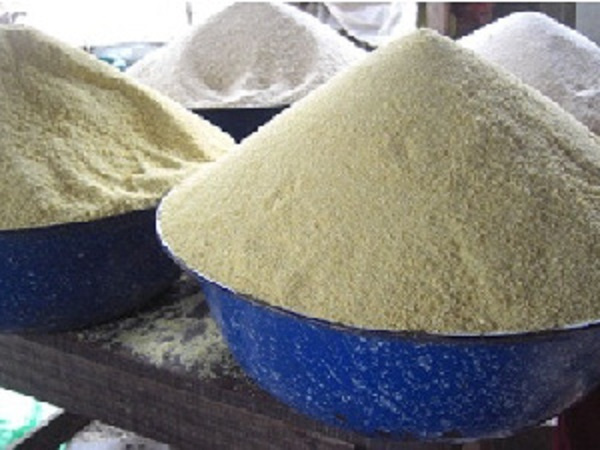
    She pointed out that students who previously brought gari to school no longer find it necessary, as they are now well-fed under the policy.

    “His Excellency Nana Addo, compassionate, visionary and result-oriented Bawumia, they said whether you are rich, whether you are poor, you are a Ghanaian, go to school; everything is free.

    “All you do is get your chop box, the gari is not even compulsory because you are being fed three hot meals a day.

    “So, if you go you don’t need gari. I have children, not necessarily personal or biological children in Free Senior High, they take gari and return the gari home,” she stated.

    Wiredu contrasted the NPP’s performance with that of the opposition National Democratic Congress (NDC), asserting that the NDC’s history of poor governance disqualifies them from reclaiming power.

    She reiterated the NPP’s stance that the NDC’s call for a review of the Free Senior High School policy signals their intention to abolish the policy if they come into power.

  • Free SHS students return gari they take from home due to abundance of food – NPP member

    Free SHS students return gari they take from home due to abundance of food – NPP member

    A member of the communications team for the ruling New Patriotic Party (NPP), Vera Wiredu, has praised the impact of the Free Senior High School policy led by President Akufo-Addo’s administration.

    During an appearance on TV3’s New Day program, she highlighted that the policy has exceeded its social intervention objective.

    Madam Wiredu pointed out that students who previously had to bring gari to school no longer need to do so because they are well-fed under the policy.

    “His Excellency Nana Addo, compassionate, visionary and result-oriented Bawumia, they said whether you are rich, whether you are poor, you are a Ghanaian, go to school; everything is free.

    “All you do is get your chop box, the gari is not even compulsory because you are being fed three hot meals a day.

    “So, if you go you don’t need gari. I have children, not necessarily personal or biological children in Free Senior High, they take gari and return the gari home,” she stated.

    In a comparison between the NPP and the opposition National Democratic Congress, Vera Wiredu highlighted the NDC’s track record of poor governance, stating that they do not deserve to return to power.

    She reiterated the NPP’s stance that the NDC’s call for a review of the Free Senior High School policy indicates a clear intention by the opposition to cancel the policy if they come into power.

  • Mahama promises to fix Free SHS policy in first 100 days of office

    Mahama promises to fix Free SHS policy in first 100 days of office

    Flagbearer of the opposition National Democratic Congress (NDC), John Dramani Mahama, has pledged that a future NDC government will prioritize resolving issues surrounding the implementation of the Free Senior High School (SHS) policy.

    This commitment comes amid concerns about the policy’s execution and funding.

    Speaking at a meeting with representatives from various teacher unions, including the Ghana National Association of Teachers (GNAT), the National Association of Graduate Teachers (NAGRAT), and the Coalition of Concerned Teachers, Mr. Mahama outlined plans to strengthen the education sector.

    He announced his intention to convene a stakeholder forum on education within his first 100 days in office to gather feedback on how to enhance and provide quality education.

    “Within the first 100 days of me becoming president, we will hold a stakeholder dialogue on education. It will have as part of its focus the implementational bottlenecks of the Free SHS, but it is also going to deal with how we can improve financing and teaching and learning at the basic school level and so at that stakeholder’s engagement, NAGRAT, GNAT, parents, students, educational experts, everybody is going to be there and we are going to have a discussion on access, on equity, on affordability, and on financing our educational system.”

  • Cancel Free SHS if that is what is causing price of fuel to rise – Angry driver tells Akufo-Addo

    Cancel Free SHS if that is what is causing price of fuel to rise – Angry driver tells Akufo-Addo

    An aggrieved driver has voiced his frustration over the government’s decision to increase fuel prices.

    He linked the government’s intention to the implementation of the Free Senior High School (SHS) policy. 

    Speaking to the media, the driver questioned the rationale behind the fuel price hike in connection with the purported benefits of Free SHS, calling for its cancellation.

    “How will free shs help me? Why would you increase fuel due to Free SHS? Why would you let me suffer. Free SHS is not helping, cancel it, it is not helping,” he lamented.

    With fuel prices hitting record highs, concerns over the impact on transportation costs and living expenses have escalated.

    While the Free SHS policy has been lauded for increasing access to education, its implications for government spending and fiscal policy have come under scrutiny.


    Critics argue that the policy’s financial implications, coupled with external factors such as global fuel price fluctuations, have contributed to the current economic challenges.

    Meanwhile, the Ghana Private Road Transport Union (GPRTU) and the Ghana Road Transport Coordinating Council (GRTCC) has issued a cautionary advisory, urging commuters to refrain from accepting any new fares that have not received official approval.


    This comes in response to an announcement made by the Transport Operators Union and the Concerned Drivers Association of Ghana, proposing a 30% fare increase set to come into effect on Saturday, April 13.

    In their joint press release, the GPRTU and the GRTCC attributed the decision to raise fares to the perceived failure of the government to adequately address longstanding issues within the transport sector.


    However, the directive has led to some confusion and disagreement between commuters and drivers regarding the implementation of the new fare adjustments.

    Watch video below:

  • Do you have amnesia? Sheer hypocrisy! – Salam Mustapha slams Mahama over ‘One Student, One Tablet’ criticism

    Do you have amnesia? Sheer hypocrisy! – Salam Mustapha slams Mahama over ‘One Student, One Tablet’ criticism

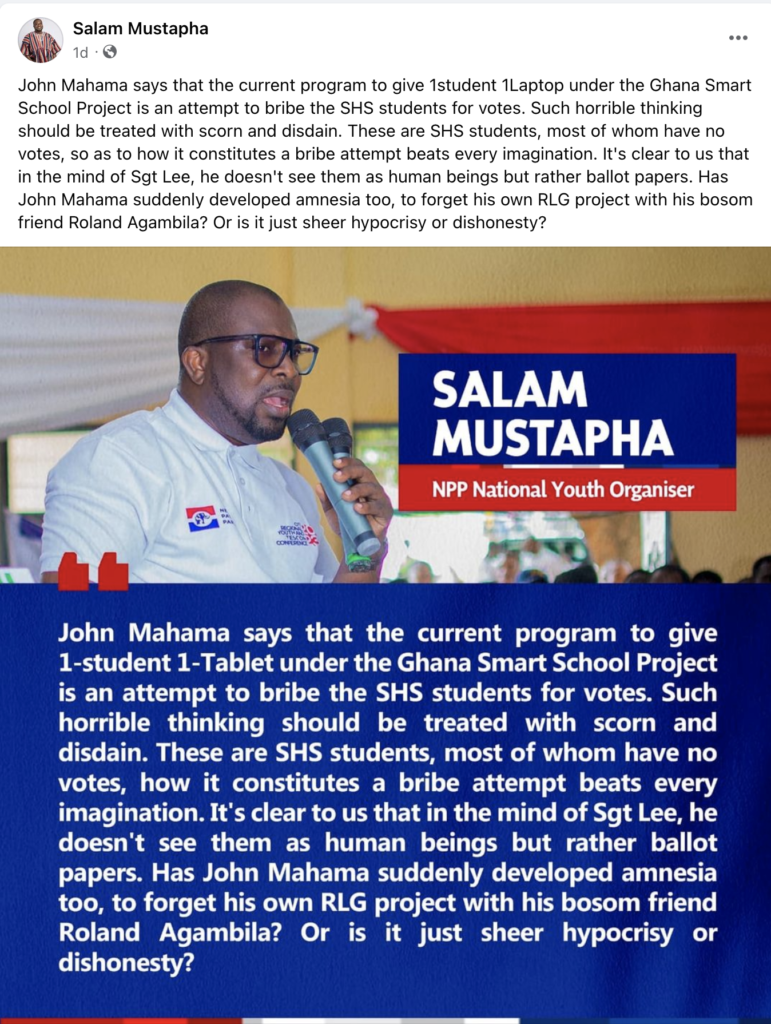
    The National Youth Organizer of the New Patriotic Party (NPP), Salam Mustapha, has strongly criticised John Dramani Mahama, the flagbearer of the National Democratic Congress (NDC), for his remarks on the government’s ‘One-Student-One-Tablet’ initiative.

    Mustapha took to social media to express his disapproval of Mahama’s stance, calling for the public to regard such comments with contempt.

    Mustapha argued that while the NPP government prioritises the welfare of students as the future of the nation, Mahama views them merely as potential voters in upcoming elections.

    He questioned Mahama’s credibility and the NDC’s right to criticise the initiative, reminding them of a similar project implemented during their tenure.

    “John Mahama says that the current program to give 1student 1Laptop under the Ghana Smart School Project is an attempt to bribe the SHS students for votes. Such horrible thinking should be treated with scorn and disdain.

    “These are SHS students, most of whom have no votes, so as to how it constitutes a bribe attempt beats every imagination. It’s clear to us that in the mind of Sgt Lee, he doesn’t see them as human beings but rather ballot papers,” Mustapha remarked.

    “Has John Mahama suddenly developed amnesia too, to forget his own RLG (formerly Roagams Link Ghana Ltd ) project with his bosom friend Roland Agambire? Or is it just sheer hypocrisy or dishonesty?” he questioned.

    John Dramani Mahama, speaking at a student forum at Wisconsin University in Accra, criticised the government’s allocation of tablets to high school students, labelling it as a tactic to influence votes.

    Mahama argued, “you bring a new curriculum; the children have no textbooks in basic schools for the last four years, and you think that giving pre-tertiary students tablets is more important. Of course, everybody knows the political expediency.”

    “The pre-tertiary students are going to register in May because some of them are going to be 18 and above. Some are 18 already, and they are going to be the ones voting. So, this is a gift to entice them to vote for the current government. It’s a bribe for them to vote for this government, but I mean, the students do not exist in isolation. They live in households and families,” Mahama added.

    In 2010, the Ministry of Environment, Science and Technology in Ghana contracted RLG Communications Limited to manufacture and distribute over 103,181 laptops. The NDC government at the time paid GH¢51,257,500.00 for these laptops.

    However, RLG was only able to produce 90,448 laptops, leaving a balance of 12,733 pieces worth GH¢6,366,875.00 undelivered. This discrepancy led to violations in the execution of the contract, as highlighted in a 2015 Auditor General’s Report.

    As a result, RLG Communications Limited agreed to repay GH¢6 million to the government due to its failure to supply the remaining laptops under the Free Laptop Distribution Programme in 2010.

  • Ghana’s digitalisation drive will churn out technically-inclined students –  Akufo-Addo

    Ghana’s digitalisation drive will churn out technically-inclined students – Akufo-Addo

    President Akufo-Addo has outlined the advantages Ghana stands to gain from its education digitization efforts, as the government equips students with tablet computers.

    Under the ‘One Student, One Tablet’ initiative of the Ghana Smart Schools Project, approximately 1.3 million Senior High School (SHS) students are set to receive tablets, each loaded with digital content to enhance research, teaching, and learning processes, aimed at fostering technical competence among students.

    The primary goal is to provide students with cutting-edge learning tools, empowering them to compete globally in the 21st century and Fourth Industrial Revolution.

    President Akufo-Addo emphasized the government’s commitment to transforming the educational sector to meet modern demands, with a significant focus on Science, Technology, Engineering, and Mathematics (STEM) education, as well as technical and vocational training.

    Highlighting the pivotal role of education in national development, the President underscored the government’s dedication to enhancing the ‘Free SHS’ policy further, with a shift towards digitalization to improve online and offline teaching and learning experiences.

    At the tertiary level, plans are underway to offer discounted tablets and laptops to students and lecturers to facilitate academic activities.

    President Akufo-Addo justified the substantial investment in education, citing record-high enrollment figures in SHS and significant budgetary allocations aimed at ensuring educational transformation.

    As part of the Ghana Smart Schools Project, the government is constructing 100 educational facilities equipped with solar panels and digital infrastructure, with 30 expected to be completed this year, fostering innovative and futuristic education.

    Dr. Yaw Osei Adutwum, Minister of Education, expressed optimism about Ghana’s educational future, emphasizing the transformative power of education in nation-building and commending the President’s commitment to achieving the nation’s educational goals.

    The program, attended by Vice President Dr. Mahamudu Bawumiah, education experts, technocrats, and members of the Diplomatic Corps, signals Ghana’s determination to harness the potential of digitization in education for sustainable development.

    “Government continues to seek innovative ways to boost further the ‘Free SHS’ policy.

    “As we gather here today, let us reflect on the crucial role education plays in shaping the destiny of our nation. Indeed, education is at the centre of poverty eradication,” he stated.

  • Apart from maize, I don’t have anything to feed my students – Jirapa SHS Headmaster

    Apart from maize, I don’t have anything to feed my students – Jirapa SHS Headmaster

    Students in Jirapa Senior High School have been left with the option of feeding on either maize for survival.

    This is according to the Headmaster of the institution, Primus Baro, who attributes the situation to the impact of Akufo-Addo’s Free SHS policy.

    According to him, his student, are not provided with any menu currently because all there is to feed on is food made out of maize.

    Consequently, they are compelled to rely on Tuo Zaafi, or porridge for sustenance.

    Baro noted that rice was not even available at the time of his statement, leaving maize as their primary food source.

    “As I speak, apart from maize, I don’t have anything currently now as I sit. And I am mentioning my school. Last week we received some food stuff, and we got maize so much. We didn’t receive rice until yesterday when I had to fall on my PTA to give me some rice. I just came from Accra Central.”

    “I was in Accra and I was trying to find out what was happening. The students have been eating, they will eat TZ in the afternoon and eat TZ in the evening. Don’t forget that they will take koko because there is no tom brown. I don’t have tom brown. I don’t have choco. So they will take koko in the morning.”

    “So it is maize maize maize show. Now one of the problems associated with this kind of thing is that, 1, The Menu- There is nothing like menu in most of our schools now. Because at a point in time, it is true that you may have some particular kind of food. you may have maize at the time. At a point in time you may have rice, plenty, but the maize is not there. What it means is that you have to substitute all maize related meals with the rice. By the time the maize is coming, the rice is gone. So this is one of the things that create imbalances in the system,” he told the media.

  • Free SHS policy deemed unfair to all students – TEWU Chairman

    Free SHS policy deemed unfair to all students – TEWU Chairman

    National Chairman of the Teachers and Educational Workers Union (TEWU), Ambrose Kwadwoza, has acknowledged the benefits of the Free Senior High School (SHS) policy.

    However, he highlights its lack of equitable access for all Ghanaians, particularly concerning the free aspect, noting disparities in transportation costs and long commute times for some students.

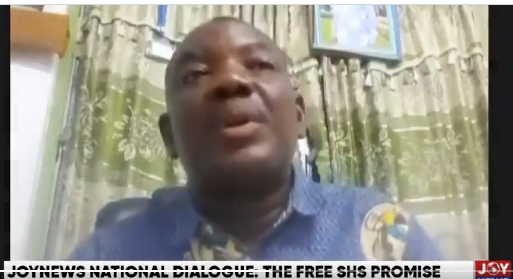
    “They spend hours in traffic so if you put all those things into perspective, you will see that the Free SHS policy has not been fair to all Ghanaians,” he said on JoyNews’ National Dialogue on the Free SHS Promise.

    TEWU’s National Chairman highlighted that numerous students, especially those from underprivileged backgrounds, encounter difficulties traveling to schools distant from their residences, underscoring how these students disproportionately bear the burden of inequality, thereby spotlighting the policy’s unfairness.

    “So, if somebody will be kept in the boarding house and fed three times and somebody who commutes daily to school and back is fed once, then already the cost barrier that you want to eliminate has been embedded on the person who is commuting from the house and back.”

    Responding to the notion that students previously commuted long distances before the Free SHS policy, Mr. Kwadwoza clarified that prior to the policy, commuting was often a result of financial limitations.

    He emphasized that with the introduction of the Free SHS policy, including free boarding schools, everyone should have the opportunity to benefit from what is now free for all Ghanaians.

  • Students at KSTS are being served breakfast without sugar – Tutor

    Students at KSTS are being served breakfast without sugar – Tutor

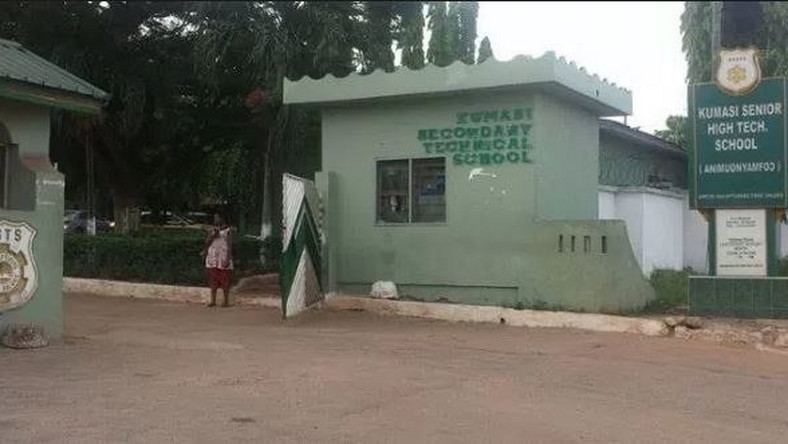
    A tutor at Kumasi Senior High Technical School (KSTS), Andy Owusu, has shed light on a concerning issue plaguing the institution.


    Speaking on Oyerepa FM he stated that the shortage of sugar is impacting breakfast meals provided to the beneficiaries of the Free Senior High School (FSHS) programme.


    According to Mr Owusu, the scarcity has led to disruptions in the morning routine, with a noticeable decline in student attendance at the dining hall.


    He indicated that out of approximately 2,000 students enrolled at KSTS, only around 100 of them have been attending breakfast sessions due to the absence of sugar in their meals.

    “If you come to KSTS we don’t have sugar to give to the students. Since Thursday, we have been feeding the breakfast without porridge. Most of them don’t even come to the dining hall to eat as a result of the lack of sugar in their breakfast. Out of 2,000 students about a 100 of them report to the dining hall,”he added.

    The Free Senior High School (Free SHS) education policy in Ghana was initiated during the September 2017 administration of President Nana Akufo-Addo.

    Originating from one of the President’s campaign promises during the 2016 election period, the policy has evolved into a crucial component of Ghana’s educational system.

    The programme has received massive criticism from various civil society organizations and educational institutions.

    As per reports from Africa Education Watch (Eduwatch) over 5.7 million Ghanaian students have benefitted from the programme.

    The education think tank has revealed that the Free SHS policy has granted  a substantial increase in secondary school enrollment, soaring from 813,448 in the 2016/17 academic year to 1.3 million in the 2022/23 academic year.

    The Institute of Statistical, Social and Economic Research (ISSER) and other analysts have also highlighted fiscal and quality challenges that require careful reconsideration.

    In November 2023, ISSER underscored the importance of reviewing specific aspects of the Free SHS program, including the sustainability of the government fully covering students’ tuition and costs within budget constraints.

    The escalating teacher-student ratios in public SHS schools were also noted, impacting resources and learning.

    The World Bank suggested means-testing and cost-sharing arrangements by parents to optimize program benefits and affordability.

    In February 2024,  the Executive Director of the Institute for Education Services (IFEST),Dr. Peter Anti, emphasized that acknowledging funding challenges in the Free SHS program is crucial for making progress in addressing the issue.

    “While we were doing double track, we should have made a conscious effort to improve the infrastructure in our schools. Now we don’t know what is happening, we decided to go and do other kinds of projects within the same education sector,” he said.

  • The positives of Free SHS must outweigh its challenges – Deputy Coordinator

    The positives of Free SHS must outweigh its challenges – Deputy Coordinator

    The Deputy Coordinator of the Free Senior High School (SHS) Secretariat, Nana Afrah Sika Mensah, urges the nation to focus on the achievements of the policy rather than its challenges.

    Despite recognizing issues like food shortages in some schools, she contends that the benefits of the policy surpass its drawbacks.

    During an interview with Nii Larte Lartey on Eyewitness News on Citi FM, she stressed that the policy has significantly benefited children from underprivileged backgrounds.

    Emphasizing the need to highlight the positive aspects over the negatives, she expressed gratitude for the opportunities the Free SHS has provided to students from less privileged communities.

    She stated, “Free SHS has truly been instrumental for our country.

    Without it, individuals like my siblings wouldn’t have access to quality education. Despite facing challenges, we should prioritize the positive impact and make it outweigh the difficulties encountered by the secretariat.”

    Mensah emphasized the crucial role of Free SHS in granting education access to those in less endowed or underprivileged communities, asserting that, without it, many individuals would lack the means to support their children’s education.

    “Free SHS has really helped us as a country and then maybe had it not been the Free SHS people like my siblings out there wouldn’t get access to quality education. So even though we have challenges, we should rather make the positives outweigh the challenges we are facing as a secretariat.”

    “We’ve given people access to education. People from the less endowed communities or people who are less privileged in the communities had it not been for Free SHS, they would not get the opportunities to foot bills for their wards,” she stated.

  • Only Day schools should benefit from Free SHS – Former Finance Minister

    Only Day schools should benefit from Free SHS – Former Finance Minister

    Former Finance Minister Seth Terkper has suggested that to reduce pressure on the government budget, all Free Senior High Schools (SHSs) should transition to exclusively offering day schooling.

    Terkper argued that the longstanding legacy of Free SHS should lead to a transformation of the system into a day school model rather than a boarding school model.

    He made these comments during an interview on Joy FM’s Super Morning Show on March 4, emphasizing that no advanced country implements free secondary education with a boarding system.

    “Tell me which advanced country has a free secondary education which comes with boarding with all fees and everything paid…the public schools are all day.

    “Have not seen the old style boardination when government takes all the responsibility it is in enormous,” he added.

    Mr. Terkper highlighted the benefits of Free SHS but suggested transitioning to a day system to alleviate pressure on the government, given the extensive responsibilities in education.

    He acknowledged that Free SHS is a significant legacy that should be maintained. However, he proposed that the government could have required boarding students to pay to share responsibilities and reduce the burden on the government.

    Emphasizing the extensive nature of education, the former finance minister argued that expecting the government to bear the entire cost of Free SHS might not be sustainable for Ghana’s economy, especially considering its low-income status.

    “Even the advanced countries do it through a day school system,” he said.

    For months, parents, teachers, and stakeholders have voiced concerns about perceived shortcomings of the Free Senior High School (SHS) policy, particularly regarding the provision of three daily hot meals to SHS students free of charge.

    After more than seven years of policy implementation, President Akufo-Addo highlighted the transformative impact of the Free SHS policy during the 2024 State of the Nation Address in Parliament on Tuesday, February 27.

    He urged an end to arguments against the policy, emphasizing the need to acknowledge its success and focus efforts on its improvement.

    “Mr Speaker, Free SHS might be labelled by its detractors as a mere political slogan that must be demonised, but it is, in fact, a transformative programme that has broken myths and liberated minds.

    “I am proud that the NPP government, under my leadership, has been able to bring this transformative policy into our education system.

    “Mr Speaker, I believe the success of the Free SHS has answered its critics and the arguments about it should cease, and we should simply concentrate on finding ways to improve it.”

  • Flashback: Free SHS not meant for irresponsible parents – Jane Naana

    Flashback: Free SHS not meant for irresponsible parents – Jane Naana

    Nine years ago, then Minister of Education, Prof. Jane Naana Opoku Agyeman, warned that parents who deliberately choose not to support their children’s education financially will not be accommodated in President Mahama’s progressively free Senior High School (SHS) project.

    She emphasized that the fee-free Senior High School initiative serves as an incentive for SHS attendance, alongside assisting parents who want to fund their children’s secondary education but lack the financial means.

    “We are aware of parents who can financially support their children and we urge them to continue to do so and we are also aware of those who even go on to support other children – we want to express our gratitude for this key kind intervention.”

    “We are also aware of parents who wish to support their dependents but they are honestly unable to do so. This intervention is for them. It is not for those who willfully decide to be irresponsible,” she noted when addressing the Chiefs and people of Ekumfi Otuam at the commissioning of a 24-classroom community day secondary school on Thursday.

    The facility, commissioned by President John Mahama and named after the late President John Evans Atta Mills, marks the official launch of the progressively free Senior High School promised by the President in 2013.

    In addition to its spacious 24 classrooms, the facility features four laboratories for Physics, Chemistry, Biology, and Integrated Science, two libraries, eight offices for departmental heads, ICT laboratories, and an internet learning area. It was designed in an E-shape structure to symbolize excellence, according to officials, with other schools planned to have a similar resemblance.

    This facility is one of the 200 community day senior schools promised by the President to be constructed across the country, especially in deprived and underserved communities, to enhance access to education.

    Prof. Naana Opoku Agyemang further explained that students benefiting from the free SHS program in the 2015/16 academic year do not include day students receiving other forms of scholarships, such as those offered by the Ghana Cocoa Board, Northern Scholarships, the Secondary Education Improvement Project, as well as scholarships from NGOs, corporate bodies, and individuals.

  • Quality and quantity compromised: ‘Malnourished’ Free SHS students tell it all

    Quality and quantity compromised: ‘Malnourished’ Free SHS students tell it all

    An investigative documentary titled “Empty Plates,” produced by journalist Kwetey Nartey, has revealed serious defects in the implementation of Ghana’s Free Senior High School (SHS) policy.

    The documentary, which is yet to be aired on JoyNews, uncovered an acute shortage of food items in many senior high schools across the country, raising concerns among parents, teachers, and stakeholders.

    Despite the policy’s promise of providing three daily hot meals to SHS students free of charge, the excerpts of the documentary highlighted the challenges faced in meeting this commitment.

    It showed that many schools are struggling with inadequate quantities and compromised quality of food served to students.

    “It is all about the quantity. And the jollof too, its quality. The amount they serve on the table, very small,” an aggrieved student shared.

    This development has reignited concerns that have been raised for months about the alleged shortcomings of the Free SHS policy. The shortage of food items in schools could undermine the effectiveness of the policy and impact the well-being of students.

    During the 2024 State of the Nation Address in Parliament on Tuesday, February 27, President Akufo-Addo emphasized the transformative impact of the Free Senior High School (SHS) policy, which has been implemented for over seven years. He called for an end to arguments against the policy, urging that its success should be acknowledged, and efforts should focus on improving it.

    “Mr Speaker, Free SHS might be labelled by its detractors as a mere political slogan that must be demonised, but it is, in fact, a transformative programme that has broken myths and liberated minds.

    “I am proud that the NPP government, under my leadership, has been able to bring this transformative policy into our education system. Mr Speaker, I believe the success of the Free SHS has answered its critics and the arguments about it should cease, and we should simply concentrate on finding ways to improve it.”

  • Private secondary schools will be featured on free SHS programme – Mahama

    Private secondary schools will be featured on free SHS programme – Mahama

    Addressing the launch of the 2024 annual week celebration of the Ghana National Association of Private Schools, the flag bearer of the National Democratic Congress (NDC), John Dramani Mahama, underscored the pivotal role of private schools as collaborative partners with the government in delivering quality education for Ghanaian children.

    Mr Mahama commended the significant contributions of private schools to the educational sector, describing them as trailblazers and pioneers responsible for introducing innovative teaching techniques.

    Notably, he cited the Montessori curriculum as an exemplary instance, initially implemented by private schools and later adopted by some public institutions to enhance teaching and learning methodologies.

    The former president, leading the NDC into the upcoming December presidential and parliamentary elections, emphasized the effectiveness of private schools in addressing the needs of special children, attributing it to their favorable teacher-to-pupil ratio.

    He highlighted the challenges faced by public schools with high student numbers, making it difficult for educators to cater to individualized needs, especially for those with special requirements.

    Mr Mahama assured the private schools’ association that an NDC government, if elected, would prioritize education, convening stakeholders to conduct a comprehensive review of the entire education structure, spanning from basic to tertiary levels.

    He outlined plans for substantial investments in basic education starting from 2025, aiming to fortify the foundation of the education sector.

    Regarding secondary education, the NDC leader committed to extending the free Senior High School (SHS) program to include private secondary schools.

    Mr Mahama acknowledged the infrastructure and human resources capabilities of many private institutions, positioning them as integral contributors to the successful implementation of the free SHS initiative.

    Mr Mahama referenced a recent Edu-Watch report, shedding light on the persistent financial burden shared by parents and the government at the secondary education level.

    Despite the implementation of the free SHS policy, parents still bear approximately 77% of the total cost of their children’s education, as revealed in the report.

  • Mahama accuses govt’s over contradictory stance on free SHS

    Mahama accuses govt’s over contradictory stance on free SHS

    Former President and presidential candidate of the National Democratic Congress (NDC), John Mahama, has accused the governing New Patriotic Party (NPP) of double standards regarding the ongoing discourse on the review of the Free Senior High School (SHS) policy.

    Addressing attendees at the launch of the Ghana National Association of Private Schools week, themed “2024 Elections: The Private Education Manifesto,” Mahama lambasted the government’s handling of the Free SHS policy, alleging a lack of transparency and consistency in its communication.

    Mahama pointed to a document submitted by the government to the International Monetary Fund (IMF), which pledged to review and rationalize the Free SHS policy. He criticized the discrepancy between the government’s promises to international bodies and its public narrative, accusing the NPP of hypocrisy.

    “There’s hypocrisy in this thing about review. If you look at the IMF agreement that this government has signed, under point 47, page 76,” Mahama stated. “This Akufo-Addo-Bawumia government signed an agreement with the IMF in January 2024. And they say that in the educational sector, we will review and rationalize the free SHS. These are their words, not my words.”

    Mahama emphasized the need for clarity and honesty in the discourse surrounding the Free SHS policy, urging citizens to scrutinize government actions and statements. He highlighted concerns regarding the implementation and effectiveness of the policy, citing statistics indicating a significant number of students not taking up their places in Free SHS schools.

    “The report says that between 2021 to date, over 196,000 children did not take up their place in the free SHS. Even though they were posted and qualified, they didn’t go. We need to find out why they didn’t go,” Mahama explained. “The total amount of money the government has spent on free SHS comes to about ¢5.8 billion. The proportion of the parents is about 77% to the government’s share of about 23%. That is why we must do a review.”

  • Free SHS has become a political game for govt – Mahama

    Free SHS has become a political game for govt – Mahama

    The National Democratic Congress (NDC) presidential candidate, John Dramani Mahama, has accused the New Patriotic Party (NPP) of double standards in the Free Senior High School policy discourse.

    Government appointees advocate for policy improvement, not review, but Mahama has criticized this stance.

    Speaking at the launch of the Ghana National Association of Private Schools week, Mr Mahama condemned the government’s double standards. He points to their commitment to review the policy in an IMF document, contrasting with public statements.

    Mahama criticizes the NPP’s lack of transparency and consistency in communication with the IMF, highlighting the disparity between promises and actions. Referring to the IMF agreement, he quotes the government’s pledge to review and rationalize free SHS in the educational sector.

    He urges vigilance in understanding the term “review,” emphasizing the government’s use of the term in the IMF agreement.

    He encouraged reading the Eduwatch report, especially on free SHS, revealing that over 196,000 qualified children didn’t enroll between 2021 and now.

    The report states government spending of ¢5.8 billion, with parents covering 77% and the government 23%, justifying the need for a review.

    “There’s hypocrisy in this thing about review. If you look at the IMF agreement that this government has signed, under point 47, page 76.

    “This Akufo-Addo-Bawumia government signed an agreement with the IMF in January 2024. And they say that in the educational sector, we will review and rationalise the free SHS. These are their words, not my words.”

    “And so when you hear all this politics about my understanding of the review means to abolish, in their own words, they are using review. Sometimes, you must watch our politics. I encourage all of you to get the Eduwatch report and read it, and it is about especially, the free SHS.

    “It says that between 2021 to date, over 196,000 children did not take up their place in the free SHS. Even though they were posted and qualified, they didn’t go. We need to find out why they didn’t go.

    “The report says that the total amount of money the government has spent on free SHS comes to about ¢5.8 billion. The proportion of the parents is about 77% to the government’s share of about 23%. That is why we must do a review,” he said.

  • Our secondary education system is producing more grammar students than technical students – AfricaEduWatch

    Our secondary education system is producing more grammar students than technical students – AfricaEduWatch

    Executive Director of AfricaEduWatch, Kofi Asare, has expressed concern that the current secondary education system in Ghana is producing more students focused on grammar (academic) subjects than technical subjects.

    Mr Asare made these remarks in the context of the government’s Free Senior High School (SHS) policy, which aims to provide access to education for all students.

    According to Asare, there is an imbalance in the education system’s emphasis on different types of skills and knowledge.

    Speaking on TV3’S Ghana Tonight, he said “The point I want to make is the President attempts to see the bigger picture on the Free SHS policy. He talks about producing a critical mass of youth who will have implications on the quality of Labour force.”

    “But you see, within that bigger picture, the President must also appreciate that our secondary education system is producing more Grammar students than technical students. Only about 12 percent of our students in senior high schools are doing technical skill oriented subjects. Majority of them are doing Grammar. So if you are producing 450,000 annually in secondary and you have a situation where only 40 percent is moving to tertiary, then it means that about 250,000 graduates are not moving anywhere. They will become unemployed. They don’t have the skills to became primary Labour market entrants.”

    President Nana Addo Dankwa Akufo-Addo, while delivering the State of the Nation Address in Parliament on February 27, emphasized that despite criticism from detractors who dismiss the free Senior High School (SHS) policy as a mere political slogan, the initiative has significantly improved the lives of Ghanaians who would have otherwise discontinued their education after Junior High School (JHS).

    He noted that not being able to go to secondary school for “lack of money was so widespread and an accepted phenomenon that it led to some people thinking Senior High School was not meant for them or their children or for people from their village, and, therefore, a child in the family finishing Junior High School and moving on to Senior High School was simply not factored in their expectations.”

    “Free SHS might be labelled by its detractors as a mere political slogan that must be demonised, but it is, in fact, a transformative programme that has broken myths and liberated minds. It is humbling on the one hand and frightening on the other, to think of the sheer number of talents that Free SHS has unearthed that would otherwise have ended their formal education at BECE.”

    President Akufo-Addo is confident that the country will get more “engineers, doctors, architects, scientists, writers and poets out of the increased numbers of those attending Senior High School, who will go on to further education.”  

  • Free SHS has been transformative – Akufo-Addo

    Free SHS has been transformative – Akufo-Addo

    President Nana Addo Dankwa Akufo-Addo emphasized that despite criticism from detractors who dismiss the free Senior High School (SHS) policy as a mere political slogan, the initiative has significantly improved the lives of Ghanaians who would have otherwise discontinued their education after Junior High School (JHS).

    During his tenure of seven years as president, Akufo-Addo has encountered numerous individuals, both young and old, from various regions of the country, who have shared stories about being the first in their families and communities to attend Senior High School (SHS).

    He noted that not being able to go to secondary school for “lack of money was so widespread and an accepted phenomenon that it led to some people thinking Senior High School was not meant for them or their children or for people from their village, and, therefore, a child in the family finishing Junior High School and moving on to Senior High School was simply not factored in their expectations.”

    “Free SHS might be labelled by its detractors as a mere political slogan that must be demonised, but it is, in fact, a transformative programme that has broken myths and liberated minds. It is humbling on the one hand and frightening on the other, to think of the sheer number of talents that Free SHS has unearthed that would otherwise have ended their formal education at BECE.”

    President Akufo-Addo is confident that the country will get more “engineers, doctors, architects, scientists, writers and poets out of the increased numbers of those attending Senior High School, who will go on to further education.”  

    He emphasised that even if they stop at SHS, one can only imagine what “a million more Secondary School educated young people will do to our self-confidence and the value of our workforce. That, alone, makes Free SHS worthwhile.”


    President Akufo-Addo delivered his State of the Nation Address in Parliament on Tuesday, February 27, 2024.

  • Govt to provide Wesley Girls students with tablets by April – Education Minister

    Govt to provide Wesley Girls students with tablets by April – Education Minister

    Dr. Yaw Osei Adutwum, the Minister of Education, has unveiled the government’s initiative to provide over 1.4 million tablets to Wesley Girls students as part of the free SHS policy.

    The purpose behind this initiative is to enhance the quality of education in public Senior High Schools nationwide.

    Addressing the audience at the Wesley Girls SHS speech and prize-giving day, Dr. Yaw Osei Adutwum emphasized that the distribution of tablets will be executed within the upcoming two months.

    He expressed his enthusiasm about the forthcoming implementation, stating that every student in the school will soon have access to a tablet computer.

    Furthermore, he highlighted the development of a learning management system and the training of teachers to facilitate online homework and class activities.

    Dr. Adutwum also mentioned plans to introduce additional smart boards to create a comprehensive, technology-driven educational environment.

    “I am happy to tell you that within the next two months, every single student in this school will have a tablet computer. We are building a learning management system, so all teachers are going to be trained, and you will do your homework and class activities online. So, if you have support, it should be getting more smart boards so that it will be a 360-degree smart, technology-driven environment” the Education Minister added.

  • NDC’s Beatrice Annan caught ‘pants down’ over Free SHS comment

    NDC’s Beatrice Annan caught ‘pants down’ over Free SHS comment

    A member of the National Democratic Congress (NDC) communications team, Beatrice Annan, has been exposed for lying about the party’s stance on the Free Senior High School (SHS) policy.

    A Twitter user, @Bagya_Nurudeen, posted a compilation of old videos that showed Annan claiming that the NDC never campaigned against the Free SHS policy, which was initiated by the Akufo-Addo-Bawumia administration.

    The video, which was captioned “This year, no amount of propaganda and lies will be tolerated. @Beatrice_Annan1 has been exposed” with a pro-New Patriotic Party (NPP) slogan, “Say no to the NDC”, showed Annan speaking on Metro TV’s Good Morning Ghana programme.

    “The NDC never campaigned against Free SHS. The NDC was the political tradition that introduced progressive Free SHS,” she said amid shrieks of laughter from another member on the panel who seemed to disagree with her position.

    However, the video also showed other clips of NDC leaders, such as flagbearer John Mahama, General Secretary Fiifi Kwetey, and Director of Interparty and CSOs Relations Peter Boamah Otokunor, speaking heavily against the Free SHS policy and the method of implementation.

    “Free SHS will not be feasible because if you look at the cost of education in this country, in any country, it is very, very expensive,” said Otokunor.

    “When today you look at the NPP going all over the country shouting Free SHS, Free SHS, Free SHS. That is, all lie be lie,” said Kwetey.

    The compilation also had a snippet of an NDC rally where members chanted “Free education 419, Free education 419”. 419 in this context means ‘fraud’.

    The video has sparked a lot of reactions online, with many people accusing Annan and the NDC of being dishonest and hypocritical about the Free SHS policy, which has increased access and quality of secondary education in the country.

    Some people also questioned the credibility and competence of Annan to speak on such matters.” She didn’t have the records, and possibly by then, she was in school,” @AtingaAdombire wrote in the comments in response to the video.

  • Bawumia vows to enhance free SHS policy if elected president

    Bawumia vows to enhance free SHS policy if elected president

    Flagbearer of the New Patriotic Party (NPP), Dr. Mahamudu Bawumia, has reaffirmed his commitment to enhancing the government’s Free Senior High School (Free SHS) policy, pledging to build upon its successes and address existing challenges. 

    Delivering a national address at the UPSA auditorium on February 7, Bawumia highlighted the government’s achievement in achieving historic levels of SHS enrollment and lauded the performance of students in the 2023 West African Senior School Certificate Examination (WASSCE).

    “We have also implemented Free SHS with an increase in enrollment from 800,000 in 2016 to 1.4 million by 2022. The year 2023 has recorded the highest-ever level of enrollment in SHS of around 500,000 students,” stated Bawumia.

    He underscored the significance of the Free SHS policy in promoting access to education, achieving gender parity, and improving academic performance, emphasizing that under his leadership, the policy would continue and be further improved.

    “The performance of the students at WASSCE is also the best since 2015, and we have also achieved gender parity. Under my government, Free SHS will continue, and we will improve upon it. Who can you trust to protect and improve Free SHS? Once again, it is Dr. Bawumia,” he affirmed.

    Despite calls for revisions and improvements to the Free SHS policy from various quarters, including groups and individuals, the Akufo-Addo government has maintained its stance on the initiative. However, the government has agreed with the International Monetary Fund (IMF) to reassess the program and its associated costs, signaling a commitment to ensuring the sustainability and effectiveness of the policy.

    Bawumia’s pledge to enhance the Free SHS policy comes at a crucial juncture as Ghana prepares for the upcoming general elections. His remarks reflect the NPP’s dedication to education reform and its vision for advancing access to quality education for all Ghanaian students.

    As the political landscape evolves, the future of the Free SHS policy is expected to remain a focal point of debate and discussion, with Bawumia’s promises adding a new dimension to the discourse surrounding education policy in Ghana.

  • Govt finally agrees to ‘touch’ Free SHS under IMF requirements

    Govt finally agrees to ‘touch’ Free SHS under IMF requirements

    The government of Nana Addo Dankwa Akufo-Addo, in a significant development, has unequivocally announced its intention to review the flagship Free Senior High School (Free SHS) program. This revelation is outlined in the latest report from the International Monetary Fund (IMF) regarding Ghana’s US$3 billion bailout programme.

    Contained on page 76 of the comprehensive 155-page report under the section titled ‘PUBLIC SPENDING EFFICIENCY,’ the government discussed recalibrating the expenditure portfolio of Municipal and District Assemblies (MDAs) responsible for social spending.

    Specifically addressing education, the report states: “In the education sector, we will review and rationalize the Free Senior High School (SHS) program.”

    This move is part of a broader strategy to shift the spending composition of MDAs towards targeted and well-designed interventions.

    The report, dated December 18, 2023, titled “STAFF REPORT FOR THE 2023 ARTICLE IV CONSULTATION, FIRST REVIEW UNDER THE ARRANGEMENT UNDER THE EXTENDED CREDIT FACILITY, REQUEST FOR MODIFICATION OF PERFORMANCE CRITERIA, AND FINANCING ASSURANCES REVIEW,” sheds light on the government’s commitment to a thorough assessment of public sector wages, with a focus on the education and health sectors.

    Contrary to previous assertions, the government, led by the education minister, has now acknowledged the need for a review of the Free SHS program.

    The report emphasizes the objective of improving overall learning outcomes, including targeted measures to enhance foundational learning and continued support for tertiary education.

    This announcement comes amid recent exchanges between the government and former president John Dramani Mahama, who had pledged to review the Free SHS if elected in 2025. While the government has previously argued against the need for a review, the latest stance signals a shift towards recognizing the necessity for improvements in the Free SHS policy.

    IMF GHANA REPORT January 2023 by The Independent Ghana on Scribd

  • We will continue to support tertiary education but Free SHS will be reviewed – Gov’t to IMF

    We will continue to support tertiary education but Free SHS will be reviewed – Gov’t to IMF

    In a significant development, the Nana Addo Dankwa Akufo-Addo government has officially declared its intention to review the flagship Free Senior High School (Free SHS) program.

    This revelation comes as part of the information presented in the International Monetary Fund’s (IMF) latest report on Ghana’s US$3 billion bailout programme.

    The pertinent details of this policy shift are outlined on page 76 of the comprehensive 155-page report, falling under the section titled ‘PUBLIC SPENDING EFFICIENCY.’

    Within this segment, the government articulates its plans, which extend beyond the Free SHS program to include recalibrating the expenditure portfolio of Municipal and District Assemblies (MDAs) responsible for social spending.

    This strategic move suggests a broader commitment to enhancing public spending efficiency and highlights the government’s proactive stance in evaluating and adjusting key initiatives for the overall benefit of the nation.

    The decision to review the Free SHS program, a cornerstone of the government’s education policy, is likely to spark discussions and debates on the potential implications and desired outcomes.

    The relevant portion on education read: “The key objective is to shift the composition of spending by these MDAs towards targeted and well-designed interventions.

    “In addition to functional review of relevant MDAs, we will carry out a comprehensive assessment of public sector wages, including in education and health sectors.

    Just weeks ago, the government found itself embroiled in a verbal exchange with former President John Dramani Mahama, who pledged to review the Free Senior High School (Free SHS) program if elected in 2025.

    Despite the government’s staunch defense, led by the education minister, asserting that the program requires improvements rather than a review, the debate surrounding the Free SHS policy remains contentious.

    The Free SHS policy, a cornerstone of the government’s education initiatives, focuses on eliminating financial barriers by absorbing fees approved by the GES council. Its objectives include not only enhancing accessibility by removing cost constraints but also improving educational quality. This is achieved through measures such as providing core textbooks and supplementary readers, implementing teacher rationalization and deployment strategies, and other impactful initiatives.

    Furthermore, the policy aspires to address the anticipated surge in enrollment by expanding physical school infrastructure and facilities. As the government and former President Mahama lock horns over the future of the Free SHS program, the debate underscores the significance of this education policy and its potential impact on the nation’s educational landscape.

    “In the education sector, we will review and rationalize the Free Senior High School (SHS) program. We will continue our support to tertiary education, take targeted measures to improve foundational learning (e.g., increasing capitation grants) and introduce reforms with the help of development partners to improve overall learning outcomes.”

    The December 18, 2023 report was titled: “STAFF REPORT FOR THE 2023 ARTICLE IV CONSULTATION, FIRST REVIEW UNDER THE ARRANGEMENT UNDER THE EXTENDED CREDIT FACILITY, REQUEST FOR MODIFICATION OF PERFORMANCE CRITERIA, AND FINANCING ASSURANCES REVIEW.”

  • 2,569 fresh SHS students still at home, not 137,000 – GES clarifies


    The Ghana Education Service (GES) in the Western North Region has clarified that 2,569 newly admitted Senior High School students are yet to report, not the previously announced 137,000 by CHASS.

    The Education Directorate highlighted that out of the expected 14,558 candidates, 11,989 students, or 82%, have picked up their admission slots. Efforts are underway, including deploying circuit supervisors, to meet admission targets.

    Spanklin Ofori, GES Western North Region’s PRO, stated, “Although significant progress has been made with the enrollment rate, there is still work to be done to meet our set target.”

    He emphasized the importance of education, and circuit supervisors are educating parents on the need to enroll their wards.

    Nana Amo Amankwah, President of CHASS in the Western North Region, urged students facing financial challenges to still come, emphasizing the availability of mattresses in many schools.

    He urged them not to worry about all items on the prospectus but to prioritize essentials like towels and sponges.

    In a study by Africa Education Watch, it was revealed that parents’ expenses on prospectuses and other items surpassed government spending under the Free Senior High School program.

    Parents spent GH¢2,477 on prospectuses for boarding schools and an additional GH¢4,000 on various items during the 2023/2023 academic year.

  • GES greenlights parents to support Free SHS through fundraising 

    GES greenlights parents to support Free SHS through fundraising 

    The Ghana Education Service (GES) has conveyed that Parents Associations (PAs) are permitted to engage in fundraising activities as a means of contributing support to the implementation of the Free Senior High School (SHS) policy.

    As outlined by the GES, Parents Associations (PAs) have been granted the flexibility to pursue various fundraising channels for school development. However, it is emphasized that they are prohibited from levying any fees on students or pupils.

    This information is detailed in the recently issued guidelines document by the GES, delineating the operational framework for Parents Associations in pre-tertiary schools.

    There have been concerns about the operations of PTAs that supposedly thwarted the government’s efforts at ensuring universal access to education, specifically at the SHS level. 

    This was due to the outrageous imposition of levies by some PTAs which sought to defeat the purpose for which the Free SHS policy was introduced.

    In response to these developments, the management of GES suspended the imposition of levies in all schools.

    It also directed the reorganization of the Parent Teachers Associations (PTAs) to Parent Associations (PAs) to limit the involvement of management and staff of the school.

    The GES emphasised that PAs should operate independently, separate from school management and staff. 

    According to GES, PAs could undertake projects to support the development and growth of the schools to which they are related but emphasised that the management of the schools shall have full authority over the handling of such projects without interference from PAs.

    GES stated that PAs may through the management of the school, offer support to teachers/staff of the school through the provision of incentive packages and other welfare schemes. 

    It maintained that no child shall be discriminated against or given preferential treatment in the official duties of the teacher/staff to which that incentive or welfare package is related. 

    “Aside from contributions made by PAs, individual parents/guardians may make voluntary donations or contributions to the school as that individual deems fit and such donation shall not confer any preference or privilege to any student in terms of access to and use of the facility or donation,” GES said.

    The GES in the document clarified that although school management should not be signatories to Parents Associations’ activities, they can participate without assuming liability for decisions made.

    However, PAs are required to submit their annual activities and plans for approval by school management. 

    Additionally, the accounts of PAs will undergo annual audits, and audit reports must be submitted to Regional Directors for forwarding to the Director General of the Ghana Education Service.

  • Over 137,000 fresh SHS students still at home – GES

    Over 137,000 fresh SHS students still at home – GES


    The Director of the Ghana Education Service (GES), Sekondi Takoradi Metropolitan area, Sally Nelly Coleman, has disclosed that more than 137,000 students placed through the 2023 Computerized School Selection and Placement System (CSSPS) into Senior High Schools and Technical and Vocational Education and Training Schools across the country have not yet enrolled for admissions.

    The revelation, deemed “very worrying” by Coleman, follows the placement of approximately 590,000 students in various schools across the country. To date, only 453,000 have reported for admissions, prompting a plea to parents to facilitate their children’s admission.

    Despite the release of the computer placement list and a reopening date of January 3, 2024, a substantial number of students appear unprepared for admission.

    In response to the situation, Daniel Vroom-Laryea, Western Regional Chairman of the National Council of Parent-Teacher Associations, highlighted various contributing factors during an interview on Connect FM’s Omanbapa morning show.

    Mr Vroom-Laryea emphasized that the school reopening timing posed challenges for both parents and students.

    Cocoa farmers in rural areas, for instance, faced financial constraints due to poor yields, hindering their ability to finance their children’s education.

    Mr Vroom-Laryea indicated that financial issues were preventing some students from reporting for admission, revealing hidden complexities within the Free Senior High School Policy.

    “About 590,000 were placed in the various schools nationwide. So far, 453,000 have reported for admissions. So about 137,000 are still home, they have not reported to their various schools for admissions. We are pleading with parents to go for the admissions” ” she lamented.

    “The re-opening date for the schools was not favorable for both parents and the students. Cocoa farmers in the rural areas are complaining that they had little yield in the year and so they don’t have the money to take their children to school. They must fill their chop boxes, some parents are even renting for their children to be in school, they must buy a lot of things for them to be in school. So, all those who have not reported, it is due to financial issues. The free SHS is becoming more expensive than we thought. There are more hidden issues to the free senior high school than we have all been made to believe,” he indicated.

    He further expressed concerns about the increasing costs associated with the policy and asserted that the government was restricting the Parents Association from aiding the situation.

    Mr Vroom-Laryea cited instances of over 21 pregnancies reported in a senior high school, attributing the issue to a lack of school infrastructure.

    He lamented the government’s decision to limit the involvement of Parent-Teacher Associations, citing it as a significant problem in addressing challenges within the education system.

    “About 590,000 were placed in the various schools nationwide. So far, 453,000 have reported for admissions. So about 137,000 are still home, they have not reported to their various schools for admissions. We are pleading with parents to go for the admissions” ” she told Nhyiraba Paa Kwesi Simpson, the host of Connect FM’s Omanbapa Morning Show.

  • Free SHS minus support from parents is meaningless – National Council of PTAs

    Free SHS minus support from parents is meaningless – National Council of PTAs

    The Western Regional Chairman of the National Council of Parent Teacher Associations, Daniel Vroom-Laryea, has voiced concern over the government’s exclusion from senior high school management.

    Stressing the crucial role of parental support for the success of the free Senior High School policy, he pointed out that parents are currently being hindered from assisting schools.

    Mr Vroom-Laryea highlighted issues such as over 21 pregnancies in a senior high school due to a lack of walls and the prevention of Parent-Teacher Associations (PTA) from contributing to schools, which he deemed a significant problem.

    “Parents are now being prevented from helping the schools, but we must know that free SHS is meaningless without the support of parents. We even recorded over 21 pregnancies in one of the senior high schools last year, because the school had no wall, and the students were being sneaked out. We are not being made to help, the government has stopped PTA from doing everything in the schools and that is a problem”, he added.
    His comments were prompted by revelations from Sally Nelly Coleman, the Sekondi Takoradi Metropolitan Director of the Ghana Education Service, indicating that over 137,000 fresh students placed through the 2023 Computerized School Selection and Placement System (CSSPS) have not enrolled for admissions in various Senior High Schools.
    The Ghana Education Service released the computer placement list for fresh students last year, with a reopening date of January 3, 2024. Coleman expressed concern, stating that out of about 590,000 placements nationwide, only 453,000 students have reported for admissions.

    Mr Vroom-Laryea attributed this situation to an unfavorable reopening date, citing complaints from cocoa farmers in rural areas who had little yield and struggled financially to send their children to school. He emphasized that the hidden issues behind the free Senior High School policy make it more expensive than initially thought.