Tag: funeral

  • Social media users condemn Sarkodie for missing Nana Ampadu’s funeral

    Social media users, notably those on Facebook and Twitter, have criticised Ghanaian rapper Michael Owusu Addo, better known in the entertainment industry as Sarkodie, for missing the funeral of Highlife legend Nana Ampadu.

    After apologizing for the incident on both social media platforms, some users took to the comment sections to express their discontentment.

    While some believe Sarkodie deliberately refused to attend the funeral, others indicated that the rapper could have made use of a personal assistant or reminder on his phone to prompt him.

    Others also shared the view that the apology was an insult while others believe Sarkodie should mend his relationship with the family of Nana Ampadu.

    Pac Anokye Lord Knows, a Facebook user, wrote: “Naa…You already have it in mind that u won’t go..we are not children to come tell us stories..Shame to You”.

    “You must honour the MASTERS. This excuse is best left not said. Actually an INSULT to the memory of arguably one of the Greatest Global Musicians of all time,” Lloyd Amoah also wrote on Facebook.

    The situation on Twitter was no different as users also expressed similar sentiments on the matter. Fidelis Banaaleh in a Twitter post said Sarkodie missed the funeral because it was not his priority.

    “You missed it because it wasn’t a priority for you senior.. in an age where phones have reminders? hmm to whom much is given much is expected Mr Sarkodie.. understand that the young are learning from you,” he tweeted.

    Sarkodie apologizes for missing Nana Ampadu’s funeral

    In a Facebook post on October 9, Sarkodie said he was ashamed of himself and hurt for missing Nana Ampadu’s funeral despite being reminded about it by veteran actor, David Dontoh.

    He said even though David Dontoh’s reminder lingered on his mind, it apparently skipped him on the day of the event.

    Sarkodie added that it was bad enough for him to be missing the funerals of legends stressing that he needs to do better.

    He wrote: “Ashamed and hurt for not making it to the Legend Nana Ampadu’s funeral … Uncle David Dontoh told me about it last Sunday… Crazy how I had it on my mind from then and still missed it but all the same Rest In Peace Grandpa May the almighty keep you safe No excuse makes sense to even myself missing all these legends’ funerals… Need to do better”.

    Nana Ampadu died on Tuesday, September 28, 2021, while on admission at the Intensive Care Unit of the University of Ghana Medical Centre (UGMC) in Accra with his funeral slated for October 8.

    A day after his passing, Sarkodie made a post on social media revealing that the late music icon had once given him wise advice about not posting private stuff on social media.

    A state funeral in Accra was organized for the late Nana Kwame Ampadu and he was subsequently transported to his hometown at Obo Kwahu, in the Eastern Region, on Saturday,

    October 8, 2022, where he has been laid to rest.


  • Queen’s state burial: Soldier, 18, found dead at barracks

    After the service at Westminster Abbey, Household Cavalry Trooper Jack Burnell-Williams was one of those who escorted the late monarch’s coffin as it was driven by a gun carriage down Whitehall and along the Mall.

    A teenage soldier who took part in the Queen’s state funeral has been found dead at his barracks.

    Household Cavalry Trooper Jack Burnell-Williams was among those to escort the late monarch’s coffin as it was carried by gun carriage through Whitehall and down the Mall following the service at Westminster Abbey.

    The Army has confirmed that the 18-year-old, from Bridgend, South Wales, died on Wednesday at Hyde Park Barracks in Knightsbridge.

    Police are not treating his death as suspicious.

    He was believed to be one of the newest recruits to the Household Cavalry.

    An Army spokesman said: “It is with sadness that we can confirm the death of Trooper Jack Burnell-Williams on 28 September 2022 at Hyde Park Barracks.

    “Our thoughts are with the soldier’s family and friends at this difficult time and we ask that their privacy is respected.”

    The case has been referred to the coroner.

    Sharing a picture and tribute on Facebook to her son, known as Jak by his family and friends, his mother Laura Williams, 42, wrote: “Never ever thought I would be saying this but we as a family are all heartbroken with the sudden passing of our wonderful son Jak Williams.”

    The case has been referred to the coroner.

    Sharing a picture and tribute on Facebook to her son, known as Jak by his family and friends, his mother Laura Williams, 42, wrote: “Never ever thought I would be saying this but we as a family are all heartbroken with the sudden passing of our wonderful son Jak Williams.”

  • Shinzo Abe: A divided Japan sends its dead former prime minister farewell

    Akie, the widow of Shinzo Abe, walked slowly while wearing a black kimono and carrying a silk-covered urn containing her husband’s ashes.

    She set it on a sizable shrine that was decorated with white chrysanthemums.

    Above it hung a huge photo of Abe, Japan’s longest-serving prime minister.

    Only once before in Japan’s post-war history has a politician been given a state funeral – and Tuesday’s event to honor Abe has stirred huge controversy.

    It drew thousands of guests – local and global leaders, notably from Japan’s closest allies. But it also faced a backlash as protesters marched against the decision to hold the funeral.

    It’s a day and an event that appears to have cut Japanese society down the middle. And it’s a sign of Abe’s complicated and often divisive legacy.

    The 67-year-old politician was assassinated in July – shot twice by a homemade gun. The killing shocked a country unused to gun crimes or political violence, triggering an outpouring of grief for a leader who had never been that popular.

    “Abe-San, thank you so much,” mourners shouted when they gathered to pay their respects in July – with his death, many of his countrymen realized he had given Japan a sense of stability and security.

    That mood changed with the announcement of a state funeral. But it has gone ahead despite growing opposition from the Japanese public with opinion polls showing around 60% opposed it.

    Outside the Budokan – the arena in Tokyo where the funeral was taking place – the queue of mourners carrying flowers stretched for well over 3km (1.8 miles). They wore black and carried flowers to pay their respects for one last time.

    “I love Abe and everything about him, that’s why I am in line,” one 19-year-old said. Another mourner, a woman, said she was there to “show my gratitude for his long service as PM”.

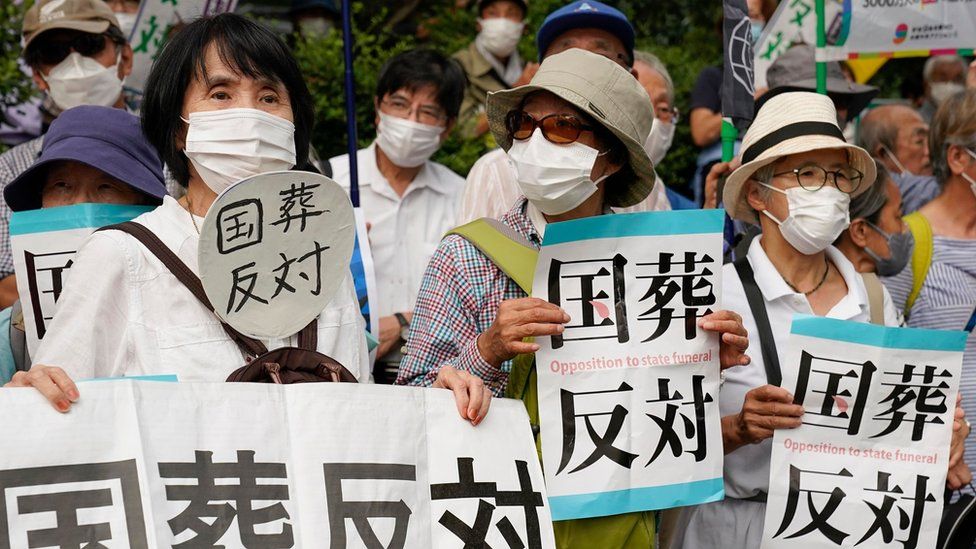
    But a short distance away in front of the Japanese parliament thousands more gathered to noisily and angrily demonstrate their opposition.

    Abe was widely admired abroad, but he was a divisive figure at home. Many of the protesters outside parliament were furious about the $10.7m (1.6bn yen; £10m) cost of the funeral. Others simply said Abe did not deserve the rare honour of a state funeral.

    “I am frustrated and angry that we let the government do whatever they want without consulting the people,” said 25-year-old Iori Fujiwara. “Us younger generation needs to speak out more for our own future, that’s why I am here.”

    “I could not stay at home while they are spending so much money and inviting so many guests while there are Japanese people suffering from the typhoon last week,” said 25-year-old Ayaka Uehira.

    Protesters hold placards reading 'No!! State funeral' during a rally against the state funeral of former Prime Minister Shinzo Abe in Tokyo, Japan, 27 September 2022.
    IMAGE SOURCE, GETTY IMAGES Image caption, Noisy protesters were kept away from the arena where the funeral took place

    Many of those who oppose the funeral – and Abe’s political legacy – are older Japanese. In a country traumatized by war, the older generation has long favored a “pacifist” constitution that has kept Japan from heavily investing in its military.

    Abe, however, sought to change that – not by a referendum or parliamentary process, but by reinterpreting the constitution.

    This move was controversial and unpopular but has increasingly been welcomed by Abe’s supporters – many of whom are younger Japanese. Untroubled by memories of war, they are also increasingly reacting to China’s aggressive claims on Japanese territory.

    For them, Abe was an extraordinary politician who put Japan back on the international map as a significant player.

    Prime Minister Fumio Kishida and his Liberal Democratic Party certainly made the decision to honor Abe without considering how the country might react.

    But there is no denying the fact that Abe was also a man greatly admired by Japan’s allies.

    He pushed for stronger relations among what he called “like-minded democracies”, including India and Australia. He was also instrumental in the founding of the Quad – an alliance between the US, Japan, India, and Australia.

    So it’s no surprise that the US vice-president, and sitting and former Australian prime ministers traveled to Tokyo to pay their respects. Or that India’s PM Narendra Modi made the journey after skipping the funeral of Queen Elizabeth II in London last week.

    They perhaps recognize that in some ways, Abe was well ahead of his time.

    He had always been wary of a rising threat from China – a concern Japan’s allies now share.

  • Ghanaian community in UK prepare to hold funeral ceremony for Queen Elizabeth II

    The Ghanaian community in Britain is getting ready to perform a funeral service for the late queen in accordance with Ghanaian customs as the British government and monarchy conduct the last funeral rites of the deceased, who was the first Head of State of Ghana.

    The ceremony’s venue was decorated with Ghanaian flags and red and black fabrics, according to a video posted by GhanaWeb.

    Additionally, there were royal umbrellas, drums, and other artifacts that were typical of Akan festivities.

    The lady who recorded the video indicated that the venue of the burial was Conel, Victoria Line, a community in London, the capital town of England.

    She invited all Ghanaians in the UK to join them to celebrate the late queen.

    “We are inviting all Ghanaians to Conel as we celebrate our queen mother, Elizabeth and also mourn with the family and wish them all the best,” she said.

  • King Charles III spoke with Akufo-Addo and Asantehene – Royal Reporter

    King Charles III spoke, via telephone, with a number of world leaders in connection to the funeral of his late mother and former monarch, Queen Elizabeth II.

    Among others, he spoke to political leaders and some royal leaders with close ties with the British monarchy.

    According to a list shared by Cameron Walker, a Royal Reporter with GB News, King Charles spoke to the ‘King of Ashanti,’ as well as Presidents of Ghana, the United Arab Emirates and Egypt and Prime Minister of Bangladesh.

    President Akufo-Addo and First Lady Rebecca Akufo-Addo have been spotted in London along with other world leaders attending the funeral of Queen Elizabeth II.

    A formal invitation to the Asantehene was also formally invited via the Foreign and Commonwealth Office, FCO. A later report indicates that the Asantehene also communicated his inability to attend the funeral.

    The world’s longest serving leader, Her Majesty Queen Elizabeth II, was pronounced dead on Thursday, September 8, 2022, via a statement from the royal family.

    Born on April 21, 1926, the Queen, christened Elizabeth Alexandra Mary, immediately acceded the British throne on February 6, 1952, when her father, King George VI died.

    She became queen at the age of 25 and remained on the throne for seven decades before her death.

    Elizabeth II was Queen of the United Kingdom and Head of State for 14 other jurisdictions.

    Queen Elizabeth’s eldest son Charles, 73, has been named succesor and by that becomes king of the United Kingdom and the head of state of 14 other realms including Australia, Canada and New Zealand. His wife Camilla becomes Queen Consort.


  • Family of boy paraded naked for allegedly stealing GH¢100 wants justice

    Kwabena Kwam alias Ofie One, an uncle to one of the boys stripped naked and paraded in Akuapem Adawso for allegedly stealing GH¢100, has asked the police Service to deal ruthlessly with the offender who committed the criminal act.

    Two teenagers were stripped naked and paraded on the streets of Akuapem Adawso in the Akuapem North Municipality of the Eastern region over an alleged GHC100 theft.

    The incident occurred Friday, October 29, 2021.

    The victims, both 14 years of age, were alleged to have stolen GH¢100 cash and a mobile phone.

    The mob led by one Larbi and Akwei brutalized the two children making one of them defecate on himself in the process.

    The uncle to one of the boys said the incident was reported at the Police Station and but the officers in charge of the matter want to make the case a foolish one.

    According to him, the law must deal with the two suspects who subjected the boys to such humiliation.

    He said when you arrest an alleged criminal, you have to send them to the Police and not use your powers in executing justice against them.

    Speaking on Nyankonton Mu Nsem on Rainbow Radio 87.5Fm, he said the family would not rest until the men who did this were punished.

    Source: rainbowradioonline.com

  • Popular pallbearers in Ghana grant interview to Aljazeera (VIDEO)

    Popular Pallbearers in Ghana have granted an interview to Aljazeera.

    They responded to a number of issues in the industry.

    Watch video below

    Source: adwoaadubianews.com

  • A morbid internet fully embraces the Ghanaian funeral meme

    A new meme format has graced the internet, and its popularity is a signal to the general mood of the world: funereal.

    Today, Bernie Sanders suspended his campaign for the to be the Democratic nominee for president. When I hopped in the group DM to commiserate, I knew what I would eventually see: a video of the now presumptive nominee Joe Biden saying something incomprehensible which would then smash cut to a video of Ghanaian pallbearers dancing with a casket, set to the EDM song Astronomia by Tony Igy.

    This meme shares some DNA with memes we’ve seen in the past. The “To Be Continued” meme, which took its cues from the iconic ending theme to the first section of the JoJo’s Bizarre Adventure anime, also turned tragedy or impending injury into humor by cutting away at the exact moment of impact. The difference between To Be Continued and Ghanaian Pallbearers is the acknowledgement of death or injury. When you watch a pallbearer dancing with a casket, part of the implied humor is that someone is going to fucking die.

    It’s not like a collective interest in the morbid is anything new. The subreddit r/watchpeopledie, now closed, used to have over 300,000 subscribers who just wanted to watch people die. If you know any teenage girls, you’ll know that a lot of them go through a phase of fascination with serial killers. Hell, it’s already a meme that millennial women are obsessed with true crime podcasts. What differentiates the Ghanaian Pallbearers from all of these is that you are invited to laugh at the tragedy, or at least the implication of one.

    The dancing pallbearers can turn some incredibly grim content into meme material. I have seen pallbearers dancing after several news agencies called the election for Trump in 2016, after the second plane hit the towers (the creator deleted the tweet), a woman bungee jumping while the bungee cord is not visibly attached to her person, and a video of UK Prime Minister Boris Johnson saying that he shook hands with COVID-19 patients in a hospital. Someone even did the climactic scene of Parasite. I did not find all these videos funny, but unusually for me, the anticipation of an injurious moment, or a part of human history that is shocking or tragic, made me seek out more of these videos.

    I feel like if the internet is latching onto this format, then many people are seeking the same thing I am from culture. I don’t want a mental panacea, or assurances that everything will be alright. I need to know that everything is exactly as bad as my running mental commentary is saying it is. Ghanaian pallbearers dancing with a casket in a highly choreographed routine, lifting it up and lowering it, pretending to drop it and laying down dead in an homage to James Brown, makes all the horrors of the world easier to handle. It’s not a joyful laugh, but a grim one. Of course these videos all end in tragedy. Were you expecting something else?


  • Coronavirus: How centuries old tradition of funerals has been affected in Ghana

    Funerals are a big deal in Ghana and it is not uncommon, in some parts, for a ceremony to last up to seven days, drawing thousands of crowds adorned in flowing red and black robes and gold jewellery.

    Some families even hire professional mourners to cry at the funeral of their loved one because “it serves as a reward to the person who has died,” says Adwoa Yeboah Agyei, who owns The Funeral Shop and Services, a franchise with locations across Accra.

    Anguished families

    But a centuries-old tradition has come to a halt.

    Since Ghana’s President Nana Akufo-Addo suspended all public gatherings in mid-March in the wake of the coronavirus pandemic, burials have been limited to no more than 25 people in the West African nation.

    Obed Ampadu-Asiamah’s 73-year-old father, Daniel, passed away soon after the announcement following complications from a stroke.

    Obed has been scrambling to make painful phone calls send notices informing attendees he could only invite 25 family members and friends. They originally expected 2,000 people and an official funeral has been postponed to a later date.

    ?”We had to cut all the in-laws and the grandchildren. None were able to attend,” he told CNN, his voice shaking.

    “We could only provide six slots for members on my father’s side of the family and three for members of his church.”

    The large funeral home they rented to hold the ceremony was moved into a small, private chapel within the same venue.

    Face masks concealed the anguish on the faces of mourners dressed in red and black, as they stood several feet apart with heads bowed in remembrance of a highly respected man, who established churches in parts of West Africa.

    Livestreaming burials

    At Transitions, Ghana’s largest private funeral home, a once heavy flow of ceremonies now trickles at a slow pace.

    Genevieve Carnelius, the general manager, stated that finances and operations have been badly affected, but says her priority now is to work with clients like Obed to remotely reschedule their loved ones’ funerals to uncertain future dates.

    The home currently offers online live streaming from their chapel, where Ampadu-Asiamah’s burial service took place, and where mourners across the globe can view the ceremonies of their loved ones.

    Once a lucrative sector, businesses catering to funerals are reeling.
    Maryam Abdullah is a fashion designer who sews traditional garments primarily for weddings and funerals.

    In an empty shop once bustling with customers, she sighed as she explained how Covid-19 has affected her business.

    “No one is coming. Even the people who have already brought cloths for me to sew have not returned to pick them up, said Maryam. She understands why, though. “If this is what it takes to stop the spread of this coronavirus, I am okay.”

    For now, she prefers her clients to stay at home because she feels more protected from contracting the virus herself, but it will only be a matter of time before funds run dry, she added.


    A stray from traditional customs

    Shaking hands with the family of the deceased is a deep-rooted tradition in many Ghanaian tribes that has taken place for hundreds of years and has become a mandatory part of ceremonies to show respect for the dead, says Queen Naa Tsotsoo Soyoo I, a Ghanaian Queen mother, who forms part of a powerful group of traditional women leaders.

    She explained how significant the ban on mass funeral gatherings has affected the customs of such ceremonies.

    “A significant part of funerals is bringing families together to embrace through handshakes, hugs and to mourn in close proximity of one another,” said Queen Naa.

    “The immediate implication of what is now taking place is that families will be unable to connect. This is something that has never happened in generations and it is definitely going to have a social impact.”

    Despite all the sudden changes to traditional practices at funerals, she acknowledged that certain inherent rites will never go away. For example, in Islam, the second largest religion practised in Ghana, senior Muslim members of the community must recite Quranic verses over the deceased immediately after designated family members perform a ritual cleansing of the body.
    The person must be buried within 24 hours of death.
    ??
    “With all that is going on, the testament of a funeral will always be a view of how a person lived life and the core of every funeral is that the individual is sent off with respect and dignity,” she added.

    No one can predict how long the effects of Covid-19 will alter lives as we once knew it. But Queen Naa is certain of one thing. “There will be many celebrations of life when this is all over.”


    Source: cnn

  • Coronavirus: Why Ghana has gone into mourning after mass funeral ban

    In our series of letters from African writers, journalist and former Ghana government minister Elizabeth Ohene writes about the dramatic impact coronavirus is having on life in her country and beyond.

    If anyone had any doubt about just how serious the Covid-19 outbreak is, we now have proof positive, we are in the midst of a huge crisis.

    This is a crisis not measured yet by how many people have been taken ill, or are in hospital or have died.

    Here in Ghana, there are some things that are sacred in our lives and nobody touches them under any circumstance: religion, handshakes and funerals.

    These are subjects that are not up for discussion and many people believe they define our very existence.

    For weeks, government and health officials here have been warning everybody to improve personal hygiene and avoid crowds.

    Many people preferred to think that the coronavirus would not make it into sub-Saharan Africa and therefore they believed the warnings by the health experts could be ignored.

    ‘Only enemies refuse to shake hands’

    Whoever heard of a Ghanaian, indeed, an African greeting another person and not shaking hands?

    To refuse or ignore to shake hands with someone means that person is an enemy. Now we can’t shake hands with anybody, friend or foe.

    President Nana Akufo-Addo set the tone for the new rules at the celebrations of Ghana’s 63rd independence anniversary on 6 March, when he ostentatiously kept both his hands resolutely behind his back when he arrived at the ceremony to greet those seated on the dais.

    And as though the prohibition on handshaking was not traumatic enough, a ban has been put on the holding of funerals. The official announcement says there can be private burials, but no mass gatherings of mourners.

    I am not sure I can convey the enormity of this on the Ghanaian psyche.

    There is no such thing as a private burial in our thinking and funerals are huge, dramatic and regular ceremonies.

    Our lives revolve around funerals.

    The catering industry relies on funerals to survive, the textile industry needs orders for funeral cloths to stay in business, the tailors and dressmakers are busy mostly because they make clothes for funerals; choral groups, events organisers, transportation and manufacturers and sellers of alcoholic and non-alcoholic drinks would disappear without funerals.

    But there will be no more funerals.

    Come to think of it, what with the handshaking ban, it’s probably just as well that a ban has been placed on funerals.

    We can’t have funerals and not shake hands, the entire funeral ceremony consists of shaking hands, shaking hands and shaking hands.

    The ban on religious gatherings here, and in some countries elsewhere on the continent, is having a big impact on people for whom communal prayer and the discipline of the religious calendar are central to their lives.

    But there is silence in the mosques and in the churches here in Ghana.

    When the announcement was first made by the president, the Christian leaders were stunned and the charismatic churches, in particular, were in total disbelief.

    Miracle prayers
    It was unthinkable that anything or anybody could close church services. The all-night services, the miracle services, the anointing services have taken over all our lives.

    Some had hoped that the promise of miracle prayers to save Ghana from the scourge of coronavirus would convince the president to keep the churches and mosques open, but he was not moved to change his mind.

    And they will stay closed throughout Easter, the most sacred festival on the Christian calendar.

    The order to close the churches is turning out to be the most difficult one for people to obey.


    The mainstream churches are complying and many are offering online services, which include provisions for offertory to be made through mobile money donations.

    But some of the charismatic churches seem to think they are allowed to flout the order not to hold church services by claiming they are offering special prayers against Covid-19.

    Going to church multiple times a week is normal for many people and the news is usually full of the antics of some of the so-called men of God.

    The president asked the nation to fast and pray on Wednesday this week and doubtless, some people would have had difficulty accepting that they could fast and pray by themselves at home without going to church.

    From here, we keenly follow all the news about how the rest of the continent is doing with the role of religion in the march of the deadly coronavirus.

    I have no doubt that the approach of Tanzanian President John Magufuli would be cited by some people here as worth following.

    He has banned public gatherings and closed schools as we have, but he said he did not ban church or mosque worship because these were places where “true healing” took place.

    Coronavirus is a devil, it can not live in the body of Christ, it will burn instantly. This is a time to build our faith,” President Magufuli, who has a PhD in chemistry and is a devout Catholic, said at a church service last Sunday.

    President Akufo-Addo has urged us to seek the face of God and pray for Ghana but he is sticking to the science and emphasising the washing of hands, social distancing and the churches and mosques remain closed.

    It is now getting through to many people that we are in deadly uncharted territory when the Zion Christian Church (ZCC), probably the biggest church in southern Africa, announced it had postponed all gatherings including their Easter service.

    This service normally draws millions of pilgrims, who congregate at the foothills of the Moria Mountain in Limpopo during the Easter weekend, and there surely cannot be a more dramatic spectacle.

    Never, in the history of the ZCC, since its inception in 1910, has the church postponed or cancelled its pilgrimage.

    We can’t shake hands, we can’t have funerals, we can’t go to worship at the mosque or the church, the ZCC has postponed its Easter pilgrimage; we are in the midst of an emergency alright.


    Source: BBC.com

  • Kenya declares national holiday for Moi’s funeral

    The authorities in Kenya have declared that Tuesday 11 February will be a national holiday for people to attend the state funeral of former President Daniel arap Moi.

    Mr Moi died on 4 February at a private hospital in the capital, Nairobi, of an unspecified illness. He was 95 years old.

    He was Kenya’s longest-serving president after spending 24 years in power.

    President Uhuru Kenyatta, while announcing the death, said the former president would have a state funeral with full civilian and military ceremonial honours.

    On Thursday, Interior Minister Fred Matiangi announced that the holiday would “accord all Kenyans the opportunity to attend the national memorial service in honour” of the former president.

    Mr Moi’s body will lie in state for three days from Saturday at parliament before a memorial service on Tuesday at Nyayo stadium in the capital.

    He will be buried the next day at his home in Kabarak, located 270km (167 miles) north-west of Nairobi.

    Source: bbc.com