Tag: GES

  • Finance Ministry approves payment of teachers’ salary arrears in instalments – GES

    Finance Ministry approves payment of teachers’ salary arrears in instalments – GES

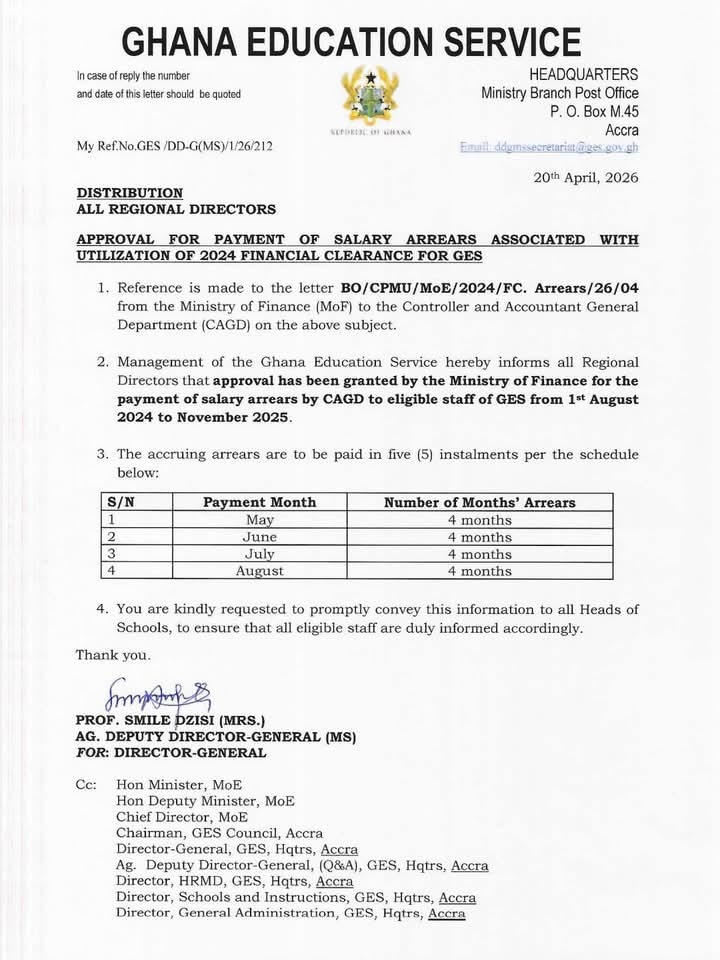
    The Finance Ministry has cleared the Ghana Education Service (GES) to pay the salary arrears of teachers covering August 1, 2024, to November 2025.

    However, the payment will be made in five instalments, GES has announced in a formal statement dated April 20, signed by the Acting Deputy Director-General (Management Services), Prof. Smile Dzisi, on behalf of the Director-General of GES. 

    “Management of the Ghana Education Service hereby informs all Regional Directors that approval has been granted by the Ministry of Finance for the payment of salary arrears by CAGD to eligible staff of GES from 1st August 2024 to November 2025”, parts of the statement read.

    The payment of the arrears is scheduled to begin in May 2026. The arrears will be paid over four months, with four months’ arrears to be settled in each of May, June, July and August.

    “The accruing arrears are to be paid in five (5) instalments…”, the statement added.

    This comes after the education regulatory body secured financial clearance from the Finance Ministry in 2024, following the posting of the teachers.

    The statement, addressed to all Regional Directors, indicated that the Ministry of Finance has authorised the Controller and Accountant-General’s Department (CAGD) to process the payments.  GES also directed all heads of schools to inform their eligible staff.

    The Service has directed Regional Directors to communicate the development to all Heads of Schools to ensure that affected staff are duly informed.

    The move is expected to bring relief to affected staff who have been awaiting payment of their outstanding salaries.

    Meanwhile, it will be recalled that the Ghana Education Service (GES) in a press statement dated 16th October, announced that it has received financial clearance to pay the salaries of 6,249 teachers recruited in 2024.

    These teachers had been working after their postings but hadn’t been placed on the government’s payroll, hence they were not receiving salaries for their services.

    However, after the Finance Ministry authorised that they can be paid, the education regulator announced that they can now start receiving salaries. In Ghana’s public sector, recruits cannot be paid until the Ministry of Finance issues financial clearance.

    Consequently, GES, in the statement, noted that “This approval allows the Ghana Education Service to complete all necessary processes to ensure the staff receive their salaries. Although this financial clearance expires on 31st December 2025, Management of GES will ensure that all staff are placed on the mechanised payroll in time for November 2025 payments.”

    The Service expressed appreciation to its staff for their dedication and reiterated its commitment to ensuring the timely and accurate disbursement of salaries.

    According to reports, these 6,249 newly recruited teachers mark the last set of recruits that have been cleared to receive a salary.

    The Education Minister in mid-October announced that the government will absorb six thousand two hundred teachers into the education system and settle all arrears owed them.

    This announcement came after a group of concerned and aggrieved teachers who had worked for months without salary petitioned the office of the Education Minister, he said.

    Addressing the petition, Education Minister Haruna Iddrisu, during a pre-event briefing and regional stakeholder meeting on October 13 ahead of the ADEA Triennale 2025 launch later this month, revealed that the government has earmarked about one million cedis for the payment of teachers’ salaries. He also urged them to give their best to promote academic excellence across the country’s educational institutions.

    “A few weeks ago, my Chief Director and I received a petition from some teachers who were unhappy with the government over their delayed salaries. They have worked for several months without pay. I’m happy to announce that the Cabinet has given approval for the 6,200 teachers to be absorbed, and the process will begin in due course. They will receive their staff IDs, and as I assured them, they will also get their back pay.

    “But having demonstrated goodwill by doing this, we expect something in return — that they remain committed and dedicated to academic work,” the Minister highlighted.

    He revealed that the government has approved one million dollars to absorb the teachers and a category of health workers.

    “So, those 6,200 teachers, I think I can speak for both ministries in this matter, the Cabinet has given the Minister of Finance approval to vary the budget and spend about GH₵1.1 billion to absorb a category of health workers and teachers,” the Minister noted.

  • Free SHS: CHASS warns of potential nationwide SHS shutdown over funding delays

    Free SHS: CHASS warns of potential nationwide SHS shutdown over funding delays

    Senior high schools (SHS) nationwide risk a shutdown due to delays in funds for purchasing food, particularly perishables, to sustain feeding operations under the Free Senior High School (Free SHS) programme, the Conference of Heads of Assisted Secondary Schools (CHASS) has announced.

    This comes after the association’s meeting with the Education Minister on Friday ended in a stalemate after stakeholders failed to reach an agreement on what measures could be taken to address a worsening food-supply crisis in schools.

    The meeting saw the attendance of stakeholders such as CHASS, the National Food Buffer Stock Company, and the GETFund, with a focus on procurement of perishable food items such as vegetables, meat, and eggs, which have become difficult to source due to delays in funding.

    In an effort to resolve the issue, the minister proposed that GETFund maintain an arrangement allowing CHASS to independently procure perishable items. However, the parties were unable to reach a consensus.

    The deadlock follows a formal petition by CHASS and the Conference of Principals of Technical Institutions (COPTI), who have raised concerns over dwindling supplies from the National Food Buffer Stock Company and the impact of inflation on already constrained school budgets.

    Consequently, CHASS warned that failure by the government to provide immediate funding for the procurement of essential food supplies may compel schools to send students home, warning that such a move may disrupt the academic calendar and preparations for the West African Senior School Certificate Examination (WASSCE).

    Headteachers have reportedly resorted to using personal funds and relying on credit from local suppliers to ensure students continue to receive meals.

    With negotiations stalled, concerns are growing over the sustainability of the programme’s feeding component, which supports more than 1.2 million students nationwide.

    Stakeholders are expected to reconvene in the coming days as efforts continue to find a lasting solution to the crisis.

    About the Free SHS policy 

    The Free Senior High School policy was introduced in 2017 by the Akufo-Addo-led government to make secondary education accessible to all eligible students without financial barriers.

    The policy was aimed at helping students who struggled to pay tuition, boarding, and other school-related expenses. However, the policy came with its challenges, such as overcrowding and congestion in schools, pressure on infrastructure and facilities, and increased pressure on teachers.

    This increased the number of enrollments in the senior high schools that were listed under the Free SHS policy. About 3.5 million students have benefited from the Free Senior High School (Free SHS) program since its launch.

    The immediate-past government revealed that it had spent over GH¢12 billion on the implementation of the Free SHS policy since its inception. Meanwhile, Asantehene Otumfuo Osei Tutu II has urged a reassessment of Ghana’s Free SHS initiative, recommending that households with sufficient means contribute financially so that government support can be directed toward students in real need.

    During a meeting with Education Minister Haruna Iddrisu, the Asantehene suggested a shared funding model, akin to previous arrangements where financial aid was granted to bright but disadvantaged students, while those with the ability to pay covered their own expenses.

    “Those who can afford to pay, let’s have a second look at the policy. If someone can afford it, let’s allow them to pay. In the old times, when you passed, the bursary would look for good but needy students and award them scholarships, and those who could afford to pay did so.”

    Otumfuo Osei Tutu II has recognised the positive impact of the Free SHS policy but stressed the importance of a national discussion to tackle its shortcomings and secure its future.

    “This Free SHS we are talking about, although we have implemented it, if we have a dialogue and find out that it will result in students coming home now and then because there is no food, then it is not fit for purpose.”

    He also pointed out several pressing concerns affecting secondary schools, including overcrowded dormitories, a lack of well-equipped science and ICT laboratories, irregular food supplies, and insufficient school buses.

    “Our dormitories are overcrowded and lack science and ICT labs. Sometimes, PTA makes contributions to support. The lack of school buses and the shortage of food should all be looked at. Let us implement it well so that students will stay in school and have enough to eat.”

  • Shatta Wale partners Ghana Education Service on 20th anniversary plans

    Shatta Wale partners Ghana Education Service on 20th anniversary plans

    Ghanaian dancehall artiste Shatta Wale is set to partner with the Education Ministry to promote tertiary education among the populace, particularly the youth.

    This forms part of the activities marking two decades since the introduction of the Student Loan Trust Fund (SLTF).

    The partnership was revealed during a courtesy call at the Ministry of Education in Accra, where the musician engaged with the Fund’s board and management to discuss the initiative.

    Speaking after the meeting, Shatta Wale expressed his excitement and enthusiasm about the collaboration, promising “something great” for students ahead of the celebration of the 20th anniversary, adding that the partnership with GES is an awesome opportunity to support education and positively impact students across the country.

    “Education is the key,” the  ‘Gringo’ hitmaker stated.

    The initiative is expected to form part of a broader campaign to raise awareness about the Fund’s work and expand access to financial support for students pursuing higher education.

    About SLTF

    The SLTF was established in December 2005 under the Trustee Incorporation Act 1962 (Act 106). It is dedicated to managing financial resources efficiently to support students while upholding national principles.

    Meanwhile, as part of a series of reforms being implemented under President John Dramani Mahama’s Reset Agenda, the Students Loan Trust Fund (SLTF) in early November last year announced a 50% increase in loan amounts available to tertiary students.

    In this regard, regular students will now receive between GHC2,250 and GHC4,500 each academic year, and they will get the funds directly from the SLTF.

    This was contained in a statement signed and dated Friday, November 7, by Dr. Saajida Shiraz, Chief Executive Officer of the SLTF. The Students Loan Trust Fund explained that the raise is to ensure that all groups of persons can pursue tertiary education without encountering financial challenges.

    “Following President Mahama’s directive, loan amounts have been reviewed upward to reflect current economic realities and to provide meaningful support to students,” the statement said.

    So far, beneficiaries amount to 35,608 across 130 public and private institutions nationwide. According to SLTF management, the latest disbursement reflects the John Mahama-led administration’s pledge to ensure inclusive access to education, regardless of students’ backgrounds.

    The SLTF, conversely, has reiterated its resolve to release funds on time to allow students to gain admission into their preferred tertiary institutions without financial hindrance.

    Interest on student loans slashed by 6%

    Students Loan Trust Fund (SLTF) saw a 50 percent increase in loan amounts, with beneficiaries now eligible to receive between GH¢2,250 and GH¢4,500 per academic year.

    The adjustment, which forms part of sweeping reforms unveiled in a press statement issued on Friday, November 7, is aimed at improving access to affordable tertiary education, following directives from President John Dramani Mahama.

    “Increased Loan Amounts for Regular Students Loan: Regular student loan amounts, disbursed directly to students, have been increased by 50%. Consequently, loan amounts now range from GHC 2,250.00 to GHC 4,500.00 per academic year,” part of the statement outlining the reforms said.

    The interest rate on student loans has also been slashed from 12 per cent compound interest to 6 per cent simple interest during the study and moratorium periods.

    “Interest Rate Reduction: The prevailing interest rate on student loans has been reduced from 12% annual compounded interest to 6% simple interest during the period of study and moratorium,”

    Government has introduced the “Student Loan Plus,” a flagship initiative under the No Fees, No Stress programme as one major highlight of the reforms.

    “Introduction of Students Loan Plus: Tertiary Students can now apply for the Students Loan Plus package, a component of the No Fees Stress Initiative, which provides tertiary students with full fee coverage loans disbursed directly to tertiary institutions,” other parts of the statement read.

    The Students Loan Trust Fund also unveiled  a streamlined application and disbursement process, concealing the long-standing E-zwich requirement.

    “Streamlined Application and Disbursement Process: The E-zwich requirement for loan application is no longer mandated. GCB Bank accounts for disbursement will now be created automatically within the No Fees Stress portal for all new applicants.”

  • GES closes application for teacher recruitment , over 40k applications received

    GES closes application for teacher recruitment , over 40k applications received

    The Ghana Education Service (GES) has closed its teacher recruitment portal just three days after it opened.

    The portal, which was originally scheduled to remain open until Friday, April 17, was shut early due to a record number of applications from teachers.

    GES says, while it opened the recruitment portal for just 7,000 slots, about 40, 000 prospective applicants have submitted applications, informing their move to close the portal to manage the flow of submissions.

    Speaking at a news conference in Accra, the Minister for Education, Haruna Iddrisu, attributed the limited intake to budgetary constraints, despite the high demand for teaching jobs across the country.

    “If resources were available, we would have been recruiting up to 50,000 teachers nationwide, but owing to budgetary constraints, we are unable to do that,” he said.

    The Education Minister continued that,

    Mr Iddrisu noted that the recruitment process had been conducted in a transparent manner, with approval granted to hire a limited number of qualified candidates.

    “The Ministry of Education received clearance to recruit up to 7,000 teachers, both degree and diploma holders, and the process has been advertised in an open and transparent manner,” he explained.

    He further described the overwhelming number of applications as a reflection of the growing demand for employment in the education sector.

    “When the portal was opened for 7,000 teachers, we received over 40,000 applications. The Ghana Education Service subsequently closed it, and those who were fortunate to apply will be critically assessed based on their readiness, competence, and qualifications,” he added.

    The Minister assured applicants that the selection process would be fair and merit-based.

    Meanwhile, the government is currently making efforts to avert the looming unemployment crisis brooding in Ghana’s health sector.

    Consequently, it is collaborating with other international partners to employ some skilled nurses as well as teachers. On Monday, October 27, the Ghanaian government, represented by Ghana’s Minister of Special Initiatives, Emmanuel Agyekum with with support from Mr Nelson Ndebah Ndebugre from the Office of the President, signed a Memorandum of Understanding (MoU) during a high-level meeting with Bahamian officials, including Prime Minister Philip “Brave” Davis.

    The bilateral deal is to facilitate the recruitment of Ghanaian teachers and nurses for employment opportunities in the Caribbean nation.

    The signing of the MoU was announced in a communique, which highlighted that the new agreement is an important step forward in the partnership between the two countries, citing that Ghana is becoming a leader in sending skilled workers abroad and that the world has confidence in the talent and professionalism of the Ghanaian people.

    “At the heart of this MoU is a shared vision aimed at improving cooperation and relations between Ghana and The Bahamas through people-centred development and mutually beneficial cooperation. As part of the initial phase of this collaboration, the recruitment of experienced Ghanaian teachers and nurses to serve in the Bahamas has commenced. This initiative proves that the trust that our international partners have in the quality of Ghanaian educators and healthcare workers, who have consistently demonstrated excellence, discipline, and dedication in shaping minds and healing the nations,” the communique read.

    Under the initial phase of the collaboration, experienced Ghanaian teachers and nurses will be recruited to serve in the Bahamas.

    It added that the programme is “only the beginning,” noting that the broader agreement provides a framework for future cooperation in commerce, culture, tourism, and human capital exchange.

    “This initiative is a win-win for both countries. It opens new pathways for Ghana’s skilled professionals to share expertise and gain global exposure while earning decent livelihoods. For The Bahamas, it ensures access to competent teachers and nurses whose professionalism will enhance their education and health sectors.”

    It further assured stakeholders that the welfare and fair treatment of Ghanaian recruits will remain a top priority, adding that recruitment processes will be transparent and the rights and safety of participants fully safeguarded.

    “Though the conditions of the MoU remain confidential as part of diplomatic protocol, I would like to point out that its spirit and purpose are rooted in cooperation, respect, and shared prosperity.”

    This is not the first time the Bahamas has recruited Ghanaian nurses to work in their country. Last year, the Bahamas’ national broadcasting service, the ZNS Network, reported in 2024 that Ghanaian nurses were being recruited to help address staffing shortages in Bahamian hospitals.

    According to Health Minister Dr Michael Darville, 18 Ghanaian speciality nurses were expected to arrive in The Bahamas by the end of October 2024 to support facilities like Princess Margaret Hospital and Rand Memorial Hospital, citing that this early recruitment was part of a bilateral healthcare support initiative.

  • Inter-schools competition suspended in Central Region over brutal attack on student

    Inter-schools competition suspended in Central Region over brutal attack on student

    A brutal attack on a student of the Obrachire Senior High Technical School has prompted the Central Regional Directorate of the Ghana Education Service (GES) to suspend all zonal inter-school sporting activities among Senior High Schools (SHSs) and Senior High Technical Schools (SHTSs) in the region following violent incidents during recent competitions.

    The suspension was formally announced in a statement on Sunday, February 22. The directorate said the decision has been necessitated by genuine reports of clashes and violent behaviour among students during zonal athletics competitions.

    In a widely circulated video, some students of the Swedru School of Business (SWESBUS) were captured attacking a student of Obrachire Senior High Technical School during the district inter-schools athletics competition. 

     From the video, we see the Swedru students throwing blocks at the Obrachire students, while others throw heavy punches at him while he tries to find his balance. One student, believed to be a Swedru, rushed in and delivered a forceful kick to his neck, leaving him struggling to stand.

    The confrontation reportedly occurred in Agona Swedru on Thursday, February 19, when tensions between the two schools escalated into physical violence and brawls.

    The GES statement expressed deep concern over the situation, noting that the incidents had “disrupted the spirit of healthy competition and posed serious threats to the safety and well-being of students, staff, and spectators.”

    It reminded school heads that sports activities are meant to encourage discipline, teamwork, mutual respect, and healthy rivalry. “It is therefore regrettable that these noble objectives have been undermined by acts of indiscipline and violence,” the statement added.

    To safeguard lives, maintain order, and protect the integrity of school sports, Management has directed the immediate halt of all zonal inter-school sporting events until further notice.

    The temporary suspension, GES explained, will allow Management some time to investigate the incident, conduct a review, engage the relevant stakeholders, and develop strategies to prevent future incidents.

    Consequently, the regional directorate has ordered all heads of SHSs and SHTSs to temporarily hold on with all planned or scheduled zonal athletics competitions, inform staff, students, and other stakeholders, and ensure strict compliance. 

    “Please note that this directive takes immediate effect and must be adhered to without exception,” the statement emphasised.

    The Directorate assured the public that it remains committed to restoring sporting activities under conditions that guarantee safety, discipline, and the true spirit of healthy competition.

    This incident comes barely two-weeks after GES in the Eastern Region slapped a two-year ban on three Senior High Schools over acts of hooliganism.

    The schools include the Koforidua Senior High Technical School (SECTECH), New Juaben Senior High School (NJUSCO), and Nsutam Senior High Technical School (NSUTECH). Until 2028, these schools will not be allowed to participate in all sports and related co-curricular activities.

    This comes after stakeholders’ investigations proved that these schools were involved in hooliganism during the just-ended Regional Super Zonal Sports Competition.

    In a letter dated February 11, 2026, the Eastern Regional Education Directorate stated the joint expression of regret by the affected schools’ sports executives and school authorities following the chaos that happened during the zonal games on February 4 and 6, 2026.

    “Koforidua Senior High Technical School (Sectech), New Juaben Senior High School (Njuasco), New Nsutam Senior High Technical School (Nsutech). The Management of Eastern Regional Education Directorate and the Regional 2 Cycle Schools’ Sports Executives express their displeasure in the recent incidents before, during and after the Regional Super Zonal Sports (Games) Competition,” parts of the statement said.

    It continued that their students, during the regional games, violated some provisions that guide the conduct of students as far as GES laws are concerned.

    It said, “in accordance with the Ghana Education Service Code of Conduct (2.17 Physical and Psychological Violence) and the Eastern Region Schools and Colleges Sports Association (ERSCSA) Code of Discipline: ARTICLE VII (Disturbances/Riots/Hooliganisms) and ARTICLE VIII (Sanctions/Punishments), the students in your school were found engaging in acts of hooliganism which are unacceptable and contradicts to the rule of discipline in GES.”.

    This section prohibits any acts of physical assault, intimidation, bullying, or psychological abuse among students, stressing that violence, whether physical (fighting, attacking, causing injury) or psychological (harassment, threats, humiliation), is a serious breach of discipline.

    The penalties for violations under Article VII. Sanctions include:

    Suspension or banning of schools from sports and extracurricular activities. Withdrawal of privileges such as hosting or participating in competitions. Additional disciplinary measures imposed by GES or the regional sports association. The severity of punishment depends on the gravity of the offence, with repeat or violent incidents attracting harsher sanctions.

    In addition, the affected schools have been directed to pay a GHC 500 fine and be charged for any damage caused to any property or individual, or injury that was caused.

    GES said, “…….liable to a fine of Five hundred Ghana cedis (GhC500.00). b. surcharged to pay for the cost of any damage/injury to Property or Individual, which shall be determined by a Committee based on the extent of the damage/injury,” urging authorities of the affected schools to caution all their students, both old and new, to avoid further sanctions.

    “Please ensure that your students, staff, old students and other supporters adhere to all rules and regulations governing GES and ERSCSA to avoid any further disciplinary actions. Management counts on your cooperation,” GES added.

    The ban by the GES comes barely a week after a student of Koforidua Senior High Technical School (SECTECH) was hospitalised and given medical care after a violent attack by some Form Two students of New Juaben Senior High School during a clash at the Eastern Regional Inter-Schools Sports Festival in Koforidua.

    According to reports, the victim, identified as Jerome Appiah, was eating waakye on his way to campus when the Juaben students attacked him with a machete, leaving him with a deep wound to the shoulder and bleeding profusely.

    This prompted fears of reprisal attacks and heightened security concerns. Police intervened and quickly ushered Jerome to the Eastern Regional Hospital, where he was receiving treatment and was said to be in stable condition.

  • GES bans new Nsutamam, Koforidua and New Juaben SHS from sports and other activities over recent clash

    GES bans new Nsutamam, Koforidua and New Juaben SHS from sports and other activities over recent clash

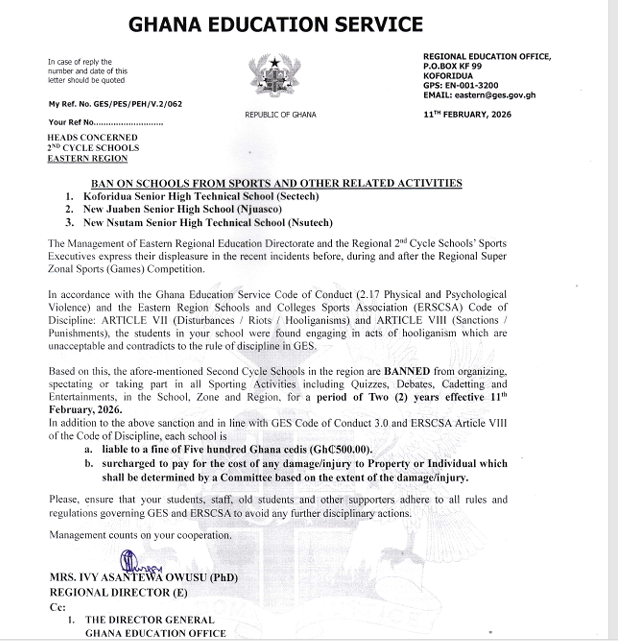
    The Ghana Education Service (GES) in the Eastern Region has slapped a two-year ban on three Senior High Schools over acts of hooliganism.

    The schools include the Koforidua Senior High Technical School (SECTECH), New Juaben Senior High School (NJUSCO), and Nsutam Senior High Technical School (NSUTECH). Until 2028, these schools will not be allowed to participate in all sports and related co-curricular activities.

    This comes after stakeholders’ investigations proved that these schools were involved in hooliganism during the just-ended Regional Super Zonal Sports Competition.

    In a letter dated February 11, 2026, the Eastern Regional Education Directorate stated the joint expression of regret by the affected schools’ sports executives and school authorities following the chaos that happened during the zonal games on February 4 and 6, 2026.

    “Koforidua Senior High Technical School (Sectech), New Juaben Senior High School (Njuasco), New Nsutam Senior High Technical School (Nsutech). The Management of Eastern Regional Education Directorate and the Regional 2 Cycle Schools’ Sports Executives express their displeasure in the recent incidents before, during and after the Regional Super Zonal Sports (Games) Competition,” parts of the statement said.

    It continued that their students, during the regional games, violated some provisions that guide the conduct of students as far as GES laws are concerned.

    It said, “in accordance with the Ghana Education Service Code of Conduct (2.17 Physical and Psychological Violence) and the Eastern Region Schools and Colleges Sports Association (ERSCSA) Code of Discipline: ARTICLE VII (Disturbances/Riots/Hooliganisms) and ARTICLE VIII (Sanctions/Punishments), the students in your school were found engaging in acts of hooliganism which are unacceptable and contradicts to the rule of discipline in GES.”.

    This section prohibits any acts of physical assault, intimidation, bullying, or psychological abuse among students, stressing that violence, whether physical (fighting, attacking, causing injury) or psychological (harassment, threats, humiliation), is a serious breach of discipline.

    GES bans 3 schools over hooliganism

    The penalties for violations under Article VII. Sanctions include:

    Suspension or banning of schools from sports and extracurricular activities. Withdrawal of privileges such as hosting or participating in competitions. Additional disciplinary measures imposed by GES or the regional sports association. The severity of punishment depends on the gravity of the offence, with repeat or violent incidents attracting harsher sanctions.

    In addition, the affected schools have been directed to pay a GHC 500 fine and be charged for any damage caused to any property or individual, or injury that was caused.

    GES said, “…….liable to a fine of Five hundred Ghana cedis (GhC500.00). b. surcharged to pay for the cost of any damage/injury to Property or Individual, which shall be determined by a Committee based on the extent of the damage/injury,” urging authorities of the affected schools to caution all their students, both old and new, to avoid further sanctions.

    “Please ensure that your students, staff, old students and other supporters adhere to all rules and regulations governing GES and ERSCSA to avoid any further disciplinary actions. Management counts on your cooperation,” GES added.

    The ban by the GES comes barely a week after a student of Koforidua Senior High Technical School (SECTECH) was hospitalised and given medical care after a violent attack by some Form Two students of New Juaben Senior High School during a clash at the Eastern Regional Inter-Schools Sports Festival in Koforidua.

    According to reports, the victim, identified as Jerome Appiah, was eating waakye on his way to campus when the Juaben students attacked him with a machete, leaving him with a deep wound to the shoulder and bleeding profusely.

    This prompted fears of reprisal attacks and heightened security concerns. Police intervened and quickly ushered Jerome to the Eastern Regional Hospital, where he was receiving treatment and was said to be in stable condition.

    To prevent an escalation, the Headmaster of Koforidua SECTECH, Emmanuel Frimpong Benjabeng, joined by other teachers, rushed to the Koforidua Youth Resource Centre, where the inter-schools sports festival was being held.

    However, while the headmaster was in an engagement with the New Juaben South Municipal Education Director, Mustapha Haruna Appiah, he was informed that further disturbances had broken out, forcing him to leave the meeting abruptly.

    Later, it emerged that a teacher of SECTECH, Henry Kudiabor, had also sustained a head injury after being struck by a flying stone during clashes involving students of Nsutam Senior High Technical School, who were allegedly pelting stones.

    The New Juaben South Municipal Education Director, Mustapha Haruna Appiah, expressed concern over the recurring violence and called on the police and event organisers to investigate the incident thoroughly and tighten security to prevent further attacks.

    This added to a worrying trend of rising indiscipline and violent confrontations among students in Ghanaian schools, particularly second-cycle schools nationwide.

    Last year was marked by at least five major violent incidents recorded between January and July 2025, from Kinbu’s teacher assault to Nalerigu’s fatal shootings.

  • Allow Supreme Court resolve alleged infringement of Muslim students’ rights at Wesley Girls – President Mahama

    Allow Supreme Court resolve alleged infringement of Muslim students’ rights at Wesley Girls – President Mahama

    President John Mahama has added his voice to the ongoing controversies surrounding a growing dispute about the rights of Muslim students in mission schools. 

    The growing dispute started when reports surfaced that Wesley Girls Senior High School was restricting Muslim students from practising their faith, i.e., fasting, prayers. On November 28, Imam Sahamudeen Bamba publicly reignited the controversy, accusing Wesley Girls’ SHS of continuing to restrict Muslim students. His accusations come on the back of a pending lawsuit which was filed at the Supreme Court of Ghana by lawyer Shafic Osman, challenging Wesley Girls’ SHS for allegedly restricting Muslim students from fasting and wearing hijabs.

    Following Sahamudeen’s allegations, he openly called on President Mahama to intervene. Consequently, the President, speaking during a meeting with the National Peace Council on Wednesday, December 10, expressed his surprise at the tensions, citing that an MoU signed by these missionary schools clearly spell out the institution’s acceptance of recognition of diversity. 

    Hence, President Mahama expressed confidence in the Supreme Court’s ruling, saying, “There is a matter before the Supreme Court which is yet to be determined. If you read what the faith-based organisations agreed in their own MoU, I don’t see any point of dispute.

    “They all accept that if there is a mission school, it has its faith orientation, but within that faith orientation, there must be recognition of diversity. It is right there in the MoU. I don’t want to suggest it, but I think the Supreme Court has its work cut out for it because the same people signed that MoU, so I don’t see what the contention there is”.

    The President also referred to a part of the MoU that spelt out regulations about fasting for both the Christian and Islamic religions. According to him, the agreement was that in cases where a student, by religious obligation, sought to fast, it would be subject to the approval of their parents. Once approved, any repercussions or health implications resulting from the fast would be the responsibility of the parents and not the school.

    “And there is even a section that talks about fasting because Christians fast and Muslims fast. You can find a Christian student in a Muslim school and a Muslim in a Christian school. And it says that yes, the student can fast if the parents approve. And if there are any health consequences from the fasting, the responsibility shall be that of the parent and not the school”, the President said.

    It will be recalled that, in 2024, the National Peace Council facilitated the signing of a Memorandum of Understanding (MoU) between faith-based organisations and the Ghana Education Service, which was aimed at regulating and managing religious diversity in mission schools, covering practices like fasting, worship spaces, and dress codes.

    He went on to commend the Peace Council for their facilitation to ensure, maintain and peace and harmony in our respective SHS.

    “So I think that it is something we can be proud of, and I want to congratulate the Peace Council for being the facilitators of that understanding between the faith-based schools,” he added.

    In a related development, the Methodist Church of Ghana denied allegations that regulations governing the Wesley Girls’ High School (WGHS) treat students unfairly based on their religion.

    In a statement issued on Friday, November 28, the Church said the school continues to uphold unity and discipline by welcoming students from all walks of life.

    The statement emphasized that students are expected to adhere to the school’s traditions, regardless of their background or personal beliefs, and noted that these traditions have shaped WGHS into the respected institution it is today.

    Wading into the conversation, the National Council of Parent-Teacher Associations (NCPTA) noted that all schools must embrace each and every student’s religious beliefs and ensure no faith is given preference over another.

    According to a statement on Tuesday, November 25, NCPTA added that schools that undermine the rights of students across the country are violating Articles 12, 17, and 21(1)(c) of the Constitution.

    “As public entities, all schools and their administrators must uphold the supremacy of the Constitution,” parts of the statement read.

    As per Articles 12, 17 and 21(1)(c) “the fundamental human rights and freedoms enshrined in this Chapter shall be respected and upheld by the Executive, Legislature and Judiciary and all other organs of government and its agencies and, where applicable to them, by all natural and legal persons in Ghana, and shall be enforceable by the Courts as provided for in this Constitution.

    “Every person in Ghana, whatever his race, place of origin, political opinion, colour, religion, creed or gender, shall be entitled to the fundamental human rights and freedoms of the individual contained in this Chapter, but subject to respect for the rights and freedoms of others and for the public interest.

    But Attorney General (A-G) and Minister, Dr. Dominic Ayine, has declared his support for the religious policy practised at Wesley Girls’ Senior High School (SHS).

    The A-G has stated that Wesley Girls’ School is not obliged to accommodate other religious practices. He added that Wesley Girls’ Senior High School, being a Methodist Church of Ghana institution, has the right to uphold its Methodist values.

  • GES announces end of Ghana-only WASSCE from 2026

    GES announces end of Ghana-only WASSCE from 2026

    The Ghana Education Service (GES) has announced that Ghana will rejoin the international West African Senior School Certificate Examination (WASSCE), starting from the May/June 2026 examination cycle.

    In 2020, the Akufo-Addo-led administration introduced the “Ghana-only WASSCE” under the then Education Minister, Yaw Osei-Adutwum. In the last five years, Ghanaian Senior High School candidates sat a localized version of the West African Senior School Certificate Examination (WASSCE), separate from the international May/June exams written by Nigeria, Sierra Leone, Liberia, and The Gambia.

    Also, it was reported that, due to COVID-19, which became a global plague, Ghana adjusted its exam calendar to fit its own reopening schedule for schools, which differed from other WAEC member countries.

    At the time, the government explained that the move was to deal with cross-border leakages of exam papers, which were undermining credibility. By isolating Ghana’s exam, they could better control distribution and monitoring.

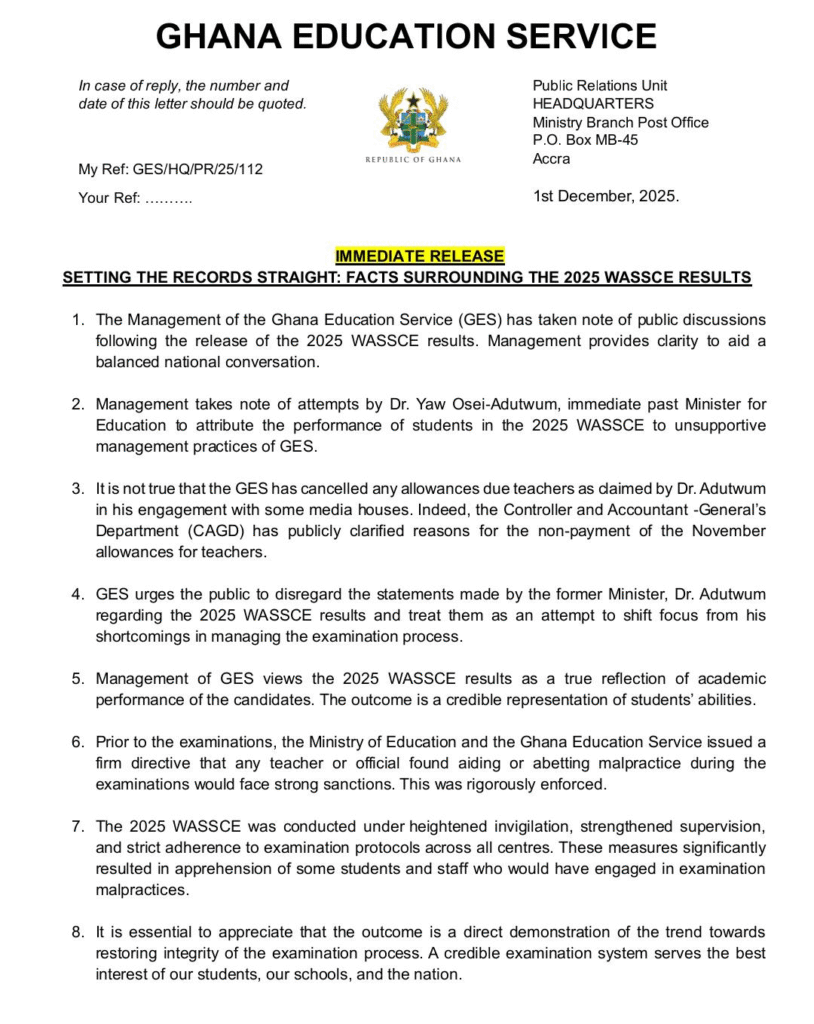
    However, following the release of the 2025 provisional results by the education regulator, GES announced in a statement dated December 1, explaining facts surrounding the 2025 WASSCE results.

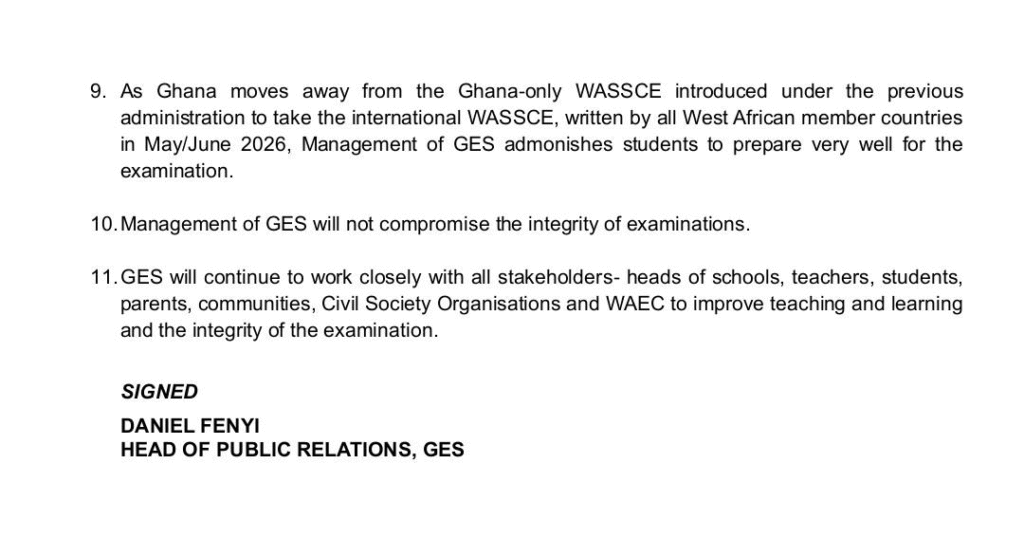
    The statement revealed that: “As Ghana moves away from the Ghana-only WASSCE introduced under the previous administration to take the international WASSCE, written by all West African member countries in May/June 2026…”

    Consequently, it urged candidates to adequately prepare for the exams in the coming year, as it seeks to adopt the necessary measures to uphold the integrity of the exams without compromise.

    “…the Management of GES admonishes students to prepare very well for the examination. Management of GES will not compromise the integrity of examinations. GES will continue to work closely with all stakeholders, heads of schools, teachers, students, parents, communities, Civil Society Organisations, and WAEC, to improve teaching and learning and the integrity of the examination,” parts of the statement read.

    While GES, in its statement, didn’t explain the reason behind the return to the international WASSCE in 2026, according to WAEC, students in all five member countries write the same WASSCE because it ensures uniform standards of assessment, comparability of results, and credibility across the sub-region.

    It also helps students move freely across any of the West African countries to pursue higher education using their exam certificates and, later, even secure job opportunities since their certificates are recognized equally.

    Meanwhile, GES’ statement wasn’t only intended to announce the return to the international WASSCE next year, but also to address some remarks made by the former Education Minister, Dr. Adutwum, when the 2025 WASSCE results were released.

    Dr. Adutwum, in reaction to the abysmal performance by the students, particularly across the four core subjects, blamed the government. According to reports, Dr. Adutwum suggested that “the performance of students in the 2025 WASSCE was due to unsupportive management practices of GES,” adding that the government’s cancellation of allowances for teachers is a contributory factor to the students’ performance.

    GES, in response, stated that: “Management takes note of attempts by Dr. Yaw Osei-Adutwum, immediate past Minister for Education, to attribute the performance of students in the 2025 WASSCE to unsupportive management practices of GES. It is not true that the GES has cancelled any allowances due teachers, as claimed by Dr. Adutwum in his engagement with some media houses. Indeed, the Controller and Accountant-General’s Department (CAGD) has publicly clarified reasons for the non-payment of the November allowances for teachers.”

    It went on to charge the public to treat Dr. Adutwum’s remarks as a move to deflect attention from his failures in handling the examination process.

    “GES urges the public to disregard the statements made by the former Minister, Dr. Adutwum, regarding the 2025 WASSCE results and treat them as an attempt to shift focus from his shortcomings in managing the examination process,” the education agency added.

    It continued that: “Management of GES views the 2025 WASSCE results as a true reflection of the academic performance of the candidates. The outcome is a credible representation of students’ abilities. It is essential to appreciate that the outcome is a direct demonstration of the trend towards restoring the integrity of the examination process. A credible examination system serves the best interests of our students, our schools, and the nation.”

    WAEC released the provisional results of the 2025 West African Senior Secondary Certificate Examination (WASSCE) on Saturday, November 29.

    The results show a massive surge in outright failure rates (Grade F9) across all four core subjects compared to the 2024 performance.

    According to the provisional results released by WAEC, the percentage of students who failed Social Studies increased steeply from 9.55% in 2024 to 27.50% in 2025, representing a 188% increase.

    The other core subjects, that is, Integrated Science and English Language, also saw a doubling of their previous failure rates.

    For Integrated Science, the failure rate increased by 8.93%; that is, the 2024 rate was 7.12%, and in 2025 it increased to 16.05%.

    The failure rate for the English Language also rose from 5.88% in 2024 to 12.86% in 2025. Core Mathematics recorded the sharpest decline, with the proportion of candidates who failed rising from 6.10% in 2024 to an alarming 26.77% in 2025, more than four times higher.

    Consequently, only 48.73% of candidates achieved grades A1 to C6, a steep drop from the 66.86% recorded in 2024. In absolute terms, 209,068 candidates passed Core Maths, while 114,872 (26.77%) failed outright with an F9. Put simply, for every four students who sat for the exam, one failed Core Mathematics.

    The core subjects are foundational: English, Mathematics, Integrated Science, and Social Studies are the backbone of Ghana’s education system. Failure in these means students lack the basic skills needed for higher education or employment.

    The failure of core subjects by candidates this year comes with several major concerns, including career opportunities, social consequences, and the likely impact on the country’s economy.

  • Recall all the tables and install content filters – EduWatch to GES on SHS tablets and pornography

    Recall all the tables and install content filters – EduWatch to GES on SHS tablets and pornography

    The Akufo-Addo-led administration distributed about 83,000 tablets to Senior High School (SHS) students under its flagship digital learning initiative. The goal is to modernise teaching and learning in second-cycle schools, improve digital literacy, and provide access to electronic textbooks to reduce delays in textbook supply.

    However, these tech devices have now become items of distraction and an aid in accessing pornography instead of academic materials. This was revealed by the incumbent Education Minister, Harunna Iddrisu, on the floor of Parliament.

    He said, “My attention this morning, Mr Speaker, was drawn to the fact that many of the devices are not customised and the students are using them for other purposes, including pornography, which is not acceptable.”

    In reaction to this, education think-tanks Africa Education Watch (Eduwatch) has urged the Ghana Education Service (GES) to retrieve the tablets from the students and equip them with proper safety controls before giving them back to them.

    Project Management Specialist at Eduwatch, Kofi Nkansah Sarkodie, during a media engagement on Friday, November 28, recommended that the devices be recalled to their respective schools for proper management and the installation of UNESCO-approved safety features.

    The UNESCO-approved safety features refer to digital safeguards and content controls that align with UNESCO’s global standards for safe, inclusive, and responsible use of technology in education.

    “Those tablets have already been procured and distributed. We recommend that GES retrieve them and ensure that the safety measures are fully implemented. Retrieval can be done at the school level, and the necessary safeguards must be deployed. The devices are intended for academic purposes only, to support students’ learning, and not for any other activity,” Sarkodie said.

    EduWatch stressed that retrieving and reconfiguring the tablets is essential to protect students from inappropriate content and to ensure the devices fulfil their intended educational function.

    According to reports, out of 1.3 million tablets procured, about 980,000 had been distributed, but many were not properly locked. This lack of restrictions allowed students to use them for non-academic purposes, including accessing pornographic content.

    The Minister emphasised that the tablets were intended as part of the Free SHS Smart Schools Project, which is an extension of Ghana’s Free Senior High School (FSHS) policy was launched to digitise the Free SHS program by providing tablets preloaded with curriculum materials and building “smart schools” to modernise teaching and learning.

    Education Minister  Haruna Iddrisu also rebuffed claims that the government did not allocate a budget for the Free Senior High School (SHS) programme.

    During the Finance Minister’s budget presentation on the floor of Parliament on Thursday, November 13, he mentioned that the Free SHS will be funded through GetFund, as about a billion cedis has been allocated to the Education support fund.

    Mr Iddrisu, on Wednesday, November 19, at a press conference held in Accra, where the Minister provided clarity on the education sector allocations in the 2026 Budget, explained that the misconceptions surrounding the Free SHS allocation are practically impossible.

    “The Ghana Education Fund has been allocated 9.9 billion, including 4.2 billion earmarked for Free Senior High School and free TVET infrastructure and services. I’ve heard commentaries suggesting that there is no allocation for Free SHS. That is not practically possible,” he explained.

    There were claims from the Minority in Parliament and some civil society groups that the government did not make a direct budgetary allocation for the Free SHS programme in the 2026 Budget. The Minority Caucus argued that while the government highlighted GSLIP and infrastructure expansion, it failed to earmark explicit funds for Free SHS in 2026. They claimed this omission suggested the government was outsourcing Free SHS financing to donor support rather than sustaining it with domestic resources.

    The Minister said, “The budget is always done for and on behalf of the President of the Republic, which was his first budget. When the GETFund formula gets to Parliament, you will see the actual numbers,” the Minister added.

    He stated that President John Mahama, in the 2025 Budget Statement, outlined a significant policy shift, moving the financing of Free SHS from petroleum revenue to GETFund.

    “From 2018 to 2024, Free SHS was largely financed from the country’s petroleum revenue. The shift now is that GETFund will provide the financing. When the GETFund formula gets to Parliament, you will see the actual numbers,” he said.

    The Minister added that the allocation will also cover student feeding and support the rollout of free tertiary education for persons with disability, effective 2026. The policy forms part of the government’s Inclusive Education Policy.

    “I have submitted a comprehensive policy paper to Cabinet to look at the possibility of introducing free education for all learners in special and integrated schools across the country. I intend that if I get the support of the President and Cabinet, which I trust I have, from 1 January 2026, we should be able to provide for the needs of all learners with special needs in our country,” Mr Haruna noted.

  • Rethinking Ghana’s language policy in education: An Afrocentric defence of Mother tongue instruction

    Rethinking Ghana’s language policy in education: An Afrocentric defence of Mother tongue instruction

    A feature by Manaseh Mawufemor Mintah, PhD

    Rethinking Ghana’s language policy in education: An Afrocentric defence of Mother tongue instruction

    The history of language and education in Africa cannot be separated from the colonial project. British colonial education was never intended to create independent thinkers; it was designed to produce interpreters, clerks, and subordinates to the empire’s bureaucratic machinery. As Albert Luthuli of South Africa lamented, colonial schools were structured to make Africans “hewers of wood and drawers of water.”

    Consequently, Ghana, like much of the continent, inherited this system unchanged. The English language, instead of serving as a medium of communication, became a symbol of elitism and social mobility. It is divided rather than unified. It made many young Africans feel that intelligence was foreign to their own tongues and that the ability to think or express themselves meaningfully was tied to fluency in English.

    It is precisely for this reason that the Minister of Education’s recent call for the use of mother tongues as a medium of instruction in basic schools is both timely and deeply welcome. The policy represents not only an educational adjustment but a symbolic act of national reclamation. It marks a conscious effort to reverse the profound psychological and cultural dislocation that colonial schooling inflicted on the African mind. Moreover, this call acknowledges that language is not merely a channel for instruction but the foundation upon which thought, identity, and collective dignity are built. When people are compelled to think, dream, and express themselves entirely in another’s language, they unconsciously internalise subordination. Therefore, Ghana’s renewed focus on linguistic empowerment through local instruction is an essential step toward restoring self-belief and intellectual independence.

    The Afrocentric argument for mother tongue education is not simply about linguistic preference; it is about reclaiming epistemic sovereignty. Language is never neutral; it is the grammar of consciousness, the vessel through which a people understand reality. A child who learns science, morality, and art in their first language is not merely learning content but internalising a worldview. Indeed, language carries culture, spirituality, and value systems, shaping how individuals perceive themselves and their environment. Research by UNESCO and several African-centered scholars has long confirmed that children learn faster and retain knowledge more effectively when taught in their native languages. Therefore, using indigenous languages as the foundation of early education is both culturally restorative and pedagogically sound.

    My own educational journey offers vivid evidence of this truth. I still recall my experiences in primary and secondary school, where much of what we learned was alien to our lives. If I had been taught the parts of a flower in my native Ewe tongue, I might have gone on to become a taxonomist, a scientist rooted in the natural systems of my land. Instead, I was compelled to memorise English terms disconnected from my cultural and emotional reality. I could recite them flawlessly yet never internalise their meaning. Similarly, I remember sitting in my geography class at Bishop Herman College learning about the Volga River in Russia, the Rocky Mountains in the United States, and glaciated landforms that had no bearing on the world I inhabited. We were made to draw and label hanging valleys and cirques that we had never seen and would likely never encounter. The closest thing to those glaciers in our experience was the frozen block of ice kept in a kenkey seller’s bucket. Yet we were examined on such abstractions as though our survival depended on them.

    This educational model, inherited from colonial systems, has trained African students to master abstractions detached from their own environment while neglecting the immediate world around them. We spent years memorising that water wets glass, reciting Newton’s laws, and repeating textbook definitions without any critical explanation. No one ever told us why water wets glass but not plastic. The system taught us to reproduce information, not to reason. Consequently, our schools have produced generations of citizens who fear inquiry and revere authority. Mother tongue education, by contrast, grounds knowledge in experience. It enables teachers to explain scientific, moral, and social concepts in the language of life, not in the cold syntax of borrowed words.

    The problem of memorisation in Ghana’s schools is not that our children lack intellect; rather, they are taught in a language that distances understanding from experience. I never memorised anything in law school, yet I was told I would fail. I did not fail because I understood. The culture of rote learning is a direct consequence of linguistic alienation. I remember being told that the black-letter laws must be memorised verbatim and that one could not interpret them differently. Yet, as someone who never favoured blind memorisation, I resisted this norm. I chose to engage with law through reason and context, carving meaning from understanding rather than from mechanical recall. It may not have earned me the highest grades, but it gave me a depth of comprehension far beyond those who memorised without reflection.

    Critics of the new policy, however, argue that the problem is not language but poor teaching. They contend that English promotes national unity and global competitiveness, enabling students from different regions to take the same exams and communicate worldwide. Moreover, they fear that implementing instruction in multiple local languages would fragment the education system and increase administrative burdens. This view, while seemingly practical, reveals a more profound misunderstanding of the issue. It treats language as a mere instrument of communication rather than the cognitive and cultural framework through which meaning is constructed.

    On the contrary, the claim that Ghana’s multilingualism makes indigenous education impractical is itself a colonial assumption, the belief that African diversity is a liability rather than a strength. In truth, Ghana’s linguistic richness can be managed intelligently. In major urban centres such as Accra and Tema, where linguistic overlap is high, Twi and Ga could be adopted interchangeably alongside English. In rural areas, however, education should be tied to the soil of origin. Local teachers fluent in the community’s tongue should handle early-grade instruction, while those posted from elsewhere should be incentivised to learn the language of the people they serve. This would not only promote inclusivity but also foster respect for cultural diversity within the teaching profession.

    Furthermore, this approach strikes a balance between cultural authenticity and administrative practicality. It does not seek to abolish English but to dethrone its monopoly. Once children grasp scientific and moral concepts in their own languages, English can function merely as a tool of translation for global communication, not as the sole gateway to knowledge. Tanzania and Ethiopia have demonstrated that such bilingual systems work effectively when there is political will and cultural confidence.

    Nevertheless, the problem extends beyond language alone. The very curriculum we inherited is an artifact of colonial ideology. When I studied geography in secondary school, I learned about glaciated valleys, the Appalachians, and the Rockies, yet nothing about the Volta Basin or the Atewa Range. American children are never made to study Ghanaian landforms, but Ghanaian children are compelled to learn about America’s. Our textbooks, often written by non-Africans, embed a Eurocentric worldview that alienates us from our heritage. Therefore, the crisis is not only linguistic but epistemological. A colonial curriculum, even when taught in African languages, will still yield colonial outcomes unless the content itself is decolonised.

    In this regard, the conversation on language must expand into a larger project of cultural emancipation. If Ghana is truly committed to transformation, we must decolonise every sphere of public life. This includes our courts, classrooms, parliaments, and even our wardrobes. Lawyers and judges must drop the colonial horsehair wigs that symbolise psychological servitude. The President and his ministers must abandon Western suits and ties and instead reflect African identity through indigenous attire. Parliament should normalise the use of local dialects, with translation systems to ensure inclusivity, just as the European Union operates across multiple languages. Likewise, researchers and academics must reject the blind imitation of Western citation metrics and adopt Afrocentric methodologies that honour indigenous knowledge systems. True transformation demands courage, the courage to break with mimicry and rediscover ourselves.

    Hence, this policy is not merely an educational reform but a profound political and cultural act. It proclaims to every Ghanaian child that they can think, analyse, and innovate in their own voice. While concerns about implementation, teacher training, and resource translation are valid, they are logistical challenges, not philosophical barriers. With adequate planning, investment, and national will, these obstacles can be overcome. What cannot wait, however, is the urgent need for psychological liberation. Language is the soul of civilisation. To be taught entirely in a foreign tongue is to live intellectually in exile.

    Moreover, the argument that English ensures global relevance must be critically interrogated. Nations such as Japan, China, and South Korea achieved industrial and scientific breakthroughs not by prioritising English but by mastering complex concepts in their own languages before translating them for global discourse. Their success stems from cultural self-confidence, not linguistic imitation. Ghana can and must follow this path. We should aspire to produce children who grasp the logic of science in Akan, the ethics of community in Ga, and the poetry of existence in Ewe before expressing those insights in any other tongue. That is how originality and innovation are born.

    Ultimately, the inability of many Ghanaian students to apply knowledge does not result from language deficiencies but from an education system that rewards memorisation over understanding and conformity over creativity. As my own experience shows, true learning begins when comprehension replaces repetition. The deeper we root education in familiar languages, contexts, and cultures, the more critical, creative, and confident our students will become.

    In the final analysis, the mother tongue policy must be seen not as an attack on English but as a restoration of intellectual balance. English will remain a useful bridge for global communication, but it must no longer define intelligence or dictate belonging. Ghana’s future depends on nurturing thinkers who see the world through African eyes, reason through African experience, and articulate knowledge through African voices. We cannot build a self-reliant nation in a borrowed tongue.

    DISCLAIMER: Independentghana.com will not be liable for any inaccuracies contained in this article. The views expressed in the article are solely those of the author, and do not reflect those of The Independent Ghana

  • Govt to clear salary backlog of over 6k staff at GES in November

    Govt to clear salary backlog of over 6k staff at GES in November

    Six thousand two hundred and forty-nine (6,249) teaching and non-teaching staff of the Ghana Education Service (GES) are expected to receive salaries owed them by the government in November.

    Speaking to the media on Thursday, October 16, the Deputy Director-General of GES, Smile Gavua Dzisi, disclosed that the government has already initiated measures to ensure the affected individuals receive their payments within the stipulated time.

    “Following the approval from the cabinet on the extension of financial clearance granted in 2024,  through the sector minister, Hon. Haruna Iddrisu and his team, we have been given the green light and we have been directed to immediately complete the process of the mechanism and payments of all recruited staff who are yet to be paid.

    “And this payment will be done by the end of November 2025. These unpaid teaching and non-teaching staff of GES are about 6,249. We’re going to start the process after the press conference to ensure they will be paid by the end of November,” she assured.

    Earlier, the Education Minister announced that, government will absorb six thousand two hundred teachers into the education system and settle all arrears owed them.

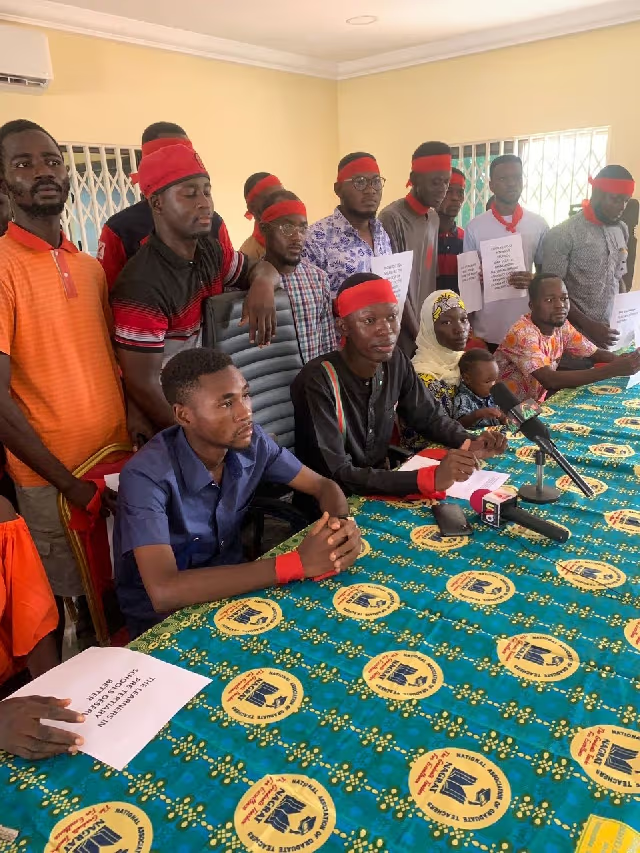
    The announcement comes after a group of concerned and aggrieved teachers who have worked for months without salary petitioned the office of the Education Minister.

    Addressing the petition, Education Minister Haruna Iddrisu, during a pre-event briefing and regional stakeholder meeting on October 13 ahead of the ADEA Triennale 2025 launch later this month, revealed that the government has earmarked about one million cedis for the payment of teachers’ salaries. He also urged them to give their best to promote academic excellence across the country’s educational institutions.

    “A few weeks ago, my Chief Director and I received a petition from some teachers who were unhappy with the government over their delayed salaries. They have worked for several months without pay. I’m happy to announce that the Cabinet has given approval for the 6,200 teachers to be absorbed, and the process will begin in due course. They will receive their staff IDs, and as I assured them, they will also get their back pay.

    “But having demonstrated goodwill by doing this, we expect something in return, that they remain committed and dedicated to academic work,” the Minister highlighted.

    According to him, the government has approved one million dollars to absorb the teachers and a category of health workers.

    So, those 6,200 teachers, I think I can speak for both ministries in this matter, the Cabinet has given the Minister of Finance approval to vary the budget and spend about GH₵1.1 billion to absorb a category of health workers and teachers”, the Minister noted.

    The Tamale South Constituency MP also revealed steps the government is taking to deal with the confusion that comes with the school placement system. Three hundred and ninety-three thousand (393,000) candidates passed their Basic Education Certificate Examination (BECE) in 2025, making them eligible to enter Senior High School as the country’s education system demands.

    Due to the long-standing prestige attached to fewer than 100 top-tier Category A and B schools, the 76,000 vacancies available in these institutions cannot accommodate the large number of students who prefer them, creating intense pressure on the Computerised School Selection and Placement System (CSSPS).

    Consequently, Haruna Iddrisu, announced plans to promote fairness and improve access for all qualified candidates starting next year, 2026, by re-categorising some second-cycle schools, a move which has received the President’s approval.

    “When it comes to Category A, B, and C schools, every parent understandably wants their child in a Category A school. But in the past month, we haven’t expanded infrastructure in any Category A school to make that possible. My thinking, to ensure equity, is that from 2026 onwards, after consultations and discussions with the President, and with his support and blessing, we will convert at least 10 Category C schools to Category B schools, and 10 Category B schools to Category A schools”, the Minister said.

    The re-categorisation will, however, be backed by improved infrastructure facilities in the respective schools to promote a serene academic atmosphere.

    “This will be backed by infrastructure improvements, additional classroom blocks, dormitories for students, and quality enhancements through better teaching and learning materials and aids”, Mr Haruna continued.

    The Education Ministry has announced a transition from prepaid to postpaid meters across all government senior high schools nationwide.

    This was announced by the Education Minister, Haruna Iddrisu, during a speech at the 63rd Conference of Heads of Assisted Secondary Schools (CHASS) in Sunyani, held on Wednesday, October 8

    The move comes following complaints from headteachers over the unreliability of prepaid meters and the challenges that disrupted power flow causes to academic work.

    Ahead of the Minister’s announcement, CHASS National President, Alhaji Yakub A.B. Abubakar, highlighted some of the challenges faced by these headteachers, citing electricity supply disruptions due to prepaid meters.

    In response, the Minister said “….And I’m happy to announce that, first January 2026, all CHASS schools will be on post-paid meters. My colleague Hon Jinapor asked me to convey to you that it is possible and that all CHASS schools will be moved to postpaid so that you will not continue to endure the embarrassment of lights being off”, the minister disclosed.

    Over the years, the government-assisted Senior High Schools (SHS) have complained about the interruptions in power supply due to the use of pre-paid meters in the respective schools. Prepaid electricity meters work on a “pay-as-you-go” system, where users buy power in advance and consume only what they’ve paid for.

    Consequently, schools had to buy electricity upfront and later seek reimbursement from the Ministry of Education, and this created cash flow problems, especially when government funds were delayed.

    Headmasters emphasised that power interruptions affected students’ ability to study, especially during exam preparation periods.

    Schools like Mawuli SHS and Presec-Legon reported frequent blackouts when prepaid units ran out, disrupting evening studies and essential services. Mawuli SHS noted that “each time the units run out, we’re plunged into darkness,” which directly undermines academic performance.

    The Minister also disclosed that the Education Ministry has cleared the outstanding arrears owed to Primetime Limited, organisers of the National Science and Mathematics Quiz (NSMQ), from 2023 to date.

    The Ministry confirmed the disbursement in a statement released on Wednesday, October 8, issued by its Press Secretary, Hashim Haruna.

    The Ministry reaffirmed its commitment to promoting science and mathematics education through consistent financial support and broader participation.

    “The Ministry of Education has released an amount of GH¢9.5 million to Primetime Company to clear all the arrears owed to the organisers of the National Science and Mathematics Quiz competition,” the statement read.

    The Ministry also announced that the competition will now include more schools.

    “The number of schools in the competition has now been expanded to 177, up from 124 this year,” the statement added.

    The organisers of NSMQ released the timetable for the competition on October 1, which included the launch and balloting set for October 7, as well as the preliminaries slated for October 13 to 17.

    Two days later, the one-eighth stage will kick off from October 19 to 21, followed by the quarter-finals from October 23 to 25. The semi-finals will take place on October 27, and the grand finale, where the champions will be announced, is scheduled for three days later.

    However, CHASS initially announced its intention to boycott this year’s competition, citing financial constraints. In a statement dated October 3 and signed by CHASS National Secretary Baro Primus, the organisation informed the quiz organisers that Ghanaian senior high schools would not participate in the balloting or subsequent stages of the 2025 NSMQ.

  • Govt to absorb 6,200 teachers, settle all arrears owed them – Education Minister 

    Govt to absorb 6,200 teachers, settle all arrears owed them – Education Minister 

    Education Minister has announced that, government will absorb six thousand two hundred teachers into the education system and settle all arrears owed them.

    This announcement comes after a group of concerned and aggrieved teachers who have worked for months without salary petitioned the officeof the Education Minister, he said.

    Addressing the petition, Education Minister Haruna Iddrisu, during a pre-event briefing and regional stakeholder meeting on October 13 ahead of the ADEA Triennale 2025 launch later this month, revealed that the government has earmarked about one million cedis for the payment of teachers’ salaries. He also urged them to give their best to promote academic excellence across the country’s educational institutions.

    “A few weeks ago, my Chief Director and I received a petition from some teachers who were unhappy with the government over their delayed salaries. They have worked for several months without pay. I’m happy to announce that the Cabinet has given approval for the 6,200 teachers to be absorbed, and the process will begin in due course. They will receive their staff IDs, and as I assured them, they will also get their back pay.

    “But having demonstrated goodwill by doing this, we expect something in return, that they remain committed and dedicated to academic work,” the Minister highlighted.

    According to him, the government has approved one million dollars to absorb the teachers and a category of health workers.

    So, those 6,200 teachers, I think I can speak for both ministries in this matter, the Cabinet has given the Minister of Finance approval to vary the budget and spend about GH₵1.1 billion to absorb a category of health workers and teachers”, the Minister noted.

    The Tamale South Constituency MP also revealed steps the government is taking to deal with the confusion that comes with the school placement system. Three hundred and ninety-three thousand (393,000) candidates passed their Basic Education Certificate Examination (BECE) in 2025, making them eligible to enter Senior High School as the country’s education system demands.

    Due to the long-standing prestige attached to fewer than 100 top-tier Category A and B schools, the 76,000 vacancies available in these institutions cannot accommodate the large number of students who prefer them, creating intense pressure on the Computerised School Selection and Placement System (CSSPS).

    Consequently, Haruna Iddrisu, announced plans to promote fairness and improve access for all qualified candidates starting next year, 2026, by re-categorising some second-cycle schools, a move which has received the President’s approval. 

    “When it comes to Category A, B, and C schools, every parent understandably wants their child in a Category A school. But in the past month, we haven’t expanded infrastructure in any Category A school to make that possible. My thinking, to ensure equity, is that from 2026 onwards, after consultations and discussions with the President, and with his support and blessing, we will convert at least 10 Category C schools to Category B schools, and 10 Category B schools to Category A schools”, the Minister said.

    The re-categorisation will, however, be backed by improved infrastructure facilities in the respective schools to promote a serene academic atmosphere.

    “This will be backed by infrastructure improvements, additional classroom blocks, dormitories for students, and quality enhancements through better teaching and learning materials and aids”, Mr Haruna continued.

    The Education Ministry has announced a transition from prepaid to postpaid meters across all government senior high schools nationwide.

    This was announced by the Education Minister, Haruna Iddrisu, during a speech at the 63rd Conference of Heads of Assisted Secondary Schools (CHASS) in Sunyani, held on Wednesday, October 8

    The move comes following complaints from headteachers over the unreliability of prepaid meters and the challenges that disrupted power flow causes to academic work.

    Ahead of the Minister’s announcement, CHASS National President, Alhaji Yakub A.B. Abubakar, highlighted some of the challenges faced by these headteachers, citing electricity supply disruptions due to prepaid meters.

    In response, the Minister said “….And I’m happy to announce that, first January 2026, all CHASS schools will be on post-paid meters. My colleague Hon Jinapor asked me to convey to you that it is possible and that all CHASS schools will be moved to postpaid so that you will not continue to endure the embarrassment of lights being off”, the minister disclosed.

    Over the years, the government-assisted Senior High Schools (SHS) have complained about the interruptions in power supply due to the use of pre-paid meters in the respective schools. Prepaid electricity meters work on a “pay-as-you-go” system, where users buy power in advance and consume only what they’ve paid for.

    Consequently, schools had to buy electricity upfront and later seek reimbursement from the Ministry of Education, and this created cash flow problems, especially when government funds were delayed.

    Headmasters emphasised that power interruptions affected students’ ability to study, especially during exam preparation periods.

    Schools like Mawuli SHS and Presec-Legon reported frequent blackouts when prepaid units ran out, disrupting evening studies and essential services. Mawuli SHS noted that “each time the units run out, we’re plunged into darkness,” which directly undermines academic performance.

    The Minister also disclosed that the Education Ministry has cleared the outstanding arrears owed to Primetime Limited, organisers of the National Science and Mathematics Quiz (NSMQ), from 2023 to date.

    The Ministry confirmed the disbursement in a statement released on Wednesday, October 8, issued by its Press Secretary, Hashim Haruna.

    The Ministry reaffirmed its commitment to promoting science and mathematics education through consistent financial support and broader participation.

    “The Ministry of Education has released an amount of GH¢9.5 million to Primetime Company to clear all the arrears owed to the organisers of the National Science and Mathematics Quiz competition,” the statement read.

    The Ministry also announced that the competition will now include more schools.

    “The number of schools in the competition has now been expanded to 177, up from 124 this year,” the statement added.

    The organisers of NSMQ released the timetable for the competition on October 1, which included the launch and balloting set for October 7, as well as the preliminaries slated for October 13 to 17.

    Two days later, the one-eighth stage will kick off from October 19 to 21, followed by the quarter-finals from October 23 to 25. The semi-finals will take place on October 27, and the grand finale, where the champions will be announced, is scheduled for three days later.

    However, CHASS initially announced its intention to boycott this year’s competition, citing financial constraints. In a statement dated October 3 and signed by CHASS National Secretary Baro Primus, the organisation informed the quiz organisers that Ghanaian senior high schools would not participate in the balloting or subsequent stages of the 2025 NSMQ.

  • Double-track system to end by 2027 – GES

    Double-track system to end by 2027 – GES

    The Ghana Education Service (GES) has reiterated its intention to phase out the double-track system by 2027.

    The Double Track System is an academic calendar model introduced in Ghana’s Senior High Schools (SHS) by the Akufo-Addo-led administration in 2018 to manage overcrowding by splitting students into two alternating groups, Green and Gold, who attend school at different times.

    While it has been instrumental in managing the infrastructure deficit in the Free Senior High School programme, it came with several other challenges, including reduced contact hours for studies and increased burden on teachers, which affected academic results.

    Consequently, the Deputy Director-General for Quality and Access at the Ghana Education Service (GES), Dr Munawaru Issahaque, has announced that his outfit is currently engaging key stakeholders, including leading university professors and the Minister of Education, to gradually eliminate the double-track system in the next two years. 

    Speaking in an interview with Citi News on Sunday, October 12, Dr Issahaque said the initiative seeks to restore the traditional academic calendar and bring relief to parents and students.

    “We are very ready to reopen between October 18 and 20. We want our parents to also have some peace of mind. So, we have worked with key stakeholders behind the scenes to ensure that we revert the academic calendar and, with the Minister of Education’s approval, reverse the double-track system by 2027,” he said.

    Dr Issahaque explained that the process involves both material and financial considerations, emphasising that the Service is committed to a smooth transition. He also revealed that the automatic placement rate for this year’s Computerised School Selection and Placement System (CSSPS) stood at 82 percent, reflecting successful placements for the majority of candidates.

    “If we have about 600,000 candidates and almost 593,000 passed, it means they have a chance of being placed in one school or another,” he noted.

    The Deputy Director-General further indicated that the GES is fully prepared to reopen senior high schools for Form One students, following the completion of the placement process. He advised parents to ensure their wards are adequately prepared for school reopening by fulfilling all prospectus requirements.

    “We all want the best for our children. The system offers seven school options, but many parents focus primarily on the first choice. That’s not a fair approach. Prepare your child to accept the school they are placed in and get ready to join their colleagues,” Dr Issahaque urged.

    About a month ago, the government earmarked GH¢1 billion to phase out the double-track system in senior high schools (SHSs).

    The Minister of Education, Haruna Iddrisu, announced this during the inauguration of a new staff accommodation facility at Accra Girls’ Senior High School.

    The massive investment, which will reflect in next year’s budget, will be sourced from the Ghana Education Trust Fund (GETFund).

    Also, the government this year began including private Senior High Schools (SHSs) in the Free SHS programme through a pilot initiative involving 60 selected institutions as part of efforts to reduce congestion in public SHSs and phase out the Double Track System.

    In reaction to this, Former Education Minister, Dr Yaw Osei Adutwum, who served under the Akufo-Addo-led government, has opposed the current administration’s measure to include private schools under the Free Senior High School (FSHS) policy.

    Addressing the media on Monday, September 16, Dr Adutwum, now flagbearer of the NPP, questioned how such an initiative can be achieved given the heavy demand for certain schools.

    “I don’t understand the logic. The issue is not about lack of space in schools generally, but lack of space in the most desirable schools. So if you don’t get this right, you will prescribe the wrong solution. I don’t think private schools are the answer to the double-track system.

    “Parents have a right to select the schools they want, and everybody wants Category A. If you don’t have Category A private schools, parents are going to have nothing to do with it,” he said.

    However, the former Education Minister argues that it is impossible for the National Democratic Congress (NDC) government to successfully roll out the policy, as it fails to address the real challenge.

    He believes that although the government’s intention is to reduce overcrowding in certain Senior High Schools, such an initiative would be a fiasco, since most students want to attend only the top-ranked schools.

    The Ghana National Association of Teachers (GNAT) has criticized the government’s intentions to include private schools in the Free Senior High School (SHS) policy.

    Speaking to the media on Tuesday, June 3, GNAT’s General Secretary, Thomas Musah, stressed that the proposed plans would place additional strain on public schools.

    He noted that the government must tread cautiously to prevent citing a lack of resources as a reason for discontinuing the programme.

    “We don’t want the situation where tomorrow the government will come and tell us that there are no resources to teach in the public schools, and so we are adding on to those that parents have to pay. Already we have been calling for parents who can pay fees to pay, or should be made to make some contributions.

    “We have not yet been able to get all these things done. So, adding on to the already existing burden will be serious, and I have some difficulty with it,” he stated.

    The anticipated extension of the Free SHS policy, according to Education Minister Haruna Iddrisu, is a fulfillment of the government’s manifesto promise, aimed at ensuring eligible students gain admission without delays. “We believe strongly that in fulfilling this manifesto campaign promise, this is going to serve as an artery in helping us bring an end to the double-track system,” the deputy minister said.

    According to him, the Education Ministry has received encouraging feedback from private schools, many of which have expressed readiness to meet the standards and requirements of the Free SHS framework. “… and the eagerness of the private schools to participate, the private schools will deliver in their participation,” he assured.

    He added that this collaboration would not only help expand capacity but also ensure a more equitable distribution of educational opportunities across the country.

  • Dismissed KNUST SHS Assistant Headmaster to be arrested – Gender Ministry

    Dismissed KNUST SHS Assistant Headmaster to be arrested – Gender Ministry

    The dismissed Assistant Headmaster of KNUST Senior High School (SHS), Charles Akwasi Aidoo, who was caught on camera fondling a female student, is now facing an imminent arrest.

    Speaking to the media, the Minister for Gender, Children, and Social Protection, Dr. Agnes Naa Momo Lartey, indicated that her ministry is working to ensure Mr Charles Akwasi Aidoo is arrested in the coming days.

    “The Recent one is the report of the female student at KNUST with the assistant headmaster. Even though GES through the school dismissed him, we are collaborating with the police to effect the arrest of the perpetrator,” she added.

    On Monday, September 30, the Ghana Education Service (GES) announced the removal of the Assistant Headmaster (Academic) of KNUST Senior High School from office over an alleged misconduct.


    He was spotted in a viral video with a female student in a compromised position. In response, management of GES released a statement declaring their stance on the matter.


    “Management views this matter with utmost seriousness. In line with our commitment to safeguarding the integrity of the teaching profession and ensuring the safety and welfare of students under our care, Mr. Aidoo has already been removed from office, and prohibited from going to the school while thorough investigations are being carried out,” the statement read.


    The GES assured the general public, stakeholders, parents, and students that due process will be followed, and the appropriate disciplinary action will be taken in accordance with the code of conduct of the Ghana Education Service.


    The case involving the dismissed Assistant Headmaster and the female student comes at a time when many senior high school graduates, especially females, have declared their intention to live a promiscuous lifestyle after school.


    Several viral videos that have surfaced also show some female Senior High School graduates announcing their intentions to date married men. Reacting to these videos, the Cyber Security Authority (CSA) cautioned SHS graduates against posting indecent and irresponsible content on social media, as that could damage their prospects.


    In a statement issued in Accra on Thursday, September 25, the agency noted, “Irresponsible content can severely damage one’s academic, career, and professional prospects”.


    Additionally, the Authority such actions could pave way for cyberbullying, harassment, grooming, and other forms of digital exploitation.
    “As Ghana continues to progress in its digital transformation, the CSA emphasises the importance of promoting positive digital citizenship among the youth.”
    Meanwhile, the Ministry for Communication, Digital Technology, and Innovations has announced a decline in financial losses from cybercrime this year, despite rising online threats.
    Speaking at the launch of the 2025 edition of the National Cyber Security Awareness Month (NCSAM) on Wednesday at the Ghana Investment Promotion Centre (GIPC) Auditorium, the sector Minister, Samuel Nartey George, disclosed that from January to June 2025, the country recorded GHS14.9 million in cybercrime from GHS 23.3 million in the previous year.
    Online scams, fraud, blackmail, and unauthorized access attributes to the majority of cybercrime-related financial losses in Ghana, according to the Minister. The Minister cited statistics from the Cyber Security Authority to support his disclosure. The Minister added that, the need for a safer and more accountable digital environment requires collective efforts.
    “Statistics from the Cyber Security Authority indicate that Ghana recorded cybercrime-related financial losses of GHS 23.3 million in 2024 and GHS 14.9 million in the first half of 2025, mainly through online fraud, blackmail, and unauthorized access,” he stated.
    This year’s campaign, themed “Building a Safe, Informed, and Accountable Digital Space,” focuses on countering misinformation, disinformation, and deepfake manipulation. The Minister noted that Ghana’s internet penetration stood at 70 percent, with 24.3 million users and 7.95 million active social media identities, placing the country 15th globally in social media adoption. He cautioned that “the same connectivity that drives innovation also provides an avenue for exploitation by cybercriminals.”
    Mr. George disclosed that his Ministry was working to amend the Cybersecurity Act, 2020 (Act 1038) to strengthen regulations that balance innovation with user protection. He further commended the Criminal Investigations Department (CID) and the Cyber Security Authority (CSA) for recent joint operations, including a crackdown in Tema that led to 39 arrests, as well as earlier operations between May and July 2025 that netted 65 suspects linked to sophisticated fraud schemes.
    “Let me sound a warning to those exploiting foreign nationals to perpetrate cyber fraud: we are on your trail, and we will bring you to justice,” he declared.
    The Minister also underscored the role of the media in safeguarding Ghana’s digital ecosystem, urging journalists to raise awareness on issues such as cyberbullying, fraud, and online exploitation. “This campaign cannot succeed without your active participation,” he stressed.
    Adding to the discussion, the Director-General of the Cyber Security Authority, Mr. Divine Selase Agbeti, highlighted the scale of the threat. Reported cyber incidents rose from 1,317 cases in the first half of 2024 to 2,008 cases in the same period this year. Online fraud alone accounted for 36 percent of reported cases, cyberbullying 25 percent, online blackmail 14 percent, unauthorized access 12 percent, and information disclosure 9 percent.
    He noted that financial losses increased by 17 percent year-on-year, reaching GHS 14.9 million in the first half of 2025, with fraud and impersonation responsible for more than 94 percent of the figure.
    The Dean of the School of Engineering Sciences at the University of Ghana, Ing. Prof. Elsie Effah Kaufmann, also addressed the event, stressing the role of academia in Ghana’s cybersecurity agenda. She described digital transformation—through mobile payments, telemedicine, online education, and smart governance—as a driver of growth, but warned that cyberspace remains unsafe.
    Sharing her personal experience of being falsely reported dead on social media days earlier, Prof. Kaufmann cautioned that “the very technologies that connect us and drive progress can also be exploited to undermine trust, disrupt economies, and erode the rights and freedoms of citizens.”
    She highlighted three areas where academia can bolster cybersecurity: research, capacity building, and innovation.
    In connection to cyberattacks, Sam George announced plans to roll out tailored Artificial Intelligence (AI) solutions in five key Ministries.
    According to a post shared on the ministry’s Facebook page, the Honourable Minister mentioned that recent cyberattacks had targeted multiple government portals, with attempts made to manipulate HR databases.
    ‎He attributed these breaches largely to poor personal cyber hygiene, such as logging into official email accounts on unsecured public devices.
    Speaking at a stakeholder session on Artificial Intelligence (AI) readiness for selected Ministries, held today at the Ministry of Finance, the minister outlined a phased rollout targeting five priority Ministries involving, Finance, Interior, Lands and Natural Resources, Fisheries and Aquaculture including the Ministry of Communication, Digital Technology and Innovations with AI solutions tailored to each institution’s operational needs.
    Mr George is therefore poised to collaborate with the Cyber Security Authority to enforce stronger security protocols, enhance user training, and ensure compliance with national standards.
    ‎He stressed that AI deployment would be preceded by assessments of each institution’s digital maturity and would be designed to reduce inefficiencies, digitize workflows, and cut operational delays.
    ‎The deployment, he noted, would require data standardisation and full utilisation of Ghana’s National Data Centre.
    Highlighting cost-saving measures, the Minister cited the success of centralised licensing arrangements with Microsoft, which have already saved the country tens of millions of dollars. He disclosed that similar consolidation of enterprise software contracts was planned to eliminate wasteful spending.
    ‎On infrastructure, he announced that the National Data Centre is due for an upgrade to meet current and future hosting demands. Funding discussions with the Ministry of Finance are ongoing to ensure timely completion of the project.
    ‎The meeting also reviewed the summary of the National AI Strategy and identified use-cases for the five pilot ministries, with implementation slated for 2026. The Minister encouraged the Ministry of Finance to allocate a dedicated budget line for AI deployment in the 2026 fiscal year.
    A month ago, Sam George highlighted Ghana’s commitment to a digital future, emphasizing the country’s dedication to fostering economic growth, innovation, and job creation. He also pointed out that MTN’s decision to establish its second AI lab in Africa plays a key role in this vision, with Ghana being selected as the hub.
    He added that Ghana has been selected as the location for MTN’s second artificial intelligence (AI) lab in Africa. According to him, the decision to establish the second lab in Ghana underscores the nation’s growing influence in AI research and technological innovation.
    Sam George described the new lab as a “center of excellence,” aimed at driving advancements in AI, machine learning, and digital transformation. The opening of the AI lab is anticipated to foster collaboration among tech leaders, researchers, and innovators, further strengthening Ghana’s expanding digital ecosystem.
    The Honourable Minister had also noted that the government of Ghana has signed strategic partnerships with technological giants Huawei and Google.
    Updating the members of the general public on the various initiatives taken by his ministry to develop the communication sector as part of the Government Accountability Series in, August, he made this information known.
    “In the period under review, we have signed strategic partnerships with Huawei and Google. We entered into a formal partnership arrangement with these technology giants to drive deeper integration between policy research and practical innovation,” Sam Nartey George said.
    He noted that these partnerships will see both Google and Huawei train 100,000 beneficiaries each under the One Million Coders Programme.
    “This represents a deliberate move to prepare students for the evolving demands of the digital technology economy under President John Dramani Mahama,” the Communications, Digital Technology, and Innovation Minister further remarked.
    Mr Sam Nartey George expressed gratitude to the two organisations and clarified that the programme will be both online and in person.
    “My gratitude goes to both technology giants, Huawei and Google for their belief in the John Dramani Mahama vision. This Google certificate and Huawei training programme are going to be a mix of in-person and online training programmes and so we will be rolling out the programme very soon in every constituency in the country to allow for people to take this training.”
    He added, “the beauty of the Google 100,000 training is Google already has its AI research lab in Ghana, and what we are trying to do is train the people using Google’s certification Programme and then, on the back of that, get them employed to work with Google or any of its partners and affiliates.

  • GES sacks KNUST SHS assistant headmaster

    GES sacks KNUST SHS assistant headmaster

    The Ghana Education Service (GES) has announced the removal of the Assistant Headmaster (Academic) of KNUST Senior High School Mr. Charles Akwasi Aidoo from office over an alleged misconduct.

    He was spotted in a viral video with a female student in a compromised position.

    In response, management of GES released a statement declaring their stance on the matter.

    “Management views this matter with utmost seriousness. In line with our commitment to safeguarding the integrity of the teaching profession and ensuring the safety and welfare of students under our care, Mr. Aidoo has already been removed from office, and prohibited from going to the school while thorough investigations are being carried out.,” the statement read. 

    The GES assured the general public, stakeholders, parents, and students that due process will be followed, and the appropriate disciplinary action will be taken in accordance with the code of conduct of the Ghana Education Service.

    Months ago, the Ghana Education Service (GES) directed school authorities to ensure that practical fees for the 2025 West African Senior School Certificate Examination (WASSCE ) received from students are refunded effective Monday, July 28.

    A press statement dated, Monday, July 28, indicated that teachers and school heads who fail to adhere to the directive shall face severe sanctions.

    “The Government of Ghana has released full funding to cover the costs of the 2025 WASSCE practical examinations, including required materials and resources.

    Management policies with concern that some Heads have engaged in the collection of monies from Candidates/Parents/Guardians for these same practicals. The Heads involved are therefore directed to; refund any monies collected from students in respect of WASSCE practicals,” parts of the statement read.

    It instructed that school authorities ensure that the refund process is properly documented and official receipts are issued to acknowledge repayment.

    GES added that regional Directors should be notified once the monies are refunded, emphazing, “Compliance with this directive will reduce the financial burden on students and parents and ensure that no learner is excluded from participation over lack of money”.

    “Failure to comply will be considered a serious breach of official instructions and may attract administrative sanctions. Regional Directors are by this letter requested to share this information with all Heads of schools through their respective Municipal/Metro/District Directors of Education,” it stated.

    On Saturday, July 27, the Ghana Education Service announced the release of funds to cater for the 2025 WASSCE practical examinations for all Senior High Schools (SHSs) and Senior High Technical Schools (SHTSs) across the country.

    An amount of GH¢15,849,920 has been released, according to reports. In its statement issued and signed by the Head of Public Relations, Daniel Fenyi, the funds are expected to provide all necessary materials and supplies for their practical exams.

    “ The Management of the Ghana Education Service (GES) announces that funds have been released to all Senior High Schools (SHS) and Senior High Technical Schools (SHTS) across the country to cover the fees for the 2025 WASSCE practicals.

    “This payment ensures that all practical examinations scheduled for the 2025 WASSCE are fully supported, including the provision of the required materials and other essential resources,” the Service noted.

    Additionally, the Service explained that the move is intended to shield guardians as well as parents from extra cost and also create a conducive environment in ensuring that students excel in the upcoming exams.

    “With the release of the funds, GES seeks to facilitate a smooth and well-cordinated examination process that enables students to focus on their academic work, while relieving parents and guardians of any such financial burden,” it stated.

    The GES cautioned school authorities against diverting the funds from its intended purpose, warning that any misappropriation will attract strict sanctions in accordance with existing financial regulations and disciplinary procedures.

    “Regional, district and school authorities are, therefore, strongly urged to ensure the due application of the funds for their intended purpose to guarantee efficiency and accountability. Management will continue to monitor the utilisation processes to ensure compliance and to maintain high standards in the administration of the examination.

    “The Ghana Education Service appreciates the cooperation of all stakeholders in advancing quality education and remains dedicated to creating an enabling environment for the success of all students,” part of the release read.

    The 2025 WASSCE is scheduled to take place from August 4 to September 19.

    Meanwhile, a leading public policy and consumer advocacy think tank, CUTS International, Accra, has opposed the system where Basic Education Certificate Examination (BECE) and WASSCE candidates pay to access their results.

    Per a statement released in Accra on Monday, July 7, the West Africa Regional Director of CUTS, Mr. Appiah Kusi Adomako, described the practice as unfair and costly.

    He has therefore called on the Education Ministry to shoulder the cost of providing candidates with access to their results.

    “In many parts of the world, exam bodies do not charge students to access their results. In our local universities, student can access their results free of charge, as is the case in every jurisdiction. This is a basic right that should not come at a cost to students or their families,” Mr. Adomako said.

    Initially, the West African Examinations Council (WAEC) printed and distributed physical results slips to schools; however, it adapted to the digital platform to make the process seamless.

    Candidates now pay between GHS 15 and GHS 25 to view their results.But according to the West Africa Regional Director of CUTS, the Ministry must learn from other African countries that do not charge for results.

    “Going digital was supposed to make things easier and more affordable. But instead, candidates are now forced to pay out of pocket for a service that should be free. In countries like South Africa, Egypt, Tunisia, Morocco, Kenya, and Zambia, students access their results online without paying any fee. Why should Ghana be different?.

    “WAEC is not the only body that runs examinations. Students who sit for ACCA, SAT, TOEFL, GRE, IELTS, and even our own national service postings access their results or placements online for free. The same should apply here,” Mr. Adomako stressed.

    Mr. Appiah Kusi Adomako also criticised the requirement for students to pay to access their Senior High School placement results through the Computerised School Selection and Placement System (CSSPS), describing it as an added financial burden.According to him, “Accessing exam results or computerised placement into SHS should not be a luxury or a source of revenue. It should be a basic service as it pertains in other jurisdictions.

    While the GES continues its efforts to alleviate financial pressures on students and parents nationwide, other challenges, particularly in conflict-prone areas, pose serious threats to access to education and student safety.Currently, Nkwanta and its surrounding towns are experiencing a protracted conflict involving the Akyode, Adele, and Chala communities.

    The conflict has escalated in recent years, resulting in the loss of lives and the destruction of property. A curfew was placed on the area by the government.The violent incidents that were recorded on June 26 and 27 affected three students.

    Two female students of Nkwanta Senior High School (SHS) were recently hit by gunshots while en route to school.A male student was also killed by a stray bullet while seated in his classroom during mock examinations.SHS schools in Nkwanta South have been shut down until further notice.

    In response, the police service has captured some eight individuals for their roles in recent clashes in Nkwanta that have taken the lives of students.Currently, there is a total ban on all persons in the Nkwanta Township and its environs in the Nkwanta South Municipality of the Oti Region from carrying arms, ammunition, or any offensive weapons.Any person found with any arms or ammunition will be arrested and prosecuted.

    The government continues to urge chiefs, opinion leaders, youth, and people of the area to exercise restraint in the face of the challenges confronting them and to use non-violent means to channel their energies into ensuring peace in the area.But the GES has insisted that final-year Senior High School (SHS) students in the Nkwanta South Municipality of the Oti Region will participate in the 2025 West African Senior School Certificate Examination (WASSCE) despite chaos in the area.Speaking to the media on Monday, June 30, the Head of Public Relations at GES, Daniel Fenyi, indicated that the Service is in discussions with stakeholders to ensure candidates are not affected regardless of the risk.

    “Three Senior High Schools (SHS) will be writing the WASSCE, but definitely, if the conflict persists, that means they wouldn’t be able to write in Nkwanta township. So meetings are ongoing, and we hope to finalize our discussions as soon as possible to come out with the modalities on when, how, and where our children can write the WASSCE.”

    According to him, one of the measures is to ensure students write the exams in the safest environment possible.”But the assurance they can get from us is that they won’t miss the WASSCE. We are putting in place every measure to ensure they write the WASSCE with their colleagues.”

    “The assurance they can get from us as the Ghana Education Service is that they won’t miss the WASSCE. We are putting in place every measure to ensure that they write the WASSCE with their colleagues all across the country, and we are making sure that the conflict goes beyond them so they can’t be punished for what they didn’t cause. So I can assure them that they will not miss this examination,” he said.
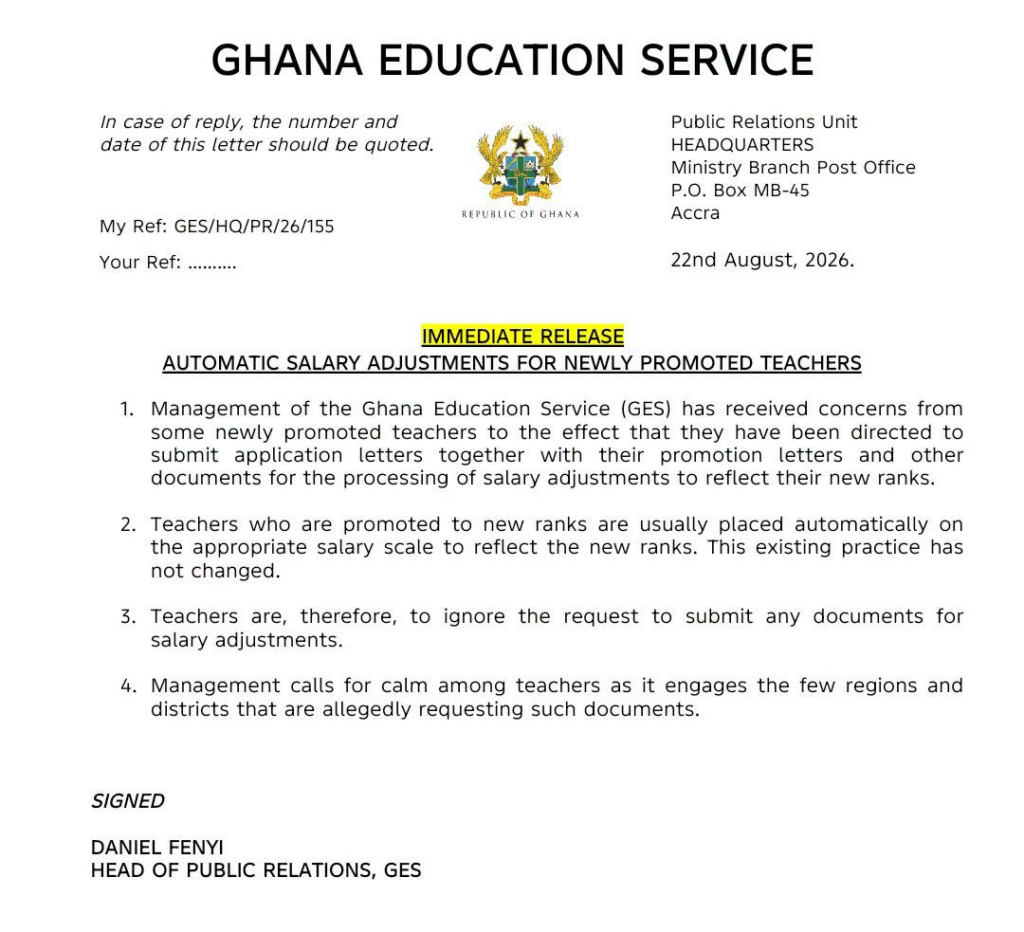
  • National Placement Centre must be shut down for regional offices to deliver – GNACOPS to GES

    National Placement Centre must be shut down for regional offices to deliver – GNACOPS to GES

    The National Placement Resolution Centre, established to address challenges with the Computerised School Selection and Placement System (CSSPS), is facing calls for its collapse. One of the individuals calling for its closure is the Executive Director of the Ghana National Council of Private Schools (GNACOPS), Obengfo Nana Kwasi Gyetuah.

    Speaking to the media on Saturday, September 27, Nana Kwasi Gyetuah noted that the Centre is under pressure due to an overwhelming number of school placement complaints, which it struggles to resolve because it lacks direct contact with issues at the district level.

    Thus, he called on the Ghana Education Service (GES) to fully transfer the responsibilities of the National Centres to the Regional Centres, as they are closer to the ground. He clarified that the delays in resolving issues at the regional level are not due to a lack of capacity but to inadequate resources, which prevent them from fully meeting their obligations.

    “We understand the regional resolution centres, but they are not giving the appropriate solutions to the issues. We have given priority to the national centre. If the national centre does not exist, everybody will go to their nearby centre.


    “We should collapse the national centre, because the GES offices are already there; the problem is not beyond the regional offices. It’s just that we have not distributed fairly the resources to the regions and districts to empower them to do what they’re supposed to do.


    “When you go to the national centres, I have been there; those over there don’t have superior knowledge to the people at the district level. In terms of experience, and those who even understand the terrain very well, the district education officers understand it better than those at the national level. Because they live with the people,” he added.


    Every District and Regional Education Office have been designated by the Ghana Education Service to assist students, parents, and guardians with Senior High School (SHS) placement challenges.


    However, the Ghana National Association of Teachers (GNAT) Hall in Accra has come under strain after a recent incident on Tuesday, September 23. Parents and prospective Senior High School students thronged the GNAT Hall over misplaced placements to difficulties in accessing schools of choice.


    Others also raised concerns about being assigned to schools far from their preferred locations despite meeting the required grades. On September 19, the Deputy Education Minister, Dr. Clement Apaak, called for calm following reports of technical glitches in the placement process.


    During a visit to the Ghana National Association of Teachers (GNAT) Hall in Accra on Friday, September 19, the minister stated that the issue is being resolved and assured parents and students that all Senior High School placements would be finalised soon.


    He explained that the current challenge was anticipated and that measures have been put in place to address it promptly. “It’s a process. It has not ended. Be patient and be reassured that we anticipated a number of challenges, and that is why we decided to set a reporting date that gives you enough time and gives us enough time to address all the issues.


    “So be assured that by the time our wards are expected to report, which is around this same time next month, October 18, many of these issues, if not all, will be resolved,” he added.


    Despite the tension, the Ministry reaffirmed its commitment to safeguarding the integrity of Ghana’s school placement system.
    On Wednesday, September 17, the Ghana Education Service (GES) opened the Computerised School Selection and Placement System (CSSPS) portal to allow prospective Senior High School (SHS) students to access their designated schools.


    As per a circular dated Wednesday, September 17, signed by the acting Deputy Director-General for Quality and Access at the GES, Dr Munawaru Isshaque and addressed to all regional directors, freshers will report to their designated schools from October 18.


    The statement warned school authorities against enrolling students against the placement list generated by the CSSPS Secretariat, stressing the need for transparency and impartiality during the registration process.


    “Admission of students should strictly follow the placement list generated by the CSSPS Secretariat. No school is permitted to admit students outside the official placement without prior written approval from GES,” parts of the circular read.


    483,800 have been placed into various Senior High Schools across the country out of the 590,000 candidates. On Monday, September 1, the school placement portal was opened for new entrant students to verify their school choices, biodata, and other relevant information ahead of the final placement.


    The deadline for the fact-checking exercise was brought to a close on Monday, September 8. Of this figure,248,038 are females (51.4%), and 234,783 are males (48.6%).


    However, 107,509 candidates (18.2%) could not be matched with their initial school choices due to high demand for certain Category A schools.


    In August, the Deputy Education Minister, Dr Clement Apaak, emphasized that multiple factors influence how students are assigned to specific Senior High Schools (SHSs).


    According to an official statement signed and issued by the Deputy Education Minister on Saturday August 30, the Ministry noted that the Computerised School Selection and Placement System (CSSPS) used in designating SHS graduates to various schools considers the aggregate and raw scores of students, the availability of vacancies in schools, and the popularity of specific programmes.


    The statement added that the Ministry does not demand or accept rewards from parents or guardians to guarantee that students are placed in schools of their choice, as speculated.


    “The Ministry confirms that this information is not only false but also maliciously misleading. The placement is based on a combination of factors, including aggregate and raw scores, availability of vacancies in the various schools and programmes of study. Limited vacancies and high competition can affect placement. The Ministry unequivocally states that no form of payment or inducement is required or solicited from parents, guardians, or their representatives for the purpose of securing placement.


    “All interactions with the Ministry and Ghana Education Service (GES) officials are expected to adhere to the highest standards of integrity and transparency. The public is advised to be cautious and report any cases of extortion or bribery attempts related to student placements. Stakeholders are encouraged to report miscreants to the nearest police station,” parts of the statement read.


    The Ministry’s clarification was a rebuttal to recent claims that the Ministry solely depends on a rigid score system to place students in Senior High Schools. Meanwhile, the Ministry has described the claims as misleading and inaccurate.

  • Placement portal opened for 2025 JHS graduates to review school choices and biodata

    Placement portal opened for 2025 JHS graduates to review school choices and biodata

    The Ghana Education Service (GES) has opened the school placement portal, today, Monday, September 1, for individuals who participated in this year’s Basic Education Certificate Examination (BECE) to verify their school choices, biodata, and other relevant information ahead of the final placement.

    The deadline for this fact-checking exercise which has begun on the www.csses.gov.gh will conclude on Monday, September 8.

    At a media briefing on Wednesday, August 27, GES Director-General, Professor Ernest Kofi Davis noted “This process is expected to take no more than three weeks. From September 1 to September 8, the portal will be open for candidates to review their school choices, biodata, and other relevant information”.

    After placement, students are expected to report to their schools and start classes between October 18 and October 20 to begin the 2025/2026 academic year.SHS 3 students will reopen on October 11, 2025, and remain in school until February 27, 2026, covering 18 weeks.

    They will return on March 13, 2026, for a 14-week session ending June 21, 2026, ahead of the West African Senior School Certificate Examination (WASSCE) scheduled for April 20 to June 20, 2026.SHS 1 and 2 students will start their first session on October 18, 2025, and break on February 27, 2026, after 17 weeks.

    They will resume on May 4, 2026, for a 16-week session ending August 21, 2026, marking the close of the academic year. The Transitional Calendar refers to a temporary academic schedule designed to bridge the gap between the old double-track system and the new single-track system.

    On that calendar, first-year students will also report on October 18, 2025, and stay until January 30, 2026, before proceeding on a short break.

    Their second term will then begin on March 16 and run until June 12, 2026, with additional breaks, including some four weeks of off-site learning to help manage overcrowding in school facilities.

    Second-year students in transitional schools will reopen on January 5, 2026, and vacate on May 18, 2026, with five weeks of online learning. They will then resume from the vacation later in September for the final stretch of the academic year.

    Final-year students in transitional schools will begin on October 27, 2025, for a 14-week session before the Christmas break and resume in February for an 18-week preparation period before they sit for their West African Senior School Certificate Examination (WASSCE).

    GES also highlighted some significant breaks in the new timetable. The Christmas break will begin on December 20, 2025, and end on January 4, 2026.

    Vacation for SHS 3 students is slated for February 27 to March 1, 2026, while SHS 1 and 2 students will break from August 21 to August 23, 2026. GES has also proposed September 11, 2026, as the start date for the 2026/2027 academic year.

    In an unrelated development, sixty (60) private schools have been included under the Free Senior High School (SHS) policy. Junior High School (JHS) graduates will be admitted into these private schools, which fall under Category E in the school selection process. These schools will be accepting applications starting from the 2025/2026 academic year.

    The new development aligns with the government’s efforts to ease congestion in public SHSs as well as promote quality education across the country.In a press release issued on Sunday, July 20, by the Ghana National Council of Private Schools (GNACOPS) and signed by its National Executive Director, Oberto Nana Kwasi Gyetuah, the council described the initiative as a historic and progressive move.

    “This progressive move marks a significant milestone in Ghana’s educational transformation journey. It underscores the Government’s commitment to inclusive, collaborative education delivery and reaffirms the important role of private schools in advancing national development goals,” part of the release read.

    The council further called on other private schools that are yet to be listed to remain patient, prepared, and compliant with regulatory standards. In May, Deputy Minister of Education Dr. Clement Apaak announced that the inclusion forms part of a broader plan to scale up capacity and gradually end the double-track system.

    “As part of our campaign promise, we have been working diligently to bring on board private senior high schools in the delivery of the Free SHS programme. Meetings have been held, engagements have been done, and we are very certain that with the diligence we expect from our side…” he noted.

    The double-track system was introduced in 2018 by the erstwhile government to accommodate the surge in student enrollment due to the Free SHS policy, addressing overcrowding in public schools. Under this system, students were divided into two groups—Green Track and Gold Track—attending school in shifts, with one track in session while the other was on break.

    The anticipated extension of the Free SHS policy, according to the Education Minister, Haruna Iddrisu, is a fulfillment of the government’s manifesto promise, adding that it is a step to ensure eligible students gain admission without delays.

    “We believe strongly that in fulfilling this manifesto campaign promise, this is going to serve as an artery in helping us bring an end to the double-track system,” the deputy minister said.

    According to him, the Education Ministry has received encouraging feedback from private schools, many of which have expressed readiness to meet the standards and requirements of the Free SHS framework.“… and the eagerness of the private schools to participate, the private schools will deliver in their participation,” he assured.

    He added that this collaboration would not only help expand capacity but also ensure a more equitable distribution of educational opportunities across the country.

  • GES to begin 2025 school placement exercise on September 17

    GES to begin 2025 school placement exercise on September 17

    The 2025 school placement exercise will officially commence on September 17, as announced by the Ghana Education Service (GES).

    At a media briefing on Wednesday, August 27, GES Director-General, Professor Ernest Kofi Davis, indicated that before final placement is completed, prospective Senior High School (SHS) students will be allowed to double-check and correct their information via www.csses.gov.gh to avoid errors.

    He explained that the exercise will run from September 1 to September 8.

    “In order to reduce the errors associated with school placement, candidates will have the opportunity to review the entries they have made; gender, school code, programme code, online on www.csses.gov.gh.
    “This will be supported by an explainer video to guide parents. This exercise is expected on the 1st September and ends on 8th September. The Actual placement exercise will commence on the 17th of September. Students are expected to report to campus and begin their studies between 18th to 20th October,” he stated.

    After placement, students are expected to report to their schools and start classes between October 18 and October 20 to begin the 2025/2026 academic year.
    SHS 3 students will reopen on October 11, 2025, and remain in school until February 27, 2026, covering 18 weeks. They will return on March 13, 2026, for a 14-week session ending June 21, 2026, ahead of the West African Senior School Certificate Examination (WASSCE) scheduled for April 20 to June 20, 2026.
    SHS 1 and 2 students will start their first session on October 18, 2025, and break on February 27, 2026, after 17 weeks. They will resume on May 4, 2026, for a 16-week session ending August 21, 2026, marking the close of the academic year.
    Transitional CalendarThe Transitional Calendar refers to a temporary academic schedule designed to bridge the gap between the old double-track system and the new single-track system.
    On that calendar, first-year students will also report on October 18, 2025, and stay until January 30, 2026, before proceeding on a short break. Their second term will then begin on March 16 and run until June 12, 2026, with additional breaks, including some four weeks of off-site learning to help manage overcrowding in school facilities.
    Second-year students in transitional schools will reopen on January 5, 2026, and vacate on May 18, 2026, with five weeks of online learning. They will then resume from the vacation later in September for the final stretch of the academic year.
    Final-year students in transitional schools will begin on October 27, 2025, for a 14-week session before the Christmas break and resume in February for an 18-week preparation period before they sit for their West African Senior School Certificate Examination (WASSCE).
    GES also highlighted some significant breaks in the new timetable. The Christmas break will begin on December 20, 2025, and end on January 4, 2026. Vacation for SHS 3 students is slated for February 27 to March 1, 2026, while SHS 1 and 2 students will break from August 21 to August 23, 2026. GES has also proposed September 11, 2026, as the start date for the 2026/2027 academic year.
    In an unrelated development, sixty (60) private schools have been included under the Free Senior High School (SHS) policy. Junior High School (JHS) graduates will be admitted into these private schools, which fall under Category E in the school selection process. These schools will be accepting applications starting from the 2025/2026 academic year.
    The new development aligns with the government’s efforts to ease congestion in public SHSs as well as promote quality education across the country.
    In a press release issued on Sunday, July 20, by the Ghana National Council of Private Schools (GNACOPS) and signed by its National Executive Director, Oberto Nana Kwasi Gyetuah, the council described the initiative as a historic and progressive move.
    “This progressive move marks a significant milestone in Ghana’s educational transformation journey. It underscores the Government’s commitment to inclusive, collaborative education delivery and reaffirms the important role of private schools in advancing national development goals,” part of the release read.
    The council further called on other private schools that are yet to be listed to remain patient, prepared, and compliant with regulatory standards.
    In May, Deputy Minister of Education Dr. Clement Apaak announced that the inclusion forms part of a broader plan to scale up capacity and gradually end the double-track system.
    “As part of our campaign promise, we have been working diligently to bring on board private senior high schools in the delivery of the Free SHS programme. Meetings have been held, engagements have been done, and we are very certain that with the diligence we expect from our side…” he noted.
    The double-track system was introduced in 2018 by the erstwhile government to accommodate the surge in student enrollment due to the Free SHS policy, addressing overcrowding in public schools. Under this system, students were divided into two groups—Green Track and Gold Track—attending school in shifts, with one track in session while the other was on break.
    The anticipated extension of the Free SHS policy, according to the Education Minister, Haruna Iddrisu, is a fulfillment of the government’s manifesto promise, adding that it is a step to ensure eligible students gain admission without delays.
    “We believe strongly that in fulfilling this manifesto campaign promise, this is going to serve as an artery in helping us bring an end to the double-track system,” the deputy minister said.
    According to him, the Education Ministry has received encouraging feedback from private schools, many of which have expressed readiness to meet the standards and requirements of the Free SHS framework.
    “… and the eagerness of the private schools to participate, the private schools will deliver in their participation,” he assured.
    He added that this collaboration would not only help expand capacity but also ensure a more equitable distribution of educational opportunities across the country.

  • First-year SHS students to report to school on October 18 – GES

    First-year SHS students to report to school on October 18 – GES

    The Ghana Education Service (GES) has announced that all first-year Senior High School (SHS) students in both single-track and transitional schools are to report to school on October 18, 2025, as they formally begin the 2025/2026 academic year.

    The Service announced this in a statement dated August 20 and signed by the Director of Schools and Instructions Division, Prince C. Agyemang-Duah, on behalf of the Acting Director-General.

    According to GES, the new timetable is designed to ensure smooth operations and consistency across all secondary schools nationwide.

    “The reporting date for first-year students (Single Track and Transitional Schools) is 18th October, 2025. Other key term dates and holidays have been clearly outlined in the attached academic calendar,” the release noted.

    GES went on to direct all Regional Directors to circulate the academic calendar to second-cycle institutions under their jurisdiction and ensure that all concerned parties duly comply with the new directive.

    “By a copy of this letter, Regional Directors are kindly requested to disseminate the attached Academic Calendar to all Heads of Second Cycle Institutions under your jurisdiction, and ensure that Heads strictly adhere to the calendar to guarantee consistency and smooth implementation across all schools. Provide the necessary monitoring and support to Heads of Schools in the execution of the calendar,” parts of the statement read while eulogising them for their “usual cooperation to ensure effective teaching and learning in our institutions for the 2025/2026 academic year.”

    As directed in the five-page statement document, the academic year will follow two main schedules – the Transitional Calendar for schools yet to fully align with the standard system, and the Single Track Calendar for schools already on the regular schedule.

    The Service also assured parents and stakeholders that the transitional arrangements, which include online sessions for some year groups, are intended to improve instructional time while managing infrastructural limitations across schools.

    For Single Track Schools
    According to the statement, SHS 3 students will reopen on October 11, 2025, and remain in school until February 27, 2026, covering 18 weeks. They will return on March 13, 2026, for a 14-week session ending June 21, 2026, ahead of the West African Senior School Certificate Examination (WASSCE) scheduled for April 20 to June 20, 2026.

    SHS 1 and 2 students will start their first session on October 18, 2025, and break on February 27, 2026, after 17 weeks. They will resume on May 4, 2026, for a 16-week session ending August 21, 2026, marking the close of the academic year.

    Transitional Calendar
    The Transitional Calendar refers to a temporary academic schedule designed to bridge the gap between the old double-track system and the new single-track system.

    On that calendar, first-year students will also report on October 18, 2025, and stay until January 30, 2026, before proceeding on a short break. Their second term will then begin on March 16 and run until June 12, 2026, with additional breaks, including some four weeks of off-site learning to help manage overcrowding in school facilities.

    Second-year students in transitional schools will reopen on January 5, 2026, and vacate on May 18, 2026, with five weeks of online learning. They will then resume from the vacation later in September for the final stretch of the academic year.

    Final-year students in transitional schools will begin on October 27, 2025, for a 14-week session before the Christmas break and resume in February for an 18-week preparation period before they sit for their West African Senior School Certificate Examination (WASSCE).

    GES also highlighted some significant breaks in the new timetable. The Christmas break will begin on December 20, 2025, and end on January 4, 2026. Vacation for SHS 3 students is slated for February 27 to March 1, 2026, while SHS 1 and 2 students will break from August 21 to August 23, 2026. GES has also proposed September 11, 2026, as the start date for the 2026/2027 academic year.

    In an unrelated development, sixty (60) private schools have been included under the Free Senior High School (SHS) policy. Junior High School (JHS) graduates will be admitted into these private schools, which fall under Category E in the school selection process. These schools will be accepting applications starting from the 2025/2026 academic year.

    The new development aligns with the government’s efforts to ease congestion in public SHSs as well as promote quality education across the country.

    In a press release issued on Sunday, July 20, by the Ghana National Council of Private Schools (GNACOPS) and signed by its National Executive Director, Oberto Nana Kwasi Gyetuah, the council described the initiative as a historic and progressive move.

    “This progressive move marks a significant milestone in Ghana’s educational transformation journey. It underscores the Government’s commitment to inclusive, collaborative education delivery and reaffirms the important role of private schools in advancing national development goals,” part of the release read.

    The council further called on other private schools that are yet to be listed to remain patient, prepared, and compliant with regulatory standards.

    In May, Deputy Minister of Education Dr. Clement Apaak announced that the inclusion forms part of a broader plan to scale up capacity and gradually end the double-track system.

    “As part of our campaign promise, we have been working diligently to bring on board private senior high schools in the delivery of the Free SHS programme. Meetings have been held, engagements have been done, and we are very certain that with the diligence we expect from our side…” he noted.

    The double-track system was introduced in 2018 by the erstwhile government to accommodate the surge in student enrollment due to the Free SHS policy, addressing overcrowding in public schools. Under this system, students were divided into two groups—Green Track and Gold Track—attending school in shifts, with one track in session while the other was on break.

    The anticipated extension of the Free SHS policy, according to the Education Minister, Haruna Iddrisu, is a fulfillment of the government’s manifesto promise, adding that it is a step to ensure eligible students gain admission without delays.

    “We believe strongly that in fulfilling this manifesto campaign promise, this is going to serve as an artery in helping us bring an end to the double-track system,” the deputy minister said.

    According to him, the Education Ministry has received encouraging feedback from private schools, many of which have expressed readiness to meet the standards and requirements of the Free SHS framework.

    “… and the eagerness of the private schools to participate, the private schools will deliver in their participation,” he assured.

    He added that this collaboration would not only help expand capacity but also ensure a more equitable distribution of educational opportunities across the country.

  • GES, Education Ministry under fire over ghost names and illegal allowances

    GES, Education Ministry under fire over ghost names and illegal allowances

    The Ghana Education Service (GES) and the Ministry of Education have come under scrutiny following revelations in the 2024 Auditor-General’s report about unearned salaries and responsibility allowances.

    According to the report, some head teachers validated the names of deceased staff and collected their salaries, a practice that has raised concerns in Parliament.

    The Public Accounts Committee (PAC) has directed the head teachers involved to refund the monies within 30 days.

    Ranking Member of the Committee and MP for Komenda Edina Eguafo Abrem, Samuel Atta Mills, expressed outrage over the recurring nature of the malpractice. “Awurade nyankopon,” he exclaimed. “My God… GES, this is a problem ooo… Who is keeping an eye on this, to stop these infractions?”

    Mr Atta Mills, who has served three terms on PAC, said he was alarmed that the Ministry and GES had year after year failed to curb the irregularities, and called for sanctions against supervisors who allowed the lapses.

    The issue came to light when Deputy Minister of Education, Dr Clement Abas Apaak, led a team from the Ministry before the PAC on Friday, August 22. He admitted that dishonesty and collusion among staff of the Ministry and GES had contributed to the persistence of such irregularities, and assured the Committee that steps would be taken to expose those involved.

    The Auditor-General’s report also cited weak oversight and poor internal controls as enabling factors behind the infractions.

    Meanwhile, responsibility allowances paid by the GES cover certain staff categories, including deputy directors, assistant directors, principal superintendents, school heads, heads of departments, and senior non-teaching officers such as principal accountants and internal auditors.

    To address the broader payroll concerns, government has launched a nationwide audit to remove ghost names. Earlier this year, the Controller and Accountant-General’s Department announced the termination of salaries for tens of thousands of inactive or separated government workers and pledged to recover wrongful payments made through wrongful validation.

    In a similar event, Over 2,000 ghost names have been deleted from the National Service Authority (NSA)payroll scheme as part of its cleanup exercise.The cleanup exercise, according to the Authority, will save Ghana over GH¢1 million.

    While addressing the media, the NSA’s Director-General, Felix Gyamfi, indicated that the Controller and Accountant General’s Department will verify the details of legitimate service personnel.

    “If you’re already on another payroll — whether as a police officer, immigration officer, or army officer — and you’re doing national service just to meet the requirement, do not submit your allowance form this month. “We are now working closely with the NIB and other security agencies, and anyone who attempts to defraud the system will be arrested,” Gyamfi warned.

    The Fourth Estate, released a report into the payroll records from 2017 to 2023 and the 2024 National Service Year.The finding revealed serious irregularities within the NSA, uncovering how a 72-year-old Kenyan, Kwame Donkor, was wrongly listed as a beneficiary.

    Mr Donkor was enlisted in the payroll with a photo and not an official ID card, which is unusual. However, the photo belonged to Emmanuel Mutio, a Human Resource Manager at a private IT company in Kenya. A 72-year-old Kenyan had his name appear on the payroll 226 times as a registered beneficiary.

    The Fourth Estate initially uncovered the issue in November 2024, but the NSA obtained a court order preventing them from publishing the findings.

    After the court later lifted the injunction, the report was finally released.

    In response, President John Dramani Mahama ordered a probe into the matter.

    The NIB, upon the President’s directive, interrogated the former Deputy Director of the National Service Authority (NSA), Gifty Oware-Mensah and Kwaku Ohene Djan, who is also a former Deputy Executive Director of the National Service Authority. The payroll fraud reportedly cost Ghana GHȼ50 million monthly.

    The government uncovered a major payroll discrepancy within the National Service Authority (NSA), identifying 81,885 suspected ghost names that may have led to substantial financial losses.

    This revelation follows a detailed audit of active National Service personnel, exposing a vast gap between the actual number of personnel and the figures previously reported for allowance payments.

    Official data now confirms that only 98,145 personnel are currently in service, compared to the 180,030 names submitted for payment in 2024.

    “This figure is 81,885 less than the 180,030 names presented by the previous management of the Authority for allowance payment in 2024,” a government statement confirmed.

    The discrepancy, which points to potential fraud or payroll inflation, was brought to light after an investigative report by The Fourth Estate, prompting swift action from the presidency.

    In response, President John Dramani Mahama has instructed the National Investigations Bureau (NIB) to launch an immediate probe into the operations of the NSA. The investigation aims to determine the extent of the irregularities and hold those responsible accountable.

    Additionally, the President has emphasized the urgent need for stricter payroll verification processes to prevent a recurrence of such financial mismanagement in the future.

  • GES opens applications for teachers, officers seeking higher ranks

    GES opens applications for teachers, officers seeking higher ranks

    Qualified teachers and officers can now apply for promotion to higher ranks within the service, as announced by the Ghana Education Service (GES). The ranks for which applications have been opened include Deputy Director, Assistant Director I, Assistant Director II, and Principal Superintendent.

    Applicants who meet the eligibility requirements are encouraged to submit their applications before the deadline on Friday, September 5, 2025. Application forms can be obtained from the Ghana Education Service’s website or by scanning the QR code provided online.

    Applicants have been advised to attach a clear and legible passport-sized photograph in JPEG, JPG, or PNG format, along with their last promotion, appointment, or upgrading letter, and their highest academic certificate when applying for promotion.

    The GES has emphasized that, except for the passport-sized photograph, all other documents must be in PDF format. This was contained in a press statement issued by the Ghana Education Service.

    “An applicant should upload the following documents: passport-size photograph (in jpeg, jpg, or png format), last promotion or appointment or upgrading letter, highest academic certificate used for applying for the promotion. All documents uploaded MUST be in PDF (except the passport picture) and should be clear and legible. Application window opens from Monday, 18th August to Friday, 5th September 2025. SCAN TO APPLY,” parts of the statement read.

    In detailing the eligibility criteria, the Service indicated that applicants for the Deputy Director rank must have held the position of Assistant Director I in or before 2020 and must have remained active in the service. Applicants for Assistant Director I must have been promoted to the rank of Assistant Director II in or before 2020 and remained continuously at post. Similarly, applicants for Assistant Director II should have been promoted to the rank of Principal Superintendent in or before 2020 and must have been consistently at post since then. For the Principal Superintendent rank, applicants must have attained the position of Senior Superintendent I in 2020 or earlier.

    “Deputy Director: An applicant should have been promoted to the rank of Assistant Director I in or before 2020 and should have been continuously at post since date (except for the periods of approved leave of absence).

    “Assistant Director I: An applicant should have been promoted to the rank of Assistant Director II in or before 2020 and should have been continuously at post since date (except for the periods of approved leave of absence).

    “Assistant Director II: An applicant should have been promoted to the rank of Principal Superintendent in or before 2020 and should have been continuously at post since date (except for the periods of approved leave of absence).

    Principal Superintendent: An applicant should have been promoted to the rank of Senior Superintendent I on or before 2020 and should have been continuously at post since that date (except for the periods of approved leave of absence). An applicant who has obtained an approved undergraduate degree will be automatically placed on this rank,” the statement added.

    Additionally, applicants who wish to apply with Master’s or Doctorate degrees must ensure their certificates are in courses recognized by the GES.

    “For the avoidance of doubt, applicants who wish to rely on Master’s/Doctorate degrees to join the interviews out of turn should note the following:Master’s/PhD programme should be on the approved GES course of study.”

    Additionally, applicants who wish to apply with Master’s/Doctorate degrees must ensure their certificates are in courses recognized by the GES and should have been acquired before their most recent promotion.

    “The Master’s/PhD certificate should not have been obtained before the previous promotion. Applicants who wish to use the Master’s/PhD certificate for ADI, ADII, and Deputy Director promotion should have obtained their certificate in or before 2022,” it concluded.

    Meanwhile, the Service continues to grapple with unresolved issues concerning newly trained teachers. On Monday, June 23, over 100 aggrieved teachers picketed at the GES headquarters in Accra, demanding the payment of several months of unpaid salaries.

    The intended peaceful protest turned chaotic, prompting police intervention. However, the teachers refused to disperse. The group’s spokesperson, Eric Darfuor, explained to the media that their decision to protest stemmed from unmet assurances by the GES that their outstanding salaries would be paid by the end of July.

    “The PRO said there has been an official communiqué from GES, so we have suspended our picketing for now, and we are hoping to receive our salaries by the end of July. The PRO said they are at the final stage of resolving our issue, so very soon we will receive our salary.

    “So we are waiting and waiting for the very soon, by the end of July, so when the time is due, and we do not hear anything from them, we will come back again stronger.”

    Defiant, the protesting teachers have vowed to intensify their actions. “We’ll be here overnight so that by morning, we can go to the Finance Ministry and then proceed to Parliament,” one protest leader said.

    “When MPs arrive, we’ll let them know what the government is putting us through. All we ask is for our staff IDs and the money owed to us.”

    In response, the Ghana Education Service (GES) has stated that it is working to resolve months of unpaid salaries and other concerns raised by newly posted teachers. This was revealed in a press release issued by the GES Public Relations Officer, Daniel Fenyi, on Tuesday, June 24. According to the Service, it has formally requested an extension of the expired financial clearance from the Ministry of Finance to enable the payment of outstanding salaries and the issuance of staff IDs.

    Out of the 12,807 graduates recruited from the Colleges of Education last year, about 2,113 are yet to receive their salaries due to the expiration of financial clearance. The Service has attributed this situation to inconsistencies in the affected teachers’ Ghana Card details, SSNIT numbers, and cases of self-reposting.

    Additionally, the GES disclosed that it has set up a technical committee to resolve the anomalies. In the meantime, the Service has called for calm, assuring teachers of its commitment to addressing the matter.

    “The present GES Management, upon assuming office, immediately undertook a nationwide staff validation exercise from 7th-14th March 2025 to confirm the genuinely recruited teachers and clean up recruitment anomalies.

    “It is important to note that significant progress has already been made. The Service assures all affected staff that every effort is being made to rectify the situation and ensure that all genuinely recruited teachers receive their due remuneration,” parts of the statement read.

    In a related development, the Office of the Special Prosecutor (OSP) has disclosed that it is investigating suspected corruption and corruption-related offences linked to the large-scale sale of appointment letters to prospective teachers and the laundering of proceeds from the unlawful enterprise.

  • Surging violent incidents compel Education Ministry to review security measures in SHSs

    Surging violent incidents compel Education Ministry to review security measures in SHSs

    A comprehensive review of security arrangements in schools nationwide has been ordered by the Ministry of Education. The call is a response to recurring violent incidents specifically in the Senior High Schools (SHSs) that have claimed the lives of students.

    The Education Minister, Haruna Iddrisu, who was addressing the media on Thursday, August 7, 2025 fumed about the chaos in SHSs describing them as “deeply troubling and unacceptable.”

    “We must work more closely with our security agencies and law enforcement to ensure our schools remain safe spaces for learning. Even our concept of a ‘watchman’ in educational institutions needs to be revisited.

    “Do we just pick anyone and label them school security? With no training in policing or even basic security practices?.We need to review this so we can foster a safer school environment for both students and teachers,” he added.

    His comments follow the death of a 15-year-old student of Kinbu Senior High School (SHS), which occurred on July 31. Addib Alhassan was fatally stabbed during an altercation allegedly sparked by a heated argument.

    The exact cause of the confrontation remains unclear. After sustaining injuries, Alhassan was initially rushed to the Adabraka Polyclinic and later transferred to the Ridge Hospital due to the severity of his injuries. He was later pronounced dead.

    In reaction to the unfortunate incident, the Member of Parliament for Klottey-Korle, Dr. Zanetor Agyeman-Rawlings, strongly condemned the murder, describing it as both tragic and senseless.

    She expressed deep shock and sorrow over the stabbing in a statement she released on Friday, July 31, 2025. “I strongly condemn this act of violence, and I will collaborate with the Ghana Police Service and other relevant authorities to ensure that thorough investigations are swiftly done and that justice is served,” she said.

    The Member of Parliament stressed that schools must remain a safe haven for studies and personal development. She encouraged a joint effort from education and security authorities to ensure stronger safety measures are in place across all institutions.

    “This tragedy must be a wake-up call for all stakeholders in the education and security sectors to prevent such incidents from recurring,” she stated. Dr. Agyeman-Rawlings offered her condolences to the bereaved family and the Kinbu SHS community, including students and staff.

    She made a commitment to partner with the Ghana Education Service (GES), school leadership, and security agencies to strengthen safety and mental health support structures in schools across her constituency.

    Earlier this year, Kinbu Secondary Technical and Accra Technical Centre School were involved in a heated altercation, adding to the number of melees recorded this year.

    Violence in SHSs has become a trend in the country. Seven months into the year, Ghana has recorded over five violent clashes in SHSs. These incidents have witnessed students possessing weapons, destroying property, and others engaging in brutal confrontations.

    Stakeholders have bemoaned the growing indiscipline and insecurity on school campuses, prompting calls for an immediate intervention. Recently, authorities at Sokode Senior High Technical School temporarily shut down the premises over a violent misunderstanding between students.

    Kumasi Technical Institute (KTI) and Kumasi Anglican Senior High School clashed after returning from an inter-school competition. One student sustained severe injuries as a result of the event; school properties and private cars belonging to teachers were also damaged.

    Salaga Senior High School in the Savannah Region observed the most violent clashes. The confrontation left a student with multiple stab wounds, with the police retrieving locally-produced pistol and ammunition from the scene. Students of Islamic Senior High School (ISSEC) also faced off with local youth, causing injuries and damages to multiple vehicles.

    Months ago, a 16-year-old form two student of Osei Kyeretwie Senior High School (OKESS) was arrested by the Tafo Pankrono Divisional Police Command for illegally possessing a locally manufactured firearm.

    The police arrested the suspect following a routine dormitory search by school authorities on Wednesday, May 14. According to the accused, the weapon belonged to his stepfather, Mr. Daniel Owusu Baafi, who has been apprehended.

    This was disclosed by the Deputy Superintendent of Police Godwin Ahianyo, Head of Public Affairs for the Ashanti Regional Police Command, on Sunday, May 18. Following their arrest, both individuals were granted bail and are to report to the police on Monday, May 19, as investigations continue.

    A fisticuff between two final-year students of Wa T.I. Ahmadiyya Senior High School (Wa Amass) has left one hospitalised and in critical condition, according to reports. It is reported that Iddrisu Ibrahim, also known as Lincoln—an agricultural science student—and his colleague Hafis, who is also known as Baayaawa—a general arts student—engaged in an argument over a video that was recorded.

    It is said that Lincoln filmed Hafis without his consent—an action that left the latter displeased. He requested Lincoln to delete the said video, but Lincoln reportedly refused. When matters escalated, Hafis pulled out a knife and stabbed his colleague in the stomach and ribs.

    Amid the many violent clashes, the Ministry of Education has granted school heads at Senior High Schools (SHS) across the country the mandate to conduct searches on students.

    Deputy Minister for Education Clement Apaak in May noted that the action is a part of the government’s series of strategies to eradicate indiscipline in schools, specifically SHSs.

    The Deputy Minister has also indicated that Parent-Teacher Association (PTA) meetings will be reinstated to ensure teachers and parents collaborate and share concerns. This was realised last month.

    A directive from President John Dramani Mahama has necessitated the reinstatement of Parent-Teacher Associations (PTAs) in primary and secondary schools across the country. This was disclosed by Daniel Fenyi, the Head of Public Relations at the Ghana Education Service (GES), on Thursday, July 17.

    The move, he explained, will ensure effective collaboration between parents and teachers for quality education for students.

    “All heads of public senior high schools, technical, and STEM schools are to operationalise the reinstatement with immediate effect. This move is aimed at strengthening the collaboration and involvement of parents, communities, and teachers in the delivery of quality education to Ghanaian learners,” parts of the statement added.

  • Reimburse every cedi collected from students, parents for 2025 WASSCE practical fee – GES orders school heads

    Reimburse every cedi collected from students, parents for 2025 WASSCE practical fee – GES orders school heads

    The Ghana Education Service (GES) has directed school authorities to ensure that practical fees for the 2025 West African Senior School Certificate Examination (WASSCE ) received from students are refunded effective Monday, July 28.

    In a press statement dated, Monday, July 28, indicated that teachers and school heads who fail to adhere to the directive shall face severe sanctions.

    “The Government of Ghana has released full funding to cover the costs of the 2025 WASSCE practical examinations, including required materials and resources.

    Management policies with concern that some Heads have engaged in the collection of monies from Candidates/Parents/Guardians for these same practicals. The Heads involved are therefore directed to; refund any monies collected from students in respect of WASSCE practicals,” parts of the statement read.

    It instructed that school authorities ensure that the refund process is properly documented and official receipts are issued to acknowledge repayment.


    GES added that regional Directors should be notified once the monies are refunded, emphazing, “Compliance with this directive will reduce the financial burden on students and parents and ensure that no learner is excluded from participation over lack of money”.

    “Failure to comply will be considered a serious breach of official instructions and may attract administrative sanctions. Regional Directors are by this letter requested to share this information with all Heads of schools through their respective Municipal/Metro/District Directors of Education,” it stated.

    On Saturday, July 27, the Ghana Education Service announced the release of funds to cater for the 2025 WASSCE practical examinations for all Senior High Schools (SHSs) and Senior High Technical Schools (SHTSs) across the country.


    An amount of GH¢15,849,920 has been released, according to reports. In its statement issued and signed by the Head of Public Relations, Daniel Fenyi, the funds are expected to provide all necessary materials and supplies for their practical exams.


    “ The Management of the Ghana Education Service (GES) announces that funds have been released to all Senior High Schools (SHS) and Senior High Technical Schools (SHTS) across the country to cover the fees for the 2025 WASSCE practicals.


    “This payment ensures that all practical examinations scheduled for the 2025 WASSCE are fully supported, including the provision of the required materials and other essential resources,” the Service noted.


    Additionally, the Service explained that the move is intended to shield guardians as well as parents from extra cost and also create a conducive environment in ensuring that students excel in the upcoming exams.


    “With the release of the funds, GES seeks to facilitate a smooth and well-cordinated examination process that enables students to focus on their academic work, while relieving parents and guardians of any such financial burden,” it stated.


    The GES cautioned school authorities against diverting the funds from its intended purpose, warning that any misappropriation will attract strict sanctions in accordance with existing financial regulations and disciplinary procedures.


    “Regional, district and school authorities are, therefore, strongly urged to ensure the due application of the funds for their intended purpose to guarantee efficiency and accountability. Management will continue to monitor the utilisation processes to ensure compliance and to maintain high standards in the administration of the examination.


    “The Ghana Education Service appreciates the cooperation of all stakeholders in advancing quality education and remains dedicated to creating an enabling environment for the success of all students,” part of the release read.


    The 2025 WASSCE is scheduled to take place from August 4 to September 19.


    Meanwhile, a leading public policy and consumer advocacy think tank, CUTS International, Accra, has opposed the system where Basic Education Certificate Examination (BECE) and WASSCE candidates pay to access their results.


    Per a statement released in Accra on Monday, July 7, the West Africa Regional Director of CUTS, Mr. Appiah Kusi Adomako, described the practice as unfair and costly.


    He has therefore called on the Education Ministry to shoulder the cost of providing candidates with access to their results.


    “In many parts of the world, exam bodies do not charge students to access their results. In our local universities, student can access their results free of charge, as is the case in every jurisdiction. This is a basic right that should not come at a cost to students or their families,” Mr. Adomako said.


    Initially, the West African Examinations Council (WAEC) printed and distributed physical results slips to schools; however, it adapted to the digital platform to make the process seamless.


    Candidates now pay between GHS 15 and GHS 25 to view their results.
    But according to the West Africa Regional Director of CUTS, the Ministry must learn from other African countries that do not charge for results.


    “Going digital was supposed to make things easier and more affordable. But instead, candidates are now forced to pay out of pocket for a service that should be free. In countries like South Africa, Egypt, Tunisia, Morocco, Kenya, and Zambia, students access their results online without paying any fee. Why should Ghana be different?.


    “WAEC is not the only body that runs examinations. Students who sit for ACCA, SAT, TOEFL, GRE, IELTS, and even our own national service postings access their results or placements online for free. The same should apply here,” Mr. Adomako stressed.
    Mr. Appiah Kusi Adomako also criticised the requirement for students to pay to access their Senior High School placement results through the Computerised School Selection and Placement System (CSSPS), describing it as an added financial burden.
    According to him, “Accessing exam results or computerised placement into SHS should not be a luxury or a source of revenue. It should be a basic service as it pertains in other jurisdictions.While the GES continues its efforts to alleviate financial pressures on students and parents nationwide, other challenges, particularly in conflict-prone areas, pose serious threats to access to education and student safety.
    Currently, Nkwanta and its surrounding towns are experiencing a protracted conflict involving the Akyode, Adele, and Chala communities.
    The conflict has escalated in recent years, resulting in the loss of lives and the destruction of property. A curfew was placed on the area by the government.
    The violent incidents that were recorded on June 26 and 27 affected three students.
    Two female students of Nkwanta Senior High School (SHS) were recently hit by gunshots while en route to school.
    A male student was also killed by a stray bullet while seated in his classroom during mock examinations.
    SHS schools in Nkwanta South have been shut down until further notice.
    In response, the police service has captured some eight individuals for their roles in recent clashes in Nkwanta that have taken the lives of students.
    Currently, there is a total ban on all persons in the Nkwanta Township and its environs in the Nkwanta South Municipality of the Oti Region from carrying arms, ammunition, or any offensive weapons.
    Any person found with any arms or ammunition will be arrested and prosecuted.
    The government continues to urge chiefs, opinion leaders, youth, and people of the area to exercise restraint in the face of the challenges confronting them and to use non-violent means to channel their energies into ensuring peace in the area.
    But the GES has insisted that final-year Senior High School (SHS) students in the Nkwanta South Municipality of the Oti Region will participate in the 2025 West African Senior School Certificate Examination (WASSCE) despite chaos in the area.
    Speaking to the media on Monday, June 30, the Head of Public Relations at GES, Daniel Fenyi, indicated that the Service is in discussions with stakeholders to ensure candidates are not affected regardless of the risk.
    “Three Senior High Schools (SHS) will be writing the WASSCE, but definitely, if the conflict persists, that means they wouldn’t be able to write in Nkwanta township. So meetings are ongoing, and we hope to finalize our discussions as soon as possible to come out with the modalities on when, how, and where our children can write the WASSCE.”
    According to him, one of the measures is to ensure students write the exams in the safest environment possible.
    “But the assurance they can get from us is that they won’t miss the WASSCE. We are putting in place every measure to ensure they write the WASSCE with their colleagues.”
    “The assurance they can get from us as the Ghana Education Service is that they won’t miss the WASSCE. We are putting in place every measure to ensure that they write the WASSCE with their colleagues all across the country, and we are making sure that the conflict goes beyond them so they can’t be punished for what they didn’t cause. So I can assure them that they will not miss this examination,” he said.
  • GES releases funds to cover materials for 2025 WASSCE practical exams

    GES releases funds to cover materials for 2025 WASSCE practical exams

    The Ghana Education Service (GES) has released funds to cater for the 2025 WASSCE practical examinations for all Senior High Schools (SHSs) and Senior High Technical Schools (SHTSs) across the country.

    An amount of GH¢15,849,920 has been released, according to reports.

    According to GES, in a statement issued on Saturday, July 27, and signed by the Head of Public Relations, Daniel Fenyi, the funds are expected to provide all necessary materials and supplies for their practical exams.

    “ The Managaement of the Ghana Education Service (GES) announces that funds have been released to all Senior High Schools (SHS) and Senior High Technical Schools (SHTS) across the country to cover the fees for the 2025 WASSCE practicals.

    “This payment ensures that all practical examinations scheduled for the 2025 WASSCE are fully supported, including the provision of the required materials and other essential resources,” the Service noted.

    Additionally, the Service explained that the move is intended to shield guardians as well as parents from extra cost and also create a conducive environment in ensuring that students excel in the upcoming exams.


    “With the release of the funds, GES seeks to facilitate a smooth and well-cordinated examination process that enables students to focus on their academic work, while relieving parents and guardians of any such financial burden,” it stated.

    The GES cautioned school authorities against diverting the funds from its intended purpose, warning that any misappropriation will attract strict sanctions in accordance with existing financial regulations and disciplinary procedures.


    “Regional, district and school authorities are, therefore, strongly urged to ensure the due application of the funds for their intended purpose to guarantee efficiency and accountability. Management will continue to monitor the utilisation processes to ensure compliance and to maintain high standards in the administration of the examination.

    “The Ghana Education Service appreciates the cooperation of all stakeholders in advancing quality education and remains dedicated to creating an enabling environment for the success of all students,” part of the release read.

    The 2025 WASSCE is scheduled to take place from August 4 to September 19.

    Meanwhile, a leading public policy and consumer advocacy think tank, CUTS International, Accra, has opposed the system where Basic Education Certificate Examination (BECE) and West African Senior School Certificate Examination (WASSCE) candidates pay to access their results.

    Per a statement released in Accra on Monday, July 7, the West Africa Regional Director of CUTS, Mr. Appiah Kusi Adomako, described the practice as unfair and costly.

    He has therefore called on the Education Ministry to shoulder the cost of providing candidates with access to their results.

    “In many parts of the world, exam bodies do not charge students to access their results. In our local universities, student can access their results free of charge, as is the case in every jurisdiction. This is a basic right that should not come at a cost to students or their families,” Mr. Adomako said.

    Initially, the West African Examinations Council (WAEC) printed and distributed physical results slips to schools; however, it adapted to the digital platform to make the process seamless.

    Candidates now pay between GHS 15 and GHS 25 to view their results.

    But according to the West Africa Regional Director of CUTS, the Ministry must learn from other African countries that do not charge for results.

    “Going digital was supposed to make things easier and more affordable. But instead, candidates are now forced to pay out of pocket for a service that should be free. In countries like South Africa, Egypt, Tunisia, Morocco, Kenya, and Zambia, students access their results online without paying any fee. Why should Ghana be different?.

    “WAEC is not the only body that runs examinations. Students who sit for ACCA, SAT, TOEFL, GRE, IELTS, and even our own national service postings access their results or placements online for free. The same should apply here,” Mr. Adomako stressed.

    Mr. Appiah Kusi Adomako also criticised the requirement for students to pay to access their Senior High School placement results through the Computerised School Selection and Placement System (CSSPS), describing it as an added financial burden.

    According to him, “Accessing exam results or computerised placement into SHS should not be a luxury or a source of revenue. It should be a basic service as it pertains in other jurisdictions.

    While the GES continues its efforts to alleviate financial pressures on students and parents nationwide, other challenges, particularly in conflict-prone areas, pose serious threats to access to education and student safety.

    Currently, Nkwanta and its surrounding towns are experiencing a protracted conflict involving the Akyode, Adele, and Chala communities.

    The conflict has escalated in recent years, resulting in the loss of lives and the destruction of property. A curfew was placed on the area by the government.

    The violent incidents that were recorded on June 26 and 27 affected three students.

    Two female students of Nkwanta Senior High School (SHS) were recently hit by gunshots while en route to school.

    A male student was also killed by a stray bullet while seated in his classroom during mock examinations.

    SHS schools in Nkwanta South have been shut down until further notice.

    In response, the police service has captured some eight individuals for their roles in recent clashes in Nkwanta that have taken the lives of students.

    Currently, there is a total ban on all persons in the Nkwanta Township and its environs in the Nkwanta South Municipality of the Oti Region from carrying arms, ammunition, or any offensive weapons.

    Any person found with any arms or ammunition will be arrested and prosecuted.

    The government continues to urge chiefs, opinion leaders, youth, and people of the area to exercise restraint in the face of the challenges confronting them and to use non-violent means to channel their energies into ensuring peace in the area.

    But the GES has insisted that final-year Senior High School (SHS) students in the Nkwanta South Municipality of the Oti Region will participate in the 2025 West African Senior School Certificate Examination (WASSCE) despite chaos in the area.

    Speaking to the media on Monday, June 30, the Head of Public Relations at GES, Daniel Fenyi, indicated that the Service is in discussions with stakeholders to ensure candidates are not affected regardless of the risk.

    “Three Senior High Schools (SHS) will be writing the WASSCE, but definitely, if the conflict persists, that means they wouldn’t be able to write in Nkwanta township. So meetings are ongoing, and we hope to finalize our discussions as soon as possible to come out with the modalities on when, how, and where our children can write the WASSCE.”

    According to him, one of the measures is to ensure students write the exams in the safest environment possible.

    “But the assurance they can get from us is that they won’t miss the WASSCE. We are putting in place every measure to ensure they write the WASSCE with their colleagues.”

    “The assurance they can get from us as the Ghana Education Service is that they won’t miss the WASSCE. We are putting in place every measure to ensure that they write the WASSCE with their colleagues all across the country, and we are making sure that the conflict goes beyond them so they can’t be punished for what they didn’t cause. So I can assure them that they will not miss this examination,” he said.
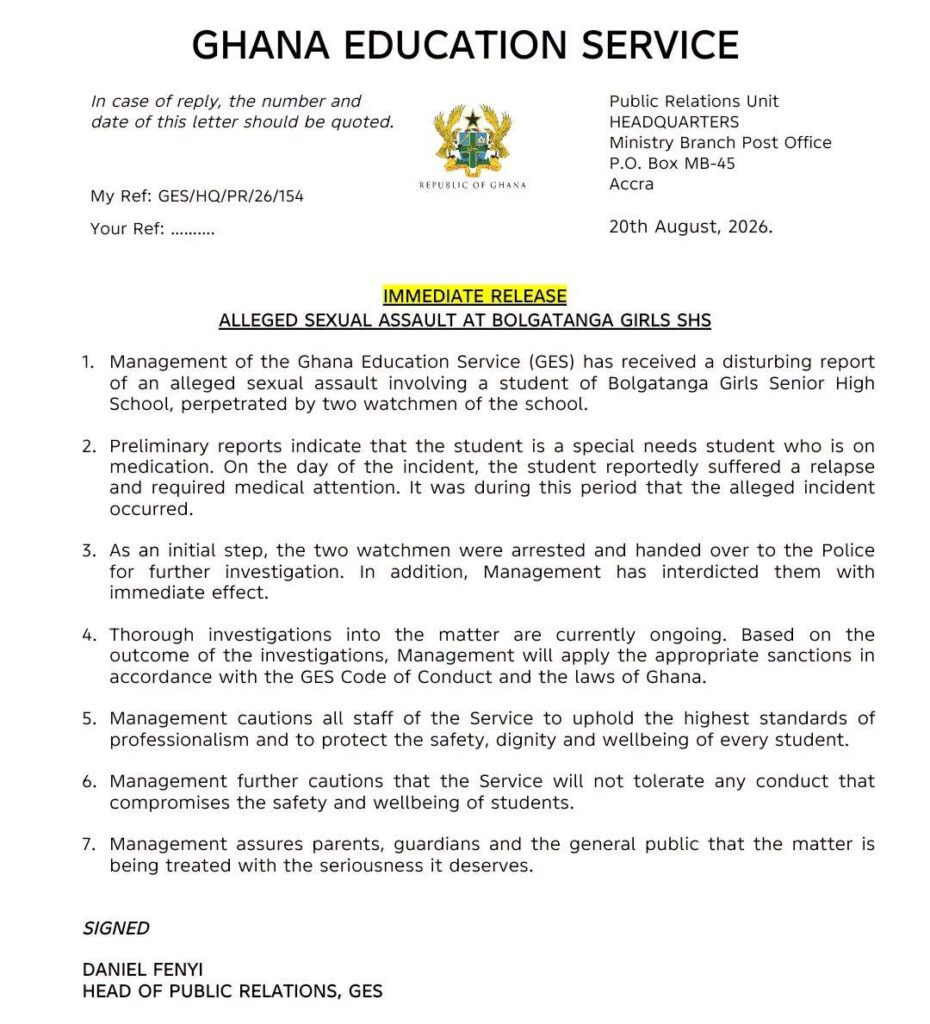
  • Expose students wielding weapons in schools – GES urges students

    Expose students wielding weapons in schools – GES urges students

    All Ghanaian students, especially those in senior high schools, have been charged with the responsibility of exposing students who they find possessing weapons in schools.

    During the launch of the “Sav Schools Outreach Programme” at O’Reilly Senior High School in Accra, Deputy Director-General of the Ghana Education Service (GES), Dr Munawaru Issahaque, said this will foster learning environments devoid of violence among students.

    “You are the voices that can shift attitudes, challenge the status quo, and inspire action. When you advocate for safer schools, you are sending a powerful message that every life matters, that violence has no place in our future,” he said. 

    The initiative is led by the United Nations Development Programme (UNDP) Ghana in partnership with the National Commission on Small Arms and Light Weapons (NCSALW). 

    The UNDP Ghana’s Head of Inclusive Growth and Accountable Governance, Dr Edward Ampratwum, proposed a collaborative effort involving various sectors of society to tackle violence.

    He stressed the need for rapid reforms in firearm legislation and greater backing for the Commission’s work.

    Months ago, a 16-year-old form two student of Osei Kyeretwie Senior High School (OKESS) was arrested by the Tafo Pankrono Divisional Police Command for illegally possessing a locally manufactured firearm.

    The police arrested the suspect following a routine dormitory search by school authorities on Wednesday, May 14.

    According to the accused, the weapon belonged to his stepfather, Mr. Daniel Owusu Baafi, who has been apprehended.

    This was disclosed by the Deputy Superintendent of Police Godwin Ahianyo, Head of Public Affairs for the Ashanti Regional Police Command, on Sunday, May 18.

    Following their arrest, both individuals were granted bail and are to report to the police on Monday, May 19, as investigations continue.The illegal possession of guns has become a common trend in Ghana.

    Experts have called for stricter punishments for culprits.

    Speaking to The Independent Ghana, the Deputy Director of Policy, Planning, Monitoring, and Evaluation (PPME) at the National Commission on Small Arms and Light Weapons (NACSA), Gyebi Asante, highlighted the urgent need to review existing laws governing firearms possession to better align with current security challenges.

    “We are advocating for the law to be reviewed to suit the current situation and also be able to align with our current dispensation. It is something we have taken steps to do,” he said.

  • We are working to resolve your concerns – GES to newly trained picketing teachers

    We are working to resolve your concerns – GES to newly trained picketing teachers

    The Ghana Education Service (GES) has stated that it is working to resolve months of unpaid salaries and other matters raised by newly posted teachers.

    This was revealed in a press release issued by the GES’ Public Relations Officer, Daniel Fenyi, on Tuesday, June 24.

    According to the Service, it has formally requested an extension of the expired financial clearance salaries from the Ministry of Finance to enable the payment of outstanding salaries and issuance of staff IDs.

    Out of the 12,807 graduates recruited from the Colleges of Education last year, about 2,113 of them are yet to receive their salaries due to the expiration of financial clearance.

    The Service has attributed this to inconsistencies in the affected teachers’ Ghana Card details, SSNIT numbers, and instances of self-reposting.

    Additionally, the GES has noted that it has established a technical committee to rectify the anomalies.

    “The present GES Management, upon assuming office, immediately undertook a nationwide staff validation exercise from 7th-14th March 2025 to confirm the genuinely recruited teachers and clean up recruitment anomalies,” it added.

    On Monday, June 23, over 100 aggrieved newly trained teachers picketed at GES’ headquarters in Accra, demanding the payment of months of unpaid salaries.

    The intended peaceful protest turned chaotic, prompting the intervention of the police. However, the teachers refused to comply.

    Defiant, the protesting teachers have vowed to intensify their actions.

    “We’ll be here overnight so that by morning, we can go to the Finance Ministry and then proceed to Parliament,” one protest leader said.

    “When MPs arrive, we’ll let them know what the government is putting us through. All we ask is for our staff IDs and the money owed to us.”

    Meanwhile, the Service has called for calm while assuring the Service’s commitment to resolving the matter.

    “It is important to note that significant progress has already been made. The Service assures all affected staff that every effort is being made to rectify the situation and ensure that all genuinely recruited teachers receive their due remuneration,” parts of the statement read.


  • Ensure guns, knives, other violent tools aren’t found in our schools – Education Minister to GES

    Ensure guns, knives, other violent tools aren’t found in our schools – Education Minister to GES

    Minister for Education, Haruna Iddrisu, has directed the Ghana Education Service (GES) to take urgent steps to restore discipline in senior high schools across the country.

    Expressing deep concern over what he described as a worrying breakdown of discipline in educational institutions, the Minister emphasized the need for immediate action to safeguard the learning environment for students.

    Speaking during a meeting with heads of schools in Sunyani, in the Bono Region, Mr. Iddrisu highlighted a recent shooting incident at the SDA Senior High School in Kumasi as a glaring example of the growing indiscipline among students.

    He stressed that the rising cases of violence, misconduct, and disregard for authority within schools threaten not only academic excellence but also the future of the nation.

    According to the Minister, maintaining strict discipline is critical to instilling the right values in young people.

    Mr. Iddrisu charged the GES to work closely with school administrators, parents, and other stakeholders to implement stringent measures aimed at reversing the trend.

    He further urged school heads to enforce existing rules and regulations without fear or favor, ensuring that students are held accountable for their actions.

    “He has our full policy support to enforce those directives. So, the ‘unGhanaian’ development of shooting in Kumasi, the Director General of the GES has the full support of the government for you to strengthen your inspection in order that guns, knives, and other violent tools are not found in our schools,” he stated.

    The Minister assured that the government would support the education sector with the necessary resources and policies to maintain order and protect the sanctity of the country’s educational institutions.

  • Single-track Senior High Schools to reopen on April 23 – GES

    Single-track Senior High Schools to reopen on April 23 – GES

    The reopening date for single-track senior high schools (SHSs) has been rescheduled to April 23 from March 29.

    This update was contained in a letter from the Ghana Education Service (GES), dated March 27, and addressed to all regional education directors. The letter directed regional directors to ensure that the information reaches all relevant stakeholders.

    “By this letter, regional directors of education are requested to communicate this information to all heads of single-track senior high and senior high technical schools to inform parents, guardians, and students to take note of the new date and prepare accordingly,” the statement read.

    Initially, students were set to return on March 29 after their vacation, which started on March 4. However, with the Eid-Ul-Fitr public holidays falling on March 30 and 31, the reopening was first postponed to April 1, 2025, before being further extended to April 23, 2025.

    A statement from the Ministry of the Interior clarified that since Eid-Ul-Fitr falls on Sunday, March 30, 2025, the President, through an Executive Instrument (E.I.), declared March 31 and April 1, 2025, as additional public holidays.

    “However, in view of the fact that 30th March 2025 falls on a Sunday and in the interest of the public, His Excellency, the President of the Republic of Ghana, has by Executive Instrument (E.I.), in accordance with Section 2 of the Public Holidays and Commemorative Days Act (Act 601), declared Monday, March 31, 2025, and Tuesday, April 1, 2025, as additional public holidays and should be observed as such throughout the country,” the statement said.
    GES Justifies Decision

    Commenting on the decision, Cassandra Twum-Ampofo from the GES Public Relations Unit explained that bringing students back right before multiple holidays would not be ideal, as it would expose them to unnecessary travel risks.

    “Monday and Tuesday had been declared as statutory holidays, and just after they returned, there would be a break for Easter celebrations. It would not be prudent to allow students to be travelling back and forth, considering the risks involved,” she explained.

    To ensure a smooth instructional period, GES management decided to extend the reopening date.

    Addressing concerns about how the delay might affect final-year students preparing for the 2025 West African Senior School Certificate Examination (WASSCE), Ms. Twum-Ampofo assured that arrangements had been made to recover lost instructional time.

    “There is always an instructional hour added to make up for breaks of this nature,” she stated, pointing out that holidays such as Eid al-Fitr and Easter are unavoidable.

    “So, it is also not something new. The only thing is that we didn’t want the situation whereby when they come, just Monday, Tuesday, there’s a holiday, and then there is also an Easter break,” she emphasized.

    She further clarified that this adjustment only affects single-track SHSs, while double-track students will continue following their original academic schedule.

  • NAGRAT challenges Prof. Smile Dzisi’s appointment, calls for his dismissal

    NAGRAT challenges Prof. Smile Dzisi’s appointment, calls for his dismissal

    The National Association of Graduate Teachers (NAGRAT) is calling for the dismissal of Professor Smile Gavua Dzisi as Deputy Director-General of the Ghana Education Service (GES), arguing that he lacks the necessary professional teaching background.

    According to NAGRAT, key leadership positions within the GES should be reserved for professional educators who have advanced through the system.

    The association contends that appointing individuals without teaching experience undermines the growth and progression of trained educators.

    NAGRAT President Eric Carbonu voiced his concerns, stating “Pre-tertiary teachers, many of whom hold advanced degrees like PhDs and Masters, are fully capable of managing their own affairs and should be given leadership opportunities within the service.”

    He further stressed the distinction between the pre-tertiary and tertiary education sectors, asserting that individuals without experience in pre-tertiary education are not well-suited to oversee its administration.

    Beyond pushing for Prof. Dzisi’s removal, NAGRAT is urging the government to prioritize trained educators for leadership positions in pre-tertiary education agencies.

    The association has also called on President John Dramani Mahama to uphold the professionalism of public and civil service appointments, ensuring they remain non-partisan and serve all Ghanaians effectively.

    To advance these demands, NAGRAT has requested a meeting with the President and other key education stakeholders to address its concerns and propose strategies for strengthening the sector.

  • Ntim Fordjour reacts to reinstatement of dismissed GES staff

    Ntim Fordjour reacts to reinstatement of dismissed GES staff

    Member of Parliament (MP) for Assin South and former Deputy Minister of Education, Rev. John Ntim Fordjour, has expressed his commitment to ensuring that all teachers who were unjustly dismissed from their positions are fully reinstated.

    His remarks come in response to the Ghana Education Service’s (GES) directive to reinstate affected teachers whose appointments were revoked.

    In a post on X on Thursday, March 6, Ntim Fordjour acknowledged the role of the Minority in Parliament in advocating for the reinstatement of the teachers.

    “After a forceful collective advocacy of the Mighty Minority, the Director-General of GES has done the needful. We will monitor to ensure all teachers who were unfairly and insensitively terminated are reinstated,” he stated.

    He also commended the Director-General of GES for taking the necessary steps to address what he described as an injustice against the affected teachers.

    Reaffirming his dedication to fairness in the education sector, Ntim Fordjour emphasized that the fight for justice would continue until all those who have suffered similar mistreatment are fully restored to their rightful positions.

    “The fight continues unabated until all our hardworking citizens who suffered similar injustices are fully restored,” he declared.

  • Unfairly dismissed workers will be restored to their rightful position – Ntim Fordjour

    Unfairly dismissed workers will be restored to their rightful position – Ntim Fordjour

    The Member of Parliament for Assin South and former Deputy Minister of Education, Rev. John Ntim Fordjour, has assured that teachers who were unfairly dismissed will return to their positions.

    His statement follows a directive from the Ghana Education Service (GES) ordering the reinstatement of those whose appointments had been revoked.

    In a post on X on Thursday, March 6, he acknowledged the efforts of the Minority in Parliament, attributing the decision to their persistent advocacy.

    He recognized the Director-General of GES for taking the appropriate measures to rectify the injustice faced by the affected teachers.

    He restated his commitment to advocating for justice on behalf of all workers who have experienced similar unfair treatment.

    Ntim Fordjour vowed to continue championing fairness in the education sector until every affected individual is fully reinstated.

    “The fight continues unabated until all our hardworking citizens who suffered similar injustices are fully restored,” he declared.

  • GES sets March 14 deadline for verification of revoked appointments

    GES sets March 14 deadline for verification of revoked appointments

    The Ghana Education Service (GES) has instructed all staff whose appointments were recently revoked to undergo a mandatory verification process by March 14, 2025.

    This exercise aims to streamline the payroll system by ensuring that only properly recruited personnel remain on record.

    In a letter dated March 5, 2025, GES referred to an earlier communication issued on February 17, 2025, regarding the annulment of certain appointments. The latest directive requires affected individuals to take part in a validation process overseen by a three-member regional committee consisting of the Regional Human Resource Officer, Regional Internal Auditor, and Regional Accountant.

    To facilitate the verification, affected staff must present the following documents:

    1. Appointment Letter
    2. Academic Certificate
    3. Licensure Certificate
    4. National Service Certificate

    The Acting Director-General of GES, Prof. Ernest Kofi Davis, reiterated the importance of the exercise, urging all affected personnel to comply.

    “This validation is crucial to maintaining an accurate and up-to-date payroll database,” he stated.

    GES has assured that the process will be conducted efficiently and has called for the full cooperation of all individuals involved.

  • No school for students on March 7 – GES declares

    No school for students on March 7 – GES declares

    The Ghana Education Service (GES) has declared Friday, 7th March 2025, a holiday for all schoolchildren nationwide.

    The decision comes in recognition of the effort students put into preparing for Ghana’s 68th Independence Day celebrations, allowing them a well-earned day of rest.

    In an official statement, GES confirmed that academic activities will resume on Monday, 10th March 2025.

    Parents and guardians have been advised to take note of the schedule adjustment and plan accordingly.

    The education service also acknowledged any inconvenience the holiday might cause but emphasized its importance in ensuring students recover from the demands of the celebrations.

  • GES begins public survey on Free SHS, double track system

    GES begins public survey on Free SHS, double track system

    The Ghana Education Service (GES) has launched a nationwide survey to gather public feedback on the Free Senior High School (SHS) policy and the Double Track System, aiming to evaluate their impact and uncover the challenges faced by students, parents, and teachers.

    The initiative was announced on GES’s official Facebook page on Saturday, February 22, 2025. The survey seeks to assess public understanding of these educational policies, measure their effectiveness, and identify areas that require improvement.

    Introduced to eliminate financial barriers to secondary education, the Free SHS policy has broadened access to schooling across Ghana. However, it has also faced criticism over issues such as overcrowded classrooms, limited infrastructure, and concerns over the quality of teaching—particularly under the Double Track System, which was implemented to manage the surge in student enrollment.

    In a call for participation, GES is encouraging students, parents, educators, and the general public to share their experiences and offer suggestions for potential reforms.

    The survey coincides with the ongoing National Education Forum in Ho, Volta Region, which began on February 18, 2025. This forum has brought together education experts, policymakers, and stakeholders to assess Ghana’s education system and develop strategies for improvement.

    GES has emphasized that responses from the survey will be analyzed and factored into the forum’s discussions, helping shape future educational policies.

    This consultation marks a significant step toward determining whether the Free SHS and Double Track System are fulfilling their intended goals or if policy adjustments are necessary. As education reform continues to dominate national conversations, the survey’s findings could play a pivotal role in reshaping Ghana’s educational future.

  • Dr Bempah Tandoh resigns as Deputy DG of GES

    Dr Bempah Tandoh resigns as Deputy DG of GES

    Dr. Kwabena Bempah Tandoh has officially stepped down from his position as Deputy Director-General (Quality and Access) of the Ghana Education Service (GES), with his resignation taking effect on February 21, 2025.

    During his time in office for about 6 years, Dr. Tandoh was instrumental in driving improvements in educational quality, enhancing teaching and learning, and expanding access to education for children across Ghana.

    Reporting directly to the Director-General, Dr. Tandoh oversaw four key divisions within the GES, ensuring their operations aligned with the goals set out in the Education Strategic Plan (ESP 2018–2030). His role focused on research, assessment, monitoring, and evaluation—critical areas in strengthening Ghana’s educational framework.

    Among his notable achievements was his leadership in the introduction of the Double Track System for Senior High Schools (SHS), an initiative aimed at supporting the Free Senior High School Policy. As Chief Technical Officer, Dr. Tandoh was at the forefront of designing, developing, and overseeing the system’s implementation.

    He also played a pivotal role in the Ghana Accountability for Learning Outcomes Project (GALOP), a $218.7 million USD initiative. Dr. Tandoh was part of the negotiation team that secured funding from the World Bank in Washington, D.C., and led the project’s execution within the GES.

    During the COVID-19 pandemic, Dr. Tandoh led the development and rollout of the Global Partnership for Education (GPE) COVID-19 Accelerated Funding, designed to strengthen the education system’s resilience during the crisis.

    Other significant contributions include spearheading Ghana’s Education in Emergency Policy, developing training content for SHS core subject teachers, launching the GES Professional Learning Communities (PLC) App, and overseeing the rollout of the Standard Based Curriculum and the Common Core Curriculum.

    Reflecting on his tenure, Dr. Tandoh remarked, “It has been an honor to contribute to the advancement of education in Ghana. I am particularly proud of the work we have done to expand access and improve quality, and I am confident that the GES will continue to build on these achievements.”

    As Dr. Tandoh moves on to new ventures, his legacy of innovation and strategic leadership is expected to leave a lasting mark on Ghana’s education system, benefiting future generations of learners.

  • GES reverses appointments for newly hired teaching, non-teaching staff

    GES reverses appointments for newly hired teaching, non-teaching staff

    The Ghana Education Service (GES) has annulled the appointments and recruitments of Teaching and Non-Teaching staff who have yet to be incorporated into the government payroll.

    This decision, effective immediately, stems from an order issued by the Chief of Staff, as indicated in a letter from the Office of the President dated February 10, 2025.

    In an official statement released on February 17, 2025, and signed by Acting Director-General Prof. Ernest Kofi Davis, all Education Directors at the Regional, District, Municipal, and Metropolitan levels have been tasked with ensuring compliance with this directive.

    The statement emphasized that the affected staff members will not be added to the payroll, thereby rendering their appointments void.

    GES assured that any further updates regarding the issue will be communicated accordingly.

  • Stop inflating BECE registration fees – GES warns school heads

    Stop inflating BECE registration fees – GES warns school heads

    The Ghana Education Service (GES) has firmly cautioned basic school heads against levying unauthorized charges for Basic Education Certificate Examination (BECE) registration following reports.

    “The Ghana Education Service (GES) has taken notice of allegations on social media that some Heads of Basic schools are imposing unauthorized BECE registration fees on final-year students,” the statement indicated.

    In a statement issued on February 12, 2025, the Ghana Education Service (GES) acknowledged growing concerns on social media regarding reports of unauthorized charges for Basic Education Certificate Examination (BECE) registration.

    GES stressed that these charges are not sanctioned and directed all school heads to stop the practice immediately.
    “Management wishes to emphasise that these fees are unauthorized, and all Heads are advised to cease this practice immediately,” it stated.


    To enforce compliance, GES has instructed regional directors to notify district directors to keep a close watch on schools and warn headteachers against imposing unapproved fees.

    The statement added that any headteacher found guilty of collecting such payments must refund them immediately, with GES cautioning that failure to comply will result in strict penalties.


    Additionally, GES reiterated that late registration for BECE candidates will not be allowed under any circumstances.


    Therefore, all eligible students must be enrolled within the designated registration period set by the West African Examinations Council (WAEC).
    The general public has been urged to take note of these directives, while parents and guardians who have been asked to pay such fees are encouraged to report the issue to the relevant authorities.

  • 2025 BECE to begin on June 9, WASSCE August 4

    2025 BECE to begin on June 9, WASSCE August 4

    The Ghana Education Service (GES) has unveiled the examination timetable for the 2025 Basic Education Certificate Examination (BECE) and West African Senior School Certificate Examination (WASSCE).

    As per a notice issued to all Regional Directors of Education, the BECE will be conducted from June 9 to June 16, 2025, while the WASSCE is set to take place from August 4 to September 19, 2025.

    The letter also mentioned that the West African Examinations Council (WAEC) will soon release further details regarding the registration procedure for candidates. Heads of schools will be informed once the registration dates are finalized.

    GES has instructed Regional Directors to ensure that this information is communicated to Metropolitan, Municipal, and District Directors of Education so that all Heads of Basic and Senior High Schools are adequately informed. Schools are urged to make appropriate preparations to ensure students are ready for these pivotal exams.

    Students and parents are advised to stay informed through their schools and official updates from WAEC and GES.

  • Professor Ernest Davis named as Director-General at GES

    Professor Ernest Davis named as Director-General at GES

    Professor Ernest Kofi Davis, currently serving as the Provost of the College of Education Studies at the University of Cape Coast (UCC), has been appointed as the new Director-General of the Ghana Education Service (GES).

    The announcement was made via the GES’ official Facebook page on Monday, January 27.

    Professor Davis brings a wealth of academic and leadership experience to the position. He earned his Ph.D. in Mathematics Education from Monash University in Australia, and has been recognized as a Carnegie African Diaspora Fellow for his contributions to educational advancement in Africa.

    In addition to his academic qualifications, he is an active member of the Ghana Mathematics Association, an organization dedicated to fostering excellence in mathematics education across Ghana. Professor Davis has also held influential roles in educational research, notably as the Vice President of the Ghana Education Research Association (GERA-Ghana), which aims to improve educational standards through research and evidence-based practices.

    Professor Davis takes over from Dr. Eric Nkansah, who was appointed as Director-General in October 2022 by former President Nana Addo Dankwa Akufo-Addo. Although Dr. Nkansah’s tenure was brief, he focused on addressing challenges such as teacher welfare, curriculum updates, and improving educational infrastructure. Professor Davis is now tasked with continuing these efforts and shaping the future of Ghana’s education system.

  • Tsito SECTECH headmaster, staff interdicted over diversion of food for students

    Tsito SECTECH headmaster, staff interdicted over diversion of food for students

    The Ghana Education Service (GES) has placed Rev. Joy Kafui Akpebu, headmaster of Tsito Secondary Technical School in the Volta Region, on suspension, along with two other staff members, as authorities probe allegations of misappropriation.

    In an official statement released on January 18, 2025, GES revealed that the suspension follows accusations that the staff members diverted more than 100 cartons of tinned tomatoes, which were meant to be used for preparing meals for the school’s students.

    The individuals under investigation include Rev. Akpebu, the school’s storekeeper, Sylvanus Awunyo, and Samuel Kwame Ampeh, the driver. The suspensions comply with Section 8 of the GES Code of Conduct, which allows for the removal of personnel pending an inquiry.

    “Rev. Joy Kafui Akpebu, Headmaster of Tsito Senior High Technical School, Sylvanus Awunyo, Storekeeper, and Samuel Kwame Ampeh, Driver, have been interdicted pending an investigation into the alleged diversion of 100 cartons of tinned tomatoes intended for student meals in the Volta Region. This decision is in accordance with Section 8, Clauses (i-v) of the Ghana Education Service (GES) Code of Conduct, which authorizes the interdiction of staff who may interfere with an ongoing investigation,” GES posted on its Facebook page on Saturday, January 18, 2025.

    The decision came after a vigilant citizen, Apostle Frank Gogo Ekatso, intervened by apprehending a taxi driver suspected of transporting the diverted goods.

    In a widely shared video, Apostle Ekatso confronted the driver of an Opel Astra (GR 5051 U) as he attempted to load the cartons of tomatoes into his vehicle at a secluded spot along the Sokode-Akrofu road in the Ho Municipality. Ekatso explained in the video that he had witnessed items being unloaded from a bus earlier, which was identified as belonging to Tsito Secondary Technical School.

    The tomatoes were reportedly part of a food supply collected from the Mawuli Senior High School food distribution center, which serves several schools in the region. The taxi driver has since been taken into police custody, where he is cooperating with investigators as the case unfolds.

  • SHSs reopen today as GES dismisses calls for postponement

    SHSs reopen today as GES dismisses calls for postponement

    Senior High Schools (SHSs) across the country are reopening today, January 3, as the Ghana Education Service (GES) has dismissed calls for a postponement.

    In a statement released on January 2, 2025, the GES reaffirmed that the 2024/25 academic calendar remains unchanged despite concerns raised by the Conference of Heads of Assisted Secondary Schools (CHASS).

    The GES clarified that SHS students are to return to school on January 3, 2025, while primary and Junior High Schools (JHS) will reopen on January 8, 2025, maintaining the previously announced schedule.

    This comes after CHASS urged the Ministry of Education to address financial challenges faced by second-cycle schools, warning that unresolved issues could disrupt the reopening process. CHASS had also strongly advised against the January 3 reopening for SHS students, calling for a postponement.

    However, GES insisted in its January 2 statement that “the academic calendar remains intact” and emphasized that reopening dates for all educational levels will proceed as scheduled.

    The service urged students, staff, parents, and the general public to take note of the schedule and comply accordingly.

  • Fast-track inquiry into fire incident at Kwashieman Cluster of Schools – GES to Police

    Fast-track inquiry into fire incident at Kwashieman Cluster of Schools – GES to Police

    The Ghana Education Service (GES) has urged the police to quickly investigate and bring to justice those responsible for the fire that destroyed the library at the Kwashieman Cluster of Schools.

    The library had been used to store ballot boxes for the Ablekuma North constituency parliamentary election before the fire broke out on Tuesday, December 17.

    GES’s Director-General, Dr. Eric Nkansah, voiced his distress over the incident and assured the public that the authorities would take appropriate action to ensure the culprits are held accountable under the law.

    “It is such an unfortunate event, obviously, as the Director-General for Ghana Education Service, it is one of the saddest moments that I would have. The school recently benefited from a library project. I think it came across as one of the best library projects that we have had in the basic schools across the country.

    “It has also benefited from some kind of support from the ministry in just recent times. And the last thing anybody would have expected would have been to see the situation that we are witnessing now.

    “It is affecting and displacing quite a number of our pupils, but as a service, we also have an education and emergency contingency plan, which is more or less like a business continuity plan that has been activated at the district and regional levels.”

  • We’re hopeful WASSCE results will be released before 2025 – GES

    We’re hopeful WASSCE results will be released before 2025 – GES

    The Director-General of the Ghana Education Service (GES), Dr. Eric Nkansah, has expressed confidence that the 2024 West African Senior School Certificate Examination (WASSCE) results will be out by the end of the year.

    In an interview with JoyNews, he confirmed that the West African Examinations Council (WAEC) had been in discussions with the Ministry of Education about the release of the results.

    He also mentioned that while WAEC typically sets specific timelines, unforeseen issues can sometimes cause delays in meeting those deadlines.

    “We are sure the results will be released possibly before the year ends,” he stated.

    WAEC’s Director of Public Affairs, John Kapi, shared that the government has an unpaid debt of GH₵118 million, which has yet to be settled.

    He pointed out that this financial shortfall is a key reason behind the delay in releasing the 2024 WASSCE results.

    Mr Kapi said, “We intended by now to be processing the results, because, as we mentioned earlier, the marking of the scripts for both the theory and practical aspects is complete.”

    He went on to explain that the final part left to complete is the objective section, which requires specialized equipment.

    “We thought that by the 19th of this month, all things being equal, we could release the results before the office closes for the Christmas break,” he explained.

    WAEC had previously encountered similar difficulties prior to organizing the exams, but the situation improved after the government made a partial payment toward its debt.

  • GES resolves technical challenges with 2024 Degree Recruitment portal

    GES resolves technical challenges with 2024 Degree Recruitment portal

    The Ghana Education Service (GES) has successfully restored its recruitment portal after it experienced some technical challenges.

    The portal was initially launched on 3rd September 2024 to allow qualified applicants to apply for teaching positions across the country.

    According to the GES Management, a total of 38,748 applications were received, with 11,665 applicants meeting the minimum requirements outlined in the advertisement. The Service is now in the process of recruiting these qualified applicants to fill critical teaching positions in batches.

    Once a batch is completed, eligible applicants will receive a text message notifying them to proceed to the portal to print their appointment letters.

    In the meantime, applicants with queries or concerns regarding the recruitment process are encouraged to reach out to Management via email at hecretariat@ges.gov.gh.

    A statement issued by Cassandra Twum Ampofo, Head of the Public Relations Unit, assured the public that the issues with the portal have been resolved, allowing the recruitment process to continue smoothly.

  • GES embarks on a 16-day activism to check gender-based violence in SHSs nationwide

    GES embarks on a 16-day activism to check gender-based violence in SHSs nationwide

    The Ghana Education Service (GES) has officially launched a 16-day campaign aimed at tackling gender-based violence (GBV) in Senior High Schools (SHS) across the country.

    The initiative, which focuses on creating safe spaces for both students and teachers, was inaugurated today under the theme “Safe Spaces, Empowered Voices: Ending Sexual Harassment in Our Schools.”

    Cynthia Bosomtwe, a policy advisor and consultant for IPA Ghana, who chaired the event, emphasized that a comprehensive approach is necessary to eliminate GBV in schools. She called for advocacy, programs, policies, and regulations to be put in place to protect individuals, particularly women and girls.

    “These regulations should aim at protecting the rights of individuals, especially women and girls. In Ghana, SGBV against women and girls is common in our homes, communities, and schools,” Bosomtwe stated. She further urged, “We need to rise up” to address the pervasive issue.

    In his opening remarks, Steven Abamfo, the Greater Accra Regional Director of Education, shed light on the far-reaching effects of sexual and gender-based violence (SGBV) within educational environments. He highlighted how such violence strips individuals of their dignity and creates an unsafe learning environment. “It affects not only the individuals directly involved but also the entire school community by creating an atmosphere of fear,” Abamfo added.

    The campaign comes on the heels of alarming findings from a report by the United Nations Children’s Fund (UNICEF) and the Girls Excellent Movement (GEM). The report, titled Sheltered Yet Exposed, details the prevalence of sexual assault among female students in SHS from 2019 to 2021. According to the report, a staggering 51.9% of female students experienced sexual assault during this period. The report also shows that 54.3% of the victims were aged between 17 and 22, while 45.7% were between the ages of 11 and 16.

    The perpetrators of these assaults varied, with friends being the most common offenders at 24%, followed by family friends (12%), schoolmates (12%), teachers (10%), and strangers (9%). The report also highlighted that beyond sexual assaults, female students in SHS endure other forms of gender-based violence, including physical assault, bullying, verbal abuse, and harassment.

    The launch of the campaign was attended by development partners, including the National Teaching Council (NTC), UNICEF, and Innovations for Poverty Action (IPA), who are all working together to address this critical issue in Ghana’s education system.

  • First-year SHS students to resume on October 30th – GES

    First-year SHS students to resume on October 30th – GES

    The Ghana Education Service (GES) has issued the academic calendar for both Basic and Senior High Schools nationwide for the 2024/2025 school year.

    According to a statement released by the service, all first-year students in single track and transitional schools, along with returning students in single track institutions, are scheduled to return on Wednesday, October 30, 2024.

    This indicates that incoming students, who are awaiting their Basic Education Certificate Examination (BECE) results and SHS placements, are expected to commence school on the same date.

    GES further explained that the adjustment in reopening dates is aimed at aligning the school calendar to begin in September 2024.

    “The academic year begins on Wednesday, 30th October, 2024 for all Senior High Schools. Please note that the current first-year students in transitional calendar schools will end their 2023/2024 academic year on Monday, 28th October, 2024 and be promoted to Form Two (2) to continue with the new academic year immediately.

    “Incoming first-year students for single track and transitional schools will also begin school on Wednesday, 30th October, 2024. Additionally, all continuing students in single track schools will re-open for the new academic year on Wednesday, 30th October, 2024,” part of the statement read.

    It added, “This re-opening date aims to ensure that the school calendar starts in September next year and paves the way for our final year students to write their 2025/2026 WASSCE in May/June.”

    Read the statement plus the full academic calendar for both basic schools and SHSs below:

  • GES alters Basic schools calendar, students to resume today September 10

    GES alters Basic schools calendar, students to resume today September 10

    Basic schools across the country are set to reopen tomorrow, September 10, 2024, marking the start of the 2024/2025 academic year.

    This reopening will officially restore the school calendar for basic education to its original September start date, following a four-year disruption caused by the COVID-19 pandemic.

    A spokesperson for the Ghana Education Service (GES) told the Ghanaian Times that the return to the September academic calendar was aimed at normalising school operations and ensuring smooth transitions for both students and educators.

    According to the 2024/2025 academic calendar released by the GES, kindergarten, primary, and junior high school (JHS) students will begin their first term tomorrow, which will last for 15 weeks.

    The term will officially end on December 18, 2024, with schools vacating the following day, December 19, 2024.

    The second term is scheduled to start on January 7, 2025, and conclude on April 16, 2025, followed by a vacation on April 17, 2025, after another 15 weeks of schooling.

    The third and final term of the academic year will commence on May 6, 2025, and will run for 12 weeks, ending on July 24, 2025, bringing the academic year to a close.

    The academic calendar was previously adjusted from 2021 to 2022, with the school year rescheduled from January to December due to the nationwide school closures that began in March 2020 as part of efforts to curb the spread of the COVID-19 pandemic.

    “Management of the Ghana Education Service wishes to inform you that the reopening date for basic schools (kindergarten, primary, and junior high schools) across the country for the first term of the 2023/2024 academic year is October 3, 2023,” a memo signed and issued by the Deputy Director-General of the GES in charge of Quality and Access, Dr. Kwabena Bempah Tandoh,” said.

  • GES blamed for O’Reilly SHS murder case over no corporal punishment directive

    GES blamed for O’Reilly SHS murder case over no corporal punishment directive

    Some Ghanaians are laying the blame on the Ghana Education Service (GES) over the recent murder case that has rocked O’Reilly Senior High School.

    Edward Sackey, an 18-year-old General Arts student from O’Reilly Senior High School, was fatally stabbed during an altercation with a classmate from the Visual Arts Department on Monday, September 2.

    According to reports, the altercation that led to Edward’s death was reportedly sparked by a dispute over personal wealth. Edward was stabbed three times in the chest and was pronounced dead at the hospital.

    There are reports that the school authorities, particularly teachers failed to take action during the clash between the two students and after the stabbing occurred.

    This unfortunate incident has gotten the X platform buzzing with many citizens sharing their views on the matter. One of the bodies fingered for their indirect role in the case is the GES.

    Some users argue that teachers in the Senior High School have been stripped of their power to sanction students who engage in unacceptable actions.

    They noted that should they have had that authority, they would have been able to intervene and present the unfortunate demise of Edward.

    “GES has taken all disciplinary powers from the teachers. Based on what will they intervene only to be punished by GES after? A useful lesson…No, the new GES rules have forbidden any form of discipline against students by the teachers. If you want to punish, you must write letter through your head to District Director and to Regional Director, justifying why you want to punish and get approval in writing before you can,” a user, @ProfBaidoo1, wrote.

    “Teachers have been rendered powerless and useless giving these kids the audacity to behave anyway they can. I mean what’s the country turning into?” a user, @fixondennis, quizzed.

    Another user added, “Ebe sad oooo now GES say make them no cane students again”. They further commented, “When U punish a student… U can be in trouble ooo.. So just go to work and do your teaching, go home after closing.”

    In 2017, the Public Relations Officer of the Ghana Education Service (GES), Rev.Jonathan Bettey, has instructed teachers especially those in public schools to desist from beating pupils and students with canes.

    He said the GES does not approve of teachers using canes to whip students when they go wrong adding that is not the only means of disciplining students.

    Meanwhile, the father of Edward Sackey, Enoch Sackey, has announced his intention to sue the school following his son’s tragic death.

    In an interview with Accra-based CitiNews, Enoch Sackey expressed profound frustration and demanded accountability from the school for the circumstances leading to his son’s death.

    “We have to sue the school, we have to hold the school responsible,” Sackey asserted. “We want the school authority to come out and explain why such a thing would happen on school premises, where the teachers, nobody tried to interfere… they were all unconcerned until my son passed away.”

    Sackey further criticized the school’s teachers for negligence, noting that his niece had called him to the school due to the fight but he did not understand why the teachers did not handle the situation. “I went to the school in Accra to understand the happenings, but sadly, I found my son covered in blood,” he said.
    On Tuesday, Sackey and other family members, dressed in red and black, picketed the school to voice their dissatisfaction. They have expressed disappointment that neither the school administration, the attacker’s family, nor the police have contacted them regarding the incident.

    Sackey emphasized, “We want answers from the school authority, and the parents of the boy and the police. We want justice, and we want the school authority to explain to us if the teachers were not at the school when it happened, or they were there, or they did not care.”

    The suspect, Godwin, has been apprehended by the Ghana Police Service.

  • GES reveals school selection dates for 2024 BECE candidates

    GES reveals school selection dates for 2024 BECE candidates

    Ghana Education Service (GES) has set the dates for the 2024 school placement process for Basic Education Certificate Examination (BECE) candidates.

    The selection period will run from August 28 to September 4.

    Prince C. Agyemang-Duah, Acting Director of the Schools and Instruction Division at GES, has called on parents and guardians to actively participate in this year’s school selection to ensure an efficient and effective placement process.

    Candidates will be able to confirm their preferred school choices via a designated short code, with details to be shared soon. This step will precede the final placement process.

    This announcement follows the conclusion of the 2024 BECE, which saw 570,461 students sitting for the exams from July 8 to 15 across Ghana.

    The selection phase will enable students to choose their preferred Senior High Schools or Technical and Vocational Education and Training (TVET) institutions.

    Regional Education Directors have been directed to communicate the selection dates to relevant stakeholders, including local education authorities and exam officials, to facilitate a smooth process.

    GES will also deploy officers from its headquarters to monitor the selection process across the country, ensuring compliance with all guidelines and maintaining transparency throughout.

  • PAC launches probe into 18 teachers illegal promotion, withdrawal of GH188K

    PAC launches probe into 18 teachers illegal promotion, withdrawal of GH188K

    Public Accounts Committee (PAC) of Parliament has instructed the Ghana Education Service (GES) to launch an investigation into 18 teachers in the Amansie Central District who unlawfully promoted themselves without following the established GES regulations.

    According to a report from the Amansie Central Education Directorate, these teachers improperly upgraded their positions without the necessary documentation, leading to an unjustified salary increase.

    This unauthorized action caused the state a financial loss of GH¢188,000.

    Vincent Ben Ameyaw, the District Education Director for Amansie Central, revealed that so far, GH¢34,000 of the misappropriated funds has been recovered.

    “We have been able to collect GH¢34,731.53 and we are left with GH¢152,966.54 and we are on course collecting [the balance].
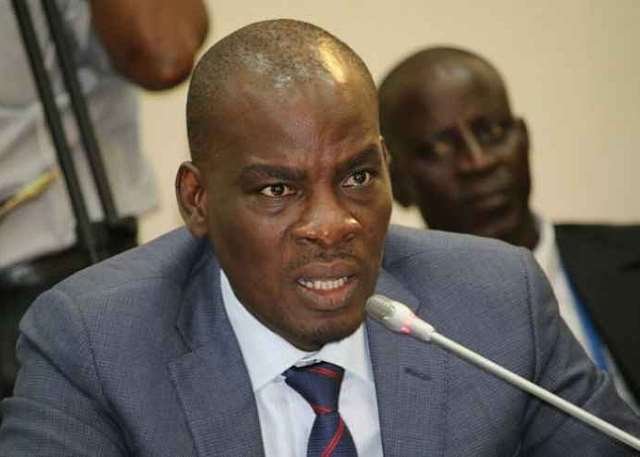
    “We did not place [promote those teachers], they did self-upgrading without passing through the office. So it is a backdoor affair.”