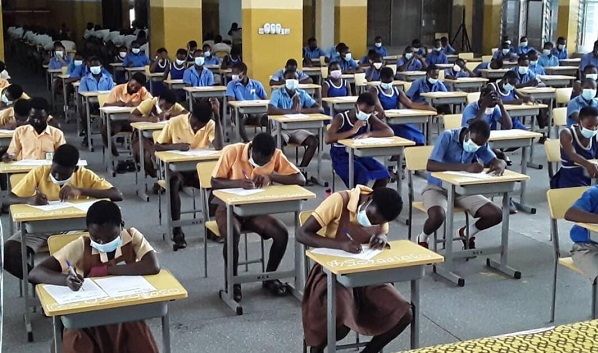
The Director-General of the Ghana Education Service (GES), Dr. Eric Nkansah, has expressed confidence that the 2024 West African Senior School Certificate Examination (WASSCE) results will be out by the end of the year.
In an interview with JoyNews, he confirmed that the West African Examinations Council (WAEC) had been in discussions with the Ministry of Education about the release of the results.
He also mentioned that while WAEC typically sets specific timelines, unforeseen issues can sometimes cause delays in meeting those deadlines.
“We are sure the results will be released possibly before the year ends,” he stated.
WAEC’s Director of Public Affairs, John Kapi, shared that the government has an unpaid debt of GH₵118 million, which has yet to be settled.
He pointed out that this financial shortfall is a key reason behind the delay in releasing the 2024 WASSCE results.
Mr Kapi said, “We intended by now to be processing the results, because, as we mentioned earlier, the marking of the scripts for both the theory and practical aspects is complete.”
He went on to explain that the final part left to complete is the objective section, which requires specialized equipment.
“We thought that by the 19th of this month, all things being equal, we could release the results before the office closes for the Christmas break,” he explained.
WAEC had previously encountered similar difficulties prior to organizing the exams, but the situation improved after the government made a partial payment toward its debt.
The Ghana Education Service (GES) has successfully restored its recruitment portal after it experienced some technical challenges.
The portal was initially launched on 3rd September 2024 to allow qualified applicants to apply for teaching positions across the country.
According to the GES Management, a total of 38,748 applications were received, with 11,665 applicants meeting the minimum requirements outlined in the advertisement. The Service is now in the process of recruiting these qualified applicants to fill critical teaching positions in batches.
Once a batch is completed, eligible applicants will receive a text message notifying them to proceed to the portal to print their appointment letters.
In the meantime, applicants with queries or concerns regarding the recruitment process are encouraged to reach out to Management via email at hecretariat@ges.gov.gh.
A statement issued by Cassandra Twum Ampofo, Head of the Public Relations Unit, assured the public that the issues with the portal have been resolved, allowing the recruitment process to continue smoothly.
The Ghana Education Service (GES) has officially launched a 16-day campaign aimed at tackling gender-based violence (GBV) in Senior High Schools (SHS) across the country.
The initiative, which focuses on creating safe spaces for both students and teachers, was inaugurated today under the theme “Safe Spaces, Empowered Voices: Ending Sexual Harassment in Our Schools.”
Cynthia Bosomtwe, a policy advisor and consultant for IPA Ghana, who chaired the event, emphasized that a comprehensive approach is necessary to eliminate GBV in schools. She called for advocacy, programs, policies, and regulations to be put in place to protect individuals, particularly women and girls.
“These regulations should aim at protecting the rights of individuals, especially women and girls. In Ghana, SGBV against women and girls is common in our homes, communities, and schools,” Bosomtwe stated. She further urged, “We need to rise up” to address the pervasive issue.
In his opening remarks, Steven Abamfo, the Greater Accra Regional Director of Education, shed light on the far-reaching effects of sexual and gender-based violence (SGBV) within educational environments. He highlighted how such violence strips individuals of their dignity and creates an unsafe learning environment. “It affects not only the individuals directly involved but also the entire school community by creating an atmosphere of fear,” Abamfo added.
The campaign comes on the heels of alarming findings from a report by the United Nations Children’s Fund (UNICEF) and the Girls Excellent Movement (GEM). The report, titled Sheltered Yet Exposed, details the prevalence of sexual assault among female students in SHS from 2019 to 2021. According to the report, a staggering 51.9% of female students experienced sexual assault during this period. The report also shows that 54.3% of the victims were aged between 17 and 22, while 45.7% were between the ages of 11 and 16.
The perpetrators of these assaults varied, with friends being the most common offenders at 24%, followed by family friends (12%), schoolmates (12%), teachers (10%), and strangers (9%). The report also highlighted that beyond sexual assaults, female students in SHS endure other forms of gender-based violence, including physical assault, bullying, verbal abuse, and harassment.
The launch of the campaign was attended by development partners, including the National Teaching Council (NTC), UNICEF, and Innovations for Poverty Action (IPA), who are all working together to address this critical issue in Ghana’s education system.
The Ghana Education Service (GES) has issued the academic calendar for both Basic and Senior High Schools nationwide for the 2024/2025 school year.
According to a statement released by the service, all first-year students in single track and transitional schools, along with returning students in single track institutions, are scheduled to return on Wednesday, October 30, 2024.
This indicates that incoming students, who are awaiting their Basic Education Certificate Examination (BECE) results and SHS placements, are expected to commence school on the same date.
GES further explained that the adjustment in reopening dates is aimed at aligning the school calendar to begin in September 2024.
“The academic year begins on Wednesday, 30th October, 2024 for all Senior High Schools. Please note that the current first-year students in transitional calendar schools will end their 2023/2024 academic year on Monday, 28th October, 2024 and be promoted to Form Two (2) to continue with the new academic year immediately.
“Incoming first-year students for single track and transitional schools will also begin school on Wednesday, 30th October, 2024. Additionally, all continuing students in single track schools will re-open for the new academic year on Wednesday, 30th October, 2024,” part of the statement read.
It added, “This re-opening date aims to ensure that the school calendar starts in September next year and paves the way for our final year students to write their 2025/2026 WASSCE in May/June.”
Read the statement plus the full academic calendar for both basic schools and SHSs below:
Basic schools across the country are set to reopen tomorrow, September 10, 2024, marking the start of the 2024/2025 academic year.
This reopening will officially restore the school calendar for basic education to its original September start date, following a four-year disruption caused by the COVID-19 pandemic.
A spokesperson for the Ghana Education Service (GES) told the Ghanaian Times that the return to the September academic calendar was aimed at normalising school operations and ensuring smooth transitions for both students and educators.
According to the 2024/2025 academic calendar released by the GES, kindergarten, primary, and junior high school (JHS) students will begin their first term tomorrow, which will last for 15 weeks.
The term will officially end on December 18, 2024, with schools vacating the following day, December 19, 2024.
The second term is scheduled to start on January 7, 2025, and conclude on April 16, 2025, followed by a vacation on April 17, 2025, after another 15 weeks of schooling.
The third and final term of the academic year will commence on May 6, 2025, and will run for 12 weeks, ending on July 24, 2025, bringing the academic year to a close.
The academic calendar was previously adjusted from 2021 to 2022, with the school year rescheduled from January to December due to the nationwide school closures that began in March 2020 as part of efforts to curb the spread of theCOVID-19 pandemic.
“Management of the Ghana Education Service wishes to inform you that the reopening date for basic schools (kindergarten, primary, and junior high schools) across the country for the first term of the 2023/2024 academic year is October 3, 2023,” a memo signed and issued by the Deputy Director-General of the GES in charge of Quality and Access, Dr. Kwabena Bempah Tandoh,” said.
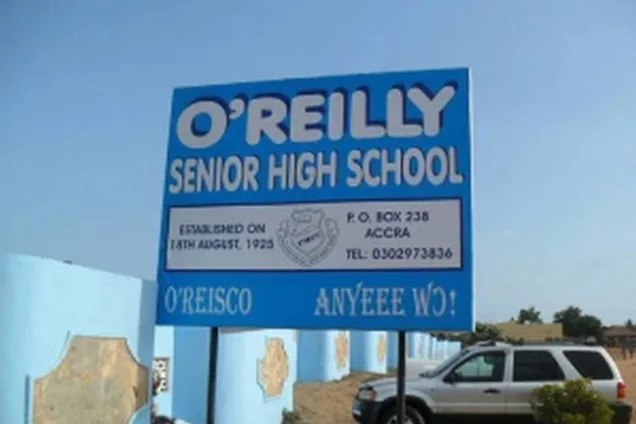
Some Ghanaians are laying the blame on the Ghana Education Service (GES) over the recent murder case that has rocked O’Reilly Senior High School.
Edward Sackey, an 18-year-old General Arts student from O’Reilly Senior High School, was fatally stabbed during an altercation with a classmate from the Visual Arts Department on Monday, September 2.
According to reports, the altercation that led to Edward’s death was reportedly sparked by a dispute over personal wealth. Edward was stabbed three times in the chest and was pronounced dead at the hospital.
There are reports that the school authorities, particularly teachers failed to take action during the clash between the two students and after the stabbing occurred.
This unfortunate incident has gotten the X platform buzzing with many citizens sharing their views on the matter. One of the bodies fingered for their indirect role in the case is the GES.
Some users argue that teachers in the Senior High School have been stripped of their power to sanction students who engage in unacceptable actions.
They noted that should they have had that authority, they would have been able to intervene and present the unfortunate demise of Edward.
“GES has taken all disciplinary powers from the teachers. Based on what will they intervene only to be punished by GES after? A useful lesson…No, the new GES rules have forbidden any form of discipline against students by the teachers. If you want to punish, you must write letter through your head to District Director and to Regional Director, justifying why you want to punish and get approval in writing before you can,” a user, @ProfBaidoo1, wrote.
“Teachers have been rendered powerless and useless giving these kids the audacity to behave anyway they can. I mean what’s the country turning into?” a user, @fixondennis, quizzed.
Teachers have been rendered powerless and useless giving these kids the audacity to behave anyway they can.
Another user added, “Ebe sad oooo now GES say make them no cane students again”. They further commented, “When U punish a student… U can be in trouble ooo.. So just go to work and do your teaching, go home after closing.”
In 2017, the Public Relations Officer of the Ghana Education Service (GES), Rev.Jonathan Bettey, has instructed teachers especially those in public schools to desist from beating pupils and students with canes.
He said the GES does not approve of teachers using canes to whip students when they go wrong adding that is not the only means of disciplining students.
Meanwhile, the father of Edward Sackey, Enoch Sackey, has announced his intention to sue the school following his son’s tragic death.
In an interview with Accra-based CitiNews, Enoch Sackey expressed profound frustration and demanded accountability from the school for the circumstances leading to his son’s death.
“We have to sue the school, we have to hold the school responsible,” Sackey asserted. “We want the school authority to come out and explain why such a thing would happen on school premises, where the teachers, nobody tried to interfere… they were all unconcerned until my son passed away.”
Sackey further criticized the school’s teachers for negligence, noting that his niece had called him to the school due to the fight but he did not understand why the teachers did not handle the situation. “I went to the school in Accra to understand the happenings, but sadly, I found my son covered in blood,” he said.
On Tuesday, Sackey and other family members, dressed in red and black, picketed the school to voice their dissatisfaction. They have expressed disappointment that neither the school administration, the attacker’s family, nor the police have contacted them regarding the incident.
Sackey emphasized, “We want answers from the school authority, and the parents of the boy and the police. We want justice, and we want the school authority to explain to us if the teachers were not at the school when it happened, or they were there, or they did not care.”
The suspect, Godwin, has been apprehended by the Ghana Police Service.
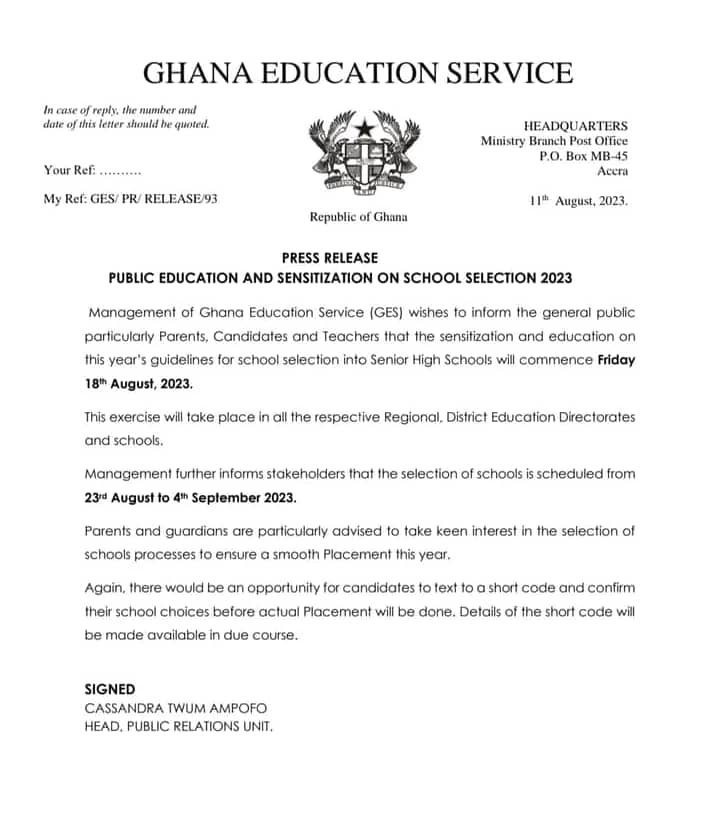
Ghana Education Service (GES)has set the dates for the 2024 school placement process for Basic Education Certificate Examination (BECE) candidates.
The selection period will run from August 28 to September 4.
Prince C. Agyemang-Duah, Acting Director of the Schools and Instruction Division at GES, has called on parents and guardians to actively participate in this year’s school selection to ensure an efficient and effective placement process.
Candidates will be able to confirm their preferred school choices via a designated short code, with details to be shared soon. This step will precede the final placement process.
This announcement follows the conclusion of the 2024 BECE, which saw 570,461 students sitting for the exams from July 8 to 15 across Ghana.
The selection phase will enable students to choose their preferred Senior High Schools or Technical and Vocational Education and Training (TVET) institutions.
Regional Education Directors have been directed to communicate the selection dates to relevant stakeholders, including local education authorities and exam officials, to facilitate a smooth process.
GES will also deploy officers from its headquarters to monitor the selection process across the country, ensuring compliance with all guidelines and maintaining transparency throughout.
Public Accounts Committee (PAC) of Parliament has instructed the Ghana Education Service (GES) to launch an investigation into 18 teachers in the Amansie Central District who unlawfully promoted themselves without following the established GES regulations.
According to a report from the Amansie Central Education Directorate, these teachers improperly upgraded their positions without the necessary documentation, leading to an unjustified salary increase.
This unauthorized action caused the state a financial loss of GH¢188,000.
Vincent Ben Ameyaw, the District Education Director for Amansie Central, revealed that so far, GH¢34,000 of the misappropriated funds has been recovered.
“We have been able to collect GH¢34,731.53 and we are left with GH¢152,966.54 and we are on course collecting [the balance].
“We did not place [promote those teachers], they did self-upgrading without passing through the office. So it is a backdoor affair.”
Meetings with thePublic Accounts Committeeof Parliament are often charged with tension, given the rigorous examination and scrutiny that typically ensue.
These sessions can become notably heated, with committee members rigorously probing those under review.
However, during a recent session, the atmosphere took an unexpected turn.
Emmanuel Samson, a teacher from Akropong Number One D/A JHS in the Gomoa West District, who was summoned for an alleged misuse of salary overpayments, managed to bring a sense of levity to the proceedings.
Instead of the usual intense grilling, Samson’s appearance provided moments of light-heartedness, as he elicited laughter and giggles from the committee members.
His presence, and the way he handled the situation, injected an unusual but welcome dose of humor into the typically serious environment of parliamentary scrutiny.
Public Account Committee Sitting: "Yes, I chopped the money" – GES officer confesses to receiving GHC 15K salary overpayment.#JoyNewspic.twitter.com/XcPv4f1KGU
Asked by James Klutse Avedzi, Chairman of the Public Accounts Committee, “When you got the money, which was more than the amount you were expecting, did you know at that time when you received the salary?” he replied:
“No, please. When I got the money, I thought it was my money until the auditors came in,” to which the whole room started giggling, with many of the members laughing.
The Ranking Member on the Committee, Davis Ansah Opoku (OPK), who is also the Member of Parliament for Mpraeso, then asked, “Like we say in our local settings, you have chopped the money? Mr Samson, you have chopped the money?”
“Yes, boss,” the GES officer answered.
(The whole room bursts into laughter once again)
“Alright, we are grateful for your sincerity…” OPK said.
The conversations continued from there, with James Azedziasking Emmanuel Samson to ensure that, as he had assured the committee that he would pay back at the end of August 2024, he does so, or else he will instruct the auditors to take action against him.
The Ghana Education Service (GES) has distributed laptops to 233 teachers and some non-teaching staff in the Okaikwei North Municipality, Greater Accra Region.
This initiative is part of the government’s One Teacher, One Laptop programme, aimed at enhancing the educational system through improved access to technology.
The distribution event took place at the Municipal Education Directorate in Achimota. Recipients underwent validation processes, including the presentation of their Ghana Cards, before receiving their laptops and accompanying bags.
Teachers expressed their gratitude towards the government and their union leaders for the timely rollout of the programme.
One teacher remarked, “The trend in education is driven purely by ICT, and devices such as computer laptops come in handy to enhance the teacher’s efforts.”
This programme has also benefited pre-tertiary teachers in all five northern regions of Ghana, including Northern, North East, Savannah, Upper East, and Upper West. A mop-up exercise is currently underway to ensure primary school teachers, teachers on study leave, and GES office staff in these regions receive their laptops.
Teaching and non-teaching staff who have not yet received their laptops can generate a collection code by dialing 790555# and contacting their ICT Coordinators for assistance. A statement from the manufacturing firm in Accra urged all remaining beneficiaries to use this shortcode and reach out to their respective ICT Coordinators.
According to the company, nearly 96% of eligible GES staff have already received their laptops. Efforts are being intensified to ensure all remaining beneficiaries receive their devices, thus concluding the nationwide distribution. The shortcode has been established to facilitate this final phase.
Teachers in the Ashanti, Greater Accra, North East, Upper West, Upper East, Northern, and Savannah Regions can activate their short code and contact their ICT Coordinators from Friday, July 26th, to collect their laptops. Teachers and non-teaching staff in the remaining 10 regions will follow the same process starting Wednesday, July 30th, 2024.
The One Teacher, One Laptop programme, launched in September 2021, aims to improve teaching and learning outcomes in pre-tertiary educational institutions nationwide. Under the programme, every public school teacher from kindergarten to senior high school is to receive a laptop to aid in lesson preparation, research, and learning.
The government covers 70% of the laptop cost, with teachers contributing the remaining 30% through their unions. These laptops also enable teachers to access digital online training through National Teaching Council-approved modules, ensuring that teaching aligns with National Teachers Standards across the country.
The Ghana Education Service (GES) has announced that first-year senior high students for the 2024/25 academic year are scheduled to begin classes on Friday, September 27.
School heads and parents are advised to take note of this date and ensure that their wards are adequately prepared for the new academic term.
In a press statement released on Tuesday, July 16, the GES outlined the timeline for the first semester, indicating that students will conclude their classes and begin their vacation on December 6.
“Management of the Ghana Education Service (GES) wishes to inform all heads of Senior High/Senior High Technical Schools that the reopening date for 1st year students of the 2024/2025 academic year is set for September 27,” the statement read.
The GES assured that all planned activities and programs for the semester will proceed as scheduled without any changes.
Parents and guardians are encouraged to ensure their children are prepared with the necessary supplies and materials needed for the upcoming academic term.
School heads are also urged to make the necessary arrangements to welcome the new students and facilitate their smooth integration into the school environment.
Ghana Education Service (GES)has received a petition to launch a thorough investigation into the physical assault and indefinite suspension of Abraham Sambou, a third-year student at Labone Senior High School.
In a letter addressed to the GES on June 21, Mrs. Raissa Ebu detailed the incident that occurred on June 18.
She reported that House Master Mr. Eric Agyemang, also known as Power, allegedly slapped Mr. Sambou following a false accusation by the school prefect, Blessing Nyamekye, who claimed Mr. Sambou was using a mobile phone and had refused to hand it over.
“In addition to the assault, Master Sambou was prevented from attending classes on the same day and was kept in the senior house master’s without food nor water until after 2 PM, when we arrived to meet with the school’s management.”
“Following this, Master Sambou has been indefinitely expelled from the boarding house despite his denial of the false allegations.
Master Sambou maintains that he does not use a phone at school; he was merely defending himself against the prefect’s harassment and false accusation,” she stated.
Mrs Ebu expressed that this unjustified, undocumented expulsion without due process has created a significant issue for the entire family. This is because Master Sambou would now have to travel daily from Kasoa in the Central Region to Labone, Accra.
“The family is deeply concerned about the mistreatment of our ward Master Sambou and the conduct of the school authorities, particularly Mr Agyemang, who has admitted to slapping the vulnerable final year student- a student who needs all the psychological help he can get as the WASSCE approaches.”
“Mr Agyemang justified his actions by claiming Master Sambou lied about his father’s availability when asked to provide his father’s phone number.
Later, it was confirmed that Master Sambou’s father was indeed unavailable as the call was eventually answered by the boy’s mother,” she further said.
Mrs Ebu also mentioned that during their visit to the school to discuss the issue, the headmistress of the school Mrs Rejoice Acorlor openly supported Mr Agyemang’s actions. She stated that she would have acted even more severely by slapping the boy and hitting him with her shoes.
“She also mentioned that if the incident had occurred before the registration for the WASSCE, she would have ensured Master Sambou was not registered for the exam,” she added.
Mrs Ebu pointed out that such a boastful stance by the headmistress raises serious concerns about the school’s governance and the quality of education.
“The wrongful actions against Abraham Sambou have caused significant distress and disruption to his education, particularly as he prepares for his final examination.
Following the assault, Master Abraham Sambou has been experiencing severe headaches and pain in his left ear and left eye, necessitating treatment at the Amanfro Polyclinic on Wednesday 19th June 2024.
“As of the time of writing this petition, Mr Eric Agyemang has a photograph of himself on his WhatsApp Display Picture (contact number 0244382506) in which he is seen purportedly [displaying] a gun.”
“It is imperative that Master Abraham Sambou is given a fair hearing as required by natural law so that he can continue his studies without undue physical and psychological trauma,” she stated.
The Ghana Education Service (GES) is set to deploy guidance and counselling personnel to Junior High and Senior High Schools in preparation for the full rollout of the new curriculum for secondary education in the country.
This initiative aims to educate and prepare students ahead of the next academic year’s implementation of the new standard-based curriculum, which promises a more flexible and personalized learning experience for Senior High School (SHS) students.
“GES is moving all their guidance and counselling staff who are in the classroom. Now they will be focusing on these activities and they will be having their offices in the schools to guide the children. Of course, the teachers will also help with that,” he said.
He further explained that the initiative aims to start from Junior High School 3 (JHS 3) to ensure students transitioning to SHS 1 have an understanding of the new curriculum.
Regarding the availability of teaching and learning materials for the curriculum, Prof. Appiah assured that materials would be made available before the full implementation.
“NaCCA, our mandate is to assess and approve textbooks, we don’t develop textbooks. However, knowing that this is a new curriculum, we had to develop resource materials for the schools and the learners. For the teachers, we are done. I have told you about the teacher manual. So each manual for each subject,” he explained.
Background
The National Council for Curriculum and Assessment (NaCCA) recently launched a manual for teachers in Ghana in preparation for the rollout of the new standard-based curriculum for Senior High Schools. The manual was unveiled by Prof. Edward Appiah at the Yaa Asantewaa Girls Senior High School in the Kwadaso Municipality of the Ashanti Region on Tuesday, May 21, 2024.
Before the manual’s launch, NaCCA revealed that the new curriculum for SHS students would allow learners to study both science and arts-related courses simultaneously. This development is intended to enable students to pursue any course of their choice at the tertiary level without limitations. Unlike the old curriculum, where arts students were not permitted to learn major aspects of science, the new curriculum removes such barriers, providing SHS students with more comprehensive educational opportunities.
The Acting Director in Charge of Curriculum at NaCCA, Mr. Reginald Quartey, discussed this during an engagement session with journalists from across the country. The event, held from Tuesday, May 14 to Wednesday, May 15, 2024, at the Volta Serene Hotel in Ho, Volta Region, brought together numerous top journalists from all regions. During the engagement, resource persons from NaCCA guided the media through all aspects of the new curriculum for SHS students.
Mr. Quartey emphasized that the new Senior High School Curriculum would focus on social, emotional, and behavioral issues as well as values. He stated that education should empower individuals to positively contribute to society.
Subject Combination
NaCCA also disclosed that the new curriculum would allow students to choose a minimum of seven and a maximum of nine subjects, depending on their strengths. Talented students, however, can choose to take more than nine subjects. The curriculum has been designed for grammar, STEM, and technical schools across the country.
With these comprehensive changes, the GES and NaCCA aim to create a more inclusive and holistic educational environment that prepares Ghanaian students for diverse and successful futures.
The Ghana Education Service (GES) has declared Thursday, May 9, 2024, as a public holiday for all Catholic and Presbyterian Schools nationwide.
This decision aligns with the observance of Ascension Day for the year.
In a joint statement, Ms. Araba Ahima Bentum, General Manager of the Ghana Catholic Education Unit, and Daniel Yeboah Hienno, General Manager of Presbyterian Schools, confirmed that this decision is in accordance with the celebration of Ascension Day.
“I wish to inform you that all Catholic Schools and offices of the Catholic Education Unit throughout the country will observe Thursday 09th May 2024 as Ascension Day and Obligatory Holy day. All Catholic Schools across the country will therefore be on holiday for the observation of the Ascension Day,” It announced.
The statement further urged all regional managers of the Catholic Education Unit, as well as chaplains in Senior High Schools and tertiary institutions, to ensure the observance of the day.
Similarly, all Presbyterian Schools and offices of the Presbyterian Education Unit nationwide are required to observe the Ascension Day Celebration, with all schools and offices closed for the day.
“It is our hope that Presbytery Chairpersons will encourage their District Ministers to fully participate in this celebration,” the statement added.
Ghana Education Service (GES) has voiced concern over the increasing prevalence of tattooing, multiple piercings, and bleaching among pupils, labeling it as ‘a worrying trend.’
Furthermore, the Service is troubled by the rise in teenage pregnancies and cohabitation, recognizing the significant impact these issues have on the education of pupils, particularly girls.
Ms. Priscilla Christabel Eshun, the Central Regional Girls Education Officer of the GES, expressed surprise at discovering young pupils with prominent tattoos bearing peculiar names and meanings during visits to selected districts in the Central Region as part of the ‘Life Skills Programme’ aimed at empowering pupils.
The districts covered in these visits included Ajumako-Enyan-Essiam, Assin South, Ekumfi, Upper Denkyira West, Twifo-Hemang-Lower-Denkyira West, and the Komenda-Edina-Eguafo-Abrem Municipality.
Ms. Eshun revealed these findings at the Second Quarter Sub-Implementing Partners (IPs) Review Meeting on sexual and gender-based violence, organized by the Regional Coordinating Council with support from the United Nations Population Fund (UNFPA).
Various partner institutions and agencies, such as the Department of Gender, Ghana Education Service, Ghana Health Service, National Youth Authority, Population Council, and the Ghana News Agency, participated in addressing the forum. Additional contributors included the Planned Parenthood Association of Ghana, Social Welfare, House of Chiefs, and Non-Governmental Organizations.
Ms Eshun said: “In one of the schools we visited, a young girl had bleached her skin to the point where it was peeling off and emitting an unpleasant smell.”
“We also observed students with multiple piercings in their ears.
“This has become a fashion trend, and many girls are engaging in it without considering the potential health, employment, and other socio-economic consequences,” she added.
She added that the GES also discovered that numerous boys had discontinued their education for various reasons and had resorted to operating tricycles (known as Aboboyaa or Pragyia).
The investigations further revealed that many young girls were forming associations with these boys in search of financial support.
“Regrettably, many girls are enticed into such relationships for financial gain, using the money to purchase sanitary pads and other personal items,” Ms Eshun revealed.
She emphasised that the Service prohibited tattooing, multiple piercings, and bleaching as stated in its harmonised code of Conduct approved for students in pre-tertiary schools.
The section of the code of conduct titled “Improper Dressing” explicitlystates that “bleaching of the skin by a student shall not be allowed.”
She said the GES Code of Conduct stressed the necessity for students to dress neatly, adhere to the prescribed dress code and footwear consistently, and avoid accessories such as chains, bangles, caps, and bracelets.
Spectacles, for instance, were only permitted with a valid medical prescription and alterations to school uniforms or dresses were prohibited.
“Students shall not wear chains, bangles, caps, or braces. The wearing of spectacles shall require a medical prescription.
“No alterations to school uniforms or dresses shall be allowed. Possession or use of un-prescribed attire by a student is an offence,” Mrs. Eshun explained.
These guidelines, she said, also extend to personal grooming, emphasising the importance of maintaining a decent haircut as defined by school authorities.
Clean, neat, and modest hair is encouraged, with an emphasis on avoiding extreme styles and colours.
For male students, she said a styled haircut and a clean-shaven beard are acceptable.
“Students should have a decent haircut as prescribed by the school authorities. Hair should be clean, neat, and modest, and avoid extremes in style and colour. Men’s hair should be neatly struck and beards clean-shaven.”
The Code of Conduct outlines various sanctions for offences such as confiscation of bleaching creams and other unauthorised items, facing disciplinary committees, signing bonds, cautioning, and counselling, manual work, demotion for prefects, two weeks of internal suspension, and supervised shaving of beards or sideburns.
The GES’s Harmonised Code of Conduct reflects a broader commitment to instilling discipline and uniformity in the educational environment, emphasising the role of appropriate appearance and grooming standards in fostering a conducive learning atmosphere.
Mr. Alan Paintsil, on behalf of the RCC, pledged his outfit’s commitment to sustaining the progress made in reducing teenage pregnancies and other sexual and gender-based violence across the region.
He highlighted the specific districts that have been prioritised for the intervention and called for support from all stakeholders.
The Ghana Education Service (GES) has transferred four of the eight senior high school headteachers in the Ashanti Region who were interdicted for allegedly charging unauthorized fees.
The headmasters were interdicted in December 2023 for allegedly charging students unapproved fees, including house dues, books, calculators, admission process fees, printing of slips, files, and hymn books.
Following the conclusion of its probe, the Ghana Education Service transferred four of the headmasters. Sulemana Yeboah, the Ashanti Regional President of the Conference of Heads of Assisted Secondary Schools (CHASS), disclosed this in an interview.
“They [GES] have taken the decision where four of them [the headteachers] have been asked to go to their various schools, and four of them have been swapped from their former schools to different schools. [Headteacher] of Kumasi Girls is now at Ntonsu SDA Girls and [Headteacher] of SDA Girls is at Nkawie. [Headteacher] of Nkawie SDA Girls has been moved to Nkroful Agric.
“And in the direct swap, we have [Headteacher] of Manso Adubia SHS moving to Tweapease Senior High School, and [Headteacher] of Tweapease Senior High School moving to Manso Adubia SHS. The last person moved from KSTS to Bosome Freho Senior High School to replace the headteacher, who is on retirement,” he said in an interview with Citi FM.
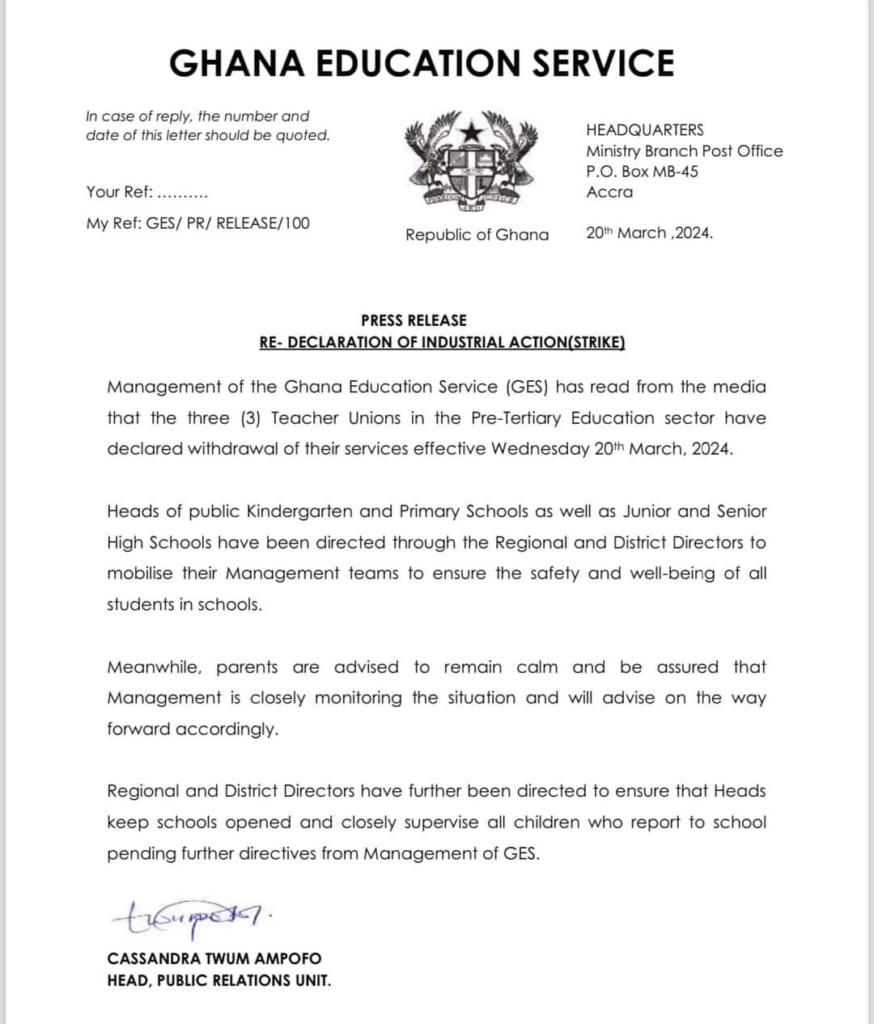
The Ghana Education Service (GES) has instructed junior and senior high school headteachers to continue school operations despite the ongoing strike by three teacher unions.
The strike, initiated on Wednesday, March 20, 2024, by the Ghana National Association of Teachers (GNAT), the National Association of Graduate Teachers (NAGRAT), and the Coalition of Concerned Teachers (CCT), is due to the government’s alleged failure to address their conditions of service.
Headteachers have been directed to ensure the safety of students during their time at school.
GES issued a press release on Wednesday, March 20, reassuring parents to remain calm, stating that management is actively monitoring the situation.
“Regional and District Directors have further been directed to ensure that Heads keep schools open and closely supervise all children who report to school pending further directives from Management of GES.”
The Eastern Regional Education Directorate, in collaboration with Zoomlion Ghana Ltd, has launched a Waste Segregation pilot program in nine selected Basic Schools in the New Juabeng South Municipality.
The initiative aims to separate plastic waste from other waste generated in schools for recycling purposes and to reduce the accumulation of plastics in storm drains, rivers, and streams.
Godfried Caesar, the Eastern Regional Schools Health and Education Programme (SHEP) Coordinator, explained that the primary objective is to maintain clean school environments by segregating waste in different dustbins.
Plastic waste, such as water sachets and bottles, will be sold to recycling companies, and the proceeds will be used to meet some essential needs of the schools to enhance teaching and learning.
The project is also intended to mitigate environmental degradation caused by plastic pollution, as plastics buried in the soil through improper waste disposal contribute to pollution. Caesar called for support and collaboration from organizations to expand the project to all 52 schools in the Municipality and beyond, following a successful pilot phase.
Faustina Shardey, Eastern Regional Coordinator of Zoomlion Ghana, noted that the initiative aligns with the “Zero Waste” campaign ongoing in Accra. Zoomlion Ghana has provided each of the nine schools with two dustbins, liners, and other accessories to facilitate the implementation of the project.
The Member of Parliament for Ningo-Prampram, Sam Nartey George, expressed concerns about the shortage of Ga Dangbe language teachers in his constituency.
Sam George highlighted the impact of technological advancements and the influence of certain religions on eroding cultural values, leading to a decrease in support for indigenous languages, particularly Dangbe.
“Today, with the advent of technology and Judeo-Christo religions, many of the things that we refer to as our culture have been termed demonic practices,” he lamented.
“And so we’re actually walking away from our culture, and Mr. Speaker, as a Dangbe boy from the Ga-Dangbe ethnic group, I am very worried.”
During his address to the House, the MP highlighted the significant disparity in the availability of language teachers between Akan and Dangbe.
He revealed that in 2017, there were 37 Akan language teachers in the Ningo-Prampram district, compared to only two Dangbe teachers. Despite efforts to address the shortage by sponsoring students to obtain degrees in Dangbe, the problem persists.
“What did not solve the problem was the Ghana Education Service (GES) posting these Dangbe teachers to the north or to the Ashanti Region to teach social studies and Bible knowledge when they studied Dangbe,” he pointed out.
The presidential candidate of the New Patriotic Party (NPP) and current Vice President of Ghana, Dr. Mahamudu Bawumia, is set to present his campaign team list to the National Executive Committee (NEC) on Monday, 19 February 2024, for consideration and approval.
Sources from Asaase News indicate that Dr. Bawumia has been conducting extensive consultations within the party’s rank and file for the composition of his campaign team.
“Recently, the Ga Dangbe took a stance and said they thought that the Ghana Education Service was intentionally working to kill some languages,” he revealed.
“Because if we have trained teachers in our local languages, and there’s a shortage of teachers in the region, why post them away to teach a different language? It makes absolutely no sense.”
The Deputy Ranking Member on the Education Committee of Parliament, Dr. Clement Apaak, has called on the Ghana Education Service (GES) to immediately reverse its decision to transform Parent-Teacher Associations (PTA) into Parent Associations (PA).
Dr. Apaak stressed the crucial role that PTAs have played in supporting the government’s efforts to achieve universal access to education over the years.
His remarks come in response to GES’ decision to reorganize PTAs into PAs, citing financial and operational challenges associated with providing educational access in schools.
In an interview with Citi News, Dr. Apaak criticized the move, describing the realignment of parent-teacher associations as “totally unnecessary.”
“…We have seen the negative consequences of that. The PTAs have and continue to play a very important role in assisting the government in delivering education. You go to many secondary schools across this country, you will see structures that were put up by PTAs,” Dr. Clement Apaak said.
The GES has introduced new guidelines for Parent Associations, formerly known as Parent-Teacher Associations (PTAs), in pre-tertiary schools.
These guidelines prohibit teachers from participating in the Association, impose restrictions on teachers collecting fees from students for exam purposes, and specify that parents whose children have completed school should no longer be part of the Association.
Gapson Kofi Raphael, the Secretary of the National Council of the Parents Teachers Association in Ghana, has also expressed dissatisfaction with the Ghana Education Service’s guidelines on PTAs, labeling them as unlawful and illegal.
The North Tongu constituency’s Member of Parliament, Samuel Okudzeto Ablakwa, has disbursed GH¢150,000 to the Ghana Education Service in the district, clearing six months’ rent advance for 167 teachers affected by the Akosombo Dam spillage.
In efforts to encourage the teachers’ return for uninterrupted teaching, Ablakwa emphasized the importance of such initiatives.
“My office has paid rent for 167 teachers who were displaced by the floods in order for them to return to teach our children.
“These are some of the innovations we’re embarking on to ensure our people are not left behind,” he explained in an interview with Citi News.
Despite ongoing challenges, Ablakwa’s office has provided school bags, footwear, and essential items to facilitate education in the area. Full scholarships have been granted to 50 student victims across various tertiary institutions.
Addressing St. Kizito SHS, which housed a significant number of displaced victims, Ablakwa reported that “teaching and learning have commenced, and painting and renovation works will be completed next week.”
He appealed to benevolent organizations for further assistance, highlighting the persistent impact of the floods and the crucial need for ongoing support.
“The flood is no longer in the community. Yes, the water has receded, but the people are still homeless,” he expressed concern.
Following the 2023 Akosombo Dam spillage, which displaced around 12,000 residents in North Tongu, Ablakwa’s initiative continues. Victims with uninhabitable properties remain in tents, prompting the MP’s call for support.
Ablakwa’s ongoing project includes the construction of a shelter in Mepe for 300 widows, elderly individuals, and single mothers.
Currently, the facility is 78% complete and is scheduled for handover in February 2024. This second resettlement center in the constituency features 50 rooms, washrooms, and an entertainment room exclusively for vulnerable women.
Ghana Education Service (GES) has provided clarity on certain procedures expected from teachers in both primary and secondary schools nationwide.
Addressing the ongoing confusion between headmasters and teachers in various schools concerning lesson notes, the GES acknowledged the previous requirement for teachers to submit lesson plans every Monday, with potential disciplinary consequences for non-compliance.
However, recent changes to the curriculum and educational systems have caused some misunderstandings.
In a statement released on January 17, the GES clarified that lesson notes can now be handwritten or prepared electronically, and submission can be done physically or via email.
Furthermore, the statement instructed regional directors to communicate this information to district, municipal, and metropolitan directors of education.
Background
Teachers in Ghanaian schools have generally created lesson plans and notes on dedicated Teacher Lesson Note Books provided by the school.
Headteachers documented and reviewed each week’s subjects before they were implemented.
In the past, G.E.S. required all teachers to submit lesson plans every Monday, and failure to do so could result in disciplinary action.
This practice had become part of theG.E.S. system over the years, and many teachers viewed it as an essential part of their job.
However, recent modifications to the curriculum and educational systems have created new obstacles.
In a key modification for 2024, the GES directed the district/municipal/metropolitan directors of education to require that teachers accept lesson notes in both handwritten and electronically generated versions, either in print or via email.
In response to the evolving curriculum and educational systems, the Ghana Education Service (GES) has provided clarity on the procedures for teachers in basic and high schools regarding lesson notes.
In the past, teachers were required to submit lesson plans every Monday, with potential disciplinary action for non-compliance. However, recent modifications have led to confusion.
In a statement on January 17, the GES clarified that lesson notes can be either handwritten or electronically prepared, and they can be submitted physically or via email.
The GES urged regional directors to communicate this information to district, municipal, and metropolitan directors of education.
Teachers in Ghanaian schools traditionally used dedicated Teacher Lesson Note Books provided by the school to create lesson plans and notes. Headteachers documented and reviewed weekly subjects before implementation.
In the past, the Ghana Education Service (GES) mandated teachers to submit lesson plans every Monday, with potential disciplinary action for non-compliance. This practice had become ingrained in the GES system over the years, seen by many teachers as an essential part of their job.
However, recent modifications to the curriculum and educational systems presented new challenges. In a significant change for 2024, the GES directed district/municipal/metropolitan directors of education to accept lesson notes in both handwritten and electronically generated formats, either in print or via email.
The Ghana Education Service (GES) has conveyed that Parents Associations (PAs) are permitted to engage in fundraising activities as a means of contributing support to the implementation of the Free Senior High School (SHS) policy.
As outlined by the GES, Parents Associations (PAs) have been granted the flexibility to pursue various fundraising channels for school development. However, it is emphasized that they are prohibited from levying any fees on students or pupils.
This information is detailed in the recently issued guidelines document by the GES, delineating the operational framework for Parents Associations in pre-tertiary schools.
There have been concerns about the operations of PTAs that supposedly thwarted the government’s efforts at ensuring universal access to education, specifically at the SHS level.
This was due to the outrageous imposition of levies by some PTAs which sought to defeat the purpose for which the Free SHS policy was introduced.
In response to these developments, the management of GES suspended the imposition of levies in all schools.
It also directed the reorganization of the Parent Teachers Associations (PTAs) to Parent Associations (PAs) to limit the involvement of management and staff of the school.
The GES emphasised that PAs should operate independently, separate from school management and staff.
According to GES, PAs could undertake projects to support the development and growth of the schools to which they are related but emphasised that the management of the schools shall have full authority over the handling of such projects without interference from PAs.
GES stated that PAs may through the management of the school, offer support to teachers/staff of the school through the provision of incentive packages and other welfare schemes.
It maintained that no child shall be discriminated against or given preferential treatment in the official duties of the teacher/staff to which that incentive or welfare package is related.
“Aside from contributions made by PAs, individual parents/guardians may make voluntary donations or contributions to the school as that individual deems fit and such donation shall not confer any preference or privilege to any student in terms of access to and use of the facility or donation,” GES said.
The GES in the document clarified that although school management should not be signatories to Parents Associations’ activities, they can participate without assuming liability for decisions made.
However, PAs are required to submit their annual activities and plans for approval by school management.
Additionally, the accounts of PAs will undergo annual audits, and audit reports must be submitted to Regional Directors for forwarding to the Director General of the Ghana Education Service.
The National Council of Parent-Teacher Associations (NCPTA) has urged its members to dismiss any directives from the Ghana Education Service (GES) pertaining to operational guidelines that were not formulated by the NCPTA itself.
Emphasizing that the GES lacks the authority to regulate the affairs of a private body beyond its jurisdiction, the General Secretary of the NCPTA, Raphael Kofi Gapson, communicated this stance through a circular to members, stressing the collaborative partnership between the NCPTA and the education authorities.
In response to the circular, Mr Gapson informed the Daily Graphic that the GES has yet to respond to their letter, which requested a halt to the guidelines for further deliberation.
Citing legal complexities in the matter, Mr Gapson explained that the NCPTA chose a diplomatic approach by initially reaching out to the GES through written communication and advocacy. If the GES fails to respond, the NCPTA is prepared to escalate the matter further.
“The GES/Ministry of Education must know that we are partners and collaborators, and not part of their regulatory agencies,” the General Secretary of the NCPTA, Raphael Kofi Gapson, indicated in a circular to members.
“They have not called us, they have not even acknowledged receipt of the letter, and so, as of now, we are still waiting,” he said, stressing that “this is an issue we would deal with appropriately.”
Highlighting the autonomy of the association, the circular declared that the NCPTA operates independently of the GES and the Ministry of Education.
The association, registered as a private corporate entity under the Office of the Registrar General since 2013, possesses a constitution with defined structures.
The circular vehemently opposed any attempt to change the association’s name to “Parent Association (PA),” asserting that such an alteration would be illegal, unlawful, and unethical.
The NCPTA granted the GES until the end of the week to respond, indicating that their next course of action would be determined by the GES’s reaction.
In a separate development, the NCPTA called on the GES to revert to the original name, Parent Teacher Association (PTA), from the imposed name Parent Association (PA). The NCPTA criticized the new nomenclature, asserting that it was perceived as an imposition by its members. The NCPTA’s letter to the GES on this matter was dated January 9, 2024, and signed by the National President, Christian Atsu Aikins. The GES has reportedly received a copy of the letter.
The context of the dispute revolves around guidelines developed by the GES under the new name “Parent Associations (PAs),” recognizing the collaboration between school heads and PTAs. However, the NCPTA expressed concerns over inconsistencies in the guidelines, particularly regarding autonomy and conflicting provisions related to the Director-General’s involvement in financial matters.
Dr. Clement Apaak, the Member of Parliament for Bulsa South and Ranking Member of Education in Parliament, has urged senior high school headteachers to strictly adhere to guidelines set by the Ministry of Education (MoE) and the Ghana Education Service (GES).
He emphasized the importance of refraining from imposing unapproved fees, echoing this sentiment in response to the suspension of certain headmasters in seven senior high schools nationwide by the GES for violating directives against charging additional fees to parents.
Dr. Apaak endorsed the plea made by the National Association of Graduate Teachers (NAGRAT) leadership, supporting their call for headteachers not to independently procure logistics and to await government provisions.
NAGRAT President Angel Carbonou emphasized compliance with regulations and the prompt reporting of deficiencies, allowing relevant authorities to intervene.
The Ghana Education Service took decisive action by suspending headmasters in seven senior high schools in the Ashanti Region due to unauthorized fund collection from candidates.
The affected schools include Kumasi Girls, Asanteman, Kumasi Manso Adubia, Agric Nzema Community, Nkawie, and Collins Senior High School.
The Ghana Education Service (GES) has clarified that reports suggesting the reinstatement of eleven headteachers who were interdicted for charging unauthorized fees to Form One students are false.
The headmistress of the Ghana Senior High School in Koforidua and seven other headteachers in different senior high schools across the Ashanti Region were interdicted for allegedly selling unauthorized items to Form One students.
The GES emphasized that the interdiction was a result of the headteachers blatantly ignoring directives, and there has been no reinstatement. The public has been urged to disregard such reports.
A total number of 11 headteachers have been interdicted by the Ghana Education Service (GES) for charging unapproved fees during the admission of first-year students in their respective institutions.
Seven head teachers in SHSs across the Ashanti Region have been directed to step aside for allegedly imposing unauthorized fees on first-year students.
In a number of press statements, the Ghana Education Service announced that it has launched investigations into the actions of the headteachers.
The affected individuals are Mrs. Selina Anane Afoakwa (Headmistress of Kumasi Girls SHS), Mr. Nataniel Asamoah (Headmaster of Asanteman SHS), Mr. Andrews Boateng (Headmaster of Kumasi Senior High Technical School), and Mr. Kwadwo Obeng-Appiah (Headmaster of Manso-Edubia SHS).
Additionally, Mr. Daniel Boamah Duku (Headmaster of Agric Nzema Community SHS), Ms. Gladys Sarfowah (Headmistress of Nkawie Senior High Technical School), and Mr. Ampong Ahmed Omar (Headmaster of Collins SHS) are included in the list.
According to the GES, the headteachers have been accused of charging students various unapproved fees, including payments for house dues, books, calculators, admission process, printing of slips and files, and hymn books.
This action follows similar interdictions of headteachers in the Greater Accra and Eastern regions for unauthorized sales of items to students.
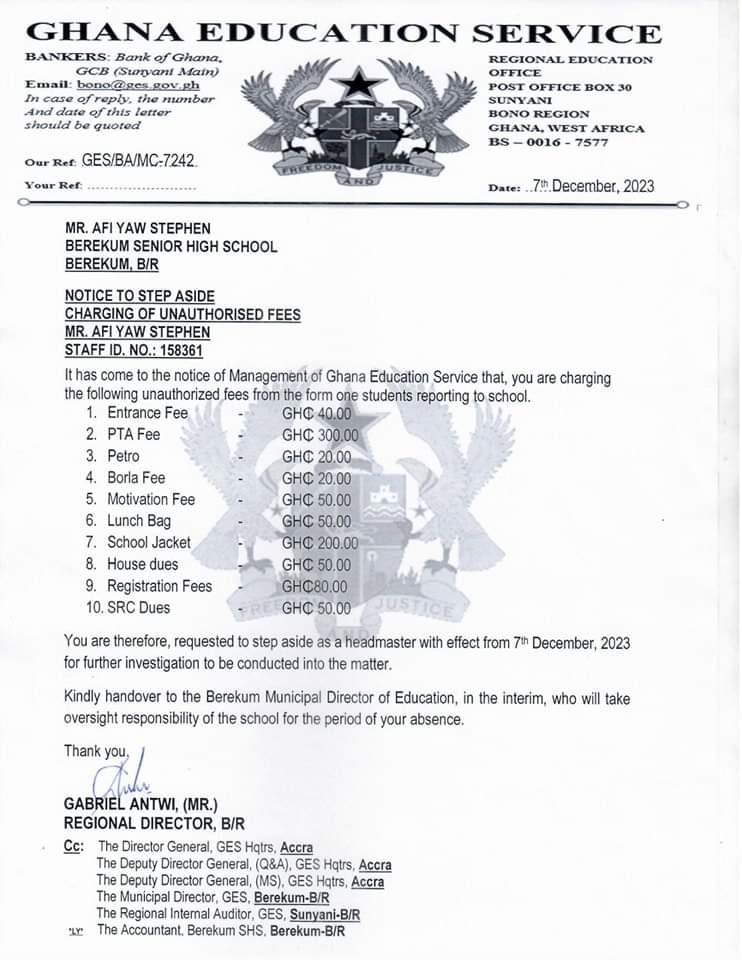
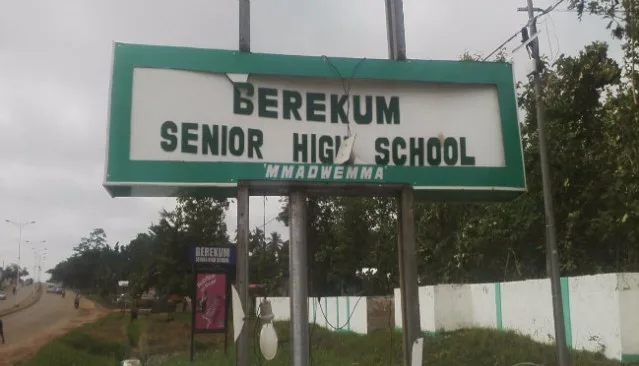
Mr. Afi Yaw Stephen, Headmaster of Berekum Senior High School, and Mr. Joseph Jilinjeh Abudu, Headmaster of Odomaseman Senior High School, were both directed to step aside in separate letters by the GES for selling items not approved by the education authorities.
Mr. Afi Yaw Stephen was accused of charging unauthorized fees, including “Borla fees,” “motivation fees,” and “lunch bag” charges.
On the other hand, Mr. Joseph Jilinjeh Abudu has been accused of charging students GHC45 for hymn books, SRC fees, brown khaki, and other unapproved items.
The headteachers of O’Reilly Senior High School and Ghana Senior High School were interdicted for alleged unauthorized activities.
Nadia Lartechoe Annan of O’Reilly SHS and Patience Naki Mensah of Ghana Senior High School were suspended for unauthorized activities, including the collection of admission fees and the sale of ceremonial cloth, tracksuits, and other items to incoming Form One students.
Meanwhile, President of the National Association of Graduate Teachers (NAGRAT), Angel Carbonu, has issued a stern warning to headteachers nationwide, urging them to adhere to the government’s policy prohibiting the sale of items to students within school premises.
The Ghana Education Service (GES) has decided to lift the interdiction on Senior High School heads by the end of this week, following a closed-door meeting with representatives from the Ghana National Association of Teachers (GNAT) and the Conference of Assisted Heads of Senior High Schools (CHASS) in Accra.
Thomas Musah, the General Secretary of GNAT, expressed gratitude for the GES’s responsiveness to their plea for the reinstatement of the affected heads.
In an interview with Accra100.5FM’s news team on Thursday, December 14, 2023, Mr. Musah commended the GES for its collaborative approach in addressing the concerns raised by GNAT and CHASS.
“This development suggests a positive outcome from the discussions, signalling the imminent reinstatement of the interdicted Senior High School heads,” he said.
The eleven interdicted headteachers include Mrs. Selina Anane Afoakwa, Headmistress of Kumasi Girls SHS; Mr. Nathaniel Asamoah, Headmaster of Asanteman SHS; Mr. Andrews Boateng, Headmaster of Kumasi Senior High Technical School; and Mr. Kwadwo Obeng-Appiah, Headmaster of Manso-Edubia SHS.
Others are Mr. Daniel Boamah Duku, Headmaster of Agric Nzema Community SHS; Ms. Gladys Sarfowah, Headmistress of Nkawie Senior High Technical School; and Mr. Ampong Ahmed Omar, Headmaster of Collins SHS.
According to the GES, these headteachers face accusations of imposing various unapproved fees, including house dues, books, calculators, admission process fees, and charges for printing slips, files, and hymn books on first-year SHS students.
This development follows similar interdictions of Mr. Afi Yaw Stephen, Headmaster of Berekum Senior High School, and Mr. Joseph Jilinjeh Abudu, Headmaster of Odomaseman Senior High School, as well as the Headmistress of the Ghana Senior High School (GHANASS), Patience Naki Mensah.
The Ashanti Regional chapter of the Conference of Heads of Assisted Secondary Schools (CHASS) has highlighted that the Ghana Education Service (GES) has not yet formed the Committee intended to investigate the seven interdicted Senior High School headteachers.
Zakaria Suleman Yeboah, the Ashanti Regional chairman of CHASS, revealed to Citi News that the initial four individuals, scheduled to appear before the disciplinary committee today, were unable to do so due to the ongoing constitution of the committee.
He remains optimistic that the four individuals will eventually present themselves before the disciplinary committee on Wednesday, December 13.
Mr. Yeboah hopes that the committee, once established, will promptly conclude its investigations to bring closure to the matter.
“Currently we are just waiting for the regional director to constitute the committee and then, as CHASS, we have been asked to bring a rep so that the committee can be established…I wish and pray that by tomorrow morning they will start their sitting and four of our members will start to face the committee.”
“Looking at the issues, I can say that it won’t get to even two weeks. There are only seven and the four will be meeting them tomorrow and the other three the next day. I believe that by next week, their recommendations should go to the headquarters for them to make their final decision,” Mr Zakaria said.
Mr. Zakaria also reiterated CHASS’ call for various headmasters to strictly adhere to the rules of the Ghana Education Service (GES) to avoid sanctions.
The Ghana Education Service (GES) has directed seven headteachers in senior high schools across the Ashanti Region to step aside amid allegations of charging unauthorized fees from fresh students.
In separate statements, the GES confirmed that investigations have been initiated into the conduct of these headteachers. The implicated individuals are Mrs. Selina Anane Afoakwa, headmistress of Kumasi Girls SHS, Mr. Nataniel Asamoah, headmaster of Asanteman SHS, Mr. Andrews Boateng, headmaster of Kumasi Senior High Technical School, and Mr. Kwadwo Obeng-Appiah, headmaster of Manso-Edubia SHS.
The remaining three are Mr. Daniel Boamah Duku, headmaster of the Agric Nzema Community SHS, Ms. Gladys Sarfowah, headmistress of Nkawie Senior High Technical School, and Mr. Ampong Ahmed Omar, headmaster of Collins SHS. The GES is taking action to investigate and address the allegations against these headteachers.
Four out of the seven headteachers who were interdicted for allegedly charging unauthorized fees in the Ashanti Region are anticipated to appear before a committee assigned to investigate the claims on December 12.
The Ghana Education Service (GES) clarified that the headteachers were accused of imposing various unapproved fees on students. These alleged fees include payments for house dues, books and calculators, fees for the admission process, the printing of slips and files, and hymn books.
In an interview with Citi News, Zakaria Suleman Yeboah, the Ashanti Regional Chairman of the Conference of Heads of Assisted Secondary Schools (CHASS), stated that the headteachers are willing to cooperate with the committee during the investigation.
“I cannot say whether the items stated against them [the headteachers] are right or not. I have met my members, and we have spoken at length, and they have given me their side of the story, so I hope that the committee sitting will help us unravel some of the issues at stake.”
The Ghana Education Service (GES) has directed seven headteachers in senior high schools across the Ashanti Region to step aside amid allegations of charging unauthorized fees from fresh students.
In separate statements, the GES confirmed that investigations have been initiated into the conduct of these headteachers. The implicated individuals are Mrs. Selina Anane Afoakwa, headmistress of Kumasi Girls SHS, Mr. Nataniel Asamoah, headmaster of Asanteman SHS, Mr. Andrews Boateng, headmaster of Kumasi Senior High Technical School, and Mr. Kwadwo Obeng-Appiah, headmaster of Manso-Edubia SHS.
The remaining three are Mr. Daniel Boamah Duku, headmaster of the Agric Nzema Community SHS, Ms. Gladys Sarfowah, headmistress of Nkawie Senior High Technical School, and Mr. Ampong Ahmed Omar, headmaster of Collins SHS. The GES is taking action to investigate and address the allegations against these headteachers.
Ranking Member on the Education Committee in Parliament, Peter Nortsu-Kotoe, has voiced criticism against the Ghana Education Service (GES) for its handling of allegations against 11 senior high school head teachers.
These educators have been interdicted on the grounds of allegedly charging unauthorized fees.
Mr. Kotoe has suggested that the GES could have managed the situation more effectively by ensuring a fair hearing for the accused head teachers before the decision to interdict them was made.
The legislator, who represents Akatsi North, expressed his dissatisfaction with the actions taken by the GES in this particular case.
“We are aware that firm instructions have been issued to the heads of the various senior high schools in the country, but I will say that they are working under certain conditions that make it difficult for them to deliver on their mandate. They might have erred, but I am not happy with the manner in which the Ghana Education Service has unprofessionally handled the matter. These are people working for you to help you pursue your agenda, so no matter what offense they commit, the first thing as an employer is to invite them and hear their side of the story.”
In a related development, four out of the seven head teachers in the Ashanti Region, who were interdicted for allegedly charging unauthorized fees, are scheduled to appear before a committee tasked with investigating the claims on December 12.
A total number of 11 headteachers have been interdicted by the Ghana Education Service (GES) for charging unapproved fees during the admission of first-year students in their respective institutions.
Seven head teachers in SHSs across the Ashanti Region have been directed to step aside for allegedly imposing unauthorized fees on first-year students.
In a number of press statements, the Ghana Education Service announced that it has launched investigations into the actions of the headteachers.
The affected individuals are Mrs. Selina Anane Afoakwa (Headmistress of Kumasi Girls SHS), Mr. Nataniel Asamoah (Headmaster of Asanteman SHS), Mr. Andrews Boateng (Headmaster of Kumasi Senior High Technical School), and Mr. Kwadwo Obeng-Appiah (Headmaster of Manso-Edubia SHS).
Additionally, Mr. Daniel Boamah Duku (Headmaster of Agric Nzema Community SHS), Ms. Gladys Sarfowah (Headmistress of Nkawie Senior High Technical School), and Mr. Ampong Ahmed Omar (Headmaster of Collins SHS) are included in the list.
According to the GES, the headteachers have been accused of charging students various unapproved fees, including payments for house dues, books, calculators, admission process, printing of slips and files, and hymn books.
This action follows similar interdictions of headteachers in the Greater Accra and Eastern regions for unauthorized sales of items to students.
Mr. Afi Yaw Stephen, Headmaster of Berekum Senior High School, and Mr. Joseph Jilinjeh Abudu, Headmaster of Odomaseman Senior High School, were both directed to step aside in separate letters by the GES for selling items not approved by the education authorities.
Mr. Afi Yaw Stephen was accused of charging unauthorized fees, including “Borla fees,” “motivation fees,” and “lunch bag” charges.
On the other hand, Mr. Joseph Jilinjeh Abudu has been accused of charging students GHC45 for hymn books, SRC fees, brown khaki, and other unapproved items.
The headteachers of O’Reilly Senior High School and Ghana Senior High School were interdicted for alleged unauthorized activities.
Nadia Lartechoe Annan of O’Reilly SHS and Patience Naki Mensah of Ghana Senior High School were suspended for unauthorized activities, including the collection of admission fees and the sale of ceremonial cloth, tracksuits, and other items to incoming Form One students.
Meanwhile, President of the National Association of Graduate Teachers (NAGRAT), Angel Carbonu, has issued a stern warning to headteachers nationwide, urging them to adhere to the government’s policy prohibiting the sale of items to students within school premises.
Seven head teachers in Senior High Schools (SHSs) across the Ashanti Region have been directed to step aside for allegedly imposing unauthorized fees on first-year students.
In a number of press statements, the Ghana Education Service (GES) announced that it has launched investigations into the actions of the headteachers.
The affected individuals are Mrs. Selina Anane Afoakwa (Headmistress of Kumasi Girls SHS), Mr. Nataniel Asamoah (Headmaster of Asanteman SHS), Mr. Andrews Boateng (Headmaster of Kumasi Senior High Technical School), and Mr. Kwadwo Obeng-Appiah (Headmaster of Manso-Edubia SHS).
Additionally, Mr. Daniel Boamah Duku (Headmaster of Agric Nzema Community SHS), Ms. Gladys Sarfowah (Headmistress of Nkawie Senior High Technical School), and Mr. Ampong Ahmed Omar (Headmaster of Collins SHS) are included in the list.
According to the Ghana Education Service (GES), the headteachers have been accused of charging students various unapproved fees, including payments for house dues, books, calculators, admission process, printing of slips and files, and hymn books.
This action follows similar interdictions of headteachers in the Greater Accra and Eastern regions for unauthorized sales of items to students.
Mr. Afi Yaw Stephen, Headmaster of Berekum Senior High School, and Mr. Joseph Jilinjeh Abudu, Headmaster of Odomaseman Senior High School, were both directed to step aside in separate letters by the GES for selling items not approved by the education authorities.
Mr. Afi Yaw Stephen was accused of charging unauthorized fees, including “Borla fees,” “motivation fees,” and “lunch bag” charges.
On the other hand, Mr. Joseph Jilinjeh Abudu has been accused of charging students GHC45 for hymn books, SRC fees, brown khaki, and other unapproved items.
The headteachers of O’Reilly Senior High School and Ghana Senior High School were interdicted for alleged unauthorized activities.
Nadia Lartechoe Annan of O’Reilly SHS and Patience Naki Mensah of Ghana Senior High School were suspended for unauthorized activities, including the collection of admission fees and the sale of ceremonial cloth, tracksuits, and other items to incoming Form One students.
With this development, the total number of headteachers interdicted by the GES for charging unapproved fees now stands at 11.
Meanwhile, President of the National Association of Graduate Teachers (NAGRAT), Angel Carbonu, has issued a stern warning to headteachers nationwide, urging them to adhere to the government’s policy prohibiting the sale of items to students within school premises.
The Ghana Education Service (GES) has interdicted four headteachers over allegations of selling unauthorized items to Form One students.
Mr. Afi Yaw Stephen, Headmaster of Berekum Senior High School, and Mr. Joseph Jilinjeh Abudu, Headmaster of Odomaseman Senior High School, were both directed to step aside in separate letters by the GES for selling items not approved by the education authorities.
Mr. Afi Yaw Stephen was accused of charging unauthorized fees, including “Borla fees,” “motivation fees,” and “lunch bag” charges.
On the other hand, Mr. Joseph Jilinjeh Abudu has been accused of charging students GHC45 for hymn books, SRC fees, brown khaki, and other unapproved items.
The headteachers of O’Reilly Senior High School and Ghana Senior High School were interdicted for alleged unauthorized activities.
Nadia Lartechoe Annan of O’Reilly SHS and Patience Naki Mensah of Ghana Senior High School were suspended for unauthorized activities, including the collection of admission fees and the sale of ceremonial cloth, tracksuits, and other items to incoming Form One students.
Meanwhile, President of the National Association of Graduate Teachers (NAGRAT), Angel Carbonu, has issued a stern warning to headteachers nationwide, urging them to adhere to the government’s policy prohibiting the sale of items to students within school premises.
The Ghana Education Service (GES) has taken action by interdicting two additional headteachers over allegations of selling unauthorized items to Form One students.
Mr. Afi Yaw Stephen, Headmaster of Berekum Senior High School, and Mr. Joseph Jilinjeh Abudu, Headmaster of Odomaseman Senior High School, were both directed to step aside in separate letters by the GES for selling items not approved by the education authorities.
Mr. Afi Yaw Stephen was accused of charging unauthorized fees, including “Borla fees,” “motivation fees,” and “lunch bag” charges.
On the other hand, Mr. Joseph Jilinjeh Abudu has been accused of charging students GHC45 for hymn books, SRC fees, brown khaki, and other unapproved items.
This brings the total number of headteachers interdicted by the GES for charging unapproved fees to four.
The headteachers of O’Reilly Senior High School and Ghana Senior High School were interdicted for alleged unauthorized activities.
Nadia Lartechoe Annan of O’Reilly SHS and Patience Naki Mensah of Ghana Senior High School were suspended for unauthorized activities, including the collection of admission fees and the sale of ceremonial cloth, tracksuits, and other items to incoming Form One students.
Meanwhile, President of the National Association of Graduate Teachers (NAGRAT), Angel Carbonu, has issued a stern warning to headteachers nationwide, urging them to adhere to the government’s policy prohibiting the sale of items to students within school premises.
President of the National Association of Graduate Teachers (NAGRAT), Angel Carbonu, has issued a stern warning to headteachers nationwide, urging them to adhere to the government’s policy prohibiting the sale of items to students within school premises.
This caution follows recent actions taken by the Ghana Education Service (GES), where the headteachers of O’Reilly Senior High School and Ghana Senior High School were interdicted for alleged unauthorized activities.
The interdiction letters, dated December 6th and 7th, 2023, respectively, were issued by the Regional Education Offices of Greater Accra and Eastern Regions.
Nadia Lartechoe Annan of O’Reilly SHS and Patience Naki Mensah of Ghana Senior High School were suspended for unauthorized activities, including the collection of admission fees and the sale of ceremonial cloth, tracksuits, and other items to incoming Form One students.
Subsequently, on December 8, the GES interdicted two more headteachers, Mr. Afi Yaw Stephen of Berekum Senior High School and Mr. Joseph Jilinjeh Abudu of Odomaseman Senior High School, both for selling unauthorized items to new students.
In reaction to this, Mr Carbonu said, “Let me caution my colleagues and my senior colleagues if GES under the control of the Ministry of Education is giving out a policy indicating that no school should sell any item to students either within the school premises or outside the school premises, no officer of the Ghana Education Service (GES) should make him or herself a salesman or a saleswoman to sell any item to parents or students.”
Angel Carbonu further emphasized that, although there might be valid reasons behind selling items, disregarding directives from the Ghana Education Service (GES) poses significant risks.
“Sometimes the reason these items are supposed to be sold is for very good reasons, mostly in the interest of the students themselves, but if the owner of the job, your employer has directed you not to sell why do you put yourself in harm’s way?
“You will just have to abide by that rule so that the consequences of that rule will be evident to the employer for the employer to rather amend its policy or maintain the policy.”
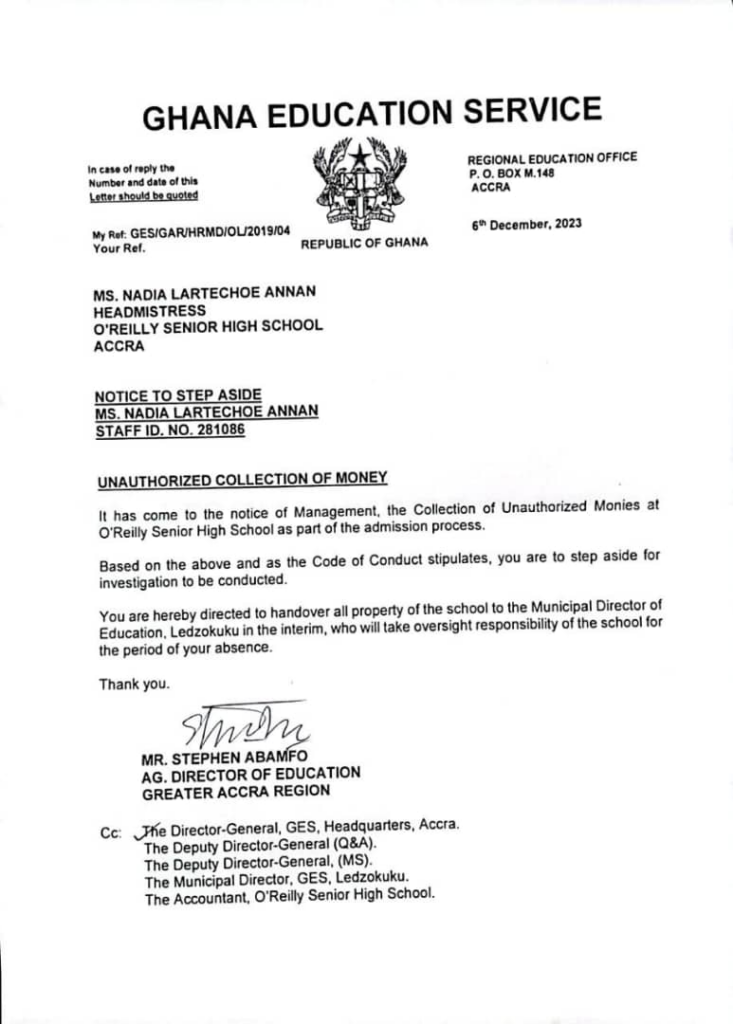
The Ghana Education Service (GES) has taken disciplinary action by interdicting the headteacher of O’Reilly Senior High School.
The interdiction is in response to the headteacher’s unauthorized collection of money as part of the admission process.
A letter from the GES, dated December 6th, 2023, points to this action as a violation of the school’s code of conduct.
The letter states, “It has come to the notice of Management, the collection of unauthorized monies at O’Reilly Senior High School as part of the admission process. Based on the above and as the code of conduct stipulates, you are to step aside for an investigation to be conducted.”
In addition to the interdiction, the letter from the Ghana Education Service (GES) instructed the headteacher of O’Reilly Senior High School to hand over all school property to the Municipal Director of Education, Ledzokuku.
The Municipal Director will assume oversight responsibility during her absence.
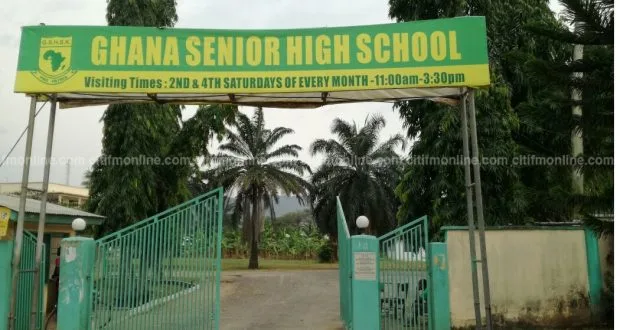
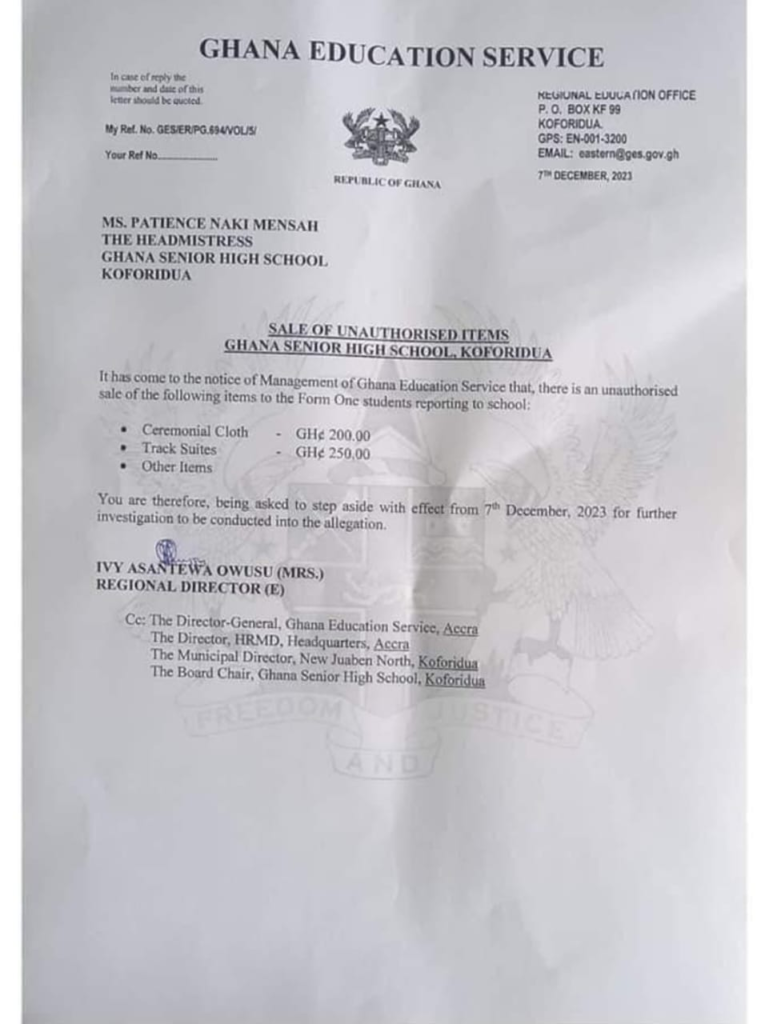
The Ghana Education Service (GES) has taken action against Patience Naki Mensah, the headmistress of Ghana Senior High School (GHANASS) in Koforidua, by placing her under interdiction.
The decision comes in response to allegations that she sold unauthorized items to Form One students reporting to the school.
This information was conveyed through a press release signed and issued by the Eastern Regional Director of Education, Mrs. Ivy Asantewaa Owusu, on Thursday, December 7, 2023.
The interdiction is intended to allow for a thorough investigation into the allegations against Madam Mensah.
Notably, this case adds to the growing number of headteachers who have faced disciplinary actions for allegedly charging unapproved fees since the implementation of the Free Senior High School (SHS) policy.
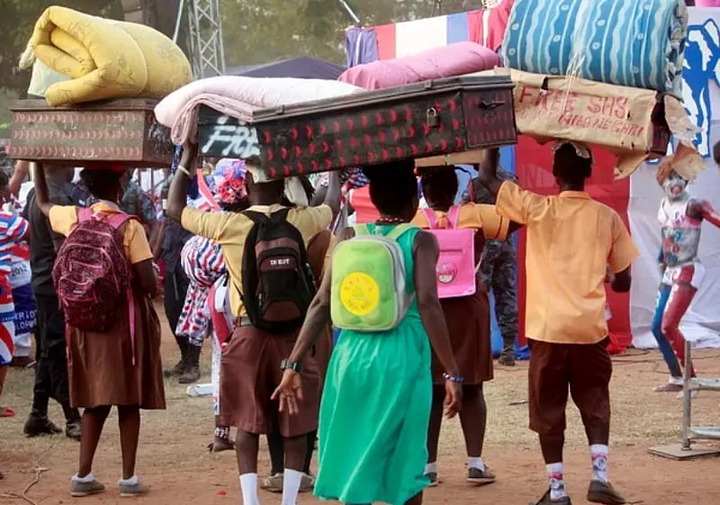
Despite widespread calls for a reevaluation of the reopening date, first-year Senior High School (SHS) students across the country are set to begin reporting to their respective schools today.
Despite pleas from parents and other stakeholders to postpone the reporting date for various reasons, the Ghana Education Service (GES) is steadfast in maintaining the December 4 date.
In response to these concerns, Parliament has urged the Minister of Education to consider rescheduling the reopening date to the first week of January instead of Monday, December 4.
However, despite Parliament’s appeal, the Ghana Education Service (GES) has rejected the request.
In a statement, the GES emphasised that “It is the expectation of management that schools begin registration and orientation of students from the 4th of December 2023.”
The timetable impacts students on both single and double-track systems, as outlined in the 2023/2024 academic calendar released by the Ghana Education Service (GES).
A grand total of 598,839 candidates participated in the Computerized School Selection and Placement System (CSSPS), leading to the placement of 585,797 individuals in various Senior High Schools and Technical and Vocational Education and Training Schools (TVET) across the nation.
The Ghana Education Service (GES) has revealed that management will consider revising the reopening date for first-year students in the Senior High Schools (SHS).
According to the Public Relations Officer of the GES, Cassandra Twum Ampofo, her outfit had taken note of the concerns of Pre-Tertiary Teacher Unions regarding the limited time parents had for preparations.
The concerns follow the release of the Computerized Schools Selection Process on November 28, with SHS students expected to start classes on December 4.
Reacting to the concern in an interview with the media, Cassandra Twum Ampofo explained that her outfit had long published the academic calendar for second-cycle institutions. Hence, they assumed parents were prepared. Nevertheless, they would take a second look at what can be done to address the situation.
“Before the release of placement, we had already published the academic calendar so the first December for first years was already cast and so as a parent, if you knew that your child would be going to the boarding house at least you are working within that time frame. We were only waiting for the school placement to be out but in terms of preparation, we knew that they had started.
“But again once they have given us this feedback, management will look at it and whatever comes out of it will be communicated to the public,” she said.
Additionally, the Executive Director at the Institute of Education Studies, Dr. Peter Anti-Partey, urges the GES to postpone the reopening to early next year for parents to adequately prepare.
“Adjust it in such a way that everybody will be a little bit okay. I don’t know how they are going to do this because you cannot move it to the following week. If you move it to the following week, it means the students are about to spend about one week on campus. It does not help because some of them will be traveling so you go to school for one week and you come back home for Christmas. It does not help.
“So, I think that maybe the best option will be either to maintain this or move the reopening of the first years to early next year so that everybody would be prepared for that,” he said.
The Municipal Director of Education for Nkwanta South, Jonathan Korsinah, says parents in Nkwanta are preventing their wards from attending classes due to the recent tribal conflict happening in the area.
“Schools in town were not officially closed, but for the safety of teachers and children, parents refused to allow their children to come to school,” he said to the Ghana News Agency (GNA) in an interview.
According to him, they are currently awaiting official correspondence from the Ghana Education Service (GES) Head Office, which will be transmitted through the Regional Office to officially declare the school closures.
He noted that when parents are reluctant to send their children to school, it implies a certain level of parental awareness, causing fear and anxiety that ultimately leads to school closures.
In particular, communities like Gekron, Shaire, and other strong Akyode communities have witnessed students and teachers unable to attend school due to fears of potential attacks.
As of Friday, October 27, parents continued to relocate from Nkwanta with their children. Jonathan Korsinah added that he was working in coordination with the security agencies to determine the next steps.
It’s important to note that schools in the Ntrubo areas of the Municipality remained unaffected.
The region recently experienced renewed conflict between the Adele, Challa, and Akyode tribes, resulting in thousands of residents fleeing their homes to neighboring districts and municipalities in the Oti Region.
The clashes originated from differences related to the performance of ritual rites for the 2023 annual Yam Festival of the Akyode group, leading to the destruction of numerous homes and shops, and causing Nkwanta to become a deserted town.
The Greater Accra Regional Directorate of the Ghana Education Service (GES) has provided assurance that schools will remain open on Thursday and Friday in the region.
This decision comes in light of the updated directive regarding the closure of shops, offices, and schools during the funeral ceremonies for the late Ga Manye Naa Dede Omardru III.
Originally, it was planned to have a closure from Thursday to Saturday, but the recent modification limits the closure to only Saturday.
The GES has entreated Head teachers and teachers in the Metro/Municipal/District Education Directorate to take note of the changes.
In December 2022, Ga Manye, Naa Dedei Omaedru III, passed away. On June 19, 2023, President Nana Addo Dankwa Akufo-Addo inaugurated a book of condolences in her honor.
The final funeral rites for the late Ga Manye were originally scheduled to occur between October 15 and October 31, 2023.
Recently, the Ga Traditional Council made adjustments to its guidelines concerning the closure of businesses in preparation for the late queen, Naa Dedei Omaedru III’s final funeral rites. Initially, the Council had decreed a three-day shutdown of all offices and shops in the Central Business District of the Greater Accra Region, spanning from October 26 to October 29.
However, in a recent statement, the Council revised its instructions, specifying that offices and businesses should only close on Saturday, October 28, as opposed to the previously announced three-day closure.
Meanwhile, the family of Ga Manye has obtained an interim injunction that suspends the funeral originally planned for Saturday, October 28.
The Wenchi Municipal Directorate of the Ghana Education Service (GES) in the Bono Region has launched an inquiry into a concerning incident involving a teacher at St. Paul’s Anglican Basic School.
The teacher is alleged to have compelled some students to take an oath in the name of a deity to demonstrate their innocence regarding his missing phone.
The GES has emphasized that if the teacher is found culpable for these actions, he will face appropriate consequences as outlined in the established code of conduct.
David Baffoe, the Public Relations Officer at the Wenchi Municipal Education Directorate, stated that the directorate is committed to uncovering all the facts surrounding the incident.
He stated, “We started the investigations…and we will continue today so that we can establish the facts on the whole matter so that we can communicate appropriately to the public. We are there to make sure that we get the truth from the matter, and if the teacher is found culpable, we will use the established code of conduct against him.”
The Ghana Education Service (GES) has changed the reopening date for Senior High School (SHS) Form One students to September 25, 2023.
A letter signed by Prince C. Agyemang-Duah, Acting Director of the Schools and Instructions Division of the GES, has informed all regional directors and school heads of this adjustment. Previously, the students were expected to resume on September 18, 2023.
“By this letter, regional directors of education are requested to communicate this information to all heads of senior high and senior high technical schools to inform parents/guardians and students to take note of the new date and prepare accordingly,” it said.
Mr. Agyemang-Duah clarified the reason behind the date change, citing concerns related to the double track system. He noted that maintaining the original date could overwhelm schools due to the large number of students.
Moreover, he highlighted that as the final paper of the West African Senior School Certificate Examination (WASSCE) is slated for completion on September 26, the majority of the senior students would have already concluded their exams and departed from the school premises.
As a result, the number of final year students present on September 25 would be reduced, effectively resolving any accommodation concerns.
“So, after consultation with the Director-General of the GES, we agreed to shift the reopening date to September 25 to make room for the final year students to complete their examination,” he explained.
In January of this year, the Ghana Education Service (GES) unveiled the 2023 academic calendar for pre-tertiary institutions, encompassing kindergarten, primary, junior high, and senior high schools.
The Transitional Academic Calendar for Double Track Senior High Schools (SHSs) outlined that Form Three students were to complete 1,360 contact hours, while Form Two students were to engage in 1,200 hours, and Form One students were to have 1,080 hours.
According to this calendar, Form Three students were scheduled to return to school from January 10, 2023, until April 5, 2023, for the first term. Following this, they would enjoy a break from April 6, 2023, to April 16, 2023, with the second term commencing on April 17, 2023, and concluding on June 1, 2023.
The final year students were then expected to vacate from June 2, 2023, to June 8, 2023, while the third term was set to run from June 9, 2023, to September 15, 2023, marking the culmination of the academic year.
For Form Two students, their academic year commenced on January 10, 2023, and ran until February 17, 2023. Subsequently, they had a break from February 18, 2023, to April 10, 2023. The second term was scheduled from April 11, 2023, to June 1, 2023, followed by a vacation from June 2, 2023, to August 11, 2023. The third term was set to start from August 14, 2023, and conclude on November 30, 2023, marking the end of the academic year.
As for all Form One students, their academic calendar initially spanned from February 20, 2023, to April 13, 2023, with a break from April 14, 2023, to June 8, 2023. The second term was slated to begin on June 9, 2023, and last until August 10, 2023, with a break from August 11, 2023, to September 17, 2023. The third term was originally planned for September 18, 2023, to November 30, 2023, concluding the academic year.
In the case of single-track schools, Form Three students were expected to complete 1,360 contact hours, Form Two students 1,280 contact hours, and Form One students 1,120 contact hours. Form Three students’ first term started on January 10, 2023, and ended on April 5, 2023, with a break from April 6, 2023, to April 16, 2023. The second term was scheduled from April 17, 2023, to June 1, 2023. Following this, they had another break from June 2, 2023, to June 8, 2023, before commencing the third term from June 9, 2023, to September 15, 2023, marking the academic year’s conclusion.
On the other hand, Form Two students’ first term began on January 10, 2023, and ran until April 5, 2023, followed by a break from April 6, 2023, to April 16, 2023. Their second term was set to start from August 17, 2023, and end on August 25, 2023.
For Form One students in single-track schools, their first term was planned from February 20, 2023, to April 5, 2023, with a break from April 6, 2023, to April 16, 2023. The second term was scheduled from April 17, 2023, to September 15, 2023.
The Ashanti Regional Directorate of the Ghana Education Service (GES) has reported that a total of 108 pregnant girls and 104 nursing mothers participated in the 2023 Basic Education Certificate Examination (BECE) in the region.
Alongside these candidates, a total of 117,084 students took part in the examination.
According to the Public Relations Officer for the regional directorate, in an interview with the media on August 15, 2023, the overall candidate count included 57,973 males and 59,111 females.
The examination also saw 314 candidates marked as absent due to various reasons, including dropouts, illness, and travel.
Additionally, it was revealed that the Kumasi Metropolis had the highest number of examination centers with 36, accommodating a total of 9,878 candidates.
In contrast, the Sekyere Afram Plains District recorded the lowest number of candidates, with a total of 367 students participating.
Results of the recent teachers’ promotional examination, administered by the Ghana Education Service (GES), have unveiled a 69% achievement rate for candidates who participated in the February test.
This implies that 31% of examinees fell short of meeting the necessary criteria for advancement.
From a total of 80,810 participants, 55,917 individuals have triumphed, securing their progression into higher educational leadership positions.
The examination acted as a gateway for those aspiring to roles such as Deputy Director, Assistant Director I, Assistant Director II, and Principal Superintendent within the Deputy Director grade.
GES conveyed that candidates will receive notification of their success or lack thereof via text message.
“A message will be sent to all candidates who sat for the exams to indicate whether successful or not. (Please note that, the promotion site will NOT be accessible this year) Formal promotion letters will be released in due course,” GES stated in a release.
“A message will be sent to all candidates who sat for the exams to indicate whether successful or not. (Please note that, the promotion site will NOT be accessible this year) Formal promotion letters will be released in due course.”
Between August 23 and September 4, 2023, the process of school selection will take place across regional, district education directorates, and schools.
The GES in a statement signed by the Head of Public Relations Unit, Cassandra Twum Ampofo, said, “Management of Ghana Education Service (GES) wishes to inform the general public, particularly Parents, Candidates and Teachers that the sensitization and education on this year’s guidelines for school selection into Senior High Schools will commence Friday 18th August 2023.”
“This exercise will take place in all the respective Regional, District Education Directorates and schools. Management further informs stakeholders that the selection of schools is scheduled from 23rd August to 4 September 2023”.
The Head of the Public Relations Unit said candidates will be offered the opportunity to text a short code to confirm their school choices before actual placement.
“There would be an opportunity for candidates to text to a short code and confirm their school choices before actual Placement will be done. Details of the shortcode will be made available in due course”.
The BECE which started Monday, August 7, ended Friday, August 11.
The Ghana Education Service (GES) has announced plans to sensitize candidates who recently took the Basic Education Certificate Examination (BECE) on the procedures for selecting Senior High Schools. This informative session is scheduled for August 18, 2023.
The school selection process itself will occur from August 23 to September 4, 2023, across various regional, district education directorates, and schools.
In a statement signed by Cassandra Twum Ampofo, the Head of Public Relations Unit at GES, said “the management of Ghana Education Service (GES) wishes to inform the general public, particularly parents, candidates, and teachers, that the sensitization and education on this year’s guidelines for school selection into Senior High Schools will commence on Friday, August 18, 2023.”
She further emphasized, “This exercise will take place in all the respective Regional, District Education Directorates, and schools. Management further informs stakeholders that the selection of schools is scheduled from August 23 to September 4, 2023.”
As part of the process, candidates will have the opportunity to confirm their school preferences by texting a designated short code before the actual placement is finalized. The specific details of the shortcode will be communicated in due time.
The BECE, which began on Monday, August 7, concluded on Friday, August 11.
Deputy Minister for Education, Rev. John Ntim Fordjour, has dismissed assertions that the Basic Education Certificate Examination (BECE) will be eliminated after 2023.
As per his statements, the Ghana Education System (GES) does not intend to eliminate the BECE; however, there will be a modified structure with equivalent examination standards established by the West African Examination Council (WAEC).
Rev. Ntim Fordjour explained that the new format will be reflective of the curriculum that is being used in the various basic schools in Ghana.
Speaking in an interview with TV3 on Wednesday, August 8, 20023, Rev John Ntim Fordjour entreated the general public to disregard claims of the abolition of BECE after the 2023 edition.
“There’s no decision whatsoever to write off or jettison BECE, so that notion or perception should be disregarded.
“Well, we are going to have the same form as we’ve been doing. Of course, the test items each year will have it in a different format, as WAEC determines, but the standard is going to be the same, and it’s going to be reflective of the curriculum that we have put in place. What they have been taught is exactly what is going to come up,” he told TV3.
Rev. John Ntim Fordjour’s comment comes in response to claims of a possible cancellation of the Basic Education Certificate Examination (BECE) after the 2023 edition over the introduction of a new examination for Basic schools in Ghana.
The Ghana Education Service (GES) has released a set of guidelines and directives for candidates participating in the 2023 Basic Education Certificate Examination (BECE).
These measures are put in place to maintain proper conduct during the examination and to address the issue of examination malpractice, which has become a national concern.
Among the directives issued, candidates are prohibited from wearing socks during the exam. Instead, they are required to wear only flat open sandals without socks.
Additionally, candidates are not allowed to wear wristwatches or carry any electronic gadgets, including mobile phones, into the exam hall.
The 2023 BECE is scheduled to take place from Monday, August 7 to Friday, August 11.
These guidelines are to be adhered to by all public and private schools within the municipality.
By implementing these measures, the education office aims to ensure a fair and secure examination environment, fostering a level playing field for all candidates and upholding the integrity of the BECE.