To be honest Ronaldo hasn’t been actually that bad. He just just need to work on his passing, shooting, movement, ball retention, dribbling, crossing, decision-making, set pieces, man-marking, ball control, tackling, shooting & few others things.
Traditional medicine practitioners have indicated that government should refocus its attention on their operations because it can earn the country billions of cedis to deal with the current economic crisis.
According to them, the herbal medicine sector can fetch Ghana more than 30 billion cedis in revenue if government refocuses its attention on the area.
Prof. Samuel Ato Duncan, the newly elected president of the association describes the initiative as the ‘green gold agenda’.
At a recent ceremony to swear in new members of the Ghana federation of traditional medicine practitioners, Prof. Duncan urged the government to pay critical attention to the sector to reap the benefits.
‘We will pursue the green gold agenda. If gold and cocoa have failed in turning the economic fortunes of the country, then we must turn to green gold. When I say green gold, what I mean is, we have traditional medicine that we can package properly and sell for deprived exchange to benefit our country,” he said on November 23.
“I will help find solutions to the challenges confronting the country. This is practical, not just talking. We are ready to help redeem the crisis, Ghana is facing,” Prof. Samuel Ato Duncan added.
The President of the Ghana federation of traditional medicine practitioners noted that herbal medicines in Ghana are being rebranded to ensure packaging and quality of the products meet global standards.
Ghana, ranked 61st in the world, are the tournament’s lowest-ranked team and that is partly because of their poor showing at the Africa Cup of Nations (Afcon), where the Black Stars failed to win a game and finished bottom of their group.
Since that failure coach, Otto Addo has recruited from the diaspora and Belgium-born Odoi, who plays for Club Bruges, is one of the newcomers who helped the squad qualify for Qatar ahead of fierce West African rivals Nigeria.
“The journey has been positive,” Odoi, 34, told the BBC World Service.
“I think sometimes you have to be deep to grow from that and learn from that. I think that’s what these these experiences brought.
“Obviously, Afcon was a very bad performance – one of the worst in the last few years and decades. We managed to grow and learn from that process.”
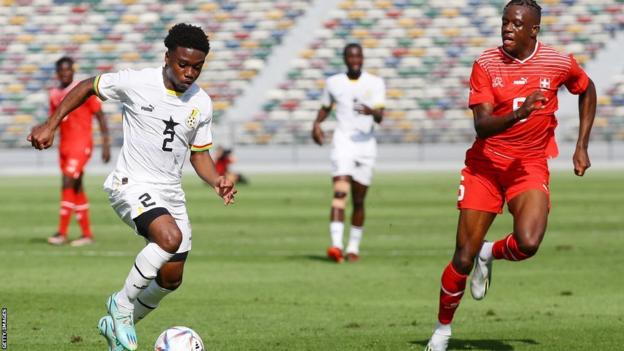
Addo won only one of his first seven games in charge of Ghana but the side have recorded victories in their past two friendlies against Nicaragua and Switzerland.
The latter was an impressive 2-0 triumph in Abu Dhabi last week, and Odoi says fellow new recruits, including Athletic Bilbao forward Inaki Williams, are settling in well.
“We’ve used this last week to fit everybody in and to get used to the system and practice the defensive and offensive battles,” the former Fulham full-back said.
“And everybody gets to know each other a little bit better on the pitch.”
Despite their low ranking, Odoi believes Ghana are capable of upsetting Portugal, who were European champions in 2016.
“Everyone knows Portugal players are of a high level,” he said.
“We still have to play the game. It is not like Portugal has won this game. I am sure they are aware of that.
“If you look at the performances of other African counties, and Saudi Arabia[against Argentina], you still have to play the game.”
Lamptey ‘settling in quickly’
Tariq Lamptey’s first two caps for Ghana have come in friendlies against Brazil and Switzerland
Meanwhile, Brighton & Hove Albion wing-back Tariq Lamptey is among those poised to make his competitive debut for Ghana.
The former England Under-21 international has featured in two friendly matches since switching allegiance in July – a decision his parents supported.
“They always said to me that they’re proud of whoever I represent,” Lamptey, 22, told the BBC’s World Football podcast.
“Ultimately, I was born in England, and they’re from Ghanaian background. Making my debut against Brazil was a really proud moment for both me and my family. It was a surreal feeling against some of the best players in the world.
“It’s every little boy’s dream to play football at the highest level. If I’m selected, then I will try and do my best.”
Lamptey joined Ghana for friendlies against Brazil and Nicaragua in France in September, and says he settled into the squad quickly.
“They were very welcoming and I was just able to get on the training pitch and get to work,” he said,
“Off the pitch, I knew a few of the boys before but it was really good to get to know everyone. It’s a good group.”
The reaction of the Black Stars fans, both on social media and from the stands, has also been important to Lamptey.
“I just want to say a massive thank you to the fans, because their love and support has definitely been received well,” the former Chelsea youngster said.
“I’m really grateful to have great fans like that.”
According to Ayew, Portugal are the better side in terms of quality, and he added that the Black Stars will be playing against a tough opponent.
Despite his admission about Portugal, the most capped Ghanaian player stated that they will go all-out to surprise the 2016 European champions on Thursday.
“We all know that if we’re going to get into this game Portugal are the ones who are favourites on paper.
“But after, we have to show on the field that what is on paper is not what will happen on the pitch, so we are ready. We are ready, and we know we are playing a big side that were European champions some years back and have top players,” he said in a post-match interview.
Austria-based Ghanaian, Richard Owusu, has stated that he has no hope that Ghana can develop in the future because the leaders and the people do not love each other enough to want the best for them.
In an interview on Daily Hustle Worldwide, Richard Owusu indicated that the opportunities available for Europeans cannot be compared to Ghana despite the current global economic crisis.
He disclosed that Austria is also experiencing price hikes, but the prices don’t go up as often as in Ghana. Moreover, he mentioned some of the benefits Austrian citizens enjoy now.
“I bought fresh tomatoes after work today, and it was 3 Euros, 50 cents. If you don’t work here, you won’t eat. Even if someone gives you bread today, you can’t go back for more tomorrow. You have to pay bills and all. But you can always find a job here with whatever qualification you have, so people are well off,”
Speaking on the economic situation in Ghana, Richard noted that he has no hope when it comes to the development of Ghana and that the country will continue to wallow in poverty because there is no love among Ghanaians.
“It is not the same in Ghana, and it is a big problem. There are no manufacturing companies for skilled workers to do. I’m sorry, but we have allowed a lot to go, so we can’t compare ourselves to the whites. I have no hope for Ghana to develop. What we are going through now will continue forever because we don’t have love,” he told DJ Nyaami on SVTV Africa.
Labour consultant Austin Gamey has asked the government to be more open and transparent with the labour unions, who are currently asking for a 60% increment in their salaries.
According to him, this will enable the unions to have a perfect understanding and appreciation of the dynamics of the current economic challenges; and thus agree to a realistic increment.
“Let the employer be extremely very open and let them know of the truth, this is what we have, if we pay this, this will be the consequence and if we pay that, this will be the consequence. So let them (government) make a humble appeal to them (labour) and give them (labour) the assurance that come from next year going the right things will have to be done” Mr. Gamey explained.
Labour unions in Ghana are currently in negotiations with the government for a 60% increase in their salaries citing harsh economic conditions but the government has since proposed a 12% increase.
But speaking to Alfred Ocansey, host of the Ghana Tonight show on TV3, Austin Gamey stressed that “what they are demanding may be too much but it thus appear we’re not transparent and open enough for them (labour) to appreciate where we are, let them (government) open up and let them (labour) appreciate the dynamics of the situation in which we find ourselves and let’s agree that we’ll pay them very well and put in place systems to cheek it”.
He also urged the government to begin to develop a system that will help track the productivity of public sector workers, to enable the government to compensate them (lobour) appropriately.
He explained that “let us agree for once as a nation to develop a salary structure that is reasonable, that the national purse can accommodate and it can, except that the people will have to work for it and they do know that organized labour is not against productivity, the employer appears to be the one that is not taking the proper steps in accordance with the law”.
He indicated that a proper salary structure that will ensure workers are well paid will also set targets for the workers and that will improve productivity in the country.
Mr. Gamey also stated that the government should be able to develop a proper salary structure for the Ghanaian public sector workers before 2025 to avert further labour agitations.
Former President John Agyekum Kufuor says it is time Ghana abolished the Council of State concept in its governance structure.
He said the Council has outlived its usefulness in the current democratic dispensation.
“I have had a chance to express my views on the Council of State, very honourable distinguished institution, well-meaning. But, I can say I don’t think it is fit for purpose given the state of development of our country and given the fact that the nation is committed to practicing democratic governance.”
The former President said this at a seminar organised by the Professor Mike Oquaye Centre for Constitutional Studies at the Institute for Economic Affairs (IEA), in Aburi, Eastern Region, on Tuesday.
The seminar formed part of a series of engagements the Institute is undertaking to solicit input toward a possible review of Ghana’s 1992 Constitution.
The former President proposed that, instead of the Council of State, the country should set up a second chamber of Parliament to play the advisory role to the government.
In recent times, the relevance of the Council of State has been questioned with some political commentators, academia and civil society organisations suggesting that the body has outlived its usefulness, thus should be abolished.
Former President Kufuor explained that though the framers of the Constitution thought it wise to set up such a body to advise the President, the Council is no longer useful.
He said: “… We limit the uses of Council of State to advising just the President,” and that often, the President decided whether or not to take the advice.
“So, I have gone through all these periods and I have come to a conclusion, perhaps, what our Constitution should have to temper the extremes of democracy is not a Council of State, but a second chamber. A second chamber well composed not on basis of democracy so much. Democracy should always be implied in there though, but not entirely democratically but more on experience, prove in public spiritedness, prudence, maturity, care for the nation, inclusive.
“If we do that, and allow this second chamber to operate openly, in the full glare of publicity, then the wisdom that would be issued from their deliberations would impact not only the President… ,” he added.
The former President added that the term of the second chamber must not be tied to the tenure of any government to ensure that there is continuity in the provision of development for the people.
On limiting the appointing powers of the President, the former President said the country must practice the checks and balances in its pure form, especially among the lead organs of State.
He called for the amendment of sections of the Constitution that empowered presidents to appoint about 50 percent of Ministers from Parliament.
“The legislature should be apart, people being elected there should be encouraged to professionalise themselves as legislators so they will play the guard dogs or watchdogs on the executive,” he said.
The former President also urged that political parties should be allowed to participate in elections at the local level.
The West Gonja municipal commander of the Ghana Police Service Supt Johnson Hessey has advised traditional leaders to stop interfering in criminal cases against their subjects.
Hessey called on the chiefs to stop settling criminal cases such as rape, kidnapping and robbery at their palaces.
The commander made this appeal days after Ghana’s chief justice, Anin Yeboah commissioned a new circuit court complex in Damongo of the Savannah region.
“I will plead with the traditional authorities that criminal cases cannot be settled at the chief palace. When a criminal case is sent to court and a chief is interfering, it is preventing the laws of Ghana to work,” Supt Hessey said.
“Courts make people to be aware of certain things, they will not be ignorant,” he added.
The new circuit will bring justice delivery closer to the people of Damongo. The police used to travel about 98 kilometres to Bole or Tamale for court hearings.
The English- and Spanish-language broadcasts of the United States’ opening 1-1 tie with Wales at the World Cup was watched by 11.7 million people, a 5% increase over the Americans’ 2-1 victory over Ghana at the 2014 tournament.
The game, which began at 2 p.m., was watched by 8,306,000 people on Fox and 3.4 million on Telemundo, Telemundo digital, and Peacock, all of which are owned by Comcast Corp.’s NBCUniversal.
The match was watched by 563,000 people on streaming, according to Fox, the network’s highest group-stage viewership since taking over U.S. English-language rights for the 2018 tournament. The most-watched Spanish-language World Cup match received 1.0 million views on Telemundo and Peacock.
The 2014 United States opening in Brazil, which began on a Saturday in mid-June, was seen by 11.1 million on ESPN and 4.8 million on Univision.
Clint Dempsey gave the USA a lead just 34 seconds into the match in the 2014 game, but Ghana appeared to salvage a point in the 82nd minute when Andre Ayew beat Tim Howard.
John Anthony Brooks was the hero, in the end, scoring the winner in the 86th minute after he was left unmarked on a late corner kick.
National Chairman of the Progressive People’s Party (PPP), Nana Ofori Owusu, has questioned why Finance Minister Ken Ofori-Atta is so adamant about leaving office, even though he claims to be working for free.
Nana Owusu said that he was one of the first people to commend the finance minister for working for the country for free but he does not understand why he is refusing to vacate his position despite calls by many Ghanaians for him to step down.
“When I heard the finance minister does not take a salary, I applauded him because of his willingness to sacrifice his time and leave all his businesses to work for Ghana for free.
“Now, I don’t understand why the minister for finance, who says is not paid GH¢1 … who gets nothing from the public sector, is fighting so hard to keep a position his own people, including majority of MPs of his party, are urging him to relinquish.
“You are serving us for free and we are saying that we are grateful for the service but you should step aside and you are saying no I will continue serving,” he said in Twi in a Peace FM interview monitored by GhanaWeb.
The PPP national chairman added that the refusal of the finance minister to resign feeds into the conflict-of-interest allegation against him.
Meanwhile, the Commissioner of the Commission on Human Rights and Administrative Justice (CHRAJ), Joseph Whittal, has said that CHRAJ has received a petition from Tiger Eye PI, the outfit of Investigative Journalist, Anas Aremeyaw Anas, to investigate Finance Minister Ken Ofori-Atta.
According to Whittal, Ana’s outfit wants CHRAJ to investigate Ofori-Atta for the conflict of interest allegation levelled against him for the involvement of his bank, Data Bank, in loans the government of Ghana contracts.
He added that the commission is currently examining the petition as to whether it has merits.
The Ministerial Session of the Accra Initiative (AI) ended in Accra yesterday after further deliberations on the need for joint actions by Member States to address cross-border security issues.
The conference brought together Ministers of Security and Defence of Member States of the AI, which are Benin, Ghana, Togo, Burkina Faso, Cote d’Ivoire, Mali, and Niger.
Other participants were some representatives of the United Nations (UN) and the Economic Community for West African States (ECOWAS).
The AI was established in September 2017 as a mechanism to enhance intelligence and security cooperation between the security agencies of member states.
Its formation was necessitated by the urgent need to address the deteriorating security situation in the Sahel region and curb the southward drift of the threat of terrorism to Coastal West African States.
Opening the session, Minister for National Security, Mr. Albert Kan-Dapaah, said with strong collaboration between African countries, winning the fight against terrorism in the sub-region could be possible.
He stated that the seemingly deteriorating security situation in some African countries did not mean efforts of leaders of the affected countries to combat violent extremism were in vain.
Rather, the minister stressed that the situation could have even been worst without some interventions like intelligence sharing and capacity building, put in place to monitor situations and avert further misfortunes.
He commended the AI for its dedication to ensuring that terrorists and extremists do not take refuge in its member states.
Commissioner, of Political Affairs, peace and security of the ECOWAS Commission, Dr. Abdel-Fatau Musah, in his remarks bemoaned that terrorism was steadily gaining a foothold in the region, especially in the Sahel with the onslaught of Boko Haram in Nigeria and the southward movement towards the coastal member states especially in Benin, Togo, and Cote d’Ivoire.
He noted that the incremental gains of a combination of determined efforts by the Multinational Joint Task Force (MNJTF), counterterrorism operations across the Lake Chad Basin as well as inter terrorist conflicts which had to some extent degraded the capacities of terrorist groups such as the Boko Haram.
According to Dr. Musah, the worrisome incursion of terror acts in Benin and Togo in recent times and the attacks in Cote D’Ivoire in 2016 confirmed the spread of the terrorist menace toward coastal member states.
Over the years, various counterterrorism mechanisms, he said had emerged to respond to the terrorist threat, “Which are often uncoordinated and independent of ECOWAS.”
“It is worthy to note that the three areas of effort of the AI namely, information exchange between intelligence services and security forces, training of intelligence services and security forces, and the joint military operations at the borders of member states correspond very well for the eradication of terrorism in the ECOWAS region,” he added.
In her remarks, a representative of the UN, Ms Giovanni Biha indicated that cross border cooperation and joint military operations to address the terrorist threat had been largely possible by virtue of the commitment of member countries of the AI.
She assured of her outfit’s readiness to continually support the AI in achieving its objectives.
The Ambassador of the European Union (EU) to Ghana, Mr. Irchad Razaaly, stressed that thinking outside the box to find innovative solutions to counter terrorism in the sub-region was very necessary.
Dr. K.Y. Amoako, Founder and President, African Center for Economic Transformation Sixty-five years ago, our nation was born. It was born out of indomitable courage in the face of colonialism and imperialism. It was born through shared struggle, bloodshed, and tears. And it was born on the backs and hopes of ordinary Ghanaians.
I was 13 years old at the time of independence. I grew up with Ghana, and I have lived through our post-colonial journey—the ups and downs, the successes, and the setbacks.
Ghana has so many reasons to be proud. We have been at the forefront of Africa’s movement not only to independence but also to democracy and citizen empowerment. We are known as Africa’s ‘Black Star’, but we are also its North star. We have led, and others have followed.
However, we have not yet attained the heights that our forebears fought and bled for. We have not yet realized the Ghana we want — for ourselves, but most importantly, for future generations.
Despite occasional periods of economic growth, Ghana continues to grapple with critical social and economic challenges that hold us back from achieving our full potential. Our young people are disenchanted and distrustful of our leaders and institutions as they deal with unemployment. The growing polarization of our politics is drawing us further and further apart when we should be working together for our common good. We struggle to translate our abundant natural and human resources into economic and social well-being. At the same time, we must confront and adapt to the challenges—such as climate change, population growth, financial instability, and public health—that pose direct threats to our survival.
We have reached a tipping point and cannot continue along this path if we are to survive as a nation. As we approach the second half of the 21st century, it is imperative that we stop, adjust our sails, and change course to build the Ghana we want.
We have a window of opportunity over the next twelve months, before the 2024 election campaigns go into full drive, to build a national consensus around Ghana’s biggest opportunities and challenges and to put those issues squarely on the agenda for debate during the next election.
It is not enough for Ghana to experience spurts of economic growth with increasing poverty.
Ghana needs sustained and resilient economic transformation that ensures the lives our people continue to improve.
Faster progress on transformation not only will strengthen our economy but also help us better survive shocks, like inflation, rising energy costs and the rapid depreciation of the cedi and more quickly lift our most vulnerable brothers and sisters out of destitution.
Many countries around the world have successfully traveled the road to transformation. Each country is different, but there are lessons and best practices to follow on our journey. And it all starts with having a plan.
To build the Ghana we want, we need to focus our energies on a number of critical areas and set a unified vision with clear and measurable targets and goals — a national consensus on what to do to turn the tide and address the challenges facing us.
This means, among other things that we need to diversify our industries to be more competitive in global markets; increase productivity, especially of our human resources; and advance technology and innovation — all to improve the well-being of our citizens. For instance, we can increase the capacity of local SMEs so they become investment ready and are able to utilize technology for increased productivity and competitiveness on global markets.
This vision will require the agreement and collaboration of all citizens especially the youth, political, traditional, and religious leaders, prominent community organizations, and technical policy experts. It will be our north star for our transformation agenda and for our democracy. We need to act as citizens and not spectators — citizens with a vested interest in building a Ghana we can all be proud of.
Kwame Nkrumah told us: “We have a duty to prove to the world that Africans can conduct their own affairs with efficiency and tolerance and through the exercise of democracy. We must set an example to all Africa.”
During these challenging times in Ghana and around the world, it is past time for us to live up to that duty and set that example once more. The good news is the work has already begun. A few months ago, a group of Ghanaians representing a cross-section of our society came together at Peduase to define what we can do together to chart a path for Ghana’s future. The youngest person in the group was only 13 years old, and the oldest was older than I am. The group included leaders from policy institutes, media, civil society, and business, and brought viewpoints from every angle to enrich and improve our approach. Most importantly, their political affiliations spanned most of the parties in Ghana.
Together, we are collaborating to develop what we call a Compact for Political and Economic transformation in Ghana. The Compact: will be an agreement between citizens and government, regardless of who is in power, on the direction of travel for our country, and on the vision and values that underpin our democracy and pave the way toward the Ghana we want. It will also be a Compact between all of us as citizens on the values we want to uphold as a nation as we embark on this new agenda.
Agreeing on a common vision and a roadmap for Ghana will help make our elections more about the issues and less about the politics. It will help our governments focus on national interest over party interest. And importantly, it will help us as citizens hold our elected officials accountable and take more responsibility for driving the agenda for our country.
What we are starting now will need the commitment of all Ghanaians, regardless of background, religion, political party affiliation, age, or gender. We have an opportunity today to begin a journey toward a better future, and I hope you will all join us.
My journey will one day come to an end, and the future belongs to my children and grandchildren. And your children and grandchildren. What kind of future will they have? What legacy will we leave them? We all appreciate the challenges that still exist. Let us now work together to turn our fortunes around and strive for the aspirations that nearly all of us have, for the Ghana we want — for ourselves and future generations.
For the past fifty years, Dr K.Y. Amoako has spearheaded many of the issues and policies central to Africa’s development. A pioneer and passionate advocate for African transformation, he has worked alongside African leaders and some of the world’s most prominent development specialists to tackle many of the most pressing African and global development issues. Previously, Amoako served as Executive Secretary of the Economic Commission for Africa at the rank of UN Undersecretary General. Before then he was a senior official at the World Bank.
The government has refuted reports that special forces from the United Kingdom are being brought to Ghana to help fight terrorism.
A report by British newspaper, the Telegraph, yesterday reported that Britain is in discussion with Ghana to send special forces into the country after it was forced to withdraw all of its peacekeepers from Mali.
“The Government of Ghana wishes to state that the information regarding British special forces is false. Neither Ghana nor any other member of the Accra Initiative has discussed with any partner, any such request nor contemplated the involvement of foreign forces in any of the activities”, a statement by the Ministry of Foreign Affairs and Regional integration stressed.
The Ministry said the Government of Ghana has had no interaction with the United Kingdom for the deployment of soldiers into the country.
“The Government of Ghana has no interactions with the UK Government aimed at deploying UK soldiers to Ghana for purposes of operations as described in the story”, parts of the statement read.
It further explained that, the Accra Initiative rather aims to prevent spillover terrorism from the Sahel and to address transnational organized crime within the common border areas of member states.
The statement was delivered by Mr. Ken Ofori-Atta when he testified before the ad hoc committee of Parliament in response to the allegations made by the minority that served as the foundation for their motion of censure.
Speaking on Friday, November 18, 2022, the embroiled Minister acknowledged the hardship of the country and said that he was acutely aware of how the crisis was affecting the average Ghanaian and how it was further forcing businesses to close.
“That is what gives me the strength to press on to find solutions and relief for Ghanaians to the myriad of problems that our country and the rest of the world are facing especially in march 2020,” the minister added.
The gaming industry is basically the practice involved in the monetization, development, and marketing of video games.
Practicing these three requires a ton of human effort, which results in creating an enormous amount of jobs throughout the globe.
In a few years, the gaming industry in Ghana has grown from focussing on particular customers to the mainstream markets.
Let us explore some basic facts about the gaming industry in Ghana, its market value, and its growth over the years.
History of Gaming Industry in Ghana
The history of Ghana’s gaming industry is almost 50 years old, even older than some of the gaming platforms. Majorly the whole gaming industry is operated under three acts: the 1960 Betting Lottery Act, the 1973 Gambling Machines Act, and the Casino Licensing Act. Digitalization is progressing rapidly in Ghana, helping the entire gaming industry to introduce new laws and regulations in favor of gamers. Currently, the gaming industry in Ghana is regulated under the Ministry of Interior, which was established under the Gaming Act 2006. This act allows all kinds of gaming in the entire country except lottery.
Contribution of the Gaming Industry to Ghana’s Economy
Today anyone can enjoy online games no matter if you have $10 or millions. The gaming industry in Ghana contributes in so many ways to the country’s economy. It supports Ghana’s economy by increasing overall business sales and providing gaming taxes. In the last decade, the gaming industry in Ghana managed to get amazing growth. This directly contributed to the country’s economy. Over the years, online gaming has reached throughout the country and contributed a lot to its economy.
With the advancement of technology, gamers can now play games on their computers, mobile phones, PlayStation 5, Xbox, and various other devices. This directly increased the demand for these gaming setups in the market resulting in business expansion. The main source through which a gaming company generates revenue is advertising and taking percentages in the winning amount. They also charge some fees for downloading the game and buying a membership.
Future of Ghana’s Gaming Market
Ghana’s gaming market is growing amazingly, giving hope for a promising future. As the industry grows, online gaming companies like 22Bet will offer amazing discounts and offers to attract new gamers. These approaches will motivate the mass and help transform Ghana’s gaming industry into Africa’s gaming hub. The public of Ghana is adopting cloud-based technologies and software technologies very quickly, and it has led to an increase in internet awareness. This directly helps in increasing the gaming trends among the public of Ghana.
Based on certain studies, the gaming industry of Ghana will show enormous growth during 2021-27. During the lockdown period, people spent more time at their homes which led to an increase in the usage of interest in playing online games. Due to the increase in the number of mobile users in the country, the gaming industry is going to experience growth in upcoming years. This will lead to an impressive increase in the revenue just by the mobile segment users.
Objectives of Online Gaming Regulators
The gaming commission solely focuses on controlling, regulating, and monitoring all kinds of gaming services allowed in overall Ghana. Below is a list of objectives and practices of the gaming commission in Ghana :
Decides and makes the required proposals needed to improve the facilities provided by the gaming industry.
Provides licensing to the qualified companies interested in providing games to the mass.
When needed, it serves as a body providing advice to the government on topics related to gaming in the country.
Takes care of all the complaints and issues raised by the gaming companies and the players.
Maintain and ensure that all the licensed gaming companies are keeping the minimum bankroll implemented by the government.
Gaming Commission of Ghana: Vision & Goals
The main vision of The Gaming Commission of Ghana is to maintain the integrity and reputation of the online gaming industry in the country. By doing this, they want to make Ghana’s gaming industry a world-class gaming market. The operators follow every law imposed by the government and focus on not violating any of them. The gaming industry also puts effort into supporting the country economically.
In order to do so, the gaming market increases the business of selling, buying, importing, and exporting goods related to gaming. They are also focusing on providing access to play and participate in online games to the citizens of Ghana. Here are some goals of the Gaming Commission of Ghana:
Making the gaming industry’s customer service effective and available for each gamer.
Maintain a healthy and regulatory environment between the gaming industry and the players along with following the laws of government.
Inform their users about the changes in rules and regulations made by the committee.
Promote and advertise the fair and equal for everyone kind of gaming environment throughout the country.
Portugal captain, Cristiano Ronaldo, has described their opening 2022 World Cup group game against Ghana as the ‘most difficult’ in the competition.
Speaking about Portugal’s chances of winning the World Cup, the 37-year-old noted that the team must focus their attention on winning their first game against Ghana, which he described as the ‘most difficult.
“I believe our national team has tremendous potential to win the World Cup. We will see. I believe we can. I have that hope, that belief, ” the Manchester United forward said.
“But like these competitions always teach us; we must think calmly. We must think and focus on the first group game. We must think about the Ghana game which is the most difficult one.
“We must start well, gain some confidence and we will go from there,” he said.
The European side will come up against the West African country on Thursday, November 24, 2022, at Stadium 974 in Doha.
Ghana will also play against South Korea and Uruguay in the group.
The Black Stars who are making their fourth appearance at the Mundial will hope to perform after exiting the group phase in Brazil in 2014.
Fitch Solutions has projected that Ghana’s cedi will continue to depreciate until the first quarter of 2023.
According to the international research firm, inferring from previous studies of the Ghana cedi, it is likely that the cedi will continue depreciating till an IMF programme is secured.
In its latest article on Ghana published on November 14, Fitch said: “Our view is further informed by the fact that previous periods of significant exchange rate weakness in Ghana all lasted roughly 12-14 months suggesting that the cedi will continue to depreciate into the Q123 (the current sell-off started in January 2022). This keeps inflation high, weighing on living standards and eroding support for the government.”
Fitch also projected an increase in strikes and protests due to the increasing cost of living in the country.
“While we expect to see an uptick in protests against austerity measures that would likely be implemented under an IMF programme, we do not believe they will threaten the overall stability of the government. This is factored into our Short-Term Political Risk Index, in which Ghana scores 62.0 out of 100 (a higher score implies lower risk), above the Sub-Saharan African average of 50.3,” Fitch added.
Fitch Solutions also projected that in the possible event of the removal of the Finance Minister, Ken Ofori-Atta, ongoing negotiations with the International Monetary Fund will not be affected.
According to Fitch, this is because the next person tipped to be Ofori-Atta’s replacement is Mark Assibey-Yeboah who it believes “would take a more accommodative approach towards negotiations with the Fund.”
With the withdrawal of some 300 British peacekeepers from Mali in the wake of frosty relations with Bamako over the involvement of Russian mercenaries in the fight against terrorist groups in the Sahel, some special forces are expected to arrive in Ghana.
In a report by UK-based ‘The Telegraph’ and sighted by GhanaWeb, British ministers are also expected to be in Accra to hammer out a new security agreement which will position Ghana and by extension Burkina Faso as the new frontline against terrorism.
It is unclear if the move is a face-saving operation in the wake of the mission in Mali being shut down or something more significant as British forces already train troops in Ghana.
Ghana, Togo, Benin and Cote d’Ivoire all signed up for the Accra Initiative in 2017. This is a coalition which aims at stopping insecurity spilling over their borders from the Sahel.
It was reported on Monday, November 14, that the UK will be withdrawing all of its troops from Mali, which until only a few months ago, Whitehall officials were describing as “the new frontline of the war on terror”.
Former Africa Minister Rory Stewart, who championed the so-called “pivot to the Sahel” under Prime Minister Theresa May, was scathing about the real purpose of the Ghana trip, suggesting it was no more than a face-saving operation.
“We struggled to maintain 300 troops in Mali, partly because it cost perhaps as much as a hundred million pounds from tightly stretched budgets,” he told The Telegraph. “I fear that the ‘pivot to Ghana and Burkina Faso’ is largely a way of excusing our retreat from the Sahel and will ultimately add up to less than people pretend.”
“We have been worrying about Burkina Faso for some time. But without an embassy there or any significant investment, there is a real limit to what the UK can do,” Stewart added.
Cassava is grown in large quantities throughout the nation, but according to Sarpei Kwadey, the chief executive officer of Bankyekrom Limited, only a small portion is processed.
He claims that while 18 million metric tonnes of cassava are produced year, 10 million metric tonnes go unharvested, placing the nation among the top five producers of the tuber in Africa.
However, only a pitiful 0.5 percent of this material is handled.
“We need huge tracts of land to cultivate cassava on a large scale, as well as skilled labour, mechanisation and planting materials,” Mr. Kwadey said at the maiden Cassava Multi-Stakeholder Forum held in Accra and organised by the Ghana Incentive-based Risk-sharing System for Agriculture Lending (GIRSAL) in partnership with the Development Bank, Ghana (DBG) and Ghana Industrial Cassava Stakeholder Platform (GICSP).
The forum was held to identify opportunities and key challenges facing the national agenda of industrialising the cassava ecosystem, and the key interventions that would support solutions for an effective and efficient value chain pivoted around major, small and medium processors.
Chairman of the GICSP, Chris Quarshie, noted that the high starch content in cassava root is an important characteristic that makes the crop a potential industrial cash-crop. However, lack of varieties in cassava prevents starch production in large quantities; and, therefore local ethanol-consuming industries use imported raw materials for production due to inadequate supply.
He said: “This country consumes about eight million tonnes of cassava annually, and records 10 million tonnes of annual surplus that is un-harvested and left in the ground to rot. We have cassava, but we need to get the variety that is high in starch, high-yielding, and will be of interest to industries”.
Mr. Quarshie added that cassava has a low risk-profile and matures between 20 and 24 months, depending on the variety. He therefore called for proactive policies, financing and capacity building for players in the industry.
On his part, Mr. Duker of the Development Bank Ghana assured that the bank will collaborate with key stakeholders to help fund and support businesses to grow the cassava value chain.
“This we will do through our holistic approach to combine finance, capacity-building and market development.”
Mr. Duker explained that DBG focuses on four key sectors: agribusiness, manufacturing, ICT and high value services.
“The importance of unlocking value within key agriculture value chains must not be understated. So, that explains why we are here today as a sponsor for this event.”
He added that DBG’s mandate is to grow the private sector, and unlock growth for the economy by working constructively with stakeholders to address the finance gap for long-term capital in a catalytic way – while delivering a beneficial Ghanaian credit market that works for everyone sustainably.
He called for urgent action through a joint effort to address challenges faced in the cassava sector. “We need to do it differently. What does this mean? We need to collaborate on setting new standards together, and this requires that we have authentic conversations. We are here this morning to roll-up our sleeves and work together to come up with solutions which allow us to take the important next steps.”
The Member of Parliament for South Dayi, Rockson-Nelson Dafeamekpor, has alleged that the government is paying remunerations to some workers who are supposed to be working at a port in Keta.
In a tweet shared on Monday, November 21, 2022, Dafeamekpor questioned who these salaries were going to because there is no port in Keta, a coastal town in the Volta Region.
The MP, who made these remarks while reacting to a purported document indicating the approval of annual bonuses for workers of ports, including the port at Keta, bemoaned the fact that the workers were even going to be paid bonuses.
“How can we be paying monthly salaries, allowances and End of Year bonuses to workers of a nonexistent Port at Keta?
“Again, per para 5, what’s the meaning of para 5? “A Retired Staff who ‘worked’ for more than 6 months or more during the year will be entitled to full bonus..”?” parts of the MP’s tweet read.
The MP shared a document from the Ghana Ports and Harbour Authority addressed to the directors of the ports at Tema, Takoradi, and Keta, confirming the approval of the payment of bonuses to workers at these ports.
The government started processes to construct the third commercial airport in Ghana at Keta in 2019.
It has so far signed an executive instrument that demarcates the area for the port, advertised for tenders for feasibility studies, and appointed a director for the proposed port.
As of now, the only structure at the demarcated area for the Keta port is a sign post, but the Minister for Transport, Kwaku Ofori Asiamah, has stated that the government remains committed to the construction of the proposed Keta port.
Current data from the United Nations COMTRADE database have indicated that Ghana imported US$151million worth of raw sugar in 2020 alone – with the country being ranked 45th largest importer of the commodity globally.
The commodity is also ranked among the first ten most-imported products into the country, as Ghana’s essential food imports bill continuously rise year by year – currently valued at US$2billion according to the finance ministry.
The data also added that the imports of sugar and sugar confectionery was US$158.3million in 2019, with Mexico, Brazil, USA, Guatemala, France and India being the lead importers.
Data from the Ghana Export Promotion Authority (GEPA) show that the country consumes about 370,000 tonnes of sugar annually, with domestic production currently at an all-time low.
Industrial and domestic supply prospects
Huge supply opportunities exist for large industrial sugar importers, such as FNJ Investments, Fan Milk, Multi-Pac, Kasapreko, Stallion Industries, Nutrifoods and Blow Chem, among others
The Ministry of Trade and Industry has further projected that domestic consumption of sugar in Ghana could rise to 872,000 metric tonnes in 2030.
Similarly, the West Africa sub-region – which is also forecast to experience rapid growth in sugar consumption – also presents a potential sugar export market for Ghana. Amid these market potentials and existing congenial climatic and lithospheric conditions, production of sugar remains at zero.
The Sugar Industry in Ghana
Ghana’s sugar industry is virtually fully dependent on imports. Local production remains negligible at a mere 150 tonnes in 2013 according to the UN data, and there’s a mere 6,000 hectares of sugar plantation in existence.
With two sugar mills in Asutsuare and Komenda, these facilities have been lying idle since 1983 largely due to inefficient management. However, the Komenda Sugar Factory was revived in 2015 and 2016 – but was shut down shortly after due to lack of raw materials.
Attempts to revive Komenda sugar factory
In 2016, government secured a US$35million loan from the Export-Import (EXIM) Bank of India and invested it in the factory. An additional US$24million was set aside to support out-grower farmers.
The factory, which was inaugurated on May 31, 2016 to produce sugar, became stillborn due to a multiplicity of factors that were touted as technical and operational challenges.
On June 3, 2020, however, Trade and Industry Minister Alan Kyerematen announced in parliament that Cabinet had officially approved Park Agrotech Limited as a new strategic investor to operate the factory.
That notwithstanding, the current status of the investment by Park Agrotech is unknown.
Nevertheless, a number of plans, according to the trade ministry, are also underway to develop sugar-cane plantations for a second revival of the Komenda sugar factory.
Also, plans by multinational trading house Cargill to build a sugar refinery in Tema are a possibility.
GEPA’s NEDS projections
Meanwhile, GEPA through the National Export Development Strategy (NEDS) has designed a blueprint for harnessing the full potential of sugar production to curb the rising imports.
In the NEDS, the Authority has projected revenues from the export of sugar by 2029 to be US$1.2billion.
Trade between Ghana and the United Kingdom (U.K.) is targetted to grow to £1.4 billion in value as the two countries commit to a new three-party partnership, including Rwanda, which is expected to boost trade opportunities between local businesses and their foreign counterparts.
According to the British High Commissioner to Ghana, Harriet Thompson, while increasing trade remains a key priority for both countries, it is expected that products going from the country to the U.K. meet market standards.
She observed that supporting Ghana’s exporters to meet the standards the UK markets require will help to remove one of the barriers currently stopping goods from the country from entering their markets.
The British High Commissioner to Ghana, speaking in an interview at the sidelines of the launching of the ‘Standards Partnership Pilot,’ reiterated that the platform created was fundamental to boosting trade between the country and the rest of the world.
“This programme will help put Ghanaian businesses on the global stage. By adopting and working within international trading standards, this new partnership will build greater capacity in Ghana’s Standard Authority (GSA), and better position companies to export Ghanaian products to the UK.
“The launch of the UK-Ghana Standard Partnership Pilot is timely. With the roll-out of the AfCFTA and the implementation of the U.K. – Ghana Trade Partnership Agreement, quality standardisation will play a critical role in driving further trading opportunities between our two nations and beyond,” she stated.
The programme is the first U.K. Government-backed initiative to use global standards to support trade in Africa. It is led by the British Standards Institution (BSI) in collaboration with and to support GSA.
It will focus on strengthening national quality infrastructure organisations and systems in complying with internationally recommended practices.
Also, the pilot will help deliver secondary benefits by enabling businesses to build resilient, diversified supply chains with high-quality products and services, resulting in greater choice and lower prices of goods for consumers.
The project is the first step toward the Standards Partnership programme – a Foreign, Commonwealth and Development Office-funded (FCDO) initiative to unlock sustainable economic development by increasing the capacity of developing countries to use and comply with standards and regulatory measures – enabling them to access new markets, and benefit from global supply chains.
The Deputy Minister of Trade & Industry, Michael Okyere Baafi, also speaking at the ceremony, said the project will, among other benefits, strengthen the long-standing relationship between Ghana and the U.K.
He added that it will also ensure that the products are vigorously checked and maintained so that they can be consumed locally and exported, which will enhance the country’s foreign exchange earnings.
On his part, the President of the African Organisation for Standardisation (ARSO) and Director-General of GSA, Prof. Alex Dodoo, acknowledged that the initiative holds the potential to transform intra-Africa and global trade.
He said the U.K. is one of Ghana’s leading trading partners, and goods from Ghana are always in high demand provided they meet strict international standards and related requirements.
Because of this, he observed that the Standards Partnership Programme provides a timely opportunity for Ghana to improve standards and quality infrastructure to expand trade with the UK and the world.
Joe Jackson, a Business Executive and Consultant at Dalex Finance, has eulogised the late former Minister of Finance, Professor Kwesi Botchwey.
According to him, the late Professor will be remembered as Ghana‘s foremost finance minister who changed the country’s economic fortunes.
He noted that the untimely demise of Kwesi Botchwey during the time that the country is going through some economic difficulties and seeking a bailout from the IMF, increases his nostalgia for his record term as Finance Minister.
Joe Jackson tweeted, “Dr. Kwesi Botchwey, Your passing, at this time of an economic crisis, increases my nostalgia for your record term as Finance Minister.
“We will forever remember you as the minister who changed our economic fortunes.
“Rest in peace ‘Uncle Kwesi’.”
Kwesi Botchwey died at the age of 78 after a short illness at the Korle Bu Teaching Hospital in Accra on Saturday, November 19.
As part of his political career, he served in the Rawlings’ Provisional National Defence Council (PNDC) – military regime – and the National Democratic Congress (NDC) – civilian regime – as the Secretary for Finance and Minister of Finance and Economic Planning respectively.
He was described as the longest-serving finance minister in Ghana’s history.
Prof Botchwey attended Presbyterian Boys’ Secondary School before proceeding to the University of Ghana to pursue an LLB. He was at Yale Law School for his LLM and graduated from the University of Michigan Law School with his doctorate.
Prof. Kwesi Botchwey served as an advisor to World Bank on the 1997 World Development Report.
He had vast expertise in economic management as he was a member and Chairman of IMF‘s Group of Independent Experts who conducted the first-ever external evaluation of the Enhanced Structural Adjustment Facility under the Fund.
Meanwhile, tributes continue to pour in for the late scholar, especially from his close associates and sympathizers of the National Democratic Congress.
Ghana’s total debt stock has shot up to GH¢450 billion in 2022 from a total of GH¢120 billion in 2017, Finance Minister Ken Ofori-Atta has revealed.
The current debt stock means Ghana has borrowed over GH¢300 billion since the Akufo-Addo-Bawumia-led government assumed power in January 2017.
Appearing before the ad-hoc committee probing the grounds of censure filed by the Minority in Parliament, Mr Ofori-Atta said despite the astronomical increase in Ghana’s debt stock, the focus should be on what the loans have been used for and its benefits to the nation.
Mr Ofori-Atta stated that the GH¢330 billion loan has been invested in One-District-One Factory, education, interchanges, Planting for Food and Jobs and other sectors that he claims have benefitted the state.
The Finance Minister also dismissed suggestions that he has mismanaged the country’s finances.
“Fiscal recklessness leading to the crash of the Ghana cedi which is currently the worst performing currency in the world” was one of seven grounds put forward by the Minority to demand the removal of Mr. Ofori-Atta.
He added that on the contrary, the government’s “strenuous efforts to protect the public purse is what has helped”.
He argued that he has as required of him always presented government revenue and expenditure propositions to Parliament, who have in turn raised no concerns.
Former Director of Operations of the National Democratic Party (NDP), Joseph Bediako, has berated President Nana Addo Dankwa Akufo-Addo for the arrest of Salamatu Mohammed, a mother of four, for wishing the president dead.
Speaking in a CTV interview monitored by GhanaWeb, Biadiako said that the arrest of Salamatu Mohammed just because of her comments is a characteristic of dictatorships.
He added that Ghana is a democracy, and if the president wants to be a dictator, he should be one in his party, the New Patriotic Party (NPP).
“I read on GhanaWeb that a woman has been arrested. For which reason? So, now Akufo-Addo wants to be a dictator. If he wants to be a dictator, he should be one in the NPP… why was the woman arrested for insulting the president.
“He should be a dictator in his party, where he speaks and no one has an opinion. In this same Ghana, didn’t we see people insulting the late president, Atta Mills?
“Don’t members of the NPP say worse than the comments the woman made? NPP members should blow their heads in shame because when it comes to politics of insults no one tops them,” he said in Twi.
GhanaWeb reported on Wednesday, November 16, that Salamatu Mohammed had been arrested for wishing President Nana Addo Dankwa Akufo-Addo dead in a viral video.
In the said viral video, which was sighted by GhanaWeb, the woman, who was berating the president for the current economic conditions in the country, questioned why witches and ritualists from the northern parts of Ghana have not killed the president yet.
“Akufo-Addo we are begging you in the name of God, we cannot even afford pots to cook our food. Do you want us to use your head to cook?
“Now the price of an aluminium cooking pot has increased from 6 million (GH¢ 600) to 12 million (GH¢1200). Why?
“God will punish you. The witches in Ghana and the ritualist from the north can’t you kill this man… I have four children; do you know the feeding fees I pay? Do you know the feeding fee, I am going to pay today… Idiot,” she said in Twi.
The lawyer of Salamatu Mohammed, Gideon Koku Abotsi, said in an interview with GhanaWeb that his client was released by the police without being charged with any crime.
He confirmed that the police arrested Salamatu Mohammed because of the viral video and that they (the police) said they would be investigating the matter further.
The program attempts to raise motorcyclists’ awareness of road safety before, during, and after the holiday season.
As part of the program, Betika spoke with riders in places including Adjiringanor, Madina, Circle, and Abbosey Okai to instruct them on complying to traffic safety regulations such respecting the rights of other road users and the traffic signal.
In order to save lives, they also distributed roughly a thousand reflector jackets.
Marketing Coordinator for Betika Ghana, Ernest Ayesu Ghartey used the opportunity to express Betika’s commitment to invest in the youth in all ways possible and also urged riders to always be in their protective gear.
He added, “I hope this campaign will remind riders of the need to ride properly to prevent avoidable accidents and fatalities. Betika is dedicated to helping the government and its agencies reduce traffic accidents through initiatives like this”.
“I’m proud that I, Nana Yaa Henrietta Okora coming from nowhere in Ghana, have a job that I employ even the American people to work for me,” CEO of A& H African and Jamaican Restaurant, New Jersey, United States stated.
Madam Nana Yaa recalls when she relocated to the United States in 2000. She recounted that when her Grandfather and mother picked her up from the airport, she thought she would not walk on sand but sky in America.
“My grandpa told my mom, ‘ask your daughter and son if they picked any money from the floor. When you people were in Ghana, you thought they were dollars on the floor for picking.”
She narrated that settling into her new home was not easy. Before choosing to open a restaurant, Nana Yaa worked at a tripe store, a military clothing supply factory and a nursing home. She tells how these experiences shaped her perceptions, especially about diseases like Dementia and Alzheimers, that is said to be witchcraft in Africa.
Nana Yaa explained, “Those times I was working there, the minimum wage was like 11 dollars per hour, and I work a minimum of 40 hours a week. It was not that easy. A lot of stuff happened, so I decided I don’t want to work for anybody. I noticed that we didn’t have any African Restaurant in my area. So I decided to open an African Restaurant and see how it goes.”
A&H African and Jamaican Restaurant sells food indigenous to Africa and the Caribbean, including their best sellers, banku, fufu, omotuo (riceballs), oxtail and jerk chicken.
“America has more opportunities than Ghana. Over here, when you work, you are going to make it,” Nana Yaa continued. “I don’t think you can be here in America to be lazy. If you are lazy in America, you will go home with nothing.”
Rev. Dr. Daniel Bruce, a clinical psychologist and lecturer at the Methodist University College, has called the marginally lower pricing for diesel and gasoline and the higher costs for liquefied petroleum gas (LPG) a game of “robbing Peter to pay Paul.”
“Why should the cost of LPG, which is used by practically everyone in Ghana, increase when the cost of diesel is falling?
Therefore, it is the same; I will top up my LPG supply and utilize the money I save by the price drop on diesel.
Thus, you have not taken any action “He clarified.
Meanwhile, the public is demanding a corresponding decrease in the cost of transportation; however, Professor Bruce opined that drivers cannot break even, despite the reduction in fuel prices, because of the high cost of spare parts in Ghana. Therefore, there will be no decrease in transportation fares.
“If I cannot afford the LPG, what do I do? I have to go after the trees and make some charcoal or use the trees as fuel to fire whatever I want to cook,” according to Professor Bruce.
Leader of the Ghana Freedom Party, Madam Akua Donkor, has been sharing her thoughts on Ghana’s economy on the GTV Breakfast Show on Wednesday, November 17, 2022.
She suggested that Ghana needed to begin to refine petroleum as a sure way to reduce prices.
Madam Akua Donkor said she can support the government in achieving this feat.
She advocated “bringing back” road tolls to cushion the economy.
Banking sector:
The GFP leader stated that the forex market should be streamlined in order to deal with the cedi’s depreciation against major currencies.
She joined in the “eat what you grow”, mantra, to eliminate the overdependence on foreign goods.
The Strategic Thinkers Network Africa, STRANEK-Africa has called on the government of Ghana to adopt a long-term plan to fight illegal mining otherwise known as galamsey in local Ghanaian parlance.
In a statement outlining some of the devastating effects of the galamsey menace, STRANEK-Africa noted that the government’s efforts of fighting the illegal menace have over the years remained a promise.
The group has thus called on all stakeholders involved in the galamsey fight to contribute their quota in ending the menace whiles noting that the fight against illegal mining ought to be approached as a marathon and not a sprint.
“There are various ways in which the activities of galamsey can be curbed. STRANEK-Africa believes that there should be heavy 24 hours monitoring by the military in communities where galamsey activities is on the rise. The 24-hour military monitoring will assist in reducing the illegal smuggling of gold and the high rate of destroying forest and rivers. The country is likely to lose millions of dollars yearly to illegal smuggling. People found guilty of such illegalities should be drastically dealt with by the law. Also, significant resources will need to be invested in oversight agencies such as Minerals Commission, Environmental Protection Agency and Precious Minerals Marketing Company, the body responsible for assaying and monitoring gold exports.
“Chiefs must put their foot down and ensure that activities of illegal miners are not condoned. There must be active involvement of residents living in galamsey communities by saying ‘No’ to galamseyers in order to safeguard their environment,” STRANEK-Africa in a statement signed by Executive Director, Nii Tettey Tetteh said.
Ghanan is currently grappling with the devastating impact of unmitigated illegal mining activities across the length and breadth of the country.
Currently, several of the country’s forest reserves and river bodies are under threat from the activities of illegal miners.
They claim that being fired has increased their burdens in light of the current economic situation.
The workers also claimed that despite what had been reported in the media, the government had not treated them fairly.
The disgruntled employees claimed in a 3news story that the government’s reluctance to pay their salaries “had brought untold hardship to our members, especially in these difficult economic times…
“We also wish to emphatically state that, we have not been paid off contrary to rumours flying around in government circles,” the report added.
It would be recalled that the Ministry of Roads and Highways on November 17 2022, called for the immediate discontinuation of the collection of tolls on all public roads and bridges across the country.
This order, according to a statement signed by the sector Minister, Kwasi Amoako-Attah, took effect on Thursday, November 18, 2021, at 12:00 am.
It followed the announcement by the Finance Ministry about the scrapping of tolls on all public roads in the 2022 budget presented by the Finance Minister, Ken Ofori-Atta.
He explained that the move is to ease vehicular traffic at the toll booths.
The move by government saw over 800 toll workers rendered jobless. These workers were however promised to be reassigned and given their due.
Arsenal midfielder Thomas Partey was in the starting eleven alongside Belgium-based Elisha Owusu.
Andre Ayew started starting with his brother Jordan Ayew while Hearts of Oak star Daniel Afriyie Barnieh has been handed his maiden start for the Black Stars.
According to Apostle Mike Etrue, Ghana’s economy will be returned to the road of prosperity and the nation would never experience the same kind of devastating economic crises and political instability as Sri Lanka.
“In times of despair, there is only one hope. our hope is in the Lord. He will never fail our nation Ghana. Ghana will prosper. Ghana will succeed. Ghana will continue to be blessed. Ghana will move from grace to grace. Once we have petitioned God, fasted, and prayed God will surely answer our prayers and Ghana will enjoy peace. Ghana will be victorious out of this economic crises” Apostle Mike Etrue stated.
He said this at Central Terbenacle in Koforidua during Sunday service to climax the three-day fasting and prayers instituted by the Executive Council of the Church for divine intervention in Ghana’s economic crises.
Apostle Mike Etrue said the fasting and prayers had nothing to do with politics but in fulfillment of divine responsibility that in times of adversity and despondency, God is the only hope to change situation.
“We are not doing politics. We want to save Ghana.”
Using Ezra 8:21-23 as main text, Apostle Etrue said, Ezra, camped the Israelites for three-days to proclaim a fast in order to humble themselves before God and to pray for His protection and leading during a perilous journey.
“God should intervene in the IMF negotiation. The nation will surely change. God should grant President, MPs, and Ministers wisdom to manage the economy.”
The national daily minimum wage has been increased from GH¢13.53 in 2022 to GH¢14.88 pesewas for the year 2023, the Minister of Employment and Labour Relations, Ignatius Baffuor Awuah has announced.
Organized Labour, the Ghana Employers Association and government have been meeting on the determination of the national daily minimum wage for 2023 since Monday November 14.
This afternoon, the Minister said at a press conference in Accra on Wednesday November 16 that, the national tripartite committee concluded the negotiations and “we think this is the best time to communicate to Ghanaians on the outcome of the negotiations.”
The committee, he said, took into account the current economic challenges, cost of living, sustainability of businesses and desirability of attaining higher levels of employment.
“The committee concluded on the need to increase the national daily minimum wage by 10 per cent over the 2022 national daily minimum wage which translates into new national daily minimum wage of GH¢14.88 pesewas and a cost of living allowance of 15 per cent over the 2023 national daily minimum wage.
“The effective date for the implementation of the 2023 national daily minimum wage shall be 1st January 2023.
“All establishments, institutions, organizations whose daily minimum wages are below the new rate should adjust accordingly effective 1st January 2023,” he said.
A former chairman of the governing New Patriotic Party (NPP), in the Afigya Kwabre South Constituency in the Ashanti Region, Chairman Odeneho Kwaku Appiah, known in political circles as (COKA), has pinpointed dishonesty, greediness and corruption’ as the core bane to Ghana’s under development.
The NPP stalwart, believes Ghana is not developing because the country has been infested with large number of dishonest and greedy individuals with high tendency of engaging in corrupt practices to serve their own parochial interest.
“I personally describe these individuals as, “Economic Demons”, their toxic nature has collapsed thousands of both private and state owned companies which had the potential of employing more youth and generating massive revenue at the same time in the country “.
Expressing his frustrations on his social media handles, on Tuesday November 15, 2022, Chairman COKA described as worrying, what he says is the increasing incidence of greed and selfishness exhibited by a large number of Ghanaians.
“When you take your time to research, you will find out that the demons in Africa are powerful than those in Europe. You travel to Europe and you will see a company which was established 80 years go and the founder is no more yet the company is thriving. In Africa, a company dies after the founder is no more all because we are always thinking about today”.
“However, those in the other part of the world think of today, tomorrow and their next generation to come. All our visions and dreams die with us all because there are people who are envious of our progress”. Plan for the future and stop selfishness”. He said in a Facebook post.
Mr Odeneho Kwaku Appiah further noted that, the slow pace of the country’s development can only be blamed on such tendency, adding that, Ghana needs what he describes as service citizens and leaders to change the course of development.
Some residents in Kumasi in the Ashanti Region, have kicked against the directions by the leadership of some religious leaders to declare fasting and prayers aimed at reviving Ghana’s ailing economy.
According to them, “prayers and fastings alone won’t solve our economic hardship, but what Ghana needs is strong, incorruptible leaders with the very strong mentality to formulate and implement good policies to revive the economy.”
The current economic hardship, which has been widely speculated about by many Ghanaians and admitted by the president, has resulted in many people suggesting solutions on how to propel the country to greater heights.
Church of Pentecost
The Church of Pentecost (COP) declared a three-day fast and prayer session for all members starting on November 10, 2022.
The Church’s Executive Council arrived at the decision in the wake of economic hardship being experienced in the country.
“It is apparent that the country for some time now has been going through some economic challenges which threaten the peace and security of the nation.
“The church in times like this has a divine responsibility to intercede for the nation,” he said. Addressing the congregation on Sunday, the Chairman of COP, Apostle Eric Nyamekye, told the members to adhere to the directive.
Recognizing that the announcement was made on short notice, he urged the gathering to do so in order to invite divine guidance into Ghana’s leadership and put the economy on a better footing.
He highlighted a biblical reference to buttress his point. ‘So we fasted and petitioned our God about this, and He answered our prayer’ (Ezra 8:23).
On the back of this, he indicated that “we should also pray for wisdom for our leaders to find immediate solutions to these challenges.”
The fasting and prayers are expected to take place from November 10th to November 13th.
Presbyterian Church of Ghana
The Presbyterian Church of Ghana also declared a three-day fast and prayer for Ghana’s economy.
The church noted that most economies around the world are facing economic difficulties, and Ghana is not an exception.
The church said they remain hopeful that the Lord will step in and put an end to these difficulties.
“In light of this, the Moderator of the General Assembly, with the support of the General Assembly Council, has declared a three-day fasting and prayer from November 28th to November 30th, 2022, to fervently intercede for the wellbeing of Ghanaians.
“We encourage all congregations to set aside these days to pray for the nation,” a statement issued by the Church on Thursday, November 10, said.
But speaking to OTEC News on Friday, November 11, 2022, some said they would not participate in the fasting and prayers for the country because it is a waste of time and energy, adding that “if prayers and fasting were the solutions to Ghana’s problems, we would have been a prosperous nation by now.”
Instead of fasting and praying all the time, they charged religious leaders to advise their church members on proper ethical behaviour, discipline, and adhering to the responsibilities of the state and the community.
Another noted that, if praying for the country’s economy was the answer to the problems in the country, the economy would have been fixed already.
Another citizen said traders increasing the prices of their goods at an unreasonable price also affects the economy, so if they do not refrain from that, the economy will never grow no matter the number of prayers and fasting.
Government Spokesperson on Governance and Security, Palgrave Boakye-Danquah, has expressed optimism for Ghana’s economy to rebound soonest despite the prevailing economic challenges.
Palgrave Boakye-Danquah assured Ghanaians that the Akufo-Addo-led government would leverage the economic policy initiatives to drive growth and prosperity.
The government, he indicated, had outlined a series of economic measures, including seeking the assistance of the International Monetary Fund (IMF), in the short term, to help repair our finances.
The challenges of the COVID-19 pandemic, as well as the Russian invasion of Ukraine, Palgrave Boakye-Danquah stated, had greatly compromised the country’s economy.
He stated that “the government would revive and revitalize the country’s economy and put it back on the path of rapid growth,” Palgrave Boakye-Danquah exclusively told Kwaku Owusu Adjei (Patoo) on Adwenekasa on Accra-based Original FM 91.9.
He attributed the situation to “so many malevolent forces,” which he said have come together at the same time to cause the current economic turmoil bedeviling the country.
He mentioned that no party in Ghana has displayed the organizational skills and capacity that the NPP has.
It remains one of the most intense moments in the country after the country’s national football team, the Black Stars, made their third appearance at the World Cup, which was fraught with a lot of scandals.
The 2014 World Cup in Brazil saw Ghana get eliminated at the group stage of the competition, but it also came with several camp-related stories, among other stories of corruption allegations.
Recalling the moments and some of the happenings during the period, Elvis Afriyie Ankrah, who was the Minister of Youth and Sports, explained how he received one of his biggest blessings in disguise.
He explained that, upon the return of the team to the country and the eventual setting up of the Dzamefe Commission to look into the issues surrounding Ghana’s appearance at the Mundial, he got a unique opportunity to understand things better.
In hindsight, Elvis Afriyie Ankrah says he would not advise any politician to consider using state money to send supporters to a soccer tournament like the World Cup.
“With the benefit of hindsight, I probably should have… I should have just left it, and they would have said whatever they wanted to say, and it would have saved me a lot of headaches.
“It’s not worth it and I would advise – and I’ve been saying this that the current minister, in this economic crisis, don’t bother our supporters. If you want to go and watch the World Cup, if you have your own money, get your ticket and go. So, those were the lessons, of course, fortunately, or not, the Commission was a blessing in disguise,” he said.
Speaking to Edward Smith Anamale on GhanaWeb TV’s Election Desk, the aspiring General Secretary of the National Democratic Congress (NDC) said that it was during the hearings of the Dzamefe Commission that he heard some of the wildest things.
Elvis Afriyie Ankrah said that some of the allegations were so wild that they even involved stories that his wife and his mother were also implicit in some purported corrupt practices.
“There were all manner of wild stories. I’d give you just a few. There’s this story that my wife was a caterer… I mean, my wife has absolutely nothing to do with cooking; the only reason she went was because we buried her mother three weeks earlier. So, I took my wife and my two kids because the other one was in boarding school, and I bought the tickets myself –Air Portugal- and took them.
“It was not at government expense but there was the story out there. They said my mother was in charge of replica jerseys. What they didn’t know is that my mother doesn’t live in Ghana; my mother has never lived in Ghana since I was six months old. She doesn’t know the difference between a corner kick and a penalty. She has no idea so when I told her, ‘Mummy, they said you are in charge of replica jerseys, she said what is that?’ she has no idea,” he said.
Elvis Ankrah also recalled how there was news that he had paid about $2000 just for coconuts when, in actual fact, after the Commission’s hearings, it was established that he was not guilty.
He added that by the time he left office as the Minister of Youth and Sports, he was able to leave behind well over $4 million of the money the government gave them to go to the World Cup.
“I woke up one day and there was one of the papers with me sitting with some ministers, with coconut in front of us. They said coconut was $200, $2000. There was nothing about coconut. I drink coconut always because I’m a health-conscious person, and at the camp, coconut was virtually free. And even if you buy it, it’s less than $1. Nothing; it was all manufactured.
“It was later that I got to know that there were some unseen hands behind it but I keep saying that if those things had not happened, and especially if the commission had not been put in place, and a report officially there, which shows clearly I was audited by Ernst and Young… by the time I was leaving office, the World Cup money itself, which government gave to us, $4.444 million was left in the account,” he explained.
The Koforidua Area Head of The Church of Pentecost Apostle Mike Kwame Etrue is hopeful that Ghana’s economy will bounce back strongly after the 3-day fasting and prayers by the Church.
According to Apostle Mike Etrue, Ghana will never plunge into disastrous economic crises and political instability like Sri Lanka, saying, the country’s economy is going to be restored unto the path of prosperity.
“In times of despair, there is only one hope. our hope is in the Lord. He will never fail our nation Ghana. Ghana will prosper. Ghana will succeed. Ghana will continue to be blessed. Ghana will move from grace to grace. Once we have petitioned God, fasted, and prayed God will surely answer our prayers and Ghana will enjoy peace. Ghana will be victorious out of this economic crises” Apostle Mike Etrue stated.
He continued “Ghana will never be like Sri Lanka Ghana will never be shaken. Ghana’s economy will not collapse. Ghana will stand tall. The table will turn and Ghana will enjoy peace.”
He said this at Central Terbenacle in Koforidua during Sunday service to climax the three-day fasting and prayers instituted by the Executive Council of the Church for divine intervention in Ghana’s economic crises.
Apostle Mike Etrue said the fasting and prayers had nothing to do with politics but in fulfillment of divine responsibility that in times of adversity and despondency, God is the only hope to change situation.
“We are not doing politics. We want to save Ghana.”
Using Ezra 8:21-23 as main text, Apostle Etrue said, Ezra, camped the Israelites for three-days to proclaim a fast in order to humble themselves before God and to pray for His protection and leading during a perilous journey.
Prayer was said for the manifold wisdom of God for the President, Ministers, CEOs, MMDCEs, and parliamentarians among others to manage the affairs of the country well.
“God should intervene in the IMF negotiation. The nation will surely change. God should grant President, MPs, and Ministers wisdom to manage the economy.”
Professor Ernest Aryeetey, a former Vice Chancellor of University of Ghana, has said Ghana must think beyond the International Monetary Fund (IMF) in the quest to stabilise and transform the economy.
He noted that Ghana had always known how to recover from economic hardship with the support of the IMF but had refused to follow the required reforms due to political expediency.
Prof. Aryeetey said this at the 26th GJA Awards in Accra on the theme: “Walking the path towards Ghana’s Economic Recovery – The Role of the Media”.
He said after economic recovery, there must be stabilisation and transformation, which required broad participation and the need to change agriculture, boost trade, stimulate investment and industrialise not to get back to the same situation.
“Today, we are where we are because we failed to develop the right type of politics that will support economic transformation… (We need to) think about the political economy. How we (can) use our institutions to develop the right type of policies,” Prof. Aryeetey said, adding that the country needed to welcome more analysis and debates on the economy.
Prof. Aryeetey asked the media to create space for discussions on the economy towards finding solutions to the challenges, saying without that, it would only be the ideas of a small political group, friends and families.
“Let’s encourage debates on the economy. Let’s create a Ghana where ideas flourish and stop tagging people who share their thoughts on the economy..,” Prof. Aryeetey, who chaired the awards event said.
Madam Florence Oboshie Sai-Coffie, Special Advisor to President Nana Addo Dankwa Akufo-Addo on Media and Strategic Communications, said government was doing its best to bring the economy back on track and tasked the media to amplify voices that could help find solutions to the economic challenges.
She said the media would be prioritised in the search for the solution and said Government was happy journalists were responding positively to the call for all hands to be on deck for economic recovery.
Mr Yaw Boadu Ayeboafo, Chairman of National Media Commission, asked the media to sustain national interest in discussions on the economy and not partisan ones.
The appointment aims to enhance and expand the company’s activities in the markets where it already operates while also centralizing Prudential’s operations in Africa.
“Africa is a strategic growth driver for our group, building the talent and capacity to drive the next level of business growth is key and will foster greater efficiency and effective decision making to help us deliver on our purpose of helping people in Africa get the most out of life by making healthcare and financial security more accessible and affordable,’’ Solmaz added
Currently Mokobi is the Regional Chief Executive Officer for two regions: East and Central, as well as West and Southern Africa.
“Mokobi is a well-known industry veteran, with more than 29 years of experience of commercial leadership in Africa.
“His past experience includes turning around businesses on the African continent, moving Prudential to the number one market position in some of our countries, and gaining recognition as an innovative player.
“Over the years, he has nurtured employees and created room for talent to thrive.
“Africa is a continent with great potential. Data from Swiss Re Institute ranks the continent as the second-fastest growing insurance market in the world after Latin America, with a total value of $68 billion.
“Yet, Africa has a large uninsured population as reflected in the low insurance penetration levels currently at 2.8 per cent. This points to significant headroom for expansion of the underwriting market, also given the population is expected to double to 2 billion by 2050.
“As a purely Asia and Africa-focused business, we are investing in people and technology to build the capacity to serve more customers on the continent. Today, Prudential serves over 1.7 million customers in Africa through a distribution network of more than 13,000 agents and 600 bank branches. Since we started our Africa journey in Ghana in 2013, we are now present in eight countries – Cameroon, Cote d’Ivoire, Ghana, Kenya, Togo, Uganda, Zambia and Nigeria.
“We are confident that the Africa business will continue to thrive under the stewardship of Mokobi.”
The Electoral Commission of Ghana has cancelled the certificates of 17 political parties who have no regional and national presence and, therefore, are flouting the laws.
The EC in October gave the parties to the end of that month to prove why their registrations should not be cancelled under the Political Parties Act of 2000, Act 574.
After the expiration of the deadline a notice signed and issued by the Chairperson of the EC, Jean Mensa and published today, November 14, 2022, stated “Pursuant to the publication by the Electoral Commission dated 13th & 17th October 2022, the General Public is hereby informed that the Registration Certificates of the under-listed Political Parties have been cancelled in accordance with Section 15 (3) (c) of the Political Parties Law, 2000 (Act 574) effective the 1st day of November, 2022.”
Below are the parties:
Democratic People’s Party (DPP) United Front Party (UFP) United Development System Party (UDSP) Every Ghanaian Living Everywhere (EGLE) Yes People’s Party (YPP) United Ghana Movement (UGM) Democratic Freedom Party (DFP) New Vision Party (NVP) Ghana Democratic Republican Party (GDRP) Ghana National Party (GNP) Power Unity Party (PUP) United Progressive Party (UPP) Reform Patriotic Democrats (RPD) People’s Action Party (PAP) United Renaissance Party (URP) National Reform Party (NRP) United Love Party (ULP)
The Moroccan Ambassador to Ghana, His excellency, Imane Ouadil has commended the President, Executives, and members of the Ghana Morocco Old students Association(GHAMOSA ) for using their knowledge and expertise to promote and strengthen the relationship between Ghana and Morocco.
Speaking at the 10th-anniversary celebration of the Association in Accra on 11th November 2022, she said the old students are one of the important investments of the Moroccan government in Ghana and investment in the future for the two countries and the African continent.
She noted that the 10th anniversary of the Ghana Morocco old students Association celebration which falls in November coincides with the celebration of two important dates for “ us Moroccans a few days ago the 6th of November that celebrates the Green March and pays tribute to the many who devoted their lives to liberate our Sahara. I am happy to celebrate all three events with you all tonight”.
She commended President Nana Addo Dankwa Akufo Addo, and the King of Morocco, King Mohammed VI for working together to strengthen the relationship between the two countries. She also commended Ambassador Kwabena Anan former Ghana Ambassador to Morocco and Ambassador Tourougui, Former Morocco Ambassador to Ghana for their unflinching service to strengthen the relationship between the two countries.
According to her, there has been an increase in student mobility from African countries as a result of the good cooperation agreements. “Currently, Morocco hosts more than 18,000 students from 47 African countries, enrolled in different Moroccan higher education public institutions such as the faculties of medicine and pharmacy, dentistry, science and technology, engineering sciences, commerce, and management technology, and translation.” She stated.
Ambassador Imane Ouadil noted that the influx of foreign students has been in the order of 4, 000 new students each year where Africans represent 63% of all entrants with the assumption of 95% as scholarship holders of the Moroccan government.
“I, therefore, want to commend the tremendous work done by the Moroccan Agency for International Cooperation. you all know AMCI and its Director General, Ambassador Mohammed Methqal, who are working to broaden the fields of cooperation between Morocco and its sister African countries towards order to increase the number and type of beneficiaries of international cooperation programmes in number and type . Thanks to these efforts we have managed since 2019 to educate an additional 20 Ghanaian students for vocational training”, she noted.
“To underscore Morocco’s commitment to Africa and its youth, I quote King Mohamed VI ‘S speech from the 29th African Union Summit in 2017 when Morocco re-joined its institutional African Family. His Majesty said “the future of Africa depends on its youth; Africa’s young population underlines the urgency of orienting the demographic dividend towards the emergence of the continent. Africa, therefore, has an unexpected opportunity to benefit from a young, educated, and abundant workforce to fuel its economic growth”.
“Indeed Africa cannot be seen as a mere pool of opportunities. Africa needs to create and seize its own opportunities and generate its own wealth. I commend you, beneficiaries of Morocco government’s scholarship for stepping out of your comfort zone and moving to a new different country for years. While I hope the majority of your experience was enriching and exciting. I imagine there were also challenging days that made you nostalgic for home, for the nice Ghanaian dishes, yet you persevered. And when you returned to Ghana, you applied your experience in your respective fields to give back to your communities to make a difference” she said.
“I want to announce that we are currently processing the admission files of 97 Ghanaian candidates. that I hope will in a few years come back to contribute to the development of Ghana and to swell your ranks “, she added.
The event bought together high-level dignitaries like Honourable Stephen Yakubu, Upper West Regional Minister, Nii Kotey Amon II, Asere Dzaasetse of the Ga State, Hon Aliu Mahama, Member of Parliament for Yendi, representative of the Minister of Foreign Affairs and Ambassador Kwabena Anan among others, Guineas Ambassador to Ghana
In his presentation, the President of the Ghana Morocco Old Students Association, Peter Panyin Anamang, described the Ghana Morocco Old Students Association as a global coalition of young Ghanaian professionals trained in the Kingdom of Morocco and now integrated into various sectors of the Ghanaian economy and around the world.
He said over the last decade, the Association has undertaken many impactful activities which include Educational Conferences, Business exhibitions and Networking forums, Sports and Networking Festivals, and many others. These activities he said were to further strengthen the already existing bond between Ghana and Morocco.
He commended the king of Morocco, His Majesty King Mohammed VI, and Former President John Agyekum Kufuor, who revived the Ghana – Morocco relations and paved the way for Ghanaians to further their education in Morocco.
I would like to use this opportunity to thank His Excellency Ambassador Kobina Annan, Former Ghana Ambassador to Morocco, and Mrs. Ekua Annan. They have shown great commitment and provided guidance, encouragement, and support through every stage of the formation of this Association. On this special day, we say thank you!
We would also like to say special thanks to Ambassador Tourougui, former Moroccan Ambassador to Ghana, their deputies, and the staff of the Embassy for their partnership, trust, and respect, and for making the Embassy our home. A very special thanks to CIMAF Ghana and OCP Ghana for the partnership.
The government has assured media practitioners of the government’s commitment to prioritising press freedom in the management of the country’s democracy.
Reading a speech on behalf of the President as the guest of honour at the 26th GJA Awards held in Accra on November 12, Florence Oboshie Sai-Coffie, says the president wants the media to play its part towards economic recovery as the world faces turbulent economic downturns.
“All agencies of mass media shall at all times be free to uphold the principles and objectives of this constitution and shall uphold the responsibility and accountability of the government to the people of Ghana.”
“We truly believe that in search for solutions for the challenges, the media must be prioritised. Indeed, you are to help with amplifying the vibrant voices of the public and help us to find a pathway that takes us to economic recovery,” she said.
Although Ghana is considered a standard for democratic stability, it ranks 60th in the world for press freedom, dropping from an initial 30th position.
This is Ghana’s lowest-ever ranking in 17 years, after it ranked 66th and 67th in 2005 and 2002 respectively.
The latest report is out of 180 countries assessed, with Ghana recording a decline in its indicative points from 78.67 percent to 67.43 compared to last year.
Energy Minister, Dr. Matthew Opoku Prempeh has reaffirmed Ghana’s strong commitment to promoting clean cooking anchored on its 2030 agenda of 50% of its population having access to LPG.
Dr. Prempeh was speaking on the 10th November, at a Kingdom of Saudi Arabia’s Clean Fuels Solutions for Cooking Event which is part of the 2nd Middle East Green Initiative on the margins of COP 27 ongoing at Sharm El Sheikh, Egypt.
The event was under the patronage of His Royal Highness Mohammed Bin Salman, Crown Prince of the Kingdom of Saudi Arabia.
The Minister said Ghana’s strategy for clean cooking is to improve the efficiency of cooking fuels production, transportation to markets, value addition and promotion of efficient end-user technologies. He said by the end of 2030, Ghana will reduce the use of firewood and charcoal for cooking to below 30% which will improve our overall carbon footprint.
He added that the country will also increase access to LPG for household use to 50% from 36.9% at 2021 and provide LPG for commercial catering particularly in schools and other Government institutions.
The Minister who is also Member of Parliament for Manhyia South said as the demand for clean cooking solutions is growing, there is the need to turn attention to the efficient exploitation of the natural resources that are required for the clean cooking ecosystem.
“We need effective coordination and transparent accounting systems to unlock the enormous carbon financing opportunities and drive investment into the clean cooking sector” he said.
The current disruption in the global supply chain due to COVID-19 and other geopolitical challenges, according to the Minister makes it imperative to bring clean cooking interventions closer to markets.
He therefore called for the need to develop local capacity along the entire value chain to support the catalytic growth of the clean cooking industry globally.
“Ghana is building capacity through a number of technical cooperations including the GIZ-TVET, the Senior High Schools Renewable Energy Challenge which have triggered interest in research and development and innovation in renewable energy and clean cooking solutions for the Ghanaian market and beyond. With support from the World Bank, Ghana is developing the National Clean Cooking Strategy and Investment Prospectus to provide the framework for the promotion and development of the industry” he said.
He continued “Ghana with support from the World Bank successfully launched the result-based National LPG Promotion Programme on September 6th, 2022. The objective of the programme is to provide government interventions that would accelerate the switch from unclean fuels to LPG in a bid to achieve the goal of 50 per cent access by 2030.
“Government will distribute about 2million LPG stoves and install LPG cooking systems in institutions that cook on a large scale under this programme. These interventions complementing the Cylinder Recirculation Model will enable Ghana reach its targets aforementioned.”
Dr. Prempeh indicated Ghana’s readiness for cooperations and partnerships to scale up Ghana’s National LPG Promotion and Improved Cookstoves Promotion Programmes.
Dignitaries at this function included Dr. Baomintsvotse Vahinals, Chief of Staff at the Office of the President of Madagascar, H.E. Ibrahim Yacoubou, Minister for Energy and Renewable Energy of Niger, H.E Sophie Gladima, Minister for Energy and Petroleum of Senegal and a host of other dignitaries on the African continent.
The Chief Executive Officer of the Ghana upstream petroleum chamber, David Ampofo has called on various players in the country’s energy sector to focus attention and more resources on local gas production.
This, he says, is necessary to strengthen the sector and also cut down on the amount of foreign reserve that is used to import gas.
As of June 2021, the total amount of Liquefied Petroleum Gas (LPG) imported into Ghana reached 7.49 million U.S. dollars.
David Ampofo made the call on the sidelines at the maiden Ghana oil and gas conference organized by his outfit.
Mr. Ampofo said ” We need to harness our GAS, Ghana has a lot of Natural GAS yet we do not do much with it”.
He admitted it was an area that required heavy capital yet is maintained it is an important activity to undertake like “the advocacy for the curbing of rice imports, we are being urged to grow our own rice and it is the same with gas especially in the current economic times”
Ghana is said to have a lot of gas that comes with the discovery of crude oil yet there is the need to invest in infrastructure like pipelines and gas lines to harness this resource.
The former Manchester United and Bayern Munich coach was rumoured to be a very superstitious sportsman who doesn’t joke with his ritual.
Despite admitting that he wears orange pants on matchday, Van Gal denied being superstitious when asked “Is it true what your wife said, that you are superstitious?”
“No. I received orange underpants from her. Do you really think I will wear these orange pants every day? I only do it on match days. This is why I wear it. Out of respect for my sweet wife,” he said.
Meanwhile, Luis Van Gaal has named three players of Ghanaian descent namely Jeremie Frimpong, Memphis Depay, and Cody Gakpo in their 26-man squad for the 2022 FIFA World Cup.
The Netherlands will play Senegal, Qatar, and Ecuador in the group stage, while Ghana has dates with Portugal, South Korea, and Uruguay.
Ghana legend Asamoah Gyan says Ghanaians are their own enemies ahead of the 2022 FIFA World Cup tournament in Qatar later this month.
The former Sunderland player has reacted to the recent brouhaha surrounding Black Stars recent call-up for the upcoming FIFA Mundial.
He was the main striker for the Black Stars when they made their first-ever appearance in Germany 2006 and scored the country’s first-ever goal at the tournament.
He was named Ghana’s captain ahead of the 2014 edition when Ghana exited the competition at the group stages and was the only time Ghana failed to qualify from the Group stages.