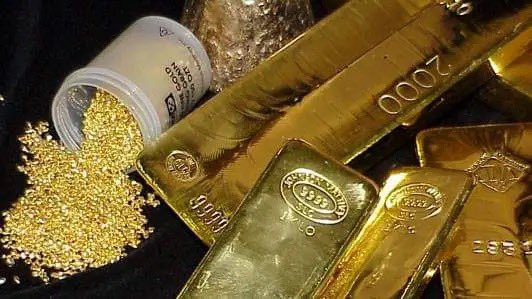
A small-scale mining company is urgently searching for their delivery guy,known only as Bukom Banku, who is suspected of absconding with gold worth GHS 800,000.
Despite numerous attempts to contact him, Bukom has ignored phone calls and remained silent the few times he did answer.
In a bid to locate him, the company is offering a substantial bounty of GHS 50,000 to anyone who can assist in his apprehension.
This was announced by X (formerly Twitter) user EDHUB, @eddie_wrt, on March 31, 2024.
“Anyone with information on his whereabouts can report to the nearest police station or contact 0542837631, ” the tweet read.
BUKOM BANKU WANTED: A small-scale mining company is searching for a young worker who plays the role of a delivery guy for the company. The young man, only identified as Bukom Banku, was sent last Friday from Manso Datano(Ashanti Region) to deliver gold worth over 800,000 cedis to… pic.twitter.com/8EVNysWbVM
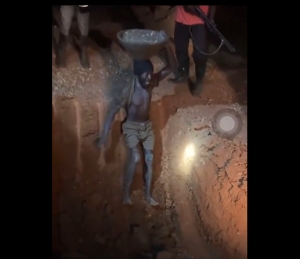
A suspected thief was forced to recite his last prayers as a group of illegal miners (galamsey operators) held a gun to his head after catching him red-handed raiding their site.
In a video that went viral, the miners are heard giving instructions to the alleged thief, who was caught trying to steal their processed gold ore.
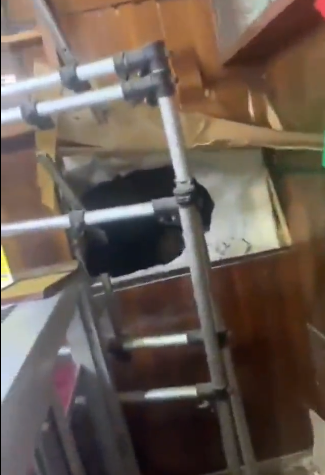
The exact location and time of the incident are unknown, but the miners can be seen directing the thief to enter a pit while telling him to prepare for the worst.
“I am pleading with you. Please forgive me… this is goodbye to my family…” the alleged thief said amid tears.
In the video, the enraged miners are also seen pumping a shotgun while compelling the thief to enter a pit.
However, the outcome for the alleged thief remains unknown as the video abruptly ends when he is forced into the pit with a pan on his head.
Illegal miners (galamseyers) dug a pit in an attempt to buřy al!ve a thief they caught at the site at night while trying to steal their processed gold ore. The panicked suspect, held at gunpo!nt, couldn't hold back his tears as he cried for help. pic.twitter.com/2sMXaJFL6R
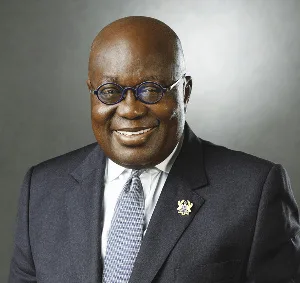
President Akufo-Addo unveiled ambitious plans for Ghana’s mining sector during his State of the Nation’s Address in Parliament on Tuesday, February 27.
Highlighting significant developments, he announced the imminent opening of three large-scale mines in the Ahafo, Upper East, and Upper West regions.
Among these, Cardinal Namdini is set to become operational in the fourth quarter of the year, marking a milestone for gold production in the Upper East Region.
“With these new mines, our gold production is expected to increase to some four point five million ounces (4.5 million oz) annually,” he said.
To enhance the value of this production, the government has established a 400-kilogram gold refinery through a public-private partnership, with negotiations underway for a London Bullion Market Association (LBMA) Certificate.
In addition to gold, President Akufo-Addo emphasized the government’s focus on green minerals like lithium. He outlined a policy framework to ensure the responsible exploitation and management of these critical minerals, aiming for comprehensive beneficiation across the value chain.
The President attributed the resurgence of Ghana’s mining sector to progressive policies, which have revitalized dormant mines such as Obuasi and Bibiani, while expanding existing operations.
Notably, preliminary reports indicated a record-breaking gold production of four million ounces, fueled by measures like reducing withholding tax on unprocessed gold by small-scale miners from three percent to one and a half percent. This policy change resulted in a staggering 900 percent increase in gold exports from the small-scale sector over the past two years.
Building on these resources, Ghana introduced the innovative Gold for Oil Policy, which now accounts for approximately 30 percent of the nation’s total crude oil consumption.
President Akufo-Addo’s address underscored the government’s commitment to leveraging Ghana’s abundant mineral resources for sustainable development and economic growth.
President Akufo-Addo envisions Ghana boosting its gold production to approximately 4.5 million ounces annually, citing the ongoing construction of three large-scale mines in the Ahafo, Upper-East, and Upper-West Regions.
The mining firm Cardinal Namdini is expected to commence gold pouring in the Upper-East in the last quarter of 2024.
Ghana reclaimed its status as Africa’s leading gold producer last year, surpassing South Africa with a record-breaking production of four million ounces.
President Akufo-Addo, in a State of the Nation Address, attributed this success to progressive government policies, including the revival of dormant mines like Obuasi and Bibiani, as well as the expansion of existing ones.
The President highlighted the positive impact of reducing withholding tax on unprocessed gold by small-scale miners from three percent to one-and-a-half percent, resulting in a remarkable nine-hundred percent increase in gold exports from the small-scale sector over the last two years.
Anticipating economic growth, President Akufo-Addo emphasized the strategic importance of advancements in the gold sector.
Despite Ghana’s abundant mineral resources, past policies have left many mining communities grappling with severe infrastructural deficits.
To leverage these resources, the government introduced the innovative ‘Gold for Oil Policy,’ accounting for approximately thirty percent of the country’s total crude oil consumption.
Additionally, a 400-kilogram capacity gold refinery has been constructed through a public-private partnership, with ongoing negotiations for a London Bullion Market Association (LBMA) Certificate.
President Akufo-Addo also highlighted the policy framework for the exploitation and management of green minerals, including lithium, aiming for comprehensive benefits across the value chain of these critical minerals.
“For our green minerals, including lithium, we have put in place a policy for their exploitation and management, to ensure it is beneficial across the value chain of these critical minerals,” the President noted.
A cunning scam that spanned international borders, has observed a United Arab Emirates citizen, Farhad Omedi, fall victim to a fraudulent gold deal orchestrated by a Ghanaian and two Nigerians.
Omedi was lured to Accra, Ghana, where he was promised a lucrative gold transaction.
The Ghanaian accomplice, Baffour Abraham, and the two Nigerians, 39-year-old Sunday Olatunji and 51-year-old Israel Olawale Omoley, convinced Omedi to start with a substantial sum of $60,000 under the pretense of selling him genuine gold.
However, it turned out to be a well-coordinated scam.
Fortunately, the authorities were quick to act. The Dawhenya and Lakeside police apprehended Olatunji and Omoley, but Abraham managed to evade capture and is currently on the run.
Farhad Omedi, a native of the United Arab Emirates got lured to Accra, Ghana and was defrauded by a Ghanaian and two Nigerians of US$60,000 in a fake gold deal.
The two Nigerians, 39-year-old Sunday Olatunji and 51-year-old Israel Olawale Omoley have been arrested by the… pic.twitter.com/YFyP3lAloi
Flagbearer of the New Patriotic Party, Dr Mahamudu Bawumia, has underscored the importance of maximizing the benefits derived from Ghana’s abundant natural resources to foster job creation, enhance livelihoods, and strengthen the domestic economy.
In light of Ghana’s significant gold reserves, Dr. Bawumia has proposed a legislative initiative that would ensure areas with confirmed gold deposits are exclusively owned by Ghanaian entities.
This policy, if enacted under his government’s leadership, aims to empower local ownership and control over valuable natural resources, thereby driving economic prosperity within the nation.
Furthermore, Dr. Bawumia emphasized the potential of this policy to bolster Ghana’s gold reserves substantially. By increasing these reserves, Ghana can achieve a level of financial stability that supports robust and sustainable external payments.
“My government will provide the Geological Survey Department and our universities with resources annually to undertake a mapping of areas where we have gold reserves.
“As a matter of policy, we will legislate that concessions in these areas with proven reserves will be 100% Ghanaian owned since with proven gold reserves, we can easily raise the capital required and hire the expertise,” Dr Bawumia said when he delivered a public lecture on February 7, 2024, at the UPSA.
Additionally, Dr. Bawumia highlighted his government’s intention, if elected, to collaborate with exploration experts from universities and geological institutions.
This partnership aims to harness the expertise of these professionals in exploring seven significant gold belts spanning from Axim and Winneba to Nangodi and Lawra.
“However, even if only 5% of this 5-billion-ounce estimate materializes, it will be a game changer for Ghana,” Dr Bawumia added.
According to data from the Geological Survey Department, Ghana boasts seven gold belts spanning an area of 43,000 square kilometers. Remarkably, approximately 50% of this area, totaling 21,000 square kilometers, remains unexplored.
Conservative estimates suggest that these unexplored belts hold a significant potential quantity of gold, estimated at around 5 billion ounces. This substantial reserve translates to a staggering market value of $10 trillion dollars at current market prices.
Recent revelations indicate that the looted treasures during the Sagrenti War of 1874 in Kumasi extended beyond mere artifacts.
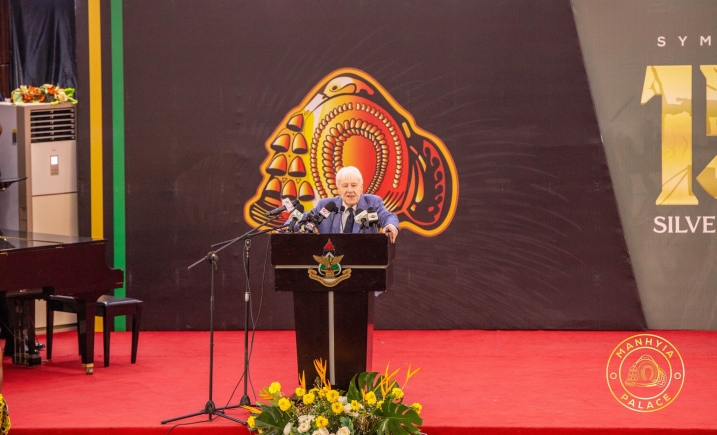
During a keynote address at a symposium commemorating the 150th anniversary of the Sagrenti War of 1874 on February 6, 2024, Head of the Centre of West African Studies at Birmingham University, Prof. Tom McCaskie, noted that a significant portion of the wealth amassed by Asantehene Kofi Karikari’s predecessor, Nana Kwaku Dua I, was lost in the looting, with the entire city of Kumasi left in ashes.
“Kwaku Dua was somebody who really really enforced the laws of Asante. In the process, he gathered together a great deal of money in gold dust principally but also in species and other things,” he said.
Expanding on the significance of the gold, the historian elucidated that a substantial sum of money was stored in three distinct locations within Kumasi: Kumasi itself, Aburaso, and Breman. This wealth had been passed down to Kofi Karikari following the death of Nana Dua in 1867.
“The amount of gold contained in Adakakese alone at Kwaku Dua’s death was in excess of 400,000 ounces. This in 1867 was worth 1.2 million pounds sterling. The current value of the Adakakase is somewhere over 2 billion pounds.”
“The attempt to get back the treasures looted from Kumasi by Garnet Wolseley in 1874, takes no account- because it cannot- of the gold or gold dust that the British must have carried away with them. We don’t know about this because it was loot, a private loot and so it is separate from the cultural artefacts that Otumfuo is trying to retrieve for Asanteman,” he added.
It is believed that the Asantes may be seeking restitution for more than just gold artifacts from the British.
Recent revelations indicate that the looted treasures during the Sagrenti War of 1874 in Kumasi extended beyond mere artifacts.
During a keynote address at a symposium commemorating the 150th anniversary of the Sagrenti War of 1874 on February 6, 2024, Head of the Centre of West African Studies at Birmingham University, Prof. Tom McCaskie, noted that a significant portion of the wealth amassed by Asantehene Kofi Karikari’s predecessor, Nana Kwaku Dua I, was lost in the looting, with the entire city of Kumasi left in ashes.
“Kwaku Dua was somebody who really really enforced the laws of Asante. In the process, he gathered together a great deal of money in gold dust principally but also in species and other things,” he said.
Expanding on the significance of the gold, the historian elucidated that a substantial sum of money was stored in three distinct locations within Kumasi: Kumasi itself, Aburaso, and Breman. This wealth had been passed down to Kofi Karikari following the death of Nana Dua in 1867.
“The amount of gold contained in Adakakese alone at Kwaku Dua’s death was in excess of 400,000 ounces. This in 1867 was worth 1.2 million pounds sterling. The current value of the Adakakase is somewhere over 2 billion pounds.”
“The attempt to get back the treasures looted from Kumasi by Garnet Wolseley in 1874, takes no account- because it cannot- of the gold or gold dust that the British must have carried away with them. We don’t know about this because it was loot, a private loot and so it is separate from the cultural artefacts that Otumfuo is trying to retrieve for Asanteman,” he added.
It is believed that the Asantes may be seeking restitution for more than just gold artifacts from the British.
Minister for Lands and Natural Resources, Samuel A. Jinapor, has delivered a compelling address at the thirtieth anniversary of the Investing in African Mining Indaba held at the Cape Town, on Monday, 5th February, 2024.
He made a resounding call to “Invest in the number one mining destination of Africa, Ghana.
Ghana’s mining legacy, spanning over a century, was highlighted by the Minister as he emphasized the diverse mineral wealth the country possesses, including gold, diamond, bauxite, manganese, lithium, iron ore, copper, zinc, nickel, chrome, lead, and salt.
Underlining Ghana’s gold production leadership on the continent, he reported an unprecedented four million ounces produced last year, with plans for expansion and the addition of three new gold mines in the country.
“We have three (3) new gold mines currently under construction, one by Newmont in the middle belt of the country, and two in Northern Ghana, by Cardinal Namdini and Azumah Resources, with Cardinal Namdini’s Project expected to pour its first gold this year. With these new mines, and the expansion of existing ones, we expect to increase gold output to some four point five million ounces (4,500,000 oz), annually, ” he explained.
Breaking away from the conventional notion that gold was exclusive to the southern part of Ghana, the Minister revealed new gold deposits identified in the Savannah Region, inviting investors to join in the exploration of this promising frontier, in Ghana know as the “Dollar Power.”
The Minister also detailed Ghana’s commitment to value addition in mineral resources, showcasing a new four hundred kilogramme (400kg) capacity gold refinery.
Fruitful discussions with South Africa’s Rand Refinery were disclosed, indicating progress toward securing a London Bullion Market Association (LBMA) certification.
“Beyond gold, Ghana is strategically leveraging over nine hundred million metric tonnes (900,000,000MMt) of bauxite resources to build an integrated aluminum industry.”
The Minister highlighted initiatives, such as the construction of a US$450,000,000.00 manganese refinery and the establishment of the Ghana Integrated Iron and Steel Development Corporation (GIISDEC) to harness iron ore resources for an integrated iron and steel industry.
Addressing the lithium market, the Minister affirmed Ghana’s commitment to value addition, echoing a firm stance against the raw export of lithium resources. This commitment aligns with Ghana’s Green Minerals Policy, aiming to contribute to the global green energy transition.
“And if we have not said it loud enough, permit me to repeat, Ladies and Gentlemen, under NO circumstance will we export our lithium resources in their raw state,” he stressed.
The Minister underscored Ghana’s dedication to using mining as a catalyst for sustainable development. Policy and legislative reforms since 2017 have prioritized efficient exploitation, environmental protection, value addition, local content, and local participation.
The government aims to shift from the traditional “dig and ship” model to a new era of beneficiation, ensuring optimal returns and investment security.
Highlighting opportunities across the entire mining value chain, the Minister emphasized the potential for exploration, mining, refining, processing, and downstream industries.
Ghana’s strategic location and the benefits of the Africa Continental Free Trade Area (AfCFTA) were presented as key advantages, enabling investors to use Ghana as a launchpad to reach the broader African market.
Mr Jinapor in his address assured the global investor community of Ghana’s readiness for business, backed by a stable democracy and a progressive fiscal regime.
Ghana, “the beacon of democracy in Africa,” offers an attractive investment destination with ease of access to geological information, transparent governance institutions, and highly skilled mining personnel.
The Lands Minister wooed investors of Africa and on the global scale to invest in Ghana, showcasing the country for its rich mining potential and inviting them to join in the exciting journey towards sustainable and mutually beneficial mining ventures.
Independent presidential candidate for the 2024 general elections, Dr. Sam Ankrah, has underscored the significance of prioritizing the well-being and development of the country’s youth over natural resources like oil, gas, or gold.
In a meeting with media practitioners at his campaign office in Accra, Dr. Ankrah, a global business strategist and development economist, stressed the need for creating a system that harnesses the untapped potential of the younger generation.
He emphasized that if the youth are deemed more valuable than the country’s mineral resources, efforts should be directed towards preparing them for future responsibilities, and the government should take on this responsibility.
“If our youth are more valuable than our oil, gas, or gold we are mining then let’s create a system to harness these untapped resources as a country,” he added.
Discussing his Affordable Ghana campaign, focused on transparent and accountable leadership, Dr. Ankrah urged young people to support his initiative and actively engage in holding political candidates accountable.
He promised to present a youth policy document encompassing a comprehensive scheme catering to every young person in the country, with a commitment to ensuring full-time employment, apprenticeship, or education for every young person above 18 by his second year in office.
As a seasoned economist and investment banker, Dr. Ankrah highlighted the importance of active civic responsibility and engagement for a thriving democracy.
He emphasized that achieving an empowering atmosphere for Ghanaian citizens requires adherence to the rule of law, efficient government institutions, and a robust fight against corruption.
Dr. Ankrah encouraged the younger generation to maintain optimism for the nation’s future and be innovative in supporting his ten-point plan, which aims to challenge the political duopoly of the National People’s Party (NPP) and the National Democratic Congress (NDC) in Ghana’s governance history.
Minister for Lands and Natural Resources, Samuel A. Jinapor, has encouraged the investor community to collaborate with the government in establishing a large-scale mining operation in Dollar Power, located in the Bole District of the Savannah Region.
The minister highlighted that geological data indicates Dollar Power is richly mineralized, particularly with substantial gold deposits, making it a viable location for the establishment of large-scale mining operations.
Dollar Power, previously known as Sindi Community, is situated along the Ghana–Ivory Coast International Boundary Line in the Savannah Region, approximately 20 km from the District Capital, Bole. Historically, the area was uninhabited after being raided by slave traders in 1897, leaving it deserted.
However, in 1928, the colonial Governments of the then Gold Coast and Ivory Coast, established an International Boundary Line between the two countries, with the erection of Boundary Pillars at mutually agreed positions. This Boundary Line was reaffirmed by the two countries in 1973 with the planting of teak trees along the border.
The large deposits of gold in the area, however, attracted people from across both countries, whose activities has led to the destruction of Boundary Pillars and the teak trees. In 2005, a small group of Ghanaians begun moving to the area to take advantage of the gold deposits, and prevent Ivorians from exploiting the mineral resources.
Currently, there are about three thousand (3,000) inhabitants in the area, mainly involved in small-scale mining. The gold deposits in the area have made the people to name parts of the community Dollar Power Obuasi.
Since 2021, the Ministry of Lands and Natural Resources, through the Ghana Boundary Commission, has been working with their counterparts in Ivory Coast to reaffirm the Boundary Lines. The Ministry has, also, been working with the Chiefs and people of the area to regularise their small scale mining activities.
On Wednesday, 31st January, 2024, the Minister for Lands and Natural Resources led a team from the Ministries of Lands and Natural Resources and Roads and Highways to inspect progress of work on the road and other infrastructure in Dollar Power.
At a durbar with the Chiefs and people of the community, Hon. Jinapor said geological data from the Ghana Geological Survey Authority indicates huge deposits of gold in the area that makes it commercially viable for large scale mining.
He said the traditional notion that gold was found only in the south no longer holds, as large scale mining operations are currently taking place in the Upper East and Upper West Regions. According to the Minister, Dollar Power is even more mineralised than some of these areas, and with the right investment, large scale mining operations can be established to exploit the huge deposits of gold.
The Minister said to attract the needed investment into the community, which is currently only assessable by water, Government is constructing a 24km feeder road from Ntereso in the Bole District to Dollar Power, and another 25km feeder road from Sapelliga in the Upper East Region to Dollar Power.
He said these constructions being undertaken by the 48 Engineers of the Ghana Armed Forces are far advanced, and would be completed by the middle of this year.
In addition to the construction of the roads, he said Government is, also, committed to bringing a community mining to the area, to regularise activities of small scale miners. The Minister directed the Minerals Commission and the Ghana Geological Survey Authority to expedite action on the establishment of a community mining scheme.
The Minister called on the people to support Government to regularise their mining operations, and serve as watchdogs to fish out people in the community engaged in illegal mining, particularly, on river bodies.
The Chief of Dollar Power, Sindiwura Mahama Awudu Abott, speaking through his Secretary, thanked Government for the road construction which will link the community to other parts of the country.
He said the construction has, also, enhanced economic and social activities in the area, and will ensure effective border control when completed. The Chief, also, thanked Government for the commitment to establish a community mining scheme in the area, as well as bring large scale mining operations to the community.
He said most of the community members are miners, and are willing to work with Government to regularise their activities or work in an established large scale mine.
He pleaded with Government to construct a bridge over the Black Volta to aid transportation and trade, as well as enhance safety of community members.
He, also, called on Government to restore the destroyed Boundary Pillars and teak trees to secure the safety of the border and prevent encroachment.
The Ghana Chamber of Mines anticipates that gold production in 2024 will surpass 4.5 million ounces.
Despite economic challenges in the nation, the mining sector experienced some expansion in 2023.
President of the Ghana Chamber of Mines, Joshua Mortoti, provided insights, stating that small-scale mining companies are projected to produce between 1.1 million and 1.3 million ounces of gold in 2024.
On the other hand, large-scale gold mining firms are expected to contribute significantly to the total, with a production estimate of 3.4 million ounces.
“The latter mines [Obuasi, Tarkwa] are approaching their end of life span. With a projected output range of 1.1 million ounces to 1.3 million ounces in 2024 from the small-scale sector, the national gold output is expected to exceed 4.5 million ounces in 2024. Including manganese production, the planned output for 2024 is 5 million tonnes,” he said.
Minister of Lands and Natural Resources, Samuel Abu Jinapor, expressed that the government and the Ghana Chamber of Mines had achieved significant successes together in the previous year.
Looking forward to 2024, he emphasized the opportunity to intensify and enhance cooperative efforts. The goal is to establish conditions that facilitate the efficient and profitable operations of large-scale mining firms.
“What I can assure you is that the government is fully committed to providing adequate security for your concessions. Because it is when your concessions are safe that you can work in peace to support the government. So, whatever we need to do to ensure that your concessions are safe, we will do it”, he stated.
“And in this regard, I will continue to count on the leadership of the Chamber. If there are specific or special cases, we need to deal with let us know and we will take the necessary steps to deal with them”, he added.
According to third-quarter data from 2023, production attributable to member businesses of the Ghana Chamber of Mines reached 2.14 million ounces. This figure is slightly lower than the 2.18 million ounces recorded during the same period in 2022.
In contrast, production from small-scale miners saw a significant increase from 0.66 million ounces in 2022 to 1.12 million ounces in 2023, reflecting a substantial growth of 70.6%.
On Sunday, November 26, the owner of a jewelry shop in Opera Square, Accra, experienced a heartbreaking moment when she discovered her shop had been burglarized.
The shop owner was brought to tears upon realizing that all her jewelry, including two gold bars, and a sum of money had been stolen.
A video circulating on social media depicted the shocking scene, revealing that the thieves had forcefully entered by breaking through the concrete walls of the shop. In their illicit endeavor, the culprits traversed through three different shops to carry out the theft.
Last Sunday, a jewelry shop owner was reduced to tears at Opera Square in Accra, after a shocking discovery when she opened her shop.
She found that all her jewelry, including two gold bars and money had been stolen by thieves who evidently gained access by smashing through the… pic.twitter.com/OlB3kqOlxU
General Manager of Shandong Gold Group, the parent company of Cardinal Namdini Mining Ltd., Mr Hang Li, has announced the company’s plan to construct an airport in Bolgatanga to ease transportation to and from the Upper East region.
He noted that discussions are already underway with the relevant stakeholders, and hopefully, the project will come on stream.
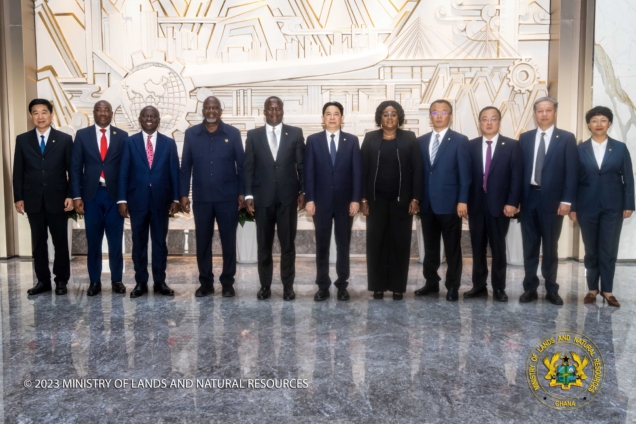
Mr Hang Li made this known on Wednesday, October 25, the Minister for Lands and Natural Resources, Samuel Abu Jinapor, paid a working visit to the head office of the Shandong Gold Group in Jinan, a city in the Shandong Province of China.
Mr Jinapor is in China at the invitation of China’s Minister for Natural Resources, Wang Guanghua, to participate in the 25th China Mining Conference and Exhibition, to be held in Tianjin, from October 26th to October 28th, 2023.
The Conference, said to be one of the largest mining events, brings together government’s investors and other industry players to discuss developments in the mining industry, including mining investment, green and innovative mining, as well as emerging practices in the industry.
Ahead of the conference, the Lands Minister called on the senior leadership of Shandong Gold Group to engage them on their operations in Ghana.
Shandong Gold Group has a project in Ghana, the Cardinal Namdini project, which is currently at the construction stage, following a relocation of affected communities last year.
It is projected that the mine will produce some 1.1 million ounces of gold in the first three years, becoming the third largest mine in the country.
Mr. Hang Li, while engaging the Lands Minister, assured of the company’s commitment to pouring its first gold at the Namdini project in Talensi, in the Upper East Region, before the end of next year.
He said the company’s strategic plan has always been to pour gold by the fourth quarter of 2024, and its management in China is working with the team in Ghana to ensure that they deliver on this commitment.
On his part, Mr. Jinapor said the government was willing to provide all the support the company needs to ensure that gold is poured early enough next year.
The minister said the Namdini project is crucial for the country to maintain her position as the leading producer of gold on the continent.
He added that the impact the project will have on the economy of the northern part of the country makes it imperative for the company to start production as soon as possible. He called on the management to give the necessary support to the team in Ghana to deliver on their promise.
Touching on the proposed airport at Bolgatanga, Mr. Jinapor said it will make the work of the company and the transportation of gold easy and urged them to expedite action on it.
He also called on the company to invest in other mining projects in the country, including investment in value addition, and work to become an example for Chinese investment in Ghana.
Ghana’s Ambassador to China, Dr. Winfred Hammond, lauded the commitments made by the company and pledged the Embassy’s unflinching support to ensure that the first gold is poured next year at the Namdini mine.
The Minister was also accompanied by the Chairperson of the Minerals Commission Board, Barbara Oteng-Gyasi, the Chairperson of the Parliamentary Select Committee on Mines and Energy, Samuel Atta-Akyea, and the Chief Executive Officer of the Minerals Commission, Mr. Martin Ayisi.
Cardinal Namdini Mining Ltd. is the largest mining company in China and has been ranked among the top ten global gold enterprises for two consecutive years, according to the Ministry of Lands and Natural Resources.
The Minority in Parliament, has strongly opposed the Bank of Ghana’s (BoG) proposal to transfer control of the National Investment Bank (NIB) to the Agricultural Development Bank (ADB).
According to the NDC MPs, this move raises concerns of a conflict of interest due to the fact that the Bank of Ghana holds a majority stake of over 60% in ADB.
During a press conference held in Parliament, Isaac Adongo, the Ranking member for the Finance Committee, accused the Akufo-Addo administration of attempting to surreptitiously hand over NIB to political allies.
The Bolgatanga Central MP also presented alternative solutions to the government, which he believes could help NIB overcome its challenges without resorting to a sale.
“Ladies and Gentlemen, it is instructive to note that every viable and constructive alternative proposals by well- meaning Ghanaians aimed at resolving the problems of NIB to retain and revive a largely systemic Bank were bluntly ignored.
“NIB’s biggest problem is that it is suffering from capitalization deficit of GHC2.4 billion. However, a casual review of NIB’s balance sheet shows that a restructuring of the balance sheet can generate in excess of GHC2.75 billion to wipe of the GHC2.4 billion and leave a free shareholders fund and equity of about GHS350 million towards recapitalization and a total cash injection of GH2.8b. It is therefore puzzling that anybody sitting on this gold mine will attempt to give it out to somebody for peanut.
“I wish to state here, that some of the proposals that were ignored are still very important today to remedy the situation.
Among these include, but are not limited to, the following:
“Sale of NIB’s 24% shares in Nestle Ghana acquired at Ghc50 million a long time ago, that were given a conservative value of Ghc500million in 2018. This singular proposal would have generated a risk-free cash of Ghc500million to NIB and provided a realized capital gain of Ghc450 million for ecapitalisation. Strangely, this was either ignored or lost on Hon. Ken Ofori Atta, who rather opted to take the shares in Nestle and swap it with a Ghc500 million government bond plus a further Ghc800million government debt as deposit for shares. As it turned out, those bonds have since been impaired through the poor conduct of the Finance Minister in the infamous and unending DDEP consistent with IFRS 9.”
Gold Fields Limited reported that it produced 1,154,000 ounces (oz) of gold during the first half of 2023, marking a 4 percent decline in production compared to the same period in the previous year when they produced 1,201,000 oz.
The decrease in production is primarily attributed to the planned reduction in output at Damang, as stated by the company.
For the first half of 2023, the company’s all-in-costs stood at US$1,398/oz, reflecting a 3 percent increase compared to H1 2022, where it was US$1,352/oz. This increase is attributed to lower gold sales and higher cost of sales before amortization and depreciation, partially offset by reduced non-sustaining capital expenditure.
Conversely, the all-in-sustaining cost (AISC) for H1 2023 amounted to US$1,215/oz, in contrast to the US$1,148/oz recorded during H1 2022. This represents a year-on-year increase of 6 percent.
As a result of these developments, the company reported earnings of US$454 million for the six months ending in June 2023, equivalent to US$0.51 per share. This represents a 9 percent decrease compared to the US$498 million (US$0.56 per share) earned in H1 2022.
In light of these financial results, the company, in unaudited interim results shared with the press, declared an interim dividend of 325 South African cents per share, which accounts for 35.1 percent of normalized earnings.
This compares to the 2022 interim dividend of 300 South African cents per share, marking an 8 percent increase year-on-year. This dividend decision aligns with the company’s dividend policy of distributing between 30 to 45 percent of normalized profit as dividends.
The company’s performance comes on the back of a difficult operating period – marked by “elevated mining cost inflation and strong competition for skills in our key mining jurisdictions presenting significant headwinds”.
The Group made two significant corporate announcements that underscore our commitment to pursuing value-enhancing transactions to enhance the quality and value of our portfolio. These announcements included the proposed Tarkwa/Iduapriem joint venture in Ghana in March 2023 and the Windfall joint venture with Osisko Mining in Canada in May 2023.
Furthermore, we have expedited several internal initiatives designed to further reinforce the execution of our strategy. These initiatives are aimed at unleashing the full potential of our personnel and assets, ultimately driving increased business value.
During the first half of 2023, our primary focus was on two of these initiatives: the implementation of our cultural transformation journey, known as the “Gold Fields Way,” and the optimization of our assets.
Local production
Silver Fields During Q2 2023, Ghana delivered approximately 204,000 oz of gold, including 45 percent of Asanko, at an AIC of US$1,227 per ounce. Ghana produced 397 000 oz of gold in H1 2023 at an AIC of US$1,210 per
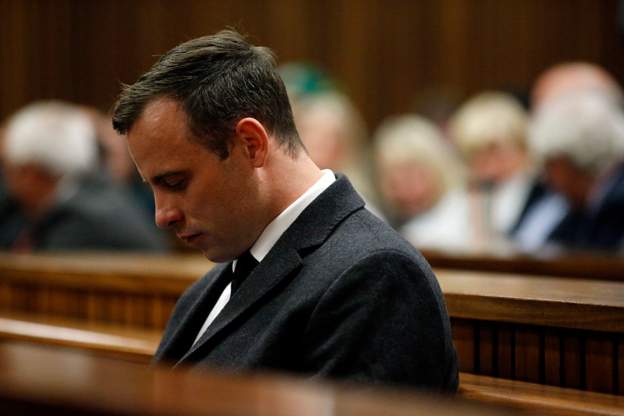
South African athlete, Oscar Pistorius, who has been incarcerated for six years following the conviction for the murder of his girlfriend Reeva Steenkamp, has formally petitioned the Constitutional Court to grant him eligibility for parole.
This move comes subsequent to his previous attempt for parole being rejected in March. The denial was rooted in the revelation that he had not completed the stipulated minimum sentence duration required to qualify for early release.
Pistorius was initially found culpable for murder and subsequently sentenced to 13 years in prison in 2017, following a protracted and highly publicized trial that involved numerous legal proceedings.
His conviction stemmed from the tragic incident in which he shot and fatally wounded Reeva Steenkamp by firing through the bathroom door of his heavily fortified residence on Valentine’s Day in 2013. Pistorius asserted that he believed Steenkamp was an intruder, leading to the fatal confrontation.
He believes he qualifies to be released on parole and that “staying longer in prison constitutes an infringement on his fundamental rights“.
The nation’s highest appeals court stated earlier this year, nevertheless, that the six-time Paralympic gold medalist must still serve an additional year and a half in prison before being considered for parole.
Confusion was caused by the fact that Pistorius’ prison sentence had been fragmented by house arrest and appeals.
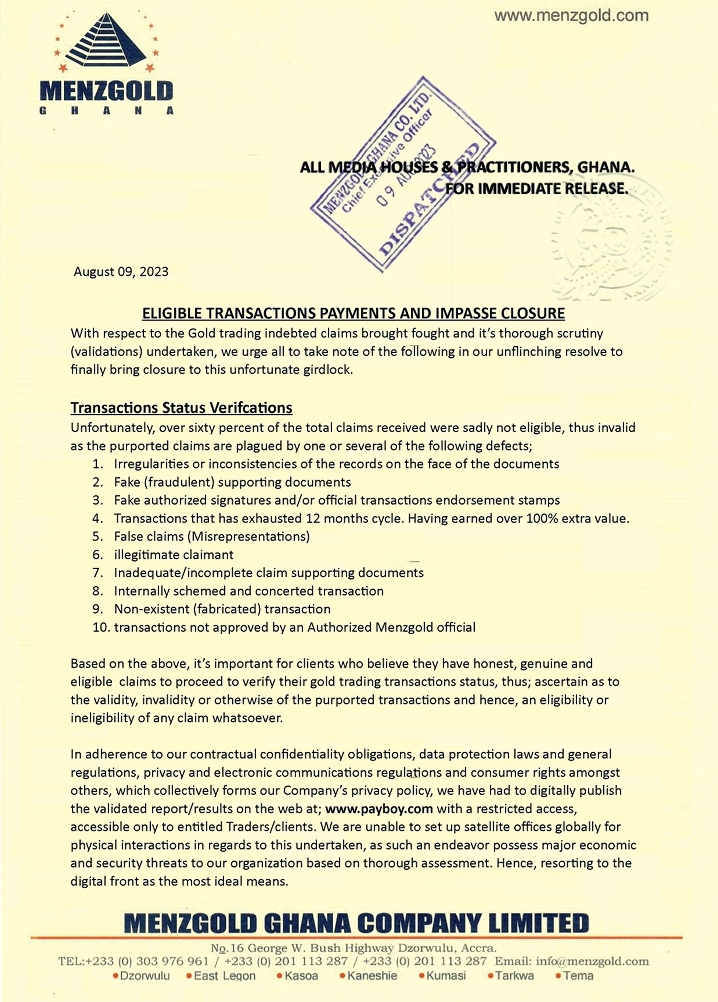
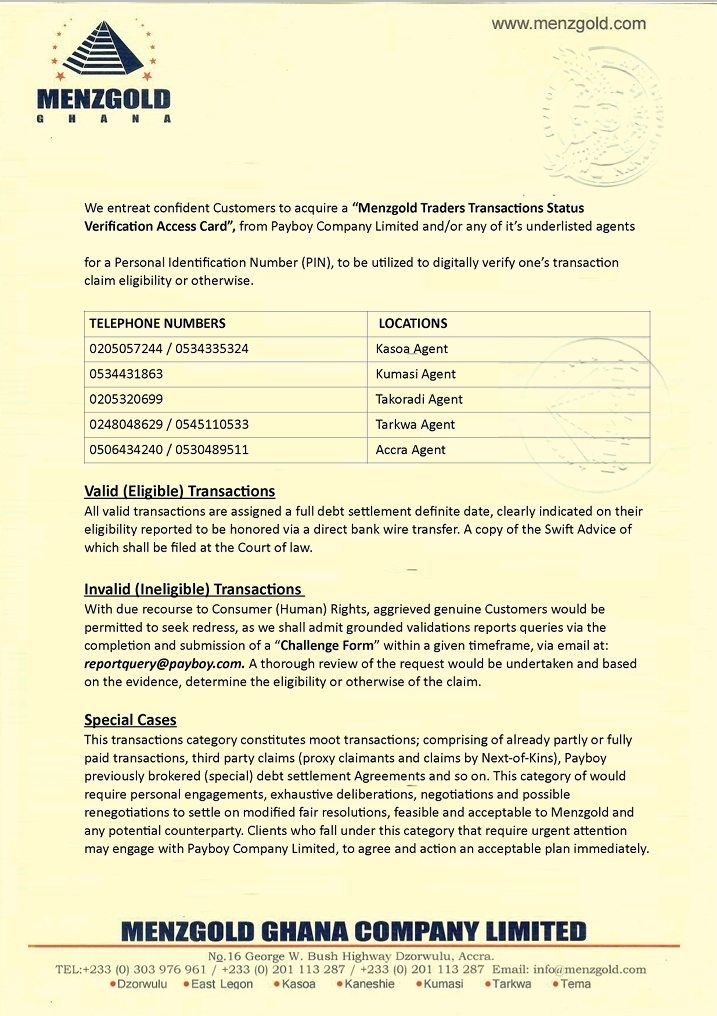
The CEO of the now-defunct gold trading firm Menzgold, Nana Appiah Mensah, has revealed that a significant portion of the claims submitted for validation have been identified as problematic, accounting for more than sixty percent of the total submissions.
Menzgold had called upon its clients on July 30 to provide supporting documentation for validation, a process aimed at expediting the disbursement of payments.
The company outlined a range of issues among the submissions, including inconsistencies or irregularities in the provided records, counterfeit or fraudulent supporting documents, as well as forged authorized signatures, among other alleged discrepancies.
While Menzgold acknowledged these challenges in a statement, it encouraged clients falling within the aforementioned bracket of over 60 percent to independently verify the status of their gold trading transactions. This verification would entail confirming the authenticity, legitimacy, or lack thereof, of the purported transactions, ultimately determining the eligibility or ineligibility of any given claim.
“We advise confident Customers to obtain a ‘Menzgold Traders Transactions Status Verification Access Card’ from Payboy Company Limited or any of its authorized agents. This card will provide a Personal Identification Number (PIN), which can be used to digitally verify the eligibility or status of one’s transaction claim,” NAM 1 (Nana Appiah Mensah) further elaborated in the statement.
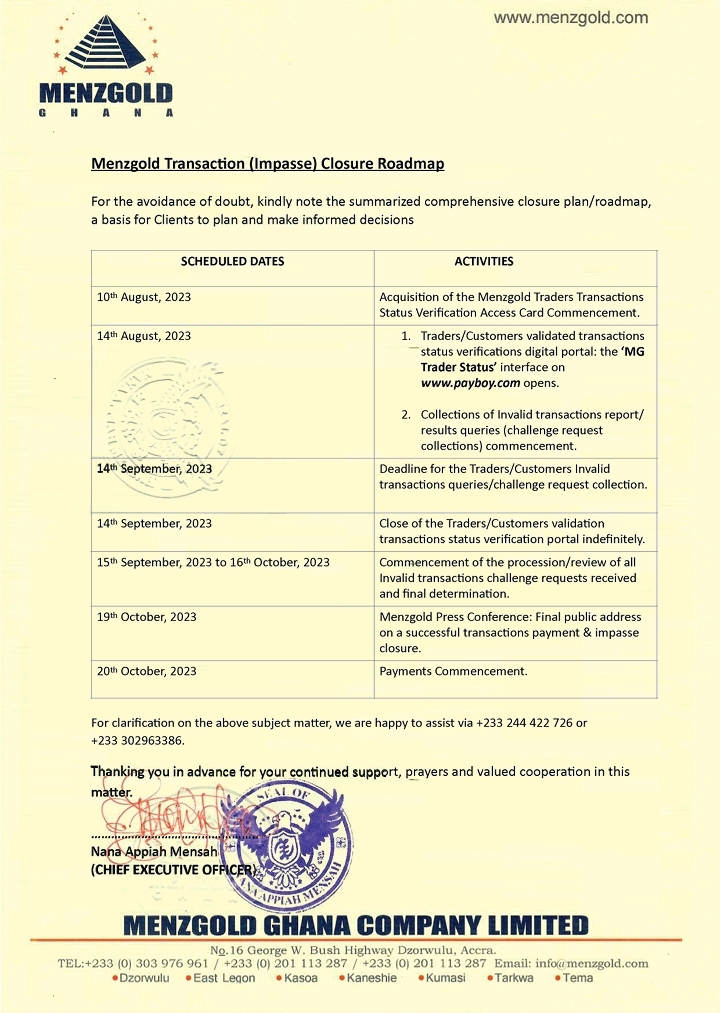
Payment disbursement to clients whose claims have been fully validated is scheduled to commence on October 20, 2023.
The Bank of Ghana has reported a mixed reaction to the prices of Ghana’s major export commodities on the international market in the first half of the year.
According to the Monetary Policy Committee Press Release dated 24th July, 2023.
Cocoa prices surged to record highs last seen over a decade ago, triggered by tight supplies from West Africa coupled with expectations of a global deficit in the 2022/2023 crop season.
On a year-to-date basis, cocoa beans gained 25.5 percent to settle at US$3,185.29 per tonne in June 2022.
International benchmark crude oil prices lost 7.8 percent in the year to close at US$74.98 per barrel due to concerns that sluggish global growth could reduce energy demand, the report noted.
However, decisions by OPEC+ to deepen production cuts moderated the losses somewhat.
With regards to gold, the price of the commodity went up by 8.1 percent year-to date to settle at US$1,942.07 per fine ounce.
This was as a result of increased fears over global recession and possible slower interest rate hikes in the United States loom.
Also, increased demand for the metal from China is said to be another factor for the price hike.
124 young individuals have successfully completed the second batch of the Gold Fields Ghana Foundation (GFGF) Graduate Training program.
The beneficiaries, comprising 88 males and 36 females, are residents of Tarkwa, Abosso, and Damang, the company’s host communities.
These graduates, who have completed their tertiary education and national service, underwent a two-year program to develop the necessary skills and competencies for employment in their respective fields.
The training provides hands-on experience to enhance employment prospects in mining, construction, and related industries.
It covers various aspects of the extractive sector, including mining operations, marketing, and governance.
The graduates also participated in the Value-Addition Project, where they identified and proposed solutions to challenges in mining operations, contributing to the overall improvement of the industry.
Gold Fields West Africa’s Executive Vice-President and Head, Joshua Mortoti, revealed during the graduation ceremony in Tarkwa that the foundation has invested $2.3 million in the program since its establishment in 2018.
He highlighted that the program has already offered on-the-job training and valuable skills to a total of 171 graduates.
“There were 47 graduate trainees in the first batch of the programme with 31 of them securing employment in the mining and construction industries, across Ghana.
Five others are furthering their education in the United States and Europe,” he said.
Presidential hopeful for the New Patriotic Party (NPP), Kennedy Agyapong has objected the notion that the country’s economy will thrive due to the availability of Gold.
In a post cited on social media by the Assin Central Member of Parliament (MP), he mentioned that about 32 products can be derived from Cassava and a number of items he considers more relevant for the country’s turn around rather than Gold,
According to him, Cassava, sugarcane, Palm oil are among other major resources the country can invest in to rack income to improve upon current economic woes
This, he said, “Unfortunately, we believe that Gold is the ultimate I think otherwise, I personally believe that Cassava is more important than Gold, Cassava is a necessity and Gold is a luxury, Sugarcane is a necessity and Gold is a luxury, Palm is a necessity and Gold is a luxury. There are over 32 products that can be made from Cassava alone.”
His viewpoint was earlier in the day mentioned during his filing of nomination for the NPP flagbearer position on Wednesday, June 21, 2023, at the party’s headquarters in Accra, before proceeding to make a social media post to reiterate, signifying how important this message is to his campaign.
He makes the 7th aspirant to file his nomination for the flagbearer slot of the party.
He was accompanied by scores of supporters despite the heavy downpour, scores of supporters followed the Assin Central MP to the party’s headquarters in Accra.
He was accompanied by a number of close allies and teeming supporters who thronged the NPP headquarters in Accra for the event.
One of the notable faces captured at the venue was former Ghana Football Association boss Kwesi Nyantakyi.
The Bank of Ghana has provided an update on the current status of three key commodities that Ghana trades in, namely cocoa, crude oil, and gold.
In its May 2023 Monetary Sector Report, the Central Bank noted that in the first four months of 2023, cocoa prices were generally positive.
This was driven by lower production volumes, higher grinding in top-grower Ivory Coast and increased global demand.
Per the report, prices began the year at US$2,539.86 per tonne in December 2022, and rose to US$2,924.37 per tonne in April this year. This represents 15.2 percent year-to-date increase and 13.0 percent on year-on-year terms.
With regard to crude oil, prices have broadly trended downwards since June 2022.
From US$117.2 per barrel in June 2022, prices plunged to US$81.3 per barrel in December 2022, before moving slightly up to US$82.7 per barrel in April 2023.
Prices were pressured by concerns over the health of the global economy and prospects of oil demand, despite the announced production cut by OPEC+, the Central Bank noted.
Meanwhile, the BoG says gold has remained strong so far this year.
Spot gold started the year at US$1,796.2 per fine ounce and surged to an all-time high US$2,000.7 per fine ounce in April 2023, representing a 3.4 percent year-on-year growth.
This was prompted by economic uncertainty amid fears of recession, expectation of lower rate hikes as inflation eases, and the banking crisis in the U.S. and Europe.
“The weighted average price of the three major commodities exported by Ghana (cocoa, gold and crude oil) increased by 3.9 percent in April 2023.
The increase in the overall index was on the back of increases in all the three commodities, with the cocoa sub-index increasing by 4.9 percent, the crude oil sub-index by 3.9 percent, and the gold sub-index by 3.7 percent,” the report added.
So far, the government’s Success of the Gold for Oil program has validated the viewpoints of Vice President Dr. Mahamudu Bawumia and Energy Minister Dr. Matthew Opoku Prempeh.
Dr Bawumia who has been driving the policy from the presidential level, and Dr Opoku Prempeh who is the implementation anchor at the ministerial level, have persistently drummed home the inherent benefits of the programme and promised that the government will do everything possible to ensure that Ghana reaps maximum benefits from it.
According to Dr Bawumia, since its operationalisation, the Gold for Oil policy has stabilised the exchange rate and is expected to save the country approximately $4.8 billion annually.
Also speaking at the 2023 energy sector retreat, Dr Opoku Prempeh stated that his ministry will religiously monitor every step in the Gold for Oil value chain to ensure that the purposes for which the programme was birthed, are not defeated.
Positive effects
The Gold for Oil policy has been credited as one of the measures that have led to stable fuel prices.
The Head of Financial Markets at the Bank of Ghana, Steven Opata, said the government’s policy had resulted in increased competition among traders of refined petroleum products, leading to reductions in prices at the pumps.
As a result of the implementation of the policy, petroleum prices, which hovered averagely at GH¢15 in January 2023, now sells at about GH¢12 on the average and are expected to further go down in the coming months.
As of May 29, 2023, the price of gasoline in Ghana was GH¢13.2 per litre, roughly $1.19, indicating a decrease from the prices in December 2022 .
This has brought relief to motorists as they are able to work within their budgets.
Also, the increases in transport fares that characterised the year 2022 have died down, bringing relief to passengers.
Furthermore, the drop in fuel prices has impacted on the drop in inflation, since fuel prices are a major driver in economic activities.
From a high of 54.1 per cent in December, 2022, inflation has consistently dropped, reaching 41.2 per cent in April. This signifies a positive outlook for the economy.
At a time West Africa’s biggest economy, Nigeria is struggling to deal with surging oil prices , which has led to two states in Africa’s most populous nation of 221 million people cutting down working days to three in a week, many see Ghana’s Gold for Oil policy as a significant step in bringing relief to Ghanaians and driving economic growth.
Achieving policy objective
The implementation of the Gold for Oil programme commenced with the arrival of the first consignment of about 40,000 metric tonnes of diesel on January 15, 2023, valued at about $40 million.
The National Petroleum Authority (NPA) in a statement said the prime objective of the programme is to use additional foreign exchange resources from the Bank of Ghana’s Domestic Gold Purchase programme to provide foreign currency for the importation of petroleum products for the country which currently stands at about $350 million per month.
Payment for oil supply is to be done in two channels: by way of barter trade where gold is exchanged for oil or via broker channel where the gold is converted into cash and paid to the supplier.
The first consignment of 40,000 metric tonnes of diesel constitutes about 10 percent of the country’s combined monthly demand for petrol and diesel.
According to the NPA, the plan is to gradually increase imports under the programme to constitute about 50 per cent of the country’s total demand for petrol and diesel.
The implementation of the programme will ease pressure on the dollar (the currency used for the importation of petroleum products) and avoid the occasional increases in petroleum prices resulting from the depreciation of the cedi against the dollar.
In addition, the programme will ensure that the cost of importing the products from international oil traders will be comparatively cheaper.
The consequent reduction in foreign exchange pressures and premiums charged by international oil traders as well as efficiency gains from the value chain will lead to lower ex-pump prices in the country.
Outstanding move
The Group Chief Executive Officer and Managing Director of GOIL Plc, Kwame Osei-Prempeh, described the policy as outstanding.
He said his outfit is benefiting from the deal because the policy is good.
He, therefore, dismissed allegations in certain quarters that the programme has negatively affected some Oil Marketing and Bulk Distributing Companies.
In an interview with Joy Business at the 54th Annual General Meeting of the company, Mr Osei-Prempeh explained that measures have been put in place by the shareholders of the company to take advantage of the deal to protect the interest of consumers and partners.
“We are not kicking against it. It has really taken some of our stress because at a point we needed to push for dollars and all but now it is fine,” he said.
A former Group Chief Executive Officer of GOIL, Patrick Akorli has also described the programme as innovative.
Speaking with Citi News, Mr Akorli said the success of the policy depends on the honesty of the government.
He stated:” It is a very innovative one. What the government is saying is that we need about $400 million almost every year [to get oil], so if we have gold and the gold can be exchanged at a given price to get dollars dedicated to the oil downstream market, then at least we are assured that prices will be stable.”
Top Gold Producer boost
Meanwhile, the Gold for Oil policy is set for a major boost after Ghana recaptured the position of Africa’s biggest gold producer from South Africa.
Industry watchers believe that increased gold production gives the indication that the nation is well-positioned to pursue the policy, which is seen as a game-changer for Ghana’s economy.
The Russia war in Ukraine has upended the fragile economic recovery from the COVID-19 pandemic, setting in motion a crisis that is devastating global energy markets, the United Nations has stated.
Consequently, the government of Ghana has been looking for avenues to overcome the challenges.
Experts who spoke to The Thunder over the weekend said Ghana will see a rebuilding of its gold reserves, which will enhance the trading of oil products.
Reuters reported on June 9, 2022 that Ghana recorded a 32 per cent increase in gold production in 2022, enabling the country to win back the top spot from South Africa as the largest gold producer in Africa.
Ghana lost the position to South Africa in 2021 after a drastic fall in output.
Quoting Joshua Mortoti, the President of the Ghana Chamber of Mines, the report said gold output rose to 3.7 million ounces in 2022 from 2.8 million ounces the previous year, driven by growth in the output of both large and small-scale sectors.
“The large-scale gold sub-sector recorded its highest output in the country’s history in 2022,” Mortoti said.
Ghana experienced a significant 32% surge in gold production last year, allowing it to reclaim its position as the largest gold producer in Africa from South Africa, the president of the mines chamber said on Friday, according to Reuters.
After experiencing a substantial decline in output, Ghana had relinquished the top spot to South Africa in 2021.
However, in 2022, gold production in Ghana rose to 3.7 million ounces, a notable increase from the previous year’s 2.8 million ounces. This growth can be attributed to advancements in both the large-scale and small-scale sectors of gold mining in the country.
“The large-scale gold sub-sector recorded its highest output in the country’s history in 2022,” Joshua Mortoti, the President of the Ghana Chamber of Mines, told members at the annual general meeting.
He said a combination of output and the expansion of production at existing mines drove the large-scale sector’s contribution to national gold output up by 13% to 3.1 million ounces last year from 2.7 million ounces in 2021.
Mortoti said member companies of the mines chamber had sold over 77,620 ounces of gold under the Domestic Gold Purchase Programme, a scheme launched by the Bank of Ghana to boost reserves.
A 3.4% decline in South Africa’s mining production in the second quarter of 2022 was led by a decrease in gold and coal mining – gold production was down by 11.7% and coal by 5.7%, according to reports.
According to Statistics South Africa (StatsSA), the domestic mining production decreased by 8.4% year-on-year in July 2022.
StatsSA said that largest negative contributors were gold (a decline of 19.7%, contributing -3.1 percentage points); platinum group metals (-12.2%, contributing -2.8 percentage points); and iron ore (-20.4%, contributing -2.7 percentage points).
The Ghana Chamber of Mines, has reported that large-scale gold output reached an all-time high of 3.1 million ounces in 2022.
The figure represents an increment of 13 per cent over the 2021 figure of 2.7 million ounces.
The chamber’s producing member companies contributed 3 million ounces of the large scale gold output with the remaining 35,421 ounces declared as being attributable to non-Chamber member large scale mines.
The country’s overall gold output including production from small scale miners increased from 2.8 million ounces in 2021 to 3.7 million ounces in 2022, representing an increase of 32 per cent.
President Nana Akufo-Addo has indicated Ghana’s domestic gold purchase program has raised the nation’s bullion holdings from eight to fourteen tonnes.
Speaking at the official opening of the Graphic Natural Resources Stakeholders Dialogue in Accra on Thursday, 11 May 2023, the president said: “For well over the century that we have been mining gold, our gold reserves between the 1980s and June 2021, were just eight tonnes.”
“Under the domestic gold purchase programme, our gold reserves have increased from eight to 14 tonnes as of the end of 2022. That is just under 18 months of the implementation of this programme,” the president noted.
The president also hinted at banning the exportation of certain natural minerals in their raw state.
“We cannot forget lithium and the other green minerals which have been described as the minerals of the future due to the importance of the green energy transition,” he remarked.
“Fortunately,” he noted, “we have discovered lithium in commercial quantities, in occurrence with cobalt, nickel, copper, lead, and zinc in the country.”
“We should not do with these minerals what we have done with our gold resources over the years,” he cautioned.
Mr Akufo-Addo announced: “The ministry of lands and natural resources, under the leadership of Abu Jinapor, is finalising a policy document for the exploitation and utilisation and management of these crucial minerals for the consideration of cabinet in the next few years.”
The president added: “By section 28 of GIDEC law, in section 30 of the GIFTECH law, the minister of lands and natural resources is empowered to make regulations to ensure that no bauxite or iron ore, in their raw state, is exported out of the country after five years of coming into force of these laws.”
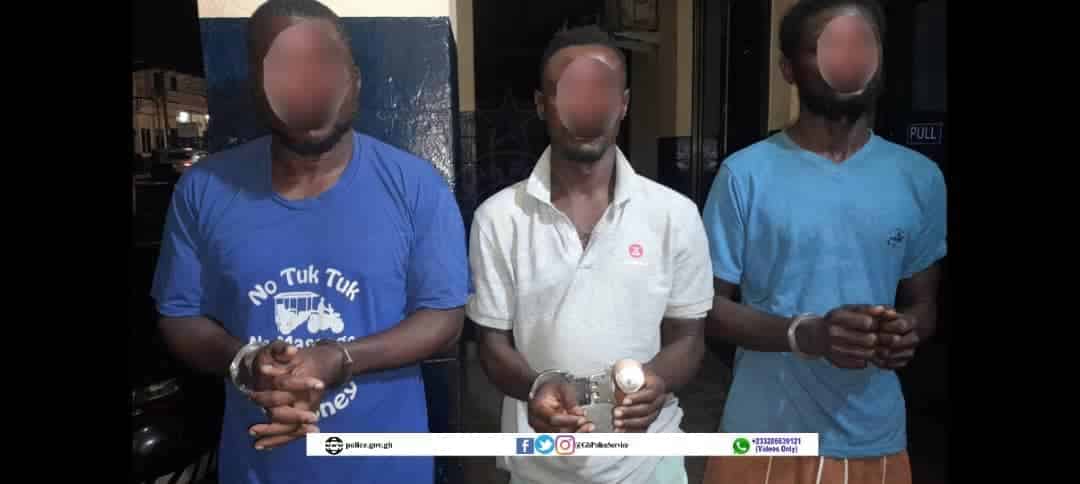
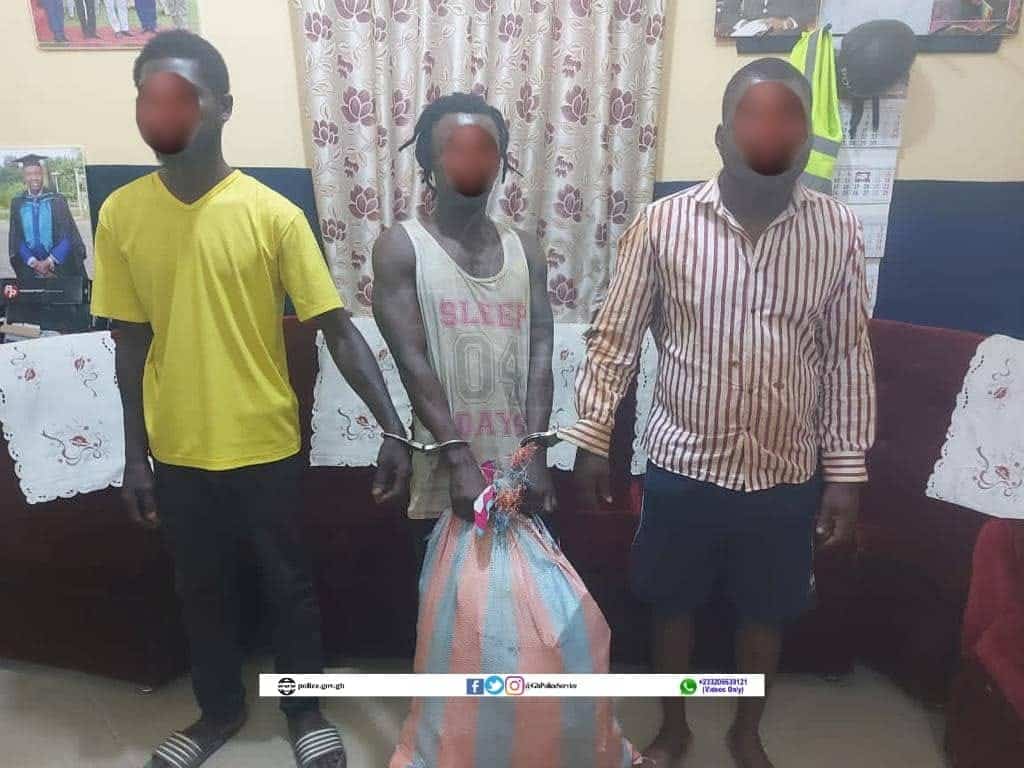
The Police have arrested three suspects in connection with a robbery attack on a gold-buying shop at Akoon-Tarkwa in the Western Region.
The suspects, Ezekiel Stephen Oghenekaro, Samuel Amoashie and Fatawu Awudu together with three other suspects armed with weapons are reported to have attacked the gold buying shop on 18th April 2023, and made away with an unspecified amount of money.
Following the attack, the Police launched an operation on the gang and arrested three of the suspects in the bush around Benso and Esuosu townships.
In a public notice on social media, the Police revealed that a search conducted on them led to “the retrieval of three motorbikes and a sack fully loaded with an unspecified amount of money believed to be the booty from their attack on the shop.”
All the suspects were subsequently put before the Tarkwa District Court on 21st April, 2023 and have been remanded into lawful custody to re-appear on 3rd May, 2023.
Police intelligence operation is currently ongoing to get the remaining gang members arrested to face justice and we shall surely get them.
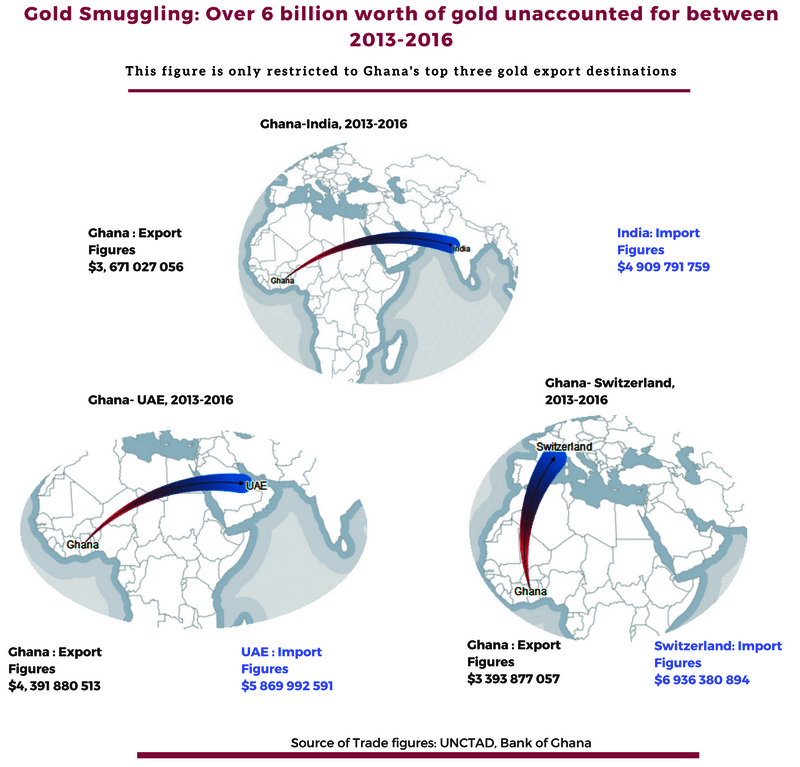
A report by Originally, a safety standards oriented company, has revealed that some exports made by Ghana and its three major gold trading partners from 2013 to 2016 have been unaccounted for.
According to the report on the global illicit economy, an amount of over $6 billion is yet to be accounted for from engagements between Switzerland, India, the United Arab Emirates and the West African country.
The figure is expected to rise significantly if all export and import data between all of Ghana’s gold trading partners were to be examined.
For example from 2013 to 2016, the gold import-export variance between Ghana and Switzerland amounted to over 3 billion dollars. While Switzerland gold import figures revealed that they had imported close to $7 billion worth of gold from Ghana, Ghana’s official records indicated an export of a little over $3 billion.
Ghana is reported to lose over $2 billion annually in unpaid royalties and taxes on gold smuggled out of the country. This information is attributed to the Ministry of Lands and Natural Resources.
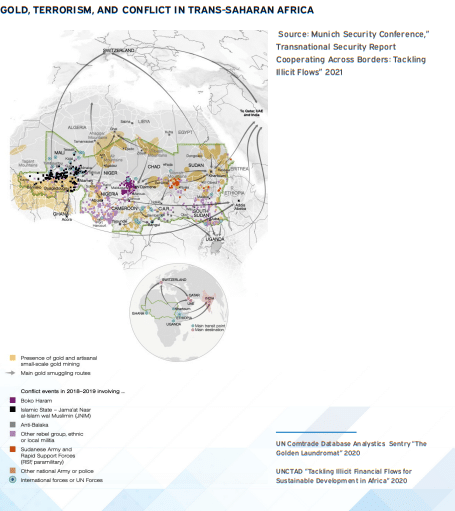
Also, Originally identified Ghana, Sudan, Ethiopia and Uganda as major illegal gold trading routes with export destinations being Switzerland, the United Arab Emirates, and India.
Originally noted that “Local gold refineries are being extensively used to launder gold from illicit sources in an artisanal mining sector involving several million people, forced labor, and high risks.”
The report comes on the back of an investigative piece by Aljazeera which recently stoked debate about how some Ghanaian officials could be complicit in illicit gold trades and money laundering activities for a group of mafias controlling the gold industry in Africa.
A gold trader exposed in Al Jazeera’s Gold Mafia investigative documentary, Alistair Mathias, has revealed that he smuggles $40 million worth of gold from Ghana monthly.
Alistair Mathias, described by the investigative reporters as a financial architect who builds money laundering schemes for corrupt politicians, said “I’ve been doing it for about 13 years now, 14 years. In Ghana I do one ton. I do $40 million every month out of Ghana.”
He further alleged that President Akufo-Addo is his friend and lawyer.
“Ghana’s president is a good friend of mine. In fact, he was my lawyer,” Mathias was recorded saying.
He has since recanted his statements, and President Akufo-Addo has told Al Jazeera that he has no recollection of acting as a lawyer for Mathias or his company.
The first of a four-part investigative series on the smuggling of gold in Africa released by Al Jazeera last week, Alistair Mathias, illegally exports gold worth $40 million from Ghana each month
The episode reveals the perpetrators of the crime in numerous African countries, including one who admitted to transporting gold worth $480 million out of Ghana every year. Alistair Mathias is the man’s name.
According to reports, Alistair Mathias, a Canadian citizen located in Dubai, aids in money laundering around the globe and uses a network of businesses and refineries to make sure his operation is successful. Russians and African leaders are among his clients.
He is said to be the partner of Ewan Macmillan, another alleged mafia exposed in the series.
During his meeting with Al Jazeera’s undercover reporters, Mathias said aside Ghana, he moves gold worth between $70million and $80million from Zimbabwe monthly. South Africa was also on his list.
According to Al Jazeera, “When asked for a formal comment about the findings of Al Jazeera’s investigation, Mathias denied that he designed mechanisms to launder money and said that he had not laundered money or traded illegal gold for Russian clients or anyone else. He told us he had never had any working relationship with Macmillan.”
Alistair Mathias accused of duping Ghanaian businessman
This isn’t the first time Alistair Marthias’ name is being tagged with crime, in 2014, he was accused swindling a Ghanaian businessman of over $4million in a gold trade.
According to the businessman, Henry Osei, he opened a branch of his company in Dubai and gave Mathias the role of clearing and forwarding gold shipments to the refinery in Dubai as well as receiving proceeds for transfer to the Ghanaian company back home in Accra, since the latter was a resident of UAE.
He said things run smoothly at the beginning of the partnership but in December 2013 and March 2014, Mathias failed to transfer proceeds of $4million to Ghana though checks had revealed the refinery in Dubai had paid him for the sale of gold.
“After all my efforts to retrieve my money back proved futile, it left me no choice than to file a criminal case against him for his arrest. Mr Matthias was subsequently arrested when he came to Ghana and was granted bail in less than an hour at the Police Headquarters. As I speak the man has travelled back to Dubai,” Mr Osei noted in a Dubai court.
Though Alistair pleaded not guilty to the charge of misappropriating the said amount, the court judged in favour of the complainant.
Alistair’s account of partnership
Alistair Mathias said he came to Ghana in 2009/10 in search for investment opportunities and settled on mining.
He acquired a concession in the Eastern Region after registering his company, M.A. Resources Ltd. in 2010 and in 2011, he met Henry Osei and his business partner.
They were both directors and shareholders of Guldrest Resources Company Limited, a local company involved in gold business with a vast network across the country.
According to Alistair, he started financing his new business partners to buy gold for his company in UAE, Mathias Holding and things went well until Guldrest Resources lost huge amounts of money in 2012/13 due to a sharp decline in gold prices.
To help Henry Osei out of his dilemma, Alistair said he formed a company with the Ghanaian in UAE, Guldrest Resources FZC.
He was therefore surprised to find out Mr Osei lodged a complaint with Ghana’s Criminal Investigations Department of the Ghana Police, accusing him of defrauding him (Osei) to the tune of four million dollars.
Though he was in Dubai at the time the complaint was filed, Alistair said he “immediately flew to Ghana to respond to the rather baseless claims made against me by a man whose company was owing me large amounts of money.”
While this was happening, Henry Osei also went to UAE to make a similar complaint to the police.
“According to court documents, Henry’s claims to the police were that as manager of Guldrest Resources FZC, Alistair could not account for $4,054,024.10 out of a total transaction volume of $83,927,240.10 by way of…failing to send the value of the gold sent thereto…’,” a report on myjoyonline.com stated.
In his absence, the Sharjah Public Prosecution went to court, after preparing a docket, seeking to try Alistair in absentia.
After failed attempts to prevent him from flying outside Ghana, Alistair said he arrived in Dubai a few days before judgment was going to be passed on him, without knowing that was even happening.
According to myjoyonline.com, “Sharjah Court of Misdemeanour reviewed the case, in the presence of the appellant (Alistair) along with his [legal] representative, as well as the [legal] representative of the claimant (Henry) and upon asking about the charge levelled against him, he denied the accusation.”
The report further mentioned that “according to the court, Henry submitted an expert accounts report prepared by an “expert consultant.” The lower court itself appointed an accounting expert who concluded Alistair owed $3,638,504.24.
“The Court of Appeal further stated that Alistair, raised “objections on the appointed expert report before the lower court because the expert relied on documents that were not translated and the expert did not seek the support of an expert in minerals specialized in gold.”
Alistair who wasn’t satisfied with the lower court’s ruling filed an appeal at the UAE Court of Appeal and there, the case against him was dismissed.
According to the court enough evidence had been provided to prove that Alistair Mathias was totally innocent of the charges brought against him by the country’s public prosecutors.
The court also ruled that Henry Osei rather owed Alistair more than USD $9.2 million.
“The three-member panel held that Mr Henry Osei’s complaint which formed the basis for the charges against Mr Mathias was founded on contradictory, unproven and unsubstantiated claims.
“The Sharjah Second Penal Court of Appeal consequently ruled that “the misappropriation crime levelled against [Alistair] [are] totally void and there is no proof or even indication that [he] committed such a crime…”
“The court found, that contrary to claims by the Ghanaian, Henry Osei, that his estranged business partner owed him $4 million, Mr Osei’s Guldrest Resources Ghana Company Ltd., rather owes Mr Mathias about $9.2 million,” myjoyonline.com reported.
In Al Jazeera’s Gold Mafia documentary, a Kenyan national who was named the top gold smuggler in Africa received the Lifetime Africa Achievement Prize in 2012 for exceptional humanitarianism and equity in Africa.
The Excellence Awards Foundation (EAF), also known as the Millennium Excellence Awards and founded by Ambassador Ashim Morton, presented the award to Kamlesh Pattni. The Asantehene Otumfuo Osei Tutu II serves as the foundation’s life patron.
The awards ceremony was held at the Presidency State House in Nairobi, Kenya on December 15, 2012 and attracted the leadership of the African Union (AU), the Economic Commission for Africa (ECA) and very eminent dignitaries from countries across the continent.
Pattni was awarded alongside other Heads of State including the late President Prof. John Evans Atta Mills, who was conferred with a posthumous prize for democratic governance and development in Africa; President Mwai Kibaki of Kenya, the prize for leadership, national cohesion and stability and President Yoweri Museveni of Uganda, who received the prize for nation building and African leadership.
At the time of his award, Kamlesh Pattni, was facing several counts of fraud in a court case after he was implicated in a scandal that robbed Kenya of 10% of its GDP in the 1990s.
Kamlesh Pattni was involved in the so-called Goldenberg scam, a gold smuggling operation that robbed Kenya of $600mn and led to charges of corruption against many members of then President Daniel Arap Moi’s government.
Pattni’s company, Goldenberg International, was granted an exclusive licence to export Kenyan gold, but instead, he allegedly smuggled gold from what is now the Democratic Republic of Congo.
After years of prosecution, Pattni was acquitted in 2013.
Pattni, who is now a self-proclaimed pastor and sometimes goes by the name Brother Paul, is now running a similar scheme in Zimbabwe from his base of operations in Dubai.
The revelation is part of Al Jazeera’s Gold Mafia, a four-part series investigating some of Southern Africa’s largest gold smugglers and money launderers.
An Accra Circuit Court has remanded a customs officer and two others accused of stealing gold valued at USD4,303,234.00 belonging to GND Global Trading LLC.
Emmanuel Dwamena, 37, the Customs Officer, Abdul Karim Lakoh, 38, and Seth Dzamesi, 43, both businessmen, denied conspiring to steal the 75 kilos of gold bars.
They would be brought back to the Court on March 27, 2023.
Meanwhile, their accomplice, George Asamoah, is on the run.
Prosecuting, Deputy Superintendent of Police (DSP) Evans Kesse, said the Complainants: Abdallah Ali, Farhad Sami, and Zev Volf, were citizens of the United Arab Emirates and Australia, respectively. Lakoh is a Sierra Leonean, as Dzamesi, a Ghanaian, claimed to be a businessman, residing at Tantra hills, and Dwamena, the customs officer, also a Ghanaian, resided at Kasoa, and Asamoah was at large.
He said in March 2023, the complainants went to Sierra Leone to buy Gold, and Lakoh, who was among the people who sold the gold to the complainants, promised to assist the complainants from Sierra Leone through Ghana on transit to Dubai with the gold.
DSP Kesse said on March 16, 2023, the Complainants and Lakoh arrived at the Kotoka International Airport with Sky Airline with their personal belongings, including 75 kilos of gold bars.
However, when the complainants landed at Kotoka International Airport Ghana, Lakoh managed to come out from the arrival hall, and Asamoah, now at large on cell phone 0269736510 and Asamoah came to the Airport in a black Range Rover vehicle to pick Lakoh out of the arrival hall.
The Court heard that they met Dzamesi, who was also using customs branded Toyota Hilux Pickup with registration number GX stole the bag containing the 75kg of the gold bars and kept it in the Toyota pickup.
He said whilst the complainants were at the transit arrival hall, an Immigration officer sneaked the complainants from the arrival hall and handed them over to Dwamena at the departure hall and he drove them to a supposed customs bonded warehouse at East Legon, Accra with House No.18 Shamo Kwei Avenue, to meet Dzamesi who posed as a customs officer.
The prosecution said the bag containing the 75 kilos of gold bars was sent to his office, where Dzamesi forced the complainants out of his office after taking the gold. Dwamena drove the complainants back to the Airport and abandoned them.
At the Airport, the Court heard that Lakoh attempted to escape but he was arrested and handed over to the Airport Police for investigation.
Further background checks on Lakoh indicated that the whole gold scandal started in Sierra Leone and with the help of Dwamena and Asamoah who happen to be their Ghanaian accomplices, they succeeded in stealing the 75 kilos of gold bars from Kotoka International Airport.
He said the accused persons admitted the offence in their cautioned statement that they hatched the plan from Sierra Leone and with the assistance of the Ghanaian accomplices in Ghana to steal the gold. Efforts are being made to arrest the other accomplices.
On March 15, 2023, Vice President Dr. Mahamudu Bawumia, who serves as the head of Ghana’s economic management team, took aim at those who have criticized the government’s gold-for-oil strategy.
The vice president hailed the policy’s performance, saying that it is now in its third month of operation and that the country would continue to reap its benefits, which will eventually help stabilize the currency rate and fuel prices.
“We have to understand, the prices of fuel will go up and will come down. But what we expect to see under the Gold-For-Oil Policy is more stability in the pricing and also savings in foreign exchange. There is more to come, this is the third month of the operation of the policy.
“Some people said it will not work; Ghana does not have enough gold. How can you say that? We’ve been mining this gold for 200 years; they keep taking it out and it cannot work for us? It doesn’t make sense.
“There are people who are very disappointed that it is working but bleeding is allowed. We have an impossibility mindset. They can keep to it, for us all things are possible by the grace of God.”
According to the Vice President, the country will make an annual savings of some US$4.8 billion in foreign exchange when the policy is optimised to cover 100% of the country’s foreign imports by the end of the year as projected.
“I’ve been told that next week we are likely to see a reduction in fuel prices and next week is actually not far. It is tomorrow. Tomorrow we will see the decline in prices that we expect. This is remarkable. Two and a half months ago you were at 23 cedis and today you are at 12 cedis per litre and falling. That is a good point.
“But let me note that the most important aspect of the Gold-for-oil policy is not just the reduction in fuel prices. But the most important aspect is the savings in foreign exchange that the Bank of Ghana will make as a result of the lower demand for forex to import oil.
“That saving is huge, we are currently importing about 50 to 60 per cent of oil under this policy, the goal is to move to 100% and that will be done this year,” the vice president stated while commissioning a new head office for the state-owned Bulk Oil Storage and Transportation Company Limited (BOST).
About the Gold-for-oil policy
Last year, Dr. Bawumia announced a new government policy dubbed gold-for-oil. The policy, as explained by the government, is to allow the government to pay for imported oil products with gold, in a direct barter with gold purchased by the Central Bank.
The policy despite its projected outcome has received heavy criticism.
A flagbearer hopeful of the governing New Patriotic Party (NPP), Kennedy Ohene Agyapong in a recent radio interview, condemned the government’s Gold-for-Oil policy.
Kennedy Agyapong advanced the view that instead of selling raw gold, government should pursue a path of refining the mineral and adding value to the mineral before selling it.
Giving his thoughts on the gold-for-oil policy, Ken Agyapong said “Does it make sense to you to buy oil with gold? Why don’t you sell your gold, make the money and go and buy the oil?”
The lawmaker also expressed his disappointment in party members who support and defend the policy. Adding that he didn’t go to school but there are simple things the government can do to purchase the oil.
“I didn’t go to school but I know Economics. There are simple things that we can do. And I’m surprised, we say we have the men and we are hailing this? We are hailing gold for oil? Jesus Christ! We need to move, move,” he said.
Three persons have appeared before an Accra Circuit Court for allegedly swindling a businessman of GHC1,300,000.
The three accused persons are said to have collected the amount under the pretext of securing the businessman two kilograms of gold but they failed to honour their promise.
The three: Gabriel Koomson, Abeiku Tetteh and Obeng Mensah, have been jointly charged with conspiracy to commit crime to wit defrauding and defrauding by false pretence.
They have denied the charges and the court presided over by Mrs Evelyn Asamoah has admitted each accused person to bail in the sum of one million cedis bail each with four sureties each.
The court stated that two of the sureties should be justified with landed property.
The accused persons would reappear on March 7, 2023.
The prosecution, led by Assistant Superintendent of Police (ASP) Maxwell Oppong, told the Court that the complainant Mr Kojo Boateng, a businessman, resided in Accra whilst the accused persons were residents of Kwabenya, Akuapim Mampong and Oyarifa, respectively.
The prosecution said the complainant and Koomson were very good friends.
It said on February 7, 2023, the complainant informed Koomson that he had some investors who wanted two kilos of gold to buy but he did not know the gold business very well.
The prosecution said Koomson also told the complainant that if the money was given to him, he could get him the gold.
The court heard that on the same day, Koomson went to the complainant’s residence and an amount of GHS 500,000 was given to him in the presence of a witness.
The prosecution said Koomson also informed Tetteh whom he claimed to be his business partner.
It said Tetteh also brought in Mensah and introduced him as his personal driver.
According to the prosecution, on February 8, 2023, the accused persons went to Prestea in search of the gold, but they did not bring any gold to Accra.
It said on February 9, 2023, on their way to Accra, Tetteh informed Koomson that one Alhaji Farouk had informed him that he could get someone to secure him the gold adding, the person would bring the gold to Accra for the transaction.
The prosecution said the said Alhaji Farouk sent Tetteh the person’s phone number.
It said Tetteh contacted the said person who also introduced himself as Isaac Amakye and had agreed to meet Tetteh in Accra.
The prosecution said on February 10, 2023, the accused persons who were in Tetteh’s vehicle drove to Kums Hotel at Lapaz and met Amakye and they all drove to Danbis Hotel at Lapaz to meet one Charles.
It said at the hotel, Charles brought out two metallic substances alleged to be gold and showed it to Koomson and Tetteh.
The prosecution said on the same day, at the Danbis Hotel, Koomson made a video call showing the metallic substances to the complainant as the gold.
It said on February 11, 2023, at about 1000 hours, the accused persons drove back to the said hotel and met Amakye and Charles (now at large) who demanded proof of the money before the gold would be given out.
The prosecution said the accused person drove back to the complainant’s house and collected cash of GHC 1,300,000 from him under the pretext of going to buy the gold.
It said the accused persons after taking the money allegedly drove back to the Hotel and met Amakye and Charles.
The prosecution said Koomson and Tetteh allegedly took the money and went to a room with Amakye and Charles.
It said Koomson allegedly handed over the money to Tetteh and Charles in the room.
The prosecution said Koomson and Amakye took the metallic substance and left for Achimota Mile 7 to test the alleged gold.
The prosecution said a few minutes later, Koomson and Amakye returned with the alleged gold.
The prosecution said Koomson instructed Tetteh to hand over the cash to Amakye and Tetteh did so.
It said Amakye left the room with the money and a few minutes later, one Police Officer and three other guys who were in EOCO vests allegedly entered the Hotel room and handcuffed Charles and took the gold under the pretext of taking him to EOCO for investigation and put him in awaiting vehicle and sped off.
The prosecution said Koomson informed the complainant about the arrest.
It said the complainant with assistance of the Police Patrol team arrested the other accused persons.
Ghana is in talks with Emirates National Oil Co. for a barter arrangement that will enable the West African nation to buy fuel with gold.
The government reached a “tentative” agreement with the Dubai-based oil firm, said Kabiru Mahama, an economic adviser to Vice President Mahamudu Bawumia.
Ghana, Africa’s second-largest gold producer, last week ordered large mining companies to sell 20% of the metal they refine to the central bank from January 1 as it builds up reserves of bullion to be used to import fuel and reduce demand for dollars after its currency plunged 57% this year.
“We’re open to any international oil-trading company that is interested,” Mahama said in a phone interview on Friday.
“Starting next October, all our oil-product needs would be swapped for gold.”
Ghana is struggling to stabilize its economy and sees the barter system as a way to stem a slide in the cedi — the world’s worst performer among currencies tracked by Bloomberg.
The weakening cedi is fueling inflation and depleting the nation’s foreign-exchange reserves.
Meanwhile, President Nana Akufo-Addo’s government, which lost access to international capital markets this year because of ballooning debt and loan-service costs, plans to ask international bondholders to accept losses on their investments to pave the way for an International Monetary Fund bailout.
ENOC didn’t immediately respond to an email and a phone message requesting comment. Dubai’s government, which owns ENOC, also didn’t immediately respond to an email seeking comment.
Government-to-Government
Dubai has a long association with the gold trade. While critics say that regulatory loopholes allow bullion used for money laundering and smuggled out of war zones to be traded in the city, Dubai’s commodities exchange has rejected those claims.
Gold trading was brought into the United Arab Emirates’s federally managed anti-money laundering reporting system last year.
“ENOC is interested in giving us refined oil for gold,” Steve Opata, head of financial markets at the Bank of Ghana, said in an interview on Monday.
“Depending on what quantities they are committed to giving us, we will give them the equivalent in gold. This is a government-to-government program.”
Ghana spends about $10 billion annually on imports, of which 48% is spent on purchasing fuel.
The government expects bartering gold for refined crude will help it rebuild gross international reserves that fell to $6.7 billion at the end of October, enough to cover just 2.9 months of imports, from $10.8 billion a year earlier.
The plunging currency resulted in inflation accelerating to 40.4% in October. That prompted the central bank to raise borrowing costs by 250 basis points to 27%, the highest level in more than 19 years.
The Bank of Ghana will buy the gold from mining companies in cedis. Ghana began buying gold last year — the first time in 60 years — to bolster its foreign reserves. The latest move ramps up the purchases.
“If we implement it as envisioned, it will fundamentally change our balance of payments,” Bawumia said in a Facebook post.
Oil importers’ demand for dollars “in the face of dwindling foreign-exchange reserves results in the depreciation of the cedi and increases in the cost of living with higher prices for fuel, transportation and utilities,” he said.
Explaining this, the Executive Director of ASEPA, Mensah Thompson, noted that gold is a commodity with exceptionally high price volatility on the global market, which meant that if the commodity price dropped, the government would require more gold to buy oil.
In such situations, he says, there will be a mad rush for gold, thus exposing forest reserves to further depletion.
Meanwhile, the rationale behind trading gold for oil, according to the Vice President, Dr Mahamudu Bawumia, is meant to tackle dwindling foreign currency reserves, which are weakening the cedi.
If implemented as planned for the first quarter of 2023, the new policy “will fundamentally change our balance of payments and significantly reduce the persistent depreciation of our currency,” Bawumia said.
Adamant about the government’s intention to resolve the depreciation of the local currency, Mr Thompson described the barter trade as unfortunate and called on the government to rescind its decision.
He said, “the sad situation about this is that Ghana has an oil refinery that has been abandoned since 2017.”
For him, buying oil with gold is not the best option to strengthen the local currency.
“The gold to be purchased by the Bank of Ghana and the PMMC will be in cedis at a spot price with no discounts.”
“These directives would also help local gold refineries obtain gold supplies from PMMC to support their operations as they work toward obtaining the required London Bullion Market (LBMA) certification,” the Minister explained.
The Chief Executive Officer of the Ghana Chamber of Mines, Sulemana Konneye, explained to Citi News the objective these measures are intended to achieve.
“Our member companies have agreed to work with the Bank of Ghana starting this year. We have a target for next year which is under consideration. I can’t tell if these member companies will be committed to the 20% as it is still under consideration but the general programme has been accepted by the industry.”
“For the quantum, the mining companies we are yet to reach an agreement on it and will communicate in due course.”
Former President John Agyekum Kufuor has questioned the outcomes of all the interventions made over the years to tackle the growing menace of galamsey activities in the country, involving security services such as the military and the police.
He explained that in the instances of some of these military interventions like the Operation Vanguard and other similar operations, instead of any major outcomes, the people were rather reported to have gone to brutalize the locals.
“Right now, we are criminalizing all these young people and we send soldiers: Vanguard and all these people, they go and molest the locals,” he lamented.
President John Agyekum Kufuor further expressed worry over the fact that it is yet to be known if any of these interventions produced results such as a team returning with pots of gold.
He also wondered if it is the case that these teams do not discover the gold that is mined in these small-scale mining sites or not.
“I haven’t heard of such expeditions coming back with, say a pot of gold back to Bank of Ghana.
“So, what’s happening? Don’t they find the gold? Everywhere we are getting Chinese and you haven’t heard any Chinese people reporting with the gold they got from our lands and waters,” he wondered.
John Agyekum Kufuor was speaking at a Seminar on Reviewing Ghana’s 1992 Constitution, organized by the Institute of Economic Affairs (IEA), at his residence at Peduase, in the Eastern Region.
As the country’s economy continues to struggle and the cedi rapidly depreciates now might be the time to consider active local participation in the country’s extractive sector.
The Ghana mine workers union believes this is critical to checking the repatriation of funds from the country abroad which have contributed to the dire state of the country.
General secretary of the Ghana mine workers union, Abdul-Moomin Gbana stressed that increasing indigenous investment in the mining sector is critical to salvaging Ghana’s economy.
“If you look at the small-scale mining sector, you have about 80 per cent retention of receipts from mining, 20 to 25 per cent can go out for capital expenditure and other expenses and so clearly, if you look at the two algorithms then clearly, the small-scale mining is more beneficial”
“And so it means that if we increase our stake or if we are able to raise indigenous Ghanaians to participate actively in mining or the state increases its stake in these mining companies, what it does is the receipts that we generate will definitely come back into the Ghanaian shores and that we will be able to shore up our position as a country.” He added
The Ghana cedi for instance is facing tough times as it at some point last week traded at GHS15 to the dollar.
The local has depreciated significantly in recent months and at the beginning of the week, the cedi was noted as the world’s worst-performing currency.
That took its losses this year to more than 45 per cent.
The Ghana Union of Traders Associations GUTA for instance believes the challenge with the currency can partly be blamed on the repatriation of funds by multinationals in the country and has called for the regulation of their activities.
Mr Agbana spoke to Citi Business News on the sidelines of a workshop on the gold mining sector organized by Public Services International.
The two-day regional workshop on the gold mining sector was to identify tax incentive regimes in the sector and estimate the loss to domestic resource mobilization and, while learning from other experiences, provide information on the implication for resource sovereignty, public service development, jobs, and sustainable development.
The Biden administration is increasing pressure on Nicaraguan President Daniel Ortega’s authoritarian rule, threatening a ban on Americans doing business in the country’s gold industry, raising the prospect of trade restrictions, and deporting 500 government insiders.
The actions, stemming from an executive order signed by President Joe Biden on Monday, are the latest and perhaps most aggressive attempt by the U.S. to hold the former Sandinista guerrilla leader accountable for his continued attacks on human rights and democracy in the Central American country as well his continued security cooperation with Russia.
Previous rounds of sanctions have focused on Ortega, his wife, and vice president, Rosario Murillo, and members of their family and inner circle. But none of those moves have managed to loosen Ortega’s grip on power The latest target by Ortega’s government: the Roman Catholic Church. In August, security raided the residence of a bishop, detaining him and several other clergies.
The new executive order greatly expands a Trump-era decree declaring Ortega’s hijacking of democratic norms, undermining of the rule of law, and use of political violence against opponents a threat to U.S.′ national security.
Together with the Treasury Department’s simultaneous sanctioning of Nicaragua’s General Directorate of Mines, the order all but makes it illegal for Americans to do business with Nicaragua’s gold industry. It’s the first time the U.S. has identified a specific sector of the economy as potentially off-limits and can be expanded in the future to include other industries believed to fill the government’s coffers.
The executive order also paves the way for the U.S. to restrict investment and trade with Nicaragua — a move recalling the punishing embargo imposed by the U.S. in the 1980s during Ortega’s first stint as president following the country’s bloody civil war.
“The Ortega-Murillo regime’s continued attacks on democratic actors and members of civil society and unjust detention of political prisoners demonstrate that the regime feels it is not bound by the rule of law,” said Under Secretary of the Treasury for Terrorism and Financial Intelligence Brian E. Nelson. “We can and will use every tool at our disposal to deny the Ortega-Murillo regime the resources they need to continue to undermine democratic institutions.”
In her daily comments Monday to official media, Murillo did not directly mention the expanded U.S. sanctions, but said that Nicaraguans are “defenders of the national sovereignty.”
She also read a letter from Ortega congratulating China President Xi Jinping who was named to another term as head of the ruling Communist Party Sunday, in which Ortega questioned the “aggressive imperial ambition” of the west.
Monday’s action could signal the start of a new offensive taking aim at the broader economy — something the Biden administration has been reluctant to pursue fear of adding to the country’s hardships and unleashing more migration. For the fiscal year that ended in September, U.S. border agents encountered Nicaraguans nearly 164,000 times at the southwest border — more than triple the level for the previous year.
At the same time, frustrations have been building in Washington over the way Nicaragua’s economic elites have largely remained silent amid Ortega’s crackdown.
The Biden administration’s targeting of the gold industry could sap Ortega’s government of one of its biggest sources of revenue. Gold was the country’s largest export in 2020 and the country, already the largest producer of the precious metal in Central America is looking to double its output in the next five years.
According to Nicaragua’s Central Bank, the country exported a record 348,532 ounces of gold in 2021, and the country’s mining association projects exports totaling 500,000 ounces in 2023.
Among foreign investors active in the country is Condor Gold, whose CEO, Mark Child, appeared in a photo with the Nicaraguan leader in a September presentation for investors prepared by the U.K.-based company.
“He is basically totally supportive of the project,” Child said in a March interview following a 90-minute meeting with Ortega. “That meeting… basically gives a major green light for the construction of project finance and materially de-risks the project.”
The Toronto and London-listed Condor has permits to build and operate three open pit mines, the most advanced of which is believed to hold 602,000 ounces of gold worth nearly $900 million at current prices. Condor is partly owned by a company belonging to an American mining engineer who has worked for decades in the country.
Shares in Condor were up slightly 2 cents, or 3.8%, following the U.S. announcement. However, another Toronto-listed junior mining company with operations in Nicaragua, Calibre Mining Corp, saw its share price plunge 17 cents, or 17%.
The Vancouver-based firm has several mining projects in Nicaragua believed to contain 2.9 million ounces of gold.
As part of Monday’s actions, the Treasury Department also froze the U.S. assets of Reinaldo Lenin Cerna, who it describes as a close adviser to Ortega. According to the Treasury Department, Cerna was the head of state security during Ortega’s first presidency and allegedly helped carry out the assassination of the head of security for former dictator Anastasio Somoza.
Additionally, the State Department will also be pulling the U.S. visas of more than 500 Nicaraguan individuals and their family members who either work for the Ortega government or help formulate, implement and benefit from policies that undermine democracy in the country, U.S. officials told The Associated Press on the condition of anonymity to discuss the action. Previously it froze the U.S. assets of the defense minister and other members of the security forces tied to the shuttering of more than 1,000 nongovernmental organizations.
Previously, the Biden administration also sanctioned the state-owned mining company. It also reallocated the country’s sugar quota, taking away a valuable U.S. subsidy worth millions of dollars every year.
Nicaraguans began fleeing their country in 2018, initially to neighboring Costa Rica, after Ortega violently put down massive street protests. Then in 2021 security forces began rounding up leading opposition leaders, including seven potential challengers to Ortega ahead of that year’s presidential elections. Without a meaningful challenger, Ortega coasted to a fourth consecutive five-year term and Nicaraguans left their homeland in even larger numbers.
Gold is considered one of Ghana’s most priced minerals which in recent times is being exploited by many even through illegal means.
In the case of Addaekrom, an island community in the Eastern Region of Ghana, their gold is a most unimaginable basic need: good drinking water.
Sad as it sounds, that appears to be a major worry for the people of the small community.
Speaking with youtuber; Nana Tea Was Here Some, one of the teachers in the community who are revolutionalising education, Godfred Nyarko, explained that students, for instance, only use sachet water when they are unwell.
“The river is where we fetch water from but as for us the teachers, we buy bags of pure water when the boat is going to Tokor, Kpando… water is not a problem but if they can get us a pipe, that will be fine.
“Sometimes when they are sick, that’s when they come to us for pure water. So, pure water here is like gold. When they are sick, the nurses will tell them to take the medicine with pure water and so they’ll come to us for pure water,” he said.
The Addaekrom community of a little over 1000 inhabitants, has only one school that is riddled with many challenges.
Godfred Nyarko explained that whenever it rains, school activities automatically have to come to a halt.
A total of 187 persons charged with different mining offences have been convicted and sentenced to various terms of imprisonment in the Eastern Region since 2017.
They include 29 Nigeriens, seven Nigerians and three Chinese.
The Attorney-General and Minister of Justice, Mr Godfred Yeboah Dame told journalists that prosecution was conducted by the Eastern Region Office of the Attorney-General headed by Chief State Attorney, Mrs Emily Addo-Okyireh.
Mr Dame said since the designation of the High Court 3 and Circuit Court B, in Koforidua as courts to deal with illegal mining cases by the Chief Justice, Justice Kwasi Anin Yeboah, the Office of the Attorney-General prosecuted all cases on illegal mining brought to its attention.
He said most of the cases were tried in Circuit Court B, Koforidua presided over by Mrs Mercy Adei-Kotey, now a Justice of the High Court.
The Attorney General said that most of the accused were tried and sentenced under the old section 99 of the Minerals and Mining Act, 2006 (Act 703).
The Section 99(1) of Act 703 prescribed a penalty of a minimum fine of three thousand penalty units or imprisonment for a term of not more than five years for the offence of buying or selling minerals without a licence.
For the offence of undertaking a small scale mining operation without a licence or acting in contravention of a provision of Act 703 in respect of which an offence is created, section 99(2) of Act 703 stipulated a penalty of a minimum fine of one thousand penalty units or to imprisonment for a term not more than three years.
Mr Dame said in spite of that provision, prosecutors succeeded in getting custodial sentences imposed on the accused in 40 out of the 48 cases being prosecuted, with the court exercising discretion to impose a fine in eight of the cases.
Under the new law, Mr Dame noted that 33 of the convicted persons including 11 foreigners were convicted and sentenced under the new Minerals and Mining (Amendment) Act, 2019 (Act 995) between August 2021 and September 2022 and are currently serving various prison terms of 15 years, 20 years and 18 years together with fines imposed in the various cases in which they were convicted.
Mr Dame, however, expressed displeasure with the decision of the Circuit Court to impose sentences between three years and five years on the accused in five of the cases involving the trial of 47 persons, which were filed before the passage of Act 995 but which were determined after the Act had come into force on August, 19, 2019,
This, he said, was contrary to the law as Act 995 substituted the punishment regime provided for under Act 703 with a new punishment regime which increased the penalty for engaging in illegal mining operations and illegal trading in minerals.
In the view of the Attorney-General, the substitution of the former section 99 of Act 703 with a new section 99 under Act 995 implied that a court of law engaged with the conduct of a case pending before it, was obliged to apply the new penalties provided for by the law rather than applying the old penalties existing under the law which was no longer in force.
The Attorney-General indicated that of the 48 cases tried in the Eastern Region since 2017, in respect of which convictions have been secured, only one is on appeal.
He said that there were currently about 43 new cases involving the trial of about 250 persons including Chinese at Circuit Court B, Koforidua.
The Attorney-General said an update on the prosecution of illegal mining cases in other regions, particularly, Ashanti, Western and Greater-Accra Regions will be provided in due course.
In the first place, this is not gold that comes from the ore that is mined from many kilometers beneath the earth’s surface per se, but this product is as cherished as the jewelry you wear on your wrist or neck.
Known differently to different tribes in Ghana by name: Agatawoe in Ewe; Ayilo for the Gamɛi; shirew by the Akans; and kaolin in English, this product is also known as food that is loved by mostly pregnant women.
It is believed that it is because of its unique smell that pregnant women are so drawn to it.
Formed from a type of clay, ayilo is used for many other things including it being a reliable material for electro-porcelain fabrication, as well as a major material used for making wall and floor tiles.
In Ghana, Anfoega is one of the locations where this product is mostly produced from, through a process of moulding the freshly mined clay soil into lumps, oven-baked and distributed to markets.
The industry in Anfoega in the Volta Region, for instance, is such a big one, almost everyone in the town has benefited from the economic gains that come with it.
According to a Facebook post shared by Kofi Semamu Atsu Adzei, he said that this ‘white gold’ has created many rich people and prominent business people from the community.
“This is white Gold, yes you heard me right. This can be found in Anfoega and it’s called Agatawoe, the Gamɛi call it ayilo, it is shirew by the Akans and kaolin in English.
“Almost everyone in Anfoega has benefited from the economic gains of this white gold. Anyone into the white gold business is a rich person. Ask anyone from the holy village of Anfoega about it and you will marvel,” he wrote.
Uses of Ayilo:
Apart from the already stated uses of kaolin, the product is also used by many to manage nausea, while others claim it helps in the prevention of things like diarrhoea, discomfort and other pregnancy-related conditions, a report by graphic.com.gh said.
Further details online show that some experts explain that kaolin has absorbent qualities that make it a good addition to helping with diarrhoea.
Also, the use of kaolin is said to help improve conditions such as irritable bowel syndrome and leaky gut.
Ayilo is also used for as a beauty enhancement and is said to be used for many traditional and medicinal purposes.
“It is also a key ingredient in some cleansers, shampoos, toothpastes and beauty products, as it is claimed to gently cleanse and pull impurities from the pores
without causing redness,” a report stated.
Effects of Ayilo:
But there have also been reported after effects of using this product, some of which researchers say is that when pregnant women, for instance, consume too much of it without taking more nutritious foods, it can expose them to anemia.
Besides, because of its source and composition, it is believed that ayilo could carry some amounts of worm eggs, and as such, should it be consumed, the eggs could hatch in the body, leading to the worms feeding on the red blood cells and posing great health risks to an individual.
With chemical elements such as Aluminium, Arsenic, Boron and Nickel, the product poses even more harmful threats to anyone who consumes it.
The Police received a distress call that there was a robbery attack on the Adom Gold buying shop around 7:30pm on Wednesday, August 3, and Police moved quickly to the scene.
While the robbers were fleeing the scene upon seeing the Police, they started shooting indiscriminately injuring an officer in the process. Police returned fire but the robbers managed to escape.
The officer is currently on admission at the Konongo Odumase Government Hospital and in stable condition.
The Inspector-General of Police has spoken to him and the commanders on the ground.
There is currently an ongoing anti-robbery operation in the area to get the suspects arrested to face justice.
Meanwhile, the Police have urged members of the community to remain calm and be on the lookout for any suspicious characters among them and inform the Police accordingly.
They also urge hospitals and other health facilities in the area to report to the Police any persons who report to them for treatment of gunshot wounds or any other wounds.
Still, in the Ashanti region, Six students of the Kwame Nkrumah University of Science and Technology (KNUST) have been remanded on Wednesday.
The suspects were accused of raping a first-year student.
The development comes after the suspects were arraigned at the Asokore Mampong District Court.
This is the second time a KNUST student has been charged with raping another student at the school.
On June 10, 2022, armed robbers raided the premises of a gold ore mining company making away with an unspecified amount of gold.
The affected company, GoldStone Resources Limited near Akrokeri in the Ashanti region, has now confirmed the value of the gold the robbers bolted with.
They made away with approximately US$350,000 when they raided the Homase site of the company.
The company in a June 29 statement said employee was hurt during the incident adding that the loss was not expected to have an impact on the financial performance of the company.
“The Board can now confirm that an armed robbery took place at its Homase site, which, whilst no one was hurt, resulted in a loss of gold with a value of approximately US$350k,” the statement said.
“Whilst this loss is not expected to have a material impact on the financial performance of the business, the Company was not in a position to make an announcement that was compliant with the AIM Rules, which led to a suspension in the trading of its ordinary shares on AIM whilst an investigation was launched by the authorities in Ghana,” the statement added.
Five out of eight robbers involved in a robbery operation at Akyem Adukrom in the Eastern Region have been apprehended by the Police Service.
Three additional suspects are currently on the loose, and authorities are on the lookout for them.
According to a press statement issued by the police, the eight criminals assaulted and robbed a gold dealer at gunpoint of his or her gold.
Adams Awal, Ibrahim Hamidou (Akwasi Anokye, Insuah Moro, Nasiru Salifu, and Kwadwo Amponsah) were among the eight people apprehended by the police.
They are currently being held by the police. The robbers were also found to be in possession of a number of weapons.
An AK 47 Assault Rifle, two magazines with 24 rounds of ammunition, a python revolver handgun, eight BB live cartridges, and nine gold nuggets are among the items.
The police also recovered an amount of GH9077.
Meanwhile, the police have seized a Toyota Land Cruiser with the licence plate DV 4142 7, which was used in the latest robbery.
The president of the Bono East Regional House of Chiefs and president of Yegi traditional council, Pimampim Yaw Kagbrese V, has appealed to the government through the Minister for Lands and Natural Resources, Samuel A. Jinapor, to, as a matter of urgency, assist them in exploiting gold discovered in the region responsibly.
He said he would be very glad if the minister would mobilise the needed resources, especially logistical support, to ensure the exploitation is properly carried out and help bring development to the area.
The chief said illegal mining in the region is not rampant compared to other regions but bemoaned the practice of illegal lumbering, which he described as something that calls for the government’s urgent attention.
He, however, reposed his confidence in the minister, saying, “we know you and we know what you are capable of, and we know you can do this and do it well”.
The Lands and Natural Resources Minister, Samuel A. Jinapor, who spoke at length on the issue of lumbering in the region, appealed to the chiefs to work hand-in-glove with the REGSEC to place a ban on the harvesting of wood for charcoal on commercial purposes to help preserve the only forest cover available to Ghana for future generations.
In view of the fight against logging, the minister asked that REGSEC add on a member from the Regional House of Chiefs to be part of the task force and audit committee, which is to be established to ensure that they have an all-inclusive force.
Mr Jinapor assured the chiefs that all the concerns tabled before him would be taken up with speed and provide all needed logistics, especially with regards to gold exploitation in the region, for the benefit of all.
The Bono East Regional Minister, Akwasi Adu Gyan, who accompanied the minister on his working visit on Tuesday, 16th November 2021, called on the traditional authorities within the region to support the Lands Minister and the government to succeed, stressing that “if the Minister succeeds, the government succeeds and it will all be for our own benefit”.
Ghana will receive 20 percent free equity share for gold refined locally when Royal Gold Ghana Limited begins operation this year.
Currently, all the gold produced by mining companies in the country are refined outside, therefore, the government gains nothing from gold refined abroad.
In that vein, the government entered into a public-private partnership with an Indian company, Rosy Royal Limited, to refine gold in Ghana.
The agreement states that the government of Ghana will receive a 20 percent equity share in the gold refined by the Indian Company locally, while the Indian investor, which built the refinery gets 80 percent.
“It is the cost of refining gold locally which we will gain 20 per cent free equity share but the gold belonged to the mining companies.
“In fact, we do not gain anything when the gold is refined outside and so as part of efforts to providing refinery solution, the government of Ghana entered into agreement with the Indian Investor to build a refinery here. It also formed part of government’s policy to at least refine 30 percent of all gold produced in Ghana,” he added.
Mr Wisdom Gomashie, a Personal Assistant to Deputy Minister of Lands and Natural Resources in charge of Mines, Mr George Mireku Duker, told the Ghana News Agency in an interview on Wednesday.
Mr Gomashie stated that the Indian Investor invested an estimated amount of $25 million in constructing the gold refinery, which is located at the Diamond House on the premises of the Precious Minerals Marketing Company in Accra.
Mr Gomashie explained that the Indian Investor would also pay corporate taxes to the government and employ Ghanaians and later the percentage of equity share between the parties would be 50%-50% after the Investor has operated the refinery for some time.
The government through the Precious Minerals Marketing Company entered a joint partnership with Rosy Royal Limited, an Indian company, to establish a gold refinery that has vested state equity.
The refinery will be known as the Royal Gold Ghana Limited, which can refine 400 kilogrammes of gold daily.
Gold prices moved lower as the dollar moved higher and U.S. yields declined.
The Greenback rose as riskier assets continued to trade under pressure. U.S. Q2 GDP came in stronger than expected while the U.S. existing home sales fell. U.S. consumer confidence came in weaker than expected as the spread of the coronavirus continued to erode growth.
Gold prices moved lower but continue to trade in a tight range. Support is near the 10-day moving average near 1,856, with resistance seen near the 10-day moving average at 1,869.
Short-term momentum has turned negative as the fast stochastic generated a crossover sell signal. Prices have been moved from overbought to the neutral range.
The current reading on the fast stochastic is 68, down from 83. Medium-term momentum is positive to neutral as the MACD (moving average convergence divergence) histogram prints in the black with a flattening trajectory, which points to consolidation.
According to the National Association of Realtors, existing-home sales fell 2.5% on a month-to-month basis an annualized rate of 6.69 million units. Sales were a healthy 25.8% higher year over year.
There were just 1.28 million homes available for purchase at the end of November. That is down 22% from a year earlier and represents a 2.3-month supply at the current sales pace.
The median price of an existing home sold in November was $310,800, a 14.6% increase from November 2019.
The Ministry of Lands and Natural Resources in 2017 identified that the export of bulk minerals were undertaken by companies without proper tracking mechanisms to confirm the actual volume of minerals produced and exported, the sector minister, Kwaku Asomah-Cheremeh, has said.
He said to address the problem, the Ministry has constructed two weighbridges at Apemanim in the Ahanta West District of Western Region and Awaso in the Bibiani-Anhwiaso- Bekwai Municipality of the Western North Region.
This is to track and confirm actual volumes hauled from the mines to the Takoradi Port. It is also to ensure that Ghana is not short-changed in any way regarding shipments of bulk minerals.
Speaking at a press conference in Accra on Wednesday, October 21, Mr Asomah-Cheremeh said: “Ladies and Gentlemen, gold has also been exported over the years by production companies without independent confirmation of the actual volumes and grades of the mineral prior to export.
“To address the situation, the Ministry established an Assay Center at the Kotoka International Airport to properly track (weigh, test, value and certify) actual volumes and grades of gold being exported.
“I am pleased to say that as it stands today, gold exported out of the country passes through the assay process for validation of the actual value.â€