Founder of the United Peoples Party (UPP), Akwasi Addae Odike, has hinted that he will be petitioning Ghana’s international partners over illegal small-scale mining activities, popularly known as galamsey.
He listed three institutions that the UPP will be petitioning to put pressure on the government to take more decisive steps in combatting the ever-growing scourge of galamsey.
In an interview on Joy News channel, October 10, 2022; Odike stressed that from where he sat, the government was still not taking the galamsey fight seriously hence the need to employ external pressures.
“We want to send a petition to United Nations, European Union and International Monetary Fund, IMF, we want this to be part of the conditions, the strings attached to the bailout. I am imploring the IMF to bring galamsey issues as part of the conditionalities to secure this bailout.
“This will push the government harder, to take decisive decisions to mitigate this menace. United Nations Security Council too must come in, because now the effect of illegal mining is creating a health hazard,” he submitted.
He also cited the issue of security submitting that people into galamsey “are possessing a lot of guns, apart from that, HIV/AIDS is on the ascendency at these mining areas,” he alleged insisting that he had evidence to back the claims.
He is also worried about the fact that galamsey was gradually posing a health threat, especially to tubers that are grown in affected areas.
“It is contaminating our food, the tubers. You are sitting in Accra here and unbeknownst to you, you buy a yam which has been contaminated with cyanide and you will have a kidney or some infection,” he added.
Galamsey has become topical in recent months with the resurgence of news on its continued negative impact on the environment.
President Nana Addo Dankwa Akufo-Addo at a recent meeting with the National House of Chiefs and selected Metropolitan, Municipal and District Chief Executives, MMDCEs, restated his resolve to root out the canker.
The issue has also been given impetus following the rearrest last month of a notorious galamsey kingpin in the person of Aisha Huang.
The Chinese national who had as of 2018 been repatriated from Ghana after the state discontinued a criminal trial against her for galamsey, reentered the country on the blind side of the authorities.
The Oti Regional Minister, Joshua Gmayenaam Makubu has reiterated the government’s intentions of adding value to the region’s recently discovered iron ore deposits.
According to him, the government is determined to ensure Ghana realizes the full benefits of the iron ore deposit and at the same time, make sure its full value chain is retained in the Oti Region.
He said this when he took his turn at the State of the Region Report, a platform put together by the Ministry of Information for Regional Ministers to brief the media on developments in their respective regions on Sunday, October 9, 2022.
“Recently, the Region has discovered large quantities of Iron Ore. The Ghana Geological Survey Authority led the discovery of large quantities of Iron ore deposits. The iron ore is 55.22 weight percent (fe) and of a higher grade
“Government is determined to provide value addition to its raw commodity and would ensure that the Ghana Integrated Iron and Steel Development work closely with the GGSA and the communities to ensure that full value chain is retained in the region and the country,” he said.
The large iron ore deposits were discovered in Akokrowa, a farming community in the region,
Mr. Makubu described the discovery of the iron ore as good news for the region and urged the chiefs and people to work in harmony to drive development to the area.
He maintained that the exploration and the business of the Iron will create jobs and wealth for the people of Oti and the country in general.
Already, 10 local and foreign investors have expressed interest in mining the iron ore. None of the investors according to Mr. Makubu will exclusively own a concession but will rather sign a Memorandum of Understanding (MoU) with the Ghana Integrated Iron and Steel Development Corporation (GIISDEC) and the host communities to mine within a specific period to benefit the region and the country at large.
Roads
Touching on the kilometres of road constructed in his since 2017, Mr. Makubu said a total of 587km of road have been constructed and a further 185.7km are under construction. It includes the rehabilitation of the 21km Nkonya Wurupong to Kwamekrom road, the 30km reconstruction of the Hohoe to Jasikan road, the Jasikan to Dodo Pepeso road, upgrading of the 26.8km Kete Krachi to Buya road and several others.
Health
On health, he said 10 projects have been completed in the region while 8 are still under construction. He said these projects include the CHPS compound at Dadease in the Nkwanta South Municipality, the CHPS compound at Azua market in the Nkwanta North District and the CHPS compound with nurses’ quarters at Nkonya Asakyiri in the Biakoye District.
Administrative Officers in the Local Government Service are likely to lose their jobs in the coming days, Head of the Local Government Service, Dr. Nana Ato Arthur has disclosed.
According to him, the Service is taking steps to undertake an exercise to lay off some Administrative Officers because the sector is bloated and the number of Administrative officers in the various Assemblies has resulted in ‘poor quality service delivery’ within the sector, the Chronicle reports.
He further noted how worrying it is that sometimes, such officers numbering up to 10 or more are employed to work in one District or Municipal Assembly alone, leaving a situation where there are more staff than work to be done.
Dr. Ato Arthur disclosed this in a speech read on his behalf at the third National Conference of Ghana National Association of Local Govt Service Administrators (GALGA) at Tamale in the Northern Region recently.
Reacting to this, however, immediate past Secretary of GALGA, Andrew Asare Bediako indicated that the Association will resist any such attempts to dismiss its members from work, the Chronicle reports.
According to him, the Administrative Officers cannot be blamed for over employment considering they have no hand in the employment of Local Government Service workers and therefore should not bear the brunt.
Mr. Asare Bediako further suggested that training workshops are rather organized for Administrative Officers to ensure productivity and enhancement of their skillset.
Traders within the Central Business District in the Kumasi Metropolis in the Ashanti Region have closed down their shops to protest what they say are exorbitant taxes imposed on businesses by the government.
Most of the locked-up shops had red bands tied on them as traders say the protest will last for three days.
The traders are also kicking against a decision by the Ghana Revenue Authority to station their officers at each shop to record Value Added Tax (VAT) on products they sell.
The affected shops are for traders who deal in groceries and are situated at Pampaso and PZ in the Central Business District.
Some of the shop owners who spoke to Citi News want the government to reduce the taxes on businesses.
The October 2022 Bank of Ghana (BoG) Summary of Economic and Financial Data has revealed that Ghana’s public debt stock went from ¢9 billion ¢402.4 billion as of July 2022.
This, according to the central bank, is equivalent to 68% of the Gross Domestic Product and is in sharp contrast to the projected 104.6% of debt to GDP ratio in 2022 by the World Bank.
In dollar terms, the country’s debt dropped marginally to $53.2 billion in July 2022, from $54.4 billion in June 2022.
Based on the data, the nation did not borrow fresh funds from the international market during the period. However, the debt level will go up going forward, following the $750 million Afrieximbank loan that came in August 2022.
According to the data, the external debt remained largely unchanged at $28 billion, equivalent to 35.8% of GDP.
The domestic debt however has been going up since January 2022 because of the significant borrowing by the government in the domestic financial market.
The domestic debt stood at ¢190.3 billion in July 2022, from ¢190.1 billion in June 2022.
Data available shows that the domestic debt began the year at ¢181.9 billion in January 2022 and then went up to ¢185.4 billion in February 2022 and ¢190.1 billion in March 2022. It subsequently shot up to ¢189.2 in April 2022 and ¢188.5 billion in May 2022.
On the other hand, the financial sector resolution bond fell by ¢100 million to ¢14.4 billion in July 2022. This is equivalent to 2.4% of GDP.
The total public debt stock of the country dropped to ¢388.1 billion in April 2022, from ¢392.1 billion in March 2022. It later went up marginally to ¢389.2 billion in May 2022 and subsequently to ¢393.4 billion in June 2022.
Meanwhile, the World Bank in its latest Africa Pulse Report classified Ghana as a high debt distress country as it projects the nation’s debt to Gross Domestic Product (GDP) of 104.6% by the end of 2022.
According to the report, debt is expected to jump significantly, from 76.6% a year earlier, amid a widened government deficit, massive weakening of the cedi, and rising debt service costs.
Renowned economist and businessman, Dr. Kofi Amoah, has berated the government for failing to regulate the activities of religious organisations in Ghana.
In a tweet shared on Saturday, October 9, Dr. Amoah intimated that the government’s failure to regularize religious activities has led to the influx of phoney entities who end up scamming Ghanaians.
He questioned why the government looks unperturbed as Ghanaians are continuously scammed by fake religious leaders like Agradaa as countries such as Rwanda crack down on this menace.
“People are continuously robbed of their savings thru deceptions n promises of fake pastors. Good govts protect citizens from such scams.
“Rwanda closed down 700 fake churches n 200 mosques over nite. Why do our political leaders look on unconcerned? WHY?” parts of the tweet read.
Dr. Amoah made these remarks while reacting to a report by GhanaWeb that scores of people who went to the church of one-time fetish priestess, Nana Agradaa, now known as Evangelist Mama Pat, are crying foul in what they described as a scam by the repented woman.
In several short video clips that have since gone viral in the last few hours, a number of the victims are seen running away from the church building of Evangelist Mama Pat, even as many raised alarms about the fact that they had been deceived and scammed.
GhanaWeb’s further checks showed that the people were at the church in their numbers on the day because the repented priestess had earlier advertised through her television channel that she was going to give out monies to people.
She is also said to have advertised that she would double monies that are brought to her church, Heavenway Champion International Ministry, on the day.
However, as has been typical of her, particularly from the days when she was a fetish priestess, it seems the evangelist only played on the gullibility of the scores of people who appeared at her church to extort monies from them.
When she was done, as has been shared in a number of the videos available to GhanaWeb, she booted them out of the building, aided by her well-built bodyguards.
A number of the affected people are also heard ranting and calling her out.
“This is Agradaa’s church, Heavenway, and she advertised on her TV station that she was going to share monies to everyone only for us to get here, and she rather collects monies from people. She told people to bring ten million (GHc10,000) and come for two billion (GHc200,000) after which she asked people to leave the church. Things immediately turned chaotic here,” a lady giving voice commentary in one of the videos said.
People are continuously robbed of their savings thru deceptions n promises of fake pastors
Good govts protect citizens from such scams
Rwanda closed down 700 fake churches n 200 mosques over nite
Why do our political leaders look on unconcerned? WHY? ???????? https://t.co/s2IpLN74XI
The government has decided not to launch a public information campaign on reducing energy use this winter after the prime minister’s office raised objections, the BBC has been told.
A source said there was a “reasonably well-developed plan” to encourage household energy-saving.
But Climate Minister Graham Stuart denied a Times report that a campaign had been blocked by Downing Street.
He said UK energy was secure despite a National Grid warning of blackouts.
Its message about possible power cuts was based on a worst-case scenario of gas shortages if the energy crisis in Europe escalates.
The Department for Business, Energy and Industrial Strategy (BEIS) was considering plans to encourage households to switch off their appliances and heating to conserve energy whenever possible during winter.
However, the BBC was told the department was stopped from taking the plan forward because of objections from the prime minister’s office and the Department of Health and Social Care (DHSC).
DHSC sources said they did not believe they had played any specific role in any decision, but indicated there might be broad “concern about the elderly being afraid to turn on their heating”.
The Times newspaper reported that Downing Street’s intervention came on Thursday when National Grid issued its warning.
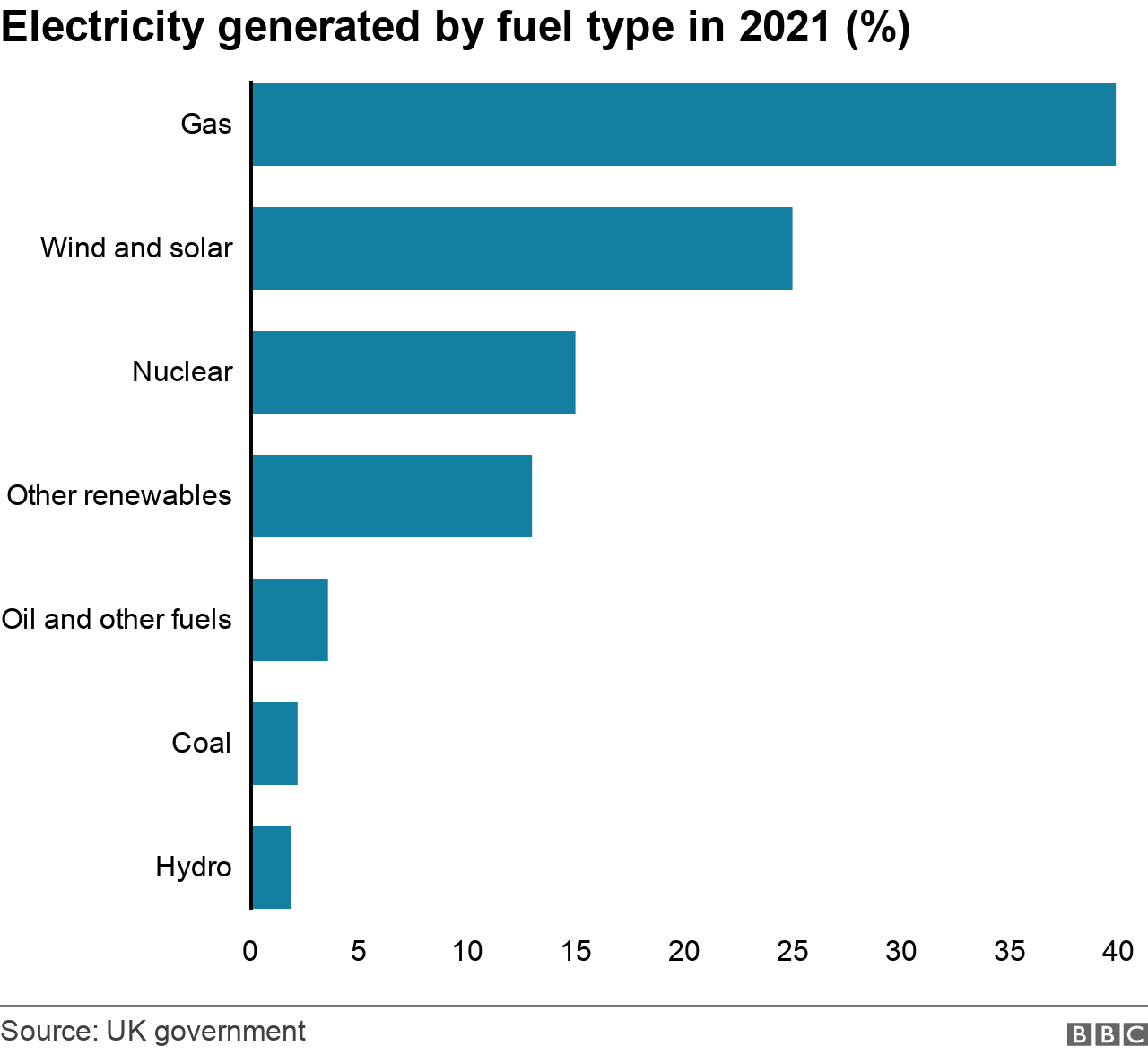
The UK is heavily reliant on gas to produce electricity, with gas-fired power stations generating more than 40% of the country’s electricity.
In the “unlikely” event that gas supplies ran extremely low, homes and businesses in the UK could face three-hour planned blackouts, National Grid said.
The government says National Grid has drawn up plans to launch a voluntary service to reward users who reduce demand at peak times.
Speaking on BBC Breakfast, Mr Stuart said he was “confident the government has done everything in its power” to make sure energy rationing would not be necessary this winter.
But he added: “We make plans for all scenarios.”
During the Conservative leadership campaign, Prime Minister Liz Truss pledged there would be no energy rationing this winter.
On Thursday, when asked if she could guarantee there would be no blackouts, Ms Truss said: “We do have a good supply of energy in the UK.”
In a statement, BEIS said: “There are no plans for the government to tell the public to reduce usage for the sake of our energy supplies.
“The UK has a secure and diverse energy system and we are confident that the steps we are taking will protect security of electricity and gas supplies.”
When asked to comment, Mr Stuart indicated there had been discussions within BEIS, but confirmed there would not be a government-led effort to get people to reduce usage, saying “it has been decided that there will not be a campaign”.
Mr Stuart also denied that a well-developed campaign had been prepared and then blocked by the prime minister’s team.
How will the demand flexibility system work?
National Grid wants to be able to reduce British energy demand at peak times if there is going to be a shortage.
This winter, starting in November, it is going to have 12 trial days where it asks customers who have signed up via their energy suppliers to reduce the amount of energy they are using at particular times of day.
They would be given a day’s notice that they would be asked to do this.
In return, they would be paid for using less energy. National Grid has not yet decided how this will work but has suggested that for the trial days customers might be able to make back £10 a day.
Expect National Grid to announce more details later this month with customers being able to sign up from 1 November as long as their energy suppliers are participating in the scheme.
The Times newspaper had reported that the prime minister had rejected plans for a £15m public information campaign, which was signed off by Business Secretary Jacob Rees-Mogg.
It suggested Ms Truss was “ideologically opposed” to the campaign amid concerns it would be too interventionist.
In her speech to the Conservative Party conference on Wednesday, the prime minister said her conservatism was about “freedom”.
“I’m not going to tell you what to do, or what to think or how to live your life,” she said.
Some question whether a campaign is needed at a time when many people are already changing their behaviour and saving energy where they can.
But those with knowledge of a campaign say they don’t understand the logic of blocking it. “Slightly mystifying,” they say.
In a tweet, Conservative MP Guy Opperman said he would he “fully behind” an energy-saving campaign that would help people and the taxpayer save money.
“This is not Nanny state,” he wrote, arguing it was about “preserving supply, saving money for everyone, and encouraging localism”.
Stew Horne, head of policy at not-for-profit organisation Energy Saving Trust, said the government needed to consider how to reduce demand this winter to increase energy security.
He said the European Commission had recently announced plans to reduce peak demand by 5% across EU member states. In Italy, central heating use will be reduced and households have been asked to turn down their thermostats to reduce energy demand.
Mr Horne said he “would welcome consideration of similar measures to improve energy security”.
Russia’s invasion of Ukraine has caused turmoil and volatility in the energy markets, sending fuel bills rocketing, and tightening supplies of oil and gas globally.
Ahead of winter, countries across Europe are scrambling to shore up supplies, as gas flows from Russia are restricted.
Since taking office Ms Truss’s government has been seeking to boost energy security, with a ban on fracking for shale gas in England lifted last month, and a new oil and gas exploration licensing round launched on Friday.
This comes after government stepped in with an energy support package to help people with soaring bills.
Economist and Finance Lecturer at the University of Ghana Business School, Prof. Godfred Bokpin says the current economic woes of the country are partly due to government’s failure to address inflation challenges even before the Russia-Ukraine war started.
Prof. Bokpin believes that government cannot solely blame the increasing prices of food and products on the Russia-Ukraine war as there were early indicators of inflation in the country.
Speaking on Top Story, Friday, he said the Monetary Policy Committee (MPC) ought to have instituted emergency measures such as increasing the policy rate as a reactive measure to deal with the situation.
“Inflation started picking up in Ghana ahead of the world and that is why we have held the view that the price development in Ghana started even before Russia started firing bullets to Ukraine and therefore we have local triggers of inflation that we failed to deal with rather than outsourcing everything to Russia-Ukraine.
“The response then was for the MPC to arrange an emergency meeting and then increase the rate, that is more reactionary rather than being proactive,” he said.
According to the finance lecturer, the weak fiscal management and increasing public debt are other contributors to the poor economy, hence, the Bank of Ghana cannot be fully blamed.
He contended that politicians and other managers of the fiscal system should be held responsible for their failure to be fiscally disciplined in terms of their expenditures.
“We may be missing the point if we blame the Bank of Ghana so much and leave out the big elephant in the room, which is the fiscal side where the political economy is dominant, where politicians and managers of the fiscal side are to be blamed for the current mess that we are in.
“If you look at Bank of Ghana’s statement for the past one year, you will see a certain posture of Bank of Ghana that suggests that they are unhappy with the way the fiscal side is being managed,” he explained.
Prof. Bokpin noted that the current fiscal system is in a mess and the Central Bank is just “deploying monetary policy as a broom to sweep the mess that is created by the fiscal side”.
He was responding to the Central Bank’s rebuttal that it is not responsible for the increasing rate of inflation in the country as the World Bank has suggested.
The BoG on Thursday said it cannot be blamed for the increasing rate of inflation in the country.
Announcing a monetary policy increment on Thursday, thus a 200 basis points increase to 24.5 percent, the Governor of the Bank of Ghana, Dr Ernest Addison, explained that the rising inflation rate is not a result of delay in tightening the monetary policy rate.
“They’re of the other view that the monetary policy tightening is the way to go. Except that we’re late by their assessment, which I also disagree with because we started this policy tightening as far back as November 2021. It wasn’t in January that we got locked out of the market”, he added.
The comments by the BoG Governor, follow a recent World Bank report which indicated that failure of the Central Bank to tighten its monetary policy on time, is the cause of the country’s rising inflation which has consequently affected the economy.
Per the report, the country’s debt to GDP is expected to hit 104% by the end of the year.
This means if Ghana’s total productivity, if measured over a one year period, it cannot cater for its external debts; as a deficit of some 4% would be required.
The governing New Patriotic Party(NPP) Constituency Chairman for Ellembele, Samson Ndoli has accused the District Chief Executive for the area, Kwasi Bonzoh of collecting GHC70,000 bribe to facilitate illegal mining in the area.
In an interview, he accused the DCE of taking the said amount from some illegal miners who had been arrested and allowed them back to the mining site to continue with their further destruction of the land.
“The party held a meeting in our office which was attended by the DCE where we agreed that illegal miners in our area are destroying our water bodies and so we need to arrest them. We undertook the operation to arrest them led by the DCE during which 7 excavators were seized and five persons arrested. Three days after their arrested, we were informed that they’ve been released after the DCE held a meeting with them where he collected GHC70,000 allowing their machines to go back to the site. We were not happy with that news and so we went to the site the following day where we took videos. We realized that the illegal miners had gone further in the destruction of the land.”
He continued: “We then went to inform the District Police Commander that those who were arrested have gone back to the site. We moved to the scene with the Police and the media where we saw them working. Many of them escaped but three were arrested, we seized their equipment and fuel and took them to the police station. In the evening, the DCE’s aide came and bailed out the suspects. One of the DCE’s boys told us that if we arrest the miners ten times, they will be released ten times because the DCE is the Chairman of the DISEC. After the media publication, the DCE decided to cover up, he teamed with the galamseyers to do a press conference. What we find unfortunate is that even if you the DCE will release them to go back to the site, he needed to inform us (Executives) because we took the decision together. The DCE should have even commended us for arresting the suspects but he rather called the Secretary and asked him what locus he had to lead police officers to go to a mining site.”
He added: The party birthed the government. So if the government introduces a policy, the party must stand firmly and back that policy.”
In September 2022, Police arrested the DCE, Kwasi Bonzo days after his personal assistant, and one other person were placed under police investigation for the disappearance of two mining excavators in the district.
The arrest ensued when the DCE caught wind that the police had recovered an excavator similar to what had been reported missing. He moved in to supposedly identify the earthmoving equipment in the early hours of the day.
Reports indicate that the DCE was ignored when he came in to try and verify the machines’ ownership. He then followed up to Ayisakrom in the district where he was said to have confronted the security officials resulting in a scuffle.
He was arrested and transported to the headquarters in Sekondi.
NPP Constituency Chairman of Elembele Constituency exposes the DCE for the area, Kwasi Bonzo for collecting bribes to facilitate illegal mining in the area. pic.twitter.com/MIGOjZ61D0
A UK-based Ghanaian sewerage system expert Enerst Kwaku Kobea, has urged the government to build underground storage tanks to store volumes of flood water that wreaks havoc whenever it rains.
His call comes after scores of residents in the Ga South Municipality of the Greater Accra Region have been displaced with several others trapped in their homes as Ashalaja, Weija, Oblogo and Tetegu areas flood.
The residents have described it as a crisis situation as many homes have nearly been submerged. Some have had to use canoes to avoid drowning. They describe the situation as a crisis.
According to them, the flood is a result of an overflow of the Weija dam.
Speaking on Ghana Kasa on Kasapa 102.5FM/Agoo TV, Enerst Kwaku Kobea, said the construction of underground tanks is the way to go in ending the perennial flooding, especially in the country’s capital.
He added that the government must find the funds to construct the underground tanks and sewerage system to conserve water for reuse when it rains heavily.
“This same system can also supply potable water to the citizenry. Underground tanks will have to be built because our land in Ghana is solid, we can dig 20 feet down, and 20 feet up so that the water that is spilled which wreaks will all go into that huge tanks. We can also build an underground sewerage system so that rain that falls in Takoradi, Cape Coast etcetera can be diverted to the Weija Dam so that the dam will be the main water supply for Ghana.
“This should be simple for the government to do to avert the loss of lives and property when it rains. Government should not give excuses but find the funds to construct these underground tanks which are very important.”
Two new Judges were on Thursday, 6th October2022 sworn-in for the ECOWAS Court of Justice by the Chairman of the Authority of Heads of State and Government of the Community, President UmaroSissoco Embalo of Guinea Bissau at a ceremony in Bissau.
Justices Sengu Mohammed Koroma from Sierra Leone and Claudio Monteiro Goncalves from Cape Verde will replace Justices Keikura Bangura and Januaria Tavares Silva Moreira Costa from Sierra Leone and Cape Verde respectively who justcompleted their tenure at the Court.
The new judges will join the President of the Court, Justice Edward Amoako Asante from Ghana, the Vice President, Justice Gberi-be Ouattara from Cote d’Ivoire and Justice Dupe Atoki from Nigeria, whoseterms were renewed by the Heads of State and Government of the Community.
Following their swearing in, the President of the Court, Justice Asante welcomed them to the team and expressed the hope that they will contribute to strenghtening the Court’s rich jurisprudence duringtheir four year tenure.
The President, who was among dignataries at the ceremony added : ‘ We are excited at theirappointment by the leaders of ECOWAS and look forward to their resumption of duty so that they cancontribute their quota to reducing the Court’s bulging cases docket.’
The largest opposition party in Ghana, the National Democratic Congress, has described the current efforts by the Nana Addo Dankwa Akufo-Addo government against illegal small-scale mining (galamsey) as mere ‘window dressing’.
According to the party, the Akufo-Addo government only engages in rhetoric rather than cracking the whip on its own officials and officials of the New Patriotic (NPP) who have been caught engaging in ‘galamsey’.
It has, therefore, demanded that President Akufo-Addo, as the first sign of his seriousness in the fight ‘galamsey’, orders the prosecution of five persons including his past appointees and leading members of the NPP.
Here are the five people NDC wants Akufo-Addo to prosecute
Former Minister of Environment, Science, Technology and Innovation, Prof. Kwabena Frimpong Boateng
The first person the NDC is demanding that the government prosecutes is the first Minister of Environment, Science, Technology and Innovation under Akufo-Addo’s presidency, Prof. Kwabena Frimpong-Boateng, for allegedly fuelling and profiting from illegal mining.
The former minister, in 2006 contested in the NPP flagbearership race for the December 2008 National Presidential Elections but lost to the current president, Akufo-Addo.
Kwabena Frimpong Boateng is a Ghanaian physician and cardiothoracic surgeon who established the National Cardiothoracic Centre and the Ghana Red Cross Society. He is also the President of the Ghana Heart Foundation and was the Chief Executive Officer of the Korle Bu Teaching Hospital in Accra.
Prof Boateng has been accused by some Ghanaians including veteran journalist Kweku Boateng of owning a ‘galamsey’ site.
Claims that the renowned medical practitioner was involved in ‘galamsey’ heightened in 2020 when 500 excavators seized from illegal miners went missing under his watch.
Former secretary to the Inter-Ministerial Committee on Illegal Mining, Charles Bissue
The second person the NDC wants prosecuted is the former secretary to the Inter-Ministerial Committee on Illegal Mining, under President Akufo-Addo, Charles Bissue.
Mr. Bissue, in addition to his rule as the secretary to the Inter-Ministerial Committee on Illegal Mining, was a presidential staffer. He was also a two-term Western Regional Secretary of the NPP and a member of the National Council of the party.
He recently indicated that he was going to contest in the race for the NPP’s General Secretary position but withdrew at the last minute.
Charles Bissue was implicated in an investigative documentary by Anas Aremeyaw Anas in 2019 as an alleged enabler for galamsey.
Bissue allegedly facilitated for ORR Resource Enterprise, a company seeking to circumvent laid down processes to be given clearance for its mining operations.
The matter was referred to Special Prosecutor, then Martin Amidu, but Bissue was cleared of any wrongdoing by the Criminal Investigations Department of the Ghana Police Service before Amidu could finish with his investigations.
Ashanti Regional Chairman of the NPP, Bernard Antwi Boasiako
The Ashanti Regional Chairman of the NPP, Bernard Antwi Boasiako, a.k.a. Chairman Wontumi, is one of the names on the list of the NDC.
He has since 2018 been often accused without evidence of being the El Chapo of galamsey in Ghana.
The involvement of Wontumi in galamsey was highlighted by then Minority lawmaker Adam Mutawakilu in a July 2018 press conference in parliament.
“…The chief of Jakobu came out clearly [to tell me] that the CEO of the forestry commission and Wontumi, chairman of NPP in the Ashanti Region, are engaged in galamsey,” the former MP said.
Wontumi’s name came up again recently, when the Minister for Lands and Natural Resources, Samuel Abu Jinapor, directed the Forestry Commission to suspend the operations of Akonta Mining Company in the Tano Nimiri Forest Reserve of the Amenfi West Municipal Assembly.
According to a statement issued by the Public Affairs office of the Ministry on Friday, September 30, 2022, the company owned by Wontumi, has been engaging in mining activities in the forest without a permit.
Former First Vice-Chairman of the New Patriotic Party (NPP) in the Central, Horace Ekow Ewusi:
The former First Vice-Chairman of the New Patriotic Party (NPP) in the Central, Horace Ekow Ewusi, is another name on the list of the NDC.
Ekow Ewusi was supposedly arrested by the police over the 500 missing excavators used for illegal mining in 2020.
His arrest was after Prof Frimpong Boateng issued a letter directing the Criminal Investigation Department to arrest and interrogate him after learning that former Ekow Ewusi had sold some of the confiscated equipment from illegal miners.
Horace Ekow Ewusi also was caught on tape discussing galamsey plans with a former Minister of Environment, Science, and Technology.
In the said tape, Ekow Ewusi was heard detailing to Professor Frimpong Boateng how they can use galamsey to finance party activities.
He stated: “The last time you met my MP [Elvis Donkor] in Parliament, he told you that he will also need a machine to work with and you even asked him to come and see me because I have a lot of these excavators.”
Professor Frimpong Boateng however denied the content of the leaked audio in a GhanaWeb interview.
Former aide to the Ashanti Regional Chairman of the NPP, Bernard Antwi Boasiako, Andy Owusu
The last name on the list of five names is the former aide to the Ashanti Regional Chairman of the NPP, Bernard Antwi Boasiako, Andy Owusu.
Andy Owusu was captured on tape with other persons who were purported to have received bribes in the exposé by Anas Aremeyaw Anas on galamsey in 2019.
Investigative journalist Anas Aremeyaw Anas claimed that Andy Owusu charged GH¢50,000 for his services during undercover investigations and was paid a total of fifteen thousand cedis (GH¢15,000.00).
“Mr. Andy Owusu, a link man for Mr. Bissue charged us fifty thousand cedis (GH¢ 50,000.00) to get us through to him. We negotiated for forty thousand Cedis (GH¢40,000.00) and he accepted it. Out of this amount he accepted part payment of fifteen thousand cedis (15,000.00). Mr. Andy Owusu was also the one who told us how much Mr. Bissue was ready to accept to fast track the process for us. Mr. Andy Owusu also linked us to “school boy” a national security operative for our safety at the illegal mining site”, he posted on his Facebook page.
The Minister for Food and Agriculture, Dr. Owusu Afriyie Akoto, has admitted that the government is currently failing in the fight against illegal small-scale mining, popularly known as ‘galamsey’.
He, however, said that the government remains unwavering in its resolve to stop ‘galamsey’ and it is confident that it will end the menace soon.
“… yes, you say that we have failed in galamsey but it is an ongoing battle. And we think that, as a government, we are going to win at the end of the day.
“Because there is a lot of goodwill amongst the stakeholders. The traditional authorities and other stakeholders know the harmful effect of galamsey on all aspects of life. So, ultimately, we will get together to control it,” Dr. Afriyie Akoto told journalists at a press conference in Accra on Tuesday, October 10, 2022.
The minister also refuted the assertions that ‘galamsey’ is crippling Ghana‘s food production and has particularly destroyed many cocoa farms, leaving just a little.
“… if you are talking about little of cocoa, it is not a little. Galamsey is nibbling at the edges because COCOBOD has done a survey which shows that 2 percent of areas under cocoa are being affected by galamsey. 98 percent is not little left,” he noted.
Meanwhile, President Nana Addo Dankwa Akufo-Addo has refuted suggestions that his government is not committed to the fight against illegal small-scale mining (‘galamsey’).
According to Akufo-Addo, his government has been committed to the fight against the menace since his first day in office and its determination to curb it even cost his party, the New Patriotic Party (NPP), some votes in the 2020 General Elections.
The president, who made these remarks at a meeting with the National House of Chiefs and some Municipal Metropolitan and District Chief Executives (MMDCEs) in Kumasi, intimated that the votes he and his party lost showed that he really put his presidency on the line to fight ‘galamsey’.
“Since I took office on January 7th, 2017, nearly six years ago, I have made it a central feature of my presidency to lead in the fight to rid our country of this menace, which we all now call galamsey. Indeed, it was an important aspect of my inaugural address that day. It has not been easy; it has not been popular and we have not gotten the immediate results that I was looking for.
“Indeed, in the last election of 2020, my stance on the issue cost my party and I significant losses in the mining communities. It turned out that my statement that I was putting my presidency on the line in the fight against galamsey was neither bumbazed nor reckless. It was the simple truth,” he said.
Akufo-Addo also urged chiefs across the country to get themselves into the fight against illegal small-scale mining since they are the custodians of land in the country.
With family members of some injured persons in the Ejura shooting incidents agitating for compensation, it has emerged that the Attorney-General (A-G) gave a piece of legal advice in July this year for compensation to be paid.
In a letter cited by the Daily Graphic, the A-G, Godfred Yeboah Dame, advised the government to compensate three injured victims of the incident with about GH¢1.28 million.
The three injured persons captured in the A-G’s advice for compensation are Louis Ayipka, 30; Nazif Nuhu, 20, and Awal Mesbawu, 16.
Per the letter, the A-G advised that Ayikpa should be compensated with GH¢347,953, Nuhu should get GH¢192,425, and Mesbawu should be given GH¢678,519.
Apart from the compensation, the A-G also advised the government to implement a recommendation by a Medical Board for the victims to be given medical and psychosocial care.
The letter, dated July 12, this year was addressed to the Minister of Interior, Ambrose Dery.
Family agitates
Last Wednesday, the family of the three injured persons called on the government to pay them compensation as recommended by the Justice Koomson’s Committee.
At a press conference in Accra, the family further urged the A-G to expedite action on the prosecution of those suspected to have killed Yussif and Suraj.
According to the family, after submitting all the required medical documents needed to effect the payment, they had so far not received any acknowledgement indicating receipt of the documents.
Report
On June 29, last year, Abdul Nasir Yussif and Murtala Suraj Mohammed died from gunshots from joint police and military team during activities related to the burial of a social activist in the area, Ibrahim Muhammed, popularly known as Kaaka.
Three other persons — Ayikpa, Nuhu and Mesbawu — got injured in the incident.
A committee set up by the Minister for the Interior to investigate the matter submitted its report in September last year.
The committee, chaired by a Justice of the Court of Appeal, Justice Kingsley Koomson, in its report, recommended that the families of the two young men who lost their lives in the shooting incident must be compensated.
It further recommended that the three injured persons must also be compensated.
While the government had since compensated the families of the two young men who lost their lives in the shooting incident, the injured persons are yet to be compensated.
On what went into arriving at the compensation for each of the three persons, the A-G relied on certain factors used to award compensation in some case law.
These were permanent physical disability or impairment, disruption of education, pain and suffering, loss of enjoyment of life, ongoing medical care needs, loss of future earnings, reimbursement of the cost of medical treatments, increase in living expenses among others. The A-G also factored in the national minimum wage and transportation cost, among other factors.
Regarding the medical and psychosocial care, the A-G advised that all three should be given psychosocial support as recommended by the medical board.
“In the case of Awal Mesbawu, the appropriate functional prosthesis should be provided to him to assist in mobilisation as recommended by the medical board,” the A-G said.
Dr Ernest Addison, the Governor of the Bank of Ghana (BoG), has said capping fuel prices is a wrong policy.
There have been calls for the government to intervene and cap the prices of fuel to cushion consumers.
But speaking at the 108th MPC press briefing in Accra on Thursday (6 October), Addison said, “Capping fuel prices is not an innovation. In fact, it is a wrong policy. When you have fuel prices rising and you also have a budget deficit problem, who is going to pay for the difference of the cost of fuel?”
“That will create further fiscal subsidies and worsen your fiscal deficit problem that we are all trying to resolve. So on the contrary, we should really be pushing towards full cost recovery to minimize the burden on the budget,” he added.
Oil prices held near three-week highs on Thursday after OPEC+ agreed to tighten global crude supply with a deal to cut production targets by two million barrels per day (bpd), the largest reduction since 2020.
Brent crude futures edged down 16 cents, or 0.2%, to US$93.21 per barrel by 1020 GMT after settling 1.7% up in the previous session.
U.S. West Texas Intermediate (WTI) crude futures lost 14 cents, or 0.2%, to US$87.62 after closing 1.4% up on Wednesday.
The Minister for Energy, Dr Matthew Opoku Prempeh, who disclosed this at the opening of the 3rd West African LPG Conference and Expo in Accra on Monday said the NLPGPP is an enhancement of the erstwhile Rural LPG Promotion Programme (RLPGPP), with an emphasis on commercial and industrial use.
He said the LPG sector offers a compelling way to support Africa’s industrialisation drive while leveraging the switch to cleaner energy sources, adding that, it would require joint efforts from academia, business, and the government to carefully drive West Africa to maximize the economic benefits along the entire LPG value chain.
Dr Opoku Prempeh noted that although the usage of LPG as a household fuel has grown in several West African nations since the early 1990s, the average per capita consumption is still low by global standards.
The Minister was hopeful that, “after detailed discussions via this forum on the promotion of LPG through policies and national legislation in West Africa, LPG consumption might be greatly boosted in the region.”
The 3-day conference and Expo is aimed at reaching an agreement on making LPG available at an attractive price in the West African Markets and attracting the requisite investments for LPG storage and distribution infrastructure.
The Member of Parliament for Suhum Constituency, Hon. Frederick Opare Ansah has described as desperate propaganda an attempt by some faceless people to misrepresent Dr. Bawumia’s engagements during his working tour of some parts of the north this week.
During his tour, which took him to the Northern and North East Regions between Sunday, October 2 to Wednesday, October 5, the Vice President paid courtesy calls on traditional rulers and inspected a number of ongoing Government projects, including Agenda 111 District hospitals.
The Vice President also met with the party faithful, who he thanked for their continuous support to the government and urged them to, in spite of the current economic challenges, be proud of the NPP Government’s achievements in various sectors, which he listed to them.
However, some people, who the Hon Opare Ansah says are internal party saboteurs, are, throgh social media, propaganda, spreading falsehood about the Vice President’s tour.
It is these claims Hon Opare Ansah, who was a member the Vice President’s delegation for the tour, has completely rubbished as “desperate propaganda” by people he adds, desire to lead the party in 2024 and see the Vice President as a threat.
Speaking to Omanhene Kwabena Asante on Asempa FM’s Ekosii Sen programme from the north on Wednesday after, Hon. Opare Ansah said even those behind the propaganda know very well how decent and decorous a politician Dr. Bawumia is.
“Everybody knows Dr. Bawumia is a decent and a decorous politician who speaks to issues and doesn’t insult,” said Opare Hammond.
“From 2007 when he emerged on the national scale, 2012, 2016 and 2020, Dr. Bawumia has been meeting people, and he has also been campaigning with the President. Have you ever heard he has said something indecent before?”
“I sat in all the meetings throughout the tour and nothing like that happened. All that these desperate people are putting through propaganda, artworks and articles on social media are coming from our own NPP brothers, who support some other people who intend to lead the party.
Opare Ansah described the Vice President’s tour of the North as very successful, as it gave him the opportunity to “inspect on-going projects, re-assure Chiefs and people of the north of government’s commitment to completing these projects, as well as provided opportunities for our party to interact with the Vice President on government’s development efforts, as he also thanked the party for their support to him over the years to partner President Akufo-Addo both as a running mate and as Vice President.”
The Suhum MP had some words of advice to internal NPP members who specialise in deliberately smearing their opponents with dirt to desist from that, as it is detrimental to the overall interest of the NPP party.
“Let us stop such dirty politics because it is not healthy,” he said.
“We will finish the internal contest and face the NDC. In the past, some of these people said many things against Nana Akufo-Addo in 2007 and after our internal contest, the NDC used these lies against our candidate.
“My advice to my NPP brothers is that we should have a healthy contest devoid of insults, lies and fabrications so that when you meet your brother in the future you can comfortably look him in the face and say this is my brother.
“There is no iota of truth in their desperate propaganda
You can’t deliberately throw dirt on your brother and turn around and accuse him of being dirty.”
Dr. Bawumia’s delegation to the North included: the Minister of Interior Hon. Ambrose Dery, Sports Minister Hon. Mustapha Ussif, a number of Deputy Ministers, CEOs of State Agencies including immediate past National Organiser of NPP Sammy Awuku, Presidential Advisor on Health Dr. Nsia Asare, a number MPs from various regions, party executives and stalwarts of the NPP, including Chairman Odeneho COKA.
The Akufo-Addo government has announced a 21 percent increase in the producer price of cocoa.
The announcement comes after the minority caucus of Parliament warned Ghana Cocoa Board (COCOBOD) and thus the government against any attempt to short-change cocoa farmers by announcing prices that are below GH¢1000 per a bag of cocoa.
“After all this uncertainty, government should not announce any price below GH¢1000 per bag, or GH¢16,000 per tonne. Ghanaians are all witnesses to the historic depreciation of the Cedi. In 2021, COCOBOD used an exchange rate of GH¢6 to $1.
“We wish to remind them that the dollar is now more than 10. Even at the dollar equivalent price, farmers and all stakeholders including LBCs and Haulers should receive higher prices and margins this year,” parts of a statement issued by minority’s Ranking Member on the Finance Committee of Parliament, Dr. Cassiel Ato Forson, on Wednesday, October 3, 2022 read.
In a statement issued, on the same day, by the Minister of Food and Agriculture, Dr. Owusu Afriyie Akoto, the government said that the 21 percent increase translates to GH¢800 per bag of 64 kg. gross weight and takes effect from Friday, October 14, 2022.
“The 21% rise in the producer price of cocoa is a testament to government’s resolve to ensure farmers earn a decent income and make cocoa farming lucrative. Government will continue to implement initiatives to build a robust, resilient and sustainable cocoa industry where cocoa farmers and their communities will thrive.
“To ensure a decent standard of living for Ghanaian cocoa farmers after retirement, government will from November 2022 move from the pilot phase to the implementation phase of the Cocoa Farmer’s pension scheme.
“The Scheme remains an unprecedented achievement under His Excellency Nana Addo Danquah Akufo Addo,” parts of the statement read.
Read the full statement below:
REVIEW OF THE PRODUCER PRICE OF COCOA FOR THE 2022/23 COCOA SEASON WEDNESDAY, 5TH OCTOBER 2022
Introduction
The Producer Price Review Committee (PPRC), under the Chairmanship of Hon. Dr. Owusu Afriyie Akoto, met and agreed on the Producer Price of Cocoa for the 2022/2023 season which opens, Friday, 14th October, 2022.
Producer Price
We are pleased to announce that Government has increased the producer price of cocoa by 21% from GH¢10,560 per tonne to GH¢12,800.00 per tonne. The producer price represents 89.99% of the net FOB value. This figure translates into GH¢800 per bag of 64 kg. gross weight and takes effect from Friday, 14th October, 2022.
The 21% rise in the producer price of cocoa is a testament to Government’s resolve to ensure farmers earn a decent income and make cocoa farming lucrative. Government will continue to implement initiatives to build a robust, resilient and sustainable cocoa industry where cocoa farmers and their communities will thrive.
To ensure a decent standard of living for Ghanaian cocoa farmers after retirement, Government will from November 2022 move from the pilot phase to the implementation phase of the Cocoa Farmer’s pension scheme. The Scheme remains an unprecedented achievement under His Excellency Nana Addo Danquah Akufo Addo.
Other Rates and Fees
The Committee has also approved the rates and fees for all other stakeholders in the supply chain. These include the Buyers’ margin, Hauliers’ rate, warehousing and internal marketing costs, as well as, fees for disinfestation, grading and sealing and scale inspection.
Government Support and Commitment
Government will continue to support cocoa farmers through the pests and diseases control programme (Mass Spraying) and rehabilitation of diseased cocoa farms. Government will also assist cocoa farmers by making the requisite inputs such as fertilizers available for farmers to buy to increase farm productivity. Government is committed to continuing to supply certified planting materials that are drought tolerant, early bearing and high-yielding.
Ladies and Gentlemen, as you may be aware, the European Union will soon legislate Regulations on due diligence on Deforestation and Forest Degradation. This places enormous responsibility on us to ensure that cocoa is sustainably produced in Ghana. Issues of deforestation and forest degradation remain important in meeting the EU due diligence requirements.
Once completed, the CMS will establish a national mandatory traceability system which will be transparent and accountable. This will ensure that all Ghana cocoa beans are traceable from the port of shipment to the plot of land that produced the beans. This is a key requirement under the European Union Due Diligence requirements.
I am pleased to inform you that the first component of the CMS, which involves the establishment of a reliable farmer database (farm mapping and enumeration), is expected to be completed by the end of October 2022.
Before I resume my seat, I wish to assure all stakeholders that COCOBOD has made available funds, jute sacks and related logistics for the smooth take-off of the 2022/23 Main Crop Season.
A 55-year-old man has reportedly been killed during a fight over goat meat at Sehwi Paboase, a community in the Sehwi Wiawso Municipality of the Western North region.
According to onuaonline.com, the victim who was identified as Buley was hit on the head by his close friend, Azuley, as they were fighting over a dead goat given to them by a neighbour.
The report indicated that Buley and Azuley have been hunting for carcasses together but the goat meat they were given created some confusion between them after Buley felt cheated because of the part of the meat he was given.
The two men started an altercation over the meat but the issue was resolved and they both went to their homes.
The assemblyman for Paboase Electoral Area, Simon Okom, who was narrating the incident, said that the fight rekindled the next day when Buley went to Azuley’s house for his sack.
He added that as the two men were fighting Azuley struck Buley’s head with a club and he was pronounced dead at the Sehwi Wiawso Government Hospital.
“They both go around looking for carcasses. So a man gave them a goat and Buley felt cheated after getting only the head and some parts.
“When he went home for his sack this morning, the disagreement continued and Buley hit Azuley first. So Azuley also hit him with a stick and he fell unconscious and died,” he is quoted to have said by onuaonline.com.
The report also indicated that the mortal remains of the victim have been deposited at the Sehwi Wiawso Government Hospital Morgue.
It added that the suspect, Azuley, run away from the community after the incident.
Prof. Charles Marfo, Provost of the Kwame Nkrumah University of Science and Technology’s (KNUST) College of Humanities and Social Sciences (CoHSS), has echoed the clarion call for the Inspector General of Police (IGP), Dr. George Akuffo Dampare to be entrusted with the fight against illegal mining popularly known as galamsey in the country, Purefmonline.com reports.
The former President of the University Teachers Association of Ghana (UTAG) in an interview with Kwame Adinkrah on Kumasi-based Pure FM stated that the IGP has shown competence through his high-class tactical abilities and has over the period exerted the qualities needed to garner gains concerning the leadership responsibilities required to combat the galamsey menace.
According to him, Government’s efforts to suppress galamsey activities so far do fall short of rewards and punishments modalities which he describes as a key ingredient to sustain the fight.
He stated that the IGP has matured with such potential to tighten the loopholes and gaps in the galamsey fight processes.
“Kwame, the last time, I heard you in one of the viral videos recommending the IGP, Dr. George Akuffo Dampare as the man befitting for the galamsey fight job. I think so too.
Let us look at this, for instance, he was denigrated for introducing the system where competent relatives replace officers who die in the line of duty, but Kwame, what has been the overall feedback and the attitude of our officers after this system was introduced?
These are the rewards and punishments I am talking about. When I commit myself to the nation and I am gone, what happens to my family?”
“We need a formidable system to cater for rewards, benefits or emoluments of front liners (security personnel) commissioned to these illegal mining areas.
Such modalities will ingrain patriotism and uncompromising commitment toward the national course.
This and many more I think Dampare is likely to bring on board if he’s left to lead the charge in the galamsey fight.”
“The illegal mining sector has tendencies to corrupt those security officers ordained to fight galamsey. Without any modalities, when these military officers are pushed into the forests and see these miners living lavishly, what do we expect them to do?” He quizzed.
The KNUST CoHSS Provost further re-echoed his description of Dr. Dampare as a brilliant policy maker, referring to his latest instituted rewarding systems in the Police Service; an emergency medical fund and replacement of officers who die in the line of duty with the deceased qualified family member into the Police force.
Such tactful packages, according to him, will eliminate diabolic thoughts questioning the essence of committing oneself to the success of a national need.
President Akufo-Addo has made a fervent appeal to members of the National House of Chiefs to eschew partisan political interests while collaborating with the government to end the menace of illegal mining.
The president made this request during his opening remark at a meeting with the National House of Chiefs to discuss the fight against galamsey.
“There are many requests I intend to make on you during our behind closed doors session of our meeting. But one of the most significant which I have to make now is to seek your assistance to take partisan political interests out of the fight against galamsey. It can only succeed if it is a truly national battle which no one seeks to exploit for political gain as we saw in our last election.
“The progress of our country depends on all of us; all citizens of Ghana, all fellow Ghanaians pulling together to defeat this existential threat to our future,” the president said during the meeting held on Wednesday, October 5, 2022.
The president noted the several initiatives adopted by his government to end the menace while emphasising the need for traditional leaders to collaborate with the government in the fight against illegal mining.
“We have tried many initiatives including that of the community mining scheme and the establishment of a new legal regime for dealing with the perpetrators of this phenomenon which has imposed severe sanctions on those Ghanaians and foreigners convicted of illegal mining, still we have not won the fight. It is obvious that if we are to win the fight you and I have to take the lead to collaborate closely to do so and that is why I am here today,” he said.
The meeting with the traditional leaders was convened at the request of the president to discuss ways to fight illegal mining, which has escalated in magnitude over the past years.
This is despite the promise made by the president at his inauguration in 2017 and the various campaigns launched by his government over the period.
The growing impact of galamsey is proving a threat to several water and forest bodies across the country.
This has led to calls on the government to adopt more radical efforts in the galamsey fight.
President Akufo-Addo has emphasised that he spoke the absolute truth when he announced his commitment to fighting illegal mining in Ghana.
According to the president, the evidence of truth in his statement was apparent when his government’s fight against galamsey cost himself and the New Patriotic Party during his quest for re-election in 2020.
“Since I took office on January 7th, 2017, nearly six years ago, I have made it a central feature of my presidency to lead in the fight to rid our country of this menace, which we all now call galamsey. Indeed, it was an important aspect of my inaugural address that day. It has not been easy; it has not been popular and we have not gotten the immediate results that I was looking for.
“Indeed, in the last election of 2020, my stance on the issue cost my party and I significant losses in the mining communities. It turned out that my statement that I was putting my presidency on the line in the fight against galamsey was neither bumbazed nor reckless. It was the simple truth,” the president said when he met with members of the National House of Chiefs in Kumasi on Wednesday, October 5, 2022.
The meeting with the traditional leaders was convened at the request of the president to discuss ways to fight illegal mining, which has escalated in magnitude over the past years.
This is despite the promise made by the president at his inauguration in 2017 and the various campaigns launched by his government over the period.
The growing impact of galamsey is proving a threat to several water and forest bodies across the country.
This has led to calls on the government to adopt more radical efforts in the galamsey fight.
The Paramount Chief of Bunkpurugu Traditional Area, Naba Alhaji Abuba Nasinmong, has urged the Vice President, Dr. Mahamudu Bawumia, to focus on his good works for the country and not be discouraged by the negativity of his opponents, who he said, will always find negative things to say about the Vice President.
Welcoming Dr. Bawumia, who is on a working visit to the north, to his Palace on Tuesday, the Bunkpurugu Naba, commended the Vice President for his “indefatigable leadership,” and the recognition he has given to the people of Bunkpurugu and the north in general, adding that God will crown his efforts.
“I am excited to have you present at my Palace, once again, to pay a courtesy call on me and my people in the Bunkpurugu Traditional Area. We are highly delighted having you with us today, because of the recognition you have given us as a people in this part of our country,” Naba Abuba Nasinmong, who was flanked by his elders and indigenes of the community, said.
“You are a true statesman and an astute modern politician who has efficiently aided the first gentleman of the Ghanaian State, His Excellency Nana Addo Dankwa Akufo-Addo to maintain law and order, peace and tranquillity, and implementation of people-centred policies that have touched the life of every Ghanaian, especially in the Bunkpurugu-Nakpanduri District such as Free SHS policy, Planting for Food and Jobs, an extension of electricity, an improvement on our roads, etc.”
As he lauded Dr. Bawumia and the Akufo-Addo Government, he expressed his support and “wholehearted” encouragement to the Vice President not to be discouraged by the negativity of his critics.
“Permit me to wholeheartedly express the following: your opponents would always find negative things to say about you, but continue with your good works and Almighty God will grant you victory.
“I wish to, on behalf of my people, assure you of our maximum support.”
The Vice President has been on a working tour of the northern part of the country since Sunday.
After touring the Northern Region on Sunday and Monday, paying courtesy calls on traditional leaders, and inspecting ongoing government projects, the Vice-president took his tour to the North East Region on Tuesday.
The Government’s construction of Agenda 111 District hospitals is among the key government projects the Vice President has been inspecting on his tour.
The government is considering an ambitious move to establish a fertiliser company capable of meeting the fertiliser demand of the entire African continent, President Akufo-Addo has said.
According to the President, the global shortfall in the supply of fertiliser caused by Russia’s invasion of Ukraine presented an opportunity for Ghana to position itself to produce fertilisers for local consumption and for export to other parts of the continent.
In a meeting with the Norwegian Ambassador at the Jubilee House in Accra yesterday, President Akufo-Addo said discussions were ongoing to determine how the country could take advantage of the opportunity.
The Norwegian Ambassador, Ingrid Mollestad, visited the President with a delegation from Yara International, a Norwegian chemical company that produces, distributes, and sells nitrogen-based mineral fertilisers.
The discussion centred on Yara International’s support for about 100,000 small-holder Ghanaian farmers with fertilisers to the tune of US$20 million to improve crop production in Ghana.
President Akufo-Addo appealed to the Norwegian company to consider partnering with the government to establish a fertiliser plant to serve the continent.
“Our main concern is to be able to make these fertilisers here ourselves. Plans are ongoing to establish a fertiliser facility here in Ghana. It will make a lot of sense in terms of the West African market and larger African market.”
“It would be great to involve you as partner in that exercise because it will make a lot of sense for us to make a big facility here in Ghana to supply our needs and at the same time the regional and continental market,” he said
President Akufo-Addo expressed the commitment to work to ensure that the vision became a reality for the country.
He thanked the Norwegian company for the support and invited the ambassador to work with the government to consider other areas of partnership and cooperation.
“We appreciate the gesture and your involvement in Ghana,” he said and commended the company for developing a model to track the movement of fertiliser to prevent corruption in the distribution of the fertilisers.
Ms Mollestad, on her part, reiterated Norway’s commitment to ensuring food security in Ghana, and Africa.
“We are committed to doing our utmost on the continent for food security and producing sustainable food for the continent,” she said.
She expressed delight that Yara, the biggest producer of fertiliser in the world, had decided to support Ghana to improve crop production and food security.
The rippling effect of Ghana’s debt restructuring will not only be felt by financial institutions but businesses and households.
This is the “reality” that Ghana finds itself, the Policy Initiative for Economic Development (PIED), an economic policy Think Tank, said as the country looks to restructure its debt with the help of the International Monetary Fund (IMF).
Ghana is in negotiation with IMF for a $3 billion loan support for its homegrown economic programme, with a Debt Sustainability Analysis (DSI) currently ongoing.
The loan facility is aimed at easing the country’s economic hardship by restoring and sustaining macroeconomic stability, ensuring a resilient and inclusive growth and promoting social protection.
The Government is also setting up a five-Member Committee of prominent financial services professionals to lead extensive stakeholder engagements across all the key segments of the financial sector in the debt restructuring process.
Dr Daniel Abateye Anim-Prempeh, an Economic and Financial Analyst with PIED, told the Ghana News Agency in an interview on Tuesday that financial institutions would be denied the needed access to liquidity through the debt restructuring.
He noted that in effect, banks, pension funds and insurance companies who the Government borrowed from would find it difficult to mobilise enough money for onward lending, thereby denying businesses the opportunity to borrow for expansion.
“If businesses are not expanding, it means that they would not be able to increase output. When output is not increased, jobs will not be created, and they cannot make profit and that will also affect the Government’s ability to mobilise revenue through taxation.” Dr Anim-Prempeh explained.
Mindful of the reduction in the level of public and investor confidence in the economy and, by extension, the financial sector, he urged the Government to ensure that “the debt restructuring is well done and communicated.”
The Financial Analyst said many Ghanaians would resort to the traditional ways of keeping money in their homes should the debt restructuring reduce public confidence, particularly in the financial sector.
“People have invested in treasury bills or bonds with the expectation that when it matures, they can get the money with returns, but now it must now be extended. This means that people’s plan and strategy for the use of that money have been frustrated.”
He also said: “With this, people who have money will resort to other instruments or alternatively. People who have so much money may resort to other markets other than our domestic market.”
Dr Anim-Prempeh, therefore, recommended to the Government to “devise a very good communication mechanism and a holistic stakeholder engagement to ensure that the debt restructuring is done and still maintain investor confidence in the domestic economy.”
He asked the Government to fast-track the negotiations with the IMF and be transparent to everyone, noting that, “once the IMF and the facility comes on board, we’ll earn that credibility from external investors.”
He told the Government to engage captains of industry, including investors and the Association of Ghana Industries (AGI) to incorporate the Planting for Food and Jobs (PFJ) programme to increase value addition and export to anchor economic growth.
The Financial Analyst cautioned the Government against “diverting the money into consumption like paying of wages and salaries, and also conduct periodic audit into the use of the funds to ensure accountability.”
Data provided by the Bank of Ghana shows that the country’s total public debt stock has reached GHS393.4 billion in June 2022, 78.3 per cent of Gross Domestic Product (GDP).
The Central Bank’s Summary of Economic and Financial Data noted that the domestic debt was GHS190.1 billion, and external debt, GHS203.4 billion, and ascribed the increase in debt to exchange rate instability.
The IMF in its April 2022 Fiscal Monitor predicted that Ghana’s debt to GDP ratio would be 84.6 per cent by the end of 2022 – a debt situation that many economic and financial analysts, and financial institutions have described as “unsustainable.”
It was clear from this that the government had issued more T-bills than its intended objective of GH7.36 billion.
According to myjoyonline.com, the 91-day, 182-day, and 364-day tenors cleared at 30.45% (+184 basis points), 31.57% (+163 basis points), and 31.55% (+202 basis points).
The Treasury raised GH 999.86 million at the T-bill auction, which represents a 10.48% gain over the auction objective of GH 905.00.
91-day bills are selling at an interest of 30.45% and the 182-day bill is going for 31.57%.
The 364-day bill was however at 31.55%.
However, the government is expecting to raise GH¢1.176 billion across the 91-day and 182-day bills to aid the refinancing of matured T-bills worth GH¢1.092 billion.
Member of Parliament for Adansi Asokwa, Kobina Tahir (K.T.) Hammond, has said that persons financing illegal small-scale mining (galamsey) are well known but have not been exposed yet because of fear.
He intimated that they are not talking about ‘galamsey’ because they know the power of the people involved in the menace, adomonline.com reports.
“How do these visitors get to know these galamsey towns? Our own people hold their hands and take them to the places to do the illegal mining. We all know those involved but it has become difficult to talk about it because of fear,” the MP is quoted to have said on Asempa FM.
K.T. Hammond, however, urged the government to start putting in place serious mechanisms to stop the menace because it is becoming very scary.
“The issue of galamsey is a serious issue and should be looked at. Let’s be up and doing as a government and do the right thing.
“The government should do more to end the galamsey menace. It is not acceptable any longer. Government should tighten the measures adopted in the galamsey fight,” he said.
Meanwhile, the United States (US) Ambassador to Ghana, Virginia Palmer, has urged the government of Ghana to put in more effort in the fight against the menace of illegal small-scale mining (galamsey) in the country.
According to her, Ghana was not making any significant strides in the fight against the menace because only the illegal miners (‘galamseyers’) are arrested while the powerful forces behind them are not touched.
Virginia Palmer, who made these remarks when she paid a courtesy call on the Asantehene, Otumfuo Osei Tutu II, added that if the government fails to take urgent steps to stop ‘galamsey’, the country will be in some serious crisis soon.
“The galamseyers themselves are people who need to make a living. I think the galamseyers are not active in doing it but the powers behind them are the ones truly responsible for the evils. Indeed, they are wreaking real environmental havoc on your rivers which is having an impact on your cocoa crops. All of these things are going to have really negative consequences on the economy of Ghana,” she said.
The Director-General of the Internal Audit Agency (IAA), Dr Eric Oduro Osae, has tasked internal auditors to monitor the accounting systems used to prepare financial statements of State Owned Enterprises (SOEs) to ensure accuracy.
According to him, the government had been questioning the amount of money paid by most SOEs as dividends over the suspicion that some SOEs might not be paying the precise dividends.
“Internal Auditors, you are within these institutions, you are expected to ensure that accurate profits are declared and dividends declared are duly paid to the government,” he said.
Dr Osae was speaking in Accra yesterday when he opened a two day training for internal auditors on the preparation of the 2023 Risk-Based Internal Audit (RBIA).
RBIA is an audit methodology that links internal audit to an institution’s overall risk management framework with focus on the institution’s limited resources, high risk and high probability of weak controls.
The Public Finance Management Act, 2016(Act921) mandates Internal Audit Units of covered entities to, within 30 days after the beginning of the financial year, submit an annual audit work plan to the principals spending officer and the audit committee of the entities as well as the IAA.
The workshop, held three months ahead of the next due date( January 30, 2023) for the submission of the plan, is aimed at equipping participants with the requisite skills and tools to enable them prepare and submit their RBIA work plans and reports as well as appreciate contemporary practices.
Dr Osae said amongst other key mandatory areas internal auditors should focus on its 2023 risk assessments as a follow up of recommendations from the Auditor-General Report.
He said they should also mainstream and conduct performance audits of operations of their institutions to get value for money, while they audit borrowing, outstanding recoverables and debts.
That, he said, was important because the Auditor-General had made several comments on that issue and it was critical for the internal auditors to get the exact figures before the Auditor-General’s next report.
Dr Osae said the participants would be guided to prepare their RBIA plans on areas such as protection of public assets, titling of assets, and ownership because the asset ownership of many institutions were questionable.
“We need you, internal auditors, to plan and make sure that you guide and support these institutions to be able to report on a fair basis. Let us work together to provide the advisory and assurance services our institutions need,” he said.
Some Economists have advised the government to protect financial institutions and households as it works towards restructuring the country’s debt with the help of the International Monetary Fund (IMF).
The Economists, Dr Patrick Asuming and Dr Priscilla Twumasi-Baffuor, said the government must ensure that the debt restructuring was done in a way that would protect financial institutions, including banks and savings and loans institutions, as well as households.
In the debt restructuring process, the government will either negotiate with the financial institutions to either reduce the debt or extend the payment duration.
The Economists explained that the country’s current economic and financial position would force the government to negotiate with financial institutions to cut down on debt interest rates, which would affect their profit.
The government has announced that it will soon name a five-member committee of prominent financial services professionals to lead extensive stakeholder engagements across all the key segments of the financial sector.
Mr Ken Ofori-Atta at a press briefing in Accra said the engagement with stakeholders in the banking, asset, management, pensions, and insurance sector was to fast-track the IMF negotiation process in a clear and transparent manner.
In an interview with the Ghana News Agency, Dr Asuming, who is a Development Economist, said debt restructuring would occur, and advised the government to protect financial institutions in the process.
He noted that the government had over borrowed with rising interest costs making it expensive to repay the debt, noting that “the government is really between a rock and hard place, but it’s more likely to have a domestic debt restructuring.”
The Senior Lecturer at the University of Ghana Business School (UGBS), however, said: “the government must ensure that the domestic debt restructuring as part of the IMF programme does not lead to the collapse of banks.”
“The restructuring should not lead to the collapse of any financial institution. We spent so much money to just recently clean them up, so it will be shocking to see any collapse,” Dr Asuming said.
In a media discussion monitored by GNA on a local radio station in Accra, Dr Twumasi-Baffuor also said debt restructuring was inevitable and may lead to losses and called for the protection of households from possible adverse effects.
She said: “The restructuring should be done in such a way that households are insulated from the adverse possible effects that will happen. As we go through all these, we need to be careful that households’ incomes are protected particularly given that in Ghana we struggle with a lot of Ponzi schemes in the financial sector,” she said.
The Executive Director of the Media Foundation for West Africa (MFWA), Sulemana Braimah, has taken a swipe at President Akufo-Addo for his government’s handling of illegal small-scale mining (‘galamsey’).
In a tweet shared on Monday, Braimah, who was reacting to a picture of multicoloured water samples from rivers in Ghana, said that the state of the water bodies shows how successful the Akufo-Addo administration has been in the fight against ‘galamsey’.
He intimated that in spite of all the investments the government has made in the fight against ‘galamsey’ and the many government agencies that are supposed to be fighting the menace, the situation seems to be getting worse, which shows the kind of leader Akufo-Addo is.
“This is how successful President Akufo-Addo’s fight against galamsey has been. These are samples from Ghana’s rivers & streams.
“Despite this, all ministers, DCEs, CEOs of all the relevant sectors, regions and districts are all at post. Akufo-Addo’s leadership is a strange one,” parts of the tweet read.
The executive director was reacting to a news report by Joy News which showed discoloured and muddy samples of water from nine water bodies in the country.
The water bodies included the River Ankobra, River Ofin, Afu Afu Stream, River Bonsa, Totoa Stream, NWUI, Tano River and River Bia.
Vice President Dr Mahamudu Bawumia has called on the private sector to support the public sector in creating awareness on the relevance of cybersecurity in the country.
Speaking at the official launch of the National Cyber Security Awareness Month (NCSAM) 2022, today, Monday, 3 October 2022 at the cedi conference centre, University of Ghana, Accra, on the theme: “Regulating Cybersecurity: A Public-Private Sector Collaborative Approach,” Dr Bawumia, said creating greater awareness of the Cybersecurity Act, 2020 (Act 1038) and building synergies among all relevant stakeholders to ensure compliance with them is absolutely critical.
He noted that the law and the relevance of cybersecurity regulations among children, the public, businesses and government, whilst highlighting the need for public-private sector cooperation must be paramount.
The awareness month, therefore, he noted was important to ensure that everyone is involved in cybersecurity activities to ensure a safer digital Ghana.
Dr Bawumia noted that the government is not relenting in its efforts to crack down on cyber-criminal activities, “however, we all have a part to play for our collective security to ensure mutual benefits of the digital space to all users.”
He appealed to the public to relay relevant information to the appropriate authorities for cybercrime prevention and investigations. This he said includes issues that affect children.
“I am reliably informed that victims of child online abuses do not open-up to authorities for investigations and assistance, leaving abusers on the streets to continue their anti-social deeds. The National Computer Emergency Response Team (CERT) and the established sectoral CERTs are available for incident response and coordination, and I encourage businesses and government organisations to take advantage of them,” he noted.
The vice president added that “the Cybercrime/ Cybersecurity Incident Reporting Points of Contact is also available to the general public to report cybercrimes and to seek guidance.”
Ghanaians can call 292 freely and seek real time assistance on cybersecurity incidents and report same to the National CERT which operates within the Cyber Security Authority.
Dr Bawumia encouraged the public to utilise this contact as “we seek to promote preventive and cyber hygienic practices to protect our citizens and our digital assets.”
Read Dr Bawumia’s full speech below:
KEYNOTE ADDRESS BY THE VICE PRESIDENT, HIS EXCELLENCY DR. ALHAJI MAHAMUDU BAWUMIA, AT THE OFFICIAL LAUNCH OF THE NATIONAL CYBER SECURITY AWARENESS MONTH (NCSAM) 2022 ON OCTOBER 03, 2022 AT THE CEDI CONFERENCE CENTRE, UNIVERSITY OF GHANA, ACCRA
Hon. Minister for Communications and Digitalisation, Mrs. Ursula Owusu-Ekuful,
Hon., Minister for National Security, Mr Albert Kan Dapaah,
Hon. Minister for Information, Mr Kojo Oppong Nkrumah,
Members of the Parliamentary Select Committee on Communications and other Members of Parliament,
Members of the Governing Board of the Cyber Security Authority,
Ag. Director-General of the Cyber Security Authority, Dr. Albert Antwi-Boasiako,
Members of the Joint Cybersecurity Committee (JCC),
Vice Chancellor of the University of Ghana, Professor Nana Aba Appiah Amfo,
Members of the Diplomatic Corps,
Media personnel,
Distinguished Guests,
Ladies and Gentlemen,
It is my pleasure to join you again to launch one of the most important national events in Ghana’s cybersecurity development, the National Cyber Security Awareness Month (NCSAM). In October 2018, I opened the National Cyber Security Awareness Month and launched the 5-year cybersecurity awareness programme dubbed “A Safer Digital Ghana,” an initiative of the then Ministry of Communications, which underpins Ghana’s cybersecurity awareness initiatives. Four years on, I must say that I am impressed with our achievements in cybersecurity development, leading to our progress on the Global Cybersecurity Index rating from 32.6% in 2017 to 86.69% in 2020 with respect to cybersecurity readiness.
I thank the Minister for Communications and Digitalisation and her team, the Governing Board of the Cyber Security Authority, the Ag. Director-General and staff of the Cyber Security Authority, Members of the Joint Cybersecurity Committee, and all relevant stakeholders; including the private sector and international partners, for the commitment in achieving this feat. We, however, need to do more towards cybersecurity development as we step up our efforts to transform the economy through digitalisation.
Ladies and gentlemen, I note that the theme for this month-long event, is “Regulating Cybersecurity: A Public-Private Sector Collaborative Approach.” Cybersecurity development everywhere is a shared responsibility, and enhancing understanding of the provisions of the Cybersecurity Act, 2020 (Act 1038) and building synergies among all relevant stakeholders to ensure compliance with them is absolutely critical. Creating greater awareness of the law and the relevance of cybersecurity regulations among Children, the Public, Businesses and Government, whilst highlighting the need for public-private sector cooperation must be paramount. This awareness month is therefore important to ensure that everyone is involved in cybersecurity activities to ensure a safer digital Ghana.
Distinguished guests, in the era of the Fourth Industrial Revolution, new and emerging digital technologies and trends, such as Fifth Generation (5G) networks, Quantum Computing, Artificial Intelligence (AI), Cloud Computing, Mobile Web Services, Internet of Things (IoT) and Social Media, are radically changing the business landscape and reshaping the nature of work and business operations. Building a resilient digital ecosystem is therefore vital for national development. We need robust systems with relevant laws, directives, and guidelines to secure our digital ecosystem and we took a major step in this direction with the passage of Act 1038.
Ladies and gentlemen, the growing desire to accelerate inclusive growth through greater efficiency, transparency, and accountability in the delivery of public services has led to the implementation of national flagship digitialisation projects including Mobile Money Interoperability, the Digital Property Addressing System, Universal QR Code Payment System (GhQR), National Identification System, the Ghana.gov payment infrastructure, the Paperless Port System, e-Justice System, e-Procurement among others. The unique identification number for each citizen provides Ghana with a linked national database as the Ghana card is currently linked to Tax Identification Number, National Health Insurance Cards, Social Security and National Insurance Trust (SSNIT), Passports, and Sim Cards to provide seamless identification of all individuals and promote secure transactions. The Digital Property Addressing System has also solved the problem of lack of functional address systems in the country by leveraging on GPS technology to implement a digital address system which captures every square inch of our land. We can now identify every person and every property in this country and very soon, it will be difficult for criminals to hide behind the anonymity of technology to defraud anyone.
Ladies and gentlemen, notwithstanding these strides, we are keenly aware that the dependence on digitalisation to transform our economy comes with increased risk of cyber threats and attacks. According to the World Economic Forum, cybercrime cost the world at least $6 trillion in 2021 and could lead to over $10 trillion in annual damages by 2025. Research by IBM also indicates that, it takes 280 days to find and contain the average cyberattack, while the average attack costs $3.86 million. There have been a number of attacks on critical infrastructures around the world; recently the Holiday Inn was hit by cyberattacks which disrupted its “booking channels and other applications”. Earlier in the year, SpiceJet reportedly faced ransomware attacks causing several flights to be either delayed or cancelled. Toyota Motor supplier, Denso, was also hacked and sensitive data stolen. These incidents are increasing and affect all sectors of society. These attacks do not only affect the named institutions; they have effects on employment, company finances, national investments and on individuals who interact or do business with affected institutions. These are just a few examples to emphasise the point that in our current digitalised and interconnected environment, a single cybersecurity incident can affect an entire organisation, a whole nation or the world at large. Therefore, it is critical to build a strong shield against cyber threats and incidents that could undermine our capacity to act and develop.
Ladies and gentlemen, the Government of Ghana is committed to putting in place the needed structures to deal with cybercrimes that keep arising as a result of increasing digital connectivity. That is why in 2017, we set up the National Cyber Security Secretariat, which, in three short years, has now evolved into the Cyber Security Authority following the passage of the Cybersecurity Act, 2020 (Act 1038). I am delighted that the Authority has continued in efforts to develop cybersecurity in the country, and also, enhanced its awareness creation activities. As businesses and individuals, we must develop the needed cybersecurity consciousness to help mitigate cybercrimes, which according to statistics are caused by human actions in about 90% of the cases.
Ladies and gentlemen, Critical Information Infrastructure (CII) constitutes assets (real or virtual), networks, systems, processes, information, and functions that are so vital to the nation that their incapacity or destruction would have a devastating impact on national security, the economy, public health and/or safety. Thirteen (13) sectors of our economy have so far been designated as CII and these include: National Security and Intelligence, Banking and Finance, Information and Communication Technology (ICT), Energy, Transport, Water, Health, Government, Emergency Services, Food and Agriculture, Manufacturing, Mining and Education. A Directive for the Protection of Critical Information Infrastructures (CIIs) was launched by the Authority on October 1, 2021 to assist CII owners in registering with the Authority and guide them to protect their critical systems. I will urge all operators to familiarise themselves with the Directives and comply. I am reliably informed that from January 2023, all Critical Information Infrastructure Owners, whether in the private sector or public institutions, will be required to undergo mandatory compliance checks and audits to ensure the protection of Ghana’s critical systems. This audit and compliance actions will be in line with regulations aimed at reinforcing the resilience and response capacities of these institutions against cyber threats and incidents, as well as to ensuring a resilient, secure economy. This will help protect our critical systems from rising malicious cyber activities in the global landscape. They are also important to assess the adequacy and effectiveness of controls/measures put in place to meet the requirements of the law. Designated CII owners who fail to comply with the regulatory measures to protect our critical databases and systems will be sanctioned in accordance with the Cybersecurity Act.
The Ministry of Communications and Digitalisation is committed to the full enforcement of the Cybersecurity Act and from January 2023, no firm will operate a cybersecurity service in the country without a license granted by the Authority. We can no longer take chances to allow access to sensitive and critical data without the necessary legal and technical due process. There must be a way to ensure that the institutions and the people we engage to provide cybersecurity services meet the fit-for-purpose tests and can be held accountable for the services they provide.
Distinguished guests, cooperation is one of the strategic imperatives in our National Cybersecurity Policy and Strategy. The Joint Cybersecurity Committee is enshrined in our law and has been duly inaugurated, I’m told. It comprises representatives from all sectors and agencies, both public and private, involved in cyber defence. As cyberspace is borderless and interdependencies keep widening, Ghana is committed to improving collaboration not only at the domestic level but internationally in the fight against cybercrimes. I commend all international and local partners who have been instrumental in Ghana’s cybersecurity development so far. Our modest strides in cybersecurity development have been acknowledged and Ghana is increasingly being noted as a hub for training and capacity building for our sub region by the European Commission, World Bank and ECOWAS.
Several African countries have shown a commitment to work with Ghana as part of efforts to improve cybersecurity in our respective countries and on the continent at large and I am informed that, we have had teams from Sierra Leone, the Gambia and Niger amongst others, visiting us to learn from our modest but significant achievements in cybersecurity. In Ghana, we believe that we will go far when we walk together, and are committed to walking with you all. We believe that international cooperation is an indispensable tool in countering cybercrime.
Today, representatives from Rwanda and Mozambique are here to support the event and sign Memorandums of Understanding for cooperation with Ghana on cybersecurity matters. I welcome you all to Ghana. The MoUs will provide for joint capacity building exercises and training in the relevant areas through the sharing of expertise. It also entails exchange programmes for staff to promote capacity building and talent development in both countries and conduct of joint cybersecurity exercises. The countries involved will learn, share, and promote effective cybersecurity practices to ensure resilience and cyber readiness on both ends.
Distinguished guests, indeed no country can tackle the world’s current challenges alone: from wars and other conflicts, climate change, poverty, inequality, lack of respect for human rights, food insecurity, unemployment – the list is endless and cybercrime ranks high up there. International cooperation is vital if we are to overcome these challenges.
Hon. Ministers, ladies and gentlemen, Government is not relenting in its efforts to crack down on cyber-criminal activities, however we all have a part to play for our collective security to ensure mutual benefits of the digital space to all users. I appeal to the public to relay relevant information to the appropriate authorities for cybercrime prevention and investigations. This includes issues that affect children. I am reliably informed that victims of child online abuses do not open-up to authorities for investigations and assistance, leaving abusers on the streets to continue their anti-social deeds. The National Computer Emergency Response Team (CERT) and the established sectoral CERTs are available for incident response and coordination, and I encourage businesses and government organisations to take advantage of them. The Cybercrime/ Cybersecurity Incident Reporting Points of Contact is also available to the general public to report cybercrimes and to seek guidance. I am reliably informed that, our citizens can call 292 freely and seek real time assistance on cybersecurity incidents and report same to the National CERT which operates within the Cyber Security Authority. I encourage the public to utilise this contact as we seek to promote preventive and cyber hygienic practices to protect our citizens and our digital assets.
Distinguished guests, in order to gain the full benefits of our digitalisation efforts, we must create a risk-aware cybersecurity culture. I have a lot of confidence in the work of the Cyber Security Authority in implementing its regulatory mandate and the government will ensure that the Authority is provided with the necessary resources to do its work. I urge all corporate bodies, faith based and civil society organisations and the media to collaborate with the Cyber Security Authority and get involved in the awareness creation and capacity building exercises in the month of October as we promote cybersecurity at the national level.
I hereby declare the 2022 National Cyber Security Awareness Month launched.
The Member of Parliament (MP) for Tamale Central, Ibrahim Murtala Muhammed, has accused the Minerals Commission of Ghana of breaking the country’s laws by extending the mining license of NPP’s Ashanti Regional Chairman, Bernard Antwi Boasiako, by 13 years.
According to him, the alleged extension given to Bernard Antwi Boasiako, a.k.a. Wontumi, is illegal because the country’s laws only allow for a three years maximum extension for mining licenses.
The MP, who made these remarks in a TV3 interview monitored by GhanaWeb, questioned the rationale behind Wontumi’s 13 years license extension.
“The issue about Wontumi is not about him engaging in mining for a very long time or not. It is about the criminal extension of his license renewal, 13 years. When the laws are very clear (that the) maximum (renewal should be) 3 years. Why did they make it 13 years? That is the issue,” he said
Murtala also bemoaned the failure of the state to arrest and investigate Wontumi for his alleged involvement in illegal mining (‘galamsey’).
“You have the same Wontumi, who sat on national television and showcased gold bars worth millions of dollars. Did anybody invite him? Did the National Security or the BNI (Bureau of National Investigation) invite him?” he said.
He added that if the government was serious about the fight against ‘galamsey’, it would have arrested Wontumi by now.
Meanwhile, the Minister for Lands and Natural Resources, Samuel Abu Jinapor, has directed the Forestry Commission to cease the operations of Akonta Mining Company in the Tano Nimiri Forest Reserve of the Amenfi West Municipal Assembly.
According to a statement issued by the Public Affairs office of the Ministry on Friday, September 30, 2022, the company owned by the ruling NPP Chairman for Ashanti Region, Bernard Antwi Boasiako, alias Wontumi, has been engaging in mining activities in the forest without a permit.
“The attention of the Ministry of Lands and Natural Resources has been drawn to publications about certain operations by Akonta Mining Limited in the Tano Nimiri Forest Reserve in the Amenfi West Municipality in the Western Region.
“Records available to the Ministry show that while Akonta Mining Ltd has a mining lease to undertake mining operations in some parts of Samreboi, outside the Forest Reserve, the company has no mineral right to undertake any mining operations in the Tano Nimiri Forest Reserve,” the statement said.
According to the Ministry, while Akonta Mining Company had applied for a permit to mine in the said forest reserve, the Minister had yet to give approval to any such application hence rendering the activities of the firm in the said forest reserve illegal.
Engineer Kwabena Agyei Agyepong, former General Secretary of the New Patriotic Party (NPP), has called on the government to be bold enough to tell Ghanaians which areas of the economy it cannot afford to spend money on.
He charged the government to also list developmental projects the country’s scarce national resources cannot sustain.
“We cannot spend what we do not have and we must learn to live within our means,” Mr Agyepong said. He said this in an interview on Class FM’s morning show hosted by Kofi Oppong Asamoah.
This call has been necessitated as it is believed it will repose confidence in the citizenry. He added that it is sad to continue to go borrowing to meet our national budget deficits, adding that no one takes pride in borrowing.
Admitting there is a general global economic melt down, Ghana is where it is as a result of the collective unpatriotic attitude.
He chronicled these negative acts; as the issue of over-invoicing and under-invoicing, particularly at the ports, resulting in the realization of just about 20 percent of our supposed port revenues, collusion and conniving by civil and public servants to divert state funds, and other corrupt practices that have characterized our way of life, as a people.
Mr Agyepong questioned why we must invest a whooping € 500.00m (five hundred million Euros) in the proposed 18-kilometer Accra-Tema motor way reconstruction project; and said there should be value for money in our national expenditure culture.
He regretted that the spirit of nationalism and volunteerism seems to have disappeared from the Ghanaian and advised that it is about time to look at ourselves and bring back our cherished values.
PERSONAL CONVICTIONS
The NPP flag bearer hopeful opined that we can consolidate and merge some of our ministries to bring government overheads down.
He also believes that the procurement agency must be scrapped because it is another means of corruption, where any new government policy seems to be an opportunity for people to do their own thing.
Mr Agyepong reinterated his political philosophy; hinged on the 3S’s Service, Sacrifice and Selflessness which he said is people-centered, strong respect for Ghanaian values and a deep sense of love for one another. This, he believes, will translate into prosperity for the nation Ghana.
Finance Minister Ken Ofori-Atta has hinted that government will soon review the Electronic Transfer Levy (E-Levy).
Currently, all electronic money users including mobile money customers are charged 1.5 percent of accumulative transfers that exceed GH¢ 100 in a day.
According to the Ministry of Finance, the proceeds from the E-Levy are woefully below projected numbers with only about 10 percent of the projected GH¢600 million monthly being realised.
Speaking at a briefing in Accra on Wednesday, Ken Ofori-Atta said that the review of the E-Levy forms part of measures to help improve the government’s domestic revenue mobilisation.
He added that the review is also targeted at ensuring that a lot of Ghanaians pay the levy.
“Such exercises form part of an ongoing drive to ensure we take significant steps forward in remedying long-standing challenges with domestic revenue mobilization, indiscipline, corruption and leakages.
“Of course, heightened tax compliance and increased tax audit exercises will continue to be complemented by policy initiatives that allow us to tap into a wider pool of taxpayers in the years ahead.
“Towards this therefore we are looking at areas around the E-Levy to ensure its efficient implementation,” he said.
The Association explains that the interference from political cohorts within government in the running of the Civil Service is one of the major contributory factors to the worrying situation.
Speaking at the 5th Nathan Annang Quao Lectures on the theme “Abuse of political power in the Ghanaian Civil Service: the bane of National Development,” the Executive Secretary of the Association, Dr. Isaac Bampoe Addo called on the government to wean itself from the activities of the service.
“Our evidence reveals that the so-called ghost names that cannot be identified in the civil service payroll have turned out to be personal assistants of politicians,” Dr. Bampoe said.
He complained further that “permanent consultancies for key functions of the services have been outsourced to party apparatchiks and consultants.”
“This has compromised the quality of services provided by most civil servant organisations,” Dr. Bampoe said.
He also noted that capacity building opportunities have also been “hijacked by politicians”.
“The ones they are not able to hijack are sabotaged to the disadvantage of the nation.”
Leading member of the ruling New Patriotic Party, Dr Amoako Baah, has claimed that President Akufo-Addo pleaded with Finance Minister, Ken Ofori-Atta, to rescind a decision to resign from office.
In an interview with Joy FM, Dr Amoako Baah argued that President Akufo-Addo is insisting on the finance minister keeping his job because he is his relative.
“If the finance minister was not a relative of the president, he himself would have resigned. I hear he tried to resign actually; the president begged him not to. All because the president needs him. Whatever it is he was doing, he is the one who understood what he was doing. He was the one who made it work, and so the president needs him no matter what. This situation we are in is not like other times. This is a peculiar situation of family and friends,” he stated.
There are calls for Mr Ofori-Atta to be relieved of his position, with some critics citing the current economic challenges facing the country.
The decision by the government to enter an International Monetary Fund programme despite its earlier position against the IMF has also been cited by several critics of the finance minister.
Dr Amoako Baah, in the interview, described Mr Ofori-Atta leading Ghana’s IMF negotiations as counterfeit logic.
“How is it possible that the very person that is trumpeting the idea that we are not going to the IMF, we have the means to make it work, we don’t need to go to the IMF, we are a proud nation and all of that. Then we end up at the IMF and suddenly this same person is the one who has become the champion of dealing with the IMF. How is that possible?” he questioned.
Dr Amoako Baah, who is a senior political science lecturer, called the minister’s integrity into question, saying, “This is what is called counterfeit logic; it has no integrity nor whatsoever.”
The government is currently battling a case of intellectual property breach arising from the use of video content in a ‘Visit Ghana’ campaign promo.
But it is not the first time the Akufo-Addo government has found itself in such an unpleasant situation.
On its first day in office, the president had egg on his face when it emerged that portions of his speech had been plagiarized. There has been one other blunder in between the January 2017 incident and the recent one.
Particulars of the three incidents are;
Ghana Tourism Authority vs. Kirani Ayat
Musician Kirani Ayat had reason to call out the government after it emerged that a ‘Visit Ghana’ video posted on the social media handle of the President earlier this week had footage that belonged to him.
Whereas he insists that no government agency had sought his permission to use the material, the Ghana Tourism Authority, GTA, which produced the video said it had received authorization from an agency, Samsal, to use the material dismissing reports of intellectual property breach.
In a September 28, 2022 statement, the agency explained that it entered into a Memorandum of Understanding (MoU) with GTA to promote Digital Wrist Band – a product that granted access to highly sought after events slated for the Christmas season – to tourists and foreigners.
Per the MoU, the agency said GTA was to give it the needed support in terms of finances and logistics in order to produce video content to market Ghana to the world in that regard.
Consequently, Samsal said it put together a video reel (mood board) for the GTA that included parts of Ayat’s ‘GUDA’ video to demonstrate the vision it had for videos it intended to subsequently create for the campaign.
“We put together a video reel (“mood board”) which we showed to the GTA as inspiration and creative direction for the videos we intended to produce during the campaign.
“The mood board was a mash up of scenes from different videos, including the video for Ayat’s “GUDA”, and other videos shot by David Nicol-Sey, a fellow creative who we have worked on several campaigns with (and who directed the campaign video for Discovery Bands).
“For the avoidance of doubt, the video which the President and the GTA have put in circulation is not the mood board we created. It contains snippets from the mood board. However, we never authorized the GTA to publish the mood board or sense from it. The signed MoU was explicit that our delivery obligations related to new content which would be financed by the GTA,” part of the statement read.
Ghana Beyond Aid document ‘steals’ photo of Kenya skyline
In 2019, it emerged that the Ghana Beyond Aid office had used a photo of Nairobi skyline for the cover page of its official document.
The document was put together by a committee headed by the then senior minister and was launched by President Akufo-Addo on May Day.
It depicted high rise buildings over a green landscape. One of the buildings in the image, however, turned out to be the headquarters of Dawit Insurance in Nairobi.
The Ghana Beyond Aid Charter and Strategy Document was 61 paged and had seven chapters spelling out the role of government and citizens to wean the country off dependence of donors.
An apology was subsequently rendered for the gaffe.
2017 inauguration speech and Bush’s plagiarized paragraphs
Ghana’s President Nana Akufo-Addo came under fire on Sunday when it emerged that his inaugural address plagiarized quotes from speeches by U.S. presidents Bill Clinton and George W. Bush, this is how a Reuters report of January 8 started off.
The two sentences that had become center of the pliagiarism row that had taken over social media were:
“I ask you to be citizens, citizens not spectators, citizens not subjects, responsible citizens building your communities and our nation,” and.
“Though our challenges are fearsome, so are our strengths. Ghanaians have ever been a restless, questing, hopeful people and we must bring to our task today the vision and will of those who came before us.”
The Reuters report observed that, the first sentence almost matched one from George Bush’s inaugural address in 2001, while the second mirrors Bill Clinton’s inaugural speech in 1993 with only the country name changed.
The Director of Communication at the Presidency, Eugene Arhin explained that the issued were “complete oversight and never deliberate,” noting that the speech contained four correctly attributed quotations.
Communication Team Member of the ruling New Patriotic Party (NPP) Nana Kofi Ntiamoah, has urged Ghanaians to have confidence in the Akufo-Addo administration to navigate the nation positively through the present economic storms because, fundamentally, the NPP has a track record of doing so.
Nana Kofi Ntiamoah reminded Ghanaians that although times may be hard now, the Akufo-Addo administration inherited an even more dire situation and successfully moved the country onto a path of growth until the whole world was blindsided by the Covid-19 pandemic, the Russia-Ukraine conflict and locally, the banking sector clean-up.
He assured that despite the present difficulties, the government is working assiduously to restore the country on the path of growth and accelerated development shifted off course by the three almost concurrent challenges.
“Not long ago, we had felt similar despair. The fear of losing our lives to a pandemic and the near halt to our economy as we battled to survive each day. Some years ago also we had been confronted by very dire economic circumstances.
The joblessness of our youth, years of lights out that impacted adversely on businesses and jobs, the disappointment of dealing with a collapsed national health insurance system and inability to access health care, the bane of the cash and carry system, a nearly collapsed national ambulance system, freeze on public sector employment, an almost collapsed banking sector and so on,” Nana Kofi Ntiamoah told Accra-based Wontumi TV.
“The government of President Akufo-Addo put in much effort to turn things around and elevate the standards of living of the Ghanaian people above what the situation used to be at the time this government was formed in 2017. Taking over from then meant we had to do our best also to make things work and better.
“Together as a country, we proceeded to fix the economy. We made great gains and the records attest to this. Prior to the Coronavirus pandemic which has impacted all economies in the world, we stabilized the economy and achieved great strides,” he added.
“In the midst of the current economic challenges we face, we are putting in place the key pillars for the economic transformation of Ghana. We may not yet be where we want to be, and we may be buffeted by the winds of the pandemic and the war for yet a little while, but we have made a great start and, together, we shall finish what we started.”
The Greater Accra Regional Minster, Henry Quartey, has issued a stern warning against individuals engaged in the sale of government land, especially at the Ramsar site.
According to him, the Regional Security Council will deal with individuals engaged in the lawless act of selling government’s land.
“I caution those engaged in selling government lands and deploying land guards to desist from it, as the Regional Security Council will deal swiftly with any acts of lawlessness from such groups”, citinewsroom quoted the Minister.
He added occupants of the Ramsar sites will also be removed especially those who have structures on the waterway.
“I am being told by some people; I will not be going after [those occupying Ramsar sites]. Tell them, I am coming. Very soon, we will beat the Ramsar sites and if we find that, a church is sitting on a waterway, mark my words, we will pull it down,” he added.
Henry Quartey in June this year, led some members of the Regional Security Council (REGSEC) to demolish illegal structures at Frafraha in Accra.
The exercise was part of efforts by the Minister to reclaim some encroached acres of fenced land belonging to the State under the care of Council for Scientific and Industrial Research (CSIR).
A former bodyguard of Ghana’s first president, Osagyefo Dr. Kwame Nkrumah, has recalled the days when he would accompany his boss to the beach in the dead of the night.
During those outings, Christian Blukoo said the former president would engage in some spiritual acts.
Always preoccupied with how to keep the president safe, the former bodyguard explained that he and other reliable guards at the Christiansborg Castle (Osu Castle) – the seat of government at the time- would be dutied to follow him.
“After I was successful, I was sent to Castle and then they confirmed me as a bodyguard to Nkrumah, and then they put me in protection because Nkrumah at times went out at night. When he was going, those who were smart at the Castle had to follow him because bodyguards will not be in the house at night,” he said.
Christian Blukoo explained further in an interview with JoyNews that although he could never speak about these things in the past due to the oath of secrecy, he feels safer now to talk about them. He described how on some of those days, Dr. Kwame Nkrumah would spend time on the beach behind the Independence Square, praying and engaging in other spiritual activities.
“They used it call it secrecy but now, I’m free to speak. At times, he used to go to the seaside at the Black Star Square to consult the spiritual (sic) and like we do here by praying, he also used to do that: he’ll go to the seaside and pray. There were certain other things that he would do,” he narrated.
The former bodyguard of the president also shared some deep details of some of the security operations he and others undertook for Kwame Nkrumah.
A young man based in Ashaiman, Wisdom, has stated that the government of Ghana must provide jobs for the youths of Ashaiman, otherwise, the government must legalise the sale of weeds.
According to Wisdom, he has been jobless for a long while and depended on weed to cater for himself and his family.
Speaking on Ghetto Life Story on SVTV Africa, Wisdom revealed that he has been arrested severally for selling weed and remanded to two years in prison. He noted that the authorities sometimes arrest them without reason because they “know this area is a ghetto.”
“I started selling because my family had nothing, and my work collapsed after my boss travelled. So I decided to get into that business to support my family.
There are no jobs here, and we must ask the government why there are no jobs here. Imagine you have no food to eat in the morning, won’t you find ways to get money? I’ve done a lot of bad things.”
Moreover, Wisdom pleaded with the government to provide jobs for the youths here because “companies do not even employ us when we mention Ashaiman. If they allow us to sell the weed, there will be no criminals.”
Wisdom shared some of the effects weed has had on his life. According to him, he smokes for the calming effects because he is quick-tempered.
“Cocaine is not good, but the youths mix it with weed these days. For me, I don’t do cocaine, but weed makes me think well,” Wisdom told DJ Nyaami.
Japan bid farewell to former Prime Minister Shinzo Abe in an elaborate state funeral Tuesday, despite public opposition to the cost of the event as the
country grapples with their late leader’s legacy.
Abe, Japan’s longest-serving prime minister, was shot dead during a campaign speech in Nara in July, stunning a nation where gun violence is extremely rare.
More than 4,300 guests attended the service at the Nippon Budokan Arena in Tokyo, including foreign dignitaries such as US Vice President Kamala Harris, Indian Prime Minister Narendra Modi and Australian Prime Minister Anthony Albanese.
Abe’s ashes were carried into the venue, where the government played a video tribute honoring his life and career. Prime Minister Fumio Kishida then delivered a memorial address, praising Abe’s “courage” and dedication.
Other government figures including former Prime Minister Yoshihide Suga – who was Abe’s right hand man for many years – also gave remarks, before attendees laid flower offerings and bowed in turn.
Other ceremonial rites on the program include an honor guard, gun salute, and musical performances, before a government reception for visiting foreign dignitaries.
Police ramped up security for the event, with public broadcaster NHK reporting that about 20,000 police officers were deployed to keep the peace. But altercations broke out anyway between police and demonstrators outside the funeral venue.
Divisions over legacy
On Tuesday morning, crowds of people lined up outside designated memorial sites to leave flowers and pay their final respects to Abe, who dominated Japanese politics for a generation. But as they mourned, thousands of others took to the streets in anti-funeral protests across Tokyo, illustrating a deep public divide over the occasion, Japan’s first state funeral for a Japanese leader since 1967.
Some crowds chanted slogans as they marched near the funeral venue, waving banners that urged a stop to the proceedings. Protest leaders rallied the crowd through loudspeakers, and a van rolled past with music blasting from a boom box.
The protests grew tense at times, with several loud confrontations and scuffles between demonstrators and police. Abe’s death sent shock waves
through Japan and the international community, with thousands of mourners gathering in Tokyo in July as his private funeral took place.
But in the months since his assassination, the outpouring of grief has given way to a growing discontent. Abe’s state funeral comes as the country grapples with rising inflation and anger stemming from revelations that half of Japan’s ruling party members had ties with the controversial Unification Church, which has faced backlash over fundraising practises.
Some critics have also pointed to Abe’s more unpopular policies while in office as a reason for the shift in mood, and questioned why so much taxpayer money is going to the state funeral – which will cost some $12 million (1.66 billion yen) – at a time of acute economic strain.
“It was a tragedy that Abe was gunned down and lost his life, but we shouldn’t make him a hero out of this tragedy,” one protester, Shinsaku Nohira, told CNN at a recent anti-state funeral demonstration outside Japan’s parliament.
“At least half of Japan’s population is against this state funeral, so I don’t want the government’s messaging to get out there, I want people out there to know that there are citizens in Japan who are opposing this event.”
An opinion poll by NHK earlier in September showed that 57% of respondents opposed the state funeral, compared to 32% who
supported it – and the rest said they didn’t know, or declined to answer.
Prime Minister Fumio Kishida has tried to appease the public, saying a state funeral for Abe was “fitting” given his achievements as former
leader. The ceremony is not meant to “force people to mourn” or to become a “political issue,” he said in August. Abe’s tenure and assassination
Abe held office for two separate terms, during which he transformed Japan’s security posture, raising questions over the country’s status as a pacifist
nation, and passed a major security legislation in 2015 that expanded what Japan could do militarily to support the US.
He also was a prominent figure on the world stage, cultivating strong ties with Washington and seeking better relations with Beijing – while also trying to counter Chinese expansion in the region by uniting Pacific allies. One of his final successes in office was securing the 2020 Tokyo Olympics – though the Covid-19 pandemic forced the competition to be postponed to 2021.
After stepping down in 2020, citing health reasons, Abe remained active in politics, often campaigning for his party – which is what he was doing at the time of
his assassination.
NHK reported in July that thesuspected shooter, Tetsuya Yamagami, had targeted the former Prime Minister because he believed Abe’s grandfather –
another former Japanese leader– had helped the expansion of a religious group he held a grudge against.
CNN has not been able to independently confirm what group Yamagami was referring to, or links between Abe and any group the suspect harbored
hatred towards.
Controversial church under the microscope after assassination
But the assassination saw a backlash against the Unification
Church, which said Yamagami’s mother had been a member who attended church events, though Yamagami himself was never a
member. It also said that the church had received a message of support from Abe at an event it organized,
but that the former prime minister was not a registered church member, nor did he sit on its advisory board.
Thousands of cows have been released in protest at the lack of promised government assistance by charitable trusts that operate livestock shelters in the Gujarat state of western India.
Videos of cows walking through government buildings have gone viral.
Protesters have threatened to boycott the upcoming state election if the government fails to release funds.
Gujarat is among several Indian states reeling from a lumpy skin disease outbreak, leading to cattle losses.
The state has reported more than 5,800 cattle deaths, while nearly 170,000 are estimated to have been affected by the disease.
Cows are sacred animals for India’s majority Hindu community, and slaughtering them is illegal in 18 states, including Gujarat.
In 2017, Gujarat tightened its cow protection laws by notifying that those slaughtering a cow could be punished with a life sentence.
An unintended consequence has been a large number of cattle roaming the streets, causing traffic snarls, or landing up at shelters.
In its budget for this year, the Gujarat government had allocated 5bn rupees ($61m; £57m) to maintain shelters for cows and other old animals in the state.
Shelter managers, however, said they had not received any money under the scheme and felt “cheated” by the government.
They added that despite several representations to the government, they had not been offered any solutions.
IMAGE SOURCE, PARESH PADHIYAR Image caption, Protesters say they not have received any aid promised to cattle shelters by the government
The Indian Express reported that nearly 1,750 cowsheds run by charitable trusts, which house more than 450,000 cattle, had joined the protest.
“BJP-ruled states like Uttar Pradesh, Haryana, Madhya Pradesh, and Uttarakhand are providing support. Even Congress-ruled Rajasthan is offering 50 rupees for one cow. So why has Gujarat failed to support cows?” Vipul Mali, general secretary of the Gujarat Gau Seva Sangh – which runs cow shelters for sick cattle – was quoted by the newspaper as saying.
Reports say in the past few days, cattle have taken over roads, local courts, and government buildings in several parts of Gujarat.
In one government office, protesters showed up with cow urine and dung.
Police said they had detained 70 protesters in the districts of Banaskantha, Patan, and Kutch.
The Gujarat animal husbandry minister admitted that aid had been delayed due to “administrative tangles” and promised to find a “positive solution” in a day or two.
Protesters have now threatened a wider agitation if their demands are not met by the end of the month.
More than one million network subscribers will have their unregistered SIM cards deactivated after September 30, 2022, as they are without a Ghana card, the
sole identification document for the ongoing SIM registration exercise.
The Independent Ghana has arrived at this conclusion following careful analysis of statements by relevant stakeholders in the communication sector who are to
ensure the smooth running of the SIM registration exercise.
The institutions involved in this analysis are the National Identification Authority (NIA), the Ghana Chamber of Telecommunications, and the National Communications Authority (NCA).
The NIA is responsible for the issuance of the Ghana card and, according to the authority, it will not be able to issue all the Ghana cards needed to enable network subscribers to register their SIM cards.
On September 9, 2022, the Director of Corporate Affairs at the NIA, Dr Abudu Abdul Ganiyu, told JoyNews that NIA has issued 15,859,251 Ghana cards and is yet to print 528,360 cards, as well as issue 763,877 cards. In total, 1,292,237 Ghana cards are yet to be received.
A week after his comment, the Executive Secretary of the Authority, Professor Kenneth Agyeman Attafuah, while addressing the press on the provision of Ghana cards ahead of the September 30th deadline, said “we cannot do that.” “There is no way that the NIA can register those people. It is technically, physically impossible. We had said way back in March that it was impossible. I have said it is like expecting a maiden to make a baby every three months,” he said.
Professor Kenneth Agyeman Attafuah explained that the NIA will not be able to provide all eligible Ghanaians with their Ghana cards owing to a lack of officers at its registration centres. “Today, there is only one office in a district. At the 200 registration centres, you may have about 16 NIA officials serving the people.
Today, there is only one office per district, and there are four people in that district office. The maximum is five at the regional offices. We augment the staff
numbers with national service personnel,” he said.
Weeks before the NIA made this revelation, the Ministry of Communications and Digitalization for the second time extended the SIM card registration
deadline from July 31 to September 30.
The exercise was extended because of challenges involved in the issuance of the Ghana card, Communications Minister Ursula Owusu-Ekuful admitted on July
31, 2022, in a press briefing. Days after the extension, it emerged that the number of people who trooped to the registration centres to register their SIM cards
had plummeted.
According to figures from the Ghana Chamber of Telecommunications, the number of subscribers re-registering their SIM cards fell to 5,861 on August 19, 2022, from about 235,000 recorded on July 31, 2022, when the extension was announced. This represented a 98% decline. The data also showed that by August 1, 2022, the number of registrations fell to 62,715, compared with the 235,460 recorded on July 28, 2022.
The trend continued until it dropped further to 5,861 by August 19th, 2022. Despite the decline in numbers and the NIA’s inability to provide all Ghana Cards, the NCA and the Communications Ministry have made no move to extend the registration deadline to ensure the affected Ghanaians are not disadvantaged.
Even though the NCA has been dragged to court, the Authority is yet to rescind its decision and provide the NIA more time to provide citizens with their Ghana
cards. Galamsey: 12 excavators seized; one arrested in Ashanti region Effects of blocked SIM cards on the economy should the NCA block SIM cards after September 30, as stated earlier, the government risks losing some of the taxes it generates from citizens who make use of voice and data services.
A communication service tax of 5% is levied on charges payable by both individual and corporate users of electronic communication services (ECS) provided by
service providers other than private electronic communication services.
Government will lose a large sum of money it would have generated from network service providers through the over one million network subscribers who have not registered their SIM cards. Also, network service providers will lose subscribers, thereby reducing their revenue. The assertion is that a number of Ghanaians yet to retrieve their Ghana cards engage in mobile money transactions. Government is able to generate revenue through its electronic transaction levy (e-levy) of 1.5% on mobile money transactions above the GHS100 threshold.
The revenue generated from this tax will decline as over one million network subscribers will be without an active SIM card.
Interior Minister Ambrose Dery has advised residents in Bawku, in the Upper East Region, to aim at embracing peace in order for the curfew imposed on them by the government to be raised.
According to him, the existing state of lawlessness and disorder in the region is detrimental to the development of the area and the country as a whole.
“If you give us peace, we will see how we will review the curfew in the next few weeks. But if you tell us the only thing you know is war, we will increase it. “I am not sure, that is what you want,” he said.
The Interior Minister’s remarks follow appeals for the government to lift the aged curfew that has been imposed on the community.
On Wednesday, November 24, 2021, the Interior Ministry imposed a 14-hour curfew on the Bawku Municipality, where inhabitants remained indoors from 4:00pm to 6:00am.
Also, individuals found to be in possession of a weapon or ammunition within the municipality were to be detained and prosecuted. However, on Monday, December 27, 2021, the township witnessed the loss of lives and the destruction of property as a result of gunshots in the area. In January this year, four people
were shot dead, and eight others sustained injuries during renewed clashes between Kusasis and Mamprusis in Bawku.
This went on despite a curfew imposed by the Interior Ministry. Due to the insurgence, the Minister for the Interior by Executive Instrument renewed the
curfew hours imposed on Bawku Municipality and its environs from 6:00 pm to 6:00 am, which took effect Monday, September 26, 2022.
Prof Jane Naana Opoku- Agyemang, the former Minister for Education during former President John Dramani Mahama’s presidency has assigned a reason for the then National Democratic Congress (NDC) government’s decision not to roll out a Free Senior High School programme.
According to her, the NDC in government chose the progressively Free SHS as against the en-masse Free SHS implemented by the governing New Patriotic Party (NPP) today.
“We refused to do the NPP’s kind of Free SHS to prevent the students from fighting over food,” she said.
“There is no food to feed the children because of the NPP’s free-for -all programme,” she explained.
My team at the Ministry knew that the NPP’s concept of Free SHS is problematic because the research was available for them to read.
She said research from the West African Examination Council (WEAC) among others abound for them and the handing over notes were all available for them.
“Now the National Buffer Stock Company is in shambles and cannot supply food to the schools and they are blaming the NDC for it after six years of leaving power?” she queried.
Prof Jane stressed that the NPP arrow cannot be pointed at the NDC.
The former Education Minister who became the running mate to former President John Dramani Mahama in the 2020 general elections said these in an interview on the Ghana Yensom morning show hosted by Emmanuel Quarshie (The Hitman) on Accra 100.5 FM on Tuesday, September 27, 2022.
“In 2020, when we said the implementation of the Free SHS was problematic and that we will review it, the naysayers said we will cancel it,” she said.
“They have come to terms with the teething problems of the implementation of the Free SHS so they should review it and make it better,” she told the governing NPP.
She called on the NPP to review Free SHS and find out what is wrong with the policy.
Interior Minister, Ambrose Dery says government will only lift the curfew in Bawku if there is total peace and security.
Mr. Dery says the current breakdown of law and order in the area affects development.
Ambrose Dery’s comment comes after calls for government to lift the age-old curfew necessitated by conflicts in the area.
But the Minister says all other bans will be lifted if peace is restored.
“If you give us peace, we will see how we will review the curfew in the next few weeks, but if you tell us the only thing you know is war, we will increase it. [I am not sure that is what you want]”, he said.
Last week, the Upper East Regional Security Council (REGSEC) announced the enforcement of additional security measures in Bawku.
The revised security actions are to stem the renewed fighting in the community.
After its emergency meeting, REGSEC resolved on the following measures:
The Police, Ghana Immigration Service and the Military are allowed to use official motorbikes between 6:00am to 6:00pm.
Temporary ban on ‘yellow, yellow’ operations until further notice.
Curfew hours to cover Nayoka, Kpalgu and Manga.
“Please ensure strict compliance”, a statement from the Office of the Upper East Regional Coordinating Council said.
The decision came after at least three persons were reportedly shot by unknown persons.
A transformer belonging to the Northern Electricity Development Company was also destroyed during the shooting incident.
The government may face complicated refinancing options in repaying Treasury bills that will mature on October 2022.
According to the Weekly Fixed Income Update by Databank Research, a refinancing offer on October 3, 2022, may not get much traction due to the expected domestic debt restructuring.
It, therefore, pointed out that the government will likely supplement any refinancing offer with the Bank of Ghana support to get more favourable refinancing options.
“Last week, Fitch Ratings downgraded Ghana’s Issuer Default Rating from ‘CCC’ to ‘CC’. They cited possible debt restructuring, high debt service, and constrained financing as reasons for the recent downgrade. This is expected to complicate the refinancing options of the Treasury on the maturing paper on October 3, 2022 as pricing for a refinancing offer will likely be unfavourable”.
The government is expected to offer ¢905 million across the 91-day to 182-day bills to refinance total maturities worth ¢786.6 million.
Treasury fell short of its target first time in 15 weeks
The Ghanaian Treasury fell short of its auction target during last week’s (September 23, 2022) T-bill offer for the first time in 15 weeks.
The shortfall in uptake was mainly attributed to subdued bids, with total bids submitted constituting 89.59% of the auction target.
The weighted average yields of T-bills currently stand at 30.18% for the 91-day, 31.34% for the 182-day and 30.47% for the 364-day tenors.
Investors to maintain interest in near-term maturities
Meanwhile, on the bond market, investors will maintain interest in near-term maturities in the secondary market.
“We expect investors to focus on T-bills in the primary market. Investors may also be on the lookout for a bond offering to refinance the maturing paper on October 3, 22. We expect investors to maintain interest in near-term maturities in the secondary market”.
The Ministry of Finance and the Bank of Ghana have commenced discussions with the International Monetary Fund (IMF) for the second time for an IMF-supported programme.
The government is also expected to begin negotiations with the IMF this week which will last for about two weeks.
“Government negotiations with respect to the IMF-supported programme is commencing this week and we are optimistic about making progress in our discussions,” a statement issued by the Ministry noted.
In order to achieve a programme from the IMF, the government says it has put together a “comprehensive post COVID-19 economic programme which will form the basis for the IMF negotiations.”
This programme, the Ministry said is to establish a macro-fiscal path that ensures debt sustainability and macroeconomic stability underpinned by key structural reforms and social protection.
Meanwhile, the Ministry of Finance has disclosed that it is currently undertaking a debt sustainability analysis to confirm the country’s debt sustainability.
The Ministry in a statement on Monday, September 26 said this is necessary as it is a prerequisite for an IMF Programme.
The IMF has also announced that its economic programme with Ghana will focus heavily on debt sustainability.
This was captured in a Question and Answer statement issued by the IMF as it begins deliberations with the Government of Ghana on an Economic Programme aimed at stabilising Ghana’s economy.
The IMF also added that the programme will support the credibility of government policies, restore confidence in the central bank’s ability to manage inflation and accumulate foreign exchange reserves to help the local currency withstand headwinds.
On the Fiscal sector, the IMF noted that an important policy objective would be to increase revenues, critical for debt sustainability while safeguarding spending on health, education, and social protection.
Details of the engagement
Dr. Stephane Boudet is expected to lead the IMF mission team members made up of senior economists, research analysts, and communication officers.
Joy Business is learning that issues about the country’s current fiscal position as well as steps taken to improve the revenue situation will come up.
The IMF team will engage the Finance Minister, Ken Ofori-Atta, the Governor of the Bank of Ghana, Dr. Ernest Addison, Vice President Dr. Mahamudu Bawumia, some business associations, civil society groups and parliament.
The IMF in its Question and Answer statement maintained that the engagement follows several visits in recent months to engage with the authorities.
Vice president, Dr. Mahamadu Bawumia has lamented the failure of opponents of government to read about or seek clarification on projects being carried out.
He holds that it is not good enough that despite their failure to seek information on issues, they only resort to accusing those in government of lying.
Bawumia was speaking at a durbar of chiefs on Monday, September 26 at the commissioning of the Cape Coast roads, as part of Sinohydro projects.
“Today, marks yet another day of the commissioning of yet another Sinohydro project fiili fiili (sic). Unfortunately for some of our opponents, when we say something and they don’t understand, instead of asking for an explanation and also reading about it, they don’t like to read, they don’t ask for explanation, they just say you are lying.”
He continued: “But today as we commission the project, they are silent, they are no longer saying it is not possible.”
He disclosed that a total of 441 km of road and two interchanges are to be constructed, to “help intra urban, regional and national traffic flow and to strengthen regional economic integration.”
Bawumia cut the sod for the project on 21st November 2019, work started in December 2019 over 30 months duration and had been completed on schedule.
The Minister of Roads spoke about government’s plan to continually increase the road network and ease movement of goods and persons.
The Chinese Ambassador to Ghana, for his part, stressed that such projects continue to deepen the warm ties between the two countries.