Tag: IMF

  • Finance Ministry, BoG begin debt sustainability analysis with IMF

    The Ministry of Finance has confirmed that its officials and that of the Bank of Ghana have commenced a comprehensive debt sustainability analysis with the
    International Monetary Fund (IMF) for a $3 billion support programme.

    A statement from the ministry said: “the Government of Ghana is putting together a comprehensive post-Covid-19 economic programme, which will form the basis for the IMF negotiations.”

    “The programme seeks to establish a macro-fiscal path that ensures debt sustainability and macroeconomic stability, underpinned by key structural reforms and social protection.”

    The ministry added that it is “optimistic about making progress in our discussions.” “Government remains
    committed, and shall continue to actively engage all stakeholders, both public and private, in a clear and transparent manner as we seek to fast-track this process.”

    An IMF team is in Ghana until October 7 to continue discussions with the government on policies and reforms that could be supported by a lending arrangement. The meeting with the IMF comes amid concerns that Ghana is about to start talks with domestic bondholders on a restructuring of its local-
    currency debt.

    Reports indicate that major local investors, including local banks and pension funds, are preparing to engage in discussion on debt
    reorganization. This could entail the extension of maturities and haircuts on principal and interest payments.

    Ghana’s debt-service costs in the first half amounted to GH¢20.5 billion, equivalent to 68 percent of tax revenue.

  • Ofori-Atta outlines 7 pillars hinged on Ghana’s potential IMF programme

    Ken Ofori-Atta, Ghana’s finance minister, has detailed a number of pillars that will depend on Ghana’s potential IMF economic support program.

    Official negotiations between Ghana and representatives of the Fund are now taking place in Accra, Ghana.
    Once an agreement is struck, the nation hopes to receive $3 billion from the Bretton Woods institution.

    In a news conference where he gave an update on the talks, Ken Ofori-Atta said, “Our economic agenda contains a series of time-bound structural reforms and fiscal consolidation measures to place our debt levels and fiscal accounts on a sustainable course over the medium term.”

    “The programme is hinged on seven (7) pillars, namely: i. Debt Sustainability; ii. Fiscal Consolidation; iii. Strengthening Monetary and Exchange Rate Policies iv. Building Strong Financial Institutions; v. Macro-Critical Structural Reforms; vi. Maintaining Peace and Security; and vii. Economic Growth and Transformation.”

    The Finance Minister however disclosed that government is finalizing its post-COVID-19 economic programme as the domestic blueprint to engage the IMF.

    “This document has already benefitted from input from key stakeholders including Civil Society Organizations (CSOs), social partners (Labour unions, employers, and FBOs), academia, industry professionals, and the leadership of Parliament. Additional stakeholder engagements will be held to solicit further inputs for the programme,” Ken Ofori-Atta said.

    The potential IMF programme seeks to establish a macro-fiscal path that ensures debt sustainability and macroeconomic stability underpinned by key structural reforms and social protection.

    Meanwhile, a five-member committee has been established to lead the extensive stakeholder engagement which will take place from September 26 to October 7, 2022.

  • LIVESTREAMING: Finance Minister briefs press on Ghana’s economy

    The Ministry of Finance is shedding light on the current state of Ghana’s economy.

    Finance Minister Ken Ofori-Atta is moderating the press conference underway.

    The government of Ghana is seeking assistance from the International Monetary Fund (IMF) to address the economic crisis facing the country.

    An IMF team arrived in the country on Monday to continue its engagement with the government, being represented by the Finance Ministry, Bank of Ghana and the Vice President, Dr Mahamudu Bawumia, the head of the economic management team.


  • Ghana’s debt situation will require comprehensive Debt Sustainability Analysis – Finance Ministry

    A package of economic support has been discussed with the IMF by the Ministry of Finance and the Bank of Ghana.

    A comprehensive Debt Sustainability Analysis would be necessary to establish that Ghana’s debt is on a sustainable path, according to a statement released by the Ministry (DSA).

    “The Ghanaian government is putting together a thorough post-COVID-19 economic blueprint that will serve as the framework for IMF negotiations.
    The program aims to create a macro-fiscal path that guarantees debt sustainability and macroeconomic stability and is supported by significant structural reforms and social protection “The announcement gave details.

    It added that Government negotiations with respect to the IMF-supported programme will commence this week beginning September 26, 2022.

    “We are optimistic about making progress in our discussions and Government remains committed and will continue to actively engage all stakeholders, both public and private, in a clear and transparent manner as we seek to fast-track this process,” the statement concluded.

    Meanwhile, Ghana is targeting an amount of US$3 billion over three years from the Fund once an agreement on a programme is reached.

    Government hopes to complete negotiations by end of this year in order to receive the funds in the first quarter of 2023.

  • Ghana’s public debt to GDP about 100%; debt restructuring unavoidable – Ato Forson

    According to Cassiel Ato Forson, a former deputy minister of finance, Ghana’s public debt to GDP is currently close to 100%, making debt restructuring inevitable due to the country’s unsustainable debt.

    The MP from Ajumako revealed in a tweet that as part of the IMF negotiations, the administration has now been compelled to add all the necessary components to the calculation of public debt as a percentage of GDP.

    “Govt has finally consented as part of the IMF agreement to add the ESLA and GETFund bonds, plus cocoa bills and Sinohydro, to the public debt after calling the minority names because I urged they add them!
    Tweeted him.

    The Ministry of Finance on Monday announced that the IMF delegation is currently undertaking a comprehensive debt sustainability analysis of the country.

    “the Government of Ghana is putting together a comprehensive post-Covid-19 economic programme which will form the basis for the IMF negotiations.”

    “The programme seeks to establish a macro-fiscal path that ensures debt sustainability and macroeconomic stability, underpinned by key structural reforms and social protection.”

    “Government remains committed and shall continue to actively engage all stakeholders, both public and private, in a clear and transparent manner as we seek to fast-track this process.”

  • We need consensus building on debt restructuring process – Dr. Atuahene

    Dr. Richmond Akwasi Atuahene, a consultant in banking and corporate governance, has encouraged the government to reach a consensus before engaging in negotiations with the International Monetary Fund(IMF).

    The government of Ghana would have to participate in various debt restructuring procedures as part of the IMF’s programme for the sustainability of country’s debt.

    However, according to financial analysts, Ghana is currently in a very precarious situation.

    As such, a restructure of the nation’s internal debt may cause a number of banks to go bankrupt immediately.

    This could further exacerbate the country’s economic recovery programme.

    According to Dr. Atuahene, consensus building is needed now more than ever to ensure that the brightest minds in Ghana’s fiscal space are allowed to make their input into whatever strategy the government intends to embark on.

    While this may not stop the debt restructuring process from having a resounding effect on the economy, he believes it may dull the blow that the economy would be dealt with.

    “There’s the need for us to build up like Mr. Seth Terkper said, there needs to be a consensus building to look at this objectively devoid of politics. If we can get the crème de la crème people to meet and look at the impact, do the scenario analysis, because this haircut we have the hold out, we have the fair cut and fair value, all these things need to be looked at critically.

    “And I believe that we need a team, people who are passionate about it and who know what they’re talking about so that they can have something which will not impact, because definitely it will impact on the economy whether we like it or not it’s going to impact the economy especially the domestic debt, it’s going to impact on it,” he said.


  • Government begins second phase of discussions with IMF

    The Ministry of Finance and the Bank of Ghana have commenced discussions with the International Monetary Fund (IMF) for the second time for an IMF-supported programme.

    The government is also expected to begin negotiations with the IMF this week which will last for about two weeks.

    “Government negotiations with respect to the IMF-supported programme is commencing this week and we are optimistic about making progress in our discussions,” a statement issued by the Ministry noted.

    In order to achieve a programme from the IMF, the government says it has put together a “comprehensive post COVID-19 economic programme which will form the basis for the IMF negotiations.”

    This programme, the Ministry said is to establish a macro-fiscal path that ensures debt sustainability and macroeconomic stability underpinned by key structural reforms and social protection.

    Meanwhile, the Ministry of Finance has disclosed that it is currently undertaking a debt sustainability analysis to confirm the country’s debt sustainability.

    The Ministry in a statement on Monday, September 26 said this is necessary as it is a prerequisite for an IMF Programme.

    The IMF has also announced that its economic programme with Ghana will focus heavily on debt sustainability.

    This was captured in a Question and Answer statement issued by the IMF as it begins deliberations with the Government of Ghana on an Economic Programme aimed at stabilising Ghana’s economy.

    The IMF also added that the programme will support the credibility of government policies, restore confidence in the central bank’s ability to manage inflation and accumulate foreign exchange reserves to help the local currency withstand headwinds.

    On the Fiscal sector, the IMF noted that an important policy objective would be to increase revenues, critical for debt sustainability while safeguarding spending on health, education, and social protection.

    Details of the engagement

    Dr. Stephane Boudet is expected to lead the IMF mission team members made up of senior economists, research analysts, and communication officers.

    Joy Business is learning that issues about the country’s current fiscal position as well as steps taken to improve the revenue situation will come up.

    The IMF team will engage the Finance Minister, Ken Ofori-Atta, the Governor of the Bank of Ghana, Dr. Ernest Addison, Vice President Dr. Mahamudu Bawumia, some business associations, civil society groups and parliament.

    The IMF in its Question and Answer statement maintained that the engagement follows several visits in recent months to engage with the authorities.

  • IMF team arrives today to continue discussions with government 

    An International Monetary Fund (IMF) staff team, led by Stéphane Roudet, Mission Chief for Ghana, will today, September 26, 2022, arrive in Accra to continue discussions with the government on policies and reforms that could be supported by the Fund.

    The team, per reports, will also have engagements with other stakeholders, including the Bank of Ghana, Parliament, business associations, and the Civil Society Group during the visit.

    Ghana turned to the IMF for assistance in July this year as its balance-of-payments deteriorated and hundreds took to the streets to protest against economic hardship. 

    In the same month, an IMF staff team led by Carlo Sdralevich visited Accra to assess the current economic situation and discuss the broad lines of the government’s Enhanced Domestic Programme.

    Meetings were held with Vice President Dr Mahamudu Bawumia, Finance Minister Ofori-Atta, and the Governor of the Bank of Ghana, Dr. Ernest Addison, as well as Parliament’s Finance Committee, civil society organizations, and development partners, including UNICEF and the World Bank.

    At the end of its first assessment, the international body confirmed that Ghana’s economic challenges have been exacerbated by the deadly coronavirus disease (COVID-19) and the ongoing Russia-Ukraine war which began at the beginning of the year.

    “Ghana is facing a challenging economic and social situation amid an increasingly difficult global environment. The fiscal and debt situation has severely worsened following the Covid-19 pandemic. At the same time, investors’ concerns have triggered credit rating downgrades, capital outflows, loss of external market access, and rising domestic borrowing costs.

    In addition, the global economic shock caused by the war in Ukraine is hitting Ghana at a time when the country is still recovering from the Covid-19 pandemic shock and with limited room for maneuver. These adverse developments have contributed to slowing economic growth, accumulation of unpaid bills, a large exchange rate depreciation, and a surge in inflation”, the Fund said.

    Prior to the first team’s departure, the IMF staff assured that the Fund will continue to monitor the economic and social situation closely and engage the government.

    The eventual agreement between Ghana and the IMF will likely consist of $3 billion in financing over a three-year period, and contain elements of both Extended Credit Facility (ECF) and Extended Fund Facility (EFF) programmes.

    It is expected that the recent discussions between the Fund and the Ghana government will end on October 7, 2022.

    The Fund’s visit is coming at a time when Fitch, a rating agency, has downgraded Ghana’s credit to further junk status.

    Fitch downgraded Ghana’s Long-Term Local- and Foreign-Currency Issuer Default Ratings (IDRs) to ‘CC’, from ‘CCC’.

    The downgrade, it said, reflects the increased likelihood that Ghana will pursue a debt restructuring given mounting financing stress, with surging interest costs on domestic debt and a prolonged lack of access to Eurobond markets.

    Source: The Independent Ghana

  • IMF team arrives on Sept. 26 to continue discussions with government

    An International Monetary Fund (IMF) staff team, led by Stéphane Roudet, Mission Chief for Ghana, will arrive in Accra tomorrow September 26, 2022.

    The IMF is set to continue discussions with government on policies and reforms that could be supported by a Fund lending arrangement.

    The team will also further engage with other stakeholders including the Bank of Ghana, Parliament, business associations and Civil Society Group during the visit.

    In July, 2022, an IMF staff team led by Carlo Sdralevich visited Accra to assess the current economic situation and discuss the broad lines of the government’s Enhanced Domestic Programme that could be supported by a Fund lending arrangement.

    The IMF team met with Vice President Bawumia, Finance Minister Ofori-Atta, and the Governor of the Bank of Ghana, Dr. Ernest Addison. The team also met with the Parliament’s Finance Committee, civil society organizations, and development partners, including UNICEF and the World Bank to engage on social spending.

    At the end of the meeting, it reaffirms its commitment to support Ghana at this difficult time, consistent with its policies.

    “Ghana is facing a challenging economic and social situation amid an increasingly difficult global environment. The fiscal and debt situation has severely worsened following the Covid-19 pandemic. At the same time, investors’ concerns have triggered credit rating downgrades, capital outflows, loss of external market access, and rising domestic borrowing costs.

    “In addition, the global economic shock caused by the war in Ukraine is hitting Ghana at a time when the country is still recovering from the Covid-19 pandemic shock and with limited room for maneuver. These adverse developments have contributed to slowing economic growth, accumulation of unpaid bills, a large exchange rate depreciation, and a surge in inflation”, it said.

    It further said that it held initial discussions on a comprehensive reform package to restore macroeconomic stability and anchor debt sustainability, adding, the team made progress in assessing the economic situation and identifying policy priorities in the near term.

    The discussions focused on improving fiscal balances in a sustainable way while protecting the vulnerable and poor; ensuring credibility of the monetary policy and exchange rate regimes; preserving financial sector stability; and designing reforms to enhance growth, create jobs, and strengthen governance.

    It concluded that the IMF staff will continue to monitor the economic and social situation closely and engage in the coming weeks with the authorities on the formulation of their Enhanced Domestic Programme that could be supported by an IMF arrangement and with broad stakeholders’ consultation.

    The discussions with government and other stakeholders will end on October 7, 2022.

    This is coming following the downgrade of Ghana’s credit to further junk status by rating agency, Fitch.

    Fitch downgraded Ghana’s Long-Term Local- and Foreign-Currency Issuer Default Ratings (IDRs) to ‘CC’, from ‘CCC’.

    The downgrade, it said, reflects the increased likelihood that Ghana will pursue a debt restructuring given mounting financing stress, with surging interest costs on domestic debt and a prolonged lack of access to Eurobond markets.

  • Akufo-Addo administration has been indifferent to advice about economy – Bokpin

    If you ever thought the incumbent government was a listening one, then economist Professor Godfred Alufar Bokpin begs to differ.

    For him, the Akufo–Addo administration has been indifferent to heeding any advice that stakeholders have suggested.

    Prof Bokpin said this when contributing to Ghana IMF talks on JoyNews’ Newsfile on Saturday.

    According to him, Ghana’s economic crisis is due to the government’s unwillingness to admit that it has mismanaged the economy and needs help.

    “If you check all that we have said from last year to date, you’ll see that there was no theory. In fact, the theory gives grounding and the predictive framework we get. We are in this because the government failed to listen.

    “We are in this because of the posture of the government. We are in this because of our own actions and inactions so we cannot outsource all our problems to Russia–Ukraine war,” he told Samson Lardy Anyenini.IMF

    Official negotiations between the government and the International Monetary Fund (IMF) for an economic programme are expected to take off from Monday, September 26, 2022.

    The IMF mission is coming to Accra after a request was made by the government for an economic programme to help support Ghana’s balance of payment.

    This is coming on the back of previous engagements and discussions with the IMF to try and understand the current challenges facing Ghana’s economy.

    The IMF team was earlier in Ghana to pick up what has been described as an “economic data gathering exercise”.

    This is expected to influence the Fund’s proposal to government on moves to turn around the economy.

    The IMF has also engaged other interest groups, including civil society groups, business associations and government institutions.

    Meanwhile, Prof Bokpin has expressed displeasure over government’s decision to seek external support.

    According to him, previous support from the IMF have failed to achieve its intended expectations.

    He maintains that any support from the Bretton Wood institution will do very little in current times.

  • Financial meltdown: Fitch downgrades Ghana once more, this time from “CCC” to “CC”

    The Long-Term Local-and Foreign-Currency Issuer Default Ratings (IDRs) of Ghana have been once again downgraded by the international credit rating agency, Fitch Ratings.

    The rating agency, in August 2022, downgraded Ghana’s Long-Term Foreign-Currency (LTFC) Issuer Default Rating (IDR) to ‘CCC’ from ‘B-‘.

    In a release posted on its website (fitchratings.com), the agency indicated that it normally does not give credit ratings below CCC.

    “Fitch Ratings has downgraded Ghana’s Long-Term Local- and Foreign-Currency Issuer Default Ratings (IDRs) to ‘CC’, from ‘CCC’. Fitch typically does not assign Outlooks to issuers with a rating of ‘CCC’ or below,” parts of the release read.

    The ‘CCC’ rating implies that Ghana is considered a “junk” country in terms of investment and any investor who buys a bond issued by the Government of Ghana is at a high risk of not getting his/her investment.

    On the reasons for the downgrade to CC, Fitch indicated that “The downgrade reflects the increased likelihood that Ghana will pursue a debt restructuring given mounting financing stress, with surging interest costs on domestic debt and a prolonged lack of access to Eurobond markets. There is a high likelihood that the IMF support programme currently being negotiated will require some form of debt treatment due to the climbing interest costs and structurally low revenue as a percentage of GDP.

    “We believe this will be in the form of a debt exchange and will qualify as a distressed debt exchange under our criteria. The government has not confirmed or denied press reports that Ghana is preparing to negotiate a restructuring.

    “Interest costs on external debt are lower than for domestic debt and near-term external debt amortizations appear manageable. However, we believe there could be an incentive to spread a debt restructuring burden across domestic and external creditors and therefore do not have a strong basis to differentiate between Foreign- and Local-Currency ratings at this time,” it added.

  • Ghana has the greatest amount of outstanding debt in Africa, according to the IMF

    According to a Joy Business report, Ghana has the greatest outstanding debt to the Bretton Woods institution according to the International Monetary Fund (IMF).

    According to the Fund’s most recent Quarterly Finances report for the period ending July 2022, Ghana’s outstanding debt obligations are anticipated to be worth 1.31 billion SDRs, or roughly $1.69 billion.

    According to the report’s further explanation, Ghana’s unpaid loans make up 9% of the overall amount owed by African nations to the Fund but unpaid loan commitments.

    It added that the percentage is equivalent to 178 percent of its share of monies borrowed from the IMF.

    The Quarterly Finances report, however, excluded COVID-19-related and economic support received by Ghana which amounts to more than $1.2 billion from the Fund.

    Ghana’s loan exposure has since been classified by the IMF as concessional lending – which comes with low-interest financing.

    Meanwhile, Ghana’s external debt component was pegged at $28.1 billion as of June 2022, with a large portion of the loans used for commercial purposes.

    The IMF rankings have also placed Sudan and the Democratic Republic of Congo in 2nd and 3rd in Africa with the largest outstanding loans.

    The two countries have Special Drawing Rights of 992 million and Special Drawing Rights of 990 million respectively.

  • The current economic difficulties in Ghana are not locally caused – IMF

    According to Kristalina Georgieva, the managing director of the International Monetary Fund (IMF), Ghana’s current economic difficulties are the result of external shocks rather than local policies.

    Georgieva said the following when speaking at the Africa Adaptation Summit in the Netherlands earlier this month:

    “Ghana’s people have been harmed by exogenous (external) shocks, just like everyone else on the earth.

    “The epidemic came first, then Russia’s conflict in Ukraine.
    We must recognize that this is not the result of poor national policy, but rather of a confluence of shocks, and help Ghana as a result.
    stated Georgieva.

    Discussing Ghana’s ongoing talks with the IMF, Georgieva highlighted that the Fund had ‘started very constructive discussions’, noting that she would support Ghana “because your (Ghana’s) strength contributes to the strength of your neighbours; it contributes to a stronger world”.

    In the face of the pandemic and the war in Ukraine, as stressed by Georgieva, Ghana proactively entered talks with the IMF for a $3 billion loan.

    The loan will be used to stabilise the economy in the face of global economic turbulence, supporting the cedi and helping to reduce the price of food and fuel.

    In the past month, the IMF has provided loans to both Pakistan and Sri Lanka, showing the global nature of current economic challenges.

    President Akufo-Addo and Vice President Bawumia have stressed that an IMF loan will serve to help Ghana’s economy in the short-term, building a foundation for long-term resilience and prosperity.

    Meanwhile, the immediate past IMF resident representative for Ghana, Dr. Albert Touna Mama, said Ghana has dealt well with those external shocks and expressed confidence that it can deal with these ones too.

    “This country has known a lot of shocks and we have navigated those together. There is no reason it cannot navigate the current ones,” Dr. Mama said.

  • Government, IMF working together to present false picture of the actual economic situation – Adongo alleges

    Isaac Adongo, the Deputy Ranking Member on the Finance Committee of Parliament, has charged that the IMF’s evaluation did not accurately reflect Ghana’s actual fiscal condition.

    The COVID-19 pandemic and Russia’s invasion of Ukraine were recently blamed by the Fund’s managing director, Kristalina Georgieva, for the current economic circumstances in Ghana.

    She argues that because these two issues have had a big impact on other economies, Ghana’s economic difficulties cannot be attributed to the country’s government’s misguided policies.

    However, Isaac Adongo’s response to the crisis suggested that the Bretton Woods institution sent the wrong message when it blamed these two outside sources for the economic catastrophe.

    “The IMF is managing the situation so that they do not create fear and panic that will further exacerbate the issue. It is very clear that, the Ghanaian economy was already suffering internal and external vulnerability before COVID-19 and Russia-Ukraine war,” he said in an interview with Accra-based Citi FM.

    The Bolgatanga Central lawmaker further accused the Akufo-Addo-Bawumia administration of colluding with the IMF to paint a false narrative of Ghana’s true economic situation.

    “It is dishonesty for people who have profited from propaganda; people who have come to power on the back of the deception of the Ghanaian people that going to IMF defines incompetence, to now be turning around to say that we should not have that debate. Didn’t Dr. Bawumia describe John Mahama with unprintable words for taking Ghana to the IMF?.”

    The NPP should hang its head in shame for putting us here, I want to say.
    They want to now engage in double-talk by collaborating with the IMF through PR.
    The IMF has a dossier from 2019 that indicates the country was headed in the wrong way, therefore the truth is that they have mismanaged the economy, he emphasized.

    Official negotiations for an economic support package for Ghana are anticipated to start on September 26, 2022, according to the Ghanaian government and the International Monetary Fund.

    Upon reaching an agreement on a program, Ghana is reportedly looking to receive $3 billion from the Fund over the course of three years.
    The latest loan request was for $2.5 billion, which was double the previous $1.5 billion goal set by the administration.

  • Ghana Employers Association backs the government’s IMF application

    The Ghana Employers’ Association (GEA) has supported the government’s decision to approach the International Monetary Fund (IMF) for assistance in resolving the nation’s economic problems.

    This is related to the current discussion surrounding the action, which has been criticized by a number of organizations, including the Trade Union Congress (TUC), who called it a “tragic blunder and stupid judgment.”

    But according to Dan Acheampong, president of the GEA, an IMF program was currently required to give policy the urgently required credibility, to restore stability and confidence in the Ghanaian economy, and to lower perceived risk and worries held by employers and investors.

    “It is envisaged that the IMF intervention, by way of balance of payments support, will create some fiscal space for Government to pursue relevant short-term policies to return the economy to the path of fiscal consolidation and debt sustainability,” MrAcheampong said.

    He made the call at the 62nd Annual General Meeting of the GEA, in Accra, yesterday, on the theme: “Sustaining businesses in the midst of macro-economic challenges.”

    In view of current challenges, Mr Acheampong said, the Enhanced Domestic Programme that would form the basis of the engagement with the Fund, should focus on fiscal consolidation, restoration of debt sustainability, robust monetary and financial sector policies as well as prudent exchange rate management measures.

    Mr Acheampong said, in order to augment fiscal consolidation, the GEA was entreating the government to speed up the implementation of the tax Exemption Bill, which had just been passed by Parliament, to render efficient and effective tax exemption management.

    He recommended that the benchmark value policy be reviewed to cover imported goods that were not produced locally, and a sunset clause provided for goods produced locally, but not in sufficient quantities while efficiently implementing enduring import substitution policies for the same.

    The GEA President further advised the government to review and streamline the flagship programmes, to make them achieve their intended objectives without any significant fiscal pressure, adding that “We believe that this will create some fiscal space for Central Government to operate.”

    The Deputy Minister of Employment and Labour Relations, Bright Wireko-Brobbey, reiterated the need for dialogue in resolving labour disputes without disrupting the processes of production and jeopardising the stability of the industry in the face of the current challenges.

    The Ministry of Employment and Labour Relations, she said, would continue to promote the principles of dialogue, enforce the provisions of the existing labour laws and regulations, protect the rights of workers and employers as well and promote safety nets for employers and workers.

    Additionally, he said, the ministry would engage key government institutions, including the Ministry of Finance and Ministry of Trade and Industry the creation of enabling business environment for macroeconomic stability.

    The greatest course of action in these trying economic times, said Mr. Wireko-Brobbey, is to “continue to engage each other and share information among ourselves so that we may find a durable solution together.”

    The managing director of Absa Bank Ghana, Abena Osei-Poku, recommended companies to develop a continuity strategy in order to be prepared for present and future issues.

    She advised employers to encourage and support workers by informing them of the state of the economy and how it affects their support.

  • Economist blames cedi depreciation on excessive govt expenditure

    Economist, Courage Boti has attributed the free fall of the Cedi to among other things, the excessive expenditure before and during the advent of COVID-19 as against the poor revenue mobilization targets through the e-levy and others.

    The cedi has depreciated against the dollar, trading at 9 cedis per dollar.

    The sharp fall from 6 cedis at the beginning of the year, to 9 cedis now, has had a major impact on importers in particular, with a far-reaching effect on the purchasing power of consumers.

    Courage Boti tells Citi News that managers of the economy failed to take remedial measures to revert the poor performance of the cedi.

    “I thought we missed an important opportunity in November when we were reading the budget to try to address the market. Clearly, during the Covid-19 era, we spent monies we did not have, coupled with the energy sector problems and financial sector clean-up. We exceeded our budget. It will take about 3 to 4 years of rationalization to bring things back to normal.”

    “After Covid-19, we could have streamlined expenditure to make up for the excess expenditures we had in the past.”

    Courage Boti shares, with Citi News, some ideas the government should adopt, to arrest the cedi.

    “Having done all these, the natural thing going into consolidation would have been to have an IMF bus stop, where we had policy guidance and balance of payment support. If we were under such programs in 2021 and 2022, it would have guaranteed fiscal discipline which the market will trust and balance of payment support that can reassure investors that they are safe.”

    “The harm has been caused, the first solution is to accelerate the conversations with IMF. This will depend on our transparency and the amount of information we are willing to give.”


    Source: Citinewsroom

  • Most party leaders weren’t happy with resort to IMF – NPP MP

    Member of Parliament for Bortianor Ngleshie Amanfro Sylvester Tetteh,  has disclosed that the decision by government to resort to the International Monetary Fund, IMF, was not one that most leaders of the New Patriotic Party, NPP, were happy about.

    He cited global occurrences and the looming danger of an economic meltdown as factors that forced that decision to be taken.

    Contributing to discussions on Peace FM’s Kokrokoo Morning Show programme last week, he said he was positive that the government will steer the nation out of the crisis in due course.

    “If you look at the state of the economy as presented by the Finance Minister (after the mid-year budget review on July 25), the things he said were reassuring that we have pragmatic measures in place.

    “Today, we have gone to the IMF, all of us were not happy that from where we had grown the economy to, we were going to the IMF for balance of payment.

    “The truth of the matter is that, most NPP leaders were not happy but it had become necessary with revenue at an all-time low and expenditure rising. What excites me is that all the transformational programmes will not be touched,” he stressed.

    He added that the fact that programmes like 1 District – 1 Factory, YouStart, Obatampa Cares, Free SHS; were not going to be impacted by the IMF programme, was a pointer to the fact that the future was bright and Ghana can get out of the current predicament in due course.

    Government on July 1 announced it was approaching the Washington-based outfit for an economic rescue programme.

    An IMF team has since had initial contact with major stakeholders during a one-week visit to Accra between July 6 13, 2022.

    Source: Ghanaweb


  • Review E-Levy to 0.5% – Prof. Quartey

    The Director of the Institute of Statistical, Social and Economic Research (ISSER) of the University of Ghana, Prof. Peter Quartey, has called on the government to use the 2022 midyear budget to review the Electronic Transfer Levy (E-Levy) to make it cheaper for more Ghanaians to contribute to it.

    In an interview ahead of the mid-year review next Monday, the Economics professor said a revised collection rate from 1.5 per cent to 0.5 per cent, intensified education and accompanying measures would encourage compliance and narrow the revenue generation gap recorded in the first quarter of the year.

    He explained that most Ghanaians were evading the levy because of the high rate, limited education and loopholes associated with the structure of the levy.

    In another interview ahead of the mid-year budget review, a former Minister of Finance, Seth Terkper, called for bold revisions to the 2022 targets to help inspire market confidence and soften the ground for an economic programme with the International Monetary Fund (IMF).

    Mr Terkper said the mid-year budget review must also be used to psych up and prepare the citizenry towards an IMF bailout which, he said, would be dominated by belt-tightening measures, especially in the first years.

    The former member of staff of the IMF mentioned steep cuts in revenue and expenditure targets as some of the things needed to signal to the IMF that the country was ready to take the needed decisions to help restore fiscal discipline.

    Both eminent personalities were sharing their views with the Daily Graphic yesterday ahead of the mid-year budget review expected to be laid in Parliament next Monday.

    Source: Graphic.com


  • Minority shoots down one-billion-dollar loan despite IMF plea

    The Minority has shot down the approval of a 1 billion dollar syndicated loan at the committee meeting despite IMF advice that it should be approved to prevent the economy from grinding to a halt.

    According to the Ranking Member of the Finance Committee, Ato Forson, their decision was due to the fact that some concerns including defects in the document raised by the minority with regards to the loan have not been addressed.

    He insists that until the right things are done, the minority side will not approve the one billion dollar syndicated loan despite the IMF plea.


    Speaking in an interview, he said, “…we met as a committee for us to consider and approve two tranches of loans. We have considered them in good fate, but we have lingering concerns. First of all, we believe that the document before us has some fundamental defects because what is in the memorandum to parliament and what is in the loan agreement have some difference in the sense that in one breath, we were called upon to approve a loan of 750 million dollars but what is in the agreement has two trenches, tranche A and tranche b, one is in dollars and one in euros. So that will mean that parliament would have to amend what was brought to us.”

    When asked why they ignored the advice of the IMF, he said they only take advice from foreign partners and not instructions.

    “Parliament does not take instructions from our foreign partners, we take advice from them, advice can either be accepted or rejected it depends on the circumstances on the day,” Ato Forson added.

    Source: www.ghanaweb.com

  • E-Levy, other taxes stifling growth potential of new businesses Terkper

    Former Finance Minister, Seth Terkper, has once again bemoaned the negative impact of the Electronic Transfer Levy (E-Levy) on ordinary Ghanaians.

    According to him, apart from being poorly designed and inequitable, the controversial tax policy adds to the operational costs of new and innovative businesses within the technology space.

    A member of the governing New Patriotic Party (NPP), Gabby Asare Otchere-Darko, recently stated that the e-levy introduced by the government to generate additional cash for the government is raking in only 10% of estimated revenue.

    This has led to calls for the levy to, among other things, be scrapped.

    Commenting on the E-levy ahead of the presentation of the mid-year budget review, Mr. Terkper urged the government to look for ways to provide new businesses with incentives to facilitate their growth.

    “They are the ones who should get tax concessions. They are not the ones who should suffer the tax.”

    But he complained that Ghana is currently “doing the reverse.”

    “You have old industries, and you keep renewing their incentives and when new industries come, we rather tax them instead of providing them with incentives,” Mr. Terkper said.

    Source: Citinews


  • IMF programme: Corruption not the main cause of Ghana’s problems – Kwesi Pratt

    Seasoned Journalist, Kwesi Pratt says corruption is not the cause of Ghana’s problems.

    As the nation returns to the International Monetary Fund (IMF) despite calls on the President not to consider such move, especially when he promised Ghanaians he wouldn’t take that route, government officials and members of the governing New Patriotic Party(NPP) have begun to build a defence for this decision.

    According to Minister of Information, Kojo Oppong Nkrumah, the Akufo-Addo government is going to the IMF for a “balance of payment” support, therefore shot down arguments that the President and the governing New Patriotic Party (NPP) should apologize for deceiving Ghanaians as they berated the previous Mahama government for doing same.

    The Minister argued that the former President John Mahama and his government went to the IMF because they had messed up the economy, but President Nana Akufo-Addo is going for a bailout due to external factors; referring to the repercussions of the COVID-19 pandemic and the Ukraine/Russia war among others.

    ” . . when the country was handed over to former President Mahama, there was no external global crisis. It was his own domestic management but at the end, he said to us that they have chewed the meat to the bone, so they are going to the Fund for bailout.

    “This is his words, not mine. What tended up happening is that when they went for the bailout and we came into power, from 2017 to 2019, we saw how the Ghanaian economy performed.

    “Today, our economic state has called for us to also go for bailout but it’s a different scenario. It’s not our internal domestic management that is the cause but the external issues and external pressures that have necessitated our decision to go for this facility,” he said in an interview on Peace FM’s “Kokrokoo” Monday morning.

    Contributing to the Tuesday edition of ‘Kokrokoo’ programme, Kwesi Pratt spoke against the IMF bailout saying the government should spare Ghanaians the stories about external factors affecting Ghana so bad that the government must resort to the IMF.

    “Did the external factors jump over Togo, Burkina Faso and La Cote D’Ivoire to affect Ghana alone? . . . How is that possible?”, he queried.

    He also opposed the notion in the minds of Ghanaians that the country’s progress is crawling because of corruption.

    To him, he doesn’t believe “corruption is the cause of what we are facing today”.

    He stressed; “Corruption is a problem, no doubt but it is not the main cause of the problems we are facing today”.

    Mr. Pratt stated emphatically that “the problems we are facing today are a structural economic problems; fundamental structural economic problems”.

    Source: Ghanaweb via Peacefmonline

  • Governments should subsidise food and energy, says IMF boss

    Governments need to subsidise the cost of food and energy for the poorest members of society, the head of the International Monetary Fund (IMF) has told the BBC.

    People around the world are struggling with the rising cost of living.

    Kristalina Georgieva said support needs to be provided “in a very targeted manner, preferably by providing subsidies directly to people”.

    Many governments are providing some help but critics argue it’s not enough.

    When it comes to the cost of living crisis, Ms Georgieva said: “There are two priorities, one the very poor people, segments of society that are now struggling with high food and energy prices”.

    The second, she added, is to support those businesses that have been “most damaged” by the war in Ukraine.

    The IMF’s role is to work with governments to stabilise the global economy and enhance prosperity.

    However, that’s proving challenging because food prices have hit record highs this year, whilst oil and gas prices have also risen sharply.

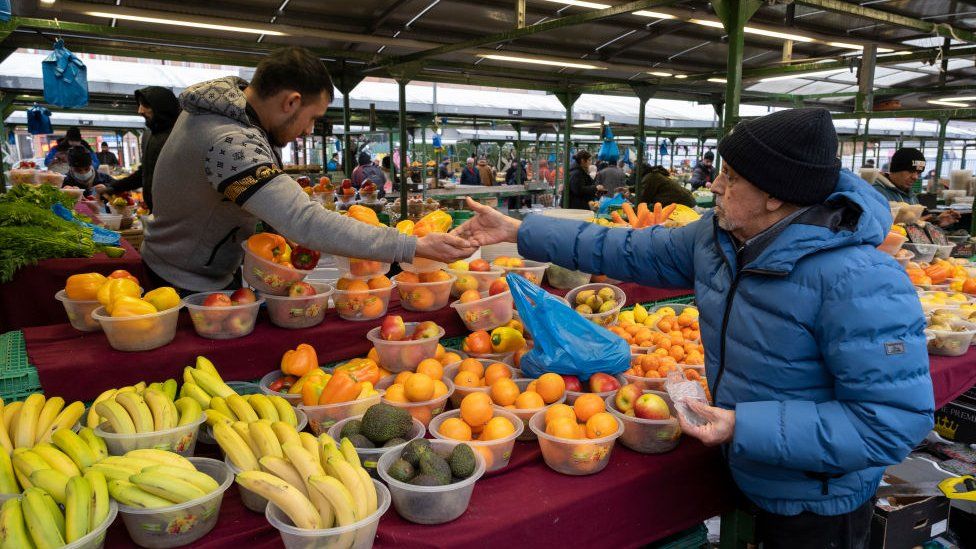
    Stallholder serving his customers as they go shopping for fruit and vegetables at Birmingham Open MarketIMAGE SOURCE, GETTY IMAGES
    Image caption, Food prices are soaring around the world because of the pandemic and the war in Ukraine

    This is largely because of the twin shocks of the coronavirus pandemic and the war in Ukraine. Between them, Russia and Ukraine are major exporters of crops and hydrocarbons.

    Recession fears

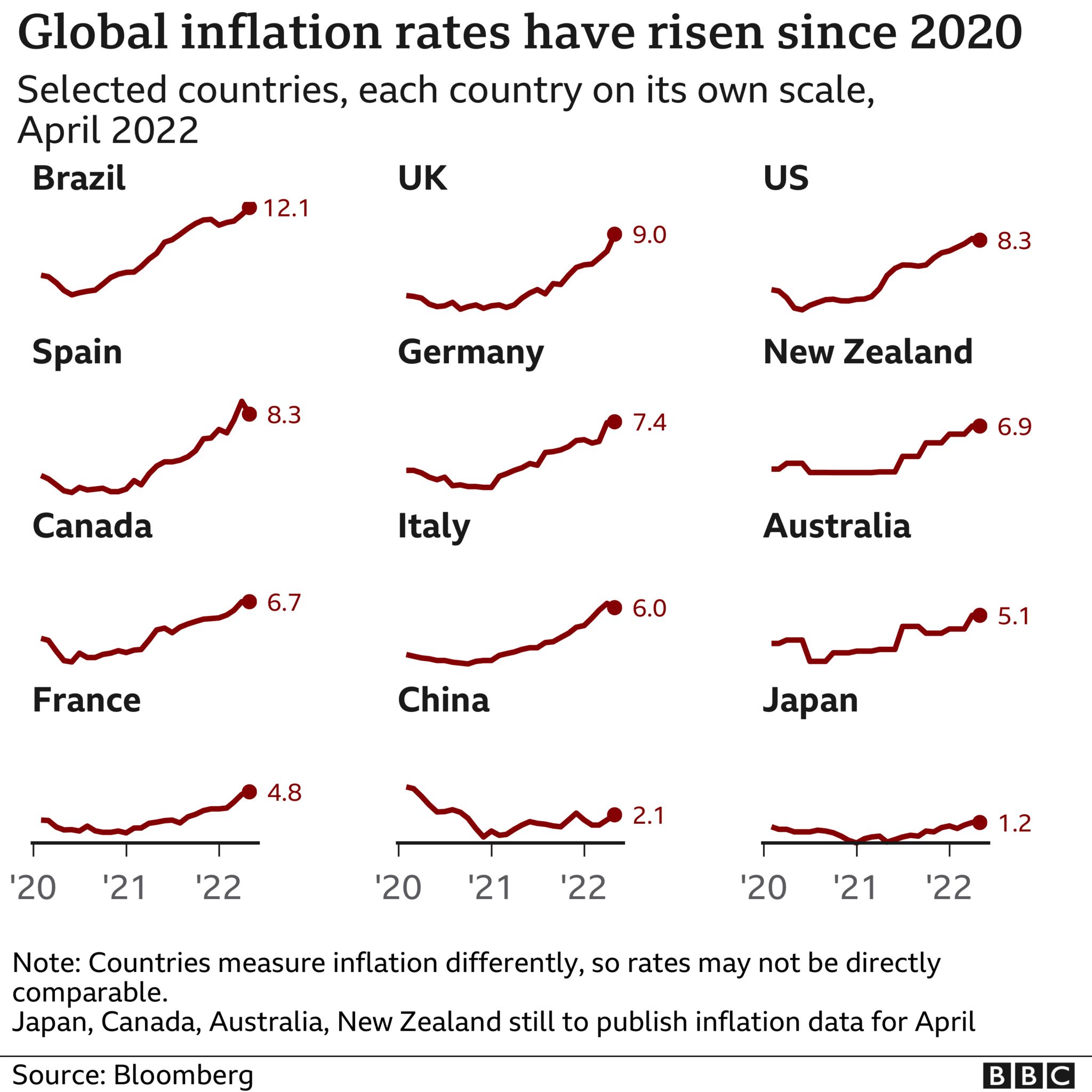
    The importance of these commodities to the global economy has led the annualised inflation rate to reach its highest point in decades in many countries: 9% in the UK, 8.3% in the US and 7.4% in the Eurozone.

    Central banks are lifting interest rates to try and slow the increase in prices, which has led some influential figures such as Goldman Sachs’ Lloyd Blankfein to warn of the risk of recession.

    Ms Georgieva is concerned about the impact those higher borrowing costs will have on governments who have to repay huge debts they took on to get through the pandemic.

    She said governments needed to be “very careful” about how much money they spent and what they spent it on.

    Chart showing inflation of UK and other countriesIMAGE SOURCE, AFP

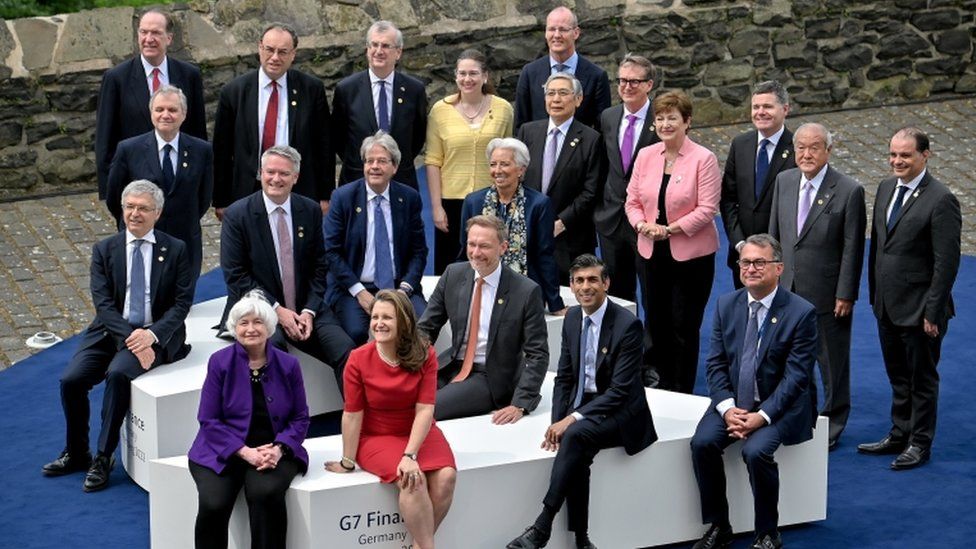
    The problem of falling living standards was at the top of the agenda at this week’s meeting of G7 finance ministers in Germany.

    The meeting of seven wealthy countries ended with a pledge to “continue to work together to minimise the impact of the war globally as well as on our own economies and population by providing well-targeted support, where necessary”.

    Over the last few months, governments have made a range of interventions to try and lower the cost of living.

    In the US President Biden has released oil from reserves to try and bring prices down, Spain and Portugal have capped gas bills and it’s a leading issue in Australia’s election.

    In the UK Chancellor Rishi Sunak has made some tax changes and is considering a windfall tax on the soaring profits of energy companies.

    G7 finance ministers meeting in BonnIMAGE SOURCE, EPA
    Image caption, Finance Ministers from the G7 group of advanced economies are facing similar challenges

    Ms Georgieva is concerned that without the correct government support the protests seen in Sri Lanka could be repeated in other countries.

    Sri Lanka’s economic crisis, exacerbated by rising prices, has led to deadly riots, a new prime minister and a first ever default on its debts.

    The IMF boss said such similar unrest before the pandemic, from France to Chile, was caused by “a sense of inequality growing” and decisions being made without the support of the people.

    “If we are to learn any lessons from 2019 it is to be much more humble about policy decisions, and engage in multiple ways with people, because policies must be for people, not the paper we write them on,” she said.

    Feeding the world

    A group of international development bodies including the IMF and World Bank this week launched a major plan to try and tackle food insecurity around the world.

    It was spearheaded by US Treasury Secretary Janet Yellen, who said it was necessary because: “There’s a very real risk that soaring global market prices of food and fertiliser will result in more people going hungry.”

    Ms Georgieva said that while there is plenty of food, it is not evenly distributed.

    The solutions, she said, are growing more crops where possible but also a greater focus on agricultural productivity, “not only because of the war, but because of climate change”.

    She added: “Trade needs to be retained open, we should not have a situation in which countries hold on to food more than they need and create all kinds of barriers for moving it from one place to another.”

    India is the world’s second-biggest wheat producer but has banned exports, just as other countries were looking for it to make up some of the shortfall from Ukraine’s inability to ship its produce. Narendra Modi’s government says that ban could be revised at some point.

    “I would really beg them to reconsider, that is such a difficult moment for the world,” Ms Georgieva said.

    “I understand they need to feed their people. They have 1.4 billion of them, but let’s all act in a collaborative manner because only if you do [that, do] we have a chance to overcome this crisis.”

    Source: BBC


  • E-Levy not an option, consider best IMF programme to rescue Ghana Apaak to government

    The Member of Parliament for Builsa South, Dr Clement Apaak, has said government is better off debating which IMF programme will rescue the nation and give policy credibility rather than thinking about reintroducing the E-levy in any form, which according to him, is not an option.

    According to Dr Apaak, the Minority will support the government if it decides to seek help from the IMF but will continually oppose the E-levy.

    In a Facebook post, he reminded President Akufo-Addo that he would have the embarrassing record of not presenting the State of the Nation Address (SONA) in February as has been the trend with all past Ghanaian leaders.

    His post read: “Government Crisis Retreat – What is there to debate? KILLER E-LEVY is not an option. They are better off spending their retreat time at Peduase debating amongst themselves the best IMF programme that will rescue the nation and give policy credibility.

    “With seeking the support of the IMF, they have the mandate, with KILLER E-LEVY, they don’t. Let no one deceive them at Peduase, it is still 137 No votes against E-levy any day it comes to the floor of Parliament resurrected, revived or resuscitated.

    “While at their retreat, they should not forget that SONA, a constitutional obligation, is yet to be fulfilled. In fact, from 2017 to 2021 NADAA presented SONA in the month of February as did his predecessors. It is clear that NADAA will have the embarrassing record of NOT presenting SONA in February in the history of the 4th Republic.”

    Meanwhile, Information Minister Kojo Oppong Nkrumah has announced that Cabinet has concluded its deliberations on ways to revive the economy and President Nana Akufo-Addo has taken some decisions aimed at mitigating the impact of the global economic difficulties on Ghana.

    To this end, he said: “Finance Minister Ken Ofori-Atta will provide details of these measures later this week after consultations with key social and economic stakeholders”. 

    “In addition to the scheduled appraisal of the performance of government programmes, Cabinet also extensively discussed the impact of global economic difficulties on Ghana and the Ghanaian people”, a statement from Mr Nkrumah noted.

    It added that President Nana Akufo-Addo approved “far-reaching” measures aimed at “mitigating the depreciation of the cedi, ensuring expenditure discipline and providing relief in the face of global fuel price hikes and inflation; as well as ensuring that priority programmes meant to grow the economy are protected”.

    The statement said the “government appreciates the efforts of all who contributed to a successful retreat and looks forward to the support of all Ghanaians in implementing the agreed measures.”

    Source: classfmonline.com

  • We won’t go to IMF for ‘small small boys’ to dictate to us on how to manage our economy – Baafi

    Falling on the International Monetary Fund (IMF) for a bailout means that we cannot manage our own economy and that they should come to our rescue, Michael Okyere Baafi, Member of Parliament for New Juaben South has asserted.

    Making a case for Ghanaians and the Minority in Parliament to accept the Electronic Transaction Levy Policy, the lawmaker said it would be a bad step for the Ghana government to go to the IMF for a bailout to improve the wobbling economy. 

    In a chat with some media personnel in Koforidua, Michael Okyere Baafi indicated that even when Ghana falls on the IMF, the Breton Wood institution would not even bring experts to meet the Ghanaian contingent but will rather make “small boys” to meet Ghana’s high-level economists.

    “Immediately you say you are going for a bailout, immediately you take that decision, do you know the people they are going to bring? They won’t bring their experts. 

    “Deputy Finance Minister was telling me some time ago, he said all the IMF meetings they have had – high-level meetings – small small boys will come and take decisions. Small small boys will come and tell you hey Ghana do this.

    “When they come and you tell them that you cannot manage your economy well so they should come and give you a bailout, they will say, ‘okay we can give you first tranche 1b dollars to stabilise your economy. But the 1b we are giving you there are a lot of things that you don’t need in this country that you are doing unnecessarily.

    “So they will tell you that the first thing that you have to do is to cut your coat according to your size,” he expressed.

    The New Juaben MP reiterated that one of the key conditions the IMF “small boys” would direct would be for the government to cancel the Free Senior High School which is only a political decision and not an entrenched constitutional policy.

    He added that the IMF conditionality would also compel the government to cancel the Nation Builders Corps (NABCO) and as well downsizing employment in all the public sectors.

    “Why should we go to IMF, take loans, and suffer this much?” he asked.

    Michael Okyere Baafi, therefore, urged Ghanaians to see the E-Levy Policy as a homegrown policy that will make Ghana manage its own affairs without falling on foreign aid which comes with uncomfortable conditionality.
    Source: www.ghanaweb.com

  • Mahama never managed Ghanas economy, IMF did Kusi Boafo

    The Chief Executive Officer (CEO) of Public Sector Reforms, Mr. Thomas Kusi- Boafo, has said Ghanaians could not trust former President John Dramani Mahama for any better economic management as people are suggesting.

    According to him, the former president never managed the country’s economy, even when he was president.

    Speaking to Agya Wusu on Hot 93.9FM’s political talk show ‘Dwene Ho Bio’, Mr Kusi-Boafo revealed that the IMF managed our economy during John Dramani Manama’s reign.

    He noted that those calling for the intervention of the IMF on Ghana’s economy are proposing nothing but stiffer measures to freeze employment and other social intervention put in place by the current administration.

    He explained that if the former president had a solution to today’s economic problems, he would have solved it under his leadership.

    Mr Kusi-Boafo then called on Ghanaians to accept the introduction of the E-levy bill to help generate revenue for the government to embark on the construction of roads, create more jobs and ease us from our huge debts as a nation.

    Source: hotfmghana.com

  • Coronavirus: Avoid tariff and nontariff barriers to trade IMF

    The External Sector Report of the International Monetary Fund (IMF) has said policy efforts in the near term should continue to focus on providing lifelines and promoting economic recovery.

    The report said countries with flexible exchange rates would benefit from continuing to allow them to adjust in response to external conditions, where feasible.

    “Foreign exchange intervention, where needed and where reserves are adequate, could help alleviate disorderly market conditions. For economies facing disruptive balance of payments pressures and without access to private external financing, official financing and swap lines can help provide economic relief and preserve critical health care spending,” it stated.

    It added: “Tariff and nontariff barriers to trade should be avoided, especially on medical equipment and supplies, and recent new restrictions on trade rolled back. Using tariffs to target bilateral trade balances is costly for trade and growth, and tends to trigger offsetting currency movements.

    “Tariffs are also generally ineffective for reducing excess external imbalances and currency misalignments, which requires addressing underlying macroeconomic and structural distortions. Modernizing the multilateral rules-based trading system and strengthening rules on subsidies and technology transfer is warranted, including by expanding the rule book on services and e-commerce and ensuring a well-functioning WTO dispute settlement system.

    “Over the medium term, reducing excess imbalances in the global economy will require joint efforts on the part of both excess surplus and excess deficit countries. Economic and policy distortions that predated the COVID-19 crisis might persist or worsen, suggesting the need for reforms tailored to country-specific circumstances.

    “In economies where excess current account deficits before the crisis reflected larger-than-desirable fiscal deficits (as in the United States) and where such imbalances persist, fiscal consolidation over the medium term would promote debt sustainability, reduce the excess current account gap, and facilitate raising international reserves where needed (as in Argentina). Countries with export competitiveness challenges would benefit from productivity-raising reforms.

    “In economies where excess current account surpluses that existed before the crisis persist, prioritizing reforms that encourage investment and discourage excessive private saving are warranted.

    “In economies with remaining fiscal space, a growth-oriented fiscal policy would strengthen economic resilience and narrow the excess current account surplus. In some cases, reforms to discourage excessive precautionary saving may also be warranted (as in Thailand and Malaysia) including by expanding the social safety net.”

    Source: Laud Business

  • IMF data is the true state of our economy – Professor Gatsi

    The data published by the IMF on the macro-fiscal situation of Ghana is the true state of the Ghanaian economy, Business School Lecturer, Professor John Gatsi has said.

    According to him, whiles Ghanaians know the fiscal deficit to Gross Domestic Product in 2019 to be 4.5%, the Fund knows the true state of the budget deficit in 2019 as 7.5%.

    “The clarification by the IMF will generate further political debate about the economy. The data published by the IMF shows the true state of the economy.

    “The whole issue about misreporting is not about misreporting of economic data to IMF but to the people of Ghana through the budget. We believe the data published by the IMF to be true. So, what is the IMF explaining to us?”, he questioned.

    Below is the article by Professor John Gatsi, Business School Lecturer and Head of Finance at the University of Cape Coast;

    IMF clarification on macro-fiscal data does not change the true state of the Ghanaian economy – Prof. John Gatsi

    The clarification by the IMF will generate further political debate about the economy. The data published by the IMF shows the true state of the economy.

    The whole issue about misreporting is not about the misreporting of economic data to the IMF but to the people of Ghana through the budget. We believe the data published by the IMF to be true. So what is the IMF explaining to us?

    The people of Ghana know the deficit in 2019 to be 4.5% but the IMF knows the true state of the deficit in 2019 was 7.5%.

    We believe the correct data was presented to IMF and what is now known as misreporting is to Parliament via the budget.

    The explanation by IMF is strange and may be tagged as involved in domestic politics. We are guided by our Constitution and financial management principles, objectives and strategy enshrined in the public financial management act,2016 (Act 921) in which the Finance Minister is the main executive member with financial management responsibility.

    It is, therefore, the Finance Minister who should face the country to explain the data agreed upon with the IMF. It is unnecessary for the IMF to attempt to do what the Finance Minister should be doing.

    Now to the substantive issues. Take for example that Ghana raised $2bn in a year but spent $3bn and decided to divide the extra $1bn into $600M and $400M and stated in its financial statement that over expenditure was $600M but disclosed in the notes to the financial statements that the country overspent another $400M which was also approved by Parliament.

    Now how much is the over-expenditure that parliament approved on behalf of the people? The answer is $1bn.

    Now why did IMF accept the figures presented by government in its dataset? Answer is that it is the true picture about the Ghanaian economy therefore the true picture of the deficit, reserves, debt to GDP ratio and primary balance as well as GDP growth presented by IMF from the data supplied by government remain the true state of the Ghanaian economy.

    Ask any of the IMF team, a member of the minority or member of government that if they are taken as consultants to look at the macro-fiscal data in the budget and that of IMF data for a client to provide the macro-fiscal situation of Ghana to take/make critical and informed decisions will they look at the true state as presented by IMF or not?.

    Accountants will tell you the purpose of the notes to an account gives extra critical information that you must use without which your assessment of the account is meaningless and incomplete.

    The separation or no separation of financial sector and energy costs does not take away the fact that the true state of the economy is what the IMF data presented and the granting of the $1bn Rapid Credit Facility was based on the true state of the macro-fiscal situation that is why the IMF attached it to the disbursement letter to Ghana.

    Source: Class FM

  • Reports we shared different macroeconomic data with IMF are false – Finance Ministry

    The Ministry of Finance has said widespread reports that it shared different figures with the International Monetary Fund (IMF) and to Parliament in the process of contracting the US$1 billion rapid loan facility are false and misleading.

    In a statement issued by the official website of the ministry, www.mofep.gov.gh said, “Our attention has been drawn to a publication by fact-checkghana.com of the Media Foundation for West Africa suggesting that the government has shared different macroeconomic data with Ghanaians and the International Monetary Fund (IMF). We wish to state that this assertion is false and misleading,” the Ministry noted.

    “The first inaccuracy in the said publication was taking the January to September figures, that is the third quarter figures reported in our budget statements and comparing them with the full-year figures reported by the IMF,” the statement explained.

    Prior to this, some fact-checking organizations and civil society organizations indicated there were some disparities in the figures of Gross Domestic Product (GDP) Deficit, Primary Balance, Current Account Balance, and Gross International Reserves figures earlier presented by the Finance Minister, Ken Ofori-Atta to Parliament.


    Press-Release 20200510 Fact… by The Independent Ghana on Scribd

  • Government did not share different data with the IMF MoF

    The Ministry of Finance has described as false and misleading, report by the fact-checkghana.com of the Media Foundation for West Africa (MFWA) suggesting that Government has shared different macroeconomic data with Ghanaians and the International Monetary Fund (IMF).

    Factcheck-ghana.com has said it crosschecked the data submitted to the IMF by Ghanaian authorities and what has been previously shared with Ghanaians and published by the Ministry of Finance.

    “Based on the figures, we conclude that indeed, the data presented by the government to the IMF are different from those in budget statements.
    “The fact-checking team found disparities between the data published in the statement of the IMF and data from the Budget Statements of 2019 and 2020 that the Minister of Finance, Ken Ofori Atta, presented to Parliament. ”

    But the Finance Ministry urged the public to reject this claim.

    A statement from the Ministry on Sunday, May 10 said: “Our attention has been drawn to a publication by fact-checkghana.com of the Media Foundation for West Africa suggesting that Government has shared different macroeconomic data with Ghanaians and the International Monetary Fund (IMF). We wish to state that this assertion is false and misleading.

    “May we state that the Ministry of Finance welcomes discussions of the economic information we provide. Such discussions help us in managing the economy. We also operate an open-door policy.

    “We urge the public to seek clarification on matters they may have difficulty with and we would be happy to help resolve any misunderstanding. Publishing such wrong claims about the economy is not helpful.”

    Source: laudbusiness.com

  • You need to go through reports to understand economic figures – IMF Country Rep

    The Country Representative of the International Monetary Fund (IMF) to Ghana Dr. Albert Touna Mama has said that economic figures are generated from reports and that one needs to read full reports to understand different economic figures which have been presented.

    Speaking on Joy FM’s news analysis programme News File on Saturday to clarify allegations of falsification of figures to the IMF by the government, the IMF representative rejected the allegation, saying the government did not misreport figures to the IMF, but rather, the IMF generated its figures from data (report) the government presented to it.

    According to Fact Check Ghana and the opposition NDC, the government of Ghana had in its budgets to Parliament for 2018 and 2019 presented fiscal deficits of 3.0% and 4.4% of GDP but changed the figures to 7.0% and 7.5% of GDP to the IMF for 2018 and 2019 respectively.

    For Gross International Reserve, Fact Check Ghana and the NDC also alleged that government quoted 6,800 and 8,100 for 2018 and 2019 in its budget to Parliament but changed the figures to 5,317 and 6,634 for the same period respectively to the IMF.

    But the IMF Country representative noted that figures they published in their statements for fiscal deficit and gross international reserve were figures they generated themselves from reports they received from the government, which contained discussions and explanations on both sets of figures.

    He also expressed the belief that the budget statements presented to Ghanaians by the government similarly discusses and offers explanations on figures.

    “These statements (IMF’s figures) are at the back of a report,” said the IMF Country Rep.

    “When you go through these reports, all these discrepancies are discussed and I believe that the budget statements also goes into these discrepancies.”

    “So you cannot go through these reports and at the end of the report compare apple and peers. You need to go through the reports and understand what are the figures that have been presented.”

    While the IMF calculated its fiscal deficit without financial sector payments and energy sector payments, the government did so with the two payments. Similarly, the IMF calculated the gross international reserve without the heritage and stabilization fund, while the government’s method of calculating added the two.

    But Dr. Albert Touna Mama said nothing was hidden by the government and that it is aware of the reason for the government’s methodology as captured in the report they received and the budget statements.

    “When it comes to the data we received that we worked with, in this debate, there is nothing new that we did not know about.”

    Asked whether it is the IMF’s preference that the government must include financial sector payments and energy sector payments when preparing financial reports, the IMF country director said the IMF doesn’t necessarily need to have a preference.

    “We don’t need to have a preference,” he said.

    The IMF rep added that it is not necessarily wrong for the government not to include certain elements in determining certain indicators in some instances.

    He cited an example of an agreement the IMF had with the government to set aside financial sector payments in determining fiscal deficit at some point under the Ghana-IMF program, which ended in 2019, because the financial sector payment was not anticipated during the original design of the programme.

    “For example during the program that expired in April 2019, when the issue of the financial sector came up, because initially in the design of the program, this is something that was not anticipated, and the program aimed to achieve some fiscal target, a decision was made that the financial sector really needed to be taken care of.”

    “And if you really want a true picture of the fiscal effort that the government is making, we need to strip out financial sector cost. Because this is a necessary action so that you can generate economic quotes in the future so we agreed on that.”

    “On the financial sector payment, we agreed to put them aside and just measure the fiscal effort without financial sector cost.”


    Source: www.ghanaweb.com


  • IMF: Previous warnings of global economic contraction too optimistic

    The Head of the International Monetary Fund said Friday that previous estimates for the world economy to contract by three percent this year were too optimistic.

    IMF Managing Director Kristalina Georgieva, during a video-linked conference in Florence, said that worsening indicators in some countries could weigh even further on this forecast.

    “Incoming economic data for many countries is below our already pessimistic assessment for 2020,” Georgieva said. “And with no immediate medical solutions, more adverse scenarios might unfortunately materialise for some economies”.

    In April, the IMF warned that the world economy would experience the worst downturn since the Great Depression.

    Provided the pandemic were to lessen in intensity in the second half of 2020, however, global growth would rebound by 5.8% in 2021, representing a partial recovery, the IMF said last month.

    “The unknown behaviour of the virus is clouding the horizon for projections,” Georgieva said on Friday.

    “Assuming that we will have treatments and vaccines by early 2021 at the latest, then we can expect a recovery,” she said, cautioning that testing and tracing would have to be on a much larger scale than current efforts.

    The coronavirus pandemic has killed more than 270 000 people worldwide, nearly 85 percent of them in Europe and the United States, since it appeared in China in December, according to AFP tracking.

    Source: AFP

  • FLASHBACK: Ghana seeks $1 billion IMF support

    In early 2009, Ghana turned to the IMF for a $1 billion loan to help stabilize the economy.

    IMF advisors, working with the Ghanaian government, to prop up its foreign exchange reserves.

    Ghana discussed programme options, which are essentially the standby arrangement, or Poverty Reduction and Growth Facility (PRGF).

    The West African country was grappling with a swelling budget deficit and trade imbalances after the cost of imports surged to record highs last year.

    Read the full story originally published on May 7, 2009

    Ghana is in talks with the International Monetary Fund (IMF) to secure a total of at least one billion dollars of support to prop up its foreign exchange reserves, the Ministry of Finance said on Thursday.

    The negotiations, which dominated meetings between the Ghanaian delegation and the IMF officials at this year’s spring meetings in Washington, would continue in Accra next week. “We discussed programme options, which are essentially the standby arrangement, or Poverty Reduction and Growth Facility (PRGF),” the Ministry said in a written statement signed by spokeswoman Cecilia Kwetey to the Ghana News Agency in Accra. Ghana is currently grappling with a swelling budget deficit and trade imbalances after the cost of imports surged to record highs last year.

    The statement said the PRGF had an advantage of concessional funding, at a fixed 0.5 percent interest rate payable over 10 years, as opposed to a market-based interest rate on the stand-by which also has a shorter repayment period of less than five years. In addition, Ghana expects to receive 420 million dollars in the third quarter of this year as part of IMF’s new post-G20 summit commitment to increase its allocations of Special Drawing Rights (SDRs) to member countries, the Ministry said. The SDR is an international reserves asset, created by the Fund to supplement the existing official reserves of its members. The fund also agreed to support Ghana’s balance of payments gap, the Ministry added.

    “Preliminary indications are that the Fund’s support could be in the order of around 600 million dollars over a two-three-year period, which together with the additional special drawing rights allocation, would boost Ghana’s gross foreign exchange reserves by around 1 billion dollars,” it predicted.

    Ghana is also suffering from the impact of lower remittances sent home by workers abroad as the global economic crisis bites. Ghanaians living abroad send home about $3 billion each year, almost a fifth of the gross domestic product. In a speech in London as part of a three-day visit to Britain, President Evans Atta Mills said the economy he inherited was not as robust as it was said to be, but added that Government was not interested in blame game. He reassured that his administration was prepared to take the challenges to turn the economy around. While welcoming assistance from development partners for the growth of the economy, President Mills stressed that Ghana could not forever rely on donor hand-outs. “The time has come to look for home-grown solutions,” he said, adding, “our team is capable of putting the economy on a strong foundation”. President Mills assured investors of a sound investment climate that hinged solidly on open, transparent, honest and accountable governance. Ghana’s budget deficit currently stands at a provisional 14.9 percent of Gross Domestic Product in 2008 — a gap the new government plans to narrow to 9.4 percent of GDP by the end of 2009. President Mills had earlier debunked allegations that Government was spending lavishly on visit which was at the instance of Britain. 7 May 09

    Source: www.ghanaweb.com

  • Lift trade restrictions on medical supplies and food IMF, WTO to governments

    The International Monetary Fund (IMF) Managing Director Kristalina Georgieva and Director-General of the World Trade Organisation (WTO), Roberto Azevêdo, have on Friday April 24 issued a joint call for governments to refrain from imposing export and other trade restrictions on key medical supplies and food and to quickly lift those put in place since the start of the year.

    In response to the COVID-19 pandemic, some governments have adopted measures to facilitate imports of medical products, such as cutting import duties, curbing customs-clearance processes, and streamlining licensing and approval requirements, the two agency heads noted.

    Similar attention should be paid to facilitating exports of key items such as drugs, protective gear and ventilators, they added.

    While global trade rules allow for temporary export restrictions to prevent or relieve critical shortages, “we urge governments to exercise caution when implementing such measures in the present circumstances”.

    “What makes sense in an isolated emergency can be severely damaging in a global crisis,” they warned. “Such measures disrupt supply chains, depress production, and misdirect scarce, critical products and workers away from where they are most needed.”

    “The result is to prolong and exacerbate the health and economic crisis — with the most serious effects likely on the poorer and more vulnerable countries.”

    Ms Georgieva and DG Azevêdo also expressed concern with the decline in the supply of trade finance, which ensures that imports of food and essential medical equipment reach the economies where they are most needed. In addition, despite strong supply, export curbs on some food items are beginning to appear.

    “The experience in the global financial crisis showed that food export restrictions multiply rapidly across countries and lead to ever greater uncertainties and price increases,” they noted.

    Source: laudbusiness.com

  • IMF’s Georgieva says coronavirus crisis is worst since Great Depression

    The crisis sparked by the spread of the novel coronavirus is the worst since the Great Depression, IMF Managing Director Kristalina Georgieva said on Monday.

    The fallout from the virus will mean that 170 countries will have negative economic growth this year, she told a videoconference press briefing for the Bulgarian media.

    Source: reuters.com

  • Coronavirus: IMF says half the world has asked for a bailout

    Half of the world’s countries have approached the International Monetary Fund for emergency loans to weather the financial crisis sparked by the global coronavirus pandemic.

    More than 100 countries so far have asked for emergency assistance, Kristalina Georgieva, IMF’s managing director, told a meeting of G20 finance ministers and central bank governors on Wednesday.

    She said the IMF is ready to use its “full toolbox and $1 trillion firepower” of lending capacity, noting that 10 countries have so far received emergency funding, and half of the remaining countries should receive their requested financial lifelines by the end of April.

    Georgieva’s comments come after the fund issued a stark warning that the global economy is on track for the deepest downturn since the 1930s and governments and health officials must work together to prevent an even worse outcome.

    The IMF head said “everything is on the table in terms of measures we can take,” and encouraged central banks to “spend as much as you can.”

    “But keep the receipts,” she added. “We don’t want accountability and transparency to take a back seat in this crisis.”

    In an interview with CNBC, the IMF chief acknowledged that the fund has a reputation for imposing tough conditions on countries seeking bailouts.

    But this time, “we are asking for one thing only: Please pay your doctors and nurses, make sure that your health systems are functioning, and that your vulnerable people and first [responders] are protected,” Georgieva told the network.

    The IMF said on Tuesday that it expects global GDP will contract by 3% in 2020, a far worse recession than the one that followed the global financial crisis of 2008, a

    nd a 180-degree reversal of its previous forecast in January when it was expecting growth of 3.3% this year.

    The fund said there is a risk of the recession extending into 2021 if policymakers fail to coordinate a global response to the virus.

    Source: cnn.com

  • Central Banks build $8trn war chest against coronavirus

    Central Banks across the globe have built an $8 trillion war chest against the Coronavirus pandemic.

    International Monetary Fund (IMF) Managing Director Kristalina Georgieva disclosed this, today, during the G20 Finance Ministers and Central Bank Governors meeting. At the on-going virtual Spring Meetings.

    “Thank you to the Saudi Presidency for steering the G20 in this unprecedented crisis, and to all of you for the remarkable efforts to protect people and the economy.”

    “8 trillion dollars of fiscal measures and ample liquidity by central banks have helped build a bridge to recovery for companies and households,” she.said.

    And you stepped up with an initiative on a time-bound suspension of debt service payments for the poorest countries. I wholeheartedly welcome this timely action. Ms. Georgieva said that the IMF has quickly responded to the call by the G20 to up its financial assistance to countries hit by the pa demic.

    According to her, “You called on the Fund to ramp up our crisis response for emerging markets and developing countries. And we acted on this call.”

    “We doubled annual access limits for emergency financing. Over 100 countries have already approached us and by the end of this month, half of the requests will have been approved by our Board. Ten countries have already received emergency assistance.”

    “This Monday our Board granted immediate relief for debt service to the IMF to 25 countries. We thank members who have made generous pledges to this effort and call on others to contribute.”

    The IMF boss said that her team.and world leaders were discussing a new short-term liquidity line for countries with strong policies. She said, “We will need to step up even more.

    As you know, we project a deep recession in 2020 and only a partial recovery in 2021.

    “To help countries steer through the depth of the recession and support their recovery, we are prepared to use our full toolbox and $1 trillion firepower, mindful of the need to use programs wisely and strengthen good governance.”

    “Second, to assist our low-income countries, we plan to triple our concessional lending. We are therefore urgently seeking US$18 billion in new loan resources for the Poverty Reduction and Growth Trust, and will also likely need at least US$1.8 billion in subsidy resources.”

    “We will also explore whether the use of SDRs could be helpful in this context.”

    “Third, we will concentrate both lending and policy support to reduce the scarring of the economy caused by bankruptcies and unemployment, in order to support a speedy recovery. And, with many economies continuing to face capital outflows and high debt, we are ready to work closely with other international institutions and fora, as well as private stakeholders, to help our members steer through this crisis and come out of it more resilient.”

    Source: vanguardngr.com

  • Coronavirus: Banks’ resilience to be tested in some countries IMF

    The International Monetary Fund says the resilience of banks may be tested in some countries in the face of a sharp slowdown in economic activity that may turn out to be more severe and lengthy than currently anticipated.

    This development, it said, may lead to larger-than-anticipated losses.

    In its Global Financial Stability Report released on Wednesday, 15 April, 2020, the IMF said a prolonged period of dislocation in financial markets may result in distress among other financial institutions, including asset managers, to an extent that could lead to a credit crunch for nonfinancial borrowers.

    Financial vulnerabilities had been elevated in some systemically important economies before the outbreak of COVID-19 and they may become exposed should financial conditions continue to tighten, it added.

    “Countries where banks have high nonperforming loans, significant exposures to state owned enterprises, and large holdings of government bonds are vulnerable to an intensification of the sovereign-financial sector feedback loop.

    “For example, in India, where nonbank financial institutions had already been under intense funding pressure, following two defaults before the COVID-19 shock, state-owned banks have a sizable stock of bad loans and significant links to nonbank financial institutions.

    Other countries, notably African economies, may be vulnerable to disruptions in trade financing if cross-border funding and correspondent banking relations become affected.”

    It however commended Central banks globally for taking bold and decisive actions by easing monetary policy, purchasing a range of assets, and providing liquidity to the financial system in an effort to lean against the tightening in financial conditions and maintain the flow of credit to the economy.

    As policy rates are now near or below zero in many major advanced economies, unconventional measures and forward guidance about the expected policy path are becoming the main tools for these central banks going forward, it emphasised.

    It explained further that central banks may also consider further measures to support the economy during these challenging times, whereas policymakers need to maintain a balance between safeguarding financial stability and supporting economic activity.

    Source: classfmonline.com

  • $1billion cash: Were not back to an IMF program – Gabby Otchere-Darko

    An influential member of the governing New Patriotic Party (NPP) Gabby Asare Otchere-Darko has explained even though the government of Ghana has secured a facility of $1 billion from the International Monetary Fund (IMF) to support its fight against the novel coronavirus pandemic, it does not mean the country is back in an IMF programme.

    Following the announcement that the IMF had successfully approved a credit facility of $1 billion to help Ghana confront the virus, many called out the governing NPP for demonizing the erstwhile National Democratic Congress (NDC) for borrowing from the IMF while the NDC was in power.

    But in a sharp rebuttal, Mr Asare explained that the money made available by the IMF to help countries fight the virus is not similar to the Extended Credit Facility program that the NDC government entered into with the IMF in 2015.

    Instead, he praised the current administration for being able to double the amount the IMF had made available to the country by making a strong case.

    “Ghana pushed for $1bn IMF support to fight Covid-19. Yes, IMF has approved $1bn for Ghana. No, this does not mean we are back in an IMF program. The Fund says it has a $1 trillion war chest to fight Covid-19. Ghana made a strong case for double what IMF had on the table for us,” he wrote.

    Ghana is among developing countries that have had to turn to the IMF for support to fight the pandemic due to resource constraints.


    Source: mynewsgh.com

  • IMF predicts negative global growth in 2020

    The International Monetary Fund (IMF) says the outlook for global growth for 2020 is negative at least a recession as bad as during the global financial crisis or worse.

    It, however, expects a recovery in 2021, adding: “To get there, it is paramount to prioritise containment and strengthen health systems—everywhere. The economic impact is and will be severe, but the faster the virus stops, the quicker and stronger the recovery will be.”

    This follows a statement on Monday after a conference call of G20 Finance Ministers and Central Bank Governors.

    Managing Director of IMF, Kristalina Georgieva said: “The human costs of the Coronavirus pandemic are already immeasurable and all countries need to work together to protect people and limit the economic damage.

    She pointed out that: “We strongly support the extraordinary fiscal actions many countries have already taken to boost health systems and protect affected workers and firms. We welcome the moves of major central banks to ease monetary policy. These bold efforts are not only in the interest of each country but of the global economy as a whole. Even more will be needed, especially on the fiscal front”.

    Continuing, she said “advanced economies are generally in a better position to respond to the crisis, but many emerging markets and low-income countries face significant challenges.”

    On the way forward, Mrs Georgieva said the IMF is concentrating bilateral and multilateral surveillance on this crisis and policy actions to temper its impact.

    Additionally, the Fund will massively step up emergency finance, adding “nearly 80 countries are requesting our help—and we are working closely with the other international financial institutions to provide a strong coordinated response.”

    “These are extraordinary circumstances. Many countries are already taking unprecedented measures. We at the IMF, working with all our member countries, will do the same. Let us stand together through this emergency to support all people across the world.”

    Source: classfmonline.com

  • Venezuela asks IMF for $5 billion to tackle coronavirus

    President Nicolas Maduro’s government has requested $5 billion from the International Monetary Fund (IMF) to deal with the coronavirus pandemic in Venezuela, where 33 cases have been reported so far.

    “We come up to your honorable organism to request your assessment, regarding the possibility of granting Venezuela a financing facility for $5 billion from the Emergency Fund of the Rapid Financing Instrument (IFR), resources that will contribute significantly to strengthen our detection and response system ” reads the letter signed by Maduro.

    Venezuelan Foreign Affairs Minister Jorge Arreaza published the letter on his Twitter account on March 17.

    “President Nicolas Maduro has formally requested financing for $5 million to the International Monetary Fund to strengthen the response capacity of our health system during the Covid-19 contingency. Another timely action to protect the people,” Arreaza wrote.

    It is the first time Venezuela turns to the International Monetary Fund in almost 20 years. In 2007, Former President Hugo Chavez announced the country was withdrawing from the IMF because he believed it served U.S. interests, but the decision to withdraw was not materialized.

    In January last year, the IMF suspended activity with Venezuela because of the political crisis in which it is immersed.

    The letter, dated March 15th, 2020, is addressed to the Managing Director of the IMF, Kristalina Georgieva, and mentions the “hard and unexpected battle the world is facing today against the outbreak of the new coronavirus”.

    “Only under the spirit of solidarity, brotherhood and social discipline we will be able to overcome the situations that come our way, and we will know how to protect the life and well being of our people,” it adds.

    Maduro has placed the country in quarantine to prevent the spread of the coronavirus, and has suspended all work and school activities.

    “I want to announce that starting Tuesday, March 17, Venezuela will enter into social quarantine, the entire country, the 23 states and the capital district, all into social quarantine, into collective quarantine,” Maduro said on Monday. He confirmed 16 new coronavirus cases, reaching a total of 33.

    Source: www.aa.com.tr

  • IMF rejects crisis-hit Venezuela’s request for $5 bn virus aid

    The International Monetary Fund on Tuesday rejected economically devastated Venezuela’s request for a $5 billion loan to help it cope with the onslaught of coronavirus on the country that an aid agency warned is as prepared as war-torn Syria.

    President Nicolas Maduro made the request earlier Tuesday but, in a statement hours later, the Washington-based institution indirectly cited a dispute over Maduro’s leadership in denying his petition.

    In a letter to IMF chief Kristalina Georgieva, Maduro said a $5 billion loan from the IMF’s Rapid Financing Instrument (RFI) “will contribute significantly to strengthening our detection and response systems.”

    It was the country’s first loan request to the IMF since 2001.

    “Unfortunately, the Fund is not in a position to consider this request,” because there is “no clarity” on international recognition of the country’s government, the Washington-based institution said in a statement.

    “As we have mentioned before, IMF engagement with member countries is predicated on official government recognition by the international community, as reflected in the IMF’s membership. There is no clarity on recognition at this time,” the statement said.

    More than 50 countries including the United States have not recognized Maduro for more than a year, after switching allegiance to opposition leader Juan Guaido who declared himself acting president.

    Guaido branded Maduro a usurper over the president’s 2018 re-election in polls widely seen as fraudulent.

    But US sanctions and other international pressures have failed to dislodge Maduro, who is backed by Venezuela’s creditors China and Russia and retains the support of the powerful military.

    Five years of crisis

    The RFI from which Maduro sought the assistance is a mechanism by which all IMF member countries can get financial assistance without the need to have a full-fledged economic program in place.

    Venezuela’s health system is in tatters after five years of economic and political crisis that has sent millions of people fleeing for lack of basic staples.

    “We hardly have five percent of the medicine stocks we need,” Douglas Leon Natera, head of the Venezuelan Medical Federation, told AFP earlier.

    Jan Egeland, general secretary of the Norwegian Refugee Council, placed Venezuela in the same category as war-torn Syria and Yemen in its preparedness.

    Like those countries, “there will be carnage” when the virus reaches parts of Venezuela given that “health systems have collapsed,” warned Egeland.

    The country has 33 reported coronavirus cases, according to John Hopkins’ global tally, and Maduro has ordered a lockdown in the capital Caracas and six other states.

    “At this crucial moment and aware of the high level of contagion of this disease, we will continue to take rapid and vigorous measures” to stop the advance of the pandemic, Maduro wrote in his letter to Georgieva.

    “We are convinced that in permanent coordination with the WHO (World Health Organization) and the support among the countries of the world, we will be able to overcome this difficult situation.”

    The country has banned flights to and from Europe, as well as Colombia, Panama and the Dominican Republic. It has also suspended school and university classes as well as sports events.

    Source: AFP