A social media footage shows a group of guys storming the dentist’s home in the state of Telengana. Others may be seen damaging her family’s property and an automobile.In the southern Indian state of Telengana, a mob of at least 40 men broke into the home of a 24-year-old woman and abducted her.
The woman, a dentist, was abducted from the house in broad daylight Friday. A video making the rounds on social media shows at least 30 men forcibly entering the house, only to drag a man out. They then proceed to beat him with sticks and rods while others vandalized the house and a car.
A video on social media shows dozens of men barging into the dentist’s house in the state of Telengana. Others can be seen vandalizing a car and her family’s property.
A mob of at least 40 men forced their way into the home of a 24-year-old woman and kidnapped her in the southern state of Telengana, India.
The woman, a dentist, was abducted from the house in broad daylight Friday. A video making the rounds on social media shows at least 30 men forcibly entering the house, only to drag a man out. They then proceed to beat him with sticks and rods while others vandalized the house and a car.
#WATCH | Ranga Reddy, Telangana | A 24-yr-old woman was kidnapped from her house in Adibatla y’day. Her parents alleged that around 100 youths barged into their house, forcibly took their daughter Vaishali away & vandalised the house. Police say, case registered & probe underway. pic.twitter.com/s1lKdJzd2B
Vaishali, a resident of the Ranga Reddy district near Hyderabad, was safely rescued after an hourslong operation carried out by the state police, according to a report by New Delhi Television (NDTV).
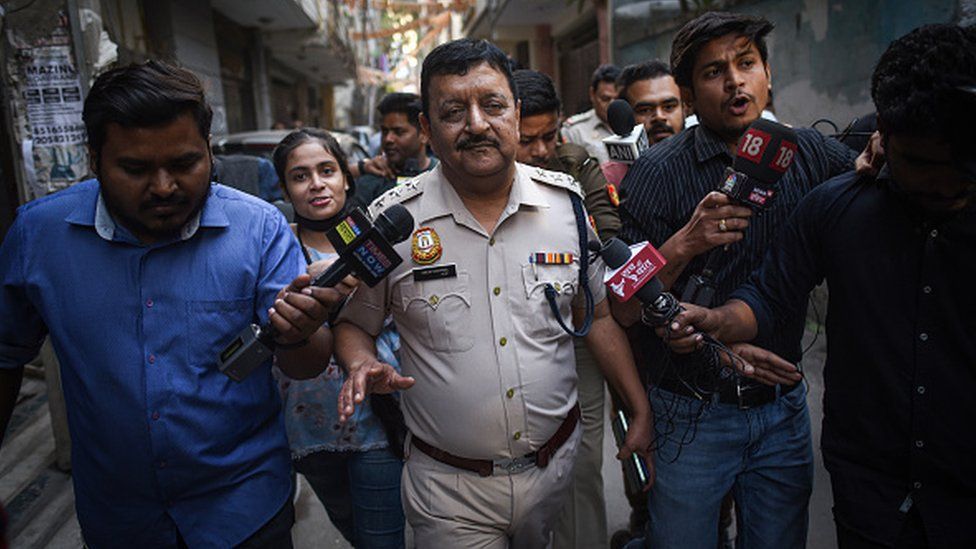
The police have arrested 18 men and registered the case while they continue to look for others involved.
The incident comes on the heels of a gruesome murder case in the Indian capital where a man killed his live-in partner, chopped her up into pieces, and disposed of her corpse in a forest over weeks.
The woman’s parents speak out
The woman’s parents allege that over 100 men entered the house, roughly half of which attacked Vaishali. “About 50 people went to the first floor and forcibly took away the girl,” the mother of the kidnapping victim said, according to the local news agency Press Trust of India.
The family named Naveen Reddy, a man who owns a tea store opposite the victm’s house, as the accused who led the mob into the house. Local police told NDTV that the two had previously met on a badminton court and were in a relationship.
However, the woman rejected his proposal to marry. Reddy then harassed her on social media platforms which led her to file a police complaint alleging stalking. Reddy remains at large.
What does the case mean for India?
Sudheer Babu, an additional commissioner at the Rachokonda Commissionerate, told Asian News International, “We have registered cases under section 307 and other sections of IPC (Indian Penal Code) related to threatening,”
Section 307 refers to attempted murder, a non-bailable crime.
Cases like these highlight the severity of gender-based violence Indian women face on a regular basis.
One in every three Indian women has experienced mental, physical, or sexual violence, according to research in the Journal of Epidemiology and Community Health. Only one in ten of these women report these cases to the police.
The latest round of the National Family Health Survey 5 further revealed that 32 percent of women who have been married between the ages of 18 to 49 have experienced abuse by their spouses.
An Indianman has gained the admiration of millions of devotees after spending eight years carving over 400 stone steps to a hilltop Hindu temple using only a hammer and chisel.
The Baba Yogeshwar Nath temple in Bihar, Eastern India, was famous among devotees of Lord Shiva, but very difficult to reach because of its location at the top of a steep 1,500-foot hill. Able-bodied people spent hours climbing the hill every day, while the elderly, children and disabled people had virtually no way of reaching it without assistance. Trekking up and down the steep, rocky slopes was risky, and people often injured themselves trying to reach the holy temple. So one day, eight years ago, a local mason decided to make every devotee’s life a little easier by carving stone steps from the bottom of the hill all the way up to the temple.
Ganauri Paswan worked as a truck driver for most of his life, before shifting to masonry. He spent most of his time in the city of Jehanabad earning money for his family back home in Jaru Banwariya, a village at the foot of the hill that many people climbed every day to perform pujas at the Baba Yogeshwar Nath temple. After going up the hill himself one day and seeing what devotees had to go through, Paswan decided that something had to be done, and that he was the man to do it.
Eight years ago, Ganauri Paswan grabbed a hammer and chisel and set about the task of carving an easier path up the 1,500-foot-tall hill. Lacking the funds to have stone brought to the hill, the mason decided to work with whatever stones he found on the hill, and even though it took him a while to make any noticeable progress, after eight hard years, he is close to finishing his stone staircase.
“I don’t know where I got all this patience and energy, it has never felt like a task to me,” Paswan said. “I would happily get lost in the mountain, working all day. I just wanted to make it easier for devotees of Baba Bholenath (Lord Shiva) to reach him easily.”
“I did not care if I lived or died,” the mason added. “I just wanted to carve these stone stairs in any way possible.”
Since 2014, when he first started carving his way up this literal mountain of a challenge, Ganauri Paswan carved over 400 stone steps. In the beginning, he only had the support of his family – his wife and two sons – who sometimes accompanied him, but over the years, he earned the respect and appreciation of thousands of devotees who started using his stairway.
For his impressive achievement, Ganauri Paswan has been compared to Dashrath Manjhi, the “Mountain Man” who carved his way through a mountain and became an international legend.
Recent mass layoffs at big US tech firms have plunged into uncertainty several Indians working on non-immigrant visas such as the H1-B. Surbhi Gupta, a product manager at Meta who was among those affected, spoke to California-based journalist Savita Patel about how it took her time to accept it, the uncertainties that H1-B visa holders deal with, and what she plans to do next.
It was my mum’s birthday. I was staying up late to wish her and that’s when I started getting messages from my friends about layoff announcements. They were all anxious.
At around 6am here, I received an email that I’d been let go. I had joined Meta earlier this year as a product manager. My team was shocked because I’d been performing really well.
It went against my motto, work is worship, instilled early by my favourite teacher at school. Initially, it felt like the Titanic sinking because I was losing access to things one by one – workplace, then email, then laptop. But I was pleasantly overwhelmed and surprised in a positive way by my network on LinkedIn. Many colleagues, ex-colleagues and friends reached out in a very supportive way, making introductions and referrals. It made me feel like I have so many people in this country who care for me, made me feel like I belong to this country.
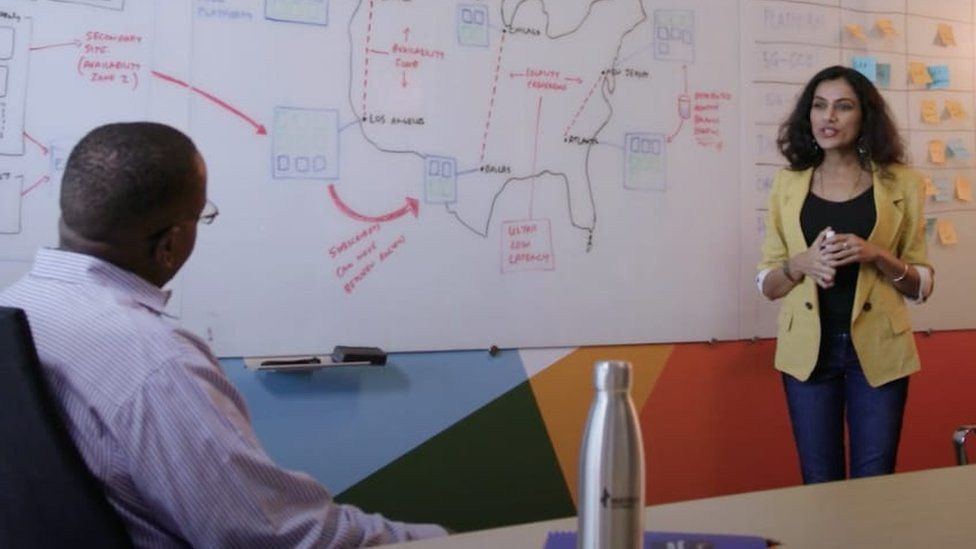
IMAGE SOURCE,PHOTO COURTESY: SURBHI GUPTA Image caption, Ms Gupta says she’s in touch with many companies and is exploring all options
My last day at Meta is in January and my H1-B visa [a non-immigrant visa that allows firms in the US to hire foreigners for up to six years] allows me to stay in the US for another 60 days, so early March is the deadline for me to find another job.
The job search is going to be difficult now as hiring will be slow in December because of the holidays. But I’m very focused. I am in touch with multiple companies and exploring options.
What I’ll miss most about Meta is the workplace and my colleagues. Being at Meta meant not only being able to build an amazing product for millions of people, but also being able to participate in fireside chats and growth and learning opportunities. As a product manager, it would have been rewarding to see the project I was working on go further.
My parents taught me to never give up in life. They tell me to stay strong because I’m a person who can convert problems into opportunities. They tell me ‘aur kuch accha mil jayega’ [you’ll find something better].
But my ability to work and stay in the US depends on my H1-B visa. I moved to the US in 2009 and I have worked very hard to build my career on my own strength and intellect. I have worked in prominent companies like Tesla, Intuit, etc., built great products, got top ratings, paid taxes, and contributed to the US economy for more than 15 years, but I feel that I am in the same place as far as permanent residency goes because of the limitations of the H1-B. I was crowned Miss Bharat California [a beauty pageant] by my idol, Bollywood actress Sushmita Sen. I have walked the ramp at New York Fashion Week. I have my own podcast.
We face unnecessary stress because the US has a country cap which takes forever for Indian H1-B holders to get a green card (permanent residency). Even though I am in the green card queue, when I track my status, I sometimes get a wait-time of two decades, and at other times, 60 years.
Our personal life suffers because of the uncertainty. Buying a home has been a question mark in my mind – do I invest in a home and then what if I have to leave. In spite of having gone ahead with the YC [Y Combinator is an American technology start-up accelerator], I can’t start a company even though I have a great idea because I don’t have a green card.
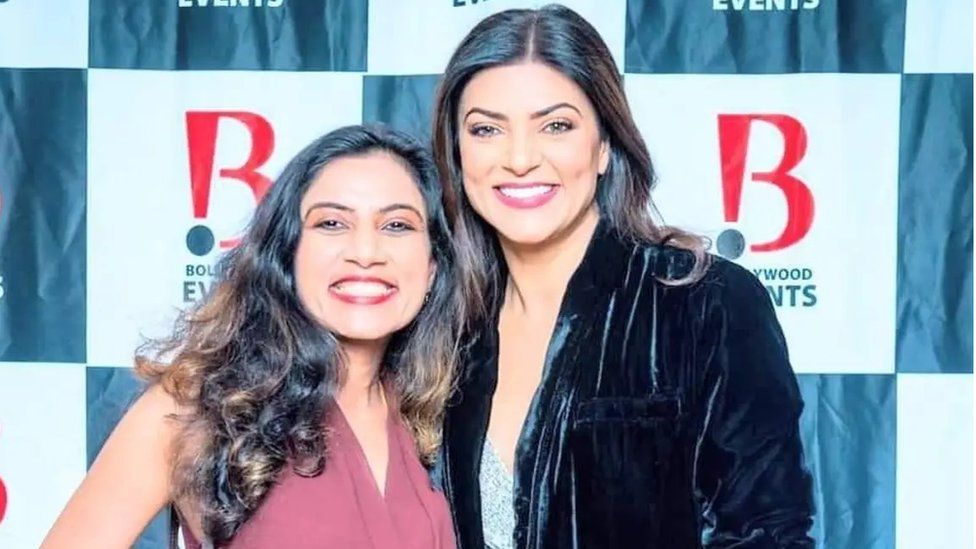
IMAGE SOURCE,PHOTO COURTESY: SURBHI GUPTA Image caption, Ms Gupta was crowned Miss Bharat California by her idol Sushmita Sen
I travelled to 30 countries before turning 30 years old, but now I’m unable to travel much, even though it’s my dream to travel the world, because I’m nervous about facing problems while trying to get my H1-B visa re-stamped. I have heard from my friends who work at great companies like Google and PayPal about getting stuck abroad.
I have even curtailed my travels home to India. A few years back, I got stuck in India. I had gone to attend a wedding and I had to get my H1-B visa stamped. But that took several months as it went into random administrative processing and I wasn’t even sure when it would come through. The uncertainty and the wait caused problems in my marriage. The visa issues had a very big role in my marriage. It was not the only reason, but it became one of the major reasons for the break-up of my marriage. I also had to drop out of a semester at New York University, where I was studying at the time, because I didn’t know when I would be able to return to the US. Why do people on H1-Bs have to deal with this?
I have not met my parents since the Covid-19 pandemic because they haven’t been able to come to visit me for three-and-a-half years. They are elderly, and don’t keep too well. I constantly think – if my parents need support, will I be able to go to help them? Nobody realises how it impacts our life.
But despite whatever has happened, I believe this experience too has a silver lining. Spirituality is a significant part of my life. I am a believer and follower of Sadhguru ji [as followers refer to Indian yoga guru Jaggi Vasudev]. He says that we should not be identified only by or limit our identity to our professional role. In Silicon Valley, the most frequently asked question is – Which company do you work for? But I am still me, not just a product manager. Everyone should realise that they are more than just the company they work for.
DISCLAIMER: Independentghana.com will not be liable for any inaccuracies contained in this article. The views expressed in the article are solely those of the author’s, and do not reflect those of The Independent Ghana
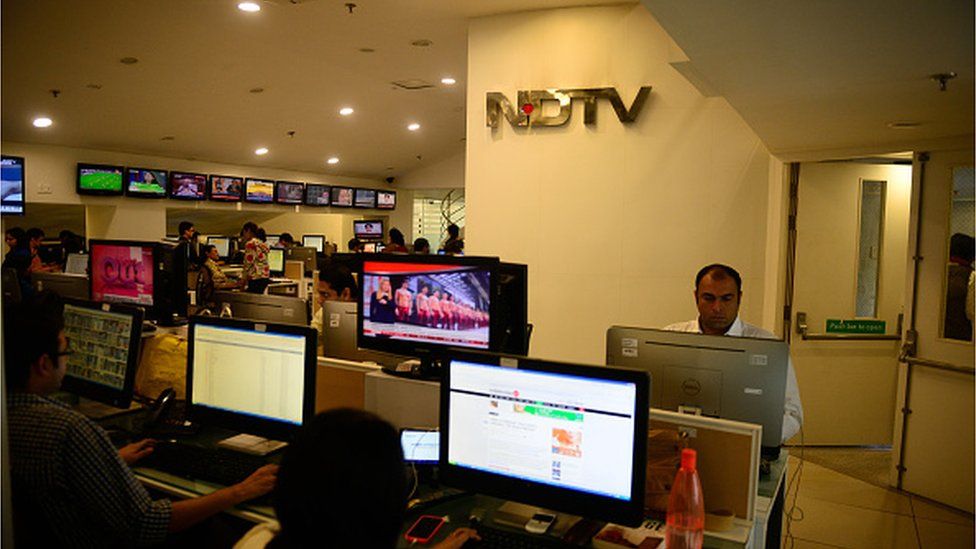
The founders of leading Indian news network New Delhi Television (NDTV), Radhika and Prannoy Roy, have resigned as directors of a group promoting their company, bringing a conglomerate led by Gautam Adani, one of the world’s richest men, closer to acquiring the media firm. The BBC investigates what this means for the future of Indian television news.
Radhika Roy once said that the creation of NDTV with her broadcaster husband Prannoy Roy was a “happy accident.”
In November 1988, the Roys launched NDTV with a single show, The World This Week, on the bland state-run Doordarshan with “no grand plan” in mind and “certainly no idea” that it would grow from being a producer of a weekly world news show to India’s first 24/7 news network and independent news broadcaster.
More than three decades later, the couple’s news channel is changing hands. Gautam Adani, the third richest man in the world – behind Elon Musk and Jeff Bezos – is set to buy NDTV in one the world’s most tumultuous media markets.
Mr Adani, a 60-year-old billionaire who runs a port-to-energy conglomerate, is seen by many as someone close to Prime Minister Narendra Modi and his government. Truth to tell, his “relationship with political and social leaders, across all types of party lines, have made him acceptable to every government,” according to RN Bhaskar, author of a recently published biography of the tycoon.
In March, Mr Adani’s new company AMG Media Networks Limited bought a minority stake in Quintillion, a digital business news company. “The Quintillion investment is too meagre to demandMr Adani’s attention. So, does he have bigger plans?” wondered Mr Bhaskar in his book.
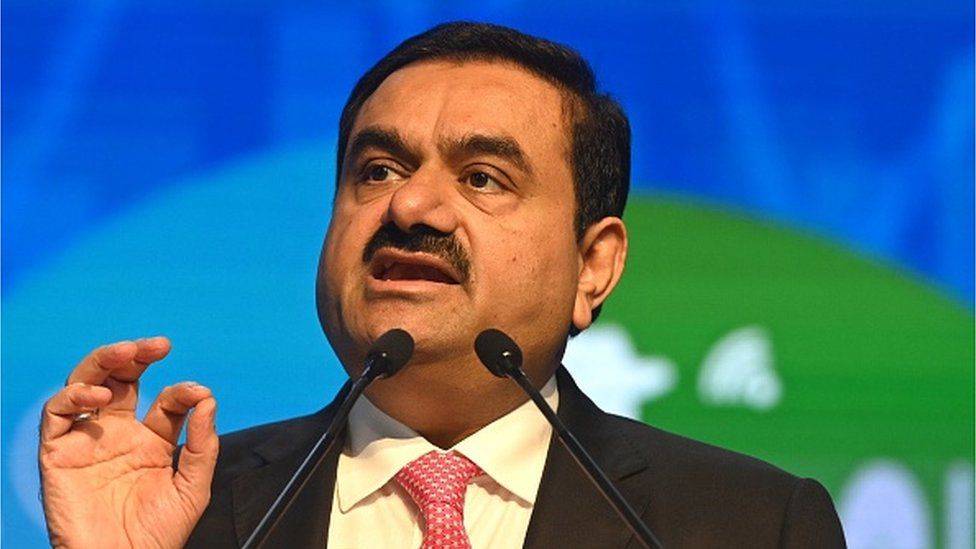
IMAGE SOURCE,AFP Image caption, Gautam Adani, the world’s third richest man, bought a small stake in a digital business media company earlier this year
Now we know. With revenues of around $51m and a modest profit of $10m, NDTV may not be a lucrative buy for Mr Adani, whose sprawling group has a market capitalisation of $260bn.
But NDTV is India’s best-known network that pioneered data-driven vote analysis, morning shows, and a host of tech and lifestyle programmes on TV. Today, it has a robust online presence, claiming some 35 million followers across platforms.
NDTV, the Adani group believes, is “the most suitable broadcast and digital platform to deliver on our vision”. Mr Adani has offered some clues about what the vision is. “Why can’t you support one media house to become independent and have a global footprint? India does not have one single [outlet] to compare to Financial Times or Al Jazeera,” he told the Financial Times.
Critics of the sale are more sceptical. Many regard NDTV as one of India’s few independent news networks, which has stayed away from the shouty jingoism of many of its peers. A study by Oxford University and the Reuters Institute for the Study of Journalism found that 76% of respondents trust information from NDTV.
Mr Adani’s takeover has sparked concerns that this would hurt its editorial integrity. Despite the diversity of media choices, independent journalism in India doesn’t appear to be in fine fettle: the country dropped to 150 of 180 countries ranked in Paris-based Reporters Without Borders’ World Press Freedom Index this year, its lowest position ever. Mr Modi’s ruling Bharatiya Janata Party (BJP) rejects the findings, saying the index adopts a methodology that is both “questionable and non-transparent”.
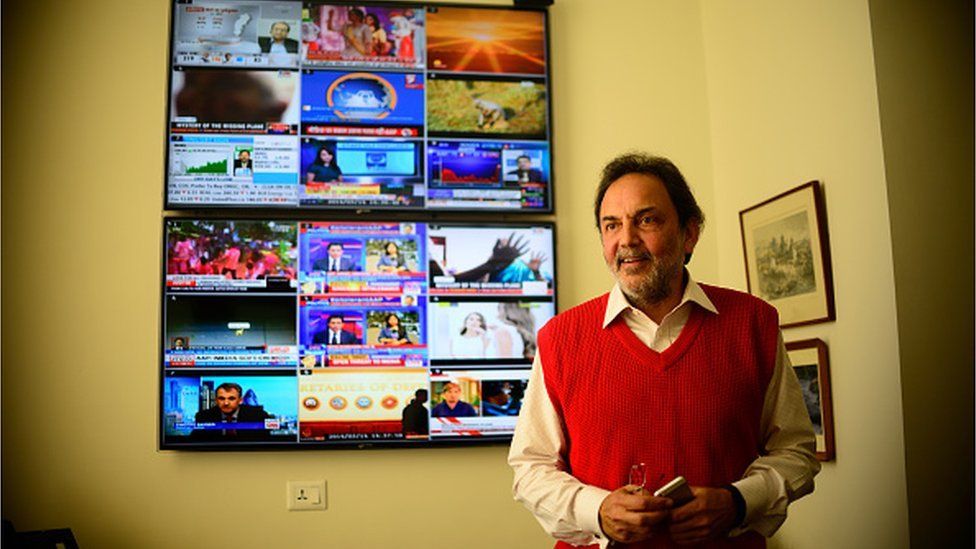
IMAGE SOURCE,GETTY IMAGES Image caption, Prannoy Roy and his wife Radhika founded NDTV 34 years ago
The diversity of media also masks the concentration of ownership, say experts. Four daily newspapers, for example, share three quarters of the readership in Hindi, according to Reporters Without Borders. Billionaire Mukesh Ambani, who owns a $220bn retail-to-refining conglomerate, also controls Network18, one of India’s largest media companies. Companies owned by Mr Adani and Mr Ambani generate revenues equivalent to 4% of India’s GDP.
The takeover of NDTV is also symbolic of the troubles plaguing the news business in India, says Vanita Kohli-Khandekar, a media specialist. India has more than 400 news channels in a market that is mostly privately owned and in regional languages. News channels mopped up an estimated 8% of the $423m that TV advertising got in 2021.
“News is one of the toughest business to be in, anywhere,” says Ms Kohli-Khandekar. “In India, TV news is one of the most unprofitable, politically perilous and dodgy businesses to be in.” Just “two to three companies” make money from time to time, she adds.
Since people are largely not willing to pay for news, advertising accounts for a bulk of revenues for the channels. Many believe the credibility of networks has waned: many have been accused of fiddling with ratings and what an expert called the “grotesque tabloidization” of news, and partisan coverage.
IMAGE SOURCE,GETTY IMAGES Image caption, NDTV pioneered a lot of TV news programming in India, including election analysis
NDTV’s own financial woes began during an economic downturn more than a decade ago when it had to borrow $44m from a company controlled by Mr Ambani’s Reliance Industries to refinance existing debts. “NDTV has struggled long and hard and it seems to be losing the fight. For the business of journalism it seems like a defeat,” says Ms Kohli-Khandekar.
Time will tell whether the editorial content and tenor of the network will change under the new ownership. At a time when TV news is polarised, NDTV was “more left-of-the centre and did stories critical of the government which most others were not taking up,” says Shailesh Kapoor of Ormax Media, a media consultancy. “Will they now soften their stand and move to a more neutral position because of editorial restrictions?”
Mr Adani believes there’s nothing to fear. “Independence means if government has done something wrong, you say it’s wrong,” he told Financial Times. “But at the same time, you should have courage when the government is doing the right thing. You have to also say that.”
On Sunday night, a mob stormed a police station in the southern Indian state of Kerala, injuring 36 officers as months of protests against a port project turned violent.
Adani Ports and SEZ Ltd, owned by Asia’s richest man, Gautam Adani, is building the port.
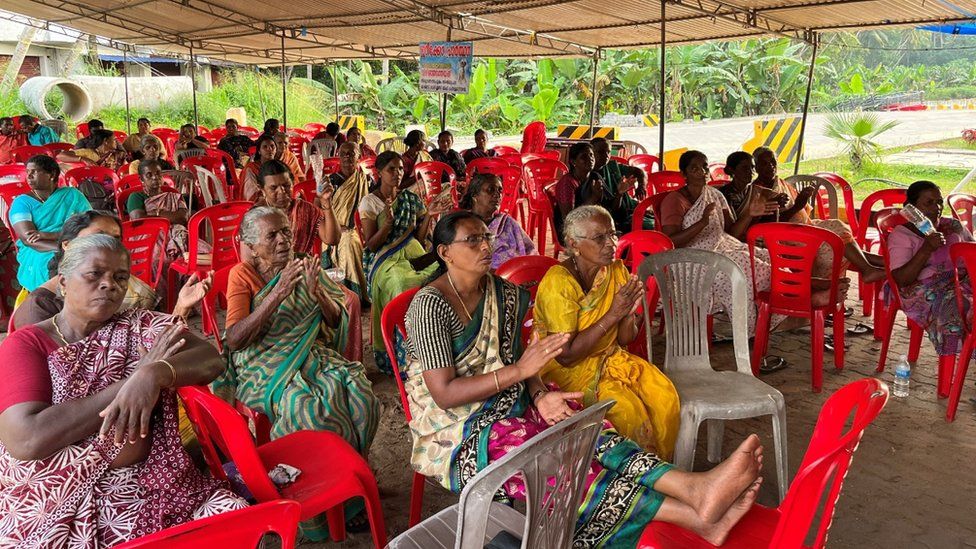
Protesters, primarily local fishermen, claim that the $900 million (£744 million) project is causing coastal erosion and destroying their livelihoods.
The allegations have been denied by the company.
Protests have been ongoing for more than 100 days, but have been mostly peaceful up until now. Many of the protesters claim that coastal erosion has destroyed their homes, forcing them to live in makeshift shelters.
The company, however, has said that the project complies with environmental laws and that sea erosion is occurring due to climate change.
Last week, the Kerala high court had said that the protesters must comply with its earlier order to allow “unhindered ingress and egress” to the project site.
IMAGE SOURCE,REUTERS Image caption, Locals have been protesting for months against the project
But over the weekend, protesters blocked the company’s vehicles from entering the construction site, prompting police to arrest some of them.
On Sunday night, hundreds of protesters stormed the local police station, leading to clashes with the police.
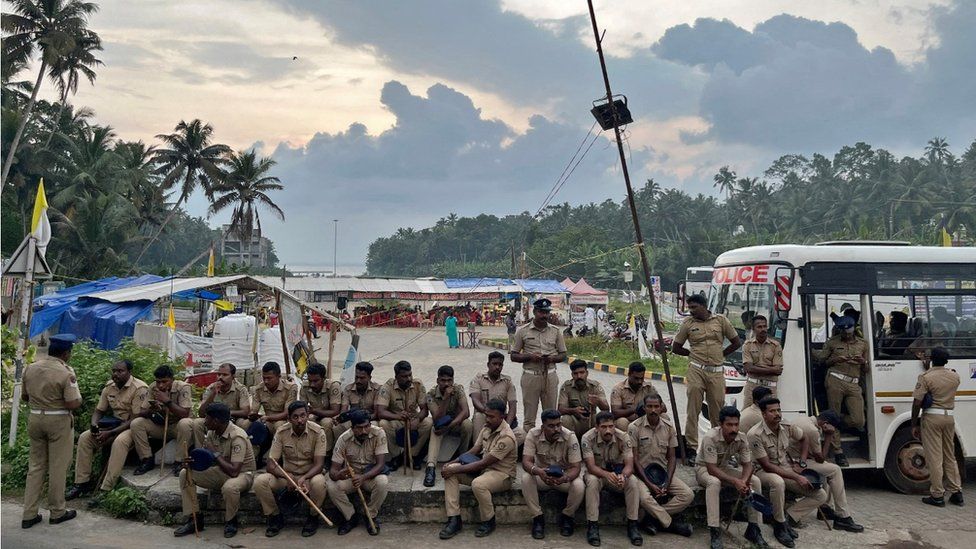
“A mob gathered at the police station in the evening and demanded the release of a few persons who were arrested in another case,” a senior state police official told reporters, adding that they had deployed around 900 police personnel in the area.
Several protesters were also injured, and some police vehicles were damaged. Around 3,000 people have been charged by police in connection with the violence.
But Eugene H Pereira, a vicar general who was one of the convenors of the protest, blamed the police for provoking the protesters who, he said “were ready to leave the area without creating any trouble”.
“The state government is responsible for the violence. They were doing it to prepare the ground for forcible eviction of the protesters,” he alleged.
A state minister denied this, and accused the protesters of stalling the project even after the government had agreed to meet their demands.
“They want the port project – which is in an advanced stage of construction – to be abandoned entirely. But that’s not going to benefit them at all,” he told the BBC.
After the violence, the Adani Group approached the state’s high court, which on Monday asked the government to file a report.
An Adani official told the BBC on condition of anonymity that the company had suffered damages of around 800m rupees ($9.8m; £8.1m) so far due to the blockade, which has gone on for more than 104 days.
IMAGE SOURCE,REUTERS Image caption, Adani Group says the project is in compliance with all laws
Adani Ports, India’s largest port operator, signed the deal in 2015 to build the port at Vizhinjam in Thiruvananthapuram, Kerala’s capital city.
The company operates nine feeder ports across India and the Vizhinjam port is expected to meet all its transhipment requirements once ready.
It has said that the port, once completed, would be “India’s gateway to international transhipment” due to its proximity to international shipping routes.
The port was initially scheduled to be opened in 2019 but work was delayed after a deadly cyclone hit the state in 2017, and due to a shortage in construction material. It is now set to open in September 2023.
The opposition Congress party, which was in power when the deal was signed, alleged that the current government had “ignored” a rehabilitation package for displaced people which was originally part of the agreement.
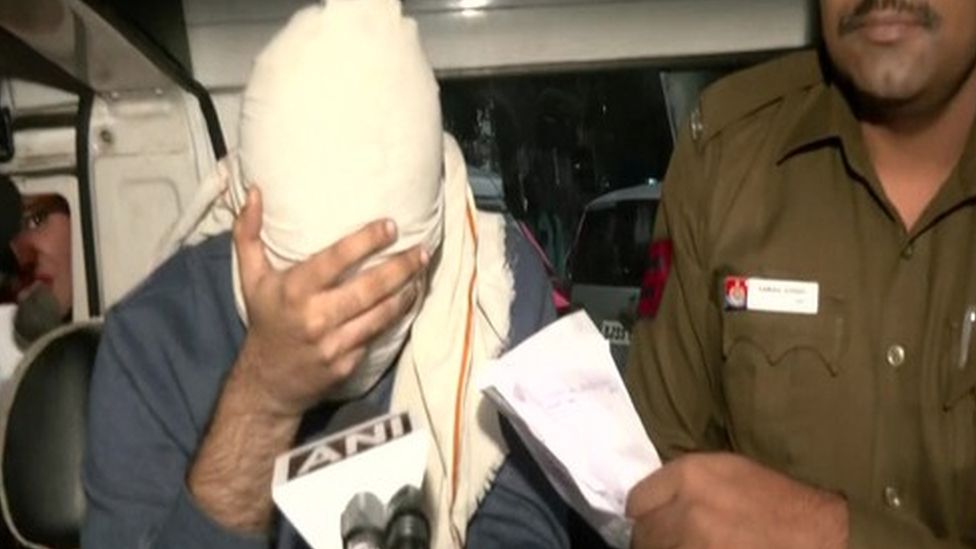
Aftab Poonawala, a young man from Delhi, has been arrested on suspicion of murdering his three-year live-in partner.
They claim Mr Poonawala murdered 27-year-old Shraddha Walkar in May, chopped up her body into dozens of pieces, stored them in his home fridge, and then went around disposing of them – a piece at a time – in various parts of the city over the next few months.
Mr Poonawala is still in custody and has not made any public statements, but he told a court on Tuesday that “the information being spread against me is not correct” and that he was “fully cooperating with the authorities.”
The death came to light only last week after Ms Walkar was reported missing by her father.
Since then, lurid details of the alleged murder have made daily headlines in India, with nuggets of unverified information being fed by unnamed policemen to local journalists.
The crime has been dubbed “the fridge murder” and the huge interest in the case has seen news websites running live pages on the investigation that are being updated every few minutes.
And anger has spilled over onto the streets – protesters have burnt Mr Poonawala’s effigies, demanding strict punishment for him.
Lawyers, activists and former police officials have expressed concern at the intense media coverage.
Vikram Singh, who retired as director general of police in the state of Uttar Pradesh, called it “extremely irresponsible”.
“A ball-by-ball commentary is detrimental to the cause of the investigation and disrespects the deceased,” he told the BBC.
The breathless coverage has also made it hard to separate the grain from the chaff – reports are mired ininconsistencies with little clarity on the facts of the case, including on how the couple met.
The relationship
Though Ms Walkar and Mr Poonawala lived in the same area in Mumbai city, police say they met on Bumble, a dating app.
But in the missing complaint to the Mumbai police in early October, her father says they met in 2018 at a call centre where they both worked.
Ms Walkar’s relations with her family were strained as they disapproved of her relationship with Mr Poonawala.
In his police complaint, her father said he had tried to dissuade her from moving in with Mr Poonawala since “we are Hindus and Aftab is Muslim and we don’t marry outside of our caste or religion”.
But the couple started living together in 2019 and moved to Delhi earlier this year and rented an apartment in Chhatarpur Pahadi area.
IMAGE SOURCE,ANI Image caption, Police allege that Aftab Poonawala killed his live-in partner
The couple’s friends and the police say the two quarrelled frequently and accuse Mr Poonawala of abusing her.
Senior police official Ankit Chauhan told ANI that Shraddha started putting pressure on Mr Poonawala to marry her and that “on 18 May, he lost his temper and strangled her”.
Ms Walkar’s father approached Mumbai police after being alerted by her friends that they had not heard from her for a few months and that her phone had been switched off.
On Wednesday, a handwritten note surfaced that Delhi police said was written by Ms Walkar in 2020 in which she had complained to the Mumbai police that he had beaten her up and “was threatening to kill her and cut her up into pieces” – exactly what police allege happened two year later.
Following criticism, Mumbai police responded that the case had been investigated, but “it was closed after she gave a written statement that it had been resolved and there was no dispute”.
What we know so far?
On Tuesday, when Mr Poonawala was asked by a court if he knew what he had done, he replied that “whatever happened took place in the heat of the moment and was not deliberate”.
His statement was interpreted by some as a confession, but his lawyer Abinash Kumar rejected that Mr Poonawala had confessed to murder and said that he was “fully cooperating with the investigation”.
Soon after his arrest, police had said that Mr Poonawala had confessed to his crime and given them some leads to find evidence.
Thereafter, they searched his apartment and took him to a nearby forest where – they said – “he had disposed of body parts”.
IMAGE SOURCE,GETTY IMAGES
Police say they have recovered some bones and body parts which have been sent for forensic analysis and will be matched against the DNA samples of her father to find out if they are indeed Ms Walkar’s.
Armed with metal detectors, police have also been combing bushes in Gurgaon, a Delhi suburb, for knives that were allegedly used to hack the body and after divers fished out some bones from a pond in Delhi’s Maidan Garhi area, it was emptied to find more evidence.
On Thursday, the accused underwent a polygraph and is later expected to be put through a narco-analysis test – in which a drug known as “truth serum” is injected into the person before they are asked questions.
Even though they are not admissible in court, a judge ordered the tests after police said that Mr Poonawala was misleading them by giving contradictory statements.
The missing links
On Tuesday, police told a court that 80% of their investigation was complete,but reports say that they are still looking for crucial evidence that would help them build a watertight case.
No belongings of Ms Walkar have been recovered from the apartment where the couple lived and some of the evidence may have been compromised as it’s been months since the alleged murder.
Police say they believe that a “heavy, sharp weapon” like a hack saw or a butcher’s knife was used to dismember the body but they are yet to recover it.
It is also not yet established if the bones they have recovered are really of the victim and some reports say their quality may be compromised since the remains have been found months after the alleged murder.
IMAGE SOURCE,GETTY IMAGES Image caption, After divers fished out some bones from a pond in Delhi’s Maidan Garhi area, it was emptied to find more evidence
There has been criticism of Delhi police that they have little concrete evidence and that their case is entirely built on circumstantial evidence that would not stand scrutiny in court.
The BBC reached out to Delhi police but officials said they were “busy with the investigation”.
But retired police official Vikram Singh says there is “abundant evidence and a skilful investigator will be able to get a conviction”.
“Sometimes it takes time to recover a weapon used in the crime but if you’ve got a drop of blood or spit or a shred of meat, you can build a watertight case.”
Besides, he says, there is “enough circumstantial evidence” against Mr Poonawala – “they were living together, there are accounts of neighbours and CCTV footage that shows Shraddha regularly coming in and leaving the house, so he has few escape routes available”.
Talking to a Hindi newspaper, Mr Kumar, Poonawala’s lawyer, said he understood that it was a “challenging” case.
“But unless I know the full charges against him, I’m unable to say how easy or difficultit would be to defend him,” he added.
Rats were blamed by police in India for destroying nearly 200kg (440lb) of cannabis seized from dealers and kept in police stations.
“Rats are tiny animals and they have no fear of the police. It’s difficult to protect the drug from them,”according to a court in the state of Uttar Pradesh.
The court had ordered the police to produce the stash as evidence in drug-trafficking cases.
The judge cited three instances in which rodents destroyed marijuana.
According to an order issued by Judge Sanjay Chaudhary, when the court asked the police to produce the seized drug as evidence, it was told that 195kg of cannabis had been “destroyed” by rats.
In another case involving 386kg of the drug, the police filed a report saying “some” of the cannabis was “eaten up by the rats”.
Judge Chaudhary said some 700kg of marijuana seized by the police was lying in police stations in Mathura district and that “all of it was under danger of infestation by rats”.
He said the police had no expertise in dealing with the matter as the rats were “too small”. The only way to protect the seized goods from “such fearless mice”, he added, was to auction the drugs to research labs and medicine firms, with the proceeds going to the government.
MP Singh, a senior police official of Mathura district, told reporters that some of the marijuana stored in police stations under his vicinity had been “damaged due to heavy rains” and not destroyed by rats.
In 2018, eight Argentinian police officers were fired after they blamed mice for the disappearance of half a ton of cannabis from a police warehouse. But experts disputed the claim, saying that the animals were unlikely to confuse the drug for food and “if a large group of mice had eaten it, a lot of corpses would have been found in the warehouse”.
A study published in 2019 found that when laboratory rats were given cannabis-laced dough, they “tended to become less active and their body temperature also was lowered”.
In 2017, police in the eastern Indian state of Bihar had blamed rats for consuming thousands of litres of confiscated alcohol, a year after the state banned the sale and consumption of alcohol.
In 2018, technicians who arrived to fix a malfunctioning cash machine in the state of Assam found that currency notes worth more than 1.2m rupees ($14,691; £12,143) had been shredded – and the suspected culprits were rats.
Police in Indiahave arrested the parents of a young woman for allegedly murdering her and disposing of her body near an expressway.
On Friday, the woman’s body was discovered wrapped in plastic and stuffed in a red suitcase near Mathura in the northern state of Uttar Pradesh.
Her father, Nitesh Kumar Yadav, and mother, Brajbala, have not yet made any statements.
The police say they are treating the case as a suspected “honour killing”.
Honour killings – or crimes committed against people who are perceived as breaking age-old traditions – are reported regularly in India.
The victims are mainly young men and women who fall in love or marry against their families’ wishes outside of their caste or within their sub-caste.
The victim, Aayushi Chaudhary, was studying at a private college in Delhi, where she lived with her family, police said.
In a detailed press release on Monday, police alleged that the 22-year-old’s father murdered her on 17 November after a fight over her marriage with a man from another caste. They alleged that the parents packed the body in a suitcase and left it near the Yamuna expressway at night.
After the body was discovered a day later, a post-mortem was carried out which revealed injury marks on the woman’s head, face and other body parts, police alleged, adding that she died after being “shot twice in the chest”.
They have seized the father’s licensed gun and the car allegedly used in the crime.
An Indian woman who went into a private clinic to have her uterus surgically removed woke up from the procedure to find that both her kidneys had been stolen.
A couple of months ago, we featured the shocking story of an Indian woman who claimed that one of her kidneys had been stolen by her husband and sold for profit. As cynical as this may sound, she was lucky compared to another fellow Indian who had both her kidneys removed without her consent and now has to rely on daily dialysis to survive. Back in September, Sunita Devi, a woman from Bihar’s Muzaffarpur district went to a private clinic in Bariyarpur to have her uterus surgically removed. Only instead of her uterus, doctors there removed both her kidneys and then disappeared.
It’s the kind of horror urban legend that’s been going around for decades. Someone goes into a clinic for a procedure only to have their organs harvested to be sold on the black market. Only this one is actually real, which only makes it more terrifying.
At the beginning of September, 38-year-old Sunita Devi was rushed to Sri Krishna Medical College and Hospital (SKMCH) in Muzaffarpur, because her condition had started deteriorating after her original operation to have her uterus removed. Doctors at SKMCH examined the woman and informed her family that both her kidneys had been removed and she required dialysis to survive.
“Doctors at SKMCH referred Sunita to Indira Gandhi Institute of Medical Sciences, Patna for treatment. She was sent back to this hospital after treatment there. Since Sunita has no kidneys, if she does not have dialysis for even one day, then she could die,” Dr BS Jha, superintendent of SKMCH, told the India Times newspaper.
As for the culprits, following a complaint filed by Devi’s family against Pawan Kumar, the owner of Subhakant Clinic, and Dr R K Singh, police started an investigation in September. They found that the clinic was not even registered and that the doctors’ qualifications appeared to be fake. Both suspects have been on the run since the incident, but according to the Hindustan Times one of them was recently apprehended.
The mother-of three is still in critical condition, relying on daily dialists sessions to survive. She will however require an organ transplant in order to survive. She has been asked to enroll for a kidney transplant, but there is already a long waiting list. Devi also appealed to the Indian Government to make the shady doctors pay for what they did to her.
“I appeal to the government to immediately arrest the accused doctor who removed my both kidneys. His kidneys should be given to me for transplant so that I could survive,” she said.
Kili Paul, a Maasai TikToker who went viral in India last year, finally got his chance to visit the country, and has shared highlights from the trip on his YouTube channel.
It was his first time on a plane and he said he was initially nervous but had to do it because of his love for India.
Wearing traditional Maasai clothes, Kili Paul appeared on some of the country’s most-watched television shows, including Bigg Boss, and a dance reality show, Jhalak Dikhhla Jaa.
He also spent time with one of Bollywood’s most famous actors, Ranveer Singh, singing with him at an event in Mumbai.
Plus he shared videos of him trying traditional Indian snacks.
Originally from a small village in Mindu Tulieni, in eastern Tanzania, Kili Paul became a social media sensation last year with his lip-syncing videos to Hindi songs.
They amassed millions of views in India, catching the attention of some of the biggest Bollywood stars. He and his sister, Neema Paul, are most known for their performance of Raataan Lambiyan, from the film Shershaah.
Kili Paul has continued to entertain fans in India and worldwide with his music videos. He currently has 4.2 million followers on Instagram.
Despite the fact that there are more people on Earth than ever before because we are living longer lives, population growth is at its slowest rate since 1950, according to UN data.
According to UN Population Division projections, the world’s eighth billionth resident was born today.
The global population has grown to eight billion people, three times the size it was in 1950, and while there are more people on Earth than ever before because we are living longer lives, population growth is slowing to its slowest rate in more than 70 years.
The global population growth rate will be less than 1% in 2020. This is largely due to a lower birth rate, with women having fewer children as a result of widespread contraception and improved education and mobility opportunities for women and girls.
The global population is also getting older – 10% are aged over 65, and this will increase to 16% by 2050.
By 2050 the number of over-65s will be twice that of those under five.
China and India are the joint-most populated countries in the world, with 1.4 billion people each.
Based on UN projections, India will surpass China for the first time next year.
Image:The population of India is expected to surpass that of China next year
More than half of the projected increase up to 2050 will be concentrated in eight countries: the Democratic Republic of the Congo, Egypt, Ethiopia, India, Nigeria, Pakistan, the Philippines and Tanzania.
Countries in sub-Saharan Africa are expected to contribute more than half of the increase anticipated through 2050.
The biggest increases will come specifically from the Democratic Republic of Congo and Tanzania, with both populations doubling in the next 30 years.
Elsewhere in Africa, the biggest surges will be in Nigeria, Ethiopia and Egypt.
In Asia outside India and China, the biggest growth will happen in Pakistan and the Philippines.
More generally, 46 of the least-developed countries in the world will have the fastest-growing populations between now and 2050.
Most of this growth (two-thirds) will be driven by what has already happened – and the youthful structure of the population.
Image:China has been the most populous country since records began
Where is the population shrinking?
The world population is growing more slowly than it has in decades due to long periods of low fertility.
More than two-thirds of people live in countries where women have 2.1 children or fewer.
This is roughly the level that would produce zero growth worldwide.
The population of 61 countries will decrease by 1% or more between now and 2050 – either due to decreased birth rates or increased levels of migration.
The war in Ukraine is having a huge impact on its population size – with projections showing it will have lost more than 20% of its population by 2050.
Four other central and eastern European countries – Bulgaria, Latvia, Lithuania and Serbia – will experience similar population decreases in the next three decades.
COVID decreases life expectancy
Overall life expectancy fell from 72.8 before the pandemic in 2019 to 71 last year.
COVID’s impact was not the same for every region, however.
Central and southern Asia, Latin America and the Caribbean were hit the most – with life expectancy decreasing by around three years.
But in Australia and New Zealand, which both shut their borders and pursued a “zero COVID” policy for most of the pandemic, life expectancy increased by 1.2 years due to a decreased risk of dying from other causes during successive lockdowns.
Coronavirus may have resulted in some short-term reductions in pregnancies, but there was no evidence of an overall decline, UN experts said.
What’s next?
The global population will continue to grow – to around 8.5 billion people by 2030 and 9.7 billion by 2050.
It will start to peak at around 10.4 billion people in the 2080s and remain at that level until 2100.
After that, trends are uncertain.
Australia, New Zealand, the rest of Oceania, North Africa and Western Asia will still be growing in population by the end of this century.
But the rest of the world, including Europe and North America, will have reached their peak and started to decline before the year 2100.
Antonio Guterres, the UN secretary-general, said of the eight billion milestone: “This is an occasion to celebrate our diversity, recognise our common humanity and marvel at advancements in health that have extended lifespans and dramatically reduced maternal and child mortality rates.”
But he added: “At the same time, it is a reminder of our shared responsibility to care for our planet and a moment to reflect on where we still fall short of our commitments to one another.”
The office of Indian Prime MinisterNarendra Modi tweeted a picture of the two of them speaking.
We don’t know the details of the conversation yet, but the first meeting between Modi and Sunak – the UK’s first Indian-origin Prime Minister – was much anticipated in India. The 42-year-old is also married to Akshata Murty, daughter of Infosys founder NR Narayana Murthy.
Modi had congratulated Sunakon a phone call after he came to power, and tweeted that they had “agreed on the importance of early conclusion of a comprehensive and balanced [free trade agreement]”.
A trade pact aims to double bilateral trade by 2030 – the two countries are now looking to finalise the agreement by the end of March, according to Reuters.
Prime Minister of India, Narendra Damodardas Modi, has called for a “return to the path of ceasefire and diplomacy” in Ukraine.
Speaking at a session on food and energy security, he said that global supply chains were “in ruins” because of problems caused by climate change, the Covid pandemic and the ongoing war in Ukraine.
He also emphasised the role of G20 leaders in “creating a new world order” after the pandemic.
“Over the past century, World War Two wreaked havoc in the world. After that, the leaders of that time made a serious effort to take the path of peace. Now it’s our turn,” he said.
At the session, which also had US president Joe Bidenand Russian FM Sergey Lavrov in attendance, Modi said that India’s energy security was crucial for global growth.
“We must not promote any restrictions on the supply of energy and stability in the energy market should be ensured,” he said.
Indian leaders have repeatedly said that the country will continue buying oil from Russia despite Western pressure to isolate Putin.
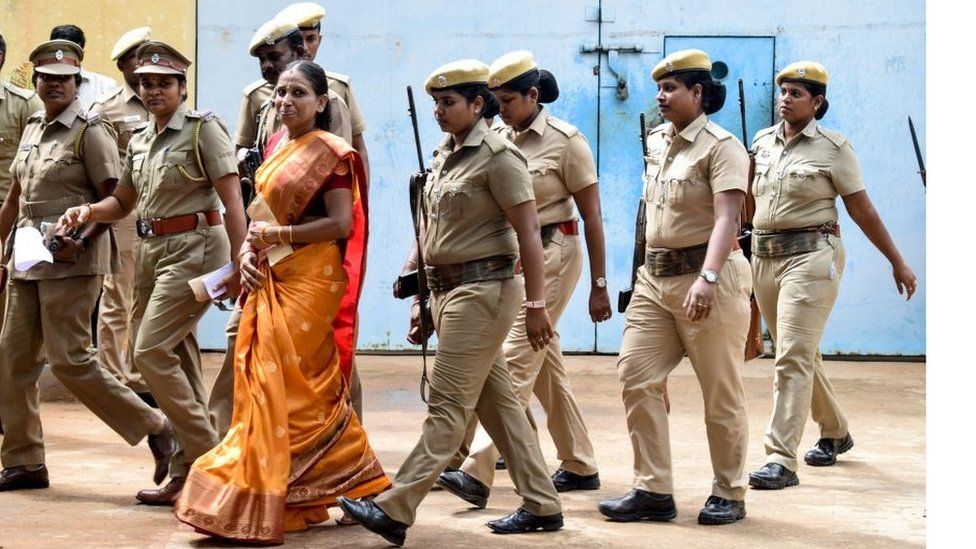
Six people convicted in the assassination of former Prime Minister Rajiv Gandhi in 1991 have been ordered released by the Indian Supreme Court.
The order was issued after two convicts, S Nalini and RP Ravichandran, requested early release from prison.
They filed their petition after the Supreme Courtreleased another convict in the case, AG Perarivalan, in May.
All seven convicts were serving life sentences and had been incarcerated for more than 30 years.
In its order on Friday, the Supreme Court said the conduct of the prisoners during this time had been “satisfactory”.
Gandhi’s murder in May 1991 was seen as retaliation by Sri Lanka’s Tamil Tiger rebel group for India’s involvement in the island nation’s civil war after Delhi sent peacekeepers there in 1987 when he was prime minister.
The Congress party, of which Gandhi was the leader, criticised the court’s decision to free the convicts.
“The decision of the Supreme Court to free the killers is totally unacceptable and completely erroneous. The Congress party finds it wholly untenable,” party spokesman Jairam Ramesh said in a statement.
“It is most unfortunate that the Supreme Court has not acted in consonance with the spirit of India on this issue,” he added.
The convicts, whose release was ordered on Friday, were among 25 people initially sentenced to death in 1998 by a trial court.
The top court upheld the conviction of only seven of them. Four of the convicts – Perarivalan, S Nalini, Santhan and Sriharan – received the death penalty while three others were awarded life sentences. The remaining were cleared of all charges and freed.
Nalini’s death sentence was commuted in 2000 following a clemency petition byGandhi’s widow Sonia Gandhi who had pointed out that the prisoner was pregnant at the time.
IMAGE SOURCE,GETTY IMAGES Image caption, Nalini’s death sentence was commuted in 2000
In 2014, the Supreme Court commuted the death sentences of Perarivalan, Santhan and Sriharan too, citing delays in deciding their mercy pleas.
Tamil Nadu state government then announced its decision to free the plotters, but the federal government launched a legal challenge to stop the state from freeing them.
“The assassination of Rajiv Gandhi was an attack on the soul of India. The release of the killers of a former prime minister of India and our great leader, as well as several other innocent Indians, would be contrary to all principles of justice,” Manmohan Singh, then the prime minister, said in a statement.
“No government or party should be soft in our fight against terrorism.”
The statue of Kempegowda, the 16th-century local leader who founded Bengaluru, was unveiled by Indian Prime Minister Narendra Modi (Bangalore).
The 33m (108ft) bronze statue weighs 220 tonnes and is located at the international airport in the southern Karnataka state’s capital city.
According to media reports, the statue cost 850 million rupees ($10.5 million; £8.9 million).
The state government set aside 1 billion rupees for the statue and a theme park in 2019.
According to a state minister, the statue will be called “the statue of prosperity” to reflect Bengaluru’s progress.
The city is known as “India’s Silicon Valley” because it is home to some of the country’s largest IT companies and start-ups.
The statue has been sculpted by Ram V Sutar, who also made the “statue of unity” in Gujarat, which commemorates independence leader Sardar Vallabhbhai Patel – the 600ft-high statue is the world’s tallest.
The inauguration of Kempegowda’s statue comes months ahead of assembly elections in the state.
Political analysts say the event is an attempt by the governing Bharatiya Janata Party (BJP) to woo the upper-caste Vokkaliga community, to which Kempegowda belonged.
The Vokkaligas are dominant in the state’s Old Mysore region – which covers eight districts, including Bengaluru. While the BJP has won elections from this area, opposition parties Congress and Janata Dal (Secular) still have an upper hand here.
Kempegowda is a hugely revered figure in Karnataka. He was part of the Vijayanagar empire, which ruled parts of southern India from the 14th Century to early 17th Century.
According to historian Suryanath Kamath, there is evidence of him ruling over areas that include present-day Bengaluru from 1513 to 1569.
But others say they have unearthed evidence that he was alive until 1608.
“Much about Kempegowda is known from folklore rather than epigraphy,” says Prof M Jamuna, former chair of history at Bangalore University.
Prof Jamuna said research had established that Kempegowda was “not the big moustachioed warrior with a sword and a shield as he is presented in statues nowadays”.
India fail to take a single wicket as England advance to Sunday’s final against Pakistan thanks to a magnificent innings by Jos Buttler and Alex Hales.
England advanced to the T20 World Cup final after defeating India by 10 wickets.
England made 170 runs without losing thanks to the highest partnership in tournament history between Jos Buttler (80) and Alex Hales (86).
The pair hunted down the 169 target in impressive fashion, securing a spot in the final on Sunday.
Hales got to half a century in 28 balls and ended up hitting seven sixes, while Buttler needed 36 deliveries to get to 50 and rounded off the win by smashing a maximum.
India’s innings at the Adelaide Oval saw Hardik Pandya score 63 off 33 balls (including five sixes) as they ended on 168/6. However, it proved too little to set up a game against fierce rivals Pakistan.
England only narrowly made the semi-final after beating Sri Lanka with two balls to spare.
Now though, they will head to Melbourne full of confidence as they hope to lift the trophy they last won in 2010.
Pakistan made the final after comfortably beating New Zealand on Wednesday.
It will be a double World Cup final for England this week as the women’s rugby union team play hosts and reigning champions New Zealand on Saturday.
A venomous cobramet its demise after attacking an eight-year-old boy in India, who bit the wild snake to death after it wrapped itself around his hand.
Per the New Indian Express, the incident transpired in India’s Pandarpadh village in Jashpur district on Monday. 8-year-old Deepak was playing in the backyard of his house on Monday when a poisonous cobra bit him on his hand.
“The snake got wrapped around my hand and bit me,” Deepak told the outlet. “I was in great pain. As the reptile didn’t budge when I tried to shake it off, I bit it hard twice. It all happened in a flash.”
Deepak’s family rushed him to a local health centre, where he was given anti-snake venom and kept for observation. Dr. Jems Minj said Deepak luckily suffered a “dry bite,” meaning there was no venom in the snake’s fangs at the time. He was discharged after only a day.
Local snake expert Qaiser Hussain told the outlet that cases of dry bites, while “painful,” are quite rare, and a local journalist named Ramesh Sharma said the district is also known as Naglok (meaning abode of serpents) because of the 200 different kinds of snakes that call the district home.
“I have never come across such an incident in Jashpur district,” Sharma said.
The incident in Pandarpadh comes shortly after a 2-year-old in Turkey bit a snake to death in August after it bit her lip in her backyard.
“Our neighbors have told me that the snake was in the hand of my child, she was playing with it and then it bit her,” Mehmet Ercan, the toddler’s father, told Newsweek. “Then she has bitten the snake back as a reaction.”
It’s unknown what kind of snake bit her, but regardless the toddler survived and is alive and well.
India’s foreign ministersays purchasing oil from a “steady and time-tested partner” is economically advantageous.
Foreign Minister Subrahmanyam Jaishankar said during his first visit to Russia since it invaded Ukraine that India will continue to buy Russian oil because it is beneficial to the country, a move that runs counter to Western efforts to cripple Russia’s economy with sanctions.
On Tuesday, Jaishankar met with his Russian counterpart Sergey Lavrov in Moscow, accompanied by senior officials in charge of agriculture, petroleum and natural gas, ports and shipping, finance, chemicals and fertiliser, and trade, emphasizing the importance of relations with Russia.
“Russia has been a steady and time-tested partner. Any objective evaluation of our relationship over many decades would confirm that it has actually served both our countries very, very well,” Jaishankar said in a joint news conference.
“As the world’s third-largest consumer of oil and gas, a consumer where the levels of income are not very high, it is our fundamental obligation to ensure that the Indian consumer has the best possible access on the most advantageous terms to international markets,” he said.
“We have seen that the India-Russia relationship has worked to advantage. If it works to my advantage, I would like to keep that going,” the Indian foreign minister added.
India, which has not explicitly condemned what Russia calls its “special military operation in Ukraine”, has emerged as Russia’s largest oil customer after China following a boycott by Western buyers.
Russian Foreign Minister Sergei Lavrov and his Indian counterpart Subrahmanyam Jaishankar shake hands during a news conference in Moscow. [Maxim Shipenkov/Pool via Reuters]
Jaishankar’s announcement came ahead of United States Treasury Secretary Janet Yellen’s visit to New Delhi later this week, when she is expected to discuss a Group of Seven (G7) plan to cap the price of Russian oil with Indian officials.
US officials and G7 countries have been in intense negotiations in recent weeks over the unprecedented plan to put a price cap on sea-borne oil shipments, which is scheduled to take effect on December 5 to ensure European Union and US sanctions do not throttle the global oil market.
Both New Delhi and Beijing have so far refused to join Western sanctions against Russia.
Lavrov praised the position of Russia’s “Indian friends” on Ukraine and accused Western countries of trying to consolidate a “dominant role in world affairs” and prevent “the democratisation of international relations”.
Russia and India are also considering joint production of modern defence equipment, the foreign minister was quoted by TASS news agency as saying. Last year, the two countries inked a $677m deal to produce AK-203 assault rifles in India as part of New Delhi’s push for self-reliance in defence manufacturing. India is one of the world’s largest buyers of defence equipment.
Moscow has been New Delhi’s biggest supplier of military equipment for decades. India imported Russian defence equipment worth more than $20bn between 2011 and 2021.
According to Lavrov, Russia and India also want to cooperate more closely in the fields of nuclear energy and space travel.
Ten years ago when a 19-year-old Delhi woman was found gang raped and murdered in the fields of the neighbouring state of Haryana, it was described as a “rarest of rare” case.
Indians were shocked by news reports which detailed the brutality to which the teenager – named Anamika in court documents as her real name could not be revealed under Indian law – had been subjected.
Three men, arrested for the crime, were found guilty and given the death penalty by a trial court in 2014 and the Delhi High Court confirmed the sentences a few months later.
But on Monday, in a stunning reversal, the Indian Supreme Courtset the men free, saying there was no “cogent, clinching and clear evidence” that they had committed the crime.
The three-judge bench raised serious questions about the police investigation, criticised the sessions court for “glaring lapses” in the trial and said the judge had acted like a “passive umpire”.
The decision has angered the victim’s parents, shocked activists and lawyers and led to outrage on social media in a country where tens of thousands of rapes are reported every year.
“This is what justice looks like in India 2022,” one Twitter user wrote, sharing a photo of the woman’s dejected father.
Some compared the top court’s decision with a recent order by the Gujarat state government to release convicts who were serving life sentences for the gang rape of Bilkis Bano, a pregnant Muslim woman, and the murder of her relatives during 2002 religious riots in Gujarat state.
Anamika’s father told me that his “hopes of getting justice were dashed in minutes”.
“We had waited for 10 years for justice. We had faith in the judiciary, we believed that the Supreme Court will confirm the death penalty and my daughter’s killers would be finally hanged,” he said.
The 19-year-old lived in Chhawla, a lower middle-class rural area in south-west Delhi. In January 2012, she started a job at a call centre in Gurgaon, a suburb of the capital, and was the sole breadwinner for her family.
“She had just received her first salary and was thrilled,” says anti-rape activist Yogita Bhayana, who has been supporting the family in their fight for justice for the past eight years.
On the night of 9 February 2012, Anamika was returning home from work with three friends when she was abducted by men in a red car.
The gruesome crime made headlines in India after her partially burnt, horribly mutilated body with signs of torture was found four days later.
During trial, the prosecution argued that the case against the accused was watertight – they said they had found the wallet of one of the three men at the crime scene, that the suspects had confessed to the crime and had led the police to the body and helped recover the victim’s clothing.
DNA samples collected from blood stains, semen and hair found in the seized car proved that the accused and the victim had been in the vehicle, they added.
The trial court convicted the men and gave them the death penalty two years later. While confirming their death sentence, the high court described the accused as “predators”.
But Monday’s 40-page Supreme Court order, authored by Justice Bela Trivedi, questioned the evidence presented by the prosecution and said it was possible that it had been tampered with.
Pointing out a “number of inconsistencies and contradictions in the evidence of the police and in the testimonies of the formal witnesses”, the court said:
The accused were not identified in court by the victim’s friends or a male witness who had tried to fight the kidnappers.
The Delhi police claim about the “discovery of incriminating articles such as a piece of the car’s bumper and wallet containing documents of one of the accused” were not seen in the first pictures from the crime scene.
Haryana police, who had reached the scene first, did not mention these items in their report.
The items were not mentioned in the seizure memo of the investigation officer.
A phone the police recovered was never shown to the woman’s father to confirm whether it really belonged to his daughter.
It was not conclusively proved that the red car seized by the police was the same in which the crime had been committed.
The circumstances of the arrests were questionable.
Non-examination of some of the accused had “created a cloud of doubt”.
The court also said that the evidence taken from the car was sent for forensic examination on 27 February – almost two weeks after it was seized. “Under the circumstances, the possibility of tampering with the samples could not be ruled out,” she wrote.
Acknowledging that “if the accused in a heinous crime go unpunished, a kind of agony and frustration may be caused to the society in general and to the family of the victim in particular”, the order said that the “prosecution has failed to prove the charges beyond reasonable doubt and we have no alternative but to acquit the accused, though involved in a very heinous crime”.
The BBC has emailed top Delhi police officials for comment.
IMAGE SOURCE,GETTY IMAGES Image caption, Tens of thousands of rapes are reported in India every year
Charu Wali Khanna, the lawyer for Anamika’s family who assisted the prosecution, told me the order would be challenged in the Supreme Court with a review petition.
“This judgement is very vague and it raises these hyper-technical issues. It says the evidence could have been tampered with, but it does not indict the police,” she said.
“The order says there was no clinching evidence, but they disregarded a lot of evidence that was against the accused.”
Anamika’s father, who works as a security guard at a school, told me he had gone to the court straight from work on Monday after his night shift.
Ms Bhayana, who waited outside the court with the parents while the judgement was read out, spoke of the anger and disappointment they felt.
“I’m heartbroken, I don’t have the words to explain how I feel. So you can imagine how the parents must feel,” she told me.
Ms Bhayana said she “didn’t even have 1% apprehension” that something like this could happen and had been assuring the family that this was “the end of the road” in their fight for justice.
“But it’s all collapsed around us. When the lawyer messaged me informing about the order, my first reaction was of disbelief. I thought I must’ve misheard.”
Ms Bhayana says if the Supreme Court had concerns about the investigation, they could have reopened the case, ordered another investigation, or handed over the case to the federal police.
“The fact is that a young woman was gang raped and brutally murdered. The court must provide some kind of remedy to her family,” she says.
Anamika’s father, meanwhile, is bewildered.
“Mere upar to vajr gir gaya [I have been hit by the bolt from the sky],” he told me.
“What has the Supreme Court done? The courts did not have any doubts for 10 years. So how did everything suddenly become a lie?” he asks.
“Everyone says India is not safe for its girls. After this court order, no girl in India will be safe. This will embolden criminals further,” he says.
Prime Minister Narendra Modi has said that the tragedy was painful. He added that his thoughts were with the families of the victims.
“Rarely in my life, would I have experienced such pain. On one hand, there is a pain-riddled heart and on the other hand, there is the path to duty,” he said.
Expressing his condolences, he pledged the government’s full support to the families of those who died in the accident.
“All alertness is being observed even in the hospital where the injured are under treatment,” he said.
“In March this year, it was closed to the public for renovation,” Sandeep Jhala, the chief of the local Morbi municipality, told reporters.
Mr Jhala says the bridge was reopened to the public after repairs only on 26 October.
“But the local municipality had not yet issued a fitness certificate (after the renovation work),” he says.
Mr Jhala told local media that the municipality didn’t know yet “how the bridge collapsed, what was its capacity, whether they had taken any fitness certificate or not, what kind of material was used in it“.
What happened?
Reports said several hundred people were on the bridge at the time of the collapse on Sunday.
A major tourist attraction, the century-old narrow cable bridge, built over the Machchu river, draws tourists in big numbers.
The bridge was particularly busy this weekend as the Hindu festival season of Diwali and Chhath Puja drew a large number of visitors to the tourist spot, which was reopened to the public only last week.
Reports say hundreds of families were on the bridge when it collapsed.
Victims mostly include children, women, and elderly people.
Videos on social media showed dozens clinging onto the floating wreckage as emergency teams attempted to rescue them. Many children and women, who were stuck, could be heard crying for help.
Lord Bilimoria, a British Indian businessman, told Sky News that the last decade had seen “glass ceilings shattered” in front of his eyes.
He said: “This is something that we should be celebrating as a country.
“The Indian community here, one-and-a-half million strong, is the largest ethnic minority community, and I would say the most successful, reaching the very top in business, in politics, at the cabinet table and now prime minister.
“So that is wonderful news, it’s being celebrated by the 30 million people of Indian origin around the world, and it’s being celebrated by the 1.4 billion people in India.
“So it’s a matter of great pride, it’s a sign of how wonderful this country the United Kingdom is, how much it’s changed since I came from India as a 19-year-old student in the early 80s when I was told by my family and friends, if you decide to work in the UK after your studies, just remember you will never get to the top because you won’t be allowed to get to the top as a foreigner.”
Andye was onlyin Paris for three days. On day one, she met Steven on board the Metro. It was a journey that would change their lives forever.
Andye was only in Paris for three days. On day one, she jumped aboard the Metro train that would change her life forever.
It was September 2016. Andye, born in Haiti and brought up in the US, was 25 and finishing up a Master’s degree in Amsterdam, in the Netherlands.
She was in that in-between phase of a degree when studies are over, but graduation is still to come.
“I decided, ‘I’m just going to travel for a month and then come back to Amsterdam,’” Andye tells CNN Travel.
Andye planned a month’s adventure exploring Italy, Greece, Egypt and India. On her way back, she returned via Paris to visit a close friend, Seyna, who lived in the French capital and was looking after some of Andye’s belongings.
“I got on the Metro to head back to my friend’s house where I’d dropped off my suitcases,” Andye recalls to CNN Travel. “And that’s where he got on.”
“He” was Steven, a 26-year-old Master’s student originally from the Central African Republic studying in Paris and working part-time in a school. (Andye and Steven have asked that only their first names be used for privacy reasons).
When Steven boarded the train, the carriage was already full of travelers. He was one of several passengers standing.
Meanwhile, Andye was sitting, her traveling backpack on her knee and her headphones on. Steven noticed her right away.
“I found her really beautiful,” Steven tells CNN Travel.
A few stops went by, the carriage emptied out, seats freed up and Steven ended up sitting opposite Andye. He kept glancing her way. She seemed to be looking at him too. Their eyes kept meeting.
Andye also noticed Steven amid the crowds of travelers.
“We just kept looking at each other,” she recalls. “He would turn around to look at me, and I would look away, and we just kept on doing that for like a good 15 minutes, just staring at each other and looking away.”
As the train sped underground the Parisian streets, Steven tried to think of a polite way to broach conversation with the girl with the backpack. He wanted to speak to her, but he was also conscious of respecting her space and privacy.
Meanwhile, Andye was silently fantasizing about the stranger opposite her.
She recalls being struck by his “calming energy.”
“He had really nice, muscular arms. I was like, ‘Wow, he looks like someone I could really get a nice hug from.’”
As these thoughts flashed through Andye’s mind, they were followed by another, sinking realization.
“I was like, ‘What if he’s my husband, but I’ll never know? Because I’m going to get off this train without ever speaking to him.’”
“Then, at some point — when our eyes finally caught each other, and neither of us turned back — I saw his lips move. So I removed one of my headphones.”
Metro meet-cute
Steven and Andye started chatting when they were on the same Paris Metro train in September 2016.
In French, Steven was suggesting Andye could move her heavy-looking backpack onto the now vacant seat next to her.
Andye, who is fluent in French, replied that it wasn’t necessary — the bag wasn’t heavy.
“Then, somehow, I just did not put on my headphones back, because I kind of was hoping that we would keep on talking,” says Andye. “And then the conversation continued.”
Steven asked if Andye was a student — because of the backpack — and she told him about her studies. Steven explained he was also working towards a Master’s degree.
“At some point, I had to get off the train to transfer, and he asked if he could get off with me. And I said, ‘You can do as you please.’”
As they got off the train together, Steven offered to help carry her backpack.
“I felt a bit nervous because I didn’t know him and I thought about how he could probably run away with my bag,” says Andye. “But my gut felt comfortable enough to allow him to take it.”
The two waited for the next subway station together, Steven holding the backpack. Then they got on the next train together and sat next to one another.
“We just kept on talking,” says Andye. “That’s when we realized that we actually were doing our Master’s in the same field of study. We were both studying sustainable development, and we started talking about that a bit.”
When the train arrived at Andye’s stop, Steven got off with her, handed her the backpack. They exchanged numbers, then Steven asked if he could give her a hug goodbye. Andye agreed.
“I thought that was so weird, because in France people just do the kisses on the cheek, they don’t hug,” recalls Andye.
“I was like, ‘Wow, what if this guy is a mind reader? Because earlier I was just thinking I could get a really nice hug from him.’”
After their hug, the two went their separate ways. Steven, glancing at his phone, realized his Metro detour had made him late for work.
Meanwhile, Andye reunited with her friend Seyna and immediately shared details of her Metro meet-cute.
Later that evening, Steven messaged Andye and nervously waited for a reply.
“When she responded, I screamed and ran to my cousin,” says Steven, recalling announcing that Andye was the woman he would marry.
Andye and Steven messaged back and forth all evening, trying to figure out if they could meet up again before Andye returned to Amsterdam. She had a tight schedule, and at first suggested it would be easier to meet in a few weeks — after graduation she planned to return to Paris for a week before she headed home to the US.
“Even if we see each other for just a quick second, I really want to see you before you leave,” wrote Steven in response.
Eventually, the two settled on meeting for a quick dinner on Andye’s last evening. Steven wanted to impress Andye and take her to a swanky restaurant, but Andye wanted to make sure she wouldn’t be late home, given she was traveling the next day.
They settled on a casual fast food spot, right next to the Metro stop where they’d parted the first time.
As Andye was getting ready for the date, Seyna teased her about her romantic Metro meeting and the subsequent date plans.
“She was really giddy about me going on the date,” Andye laughs.
When they saw one another again, both Andye and Steven felt excited.
“I felt butterflies in my stomach,” says Steven.
“We did the usual French greeting with one kiss on each cheek AKA ‘la bise,’” recalls Andye, who remembers trying to temper her excitement, given her imminent return to the US.
Inside the restaurant, the two settled into conversation quickly.
“We started talking and getting to know each other a bit,” recalls Andye.
Steven was straightforward with Andye, explaining he was looking for a relationship.
“I thought that was like, ‘Whoa, first date, like you’re doing too much for me.’ But I appreciated his sincerity,” says Andye. “We kept on talking and I got, again, that kind of like, calm feeling being around him.”
Andye’s original plan to keep the evening short no longer seemed so important. She suggested they go into the center of Paris to a bar.
Later, Steven accompanied Andye back to her friend’s apartment. Outside the door, they kissed. Then Steven returned to where he lived, further into the suburbs of Paris.
It was later than he’d realized, and trains had stopped running, so he walked most of the way. Steven says he didn’t mind, he was just caught up in the excitement and romance of the evening.
Meanwhile, Andye excitedly told Seyna about the date and how well it went.
“Then the next day I left to go to Amsterdam, but we kept in touch. He was messaging me the whole time I was in Amsterdam,” recalls Andye.
Long distance
Andye went back to the US, but she stayed in touch with Steven.
After graduation, Andye returned to Paris for a brief stopover before her return to the US. Once again, she arranged to meet Steven at the Metro stop by Seyna’s apartment.
The two hopped on the train together and went for a stroll along the Champs Élysées, through the Trocadéro area and towards the Eiffel Tower.
Andye and Steven tried to see each other as much as they could during those few days, often riding the Metro together. On one of these journeys, Steven turned to Andye and said he didn’t want her to return to the US.
“Why?” asked Andye.
“Because I love you,” said Steven.
“How can you love me? You don’t even know me!” said Andye.
Andye boarded her flight to the US at the end of September, with no imminent plans to return to Europe.
“We didn’t make plans to meet up, we kind of held hope that we were gonna see each other again, at some point,” says Andye.
“We decided that we’re going to keep in touch, and just keep writing to each other and talking,” says Steven.
Three months later, Andye started working with an international organization based in Washington DC. She soon learned the role involved business travel, mostly to Guinea. Serendipitously, flights often included a layover in Paris.
In March 2017, six months after their first Metro encounter, Steven and Andye reunited at Charles de Gaulle airport for Andye’s 24-hour stopover.
In the intervening months, the two had been in constant communication. But it wasn’t the same as finally seeing one another in person again.
“Wow, this person actually exists,” Andye remembers thinking.
“We talked a lot, we hugged a lot,” says Steven of their reunion.
But before long they were saying goodbye again.
Andye’s role involved traveling to West Africa every three months or so. She figured that each time, she would try to incorporate a Paris layover.
But Steven felt guilty that Andye was the one always traveling — he didn’t have a visa to travel to the US, so he couldn’t reciprocate the trips.
“It was getting complicated,” he says. “Because it was always Andye who would have had to travel, I thought it would have been even more complicated later on in the process.”
Steven didn’t communicate these worries to Andye. But she sensed something was up.
“I just remember him being less attentive, really distant. And I said, ‘Look, if you’re not into this, let’s just end it. I am not going to chase you. I love you. But I don’t like one-sided relationships. I would like for this to be reciprocal. And since it’s not, I’m kind of removing myself out of the equation.’”
Reunited in Paris
Andye and Steven reconnected in Paris after a few months apart.
A couple of months passed. Andye and Steven didn’t talk during this period, but they both thought about one another often. Meanwhile, Andye planned a trip to Paris to visit Seyna.
“I’m usually the kind of person, like once it’s over, it’s over. But with him I felt like this was more kind of a break than a breakup,” says Andye.
“I had my friend Seyna kind of reach out to him to see if he was okay, since I hadn’t heard from him, and tell him that I was coming to France for a week for vacation.”
Steven and Andye arranged to meet up during Andye’s trip.
“We talked a lot. We went out dancing, and then we kind of got back to how things were before,” she says. “I was in Paris for at least four to five days and we spent most of the time together.”
Steven says seeing Andye again after months of silence “reignited a fire” inside him.
“At that moment I thought to myself, ‘If I don’t make it work, I’m going to regret it for the rest of my life,’” he says.
The two were able to talk candidly about the situation, with Andye explaining she didn’t mind that she was always the one traveling, given she could incorporate visits into work trips.
They parted on stronger terms.
“I was really easy and confident in our relationship after that visit, but I do think that it took a while for me to warm back up into it,” says Andye.
The relationship did have another wobble when Andye was back in DC. When they came back together again, Andye was firm: She told Steven they both had to be all in.
“I was like, ‘Look, I don’t have time to play games. If this is what you want to do, it’s not for me, I was very strict on my boundaries. I told him, ‘Look, if you’re really serious about this, here’s my mom’s number. You let her know that you’re serious about her daughter.’”
Within a week, Steven had sent a long paragraph to Andye’s mother.
“I tried to tell her a bit about myself,” Steven explains. “I said I was serious about Andye.”
Steven’s message had the effect of taking Andye and Steven’s relationship to the next level. They started talking about what country they might live in the future, and plans for marriage.
Andye and Steven’s temporary breakup made the relationship stronger.
The next time they reunited in France, in November 2017, Andye built a week’s vacation into her stopover.
“He came to pick me up and brought my favorite chocolate croissants to the airport,” she recalls. “He knows I’m addicted.”
It was during this trip that Steven proposed.
“When I met Andye, I felt at peace, in sync with all of nature’s elements,” says Steven. “But when I wanted to propose to her, I felt a wave of different feelings. I was asking myself what I would do if she said no and at the same time, I was excited at the idea that she would accept to be my wife. I was nervous and shaking internally.”
Andye accepted Steven’s proposal.
“I got that same calm feeling that I had that first day that I met him,” says Andye of the moment she said yes.
The couple kept the news to themselves for a short while, first telling Seyna, Andye’s Paris-based friend, and later Steven’s best friend.
The two decided to enjoy the engagement for a little while, and not rush into marriage They continued their long-distance romance and the following summer Andye spent four months in France with Steven. She’d quit her job and was in the middle of a short break, reconvening and figuring out her next steps career-wise.
“It was a really wonderful summer,” says Andye, recalling quality time spent with Steven, his family and friends.
While she was in France, Andye also looked into applying for jobs in Paris. But this proved trickier than she expected
Andye and Steven had previously figured it made most sense for Andye to move to France — Andye was fluent in French, after all. But after she struggled to find a France-based job, the couple started discussing the possibility of living together in the US instead.
Almost a year later, in July 2019, Steven’s fiance visa was approved. To celebrate, Andye and Steven went to Haiti. While there, they were inspired to plan their own Haiti-based wedding celebration.
Move to the US
Andye and Steven got married exactly three years after they met on the Metro.
Steven and Andye started their American life together in a tiny studio apartment in DC. They had a small wedding at a court office on September 16, 2019 — the three year anniversary of their Metro meeting — while anticipating a larger celebration in Haiti the following year.
Both Andye and Steven were thrilled to be living together after years of long distance. The two started a company together, Afrayiti, creating handmade apparel using African fabric.
Not long afterwards, Covid-19 hit the US. Steven lost his job, and early on, Andye caught the virus and was hospitalized.
She recovered physically, but struggled with anxiety for some time afterward.
“I became really anxious to the point where I didn’t leave my place for three months,” Andye recalls. “I didn’t even step outside of the door of our apartment.”
During this time, Andye says Steven was a huge support.
“I wouldn’t have survived this pandemic, if it wasn’t for him.”
Steven says there is no one but Andye who he’d want to spend lockdown with.
The Haiti wedding celebration canceled, the couple instead spent their time cooking, sewing and designing together.
As the pandemic waned, Steven encouraged Andye to reenter the world. She’s grateful for his patience during this period.
“I was so scared to go outside and he kind of really pushed me into taking just small steps,” says Andye.
In summer 2021, the couple relocated to Florida, enticed by the idea of more space, warm weather and proximity to the beach. They feel, says Andye, “at peace” in Florida.
A real life romantic comedy
Andye and Steven feel like fate brought them together.
Today, Andye and Steven are still Florida-based, planning future adventures together. Since the world opened up, they’ve visited Tanzania, Zanzibar and Costa Rica together.
When their Haiti wedding celebration was canceled, the couple decided to start a tradition where they plan a vacation to coincide with their anniversary. Right now, they’re in Mexico celebrating six years since their Metro meeting and three years since their courthouse wedding.
“One of the things that is symbolic — and I don’t think he notices — is when we’re traveling, he likes to ask me [if he can] carry my backpack,” says Andye.
Steven’s been carrying her bag, “since day one,” says Andye, laughing.
While Andye and Steven think they were fated to meet Steven on the Metro that day, they both have moments when they marvel at what happened.
The couple love to travel together. Here they are in Costa Rica in 2021.
“There are days where I say to him, “God, I’m married to a stranger that I met on the train in Paris,’” she says.
“What if I was late to take the train, what would have happened?” says Steven. “It’s destiny that brought us together.”
When Steven and Andye tell others how they met, they’re often told their story resembles a romantic comedy.
“Honestly, I feel like I am living a rom-com with him,” says Andye. “Especially as a Black woman, you don’t often see international love stories with Black women or Black men in them.
And I think for me, just sometimes when I think about it, I’m like, ‘Wow, I’m living my own rom-com.’ I don’t need to see it on TV, this is it.”
“There are days where I say to him, “God, I’m married to a stranger that I met on the train in Paris,’” says Andye. Here’s the two in Tanzania in 2021.
Source:myjoyonline.com
The people of Upla, a small village in India’s Maharashtra state, allegedly hold the local monkey population in such high regard that they have had land registered in the animals’ name.
Farmland is very precious in India, a country where land disputes between humans are fairly common. That only makes the situation in Upla, a village of 1,600 people and around 100 Rhesus macaques that much more intriguing. Indians have always held the monkeys in high regard, feeding them and including them in various rituals, but the people of Upla have gone beyond that, registering 32 acres of land in the monkeys’ name, a fact acknowledged by the village head.
“While documents clearly state that the land belongs to monkeys, it is not known who created this provision for the animals and when it was done,” the village sarpanch (head), Bappa Padwal, recently said. “The village is home to nearly 100 monkeys now, and their numbers have dwindled over the years as the animals do not stay in one place for long.”
As for the state of the monkey’s land, well it’s not like anyone can consult the owners about it, so the forestry department carried out plantation on it, which I’m sure the macaques would approve of.
According to the Times of India, villagers feed the monkeys whenever they appear at their doorstep, and some still follow the tradition of first offering gifts to monkeys during a wedding ceremony, and only then carrying on with the proceedings.
It sounds like monkeys are virtually worshipped, or at least respected in Upla, but the locals sang a very different tune a couple of years ago. Back then, several news outlets reported that around 300 macaques were terrorizing the local population, stealing their food, entering their homes uninvited, and even physically attacking them.
“Crops of many farmers have been damaged by the gang of monkeys, who move around in large groups. People are scared to even walk in the village,” one local said at the time. “If we try to drive them away, they attack us.”
I guess a lot has changed in Upla over the last couple of years…
The Indian government fined Google 13 billion rupees ($161 million; £144 million) for dominating the market with its Android platform.
The country’s competition regulator has accused Google of entering into “one-sided agreements” with smartphone manufacturers in order to keep the dominance of its apps.
It has ordered Google to “cease and desist” from such behaviour.
Google has not responded to the fine or the accusations yet.
The Competition Commission of India (CCI) said in a statement on Thursday that Google was “abusing” the licensing of its Android operating system for a range of smartphones, web searches, browsing, and video hosting services.
It said that Google was entering into forced agreements with players in the space to ensure that its bouquet of apps – such as Google Chrome, YouTube, Google Maps and others – were used.
The statement added that this practice was stifling competition and gave Google continuous access to consumer data and lucrative advertising opportunities.
The CCI has also asked Google to not force device manufacturers to pre-install its apps and that it must allow manufacturers and users to install apps of their choice during the initial device setup.
“Markets should be allowed to compete on merits and the onus is on the dominant players (in the present case, Google) that its conduct does not impinge this competition on merits,” the statement said.
Google is facing a series of anti-trust cases in India and authorities are also probing Google’s conduct in the smart TVmarket and its in-app payments system.
The Android-related inquiry was started in 2019, following complaints by consumers of Android smartphones.
The case is similar to the one Google faced in Europe, where regulators imposed a $5bn fine on the company for using its Android operating system to gain an unfair advantage in the market.
Serum Institute of India (SII), an Indian vaccine manufacturer, stated it had to dispose of 100 million doses of its Covid-19 vaccine after they expired.
According to CEO Adar Poonawalla, the company ceased making Covishield in December of last year due to low demand.
SII, the world’s largest vaccine manufacturer, has been producing the local version of AstraZeneca’s Vaxzevria jab.suit for several years.
Covishield accounts for over 90% of the doses given in India.
India has administered over two billion doses of Covid-19 vaccines.More than 70% of the Indian population has taken at least two doses, according to the federal health ministry.
In January 2022, India began giving boosters to healthcare and frontline workers, and those above 60 years with comorbidities. It was later expanded to all adults.
In July, free booster doses – or precaution doses as the government calls them – were provided to all adults for 75 days to mark 75 years of India’s independence.
But so far, India has administered just 298 million booster doses, according to the health ministry.
“The booster vaccines have no demand as people now seem fed up with Covid,” Mr Poonawala told reporters on Thursday. “Honestly, I’m also fed up. We all are.”
According to Mr Poonawala, the SII had around 100 million doses of Covishield in stock. The vaccines – which have a shelf life of nine months – expired in September this year.
“Going forward, when people take a flu shot every year, they may take a Covid vaccine along with it,” Mr Poonawala said. “But in India, there is no culture of taking a flu shot every year, like in the West.”
Meanwhile, Mr Poonawala said the SII had completed trials for the Covid vaccine Covovax as a booster dose. The company expects the vaccine to get approval within the next two weeks.
It has also partnered with the US biotech company Novavax for an Omicron-specific booster, he said.
Nigerian officials have urged Indian authorities to safeguard the safety of Nigerian students studying in the country.
Fighting broke out between Nigerian and Indian students at Delhi’s GD Goenka University last weekend, sparked by a football match dispute.
Footage of the clash has been shared on Twitter.
Nigerian students are being attacked in a University Campus near Delhi – 30,000 Nigerian students come to study in India paying money, 50,000 Indians live in Nigeria to make money. pic.twitter.com/K9u9Vn1PhM
The incident at the university’s Gurugram campus forced more than 80 Nigerians to flee and take refuge at the country’s embassy.
The chairwoman of the Nigerians in Diaspora Commission, Abike Dabiri-Erewa, said: “a few injuries” had been recorded during the violence.
But Mrs Dabiri added that “calm” had been restored and that the Nigerian students have since returned to the campus after a meeting between officials of the two nations.
In a tweet, the Nigerian representative also said the country’s embassy had got a “written commitment by the Indian authorities to protect” Nigerian students.
She also advised that any students who felt “threatened” should report to the diplomatic mission of Nigeria.
The Indian authorities said they are investigating the incident – including reviewing CCTV footage of the violence, according to local media.
Thousands of African students – many of them Nigerians – are studying at several Indian universities.
But there have often been tensions between the locals and Africans.
Local media report that last month some Indian students had protested against African students praying on a football pitch, insisting that they should instead do so inside their hostels.
Mohammed Shami made a sensational return to the India set up as his blistering final over helped secure a six-run win over Australia in a pulsating T20 World Cup warm-up fixture.
Shami replaced the injured Jasprit Bumrah for the tournament Down Under and four wickets fell from the final four deliveries with defending champions Australia requiring 11 to win.
That was Shami’s only over of the game at the Brisbane Cricket Ground, a match where Aaron Finch (76) found form but only three other Australia batsmen made double figures as they were bowled for 180 – losing six wickets for just nine runs from the final two overs.
Earlier, KL Rahul (57 off 33) and Suryakumar Yadav (50 off 33) had guided India to 186-7, a total that had looked under-par until Shami’s heroics.
Shami steals the show
Shami was overlooked by India originally in favour of rising stars Arshdeep Singh and Harshal Patel but Bumrah’s misfortune provided him an opportunity, and boy did he take it in a brilliant final over that had started with Pat Cummins taking a couple of twos, before the Australia paceman came unstuck by a scarcely believable one-handed catch by Virat Kohli on the boundary.
More great work by Shami saw Ashton Agar run out when trying to sneak a bye, which preceded a couple of stunning Yorkers, uprooting the wickets of Josh Inglis and Kane Richardson, who had been the pick of Australia’s bowlers with figures of 4-30.
Finch finds his wings again
Australia may have lost the unlosable but a massive takeaway for the hosts was captain Finch finding form on the eve of the World Cup.
Finch had managed only one half-century in his past 10 T20I knocks, and amassed just 25 runs across three innings in the series loss to England. The Australia skipper not only scored runs against India, but did so with a strike rate of 140.74.
Two-time Indian Olympic medallist Sushil Kumar will stand trial for allegedly murdering a fellow wrestler during a stadium brawl last year, a lawyer said Thursday.
Kumar and 17 others were charged by a Delhi court on Wednesday, more than a year after they were arrested over the death of 23-year-old junior grappler Sagar Dhankar following a long rivalry between two groups of wrestlers.
The court said investigators were able to produce enough evidence to proceed against Kumar, who has said he is innocent and accused police of framing him.
Prosecutors accuse the 39-year-old champion of being a “kingpin” in the sensational murder case of May 2021 that shocked India’s sports fraternity.
He has been charged with murder, kidnapping, rioting and using deadly weapons. Two of the accused are still on the run, according to prosecutors.
Kumar was arrested after a week-long manhunt following the deadly brawl that was fuelled by personal and professional rivalry between the two players.
Prosecutors allege Kumar and the other accused beat Dhankar and his friends with clubs and other weapons outside a Delhi stadium and left the victim to die.
He was seen in a video — which prosecutors say is authentic — assaulting the former junior wrestler, who died in hospital.
Pardeep Rana, a lawyer representing one of the accused, said his client was arrested on trumped-up charges.
“We will disprove the allegations before the court,” Rana told AFP.
Kumar was viewed as one of India’s finest sportsmen and is the only one to win two individual Olympic medals — a freestyle wrestling silver at the 2012 London Games and a bronze at the Beijing Olympics four years earlier.
He has also represented India in other international competitions and won three Commonwealth Games golds and one gold at the World Wrestling Championships in Moscow in 2010.
He was awarded India’s highest honour for athletes in 2009.
The former champion is being held in a separate cell at Delhi’s Tihar prison for security reasons.
Investigations into the nearly 70 child deaths in The Gambia linked to Indian-made cough syrups are being conducted amid worries about the effectiveness of regulations governing the production and distribution of pharmaceuticals.
What went wrong in The Gambia?
Last week, the World Health Organization (WHO) issued a global alert over four brands of cough syrups, saying they could be linked to acute kidney damage, following reports from The Gambia of children diagnosed with serious kidney problems.
Laboratory analysis of the syrups “confirms that they contain unacceptable amounts of diethylene glycol and ethylene glycol as contaminants”, according to the WHO.
The Indian authorities and the cough syrup manufacturer, Maiden Pharmaceuticals, say these syrups have been exported to The Gambia only.
What is known about the manufacturer?
Maiden Pharmaceuticals says it adheres to internationally recognized quality-control standards.
But some of its products have failed to meet national or state-level quality-control standards in India.
Official records there show the company:
was blacklisted by Bihar state, in 2011, for selling syrup failing to meet local standards
was subject to legal proceedings by India’s drug regulator, in 2018, for quality-control violations
failed a quality-control test in Jammu and Kashmir state, in 2020
has failed quality-control tests in Kerala state four times in 2022
It is also among nearly 40 Indian pharmaceutical companies blacklisted by Vietnam for exporting sub-standard products.
The company, based in Haryana state, has said it is “shocked” by the deaths in The Gambia and had “been diligently following the protocols of the health authorities, including [the] drugs controller general [of India] and the state drugs controllers, Haryana”.
We’re not selling anything in domestic market. We’ve been obtaining raw materials from certified & reputed companies. CDSCO officials have taken samples & we are awaiting the results: Maiden Pharmaceuticals Ltd on deaths of 66 children in Gambia allegedly due to their cough syrup pic.twitter.com/HFEJbx1POx
It would not comment further while drugs regulators were still testing, it added.
Haryana Health Minister Anil Vij told BBC News samples had been sent for testing and if something wrong was detected, action would be taken.
How effective is India’s quality control?
India produces a third of the world’s medicines, mostly in the form of generic drugs.
It is a major supplier to countries in Africa, Latin America, and other parts of Asia.
IMAGE SOURCE, GETTY IMAGES Image caption, India is a major global pharmaceutical manufacturer
Its manufacturing plants are required to adhere to stringent quality-control standards and production practices.
But Indian companies have faced criticism and even bans by overseas regulators such as the US Food and Drug Administration (FDA) for quality-control problems at some plants.
One analysis of India’s pharmaceutical industry points to underfunding of oversight bodies and a lax interpretation of regulations as key issues, with a lack of interest in ensuring purity standards are adhered to.
Public-health activist Dinesh Thakur also highlights the relatively light punishment in India for flouting quality standards – a fine of $242 (£220) and a possible prison sentence of up to two years.
“Unless one can causally establish a direct link between a sub-standard drug and a fatality, this is the norm of punishment meted out,” he says.
Also, India is not included in the WHO standards for national bodies that regulate medicines, although it is for vaccines.
“This may result in inconsistent regulatory control over pharmaceutical manufacturing activities,” Leena Menghaney, head of Médecins Sans Frontières (MSF) Access Campaign South Asia, says.
Should The Gambia have tested?
The Health Ministry in Delhi has launched an investigation but says it is “usual practice that the importing country tests these imported products… and satisfies itself as to the quality”.
But The Gambia’s Medicine Control Agency executive director Markieu Janneh Kaira says it prioritises checks on anti-malarial drugs, antibiotics, and painkillers, rather than cough syrup.
BBC News contacted the agency for clarification but had no response.
The Gambia’s President, Adama Barrow, has said he “would get to the bottom” of the causes of the tragedy and announced the creation of “a quality-control national laboratory for drugs and food safety”.
The Gambia would “establish safeguards to eliminate the importation of sub-standard drugs”, he added.
MSF wants countries with the sufficient testing capacity to help low-income countries such as The Gambia.
“This is not about the importing countries’ responsibility only,” Ms Menghaney says.
In Nigeria, the National Agency for Food and Drug Administration and Control is now asking for all imported shipments of pharmaceuticals to be cleared by approved agents prior to leaving India.
The foreign ministry of Indiahas expressed its grave worry about the conflict’s escalation in Ukraine after dozens of Russian missiles have struck different cities.
Spokesman Arindam Bagchi said India is willing to support “all attempts” at de-escalation in the coming weeks.
“We reiterate that escalation of hostilities is in no one’s interest,” he said.
“We urge immediate cessation of hostilities and the urgent return to the path of diplomacy and dialogue.”
The European Commission earlier condemned the strikes as “heinous” as it emerged at least 11 people had died in the blasts, with upwards of 64 injured.
The COVID-19 outbreak prevented travel for more than two years, but today India’s tourist and hospitality sectors are pretty hopeful. Journalist Rubina A. Khan, a freelance, on the roots of optimism.
Nearly 3% of India’s GDP and roughly 100 million jobs were created by tourism in 2019.
But the sector was severely hit in India – like in other countries – when the pandemic struck. Only 2.74 million foreign tourists visited India in 2020 compared with 10.93 million the year before, official data shows.
While the number of foreign visitors is still nowhere close to pre-pandemic levels, travel company operators and hotel industry executives say an upsurge in domestic tourists is making them more upbeat.
After two years of being cooped up inside, Indians are now travelling with a vengeance – ‘revenge travel’, as the phenomenon is called. And many, experts say, now prefer to travel within the country instead of flying to more expensive destinations abroad.
The industry is also benefiting from new trends borne of the pandemic such as micro-holidays and workcations.
Deep Kalra, the founder, and chairman of the travel website Make My Trip, says the sector started seeing an upturn in the last quarter of 2020, and has been consistently recovering ever since
Experts say the pandemic offered Indians an opportunity to explore their own country.
India has always been a popular tourist destination. From historic forts and stunning palaces to dense jungles, there’s no shortage of options for visitors.
But with international travel disrupted for months, more and more Indians became open to the idea ofvacationing within the country, says Vishal Suri, the managing director of travel company SOTC.
IMAGE SOURCE,GETTY IMAGES Image caption, The Taj Mahal is one of the biggest tourist attractions in India
“The pandemic has given Indians a new-found appreciation for the outdoors,” Mr Suri says.
He adds that there has been an uptick in demand for unexplored destinations – people are seeking ways to combine pilgrimages and spiritual trips with experiencing local food, cultural trails and adventure.
The pandemic also generated new trends such as staycations and workcations – combining remote working with vacations.
“Travellers are now extremely comfortable with booking homestays that offer exclusivity, privacy, and the comfort of a home away from home,” says Pradeep Shetty, a senior official at the Federation of Hotel and Restaurant Associations Of India (FHRAI).
Mr Kalra from Make My Trip agrees – he says that people have warmed up to the idea of travelling within India whenever possible.
“Even the travel frequency has changed and become more regular. The annual break has now turned into micro-holidays with people increasingly taking more breaks in the form of multiple weekend getaways and seasonal holiday breaks,” he says.
Impact on the hospitality sector
This shift has turned out to be a revenue-spinner for hotels in India, as people are now willing to use the money they would normally reserve for their international vacations on better facilities domestically.
Some luxury hotels dropped their prices at intervals in the pandemic, leading to a spike in bookings and short-term revenues.
Puneet Chhatwal, the COO of The Indian Hotels Company Ltd (IHCL)– India’s largest hospitality company which operates the Taj chain of luxury hotels – says that after each successive Covid wave, the recovery was “stronger and quicker”.
“The ICHL’s occupancy figures today exceed the pre-pandemic levels – a resurgence that is primarily fuelled by domestic tourism,” he adds.
IMAGE SOURCE,GETTY IMAGES Image caption, The Taj in Mumbai is one of India’s most premium hotels
Raffles Udaipur – run by international hotel chain Raffles – is situated on a private island and opened in August 2021, just months after the devastating second wave of the pandemic in India.
But the hotel has seen a “healthy rate of occupancy” every month throughout its first year of operations in India, says Puneet Dhawan, the hotel’s senior vice-president for India and South Asia.
“While we have no pre-pandemic metric to compare to, we have observed a steady rise in the response to our property,” he adds.
Mr Dhawan says the hotel is gearing up for an even busier year ahead – starting with the tourist rush in winter and the upcoming wedding season.
Mr Kalra says there are other positive signs too, such as the resumption of corporate travel – a trend that is likely to increase in the coming quarters, aiding overall recovery for the travel industry.
Challenges
But despite the optimism, people in the industry say that domestic tourism alone cannot take the sector back to the pre-pandemic-level of growth.
In September, India’s tourism minister said that the government was working towards the all-round revival of the tourism sector.
But foreign arrivals continue to be dismal – data shows they dipped by 44.5% in 2021 compared with the year before.
IMAGE SOURCE,GETTY IMAGES Image caption, Experts say more and more people are willing to travel within India
“India has not released a single campaign inviting the world to us. What we need is a stellar marketing strategy that excites travellers enough to choose us, especially the 60 million people that used to travel to China and aren’t today,” says Dipak Deva, managing director of the Travel Corporation of India, one of India’s best-known travel agencies.
He adds that the government also needs to restore its e-visa facility – especially for countries such as the UK from where a large number of tourists visit India – as the current procedure is too cumbersome.
“With international travel now returning to the fore, we are confident that in a few quarters, international travel will also be able to recover completely.”
Officials had to use ropes to rescue the injured people who were on the bus when it came off the road in Pauri district, Uttarakhand.
At least 25 people travelling as part of a wedding party have died after a bus plunged into a gorge after leaving the road in northern India.
Police told the Press Trust of India news agency there were 45 to 50 people on board the bus when it fell into the ravine in Pauri district in Uttarakhand state on Tuesday evening.
State police and the disaster response force worked alongside locals to rescue 21 people at the site of the crash, police chief Ashok Kumar tweeted.
Vijay Kumar Jogdande, a senior government official, said they would be carrying out an investigation into the incident and will conduct post-mortems after retrieving the bodies from the site.
Officials were seen clearing the area of bushes and trees to help with the rescue operation as they pulled up an injured person.
Rescuers also retrieved a dead body using ropes, before they were taken away on a stretcher.
Prime Minister Narendra Modi said all possible assistance will be given to those affected.
“In this tragic hour, my thoughts are with the bereaved families. I hope those who have been injured recover at the earliest,” he tweeted.
Deadly road accidents are common in India due to reckless driving, poorly maintained roads, and aging vehicles.
At least 25 people have died after a bus plunged into a gorge in the northern Indian state of Uttarakhand.
Officials said at least 40 were on board when the bus veered off the road and fell into a ravine in Pauri Garhwal district on Tuesday night.
So far, 21 passengers have been rescued following an overnight operation led by the state’s disaster response force.
Prime Minister Narendra Modi tweeted that his “thoughts are with the bereaved families”.
The bus was carrying a wedding procession from Laldhang to Bironkhal village in Uttarakhand when the accident happened.
The cause of the crash was not immediately known, but state authorities said they were investigating the incident.
Senior police official Swatantra Kumar Singh told ANI news agency that a rescue operation was still under way on Wednesday.
Pictures from the scene showed the mangled remains of the bus lying near a steep hill as rescue personnel helped pull out the survivors.
Uttarkhand’s Chief Minister Pushkar Singh Dhami said that all possible help was being provided to the rescue teams to aid their efforts.
Road safety is notoriously bad in India, with more than 100,000 dying each year in crashes due to poor driving and dilapidated roads.
Buses are a popular mode of transport in India, especially in smaller towns. But operators often flout safety rules and pack them beyond their capacity.
An avalanche struck a group of mountaineers in the Indian Himalayas, killing at least ten persons.
The 34 trainees and seven instructors were practising navigation on Tuesday when they were hit on their descent from a peak in the northern state of Uttarakhand.
Officials said that 14 people have been rescued, while 20 were still missing.
The Indian Air Force is helping with the rescue efforts.
The group was made up of trainees from the nearby Nehru Institute of Mountaineering. It said they had been returning from Mount Draupadi Danda-2 (5,670m; 18,602 feet) when the avalanche struck.
Authorities were alerted at around 09:30 local time on Tuesday (04:00 GMT), rescue workers said.
Search efforts were paused in the night because of rain and snowfall but resumed on Wednesday.
Uttarakhand police chief Ashok Kumar told ANI news agency that rescue teams could restart operations as the weather had cleared up. “Today six bodies have been recovered. And till now a total of 10 bodies have been recovered,” he said.
Earlier, Mr Kumar had told Reuters news agency that the Indian Air Force was doing an aerial recce of the mountain as “it wasn’t easy to reach the spot” where the accident happened.
Defence Minister Rajnath Singh wrote on Twitter: “Deeply anguished by the loss of precious lives due to landslide which has struck the mountaineering expedition carried out by the Nehru Mountaineering Institute in Uttarkashi.”
It comes a week after the body of famed US ski mountaineer Hilaree Nelson was found in the Nepali Himalayas.
Ms Nelson, regarded as one of the greatest mountaineers of her generation, was reported to have fallen into a deep crevasse after reaching the summit of Mount Manaslu.
On the same day, she went missing, one person was killed and more than a dozen injured in an avalanche lower down on the same peak.
In the state of Uttarakhand in northern India, a bus crashed down a gorge, killing at least 25 people.
At least 40 people were on board when the bus went off the road and crashed into a ravine on Tuesday night in the Pauri Garhwal area, according to officials.
So far, 21 passengers have been rescued following an overnight operation led by the state’s disaster response force.
The bus was carrying a wedding procession from Laldhang to Bironkhal village in Uttarakhand when the accident happened.
The cause of the crash was not immediately known, but state authorities said they were investigating the incident.
Senior police official Swatantra Kumar Singh told ANI news agency that a rescue operation was still underway on Wednesday.
Pictures from the scene showed the mangled remains of the bus lying near a steep hill as rescue personnel helped pull out the survivors.
Uttarkhand’s Chief Minister Pushkar Singh Dhami said that all possible help was being provided to the rescue teams to aid their efforts.
Road safety is notoriously bad in India, with more than 100,000 dying each year in crashes due to poor driving and dilapidated roads.
Buses are a popular mode of transport in India, especially in smaller towns. But operators often flout safety rules and pack them beyond their capacity.
A police investigation has been launched into claims that Mahatma Gandhiwas portrayed as a demon during the present Durga Puja event in Kolkata, India.
The argument was started by a festival structure depicting the Hindu goddess Durga aiming her trident at a man with a walking stick and a bald head.
A wig and mustache were added to the figure after it led to outrage.
Mahatma Gandhi, called the ‘father of the nation’, is revered in India.
But in recent years, several Hindu hardliners have openly criticised him, accusing him of being too pro-Muslim and soft on Pakistan.
The structure was put up during celebrations of Durga Puja, an annual Hindu festival that reveres the goddess Durga.
It is the biggest festival in the eastern state of West Bengal – of which Kolkata is the capital – and elaborate stage decorations, known as “pandals”, draw huge crowds.
The organisers of the controversial pandal belonged to the All India Hindu Mahasabha, a right-wing group.
IMAGE SOURCE, ANI Image caption, A wig and mustache were later added to the controversial figure
Local media reported that visitors to the pandal had noticed the resemblance of the figurine to Gandhi.
Police officials then visited the site on Sunday night and asked the organisers to add a wig and mustache to the model.
A leader of the All India Hindu Mahasabha told The Hindu newspaper that they reluctantly made the changes because the police “forced us to do so”.
“Our freedom of expression has been curtailed,” Chandrachur Goswami said.
He acknowledged that the demon figure had “physical similarities with Gandhi” and added that they did not consider him to be the ‘father of the nation’.
Political parties in the state have strongly condemned the incident – news agency ANI reportedthat a Congress leader has filed a police complaint.
“If such a move had been made, it is unfortunate. We condemn it,” the Bharatiya Janata Party’s state president told reporters.
David Miller’s stunning century proved to be in vain as India earned a 16-run victory over South Africa to take an unassailable 2-0 lead in their T20I series.
India cruised to an eight-wicket win in the low-scoring opener on Wednesday, but the runs flowed in Guwahati on Sunday as Suryakumar Yadav (61) and KL Rahul (57) helped the hosts post an imposing 237-3.
Suryakumar and Rahul both hit half-centuries in the first match, and they were at it again as South Africa’s bowling attack failed to get control of the match, with only Keshav Maharaj (2-23) picking up wickets as the likes of Kagiso Rabada and Lungi Ngidi struggled.
India’s score was their fourth-highest in T20Is, aided by important innings from captain Rohit Sharma (43) and Virat Kohli’s unbeaten 49. Yadav’s runs, meanwhile, came from just 22 balls, five of which he despatched for six.
South Africa’s chase started woefully, as captain Temba Bavuma and Rilee Rossouw were both dismissed for nought by Arshdeep Singh in the second over.
Quinton de Kock and Miller fought to keep South Africa in the game, as former captain De Kock made a snappy 69 not out while Miller hit 106no from 47 balls.
Despite those efforts, the Proteas never truly threatened to chase the challenging total as they lost the series with a game left to play, finishing on 221-3. The third match takes place on Tuesday in Indore.
Suryakumar became the fastest player to reach 1,000 T20I runs in terms of balls faced, as he hit five fours and as many maximums to post his second half-century in a row.
He reached 1,000 T20I runs in 573 balls, 31 fewer than the previous record-holder Glenn Maxwell required, and helped India to set a huge target as the Proteas bowlers were carted to all parts.
Rabada struggles to make a dent
A key member of South Africa’s pace attack, Rabada failed to make a significant impact as he finished with figures of 0-57 in his four overs.
The most expensive of the visitors’ bowlers, Rabada was hit for 10 boundaries as India stormed to a total out of South Africa’s reach.
Tulsi, a small village in India’s Chhattisgarh state, has become known as ‘YouTube Village” because a third of its population makes videos for a living.
Online video content is more popular than ever, and it’s no wonder that millions of people around the world are working hard trying to build careers as video creators. But nowhere is the concentration of would-be YouTubers than in Tulsi Village, a small rural settlement in Chhattisgarh, where over a third of the 3,000-strong local population is actively making videos and posting them on YouTube for profit. Many of these creators used to be farmers, but after hearing that some of their peers had doubled, even tripled their income making YouTube videos, they decided that it was time for a career change.
The story of India’s YouTube Village began with two friends, Gyanendra Shukla and Jai Verma, who left their jobs as network engineer and teacher, respectively, to make video content. Before long they started earning a pretty penny from their new endeavor, and word of their success spread throughout the village, inspiring others to follow in their footsteps.
“I worked in SBI earlier, as a network engineer. My office had high-speed internet and I used to watch YouTube videos there,” Shukla told the ANI news agency. “I was already fond of movies. In 2011-12, a new version of YouTube was launched. At that time, there were very few channels on youtube. I was not satisfied with my 9 to 5 job. So I left the job and started with YouTube.”
Around 40 percent of the village population is now engaged in making video content for platforms like YouTube, TikTok or Instagram, with the youngest being 15 and the oldest being an 85-year-old grandmother. The 40 or so major channels based in Tulsi village range from comedy and music to education and DIY, with the most popular numbering over 100,000 subscribers on YouTube alone.
India will stage a MotoGP race for the first time in 2023 as top-tier international motorsport returns to the Buddh International Circuit.
It was confirmed on Friday that the venue in Uttar Pradesh that staged three Formula One races from 2011 to 2013 would host the world’s fastest riders on two wheels at the Grand Prix of Bharat.
According to organisers, India is a country where there are over 200 million motorcycles on the roads, making it a prime location to stage world-class racing.
The race weekend is provisionally scheduled for September 22-24 2023.
Dorna, the commercial rights holder for MotoGP, said it was “very proud” to be taking the sport to India, describing the country as “a key market for the motorcycle industry” and “the pinnacle of the two-wheeled world” for motorsport.
Speaking to Stats Perform, Dorna chief sporting officer Carlos Ezpeleta described India as “one of our key targets that we have had for quite some time”.
He said the experience of other championships in India had been “quite challenging”, with F1 having notably pulled out after its brief dalliance with holding races in the country.
Ezpeleta added: “We’re now excited that this opportunity has come and it’s a huge market for the motorcycle industry, and also for MotoGP as a sport, as a property with a huge potential to grow the fan base of the sport over there, which is already strong.”
Although Formula One did not stay long, Ezpeleta sees MotoGP as having greater potential for sustained success.
He said: “I think that on the championship side, MotoGP is something which is probably a better fit for the Indian market, in terms of how the bigger part of the population can relate to itself and see the motorbike as something which is aspirational to them.”
In India, women are permitted to have abortions up until the 24th week of their pregnancies.
India’s Supreme Court on Thursday removed restrictions on people who seek to terminate pregnancies outside of marriage.
“The decision to have or not to have an abortion is borne out of complicated life circumstances, which only the woman can choose on her own terms without external interference or influence,” the court ruling said.
The top court asserted that women should have the “reproductive autonomy” to seek abortions without consulting a third party.
Thursday’s decision was an extension of a ruling in a case in which an unmarried woman in a consensual relationship complained that she was denied an abortion.
Since 1971, India’s Medical Termination of Pregnancy (MTP) Act had limited abortion rights to married women, divorcees, widows, minors, “disabled and mentally ill women,” and survivors of sexual assault or rape.
Spousal rape had not been considered legal grounds for termination until Thursday’s ruling.
According to a 2017 study by the Ipas Development Foundation, about 6.4 million abortions are carried out annually in India.
Over half of this number is believed to be unsafe abortions as poverty forces women to resort to illicit back-street operators or self-medication.
It depicts a man donning running shoes and moving through an obstacle course while being encouraged by a friend, jumping over park benches, scaling barriers, and evading traffic cones.
It shows a man putting on running shoes and then making his way through an obstacle course – jumping over park benches, climbing walls, and dodging traffic cones – while his friend cheers him on.
“Is he training to join the army?” a woman watching the duo asks.
“No, he’s training to run from stray dogs,” the friend replies.
The satirical video, made by an ad agency, isn’t unique – over the past few weeks, thousands of people in Kerala have forwarded memes and videos that express anger towards stray dogs.
The reaction has been sparked by several recent reports of dogs – some of their pets – attacking people.
Animal welfare activists and veterinarians say most people in Kerala do not have a friendly relationship with dogs and keep them at a distance.
“Here, even pet dogs are mostly kept in kennels or caged or tied up for the entire day. Rarely do people let their dogs inside their homes,” says animal welfare advocate Sally Varma.
“Now people see a stray sleeping on the road and assume it is rabid,” she adds.
According to government data, with about 290,000 street dogs, Kerala is not even on the list of the top 10 Indian states with the most strays.
But in terms of dog bites, it is the sixth in the country this year, reporting nearly 100,000 cases in the first seven months of 2022, double from the previous year.
The problem isn’t new or even recent. Experts say improper disposal of waste, abandoned pets on the streets, and, most importantly, inadequate sterilization and vaccination of dogs are the primary reasons for the problem routinely gripping the state.
Twenty-one people have died so far this year from rabies – this includes a 12-year-old girl who had taken three vaccination shots, which had led to questions being raised over its efficacy. The state government has sent batches of the vaccine and antisera to test its quality.
IMAGE SOURCE, GETTY IMAGES Image caption, Stray dogs in Kerala mostly survive on garbage
The events have caused panic in Kerala, similarto what happened in 2015-16 when rising cases of dog attacks resulted in public killings of strays. Some people, including a prominent businessman, had offered bounties for such killings, prompting national outrage.
As gory photos (some of which turned out to be fake) of dead dogs circulated on social media, an online campaign was launched to boycott the state, which attracts millions of tourists every year. On the ground, activists who tried to defend stray dogs said they faced public anger.
Six years later, the situation seems similar.
Since the death of the 12-year-old, newspapers and TV channels in Kerala have provided wall-to-wall coverage of dog bites in the state – some channels even incorporated dedicated daily segments for cases from each district in the state.
“We don’t even know if each of these bite cases were because of rabid dogs,” says Ambili Purackal, founder of Daya, one of the state’s oldest animal welfare organisations.
Some brands have also tried to cash in on the anti-dog sentiment – a recent ad by a local flour brand showed a man running from a barking dog, with the tagline saying that the product would provide him with the energy he needed to run.
“Cases like these trigger a storm of daily news reports that don’t really contribute to public awareness,” says Dr Beena D, vice president of the state chapter of the Indian Veterinary Association.
News reports are often accompanied by scary images.
IMAGE SOURCE, GETTY IMAGES Image caption, Pet dogs in the state usually spend most of their life in a kennel
“They have these stock images of a rabid German Shepherd foaming at the mouth,” Ms Varma says.
The fear has led some to take extreme measures. Earlier in September, police registered a case against a man who carried an airgun while escorting a group of children to school. Local media has also reported on stray dogs being killed in some parts of the state.
While activists say they don’t blame people for being scared, they maintain that violence isn’t the answer.
But when faced with a dog on the street, people often respond with sticks and stones, “which only increases your chances of getting attacked,” Ms Purackal says.
Under pressure to act, the state government recently approached the Supreme Court for permission to call “aggressive” and “rabid” dogs. The matter will be heard again on 28 September.
“Mass killings solve nothing. We’ll keep going in circles unless you address the root causes,” Ms Varma says.
In the long term, animal welfare activists say, it’s better to run animal birth control programmes consistently for at least five years, build shelters for sick and injured animals, vaccinate all dogs, create systems to feed strays responsibly, and work with existing animal welfare groups.
Thousands of cows have been released in protest at the lack of promised government assistance by charitable trusts that operate livestock shelters in the Gujarat state of western India.
Videos of cows walking through government buildings have gone viral.
Protesters have threatened to boycott the upcoming state election if the government fails to release funds.
Gujarat is among several Indian states reeling from a lumpy skin disease outbreak, leading to cattle losses.
The state has reported more than 5,800 cattle deaths, while nearly 170,000 are estimated to have been affected by the disease.
Cows are sacred animals for India’s majority Hindu community, and slaughtering them is illegal in 18 states, including Gujarat.
In 2017, Gujarat tightened its cow protection laws by notifying that those slaughtering a cow could be punished with a life sentence.
An unintended consequence has been a large number of cattle roaming the streets, causing traffic snarls, or landing up at shelters.
In its budget for this year, the Gujarat government had allocated 5bn rupees ($61m; £57m) to maintain shelters for cows and other old animals in the state.
Shelter managers, however, said they had not received any money under the scheme and felt “cheated” by the government.
They added that despite several representations to the government, they had not been offered any solutions.
IMAGE SOURCE, PARESH PADHIYAR Image caption, Protesters say they not have received any aid promised to cattle shelters by the government
The Indian Express reported that nearly 1,750 cowsheds run by charitable trusts, which house more than 450,000 cattle, had joined the protest.
“BJP-ruled states like Uttar Pradesh, Haryana, Madhya Pradesh, and Uttarakhand are providing support. Even Congress-ruled Rajasthan is offering 50 rupees for one cow. So why has Gujarat failed to support cows?” Vipul Mali, general secretary of the Gujarat Gau Seva Sangh – which runs cow shelters for sick cattle – was quoted by the newspaper as saying.
Reports say in the past few days, cattle have taken over roads, local courts, and government buildings in several parts of Gujarat.
In one government office, protesters showed up with cow urine and dung.
Police said they had detained 70 protesters in the districts of Banaskantha, Patan, and Kutch.
The Gujarat animal husbandry minister admitted that aid had been delayed due to “administrative tangles” and promised to find a “positive solution” in a day or two.
Protesters have now threatened a wider agitation if their demands are not met by the end of the month.
A town in the Bihar state ofeastern India is rejoicing after one of its citizens was given the first government position in 75 years.
A public school has hired Rakesh Kumar, 30, as a primary instructor.
Residents distributed sweets and smeared colored powder in joy when they heard the news last week.
Government jobs are highly sought after in India for the security and benefits they offer.
Mr Kumar will teach students in Barkurwa, which is located in the same district as his own village Sohagpur. While there is also a government school in Sohagpur, teachers there are from other parts of the state.
Devendra Chowdhary, a local leader, says that generations of people in Sohagpur have aspired to steady, well-paying jobs – since at least 1947, when India became independent – but have few ways of doing so.
Many students travel to big cities nearby to study, but no one had been able to get a government job – until now.
Mr Chowdhary says that Mr Kumar’s success “has finally lifted the dark cloud of misfortune from the village” and that “younger generations will be inspired by his success”.
Mr Kumar told the BBC that he feels elated to have made his village proud. But he adds that his journey hasn’t been an easy one.
The son of a grocery store owner, Mr Kumar used to cycle 20 miles to attend high school in the neighboring city of Muzaffarpur. To make ends meet, he would also teach younger students in his spare time.
After his father died in 2016, things became even more difficult, he says.
“But I strived to fulfill my father’s dream – he wanted me to become a doctor or a teacher. Now, I have made his dream come true,” he adds.
Mr Kumar hopes the job will open new doors for him. He now plansto prepare for state exams to become a civil servant.
A 35-year-old man from India’s Tamil Nadu state recently set a new world record for the longest distance driven in reverse in under 30 minutes – 16 kilometers and 140 meters.
During an event that took place last week at Edappadi Bypass in Tamil Nadu, Chandramouli, a passionate motorist from Salem district, managed to set a new world record by driving over 16 kilometers in reverse gear in under 30 minutes.
The man, whose passion for driving cars goes back to when he was only 10 years old, practiced hard for the task, knowing that he had to beat the previous record set by 22-year-old Tesson Thomas from Pathanamthitta of Kerala, who had covered 14.2 km driving in reverse for 30 minutes.
Chandramouli managed to blow that record out of the water, backing up for 16 kilometers and 140 meters in just 29 minutes and 10 seconds.
Explaining why he decided to break this particular world record, Chandramouli said he wanted young people to understand the importance of safety. And while that may not make much sense at first sight, we all know how tricky driving in reverse, even for short distances, can be, especially in busy traffic.
Although he practiced driving in reverse for the attempt, Chandramouli said he had to deal with excruciating neck pain throughout the 29 minutes and 10 seconds.
The Indian motorist advised anyone wanting to attempt this record to take all safety precautions to avoid putting their own lives, and those of other motorists, in danger.
Chandramouli may have broken the record for the longest distance driven in reverse in 30 minutes, but the record for the longest distance driven in reverse ever has been standing since 1984. That’s when Brian ‘Cub’ Keene and James ‘Wilbur’ Wright from the US drove their Chevrolet Blazer for 14,534 km in reverse, in 37 days, passing through 15 American states and parts of Canada.
Driving in reverse seems to be pretty popular in India. A few years back we wrote a Punjab man who only drove his car in reverse.
According to Leicestershire Police, they received a number of resources, including the deployment of additional officers from the West Midlands, Derbyshire, and Nottinghamshire.
They said Thames Valley Police horses were also stationed in the city.
Extra assistance was provided through the normal mutual aid process and some officers were diverted from going to London to help.
The disorder has led to 47 arrests, with a faith leader saying it was sparked by a “country-based dispute” after the cricket.
Amos Noronha, 20, was sentenced to 10 months in prison after pleading guilty to possessionof an offensive weapon in connection with the violence.
Suleman Nagdi, from the city’s Federation of Muslim Organisations, said it was the first time he could remember the communities becoming violent.
The violence is believed to have been between Muslim and Hindu communities, with Mr Nagdi saying “loyalties kicked in” after the cricket.
In the western Indian stateof Maharashtra, rock engravings from a hitherto undiscovered civilization have been discovered over time. Now, a cave in the same area is promising to reveal more about the life and works of these prehistoric artists. Mayuresh Konnur of the BBC Marathi reports.
Researchers last year found the cave, which is about 10 kilometres (six miles) from Koloshi hamlet in western Maharashtra’s Konkan region. Stone artifacts dating back tens of thousands of years were found in the cave during excavations earlier this year.
“Nowhere in the world can we find rock art of this kind,” says Dr Tejas Garge, who heads Maharashtra’s archaeology department. Archaeologists believe these artifacts can help us find out more about the way our ancestors lived.
Two rounds of excavations were conducted in the cave
The cave, which is situated in a secluded forest in Sindhudurg, was discovered by researchers who were studying rock carvings in nearby areas. Excavation work was conducted in two rounds, during which archaeologists dug two trenches inside the cave. Several big and small stone tools dating back to the Mesolithic period – also called the middle stone age – have been found.
“The microliths, or the small stone tools, date back to around 10,000 years, whereas the larger tools could be around 20,000 years old,” says Rutivij Apte, who has been researching the Konkan petroglyphs and was part of the excavation team.
Dr Parth Chauhan, an archaeologist, says chemical processes are used to analyse any residue that might be present on the edges of the artifacts. This can help determine what the object was used for.
“It will take a couple of months to find out the exact time period these stone tools belong to. But right now, we can say that these artifacts are between 10,000 to 48,000 years old.”
Maharashtra’s laterite-rich Konkan plateau where this cave was discovered is also a treasure trove of prehistoric art. In the past explorers have discovered rock carvings of animals, birds, human figures, and geometrical designs hidden under layers of soil in several villages here.
So far, 1700 petroglyphs – or rock carvings – have been found at 132 locations in 76 villages in Sindhudurg and the nearby Ratnagiri district.
Saili Palande Datar, a Pune-based art historian, and writer say these carvings offer great insights into the life and habits of prehistoric man.
She gives the example of an iconic rock carving of a human figure found near Barsu village in the Ratnagiri district.
Several petroglyphs – rock carvings – have been found in Maharashtra’s Konkan region
The carving is embossed on a rock and seems to be of a male figure who is holding what appears to be tigers and other wild animals in both hands.
“There is an amazing sense of symmetry in this carving, which points to a high level of skill. The picture also depicts the relationship man shared with animals,” Ms Datar says.
He says that seals of the Harappan civilisation – one of the oldest civilisations in human history that flourished in the Indian subcontinent – also depict the close relationship man shared with animals.
“The seals have images of large animals like tigers and buffaloes and of man hunting animals,” she says.
Experts say that mysteries around these prehistoric rock carvings are far from being solved, but a Unesco tag – natural and cultural landmarks from around the world are singled out for their “outstanding universal value” to humanity – can help preserve them for generations.
Eight rock carving sites in the Konkan region are already a part of Unesco’s tentative list of World Heritage sites, which is the first step towards getting the tag for any culturally-significant site.
In 2016 Narendra Garwa was facing a desperate financial situation. His small book store in the village of Renwal, Rajasthan, was running at a loss.
With a family to support and little education, he searched the internet for other money-making ideas. He had some success growing vegetables in plastic bottles, but then came across a potentially more profitable crop – pearls.
“Rajasthan is a dry area with water issues. It was a challenge to think of growing pearls with limited water but I decided to try,” he says.
Pearls are formed when a mollusc reacts to an irritant in its protective membrane. The mollusc deposits layers of aragonite and conchiolin, which together form nacre, also know as mother-of-pearl.
In the wild, pearl formation is rare so most pearls sold these days are from farmed molluscs, usually oysters or freshwater mussels.
Pearls are still gathered by divers from wild oysters and mussels
To spur the mollusc to form a pearl, an irritant is artificially introduced into the creature. However, it is a delicate process and the mussels or oysters must be carefully handled, as Mr Garwa found.
“My first attempt was a disaster,” he admits. Of the 500 mussels he purchased, only 35 survived.
Mr Garwa had travelled to Kerala to buy the mussels – a journey of 1,700 miles involving a 36-hour train journey. He also used his savings and borrowed money to come up with the 16,000 rupees (£170; $200) needed to buy the molluscs.
In addition, Mr Garwa had dug a 10ft by 10ft pound in his back garden to keep the creatures in.
Despite the setback, he did not give up. Instead, he took a five-day course in pearl farming.
“Growing an oyster is like bringing up a baby,” he says.
“Monitoring the the water throughout the growth period is crucial to achieving high quality and volume of produce.”
Now he has a 40ft by 50ft pond, which he treats with multivitamins and alum which maintains the correct pH level required for growth.
Pearls are formed by oysters or mussels reacting to irritants
The survival rate of his mussels has risen from 30% to more than 70% since becoming more familiar with the process. Mr Garwa expects to produce around 3,000 pearls this year, which he can sell for between 400 and 900 rupees (£4-£10; $5-$11).
The Indian government has been encouraging pearl fishing as part of its Blue Revolution, a plan to modernise the nation’s fishing industry.
Under the scheme the government pays for half the cost of setting up a pond for pearl fishing, and so far the Department for Fisheries has given financial support to 232 pearl farming ponds.
“Pearl farming is one of the most lucrative aquaculture businesses and the government is encouraging farmers to take up this farming,” says Jujjavarapu Balaji, Joint Secretary of Marine Fisheries.
Not everyone is impressed with this wave of pearl farming activity. Critics include Gunjan Shah, who is the fifth generation of his family to be in the pearl trading business.
“The culture of pearl farming has increased in India but I think the pearls grown in every nook and corner are not of very good quality” says the owner of Babla Enterprises, based in Mumbai.
He says India is producing too many of the wrong kind of pearls.
“What India needs at present is people who can grow sea water pearls if we want to compete with China. Indian oysters are small but China has hybrid oysters which produce large pearls.
“Cultured South Sea pearls are the most valuable type of cultured pearl on the market today. These pearls come in a gorgeous variety of sizes, shapes and colours. A strand of South Sea pearls can be as expensive as $10,000 (£8,500) or more. They are very rarely produced in India.”
He says the government should be looking to develop this part of the industry.
In its defence, the government says it will take time to build up a competitive pearl farming sector.
“Pearl family is specialised farming, so this sector will take time to grow. The plan is to see the increase in the next three years,” says Mr Balaji, from the Department for Fisheries.
“Once we are able to grow enough pearls for local consumption then we can focus on exports,” he adds.
As for Mr Garwa, as well as farming pearls, he also offers courses for those who want to learn how to do it.
Reena Choudary, 28, was one of his students, and just like her tutor her first effort last year was a failure.
“I lost all the oysters – none of them were able to produce,” she says.
But this year, she expects to produce around 1,000 pearls.
Starting an independent business was a big leap for her, particularly as women in her region are often expected to look after the home rather than work.
“For people like us this smells like freedom,” she says. “We have learnt how we can be independent, help towards contributing to the family and have a say in family matters.”
India’s Supreme Court will hold a hearing on a petition challenging the release last week of 11 Hindu men convicted of the gang rape of a pregnant Muslim woman during Hindu-Muslim riots in 2002 in the western state of Gujarat.
Dozens of women in Mumbai protested on Tuesday against their release and carried placards demanding justice for the victim, who said last week she had not been told the men would be freed and that it had shaken her faith in justice.
Her 3-year-old daughter was among those killed during one of India’s worst religious riots. More than 1,000 people died during the violence, most of them Muslims.
The petition has been brought by a group of women including Subhashini Ali, a politician and member of the Communist Party of India; Revati Laul, an independent journalist; and Mahua Moitra, a member of parliament from the opposition Trinamool Congress Party, attorney Kapil Sibal said.
Sibal said the court had agreed to hear their public interest litigation petition demanding the men serve their full life sentences. No date has yet been set for the hearing.
Critics contend that freeing the convicts contradicts the government’s stated policy of supporting women in a country with numerous, well-documented instances of violence against them.
Authorities in the Panchmahals district of Gujarat released the men last Monday after considering the time they had served after their conviction in 2008 and their behaviour while jailed.
A senior Gujarat state official overseeing the release said the convicts had completed 14 years in jail and were allowed free after the Supreme Court directed authorities to consider their plea for leniency under a 1992 remission policy.
The months-long riots were triggered after a train carrying Hindu pilgrims caught fire. Hindus accused Muslims of setting the fire in which 59 pilgrims died, but Muslims said the train attack was part of a conspiracy to target their community. Several Muslims were convicted for the attack on the train.
Current Indian Prime Minister Narendra Modi was Gujarat’s chief minister at the time of the riots and his Hindu nationalist Bharatiya Janata Party continues to rule the state.
India‘s government has sacked three air force officers for the “accidental firing of a missile” into Pakistan in March.
The incident had escalated tensions between the two nuclear-armed nations.
Delhi had blamed the “deeply regrettable” incident on a “technical malfunction” during routine maintenance.
Islamabad warned Delhi to “be mindful of the unpleasant consequences of such negligence” and to avoid a repeat.
The officers responsible for the 9 March incident have been terminated from service, the Indian Air Force said in a statement on Tuesday.
It added that an investigation had found that “deviation of Standard Operating Procedure” by the officers had led to the accidental firing of the BrahMos missile.
The BrahMos is a nuclear-capable cruise missile, jointly developed by Russia and India.
Pakistan’s air force said the missile travelled at Mach 3 – three times the speed of sound – at an altitude of 12,000m (40,000ft) and flew 124km (77 miles) in Pakistani airspace before crashing.
The military said that the missile had “endangered many passenger and international flights in Indian and Pakistani airspace” as well as “human life and property on the ground.”
India’s Defence Minister, Rajnath Singh, had said after the incident that India prioritised the “safety and security” of its weapon system and that shortcomings found in the system would be rectified after an inquiry.
India and Pakistan share a hostile relationship, with both countries wanting to claim stake over Kashmir, though they control only parts of it.
The two nations have fought wars over the disputed territory in the past, and Delhi has frequently accused its neighbour of backing separatist militants in Kashmir – an accusation Islamabad denies.