The International Monetary Fund will not provide funding to Ghana if it is determined that its debts are unsustainable, according to policy risk expert Dr. Theo Acheampong.
He claims that the IMF has made it clear that nations with unsustainable debt cannot get loans from the organization.
Myjoyonline quotes him as saying: “The IMF will only lend if they are confident that a country’s debt is sustainable.
The IMF is prohibited from financing to members who have unsustainable debt unless they take efforts to restore that sustainability, which may involve debt restructuring, according to a statement on their website that I’d like to repeat here once more.
“And to determine whether your debt is sustainable or not, there are four bands that they will do in the DNC analysis. You’re either classified as being low-risk, moderate-risk, high-risk, or in debt distress. And as of last year, when that DNC was done in July, we were already classified as being at high risk of both external and overall debt distress,” he is quoted by myjoyonline.com.
Dr. Acheampong however said Ghana needs to commence a debt-restructuring process before advancing discussions with the IMF.
“So, given where we are now with the extra deficit and the extra spending I personally won’t be surprised if we move up into the next category already being in debt distress which then means that we will have to fundamentally commence a debt restructuring exercise before accessing the IMF financing,” he said.
This is the “reality” that Ghana finds itself, the Policy Initiative for Economic Development (PIED), an economic policy think tank, said as the country looks to restructure its debt with the help of the International Monetary Fund (IMF).
Ghana is in negotiation with IMF for a $3 billion loan support for its homegrown economic programme, with a Debt Sustainability Analysis (DSI) currently ongoing.
The loan facility is aimed at easing the country’s economic hardship by restoring and sustaining macroeconomic stability, ensuring a resilient and inclusive growth and promoting social protection.
The government is also setting up a five-Member Committee of prominent financial services professionals to lead extensive stakeholder engagements across all the key segments of the financial sector in the debt restructuring process.
Dr Daniel Abateye Anim-Prempeh, an Economic and Financial Analyst with PIED, told the Ghana News Agency in an interview on Tuesday that financial institutions would be denied the needed access to liquidity through the debt restructuring.
He noted that in effect, banks, pension funds and insurance companies who the Government borrowed from would find it difficult to mobilise enough money for onward lending, thereby denying businesses the opportunity to borrow for expansion.
“If businesses are not expanding, it means that they would not be able to increase output. When output is not increased, jobs will not be created, and they cannot make profit and that will also affect the Government’s ability to mobilise revenue through taxation,” Dr Anim-Prempeh explained.
Mindful of the reduction in the level of public and investor confidence in the economy and, by extension, the financial sector, he urged the Government to ensure that “the debt restructuring is well done and communicated.”
The Financial Analyst said many Ghanaians would resort to the traditional ways of keeping money in their homes should the debt restructuring reduce public confidence, particularly in the financial sector.
“People have invested in treasury bills or bonds with the expectation that when it matures, they can get the money with returns, but now it must now be extended. This means that people’s plan and strategy for the use of that money have been frustrated.”
He also said: “With this, people who have money will resort to other instruments or alternatively. People who have so much money may resort to other markets other than our domestic market.”
Dr Anim-Prempeh, therefore, recommended to the Government to “devise a very good communication mechanism and a holistic stakeholder engagement to ensure that the debt restructuring is done and still maintain investor confidence in the domestic economy.”
He asked the government to fast-track the negotiations with the IMF and be transparent to everyone, noting that, “once the IMF and the facility comes on board, we’ll earn that credibility from external investors.”
He told the Government to engage captains of industry, including investors and the Association of Ghana Industries (AGI) to incorporate the Planting for Food and Jobs (PFJ) programme to increase value addition and export to anchor economic growth.
The Financial Analyst cautioned the Government against “diverting the money into consumption like paying of wages and salaries, and also conduct periodic audit into the use of the funds to ensure accountability.”
Data provided by the Bank of Ghana shows that the country’s total public debt stock has reached GHS393.4 billion in June 2022, 78.3 per cent of Gross Domestic Product (GDP).
The central bank’s Summary of Economic and Financial Data noted that the domestic debt was GHS190.1 billion, and external debt, GHS203.4 billion, and ascribed the increase in debt to exchange rate instability.
The IMF in its April 2022 Fiscal Monitor predicted that Ghana’s debt to GDP ratio would be 84.6 per cent by the end of 2022 – a debt situation that many economic and financial analysts, and financial institutions have described as “unsustainable.”
John Dramani Mahama, a former president, has urged the administration to make sure that it strikes a deal with the IMF (IMF).
He added that because the country’s economic hardship had grown intolerable, a financial bailout from the Bretton Woods organisation was required.
John Dramani Mahama said in a tweet seen by GhanaWeb that an IMF agreement may stabilize the sputtering economy.
“Distressing! Every passing day makes our economic situation worse. Gov’t must work with greater alacrity to lock in a programme with the Fund in order to create a more predictable economic outlook,” the former president wrote on the micro-blogging site.
On October 3, 2022, international rating firm, Moody’s Investors Service downgraded Ghana’s long-term issuer and senior unsecured debt ratings to Caa2 from Caa1.
According to Moody’s, the downgrade reflects the recent macroeconomic deterioration of Ghana’s economy which resulted in further heightening of government’s liquidity, debt sustainability difficulties and posing an increased risk of debt default.
It however explained that the initiation of the review for downgrade is prompted by the ongoing negotiations between the government of Ghana and the IMF over a funding programme that may include a condition for debt restructuring to ensure debt sustainability.
It would be recalled that in June this year, government engaged the International Monetary Fund for a financial bailout amidst the economic challenges.
Subsequently, a team from the IMF arrived in the country from July 6 to July 13, 2022, to engage Ghanaian authorities for a possible economic support programme
Ghana’s growing debt-to-Gross Domestic Product (D2P) ratio is now anticipated to reach 104 percent by the end of this year, according to the Bank’s October 2022 Africa Pulse Report.
It further attributed Ghana losing its access to international capital markets as another contributing factor.
“Debt is expected to jump in Ghana to 104.6% of GDP, from 76.6% a year earlier amid a widened government deficit, massive weakening of the cedi, and rising debt service costs,” the report noted.
The country’s debt is expected to remain elevated at 99.7% and 101.8% of GDP in 2023 and 2024, respectively. Tightening of financial conditions globally along with the fall of the domestic currency widened the sovereign spread by 233 basis points since December 2021,” it added.
The forecast by the World Bank comes within a period where Ghana has commenced negotiations with the International Monetary Fund for an economic support programme.
Ahead of the possible programme, officials from the Fund are conducting a Debt Sustainability Analysis for Ghana which is a key requisite exercise for the country which is facing a heavy debt burden.
But the World Bank said despite Ghana’s target of accessing $3 billion from the Fund to restore macroeconomic stability and shore up public finances, “investors remain nervous about the country’s debt sustainability.”
It however highlighted these concerns on the back of recent economic downgrades by international credit rating agencies such as Fitch, Moody’s, Standards and Poors’ into deeper junk status.
The agencies on their part cited recent macroeconomic deterioration, further heightening of the government’s liquidity and debt sustainability difficulties as well as increasing risk of default as reasons.
The International Monetary Fund (IMF) is prepared to rescue Ghana at any time the government requests it for policy credibility, according to Prince Kofi Amoabeng, the former CEO of the bank that is no longer in existence.
He claims that the fact that Ghana has requested a bailout from the IMF approximately 18 times plainly demonstrates that the nation’s officials are unable to effectively manage the nation’s resources because of which they continually turn to the international organization for assistance.
He claimed that everytime Ghana approaches the IMF, they are able to argue that even if the nation has abundant resources, the international lender will ultimately stand to gain significantly.
Amoabeng who was speaking to TV3 programme ‘Business Focus’ explained:
“Go back to other IMF programmes; divestiture, cut down on salaries, freeze employment and what do you do? They know that you are going to mismanage the monies. If Ghana has visited IMF for the 18th time, don’t you believe they will come again? But it is a serious matter, the point is that if we had to go to the IMF, and this time that they’ve come, we should sign a contract with them for them to stay because when they go, we will mismanage again and then we will go to them and they will come back.
“And this is not free [because] they are a bank giving Ghana money. We pay for their travel expenses, hotel expenses and when they come because they know the potential of Ghana in terms of resources and others, IMF will always bail Ghana out. IMF will never say that the situation of Ghana is that bad and therefore they can’t handle it; they will always bail us out.
“Now, what is happening is that as we call them and they come for us to start negotiations, Moody’s said these people their situation is worse; somebody who is trying to negotiate, now you are throwing debt at him…these foreign institutions are in a form of some kind of caput…”
Ghana is before the IMF for US$3 billion to help the country navigate through the hostile economic crisis it finds itself in as a result of the adverse effects of the deadly coronavirus pandemic and the ongoing conflict between Russia and Ukraine.
President Akufo-Addo has stated, on occasion, that “we have decided to seek the collaboration of the International Monetary Fund (IMF) to repair, in the short run, our public finances, which have taken a severe hit in very recent times as a result, whilst we continue to work on the medium to long-term structural changes that are at the heart of our goal of creating a Ghana Beyond Aid, that is building a resilient, robust Ghanaian economy.”
CEO of the defunct UT Bank Prince Kofi Amoabeng the former, has noted that the International Monetary Fund, IMF, is ready to bail Ghana out anytime the country seeks its help for policy credibility.
According to him, Ghana seeking an IMF bailout almost 18 times clearly shows that the leaders of the country are not capable of managing the resources of the country, therefore, they will always run to the international body for help.
He said, whenever Ghana approaches the IMF, they are in a position to say because this country is well endowed with resources but that the international lender stands on a great advantage to benefit in the long term.
Amoabeng who was speaking to TV3 programme ‘Business Focus’ explained:
“Go back to other IMF programmes; divestiture, cut down on salaries, freeze employment and what do you do? They know that you are going to mismanage the monies. If Ghana has visited IMF for the 18th time, don’t you believe they will come again? But it is a serious matter, the point is that if we had to go to the IMF, and this time that they’ve come, we should sign a contract with them for them to stay because when they go, we will mismanage again and then we will go to them and they will come back.
“And this is not free [because] they are a bank giving Ghana money. We pay for their travel expenses, hotel expenses and when they come because they know the potential of Ghana in terms of resources and others, IMF will always bail Ghana out. IMF will never say that the situation of Ghana is that bad and therefore they can’t handle it; they will always bail us out.
“Now, what is happening is that as we call them and they come for us to start negotiations, Moody’s said these people their situation is worse; somebody who is trying to negotiate, now you are throwing debt at him…these foreign institutions are in a form of some kind of caput…”
Ghana is before the IMF for US$3 billion to help the country navigate through the hostile economic crisis it finds itself in as a result of the adverse effects of the deadly coronavirus pandemic and the ongoing conflict between Russia and Ukraine.
President Akufo-Addo has stated, on occasion, that “we have decided to seek the collaboration of the International Monetary Fund (IMF) to repair, in the short run, our public finances, which have taken a severe hit in very recent times as a result, whilst we continue to work on the medium to long-term structural changes that are at the heart of our goal of creating a Ghana Beyond Aid, that is building a resilient, robust Ghanaian economy.”
The country’s request for an International Monetary Fund (IMF) bail out needs a multi-stakeholder approach to deal with, the Director of Advocacy and Policy Engagement at the Centre for Democratic Development, Ghana (CDD-Ghana), Dr Kojo Pumpuni Asante, has said.
“Regrettably, the pervasive and ingrained clientele politics of the country which materialises in a “winner-takes-all” style of governance has often distorted a much-needed national debate on what needs to be done and how it needs to be done’’, he said.
Sharing his thoughts on the IMF-Ghana’s negotiations with the Daily Graphic, Dr Asante said, “Ghana’s approaches to the IMF, which have averaged every four years over the past 65 years, tell a story of recurrent failure on the part of successive governments to ensure fiscal discipline and to make the economy more resilient to both internal and external shocks.”
Context
He noted that the surge in food and fuel prices, high cost of living and disruptions in the supply-chain, as a result of exogenous shocks from COVID-19, and the war in Ukraine had exacerbated the already ailing economy, necessitating talks with the IMF on a 17th bailout.
“Undoubtedly, Ghana is suffering from its highest inflation rate of 31.6 per cent in 20 years as shown in a recent report issued by the Ghana Statistical Service,” he stated.
Citizen’s engagement
The governance expert noted that as the country wrapped up for a suitable IMF programme, there was the need for the citizenry to be made aware of the difficulties ahead.
“One thing must be clear; that much more difficult times exists ahead of us. In that regard, as much as the content of the agreement is important for charting a way out of our economic woes, preparing the citizens for this period of difficulty is even more imperative,” he said.
Dr Asante stated that whatever agreement that was going to be tabled must be citizen-centered, specifically people must be directly consulted about their needs in designing a home-grown content – one that reflected the aspirations of the people.
Issues of interest
Dr Asante said, for instance, the country’s lack of fiscal discipline, and its recent over-reliance on foreign funding where 48 per cent of its total public debt, held by external investors, would be of interest to the IMF in a recovery programme in order to ensure fiscal stability.
“However, the only way to pay our bills are through an enhanced revenue mobilisation through a tax compliance mechanism, spending efficiently and sealing all revenue leakages. We need a clear growth strategy to fix the structural problems such as our over-reliance on primary commodity exports such as gold, crude oil and cocoa.” “ We must create a workable support system and incentive to the youth who form the chunk of our population showing so much ingenuity and innovation, while ensuring that these programmes do not end up like the MASLOC, GYEDA, and the many failed programmes killed by partisan interference and unmeritorious leadership,” he stated.
Dr Asante questioned that would this on-going negotiations be the last time the country was requesting an IMF bailout in 65 years or it would also end up just like the many others.
“When we fail this time, we may not be so lucky the next time,” the governance expert retorted.
“We are very confident that the discussions that we are having with the Fund will put us in the right landing zone. Officials from the ministry will go to Washington DC at the end of the week to continue with the discussions,” Ken Ofori-Atta said.
Providing an update on Ghana’s debt sustainability analysis, the Finance Minister said, “government is getting to a point of understanding the debt sustainability numbers with the IMF. I believe this programme will become a historic resolution as demonstration to other countries on the continent”.
Some Economists have advised the government to protect financial institutions and households as it works towards restructuring the country’s debt with the help of the International Monetary Fund (IMF).
The Economists, Dr Patrick Asuming and Dr Priscilla Twumasi-Baffuor, said the government must ensure that the debt restructuring was done in a way that would protect financial institutions, including banks and savings and loans institutions, as well as households.
In the debt restructuring process, the government will either negotiate with the financial institutions to either reduce the debt or extend the payment duration.
The Economists explained that the country’s current economic and financial position would force the government to negotiate with financial institutions to cut down on debt interest rates, which would affect their profit.
The government has announced that it will soon name a five-member committee of prominent financial services professionals to lead extensive stakeholder engagements across all the key segments of the financial sector.
Mr Ken Ofori-Atta at a press briefing in Accra said the engagement with stakeholders in the banking, asset, management, pensions, and insurance sector was to fast-track the IMF negotiation process in a clear and transparent manner.
In an interview with the Ghana News Agency, Dr Asuming, who is a Development Economist, said debt restructuring would occur, and advised the government to protect financial institutions in the process.
He noted that the government had over borrowed with rising interest costs making it expensive to repay the debt, noting that “the government is really between a rock and hard place, but it’s more likely to have a domestic debt restructuring.”
The Senior Lecturer at the University of Ghana Business School (UGBS), however, said: “the government must ensure that the domestic debt restructuring as part of the IMF programme does not lead to the collapse of banks.”
“The restructuring should not lead to the collapse of any financial institution. We spent so much money to just recently clean them up, so it will be shocking to see any collapse,” Dr Asuming said.
In a media discussion monitored by GNA on a local radio station in Accra, Dr Twumasi-Baffuor also said debt restructuring was inevitable and may lead to losses and called for the protection of households from possible adverse effects.
She said: “The restructuring should be done in such a way that households are insulated from the adverse possible effects that will happen. As we go through all these, we need to be careful that households’ incomes are protected particularly given that in Ghana we struggle with a lot of Ponzi schemes in the financial sector,” she said.
The government must make sure that the debt restructuring is done in a way that would protect financial institutions, including banks and savings and loan institutions, as well as households, according to economists Dr. Patrick Assuming and Dr. Priscilla Twumasi-Baffuor.
The economists explained that the country’s current economic and financial position would force the Government to negotiate with financial institutions to cut down on debt interest rates, which would affect their profit.
Government has announced that it will soon name a five-member committee of prominent financial services professionals to lead extensive stakeholder engagements across all the key segments of the financial sector.
Mr Ken Ofori-Atta at a press briefing in Accra said the engagement with stakeholders in the banking, asset, management, pensions, and insurance sector was to fast-track the IMF negotiation process in a clear and transparent manner.
He noted that the Government had over-borrowed with rising interest costs making it expensive to repay the debt, noting that “the Government is really between a rock and hard place, but it’s more likely to have a domestic debt restructuring.”
The Senior Lecturer at the University of Ghana Business School (UGBS), however, said: “the Government must ensure that the domestic debt restructuring as part of the IMF programme does not lead to the collapse of banks.”
“The restructuring should not lead to the collapse of any financial institution. We spent so much money to just recently clean them up, so it will be shocking to see any collapse,” Dr Asuming said.
In a media discussion monitored by GNA on a local radio station in Accra, Dr Twumasi-Baffuor also said debt restructuring was inevitable and may lead to losses and called for the protection of households from possible adverse effects.
She said: “The restructuring should be done in such a way that households are insulated from the adverse possible effects that will happen. As we go through all these, we need to be careful that households’ incomes are protected particularly given that in Ghana we struggle with a lot of Ponzi schemes in the financial sector,” she said.
Dr Twumasi-Baffuor asked the Government to go to the negotiation table with the financial institutions with a possible request for an extension of maturities and ensure that people had confidence in the Government.
The economist explained that: “If your bonds or treasury bills are due next month, the Government could renegotiate with you to pay in two months and possibly not pay the interest rate at the time. All these are avenues that exist.”
Currently, there are ongoing engagements with Civil Society Organisations (CSOs), social partners (labour unions, employers, and FBOs), academia, industry professionals, and the leadership of Parliament, in Ghana’s effort to secure a $3 billion loan support programme from the IMF.
The loan facility is to support Ghana’s homegrown economic programme, aimed at restoring and sustaining macroeconomic stability, ensuring durable and inclusive growth and promoting social protection.
According to Maximo Torero Cullen, Chief Economist at the United Nations Food and Agriculture Organization (FAO), if the crisis between Russia and Ukraine persists into next year, the availability of rice and other staple foods will suffer in 2023 due to the rising price of fertilizer on the global market.
In an interview with the International Monetary Fund’s (IMF) quarterly bulletin, the Finance and Development Journal, Mr. Cullen claims that shortages of wheat and fertilizer have already increased food import costs for the most vulnerable nations by more than US$25 billion this year, putting 1.7 billion people at risk of going hungry in the future.
“If the war continues in 2022 and 2023, we could potentially have a food access problem coupled with a food availability problem, because Ukraine and Russia will further reduce their exports, including fertiliser. This is a situation we have to avoid,” he cautioned.
Under the current conditions, Cullen said Ukraine could reduce its exports of wheat and maize by around 40 percent – and Russia might do similarly.
Equally, the FAO observed that rice production and availability will slump to its lowest from 2023 due to the increase in cost of fertiliser, as prices of the cereal are starting to rise.
This situation, according to the FAO, could deteriorate further as a poor monsoon season is potentially affecting rice planting in India.
“These developments pose risks because rice is a key staple around the world, including sub-Saharan Africa,” Cullen indicated.
The way forward
The FAO’s chief economist suggests that key exporters of rice be prioritised to access fertilizer, as they will supply the rice needed by the world to minimise food access problems in the next year and prevent a full-blown catastrophe.
Cullen’s analysis of the situation in Russia-Ukraine
The FAO has said the high natural gas prices and rising food prices could make the difference between life and death for millions of people around the world.
Cullen said though the FAO admitted the crisis in Russia and Ukraine is the main driver behind present food price problems, it maintains that most countries having a food crisis also have internal conflicts.
“The second is economic downturns: COVID-19 is one of the major reasons most poor countries are facing significant challenges. And the third, of course, is climate change,” he added.
Growing effects of the Russia-Ukraine crisis
The war has exacerbated the already-existing problem of a global food crisis, as it stopped exports from two key exporters of cereals.
Around 50 countries depend on these two exporters for at least 30 percent of their cereal imports. For about 20 of these countries, it is more than 50 percent.
Another factor is that Russia is the world’s leading exporter of nitrogen, as well as the second-largest exporter of potassium and third of phosphorus fertiliser.
So when it halted the export of fertiliser, prices shot up – and since they were already high before the war, this has created a significant problem for farmers.
So the impact on food-importing countries is two-fold: they face a steeper food import bill and higher cost of fertilizer – which has quadrupled and many farmers cannot afford it.
Impact on vulnerable economies
In the case of Africa, the key net food importers are northern African countries – more than 50 percent of their wheat imports come from Russia and Ukraine. However, sub-Saharan Africa is different as it does not have wheat as a main staple.
However, maize and wheat are used for livestock in sub-Saharan Africa, with rice as the main staple.
“In the 62 most vulnerable countries of the world, we are talking about a roughly US$25.4billion increase in the food import bill compared to last year. And this is affecting 1.7 billion people,” Cullen reiterated.
After the mini-budget, Prime Minister Liz Trussacknowledged there had been “disruption” in the UK economy.
She declared in a letter to The Sun that she had “acted forcefully” and would maintain a “iron grip” on the country’s finances.
The government unveiled £45bn of tax cuts funded by borrowing last week – but did not accompany it with the usual economic assessment of the plans.
That worried investors causing the pound to slump and forcing the Bank of England to step in to reassure markets.
Ms Truss has resisted calls to reverse the cuts or to bring forward the publication of the independent fiscal watchdog’s economic forecasts and analysis of her tax plans.
The prime minister said she was “committed” to publishing the Office for Budget Responsibility (OBR) forecast on 23 November, the same day the chancellor is due to set out further economic plans, after she met the OBR on Friday.
But some Conservative MPs want to see this sooner to reassure the financial markets after turbulent trading.
The Treasury argues it should wait until additional changes are announced.
Ms Truss wrote in the Sun: “I am going to do things differently. It involves difficult decisions and does involve a disruption in the short term.”
She reiterated her commitment to “get the economy growing”, with plans to stimulate growth expected to include measures in eight areas – business regulation, agriculture, housing and planning, immigration, mobile and broadband, financial services, childcare, and energy.
And she insisted she would maintain an “iron grip on the national finances”.
Her chancellor, Kwasi Kwarteng, writing in the Telegraph newspaper, insisted that November’s statement would include a “credible plan” to get the public finances back on track, with a “commitment to spending discipline”.
“The British taxpayer expects their government to work as efficiently and effectively as possible, and we will deliver on that expectation,” Mr Kwarteng said.
But senior minister Simon Clarke told the Times newspaper the government needed to explain more about how it would control spending, as well as boost economic growth.
“We have acquired spending habits that outstrip our ability to pay for it. That needs to change,” he said.
He suggested the government was looking to make significant cuts and “trim the fat” when it comes to public spending.
“I think it is important that we look at a state which is extremely large, and look at how we can make sure that it is in full alignment with a lower tax economy.”
Ms Truss confirmed on Thursday that she was looking for cuts across the government as a way to pay for the mini-budget measures.
Waveney MP Peter Aldous said the timing of last Friday’s plan had been “hopelessly wrong”, and the rest of the details should be brought forward to October.
Liberal Democrat leader Sir Ed Davey argued that the government, by waiting until 23 November, was allowing the UK economy to “fly blind” for two months.
“Families and businesses can’t afford to wait any longer for this government to fix their botched, unfair budget,” he said.
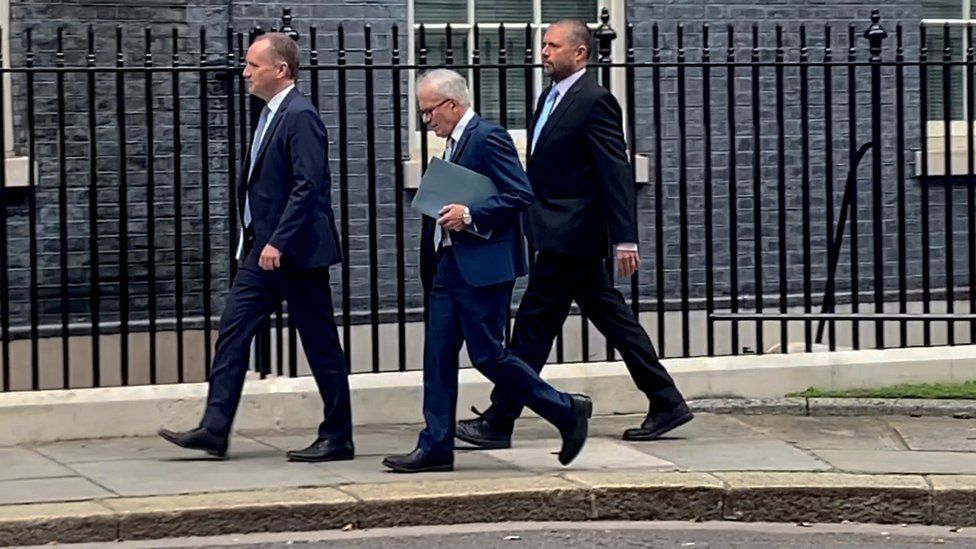
IMAGE SOURCE,PA MEDIA Image caption, Leading members of the Office of Budget Responsibility arriving at 10 Downing Street for a rare meeting with the prime minister
What is the Office for Budget Responsibility?
The Office for Budget Responsibility is the independent watchdog for the government’s finances.
It usually produces economic forecasts twice a year, to accompany each autumn budget and spring statement.
It scrutinises government plans, to increase taxes or borrowing for example, and predicts what the likely impact on the overall economy will be.
These forecasts are so important because a strong one gives investors confidence to put money into the UK economy – whereas a weak one is likely to have the opposite effect.
The government can request forecasts from the OBR at any time to get independent advice on big moves.
But it did not take the OBR up on its offer ahead of last week’s mini-budget. This is thought to have undermined confidence in the markets.
This led to the pound dropping to its lowest rate against the dollar in 37 years on Monday, before returning to its previous level.
The government’s tax-cutting plan faced criticism from the International Monetary Fund, and the pound dropped to a 37-year low of $1.03 on Monday.
On Friday, the sterling rose to $1.12 – close to the level the currency was at before the mini-budget was announced.
Despite that, the rating agency Standard & Poor’s cut the outlook for its AA credit rating for British government debt from “stable” to “negative” on Friday, because of the prospect of higher borrowing needed to fund the pledges.
In recent days, the Conservatives have posted some of their worst opinion poll ratings in more than 20 years.
A poll published on Thursday by Survation put the party on 28%, more than 21 points behind Labour, while a separate survey by YouGov put the Tories on 21%, 33 points adrift.
Labour’s shadow business secretary Jonathan Reynolds said ministers should “get back to Parliament, revoke the changes, and start again to try and rebuild confidence”.
And Conservative MP Martin Vickers urged the prime minister not to scrap the 45p tax rate and the bankers’ bonus cap, describing the move as “a political own goal”.
However, another Tory backbencher, Andrea Leadsom, said the mini-budget was “unashamedly pro-growth”, and that the markets were “wrong to be jittery” about the changes.
He blamed the impossibility of the December deadline to the nation’s mounting debt in the face of its economic difficulties.
The economist asserted during an appearance on Citi TV’s Big Issues program, which GhanaWeb was watching, that the government must first restructure its debt before concluding the agreement with the Bretton Woods institution.
Dr. Theo Acheampong argued that the time frame for this exercise was too short and that Ghana may realistically finalize its agreement with the IMF by the first quarter of 2023.
“The most important thing is how to bring your creditors together to restructure the debt. That is what could potentially actually extend the duration of the engagement exercise and that then means that the December timelines that we were looking at to conclude the IMF deal may actually slip a little bit,” he said,
“From where I sit, we only have barely three months to conclude all of this. [debt sustainability analysis] and given past experience, I struggle to see how we will conclude the debt sustainability analysis and then sit down with the creditors and agree on some sort of debt restructuring package and eventually goes to the IMF board for approval and the programme itself signed off. I think we are looking probably in about 6 months time period which may go into first quarter of next year,” the economist added.
On September 5, 2022, the Managing Director of IMF, Kristalina Georgieva, stated that a deal between Ghana and the IMF should be reached and finalized before the end of the year.
Former lecturer at Kwame Nkrumah University of Science and Technology (KNUST), Dr. Richard Amoako Baah, has urged Ghanaians to keep pressing President Nana Addo Dankwa Akufo-Addo for accountability despite his resistance to do so.
He is especially worried about Ghana’s current economic crisis, which he claims has the potential to cause the system as a whole to crash.
Despite the difficulties, he is concerned that the president is not taking advice and is being permitted to rule the country whatever he pleases.
He asserts that the current situation must alter.
“You advise him, he doesn’t take it. There is nothing left for you to do but to be quiet and watch him.
“It is our country; it belongs to all of us and it is about time we stand up and stop behaving as if the country belongs to the President and his friends and family and cronies and we are just guest workers in it.
“We are not. If we don’t speak up now. There will be nothing left, pretty much right now, nothing left,” he said in an interview on Joy FM, September 29.
Rising cost of living, galloping inflation and a depreciating Ghana Cedi are some of the main pointers to the economic crisis that Ghanaians are putting up with.
The government is in talks with the International Monetary Fund, IMF, for a reported US$3 billion rescue facility to help stabilize the economy and reset it on the path of growth.
Government has partly blamed the Russia-Ukraine war and the impact of the COVID-19 pandemic for the headwinds, insisting that all was being done to stem the tide.
Finance Minister Ken Ofori-Atta, according to Johns Hopkins University professor of applied economics Steve Hanke, has lost touch with reality on the performance of the Cedi.
On September 29, he said in a tweet that Ofori-Atta was “dreaming” to believe that the Bank of Ghana’s efforts to ensure the Cedi regains its value were “paying off.”
The Bank of Ghana’s attempts to control cedi depreciation, according to Ken Ofori-Atta, Ghana’s finance minister, are “paying off.”
Ofori-Atta must be dreaming, spoiler alert.
“The cedi has lost over 40% of its value against the USD since January 2020,” Prof. Hanke tweeted.
The economist who runs a project called ‘Troubled Currencies’ has consistently written off the local currency as the ‘central bank junk currency’ insisting that the only way to curb it depreciation was the installation of a currency board.
The Cedi has in recent times been experiencing a free fall against major trading currencies such as the US dollar.
At a point, some forex bureaus sold a dollar at GH¢10. The Bank of Ghana through its frequent hiking of the monetary policy rate has been trying to curb the situation.
The Finance Minister at a briefing on September 28 outlined other measures such as a Special Foreign exchange auction for bulk distribution companies and a Gold Purchase Programme which the central bank was implementing to stabilize the fall of the Cedi.
“As part of measures to shore up our reserves, improve exchange rate stability and address some of the funding needs, the Ministry successfully worked on a US$750 million Afreximbank loan facility which was received in August 2022,” he explained.
“The traditional Cocoa Syndication Loan, expected in the last quarter of 2022 which will promote the cocoa sector, will further help us build our FX reserves and provide a strong buffer for the cedi in the last quarter of the year,” Ken Ofori-Atta added.
As at July this year, for instance, the cedi lost its value by more than 20 percent to the US dollar.
In addition, recent economic downgrades by international rating agencies such as Fitch and Standards & Poors’ has also impacted the investor community at large, while Ghana awaits an International Monetary Fund, IMF, support programme which is expected to be accessible in 2023.
No agreement has been achieved with the International Monetary Fund (IMF) regarding the specifics of any debt operations, according to Finance Minister Ken Ofori-Atta.
According to Seth Terkper, a former minister of finance, the government may face difficulties in calculating the various debts accumulated throughout the period for the debt sustainability analysis with the International Monetary Fund (IMF).
Mr. Terkper added that the government must present a number of debts for examination as part of the bargaining process.
But, during a press conference in Accra on Wednesday September 28, 2022, Mr. Ofori-Atta said IMF will cover a period of 10 days; and in line with the President’s dialogue with the IMF Managing Director, Kristalina Georgieva, negotiations will be fast-tracked to ensure that key aspects of the programme are reflected in the 2023 Annual Budget Statement in November 2022.
“We simply have not reached any agreement with the Fund on the parameters of any debt operations as we are in the process of completing the debt sustainability analysis. Government shall continue to actively engage all stakeholders in a clear and transparent manner as we seek to fast-tract the IMF negotiation process.
“Government is committed to ensuring that a comprehensive package is negotiated with the aim of restoring and sustaining macroeconomic stability, ensuring durable and inclusive growth and promoting social protection,” he explained.
Mr. Ofori-Atta stated that in the Ministry’s press release dated 26th September, 2022 on the commencement of the IMF negotiations, having a sustainable debt path is a pre-requisite for the IMF programme.
“Therefore, the IMF/World Bank and the Ghana Team are currently undertaking a debt sustainability analysis (DSA) to inform the programme negotiations.
“In addition, the IMF and Government Team are working to update the medium-term macro-fiscal framework to inform IMF programme design.
“Also, the Government Team and the IMF Team are discussing policy measures and structural reforms proposed in our economic programme aimed at addressing the economic challenges facing the country towards restoring and sustaining macroeconomic stability, fiscal and debt sustainability, as well as promoting durable and inclusive growth and social protection.”
He claims that this is because Ghana’s creditworthiness has recently been downgraded to junk status by international rating agencies Moodys Fitch and Standards & Poor’s.
On September 28, Ken Ofori-Atta said during a news conference in Accra that the government is now concentrating on ensuring that it takes the required fiscal policy measures in order to reclaim access to the global capital market.
“Returning to the International Capital Market is going to take a bit of time. It will take about two to three years before we can be able to work on our ratings before that time. The recent downgrade is very unfortunate”, he said.
Over a period, demand for forex has overtaken supplies at a time when high debts and low investor confidence have made it impossible for Ghana to access the international capital market for borrowing.
This has led to the downgrading of Ghana’s creditworthiness, the depreciation of the local currency, and among others.
Ghana has now entered negotiations with the International Monetary Fund for a possible economic support programme which is expected to be accessed in 2023.
The government is sure that by the end of the year, the country will have reached an agreement with the International Monetary Fund (IMF) that will assist stabilize the economy and alleviate citizens of their current financial burdens.
Last Tuesday in Accra, the Minister of Finance, Ken Ofori-Atta, stated that President Nana Addo Dankwa Akufo-Addo expected to meet the December deadline and that his administration was working to make that happen.
Addressing some bank executives and the media at an event to sign an agreement between selected financial institutions and the government for the YouStart programme, Mr Ofori-Atta said the President wanted the negotiations to be concluded and a deal secured before the 2023 Budget was laid before Parliament.
He said the timeline was to enable the government to incorporate the expected IMF programmes into the 2023 Budget for onward implementation from next year.
Next year’s budget is due to be presented by November 15.
Crunch time
Speaking about the government’s commitment to revive the economy, Mr Ofori-Atta said now was a crunch time for the government as it raced against time to secure a deal from the IMF.
“As you know, the President wants this thing to be done before the budget and the budget should be done by November 15. So, it is really a crunch time now,” the Finance Minister.
He said a team from the fund was expected in the country from September 26 to 27 for the second round of negotiations after which the discussions will continue in Washington D.C. during this year’s Annual General Meeting of the World Bank and the IMF from October 10 to 16.
The minister said although Zambia took three years to conclude negotiations for its programme, which was announced this September, Ghana was optimistic that it could seal a deal by December.
Ghana opened discussions with the IMF for a programme in July.
No murmurings
Mr Ofori-Atta said, “I think we are determined to do that (secure a deal by December) and we need, as a nation, to move beyond the murmurings and to understand that we can do that.
“It is quite encouraging but also shameful when you hear the IMF Managing Director, Kristalina Georgieva, saying after meeting the President that we are determined to reach an agreement by the end of the year yet when you listen to our radio, you wonder whether we are friends or enemies of our own country,” he said.
He, however, said that enthusiasm was needed to pull the country out of the current challenges to build a stronger economy that can meet the growing needs of individuals and businesses.
Entrepreneurial instincts
Turning his attention to the YouStart, the Finance Minister said the initiative was the outcome of lessons learned from the covid-19 pandemic.
“Fundamentally, we had to adopt this approach because the pandemic taught us we must re-orient our approach towards structural transformation and react with a clear plan to ‘reap the benefits of our population dividend by building an entrepreneurial state,” he said
“This focus on building our young people’s skills and entrepreneurial ‘instincts’ is an informed one,” Mr Ofori-Atta said.
Joblessness
Mr Ofori-Atta said data showed that about 50 per cent of local employers reported misalignment of or inadequacy of skills in the market, with Mckinsey also reporting that at least 50 per cent of new tertiary institution entrants enrolled in programmes in sectors with little or no growth in the labour market.
He said the Ghana Statistical Service (GSS) also suggested that the unemployment rate for those aged 15 to 35 was 19.7 per cent.
“Even for those who are perceived to be working, 50 per cent of them are classified as under-employed.
“These statistics underscore the dire need to resolve this spectre of youth unemployment across our communities.
“Inevitably, this leads us to today’s event, where the Government of Ghana, represented by the Ministry of Finance, will sign an agreement with the Ghana Association of Bankers (GAB) and 13 leading banks for the YouStart Commercial Programme.
“Never in our history has there been a commitment of this size and scale,” he said.
Benefits
Mr Ofori-Atta was optimistic that the programme would help to strengthen the links between education and job market stakeholders, provide access to finance, skills and markets for young entrepreneurs and grow the capacity of the private sector to create jobs.
“Undoubtedly, we all are responsible for ensuring that YouStart becomes the primary vehicle for creating a million jobs over the next three years,” the minister said.
Turning point
The Chief Executive Officer of the GAB, Mr John Awuah, said the signing ceremony marked a turning point for the YouStart financing model.
He said the banks and the government had worked tirelessly to put the programme together and expressed the hope that the implementation would be smooth.
The Ministry of Finance has confirmed that its officials and that of the Bank of Ghana have commenced a comprehensive debt sustainability analysis with the
International Monetary Fund (IMF) for a $3 billion support programme.
A statement from the ministry said: “the Government of Ghana is putting together a comprehensive post-Covid-19 economic programme, which will form the basis for the IMF negotiations.”
“The programme seeks to establish a macro-fiscal path that ensures debt sustainability and macroeconomic stability, underpinned by key structural reforms and social protection.”
The ministry added that it is “optimistic about making progress in our discussions.” “Government remains
committed, and shall continue to actively engage all stakeholders, both public and private, in a clear and transparent manner as we seek to fast-track this process.”
An IMF team is in Ghana until October 7 to continue discussions with the government on policies and reforms that could be supported by a lending arrangement. The meeting with the IMF comes amid concerns that Ghana is about to start talks with domestic bondholders on a restructuring of its local-
currency debt.
Reports indicate that major local investors, including local banks and pension funds, are preparing to engage in discussion on debt
reorganization. This could entail the extension of maturities and haircuts on principal and interest payments.
Ghana’s debt-service costs in the first half amounted to GH¢20.5 billion, equivalent to 68 percent of tax revenue.
According to Seth Terkper, a former minister of finance, the government will face difficulties when calculating the various debts accumulated throughout the time period for the debt sustainability analysis with the International Monetary Fund (IMF).
On Tuesday, September 27, 2022, Mr. Terkper said on Morning Starr with Francis Abban that the administration must provide a number of debts for examination as part of the bargaining process.
If there is a chance that they won’t be paid, any additional debt that Parliament guaranteed will need to be added.
Therefore, this is where the scanning must be done.
These will all need to be discussed in relation to the framework for debt sustainability.
“That is what the statement that was issued yesterday was talking about the success of the negotiations which is dependent on a stable situation going forward. The debt sustainability framework actually puts in all these debt situations, for example your ability to generate foreign exchange to service the foreign debts. Your ability to raise revenue,” Mr. Terkper stated.
He continued: “Now your trade and other things come in, your growth probability and others are fed in and extended over a long period of ten years plus. So that is how long that analysis goes and it means there is a major problem as we have always discussed the calculation of arrears and the calculation of debts.”
He added that there are issues of arrears arising from nonpayment of domestic and foreign on the purchase of crude during the COVID-19 period and arrears owed contractors among others.
The Ministry of Finance on Monday announced that the IMF delegation is currently undertaking a comprehensive debt sustainability analysis of the country.
“The Government of Ghana is putting together a comprehensive post-Covid-19 economic programme which will form the basis for the IMF negotiations.
“The programme seeks to establish a macro-fiscal path that ensures debt sustainability and macroeconomic stability, underpinned by key structural reforms and social protection.”
Background
An International Monetary Fund (IMF) staff team, led by Stéphane Roudet, Mission Chief for Ghana, is in Accra to continue discussions with the Ghanaian authorities on policies and reforms that could be supported by an IMF lending arrangement.
The IMF staff will also further engage with other stakeholders during the visit.
There was an IMF staff team visit in July that saw the initial discussions with the Ghanaian authorities.
“We characterized that mission as constructive, kickstarted the process, and laid the groundwork for engagement,” Gerry Rice, the Director of Communications for the IMF told a media engagement ahead of this week’s visit.
Ghana is in dire need of a $3 billion package from the fund to shore up its economy.
Steve Hanke, a professor of applied economics at Johns Hopkins University in the United States, has once more charged that the Akufo-Addo government is mismanaging the Ghanaian economy.
This time, Prof. Hanke has specifically targeted President Nana Addo Dankwa Akufo-Addo, whom he sees as the primary cause of Ghana’s current economic situation.
In a tweet on September 27, the US-based economist said that President Akufo-economic Addo’s policies had caused Ghana’s economy to “go through the tubes.”
He also calculated Ghana’s inflation rate at 83 percent/year, which is twice as high as the official 33.9 percent for August of this year reported by the Ghana Statistical Service.
By his estimations, Prof. Hanke ranked Ghana in 7th place among 22 other countries reeling from the impact of inflationary pressures.
“Ghana is in 7th place in this week’s inflation table. On September 22, I measured Ghana’s #inflation at a stunning 83%/yr–over 2x the official inflation rate of 34%/yr. During Pres. Akufo-Addo’s reign, #Ghana’s economy has gone down the tubes,” Prof. Hanke wrote.
The Professor of Applied Economics, who has taken a keen interest in Ghana’s economic issues, has on numerous occasions said the economy was tanking – an expression which means the economy is down and there are fears of a recession.
Ghana is currently holding official negotiations with the International Monetary Fund for an economic support programme. The country is targeting around US$3 billion from the Bretton Woods institutions once an agreement can be reached.
High cost of living, depreciation of the cedi, revenue generations constraints, fallout from the Russia-Ukraine war among others have been attributed to some of Ghana’s economic challenges.
Consumer inflation for August 2022 hit 33.9 percent from 31.7 percent in July, making it the highest rate recorded in 21 years.
Yaw Appiah Lartey, a Partner and Financial Advisory Leader at Deloitte Ghana, has encouraged the administration to expedite talks with the International Monetary Fund (IMF).
Following the downgrading to CC, Fitch Ratings stated that Ghana’s high credit risk indicates the increased chance that the nation may pursue a debt restructure as interest rates rise.
Speaking on Morning Starr with Francis Abban Monday, Mr. Lartey indicated that speeding up negotiations with the IMF amidst the worsening economic conditions can bring in some immediate funds to cushion the economy.
In the quest to restructure the country’s debts and rebuild an economy ravaged by mismanagement and COVID-19, Appiah Lartey said “the first thing that Ghana should do is to accelerate the engagement with IMF.”
Citing the Zambia example as it recently secured 1.3 billion dollars from the IMF before its restructuring program, the Financial Advisor noted “So if you have some form of backup or liquidity support from the World Bank or some form of guarantee from the IMF at the time when you start the restructuring, it will be a much easier process. But if you go in a state where you do not have much liquidity when you start negotiating with these credit holders it will be difficult.
He added: “We saw this coming and unfortunately for us the local market is not that vibrant and the idea of the government using loan syndication using the local market or local commercial banks. As we speak the local major banks in Ghana have been downgraded,” Mr. Appiah Lartey stated.
He continued: “What that means is that these banks do not have a lot of liquidity to lend to the government anymore. So our situation has been worse and our public debt is rising and yet the liquidity to service those debts is not there. When you are rated triple C you have some elements of speculation.”
He described the government’s debt status as a junk one that needs some immediate liquidity to save the situation in order to avoid longer debt payments.
“It doesn’t mean that the government will not be able to pay but it will be much more difficult to pay. What that means is that the government will have to restructure to ensure that debts for a shorter or medium period are negotiated for a longer period.”
Ghana has been urged by the International Monetary Fund to add the 1.5 billion COCOBOD syndicated loan and the 2 billion Sinohydro loan from China to its current debt stock.
On September 27, 2022, norvanreports.com reported this.
The new IMF mission in Ghana is performing a thorough debt sustainability analysis as of September 26, 2022, and the IMF highlighted that this will present a clear and comprehensive picture of the country’s overall debt stock.
When the debt stock is included, Ghana’s GDP to debt ratio will increase from 78% (GH396 billion) to over 80% (GH399.5 billion).
Meanwhile, the government is said to be reluctant in making the addition, whiles noting that the Sinohydro loan was a barter trade for the country’s bauxite resources, norvanreports.com have said.
The government of Ghana commenced discussions with the International Monetary Fund on Monday, September 26, 2022.
According to the government, a comprehensive Debt Sustainability Analysis (DSA) which is a key requirement for securing an IMF-supported program is currently ongoing.
The move, the government said, is a necessary requirement to ensure that Ghana’s debt is on a sustainable path.
A release by the Ministry of Finance on September 26, 2022, said, “The Government of Ghana is putting together a comprehensive post-Covid-19 economic programme which will form the basis for the IMF negotiations. The programme seeks to establish a macro-fiscal path that ensures debt sustainability and macroeconomic stability underpinned by key structural reforms and social protection.”
Bankers in the country are pleading with managers of the economy to be cautious in their decision-making amid the impending restructuring of the country’s public debt in order to prevent the destabilization of the developing financial sector and the erosion of recent gains, particularly as it relates to investor confidence.
Concern over how the reorganization may affect the asset structure, profitability, and operations of banks was clear and palpable at the 39th Annual General Meeting (AGM) of the Ghana Association of Bankers (GAB).
Mansa Nettey, the organization’s president, said during the meeting that while the central government is taking the required steps to attain debt sustainability, these should not be done in a way that undermines progress made in the industry.
“Government must ensure that this is not done at the cost of financial sector stability, inadvertently undoing so much of what has been achieved in strengthening the banking sector – as a sound and stable economy needs an equally sound and stable banking system, one that can support the country’s long-term goals.”
According to budget figures, the nation spent GH¢20.5billion (US$2billion) in first-half of the year paying its debts – equivalent to 68 percent of its tax earnings. By end of June, the total amount owed by government had risen to GH¢393.4billion or 78.3 percent of Gross Domestic Product (GDP).
In response, central government started a proposed three-year Enhanced Domestic Programme engagement with the International Monetary Fund (IMF) in July for US$3billion – joining a number of emerging markets that are being forced to default or restructure some of their debts this year. This was done after efforts to stop the sell-off of its Eurobonds and halt a record depreciation of the cedi against the dollar failed – including cutting discretionary state spending by as much as 30 percent.
Mrs. Nettey – who doubles as chief executive officer of Standard Chartered Bank – further stated that while the industry recognises drastic measures need to be taken by the central bank in effectively combatting inflation, it is necessary that banks are encouraged with regulatory incentives to soften the impact.
“We recognise that the Bank of Ghana had to front-load the tightening; however, it is necessary that they are provided with regulatory incentives to help them navigate the current economic challenges and continue to support the economy,” she argued.
With the expectation of a tough business environment in the near-term, she said it is important that banks review existing operations and investment strategies to ensure sustainable performance as they remain risk-aware and undertake effective credit management processes.
At a recent engagement on Joy FM’s NewsFile, Director of the Financial Sector Division at the Ministry of Finance, Sampson Akligoh, offered assurances that government will take into consideration all stakeholders and not do anything to jeopardise the domestic financial sector.
The Zambian Case
Following the Fund’s approval of a US$1.3billion scheme for the southern African nation, Zambia will restructure its debt through a combination of haircuts to the initial value of its loans and maturity extensions. The process of renegotiating debt that will total US$17billion by the end of 2021 has begun.
This continues to be a critical milestone in the southern African nation’s quest to restructure its debts and restore an economy decimated by poor management and COVID-19; it allows the IMF to make an immediate payout of around US$185million.
In 2020, Zambia was burdened with debt that had reached 120 percent of its gross domestic product and made history as the first African nation to experience a pandemic-induced default.
Dr. Richmond Akwasi Atuahene, a consultant in banking and corporate governance, has encouraged the government to reach a consensus before engaging in negotiations with the International Monetary Fund(IMF).
The government of Ghana would have to participate in various debt restructuring procedures as part of the IMF’s programme for the sustainability of country’s debt.
However, according to financial analysts, Ghana is currently in a very precarious situation.
As such, a restructure of the nation’s internal debt may cause a number of banks to go bankrupt immediately.
This could further exacerbate the country’s economic recovery programme.
According to Dr. Atuahene, consensus building is needed now more than ever to ensure that the brightest minds in Ghana’s fiscal space are allowed to make their input into whatever strategy the government intends to embark on.
While this may not stop the debt restructuring process from having a resounding effect on the economy, he believes it may dull the blow that the economy would be dealt with.
“There’s the need for us to build up like Mr. Seth Terkper said, there needs to be a consensus building to look at this objectively devoid of politics. If we can get the crème de la crème people to meet and look at the impact, do the scenario analysis, because this haircut we have the hold out, we have the fair cut and fair value, all these things need to be looked at critically.
“And I believe that we need a team, people who are passionate about it and who know what they’re talking about so that they can have something which will not impact, because definitely it will impact on the economy whether we like it or not it’s going to impact the economy especially the domestic debt, it’s going to impact on it,” he said.
The Ministry of Finance and the Bank of Ghana have commenced discussions with the International Monetary Fund (IMF) for the second time for an IMF-supported programme.
The government is also expected to begin negotiations with the IMF this week which will last for about two weeks.
“Government negotiations with respect to the IMF-supported programme is commencing this week and we are optimistic about making progress in our discussions,” a statement issued by the Ministry noted.
In order to achieve a programme from the IMF, the government says it has put together a “comprehensive post COVID-19 economic programme which will form the basis for the IMF negotiations.”
This programme, the Ministry said is to establish a macro-fiscal path that ensures debt sustainability and macroeconomic stability underpinned by key structural reforms and social protection.
Meanwhile, the Ministry of Finance has disclosed that it is currently undertaking a debt sustainability analysis to confirm the country’s debt sustainability.
The Ministry in a statement on Monday, September 26 said this is necessary as it is a prerequisite for an IMF Programme.
The IMF has also announced that its economic programme with Ghana will focus heavily on debt sustainability.
This was captured in a Question and Answer statement issued by the IMF as it begins deliberations with the Government of Ghana on an Economic Programme aimed at stabilising Ghana’s economy.
The IMF also added that the programme will support the credibility of government policies, restore confidence in the central bank’s ability to manage inflation and accumulate foreign exchange reserves to help the local currency withstand headwinds.
On the Fiscal sector, the IMF noted that an important policy objective would be to increase revenues, critical for debt sustainability while safeguarding spending on health, education, and social protection.
Details of the engagement
Dr. Stephane Boudet is expected to lead the IMF mission team members made up of senior economists, research analysts, and communication officers.
Joy Business is learning that issues about the country’s current fiscal position as well as steps taken to improve the revenue situation will come up.
The IMF team will engage the Finance Minister, Ken Ofori-Atta, the Governor of the Bank of Ghana, Dr. Ernest Addison, Vice President Dr. Mahamudu Bawumia, some business associations, civil society groups and parliament.
The IMF in its Question and Answer statement maintained that the engagement follows several visits in recent months to engage with the authorities.
The Former Deputy Finance Minister noted that the country’s debt position has been tolerated long overdue such that it is now unsustainable.
Speaking on Top Story, Monday, the Ajumako Enyan Esiam MP said the debt restructuring situation presents dire consequences to the economy as the country has never experienced any debt restructuring of the sort.
“Our debt position has been tolerated. I can tell you that we cannot avoid debt restructuring…if Ghana does not go through debt restructuring, I may not even continue as a Member of the Finance Committee. Our debt is simply unsustainable…the entire envelope of government bond is going to go through some form of haircut,” he told Evans Mensah.
The MP is also worried as he believes the country “has no expertise” to do a debt restructuring.
According to Dr. Ato Forson, the government has poorly handled the communications surrounding its decision to debt restructure.
He contended that the unwavering impact of such a decision on the country’s economy needed the IMF to make such an announcement after its debt sustainability analysis.
“The communication around this matter has been extremely poor. Our country is in trouble because of the people who are in charge. The level of ineptitude is just too much, the way they handle issues is just unacceptable. The communication around this has been poorly done. It should have been the IMF after doing debt sustainability analysis that they will find a better way to announce it and get it done properly…the strategy has failed and it is going to cost this country a lot more,” he added.
Meanwhile, the International Monetary Fund (IMF) has announced that its economic programme with Ghana will focus heavily on debt sustainability.
This was captured in a Question and Answer statement issued by the IMF as it begins deliberations with the Government of Ghana on an Economic Programme aimed at stabilising Ghana’s economy.
The IMF also added that the programme will support the credibility of government policies, restore confidence in the central bank’s ability to manage inflation and accumulate foreign exchange reserves to help the local currency withstand headwinds.
The administration claims that a thorough Debt Sustainability Analysis (DSA), a crucial prerequisite for obtaining an IMF-supported program, is currently under way.
To make sure Ghana’s debt is managed in a sustainable way, this is a crucial prerequisite.
The government of Ghana is putting together a thorough post-Covid-19 economic blueprint, which would serve as the foundation for the IMF negotiations, according to an announcement from the ministry of finance on September 26, 2022.
The program aims to create a macro-fiscal path that guarantees debt sustainability and macroeconomic stability and is supported by significant structural changes and social protection.”
The IMF mission that arrived in Ghana on September 26, 2022, is currently in talks with the Ministry of Finance and The Bank of Ghana.
“Government remains committed and shall continue to actively engage all stakeholders, both public and private, in a clear and transparent manner as we seek to fast-track this process,” parts of the release read.
Ghana is seeking at least $3 billion from the Bretton Woods Institution to shore up its reserves and deal with the depreciating cedi and fund its infrastructure projects.
From September 26 to October 7, a staff delegation from the International Monetary Fund (IMF), led by Stéphane Roudet, Mission Chief for Ghana, will be in Accra to continue negotiations with the Ghanaian government about policies and reforms that might be backed by an IMF funding arrangement.
The IMF stated in a statement that throughout the tour, staff members will continue to interact with other stakeholders.
Deal
Ghana is before the IMF for US$3 billion to help the country navigate through the hostile economic crisis in which it finds itself as a result of the adverse effects of the deadly coronavirus disease (COVID-19) pandemic and the ongoing conflict between Russia and Ukraine.
Already, a delegation from the IMF, led by the Mission Chief for Ghana, Carlo Sdralevich, has visited Ghana and held initial discussions with the Ministry of Finance on a possible IMF-supported programme.
The International Monetary Fund (IMF) says a deal with Ghana should be reached and finalised before the end of the year.
The Managing Director of the IMF, Kristalina Georgieva, gave the assurance in a closed-door meeting with President Nana Addo Dankwa Akufo-Addo on September 5, 2022, on the sidelines of the Africa Adaptation Summit, a conference on climate change, in Rotterdam, The Netherlands.
“We understand the urgency and we will move as quickly as possible,” she told President Akufo-Addo.
Describing Ghana as a “superb country”, Ms Georgieva said the country’s current economic challenges were not locally generated but were as a result of external shocks.
She said contrary to some narratives that Ghana found itself in the current situation due to the bad policies of the Akufo-Addo administration, the factors were exogenous.
“Like everybody on this planet, you have been hurt by exogenous shocks. First the pandemic, then Russia’s war in Ukraine. We need to realise that it is not because of bad policies in the country but because of this combination of shocks and, therefore, we have to support Ghana,” the IMF boss said.
She further indicated that Ghana, a member of the IMF, “is a strong country with fantastic people”, and as such it was incumbent on the fund to lend the country support.
“We have to support Ghana because your strength contributes to the strength of your neighbours; it contributes to a stronger world,” Ms Georgieva intimated.
Ghana ready
At that meeting, President Akufo-Addo said a lot of work had been done by his Cabinet and the Ministry of Finance, and that the document to be presented by Ghana “is ready for the scrutiny of the IMF”.
He explained that Ghana was turning to the IMF for support to repair its public finances as a short-term solution.
“We have decided to seek the collaboration of the IMF to repair, in the short term, our public finances, which have taken a severe hit in very recent times, while we continue to work on the medium to long-term structural changes that are at the heart of our goal of creating a Ghana Beyond Aid; that is, building a resilient, robust Ghanaian economy,” he said.
Monday marked the official start of negotiations between Ghana and the International Monetary Fund (IMF) for an economic program that is required to prevent a debt default and stabilize the economy in the short- to medium-term.
It came after an IMF mission, led by Stéphane Roudet, the Mission Chief to Ghana, arrived in Accra over the weekend.
According to an IMF release, the team will remain in the nation from now and October 7, 2022.
The negotiatons with the government team are meant to determine the form that an economic stabilisation programme, which will be Ghana’s 17th with the fund since 1957, should take and when it can kick off.
It would also explore the nature of the policies, reforms and programmes that the loan support should entail.
Challenges
The negotiations come at a time when the economy is facing one of its worse challenges in recent times.
On Friday, Fitch Ratings downgraded the economy to CC from CCC, which is the country’s worst rating ever.
Read also: Fitch downgrades Ghana to CC from CCC
The agency said the downgrade followed “increased likelihood that Ghana will pursue a debt restructuring given mounting financing stress.”
Request
The government approached the fund for support in July this year after mounting debts in the midst of weak revenues fueled large fiscal deficit, rising inflation, a weakening currency and a general hike in cost of living.
Following the approach, a fact-finding team from the IMF arrived in July 2022 for discussions with the government after which it called for a debt sustainability analysis (DSA).
Although the results of the analysis are yet to be known, Graphic Online understands that the fund has asked the government to consider a debt restructuring with its creditors to help bring the debt to sustainable levels, necessary for a fund programme to begin.
The results of the negotiations will form the basis for a staff decision on Ghana’s request, which will then be submitted to the IMF executive Board for consideration.
According to the Finance Minister, Ken Ofori-Atta, President Nana Addo Dankwa Akufo-Addo wants a deal concluded by December 2022 to allow for a quicken recovery of the economy.
Duration
Discussions and negotiations for the country’s most recent programme in 2015 took around seven months to conclude.
Meanwhile, Graphic Online was earlier informed that the country could get up to $3 billion to stabilise its reserves and also open up access to the international capital market for lending.
The country was shut out of the market this year over the high debts.
On Monday, September 26, 2022, a delegation from the International Monetary Fund is scheduled to land in Ghana to begin formal loan request negotiations with the government of Ghana.
According to a report from Reuters, the negotiations would be focused on the policies and changes that the IMF might support as part of a program of economic assistance for Ghana.
Once an agreement on a program is reached, Ghana hopes to receive $3 billion from the Fund over the course of three years.
To get the cash in the first quarter of 2023, the government expects to wrap up negotiations by the end of this year.
The IMF officials are expected to be in the country until October 7, 2022.
Meanwhile, Government has routinely explained that recent economic headwinds are attributable largely to the ravages of the COVID-19 pandemic, the ongoing Russia-Ukraine war and the banking sector clean-up.
The rippling effect has been an increase in the cost of living, record high inflation rates and downgrades of the economy by rating agencies such as S&P and Fitch – a situation which has dealt a heavy blow to government’s ability to access the international capital market.
The Cedi has also been on a free fall compelling the Bank of Ghana to resort to hiking its monetary policy rate to deal with the situation.
The worsening economic situation compelled the government in July to initiate contact with International Monetary Fund for an economic support programme.
The country’s financial system and investor confidence will be less affected by an impending debt restructuring program, according to the assurance provided by the ministry of finance.
Prior to securing a US$3 billion credit facility from the International Monetary Fund, the Government of Ghana is anticipated to start discussions with domestic or foreign bondholders in an effort to restructure the country’s cedi debt.
The nation’s debt, which has been rising at an alarming rate, will need to be restructured as one of the primary prerequisites for the credit arrangement.
Reacting to concerns raised by some finance experts on the potential impact of the debt restructuring exercise, Director of the Financial Sector Division at the Finance Ministry, Sampson Akligoh said government will critically consider the plight of affected parties.
“No decision will be taken without external conversations… It is important that nothing is done to compromise the banking system and destroy people’s confidence in the banking sector as a whole.”
He, however, added that key players in Ghana’s financial sector will be prioritized as government engages the IMF on a potential support programme
“I understand why the analysts will say this…But if you’re within the Ministry of Finance, the job is that you have to do whatever you can to minimise the impact so that the economy is not disrupted,” he is quoted by Joy Business.
“Yes, we have a difficulty. But it is not something that we cannot sail through,” Akligoh added.
Meanwhile, a team from the International Monetary Fund are expected to arrive in Ghana on Monday September 26 to hold official negotiations with the government of Ghana for a loan request.
According to a Reuters report, the negotiations will centre on polices and reforms that could be supported by the IMF under economic support programme for Ghana.
Ghana is targeting an amount of US$3 billion over three years from the Fund once an agreement on a programme is reached.
The Bank of Ghana’s (BoG) Monetary Policy Committee (MPC) will not be holding its routine quarterly meeting today, Monday, September 26, 2022, as scheduled.
A statement from the Central Bank last Thursday said the rescheduled meeting will now coincide with Government’s next round of engagements with the International Monetary Fund(IMF).
The Fund is scheduled to begin these rounds from September 26 to October 7, on Government’s policies and reforms that could be supported by its lending arrangement.
The team, which will be led by its Mission Chief for Ghana, Stephane Roudet, is also expected to further engage with other stakeholders in the course of the visit.
Following the development, the Monetary Policy Committee says it will announce the next monetary policies on October 7, the day the engagements with the IMF will be concluded.
The last IMF mission to Ghana was between July 6 and July 13, 2022. The team used the opportunity to assess Ghana’s economic situation and discussed the broad lines of the government’s Enhanced Domestic Program that could be supported by an IMF lending arrangement.
The IMF team met with Vice President Bawumia, Finance Minister Ofori-Atta, and the Governor of the Bank of Ghana.
The team also met with the Parliament’s Finance Committee, civil society organizations, and development partners, including UNICEF and the World Bank, to engage on social spending.
Ghana is currently looking to secure a $3 billion loan from the IMF.
Honourary Vice President of IMANI Africa, Bright Simons, has criticized the Akufo-Addo government for constantly painting a false narrative about the impact of the Russia-Ukriane war on Ghana.
According to him, there is no available data that seeks to point out that Ghana is adversely being hit by the ongoing crisis.
Speaking at the 2022 Baah-Wiredu Lecture in Accra on September 21, Bright Simons argued that Ghana’s economy is not as exposed to that of Russia and other countries hence government’s justification for blaming the crisis on the current economic challenges in Ghana does not hold water.
“When we start to do the comparative analysis, you cannot use some other factor that has had a uniform effect. I tried my best to give you factors that could have shown that Ghana has been affected more, and as you saw I struggled with the data. I went to jobs, I went to growth, I went to how many people were killed and none of it bears out that we were affected worse,” he is quoted by Joy Business.
“So, if you are the worst performing in terms of currency, you cannot complain and say it is because of some factor that has affected everybody uniformly. It is as simple as that,” Bright Simons added.
The IMANI Vice president, however, blamed the current economic challenges on continuous wastage in expenditure by government and its other auxiliary agencies and institutions.
Meanwhile, President Nana Addo Dankwa Akufo-Addo recently speaking at the 77th United Nations General Assembly in New York reiterated the impact of the Russia-Ukraine war especially on African economies.
According to him, “Every bullet, every bomb, every shell that hits a target in Ukraine, hits our pockets and our economies in Africa. The economic turmoil is global with inflation as the number one enemy this year”
IMF bailout
Government has routinely explained that recent economic headwinds are attributable largely to the ravages of the COVID-19 pandemic, the ongoing Russia-Ukraine war and the banking sector clean-up.
The rippling effect has been an increase in the cost of living, record high inflation rates and downgrades of the economy by rating agencies such as S&P and Fitch – a situation which has dealt a heavy blow to government’s ability to access the international capital market.
The Cedi has also been on a free fall compelling the Bank of Ghana to resort to hiking its monetary policy rate to deal with the situation.
The worsening economic situation compelled the government in July to initiate contact with International Monetary Fund for an economic support programme.
Ghana is targeting an amount of US$3 billion over three years from the Fund once an agreement on a programme is reached.
Government hopes to complete negotiations by end of this year in order to receive the funds in the first quarter of 2023.
According to a Bloomberg report, the move forms part of government’s plan to secure a US$3 billion loan facility from the International Monetary Fund under an economic support programme.
Although Ghana has for some time not been able to access the international capital markets due its increasing public debt stock, revenue generation constraints and among others, Bloomberg said the country’s Eurobonds have since extended its declines in trading.
One of the key requirements for the loan facility will entail the restructuring of the country debt which has been soaring.
For instance, commercial banks and pension funds are among some of the country’s largest debt investors which are preparing to engage in talks on the imminent debt restructuring exercise.
If all goes to plan, the debt reform could result in an extension of maturities and cuts placed on principal and interest payment.
Ghana’s public debt stock at the end of March 2022 rose by some GH¢40.1 billion to GH¢391.9 billion, data from the Bank of Ghana’s May 2022 Summary of Economic and Financial Data has showed.
This, in terms of the country’s Gross Domestic Product (GDP), is estimated at 78 percent, which is slightly lower than the 80.1 percent earlier recorded in December 2021.
The Government of Ghana and the International Monetary Fund are expected to commence official negotiations for an economic support programme for the country.
Ghana is said to be targeting an amount of $3 billion over three years from the Fund once an agreement on a programme is reached. The new amount requested as a loan was double the government’s initial target of $1.5 billion.
According to a Joy Business report, the negotiations between IMF officials and Ghanaian authorities will start on Monday September 26, 2022.
Managing Director of the IMF, Kristalina Georgina, has recently attributed Ghana’s current economic conditions to external shocks emanating from the COVID-19 pandemic and Russia’s invasion of Ukraine.
According to her, these two factors have significantly impacted other economies hence Ghana’s economic challenges cannot be blamed on bad policies implemented by the Ghanaian government.
“Like everybody on this planet, Ghana has been hurt by exogenous shocks, first the pandemic, then Russia’s war in Ukraine, and we need to realize that Ghana’s challenge is not because of bad policies, but the combination of external shocks,” she indicated.
The IMF boss also speaking on Ghana’s possible programme said her outfit is determined to reach an agreement with the Government of Ghana by the end of this year.
She added that constructive discussions have so far been held with Ghanaian authorities for a possible economic support programme.
On July 1, 2022, President Nana Addo Dankwa Akufo-Addo ordered Finance Minister, Ken Ofori-Atta to present an economic rescue programme to the IMF following the current economic conditions in the country.
Subsequently, a team from the Fund led by Carlo Sdralevich visited Ghana between July 6 – 13, to gather relevant data and met with relevant stakeholders.
He claims that the argument over whether or not the nation’s economy is strong enough to support aid from abroad is pointless and should not be promoted.
Kweku Kwarteng’s remarks are in response to the Minority’s worries on the IMF’s assertion that the Russia-Ukraine war and the COVID-19 pandemic have severely harmed Ghana’s economy.
“Is this a point worth responding to? This whole discussion about Ghana subscribing to the IMF for the 17th time because of COVID-19 and Russia-Ukraine war – do we genuinely believe that for the sake of our country, this is a question we should be addressing? Won’t it be brilliant to be debating who has a better strategy to make this 17th appearance at the IMF the last for the country”, he quizzed on Eyewitness News.
Responding to criticisms of the IMF’s assessment of Ghana’s economy, Director of the Communications Department at the IMF, Mr. Gerry Rice re-emphasized that Ghana’s plight has been worsened by the Russia-Ukraine war as it had already injected a lot of fiscal power into the pandemic.
This is a point Kweku Kwarteng corroborates, and called for a rather more healthy discussion on the development to find a lasting solution to the country’s heavy dependence on the IMF.
“Why are we preoccupied with this? What kind of discussions do we want to have about the economy right now? I believe that our economy has been challenged but as we grow, we should learn and begin to have discussions that will make this 17th appearance, the last one. Why can’t we put those fundamental issues taking us to the IMF on the table? Why turn the debate into a blame game? Let’s correct things and focus on having helpful debates”.
Ghana is before the IMF to help the country navigate the economic crisis it finds itself in, which was worsened by the coronavirus pandemic and the ongoing conflict between Russia and Ukraine.
The country is seeking a $3 billion package from the fund.
Additionally, he has worked for the IMF in a number of departments in places including the Middle East, Central Asia, and its African Department, mainly in Ghana and Mozambique.
Before joining the IMF, Dr. Leandro Medina worked as an international consultant at the Inter-American Development Bank, participating in Portfolio Review and Policy Dialogue missions to Argentina and Uruguay.
Dr Medina comes to the position at a time that Ghana is seeking US$3 billion from the fund to help stabilize the economy which has been impacted by both internal and external factors such as the depreciation of the cedi, revenue generation constraints, the COVID-19 pandemic, Rausia – Ukrain war and among others.
Following that, between July 6 and July 13, a delegation from the Fund led by Carlo Sdralevich traveled to Ghana and spoke with pertinent parties.
Kristalina Georgiva, the IMF’s managing director, recently stated that her organization is committed to reaching a deal with the Government of Ghana before the end of this year.
She continued by saying that so far, positive negotiations for a potential economic support program had taken place with Ghanaian officials.
In the upcoming weeks, the International Monetary Fund (IMF) will send another mission to Ghana, according to Gerry Rice, the IMF’s director of communications, who made the announcement at a media event.
“In July, an IMF staff delegation visited Accra to start preliminary negotiations with the Ghanaian government.
And we defined that mission as positive, launched the procedure, and established the framework for involvement, which is still going strong today.
“Our IMF Mission Chief recently returned to Accra to meet with important peers.
I don’t have a certain date for you, but we’re aiming for another visit in the upcoming weeks.
As the economy struggles against the backdrop of greater inflation, tighter financial conditions, and poorer growth, Ghana is in a race against time to get a bailout program.
In August, the country’s inflation rate reached its highest point in 21 years as a result of the cedi’s decline.
From 31.7% in July to 33.9% in August, consumer prices increased.
To support its economy, Ghana needs a $3 billion package from the fund.
Ghana is ranked 4th in Sub-Saharan Africa (SSA) with the highest private savings, a report by the International Monetary Fund on “Private Savings and COVID-19 in Sub-Saharan Africa’ by the International Monetary Fund (IMF)” has disclosed.
Despite the challenges facing the economy, the report stated that private savings in Ghana grew from about 24 per cent in 2019 to about 30 per cent in 2022.
Again, oil exporting and middle-income countries such as Ghana, are the highest savers in the region.
The report further added that private disposable income in the country had gone up considerably.
“The private saving rate in SSA has increased during the last two decades to an average rate of 17.3 per cent in 2019 from 11.5 per cent in 1983.
However, there is significant heterogeneity across the SSA countries. Oil exporters and middle-income countries (MICs) are the highest savers in the region. Private saving rates, as expected, are particularly low in fragile states and low-income countries (LICs),” it pointed out.
The World Bank in its recent Global Findex Report said though the share of adults in Ghana having an account at a financial institution remained mostly stagnant since 2017, mobile money account ownership increased to 60 per cent from 39 per cent in 2017.
Again, the July 2022 Banking Sector Development Report by the Bank of Ghana also revealed that deposits recorded a robust growth of 19.1 per cent to ¢131.3 billion as of the end of June this year, albeit lower than the growth recorded a year earlier.
Meanwhile, Gabon is the number one country in Sub-Saharan Africa with the largest private savings of about 34 per cent.
He claims that many nations, like Ghana, have been put through more hardship because they were already at the mercy of the COVID-19 pandemic when the Russia-Ukraine crisis started.
He is quoted by citinewsroom.com as saying, “I would say, as just to repeat, the war in Ukraine has triggered a global economic shock that’s hitting Ghana and, as I said, many other countries, and all at a time when, for many of these countries, their room for fiscal maneuver, if I could put it that way, is already extremely limited because they’ve used a lot of fiscal power already in the pandemic.”
His remarks come after numerous Ghanaians, notably the former president John Mahama, disputed with claims made by the MD of the IMF that foreign causes were to blame for Ghana’s economic issues.
Gerry Rice claims that the IMF has taken note of the difficulties that various nations are facing and is acting to hasten their recovery.
And we’re well aware of it.
And for that reason, as I stated at the outset, we are stepping up to assist nations where we can, and that includes Ghana,” he insisted.
He said, “I don’t have a date for you, but [it will be] in the coming weeks.” When asked when Ghana should expect the anticipated $3 billion from the Bretton Woods organization, he stated, “I don’t have a date for you.”
A chartered economist Mr. Prince Obiri Yeboah, has asked the government to stop using the COVID-19 pandemic, and the Russian-Ukraine war as an excuse for mismanaging the economy.
The economist explained that although the COVID-19 and Russian-Ukraine war could have had an impact on the current state of the economy, the major cause of our woes has been necessitated by the mismanagement and, financial indiscipline, and incompetence on the part of the government.
He said, over the last three years, Ghana has faced challenges, including the outbreak and the Russian-Ukraine war, coupled with financial indiscipline, which has led us to the International Monetary Fund for a bailout.
He said when people are faced with challenges, they seek excuses and those to blame. But when you evaluate our situation, you will discover that there was fiscal indiscipline from the President to his appointees.
For him, the COVID-19 outbreak affected several countries but Ghana did not have any major negative impact on the economy as people make it seem.
â€The leaders we voted for have not been financially disciplined. Governance is about revenue and expenditure, and when you overspend or spend more than what you generated, you will face an economic crisis and borrow more. That is what we find ourselves today. We have overborrowed and have no other option than to go to the IMF to seek a bailout.â€
Ghana has been listed among a dozen developing nations facing a looming debt crisis amid the general economic downturn.
Other countries in the list of 12 nations at risk of debt default included: Ukraine, Nigeria, Kenya, Tunisia, Belarus, El Salvador, Egypt, Ethiopia, Argentina and Ecuador.
According to a Reuters report, factors that occasioned Ghana’s specific crisis rest on among others massive borrowing, rising inflation, a slumping currency and soaring debt to Gross Domestic Product, GDP, ratio.
“Furious borrowing has seen Ghana’s debt-to-GDP ratio soar to almost 85%.
“Its currency, the cedi, has lost nearly a quarter of its value this year and it was already spending over half of the tax revenues on debt interest payments. Inflation is also getting close to 30%,” the report noted.
The report cited Lebanon, Sri Lanka, Russia, Suriname and Zambia as nations already in default, Belarus, it added was “on the brink and at least another dozen are in the danger zone as rising borrowing costs, inflation and debt all stoke fears of economic collapse.”
It stated that countries that are looking to avert an economic collapse were among others looking to the International Monetary Fund, for rescue programmes.
Ghana is currently in talks with the IMF for one such programme after the government.
More than 30% of emerging and developing countries are at or near debt distress, Managing Director of the International Monetary Fund, Kristalina Georgieva, has revealed.
For low-income countries that number is 60%.
According to her, the tightening financial conditions and exchange rate depreciations has escalated the debt service burden which she described a harsh and for some countries unbearable burden.
Speaking at the hybrid meeting of the G20 Finance Ministers and Central Bank Governors, Madam Georgieva said the outlook of the global economy has darkened significantly, and uncertainty is exceptionally high, adding, “downside risks about which the IMF had previously warned have now materialisedâ€.
She therefore wants a strong global leadership to tackle the scourge of high debt, which has reached multiyear highs.
“The war in Ukraine has intensified, exerting added pressures on commodity and food prices. Global financial conditions are tightening more than previously anticipated. And continuing pandemic-related disruptions and renewed bottlenecks in global supply chains are weighing on economic activity.â€
“As a result, later this month, we will project a further downgrade to global growth for both 2022 and 2023 in our World Economic Outlook Update. Moreover, downside risks will remain and could deepen—especially if inflation is more persistent—requiring even stronger policy interventions which could potentially impact growth and exacerbate spillovers particularly to emerging and developing countries. Countries with high debt levels and limited policy space will face additional strains. Look no further than Sri Lanka as a warning signâ€, she added.
Emerging and developing countries have also been experiencing sustained capital outflows for four months in a row. They now suffer the risk of reversing three decades of catching up with advanced economies and instead falling further behind.
3 priorities to navigate challenging environment
The MD of IMFsaid first countries must do everything in their power to bring inflation down, adding, “failure to do so could risk the recovery and further damage living standards for vulnerable peopleâ€.
She expressed excitement that central banks are stepping up their game.
“Monetary policy is increasingly synchronised: more than three-quarters of central banks have raised interest rates and have done so 3.8 times. Central bank independence is critical for the success of these policy actions, as is clear communication and a data-driven approach.â€
Secondly, she said fiscal policy must help but not hinder central bank efforts to tame inflation.
“With growth slowing down, some people will need more support, not less. So fiscal policy needs to reduce debt while providing targeted measures to support vulnerable households facing renewed shocks, especially from high energy or food pricesâ€.
Thirdly, Kristalina Georgieva said, a fresh impetus for global cooperation will be critical to confront the multiple crises the world is facing. We need G20 leadership particularly to address the risks from food insecurity and high debt.
According to the portal, the team will also meet with the Finance Committee of Parliament as part of its data gathering and discussions with government officials and stakeholders.
It is expected that the meeting with the Vice President, who also is the head of the Economic Management Team, and Parliament will be a high-level meeting which will entail discussions around an economic support programme for Ghana.
Officials from the Fund arrived in Ghana on July 5 to commence talks with government officials for a possible economic support programme.
The meetings are also expected to ensure stakeholder input and support ahead of an imminent financial bailout programme.
The International Monetary Fund has released nearly $216 million U.S. dollars for Senegal after a review of its aid programs for the West African country.
The Executive Board of the International Monetary Fund (IMF) announced Wednesday ( June 22)
“The completion of the audits allows the immediate release of about 215.78 million dollars,” the institution said in a statement.
“As a result, total access under the 18-month agreements approved in June 2021 has been increased by about $172.6 million, from about $650 million, at the time of approval, to about $776.67 million,” the fund said.
“Soaring global fuel and food prices, compounded by the war in Ukraine and, to a lesser extent, the freeze on trade with Mali are disrupting the post-pandemic recovery,” the institution commented.
The IMF has revised down its 2022 growth forecast for the country to around 5% while inflation is expected to reach 5.5%, driven by rising food and energy prices.