The Israeli military says that Hamas fighters from Gaza have entered Israel’s southern communities and killed around 300 people.
Israeli Prime Minister Benjamin Netanyahu has informed the citizens that they are entering a war that will be lengthy and tough.
Many armed people entered southern Israel, they killed soldiers and regular people, and they took a large number of hostages into Gaza, as said by the army.
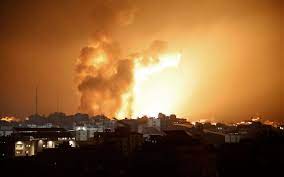
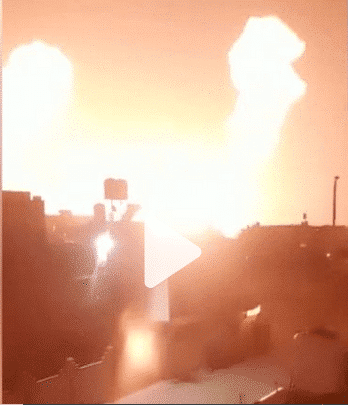
On Sunday morning, the Israeli Air Force said it was attacking important buildings and systems in Gaza.
The Israeli army attacked southern Lebanon with big guns after mortars were shot from there towards Israeli positions in the disputed Mount Dov/Shebaa Farms area.
Lebanon’s Hezbollah group said they carried out the attack to support the Palestinian resistance.
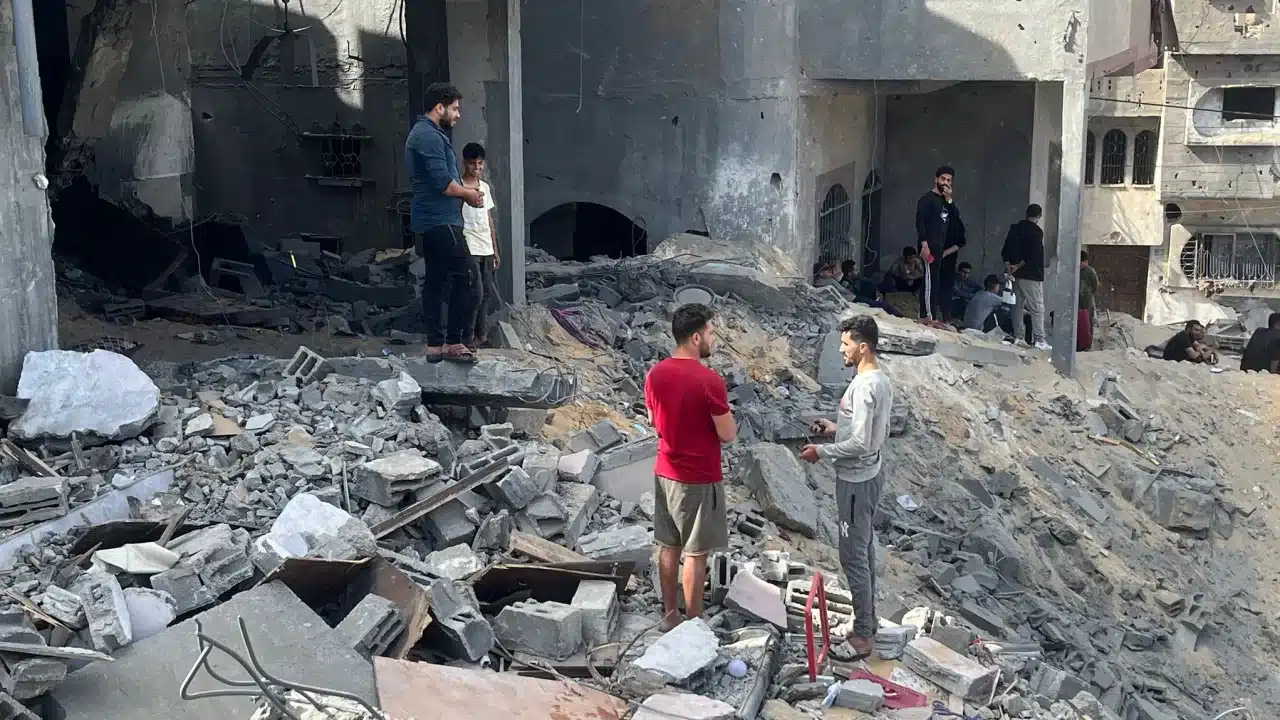
Over 300 people have died due to Israeli airstrikes in Gaza since Palestinian militants entered Israel from Gaza on Saturday morning, as confirmed by Palestinian health officials.
People living in Gaza got messages from Israel telling them to go to the city or seek safety in shelters.
The leader of Israel said in a message that they were forced into war because Hamas attacked them. They said the initial stage of the war would be over soon, as they were getting rid of most of the militants on their land. Israel will make sure its citizens are safe and succeed in their goals, he said.
The Israeli government has decided to stop providing electricity, fuel, and goods to Gaza.
Israel’s worst fear – Palestinian militants with weapons wandering around in the southern part of the country – started early on Saturday, during the Jewish day of rest and celebration known as Simchat Torah.
Gunmen broke through the fence separating Gaza from Israel. They entered Israel using motorbikes, paragliders, and by sea. The IDF spokesperson said there were hundreds of these people, and over 3,000 rockets were shot at Israel in one day.
Lieutenant Colonel Jonathan Conricus said that they attacked many Israeli communities and IDF bases. They went from one house to another, searching inside.
They killed innocent Israeli people in their houses and then took more Israeli people to Gaza. I am referring to women, children, the elderly, and disabled individuals.
Disturbing videos showed Israeli people running scared from a desert festival, and women being forced into vehicles and taken away by kidnappers. Video caption
Israeli people were calling and informing the news channels that they were staying inside their houses because they were very afraid and worried about their safety. Fifteen people living in the town of Netiv HaAsara were killed by Hamas fighters.
In the town of Sderot, a person named Shlomi saw a lot of people lying on the ground along the road.
Over time, the Israeli military started to regain control over many of the southern communities. According to Israeli media, the hostages who were kept in a dining room in Kibbutz Be’er were released after 18 hours. Soon after, more updates said that soldiers had rescued people who were being held captive in the town of Ofakim. The assailants who were keeping them hostage were also killed.
US President Joe Biden said that America strongly supports Israel, which is currently being targeted by a terrorist group. Biden described the support as very strong and unwavering.
Hamas’s military group stated that they captured many more Israelis than just a few dozen, including important military leaders.
By the end of Saturday, over 1,500 people got hurt in Gaza and another 1,500 in Israel, according to officials.
The army said that if Hamas continues to use a very high level of violence, they will respond in a way that has never been seen before.
Thousands of reserve soldiers have been called up and are now getting ready to start a military operation on the ground in Gaza.
On Saturday, Israel attacked and destroyed a tall building called the Palestine Tower in the middle of Gaza City. This building had radio stations owned by Hamas on its roof.
The Israeli air force attacked buildings used by important members of Hamas for doing terrorist acts. They informed the people in the buildings to leave before the attack happened.
There was fighting in different places in the West Bank on Saturday. Palestinian doctors said that six Palestinians were killed during clashes with Israeli forces.
Hamas military leader Mohammed Deif asked all Palestinians to help with the group’s mission.
“We have decided to stop these Israeli offenses with the help of God, so that the enemy realizes they can no longer cause chaos without facing consequences,” he said.
Ismail Haniyeh, the leader who is not currently in his home country, said that Palestinian groups plan to make the fighting bigger in the West Bank and Jerusalem that is controlled by another country.
Ghazi Hamad, who speaks for Hamas, told the BBC that Iran supported the attack directly.
Mahmoud Abbas, the President of Palestine and a political opponent of Hamas, stated that the Palestinian people have the right to protect themselves from the violence caused by settlers and occupying forces.
Many countries strongly disapprove of the Hamas attacks.
The UN boss, António Guterres, said he was shocked by reports that innocent people were attacked and taken from their houses. The UK’s Foreign Secretary, James Cleverly, firmly denounced the terrible attacks by Hamas on Israeli civilians.
Saudi Arabia wants the fighting to stop right away. They have been warning about the dangers of the occupation and how the Palestinian people are being mistreated for a long time.
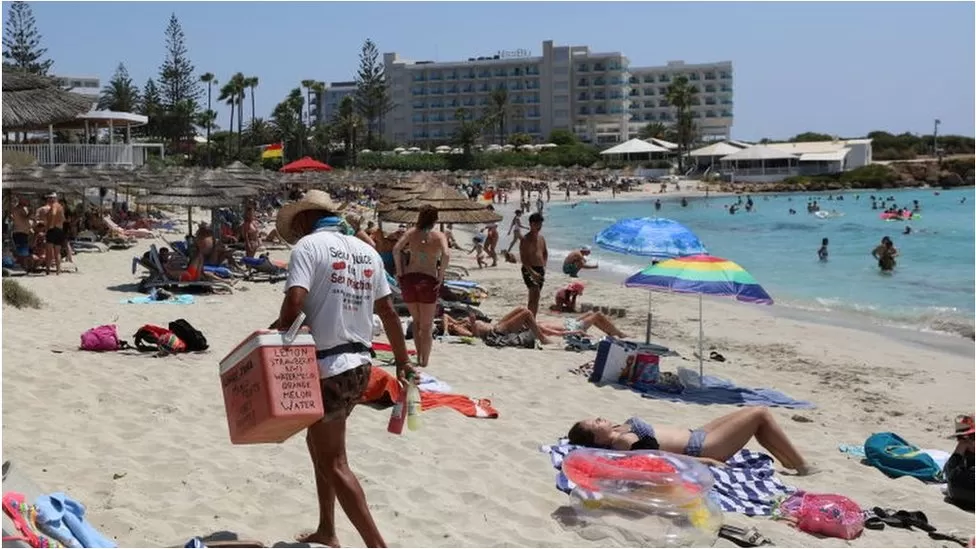
The supposed attack supposedly happened at a hotel in Ayia Napa, which is a well-liked place for tourists to visit.
A crowded courtroom in a place called Famagusta, which is close to Ayia Napa, had many family members of the accused people present to show their support.
The people being accused are 19 or 20 years old and are from a town called Majd al-Krum in Israel. They say the accusations are not true.
During the meeting on Thursday, their attorneys expressed dissatisfaction that they had not yet been shown important evidence, such as the DNA report.
Someone said that the report could prove that his two clients were not in the room when the alleged attack happened on September 3rd.
The person in charge of enforcing laws for the government said that the test on the DNA would be finished by the end of today.
After the meeting ended, the families of the defendants hurried to hug them. One of the men was clearly crying while hugging his mother.
A previous lawmaker from Cyprus, Skevi Koukouma, went to the meeting along with members of a prominent women’s group called Pogo.
Ms Koukouma said they were there to send a message that “people who have been hurt should feel comfortable telling their story and trust that others will believe them”. “She said there are other people with them. ”
The trial will start again on 16 October.
Israel’s foreign ministry first stated that six Israeli citizens were taken into custody for their suspected involvement in the attack.
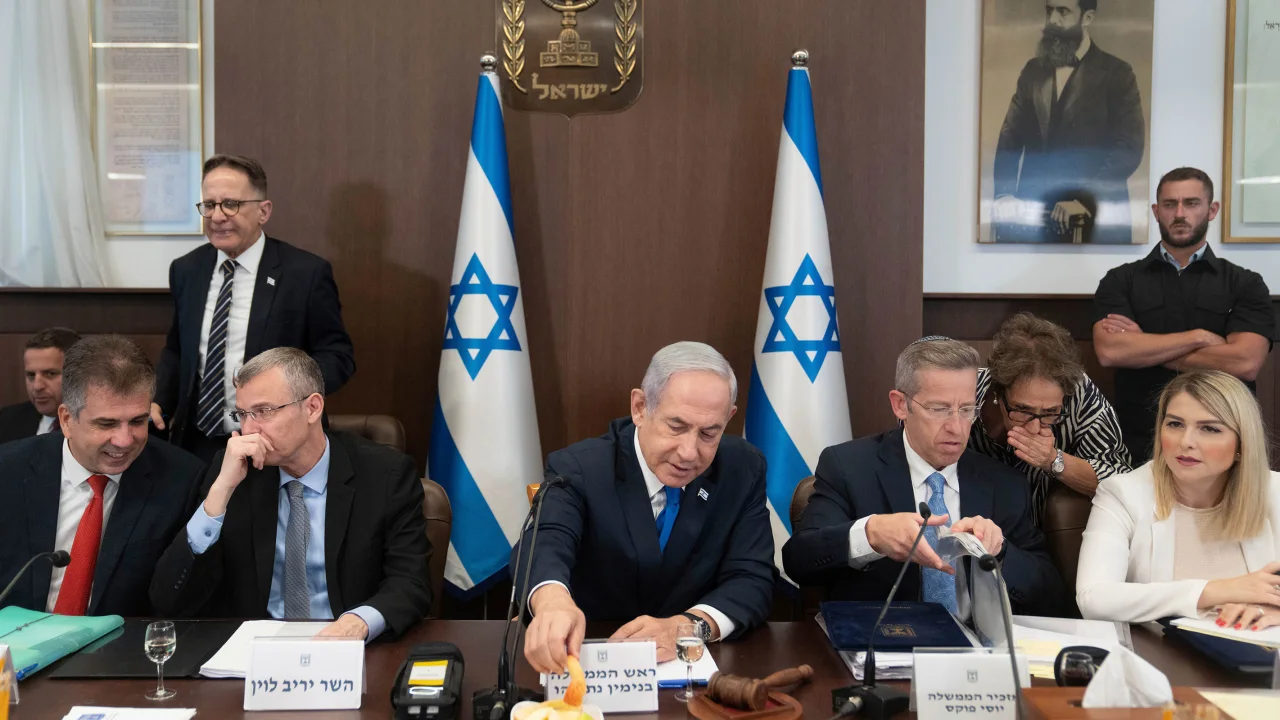
Israel’s highest court is currently listening to requests to challenge a recently passed law that makes it more difficult to remove a prime minister from office.
Eleven out of the 15 judges in the Supreme Court were listening to the arguments on Thursday. In the next two months, the court will listen to arguments on three cases that question laws made by the Benjamin Netanyahu government this year.
Thursday’s petition has a big impact on Netanyahu personally.
According to the law, only the prime minister or the cabinet with a two-thirds majority can say someone is not suitable to be a leader. This can only happen if the person is physically or mentally unable to do the job. The cabinet’s decision would need to be approved by a two-thirds majority in the parliament, called the Knesset. The amendment is a modification to one of Israel’s Basic Laws, which are similar to a constitution.
The change was approved before the government began making new laws to change the judicial system. This change has caused disagreements in the country and led to protests because people believe it harms Israel’s democracy and makes its judiciary weaker.
The people who spoke in the hearing on Thursday believe that the amendment was passed only to help Netanyahu, who is currently being tried for corruption. They think this is a misuse of the power given to representatives by the people. According to the Supreme Court, this is one reason why they can cancel changes made to a Basic Law. However, the court has never declared a Basic Law or a change to it as invalid.
Yiktzhak Burt, a lawyer representing the Knesset, admitted to the Supreme Court on Thursday that the law in question did personally help the prime minister. However, he argued that the Knesset had the authority to pass it because they were elected by the people, and he urged the court not to cancel the law. He agreed that the law had problems, but they weren’t serious enough to remove it.
On Thursday, Supreme Court President Esther Hayut explained that the court was not talking about canceling the law, but instead delaying when it would be put into effect.
Earlier this month, the highest court in the country listened to discussions about a new law, created in July, that removed its power to prevent government actions judges deem as “unreasonable. ” This law was also an alteration to an important legal rule. The third request is about Justice Minister Yariv Levin not wanting to have a meeting with the committee that selects judges because they cannot agree on who should be in the committee.
Amir Fuchs, a researcher at the Israel Democracy Institute, said to CNN that the Supreme Court is facing more challenges to amendments than ever before.
“We’ve never had so many court hearings happening one after another. ” This situation is a very rare and never seen before crisis in our government’s rules and laws,” Fuchs said.
Before this law was changed, there was no written rule that explained how a prime minister could be kicked out of their position for being incapable of doing their job. However, Fuchs mentioned that there were some previous cases where the attorney general could make that decision.
I think we had a bad deal before. It was not clear or specific enough. “It requested a change,” Fuchs explained. “But it’s very obvious that the reason behind this law was completely personal. ”
This is because people signed papers asking to declare Netanyahu not suitable for his job because of his ongoing trial for corruption. He is the first Israeli prime minister who is currently in office to go to court as a defendant. He is being tried for accusations of fraud, breaking trust, and bribery. He says he didn’t do anything wrong.
As a way to still be the prime minister while being on trial, Netanyahu agreed to declare any conflicts of interest in 2020 as part of a deal with the court.
The attorney general decided that Netanyahu could not participate in decisions that impact the court system, such as the judicial overhaul. Some people argue that certain changes in the overhaul could make it easier for Netanyahu to avoid being punished for corruption.
Earlier this year, the Justice Minister Levin announced that the government has plans to make changes to the judicial system. At that time, Netanyahu said he couldn’t participate or help because of a conflict-of-interest declaration.
But in March, shortly after the change to make it harder to remove a prime minister from office was approved, Netanyahu said he would take part.
“Until now, I haven’t been able to do anything,” said the prime minister. We are in a ridiculous situation where if I had done my job and intervened in the changes to the justice system, I would have been declared unable to continue serving. Tonight, I want to say that I’ve had enough and I cannot accept this any longer. I will participate.
A first meeting with three judges has already taken place for this case. On Thursday, the Supreme Court listened to arguments again. This time, 11 out of the 15 judges were present.
Normally, the attorney general would present the government’s arguments in a hearing at the Supreme Court. However, AG Gali Bahrav-Miara chose not to do so. She agrees with the people who signed the petition that the amendment should not continue, just like she said during the meeting about the law of “reasonableness” earlier this month.
The judges might reject the amendment and say that the parliament misused their power. This means that the legislation is not being passed for regular reasons, but for the benefit of a particular person, which is Netanyahu.
Fuchs observed that the bill was introduced and approved very quickly, and the comments made in parliament clearly indicated that the law was created to safeguard Netanyahu.
The Supreme Court might say that the law is not in effect currently and will only be in effect when the next parliament starts. That could be a solution to a difficult problem in the constitution.
“It helps with most of the problem because if they decide it will only apply in the next Knesset, it means it won’t solve any personal problems for Netanyahu. It also gives the Knesset time to reconsider the arrangement,” explained Fuchs.
The court needs to make its decision by January 12, 2024, because the judges who are handling the case will be leaving their positions.
The court has to make a decision before that time about the petition against the law that removed the court’s power to say government actions are “unreasonable. ” This is a bigger challenge, and all 15 of the current Supreme Court justices are considering the case for the first time. The decision on that request is likely to take more time compared to the decision being discussed on Thursday.
Furthermore, the highest court in the country is set to consider a case about the justice minister’s delay in organizing the group to choose new judges for the Supreme Court. Netanyahu’s government wants to change how judges are chosen in Israel so that politicians have more influence.
The group was supposed to have a meeting last week, but Levin decided to delay it.
“It’s really important, even though it’s about administrative matters and not a complaint against a fundamental law,” Fuchs explained about the challenge. This is because Levin might have to obey a court decision regarding a crucial part of the judicial reform.
However, there could be a bigger problem after the Supreme Court makes its decisions, as Fuchs explained, if Netanyahu and his government decide to ignore them. Despite being asked multiple times by CNN and other media outlets, he has not made a firm decision to obey or comply with their requests.
The government has the power to decide whether to accept this or not. Fuchs explained that just because Netanyahu is avoiding answering the question about whether he will follow the decision, it doesn’t mean he won’t.
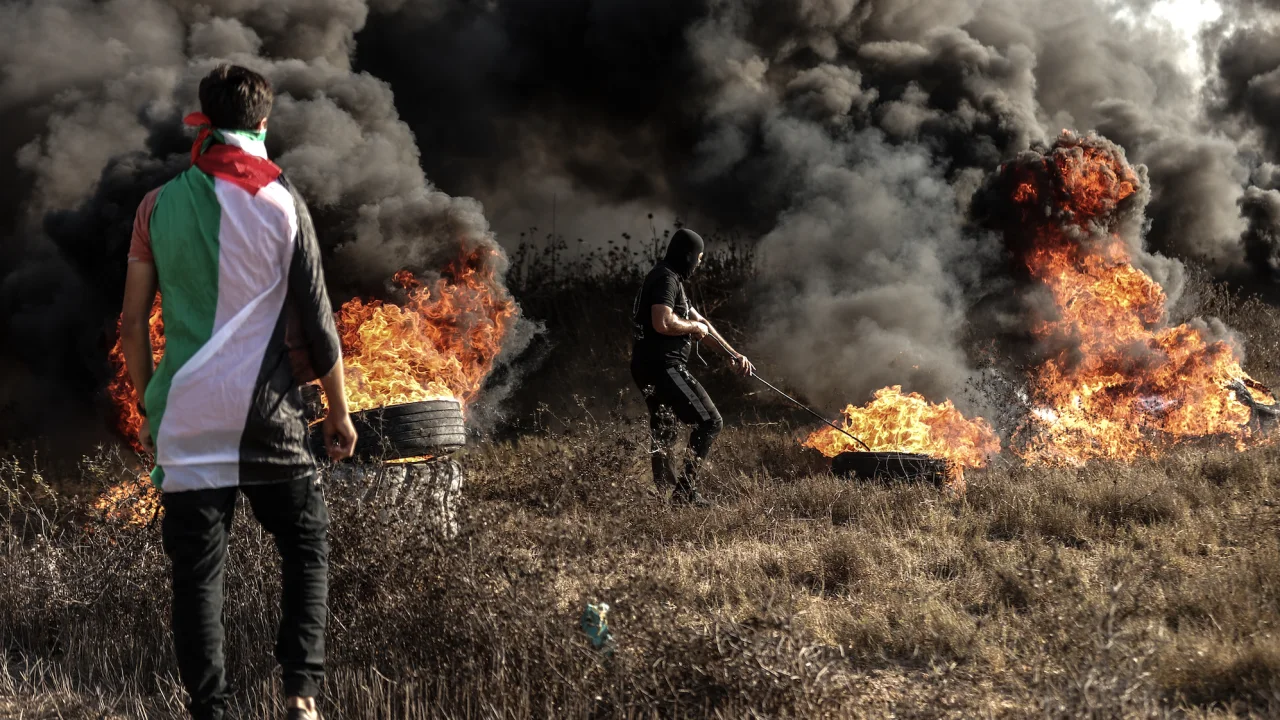
The fighting started after Palestinians protested for over a week, sometimes using violence, along the barrier separating Gaza from Israel.
On Friday, Israeli forces shot and injured at least 28 people on the Gaza side of the fence, according to the Palestinian Ministry of Health in Gaza.
The weapons are not very complicated things – they are balloons filled with helium, like the ones you see at children’s birthday parties. They have explosives or devices attached to them which are set on fire before they are used.
The balloons were let go by a group called Ahfad Al-Nasser, or the Descendants of al-Nasser. This group is known for doing attacks using balloons that have explosives tied to them.
The balloon launches on Friday caused at least three fires in Israel, but they were all put out.
The IDF (Israeli Defense Forces) attacked two places where Hamas was launching balloons, and another place where they said Hamas shot at Israeli soldiers.
Israel’s Supreme Court opened hearings Tuesday on a law to curb its powers, in a case that could set the judiciary on a collision course with Prime Minister Benjamin Netanyahu’s hardline government after months of mass protests over the controversial legislation.
The court is hearing arguments for and against the first part of Netanyahu’s judicial overhaul plan to pass parliament – a law that restricts the court’s ability to nullify government actions it deems “unreasonable.”
Beyond the legal questions surrounding the law and the justices ruling on their own powers remains the question of whether Netanyahu’s government would even abide by a court ruling – possibly months away if it comes – striking down the law. That would set Israel up for an unprecedented judicial and political crisis.
Netanyahu has always claimed that he is in full control of this government – no matter who his ministers are. But the next few weeks could be critical to his own future.
“If Netanyahu wants to survive as prime minister, he must have his hands on the steering wheel, otherwise he will fall apart,” said Amit Segal, chief political correspondent for Israel’s Channel 12. “The Supreme Court and the government alike possess a credible nuclear threat against the other side … if both sides are rational actors, they will … disarm themselves. Problem is, we’re in a crisis that is not very rational anymore.”
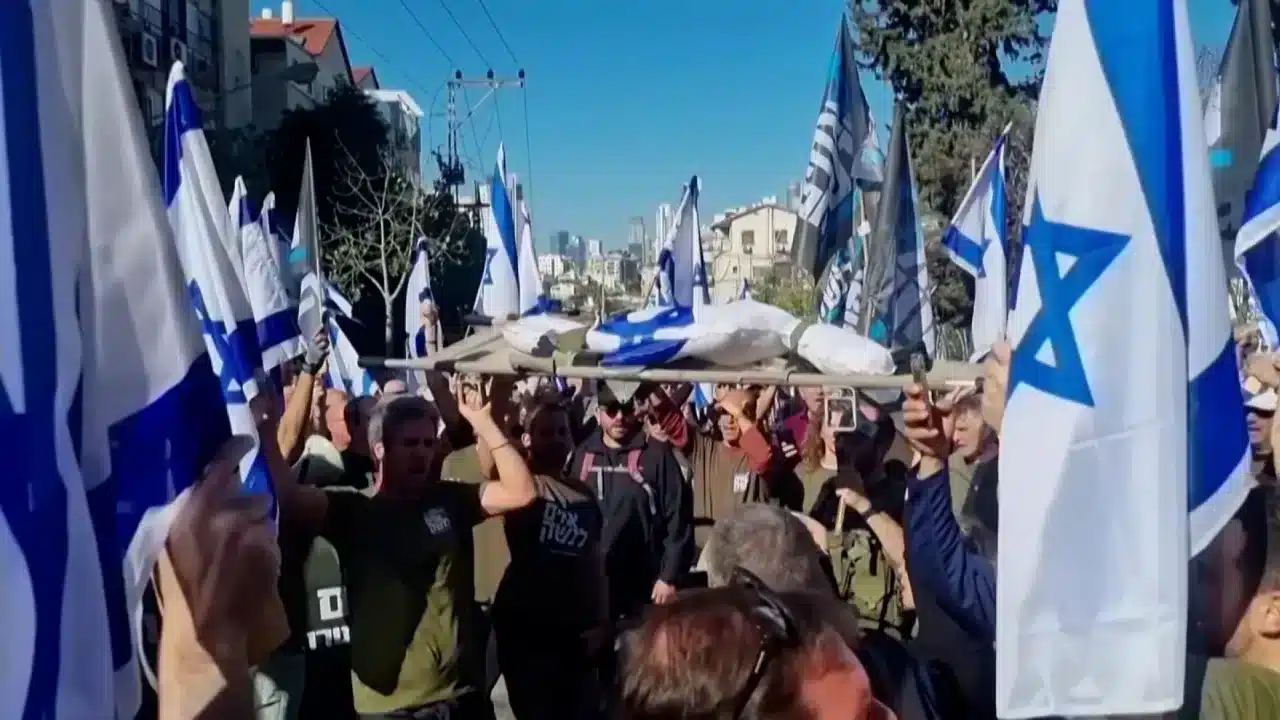
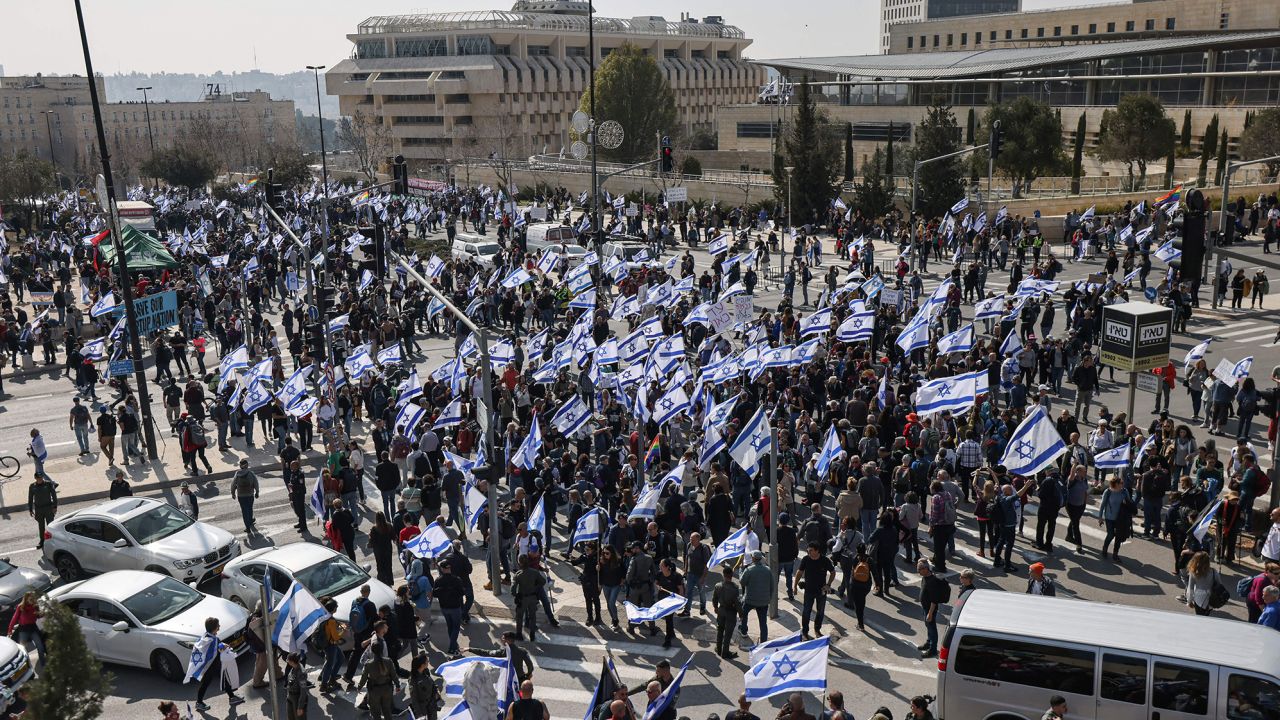
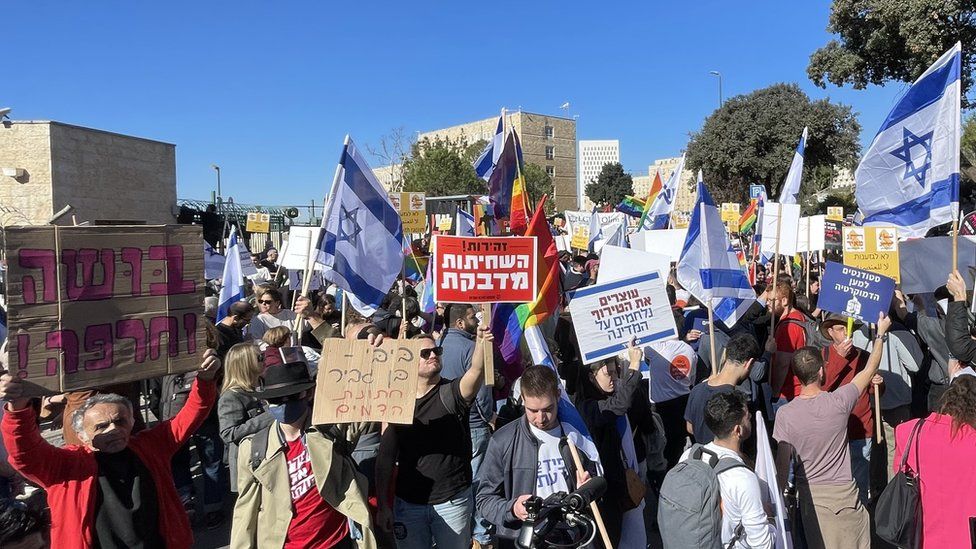
Netanyahu’s proposals to weaken the courts have divided Israeli society, with critics describing them as a threat to the country’s democracy. Tens of thousands of Israelis took to the streets outside of the Supreme Court on Monday evening, part of the 36-week long protest movement against the overhaul, to show support for the justices ahead of the hearing. Some of the demonstrators later marched to the prime minister’s official residence in Jerusalem.
The Supreme Court is hearing appeals against the so-called “reasonableness law,” the first aspect of the judicial overhaul passed in July by Netanyahu’s government despite months of street demonstrations, warnings from the Biden administration and a boycott by all opposition lawmakers of the final vote on the bill.
The measure, which amended one of Israel’s Basic Laws, came into effect two days after it was passed and strips the Supreme Court of the power to strike down government decisions it finds to be unreasonable.
Like the United Kingdom, Israel doesn’t have a written constitution. Instead, it relies on 13 Basic Laws, as well as court ruling precedents that could one day become a constitution. That leaves the Supreme Court as the only check on the executive and legislative branches of government. Striking down a Basic Law would be uncharted territory for the Supreme Court, although it has examined and commented on Basic Laws before.
In 2021, the court outlined very narrow circumstances under which a Basic Law can be annulled. Supreme Court President Esther Hayut said a Basic Law could be struck down if it endangers democratic principles such as those that deal “a mortal blow to free and fair elections, core human rights, the separation of powers, the rule of law and an independent judiciary.”
That standard was then used this year when Netanyahu dismissed key ally Aryeh Deri from all ministerial posts, in compliance with a Supreme Court ruling that it was unreasonable to appoint him to positions in government due to his criminal convictions and because he had said in court last year that he would retire from public life.
In a historic first, all 15 judges on the court have been convened to hear the challenge to the controversial law, which is expected to last no longer than a couple of days. The court must issue its ruling by January 12, 2024, because of a retirement coming up on the bench.
In an interview with CNN in July, Prime Minister Netanyahu refused to commit to abiding by a potential Supreme Court decision to strike down the law, which he and his allies say is necessary to rein in an activist judiciary that is not accountable to the will of the people.
The anti-judicial overhaul demonstrations are now the longest and largest protest movement in Israeli history.
It started when Netanyahu took back power late last year – leading the most right-wing and religious coalition ever to hold power.
And though judicial reform was barely, if ever, mentioned during Netanyahu’s election campaign, it quickly became the main issue when Justice Minister Yariv Levin announced the sweeping plans days after being sworn in.
The original proposals included reshaping how Supreme Court justices are selected, taking away some of its powers to nullify government actions, significantly limiting the authority of government legal advisers, and even giving parliament the power in certain cases to overturn Supreme Court rulings with a simple majority.
Netanyahu’s coalition said the changes were necessary to rebalance the branches of government, claiming that the Supreme Court had become insular and elitist, and held too much power over the democratically elected legislators. Opponents saw the reforms as a power grab for the ultra-Orthodox and settler movements and as a way to help Netanyahu as he faces an ongoing corruption case – charges he has vehemently denied.
Although aspects of the reforms have been dropped or softened since their initial rollout, the demonstrations have grown and morphed into a wider protest movement against the government, whose far-right ministers like Bezalel Smotrich and Itamar Ben Gvir have made controversial statements about Israeli society and about Palestinians that have raised concerns from international allies.
Many Israelis, both those for and against the judicial changes, say Israel is risking tearing itself apart, and that the judicial overhaul is just one aspect of what’s really fueling the divide – the battle between secular and religious, settler and not.
“Every single Western democracy experiences an identity crisis in its third or fourth generation. Who are we?… What are we here for? And in Israel? The crisis is whether we are Jewish and democratic state, or a democratic and Jewish state. What is the 51%? And what is the 49%? Is it a strawberry banana yogurt, or a banana strawberry yogurt?” Segal said.
The judicial overhaul and the government’s actions have not only sparked the massive protest movement that has regularly shut down some of Israel’s busiest roads and highways, but it’s also affected everything from Israel’s military, to its economy, and its international relations.
Thousands of military reservists and even some active duty soldiers have vowed not to serve if the judicial overhaul went into effect. Banks and credit ratings agencies warned about the stability of Israel’s business climate as a result of the reforms. Israel’s famous high-tech community has been unanimous in expressing deep concern over the plans, and Israel’s security establishment, including former military generals, chiefs of staff, Ministers of Defense, and chiefs of Israel’s security and intelligence agencies have said such changes would or have already weakened Israel’s security.
Haim Tomer, who served as the Mossad’s chief of intelligence and then its chief of international liaison – meaning he worked with other nations’ spy agencies –until 2014, told CNN that Israel’s security is weakening because the spirit of the armed forces, the feeling of solidarity and “shared values” have taken a hit.
“The pro-Iran camp, Iraq, Lebanon, and other Shiite forces that actually are following what’s going on see it as a kind of opportunity. (Hezbollah leader) Hassan Nasrallah has said it in his own, I would say very clear-cut phrases, he said, ‘I see that the collapse of Israel has already started. We should wait on the sidelines and see how Israel is ruining itself,’” Tomer said. “So they are looking for an opportunity to help us to give us a little push to this collapse.”
Allies, most notably the United States, have expressed deep concern over the overhaul with President Joe Biden urging Netanyahu only to pass such changes under a broad compromise agreement with opposition parties. A meeting between Netanyahu and Biden in the US has been publicly mooted, though has notably not happened yet as a result of the legislation – highly unusual for two countries that claim to be such stalwart allies.
And Tomer said regional and newer allies, like the United Arab Emirates are also expressing concern.
“The need for unity is not only to be strong, vis a vis our enemies,” Tomer said. “But the need for unity is very much requested to keep up the relations or even to develop relationships with our partners in the region.”
There are reports in Israeli media that Netanyahu is considering announcing he’s agreeing to Israeli President Isaac Herzog’s compromise plan on judicial reform. But until legislation is credibly on the table or passed regarding the law the Supreme Court is weighing this week, the hearings will move forward.
Tomer says a move by the court to strike down the legislation could lead to some major dilemmas for Israel’s security leadership.
“It means that there is a question for the chief of police. Who should he – so to speak – obey? (National Security Minister) Ben Gvir that might ask him in two weeks to stop all licenses for demonstrating on the streets, because he’s against that? Or for the Supreme Court that might say we have a right to demonstrate, the right to strike by our so to speak legal system,” Tomer said.
Meanwhile Netanyahu is heading to the US to speak at the United Nations General Assembly next week as a Biden invitation remains unfulfilled, all the while a possible peace accord between Israel and Saudi Arabia is being hammered out, according to reports.
If Netanyahu wants such achievements, he must do so while also balancing the desires of his coalition partners, whom he needs to remain in power. A deal with Saudi Arabia would likely require serious concession to the Palestinians, which may be a step too far for some of his more ultra-nationalist partners.
“(Netanyahu) lacks the power to actually lead this coalition boat to the destination that he seeks, because he is fully dependent on his far-right partners, so Netanyahu that we know, wants to promote the peace accords with Saudi Arabia and to promote the economy. And yes, to have some judicial reform, but not the full monty,” Segal said. “So what I really think is that unless Netanyahu wakes up and tells his tells his partners that they must go to the direction that he wants to, his government is in danger of falling apart.”
Standing at a protest in Haifa against the increasing crime in Arab communities in Israel, Abu Salah yells “Enough. Enough” in Hebrew with an Arabic accent.
We desire to have a tranquil and calm life. She wants to know who is responsible for all of this and why they would kill these children.
Abu Salah’s son Ali was killed last week while he was going to work. This happened one year after he was in prison. He is one of the recent people who were killed in a growing number of murders that specifically target Arab Israelis. Over 170 Arab Israelis have been killed this year, which is a much higher number compared to previous years (111 were killed in total in 2022).
Abu Salah says she was supposed to get ready for her son’s wedding. Instead, she went to a protest where many Israelis – both Jews and Arabs – came together to demand fairness and equality.
I am holding the police, government, law, and members of the Israeli Parliament responsible. “We need to find and catch all the people who are doing these awful things,” she explains. Why won’t they let my child live for a longer time. Why won’t they give him the chance for a future.
The family is from Israel and they are Arabs. Arabs make up about 20% of the population in Israel. Many people are able to speak Hebrew very well and consider themselves to be Palestinian. However, they express that they feel like they are not valued as much as Jewish Israelis, and they believe that Israeli authorities are not taking their situations as seriously.
Israeli officials say that the increase in violence is being driven by organized crime. Activists say that gangs take advantage of the fact that many young Arab-Israeli men are unemployed. These gangs act like loan providers and make shop owners and others pay money to them for protection. Arab towns in Israel are facing a problem of illegal guns. This is making people fearful of helping the police because they are afraid of retaliation.
Thabet Abu Rass, who helps run Abraham Initiatives, an organization that works for equal rights between Israeli Arabs and Jews, believes that a shortage of proper policing has caused a problem in the Arab community in Israel. Criminal organizations are taking over this space. And they are really doing everything, the criminal groups are guarding, they are collecting money for protection, they are harming people, they are lending money to people if they need it, but they are also bringing peace, harmony, and talking with people to resolve problems. Only criminal organizations are doing this job and no one else is doing it, Abu Rass says.
Abu Rass believes that the Israeli police are currently not strong because they are busy with political issues, protests against changes in the judicial system, and the increasing conflict between Israelis and Palestinians in the last year and a half. According to information from the Abraham Initiatives, not many of the recent murders have resulted in charges being made.
We feel like we are in different places than Jewish Israelis. We are not a part of Israel. But we are people who live in Israel and have the rights and responsibilities of being citizens. We want police to be fair and treat everyone equally,” Abu Rass says.
Lots of people who were hurt were chosen on purpose, either because they are in gangs that fight each other or for different reasons. But people who were not involved, even young children and toddlers, have also been killed, according to local authorities.
At the protest in Haifa last week, people carried white coffins for each of the victims up until now. Beside the victims were notes saying what they were doing when they were killed. “I went to get a pizza,” says someone. Another person says, “It was my special day when I was born. ” Many women wearing white robes held signs in three languages, Hebrew, Arabic, and English. The signs had messages like “Arab Blood Matters” and “Startup nation. More like innovation in discrimination. ”
Johara, the daughter of Badee’a Khnifes, was a person who worked against violence and fought for the rights of women. She took part in programs supported by the US State Department. She was only 28 years old when she died last year because a bomb went off under her car.
Khnifes, who is an Arab-Druze Israeli citizen, is wearing a white shirt with her daughter’s picture on it. She says that the police haven’t made much progress in solving her daughter’s murder, except for suggesting that it might have been a mix-up.
“I feel like a forgotten outsider in a very forgotten, controlling country,” she says. “I don’t feel like I fit in anywhere. ”
In the early 2000s, officials in Israel started a large-scale plan to address a high number of murders caused by organized Jewish criminal groups. In some situations, people were transported from the United States to Israel to be tried.
Arab Israelis like Khnifes want equal attention and effort to be given to this situation.
Khnifes says that in our Arab society right now, something similar to what happened 20 years ago is occurring in Israel. The police did a great job back then in dealing with criminal activities involving Jewish people. We all belong to the same group, we all live in the same place, but it doesn’t have any value. We are people who live in this country and are part of its government. I want them to treat me and my community the way they treat the Jewish community, because we are all like family.
Lots of people in this community, including Ahmad Tibi who is a member of parliament and Arab-Israeli, think that the current government is to blame. They say that it is the most right-wing government in the history of Israel. Israel’s police force is overseen by National Security Minister Itamar Ben Gvir, who was previously found guilty of expressing hatred towards Arabs.
“He is the wrong person to be the National Security minister. Tibi thinks it’s ridiculous that Netanyahu selected this person for this job. This man, who has been declared guilty by the Israeli court for being a criminal and a terrorist, is currently in charge of the police force. He is fighting against the police, and they are fighting back, but unfortunately, both sides are not succeeding. And if we fail, it will result in a large amount of violence on our streets within our community.
The Israel Police, who have been doing many important operations to prevent crime in the Arab community, said no to CNN’s request to talk.
Ben Gvir said that the increase in crime is because the government has not paid attention to the problem for a long time and has ignored the signs that it was getting worse. He wants the Shin Bet, a security agency that deals with terrorism, to help solve these crimes. He said his idea for a new “national guard” would also be beneficial.
Last month, Ben Gvir said that there are criminal groups in the Arab sector who have armed militias with many soldiers and weapons. They are dangerous groups that cause harm and fear. When they use violence on the street, they will attack Israel.
Prime Minister Benjamin Netanyahu created a team of ministers to help tackle crime in Arab communities.
He said that the increase in crime is a big problem for Israel. He said this during a meeting on Thursday.
On Thursday, the committee said they have plans to give police more advanced technology and tools to help them do their job. They also want to increase the amount of money that criminals have to pay if they are caught. The group also suggested that the police and Shin Bet should work together more closely. Netanyahu has also mentioned this idea in the past.
“We will do whatever it takes, including using the Shin Bet and the police, to stop this crime,” Netanyahu said last month when the director general of a mostly Arab city called Tira was killed. We have stopped criminal activities by groups of people in the Jewish community in Israel, and we will do the same for criminal activities in the Arab community in Israel. Every person in Israel should feel safe and not worried about terrorism inside the country.
This has caused some disagreement, including from Ronen Bar, who leads the Shin Bet, since their main job is to investigate terrorism. However, it is reported that he recently met with the leaders of Arab cities.
According to Israeli media, Bar said that if a country starts to consistently involve the Shin Bet in every difficult situation, it will become a completely different country.
No matter how they try to stop this increase in crime, Arab citizens in Israel believe it won’t be long before this problem affects their Jewish neighbors.
“Today, there is pain in the Arab society, just like there was 20 years ago in the Jewish society, and it will come back to the Jewish society,” Khnifes explains. “And I don’t want that. ”
The foreign ministry of Israel said that six Israeli citizens have been arrested in Cyprus. They are suspected of sexually assaulting a British tourist.
The Israeli embassy was told about it and their consul is talking to the local authorities.
However, the police or the UK government have not confirmed yet.
But according to reports from media in Cyprus, a court has decided to hold five foreigners in custody while they investigate an alleged rape of a tourist in Ayia Napa.
Reuters news agency also reported that the tourist was identified by a police source as a British woman.
The woman told the police on Sunday evening that she was attacked at her hotel in Ayia Napa earlier that day.
According to the person who provided the information, the five people who were arrested for the reported rape were Israeli men, and their ages were 19 and 20.
Israeli lawyer Nir Yaslovitz, speaking to Channel 12 TV, said that the Cyprus police have a serious suspicion about something, but this is not the first time we have dealt with such cases. According to The Times of Israel newspaper. I want the truth to be revealed.
In 2019, a woman from Britain went to the police in Cyprus and said that she was forced to have sex by 12 Israeli men and boys in Ayia Napa.
Later on, she withdrew her claim after being detained without a lawyer. Then, she was put on trial and found guilty of causing trouble in public.
Last year, the Supreme Court in Cyprus overturned her conviction, which made women’s rights activists very angry.
The US has criticized Itamar Ben Gvir, Israel’s national security minister, for saying that his rights in the occupied West Bank are more significant than the rights of Palestinians.
The state department said it strongly disapproved of the hurtful words and any racist talk.
His comments on Israeli television caused a lot of negative feedback on the internet.
Mr Ben Gvir said that the news coverage was not true and criticized the radical left for misrepresenting his words.
On the platform called X (previously known as Twitter), Mr. Ben Gvir criticized Bella Hadid for sharing a video of his remarks. He called her an “Israel hater” and accused her of making him appear racist and negative.
Ms Hadid shared the video on Instagram, and she has 60 million people who follow her there. She wrote a comment with the video saying that no life should be considered more important than another, no matter where or when.
MrBen Gvir is the leader of the ultra nationalist party called “Jewish Power,” and they support racist and anti-Arab policies. He has been found guilty in the past for encouraging racism and backing terrorism.
In December, Prime Minister Benjamin Netanyahu made him a high-ranking official. He was given a position in the security cabinet and put in charge of the police within Israel and its border police force operating in occupied East Jerusalem and the West Bank.
On Wednesday, there was a lot of violence where Palestinian gunmen killed three Israelis in different attacks. One attack happened near the city of Hebron in the West Bank, where Mr. Ben Gvir lives in a Jewish settlement.
This caused more limitations on the movement of many Palestinians as Israeli forces looked for the armed individuals.
Ben Gvir believes that my right, my wife’s right, and my children’s right to freely travel on the roads of Judea and Samaria are more important than the Arab’s right to move around. He used a biblical term for the West Bank to refer to the area.
He then spoke to Mohammad Magadli, a journalist from Israel who is Arab, in the studio. He said, “I’m sorry Mohammad, but what I just said is the real situation and it’s the truth. ” My life is more important than their ability to move.
A video of people’s comments became very popular on the internet and caused a negative response, including from Palestinians and Israeli politicians who disagree with the government.
The leaders of the Palestinian Authority strongly criticized the racist and terrible comments made by Israel’s minister Itamar Ben Gvir. They believe that these remarks confirm Israel’s unfair system of favoring Jewish people and promote fear among Palestinians.
It requested that Mr. Ben Gvir and other Israeli officials be punished and responsible for their actions.
Karine Elharrar, a member of the Yesh Atid party who disagrees with the government, called the minister a true representative of a very racist and extremist government that we have never had before.
MrBen Gvir has a background in Kahanism, which is a very racist movement that supports removing Palestinians from their homes forcefully.
An American spokesperson from the US state department said they strongly disagree with Israeli minister Ben Gvir’s hurtful comments about how Palestinian people can move around in the West Bank.
“We strongly denounce all racist speech. It is especially harmful when powerful people spread such messages, and it goes against the goal of promoting respect for the rights of every person. ”
On Friday, the EU criticized Mr. Ben Gvir’s comments and expressed disapproval. They emphasized that democracy and human rights are very important in the partnership between the EU and Israel, especially when it comes to the people living under occupation in Palestinian territory.
Palestinians in the West Bank currently face strict limitations on their ability to move around freely. They are unable to travel to Jerusalem or their family’s lands in Israel unless they have special permits. The Israeli government says they do this to make sure everyone stays safe.
Political parties that speak for Arab Israelis, who are Palestinian citizens of Israel, along with Israeli groups against the occupation, criticized Mr. However, they acknowledged that he was just expressing well-established facts in the West Bank.
In response to the statement from the US state department, Ahmed Tibi, an Arab Israeli MP, said that Ben Gvir, who was described as an important minister in Israel, supports the broad and overall Israeli policy that has been in place since 1967. Why are you crying about the description of a racist apartheid reality instead of acknowledging the actual reality.
B’tselem, an organization in Israel, helps Palestinians living under the control of the Israeli military. They said, “This is what we see happening every day for fifty years now. ” The rights of the Jews are seen as more important than the rights of the Arabs, and this is similar to how apartheid works.
MrBen Gvir blamed the “Israeli radical left” for misquoting him and accused them of selectively choosing his comments. This statement was posted online in English, possibly as a response to the global reaction to his remarks.
He explained that fake news spreads by twisting words. He mentioned that in a TV show, he expressed the belief that the safety of Jewish people is more important than the ease of travel for Arabs in Judea and Samaria. That’s why it’s important to have checkpoints on roads where Jewish people are often targeted by terrorists and jihadists who shoot at them.
“He said that this is exactly how the Left continues to provoke and encourage negativity towards the Israeli government worldwide. ”
After the attack on Monday, Israeli forces started putting up checkpoints at the entrances and exits of Hebron. They were talking to Palestinians and looking for the people who killed Batsheva Nigri. She was a 40-year-old nursery teacher and a mother of three who lived in a nearby settlement.
On that day, an Israeli soldier shot a Palestinian man in the head and he was badly hurt. It happened in a village close to Nablus. A video showed him without a weapon, running towards someone who was hurt. Then, he got hit by one shot.
Last week, a 15-year-old boy from Palestine was shot in the head by Israeli forces in East Jerusalem and he is now in serious condition. The police claimed that he tried to throw a homemade explosive at them while they were conducting a search.
On the same day, a video showed that Israeli soldiers shot and injured a Palestinian man. The man was not carrying any weapons and is reported to have mental health issues. The incident took place during a protest near the separation barrier in Qalqilya, Israel.
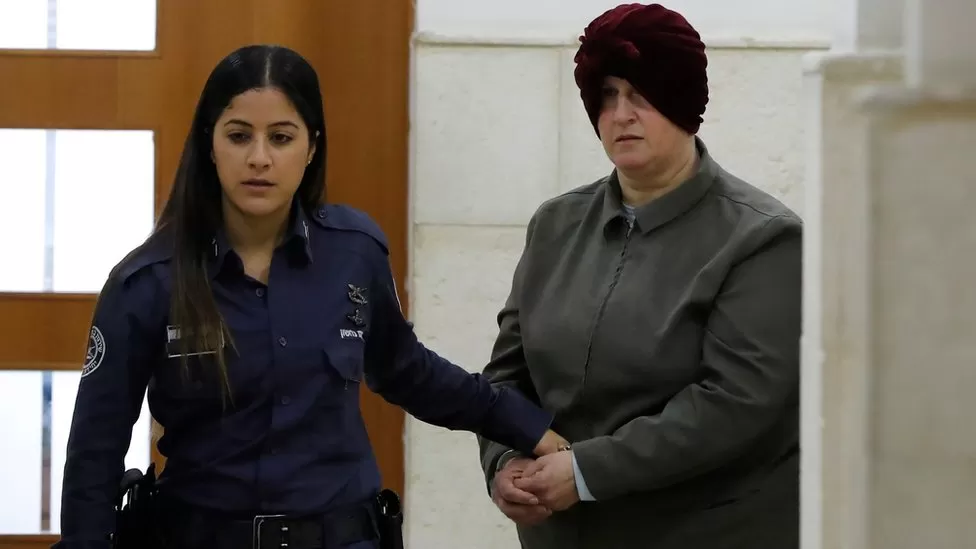
The former head of a school in Israel will face a sentence of up to 15 years in prison for causing harm to two students at an Australian Jewish school known for its strict rules.
Malka Leifer was found guilty in April of sexually attacking and abusing Dassi Erlich and Elly Sapper, who are sisters. This happened between 2003 and 2007.
The 56-year-old person was declared innocent of hurting a third sister named Nicole Meyer.
Leifer’s punishment concludes a 15-year effort for the mother of eight to be held accountable. She claimed innocence and denied committing the crimes, and subsequently put up a prolonged fight against being deported to Israel. But in 2021, a judge from Israel ruled that she pretended to have mental illness to avoid going to court, and decided that she should be sent to Melbourne.
During a very long trial, the jury learned that Leifer had mistreated the sisters in locked classrooms, on school trips, and at the principal’s house.
The judge, Mark Gamble, explained the 18 charges on Thursday and described her actions as very harmful.
Leifer was highly respected at the Adass Israel School. People were very impressed by him, almost like they would be with a rabbi. The sisters didn’t receive love and were not protected. Their mother abused them emotionally and physically at home. They didn’t have anyone to teach them about sex.
This situation is very concerning because the victims were very easy to harm, and Mrs. Leifer deliberately and heartlessly took advantage of them in a planned and careful manner. The judge said that she did it to get sexual satisfaction in a perverted way.
The judge said that Ms Sapper and Ms Erlich are not to blame for what Leifer did to them. They spoke about feeling guilty, ashamed, and afraid for a long time.
She is the only one who should feel bad and embarrassed for what happened.
Based on the time she has already spent in jail, Leifer can be released on parole in June 2029.
Speaking with her sisters outside of the court, Ms Erlich said that the punishment marked the conclusion of a challenging and distressing period in their lives.
“She said we are here today because we never gave up. ”
And even though we understand that survivors should not have to be the ones responsible for fighting for justice, this fight was never just about them.
To all other people who have survived this terrible situation: remember that you are not alone, we are all supporting you.
After Leifer’s trial ended, the police have started a new investigation into her actions of avoiding punishment.
The principal escaped to Israel in 2008 after people accused her of something wrong, apparently with the support of some members of the school’s governing body. She was taken into custody in 2014 because Australia wanted her, but two years later an Israeli court stopped her from being sent back because they decided she was not mentally capable of standing trial.
But investigators who pretended to be someone else secretly recorded her going shopping and putting money into a bank. This made Israeli authorities start investigating her again and arrest her again in February 2018. The judge said she was pretending to be someone with a mental illness.
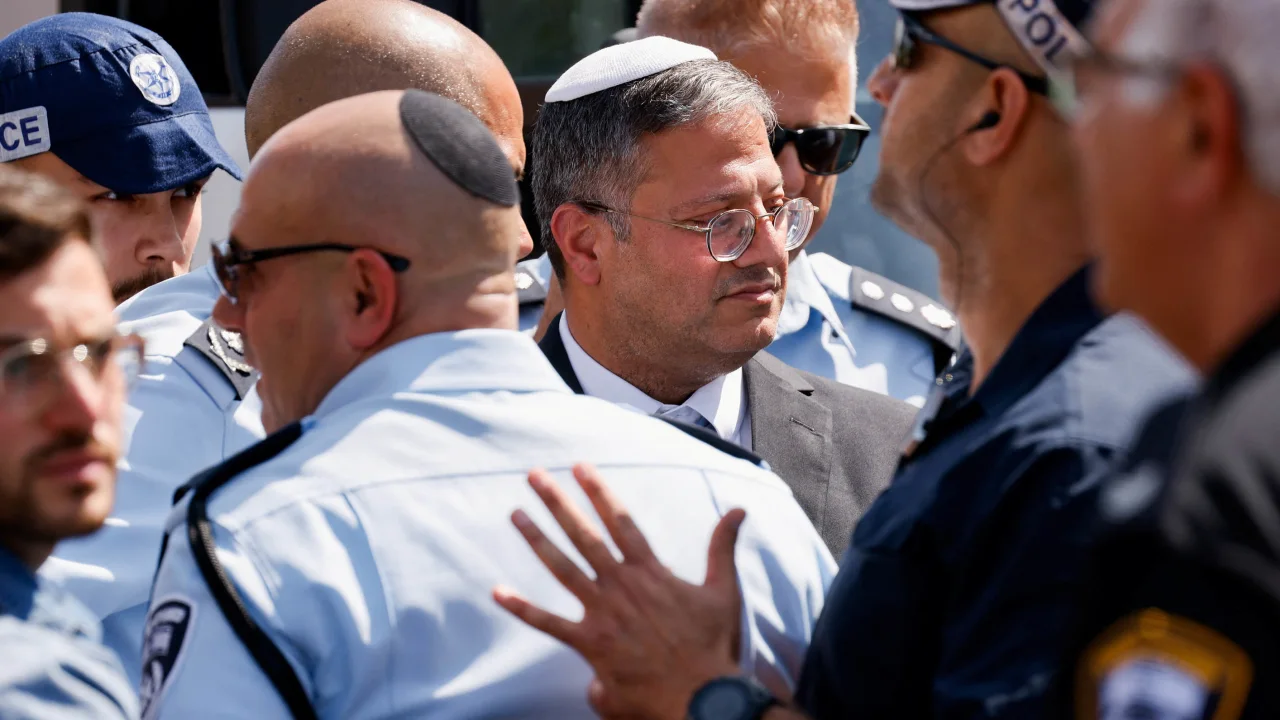
Itamar Ben-Gvir, Israel’s minister of national security, visited the Noble Sanctuary, also known as Haram al-Sharif to Muslims and the Temple Mount to Jews, on Thursday. The visit drew criticism from the Palestinian Authority and Israel’s neighbours.
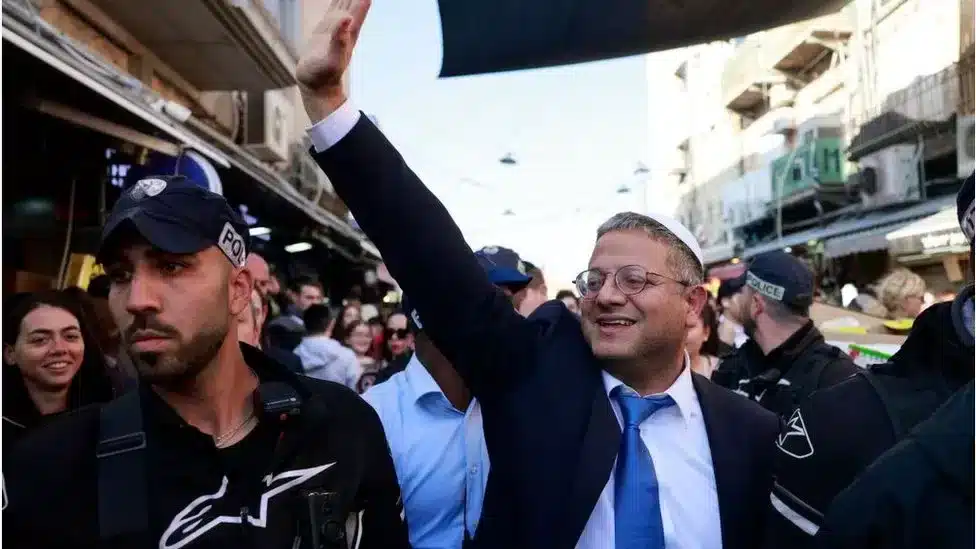
Ben-Gvir said on the website that was briefly known as Twitter, “This morning I ascended to the Temple Mount, our temple that was demolished because of gratuitous hatred. Since becoming a minister at the end of last year, far-right minister Ben-Gvir has made three trips to the location where the al-Aqsa mosque is located. Many prior clashes between Israelis and Palestinians began as tension at the sacred place.
Jews observe Tisha B’Av, a day of sorrow, on Thursday to remember the tragedies that have befallen them, particularly the demolition of the two ancient temples that once stood on the Temple Mount, the holiest place in Judaism.
The Palestinian Authority and the Jordanian government, which has been in charge of Jerusalem’s sacred sites since 1924 and sees itself as the protector of the city’s Muslims and Christians’ religious freedoms, both denounced his visit. The governments of Egypt and Turkey both denounced the trip.
Ben-Gvir’s travel, according to the Jordanian Foreign Ministry, “represents a provocative and blatant breach of international law and the historical and legal status of Jerusalem and its sacred sites.” The Palestinian Authority described the visit as a step towards “imposing forcible changes on its historical and legal reality, as an integral part of the process of judaizing Jerusalem.”
Ben Gvir set the recent political unrest in Israel in the context of his visit in a statement issued by his party, Jewish Power.
We must always keep in mind that, on this day and in this location, we are all brothers, Ben-Gvir remarked. “Right, left, spiritual, nonreligious. We are one and the same. A terrorist does not distinguish between us or separate us when he peers through the glass. Unity and support for Israel are crucial.
The most crucial location for the Israeli people is here, where we must return and demonstrate our ability to rule.
Protests over the government’s proposed judicial reforms have rocked Israel for 29 weeks in a row. A bill passed this week prohibiting the court from overturning government judgements due to “unreasonability” will be challenged, the Israeli Supreme Court announced on Wednesday, and hearings will take place in September.
The contentious legislation was approved by a vote of 64-0, with all members of the governing coalition voting in favour. All opposition MPs left the room during the vote.
One of Israel’s most contentious politicians, Ben-Gvir, has been found guilty of anti-Arab racism in the past and has stated that he thinks the current situation at Israel’s holy sites has to be rectified.
Only Muslims are permitted to pray inside the Al-Aqsa mosque compound, according to the so-called Status Quo agreement that dates back to the Ottoman occupation of Jerusalem; non-Muslims are only permitted to enter during specific hours. After Israel conquered them in the 1967 war, other states and Israel came to an agreement to keep Muslim pilgrims’ access to these sacred sites open.
Jewish prayer access to the Temple Mount has been advocated by some religiously nationalist Jewish organisations. There have been multiple incidents of Jewish tourists praying in the contested region, which has angered Muslim officials and resulted in Israeli police forcibly removing them.
In the 27th week of protests against the government’s proposed judicial makeover, sizable throngs of demonstrators have turned out across Israel.
One of the largest rallies to date, according to organisers, involved 180,000 people in central Tel Aviv alone. They estimate that 365,000 people have turned up in towns around the nation.
The demonstrations take place soon before the Knesset, the national legislature, holds its first reading on Monday of a plan to reduce judicial oversight of the executive and parliamentary branches.
Israeli Prime Minister Benjamin Netanyahu’s government has renewed its efforts to pass judicial overhaul, this time in stages, after six months of fierce opposition from center, left and even right-wing citizens, military reservists, and political parties.
This second effort is galvanizing protesters across the country, with a spokesman for the national protest movement promising an “all nighter.”
At the end of June, Israeli Prime Minister Benjamin Netanyahu said one the most controversial aspects of his government’s proposed judicial reform, a provision allowing the Knesset to overturn Supreme Court rulings, has been dropped.
Israel has no check on the power of the Knesset other than the Supreme Court.
As the protests reached their peak this Saturday, social media videos and Israeli press reported Israeli police using water cannons to clear demonstrators from blocking one of Tel Aviv’s main highways.
At least nine people were killed and about 100 others were injured as Israeli forces launched what a military source described as their greatest military operation in more than 20 years in the occupied West Bank city of Jenin, according to Palestinian sources.
The continuing “extensive counterterrorism effort in the area of the city of Jenin and the Jenin Camp,” according to a statement from the Israel Defence Forces (IDF), was initiated with the aim of attacking “terrorist infrastructure.”
Around ten drone airstrikes were conducted by the IDF, while hundreds of soldiers went for what they claimed to be a militant “command and control” centre as well as manufacturing facilities for explosives and weapons.
Videos obtained by CNN from Jenin show Israeli bulldozers tearing up streets to disarm potential explosives, as well as Israeli tanks outside the city limits.
Residents told CNN there were explosions and heavy gunfire in the area, while video from the scene showed wounded Palestinians being evacuated by ambulance to Jenin Government Hospital.
Hundreds of Palestinian families fled the area amid the destruction; Jenin deputy mayor Mohammed Jarrar said homes and infrastructure had been destroyed, cutting off electricity and water in the refugee camp.
Duha Turkman, a 16-year-old Jenin resident, said they were given two hours to evacuate.
“We ran out with people from the camp, so many children walked with their parents while terrified and crying, they didn’t understand what was happening to them and why,”she told CNN.“Many were missing; families were looking for members that they couldn’t get in contact with due to the electricity cut.”
Five of those killed in the attack were teenagers, the Palestinian Ministry of Health said. A tenth Palestinian was shot and killed by Israeli forces near Ramallah in the West Bank in a separate incident, according to the health authorities.
IDF chief spokesperson Rear Admiral Daniel Hagari earlier told reporters “eight terrorists” were killed in Jenin and there are “no non-combatants that have died as far as we know.”
Hagari acknowledged that civilians were among the injured, but insisted the operation only meant to target “terrorists.” “It’s not an invasion on Jenin, it’s not against the Palestinian Authority. It’s not against innocent, innocent Palestinians. It’s against terrorists in this camp,” he said.
The raid sparked immediate condemnation. Palestinian Authority President Mahmoud Abbas called the large-scale Israeli military operation “a new war crime.”
“Security and stability will not be achieved in the region unless our Palestinian people feel it. What the Israeli occupation government is doing in the city of Jenin and its camp is a new war crime against our defenseless people,” he said, according to presidential spokesman Nabil Abu Rudeineh.
Egypt also condemned the Israeli incursion, calling it an act of “aggression.”
Israeli Prime Minister Benjamin Netanyahu said the military acted “against terrorist strongholds in Jenin.”
“In recent months, Jenin has become a safe haven for terrorists from that safe haven. Terrorists perpetrated savage attacks, murdering Israeli civilians, men, women, and children, as many children as they could find,” Netanyahu said at a US embassy event in Jerusalem on Monday evening.
“As I speak, our troops are battling the terrorists with unyielding resolve and fortitude while doing everything, everything to avoid civilian casualties.”
Jenin resident Lina Amouri, 35, said her family hid from the gunfire until they heard mosques announcing the evacuation.
“We were all hiding in one apartment that didn’t have windows so we don’t risk anyone getting hit by a bullet. Three women and six children aged 1 to 9, since 5 a.m., with no electricity or internet connection. It was a horrifying day,” she said.
“The children were crying all day and we didn’t know how to calm them down, the only thing we could do is to pray together while we hear explosions and bulldozers outside.”
Amouri also compared the scene to a natural disaster.
“When we first went out to see what’s happening it was a totally different place, all streets were plowed, water and sewage pipes were broken, electricity poles were down, cars were piled one on the other. It felt like a storm with earthquake have just passed by.”
Turkman, the teenage resident, told CNN that before evacuating, her family’s home was taken over by Israeli forces as the operation got underway, leaving the apartment “upside down.”
“They invaded our house in the early morning, they locked us all in one room, five women and two children in one room, and in another room, they locked five men – my father, brothers and uncles,” she said.
“They took the house as snipers’ position to attack the camp, meanwhile we couldn’t use a toilet, get to the kitchen or do anything but sit in the room and listen to the explosions outside.”
CNN cannot independently verify the accounts of these two eyewitnesses.
The UN Special Coordinator for the Middle East Peace Process Tor Wennesland has said he was in direct contact with all relevant parties to urgently de-escalate the situation in Jenin and ensure humanitarian access.
“The operation comes after months of growing tension that once again reminds us of the extremely volatile & unpredictable situation across the occupied West Bank. All must ensure the civilian population is protected,” Wennesland said.
The Palestinian Red Crescent said crews were prevented from operating within the camp, according to the director of the Palestinian Red Crescent society in Jenin, Mahmoud al-Saadi.
“The ambulance crews managed to evacuate a number of the injured they were able to access. The paramedic crews were brought from other governorates to provide help,” al-Saadi said.
The international medical aid organization Doctors Without Borders (MSF) also accused Israeli forces of impeding access to medical care in Jenin.
“MSF staff have been treating patients since 2 a.m. local time at Khalil Suleiman hospital, where several gas canisters landed in the courtyard during the attack. So far, staff have received 55 wounded patients, including people with gunshot wounds to their heads and some who were hit with tear gas canisters,” MSF said.
The military operation has not only caused casualties but also disrupted health structures, impeding the medical response, according to the MSF statement.
“We’ve been working for 15 hours and patients keep coming in,” said Jovana Arsenijevic, MSF operations coordinator in Jenin. “This is an unprecedentedly long military operation, and yet there are still victims that cannot be reached.”
“Raids on Jenin camp have started to follow a familiar pattern. For example, ambulances have been rammed by armored cars, and patients and health care staff have routinely been denied entry and exit in the camp,” Arsenijevic also said.
The IDF refuted claims that ambulance crews faced obstacles, with Hagari saying cars were denied movement within the camp, but that ambulances “have a free pass.”
The director of the United Nations Relief and Works Agency (UNRWA) in the West Bank, Adam Bouloukos, said the Israeli operation and the response of “armed actors” in Jenin has “tragic consequences” for Palestinian refugees.
“Humanitarian access is most urgent now,” Bouloukos said on Twitter.
The White House is also “closely” monitoring the situation in Israel, a National Security Council spokesperson told CNN.
The spokesperson added broadly, “We support Israel’s security and right to defend its people against Hamas, Palestinian Islamic Jihad, and other terrorist groups.”
IDF spokesman Lt. Col. Richard Hecht told reporters Monday one of the goals of the operation was to break the “safe haven” mentality within the Jenin camp for militants, according to Hecht, who described it as a “hornet’s nest.”
“We’re not trying to hold the ground. We’re acting against specific targets,” Hecht said.
The first round of airstrikes were launched at 1:14 a.m. local time and were followed by IDF ground forces, Hecht said.
Some 50 shooting attacks against Israelis have emanated from Jenin, he said.
Hecht also said the Palestinian Authority and Jordan had been informed about the incursion in advance, but didn’t elaborate further.
Though the IDF spokesman declined to comment on the number of forces involved, he said it is around a brigade, which is approximately equivalent to at least 500 soldiers.
A spokesman said later an Israeli soldier was “slightly injured” by shrapnel from a grenade used during the incursion, and that they had been taken to a hospital for medical treatment.
The IDF said it struck a joint operational command center for the Jenin Camp and operatives of the Jenin Brigade, a Palestinian militant group associated with Islamic Jihad.
“The operational command center also served as an advanced observation and reconnaissance center, a place where armed terrorists would gather before and after terrorist activities,” the IDF said, adding that the camp was a “site for weapons and explosives” and “hub for coordination and communication among the terrorists.”
“Additionally, the command center provided shelter for wanted individuals involved in carrying out terror attacks in recent months in the area,” it said.
The IDF later said its forces targeted a weapons production and explosive device storage facility and confiscated an “improvised rocket launcher” and additional weapons during the operations, which were carried out in coordination with the Israel Securities Authority (ISA).
Later on Monday, an IDF aircraft struck near a mosque “to remove a threat” while soldiers engaged in a firefight with militants according to the IDF, without elaborating on the character of the “threat.” The IDF later said tunnels and weapons were found under the mosque.
Military bulldozers tore up streets in the camp, which the IDF said was to disarm potential explosive devices buried under the roads.
In response to Monday’s attacks, Hamas called on militants in the West Bank and Jerusalem to strike Israel “by all available means,” a statement by its military wing said.
Palestinian Islamic Jihad said it will “perform its duty” in stopping the “massacre” in Jenin.
Monday afternoon, Israeli police reported a Palestinian teenager stabbed an Israeli man in Bnei Brak, outside of Tel Aviv. Israeli police said the teen claimed “he stabbed the person in response to the events in Jenin.” The Israeli man was injured and moved to hospital.
The Jenin Brigade claimed it had severely damaged at least one Israeli military vehicle with improvised explosive devices and its militants continue to clash with Israeli forces “to prevent its advance inside the camp.”
Palestinian Islamic Jihad said it will face its enemy “with all possible retaliation options,” in response to the Israeli operations in Jenin.
“The aggression on Jenin will not achieve its targets, Jenin will not surrender. We will face the enemy with all possible retaliation options in response to the enemy aggression on Jenin,” the militant group posted to its official Telegram channel.
As night fell, more than 500 Palestinian families began leaving the refugee camp, the Palestinian Red Crescent said, out of fear of what the ensuing hours would bring.
Hagari told reporters the operation will end within the “next day or two.”
“It won’t be the last time we act,” he warned. “We act when we have intelligence. We act against terror before it happens, or we act after terror activities in order to reach the terrorists.”
After days of fighting that cost the lives of at least 35 individuals, practically all of them Palestinians, Israel and Islamic Jihad decided to end hostilities on Saturday.
It was uncertain whether or not the ceasefire will hold or last when it was set to begin at 10 p.m. local time (3 p.m. ET), according to Egyptian authorities in Gaza who helped negotiate it. Minutes after the ceasefire was due to go into effect, rockets were still being fired from Gaza, a CNN producer in the area witnessed.
More than an hour after the time the ceasefire was due to take effect, sirens continued to sound in Israel, warning of incoming rocket fire, and the Israel Defense Forces (IDF) launched more airstrikes on targets in Gaza, minutes before the ceasefire was due to come into effect.
The head of Israel’s National Security Council Tzachi Hanegbi thanked Egyptian President Abdel Fattah al-Sisi Saturday night, and expressed Israel’s appreciation for Egypt’s vigorous efforts to bring about a ceasefire, a statement from Prime Minister Benjamin Netanyahu’s office said. Hanegbi was acting on the guidance of Netanyahu, the statement said.
Hanegbi said Israel’s response to the Egyptian initiative means “quiet will be answered quietly, and if Israel is attacked or threatened, it will continue to do everything it needs to do in order to defend itself.”
Hamas, the militant Palestinian movement that runs the Gaza Strip, issued a statement praising Palestinian resistance factions after the ceasefire appeared to take hold.
Hamas “hails the Joint Operations Room of the Palestinian Resistance Factions for defending the Palestinian people against the most recent Israeli aggression against the Gaza Strip,” Hamas spokesperson Hazem Qasem said.
He added that “the unity of the Palestinian resistance is evidence of the Israeli occupation’s failure to provoke strife within the resistance.”
In a statement, UN Special Coordinator for the Middle East Peace Process Tor Wennesland welcomed the ceasefire and urged “all sides” to observe it.
“I look forward to the immediate restoration of humanitarian access and all social and economic measures to support Palestinian livelihoods in Gaza,” he added.
The violence this week left at least 33 Palestinians dead in Gaza and at least two people in Israel – an Israeli woman and a Palestinian man from Gaza working in Israel.
Word of the agreement came near the end of a day of intense fighting. A rocket launched from Gaza killed a Palestinian man working in Israel and seriously wounded another, Israel medical authorities said Saturday, as cross-border fire showed little signs of easing.
The two men were working in the Negev desert in southern Israel and were hit by shrapnel. IDF spokesman Lt. Col. Richard Hecht tweeted Saturday that the two men were brothers.
The Palestinian man who died is the second death in Israel due to rocket fire from Gaza since hostilities broke out on Tuesday morning.
The incident came as Israel’s military pounded targets in Gaza Saturday while Palestinian militants fired more rockets.
The IDF said it launched a series of attacks on sites which it said belong to Islamic Jihad in the Gaza Strip.
Israel accuses the group of planning attacks and since the flare-up began on Tuesday has killed six of its commanders.
In a televised speech following the ceasefire, Islamic Jihad’s secretary general Ziyad al-Nakhala acknowledged those losses and said the group was prepared to take up arms in the future.
“We are emerging from this battle with our weapons in our hands, and our fighters are still in the field, ready at all times to fight any aggression,” he said.
Islamic Jihad is the second largest armed group in Gaza after Hamas.
More than 1,200 rockets have been launched so far at Israel, said the IDF, which has struck more than 370 targets in Gaza as part of its “Shield and Arrow” campaign, in its fifth day as the ceasefire was declared.
Videos from Gaza showed that the airstrikes appeared to have also hit at least two civilian homes in the northern Gaza Strip on Saturday, but no injuries were reported.
Asked about the latest strikes by CNN, the IDF said that in the last 24 hours, they struck operational residences used as headquarters and command and control centers by the Jihad terrorists.
In its statement, the military said IDF fighter jets and aircraft struck launching sites for mortar shells and rockets “used by Islamic Jihad to fire projectiles toward Israel over the last few days.”
On Friday, at the beginning of an operation the al Quds Brigades of Islamic Jihad called “Revenge of the Free,” Palestinian militants launched rockets towards Jerusalem for the first time, as well as Tel Aviv and Israeli settlements in the occupied West Bank.Clashes also took place on Saturday morning in the occupied West Bank and at least two Palestinian men were killed, Palestinian officials said.
Sa’ed Jihad Shaker Mashah, 32, and Adnan Waseem Yousef Al-Araj, 19, were shot in the head with live bullets, the Palestinian Ministry of Health said. At least three other people were injured, the ministry said.
The clash took place in the Balata refugee camp near Nablus in the northern part of the West Bank.
The IDF and Shin Bet security agency said IDF and Israel Border Police forces were raiding “a hideout belonging to terror operatives” in the camp.
After militants in the Gaza Strip fired rockets at Israel late on Tuesday, following the passing of a well-known Palestinian hunger striker in an Israeli prison, Israel launched attacks on the Gaza Strip.
Following an 87-day hunger strike, former Islamic Jihad spokesman Khader Adnan passed away on Tuesday while being held in Israeli custody.
In response, Israel Defense Forces (IDF) fighter jets attacked a military post, a weapon storage facility, a training facility, and a weapon manufacturing site that belonged to Hamas, the militant organization that controls Gaza. The group also used the cement manufacturing facility to maintain its infrastructure. The IDF reported that dozens of rockets were fired from Gaza into the early hours of Wednesday.
The Israeli military said 104 rockets were launched from Gaza, including 24 that were intercepted by Israel and 48 that fell in open areas. The IDF said it hit 16 targets in Gaza, saying “we attacked everything we wanted tonight.”
Sirens sounded into the early hours of Wednesday morning in Israeli communities near the Gaza Strip and rockets could be heard and seen being launched from the coastal enclave, according to CNN’s team in Jerusalem and Gaza.
“The strike was carried out in response to the rocket launches from the Gaza Strip into Israeli territory earlier today, this strike significantly harms the capabilities and prevents further weapon acquisition capabilities of the Hamas terrorist organization in the Gaza Strip,” the IDF said.
On Wednesday morning, Islamic Jihad announced that “a round of confrontations” had ended with Israel, according to the militant group’s spokesperson Tariq Selmi.
Israeli military spokesperson Richard Hecht said there was no official ceasefire with Hamas but “messages have been passed.”
Earlier, the Israeli military said that after an assessment of the situation, “and following the directives of the Home Front Command, it was decided to return to the normal routine fully.”
A man looks at a car damaged by a rocket from the Gaza Strip in the southern Israeli city of Sderot on May 2, 2023.Ahmad Gharabli/AFP/Getty Images
Adnan, 45, had been on hunger strike since his arrest on February 5 and was found dead in his cell on Tuesday, according to the Israeli Prison Service.
Adnan had been detained at least 11 times since 2004 and his repeated arrests and prolonged hunger strikes had made him a symbol of Palestinian resistance to Israeli detention policies.
His death sparked anger in the West Bank, with protests, a general strike and other Palestinian detainees staging a hunger strike.
The IDF said the Israeli military would hold Hamas responsible for “all terror activities emanating from the Gaza Strip and it will face the consequences of the security.”
On Wednesday, the Palestinian Ministry of Health said a 58-year-old Palestinian man was killed and five others injured in Gaza during the overnight hostilities.
Earlier Tuesday in the Israeli city of Sderot, three people were wounded by shrapnel, with one man suffering serious injuries, emergency services said.
Hamas leader Ismail Haniyeh has been in touch with Egypt, Qatar and the UN about the strikes, according to a Hamas statement early Wednesday morning.
“Haniyeh holds the occupation responsible for the consequences of continuing this brutal aggression,” the statement read.
Adnan is at least the seventh Palestinian detainee to die on hunger strike in an Israeli prison since 1970, the Palestinian Prisoners’ Society told CNN.
Palestinian Authority Prime Minister Mohammad Shtayyeh accused Israel of carrying out a “deliberate assassination… by refusing his request to release him, neglecting him medically and keeping him in his cell despite the seriousness of his health condition.”
Israel has not yet returned Adnan’s body to his family, his lawyer Jamil Al Khatib told CNN by phone. His family has requested that there should not be an autopsy and that the body be given to the family for burial, the lawyer added.
Adnan’s widow pleaded for non-violence in the wake of his death.
“Not a drop of blood was spilled during the prisoner’s previous hunger strikes, and today we say with the rise of the martyr and his accomplishment of what he wished for, we do not want a drop of blood to be spilled,” Randa Musa said, adding that it was too late for arms to help him.
According to the Israel Defense Forces (IDF), six rockets in total were fired from Syria in the direction of Israel, with three of them landing on Israeli soil. The Israeli-occupied Golan Heights received one of the rockets.
Israeli land has not yet been damaged, according to the IDF.
It is the most recent flare-up after Israel attacked Palestinian militant targets in southern Lebanon and Gaza early on Friday in retaliation for dozens of rockets fired from Lebanon into Israeli territory.
The Israel Defense Forces (IDF) said that it had begun striking targets in Syrian territory after the rockets were launched.
“A short while ago, IDF fighter jets struck additional targets in Syrian territory, including a military compound of the Fourth Division of the Syrian Armed Forces, military radars systems and artillery posts used by the Syrian Armed Forces,” the IDF said in a statement early on Sunday local time.
The strikes by the fighter jets followed earlier IDF strikes on Syrian territory using a UAV (unmanned aerial vehicle or drone), which targeted the launchers thought to have fired the rockets.
The IDF said it “sees the state of Syria responsible for all activities occurring within its territory and will not allow any attempts to violate Israeli sovereignty.”
Syria said it had responded to “Israeli air attacks in the southern part of the country,” and claimed to have intercepted “some Israeli missiles.”
“Around 5 a.m. today, the Israeli enemy carried out an air attack with a number of missiles from the direction of the occupied Syrian Golan Heights, targeting some points in the southern region,” Syrian state media agency SANA quoted a Syrian military source as saying.
According to SANA, the military source added that Syrian air defenses had “intercepted the aggressors’ missiles and shot down some of them.”
Israel seized the Golan Heights from Syria during the 1967 Six-Day War and annexed the narrow strip of land in 1981. The Golan Heights are considered occupied territory under international law and UN Security Council resolutions.
The rocket launches come amid heightened tensions in the region following Israeli police raids on the al-Aqsa mosque in Jerusalem.
Israeli police raids of the mosque are considered by Muslims as a major provocation.
Israeli police raided the mosque twice on Wednesday last week, claiming that “hundreds of rioters and mosque desecrators (had) barricaded themselves” inside.
On Saturday night, the Israeli police again alleged that, “many youngsters [had] entered the mosque and closed the doors, for no reason.”
Israel’s neighbor Jordan warned of “catastrophic consequences” if Israeli forces were to storm the mosque again.
Should the Israeli police, “assault worshipers again, in an attempt to empty [the mosque] of worshipers, in preparation for major incursions into the mosque,” it would, “push the situation towards more tension and violence, for which everyone will pay the price,” the Jordanian Foreign Ministry spokesperson, Ambassador Sinan al-Majali, said in a statement late on Saturday local time.
“The Israeli government bears responsibility for the escalation in Jerusalem and in all the occupied Palestinian territories and for the deterioration that will worsen if it does not stop its incursions into the holy al-Aqsa mosque… and its terrorization of worshipers in these blessed days,” al-Majali said.
The warning from Jordan was followed by a statement from the Israeli Foreign Ministry early on Sunday, saying that people who “barricade themselves inside [the al-Aqsa mosque] are a dangerous mob, radicalized and incited by Hamas and other terror organizations.”
The Israeli Foreign Ministry called on Jordan’s Waqf guards, “to immediately remove from the al-Aqsa Mosque these extremists who are planning to riot (on Sunday) during Muslim prayers on the Temple Mount and the Priestly Blessing at the Western Wall.”
The Waqf is the Jordan-appointed body that manages the al-Aqsa mosque compound, known as the Temple Mount by Jews.
In a separate development on Saturday night, the IDF killed a 20-year-old Palestinian man in the occupied West Bank town of Azzoun, according to the Palestinian Authority Ministry of Health.
The man, Ayed Azam Salim, was shot and killed by live Israeli bullets in the abdomen and chest in the Qalqilya district, according to the ministry.
“Following routine activity, multiple suspects hurled an explosive device towards IDF soldiers at town of Azzun,” the IDF said in a statement. Soldiers responded “with live ammunition towards them” and a person was hit, the statement added. No IDF soldiers were injured, according to the statement.
Salim was taken to a hospital in Qalqilya where he died, according to Palestinian News Agency WAFA.
On Friday, one person was killed and seven others injured in a car-ramming attack in Tel Aviv. Police said that the car was driven by a 45-year-old resident of Kfar Kasem, a predominantly Arab city east of Tel Aviv.
The victim, an Italian tourist, was named by Israeli and Italian authorities as Alessandro Parini. Italian media said he was a 35-year-old lawyer. Israeli authorities described the incident as a “terror attack.”
Jordan has issued a warning that another Israeli assault on the al-Aqsa mosque will have “catastrophic consequences.”
The spokesperson for the Jordanian Foreign Ministry, Ambassador Sinan al-Majali, stated that if the Israeli police continued to “assault worshippers in an attempt to empty [the mosque] of worshippers, in preparation for major incursions into the mosque,” it would “push the situation towards more tension and violence, for which everyone will pay the price.”
Al-Majali stated that “the Israeli government bears responsibility for the escalation in Jerusalem and in all of the occupied Palestinian territories, as well as for the deterioration that will get worse if it does not cease its incursions into the revered Al-Aqsa mosque… and its terrorising of worshippers in these blessed days.
The warning from Jordan was followed by a statement from the Israeli Foreign Ministry early on Sunday, saying that people who, “barricade themselves inside [the al-Aqsa mosque] are a dangerous mob, radicalized and incited by Hamas and other terror organizations.”
The Israeli Foreign Ministry called on Jordan’s Waqf guards, “to immediately remove from the al-Aqsa Mosque these extremists who are planning to riot (on Sunday) during Muslim prayers on the Temple Mount and the Priestly Blessing at the Western Wall.”
The Waqf is the Jordan-appointed body that manages the al-Aqsa mosque compound, known as the Temple Mount by Jews.
Israeli police raided Jerusalem’s al-Aqsa mosque twice on Wednesday last week, claiming that “hundreds of rioters and mosque desecrators (had) barricaded themselves” inside.
On Saturday night, the Israeli police again alleged that, “many youngsters [had] entered the mosque and closed the doors, for no reason.”
Israeli police raids of al-Aqsa mosque are considered by Muslims as a major provocation.
In a car-ramming attack on Friday night in Tel Aviv, Israel, a tourist from Italy was killed and seven others were hurt.
The Tel Aviv boardwalk’s bike path was entered by a car, according to Israeli police, which then struck pedestrians before flipping over on a grass.
The driver was shot by police after they got at the scene and saw him reaching for what appeared to be a rifle-like weapon that was with him, according to Israeli police.
Israeli and Italian police have identified the victim of the attack as Alessandro Parini. He was a 35-year-old lawyer, according to Italian media.
In a tweet posted Friday, Italy’s Prime Minister Georgia Meloni expressed “deep condolences for the death of one of our compatriots, Alessandro Parini, in the terrorist attack that took place in the evening in Tel Aviv,” and condemned the “cowardly attack that hit him.”
Three of the seven people injured in the attack are still in hospital as of Saturday morning local time, according to Ichilov Medical Center. All of those killed or injured in the attack were tourists.
Police said that the car was driven by a 45-year-old resident of Kfar Kasem, an Arab-Israeli city east of Tel Aviv.
Israeli authorities described the incident as a “terror attack.”
The attack occurred after Israel struck Palestinian militant targets in southern Lebanon and Gaza, amid days of tensions in the region following police raids on the al-Aqsa mosque in Jerusalem.
The leader of the United Arab List and Knesset Member Mansour Abbas rejected any “use of violence against any citizen.”
“Especially in these difficult times, it’s important for me to emphasize… this is not the way of the Arab community and Arab citizens in Israel,” Abbas said Saturday.
Yiftach Golov is waving an Israeli flag amid a sea of similar-looking ones.
Golov hoists a brown flag that represents a group named “Brother and Sisters in Arms” among the hundreds of thousands of demonstrators who came to the streets for the 13th week in a row on Saturday.
Veterans who feel they are now engaged in combat to preserve Israeli democracy, many of them, like Golov, are from elite forces.
“We believe this is our responsibility to go once again called to the flag of the nation to stop this madness to defend Israel,” Golov said, as he weaved his way through the protesters on Tel Aviv’s Kaplan street, between the high-rises that house many of Israel’s high tech companies.
During the second intifada, in the early 2000s, Golov served in a special forces reconnaissance unit. He was never before particularly political, focusing more on getting his PhD in biophysics from Tel Aviv University.
But when the protest movement against the Israeli government’s judicial overhaul plan began in January, Golov attended one a demonstration and soon became one of thousands of veterans, and now military reservists, who have taken up the cause as their new mission.
Some, including elite Air Force reservists, have taken it a step further, threatening not to heed the call to train or even serve in protest of the government’s plans planned judicial changes, which would give the governing parties more control over Israel’s judiciary.
Others have taken to becoming some of the most active organizers and demonstrators. Last week, a group from Brothers and Sisters in Arms protested by carrying a figure wrapped in the Israeli flag on a stretcher, the way they would carry a wounded comrade off the field.
While Golov says he has not taken the drastic step to refuse service, he understands the motivation.
“We’re fighting for justice and liberty, just like the American story, that’s the values that that are being represented symbolized back when we look at our flag, that’s something that was lacking lacking for the last few decades. So basically, we reclaim the flag,” he said.
Fellow members of the group, all wearing brown shirts with the organization’s logo, come up and say hello. They’re sprinkled all throughout the protests. One is even leading the “Pink Front,” a group of coordinated drummers who look like they are dressed for a rave, and often lead the chants at the protests.
They’re using skills they learned in the military – how to organize, how to mobilize – now for the protests. But more importantly, they say they have the same type of motivation.
“The very deep feeling that you are part of something bigger than yourself, that (you’re) allowed to sacrifice anything that is needed, whether it’s your career, health, seriously mental health,” Golov said. “We all have a mission, you’re willing to do it at any cost. You’re very determined, you know that you are on the right side, you’re carrying the torch of light. That keeps us being highly motivated despite the fact that we’re not sleeping for days.”
Israel’s protest movement is made up of many disparate groups, but the pressure from Israel’s much vaunted veterans has been seen as a key to moving the needle.
Last Monday, after weeks of sustained protests and the largest general strike in Israeli history, Prime Minister Benjamin Netanyahu announced a pause to the legislation, to allow time for negotiations with the opposition.
But despite the announcements, protesters are still out in the streets in large numbers. CNN affiliate Channel 12 in Israel estimated the size of Saturday’s demonstration in Tel Aviv at about 150,000 people. Organizers claimed it was 230,000.
Last week’s mass protests and widespread strike action came after Netanyahu said he had decided to fire Defense Minister Yoav Gallant for advocating a delay in passing the legislation – a move that Netanyahu has since delayed, sources told CNN, due to “the present security situation.”
In his televised speech calling for a delay, Gallant had said the pause in the legislation was needed “for the security of Israel,” citing the refusal of some Israel Defense Forces reservists to train in protest of the government plans. He said pressing ahead with the proposals could threaten Israel’s security.
Under pressure at home and from allies abroad, Netanyahu said he would delay votes on the remaining legislation until after the Knesset’s Passover recess in April “to give time for a real chance for a real debate.”
“Out of the responsibility to the nation, I decided to delay … the vote, in order to give time for discussion,” he added.
But Netanyahu indicated that the delay was only temporary. He insisted that the overhaul was necessary, and reiterated criticism of refusal to train or serve in the military in protest at the planned changes. “Refusing is the end of our country,” he said.
Many protesters don’t believe that the pause is real, or say it’s simply a stalling tactic to give Netanyahu some breathing room and get the protesters to go home before he plows on with the reforms.
“We will start doing deactivation only when we will know 100% that Israel state will stay a functional democratic country. Whatever needs to be done for that,” Golov said.
Early Friday, Israel claimed to have attacked Hamas-related targets in southern Lebanon and Gaza. This came after the Israeli military said Palestinian terrorists were responsible for the firing of hundreds of missiles into Israeli territory from southern Lebanon.
The number of rockets fired from Lebanon was at its highest level since 2006, yet neither rocket attack in Gaza, Israel, or Lebanon was associated with any recorded fatalities.
The strikes only caused minor damage to buildings, automobiles, and agricultural locations on both sides.
The overnight exchange of fire came after Israeli police conducted violent raids of Jerusalem’s al-Aqsa mosque twice in less than 24-hours starting on Wednesday.
The situation on the ground however remains tense. On Friday, a shooting in the occupied West Bank targeting a group of settlers as they drove killed two sisters and critically injured their mother in what Israeli police described it as a “terror attack.” Hamas and Islamic Jihad praised what they called a “heroic operation.” This year’s violence takes place at sensitive time for both Israelis and Palestinians. Muslims have been marking the holy month of Ramadan, while Jews are celebrating Passover.
The violence also took place as Israel grapples with the aftermath of mass protests over a controversial judicial overhaul, which only slightly waned last week after a pause was announced, leaving the country deeply divided.
Here’s how the situation developed, and why this year’s violence is particularly a cause for concern:
The al-Aqsa mosque compound, known to Muslims as Al Haram Al Sharif, is the third holiest place in Islam, and is the holiest site in Judaism, known to Jews as Temple Mount.
Al-Aqsa mosque and its surrounding complex are located in the Old City, in the eastern sector of Jerusalem, which most of the international community considers to be under Israeli occupation. Israel captured East Jerusalem in 1967, and considers both East and West Jerusalem part of its “eternal capital.”
A “status quo” agreement between Israel and Jordan governs the Muslim and Christian holy sites there. But the specifics of the agreement are constantly changing, says Mairav Zonszein, a senior analyst on Israel-Palestine at the International Crisis Group, a Brussels-based think tank.
Israeli police raids of al-Aqsa mosque are considered by Muslims as a major provocation, and have in the past led to violent escalation. The 2021 war between Hamas and Israel was partly triggered by an Israeli raid on al-Aqsa mosque.
Under the status quo agreement, Jordan is the custodian of the compound. But Israeli police control East Jerusalem, and Zonszein said Israeli raids of the compound have increased since the Second Palestinian Intifada, or uprising, in the year 2000.
Francesca Albanese, the UN Special Rapporteur on Occupied Palestinian Territories, told CNN that Israeli police have been raiding the area for many years, particularly during Ramadan, with varying frequency and intensity.
What’s different this time, she says, is that it occurs during a climate of record levels of violence between Israelis and Palestinians, and inflammatory rhetoric towards Palestinians by some of the Israeli government’s far-right ministers.
‘We are ready’: The IDF prepares reserve forces following barrage of rocket attacks from Gaza and Lebanon
02:19 – Source: CNN
Calls for Muslims to stay in the mosque overnight increased after Jewish extremist groups had encouraged Jews to go up to the compound and sacrifice goats as part of ancient Passover ritual that is no longer practiced today.
Israeli police said it stormed al-Aqsa Wednesday after “hundreds of rioters and mosque desecrators (had) barricaded themselves” inside, adding that once they entered, stones and fireworks were thrown at them by “agitators.”
“Their intention was to create a violent riot particularly against the Temple Mount visitors in the morning hours,” a police spokesperson said on Thursday, referring to non-Muslims, who are allowed to visit but not perform prayers under the status-quo agreement. Some members of the current Israeli government have campaigned to allow Jewish prayer there.
Videos shared on social media form early on Wednesday showed Israeli police beating screaming Muslim worshipers with batons. Eyewitnesses told CNN the police also broke windows, smashed doors and fired stun grenades and rubber bullets.
The raid caused outrage in Arab states and was criticized by Israel’s allies, including the United States.
While Israel’s jurisdiction over East Jerusalem isn’t recognized by international law, and Israeli entry into the al-Aqsa mosque is forbidden by the status quo agreement, it has repeatedly sought to prohibit overnight Muslim prayers there.
There is no explicit agreement restricting overnight worship at the mosque, but an Israeli police spokesperson Dean Elsdunne on Saturday told CNN that “Muslims are not allowed to be in the compound during night hours.”
Zonszein said Israel claims there are “understandings (with the Jordanian custodians) on not staying overnight,” adding that they haven’t been made public and that Palestinians are unlikely to have agreed to them.
It is customary for Muslims to perform overnight prayers at mosques during Ramadan, in a ritual known as “itikaf.”
“Over the years it (itikaf) became yet another tool in conflict,” Zonszein said. “Israel started to restrict it when it found it to be a way for Palestinians to provoke friction with Jewish Israelis.”
While it is customary to mainly do so in the last ten days of Ramadan, itikaf can be practiced at any time of the year and is not restricted to the holy month, said Sheikh Ikrima Sabri, Imam of al-Aqsa mosque and former Grand Mufti of Jerusalem.
Israeli media has reported police will prohibit non-Muslims to access the compound during the last 10 days of Ramadan, in line with previous years.
Following Wednesday’s violence, the Waqf – the Jordan-appointed body that manages Jerusalem’s Muslim holy sites – said that al-Aqsa mosque “did not and will not close its doors” to those performing itikaf prayers throughout Ramadan, at night or during the day. Sabri said that prayer timings are solely the prerogative of the Muslims authorities at the site.
The UN’s Francesca Albanese said that as per to the status quo agreement, the Jerusalem Islamic Waqf, under Jordanian custodianship “is the only recognized authority responsible for managing the site.”
Israel’s strikes on both Gaza and Lebanon are thus far seen to be relatively restrained compared to its response in 2021 and previous years, which saw much more aggressive rocket salvos targeting Jerusalem.
While security threats have traditionally unified Israelis and masked domestic divisions, some say too great an escalation could trigger the opposite effect for the Israeli government.
“The public is always supportive when these things begin, there is always a rallying around the flag phenomenon,” said Chuck Freilich, a former deputy national security advisor in Israel and senior fellow at Institute for National Security Studies (INSS) in Israel, adding that while limited tension may divert attention away from the controversy over the judicial overhaul, any further escalation risks damaging Netanyahu’s image, especially as it is taking place over the Passover holidays.
Netanyahu’s response comes not only amid domestic upheaval, but also amid strained relations with the United States and Gulf allies, he said, adding that Netanyahu has generally been known to be cautious in his use of military force.
“The hope is that (the government) can de-escalate it, but I am not sure they will succeed,” he said, adding that it may be in the interest of Hamas and Lebanon’s Hezbollah — both backed by Israel’s longtime foe Iran — to “take advantage of Israel’s disarray.”
“There is a potential for this to escalate further at a time when Israel is deeply divided domestically,” he said.
After a protest from an Indonesian official against Israel’s participation, FIFA has revoked Indonesia’s ability to host the Under-20 Men’s World Cup later this year.
“FIFA has decided, due to the current circumstances, to remove Indonesia as the host of the FIFA U-20 World Cup 2023,” FIFA said in a statement, without providing further clarification. “A new host will be announced as soon as possible, with the dates of the tournament currently remaining unchanged.”
Sanctions could also be imposed on the Football Association of Indonseia (PSSI), according to the statement.
The youth competition was slated to take place in six Indonesian cities from May 20 to June 11 and feature a total of 24 teams. First time qualifiers are Israel.
Indonesia, a Muslim majority nation of more than 270 million people, does not have formal diplomatic relations with Israel and supports the cause of the Palestinians.
Anti-Israeli sentiment runs high among conservative Muslims in Indonesia and earlier this month, protesters marched in the capital Jakarta demanding the government ban Israel from playing in the tournament.
Indonesian President Joko “Jokowi” Widodo appealed to the public in a televised address on Monday, reiterating Indonesia’s support for the Palestinians but also stressing the country must follow FIFA regulations, according to state news agency Antara.
“Do not link sports issues with political affairs,” he reportedly said.
PSSI president Erick Thohir said he pleaded Indonesia’s case to FIFA president Gianni Infantino on Wednesday, which included showing him a letter from the Indonesian President.
“I have tried my best. We must accept FIFA’s decision to cancel the holding of the event that we are both looking forward to,” Thohir said in the statement. “Because we are members and FIFA considers that the current situation cannot be continued, we must submit.”
FIFA said it will continue to work with Indonesia and the PSSI “in the transformation process of Indonesian football following the tragedy that occurred in October 2022,” referring to the East Java stadium disaster.
“A new meeting between the FIFA president and the PSSI president for further discussions will be scheduled shortly,” the statement said.
As Prime Minister Benjamin Netanyahu‘s administration unveiled a divisive measure to revamp the judiciary, demonstrators shut down streets in cities all over Israel on Monday.
Israeli flags that were being distributed by the event’s organisers before it started became a sea as protesters in Jerusalem filled the streets around the Supreme Court and Knesset with Israeli flags.
Several drummers, trumpet blowers, and at least one juggler balancing an Israeli flagpole on his nose were among the protestors, as well as a few dozen ladies wearing long red robes and white head coverings to resemble the handmaids from Margaret Atwood’s “The Handmaid’s Tale.”
The Jerusalem demonstration was visibly smaller than one in the same location a week earlier, but still appeared to number in the tens of thousands.
The judicial overhaul bill is due for the first of three readings in parliament, the Knesset, on Monday, despite weeks of protests and calls from Israel’s President Isaac Herzog and the United States to delay the legislation and negotiate.
Netanyahu’s coalition is seeking the most sweeping overhaul of the Israeli legal system since the country’s founding. The most significant changes would allow a simple majority in the Knesset to overturn Supreme Court rulings.
The reforms also seek to change the way judges are selected, and remove government ministries’ independent legal advisers, whose opinions are binding.
US President Joe Biden has expressed concerns over the reforms, saying: “The genius of American democracy and Israeli democracy is that they are both built on strong institutions, on checks and balances, on an independent judiciary. Building consensus for fundamental changes is really important to ensure that the people buy into them so they can be sustained.”
On Sunday, Netanyahu defended the judicial reform.
“Israel is a democracy and will remain a democracy, with majority rule and proper safeguards of civil liberties,” he said during an address to the Conference of Presidents of Major American Jewish Organizations.
“All democracies should respect the will of other free peoples, just as we respect their democratic decisions.
“There’s been a lot of rhetoric that is frankly reckless and dangerous, including calls for bloodshed in the streets and calls for a civil war. It isn’t going to happen. There’s not going to be a civil war,” the Prime Minister added.
Settlements in the Palestinian territories are illegal under international law and have been condemned by the UN.
Israel’s far-right cabinet has approved the legalisation of nine illegal settler outposts in the occupied West Bank, drawing condemnation from the Palestinian Authority (PA), which called the move an “open war” against its people.
More housing units are likely to be built in separate, existing illegal settlements, a statement from Prime Minister Benjamin Netanyahu’s office said on Sunday.
“The nine communities had existed for many years; some have existed for decades,” the statement added. They were built without authorisation from the Israeli government.
More than half a million Israelis live in more than 200 settlements built on Palestinian land considered illegal under international laws. Palestinians say the settlement expansion threatens the viability of the future Palestinian state as part of the two-state solution.
The Palestinian foreign ministry said in a statement on Sunday that the latest decision crossed “all red lines” and undermined the revival of “the peace process”.
The United States, which provides billions of dollars in military aid to Israel, has yet to comment, but last month its ambassador said the country opposes the authorisation of Israeli outposts. Biden administration has aired views against settlements.
The United Nations has condemned illegal settlements in the occupied Palestinian territories in multiple resolutions and votes.
‘Palestinians will continue to resist’
Political analyst Mohammad Oweis told Al Jazeera that the government of Netanyahu, who was elected in November to form a hardline right-wing coalition, was stepping up its claim on Palestinian land.
“This is an escalation, this will increase the level of violence against the property of the Palestinians,” Oweis said.
“The Palestinians will continue to resist with whatever they have in order to protect their lives and their property.”
The Israeli prime minister’s office said the decision was taken in retaliation for two recent attacks in Jerusalem that killed 10 Israelis. Three Israelis, including two children, were killed in an attack on Friday in Ramot, a Jewish settlement neighbourhood in occupied East Jerusalem.
“In response to the murderous terrorist attacks in Jerusalem, the security cabinet decided unanimously to authorise nine communities in Judea and Samaria,” Netanyahu’s office said in a statement, using the Israeli name for the West Bank, which it occupied in 1967 along with East Jerusalem.
The announcement comes amid escalating Israeli-Palestinian violence, with at least 46 Palestinians killed by Israeli forces this year. Nine Israelis and one Ukrainian have been killed in Palestinian attacks in the past six weeks.
Netanyahu said earlier on Sunday during a meeting of his government he wanted to “strengthen settlements” and announced that his government wanted to submit legislation to Knesset, the Israeli parliament, this week to revoke the Israeli nationality of “terrorists”.
Israeli and Palestinian sources report that several Palestinian militants were killed in an Israeli army raid near Jericho in the occupied West Bank.
It is thought that five people have died, though it is unknown if all of them were gunmen.
The Israeli military has been conducting operations to target militants in the area almost every night.
Israelis have been targeted in raids and attacks during a particularly bloody time since the year’s beginning.
According to the Israel Defense Forces (IDF), the goal of the operation on Sunday night was to apprehend a “Hamas terrorist cell,” which the IDF claimed was responsible for a shooting that took place a week earlier at a restaurant close to a Jewish settlement outside of Jericho. In that attack, nobody was hurt.
Hamas, the militant Islamist movement which controls the Gaza Strip, is less prominent in the West Bank. Palestinian towns and villages there are mostly governed by the Palestinian Authority (PA), which is dominated by Hamas’ secular rival, Fatah.
The raid, coupled with activity by a Hamas cell, is unusual in Jericho, which has a relatively high concentration of Fatah-loyal PA security forces.
Witnesses say there was heavy gunfire during the incident in Jericho’s large Aqabat Jabr refugee camp. Bullet holes and bloodstains could be seen in a small house at the centre of the fighting.
IDF spokesperson Ran Kochav said soldiers “neutralised the terrorists”, some of whom, he said, were involved in the attack on the restaurant.
Hamas said its fighters were among the dead.
The governor of Jericho, Jihad Abu al-Assal, said five people had been killed and their bodies taken away by the IDF. Eight other people were also arrested, he said.
Israeli-Palestinian tensions have spiralled since an IDF raid against militants in the West Bank city of Jenin 10 days ago left 10 Palestinians, including two civilians, dead. Israeli security services said a “terror squad” had been planning an imminent attack.
Hours later, a Palestinian gunman opened fire on Jewish worshippers and passers-by outside a synagogue in occupied East Jerusalem, killing seven. The following morning, a 13-year-old Palestinian shot a group of people, also in East Jerusalem, wounding an Israeli father and son.
Later in the day, security camera footage showed a gunman and an accomplice entering the restaurant near Vered Yeriho settlement, where about 30 people were sitting. Military sources said the man, armed with an assault rifle, fired one shot in the air before his weapon jammed and the pair left the scene in a car with an Israeli licence plate.
At least 37 Palestinians have been killed by Israeli forces in the West Bank so far this year, including militants and civilians, as the military continues operations there.
Last year in the West Bank, more than 150 Palestinians were killed, nearly all by Israeli forces. The dead included unarmed civilians, militant gunmen and armed attackers.
Meanwhile, a series of attacks by Palestinians and Israeli Arabs targeting Israelis, as well as militant gunfire at troops during arrest raids, killed more than 30 people, including civilians, police, and soldiers.
An Israeli statement noted that on Thursday, four years after the nations’ connections were restored after a decades-long break, Chadian President Mahamat Idriss Deby Itno officially opened his majority-Muslim nation’s first embassy in Israel.
The opening of the embassy in Ramat Gan, close to Tel Aviv, was hailed as “a historic occasion” by Prime Minister Benjamin Netanyahu’s administration.
With a Chadian group, Netanyahu claimed to have discussed “the potential of building an embassy in Jerusalem” in 2020.
That would have been a victory for the right-winger who, since then-president Donald Trump moved the US embassy in 2018, has been pressuring international governments to establish their embassies in the city.
“We are strengthening our friendship and our common interests in pursuing peace, security and prosperity,” Netanyahu said Thursday.
Israel granted recognition to Chad after it separated from France in 1960, and by 1962, it had established an embassy there.
In response to pressure from Muslim African nations, relations between Israel and Chad were severed in 1972.
Following the 1967 and 1973 Arab-Israeli conflicts, several African nations severed ties with Israel.
However, in order to strengthen connections on the continent, Israel has recently highlighted areas of collaboration ranging from security to technology and agriculture.
Netanyahu and Deby declared the reopening of diplomatic ties during a trip to Chad in 2019.
After his arrival on Tuesday, Deby met the head of Israel’s Mossad spy agency, David Barnea.
The Mossad “has played a central role in formulating the agreement and strengthening relations between the two countries,” a statement from the Israeli prime minister’s office said.
One of the world’s poorest countries, Chad is not an Arab League member state but belongs to the Organization of Islamic Cooperation (OIC).
Netanyahu has made broadening Israelis ties across the Arab and Muslim world a foreign policy
Following negotiations in Khartoum, Israel’s foreign minister declared that Israel and Sudan would soon sign a “historic peace agreement” in Washington.
Eli Cohen claimed that during his one-day visit to meet with Sudanese President Abdel Fattah al-Burhan, the agreement’s language was finalized.
Sudan agreed to normalize relations with Israel two years ago, but a pact was never carried through.
It would be the newest member of the Arab League to forge such connections.
As part of the Abraham Accords, which were mediated by the US, the UAE, Bahrain, and Morocco have formally normalized relations with Israel since 2020.
In the past, Arab League members had resisted recognizing Israel, which contributed to the continuation of the Arab-Israeli conflict.
Jordan signed a peace deal with Israel in 1994 after Egypt did so as the first Arab nation in 1979.
An accord with Sudan holds particular symbolic importance as Khartoum was the venue for an Arab League meeting in 1967 where members vowed not to recognise Israel, after the Arab-Israeli war three months earlier.
Sudan’s foreign ministry said Mr Cohen and Lt-Gen Burhan had “discussed means for establishing fruitful relations with Israel” and strengthening cooperation in “agricultural, energy, health, water, education fields with special emphasis on security and military fields”.
It did not say whether a peace agreement would be signed.
The growing number of Arab countries formalising relations with Israel has been condemned by the Palestinians, who see it as a betrayal of their cause.
For years, Arab countries conditioned peace talks with Israel on its withdrawal from territories occupied in the 1967 war, and the establishment of a Palestinian state with East Jerusalem as its capital.
Speaking on his return to Israel on Thursday night, Mr Cohen said his trip had been made “with the consent of the United States”.
The visit, he said, “lays the foundations for a historic peace agreement with a strategic Arab and Muslim country. The peace agreement between Israel and Sudan will promote regional stability and contribute to the national security of the State of Israel”.
Mr Cohen said a signing ceremony is expected to take place after the planned transfer of power in Sudan to a civilian government following a military coup in October 2021.
Findings showed that Israel “was responsible for this attempted act of aggression,” according to its ambassador to the UN.
Iran reserves the right, according to him, “to respond resolutely to any threats or wrongdoings” by Israel.
Iran claims the attack caused minor damage, but this has not been independently verified, and neither Israel nor Iran has admitted responsibility for the attack.
The two countries are arch-foes and in recent years have been engaged in what has been described as a “shadow war” of unclaimed attacks on each other’s assets, infrastructure and nationals.
Israel is mostly known to have carried out strikes on what it says are Iranian weapons transfers to militants in Lebanon and is also believed to have sabotaged Iran’s nuclear sites and killed Iranian nuclear scientists. Iran, which rejects Israel’s right to exist, has been accused by Israel of attacking and planning to attack Israeli and Jewish targets and people. Each side is also believed to have attacked the other’s shipping.
In a letter to the UN secretary general, Iranian ambassador Amir Saeid Iravani accused Israel of “an attempt… to launch a terrorist attack against a workshop complex” belonging to Iran’s defence ministry. He did not specify what evidence Iran had for this.
Mr Iravani said Iran reserved the right to respond “wherever and whenever deemed necessary.”
The purpose of the attacked site is unclear, though reports suggest it could be connected to missile production.
US media have quoted unnamed US officials as saying Israel carried out the attack, which Iran said involved three drones, on Saturday night at about 23:30 (20:00 GMT). Iran said one was destroyed by air defence systems and two were caught by “defence traps,” causing minor damage to a building and no casualties.
If confirmed it would mark the first such known attack on a facility in Iran under the current Israeli government which came to power under Benjamin Netanyahu at the end of December.
In an interview with CNN on Tuesday, Mr Netanyahu said Israel had been “taking action against certain weapons development” in Iran, but neither confirmed nor denied it had attacked the site in Isfahan.
“I never talk about specific operations… “And every time some explosion takes place in the Middle East, Israel is blamed or given responsibility—sometimes we are, sometimes we’re not,” he said.
Following a trip to Jerusalem by Prime Minister Benjamin Netanyahu and then-President Idriss Deby, diplomatic relations betweenIsrael and Chad were restored in 2018.
Building on bilateral ties that were established five years ago, Chad will open an embassy in Israel on Thursday, according to the office of Israeli Prime Minister Benjamin Netanyahu.
The announcement was made on Wednesday as Chadian President Mahamat Deby’s office announced that he was visiting Israel for a 48-hour state visit but gave no other information.
The Chadian president would preside over the opening of the embassy, according to Netanyahu’s office.
Chad cut diplomatic ties with Israel in 1972 after the Organization of African Unity, the forerunner of the present-day African Union, ordered its member states to do so in support of the Palestinians.
But in November 2018, former Chadian President Idriss Deby, the late father of the current leader, paid a historic visit to Israel during which he spoke of the two countries committing to a new era of cooperation.
Netanyahu then visited Chad in January 2019, while the following year Israel signed normalisation agreements with Morocco, Bahrain, Sudan and the United Arab Emirates as part of a broader diplomatic push by the United States under President Donald Trump.
The agreements enraged Palestinians who condemned them as a “stab in the back” amid fears that they will weaken a long-standing pan-Arab position calling for Israeli withdrawal from territories it occupies illegally and acceptance of Palestinian statehood in return for normal ties with Arab countries.
It was not immediately clear where the Chadian embassy would be located. Most countries keep embassies in Tel Aviv.
Trump in 2017 provoked controversy by announcing he would relocate the US embassy from Tel Aviv to Jerusalem and officially did so a year later. The move infuriated Palestinians and spurred international condemnation.
Previous US presidents and the leaders of nearly every other country have refrained from opening embassies in Jerusalem until the city’s final status is resolved through Israeli-Palestinian negotiations. Palestinian leaders see occupied East Jerusalem as the capital of their future state.
Netanyahu, who returned to office last month, has cast the upgrade of relations with Chad as part of his outreach to Arab and Muslim countries, which he wants to expand.
In response to rocket fire, Israel has launched airstrikes on Gaza as tensions rise following a deadly army raid in the occupied West Bank.
According to Israeli reports, six rockets were fired, and Israel responded by attacking what it claimed were militant sites.
No one on either side was reported to have been injured.
After nine Palestinians were killed in the Jenin raid, which Israel claimed was carried out to stop “imminent terrorist attacks,” militants threatened to retaliate.
Two rockets were fired around midnight (22:00 GMT Thursday) but were intercepted by Israel’s anti-rocket Iron Dome system, the Israel Defense Forces (IDF) said. Air strikes swiftly followed, targeting what the IDF said was an “underground rocket manufacturing site” in the central Gaza Strip belonging to the Islamist militant group Hamas, which governs the territory.
A second salvo of rockets was fired hours later, landing in open ground, shot down or falling back down in Gaza, the military said. Israel subsequently hit a site which it said was “a significant centre of Hamas terrorist activities” in the northern Gaza Strip.
No group admitted to firing the rockets, though Israel holds Hamas responsible for all attacks from Gaza.
The overnight exchange followed the deadliest incident of its kind in years after Israeli forces entered the West Bank city of Jenin to arrest an Islamic Jihad “terror squad”. The IDF said it was acting on accurate intelligence about plans by the cell to attack Israelis.
Forces surrounded a building in the city’s urban refugee camp where an intense gun battle erupted. Israel said three armed suspects were “neutralised” after they opened fire, while a fourth suspect surrendered. The IDF said troops were shot at by other Palestinian gunmen and returned fire, hitting targets.
The militant Palestinian Islamic Jihad group and Hamas said their fighters had targeted the troops with gunfire and improvised explosive devices.
The Palestinian health ministry said two civilians, including a 61-year-old woman, were among those killed. Twenty people were also wounded, four of them seriously, it said.
The Palestinian presidency accused Israel of a “massacre” and later announced it had ended co-ordination with Israel on security matters.
A 10th Palestinian was meanwhile shot and killed during a confrontation with Israeli troops in the town of al-Ram, near Jerusalem, as residents protested against the Jenin raid, Palestinian officials said.
At least 30 Palestinians have been killed by Israeli forces in theWest Bank so far this year, including militants and civilians, as the military continues operations there.
Last year in the West Bank more than 150 Palestinians were killed, nearly all by Israeli forces. The dead included unarmed civilians, militant gunmen and armed attackers.
A series of attacks by Palestinians and Israeli Arabs targeting Israelis, as well as militant gunfire at troops during arrest raids, meanwhile killed more than 30 people including civilians, police and soldiers.
After spending 40 years in Israeli prisons, Maher Younis, Karim Younis’ cousin, was finally set free.
Maher Younis, the second-longest-held Palestinian prisoner, was freed after 40 years inIsraeli jails.
On Thursday, just before 7 a.m. (05:00 GMT), Maher, 65, was freed from Eshel prison, close to Beer Sabe’ (Beer Sheva) in southern Israel.
He was detained in 1983 and later found guilty in Israeli courts, along with his cousin Karim Younis, of murdering an Israeli soldier in the Israeli-occupied Golan Heights in Syria in 1980.
Karim, released two weeks ago, was the longest serving Palestinian prisoner, having been arrested earlier than Maher.
The cousins are from the Palestinian village of Ara in Israel, where large crowds of relatives and friends greeted Maher on Thursday.
Upon his release, Maher visited the grave of his father, who died in 2008. His mother showered him with petals when he arrived at his home, where he was arrested at 25.
She told Al Jazeera journalists before he son’s arrival that she would not cry but would spend every moment celebrating.
Maher Younis was convicted in 1983 of killing an Israeli soldier in the Israeli-occupied Golan Heights [Ammar Awad/Reuters]
Maher and Karim were originally sentenced to death by hanging. Their sentence was changed to life in prison, which was then commuted to 40 years in 2011.
Dozens of Israeli police, who had warned people in Ara against holding any kind of celebration for days before his release, surrounded the house on Thursday morning.
The Palestinian flag was not allowed to be raised, according to new orders banning it in public by Itamar Ben-Gvir, who was recently appointed National Security Minister under a new right-wing government led by Prime Minister Benjamin Netanyahu.
While the vast majority of Palestinian prisoners in Israeli jails are from the occupied West Bank, the Younis cousins are Palestinian citizens of Israel.
Ministers in Israel’s new government have been pushing for harsher measures against Palestinians in Israel and in occupied East Jerusalem who have carried out attacks in which Jewish Israelis are killed, such as revocation of residency and citizenship.
A heated exchange took place last week about the issue when a far-right minister said she “prefers Jewish murderers over Arab murderers”.
A report on the alleged wealth of General Qamar Javed Bajwa, the former army chief, and his family led to Shahid Aslam’s arrest last week.
In a case involving the alleged disclosure of tax information for former army chief Qamar Javed Bajwa and his family, a court in Islamabad has ordered the release of journalist Shahid Aslam on bail.
Aslam, a Bol News reporter, was detained by the Federal Investigation Agency last week in the eastern city of Lahore before being transported to Islamabad.
Aslam was accused of giving the news website FactFocus information about General Bajwa’s and his family’s personal tax information, which was then published in November, just before the army chief’s retirement.
Aslam denied that he was behind the leak.
The FactFocus report accused Bajwa and his family of amassing assets worth nearly $52m and presented official tax records and wealth statements to substantiate the allegations.
Aslam’s arrest was condemned by media and civil rights groups, who accused the government of pressuring the media into silence. The Committee to Protect Journalists criticised the arrest.
“The arrest of reporter Shahid Aslam underscores the dangerous environment for journalists in Pakistan,” Beh Lih Yi, its Asia programme coordinator, said in a statement.
The Human Rights Commission of Pakistan said the arrest not only restricted Aslam’s freedom of expression, but “such tactics set the dangerous precedent of obstructing the work of investigative journalists”.
This month, Human Rights Watch warned, “Space for free expression and dissent in Pakistan is rapidly shrinking.”
“Pakistan’s politicians are locked in a power struggle in which a free media and vibrant civil society are the casualties,” it said.
Pakistan was ranked 157 out of 180 countries on the 2022 press freedom index, published annually by Reporters Without Borders. It represented a decline of 12 positions from the 2021 rankings.
Islamabad-based lawyer Aftab Alam, an expert on media laws, said, “Sedition laws in other countries are being removed, but we still use it.”
“This is a legacy of colonial-era laws, and repeatedly we have seen their usage in the name of national interests or to prevent so-called fake news,” he told Al Jazeera.
“These actions by authorities are a way to control the masses,” he said. “Our laws require reforms.”
Waving the Palestinian flag, according to far-right security minister Itamar Ben-Gvir, is an endorsement of “terrorism.”
Itamar Ben-Gvir, Israel’s new far-right Minister of National Security, has ordered police to remove Palestinian flags from public areas because they constitute “terrorism.”
Israeli law does not forbid Palestinian flags, but police and soldiers are allowed to take them down if they pose a threat to the peace.
Sunday’s directive from Ben-Gvir, who heads the ultranationalist Jewish Power party in Benjamin Netanyahu’s new far-right government and as national security minister oversees the police, appears to signal a hardline and uncompromising attitude towards Palestinian expressions of identity and free speech and pro-Palestinian demonstrations.
The display of the Palestinian flag in Israel has, in practice, long been clamped down on by Israeli authorities, with Palestinians regarding such moves as an attempt to suppress Palestinian identity.
Ben-Gvir’s orders came after a mass anti-government protest in Tel Aviv on Saturday, where some demonstrators waved the Palestinian flag.
Protesters labelled the recently sworn-in government of Prime Minister Benjamin Netanyahu as “fascist” and advocated for equality and coexistence between Palestinians and Israelis.
Writing on Twitter, Netanyahu on Sunday said the presence of the Palestinian flag at the Tel Aviv protest was “wild incitement”.
Ben-Gvir’s directive also follows the release last week of a long-serving Palestinian prisoner, convicted of kidnapping and killing an Israeli soldier in 1983, who waved a Palestinian flag while receiving a hero’s welcome in his village in northern Israel.
Younis was convicted in 1983 for the killing three years earlier of an Israeli soldier, Avraham Bromberg, in the occupied Golan Heights [Ammar Awad/Reuters]
Ben-Gvir, in a statement, said waving the Palestinian flag is an act in support of “terrorism”.
“It cannot be that lawbreakers wave terrorist flags, incite and encourage terrorism, so I ordered the removal of flags supporting terrorism from the public space and to stop the incitement against Israel,” Ben-Gvir said.
Palestinian citizens of Israel account for about one-fifth of the population and most are descendants of Palestinians who remained within the state after its formation in 1948, an event known to Palestinians as the Nakba, or catastrophe.
The majority of the population of pre-1948 historic Palestine had been Palestinians.
They have long debated their place in Israel’s politics, balancing their Palestinian heritage with their Israeli citizenship, with the vast majority identifying as or with the Palestinians.
Many Palestinians, both in Israel and in the occupied territory, are fearful of the new government’s policies towards them, in light of the strong presence of far-right settler groups within it, with Ben-Gvir in particular previously convicted of inciting racism towards Arabs.
In some of its first moves over the past few days, the Israeli government rescinded the travel permit of the Palestinian foreign minister Riad al-Malki on Sunday and decided to withhold $39m in revenues from the Palestinian Authority on Friday.
The decisions were part of an effort to penalise Palestinians for asking the International Court of Justice to give an opinion on the Israeli occupation, which is illegal under international law.
A far-right Israeli minister’s visit to a contentious holy site in Jerusalem has been denounced by Palestinians as a “unprecedented provocation.”
Itamar Ben-Gvir, the minister of national security who has called for a tougher stance against the Palestinians, toured the area while being guarded by law enforcement.
Israel and the Palestinians are bitterly divided by competing claims to the compound.
With the election of Israel’s new nationalistic government, tensions have increased.
Mr Ben-Gvir’s visit was his first public act since the government, led by Prime Minister Benjamin Netanyahu, was sworn in five days ago.
The hilltop site is the most sacred place in Judaism and third holiest in Islam. It is known to Jews as the Temple Mount, site of two Biblical temples, and to Muslims as Haram al-Sharif, the site of Muhammad’s ascent to Heaven.
Jews and other non-Muslims are allowed to go there but not pray, though Palestinians see visits by Jews as attempts to change the delicate status quo.
The most religious and hard-line government in Israel’s history has been sworn in.
Benjamin Netanyahu returns as prime minister, after his Likud party formed a coalition with ultranationalist and ultra-Orthodox Jewish allies.
There is domestic and international concern it will inflame the conflict with the Palestinians, damage the judiciary and restrict minority rights.
Mr Netanyahu has promised to pursue peace and safeguard civil rights.
Addressing a special session of the Knesset (parliament) in Jerusalem, he stated that his administration would “restore governance, peace and personal security to the citizens of Israel”.
“I hear the opposition’s constant laments about ‘the end of the state’, ‘the end of democracy’, members of the opposition, losing the elections is not the end of democracy – this is the essence of democracy.”
Mr Netanyahu was heckled by his opponents, some of whom chanted “weak”.
They suggest he has been forced to sign deals with hard-line parties because more liberal ones refuse to sit in government with him while he is on trial on charges of bribery, fraud and breach of trust. He denies any wrongdoing.
Several hundred protesters meanwhile gathered outside, waving Israeli flags, rainbow flags bearing the Star of David, and signs reading “shame”, “danger” and “down with racism”.
Mor, a woman from Jerusalem, told the BBC: “I’m here because my country’s falling apart from its democratic values.”
Image caption,Hundreds of protesters gathered in front of the Knesset ahead of the swearing-in ceremony
This is a record sixth term as prime minister for Mr Netanyahu, who was ousted by his opponents 18 months ago, but his coalition partners are pledging to lead the country in a new direction.
The first guiding principle of the new government, published on Wednesday, declares that “the Jewish people have an exclusive and unquestionable right to all areas of the land of Israel”. It says that includes the occupied West Bank and promises to “advance and develop” settlements there.
About 600,000 Jews live in about 140 settlements built since Israel’s occupation of the West Bank and East Jerusalem in 1967. Most of the international community considers the settlements illegal under international law, though Israel disputes this.
There are also some 100 outposts – small settlements built without the Israeli government’s authorisation – across the West Bank.
In a coalition deal with the ultranationalist Religious Zionism party he signed last week, Mr Netanyahu agreed to retroactively legalise the outposts. He also promised to annex the West Bank while “choosing the timing and weighing all of the State of Israel’s national and international interests”. Such a step would be opposed by Israel’s Western and Arab allies.
Image caption,Far-right politicians Itamar Ben-Gvir (L) Bezalel Smotrich (R) will hold key positions in the new government
Religious Zionism leader Bezalel Smotrich, a West Bank settler, will be finance minister and also oversee the Civil Administration, which approves settlement building in the West Bank and controls important aspects of Palestinians’ lives.
Otzma Yehudit (Jewish Power) party leader Itamar Ben-Gvir, another settler and ultranationalist politician who has previously been convicted of racism and supporting a terrorist organisation, will be national security minister, responsible for the police.
A spokesman for Palestinian President Mahmoud Abbas warned that the plans to develop West Bank settlements would have “repercussions for the region”.
Mr Netanyahu’s coalition partners reject the idea of a two-state solution to the Israel-Palestinian conflict – the internationally backed formula for peace which envisages an independent Palestinian state in the West Bank alongside Israel, with Jerusalem as their shared capital.
There have also been expressions of concern both inside and outside Israel about some ministers’ very rigid views on the application of Jewish law and LGBTQ rights.
Avi Maoz, head of the anti-LGBTQ Noam party, will serve as a deputy minister in the prime minister’s office. He has called for Jerusalem’s Gay Pride event to be banned, disapproves of equal opportunities for women in the military, and wants to limit immigration to Israel to Jews according to a strict interpretation of Jewish law.
Activists, doctors and business leaders have meanwhile warned that discrimination against LGBTQ individuals could potentially be legalised if the anti-discrimination law is changed to allow businesses to refuse services to people on religious grounds.
Image caption,Daniel Johnas said he was concerned about future of life in Israel for himself, his husband and children
Although the coalition deal between Likud and the ultra-Orthodox United Torah Judaism party calls for such an amendment, Mr Netanyahu has said his administration will not allow any harm to the LGBTQ community. He has also chosen an openly gay member of Likud, Amir Ohana, to be parliamentary Speaker.
Critics have expressed concern at the coalition’s intention to pass legislation that would give a parliamentary majority the ability to override Supreme Court rulings.
Mr Netanyahu’s coalition partners have also proposed legal reforms that could end his corruption trial.
At Thursday’s protest, a woman from Tel Aviv, who did not want to give her name, said: “I refuse to accept what I feel is the possibility of the beginning of a fascist regime and I want to protect the rights of every citizen living in this country.”
Daniel Johnas, an activist in the religiousLGBTQ community, said he was worried for the first time to go on the street with the rainbow flag. He was also concerned about the future of life in Israel for himself, his husband and children.
Israel’s next Netanyahu-led coalition government may be the most extremist in its history.
Fascism has been on the minds of Israel’s friends and foes alike since “the Jewish State” held its latest elections and its former Prime Minister Benjamin Netanyahu began negotiations to form a new coalition. Warnings about Israel “heading toward a fascist theocracy” or “sleep walking into Jewish fascism” have multiplied.
But all these warnings appear to fall on deaf ears, as Netanyahu charts a path back to the premiership in coalition with Israel’s fascist parties. He dismisses concerns over the potential demise of Israel’s democracy and its worsening reputation in the West, especially in the United States, insisting that when it comes to the future of the Jewish State, it is he, Netanyahu, who will have the last word – in Israel as in America.
That’s probably true. But it is not reassuring. It is catastrophic.
Washington has thus far remained largely silent even as several prominent American Jews spoke against the fascist menace that emerged from the Israeli ballot box. Rather than addressing concerns directly, the Biden administration spinelessly suggested that it would judge Netanyahu’s next government “based on its policies, not personalities”.
If Trump was, well, reckless, Biden is an accomplice. As for the Arab regimes which congratulated Netanyahu for his victory, I can’t quite find an appropriate word.
But make no mistake, the problem of fascism in Israel lies less with the extremist parties that will be part of the next government and more with their enablers – Netanyahu and his chauvinistic Likud party which long strove for a Jewish state dominating both sides of the Jordan River.
In his autobiographical monstrosity, Bibi, My Story, which is part self-aggrandisement, part propaganda and part fascist manifesto,Netanyahu dedicates a chapter to his late father, Benzion. He boasts of his record as editor of a publication aptly named Hayarden (The Jordan), and as a leading voice in the militant revisionist movement which insisted upon the Jewish right to sovereignty over the whole of historic Palestine. Revisionist fighters, who eventually founded Likud’s predecessor Herut, were infamous for their terrorist operations before and during the 1948 war of independence.
That year, a number of leading Jewish voices, including Albert Einstein, Hannah Arendt and others, described the Herut Party in a public statement published in the New York Times newspaper as a “political party closely akin in its organisation, methods, political philosophy and social appeal to Nazi and Fascist parties”.
Like father like son. As preached by his father’s revisionist guru Vladimir Jabotinsky in his infamous 1923 essay, The Iron Wall, Netanyahu also believes that Jewish settlers must use military force to persuade the Palestinian Arabs to give up their rights to their homeland.
Netanyahu entered into politics with this conviction and slowly built himself up as the father of modern Israeli fascism. He started by demonising then-Prime Minister Yizhak Rabin for signing the Oslo Peace Accords and helping pave the way for his assassination by a Jewish fanatic. Once he became prime minister in 1996, he started grooming a new generation of fascist and racist leaders. The likes of Avigdor Lieberman, Gideon Sa’ar, Naftali Bennett, and Ayelet Shaked all matured under his wing in the Likud party and went on to form and lead their own far-right parties.
Ahead of the last election, Netanyahu also godfathered a new relationship between fascist-religious parties Otzma Yehudit and Religious Zionism, inviting their leaders, Itamar Ben Gvir and Bezalel Smotrich, to his family home to personally help bridge their differences. Netanyahu wanted to unite them into one electoral list so that they can enter the parliament and help carry him back into the prime minister’s office.
And he succeeded. Spectacularly.
While polls had predicted the two parties would fall short of the threshold necessary to enter the Knesset individually, united they went on to win 11 percent of the vote and 14 parliamentary seats in the 120-seat Knesset. Worse, Ben Gvir, who is like a Netanyahu on steroids, has fared particularly well among Israeli youth.
Netanyahu has also cultivated close relationships with Israel’s two main ultra-religious parties – ultra being the operating word – Shas and United Torah Judaism, which seek authority over religious, educational and social affairs in the Jewish state. Now, they will get everything they ever wanted and more.
In return, his new extremist partners have agreed to use their parliamentary majority to curtail the role of the judicial branch and end the supreme court’s oversight over the Knesset. This will not only allow Netanyahu to tighten his grip over the country, but also help him escape legal accountability following his indictment on charges of bribery, fraud and breach of trust. These parties have already used their Knesset majority to pave the way for the head of Shas party, Aryeh Deri, to become a minister despite his conviction for bribery and tax evasion.
Corruption aside, Israel’s far-right fanatics are defined by some basic fascistic characteristics, such as belief in a divine and historic nationhood and tradition that is superior to any notion of modern democracy and citizenship; a pronounced sense of aggrievance and victimhood; militaristic tendencies; and cult worship with a golden Netanyahu medallion of loyalty to go with it.
They are also driven by an avowed racism towards the Palestinians, whom they view as interlopers in their promised land. Indeed, the new Netanyahu-led government vehemently opposes the establishment of a Palestinian state, supports the expansion of illegal Jewish settlement in the occupied Palestinian territories, strives to annex part if not all of the West Bank, and denies equality to the native Palestinian minority in the Jewish State. It will demand that the Palestinians admit their historic defeat and recognise the Jews’ exclusive ownership of the country in order to live in peace.
Much of this was predicted by the late professor Zeev Sternhell, a Holocaust survivor and Israel’s foremost authority on fascism, who explained in his 2018 essay titled “In Israel, Growing Fascism and a Racism Akin to Early Nazism” that these fascists “don’t wish to physically harm Palestinians. They only wish to deprive them of their basic human rights, such as self-rule in their own state and freedom from oppression.” Though the appointment of the sadistic Ben Gvir as minister of National Security is about wishing the Palestinians physical harm.
In short, those who continue to doubt that fascism is an impending danger for Israel, are not paying attention to how its coalescing chauvinistic forces are planning on ravaging whatever is left of Israel’s liberal institutions in order to turn the Jewish state into a full-fledged fascist theocracy.
DISCLAIMER: Independentghana.com will not be liable for any inaccuracies contained in this article. The views expressed in the article are solely those of the author’s, and do not reflect those of The Independent Ghana
Qatari broadcaster says , the evidence presented refutes Israeli claims that the Palestinian journalist was killed in a crossfire.
The Al Jazeera Media Network has asked the International Criminal Court (ICC)to investigate and prosecute those responsible for the death of veteran Palestinian-American journalist Shireen Abu Akleh.
Abu Akleh, a 25-year Al Jazeera television correspondent, was killed by Israeli forces on May 11 while covering an Israeli military raid on a refugee camp in Jenin, in the northern occupied West Bank.
The 51-year-old Jerusalem native and US citizen was a well-known and respected journalist who gave Palestinians a voice through her coverage of Israel’s occupation.
‘A wider pattern’
The request includes a dossier on a comprehensive six-month investigation by Al Jazeera that gathers all available eyewitness evidence and video footage as well as new material on the killing of Abu Akleh.
The request submitted to the ICC is presented “in the context of a wider attack on Al Jazeera, and journalists in Palestine”, said Rodney Dixon KC, a lawyer for Al Jazeera, referring to incidents such as the bombing of the network’s Gaza office on May 15, 2021.
“It’s not a single incident, it’s a killing that is part of a wider pattern that the prosecution should be investigating to identify those who are responsible for the killing, and to bring charges against them,” he said.
“The focus is on Shireen, and this particular killing, this outrageous killing. But the evidence we submit looks at all of the acts against Al Jazeera because it has been targeted as an international media organisation.
“And the evidence shows that what the [Israeli] authorities are trying to do is to shut it up,” Dixon told Al Jazeera.
Al Jazeera hopes the ICC prosecutor “does actually start the investigation of this case” after the network’s request, Dixon said. The network’s request complements the complaint submitted to the ICC by Abu Akleh’s family in September, supported by the Palestinian Press Syndicate and the International Federation of Journalists.
A new documentary by Al Jazeera’s Fault Lines shows how Abu Akleh and other journalists, wearing protective helmets and bulletproof vests clearly marked with the word “PRESS”, were walking down a road in view of Israeli forces when they came under fire.
Abu Akleh was shot in the head as she tried to shield herself by a carob tree. Al Jazeera producer Ali al-Samoudi was also shot in the shoulder.
The new evidence submitted by Al Jazeera shows “Shireen and her colleagues were directly fired at by the Israeli Occupation Forces (IOF)”, Al Jazeera Media Network said in a statement on Tuesday.
The statement added the evidence overturns claims by Israeli authorities that Shireenwas killed in crossfire and that it “confirms, without any doubt, that there was no firing in the area where Shireen was, other than the IOF shooting directly at her”.
“The evidence shows that this deliberate killing was part of a wider campaign to target and silence Al Jazeera,” the statement said.
Next steps
Lina Abu Akleh, who has campaigned for justice for her aunt through media work and meetings with lawmakers in the US, where her aunt was a citizen, hopes Al Jazeera’s request will push the ICC to launch an independent investigation.
Walid al-Omari, the Al Jazeera bureau chief in Jerusalem and a friend and colleague of Abu Akleh said that it is critical to keep the case alive in public opinion. “We don’t think Israel should escape from accountability.”
Once the ICC has reviewed the evidence it will decide whether it will investigate Abu Akleh’s killing as part of ongoing investigations.
In 2021, the ICC decided it has jurisdiction over the situation in the occupied Palestinian territory. Al Jazeera’s submission requests that the killing of Abu Akleh become part of this wider investigation.
“We’re making a request for an investigation that leads to charges being brought and those responsible being prosecuted,” said Dixon.
Investigations carried out by the United Nations, Palestinian and Israeli human rights organisations, and international news outlets concluded that Abu Akleh was killed by an Israeli soldier.
The Abu Akleh family has called for a “thorough, transparent investigation” by the US FBI and Department of State to reveal the chain of command that led to the death of a US citizen.
“In short, we would like [US President] Biden to do in Shireen’s case what his and previous US administrationshave failed to do when other American citizens were killed by Israel: Hold the killers accountable,” Lina Abu Akleh wrote in Al Jazeera in July.
In November the US announced an FBI probe into the killing of Abu Akleh, news welcomed by her family.
But, Dixon cautioned, this probe should not be a reason for the ICC not to act.
“They can they can work together with … the FBI, so that this case doesn’t fall between the cracks, and that those responsible are identified and put on trial.”
Debunking shifting narratives
The Fault Lines documentary also looks closely at Israel’s shifting narratives.
Israel initially falsely blamed armed Palestinians for Abu Akleh’s death, but in September said there was a “high probability” an Israeli soldier “accidentally hit” the journalist but that it would not launch a criminal investigation.
Hagai El-Ad, director of Israeli human rights organisation B’Tselem, which swiftly debunked the false claim by Israel that a Palestinian gunman was responsible for Abu Akleh’s death, told Fault Lines: “They’re also very used to getting away with lying about killings of Palestinians both in the public arena and in the legal arena.”
“The reason why Al Jazeera made this request is because the Israeli authorities have done nothing to investigate the case. In fact, they’ve said that they will not investigate, that there’s no suspicion of a crime,” said Dixon.
Al Jazeera Media Network calls the killing a “blatant murder” and a “heinous crime”.
“Al Jazeera reiterates its commitment to achieving justice for Shireen and to exploring all avenues to ensure that the perpetrators are held accountable and brought to justice,” said the Network.
Its leader, Itamar Ben-Gvir, will become national security minister as part of the agreement.
The ultra-nationalist politician is well-known for his anti-Arab remarks and has a history of racism convictions.
It comes after Likud and its religious and far-right allies won a majority in an election earlier this month, completing Mr Netanyahu’s dramatic comeback.
“We took a big step tonight toward a full coalition agreement, toward forming a fully, fully right-wing government,” Mr Ben-Gvir said in a statement after the deal was agreed.
Negotiations with other potential coalition partners are continuing.
Mr Ben-Gvir is a controversial figure in Israel. He was a follower of the late, explicitly racist, ultra-nationalist Meir Kahane, whose organisation was banned in Israel and designated as a terrorist group by the United States.
In the past, he has called for the deportation of citizens considered “disloyal”.
While he has attempted rebrand himself as a more conventional politician, he still takes an extremely hard line on security issues.
This year has seen increased tension between Israelis and Palestinians, with gun and knife attacks targeting Israelis, and Israeli military raids killing Palestinian gunmen and civilians in the occupied West Bank.
On Wednesday, a teenager was killed and 14 people were injured in two suspected bomb attacksat Jerusalem bus stops. Mr Ben-Gvir visited the site of the first explosion.
“Even if it’s in the West Bank, lay siege to them and go from house to house in search of guns and restore our deterrence power,” he said during the visit.
IMAGE SOURCE,EPA Image caption, Benjamin Netanyahu (L) has made a remarkable political comeback
The election ended an unprecedented period of political deadlock in Israel that began in 2019, when Mr Netanyahu – who was prime minister at the time – was charged with bribery, fraud and breach of trust, which he denies.
He was eventually ousted from power in 2021 after 12 straight years leading the government, promising at the time: “We’ll be back!”
He appears to have made good on the promise, winning a clear majority with his political allies just over a year later.
However, with coalition talks still ongoing, the final make-up of his government is not yet clear.
Exploration in the Qana field is set to begin following the signing of a framework agreement with the contractor by Tel Aviv.Following a United States-mediated agreement that ended a decades-long maritime border dispute between Lebanon and Israel last month, French oil giant TotalEnergies has announced that it will soon begin gas exploration activities in the Mediterranean Sea off Lebanon’s coast.
TotalEnergies and its partner, Italy’s Eni, signed a framework agreement with Israel on Tuesday, paving the way for exploration in the so-called Qana field.
Israeli authorities provided no immediate confirmation.
Under the terms of the deal signed by Lebanese and Israeli representatives on October 27, Israel retains full rights to develop the Karish field while Lebanon retains full rights in Qana – but with a caveat.
As Qana extends southward of the agreed demarcation line – Line 23 – Israel is entitled to receive royalties under the terms of a separate deal negotiated with the operator of the so-called Block 9.
Analysts have expressed their concern that the failure to reach a profit-sharing arrangement could potentially stall production on Lebanon’s side.
Diana Kaissy, advisory board member at the Lebanese Oil and Gas Initiative (LOGI), told Al Jazeera the signature of the framework agreement was “a step forward”.
“But we don’t want it to be a faulty step,” Kaissy added. “Lebanon should be privy to the agreement.”
Cash-strapped Lebanon, which has been technically at war with Israel since its creation in 1948, is hoping that future gas discoveries will help pull itself out of the worst economic and financial crisis in the country’s modern history.
Lebanese officials have said the maritime border agreement does not represent any form of normalisation of relations between the two countries and have avoided direct negotiations with Israeli officials.
Kaissy argued that while Lebanon had contracted TotalEnergies, the state maintained a sovereign right to its resources and should therefore have a say in how Israel’s royalties over its gas field are calculated.
@TotalEnergies needs to publish the framework agreement signed between them and Israel.
@LOGI_Lebanon
Agreement on Maritime Border Line between Israel and Lebanon: TotalEnergies Will Launch Exploration Activities on Block 9 | https://t.co/47Y9zibaGk
It was not immediately clear whether Lebanese authorities had been informed of the terms of the framework agreement, which has not been made public.
Further complicating the debate around Israel’s royalties is uncertainty around which companies have a stake in Block 9.
TotalEnergies said in the statement that it would have 60 percent stake and Eni the rest.
But Lebanon in 2017 had approved licences for an international consortium including TotalEnergies, Eni and Russia’s Novatek. Novatek recently withdrew, and Lebanese officials, including Energy Minister Walid Fayad, have said that Qatar is interested in filling that gap.
“Qatar does not have any formal relation with Israel, which might explain why it was not part of the framework agreement,” Kaissy said.
TotalEnergies CEO Patrick Pouyanné said the company was “proud to be associated with the peaceful definition of a maritime border between Israel and Lebanon”.
“By bringing our expertise in offshore exploration, we will respond to the requestof both countries to assess the materiality of hydrocarbon resources and production potential in this area,” Pouyanné said.
The maritime border deal has been hailed as “historic” and mutually beneficial. It represents the first significant diplomatic breakthrough between the two countries in years.
In September, Hezbollah leader Hassan Nasrallah called the extraction of gas from Karish by Israel a “red line”. In turn, Israel’s Defence Minister Benny Gantz said that if Hezbollah harmed its offshore rig, “the price will be Lebanon”.
Alongside easing regional tensions, the deal could also be a boon for Europe as it attempts to disengage from Russian gas over Moscow’s invasion of Ukraine.
The decision by the US Department of Justice to investigate the death of Palestinian-American journalist Shireen Abu Aqla has been described as a “mistake” by Israel.
Outgoing Defense Minister Benny Gantz stated that he informed US officials that Israel would not cooperate.
The Department of Justice and the FBI declined to comment, but Abu Aqla’s family praised the “significant step toward accountability.”
During an Israeli military raid in the occupied West Bank in May, the Al Jazeera correspondent was shot in the head.
The Israel Defense Forces (IDF) concluded that one of its soldiers probably killed her, but called her death unintentional and ruled out a criminal inquiry.
Shireen Abu Aqla, who was 51, arrived in Jenin refugee camp on 11 May to report on an Israeli army raid which had seen gun battles break out between soldiers and Palestinian militants.
She was wearing a helmet and blue flak jacket marked with the word “press” when she was killed while walking along a road with other journalists, one of whom was also shot and wounded.
Journalists, bystanders and Palestinian officials said the gunfire came from Israeli troops stationed about 200m (656ft) away – allegations which was later backed by investigations by the UN Human Rights Office and multiple media organisations.
The US state department said in July that the US Security Co-ordinator (USSC) for Israel and the Palestinian Authority had concluded that “gunfire from IDF positions was likely responsible for the death”. He also found that there was “no reason to believe that this was intentional”.
The IDF initially said that it was not possible to know who killed Abu Aqla. But in September asenior official told journalists that there was a high probability that she was shot “by mistake by an IDF soldier, and of course he didn’t identify her as a journalist”.
Abu Aqla’s family heavily criticised both the USSC’s and the IDF’s findings and demanded that the US carry out an independent FBI investigation into the killing of a US citizen. Their call also received the support by dozens of members of the US Congress, including more than 20 Democratic senators.
On Monday, Israel’s Channel 14 TV and US website Axios reported that the US Department of Justice had recently notified the Israeli justice ministry that the FBI had opened an investigation.
Axios said the probe could lead to a US request to investigate the soldiers who were involved in the operation in Jenin, and that Israel would almost certainly reject it.
The probe is also likely to create further tension President Joe Biden’s administration and Israel’s incoming government, which will be led by Benjamin Netanyahu.
“The decision taken by the US justice department to conduct an investigation into the tragic passing of Shireen Abu Aqla is a mistake,” said Mr Gantz in a statement.
“The IDF has conducted a professional, independent investigation, which was presented to American officials with whom the details were shared.
He added: “I have delivered a message to US representatives that we stand by the IDF’s soldiers, that we will not co-operate with an external investigation, and will not enable intervention to internal investigations.”
Abu Aqla’s family said in a statement on Tuesday that they were “encouraged by the news”.
“We hope that the United States will use all of the investigativetools at its disposal to get answers about Shireen’s killing and hold those who are responsible for this atrocity accountable.
“We call on all parties with any evidence to respond to investigatory requests from the US States and not stand in the way of justice.”
The family also expressed hope that the FBI investigation would be “truly independent, credible, and thorough, following the evidence where it leads, up and down the chain of command”.
Syrian statemedia has reported that , an attack has targeted the Shayrat Airbase in the central province of Homs.
Israeli air strikes in the central province of Homs killed two Syrian soldiers and injured three others.
Syrian air defences responded to “hostile targets over southeastern Homs province,” intercepting “several of them,” according to the state-run news agency SANA.
According to a military source, the strikes hit the Shayrat Airbase, causing casualties and damage. Syrian state television broadcast footage of air defences intercepting “Israeli aggression missiles.”
The Syrian Observatory for Human Rights, which is based in London, said strong explosions were heard when four Israeli missiles hit the Shayrat Airbase in Homs. It said the missile attack targeted the positions of Iran-backed fighters in the area.
The strikes occurred after Israeli warplanes were seen flying over neighbouring Lebanon, whose airspace Israel sometimes crosses to carry out attacks on Syria.
Israel has carried out hundreds of strikes on targets inside government-controlled parts of Syria in recent years but rarely acknowledges or discusses such operations.
Israel has acknowledged, however, that it targets bases of Iran-allied armed groups, such as Lebanon’s Hezbollah, which has sent thousands of fighters to support Syrian President Bashar al-Assad’s forces.
On Tuesday, air strikes in eastern Syria along the border with Iraq targeted Iran-backed fighters and inflicted casualties, Syrian opposition activists said. According to two paramilitary officers in Iraq, some of those killed in the attack were Iranian nationals. The US military said it was not behind the attack. Some Syrian opposition activists blamed Israel.
An Israeli strike on Damascus International Airport and nearby military posts outside the Syrian capital on September 17 killed five soldiers.
The Israeli presidenthas stated that he will officially hand over the formation of a new government to Benjamin Netanyahu on Sunday.
On Sunday, Israeli President Isaac Herzog said he has plans to give former Prime Minister Benjamin Netanyahu the mandate to form a new Israeli government.
Herzog made the announcement on Friday, following consultations with representatives from all parties represented in Israel’s 25th parliament (Knesset). According to a statement issued by the president’s office, 64 members of Israel’s 120-seat parliament recommended that Netanyahu form the new coalition.
Netanyahu’s right-wing coalition won the election last week. If he is able to form a government with his coalition partners, it could bring an end to an unprecedented Israeli political crisis that has resulted in five elections since 2019.
The four previous elections had been mostly referendums on Netanyahu’s ability to serve while facing charges of accepting bribes, fraud and breach of trust. Netanyahu has denied any wrongdoing.
Israel’s longest-serving premier, he will have 28 days from Sunday to form what is expected to be the most right-wing Israeli government in history.
He is likely to ally with far-right controversial figures and religious parties to achieve a stable parliamentary majority. His coalition partner, the Religious Zionism alliance, won 14 seats.
That is despite the far-right nature of the party’s leadership – one figure, Itamar Ben-Gvir, has called for Palestinians “disloyal” to Israel to be expelled and is a former member of the banned Kach party, which is considered a “terrorist” organisation in Israel.
On Wednesday, Herzog was caught saying “the whole world is worried” about the far-right positions of newly elected lawmaker Ben-Gvir, an ultranationalist set to become a minister in Netanyahu’s new cabinet.
The president was holding a consultation with other parties about the election when his comment about Ben-Gvir was caught by a microphone he apparently thought was off.
“You have a partner who the entire world around us is worried about. I have also said this to him,” Herzog was heard saying at the end of a meeting on Wednesday.
“You are going to have a problem with the Temple Mount. That is a critical issue,” Herzog said, referring to the Al-Aqsa Mosque compound, which Israelis, including settler groups, have repeatedly entered over the last few years under protection by Israeli forces in violation of long-agreed norms over access.
Meeting Ben-Gvir on Thursday, Herzog repeated his concerns, according to Israeli media.
“I said that your party has a certain image that raises concerns in many places, regarding the treatment of Arabs in our state and region,” Herzog told Ben-Gvir. “World leaders are asking me.”
“I am asked in the Muslim world about the Temple Mount.This subject is sensitive,” he added.
If Netanyahu requires an extension, he is entitled to an additional 14 days to form the government. If he fails, another party leader will be chosen for the task.
Some 55 percent of eligible Palestinian voters in Israel participated in parliamentary elections.
Omayya Jabareen spent the morning of the Israeli elections preparing traditional zaatar pastries for breakfast.
Surrounded by family and friends in her home on the winding slopes of Umm al-Fahm – one of the largest Palestinian towns in Israel – the 51-year-old said she does not believe in voting in Israeli elections.
“I’ve never voted, and I didn’t vote this time,” she told Al Jazeera from her home earlier in the week, as the country voted for parliament on Tuesday. “Arab members of the Knesset [the Israeli parliament] are merely a cosmetic face for Israeli dominance and racism.”
The problems faced by the majority of the 1.8 million Palestinians inside Israel, she said, such as crime and overcrowding, are “a result of systematic policies practised against us by the state of Israel. They will remain as long as it remains in existence.”
Whether for political reasons, or a mere lack of interest, Jabareen was one of many Palestinians in Israel who chose not to vote in this year’s elections, which are Israel’s fifth in under four years due to a protracted political crisis since 2019.
The final results came in on Thursday, with former Prime Minister Benjamin Netanyahu of the Likud – Israel’s largest party – set to return after being unseated in 2021 after 12 years in power.
This year, Netanyahu ran alongside far-right controversial figures who openly call for violence against Palestinians, including Itamar Ben-Gvir – notorious for his harassment of families in the Jerusalem neighbourhood of Sheikh Jarrah and leading raids into the Al-Aqsa Mosque compound.
“I feel bad about the results,” said Kamila Tayyoun, a media officer for the Palestinian political bloc led by Ayman Odeh. The alliance, which ran in the elections and won five seats, is made up of the Arab Movement for Change party and the Democratic Front for Peace and Equality, known in Hebrew as the Hadash-Ta’al list.
A Netanyahu government, Tayyoun told Al Jazeera, “Will be very bad on the Palestinian level,” describing it as “racist” and “having a campaign by political parties largely built on the hatred and demonisation of Arabs”.
“The situation is not comforting,” added Tayyoun, who hails from Shaab on the outskirts of Akka (Acre) in the north.
Omayya Jabareen says Palestinian members in the Knesset are just a ‘cosmetic face for “Israeli racism’ [Zena Al Tahhan/Al Jazeera]
A breakdown of Palestinian voter turnout
Voter turnout among Palestinians in Israel has historically ranged between 40-50 percent, and the majority of those who vote do so for parties led by Arab politicians.
In Tuesday’s election, Palestinian voter turnout stood at approximately 55 percent, which, according to analysts, was higher than what was expected, but represented a drop from previous years when Arab parties ran together under the Joint List alliance.
“The Arab lists were divided and ran separately. Campaigning and competition over the last few days before elections, and the fear of Ben-Gvir and his party, increased the level of voting, but not by a high degree,” Saeed Zidani, a political analyst from the town of Tamra on the northwestern outskirts of Haifa, told Al Jazeera.
This year, three Palestinian blocs ran for elections, with two passing the national electoral threshold of 3.25 percent, equivalent to four seats in Israel’s 120-member Knesset. The parties running had to obtain about 157,000 votes to get the four seats.
In terms of the number of votes, Mansour Abbas’s United Arab List (UAL), which was criticised for joining former Prime Minister Naftali Bennett’s coalition government last year, garnered the most with 190,000 votes. The majority of those votes came from Palestinian Bedouins living in the Naqab (Negev) desert.
“The UAL got the most votes but it lost the most in terms of the influence it was hoping to have,” said Zidani. “Neither Netanyahu nor the other camp needs it any more. Netanyahu can form a government without it, and the opposition cannot form a government neither with it nor without it.”
The third Palestinian slate that ran, Tajamu (also known as Balad in Hebrew), did enjoy increased support and popularity this election, but did not translate that to seats.
The party leader, Sami Abu Shehadeh, who hails from al-Lydd (Lod), had a key role in connecting with the Palestinian street during the May 2021 Palestinian uprising inside Israel, during which widespread confrontations broke out with Israeli forces as a result of forced displacement in the occupied East Jerusalem neighbourhood of Sheikh Jarrah and a war on the besieged Gaza Strip.
“The Tajamu party gathered their strength and there was increased popular regard for them among Palestinians in this election, despite their loss,” Zidani said, noting that they had needed only 18,000 more votes to pass the national election threshold.
Do Palestinians believe in the Knesset?
Jewish Israeli turnout is believed to have surpassed 70 percent, a significant gap in comparison with Palestinian voter turnout.
Zidani noted that Palestinians have no problem voting – in municipal elections, turnout is regularly higher than 90 percent – but the feeling is different when it comes to the parliament, and turnout is always much lower.
Palestinians make up about 20 percent of the population in Israel and carry Israeli passports. They became an involuntary minority during the violent ethnic cleansing of Palestine from 1947 to 1949 to create a “Jewish state”.
The policies practised against them, described as “discriminatory” by human rights groups, have led to Palestinian areas in Israel suffering from a myriad number of problems, such as restrictions on land ownership, high crime rates, and home demolitions.
Umm al-Fahm, which lies in the northern Triangle area, is the third largest concentration of Palestinians inside Israel – home to 60,000 residents – after Nazareth city in the north, and Rahat city in the Naqab.
It is known for being the home of the now-outlawed northern branch of the Islamic Movement, which split in 1996 from the southern branch – now the UAL – over the decision to participate in Israeli elections.
Considerably less than half of the almost 40,000 eligible voters in Umm al-Fahm participated in elections on Tuesday, according to the results, with participation at the lowest of the three largest Palestinian areas.
Ahmad Khalifa is the head of the popular committee in Umm al-Fahm, and a member of Abnaa el-Balad’s political office – another Palestinian party that boycotted the elections.
Khalifa told Al Jazeera that he believed voter turnout among Palestinians, along with Netanyahu’s return, showed that many Palestinians believed that politics is more than just the parliament.
“Palestinians have understood that the Knesset is not the place we go to solve our larger problems, or where we go to build a national project, and it is not the place where you can prevent fascism or right-wing parties,” Khalifa said.
Khalifa added that, for Abnaa el-Balad, and for the Palestinians who think like them, the events of May 2021, cannot simply be pacified by participation in elections.
“Our political context goes against the project of cornering us into Israeli politics and into the Israeli public as citizens.
“The two-state solution has failed. Israel forced it to fail by increasing settlement building, by taking over Jerusalem, by preventing the return of refugees,” Khalifa continued.
Those who did vote in Umm al-Fahm are not necessarily opposed to Abnaa el-Balad’s reading of the situation – however, they feel that there may be some improvements in day-to-day life, as well as crime and overcrowding.
And on top of that, some feel that the representation of Palestinians in Israel’s highest legislative body is important.
“To me, it’s enough that our candidates … will merely bring up the issue of the Palestinian people and put forth Palestinian national and civil issues here,” Hussein Mustafa Mahameed, a dentist, said.
“[But] as Palestinians in this state, I believe to the utmost extent, that our civil problems will not be solved without solving the wider issue of the Palestinian people,” said Mahameed. “Any government that comes will fight the Palestinian people, and we are part of the Palestinian people.”
DISCLAIMER: Independentghana.com will not be liable for any inaccuracies contained in this article. The views expressed in the article are solely those of the author’s, and do not reflect those of The Independent Ghana
As Lapid concedes defeat, former Prime Minister Benjamin Netanyahu is set to form a government and seal a dramatic return to power.
A coalition led by right-wing former Israeli Prime Minister Benjamin Netanyahu has won a majority of Knesset seats, allowing the controversial figure to return to power.
According to the final election results announced on Thursday, Netanyahu and his ultranationalist allies – many of whom were considered outside the pale in Israeli politics only a few years ago – won 64 seats in the 120-seat parliament, with 32 of those seats going to Netanyahu’s party, Likud.
On Wednesday, when roughly 85 percent of the votes had been counted, Netanyahu had told supporters that they were “on the brink of a very big victory”, and promised to form a “stable, national government”.
His opponents in the current coalition, led by Yair Lapid, the centrist current prime minister, won 51 seats, with the remainder held by a small unaffiliated Arab party.
Lapid congratulated Netanyahu and instructed his staff to prepare an organised transition of power, his office said on Thursday.
“The State of Israel comes before any political consideration,” Lapid said. “I wish Netanyahu success, for the sake of the people of Israel and the State of Israel.”
The results mean that Netanyahu, who is on trial for corruption, will be invited by Israeli President Isaac Herzog to form a government, a process that is likely to begin next week.
Netanyahu will have 28 days to form what is expected to be the most right-wing Israeli government in history.
His coalition partners, the Religious Zionism party, won 14 seats.
The party’s leaders will now attempt to translate that strong showing into senior government posts for its members, including positions responsible for security.
Ben-Gvir was also previously convicted of racist incitement and had a picture in his office of Baruch Goldstein, an Israeli-American who killed 29 Palestinians in the Ibrahimi Mosque massacre in Hebron in 1994.
However, Netanyahu,who was prime minister for 12 years between 2009 and 2021, owes the Religious Zionism party for its support, after he was abandoned by former allies, such as Naftali Bennett.
Bennett, a fellow right winger who was once seen as Netanyahu’s protege, formed a coalition with politicians from across the Israeli spectrum, as well as a party representing Palestinians in Israel, to keep Netanyahu out of power in March 2021.
That alliance, centred on opposition to Netanyahu, proved impossible to keep together, and eventually broke down in June, prompting the latest elections, Israel’s fifth since 2019, which were held on Monday.
The victory represents a reversal of fortunes for Netanyahu, who was also prime minister between 1996 and 1999.
One of the main reasons for the opposition to him was his legal troubles – he faces corruption and fraud charges, allegations he denies.
The Religious Zionism party has said that, if it comes into government, it will work to remove the offence of “fraud and breach of trust”, which is among the crimes Netanyahu has been charged with.
While it is unclear whether this could then retroactively be applied to Netanyahu’s own trial, the plans indicate an upcoming battle withIsrael’s judiciary, which has been increasingly painted as an enemy by Netanyahu’s bloc.
The occupied West Bank has seen an increase in violence as a result of daily Israeli raids, including in Nablus and Jenin.
According to medics and local media reports, a Palestinian man who shot dead an Israeli settler at a checkpoint in the occupied West Bank city of Hebron was killed by a security guard.
The shooting at the checkpoint near the Kiryat Arba settlement, where a group of predominantly right-wing Israeli settlers lives, comes days before Israel holds its fifth election in less than four years and as violence surges in the occupied West Bank.
Israeli newspaper Haaretz identified the Israeli victim as 49-year-old Ronen Hanania while Palestinian media reported that Mohammad al-Jaabari, a 35-year-old Hebron resident, was killed in the fatal shooting.
The Hamas group,which rules the Gaza Strip, claimed the slain Hebron gunman as its member.
Israel’s Magen David Adom (MDA) emergency response service initially reported five wounded, including a 49-year-old Israeli man left “unconscious with an injury to his upper body”.
A spokesperson for Jerusalem’s Hadassah Medical Center told the AFP news agency that the man later died of his wounds.
The other Israelis suffered less severe injuries, the MDA said. A man Palestinian, who was also wounded in the shooting, was being treated at a Hebron area hospital, the Palestinian Red Crescent said.
Israel’s army said “a terrorist shot live fire” near a checkpoint in Hebron, an occupied West Bank city where a community of hardline Jewish settlers lives.
“Soldiers are conducting searches in the area” for additional suspects, the army said.
At least three Palestinians, including al-Jaabari’s brother, were arrested from Hebron, according to the Maan news agency.
Israel’s security forces have not confirmed the allegation and Israeli media, citing security sources, reported that Ben-Gvir’s home in a Hebron settlement was not targeted.
‘Spiral’ of bloodshed
The United Nations envoy for Middle East peace, Tor Wennesland, warned on Friday that the occupied West Bank was “caught in a downward spiral” of bloodshed. This year is on track to be the deadliest in the territory in more than a decade.
More than 100 Palestinians, including fighters and attackers but also civilians, have been killed across the occupied West Bank as Israel has conducted near-daily raids.
The raids intensified following a spate of attacks on Israelis that began in March.
Israeli operations have primarily been concentrated in the northern occupied West Bank, while Hebron in the south has seen less unrest.
Prime Minister Yair Lapid tweeted on Saturday that he was “praying” for those wounded in Kiryat Arba.
“Terrorism will not defeat us,” said Lapid, who is currently serving as caretaker premier but is hoping to secure an independent mandate in Tuesday’s vote.
About 475,000 Jewish settlers currently live in the occupied West Bank, in settlements considered illegal by international law, alongside some 2.9 million Palestinians.
The Palestinian health ministry says, Salah al-Braiki, 19, was murdered during violent clashes and confrontations following an Israeli army attack on Jenin.
Ramallah occupied West Bank-Sources indicate that Israeli forces killed a Palestinian teenager during a military operation on the northern occupied West Bank city of Jenin.
Salah al-Braiki, 19, was shot in the neck and died shortly afterward at the Jenin public hospital, the Palestinian health ministryreported to Al Jazeera on Friday.
Al-Braiki was pronounced dead at 1:45 am (22:45 GMT on Thursday), less than an hour after the Israeli army and special forces raided the city of Jenin and its refugee camp, during which confrontations with unarmed youth and intense armed clashes with Palestinian fighters broke out.
At least three other Palestinians were wounded by Israeli live ammunition, the ministry said.
Israeli forces also arrested Baraa Alawneh, the cousin of 26-year-old fighter Ahmad Alawneh who was killed by the army during a large raid on Jenin on September 28.
Tensions in the occupied West Bank have been boiling up since last year, as Palestinian shootings at Israeli military checkpoints and soldiers, particularly in the northern cities of Jenin and Nablus, increased.
At least three Israeli soldiers have been killed since September 14 – one during a raid on Jenin, and two in separate shootings on military checkpoints last week in Nablus and occupied East Jerusalem.
As part of a military operation, it calls “Breaking the Wave”, Israel has intensified raids, arrests, and killings in Jenin and Nablus, as Palestinian armed resistance becomes more organised.
According to local media, the Salem checkpoint north of Jenin has been targeted with at least five shootings by Palestinian fighters since the start of October.
Israel has imposed a blockade on Nablus and its villages for more than 10 days, affecting the movement of about 420,000 Palestinians as it searches for suspects of a shooting at a nearby illegal settlement of Shavei Shomron in which one soldier was killed.
Residents, political groups, andcivil society institutions are demanding the lifting of the siege as it begins to have a serious effect on the economy and life in the area.
According to the health ministry, Israeli forces have killed 175 Palestinians since the start of the year, including 124 people in the West Bank, and 51 in the besieged Gaza Strip. Approximately half of those killed in the West Bank was from Jenin and its villages.
The total death toll also includes 41 children, 17 of whom were killed during Israel’s three-day assault on Gaza in August.
The United Nations has said that 2022 “is the highest year for Palestinian fatalities in the West Bank, compared to the same period in the previous 16 years”.
Former Russian President Dmitry Medvedevhas warned Israel against selling arms to Ukraine, warning any effort to beef up Kyiv’s army will jeopardise bilateral relations.
“Israel appears to be getting ready to supply weapons to the Kyivregime. A very reckless move. It would destroy all bilateral relations between our countries,” Medvedev said on Telegram.
So far, Israel has sent humanitarian aid, including helmets, to Ukraine, but it has not sent any weapons.
A spokeswoman for Israeli Prime Minister Yair Lapid, who also holds the foreign affairs portfolio, told AFP his office would not be commenting on Medvedev’s remarks.
He was shot with a bullet to the head, ministry spokesperson Mohammad Awawdeh said.
The killing took place shortly after dozens of Israeli armoured vehicles raided Jenin on Friday at 8 am (05:00 GMT), during which confrontations broke out with Palestinian youths.
A physician in his 40s, Abdullah al-Ahmad, was also seriously wounded by a bullet to the head and is currently in critical condition in Jenin’s public hospital, Awawdeh said.
Videos shared by local journalists appeared to show Israeli forces shooting at ambulance crews.
At least five others have been wounded with live ammunition on Friday morning in Jenin, according to the health ministry.
Earlier on Friday, the state news agency Wafa announced that a Palestinian teenager had succumbed to wounds he sustained during his arrest by Israeli forces last month.
Wafa, as well as the Palestinian Authority’s Detainees Commission, identified him as 17-year-old Mohammad Maher Ghawadreh.
Ghawadreh, from the Jenin refugee camp, died while being treated at the Tel Hashomerhospital in Israel. He was arrested after he allegedly carried out a shooting attack on a bus full of Israeli soldiers in the occupied Jordan Valley, wounding seven, on September 5.
At least 160 Palestinians have been killed by Israeli forces in the illegally occupied West Bank and Gaza Strip since the beginning of the year, including 51 Palestinians during Israel’s three-day assault on Gaza in August, according to the health ministry.
Israel has been carrying out near-daily raids in the West Bank, largely focused on the towns of Jenin and Nablus, where Palestinian armed resistance is becoming more organised.
Local and international rights groups have condemned what they call Israel’s excessive use of force and “shoot-to-kill policy” against Palestinians, including suspected assailants, in the West Bank and Gaza Strip, which Israel occupied in 1967.
Senior Israeli politicians have encouraged “Israeli soldiers and police to kill Palestinians they suspectof attacking Israelis even when they are no longer a threat”, according to Human Rights Watch.
The Office of the United Nations High Commissioner for Human Rights has noted in reports that Israeli forces “often use firearms against Palestinians on mere suspicion or as a precautionary measure, in violation of international standards”.
His family, however, said he regularly visited Hebron to see them and to work. They described the claims about the motive as rumour.
Homosexuality is rejected within the most socially and religiously conservative parts of both Palestinian and Israeli societies. The reports suggest he had fled his home on a humanitarian permit while hoping to go to Canada.
Activist Natali Farah told Israel’s Haaretz newspaper Mr Abu Marhia was well known and liked and the whole LGBTQ community was “crying now”.
“Everyone is scared,” she added.
Palestinians also expressed revulsion at the beheading.
A presenter for Karama radio station, quoted by the Times of Israel, said the crime had “crossed every single red line in our society, whether in terms of morals, customs, or basic humanity”.
Some 90 Palestinians who identify as LGBT currently live as asylum seekers in Israel, the newspaper said, after suffering discrimination in their home communities. They have only been allowed to seek work in Israel since July.
In his first public remarks on the unrest, Iran’s supreme leader blamed the US and Israelfor the anti-government rallies sweeping the nation.
Ayatollah Ali Khamenei claimed that Qurans had been destroyed and said that “riots” had been “manufactured” by Iran’s fiercest foes and friends.
Additionally, he urged security forces to be prepared to handle any future unrest.
The protests – the biggest challenge to his rule for a decade – were sparked by the death in custody of a woman.
Mahsa Amini, 22, fell into a comahours after being detained by morality police on 13 September in Tehran for allegedly breaking the strict law requiring women to cover their hair with a hijab, or headscarf. She died three days later.
Her family has alleged that officers beat her head with a baton and banged her head against one of their vehicles. The police have said there is no evidence of any mistreatment and that she suffered “sudden heart failure”.
Women have led the protests that began after Ms Amini’s funeral, waving their headscarves in the air or setting them on fire to chants of “Woman, life, freedom” and “Death to the dictator” – a reference to Ayatollah Khamenei.
After unrest at many universities, school protests are now spreading in Iran. In Shiraz, schoolgirls wave their head coverings in the air today chanting “death to the dictator” on day 18 of protests over the death of #MahsaAmini.#مهسا_امینیpic.twitter.com/rCIhihzR7U
Iranian schoolgirls remove their head coverings and chant “mullahs must go away” today, on day 18 of protests over the death of #MahsaAmini in morality police custody for “improper hijab” amid mass arrests of activists and an internet shutdown.#مهسا_امینیpic.twitter.com/a01ILrgOlS
Addressing a graduation ceremony of police and armed forces cadets on Monday, the supreme leader said Ms Amini’s death “broke our hearts”.
“But what is not normal is that some people, without proof or an investigation, have made the streets dangerous, burned the Quran, removed hijabs from veiled women and set fire to mosques and cars,” he added, without mentioning any specific incidents.
The ayatollah, who has the final say on all state matters, asserted that foreign powers had planned “rioting” because they could not tolerate Iran “attaining strength in all spheres”.
“I say clearly that these riots and the insecurity were engineered by America and the occupying, false Zionist regime [Israel], as well as their paid agents, with the help of some traitorous Iranians abroad.”
He also gave his full backing to the security forces, saying that they had faced “injustice” during the unrest.
Iran Human Rights, a Norway-based group, said on Sunday that at least 133 people had been killed by security forces so far. They include 41 protesters whom ethnic Baluch activists said had died in clashes in Zahedan on Friday.
Ayatollah Khamenei’s comments came a day after security forces violently cracked down on a protest by students at Iran’s most prestigious science and engineering university, reportedly arresting dozens.
The BBC’s Kasra Naji says the gunfire heard around the campus of Sharif University of Technology in Tehran on Sunday night spread fear among many Iranians that authorities had decided to make an example of the students.
Security forces tried to the enter the campus, but the students drove them back and closed all the entrance gates.
But, our correspondent adds, a siege developed and the students who tried to leave through an adjacent car park were picked up one by one and beaten, blindfolded and taken away.
In one video posted on social media, a large number of people are seen running inside a car park while being pursued by men on motorbikes.
Breaking: #Iran security forces have laid siege to #Sharif university of Tehran. Many students and professors have been beaten up, some students are entrapped inside. The security forces are rounding up students. Shots can be heard in these videos… #MahsaAminipic.twitter.com/gx9Bugu4ea
The siege was lifted later in the night following the intervention of professors and a government minister.
On Monday, students at the university announced that they would not go back to classes until all of their fellow students had been released from detention. The university meanwhile said it had moved classes online, citing “the need to protect students”.
An agreement between two countries who are still formally at war gained more traction when Israel applauded a US plan to settle the country’s maritime border issue with Lebanon.
The draft agreement floated by United States envoy Amos Hochstein aims to settle competing claims over offshore gas fields and was delivered to Lebanese and Israeli officials at the weekend.
Lebanese authorities, who confirmed receipt of the terms, have pledged to deliver a reply “as quickly as possible”, following a flurry of recent announcements from Beirut that a deal with Israel was close.
Israeli Prime Minister Yair Lapid told his cabinet on Sunday that the US proposal “strengthens Israel’s security and Israel’s economy”.
His government was “discussing the final details, so it is not yet possible to praise a done deal”, Lapid said.
“However, as we have demanded from the start, the proposal safeguards Israel’s full security-diplomatic interests, as well as our economic interests.”
They reopened negotiations on their maritime border in 2020, but the process was stalled by Lebanon’s demand that the map used by the UN in the talks be modified.
Progress resumed after Lebanon appeared to modify its position, specifically concerning the Karish natural gas field, which Israel claims as its territory and is not open to negotiation.
The head of the powerful Lebanese Shia movement Hezbollah, Hasan Nasrallah, had threatened Israel with attacks if it began production from Karish.
But Nasrallah on Saturday called the US proposal “a very important step”.
‘Irresponsible announcements’
Lapid said Israel had been seeking an agreement with Lebanon “for over a decade”.
He added that his government does “not oppose the development of an additional Lebanese gas field, from which we will of course receive the share we deserve” – an apparent reference to the Qana field, which could be subject to a revenue-sharing mechanism under the US proposal.
“Such a field would weaken Lebanese dependency on Iran, restrain Hezbollah and bring regional stability,” said Lapid.
The Hochstein proposal will be submitted for final approval following a legal review, he said.
Progress towards the deal comes before Israel’s November 1 election, its fifth vote in less than four years.
Former Prime Minister Benjamin Netanyahu, a staunch foreign policy hawk seeking a return to power, warned that the right-wing government he intends to form after the vote could undo any pact. “If this illegal ploy passes, it won’t oblige us,” he said.
Netanyahu accused Lapid of “giving Hezbollah sovereign Israeli territory with a huge gas field that belongs” to the Jewish state, without specifying which Israeli waters he believes are being surrendered.
Israel and Hezbollah fought a 34-day war in 2006. Netanyahu said Lapid had “shamefully capitulated to Nasrallah’s threats”.
Lapid shot back, accusing Netanyahu of making “irresponsible announcements” that undermine Israel’s “security interests”.
‘Invest in our gas’
Defence Minister Benny Gantz, who also aspires to be elected prime minister in less than a month, said Netanyahu’s criticism was uninformed and dangerous.
“I’d suggest that Netanyahu … requests an orderly update on the topic before he adds fuel to Nasrallah’s propaganda, which has endangered and still endangers the agreement,” Gantz said in a statement.
It was not yet clear whether such an agreement would need the approval of parliament, where Lapid does not have a majority.
The justice ministry said late Sunday it was still examining the agreement and legal issues accompanying it.
With the Lebanese economy in deepening distress, Hezbollah has pledged to abide by whatever Beirut agrees to in the indirect talks.
“We support the Lebanese position so that we safeguard our right to demarcate our maritime borders and invest in our gas,” Lebanon’s National News Agency quoted senior Hezbollah official Mohammad Raad as saying.
For Palestinians like Dr Izzeldin Abuelaish, planning a wedding is about hazard, hope and painful memories of loss.
This is a story that needs to be told. It needs to be told because it conveys – better than any human rights report – the capricious cruelties and indignities Palestinians endure in Gaza and what is possible when humanity trumps hate.
It is also, at times, the stuff that nightmares and some movies are made of.
Dr Izzeldin Abuelaish told me the story of hazard and hope when we spoke by phone shortly after he returned to his adopted home in Toronto, Canada, earlier this month.
The dogged, universally acclaimed Palestinian-Canadian doctor and teacher have devoted his life to harmony and healing. He is a man of peace who knows the indelible costs of war.
On January 16, 2009, two Israeli tank shells obliterated his home in Gaza. His daughters, Bessan, 21, Mayar, 15, and Aya, 13, and a niece, Noor, 17, were killed. Dr Abuelaish discovered their dismembered bodies.
The 67-year-old makes his way to Gaza and the West Bank often to tend to and provide for other Palestinians – especially children. It is, he says, a duty.
In late July, Dr Abuelaish arrived in Gaza with three of his surviving children, Dalal, Abdallah, and, the bride-to-be, 29-year-old Shatha, to share with family and friends the joy of her upcoming wedding to Mohammed, a 32-year-old Palestinian-Jordanian.
Their long-distance courtship – spanning the United States, Canada, and Saudi Arabia – was a year in the making. It began with exchanged notes, then more fulsome conservations. Although their families had known each other for years, Shatha and Mohammed – both computer engineers – met in Buffalo, New York for the first time in April. By May, they were engaged. The nuptials, set for August 9, would be held in Amman, Jordan.
Excited and brimming with anticipation, Shatha welcomed her extended family in Gaza – 80 people in all – at the traditional henna party on July 30 to celebrate. She didn’t know then that she might be barred from traveling to attend her own wedding, for one reason alone: She is Palestinian.
Israel invades every aspect of Palestinian life – even their love lives. Early in September, the ministry of defence issued a “directive” ordering foreigners to report if they had become smitten with a Palestinian. Israel’s war on who, when, and where Palestinians can marry is an old, grotesque bureaucratic affront to decency.
Dr Abuelaish had planned to depart Gaza on August 4 joined by Shatha, Dalal, and Abdallah, for Ramallah in the West Bank. From there, they would enter Jordan via the Allenby Bridge.
But those plans became casualties of this fact: Gaza is a prison and Israel is the prison’s warden. Israel decides who and what can come and go, who lives or dies, and when, of course, it chooses to raid, bomb or invade the narrow strip of Palestinian soil.
On August 2, Israel stopped rail traffic and closed roads along the Gaza border after it arrested an Islamic Jihad commander in the Jenin refugee camp, during a raid in which a Palestinian child was also shot dead. The brewing prospect that military tensions would escalate turned Shatha’s excitement and anticipation into fear and foreboding.
For Dr Abuelaish, it was hell revisited. “We couldn’t get out,” he said.
A father who had already lost three daughters and a niece during an Israeli invasion was confronting the unimaginable horror that Shatha, Dalal and Abdallah were at similar, lethal risk in Gaza. “War does not discriminate,” Dr Abuelaish said. “In Gaza, you wait and ask: Who will be next?”
So, rather than wait, he acted to protect his children and to keep his promise to Shatha: She would be married in Amman on the date and time of their choosing, not Israel’s.
Their improbable odyssey out of Gaza would be dangerous and the outcome uncertain.
On August 3, Dr Abuelaish enlisted the help of influential contacts and friends on both the Israeli and Palestinian sides, made over decades attempting to mend that intransigent divide. Despite enjoying Canadian citizenship, Dr Abuelaish elected not to approach the country’s diplomats in Tel Aviv or Ramallah. He was convinced they would have just blamed him for putting his family in jeopardy by bringing them to Gaza.
On August 4, Dr Abuelaish was told by a Palestinian source that he and his family would be able to get out later that evening through Erez, the only crossing for people between Gaza and Israel. Accompanied by Palestinian drivers and guides, two golf carts carrying the family and their luggage made the short, treacherous journey towards the checkpoint.
Meanwhile, Israel appeared poised to launch what it would soon describe as a “pre-emptive” assault on Gaza designed, once more, to pummel and terrorise Palestinians into submission. Given the looming danger, Dr Abuelaish was urged to turn back. He refused.
They arrived at the checkpoint at 10pm. Private Israeli security contractors spent 90 minutes checking the Abuelaishs’ credentials and luggage and ordered the family to leave for Bethlehem without their belongings since the Israeli military was anxious to close the crossing. Again, Dr Abuelaish refused.
The Israelis relented.
A documentary crew – making a film on Dr Abuelaish’s life and work – arranged to meet him and his family on the Israeli side of the border and ferry them by van to Bethlehem using a maze of sandy, unfamiliar back roads. They were escorted briefly by Israeli security.
Relieved and thankful, Dr Abuelaish credits the co-operation of Israelis and Palestinians for his family’s safe passage out of Gaza. “They made the impossible possible,” Dr Abuelaish said. “I will never forget.” And yet, his happiness was tinged with regret and worry for the Palestinians left behind in Israel’s crosshairs.
Early on August 5, Dr Abuelaish’s family finally made the 2km (1.2 mile) crossing into Jordan.
That afternoon, Israel began to bombard Gaza. Most of the 49 Palestinians killed were civilians. Seventeen were children.
Among the dead was 30-year-old Ismail Dweik. Since June, he had been engaged to Abeer Harb. The couple had spent months preparing for their wedding. On August 6, Harb waited six hours for her fiancé’s body to be removed from under the rubble of the shattered remnants of his home.
Three days later, Shatha married Mohammed at a hotel in Amman in front of 150 guests. Their wedding was, Dr Abuelaish said, “a miracle” fashioned by “good people who believe in hope, rather than hatred, in fulfilling dreams, rather than crushing them, in being human, rather than inhuman”.
Still, Dr Abuelaish admits that sadness and guilt are his constant companions. “I feel the pain and suffering of my brothers and sisters in Palestine,” he said. “I live it, too. Every moment of every day. There must be another way.”
More than anything, Dr Abuelaish misses his late wife, Nadia, who had died in 2008 of leukemia, and his lost daughters who ought to have been by their sister’s side in Amman. “They were missing,” he said. “The happiness I felt was incomplete because we were supposed to be together. Alive and together.”
The views expressed in this article are the author’s own and do not necessarily reflect Al Jazeera’s editorial stance.
DISCLAIMER: Independentghana.com will not be liable for any inaccuracies contained in this article. The views expressed in the article are solely those of the author’s and do not reflect those of The Independent Ghana
Palestinian media has reported that some 1,000 Palestinian prisoners detained by Israel would go on a hunger strike to protest their living conditions.
Israel tightened restrictions after a dramatic jailbreak by six inmates last September, which led to widespread protest.
On Wednesday, a high-profile prisoner ended a six-month hunger strike after a deal with authorities.
Palestinians consider prisoners held by Israel one of their top issues.
There are some 4,500 Palestinians in Israeli prisons, according to Palestinian officials. About 700 of them are held without charge under what is known as administrative detention.
Israel says the measure is necessary for its security, but civil liberty groups say the practice is a violation of human rights.
The head of the Palestinian Authority’s prisoners’ committee said a further 1,000 detainees would join the hunger strike if the prisoners’ demands were not met.
The official Palestinian news agency, Wafa, said the action was a resumption of a hunger strike postponed in March after an agreement was reached between prisoners and the prison service. It accused the prison service of attempting to backtrack on the deal.
Palestinian prisoners have periodically staged or threatened hunger strikes as a tactic to pressure Israeli authorities to improve their conditions. They say conditions have got worse since six Palestinians were recaptured after tunneling out of a high-security jail last September and going on the run for nearly two weeks.