Italy and Spain are among a number of European countries further easing their coronavirus lockdown restrictions on Monday.
Most businesses in Italy, including bars and hairdressers, are reopening after more than two months of nationwide lockdown measures.
Spain meanwhile has slightly eased restrictions on some of its least affected islands.
The measures follow consistent drops in the number of daily recorded deaths.
On Sunday, Italy recorded the fewest daily deaths since it entered lockdown in March.
It said 145 people had died with the virus in the previous 24 hours. This marked a significant drop from its highest daily death toll, which was more than 900 on 27 March.
In Spain, the daily death toll fell below 100 for the first time since it imposed its lockdown restrictions.
But officials are warning that complacency over the virus could lead to a second wave of infections.
Italy and Spain are among a number of European countries further easing their coronavirus lockdown restrictions on Monday.
Most businesses in Italy, including bars and hairdressers, are reopening after more than two months of nationwide lockdown measures.
Spain meanwhile has slightly eased restrictions on some of its least affected islands.
The measures follow consistent drops in the number of daily recorded deaths.
On Sunday, Italy recorded the fewest daily deaths since it entered lockdown in March.
It said 145 people had died with the virus in the previous 24 hours. This marked a significant drop from its highest daily death toll, which was more than 900 on 27 March.
In Spain, the daily death toll fell below 100 for the first time since it imposed its lockdown restrictions.
But officials are warning that complacency over the virus could lead to a second wave of infections.
What’s happening on Monday?
Restaurants, bars, cafes, hairdressers and shops have been allowed to reopen in Italy, providing social distancing is enforced.
Almost 32,000 people in Italy have died in the pandemic, and the economy is expected to shrink by nearly 10% this year.
Catholic churches are resuming Mass, but there is strict social distancing and worshippers must wear face masks. Other faiths are also being allowed to hold religious services.
But health officials have warned of the continued dangers of large social gatherings.
Pope Francis held a private Mass at St Peter’s Basilica in the Vatican, which has been disinfected ahead of its reopening to tourists.
The Mass honoured the late Pope John Paul II, 100 years after his birth in Poland.
There was sorrow but relief too at morning mass in Milan’s Santa Maria del Rosario: the first time that people could return to churches in 10 weeks.
They came for comfort and to pray for Italy’s recovery. And they abided by strict measures: pews were disinfected before the service; worshippers sat apart; and the priest wore gloves to place the communion wafer in people’s hands, not their mouths.
“It was strange to feel the body of Christ on these gloves,” said Fr Marco Borghi, “but it’s so important for people to be able to get closer to God again at this time”.
From restaurants and bars to museums and libraries, to hair salons and beauty parlours, Italy is reopening and emerging from the world’s longest national lockdown.
There’s a sense of optimism in the streets but also, still, astonishment at what has happened, particularly here in Italy’s richest, most advanced region: over 15,000 people killed in Lombardy, almost half of all the Italian deaths.
And the economic pain is intense. One in three businesses here say they won’t be reopening today.
In Spain, some areas are also seeing restrictions ease.
The country has a four-phase system for reopening, which authorities are applying at different speeds in different regions.
Most of Spain moved into phase one last week. Up to 10 people are allowed to meet together, provided they wear masks and socially distance, while bars and restaurants can open outdoor seating at half capacity. Cinemas, museums and theatres are also opening at reduced capacity.
Some Spanish islands that have not been badly affected by the outbreak moved into phase two on Monday – allowing shopping malls to reopen and gatherings of up to 15 people.
Barcelona, Madrid and parts of the north-west however remain in phase 0. Most restrictions will remain in place, but some small shops will be allowed to reopen on Monday and funerals can be held for groups of up to 10 inside and 15 outside. This has been dubbed “phase 0.5” – an intermediate step in these regions.
The country is now “very close” to stopping the transmission of the virus, the head of the emergency health centre, Fernando Simon, said on Sunday.
But he warned that the risk of a second wave of cases was “still very big”.
Elsewhere in Europe:
Belgium is to begin reopening primary and secondary schools under strict conditions on Monday, with museums and zoos also opening their doors – albeit only to those who book online, to limit numbers
The famous Acropolis reopened in Greece, and secondary school pupils are returning to class
Restaurants, cafes and pastry shops restart business at reduced capacity in Portugal
Poland’s beauty salons and hairdressers reopen, as well as restaurants and cafes
Italy and Spain are among a number of European countries that are set to further ease their coronavirus lockdown restrictions from Monday.
Most businesses in Italy, including bars and hairdressers, will be free to reopen after more than two months of nationwide lockdown measures.
Spain is set to relax its restrictions outside of Madrid and Barcelona, with groups of up to 10 people free to meet.
The measures follow consistent drops in the number of daily recorded deaths.
On Sunday, Italy recorded the fewest daily deaths since it entered lockdown in March.
It said 145 people had died with the virus in the previous 24 hours. This marked a significant drop from its highest daily death toll, which was more than 900 on 27 March.
In Spain, the daily death toll fell below 100 for the first time since it imposed its lockdown restrictions.
But officials are warning that complacency over the virus could lead to a second wave of infections.
What’s happening on Monday?
Restaurants, bars, cafes, hairdressers and shops will be allowed to reopen in Italy providing social distancing is enforced.
Catholic churches are preparing for the resumption of Mass, but there will be strict social distancing and worshippers must wear face masks. Other faiths will also be allowed to hold religious services.
But health officials have warned of the continued dangers of large social gatherings.
In Spain, a majority of people will have emerged from lockdown by the end of the week.
Outdoor seating in bars and restaurants will be allowed from Monday, as well as family reunions and meetings between friends providing no more than 10 people gather.
In Madrid and Barcelona, along with parts of the north-west, the majority of restrictions will remain in place, but some small shops will be allowed to reopen.
The country is now “very close” to stopping the transmission of the virus, the head of the emergency health centre, Fernando Simon, said on Sunday.
But he warned that the risk of a second wave of cases was “still very big”.
Elsewhere in Europe, Belgium is to begin reopening primary and secondary schools under strict conditions on Monday.
Portugal, Greece, Denmark and Ireland are among a number of countries which are also set to relax their lockdown measures.
Italy is taking a “calculated risk” as it moves to further ease its coronavirus lockdown measures, PM Giuseppe Conte has admitted.
He said “the contagion curve” could rise again, but the country could not afford to wait for a vaccine.
Mr Conte announced that travel to and from Italy, and between the country’s regions would be allowed from 3 June.
Gyms, swimming pools and sports centres will reopen on 25 May, and cinemas and theatres on 15 June.
Travellers from EU countries will be able to enter Italy without going into a two-week quarantine.
The announced measures are a major step in the country’s efforts to restart its economy after more than two months of lockdown.
Italian officials say 31,763 people have now died with the virus in the country, the third highest figure behind the US and UK.
But Italy’s infection rate has fallen sharply in recent days.
It was the first country in Europe to impose nationwide restrictions when coronavirus cases began to surface in northern regions in February.
But it began to relax those measures earlier this month, when it allowed factories and parks to reopen on 4 May.
What did PM Conte say?
“We’re facing a calculated risk in the knowledge that the contagion curve may rise again,” Mr Conte said in a televised address late on Saturday.
“We have to accept it otherwise we will never be able to start up again.”
The prime minister said Italy’s businesses could not afford to wait until a vaccine was found, because “we would end up with a strongly damaged economic and social structure”.
Some Italian regions had called for a swifter easing of restrictions, but the prime minister said they would be relaxed gradually to avoid a second wave of cases.
Shops and restaurants are also due to reopen from 18 May providing social distancing is enforced.
Catholic churches are preparing for the resumption of Mass on the same day, but there will be strict social distancing and worshippers must wear face masks. Other faiths will also be allowed to hold religious services.
Mr Conte’s announcement came shortly after the country, which was once the global epicentre of the pandemic, reported a further decline in its daily death toll.
It reported more than 900 deaths on 27 March, but the authorities said there were 153 in the past 24 hours.
Earlier this week, the government approved a €55bn (£48bn; $59bn) stimulus package designed to offset the economic impact of the pandemic on businesses and families.
As Italy begins to ease its lockdown measures, residents in some of Naples’ poorest neighbourhoods share their stories of how the global pandemic has left scars on their city.
Takeaways and parks are reopening, small funerals can resume and some businesses are restarting.
But the shutdown has left deep wounds in a country with already serious economic problems.
Mark Lowen has been speaking to people whose lives have been changed.
Italian Prime Minister Giuseppe Conte Thursday criticised regional chiefs for defying the government and lifting lockdown measures early, saying it risked undoing efforts to prevent a second Coronavirus wave.
He also rebutted opposition accusations that he was robbing Italians of their constitutional rights.
“Initiatives involving less restrictive measures are contrary to national rules and are therefore to all intents and purposes illegitimate,” Conte told parliament.
Regions south of Rome have suffered relatively few deaths from COVID-19 and local officials have been among the most vocal opponents of the two-month shutdown.
Calabria in the south allowed bars and restaurants with outside tables to open to the public on Thursday.
But areas of the north have also begun to open up.
Veneto region, which was among the first to be hit by the virus but has suffered far fewer deaths than neighbouring Lombardy, lifted a range of restrictions including on takeaways, pizzerias and some shops on Monday.
“We cannot allow the efforts made to be in vain because of rashness at this delicate stage. Moving from the policy of ‘let’s close everything’ to ‘let’s reopen everything’, would risk irreversibly compromising these efforts,” Conte said.
While some businesses have been allowed to reopen, the lockdown will not begin to be lifted nationwide until May 4 and even then it will happen gradually over a series of weeks.
‘Freedom’
Conte said officials would carry out some 150,000 tests in May to see how many people were developing antibodies to fight the virus. An app to trace contacts between potentially infected people would be voluntary, he said.
Evidence of a rise in infections could lead to restrictive measures being reintroduced locally.
The virus reproduction number (R0) in Italy was currently between 0.5 and 0.7 — meaning 10 virus sufferers infect between five and seven other people. Should it rise again to 1.0, intensive care units would once again be overwhelmed, he said.
Conte’s speech to the lower house was delayed after opposition members complained that the prime minister was not wearing a mask.
The League party, whose members took off their own obligatory masks, forcing the speaker to temporarily suspend the session, spent Wednesday night occupying both chambers of parliament.
The far-right party’s head Matteo Salvini has accused Conte of extending the lockdown because it was the easy option and stripping Italians of their fundamental freedoms.
He has said his party was deliberating whether to join grassroots protests called for Saturday.
Conte said the accusations were “profoundly unjust” and the saving of lives was a “primary good” that trumped other rights.
His lockdown may be unpopular but it was not an electoral programme designed to please anyone, he said.
Italy has outlined plans to ease the strict restrictions imposed seven weeks ago to curb the spread of the coronavirus as it recorded its lowest daily death toll since mid-March.
Prime Minister Giuseppe Conte said curbs would be relaxed from 4 May, with people being allowed to visit their relatives in small numbers, in masks.
Parks will reopen, but schools will not restart classes until September.
Italy has reported 26,644 virus-related deaths, Europe’s highest official toll.
The country recorded 260 new deaths on Sunday, the lowest daily figure since 14 March. It has confirmed 197,675 cases of the virus, according to data from Johns Hopkins University, which is tracking the disease globally.
The number of cases has been falling, and authorities now believe Italy’s contagion rate – the number of people each person with the virus infects – is low enough to justify a cautious easing of curbs.
What has been announced?
Speaking on television, Mr Conte outlined how the country would begin “Phase Two” of lifting its coronavirus lockdown. The measures include:
People will be allowed to move around their own regions – but not between different regions
Funerals are set to resume, but with a maximum of 15 people attending, and ideally to be carried out outdoors
Individual athletes can resume training, and people can do sports not only in the vicinity of their homes but in wider areas
Bars and restaurants will reopen for takeaway service from 4 May (not just delivery as now), but food must be consumed at home or in an office
Hairdressers, beauty salons, bars and restaurants are expected to reopen for dine-in service from 1 June
More retail shops not already opened under the earliest easing measures will reopen on 18 May – along with museums and libraries
Sports teams will also be able to hold group training from 18 May
There was no announcement on the possibility of Italy’s premier football league Serie A resuming, even behind closed doors.
Mr Conte stressed that social distancing measures would need to continue for months to come, and said church services would remain banned. He urged people to stay a metre (3ft) away from each other.
“If we do not respect the precautions the curve will go up, the deaths will increase, and we will have irreversible damage to our economy,” the prime minister said. “If you love Italy, keep your distance.”
Deaths from the COVID-19 epidemic in Italy climbed by 534 on Tuesday, up from 454 the day before and the largest daily tally since Friday, the Civil Protection Agency said.
The number of new infections also increased to 2,729 from 2,256 on Monday.
The total death toll since the outbreak came to light on Feb. 21 was 24,648, the agency said, the second-highest in the world after that of the United States.
The number of officially confirmed cases was 183,957, the third-highest global tally behind those of the United States and Spain.
People registered as currently carrying the illness declined to 107,709 from 108,237 on Monday, a second consecutive daily decline.
There were 2,471 people in intensive care on Tuesday against 2,573 on Monday, maintaining a long-running decline. Of those originally infected, 51,600 were declared recovered against 48,877 a day earlier.
A six-year-old boy in Italy is celebrating after his football shirt design was adopted by the professional team Pescara.
Luigi D’Agostino beat other children in a competition, run by the club for young fans, aimed at easing the boredom of being stuck indoors during the country’s coronavirus lockdown.
The competition’s motto was “give a kick to Covid-19”.
The boy’s dolphin design will be worn by the Serie B team next season.
The Pescara club – its full name is Pescara Calcio 1936 – played in the top Italian league, Serie A, for seven seasons in its history.
Its mascot is a dolphin – the club plays in an Adriatic resort town famous for its beaches. The club features Luigi’s triumph on its website.
Italian sports kit supplier Erreà will make the shirts and has invited Luigi to spend a special day at its Parma headquarters, to see the new team strip coming off the production line.
The competition was launched simply as a children’s game, using Erreà graphics, but its popularity on social media turned it into a business project, Italian media report.
Millions of people in Italy have been unable to leave their homes – except for essential reasons – since lockdown measures came into force on 9 March.
Italy, the worst-hit country in Europe, has recorded its lowest number of new coronavirus-related deaths in more than three weeks.
Authorities say 431 people died with COVID-19 in the past day – the lowest in a 24-hour period since 19 March – bringing the total to 19,899.
For the ninth consecutive day, the number of patients admitted into intensive care with the virus was down, and the number taken to hospital overall also fell.
As Italy began its fifth week under lockdown, more than 4,000 people were diagnosed, continuing a general flattening of the so-called curve.
But officials have noted the nation has also increased the number of people being tested in recent days, with more positive cases, but allowing for more effective quarantine measures for those once they know they are infected.
On Sunday, the country passed the one million mark in testing, doubling the number since the end of March.
Image: Italy has recorded its lowest daily number of deaths for three weeks
Overall, 156,363 people have been confirmed to have the virus, although it is claimed the true number could be as much as 10 times that, particularly in the hard-hit Lombardy area.
Image: For the ninth consecutive day, the number of patients in Italy admitted into intensive care was down
Meanwhile, Italy’s civil protection agency has arranged for rescued migrants to be placed in quarantine to check for coronavirus infections on ships or on land.
More than 1.8 million people worldwide have now been infected, and over 113,000 have died, according to the Johns Hopkins University, which is tracking the pandemic.
Coronavirus: The infection numbers in real time
Spain has now overtaken Italy in terms of cases, with more than 166,000 – second only to the United States – and almost 17,000 people in Spain have died with the virus.
The country’s latest fatality figure rose for the first time in three days on Sunday, to 619, bringing the total to 16,972.
More than 60,000 patients have recovered.
Spain also recorded its lowest daily growth in confirmed infections in three weeks, as it prepares to loosen its strict lockdown measures and allow some workers to return to their jobs.
Those who can work from home are strongly being encouraged by authorities to continue doing so.
Retail shops will remain closed, other than supermarkets, fruit stands, bakeries, butchers, newsstands and pharmacies.
In the UK, another 737 people with COVID-19 died in hospitals, taking the total passed the 10,000 mark – to 10,612.
The total number of infections in Britain now stands at 84,279.
In the Republic of Ireland, the number of deaths has risen by 14 to 334. There are 9,655 infections.
In France, the number of deaths – which includes figures from hospitals and nursing homes – rose by 561 to 14,393 as of Sunday.
But for the fourth day in a row, slightly fewer people were admitted into intensive care.
However, the country’s health authority said it was important to remain vigilant because hospitals were still taking in a very large number of patients.
Russia reported its largest daily increase of cases on Sunday – 2,186 – since the outbreak began.
Moscow and many other regions have been in lockdown for almost two weeks, but the number of cases reached 15,770 – while the number of deaths rose to 130.
Authorities in the capital have clamped down on those venturing outside without a reason, such as to buy food or medicine, get medical treatment, walk the dog, or take out the rubbish.
Around 3.5 million people there, in a city of 12.5 million, reportedly left their homes for more than six hours on Friday, according to a track analysis of their mobile phones – and more than 1,300 fines have been issued for breaking rules.
Moscow is preparing to introduce digital permits next week to control movement to help enforce the lockdown.
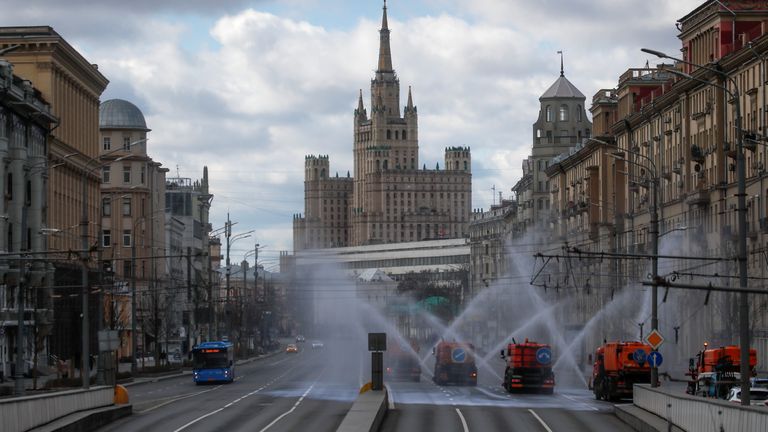
Image: Vehicles spray disinfectant while sanitising a road in Moscow
In Japan, two workers’ groups have issued a joint statement warning about a “collapse of emergency medicine,” which may lead to the collapse of medicine overall.
The Japanese Association for Acute Medicine, and the Japanese Society for Emergency Medicine have said healthcare facilities are being stretched amid a surge in coronavirus patients.
The statement said many hospitals were turning people away who were brought in by ambulance, including those suffering strokes, heart attacks and external injuries.
It said that some who were not accepted, later turned out to have the virus.
Japan – which has declared a state of emergency and is asking people to stay at home – has nearly 7,000 cases, and 108 deaths, but the numbers are growing.
However there is better news for Australia, with its chief medical officer saying the country is “in a good place” in its fight against the disease, as deaths rose by just three, to 59.
It now has 6,289 confirmed cases.
Brendan Murphy has said there is “no place in the world I would rather be than Australia at the moment”.
Italy’s prime minister has told the BBC that the European Union risks failing as a project in the coronavirus crisis.
Giuseppe Conte says the EU must act in an adequate and co-ordinated way to help countries worst hit by the virus.
Mr Conte says the European Union needs to rise to the challenge of what he calls “the biggest test since the Second World War”.
This was his first interview with the UK broadcast media since the pandemic exploded in Italy seven weeks ago.
He was speaking as Italy and some other EU countries try to push more frugal members of the bloc to issue so-called “corona bonds” – sharing debt that all EU nations would help to pay off. The Netherlands in particular has opposed the idea, leading to a clash between finance ministers of the eurozone.
The Italian prime minister told the BBC that Europe’s leaders were “facing an appointment with history” that they could not miss.
“If we do not seize the opportunity to put new life into the European project, the risk of failure is real.”
The infection rate in Italy is slowing – the latest figures show positive cases increasing from the previous day by a little over 1%. Two weeks ago, the rise was 7%.
The death toll too shows signs of falling, from 919 a fortnight ago to 542 fatalities in the past 24 hours. But Giuseppe Conte warned Italy not to lower its guard and said that the national lockdown, imposed on 9 March, could only be eased gradually.
“We need to pick sectors that can restart their activity. If scientists confirm it, we might begin to relax some measures already by the end of this month.”
Mr Conte has won plaudits for his government’s handling of the crisis – a recent poll by Demos showed his approval rating surging from 46% to 71%. But critics contend that the restrictions announced in the first few days were slow and piecemeal.
He initially resisted a push by some politicians in Lombardy, the northern region worst hit by the outbreak, to impose tighter measures more quickly. When a delegation from the Chinese Red Cross came to Milan in mid-March, they lambasted what they saw as Italy’s lax lockdown.
But the prime minister defended his government’s action.
“Going back, I would do the same”, he said. “We have a completely different system to China. For us to severely limit constitutional freedoms was a critical decision that we had to consider very carefully. If I had suggested a lockdown or limits on constitutional rights at the start, when there were the first clusters, people would have taken me for a madman.”
Earlier we reported on signs that Italy’s outbreak may have passed its peak – its daily death toll on Sunday was the lowest in two weeks.
Also this weekend, media are reporting the story of 104-year-old grandmother Ada Zanusso who survived Covid-19 in Lessona, in northern Italy.
She was living in a nursing home where 20 residents died from the virus.
“She has lost none of his lucidity and intelligence. Her recovery is a great joy and a reward for all those who have looked after her in these difficult days, ” her doctor Carla Furno Marchese told La Repubblica newspaper.
She’s not the only very old survivor, but her story provides some hope as we report on the global death toll.
Trabzonspor forward Caleb Ekuban could return to Italy as Seria A giants AC Milan are reportedly keeping tabs on him.
The 26-year-old is on loan at Trabzonspor and a report by Turkey’s prestigious “Fanatik” newspaper indicates Milan have already made their intentions known to Leeds United who own the player.
This season, Ekuba is showing good form, scoring 8 goals in 25 games, with six assists. While in five Europa League appearances this season, Ekuban has scored four goals.
Now, Ekuban’s market value has shot up to 9 million euros.
He joined Leeds in the summer of 2017 from Chievo Verona, playing 21 times for the Championship club.
He is a product of Chievo’s youth system, and before he joined Leeds, he played on loan in Albania with FK Partizani, where he scored 18 goals during the 2016-17 season in both the the the Champions League and Europa League preliminary rounds
A 101-year-old Italian man who was born during the Spanish flu pandemic has recovered from the novel coronavirus.
This was disclosed by the Deputy Mayor of the Italian city of Rimini, Gloria Lisi who revealed the man has been released from the hospital and is now home with his family.
The man, who has been named only as “Mr. P†was admitted to hospital in Rimini, northeast Italy last week after testing positive for COVID-19 and left the hospital on Thursday, March 26.
The Deputy Mayor of Rimini said his “truly extraordinary†recovery gave “hope for the future. Mr. P made it. The family brought him home yesterday evening. To teach us that even at 101 years the future is not written.â€
Mr. P was born in 1919 during the Spanish Flu pandemic which is estimated to have killed between 30 million and 50 million people worldwide.
Rimini had registered 1,189 cases of coronavirus as of Thursday, according to the Italian Civil Protection Department.
Italy yesterday recorded its highest daily jump in coronavirus deaths by 969 with an increase of 4,401 cases.
The total number of death now stands at 9,134, more than any other country and the total number of recorded cases, including deaths and those who have recovered, now stands at 86,498.
An overwhelmed Italian city at the heart of the coronavirus pandemic on Thursday sent more of its dead to nearby towns for cremation as the country’s world-leading toll topped 8,000.
Officials in Rome reported 662 new deaths and 6,153 infections — largely in line with the figures reported throughout the week.
The rise in daily deaths edged down to the lowest point in the crisis — 8.8 percent — while the infection rate stood at around eight percent for the fourth day running.
But the numbers are not dropping much further and Italians appear to be coming to terms with the realisation that two weeks of life under lockdown have not made the disease go away.
“Until we see this damn rate drop, we will have to continue making very hard sacrifices,” deputy civil protection service chief Agostino Miozzo said in reference to the ever-tightening containment measures.
Italy’s coronavirus death toll now stands at 8,165 — more than that of second-placed Spain and China, where the virus emerged in December, combined.
‘Crematoriums could not cope’
The endless flood of victims forced the city of Bergamo at Italy’s northern epicentre of the pandemic to send still more bodies to less burdened crematoriums in neighbouring towns.
An AFP photographer saw six camouflage green army trucks transporting coffins out of a Bergamo cemetery on Thursday.
“The large number of victims has meant that Bergamo’s crematorium could not cope on its own,” mayor Giorgio Gori said in a statement released to AFP.
The mayor said the city had also received 113 urns with the ashes of bodies that had been sent out for cremation earlier this week.
The bodies in the city of about 120,000 people are literally piling up.
A warehouse in the commune of Ponte San Pietro on Bergamo’s western outskirts held 35 freshly-made wooden coffins Thursday that were destined for cremation at a later date.
Still more coffins filled a barren church hall in the Seriate commune to Bergamo’s east.
A priest said a quiet prayer over the rows of coffins and a single red rose rested atop one in the otherwise empty room.
Anxious south
Yet the Italian government is just as anxious about the northern crisis spilling over into the far less developed south.
The head of the Campania region that includes Naples warned of a “dramatic explosion” of infections based on this week’s trends.
“The next 10 days will be hell for us,” governor Vincenzo De Luca said in an open letter to Prime Minister Giuseppe Conte.
The number of officially registered deaths in Campania — Italy’s third-most-populous with nearly six million people — rose from 29 on Sunday to 83 on Thursday.
But no southern region has recorded more than 100 coronavirus fatalities to date.
Italy’s latest figures confirm that COVID-19 overwhelmingly kills the elderly and the sick.
Data from Italy’s first 5,542 fatalities show that 98.6 percent of the victims already suffered from at least one ailment or pre-existing condition.
Slightly over half had three or more other health problems when they died.
Only 29.1 percent of the victims were women. The disparity has been observed elsewhere and still puzzles doctors around the world.
The average age of victims was 78 — a fraction lower than the 78.8 reported last week based on the first 3,200 deaths.
But Italian virologist Roberto Burioni said the figures were “not particularly reliable” because the country was primarily testing people who already exhibited flu-like symptoms.
Italy’s death rate among the confirmed COVID-19 cases — 10.1 percent — was thus much higher than in countries with broad-based testing such as South Korea.
Italy reported a second successive drop in daily deaths and infections from a coronavirus that has nevertheless claimed more than 6,000 lives in a month.
The Mediterranean country has now seen its daily fatalities come down from a world record 793 on Saturday to 651 on Sunday and 601 on Monday.
The number of newly declared infections fell from 6,557 on Saturday to 4,789 on Monday.
The top medical officer for Milan’s devastated Lombardy region appeared on television smiling for the first time in many weeks.
“We cannot declare victory just yet,” Giulio Gallera said.
“But there is light at the end of the tunnel.”
Italy’s National Health Institute (ISS) chief Silvio Brusaferro was more guarded.
“These are positive numbers but I do not have the courage to firmly state that there is a downward trend,” the medical expert told reporters.
Germany announced on Monday that it had accepted the Italian government’s request to care for some of the sick, with six patients to be transferred to hospitals in Dresden and Leipzig, in the eastern state of Saxony.
Italians will desperately hope that weeks of living under a lockdown in which even a jog in the park was eventually banned was the price worth paying for beating back the new disease.
Saturday’s record toll was followed by a late-night address to the nation in which Prime Minister Giuseppe Conte announced the additional closure of “non-essential” factories.
His government also banned travel to help a country that turned into the new epicentre of the pandemic last week get through a critical stretch in which restrictions are supposed to finally show results.
“Now more than ever, everyone’s commitment is needed,” Health Minister Roberto Speranza said after Monday’s figures came out.
Italy’s toll now stands at 6,077 more than that of China and third-placed Spain combined.
Nerves starting to fray
Italy has sacrificed its economy and liberties by closing and banning almost everything to halt the spread of a virus the government views as an existential threat.
The nation has rallied around its exhausted doctors and tried to deal with life under a state of emergency with humour and grace.
Entire city blocks have organised balcony parties with nightly DJs. There have been singalongs and synchronised rounds of applause.
But Italians’ nerves were clearly starting to fray and the pushback on social media against the ever-changing rules and tightening regulations was getting strong.
Twitter posts went viral ridiculing mayors and regional chiefs who threatened to jail joggers and fine people for walking their dogs too far from their homes.
The government’s new partial ban of seemingly random industries added to an air of confusion in the face of a disease Conte has called Italy’s biggest disaster since World War II.
Auto part makers were allowed to stay open but steel mills were shut. News stands could still operate but book stores could not.
Decision time
The reality is that Conte’s team is running out of things to close or ban.
Other nations are also watching the Italian numbers to see if Conte’s ban everything tactics work.
Italy is on the frontline of a war against a disease being fought by means that currently restrict freedoms and devastate economies.
Some are starting to openly ask if this price is too high — even as the global death toll soars.
Officials pleaded with the nation of 60 million people accustomed to celebrating life outdoors deep into the night to sacrifice individual liberties for the common good for two weeks.
Serie A side Napoli on Monday delayed the resumption of training, while international wine fair Vinitaly held annually in Verona was further postponed until next year.
The initial restrictions placed on the northern epicentre of the pandemic around Milan expired on Sunday and the national measures are set to end on Wednesday.
Conte indicated last week that he might need to extend the restrictions indefinitely.
His decision is expected within days.
“If everyone and I stress everyone respects our bans, we will emerge from this very difficult test first,” Conte said on Monday.
The number of people dying from coronavirus in Italy has risen by 475 in one day to nearly 3,000 – the biggest increase since the outbreak.
There are a total of 35,713 confirmed cases in the country, with more than 4,000 having successfully recovered.
Lombardy, the worst-hit region, recorded 319 deaths in one day.
Italy is the world’s worst-affected country after China, where the virus originated last year. At least 8,758 people have died, most in China.
The vast majority of the more than 200,000 confirmed cases – 80% – have occurred in Europe and the Western Pacific region, which includes much of Asia, the World Health Organization (WHO) says.
Many countries have taken drastic measures, including social distancing and cancelling major events to help slow transmission and reduce pressure on the health systems.
“But to suppress and control epidemics, countries must isolate, test, treat and trace,” the WHO chief Tedros Ghebreyesus said on Wednesday.
Italy has been on lockdown for almost two weeks as authorities try to halt the progress of the virus.
People have been asked to stay indoors – but the number of deaths has continued to spiral.
The WHO’s emergencies director, Mike Ryan, said this was probably due to the “astonishing” number of cases within the health systems, as well as the high number of elderly people in the population at large.
Dr Tedros hailed the beginning of the first vaccine trial so soon after the emergence of the virus as “an incredible achievement”.
Authorities in Italy have arrested a couple for breaching coronavirus quarantine rules after they were caught having sex inside a car.
The couple, a 23-year-old Egyptian man and a 40-year-old Tunisian woman were caught in the act by a police officer on the outskirts of Milan on Monday.
Police say the roadside fling happened on a road in Mecenate near Milan which has been heavily hit by the coronavirus outbreak.
According to news agency ANSA, the pair were accused of ignoring a quarantine rule which bans two people from being in the front or back of a vehicle together.
It wasn’t revealed if the couple will face further action, but Italian authorities are keeping an eye on all road vehicles in order to enforce a ban on travel.
Italy currently has 31,506 cases of coronavirus with 2,503 deaths.
Italy on Wednesday reported 475 more deaths from the coronavirus, a new record high that brings the total number of victims in the country to 2,978.
Latest figures provided by the Italian Civil Protection Department show that COVID-19 cases in the country have now reached 28,710, a 10% rise from Tuesday.
The Italian government is mulling over whether to further strengthen its already strict containment measures, which have brought the country to a near-total lockdown.
The hotbed of the outbreak in Italy remains the northern Lombardy region, which accounts for 1,959 of the total fatalities in the country.
Attilio Fontana, the governor of Lombardy, issued a desperate appeal to citizens on Wednesday, urging them to stay remain at home or face more stringent lockdown measures.
“Unfortunately, the number of infections is not decreasing. They continue to rise, and soon we will not be able to heal those who are falling ill,†he said.
Italy is the worst-hit country in Europe and has the highest number of COVID-19 cases and deaths in the world after China.
The World Health Organization (WHO) has declared Europe as the new epicenter of the coronavirus, which first emerged in Wuhan, China last December.
According to WHO data, the virus has now spread to 164 countries and territories, and there were over 194,000 cases and nearly 7,900 fatalities around the world by Wednesday evening.
Italy’s prime minister on Tuesday declared coronavirus was causing a “socio-economic tsunami” as European leaders agreed to seal off external borders, but many countries thwarted solidarity by imposing frontier curbs of their own.
“The enemy is the virus and now we have to do our utmost to protect our people and to protect our economies,” European Commission President Ursula von der Leyen said after the second videoconference in a week of the European Union’s 27 leaders.
“We are ready to do everything that is required. We will not hesitate to take additional measures as the situation evolves.”
Italian Prime Minister Giuseppe Conte, whose country has been hardest hit by a global health crisis now centred in Europe, said no nation would be left untouched by the “tsunami”.
He called for special “coronavirus bonds”, or a European guarantee fund, to help member states finance urgent health and economic policies, an Italian government source said.
Rome has issued similar calls for joint EU funding during previous crises, usually running into opposition from the bloc’s most powerful economy and paymaster, Germany.
Asked about Conte’s proposal, Chancellor Angela Merkel said euro zone finance ministers would continue discussing ways to help their economies cushion the impact, but no decision has been made.
“These are initial discussions and there have been no decisions by the finance ministers,” said Merkel. “I will talk to (Finance Minister) Olaf Scholz so that Germany continues to take part (in the discussions). But there are no results regarding this.”
The EU has scrambled to find a coherent response to the outbreak, with countries imposing their own border checks in what is normally a zone of control-free travel, limiting exports of medical equipment or failing to share key data swiftly.
The national leaders agreed on Tuesday to close the external borders of most European countries for 30 days and establish fast-track lanes at their countries’ frontiers to keep medicines and food moving.
Ireland will not join the travel ban on Europe’s borders, von der Leyen said, because the United Kingdom – which left the EU in January – was not either. Despite Brexit, the two have an obligation to preserve an open border on the island of Ireland.
Should Ireland go with the majority of European countries while the UK stays away, it would mean erecting controls on the sensitive border with Northern Ireland, something sides sought to avoid at all cost in three years of tortuous Brexit divorce talks.
Damaged unity
France went into lockdown on Tuesday to contain the spread of the highly contagious new coronavirus and Belgium announced it would follow suit, as the death toll in Italy jumped above 2,000, European banks warned of falling incomes and pummelled airlines pleaded for government aid.
The EU’s executive European Commission warned member states that this was just the beginning of the crisis and Germany said it would run for “months rather than weeks”, diplomats said.
Alarmed by the unilateral border restrictions being imposed in a bloc that prizes the free movement of people, French President Emmanuel Macron had pressed for the decision to close Europe’s external borders to foreigners.
“That was meant to convince European countries to drop internal and unilateral border moves. But it’s hard to see anyone doing it,” an EU diplomat said, adding the move was largely symbolic as the virus was already within.
Indeed, tensions over borders still abounded across the EU, with three Baltic countries – Lithuania, Latvia and Estonia – criticising Poland for blocking their citizens in transit from returning home.
Portugal and Spain on Tuesday notified Brussels that they have introduced controls on Europe’s internal borders, bringing the total taking such measures to at least 12 countries.
Slovakia, Slovenia and Hungary have not formally informed the EU about such moves despite pursuing them, meaning the real number is likely higher.
The EU has also moved to repatriate Europeans stranded abroad as airlines cut flights. Von der Leyen said nearly 300 Austrian and other European nationals were flown back from Morocco to Vienna on Tuesday.
Their border control steps aside, the EU leaders have come together on a “whatever it takes” approach to cushioning the economic blow from the pandemic, including by relaxing limitations on state aid.
The bloc’s antitrust chief proposed allowing governments to offer grants or tax advantages of up to 500,000 euros ($550,000) to ailing companies, though some EU countries want Brussels to go further.
Two Italian nationals who tried to enter Ghana from the epicentre of the Coronavirus disease (COVID-19) in Europe were prevented from entering Ghana Monday night, [March 16, 2020].
This was in compliance with the travel advisory directive issued by the government of Ghana to help combat the spread of COVID-19.
The Minister of Information, Mr Kojo Oppong Nkrumah who disclosed this said: “Last night there were two Italians, who it was clear they were coming from the epicentre …even though the aircraft was still in the air, we had to make arrangements at the airport to ensure that they did not get off the aircraft and they are returned to their originating destination.”
“So though we are yet to hit the 1 pm timeline today [Tuesday, March 17, 2020], some soft enforcement has already commenced at our ports of entry,” Mr Nkrumah said.
He said details of the travellers who were en route to Ghana on an Air France flight were confirmed which triggered the action to deny them entry.
On whether there would be a total ban on flights from the epicentre, Mr Nkrumah said: “as the President said the guidelines that have been given are subject to review at any point in time. At this stage, this is what we believe is appropriate to do and this is how we are enforcing it at this stage.”
Mr Nkrumah disclosed this at a trainer-of-trainers workshop for Regional Information Officers in Accra on Tuesday [March 17, 2020].
As part of measures being taken by the government to prevent the spread of the deadly Coronavirus disease in Ghana, the government has banned travellers who want to come to Ghana but have been to any country that has been affected by the disease (COVID-19) within the last 14 days.
The ban takes effect Tuesday, March 17, 2020 at 1 pm.
Ghana has so far confirmed six cases of the Coronavirus disease with over 200 contacts being traced, some of whom have been quarantined with others asked to do self-quarantine for the next 14-days.
As part of the travel advisory measures, the government has “strongly discouraged” travelling into Ghana until further notice.
A statement from the Ministry of Information on Sunday, March 15, 2020, however, said that Ghanaian citizens and persons with Ghanaian residence permits would be allowed into Ghana but would be made to observe a mandatory 14-day self-quarantine.
The death toll in Italy from the coronavirus surged to 827 on Wednesday, as 196 more fatalities were confirmed over the past 24 hours, according to an official.
Civil protection chief Angelo Borelli said the number of confirmed coronavirus cases rose to 10,590, while the total number of affected — including deaths and recoveries — reached 12,462.
Borrelli said that 196 more deaths were recorded over the past 24 hours.
To contain the virus, the Italian government has implemented a nationwide lockdown with schools and universities closed, and all events and gatherings cancelled.
The novel coronavirus emerged in Wuhan, China, last December and has now spread to 114 countries.
The global death toll is now almost 4,300, with around 118,000 confirmed cases, according to the World Health Organization (WHO), which has declared the outbreak “a global pandemic.â€
Almost 200 people died from the coronavirus in 24 hours, Italy’s Civil Protection Agency confirmed Wednesday — the highest daily increase in absolute terms registered anywhere in the world since the respiratory illness emerged in China at the end of last year.
In response, the country’s prime minister, Giuseppe Conte, told reporters the government would allocate 25 billion euros ($28.3 billion) to help mitigate the impact on the fragile economy. Only a week ago, he estimated it would need just 7.5 billion.
From Tuesday to Wednesday, 196 people died, bringing the total number of deaths to 897, the Civil Protection Agency said in a statement. Confirmed cases across the country rose to 12,462 from a previous 10,149.
After an initial lockdown in the north failed to prevent the spread, the government on Monday banned all nonessential travel and public gatherings throughout Italy until April 3, halted all sports events and extended a shutdown of schools.
The death toll in Italy from the coronavirus surged to 827 on Wednesday, as 196 more fatalities were confirmed over the past 24 hours, according to an official.
Civil protection chief Angelo Borelli said the number of confirmed coronavirus cases rose to 10,590, while the total number of affected — including deaths and recoveries — reached 12,462.
Borrelli said that 196 more deaths were recorded over the past 24 hours.
To contain the virus, the Italian government has implemented a nationwide lockdown with schools and universities closed, and all events and gatherings cancelled.
The novel coronavirus emerged in Wuhan, China, last December and has now spread to 114 countries.
The global death toll is now almost 4,300, with around 118,000 confirmed cases, according to the World Health Organization (WHO), which has declared the outbreak “a global pandemic.â€
The number of people to have died from the coronavirus in Italy has shot up by 133 in a day to 366, officials say.
The total number of infections leapt 25% to 7,375 from 5,883, according to the Civil Protection agency.
The jump in figures comes as millions adapt to new measures introduced on Sunday in an attempt to contain the outbreak.
Up to 16 million people in Lombardy and 14 provinces need special permission to travel under new quarantine rules.
Prime Minister Giuseppe Conte also announced the closure of schools, gyms, museums, nightclubs and other venues across the whole country.
The radical measures will last until 3 April.
The latest figures mean Italy now has the highest number of confirmed infections outside of China, where the outbreak originated in December. It has overtaken South Korea, where the total number of cases is 7,313.
Among the latest people to test positive in Italy is the army’s chief of staff. Salvatore Farina said he felt well and was self-isolating.
The strict new quarantine measures affect a quarter of the Italian population and centre on the rich northern part of the country that powers its economy.
The health system is under immense strain in Lombardy, a northern region of 10 million people, where people are being treated in hospital corridors.
“We want to guarantee the health of our citizens. We understand that these measures will impose sacrifices, sometimes small and sometimes very big,” Prime Minister Conte said as he announced the measures in the middle of Saturday night.
Under the new measures, people are not supposed to be able to enter or leave Lombardy, where Milan is the main city.
The same restrictions apply to 14 provinces: Modena, Parma, Piacenza, Reggio Emilia, Rimini, Pesaro and Urbino, Alessandria, Asti, Novara, Verbano Cusio Ossola, Vercelli, Padua, Treviso and Venice.
Some transport in and out of the regions affected continued on Sunday. Flights continued to arrive at Milan’s Malpensa and Linate airports, though some scheduled flights were cancelled.
However, Italy’s national carrier Alitalia said it would suspend all operations from Malpensa from Monday and Linate would only serve domestic routes. International flights would continue to and from Rome.
The World Health Organization (WHO) chief Tedros Adhanom Ghebreyesus praised Italy for making “genuine sacrifices” with the restrictions. Until Sunday only about 50,000 people in northern Italy had been affected by quarantines.
Last week the government announced the closure of all schools and universities across the country for 10 days.
The government & the people of 🇮🇹 are taking bold, courageous steps aimed at slowing the spread of the #coronavirus & protecting their country & ðŸŒ. They are making genuine sacrifices. @WHO stands in solidarity with 🇮🇹 & is here to continue supporting you.https://t.co/Y2rkgUihtA
— Tedros Adhanom Ghebreyesus (@DrTedros) March 8, 2020
What is the situation elsewhere?
The number of infections worldwide is more than 107,000, with about 3,600 deaths.
Most of the fatalities have been in China. But the country on Sunday reported its lowest number of new infections in a single day since January – an indication that the virus’s spread there is slowing.
Iran, one of the worst hotspots outside China, has now confirmed 6,566 infections and 194 deaths.
However, the real figure is feared to be much higher. One report on Sunday, quoting a government envoy, said there had been 200 deaths in the northern Gilan province alone – but the figures were later removed.
In other developments:
Saudi Arabia has put the governorate of Qatif in the oil-producing Eastern Province into lockdown. The cases confirmed in Qatif – where the Shia minority live – have all been traced back to Iran
A hotel being used as a coronavirus quarantine facility in the Chinese city of Quanzhou collapsed, killing at least ten people
Pope Francis delivered his first live-streamed Sunday prayer to avoid the usual crowds forming – he said he was “close through prayer” with those suffering from the epidemic
In the US, a cruise ship with 3,533 passengers and crew held off the coast near San Francisco after 21 people tested positive for the disease has been directed to the nearby port of Oakland
An individual who attended a conservative political conference last week that President Trump and Vice-President Mike Pence spoke at has been confirmed to have the virus
In the US more than 400 cases have been reported, and the death toll is 19.
Among other countries to report a rise in the total number of cases are: France (to 1,126); Germany (939); Spain (589); the UK (273); the Netherlands (188).
Colombia, Bulgaria, Costa Rica, Malta, the Maldives and Paraguay have, meanwhile, all reported their first cases.
Italy is set to lock down at least 16 million people in the region of Lombardy and in 11 other provinces in the north and east of the country.
The mandatory quarantine will last until early April.
The dramatic escalation in the country’s efforts to contain the new deadly coronavirus will close gyms, pools, museums and ski resorts.
Italy is Europe’s worst hit-country and reported a steep rise in virus infections on Saturday.
The new measures, which also apply to financial centre Milan and tourist hotspot Venice, could take effect as early as Sunday and will last until 3 April.
The death toll in Italy has passed 230, with officials reporting more than 50 deaths in 24 hours. The number of confirmed cases jumped by more than 1,200 to 5,883 on Saturday.
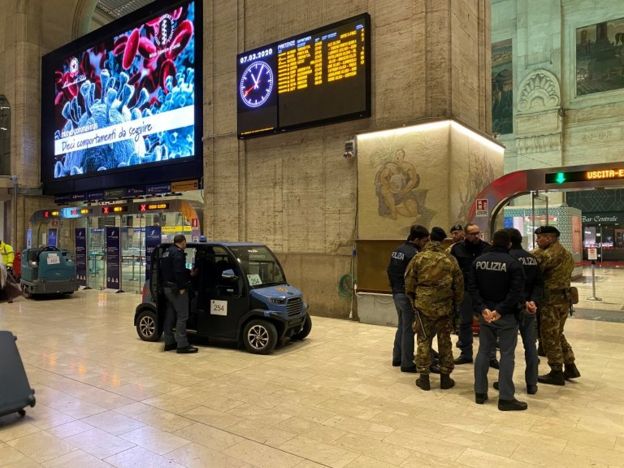
Image captionMilitary and police in Milan prepare to lock down the city
The measures published in a draft government decree were obtained by Italian newspaper Corriere della Sera.
They are set to be signed in the coming hours, reports the BBC’s Mark Lowen.
The whole northern region of Lombardy, home to 10 million people and Italy’s financial centre Milan, will be closed off except to emergency access, and 11 provinces including Venice, Parma and Modena will be affected – a total of 16 million people.
Until now around 50,000 people in northern Italy had been affected by quarantine measures.
What are the measures?
Night clubs, gyms, swimming pools, museums and ski resorts will be closed.
Restaurants and cafes can open but customers must sit at least a metre apart.
People will be told to stay home as much as possible, and those who break the quarantine could face three months in jail.
Sports competitions will close to the public, and the president of Italy’s football players’ union has called for all football to stop.
The World Health Organization has advised Italy to strongly focus on virus containment measures as infections spread in the country.
The plans echo China’s forced quarantine of millions of people which the WHO has praised for halting the spread of the virus.
Leading Italian politician Nicola Zingaretti said on Saturday he had tested positive for the virus.
“I am fine but I will have to stay home for the next few days,” the leader of Italy’s centre-left Democratic Party (PD) said in a Facebook post.
The country has said it will start recruiting retired doctors in an effort to combat the escalating outbreak.
Elsewhere, Iran has confirmed almost 6,000 infections and 145 deaths, and the number of cases worldwide has passed 100,000, officials say.
A second MP was reportedly among those to have died in Iran, where health officials fear the number of cases may actually be much higher.
Italy is embarking on the first day of its shutdown of all schools and universities after emergency measures were implemented due to the coronavirus outbreak.
Cinemas, theatres and museums are also closed across the country while its Serie A football league will be played in empty stadiums.
More than 3,000 people have been infected, making it the worst-hit country on the continent.
Schools and universities will be shuttered until at least 15 March, according to Education Minister Lucia Azzolina.
Reactions to the school closures have been mixed.
“I hoped for this decree because I feared an outbreak at school,†Massimiliano Del Ninno, father of a Rome primary school student, told Reuters news agency.
Clarissa Mazzei, a 30-year-old mother of three, called it “tragic… for the students, and also for the parents.â€
Ghana has suspended its consular services to Italy following the outbreak of the novel Coronavirus in that country.
A statement from the Embassy of Ghana in Italy indicated the ban is until further notice.
“The Embassy of the Republic of Ghana regrets to inform that due to the outbreak of the corona outbreak of the coronavirus in Italy, consular services to the general public will be suspended with immediate effect and until further notice. The embassy regrets any inconvenience that this may cause,†the statement said.
Italy has recorded over 300 cases of the disease and 11 deaths.
The European nation has put some cities and towns on lockdown in this regard with 11 towns being in Lombardy and Veneto.
No evacuations
Although there have been calls for evacuation of Ghanaians in some of the affected countries, government says it would only do so when the need arises.
Meanwhile, the World Health Organisation in an assessment report as of Friday, February 14, 2020, indicated that although government has committed GH¢2.5 million for any occurrence of the disease in Ghana, the amount is inadequate.
According to the report, Ghana’s total budget for COVID-19 preparedness stands at GH¢35million.
WHO warns against assigning ‘blame’ for virus
The World Health Organisation (WHO) has declared the Coronavirus disease a global health emergency and has warned countries to prepare for a possible pandemic.
Meanwhile, the WHO’s Executive Director Dr Michael J Ryan says no individual country is to blame for the outbreak.
“It’s really important that our rhetoric and narrative is balanced” said Dr Ryan, adding that China was not responsible for coronavirus, just as the Democratic Republic of Congo was not responsible for Ebola.
He said stigma “had become part of the global narrative, which is unhelpfulâ€.
The death toll from the novel coronavirus is now more than 2,700 worldwide, with the majority being in mainland China.