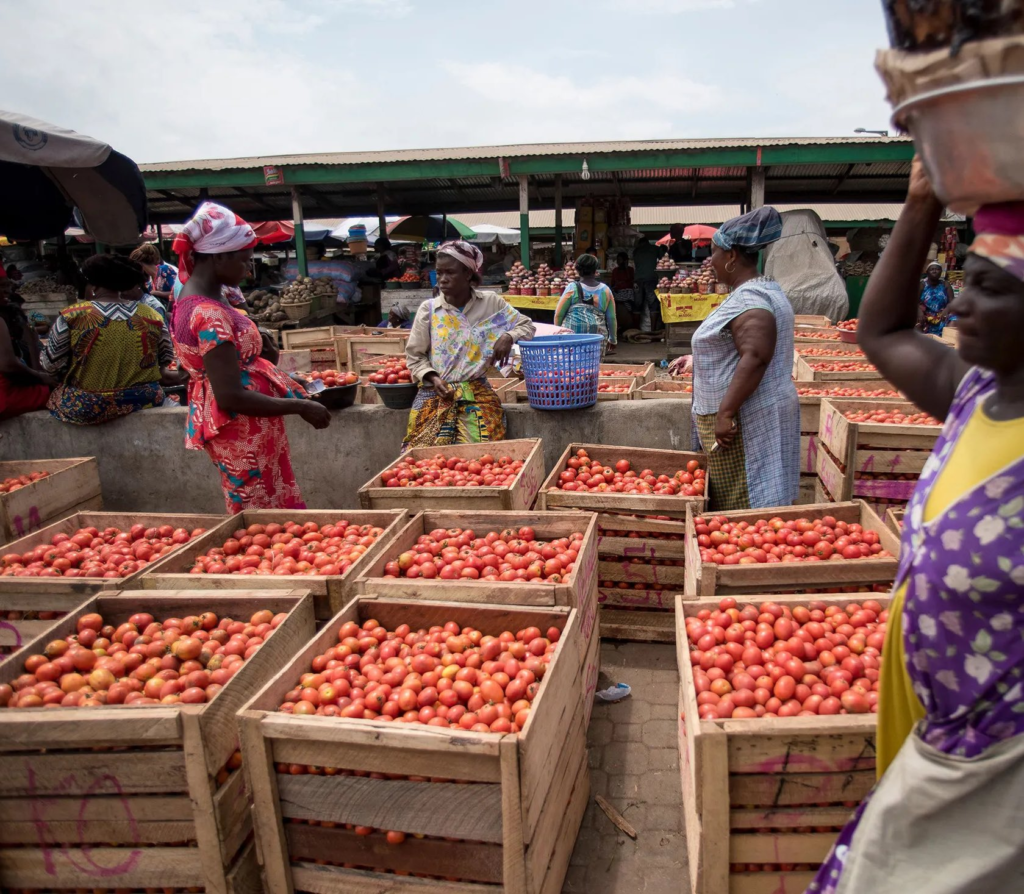
Ghanaians may have to brace themselves for a shortage of fresh tomatoes in markets nationwide as the Burkina Faso government issues an indefinite ban on the export of the commodity.
In a formal communique dated March 16, and signed by both the Trades and Agriculture ministers of the Francophone country, it noted that a ban is necessary to feed the country’s national processing units.
This has sparked widespread concerns about its potential to worsen Ghana’s tomato supply crisis, as Ghana imports approximately 70-80% of its tomatoes from Burkina Faso, worth about $400 million annually.
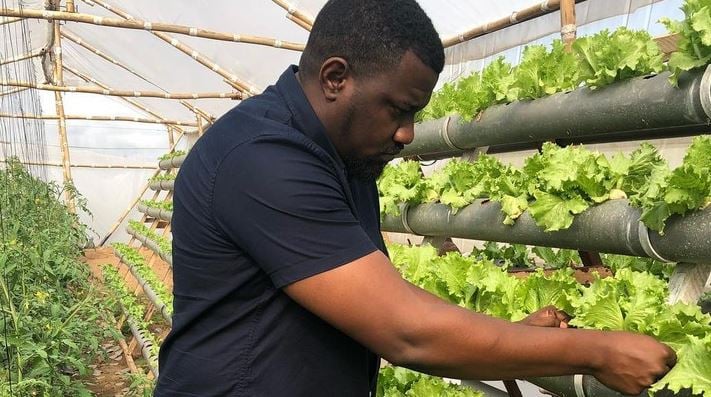
Reacting to the new development, the Agric Ministry said it has urged Ghanaian farmers to intensify dry-season farming to boost local production and stabilise food supply to mitigate the pressures from the ban.
Speaking in an interview on Joy News on Thursday, March 19, the deputy Agriculture Minister, John Dumelo, acknowledged that Ghana’s dependence on Burkina for tomatoes may not end immediately, but with intense local farming in the dry season under improved irrigation infrastructure, the country should be self-sufficient in the next 3-4 years.
“For us, going to Burkina Faso for tomatoes might not end immediately, but once they get encouraged, within three or four years, we should be self-sufficient when it comes to tomato production,” he said.
He urged farmers to scale up production, pledging the government’s readiness to support them to produce tomatoes, especially during this ban.
“I told them to let me know what they need to help them scale up production, especially in the next dry season… The government is committed to helping them to scale up production,” he added.
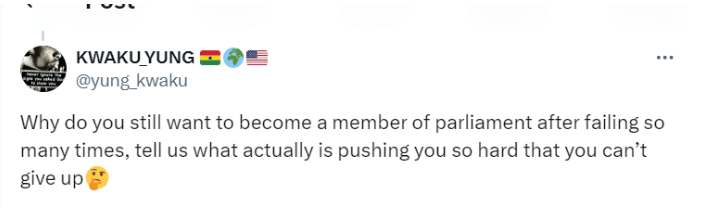
The Ayawaso West Wuogon Member of Parliament continued that, “I am yet to get the reason why the Burkina Faso government announced the ban and the details that come with it. But last year, I was in the Northern Region, and I urged them to produce tomatoes in the dry season. This dry season, I went back, and most of them are doing just that,” he added.
More about the communique on the ban
The issuance of Special Export Authorisations (ASE) has also been suspended. The Special Export Authorisations (ASE) are official permits issued by the government that allow traders to export certain goods,
“Economic operators and the public are hereby informed that, to ensure the supply of national processing plants, the export of fresh tomatoes is suspended throughout the national territory until further notice. Consequently, the issuance of Special Export Authorisations (ASE) is suspended.
The letter also stated that operators holding valid fresh tomato export permits have two (2) weeks from the date of signature of the communiqué to complete their export procedures. After two weeks, the permit will be considered invalid.
“Economic operators holding valid fresh tomato export authorisations have two (2) weeks from the date of signature of this communiqué to complete their export procedures. After this period, the authorisation will be considered invalid”, the statement continued.
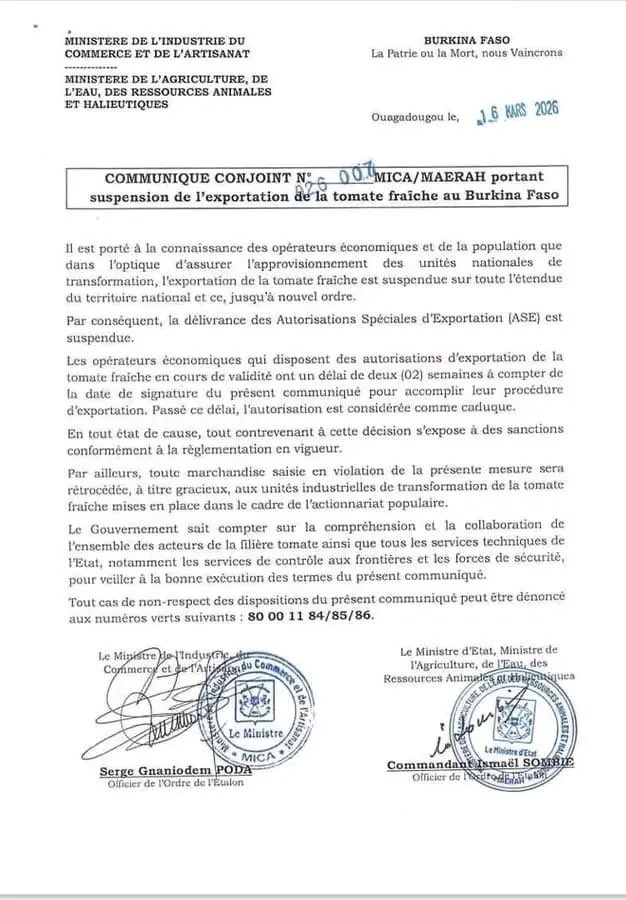
The Burkinabé government warned that any violator of the directive will be sanctioned in accordance with applicable regulations.
“Furthermore, any goods seized in violation of this measure will be returned, free of charge, to the fresh tomato processing plants established under the popular shareholding scheme,” the letter translated to English noted.
It continued that, “The Government is counting on the understanding and cooperation of all stakeholders in the tomato sector, as well as all state technical services, particularly border control services and security forces, to ensure the proper implementation of the terms of this communiqué”.
Kumasi vendors express frustration
The impact of the ban is being felt well before any formal shortage sets in.
Some tomato vendors at the Racecourse Market in Kumasi are already expressing frustration over the development, warning that prices could spike if the situation is not quickly addressed.
The vendors are using the occasion to call on the government to prioritise the local tomato industry by revamping irrigation systems and investing in local processing facilities, longstanding concerns that have left Ghana’s tomato sector heavily dependent on imports from neighbouring countries, particularly Burkina Faso.
Ghana has historically relied on cross-border produce flows from Burkina Faso to supplement domestic tomato supply, especially during lean seasons when local harvests are insufficient to meet demand.
A sudden and indefinite halt to those exports is therefore expected to tighten supply significantly, with knock-on effects on prices at markets nationwide.
Northern Ghana, which serves as the main corridor for produce trade with Burkina Faso, is expected to feel the shortage most acutely in the short term.
Before this ban, Ghana was hit with the sad news of a fatal terrorist attack on tomato traders in mid-February.
A truck carrying Ghanaian tomato traders was attacked by terrorists in Titao, Burkina Faso, on Sunday, February, 15. This was contained in a press release issued to media houses and signed by the Minister for the Interior and National Security, Muntaka Mohammed-Mubarak.
“The Government of Ghana has received disturbing information from Burkina Faso of a truck carrying tomato traders from Ghana, which was caught in a terrorist attack in Titao,” the release said.
According to the Ministry, Ghana Embassy in Burkina Faso has already launched an investigation into the unfortunate incident.
“The Ghana Embassy in Burkina Faso is liaising with officials of Burkina Faso to visit the attack site for details and identification of Ghanaians caught in the attack,” the statement added. Parts of the Sahel region have recently experienced heightened terrorist attacks.