The official King Charles III coronation logo has been unveiled by Buckingham Palace for use in street celebrations, social media, and souvenirs.
Sir Jony Ive, a well-known designer of cutting-edge Apple products like the iPhone, created it.
In this more conventional picture, flowers are arranged to resemble the St. Edward’s crown that was worn during the coronation.
According to Sir Jony, the floral pattern highlights the “optimism of spring” and embodies the King’s love of the natural world.
Image caption,King Charles and logo designer Sir Jony Ive
“The design was inspired by King Charles’s love of the planet, nature, and his deep concern for the natural world,” said the former Apple design guru, who is more usually associated with sleek tech designs of equipment such as iMacs and iPods.
The logo, to be used for events over the coronation long weekend in May, features a rose, thistle, daffodil and shamrock – emblems from across the United Kingdom.
It’s in contrast to the very stark design of the new King Charles stamps revealed this week, which has no crown or decoration.
The logo, also available in a Welsh-language version, is the latest detail to be revealed from the planned celebrations to mark the coronation, which will be held at Westminster Abbey on 6 May.
The day will include a carriage procession and traditional appearances on the Buckingham Palace balcony, although it is still not known who will be attending – with no confirmation yet whether the Duke and Duchess of Sussex will be there.
On Sunday 7 May there will be a music concert and light show at Windsor Castle, and this week a public ballot opened for the 10,000 free tickets on offer for the event.
There will be an extra bank holiday on Monday 8 May, with events highlighting the work of volunteers.
The King is modifying the royal family’s web pages, which his mother, Queen Elizabeth, was previously using.
King Charles III is updating communication methods that Queen Elizabeth II previously used.
King Charles released two statements on Thursday using the official accounts of the British royal family on Instagram, Twitter, and Facebook. The messages featured a new graphic. Following Queen Elizabeth’s passing in September 2022, Charles, then 74, took charge of the @RoyalFamily social media accounts.
The new graphics, which can be seen in news feeds, have white backgrounds with navy text watermarked with the British royal coat of arms.
Until now, King Charles had been making statements with the same navy graphic that Queen Elizabeth used. The old design featured large white text with a small royal coat of arms in the lower left corner.
Following his mother as monarch, Charles has used his royal signature, “Charles R.” The “R” stands for “Rex,” which means “King” in Latin. During her record-breaking reign, Queen Elizabeth would sign official communications as “Elizabeth R” — the “R” meaning “Regina,” or “Queen.”
The new graphic isn’t the only way King Charles is refreshing the royal family’s social media pages. In the fall, the sovereign’s office started a series called “The Royal Week,” sharing photos and short summaries on the latest engagements of the King, Queen Camilla, Prince William, Kate Middleton and the rest of the working royals.
Last week, Charles’ office started the clock for the countdown to his coronation in May.
“100 days to go until the Coronation!” the palace tweeted, sharing a recap of “what to expect” over the three-day weekend.
As PEOPLE previously reported, King Charles and Queen Camilla will be crowned in a ceremony at Westminster Abbey on May 6. “The Service will reflect the Monarch’s role today and look towards the future, while being rooted in longstanding traditions and pageantry,” courtiers said.
Following the service, King Charles and Queen Camilla will be joined by members of the royal family for the larger Coronation Procession back to Buckingham Palace, where they will all appear on the iconic balcony for the first time since the accession.
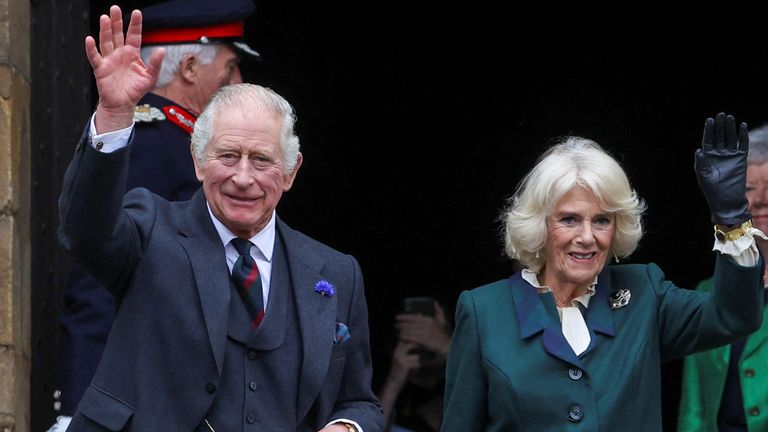
King Charles and Queen Camilla. ANDREW MILLIGAN/GETTY
The following day, the Coronation Concert will be broadcast live from Windsor Castle. The event will feature “global music icons and contemporary stars,” supported by a world-class orchestra and dancers. Free pairs of tickets will be made available to the public via national ballot, and the concert will also be attended by volunteers from some of the King and Queen Consort’s charity affiliations.
Synchronized with the concert, “Lighting up the Nation” will see iconic locations across the U.K. illuminated with projections, lasers and drone displays.
Also on May 7, citizens across the U.K. will gather with neighbors for the Coronation Big Lunch. Originally conceived by the Eden Project, the event is intended to “boost community spirit, reduce loneliness and support charities and good causes.”
Monday, May 8, was announced as a bank holiday by Prime Minister Rishi Sunak in November. U.K. citizens are invited to participate in the Big Help Out, a volunteering initiative
The Reserve Bank of Australia (RBA) states that the new design will honour “the culture and history of the First Australians.”
The current five dollar note features a portrait of the late Queen Elizabeth II.
After the Queen passed away in 2017, discussions about Australia’s future as a constitutional monarchy resurfaced.
“This decision by the Reserve Bank Board follows consultation with the Australian government, which supports this change,” the bank said in a statement.
“The Bank will consult with First Australians in designing the $5 banknote. The new banknote will take a number of years to be designed and printed. In the meantime, the current $5 banknote will continue to be issued. It will be able to be used even after the new banknote is issued,” it added.
The RBA currently has no plans to change the design of any other denomination of Australian banknotes, a spokesperson told the BBC.
It has not yet set a date for when it will reveal the new five dollar note design, they added.
The decision was welcomed by Aboriginal politicians and community leaders.
“This is a massive win for the grassroots, First Nations people who have been fighting to decolonise this country,” Lidia Thorpe, a Greens senator and DjabWurrung Gunnai Gunditjmara woman.
First Nations people lived in Australia for at least 65,000 years before British colonisation, according to recent estimates.
This is a massive win for the grassroots, First Nations people who have been fighting to decolonise this country. First Nations people never ceded our Sovereignty to any King or Queen, ever. Time for a Treaty Republic! pic.twitter.com/J4LjyFXwUe
The King became the British monarch after his mother’s death in September.
As the British monarch, he is also the head of state of Australia, New Zealand and 12 other Commonwealth realms outside the United Kingdom. The role is largely ceremonial.
The British monarch’s portrait has appeared on at least one design in every series of Australian banknotes.
However, in September Australia said the image of the new monarch would not automatically replace the Queen on its five dollar notes, and that she might be replaced by Australian figure.
Much of Australia’s currency already features Indigenous Australian figures and artworks.
In a 1999 referendum Australian voters chose to keep the British monarch as the country’s head of state.
In 2021, Australia officially changed its national anthem to remove reference to the country being “young and free”.
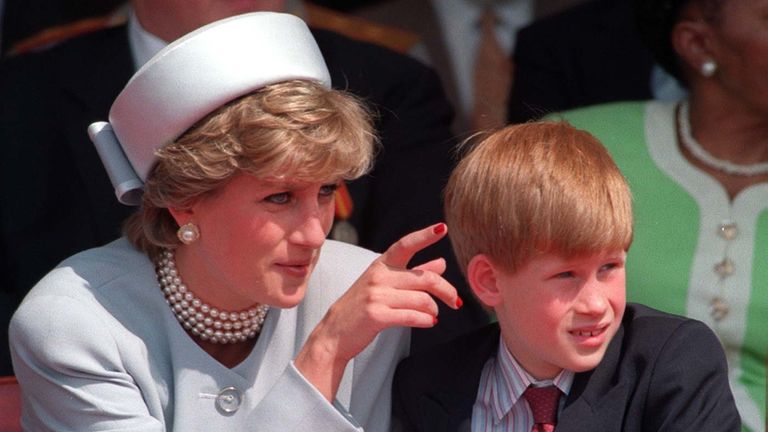
Prince Harry has written about the moment he learned his mother, Princess Diana, had been killed in a car accident.
Spare, details a series of revelations in which Harry admits to using cocaine and discusses how he lost his virginity.
When his mother died, he was woken up by his father, who “sat on the edge of the bed and put his hand on my knee,” he wrote.
“My dear son, mum has had a car accident,” he says Charles said.
“There have been complications. Mum has been seriously injured and has been taken to hospital, my dear son.”
The book added: “He would always call me ‘dear son’, but he was repeating it a lot.
“He spoke quietly. It gave me the impression he was in shock.”
Diana died in 1997 following a car crash in Paris.
The book Spare was mistakenly put on shelves in Spain, five days ahead of the official release date – but Sky News has obtained a copy.
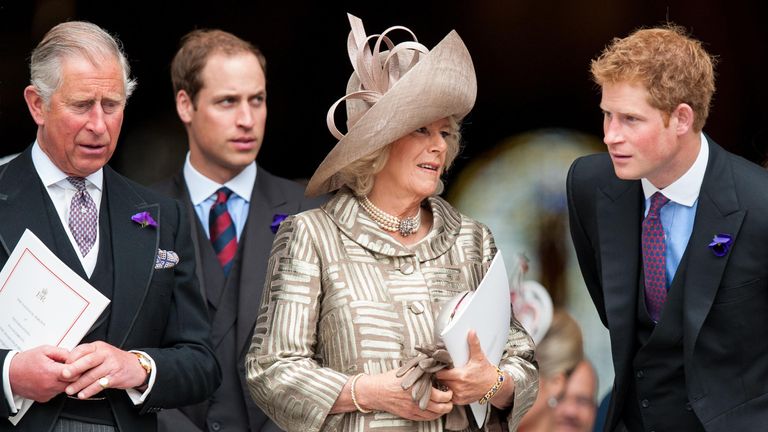
Image:From left: The then Prince Charles, William, the then Duchess of Cornwall and Harry
‘Don’t remarry’
Prince Harry also says in his new book that he asked his father not to marry Camilla.
The Duke of Sussex also talks about the moment he was told his mother had a car accident, amongst a number of other revelations.
Speaking about his father marrying Camilla, the prince writes: “That’s why when the question came, Willy and I promised our father that we would welcome Camilla to the family. The only thing we asked for in return was that he didn’t marry her. ‘You don’t need to get married again’ we asked him.”
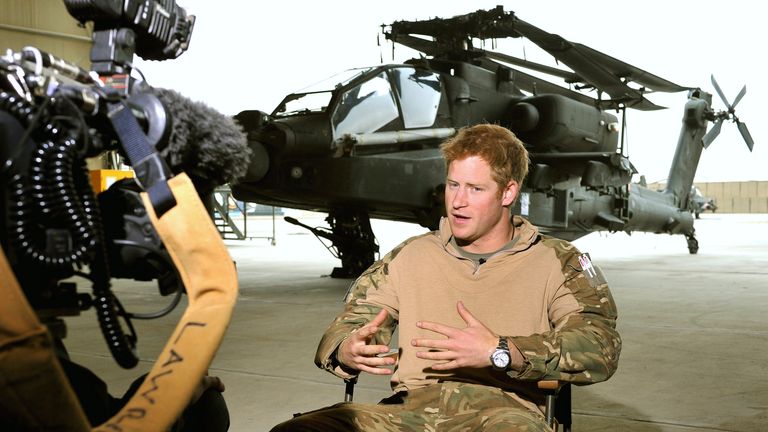
Image:Harry in Afghanistan in 2012
Harry killed 25 people in Afghanistan
In Spare, the duke also said that he killed 25 people while serving inAfghanistan.
Writing about his two tours of duty, the Prince, who spent 10 years in the Army, said: “So my number: twenty-five. It was not something that filled me with satisfaction, but I was not ashamed either. Naturally, I would have preferred not to have that figure on my military resume, or in my head, but I would also have preferred to live in a world without the Taliban, a world without war.”
Prince claims he was dissuaded from asking for Diana investigation
Harry also claims in his memoir that he and his brother William were dissuaded from jointly asking for an investigation into their mother’s death.
He wrote: “Especially the summary conclusion, that our mother’s driver was drunk and, as a result, that was the only cause of the accident. It was simplistic and absurd. Even if the man had been drinking, even if he had been drunk, he wouldn’t have had any problem driving through such a short tunnel.
“Unless paparazzi were following him and dazzled him. Why had those paparazzi got off lightly? Why weren’t they in prison? Who had sent them? And why weren’t those people in jail either? What other reason could there be apart from corruption and cover-ups being the order of the day? We agreed on all those questions, and also what we should do next. We would issue a statement, asking jointly for the investigation to be reopened. We might call a press conference. Those who decided dissuaded us.”
Harry admits he took cocaine
In the book, he also admitted that he took cocaine, spoke about how he lost his virginity and claimed his brother physically attacked him during a row over his marriage to Meghan Markle.
Speaking about using cocaine,Prince Harry said “it wasn’t very fun, and it didn’t make me feel especially happy”.
Harry described losing his virginity as “a humiliating episode with an older lady”.
He said it was “with an older lady, who loved horses very much and treated me like a young stallion”.
The excerpt read: “‘I mounted her quickly, after which she spanked my ass and held me back… one of my mistakes was letting it happen in a field, just behind a busy pub. No doubt someone had seen us’.”
Whether Prince Harry will be present at his father’s coronation in May is not made clear in the most recent trailer for an upcoming TV interview. When asked if he will play a role in the monarchy’s future, he says he still believes in it but says, “I don’t know.”
The “door is always open” to his family for reconciliation, according to Prince Harry, but “the ball is in their court.”
In the most recent ITV clip, when asked if he would be at his father’s coronation in May, the young man responds, “There’s a lot that can happen between now and then.”
“But you know, the door is always open. The ball is in their court.
“There is a lot to be discussed and I really hope that they are willing to sit down and talk about it.”
Harry says: “I don’t know how staying silent is ever going to make things better.”
Put to him that some people would say he has railed against invasions of his privacy all his life – and now he is invading the privacy of his nearest and dearest without permission – Harry replies: “That would be the accusation… from the people that don’t understand, or don’t want to believe, that my family have been briefing the press.”
Asked if he believes in the monarchy, the prince says, “yes”, but when further pressed if he will play a part in its future, he replies: “I don’t know.”
It comes after a leaked extract of his highly anticipated autobiography, Spare, to The Guardian newspaper, reportedly claims he was physically attacked by his brother over the younger prince’s marriage to Meghan.
‘I landed on the dog’s bowl… the pieces cutting into me’
The incident allegedly took place at Nottingham Cottage in 2019 when Harry was living there and started when William arrived and complained about the American actress.
He goes on to allege William had called Meghan “difficult”, “rude” and “abrasive”.
The Duke of Sussex claims the Prince of Wales was being irrational, leading to the siblings shouting over each other and exchanging insults.
“It all happened so fast. So very fast. He grabbed me by the collar, ripping my necklace, and he knocked me to the floor. I landed on the dog’s bowl, which cracked under my back, the pieces cutting into me,” Harry reportedly wrote in the book.
“I lay there for a moment, dazed, then got to my feet and told him to get out,” the excerpt continued.
‘Now you’ve given me an heir and a spare’
Harry alleges William urged him to hit back but he refused. Shortly afterwards though, the elder brother apologised, according to The Guardian’s copy.
William then told his brother not to tell Meghan about the confrontation. Harry said: “You mean that you attacked me?” – to which William replied: “I didn’t attack you, Harold.”
According to The Guardian, Harry also recounts in the book what his father said to his mother Diana on the day of his birth.
Harry claims the King told the then Princess of Wales: “Wonderful! Now you’ve given me an heir and a spare – my work is done.”
Sky News has approached Buckingham Palace and Kensington Palace, and both said they will not be commenting on the allegations.
The video you are trying to watch cannot be viewed from your current country or locationPrince Harry wants his father ‘back’
‘They’ve shown absolutely no willingness to reconcile’
In a trailer released earlier this week for the upcoming ITV interview by journalist Tom Bradby, Harry says: “I would like to get my father back. I would like to have my brother back”.
Filmed in California where the duke now lives, he says “I want a family, not an institution” and “they’ve shown absolutely no willingness to reconcile”.
“It never needed to be this way,” says the duke, and refers to “the leaking and the planting”.
The interview will be broadcast on Sunday – two days before Harry’s autobiography Spare is published on 10 January.
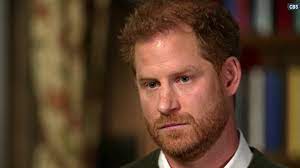
In a separate interview with CBS News, due to air the same day, Harry criticises Buckingham Palace over an alleged failure to defend him and his wife, the Duchess of Sussex, before they stepped down as senior royals.
Last month, the couple’s Netflix documentary series contained new allegations against the Royal Family, as the Sussexes also hit out at their treatment at the hands of the media.
King Charles has used his first Christmas message to reflect on the cost-of-living crisis.
He spoke of the “great anxiety and hardship” for those struggling to “pay their bills and keep their families fed and warm”.
There were images of food banks and help for the homeless alongside the speech, recorded by the King in St George’s Chapel, Windsor.
He paid tribute to his mother Queen Elizabeth, who is buried in the chapel.
The late Queen pioneered the televised royal Christmas Day address, and used what was to become her final message last year to speak of “passing the baton” to the next generation.
The themes of the King’s speech touched on some of his causes and beliefs – concern for the disadvantaged, the importance of public service and supporting a multi-faith approach to religion.
Only “working royals” appeared on screen in the King’s broadcast, including the Queen Consort, the Prince and Princess of Wales, the Earl of Wessex and the Princess Royal.
That meant that Prince Harry and Meghan, the Duke and Duchess of Sussex, were not mentioned. The Duke of York was also not included.
At a time of industrial strife and financial pressures, the King’s message focused on those supporting people in need.
“I particularly want to pay tribute to all those wonderfully kind people who so generously give food or donations, or that most precious commodity of all, their time, to support those around them in greatest need,” said the King.
The message was accompanied by pictures of charities giving food to the homeless and volunteers helping at a food bank.
Buckingham Palace has said funds donated after the death of the late Queen were being given to a charity helping those unable to pay energy bills.
The King has gathered with other senior royals at Sandringham, Norfolk, for Christmas, and earlier attended the traditional Christmas Day service for the first time as monarch.
Last year the Queen spoke of “passing the baton” to the next generation
The King praised the emergency services who “worked tirelessly to keep us all safe”, teachers and health and social care staff.
Last year proved to be the late Queen’s last Christmas message, and the King remembered the “love and sympathy” that followed her death in September.
“Christmas is a particularly poignant time for all of us who have lost loved ones. We feel their absence at every familiar turn of the season and remember them in each cherished tradition,” said the King.
Standing “close to where my beloved mother, the late Queen is laid to rest with my dear father”, he spoke of his mother’s faith in God and also her “faith in people”.
The message highlighted the community work of faith groups, and the King, as well as asserting his own Christian belief, extended this to other religions.
He spoke of the “heartfelt solidarity” shown by “churches, synagogues, mosques and gurdwaras”.
The King described how moved he had been to go to the birthplace of Christ in Bethlehem: “It meant more to me than I can possibly express to stand on that spot.”
The King’s speech continues a tradition going back 90 years, with the first royal Christmas broadcast delivered on the radio in 1932 by George V. The first televised broadcast was presented by Elizabeth II in 1957.
In terms of changes in style, the King delivered his first message standing up, rather than a formal address from behind a desk, and his themes addressed more current social issues.
But there was much that was traditional. This was a Christmas Day message delivered in a chapel with a choir singing, touching on themes of faith, hope and the importance of serving others.
The choir finished, as it had last year for the Queen’s last message, singing the carol O Little Town of Bethlehem, with the King highlighting its message of “light overcoming darkness”.
King Charles III is set to include a tribute to his mother, Queen Elizabeth II, in his first Christmas message as monarch.
An image of Charles delivering his speech, which is due to be broadcast on Christmas Day at 15:00 GMT, shows the King in St George’s Chapel, Windsor.
In her final Christmas message, the late Queen spoke of “passing the baton” to the next generation.
And her son’s first Christmas Day message will remember her legacy.
This will be the first televised annual royal Christmas Day broadcast not to be presented by the late Queen, who appeared in the first TV message in 1957.
The photo of the King shows him recording this year’s message in the chapel where a committal service was held during the Queen’s funeral in September.
Both his mother and father, Prince Philip, are buried in the George VI Memorial Chapel within St George’s Chapel.
The picture, released by Buckingham Palace, shows King Charles standing in front of a Christmas tree with plastic-free, recyclable decorations and arrangements of holly and ivy in the background.
This year sees the King and Camilla the Queen Consort return to the tradition of spending Christmas in Sandringham, Norfolk, after concerns about Covid and Queen Elizabeth’s health kept the Royal Family in Windsor last year.
The Prince and Princess of Wales are among the senior royals expected to be with King Charles for Christmas.
In her 2021 Christmas message, the Queen gave a highly personal tribute to her “beloved” Prince Philip, who died in April of that year.
Queen Elizabeth presented the first televised Christmas message in 1957
The King’s Christmas Day broadcast continues a tradition going back 90 years.
The first royal Christmas broadcast was a live radio speech in 1932, delivered from Sandringham by George V, with the script written by the author Rudyard Kipling.
In 1957, Elizabeth II delivered the first televised message, saying that it was a technological landmark that “television has made it possible for many of you to see me in your homes on Christmas Day”.
The message became part of many families’ Christmas celebrations and the first televised broadcast in 1957 set a familiar pattern.
The national anthem was followed by the monarch speaking directly to the camera, with a speech that included Christmas greetings, a religious lesson, support for the Commonwealth, a round-up of the royal year and a moral message for the times.
In 1957 it meant a warning about values in public life, criticising a culture of “self-interest”.
The timing of the Christmas broadcast was originally set for 15.00 GMT as best for reaching the most countries in different time zones around the world.
The Bank of England has unveiled the new design for banknotes that feature the image of King Charles.
The only change to the current designs of the £5, £10, £20, and £50 notes will be the portrait, which will go into circulation in the middle of 2024.
The King’s portrait will appear on new notes on the front and in the transparent security window.
After the new notes start to circulate, old notes will still be accepted in stores.
Beginning in 1960, Queen Elizabeth was the first and only monarch to be depicted on circulating Bank of England banknotes. The monarch is not shown on the notes that Scottish and Northern Irish banks have issued.
There are about 4.5 billion individual Bank of England notes worth about £80bn in circulation at present.
The King’s cypher will also appear on the notes
The Bank of England said that, following guidance from the Royal household, the new notes would only be printed to replace worn notes or to meet increased demand, in order to minimise the environmental and financial impact of the change.
Bank of England governor, Andrew Bailey, said he was “proud” of a “significant moment” with the new design.
Fifty pence coins bearing the image of King Charles III have already entered circulation via post offices across the country.
An estimated 4.9 million of the new coins are being distributed to post offices – about half of the total number earmarked for circulation – to be given in change to customers.
The new King Charles 50p coins have already entered circulation
Coins carrying the image of the late Queen will still be accepted in shops, in the same way as banknotes.
For anyone taking part in a family Christmas quiz this year, it is worth remembering that, in ascending order, the reverse side of current polymer Bank of England banknotes feature Sir Winston Churchill, Jane Austen, JMW Turner and Alan Turing.
Cash use has become far less frequent when compared to debit cards, owing primarily to the use of contactless payments and then accelerated by the Covid pandemic. The buying power of specific coins and banknotes have also been diluted by rising prices.
However, there is still keen interest from consumers and collectors about the images used on cash.
Collectors will be particularly excited to get their hands on the lowest serial numbers of the new King Charles banknotes when they appear.
On September 3, five days before Her Majestydied, award-winning photographer Sam Hussein captured the image.
For his first Christmas card as monarch, King Charles has chosen a photograph taken just days before the Queen’s death.
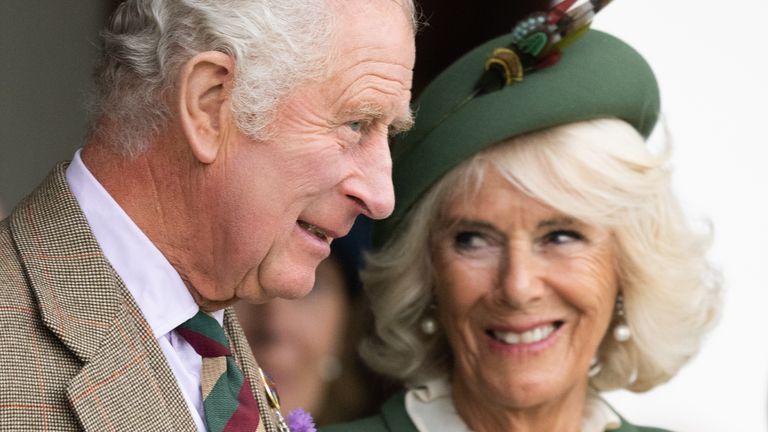
It shows His Majesty and the Queen Consort in September, when he was still Prince of Wales, at the Braemar Royal Highland Gathering.
The photograph was taken on September 3, five days before Her Majesty died, by award-winning photographer Sam Hussein.
The King is captured from the side as Camilla smiles at him warmly.
He is dressed in a tweed suit with a red, green and beige tie, while the Queen consort is wearing a green suit and matching hat with a pheasant motif and pearl earrings.
During the event in Aberdeenshire, the King officially opened a new structure celebrating the Queen’s Platinum Jubilee.
He cut a heather rope to mark the opening of the Queen Elizabeth Platinum Jubilee Archway.
His mother was unable to attend because of her declining health.
The couple then watched competitors taking part in events including the caber toss, hammer throw and tug-of-war.
Camilla and the Princess Royal were presented with heather posies by 10-year-old Chloe Guy and 12-year-old Cassie Stewart, who are both members of the Braemar Royal Highland Society’s dancing class, before the games got under way.
It appears that the Queen Consort took a sprig of flowers and put it in her buttonhole, as shown in the Christmas card photograph.
An oath of fealty to the monarch is no longer required of legislators in the Canadian province of Quebec, thanks to a new law.
Three parliamentarians refused to take the oath of allegiance after King Charles III’s coronation, which led to the introduction of the measure.
The federal parliament of Canada overwhelmingly rejected cutting ties with the Crown in October.
In Canada, Quebec is the province that favors constitutional monarchy abolition the most.
The bill was introduced on Tuesday by Premier Francois Legault.
In October, after the province had an election,14 politicians refused to swear the oath. After being told they could not sit in the legislature without doing so, 11 of them backed down.
But three hold-outs did not, and have been barred from the National Assembly since late November, waiting for Mr Legault to bring forward the bill. It was fast-tracked once all parties in the legislature agreed to waive consultation.
In Quebec, members of the legislature had to swear two oaths, to both the people of Quebec and the Crown, and the latter has long been controversial.
The new provincial law amends the Canadian Constitution Act of 1867, to add a section exempting Quebec from the Oath of Allegiance to the King. That allegiance has been a requirement for all members of provincial legislatures across Canada.
“It is, I think, a relic from the past,” Gabriel Nadeau-Dubois, a co-spokesperson for the Quebec solidaire party, said in early December about the oath to King Charles.
“I think there is strong support in Quebec to modernize our institutions, to make sure that the representatives of the people are not forced in 2022 to swear an oath to a foreign king.”
Constitutional scholar Philippe Lagasse told the BBC in an email that Quebec did not have the authority to amend the constitution by an act of legislation alone.
He said a change like this would either need the support of seven provinces that had, on aggregate, more than 50% of the population of Canada, or the federal parliament would have to agree with Quebec to allow the change in Quebec alone.
Prime Minister Justin Trudeau could challenge this new law in court, or a private citizen could be given standing by the court to bring forth a challenge.
In Canada, the monarch – now King Charles – is the head of state. The monarchy serves a mainly symbolic role, with the power to govern entrusted to the Canadian government.
Opinion polls suggest Canada as a whole remains divided on the monarchy. In an Ipsos survey conducted following the death of Queen Elizabeth II, half of the Canadian respondents – around 54% – said their country should sever its ties with the Crown.
That sentiment is strongest in Quebec, where 79% agreed.
Millions of 50p coins bearing the image of King Charles III will enter circulation on Thursday through post offices across the country.
They are the first bulk produced coins bearing the image of the new King, and they will be distributed as change to customers.
An estimated 4.9 million of the new coins are being distributed to post offices, accounting for roughly half of the total number intended for circulation.
Coins bearing the image of the late Queen will continue to be accepted in stores.
“Today marks a new era for UK coinage, with the effigy of King Charles III appearing on 50ps in circulation,” said Rebecca Morgan, director of collector services at The Royal Mint.
“We anticipate a new generation of coin collectors emerging, with people keeping a close eye on their change to try and spot a new 50p that bears the portrait of our new King.”
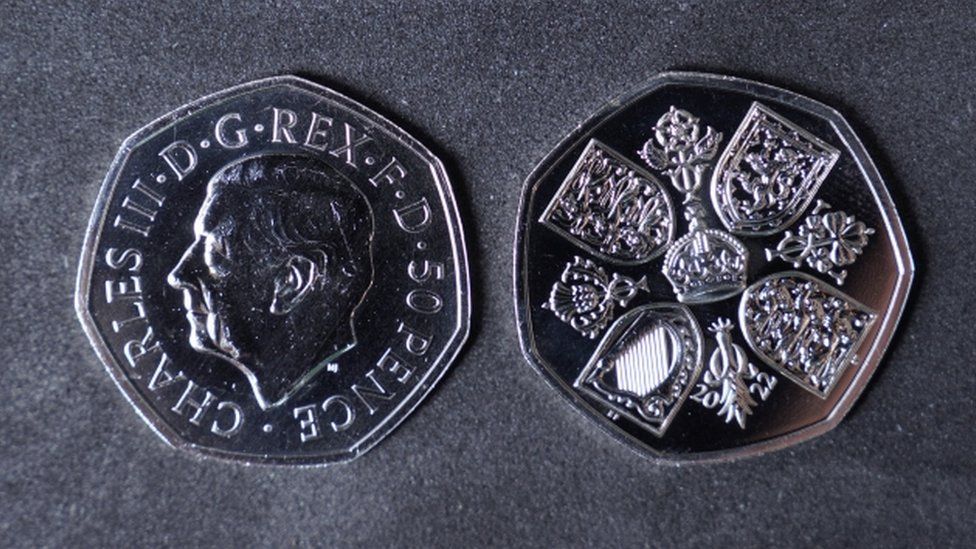
IMAGE SOURCE,PA MEDIA Image caption, The new 50p coin celebrates the King and commemorates his mother
The coin has been struck at The Royal Mint in Llantrisant, Wales, using an image of the King produced over the course of months by sculptor Martin Jennings.
He used pictures of King Charles on his 70th birthday to create a likeness of the monarch, in what is the smallest work he has ever had to produce. He described its production and distribution as a “quite remarkable experience”.
The first batch of coins will be given in change to customers buying something in post offices – something its chief executive Nick Read describes as a “tremendous honour”.
“December is our busiest time of the year so the coin will be entering our network in a phased manner,” he said. “If you don’t receive the new 50p in your change on your first visit to a post office you may well get it in your change in a subsequent visit, so keep a look out for it.”
More coins will be released in line with demand, replacing damaged or worn 50p coins carrying the portrait of Queen Elizabeth. There are approximately 27 billion coins circulating in the UK bearing the image of the late Queen and these can still be used to pay for things. Before decimalisation, it was common for people to carry coins featuring different monarchs in their pockets.
However, there is still keen interest from consumers and collectors about the images used on coins and banknotes.
The reverse side of the new 50p coin is a copy of the design used on the 1953 Crown struck to commemorate the Queen’s coronation.
It includes the four quarters of the Royal Arms depicted within a shield. In between each shield is an emblem of the home nations: a rose, a thistle, a shamrock and a leek.
The coins follow centuries of tradition with the monarch now facing left – the opposite way to his predecessor. Profiles are alternated between left and right for successive monarchs. As with previous British kings, and unlike the Queen, he wears no crown.
Other denominations will be manufactured, carrying the King’s image, in line with demand.
Camilla, the Queen Consort, is discontinuing the practise of having ladies-in-waiting and will instead be assisted by “Queen’s companions.”
In addition to modernising the title, the six female assistants will be required to attend less frequently than the previous role required.
Honorary positions entail assisting the Queen Consort at public events.
Unlike the ladies-in-waiting, this role will not require any correspondence or administration.
Replacing the role of lady-in-waiting will bring an end to a feature of court life that dates back to the Middle Ages, with such close personal helpers to a Queen often coming from aristocratic families and, over the centuries, becoming embroiled in court intrigue.
The new “companions” will be a more occasional and informal position, supporting the Queen Consort at official engagements and not involved in replying to letters or day-to-day planning.
They don’t receive a salary but their expenses will be covered.
This symbolic change of direction will be put into practice next week, when the Queen Consort hosts a reception for campaigners against domestic violence and violence against women.
Figures published by the Office for National Statistics on Friday showed that 2.4 million adults in England and Wales, 1.7m women and 700,000 men, had suffered from domestic abuse in the previous year.
Queen Camilla has campaigned to raise awareness about domestic violence and for the first time her Queen’s companions will be with her at the Violence Against Women Girls reception at Buckingham Palace, rather than ladies-in-waiting.
The first companions include some longstanding personal friends – the Marchioness of Lansdowne, Jane von Westenholz, Lady Katharine Brooke, Sarah Troughton, Lady Sarah Keswick and Baroness Chisholm, a former Conservative whip and Cabinet Office spokeswoman in the House of Lords.
A palace source says that Baroness Chisholm, who has been sitting on two select committees as a Conservative, has become a non-affiliated peer.
The Queen Consort, aged 75, has also appointed Major Ollie Plunket as her equerry, who acts as a personal assistant.
The former ladies-in-waiting who served the late Queen Elizabeth IIwill now help King Charles to host events at Buckingham Palace and will be known as “ladies of the household”.
Britain’s King Charles III on Tuesday welcomed South African President Cyril Ramaphosa to London for the first state visit of his reign.
After the two men inspected the guard of honour together, they travelled to Buckingham Palace in a carriage procession escorted by mounted soldiers from the Household Cavalry.
Climate change, trade, and the Commonwealth are expected to be on the agenda in discussion between the two.
Ramaphosa will also visit parliament for an address to both the upper and lower houses, attend a state banquet at Buckingham Palace, and hold talks with Prime Minister Rishi Sunak during his stay.
At the start of the visit, the two governments announced the launch of the next phase of the UK-South Africa Infrastructure Partnership.
‘South Africa is already the UK’s biggest trading partner on the continent, and we have ambitious plans to turbocharge infrastructure investment and economic growth together,’ Sunak said.
Britain’s Foreign Secretary, James Cleverly, said the choice of Ramaphosa for Charles’ first state visit was a sign of the country’s ‘enduring commitment’ to Africa, even as it eyes new partners in Asia.
Dr Amoako Baah, a leading member of the ruling New Patriotic Party (NPP), has stated that President Nana Addo Dankwa Akufo-Addo is unconcerned about the difficulties Ghanaians are facing.
Speaking in a Neat FM interview monitored by GhanaWeb, Dr Baah said that all the president cares about is the pageantry that comes with the presidency.
Dr Baah, who was reacting to viral pictures of the president with the British monarch, King Charles III during his private visit to the UK, said that Akufo-Addo only wants to be like Ghana’s first president, Dr Kwame Nkrumah.
“This is what he (Akufo-Addo) likes (meeting powerful people). He is called Nana Show boy. He likes beautiful things. He wants to be a statesman.
“In spite of the fact that Nkrumah was the one who locked up his grandfather, he really likes him (Nkrumah). And so, he wants to be like Nkrumah in everything he does. He wants to be like a stateman; standing in front of people and giving speeches and so on, that is what he likes to do,” he said in Twi.
“The thing is that Nana Addo does not have the genes of the NPP in him… Because why will someone like a person who locked up his grandfather which led to his death?
“He (Akufo-Addo) does not have a good character. His grandfather died bitterly at the hands of Nkrumah but that does not disturb him. He only wants to be a show boy just as Nkrumah was,” he added.
The meeting which took place at the Windsor Castle ws confirmed by a tweet on the official handle of the Royal Family.
“This afternoon, The King welcomed the President of Ghana to Windsor Castle for an Audience,” the caption accompanying a photo of the two gentlemen shaking hands read.
Akufo-Addo is in the United Kingdom on a private visit. He is expected back in the country today.
Per GhanaWeb tracking, Akufo-Addo becomes the third African leader to meet the King after Ali Bongo of Gabon and Muhammadu Buhari of Nigeria respectively.
Dozens of African leaders were in the UK in Septemberto attend the funeral of the King’s late mother, Queen Elizabeth II who spent seven decades as the monarch.
King Charles has begun the process of increasing the number of royals who can perform official duties in the monarch’s absence, proposing Princess Anne and Prince Edward as new additions.
Camilla, the Queen Consort, and four other senior royals currently serve as “counsellors of state.”
However, Prince Andrew and Prince Harry are no longer available as “working royals.”
On Monday, the House of Lords heard the King’s request for a change.
It’s expected that the Lords will reply on Tuesday – and the same day could see the government introducing legislation in the House of Commons, with a Counsellors of State Bill paving the way for the King’s proposal for two extra working substitutes.
This rapid move in Parliament is intended to resolve an awkward constitutional problem about who could deputise for the King if he was overseas or unwell and could not carry out his duties as head of state.
At present two of the five eligible to act as counsellors are effectively ruled out.
Prince Andrew, the Duke of York, withdrew from royal duties in the wake of his association with US sex offender Jeffrey Epstein.
Prince Harry, the Duke of Sussex, lives with his family in the United States and has stepped back from being a “working royal”.
Rather than remove them from the list of counsellors of state, the proposal is to widen the pool of eligible royals, so that the availability of Prince Andrew and Prince Harry would cease to be an issue.
In the House of Lords, Lord Parker of Minsmere delivered a statement from the King which called for Princess Anne, the Princess Royal, and Prince Edward, the Earl of Wessex, to be added as extra counsellors of state.
The statement said that adding the extra counsellors would “ensure continued efficiency of public business when I’m unavailable, such as while I’m undertaking official duties overseas”.
The message was also delivered to the House of Commons,with leader of the house Penny Mordaunt telling MPs there would be legislation to follow.
This will mean amending the Regency Act, which at present stipulates that counsellors are the spouse of the monarch plus the next four royals in succession to the throne, who are over the age of 21.
The current counsellors are Camilla, the Queen Consort; Prince William, the Prince of Wales; Prince Harry, Duke of Sussex; Prince Andrew, Duke of York and his daughter, Princess Beatrice.
Both Princess Anne and Prince Edward have previously been counsellors of state, before being overtaken in the order of succession.
Counsellors can carry out official duties which could include the state opening of Parliament, signing documents, receiving ambassadors or attending Privy Council meetings, if the monarch is temporarily ill or abroad.
It is expected that the King and Queen and the Prince and Princess of Wales could be undertaking overseas visits next year, so counsellors could be a necessity when they are away.
Last month the issue was raised in the House of Lords, with Labour peer Viscount Stansgate challenging how Prince Andrew and Prince Harry could be two of the five replacements when one had “left public life” and the other had “left the country”.
Released on Monday, his 74th birthday, the photograph marks Charles’ appointment as Ranger.
The photo shows the monarch leaning against an ancient oak tree in Windsor Great Park, with the winter sun gleaming in the background.
The photo shows the monarch leaning against an ancient oak tree in Windsor Great Park, with the winter sun gleaming in the background.
Britain’s King Charles III speaks in the Throne Room at St James’s Palace during the Accession Council in London in September 2022. He was formally proclaimed as King. Joining him were his son Prince William and his wife Camilla, the Queen Consort. Credit: Jonathan Brady/Pool/AP
The post of Ranger was previously held by his father, Prince Philip, the late Duke of Edinburgh, for 70 years. Duties include offering guidance to the Deputy Ranger on the stewardship of one of the country’s oldest estates, Buckingham Palace said in a statement.
Festivities for the King’s birthday began Monday with a rendition of “Happy Birthday” by the band of the Household Cavalry at Buckingham Palace, where Charles was born in 1948. This performance was followed at midday by a 41-gun royal salute from the King’s Troop Royal Horse Artillery in Green Park.
Charles came to the throne on September 8, with the death of his mother, Queen Elizabeth II, at age 96.
Last month, the UK Royal Mint unveiled King Charles III’s coin portrait.
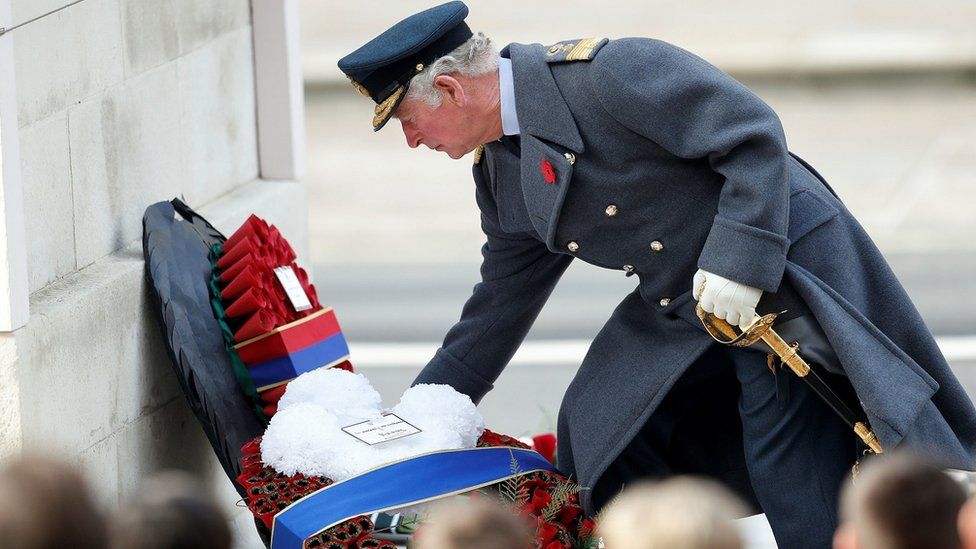
Following the death of his mother, Queen Elizabeth II, King Charles will lead the Remembrance Sunday service at the Cenotaph for the first time as monarch.
At 11:00 GMT, the United Kingdom will observe two minutes of silence to pay tribute to the war dead.
Remembrance Sunday was one of the most important royal engagements in the late Queen’s calendar.
The King, politicians, and religious leaders will lay wreaths at the central London memorial.
King Charles’ ring of poppies will incorporate a ribbon of racing colours in a tribute to the ones used by the late Queen and his grandfather King George VI.
During his time as Prince of Wales, King Charles represented the late Queen at the last five Cenotaph services and laid a wreath on her behalf, as she watched from the Foreign Office balcony that overlooks Whitehall.
The beginning of the silence will be marked by Big Ben striking 11 times at 11:00.
The bell has been largely silent for five years after it was dismantled and repaired in a renovation project. While it has run for events such as New Year’s Eve and the late Queen’s funeral, its tolling on Sunday will mark its official return to use.
IMAGE SOURCE, PA MEDIA Image caption, King Charles III will lay a wreath for the first time as monarch
The service, led by the Bishop of London, will also feature a march past by 10,000 Royal British Legion veterans, representing 300 different Armed Forces and organisations between them.
Among those taking part will be World War Two veterans – fewer in number as each year goes by – and those who have served in more recent conflicts.
To commemorate 40 years since the Falklands War, 400 members of the South Atlantic Medal Association will also take part.
A further 10,000 members of the public will line Whitehall to watch the service.
Along with King Charles, Camilla the Queen Consort, the Prince and Princess of Wales, the Earl and Countess of Wessex, Princess Anne and Vice Admiral Sir Tim Laurence, the Duke and Duchess of Gloucester, the Duke of Kent and Princess Alexandra, will attend the service.
IMAGE SOURCE, REUTERS Image caption, Queen Elizabeth II saw Remembrance Sunday as one of her most important engagements of the year
The event will also be attended by senior members of the government.
Speaking ahead of the service, Prime Minister Rishi Sunak and Defence Secretary Ben Wallace commemorated the fallen and also paid tribute to those fighting for Ukrainians’ freedom.
Mr Sunak said: “This year more than ever, we are reminded of the huge debt of gratitude we owe those who lay down their lives to protect their country.
“As we fall silent together on Remembrance Sunday, we will honour the memories of the men and women we have lost and pay tribute to the brave soldiers of Ukraine as they continue their fight for freedom.”
His words were echoed by Mr Wallace, who said Remembrance Sunday was a time to reflect on the sacrifices made by our veterans and service personnel around the world.
“We must never forget those who gave their lives in defence of our values and our great nation,” he said.
“All of us will also be thinking of those brave Ukrainians who are fighting for their very own survival to defend freedom and democracy for all, just as the UK and Commonwealth soldiers did in both world wars.”
More than 100 Falklands War veterans and family members of those who died in the war will take part in a remembrance service and parade in the capital Stanley on Sunday.
They made the 8,000 miles (12,900km) journey via a special flight arranged by the Ministry of Defence, with many of the veterans making an emotional return to the Falklands for the first time since the war with Argentina broke out in 1982.
Over the past few days the veterans, along with mothers, wives and children of those who died, have visited the battlefields where British forces fought, with some shedding tears and placing crosses at cemeteries for fallen comrades and family members.
On Saturday, members of the Royal Family attended the annual Royal British Legion Festival of Remembrance at the Royal Albert Hall.
On Friday, the UK held another silence on Armistice Day to commemorate the end of World War One in 1918.
Queen Elizabeth II‘s service and duty have been commemorated at the annual Festival of Remembrance in London.
The event at the Royal Albert Hall, part of a weekend of tributes to war dead, was attended by the Royal Family.
King Charles and his siblings, Princess Anne and the Earl of Wessex watched as a video of their mother was played.
The late Queen enlisted in the Auxiliary Territorial Service as a teenager towards the end of World War II.
This year’s event also marked 40 years since the Falklands war, with footage of contributions from those who served.
The Royal Family will also take part in a Remembrance Sunday service at the Cenotaph when a two-minute silence will be held at 11:00 GMT.
IMAGE SOURCE,PA MEDIA
IMAGE SOURCE,PA MEDIA
As tributes were paid to the late Queen, a clip of her was played in which she spoke of the “tremendous contribution” the Armed Forces had made to Britain’s “standing and reputation” throughout the world during her reign.
Hosting the annual Royal British Legion event, BBC newsreader Huw Edwards said Elizabeth II had symbolized “completely” service and duty – which he described as the “watchwords” of military life.
The late Queen was the longest-serving commander-in-chief of the British Armed Forces – a position held by the monarch – and was also the patron of the Royal British Legion, a charity that provides support to veterans and their families.
Elizabeth II considered Remembrance Sunday one of the most important engagements in her calendar.
The UK’s longest-reigning monarch lived through World War II as a teenager. At the age of 18, she enlisted in the Auxiliary Territorial Service – a branch of the Army for women – in February 1945 and trained to become a military truck driver and mechanic. The late Queen was the first female member of the Royal Family to serve in the Armed Forces. However, the war ended before she could be assigned to active duty.
Also in attendance on Saturday evening were Camilla, the Queen Consort, the Prince and Princess of Wales, the Countess of Wessex, Vice Admiral Sir Tim Laurence, the Duke and Duchess of Gloucester, the Duke of Kent and Princess Alexandra.
IMAGE SOURCE,PA MEDIA Image caption, Prime Minister Rishi Sunak was joined by his wife, Akshata Murthy, at the event
IMAGE SOURCE,PA MEDIA Image caption, Labour leader Sir Keir Starmer was joined by his wife Victoria at the festival
Prime Minister Rishi Sunak and Labour leader Sir Keir Starmer represented the two main political parties at the landmark London venue.
The evening was opened with a rendition of I Vow To Thee My Country by actor Luke Evans, and also saw performances by Andrea Bocelli and Hallelujah by EastEnders actress Shona McGarty.
The Chelsea Pensioners, among the oldest retired members of the Army, received applause as they took their seats.
The Royals joined the crowd to sing Jerusalem after the remembrance book, which contains the names of British war dead was brought into the venue. One of those who brought it into the hall was Captain Dmytro Donskoi, defence and air attache for Ukraine.
It ended with a rendition of God Save The King and three cheers, after which Charles waved to the crowd who applauded as the Royal Family left.
On Sunday, senior members of the Royal Family will pay tribute to the fallen when they take part in a service of remembrance in central London, where they will lay wreaths at the Cenotaph – along with senior politicians and faith leaders – and observe a march past by 10,000 veterans.
President Muhammadu Buhari has said he is not interested in having assets all over the place.
Buhari stated this in an interview in the United Kingdom after meeting with His Royal Majesty, King Charles III in Buckingham Palace on Wednesday.
He said, “And he (King Charles III) asked me whether I have a house here (UK) and I said no. I said even in Nigeria the only house I have is the house I had before I got into government. I am not very much interested in having assets all over the place. I feel much freer when I have nothing.”
Meanwhile, Buhari has expressed confidence that the ruling All Progressives Congress, APC and its pfesidential candidate, Asiwaju Bola Tinubu will in the forthcoming 2023 general elections.
According the President, APC is lucky to have Tinubu as its presidential candidate ahead of the 2023 general elections.
When asked the chances of the APC in the 2023 elections, Buhari said, “What are the chances of my party not winning the election? We are going to win the election.
“Tinubu, the presidential candidate, a very well-known politician in the country, he was a two-term governor in Lagos State, the most resourceful state and the most visited state. So, I think the party was lucky to get him to be the candidate,” he added.
But there were questions in the House of Lords this week about the need to update the rules for eligibility.
Labour peer Viscount Stansgate had challenged how Prince Andrew, the Duke of York, and Prince Harry, the Duke of Sussex, could be two of the five potential replacements when one had “left public life” and the other had “left the country”.
Any update will require an amendment to the Regency Act, which is under the auspices of the Cabinet Office, but there appears to be momentum behind such a constitutional change.
However, it is expected that the response will be to widen the number of royals who can act on behalf of the monarch, making a more flexible list of available working royals – rather than removing Prince Andrew and Prince Harry.
IMAGE SOURCE,MAX MUMBY/INDIGO Image caption, Peers questioned the status of Prince Andrew and Prince Harry as two of the current five counsellors of state
Depending on the legislative timetable, there could be changes later this year, reflecting the need to have stand-ins in place when both the King and Queen Consort and Prince and Princess of Wales could be on overseas trips in 2023.
At present these are Camilla, the Queen Consort; Prince William, the Prince of Wales; Prince Harry, Duke of Sussex; Prince Andrew, Duke of York, and his daughter, Princess Beatrice.
They can carry out official duties, such as signing documents, receiving ambassadors, or attending Privy Council meetings, if the monarch is temporarily ill or abroad,
IMAGE SOURCE, PETER NICHOLLS Image caption, Counsellors of state could be needed if the King is travelling overseas
Labour peer Viscount Stansgate – who is Stephen Benn, the eldest son of Labour politician Tony Benn – said this showed the value of updating the Regency Act, to ensure royals were available to stand in.
“It is the only reason why it was possible to open the current session of this Parliament,” he told peers in the House of Lords.
He called on the government to approach the King over changes to the current arrangements, now that Prince Harry was living in the United States and Prince Andrew no longer carried out royal duties.
Lord Addington, a Liberal Democrat, suggested that working royals – “somebody who actually undertakes royal duties” – should be given priority for these roles.
In response, the Lord Privy Seal, Lord True, said he would not comment on “specific circumstances” of counselors, but he did not rule out a change.
The Canadian province of Quebec is bringing back a debate about the country’s ties to the British monarchy in light of King Charles III’s upcoming coronation.
Following the introduction of a motion by Bloc Quebecois leader Yves-Francois Blanchet that compelled a discussion about the Crown in the House of Commons, parliamentarians will vote on whether Canada should sever ties with the monarchy on Wednesday.
His move follows the refusal of 14 recently-elected Quebec politicians to recite an oath of allegiance to the King during their swearing-in to the provincial legislature, as required by Canadian law.
Speaking to reporters, Mr Blanchet admitted that his motion is likely to fail, but he said the failure will show Quebecers that federal politicians “prefer to support the King than the people”.
In Canada, the monarch – now King Charles – is the head of state. The monarchy serves a mainly symbolic role, with the power to govern entrusted to the Canadian government.
Changing the current system would need approval from both the House of Commons and the Senate in parliament, as well as the unanimous consent of all 10 provinces
Members of Canada’s governing Liberal party have already said they will oppose the motion.
While Mr Blanchet’s motion may fail, the future of Quebec politicians who refused to swear the oath to the Crown remains uncertain.
Their refusal could lead to a bill that seeks to redefine the requirement to take the oath of allegiance in the province – if they are able to sit in Quebec’s legislature at all – and political watchers say they are eager to see how the dispute unfolds.
Quebecers have long opposed the Crown
Quebec’s relationship with the monarchy is complex.
Many Quebecers are in favour of Canada being a republic rather than a constitutional monarchy– a sentiment that is tied to the province’s history of being a French-speaking region that was once under British colonial rule.
The province has twice voted against independence in referendums, and the push for Quebec sovereignty has weakened over the years. But Quebec politicians have continued to put forward policies that seek to define the province as distinct from English Canada.
When tabling his motion on Tuesday, Mr Blanchet said he believes Canada’s tie to the British Crown is “archaic.”
“It is a thing of the past, it is almost archaeological, it is humiliating,” he said.
Frustration with the oath of allegiance to the Crown isn’t new. As early as 1970, members of the sovereigntist Parti Quebecois, a separatist provincial political party in Quebec, had openly opposed it.
Their opposition led to the creation of a second, supplementary oath in 1982 that also pledges loyalty to the people of Quebec.
Since then, politicians in that province have had to recite both oaths before taking office. In 2018, some recited the oath to the Crown behind closed doors in protest.
Mr Blanchet, whose party represents Quebec interests in the federal House of Commons, said many recite the oath only because they have to.
“We are a conquered people that still have to swear allegiance to a conquering King,” he said.
This sentiment was echoed by the 14 members of Quebec’s National Assembly, who have not yet recited the oath ahead of the assembly’s commencement in November – an unprecedented number of politicians to do so.
“What’s happening now is really dramatic,” said Daniel Beland, a political science professor at McGill University in Montreal, who added that politicians may not be able to sit or receive their salary without reciting the oath.
“The Constitution Act of 1867 clearly states that to become a member of a provincial legislature, you need to perform the oath of allegiance,” Beland said.
“There is quite a bit of suspense about what will happen.”
Ewan Suaves, the spokesperson for Quebec Premier Francois Legault, said the law is clear that politicians must recite the oath in order to sit. But added that the premier, too, opposes it.
“We agree that it’s time to end the obligation to swear allegiance to King Charles III, but it takes a Bill in order to do so. And to present or pass a Bill, the [members] must sit,” Mr Suaves said.
How does the rest of Canada feel about the Crown?
Opinion polls suggest Canada as a whole remains divided on the monarchy. In an Ipsos survey conducted following the death of Queen Elizabeth II, half of the Canadian respondents – around 54% – said their country should sever its ties with the Crown.
That sentiment is strongest in Quebec, where 79% agreed.
Prime Minister Justin Trudeau, however, has said the monarchy offers his country “extraordinary stability”.
In response to Mr Blanchet’s motion asking Canada to sever its ties to the Crown, Mr Trudeau said “there is not one Quebecer who wants the [Canadian] constitution reopened.”
Mr Beland said that at a time when Quebec’s independence movement has weakened, there has been more emphasis on symbolic assertions of sovereignty – like refusing to take the oath of allegiance.
He added the refusal to take the oath could be a way to seize political momentum by the Parti Quebecois, who lost seats in the recent election.
“This is about broad principles, but this is also a lot about political posturing,” Mr Beland said.
Amending the oath requirement is also a complicated task, and there is disagreement among experts on how it can be done.
Some believe a bill passed by the Quebec National Assembly would be enough to replace or amend the oath of allegiance. Others, however, believe any changes to the oath would require an amendment to Canada’sconstitution.
The latter, “of course, is much more difficult to do,” said
According to a media notice from Downing Street,Liz Truss used her final cabinet meeting to tell her ministers the government had “secured some significant achievements” in the “short time” it had been in place.
A readout of this morning’s meeting said: “The prime minister opened cabinet by thanking ministers for their support. She said that in the short time the government had been in place they had secured some significant achievements.
“She said the government ensured the country was able to mourn the passing of Her Majesty The Queen and to welcome His Majesty King Charles III as the new monarch, a vital moment in the history of our country.
“The prime minister said the government acted to immediately protect the public and businesses from unsustainably high energy bills – bringing in the Energy Price Guarantee to save the typical household around £700 this winter.
“The government also stuck to its pledge to scrap the rise in national insurance and demonstrated its steadfast commitment in supporting Ukraine in its fight against Russia’s war of aggression.”
The media notice ends: “The prime minister concluded by saying her time in the role had been a huge privilege and that her successor will have her support as they now build on the important steps already taken by the cabinet to support the country.”
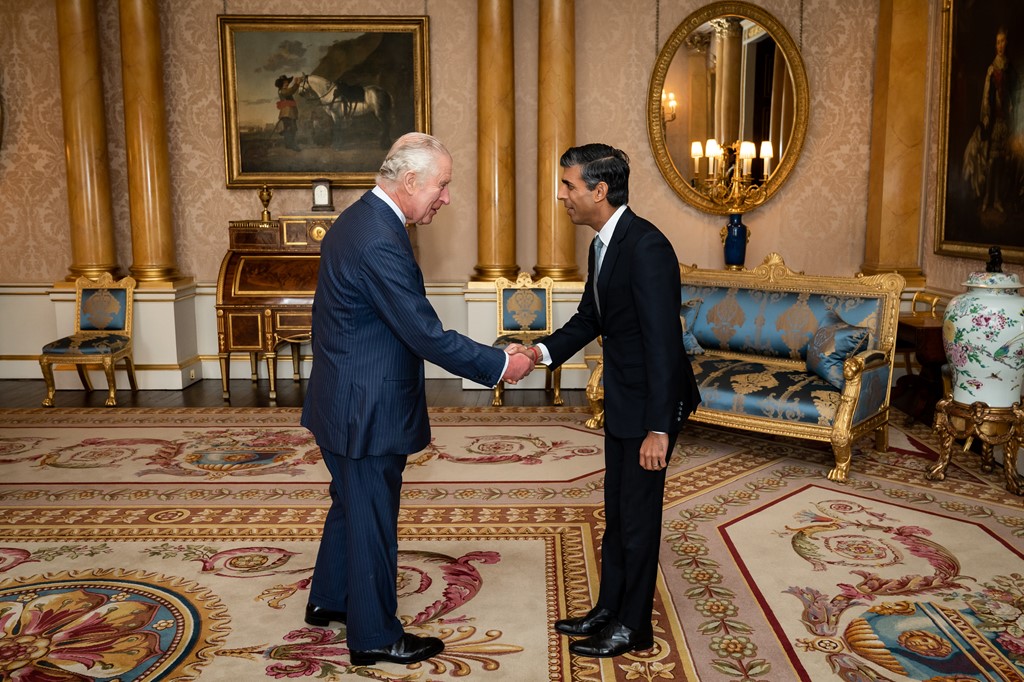
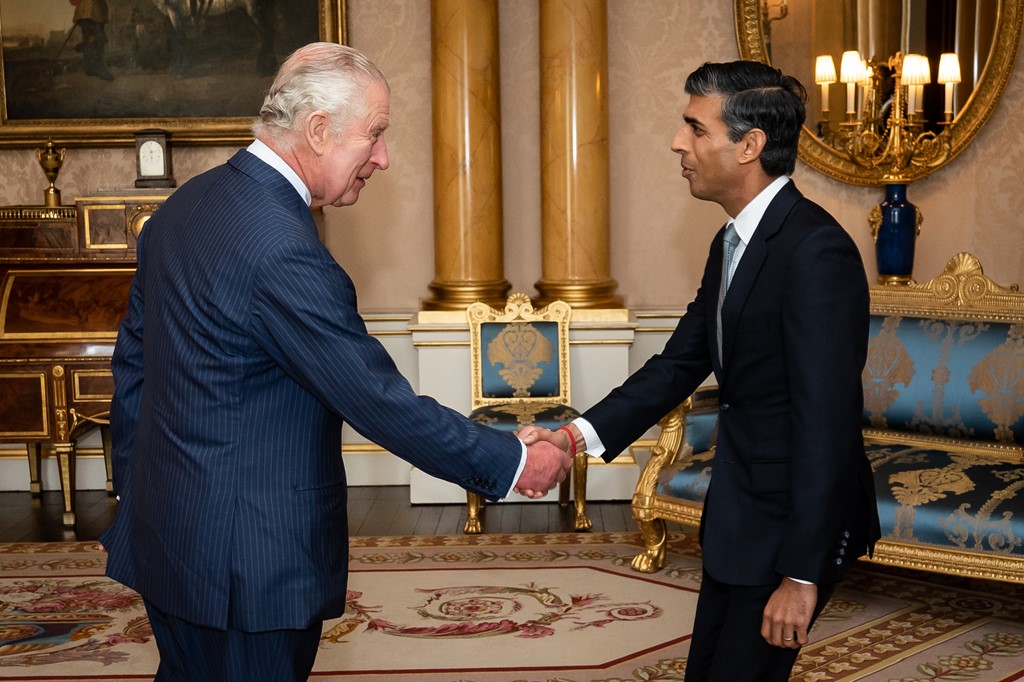
The government has set a date for Rishi Sunak to visit Buckingham Palace and meet King Charles on Tuesday.
Sunakwill meet the monarch after Liz Truss has chaired a final meeting of her cabinet at 9am, after which she will make a speech outside Downing Street. She will then go to Buckingham Palace for an audience with the King.
Afterwards, Sunak will go and meet the King, where he will be asked to form a government.
The new prime ministerwill then give a speech outside Number 10 at about 11.35am.
Rishi Sunak’s victory in the Conservative leadership election has been described as a “groundbreaking milestone” by US President Joe Biden.
After meeting King Charles today, Mr Sunak is set to become Britain’s first black prime minister. On Monday, Mr. Biden made the remark at a White House event commemorating the Indian holiday of Diwali.
Mr Sunak, a 42-year-old multimillionaire former hedge fund boss, won the race to lead the Conservative Partyon Monday and will become the UK’s youngest leader in modern times.
His family migrated to Britain from India in the 1960s, a period when many people from Britain’s former colonies moved to the country to help it rebuild after World War Two.
“We’ve got the news that Rishi Sunak is now the prime minister,” Mr Biden said. “He’s expected to become the prime minister I think tomorrow when he goes to see the King.
“Pretty astounding. A groundbreaking milestone and it matters.”
White House press secretary Karine Jean-Pierre had earlier said Mr Biden would call Mr Sunak in the coming days, noting that it was protocol for the US president to wait to offer his congratulations until after an incoming British prime minister had met with the monarch and been formally invited to form a new government.
The handover of power from Trussto Sunak will not take place on Monday, the Reuters news agency has quoted a spokesman for the current prime minister as saying.
“I can confirm that the transition won’t be taking place today,” the spokesman said.
He added that discussions between the outgoing and incoming prime ministers and King Charles IIIon the timing and choreography of the changeover were being held.
King Charles III is selling some of the racehorses inherited from his mother, Queen Elizabeth II.
Her late Majesty was an ardent racehorse breeder as well as a racegoer and rider.
On Monday, Tattersalls auction house in Newmarket announced the sale of 14 of Queen Elizabeth II’s “brood mares.”
They include Just Fine, trained by Sir Michael Stoute, who oversaw more than 100 royal winners, and Love Affairs.
Tattersall’s spokesman Jimmy George said: “It’s nothing out of the ordinary. Every yearthey would sell horses.
“The Queen had brood mares of her own, she would breed them and sell them. You can’t keep them all.”
IMAGE SOURCE,GETTY IMAGES Image caption, The Queen, an avid racegoer and rider, also bred horses from her stud at Sandringham
Mr Georgesaid the sale of the Queen’s horses did not symbolise the end of the Royal household’s connection with racing.
He said: “Every year owners sell stock. His Majesty is just doing what owners do.”
It was from her father, King George VI, that the Queen inherited the Royal Stud, a racehorse breeding centre at Sandringham that produced many of her winners.
Her racing manager John Warren previously said horses were a “tremendous getaway” from other duties and her support had been a major boost for British racing.
“I’m sure if the Queen had not been bred into being a monarch she would have found a vocation with horses. It was just simply in her DNA,” he said.
King Charles III is following in Queen Elizabeth’sfootsteps much sooner than expected.
Liz Truss has resigned from her role as British Prime Minister. As a result, King Charles will make history by swearing in a new PM less than two months after ascending the throne.
Truss’s tenure will also make history as the shortest for a British PM…ever.
Kirsty O’Connor/WPA Pool/Getty Images
The change likely holds special significance to King Charles.
One of the last constitutional duties his late mother performed before her death was appointing Truss as the new Prime Minister (this is a largely ceremonial duty as the position of PM traditionally goes to the leader of whichever party in Parliament gets the most seats in a general election).
And now, before his coronation, he’s already following suit.
King Charles will need to appoint a new Prime Minister as soon as posible. No details have been shared about who will take over for Truss, so be on the lookout for more information.
YUI MOK/POOL/AFP/Getty Images
If you recall, Truss was sworn in as Prime Minister just two days before Queen Elizabeth tragically passed away at age 96.
During her reign, the queen welcomed a total of 15 Prime Ministers. While King Charles still has a long way to go, BBC journalist Philip Sim joked that King Charles is on track to make history (again).
“On current pace, King Charles could surpass his mother’s record of 15 prime ministers before the end of 2024,” he wrote on Twitter.
Sir John Major has slammed The Crown’s reported depiction of Charles attempting to force the Queen’s abdication during his presidency as “damaging, malicious fiction.”
The next season of the Netflix show is expected to include footage of the then-Prince of Wales, Dominic West, briefing Sir John (Jonny Lee Miller) against the Queen in an attempt to depose her.
According to The Mail on Sunday the writers suggest that in 1991, Charles believed his mother, who was 65 at the time, was making the same mistake as Queen Victoria by not letting her younger heir take over.
A spokesperson for Sir John told the paper: “Sir John has not co-operated in any way with The Crown. Nor has he ever been approached by them to fact-check any scripted material in this or any other series.
“There was never any discussion between Sir John and the then Prince of Wales about any possible abdication of the late Queen Elizabeth II.”
The spokesperson said that if such scenes are broadcast, “they should be seen as nothing other than damaging and malicious fiction. A barrel-load of nonsense peddled for no other reason than to provide maximum – and entirely false – dramatic impact”.
Despite the UK’s current economic unrest, Jacob Rees-Mogg said earlier today that the King’s coronation next year “has to be done well.”
Given that Labour supported the idea, Downing Streetstated that “all options” are still on the table with regard to moving the early May bank holiday to coincide with the King’s coronation.
The event is due to take place on 6 May next year in Westminster Abbey, eight months after the monarch’s accession and the death of the Queen.
Number 10 said a bank holiday for King Charles’s coronation is still “on the table”.
The prime minister’s official spokesman said: “Obviously, this will be a historic event. We are carefully considering our plans. All options remain on the table.”
Meanwhile, Labour has suggested that pushing the 1 May bank holiday back until Monday 8 May to give the country a long weekend would be a “good way for the country to be able to celebrate”.
Sir Keir Starmer’s spokesperson said: “Moving the May bank holiday that there is for that weekend would be a good idea.”
The announcement of the date for the King’s coronation yesterday sparked calls from a number of MPs for a change to the May bank holiday in order to mark the event.
Tory former cabinet minister David Jones told the Daily Mail: “To combine the two events would be welcomed by the entire nation.
“It would make a very special memory for all of us.”
Former Labour frontbencher Khalid Mahmood agreed, adding: “We can move the holiday back to the coronation weekend.
“We have a unique system with the monarchy and an independent parliament – I would back Britons having a three-day weekend to mark the occasion.”
Earlier today, Jacob Rees-Mogg told Sky news that the King’s coronation next year “needs to be done properly” despite the current economic turmoil in the UK.
The business secretary said “we don’t have coronations very often” and disputed that conversations about the cost of the ceremony could be compared to debates about rising wage demands.
But he refused to speculate how much the event will cost.
It is thought the coronation will be more modest and shorter than previous ceremonies, with some suggesting it will last one hour.
King’s coronation date announced
Buckingham Palace has confirmed the Queen Consort will be crowned alongside the King.
The palace said the ceremony would “reflect the monarch’s role today and look towards the future” while staying “rooted in longstanding traditions and pageantry”.
The Queen’s coronation on 2 June 1953 was three hours long and had a congregation of 8,000 dignitaries. The event was broadcast live on television, attracting record-breaking audiences around the world.
Although the King succeeded to the throne when the Queen died, the coronation ceremony marks the formal investiture of a monarch’s regal power.
The King will be 74 next May, making him the oldest person to be crowned in British history.
In Westminster Abbey, where coronations have been held for more than 900 years, the service will be held. King Charles will be the oldest monarch in British history when he is crowned.
According to Buckingham Palace, King Charles III will be crowned on Saturday, May 6, next year.
The religious ceremony will be held at London’s Westminster Abbey and conducted by the Archbishop of Canterbury, Justin Welby.
It is thought the coronation will be more modest and shorter than previous ceremonies, with some suggesting it will last one hour.
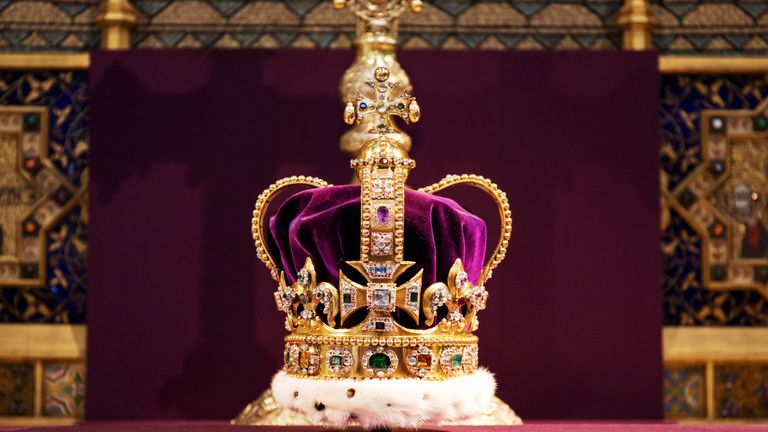
Image:King Charles III will wear St Edward’s Crown towards the end of the ceremony, which was also worn by the Queen at her coronation in 1953
What will happen at King Charles’s coronation?
The Palace said the ceremony would “reflect the monarch’s role today and looks towards the future” whilst staying “rooted in long-standing traditions and pageantry”.
It has still not been confirmed whether there will be a Bank Holiday to mark the day, although the fact it falls on a weekend might suggest this is unlikely.
The Queen’s coronation on 2 June 1953 took three hours with a congregation of 8,000 dignitaries. The event was broadcast live on television, attracting record-breaking audiences around the world.
Back then, thousands lined the streets for a glimpse of the Queen in the gold state coach, which has been used for coronations since George IV.
It is not known whether the coach will be used this time.
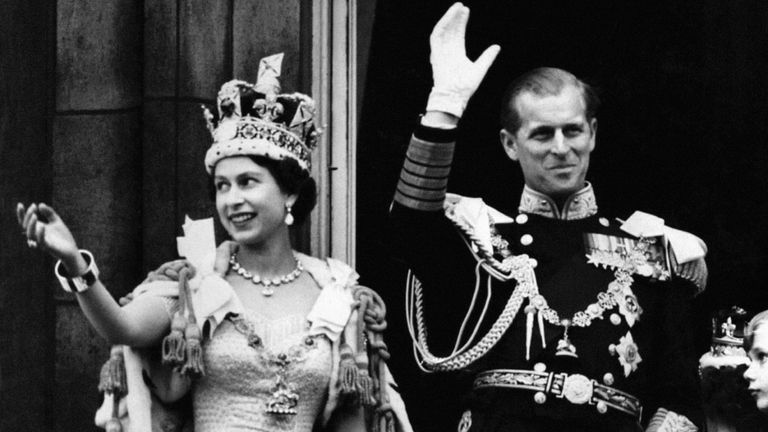
Image:Queen Elizabeth and the Duke of Edinburgh on the Buckingham Palace balcony after her coronation in 1953
Although the King succeeded to the throne whenthe Queendied, the coronation ceremony marks the formal investiture of a monarch’s regal power.
Charles will be anointed with holy oil, blessed and consecrated by the archbishop.
He will be crowned with St Edward’s Crown. During the ceremony, Camilla will also be anointed and crowned.
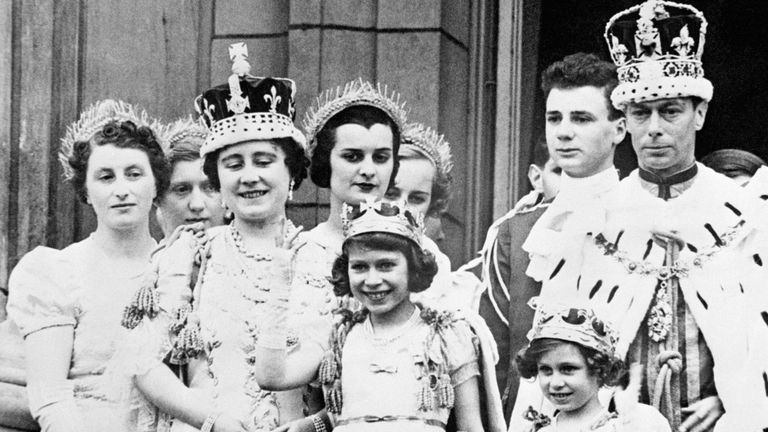
Image:Queen Elizabeth (later the Queen Mother), Princess Elizabeth, Princess Margaret and King George VI after his coronation in 1937
The date of the coronation is also the birthday of the Duke and Duchess of Sussex’s son Archie – the King’s grandson – who will be turning four on the day.
There is also no detail yet on who will attend the ceremony, including whether or not Prince Harry and Meghan will be invited or be able to travel from California to attend.
In her later years, Princess Diana opened up about her struggles with an eating disorder.
She previously told a royal biographer she began experiencing bulimia following her engagement.
A new royal book claims that by the time of her honeymoon, Diana’s wedding ring was too big for her.
Princess Diana‘s struggle with bulimia took such a toll after her wedding that her ring had to be adjusted following her honeymoon, according to a new book.
Valentine Low, a Times of London royal correspondent, authored “Courtiers: The Hidden Power Behind the Crown,” which was released in the UK on Thursday. In the book, he traces the modern history of the royal family through the lens of courtiers, a term used for the people working within each royal household.
In the chapter “Growing Up,” Low covers the experience of Michael Colborne, a private secretary who worked for Charles and Diana early into their marriage. Colborne, the author wrote, witnessed not only the “disintegration” of the couple’s marriage, which began after their 1981 wedding but the beginning of Diana’s struggle with bulimia nervosa, an eating disorder.
According to Low, Charles had summoned Colborne to Balmoral, Scotland, where he and Diana spent some time following their tumultuous two-week honeymoon in 1981. It was there that Low wrote Diana opened up to the private secretary about how unhappy she was and, after an argument between her and Charles, that the prince threw her wedding ring at him.
“Colborne heard Charles and Diana having a massive row. Then Charles suddenly appeared, and threw something at Colborne: it was Diana’s wedding ring, which Colborne somehow managed to catch,” the author wrote.
“Diana had lost so much weight that it no longer fitted and needed to be adjusted,” he added.
Diana’s ring required an adjustment soon after their wedding in July 1981. David Levenson/Getty Images
Then 20 years old, Diana had already shown signs of her condition for months. The UK’s National Health Service describes it as an eating disorder and mental health condition which involves the individual eating “a lot of food in a very short amount of time (binge eating) and then making themselves sick” in order to prevent weight gain.
According to Andrew Morton’s 1992 biography, based on confession tapes recorded by the princess, Diana’s condition began before her wedding to Charles.
“The bulimia started the week after we got engaged and would take nearly a decade to overcome,” she said on the tapes, according to Vogue. “My husband put his hand on my waistline and said: ‘Oh, a bit chubby here, aren’t we?’ and that triggered off something in me.”
Her wedding ring is also not the only item to have been sized down due to her struggle with bulimia. As Vogue also reported, her wedding dress designer said when they began fittings for the big day, Diana’s waist measured between 26 to 27 inches. But by her wedding in July 1981, her waist dropped to 23 inches.
During a keynote address in 1993, she opened up public discourse surrounding eating disorders and touched on how they can affect an individual’s overall health.
Princess Diana‘s struggle with bulimia took such a toll after her wedding that her ring had to be adjusted following her honeymoon, according to a new book.
Valentine Low, a Times of London royal correspondent, authored “Courtiers: The Hidden Power Behind the Crown,” which was released in the UK on Thursday. In the book, he traces the modern history of the royal family through the lens of courtiers, a term used for the people working within each royal household.
In the chapter “Growing Up,” Low covers the experience of Michael Colborne, a private secretary who worked for Charles and Diana early into their marriage. Colborne, the author wrote, witnessed not only the “disintegration” of the couple’s marriage, which began after their 1981 wedding, but the beginning of Diana’s struggle with bulimia nervosa, an eating disorder.
According to Low, Charles had summoned Colborne to Balmoral, Scotland, where he and Diana spent some time following their tumultuous two-week honeymoon in 1981. It was there that Low wrote Diana opened up to the private secretary about how unhappy she was and, after an argument between her and Charles, that the prince threw her wedding ring at him.
“Colborne heard Charles and Diana having a massive row. Then Charles suddenly appeared, and threw something at Colborne: it was Diana’s wedding ring, which Colborne somehow managed to catch,” the author wrote.
“Diana had lost so much weight that it no longer fitted and needed to be adjusted,” he added.
Diana’s ring required an adjustment soon after their wedding in July 1981.David Levenson/Getty Images
Then 20 years old, Diana had already shown signs of her condition for months. The UK’s National Health Service describes it as an eating disorder and mental health condition which involves the individual eating “a lot of food in a very short amount of time (binge eating) and then make themselves sick” in order to prevent weight gain.
According to Andrew Morton’s 1992 biography, based on confession tapes recorded by the princess, Diana’s condition began before her wedding to Charles.
“The bulimia started the week after we got engaged and would take nearly a decade to overcome,” she said on the tapes, according to Vogue. “My husband put his hand on my waistline and said: ‘Oh, a bit chubby here, aren’t we?’ and that triggered off something in me.”
Her wedding ring is also not the only item to have been sized down due to her struggle with bulimia. As Vogue also reported, her wedding dress designer said when they began fittings for the big day, Diana’s waist measured between 26 to 27 inches. But by her wedding in July 1981, her waist dropped to 23 inches.
Later in life, the princess used her experience to become an advocate for others, according to Elle Magazine.
During a keynote address in 1993, she opened up public discourse surrounding eating disorders and touched on how they can affect an individual’s overall health.
A recent report claims that King Charles III’s coronation has been scheduled.
The date of Charles’ coronation will be June 3 at Westminster Abbey in London, according to Bloomberg, which cited U.K. sources.
However, a spokesperson for Buckingham Palace told the Evening Standard that any reports on the coronation date are “pure speculation.”
Sources told the London newspaper that a date for the coronation had not been decided and added that any reporting of the date should be taken “with a massive pinch of salt.”
According to Bloomberg, anonymous government officials said that plans for the coronation have centered on June 3, though discussions are ongoing as to which other dates could be proclaimed official holidays.
As the king’s coronation is a state event, the date on which it takes place will be observed as a bank holiday. Since June 3 of next year falls on a Saturday, Friday, June 2 could potentially be proclaimed a bank holiday.
If the coronation is officially set for June 3, King Charles III’s ceremony will take place almost 70 years to the day after his mother Queen Elizabeth II was crowned on June 2, 1953.
Coronations usually take place a year after the death of a monarch in order to allow for a period of mourning as well as to provide enough time for the planning that such a massive public event entails.
The late monarch was 25 at the time of her coronation while Charles was just four-years-old.
After the queen’s death on Sept. 8, Charles immediately ascended to the throne. He was officially proclaimed king by the Accession Council of the United Kingdom on Sept. 10.
Charles’ wife Camilla will be crowned Queen Consort at his coronation. Photo by Andrew Milligan – Pool/Getty Images
While Elizabeth’s coronation was attended by 8,000 guests, attendees of Charles’ ceremony will be limited to 2,000, due to safety and health concerns.
The monarch has also reportedly expressed a wish that the coronation is more inclusive of other faiths and communities to better reflect the nation’s diversity.
Due to the queen’s advanced age, preparations for the event have been underway for years, under the code name “Operation Golden Orb.”
It marks the start of a brand-new chapter. At a global gathering for his United for Wildlife non-profit, Prince William gave his first speech as the heir apparent to the British throne, paying tribute to the late Queen Elizabeth II.
Speaking at London’s Science Museum, the prince of Wales addressed 300 global leaders from the private sector, philanthropists, and conservation organizations, as well as law enforcement representatives, who had all gathered to tackle the critical issue of wildlife crime around the world.
He also praised the wildlife advocacy first championed by his father, King Charles III, andlate grandfather, Prince Philip.
“Our natural world is one of our greatest assets,” he said. “It is a lesson I learned from a young age, from my father and grandfather, both committed naturalists in their own right, and also from my much-missed grandmother, who cared so much for the natural world. In times of loss, it is a comfort to honour those we miss through the work we do. I take great comfort from the progress we are making to end the illegal wildlife trade.”
Illegal wildlife trafficking and poaching has long been at the forefront of Prince William’s work. Since launching the nonprofit in 2012, William, in his role as president, has overseen efforts to convene leading wildlife charities to create a global movement with the aim of bringing an end to issues such as the rapid escalation of the illegal wildlife trade and why it must be addressed as a serious organized crime.
“It is, of course, a difficult mission that we commit ourselves to,” he said at the Oct. 4 summit. “The challenges often cited in fighting wildlife crime include the lack of a coordinated international response … the lack of strong criminal justice … corruption and insufficient resources. But we set out to reverse that.”
“We set out to ensure that those involved in wildlife crime face an international response as powerful and coordinated as any other serious and organised crime,” he said. “To bring their sinister operations out of the shadows and to ensure that communities are equipped, empowered, and supported to protect themselves and their natural world. And everyone here is playing a significant role in helping us do so.”
Multiple bombshell books about the royal family just dropped, including The New Royals by author Katie Nicholl, which sheds some light on King Charles’s somewhat tense relationship with Kate Middleton in the early days of her time in the royal family. TL;DR: Charles didn’t exactly love how much attention his daughter-in-law got for being so stylish.
Why, you ask, while rolling your eyes? Apparently, the future King was reminded of how the public focusedmore on Princess Diana than on him during their tense relationship.
“Her star immediately eclipsed her husband’s, causing early fractures in their relationship,” Nicholl wrote, via Entertainment Tonight. “The diligent, sensitive, and status-conscious Charles found it hard to understand. He could not see that in the new media age, being a royal-born prince and future king was a lesser currency than his wife’s megawatt beauty and disposition.”
Charles found himself once again pushed out of the spotlight when Kate entered the picture and everyone was immediately fascinated by her—not to mention obsessed with her fits.
“In the past, father and son hadn’t always seen eye to eye. There was a well-documented clash of opinions in 2013 over the palace’s priceless collection of ivory, for one,” Nicholl writes. “And Charles was sometimes irritated that Kate’s frocks got more media attention than his good works.”
Photo credit: Danny Martindale – Getty Images
Um. Okay, Charles! Anyway, on top of that ridiculousness, Charles was also upset that he didn’t spend enough time with Prince George, Princess Charlotte, and Prince Louis. As Nicholl puts it, he “had been hurt by not seeing as much of his Cambridge grandchildrenas he might have liked.”
King Charles III has a nickname for his daughter-in-law Meghan Markle, and it is…strange, to say the least. The royal family has been in the news a lot lately due to the death of Queen Elizabeth II last month. But the mourning period is over, and it’s time for some royal gossip.
Royals expert and journalist Katie Nicholls wrote a book called The New Royals: Queen Elizabeth’s Legacy and the Future of the Crown, which came out Tuesday, October 4. It shares all the juicy details on the late queen’s successor, King Charles III. According to Nicholls, the king—who was apparently jealous that Kate Middleton’s style was more of a media magnet than his good deeds— gave the Duchess of Sussex the nickname “Tungsten.”
“Charles reportedly nicknamed his future daughter-in-law ‘Tungsten’ because of her toughness and resilience,” Nicholls wrote in the book, per a report from Entertainment Tonight.
Tungsten, according to the Oxford English Dictionary, is “the chemical element of atomic number 74, a hard steel-gray metal of the transition series. It has a very high melting point (3410°C) and is used to make electric light filaments.” It’s a weird thing to call someone, but it is a compliment to Markle, especially considering all she’s been through since she began dating Prince Harry.
Nicholls writes in The New Royals that Charles first noticed Markle’s tungsten-level toughness at her first joint appearance with Harry, Prince William, and Kate Middleton during the Royal Foundation Forum in February 2018.
People expressed their “thrill” and pride at seeing the King and his wife at Dunfermline, Fife, where they were attending one of the royal couple’s Monday engagements.
King Charles and the Queen Consort have carried out their first official engagement together since royal mourning ended.
Hundreds of people lined the streets in Dunfermline to greet the couple as they left the city chambers.
They were seen chatting, smiling and shaking hands with people who had waited patiently for their arrival – with the monarch even being offered a free haircut.
When asked if he would like to go into a local barber’s shop, King Charles smiled and said “next time”.
The crowds were “thrilled” with the royal visit. Teacher Carol Williams, 52, who was waiting to catch a glimpse of the couple, said “it’s such an honour for Dunfermline to be his first visit as the new King”.
It was the first time King Charles and the Queen Consort had carried out a public engagement since the Queen’s funeralon 19 September.
Before spending time with the crowds, the royals had attended an official council meeting where the King formally marked the conferral of city status on Dunfermline and signed a guest book.
During the ceremony, the King said he was “delighted” when it was announced the town would become a city.
He said he hoped people would feel a “real sense of pride in this new chapter”.
The Fife city was one of eight places to be awarded its new status as part of the late Queen Elizabeth’s Platinum Jubilee celebrations.
Scottish First Minister Nicola Sturgeon was also at the chambers for the royal engagement.
King Charles and the Queen Consort then visited Dunfermline Abbey to mark its 950th anniversary and to see the resting place of Robert the Bruce.
Image:The King and Queen Consort attend the council meeting in Dunfermline
Image:The royal couple wave to the crowd as they leave Dunfermline Abbey
They were again greeted by crowds of well-wishers and met officials from Historic Scotland to learn more about the conservation of the site.
The King and his wife will be hosting a reception at the Palace of Holyroodhouse in Edinburgh later on Monday to celebrate British South Asian communities.
They are expected to meet between 200 and 300 guests of British Indian, Pakistani, Bangladesh, Sri Lankan, Nepalese, Bhutanese and Maldivian heritage from across the UK.
The event will recognise the contribution many from these communities havemade to the NHS, arts, media, education, business and the armed forces.
King Charles III will welcome South African President Cyril Ramaphosa to the U.K. for three days of high-level talks next month.
This is to celebrate the first state visit of his reign with the leader of a Commonwealth member with close ties to the royal family.
Ramaphosa has accepted Charles’s invitation for a state visit from Nov. 22-24, Buckingham Palace said Monday. The South African leader will be accompanied by his wife, Dr. Tshepo Motsepe.
Charles has visited South Africa on several occasions since 1997. At Nelson Mandela’s funeral in 2013, he said the world would be a “poorer place” without the man who led South Africa’s transition from apartheid to multi-ethnic democracy, adding that Mandela was owed “an enormous debt of gratitude” for his achievements.
The King and Camilla, the queen consort then the Prince of Wales and the Duchess of Cornwall welcomed former South African President Jacob Zuma to the U.K. at the start of a state visit in 2010.
Charles’ sons, Princes William and Harry, have also visited South Africa a number of times.
Next month, King Charles III will host South African President Cyril Ramaphosa for three days of high-level negotiations in the United Kingdom. This will be the first official visit since the king succeeded his late mother Queen Elizabeth II last month.
In a statement on Monday, Buckingham Palace announced that Ramaphosa has accepted Charles’s invitation for a state visit from November 22 to 24.
The South African leader will be accompanied by First Lady Tshepo Motsepe.
South Africa is a member of the Commonwealth, a political association of 56 countries, mostly former British colonies.
Ramaphosa’s predecessors Nelson Mandela, Thabo Mbeki, and Jacob Zuma, the other presidents the country has had since its first multi-ethnic elections in April 1994, have also previously made state visits to the UK.
While still the prince of Wales and the Duchess of Cornwall, Charles, and Camilla, the queen consort, welcomed former South African President Jacob Zuma to the UK at the start of a state visit in 2010.
The new monarch has visited South Africa on several occasions since 1997. At Mandela’s funeral in 2013, he said the world would be a “poorer place” without the man who led South Africa’s transition from apartheid to multi-ethnic democracy, adding that Mandela was owed “an enormous debt of gratitude” for his achievements.
The visit comes as Ramaphosa faces a huge scandal back at home. Arthur Fraser, the former head of the country’s spy agency has accused the president of kidnapping, bribery, money laundering, and “concealing a crime” in relation to the alleged theft of $4m in cash found at his Phala Phala game ranch in northern South Africa.
In their first joint public appearances since the Queen’s funeral, the King and Queen Consort are scheduled to go to Dunfermline and Edinburgh.
They will visitDunfermline Abbey to mark the former town’s new status as Scotland’s eighth city.
Charles and Camilla will also attend a council meeting at the City Chambers.
The King and his wife will then host a reception at Edinburgh’s Palace of Holyroodhouse, to celebrate British South Asian communities.
The late Queen Elizabeth previously visited Dunfermline Abbey to mark its 900th anniversary and this year it is celebrating its 950th anniversary.
Royal mourning ended last Tuesday and Scotland has since seen the Prince and Princess of Wales visit for the first time since taking up their news titles.
King Charles and Camilla attended church at Crathie Kirk, near Balmoral, last Sunday as they were seen in public for the first time since the late monarch’s funeral.
Dunfermline’s regal past
IMAGE SOURCE , GETTY IMAGES Image caption, Charles and Camilla will visit the Category A-listed Dunfermline Abbey, built in the 12th Century
Eight places in the UK were made cities as part of platinum jubilee celebrations marking the 70-year reign of the late Queen Elizabeth.
Dunfermline’s bid was based on its historic status after King Malcolm III established its ancient seat in 1057.
He married Margaret of Wessex, who was later canonised as a saint and considered a religious and cultural pioneer.
She brought Benedictine monks to Scotland and introduced cultural innovations from the Courts of Europe.
As Scotland’s only female saint, she attracted pilgrims from all over the world, leading to the building of Dunfermline Abbey.
It was later established as a royal mausoleum for the Scottish Crown. A total of 18 royals, including seven kings, were buried there – from Queen Margaret in 1093 to Robert Stewart, Duke of Albany, in 1420.
Robert the Bruce, otherwise known as Robert I, became the last of the seven Scottish kings to be buried there in 1329 – although his heart was taken to Melrose – and his name is carved into the top of Dunfermline Abbey.
The couple will be welcomed on their visit to Dunfermline by community groups, including a pipe band and local schoolchildren.
King Charles will formally mark the conferral of city status and make a short speech in the chamber room.
He will also meet the Lord Lieutenant of Fife, Robert Balfour, who will introduce Scotland’s First Minister Nicola Sturgeon and Scottish Secretary Alister Jack.
After the ceremony, Charles and Camilla will take a short walk to Dunfermline Abbey to formally mark its 950th anniversary.
They will be introduced to representatives from Historic Scotland and learn about the heritage of the local area and conservation of the site.
The lord provost of Fife, Jim Leishman, was looking forward to welcoming the royals.
“It has been a long hard journey and a lot of people deserve a lot of credit for the work they have put in over ten years,” he told BBC Radio’s Good Morning Scotland programme.
“The King and Queen Consort are having a wee walk going down to the abbey after he has given us the city status – the people of Dunfermline will love that.
“That is what makes it very very special – his first official engagement in Scotland and he is coming to Dunfermline. That is a tremendous accolade for the people of Dunfermline.”
Palace reception
The King and Queen Consort will later host a reception in the great gallery at the Palace of Holyroodhouse in Edinburgh.
They will meet between 200 and 300 guests of British Indian, Pakistani, Bangladeshi, Sri Lankan, Nepalese, Bhutanese and Maldivian heritage from across the UK.
The event will recognise the contribution many from these communities have made to UK life, from the National Health Service to the arts, media, education, business and the armed forces.
Buckingham Palace says, King Charles will not go to the COP27 climate change meeting, which will take place in Egypt next month.
It was in response to a Sunday Times article that claimed Liz Truss, the prime minister, had “directed” the King not to attend.
The Palace said advice had been sought by the King and given by Ms Truss.
“With mutual friendship and respect there was agreement that the King would not attend,” the Palace stated.
Before his ascension to the throne last month, the King – then the Prince of Wales – had indicated he would attend the annual conference.
Royal correspondent Jonny Dymond said the BBC had put it to the Palace that the King must be personally disappointed given his long decades of passionate environmental campaigning.
But the Palace responded that the idea the King was uncomfortable was not the case, and he was ever mindful of the sovereign’s role to act on the government’s advice.
Last November – Prince Charles – the King travelled to Egypt with the then-government’s blessing to urge the Egyptian administration on its efforts, meeting President Abdel Fattah Al-Sisi during a planned visit.
In the past, the King has demonstrated his deep commitment to environmental issues and, as Prince of Wales, had a long history of campaigning to reduce the effects of climate change.
Only last year he made a speech at the COP26 opening ceremony in Glasgow, when the summit was hosted by the UK. The late Queen also gave a speech at the event, via video link.
Senior Conservative MP Tobias Ellwood said he hoped “common sense would prevail” and the King would be allowed to go to Egypt.
He said in a tweet that King Charles was a “globally-respected voice” on the environment whose attendance would add “serious authority” to the British delegation.
At last year’s COP26 conference, King Charles – or Prince Charles as he was then – was one of the star turns, delivering a passionate call for world leaders to adopt a “war-like footing” over climate change.
This year he’ll have to keep his powder dry, after what’s presented, on the surface at least,as a dispute-free agreement that he shouldn’t go.
Although it’s worth noting this is about not attending “in person”, which might leave the door ajar for other virtual contributions.
There will inevitably be speculation that, below all the constitutional smoothing, this will have really disappointed the King. He has campaigned devotedly for decades, heart on sleeve, on such environmental issues.
And it could also raise the prospect of early tensions between a new King and a new PM.
But it’s a case of different roles, and different rules and the King has always known that as sovereign he would have to act within a different set of politically-neutral constraints.
The Egyptian authorities say they hope to use their presidency of COP27 to urge the international community to act on pledges of support for developing countries to cope with the devastating impacts of climate change.
However, there has been criticism ahead of the summit. Human Rights Watch has said Egypt has severely curtailed the work of environmental groups. Officials in Cairo said the report was “misleading”.
COP27, a United Nations event, is being held in the coastal city of Sharm el-Sheikh from 8 to16 November.
Next week, King Charles will attend his first public engagements since the royal periodof mourning came to an end, including a reception in Edinburgh for South Asian communities from across the UK and a visit to Dunfermline Abbey in Fife.
IMAGE SOURCE, BUCKINGHAM PALACE/GETTY IMAGES/PA Image caption, A new picture of the King with the Queen Consort, Prince, and Princess of Wales was released on Saturday
As the new head of The Firm, Charles now oversees some $42 billion in assets and inherited $500 million from Queen Elizabeth, including her castles, jewels, art collection and a horse farm—all of it tax-free.
When you’re a member of the House of Windsor, going into the family business may come with a lifetime of prestige and privilege, but it doesn’t always bring great wealth.
Even members of The Firm—as high-ranking royals have been known since the days of King George VI—are often dependent on their elders for allowances, gifts and other blue-blooded handouts.
But it’s still good to be the king.
After training for the position for more than 70 years, King Charles III inherited large swaths of land, regal estates, rare jewels, paintings and other personal property—some going back centuries—from his mother, Queen Elizabeth II.
He also now oversees the late monarch’s $42 billion portfolio of assets held in trust for the kingdom, including billions in investments—and other opulent palaces, glittering jewels and priceless art that he will never actually own.
Her Majesty’s will is expected to be sealed for at least 90 years so the exact distribution of her assets will not be known for several generations. But as her eldest son, Charles inherited the Queen’s private estates—her much-loved castle in Balmoral, Scotland, where she died, as well as Sandringham in eastern England, home to the thoroughbred horse farm known as the Royal Studs.
King Charles is also expected to inherit her enormous private collection of jewelry, art, rare stamps and any personal investments. Altogether, Forbes values these personal assets at $500 million. And Charles won’t have to pay a shilling of inheritance tax, thanks to a 1993 agreement with the British government that exempts transfers of property from one sovereign to another.
The 73-year-old monarch also accedes the throne with a king’s ransom of his own, largely through the lucrative annual income he received from the Duchy of Cornwall, which earned him some $27 million this year and which his eldest son, Prince William, will now inherit.
As Prince of Wales, Charles launched several ventures to protect the environment and foster organic farming. Through his Charitable Foundation (which William also inherits now), Charles owned the largest organic food brand in the U.K., as well as a nature retreat and crafts center in Transylvania that each operate as bed and breakfasts.
Prince William will now take possession of the Duchy of Cornwall, a conglomerate with $1.2 billion in net assets including the Oval cricket ground in London, Charles’ former residence at Highgrove House (where he first began farming organically in 1985) and the Isles of Scilly, but the new King will not exactly be left wanting for prime real estate.
As the new monarch, Charles assumes ownership of institutions that manage an estimated $42 billion in assets, including some of the world’s most famous royal palaces and the Crown Jewels.
These assets—which include Buckingham Palace, Windsor Castle and the Tower of London—aren’t held directly by the King, but are instead owned by the reigning monarch “in right of the Crown” for the duration of their reign. They are also held “in trust” for his successors and the nation—meaning they can’t actually be sold.
In contrast to the various estates, which file annual reports, the palaces and jewels are often thought of as priceless. So what’s it all worth? Forbes gave it a royal effort.
The single most valuable asset held by King Charles is the Crown Estate, a sprawling real estate portfolio with $17.5 billion in net assets. Those properties include Regent Street, London’s prime shopping destination, as well as Ascot Racecourse (a favorite of the Queen) and virtually the entire seabed of the U.K. All of the Crown Estate’s net profit—$361 million in fiscal year 2022—goes to the British Treasury.
But the royal family also gets a cut: They receive an allowance from the Treasury known as the “Sovereign Grant,” equal to 25% of the net profit for the financial year two years earlier. In 2022, the Sovereign Grant amounted to $99.6 million, based on the Crown Estate’s net profit in the 2019-20 financial year.
That enormous windfall doesn’t go directly to Charles, however. A 10% cut of that net profit—$39.8 million for 2022—is set aside for maintaining Buckingham Palace, and an additional 15% is used to finance the royal family’s annual travel, formal events, housekeeping and payroll. And those bills add up fast.
The most expensive trip taken by the royals in the past year, for instance, was Prince William and Kate’s nine-day visit to Belize, Jamaica and the Bahamas in March, which cost roughly $260,000, including planning prior to the visit.
The Sovereign Grant isn’t Charles’ only source of income. For one, it doesn’t cover physical security. As King, he also gains control of the Duchy of Lancaster, a private estate with $753 million in net assets that is owned in trust by the monarch.
The Duchy’s net revenues go directly to the King as an allowance called the Privy Purse, which covers any other official expenditures. (In 2022, that amounted to $24 million, pre-tax.) Unlike the Sovereign Grant, which is tax-free, the Queen agreed in 1993 to voluntarily pay income tax on the portion of the Privy Purse not used for official purposes—and Charles agreed to maintain the same policy upon his accession.
In addition to the Crown Estate and the Duchy of Lancaster, Charles also holds the Crown Estate Scotland, a portfolio with some $570 million in net assets, including the Scottish seabed, rural estates and the rights to fish wild salmon and extract naturally occurring gold and silver in Scotland.
The rest of the Crown’s holdings—at least nine former and current royal residences and the Royal Collection, which includes the Crown Jewels—are the most difficult to value because they would never reach the open market and they don’t file annual reports.
The Crown Jewels are perhaps the most identifiable asset associated with the British royal family. As part of the Royal Collection, they are “held in trust by the monarch for the nation.” The Royal Institution of Chartered Surveyors estimated their value at $4 billion in 2019, using the sale of the French Crown Jewels in 1887 and the sale of the late Princess Margaret’s jewelry in 2006 as a comparison.
The overall value of the Royal Collection, which includes works by Rembrandt, Vermeer, Caravaggio and Leonardo Da Vinci, is unquestionably much higher. According to a 2017 report by Brand Finance, a U.K.-based brand valuation firm, the Royal Collection—including the Crown Jewels—is estimated to be worth $12.7 billion.
There are also at least nine palaces, castles and residences owned by the King in trust as sovereign or “in right of the Crown.” According to estimates provided by Lenka Dušková Munter, a sales specialist for historical properties at Czech real estate agency Luxent, and Colby Short, co-founder and CEO of estate agent website GetAgent.co.uk, Forbesestimates the combined value of these properties at $9.5 billion.
The most valuable property in the collection is, of course, the King’s official London residence, Buckingham Palace, estimated at $4.9 billion. On the lower end, there’s Clarence House, Charles’ formal residence in London when he was Prince of Wales, valued at $72 million.
Balmoral and Sandringham, which are now personally owned by the King after he inherited them from Queen Elizabeth, are worth $118 million and $73 million, respectively.
Most of these assets cannot be sold. But in choosing Charles as his regnal name, the new King would be wise to remember what happened to King Charles I’s worldly possessions—after he was beheaded by his people in 1649.
Following Charles I’s death during the English Civil War, his assets were promptly auctioned off— Richmond Palace in London reportedly sold for £13,000 (or about $1.8 million today) before ultimately being demolished. Parliament also sold Charles I’s art collection, considered at the time to be one of the greatest in the world. The appraised value of £35,000 for the paintings alone—some $5 million adjusted for inflation—is a fraction of the $450 million paid at auction for just one of those works, Leonardo Da Vinci’s Salvator Mundi, when it became the most expensive painting ever sold in 2017.
Presumably Charles III’s reign will go a little more smoothly than his regal namesake. The new King has seen a surge in support since his mother’s death. A YouGov survey for the Times of London published Tuesday found that his approval rating has jumped to 63% since May, when only 32% of respondents believed he would do a good job as the monarch.
“The queen was obviously very well regarded globally and inside the U.K.,” says David Haigh, chief executive of Brand Finance. “She did an extremely good job. And the jury’s out as to whether or not Prince Charles will live up to her example.”
THE KING’S PERSONAL ASSETS
As the new King, Charles inherits the Queen’s personal assets, which Forbesestimates at $500 million. That includes Balmoral and Sandringham, the Royal Philatelic Collection—which includes “the world’s finest and most comprehensive collection of British and Commonwealth stamps”—personal investments, horses, jewelry and artworks Her Majesty inherited from her mother in 2002.
The prize painting in that collection is said to be Claude Monet’s Study of rocks, Creuse, reportedly worth as much as $17.3 million. And assuming Charles’ late father, Prince Philip, had a smart estate tax attorney, the Duke of Edinburgh would have bequeathed his own art collection—estimated at $2.3 million by the late royal commentator and journalist David McClure—to the Queen upon his death in April 2021 to avoid paying inheritance tax. If he did, those assets also likely passed on tax-free to Charles.
There is also a vast collection of cars, watches and other extravagant toys held by the King and the royal family. On Sunday, on the first full day of his reign, King Charles turned up to greet crowds at Buckingham Palace wearing an 18-carat gold Parmigiani Fleurier Toric Chronograph watch that he’s owned since the mid-2000s, the Swiss watchmaker told Forbes. Parmigiani Fleurier no longer produces the Toric Chronograph, but a similar model sold at Christie’s for $8,125 in 2019.
The King’s vehicle of choice for his London debut was his mother’s Rolls Royce Phantom VI, which was presented to her for her Silver Jubilee in 1977. While the car is not for sale, a similar model from 1976 can be purchased for $225,000.
Charles also inherits the Bentley State Limousine, originally designed for the Queen’s Golden Jubilee in 2002 to commemorate her half-century on the throne.
In his 64 years as Prince of Wales, Charles also learned how to build his own outrageous fortune. He largely depended on income from the Duchy of Cornwall, which expanded under his tenure to $1.2 billion in net assets, including nearly $400 million in commercial properties and more than 52,000 hectares of land, or about a third the size of Greater London. Between 2011 and 2022, the Duchy’s net assets grew by 51%.
The profits from those assets provided Charles with enough income to be independent of the Sovereign Grant: In the fiscal year ending March 31, 2022, the then-Prince of Wales earned some $26.6 million (pre-tax) from the Duchy of Cornwall, compared to $1.2 million from the Sovereign Grant.
That valuable asset is now in the hands of Prince William, who succeeded his father as the Prince of Wales. With Cornwall, William will no longer have to ask his father for a cut of his income anymore. Prince Harry, on the other hand, is forging ahead with his own business ventures along with his wife, Meghan Markle.
In December 2020, the couple signed a three-year podcasting deal with Spotify that could be worth between $15 million and $18 million. The couple also has an Apple TV+ series on mental health that Harry executive produces with Oprah Winfrey for an undisclosed sum and a $100 million, five-year Netflix deal, which was signed in September 2020.
After all, leaving the royal family isn’t usually a smart financial move: When Queen Elizabeth’s uncle, King Edward VIII, abdicated in 1936 to marry the twice-divorced Wallis Simpson, he was cut off from the Civil List, the royal funding stream now known as the Sovereign Grant. Instead, he negotiated a deal with his brother, King George VI, to receive £25,000 a year ($1.4 million adjusted for inflation.) Still, at the time of his death in 1972, the Duke of Windsor (as he became known) left behind a fortune worth nearly $2.5 million—$17.7 million today—including a villa in Paris.
Charles’ personal assets before he became king are far murkier. He’s also received scrutiny for investments made through the Duchy of Cornwall. In 2017, the International Consortium of Investigative Journalists’ Paradise Papers investigation revealed that the Duchy of Cornwall had invested millions of pounds in offshore funds and companies, including a business registered in Bermuda run by Hugh van Cutsem, an old friend from the University of Cambridge in the 1960s.
At the time, the Duchy said Charles didn’t have any “direct involvement in investment decisions.”
As King, Charles now holds $500 million in personal assets with another $42 billion held in trust as the sovereign. Despite an obviously luxurious lifestyle with access to multiple castles, fleets of cars, private planes and a pretty great collection of tiaras and other jewelry, there is one thing that King Charles III shares with every commoner—death and (some) taxes.
Queen Elizabeth II’s state funeral on 19 September was an occasion complete with much pomp and ceremony, befitting her 70-year reign. Much has been reported, however, of King Charles III’s aspirations for a ‘slimmed-down’ monarchy – a notion that’s becoming all the more appropriate in light of the cost of living crisis. So what can we expect from the new King’s coronation, as an event traditionally associated with grandeur and majesty?
Following his mother’s death on 8 September, no date has been announced for the King’s coronation: a milestone that will formally mark his transition to the role of monarch. Royal precedent has typically dictated that the event come many months after the initial accession, due first to the observance of a respectful mourning period, as well as on account of the planning and preparation required. The coronation of the late Queen, for example, on 2 June 1953, came over a year after the death of her father in February 1952. The Telegraph reports that the King will likely be crowned next spring or summer.
The affected workers will be consulted, and Buckingham Palace said it hopes that life in the Household may carry on largely unaltered under the new monarch.
Staff who assisted the late Queen personally have been informed that some of their careers may be in jeopardy under King Charles III.
The letter, from Sir Michael Stevens, keeper of the privy purse, says: “I am sure you can appreciate that these are sensitive and challenging times.”
He adds that work is underway to support staff and ensure there are “good communications” over the coming weeks.
The letter says: “Consistent with continuity, the approach on Accession is essential that the requirements and the purpose of the Household continue unchanged following demise.
“While it is too early to confirm the position definitively, it is anticipated that only a very small minority of employees (fewer than 20) who provided personal services to Her Majesty Queen Elizabeth will see their posts affected by Her Majesty’s death.
“We will be consulting with you and those affected in relation to these anticipated changes after the State Funeral. Those affected are being written to.”
Last week it was disclosed that up to 100 employees at the King’s former official residence, Clarence House, had been notified that they could lose their jobs.
Mark Serwotka, the general secretary of the Public and Commercial Services Union, which represents a number of employees in the royal households, said staff had worked for the Queen for a number of years and felt “let down” after receiving the letter.
“Our members are disappointed and saddened by this development,” he said.
Meetings are being held with those affected and staff is being told they can contact Employee Assistance providers in the coming weeks.
Students from the King’s previous school have called the experience of viewing the Queen’s funeral while sitting in his old bedroom “surreal.”
Lessons were postponed at Gordonstoun School in Morayshire on Monday so that faculty and students could watch the funeral broadcast.
Beginning in 1962, King Charles attended the private school for five years.
He became a member of the Coastguard during his time there and took part in school plays, winning lead parts in productions such as Macbeth and Pirates of Penzance.
He went on to become a school guardian (head boy) in his final year, a colour bearer (prefect), and head of his boarding house, Windmill Lodge.
The group of girls gathered around the same desk that was used by the King during his time at the school while watching proceedings on a laptop.
Asked how it felt to be taking in such a historic event in the room Charles once lived in, Amelia said: “It’s a weird feeling.
“Also, the laptop on his old desk and watching the Queen’s funeral, it’s – yes, really weird. It’s all really connected.”
The Queen had a close connection to the school, with her late husband, the Duke of Edinburgh, studying there in his youth.
Their three sons, Charles, Edward, and Andrew, all followed in their father’s footsteps, and Princess Royal’s two children, Zara and Peter, were also students at the independent school.
The Queen regularly visited Gordonstoun, both formally and informally, taking a close interest in the progress of her sons and watching them take part in extra-curricular activities.
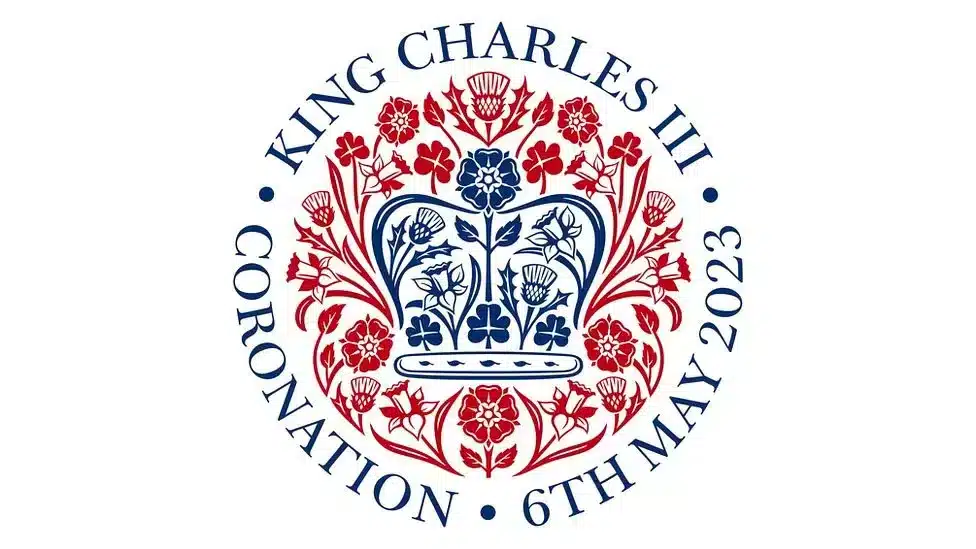
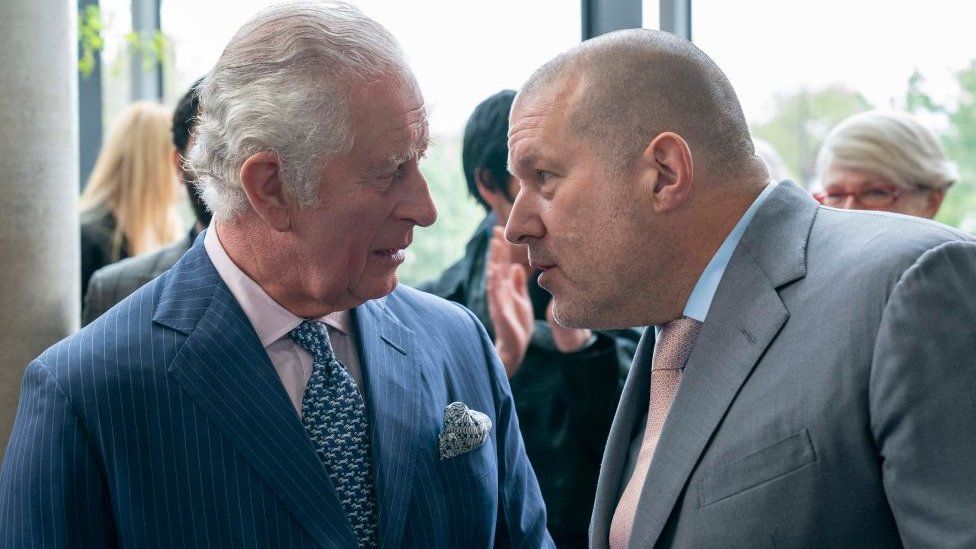
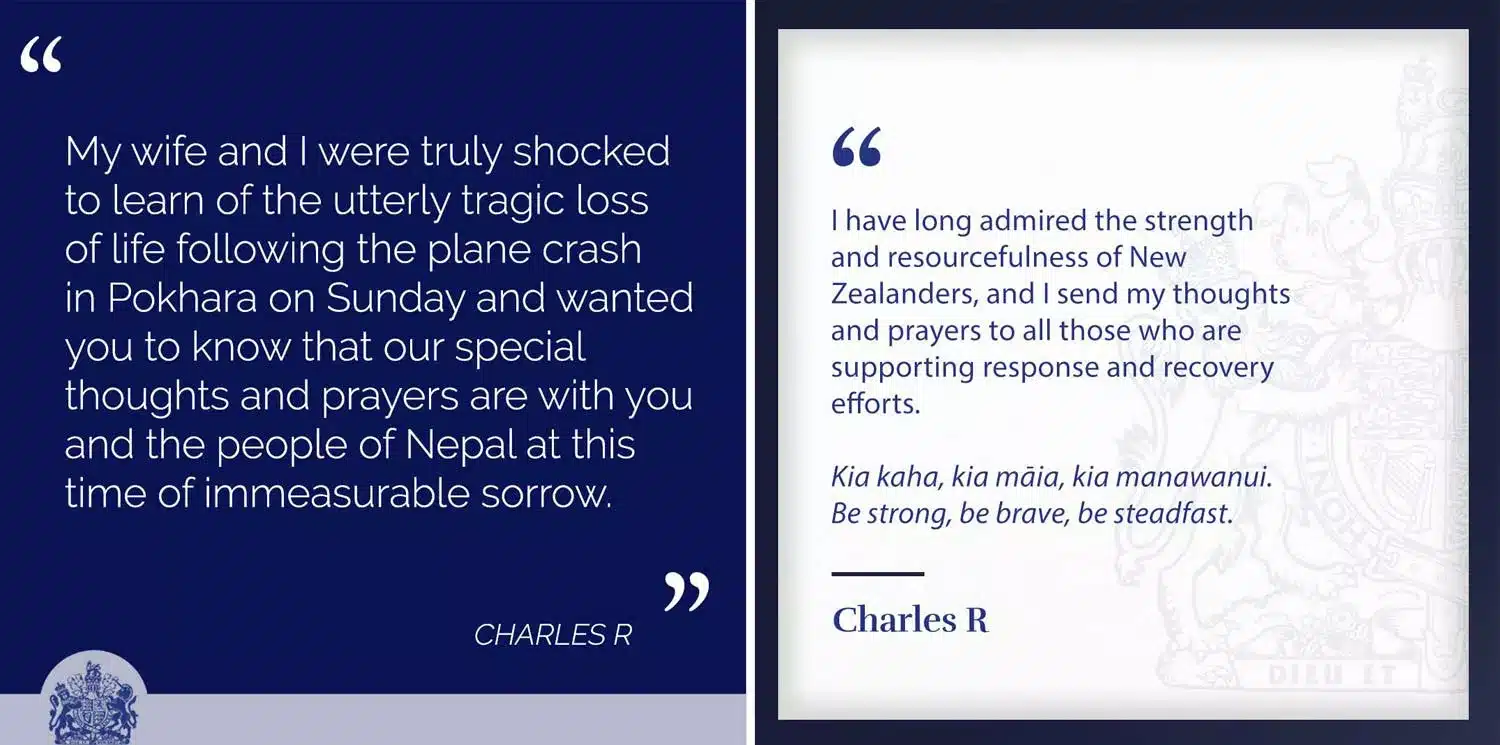
:max_bytes(150000):strip_icc():focal(479x339:481x341):format(webp)/king-charles-queen-camilla-Dunfermline-Abbey-112822-ccde35ded870486f90744036385f1e18.jpg)