Tag: LGBTQ

  • Sam George ready to reintroduce ‘dead’ anti-LGBTQ bill

    Sam George ready to reintroduce ‘dead’ anti-LGBTQ bill

    Minister-nominee for Communications, Digitalisation, and Innovation, Samuel Nartey George, has declared his intention to bring back the controversial Anti-LGBTQ bill in the 9th Parliament.

    Speaking during his vetting by the Appointments Committee on Thursday, January 30, Mr George reaffirmed his unwavering commitment to ensuring the bill’s passage, arguing that it reflects the values and beliefs of the Ghanaian people.

    “This is a matter of principle and national interest. The Anti-Gay Bill is not about discrimination but about preserving our moral and cultural values as a country,” he stated.

    He maintained that while Ghana respects human rights, certain practices remain incompatible with the country’s cultural heritage.

    With the expiration of the bill following the dissolution of the 8th Parliament, Mr George is confident that once reintroduced, it will gain widespread support.

    “The people of Ghana have spoken clearly on this issue, and as their representative, I will ensure that their voice is heard,” he added.

    Addressing concerns from international organisations, he dismissed any form of external pressure, insisting that Ghana has the sovereign right to determine its laws.

    He pledged to work closely with Parliament and relevant stakeholders to push the bill through, underscoring his determination to uphold what he describes as Ghana’s societal values.

  • Our stance for an anti-LGBTQ bill hasn’t changed – Majority Leader

    Our stance for an anti-LGBTQ bill hasn’t changed – Majority Leader

    Majority Leader Mahama Ayariga has emphasized that the National Democratic Congress (NDC) remains firmly committed to the Anti-LGBTQ Bill, reiterating that the party’s position on the matter has not wavered since the last elections.

    His remarks were in response to recent comments by President John Dramani Mahama, who suggested that a government-backed bill could provide a more effective framework than the ongoing Private Member’s Bill.

    Addressing Channel One TV on Monday, 27 January, Mahama Ayariga clarified procedural matters surrounding legislative bills, noting that proposals or agreements not finalised within a particular Parliament’s term are generally considered void.

    “No, there has been no change in our stance. The question now is whether we can simply sign and pass it into law. Would it be recognised as proper legislation, or might the process be challenged on the grounds that its validity expired with the previous Parliament?” Ayariga stated.

    According to President Mahama, such an approach would allow for broader consultations and foster stronger national consensus on the contentious issue.

    President Mahama also raised concerns about the need for a revised school curriculum, emphasizing the importance of instilling moral and cultural education that promotes Ghanaian and African values among the youth. This was during his meeting with the Bishops on Tuesday, 14 January.

  • We expect everyone to respect the Ghanaian values – Haruna Iddrisu on LGBTQ matters

    We expect everyone to respect the Ghanaian values – Haruna Iddrisu on LGBTQ matters

    Education Minister-Designate, Haruna Iddrisu, has reiterated his firm opposition to LGBTQ+ practices, underscoring the need to uphold Ghana’s cultural and moral values.

    He stressed the importance of respecting the country’s traditions and ethics in addressing the LGBTQ+ debate.

    Speaking before the Appointments Committee of Parliament on January 20, 2025, Haruna Iddrisu articulated his position on the matter, referencing his religious beliefs and cultural upbringing. “It’s a cultural wrong, with my religion as a Muslim, you know where I stand on this matter. It is repugnant to my Muslim values and ethics,” he stated.

    He further noted, “I do not want to believe that many a Ghanaian parent would want their children trained in a way which is not consistent with the way I and you were brought up as Ghanaians. That a man can relate to a man and a woman can relate to a woman.”

    During his remarks, Haruna Iddrisu emphasized the importance of preserving Ghana’s identity. “We’re a country and we define our values both social and cultural, and we should expect all other persons to respect those values,” he added.

    The debate surrounding LGBTQ+ practices in Ghana has sparked significant public and political discourse in recent years. On January 14, 2025, former President John Dramani Mahama addressed the issue during a meeting with the Catholic Bishops’ Conference in Accra. He proposed a shift in strategy for advancing the Anti-LGBTQ+ bill, suggesting that it be introduced as a government-sponsored initiative rather than a private member’s bill.

    According to President Mahama, government sponsorship would grant the bill more legitimacy and enhance its prospects of passing through Parliament.

    Ghana has been working towards criminalizing LGBTQ+ activities for over two years. An Anti-LGBTQ+ bill was introduced during the tenure of the 8th Parliament and passed by the House. However, it failed to receive presidential assent before the dissolution of Parliament on January 6, 2025, effectively rendering it null.

    Despite the legislative hurdles, Haruna Iddrisu reaffirmed the country’s commitment to preserving its values, stating, “We’re a country, we have our own values, and we have a duty to preserve those values within the ambit of the constitution.”

  • Ensure anti-LGBTQ bill is passed into law – Catholic Bishops to Mahama

    Ensure anti-LGBTQ bill is passed into law – Catholic Bishops to Mahama

    The Ghana Catholic Bishops Conference has urged President John Dramani Mahama’s government to expedite the reintroduction and passage of the Human Sexual Rights and Family Values Bill, commonly referred to as the anti-LGBTQ bill.

    During a meeting on Tuesday, January 14, President Mahama proposed that a government-sponsored bill would be more effective than the current Private Member’s Bill, as it would ensure broader consultation and stronger national consensus.

    The President further highlighted the need to revise school curriculums to include moral and cultural teachings aimed at reinforcing Ghanaian and African values among children.

    Most Reverend Matthew Gyamfi, President of the Ghana Catholic Bishops Conference, stressed the importance of passing the bill without delay.

    “What we want is that it is made into a law. That does not mean that it cannot be taught in the schools if it is made into a law. Many of our laws are taught in schools through civic education and other things.

    “So the fact that it should be taught does not rule out the fact that it should be made into a law. Ghanaians are overwhelmingly in favour of it, so we don’t want the use of any technical words to demean what Ghanaians want.”

    President Mahama clarified the bill’s current status, stating, “As far as I know, the bill did not get to the President for assent. And so the convention is that all bills that are not assented to before the expiration of the life of Parliament expired, and so that Bill is effectively dead, it has expired.”

    He emphasized the importance of consensus in the bill’s reintroduction, suggesting a collaborative approach. “I do think that we should have a conversation on it again, so that all of us, if we decide to move that bill forward, [we do so] with a consensus.”

    The former president also proposed that the bill be reintroduced with formal government backing after thorough stakeholder consultations.

    “I don’t know what the promoters of the bill want to do, but we should have a conversation about it again… probably it shouldn’t be a private members bill. It should be a government bill with government behind it after consultation with all the stakeholders to see how to move this forward,” he stated.

  • Stop abusing your power and being capricious – Sam George to CJ over anti-LGBTQ case delay

    Stop abusing your power and being capricious – Sam George to CJ over anti-LGBTQ case delay

    Ningo-Prampram Member of Parliament, Sam Nartey George, has called out Chief Justice Gertrude Torkornoo for what he describes as the arbitrary and capricious handling of the ongoing legal challenge surrounding the anti-LGBTQ bill.

    Sam George’s frustration stems from the delay in ruling on injunction applications that are blocking the transmission of the controversial Promotion of Proper Human Sexual Rights and Ghanaian Family Values Bill to President Nana Akufo-Addo for assent.

    Addressing the media, Sam George did not mince words, accusing the Chief Justice of abusing her authority under Article 296 of the Constitution.

    He expressed his disappointment with how long the case has been drawn out.

    “It is an abuse of her powers under Article 296 of the constitution. She is acting arbitrarily, capriciously, and maliciously. We will take her on for that,” Sam George declared.

    Initially, supporters of the anti-LGBTQ bill had planned a protest for August 21, 2024, to express their dissatisfaction with the Supreme Court’s delay. However, the demonstration has been rescheduled to September 21, 2024.

    The controversy stems from the court’s postponement of its decision on the injunction applications filed by Broadcast Journalist Richard Dela Sky and Researcher Dr. Amanda Odoi.

    The pair seeks to prevent the bill from being forwarded to the President. The Chief Justice, who presides over a five-member panel, has stated that the court will issue its ruling on the injunction applications together with its final judgment, indicating that an expedited trial is in the best interest of justice.

    Public interest has surged as the Supreme Court navigates legal arguments from both sides. Richard Dela Sky’s challenge questions the bill’s constitutionality, suggesting it infringes on fundamental rights enshrined in the 1992 Constitution.

    Meanwhile, Dr. Amanda Odoi’s concerns center on the bill’s lack of a fiscal impact analysis, raising potential conflicts with Article 108 of the Constitution.

    In defense of Parliament’s actions, Attorney-General Godfred Yeboah Dame argued that the Speaker of Parliament acted within his constitutional authority when transmitting the bill to the President, asserting that no additional fiscal evaluation was necessary beyond what the bill itself mandates.

    Thaddeus Sory, representing the Speaker of Parliament, echoed similar sentiments, asserting that the legislative process is still ongoing and therefore not subject to premature interference by the Supreme Court. He contended that until the President signs the bill into law, it remains outside the court’s jurisdiction.

    The Promotion of Proper Human Sexual Rights and Ghanaian Family Values Bill, commonly referred to as the anti-LGBTQ bill, was passed by Parliament on February 28, 2024, after a three-year-long journey through legislative processes. However, it remains in legal limbo until the court resolves the ongoing case and clears the way for its potential signing into law.

  • We will take Chief Justice on during our LGBTQ demo on Sep. 21 – Sam George

    We will take Chief Justice on during our LGBTQ demo on Sep. 21 – Sam George

    Proponents of the Promotion of Proper Human Sexual Rights and Ghanaian Family Values Bill also known as the anti-LGBTQ bill have rescheduled their protest to September 21, 2024.

    Initially, the protest to be embarked on due to the Supreme Court’s delay in ruling on the injunction applications against the transmission of the bill to President Nana Akufo-Addo was initially scheduled to happen on August 21, 2024.

    Ningo-Prampram Member of Parliament, Sam Nartey George, made this known when he engaged the media while expressing displeasure with Chief Justice, Gertrude Torkornoo, presiding over a five-member panel hearing the case.

    According to him, the matter should have been dealt with already but the Chief Justice keeps prolonging the case.

    He wants Justice Torkornoo to provide a timeline for the case.

    “It is an abuse of her powers under Article 296 of the constitution. She is acting arbitrarily, capriciously and maliciously. We will take her on for that,” Sam George.

    The Supreme Court of Ghana has postponed its ruling on the injunction applications filed by Broadcast Journalist Richard Dela Sky and Researcher Dr. Amanda Odoi regarding the transmission of the controversial anti-LGBTQ bill to President Nana Akufo-Addo.

    The court announced that it will deliver its ruling on the injunction applications concurrently with the final judgment.

    Chief Justice Gertrude Torkornoo, presiding over a five-member panel, emphasized that an expedited trial would better serve the interests of justice in this matter.

    The decision comes amidst heightened public interest and legal scrutiny surrounding the Human Sexual Rights and Family Values Bill recently passed by Parliament.

    During separate hearings, the Supreme Court addressed the concerns raised by Richard Dela Sky and Dr. Amanda Odoi. Mr. Sky challenges the constitutionality of the bill, arguing that it violates multiple provisions of the 1992 constitution and encroaches upon fundamental human rights.

    Dr. Odoi, on the other hand, expressed specific reservations about certain provisions within the bill and sought an injunction to halt its transmission to the President for approval. Her legal counsel, Dr. Ernest Ackon, contended that the bill’s passage lacked a fiscal impact analysis, potentially infringing Article 108 of the constitution.

    In response, the Attorney-General, Godfred Yeboah Dame, defended Parliament’s actions, asserting that the Speaker’s discretion in transmitting bills to the President is constitutionally bound and does not require additional fiscal scrutiny beyond what is explicitly stated in the bill.

    Thaddeus Sory, representing the Speaker of Parliament, argued against the injunctions, emphasizing that the legislative process remains ongoing until the bill receives presidential assent, thus placing it outside the Supreme Court’s jurisdiction to intervene prematurely.

    Parliament on Wednesday, February 28, passed the Promotion of Proper Human Sexual Rights and Ghanaian Family Values Bill also known as the anti-LGBTQ bill after three years following its introduction.

  • I won’t sabotage anti-gay bill due to my research on LGBTQ community – SC judge nominee

    I won’t sabotage anti-gay bill due to my research on LGBTQ community – SC judge nominee

    Supreme Court judge nominee, Professor Richard Frimpong Oppong, has dismissed concerns that his research on LGBTQ issues would lead him to undermine Ghana’s anti-LGBTQ bill if he is confirmed as a judge.

    Speaking before the Parliamentary Vetting Committee on Tuesday, August 13, 2024, Professor Oppong rejected the notion that he would be a “dangerous” addition to the bench due to his academic work.

    The concerns were raised by Rockson-Nelson Dafeamekpor, MP for South Dayi and a sponsor of the anti-LGBTQ bill. Referring to Professor Oppong’s research titled Foreign Same-Sex Marriages Before Commonwealth African Courts, Dafeamekpor suggested that the nominee might strike down the bill if he were to join the Supreme Court.

    “As a sponsor of the bill, I think you will be a danger when you get onto the bench in terms of our anti-LGBTQ activities. There is a confidential report that suggests that. And I am saying that when you get the opportunity, you will be striking down these laws because that is the justificational mandate of the Supreme Court,” Dafeamekpor stated.

    In response, Professor Oppong firmly denied these assertions. “I think I really reject the idea that if I get to the Supreme Court, I will be a danger to anything that you are talking about,” he responded. He emphasized that, if approved, his role as a judge would be to apply the laws of Ghana, irrespective of his academic research.

    Professor Oppong’s research had stirred controversy due to its examination of how African courts, including those in Ghana, Kenya, and Nigeria, might handle foreign same-sex marriages. In the abstract of his research, he acknowledged that same-sex relationships would likely violate the laws of most African countries, including Ghana. He noted that such unions are either explicitly prohibited or fall under legislation that can be interpreted to prohibit them.

    However, he also pointed out the challenges that arise when countries that do not recognize same-sex relationships are confronted with legal conflicts due to the growing global trend of institutionalizing same-sex marriages. He suggested that African courts might need to differentiate between cases seeking adversarial court procedures, like dividing marital property, and those attempting to legitimize a same-sex union.

    Despite the nuanced views presented in his research, Professor Oppong clarified that judges must apply the law impartially, without letting personal beliefs influence their judgments. When asked directly if he believed a man should be granted the right to marry another man, he answered unequivocally, “No.”

    Professor Oppong’s comments aimed to assure the committee that his academic work would not compromise his commitment to upholding Ghana’s laws, including the anti-LGBTQ bill, if he is confirmed as a Supreme Court judge.

    On February 28, 2024, Ghana’s Parliament unanimously passed the Human Sexual Rights and Family Values Bill, 2021.

    The bill which is yet to be assented to by President Akufo-Addo to become law criminalises the mere identification as an LGBTQ+ community member and “related activities,” including same-sex relationships, the use of sex toys, and cross-dressing. 

    Presently, the content of the bill has not been made public as the President has been advised against receiving the bill from the Clerk of Parliament due to the legal action against the bill currently at the Supreme Court.

  • Anti-LGBTQ Bill in limbo as Supreme Court defers ruling on injunction applications

    Anti-LGBTQ Bill in limbo as Supreme Court defers ruling on injunction applications

    The Supreme Court of Ghana has postponed its ruling on the injunction applications filed by Broadcast Journalist Richard Dela Sky and Researcher Dr. Amanda Odoi regarding the transmission of the controversial anti-LGBTQ bill to President Nana Akufo-Addo.

    The court announced that it will deliver its ruling on the injunction applications concurrently with the final judgment.

    Chief Justice Gertrude Torkornoo, presiding over a five-member panel, emphasized that an expedited trial would better serve the interests of justice in this matter.

    The decision comes amidst heightened public interest and legal scrutiny surrounding the Human Sexual Rights and Family Values Bill recently passed by Parliament.

    During separate hearings, the Supreme Court addressed the concerns raised by Richard Dela Sky and Dr. Amanda Odoi. Mr. Sky challenges the constitutionality of the bill, arguing that it violates multiple provisions of the 1992 constitution and encroaches upon fundamental human rights.

    Dr. Odoi, on the other hand, expressed specific reservations about certain provisions within the bill and sought an injunction to halt its transmission to the President for approval. Her legal counsel, Dr. Ernest Ackon, contended that the bill’s passage lacked a fiscal impact analysis, potentially infringing Article 108 of the constitution.

    In response, the Attorney-General, Godfred Yeboah Dame, defended Parliament’s actions, asserting that the Speaker’s discretion in transmitting bills to the President is constitutionally bound and does not require additional fiscal scrutiny beyond what is explicitly stated in the bill.

    Thaddeus Sory, representing the Speaker of Parliament, argued against the injunctions, emphasizing that the legislative process remains ongoing until the bill receives presidential assent, thus placing it outside the Supreme Court’s jurisdiction to intervene prematurely.

  • No LGBTQ+ under my watch, matters not the consequences – A Bawumia vow to Ghanaians

    No LGBTQ+ under my watch, matters not the consequences – A Bawumia vow to Ghanaians

    Flagbearer of the New Patriotic Party (NPP), Dr. Mahamudu Bawumia, has made it clear that if elected President, he will not tolerate LGBTQ activities in the country, regardless of any consequences.

    He emphasized that such activities go against the core values of the nation and cannot be condoned.

    Dr. Bawumia highlighted that both the Bible and the Quran, along with the Ghanaian people, do not endorse such practices.

    During a meeting with the clergy in Tamale on Thursday, the Vice President said, “On this matter of LGBTQ, I want to say again unequivocally that we will not allow it in Ghana.

    It is not going to be permitted. Our Bible says no, our Quran says no, and our people say no. So no. That is the answer.”

    “No man will be marrying a man, no woman will be marrying a woman. It is not our value. And I will stand firm no matter the consequences.

    “We will stand firm on that matter no matter the consequences. We will safeguard our country and we will safeguard our people.”

  • Homosexuality will not be legalised in Ghana, no matter what! – Bawumia assures

    Homosexuality will not be legalised in Ghana, no matter what! – Bawumia assures

    Vice President Dr. Mahamudu Bawumia has reaffirmed his firm stance against the activities of LGBTQ in Ghana, stating unequivocally that he will not allow them to take place in the country if he is elected president.

    The flagbearer of the New Patriotic Party (NPP) emphasized that such activities are against the core values of Ghana and cannot be tolerated.

    Dr. Bawumia highlighted that both the Bible and the Quran, as well as the majority of Ghanaians, do not support LGBTQ practices.

    He underscored the importance of upholding Ghanaian cultural and religious values in maintaining societal norms and morality.

    During a meeting with the clergy in Tamale on Thursday, the Vice President stated, “On this matter of LGBTQ, I want to say again without any equivocation that we will not allow it in Ghana. It is not going to be allowed. Our Bible says no, our Quran says no, and our people say no. So no. That is the answer.”

    “No man will be marrying a man, no woman will be marrying a woman. It is not our value. And I will stand firm no matter the consequences.

    “We will stand firm on that matter no matter the consequences. We will safeguard our country and we will safeguard our people.”

    Presently, the Supreme Court is hearing a suit that challenges the constitutionality of the anti-LGBTQ bill which has been approved by Parliament but yet to be assented to by President Akufo-Addo.

  • Dafeamekpor criticises Supreme Court for adjourning anti-LGBTQ case indefinitely

    Dafeamekpor criticises Supreme Court for adjourning anti-LGBTQ case indefinitely

    A co-sponsor of the Human Sexual Rights and Family Values Bill, Rockson-Nelson Dafeamekpor, has criticized the Supreme Court for its handling of two cases filed against the bill.

    The Supreme Court adjourned these cases indefinitely, which Mr. Dafeamekpor believes was inappropriate.

    He argued that the court should have set a specific date for the adjournment and should have enforced strict timelines for the filing of documents by the parties involved.

    “What troubled me is the fact that the Speaker requested for expeditious hearing and this happened late March and we are in May. So it is taking the court about six weeks to see to a request of expeditious hearing and I thought that by practice when such things happen, the court will be in a hurry to deal with such matters.

    “They would have adjourned the matter to a definite date and then within that timeframe, ask the parties to file the processes they have directed them to file. But what we saw is that the matter has been adjourned indefinitely and I thought that when the Speaker as a party in a matter prays for expeditious hearing, it should matter.

    “Because when the Attorney General made a request to the court that my matter for instance be given expeditious hearing, you saw the alacrity with which it was handled.”

    Private Legal Practitioner Martin Kpebu commented on the development, suggesting that the case may be recalled by the end of June or early July, considering the timelines set by the court for the filing of documents.

    “If you look at the time lines they gave, it is possible that they can return to court by ending of June. You see, the court gave Richard Sky up to 17th of June to file and he asked the Attorney General and the rest to respond within 7 days..

    “So if he is able to follow up within 4 days, it will be served on the Attorney General which is 17 plus 4 and that will be 21st.

    “Then the Attorney General and the rest have 7 days, so that will take us to 28th May, then it will take a few days for the documents to be sent to the judges and the registrar will now confer with the Chief justice to get a new date.

    “So if everything goes according to plan, the new date will be announced ending of June.”

    Academics and analysts are weighing in on the Chief Justice’s decision to allow a live telecast of the case, as well as the Attorney General’s push for more cases of public interest to be broadcast live.

    Vice President of the GJA, Linda Asante Adjei, is urging caution, warning that some journalists may abuse the process.

    “We need to have some kind of orientation for journalists who will be covering such cases,” she added.

  • “Don’t interrupt me” – CJ and Thaddeus Sory engage in mini-showdown during hearing of anti-LGBTQ case

    “Don’t interrupt me” – CJ and Thaddeus Sory engage in mini-showdown during hearing of anti-LGBTQ case

    During the Supreme Court’s session on the anti-LGBTQ+ Bill on Wednesday, May 8, 2024, Chief Justice Gertrude Torkornoo had a lively exchange with senior counsel Thaddeus Sory.

    Sory represents Speaker of Parliament Alban Bagbin, a respondent in both cases before the court.

    “I am not impressed with what you are doing,” Chief Justice Gertrude Torkornoo remarked during her exchanges with Thaddeus Sory, as their discussion dragged on regarding a preliminary objection raised by the lawyer against a request by the petitioners.

    “You can hear me very well, you appreciate the pickle we are in? You filed an affidavit on the 15th of … please hold on,” she said as Sory gave crisp responses to her submissions.

    “Don’t interrupt me, please, always wait for me to land,” the CJ stressed before adding: “Your substantive affidavit before us is dated 2nd of April, listen, let me land.

    “If you had waited to understand my words instead of rushing to justify yourself, you would have admitted that you didn’t have a formal notice to object,” a position the lawyer appeared to disagree with.

    The Chief Justice then inquired about the “legality” of his position, providing Sory with an opportunity to elaborate.

    “The legality lies in the fact that the motion paper invoked the jurisdiction of the court and if there is an irregularity on the face of the motion paper, i.e. his motion for injunction,” he submitted.

    Following the exchanges and deliberations, the court deemed Sory’s application unnecessary and granted permission for the petitioners to proceed with their intended course of action.

    Subsequently, the apex court adjourned proceedings in both cases to allow the lawyers for the Speaker and Richard Sky to file necessary documents as per the court’s guidance.

    For Richard Sky, one of the petitioners, he is required to resubmit his application for injunction, incorporating all the changes he wishes to make from his initial filing.

    Amanda Odoi, Counsel for the Speaker of Parliament, has been instructed to resubmit a supplementary affidavit for court consideration in opposition to Dr. Amanda Odoi’s application for injunction.

    The Chief Justice-led court ordered the removal of paragraphs containing intemperate language from The Speaker’s affidavit, with the supplementary affidavit to be re-filed within 7 days.

    This process will result in the issuance of a new hearing date for the injunction application, which will be communicated to all parties involved.

  • Richard Dela Sky’s anti-LGBTQ case was not delayed by the Supreme Court – AG

    Richard Dela Sky’s anti-LGBTQ case was not delayed by the Supreme Court – AG

    Attorney-General and Minister for Justice, Godfred Yeboah Dame, has refuted allegations that the Supreme Court delayed in considering Richard Dela Sky’s application seeking a declaration that the Human Sexual Rights and Family Values Bill, also known as the anti-gay bill, is null, void, and of no effect.

    Following the adjournment of the case to May 17 to allow the applicant to “file a fresh motion paper with supporting affidavit and statement of the case,” Mr. Dame dismissed the claims, stating that they were based on misinformation.

    “That impression [that the hearing delayed] is misinformed and this is actually one of the matters that has been heard early. When I was in private practice, filed processes in June and the courts heard them in October and November. Gone are the days when one’s processes are filed, it takes about four months before the Supreme Court hears them.”

    He further explained that the Supreme Court hears cases based on its schedule and expressed gratitude to the Chief Justice for permitting media coverage of the hearing.

    “The Supreme Court hears cases taking into account the schedule of the court and the business the court has and all that and so there is nothing that has delayed this matter and as I said, the most important thing about this matter is the transparency.”

  • Apex Court adjourns anti-LGBTQ case indefinitely as it prepares to receive a new motion

    Apex Court adjourns anti-LGBTQ case indefinitely as it prepares to receive a new motion

    The Supreme Court expressed dissatisfaction with the lawyers representing the second defendant and respondent, the Speaker of Parliament, in the lawsuit filed by Richard Dela Sky against the Human Sexual Rights and Family Values Bill, also known as the Anti-LGBTQ Bill.

    During proceedings on Wednesday, May 8, lawyers representing the plaintiff, Richard Sky, sought to amend one of the reliefs after noticing an omission on the motion paper for the interlocutory injunction.

    However, lawyers for the Speaker of Parliament, led by Thaddeus Sory, raised a preliminary objection to the application. They argued that allowing Richard Sky to amend the reliefs would undermine the objections they had raised about the same reliefs.

    Thaddeus Sory contended that once an objection has been raised to a relief in a motion paper, the applicant has no right to amend the relief, as it would nullify their objections.

    In response, Richard Sky’s lawyers cited provisions of the High Court rules C. I 47, asserting their right to seek leave from the court to amend any proceedings before it.

    Attorney General Godfred Yeboah Dame, present in court, questioned the grounds for the objection by the second defendant. He argued that the new reliefs were not materially different from the old ones, except for grammatical corrections.

    The court dismissed the objection as unnecessary and permitted Richard Sky to amend the reliefs on the motion paper.

    Presiding over the case, Chief Justice Gertrude Torkonoo directed Richard Sky to file a new motion by May 17. The defendants, the Speaker of Parliament and the Attorney General, were given 7 days after that to file their responses.

    Meanwhile, the case has been adjourned sine die.

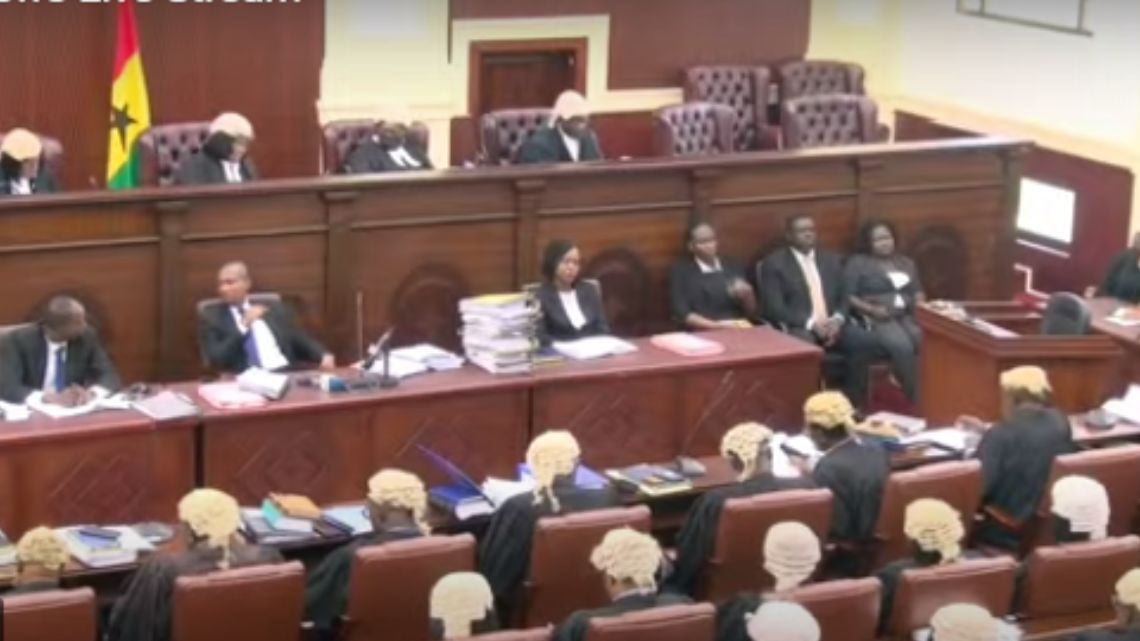
  • LIVESTREAMING: Supreme Court hears lawsuits against anti-LGBTQ bill

    LIVESTREAMING: Supreme Court hears lawsuits against anti-LGBTQ bill

    The Supreme Court has begun hearing two lawsuits filed by broadcast journalist Richard Dela Sky and Researcher Dr. Amanda Odoi, challenging the passage of the Human Sexual Rights and Family Values Bill, also known as anti-LGBTQ+ Bill by Parliament.

    These lawsuits have effectively halted the bill’s transmission from Parliament to the Presidency, where President Nana Addo Dankwah Akufo-Addo would potentially assent to it.

    The proceedings are being broadcast after the Attorney General and Minister of Justice, Godfred Yeboah Dame, requested the Chief Justice to allow live coverage of proceedings while highlighting the considerable public interest in the anti-gay bill as the rationale for the request.

    The bill, which prohibits LGBTQ activities and their promotion, advocacy, and funding, was passed by Parliament on Wednesday, February 28, 2024.

    However, President Nana Addo Dankwa Akufo-Addo has yet to assent to the bill, awaiting the Supreme Court’s ruling.

  • Akufo-Addo will not assent to anti-LGBTQI Bill – EU

    Akufo-Addo will not assent to anti-LGBTQI Bill – EU

    In his recent address to the European Parliament on April 24, 2024, Virginijus Sinkevičius, acting on behalf of High Representative/Vice-President Josep Borrell, tackled concerns surrounding Ghana’s Human Sexual Rights and Family Values Act, commonly referred to as the anti-LGBTIQ Bill.

    Recognizing Ghana as a robust democracy and a stabilizing force in the region, Mr. Sinkevičius commended the nation for its strides in human rights protection, including recent efforts towards abolishing the death penalty.

    However, he also underscored persistent challenges, particularly in safeguarding the rights of sexual minorities.

    The passage of Ghana’s anti-LGBTIQ Bill through Parliament has sparked both domestic and international apprehension.

    Currently under judicial review by the Supreme Court to assess its constitutionality, the Bill awaits presidential assent to become law.

    Mr. Sinkevičius noted that the European Union and its Member States have been closely monitoring developments surrounding the Bill since its introduction in 2021.

    Despite the Bill’s passage, Mr. Sinkevičius expressed confidence in Ghana’s commitment to human rights, citing public statements from the President and senior government officials expressing concerns about potential setbacks in human rights and financial implications.

    Highlighting Ghana’s pivotal role in regional stability and its evolving partnership with the EU, Mr. Sinkevičius emphasized the EU’s appreciation of Ghana’s dedication to shared interests, including support for a rules-based multilateral order and the abolition of the death penalty.

    The speech concluded with a reaffirmation of the EU’s partnership with Ghana, stressing mutual respect for human rights and a commitment to follow Ghana’s promising path in upholding universal values.

    Read the entire speech below;

    Ghana: Speech by High Representative/Vice-President Josep Borrell in the EP plenary on the LGBTIQ bill passed by the Ghanaian parliament

    Speech delivered by Commissioner for Environment, Oceans and Fisheries, Virginijus Sinkevičius, on behalf of High Representative/Vice-President Josep Borrell

    Check against delivery!

    President, Honourable Members,

    Ghana, a solid democracy and anchor of regional stability, has a strong record in terms of protecting human rights through its laws and through its practice. Significant steps have been taken in this area. See, for example, Ghana’s decision of last year to take steps towards abolishing death penalty.

    However, challenges remain notably in the area of the protection of sexual minorities. The recent passing in Parliament of the Human Sexual Rights and Family Values Act, more commonly referred to as the anti-LGBTIQ Bill, is an issue of concern in Ghana as it is the case in any other country on the continent and in the world. In its current form, the Bill requires close review in light of Ghana’s international and constitutional human rights commitments.

    The constitutionality of the Bill has been challenged and it is currently scrutinised by the Supreme Court.

    It is also to be noted that the Bill also still requires presidential assent to enter into force. The President has publicly reiterated his commitment to the respect of Human Rights and has expressed his concern to seeing a “backsliding” on human rights in the event of adoption of the Bill. Senior members of the Ghanaian Government have also highlighted the Bill’s potential financial consequences and losses for the 2024 budget.

    We are therefore confident that Ghana will stand firm in the commitments it has made on national and international Human Rights.

    The European Union, together with its Member States, have followed the matter closely since its introduction in 2021. Our position and concerns on the matter are well-known and regularly communicated. Ghana has a pivotal role in ensuring regional stability in an increasingly volatile region, marked by spill over of insecurity from the Sahel to the Gulf of Guinea countries.

    The European Union has succeeded in further deepening its partnership with Ghana, as it evolved from a strictly developmental partnership to a more political one that is fit to face regional political and security challenges.

    It is therefore of utmost importance that we remain close and build upon Ghana’s and EU’s already strong partnership to defend our common values.

    Closing remarks

    President, Honourable Members,

    The debate today illustrates European Union’s commitment to defend Human Rights as universal values.

    Ghana has shown strong commitment to shared interests in a rules-based multilateral order, notably in the context of the Russian aggression in Ukraine, and on values dear to the European Union, such as the abolition of the death penalty, an important milestone in Ghana’s support for Human Rights.

    Therefore, we cannot but partner in Ghana’s commitment and regional leadership and in his respect of Human Rights and continue to follow the country in this promising path.

    Thank you.

  • Bawumia’s stance on LGBTQ activities came too late – Lecturer

    Bawumia’s stance on LGBTQ activities came too late – Lecturer

    A Political Marketing Strategist at the University of Ghana Business School (UGBS), Professor Kobby Mensah, has criticized Vice President Dr. Mahamudu Bawumia for his delayed stance on the controversial anti-LGBTQ+ bill.

    Prof. Mensah suggested that Dr. Bawumia should have expressed his position earlier when the topic was more prominent, stating that by the time the Vice President made his views known, the public discourse had shifted away from the bill, and people had moved on to other issues.

    In an interview on JoyNews’ AM Show on Friday, April 12, Prof. Mensah characterized Dr. Bawumia’s intervention as belated and suggested that it may not have the intended impact due to the timing.

    He noted that many Ghanaians are now focused on different matters, no longer considering the Anti-LGBTQ+ bill as a priority. Prof. Mensah added that some individuals have even criticized Dr. Bawumia for his silence on the issue, questioning the sincerity of his stance now that the conversation has evolved.

    “Bawumia should have spoken about this issue long ago. He should have spoken when everybody’s mind was on this. Currently, his has been buried in the festivities and has been buried in the notion that of course, he has actually spoken about it as the issue is no longer at the front burner of the conversation,” he said.

    Prof. Mensah expressed the view that Dr. Bawumia’s delayed response could potentially undermine his credibility on the matter, as it may be perceived as opportunistic or insincere.

    “People have moved on. So his position has been buried and most people have the idea he hasn’t spoken about it. I wonder how many people will really get to know that he has spoken about it,” he said.

    He noted that timely and proactive engagement with such controversial topics is essential for political leaders to effectively address public concerns and maintain trust among the electorate.

    Professor Kobby Mensah’s remarks come in the wake of the New Patriotic Party (NPP) flagbearer’s declaration on Thursday, April 11, during his address to thousands of Muslims in Kumasi as they observed Eid prayers. This marked Vice President Dr. Mahamudu Bawumia’s first public commentary on the contentious issue of LGBTQ+ activities in Ghana.

    In his address, Dr. Bawumia left no room for ambiguity, firmly rejecting LGBTQ+ practices. He aligned his stance with his personal and religious beliefs rooted in Islam, as well as the social and cultural norms prevalent in Ghana.

    “I will like to take this opportunity to personally comment on the raging issue of LGBTQ in Ghana. First of all, it is important to note that our cultural and societal norms and values as Ghanaians frown on the practice of homosexuality,” Dr. Bawumia said.

    “Furthermore, as a Muslim, my view on this matter aligns with the position of my religious faith. The Holy Quran is replete with verses frowning on LGBTQ acts, including same-sex marriages. My faith is therefore very strictly against the practice of homosexuality, no “ifs” or “buts”. No shades of grey.”

    “Therefore, I personally cannot support that which my religion, and indeed, all the major religions in Ghana clearly and unequivocably forbid. All the major religious traditions in Ghana (Christianity and Islam) are opposed to this practice and I stand opposed to it now and I will stand opposed to it as President, Insha Allah.”

  • Look at causes of LGBTQ activities and stop the idea of jailing people – Brigitte Dzogbenuku

    Look at causes of LGBTQ activities and stop the idea of jailing people – Brigitte Dzogbenuku

    Presidential Candidate for the Progressive People’s Party (PPP) in the 2020 general elections, Brigitte Dzogbenuku, has expressed her opposition to laws targeting individuals who practice homosexuality.

    She believes that those who engage in LGBTQ practices do so despite facing hate and discrimination because they perceive love differently from others.

    “So, this is not when we should be thinking about jailing them for their choices; this is when we should be thinking about how we remedy that.

    “There are so many circumstances under which people become or choose to be LGBTQ, but ultimately each of them is doing it because of something they want, which will make them feel loved, have affection, or be accepted, and for some of these people, that is the only time they have felt accepted.

    “So let us not jump to the symptoms of it. Let us look at the causes”, she stressed.

    After nearly three years of deliberation, Parliament finally passed the highly contentious Anti-LGBTQ+ bill. The bill, introduced in the House years ago, was unanimously approved on Wednesday, February 28, following the completion of the third reading. It was then slated to be forwarded to President Akufo-Addo for his assent.

    Mrs. Dzogbenuku emphasized the importance of understanding the motivations behind LGBTQ relationships. She explained that each person’s experience is unique, and there are various reasons why someone might choose to engage in LGBTQ activities.

    The former presidential candidate stressed that labeling people as abnormal because they are part of the LGBTQ community is incorrect.

    “You make the choice of who you want to date or marry based on different things; what you would choose is not what I would choose, and if we actually take time to understand them and see why they made this choice and address those issues informing their choices, maybe we could be a bit more compassionate and sympathetic.”

  • When should I send anti-LGBTQ+ Bill to Akufo-Addo? – Clerk of Parliament asks Presidency

    When should I send anti-LGBTQ+ Bill to Akufo-Addo? – Clerk of Parliament asks Presidency

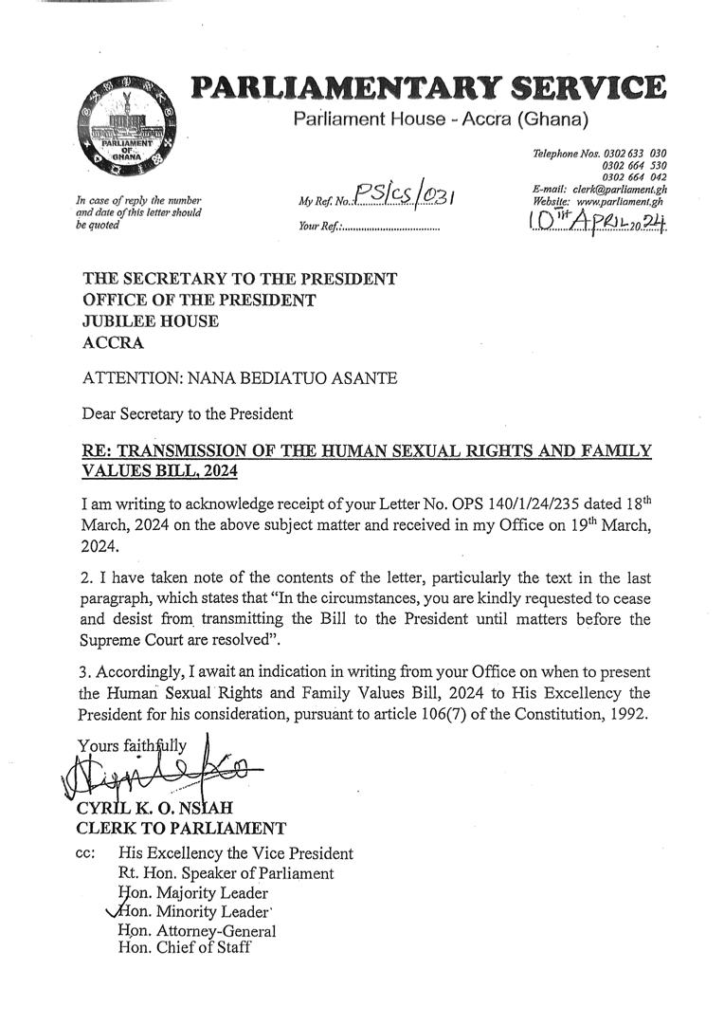
    The Clerk to Parliament, Cyril Nsiah, has contacted the Executive Secretary to the President, Nana Bediatuo Asante, seeking clarification on when to transmit the Sexual Rights and Ghanaian Family Values Bill, also known as the anti-LGBTQI+ Bill.

    This request follows a controversial letter from Mr. Bediatuo that advised Parliament not to transmit the Bill to President Akufo-Addo for his assent.

    In his letter to Mr. Bediatuo dated Wednesday, April 10, Mr. Nsiah stated his intention to transmit the Bill in accordance with Article 106(7) of the 1992 Constitution of Ghana.

    “I am writing to acknowledge receipt of your Letter No. OPS 140/1/24/235 dated 18th March, 2024 on the above subject matter and received in my Office on 19th March, 2024.”

    “I have taken note of the contents of the letter, particularly the text in the last paragraph, which states that “In the circumstances, you are kindly requested to cease and desist from transmitting the Bill to the President until matters before the Supreme Court are resolved.”

    “Accordingly, I await an indication in writing from your Office on when to present the Human Sexual Rights and Family Values Bill, 2024 to His Excellency the President for his consideration, pursuant to article 106(7) of the Constitution, 1992.”

    After the controversial letter dated March 18, 2024, in which the presidency requested parliament not to send the anti-gay bill to President Akufo-Addo for his assent due to pending applications for an order of interlocutory injunction against the bill, there was widespread condemnation of the presidency’s stance. In response, parliament suspended the vetting process for President Akufo-Addo’s newly nominated ministers.

    The letter emphasized that it would be improper for Parliament to proceed with transmitting the Bill to President Akufo-Addo for any action until the legal matters before the court are resolved. It was also revealed that the Attorney-General had advised the President against taking any action regarding the Bill until the legal issues raised in the lawsuits are addressed by the Supreme Court.

    Meanwhile, an Accra High Court has granted an application for the abridgment of time for the hearing of the case seeking to compel President Akufo-Addo to receive the Anti-LGBTQ bill from parliament. This case, filed by NDC MP Rockson-Nelson Dafeamekpor, seeks several declarations over the President’s refusal to receive the bill from Parliament.

  • I stand opposed to LGBTQ activities, we won’t accept it – Bawumia declares stance

    I stand opposed to LGBTQ activities, we won’t accept it – Bawumia declares stance

    Vice President Dr. Mahamudu Bawumia has strongly reiterated his opposition to LGBTQ+ activities in Ghana, emphasizing that the Islamic faith and other religions in the country are against such practices.

    As a devout Muslim, Dr. Bawumia made it clear that he does not support or condone LGBTQ practices.

    His statements come in response to calls from various quarters, particularly within certain Muslim communities, for him to clarify his position on the issue, especially as President Akufo-Addo has yet to sign a bill into law regarding this matter.

    Speaking at the Kumasi Central Mosque in the Ashanti Region during the Eidul-Fitr prayers, Dr. Bawumia emphasized his firm stance against LGBTQ activities, stating that such practices would not be tolerated under his leadership.

    “First of all, it is important to note that our cultural and societal norms and values as Ghanaians frown on the practice of homosexuality,” Dr. Bawumia said.

    “Furthermore, as a Muslim, my view on this matter aligns with the position of my religious faith. The Holy Quran is replete with verses frowning on LGBTQ acts, including same-sex marriages. My faith is therefore very strictly against the practice of homosexuality, no “ifs” or “buts”. No shades of grey.”

    “Therefore, I personally cannot support that which my religion, and indeed, all the major religions in Ghana clearly and unequivocably forbid. All the major religious traditions in Ghana (Christianity and Islam) are opposed to this practice and I stand opposed to it now and I will stand opposed to it as President, Insha Allah.”

    In February of this year, Parliament passed the Human Sexual Rights and Family Values Bill. This bill seeks to impose a minimum jail term of three years and a maximum of five years on individuals who engage in and promote homosexual activities in the country.

    However, the bill has not yet been signed into law by President Akufo-Addo, as it is currently facing a challenge at the Supreme Court.

  • Dumelo’s ‘gay’ movie “Men in love” resurfaces after supporting anti-LGBTQ bill

    Dumelo’s ‘gay’ movie “Men in love” resurfaces after supporting anti-LGBTQ bill

    Accusations have arisen against actor and aspiring parliamentarian John Dumelo from some X users, alleging a lack of clear convictions regarding the anti-LGBTQ bill.

    These criticisms surfaced following Dumelo’s remarks on the controversial Promotion of Proper Human Sexual Rights and Ghanaian Family Values Bill, commonly known as the “anti-gay bill”.

    During an interview with Starr FM’s Bola Ray, Dumelo stated that he aligns with the position of the National Democratic Congress (NDC) on the bill.

    He emphasized the NDC’s support for the bill, citing its aim to protect “family values” in Ghana.

    While he declined to state a personal stance, Dumelo added that he respects the privacy of individuals.

    https://twitter.com/RightifyGhana/status/1776585087745659359/video/1

    However, his recent comments have sparked backlash, with X users pointing out his past role in the movie “Men in Love,” where he portrayed a gay character.

    “He wants to be a politician but he also wants to be progressive. Tell him to choose a struggle,” a user wrote.

    X user tweets about John Dumelo stance on anti-gay bill

    The 2010 Nigerian movie “Men In Love” portrays a couple experiencing marital challenges, which are exacerbated by the arrival of a gay friend who is under a curse. John Dumelo and Muna Obiekwe played the gay roles in the film.

    After the release of “Men In Love,” Dumelo publicly denied being gay. In a 2010 interview, he clarified that the film aimed to depict homosexuality as a consequence of demonic influence.

    He told GhanaCelebrities that; “Yes I did a movie in Lagos. It was a gay movie. In that movie, I was under a spell. My best friend put me under a demonic spell. He then abused me to satisfy his gay pleasures. When you watch that movie, it actually doesn’t promote homosexuality”.

    “It regards homosexuality as an evil thing. At the end of the movie, I prayed and the demon just came out of me, then I apologised to my wife and family, so it doesn’t mean am gay. It was just to create awareness that people who are actually gay most likely are under demonic spells”, he is quoted to have continued.

    Parliament on Wednesday, February 28, passed the Promotion of Proper Human Sexual Rights and Ghanaian Family Values Bill also known as the anti-LGBTQ bill after three years following its introduction.

    The Anti-LGBTQ+ bill aims to criminalize LGBTQ+ activities in Ghana. It proposes strict penalties, including imprisonment, for individuals engaged in activities related to homosexuality and LGBTQ+ advocacy.

    Additionally, the bill seeks to prohibit the promotion of LGBTQ+ rights, organizations, and events in Ghana.

    Prior to its passage, there had been several amendments to the bill. After deliberation, Parliament decided that the minimum custodial sentence has been set at three years, with a maximum of five years for promoters and sympathisers.

    Additionally, individuals caught directly engaging in these activities will face a minimum sentence of six months, extendable to a maximum of three years.

    Some international organisations and individuals in the country have called on the government not to assent to the bill. The UN High Commissioner for Human Rights, Volker Türk, has described the passage of bill as “profoundly disturbing.”

    Currently, President Akufo-Addo has withheld his assent to the bill after one Richard Sky headed to the Supreme Court, challenging the constitutionality of the Bill.

    The President’s decision has not sat with members of the opposition National Democratic Congress.

  • Gabby Otchere Darko calls for lighter sentence for LGBTQ  members, supporters

    Gabby Otchere Darko calls for lighter sentence for LGBTQ members, supporters

    A prominent member of the New Patriotic Party (NPP), Gabby Otchere-Darko, has questioned why Ghana, seeking to protect her family values have not called for harsher sentences for individuals caught engaging and promoting child marriage but done so for LGBTQ members.

    Mr Otchere-Darko made the comment amidst investigations into a contentious marriage between a minor and Nungua’s elder, Nuumo Borketey Laweh Tsuru XXXIII, aged 63. 

    Per the Children’s Act 1998 (Act 560), an adult caught forcing a minor into marriage faces a maximum jail term of 12 months or fines of up to 5 million cedis (500 Ghana Cedis).

    In a post on the X platform, wondered why the country is seeking to impose a “stiffer” sentence on consenting adults in the LGBTQ community who decide to have an amorous relationship, or any promotion, sponsorship or support of LGBTQ activities when a situation such as child marriage which involves an adult and a minor prescribes a lighter sentence.

    In what appears to be a jab to anti-LGBTQ bill promoters including Ningo-Prampram MP, Sam George, Gabby Otchere-Darko wrote, “In Ghana, you face a maximum jail term of 12 months if you force a minor into marriage, according to Children’s Act 1998 (Act 560).”

    “Once assented, the law that seeks to presumably protect our family values (which ignores child marriage by the way) will impose a prison sentence of up to five years for the “wilful promotion, sponsorship or support of LGBTQ+ activities”. In fact two consenting adults of same sex face a stiffer sentence if they are found kissing in public than the 70-year old man who marries a 14-year old girl.”

    The Children’s Act 1998 (Act 560), amended in 2016, safeguards children’s rights against forced betrothal and marriage.

    The Constitution of Ghana also defines anyone below 18 as a child, ineligible for marriage. Sections 14 and 15 of the Children’s Act explicitly state the right of children to reject betrothal and marriage, setting the legal marriage age at 18.

    The recent alleged marriage has ignited a fierce debate, with many condemning the act on social media and demanding the arrest of the Ga-Dangme States’ Overlord. Despite the uproar, some authorities have defended the marriage, citing cultural practices.

    Presently, the Supreme Court is set to hear the unconstitutional claims levelled against the anti-LGBTQ bill which has been approved by Parliament but yet to receive a presidential assent by Nana Akufo-Addo.

  • Akufo-Addo cannot sign anti-gay bill because he doesn’t have the holy spirit in him – Rev.Dr Samuel Mensah

    Akufo-Addo cannot sign anti-gay bill because he doesn’t have the holy spirit in him – Rev.Dr Samuel Mensah

    A pastor at Full Gospel Church International, Rev. Dr. Samuel Mensah, has asserted that President Akufo-Addo’s reluctance to sign the Proper Human Rights Family Value Bill, commonly known as the anti-LGBTQ bill, indicates a lack of the Holy Spirit within him.

    In a widely circulated video, the pastor emphasized the importance of having a leader filled with the Holy Spirit, arguing that such a leader would unequivocally support legislation against LGBTQ activities.

    He challenged the notion that mere attendance at church services equates to true faith, urging individuals to demonstrate their beliefs through actions. Rev. Mensah also criticized the Akufo-Addo-led administration, alleging widespread corruption and moral decay within the government.

    He called upon President Akufo-Addo to embody the principles of his faith and enact positive change in the country.

    “If we have a holy spirit filled president, he will sign the LGBTQ into law. He can’t come and deceive us that I go to church, if you really go to church and you believe it, show it. If you claim you belong to one of the traditional  churches, show it.

    “Let your faith speak for you. If the fish rots it rots from the head. Right from the Jubilee House and everywhere there’s rottenness yet they said they are christians. Take your faith to where you belong to and let your faith change the environment,” he said.


    On Wednesday, February 28, 2024, Parliament approved the anti-LGBTQ bill, set to criminalize activities related to lesbian, gay, bisexual, and transgender (LGBT) individuals, as well as their promotion, advocacy, and funding within Ghana.

    President Akufo-Addo has clarified that the anti-LGBTQI bill has not yet reached his desk for approval. Despite concerns raised in diplomatic circles, he assured that Parliament’s bipartisan approval of the bill will not compromise Ghana’s human rights record.

    Addressing anxieties surrounding any potential shift in Ghana’s stance on human rights and the rule of law, President Akufo-Addo emphasized his commitment to upholding these principles.

    While refraining from discussing the bill’s origin or its pending status, he acknowledged a constitutional challenge filed at the Supreme Court regarding the proposed legislation. The President urged patience, suggesting that everyone await the court’s decision before taking any further action.

    Watch video below:

  • Religion is the reason people hate us – Wanlov the Kubolor on LGBTQ matters

    Religion is the reason people hate us – Wanlov the Kubolor on LGBTQ matters

    Wanlov the Kubolor, a musician and advocate for gay rights, attributes the surge in hostility towards LGBT+ individuals in Ghana to colonialism, religion, and poverty.

    During a recent interview with Graphic Online TV, Wanlov asserted that before the era of colonialism, LGBT+ individuals lived harmoniously within societies.

    He elaborated that the escalation of animosity towards the LGBT+ community in Ghana coincided with a lack of access to fundamental resources and societal necessities among citizens.

    According to Wanlov, this deprivation, combined with religious doctrines, fostered an environment conducive to homophobia.

    “When I look at the fact that there were no stringent laws, harsh punishments, or anything out there, that is the pre-colonial era, against homosexuality or queer life, I feel like people just coexisted.

    “What has happened now to us as Ghanaians is that we have been taken to this level of poverty right now. And each of us feels very neglected by the state.

    “Each of us feels very neglected by the places we work. We feel like everybody is trying to take advantage, underpay us, and so on. So the average Ghanaian is not getting all the rights guaranteed by the constitution. We don’t live with the kind of dignity we are supposed to.

    “Then this average Ghanaian is being taught by Christianity, by Islam, and by colonial traditional religion that homosexuality is a sin.

    “So when the queer community that is extra oppressed because of this homophobia steps up to say, ‘Okay, can you at least treat us like the average Ghanaian?’ The homophobic community of Ghana is like, ‘How dare you? You are a sinner. You are less of a person than me because I am a better person. How dare you ask for rights when this state I live in doesn’t guarantee me or doesn’t give me the rights that I deserve, even if I am being a good person.’ So I feel that that indignation is at play,” he said.

    Wanlov the Kubolor’s remarks contribute to the ongoing discourse concerning the Anti-LGBT+ Bill and its implications for human rights in Ghana.

    About the bill

    According to the Anti-LGBT+ Bill, individuals engaged in LGBT+ activities could face imprisonment ranging from six months to three years, while those promoting or sponsoring such activities could be sentenced to three to five years in jail.

    President Akufo-Addo has postponed his determination on signing the Bill into law, citing a constitutional challenge in the Supreme Court.

    However, even if he opts against it, Members of Parliament hold the authority to override the president’s decision with a two-thirds majority vote, thereby making the Bill’s provisions legally binding.

  • “It was a painful experience” – Man recounts first sexual encounter with Gay Biology teacher at age 16

    “It was a painful experience” – Man recounts first sexual encounter with Gay Biology teacher at age 16

    A 25-year-old man has shared how his male biology teacher back at Senior High School (SHS) allegedly initiated him into homosexuality.

    In an interview on Onua FM, Kofi (not his real name) disclosed that he was the teacher’s favorite student as he performed well in class, hence preferential treatments did not cause him to be alarmed.

    “I was a very intelligent student, so he became fond of me, the same as some other teachers. He often sends me to get something for him, or he asks that I escort him to places. He also sometimes supports me financially.”

    But the advances became clear when he was in his final year at age 16, when he had to reside on campus despite being a day student.

    Per his account, one night, he was invited by his teacher for dinner, a gesture he believed was the kindness of his tutor. Apparently, that day was when his teacher made a pass on him and eventually had sexual intercourse with him.

    He narrated, “After we were done eating, I told him I had to go home and prepare because I would be returning for preps. He told me there was no need for me to go home and return to school, as I could shower at his place and even have my prep time in his bungalow, after which I could return home. So, I went to his bathroom to take my bath, and while there, he joined me naked. Because he was my teacher, I sought to cover myself because I was shy around him, but he told me not to worry,” he stated.

    According to Kofi, his teacher sought his consent but could not tell how he gave in to his request as he was shell-shocked.

    “… At that instant, he began to fondle my penis. At that instance, it did not occur to me that he was gay and he could have sex with me. All of a sudden, he held my penis into his mouth and was licking it. He asked me if I could have sex with him. I stood quiet for a long time because I didn’t know what to say, and then it happened. It was a painful experience, but he was my teacher, and he helped me sometimes, so whatever he said, I did,” he added.

    Per the man’s narration, he was not defiled.

    The Criminal Offences Act, 1960 defines defilement in Section 101(2) of Act 29 as natural or unnatural carnal knowledge of a child under sixteen years of age with or without the child’s consent. 

    But this revelation comes at a time when Ghana is close to criminalising the activities of the LGBTQ+ community.

  • Prioritise reforms for homosexuals, do away with punishment – Ekow Assafuah tells Parliament

    Prioritise reforms for homosexuals, do away with punishment – Ekow Assafuah tells Parliament

    Deputy Minister-designate for the Ministry of Local Government, Decentralisation and Rural Development, Vincent Ekow Assafuah, has urged Parliament to focus more on the reformation process of homosexuals rather than solely on punishment.

    He emphasized that it is Parliament’s responsibility to ensure the reformation and integration of homosexuals back into society. While expressing support for the passage of the anti-LGBTQ+ bill, he stated that simply ostracising homosexuals from society is not the solution.

    Speaking during his vetting by Parliament’s Appointments Committee in Accra on Monday, March 11, 2024, Mr. Assafuah mentioned that his Catholic background aligns with the bill, and he pledged his support for it.

    “In principle, the LGBTQ bill that has been passed or approved by Parliament is one that I support wholeheartedly because it is in consonance with my tradition and culture. It is in consonance with my formation as a catholic person or practising catholic,” he stated. 

    The anti-LGBTQ bill, which prohibits lesbian, gay, bisexual, and transgender (LGBT) activities and criminalizes their promotion, advocacy, and funding, was unanimously passed by Parliament on Wednesday, February 28, 2024, after three years since its introduction.

    If assented to by the President, the bill will impose sanctions on those promoting or engaging in LGBTQ activities in the country. It prescribes a minimum sentence of six months and a maximum of three years for individuals caught in same-sex activities. Additionally, those found guilty of promoting, advocating, or funding LGBTQ activities could face a minimum of three years and a maximum of five years imprisonment.

    Despite supporting the bill, Mr. Assafuah expressed opposition to the punishment prescribed for individuals who violate the anti-LGBTQ law.

    “There are reasons for punishment to be meted out to people. There is a principle behind punishment and one of the principles is to ensure that a person is being reformed out of a criminal activity. And so, if we have to reform persons, do we have to mete out punishment that seems to ostracise the person from society? It seems that as a society, we are bringing out our failures in the sense that we are showing our inability or incapacity to be able to reform people or if you like put people through sessions that reintroduce such persons into society. If we are not able to do so. That is where I see the failure,” he explained. 

    “It seems we are throwing our hands in despair. I am making a strong point that as a Parliament, we should be very interested in reforming our people. That is our responsibility as a people. We cannot say that there is a supposed anticipation of gay persons being lynched if they are given community service and so because of that as the people’s representatives we are throwing our hands in despair to allow such persons just to go astray.

    “That cannot be our course. Let’s have a proper forum, let’s have proper engagements to see how best we can deal with such persons. It is our responsibility to do so,” Mr Assafuah stated.

  • Why I choose not to comment on LGBTQ+ issues- Celestine Donkor

    Why I choose not to comment on LGBTQ+ issues- Celestine Donkor

    Renowned gospel artiste Celestine Donkor has recently revealed her decision to refrain from commenting on LGBTQ rights in Ghana, citing previous negative feedback as the reason behind her silence.

    In a recent interview, the acclaimed singer-songwriter expressed her desire to speak out on political and LGBTQ-related issues.

    However, she expressed concerns about potential backlash if her opinions do not align with societal expectations.

    Mrs. Donkor emphasised the challenges musicians face when sharing their opinions on sensitive topics, stating, “As you have decided to share your opinion on issues of politics or LGBTQ, before you realise, some people will say you’re a musician, so you have to shut up and focus on your music career.”

    To avoid potential trouble, she explained that musicians are now prioritizing their craft to entertain their fans.

    “By the grace of God, we are focusing our attention solely on the music that we are doing for now,” she concluded.

    Celestine Donkor is a Ghanaian gospel musician and songwriter.

    In March 2021, she was among the Top 30 Most Influential Women in Music by the 3Music Awards Women’s Brunch. She founded the Celestial Praise, an annual Gospel music concert. 

  • AntiLGBTQ+ bill: We are focusing on trivial issues; corruption is more concerning – Okyeame Kwame

    AntiLGBTQ+ bill: We are focusing on trivial issues; corruption is more concerning – Okyeame Kwame

    Renowned rapper Kwame Nsiah-Apau known popularly as Okyeame Kwame has voiced his concerns about the misplaced priorities of Ghanaian and African politicians, emphasizing the need to redirect their focus from LGBTQ issues to combating corruption.

    According to the ‘Ye Ko’ hitmaker, corruption has entrenched itself as an unofficial citizen in every African country and addressing this pervasive problem should take precedence for the continent’s development.

    In his statement, Okyeame Kwame stressed that Ghana could achieve essential progress and self-sufficiency if all efforts were consolidated in the fight against corruption.

    “If I were in charge, I would rather focus on corruption, I would rather focus on educational reforms,” Okyeame Kwame stated.

    He expressed a desire for political leaders to concentrate on issues such as corruption and educational reforms rather than getting entangled in debates over LGBTQ matters.

    Highlighting the importance of education, Okyeame Kwame drew attention to the success of STEM (Science, Technology, Engineering, and Mathematics) introduced by the Western world.

    He advocated for a shift in perspective, encouraging the adoption of STEAM, where the arts are taken seriously, fostering creativity that is often overlooked in African education systems.

    In a candid remark, the rapper remarked, “For me, LGBTQ is not my problem. My concern lies with the BJ in there. If I say I’m a member, they may come and arrest me. Between corruption and LGBTQ, which one is very pressing?”

    Okyeame Kwame’s stance underscores the urgency of addressing corruption as a fundamental issue for the socio-economic advancement of the continent.

  • List of African countries that are against LGBTQ activities

    List of African countries that are against LGBTQ activities

    Ghana’s recent passage of the anti-LGBTQ+ bill has sparked global attention and concern.

    The legislation, officially known as the “Human Sexual Rights and Family Values Bill, 2024,” has elicited widespread condemnation both within and beyond Ghana’s borders.

    Across the African continent, a number of countries maintain laws criminalizing various aspects of LGBTQ activities.

    These regulations encompass the criminalization of LGBT individuals, sexual activities between individuals of the same gender, and, in some instances, the gender expression of trans people.

    This list outlines the legal frameworks and penalties imposed by different nations, reflecting the diverse and, restrictive attitudes towards LGBTQ communities in Africa.

    1. Algeria
      • Illegalises LGBT persons and any form of sexual relations between males and females
      • Highest punishment: Three years imprisonment and a fine of 10,000 Dinars
    2. Burundi
      • Illegalises LGBT persons and any form of sexual relations between males and females
      • Highest punishment: Two years imprisonment and a fine of 100,000 Burundian Francs
    3. Cameroon
      • Illegalises LGBT persons and any form of sexual relations between males and females
      • Highest punishment: Five years imprisonment and a fine of 200,000 West African CFA Francs
    4. Chad
      • Illegalises LGBT persons and any form of sexual relations between males and females
      • Highest punishment: Two years imprisonment and a fine of 500,000 West African CFA Francs
    5. Comoros
      • Illegalises LGBT persons and any form of sexual relations between males and females
      • Highest punishment: Five years imprisonment and a fine of 1,000,000 Comorian Francs
    6. Egypt
      • Illegalises LGBT persons and any form of sexual relations between males
      • Highest punishment: Three years imprisonment and a fine of 3,000 Lira
    7. Eritrea
      • Illegalises LGBT persons and any form of sexual relations between males and females
      • Highest punishment: Three years imprisonment
    8. Eswatini
      • Illegalises LGBT persons and any form of sexual relations between males
      • Highest punishment: Imprisonment
    9. Ethiopia
      • Illegalises LGBT persons and any form of sexual relations between males and females
      • Highest punishment: One year imprisonment
    10. Gambia
      • Outlaws same-sex relations, unnatural/indecent acts
      • Sentence: Fourteen years to life in prison
    11. Ghana
      • Illegalises LGBT persons and activities, and any form of sexual relations between males
      • Highest punishment: Up to 3 years in prison
    12. Guinea
      • Illegalises LGBT persons and any form of sexual relations between males and females
      • Highest punishment: Three years imprisonment and a fine of 1,000,000 Guinean Francs
    13. Kenya
      • Illegalises LGBT persons and any form of sexual relations between males
      • Highest punishment: Fourteen years imprisonment
    14. Liberia
      • Illegalises LGBT persons and any form of sexual relations between males and females
      • Highest punishment: One year imprisonment
    15. Libya
      • Illegalises LGBT persons and any form of sexual relations between males and females
      • Highest punishment: Five years imprisonment
    16. Malawi
      • Illegalises LGBT persons and any form of sexual relations between males and females, gender expression of trans people
      • Highest punishment: Fourteen years imprisonment with corporal punishment
    17. Mauritania
      • Illegalises LGBT persons and any form of sexual relations between males and females
      • Imposes the death penalty
      • Highest punishment: Death by stoning
    18. Morocco
      • Illegalises LGBT persons and any form of sexual relations between males and females
      • Highest punishment: Three years imprisonment and a fine of 1,000 Dirhams
    19. Namibia
      • Illegalises LGBT persons and any form of sexual relations between males
      • Highest punishment: Unclear
    20. Nigeria
      • Illegalises LGBT persons and any form of sexual relations between males and females, gender expression of trans people
      • Imposes the death penalty
      • Highest punishment: Death by stoning
    21. Senegal
      • Illegalises LGBT persons and any form of sexual relations between males and females
      • Highest punishment: Five years imprisonment and a fine of 1,500,000 West African CFA Francs
    22. Sierra Leone
      • Illegalises LGBT persons and any form of sexual relations between males
      • Highest punishment: Life imprisonment
    23. Somalia
      • Illegalises LGBT persons and any form of sexual relations between males and females
      • Highest punishment: Death penalty
    24. South Sudan
      • Illegalises LGBT persons and any form of sexual relations between males, gender expression of trans people
      • Highest punishment: Fourteen years imprisonment and a fine
    25. Sudan
      • Illegalises LGBT persons and any form of sexual relations between males and females
      • Highest punishment: Life imprisonment
    26. Tanzania
      • Illegalises LGBT persons and any form of sexual relations between males and females
      • Highest punishment: Life imprisonment
    27. The Gambia
      • Illegalises LGBT persons and any form of sexual relations between males and females, gender expression of trans people
      • Highest punishment: Life imprisonment
    28. Togo
      • Illegalises LGBT persons and any form of sexual relations between males and females
      • Highest punishment: Three years imprisonment and a fine of 500,000 West African CFA Francs
    29. Tunisia
      • Illegalises LGBT persons and any form of sexual relations between males and females
      • Highest punishment: Three years imprisonment
    30. Uganda
      • Illegalises LGBT persons and any form of sexual relations between males and females
      • Highest punishment: Life imprisonment or the death penalty
    31. Zambia
      • Illegalises LGBT persons and any form of sexual relations between males and females
      • Highest punishment: Life imprisonment
    32. Zimbabwe
      • Illegalises LGBT persons and any form of sexual relations between males
      • Highest punishment: One year imprisonment and a fine
  • Journalist drags Parliament to Supreme Court over Anti-LGBTQ+ bill

    Journalist drags Parliament to Supreme Court over Anti-LGBTQ+ bill

    Journalist Richard Dela Sky has taken Parliament to the Supreme Court over the passage of the Proper Human Sexual Rights and Ghanaian Family Values Bill also known as the anti-LGBTQ bill.

    This controversial legislation was passed unanimously by lawmakers on February 28, 2024, after years of deliberation.

    There is mounting pressure on President Akufo-Addo from Members of Parliament to sign the bill into law. However, the President has stated that he will withhold his assent until the court issues a ruling on the case.

    Under the bill, individuals promoting or sponsoring LGBTQ activities could face three to five years in jail, while those caught engaging in such acts could be sentenced to a minimum of 6 months and a maximum of 3 years.

    The reliefs sought by the journalist include an order restraining President Akufo-Addo from assenting to the bill and also preventing the “Speaker of Parliament and the Clerk to Parliament from presenting ‘The Human and Sexual Values Bill, 2024’ to the President of the Republic for his assent.”

    The plaintiff in the lawsuit against the Anti-LGBTQ+ bill argues that certain portions of the legislation are in conflict with the principles of the 1992 Constitution, and thus should be declared null and void.

    The lawsuit, filed on March 5, 2024, also contends that certain sections of the bill impose a financial burden on the Consolidated Fund or other public funds of Ghana.

    On the other hand, the bill’s proponents, including Member of Parliament for Ningo-Prampram, Sam George, maintain that no part of the bill violates the provisions of the 1992 constitution. Speaking to the media on March 2, Sam George noted that critics of the bill who claim it contradicts the constitution have not specified the exact sections they believe are problematic.

    “This is a social issue and so Parliament is within the same Article 17.4 exercising its right that the constitution has conferred on us to deal with the social issue. It says for the matters relating to adoption, which is in this bill, marriage is in this bill, divorce, burial, and the evolution of property. But clearly, parliament has not acted ultra vires the constitution,” he said.

    The Finance Ministry is expressing concerns about the potential implications if President Akufo-Addo decides to assent to the recently passed bill.

    The Ministry outlined the negative implications of the document on its expenditure, key government plans, and projects. It urged President Akufo-Addo to hold off on signing the bill into law as it may cost the country greatly. These risks include a potential loss of $850 million in budgetary support from the World Bank this year alone.

    In the 5-page document, the Ministry explained that “for 2024 Ghana will lose US$600 million Budget support and US$250 million for the Financial Stability Fund.”

    “This will negatively impact Ghana’s foreign exchange reserves and exchange rate stability as these inflows are expected to shore the country’s reserve position.

    Over the next six years, the Ministry explained that “Ghana is likely to lose US$3.8 billion in World Bank Financing.”

    Some Members of Parliament are furious over the Finance Ministry’s advice to President Akufo-Addo. For instance, MP for Sagnarigu, Alhassan Bashir Alhassan Fuseini, has urged Ghanaians to take action in support of the anti-LGBTQ+ bill. The MP stated that the proposed legislation is crucial to upholding the country’s cultural values and independence from external influence.

  • ‘Donkomi’: Ghana is now worth “cheap” $3bn because of anti-LGBTQ bill – NDC slams Finance Ministry

    ‘Donkomi’: Ghana is now worth “cheap” $3bn because of anti-LGBTQ bill – NDC slams Finance Ministry

    Deputy Communications Officer for the National Democratic Congress (NDC), Malik Basintale, has challenged the Finance Minister to identify the specific clause in Ghana’s agreement with the International Monetary Fund (IMF) that states passing the anti-gay law would result in a termination of the agreement.

    In response to a letter from Ghana’s Finance Ministry to the President, advising against signing the bill into law due to potential implications such as hindering aid access, Basintale stated on TV3 that he has thoroughly reviewed the agreement but found no provision that would lead to the termination of the agreement with the IMF.

    “I’ve read this document over twenty times and I haven’t seen a single legal basis as to why Alhaji Amin Antah, MP for Karaga, will think that it is wrong for the president to sign a bill that stops man and man from marrying. There is no condition, there is no termination clause stated in this agreement that has got anything to do with LGBTQI. The basis that will lead to the termination of this agreement has got absolutely nothing to do with the passage of a law criminalizing LGBTQI.”

    He believes that if the country’s cultural practices can be shelved because of some dollars to be donated to the country, Ghana should be sold to its highest bidder.

    “So I ask Alhaji Amin Antah, who has suddenly developed a love for LGBTQI and thinks that criminalizing them will lead us to not getting 3 billion loan. Paltry, last year 2022, the Auditor General’s report brought out infractions in public sector to a tune of 1.2 billion that is greater than 700 million per year Amin Antah thinks we should not set aside. If because of a paltry 3 billion loan this government thinks LGBTQI+ be practised in this country, it is time we sold this country to someone who will buy the country for cheap,” he said.

    Meanwhile, President Akufo-Addo has reaffirmed Ghana’s dedication to upholding human rights, despite the recent passage of the Proper Human Sexual Rights and Ghanaian Family Values Bill, also known as the Anti-LGBTQ+ Bill.

    Speaking at a diplomatic event, he stressed that Ghana maintains its reputation for respecting human rights and following the rule of law.

    The President clarified that the Bill is currently being challenged in the Supreme Court, and until a verdict is reached, his government will not enforce any provisions of the private Member’s bill.

    In a circular shared by Director of communications at the office of the President, Eugene Arhin, the President said, “l am aware that last week’s bi-partisan passage by Parliament of the Proper Human Sexual Rights and Ghanaian Family Values Bill, on a Private Member’s motion, has raised considerable anxieties in certain quarters of the diplomatic community and amongst some friends of Ghana that she may be turning her back on her, hitherto, enviable, longstanding record on human rights observance and attachment to the rule of law. I want to assure you that no such back-sliding will be contemplated or occasioned.”

    President Akufo-Addo clarified that the Anti-LGBTQ+ Bill has not yet been presented to him for formal action. He stated that any decision he takes regarding the Bill will depend on the outcome of the lawsuit challenging it in the Supreme Court.

    “I think it will serve little purpose to go, at this stage, into the details of the origin of this proposed law, which is yet to reach my desk. But, suffice it to say, that I have learnt that, today, a challenge has been mounted at the Supreme Court by a concerned citizen to the constitutionality of the proposed legislation,” the President added.

  • LGBTQ not part of Ghana’s IMF agreement – Prof. John Gatsi

    LGBTQ not part of Ghana’s IMF agreement – Prof. John Gatsi

    Economics professor and dean of the University of Cape Coast Business School, Professor John Gatsi, has contended that LGBTQ issues were not a stipulation for Ghana when seeking the International Monetary Fund’s (IMF) external credit facility support.

    In response to the IMF’s comments on the anti-LGBTQ+ bill, Gatsi sees these remarks as merely reflecting the organization’s interests.

    Despite the IMF emphasizing diversity and inclusion, Professor Gatsi believes Ghana’s finance ministry is being used to pressure support for the bill’s non-signing.

    He highlighted that during negotiations with the IMF, LGBTQ concerns were not part of the conditions.

    Mr Gatsi stressed that Ghana’s financial dealings involve repayable loans, with parliamentary approval being the primary condition, which has already been met.

    The finance ministry’s report to President Akufo-Addo warned of potential financial losses, estimating over US$3.8 billion from World Bank financing.

    Areas at risk include ongoing projects and negotiations, such as the First and Second Ghana Resilient Recovery Development Policy Operation and the Ghana Financial Stability Fund.

    Additionally, the ministry fears consequences for Ghana’s financial position, which heavily relies on IMF support following debt restructuring and access to foreign exchange.

    As Ghana awaits the review and approval of the third tranche from the IMF, uncertainties persist regarding the impact of the anti-LGBTQ+ bill on these financial arrangements.

    “Diversity and inclusion are values that the IMF embraces,” the Fund emphasised.

  • Ghana won’t compromise human rights legacy – Akufo-Addo

    Ghana won’t compromise human rights legacy – Akufo-Addo

    President Akufo-Addo has reassured the diplomatic community that the anti-LGBTQI bill, recently passed by Parliament, will not compromise the country’s strong human rights track record.

    The President stated that no such regression in human rights will be considered or allowed.

    In a message to the diplomatic community on Monday, March 4, President Akufo-Addo clarified that the bill has not yet reached his desk for approval.

    He acknowledged concerns raised by the international community and friends of Ghana but emphasized that no backsliding on human rights principles would occur.

    President Akufo-Addo urged patience, mentioning that a concerned citizen has challenged the constitutionality of the proposed legislation at the Supreme Court.

    He emphasized the importance of awaiting the court’s decision before taking any action.

    “I am aware that last week’s bi-partisan passage by Parliament of the Proper Human Sexual Rights and Ghanaian Family Values Bill, on a Private Member’s motion, has raised considerable anxieties in certain quarters of the diplomatic community and amongst some friends of Ghana that she may be turning her back on her, hitherto, enviable, longstanding record on human rights observance and attachment to the rule of law. I want to assure you that no such back-sliding will be contemplated or occasioned.

    “I think it will serve little purpose to go, at this stage, into the details of the origin of this proposed law, which is yet to reach my desk. But, suffice it to say, that I have learnt that, today, a challenge has been mounted at the Supreme Court by a concerned citizen to the constitutionality of the proposed legislation.

    “In the circumstances, it would be, as well, for all of us to hold our hands, and await the decision of the Court before any action is taken. The operation of the institutions of the Ghanaian state will determine the future trajectory of the rule of law and human rights compliance in our country,” President Akufo-Addo said.

    Parliament passed the Proper Human Sexual Rights and Ghanaian Family Values Bill on February 28, commonly known as the anti-gay Bill, sparking various reactions, including concerns from the diplomatic community.

    The Ministry of Finance, in a brief on March 4, highlighted dire implications of assenting to the bill.

  • Bridget Otoo’s husband ‘shames’ Prof Gadzekpo over “LGBTQ among Ga people” comment

    Bridget Otoo’s husband ‘shames’ Prof Gadzekpo over “LGBTQ among Ga people” comment

    Husband of prominent Ghanaian broadcaster Bridget Otoo, Dr. Evans Ago Tetteh, has dismissed claims made by the Board Chair of the Ghana Center for Democratic Development (CDD-Ghana), Professor Audrey Gadzekpo.

    Professor Audrey Gadzekpo had claimed that various Ghanaian cultures, including Ga and Nzema, historically incorporate homosexual practices.

    However, she did not specify the particular rituals or ceremonies within these cultures where such practices purportedly took place, leaving room for skepticism regarding the alleged integration into their cultural heritage.

    “The whole argument Mr Sam George advances, and it seems very logical that if you go into our history, because Kojo Besia is a coinage, it doesn’t mean that we practice it; look, I have heard people who were against the bill but have admitted that when you look into some of our cultural practices, there are homosexual practices. It didn’t come from the West,” she stated.

    “Which one? Well, I was in a training, and somebody told us that when you look in… there are practices in Ga culture, there are practices in Nzema culture, for example, that sociologists have documented,” she stated.

    Addressing the matter on the X platform, Dr. Evans Ago Tetteh emphasized that while the Gas have coexisted with queer individuals in their communities for centuries due to their inclusive nature, it does not imply that such practices are inherent in their cultural traditions.

    He asserted that there is no evidence of any homosexual practices within Ga culture, despite the belief among the Ga people that God embodies both masculine and feminine qualities.

    He cautioned Professor Audrey Gadzekpo against making baseless allegations without proper substantiation.

    “Ma’am there’s no single homosexual practice in Ga culture even though we believe God is both a man and a woman. Stop misleading people. Gas have lived with queer people in our societies for centuries because we are accomodative but doesn’t mean it’s imbibed in our culture,” he wrote.

  • Sam George recounts details of his life as a young boy who grew up in Nigeria

    Sam George recounts details of his life as a young boy who grew up in Nigeria

    A proponent of the LGBTQ bill, Sam George, has recalled the warm reception he received while growing up in Nigeria.

    According to him, while schooling at Command Day Secondary School in Osun, Nigeria, he could go to school and get home alone without his parents being worried about his safety.

    “Growing up in Nigeria, I could walk to my neighbors house and have a meal with them. My parents weren’t scared when I attended Command Day Secondary School in Osugun at Nafri Barack knew I was going to school and come back, they weren’t  afraid their son was going to get killed by a child who has been affected mentally because he is transgendered,” he sated.  

    He disclosed this in an interview with the Nigeria-based television station News Central TV.

    He added that the serene environment he enjoyed while in Nigeria is the same being exhibited in Ghana as children go to school and return safely.

    This, Sam George said, has left parents focused on their day-to-day activities because they can vouch for the safety of their wards during and after the close of school.

    “In Ghana today, children go to school and play on their way back home and their parents are safe, their parents are able to contribute to Ghana’s Economic Development because they know their children are safe,” he added.

    Sam George shared this information while discussing the effects of LGBTQ on countries. He stated that not opposing LGBTQ activities could be detrimental to the lives of innocent children living in the country.

    He cited a recent incident that happened in the United States (US) where a young man massacred 22 kids. “In Ghana today, children go to school and play on their way back home and their parents are safe, their parents are able to contribute to Ghana’s Economic Development because they know their children are safe,” he added.

    Sam George shared this information while discussing the effects of LGBTQ on countries. He stated that not opposing LGBTQ activities could be detrimental to the lives of innocent children living in the country.

    He cited a recent incident that happened in the United States (US) where a young man massacred 22 kids.

    Sam George alleged that the individual’s action was fueled by a mental disorder he was battling with after he underwent gender transition. To him, African leaders must stand tall and prohibit the dire consequences LGBTQ activities will bring to the country.

    Parliament on Wednesday, the February 28 2024, passed the Proper Human Sexual Rights and Ghanaian Family Values, also known as the anti-LGBTQ bill. 

    The legislation prohibits lesbian, gay, bisexual, and transgender (LGBT) activities and criminalizes their promotion, advocacy, and funding in the country.

    The bill awaits approval from President Akufo-Addo for implementation.

    The United States of America (USA) has warned that Ghana’s public health, media, civic spaces, and economy could be affected should the bill be endorsed.

    In a statement, US State Department Spokesperson Matthew Miller stated that the legislation threatens Ghana’s tradition of tolerance, peace, and respect for human rights. 

    Mr. Miller has called for a review of the bill to safeguard the rights of all individuals in Ghana, citing its inconsistency with the country’s values.

  • Anti-LGBTQ+ bill: “Africans are not puppets and stooges of the West” – Sam George

    Anti-LGBTQ+ bill: “Africans are not puppets and stooges of the West” – Sam George

    Member of Parliament for Ningo-Prampram, Sam Nartey George, has stated that Africans are not individuals who can be manipulated by the West for selfish interests. 

    In an interview with Nigeria-based television station News Central TV, he indicated that it’s long overdue for African countries to object to the rule and intimidation from the West.

     “Ghana is a fertile ground for business; Africa must begin to assert our rights. We are not puppets and stooges of the West,” he added.

     His comments come after parliament, on Wednesday, the February 28 2024, passed the Proper Human Sexual Rights and Ghanaian Family Values, also known as the anti-LGBTQ bill. 

    The legislation prohibits lesbian, gay, bisexual, and transgender (LGBT) activities and criminalizes their promotion, advocacy, and funding in the country.

    The bill awaits approval from President Akufo-Addo for implementation.

    The United States of America (USA) has warned that Ghana’s public health, media, civic spaces, and economy could be affected should the bill be endorsed.

    In a statement, US State Department Spokesperson Matthew Miller stated that the legislation threatens Ghana’s tradition of tolerance, peace, and respect for human rights. 

    Mr. Miller has called for a review of the bill to safeguard the rights of all individuals in Ghana, citing its inconsistency with the country’s values.

     However, Sam George, who is also the proponent of the LGBTQ bill, has indicated that President Akufo-Addo must be confident enough to assent to the bill as Ghana stands to lose. 

    He emphasized that American businesses operate in Ghana to make profits and not because of LGBTQ-related agendas.

    According to him, no American business owners in Ghana will cease operations if they are making huge profits just to oppose the country’s cultural values.

    He added that whoever will not be comfortable with what the country supports can suspend their businesses, as those willing to will come and occupy their spaces.

    “Well Ghana is a proud African Nation, first country in sub saharan Africa to gain independence and lead a light for the rest of Africa. I expect the leaders of our country, the president of our country to stand shoulder high and tell the American people you either do business on our terms or you can walk. 

    “American businesses that operate in Ghana are not here because of LGBTQ, they are here because they make a profit. If you are an American business working in Ghana and you turn 100 million dollars in profit every year, if you think that because we are protecting our cultural values and say no to LGBTQ you want to lose a 100 million dollars in profit, pack up and go another company to come to Ghana and do business, he added.


  • There are some homosexual practices in Ga and Nzema cultures – Prof Gadzekpo alleges

    There are some homosexual practices in Ga and Nzema cultures – Prof Gadzekpo alleges

    Professor Audrey Gadzekpo, the Board Chair of the Ghana Center for Democratic Development (CDD-Ghana), has challenged the common belief that Ghanaian values and norms universally condemn LGBT+ activities.

    During an appearance on Joy Newsfile on Saturday, March 2, 2024, Prof. Gadzekpo pointed out that there is evidence of such activities existing in some local cultures.

    She specifically mentioned that Ghanaian cultures, including Ga and Nzema, have historically included homosexual practices.

    “The whole argument Mr Sam George advances, and it seems very logical that if you go into our history, because Kojo Besia is a coinage, it doesn’t mean that we practice it; look, I have heard people who were against the bill but have admitted that when you look into some of our cultural practices, there are homosexual practices. It didn’t come from the West,” she stated.

    When asked about specific Ghanaian cultures that exhibit traits of homosexual practices, Professor Gadzekpo pointed to the Ga and Nzema peoples.

    “Which one? Well, I was in a training, and somebody told us that when you look in… there are practices in Ga culture, there are practices in Nzema culture, for example, that sociologists have documented,” she stated.

    She did not indicate the exact rite that saw such homosexual practices, which she claims were or are being practiced.

    The Human Rights and Family Values Bill, also known as the Anti-Gay Bill, has been endorsed by the Parliament of Ghana and is pending presidential approval to be enacted into law. However, Professor Gadzekpo contends that the legislation, which criminalizes same-sex activities, violates the fundamental human rights guaranteed by the Ghanaian Constitution.

    She has therefore stated that the CDD will seek to challenge the bill’s legality at the Supreme Court if it is enacted into law.

    As it stands now, Parliament has tabled the bill at the President’s desk for President Akufo-Addo to assent to the bill to become law.

    The Anti-LGBTQ+ bill aims to criminalize LGBTQ+ activities in Ghana. It proposes strict penalties, including imprisonment, for individuals engaged in activities related to homosexuality and LGBTQ+ advocacy.

    Additionally, the bill seeks to prohibit the promotion of LGBTQ+ rights, organizations, and events in Ghana.

    Prior to its passage, there had been several amendments to the bill. After deliberation, Parliament decided that the minimum custodial sentence has been set at three years, with a maximum of five years for promoters and sympathisers.

    Additionally, individuals caught directly engaging in these activities will face a minimum sentence of six months, extendable to a maximum of three years.

    Ghana is among many African countries that are working to rid LGBTQ activities in the society. Uganda enacted one of the world’s harshest anti-gay laws in May, which calls for the death penalty for certain same-sex acts.

    Following this, the country faced sanctions from international communities. The U.S. imposed a first round of visa restrictions on Ugandan officials in response to the law in June, and the World Bank halted new lending to the country in August.

    The concern now is Ghana could face similar sanctions and be blocked from receiving financial aid from countries that uphold LGBTQ rights. But Parliamentarians have noted that Ghana is poised to withstand whatever pro-LGBTQ countries throw at them.

  • My birthplace, Jamestown, now a “mess” of homosexuality – Rev. Lawrence Tetteh

    My birthplace, Jamestown, now a “mess” of homosexuality – Rev. Lawrence Tetteh

    The founder and president of Worldwide Miracle Outreach, Rev. Lawrence Tetteh, has raised concerns about his birthplace, Accra Jamestown, transforming into what he deems a ‘notorious’ neighborhood for homosexuals.

    In an interview with GTV’s morning show, the religious leader, born in the primarily Gas-inhabited community, expressed dismay over the current state of Jamestown, describing it as a “mess.”

    Rev. Lawrence Tetteh highlighted the apparent openness of indigenes to endorse and practice various LGBTQ+ activities, emphasizing the negative consequences he perceives.

    “I was born in Jamestown, and it is a privilege to be born in Jamestown. But in that community, when you go there now, it’s a mess. Why should we impose LBGTQ+ on our children? Why do we want to destroy our nation,” he lamented.

    He questioned the imposition of LGBTQ+ values on children and lamented the potential impact on the nation.

    His comments come in response to international pressure for the acceptance of LGBTQ+ practices in Ghana.

    This debate intensified following the passage of the Human Sexual Rights and Family Values Bill (anti-LGBTQ+ bill) on February 28, 2024.

    The international community has expressed disapproval and issued warnings of potential economic challenges if the bill receives President Akufo-Addo’s assent.

  • Video of improperly dressed Sister Derby ‘forcing’ innocent school pupil to accept LGBTQ

    Video of improperly dressed Sister Derby ‘forcing’ innocent school pupil to accept LGBTQ

    A viral video shows Ghanaian musician and LGBTQ+ advocate, Deborah Vanessa, also known as Sister Derby seated among a panel, addressing students of North Legon Little Angels school, emphasizing the existence of different sexual identities beyond male and female.

    She advocated for acceptance and discouraged discrimination based on how individuals are born, drawing parallels to racial discrimination.

    Parliament approved the Proper Human Rights and Family Values Bill, commonly known as the anti-gay bill.

    The bill criminalizes and proscribes LGBT+ activities, including their promotion, advocacy, and funding, with penalties ranging from six months to three years for individuals involved and three to five years for promoters and sponsors.

    Now awaiting President Akufo-Addo’s endorsement to become law, the bill has sparked widespread debate and controversy regarding human rights and LGBTQ+ issues in Ghana.

  • Trans woman detransitions after encounter with God

    Trans woman detransitions after encounter with God

    A transgender woman who had undergone gender transition has decided to detransition after what he describes as a profound encounter with God.

    Azario formerly known as Ashley, had transitioned to female several years ago but is now detransitioning.

    In an emotional video, Azario shared his journey of faith and self-discovery.

    “God made me a man, the devil tricked me into being trans and now God has called me back,” he said.

    Now, Azario is focusing on rebuilding his life and reconciling his past with his present. He hopes that by sharing his story, he can inspire others to listen to their inner voice and find the courage to follow their own path, whatever that may be.

    https://twitter.com/sikaofficial1/status/1763665218129854748?s=46
  • Kumasi-Tafo youth abuse ‘kojo besia’ for being gay

    Kumasi-Tafo youth abuse ‘kojo besia’ for being gay

    A disturbing incident occurred in Kumasi-Tafo, where a young man was booed and assaulted by some youths who accused him of being gay due to his effeminate nature.

    In a video that surfaced online, a group of about seven men can be seen taunting the young man as he tries to pass by. They repeatedly chant “trumu di fo” (meaning “you are gay” in Twi) and block his movement by pulling parts of his dress.

    Despite the young man’s attempts to fight off the abuse, he was overpowered by the group.

    A netizen who reacted to the video vouched that the victim is not gay as alleged.

    The incident has sparked outrage and raised concerns about the safety and rights of individuals who may be perceived as LGBTQ+ in Ghana.

    This comes at a time when Parliament has passed the Promotion of Proper Human Sexual Rights and Ghanaian Family Values Bill also known as the anti-LGBTQ bill after three years following its introduction.

    During February 28th’s Parliamentary session Majority Leader Alexander Afenyo-Markin sought to make amendments to the bill during the second consideration stage citing human right infringement.

    However, the Minority rejected his request, prompting the Speaker to push for the third consideration stage,.

    Speaker Alban Bagbin put the bill to a voice vote and the ayes had it.

    As it stands now, Parliament has tabled the bill to the President’s desk for President Akufo-Addo to assent to the bill to become law.

    The Anti-LGBTQ+ bill aims to criminalize LGBTQ+ activities in Ghana. It proposes strict penalties, including imprisonment, for individuals engaged in activities related to homosexuality and LGBTQ+ advocacy.

    Additionally, the bill seeks to prohibit the promotion of LGBTQ+ rights, organizations, and events in Ghana.

    Prior to its passage, there had been several amendments to the bill. After deliberation, Parliament decided that the minimum custodial sentence has been set at three years, with a maximum of five years for promoters and sympathisers.

    Additionally, individuals caught directly engaging in these activities will face a minimum sentence of six months, extendable to a maximum of three years.

    Already, the UN High Commissioner for Human Rights, Volker Türk, has described the passage of bill as “profoundly disturbing.”

    A portion of the UN Human Rights statement read “I call for the bill not to become law. I urge the Ghanaian Government to take steps to ensure everyone can live free from violence, stigma and discrimination, regardless of their sexual orientation or gender identity. Consensual same-sex conduct should never be criminalized.”

    Other pro-LGBTQ bodies have warned that many individuals will be vicitimised based on assumptions of them being gay.

  • “Side-chicks” are the biggest threat to our family values not LGBTQ+ – Gabby Otchere-Darko

    “Side-chicks” are the biggest threat to our family values not LGBTQ+ – Gabby Otchere-Darko

    Leading member of the ruling New Patriotic Party (NPP), Gabby Otchere-Darko has waded into the conversation surrounding the controversial Promotion of Proper Human Sexual Rights and Ghanaian Family Values Bill also known as the anti-LGBTQ bill which was recently passed by Parliament.

    In his view, the activities of the LGBTQ community pose no threat to Ghana’s family values in comparison to the activities of mistresses and paramours of married men and women, also known as side chicks and side dudes.

    According to him, “the biggest threat to family values in our society is caused by side chicks and side dudes” as they break homes.

    His analysis is that family values cannot thrive in broken homes. In his view, hypocritical individuals have chosen their greater demon, and as such, “our MPs don’t care.”

    Parliament on Wednesday, February 28, passed the Promotion of Proper Human Sexual Rights and Ghanaian Family Values Bill also known as the anti-LGBTQ bill after three years following its introduction.

    During Wednesday’s Parliamentary session Majority Leader Alexander Afenyo-Markin sought to make amendments to the bill during the second consideration stage citing human right infringement.

    However, the Minority rejected his request, prompting the Speaker to push for the third consideration stage,.

    Speaker Alban Bagbin put the bill to a voice vote and the ayes had it.

    As it stands now, Parliament has tabled the bill to the President’s desk for President Akufo-Addo to assent to the bill to become law.

    The anti-LGBTQ+ bill aims to criminalize LGBTQ+ activities in Ghana. It proposes strict penalties, including imprisonment, for individuals engaged in activities related to homosexuality and LGBTQ+ advocacy.

    Additionally, the bill seeks to prohibit the promotion of LGBTQ+ rights, organizations, and events in Ghana.

    Prior to its passage, there had been several amendments to the bill. After deliberation, Parliament decided that the minimum custodial sentence has been set at three years, with a maximum of five years for promoters and sympathisers.

    Additionally, individuals caught directly engaging in these activities will face a minimum sentence of six months, extendable to a maximum of three years.

    Ghana is among many African countries that are working to rid LGBTQ activities in the society. Uganda enacted one of the world’s harshest anti-gay laws in May, which calls for the death penalty for certain same-sex acts.

    Following this, the country faced sanctions from international communities. The U.S. imposed a first round of visa restrictions on Ugandan officials in response to the law in June, and the World Bank halted new lending to the country in August.

    The concern now is Ghana could face similar sanctions and be blocked from receiving financial aid from countries that uphold LGBTQ rights. But Parliamentarians have noted that Ghana is poised to withstand whatever pro-LGBTQ countries throw at them.

    Already, the UN High Commissioner for Human Rights, Volker Türk, has described the passage of bill as “profoundly disturbing.”

    A portion of the UN Human Rights statement read “I call for the bill not to become law. I urge the Ghanaian Government to take steps to ensure everyone can live free from violence, stigma and discrimination, regardless of their sexual orientation or gender identity. Consensual same-sex conduct should never be criminalized.”

  • Ghanaians’ support for LGBTQ+ bill is as a result of misinformation – Wanlov

    Ghanaians’ support for LGBTQ+ bill is as a result of misinformation – Wanlov

    Renowned Ghanaian musician Emmanuel Owusu-Bonsu known popularly as Wanlov Da Kubolor and one-half of the FOKN Bois duo, has taken a bold stance challenging the prevailing narrative that the LGBTQ agenda is being imposed on Ghana by powerful Western nations.

    In a recent interview on Angel FM, the ‘Human Being’ singer expressed disagreement with the widely held belief that Western countries are pushing the LGBTQ agenda onto Ghanaians, arguing that such claims lacked merit.

    His comments come in the wake of the passage of the Promotion of Human Sexual Rights and Ghanaian Family Values Bill, also known as the Anti-Gay Bill, by the Ghanaian Parliament on February 28, 2024.

    WanLov Da Kubolor contends that Ghana’s resistance and aversion to homosexuality stem more from misinformation than from a genuine understanding of the LGBTQ community.

    He emphasised that portraying LGBTQ rights as foreign interference is inaccurate and does not reflect the nuanced reality of the situation.

    The musician drew attention to the United States, where same-sex marriage is legal in some states but remains a contentious issue in others.

    “No country is pushing the LGBTQ agenda onto Ghana. Even in America, it’s not universally legalised; only certain states have done so, while others are still considering it,” he stated during the interview.

    WanLov Da Kubolor also highlighted the situation in Europe, where same-sex marriage is legal in several countries, pointing out that there haven’t been reports of widespread violence among same-sex partners.

    He urged Ghanaians to consider the diversity of perspectives and experiences surrounding LGBTQ issues globally.

    As the Ghanaian Parliament recently passed the Anti-Gay Bill, criminalizing certain aspects of LGBTQ advocacy and relationships, WanLov Da Kubolor’s perspective adds a unique voice to the ongoing discourse surrounding the LGBTQ community in Ghana.

    His comments shed light on the complexity of the issue, challenging stereotypes and encouraging a more nuanced understanding of the factors at play.

  • Jailing LGBTQ members will not end homosexuality – Catholic Bishops

    Jailing LGBTQ members will not end homosexuality – Catholic Bishops

    The President of the Ghana Catholic Bishops’ Conference, Reverend Matthew Kwasi Gyamfi, has stressed that imprisoning homosexuals will not eliminate homosexuality; rather, it may worsen such behaviors.

    He is advocating for a reconsideration of the penalties outlined in the Proper Human Sexual Rights and Family Values bill.

    Reverend Gyamfi argues that incarcerating individuals with such inclinations in Ghana’s inadequate prison facilities may only reinforce their behavior instead of facilitating rehabilitation.

    In an interview with Citi FM on Thursday, February 29, he underscored the importance of implementing corrective and reformative measures within the prison system to prevent potential adverse outcomes.

    “We think that in the case of this particular law and the way it is being implemented, being placed in prison as the punishment that they have chosen, it is not going to solve the problem.

    “Because you see if you round up same-sex people, and you know our prisons, they are going to end up in the same room, and what is going to prevent them from going through these activities in the prison?”

    “And you are not going to put them there forever because they are going to be there for three months to six months.

    “And then they practice this and come out as more experts at it than when you sent them there. Then you release them back into society. So, what is going to happen?”

    “That is why we were concerned about a punishment that will correct them, that will reform them. So if the government is going this way or if the parliament is going this way that is why we are suggesting that in the prison there, they should add more of the corrective and reformative measures,” he stated.

    After nearly three years of deliberation, Parliament passed the highly controversial Anti-LGBTQ+ bill on Wednesday, February 28.

    Introduced in the House as a private members’ bill, the legislation received unanimous approval following the completion of the third reading.

    Under the provisions of the bill, individuals involved in prohibited activities may face imprisonment ranging from six months to three years, while sponsors and promoters could be sentenced to three to five years’ imprisonment.

    However, the bill has faced criticism from various quarters, with many citing different reasons for their objections.

  • We won’t stop fighting until anti-gay bill is squashed – CDD

    We won’t stop fighting until anti-gay bill is squashed – CDD

    The Center for Democratic Development (CDD) has expressed profound disappointment following the approval of the Human Sexual Rights and Family Values Bill, 2021 by Parliament.

    In a press release dated February 29, the CDD described the legislation as grossly ill-conceived, unconstitutional, and contrary to the nation’s best interests.

    The Think-Tank emphasized that if enacted into law, the bill would constitute a significant setback for Ghana and its democratic principles.

    The statement by CDD is a response to Parliament’s passage of the bill on February 28, culminating in a third reading and a voice vote led by Speaker Alban Sumana Bagbin, who declared, “the ayes have it.”

    While acknowledging the passage of the bill, the CDD underscored that its legal status remains that of a bill, not law.

    The organization asserted, “Passage of the bill is, of course, not the end of the matter. We note, importantly, that the bill is still only a bill, not law. Thus, passage of the bill does not change the legal status quo.”

    Furthermore, the CDD emphasized its commitment to opposing the bill outside of Parliament, asserting that Ghana’s democracy is not solely a majoritarian system. The organization stressed that constitutional democracy protects minorities against the potential oppression by a majority, insisting that the bill, if enacted, would stigmatize and oppress a social minority.

    Please read full press release below:

    On Wednesday, February 28, 2024, the Parliament of Ghana, by a voice vote, passed the so-called Human Sexual Rights and Family Values Bill, 2021. While we find passage of this bill by Ghana’s Parliament regrettable, the action of Parliament does not come as a surprise.

    The mass hysteria and fanaticism which proponents of the bill had mobilized in support of the bill and against anyone who dared to oppose it made level-headed debate about the bill practically impossible. Consequently, its passage by Parliament became politically unstoppable, particularly in a tough election year. Notwithstanding Parliament’s action yesterday, we remain resolute in our conviction that this bill is grossly ill-conceived, unconstitutional, and not in the best interest of the nation. It would be a major setback for Ghana and its standing as a democratic society if such a bill was to become law.

    Passage of the bill is, of course, not the end of the matter. We note, importantly, that the bill is still only a bill, not law. Thus, passage of the bill does not change the legal status quo.

    Parliament is only one player in the law-making process. Moreover, Parliament does not have the final say in determining whether a bill becomes law or, even if a bill were to become law, whether that law passes the test of constitutionality.

    We remain determined to fight this bill outside Parliament. Ghana’s democracy is not a simple majoritarian democracy where the majority can impose their will or prejudices on a minority merely because they have numbers on their side. Ours is a constitutional democracy, in which even a majority, no matter how numerous or vociferous, is restricted as to what it can and cannot do in the name of law. Importantly, our constitution protects minorities against oppression at the hands of a majority. We believe that this bill passed by Parliament is a clear instance of a majority or an influential coalition of interests, acting through Parliament, to stigmatize and oppress a social minority.

    Now that Parliament has proceeded to pass this bill, we believe the time is ripe for the Supreme Court to hear and finally determine the case that is already before it, challenging the constitutionality of this bill, in light of the restrictions placed on Parliament under Article 108 of the Constitution. That provision enjoins Parliament to not enact or pass a Private Member’s bill that has the purpose or effect of imposing a charge on public funds. We believe, as the suit before the Supreme Court rightfully alleges, that this bill, which, among other things, imposes penal sanctions, including years of imprisonment for a violation, is precisely the kind of Private Member’s bill that Article 108 prohibits Parliament from considering or acting upon.

    Quite apart from being defective in terms of Article 108, the bill also fails the constitutional test on multiple substantive grounds. Among other things, the bill infringes on the rights of privacy, freedom of association, freedom of speech and expression, freedom of opinion, freedom of the media, and the right to equality under the law. In fact, the bill prohibits even advocacy intended to change or repeal the bill were it to become law. In other words, if this bill were to become law, no person, LGBTQ or otherwise, could advocate publicly for its repeal. Not even the Constitution of Ghana, the supreme law of the land, enjoys this untouchable status!

    We note that an interim injunction was previously sought from the Supreme Court to prevent Parliament from acting upon this bill while the bill was still making its way through Parliament.

    The Court denied that application for interim injunction, as Parliament had not completed its legislative work. Now that the Legislature’s work is done and the bill has been passed, we expect the Court to adjudicate the merits of the Article 108 case that has been pending before it for several months. Indeed, we believe that the bill’s unconstitutionality under Article 108 provides sufficient grounds for the President to refuse the sign the bill into law. We remain confident that this bill will ultimately fail the constitutional test.

    We wish to remind Ghanaians, especially our law enforcement authorities, that the legal status quo has not changed in any way as a result of the passage of this bill by Parliament.

    Thus, no provision of the bill passed by Parliament may be enforced against any person, as the bill, despite having been passed by Parliament, is not law. We especially urge our law enforcement authorities to be mindful of their professional and legal obligation to enforce only the laws of Ghana and to do so without prejudice, fear, ill-will or discrimination against any person or group of persons. In particular, our law enforcement authorities must work to safeguard the rights of all persons, including persons suspected or accused of being LGBTQ, and ensure that people do not attack or cause harm to persons suspected or accused of being LGBTQ.

  • VIDEO: Atta Mills promises not to legalise same-sex marriage (throwback)

    VIDEO: Atta Mills promises not to legalise same-sex marriage (throwback)

    Ghana is currently in the spotlight over its legislation that seeks to criminalize the identification and activities of the LGBTQ community, as well as its promoters and sponsors.

    Parliament passed the controversial Proper Human Sexual Rights and Family Values bill on Wednesday, and since then, several international communities such as the UN Human Rights and the US have called on President Akufo-Addo not to assent to the bill.

    Some Ghanaians, especially the Minority in Parliament, are skeptical of President Akufo-Addo appending his signature to the bill to become law.

    Not many citizens are pleased by this and want the president to make his stance known, just like his predecessors did. A video of the late John Evans Fifi Atta Mills has resurfaced.

    Thirteen years ago, then President John Evans Fifi Atta Mills assured that Ghana would not legalize same-sex activities under his watch.

    In an interview on November 2, 2011, he said, “(But) I as president of this nation, I will never initiate or support any attempts to legalise homosexuality in Ghana.”

    During that period, Britain had warned it would review aid to countries that persecute homosexuals. It had suspended £19 million in aid to Malawi because of concerns including its treatment of gays. 

    Now, Ghana faces the same threat as Uganda has been hit with sanctions by the US for passing one of the world’s harshest anti-Gay bill.

  • Akufo-Addo will assent to anti-LGBTQ+ bill because he is smart politician – Foh Amoaning

    Akufo-Addo will assent to anti-LGBTQ+ bill because he is smart politician – Foh Amoaning

    The Executive Secretary for the National Coalition for Human Sexual Rights and Family Values Bill, Moses Foh-Amoaning, is optimistic that President Akufo-Addo will endorse the recently passed anti-LGBTQ+ Bill.

    Parliament approved the bill on February 28, 2024, criminalizing LGBTQ activities along with the promotion, advocacy, and funding of such activities. Convictions could result in jail terms ranging from 6 months to 5 years.

    While the bill has faced criticism, including remarks from the U.S. Ambassador to Ghana, Virginia Evelyn Palmer, Foh-Amoaning emphasized the potential political consequences if the President opts not to sign the bill. He warned that the opposition National Democratic Congress (NDC) might gain an advantage in the upcoming 2024 general elections.

    In an interview on 3FM, Foh-Amoaning expressed confidence in President Akufo-Addo’s alignment with Ghanaian family values and vowed to confront opponents of the anti-gay bill in court.

    “Well, the President is a very smart politician and what I’ve told everybody who asked me this question is, first of all, there’s no President who has ascended the presidency of Ghana who has used the word of God more than this President. So, the point I’m trying to make is, with all that I know about the President, I know he will sign this bill.

    “If he refuses to sign, it would be very easy for the NDC, [they] will just package the NPP as Trumu Trumu party,” he stated in an interview on 3FM.

  • We need a response; anti-LGBTQ bill is a national concern – Christian Advocacy Africa tells Akufo-Addo

    We need a response; anti-LGBTQ bill is a national concern – Christian Advocacy Africa tells Akufo-Addo

    Executive Director of the Alliance for Christian Advocacy Africa, Rev. Dr. Kwabena Opuni Frimpong, has urged President Nana Addo Dankwa Akufo-Addo to promptly sign the Anti-LGBT+ Bill into law.

    He emphasized that this action would demonstrate the president’s commitment to reflecting the national interest and addressing the concerns of Ghanaians.

    His call comes in the wake of Parliament’s passage of the Promotion of Human Sexual Rights and Family Values Bill, also known as the Anti-LGBT+ Bill, on Wednesday, February 28, 2024, which is now awaiting presidential approval.

    Despite criticisms of the bill by individuals such as Professor Audrey Gadzekpo, Rev. Dr. Kwabena Opuni Frimpong contends that the legislation aligns with the collective interests of the country. Therefore, he believes the president should promptly assent to the bill to provide a national response to this issue.

    What happened in Parliament yesterday was not just about the MPs; it was something that is of national concern. It is something that troubled Ghanaians, and thankfully, some MPs took it to Parliament for us. We have been having conversations about it for a very long time, and we got Sam George and some other MPs to sponsor the bill in Parliament.

    “What is left now is for the president to sign; we are pleading with him because this is of national consent; he should give it a national response,” he stated.

    In response to critics, the clergyman emphasized that democracy entails allowing everyone to express their views freely, without coercion.

    “Democracy requires that we have opinions. When I wake up in the morning, and I am hungry, I should be able to say that I am hungry without people asking me why I am hungry.

    “So, because of democracy, we must allow everybody to share their opinion. Some people will prefer to share their opinions on TV, just as we are doing now, while others will prefer demonstrations or going to court. Some people prefer to go to Parliament like Sam George and his colleagues. So, we cannot stop people from having opinions as far as the bill is concerned,” he added.

    Meanwhile, Professor Audrey Gadzekpo argued that the bill was passed for political reasons rather than genuine concerns about societal values.

    Rev. Dr. Kwabena Opuni Frimpong made these remarks in an interview with Accra-based UTV on February 29, 2024.

  • Advocate opposes Anti-LGBTQ Bill, expresses disappointment with potential Presidential assent

    Advocate opposes Anti-LGBTQ Bill, expresses disappointment with potential Presidential assent

    An advocate against the Sexual Human Rights and Family Values Bill, Emerita Professor Takyiwaa Manuh, has voiced her disappointment over the potential assent by President Akufo-Addo

    The bill, which seeks to outlaw LGBTQI+ activities and penalize their promotion, advocacy, and funding, was passed by Parliament on Wednesday, February 28, 2024, following the completion of the Third Reading.

    In an interview with Starr News, Prof Manuh expressed her disapproval of the bill, citing concerns about its necessity and constitutional compatibility. She argued that the bill, if signed into law, would be a violation of Article 108 of the Constitution, particularly regarding its enforcement provisions, which could impose financial burdens on the public purse.

    “The reason why the President has not assented to the other private members bills that were sent to him was that they violate Article 108 of the Constitution. I believe that this bill violates Article 108 even more because every part of it is about enforcement, which is going to be a charge on the public purse. So if we are to follow the president’s reasoning, I will be surprised if he assents to this bill,” Prof. Manuh stated.

    She emphasized the importance of upholding the rule of law and respecting constitutional rights and freedoms for all citizens, regardless of their religion or identity. Prof. Manuh stressed that no law or act should be inconsistent with the Constitution, particularly concerning provisions that govern fundamental rights and freedoms.

    “We live in a country that is governed by the rule of law; we live under a constitution. No law, no Act that is passed can be inconsistent with the Constitution. Therefore, if there are violations of the Constitution, especially as regards the rights and freedoms that are guaranteed to all Ghanaians, the Constitution does not begin to differentiate according to your religion or identity. This law is unnecessary; we already have provisions in our laws that govern all matters,” she asserted.

  • North Legon Little Angels, the Ghanaian school reportedly promoting LGBTQ

    North Legon Little Angels, the Ghanaian school reportedly promoting LGBTQ

    Ningo Prampram Member of Parliament and a key sponsor of the Proper Human Sexual Rights and Ghanaian Family Values Bill, Sam George, has alleged that an educational establishment, North Legon Little Angels located in Accra is promoting the activities of the LGBTQ+ community.

    In an interview on StarrFM on December 14, 2023, Sam George claimed that Ghanaian musician and pro-LGBTQ activist Deborah Vanessah was invited by the school authorities to engage students and in her engagement she informed students that is acceptable to have romantic feelings for the same sex.

    According to Sam George, Deborah Vanessah’s time with the student was shared on the school’s Instagram page, but following backlash, the school took down the footage.

    “I am absolutely not interested in the privacy of your bedroom. It is because these same people have taken what is their private perversion and are bringing it to my children’s classroom. North Legon Little Angles, I am mentioning the name of the school, they take somebody who calls herself an influencer and so called social media celebrity. Take her to a school to sit with children aged 8 to 11 and tell them that it is okay for them as boys to love boys and girls to love girls. Here in Ghana, North Legon Little Angels.

    “Deborah Vannesah, Medical’s ex, One Luv’s sister. What she is doing is grooming. The video was there and they posted it on Instagram. The school after the backlash has taken it down. Did the school seek the permission of the parents for that kind of education to be given to their children? These are some of the things that are making me and my blood boil. How can I pay school fees for my child to go to school…” he said.

    The Independent Ghana emphasizes that these are allegations levelled by the legislator against the educational institution.

    This footage has resurfaced at a time when Parliament has passed the Promotion of Proper Human Sexual Rights and Ghanaian Family Values Bill also known as the anti-LGBTQ bill after three years following its introduction.

    During Wednesday’s Parliamentary session Majority Leader Alexander Afenyo-Markin sought to make amendments to the bill during the second consideration stage citing human rights infringement.

    However, the Minority rejected his request, prompting the Speaker to push for the third consideration stage,.

    Speaker Alban Bagbin put the bill to a voice vote, and the ayes had it.

    As it stands now, Parliament has tabled the bill to the President’s desk for President Akufo-Addo to assent to the bill to become law.

    The Anti-LGBTQ+ bill aims to criminalize LGBTQ+ activities in Ghana. It proposes strict penalties, including imprisonment, for individuals engaged in activities related to homosexuality and LGBTQ+ advocacy.

    Additionally, the bill seeks to prohibit the promotion of LGBTQ+ rights, organizations, and events in Ghana.

    Prior to its passage, there had been several amendments to the bill. After deliberation, Parliament decided that the minimum custodial sentence has been set at three years, with a maximum of five years for promoters and sympathisers.

    Additionally, individuals caught directly engaging in these activities will face a minimum sentence of six months, extendable to a maximum of three years.

    Ghana is among many African countries that are working to rid LGBTQ activities in the society. Uganda enacted one of the world’s harshest anti-gay laws in May, which calls for the death penalty for certain same-sex acts.

    Following this, the country faced sanctions from international communities. The U.S. imposed a first round of visa restrictions on Ugandan officials in response to the law in June, and the World Bank halted new lending to the country in August.

    The concern now is Ghana could face similar sanctions and be blocked from receiving financial aid from countries that uphold LGBTQ rights. But Parliamentarians have noted that Ghana is poised to withstand whatever pro-LGBTQ countries throw at them.

    Already, the UN High Commissioner for Human Rights, Volker Türk, has described the passage of bill as “profoundly disturbing.”

    A portion of the UN Human Rights statement read, “I call for the bill not to become law. I urge the Ghanaian Government to take steps to ensure everyone can live free from violence, stigma and discrimination, regardless of their sexual orientation or gender identity. Consensual same-sex conduct should never be criminalized.”

    Below is the full interview.