European countries have promised €21 billion (£18.2 billion) in new military aid to Ukraine, calling 2025 a “critical year” in the ongoing war. The pledge was made during a meeting of the Ukraine Defence Contact Group at NATO headquarters in Brussels.
With the U.S. showing signs of shifting its focus under Donald Trump’s leadership, European nations are stepping up to help fill the gap—offering weapons, air defence systems, missiles, and other equipment to support Ukraine on the battlefield.
Germany’s Defence Minister, Boris Pistorius, said his country would provide €11 billion in aid over the next four years. The UK’s Defence Secretary, John Healey, said the collective pledges would send a strong message to Russia that European support remains firm.
Friday’s announcements included a £450 million package from the UK and Norway. The support will go toward drones, radar systems, anti-tank mines, and vehicle repairs.
Healey clarified that this amount is part of the £4.5 billion the UK had already committed earlier this year—the largest single pledge to Ukraine in 2025 so far.
Air defence was a key topic at the meeting. Healey noted that Russia had dropped 10,000 glide bombs on Ukraine and launched about 100 attack drones per day in the first three months of the year.
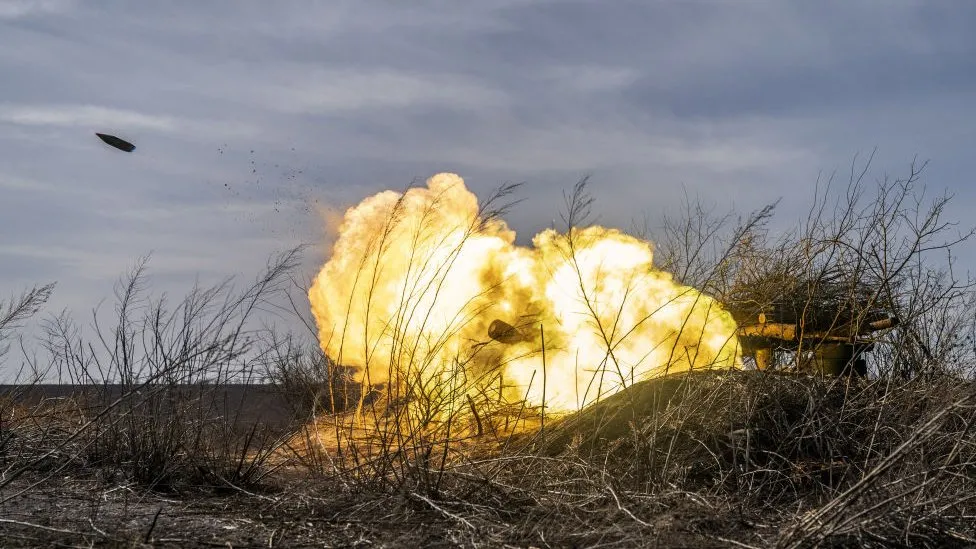
At this stage in the war, battlefield casualties on both sides inflicted by drones “way outnumber those inflicted by artillery”, the UK defence secretary said. “In our calculations, 70% to 80% of battlefield casualties are now caused and inflicted by drones,” he added. Defence ministers from 50 nations gathered in Brussels for the 27th gathering of the UDCG.
US Defence Secretary Pete Hegseth joined the meeting remotely, telling allies that America appreciated all the work “you guys” are doing. Pistorious said it Hegseth’s decision was a matter of “schedules” rather than “priorities”, and that the “most important fact was that he took part”.
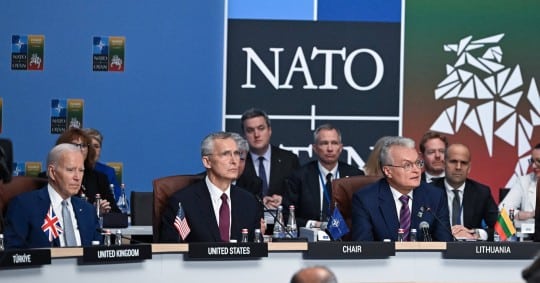
Joe Biden took to the stage with his presidency, re-election hopes, and political future hanging in the balance during a high-stakes news conference on Thursday night.
This session, lasting an hour, marked the conclusion of a NATO summit and was his first unscripted public appearance since a challenging debate with his opponent, Donald Trump. Biden’s earlier gaffe, where he mistakenly referred to Ukraine’s President Zelensky as “President Putin,” had already sparked concerns.
Throughout the conference, Biden, 81, faced persistent questions about his age and fitness to serve another term, concerns that were amplified by his debate performance. Despite these challenges and growing calls from several Democratic politicians and donors for him to withdraw from the presidential race, Biden remained composed.
He repeatedly dismissed worries about his campaign, asserting that his focus was not on his legacy but on completing the work he started when he assumed office in 2021.
“If I slow down and can’t get the job done, that’s a sign I shouldn’t be doing it,” he said. “But there’s no indication of that yet.”
From different perspectives, President Joe Biden’s Thursday night news conference at the NATO summit was seen either as a display of resolute determination or a sign of denial regarding his precarious political standing.
Despite the high stakes, Biden, 81, appeared unfazed by the pressure to step down, prompted by his earlier missteps, such as confusing Ukraine’s President Zelensky with “President Putin” and referring to Vice-President Kamala Harris as “Vice-President Trump.”
These gaffes added fuel to the calls from several Democratic politicians and donors for Biden to withdraw from the presidential race. The president, however, remained defiant, insisting that he is committed to completing his term and pushing his campaign forward.
He reassured the public of his capability to lead, despite continuous scrutiny over his age and cognitive abilities. Biden’s confident demeanor at the news conference, despite these stumbles, aimed to reassure his supporters and dispel doubts about his capacity to win another term and compete against his rival, Donald Trump.
The political landscape remains tense as more Democratic members of Congress join the call for Biden to step down, and his campaign must now grapple with whether this momentum will continue to build. Nonetheless, Biden maintains that the campaign is just beginning and expresses confidence in his ability to secure victory in the upcoming election.
The Democratic delegates who will officially back him as the party’s nominee at next month’s convention were free to change their minds as they pleased, he said, before mock whispering: “It’s not going to happen.”
He indicated that he might step aside if his staff provided data showing he couldn’t win, but current polls still suggest the race is very close. For example, an Ipsos survey released on Thursday showed Mr. Biden just one point behind his opponent, well within the margin of error.
Since the start of the year, support for both candidates has remained remarkably stable, despite the extraordinary controversies surrounding them.
However, polling alone won’t ease the anxiety among many Democratic officials, and the concerns hovering over Biden’s campaign are not easily dismissed. Reports suggest that more Democratic politicians are prepared to publicly break with the president, having waited until after the conclusion of the NATO summit to express their doubts.
There is mounting pressure onUS President Joe Biden to authorize Ukraine to utilize weapons provided by Western nations to target Russian territory.
Several allies of the US have signaled their openness to this possibility after months of concerns about escalating tensions.
Russian President Vladimir Putin has issued warnings of “serious consequences,” particularly for what he termed “small countries” in Europe.
US Secretary of State Antony Blinken, currently attending a NATO foreign ministers’ meeting in Prague, stated that Washington’s stance on the matter would “adapt and adjust” based on changing battlefield conditions.
Meanwhile, White House national security spokesman John Kirby emphasized that while US support for Kyiv has evolved, there have been no changes to existing policies.
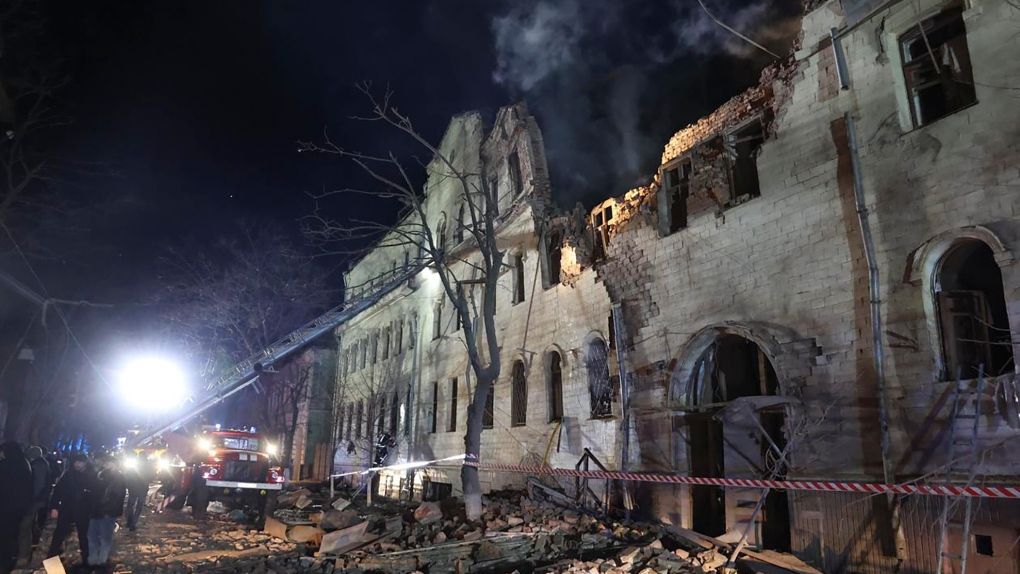
Ukraine continues to grapple with countering a Russian offensive in its eastern regions, with Kharkiv enduring weeks of deadly attacks often launched from Russian military outposts near the Ukrainian border.
Earlier this week, French President Emmanuel Macron made more direct comments, suggesting that Ukraine should be permitted to use weapons supplied by Western nations against military targets in Russian territory, albeit strictly avoiding civilian sites.
Mr Macron has for some time advocated for more direct intervention in the Ukraine war – but other Western leaders also appear to be softening to the idea.
German Chancellor Olaf Scholz has remained cautious in public but a spokesman in Berlin said that “defensive action is not limited to one’s own territory, but also includes the territory of the aggressor”.
Last week, Nato chief Jens Stoltenberg told the Economist that the West should allow Ukraine to defend itself by striking military bases in Russia. “Ukraine has the right to defend themselves. And that includes striking targets on Russian territory,” he said.
UK Foreign Secretary Lord Cameron said earlier this month that it was up to Ukraine to decide how to use British weapons, while this week the Polish Deputy Defence Minister said that Ukrainians could use Polish weapons “as they see fit”. Ukrainian President Volodymyr Zelensky has previously said it was “unfair” for Western countries to impose limits on the use of their weapons, while acknowledging that Ukraine could not risk the support of its partners.
Russia has reacted angrily to the prospect of Western weapons being used against targets on Russian territory.
“In Europe, especially in small countries, they should be aware of what they are playing with,” Vladimir Putin said, noting that many European countries had “small territory” and a “dense population”.
The Russian leader added that responsibility for any strikes inside his country’s territory would lie with Western arms suppliers, even if Ukraine’s forces carried out the strikes.
Some Nato countries remain nervous about the prospect. On Thursday, Italian Prime Minister Giorgia Meloni said she did not think it necessary to hit Russian military bases and urged the West to supply more air defences to Ukraine instead.
However, it is thought Ukraine has already used some Western-supplied weapons for attacks on Russian territory, although it has done so without fanfare.
Latvia’s foreign minister, Baiba Braze, told Ukrainian media that some countries had already provided weapons “without conditions” to Ukraine but that “not everything” was said aloud.
Other countries have been more forthcoming in giving Ukraine permission to use their weapons inside Russia. The US has already supplied Ukraine with thousands of defensive weapons, tanks and air defence systems.
Since April, it has also sent Ukraine the longest-range version of ATACMS missiles, which can travel up to 190 miles (300km). Until now, Ukraine has been using drones to attack targets ever further into Russian territory.
Earlier this week it was reported that Ukrainian drones had managedto hit an early-warning radar near the city of Orsk, around 1,500km (932 miles) from the Ukrainian border.
During a meeting of the 31-nation alliance’s leaders, Admiral Rob Bauer, who leads the NATO Military Committee, said that President Vladimir Putin is afraid of democracy. This year, many countries are having elections, which may be why Putin started the war.
NATO leaders are going to discuss plans for the largest military exercises in Europe since the Cold War during a two-day meeting in Brussels. The wargames are a way for NATO to show they are strong and committed to protecting all their friends from being attacked.
As the war slows down, and with the US and European Union having trouble agreeing on funding for Ukraine’s struggling economy because of political disagreements, Bauer asked for everyone in society to work together to solve the problem, not just the military.
We need people and organizations to change how they think. In the past, everything could be planned and controlled. But now, anything can happen at any time. “We are entering a time where we should be ready for surprises,” he said as the meeting started.
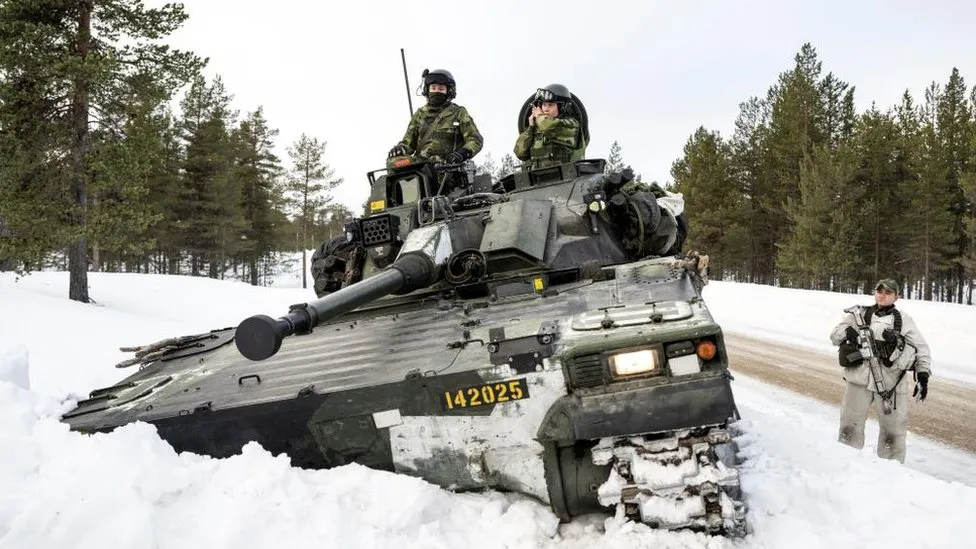
On Monday, UK Defence Secretary Grant Shapps said that the government will send 20,000 soldiers to join NATO military exercises called “Steadfast Defender. ” They will be sent to eastern Europe from February to June.
The UK will send fast planes and planes that watch, along with ships and submarines.
Allies are giving military supplies to Ukraine, which is using up ammunition. So, Norway is giving 2 billion kroner to make more ammunition because they need a lot of it.
Norway’s Defense Minister Bjorn Arild Gram said that it’s important to have a stronger defense industry to help Ukraine and protect our own security.
Half of the money will be given to Nammo, a company in Norway that makes ammunition, rocket engines, and space stuff. The Prime Minister said the money will help them make more artillery ammunition.
In Brussels, Bauer said NATO will keep helping Ukraine for a long time.
“Today is the 693rd day of a war that Russia thought would only last three days. ” “We will support Ukraine every day because the result of this war will affect the whole world,” he said.
“According to Bauer, this war isn’t really about Russia being threatened by Ukraine or NATO. ” This war is because Russia is scared of something stronger than any weapon – democracy. If the people in Ukraine can have freedom to make choices, then people in Russia will soon want them too.
Finland joined NATO in April 2023 and it shares a 1,340-kilometer border with Russia. The border goes through forests in the south and rugged terrain in the north.
Stubb went to Sweden and talked at a news conference in Stockholm with Swedish Prime Minister Ulf Kristersson. For many years, both countries stayed neutral and didn’t pick sides in wars or join any military groups. But that changed when Russia invaded Ukraine in early 2022.
Sweden and Finland have a lot of history in common. “We have a shared future,” said Kristersson at the press event. His country joined NATO in March and became the 32nd member.
Earlier today, Stubb, who became president of the Nordic country in February, said that joining NATO was the last step in embracing the values of the Western community for both countries. Both countries became part of the European Union in 1995.
“Finland and Sweden are important for making peace. ” “We want a strong military and joined NATO because it may seem strange, but that’s exactly why,” Stubb said when speaking to the Swedish parliament.
Stubb, who spoke Swedish, Finland’s second official language, said it was “very important that we took this step together. ”
In Finland, the president has a lot of power when it comes to making decisions about foreign and security policy. This includes dealing with countries outside of the European Union, like the United States, Russia, and China.
Stubb went to Sweden for the first time to meet the Swedish King and Queen.
In a meeting held online, Mr Stoltenberg said that Nato defense ministers agreed to give more military support to Ukraine, including more air defense. Jens Stoltenberg said that after a meeting about the crisis between Nato and Ukraine on Friday.
He said the group of 32 countries has looked at what equipment they have and some of it can be given to Ukraine.
“He said he thinks Ukraine will announce new air defense abilities soon. ”
The Nato leader said that Nato countries have advanced air defense systems, like Patriot, that they could give to Ukraine. However, he did not say specifically what Ukraine might receive.
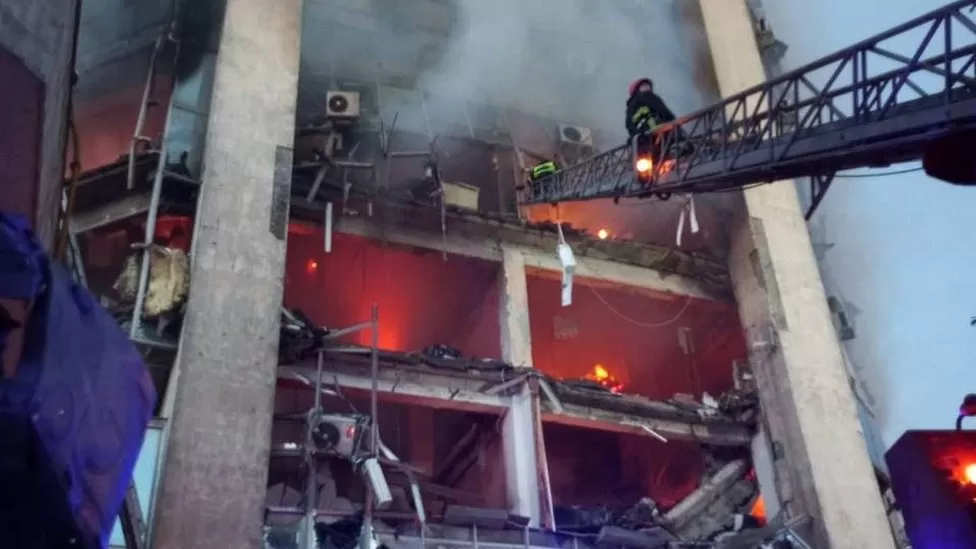
Seven people, including two kids, died in Russian missile attacks on Friday, according to Ukrainian authorities.
Ukraine said they shot down a big Russian plane deep in Russia for the first time. Moscow said that a problem with the plane caused the crash. After waiting for a long time, the US Congress is getting closer to passing a $60. 8bn (£49bn) aid bill to help Ukraine.
Germany promised to give Kyiv another US-made Patriot battery from their military supplies.
Ukraine has a few Patriot systems, but they need more to protect their cities from big Russian attacks.
Ukraine might lose in 2024. Here is a possible way it could look.
After the meeting, President Zelensky said: “We need at least seven more air defense systems like Patriot to protect our country. ” They can help many people stay alive and make the situation much better. “you [Nato] have those systems. ”
Russia has been attacking Ukraine for three years now, and it doesn’t look like the war will end soon. It’s the biggest land war in Europe since World War Two.
Mr Zelensky recently said that Ukraine doesn’t have enough weapons and could lose the war without quick help from Western countries.
Ukraine needs help from the US and other Western countries to get advanced weapons in order to keep fighting against Russia, which has a much bigger army and a lot of weapons.
“We believe that Ukraine should receive more long-term help from NATO instead of relying on short-term, voluntary offers,” said NATO Secretary-General Jens Stoltenberg before a meeting of the alliance’s foreign ministers in Brussels.
On Wednesday, Ukraine made the military conscription age lower from 27 to 25 to bring in more soldiers after being at war for over two years. A lack of soldiers and not enough ammunition has helped Russian troops take control.
“We do this because of what’s happening on the battlefield in Ukraine. ” “It’s important,” Stoltenberg told the reporters. “We can see that Russia is trying to win the war by being patient and waiting for us to give up. ”
The idea is for NATO to organize the work of the Ukraine Defence Contact Group, which is a group of about 50 countries that have been meeting during the war to provide weapons and ammunition to Ukraine. This would be instead of the US European Command.
The general in the United States. Christopher Cavoli is the top military leader for NATO and the head of US European Command. This means that he is the person in charge and will not change. However, Stoltenberg said that there is a need for an official “institutional framework” as the war continues, and NATO can provide it.
NATO is not giving weapons to Ukraine directly, but they will send non-lethal aid like tools to remove explosives, fuel, and medical supplies. This shows a new level of NATO’s involvement in the war.
NATO wants to help Ukraine more, especially because Russia has a strong military, but its members are not willing to promise Ukraine membership in the organization for ultimate security. They also don’t want to get involved in a big war with a country like Russia, which has nuclear weapons.
The new plan is for NATO to work together to help Ukraine and figure out what they need, get promises of help, and have meetings to discuss how to support them. The plan should be approved by US President Joe Biden and other leaders in July.
The Financial Times newspaper said that the plan could cost up to $100 billion over several years, but Stoltenberg did not give any more information.
Western countries said they would help Ukraine, but they did not keep their promises. Europe promised to give 1 million rounds of ammunition, but they didn’t give enough. They also had a fight about money for Ukraine’s struggling economy, and now the help is still stopped in the US.
“It’s not safe to promise things we can’t do,” said Belgian Foreign Minister Hadja Lahbib when asked how much her country might give to a $100 billion fund. She said we need to talk more about the plan.
Stoltenberg asked Congress to work together and pass a bill that gives $60 billion in military aid to Ukraine. He said that the delay is causing problems on the battlefield.
“He said this is why Ukrainians have to limit the number of artillery shells and are struggling to defend themselves against the powerful Russian military force. ” The Russian soldiers have more bullets and bigger guns than the other soldiers.
During a meeting of the 31 countries in NATO, the leader of the NATO Military Committee, Admiral Rob Bauer, said that President Vladimir Putin is afraid of democracy and that’s why he started a war.
According to report, in a two-day upcoming meeting in Brussels, NATO’s top leaders will discuss plans for the largest military exercises in Europe since the Cold War. These exercises are scheduled to take place later this year. NATO’s wargames show how strong they are and that they will protect their allies from any attack.
As the war gets stuck and funding for Ukraine’s economy is delayed because of political fighting, Bauer asked for everyone to work together to solve the problem, not just the military.
“We need everyone to change how they think from planning and controlling everything to being ready for anything at any time. ” “Get ready for anything,” he said as he started the meeting.
On Monday, the UK Defense Secretary Grant Shapps said that the government will send 20,000 soldiers to join NATO military exercises called “Steadfast Defender. ” Many of them will go to eastern Europe from February to June.
The UK will send fast fighter jets and planes that can watch and spy on things, along with big boats that fight in wars and submarines.
Allies are sending military supplies to Ukraine, which is causing a shortage of ammunition. The Norwegian government is giving 2 billion kroner to make more ammunition because there is a high demand for it.
Norway’s Defense Minister Bjorn Arild Gram said that it’s important to make the defense industry stronger to help Ukraine and protect our own safety.
Half of the money will be given to a company called Nammo, which is in Norway and makes stuff for the military like bullets and rockets. The Prime Minister wants them to make more bullets.
“Today marks the 693rd day of a war that Russia thought would only last three days. ” “We will continue to support Ukraine every day because the result of this war will affect the whole world,” he said.
Bauer added that the war is not about Russia being threatened by Ukraine or NATO. This war is about Russia being afraid of something much stronger than any weapon — democracy. If people in Ukraine can have freedom to choose their leaders, then people in Russia will want the same.
Radek Sikorski discussed the matter in a Polish parliament meeting, and his comments were shared in English on Twitter by the Foreign Ministry. There is a big argument in Europe about how to help Ukraine because Russia is winning the war and Kyiv is low on ammunition. The United States. Congress is not giving Ukraine the help it really needs to fight the Russians, which is making Europe feel more pressure to do something about the war in Europe.
French President Emmanuel Macron said last month that it is possible that troops from Western countries may go to Ukraine. This made other leaders very upset because it is not something they usually talk about. French leaders tried to explain Macron’s words and reduce the negative reaction. They also believed it was important to show Russia that they cannot succeed in their war in Ukraine.
The Kremlin says if NATO sends soldiers to fight,there will definitely be a war between NATO and Russia. Russian leader Vladimir Putin said that doing this could lead to a big war with nuclear weapons all over the world.
Poland’s Prime Minister, Donald Tusk, said that Poland will not send soldiers to Ukraine, even after Macron’s comments.
But just before two weeks, Sikorski changed his attitude.
“He said that NATO forces being in Ukraine is possible,” according to a tweet from the Foreign Ministry. He said he liked Macron’s idea because it’s about making Putin scared, not us being scared of Putin.
Sikorski’s comment is part of a bigger change to agree with Macron’s viewpoint, according to Phillips O’Brien, a professor at the University of St.
On Thursday, Sweden officially became a member of NATO. This ended its neutral stance since World War II. The decision was influenced by worries about Russian aggression in Europe, especially after the invasion of Ukraine in 2022.
The Swedish Prime Minister and the US Secretary of State attended an event where Sweden officially joined an alliance. The event took place at the State Department.
“This is a very important moment for Sweden’s history. ” It’s a big moment for the alliance. “This is an important moment in the relationship between Europe and America,” said Blinken. “Our NATO group is now more powerful and bigger than it has ever been. “
“Our alliance to protect ourselves is now even stronger and bigger than it has ever been,” he said, and thanked Sweden for being strong and tough.
“It’s been a long journey, but we always knew we would get here one day,” said Mr Blinken. Nato leader Jens Stoltenberg said that Sweden has strong military and defense industry, making the alliance stronger and safer.
Sweden asked to join a group that protects countries after Russia invaded Ukraine in 2022, but two members stopped Sweden from joining.
Hungary’s leader accused Sweden of being unfriendly and put off agreeing until last week, when the Hungarian government finally voted to approve the request.
All Nato countries must support a friend if they are attacked.
Mr Blinken remembered that Sweden has had a policy of not picking sides for 200 years. This changed when Russia invaded Ukraine. He said that the expansion of Nato was not something that was decided in advance or easy to predict.
Mr Kristersson said: “We are not bragging, but we are also happy and pleased. ” “We will do everything people expect. ”
“We share our challenges, duties, and dangers with other friends. ”
He said that the security in the area is very bad, like it was during World War Two. He also said that Sweden is joining Nato for security reasons.
During a meeting of the NATO alliance, the head of the military committee, Admiral Rob Bauer, said that President Vladimir Putin is afraid of democracy and this is why he started the war. This year, there are many elections happening in different countries around the world.
In Brussels, NATO’s top leaders will discuss plans for the largest military exercises in Europe since the Cold War. The exercises will happen later this year. The wargames are a way for NATO to show how strong they are and to promise to protect all their friends from being attacked.
troop levels slated to decline by the end of the year, American forces need to focus on helping the Iraqis rather than taking control of more cities and regions. Ukraine’s economy is suffering because of the conflict, and the European Union’s money is not getting to the country because of political fighting. Bauer wants everyone to work together to solve the problem, not just the military.
“We need both government and business leaders to change how they think. In the past, they were used to being able to plan, see what’s coming, and control everything to be as efficient as possible. Now, they need to be ready for anything to happen at any moment. ” “We are living in times where we should be prepared for surprises,” he said when he started the meeting.
Bauer said we need to change how NATO fights wars so it can work better in the future.
Monday, United Kingdom Grant Shapps, who is the person in charge of defense, said that the government will send 20,000 soldiers to join NATO’s military exercises called “Steadfast Defender. ” They will be in eastern Europe from February to June.
The United Kingdom will also send highly advanced fighter jets and surveillance planes, as well as warships and submarines.
Due to allies sending military supplies to Ukraine, Norway’s government will spend 2 billion kroner to increase ammunition production because there is a shortage.
Norway’s Defense Minister Bjorn Arild Gram said it’s important to make the defense industry stronger to help Ukraine and to protect our own security.
Half of the money will go to Nammo, a company in Norway that makes weapons and rocket parts. The Prime Minister said it’s to help them make more bullets for cannons.
In Brussels, Bauer said NATO will keep helping Ukraine for a long time.
“Today is the 693rd day of a war that Russia thought would only last three days. ” We will continue to support Ukraine every day because the result of this war will affect the future of the world.
Bauer added that this war is not really about any serious danger to Russia from Ukraine or NATO. This war is because Russia is scared of something that is even stronger than any weapon – democracy. If people in Ukraine can have freedom to choose their leaders and rights, then people in Russia will also want the same.
The Nordic country asked to join the defense alliance after Russia attacked Ukraine in 2022. Each person has to agree to a new member joining, but Hungary was taking longer because it accused Sweden of being unfriendly towards it.
Last week, Hungary’s Prime Minister Viktor Orban said that the two countries are ready to sacrifice their lives for each other. All Nato countries must support each other if one is attacked.
The Prime Minister of Sweden, Ulf Kristersson, said that it was a very important day and a significant move for Sweden to stop being neutral after 200 years.
“We think Sweden is a great country, but we are joining NATO to better protect ourselves and our beliefs,” he explained.
The president needs to sign the parliament’s approval, and then a formal invitation will be sent to Sweden to join the group of 31 members.
The process typically takes a few days.
Mr Orban is a politician who loves his country and is friends with Russia’s President Vladimir Putin. He has stopped the EU from giving weapons to Ukraine many times.
Sweden is one of the European Union countries that say Hungary is moving backwards on the EU’s democratic rules.
MrOrban’s spokesperson, Zoltan Kovacs, said that officials in Sweden think they are better than everyone else, but their power is weakening.
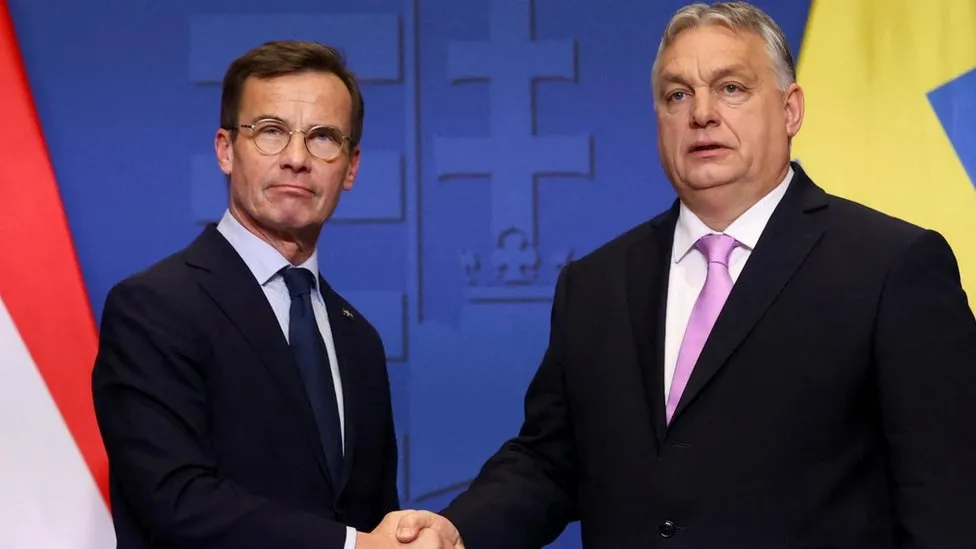
Last week, Mr Orban met with the leader of Sweden, Ulf Kristersson, and said he supports Sweden being in the group.
On Monday, almost all Hungarian MPs agreed to a vote – 188 yes, 6 no.
In his speech, Mr. Orban strongly criticized some Nato allies for trying to make his government stop the 21-month delay.
Hungary is a free country and won’t accept being told what to do by others, about what decisions to make or when to make them.
Turkey did not agree to let Sweden join Nato because it thought Sweden was helping Kurdish separatists. It finally decided to stop blocking or saying no in January.
Sweden and Finland, who have always stayed out of military conflicts, said that they want to join Nato in May 2022.
Finland officially became a member of the alliance in April of last year, which made the alliance’s border with Russia twice as long.
In 2022, Russian President Vladimir Putin sent his army into Ukraine to stop Nato from getting bigger and make Western countries weaker.
Actually, the opposite has happened with Sweden and Finland joining.
According to Mr Macron, Western countries are struggling to reach a decision about dispatching their military forces to Ukraine.
The Kremlin’s spokesperson, Dmitry Peskov, warned of a potential conflict if Nato troops were to enter the area. The Russian army has advanced into Ukraine recently, and the capital city, Kyiv, is asking for more weapons quickly.
Mr Macron said at a news conference on Monday night that we should consider whether we need security that would require deploying some elements.
“I have already explained to you what France’s position is, which is a strategic ambiguity that I support. “
Russian President Vladimir Putin started a big war in Ukraine three years ago. It doesn’t seem like the war will end anytime soon. It’s the biggest war in Europe since World War Two.
Mr Macron’s words made other countries in Europe and Nato say something back.
The President of the United States, Joe Biden,thinks that the best way for Ukraine to win is by giving them military aid. This means giving their troops the weapons and ammunition they need to protect themselves.
President Biden said that the US will not send soldiers to Ukraine to fight.
The German leader, Olaf Scholz, said that Europe and Nato have agreed not to send troops to Ukraine. This decision has not changed.
The UK Prime Minister’s spokesperson said the country is not planning to send a lot of soldiers to Ukraine, just a few to help train their forces.
Mr Peskov, speaking for the Kremlin, said that Mr Macron’s suggestion is very important, but it does not benefit Nato members.
“He said we would have to talk about how likely a conflict is to happen. “
Before, the leader of Nato, Jens Stoltenberg said they were not thinking about sending soldiers to Ukraine, but they would still help Ukraine even though it’s not in Nato.
Several Nato countries, like Spain, Poland, and the Czech Republic,agree with that stance.
Russia has a lot of weapons and a bigger military than Ukraine. Ukraine’s army relies on modern weapons from Western allies, especially the US.
Reallly intense gathering.
On Tuesday, Mr Biden asked leaders in Congress to agree to a $95bn US aid package. This money includes $60bn for Ukraine. They had a meeting in the Oval Office.
The package is having a hard time in the US House of Representatives. Republican leader Mike Johnson stood firm in the meeting,saying that they need to make more changes to the border before anything else.
Mr Johnson said the problem on the border between Mexico and the US is really important to him. Mr Biden has offered to include changes in the plan, but the Republicans are not agreeing.
Chuck Schumer, who is the leader of the Democrats in the Senate, said that the meeting in the Oval Office was the most intense one he has ever been in.
The US gives the most military aid to Ukraine. They have promised to give$45billion as of January15th,according to the Kiel Institute.
Germany is in second place,giving â¬17. 7bn of military help. The UK is next,giving â¬9. 1bn of military aid.
Ukrainian President Volodymyr Zelensky talked on video during the meeting in Paris on Monday. He said that working together to protect against Russian aggression will make our countries safer for many years.
“Let me make this really simple. ” I won’t Please, for the love of God. It’s stupid It’s embarrassing It’s not safe. “It’s not American. ”
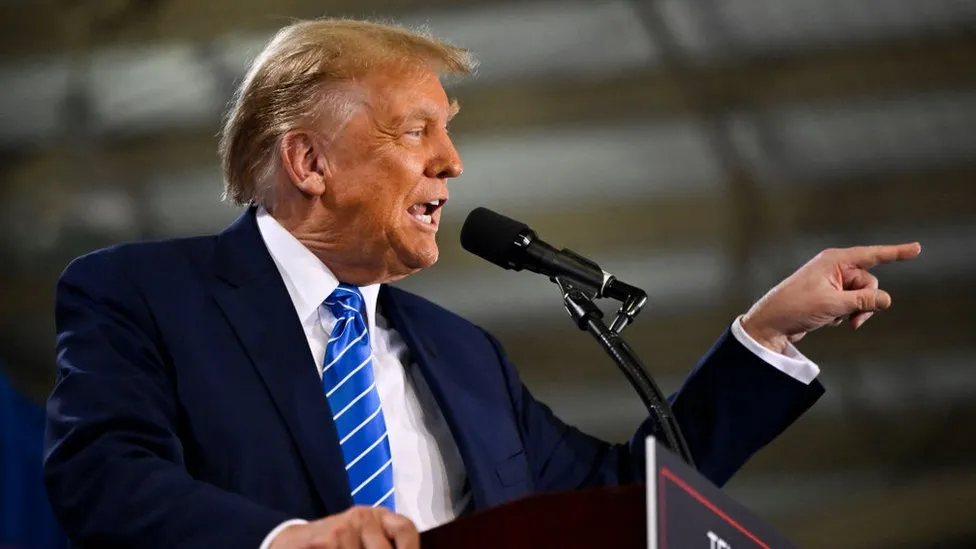
At a gathering in South Carolina, Mr. Trump, a member of the Republican party, complained about late payments from Nato members.
He talked about a previous discussion he had with the leader of a large country about a possible attack from Russia.
Mr Trump said that the official wanted to know if the US would protect a NATO member that didn’t pay its fair share.
Mr Trump told the people, “I said, ‘You didn’t pay. You’re late on your payments. ‘” “No, I won’t keep you safe. I’d even tell them to do whatever they like. ” “You have to give money. ”
“I will protect all of Nato’s land if President, even if Putin attacks. ”
Mr Biden said that the only time Nato has used Article 5 of its charter was after the 9/11 attacks on the US. This article says that if one member of Nato is attacked, all members need to defend them.
The president asked House Republicans if they will support Ukraine or Putin. He also asked if they will support America or Trump.
Nato will say on Wednesday that 18 out of 31 members are meeting their goal of spending 2% of their country’s money on defense.
Out of all the countries in Nato, only Poland spends a larger portion of its money on defense compared to the US.
In 2016, only five countries in Nato reached the same goal. Trump criticized this and said the US might leave the alliance.
The argument between Mr Biden and Mr Trump about Ukraine aid and US-Nato relations shows a big difference in their ideas for the future election.
Mr Biden often talks about how the US is a big part of a long-lasting global disagreement between countries that have democracy and countries that are ruled by one person or a small group.
He thinks that Ukraine is an important battleground in this conflict, and European allies in Nato and the EU are important partners.
For four years, President Trump often didn’t think global alliances were important for the US. He preferred dealing directly with other countries and their leaders, and prioritized America above all else.
If Nato and other countries that are friends with the US do not benefit America, he is okay with the idea that they can be replaced.
The Senate approved a package with $60 billion for Ukraine, $8 billion for Taiwan and other US allies in Asia, $14 billion for Israel’s fight against Hamas, and $10 billion for helping people in conflict areas like Gaza.
22 Republican senators agreed with it, but many conservative lawmakers didn’t like it because they want the government to focus on the increasing number of migrants at the southern US border before sending more money to other countries.
An earlier effort to pass a $118 billion aid package with border security rules failed because President Trump didn’t like it.
US Defence Secretary Lloyd Austin has had to cancel a trip to Nato headquarters because he had to go to the hospital for the third time in three months.
Mr Austin, who is 70 years old, is in the intensive care unit at a hospital in the Washington DC area. The Pentagon said he has a serious problem with his bladder that needs urgent attention.
In a recent announcement, the Pentagon said they expect Mr Austin to be back at work by Tuesday.
His deputy is doing his job for now.
According to a statement from Walter Reed Military Medical Center officials, they don’t expect the person to stay in the hospital for a long time. This statement was released by the Pentagon on Monday. “We think the Secretary will be able to go back to his usual work tomorrow. ”
Mr Austin is in the hospital for a treatment that doesn’t involve surgery. He will be given medicine to make him unconscious while doctors work on his bladder problem. The Pentagon said he will be in the intensive care unit at Walter Reed for his whole stay but didn’t say how long that will be.
People are looking closely at Mr. Austin because his past trips to the hospital have been kept a secret.
He didn’t tell anyone in the US chain of command that he had prostate cancer in December or went back to the hospital in January.
Mr Austin’s bladder problem shouldn’t affect his recovery. He should still be able to fully recover as expected. Maj Gen Pat Ryder, the Pentagon spokesperson, said that the outlook for his cancer is still very good.
He was supposed to go to a Nato meeting led by Nato’s leader Jens Stoltenberg on Thursday.
Mr Austin joined the latest UCDG meeting online from his house on 23 January.
His office told the media that Mr Austin plans to have these upcoming meetings online.
On Sunday afternoon, the Pentagon said that Mr Austin was taken to Walter Reed National Military Medical Center in Maryland for treatment. The White House and senior defense officials were also told about this.
Later in the afternoon, the Pentagon said that Mr. Austin gave his job to Deputy Defense Secretary Kathleen Hicks.
On Sunday, the hospital said that the secretary had been moved to the critical care unit for extra support and careful watching.
Mr Austin’s doctors said that his bladder problem was not going to stop him from getting better from cancer.
Last year, Mr. Austin had an operation as part of his treatment for cancer.
He had to go back to the hospital on New Year’s Day because he had a lot of pain in his leg, hip, and stomach from complications after the procedure. The doctors found a bladder infection, and he stayed in the hospital for more than two weeks.
Top military leaders and the Biden administration were not aware of Mr. Austin’s serious illness until three days after he was readmitted to the hospital in January.
The defense secretary is the second in charge of the US military after the president, and is considered a very important member of the cabinet.
The situation made people worry about how open and safe things were, and caused three different investigations into how Mr. Austin dealt with his sickness and time in the hospital. Some important Republicans said he should be fired from his job.
At a meeting with reporters earlier this month, Mr. Austin said he was really sorry for not giving enough notice and that he had said sorry to President Joe Biden in person.
The defence secretary will speak at the end of the month about why he did not tell government leaders about something.
At a big gathering on Saturday, he said he had told a leader he wouldn’t defend a country that didn’t pay its bills and would let the bad guys do whatever they wanted.
Nato members promise to protect any country in the group if it is attacked.
The White House said the comments were terrible and crazy.
Speaking to a big group at a rally in South Carolina, Mr Trump said he talked about Russia when he met with leaders from Nato countries.
He remembered that the leader of a “big country” talked about a made-up situation where they were not paying their bills to Nato and got attacked by Moscow.
Mr Trump said the leader wanted to know if the US would help his country in that situation, which made him give a strong criticism.
I asked, “Didn’t you pay. Are you late with your payment. ” “No, I won’t defend you. In fact, I would support them doing anything they want. ” You have to give money.
A spokesperson from the White House said the ex-president was supporting attacks on our closest friends by violent governments, and called the remarks terrible and crazy.
Mr Trump, who is expected to be the Republican candidate in the upcoming US presidential election, has always criticized Nato and thinks that the United States is spending too much money on defending 30 other countries.
Russia started a big attack on Ukraine in 2022, after Mr. Trump stopped being the President. He has complained about the money that the US sends to Ukraine because Ukraine is not a member of NATO.
The US has given Ukraine more money than any other country. They have given them over $44 billion since 2022, when the invasion happened. These numbers come from the White House in December.
But Republicans in Congress have stopped any new money from being given since the beginning of the year. They want strict rules to limit people from coming into the US from the southern border, and they said no to the changed bill when it was shown earlier this week.
Sweden and Finland, who used to stay out of military conflicts, changed their minds when Russia invaded Ukraine in February 2022. They asked to join NATO for protection. Finland joined, and now all 31 countries, including Finland, have to agree for Sweden to join.
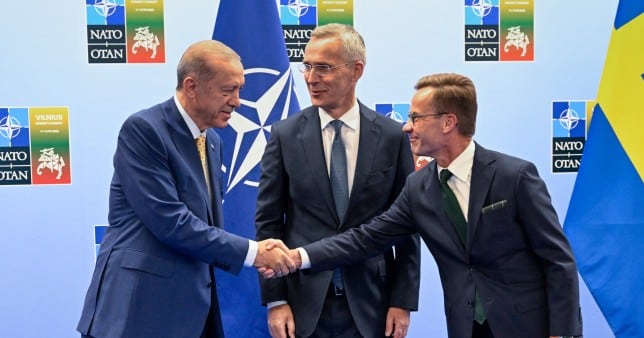
“Sweden joining NATO will make the whole group stronger,” Stoltenberg told reporters. He also talked about his discussions with Hungarian Prime Minister Viktor Orban and mentioned new developments in Turkey.
I got a message from Budapest that the parliament will meet again at the end of February. So, we have to wait until then. “But I believe in Hungary and I am sure of it,” Stoltenberg said.
At first, Hungary didn’t explain why they were delaying, and Orban said his government wouldn’t be the last to agree with Sweden. However, the European Commission refused to let Hungary have access to EU funds because they were not being democratic. This made the attitude towards Stockholm become more severe.
Budapest said that Swedish politicians are telling big lies about how Hungary’s government works.
Orban, who disagrees with NATO allies by supporting Russia’s invasion of Ukraine, said on Tuesday that he invited Swedish Prime Minister Ulf Kristersson to Budapest to talk about working together on security and defense.
If there is no emergency meeting, the parliament will meet on Feb. for Sweden’s bid. “Please rewrite this text in simpler words. ”
To let Sweden join, Turkish President Recep Tayyip Erdogan set some rules. One of them is to take a stronger position against groups that Turkey sees as a danger, like Kurdish militants and people involved in a coup attempt in 2016.
On his own, Erdogan wanted to make a deal with the United States to buy fighter jets. This was also related to his approval of something else.
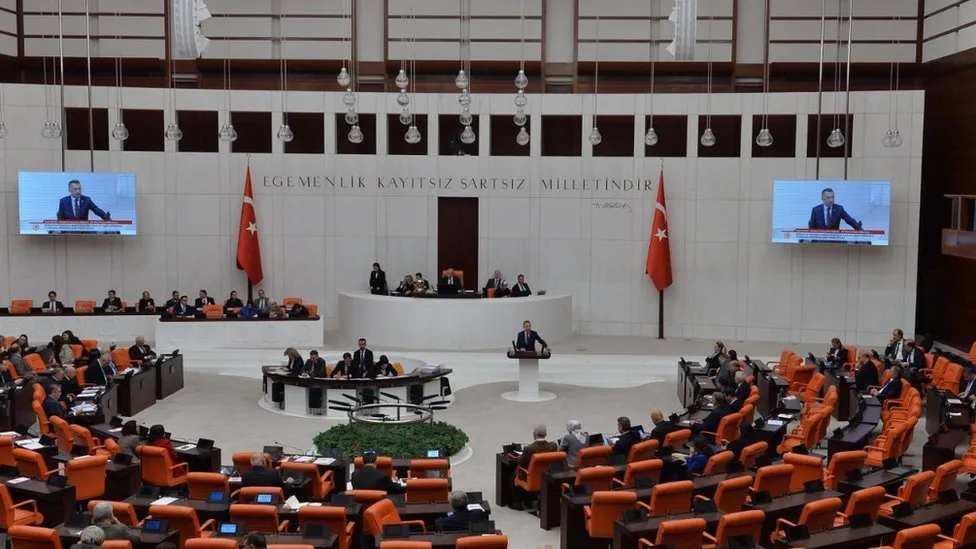
On Tuesday, Turkish leaders voted and approved Sweden’s request to join by 287 votes to 55. The Turkish government finished the process on Thursday by publishing the measure in an official newspaper.
Stoltenberg was glad that on Thursday night Erdogan signed the decision of the parliament, so now all decisions are in place in Turkey.
Sweden is going to join NATO as the 32nd member after Hungary finishes its processes and the U. Sgets approval from all the other countries. “State Department” can be simplified to “government office. “
Hungary says Sweden is being unfriendly. In March, a Hungarian government spokesperson named Zoltán Kovács said that officials in Sweden think they are better than others, but their reputation is not as strong as they think. Stockholm said Hungary is not following the EU’s rules about democracy.
But, there have been some improvements. Hungarian Prime Minister Viktor Orban asked the Swedish Prime Minister to come to Budapest for a visit and talk about how they can build more trust between their countries.
Sweden’s Foreign Minister Tobias Billstrom said he doesn’t think there is a need to talk to Hungary right now, but they can still have a conversation and talk about things in the future.
Turkey stopped Sweden from joining until July, when they finally agreed. On Tuesday evening, politicians voted 287-55 in favor of Sweden being a member. President Erdogan is likely to approve the new law.
Turkey said that Sweden was providing shelter to Kurdish fighters, and they should work harder to stop rebel groups like the PKK, which Turkey sees as a terrorist organization. The EU and US both say the PKK is a terrorist group.
Turkey, as a member of Nato, can stop other countries from becoming members.
Sweden made stricter laws in June to stop terrorism. It’s now against the law to help terrorist groups with money or support.
Sweden and Finland, who were neutral, said they want to join Nato in May 2022. This was after Russia invaded Ukraine. Finland officially joined the alliance in April, making the alliance’s border with Russia twice as long.
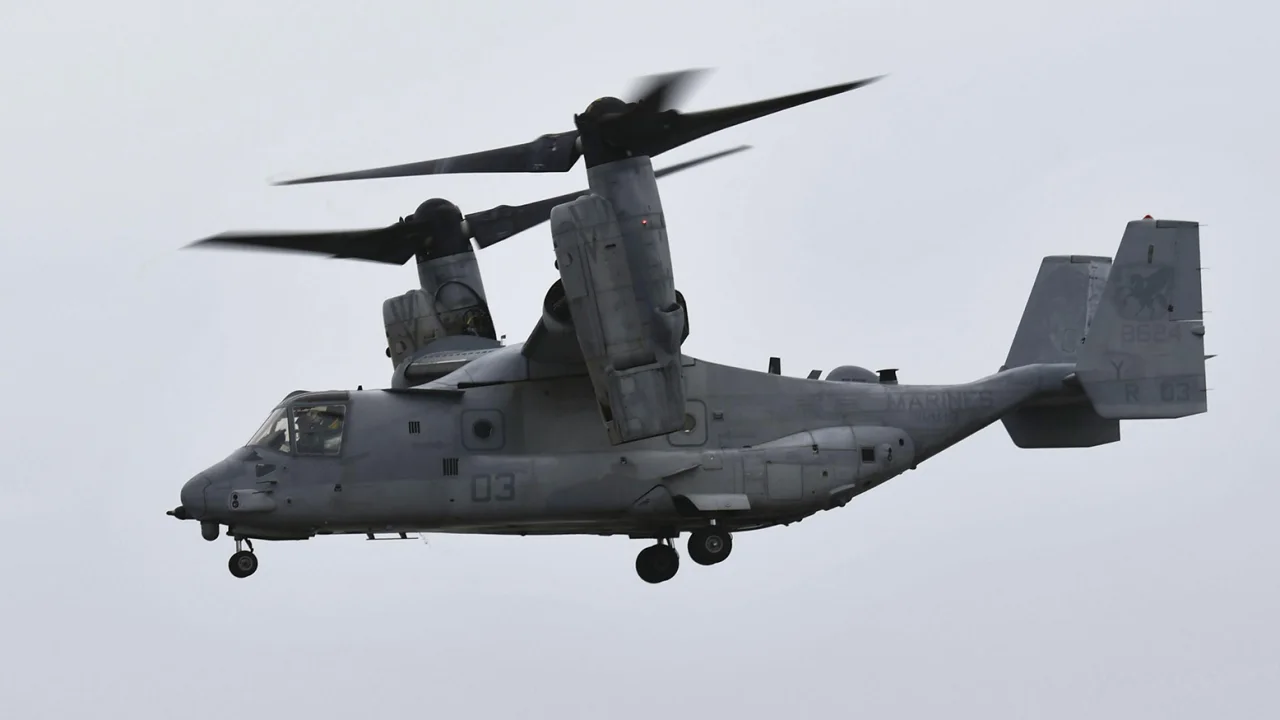
A spokesperson for the Japan shore Guard said that eight people were on board when a US military Osprey aircraft crashed off the shore of Yakushima Island in the southern Kagoshima prefecture on Wednesday.
An aeroplane and patrol boat from the 10th Regional Coast Guard Headquarters have been sent to the crash site, according to the spokeswoman, who stated that the Coast Guard received information about the incident at approximately 12:47 a.m. ET on April 27.
A representative stated that details regarding any injuries are not available at this time.
The Osprey military aircraft has been involved in other fatal crashes throughout the years; this one is the most recent.
This August, during military drills in Australia, an Osprey crashed, killing three US Marines and critically wounding numerous more.
Five US Marines lost their lives in 2022 when their MV-22B Osprey aircraft crashed when they were on a training mission close to Glamis, California. During NATO training operations in Norway that same year, an Osprey aircraft carrying four US service men went down and killed them.
The Osprey is a very adaptable aircraft that can cruise at high speed like a typical turboprop plane with wings and take off vertically like a helicopter.
Although Ospreys are generally safe to fly, since the aircraft’s introduction in the 1980s, there have been technical and operational problems, according to CNN military expert and retired US Air Force Colonel Cedric Leighton
Admiral Rob Bauer, the highest-ranking military official in NATO, said at the Warsaw Security Forum that we are in a very difficult situation. We have reached the lowest point and things are not looking good.
He said that governments and defense manufacturers need to increase production at a faster rate now.
Ukraine shoots many shells each day and most of them now come from Nato.
The leader of the military group in Nato said that for many years, the countries in Nato did not spend enough money to properly support their military forces. Now, they are giving weapons to Ukraine, even though they don’t have many weapons left in their storage places.
We need a lot of things in big amounts. The economy we created together over the past 30 years, which focuses on getting things done quickly and efficiently, is good for many things. However, it is not suitable for the military during a war.
The UK Defence Minister, James Heappey, said that the Western military supplies are running low and asked Nato allies to spend 2% of their country’s wealth on defence, as they had promised to do.
He asked when is the right time to spend 2% on defense if not when there is a war in Europe.
He also mentioned that the “just-in-time” model does not work when you need to be prepared for the fight tomorrow.
“We can’t give up just because we have less inventory,” Mr. “We need to continue supporting Ukraine tonight, tomorrow, and the following days. ” And if we quit, that doesn’t mean Putin automatically quits.
And that meant, he said, “continuing to help others every day, and making sure we have enough for ourselves again. ”
The obvious problem is that not everyone in the alliance is currently using 2% of their GDP on defense. That should be the minimum amount of money we spend on defence, not the maximum.
He said, “The US is starting to focus more on the alliance from both the east and west. It’s fair for our friends in Congress to see that European countries are spending their fair share of 2% on NATO resources. ”
The Defence Minister of Sweden, Pol Jonson, stated that it is important for Europe to strengthen its defense industry in order to provide ongoing support to Ukraine.
“He said that we are spending a lot of money and using a lot of resources. ”
“And ultimately, I believe it is important for Ukrainians to be able to buy defense equipment from European manufacturers. ” We learned important lessons here about size and quantity, especially when it comes to artillery ammunition.
The UK defence ministry has said that since the invasion began in February 2022, the UK has provided over 300,000 rounds of artillery ammunition. They have also promised to provide “tens of thousands more” by the end of this year.
The US state department says that during the same period, America has given Ukraine more than two million standard 155mm artillery rounds used by Nato.
Kyiv relies heavily on US ammunition, to the point that NATO allies are worried about what might happen if Donald Trump is re-elected as president next year.
They are worried that if Mr. Trump decides to make a deal with Moscow, the US military might not continue to help Ukraine as much as they do now.
The problem is that even though Ukraine is trying to make more ammunition, they are using it up quicker than the Western powers can give them more.
NATO and EU nations have made plans to share knowledge, partner with defense companies, and provide financial support for production.
But it seems like they are still having difficulty fulfilling the requirement.
Experts suggest that Russia is in a better position to boost its economy during times of war and replace its resources.
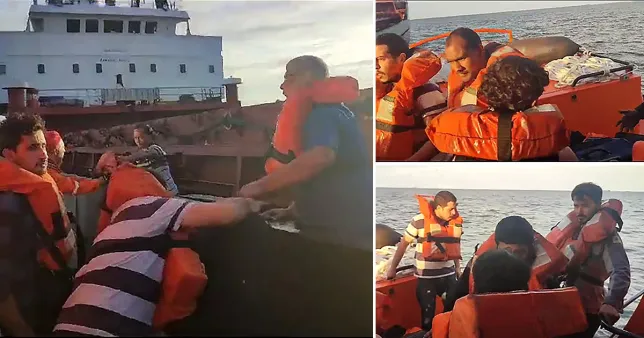
A video on Twitter shows that the 12 crew members who were on a ship in Romania have been taken to safety today.
The ship, which belonged to Togo, made an urgent call for help called Mayday after the explosion happened.
The coast guards went to assist the crew at the Sulina canal, which is the furthest point in the east of Romania.
12 people who worked on a ship that carries goods were kept safe after a big blast happened close to a port in Romania. The news said that there was an explosion in the engine room of a boat. It happened because the boat may have hit a sea mine.
The Romanian defence analyst, Radu Tudor, showed a video from the area and said that there was an explosion this morning on a ship with the Togo flag. This happened in the Sulina area of the Danube Delta.
The boat was broken, Romanian rescuers saved more than 12 crew members. It looks like the boat crashed into a explosive device in the sea.
However, a Romanian Naval Authority official stated that there is no evidence suggesting that the explosion was caused by a sea mine. They also said that the ship is somewhat steady and it doesn’t appear to be going down.
The ship came to the Sulina port on September 12 and was waiting to go through the Bîstroe channel.
There has been a lot of stress and worry at the Romanian border near the river for a few weeks now. This is because people have found small parts of drones a short distance away from villages where many people live.
Ukraine is a country that sells a lot of grain to other countries. Russia has been attacking Ukraine’s agricultural and port buildings because they don’t want the agreement that allows Ukraine to transfer grain safely. This agreement was made by the United Nations and Turkey.
Small flying robots called drones have been attacking the ports of Reni and Izmail near the Danube River, which are very close to Nato territory.
Before Russia stopped participating in the agreement, the ports on the Danube River were responsible for about 25% of Ukraine’s grain exports.
He says it is very important for other countries to keep criticizing Russia and helping Ukraine in the war.
Stoltenberg said to the BBC that if we don’t support Ukraine, then no country will be safe.
He says that nobody knows how long this war will continue, but Ukraine has been able to make progress in fighting against Russia with the help of NATO and the international community.
Stoltenberg agrees with Biden about how we should deal with China. He says that China wasn’t an enemy to NATO, but because it’s getting closer to Russia, it’s important to make sure NATO remains powerful.
Romania’s foreign ministry called in Russia‘s representative after pieces of drones were discovered inside Romania’s borders, which is a member of NATO. This is the second time such incidents have occurred within a week.
For a long time, Vladimir Putin has been using Iranian Shahed drones to attack Ukraine’s biggest ports that are used to export grain.
Klaus Iohannis, the president of Romania, keeps saying that the attacks happening nearby are a big threat to the Black Sea’s safety.
However, Russia has still been attacking buildings and ports that are used by regular people and located near the Danube River in the Odesa region. These places are only a short distance away from a member of the North Atlantic Treaty Organization (NATO).
During the explosions in Ukraine’s river ports, Romanian authorities found another set of broken drone pieces that had crashed on its shores within a week.
The attacks have made the military alliance, whose members promise to protect each other, more vulnerable to security threats.
The head of the Russian Embassy in Bucharest was called in for an urgent meeting at the Ministry of Foreign Affairs.
‘The State Secretary for Strategic Affairs, Iulian Fota, expressed Romania’s concern about a violation of our country’s airspace. This happened after finding some drone pieces near the border with Ukraine. These drone pieces were similar to the ones used by Russian forces in the attack on Ukraine. ’
Ukraine says that a Russian drone purposely attacked an area belonging to Nato and EU member country Romania.
Romania’s defense ministry strongly rejected the reports and condemned the unfair attack on Ukrainian port facilities on the Danube river.
If what Kyiv says is proven to be true, this could be a big change in the war Russia has been fighting in Ukraine for the past year and a half.
NATO has a promise to help each other if any member gets attacked.
According to Ukraine’s border guard service, a big Russian attack happened near the port of Izmail last night. Russian rockets fell and exploded on Romania’s territory. Ukrainian foreign ministry spokesperson Oleg Nikolenko shared this information on Facebook.
This new information confirms that Russia’s missile threat is a big danger to Ukraine and nearby countries, including Nato members.
Romania says that Russian drones did not land in their country. Nikolenko shared a picture of a big fire on the other side of the Danube River.
This is the line that separates Ukraine’s Odesa region from Romania’s territory, and in certain places, the distance between the two sides is just a short distance of a few hundred meters.
The president’s main staff member said it is very important to get more modern defense weapons to stop Russia from using drones and missiles.
Andriy Yermak said on Telegram that Ukraine needs more weapons and missiles that can be shot from far away to help reclaim our territories faster.
Russia needs to be beaten in a war.
In simpler terms, Romania is keeping an eye on the situation. They mentioned that Russia’s attacks on Ukraine’s infrastructure have not directly threatened Romania’s land or territorial water.
In the past, drone attacks have come very close to the shores of Romania.
In late July, a video captured an assault on a grain storage facility in the town of Reni, Romania. The attack caused a bright glow in the sky.
President Klaus Iohannis said that this is a big problem for the safety of the Black Sea.
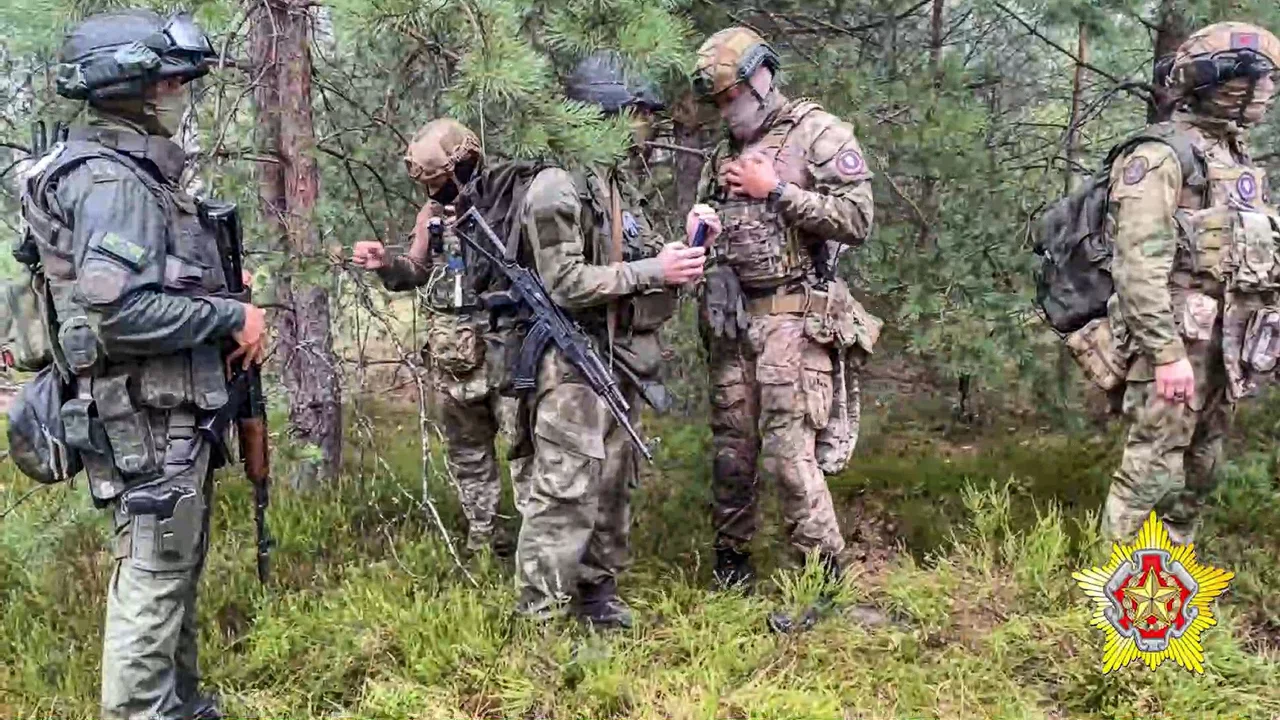
President Alexander Lukashenko stated on Thursday that Belarus would be willing to use the nuclear weapons provided by close ally Russia in the event of foreign “aggression” as tensions along the country’s borders with NATO countries increase.
Moscow has used Belarus as one of its launchpads for the invasion in early 2022, and joint Russia-Belarus military training over the past year have stoked worries that Belarusian troops could join Russian forces in the battle. Minsk has played a significant role in Russia’s war in Ukraine.
Belarus apparently received Russian nuclear warheads in June for “deterrence,” according to Russian President Vladimir Putin.
Lukashenko asserted Belarus would “never get involved in this war” until Ukrainians crossed its border in an interview with the state news service Belta. But he added, “We will keep helping Russia, they are our ally.”
He also said that Belarus will “immediately respond with everything we have,” including nuclear weapons, if provoked, particularly by NATO neighbours Poland, Lithuania, and Latvia.
Although senior officials from the US Defence Intelligence Agency (DIA) said they had “no reason to doubt” Putin’s claim, it is unclear how much of Russia’s nuclear arsenal was recently transported to Belarus, and US and Western officials have not publicly confirmed that any weapons have been transferred.
In an interview, Lukashenko stated that Belarus would not “tarry, wait, and the rest” if it were to come under attack. We’ll employ every weapon in our arsenal to deter.
He continued, “We didn’t bring nuclear weapons here to frighten someone. “Yes, nuclear weapons do serve as a potent deterrent. But these aren’t strategic nuclear weapons; they’re tactical. As soon as hostilities are initiated against us, we will employ them right away.
In July, senior DIA officials stated they did not think Lukashenko would have any influence over the weapons, which they believed would most certainly be completely under Russian control.
With Belarus’ northern neighbours on edge due to the presence of the Russian mercenary organisation Wagner, which is stationed in Belarus in the wake of its brief uprising in Russia earlier this summer, Lukashenko’s most recent remarks come as the security environment in Europe becomes more unstable.
In an apparent effort to exert more pressure on NATO and EU countries, there have been rumours of Wagner troops heading towards a narrow sliver of land between Poland and Lithuania in recent weeks.
Poland recently declared it would send some 10,000 troops to its border with Belarus, citing Wagner-related worries, and detained two Russians on suspicion of espionage and spreading disinformation for the Russian mercenary force.
Due to worries about Wagner forces, Lithuania announced on Wednesday that it will temporarily halt operations at two of its six border checkpoints with Belarus. The interior minister cited “emerging threats to national security and possible provocations at the border.”
As a retaliatory measure, Belarus criticised Lithuania for taking a “unconstructive and unfriendly step,” calling its Wagner justification “far-fetched.”
In the interview on Thursday, Lukashenko rejected the idea that the failed Wagner mutiny may have undermined Putin, labelling such accusations as “total nonsense.”
“Putin is now more active, shrewd, and intelligent. Nobody will remove Putin today, Lukashenko added, and our enemies need to know it.
He added that the decision to send Wagner fighters to Belarus had come from him. He remarked, “The rebellion could have been terrible to everyone, thus it was important to accept any terms in order to quiet this mutiny, to put out this fire.
According to the Polish ambassador, Poland is preparing for “growing aggressiveness” from Russia and Belarus.
On Thursday, Lukashenko added his voice to the discussion of the ongoing conflict by announcing that Moscow would never relinquish the Crimean peninsula that it had illegitimately taken from Ukraine over seven years earlier.
Russia will “never ever return Crimea,” he declared, according to Belta, even though it is willing to negotiate with Ukraine.
“It won’t take place. I don’t think we can come to an agreement here in the east right now. But Russia is open to talking on any subject. I am positive of it,” Lukashenko remarked.
However, he asserted that Ukrainians “are pushed by Americans” and do not currently want to discuss, adding that negotiations “have to start without preliminary conditions.” Belarus should be a part of any peace negotiations over Ukraine because “we have our interests there, and our position should be heard,” he continued.
In 2014, shortly after Ukrainian protesters assisted in the overthrow of pro-Russian President Viktor Yanukovych, Russia forcibly annexed Crimea when tens of thousands of its special operations forces deployed throughout the peninsula in unmarked uniforms.
Following a referendum that was denounced as invalid by Ukraine and the majority of the world, Russia finished annexing Crimea two weeks later. At the time, this was seen to be the largest land grab in Europe since World War II.
Human rights watchdogs have noted Crimea’s transformation into a police state after annexation, with local officials and Russian security forces arresting and prosecuting those believed to be loyal to Ukraine, notably members of the Crimean Tatar population.
A 2020 US State Department study detailed a pattern of illegal or arbitrarily carried out killings and forced disappearances in Crimea by Russian or Russian-led authorities.
Since then, the occupied region has played a significant role in the conflict in Ukraine. The Crimean bridge, which connects the peninsula to the Russian mainland, serves as a crucial supply route for Russian forces and a target for the Ukrainian operation.
Belarus, a former Soviet satellite that proclaimed its independence in 1990, is an autocratic nation that Lukashenko has essentially ruled since the country’s declaration of independence.
In skirmishes between two strong armed factions in Tripoli, southern Libya, at least 27 people were killed and 106 others were hurt, according to a statement from the nation’s emergency services on Tuesday.
Mahmoud Hamza, the 444 Brigade commander, was detained on Monday while attempting to enter Tripoli’s main Mitiga airport, which sparked the start of fighting. The Special Deterrence Force, a competing group that controls the airport, caught him. His detention’s cause is still a mystery.
According to state news agency LANA, after a deal was struck with the UN-recognized Government of National Unity to transfer Hamza to a neutral party, the fighting stopped late on Tuesday.
According to LANA, casualties included civilians.
Images of smoke billowing above the capital following the nighttime skirmishes indicate that the fighting is thought to be the most intense of this year.
According to LANA, the agreement covers the end of all military activities in Tripoli, the relocation of military forces to their barracks, the evaluation of property damage to both public and private property, and the issuance of compensation by the Government of National Unity.
According to a statement made on Tuesday by the United Nations Support Mission in Libya (UNSMIL), the mission is “closely monitoring security incidents and developments in Tripoli since yesterday and their impact on the civilian population. The Mission reminds all parties concerned of their legal obligation to safeguard civilians.
Following the 2011 NATO-supported rebellion against Moammar Gadhafi, the country was divided into warring factions in 2014. Since then, there has been little peace in the country. According to Reuters, the Special Deterrence Force and the 444 Brigade are thought to be the two strongest military units in the Libyan capital.
Tuesday will see Poland perform its greatest military display in decades, flexing its defensive muscles as tensions build along its border with Belarus, a crucial ally of Russia.
The Polish Defence Ministry announced that 200 pieces of Polish and foreign military hardware, 92 aircraft, and 2,000 service members would be on display to commemorate Polish Army Day on Tuesday.
Some of the most modern weapons Poland has in its arsenal will be displayed during the parade, including US-made M1A1 Abrams tanks, South Korean K2 tanks and K9 self-propelled howitzers, HIMARS rocket launchers, Krab self-propelled howitzers, and US-made Patriot missile batteries systems, which are a component of the Polish “WIS-A” air defence system.
Following Russia’s decision to invade the Ukrainian peninsula of Crimea in 2014, Poland has recently emerged as one of Europe’s top military forces after investing billions on new hardware. In the wake of the crucial role it has played in assisting Ukraine since Moscow’s all-out assault, Warsaw’s diplomatic influence has also increased.
As worries about the presence of Russian Wagner mercenary forces in Belarus grow, Poland last week announced the deployment of hundreds more soldiers to its eastern border.
Poland has borders with Russia’s semi-exclave of Kaliningrad in addition to Ukraine and Belarus. According to experts, Warsaw is sending a message to Russia and Belarus by organising a major display of might on Tuesday.
It has an almost Soviet feel about it. On May 8, Russia celebrates, along with Belarusians, North Korea, and Iran. It somewhat mimics the way they speak. According to Edward Arnold, a research fellow at the British security think tank RUSI, the opponent states view them [parades] as a show of power, so Poland will respond with a show of force.
In addition to demonstrating its capabilities to Russia and its allies, Arnold stated that Poland’s government is also attempting to reassure its own citizens that it is dedicated to security two months before significant elections.
A third consecutive term in office for the ruling right-wing Law and Justice party would be unprecedented in post-Communist Poland. However, it has so far been unable to decisively edge over the opposition Civic Platform coalition.
Since a war is raging on Poland’s border, security concerns rank high alongside the economy and living standards, according to Aleks Szczerbiak, a professor and the chair of the politics department at the University of Sussex in England, who spoke to CNN. “Demonstrating their competence on security is absolutely critical to the government’s reelection,” he added, noting that the problem crosses all political lines.
Nobody will argue that military security is unimportant or that we shouldn’t be bolstering the armed forces. Although they won’t suggest that strengthening the Polish military is unimportant, [the opposition] will claim that the government is staging this parade as a sort of election show.
According to Jamie Shea, a former NATO official who is currently a professor of strategy and security at the University of Exeter in England and a fellow at Chatham House, Poland’s role within NATO has altered significantly over the past ten years.
Before Putin annexed Crimea and [started the invasion of] Ukraine, he said, “If you look at NATO ten years ago, its primary focus was mostly the Middle East, Afghanistan, and those kinds of missions, in which Poland participated, but to a small extent.” “But with NATO shifting back to focus on Central and Eastern Europe since 2014, Poland’s importance in the alliance has increased significantly,” the author writes.
Arnold claimed that there is a discernible power shift among NATO’s European members. “The leadership used to be the UK, Germany, France, and the US, and then together with the Quad, that group was the group that sort of decided things and that became NATO policy,” he said.
Poland has recognised its opportunity as the UK has left the European Union and Germany is still unwilling to take the lead on Ukraine.
“[They] are very vocal about defence and security issues, [have] excellent relationships with the Baltic states, and Russia has always been a serious threat,” So Warsaw seems like a solid option if you’re looking at this from a Washington perspective,” Arnold continued.
According to official NATO statistics, Poland has significantly boosted its defence spending in recent years, going from less than 2% of its GDP in 2014 to 4% this year. It surpasses the US to become the country with the largest share of GDP spent. Importantly, Poland invests more than 50% of its money in new technology and R&D.
They will become the EU’s and NATO’s European military powerhouse if all of these separate acquisition programmes are carried out as planned, according to Shea. According to one estimate, they will have more tanks than France, Germany, Italy, and the UK put together if they buy all of the US tanks, the Abrams tanks, the tanks they have bought from South Korea, and modernise what they already have.
Ukraine is now dependent on Poland, which leaves it open to attack. According to the United Nations, Poland is the country hosting 1.6 million Ukrainian refugees and receiving the majority of Western military supplies and other supplies into Ukraine.
Poland, according to Shea, is “the entire linchpin of the Western efforts to support Ukraine and keep it in the fight.” The majority of Ukrainian soldiers’ training is conducted in Poland, where the Poles have also established a number of maintenance facilities where the Leopard tanks may be rebuilt and returned. Additionally, many Ukrainian soldiers who sustain injuries receive treatment in Polish hospitals, he added.
The government is also prepared to put its constituents first. Shea cited Warsaw’s decision to impose a restriction on the import of grain and other food products from Ukraine after a boom in the availability of low-cost goods as evidence that “Law and Justice has shown that it is willing to upset Ukrainians big time where it feels that the alternative would be to alienate Polish farmers.” The ban is currently being extended by Warsaw.
Poland continues to struggle with the EU over issues like immigration and the rule of law, but Warsaw is making it clear to its partners that they need its military capabilities.
“The current government’s relationship with the EU is quite strained, especially when it comes to problems involving justice and home affairs as well as other concerns. However, Poland wants to downplay those opinions and sort of emphasise to the EU that [they] make a really large contribution to security and they don’t want to jeopardise it in any way, according to Arnold.
Recent developments in Belarus have demonstrated that Poland is actually at risk, not just speculating about it.
A Ukrainian missile defending against incoming Russian fire killed two persons in eastern Poland in November, around four miles (6.4 km) west of the Ukrainian border. Officials from Ukraine and Poland called the occurrence an accident and attributed the deaths of the victims to Russian aggression.
In February 2022, Russia began its full-scale invasion of Ukraine using Belarus as a staging area. More recently, as part of an agreement to put a stop to the group’s armed uprising against the Kremlin, it was purportedly reported that thousands of Wagner mercenary warriors were transferred there last month.
The two troops conducted combined training exercises earlier this month close to the Polish border after Belarusian President Alexander Lukashenko requested the group to assist in educating his nation’s military. These exercises are when Warsaw claimed two Belarusian helicopters had violated Polish airspace.
Following the event, Polish Defence Minister Mariusz Blaszczak announced that 10,000 soldiers would be dispatched to the border, of which 4,000 would assist the border guard immediately and the rest 6,000 would be in support roles.
The border has previously been militarised by Belarus. As revenge for Europe’s sanctions against his government in 2021, Lukashenko was charged of creating a problem there by transporting migrants from the Middle East to Minsk and then sending them to the EU border.
On Saturday in Kaliningrad, a Russian warplane crashed while on a training exercise, killing both of the pilots.
The Su-30 lost control, nosedived, exploded as it hit the ground in the Baltic Sea exclave, and spun out of control.
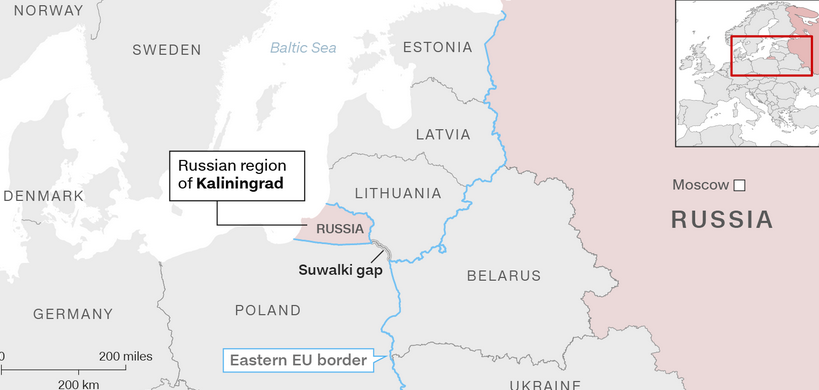
It took place near to the so-called Suwalki Corridor, which is a 60-mile region between Belarus and Kaliningrad that has been nicknamed the “weakest link” in NATO.
There are worries that the Wagner mercenary group’s soldiers could be used as a pretext in the strip, which provides the only land connection between Poland and Lithuania, two other members.
‘Technical malfunction’ was likely to blame for the catastrophe, according to officials.
“The Su-30 plane went down in a deserted area.” The flight was conducted without any weapons. Local military authorities reported that the crew had died.
The Su-30 has been heavily employed by Russia during its conflict in Ukraine.
Vladimir Putin has lost eight military aircraft so far this year, the most recent being the downed fighter plane.
Two Russian fighter planes crashed into the Pacific Ocean and the Sea of Azov last month while conducting training flights.
Video of the collision shows witnesses exclaiming, “What a nightmare.” A plane went down.
It blew up. What a disaster, the pilots didn’t even eject.
After accusing Minsk of violating its airspace, Poland will send more troops to the Belarusian border, escalating tensions between the NATO member and a crucial ally of the Kremlin in an increasingly unstable security environment in Europe.
Two Belarusian helicopters were allegedly in violation of Polish airspace on Tuesday while participating in training exercises, according to Warsaw. The Belarusian defence ministry fiercely disputed this and called the allegations “far-fetched.”
This coincided with an uptick in activity along the Suwalki gap or corridor, a narrow piece of land between Poland and Lithuania where forces from the Russian mercenary outfit Wagner are reportedly moving in an apparent effort to exert more pressure on NATO and EU nations.
A contract was apparently arranged by Alexander Lukashenko, the president of Belarus, to put an end to Wagner’s unsuccessful uprising against Moscow. Following this, Belarus reportedly received thousands of mercenary fighters.
Despite Minsk informing Warsaw of the drill, a border crossing occurred in eastern Bialowieza at a “very low altitude, making detection by radar systems difficult,” according to a statement from the Polish defence ministry.
Later, the ministry added, Polish Defence Minister Mariusz Blaszczak ordered the deployment of more soldiers and combat helicopters along the border.
According to the Belarusian defence ministry, “the Mi-24 and Mi-8 helicopters did not violate any airspace.”
The Polish military-political leadership made the absurd claims that the Mi-24 and Mi-8 helicopters of the Belarusian Air Force and Air Defence Forces had crossed Poland’s border in order to justify the augmentation of forces and equipment close to the border with Belarus, the ministry stated on Telegram.
The incident, which purportedly occurred south of the Suwalki gap, a 60-mile border that is strategically important to NATO, the EU, Russia, and Belarus, was reported by Poland to NATO.
The border region is the only overland link between the Baltic republics and the rest of the EU, connecting the Russian outpost of Kaliningrad to Belarus.
In a situation that is “becoming even more dangerous” as Russian-allied forces strive to strengthen their presence close to the NATO border, Polish Prime Minister Mateusz Morawiecki stated last week that Wagner mercenaries were travelling towards the Suwalki corridor via Grodno, a city in western Belarus.
The deputy foreign minister of Poland, Pawe Jaboski, said on Tuesday that there might “unfortunately” be other provocations from Russian and Belarusian military in the future.
At Lancaster University in northern England, Barbara Yoxon, a specialist in international politics, said Warsaw “views Belarus as complicit in the current European security crisis.”
In February 2022, Moscow invaded Ukraine via Belarusian territory, cementing relations with Russian President Vladimir Putin and Belarusian President Alexander Lukashenko.
The Suwalki gap is a crucial aim for Putin’s government since it would create a direct link between Russia and Kaliningrad.
“Russia would be able to effectively block off the Baltic States from its NATO allies in central and western Europe by sending soldiers from both the west (Kaliningrad) and the east (Belarus). Putin might conceivably attack nations like Lithuania, Latvia, or Estonia if this were to happen.
In response to Putin, who has historically attempted to undermine NATO expansion in Europe, the Western leaders of the organisation were forced to reevaluate their national security strategy as a result of the conflict in Ukraine.
Yoxon continued, “If Russia sent soldiers to the Suwalki gap, it would probably set off an instant military response from other NATO nations, who would interpret it as a direct assault on its member states in the area.
Such a step “would signal Russia’s readiness to escalate its dispute with NATO to a full-scale war and risk a nuclear escalation on both sides.”
Separately, Warsaw summoned the Ukrainian ambassador to Poland on Tuesday following claims made by a Polish foreign policy adviser that Kiev was being unappreciative of Poland’s assistance in exporting its grain.
In July, Russia pulled out of an agreement that guaranteed the secure sale of Ukrainian grain from southern ports in the area, driving up the price of wheat and putting pressure on the Global South nations who depend on the vital commodity.
Five EU nations—Poland, Slovakia, Hungary, Romania, and Bulgaria—four of which border Ukraine—have relaxed the restrictions on the import of Ukrainian grain that they had put in place to safeguard their own agricultural businesses.
However, on Tuesday, Kyiv contacted the Polish ambassador after Marcin Przydacz, the head of the Presidential Office for International Policy, stated on Monday that Ukraine should “start appreciating what role Poland has played for Ukraine over the past months and years.”
According to Kyiv, “statements about the alleged ingratitude of the Ukrainians for the assistance of the Republic of Poland do not reflect reality and as such are unacceptable.”
olitical pragmatism,” emphasising that “no statements will prevent us from workin
In the coming weeks, Vladimir Putin will travel on a diplomatic mission to Turkey, his first trip to a nation that is a member of NATO since the conflict in Ukraine began.
Erdogan emphasised the significance of the Black Sea Grain Initiative, which he called a “bridge for peace,” and told Putin that “no steps should be taken that will escalate tensions in the Russia-Ukraine war.” Erdogan also confirmed the visit.
But as Russia intensifies its use of force to stop Ukraine from exporting grain, it today assaulted Ukraine‘s biggest inland port, which is located across the Danube River from Romania. As a result, food prices around the world have increased.
As ships prepared to arrive at the port of Izmail to load up with Ukrainian grain in violation of a de facto blockade Russia reimposed in mid-July, the attacks destroyed buildings there and prevented them from doing so.
Oleksandr Kubrakov, the deputy prime minister of Ukraine, claimed that about 40,000 tonnes of grain that were bound for China, Israel, and nations in Africa were damaged by Russian drone assaults.
President Volodymyr Zelenskiy posted on Telegram that “Russian terrorists have once again attacked ports, grain, and global food security.”
One of the major exporters of grains worldwide is Ukraine. After declining to renew a deal that had eased its wartime blockade of Ukrainian ports last year, Russia began attacking Ukraine’s agricultural and port infrastructure and has continued to do so for more than two weeks.
Since Russia’s blockade of Ukraine’s Black Sea ports in mid-July, the port, which is across the river from NATO member Romania, has served as the primary alternate route for grain exports out of Ukraine.
After speaking with Erdogan, the Kremlin reaffirmed Russia’s need for rejoining the grain agreement: the implementation of a parallel agreement that would improve the terms for its own food and fertiliser exports.
These shipments are now immune from sanctions, which the West claims Moscow is attempting to thwart by endangering the world’s food supply.
Putin and Erdogan, according to Erdogan’s staff, decided that he will visit Turkey soon.
Putin, who is wanted for war crimes by the International Criminal Court, has made no official trips outside of the country this year and has only travelled outside of the former Soviet Union once since beginning his invasion, on a day trip to Tehran more than a year ago. Erdogan has long expressed the desire to welcome Putin and persuade him to resume the grain agreement.
Recent assaults on Ukraine’s grain infrastructure have been characterised by Moscow as reprisal for a Ukrainian attack on a Kerch Strait bridge to Crimea that was being used to supply Russian forces in southern Ukraine.
In a statement, American ambassador Bridget Brink denounced the strikes and listed recent Russian targets, including “Homes. Ports. cereal silos. historic structures. Men, women, and kids.
Round-the-clock and escalating Russian attacks on Kryvyi Rih, Kharkiv, Kyiv, and Kherson once again demonstrate Russia’s lack of interest in peace, disregard for the safety of civilians, and disregard for people across the world who depend on Ukrainian food.
According to Kyiv, the purpose of the strikes is to convince shippers and their insurance firms that Ukrainian ports are hazardous to resume exports, hence reinstating Russia’s blockade.
Before Russia withdrew from the Black Sea agreement, grain was exported mostly via Ukraine’s Danube river ports like Izmail, which have subsequently become the principal exit point. Grain is loaded onto barges and transported to Romania’s Constanta Black Sea port for further shipment.
While Moscow claims it will treat ships bound for Ukrainian seaports as potential military targets, Kiev wants international ships to arrive right there and load up.
Russia’s decision to renege on the agreement, mediated by the U.N. and Turkey, has prompted a warning from the United Nations about a potential food catastrophe in the world’s poorest nations.
According to Ukrainian officials, in nine days of strikes following the termination of the grain agreement, Moscow has attacked 26 port facilities, five civilian vessels, and 180,000 tonnes of grain.
A short distance from NATO member Romania, in Izmail on the Danube, a Russian drone strike struck Ukrainian port facilities.
Damage has been done to a grain elevator, a passenger facility and a grain warehouse.
After pulling out of a UN agreement that allowed both countries to move grain securely across the Black Sea, Russia started attacking Ukrainian ports.
Early on Wednesday, a sizable fire erupted from Izmail’s port area.
The size of the fire could be seen in video taken from the Romanian bank of the Danube, which was around 3 km (1.9 miles) distant.
The ongoing Russian strikes on Ukrainian infrastructure “close to Romania,” according to Romanian President Klaus Iohannis, are unacceptable.
Russian drones were reportedly moving towards the Danube river, where Ukraine has two ports, Izmail and Reni, according to the air force of Ukraine.
According to Ukraine’s military command in the south, air defences have been in operation for about three hours.
Oleh Kiper, the regional governor of Odesa, reported that emergency personnel were on the scene of the most recent Russian attack and that no casualties had been reported.
Volodymyr Zelensky, the president, stated that “unfortunately there has been damage,” and the regional administrator shared several pictures on social media that showed that multiple buildings had been affected.
The Izmail prosecutor has opened an investigation into a freight terminal, a warehouse and a lift that were all destroyed, without specifying precisely where in the Odesa region, according to officials and the Ukrainian army ministry.
Russian drones also targeted grain storage facilities in Reni, which is located further up the Danube and close to Romanian territory, last week.
The attacks that were so close to Romania, according to President Iohannis, were war crimes that further harmed Ukraine’s “ability to transfer their food products towards those in need in the world.”
Earlier, Russia bombed the significant Black Sea ports of Odesa and Chornomorsk, destroying 60,000 tonnes of grain, according to the authorities.
Russia effectively imposed a naval blockade when it abandoned the grain agreement in July by threatening to strike any ships en route to Ukrainian ports on the Black Sea.
Ukraine’s ports on the Danube have continued to be reached by ships travelling through the Black Sea, albeit this alternate route has gained prominence.
Wheat and maize are two commodities that Ukraine exports in large quantities to other countries, and the majority of the shipments had been coming from ports along the Black Sea. For Ukraine’s exports, the Danube becomes crucial if the Black Sea is closed to ships.
In the immediate aftermath of Russia’s withdrawal from the grain agreement, wheat prices skyrocketed on global markets.
Global food security is becoming a worry, particularly for underdeveloped Asian and African countries.
According to local officials, Russia also launched more than 10 drones overnight on Kyiv, the capital of Ukraine.
Anti-aircraft systems destroyed all of the projectiles, but according to the officials, falling debris damaged a number of non-residential buildings.
Russia has not made any official comments about the alleged strikes to date.
Vladimir Putin, the president of Russia, has indicated that his nation would be amenable to peace talks.
Russia and Ukraine have both previously stated that certain requirements must be completed before peace negotiations can begin.
In spite of the potential for retaliation over a Ukrainian attack on a vital road bridge to Crimea, Putin has now stated that African and Chinese initiatives might serve as the foundation for peace in Ukraine.
Although he said he hadn’t ruled out negotiations about Ukraine, he added that it would be challenging to put a ceasefire into effect because Ukraine is presently on the offensive, according to DW.
The notion of a ceasefire has been rejected by Ukrainian President Volodymyr Zelenskybecause it would allow Russia to maintain authority over about one fifth of his nation’s land.
According to the Russian Defence Ministry, Ukraine attempted to assault Crimea with 25 drones over the course of one night, and nine of those drones crashed into the Black Sea.
2014 saw the annexation of Crimea by Russia; ever since, Ukraine has been waging war against Russia.
Attacks on the region have grown and become more frequent in recent weeks as Kiev attempts to retake Crimea.
According to Russian authorities, three Ukrainian drones were shot down above Moscow early on Sunday, destroying two office buildings.
Following the airstrike on Moscow, the Kremlin threatened to use nuclear weapons, with Putin loyalist and former Russian president Dmitry Medvedev stating that there is “simply no other way out.”
According to the MailOnline, he reportedly advised Kyiv to “pray to our warriors” so they won’t “allow the global nuclear fire to flare up.”
“Our Armed Forces protect the people of Russia and our land,” declared Medvedev in response to the enemy’s concerted counteroffensive.
“This is obvious to all moral individuals.” Beyond that, though, they also stop global war.
After all, under the terms of the directive issued by the Russian President on February 6, 2020, we would have to deploy nuclear weapons if we assumed that the [Ukrainians’] offensive, which had NATO‘s support, was successful and they had captured any of our territory.
Simply put, there is no other way out.
As a result, our adversaries must pray to our soldiers. They prevent a flare-up of the global nuclear fire.
The statement was made as Putin and other military leaders celebrated Russia’s Navy Day on Sunday with a parade off the coast and the addition of 30 new ships to the fleet.
The prime minister of Poland claims that more than 100 members of the Russian mercenary group Wagner are marching towards a narrow strip of land separating Poland from Lithuania and has issued a warning that they may attempt to enter the border by pretending to be migrants.
Mateusz Morawiecki, the prime minister of Poland, stated on Saturday that his country had learned that the Wagner mercenaries were not far from Grodno, a city in western Belarus close to the Suwalki gap or corridor.
Following a failed military rebellion in Russia, thousands of Wagner soldiers are reportedly in Belarus.
Morawiecki reiterated claims that Belarus, a significant supporter of Russia, has been directing migrants towards the west in an effort to overwhelm Polish border guards.
According to Morawiecki, the troop moves appeared to be another component of this attempt to weaken the border.
In addition to helping illegal immigrants enter Polish territory and destabilising Poland, he predicted that they would likely pose additional hazards by trying to infiltrate Poland under the garb of illegal immigration.
According to Morawiecki, there have been over 16,000 attempts by migrants to cross the border illegally so far this year after being “pushed to Poland” by Russian President Vladimir Putin and Belarusian President Alexander Lukashenko.
Wagner has not responded to the reports, so it is unclear exactly what his forces are doing in Grodno. However, the stationing of Russian allies close to the Suwalki corridor would be an escalation that would alarmed NATO and EU members.
Despite being only 60 miles long, the corridor is crucial from a strategic perspective for NATO, the EU, Russia, and Belarus. The border region is the only overland connection between the Baltic states and the rest of the EU and links the Russian exclave of Kaliningrad to Belarus.
In the early stages of Russia’s invasion of Ukraine, analysts worried that Moscow would strike the Suwalki corridor in an effort to defend Kaliningrad, its westernmost province and the only region of the nation that is encircled by EU nations.
The precise number of Wagner forces in Belarus is unknown. As part of an agreement made by the president of Belarus to put an end to the mercenary group’s violent uprising against the Kremlin last month, they were invited to the nation.
Wagner was then requested by Lukashenko to assist with military training. The two intend to conduct combined military drills close to Poland’s border, which is likely to exacerbate existing tensions.
At a conference, Lukashenko made fun of Russian President Putin by saying that the Wagner fighters had started to worry him because they wanted to go on “an excursion” in the west.
Despite claiming that its borders are secure, Poland has shifted its troops east because of potential Wagnerian threats.
The Belarusian Defence Ministry announced that close to its border with NATO member Poland, Belarusian soldiers will conduct joint military drills with Wagner fighters.
After the private military group’s brief rebellion last month, Wagner fighters arrived in Belarus. Its creator Yevgeny Prigozhin was reportedly seen in a video on Wednesday wishing his fighters in the nation well.
According to a statement from the defence ministry, “The Armed Forces of Belarus continue joint training with the fighters of PMC ‘Wagner’.”
“During the week, units of the special operations forces together with representatives of the company will work out training and combat tasks at the Brestsky training ground,” it added.
The ministry didn’t say when exactly the exercises would take place.
Poland said its borders were secure and that it was monitoring the situation, Reuters reported.
At the beginning of July, Belarusian president Alexander Lukashenko invited Wagner forces into Belarus to help train his country’s military. The invite came shortly after the failed armed insurrection by Wagner forces against Moscow, which Lukashenko was credited with helping diffuse.
A CNN analysis of satellite imagery and social media videos found that Wagner fighters arrived at a previously abandoned military base in Belarus earlier this week. The footage showed hundreds of vehicles on the move.
Then on Wednesday, a video emerged that appeared to show Prigozhin greeting his fighters in Belarus, in what would be his first public appearance since he led an armed rebellion in Russia last month. CNN geolocated the video to a previously disused military base in Asipovichy, roughly 80 kilometers (49 miles) southeast of the capital Minsk.
“Welcome guys! I am happy to greet you all. Welcome to the Belarusian land! We fought with dignity! We have done a lot for Russia,” a man resembling and sounding like Prigozhin says in the video, which was posted on pro-Wagner Telegram channels on Wednesday and then shared on Prigozhin’s account.
Prigozhin’s whereabouts has been hotly debated following his short-lived rebellion.
The rebellion by his group posed one of the biggest threats yet to the rule of Russian President Vladimir Putin.
Also this week, the head of the UK intelligence service MI6 said Putin had no choice but to reach an agreement with the Wagner leader in order to end the uprising, saying he “cut a deal to save his skin.”
The transfer of F-16 fighter jets from NATO to Ukraine, according to Vladimir Putin’s foreign minister, poses a “direct nuclear threat” to Russia.
In response to Nato’s promise to begin training Ukrainian pilots to operate the fighter jets in August, Sergey Lavrov spoke out.
The Kremlin asserts that it forewarned the US, UK, and France about the dangers of giving Ukraine the jets.
Lavrov said: ‘Just one example of an extremely dangerous turn of events is the United States plans to transfer F-16 fighter jets to the Kiev regime.
‘We have informed the nuclear powers, the United States, Britain and France, that Russia cannot ignore the ability of these aircraft to carry nuclear weapons.
‘No amount of assurances will help here.’
Lavrov continued: ‘In the course of combat operations, our servicemen are not going to sort out whether each particular aircraft of this type is equipped to deliver nuclear weapons or not.
‘We will regard the very fact that the Ukrainian armed forces have such systems as a threat from the West in the nuclear sphere.’
He also warned: ‘The United States and its Nato satellites are creating risks of a direct armed clash with Russia, and this is fraught with catastrophic consequences.
‘The conditions for Russia’s use of nuclear weapons are clearly defined in our military doctrine.
‘They are well known, and I will not repeat them once again.’
He also accused countries at the Nato summit which was held in Vilnius, Lithuania, of ‘consistently lowering the threshold for the use of force and building up the nuclear capability in military planning’.
A key theme of this year’s summit was Volodymyr Zelensky’s wish for Ukraine to join Nato.
But defence secretary Ben Wallace said Zelensky needed to be mindful about keeping ‘doubting politicians’ on side following his complaints.
Mr Wallace said he needed to show more ‘gratitude’ to western allies for arming Ukraine and said ‘we’re not Amazon’.
In other news, Wagner Group chief Yevgeny Prigozhin, who staged a coup against Vladimir Putin, is likely dead or in jail, a former US military leader said.
The mercenary leader ordered his soldiers to travel towards Moscow in a failed rebellion against the Kremlin in late June.
The Russian president said his former caterer’s actions amounted to ‘armed mutiny’, and Prigozhin is now feared dead by experts.
Nato has warned Iran to quit supporting Russia’s military presence in Ukraine.
The Middle Eastern nation has sent hundreds of drones, also known as unmanned aerial vehicles (UAVs), to Russia over the past year in order to terrorise Ukrainian citizens.
Allies have urged Tehran to halt its military assistance to Russia because they are gravely concerned about the “malicious activities” occurring on their own soil.
‘We call upon Iran to cease its military support to Russia, in particular its transfer of uncrewed aerial vehicles, which have been used to attack critical infrastructure, causing widespread civilian casualties,’ the 31-member alliance said in a final declaration at a summit in Lithuania.
Allies are seriously concerned by the ‘malicious activities’ within their own territory (Picture: Rex)
‘We express our serious concern over Iran’s malicious activities in allied territory.’
Relations between Tehran and Moscow have grown much closer since the start of the invasion.
Russia wants drones and ballistic missiles, while in exchange Iran wants Russia’s investment and trade.
In June, the White House warned the two countries’ military partnership appears to be deepening.
‘We are also concerned that Russia is working with Iran to produce Iranian UAVs from inside Russia,’ spokesperson John Kirby said in a statement.
Citing newly declassified information, he added that Russia is receiving materials from Iran required to build a drone manufacturing plant that could open as early as next year.
‘We are releasing satellite imagery of the planned location of this manufacturing plant in Russia’s Alabuga Special Economic Zone,’ Kirby said.
The, UK, the US and the European Union in recent months all have issued rules designed to cut off the flow of drone components to Russia and Iran.
NATO member states have stated that Ukraine can join the military alliance “when allies agree and conditions are met,” following President Volodymyr Zelensky’s criticism of the delay in Ukraine’s accession.
While acknowledging the need for a swifter process, NATO’s communique did not provide a specific timeframe.
President Zelensky expressed his frustration, describing the delay as “absurd” and noting the apparent lack of readiness to invite Ukraine to join NATO or become a member. He is currently in Vilnius, Lithuania, where the summit is taking place.
Although Kyiv recognizes that it cannot join NATO while engaged in a conflict with Russia, it remains eager to join as soon as possible once the fighting comes to an end.
In their first working session at the #NATOSummit, Allies took decisions to bring Ukraine closer to NATO, and reinforce the Alliance’s collective deterrence and defence
During a briefing, NATO Secretary-General Jens Stoltenberg confirmed that allies had reaffirmed Ukraine’s future NATO membership and had agreed to forgo the need for a formal membership action plan in the process.
“This will change Ukraine’s membership path from a two-step process to a one-step process,” he said.
But Mr Zelensky tweeted that the lack of an agreed timeframe meant his country’s eventual membership could become a bargaining chip.
“A window of opportunity is being left to bargain Ukraine’s membership in Nato in negotiations with Russia. Uncertainty is weakness,” he said.
President Volodymyr Zelensky’s comments come in the midst of disagreement among NATO members regarding Ukraine’s membership in the alliance. Some members express concerns that granting Ukraine near-automatic membership could incentivize Russia to further escalate and prolong the conflict that resulted from its invasion of Ukraine.
NATO’s communique acknowledged Ukraine’s increasing interoperability and political integration with the alliance, as well as the progress it has made in implementing reforms. Member states pledged their support for continued reforms in Ukraine.
NATO Secretary-General Jens Stoltenberg is scheduled to meet with President Zelensky at the inaugural meeting of the NATO-Ukraine Council on Wednesday.
During the summit, a series of military packages were announced. A coalition of 11 nations will commence training Ukrainian pilots to operate F-16 fighter jets at a center to be established in Romania starting in August.
Meanwhile, Russian Defense Minister Sergei Shoigu was quoted by Russian news agencies as warning that Moscow would be compelled to use “similar” weapons if the United States supplied controversial cluster munitions to Ukraine. Cluster munitions release bomblets over a wide area and are banned by over 100 countries due to their impact on civilians. Shoigu stated that while Russia possesses similar cluster weapons, they have refrained from using them thus far.
Human rights groups have reported the use of cluster munitions by both Russia and Ukraine during the 17-month-long conflict following Russia’s invasion in February last year.
After delaying the Scandinavian country’s application for membership for months, he has consented to “as soon as possible” deliver the accession protocol to parliament.
On the eve of the alliance’s summit in Lithuania, Jens Stoltenberg, the secretary-general of Nato, issued the declaration following conversations with Erdoan and Ulf Kristersson, the prime minister of Sweden.
He said in a statement on Twitter this is a ‘historic step which makes all Nato allies stronger and safer’.
Stoltenberg declined to give a date for when Sweden’s accession would be ratified by the Turkish parliament, the grand national assembly, which would decide on the exact timing.
Kristersson was greeted by an ovation as he walked into the lobby of his hotel in Vilnius, shortly after securing the long-awaited assent.
This comes less than two weeks after the country gave the go-ahead to two men to hold a Quran-burning protest outside a mosque, a ‘despicable’ decision which was widely condemned in Turkey.
Sweden and Finland applied to join Nato last year after Russia launched a war in Ukraine.
With the move, the two countries casting aside policies of military non-alignment that had lasted through the decades of the Cold War as the invasion reframed the security considerations.
But Sweden’s accession has been held up by objections from Turkey since 2022.
Hungary is now the only Nato member who has not yet agreed to it joining the alliance.
UK’s foreign secretary James Cleverly tweeted his approval of Turkey agreeing to support Sweden, stressing it is ‘in everyone’s interest’.
He wrote: ‘Their accession makes us all safer. The UK welcomes the steps Turkey has taken today to bring this closer.
‘We continue to stand by our Swedish friends Tobias Billstrom.’
Turkey’s President, Recep Tayyip Erdogan, has stated that his country will support Sweden’s bid to join NATO if the European Union initiates membership talks with Turkey.
President Erdogan plans to convey this demand at the upcoming NATO summit in Lithuania.
President Erdogan has already informed US President Joe Biden of his intentions regarding Sweden’s NATO membership aspirations. His remarks precede a meeting with Sweden’s Prime Minister and NATO’s Secretary General in the Lithuanian capital, Vilnius.
As a NATO member, Turkey holds the power to veto the entry of any new country into the alliance. Turkey has previously expressed concerns regarding what it perceives as Stockholm’s willingness to host Kurdish militants.
However, President Erdogan acknowledged that Sweden has taken some positive steps by amending anti-terror laws, though he still has remaining grievances.
While Hungary has also been hesitant in supporting Sweden’s NATO bid, it has indicated that it will not further delay the process if Turkey changes its stance.
Jens Stoltenberg, the NATO Secretary General, stated on Monday that there is still a possibility of a “positive decision” regarding Sweden’s NATO membership during the upcoming two-day conference.
He added that Sweden joining Nato would “strengthen our ability to defend and protect not least the Baltic region”.
German Chancellor Olaf Scholz, meanwhile, has dismissed Mr Erdogan’s idea of a reciprocal agreement.
“Sweden meets all the requirements for Nato membership,” he told reporters in Berlin. “The other question is one that is not connected with it.”
A spokeswoman for the European Commission, the EU’s executive body, said membership to the bloc could only be granted by following procedure.
“The European Union has a very structured process of enlargement and a very, very clear set of steps that need to be taken by all candidate countries and even by those that wish to become candidate countries,” said Dana Spinant.
Over a year ago, Sweden, along with Finland, initiated a bid to join NATO, prompted by Russia’s invasion of Ukraine. Finland successfully became the 31st member of the alliance in April, after Turkey withdrew objections that were akin to those it currently has regarding Sweden’s application.
It’s worth noting that Turkey’s pursuit of EU membership has been stalled for several years. In 2016, EU members voted to suspend talks on the matter due to concerns over Turkey’s crackdown on dissenters following a failed coup attempt that same year.
Nevertheless, relations between Turkey and the EU have improved since then, with the EU relying on Turkey’s assistance on various issues, including migration.
In summary, Sweden and Finland launched bids to join NATO in response to Russia’s actions in Ukraine. While Finland has already gained membership, Turkey’s objections currently hinder Sweden’s application.
Turkey’s own EU membership process has been suspended, though relations between Turkey and the EU have shown signs of improvement.
The West has received a nuclear warning from Alexander Lukashenko weeks after his nation began receiving Russian tactical nuclear weapons.
Targets for strikes in the event of aggression have already been decided, according to the president of Belarus.
He declared: “We are not going to attack anyone with nuclear weapons” at a meeting with foreign reporters at his Minsk mansion.
You can forget about using nuclear weapons as long as you don’t hit us. However, the reaction will be immediate if you act aggressively. The goals have been selected.
His stark warning comes as Ukraine is still grappling with the ‘serious threat’ at the Russian-occupied Zaporizhzhia nuclear power plant.
Lukashenko, a close ally of Russian president Vladimir Putin, also gave an update about the whereabouts of Yevgeny Prigozhin.
‘As for Prigozhin, he is in St Petersburg. He is not on the territory of Belarus,’ he said.
Live Feed
Russia will hold illegal ‘elections’ in the occupied areas of Kherson Oblastin September, regional governer Yurii Sobolevskyi has confirmed.
The Ukrainian official cited the formation of a ‘Kherson Oblast election commission,’ set up by the Russian occupation authorities and urged locals not to take part in the process.
‘The occupiers set the dates of elections in the Kherson region — September 8, 9, 10. This was officially announced by the “head of the Kherson Region Election Commission” from the occupation authorities,’ he wrote on Telegram.
‘These actions have nothing to do with the election process and are absolutely illegal. Considering the way they already conducted the “referendum”, you can’t call it anything other than a circus and theater of the absurd.
‘I want to remind everyone that there will be responsibility for participating in the organization of this show. Each person will be held accountable.’
Russia’s central election commission also confirmed plans to hold illegal votes in the four partially-occupied Ukrainian oblasts of Kherson, Zaporizhzhia, Donetsk, and Luhansk.
The sham vote, which is expected to take place on the same day as elections in Russian regions, shows the Kremlin’s desire to present the areas as integral parts of Russia, according to the U.K. Defense Ministry.
The UK government has named Martin Harris as its next ambassador to Ukraine, starting in September.
A longstanding diplomat, Harris previously served as the British ambassador to Romania between 2010-14 and has worked closely with HM goverment on diplomatic missions in both Moscow and Kyiv.
He was appointed an Officer of the Order of the British Empire in 2010, and a Companion of the Order of St. Michael and St. George in 2023.
Outgoing ambassador to Kyiv, Melinda Simmons, who was appointed to the role in 2019, will take another diplomatic service appointment, the government said in a statement.
Ukraine plans to abandon conscription and move to a professional army after the war with Russia to bring Kyiv closer to NATO standards, Prime Minister Denys Shmyhal said on Thursday.
After a meeting with top defence and security officials at which reforms known as ‘the Ukrainian shield’ were discussed, Shmyhal said the government would also continue to focus on supporting a further increase in domestic weapons production.
‘The primary task is to complete the transition of the Security and Defence Forces of Ukraine to NATO standards. In all aspects: from equipment and weapons to planning and analysis,’ Shmyhal said on the Telegram messaging app.
‘After the end of the war, Ukraine will abandon the draft as it existed before the war. The foundation of our defence will be a professional army.’
The United States is expected to announce it will give cluster munitions to Ukraine for its fight against Russia’s invasion, the New York Times has reported, citing an unidentified senior Biden administration official.
Ukraine says it wants to use the explosives to clkear minefields andstrike at dug-in Russians, but Human Rights groups have criticised the move and say the unexploded bomblets are a threat to civilians.
Cluster munitions, banned by more than 120 countries, normally release large numbers of smaller bomblets that can kill indiscriminately over a wide area, threatening civilians.
A seven-year-old boy has perished in the Baltic Sea after jumping overboard from a passenger ferry.
In a last-ditch effort to save him, his mother dove in after her and perished as well.
According to a spokeswoman for the Swedish Maritime Administration, the mother chose to dive into the water after her child on Thursday when he fell into it.
Both were travelling from the Swedish port of Karlskrona to the Polish port of Gdynia on the Stena Spirit boat.
Crew issued a mayday signal and reportedly turned round to head back to the scene where they fell.
Ships and helicopters from Sweden and from NATO units that were in the area assisted in the attempted rescue operation.
Once found, the 36-year-old mother and boy were transported separately by helicopter to a hospital in Karlskrona.
Anders Olsson, who was on the rescue helicopter that pulled the woman from the sea, told Swedish radio on Friday that she was ‘not responsive’ and first aid was administered to her.
Police spokesperson Mariusz Ciarka told local media that it was impossible to save the lives of the two, both of whom were Polish citizens.
He said: ‘Unfortunately, in the morning we received information from the Swedish side that we have to pass on this terrible news to the family, because both the boy and the woman are dead.’
The boy fell from a height of about 20 meters – 65 feet – off the Stena Line ferry, it has been reported.
‘At the moment we have no information whether this was due to a malfunction of the ferry,’ Stena Line spokesperson Agnieszka Zembrzycka told TVN 24.
‘We are cooperating with the police and other authorities that are appointed to explain the causes and circumstances of this event.’
Swedish police issued an appeal to Polish passengers via Poland’s state-run news agency PAP asking for information that could explain how the accident occurred.
Ukraine is seeking an invitation to initiate the process of joining NATO at the upcoming summit of the military alliance next month. President Volodymyr Zelenskyy’s aide has stated that if the leaders do not demonstrate “courage,” the president will not attend the summit.
Chief diplomatic adviser Ihor Zhovkva told Reuters that Kyiv wanted the July 11-12 NATO summit in Vilnius, Lithuania to deliver a response to the application for NATO membership that Ukraine filed on September 30, 2022.
“This application is now on the tables of the leaders of NATO allies. The Vilnius summit would be a very good start to respond to this application. And by respond, we mean invitation for membership, which is only the first stage,” he said.
In an interview in the heavily guarded president’s office in Kyiv, the Zelenskyy aide said “What we are asking for is to start the procedure,” and banged on the table at one point to drive his point home.
On Monday, President Joe Biden (left) made his first remarks regarding the Wagner Group’s uprising against Russia. On Monday, President Joe Biden (left) made his first remarks regarding the Wagner Group’s uprising against Russia. (Images via Rex/Reuters)
In his initial remarks following the march on Moscow, US President Joe Biden claimed that the US and its allies had “nothing” to do with the Wagner uprising against Russia.
On Monday, Biden addressed the weekend coup attempt by the Wagner Group, which saw it capture control of a significant Russian city and briefly advance on Moscow.
‘They agreed with me that we had to make sure we gave (Russian President Vladimir) Putin no excuse – let me emphasize, we gave Putin no excuse – to blame this on the West or to blame this on NATO’.
Wagner mercenary chief Yevgeny Prigozhin leaves the headquarters of the Southern Military District amid the group’s pullout from the city of Rostov-on-Don, Russia, on Saturday (Picture: Reuters)
Biden added: ‘We made clear that we were not involved. We had nothing to do with it. This was part of a struggle within the Russian system.’
The mercenary group revolted on Friday, with its found Yevgeny Prigozhin saying he intended to punish defence minister Sergei Shoigu and army chief Valery Gerasimov for launching rockets at his troops. The uprising was the biggest threat to Putin in more than two decades.
After a day of conflict, Prigozhin agreed to exile in Belarus.
Still, Biden said the ‘ultimate outcome’ of the insurrection remains to be seen.
‘I directed my national security team to monitor closely and report to me hour by hour,’ he said. ‘I instructed them to prepare for a range of scenarios.’
Putin called the Wagner rebellion ‘treason’. In an unscheduled national address on Monday, the Russian president reiterated his offer of amnesty to insurrectionists but not to Prigozhin.
Biden on remained silent over the weekend on the uprising. The US president spoke with European allies by phone on Saturday and then traveled to Camp David along with his national security adviser Jake Sullivan.
US intelligence officials gathered detailed information of Prigozhin’s plans leading up to the rebellion including how he planned to advance, sources told CNN on Monday. That intelligence was reportedly only shared with some allies, including British officials, and not to NATO.
At a gathering of EU defence ministers, military personnel from the US and NATO, as well as business leaders, Macron stated that the system is “protecting key installations and lives” on Monday.
He continued, “It really is Europe protecting Europe,” alluding to his rejection of a German plan to build an anti-missile defence system for Ukraine using supplies from the US and Israel.
For the French presidency, announcing the deployment of the SAMP/T Mamba shows that there is an alternative.
Ukrainian troops completed training in March on the SAMP/T Mamba medium-range surface-to-air system, which includes radar and eight Aster missile launchers, with a range of about 100 kilometres.
The system is intended to help Ukraine counter Russian drone and plane attacks.
Earlier in May, Ukraine Air Force spokesperson Yurii Ihnat said that air defense systems like the SAMP/T or Patriot were needed to protect against large-scale ballistic missile attacks.
A Mamba system is already deployed in Romania to protect the strategic Black Sea port of Constanta.
If NATO members continue to provide military equipment to Kiev, there is a “serious danger” that the conflict in Ukraine may escalate. This is according to Russian President Vladimir Putin.
Putin stated at the St. Petersburg International Economic Forum on Friday that NATO was “obviously being drawn into the war in Ukraine.”
“The supplies of heavy military equipment to Ukraine are still being made, and they are currently considering supplying Ukraine with jets.”
The comment appeared to be a reference to the F-16 fighter jets some members of the NATO alliance are making plans to supply Ukraine with.
NATO, or the North Atlantic Treaty Organization, was formed in the aftermath of World War II to defend Western nations from the Soviet Union and the alliance contains a mutual defense clause where an attack on any one member is considered an attack on all. While Ukraine is not a member of NATO, some NATO members have been supplying Kyiv with tanks, armored vehicles and other weaponry – prompting threats of retaliation from Russia.
German Leopard 2 tanks, British Challenger 2 tanks and American Bradley and Stryker vehicles are among the Western equipment that has been sent to Ukraine.
In late April, NATO Secretary-General Jens Stoltenberg said that NATO allies and partners had delivered more than 1,500 vehicles and 230 tanks to the country.
During his speech in St. Petersburg, Putin said Russia had destroyed tanks “including Leopards” at the front lines.
“And if they are based abroad, but used in fighting we’ll see how to hit them, and where we can hit those means that are used against us in fighting,” Putin said.
“This is a serious danger of further drawing NATO into this military conflict,” he added.
During his speech to the forum, Putin also suggested Russia’s large number of nuclear weapons would “guarantee” its security – noting that Russia had more such weapons than NATO countries.
Russia has a total stockpile of around 6,250 nuclear warheads as of January 2021, according to the Arms Control Association. The US has more than 5,500 while two other NATO member states, Britain and France, have about 220 and 290 nuclear warheads, respectively.
“Nuclear weapons are created to guarantee our security in the broader sense and the existence of the Russian state,” Putin said.
“But first of all, there is no need and secondly the very fact of talking about it reduces the possibility of the threshold for using these weapons being reduced.”
“Also, we have more weapons like this than the NATO countries. They know it and they keep driving towards negotiation on reduction.”
In February, Putin said he would suspend Russia’s participation in the New START nuclear arms reduction treaty with the United States, imperiling the last remaining pact that regulates the world’s two largest nuclear arsenals. Russia’s Foreign Ministry subsequently said the decision was “reversible.”
The treaty puts limits on the number of deployed intercontinental-range nuclear weapons that both the US and Russia can have. It was last extended in early 2021 for five years.
Under the key nuclear arms control treaty, both the United States and Russia are permitted to conduct inspections of each other’s weapons sites.
As a show of force amid tensions with Russia, NATO has begun the largest air exercise in its history.
In response to a mock attack on an alliance member, more than 250 aircraft and 10,000 personnel from 25 nations will be sent, with the US sending 2,000 members of the Air National Guard and around 100 jets alone.
On Monday morning, the first aircraft took off from airfields in northern Germany.
The Air Defender 23 drill is expected to run until June 23, but planning began in 2018.
‘The exercise is a signal – a signal above all to us, the Nato countries, but also to our population that we are in a position to react very quickly, that we would be able to defend the alliance in case of attack,’ German air force chief Lt. Gen. Ingo Gerhartz told ZDF television.
Gerhartz said he proposed the air exercise five years ago, reasoning that Russia’s annexation of Crimea underlined the need to be able to defend Nato.
But it was the invasion of Ukraine in February 2022 that pushed the alliance to get ready for the possibility of an attack on its territory.
Sweden, which is hoping to become member, and Japan are also participating in the exercise.
There have already been warnings it could disrupt flights in some parts of Europe.
Matthias Maas, the head of a German air traffic controllers’ union, GdF, said that it ‘will of course have massive effects on the operation of civilian aviation’.
But Gerhartz disputed that, arguing that Germany’s air traffic control authority has worked with the air force to keep disruption ‘as small as possible’.
He noted that the exercise is limited to three areas which will not all be used at the same time, and that it will be over before school vacations start in any German state.
‘I hope that there we will be no cancellations; there may be delays in the order of minutes here and there,’ he said, insisting that the study cited by the air traffic controllers’ union assumes a worst-case scenario in bad weather in which the military would not fly anyway.
After leaking an elaborately faked statement from Vladimir Putin, hackers instilled fear in the hearts of millions of Russians about a full-scale Ukrainian attack.
Putin appeared to impose martial law in the message and said that Ukrainian forces had “entered the territories of Kursk, Belgorod, and Bryansk.”
A video message that initially appeared as a radio broadcast and eventually made its way onto the country’s state media later went viral on social media, with numerous clips of the emergency appeal.
The announcement, sounding like an official broadcast from Putin, said: ‘Fellow citizens, brothers and sisters, at 4am today Ukrainian troops, armed to the teeth by the NATO bloc, with approval and support from Washington, have entered the territories of Kursk, Belgorod and Bryansk regions.
‘Our border guards and Armed Forces are fighting back the superior troops of the aggressor. My order introduced martial law in Kursk, Belgorod and Bryansk regions.
Russian radio hit by ‘major hack’ with Putin impersonator imposing ‘martial law’
‘Also today, I will sign a law [to declare] general mobilisation because in order to fight a dangerous and treacherous enemy we would need to unite all forces of the Russian Federation.
‘I am asking residents of Kursk, Belgorod and Bryansk regions to evacuate deeper into Russia, maintaining order and peace.’
The broadcast added: ‘Strictly follow orders by local military administration while leaving your living place, to give the Russian army the chance to defend Russian land from Ukrainian Nazis. The enemy will be destroyed, the victory will be ours.’
Kremlin spokesman Dmitry Peskov admitted the Russian media had been caught out and branded the special Putin broadcast a ‘hack’.
‘Experts have already taken control and eliminated the hack, due to which some TV networks showed ‘Putin’s emergency appeal’,’ said Peskov.
While it remains unclear who was behind the attack, Russian officials immediately blamed Ukraine.
It appeared TV channels had repeated the message after it was first broadcast on FM radio stations across at least Belgorod, Rostov and Voronezh regions.
The latest hack across a wide area of western Russia increases the feeling that Putin’s government is losing control.
Ironically, though, the ‘Putin broadcast’ promoted calls among the autocrat’s most ardest supporters to properly announce mass mobilisation and martial law.
Putin has so far resisted such moves fearing a backlash from Russians already suffering from his ill-conceived war.
A representative for UK Prime Minister Rishi Sunak said Tuesday that Britain and the Netherlands are forming a “international coalition” to assist Ukraine in acquiring F-16 fighter jets, which Kyiv claims are essential to its defence as Russia intensifies its aerial attacks.
Following a meeting between Sunak and Dutch Prime Minister Mark Rutte at the Council of Europe Summit in Iceland, the two NATO allies reportedly tried to bring US-made jets to Ukraine as well as train Kyiv’s pilots to fly them.
The statement from the presidents of Britain and the Netherlands was warmly received by Ukraine, which has been arguing that the fighter jets are crucial to protect against Russian missile and drone threats.
“We need F-16s, and I am grateful to our allies for their decision to work in this direction, including training our pilots,” said Andriy Yermak, head of the office of President Volodymyr Zelensky.
Yermak said Belgium, another NATO ally, in particular, had “confirmed its readiness to train” Ukrainian pilots.
Britain does not have F-16s in its air force, but the Netherlands and Belgium do. The US Air Force has almost 800 F-16s in its fleet.
Speaking in the United Kingdom Monday, Zelensky welcomed promises of fresh military aid from European leaders – but renewed his demands to be provided with modern fighter jets.
Following a visit with Sunak, Zelensky hinted that Ukraine is closer to receiving F-16s, saying that Kyiv and London were “actively moving forward” on a plan. Zelensky also thanked the UK for agreeing to train Ukrainian pilots.
The US Air Force calls the F-16, which first flew in 1978, a “relatively low-cost, high-performance weapon system.”
The single-engine jets can act in air-to-air or ground-attack modes, flying in all weather conditions with a range of 500 miles (860 kilometers).
It would be a substantial upgrade to the aircraft in Ukraine’s fleet now, largely Soviet-era warplanes that were either in Ukraine’s air force before the Russian invasion or have been given to Kyiv by other European states like Poland that used to be in the Soviet orbit.
Despite Zelensky’s repeated pleas for F-16s, many of Ukraine’s allies have been reluctant to supply Kyiv with weapons that can reach Russian soil.
Early on in the war, the US believed that supplying Ukraine with new fighter jets would risk an escalation between NATO and Russia.
Meanwhile, US and allied officials have previously said the jets would be impractical because they require considerable training and Russia has extensive anti-aircraft systems that could easily shoot them down.
Any movement of F-16s to Ukraine would require US approval and US President Joe Biden said earlier this year that Kyiv did not need the fighter jets.
But CNN reported in March that the US is working with Ukrainian pilots in the United States to determine how long it would take to train them to fly F-16s, according to sources briefed on the matter.
The first NATO liaison office to be established in Asia is being considered by Japan, according to the country’s foreign minister, who said in an exclusive interview with CNN on Wednesday that the globe is less stable as a result of Russia’s invasion of Ukraine.
Foreign Minister Yoshimasa Hayashi stated on Wednesday, one week before the Group of Seven summit that Japan will be hosting this year in Hiroshima, “We are already in discussions, but no details (have) been) finalised yet.”
Hayashi explicitly noted Russia’s invasion of Ukraine last year as a situation that had effects well beyond the boundaries of Europe and compelled Japan to reevaluate regional security.
“The reason why we are discussing about this is that since the aggression by Russia to Ukraine, the world (has) become more unstable,” he said.
Ukrainians fleeing war find asylum in unexpected Asian country (June 2022)
“Something happening in East Europe is not only confined to the issue in East Europe, and that affects directly the situation here in the Pacific. That’s why a cooperation between us in East Asia and NATO (is) becoming … increasingly important.”
He added that Japan is not a treaty member of NATO, which stands for the North Atlantic Treaty Organization – but that the move sends a message the bloc’s Asia Pacific partners are “engaging in a very steady manner” with NATO.
The opening of a NATO liaison office in Japan would mark a significant development for the Western alliance amid deepening geopolitical fault lines, and is likely to attract criticism from the Chinese government, which has previously warned against such a move.
The Nikkei Asia first reported plans to open the office in Japan last Wednesday, citing unnamed Japanese and NATO officials.
NATO has similar liaison offices in other places including Ukraine and Vienna. The liaison office in Japan will enable discussions with NATO’s security partners, such as South Korea, Australia and New Zealand, on geopolitical challenges, emerging and disruptive technologies, and cyber threats, Nikkei reported last week.
In a statement to CNN last week, a NATO spokesperson said: “As to plans to open a liaison office in Japan, we won’t go into the details of ongoing deliberations among NATO allies.” She added that NATO and Japan “have a long-standing cooperation.”
CNN reached out to NATO for comment on Wednesday after Hayashi’s remarks.
Russia’s invasion of Ukraine sent shockwaves through Europe and drove non-aligned Finland and Sweden to abandon their neutrality and seek protection within NATO, with Finland formally joining the bloc last month.
Ukrainian President Volodymyr Zelensky has been invited to participate in the G7 summit next week, said Hayashi, alongside the leaders of Canada, France, Germany, Italy, the United Kingdom, the United States, and the European Union. Zelensky is expected to dial in remotely.
“Since we are hosting it here in Japan, so we have to talk about Asia Pacific, Indo-Pacific issues too,” he said, adding that the summit location in Hiroshima — where atomic bombs were dropped in 1945 — was partly chosen because “we would like to talk about nonproliferation and also disarmament,” topics that have come to the fore during the war in Ukraine.
The war has also seen countries like Japan and South Korea draw closer to their Western partners, while presenting a united front against perceived threats closer to home.
Hayashi highlighted what he described as Japan’s “severe and complex” regional security environment, noting that in addition to increased Russian aggression, Tokyo is also contending with a nuclear-armed North Korea and a rising China.
China has been growing its naval and air forces in areas near Japan while claiming the Senkaku Islands, an uninhabited Japanese-controlled chain in the East China Sea, as its sovereign territory. In the face of growing friction, Japan recently announced plans for its biggest military buildup since World War II.
Tensions between Japan and Russia have also been increasing in recent months, fueled in part by Russian military drills in the waters between the two nations, and joint Chinese-Russian naval patrols in the western Pacific close to Japan.
In April, Russian warships conducted anti-submarine exercises in the Sea of Japan, also known as the East Sea – and in March, Russian missile boats fired cruise missiles at a mock target in the same waters. And after Japanese Prime Minister Fumio Kishida made a surprise visit to Ukraine in March, two Russian strategic bombers, capable of carrying nuclear weapons, flew over waters off the Japanese coast for more than seven hours, Reuters reported.
Despite the growing regional tensions, Hayashi said the potential opening of the office was not aimed at specific countries. “This is not intended…to be sending a message,” said Hayashi.
He added that Japan and other countries still need to cooperate with China on larger issues such as climate change and the Covid-19 pandemic, and that Tokyo wanted a “constructive and stable relationship” with Beijing.
China has previously warned against NATO expanding its reach into Asia and responded angrily to previous reports on the possible Japan office.
“Asia is a promising land for cooperation and a hotbed for peaceful development. It should not be a platform for those who seek geopolitical fights,” said Chinese Foreign Ministry spokesperson Mao Ning in a briefing last week. “NATO’s eastward push and interference in Asia Pacific matters will definitely undermine regional peace and stability.”
Though Beijing has claimed impartiality in the Ukraine war and no advance knowledge of Russia’s intent, it has refused to condemn Moscow’s actions. Instead, it has parroted Kremlin lines blaming NATO for provoking the conflict – further fracturing relationships with both Europe and the US.
And in March, senior Chinese Foreign Ministry officials and influential Communist Party publications accused the United States of seeking to build a NATO-like bloc in the Indo-Pacific, with one official warning of “unimaginable” consequences.
On Wednesday, Hayashi played down concerns that opening a Tokyo NATO office could further inflame tensions, saying: “I don’t feel that’s the case.”
The country has had a pacifist constitution since World War II – which he argued is reflected in this move.
“We are not offending anyone, we’re defending ourselves from any kind of interference and concerns, and in some cases threats,” he said.
Three Russian aircraft were intercepted by German and British fighter jets in international airspace over the Baltic Sea on Wednesday, according to the German Armed Forces.
One Il-20 and two military Su-27 aircraft were “again flying without transponder signal,” the German Armed Forces tweeted.
The Baltic airspace in northeastern Europe has been protected by the military alliance since 2004 becauseNATO members Estonia, Latvia, and Lithuania lack fighter jets of their own. In order to achieve this, the allies frequently send soldiers and fighter jets to Russia’s bordering Baltic Sea republics.
At the beginning of April, after eight months, the Bundeswehr handed over command of the NATO air surveillance mission to Great Britain. However, the German Air Force will continue to support it until the end of the month.