A top New York City doctor who was on the front line of the US fight against coronavirus has taken her own life.
Dr Lorna Breen, who was medical director of the emergency department at New York-Presbyterian Allen Hospital in Manhattan, died of self-inflicted injuries on Sunday, police said.
The 49-year-old’s father, Dr Philip Breen, told the New York Times: “She tried to do her job and it killed her.”
New York accounts for 17,500 out of America’s coronavirus 56,000 deaths.
The elder Dr Breen said his daughter had had no history of mental illness. She died in Charlottesville, Virginia, where she had been staying with her family.
Lorna Breen herself had fallen ill with the coronavirus during the course of her work and returned to the job after about a week-and-a-half of recuperating, said her father.
The hospital had sent her home again, before her family “intervened” to bring her to Charlottesville, said her father.
He said that when they last spoke, his daughter had seemed “detached” and told him how Covid-19 patients were dying before they could even be removed from ambulances. Dozens of patients have succumbed to coronavirus at the 200-bed hospital in Manhattan.
“She was truly in the trenches on the front line,” her father told the Times.
“Make sure she’s praised as a hero. She’s a casualty just as much as anyone else who has died.”
According to the newspaper, Dr Lorna Breen was a devout Christian who was very close to her family. She was an avid skier who also enjoyed salsa dancing. She volunteered once a week at a home for old people.
New York-Presbyterian Allen Hospital said in a statement: “Dr Breen is a hero who brought the highest ideals of medicine to the challenging front lines of the emergency department.”
In a press release confirming her death, the Charlottesville Police Department also described Dr Breen as a “hero”.
The police department said that after a call for help on 26 April, Dr Breen was taken to a local hospital for treatment “where she later succumbed to self-inflicted injuries”.
Police chief RaShall Brackney said in a statement: “Frontline healthcare professionals and first responders are not immune to the mental or physical effects of the current pandemic.
“On a daily basis,” she added, “these professionals operate under the most stressful of circumstances, and the coronavirus has introduced additional stressors.”
New York state has recorded almost a third of the country’s nearly one million confirmed Covid-19 cases.
On Monday, New York Governor Andrew Cuomo said random antibody tests indicated that a quarter of New York City (24.7%) – America’s most populous city with 8.3 million people – had been infected with coronavirus.
New York City, the hardest hit U.S. city in the coronavirus pandemic, revised its official COVID-19 death toll sharply higher to more than 10,000 on Tuesday to include victims presumed to have perished from the disease but never tested.
The new cumulative figure for “confirmed and probable COVID-19 deaths” released by the New York City Health Department marked a staggering increase of over 3,700 deaths formally attributed to the highly contagious illness since March 11.
The 60 percent spike in reported deaths underscored the enormous losses endured in the nation’s most populous city, where the sounds of wailing sirens have echoed almost non-stop through largely empty streets for weeks.
The city’s revised count, 10,367 in all, raised the number of coronavirus deaths nationwide to more than 28,300 – New York accounting for the biggest share of deaths.
With only a tiny fraction of the U.S. population tested for coronavirus, the number of known infections climbed to more than 600,000 as of Tuesday, according to a running Reuters tally.
U.S. public health authorities have generally only attributed deaths to COVID-19, the respiratory disease caused by the novel coronavirus, when patients tested positive for the virus.
New York City’s Health Department said it will now also count any fatality deemed a “probable” coronavirus death, defined as a victim whose “death certificate lists as a cause of death ‘COVID-19’ or an equivalent.”
March 11 was used as the starting point because that was the date of the first confirmed coronavirus death, the city said.
“Behind every death is a friend, a family member, a loved one,” said Health Commissioner Dr. Oxiris Barbot. “We are focused on ensuring that every New Yorker who died because of COVID-19 gets counted.”
The new approach in New York City could pave the way for similar policies across the country, possibly leading to a surge in the US number of reported coronavirus deaths.
Even before Tuesday’s revision in New York City, the number of new U.S. deaths on Tuesday had reached at least 2,228, the highest toll yet in a single 24-hour period.
‘Not a comfortable place’
Louisiana, another coronavirus hot spot, and California also reported record daily spikes in deaths on Tuesday, despite tentative signs across the country in recent days the outbreak was beginning to ebb.
New York Governor Andrew Cuomo, whose state’s healthcare network was strained to breaking point by a wave of COVID-19 hospitalisations, had said on Monday it appeared “the worst is over.”
Health officials have cautioned that death figures are a lagging indicator of the outbreak, coming after the most severely ill patients fall sick, and do not mean stay-at-home restrictions are failing to curb transmissions.
New York state and some other hard-hit areas continue to report sharp decreases in hospitalisations and numbers of patients on ventilators, although front-line healthcare workers and resources remained under extraordinary stress.
“The plateau is not a very comfortable place to live,” David Reich, president of New York’s Mount Sinai Hospital, said in a telephone interview. “So I don’t think people should be celebrating prematurely.”
That cautious note was also sounded by President Donald Trump’s top infectious diseases adviser, Dr. Anthony Fauci, who said Trump’s May 1 target for restarting the economy was “overly optimistic”.
Fauci, echoing many governors, said in an Associated Press interview that health officials must first be able to test for the virus quickly, isolate new cases and track down new infections.
At his daily White House briefing later in the day, Trump said he was close to completing a plan for ending America’s coronavirus shutdown, which has thrown millions out of work, and may forge ahead with restarting the battered U.S. economy in some parts of the country even before May 1.
The president took renewed aim at the World Health Organization at the briefing, saying he has instructed his administration to halt U.S. funding to the Geneva-based institution over its handling of the pandemic.
Mutiny on the bounty
Trump, a Republican who before the outbreak touted a vibrant economy as a pillar of his Nov. 3 re-election bid, earlier lashed out at Democratic state governors, after Cuomo said he would refuse any presidential order to reopen the economy too soon.
“Tell the Democrat Governors that ‘Mutiny On The Bounty’ was one of my all time favorite movies,” Trump wrote on Twitter on Tuesday, referring to a classic film about an 18th-century rebellion against the commanding officer of a British naval vessel.
But Trump toned down his remarks at the White House briefing saying he would “authorize” governors – despite doubts from some experts that the presidency has such powers – to implement plans in their states at the appropriate time.
Cuomo, a Democrat, and governors of six other northeastern states have announced they are coordinating on a regional plan to gradually lift restrictions. The governors of California, Oregon and Washington formed a similar West Coast regional pact.
California Governor Gavin Newsom and Oregon Governor Kate Brown, both Democrats, on Tuesday offered frameworks for eventually restarting public life and business in their states.
Some Republicans, including the governors of Ohio, Maryland and New Hampshire, also said states have the right to decide when and how to reopen.
By last Tuesday, the death toll from coronavirus in New York City had passed that of the 9/11 attacks on the World Trade Center.
The figure was reached only three weeks after the first coronavirus death in the city.
The outbreak has placed New York at the centre of the global pandemic and put an unprecedented strain on the city’s emergency workers and frontline staff.
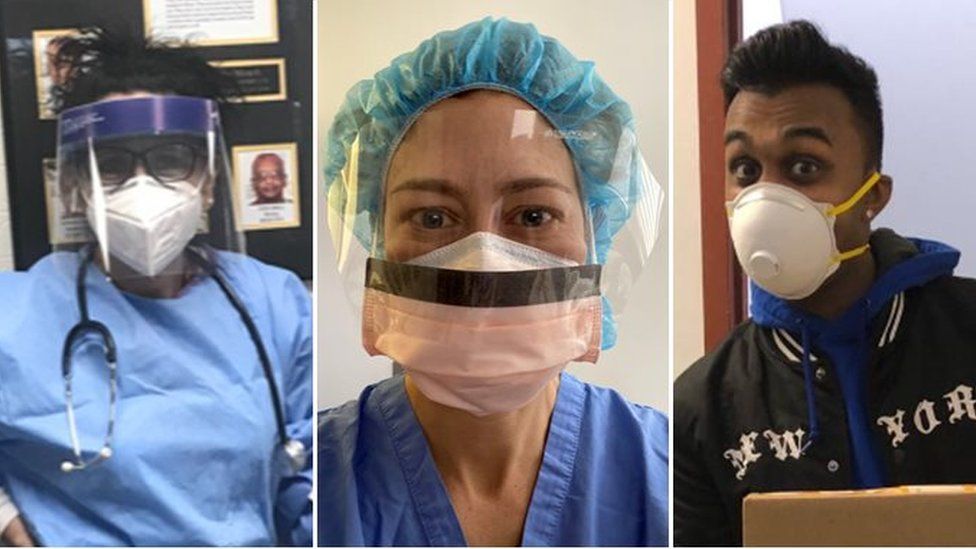
Over the course of Tuesday, six of those people – two doctors, an undertaker, two senior care home staff and a food delivery worker – kept diaries of their day and shared them with the BBC.
This is their story.
Midnight, Tuesday 7 April
Kathleen Flanagan returns from a late shift at a nursing home. The TV is on in the living room, playing the sitcom That ’70s Show. As has become the custom in her household she shouts “Hello” to let her family know that she is home and to make sure they avoid contact with her.
She heads downstairs into the laundry room, takes off her clothes and showers.
Everything she has worn at work must go into the washing machine before she sees her husband and children.
When she heads back up the stairs, she is greeted by a bouquet of sunflowers in the kitchen. A card from her eight-year-old son reads: “Keep kicking butt Mom!”
Two of her three sons are asleep on the couch waiting for her. She cooks eggs and spinach for dinner and shares details of her day with her husband – the good news is that coronavirus patients in one of the centres she oversees are starting to look better, but in another the situation is getting worse.
She opens her laptop to do some work and falls asleep somewhere between 01:00 and 02:00.:57
Doctor Jennifer Haythe is woken by a call from the intensive care unit at her hospital, letting her know about a Covid-19 patient whose condition is deteriorating.
The 46-year-old hangs up the phone and tosses and turns in bed, worrying about the patient. She rethinks the plan for them and then is met by the increasingly familiar feeling of loneliness.
‘Like 9/11 every day’: A New York paramedic’s diary
Like many healthcare professionals working with coronavirus patients, Jennifer is living separately from her family. She is staying in an apartment in Greenwich Village, while her husband and children are in their house upstate.
Faced with an eerie silence outside and missing her loved ones, she does a deep breathing exercise: “In for four, hold for seven, out for eight.” It must work because she falls asleep.
02:00
Outside the city, in the New York state town of Corinth, Faith Willett, a director of nursing at a care home, is woken by a member of staff reporting a high fever. She advises her to self-isolate and contact a doctor as soon as possible.
Faith feels sick and struggles to fall back to sleep. She scrolls through her phone to see the latest news on the coronavirus outbreak, paying close attention to local updates that might be worrying residents and their families.
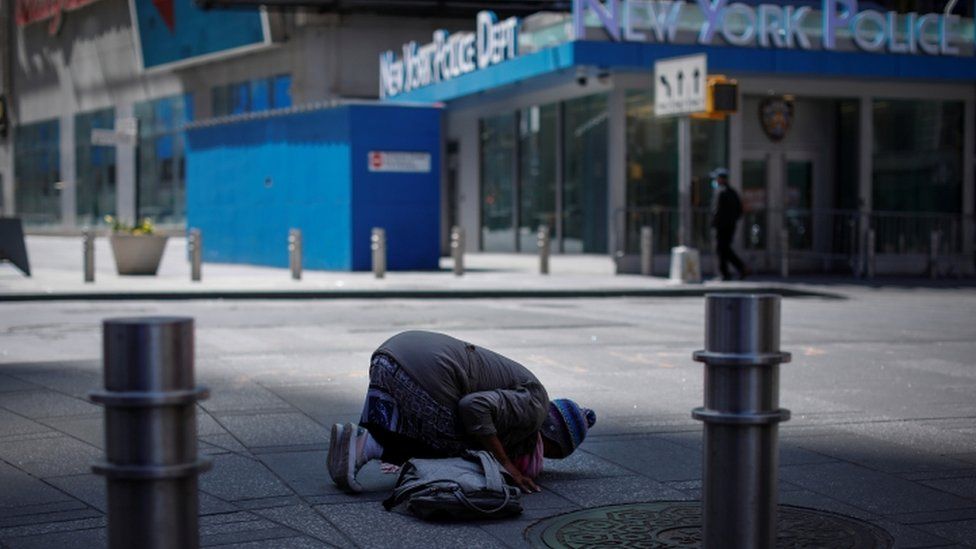
In deserted Times Square, a Muslim woman prays on Tuesday The news feels so surreal that the 46-year-old nurse wonders if she’s asleep. She wakes her husband to ask if she’s dreaming. “No, babes, you’re awake,” he replies. He tells her to get some rest.After a few hours of disturbed sleep, she wakes to her alarm. She grabs her computer and scans the latest updates from her colleagues. She can breathe a sigh of relief. There are no confirmed cases – for now.
05:00
Funeral director Steven Baxter is already out of the house. His hours have completely changed since the virus struck, as he and funeral workers across New York struggle to keep up with the rising number of fatalities.
The days of wearing a suit to work are gone. He now dons “scrubs” that he can throw out afterwards, without risking cross-contamination. The trainers he wears to work are always kept outside.
He sets off to a nursing home, where he has to collect the body of yet another coronavirus victim. It is the first of several such visits he will have to make that day.
06:30
Back in Greenwich Village, doctor Jennifer Hayth wakes up to her alarm. She opens her eyes with the fleeting hope that the past few weeks have been a bad dream.
She has a shower and gets ready for work. There are no dogs for her to walk, no husband to kiss goodbye and no children to prepare breakfast for.
She heads to a coffee shop where a woman walking her dog notices her doctor’s uniform and thanks her. In the cafe, the only other customer – a retired police officer – pays for her coffee.
The Cat Stevens song Peace Train comes on the radio as she drives to work at Columbia University Medical Center. She hasn’t heard it for a while and it makes her feel energised. She looks over the highway at the USNS Comfort – a Navy hospital ship docked in New York City where coronavirus patients are being treated – and thinks to herself that it seems almost majestic.
Arriving at work, she puts on her mask, gown, gloves and other equipment required for working with coronavirus patients and heads over for another day in the ICU.
07:00
Nurse Kathleen Flanagan wakes to a hug from her eight-year-old son. Before she leaves the house, he performs a dance to the song High Hopes by the band Panic! At the Disco.
She listens to it again in the car, applying the lyrics to her own life.
Mama said don’t give up, it’s a little complicated…
Had to have high, high hopes for a living
As she listens to the song, she passes the traffic light where last month she received a phone call that changed everything. A colleague at a nursing and rehabilitation centre in New York City told her that two residents had fevers and respiratory symptoms – the first signs of coronavirus in any of the six facilities she oversees.
She was heading to a different centre at the time and was faced with the decision of whether to help remotely or change her plans and put herself on the frontlines of the outbreak. She turned her car around.
Her normal job does not include direct patient care. But three weeks later, she continues to take a hands-on role at the centres with coronavirus patients in spite of the risks.
08:45
At another nursing home in Glens Falls, New York, Faith Willett has been at work for about an hour and there is already cause for concern.
Before leaving the house this morning, she said her personal mantra aloud to herself in the shower: “We’ve got this.” Like every day in recent weeks, she hoped there would be no signs of coronavirus in the centre.
But as a nurse walked out of a resident’s room during the routine morning checks, Faith could tell from her eyes it was bad news – the resident had a high temperature and was getting short of breath while reading her Bible.
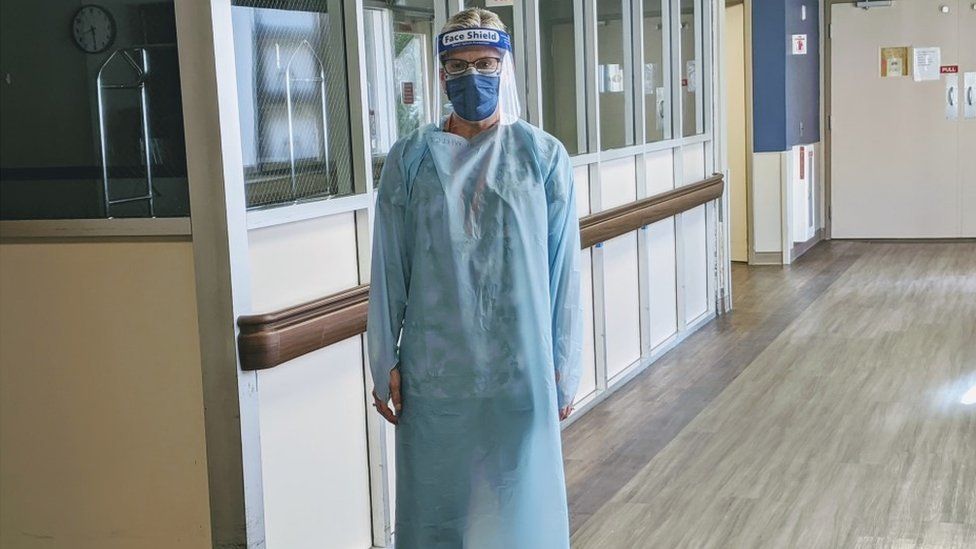
Image captionCoronavirus has forced carers like Faith Willett to go against all their natural instincts
All the staff at the home know this might end up being the day the virus made its way in. Masks need to be issued and the door to the resident’s room must be closed, with only designated caregivers in full protective equipment allowed in.
Faith considers the order.
You should never close a door to a resident’s room unless they ask you to – it’s a violation of their rights; it’s forced isolation; it’s mistreatment, she thinks. But she reminds herself that they must go against all their instincts as caregivers to save lives.
A nurse in full protective equipment goes into the room to perform the test. There are tears in the nurse’s eyes but they soften as she walks in. She completes the test, packages it and takes it to the lab. Faith admires the woman’s bravery for being able to do it.
09:00
Steven Baxter is sorting through death certificates and other documentation at Gannon Funeral Home in Manhattan. The phone line has just opened so he is preparing for another day of calls from families who have lost loved ones to the virus.
The 53-year-old recently converted the chapel in the funeral home into a morgue. He has a rule: the dead need to be treated with respect and given adequate space. But the number of bodies coming in is hard to keep up with.
Later today he will need to take the bodies of eight Covid-19 patients to be cremated, and to chase a supplier about cremation boxes, which are increasingly in short supply.
It will be about three weeks before the person he collected this morning can be cremated – the pandemic has put a strain on the system, creating major backlogs.
All his days are merging into one at the moment. The “removal” this morning was like any other in the time of coronavirus – he put on a respirator and other protective equipment, and used disinfectant spray as he worked to ensure he was safely transferring the body.
09:34
People not directly on the frontline are also performing critical jobs to prevent the virus spreading.
Since the pandemic began, doctor Michael Morgenstern has swapped his subway commute for a walk upstairs. This morning, he logs on to video conferencing platform Zoom for his first appointment of the day.
Many of his patients are elderly and part of his role now is explaining the risks of coronavirus to them, and the precautions they should take.
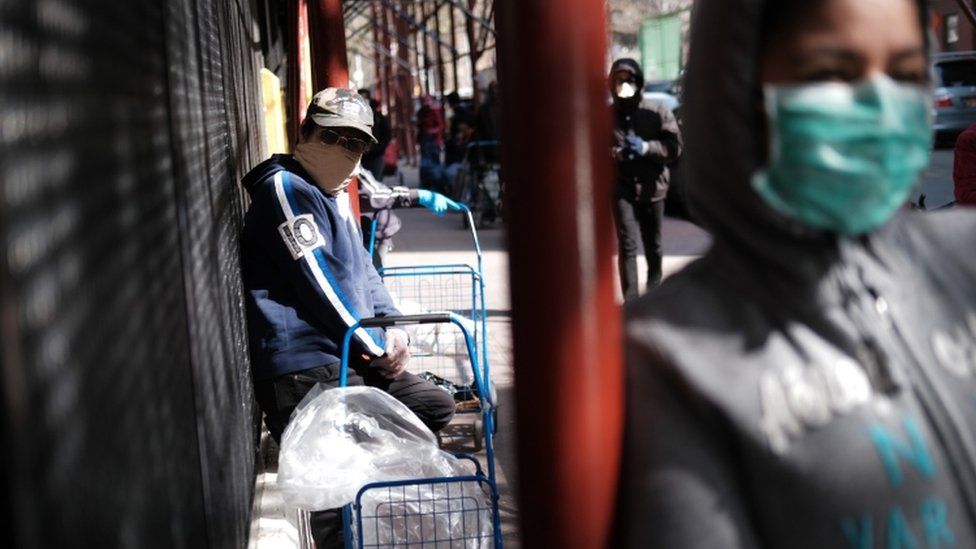
Image copyrightGETTY IMAGESImage captionPeople queue at a food distribution centre in Harlem
The first patient wants to go out and visit two other doctors. Michael asks the son, who is also on the call, to try to see if the appointments can be conducted over the phone or through a video platform.
He is concerned about people exposing themselves to the virus and has spent much of his morning up to now working on a petition calling for the public to wear non-medical face masks, in line with recommendations from the Centers for Disease Control.
He repeats the mantra “an ounce of prevention is worth a pound of cure” to himself as he works.
His legs shake as he begins his second appointment of the day. He’s nervous about what’s happening in the world.
10:00
Faith Willett gets a call from the nurse who fell ill – she can’t get tested and has instead been labelled “presumed positive”.
Faith is angry about the lack of testing for a frontline worker. She worries that the residents may have been exposed and then finds herself wondering – selfishly, she thinks – if she too might have been.
Five other people working at the home have been tested for Covid-19 because of symptoms – four were negative and the fifth is pending.
Faith and her colleagues all worry about the same thing: they don’t want to be the person who brings the virus into the facility.
11:00
At another nursing and rehabilitation home, Kathleen Flanagan has spent much of the morning checking on residents with coronavirus symptoms.
The hospital calls to discuss returning one long-term resident, assuring her that he is alert and responsive.
Two others are at the hospital. One is not doing well. When asked who his next of kin are, she replies: “We are his family.”
She urges the doctor to fight for him.
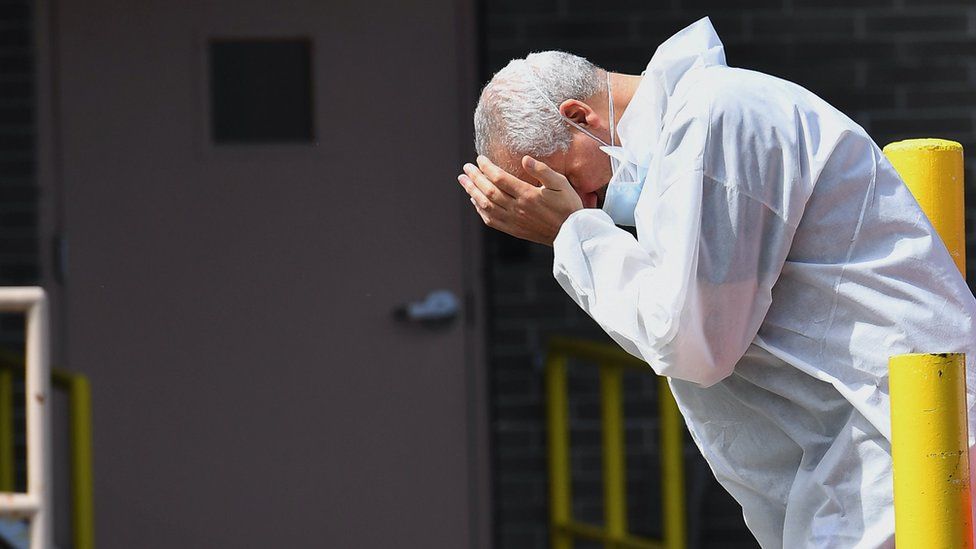
Image copyrightAFPImage captionAt the Wyckoff Heights Medical Center, a hospital worker takes a moment to pause
11:23
Michael Morgenstern sees his next patient via video call. An elderly person with cancer.
The cancer appears to be spreading but while the patient is continuing with chemotherapy, they are holding off on adding radiation treatment for now because of the Covid-19 risk.
Michael is worried. He advises relatives who are still going outside to consider wearing face masks when they are around the patient.
He continues to see patients and work with volunteers for his coronavirus campaign throughout the morning. One of the patients was born only shortly after the Spanish flu pandemic of 1918, he thinks to himself.
12:00
Doctor Jennifer Haythe is carrying out rounds in the ICU. Everyone she sees is a Covid-19 patient. They are all on ventilators.
She passes colleagues but can only see their eyes. In them she sees stress, but also hope and courage.
Image copyrightEPAImage captionA patient is transported through Jennifer’s hospital in Manhattan
As she attends to sick and dying patients she thinks about what it must be like for them and their families.
“A hospital without visitors. What is that?” she asks herself.
12:30
Sarujen Sivakumar, a 22-year-old Lebanese-born delivery team manager for Eat Offbeat – a catering company led by immigrants and refugees – heads out to work.
Like many businesses across New York, his company has had to re-model amid the pandemic and now sells coronavirus “care packages” of a week’s worth of meals and snacks.
As he begins his journey, he is struck again by how quiet the city is. In the six years since he arrived here as a refugee, he has never seen it like this. There are no groups talking to each other, no performers at the subway station. He feels almost as if he is in a video game.
Before the outbreak, he would greet his colleagues with special handshakes and hugs. But as he walks into the kitchen today, he knows he has to keep his distance.
13:00
At the Glens Falls nursing home, it is visiting time.
Faith and her colleagues bring residents into the dining room where there are big windows through which they can see their relatives.
Families wait outside in their cars and take turns coming to the windows. They have agreed to limit their visits to 10 minutes each.
As emotional reunions take place through the glass, Faith observes the range of tears being shed – joy, laughter, sadness and, of course, fear.
13:45
The chefs at Sarujen’s company say they are too scared to take the train to work any more, but also worry about how they would survive financially if the company stops running.
Sarujen knows how hard he and others at the company worked to get where they are today. He worries that if it closes, it won’t be the same again in the future.
There is little time to talk about it in depth as they have deliveries to get on with.
14:30
Steven Baxter heads to a funeral home to collect the body of another coronavirus victim.
He received a call the previous day from a man whose father had died. He couldn’t afford what the company was charging for a cremation and needed someone else to take over.
As he collects the body, Steven is angry about what he sees as exploitation of victims of a health crisis. He believes the price that was being charged is four times the average in the city.
16:20
It’s the news everyone had been dreading. The result for the fifth employee tested at Faith Willett’s home comes back positive.
She tells herself there’s no time to feel – she needs to act.
She begins the difficult process of alerting residents and their families.
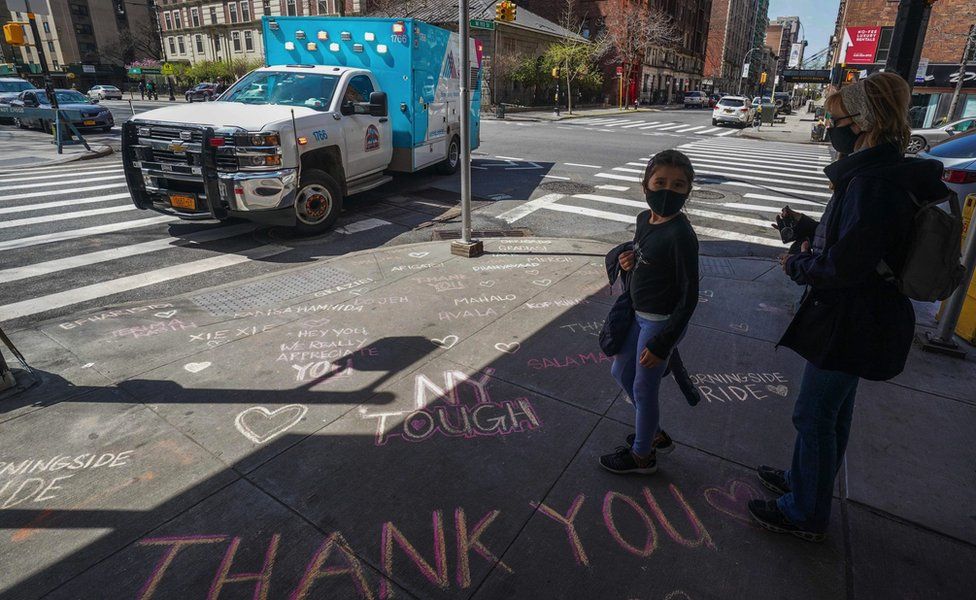
Image copyrightAFPImage captionMessages in support of medical staff have appeared outside Mount Sinai West Medical Center
17:00
While speaking to a patient earlier in the day who was unable to get a mask, doctor Michael Morgenstern shows him how to fashion one out of a T-shirt.
He decides others may also need to see how to do this so shoots a video and shares it online.
18:00
As Sarujen drops off his last package, he gets a call asking him to join a team meeting about the future of the company.
At the meeting, they agree that the delivery drivers will take the chefs to and from work so they can avoid trains.
He is happy that he can continue working but exhausted from stress over the virus and the day’s concerns over his job.
20:00
Steven Baxter returns home from the funeral home but his day isn’t over.
His twin sons are playing basketball in the backyard. They ask him if he has to shower. When he says yes, they know what sort of day he must have had.
For the next few hours, he deals with calls from more bereaved families. He doesn’t have time to speak with his wife, who is also a funeral director.
He falls asleep before his children. He has to be at another nursing home to collect another body at 04:00.
20:22
Jennifer has a hot bath and is ready to crawl into bed. Even though her hours haven’t changed, she feels much more exhausted than before.
As she responds to more texts about patient care, she reviews how she feels. Achy, tired, sore throat. She wonders if she should get tested.
20:40
Faith Willett gets a call from a nurse who says she can’t do an upcoming shift. She isn’t unwell but news has got around about today’s positive result at the nursing home.
The nurse’s skills and training are invaluable. Faith can’t understand the woman’s decision, which she sees as jumping ship at a time of crisis.
21:00
Jennifer watches an episode of TV sitcom Friends. It is all she can manage to watch these days – she struggles to focus on anything too heavy.
She has a goodnight FaceTime with her children before turning out the lights. She hasn’t seen them in person for eight days.
As she closes her eyes, she makes a mental note: “Thank the cast of Friends when this is over.”
22:00
Kathleen Flanagan has been home for about an hour. It was the usual routine – a shout of “hello” to the family again, clothes in the washing machine again, a shower again.
She has time for only one meal a day at the moment. Today it was eggs and spinach, again.
She goes to sleep with The Office playing on Netflix. It is her winding-down time before she has to start again. But her phone stays close in case anyone needs her.
23:58
There are only a few hours before Faith has to start work again. She has been trying to get some rest but is woken by an email reminder from the department of health about an upcoming call about the virus.
There has been no news from her nursing home of new or worsening symptoms. But that doesn’t mean she can relax.
Throughout this day, Tuesday 7 April, another 779 people died of coronavirus in New York state – a new high.
Images have emerged of coffins being buried in a mass grave in New York City, as the death toll from the coronavirus outbreak continues to rise.
Workers in hazmat outfits were seen using a ladder to descend into a huge pit where the coffins were stacked.
The location is Hart Island, used for New Yorkers with no next of kin or who could not afford a funeral.
New York state now has more coronavirus cases than any single country, according to the latest figures.
The state’s confirmed caseload of COVID-19 jumped by 10,000 on Thursday to 159,937, of whom 7,000 have died.
Spain has had 153,000 cases and Italy 143,000, while China, where the virus emerged last year, has reported 82,000 cases.
The US as a whole has recorded 462,000 cases and nearly 16,500 deaths. Globally there are 1.6 million cases and 95,000 deaths.
The drone footage comes from Hart Island, off the Bronx in Long Island Sound, which has been used for more than 150 years by city officials as a mass burial site for those with no next-of-kin, or families who cannot afford funerals.
It is probable that many of the coffins are for coronavirus victims, but it is not clear whether they fall into the above categories.
Burial operations at the site have ramped up amid the pandemic from one day a week to five days a week, according to the Department of Corrections.
Prisoners from Rikers Island, the city’s main jail complex, usually do the job, but the rising workload has recently been taken over by contractors.
New York City Mayor Bill de Blasio indicated earlier this week that “temporary burials” might be necessary until the crisis had passed.
“Obviously the place we have used historically is Hart Island,” he said.
The number of coronavirus deaths in New York state increased to 799 on Wednesday, a record high for a third day.
But Governor Andrew Cuomo took heart from the fact that the number of Covid-19 patients admitted to New York hospitals dropped for a second day, to 200.
He said it was a sign social distancing was working. He called the outbreak a “silent explosion that ripples through society with the same randomness, the same evil that we saw on 9/11”.
Another glimmer of hope was heralded on Thursday as official projections for the nationwide death toll were lowered.
The 60,000 projection would match the upper estimate for total flu deaths in the US between October 2019 to March 2020, according to government data.
But Vice-President Mike Pence stressed on Thursday that Covid-19 is about three times as contagious as influenza.
The White House has previously touted estimates that 2.2 million Americans could die from coronavirus if nothing was done to stop its spread.
Stay-at-home orders have in the meantime closed non-essential businesses in 42 states, while drastically slowing the US economy.
New data on Thursday showed unemployment claims topped 6 million for the second week in a row, bringing the number of Americans out of work over the last three weeks to 16.8 million.
Chicago meanwhile imposed a curfew on liquor sales from 21:00 local time on Thursday to stop the persistent violation of a ban on large gatherings.
New York is “undoubtedly flattening the curve”, Governor Andrew Cuomo says, despite reporting the largest single-day death toll – for the second day in a row – with 779 New Yorkers succumbing to the virus on 7 April.
“We are flattening the curve because we are being rigorous about social distancing,” Cuomo says. “It’s not a time to get complacent.”
What else did the governor say?
Statewide hospitalisation rates have continued to decline, suggesting that the infection rate is beginning to plateau
Cuomo notes that black and Hispanic people in New York are disproportionately likely to die of the virus. “The poorest people play the highest price,” he says. “Why? Let’s figure it out, let’s do the work.”
All of New York’s flags will be flown at half-mast, in honour of those who have died of Covid-19. Cuomo notes that New York lost 2,753 lives on the 11 September attacks, while 6,268 New Yorkers have already died of the virus As the disease continues to pummel the eastern state, Cuomo has promised an additional $600 to those who have filed for unemployment.
“I don’t think we return to normal,” Cuomo says. “If we’re smart, we achieve a new normal.”
The coronavirus outbreak in New York will get worse, with damage accelerated by shortages of key medical supplies, the city’s mayor has said.
“We’re about 10 days away from seeing widespread shortages,” Bill de Blasio said on Sunday. “If we don’t get more ventilators people will die.”
New York state has become the epicenter of the outbreak in the US and accounts for almost half of the country’s cases.
There are now 31,057 confirmed cases nationwide, with 390 deaths.
On Sunday, the state’s Governor Andrew Cuomo said 15,168 people had tested positive for the virus., an increase of more than 4,000 from the previous day.
“All Americans deserve the blunt truth,” Mr de Blasio told NBC News. “It’s only getting worse, and in fact April and May are going to be a lot worse.”
New York now accounts for roughly 5% of Covid-19 cases worldwide.
On Friday, President Donald Trump approved a major disaster declaration for the state which gave it access to billions of dollars of federal aid.
However, Mr de Blasio has continued to criticise the administration for what he views as an inadequate response.
“I cannot be blunt enough: if the president doesn’t act, people will die who could have lived otherwise,” he said. “This is going to be the greatest crisis, domestically, since the Great Depression,” he added, referring to the economic crisis of the 1930s.
Speaking at a news conference at the White House on Sunday, Mr Trump said he had also approved a major disaster declaration for Washington state and would approve a similar measure for California.
“This is a challenging time for all Americans. We’re enduring a great national trial,” he said.
President Trump also said a number of medical supplies were being sent to locations nationwide, as well as emergency medical stations for New York, Washington and California, the worst-hit states.
Doctors across New York have reported depleted medical supplies and a lack of protective gear for healthcare workers on the frontlines of the outbreak.
Warnings of such shortages have reverberated across the country as other state governors have pleaded with the federal government to make more supplies available.
In California, officials instructed hospitals to restrict coronavirus testing. Meanwhile, a hospital in Washington state – once the centre of the US outbreak – said it could run out of ventilators by April.
And on Sunday, Illinois Governor JB Pritzker said states were “competing against each other” for virus supplies.
“We need millions of masks and hundreds of thousands of gowns and gloves,” he said. “We’re getting just a fraction of that. So, we’re out on the open market competing for these items that we so badly need.”
An almost $2 trillion (£1.7 trillion) emergency stimulus bill intended to blunt the punishing economic impact of the pandemic failed to pass the US Senate on Sunday.
The bill got 47 votes, falling short of the 60 needed in the 100-member chamber.
Democrats raised objections to the bill with Senate minority leader Chuck Schumer saying it had “many, many problems”. Democrats accused Republicans of wanting to bail out big businesses.
Talks between Democrats and the White House are continuing.
The coronavirus outbreak in New York will get worse, with damage accelerated by shortages of key medical supplies, the city’s mayor has said.
“We’re about 10 days away from seeing widespread shortages,” Bill de Blasio said on Sunday. “If we don’t get more ventilators people will die.”
New York state has become the epicentre of the outbreak in the US and accounts for almost half of the country’s cases.
There are now 31,057 confirmed cases nationwide, with 390 deaths.
On Sunday, the state’s Governor Andrew Cuomo said 15,168 people had tested positive for the virus., an increase of more than 4,000 from the previous day.
“All Americans deserve the blunt truth,” Mr de Blasio told NBC News. “It’s only getting worse, and in fact April and May are going to be a lot worse.”
New York now accounts for roughly 5% of Covid-19 cases worldwide.
On Friday, President Donald Trump approved a major disaster declaration for the state which gave it access to billions of dollars of federal aid.
However, Mr de Blasio has continued to criticise the administration for what he views as an inadequate response.
“I cannot be blunt enough: if the president doesn’t act, people will die who could have lived otherwise,” he said. “This is going to be the greatest crisis, domestically, since the Great Depression,” he added, referring to the economic crisis of the 1930s.
Speaking at a news conference at the White House on Sunday, Mr Trump said he had also approved a major disaster declaration for Washington state and would approve a similar measure for California.
“This is a challenging time for all Americans. We’re enduring a great national trial,” he said.
President Trump also said a number of medical supplies were being sent to locations nationwide, as well as emergency medical stations for New York, Washington and California, the worst-hit states.
Doctors across New York have reported depleted medical supplies and a lack of protective gear for healthcare workers on the frontlines of the outbreak.
Warnings of such shortages have reverberated across the country as other state governors have pleaded with the federal government to make more supplies available.
In California, officials instructed hospitals to restrict coronavirus testing. Meanwhile, a hospital in Washington state – once the centre of the US outbreak – said it could run out of ventilators by April.
And on Sunday, Illinois Governor JB Pritzker said states were “competing against each other” for virus supplies.
“We need millions of masks and hundreds of thousands of gowns and gloves,” he said. “We’re getting just a fraction of that. So, we’re out on the open market competing for these items that we so badly need.”
An almost $2 trillion (£1.7 trillion) emergency stimulus bill intended to blunt the punishing economic impact of the pandemic failed to pass the US Senate on Sunday.
The bill got 47 votes, falling short of the 60 needed in the 100-member chamber.
Democrats raised objections to the bill with Senate minority leader Chuck Schumer saying it had “many, many problems”. Democrats accused Republicans of wanting to bail out big businesses.
Talks between Democrats and the White House are continuing.