Tag: NHIA

  • Goaso Chief to decline invitation of  indigenes without NHIS card

    Goaso Chief to decline invitation of indigenes without NHIS card

    Nana Akwasi Bosompra I, the Omanhene of Goaso traditional area, has announced that individuals without an NHIS card will be denied entry to his palace in an effort to promote the National Health Insurance Scheme (NHIS) and improve access to affordable healthcare.

    Nana Akwasi Bosompra I emphasized the importance of the NHIS as an intervention aimed at addressing the healthcare and economic needs of his community. During a visit by a delegation from the National Health Insurance Authority (NHIA), led by CEO Dr. Bernard Okoe Boye, Nana Kwasi Bosompra stated that NHIA registration has become mandatory for every household under his Traditional Council.

    He believes that NHIS membership will enable his people to access quality healthcare services at an affordable cost.

    The Omanhene appealed to traditional leaders across the country to play an active role in encouraging people to register for the NHIS. He emphasized the significant role of chiefs in ensuring that every Ghanaian has access to medical insurance and stressed the need to revitalize community involvement in NHIS affairs.

    “If you want to summon anyone, you must come with an NHIA card. If you can get money to litigate then you surely must have money to for health insurance. I’m introducing this innovation to use the powers we have to help our people. As traditional rulers, sometimes we have to force our people to do the right thing”, he said.

    Dr. Okoe Boye thanked the Goaso Omanhene for his generous donation of the piece of land used for the construction of the NHIA Regional office and the two other district offices.

    According to Dr. Okoe Boye, chiefs are revered as key stakeholders to the sustenance of the Scheme, hence they must come on board and actively play the role as ambassadors.

    The NHIA Chief Executive’s delegation earlier conferred on the Ahafo Regional Minister, Hon. George Yaw Boakye who joined the team to inaugurate the newly built projects.

    The Regional Director, Mr. Alexander Fordjour, the Goaso Municipal Chief Executive, Hon. Yaw Osei Boahene, the Municipal Director of Ghana Health Service, Mr. Matthew Amponsah, and other stakeholders witnessed the inaugural ceremony.

    The NHIA Chief Executive’s delegation was made up of his Executive Assistant, Mr. Gabriel Osei, the Ag. Director of Admin/Human Resources, Mr. Raymond Avinu , Ag. Director of Procurement, Mr. Frank Yeboah, Ag. Deputy Director, Corporate Affairs, Madam Vida Adutwumwaa Boateng and selected staff from the NHIA head office.

  • Babies will be registered under the Ghana card scheme in July – Bawumia

    Babies will be registered under the Ghana card scheme in July – Bawumia

    The vice President, Dr Mahamudu Bawumia has stated that new born babies will be registered under the Ghana Card scheme starting from July at various hospitals.

    The move, he explained follows the completion of the integration of the National Identification Authority (NIA), Ghana Health Service (GHS) and Births and Deaths Registry databases.

    Speaking in the United Kingdom on Saturday, June 10, during the International Women’s Conference, the Vice President announced, “We have taken off the problem of fake birth certificates, bureaucracy, and corruption at the Birth and Deaths Registry. What we have done is to digitalise the processes at the Birth and Death Registry and linked their system with the Ghana Health Service and the NIA”.

    “I have not yet announced in Ghana, I’m happy to announce that the integration of the database of the NIA, GHS, and the Birth and Deaths Registry is complete. So from next month, when a child is born in Ghana, we will issue the Ghana Card number right from birth”.

    The National Identification Authority has registered over 17 million Ghanaians onto its system.

    The Vice President, Dr Mahamudu Bawumia has announced that babies will be issued Ghana Card numbers at birth, following the completion of the integration of the NIA, GHS and Births & Deaths Registry databases.
    
    He was speaking in the United Kingdom. #CitiNewsroom pic.twitter.com/hkMME5V5YN
    
    — CitiNewsroom (@Citi973) June 10, 2023
  • NHIS: Health facilities charging illegal fees to be sanctioned – Okoe Boye

    Chief Executive Officer of the National Health Insurance Authority (NHIA), Bernard Okoe Boye, says the authority will go after “unscrupulous” health facilities under the National Health Insurance Scheme (NHIS) charging illegal fees and bring them to book.

    He said this is to clamp down on unscrupulous persons engaging in the act and bringing the scheme into disrepute.

    “Very soon we are going to invite some of the heads of hospitals who we have sent teams to and have brought us reports of the practice of illegal charges in their facilities,” he said at the commissioning of a new NHIS office at Ejisu in the Ashanti Region.

    The CEO said the Government was committed to ensuring the sustainability of the NHIS, saying that, what Ghanaians had to do was to report anomalies at the facilities to the Scheme to help improve on service delivery.

    He further disclosed that claims paid to health facilities on a monthly basis by the National Health Insurance Authority (NHIA) for their services to patients rolled unto the National Health Insurance Scheme (NHIS) has been increased from GH¢100 million to GH¢ 150 million.

    This, according to Chief Executive Officer of the scheme is an increase of 50% in the amount previously paid.

    Speaking at the commissioning of a new NHIS office at Ejisu in the Ashanti Region, he said: “I can tell you that every month we pay an average of GHC 150 million to health facilities across Ghana for attending to NHIS clients.” 

    He explained that the increment is “due to the movement of the currency and inflationary pressures.”  

    The newly commissioned offices would be a permanent one for the Ejisu and Juaben Municipalities after years of operating in rented offices.  

    Dr. Okoe Boye said despite challenges facing the Scheme it remained one of the most impactful interventions introduced by successive governments.  

  • NHIA initiates “online Policy” to make information on claims payments easy

    NHIA initiates “online Policy” to make information on claims payments easy

    The National Health Insurance Authority (NHIA) has launched an online policy to improve on transparency and accountability into the payment of claims for the service providers and other stakeholders.

    Dubbed, “Sunshine Policy,” the amount, date, and period the claims paid covers would be exhibited on the website to ensure that information flow was accurate to defuse misinformation among service providers and other stakeholders.

    Dr Bernard Okoe-Boye, Chief Executive of the NHIA who launched the policy said it was to address the problem that had been associated with the scheme for the past 20 years where all payments relating to facilities had been shrouded in secrecy between the scheme and the service providers.

    He explained that the new policy would also eliminate situations where suppliers of medicines that were given to patients knew not when and how payments were made.

    “This is a crucial policy to ensure that anybody dealing with hospitals will know that something is going to them.”

    Dr Okoe-Boye said the policy would greatly impact stakeholders’ confidence in the Scheme and promote a congenial relationship among all parties.

    “We now have a link on our website where all the players in the health sector have access to what we have paid, when we paid the money to, and for what we paid them,” he added.

    He noted that NHIA had published claims payments to its credentialed healthcare facilities in January and February 2023 under the new policy on its website adding that the publication of the claims payments would be made available to the appropriate stakeholders on the website on monthly basis as a mark of keeping faith and staying abreast with all its valued stakeholders.

    “The NHIA is working hard to create more efficiencies in its claims management processes and reduce the gap between amounts paid and the period for which claims have been duly submitted and vetted,” he added.

    Under the programme, some selected organisations such as the teaching hospitals, regional hospitals, Ghana Health Service, Pharmaceutical Society of Ghana, Ghana Registered Midwives Association, Pharmaceutical Importers and Wholesalers Association of Ghana and other bodies and service providers can easily check and verify when money is paid.

    Mr Oswald Essuah-Mensah, NHIS, Ag. Director, Corporate Affairs who took the media through the link on the website said those

  • US Donates $5M to Ghana’s NHIA to improve healthcare

    US Donates $5M to Ghana’s NHIA to improve healthcare

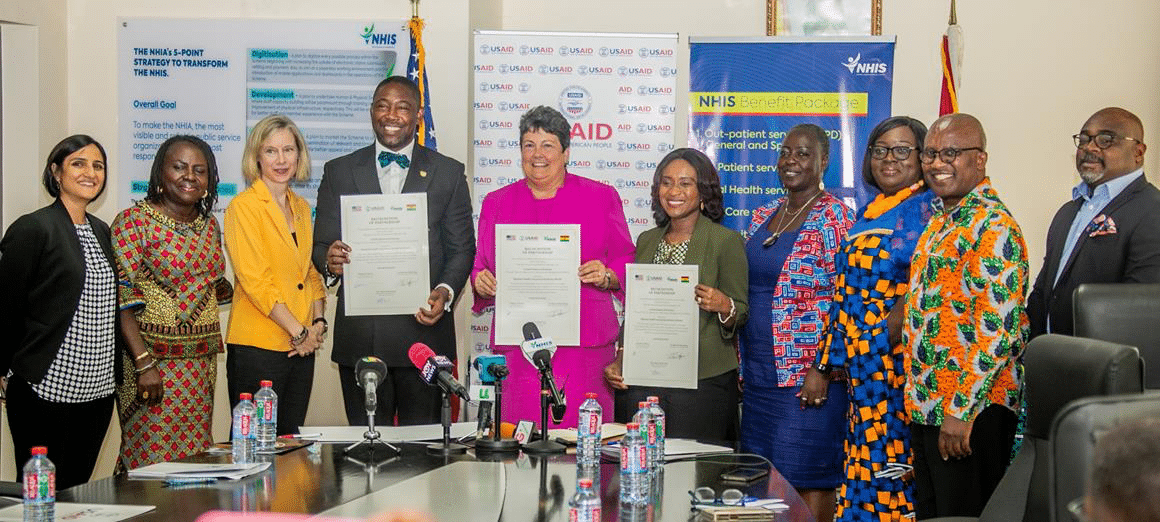
    The United States Ambassador to Ghana, Virginia Palmer, has announced that $5 million in new US funding will be provided to improve the performance of Ghana’s National Health Insurance Scheme (NHIS) and ensure the quality of health services in the country. 

    The new five-year partnership was launched by the Ambassador and Dr. Bernard Okoe Boye, Chief Executive Officer of the NHIA.

    Ambassador Palmer stated that “the health sector is at the core of Ghana’s development. It is essential for the wellbeing of all Ghanaians that funding for health is prioritized. A healthy population is the basis for a prosperous population.”

    The NHIA-USAID partnership aims to improve NHIA’s capacity to digitize all its information systems, making data available to NHIA to better communicate the Scheme’s financial and programmatic status to stakeholders. 

    The partnership will also focus on building NHIA systems to monitor the clinical quality of healthcare services. This actionable clinical data will help NHIA advocate for improved quality of care across public, faith-based, and private healthcare facilities, contributing to improved health outcomes across Ghana.

    USAID’s integrated health programming supports the Government of Ghana in the areas of health system strengthening, maternal, reproductive, newborn, and child health, as well as malaria, HIV, social protection, water, sanitation and hygiene, global health security, and COVID-19. USAID supports the Government of Ghana to build a more resilient health system and prepare Ghana to face future health emergencies.

    This funding is expected to provide a significant boost to Ghana’s healthcare system, ensuring that the NHIS is able to provide quality healthcare services to Ghanaians. 

  • Illegal fee collection to be tackled by NHIA – Ashanti Regional Director

    Illegal fee collection to be tackled by NHIA – Ashanti Regional Director

    The Ashanti Regional Directorate of the National Health Insurance Scheme (NHIS) has vowed to tackle incidents of illegal fee collection associated with the scheme.

    Incidents of extortion and illegal payments from National Health Insurance Scheme members (NHIS) were noticed to be occurring at some health provider sites in the Ashanti Region. 

    According to the Ashanti regional director of the National Health Insurance Authority, Kwadwo Dwomoh, the situation nearly eroded the confidence the public had in the scheme. 

    Given this, a co-payment committee has been set up to investigate and tackle the running illegality. 

    Speaking at the National Health Insurance Authority, Ashanti Region end of the year 2022 performance review, he cautioned health facilities and health workers to desist from the practice. 

    “There was some huge uproar and anxiety from the NHIS members regarding extortions and illegal payments at some health provider sites which nearly eroded the confidence the public had in the scheme. As a result of this unfortunate situation, a National Co-Payment Committee was formed and inaugurated by the Chief Executive to fight this canker to restore the enviable image of NHIS. 

    “And it is on the strength of this that, I encourage every one of us to rigorously fight against the notorious co-payments and illegal fee collections at some provider sites. I urge all health facilities in the Region to desist from such practices which tend to reduce the confidence of the populace in the NHIS,” he said. 

    The end of the year will assess the authorities’ performance for 2022 and outline its commendation plan this year. 

    The authority 2022 generated GHC 300,518 for its flagship Project 1000K for health strategy, which court support from interested individuals to pay and underwrite subscription fees for children under 18. 

    Ashanti Region registered and renewed a total of 2.954 million members representing 53% of the population of Ashanti and 17.22% of the total number of NHIS Active Members in Ghana.

    The Authority targets universal Health coverage in the region and the country at large by 2030. 

    Director of Middle Belt National Health Insurance Authority, Kwadwo Tweneboah-Koduah charged workers to ensure 80 % enrolment to satisfy Ghana’s quest to attain Universal Health Coverage.

    “The work of NHIA can be equated to the service to humanity. Working to make sure that the poor and vulnerable are well catered for.

    If we can get everybody registered or get over 80 to 90% registration, then Ghana would have achieved Universal Health Coverage in terms of membership. And it is dependent on us to make it happens. We need to up our game,” he said. 

    The authority is hopeful that, it will surpass its target at the end of 2023.

  • NHIA to revoke licence of medical facilities charging unauthorized fees  

    The National Health Insurance Authority (NHIA) has warned medical facilities to desist from imposing illegal charges on beneficiaries of the National Health Insurance Scheme (NHIS).

    Such facilities risk having their NHIS licence terminated as retribution.

    According to Chief Executive Officer of the NHIA, Bernard Okoe-Boye, the new directive will take place from January 2023.

    “You might hear that some facilities either have been called to the authority to account for their behaviour or worst-case scenario, they might be de-credentialed meaning we will take away their status to see people with a health insurance card.

    “I know some facilities will pray they don’t get there because I know that 80 percent of all Internally Generated Funds of all hospitals in Ghana come from National Health Insurance,” Dr Okoe-Boye said.

    This comes in response to several complaints that some facilities charge NHIS clients an undue amount of money for the care of ailments listed under the program.

    The NHIA, in May 2021, declared that it was on the lookout for authorized service providers who demanded additional payments.

    In 2003, the Ghanaian government launched the National Health Insurance Scheme (NHIS).

    The program served as a national health insurance system designed to give Ghanaians fair access to and financial support for essential medical services.

    Speaking to the media earlier this month, Mr Okoe Boye said the administration provides GH1.5 billion to healthcare providers annually.

    “We are making sure our members are properly taken care of. We are ready to revoke the credentials of healthcare facilities who make extra monetary demands from our members with impunity,” he said.

    As a corporate body, the Authority has the ability to enter into contracts, buy and hold real estate, and undertake other legal transactions in the course of carrying out its duties.

    It was incorporated in accordance with the National Health Insurance Act 2003, Act 650.

    The Authority’s goals include achieving National Health Insurance coverage for citizens and visitors who aren’t citizens of the nation but are still within, as well as giving those who are covered by the Scheme access to medical services.

    Source: The Independent Ghana 

  • 15.16m Ghanaians enrolled onto NHIS – Finance Ministry 

    A total of 15.16 million Ghanaians have been enrolled onto the National Health Insurance Scheme (NHIS).

    This figure is as of September 2022, according to the Ministry of Finance in the 2023 budget statement presented to Parliament.

    The target population was 18.21 million. In 2023, the government estimates that enrollment onto the scheme will increase to 20.30 million.

    As it stands now, Ghana has a population of over 31 million people.

    According to the ministry, the National Health Insurance Authority (NHIA) improved claims management processes following the introduction of the e-claims and paperless systems. 

    The Authority is considering a revision of tariffs to allow coverage of childhood cancers and long-term family planning services. 

    Meanwhile, Overlord of Dagbon Traditional Area, Yaa-Naa Abukari II has been designated as the National Health Insurance Scheme (NHIS) worthy Ambassador.

    This is in recognition of the Yaa-Naa’s active and personal interest in encouraging Ghanaians home and abroad to register for the NHIS.

    The title was conferred on the Yaa-Naa at a colorful ceremony at the Gbewaa Palace in Yendi when a high powered delegation from the National Health Insurance Authority (NHIA) led by the Chief Executive, Hon. Bernard Okoe-Boye paid a courtesy call on the Dagbon Overlord.

  • Okoe-Boye cautions healthcare providers charging illegal fees

    The National Health Insurance Authority (NHIA), Chief Executive, Dr. Bernard Okoe-Boye says the decision to revoke the licenses of credentialed healthcare providers charging illegal fees is non-negotiable.

    According to him, the NHIA is paying one and a half billion cedis annually to healthcare providers for claims submitted to the Authority for which reason it is unreasonable to demand extra money from NHIS members at the point of need.

    He emphasized that any healthcare provider caught acting with impunity would not be spared.

    “We are making sure our members are properly taken care of. We are ready to revoke the credentials of healthcare facilities who make extra monetary demands from our members with impunity.”

    Dr. Okoe Boye expressed his misgivings at a meeting with the Upper East Regional Minister on December 1, 2022.

    The Regional Minister, Hon. Stephen Yakubu commended the bond between the NHIA executive management and the Governing Board.

    He said the people of the northern belt have largely been beneficiaries of the NHIS because it is pro-poor focused.

    The Regional Minister described as enormous the NHIA’s recent innovations such as the Mobile Renewal platform and the Ghana card and NHIS card linkage.

    As part of the visit, Dr. Okoe Boye paid a courtesy call to the paramount Chief of the Paga traditional area where he stated, “We trust that our revered father, the Pagapio will go on with his blessings and good counseling to enable the NHIA to make progress in ensuring that all residents in Ghana are covered by the NHIS.”

    “We encourage the entire population in Kassena Nankana to enroll in the Scheme to access affordable and quality healthcare.”

    He said it would soon be possible for all residents in Ghana and beyond to register for the NHIS via online through a digital platform yet to be officially launched by the Vice President, Alhaji Dr. Mahamudu Bawumia in Tamale.

    He underscored the need for NHIS members to periodically renew their membership using the dedicated short code *929#.

    The Pagapio, Pe Pwanalunga-Charles Awiah Awampaga II applauded the NHIA’s executive management and the Governing Board for touching base with him.

    He made a firm pledge to help the NHIA succeed in increasing the NHIS active membership in his traditional area.

    The Pagapio made a passionate appeal to Dr. Okoe Boye and the Governing Board to open an additional office in the area.

    The team visited the NHIS Navrongo district office and also interacted with staff who talked about their achievements and challenges.

    The NHIA Chief Executive on November 28, 2022, embarked on a working visit to the northern belt comprising the Northern, North East, Savannah, and Upper East regions, except the Upper West region.

    The nationwide working tour was to interface with major stakeholders including traditional leaders, administrative heads, and staff of the National Health Insurance Scheme (NHIS).

    He is being accompanied by some NHIA Board members and Directors, among others.

  • NHIA boss cautions healthcare providers charging illegal fees

    The National Health Insurance Authority (NHIA) Chief Executive, Dr. Bernard Okoe-Boye has said the decision to revoke the licences of credentialed healthcare providers charging illegal fees is non-negotiable.

    According to him, the NHIA is paying one and a half billion cedis annually to healthcare providers for claims submitted to the Authority for which reason it is unreasonable to demand extra money from NHIS members at the point of need.

    He emphasized that any healthcare provider caught acting with impunity would not be spared.

    “We are making sure our members are properly taken care of. We are ready to revoke the credentials of healthcare facilities who make extra monetary demands from our members with impunity,” he said.

    Dr. Okoe-Boye expressed his misgivings at a meeting with the Upper East Regional Minister on December 1, 2022.

    Upper East Regional Minister, Stephen Yakubu commended the bond between the NHIA executive management and the governing board.

    He said the people of the northern belt have largely been beneficiaries of the NHIS because it is pro-poor focused.

    The Regional Minister described as enormous the NHIA’s recent innovations such as the Mobile Renewal platform and the Ghana card and NHIS card linkage.

    As part of the visit, Dr. Okoe-Boye paid a courtesy call on the Paramount Chief of Paga traditional area where he stated, “We trust that our revered father, the Pagapio will go on with his blessings and good counselling to enable the NHIA make progress in ensuring that all residents in Ghana are covered by the NHIS.”

    “We encourage the entire population in Kassena Nankana to enroll onto the Scheme to access affordable and quality healthcare.”

    He said it would soon be possible for all residents in Ghana and beyond to register onto the NHIS via online through a digital platform yet to be officially launched by the Vice President, Alhaji Dr. Mahamudu Bawumia in Tamale.

    He underscored the need for NHIS members to periodically renew their membership using the dedicated short code *929#.

    The Pagapio, Pe Pwanalunga-Charles Awiah Awampaga II applauded the NHIA’s executive management and the Governing Board for touching base with him.

    He made a firm pledge to help the NHIA succeed in increasing the NHIS active membership in his traditional area.

    The Pagapio made a passionate appeal to Dr. Okoe Boye and the Governing Board to open an additional office in the area.

    The team visited the NHIS Navrongo district office and also interacted with staff who talked about their achievements and challenges.

    The NHIA Chief Executive on November 28,2022 embarked on a working visit to the northern belt comprising the Northern, North East, Savannah and Upper East regions, except the Upper West region.

    The nationwide working tour was to interface with major stakeholders including traditional leaders, administrative heads and staff of the National Health Insurance Scheme (NHIS).

    He is being accompanied by some NHIA Board members and Directors, among others.

  • NHIA boss cautions healthcare providers charging illegal fees

    The decision to remove the licences of qualified healthcare practitioners who charge unlawful fees, according to NHIA Chief Executive Dr. Bernard Okoe-Boye, is not negotiable.

    He believes it is inappropriate to expect additional funds from NHIS members at the time of need because the NHIA already pays 1.5 billion cedis to healthcare providers each year for claims submitted to the Authority.

    He underscored that no healthcare professional found acting recklessly would escape punishment.

    “We are making sure our members are properly taken care of. We are ready to revoke the credentials of healthcare facilities who make extra monetary demands from our members with impunity,” he said.

    Dr. Okoe-Boye expressed his misgivings at a meeting with the Upper East Regional Minister on December 1, 2022.

    Upper East Regional Minister, Stephen Yakubu commended the bond between the NHIA executive management and the governing board.

    He said the people of the northern belt have largely been beneficiaries of the NHIS because it is pro-poor focused.

    The Regional Minister described as enormous the NHIA’s recent innovations such as the Mobile Renewal platform and the Ghana card and NHIS card linkage.

    As part of the visit, Dr. Okoe-Boye paid a courtesy call on the Paramount Chief of Paga traditional area where he stated, “We trust that our revered father, the Pagapio will go on with his blessings and good counselling to enable the NHIA make progress in ensuring that all residents in Ghana are covered by the NHIS.”

    “We encourage the entire population in Kassena Nankana to enroll onto the Scheme to access affordable and quality healthcare.”

    He said it would soon be possible for all residents in Ghana and beyond to register onto the NHIS via online through a digital platform yet to be officially launched by the Vice President, Alhaji Dr. Mahamudu Bawumia in Tamale.

    He underscored the need for NHIS members to periodically renew their membership using the dedicated short code *929#.

    The Pagapio, Pe Pwanalunga-Charles Awiah Awampaga II applauded the NHIA’s executive management and the Governing Board for touching base with him.

    He made a firm pledge to help the NHIA succeed in increasing the NHIS active membership in his traditional area.

    The Pagapio made a passionate appeal to Dr. Okoe Boye and the Governing Board to open an additional office in the area.

    The team visited the NHIS Navrongo district office and also interacted with staff who talked about their achievements and challenges.

    The NHIA Chief Executive on November 28,2022 embarked on a working visit to the northern belt comprising the Northern, North East, Savannah and Upper East regions, except the Upper West region.

    The nationwide working tour was to interface with major stakeholders including traditional leaders, administrative heads and staff of the National Health Insurance Scheme (NHIS).

    He is being accompanied by some NHIA Board members and Directors, among others.

  • Expedite review of NHIS medicines list – Pharmacists appeal to NHIA

    The Government and Hospital Pharmacists Association (GHOSPA) has asked the government to evaluate the costs of the National Health Insurance Medicine Lists.

    The association expressed regret over the country’s rising drug prices in a press release. 

    GHOSPA noted that the cost of medicines has more than doubled in the past few months.

    For instance, it says “a tablet of Paracetamol, which used to cost 0.05 Ghana Cedis, is now 0.21 GHS on the market, whilst the NHIS price is currently set at 0.09 GHS.”

    “A lot of the medicines on the NHIS Medicines List are lagging by an average of 100% of current market prices,” part of the statement read.

    The current economic downturn, according to the association, is to blame for the high cost of medicines and pleaded with the government to heed their demands and increase the prices of NHIA medications.

    In the event that the government fails to meet their demands, GHOSPA has stated that it will adopt a Cash and Carry regime for the supply of pharmaceutical products to the government and other institutions.

    “We are not living in normal times, and therefore, the Authority must act as such. Depart from the usual practice of waiting for 1-year or more before updating the NHIS Medicines List.” 

    Source: The Independent Ghana

  • Economic crisis: Not all factors are external – Dr. Okoe Boye admits

    The Chief Executive Officer of the National Health Insurance Authority (NHIA), Dr. Bernard Okoe Boye, has stated that not all the factors affecting the country’s economy are external.

    It will be recalled that on several occasions, government officials, including President Nana Addo Dankwa Akufo-Addo, have blamed the economic crises being experienced in the country on the effects of COVID-19 and the recent Russia-Ukraine War.

    But speaking on Thursday, November 3, 2022, edition of Good Morning Ghana and monitored by GhanaWeb, the former Member of Parliament for Ledzokuku explained that admittedly, some of the factors affecting the country are internal.

    He cited debt levels as part of the reasons the country is battling with the economy.

    “Not all the factors responsible for our situation are external; our debt levels are also not so good. Debt servicing swallows most of the funds we get,” he said.

    Not all the factors responsible for our situation are external; our debt levels are also not so good. Debt servicing swallows most of the funds we get – @OkoeBoye #GoodMorningGhana

    — Metropolitan Television (@metrotvgh) November 3, 2022

    Source: Ghanaweb

  • Decision by Pharmaceutical Companies to stop supply on credit harsh – Dr Okoe Boye

    Chief Executive Officer of the National Health Insurance Authority (NHIA), Dr Bernard Okoe Boye, has described as harsh, the decision by the three major pharmaceutical industries to stop the supply of drugs and medications to all health facilities.

    He said, even though their demands for tariff adjustments were legitimate, their resolve to stop outright supply on credit basis was harsh and would have dire consequences on health delivery across the country.

    The Ghana National Chamber of Pharmacy, Pharmaceutical Association of Ghana and the Pharmaceutical Importers and Wholesalers Association of Ghana announced their decision at a press conference last Thursday.

    Dr Okoe Boye said the group should have engaged the Ministry of Health (MoH) to find an amicable solution to the issue.

    “When you have an agreement with a partner, the best thing to do is to come back to the negotiation table,” he said.

    “I think the approach is very harsh, but as stakeholders we need to be patient and tolerant,” he added.

    Dr Okoe Boye said, as much as the NHIA sympathises with the situation, it does not directly engage in the policy framework that determines tariff adjustments for the suppliers.

    He said the Ministry of Health, based on negotiations with suppliers, determines tariff for each drug, which the authority works with.

    Dr Okoe Boye therefore urged the suppliers to reconsider the decision and said the MoH was meeting the pharmaceutical companies to find an alternative resolution to the situation.

    He expressed hope that the meeting would produce fruitful results.

    He said the NHIA was doing its best to ensure that arrears owed suppliers were paid.

    Source: GNA

  • NHIA to release possible solutions to demands of the Pharmaceutical Industry

    Management of the National Health Insurance Authority (NHIA) will soon release possible solutions to manage the decision taken by the Pharmaceutical Industry to serve all medication supplies only on cash basis.

    The Industry at a press briefing on Thursday October 20, 2022, said the step had become necessary as macro-economic indicators such as exchange rate and payment terms, inflation, interest rates, fuel prices and utilities among others, were having a deleterious effect on the smooth running of the pharmaceutical business.

    At the briefing, Mr William Adum Addo, President of the Pharmaceutical Importers and Wholesalers Association, encouraged the National Health Insurance Scheme and all private health insurance companies to give accredited facilities seed funds to buy medicines on cash for supplies to provide patients under the Scheme with medicines.

    Berima Sarpong, the Communications Manager, NHIA, in an interview with the Ghana News Agency, however said the Authority valued the industry as an important stakeholder, appreciated the conditions in which they operated and was concerned about the difficulties they were going through.


    “Management has, therefore, held series of meetings and will come out with possible solutions to manage the situation,” he said.

    Source: GNA

  • NHIA engages stakeholders over unapproved charges

    The National Health Insurance Authority (NHIA) has met with stakeholders, including accredited health service providers under the National Health Insurance Scheme (NHIS), to discuss the rising trend of out-of-pocket payments required of members at health facilities.

    Out-of-pocket expenses are payments made with your own money for medical care that are not reimbursed by insurance.

    The unapproved charges, also known as co-payments, are a violation of the Act 852 statute and the NHIA’s contract with accredited healthcare service providers, according to the National Health Insurance Authority (NHIA).

    Chief Executive Officer of the National Health Insurance Authority, Dr. Bernard Okoe-Boye, who expressed his concerns while addressing the media in Accra, said the practice was seriously threatening to setback progress made by the scheme.

    He was not happy with the fact that co-payment had assumed precedence in healthcare facilities across the country, where it was becoming the norm.

    He claimed that this undermined not only the government’s efforts to achieve universal health coverage as established by a law passed by Parliament in 2003, but also those of healthcare providers and consumers.

    “We owe it as a duty to ourselves, our people, and posterity to ensure the success of the Scheme, a goal we have all fortunately committed to as stakeholders. 

    “There have been significant improvements in utilization and access to healthcare, with over 90 per cent of OPD attendance in public institutions and 70 per cent in credentialed private health institutions being members of the scheme”, Dr Okoe-Boye mentioned.

    He pointed out once more that the scheme’s operational changes had allowed for monthly service and claim submissions in excess of GHC 120 million.

    He said, however, it was disturbing to receive daily complaints from the members of the scheme that healthcare providers had unilaterally resorted to demanding out-of-pocket payments and extra charges for services and medicines covered by the scheme.

    He observed that the phenomenon was making the National Health Insurance Scheme unpopular.

    “The Authority receives several cases of co-payments on a daily basis through the call centre and from the districts, and regions across the country. Every 6 out of 10 calls received at our call centre are related to co-payments, including the very unpleasant cases of NHIS members detained by some providers over extra payment demands”, he disclosed.

    He also disclosed that a survey on co-payments conducted by the research directorate of the Authority revealed that the menace was pervasive across the regions and healthcare provider types with no exceptions.

    “At the tertiary and secondary care levels, NHIS members are made to pay for most services, including all laboratory investigations, and about 80 per cent of medications prescribed. Whereas at the primary care level, apart from blood film for malaria, all other laboratory investigations and about 50 per cent of medications prescribed are paid for by members in addition to other services”, he revealed.

    He, however, expressed worry that the practice by the healthcare providers defeated the mandate of the Authority and the Scheme, thereby negatively impacting its operations and making it unattractive to the public.

    Dr. Okoe-Boye further said that the stakeholders’ engagement was a step by the Authority to engage and allow for a dispassionate deliberation on the issue and proffer long-lasting binding solutions to the menace for the betterment of the scheme towards the attainment of the universal health coverage as envisioned by the government and the people of Ghana.

    The National Health Insurance Scheme was established by the government of Ghana in 2003. The program was a form of national health insurance established to provide equitable access and financial coverage for basic health care services to Ghanaians. 

    The Scheme, in its 19-year journey, has undergone several policy and operational reforms through stakeholder engagement and consensus building to improve efficiency, enhance the quality of healthcare, and to ensure sustainability.

    Source: The Independent Ghana

  • NHIS to cover childhood cancer treatment expenses Bawumia

    Vice President Dr Mahamudu Bawumiahas announced a decision by the government  to include childhood cancer treatment expenses on the National Health Insurance Scheme (NHIS).

    He made this announcement at a stakeholders meeting in Accra on Friday August 26.

    In a Facebook post after the meeting, he said “This afternoon I announced the fulfillment of a manifesto promise, that is, a decision to include childhood cancers treatment expense on the National Health Insurance Scheme (NHIS) at a stakeholders meeting in Accra.”

    He added that the cost of Hydroxyurea, an essential drug for the treatment of sickle cell anemia, is also now covered by NHIS.

    “These health decisions are important to deal with the sickness and also the financial burden on families of children with cancer and people living with sickle cell will be drastically reduced while receiving treatment.

    “I commend the First Lady, H.E Rebecca Akufo-Addo, the Minister and Ministry of Health, the Board Chair of NHIA and his team, the CEO of NHIA, World Child Cancer, Roche ,and all collaborators for helping to achieve this life-saving initiative.”


    Source: 3news

  • NHIA threatens healthcare providers charging illegal fees

    The National Health Insurance Authority (NHIA) has threatened to withdraw credential letters of healthcare providers that continue to charge its members illegal fees when they come to seek health care in their facilities.

    According to the Authority, the charging of these illegal fees was having a toll on the renewal of membership cards due to the bad experience they get whilst trying to seek healthcare in these facilities.

    Mr Samuel Lobber, the Upper West Regional Manager of the NHIA who issued the threat during a media briefing in Wa, noted that these illegal charges were punishable per the contract NHIS and the service providers.

    “Members who go through these bad experiences are likely to tell their experiences to potential members to influence them not to join the scheme”, he said.

    Mr Lobber noted that hospital facilities were getting over 90 per cent of their revenue through the NHIS and risked collapsing if they happen to have their credential letters withdrawn.

    He disclosed that currently, there was a committee at the instance of Parliament working on various punitive measures against service providers that charge illegal fees and encouraged members to help identify such facilities as they could no longer continue to hide their identity.

    On the high cost of medicines, Mr Lobber pointed out that as a country, they were currently doing over 30 per cent of their healthcare cost on medicines, which according to him, was very bad as it surpassed the 24 per cent threshold recommended by the World Health Organisation (WHO).

    The Regional Manager of the NHIA cited demand and supply-side moral hazards, insufficient enforcement of the gatekeeper system, poor road network, and poor mobile network connectivity as some of the challenges affecting operations of the scheme in the region.

    He, therefore, advised members of the scheme to stop jumping from one facility to the other collecting drugs, which they never complete the course but just creating mini pharmaceuticals in their homes and burdening the scheme with cost.

    Mr Lobber also advised members against making the District Hospitals their first point of call when seeking healthcare and that it often resulted in congestion in those facilities, which also led to compromised quality of care for members.

    He encouraged members to use the primary healthcare facilities and when the need be they would be referred to the District Hospitals for further treatment, adding that this would also help reduce the cost burden on the scheme.

    Source: GNA

  • NHIA has cleared all arrears to providers – Deputy CEO

    Yaa Pokuaa Baiden, Deputy Chief Executive in charge of Administration and Human Resource at the National Health Insurance Authority (NHIA) has disclosed that the Authority has been able to clear all arrears owed providers since 2016.

    She disclosed that they have also paid all arrears in 2020 up to April and have initiated the payment processes to all providers of the Authority for May 2020.

    She advised providers to make sure claims were brought on time so that they could be vetted and paid on time.

    Mrs Baiden disclosed this in an interview with the Ghana News Agency at the sidelines of a thanksgiving service by the Regional Directorate of NHIA at the Bethel Methodist Church in Takoradi to climax its Week Celebration.

    She also hinted that her outfit had been able to introduce a lot of new innovations to aid the system by improving claim processing with 30 percent E-claims, and web-based portal where credential facilities did not need to come to the Head Office from all over the country for renewal of credentials.

    She explained that through digitization there had been a significant cut down on fraudulent services that would have gone to waste.

    She said the Authority had 4,300 credential facilities throughout the country, both public and private operating under the Ghana Health Service (GHS) through the CHP Compounds, Maternity Homes, Secondary, Primary and Tertiary facilities.

    She urged members of the Scheme to always insist on their rights for the needed service or attention and asked them to read through their Subscriber Handbook, which was available at their offices to know about their rights and responsibilities as well as the benefits that awaited them.

    “The Handbook also gives information on the drug lists so that when providers deny them of any drug that is covered by the Scheme then they can insist on the right one to be given to them,”.

    Mrs Baiden added that the Scheme also offered in-patients and out-patients services (OPD), dental services, maternal and maternity services be it antenatal, post natal or surgical cases through normal deliveries and cesarean services.

    “The NHIS is a pivotal instrument in making sure that we achieve universal health coverage and as part of its week-long celebration is leaving no one behind”.

    “In achieving universal health coverage we need to make sure that our membership is at the highest for a generous benefit package then, we can provide the financial backing for it”, she emphasized.

    She encouraged Ghanaians who were not members of the Scheme to get registered and implored all non active members to do well to renew their membership to also enjoy the benefits the Scheme offers.

    “If your card has expired then it means you are not an active member so you need to renew your membership which you can do by dialing *929# for renewal without having to go to our offices”, she divulged.

    Mrs Baiden noted that the Scheme has nearly 23 million subscribers but only 11 million were active, hence, the Authority was making sure that the inactive members were encouraged to activate their membership by using the shortcode.

    Source: GNA

  • Greater Accra Regional NHIA targets two million new members

    The National Health Insurance Authority (NHIA) Greater Accra Region has stepped up efforts to meet its target of two million new members by the end of the year.

    Mr Bernard Brown, the Greater Accra Regional Director NHIA, noted that the region fell behind in attaining the target because of the COVID-19 pandemic.

    Mr Brown said the region had so far registered 1.7 million new members this year, representing about 76 per cent.

    Mr Brown said this at the Greater Accra Regional Half-year operational performance review meeting held in Accra.

    The meeting, which brought together managers, reviewed the regional operations in terms of achievements on the membership drive and revenue, logistic challenges and the way forward.

    The Regional Director of NHIA said there was a drop of 100,000 members in the second quarter compared to the first quarter of the year, adding that it was proper the managers discussed the factors that contributed to the fall.

    Mr Brown said the region would commence house to house and door to door registration to boost the membership.

    Additionally, the NHIA would also start with registration of new members in churches, mosques, markets and organisations.

    He lauded Ayawaso and Weija for recording a marginal increase in their membership drive, adding that the NHIA would found out the reasons for the increase so that those performing below average could learn from them.

    Mr Brown said the region’s revenue fell and appealed to the managers to come out with strategic ideas to boost revenue.

    He said without revenue, the NHIA would go down on its knees.

    Source: GNA

  • Sawla NHIA boss sexually assaulted me at the consulting room Nurse reveals

    Doreen Smith, a nurse at the Soma CHPS Compound at the Sawla-Tuna-Kalba District in the Savannah Region has exclusively told GhanaWeb that the District Director for the National Health Insurance Authority sexually assaulted her at the consulting room of the compound.

    She refuted earlier reports that suggested she invited the NHIA boss, Mahama Sakara, to her house purposely for revenge.

    “Even when you listen to the recording, he said he had been following me for a very long time. I never invited the man to my house. The man came to the facility early in the morning. It was in the consulting room. When the incident happened, I reported him to the community assemblyman and their chief.”

    According to Miss Smith, she was not in the known Mr Sakara was coming to the Soma CHPS Compound that morning, adding that Mahama Sakara confessed to her that, he found out after investigations that she was at post, hence, he drove his motorbike to the facility.

    “When he was coming, I never knew. He said he called someone, and the person told him I was at the facility. Even when he was coming, my colleague I was working with, also saw him. But he was going to Wa to do his voters ID card.”

    The nurse indicated that Mr Sakara had come to her CHPS compound under the guise of monitoring but turned around to make sexual advances at her.

    She said that even though he did not succeed in having sex with her, the NHIA boss succeeded in fingering her in the process of struggle.

    She revealed to GhanaWeb that, it was the second time the NHIA boss was sexually assaulting her.

    “This is the second time, I didn’t want it to happen the 3rd time. That was why I reported the case. I respect myself a lot, this is not the first time, the man (NHIS Boss) did this,” she fumed.

    The nurse added that though there is pressure from close friends of Mr Sakara to drop the charges against him, she’s not ready to do that as the man involved is not regretful of his actions.

    “The following day, the man (NHIS boss) even called me and asked, didn’t I know that I could have killed him? and I asked him, Was I killing you? And he said in the Twi dialect, Kumi Preko. So it looks like, he has not even regretted what he did to me,” she told GhanaWeb.

    She reported the case to the Assemblyman, Chief and the Police because she was concerned about her safety.

    “I first informed the community assemblyman because I’m working with a community and I can’t bypass them. So that very day, I even went to the Assemblyman and played the audio to him. It was the Assemblyman and my security man who alerted the chief.

    So the chief came and I told him all that happened. So they were even pleading and they told me that I should rest assured they will report the matter to the NHIS boss’ family. I told them I can’t live there anymore because my mind cannot be stable.”

    Miss Smith who explains that though the Sawla people lived with her like a family and didn’t treat her bad, she has relocated from the community purposely for her sanity and safety.

    “After the incident that day, I couldn’t concentrate, so I had to refer the patients to Tona…The day I was packing, the community chief even came to the facility, begging me not to go. I told them no, if I’m even here, I don’t think I can concentrate. I am no more there.”

    Meanwhile, the National Health Insurance Authority (NHIA) has ordered Mr Sakara to step aside over the allegations of sexual misconduct against him.

    According to the Authority, Mahama Sakara is being investigated by the Police service and further actions will be taken as the facts of the case unfold.

    Source: www.ghanaweb.com

  • No prisoner will be excluded from National Health Insurance Scheme – NHIA

    The National Health Insurance Authority (NHIA) in the Volta Region has given the assurance that no prisoner will be excluded from the National Health Insurance Scheme.

    “This is because their health is just as important as the health of the rest of the citizenry,” said Mr. Joseph Homenya, Regional Director of NHIA.

    Apart from that, he said that the congestion at the prisons was a great cause for concern for the health of the convicts.

    Already, 102 prisoners out of the total of 430 received new health insurance cards while 61 had their missing cards replaced in an exercise carried out by the NHIA at the Ho Central Prison more than a fortnight ago.

    Sixty-nine of the inmates at the correctional center earlier had their expired cards renewed during the exercise.

    According to Mr Homenya, the exercise to register convicts onto the scheme would now be extended to the Kpando and Kete-Krachi prisons, which had 210 and 356 inmates respectively.

    He said that officials of NHIA in those areas had been assigned to carry out the exercise to cover all the 1,004 prisoners in the region in a matter of weeks.

    Meanwhile, the Deputy Director of Prisons (DDP) in-charge of the Volta Region, Mr Andrews Dzokoto, has lauded the exercise by the NHIA as most appropriate and timely.

    He said that hitherto, the prison authorities bore the medical costs on behalf of the prisoners who did not have health insurance cards.

    “Once they all get registered onto the scheme, will save money for administrative work and other operational duties,” he added.

    Still on the health of convicts, DDP Dzokoto said that the Ho Central Prison was set to expand its three-bed infirmary to take in 20 beds, while similar plans would be carried out at the Kpando and Kete-Krachi prisons in due course.

    He insisted that it was safer to treat ailing prisoners at the correctional centre than taking them to the hospital.

    “And in an era of COVID-19, we find it safer keeping the prisoners inside the prison,” he maintained.

    Source: ghanaiantimes.com.gh

  • NHIA CEO tests positive for coronavirus, calls on friends to isolate

    The CEO of the National Health Insurance Authority, Dr. Lydia Dsane-Selby, has announced that she has tested positive for the novel Coronavirus.

    Speaking in an interview on Asaase Radio, Tuesday, June 16, 2020, she revealed that tests conducted on her by health professionals came out positive on Sunday.

    Since then, she has tried her possible best to reach out to family and friends to appeal to them to isolate and contact appropriate health professionals.

    In her explanation, she noted that the NHIA head office has since been disinfected and some staff who came into contact with her also asked to self-isolate. The facility, together with its affiliates across the country remains operational.

    Dr. Lydia Dsane-Selby in the same breath cautioned Ghanaians to continue adhering to safety precautionary measures to avert the dire consequences of contracting the disease.

    Meanwhile, the Health Minister, Kwaku Agyemang Manu who also tested positive for the virus has been discharged from the University of Ghana Medical Centre, where he was receiving treatment.

    Source: www.ghanaweb.com

  • NHIA provides clarification on its GHC250,000 donation to Relief Fund

    The National Health Insurance Authority (NHIA) says its donation of GHC250,000, to the COVID-19 Relief Fund is consistent with the goal of facilitating access to health care services.

    It made reference to the National Health Insurance ACT, 2012 (ACT 852), Section 40, which details the object of the National Health Insurance Fund (NHIF) – to facilitate the provision of or access to health care services and to invest in any other facilitating programme to promote access to health service.

    This was contained in a press statement, issued by the Corporate Affairs Directorate of the Authority, to provide clarification and remove any confusion over why it should make a contribution to the Fund.

    The NHIS, it explained, was set up as a solidarity system to make public healthcare affordable, adding that, public healthcare support included payments for vaccines, immunization, and malaria prevention amongst others.

    “In light of this, it was deemed appropriate to support Covid-19 efforts by the government. This does not, in any way, relegate the payment of claims to the background.”

    The statement said the amount donated to the Fund, though significant, represented less than five per cent of the entire Corporate Social Responsibility (CSR) Budget for 2020.

    “Indeed, it is equivalent to 0.06% of funds paid in claims this year, which amounts to approximately GHC400 million to healthcare providers as claims re-imbursement.

    “The ability to control the Covid-19 pandemic within the country would eventually protect the NHIF in terms of reduced claims from service providers.

    “In advanced countries where Universal Health Coverage is achieved, the equivalent of the National Health Service (NHS) as pertains for the UK or PhilHealth for the Philippines will cover all expenses for Covid-19 related treatments albeit with additional emergency funding from government.”

    The statement added that the donation was the “NHIS way of demonstrating good corporate citizenship by supporting government initiatives that will provide health education, prevention and enhancement of health infrastructure to fight this unseen enemy”.

    It gave assurance to the public and service providers that membership and claims payment remained its core function.

    Source: GNA

  • NHIA owes no health facility a year’s arrears in Volta Region

    Joseph Homenya, Volta Regional Director of the National Health Insurance Authority (NHIA), has said the Authority was working to ensure that all accredited health facilities were paid their claims on time.

    He said the Authority consistently paid claims, and that with the Government of President Nana Addo Dankwa Akufo-Addo paying the over GH¢ 1.2 billion arears it inherited, the past two or three years could be described as the “best times” of the NHIS.

    Mr Homenya was reacting to a statement by the National Democratic Congress (NDC) in the Region, accusing government of “peddling untruth about NHIS payments”.

    Mr Homenya said most facilities had been paid up to July 2019, and that none had claims accumulated for a year.

    “If we owe any facility, it should be in the range of four months. We even made some payments last week”, he said.

    The Director said the Authority remained committed to effective health delivery in the Region, and called on all to exercise restraint as Government worked round the clock to resource health facilities.

    The NDC in their statement said, the majority of NHIS accredited facilities in the Region had since January 2019, not been paid their claims, leaving them under resourced to deliver crucial services especially during the outbreak of the novel coronavirus.

    “We can say on authority that upon our investigations, the President and the Finance Minister peddled serious untruth to Ghanaians, because majority of accredited NHIS facilities in the Volta Region have not been paid by the Government since January 2019 to date as claimed”, the statement signed by Kafui Agleze, Regional Communications Officer and copied to the Ghana News Agency said.

    Source: businessghana.com

  • NHIA pays over GhC 91m in claims

    The National Health Insurance Authority (NHIA) has made payments of over Gh¢ 91 million to credentialed service providers who submitted their claims vouchers on time.

    In the order of payments, a total of 4,292 service providers comprising 2,993 public health facilities, 1,038 private health facilities, 228, mission health facilities and 33 quasi-government health facilities received the payment early 2020.

    The public health facilities received a total of Gh¢ 49, 845,207.91 representing 69.7% of the payments whiles the private service providers were paid Gh¢26,033,139.75 pegged at 28.3%.

    Mission health facilities (CHAG) received Gh¢15,173,008.28 representing 16.5% and quasi-government service providers were paid Gh¢846,565.84 pegged at 0.9% of the total payments made.

    Similarly, Gh¢ 857 million was paid as claims to service providers in the year 2019.

    A statement issued by the Public Affairs Directorate of the NHIA said service providers now receive their reimbursements in an average of six months in arrears instead of over 12 months.

    It indicated that the four NHIA Claims Processing Centers around the country have put in place more efficient measures to speed up the vetting and payment process.

    “All these are done to ensure that NHIS members receive quality healthcare. NHIA Service Providers who have any enquiries regarding their Claims submitted should email their concerns to claimspayment@nhia.gov.gh for swift redress,” it stated.

    Since its introduction, the NHIS has over the years grown to become a major instrument for financing health care delivery in Ghana becoming the financial mainstay of over 4, 600 credentialed healthcare service providers in the country accounting for more than 85% of funds that flow into healthcare facilities to treat NHIS members.

    The scheme is credited with improvements in the healthcare-seeking behavior of many people in Ghana who now tend to seek medical attention earlier than before, thereby avoiding unnecessary deterioration in their health conditions.

    Source: dailyguidenetwork.com