Tag: Nigeria

  • Nigerian ‘Super Eagles’ players warned against wasteful spending

    A former coordinator of the Super Eagles, Patrick Pascal has advised the present generation of Nigerian footballers to make sure they plan early for life in retirement.

    The Chairman of Bauchi State FA who gave the advice during a question and answer session on FCT Football Update Forum said the pathetic lives of some former players should serve as serious warning.

    “My advice for the young ones who are still playing is that they should look at the lives of some of the former internationals and learn to play for the future. This is the time for them to start saving for the rainy day. This is not to mock anyone but when you see something bad happen to your brother or friend, you take the necessary precaution. If you are going to night clubs and buying the most expensive cars, tomorrow you may live in poverty and there would be nobody to help you out. Most players are from poor background so it is necessary to encourage them to plan for life in retirement and the present conditions of some of the former players should be seen as warning signal,” he admonished.

    Pascal, however, advised the present generation not to forget those who helped them on their way up just as he maintained that it is godly to show honour and respect to whom it is due.

    On how he is encouraging the growth of football in his state, the Chairman of Bauchi State Football Association said he is focusing on grassroots football development.

    He added that in order to closely monitor and provide assistance where necessary, all the clubs in the 20 local governments have been asked to affiliate with the state FA.

    “I am putting in place solid structures for football development in the state. The moment I assumed office, I renovated the FA office to provide conducive working atmosphere for everyone. Pre-match meetings were held in hotels but I have to stop it. I have also ensured that all the clubs are affiliated to the State FA. We have made them to understand the numerous benefits they stand to reap as affiliates of the FA. Very soon, Bauchi will be the hub of football in Nigeria,” said Pascal.

    Source: allafrica.com

  • ‘Armed bandits’ kill dozens of villagers in northwest Nigeria, say police

    Gunmen killed 47 people in attacks on villages in the northwestern Nigerian state of Katsina in the early hours of Saturday, local police said.

    “Armed bandits”, some of whom wielded AK 47 guns, carried out the attacks, Katsina police said in a statement on Sunday.

    Hundreds of people have been killed in the last year by criminal gangs carrying out robberies and kidnappings in northwest Nigeria.

    Such attacks have added to security challenges in Africa’s most populous country, which is already struggling to contain Islamist insurgencies in the northeast and communal violence over grazing rights in central states.

    Gunmen, some with AK 47 guns, carried out the attacks in three local government authorities in the state in the early hours of Saturday between 12:30 a.m. (2330 GMT) and around 3 a.m., Katsina police said in its statement.

    “There was reports of organised and simultaneous attacks in villages in Danmusa, Dutsenma and Safana by groups of armed bandits,” the statement said of some of the attacks.

    “Detachments of Police, Nigerian Army, Nigeria Airforce, Civil Defence and DSS (Department of State Services) have been drafted to the area,” it added.

    President Muhammadu Buhari, in a statement, said he would not tolerate large scale killing of innocent people by criminal gangs.

    “In line with my commitment to security of the people, these attacks will be met with decisive force,” said Buhari, who is from Katsina.

    (REUTERS)

  • Nigeria tests 6,649 samples for coronavirus in 24 hours

    The Federal Republic of Nigeria on Thursday, April 16, tested some 6,649 blood samples for coronavirus.

    The National Centre for Disease Control (NCDC) made this known in a tweet on Friday, April 17.

    In the tweet seen by DGN Online, NCDC says there were no new cases recorded on April 16.

    It says the total number of States affected in Nigeria remains 20 (19 States + FCT).

    Some of the states include Lagos, Ondo, Oyo, Ogun, Edo, Ekiti, Benue, Anambra, Kano, Osun, Katsina, Enugu, Niger.

    Source: dailyguidenetwork.com

  • Lockdown: Nigerian Imam arrested for conducting Jumaat congregational prayer

    An Imam of a Friday (Jumaat) mosque, Gwammaja Mosque in Kano State who defied total lockdown the order to conduct the Friday congregational prayers have been arrested in the state.

    Recall that Governor Abdullahi Umar Ganduje of Kano State has declared a total lockdown on the state with effect from 10 pm Thursday to curtail the spread of the increasing cases of coronavirus in the state.

    The Special Adviser to the Governor on Media, Salihu Yakasai who confirmed the development said the Imam despite lockdown order conducted the Friday prayer.

    Yakasai in a tweet said, “The Imam of Gwammaja Mosque that performed Friday Prayers today in Kano despite the lockdown order has been arrested.”

    “The lockdown was with the full blessings of all the Imams in the state from the different Islamic sects.

    “The only way to enforce social distancing is a lockdown,” the Special Adviser however stated.

    Source: vanguardngr.com

  • A new website is helping Nigerians check if they have coronavirus

    While Nigeria has fewer confirmed cases of coronavirus than some other countries in Africa, it’s not taking any chances.

    A new website is helping NIgerians find out whether they’re at risk of Covid-19.
    Created through a partnership between the Wellbeing Foundation and PocketPatientMD, the site will determine if a person needs to visit a coronavirus test center based on a series of questions.
    The Wellbeing Foundation works with mothers and midwives across the country to ensure adequate maternal and newborn health, while PocketPatientMD is a platform that allows patients and physicians to manage their medical records digitally.
    “The main motive for having the website is to help the Nigerian government reduce the spread of the virus,” said Chris Roberts, IT manager for the Wellbeing Foundation. “We want to contribute by giving people a way to check if they are at risk of the virus. At the same time, we want to link them to the right place to get help if they are.”
    This website allows Nigerians to determine if they are at elevated risk of contracting coronavirus.

    The site asks users about their location, recent travel history and symptoms to ascertain whether or not someone needs to get tested.
    As of late Tuesday Nigeria had 373 confirmed cases of coronavirus.
    Citizens and private organizations are also creating other tools to help curb the spread of the virus.
    Lifebank, a medical delivery company, has partnered with the Nigerian Institute of Medical Research to create mobile testing centers across the country.
    And tailors in Abia, in southeastern Nigeria, are using locally sourced materials to sew face masks and medical overalls for health workers and others.

    Getting tested for coronavirus

    If the site determines a person needs to get tested for the virus, it will share emergency numbers for the Nigeria Center for Disease Control (NCDC) location closest to where they live.
    The NCDC is the country’s leading national public health institute and has been at the forefront of the coronavirus pandemic, collating data and responding to suspected cases of the virus.
    So far, the agency has tested more than 5,000 samples in Nigeria.
    The website can also directly link users with symptoms of coronavirus to doctors and the NCDC, according to Roberts.
    “If the person gives their full details then they can be sent to NCDC. All such cases that are red flags will be sent to the NCDC and they can contact the person directly,” he said.
    The website also provides users with answers to the most frequently asked questions about coronavirus.

    How the data will be used

    Roberts says one of the objectives of the website is to gather insights into the regions of Nigeria that are considered vulnerable for the coronavirus’ spread.
    “If a person puts in their proper location and other people who have the virus or symptoms do the same, then we can infer from the information that that particular area is a hot zone for the spread of the virus,” he said.
    Information on coronavirus hot zones will be used to generate maps and reports that can be sent to public officials to give insights on areas to pay more attention to.
    The data will also be shared with the NCDC and other verified researchers, according to Roberts.

    Source:

  • Ga East Hospital allegedly refused to treat 2 Nigerians who tested positive for coronavirus

    The Ga East Municipal Hospital has refused treatment for two Nigerians who tested positive for Coronavirus.

    According to the hospital, the foreign nationals failed to cooperate with authorities for treatment.

    The two, however, have been secluded in a police facility as a “matter of necessity”, a press release from the police read.

    A press release stated that “The two Nigeriens who tested positive to COVID-19 and were transferred from a Police holding facility of the Accra District Police to the National Treatment Centre have been returned to the Police facility as a matter of necessity, to enable health officials to manage them. The two refused to submit to treatment at the national treatment centre, making their management difficult, thus their return.”

    The said Nigerians were arrested on April 5, 2020 after they could not give justifiable reasons for their movement following the lockdown directive by President Nana Addo Dankwa Akufo-Addo.

    According to Citi News, further investigations by police triggered a medical test on them at the Ridge Hospital whose result came back on April 13, 2020.

    The Ghana Police Service said its officers will not have any form of contacts with the two Nigeriens as the medical team of the police service is making the efforts “safeguard Police Officers and our facility.”

    The public is reminded to continue to cooperate with the Police and Security Services to help curb the spread of the COVID-19. Stay home and stay safe, as we keep the frontline,” the police added.

    The police revealed government is in talks with the Nigerian Ambassador in Ghana on how best to deal with the situation.

    Also, government is unclear whether repatriation will be an immediate solution.

    Source: www.ghanaweb.com

  • EU donates €50m to Nigeria to fight coronavirus

    The European Union has donated €50m ($55m; £44m) to Nigeria to boost the fight against coronavirus.

    According to a statement from the Nigerian presidency, the funding will greatly help Nigeria in containing the virus and revitalising its healthcare system.

    Nigerian President Muhammadu Buhari told an EU delegation he was touched and grateful that the EU had the foresight to help its allies around the world despite the fact that its member countries were also struggling with the coronavirus pandemic.

    He said such support from the EU will save millions of lives in many countries.

    EU Ambassador to Nigeria Ketil Karlsen told Mr Buhari the donation to Nigeria was the largest support the EU was providing anywhere outside Europe to fight the pandemic so far.

    Nigeria has nearly 350 confirmed cases of the coronavirus with 10 fatalities.

    Experts have warned that a widespread outbreak of the virus in African countries with weak healthcare systems and extreme poverty could have devastating consequences.

    The EU support to Nigeria comes as the International Monetary Fund approved debt service relief for 19 African countries.

    The relief is for an initial period of six months to enable them to channel financial resources towards dealing with the coronavirus pandemic.

    Source: bbc.com

  • Dangote assures Nigerians, Africans of victory in fight against coronavirus

    Alhaji Aliko Dangote, Chairman Dangote Industries Limited has assured Nigerians and Africans of victory over the coronavirus pandemic.

    The assurance was detailed in a goodwill message on the occasion of his 63rd birthday issued by the Chief Corporate Communications Officer, Dangote Group, Mr Anthony Chiejina on Friday in Lagos.

    The foremost entrepreneur commended the efforts of the organized private sector, which through the Coalition Against COVID-19 (CACOVID) initiative had raised over N21 billion to support government efforts to tackle the pandemic in Nigeria.

    Dangote also lauded the efforts of the government at all levels and those on the frontline of the fight against COVID-19, which currently was ravaging the economic, health and social sectors of the country.

    “All hands must be on deck to help fight the coronavirus pandemic, and every gesture of support from other stakeholders outside government and the business community in Nigeria and Africa, would go a long way to help tackle this global dimension issue, with its impact felt all over the world.

    “If we all work together to combat this virus, then there is light at the end of the tunnel,” he said.

    The News Agency of Nigeria (NAN) reports that Dangote, through his philanthropic organization, Aliko Dangote Foundation (ADF) has donated N2 billion in cash and other materials to the CACOVID Fund.

    He also donated four ambulances to the Lagos State Government to support its efforts.

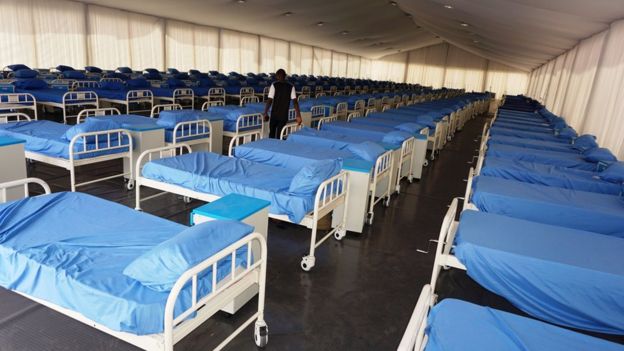
    Under his leadership, CACOVID is building isolation centres in some states inclusive of 500-bed temporary medical facility in Kano, 1,000-bed facility in Lagos, 210-bed isolation centre in Rivers, 200-bed facility in Abuja,200-bed facility in Enugu and another 200-bed facility in Borno states respectively.

    Source: vanguardngr.com

  • 66-year-old dies of coronavirus in Nigeria

    Nigeria has recorded another fatality from coronavirus in Lagos state.

    The deceased is said to be a 66-year-old citizen of the United Kingdom who travelled from India via Dubai to Lagos on 17th of March, 2020.

    The Lagos State Commissioner for Health, Prof. Akin Abayomi, disclosed this through his Twitter handle on Wednesday.

    Abayomi also confirmed that cases of coronavirus had increased to 130 in the state.

    He tweeted, “Lagos recorded another #COVID-19 related death: a 66-year-old Briton, who travelled from India via Dubai to Lagos on 17th of March, 2020.

    “As of 7th of April, 2020, there are 10 new cases of #COVID-19 confirmed. The total of #COVID-19 cases in Lagos rises to 130. “Another #COVID-19 patient was discharged after full recovery. This brings the number of discharged patients to 32.”

    Source: vanguardngr.com

  • Lockdown in Nigeria: Angry residents reportedly invade government offices for food

    Some residents of Lagos, the industrial capital of Nigeria has raided the local government office to bring out food that has hoarded as the lockdown intensifies.

    This incident happened at Abule Egba a suburb of the Lagos State where relief items meant for hungry lockdown residents was been kept.

    The residents who could not continue to starve whiles the food meant for them were hoarded decided to take the law into their own hands and go for the food.

    A Facebook user, who shared a video from the scene wrote, ”Oke Odo LCDA, Opposite Jubilee bridge Abule Egba, Lagos State.

    “Citizens of the area broke into the office of the LG Chairman and made away with COVID-19 relief materials.”

    Watch the video below:

  • Coronavirus: Nigeria discharges 11 patients

    Nigeria has discharged 11 people who were being treated for the coronavirus in hospital.

    Meanwhile, the Nigeria Centre for Disease Control has confirmed 10 new cases of the virus, bringing the total number of recorded cases to 184.

    The authorities say they have increased their testing capacity and can now test 1,500 people a day.

    Health Minister Osagie Ehanire confirmed that the country was seeing “early signs of community transmission”, and he expected an increase in the numbers of people contracting the virus.

    This is because the authorities had stepped up efforts to find those who had been in contact with Covid-19 patients.

    SOURCE: BBC NEWS

  • Nigeria announces two-week lockdown in main cities

    The president of Nigeria, Muhammadu Buhari, has announced a lockdown in the cities of Lagos and Abuja in an effort to contain the spread of Covid-19.

    The restrictions, which will start from 23:00 local time (22:00 GMT) on Monday, will also apply to Ogun state, which borders Lagos.

    The lockdown will take effect for an initial period of 14 days.

    Mr Buhari said everybody would have to stay at home, all businesses and offices would have to close, and only food shops, hospitals and other essential service providers would remain open.

    Travel to or from other states will be banned. The president said a special fund of $40m (£32m) had been set aside to help deal with the pandemic.

    Nigeria has recorded 97 confirmed cases of coronavirus, and one death.

    Africa has not been hit as hard by the virus as most other continents, but the number of cases and deaths is on the rise.

    Source: BBC

  • 2Face Idibia donates 10 million naira to help combat coronavirus in nigeria

    Veteran Nigerian singer, songwriter and record producer, Innocent Ujah Idibia, affectionately known as 2Face/2BABA has donated 10 million naira to combat coronavirus outbreak in Nigeria.

    In his bid to prevent further spread and eradicate the virus which has gained roots in the country, the singer, together with a popular brewery company are making the donations and helping the country to defeat the virus.

    He announced his free online concert which is slated on 12th April 2020. The concert is a means rekindling the hope of people, sensitizing on how to follow safety protocols and observe social distancing to help flatten the curve.

    “Together with Trophy Extra Special Stout, I will be making a N10m donation to support initiatives combating CoVID 19,”

    “The idea of the e-concert is for me to lend my voice and call on Nigerians to come together to combat this global pandemic by heeding the stay-at-home request from the government so that the spread of the virus can be reduced to its barest minimum.

    Also, It will provide a moment of hope, optimism, and comfort to everybody in this trying time.”

    Source: www.ghgossip.com

  • Nigeria records 176 deaths from Lassa fever outbreak

    Amidst the burden from COVID-19, Nigeria has recorded three new deaths from Lassa fever, bringing the total number of deaths in the country to 176 since the outbreak in January.

    This was contained in the latest Lassa fever situation report published last night by the Nigeria Centre for Disease Control (NCDC).

    The report shows that within the last one week, 28 new cases have been recorded while the total confirmed cases in the country are 932 since the last 12 weeks.

    Of the 28 new confirmed cases since the past one week, Edo and Ondo states had the highest with eight and five cases respectively.

    For the week under review, no healthcare worker was affected.

    The distribution of cases across the country also shows that only 10 states have so far not been affected by the outbreak since January.

    The states are Zamfara, Niger, Ekiti, Bayelsa, Akwa Ibom, Jigawa, Kwara, Cross Rivers and Imo and Yobe.

    “Of the 932 recorded cases since January, patients currently being managed in the country are 48.”

    The report also showed that since the past five years, the burden of the outbreak is highest this year.

    Source: allafrica.com

  • 2 Nigerians nabbed for stealing government pickups

    The Tesano police in Accra are holding two Nigerians for allegedly stealing two brand new Nissan pickups belonging to the Ministry of Regional Reorganization and Development.

    The suspects are Prince Okafor, 36, and Augustine Okafor, 25.

    According to the police, two of their accomplices who aided them in the crime have also been identified as Okoboi Jude Iweanya, a washing bay attendant, and one Obina, both of whom are currently at large.

    The Accra Regional Police Commander, DCOP Frederick Adu Anim, who confirmed the arrest to DGNonline, said the vehicles were sent to Dele Johnson Washing Bay for cleaning when the suspects stole them.

    He said on March 24, 2020 around 5:30 am, the Tesano police, during their routine snap checks at a spot near Achimota Neoplan Station, arrested Prince Okafor and Augustine Okafor driving the two unregistered brand new Nissan Hardbody pickups.

    He said the suspects had stolen the vehicles from the washing bay at Community 16 Junction in Tema.

    “When a search was conducted on the suspects, police discovered one Tecno phone, one Lenovo phone, one itel and Nokia phones and a Federal Republic of Nigeria Passport with number A05179065 issued in the name of Okoboi Jude Iweanya,” he disclosed.

    The police commander said investigations revealed that 12 Nissan Hardbody pickups were procured through SVANI Ltd for the Ministry of Regional Reorganization and Development, which were yet to be delivered.

    He said the importing company on March 23, 2020 sent all the 12 vehicles to Dele Johnson Washing Bay at Community 16 Junction for cleaning after which it would be delivered to the said ministry.

    He maintained that while the vehicles were at the washing bay, suspect Okoboi Jude Iweanya, a washing bay attendant, together with another identified only as Obina and the arrested suspects, stole two of the vehicles.

    “SVANI Ltd has come to identify the two unregistered vehicles as being part of the fleet of the 12 they sent to Dele Johnson Washing Bay for cleaning,” he added.

    He revealed that the owner of the washing bay, Dele Johnson, was also picked up by the police to assist in their investigations.

    Source: DailyGuideNework.com

  • Nigeria virus cases rise as travel bans announced

    Nigeria has placed a travel ban on people coming from 13 countries worst affected by the coronavirus outbreak as five new cases were recorded in Africa’s most-populous nation.

    That brings the country’s total number of patients with Covid-19 to eight.

    Health Minister Osagie Ehanire said contact tracing for the new cases was ongoing. All the five had travelled to the UK and/or the US.

    The Nigeria Centre for Disease Control (NCDC) tweeted about the cases, urging Nigerians to remain calm.

    Travellers from China, Italy, Iran, South Korea, Spain, Japan, France, Germany, the US, Norway, the UK, the Netherlands and Switzerland will not be able to come to the West African from Saturday 21 March.

    Nigerians have also been advised to cancel or postpone all non-essential travel to these countries, which all have reported more than 1,000 cases.

    The BBC’s Chris Ewokor in the capital, Abuja, says Nigerians returning to the country must now self-isolate for 14 days.

    On Tuesday, the government also placed an indefinite ban on all public officials from embarking on foreign trips, he says.

    Source: bbc.com


  • Nigeria coronavirus cases rise as travel bans announced

    Nigeria has placed a travel ban on people coming from 13 countries worst affected by the coronavirus outbreak as five new cases were recorded in Africa’s most-populous nation.

    That brings the country’s total number of patients with Covid-19 to eight.

    Health Minister Osagie Ehanire said contact tracing for the new cases was ongoing. All the five had travelled to the UK and/or the US.

    The Nigeria Centre for Disease Control (NCDC) tweeted about the cases, urging Nigerians to remain calm:

    Travellers from China, Italy, Iran, South Korea, Spain, Japan, France, Germany, the US, Norway, the UK, the Netherlands and Switzerland will not be able to come to the West African from Saturday 21 March.

    Nigerians have also been advised to cancel or postpone all non-essential travel to these countries, which all have reported more than 1,000 cases.

    The BBC’s Chris Ewokor in the capital, Abuja, says Nigerians returning to the country must now self-isolate for 14 days.

    On Tuesday, the government also placed an indefinite ban on all public officials from embarking on foreign trips, he says.


    Source: BBC 


  • Explosion at Nigeria gas processing plant causes deaths, destruction

    Residents along the Lagos Badagry expressway in Nigeria on Sunday, witnessed a loud explosion followed by sparks of thick flames, that claimed lives and caused extensive damage to buildings.

    Debris and thick smoke were seen over a large area as perturbed residents gathered in groups assessing the damage. Local media reported 15 deaths citing the National Emergency Management Agency, NEMA.

    The Nigerian National Petroleum Corporation, NNPC, said in a statement that the incident “was as a result of gas explosion which occured after a truck hit some gas cylinders stacked at a gas processing plant.

    An NNPC official added that “preliminary findings indicated that the impact of the explosion was so huge that it led to the collapse of nearby houses and damage to NNPC pipelines on which efforts are being made to curtail the resultant fire.”

    Nigerians took to social media to grieve in part and also bemoan what they said are dysfunctional systems that expose ordinary people to such hazards. The NNPC boss and his team visited the site of the incident while President Muhammadu Buhari also sent condolences via social media.

    Source: africanews.com

  • Nigeria: University shut down as two students die from lassa fever

    The management of Adekunle Ajasin University, Akungba-Akoko (AAUA) has issued a two-week break following the death of two students of the institution.

    A 200-level lassa fever, Temitope Patience, died of Lassa fever on Thursday while Olakunle Matthew of the department of Biochemistry was shot dead by suspected cultists on Friday.

    According to the Acting Registrar of the institution, Opeoluwa Akinfemiwa, the loss of the two students dealt a heavy blow on the school management.

    In the condolence statement sent to PREMIUM TIMES on Sunday, the registrar narrated events that led to the demise of the two students.

    “On admission of Miss Temitope Patience AYEDUN, a 200 Level of the Department of Educational Management, at the University Health Centre, the Medical Personnel tried their best to manage her until she was referred to the Federal Medical Centre, Owo where she was intensively managed before she died on Thursday, 5th March, 2020.”

    “The news of the death of Mr. Olakunle Matthew OLAYINKA, a 300-Level student of the Department of Biochemistry, following wounds from gunshot by unidentified gunmen, was received last night, Friday, 6th March, 2020, after the Medical personnel at the University Health Centre put up spirited efforts to stabilise him. The Security agents are still on the trail of the assailants for apprehension.”

    It was also stated that the university management, under the leadership of the Acting Vice Chancellor, Olugbenga Ige, commiserated with the families of the deceased, the entire students and the university community on the sad events and prayed the Lord console the families and the entire university community.

    She, however, assured that the university management has beefed up security within and outside the campus to forestall recurrence.

    The official also announced the postponement of some examinations to mourn the loss of the students.

    “Mourning the painful loss of these our students, the Ag. Vice Chancellor, Prof. Olugbenga E. Ige, on behalf of the University Senate has, therefore, directed that the First Semester University-wide GST and ENT CBT examinations for 2019/2020 academic session earlier scheduled for Monday, 9th March, 2020 to Thursday, 12th March, 2020 be postponed till further notice.”

    However, in a separate memo obtained on Sunday evening, the university’s Senate approved a two-week Mid-Semester Break for all students with immediate effect.

    This, according to the registrar, is to enable the students refresh and prepare well for the First Semester Examinations for 2019/2020 academic session on resumption.

    Source: allafrica.com

  • BREAKING: Lamido Sanusi removed as EMIR of Kano

    The Secretary to the State Government, Usman Alhaji, announced this on Monday at the State Executive Council meeting which held at the Government House in Kano.

    Alhaji explained that the state government took the decision to remove the traditional ruler over allegations of consistently refusing to abide by instructions given to him.

    More to follow…

    Source: Channels TV Nigeria

  • Nigeria isolates three people over coronavirus fears

    The health minister of Nigeria’s commercial capital, Lagos, has confirmed they have isolated three people suspected of being infected with the coronavirus.

    The three are at a containment facility in Yaba area as a precaution against the possible spread of the virus. Samples have been collected and the results will be released later.

    Nigeria confirmed its first coronavirus case on 27 February, which was also the first case in sub-Saharan Africa.

    Prof Akin Abayomi, Lagos state commissioner for health, said one of the three is a Nigerian who returned into the city on Monday after spending seven days in France. He later developed a headache and respiratory symptoms.

    The other cases involve travelers from England and China.

    The country’s confirmed case is an Italian citizen who works in Nigeria and flew into Lagos from Milan on 25 February. He was reported to be stable with no serious symptoms.

    Elsewhere on the continent, South Africa, Senegal, Algeria, Tunisia, Morocco and Egypt have also confirmed cases of the disease.

    Source: bbc.com

  • Two more suspected cases of coronavirus in Lagos

    Two more suspected cases of COVID-19 have been recorded in Lagos.

    One of the suspected cases, Vanguard gathered, is a Chinese man isolated on arrival at the Muritala Mohammed International Airport, MMIA, on Tuesday.

    The unnamed man was said to be coughing excessively when accosted.

    A source said the Chinese man is at the isolation centre at Yaba, Lagos.

    “The Chinese is now under observation at the Mainland Hospital Quarantine Centre in Yaba.”

    The Lagos State government has commenced analysis of his travel history, diagnosis and possible contact tracing while more health workers have been drafted to all the entry ports and borders.
    Source: Vanguardngr.com
  • Fresh details emerge about Nigeria’s first coronavirus case

    An Italian man who has been confirmed to be Nigeria’s first coronavirus case after arriving from Milan was in the country for almost two full days before being isolated, travelling through Lagos and visiting another state.

    The case has prompted a scramble by authorities in Africa’s most populous country who are now trying to trace everyone who arrived on the same flight as the patient and identify the places he visited before going to the hospital.

    “We have started working to identify all the contacts of the person since he entered Nigeria and even those who were with him on the aircraft,” Health Minister Osagie Ehanire told reporters on Friday in Nigeria’s capital, Abuja.

    The Italian, whose country is the worst-hit in Europe by the coronavirus outbreak, arrived on February 24 on a Turkish Airlines flight that had a connection in Istanbul, Akin Abayomi, Lagos state commissioner for health, told reporters.

    After spending the night in a hotel near the airport, he arrived in the neighbouring state of Ogun on February 25 at his place of work.

    He stayed there until he developed a fever and body aches on the afternoon of February 26, Abayomi said.

    Health practitioners with his company then contacted biosecurity authorities, who transferred him to a containment facility in Yaba, Lagos state.

    “It was very astute of the medical practitioners in that facility to keep him overnight in an isolated environment,” Abayomi said.

    Ehanire said the infection was confirmed on February 27 by the Virology Laboratory of the Lagos University Teaching Hospital, part of the Laboratory Network of the Nigeria Centre for Disease Control, and that the man is now quarantined but doing well.

    As well as being the first in Nigeria, the patient is the first confirmed coronavirus case in sub-Saharan Africa.

    Turkish Airlines did not immediately comment on the case. There are no confirmed cases in Turkey.

    The World Health Organization has said it already has experts on the ground in Nigeria, which it identifies as one of 13 “high priority” countries in Africa.

    In a sign of mounting concerns in Kenya, the country temporarily suspended flights from China on Friday. Kenya has no confirmed cases of the virus.


    Source: Aljazeera

  • Nigeria confirms first case of coronavirus

    Nigeria has recorded the first case of coronavirus, health officials confirmed Thursday.

    The Federal Ministry of Health in a Twitter post said the case was recorded in the commercial capital, Lagos.

    It is also the first case to be confirmed in West Africa since the outbreak in China on December 31, 2019.

    A statement signed by the Minister of Health, Dr Osagie Ehanire, stated that an Italian citizen who works in Nigeria and returned from Milan, Italy to Lagos, Nigeria on February 25, 2020, was suspected to have contracted the disease.

    Mr Osagie said he (Italian) was confirmed by the Virology Laboratory of the Lagos University Teaching Hospital, part of the Laboratory Network of the Nigeria Centre for Disease Control.

    He said the patient is clinically stable, with no serious symptoms, and is being managed at the Infectious Disease Hospital in Yaba, Lagos. He advised Nigerians to pay adequate attention to their hygiene, reeling out measures to prevent contracting the disease.

    The novel coronavirus COVID-19 is affecting 53 countries and territories around the world and 1 international conveyance (the “Diamond Princess” cruise ship harbored in Yokohama, Japan).

    So far 83,369 cases have been reported worldwide with 2,858 deaths recorded.

    Some 36,525 persons who initially tested positive, have now recovered.

    Source: Myjoyonline.com

  • Nigeria’s death toll from lassa fever hits 118 – Report

    The deaths recorded from the Lassa fever outbreak in Nigeria has reached 118, the Nigeria Centre for Disease Control (NCDC) has disclosed.

    From January 1 to February 23, 2633 suspected cases, with 689 confirmed cases and 118 deaths have been recorded in the country.

    The number of cases has significantly increased compared to what was reported for the same period in 2019.

    In 2019, 1249 suspected cases with 381 confirmed and 83 deaths as of the same period.

    This year, there have been more cases reported in more states across the country.

    Outbreak

    Lassa fever has become an epidemic in the country and is being diagnosed all year round. The Lassa fever season peaks during the dry season from November to May with high case fatality rates.

    In the reporting week, NCDC said the number of new confirmed cases decreased from 115 cases from the previous week to 102 cases.

    These were reported from 18 states – Ondo, Ebonyi, Edo, Bauchi, Plateau, Benue, Lagos, Enugu, Gombe, Kaduna, Katsina, Kogi, Sokoto, Taraba, Delta, Rivers, Adamawa and Nasarawa.

    Also, four health workers were newly infected in Edo and Ondo states, bringing the total number of infected health workers to 20.

    Health workers are susceptible to getting infected because of the nature of the disease.

    Cumulatively from week 1 to week 08,118 deaths have been reported with a case fatality rate of 17.1 per cent.

    In total for 2020, 27 states have recorded at least one confirmed case across 115 local government areas.

    Of all confirmed cases, three states – Edo, Ondo and Ebonyi – have the highest burden of the disease at 72 per cent.

    The primary host of the disease is the rat and it (ailment) is transmitted from the rodents to humans. Human to human transmission also occurs and has been identified as high proliferation of the disease.

    Symptoms of the disease include fever, headache, sore throat, general body weakness, cough, nausea, vomiting, diarrhoea, muscle pains, chest pain, and in severe cases, unexplainable bleeding from ears, eyes, nose, mouth, vagina, anus and other body orifices. It could also present persistent bleeding from sites of intravenous cannulation.

    Source: allafrica.com

  • Teenage girl allegedly stabs lover to death over N3,000

    The police in Ogun State have arrested an 18-year-old girl, Idowu Abosede, for allegedly stabbing her boyfriend, Aliyu Ibrahim, to death.

    The suspect was arrested following a distress call received by Sagamu Divisional Police Headquarters from Seriki Huasa in Sagamu, saying the suspect and her deceased boyfriend were at loggerheads over N3,000.

    The complainant reported that following a heated argument, the duo were dragging a knife with each other and in the process, the suspect took possession of the knife and allegedly used it to stab the boyfriend on his chest, which resulted in his death.

    A statement by the Police Spokesman, Abimbola Oyeyemi, said the DPO Sagamu, Okiki Agunbiade, immediately directed his detectives to the scene where they arrested the suspect.

    He said the knife stained with blood allegedly used to stab the deceased was equally recovered.

    “On interrogation, the suspect claimed that she came and passed the night with the deceased and when she was about going in the morning, she took the sum of N3,000 from the deceased but he was not ready to give her the whole N3,000 and that was what led to argument between them.

    She further stated that it was the deceased who brought out the knife, and while dragging it with him, the knife stabbed him on his chest,” the statement read in part.

    The corpse of the deceased has been released to his relations on their demand to bury him in accordance with Islamic right, the spokesman added.

    Oyeyemi added that the Commissioner of Police, Kenneth Ebrimson, has ordered the immediate transfer of the suspect to homicide section of the State Criminal Investigation and Intelligence Department for further investigation and prosecution.

    Source: allafrica.com

  • Mexico returns ‘smuggled ancient sculpture’ to Nigeria

    The Mexican government has returned an “ancient” bronze sculpture to Nigeria after it was seized by customs officials in the capital’s airport.

    The sculpture is believed to date back to the 6th Century from the south-western city of Ife, reports AFP news agency.

    An official from Mexico’s foreign ministry is quoted saying that the sculpture had been illegally exported.

    Mexico’s National Institute of Anthropology and History (INAH) tweeted a photo of the sculpture:

    Diego Prieto, the head of INAH, is quoted saying that experts had “determined that it was a piece of Yoruba origin”.

    Source: myjoyonline.com

  • Nurse confesses how she gave someones baby to a fake pregnant woman

    Trained Nurse, Mrs. Goriola Abike, Confesses how she swaps a twin brother to a fake pregnant woman who has been looking for a child for over years in Nigeria.

    Her statement reads;

    “I really regret my action for putting myself into this, the two families Mr and Mrs Okunola are my neighbors in Abeokuta, they have been married for over 7 years without a child in their home.

    They met with me which i promised to help them out only if they can cooperate, which our agreement is them to pay me a sum of N800 000. We planned it that, the wife should be putting bundles of cloth on the stomach just to deceived people around of being getting pregnant.

    We have a pregnant woman scanned, who has been confirmed to give birth to twins in one private hospital in Abeokuta.

    The moment the woman gave birth to twins, I planned with my other colleague at the hospital to carry out the assignment.

    The pregnant woman who gave birth to male and female twins, I congratulate the mother of the newborn baby, that she gave birth to bouncing baby girl while I took the other male child to the fake pregnant woman. She added,

    Since then, my conscience never allows me to rest”.

    She made this confession at the police division headquarter Abeokuta ogun State, which she has been detained for proper investigation.

    Source: broadcastghana.com

  • Nigerian Air Force kills key Boko Haram Leaders in Borno

    The Nigerian Air Force (NAF) yesterday said it killed some key leaders of the Islamic State of West Africa Province (ISWAP) at Jubillaram and Alinwa in the northern part of Borno State.

    This came as troops of the Operation Hadarin Daji in Zamfara State killed 13 bandits and arrested eight others in Zamfara State.

    NAF’s Director of Public Relations and Information, Air Commodore Ibikunle Daramola, said yesterday in Abuja that the Air Force Air Task Force (ATF) of Operation Lafiya Dole, under the auspices of Operation Rattle Snake III, struck the ISWAP leaders as they assembled for meetings, after intelligence reports.

    The statement however, did not give the number of those killed, their names or ranks in the group, but it added: “The mission was executed on the heels of credible intelligence reports indicating that some key ISWAP leaders had assembled for meetings, which were being held simultaneously at two separate venues, at Jubillaram and Alinwa in Marte Local Government Area.

    “Accordingly, the ATF scrambled its attack aircraft to engage both locations, damaging the meeting venues and neutralising the terrorists,” Daramola said. He said they were neutralised in operations conducted on Thursday.

    Daramola said NAF, operating in concert with surface forces, would sustain its air campaign to shape the battlespace in the North East for the effective conduct of further ground and air operations.

    According to him, Operation Rattle Snake III which commenced on February 4, was aimed at targeting selected locations within the North East in order to shape the battlespace for more effective onslaught against the insurgents.

    The multinational joint task force (MNJTF) also recently announced that it killed a high ranking ISWAP commander named Khalifa Umar.

    A statement from the Task Force said the influential commander of the terror group was “eliminated” during an airborne attack on one of the insurgents’ hideout on a Lake Chad community known as Tunbums Sabo.

    The statement signed by Timothy Antigha, the spokesman of the MNJTF, indicated that Khalifa Umar was killed during an “ongoing offensive operations against ISWAP and other purveyors of violence and instability in the Lake Chad Basin.”

    Although ISWAP’s main area of operations is further east in the Lake Chad area, the group has attacked a number of military locations in the Maiduguri-Biu-Damuturu triangle in recent months. In late July, ISIS claimed ISWAP fighters killed 25 Nigerian troops in Benisheikh and earlier that month claimed ISWAP fighters fought off a Nigerian military assault in the Damboa area.

    In a related development, troops of the Operation Hadarin Daji in Zamfara State killed 13 bandits and arrested eight others in Zamfara State, the Acting Force Information Officer, Captain Ayobami Oni-Orisan said in a statement yesterday.

    Source: allafrica.new

  • Nigeria needs 100,000 more soldiers to crush Boko Haram – Borno Governor

    Borno State Governor, Prof. Babagana Zulum, Wednesday said that Nigeria would require about 100,000 more soldiers to win the war against Boko Haram.

    He, however, suggested at least 50,000 of the recruits should come from Borno, irrespective of whether or not they have western education, to prosecute the ongoing war against terror.

    The governor urged President Muhammadu Buhari and the military to revisit the strategy used in 2016/2017 when Nigerians were almost celebrating the demise of Boko Haram so that the insurgents would be defeated once and for all.

    Zulum spoke yesterday in Maiduguri while playing host to the House of Representatives’ Committee on Defence led by its Chairman, Hon. Babajimi Benson.

    Also yesterday, the governor, in a broadcast, declared Monday a day for statewide fasting and prayers against Boko Haram insurgents.

    He said the war against insurgents could not be successfully won without manpower, technology and proper funding.

    He said: “Take my words, they (the military) don’t have the manpower; they don’t have the equipment. Kindly advise the speaker and the Senate president to tell Mr. President to approve the massive recruitment of soldiers. We need about 100,000 more to be recruited into the Nigerian Army. They should come and employ the locals whether they have western education or not.

    “We need to recruit nothing less than 50,000 men from Borno; we have able-bodied men that can join the Nigerian Armed Forces on an ad-hoc basis.”

    Zulum expressed doubt about Nigeria’s readiness to win the ongoing war against insurgency, saying that “you cannot fight this war without manpower, technology and proper funding.”

    The governor added that he will always admit the fact that the Buhari administration did so much to degrade Boko Haram when it came to power in 2015, but the situation has already degenerated with the renewed attacks on the state.

    He said: “I have always admitted that the federal government has done well under the watch of President Muhammadu Buhari. At a time, about 20 local government areas were displaced but after May 29, 2015, almost all the roads were opened and the local government retrieved.

    “But notwithstanding the gains that we had, between March 2019 till date, we have experienced horrific and simultaneous attacks throughout the state. As I told the Theatre Commander, we are experiencing the attacks in quick geometrical ratio.

    “I therefore plead with Mr. President and as well as the Nigerian military to revisit the strategy used during 2016/2017 that we were almost celebrating the demise of Boko Haram so that we can deal with the insurgents once and for all.

    “One important thing that we have to do is to take the fight into their enclaves. The whereabouts of the Boko Haram is known to all of us. It is known to the people of Borno State; it is known to the military. It is known to all of us.

    “Another important thing that I raised is the issue of commercial activities. There is nexus between peace, security and development. There is nexus between poverty, unemployment and insecurity and in order to address causes of insurgency, we need to address our major challenges. And one thing I plead with the Nigerian military is to allow for free flow of commercial activities in Borno. This will reduce recruitment, fortunately enough the chief of army staff has lifted the ban on sales of fish and fish farming in Borno State, we have conveyed the message to the fish farmers.

    “Then coming down to the challenges of the Nigerian military, I think the theatre commander can inform you better, but to the best of my knowledge, their major deficiency is manpower. They lack manpower. Borno State has a large landmass and therefore they need manpower; they need technological warfare; they need logistics. You cannot fight this insurgency to an end without technology and without manpower and without funding, this is very germane.

    “Take my words, they don’t have manpower. They don’t have equipment.”

    According to the governor, military operation has to use stabilisation mechanism, which ensures stabilisation effort on ground during a military operation.

    He added that to ensure this, the military needs manpower to hold a place as “without manpower, you cannot hold a place; without people going about their normal activities, going to their farms peace cannot reign.

    “We have over 500,000 IDPs in Monguno, 120,000 IDPs in the Republic of Niger, we have 68,000 IDPs in the Republic of Cameroon that are eager to come back home and even in Dikwa how many IDPs do we have that have limited access to their farms. This issue will not stop until people have access to their farms.

    “And honestly speaking, we need to increase the firepower of the police to augment the military as well as the Civil Defence Corps because of their importance.”

    He noted that the paramilitary, police and others have to be allowed to carry sophisticated arms.

    “I think there is the need to allow for certain guns to be used by the paramilitary for certain period of time. After the insurgency is over, you can now go back to the old position,” he stated.

    Meanwhile, Zulum has declared Monday, a day of statewide fasting and prayers against Boko Haram insurgents.

    The governor, in a six-minute broadcast to the people of the state, however, said there would be no public holiday on Monday.

    The governor after enumerating ongoing collaboration with the military, including calls for mass recruitment, equipping and deployment of thousands of volunteers in the Civilian JTF, hunters and vigilantes, said his call for prayers was strange but a necessary decision made based on popular wish of the people of the state.

    “Even though this decision is based on the popular demand of our people, some observers may rightly argue that it is a strange call. But then, Borno has been befallen with a strange evil since 2009; and sometimes, strange ailments require strange approaches.

    “As your governor, I hereby declare Monday the 24th of February 2020 as a day of devotion to pray for the return of peace in Borno. I intend to fast on that day and I appeal to every one of us in Borno, who can, to join in that simple, but pricelessly rewarding spiritual endeavour. I also appeal for the sacrifices of all other well-meaning friends and associates of Borno who can, to join us in fasting on Monday, insha’Allah, for the restoration of peace in Borno State and rest of Nigeria,” he explained.

    Source: allafrica.com

  • UK seeks closer ties with Nigeria after brexit

    The United Kingdom has expressed its readiness to deepen and strengthen relationship with traditional partners in the commonwealth after exit from European Union.

    The UK High Commissioner to Nigeria, Amb. Catriona Liang, expressed the country’s desire when she paid a courtesy visit to Gov. Abdullahi Ganduje at the Government House, Kano.

    “I think we are in a very good period at the moment because with the new government in the UK under Prime Minister Boris Johnson we are in a journey of re establishing and strengthening relationship with traditional commonwealth partners in Africa particularly Nigeria.

    “Nigeria is always important to relationship in Africa, we put our money where we have our biggest mission, we have 500 people working for us, 300 in Abuja and 200 in Lagos and another 30 or so in places like Kano,” she said.

    According to her, the previous Prime minister visited Nigeria few years ago and that she has been given clear instructions to deepen and strengthen the relationship and partnership.

    Liang said that one of her major jobs was to follow up to the UK -Africa summit, with focus on commerce and economic side of it.

    Speaking on Kano, the high commissioner said that the country would focus on three broad areas; governance, human development and economic growth.

    She said that the UK would slightly shift the way it worked in the country, saying that it was going to develop the concept called “neutral accountability”.

    “We are commending the governor for his efforts in human development. This is very encouraging. It is noteworthy to understand that we are strengthening our ties with African states.”

    “We are also looking at agriculture, the main stay of your state economy. Ours is to always strengthen our ties. It is known that Kano state has a long standing relationship with our country,” she said.

    Ganduje solicited for stronger synergy between the state and United Kingdom, hinting that policies around the sectors were deeply entrenched to have great impact on human development.

    “In the area of education, we came up with this policy, which we know is a heavy-loaded policy statement, which needs all hands on deck.

    “We all believe that with the right education, these issues of insecurity and joblessness would come to pass.

    “We also understand that education is a right to each and every citizen.

    “That is why we have a Law in place that whoever fails to take his child or children to school is committing an offence,” he said.

    “The issue of the integration of Almajiri system into our conventional education system is another task that must be accomplished. That is why we are also taking this matter very seriously.

    “In the area of agriculture I am informing you that apart from making sure that we maximize our production, we are doing our best to also see that farmers get all the necessary support to do well in their farmlands,” he said.

    According to him, the support comes from good and people-oriented agric policies to provision of quality seeds, other implements among others.

    Ganduje urged United Kingdom to help hand in propelling and supporting the noble programme that would address the issue of out-of-school children with all seriousness and determination.

    Source: allafrica.com

  • Nigeria: FA boss defends Joseph Yobo’s appointment as assistant coach

    Nigeria Football Federation (NFF) president Amaju Pinnick has defended the choice of Joseph Yobo as assistant coach of the senior national team, amid a huge public outcry over his appointment last week.

    The former captain, 39, replaces Imama Amapakabo and is expected to work with manager Gernot Rohr as third in command.

    But some fans and a section of the local media have questioned the decision to appoint Yobo saying he ‘lacks the right qualifications’.

    “The concept behind this is to nurture and condition former captain Joseph Yobo to provide leadership and mentorship for the young team,” Pinnick said.

    “He has an incredible experience playing for some of Europe’s biggest clubs. He is one of our most-capped players ever and also won the Nations Cup.

    “I believe that as Nigerians we have a chance to make a positive step forward and it’s important to give him the opportunity to succeed.”

    His country’s second most capped player, Yobo won the first of his 100 caps for Nigeria against Zambia in Chingola in 2001.

    The former Everton, Fenerbahce and Norwich City star, who represented his country at the 1999 Under-20 World Cup, skippered the Super Eagles to Africa Cup of Nations success in South Africa in 2013.

    However, the former NFF’s head of the technical department, Kashimawo Laloko, insists there are better options. He says there are more well known names in the country other than the defender who played in six Africa Cup of Nations tournaments between 2002 and 2013 in a 14-year career.

    “I don’t think we should just appoint someone because of their name. As it is, Yobo is not qualified to be an assistant coach,” Laloko told BBC Sport.

    “I have nothing against him as a person but his appointment lacks logic. There are other qualified former players who are more deserving to be assistant coaches.”

    Despite the criticism, Pinnick says the football authority is ready to support Yobo to grow in the role and in his effort to obtain the required licences.

    He also calls for patience and public support to enable Yobo to follow in the footsteps of his former coach, Nigeria legend Stephen Keshi.

    “Yes Fifa rules say that the head coach and first assistant coach must have coaching licences, but Yobo is not the first assistant coach,” Pinnick added.

    “That’s how Stephen Keshi started. Who says Yobo can’t be the next Nigerian to win the the Nations Cup as player and coach.

    “We can tap into his wealth of knowledge because we can not keep relying on foreigners as coaches all the time. We as a nation can help build one of our own.”

    In the last three decades, Austin Eguavoen, Stephen Keshi and Samson Siasia are the three former international players to have gone from assistant coaches to managing the Super Eagles.

    Yobo featured in three World Cup tournaments in 2002, 2010 and 2014, playing ten matches at the World Cup finals in total – the most appearances for the West African nation on the biggest stage.

    He became the first African to captain Everton in October 2007 and made more than 250 appearances for the Toffees, helping them qualify for the Champions League in 2005 and playing in the side that lost the 2009 FA Cup final to Chelsea.

  • MCAs reject proposal for regional governors

    Ward representatives and a section of civil society leaders have rejected a proposal for regional governors.

    In their memoranda to the Building Bridges Initiative (BBI) task force that is validating its report, the leaders want the devolution structure to remain as it is.

    “We instead call for the revitalisation of the economic blocs which will spur economic growth in the regions,” said Ms Florence Mwangangi the vice-chairperson of the County Assemblies Forum.

    The forum has a membership of 2,331, who include 2,237 MCAs, the 47 Speakers and the 47 clerks of the regional Houses.

    The idea of creating regional governments was first mentioned by ODM leader Raila Odinga during the 2018 Devolution Conference in Kakamega.

    He suggested that these larger governments would manage the counties to make them financially viable and better managed.

    Similarly, the Multi-Sectoral Forum, comprising civil society leaders, dismissed the regional government’s proposal as a bad idea.

    OVERSIGHT AGENCY

    The forum, instead, proposed the establishment of a devolution oversight authority.

    In its presentation, the County Assemblies Forum, chaired by Nyandarua County Assembly Speaker Ndegwa Wahome, called for financial autonomy from the county executive.

    “It is unfortunate that up to now, county assemblies have to rely on the county executive to get funding. It does not make sense that a county assembly, which is at the mercy of the governor, has to oversight the county executive that decides when and how much money it gets,” said Ms. Mwangangi.

    Similarly, the group wants strict adherence to the Commission for Revenue Allocation recommendations on revenue sharing, saying that any deviation by Parliament should not exceed three percent.

    Source: nation.co.ke

  • Court stops Nigeria’s Electoral Commission from deregistering 31 political parties

    Justice Anwuli Chikere of the Federal High Court, Abuja has restrained Independent National Electoral Commission (INEC) from deregistering 31 political parties.

    Justice Chikere, in her ruling, said having failed to counter the application by the applicants, the affected political parties had the legal right which must be protected.

    In an interlocutory motion with suit number: FHC//ABJ/ CS/444/19 between Advanced Congress of Democratic (ACD) and 2 others Vs. Attorney General of the Federation and another (INEC), the applicants had on Oct. 30, 2019, approached the court.

    INEC had, on Feb. 6, deregistered 74 political parties .

  • U.S.$4.6 billion Abacha loot returned in 18 years-I nvestigations

    Nigeria has over the past 18 years recovered $4.6 billion (1.4trn) allegedly looted from the nation’s treasury and stashed abroad by the late Head of State, Gen. Sani Abacha. Data on the recoveries collated by Daily Trust indicates that the funds were repatriated mainly from four countries between 2002 and 2020 under the administrations of Olusegun Obasanjo, Goodluck Jonathan and Muhammadu Buhari.

    The countries include Switzerland, Jersey Island in the United Kingdom, United States of America and Liechtenstein.

    Under the administration of former President Olusegun Obasanjo, $1.2 billion was recovered in 2002; $149 million from Jersey Island, the UK in 2003; $500 million recovered in 2004 from Switzerland and another $458 recovered in 2005 from Switzerland.

    During the Goodluck Jonathan administration, $1 billion was recovered in 2012 and $380 million in 2015, both tranches from Switzerland. The Jonathan administration also recovered $227 million from Liechtenstein in 2014 and $48 million from the United States the same year.

    President Muhammadu Buhari’s government recovered $322 million from Switzerland in 2017 and $308 million from Jersey Island, United Kingdom in February 2020, being the latest.

    Of the four countries, Switzerland tops the list of countries where the funds were recovered from.

    A total of about $2.6 billion of the funds so far repatriated to Nigeria was recovered from Switzerland while the other recoveries came from UK and USA. Switzerland was the principal recipient of funds allegedly stolen under the Abacha regime. However, there are concerns that funds so far recovered may have been ‘re-looted’ or mismanaged by those at the helms in Nigeria.

    Last week, an agreement was signed by the federal government, the government of Jersey and the United States to repatriate $308m of such funds to Nigeria, under some conditions.

    The agreement which the Attorney-General of the Federation and Minister of Justice, Mr. Abubakar Malami, signed behalf of Nigeria, tied the return of the funds to three major projects across Nigeria.

    The projects include the Lagos-Ibadan Expressway (Western Region), Abuja-Kano Road (Northern Region), and Second Niger Bridge (Eastern Region).

    Conditional transfer

    Negotiations for the return of the funds which began in 2018, according to the agreement, specifically indicated out who will manage the assets and the various organisations that would monitor the expenditure to ensure that they are not diverted to other purposes.

    The tripartite agreement reads in part: “The projects on which the funds will be expended will be administered by the Nigeria Sovereign Investment Authority and independently audited. The Federal Republic of Nigeria will establish a monitoring team to oversee the implementation of the projects and report regularly on progress.

    “The Nigerian government, in consultation with the other parties, will also engage civil society organisations which have expertise in substantial infrastructure projects, civil engineering, anti-corruption compliance, anti-human trafficking compliance, and procurement to provide additional monitoring and oversight.”

    The attachment of the conditions was blamed on the poor accountability and high level corruption in the country, especially that previous repatriated funds were said to have been stolen.

    The latest fund to be repatriated was looted through the US but was recovered and confiscated in Jersey Island at the request of the US government.

    The funds were laundered through the U.S. banking system and then held in bank accounts in Jersey in the name of Doraville Properties Corporation, a British Virgin Islands company, and in the name of a son of the ex-military ruler.

    “This agreement has culminated in a major victory for Nigeria and other African countries as it recognizes that crime does not pay and that it is important for the international community to seek ways to support sustainable development through the recovery and repatriation of stolen assets,” Malami said after the agreement was signed.

    He said the funds would be administered by Nigeria’s sovereign wealth fund and used to develop roads that will boost supply chain connections and economic growth.

    The Swiss government in 2017 said it would return to Nigeria about $321m in assets seized from Abacha’s family via a deal signed with the World Bank.

    In a separate news release, the U.S. Department of Justice said it was seeking to enforce forfeiture judgments for approximately $30m in assets located in Britain and more than $144m in France.

    The moves to recover the funds started just after former President Olusegun Obasanjo got to office in 1999.

    In April 2002, the Abacha family returned $1bn to the federal government in a deal which involved the Swiss Federal Office of Justice.

    The deal allowed the family to keep $100m and required the government to drop “some criminal charges” against Mohammed, Mr Abacha’s son, New York Times then reported.

    According to Transparency International (TI), in 2006, another $723m was returned to Nigeria from Switzerland but was largely unaccounted for.

    “That past experience led Switzerland to controversially attach conditions to the repatriation of this batch of $322 million in 2018, including third party oversight – meaning that the World Bank will now monitor the distribution of the funds,” TI said.

    A Swiss court in December 2014, ruled that the Swiss government should repatriate the funds on condition that the World Bank would monitor its use.

    This was followed by the federal government, the Swiss Federal Council and the World Bank Memorandum of Understanding (MOU) on December 4, 2017, capturing the tripartite agreement on the World Bank’s monitoring role and the modalities of the fund’s repatriation and disbursement.

    While the World Bank’s role is limited to monitoring the use of the funds, the responsibility for the use of the funds is with the federal government.

    Previous arrangements

    In 2005-2006, the funds were returned directly from Switzerland to the Nigeria and were programmed into the national budget and utilized by the Nigerian government in line with its National Economic Empowerment and Development Strategy (NEEDS).

    At that time, at the request of, and in agreement with the Nigerian and Swiss governments, the World Bank carried out an ex-post analysis on the use of the repatriated funds, particularly in terms of the contribution for these funds to NEEDS.

    The bank’s analysis took a two-pronged approached looking at general budget expenditure trends at the macro level while also conducting a field survey of randomly selected projects funded under the budget program. Its role was limited to analyzing spending of repatriated funds after they were disbursed, and had no role in supervising the implementation.

    In addition, in order to provide independent monitoring of the use of the funds, Nigerian Civil Society Organizations under the umbrella of the Network on Asset Recovery (NAR) made up of civil society organizations with expertise in anti-corruption and asset recovery will monitor the use of the funds for cash to beneficiaries and provide bi-annual reports on the use of the funds.

    US warning

    The United States warned Nigeria to be prepared for repayment if the latest $308m in question about to be released to the country was stolen again.

    The spokesperson for the US State Department, Morgan Ortagus, in a statement said this was part of the deal with the Nigerian authorities before the Island of Jersey where the funds are being kept, agreed to its repatriation.

    “The funds will be used by the Nigerian Independent Sovereign Authority for three infrastructure projects in strategic economic zones across Nigeria.To ensure that the funds are used responsibly and for the good of the nation, the agreement includes mechanisms for monitoring the implementation of these projects as well as external oversight, and it requires Nigeria to repay any funds lost as a result of any new corruption or fraud to the account established to hold the returned assets.

    “This return reflects the growing international consensus that countries must work together to ensure stolen assets are returned in a transparent and accountable manner.This agreement is a symbol of the weight that the United States government places on the fight against corruption,” he said.

    The US said they welcome President Muhammadu Buhari’s personal commitment and would continue to support civil society and other Nigerian efforts to combat corruption at all levels, as the fight against corruption is an investment in the future of Nigeria.

    Reactions

    In one of the earliest reactions, a human rights lawyer, Mr. Femi Falana, advised President Buhari to reject Switzerland’s conditions for the return of $321m loot. Falana said the condition given by the Swiss government, which allows the World Bank to supervise the spending of the returned assets, breaches international law.

    Falana urged the federal government to collaborate with relevant civil society organizations to mount campaigns locally and internationally to ensure full compliance by Switzerland, the United States and other countries with international law principles of accountability, sovereignty, equality, fairness and non-interference.

    Also, the Civil Society Legislative Advocacy Centre (CISLAC) and the Transparency International’s chapter in Nigeria, expressed concern about a lack of parliamentary and public approval of the distribution scheme.

    CISLAC’s Executive Director, Auwal Musa Rafsanjani, said the center had repeatedly called for a trust fund to be set up to manage the repatriated assets, and other assets seized within Nigeria. According to him, repatriated assets from abroad account for only 10 to 15 percent of all assets seized since 2015.

    “We are supporting the government in this recovery but with the condition that there must be an establishment of integrity trust fund that would manage this money and assets. We want to ensure that we have an institutional framework that would monitor the recovered assets in Nigeria,” Rafsanjani said.

    Source: Daily Trust
  • Chris Attohs ex wife, Damilola Adegbite reminisces on their marriage

    Nigerian actress, Damilola Adegbite is reminiscing on her marriage with Ghanaian actor, Chris Attoh .

    The stunning actress took to her social media page to remember her wedding to Chris Attoh which was held on 14th February, 2015.

    Choosing to look on the bright side, Damilola marked the 5th anniversary by revealing she hopes for a better relationship in the future.

    She shared a new photo of herself and wrote: “Fun fact: I got married on this day 5 years ago. Dear Single Lady, What is coming is better than what is gone. Be excited about the future. Just imagine all the possibilities. Not everyone gets a second chance. I wonder what my next boyfriend is doing now.”

    The couple split eventually and Chris Attoh went on to marry a woman who was later shot dead in the USA.

    They have a son together.

    Source: mzgeegh.com

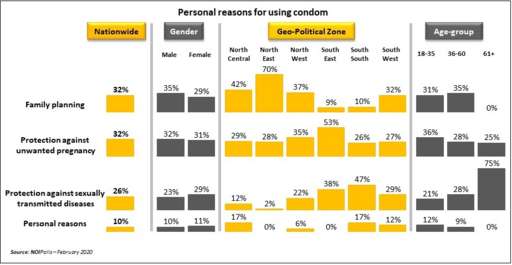
  • Only 34% of Nigerians use condoms during sex

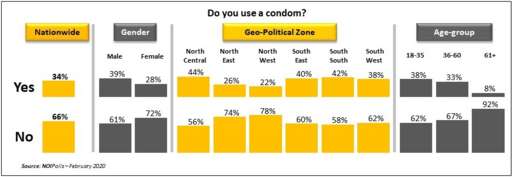
    Only 34% of adult Nigerians surveyed in a national poll use condoms during sex.

    According to the survey carried out by NOIPolls, the results show that only 28% of the general population that uses condoms do so consistently.

    This is despite the fact that most of those surveyed said it was easy for them to purchase a condom if needed.

    Chike Nwangwu, NOIPolls CEO, told the BBC that religion and a partner’s refusal were the most common reasons given by respondents for not using condoms.

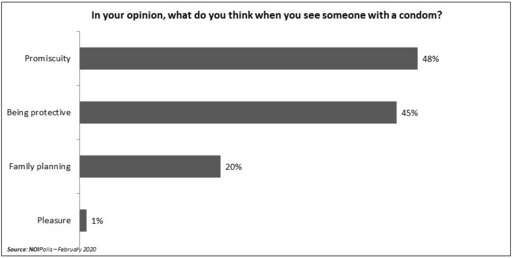
    “With regards to perception and attitude on condom, 63% of Nigerians stated that the first thing that comes to their mind when they hear the word condom is sexual pleasure, while 45% disclosed that they instantly think of promiscuity when they see someone with a condom,” he said.

    The survey including the following graphics to illustrate some of its findings:

    The data was drawn from 1,000 adults in a country of some 200 million people.

    The survey was conducted in partnership with Nigeria’s Aids Healthcare Foundation (AHF) and the National Agency for the Control of Aids (Naca) to mark International Condom Day on 13 February.

    Source: BBC

  • Housewife stabs husband over suspected infidelity

    A man, Jude Madu, escaped death by a whisker on Wednesday after his wife, identified simply as Mrs Madu, allegedly stabbed him while he was asleep at their house in Owerri, Imo State.

    A resident, Saviour Godwin, told PUNCH Metro that the enraged woman suspected that her husband was cheating on her.

    Godwin said the suspect waited until her husband slept before stabbing him three times.

    He said the man, who suddenly woke up, ran out and was rushed to the Federal Medical Centre, Owerri.

    Godwin said, “Mr Jude Madu, a resident of Owerri, was stabbed by his wife who suspected he had a side chic.

    “The man luckily escaped and was rushed to the Federal Medical Centre, Owerri, where he is in critical condition and receiving treatment.

    The police spokesperson in the state, Orlando Ikeokwu, said the command was aware of the incident.

    “We have seen it online and the Commissioner of Police has ordered invesigation into the case,” he added.

    Source: Punchng.com

  • Family of 16 burned to death in Nigeria attack

    Reports from Nigeria say 16 members of the same family have been burned to death during an attack in north-western Kaduna state.

    Witnesses said they were locked in a room before their house was set on fire.

    A number of other people were shot dead when dozens of gunmen arrived in their village. Vehicles and other property were set ablaze.

    It is not clear who carried out the attack.

    Kidnapping gangs, bandits and a faction of the Islamist group, Boko Haram – known as Ansaru – are active in the area.

  • Nigerian man beats wife to death over missing N5,000

    A 42-year-old fisherman, Patrick Ejiro reportedly beat his wife to death over alleged missing N5,000 ($13) in Tyomu community on Makurdi-Gboko Road, Tarka Local Government Area of Benue state

    Vanguard gathered that the fisherman, an indigene of Delta state, had been living with his Benue wife in the community where he ekes out a living from fishing.

    According to the source, the couple had early in morning engaged each other in a heated argument over an alleged N5,000 that was realized from the sale of fish but was unaccounted for by the late wife.

    “The argument led to a fight, the husband beat her to a pulp and she passed out bleeding from her mouth and nostrils.

    “Neighbours, who intervened, made efforts to revive her but it was unsuccessful. She was eventually rushed to the Benue State University Teaching Hospital, BSUTH, for further treatment where she was confirmed dead,” he said.

    Confirming the development, the Benue State Police Public Relations Officer, PPRO, Deputy Superintendent, DSP, Catherine Anene, said the brawl between the couple started “when the wife allegedly sold some items for the family and failed to remit the N5,000.”

    “He beat her up to a state of coma and she was bleeding from the nostrils. She was rushed to BSUTH where she was confirmed dead. The suspect is in police custody and investigation into the matter is already in progress,” she added.

    Source: vanguardngr.com

  • Terrible toll of Malawi electricity outages back

    Power black outs are now back in the country as the nation is pushed into darkness for prolonged hours, just a week after the state power distribution company put up press releases celebrating 40 days of no power cuts.

    Health workers using mobile phone light during blackout

    Publicist for Electricity Generation Company (Egenco), the country’s main producer of power, Moses Gwaza attributed the current spate of power black outs to break down of the company’s machines.

    “Three out of the four machines at Kapichira power station were down. these are obsolete machines which are support to go for overhauling maintenance every 20 years,” he said.

    Gwaza said the machines have not undergone the serious maintenance since they were installed in the 1960s.

    Electricity Supply Corporation of Malawi (Escom) h spokesperson Innocent Chitosi said the company was working with Egenco to minimise the power black outs.

    Source: ghanaweb.com

  • Lassa fever kills 1,047 Nigerians

    A total of 1,047 Nigerians have died of Lassa fever since the first reported case in 1969, the Nigerian Academy of Science, NAS, has stated.

    The NAS is the apex and official science academy of Nigeria, established in 1977 as an association of Nigeria’s foremost scientists.

    The President of NAS, Professor Kalu Onuoha, who made the declaration, said that over the past 50 years, Lassa fever has become a disease occurring in perennial outbreaks in nearly all the 36 States of Nigeria, with increasing numbers of suspected cases, dry season peaks, and unacceptably high case fatality rates.

    In a statement entitled: Lassa Fever Outbreaks in Nigeria: Time for Positive and Sustained Action, the NAS president said Nigeria should declare Lassa Fever disease a public health event of national emergency.

    Onuoha, who stressed that Nigeria must take positive and sustained action necessary to prevent and control Lassa Fever now, said the country should not wait until more fatalities are recorded as a result of the yearly occurrence.

    Onuoha said: “The NAS calls on the Federal government to declare Lassa fever disease a public health event of national emergency and to set up interdisciplinary One-Health Committee (comprising of medical and veterinary specialists, epidemiologists, social scientists, media practitioners, community representatives etc.) to advise and assist the Nigeria Centre for Diseases Control, NCDC, in investigating and managing outbreaks.”

    He recalled that since Lassa fever was first reported in Nigeria in January 1969, “a total of 16,783 suspected cases have been reported with 1,047 deaths. Of the fatal cases, 73 healthcare workers (doctors, nurses and other categories of hospital staff) have died.

    “Between 1969 and 2007, Lassa Fever was reported in only two states (Borno and Plateau). However, from 2008 to 2012, the disease spread to an additional 8 other states; from 2013 until 2019, at least 23 states report Lassa fever cases annually.

    “Over the 50-year period of Nigeria reporting 16,783 suspected Lassa Fever cases, 11,195 (67 percent) were reported between 2016 and January 29, 2020, while 632 (60 percent) of 1,047 Lassa fever deaths were reported during the same period.

    “In 2016, 921 suspected cases were reported. The respective figures for 2017 and 2018 were 1,030 and 3498 suspected cases. An alarm was raised over the tripling of the number of suspected cases between 2017 and 2018, only for the reported number of suspected cases to rise in 2019 to 5057 which was 145 per cent of the reported 2018 figures.

    “During the period 1969 to 1975, the range of Lassa Fever mortality in hospitalised patients was 33 per cent – 100 per cent. In recent years, the mortality rate has dropped to 20 per cent. Laboratory confirmation of suspected cases has been of great concern. Of the 3,498 suspected cases in 2018, only 633 (18 percent) were confirmed Lassa fever positive, while in 2019, only 833 (16.5 per cent) of the 5,057 suspected were confirmed.

    The NAS observed that: “Over the past 50 years, Lassa Fever has become a disease occurring in perennial outbreaks, in nearly all the States of Nigeria, with increasing numbers of suspected cases, dry season peaks, and unacceptably high case fatality rates.

    “While a drug exists for the treatment of the disease, the inefficient laboratory diagnosis and late hospital admission of patients, add up to make the drug less effective in treating patients. The spread of the disease throughout the country may have resulted from increasing human -rodent contact in an explosive population of rodents generated by pervasive poor environmental sanitation.”

    Acknowledging and commending the effort of the federal government, the Federal Ministry of Health, the NCDC, and other relevant agencies, the Academy hereby calls for more action and recommends that: “Government should provide adequate funds for a sensitive disease surveillance system backed by a reliable network of diagnostic laboratories. Given that only about 20 per cent of suspected Lassa fever cases are usually confirmed, there is the need to improve the capability and enhance the capacity of the national laboratory network for reliable and efficient definitive diagnosis of suspected cases.”

    Further, NAS said: “The Federal and State Governments need to mount an extensive and sustained public Lassa fever prevention and control awareness programme. Each State should establish a functional isolation ward for the treatment of Lassa fever patients.

    “It is important to set up a mechanism for improving environmental sanitation in a sustained manner throughout the country to reduce the rodent population and rodent human contact. Funds should be provided for research into finding new drugs for Lassa fever treatment and the development of vaccine.”

    Source: ghanaweb.com

  • Dangote remains Africa’s wealthiest person for 9th consecutive year

    For the ninth year in a row, Aliko Dangote of Nigeria has been declared as the wealthiest person in Africa, with an estimated net worth of $10.1billion.

    In the latest ranking of the world’s billionaires by Forbes, the American global media company, focusing on business, investment, technology, entrepreneurship and leadership, Dangote’s present worth is down from his estimate of $10.3 billion, a year ago; attributed to possibly a slightly lower stock price for his Dangote Cement flagship company.

    Africa has 54 nations, but only eight countries have billionaires according to Forbes, with South Africa and Egypt dominating not only the top 10 richest people in Africa list, but in the rankings overall with five billionaires each. Nigeria comes second with four billionaires, including Africa’s richest man, Aliko Dangote.

    Nassef Sawiris of Egypt is the new number two richest, worth $8 billion, up from $6.3 billion last year. Sawiris’ most valuable asset is a stake in shoemaker Adidas worth a recent $4 billion. The increase in Adidas’ share price alone added nearly $1.5 billion to his fortune since January 2019. He also owns a significant stake in fertilizer producer OCI N.V. In 2019, Sawiris and U.S. investor Wes Edens purchased the remaining stake they didn’t own in U.K. Premier League team Aston Villa Football Club.

    Number three on the list is Nigeria’s Mike Adenuga, worth $7.7 billion. He owns mobile phone network, GloMobile as well as oil producer Conoil and extensive real estate holdings. His mobile phone network, Globacom, is the third largest operator in Nigeria, with 43 million subscribers while his oil exploration outfit, Conoil Producing, operates six oil blocks in the Niger Delta.

    One member of this elite group was worth 50% less than a year ago. Due primarily to the introduction of a new (weaker) currency in Zimbabwe, Strive Masiyiwa’s fortune fell to $1.1 billion from $2.3 billion in January 2019. Zimbabwe, which has battled with hyperinflation, had been using the U.S. dollar as its currency, but in 2019 it switched to its own currency, initially called the RTGS. When converted into U.S. dollars, the values of Masiyiwa’s stakes in Zimbabwe-listed mobile phone network Econet Wireless Zimbabwe and Cassava Smartech fell dramatically in dollar terms.

    Just two of the 20 billionaires are women: Isabel dos Santos, the eldest daughter of Angola’s former president, Jose Eduardo dos Santos; and Folorunsho Alakija of Nigeria. Dos Santos’ fortune has declined to an estimated $2.2 billion, down $100 million from a year ago. In late December, an Angola court issued an order to freeze the assets that Isabel dos Santos and her husband, Sindika Dokolo, own in Angola. Those include her stake in telecom firm Unitel and stakes in two Angolan banks; Forbes estimates those assets are worth hundreds of millions of dollars. A statement issued by Isabel dos Santos said the judgment contained “a number of untruths” and that she would fight the decision “by using all the instruments of Angolan and international law at my disposal.”

    Africa’s billionaires are as a group richer than a year ago. Altogether, the continent’s 20 billionaires are worth a combined $73.4 billion, up from $68.7 billion a year ago.

    Country rankings are unchanged from a year ago: Egypt and South Africa are tied with five billionaires each, followed by Nigeria with four and Morocco with two. Forbes found one billionaire each from Algeria, Angola, Tanzania and Zimbabwe. That’s the same as last year but a better representation than nine years ago, when only four African nations were home to ten-figure fortunes.

    Dangote, Africa’s wealthiest man, founded and chairs Dangote Cement, the continent’s largest cement producer. He owns nearly 85% of publicly-traded Dangote Cement through a holding company. Dangote Cement produces 45.6 million metric tonnes annually and has operations in 10 countries across Africa. Dangote also owns stakes in publicly-traded salt, sugar and flour manufacturing companies. Dangote Refinery has been under construction for three years and is expected to be one of the world’s largest oil refineries once complete.

    Explaining the methodology used in the ranking, Forbes Africa said “Our list tracks the wealth of African billionaires who reside in Africa or have their primary businesses there, thus excluding Sudanese-born billionaire Mo Ibrahim, who is a U.K. citizen, and billionaire London resident Mohamed Al-Fayed, an Egyptian citizen. (Strive Masiyiwa, a citizen of Zimbabwe and a London resident, appears on the list due to his expansive telecom holdings in Africa; Isabel dos Santos, a citizen of Angola, has been living in Europe but retains assets in Angola–although they were recently frozen by a court in Angola.).

    “We calculated net worths using stock prices and currency exchange rates from the close of business on Friday, January 10, 2020. To value privately held businesses, we couple estimates of revenues or profits with prevailing price-to-sales or price-to-earnings ratios for similar public companies. Some list members grow richer or poorer within weeks or days of our measurement date.”

    Sharing the third position with Mike Adenuga with $7.7billion worth is a South African, Nicky Oppenheimer. Heir to his family’s fortune, Oppenheimer sold his 40% stake in diamond firm DeBeers to mining group Anglo American for $5.1 billion in cash in 2012.

    He was the third generation of his family to run DeBeers, and took the company private in 2001. For 85 years until 2012, the Oppenheimer family occupied a controlling spot in the world’s diamond trade. In 2014, Oppenheimer started Fireblade Aviation in Johannesburg, which operates chartered flights with its fleet of three planes and two helicopters. He owns at least 720 square miles of conservation land across South Africa, Botswana and Zimbabwe.

    Johann Rupert is the fifth richest African. He is the chairman of Swiss luxury goods firm Compagnie Financiere Richemont. The company is best known for the brands Cartier and Montblanc. It was formed in 1998 through a spinoff of assets owned by Rembrandt Group Limited (now Remgro Limited), which his father Anton formed in the 1940s. He owns a 7% stake in diversified investment firm Remgro, which he chairs, as well as 25% of Reinet, an investment holding co. based in Luxembourg. In recent years, Rupert has been a vocal opponent of plans to allow fracking in the Karoo, a region of South Africa where he owns land. Rupert says his biggest regret was not buying half of Gucci when he had the opportunity to do so for just $175 million.

    Nigeria’s Abdulsamad Rabiu is in number eight position among the top 20 African billionaires. Rabiu is the founder of BUA Group, a Nigerian conglomerate active in cement production, sugar refining and real estate. In early January 2020, Rabiu merged his privately-owned Obu Cement company with listed firm Cement Company of Northern Nigeria, which he controlled. The combined firm, called BUA Cement Plc, trades on the Nigerian stock exchange; Rabiu owns 98.5% of it.

    Isabel dos Santos is one of the two women in the top 20 African billionaires coming in 13th position with a net worth of $2.2 billion. Aged 46, Dos Santos is the oldest daughter of Angola’s longtime former president, Jose Eduardo dos Santos, who stepped down in 2017. Her father made her head of Sonangol, Angola’s state oil firm, in June 2016, but Angola’s new president removed her from that role in November 2017. Forbes research found that while Isabel’s father was president, she ended up with stakes in Angolan companies including banks and a telecom firm. She owns shares of Portuguese companies, including telecom and cable TV firm Nos SGPS

    In the 19th position is Strive Masiyiwa with a net worth of $1.1billion. Masiyiwa, 58, overcame protracted government opposition to launch mobile phone network Econet Wireless Zimbabwe in his country of birth in 1998. He owns just over 50% of the publicly-traded Econet Wireless Zimbabwe, which is one part of his larger Econet Group. Masiyiwa also owns just over half of private company Liquid Telecom, which provides fiber optic and satellite services to telecom firms across Africa. His other assets include stakes in mobile phone networks in Burundi and Lesotho, and investments in fintech and power distribution firms in Africa.

    Closing the 20 top African billionaire bracket is Nigeria’s Folorunso Alakija with a net worth of $1billion. Aged 69, Alakija is vice chair of Famfa Oil, a Nigerian oil exploration company with a stake in Agbami Oilfield, a prolific offshore asset. Famfa Oil’s partners include Chevron and Petrobras. Alakija’s first company was a fashion label whose customers included the wife of former Nigerian president Ibrahim Babangida. The Nigerian government awarded Alakija’s company an oil prospecting licence in 1993, which was later converted to an oil mining lease. The Agbami field has been operating since 2008; Famfa Oil says it will likely operate through 2024.

    Forbes Africa journalist Peace Hyde says she first interviewed Aliko Dangote in Nigeria about three years ago for the popular Forbes Africa show, ‘My Worst Day with Peace Hyde’, airing on CNBC Africa, and has since had the privilege of meeting and speaking with him several times at both official and private functions.

    “Dangote is someone who is extremely focused and driven with a bullish passion for Africa. For him, the goal is to dream as big and as grandiose as you can when it comes to the future of Africa because he believes, we have the human capital and resources to transform our continent. Everything is possible in his mind. His approach to business is testament to this fact.”

    The largest employer in Africa’s most populous economy, Dangote is also seen as a stabilising force within the economies of several countries across the African continent. His story, however, has not been without failure.

    “Dangote has had his fair share of ups and downs. But his advice to young entrepreneurs is having the ability to delay gratification and work hard through tough times so they can enjoy the fruits of their labour at a later date,” says Hyde.

    Through the Aliko Dangote Foundation, which has the objective of reducing the number of lives lost to malnutrition and disease as well as combating Severe Acute Malnutrition (SAM) in children, thousands of children have been saved from the brink of death.

    Dangote is also known as a man of few words. “I have seen him spend an entire afternoon answering questions about his business to a room of MBA graduates and proceeding to take pictures with everyone before leaving. You will not find any of the obvious trappings of wealth like flashy cars or a big entourage with him and he takes the time to speak to anyone who approaches him at a function,” adds Hyde.

    Source: ghanaweb.com


  • Nigeria militants burn to death motorists as they sleep in their cars

    Suspected militant Islamists have killed at least 30 people and abducted women and children in a raid in north-eastern Nigeria, officials say.

    Most of the victims were travellers who were burnt to death while sleeping in their vehicles during an overnight stop, officials added

    The attack took place in Auno town on a major highway in Borno State.

    Militant Islamist group Boko Haram and its offshoots have waged a brutal insurgency in Nigeria since 2009.

    About 35,000 people have been killed, more than two million have been left homeless and hundreds have been abducted in the conflict.

    Nigeria’s government has repeatedly said that the militants have been defeated, but attacks continue.

    Borno State governor Babagana Zulum looked visibly shaken when he saw the charred bodies during a visit to Auno following Sunday night’s attack, Nigeria’s privately owned This Day news site reports.

    The militants came in trucks mounted with heavy weapons, before killing, burning, and looting, state government spokesman Ahmad Abdurrahman Bundi was quoted by AFP news agency as saying.

    The assailants “killed not less than 30 people who are mostly motorists and destroyed 18 vehicles,” the governor’s office said in a statement.

    It also confirmed the abduction of women and children, but did not give a number.

    Residents said most of the victims were travelling to the state capital, Maiduguri, but were forced to sleep in Auno, about 25km (16 miles) away, because the military had shut the road leading into the city.

    The military has not yet commented.

    Maiduguri was once the headquarters of Boko Haram, but government forces eventually drove the group out of the city.

    It is unclear whether the assault was carried out by Boko Haram or a breakaway faction linked to the Islamic State (IS) group.

    Calls for military shake-up

    The attack in Auno is a reminder of the threat posed by militants, and the vulnerability of communities.

    When President Muhammadu Buhari came to power in 2015, he pledged to defeat the insurgents.

    Although his troops have made significant progress in weakening the militants, the recent spate of attacks on both military and civilian targets threatens the initial gains.

    Many Nigerians have therefore been calling for an overhaul of the security forces and the replacement of military chiefs.

    They hope that new generals at the helm of the security forces will reinvigorate the fight against the militants and make sure that the decade-long insurgency does not get any worse.

    Source: bbc.com

  • Fresh attack in Nigeria leaves at least 30 dead

    At least 30 people have been killed by suspected Islamist militants in Borno state in north-east Nigeria, officials say.

    Borno state’s spokesman said many of those killed had been stopped on the road at a checkpoint in the village of Auno.

    Many women and children had been abducted, Ahmad Abdurrahman Bundi said.

    More than 20 vehicles are reported to have been burned.

    The Islamist group Boko Haram and a local branch of the Islamic State group carry out many attacks in the area.

    Source: bbc.com

  • Para-powerlifting: Uboh-Idris silent on resignation

    Queen Uboh-Idris has failed to give reasons for her resignation as the President, Nigerian Para-Powerlifting Federation.

    Speaking with our correspondent on Sunday, Uboh-Idris, who announced her resignation at the end of the 2020 Para-Powerlifting World championship, which took place in Abuja, said she would address the press on Monday (today).

    “I will be addressing the press tomorrow (Monday) by 4pm to state my reason, for now, I cannot say anything,” she told The PUNCH.

    The NPPF had been enmeshed in crisis, with athletes staging a protest in Lagos last month over the exclusion of junior lifters from the competition.

    The Minister of Youth and Sport Development, Sunday Dare, waded into the crisis, calling all warring factions to remain calms, as all issues would be resolved.

    Uboh-Idris had also in an interview on Channels TV, accused of wanting her to share funds raked from sponsors.

    Source: punchng.com

  • Nigeria’s new visa policy to attract foreign talent

    Nigeria’s President Muhammadu Buhari has unveiled a new visa policy which he says is intended to attract innovation, specialised skills and knowledge from abroad.

    The president had last November in Egypt, announced the new visa policy which he described as a “strategic decision to bring down barriers that have hindered the free movement of our people within the continent”.

    The new policy sees the introduction of visas on arrival for short visits for holders of passports of African Union countries.

    There are 79 new categories which the government say is to ensure that “visas are more efficiently matched to the purpose of travel, thus helping improve the efficiency of processing and response”.

    The government also announced a new biometric visa database which is able to conduct checks for those on Interpol watchlists.

  • The Nigerian royal who loved to lampoon modern life

    Nigerian author Chukwuemeka Ike, who died last month at the age of 88, helped define Nigerian culture, but never received the international acclaim he deserved, writes the BBC’s Nduka Orjinmo in Lagos.

    Ike will be remembered for his novels but his legacy will also live on in an important word in Nigeria’s lexicon.

    Say “expo” to anyone here and they immediately know what you are talking about – exam malpractice.

    Ike helped popularise the term when he penned Expo 77, a novel based on the true story of how top secret school-leaving exam papers were leaked twice in 1977.

    Ironically, he was in charge of the exam board when the leaks happened, and chose to vent his frustration about the way society encouraged malpractice – from parents to students to school administrators – through his literary work.

    A man looking at a book shelf

    Eze Chukwuemeka Vincent Ike

    1931-2020

    • 1931born in Ndikelionwu, eastern Nigeria
    • 1959married Adebimpe Olurinsola Abimbolu
    • 1965published first novel Toads for Supper
    • 1971became chief executive of West African Examinations Council
    • 2008became king of Ndikelionwu
    • 2016death of only child Prince Osita Ike

    BBCPresentational white space


    His writing gave voice both to contemporary concerns and also to a defence of African – and more specifically his Igbo – culture.

    While the literary themes of the time were focused on the conflict that existed between the West and Africa, he was one of the earliest writers to capture the tide of the emerging cosmopolitan Nigeria.

    He did not just excavate the ethos of Africa from bygone times, he also reflected the present: bringing to life everyone from the politicians to the prostitutes, and prophesied the palavers that were to come.

    Morphing into a leopard

    He was satirical, lampooning institutions with humour that was acerbic and he enjoyed it. He poked fun at the foibles of modern Nigeria.

    In Toads for Supper, his first book, he dealt with the theme of love in a beautifully humorous way that exposed the tensions in multi-ethnic Nigeria.

    Set in a Nigerian university in the west of Africa’s most-populous state, it tells the story of a new student, Amadi, who is the first to go to university from his village in eastern Nigeria.

    Igbo men at a ceremony in Ohafia
    Ike celebrated Igbo culture in his work but also described the changes in modern Nigeria

    The book captured what it meant to be an Igbo student in western Nigeria before the civil war, sparked by the creation of a breakaway Igbo state, Biafra, in 1967.

    Ike responded to the civil war – a defining period of Nigeria’s history – with Sunset at Dawn.

    He would later try to distinguish between Biafra and Biafranism. He described the latter as representative of “those things that made us great in Biafra”.

    But in the book, he described the tragedy that unfolded through Fatima who is fleeing enemy planes with her young son.

    Cover page of Chukwuemeka Ike's Potter's Wheel
    AFP

    In the magical-realist Bottled Leopard, he managed to hold a generation spellbound. It was no doubt helped by the fact that the book was compulsory reading for secondary school students studying literature.

    It is the story of a schoolboy who has been chosen by his ancestors to bear the mystical power of his lineage: the power to morph into a leopard.

    Most people see Bottled Leopard as Ike’s defining work, but this could be down to the fact that it was forced on a generation of readers.

    Achebe’s influence

    Born into a royal family in the eastern part of Nigeria, Ike was a student at the famous Government College Umuahia, a breeding ground for the country’s finest post-colonial writers.

    Literary icon Chinua Achebe was his senior at the school and Ike once told an interviewer that Achebe had inspired his writing.

    “In fact, I never thought of writing novels until Chinua Achebe published his Things Fall Apart in 1958,” he said.

    Books by Ike

    Maybe it was not such a good thing to be an Igbo writer in the same generation as Achebe.

    Some believe this short-changed Ike and that his writing deserved a larger audience.

    The same could be said of the other gifted Nigerian writers of that generation: Cyprian Ekwensi, Mabel Segun and Elechi Amadi. Their brilliance seems to have been overshadowed by literary giants such as Achebe and Wole Soyinka.

    It was a generation of writers that had the difficult task of transferring oral aspects of indigenous languages into loose English translations with sometimes inchoate outcomes.

    Two women in a market
    Chukwuemeka Ike captured the patterns of speech in multilingual Nigeria

    It is in this regard that Ike’s legacy cannot be denied, his place in literature stands as tall as the others.

    For he more than most, succinctly captured the conversation style of a people in a multi-ethnic, multilingual nation.

    He reflected their ability to switch from simple English, to bombast, to peer-group slang, to pidgin English and native language.

    In Expo 77, a policeman’s reaction to a girl using a sanitary pad to help cheat in an exam, captured Ike’s writing style fittingly:

    “‘Jesu Christi Oluwa wa!’ the assistant superintendent exclaimed. He was Yoruba. ‘Jehova Witness dem people say Armageddon go come in five year time. ‘E don’ come patapata! Olorun!’ He snapped his fingers.”

    In 2008, he would go from defending his culture in the pages of a book to defending it on the throne as the king of Ndikelionwu in eastern Nigeria. He took the throne following the death of his father.

    Tackling animal sacrifice

    The Ike family has ruled Ndikelionwu for decades but his people were yet to encounter one who wanted to preserve the monarchy by changing things.

    In 2018, he asked his people to stop offering animal sacrifices to the land goddess Ala during the new yam festival.

    Instead, he wanted a Christian thanksgiving service at the Anglican church where a front row seat was usually reserved for his family.

    The writer, who spoke up for African culture in his work, and wrote about men transmuting into leopards, felt animal sacrifices should no longer be associated with his people and many of them agreed with him.


    As a king, he respected the egalitarian nature of his people and was largely democratic, working with a small council to reach decisions.

    They describe him as humble and the peace-maker who ruled with a firm hand.

    His people say he is not dead as a king does not die, but rather goes to be with his ancestors. They refuse to speak of his death, neither do they refer to him in the past.

    It is the sort of attitude that Ike may have been proud of.

    This king may be dead but he lives on in his writing.

    Source:myjoyonline.com

  • RMD says the best jollof hes ever eaten was in Ghana (Video)

    Nigerian actor and former Commissioner for Culture and Tourism in Delta State, Richard Mofe-Damijo has joined the debate of which country cooks the best Jollof that has been a long competition between Nigeria and Ghana.

    recently made public in a video that the best jollof rice he has ever eaten was in Ghana he made this known on February 7 2020 on his instagram page @mofedamijo.

    On the otherhand,the ace movie actor was quick to burst the bubbles of the Ghanians that though he ate it in Ghana but the cook is a Nigerian citizen.

    However, this has sparked varying reactions from social media followers across board. It will appear that many agreed with the veteran on this opinion while others reckoned that he was always going to give the accolade of the better jollof rice to Nigerians.

    With 1.7 million followers on his Instagram , various interesting comments have been brought to fore on this video that has gone viral.

    Watch his confession below..

  • Raising a glass to Nigeria’s booming alcohol industry

    Business is booming for bar owners in Nigeria’s megacity of Lagos.

    The legal drinking age population in Nigeria is expected to grow by an average 2.9% per year for the next five years, with the expected arrival of 12.2 million drinkers, according to drinks market analysts IWSR.

    Culture and lifestyle are also contributing to market growth, according to Maria Martinez, the owner of Luxeria – an importer and distributors of fine wine and spirits.

    “Wine is the new champagne. There is a lot of in-home consumption here,” she said.

    Source: bbc.com