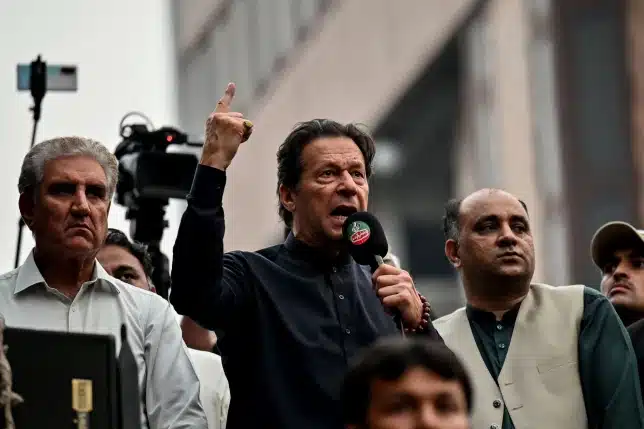
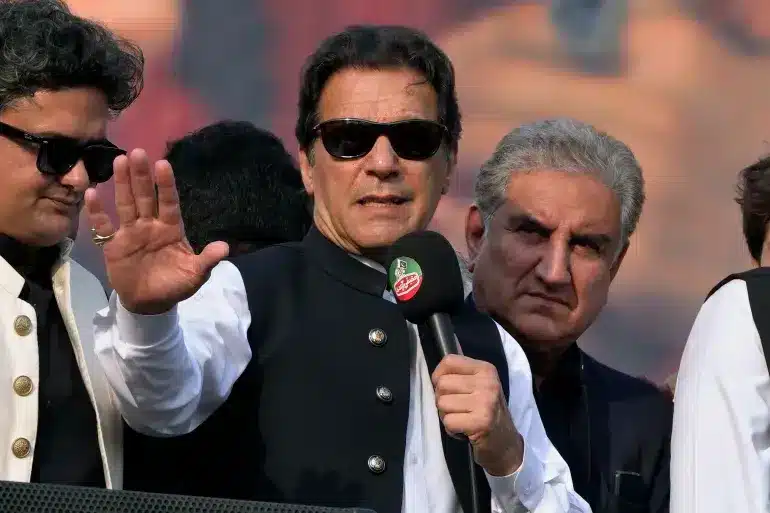
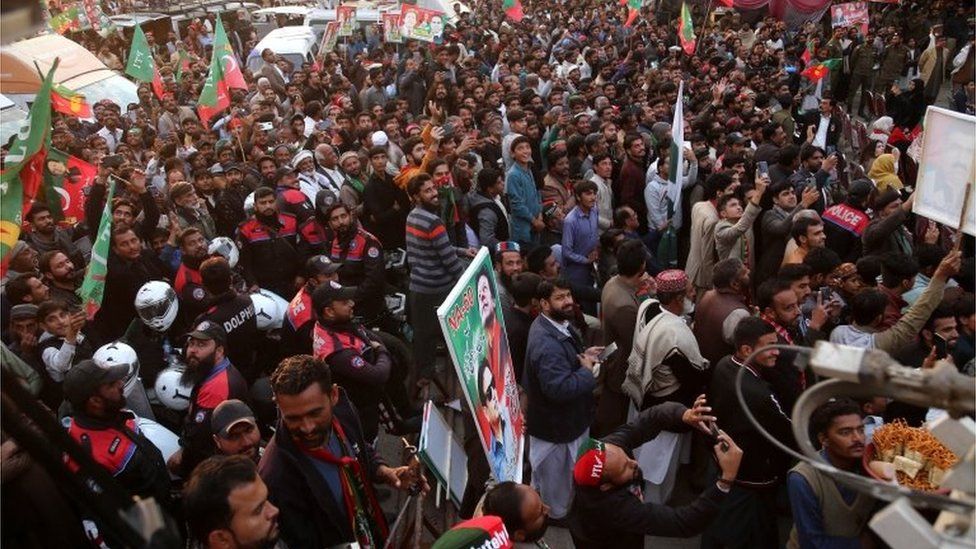
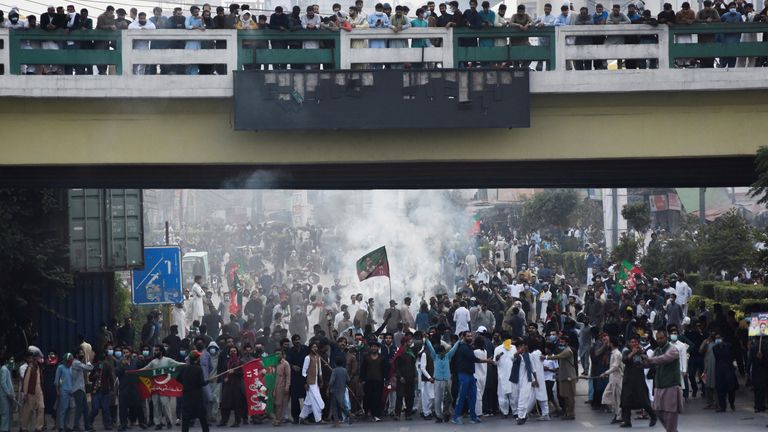
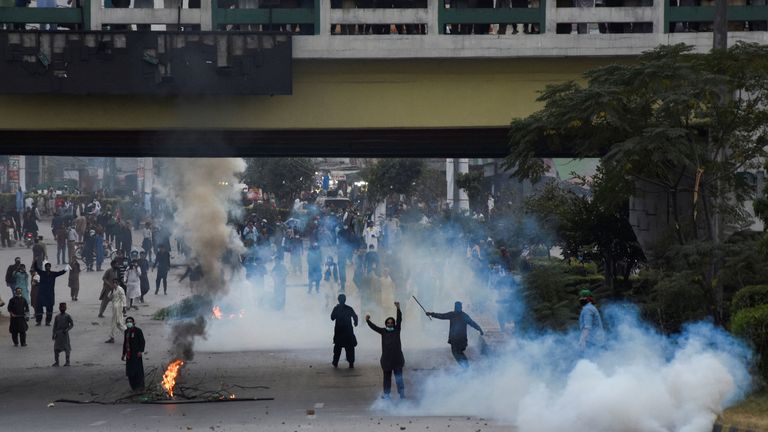
Imran Khan, a well-known cricketer and former prime minister of Pakistan, was detained after testifying in court on corruption-related accusations.
The 72-year-old Khan was detained on Tuesday on the grounds of the court by National Accountability Bureau officials, according to Fawad Chaudhry, a senior official with the Pakistan Tehreek-e-Insaf party.
In April of last year, Khan was dismissed in a no-confidence vote.
He has claimed his ousting was illegal and part of a Western conspiracy and has since campaigned against the government of his successor, Prime Minister Shahbaz Sharif, demanding early elections.
Chaudhry said Khan was dragged out of the court and into a police vehicle. He said the former premier is now in the custody of the security forces. He denounced the arrest as ‘an abduction.’
Pakistan’s independent GEO TV broadcast images of Khan being pulled by security forces towards an armored vehicle, which took him away.
Khan’s party immediately complained to the Islamabad High Court, which requested a police report explaining the charges for Khan’s arrest.
Officials from the anti-corruption body said that Pakistan’s National Accountability Bureau had issued arrest warrants for Khan last week in a separate graft case, for which he had not obtained bail- something that would protect him from arrest under the country’s laws.
The officials, who spoke on condition of anonymity, said Khan will be brought to appear before an anti-graft tribunal later on Tuesday.
Khan’s graft case is one of over 100 cases registered against him since he was ousted from power in a parliamentary vote in April last year. He served four of his five-year term.
In most of the cases, Khan faces being barred from holding public office if convicted, with a national election scheduled for November.
Khan’s party previously vowed to ramp up protests upon his arrest, which analysts say would add to the struggles of a government already hobbled by an economic crisis that has left the nuclear-armed country on the brink of default.
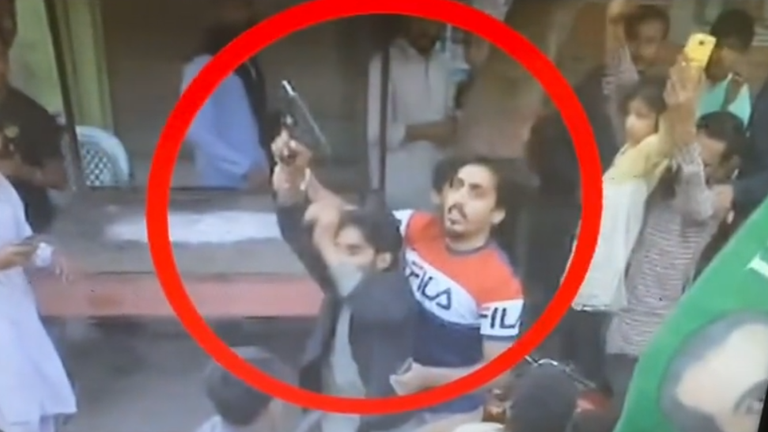
Last year, Khan was injured during an apparant assassination attempt after a gunman opened fire on him during a rally.
In March, police stormed the former PM’s home and arrested 30 people after riots broke out following Khan’s failure to appear at a court hearing.
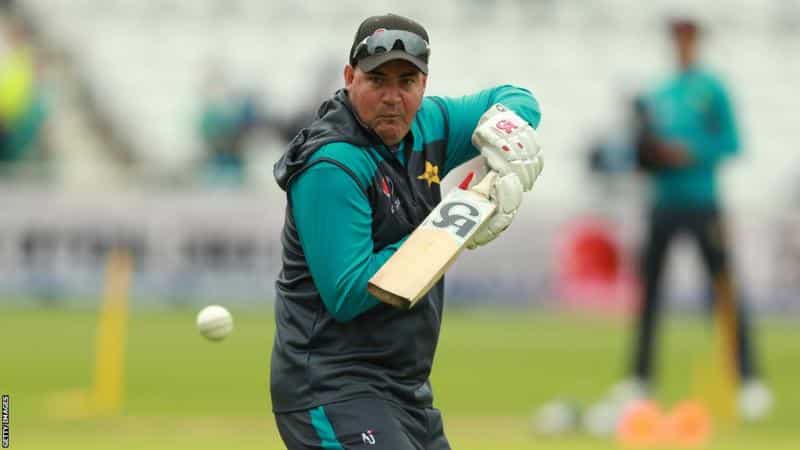
Pakistan will be under the leadership of Derbyshire head of cricket Mickey Arthur at the ICC Men’s World Cup this year.
After extending his contract with Derbyshire through 2025, Arthur, 54, declined the possibility of a second stint as Pakistan coach in January.
The South African, who began working as a consultant for Pakistan earlier this month, has now also consented to serve as their team director in addition to his Derbyshire position.
“I need that adrenaline rush,” Arthur told BBC Radio Derby.
“I’ve found the long winters hard here because I wake up for matchday.”
Arthur, who was in charge of Pakistan from 2016 to 2019 when they became the top-ranked Test side, will also lead Pakistan during a three-Test tour of Australia this winter before returning to Derby.
“The lure of them wanting me to help them was too good to turn down,” he added.
“I wouldn’t have done it if I couldn’t have given Derbyshire 100% commitment, which Pakistan have agreed to.
“It doesn’t affect my role at Derbyshire at all and wouldn’t affect any performance.
“If I didn’t feel I could give Pakistan the same level of commitment I certainly wouldn’t have taken it. I’ve looked at schedules and it’s very doable.”
Arthur has met up with the players in Pakistan during New Zealand’s ongoing white-ball tour of the country, before he returns for Derbyshire’s next County Championship Division Two game against Durham on 27 April.
He said he is already “heavily involved” in Pakistan’s selection, as well as having put together their support staff.
Former Pakistan head coach Saqlain Mushtaq left the role earlier this year after his contract expired and is now New Zealand assistant coach.
Pakistan were beaten by England in the final of the Men’s T20 World Cup in November and then had a poor season at home where they won only one match.
They were swept 3-0 by England in their Test series, drew both Tests with New Zealand and then lost the one-day international series 2-1 to the Black Caps.
Arthur, who has also coached South Africa, Australia and Sri Lanka, did not have his Pakistan contract renewed in 2019 after the side failed to reach the World Cup semi-finals.
Derbyshire chief executive Ryan Duckett said the county would remain Arthur’s “main focus”.
He added: “A coach of Mickey’s calibre will naturally attract attention; however I am delighted by his continued dedication to his role, the group of players and club as a whole.”
Arthur said Derbyshire is “a really special project” that he sees as a “long-term commitment” and that he has not yet “even scratched the surface” of where he wants to take the club.
Following his extradition from Pakistan, a man accused of killing a police officer nearly 20 years ago has appeared in court.
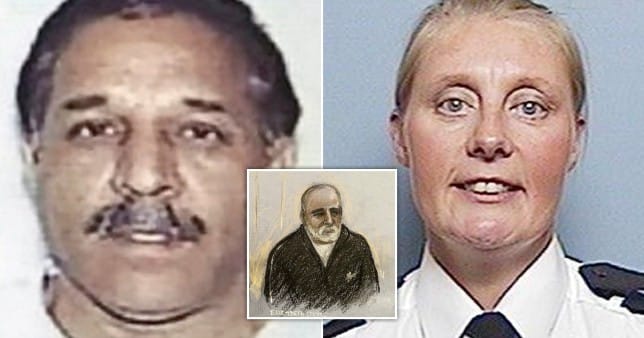
On November 18, 2005, as PC Sharon Beshenivsky and a colleague responded to a heist at Universal Travel in Morley Street, Bradford, Piran Ditta Khan, 74, is accused of killing her.
The married, 38-year-old mother of three biological children and two stepchildren was a rookie with only nine months of experience. On her daughter’s fourth birthday, just hours before she was scheduled to host a party at her Haworth home, she was assassinated.
Her colleague, PC Teresa Millburn was seriously injured.
Khan appeared in the dock of Westminster Magistrates’ Court in central London on Thursday wearing a blue and white Nike tracksuit jacket.
He is also charged with robbery, two counts of possession of a firearm with intent to endanger life and two counts of possession of a prohibited weapon.
Khan was not asked to enter a plea to any of the alleged offences and spoke only to confirm his name, date of birth and to tell the court he was having some trouble hearing.
Ms Beshenivsky was a rookie with only nine months’ service when she was killed (Picture: PA)
The court heard that a warrant was issued for the arrest of the defendant in Pakistan in 2018 and that he was was detained in 2020.
Khan is charged with the robbery of Mohammed Yousaf of a quantity of cash of a value unknown.
The firearms charges relate to his alleged possession of a Mac 10 sub-machine gun and a 9mm pistol.
All the alleged offences are said to have taken place on the same day.
No bail application was made and District Judge John Zani remanded Khan back into custody before he appears at the Old Bailey on Monday.
The judge told him: ‘All the allegations that you face are to be dealt with at a higher court, the Crown Court, so I am transferring this case to the Central Criminal Court in London and you will appear there on Monday.’
The trial may take place in Leeds but detailed arrangements for that were not made, the court heard.
A group of young men from Pakistan stand poised and prepared to represent their nation on a well-kept soccer field in Qatar. These young men are not from wealthy families or play on a typical football team.
They participated in the Street Child World Cup involving 28 teams from 24 countries. It was a football tournament for street-connected children facing adversity. The competition took place ahead of the FIFA World Cup Qatar 2022.
The team trained in Muslim Hand’s Sports Academy in Mirpur, Pakistan – Sallam Atif Shafiq
“Street Child World Cup is for those children who have a lot of talent but don’t have the facilities to play,” explains Tufail, a 17-year-old football player from Landi Kotal in Pakistan.
‘Homelessness, poverty, and neglect’
International Islamic charity Muslim Hands sponsored and travelled with the Pakistan team to Qatar’s capital city, Doha. The charity’s regional Executive Manager, Muhammad Suleman, says that many children in Pakistan suffer from homelessness, poverty, and neglect.
“In Pakistan, more than 22 million children are out of school, and more than 7.5 million children are on the streets,” Muhammad Suleman tells SCENES. “We engage these children through our mechanism of 17 academies all over Pakistan. We engage them through football,” he adds.
Pakistan team trained for many months in preparation for the tournament – Sallam Atif Shafiq
‘I love football.’
The charity views football as essential to improving children’s mental and physical health. Sahil Gul, a 17-year-old football player from Punjab, Pakistan, says football has a special connection to his heart. “I love football; I feel restless when I don’t play. It’s the kind of sport that cheers me up if I am upset,” he says.
The team began training over a year ago after a series of nationwide football trials. “Our coach, Mr Rasheed, took us under his wing and trained us well. He taught us how to play football professionally and stressed the importance of unity and brotherhood,” says Suhil.
Head Coach Muhammad Rasheed says the team are strong in faith, skill and mind – Sallam Atif Shafiq
Muhammad Rasheed is the Head Coach of the team and is a former national football player. Muhammad told SCENES that Muslim Hands provides young footballers with accommodation, mentorship, equipment and food. “These are street children, so in addition to football, we look into their everyday behaviour and teach them how to improve their lives,” he says.
The tournament was held in Qatar Foundation’s Education Education City on the outskirts of Doha. Travelling outside of Pakistan was a new experience for the boys, and they were excited to represent their country.
‘Every player’s dream’
“This is every player’s dream. Every Pakistani football player wishes to wear the Pakistani colour and to represent Pakistan,” says Suhail. “I’m thrilled that I was among the people who got to represent Pakistan. There are so many people in Pakistan; out of all of them, only ten got to go. And I was among those ten.” adds Tufail.
The Pakistan boys team battled hard against Sudan at the Street Child World Cup in Doha, Qatar – Anthony Geagea
The team won their first three matches against Sudan, Qatar and Bosnia and Herzegovina and then faced Tanzania in the quarter-final. “The competition went very well. In the quarter-final, we won by two goals. And then we qualified for the semifinal,” explains Tufail.
The Pakistan team replicated their previous triumphs and secured a spot in the final against Egypt. The fierce competition between the two teams resulted in an intense penalty shoot-out, and a crowd gathered to cheer on both sides. However, victory escaped Pakistan in the game’s last minutes, and Egypt emerged as the ultimate champions.
Members of the Pakistani team pose for a photo with other national teams at the Street Child World Cup in Doha, Qatar – Gregory Ward
‘A voice for children in Pakistan’
“I am extremely proud of these boys. I know that when they return to Pakistan, they are heroes,” says Muhammad Suleman from Muslim Hands. “This team is a voice for children in Pakistan who are at risk, a voice for the millions of children out of school and those living on the streets,” he adds.
Despite being unable to secure the top spot, Sahil hopes that the team’s performance will inspire other street-connected children in Pakistan living in poverty. “My message to people is, never stop working hard and never lose courage. Keep your passion above all else and never lose it,” he says.
Team Pakistan won the hearts of the crowds watching in Doha, Qatar – Gregory Ward
Team Pakistan’s journey in the Street Child World Cup was extraordinary. They demonstrated true grit and determination. The team may not have won the tournament, but it undoubtedly won the hearts of the crowds watching in Qatar.
Ramadan is a busy time for the charity Many Hands, as they continue to support the football player’s well-being and financial needs. They also work around the clock to provide food and shelter for street children across Pakistan.
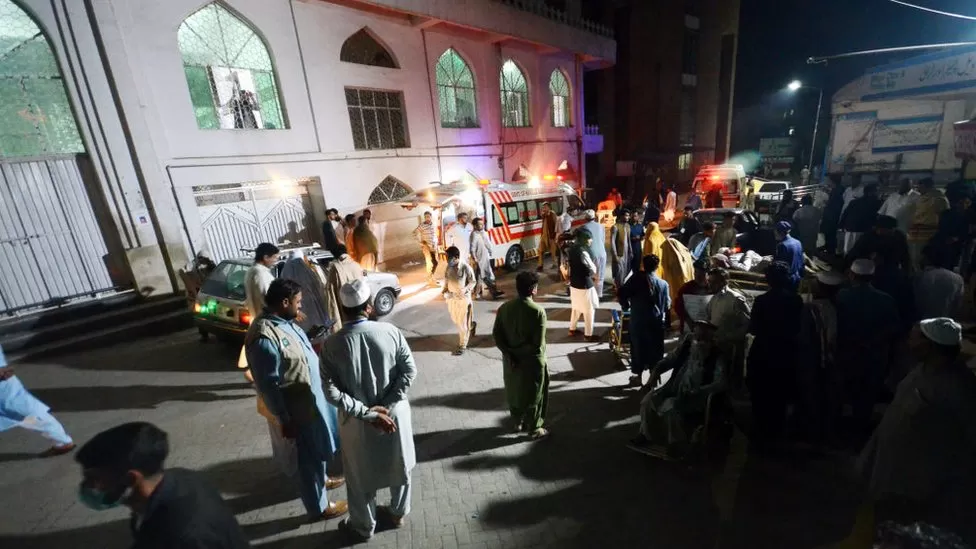
Large portions of Pakistan and Afghanistan were shaken by a strong earthquake that have left at least 12 people dead and more than 200 injured.
Buildings were damaged by the 6.5-magnitude earthquake, which also caused landslides and forced residents to flee into the streets.
It happened on Tuesday night and was centered in a hilly area in northern Afghanistan, close to the Pakistani border.
India was affected by the tremors coming from the isolated Jurm valley.
“It was a terrifying tremor. I had never felt such a tremor before in my life,” Kabul resident Khatera told AFP news agency after rushing out of her fifth-storey apartment.
Nine of the confirmed deaths were reported in the valley region of Khyber Pakhtunkhwa in Pakistan.
Three others were killed in Afghanistan, the country’s health ministry spokesman said. A child was among those killed in the Laghman province near the country’s border with Pakistan, AFP reported.
Many families had been out of their homes celebrating the Persian New Year or Norwuz when the quake hit.
But the damage found so far had been less than feared, emergency workers in Khyber Pakhtunkhwa told AFP.
However the remoteness and rugged terrain of affected areas is likely to slow relief and rescue work.
Many in the affected regions braved near-freezing temperatures to sleep outside after the quake – fearing aftershocks. Some had dashed out of their homes barefoot when they felt the shaking.
In the capital of Islamabad, a vast multi-storey residential block was evacuated after huge cracks appeared in the building.
Phone lines have been affected, and in Pakistan the highway in the worst-hit Swat area has been blocked by landslides.
Pakistan Prime Minister Shehbaz Sharif has asked disaster agencies to take emergency measures to help people.
Tremors were felt over a 1,000-km area that spans India, Uzbekistan, Tajikistan, Kazakhstan, Kyrgyzstan, Afghanistan and Turkmenistan, according to the European-Mediterranean Seismological Centre.
Earthquakes are more likely in this region because it lies at the juncture of the Eurasian and Indian tectonic plates.
In June last year more than 1,000 people were killed after a 5.9-magnitude quake struck Afghanistan’s Paktika province, the country’s deadliest in nearly a quarter of a century.
Imran Khan, Pakistan’s main opposition leader, has greeted supporters outside his home, just hours after police attempted to arrest him.
He addressed the crowd and posed for photos with those gathered near his Lahore compound.
He can be seen wearing a gas mask in one video. Throughout the night, police fired tear gas shells at protesters.
According to one official, the arrest operation has been halted.
Punjab Interim Information Minister Amir Mir said the court-ordered operation to detain Mr Khan was suspended on Wednesday to allow a cricket tournament to take place nearby, as the stand-off was causing major traffic disruption.
He said the operation would likely continue after the final of the Pakistan Super League (PSL) on 19 March.
No international cricket was played in Pakistan for six years following an attack on the Sri Lanka team by gunmen in 2009. It also took years for international players to return, and the ongoing tournament involves a large security operation.
“We can’t afford to risk the security and safety of the PSL,” a senior police official told the Reuters news agency.
Officers and paramilitary rangers were spotted leaving the Zaman Park neighborhood, where the house is located, with some reportedly abandoning roadblocks and checkpoints.
Mr Khan then emerged from the building and addressed his supporters. “The people pushed back the police and rangers sent to harm Imran Khan,” his PTI party’s Twitter account said.
The 70-year-old, who was deposed as Prime Minister in April, is accused of selling state gifts while in office. According to him, the case is politically motivated.
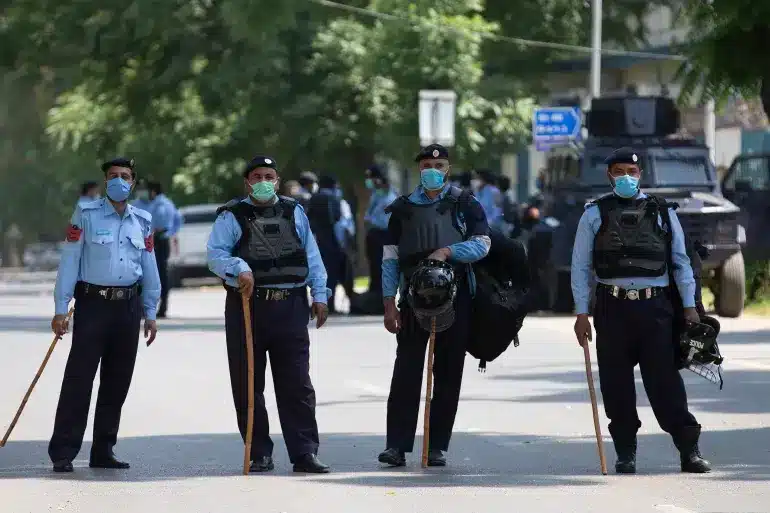
On Tuesday, officers in riot gear fired tear gas shells and water cannon to disperse hundreds of angry supporters of Mr Khan at the compound. Some of the crowd threw stones and bricks.
Police then tried to force their way into the compound to arrest Mr Khan for failing to appear in an Islamabad court.
He has said he did not appear because of security concerns as two militant attacks had previously taken place there. The politician has offered to sign a guarantee that he will appear in court on Saturday.
Mr Khan earlier told the BBC there was “no reason” for police to arrest him as he had taken protective bail until Saturday. He also said the government was determined to put him behind bars after previous failed attempts.
He said the authorities were trying to arrest him to stop his party from taking part in forthcoming elections. But he added: “Whether I am in jail or not they will not be able to stop my party winning.”
Government minister Marriyum Aurangzeb said the move had nothing to do with elections and police were only complying with court orders.
She claimed that Mr Khan was using his party workers, women and children as human shields to evade arrest and stoke unrest.
Since being ousted from office, Mr Khan has been a vocal critic of the government and the country’s army. He has toured the country delivering fiery speeches calling for elections due later this year to be held early.
He has kept up pressure on his successor Shehbaz Sharif with demonstrations and blames him for an assassination attempt in November in which he was wounded in the leg.
The latest in a succession of recent assaults against security officials in the South Asian country left at least nine police officers dead and 11 others injured in a suspected suicide blast on Monday in Pakistan‘s unrest-plagued Balochistan region, according to authorities.
Mehmood Notezai, senior superintendent of the Kachhi Police, reported that a police vehicle was attacked in the Sibi area of the province. Initial information indicates that it was a suicide attack, he said, adding that an investigation was in progress.
Afterwards, a newly founded militant organization known as Tehreek e Jihad Pakistan (TJP) claimed responsibility for the explosion.
A statement from TJP sent to CNN confirmed that the group was formed on February 23 in order to “establish an Islamic system in Pakistan” through the use of “armed Jihad.”
This is the first major attack by the group in the country. Pakistan’s interior ministry has not confirmed that the TJP is behind the attack.
Among the officers injured in the incident, three remain in critical condition and are receiving hospital treatment, Sibi’s Combined Military Hospital administration said.
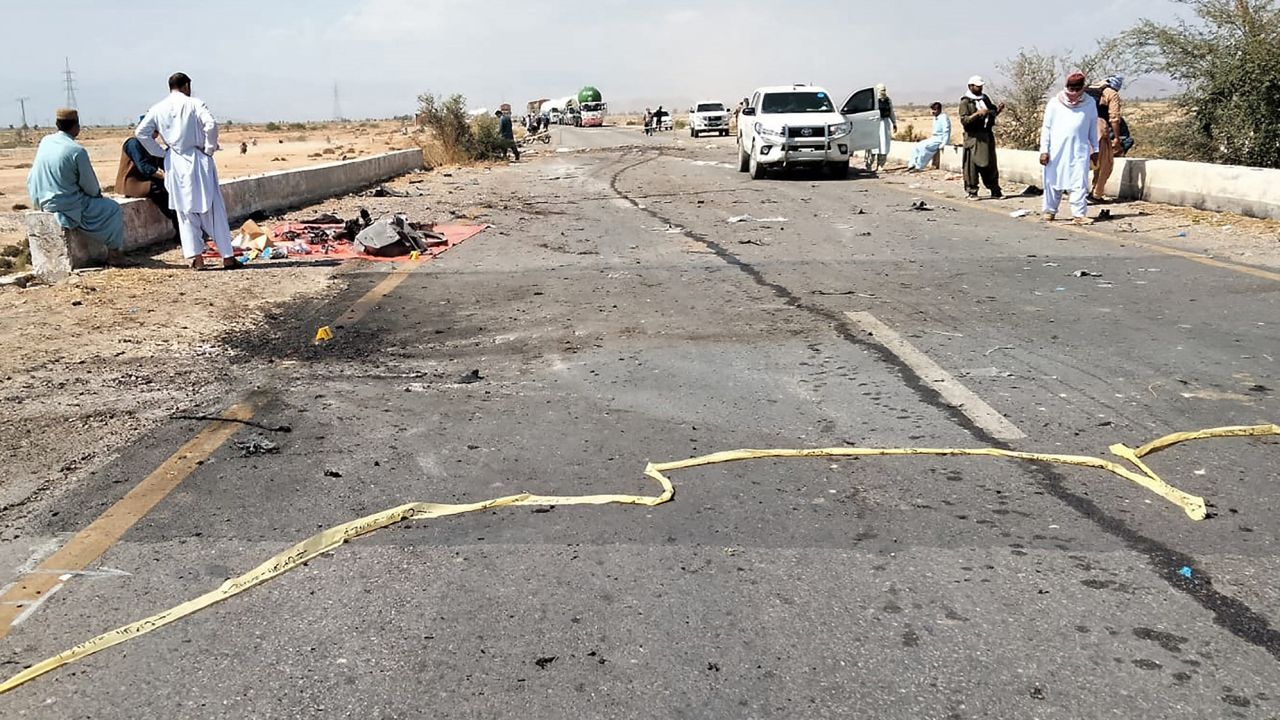
Footage obtained by CNN showed pieces of debris strewn along an isolated highway at the scene of the attack, as authorities scoured the site for evidence.
Balochistan, Pakistan’s largest province by area, has seen a decades-long insurgency by separatists who demand independence from the country, citing what they say is the state’s monopoly and exploitation of the region’s mineral resources.
The blast Monday was the third major attack against Pakistani security personnel in as many months, highlighting the rapidly deteriorating security situation in the country.
At least four people were killed and 14 others injured in February after militants stormed the police headquarters in the southern city of Karachi. Pakistan’s Taliban, known as Tehreek e Taliban Pakistan (TTP), claimed responsibility for the attack, according to spokesman Mohammad Khorasani.
And in January, at least 100 people – mostly police officials – died after a suicide bomb ripped through a mosque in the northwestern city of Peshawar, marking one of the deadliest attacks in the country in years.
TTP officials initially claimed the blast was “revenge” for the death of a TTP militant last year before the militant group’s main spokesperson later denied the group was involved in the attack.
The celebrated performer died in a hospital in Karachi, where he was on life support.
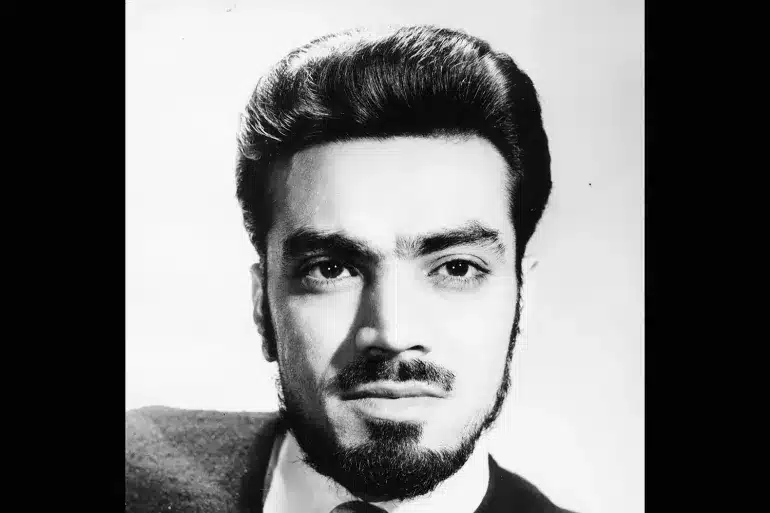
Zia Mohyeddin, one of Pakistan’s greatest figures in arts and culture, has passed away. He was 91.
The legendary actor, orator, author and broadcaster died on Monday morning in a hospital in Karachi where he was on life support.
In a career spanning more than six decades in various disciplines, theatre remained Mohyeddin’s lifetime passion. As the founding chair and later president emeritus of Pakistan’s premier National Academy of Performing Arts (NAPA), he mentored some of the country’s biggest acting talents.
Distinguished Zia Mohyeddin-Pakistan’s iconic talent, Intl star is no more with us. Had the privilege of working with him.Truly an inspiration in hosting. He was a great host,actor, director, producer & voice over artist. May ALLAH bless his soul & give sabr to Azra Bhabi. Ameen pic.twitter.com/cxe7ZHvb4o
Born in 1931 in Faisalabad city in Pakistan’s eastern province of Punjab, Mohyeddin studied theatre at London’s Royal Academy of Dramatic Arts (RADA), one of the world’s foremost acting schools.
Among a few Pakistanis to have performed in theatre and films outside the country, Mohyeddin delivered some of his most memorable performances in the Hollywood epic Lawrence of Arabia (1962), Behold the Pale Horse (1964) and Bombay Talkie (1970).
He also starred in British director Jamil Dehlavi’s Immaculate Conception (1994) and the critically acclaimed mini-series, The Jewel in the Crown (1984).
Mohyeddin, centre, with actors Virginia McKenna, left and Dame Sybil Thorndike during the filming of BBC TV drama, A Passage to India, in Tunbridge Wells, England [File: Reg Speller/Fox Photos/Getty Images]
He authored two books: memoir A Carrot is a Carrot (2008), and The God of My Idolatry, a collection of essays published in 2016.
Mohyeddin was a recipient of two of Pakistan’s top civilian awards: the Sitara-i-Imtiaz in 2003 and the Hilal-i-Imtiaz in 2012.
In a condolence message, Prime Minister Shehbaz Sharif said: “Zia Mohyeddin introduced a new style of hosting in Pakistan and his acting internationally brought laurels to the country. As president of the NAPA, he performed a great role in training the next generations of actors.
“It is sad that a man with such beautiful qualities has left us.”
Popular Pakistani actor Fawad Khan, a NAPA graduate who was associated with Mohyeddin for more than a decade, told Al Jazeera the thespian’s death felt like he has lost his own father.
“I don’t have enough words to express my word and sorrow at his passing. He helped me at every stage. His life was all about theatre, the all-encompassing passion he had for it. It kept him alive,” Khan said.
The actor said Mohyeddin was famous for his wit and one-liners, yet the seriousness he brought while working at NAPA will be his lasting legacy.
“Some years ago, he was rehearing with us on stage when he suddenly fainted during a recitation. We all got worried but thankfully, he recovered soon. The incident never appeared to have scared him,” he said.
“He may not have known you and you might have never spoken to him, but he had a shared love for theatre, and knew, within the NAPA grounds, that the art was being passed on and hence preserved. He of course lives on through his work, his students, and successors, and hopefully, a continuously thriving theatre industry in Pakistan,” the Karachi-based critic told Al Jazeera.
The International Monetary Fund (IMF) and Pakistan attempted to unlock $1.1 billion in funding at the eleventh hour to keep the country from going bankrupt, but the negotiations fell through.
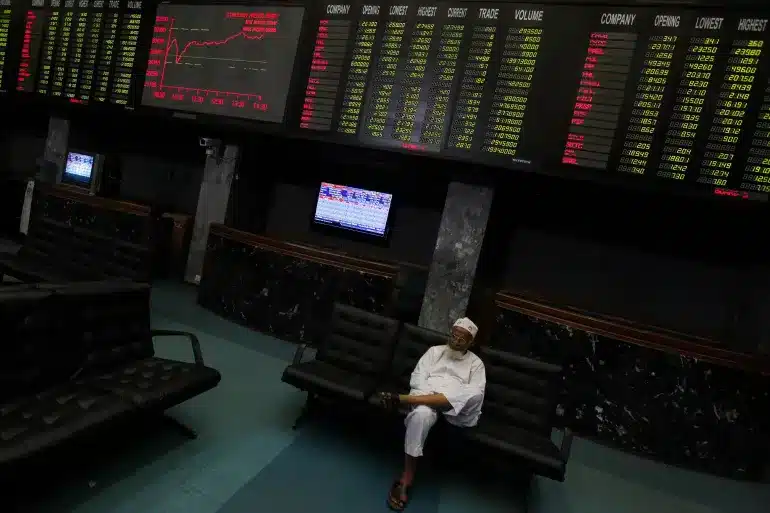
Pakistan’s foreign exchange reserves have all but vanished due to the country’s escalating economic crisis; it now has just enough dollars to cover one month’s worth of imports and is struggling to pay off extremely high levels of external debt.
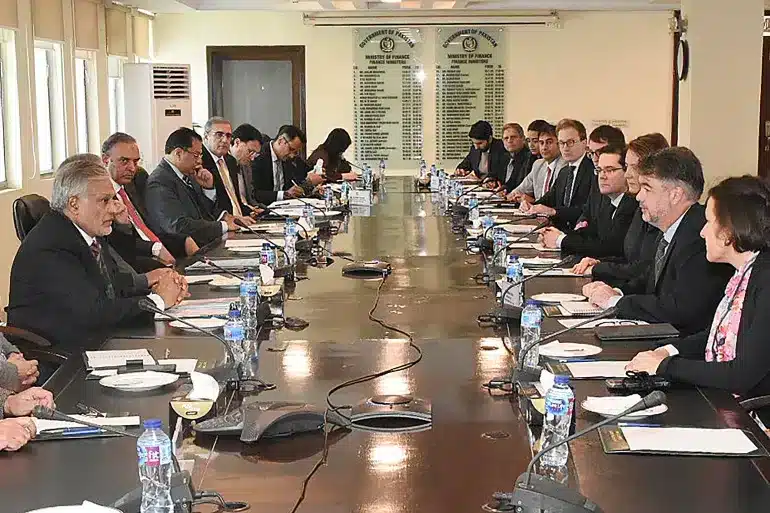
After 10 days of negotiations, the IMF delegation, which departs Islamabad on Friday, claimed “substantial progress” had been made.
“Virtual discussions will continue in the coming days,” the head of the IMF mission Nathan Porter said in a statement.
Although there was no financial lifeboat, both sides tried to paint the meeting positively. Pakistan’s finance minister told a news conference the country had been given a detailed roadmap. He talked of “painful but necessary” reforms – the IMF wants to see action and commitments from Pakistan before it commits to lending more money.
In January annual inflation soared to over 27%, the highest it’s been in Pakistan since 1975, and there are mounting fears for the economy in a pivotal election year.
This week the rupee sank to a historic low of 275 to the dollar, down from 175 a year ago, making it more expensive for Pakistan to buy and pay for things.
The lack of foreign currency is one of the most pressing of Pakistan’s problems.
Factories like Jubilee Textiles in Faisalabad, the industrial heartland of Pakistan, were shut recently – not by the frequent power cuts that have dogged Pakistan for years, but because they couldn’t get hold of dollars to pay for the goods they need.
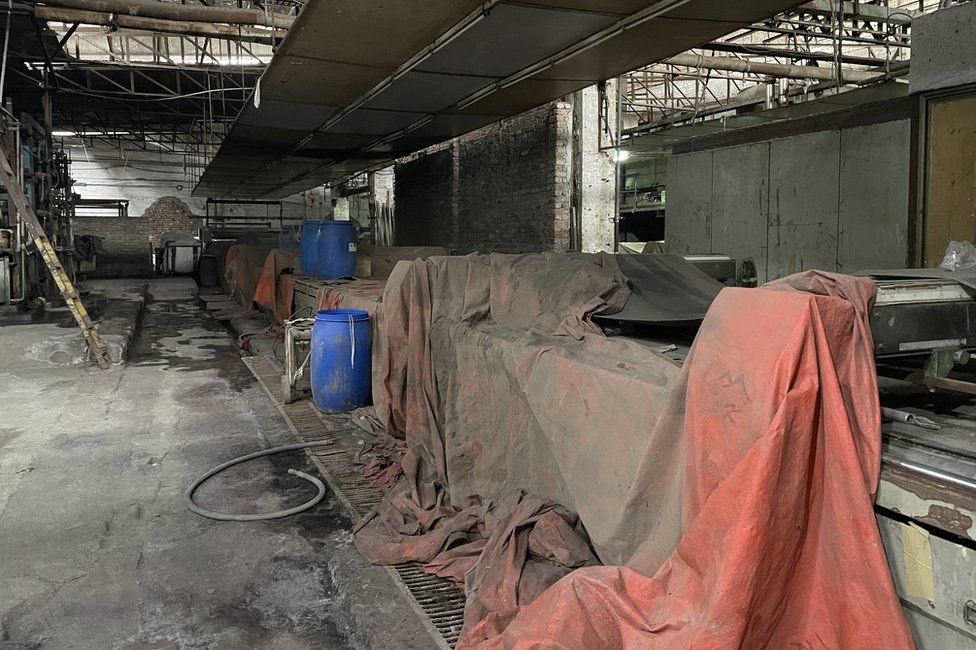
Image caption,Many factories like this one have been idle across Pakistan in recent weeks
“If we can’t import, how can we manufacture? We’ve already made a loss,” its manager Fahim told the BBC, adding that all its 300 workers had been sent home.
Jubilee’s printing machines have only just restarted after shutting last month. Piles of white cotton sheets sat in iron tubs, covered by a light coat of brick dust, when the BBC visited, with the only sound the drip, drip of an industrial washer.
Walking through the network of frozen machines, Fahim said the factory had run out of the dyes they imported from China, not because they weren’t available, but because they said their bank wouldn’t clear the dollars to pay for them for weeks.
According to analysts, the government had been holding the bank’s exchange rate artificially high behind the scenes which was contributing to the lack of dollars in the system. At the end of last month, they allowed it to drop, which could help some businesses, but also push prices up.
Image caption,Imports have been stacking up in ports, including here in Karachi
Businesses and industries across Pakistan said they have had to slow or stop work while they also wait for goods they have imported that are currently stacking up in ports.
In late January, a government minister told the BBC that there were more than 8,000 containers piled up in Karachi’s two ports, containing goods from medicine to food. Some of that has started to clear, according to local media reports, but much is still stuck.
To avoid an economic collapse, Pakistan says it has reached an agreement with the International Monetary Fund (IMF) on the terms for releasing about $1.1 billion in financial aid.
Ishaq Dar, the finance minister, claimed that “routine procedures” were to blame for the payment delay as an IMF team left cash-strapped Pakistan on Friday after 10 days of negotiations with the government.
Pakistan and the IMF had agreed to a bailout package worth $6 billion in 2019, and another $1 billion was added to the programme the following year. Since December, the $1.1 billion first payment has been delayed.
“The prime minister has said we are committed … We will implement whatever has been agreed upon between our teams,” Dar told reporters.
“We will try to make sure Pakistan completes its second IMF programme in its history,” he added.
In a statement, Pakistan IMF Mission Chief Nathan Porter said “considerable progress” was made in their talks with the Pakistani government, adding that the negotiations will continue.
Dar said the government will implement fiscal measures demanded by the IMF, including raising 170 billion Pakistani rupees ($627m) through new taxes.
Also, commitments to increase fuel taxes will be completed, with diesel levies to be doubled to 5 rupees a litre on March 1 and again on April 1 this year.
Pakistan is battling an economic meltdown, compounded by a balance of payment crisis, record inflation and a plummeting rupee that has lost value more than 10 percent of its value in the last two weeks.
Prime Minister Shehbaz Sharif last week said the economic situation was “unimaginable”.
Catastrophic floods last year worsened the crisis, with food security concerns due to the floods, continuing political chaos and worsening security situation adding to it.
According to the central bank’s data on Thursday, the country’s foreign exchange reserves fell to $2.9bn during the week ending February 3.
Experts fear the reserves would last less than 20 days and any delay in an IMF payout could have serious consequences.
Asad Sayeed, a Karachi-based economist with the research firm Collective for Social Science Research, told Al Jazeera that while both the IMF and the government appear “moderately positive” over their talks, the next week is going to be critical for Pakistan.
“There are a lot of decisions to be made and they need to be done as soon as possible, which makes the next week so important. If the government does what the IMF wants, perhaps then we can see the completion of their agreement. But if it does not, it will be a red signal for the country.”
Economist Haris Gazdar pointed towards a “technical-political dichotomy” regarding the IMF deal.
“The technical agreement would already signal an IMF nod and the advantage it confers upon the government. The IMF obviously needs ‘political’ commitment before it confers that advantage,” he told Al Jazeera.
“The things they have asked us includes revenue collection, phasing out untargetted subsidies, non-interference with exchange rate etc. Since the relationship between these variables and actual economic outcomes is never precise, there is room for genuine disagreement on targets that must be met,” he said.
“So, negotiation is part of the deal. But how much space Pakistan gets in the end is partly political.”
In an effort to seek aid to stop a worsening economic crisis that has nearly depleted its foreign exchange reserves, Pakistan is in last-minute talks with the International Monetary Fund (IMF).
It struggles to pay off sky-high levels of foreign debt and has just enough cash to cover less than a month’s worth of routine imports.
After 10 days of negotiations with the government aimed at releasing critical foreign money, an IMF delegation is scheduled to depart the nation on Thursday.
There are growing concerns for the economy in a crucial election year as annual inflation in Pakistan rose to above 27% in January, the highest level since 1975.
This week, the rupee hit an all-time low against the dollar, falling from 175 to 275, making purchases and payments more expensive in Pakistan.
One of Pakistan’s most urgent issues is its dearth of foreign currency.
Recent factory closures in Pakistan’s industrial heartland of Faisalabad, including Jubilee Textiles, were not caused by the country’s frequent power outages, which have plagued it for years, but rather by a lack of access to dollars to pay for the supplies they require.
Image caption,Many factories like this one have been idle across Pakistan in recent weeks
“If we can’t import, how can we manufacture? We’ve already made a loss,” its manager Fahim told the BBC, adding that all its 300 workers had been sent home.
Jubilee’s printing machines have only just restarted after shutting last month. Piles of white cotton sheets sat in iron tubs, covered by a light coat of brick dust, when the BBC visited, with the only sound the drip, drip of an industrial washer.
Walking through the network of frozen machines, Fahim said the factory had run out of the dyes they import from China, not because they weren’t available, but because they say their bank wouldn’t clear the dollars to pay for them for weeks.
According to analysts, the government had been holding the bank’s exchange rate artificially high behind the scenes which was contributing to the lack of dollars in the system. At the end of last month, they allowed it to drop, which could help some businesses, but also push prices up.
Image caption,Imports have been stacking up in ports, including here in Karachi
Businesses and industries across Pakistan said they have had to slow or stop work while they also wait for goods they have imported that are currently stacking up in ports.
In late January, a government minister told the BBC that there were more than 8,000 containers piled up in Karachi’s two ports, containing goods from medicine to food. Some of that has started to clear, according to local media reports, but much is still stuck.
The former leader of Pakistan, General Pervez Musharraf, who overthrew the government in a coup in 1999, passed away at the age of 79.
The former leader – who was president between 2001 and 2008 – died after a long illness, a statement from the country’s army said.
He had survived numerous assassination attempts, and found himself on the front line of the struggle between militant Islamists and the West.
He supported the US “war on terror” after 9/11 despite domestic opposition.
In 2008 he suffered defeat in the polls and left the country six months later.
When he returned in 2013 to try to contest the election, he was arrested and barred from standing. He was charged with high treason and was sentenced to death in absentia only for the decision to be overturned less than a month later.
He left Pakistan for Dubai in 2016 to seek medical treatment and had been living in exile in the country ever since.
In the statement confirming the death, the military said it expressed its “heartfelt condolences” and added: “May Allah bless the departed soul and give strength to bereaved family.”
Pakistan’s President Arif Alvi prayed “for eternal rest of the departed soul and courage to the bereaved family to bear this loss”, his office said in a statement cited by AFP news agency.
Pakistan’s Prime Minister Shehbaz Sharif also expressed his condolences, as did the country’s military leaders.
General Pervez Musharraf, the former leader of Pakistan who overthrew the government in a coup in 1999, has passed away at the age of 79.
According to a statement from the nation’s army, the former leader, who served as president from 2001 and 2008, passed away after a protracted illness.
He was on the front lines of the conflict between militant Islamists and the West after surviving many murder attempts.
After 9/11, he backed the US “war on terror” despite domestic resistance.
He lost the election in 2008, and six months later he departed the country.
He tried to run for office again in 2013 but was detained and prevented from doing so. He was charged with high treason and given a death sentence in absentia, but less than a month later, the ruling was overturned.
In order to receive medical attention, he traveled from Pakistan to Dubai in 2016 and has since been living in exile there.
In the statement confirming the death, the military said it expressed its “heartfelt condolences” and added: “May Allah bless the departed soul and give strength to bereaved family.”
Pakistan’s President Arif Alvi prayed “for eternal rest of the departed soul and courage to the bereaved family to bear this loss”, his office said in a statement cited by AFP news agency.
Pakistan’s Prime Minister Shehbaz Sharif also expressed his condolences, as did the country’s military leaders.
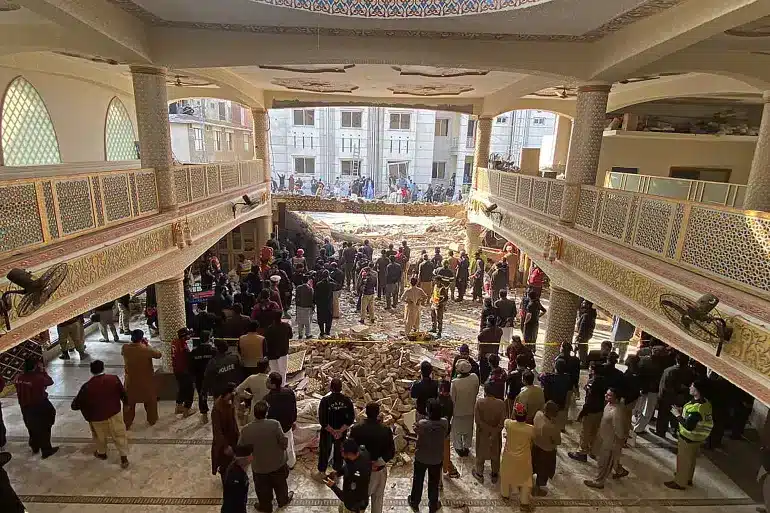
At least 87 people have died as a result of a suicide bombing that happened at a mosque in the Pakistani city of Peshawar and targeted police officers.
The mosque is within a high-security police headquarters area and a probe is under way into how the bomber got in.
Pakistan’s PM and other leaders have condemned Monday’s attack – one of the worst in the country in recent years.
The Pakistani Taliban has denied involvement after an initial claim by one of its commanders.
“Terrorists want to create fear by targeting those who perform the duty of defending Pakistan,” said PM Shehbaz Sharif. He declared a national day of mourning.
On Tuesday, rescuers were still scrambling to retrieve worshippers buried in the rubble, with a spokesman telling the BBC the operation would continue for another three hours.
“The rescue operation has been going on for more than 18 hours,” Mohammad Bilal Faizi said.
“The bodies of 20 more people have been recovered and it’s feared that some bodies may still be under the rubble.”
The BBC saw ambulances racing in and out of the compound every few minutes.
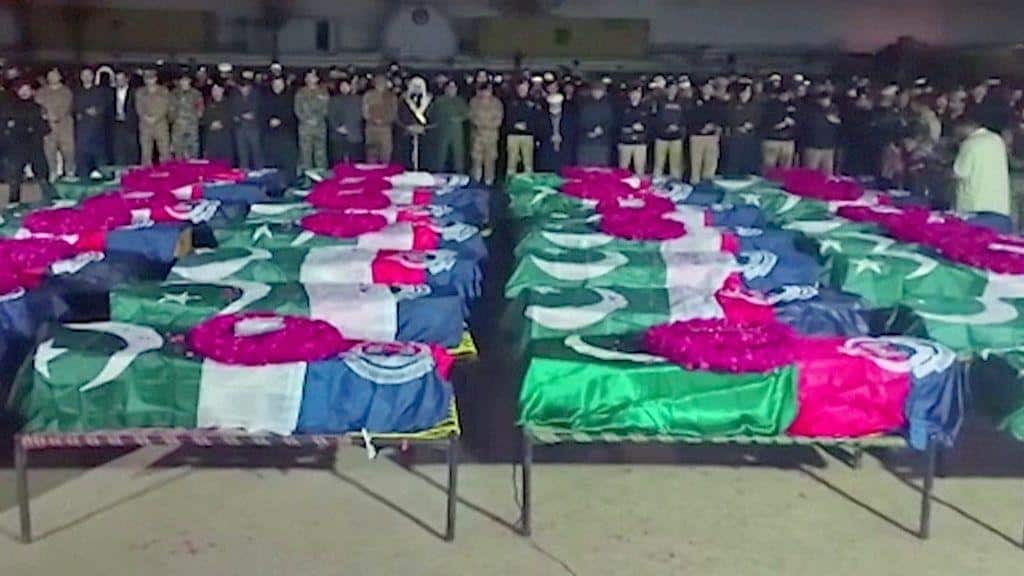
A hospital spokesman confirmed that more than 100 remained wounded. Meanwhile, funerals have been carried out for more than 20 police officers, their coffins draped with the Pakistan flag.
Between 300 and 400 police officers had been in the area at the time, Peshawar police chief Muhammad Ijaz Khan earlier told local media.
The mosque is in one of the most heavily controlled areas of the city, which includes police headquarters and intelligence and counter-terrorism bureaus.
Mr Sharif said those behind the attack had “nothing to do with Islam”. He added: “The entire nation is standing united against the menace of terrorism.”
The Pakistan Taliban – a group separate to Afghanistan’s Taliban government – ended a ceasefire in November, and violence has been on the rise in the country since.
According to authorities, an explosion at a mosque in the Pakistani city of Peshawar resulted in more than a dozen fatalities and numerous injuries.
At least 25 people were killed and at least 140 injured in the blast, a Peshawar police official told Al Jazeera.
The blast took place at the mosque where a large number of people had gathered for prayer, police official Sikandar Khan told Reuters news agency on Monday.
“A portion of the building had collapsed and several people are believed to be under it,” Khan added.
Al Jazeera’s Kamal Hyder, reporting from Islamabad, said emerging details suggested that the attack was carried out by a suicide bomber.
“The suicide bomber [was reportedly] sitting in the front row of the congregational prayer inside the mosque,” he added.
A 38-year-old police officer Meena Gul said he was inside the mosque when the bomb went off. He said he doesn’t know how he survived unhurt. He could hear cries and screams after the bomb exploded, he said according to AP news agency.
There were more than 150 worshippers inside the mosque when the bomb went off, Gul added.
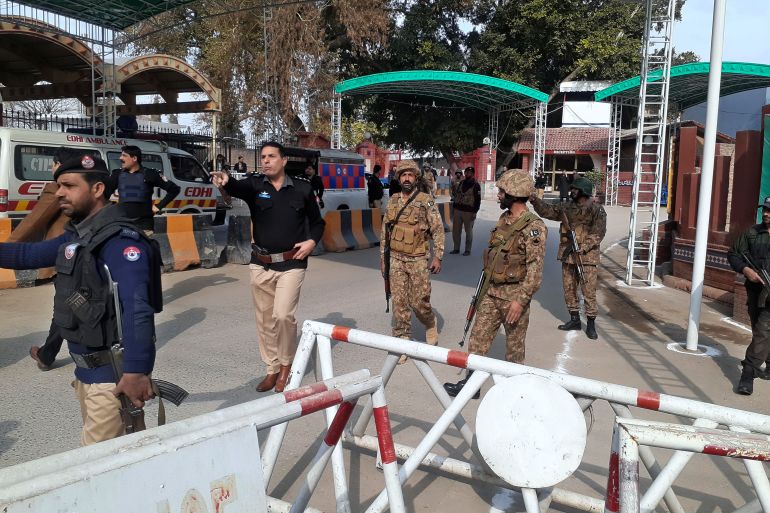
Army soldiers and police officers clear the way for ambulances rushing toward a bomb explosion site, at the main entry gate of police offices, in Peshawar, Pakistan [Muhammad Sajjad/AP Photo]
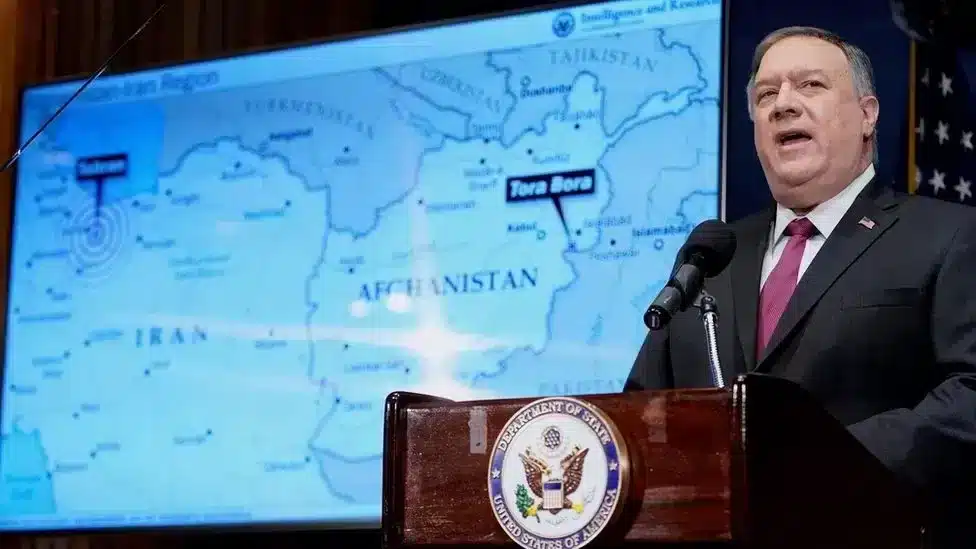
In his new memoir, former US Secretary of State Mike Pompeo mentioned that in February 2019, India and Pakistan were “close” to a “nuclear conflagration.”
Following an assault on Indian troops in Kashmir, Delhi launched airstrikes against militants in Pakistani territory.
At that time, Pakistan claimed to have downed two Indian military aircraft and captured a fighter pilot.
Kashmir is a region that both India and Pakistan claim as their own but only partially govern.
India has long accused Pakistan of backing separatist militants in the Kashmir valley – a charge Islamabad denies. The nuclear-armed neighbours have fought three wars since independence from Britain and partition in 1947. All but one were over Kashmir.
In Never Give An Inch: Fighting for the America I Love, Mr Pompeo says he does not think the world properly knows just how close the India-Pakistan rivalry came to spilling over into a nuclear conflagration in February 2019″.
“The truth is, I don’t know precisely the answer either; I just know it was too close,” he writes.
Mr Pompeo says he will “never forget the night” he was in Hanoi at a summit “negotiating with the North Koreans on nuclear weapons” when “India and Pakistan started threatening each other in connection with the decades-long dispute over the northern border region of Kashmir.”
After the attack on Indian troops that killed more than 40 soldiers – “an Islamist terrorist attack… probably enabled in part by Pakistan’s lax counter-terror policies”, according to Mr Pompeo – India had responded with air strikes inside Pakistan. “The Pakistanis shot down a plane in a subsequent dogfight and kept the Indian pilot prisoner.”
A report on the alleged wealth of General Qamar Javed Bajwa, the former army chief, and his family led to Shahid Aslam’s arrest last week.
In a case involving the alleged disclosure of tax information for former army chief Qamar Javed Bajwa and his family, a court in Islamabad has ordered the release of journalist Shahid Aslam on bail.
Aslam, a Bol News reporter, was detained by the Federal Investigation Agency last week in the eastern city of Lahore before being transported to Islamabad.
Aslam was accused of giving the news website FactFocus information about General Bajwa’s and his family’s personal tax information, which was then published in November, just before the army chief’s retirement.
Aslam denied that he was behind the leak.
The FactFocus report accused Bajwa and his family of amassing assets worth nearly $52m and presented official tax records and wealth statements to substantiate the allegations.
Aslam’s arrest was condemned by media and civil rights groups, who accused the government of pressuring the media into silence. The Committee to Protect Journalists criticised the arrest.
“The arrest of reporter Shahid Aslam underscores the dangerous environment for journalists in Pakistan,” Beh Lih Yi, its Asia programme coordinator, said in a statement.
The Human Rights Commission of Pakistan said the arrest not only restricted Aslam’s freedom of expression, but “such tactics set the dangerous precedent of obstructing the work of investigative journalists”.
This month, Human Rights Watch warned, “Space for free expression and dissent in Pakistan is rapidly shrinking.”
“Pakistan’s politicians are locked in a power struggle in which a free media and vibrant civil society are the casualties,” it said.
Pakistan was ranked 157 out of 180 countries on the 2022 press freedom index, published annually by Reporters Without Borders. It represented a decline of 12 positions from the 2021 rankings.
Islamabad-based lawyer Aftab Alam, an expert on media laws, said, “Sedition laws in other countries are being removed, but we still use it.”
“This is a legacy of colonial-era laws, and repeatedly we have seen their usage in the name of national interests or to prevent so-called fake news,” he told Al Jazeera.
“These actions by authorities are a way to control the masses,” he said. “Our laws require reforms.”
According to Pakistan’s Foreign Minister Bilawal Bhutto Zardari, the previous administration of Prime Minister Imran Khan was accused of taking the “wrong approach” toward the armed group Pakistan Taliban (Tahreek-e-Taliban, or TTP).
In an interview with Al Jazeera on Tuesday, Zardari said, “Its policy of appeasement towards the Taliban has created problems for the people of Pakistan.” He added that his government has abandoned the previous strategy.
“We recently had a national security meeting of the top political and military leadership our country where it was decided that we would not tolerate terrorist groups and anybody who violates the law in Pakistan,” the foreign minister said.
Pakistan has seen rise in attacks by the Pakistan Taliban after the armed group unilaterally ended an Afghan Taliban-brokered ceasefire agreement in November.
The Pakistani Taliban, which claims to have thousands of fighters and supporters, shares some ideological affinity with the Taliban in neighbouring Afghanistan but it comprises of mostly local fighters.
Islamabad repeatedly accuses the Taliban government in Afghanistan of sheltering Pakistan Taliban leadership on Afghan soil – an allegation denied by Kabul.
“We recently had a national security meeting of the top political and military leadership our country where it was decided that we would not tolerate terrorist groups and anybody who violates the law in Pakistan,” the foreign minister said.
Pakistan has seen rise in attacks by the Pakistan Taliban after the armed group unilaterally ended an Afghan Taliban-brokered ceasefire agreement in November.
The Pakistani Taliban, which claims to have thousands of fighters and supporters, shares some ideological affinity with the Taliban in neighbouring Afghanistan but it comprises of mostly local fighters.
Islamabad repeatedly accuses the Taliban government in Afghanistan of sheltering Pakistan Taliban leadership on Afghan soil – an allegation denied by Kabul.
Pakistan Taliban threat
Earlier in January, Pakistan Taliban warned the country’s main ruling parties of “concrete action” against their top leadership in the government for “declaring war” against it.
A statement released by the Pakistan Taliban in first week of January explicitly named Prime Minister Shehbaz Sharif and Zardari.
Former Prime Minister Imran Khan’s government was against taking military action against the Pakistan Taliban before using consuming other options.
Earlier in January he blamed the government of his successor, Prime Minister Shehbaz Sharif, for making “dangerously irresponsible” statements against the Afghan Taliban authorities and causing strains in bilateral ties rather than seeking cooperation over the Pakistan Taliban threat
The Pakistani foreign minister also reiterated on the need to engage with Afghanistan’s Taliban rulers despite the group’s hardline policies vis-a-vis women. Last month, the Taliban banned women from universities. Shortly after the group also banned women from working in NGOs.
Some aid groups have resumed operations after women healthworkers were allowed to work.
“The solution is to engage the Afghan government and try to convince them to live up to their promises to the international community whether it is to do with women’s rights or the issue of terrorism,” Zardari told Al Jazeera.
In the interview with Al Jazeera, foreign minister Zardari also confirmed that he has not recalled the Pakistani ambassador in Afghanistan back home after an attack on its mission in Kabul last month.
“He was due back for some briefings and dialogues. I hope we will have the security necessary to send him soon,” he said.
The Khyber Pakhtunkhwa legislature was dissolved after Punjab as part of the effort by the former prime minister Imran Khan to force early general elections.
Khyber Pakhtunkhwa’s provincial assembly has been dissolved for the second time in less than a week as Imran Khan, the former prime minister, pushes for early national elections.
Haji Ghulam Ali, the governor of Khyber Pakhtunkhwa, formally dissolved the provincial assembly on Wednesday by signing a letter.
He was responding to a request made by Mahmood Khan, the provincial chief minister and a prominent figure in Khan’s Pakistan Tahreek-e-Insaf (PTI) party.
On Saturday, the assembly in Pakistan’s most populous province, Punjab, was dissolved following an order by PTI chief Khan, who since his removal as prime minister last April, has been demanding immediate polls, otherwise scheduled in October this year.
Pakistan’s constitution says new elections must be held within three months of the dissolution of a provincial legislature if the house fails in setting up an interim government.
The South Asian nation historically conducts federal and provincial elections simultaneously, but the constitution allows for separate poll dates as well.
Khan’s PTI hopes the dissolution of two of the country’s four assemblies will force Prime Minister Shehbaz Sharif’s government to announce immediate general elections.
“We will return with two-thirds majority not just in Khyber Pakhtunkhwa but all of Pakistan, and form a government on the basis of our performance,” provincial chief minister Khan said in a video message on Tuesday after he wrote to the governor to dissolve the assembly.
PTI leader Musarrat Jamshed Cheema told Al Jazeera it is imperative that the government thinks beyond its “self-interests” and goes into early elections.
“You will have more than 70 percent of Pakistan contesting the provincial elections after the dissolution of Khyber Pakhtunkhwa and Punjab assemblies. Why are they reluctant to hold general elections? Not only will the delay damage them politically, it is harming Pakistan’s situation as well,” she said.
Saif Ali Khan, lawyer and former adviser to Mahmood Khan, said the PTI decided to dissolve the assemblies to push the country into general elections.
“The ruling alliance is still trying to sabotage our efforts as they do not want to hold early elections. We will fight all their tactics on political and legal forums,” he told Al Jazeera.
Lahore-based political analyst Benazir Shah said Imran Khan, by pushing for immediate polls, is trying to take advantage of his rising popularity among the people.
“If Khan can form governments in both the provinces, and Punjab in particular, he will get a huge advantage in the next general election,” she told Al Jazeera.
Shah said the ruling alliance does not have many options to manoeuvre the political crisis and could be forced to play on Khan’s terms.
“In the next three months, they would have to hurriedly put together an election campaign, mobilise their voters and craft an effective election narrative to counter Khan. None of this will be easy for the ruling coalition’s parties, which have recently taken back-to-back electoral losses and are seen as being hand-in-glove with the military,” she said.
PTI’s lawyer Khan said the ruling alliance does not have the moral credibility to lead the country, which is already facing a dire economic crisis, made worse by last year’s catastrophic floods.
“If you’re driving a bus and see the driver as incompetent, you do not wait for the bus to crash or get into an accident. You try and change the driver at the earliest. This is what we want for Pakistan,” he told Al Jazeera.
The government needs to reevaluate its priorities and shift its focus from finding quick fixes to more lasting reforms, according to experts who paint a bleak picture. After paying off some of Pakistan’s external debt payments, the central bank of the nation revealed that the country’s foreign exchange reserves had decreased to $4.3 billion, their lowest level since February 2014.
The sum, which includes $5.8 billion held by commercial banks and was disclosed by the State Bank of Pakistan (SBP) in a release on Thursday, comes to just under $10 billion.
Pakistan is hoping to end the deadlock as the International Monetary Fund (IMF) is expected to release a $1.1bn loan, which is part of the $7bn loan programme the country entered in 2019. It is also seeking immediate financial assistance from its close bilateral partners amid the economic crisis.
Thursday’s announcement comes at the back of Prime Minister Shehbaz Sharif’s visit to the United Arab Emirates where it was disclosed that the Gulf state pledged to roll over $2bn of existing loans while providing an additional loan of $1bn.
In August last year, the IMF released a tranche of $1.17bn, but the next round of funding has been in the doldrums as Pakistan has so far not agreed to the lender’s various conditions such as increasing energy prices and expanding the tax base.
Pakistan also suffered from catastrophic floods last year which resulted in the death of more than 1,700 people, affected 33 million people, and caused a loss of more than $30bn to the country.
Earlier this week, Pakistan hosted an international donors’ conference in Geneva with the United Nations, in which the global community pledged more than $10bn over the next three years.
Experts, however, have painted a gloomy picture saying the government must reconsider its priorities from finding short-term solutions to more sustainable reforms.
Sakib Sherani, an Islamabad-based economist, said Pakistan has more than $20bn debt repayment obligation annually for the next two years.
“Our annual debt repayment in 2017 was close to $7bn. This year and the next, we are looking at over $20bn. We cannot help but continue borrowing and while it may be a short- to medium-term solution, it is just unsustainable,” Sherani told Al Jazeera.
He said Pakistan must restructure its debt repayments and the government should draw a clearer roadmap for its economic strategy.
“What appears to me is that they are looking at this economic problem from a political lens, and they are trying not to get the country out of default but just to defer this situation till June or July this year, after which they can handover to caretaker government to take harsh decisions,” he added.
Pakistan is scheduled to go to the polls later this year. The current parliament finishes its tenure in August before an interim set-up takes over for three months.
Sajid Amin, a senior official at theSustainable Development Policy Institute, a research institute in Islamabad, said getting short-term refinancing and rollovers from friendly countries is not a sustainable solution to the country’s economic woes.
“We are in a stressful situation where every dollar counts. While these rollover announcements provide some temporary relief, we have no choice but to consider long-term planning on restructuring our overall debt obligations,” he told Al Jazeera.
Due to the country’s precarious economic situation, the World Bank also revised its growth projection downwards from 4 percent in June last year to 2 percent for the current fiscal year in its latest global economic prospects report.
“Pakistan faces challenging economic conditions, including the repercussions of the recent flooding and continued policy and political uncertainty. As the country implements policy measures to stabilize macroeconomic conditions, inflationary pressures dissipate, and rebuilding begins following the floods, growth is expected to pick up to 3.2 percent in FY2023/24, still below previous projections,” the bank’s report said.
“Today has truly been a day which gives us great hope,” Hina Rabbani Khar, Pakistan’s minister of state for foreign affairs said at a climate conference held with the United Nations (UN) in Geneva.
“I think the message from the world is clear: the world will stand by those who go through any national calamity,” she added.
The Islamic Development Bank, the World Bank and Saudi Arabia were some of the biggest donors.
The European Union, the US, China and France also made contributions.
It came after UN Secretary General Antonio Guterres called for major investments to help Pakistan recover from what he called a “climate disaster of monumental scale”.
IMF bailout
On the sidelines of the conference Pakistan reiterated its commitment to completing a bailout programme with the International Monetary Fund (IMF).
It came as the IMF has yet to approve the release of $1.1bn which was originally due to be made in November last year.
The nation of 220 million people has been struggling for years to stabilise its economy.
Last week the government ordered shopping centres and markets to close early every day to help save electricity.
Pakistan generates most of its power using imported fossil fuels.
Global energy prices jumped last year, putting further pressure on the country’s already dwindling finances.
To pay for those energy imports the country needs foreign currency, especially US dollars.
However, the Pakistan government saw its reserves of foreign currencies fall by about 50% last year.
As the nation is experiencing an economic crisis, the Pakistani government has ordered that markets and shopping centers close at early times each day.
The South Asian country will save, according to defence minister Khawaja Asif, about 62 billion Pakistani rupees ($274.3 million; £228.9 million).
The majority of Pakistan’s electricity is produced using imported fossil fuels.
The world’s energy prices increased last year, further straining the nation’s already precarious finances.
To pay for those energy imports the country needs foreign currency, especially US dollars.
The Pakistan government had $11.7bn of foreign currencies available last month after its reserves fell by about 50% last year.
That is only enough to cover around one month’s worth of all the country’s imports, most of which is energy.
Mr Asif told reporters on Tuesday that shopping malls and markets would have to close by 20:30 local time and government departments had been ordered to reduce their electricity consumption by 30%.
Meanwhile, the production of inefficient electric fans will be banned from the start of July.
“The federal cabinet has immediately approved the Energy Conservation Plan’s enforcement,” the ruling Pakistan Muslim League-N (PML-N) party said on Twitter.
The federal cabinet has immediately approved the Energy Conservation Plan's enforcement. pic.twitter.com/RVxhjaiYyE
According to a long-standing agreement between the two nuclear-armed rivals, Pakistan claims to have sent the Indian embassy in Islamabad a list of its nuclear installations and facilities.
In a statement released on Sunday, Pakistan’s foreign ministry said that India had simultaneously given a list to the Pakistani embassy in New Delhi.
It stated that lists are traded yearly on January 1. Since 1992, the custom has been in place.
The neighbours have fought three wars and have had a number of military skirmishes in recent years. Last year an Indian missile accidentally landed in Pakistan, setting off alarm bells across the world.
“The list of nuclear installations and facilities in Pakistan was officially handed over to a representative of the Indian High Commission in Islamabad at the Ministry of Foreign Affairs today [Sunday],” Pakistan’s foreign office said.
The annual exchanges come at a time diplomatic ties between the two are near non-existent.
India’s foreign ministry did not immediately respond to a Reuters news agency’s request for comment.
Pakistan first officially tested nuclear weapons in 1998 and has since developed a significant stockpile of nuclear capable missiles, as has India.
With the help of China, Pakistan has recently increased its use of nuclear energy to meet the rising demand for electricity.
In a separate statement, Pakistan’s foreign office said the two countries had also exchanged a list of each other’s citizens held in prisons.
The list included 705 Indian prisoners imprisoned in Pakistan, including 51 civilians and 654 fishermen, the statement said.
It added that the Indian government also shared with the Pakistani mission in New Delhi a list of 434 Pakistani prisoners in India, including 339 civilians and 95 fishermen.
Pakistan has requested the early release and repatriation of 51 of its civilian prisoners and 94 fishermen who have completed their sentences. A request for special consular access to 56 civil prisoners has also been made.
Fishermen from each country are often arrested when they stray into the other’s waters.
The mutilated body of a Hindu woman was found in a field Thursday in southeastern Pakistan, police said, as they investigate her alleged murder in the latest suspected attack against minorities in the Muslim-majority country.
The woman’s son, Somar Chand, said he found her disfigured body after searching for his missing mother with some relatives, according to a police report seen by CNN. He alleged that her skin had been peeled off, her breast cut off and her head split with a sharp object.
Daya Bheel, 40, had gone missing Wednesday, according to Surender Valasai, an assistant to Pakistan’s Chief Minister for Human Rights. Her son told police in Sindh province that his mother had gone to collect grass but did not return home, according to the police report.
Police in Sindh said they have made an unspecified number of arrests in connection with the case and have set up a special team to investigate. They have not been able to determine a motive for the alleged murder and did not share further details.
Pakistan’s Women Democratic Front said it was “extremely disturbed, saddened and shocked” to hear about the case.
“Our sister was mercilessly murdered, her body was found tortured and mutilated, a few days ago, yet there is deafening silence in the power corridors and in the mainstream media,” the group said. “Women Democratic Front calls upon all the women of the country, all our sisters to join our hands to bring an end to this reign of violence and oppression.”
Nearly 97% of Pakistan’s 270 million people are Muslim, according to the country’s bureau of statistics, and minority groups often face discrimination and persecution.
According to the United States government’s 2021 report on International Religious Freedoms, mobs targeted and killed Christians, Hindus, Ahmadi Muslims and Shia Muslims in attacks believed to be motivated by religion or accusations of blasphemy. Members of the Sunni Muslim majority had also faced similar attacks in Shia-majority areas, the report added.
Last December, a Sri Lankan national working in Pakistan’s Punjab province was killed and later burnt by a mob after being accused of committing blasphemy against the Prophet Mohammed.
The defence minister reported that Pakistani security forces killed all 33 hostage-takers as they retook a police station that had been captured.
On Sunday, Islamist insurgents from the Pakistani Taliban took control of the centre in the isolated Bannu district of the northwest.
There were several people inside at the time, including security personnel.
All hostages were released, two special forces were killed, and between ten and fifteen military personnel were hurt, according to Khawaja Muhammad Asif, the defence minister.
According to a statement quoted by local media, the TTP (also referred to as the Pakistani Taliban) acknowledged responsibility for the assault.
The group stepped up its attacks after ending a ceasefire with the government last month. The two sides have been locked in conflict for years.
It is separate to the Afghan Taliban, though it has been more active since the Afghans agreed a peace deal with the US in 2020, and took control of the country last year. The two groups share a hard-line Islamist ideology.
The hostage incident unfolded in a region near the two countries’ shared border.
Explaining events, Mr Asif told parliament that the 33 militants had links to different groups, and were being held in a counter-terrorism compound.
He said the hostages were taken after one militant hit a guard on the head with a brick and snatched his weapon.
The militants are said to have requested a safe exit in return for releasing the hostages. A standoff emerged as negotiation efforts failed.
Army commandoes are said to have taken the chance to take back the police station at 12:30 local time (07:30 GMT) after the hostage-takers found themselves arguing among themselves.
Witnesses of the siege reported explosions and heavy gunfire.
Mr Asif told parliament that “all the terrorists” had been killed, and all the hostages freed – without specifying what the latter number was.
He blamed a “total collapse” of the provincial Khyber Pakhtunkhwa government for the deadly incident.
The defence minister reported that Pakistani security forces killed all 33 hostage-takers as they retook a police station that had been kidnapped.
Islamist militants from the Pakistani Taliban seized the centre in the remote north-western Bannu district on Sunday.
Several people, including security officials, were inside at the time.
The defence minister, Khawaja Muhammad Asif, said all hostages were freed, two special forces killed, and 10 to 15 members of the military injured.
The Pakistani Taliban – also known as the TTP – confirmed it was behind the attack, according to a statement reported by local media.
The group stepped up its attacks after ending a ceasefire with the government last month. The two sides have been locked in conflict for years.
The group emerged in 2007 and was suppressed by a military operation in 2014, before re-emerging.
It is separate to the Afghan Taliban, though it has been more active since the Afghans agreed a peace deal with the US in 2020, and took control of the country last year. The two groups share a hard-line Islamist ideology.
The hostage incident unfolded in a region near the two countries’ shared border.
Explaining events, Mr Asif told parliament that the 33 militants had links to different groups, and were being held in a counter-terrorism compound.
He said the hostages were taken after one militant hit a guard on the head with a brick and snatched his weapon.
The militants are said to have requested a safe exit in return for releasing the hostages. A standoff emerged as negotiation efforts failed.
Army commandoes are said to have taken the chance to take back the police station at 12:30 local time (07:30 GMT) after the hostage-takers found themselves arguing among themselves.
Witnesses of the siege reported explosions and heavy gunfire.
Mr Asif told parliament that “all the terrorists” had been killed, and all the hostages freed – without specifying what the latter number was.
He blamed a “total collapse” of the provincial Khyber Pakhtunkhwa government for the deadly incident.
Nearby schools, businesses and roads remained closed on Tuesday, with police checkpoints in place.
The incident came amid a wave of deadly attacks in Pakistan – many of these targeting the security forces.
Four policemen were killed during a separate attack elsewhere in Bannu on Sunday.
Rehan Ahmed described his five-wicket haul, which placed England on the verge of a historic Test series sweep in Pakistan on Monday, as a “dream come true.”
The third and final Test of the tour saw Ahmed take two wickets on day one, but it was nothing in comparison to what he would do on day three, when the 18-year-old spinner tore through Pakistan.
His match statistics of 7-137 are the best for an England debutant since Peter Such’s 8-145 against Australia in 1993, and they have Pakistan on the verge of losing their first-ever home Test series.
Ahmed admitted to revising his earlier judgement that Saturday was the happiest day of his life after seeing Monday’s performance on BBC Test Match Special.
“It’s probably the best day of my life again! To get five on my debut is a dream come true. It’s great,” Ahmed said.
“I was thinking about the five-for. I’d be lying if I said I didn’t. But at the same time, I was trying to forget it. The more you try and chase the wicket, it just won’t happen.”
The highlight of Ahmed’s performance came when his delivery had Pakistan skipper Babar Azam caught by Ollie Pope, just as the hosts appeared to have steadied the ship following Jack Leach’s early three-wicket haul.
“I’ve bowled better balls and got wickets so just to get Babar Azam out is a dream come true,” Ahmed said. “He’s a very good player. Pope has got good hands so it’s good the ball went to him.
“I liked [Mohammad] Rizwan’s wicket because I’ve been working on my leg spin for the last two years. To get one to spin on the other side was great.”
Meanwhile, Pakistan batsman Azhar Ali saw his final Test innings end in disappointing fashion as he was bowled for a four-ball duck by Leach in his final outing before retirement.
Azhar struggled to hide his frustration when speaking to Sky Sports afterwards, saying: “You want to finish on a high and win your last game, you want to contribute. Unfortunately, it wasn’t to be.
“It was a bit of a disappointment, so I have mixed feelings. I am thankful to the England and Pakistan team for giving me a send-off.
“I was more emotional in the first innings than the second. It was a nervy start in the first innings. I was quite calm in the second but I am a human being so there was some emotion.
“I played down the wrong line and Leachy got me out. He has bowled really well in this series. It was my time to say goodbye to international cricket.”
Rehan Ahmed, a leg-spinner, will make history by playing in the third Test against Pakistan as England’s youngest-ever Test cricket player.
The famed Yorkshire batter Brian Close’s record, which stood since 1949, is broken by the 18-year-old.
James Anderson, a pace bowler, and Will Jacks, an all-arounder, are replaced in the side in Karachi by Ahmed and wicketkeeper Ben Foakes.
With the series officially secured, England is aiming for a 3-0 shutout.
No foreign team has ever swept Pakistan 3-0 at home, while England’s only prior clean sweeps in away Test series of three or more matches have been against Pakistan.
Ahmed from Leicestershire will be 18 years old and 126 days when the Test starts on Saturday. When Close, a former captain, played against New Zealand at Old Trafford 73 years ago, he was 18 years and 149 days old.
Despite leaving training early on Friday because he felt sick, he has been selected for the England team.
Ahmed will not be the smallest player to play a Test for England; left-arm spinner Holly Colvin, who competed for the women’s team against Australia in 2005, was 15 years and 336 days old.
Only three first-class games have been played by the Leicestershire player, who has nine wickets at an average of 30. He played for the England Lions against the visiting South Africans during the home summer and was a member of the England team that advanced to the Under-19 World Cup final this year.
He was subsequently added to the England Lions squad for a warm-up game in Abu Dhabi in November after being named in the team for a training camp in the United Arab Emirates.
On a Karachi pitch that is anticipated to turn, Ahmed gives the tourists’ XI a second frontline spin-bowling option.
Meanwhile, former Pakistan captain Azhar Ali has announced he will retire from Test cricket after the final match of the series.
Azhar, 37, has played 96 Tests, scoring 7,097 runs – only four Pakistan batters have ever scored more.
Following a thrilling conclusion that saw England defeat Pakistan by a score of 74 runs in the first Test between the two nations, Ben Stokes reaffirmed that his team has little interest in drawing games.
An aggressive showing with bat and ball paid off as Jack Leach dismissed Naseem Shah on the penultimate day of the tourists’ first red-ball visit to the nation since 2005.
The strategic decision-making of Stokes and captain Brendon McCullum on a flat field produced a Test match with the third-highest total of runs in history and an early declaration that set up an exciting final day.
“We’ve no interest in drawing,” he stated. “On pitches like this, you have to make things happen, [you have to] make some bold decisions. We had to entice the batters to play a shot at times.
“I think it’s maybe up there with England’s greatest away wins. The toil everyone has put in is hitting. We’ve done something very special this week.
As England raced to claim their final wickets in Rawalpindi before the light faded, it was reminiscent of their famous success in Karachi in 2000, the last time they had triumphed in red-ball cricket in Pakistan.
The tourists’ ability to come together in the wake of a virus outbreak that raised doubts about whether the Test would actually go as planned makes the accomplishment all the more remarkable.
“There’s a few things you can plan for, which is the way we want to approach Test cricket,” Stokes added. “But what you can’t plan for is what happened to the squad a few days before. That seems a long time ago.
“I want to give our group of players a lot of credit for coming here and turning up, a little bit under the weather. Will Jacks got the nod to make his debut about three minutes before team-time,
“You can go through this whole Test match and pick out key individuals. I think with what we’ve had to deal with coming into this Test match makes this win feel a little bit better.”
Opposite number Babar Azam was left to rue missed opportunities for his side, Pakistan having entered the final session needing only 86 to win with five wickets in hand after tea.
“We were not up to the mark,” he added, “We had a golden chance to win this Test, but session by session we lost wickets. All credit to our bowlers, it was difficult.
“We had our opportunity but we couldn’t get partnerships in the end. We have a lot of positives, so we will try to continue that in the next match.”
At Rawalpindi Cricket Stadium, Ollie Robinson and James Anderson shone as England defeated Pakistanby a remarkable margin of 74 runs.
Ben Stokes was rewarded for a strong statement when the visitors defeated Pakistan for the first time on the road in the longest format in 22 years late in the final day on a friendly pitch.
Babar Azam’s team was set a target of 343 runs to win, but Robinson took 4-50 and the dependable Anderson 4-36 before Jack Leach broke a resolute last-wicket partnership as the light grew dimmer and bowled Babar Azam’s team out for 268.
In their first Test in Pakistanin 17 years, England’s seamers excelled, producing crisp reverse swing with an old ball to grab a 1-0 series lead.
After Pakistan resumed on 80-2, Anderson delivered the first blow, catching Imam-ul-Haq behind the back by Ollie Pope down the leg side for 48.
At lunch, Saud Shakeel (76) and Mohammad Rizwan (46) helped their team reach 169-3, but early in the afternoon session, Pakistan’s wicketkeeper-batsman nicked Anderson through to Pope.
Liam Livingstone’s tour-ending knee injury necessitated the substitution of Keaton Jennings as the fielder, and Keaton Jennings removed Shakeel with a superb diving catch at short cover off Robinson’s bowling.
After retiring hurt on day four due to a finger injury, Azhar Ali (40) displayed outstanding control as he worked with Agha Salman to frustrate the tourists. Anderson and Stokes bowled excellent periods without being rewarded further.
Pope dropped Azhar off Robinson’s next ball down the leg side, but the seamer broke a 61-run partnership by catching Salman leg before and had Azhar caught by Joe Root at leg slip to conclude the stand.
When Robinson clipped Naseem Shah’s off stump with the first ball he faced, the bails stayed in place, but Pakistan was still eight down when Pope made an incredible catch for Anderson down the leg side to end Zahid Mahmood’s innings.
Robinson and Anderson swing the game in England’s favour
You would expect the spinners to play a massive part on the final day, but it was the reverse swing generated by England’s seamers that was crucial.
Robinson generated sharp movement in the air, striking twice early in the last session to set England well on their way to victory.
Anderson was also magnificent, the 40-year-old once again showing age is no barrier as he bowled 24 probing overs on a lifeless pitch.
Stokes can do no wrong
Captain Stokes became only the third England captain to win a Test in Pakistan after Ted Dexter and Nasser Hussain.
The skipper could not have wished for a better start to his reign, beating New Zealand, South Africa and India on home soil this year and leading the side superbly in this remarkable Test.
The armed group calls off a truce agreed with the government in June and orders fighters to ‘carry out attacks in the entire country’.
The Pakistani Taliban, also known as Tehreek-e-Taliban Pakistan (TTP), has ended an indefinite ceasefire in June and issued orders for its fighters to continue attacks nationwide.
“As military operations are ongoing against mujahideen in different areas, … so it is imperative for you to carry out attacks wherever you can in the entire country,” the group said in a statement on Monday.
The group, which is ideologically aligned with the Afghan Taliban, said it is facing a rising number of attacks by the Pakistani military, particularly in the Lakki Marwat district of Pakistan’s northwestern province of Khyber Pakhtunkhwa.
“We submit to the people of Pakistan that we have repeatedly warned you and continued to be patient so that the negotiation process is not sabotaged at least by us, but the army and intelligence agencies do not stop and continue the attacks, so now our retaliatory attacks will also start across the country,” the statement said.
Al Jazeera reached out to the Pakistani military for comment but did not receive a response.
The TTP has been waging a rebellion against the state of Pakistan for more than a decade. The group demands the imposition of hardline Islamic law law, release of key members arrested by the government and a reversal of the merger of Pakistan’s tribal areas with Khyber Pakhtunkhwa province.
On November 16, the TTP claimed responsibility for an attack on a police patrol in Lakki Marwat, about 200km (125 miles) southwest of the provincial capital, Peshawar. Six policemen were killed.
After the attack, Prime Minister Shehbaz Sharif said “terrorism” continues to be one of Pakistan’s foremost problems.
The TTP made its declaration hours after the government said the state minister for foreign affairs, Hina Rabbani Khar, will visit Afghanistan on Tuesday.
According to the foreign ministry, Khar will hold talks on regional security with the Taliban government in Kabul.
Security specialist Asfandyar Mir of the United States Institute of Peace told Al Jazeera that while the TTP has been escalating its violence recently, it has also exercised restraint by not carrying out attacks outside tribal areas.
“I have inferred the targeting as a function of Afghan Taliban pressure on the TTP to calibrate their escalation,” he saId. “Now if the TTP follows through in its declaration of countrywide attacks, the key question is how will the Taliban respond.”
The government and the TTP have held multiple rounds of talks facilitated by the Afghan Taliban, the last of which took place in June. The talks began weeks after the Taliban took control of Kabul last year.
Despite the ceasefire, the TTP continued its attacks this year, saying they were defensive in nature and only in retaliation for operations carried out by Pakistan’s military.
According to data compiled by the Pakistan Institute for Peace Studies, an Islamabad-based research organisation, at least 65 such attacks took place in Khyber Pakhtunkhwa through the end of October. They killed at least 98 people and wounded 75, it said.
Pakistan’s government has named a new army chief ending months of speculation over who would land what many see as the country’s most powerful job.
General Asim Munir, a former spy chief, replaces General Qamar Javed Bajwa, who retires on 29 November.
Gen Munir, the army’s most senior general, is considered a close ally.
The appointment comes at a precarious time for a country where the military has always wielded great influence in politics and foreign policy.
Former Prime Minister Imran Khan, who was ousted by his opponents in April, has been at loggerheads with the new government and the military over the appointment of the army chief.
Pakistan is also facing an economic crisis: exports are falling, while the cost of food is soaring. It’s also trying to recover from devastating floods earlier this year.
When Lt Gen Munir takes up his position at the end of the month, he will direct future relations with nuclear-armed rival India on one side, and the new Taliban government in Afghanistan on the other.
IMAGE SOURCE,REUTERS Image caption, Asim Munir has served as a former spymaster and is the army’s most senior general
“It’s not a political position but if you look at the post, this position has had a political role,” says Fahd Husain, special adviser to the prime minister.
Since Pakistan was created 75 years ago, the army has seized power three times and directly ruled the country for almost four decades.
Lt Gen Munir’s name was selected from a list of six potential candidates. The final decision on who becomes the next army chief is normally for the prime minister to make alone.
But the process often becomes a tussle between the outgoing army chief and the prime minister, as both try to push for someone sympathetic to their interests.
This time around, it was even more fractured. Current Prime Minister Shehbaz Sharif sought the counsel of his older brother, former Prime Minister Nawaz Sharif, who is believed to be preparing a political comeback.
Mr Khan, their political rival, spoke publicly about the appointment, saying the current leadership is corrupt and should not be allowed to make the decision.
It is widely acknowledged that Mr Khan came to power in elections in 2018 with the help of Pakistan’s army and intelligence services, despite denials from the former PM and the military.
He was then pushed out of the job in April this year after allegedly falling out with the military.
Since then, Mr Khan has publicly condemned the army and its outsized role in the country’s politics, even accusing members of the military of playing a role in an attack earlier this month when he was shot in the leg.
Those allegations are denied but Mr Khan has built a narrative among his many supporters that the army has directly inflicted harm on him and those that back him.
IMAGE SOURCE,EPA Image caption, Imran Khan supporters want him reinstated and many accuse the army of orchestrating his downfall
This week Gen Bajwa, who served two three-year terms as army chief, acknowledged the military’s role in politics over the last 70 years.
Speaking at a ceremony for those who have died in the line of duty, Gen Bajwa said that would change.
“That’s why, after a lot of thinking, the army decided not to meddle in any political affairs,” he said, adding: “I can assure you that we will strictly adhere to this and will continue to in the future.”
Fahd Hussain says under Gen Bajwa’s leadership, the army became more deeply involved in politics.
“The government and opposition parties cannot sit in the same room. There is no sign of any political dialogue. There is no move to find a political solution.”
Given this, Mr Hussain thinks the army will end up seizing control again.
Mr Masood is more hopeful, believing this could be the moment when Pakistan can strike a better balance between military and civilian rule.
“It’s a great opportunity for the next chief to really transform the very character of the military in the sense of not interfering in politics and confining itself to professional matters only,” he says.
Marriyum Aurangzeb, the Minister of Information, announced the appointment on Twitter, putting an end to weeks of speculation about the powerful position. Lieutenant General Asim Munir has been named as Pakistan’s new army chief by Prime Minister Shehbaz Sharif.
Marriyum Aurangzeb, the information minister, announced the appointment on Twitter on Thursday, putting an end to weeks of speculation about what some call the most powerful position in the South Asian nation.
For nearly half of Pakistan’s 75-year history, the military has directly ruled the country of 220 million people.
Lieutenant General Sahir Shamshad will take charge as the chairman of the Joint Chiefs of Staff Committee, Aurangzeb added in her tweet.
Munir will replace General Qamar Javed Bajwa who will end his six-year tenure as army chief on November 29.
PM Sharif held a cabinet meeting earlier on Thursday where he selected Munir from a list of six nominees for the top military post.
Munir is currently posted at the army headquarters in Rawalpindi. He has served briefly as chief of the country’s premier intelligence agency, the Inter-Services Intelligence (ISI).
Will president approve?
Defence minister Khawaja Asif said the names of Munir and Shamshad have been sent for approval to President Arif Alvi, who is also the supreme commander of Pakistan’s armed forces.
Alvi belongs to the opposition Pakistan Tehreek-e-Insaf (PTI) party, headed by former Prime Minister Imran Khan, who earlier accused the government of trying to pick a favourite as the army chief.
In a tweet, defence minister Asif wondered if Alvi “will pay heed to political advice or to the constitutional and legal advice”.
“Now this is Imran Khan’s test if he wants to strengthen the institution which defends the country or make it controversial. It is also a test for President Alvi,” Asif wrote.
Soon after Aurangzeb’s announcement on Twitter, the official handle of Khan’s PTI quoted its chief as saying both him and Alvi “will act according to constitution and law”.
Former defence secretary and retired army officer, Asif Yasin Malik, told Al Jazeera Munir has an “impeccable reputation” in the military.
“In the military, your reputation matters a great deal and Asim Munir is very well regarded for his competence and capabilities. So far, his career has been without any controversy and I think he can be a very good chief,” he said, hoping the presidential approval of the nomination goes smoothly.
Islamabad-based security analyst Muhammed Faisal said the new army chief will take charge at a time when the country is in crisis.
“The new chief has to navigate complex political, internal and external challenges, with the economic crisis being the most urgent, as was acknowledged even by the outgoing army chief,” he told Al Jazeera.
In one of the deadliest attacks in months, Pakistan Talibanattackers ambush a police vehicle in Khyber Pakhtunkhwa province.
In one of the deadliest attacks in months, at least six police officers were killed in an ambush while patrolling in a vehicle in Pakistan’s northwestern province of Khyber Pakhtunkhwa.
According to local officials, the incident occurred on Wednesday morning in the city of Lakki Marwat, about 200 kilometres (125 miles) from the provincial capital of Peshawar.
The police said, there were no security cameras installed in the area where the incident occurred. An investigation has already begun.
In a statement, the banned armed group Tehreek-e-Taliban Pakistan (TTP),also known as the Pakistani Taliban, claimed responsibility for the attack, adding that its attackers made it back to safe havens.
The Pakistani Taliban, allied with the Afghan Taliban, has been waging an armed rebellion in Pakistan for more than a decade, calling for the stricter enforcement of Islamic laws, the release of their members from government custody and a reduced Pakistani military presence in tribal-dominated regions.
In May this year, the group extended an indefinite ceasefire agreement with Islamabad, with the talks brokered by the Taliban government in Kabul.
But attacks by the Pakistani Taliban have not stopped, mainly in the Khyber Pakhtunkhwa province.
In a statement, Prime Minister Shehbaz Sharif’s office condemned the latest attack, calling the police a “vanguard against terrorism”.
“Let us make no mistake. Terrorism continues to be one of Pakistan’s foremost problems. Our armed forces and police have valiantly fought the scourge,” he tweeted.
Let us make no mistake. Terrorism continues to be one of Pakistan’s foremost problems. Our armed forces & police have valiently fought the scourge. No words are enough to condemn terrorists’ attack on a police van in Lakki Marwat. My thoughts & prayers are with bereaved families.
Police officials told Al Jazeera it was the fourth such attack on law enforcement officials in the past few weeks.
According to data compiled by the Pakistan Institute for Peace Studies (PIPS), an Islamabad-based research organisation, at least 65 such attacks took place in Khyber Pakhtunkhwa this year, killing at least 98 people and wounding 75.
Seven of those attacks took place in Lakki Marwat, PIPS data shows.
PIPS director and security analyst Amir Rana told Al Jazeera that while the government and the Pakistani Taliban have a ceasefire in place, the armed group portrays its attacks as defensive manoeuvres.
“Security forces face this issue that whenever they get complaints of abductions or extortion, they carry out their operations which the TTP says is a clear violation of the ceasefire agreement, and then they retaliate,” he said.
Ben Stokes says England’s bowling attack was the key factor in their victory over Pakistan in the T20 World Cup final on Sunday, despite his crucial half-century.
Sam Curran (3-12) and Adil Rashid (2-22) bowled superbly to restrict Pakistan to just 137-8, though England’s chase did not get off to the greatest of starts as openers Alex Hales and Jos Buttler were removed within the powerplay.
Stokes came in with England 32-2 after 3.3 overs, but smashed a sublime 52 off 49 deliveries to record his first ever T20I half-century and help his country to their second T20 World Cup title.
Stokes was keen to highlight England’s bowlers as the reason for the win at the MCG in Melbourne, telling Sky Sports: “I think when you chase totals in games like this, you forget the hard work that goes in before.
“I thought the way that we bowled, Adil Rashid, Sam Curran, that’s what won us the game. To restrict them to whatever we did, bowlers have got to take a lot of credit for that.
“We didn’t feel under too much pressure with the run chase. I never felt it was out of our hands at all. It’s never really panic stations when it’s under eight an over.”
England’s triumph comes after a shock defeat to Ireland in the group stage that threatened to derail their tournament, having come in as one of the favourites.
Stokes referenced that loss after the final victory, saying: “I think with that [Ireland defeat] being so early in the competition, we obviously had to address it, say what we said and then let it go.
“In tournaments, you can’t carry baggage. That was a little blip, but the best teams learn from their mistakes, they take it on the chin but they never let it affect them and they just let it go and move onto the next challenge.”
England’s success comes in new captain Jos Buttler’s first tournament since taking over from previous incumbent Eoin Morgan, who led the team to ODI World Cup glory in 2019.
Stokes says Buttler has built on Morgan’s good work to create history of his own, adding: “Jos has now created his own legacy.
“When the great man stepped down [pointing to Morgan] and Jos took over, you look how quickly he’s managed to take control of the team and progress it from the legacy that Morgs [Morgan] has left.
“He’s a guy who everyone follows. I think it shouldn’t be taken for granted how hard it can be to make tactical decisions under pressure in this format. Ninety-five per cent of his decision-making he’s got right. We’re lucky to have him.”
The T20 World Cupcould be shared between Pakistan and England if weather forecasts are to be believed.
The final of the tournament is scheduled to take place at the MCG on Sunday after Pakistan beat New Zealand and England overcame India in the semi-finals.
However, according to the Bureau of Meteorology in Australia, there is a 95 per cent chance of rain in Melbourne on Sunday, with predicted rainfall of up to 25mm and chances of thunderstorms.
Should no play be possible on Sunday, the final could take place on Monday, though that forecast is not much better with rain again deemed likely.
At least 10 overs per team are required to complete a final – up from five overs in the group stage – the failure of which would see the strange occurrence of Pakistan and England being crowned joint champions.
In what has been an otherwise exciting tournament, it would be the fourth match lost to rain at the iconic MCG, which saw three matches washed out by the weather in the group stage, including England’s clash with hosts Australia.
India fail to take a single wicket as England advance to Sunday’s final against Pakistan thanks to a magnificent innings by Jos Buttler and Alex Hales.
England advanced to the T20 World Cup final after defeating India by 10 wickets.
England made 170 runs without losing thanks to the highest partnership in tournament history between Jos Buttler (80) and Alex Hales (86).
The pair hunted down the 169 target in impressive fashion, securing a spot in the final on Sunday.
Hales got to half a century in 28 balls and ended up hitting seven sixes, while Buttler needed 36 deliveries to get to 50 and rounded off the win by smashing a maximum.
India’s innings at the Adelaide Oval saw Hardik Pandya score 63 off 33 balls (including five sixes) as they ended on 168/6. However, it proved too little to set up a game against fierce rivals Pakistan.
England only narrowly made the semi-final after beating Sri Lanka with two balls to spare.
Now though, they will head to Melbourne full of confidence as they hope to lift the trophy they last won in 2010.
Pakistan made the final after comfortably beating New Zealand on Wednesday.
It will be a double World Cup final for England this week as the women’s rugby union team play hosts and reigning champions New Zealand on Saturday.
A Pakistani journalist killed by police in Kenya last month was the victim of a “targeted killing,” according to a senior member of Pakistan’s government, who did not provide any evidence to back up his claim.
On October 23, television journalist Arshad Sharif, a vocal critic of the Pakistani military, was killed in a police shooting near Nairobi, Kenya.
Interior Minister Rana Sanaullah told reporters an initial assessment by a two-member fact finding team that traveled to Kenya on behalf of the Pakistani government was “that Arshad Sharif was killed in a case of targeted killing.” More evidence was needed “to confirm all this,” he said.
Sanaullah’s comments appear to contradict earlier accounts from Kenyan authorities that Sharif was shot dead by police responding to reports of a stolen vehicle in a case of mistaken identity.
The Pakistani interior ministeralso accused Kenyan police of “not cooperating” with the fact-finding team, saying “important data” about the case had not been handed over by Kenyan authorities. A formal request to obtain the information had been lodged, he added.
Kenyan police told CNN they were unaware Pakistani officials had made any allegations about non-cooperation. “We haven’t received any such complaints, which if any, will have to be made formally,” police spokesperson Isohi Shioso said.
Shioso said the case is being handled by police watchdog the Independent Policing Oversight Authority. CNN has reached out to the watchdog for comment.
Sharif fled Pakistan in August after sedition charges were leveled against him for allegedly criticizing state institutions and “abetting mutiny” within the military.
Those allegations followed Sharif’s interview with opposition politician Shahbaz Gill, a close ally of Imran Khan, the ousted former Prime Minister who was shot last week in murky circumstances during a protest rally in Pakistan’s Punjab province.
Following the interview, Pakistani police also charged Gill with sedition, claiming he had made “anti-state comments.”
Sharif’s television news channel ARY initially claimed it was “being hounded by the present regime,” but later cut its ties with the journalist after it was taken off air for about a month by Pakistani media regulators.
Earlier, a close friend of Sharif told CNN the journalist had to “flee Pakistan in August to save his life.” He had initially gone to Dubai but was forced to flee again due to “harassment by Pakistani officials,” the associate said.
The associate said Sharif then went to Kenya and had only been in the East African country for a few weeks before hisdeath.
A doctor in the roomdescribed his injuries as being hit “on the right thigh [with] two bullets” and “on the left thigh two bullets,” adding that his “left tibia was fractured.”
In an address to the nation, former Pakistan Prime Minister Imran Khan revealed details of his attack after being shot during a rally.
Mr Khan claimed he was shot four times during a protest march in Pakistan on Thursday, with two bullets striking each of his legs.
A doctor in the room described his injuries as being hit “on the right thigh [with] two bullets” and “on the left thigh two bullets,” adding that his “left tibia was fractured.”
The doctor said there was a fracture on Mr Khan’s right leg and near the main artery there were some bullet fragments.
“If it was hit there, there would have been a lot of bleeding,” he said.
“We took these four bullet fragments out but they did not touch any major structures.”
He added: “Once I recover, I will once again come onto the streets.”
Mr Khan said two shooters tried to assassinate him and they killed one person and injured 11 others.
He said three people had devised the plan to assassinate him, but gave no names and provided no evidence for his allegations.
The former prime minister gave an interview to Sky News two hours before he was shot in which he said he was hopeful there would not be violence during his march across the country.
Asked if the prospect of violence worried him, he said: “I’ve been on the road for six months now, what I’ve seen I’m confident that I will be able to direct it through elections. I will be able to direct this through elections and bring about a change. But the other possibility is, you would not want it to go the other way.”
Footage from the scene captured what local media is citing as the gunman, who appeared to escape as members of the public tried to take the weapon off him.
Police are questioning the alleged attacker, who appeared in a video saying he carried out the shooting and acted alone.
Image:Local media is citing the man pictured (C) as the suspected gunman
The cricketing hero-turned-politician – who has been calling for new elections since he was ousted from power in April – has been delivering impassioned speeches at gatherings across the country.
He was six days into a march from Lahore to Islamabad in his push for radical change when the shooting took place.
Following the shooting, Mr Khan’s supporters staged nationwide protests, blocking key roads in major cities and sometimes clashing with police.
His party has called for the protests to continue until its demand for political change in Pakistan is met.
An attack on Pakistan’s former Prime Minister Imran Khan, whose supporters claim was an assassination attempt, has sparked international outrage.
Mr Khan, 70, is recovering in hospital after being shot in the leg during a protest march in Wazirabad, Pakistan’s north-east.
The attack on his convoy killed one person and injured at least ten others.
However, according to his team, Mr Khan is in stable condition and could be discharged in the coming days.
The attack on Mr Khan has electrified the country, which the cricketer-turned-politician led until April, when he was ousted by a parliamentary vote of no confidence.
Schools were closed in the capital, Islamabad, after his party – the Pakistan Tehreek-e-Insaf (PTI) – called for nationwide protests following Friday prayers. President Arif Alvi – a founding member of the PTI – called it a “heinous assassination attempt”.
Mr Khan’s political opponents have also been quick to condemn the attack, with Prime Minister Shehbaz Sharif ordering an immediate investigation.
Meanwhile, US Secretary of State Antony Blinken called for calm, saying: “Violence has no place in politics, and we call on all parties to refrain from violence, harassment and intimidation.”
Pakistan – which is reeling from an ongoing economic crisis and devastating floods – has a record of political violence, with former Prime Minister Benazir Bhutto assassinated in 2007. Many evoked her killing in the wake of the attack on Mr Khan.
How the attack unfolded
Mr Khan – who has been fighting to return to office since he was ousted earlier this year – had been leading a “long march” of protests calling for early elections to facilitate his comeback.
By Thursday, his convoy had reached Wazirabad, where crowds had gathered to hear him speak.
He was stood on top of an open truck-bed surrounded by aides and his other party members when the shots rang out.
“It was so sudden that it took me a while to understand what was going on,” one party staffer, Mueezuddin, told the BBC.
However, from their vantage point they were able to pick out the attacker.
“We saw the attacker had emptied a whole magazine,” Mueezuddin said, “[and he had] loaded another magazine when he was grabbed by a boy from behind.”
Unverified videos on social media show an assailant in the crowd pointing his pistol at Mr Khan’s convoy before being overpowered by Mr Khan’s supporters.
Footage of the incident and witness accounts suggested a security guard was also seen firing from the container.
Mueezuddin said Mr Khan and those around him ducked quickly after the first shots, and when he was hit he remained calm while he was given first aid by his bodyguards.
He was then moved into a bulletproof car and rushed away to hospital in Lahore.
Immediately after the shooting, some of his allies told media that Mr Khan believed the current political leaders – including Prime Minister Sharif, the interior minister and a military general – were behind the attack.
One spokesman, Raoof Hasan, told the BBC’s Newshour programme the government was “attempting to eliminate [Imran Khan] physically”.
But in a press conference on Friday, Interior Minister Rana Sanaullah rejected the allegations, saying that the Punjab government was to blame for any security lapses in the state. “We see Imran Khan as a political opponent, not an enemy,” he added.
Mr Khan, who remains popular, has previously characterised his removal as prime minister as a political conspiracy and been loudly critical for months of the current government and military leaders. Courts have convicted him in recent corruption cases but he has disputed the verdicts as politically motivated.
Police on Tuesday night released a video confession of the man who they said had attempted to kill Mr Khan.
It’s unclear the conditions under which the interview was carried out. But, in response to police asking him why he had opened fire, he said: “He was misguiding the people. I wanted to kill him. I tried to kill him.”
The video has been dismissed by Mr Khan’s allies as a “cover-up”.
Saifullah Paracha was released recently after 19 years in Guantanamo Bay for no crime. He won’t even get an apology.
I find it infuriating when a scarred life is reduced to a quirky curiosity.
That is what has happened to Saifullah Paracha, a 75-year-old Pakistani entrepreneur who was finally released in late October from the United States-run dungeons in Guantanamo Bay, Cuba.
In reporting on Paracha’s belated liberation, several news organisations noted that he was the oldest captive there without, of course, admitting that, like so many others, he should not have spent a moment in jail given his US captors never came even remotely close to finding him guilty of a crime.
Paracha was locked up for 19 years at what one New York Times correspondent called a “seafront compound“. Sounds almost like a sun-kissed tourist resort rather than a brutish, remote prison featuring barbed wire fencing, guard dogs and armed US soldiers manning lookout posts.
In any event, that Paracha was an anomaly at Guantanamo Bay – where most of the other captives were much younger men – is what made him newsworthy.
Not the fact that Paracha wasted nearly two decades of his life in a dungeon as part of a covert, worldwide abduction racket. Nor the fact that Paracha was never charged by his American abductors and jailers during his long imprisonment.
But journalists, ultimately, aren’t the villains here.
The responsibility for this horror is shared by a succession of unrepentant US presidents who will likely never experience even a minute measure of regret or discomfort for what they did to an ageing, frail man and his family.
Paracha was “accused” of being an al-Qaeda sympathiser and “suspected” of bankrolling the group. That sentence, which quotes the BBC, contains two of the three most popular weasel words governments use to “link” – that’s the third – anyone to terrorism without proof.
In July 2003, a suspicious FBI lured Paracha to Thailand where they abducted him and flew him – bound, shackled and hooded – to Afghanistan, in an obscene affront to international law.
While being held incommunicado at a US military prison at Bagram, Paracha suffered the first of a series of heart attacks. Fourteen months later, he was taken – bound, shackled and hooded again – to Guantanamo Bay where, without a scintilla of evidence that he helped finance or promote al-Qaeda’s interests, he remained until a few days ago.
In 2005, Paracha’s son, Uzair, who was living in New York, was convicted and sentenced to 30 years in prison for allegedly “providing material support to terrorism”. Thirteen years later, in 2018, a US federal court judge ordered his release after exculpatory information was discovered that raised doubts about his conviction.
Justice Sydney Stein said he was granting Uzair a new trial because permitting the original judgement to stand would be “a manifest injustice”. Two years later, prosecutors dropped the case against Uzair.
The Paracha family has indeed been the victim of a “manifest injustice”, perpetrated by powerful men who, today, are being rehabilitated and feted as “elder statesmen”.
American presidents are not only immune to accountability; they are also immune to shame.
I doubt that George W Bush, Barack Obama and Donald Trump remember who Paracha is or care a whit about his fate since one of the principal qualifications to become commander-in-chief is to be prepared to deploy American force to harm and kill people in defence of the “national interest”.
In particular, the conduct of that smug liberal darling, Obama, in connection with Paracha’s ordeal is shameful.
A “task force” established on inauguration day by the then-new president reported to him in 2010 that there was “no evidence” to justify laying charges against some of the Guantanamo “detainees” but added that they were “too dangerous” to be set free. In April 2013 it emerged that Paracha was one of 71 captives who were innocent.
Still, politics trumped integrity. And Obama allowed a sick, honest man to remain captive rather than release him into the care of his loving family in Pakistan.
What makes Paracha’s lengthy incarceration in America’s gulag all the more egregious is that the businessman had lived and worked in the US since the 1970s and throughout his inhumane odyssey professed not only his innocence but love and gratitude for his adopted country.
None of that history mattered.
The US – spurred on by revenge-thirsty columnists who told Iraqis to “suck on this” – was hunting “terrorists” in Kabul, Baghdad and beyond.
Paracha was merely disposable, forgettable fodder to be used to show how ruthless both Republicans and Democrats could be in shielding their “homeland” from future attacks.
The rule of law didn’t matter. International law didn’t matter. The US Constitution’s rights and guarantees didn’t matter. Fairness didn’t matter. Due process didn’t matter.
And of course, Saifullah Paracha didn’t matter.
The prime years of his life didn’t matter. He was a nobody. Not a husband. Not a father. Not a brother. Not a son. Just another Muslim that a sham, illegal apparatus run by soldiers at the behest of presidents got what he deserved.
But what Paracha and his family deserve, at the very least, is an apology. That won’t happen. It should, but it won’t. Presidents don’t apologise to men like Saifullah Paracha. It would be beneath them and the office of the presidency to apologise. They’re important. He’s not.
But a recent photo of Paracha reveals that, through it all, he held tight to his humanity and perhaps his sense of humour. Arms crossed, wearing a white t-shirt and a wry smile, he sits at a table in a McDonald’s restaurant in Karachi.
I supposethat after this burst of attention, Paracha will slip back into anonymity and try, as best he can, to recover and enjoy the sunset of his life. He will do that in the quiet knowledge that he is a better man than the preening presidents who will always carry the blot of the indecency they visited on a decent human being.
DISCLAIMER: Independentghana.com will not be liable for any inaccuracies contained in this article. The views expressed in the article are solely those of the author’s, and do not reflect those of The Independent Ghana
During a two-day visit to Beijing, Prime Minister Shehbaz Sharif met with top Chinese leaders.
President Xi Jinping stated that China will continue to assist Pakistan in stabilising its economy while hosting Pakistani Prime Minister Shehbaz Sharif for talks.
On Wednesday, the leaders met at Beijing’s Great Hall of the People, the final day of Sharif’s two-day visit to China, his first since taking office in April.
Xi said the two neighbours should boost collaboration in the development of the China-Pakistan Economic Corridor (CPEC), a $60bn infrastructure project, as well as speed up work on building the Gwadar seaport in Pakistan’s Balochistan province, according to Chinese state media.
For his part, Sharif thanked Xi for China’s “invaluable assistance to Pakistan’s relief and rehabilitation work” in the aftermath of recent floods, which killed more than 1,700 people and affected some 33 million.
A statement released by his office said the leaders spoke about various projectsof “strategic importance”, including work on the CPEC and the construction of a railway line.
Sharif said Pakistan drew inspiration from China’s socioeconomic development and national resolve for progress and prosperity, the statement added, noting that the prime minister had extended an invitation to Xi for a visit to Pakistan, which was accepted.
Later on Wednesday, Sharif also met his Chinese counterpart, Li Keqiang.
The relationship between historical allies Pakistan and China have only grown stronger during the past decade, a period in which Islamabad’s ties with Washington gradually cooled.
Balanced approach
Muhammad Faisal, an Islamabad-based foreign policy analyst and a close observer of Pakistan-China ties, said Sharif’s visit was an important marker for Pakistan as it seeks to maintain a balanced approach in the face of the escalating strategic competition between China and the United States, which has direct implications for the regional order in South Asia.
He said he expected issues related to Afghanistan and India, which has emerged as Pakistan and China’s biggest regional rival, to have topped the agenda in the leaders’ talks.
Andrew Small, the author of The China-Pakistan Axis, says that Islamabad needed to tread carefully while maintaining stable relations with both Beijing and Washington.
“It is trying to reconcile the deepening of ties with China with the opportunity to reset relations with the US after the withdrawal from Afghanistan, all in the context of intensifying Sino-US rivalry. Normally US-Pakistan and China-Pakistan relations have been able to coexist happily – now there are pressures from both sides,” he told Al Jazeera.
Pakistan’s dependence on China for its financial and defence needs has increased over the years – but this has come at a cost.
Pakistan owes nearly $30bn – or 23 percent of its total external debt – to China.
“The visit is taking place at a time when Pakistan is facing serious economic challenges, multiplied by the recent flooding in the country. If Pakistan manages to achieve guarantees of rescheduling of debt and rolling over of deposits, it could be a landmark achievement of this visit,” Fazal ur Rahman, director of the Pakistan Institute of China Studies at the University of Sargodha, told Al Jazeera.
Small also said the issue of debt would be closely watched in the US.
“The real question in Washington [is] about whether Pakistan will fix some of its debt issues directly with China, or expect other actors to do the heavy lifting,” he added.
Security incidents
China’s growing presence in Pakistan has coincided with an increase in the number of attacks against Chinese nationals and installations, especially in the country’s restive southern region.
Many of the Chinese infrastructure projects are situated in the resource-rich province of Balochistan, which is also Pakistan’s most impoverished region and home to a long-running armed campaign by fighters.
Three Chinese citizens were killed in a suicide attack in Karachi in April. Pakistan’s largest city saw another attack in September in which three more Chinese-Pakistani citizens, who worked as dentists and had lived in the country for decades, were killed.
Rahman said a stable and secure Pakistan was in China’s strategic and regional interests.
“However, one should keep in mind that Pakistan will be going for elections, so the Chinese may not agree to any long-term commitments with the incumbent regime,” he added.
Small noted that China was “uncertain about the political landscape in Pakistan – and there’s not much the visit can do on that front.
“The Chinese government likes Shehbaz Sharif and this government generally, but they will be waiting to see whether things settle before making any really major new commitments.”
After nearlytwo decades in detention at Guantanamo Bay, Pakistan’s oldest prisoner has been released.
Saifullah Paracha, 75, was arrested two years after the 9/11 attacks on the United States and charged with being an al-Qaeda sympathiser.
Mr. Paracha was suspected of financing a jihadist organisation, but he maintained his innocence and was never charged.
The US military prison in Cuba once housed hundreds of suspected militants captured following the attacks.
“Mr Saif Ullah Paracha, a Pakistani national, who was detained in Guantanamo Bay, has been released and reached Pakistan on Saturday, 29 October 2022,” Pakistan’s foreign ministry said.
Clive Stafford-Smith, Mr Paracha’s lawyer, questioned why it had taken so long for his client to be released.
“He’s been cleared for release [for] well over a year… he used to hum to me The Eagles song Hotel California, where you can [according to the lyrics] check out ‘but you can never leave’,” Mr Stafford-Smith told the BBC’s Newshour programme.
Mr Paracha, who studied in the US, was accused by US authorities of having contact with some of the group’s most senior figures, including its leader Osama bin Laden and Khalid Sheikh Mohammed.
After 14 months at a US military prison in Bagram, Afghanistan, he was transferred to Guantanamo.
The secretive US military prison has been used to hold what America describes as captured unlawful combatants during its “war on terror”.
US President Joe Biden is under pressure to clear out uncharged prisoners and move ahead with the trials of those accused of having direct ties to al-Qaeda.
His administration approved Mr Paracha’s release last year, along with that of another Pakistani national, 55-year-old Abdul Rabbani, and Yemen native Uthman Abdul al-Rahim Uthman, 41.
The statement from the Pakistani foreign ministry did not mention Rabbani.
There are still 35 people being held at Guantanamo – including Khalid Mohammed, named as “the principal architect of the 9/11 attacks” in the 9/11 Commission Report.
The lawyer of Mr Paracha said he expected more detainees to be freed over the coming months.
“I’ve still got four clients there [at Guantanamo], all of whom are cleared for release,” he told the BBC, adding it was an “embarrassment to the US”.
Pakistan’s spy chief and military spokesman demanded an independent investigation into the mysterious killing of journalist Arshad Sharif in Nairobi. The government will send a team of civilian investigators to Kenya.
Thousands of people Thursday (Oct 27) mourned the death of an outspoken Pakistani journalist in the capital.
Arshad Sharif, 50, was killed Sunday night (Oct 23) when the car he was in sped up and drove through a checkpoint outside Nairobi.
His body was flown home Wednesday (Oct 26) and his funeral took place Thursday in Islamabad. The killing has drawn widespread condemnation in Pakistan.
Pakistan has not launched its own investigation into the killing of the journalist. Interior Minister Rana Sanaullah Khan has said, however, that the government will soon send a two-member team of civilian investigators to Kenya to determine the circumstances surrounding the journalist’s death.
Police in Kenya’s capital have issued contradictory statements deepening the mystery behind Sharif’s death. Initially, they expressed regret over the incident, saying it was a case of “mistaken identity.” They said Sharif was killed during a search for a similar car involved in a child abduction case.
Later, police said someone opened fire from Sharif’s car, wounding a police officer and officers shot back.
Grey areas
Sharif’s family, his friends and Pakistani government officials are demanding a fair investigation. Sharif left Pakistan in August to avoid arrest following a citizen’s complaint against him alleging he maligned the country’s national institutions. Most of his friends until his death only knew that he was in Dubai, the United Arab Emirates.
Sharif’s employer — the private ARY Television in Pakistan — had fired him in August, saying he had violated the TV station’s social media policy. His talk show POWERPLAY, which aired on Mondays and Thursdays, was discontinued.
As more than 15,000 mourners gathered for Sharif’s funeral at the country’s largest Faisal Mosque in Islamabad, Lt. Gen. Nadeem Ahmed Anjum, the country’s spy chief, and military spokesman Lt. Gen.
Babar Iftikhar, demanded an investigation. It was the first time in the country’s history that its spy chief took part in a news conference in the garrison city of Rawalpindi.
“Arshad did not want to leave but he was told that his life is in danger,” Iftikhar said. Among the questions were why Sharif was in Kenya, where he was traveling with another Pakistani resident, Khurram Ahmed, when their car failed to stop despite being flagged down at the checkpoint.
Anjum, the spy chief, said at the news conference his agency was deliberately distancing itself from any domestic investigation as he wanted an independent probe to accurately conclude why Sharif left Pakistan in September when there was no threat to his life, and why he did not come back after his Dubai visa expired in September.
The ICC Men’s T20 World Cup is in full swing. Zimbabwe held its nerve for a 1-run victory over Pakistan in the latest upset at the tournament in Australia, Thursday (Oct 27).
Three games in Group 2 took place Thursday with South Africa crushing Bangladesh by 104 runs. Rilee Rossouw posted the first century of the tournament.
Pakistan’s brittle middle-order batters were restricted at 129-8 in a thrilling game at Perth after Zimbabwe chose to bat first and struggled against pace on a bouncy wicket to make 130-8.
It just proved enough for Zimbabwe, helped by 14 extras.
Unorthodox spinner Sikandar Raza bagged 3-25 and brought Zimbabwe back in the hunt in the 14th over with the wickets of Shadab Khan and Haider Ali off successive deliveries.
Raza then dealt a major blow by having top-scorer Shan Masood (44) stumped off a wide ball down the leg side in the next over.
“I’m lost for words, my throat’s dry probably because of all the emotions,” Raza said.
“The way our seamers started at the top as well is just unbelievable and the way we backed it up in the field and the way we kept believing, I don’t think there’s any words I can share right now.”
Third-place Zimbabwe, whose opening group game was abandoned against South Africa, has three points, one more than Bangladesh.
Pakistan is in trouble with zero points. It was Pakistan’s second successive defeat after a nerve-wracking loss against arch-rival India.
About the ICC Men’s T20 World Cup
The ICC T20 World Cup is the apex global event for T20 cricket, the game’s fastest growing format.
Australia was originally scheduled to host the event in 2020, before it was postponed due to COVID-19 pandemic.
The world’s best players from 16 teams will play 45 matches around the country.
It’s the first time Australia hosts the ICC Men’s T20 World Cup. In March 2020, it hosted the Women’s T20 World Cup. The final in Melbourne was won by Australia over India in front of 86,174 spectators, a record crowd for women’s sport on the island and the second-highest crowd ever recorded for a women’s sporting event globally.
In their applicationto stay in the UK, Adil Khan and Qari Abdul Rauf cited the European Convention on Human Rights and stated that they had renounced their Pakistani citizenship.
Two members of a sex grooming gang in Rochdale have lost their long-running appeal against deportation to Pakistan.
Adil Khan, 51, and Qari Abdul Rauf, 52, had fought the deportation on human rights grounds but an immigration tribunal said they should be removed from the UK.
Judges said Khan had shown a “breathtaking lack of remorse” and that there was a “very strong public interest” in both men being kicked out.
The decision was made in August and released publicly today.
The pair were convicted in May 2012 and were part of the gang that groomed dozens of girls for sex in the Lancashire town.
The gang of nine operated for two years from 2008, plying girls as young as 12 with alcohol and drugs and gang-raping them at various locations, sometimes “pimping” them out for money.
As many as 47 girls were abused, according to police. The victims were often criminalized by authorities and were in and out of court.
Khan’s abuse included getting a 13-year-old pregnant and using the threat of violence to pass a 15-year-old around to other men.
He had argued at his last hearing in June that he shouldn’t be deported because his son needed a role model.
Father-of-five Rauf also trafficked a 15-year-old girl for sex, driving her in his taxi to secluded areas and to a flat where he and others would abuse her.
After being freed from jail in 2014 and 2016 respectively, Rauf and Khan mounted a long campaign to try to avoid being kicked out of the UK after their British citizenship was revoked.
They cited article 8 of the European Convention on Human Rights, the right to a private and family life, as the reason why they shouldn’t be deported.
Lawyers for the men also argued they were “stateless” because they had certificates showing they had renounced their Pakistani citizenship.
Grooming victims ‘treated with contempt’
The grooming case was dramatised in the BBC programme Three Girls, but there’s still anger in Rochdale that none of the men have been deported.
The girl Khan got pregnant with reportedly once came “face to face” with him and a child in Asda and ran out of the shop crying.
In April, Greater Manchester Police apologised to three victims for failing to protect them. The force admitted: “GMP could and should have done much more to protect you and we let you down.”
Campaigners criticised the apology as being “10 years too late” and said the girls had been treated with contempt.
A report also revealed that the ringleader of the Rochdale gang, Shabir Ahmed, had once been employed as a welfare rights officer by Oldham Council despite multiple concerns being raised against him.
Ahmed is serving a 22-year sentence.
A Home Office statement after the deportations were approved said: “The crimes committed by the Rochdale child sexual exploitation group who preyed on the young and vulnerable were truly appalling and have no place in our society.
“That is why we are determined to take whatever action is available to us within the law to make sure perpetrators are brought to justice and to protect victims”
Fakhar Zaman has replaced Usman Qadir in Pakistan’s squad for the T20 World Cup in Australia.
Batter Fakhar was selected on Friday, as leg spinner Qadir has not yet recovered from the hairline fracture on his right thumb that he suffered during the recent series defeat to England.
Qadir will be a travelling reserve along with Mohammad Haris and Shahnawaz Dahani.
Fakhar will arrive in Brisbane from London on Saturday along with fit-again paceman Shaheen Shah Afridi and will be available for selection in the warm-up matches against England next Monday and Afghanistan two days later.
The 31-year-old left-hander was out first ball in his last T20I appearance, a defeat to Sri Lanka in the Asia Cup final just over a month ago.
He has played for his country 71 times in the shortest format, scoring 1,349 runs at an average of 21.75.
Pakistan start their quest to win the World Cup by taking on arch-rivals India at the MCG on October 23.
Babar Azam (captain), Shadab Khan, Asif Ali, Fakhar Zaman, Haider Ali, Haris Rauf, Iftikhar Ahmed, Khushdil Shah, Mohammad Hasnain, Mohammad Nawaz, Mohammad Rizwan, Mohammad Wasim Jnr, Naseem Shah, Shaheen Shah Afridi, Shan Masood.
The highest-altitude cash machine in the world is located at the Khunjerab Pass border between China and Pakistan, at an elevation of 4,693 meters.
Over the past few decades, the ATM has become one of the world’s most ubiquitous pieces of technology, but you wouldn’t expect to see one while trekking through the snow-covered mountains of Pakistan, now would you? And yet, the Khunjerab Pass border pass in Pakistan’s northern Gilgit-Baltistan province is home to the world’s highest fully-functional ATM. Installed by the National Bank of Pakistan (NBP) in 2016, the solar- and wind-powered cash machine is a truly unusual sight to behold in such an isolated place as Khunjerab Pass, the highest paved border crossing in the world.
As you can imagine, being located at 4,693 meters above sea level in the middle of nowhere means that the world’s highest ATM isn’t exactly the busiest. It mostly serves the border guards who pick their monthly salaries from it, a handful of locals, and the few people who cross the border through the pass. That said, around 4 to 5 million rupees ($18,350 – $23,000) is withdrawn from the machine every couple of weeks.
A National Bank of Pakistan spokesperson told the BBC that it usually takes a person between two and two and a half hours to reach the world’s highest ATM when it needs emergency repairs. That is actually not bad at all, considering its extreme location. Despite its low volume in transactions, the bank takes this machine seriously because of the people who rely on it.
“They might be insignificant in numbers, but they often reside in the huge park itself and don’t have any other medium to transfer their salaries to loved ones and family,” Zahid Hussain said.
One of the best bowlers in the world at age 28. The 28-year-old recently withdrew from India’s T20 series against South Africa due to a back problem.
India says the decision was taken after a “detailed assessment and in consultation with the specialists”.
They are seen as one of the favourites for the tournament which begins later this month.
India are already without all-rounder Ravindra Jadeja, who has a right knee injury.
A replacement for Bumrah will be announced “soon”, the Board of Control for Cricket in India said, with Mohammed Shami and Deepak Chahar the other pace bowlers on their reserve list.
The BCCI did not specify Bumrah’s injury but the International Cricket Council called it a back stress fracture.
India’s first match of the World Cup is againstrivals Pakistan at the Melbourne Cricket Ground on 23 October.
The preliminary stage of the tournament starts on 16 October before the main group phase follows on 22 October.
England’s opener is on 22 October against Afghanistan in Perth.
The five-member bench has accepted Khan’s written apology for comments he made against officials during a rally in August.
A court in the Pakistani capital Islamabad has accepted former Prime Minister Imran Khan’s written apology for comments he made against a female judge in August, relieving him of a contempt case.
The five-member bench, led by Islamabad High Court (IHC) Chief Justice Athar Minallah, expressed its satisfaction with the apology on Monday, adding that the verdict was unanimous.
Khan was charged with contempt of court following a speech he made at a public rally in Islamabad on August 20, during which he threatened “action” against Judge Zeba Chaudhry and senior Islamabad police officials for arresting his top aide Shahbaz Gill, whom he accused police of torture in custody.
Gill was charged with attempting to incite a mutiny in Pakistan’s powerful military after remarks made on a TV show, an allegation Khan’s Pakistan Tehreek-e-Insaf (PTI) party denies.
Khan had initially refused to apologise for his comments but did so eventually, in the last hearing on September 22.
If he had been convicted, he could have been disqualified from running in the next election, which is scheduled for October next year.
Khan still has another case before the courts regarding the same comments in the August speech, for which he was granted bail on Sunday after an arrest warrant was issued a day before. He has been charged under various sections of the Pakistan Penal Code for the same speech.
He had also been charged under the country’s terrorism laws for the August 20 speech, but a court dropped the charges last month. The IHC had said Khan’s comments did not warrant charges under the harsh Anti-Terrorism Act, which carries a maximum sentence of life in prison and even capital punishment.
Khan’s government was toppled via a parliamentary vote of no confidence in Aprilthis year and since then he has been conducting rallies across the country, demanding early elections.
He has also alleged a US-led foreign regime change conspiracy behind the removal of his government, which both US and Pakistani officials have denied.