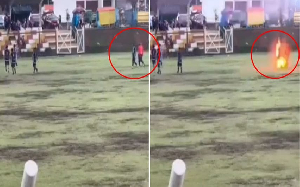
A lightning strike tragically claimed the life of one player and left four others injured during a lower-division league match in Peru on Sunday, November 3, 2025.
The game, held at Coto Coto Stadium between Juventud Bellavista and Familia Chocca, had been paused due to worsening weather conditions when the incident occurred.
Footage aired by local broadcaster Onda Deportiva Huancavelica showed players beginning to exit the field as a storm intensified.
Suddenly, a lightning bolt struck two players directly: Jose Hugo de la Cruz Meza and goalkeeper Juan Chocca Llacta. The force of the impact sent the rest of the players to the ground.
De la Cruz was killed instantly, while Llacta was rushed to the hospital by taxi, with a total of five players sustaining injuries. Among those injured were two teenagers, aged 16 and 19, who were treated for minor injuries following the incident.
🚨🇵🇪LIGHTNING STRIKES SOCCER MATCH IN PERU
Jose Hugo de la Cruz Meza, 39, was killed instantly, and 5 players were injured during a regional tournament in Chilca.
Goalkeeper Juan Chocca Llacta, 40, also received a direct strike and was rushed to hospital in a taxi with serious… pic.twitter.com/7zdnwAoc8c
“We join in solidarity and extend our sincere condolences to the family of youngHugo De La Cruz, who, after being struck by lightning, unfortunately lost his life while being taken to the hospital.
We also express our support and wishes for a speedy recovery to the other four players injured in this tragic accident,” the local municipality said in a statement quoted by CNN.
Peruvian national news channel Andina has reported that two of the four injured players have been discharged, while the other two are in stable condition but remain under medical observation.
The last recorded incident of this kind occurred in 2020, when a 16-year-old Russian goalkeeper was struck by lightning during a training session.
He survived the traumatic experience and made a full recovery after undergoing intensive treatment, which included being placed in a coma.
The decision has sparked widespread criticism within the country. Previously, lawmakers had prohibited any mention of gender equality in school textbooks.
This has had dire consequences for educational programs aimed at combating domestic violence and femicides.
César Vásquez, the health minister, has refrained from addressing the controversy. However, he has come to the defense of President Dina Boluarte regarding the declaration.
The president herself is currently under scrutiny for her questionable acquisition of expensive jewelry, including a £40,000 diamond-encrusted Cartier bracelet.
In a separate incident, her brother Nicanor Boluarte was apprehended for selling high-ranking government positions.
In response, the president disbanded an elite police anti-corruption unit and attempted, unsuccessfully, to prevent the release of official statistics revealing an increase in poverty rates.
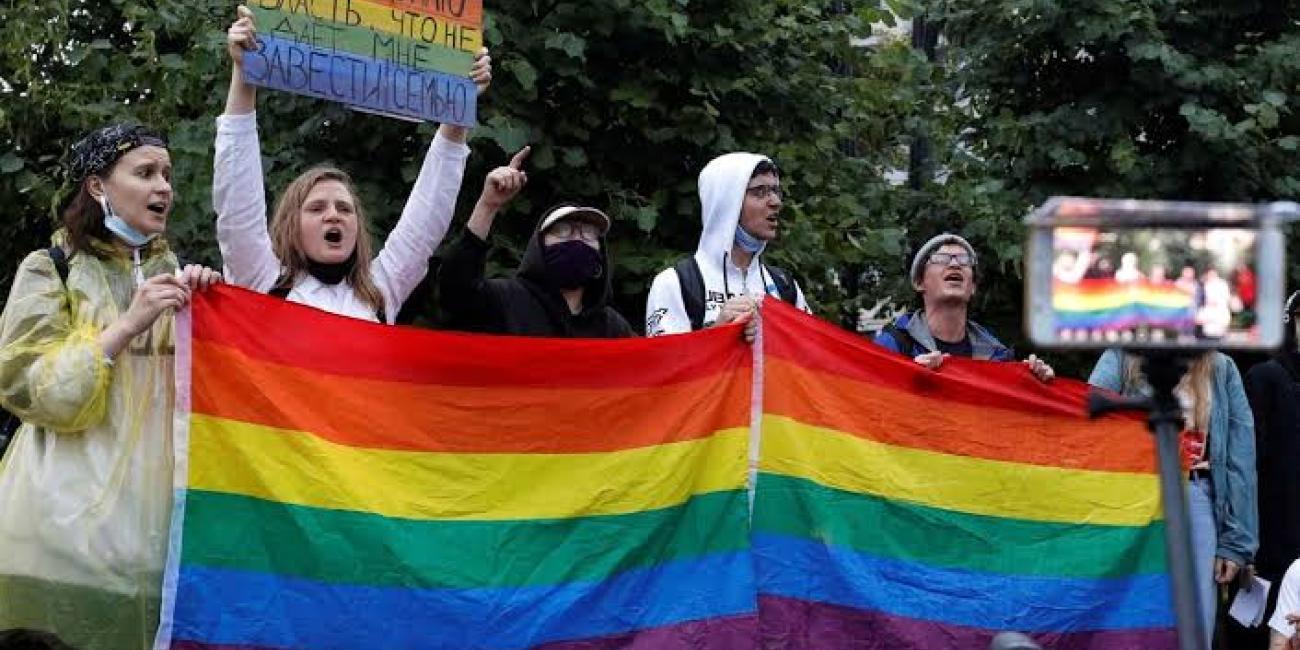
Percy Mayta-Tristán, a medical researcher at Lima’s Scientific University of the South, suggested that while the decree may have been well-intended, it demonstrated a lack of understanding of the intricacies surrounding LGBT issues.
“You can’t ignore the context that this is happening in a super-conservative society, where the LGBT community has no rights and where labelling them as mentally ill opens the door to conversion therapy,” he said.
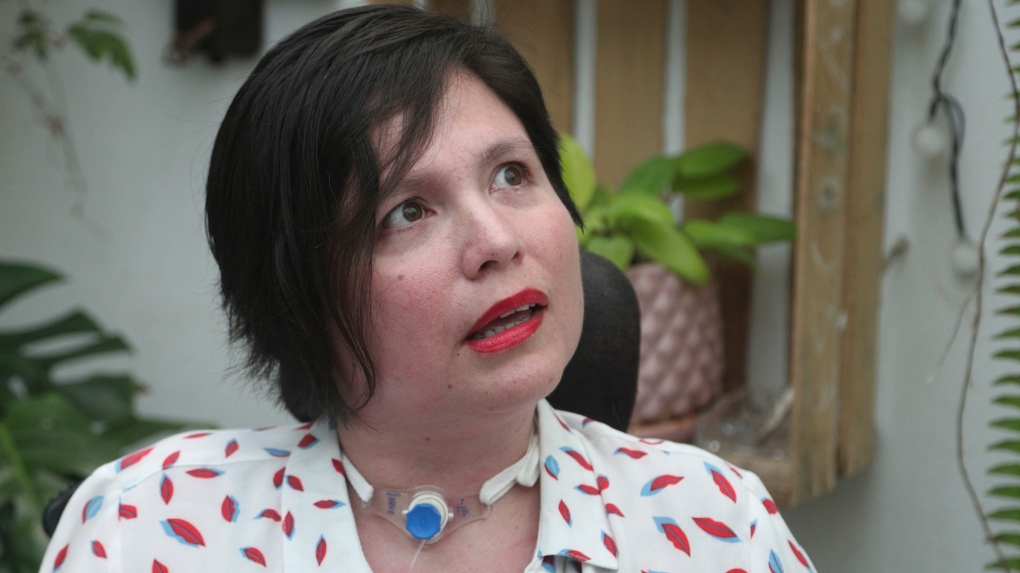
Ana Estrada fought for a long time in the courts of Peru for the right to choose when and how she could die. She became well-known in the country, which doesn’t allow euthanasia or assisted suicide.
In 2022, the Supreme Court said it was okay for Estrada to choose when to die, and no one would get in trouble for helping her. Estrada was the first person in Peru to be allowed to die with help from a doctor.
Ana fought to be able to die with dignity. Her fight has taught many people in Peru about this right and why it is important to protect it, said her lawyer, Josefina Miró Quesada. “Her struggle went beyond our country’s borders. ”
MrEstrada, who is 47 years old, had a disease called polymyositis. This disease makes muscles become weaker and there is no cure for it.
She started showing symptoms as a teenager and began using a wheelchair at 20 because she couldn’t walk anymore.
However, in 2017, Estrada’s health got worse and she couldn’t get out of bed anymore.
She had a hard time breathing and beat pneumonia. Even though she couldn’t type, Estrada used a special program to write a blog called “Ana for a death with dignity. ” In her blog, she talked about her difficulties and why she chose euthanasia.
“I am not free anymore,” she said in an interview with the Associated Press in 2018. “I have changed and I’m not like I used to be. ”
With the help of the person in charge of looking after people’s rights in Peru, Estrada won a case that allowed her to choose to end her life with euthanasia. She joined court sessions from her bed using video calls.
In 2022, Estrada told judges that she thinks life is important and she doesn’t want to die right away. She wants to be able to choose when to end her life.
Only a few countries have made it legal to end someone’s life intentionally, which includes Canada, Belgium, and Spain. In some US states like Maine and Oregon, a doctor can help a very sick person end their life.
Most Latin American countries do not allow euthanasia, but Colombia and Ecuador have made it legal or decriminalized it.
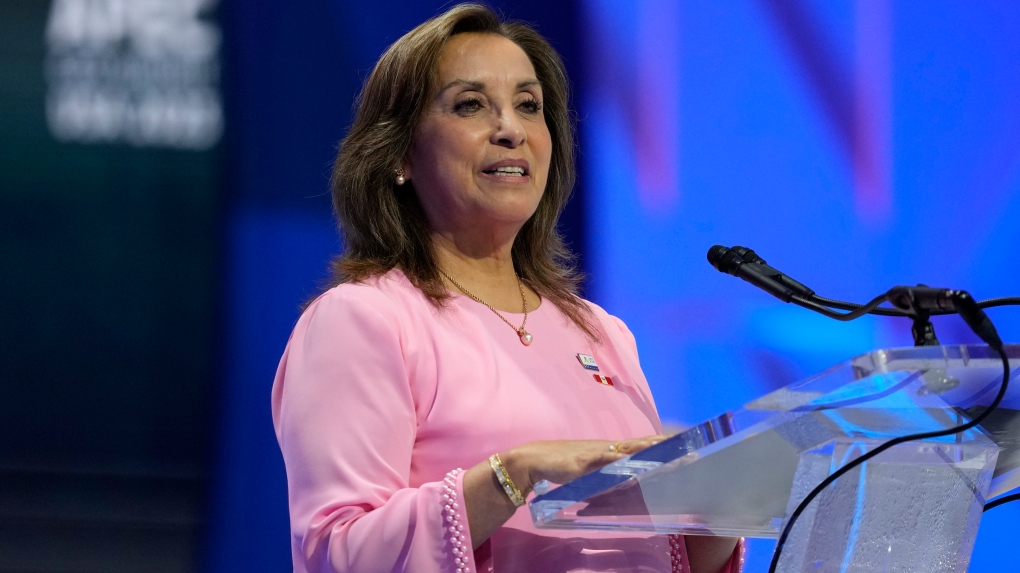
The Peruvian President Dina Boluarte spent five hours on Friday answering questions from lawyers.They are looking into whether she got a lot of money, expensive watches, and jewelry in a way that was against the law.
The law is examining the unpopular leader for acquiring money through illegal means and for failing to report all their possessions. After she spoke in court, Boluarte left in a car with dark windows, with police and security around her. Neither Boluarte nor the prosecutors explained what was discussed in the meeting.
The scandal is the newest problem in Peru’s government in the last few years. Earlier today, there were fights between protesters who don’t agree with each other. They were near a building, waiting for Boluarte to come out.
Many people went to support the president at the palace. They had a sign that said “Dina resist. ” But, there were also people nearby who were angry at the president. They had brooms and yelled “get them all out. ” The police used tear gas to make them leave.
The investigation started in the middle of March after a news show called La Encerrona showed Boluarte wearing an expensive Rolex watch in Peru. Other TV shows said that the leader was seen wearing at least two more expensive watches and a fancy bracelet worth over $54,000.
The issue was called “Rolexgate” on social media right away.
Peruvian law says that officials must report jewelry worth more than US$2,791, but it’s not known where the expensive watches and large amounts of money sent to bank accounts came from.
Boluarte didn’t give much information about the weird money movements and jewelry that she didn’t tell the authorities about. But she said that the Rolex watch in the pictures was something she earned from working since she was 18.
The disagreement will make things even harder for Boluarte, who is not well-liked by 86 percent of people in Peru, according to a survey from March by the Institute of Peruvian Studies.
“Alonso Cárdenas, a political science professor at Peru’s Antonio Ruiz de Montoya University, said that she does not have good leadership, most people do not support her, and her issues with the people are very serious. ”
On Friday night, the police forcefully opened Boluarte’s front door and went inside to look for the watches. They looked for them but couldn’t find them, so they went to the presidential palace, but they weren’t there either.
Juan Villena, the top prosecutor, said on Tuesday that his office is broadening the investigation because they think Boluarte has more secret money and possessions than they thought at first.
The office thinks her jewelry, like the Cartier bracelet and watches, could be worth up to $500,000. They also said she got over $400,000 in deposits into her bank account that they don’t know where it came from.
61-year-old Boluarte was a lawyer and district official. Then he became the vice president and social inclusion minister in President Pedro Castillo’s government. He started in July 2021 and made $8,136 per month. She became president in December 2022, after Parliament fired Castillo, and she gets paid $4,200 every month. Soon after that, she started wearing the watches when she went out in public.
The raid on Friday was the first time ever in Peru’s history that police went into the home of a president without permission. Boluarte asked for more time to answer a court order to testify about the case, but the lead prosecutor said no and emphasized that Boluarte has to cooperate with the investigation.
The Andean country often experiences political unrest. In the past six years, Peru has had six different presidents because there have been a lot of political problems. This doesn’t mean Boluarte will be kicked out of the presidency soon. Experts told The Associated Press that she probably won’t face any serious problems, at least for now. The current president of Peru cannot be accused of crimes while in office, and Congress is unlikely to start the process of removal from office.
Boluarte made friends with a group of politicians, so she will probably keep her job until 2026, according to Will Freeman, who knows a lot about Latin America. Freeman believes Boluarte is controlled by others and is helping politicians pass laws that are hurting democracy, so they can keep their jobs.
Peru’s lawmakers voted no to remove Boluarte from his job.
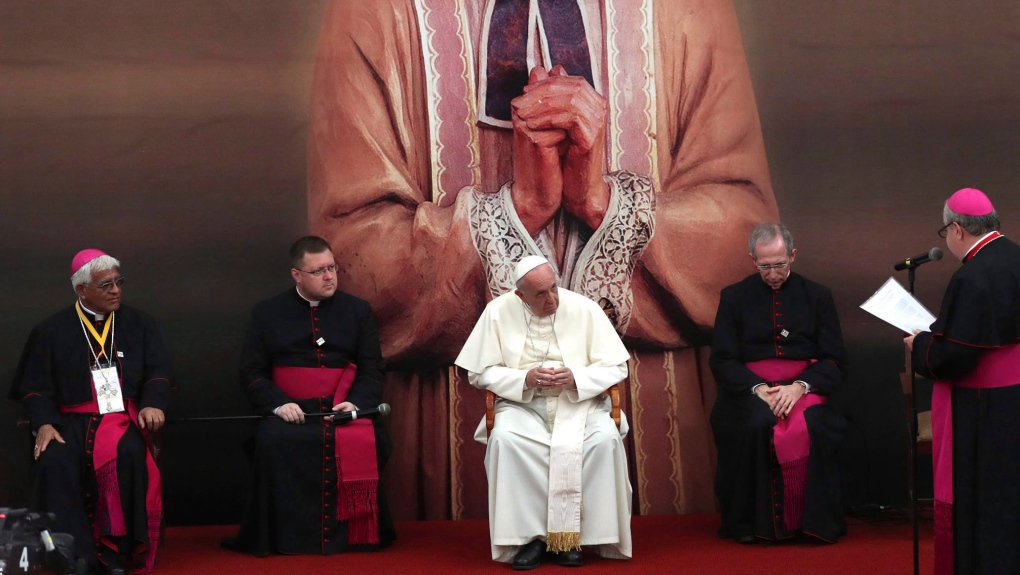
Pope Francis agreed to let Piura Archbishop Jose Eguren step down from his position. He is 67 years old, which is younger than the usual retirement age of 75 for bishops.
The Vatican did not say why Eguren was retiring early in its short announcement, and there was no immediate statement posted on the Piura archdiocesan website.
The Vatican started a thorough investigation into abuse and financial wrongdoing within the Sodalitium organization in Peru, to which Eguren is a part of.
For more than ten years, the Vatican has been paying attention to Sodalitium, a group with branches in South America and the US. In 2017, a study paid for by the group’s new leaders found that its founder, Luis Fernando Figari, sexually abused his recruits and treated them in a very bad way.
The abuses were first made public in 2015 because of the work of Peruvian journalists Pedro Salinas and Paola Ugaz. Aside from Figari’s own wrongdoings, their reporting also uncovered that a real estate developer associated with Sodalitium allegedly forced peasants off lands in Eguren’s diocese.
In 2018, Eguren took legal action against them because he said they hurt his reputation. He wanted $100,000 and for them to go to jail. He decided to stop the lawsuit for defamation in 2019 because people in the Peruvian church were criticizing him.
Last year, the Vatican sent two of their best investigators to Peru to look into claims of sexual and psychological abuse in the Sodalitium. They also looked into claims of money corruption.
The report’s information has not been shared, but Salinas hinted that Eguren’s removal was connected to the Vatican investigation. This could mean that more action might be taken in the future. Salinas was hurt by Figari and has been working hard to make Sodalitium take responsibility. Ugaz also talked to Francis in 2022.
“This has never happened before and could be a sign that something even bigger is coming: the Sodalitium might be stopped,” Salinas said in a message to The Associated Press.
Figari started the SCV in 1971, which is also called the Sodalitium. It was made for people to join and serve God. There were many Catholic groups that started as a response to the left-leaning liberation theology movement in Latin America in the 1960s.
The victims told the Lima archdiocese about Figari’s bad actions in May 2011. The church said they told the Vatican about the case right away, but they didn’t do anything until Salinas’ book came out in 2015.
Sodalitium previously said it was helping with the Vatican’s investigation. It has said that Figari claims he didn’t do anything wrong, but it thinks the allegations in “Half Monks, Half Soldiers” could be true.
General Peru’s top police officer, Ãscar Arriola, announced in a meeting with reporters that Majid Azizi, who is 56 years old, was taken into custody in Lima on Thursday, along with two people from Peru.
Arriola said the authorities stopped the attack on the Israeli person. He didn’t say who the target was for safety.
The police are searching for another person from Peru who they believe was responsible for the murder of the Israeli man.
Arriola said that Azizi came to Lima on March 3, and they were warned about him by other countries’ intelligence agencies.
The Associated Press wasn’t able to make sure if Azizi is part of the Quds Force on its own. The officials in Iran have not said anything.
The Quds Force is a special part of Iran’s Revolutionary Guard that manages operations in other countries.
Arriola mentioned that Azizi was caught after taking money from an ATM. Azizi and the two Peruvians who were arrested will stay in jail for at least 15 days for charges related to terrorism.
The general said the man planned to go back to Iran on the day he was caught.
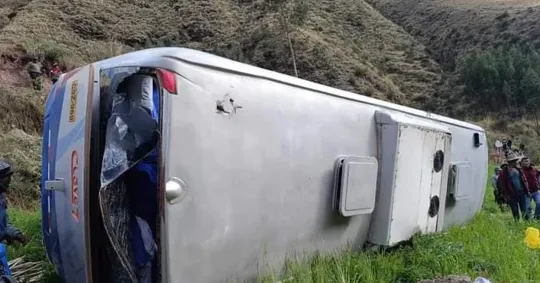
A person from Britain who was on vacation in Peru has died and many other tourists and local people got hurt when a bus crashed and fell down a road in the mountains.
Tourists and five people from Peru were going to the Mountain of Seven Colours on Sunday afternoon.
The coach crashed while driving on Highway 1 near the farming community of Tintinco, Cusitapa, at around 3pm local time.
Pictures and videos from the place show the car in really bad condition, leaning to one side, with the glass at the front broken.
The boss of the tourism police in Cusco, Harnner Horna, said on TVPerú Noticias that a 32-year-old British person died in the accident.
He said, “This person is from the United Kingdom. They were taken to the Urcos morgue. ” We have already told the Consulate to do the necessary things. La República said that the man got stuck under the bus when it turned over multiple times.
We’re not sure if his closest family members have been told yet. The British embassy has been informed.
Another British tourist who was on the bus that crashed was also identified by the local police.
The local police identified 16 people from different countries (Poland, Argentina, Spain, Italy, Brazil, Chile, and the Czech Republic) as the victims.
Five people from Peru, all from the city of Lima, were also hurt in the accident.
Horna said that some people got hurt and were taken to two nearby hospitals for treatment of broken bones and bruises. Five of them were allowed to leave the hospital on Monday.
The police are investigating and have arrested a bus driver named Manuel Navidad Casillas Cachira, who is 37 years old.
The police said the tourist company running the bus, called ‘Rainbow Mountain Trek Peru’, did not have permission to carry vacationers.
The Mountain of Seven Colours, also known as Vinicunca or the Rainbow Mountain, stands at a very high point of 16,000 feet above the sea level.
The tourist spot in the Cusco region, called Machu Picchu, looks almost unreal because the soil there is colored turquoise, lavender, and gold. It is a beautiful place located in the Andean mountain valley, where you can also find other old sites.
To reach the hill, vacationers need to take a two-hour drive from Cusco, followed by a three-and-a-half hour drive through Pitumarca. After that, they will need to walk 1. 5 miles
The Foreign Office has been reached out to for a response.
Lionel Scaloni has expressed his lack of concern regarding Lionel Messi’s fitness, especially after the superstar’s standout performance in Argentina’s 2-0 victory over Peru.
In this World Cup qualifying match, Messi not only secured the win but also netted both goals, contributing significantly to Argentina’s unblemished record.
As reigning champions, they now hold a five-point lead over Brazil, Uruguay, and Venezuela, amassing an impressive 12 points from four matches.
Prior to this match, there were doubts about Messi’s fitness due to his absence from several MLS games with Inter Miami, attributed to muscle issues.
Nonetheless, Scaloni firmly believes that the 36-year-old displayed no cause for concern, based on his exceptional showing in Lima.
“We won’t be affected by his break because we won’t be competing again until March. I imagine he will do his preseason with his team; it is not something that really worries us.
“It was already seen today, without having a lot of minutes like it was said… The most important thing is that he is healthy and that’s the best thing, he is managing his minutes.”
Messi will soon make his MLS comeback withInter Miami, who will play Charlotte twice to close up their regular season.
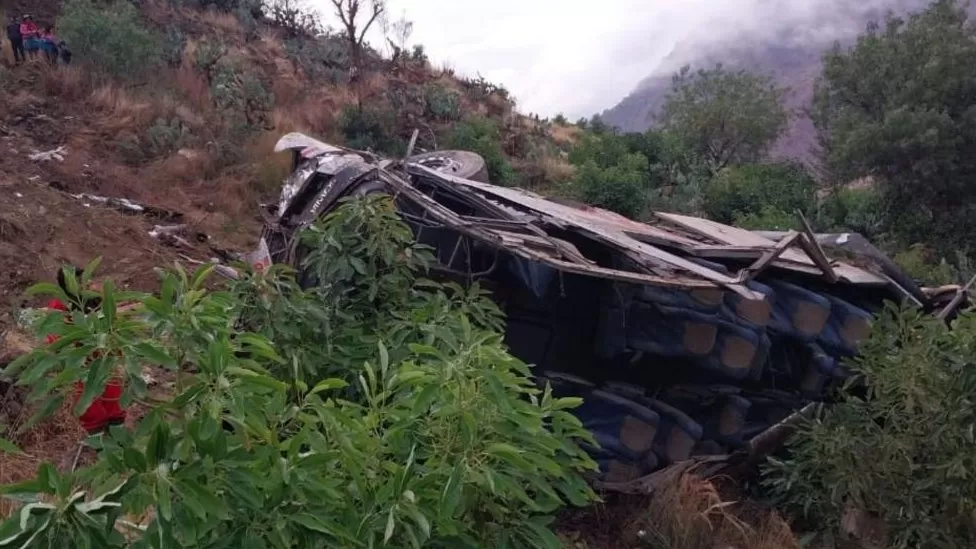
The long-distance bus was traveling through the Andes mountains between the cities of Huancayo and Huanta during the night when it went into a very deep ravine that was 200 meters (650 feet) deep.
There are often accidents involving coaches in Peru, especially during the night and on mountain roads.
According to official numbers, over 3,300 individuals lost their lives in car accidents in the Andean nation in 2022.
But, the mayor of a close town said on the local radio that the road where the accident took place had not been fixed after being damaged in a landslide one month ago.
Firefighters from Huanta and Churcampa were sent to the place where the accident happened.
People who lived nearby were the first ones to come to the place where the incident happened. They discovered that there were still some people alive inside the car.
They said the coach stopped and stayed in some bushes. The branches of the bushes stopped it from being carried away by the river nearby.
The police and firefighters saved the survivors and brought them to the nearest hospitals.
According to a decree that was published by the official newspaper “El Peruano” on Tuesday, the government of Peru is providing families who lost a relative during the country’s protests between December 8 and February 10 with almost $13,000 in financial assistance.
According to the ruling, the injured will receive half of this amount, or $6,500 US dollars (25,000 nuevos soles), while each family will receive around $13,000 US dollars (50,000 nuevos soles).
The directive also states that the payments are not regarded as reparations but rather as financial assistance for civilians and police officers.
“Economic assistance to the people killed and injured is a duty by the State due to the families’ patrimonial affectation but does not exempt (the state) of the responsibility to look for truth, justice, and reparation for the victims for the abuse of their human rights,” it wrote on Twitter.
As CNN first reported, Peruvian families have demanded reparations for deaths and injuries around the protests since former President Pedro Castillo was impeached and arrested in December. His removal from office sparked the demonstrations amid deep dissatisfaction over living conditions and inequality in the country.
There has been at least 60 protest-related deaths, according to Peru’s Ombudsman’s office, including one police officer. Most of those deaths happened outside Lima. As of February 22, seven people died in Apurimac, ten in Ayacucho and twenty in Puno for example, according to the same organization.
The government’s announcement comes after a preliminary report released by Amnesty International accused Peruvian authorities of acting with “a marked racist bias” in its crackdown on the protests last week.
The human rights group also accused Peruvian security forces of using firearms with lethal ammunition “as one of their primary methods of dispersing demonstrations, even when there was no apparent risk to the lives of others” – a violation of international human rights standards.
CNN reached out to the Ministry of Defense and Interior for comment on the Amnesty International report and the allegations of excessive use of force against protesters. The Ministry of Defense declined to comment and told CNN there is an ongoing investigation by Peru’s Prosecutor Office with which they are collaborating.
A spokesperson for the Interior Ministry also declined to comment, highlighting the ongoing investigation by the prosecutor’s office.
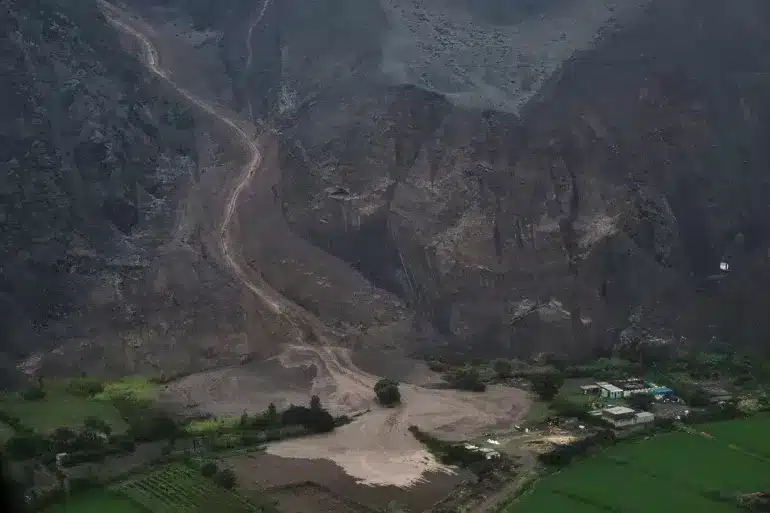
Authorities have reported at least 15 fatalities, 20 injuries, and two people missing following landslides in southern Peru. They have issued a warning that the number of casualties could rise.
“The number of people dead so far has risen to 15,” according to the directorate of the National Civil Defense Institute in the Arequipa region, where mud and rock slides began on Sunday as a result of torrential rains, on Monday.
Secocha, which is situated on the banks of the Ocoa River in the Camaná province, is one of the regions in the department of Arequipa that is experiencing high water levels as a result of the persistently heavy rain.
The Ocoa was flowing at a rate of 585.6 cubic metres per second as of Monday morning, and the Peruvian government issued a warning that the swollen river could affect nearby population centres
To address the aftermath of the landslide, the Ministry of Health has announced on Twitter that it would send “two brigades made up of doctors, nurses and mental health professionals to the area”, as well as 150kg (330lb) of medicine to the region.
The Peruvian army has also deployed helicopters to the region, transporting humanitarian aid, drinking water and sandbags to the emergency site.
“Search and rescue efforts continue,” the ministry of defence said in a tweet that called out misinformation surrounding the landslide. With some media reports setting the death toll as high as 36, the ministry wrote it recommended that members of the public “obtain information from official sources”.
The Associated Press news agency reports that Wilson Gutierrez, a civil defence official in the Mariano Nicolás Valcárcel municipality, had previously said in an interview with radio station RPP that 36 people had died in an isolated area called Miski. RPP News also reported that some of the dead had been struck by falling rocks as they travelled by truck along the Urasqui-Secocha highway.
The protests were sparked in December when then-President Pedro Castillo attempted to dissolve Congress illegally ahead of his third impeachment hearing. The move led Congress to overwhelmingly impeach Castillo, who has since been detained on charges of rebellion and conspiracy.
His former vice president, Dina Boluarte, was sworn in as Peru’s first female president that same day.
Castillo, once considered a dark horse candidate for the presidency, is a former school teacher and union organiser from Peru’s rural north. His presidency galvanised support in other impoverished, rural areas of the country, including Arequipa, where protesters stormed the airport and blocked highways in response to his arrest.
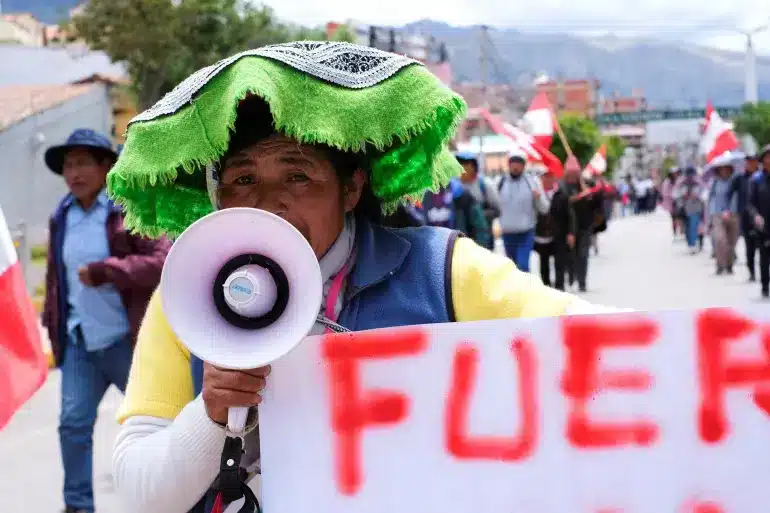
The demonstrations against Castillo’s detention have continued for more than two months, with protesters calling for Castillo’s release, Boluarte’s removal, the dissolution of Congress, new elections and a revised constitution.
Following the rejection of a similar proposal the day before amid widespread protests that are causing the nation’s economy to suffer, the Peruvian Congress has now voted down a second proposal to move elections to 2023.
On Thursday, the Free Peru Party’s motion was defeated with only 48 votes in favour, 75 votes against, and one abstention.
Elections would be moved from April 2024 to July 2023, and the proposal also called for a referendum on establishing a constitutional convention, which was a key demand of the protesters.
President Dina Boluarte supported a similar motion the day before, but it did not receive enough support.
Peru has been embroiled in a political crisis with near-daily demonstrations since December 7, when then-President Pedro Castillo was arrested after attempting to dissolve Congress and rule by decree.
At least 48 people, including a police officer, have been killed in clashes between security forces and protesters, according to the human rights ombudsman’s office.
Protesters have erected roadblocks causing shortages of food, fuel and other basic commodities in several regions of the Andean nation.
The economic fallout of the demonstrations is hitting hard on workers. Luz Camacho, a local farmer who picks up pomegranates in the southern region of Ica has lost one-quarter of her wage, enough to not be able to pay her debt to the bank.
“It has affected us a lot because we haven’t worked and we have loans and debts. Where are we going to get an income?” Camacho told Al Jazeera.
The chamber of commerce estimates that the region has lost $300m since the crisis started in December.
“This political crisis is turning into a social economic crisis,” said Jose Luis Gereda, the director of Pomica, an Ica-based company that packs fruits to be shipped abroad. Gereda buys 70 percent of its products from small producers who have been prevented by protesters from accessing fields.
Chief adviser resigns
In December, lawmakers moved elections, originally due in 2026, up to April 2024, but as protesters dug in their heels, Boluarte called for holding the vote this year instead.
The unrest is being propelled mainly by poor Indigenous Peruvians from southern areas of the country.
They perceived Castillo, who is also from that region and has Indigenous roots, as an ally in their fight against poverty, racism and inequality.
Boluarte’s government began to show additional cracks on Thursday, with the departure of Raul Molina, a chief adviser.
Molina blamed Boluarte for a lack of “substantive political gestures” as well as for not establishing any clear suspects in the deaths of protesters during the crisis.
“Madam President, listen to our people, to the great majority who are asking for changes”, read Molina’s letter of resignation released on Thursday by the press.
Since Castillo was removed from office and detained in December, there have been demonstrations against President Boluarte.
Following protests that have claimed at least 42 lives in recent weeks, the government of Peru has proclaimed a state of emergency in the capital Lima and three other regions.
The late-Saturday announcement of the measure, which will be in effect for 30 days, gives the army permission to step in to keep the peace while suspending several constitutional rights like the right to free speech and the right to assemble.
Since leftist former president Pedro Castillo was ousted from office and detained in December for attempting to illegally dissolve Congress, protests against President Dina Boluarte have swept the South American country.
He was replaced in the president’s position by Boluarte, who was vice president.
Castillo supporters have marched and barricaded streets around the country for weeks, demanding that new elections be held and for Boluarte to step down.
Demonstrators assist a man injured during protests near the Juliaca airport in Peru [Hugo Courotto/Reuters]
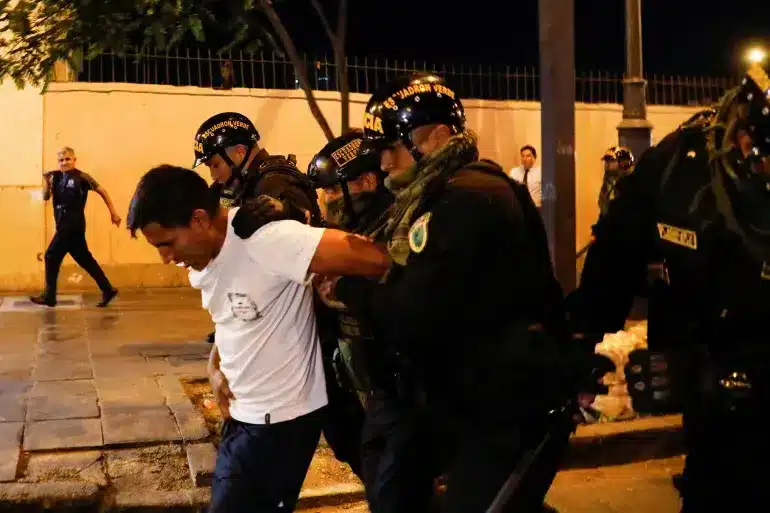
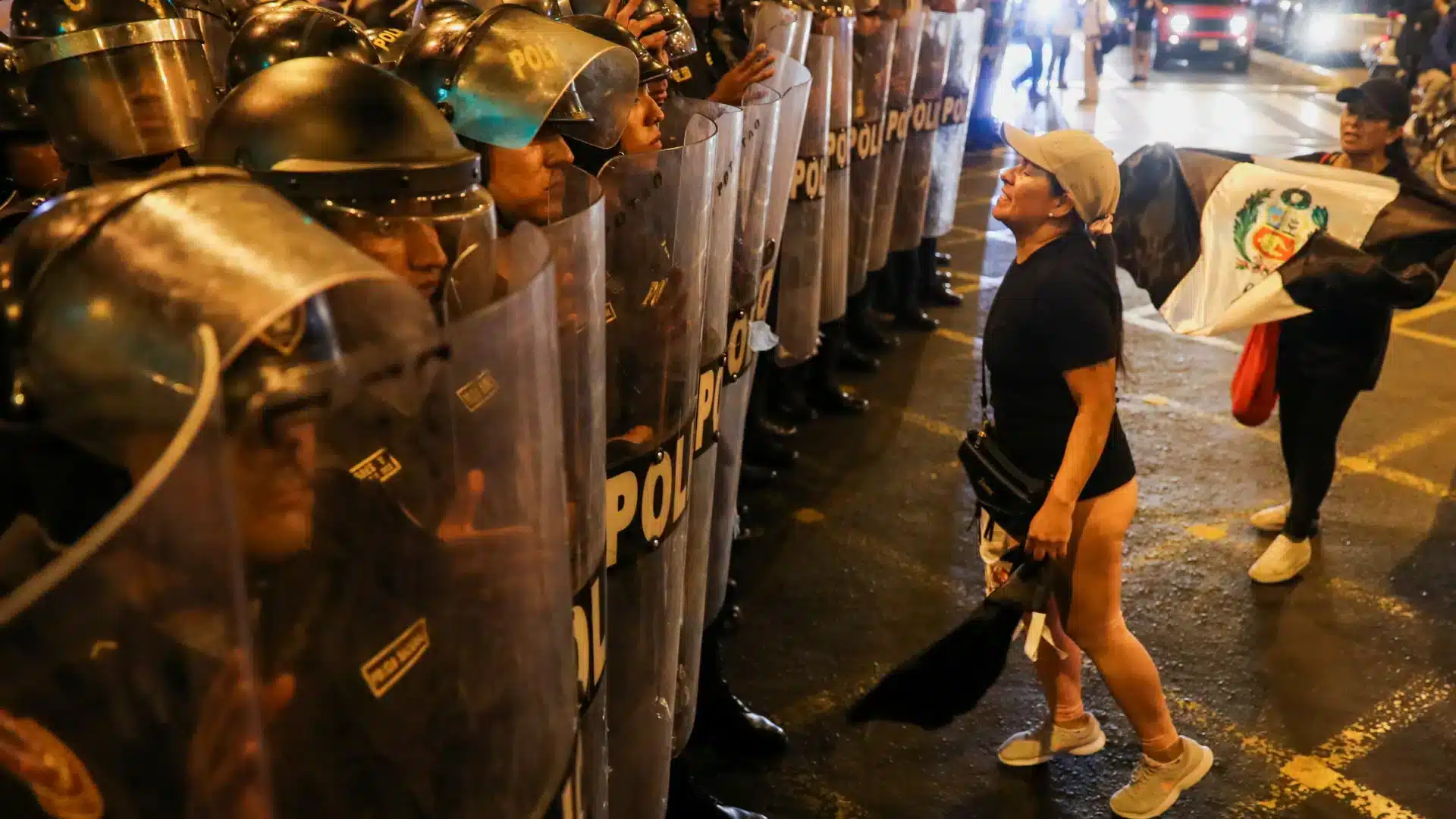
On Thursday, authorities closed air and rail links to Peru’s famed Machu Picchu tourist site as protests flared up, leading to clashes between police and protesters.
While Boluarte has apologised for the violence, on Friday the 60-year-old insisted she would not resign amid the turmoil, and rejected the possibility of calling a constitutional assembly as demanded by protesters – pointing to the difficulties Peru’s neighbour Chile has had in drafting and approving a new constitution.
Castillo, who was being investigated in several fraud cases during his tenure, has been remanded in custody for 18 months, charged with rebellion.
Peru has been riddled with political instability in recent years. Boluarte, 60, is the sixth person to hold the presidency in five years.
Authorities have shut down Cusco International Airport, a busy entry point to the mountaintop Incan citadel of Machu Picchu, one of the most popular tourist destinations in the world, as anti-government demonstrations spread across the country.
Numerous airports in Peru have been the target of weeks of protests that have claimed dozens of lives nationwide.
The Alejandro Velasco Astete International Airport in Cusco was preemptively closed due to safety concerns, according to the transport ministry of Peru on Thursday.
“This action is being taken to safeguard peoples’ wellbeing and the safety of aeronautical operations,” the ministry said in a statement.
Clashes in Cusco – an arrival point for people visiting the country’s tourism crown jewel of Machu Picchu – broke out on Wednesday with protesters attempting to enter the airport, while others torched a bus station, attacked shops and blocked train tracks with large rocks.
Peru’s rights ombudsman said one person died in Cusco and more than 50 people, including 19 police officers, were injured in the turmoil, while police said they had arrested 11 people.
Protests continue to escalate across Peru since first erupting in early December after the removal of former President Pedro Castillo, who was thrown out of office for attempting to dissolve Congress and rule by decree in a failed bid to prevent an impeachment vote against him.
Supporters of Castillo have marched for weeks demanding new elections and the removal of current leader Dina Boluarte, who replaced Castillo as president. Boluarte, 60, was Castillo’s vice president but took over once he was removed on December 7.
Castillo, who was being investigated in several fraud cases during his tenure, has been remanded in custody for 18 months, charged with rebellion.
Clashes between protesters and security forces have left at least 42 people dead, including a police officer who was burned alive in a vehicle, while hundreds more have been injured.
Almost half of the victims died in clashes on Monday night alone in the southern Puno region, where 17 people were due to be buried on Thursday. Gathered in a circle around a coffin, relatives of one of the victims held posters reading: “Dina corrupt murderer” and “we are not terrorists but citizens who demand justice”.
Also on Thursday, trade unions, left-wing parties and social collectives marched through Lima, the capital which has largely been spared of violence thus far, to denounce a “racist and classist… dictatorship”.
The social unrest has laid bare the deep divisions between residents of the affluent capital and populations in Peru’s long-neglected countryside. Castillo was a political novice who lived in a two-story adobe home in the Andean highlands before moving to the presidential palace after winning a narrow victory in elections in 2021. The result rocked Peru’s political establishment.
Al Jazeera’s Mariana Sanchez, reporting from Lima, said the atmosphere was tense at the marches in the capital following days of clashes between protesters and police in different parts of the country which had seen demonstrators killed by the gunfire of security forces.
“People have been marching around the centre of the capital demanding the resignation of President Dina Boluarte. They are calling her an assassin and saying that she is responsible for the deaths,” Sanchez said.
“Prime Minister Alberto Otárola has said that Dina Boluarte will not resign, that she is solidly conducting the country and that her resignation would be like opening the door to anarchy,” she said.
The prime minister weighed in on behalf of Boluarte in “response to a statement put out by governors in different parts of the country saying that, and urging her, that she must resign because that’s the only way to resolving the crisis”, she added.
Authorities in Peruhave flown stranded tourists to the city of Cusco from the Inca mountaintop citadel of Machu Picchu.
As protesters blocked roads and forced airports to close, thousands of tourists and Peruvians were trapped for days in various locations.
After President Pedro Castillo was removed from office, a wave of protests swept across Peru.
On whether to move up elections, Congress will vote later today.
A month-long state of emergency remains in place but Peruvian authorities appear to have made some headway re-stablishing disrupted transport links.
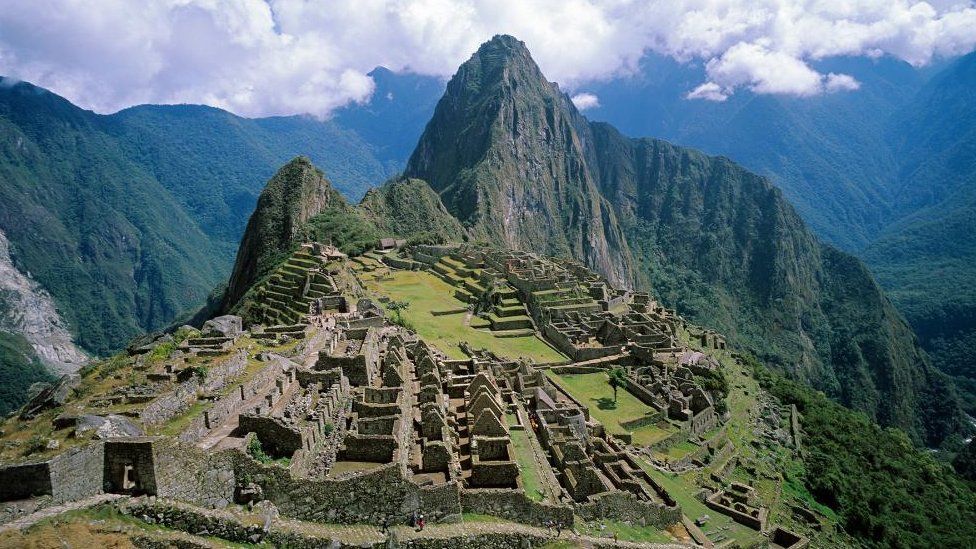
Officials in the South American country organised helicopters to evacuate tourists considered “vulnerable” from the ancient Inca citadel located at a height of 2,400m in the Andes.
Image caption, Machu Picchu is one of the main draws for tourists visiting Peru
Hundreds had been stuck there for almost a week after the train line which many tourists take to the 15th Century site was cut by protesters placing boulders on the track. Some tourists had to walk along parts of the track before the boulders could be cleared.
On Monday, the airport in Peru’s second largest city, Arequipa, reopened. The transport minister said the airports in the cities of Juliaca and Ayacucho would follow suit on Tuesday, while that in Cusco, which is used by many tourists visiting Machu Picchu, had reopened on Friday.
The airports had closed after supporters of impeached President Castillo stormed them.
The protesters are demanding that Mr Castillo – who is being held in pre-trial detention as prosecutors investigate him for alleged rebellion – be freed.
They also want a general election to be held as soon as possible.
The current political crisis was triggered by Mr Castillo’s attempt on 7 December to dissolve Congress and introduce a state of emergency, before the legislative body could hold an impeachment vote.
The move was denounced as an “attempted coup” by the head of the constitutional court and Mr Castillo was detained as he tried to make his way to the Mexican embassy in Lima to seek political asylum.
In the protests which followed more than 20 people have been killed and more than 600 injured, according to Peru’s ombudsman.
Protesters also blockaded the border with Bolivia.
Dina Boluarte, Mr Castillo’s former vice-president who was sworn in after he was impeached, wants general elections to be brought forward to December 2023.
Congress voted against the earlier date just a few days ago but is due to hold a fresh vote later on Tuesday.
Secretary of State Antony Blinkenurged Peruvian political figures to lower tensions and seek “reconciliation.”
After top US diplomat Antony Blinken spoke on the phone with the troubled South American leader, Washington said it “looked forward to working closely” on shared goals with the newly appointed Peruvian President Dina Boluarte.
In light of the ongoing unrest in Peru following the ouster of President Pedro Castillo earlier this month, the US Department of State confirmed the talks between Blinken and Boluarte on Sunday. Two days earlier, the call had been made.
“Secretary Blinken encouraged Peru’s institutions and civil authorities to redouble their efforts to make needed reforms and safeguard democratic stability,” the State Department said in a statement.
Boluarte was sworn in by Peru’s Congress to replace Castillo on December 7 after lawmakers ousted the former president, who had announced plans to “temporarily” dissolve Congress and rule by decree in what he said was an effort to “re-establish the rule of law and democracy”.
Boluarte previously served as vice president to Castillo, who has been arrested on charges of rebellion and conspiracy after his removal. On Thursday, a Peruvian court extended the left-wing leader’s pre-trial detention to 18 months.
Castillo had faced multiple crises during his short tenure as president. Sworn in July 2021, the teacher and union leader from rural Peru faced corruption allegations, a grim approval rating, and a stillborn legislative agenda thwarted by an opposition-dominated Congress.
Now Boluarte is facing a crisis of her own as demonstrators demand her resignation.
Blinken’s call with Boluarte came amid political chaos and ongoing anti-government protests calling for early elections and Castillo’s release.
“The United States looks forward to working closely with President Boluarte on shared goals and values related to democracy, human rights, security, anti-corruption, and economic prosperity,” the State Department said.
“Secretary Blinken stressed the need for all Peruvian actors to engage in constructive dialogue to ease political divisions and focus on reconciliation.”
In a national address on Saturday, Boluarte called on Congress to authorise early elections “in line” with the demands of the people of Peru.
Boluarte’s administration had declared a nationwide state of emergency on Wednesday, suspending freedom of movement and assembly in a bid to quell the unrest, which has left several people dead.
Earlier this week, Mexican President Andres Manuel Lopez Obrador slammed the measure, calling for respect for human rights and civil liberties in Peru.
“Force must not be used, the people must not be repressed and freedomsmust be guaranteed,” Lopez Obrador said during a news conference.
Authoritiesin Peru have held high-level talks to try to resolve a deepening political crisis triggered by the ousting of the former president.
The Council of State, the body made up of representatives of all branches of power, and church leaders had a three-hour meeting in the capital, Lima.
Earlier, two government ministers resigned, following days of violent protests over the impeachment of Pedro Castillo on 7 December.
More than 20 people have been killed.
After the meeting on Friday evening, the head of the National Board of Justice, José Ávila, called on Peruvians to avoid violence and engage in peaceful dialogue with the authorities.
He said government ministers would be travelling to the areas where people were protesting, in order to promote such a dialogue.
The new President, Dina Boluarte, gave no statement to the press.
In another development, thousands of tourists are trapped in the south-eastern city of Cusco after protesters forced the local airport to close.
Peru has been through years of political turmoil, with the latest crisis coming to a head when Mr Castillo announced he was dissolving Congress and introducing a state of emergency.
However, his plan backfired and Congress instead voted overwhelmingly to impeach him. Mr Castillo, who is currently in detention, is being investigated on charges of rebellion and conspiracy.
He denies all the accusation, insisting that is still the country’s legitimate president.
Demonstrators are calling for the closure of Congress, the resignation of Ms Boluarte and early elections. On Friday, Congress voted against a proposal to bring elections forward to next year.
Thursday’s clashes between the army and Castillo supporters in the central Ayacucho region left at least eight people dead, health authorities said. Footage on social media showed protestors blocking main roads and airports.
Just hours later, Education Minister Patricia Correa said she was stepping down. In a Twitter post on Friday, she wrote that the “death of compatriots has no justification”, and that “state violence cannot be disproportionate and cause death”.
Culture Minister Jair Perez also resigned.
The protests are also affecting the country’s tourism industry. The mayor of Cusco told AFP news agency that about 5,000 tourists are stranded in the city after the airport there closed when protesters tried to storm the terminal.
The city is the gateway to Macchu Picchu, an ancient Inca citadel which is visited by hundreds of thousands of people a year.
About 800 tourists are also stuck in the small town at the foot of the mountain where the citadel stands, because the railway line which serves it has stopped running.
Some mostly American and European tourists have reportedly left the town on foot along the train tracks in an attempt to return to Cusco.
In response to the unrest that has gripped the nation in the turbulent days since President Pedro Castillo was removed from office last week on accusations of insurrection and conspiracy, the government of Peru on Wednesday proclaimed a 30-day nationwide state of emergency.
“A state of emergency has been declared for the whole country, due to the acts of vandalism and violence, the seizure of highways and roads, which are stabilizing (…) and require a forceful and authoritative response,” said Alberto Otarola, Peru’s minister of defense.
The suspension of a number of rights, including the freedom of assembly, the inviolability of one’s home, and freedom of movement, as well as the potential for nighttime curfews, will result from the declaration of a state of emergency.
The action was taken less than a week after the former president Castillo attempted to dissolve Congress and govern by decree in an effort to escape being impeached for the third time by the opposition-led assembly. Legislators instead mandated his arrest.
Peruvian protesters demand immediate elections
Castillo was apprehended on December 7, while seeking to flee to the Mexican Embassy in Lima. Mexico — along with other leftist countries in the region — has voiced support for the Marxist former school teacher.
After his arrest, Vice-President Dina Boluarte was sworn in as Peru’s sixth president in as many years.
Boluarte sought to defuse the growing anger on the streets by announcing that elections would be moved up from 2026 to 2024, this, however, did nothing to mollify angered Peruvians.
Since then, she has said that new elections may take place as early as December 2023.
“Legally it works for April 2024, but by making some adjustments we can bring them forward to December 2023,” Boluarte told reporters.
Nevertheless, Castillo’s supporters have demanded his release and called for new elections to be staged immediately. Those opposing him are also calling for Congress to be dissolved and new elections held rather than accept Boluarte as president.
On Wednesday, a judge in Lima denied Castilo’s release from jail, as prosecutors filed a request that he remain in prison for 18 months of pre-trial detention.
At least seven people have died amid anti-government protests over the past several days.
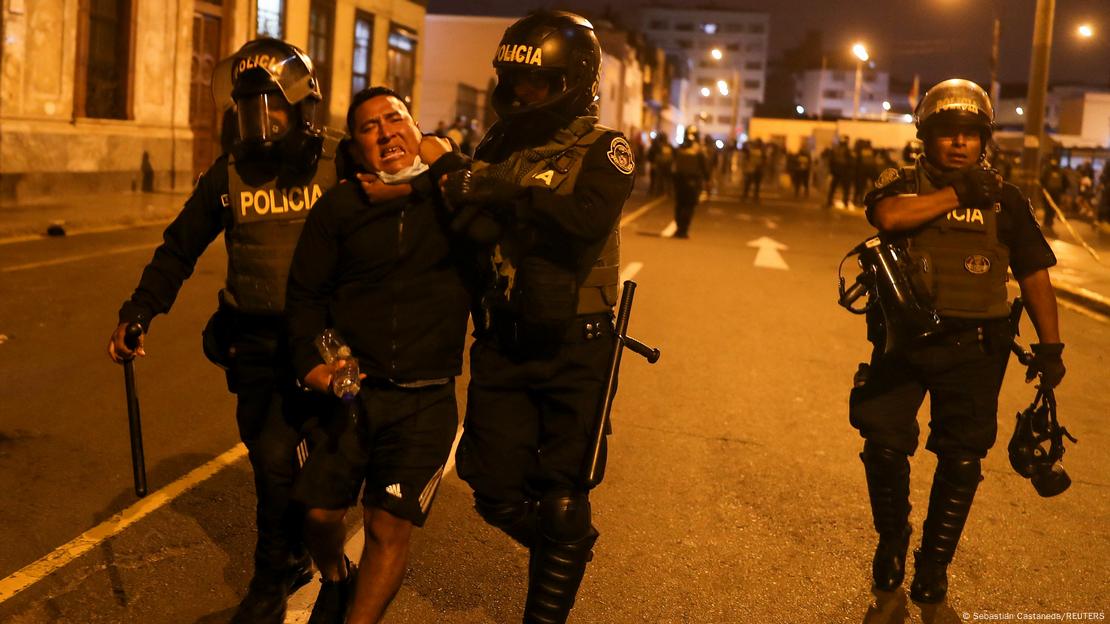
Castillo supporters want him released but opponents want Congress dissolved rather than recognize Boluart as presidentImage: Sebastian Castaneda/REUTERS
What has the new president of Peru said?
In announcing her plan to move up elections, President Boluarte said, “Peru cannot overflow with blood.”
As protesters blocked streets, pelted police with rocks while attempting to storm Congress, and clashed with authorities, Boluarte said: “The only thing I can tell you brothers and sisters [is] to keep calm. We have already lived through this experience in the 80s and 90s, and I believe we do not want to return to that painful history.”
The statement referenced the years in which the Shining Path insurgency carried out bombings and assassinations across the country, sparking decades of violence that led to the death and disappearance of nearly 70,000 people.
“This is a very serious social convulsion,” said Peru’s rights ombudsperson, Eliana Revollar. “We fear it will lead to an uprising because there are people calling for an insurrection, who want to take up arms.”
Appearing via video link before a court in Lima on Tuesday, Castillo railed against what he called his arbitrary and unfair arrest, vowing that he would “never give up and abandon this popular cause that brought me here.”
He then appealed to security forces “to lay down their arms and stop killing these people thirsty for justice.”
She also declared a state of emergency in areas where there have been protests.
In the south-western Apurmac region, clashes between demonstrators and police killed two teenagers.
Ms Boluarte took office on Wednesday after her predecessor, Pedro Castillo, was impeached for attempting to dissolve Congress.
Ms Boluarte said in a televised address to the nation early Monday local time that she would introduce legislation in Congress to hold elections in April 2024 rather than April 2026.
The move represents an about-turn as she had said upon taking office that she would serve out the remainder of Mr Castillo’s five-year term in office in full.
But protests, some of which turned violent, in the regions of Apurímac, Arequipa and Ica by people demanding fresh elections increased the pressure on Ms Boluarte.
Andahuaylas airport in Apurímac had to be closed as protesters and police clashed and smoke could be seen billowing from its buildings.
In her address, Ms Boluarte said that she would also propose a series of constitutional reforms to achieve “a more efficient, transparent and participatory system of government”, but did not go into detail about what those reforms would be.
“I call on all the parties and the Peruvian people to take part in this process so that we’re guided by a wave of democratic feeling,” she said.
Peru was thrown into political crisis last week when then-President Pedro Castillo took to national TV to announce the dissolution of the opposition-controlled Congress just hours before the legislative body was due to vote on his impeachment.
Within hours, Dina Boluarte – who until then had been Mr Castillo’s vice-president – was sworn in as Peru’s new leader.
But while Mr Castillo’s approval ratings had been very low, those of Congress have been even lower and thousands of Peruvians have taken to the streets to demand general elections be held as soon as possible.
Many of those protesting are also demanding the release of Mr Castillo, who is in police custody.
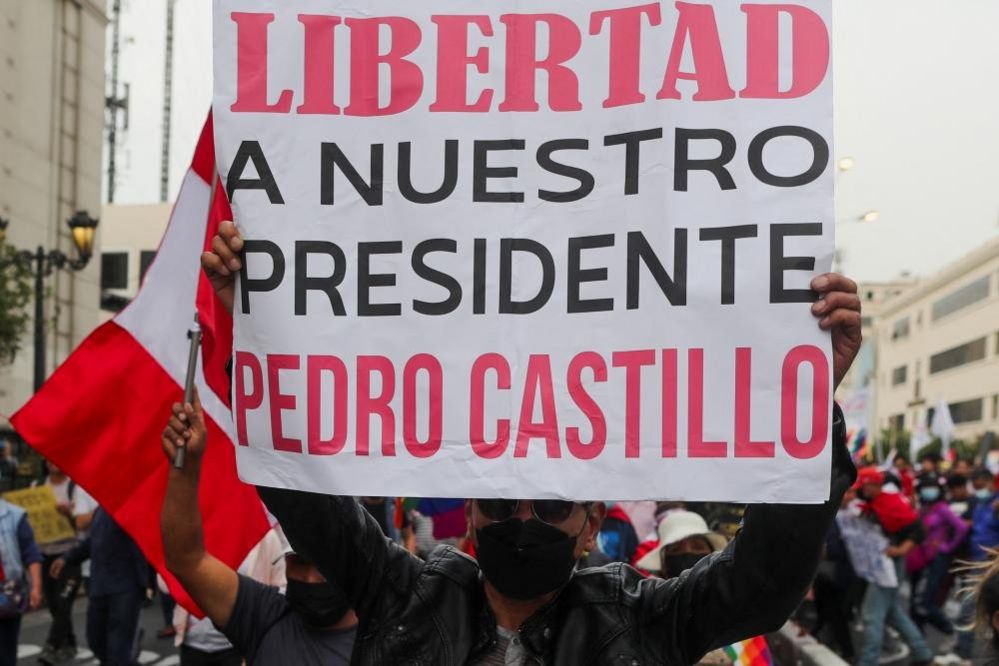
IMAGE SOURCE,REUTERS Image caption, Some protesters held up banners demanding “Freedom for our President Pedro Castillo”
Mexico’s foreign minister, Marcelo Ebrard, said on Thursday that officials “had started consultations with Peruvian authorities” over Mr Castillo’s asylum request.
But shortly afterwards, Mexico’s ambassador in Lima was summoned and warned by Peruvian officials that they considered Mr Ebrard’s comments an interference in the country’s internal affairs.
A court ordered last week that Mr Castillo be held in preliminary detention for seven days while an investigation is carried out into whether he should be charged with rebellion.
His supporters have called for a strike on Monday and are planning to block key roads.
How Ms Boluarte deals with the protests is seen as a key test for her presidency and whether she will be able to hold on to power until April 2024.
Peru’s politics have suffered from instability for years with the legislative and the executive almost constantly at loggerheads.
Violent protests in Peruforces authorities to airport. According to authorities two people have lost their lives in the protests.
Social media photographs showed smoke billowing from the Andahuaylas airport in the country’s south.
The transport ministry said in a statement that demonstrators surrounded 50 police officers and airport workers.
Protests against President Pedro Castillo’s impeachment have continued in Lima.
Police fired tear gas on Sunday to disperse demonstrators in the city.
Peru’s aviation body Corpac – part of the ministry of transport – said Andahuaylas airport had been seriously affected since Saturday afternoon, experiencing attacks, vandalism and fires being started.
It said 50 airport workers and police officers had been surrounded in the airport terminal, and added that some people had been taken hostage.
Peru’s national police later said officers had been to the airport with state police, and that one officer had been injured.
One protester was killed, police said, adding that they were taking steps to clarify the situation around the death. Peru’s ombudsman said the person killed was an adolescent.
The death of a second person in the unrest in Andahuaylas was later reported by Interior Minister César Cervantes.
Both police and the ombudsman appealed for an end to recent violence.
Hundreds of people marched through Lima on Thursday and Friday, demanding Mr Castillo’s release and the resignation of his successor, Dina Boluarte.
Three thousand people protested in Andahuaylas on Saturday. Some tried to storm a police station, according to state media.
At least 16 protesters and four police officers were injured in marches in the city, the ombudsman reported.
Mr Castillo had widespread support in the south of the country.
Peruvian President Pedro Castillois now engaged in a new judicial struggle following the filing of a constitutional complaint against the left-wing leader by the nation’s attorney general.
Attorney General Patricia Benavides accused Mr Castillo of leading a corruption ring.
The president has denied any wrongdoing and says it is an attempt by his political rivals to unseat him.
He has already survived two impeachment attempts since taking office last year.
“I am filing a constitutional complaint against José Pedro Castillo Terrones, in his capacity as president of the republic, as the alleged perpetrator of crimes against the public peace in the form of a criminal organization aggravated by his position as leader,” the official complaint posted by Ms Benavides reads.
Ms Benavides alleged that there were “serious indications of a criminal organization that has taken root in the government”.
Under Peru’s constitution, presidents enjoy immunity from prosecution while they are in office except for treason, dissolving Congress, or preventing elections from being held.
The constitutional complaint is a way to hold accountable presidents and members of Congress who enjoy this immunity from prosecution.
It will now be up to Peru’s Congress to examine the complaint and to decide whether it will go any further.
The complaint filed by Ms Benavides will be examined by parliament and could lead to President Castillo’s suspension from office if more than 65 of the 130 members were to vote in favour.
The threshold for the suspension is lower than that for the impeachment of the president, which needs 87 votes in Congress.
Congress is controlled by parties opposed to Mr Castillo but so far the president has managed to see off two impeachment attempts.
In March, 55 members of Congress voted to oust him, well short of the 87 votes needed.
Mr Castillo and his family and close advisers have been battling allegations of corruption for months.
As part of Tuesday’s constitutional complaint, two of his ministers have been accused of influence peddling, and the house where the president’s mother and sister live was searched.
His sister-in-law meanwhile is in pre-trial detention while investigators probe allegations of influence peddling. She has not been charged with any crime.
President Castillo told journalists that these acts amounted to a “political persecution” and promised to remain firm in the face of it.
Peru has seen a numberof presidents ousted from office in recent years. In 2020, it had three presidents within the space of five days.
Peru’s consumer protection agency is suing Spanish oil firm Repsol over a huge oil spill which blackened beaches off the coast of Lima in January.
The spill, which Peru called the worst ecological disaster around Lima in recent memory, leaked more than 10,000 barrels into the Pacific Ocean.
The civil lawsuit seeks $3bn (£2.54bn) for environmental damage and $1.5bn (£1.27bn) for damages to locals.
Repsol has denied responsibility.
The company initially said the spill was caused by “sudden and for environmental damagewaves produced by the volcanic eruption in Tonga”. However, it later blamed the oil tanker.
On Tuesday, a Peruvian judge admitted the $4.5bn lawsuit by Indecopi against Repsol, meaning the case will go to court.
An underwater oil pipeline owned by the company caused a spill on 15 January. It happened when an Italian-flagged tanker, Mare Doricum, was unloading at Repsol’s La Pampilla refinery.
Repsol has denied responsibility for the spill and said that it sees the claim as “baseless, inadmissible, and inconsistent”.
“We have not yet been notified of the court’s acceptance of the complaint, and we do not know the details of the acceptance,” a spokesperson for the firm told the BBC.
“We reiterate that the causes are still under investigation, but that the preliminary findings indicate that it was caused by an uncontrolled movement by the Mare Doricum vessel while it was unloading crude at the terminal.”
“Even so, Repsol has used all means at its disposal to contain, clean, and remediate the coastline, assist the communities in the area, and rescue and attend to the fauna affected by the oil spill,” the spokesperson added.
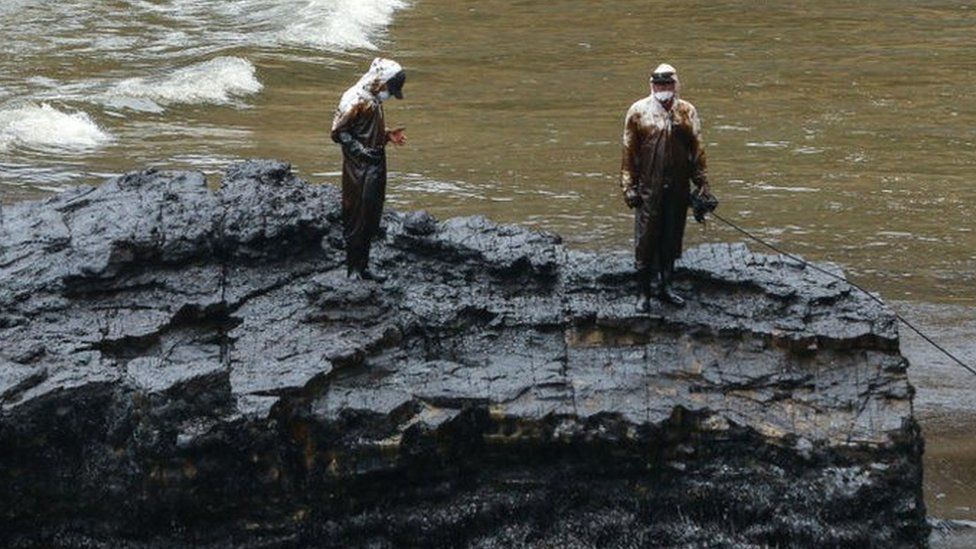
Image source, Getty ImagesImage caption, Repsol employees wore biosafety suits at the shore of Cavero Beach
Earlier this year, President Pedro Castillo described the spill as “one of the biggest ecocides ever on our coasts and seas”.
Hundreds of fishermen and hospitality workers also lost income due to the disaster, according to the Peruvian environment ministry.
Local fisherman staged protests because they were unable to go out to sea and work because of the spill.
Indecopi has alleged that the ecological damage is continuing to affect fishermen and the environment.
“We are looking to get compensation for the affected population… that lives within 150km of contaminated coast,” said Julian Palacin, the head of Indecopi, in a statement.
In January, prosecutors also opened a criminal investigation into Repsol’s role in the incident. Four executives from the firm were barred from leaving the country for 18 months amid the ongoing probe.
In May, Repsol said the clean-up would cost the firm $150m (£127m).
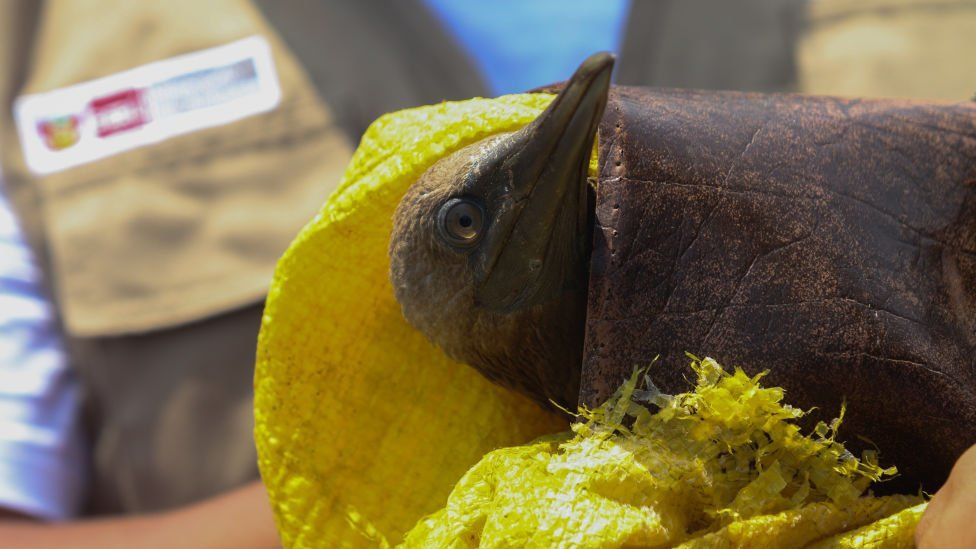
Image source, Getty ImagesImage caption, A piquero bird that was affected by the oil spill
Repsol posted a net income of €2.499bn (£2.11bn) last year – sixteen times the clean-up cost.
Professor in geosciences at the University of Edinburgh, Stuart Haszeldine said that communities and countries “have a right to expect safe transport of oil and gas”.
“There is no established market to buy a clean beach or a seabird colony – inevitably large and financially well-resourced oil companies can deploy cash, lobbyists and legal teams to delay and defocus the blame game away from their responsibility,” he said.
“This will be a contest on the strength of Peru’s legal system to enforce environmental justice onto an unwilling and well-resourced multinational.”
“The final settlement may be influenced as much by Repsol’s valuation of its own reputation and future permissions to operate globally,” he added.
Melissa Moore, head of UK policy at Oceana, a charity campaigning for ocean protection, said she was pleased to hear the case would go to court.
“This damaging oil spill wreaked havoc on two protected biodiversity areas: the Ancón Reserved Zone and the Pescadores Islets – home to iconic and legally protected species such as the Humboldt penguin and sea otter,” she said.
“Countries globally such as Peru, as well as the UK, need to end our reliance on offshore oil drilling, which has destructive impacts on the ocean, including accelerating climate change.”
Peru will release under amnesty about 3,000 prisoners including those who are particularly at risk from the coronavirus pandemic, the justice minister has said.
The disease has killed at least seven inmates, and infected more than 40 in Peru’s overcrowded prisons along with 26 wardens.
“We are going to amnesty approximately 3,000 detainees who fall into the groups vulnerable to the coronavirus,” Minister Fernando Castaneda said Wednesday on the ATV channel.
He said the government would issue a decree on Thursday formalizing the measure.
Among the prisoners who will benefit from the decision are pregnant women, inmates with children under the age of three, those serving sentences of less than four years, and those over the age of 70 who have not committed serious crimes.
The amnesty also includes those with just six months left to serve and those who have conditions that increase their risk from the coronavirus.
Last Friday, two prisoners died in a riot at a jail in northern Peru triggered by fear of the virus after the death of another inmate due to the disease.
As of Wednesday, Peru had 19,250 coronavirus infections and 530 deaths.