A plan to help people in old, falling apart homes needs to get better, a first version of a report said.
A group from the European Parliament’s Petitions Committee went to the Republic of Ireland to learn about the problem of bad concrete blocks used in houses.
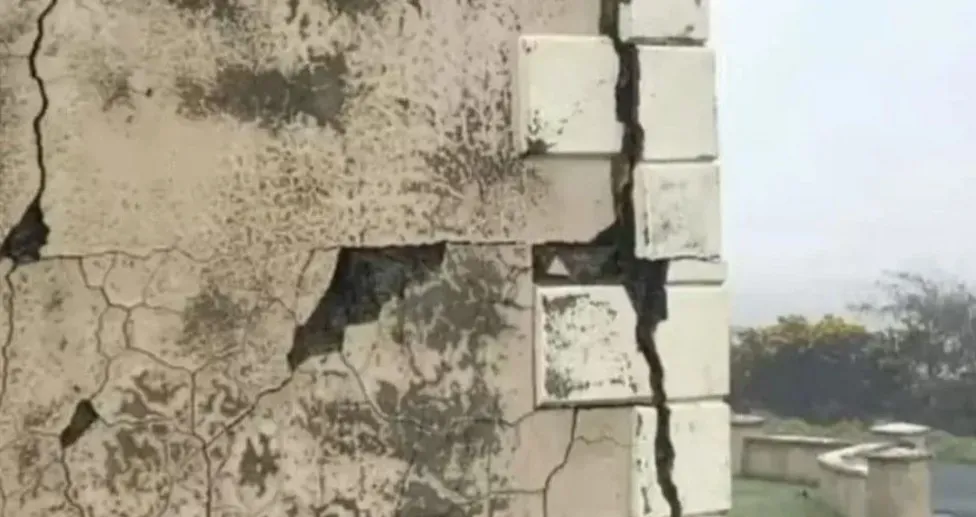
Many houses are falling apart because they used blocks with too much mica in them. Mica soaks up water and makes the walls crack and break.
The European delegation’s report has given the government six suggestions for improving the mica redress scheme.
This means we need to make the plan happen faster and have less paperwork involved.
It also said that a problem with building blocks should never happen again in Ireland or any other EU country.
‘Serious problems’
In 2016, a group of experts was formed in Ireland to look into issues with houses damaged by mica and pyrite.
In 2019, the Irish government said yes to a plan to fix things that cost €20m (£17. 2m)
However, lots of homeowners said the plan was not suitable and asked to be fully compensated.
Under the old plan, homeowners who qualified had to pay 10% of the repairs and any money still owed on their mortgage, while the government paid for 90% of the cost.
In September, the Irish government said they would add 10% tax to concrete blocks.
In November 2021, the government made a lot of changes to the old plan.
The improved plan gives up to €420,000 (£357,500) to each household in Counties Donegal, Mayo, Clare, and Limerick to help homeowners who have been affected.
The Mica Action Group, which speaks for homeowners who are affected, said that the improved plan is still not good enough and there are still big problems.
‘Urgently addressed’
The Europe Parliament’s draft report says that the state’s grant scheme is good, but it needs to be made available to more people and be easier to get.
It also said we need to know exactly who is responsible for this and hold them accountable.
It was also discovered that the bad blocks caused very serious problems for people’s health, money, and relationships, and these problems need to be fixed right away.
The Petitions Committee will talk about the report’s results when they meet in Brussels next Tuesday.
Tag: Republic of Ireland
-
Rebuilding homes grant programme needs improvements – Report
-
Ireland’s extreme right increasing due to immigration in convoluted way
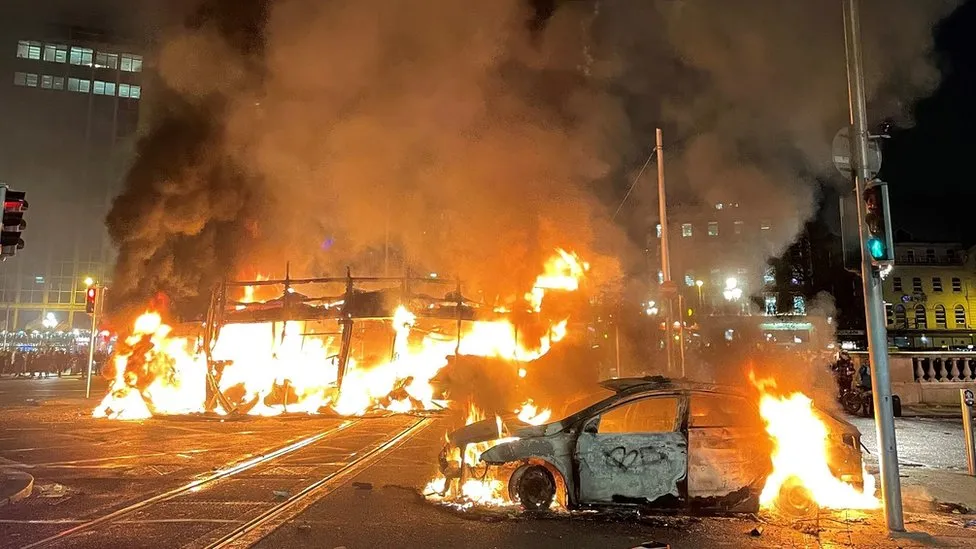
The head of police in the Republic of Ireland has accused a “lunatic, hooligan faction driven by a far-right ideology” of causing Thursday’s riots in Dublin’s city core.
With Ireland’s reputation for warmth and the céad míle fáilte, or “a hundred thousand welcomes,” what is the motivation behind this far-right movement?
The best place to start, even though the answer is complex, is when people first began to leave Ireland about two centuries ago in search of better prospects abroad.
Ireland’s history has included a lot of migration.
Millions of people have departed the island; most of them were escaping starvation and poverty, but some left for other reasons.
While travelling to Ellis Island in New York and the beginning of a new American life, the Irish were among the “huddled masses” who had a view of the Statue of Liberty.
Large numbers of them also emigrated abroad, mostly to Australia and Great Britain.
Up until recently, emigration was merely a way of life for Irish people.
However, it has drastically changed in the last 20 years or so, starting with the enlargement of the EU and, more recently, immigration from Brazil, India, the Philippines, Nigeria, and other nations.
A quarter of the people living in the 26 counties that make up the Republic of Ireland were born outside of their country, according to the most recent Central Statistics Office (CSO) data for 2022.
“80% of the usually resident population was born in Ireland,” according to the CSO, a 3% decline from 2016.
A portion of that decline can be attributed to the roughly 90,000 Ukrainian refugees that arrived after fleeing the conflict with Russia.
According to a recent article by author and Irish Times columnist Fintan O’Toole, there are far more foreign-born people living in Ireland today than there were “during the great age of immigration in the US.”
It also exceeds recent immigration to the UK by a significant margin.
Even after the 2010 European Union-IMF bailout, which momentarily saw a sharp rise in unemployment and a return to emigration, migration has hardly been discussed in Irish party political debate.
media caption“Lunatic, hooligan faction driven by far-right ideology” is the cause of the disturbance, according to the Irish police commissioner.
It is noteworthy that Ireland does not have a mainstream political personality along the lines of Marine Le Pen, Giorgia Meloni, or Geert Wilders.
This can be partially explained by the recollections of emigration and the Irish people’s desire to show kindness to strangers.
Many still talk about the bigoted placards that said, “No Blacks, No Irish, No Dogs,” in London boarding homes.
However, in recent times, prominent law enforcement officials and politicians have started discussing the danger presented by far-right activists who aim to profit on the scarcity of housing, the rising cost of living, and anxieties surrounding the increasing number of asylum seekers.
Mantras such as “Ireland is full” and “Ireland for the Irish” are commonly heard.
Concerns over public order and the far-right have existed for some time prior to the violence of Thursday night.
Police had to take lawmakers out of parliament premises in September as demonstrators obstructed entrances and put up gallows mockery.
Additionally, there are more and more localised protests against the new homes for asylum seekers as some try to gain political benefit before the municipal and European elections that take place the following year.
Right now, no candidate running on a far-right platform has been elected to any office in this country, unlike the majority of the democratic world.
The fanatics have not united behind a single individual or group either.
They all identify as anti-establishment and have various issues, each to a different extent.
Most of them are anti-immigration, but some are pushing for LGBTQ rights and other aspects of “woke culture,” and almost all of them were against the COVID-19 lockdowns.
A new movement has been facilitated by social media.
Not all far-right activists would have approved of the violence that occurred on Thursday night, and not all of the thrashing of stores—especially sports stores—was done by individuals with extreme political views.
Some were simply using the turmoil as an opportunity to rob people and obtain the newest equipment.
Politicians in this country have charged that the far-right is attempting to take advantage of a stabbing event involving an Irish citizen who was purportedly born abroad.
Delivery driver Caio Benicio claimed, “You see a man with a knife with a little girl – there is nothing else to do.”
The media seemed to be concerned that the events do not give rise to a racist narrative.
However, it’s likely that the riot will affect politics as well as policing.
Although they will respect the right to protest, authorities will probably deal with far-right activists more harshly.
Furthermore, Irish Prime Minister Leo Varadkar stated that Ireland “must slow the flow” of refugees from Ukraine and other countries even prior to the unrest.
But the majority of individuals in this room probably want to maintain a common sense viewpoint.
The problems caused by nearly two centuries of emigration are so great that the concerns arising from fairly recent immigration seem insignificant.
It is unlikely that many people would contest the idea that migration needs to be handled carefully.
However, a lot of people argue that it’s more preferable to extend a heartfelt apology than to witness your “huddled masses” depart for distant places.
-
Irish government criticised of disrespecting investigation
Judge’s request for a public investigation into the Omagh explosion on both sides of the border has been referred to as “disrespectful” by the Irish government.
Some families who lost loved ones in the 1998 massacre are represented by attorney John McBurney.
After a minister said there is no new evidence to warrant a public inquiry in the Republic of Ireland, he urged on Dublin to reconsider.
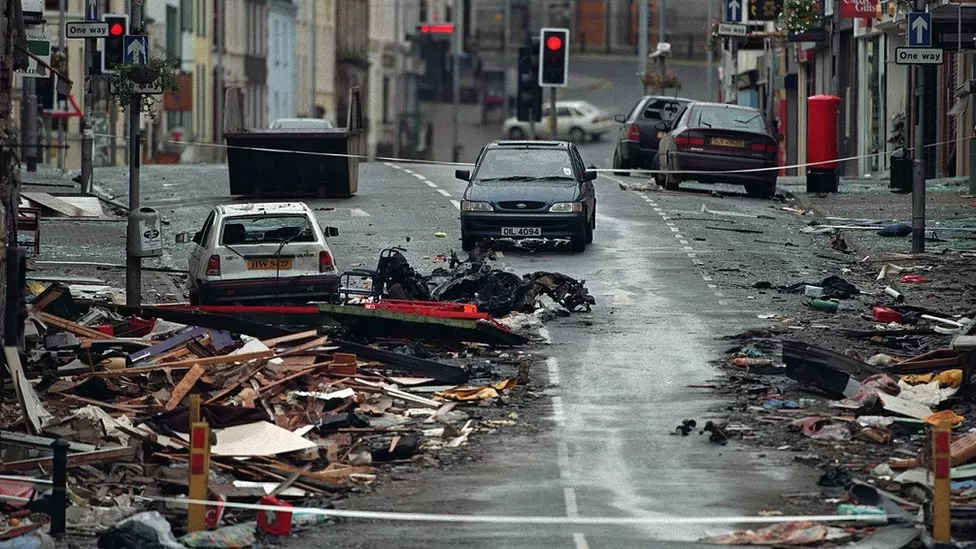
The Real IRA attack resulted in the deaths of 29 individuals, including a mother who was expecting twins.
The UK government should launch a new investigation to see whether the attack might have been avoided in 2021, according to High Court judge Mr. Justice Horner.
He additionally exhorted the Irish government to follow suit.
An independent statutory inquiry will be conducted, Northern Ireland Secretary Chris Heaton-Harris stated earlier this year.
Finalising its terms of reference is currently underway.
The incident has already been the subject of several investigations in Ireland, according to Peter Burke, the Irish Minister for European Affairs and Defence, who made this statement on Wednesday.
He said: “That is our position at the moment.” He continued by saying that the Nally Report had not uncovered any noteworthy new information that called for the opening of an investigation.
Mr. Burke stated that Dublin would fully assist the UK investigation.
According to Mr. McBurney, who represents a few family members in the Families Moving On victims’ support organisation, “On behalf of my clients, I wish to communicate the sense of astonishment and sadness felt upon hearing the hint by minister Burke during a BBC interview.
“The Nally Report lacked the required authority to completely investigate all issues, therefore many questions still need to be answered.
“A full investigation in both jurisdictions was required in order to fully deal with the matter, as Lord Justice Horner made quite clear in a very detailed judgement,” the judge wrote.
Earlier this week, a memorial service was conducted in Omagh to honour the bombing victims who perished 25 years ago.
“It is crucial that the Irish government urgently considers how disrespectful and unsatisfactory it is to ignore the obvious need, in conjunction with a statutory inquiry in Northern Ireland, to properly investigate by public inquiry all outstanding matters, as explained in the judgement of Lord Justice Horner,” Mr. McBurney continued.
“There is now a request for reconsideration of the unfavourable attitude stated by minister Burke, as well as a promise that a joint inquiry will be opened in the Republic of Ireland.
“It is difficult to see how any other arrangement can properly probe all aspects,” the statement reads.
The Irish government needs to step forward.
Kevin Skelton, whose wife Philomena perished in the Omagh blast, questioned the Irish government’s willingness to cooperate with any investigation and claimed that it “only reveals what it wants to.”
“There were people convicted in a civil court,” he continued. “The bomb was made in the south of Ireland, the people who brought it in were from the south of Ireland.”
It is time to act morally correct, and the Irish government needs to stand up.
25 years after the catastrophe, Mr. Skelton claimed that “the bomb is still going off every day” for him.
“Now that it’s been brought to an end, people can move on and have whatever life we have left to live in relative peace,” he continued.
I personally can’t handle much more, and I’m sure there are families out there that feel the same, therefore I don’t want to have to worry about what is on the TV when you turn it on.
Following a series of studies and investigations in the Republic which “warranted the establishment of a public inquiry in Ireland,” the Irish Department of Justice informed BBC News NI that “no new evidence emerged.”
The Irish government is concerned that by the end of the UK probe, there won’t be any unresolved issues pertaining to the Omagh bombing that can only be addressed at this time, they added.
The Irish government will cooperate fully with the UK probe in this matter.