Nato has warned Iran to quit supporting Russia’s military presence in Ukraine.
The Middle Eastern nation has sent hundreds of drones, also known as unmanned aerial vehicles (UAVs), to Russia over the past year in order to terrorise Ukrainian citizens.
Allies have urged Tehran to halt its military assistance to Russia because they are gravely concerned about the “malicious activities” occurring on their own soil.
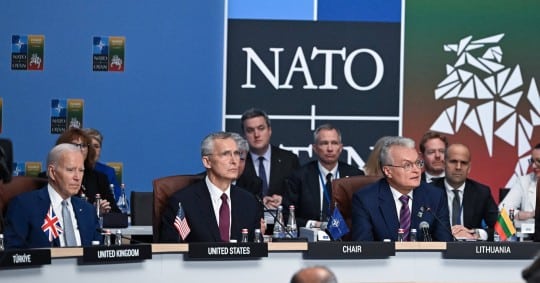
‘We call upon Iran to cease its military support to Russia, in particular its transfer of uncrewed aerial vehicles, which have been used to attack critical infrastructure, causing widespread civilian casualties,’ the 31-member alliance said in a final declaration at a summit in Lithuania.
Allies are seriously concerned by the ‘malicious activities’ within their own territory (Picture: Rex)
‘We express our serious concern over Iran’s malicious activities in allied territory.’
Relations between Tehran and Moscow have grown much closer since the start of the invasion.
Russia wants drones and ballistic missiles, while in exchange Iran wants Russia’s investment and trade.
In June, the White House warned the two countries’ military partnership appears to be deepening.
‘We are also concerned that Russia is working with Iran to produce Iranian UAVs from inside Russia,’ spokesperson John Kirby said in a statement.
Citing newly declassified information, he added that Russia is receiving materials from Iran required to build a drone manufacturing plant that could open as early as next year.
‘We are releasing satellite imagery of the planned location of this manufacturing plant in Russia’s Alabuga Special Economic Zone,’ Kirby said.
The, UK, the US and the European Union in recent months all have issued rules designed to cut off the flow of drone components to Russia and Iran.
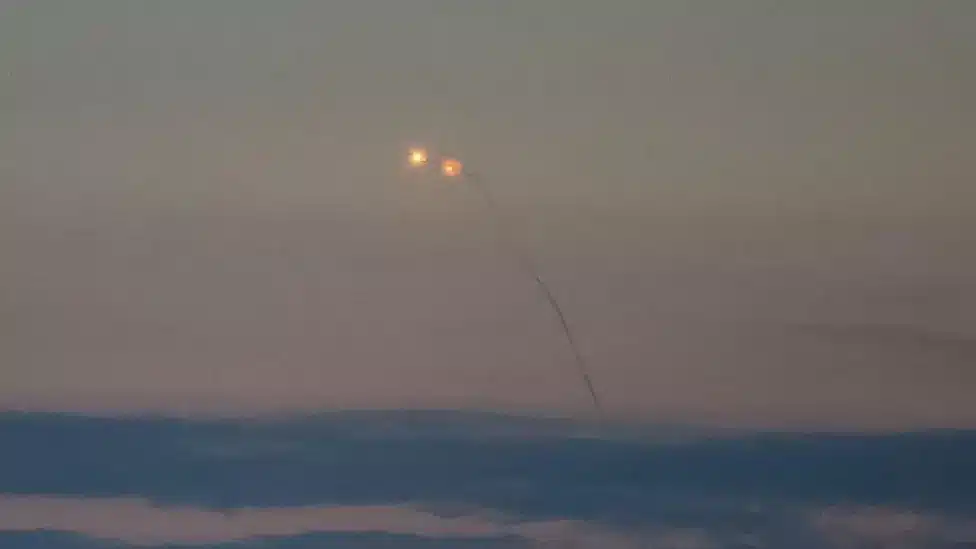
A significant border between Russia and the annexed Crimea has been temporarily closed as a result of a Ukrainian missile attack.
The Kerch Bridge’s traffic was stopped in both directions after Russian air forces claimed they had shot down a missile nearby.
According to the Russian research group Rybar, Ukraine employed a “modernised missile from an S-200 complex with a range of about 250 miles.”
According to sources, the weapon was brought down on Sunday on the Kerch, or Crimean, side of the 10-mile bridge.
It appears there were no casualties but any damage to the bridge will be seen as a blow to Moscow.
The bridge is largely seen as a vanity project for Vladimir Putin, who ordered the £3 billion crossing to be built after he illegally invaded Crimea in 2014.
It was severely damaged last October when a ‘truck bomb’ blew up and killed at least three people, Russian investigators said at the time.
Ukrainian president Volodymyr Zelensky previously said his government ‘did not order’ the attack but his deputy minister of defence, Hanna Maliar, seemingly admitted responsibility over the weekend.
As part of a list of 12 Ukrainian achievements posted on Telegram, he said: ‘273 days ago, (we) launched the first strike on the Crimean bridge to disrupt Russian logistics.’
Sergey Aksyonov, head of the pro-Russian government in Crimea, said: ‘In the Kerch area, air defence forces shot down a cruise missile. No damage or casualties.
‘I ask everyone to remain calm and rely only on trusted sources of information.’
Russia was already fearful of disgruntled Wagner fighters, who have turned against Putin, would try to destroy the bridge.
Last week, tourists heading to the Black Sea peninsula faced severe delays of up to seven hours, as each vehicle was subject to strict security checks.
Guards went to extremes, which included sending children to get x-rays and inspecting every single section of the cars, such as the glove compartments, according to citizen information service InformNapalm.
Now, Russian war channels are discussing the possibility the Ukrainian military will set its sights on the bridge again.
Kyiv previously made a video targeted at Russians planning holidays in Crimea, warning them to ‘stay away’.
The slightly bizarre clip, which was released by the Ukrainian Ministry of Defence, starts with the question: ‘Big plans this summer?’
It begins like a budget ad with grainy clips of surfers in the water, with captions that read: ‘A travel advisory is in effect for certain beaches.
’We warned you last summer to stay away from Crimea.’
The video then suddenly cuts to images of explosions and tourists fleeing missile attacks. A Russian woman is also shown crying in the back of a car.
‘Our seasonal forecast calls for stormy weather,’ it warns finally before ending with lightning.
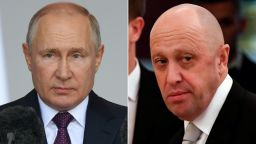
The Kremlin reports that Russian President Vladimir Putin held a meeting with Yevgeny Prigozhin, the leader of the Wagner Group mercenaries, following the failed mutiny by the group last month.
Dmitry Peskov, the Kremlin spokesperson, confirmed that Prigozhin, along with 35 other Wagner commanders, was invited to the meeting in Moscow. During the meeting, President Putin provided an “assessment” of the ongoing conflict in Ukraine and the mutiny itself.
The mutiny, which occurred on June 23, was short-lived, lasting only 24 hours. As part of the resolution to end the mutiny, which saw Wagner troops seizing a city and advancing towards Moscow, charges against Prigozhin were dropped, and he was offered relocation to Belarus.
Prior to the mutiny, there had been public discord between the Wagner Group and Russia’s Ministry of Defense regarding the conduct of the war. Prigozhin had repeatedly criticized the ministry for its failure to provide adequate ammunition to his group.
On Monday, Peskov stated that Prigozhin was one of the commanders who were invited to the Kremlin for the meeting, which took place five days after the collapse of the mutiny.
“The president gave an assessment of the company’s actions on the front,” Mr Peskov is quoted as saying by Interfax news agency.
“He also gave assessment to the 24 June events. Putin listened to the commanders’ explanations and suggested variants of their future employment and their future use in combat.”
According to the spokesman, Prigozhin told Mr Putin that Wagner unconditionally supported him.
The Wagner chief’s current whereabouts are unclear.
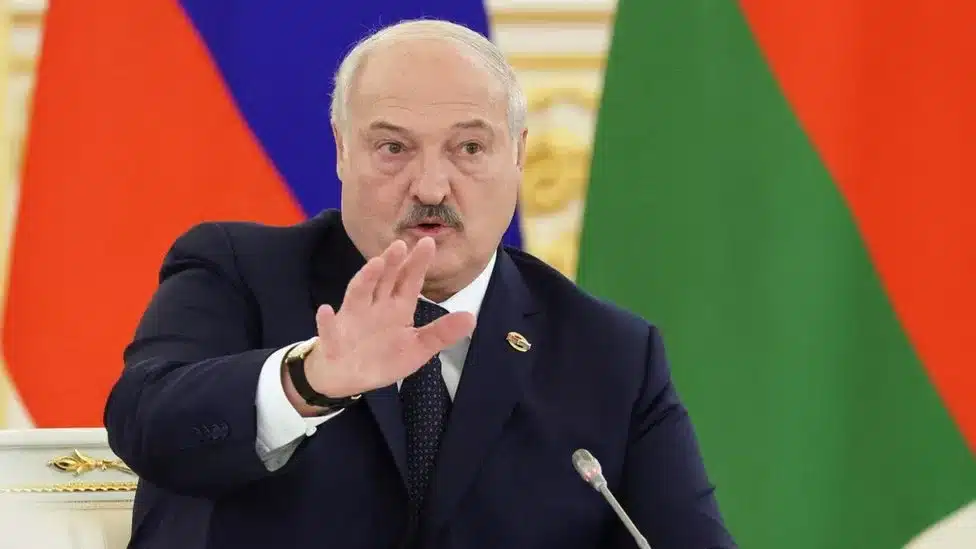
Belarusian leader Alexander Lukashenko, who played a role in brokering the resolution to the mutiny, stated last Thursday that Yevgeny Prigozhin was in Russia. The BBC tracked Prigozhin’s private jet, which flew to Belarus in late June and returned to Russia on the same evening.
The Wagner Group, a private military organization, has been fighting alongside the regular Russian army in Ukraine since the invasion last year. However, following setbacks on the battlefield, Prigozhin used social media to criticize the high command, particularly Defense Minister Sergei Shoigu and Chief of the General Staff Valery Gerasimov, the two top figures overseeing Russia’s invasion of Ukraine.
During the mutiny, Prigozhin did not directly condemn President Putin, but analysts viewed it as the most significant challenge to the president’s authority in his more than two decades in power.
In the meantime, General Gerasimov has made his first public appearance since the mutiny. Speculation had arisen that Wagner’s march was halted in exchange for the general’s dismissal.
However, footage aired on Russian TV on Monday showed General Gerasimov giving orders to attack Ukrainian missile sites, suggesting that the video was recorded after the mutiny. The video indicates that President Putin has retained both Defense Minister Shoigu and General Gerasimov in their positions.
In order to aid Ukraine in defending against Russia‘s constant missile and drone attacks, the UK will provide 17 specialised fire engines.
The Royal Air Force, Defence Fire and Rescue, and the Welsh Assembly are expected to deliver the Rapid Intervention and Major Foam Vehicles in the upcoming weeks, according to the Ministry of Defence.
The vehicles, according to Defence Secretary Ben Wallace, will improve the nation’s capacity to safeguard its infrastructure from the Kremlin’s campaign of missile and drone attacks.
The Ukrainian military fire service has already conducted a week’s training at RAF Wittering to familiarise themselves with the equipment in preparation.
They were delivered from locations around the UK to the Cambridgeshire military base, where personnel are inspecting and preparing them before their onward journey to Ukraine.
Due to arrive in the coming weeks, the urgently-needed equipment will help bolster Ukraine’s ability to respond to damage caused by Russia’s continued use of cruise missiles and one-way attack drones against Ukrainian infrastructure.
Mr Wallace said: ‘These specialist firefighting vehicles will boost Ukraine’s ability to protect its infrastructure from Russia’s campaign of missile and drone attacks and continue our support for Ukraine, for as long as it takes.’
Defence chief fire officer Sim Nex said: ‘The Defence Fire and Rescue family are extremely proud of the specialist support which we have been able to facilitate.
‘We are confident that the equipment provided to date, and associated training, will directly enhance firefighting capability, as we consider further opportunities to support the Ukrainian Military Fire Service moving forward.’
Air Commodore Jamie Thompson, commander of Global Enablement, said: ‘Support to Ukraine, through training and the provision of equipment, remains a priority of RAF Global Enablement.
‘We are proud to work alongside our allies in this effort, supplying specialist equipment and training to assure the safety of the Ukrainian people.’
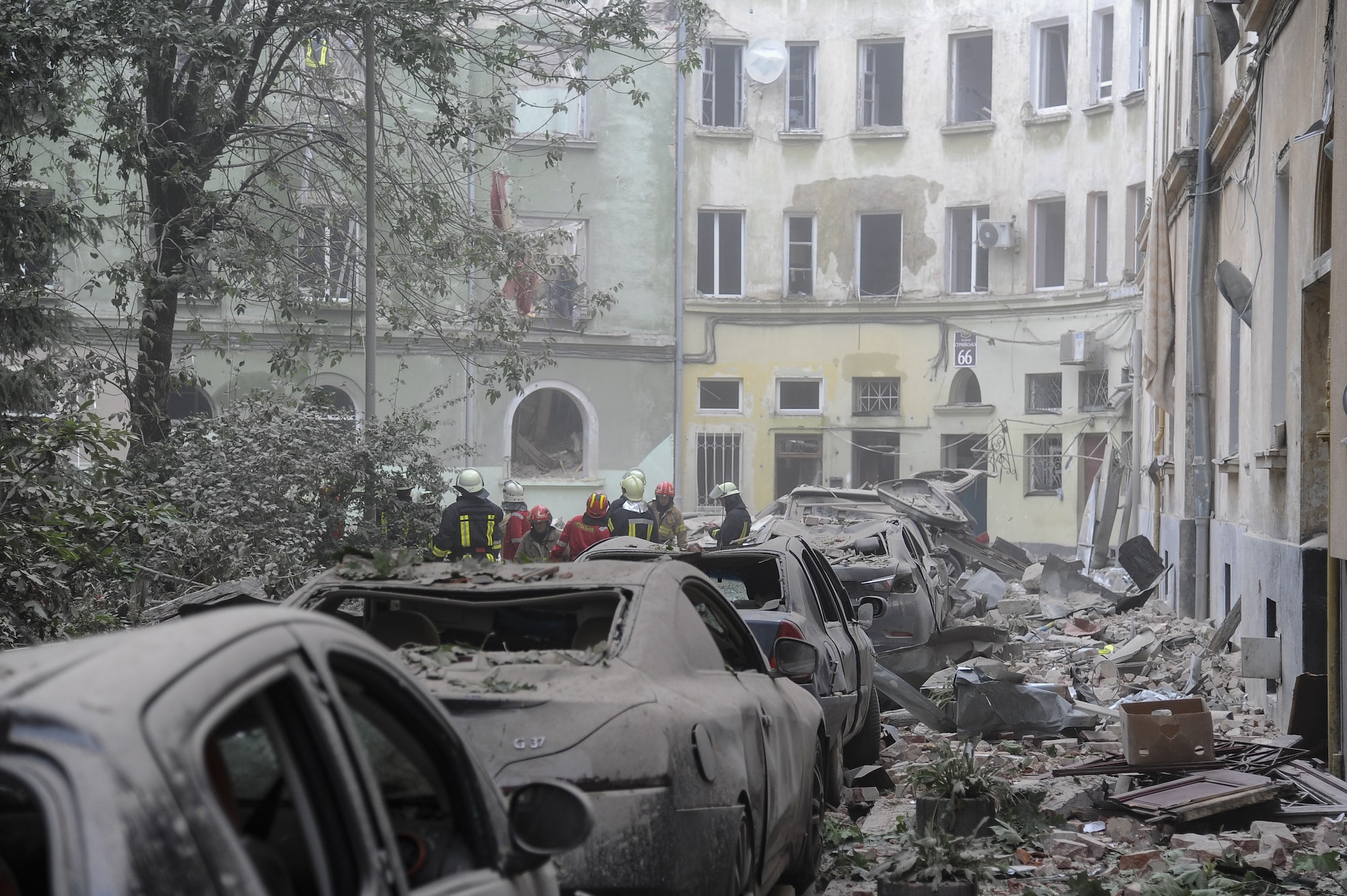
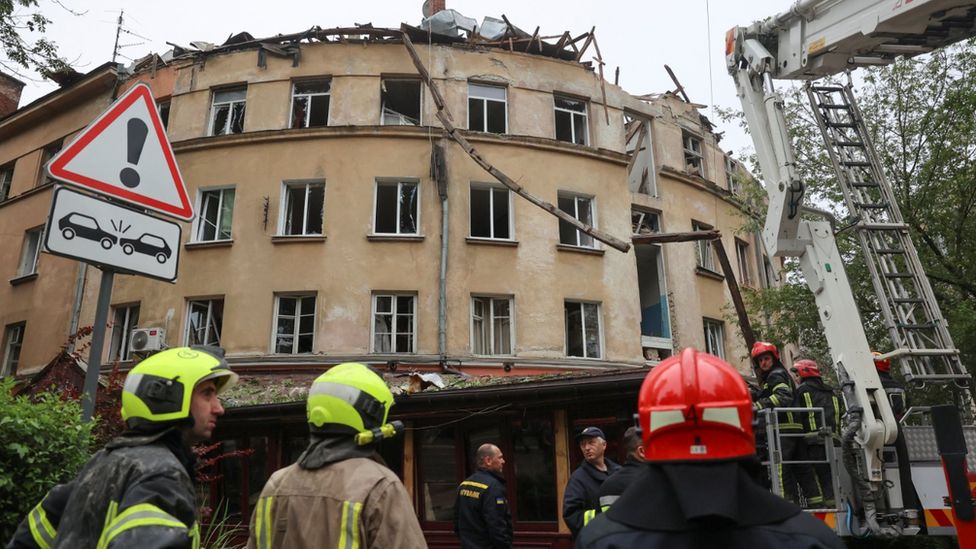
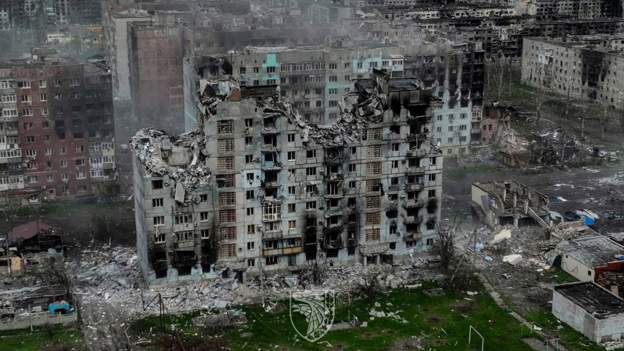
An apartment building in Lviv, western Ukraine, has been struck by a Russian rocket, resulting in the loss of four five lives.
Among the victims are two women aged 21 and 95. The mayor of Lviv described this as one of the most severe attacks on the city’s civilian infrastructure, with 40 people sustaining injuries. Over 30 houses were destroyed, according to Maksym Kozytskyi, the head of the Lviv region.
Ukraine’s air force has accused Russia of launching the missiles from the Black Sea.
As of now, there has been no official comment from Russia’s military regarding the reported attack. President Volodymyr Zelensky has pledged a substantial response to this assault by what he referred to as “Russian terrorists.”
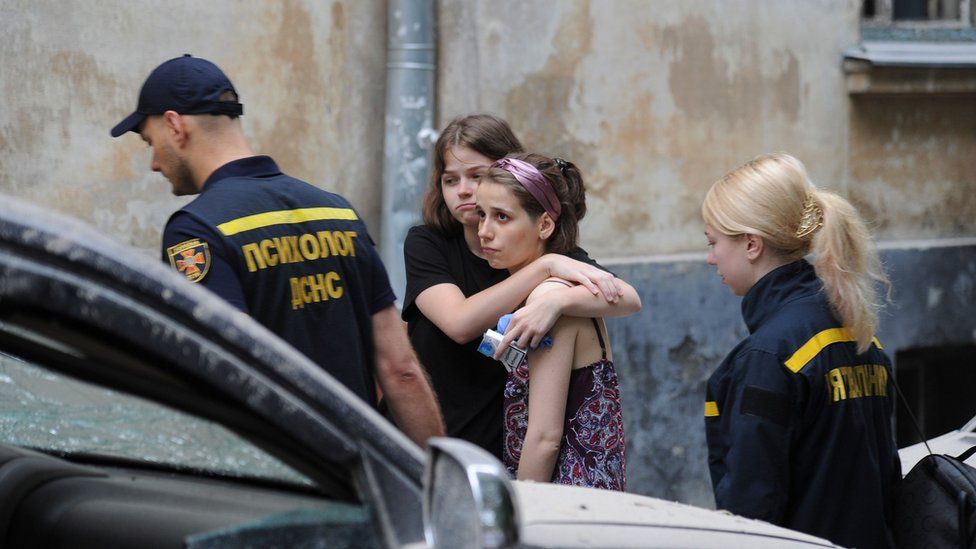
Expressing his grief on Telegram, Mr. Kozytskyi stated, “Tonight, a rocket claimed the life of a young girl in her apartment in Lviv. She was only 21 years old. Russia is robbing us of our youth and our future.”
The number of victims of the Russian strike on #Lviv increased to 5, 40 more people were wounded. pic.twitter.com/na6TWbzUYS
Mr Kozytskyi said emergency services were still working to clear debris and rescue people who are feared to be trapped under rubble.
“There is a shelter next to the house that was hit by the missile,” he added.
“It is in good condition and was open at the time of the alarm. But, only five people were in the shelter from the entire building. Very disappointing.”
Dr Sasha Dovzhyk, who works at the Ukrainian Institute London but is currently in Lviv, described hiding in her bathroom when she heard the air raid siren.
“This is what we are supposed to do,” she told the BBC. “This is the Ukrainian routine.
“You are supposed to put two walls and preferably no windows, no glass, between yourself and the street, the outside.
“When the rocket, the missile, a Kalibr missile as we know now, hit the residential building 2km away, the walls in the bathroom where I was hiding shook, so the impact was quite strong.”
Image caption,Interior Minister Ihor Klymenko said there are fears people are trapped under the rubble
Tragedy struck Kramatorsk, an eastern city near the Russian-occupied areas of Ukraine, last week when a restaurant and shopping center were targeted, resulting in the loss of 13 lives, including children.
Despite being located in western Ukraine, far from the front lines in the south and east, Lviv has also experienced previous attacks orchestrated by Russia.
Just last month, officials in Lviv reported a drone attack on vital infrastructure within the city. These incidents serve as grim reminders of the ongoing threat posed by Russian aggression and the indiscriminate nature of the attacks, which not only impact the conflict zones but also extend to areas further away from the front lines.
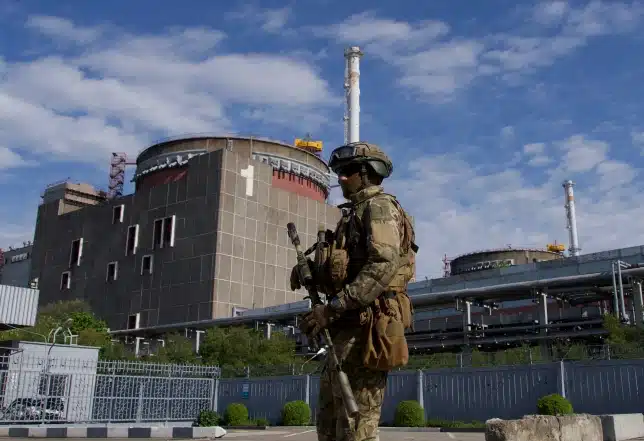
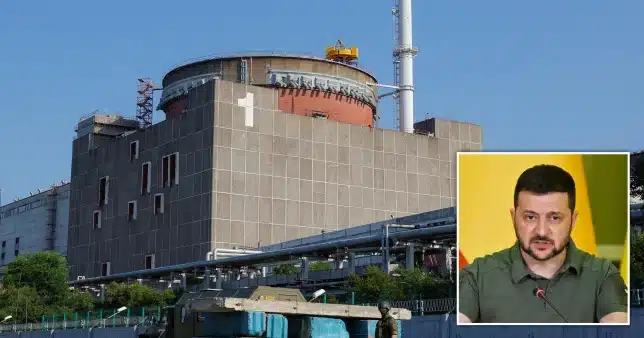
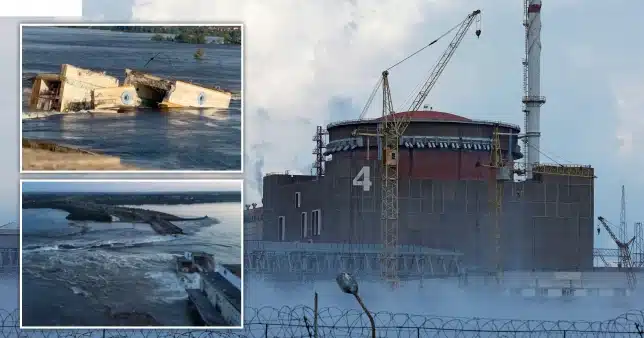
As tensions around the complex rose on Tuesday, Russia and Ukraine once more accused one another of planning an attack on Europe’s largest plant.
Volodymyr Zelensky forewarned that Moscow’s troops might have planted explosives on the roof, which, when they went off, might have been attributed to Ukrainian bombardment.
But Kremlin spokesman Dmitry Peskov hit back at the claims, saying measures were being taken to counter the threat posed to the plant by ‘the Kyiv regime’.
‘The situation is quite tense because there is indeed a great threat of sabotage by the Kyiv regime, which could be catastrophic in its consequences,’ he said.
‘The Kyiv regime has repeatedly demonstrated its willingness to do anything. Therefore, all measures are being taken to counter such a threat.’
He did not present evidence to back his assertions.
Russian troops took control of the Zaporizhzhia plant last year soon after embarking on what Vladimir Putin calls his ‘special military operation’ in Ukraine.
Each side has since regularly accused the other of shelling around the plant and of risking a major nuclear incident.
Last year, when a threat of an accident at the plant first arose, Ukraine established a crisis response headquarters.
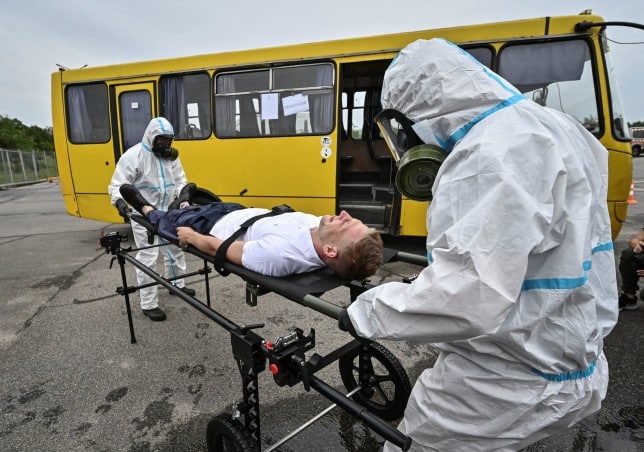
Recently, emergency workers have been taking part in drills in preparation for a potential radiation leak.
Footage showed rescuers in yellow and white protective gear and gas masks, using dosimeters to check passenger cars and trucks for radiation levels and then cleaning wheels before vehicles underwent additional decontamination at specialised washing points. A man on a stretcher was brought into a medical tent as sirens blared.
According to the emergency services, in case of a nuclear disaster at the plant, approximately 300,000 people would be evacuated from the areas closest to the facility.
That covers four regions: Dnipropetrovsk, Kherson, Zaporizhzhia and Mykolaiv. The evacuation would be mandatory.
Those forced to flee will be allowed to bring their pets with them, according to the services. Buses, trains, and personal cars would be used for the evacuation from the affected zone.
A leaflet distributed online lists what to pack in case of an evacuation from a radiation zone.
It then adds: ‘Tightly wrap your suitcase or backpack with cling film or scotch tape. This will definitely ease the process of their deactivation at the sanitation units.’
Depending on the wind direction and the spread of radiation, people would be taken to safer areas within Ukraine.
‘There are different scenarios, but we are preparing for the most critical one,’ Yurii Vlasenko, the Ukranian deputy minister of energy said.
While visiting the republic in southern Russia, Elena Milashina, a well-known Russian journalist who exposed the horrifying crackdown on homosexual men there, was attacked together with a lawyer.
Milashina and her lawyer, Alexander Nemov, were attacked as they travelled to Grozny, the regional capital of Chechnya, to witness the sentencing of a human rights activist.
She explained that she thinks her assailants meant to intimidate her and obtain access to her and Nemov’s equipment when she indicated that they “knew what they were doing” and were “in a hurry.”
“They beat us up two times,” Milashina said in a recorded interview with her employer Novaya Gazeta. “They were very specific, they knew what they wanted, knew what their limits were, beyond which they could not go.”
In the video interview Milashina is shown visibly bruised, her head shaved off and painted green.
“They did this,” she says when asked about her hair. “I don’t have any wounds, thank God, just bruises,” she added, going on to explain she believes Nemov and her were targeted for their professional activity,.
Nemov was beaten and stabbed with a knife, but he still planned on attending the court hearing, according to the Novaya Gazeta.
The newspaper reported that the perpetrators are unknown, also noting that Milashina and Nemov were asked to give a statement to police at the hospital but refused.
Milashina and Nemov were attending a court ruling in the case of Zarema Musaeva – the mother of Chechen activists, the Yangulbaev brothers, who are vocal critics of Chechen leader Ramzan Kadyrov. Musaeva was sentenced to five years and six months in prison on charges of fraud and violence against a police officer, TASS said.
The Kremlin called it “a very serious attack” that required investigative actions and serious measures to be taken. Kremlin spokesman Dmitry Peskov said Russian President Vladimir Putin was informed of the attack and the incident is being handled by Russia’s human rights ombudsman.
Russia’s Investigative Committee has launched an investigation into the attack.
Russia’s human rights commissioner, Tatyana Moskalkova, “agreed to intervene in the situation on the request of the editorial office,” Novaya Gazeta said. CNN has reached out to Russia’s Human Rights Commissioner for comment.
In a statement to Russian state media RIA Novosti, Moskalkova confirmed that the pair were attacked by unknown people and that Milashina’s fingers were broken. Moskalkova also said she asked the Commissioner for Human Rights in Chechnya to ensure the safety of the journalist.
Human rights groups have condemned the violent assault, calling for a swift investigation.
Sergey Babinets, the head of the Russian human rights organization the Crew Against Torture, said that the attackers had mentioned Milashina’s work and previous court reporting while beating the pair. “This is clearly not a gangster attack, this is a direct attack for their work,” he said in a statement
“Amnesty International condemns this cowardly assault in the strongest terms and calls on the Russian authorities to swiftly bring the perpetrators to justice and ensure the safety of those who seek truth and justice,” Amnesty International’s Eastern Europe and Central Asia director, Marie Struthers, said.
Milashina has been previously threatened for her journalism. Following her reporting on a crackdown on gay men in Chechnya in 2017, Muslim clerics in Chechnya called for “retribution” against her and other journalists. She faced death threats and was temporarily forced to flee the country.
The 2017 crackdown saw hundreds of men allegedly held and tortured in detention.
At the time, one witness who fled Chechnya after being arrested told CNN that hundreds of gay men like him were being rounded up by the authorities and held in appalling conditions in at least three detention centers.
The detentions prompted heavy international criticism of Russia. The country has a checkered record on gay rights, breaking up gay pride marches and passing anti-gay propaganda laws.
But the allegations of detention camps and torture emerging from Chechnya were unprecedented. In response, Chechen leader and Kremlin-backed strongman Kadyrov said there were no gay people in his republic, and that if there were any they should be taken away from the region
The Wall Street Journal writer is in good condition and is still robust, according to Ambassador Lynne Tracy.
He was taken into custody on March 29 on espionage charges, making him the first foreign journalist taken into custody in Russia since the Soviet era.
The charges are refuted by the US, the Wall Street Journal, and Mr. Gershkovich.
Russia had been brushing aside US requests for more visits since the ambassador’s initial meeting with the reporter in April.
“Ambassador Tracy reports that Mr Gershkovich is in good health and remains strong, despite his circumstances,” a State Department spokesperson said after Monday’s visit.
The 31-year-old is being held at Moscow’s Lefortovo prison, a former KGB prison.
The visit comes after a Moscow court rejected an appeal to free Mr Gershkovich on 22 June, a move the US said at the time was extremely disappointing.
Up until Monday’s meeting, Secretary of State Antony Blinken was pushing Russia “virtually every day” to permit consular access.
This had been a point of contention with the two countries, with the US accusing Russia of ignoring international law by blocking detained Americans diplomatic access.
Russia had indicated their decision was linked to the US refusing visas to a group of Russian reporters assigned to cover Foreign Minister Sergei Lavrov’s visit to the UN Security Council in New York.
The Russian foreign ministry described the decision to deny the visas as an act of “sabotage”.
Mr Lavrov said Russia would neither forgive nor forget the decision.
Along with Mr Gershkovich, the US has also been advocating for the release of Paul Whelan, a former US Marine who has been in jail for more than four years.
Mr Whelan is in Mordovia, an area far southeast of Moscow known for harsh conditions in its prison camps.
“Both men deserve to go home to their families now,” the State Department said in a statement.
After being jailed for 10 months, basketball star Brittney Griner was released in December after the US brokered a prison swap and released Russian Viktor Bout, who was imprisoned in the US over weapons smuggling.
Mr Blinken has said the US is exploring ways to bring home “many other Americans who are being detained in different parts of the world in an arbitrary fashion”.
Russia may be preparing to launch a major spring offensive, and it could come even before the winter snows start to melt.
The time to give Ukraine what it needs to defend itself and expel the Russian invaders is now. But despite a remarkably unified commitment, some of Ukraine’s supporters in the West are throwing wrenches in the pipeline.
Ukraine believes the Kremlin could make another push to take the capital, Kyiv, and anticipates that Russian President Vladimir Putin will call up some 500,000 more troops in addition to the 300,000 mobilized late last year.
Moscow denies it’s planning a second mobilization, but the independent Russian news outlet Volya, citing sources in Russia’s military, reported that Moscow plans to recruit another 700,000 troops. In addition, Ukraine also faces more than 50,000 private-army mercenaries, most of them Russian prisoners released in exchange for fighting.
On Friday, US Defense Secretary Lloyd Austin declared, “This is a decisive moment for Ukraine, in a decisive decade for the world,” following a crucial meeting of Ukraine’s top Western allies at Ramstein Air Base in Germany.
Ukraine is fighting against a Russia that has been a pernicious, destabilizing force on the global stage. The West is trying to calibrate its support, but the result of the Ramstein meeting was disappointing for Kyiv and for those who believe Russia must be defeated.
Austin reiterated that the United States will continue to support Ukraine “for as long as it takes,” urging Kyiv’s friends to “dig even deeper.” Despite the exhortations, however, the defense chiefs failed in one of the principal goals of the meeting, deciding to send battle tanks, which Ukraine says it needs without delay.
The decision on tanks was blocked by Germany, reluctant to send its Leopard 2 tanks or to grant permission to other countries that own them to release them. Berlin fears that Moscow will view the presence of German tanks as a provocation and wants the US to send its tanks to give it cover.
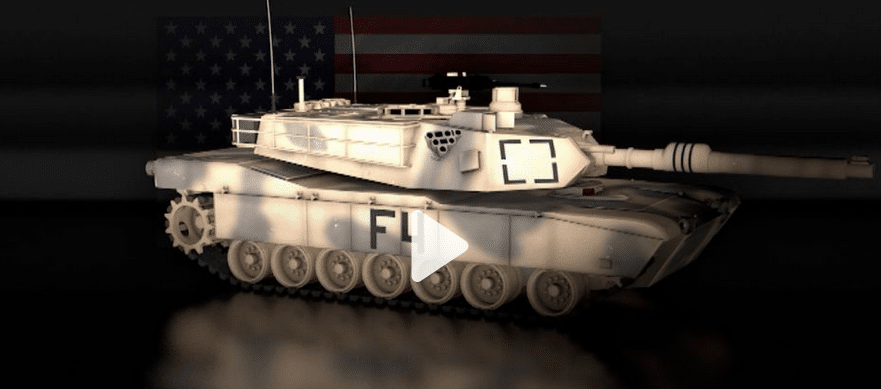
Washington is sending armored fighting vehicles and other heavy weapons but maintains that its Abrams tanks are unsuited for this war because learning to operate them takes too long and they are difficult to maintain. They insist the German tanks are a better fit.
Blocking the transfer of needed weapons to Ukraine is, shall we say, not Germany at its best.
Ukraine’s Eastern European backers, invaded by Russia during the Cold War and earlier, were fuming. Poland’s foreign minister lambasted Germany, reminding Berlin that this is not just an exercise, “Ukrainian blood is shed for real.” The three Baltic states — Latvia, Estonia and Lithuania — demanded that Germany act “now.”
A frustrated Ukrainian President Volodymyr Zelensky has said, “There is no rational reason why Ukraine has not yet been supplied with Western tanks.”
As it battles Russian soldiers and mercenaries, Ukraine has another worry. One Ukrainian source told CNN that Kyiv is concerned about the shift in the political balance in Washington now that Republicans — some of whom are less than wholeheartedly supportive of Ukraine — have taken control of the US House of Representatives. Ukrainians require the continuing forceful backing they have received from Washington.
Watching from afar, it’s easy to get the impression that Putin may soon end his hapless Ukraine war. After all, this conflict has been an utter disaster for Russia, even if it continues to kill scores of civilians by bombing apartment blocks, and despite an occasional symbolic advance.
Putin has no intention of stopping. He has silenced his liberal critics at home, but he is under pressure from far-right nationalists, including some who own mercenary armies and are showing off their prowess while mocking the Russian army that answers to him, as has Yevgeny Prigozhin, who runs the notorious Wagner Group.
Besides, Putin, who views himself as a clever student of history, may be looking at some of Russia’s greatest victories, which it wrested out of the jaws of defeat.
Russia managed to repel invasions by Napoleon and the Nazis, but the current Russian President may have gleaned the wrong lesson from his predecessors’ prowess. Napoleon and Hitler were the invaders. The Russian empire, and later the Soviet Union, was defending itself.
This time, Russia is the aggressor. Ukraine has the home-field advantage, including the inexhaustible determination to defeat the hated invader.
In fact, history teaches us something else: In 2008, Putin invaded neighboring Georgia and got away with capturing some of its territory. In 2014, he invaded Ukraine’s Crimean Peninsula and got away with that. Then, last year, he decided to take all of Ukraine.
The lesson is that when the Kremlin’s expansionist military adventures succeed, they are followed by more aggression, more wars, more illegal confiscation of its neighbors’ territory. Moscow’s victories seem to produce more wars of Russian aggression.
Defeating this assault is the best way to secure future peace, to reaffirm the notion that a rapacious country cannot simply swallow a peaceful neighbor — a notion we thought had ended after World War II.
Understandably, Germany emerged from that war with a pacifist bent. But the lesson of World War II is about the danger of allowing aggressive despots to make gains.
German Chancellor Olaf Scholz may hesitate to send tanks to fight Russia, as Germanydid in the 1940s, but he too may be distilling the wrong lessons from history. German tanks invaded a sovereign country back then. This time, they would be defending one.
Some, in fact, argue that the World War II experience bestows Germany with a unique moral responsibility to provide Kyiv what it needs. (When the Nazis invaded the Soviet Union, by the way, they invaded Ukraine, one of its republics.)
After the defense ministers at Ramstein announced they had not decided to send tanks, Zelensky, clearly disappointed, reaffirmed that Ukraine urgently needs tanks but added an intriguing comment about what had transpired. “Not everything,” he said, “can be announced in public.”
Sooner or later, I have little doubt, the tanks will come. Already German Defense Minister Boris Pistorius has ordered an inventory of the Leopards and suggested that other countries that own them start making preparations in case Germany authorizes the transfer.
Later is better than never, but there’s no reason, no excuse to delay, because Russia is about to make the war in Ukraine even deadlier. The window for preventing a much longer war may soon close.
Since 2017, the Ghanaian government has allocated over GH¢800 million to bolster and foster the growth of the micro, small, and medium enterprise (MSME) sector, as disclosed by the Chief Executive Officer (CEO) of the Ghana Enterprises Agency (GEA), Kosi Yankey-Ayeh.
This significant investment has positively impacted more than 900,000 MSMEs nationwide, playing a vital role in driving the country’s economic progress and prosperity, especially during the challenging times of the global economic downturn triggered by the COVID-19 pandemic and the Russia-Ukraine conflict.
“Beneficiaries have seen their businesses develop and their communities benefit from the positive impact they have had. These successes mean that we cannot rest on our oars; we must work harder to make many more dreams come to life,” Mrs. Yankey-Ayeh said.
She mentioned this at the 2023 MSME Day, which was under the theme ‘Building resilient and sustainable MSMEs to create one million jobs’.
Commenting on the theme, Mrs. Yankey-Ayeh assured that GEA will not relent in its quest to strengthen the capacity and competitiveness of MSMEs and maximise their contributions to the country’s economicand social development.
“As the apex government Agency mandated to promote and develop the MSME sector, we are proud of the role we play in supporting the MSME sector to grow; and we take pride in the fact that businesses are embracing and utilising all the support services we churn out for their continuous improvement and growth,” she stated.
“Your relentless efforts, entrepreneurial spirit and unwavering dedication have played a crucial role in driving Ghana’s economic growth and prosperity; and we ought to recognise and celebrate the immense contributions made by you, our MSMEs, in shaping our nation’s economic landscape,” Yankey-Ayeh added.
Over the years, the Agency through government has embarked on a number of initiatives with the objective of fostering an enabling environment for MSMEs to thrive. She stated that training and capacity-building programmes, business advisory and financial assistance have equipped MSMEs with the right tools to put them on a trajectory of growth.
“We will continue to do so to help them succeed long-term,” Yankey-Ayeh assured.
Thanks to partnerships with institutions including the Food and Drugs Authority and other regulatory bodies, the GEA said it has streamlined bureaucratic processes and reduced the constraints MSMEs face in mainstreaming and formalising their operations.
“We have always believed in helping MSMEs to thrive,” Mrs. Yankey-Ayeh said. “We understand the essence of providing them with access to financing, mentorship, training and networking opportunities. These are the building blocks of President Akufo-Addo’s entrepreneurial vision, and we believe by making these our guiding policies we will be able to help many entrepreneurs move from ideas to thriving businesses,” she added.
Russia is ‘technically ready,’ according to the president of Ukraine, to attack the power plant.
He declared on Saturday that there was a “serious threat” since Russia was technically prepared to produce a nearby explosion at the station, which might result in a radioactive spill.
He made no more statements but credited his intelligence operatives as the information’s source.
Zelensky urged world leaders to pay closer attention to the circumstances around Zaporizhzhia, the biggest nuclear reactor in Europe.
He also urged sanctions on Russia’s state nuclear company Rosatom.
The plant, located near the city of Enerhodar in southern Ukraine, has been occupied by Russia since early March last year, shortly after Moscow’s invasion.
Russia has previously denied Kyiv’s accusations that Russia was preparing an explosion at the plant. Kyiv and Moscow have accused each other of shelling the vast facility.
Last week, authorities conducted renewed nuclear disaster response drills in the area.
Yuriy Malashko, governor of the Zaporizhzhia region, said they were intended to coordinate the response of all services to an ‘emergency situation’ at the plant.
Footage showed rescuers in yellow and white protective gear and gas masks, using dosimeters to check passenger cars and trucks for radiation levels and then cleaning wheels before vehicles underwent additional decontamination at specialised washing points.
A man on a stretcher was brought into a medical tent as sirens blared.
Ukraine, then part of the Soviet Union, suffered the world’s worst nuclear accident in 1986, when clouds of radioactive material spread across much of Europe after an explosion and fire at the Chornobyl nuclear power plant.
Ion Munteanu, the nation’s chief prosecutor, indicated that the incident is being looked into as a potential terrorist act.
Olena Shevelyova, one of the witnesses, reported hearing four to five bullets. She continued, “We heard some guns firing and we were asked to go in some buildings here… to hide behind the building.”
Ambulances could be heard approaching the airport, according to Ms. Shevelyova, a 48-year-old Ukrainian executive who was waiting to join a trip to Milan.
‘It was unclear if there was a bomb or something had happened,’ she went on. ‘It was only after we went far away from the airport that we were told there is someone who is shooting.’
Since Russia invaded Ukraine, neighboring Moldova — a country with a population of about 2.6 million people, and a European Union candidate since June 2022 — has faced a long list of crises.
These include an acute winter energy crisis after Russia dramatically reduced gas supplies and recurring anti-government protests organised by a Kremlin-friendly political party against the ruling pro-Western administration.
Moldova’s leaders have also repeatedly accused Moscow of conducting campaigns to try to destabilise the country, which was a Soviet republic until 1991.
Authorities in Warsaw have revealed that a professional ice hockey player from Poland’s top league has been charged with espionage on behalf of Russia.
The individual, who holds Russian citizenship, was apprehended on June 11 in Silesia, located in southern Poland. It is believed that he is associated with a Russian spy network.
Poland’s Internal Security Agency (ABW) has detained a total of 14 individuals thus far, all of whom are suspected of being part of the same group. While the suspects come from countries situated to the east of Poland, not all of them are necessarily Russian citizens.
The long-standing espionage conflict between Russia and Western nations has escalated significantly since Moscow’s full-scale invasion of Ukraine in February 2022. Poland, a staunch ally of Ukraine, has provided military support, financial assistance, and refuge to millions of Ukrainian refugees.
In a statement on Friday, Polish Justice Minister Zbigniew Ziobro said the arrested ice hockey player was competing in a club from the country’ s Ligue 1 – the second-highest division.
“A spy who acted under the guise of an athlete was caught,” the minister said. He did not name the detained player, but several Polish media outlets identified the suspect as Maksim S.
He is now being held in pre-trial detention. If convicted, he faces up to 10 years in prison.
The charged ice hockey player has not made any public comment so far.
The Russian foreign ministry protested to Poland over the detention of the player. “We demand that the Russian side be immediately provided with comprehensive explanations,” ministry spokesperson Maria Zakharova was quoted as saying by Russia’s state-run Interfax news agency.
On Friday, the Polish authorities said the suspected Russian spy ring had been used by Moscow to conduct intelligence activities, including the monitoring of railways, as well as spreading propaganda against Poland and the Nato military alliance.
The authorities also claimed the ring had prepared sabotage acts ordered by Russian intelligence.
The future of agreements made between several African nations and the Wagner mercenary group, according to Russian Foreign Minister Sergey Lavrov, is a problem for the respective governments of those nations.
On the basis of contracts negotiated directly with the relevant governments, Wagner worked in the Central African Republic (CAR) and other nations, according to Lavrov, who was speaking at a news conference on Friday.
He also said Russia’s defence ministry had long had “several hundred” military advisers working in the CAR.
Wagner mercenaries, known for their involvement in the Ukraine conflict, staged a brief mutiny last Saturday, seizing control of the southern Russian city of Rostov-on-Don and marching towards Moscow before a deal ended their revolt. This incident has raised questions about the presence of Wagner operatives in the Central African Republic (CAR) and other parts of Africa, as well as Moscow’s level of engagement with the group’s activities on the continent.
Russian President Vladimir Putin revealed on Tuesday that Wagner was fully financed by the state, with approximately 86 billion rubles (around $940 million) being allocated to the group between May 2022 and May 2023.
In Mali, where military coups occurred in 2020 and 2021, the country is engaged in a long-standing battle against armed groups linked to ISIL (ISIS) and al-Qaeda. The authorities in Mali have stated that the Russian forces present there are not Wagner mercenaries but rather trainers assisting local troops with equipment acquired from Russia.
Wagner mercenaries have faced accusations of human rights abuses, notably the March 2022 incident in Moura, central Mali, where local troops and suspected Russian fighters allegedly killed hundreds of civilians.
In neighboring Mauritania, thousands of Malians have sought refuge in the M’bera camp since 2021, according to United Nations officials managing the camp. The camp recorded nearly 7,000 new arrivals between March and April 2022 alone.
French President Emmanuel Macron, in February, described the deployment of Wagner troops in Africa as a support system for failing regimes that only brings suffering and misery.
Other suspicious deaths since the start of Vladimir Putin’s war in Ukraine include that of Russian defence official Marina Yankina, 58, in February this year. Like Ms Baikova, she fell to her death from an apartment window.
As head of the financial support department of the Ministry of Defence, Ms Yankina was a key figure in the funding of the war.
Near the nuclear power plant that is held by Russia in Zaporizhzhia, Ukraine has been practising its nuclear disaster response procedures.
The drills, according to the governor of the Zaporizhzhia region, which includes the facility, Yuriy Malashko, were created to coordinate the response of all services to a “emergency situation” at the plant.
It follows Kyiv’s accusation that Moscow was planning a “radiation catastrophe” by attacking the facility in a “terrorist” manner, a claim that Moscow has refuted.
Russia’s envoy to the UN Vassily Nebenzia wrote to the Security Council and Secretary-General Antonio Guterres saying: ‘We do not intend to blow up this NPP (nuclear power plant), we have no intention of doing so.’
Footage showed rescuers in yellow and white protective gear and gas masks, using dosimeters to check passenger cars and trucks for radiation levels and then cleaning wheels before vehicles underwent additional decontamination at specialised washing points.
A man on a stretcher was brought into a medical tent as sirens blared.
Tetyana, 45, said as she was checked for radiation as part of the drill: ‘Of course, it is scary. I fear for my family, my child. What do we do? It is very scary.’
Officials and civil defence forces worked on scenarios that might follow a nuclear disaster, and on how to inform and evacuate the population.
‘We have assumed the worst scenario, in which the contamination zone will be bigger than 50 kilometres,’ Yurii Vlasenko, a deputy energy minister, told reporters.
‘This would mean four regions would be affected.’
He said the results of the drill were good and Ukraine was ‘ready for the challenges’ Russia posed.
The Zaporizhzhia nuclear power plant, Europe’s largest, has been occupied by Russia since early March last year, shortly after Moscow’s full-scale invasion.
Kyiv and Moscow have accused each other of shelling the vast complex ever since.
Ukraine, then part of the Soviet Union, suffered the world’s worst nuclear accident in 1986 at the Chornobyl nuclear power plant.
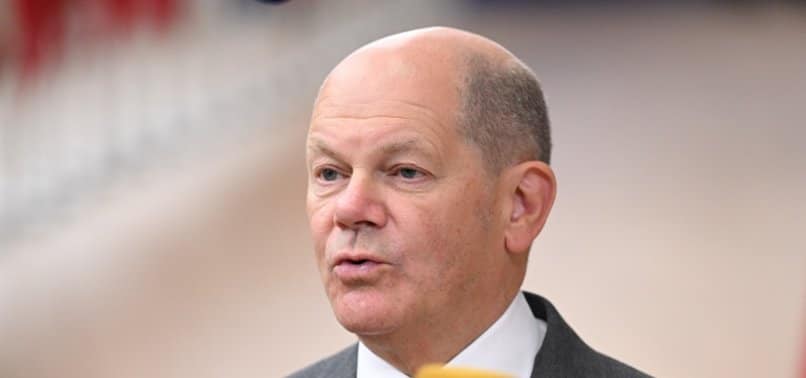
Germany is not seeking a change of government in Russia, German Chancellor Olaf Scholz has said, stressing his support for Baltic countries and Poland.
Scholz spoke after arriving at a two-day European Union summit in Brussels.
“Our goal here is not a change of government, a regime change in Russia,” Scholz said, adding that Germany is not party to what is happening in Russia.
“Every attack on NATO territory is a matter to which we have to respond collectively,” Scholz said, stressing his support for the countries concerned.
The Central African Republic’s armed forces will continue to get assistance from Russian experts, but the Wagner Group’s actions there are its own, distinct operations, according to the Kremlin.
The Kremlin statement on Wednesday concerns a country with which Russia has had close ties with in recent years. Hundreds of Russian operatives, including many from the Wagner Group, have been helping its government fight rebel uprisings against President Faustin-Archange Touadera since 2018.
And Touadera is scheduled to attend the second Russia-Africa Summit in St Petersburg in July.
But Wagner’s fate is uncertain after its abortive mutiny in Russia on Saturday.
This week, Russian Foreign Minister Sergey Lavrov told state broadcaster Russia Today that Wagner’s work in CAR “as instructors … will continue” and that the weekend’s events would not impact relations between Moscow and its partners and allies.
Meanwhile, Bangui has remained upbeat about the situation with minister and presidential adviser Fidèle Gouandjika telling the Agence France-Presse news agency that what the country had in place was “a defence deal with Russia and not Wagner. … Moscow has subcontracted to Wagner, and if Russia doesn’t agree, it will send us a new contingent.”
The mercenary group has been accused of multiple human rights abuses in CAR, Burkina Faso and Mali.
And no, there are questions about whether the group could still be seen as a stabilising force for tackling armed groups after its mutiny in Russia.
“They will be seen as too unstable and potentially a threat to the leadership in those countries,” Michael Mulroy, a former senior Pentagon official, told the Reuters news agency.
“They almost started a coup in their own [country].”
Ethiopia’s Foreign Minister Meles Alem, has formally sought to join the Brics allianceand is “hoping for a positive response”.
Brics – which is an acronym for Brazil, Russia, India, China and South Africa – is seen by some as an alternative to the G7 group of developed nations.
Ethiopia is one of the biggest economies in Africa and has enjoyed an increase in trade with China and India among others, but its economy has recently been ravaged by war and drought.
Earlier this month, the Brics group said they had received requests from dozens of countries, including a few African states, that wished to join the club of emerging economies.
Brics countries have a combined population of more than 3.2 billion people, making up about 40% of the world’s roughly eight billion people.
According to unconfirmed reports, the Wagner rebellion resulted in the arrest of at least one individual.
Armed forces chief of staff General Valery Gerasimov has not appeared in public or on state TV since the aborted mutiny on Saturday, when mercenary leaeder Yevgeny Prigozhin demanded Gerasimov be handed over.
Nor has he been mentioned in a defence ministry press release since June 9.
Gerasimov, 67, is the commander of Russia’s war in Ukraine, and the holder of one of Russia’s three ‘nuclear briefcases,’ according to some Western military analysts.
Absent from view too is General Sergei Surovikin, nicknamed ‘General Armageddon’ by the Russian press for his aggressive tactics in the Syrian conflict, who is deputy commander of Russian forces in Ukraine.
A New York Times report, based on a U.S. intelligence briefing, said on Tuesday he had advance knowledge of the mutiny and that Russian authorities were checking if he was complicit.
The Kremlin on Wednesday played down the report, saying that there would be a lot of speculation and gossip.
U.S. officials told Reuters on Wednesday that Surovikin had been in support of Prigozhin, but that Western intelligence did not know with certainty if he had helped the rebellion in any way.
The Russian-language version of the Moscow Times and one military blogger reported Surovikin’s arrest.
Meanwhile, some other military correspondents who command large followings in Russia said he and other senior officers were being questioned by the FSB security service to verify their loyalty.
Rybar, an influential channel on the Telegram messaging application run by a former Russian defence ministry press officer, said a purge was underway.
He said the authorities were trying to weed out military personnel deemed to have shown ‘a lack of decisiveness’ in putting down the mutiny amid some reports that parts of the armed forces appear to have done little to stop Wagner fighters in the initial stage of the rebellion.
‘The armed insurgency by the Wagner private military company has become a pretext for a massive purge in the ranks of the Russian Armed Forces,’ Rybar said.
Such a move, if confirmed, could alter the way Russia wages its war in Ukraine which it calls a ‘special military operation’ and cause turmoil in the ranks at a time when Moscow is trying to thwart a Ukrainian counteroffensive.
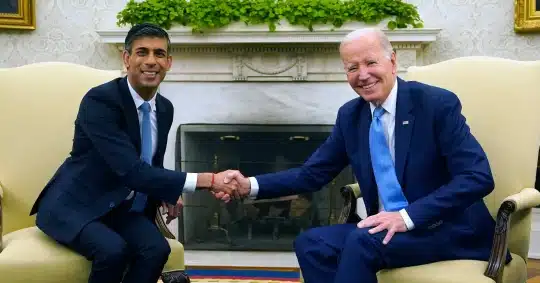
On Monday, President Joe Biden (left) made his first remarks regarding the Wagner Group’s uprising against Russia. On Monday, President Joe Biden (left) made his first remarks regarding the Wagner Group’s uprising against Russia. (Images via Rex/Reuters)
In his initial remarks following the march on Moscow, US President Joe Biden claimed that the US and its allies had “nothing” to do with the Wagner uprising against Russia.
On Monday, Biden addressed the weekend coup attempt by the Wagner Group, which saw it capture control of a significant Russian city and briefly advance on Moscow.
‘They agreed with me that we had to make sure we gave (Russian President Vladimir) Putin no excuse – let me emphasize, we gave Putin no excuse – to blame this on the West or to blame this on NATO’.
Wagner mercenary chief Yevgeny Prigozhin leaves the headquarters of the Southern Military District amid the group’s pullout from the city of Rostov-on-Don, Russia, on Saturday (Picture: Reuters)
Biden added: ‘We made clear that we were not involved. We had nothing to do with it. This was part of a struggle within the Russian system.’
The mercenary group revolted on Friday, with its found Yevgeny Prigozhin saying he intended to punish defence minister Sergei Shoigu and army chief Valery Gerasimov for launching rockets at his troops. The uprising was the biggest threat to Putin in more than two decades.
After a day of conflict, Prigozhin agreed to exile in Belarus.
Still, Biden said the ‘ultimate outcome’ of the insurrection remains to be seen.
‘I directed my national security team to monitor closely and report to me hour by hour,’ he said. ‘I instructed them to prepare for a range of scenarios.’
Putin called the Wagner rebellion ‘treason’. In an unscheduled national address on Monday, the Russian president reiterated his offer of amnesty to insurrectionists but not to Prigozhin.
Biden on remained silent over the weekend on the uprising. The US president spoke with European allies by phone on Saturday and then traveled to Camp David along with his national security adviser Jake Sullivan.
US intelligence officials gathered detailed information of Prigozhin’s plans leading up to the rebellion including how he planned to advance, sources told CNN on Monday. That intelligence was reportedly only shared with some allies, including British officials, and not to NATO.
Two British planes are said to have been intercepted by Russia over the Black Sea.
In a statement, Russia’s ministry of defence asserted that the RAF fighter jets turned around as its aircraft approached, ensuring that Russia’s state border was not crossed.
The RC-135 reconnaissance plane, which is operated by both the RAF and the US Air Force, was seen flying alongside the two Typhoon planes as they were sighted over the Black Sea, according to the report.
The statement continued, “The flight by the Russian fighter jets was conducted in strict compliance with the international regulations for the use of airspace over international waters without crossing air routes or coming in perilously close proximity to aircraft of a foreign state.”
This is a breaking news story, more to follow soon…Check back shortly for further updates.
Russian Foreign Minister Sergei Lavrov has addressed the future of Wagner fighters operating in Africa.
While recent events involving Wagner and its leader Yevgeny Prigozhin have primarily focused on Russia and Ukraine, the mercenary group also has a presence in various African countries, including the Central African Republic and Mali, where they have faced allegations of committing atrocities and war crimes.
Concerns have been raised regarding the future of these African deployments, as they have been viewed by many as unofficial representations of Russia.
However, in an interview on the state-owned RT channel, Mr. Lavrov stated that the Wagner operations in Africa will continue, as reported by the AFP news agency.
Wagner members “are working there as instructors. This work, of course, will continue,” the minister said.
He said the aborted rebellion would not change Russia’s relationship with “partners and friends”, AFP quotes him as saying.
Yevgeny Prigozhin, the commander of the Wagner, has spoken out for the first time since the weekend’s aborted military coup.
In an 11-minute audio recording he posted, he claims that no one consented to a contract being signed with the defence ministry and that his mercenary organisation was obligated to suspend operations on July 1.
When he announced that his men would march on Moscow, Prigozhin made it plain that he wasn’t targeting Putin, saying: “We didn’t march to overthrow Russia’s leadership.”
In his video message, he says: ‘The aim of the march was to avoid destruction of Wagner and to hold to account the officials who through their unprofessional actions have committed a massive number of errors’.
He says Wagner regrets ‘they had to hit Russian aviation’ and they turned around ‘to avoid spilling blood of Russian soldiers.’
The uprising within the Wagner force in Russia presents a diplomatic dilemma for Mali and the Central African Republic (CAR). These countries have been confronted with a complex situation as the forces of the mercenary group have become increasingly influential in their protracted internal conflicts.
As the Wagner fighters barrelled towards Moscow on Saturday after seizing a southern city overnight, spokespeople for the governments of Mali and CAR declined to comment on the turmoil and how it might affect their security strategies against armed groups.
Both countries have sought closer ties with Russia and military support to battle the armed fighters, saying in the past that their military cooperation agreements are with Russia rather than with Wagner.
“[Wagner’s] presence in Mali is sponsored by the Kremlin and if Wagner is at odds with the Kremlin … naturally Mali will suffer the consequences on the security front,” said Malian political analyst Bassirou Doumbia.
Mali, where military authorities seized power in coups in 2020 and 2021, is battling a years-long operation against armed groups affiliated with ISIL (ISIS) and al-Qaeda. It has said Russian forces there are not Wagner mercenaries but trainers helping local troops with equipment bought from Russia.
But the alliance has soured relations with the United Nations and alienated Western powers, who have said the fighters are Wagner forces and have alleged that they have committed possible war crimes alongside Malian soldiers.
The governments in Mali and Russia have denied the allegations.
Wagner’s continued presence in Mali amid the continuing insurrection in Russia could prove problematic for Bamako’s relations with Moscow, which last year committed to send Mali shipments of fuel, fertiliser and food worth about $100m.
“[The] exact consequences for Mali really depend on factors largely unknown such as the organisational autonomy of Wagner and their chain of command, and, of course, whether things escalate or not between [Russian President Vladimir] Putin and Wagner,” said Yvan Guichaoua, senior lecturer at the Brussels School of International Studies.
He said there were no reports of unexpected troop movements in Mali as of Saturday morning.
Rebel insurgencies
The power struggle in Russia could also have significant ramifications for CAR, where hundreds of Russian operatives, including many from Wagner, have been helping the government fight several rebel insurgencies since 2018.
Both CAR and Mali have been drawn increasingly into Russia’s orbit in recent years as the Kremlin sought greater influence in Francophone Africa to the dismay of former colonial power France, which has faced anti-French protests in the region and worsening relations with several West African governments.
In February, French President Emmanuel Macron described the deployment of Wagner troops in Africa as the “life insurance of failing regimes in Africa” that will only sow misery.
A suspension of Wagner operations in Africa could impact the group’s finances. The United States last October accused the mercenaries of exploiting natural resources in CAR, Mali and elsewhere to fund fighting in Ukraine – a charge Russia rejected at the time.
Wagner began operating in Africa and the Middle East when it was founded in 2014 and was thought to have about 5,000 fighters, but has grown significantly since then.
The paramilitary group made a name for itself internationally through its involvement in Russia’s annexation of Ukraine’s Crimean Peninsula in 2014, a move widely viewed as illegal by the international community.
The group has also been involved in the continuing Russia-Ukraine war that began in February 2022 after Wagner forces were deployed in Ukraine on March 28, 2022. The group has 50,000 active fighters in Ukraine, according to British intelligence.
According to the US National Security Council, while about 80 percent of its troops in Ukraine were withdrawn from prisons, it was stated that Wagner was effective in Russia’s alleged capture of Bakhmut in eastern Ukraine’s Donetsk region.
Wagner has also sent fighters outside Ukraine to various conflicts in the Middle East and Africa, including the war in Syria. The group has cemented strong ties with several African governments over the past decade with operations in at least eight African nations, according to leaked US documents.
The military of Ukraine, which is waging its own counteroffensive, as well as our own people here in the Donbas, are attentively following the remarkable developments in Russia.
The very long front line is only shifting by a few meters, a few villages here and there.
Everybody is waiting to see where and when the Ukrainians may commit the bulk of their newly trained forces, with their Western-supplies weapons.
There are potential new opportunities for the Ukrainians to exploit. There are questions about where the Wagner forces have withdrawn from.
Russian forces will no doubt have heard what’s been going on and will be demoralised. There might be in-fighting between rival units in the days to come, depending on what sort of aftershocks there are back in Russia following yesterday’s remarkable events.
Right now, as well as risks of an escalation from Russia, Ukraine will be searching for opportunities from the instability across the border.
A report from Russia’s state-run Tass news agency, indicates that Chechen forces are withdrawing from Russia’s southern Rostov region and heading back to the conflict zone in eastern Ukraine.
The Chechen forces were urgently deployed to the Rostov region on Saturday, tasked with squashing a mutiny by Wagner mercenaries who had seized the local capital Rostov-on-Don.
But a deal was reportedly reached late that day to resolve the crisis, and Wagner fighters left the city shortly afterwards.
Tass quotes Apty Alaudinov, deputy commander of the Akhmat special unit, as saying his fighters are going back to the area around the Ukrainian city of Mariinka – the scene of fierce fighting in recent months.
Putin is “weakened and strengthened” as a result of Prigozhin’s uprising, according to Polish MEP Radek Sikorski.
Speaking to BBC 5Live Breakfast, Sikorski said Putin’s vulnerabilities were exposed when “a group of armed men were able to cross [thousands of] kilometres of Russia hardly challenged”.
But, Sikorski said the Russian leader will now “probably purge those who he saw as wavering”, meaning his regime will become “more authoritarian and more brutal at the same time”.
We’re waiting to see how the Kremlin reacts to what’s happened this weekend. We’ll bring you more news – and analysis – as it happens.
The rebellion was ultimately brief. However, for a brief and chaotic 36 hours, hundreds of Wagner warriors commanded by warlord Yevgeny Prigozhin looked to be closing in on the nation’s capital, seriously threatening Russian President Vladimir Putin’s hold on power.
With the private mercenary group claiming to have seized key military sites in two Russian cities, the Kremlin was forced to deploy heavily armed troops to the streets of Moscow and warn residents to stay indoors.
But the face-off never came.
On Saturday, the Kremlin said a deal had been reached to end the insurrection, with Prigozhin heading to neighboring Belarus and Wagner fighters turning back from their march.
“Now is the moment when blood can be shed,” Prigozhin warned on Saturday. “Therefore, realizing all the responsibility for the fact that Russian blood will be shed from one of the sides, we turn our columns around and leave in the opposite direction to the field camps according to the plan.”
Wagner fighters will face no legal action, and the Kremlin has “always respected (Wagner’s) heroic deeds,” said Kremlin spokesperson Dmitry Peskov.
“You will ask me what will happen to Prigozhin personally? The criminal case will be dropped against him. He himself will go to Belarus,” Peskov said, adding that the situation had been resolved “without further losses.”
The abrupt about-face follows a rare, remarkable challenge to the Kremlin that threatened to plunge the country into crisis and destabilize its already stumbling war efforts in Ukraine.
Chechen leader Ramzan Kadyrov, a staunch Kremlin ally, condemned Prighozhin’s actions and said, “bloodshed could have happened.”
“The arrogance of one person could lead to such dangerous consequences and draw a large number of people into the conflict,” he added.
The threat of civil war leaves the country – and the Putin regime – in a very different place Sunday than it had been just two days prior. And with Russia possessing the world’s largest nuclear arsenal, that instability has other nations on edge, prompting emergency meetings and high-level talks.
Threat to Putin
Putin has built a reputation as an autocrat with an iron grip on power since he became president in 2000 – with his reign second in length only to Joseph Stalin, the Communist leader whose image Putin has tried to rehabilitate.
The mysterious deaths of Putin critics over the years, and more recent critics of the Ukraine war, has only bolstered the Kremlin’s veneer of total control and the consequences for those who step out of line.
That has now been shaken badly by the Wagner insurrection – with experts warning Putin may be more exposed than he has been in the last 23 years.
“Putin is clearly weakened. There is blood in the water,” said Evelyn Farkas, executive director of the US-based think tank McCain Institute. She added that this near-crisis could be seen as an opportunity for Putin critics or rivals within the Kremlin.
Moscow has stepped back from civil war with Wagner. But the danger’s not over, experts warn
Some international observers have expressed surprise at what they view as a lackluster Russian response to the insurrection, with the lack of a rapid, cohesive strategy highlighting the military’s weakened capabilities.
Putin will also have to contend with shaky public sentiment within Russia. Civilian support for the war in Ukraine remains high, but cracks had begun to show by early this year, with some Russians tuning out the propaganda on air and others finding ways to circumvent Internet restrictions.
In the months since, the war has arrived on Russian soil as Ukraine launched its counteroffensive. Russia’s Belgorod region saw a cross-border attack by anti-Putin Russian nationals in May, while the Kremlin itself came under alleged drone attacks.
The emerging split between Moscow and some of its civilians was on clear display Saturday, as Prigozhin and his forces prepared to depart the Russian city of Rostov-on-Don, where they had briefly occupied a key military facility. A video verified and geolocated by CNN show Prigozhin’s vehicle stopping as a resident approached to shake the Wagner boss’ hand; around them, residents cheer.
Russian President Vladimir Putin attends the Navy Day Parade in St. Petersburg in July 2022.Getty Images
In pictures: Russian President Vladimir Putin
1 of 41PrevNext
The location adds to the moment’s significance: Rostov-on-Don is an important regional capital with logistical and strategic value, housing the headquarters of Russia’s Southern Military District.
“All of this is spilling out into the Russian heartland,” said retired US Army Brig. Gen. Peter Zwack on Saturday.
Beth Sanner, former deputy director of National Intelligence for Mission Integration, said the incident could see Putin “double down on repression in Russia” in a bid to wrest back control – as well as step up its fighting in Ukraine, in the face of international scrutiny.
“He has been humiliated,” Sanner said. “He’s going to try to reassert (his strength) … Putin will not just stand there and allow all of this to flourish and blossom.”
World on edge
The insurrection has also turned a spotlight to Russia’s nuclear capabilities and what might push Putin to use them – questions that have loomed over the war in Ukraine ever since it began.
Putin has repeatedly engaged in nuclear saber-rattling, announcing earlier this year that it would store tactical nuclear weapons in Belarus, one of Moscow’s closest allies, which helped launch the initial invasion of Ukraine. The first of those weapons arrived this month.
On Saturday, two US officials told CNN that they had not seen any change to Russia’s nuclear posture since the insurrection started.
A State Department spokesperson added that the US has “no reason to adjust our conventional or nuclear force posture,” and that it has “long-standing, established communication channels with Russia on nuclear issues.”
But those channels are now significantly narrower than before. Earlier this year, Russia suspended participation in its only nuclear arms control treaty with the US – meaning the two nations are no longer required to share information like the location of certain missiles and launchers.
US intelligence officials had anticipated last year that there was an internal power struggle between the Wagner group and the Russian government, as the invasion of Ukraine stalled, according to top US officials.
They even saw signs that Prigozhin was making preparations for a major challenge, including by amassing weapons and ammunition, said one Western intelligence official and another person familiar with the intelligence.
But they didn’t anticipate Prigozhin would storm the Rostov region – and the insurrection unfolded so quickly that it caught US and European officials off guard, sources say.
US officials convened emergency meetings on Friday night to assess the events, while US Secretary of State Antony Blinken spoke with counterparts from Canada, France, Germany, Italy, Japan, United Kingdom, and the European Union on Saturday.
The leader of the US, United Kingdom, France and Germany also spoke on Saturday, before Wagner pulled back from its advance, according to Downing Street.
Countries near Russia are also on guard, with the president of former Soviet state Kazakhstan scheduling an emergency meeting of his Security Council on Sunday. The council will form a plan to contain any “possible negative consequences” of the insurrection that could impact Kazakh citizens or the economy, said the presidential office.
A correspondent from Al Jazeera, Yulia Shapovalova, reporting from Moscow, has said that President Putinhas urged unity and referred to the actions of the Wagner chief as a “betrayal.”
“[Putin] says Russia is fighting for its future and all we need is unity now. He called what is going on a betrayal,” Shapovalova said.
“The Ministry of Defence addressed the Wagner group fighters saying that they got involved in Prigozhin’s criminal adventure and participated in an armed rebellion,” she said.
“The ministry guaranteed everyone’s safety if the fighters surrendered. And now we see reports by state media outlets, saying that some fighters returned to their initial positions as they had been asked by the army,” she added.
In the aftermath of moves by Russia’s Wagner Group of mercenary forces, the British Foreign Office has updated its travel advice to include a warning about the possibility of disruption across all of Russia.
“There are reports of military tensions in the Rostov region and a risk of further unrest across the country,” the ministry said.
“Additionally, there is a lack of available flight options to return to the UK,” the ministry added.
Britain’s government continued to advise against all travel to Russia.
Russian reports has it that Wagner fighters are in charge of all military installations in Voronezh, a city midway between Rostov-on-Don (where Wagner also claims to be in charge) and the Russian capital Moscow.
Voronezh city officials are yet to publicly comment on the claim.
Meanwhile, Voronezh region governor Aleksandr Gusev has warned that there are many fake reports circulating about a movement of an armoured column in the region.
He also says the Russian armed forces are now carrying out “operational and combat measures” in the Voronezh region as part of the early declared counter-terrorist operation.
The map below shows you where Voronezh is. It’s still a long way from Moscow, which the Wagner group has threatened to march on.
The European Union unveiled a plan on Tuesday to safeguard the economy of the union from risks posed by unreliable suppliers in nations that do not uphold its ideals, such as China, after the conflict in the Ukraine exposed Europe’s reliance on Russia for oil and gas.
The EU’s executive body, the European Commission, is working to create regulations to safeguard commerce and investments, notably in the digital and communication sectors, which adversaries might try to use for security or military objectives.
Ursula von der Leyen, president of the EU commission, made the announcement of the idea, which needs to be approved by members of the union. She said: “The globe has become more contested and geopolitical, and there is a restricted collection of important technologies that can be exploited in a different and aggressive way.
“Given the changing nature of the risks, we now need a strategic vision for how we are going to handle these risks.”
Von der Leyen added that the EU needed to be “more assertive” in using its existing tools to tackle the problem and develop new ones.
‘Country agnostic’
The plans are being promoted as “country agnostic” because no target nations are mentioned by name, but they dovetail with the commission’s new drive to “de-risk” its relations with China without completely “decoupling”, given it relies on the Asian giant to tackle global challenges such as climate change.
Von der Leyen said the capital, expertise and research of European companies must not be “abused by countries of concern for military applications”. She raised, in particular, concerns about the security of 5G and 6G telecoms networks.
The commission considers Chinese firms Huawei and ZTE to be high-risk suppliers. In recent days it endorsed moves by some of the 27 EU member countries to exclude the two companies from their 5G networks.
In the 2019 EU-China Strategic Outlook, Brussels for the first time called Beijing a “systemic rival.” Since then, things have gone downhill with both sides hitting each other with sanctions following increasing European criticism over China’s human rights situation, resulting in the EU cancelling a major investment deal in early 2021.
The aim of the new plan is to make European economies and supply chains more resilient to threats and to resist energy or inflation hikes produced by the war while keeping trade flowing.
Under the scheme, the EU would work with countries that share its economic security concerns.
“We cannot treat a supply dependency on a systemic rival the same as we would treat that dependency on an ally,” commission executive vice-president Margrethe Vestager said.
Other risks to be countered include those posed to cyber-security or to critical infrastructure such as pipelines, undersea cables, power generators and transport networks. The threats posed by countries using trade or investment to change EU policies would also be addressed.
The challenge will be to unite EU member states – each of which have their own national policies toward countries like China and Russia – around the plans.
EU leaders are expected to discuss the scheme at their June 29-30 summit in Brussels.
Russia has threatened the West with consequences if their long-range missiles touch down on its territory, especially Crimea, which it has occupied.
Sergei Shoigu, the defence minister for the Kremlin, has today warned the US and the UK that if they use their weapons beyond international borders, they would be viewed as full-fledged combatants.
Using such missiles “outside the zone of the special military operation would signify their full-fledged involvement in the conflict and will lead to immediate strikes on decision-making centres in Ukraine,” he emphasised.
Shoigu said: ‘According to our information, the leadership of the Ukrainian Armed Forces is planning to launch strikes on the territory of the Russian Federation, including Crimea, with HIMARS and Storm Shadow missiles.
’The use of these missiles outside the area of the special military operation would mean a full-fledged involvement of the US and UK in the conflict entailing immediate strikes on the decision-making centres in Ukraine.’
His comments come as Russian regions bordering Ukraine and Crimea have been hit by drones.
Though Kyiv has not commented on its involvement, these attacks include one on Putin’s residency in Moscow.
Shoigu’s claim that Crimea is part of Russia is disputed by the West – and international law – which regards it as Ukrainian.
Putin invaded and forcibly annexed the Black Sea peninsula in 2014 – the biggest land-grab in Europe since World War II.
The minister appears clearly rattled at the power of the British-supplied Storm Shadow with a range of 155 miles, which has been fired from Ukrainian Su-24 war planes.
So far Ukraine has used the Storm Shadow and US-provided HIMARS to hit targets in Russian-occupied areas of mainland Ukraine, not including Crimea.
Russia admitted today that it had lost another colonel in an earlier Storm Shadow strike close to Crimea, on the Arabat Spit.
Col Sergei Postovalov, 53, is due to be buried tomorrow after he was fatally wounded in June 10 strike which hit a Russian command post close to Henichesk minutes after Putin’s deputy premier Denis Manturov had visited.
In the early hours of Tuesday, Russian missiles targeted the capital city of Kyiv and several other cities, causing significant damage to critical infrastructure in Lviv, located in the west of Ukraine.
The attacks on Kyiv and Zaporizhzhia in the south were reported as massive in scale.
Ukraine’s air force reported that they successfully intercepted and shot down all but three of the 35 drones that were launched during the attack.
Fortunately, no casualties were reported in Lviv, although there were explosions heard in the city during the early morning hours. However, the head of the regional authority, Maksym Kozytskyi, stated that an important target was struck three times by Iranian Shaheed drones, resulting in a fire outbreak.
According to the Ukrainian air force, more than 20 drones were launched in waves from Russian territory in the north and from the coastal region of the Sea of Azov in the southeast, targeting the capital city. Kyiv authorities stated that this was the first such incident in 18 days.
In addition to the drone attacks, Zaporizhzhia was struck by a number of Iskander-M ballistic missiles, but thankfully no injuries were reported. Furthermore, three drones were shot down over the southern region of Mykolaiv, as confirmed by the governor.
It is worth noting that the Zaporizhzhia region has been a focal point of the Ukrainian military’s ongoing offensive to reclaim territory that was captured by Russia during its full-scale invasion, which began in February 2022.
Defence Minister Hanna Malyar said hours earlier that Ukrainian forces had recaptured the village of Piatykhatky as they try to break through Russia’s front line in the southern region. She said it was the eighth Ukrainian village to be recaptured in the past week. There has been no independent confirmation of the latest developments.
In his nightly TV address, Ukrainian President Volodymyr Zelensky said that in some areas the military was moving forward while in others they were holding positions against Russian attack.
The defence minister said Ukraine’s push had advanced some 7km (4.3 miles) in two directions in Zaporizhzhia, towards the occupied southern cities of Melitopol and Berdyansk.
The exiled mayor of Melitopol, Ivan Fedorov, said residents had seen Russian forces leave the Kherson region further west for the front line in Zaporizhzhia.
Melitopol and Berdyansk lie on a coastal route from Russia to Crimea seen as critical to the Russian military because the bridge over the Kerch Strait from Russia to occupied Crimea is largely avoided by supply lorries. A Russian MP said earlier this month that the bridge was not considered secure but the “land corridor” was operating normally.
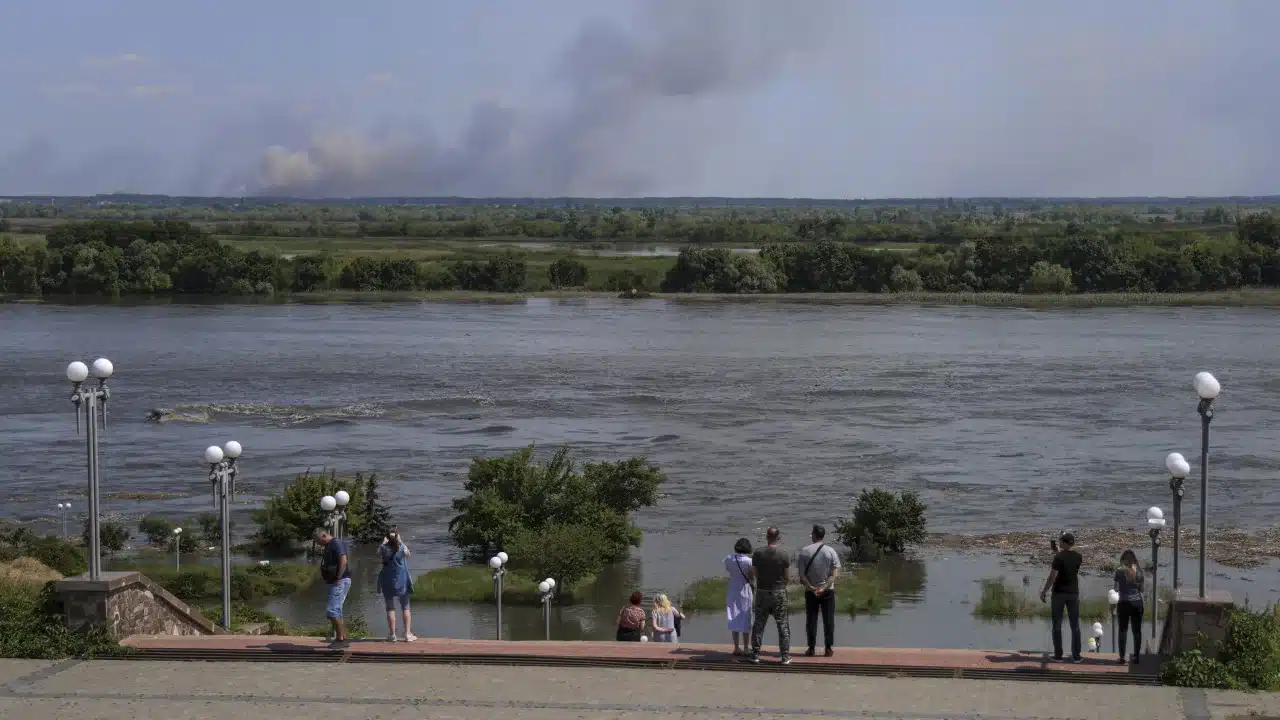
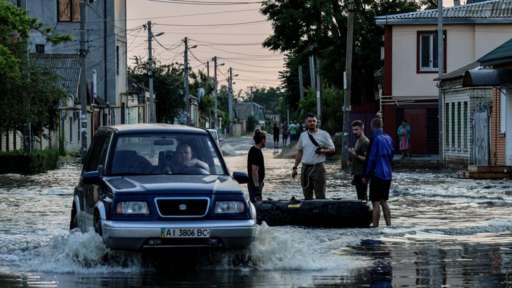
Western intelligence officials say Russian troops have moved away from the front line in Kherson since areas around the Dnipro river were flooded after the Kakhovka dam was destroyed on 6 June.
If NATO members continue to provide military equipment to Kiev, there is a “serious danger” that the conflict in Ukraine may escalate. This is according to Russian President Vladimir Putin.
Putin stated at the St. Petersburg International Economic Forum on Friday that NATO was “obviously being drawn into the war in Ukraine.”
“The supplies of heavy military equipment to Ukraine are still being made, and they are currently considering supplying Ukraine with jets.”
The comment appeared to be a reference to the F-16 fighter jets some members of the NATO alliance are making plans to supply Ukraine with.
NATO, or the North Atlantic Treaty Organization, was formed in the aftermath of World War II to defend Western nations from the Soviet Union and the alliance contains a mutual defense clause where an attack on any one member is considered an attack on all. While Ukraine is not a member of NATO, some NATO members have been supplying Kyiv with tanks, armored vehicles and other weaponry – prompting threats of retaliation from Russia.
German Leopard 2 tanks, British Challenger 2 tanks and American Bradley and Stryker vehicles are among the Western equipment that has been sent to Ukraine.
In late April, NATO Secretary-General Jens Stoltenberg said that NATO allies and partners had delivered more than 1,500 vehicles and 230 tanks to the country.
During his speech in St. Petersburg, Putin said Russia had destroyed tanks “including Leopards” at the front lines.
“And if they are based abroad, but used in fighting we’ll see how to hit them, and where we can hit those means that are used against us in fighting,” Putin said.
“This is a serious danger of further drawing NATO into this military conflict,” he added.
During his speech to the forum, Putin also suggested Russia’s large number of nuclear weapons would “guarantee” its security – noting that Russia had more such weapons than NATO countries.
Russia has a total stockpile of around 6,250 nuclear warheads as of January 2021, according to the Arms Control Association. The US has more than 5,500 while two other NATO member states, Britain and France, have about 220 and 290 nuclear warheads, respectively.
“Nuclear weapons are created to guarantee our security in the broader sense and the existence of the Russian state,” Putin said.
“But first of all, there is no need and secondly the very fact of talking about it reduces the possibility of the threshold for using these weapons being reduced.”
“Also, we have more weapons like this than the NATO countries. They know it and they keep driving towards negotiation on reduction.”
In February, Putin said he would suspend Russia’s participation in the New START nuclear arms reduction treaty with the United States, imperiling the last remaining pact that regulates the world’s two largest nuclear arsenals. Russia’s Foreign Ministry subsequently said the decision was “reversible.”
The treaty puts limits on the number of deployed intercontinental-range nuclear weapons that both the US and Russia can have. It was last extended in early 2021 for five years.
Under the key nuclear arms control treaty, both the United States and Russia are permitted to conduct inspections of each other’s weapons sites.
The leader of the exiled Belarusian opposition has warned of the risk of Russia giving nuclear weapons to “a crazy dictator.”
In an interview with the BBC in Warsaw, Poland, Svetlana Tikhanovskaya made the disparaging remarks about Alexander Lukashenko, the president of Belarus.
She charged that the west had been “staying silent” over the first nuclear weapon deployment outside of Russia since the fall of the USSR in 1991.
Given that Belarus served as the launchpad for Putin’s invasion of Ukraine in February, Lukashenko is regarded as a crucial friend by Russia.
Lukashenko announced the first ‘missiles and bombs’ had arrived in the country on Russian state television, and when the presenter asked him to confirm if Belarus had received weapons sooner than expected, he replied: ‘Not all of them. Gradually.’
He claimed the Russian bombs were ‘three times more powerful’ than those dropped on Nagasaki and Hiroshima in Japan during World War II.
Lukashenko also said he hadn’t simply asked Putin for the weapons – ‘I demanded them back,’ he said, claiming he needed them to protect against external aggression.
Belarus, like Ukraine and Kazakhstan, gave up its nuclear arsenal in the 1990s in return for security guarantees from post-Soviet Russia and the west.
There isn’t any proof that nuclear weapons have been delivered to Belarus yet, but if they are, it marks a significant reversal.
Moscow announced the move in March and says it will retain control of the missiles.
‘This deployment creates no new threat to Nato countries, so they don’t take it seriously,’ Ms Tikhanovskaya argued, believing that western countries see no difference between a missile fired from Russia or from Belarus.
‘But Belarus is our country and we don’t want nuclear weapons.
‘This is like the last step to keeping our independence. And they [in the west] are staying silent about that.’
In a joint operation earlier this week in the Arabian Sea, India’s two aircraft carriers led their battle groups, displaying what the Indian Navy says its “formidable maritime capabilities” and capacity to project power throughout the Indian Ocean and beyond.
According to analysts, it’s a significant achievement that has just recently been accomplished by the United States Navy.
The Indian Navy is one of the few in the world to operate more than one aircraft carrier, according to Nick Childs, senior fellow for naval forces and maritime security at the International Institute for Strategic Studies (IISS). “This is not a small achievement,” he added.
The two aircraft carriers, INS Vikramaditya and INS Vikrant, led the exercise with more than 35 aircraft and an array of surface ships and submarines, according to a press release from the Indian Navy.
“The successful demonstration of two-carrier battle group operations serves as a powerful testament to the pivotal role of sea-based air power in maintaining maritime superiority,” the release said.
India became capable of dual-carrier operations when the $3 billion Vikrant, India’s first domestically built carrier, was commissioned last September, joining Vikramaditya, which was bought from Russia and went into service in 2013.
Upon Vikrant’s commissioning last year, India joined only the United Kingdom and China in commissioning a domestically built aircraft carrier in the previous three years.
But while both China and the UK have more than one aircraft carrier in their modern fleets, neither has yet to perform dual-carrier operations with them, analysts said.
Collin Koh, research fellow at the S. Rajaratnam School of International Studies in Singapore, said India’s naval history may put it ahead of China, whose People’s Liberation Army (PLA) Navy is the world’s largest, in the current operating environment for aircraft carriers.
“The Indian Navy has had decades-long experience and expertise in aircraft carrier ops and this is probably the key advantage it possesses over the PLA Navy, its key rival in this field, despite the latter’s relative advance in its indigenous aircraft carrier program,” Koh said.
China has two aircraft carriers in service, the Soviet-built Liaoning and the domestically built Shandong, while a third carrier, the Fujian, has been launched but not commissioned.
Hawaii-based analyst Carl Schuster, a former US Navy captain, said India’s dual-carrier operations this week show “the rejuvenation of the Indian Navy.”
India commissioned its first aircraft carrier in 1961 and added a second in 1987. It has operated two aircraft carriers on two previous occasions, between 1987 and 1997, and between 2013 and 2017.
“It should be remembered that the Indian Navy has always been a highly trained, tightly disciplined and very proficient force,” Schuster said.
The Indian Navy press release called the carriers “floating sovereign airfields,” adding that “they provide our friends with an assurance that the Indian Navy is capable and ready to support our ‘collective’ security needs in the region.”
New Delhi’s forces have been stepping up cooperation with other navies in the Indo-Pacific, including those in the informal Quad partnership – the United States, Japan and Australia – in the annual Malabar naval exercises.
“India’s partnerships and collaborative exercises with other navies have broadened the navy’s operational knowledge and open ocean experiences,” Schuster said.
What the Indian Navy can learn about dual-carrier operations from the United States could be substantial. The US Navy operates the world’s largest carrier fleet – 11 warships – and just last week had two of those, the USS Nimitz and USS Ronald Reagan, operating together in the Philippine Sea.
The US Navy sees China as a “pacing threat” in the Indo-Pacific, and India’s naval operations look toward China too, Schuster said.
“China’s aggression along the (shared Himalayan) border and expanding operations and presence in the Indian Ocean have become India’s most serious security concern. The naval expansion and modernization is intended to address that concern,” Schuster said.
But even with the advancements demonstrated by the dual-carrier operation, India’s carrier program still has question marks, said Childs from IISS.
“While an impressive-looking display, there may be some question over what this really amounts to as yet in terms of actual operational capability,” he said, noting that images from the Indian operation showed relatively few fighter aircraft on the decks of the Vikramaditya and Vikrant.
“This may indicate limited aircraft availability, or that the ships’ capacities are somewhat constrained at the moment. It would certainly suggest that the Indian Navy could do with more carrier aircraft,” Childs said.
Svetlana Tikhanovskaya, the exiled leader of the Belarusian opposition, has expressed concerns about the potential transfer of nuclear weapons from Russia to Belarus, warning of the risks of placing such weapons “in the hands of a crazy dictator.”
Her remarks came after Alexander Lukashenko confirmed that the first “missiles and bombs” had arrived in Belarus.
Speaking to the BBC in Warsaw, Tikhanovskaya criticized Western politicians for their silence regarding the first deployment of tactical nuclear weapons outside of Russia since the collapse of the USSR in 1991.
Lukashenko, the authoritarian leader of Belarus, made the announcement during a staged discussion with a Russian state TV presenter. The setting featured military trucks and equipment carefully positioned in the background.
When asked to clarify his statement about the arrival of weapons, Lukashenko chuckled and replied, “Not all of them. Gradually.”
Lukashenko is widely regarded as a key ally of Russia, and Belarus has been seen as a launchpad for Russian President Vladimir Putin’s invasion of Ukraine in February 2022.
In a move seemingly intended to unsettle Ukraine’s Western allies, Lukashenko emphasized that the Russian bombs were “three times more powerful” than those dropped by the US on Nagasaki and Hiroshima during World War Two.
He further claimed that he had not merely requested the nuclear weapons from Putin but had instead demanded their return. Lukashenko justified the need for such weapons as protection against external aggression, a false threat he has used to justify his repression of political opposition.
Lukashenko, who has been in power since 1994, declared victory in the disputed 2020 elections, sparking mass protests and a brutal crackdown by the Belarusian KGB security service and riot police.
Image caption,Svetlana Tikhanovskaya fled Belarus in 2020 after running against Alexander Lukashenko in presidential elections
Belarus, like Ukraine and Kazakhstan, gave up its nuclear arsenal in the 1990s in return for security guarantees from post-Soviet Russia and the West. That makes this a significant reversal, although there is as yet no proof that the Russian weapons have been delivered.
Mr Putin first announced the transfer in March, pointing out that the US has deployed similar weapons in Europe. He later said the move would only take place when storage sites had been prepared, but Alexander Lukashenko now says Belarus has “more storage sites than village dogs” and several have already been renovated.
Moscow says it will retain control of the missiles, which are tactical – not longer-range strategic weapons.
“I am not planning to fight the US… tactical weapons are fine,” Mr Lukashenko said. “And the Iskander [rocket] travels 500 kilometres (310 miles) or more.”
“This deployment creates no new threat to Nato countries, so they don’t take it seriously,”Ms Tikhanovskaya argued, believing that Western countries see no difference between a missile fired from Russia or from Belarus.
Russia already has nuclear weapons in its western-most Kaliningrad region, putting Poland and the Baltic states well within range.
“But Belarus is our country and we don’t want nuclear weapons,” Ms Tikhanovskaya said. “This is like the last step to keeping our independence. And they [in the West] are staying silent about that.”
As a show of force amid tensions with Russia, NATO has begun the largest air exercise in its history.
In response to a mock attack on an alliance member, more than 250 aircraft and 10,000 personnel from 25 nations will be sent, with the US sending 2,000 members of the Air National Guard and around 100 jets alone.
On Monday morning, the first aircraft took off from airfields in northern Germany.
The Air Defender 23 drill is expected to run until June 23, but planning began in 2018.
‘The exercise is a signal – a signal above all to us, the Nato countries, but also to our population that we are in a position to react very quickly, that we would be able to defend the alliance in case of attack,’ German air force chief Lt. Gen. Ingo Gerhartz told ZDF television.
Gerhartz said he proposed the air exercise five years ago, reasoning that Russia’s annexation of Crimea underlined the need to be able to defend Nato.
But it was the invasion of Ukraine in February 2022 that pushed the alliance to get ready for the possibility of an attack on its territory.
Sweden, which is hoping to become member, and Japan are also participating in the exercise.
There have already been warnings it could disrupt flights in some parts of Europe.
Matthias Maas, the head of a German air traffic controllers’ union, GdF, said that it ‘will of course have massive effects on the operation of civilian aviation’.
But Gerhartz disputed that, arguing that Germany’s air traffic control authority has worked with the air force to keep disruption ‘as small as possible’.
He noted that the exercise is limited to three areas which will not all be used at the same time, and that it will be over before school vacations start in any German state.
‘I hope that there we will be no cancellations; there may be delays in the order of minutes here and there,’ he said, insisting that the study cited by the air traffic controllers’ union assumes a worst-case scenario in bad weather in which the military would not fly anyway.
In order to defeat “the will of the west,” a renowned political scientist close to Vladimir Putin has called for Russia to utilise nuclear weapons.
Putin-friendly Professor Sergei Karaganov is a highly esteemed authority on foreign affairs.
He has weirdly asserted that nuclear weapons will “save humanity” and prevent the west from continuing to back Ukraine in their current conflict.
Putin, according to him, must make sure “the west’s will to incite and support the Kyiv junta is broken.”
Karaganov added: ‘It is necessary that the west simply “back off” and not prevent Russia and the world from moving forward.’
He said nuclear strikes should be unleashed if other countries don’t stop supplying weapons to Ukraine, adding people need to be warned of ‘the need to leave their places of residence near objects that could become targets of nuclear strikes in countries that provide direct support to the Kyiv regime’.
Karaganov claimed western countries have lost the ‘fear of hell’ or ‘Armageddon’ which could result from full-scale nuclear war.
He added: ‘The enemy must know that we are ready to strike a preemptive retaliatory strike for all of his current and past aggressions in order to prevent a slide into a global thermonuclear war.
‘The fear of nuclear escalation must be restored. Otherwise humanity is doomed.
‘But what if they don’t back down [and if the West has] completely lost your sense of self-preservation?
‘Then [Russia] will have to hit a group of targets in a number of countries in order to bring those who have lost their minds to their senses.
’This is a morally terrible choice – we use the weapons of God, dooming ourselves to severe spiritual losses.
’But if this is not done, not only Russia may perish, but, most likely, the entire human civilisation will end.
’We will have to make this choice.’
Karaganov, 70, admitted in an article for Profile magazine that the Russian invasion of Ukraine had so far failed to take control, costing thousands of lives.
He said: ‘We can fight for another year or two or three, sacrificing thousands and thousands of our best men and grinding tens and hundreds of thousands of people who fell into a tragic historical trap of the inhabitants of the territory that is now called Ukraine.
‘This military operation cannot end with a decisive victory without imposing a strategic retreat or even capitulation on the west.
’We must force the west to give up trying to turn back history, give up its attempts at global dominance and force it to take care of itself, digesting its current multi-level crisis.
‘We will have to restore the credibility of nuclear deterrence by lowering the unacceptably high threshold for the use of nuclear weapons, prudently but quickly moving up the deterrence-escalation ladder.
‘By breaking the west’s will to aggression, we will not only save ourselves, finally liberate the world from the western yoke that has lasted five centuries, but we will also save all of humanity.’
Karaganov once claimed that Russia is a ‘genetically authoritarian power’ as a result of the country’s history which has ‘informed our genetic code’.
Kardashynka, Maryna and Valentyna’s southern Ukrainian hamlet, is a quiet area.
A charming group of cottages on the eastern bank of the Dnipro River, occupied by Russia.
Even with the liberation of Kherson city last November, the neighbours hadn’t been able to cross the river to go there because of bridges being destroyed.
In a chain of events few could predict, they finally made that journey this week, while being rescued from the recent catastrophic floods.
“A boat was passing, we started shouting and waving,” says Maryna.
Much of her surrounding area has been devoured by the Dnipro since the destruction of the Khakovka dam upstream.
Their homes sit close to this watery front line which separates Ukrainian-controlled and Russian-occupied territory.
“We’ve been waiting for help,” says Maryna. “Valentyna is 86, I’m 76 but with many illnesses.
“It’s been very difficult. There was no power, no reception, it was like we were on an uninhabited island.”
She becomes emotional and begins to weep.Image caption,
Viktor Kovalenko’s wife was killed by shelling a few days ago
They’re joined by their friend Viktor Kovalenko, whose wife was killed by shelling across the river a few days ago.
Before being rescued, he had to collect her death certificate from the Moscow-installed officials who now rule his neighbourhood.
“I buried her next to my mother. I told her to wait for me,” he says.
The pain he’s experiencing is visceral.
“I kept cursing the Russians in their faces. I don’t know how they didn’t kill me. If only you knew how great our life was together. Now I have no wife, no house, nothing.”
The eastern bank has seen the worst of the flooding, and it’s clear Maryna, Valentyna and Viktor are the lucky ones.
Hundreds of people there have been posting on the Telegram app asking to be rescued from there.
“Help me please!” writes Svitlana, who says there are 35 trapped people at an address. “They’re all on a nearby roof, children are screaming and crying,” she says.
“Three days without food and water, we are dying slowly. Please, please.”
On one local list, published on Friday, we’ve seen the names of 150 people who are reportedly missing.
Aliona posts: “Asking urgently! There is a 1939-born grandmother and 1958-born disabled woman. They need to be evacuated! Help!”
Our team called several numbers of people who said they were stuck on the Russian side, but there was no answer.Image caption,
Viktor has been helping to evacuate people
Dozens of people across Ukraine have responded with their addresses and an offer to provide accommodation after their rescue.
Ukraine’s military says it has been co-ordinating rescues from the eastern bank, but claimed “fearless volunteers” were carrying out some of the evacuations.
On board one rescue boat, as we weave through the vast expanse of Kherson’s flooded port, volunteer Viktor tells us he came under Russian fire while attempting such a trip.
“The problem is, Russian soldiers are waiting there and waiting for volunteers or soldiers to arrive so they can shoot them,” explains Viktor as he offers a lift to people trapped in their apartment blocks.
The BBC has not been able to independently verify these claims.
“Even now, working is difficult. At this very moment, Kherson is under attack. There was also shelling on the island, a rocket struck 30m away from us.”
In the last few days of reporting from Kherson, the city has come under increased shelling and the military administration has advised volunteers not to venture out on to the water.
But that hasn’t deterred people like Viktor, who continues to search for those trapped, still in need of help.
As they met in Washington, Joe Biden and Rishi Sunak praised the value of the US-UK special partnership.
But when the two joined forces for discussions about Ukraine, artificial intelligence, and economic cooperation, Mr. Biden made a foolish error and addressed Mr. Sunak as “Mr. President.”
The president instantly realised his error and made a joke about “promot[ing]” Mr. Sunak.
Well, Mr. President, I just elevated you, he remarked. Thank you for coming back, Mr. Prime Minister.
The prime minister laughed off the gaffe and it is his first time at the White House since becoming PM in October 2022.
On a more serious note, Mr Biden then said: ‘Together, we are providing economic and humanitarian aid and security systems to Ukraine in their fight against a brutal invasion from Russia. president said.
‘The global economy is undergoing the greatest transformation that has occurred since the industrial revolution,’ he added.
Mr Biden then made another joke and told the PM: ‘We’re going solve all the problems of the world in the next 20 minutes.’
Rishi Sunak met with Joe Biden to discuss Ukraine, AI, and economic co-operation (Picture: AP)
Mr Sunak blown away by the grandeur of the White House said: ‘It’s daunting to think of the conversations that our predecessors had in this room when they had to speak of wars that they fought together, peace won together, incredible change in the lives of our citizens.
‘And again, for the first time in over half-a-century, we face a war on the European continent.
‘And as we’ve done before, the US and the UK, have stood together to support Ukraine and stand up for the values of democracy and freedom and make sure that they prevail, as I know we will.
‘But also I completely agree with what you said, our economies are seeing perhaps the biggest transformation since the industrial revolution, as new technologies provide incredible opportunities, but also give our adversaries more tools for harm.’
Mr Sunak also announced the UK would host the first-ever AI summit in autumn in a bid to mitigate the risks of emerging technology.
Rishi Sunak was taken aback by the grandeur of The White House (Picture: Getty Images)
This is not the first time the president has fumbled his words.
During his visit to Ireland in April, Mr Biden appeared to confuse the name of the New Zealand All Blacks rugby team with the Black and Tans – a controversial War of Independence-era police force in Ireland.
He’s also not been so supportive about the special relationship in the past, claiming he visited the island of Ireland to ensure the ‘Brits didn’t screw around’ amid ongoing concern over the peace process and the impact of Brexit.
In the midst of the turmoil caused by the rupture of the Nova Khakovka dam, Russian gunners targeted rescuers, further reinforcing Ukraine’s accusations of Russian “ecocide” as fish were swept up and dumped by flood waters.
The Kremlin’s own troops, who were apparently caught off guard, were swept away, their trenches and quarters swamped, and as they fled into the open to save themselves, Ukrainian forces showered death down on them from the other bank of the Dnipro River.
This initially appears to be one or two own goals by Russia. In addition to engulfing its own forces and citizens in Ukraine under its occupation, it was in control of the dam that exploded and is accused by many Western countries of having intentionally blown it up.
But Moscow has form for sacrificing the lives of many for the motherland, in the same way, on the same river.
As Nazi troops advanced against the Russian army in 1941 across Ukraine, Stalin’s secret police, the NKVD, were given an order of terrible ruthlessness.
They were to blow up the Zaporizhzhia hydroelectric dam that bisected the eponymous industrial city, which stands 200 kilometers (125 miles) upriver from today’s Nova Kakhovka barricade).
On August 18, Stalin’s henchmen carried out his order. The breach in the dam sent a surge of water downstream that killed Soviet soldiers and thousands of civilians. No official history of the atrocity was recorded and historians differ over the death toll sitting somewhere between 20,000 and 100,000 souls.
Ukrainian President Volodymyr Zelensky has again blamed Moscow for the collapse of the Nova Kakhovka dam and said Russia should bear “criminal liability” for “ecocide.”
In an interview with national media on Tuesday, Zelensky said: “In our opinion, this is a crime, the Prosecutor General’s Office has already registered it. It will have evidence. There is a modern classification – ecocide,” he said, adding: “I think that there should be criminal liability… International institutions, including the International Criminal Court, should react.”
Both Kyiv and Moscow accuse each other of being behind the major breach of the dam, although it is unclear whether the dam was deliberately attacked, or whether the collapse was the result of structural failure.
Zelensky referred to a report by Ukrainian intelligence last year that claimed occupying Russian troops had mined the dam.
“The consequences of the tragedy will be clear in a week. When the water goes away, it will become clear what is left and what will happen next,” he said.
His officials have repeatedly said that the dam was destroyed by Russia to frustrate Ukraine’s plans for a large-scale counter-offensive.
Before the surge in water spread it across the low lands on its eastern banks, the Dnipro posed a formidable natural defense for Russian troops.
When they were driven out of Kherson City last summer they retreated east and south, blew the bridges across it, and dug in on the east banks. Within hours snipers were scoping targets and gunners pounded the recently liberated city from the marshes along the river.
Ukraine has, naturally, been secretive about how it plans to unleash a counter-offensive to reclaim territory lost to Russia last year.
It’s been conducting probing attacks, or reconnaissance by fire, along the frontline running east from Zaporizhzhia toward Donetsk City. These are clearly intended to test Russia’s defenses, and keep its generals guessing.
Bakhmut, the eastern city which has been dubbed the “meat grinder” by both sides, flares up sporadically as Ukraine attempts to flank Russian forces that have captured most of its urban areas.
And Ukraine has sponsored the “Russian dissident” forces (all carrying Ukrainian military ID) who’ve been raiding into Russian territory north of Kharkiv for the last couple of weeks.
This opening of this new front has caused even Russian President Vladimir Putin himself to tell his administration to resist attempts to destabilize his government.
“Today we will also address these issues in relation to ensuring Russia’s security, in this case domestic political security, considering the efforts our ill-wishers are still taking and stepping up in order to destabilize the situation inside Russia. We must do everything we can to prevent this from happening at any cost,” he said recently.
So Ukraine has had the initiative lately.
Small wonder then that, perhaps, Russia needed to destabilize Kyiv with a spectacular humanitarian and ecological disaster that, Moscow hoped, could change the course of history – and has changed the course of a river.
Any plans that Kyiv may have had for a cross-river assault are now much more complicated by a much wider body of water, more boggy landscape, and unmapped waters.
Russia has lost too.
“Their positions were fully destroyed. They are full of water. They have a lot of wounded people and dead people for now, we have information that it’s hundreds of them,” Ukrainian Army Captain Andrei Pidlisnyi told CNN on Tuesday.
A Ukrainian officer in command of men tasked with watching and raiding the Russian forces on the east bank of the river his teams kept a close watch on the floods as they overwhelmed Russian troops – driving them into the open where they could be killed more easily.
“We see them now before they were hiding in the buildings, in the trenches, and it was difficult for us to understand how many of them and where they were. But now, we see them all because they’re just running and they try to evacuate themselves. They left not only their positions, they left all their weapons, equipment, ammunition and vehicles, including armored vehicles, too,” the Ukrainian officer said.
Ukraine’s armed forces have insisted that their counter-offensive included contingency planning for a disaster at the dam.
They said they are “equipped with all the nececssary watercraft and pontoon bridge crossings for crossing water obstacles.”
Kyiv’s military added that Russia had blown the dam (as had the Soviets before them battling the German army) as a desperate attempt to thwart Ukraine’s much vaunted offensive.
But there’s another detail worth considering. The Kakhovka Dam sits at the head of the fresh water canal system which supplies the Russian-occupied Crimean Peninsula with most of its needs.
“The fact that Russia deliberately destroyed the Kakhovka reservoir, which is critically important, in particular, for providing water to Crimea, indicates that the Russian occupiers have already realised that they will have to flee Crimea as well,” said Zelensky.
He would suggest as much.
But cutting off the water supply to the massive garrisons in Crimea – which is also the head quarters of Russia’s Black Sea Fleet – would more likely serve Ukrainian than Russian interests (at least in the short military term).
So destroying the Nova Khakovka dam which has complicated Ukraine’s plans but flooded Russian defenses on a frontline that was an unlikely first choice of Ukrainian advance has served neither side well.
But it’s cost Kyiv dearly now, and will cost it yet more in the future – and an enfeebled Ukraine, no matter how angry, is Russia’s end game.
Volodymyr Zelensky, the president of Ukraine, charged Russia with setting off a “environmental bomb of mass destruction” at the Nova Kakhovka dam in Kherson yesterday, causing “catastrophic” flooding across the area.
According to Zelensky, “one of Ukraine’s largest water reservoirs was deliberately destroyed.” “Thousands of people have been left without access to clean drinking water on a regular basis.”
Meanwhile Ukraine’s top security official Oleksiy Danilov said the dam blast was ‘a fundamentally new stage of Russian aggression,’ and warned that the nearby nuclear power plant in Zaporizhzhia could be Putin’s next target.
The Zaporizhzhia Nuclear Power Plant (ZNPP) has been under Russian control since the start of the war (Picture: Reuters)
The Zaporizhzhia Nuclear Power Plant (ZNPP) has been under Russian control since the start of the war, and is reliant on water from the dam to cool its reactors.
‘It is a fact there are explosives [at the occupied Zaporizhzhia plant],’ Danilov told the Times, and said since Putin had the hydroelectric power plant blown up on his demand, he’s ‘ready to do anything.’
The plant has been shelled repeatedly throughout the war, sparking fears of a nuclear meltdown last year when rockets hit one of the plant’s reactors, which both Ukraine and Russia claimed the other was responsible for.
Russian forces have been accused of converting the plant into a military base and are ‘sufficiently protected’ from being re-captured by force, pro-Kremlin media reports.
Raphael Grossi, head of the International Atomic Energy Agency (IAEA) said this morning that the breach poses no short term risk to the ZNPP, but admitted the situation was making an already very difficult and unpredictable nuclear safety and security situation even worse.
The dam’s reservoir provides water used for the essential cooling of the six reactors at Europe’s biggest nuclear power plant, and is set to displace tens of thousands of people.
Dramatic scenes from throughout Kherson saw entire homes swept away by the dam blast, while in some communities people were forced to spend the night on the roof of their homes to avoid getting swept away.
The cause of the blasts is not yet clear, although Ukraine warned late last year that Russian forces had mined the dam as they retreated from Kherson.
At an emergency security council meeting yesterday, President Zelensky blamed the breach on ‘Russian terrorists’, saying it underlined the need for Ukraine to liberate all its territory from its neighbour’s occupation.
The President condemned the incident as the ‘largest human-made environmental disaster in Europe in decades’.
Russia has accused Kyiv of blowing up the dam themselves to distract from what they perceive to be a failing Ukrainian counteroffensive, using shells to breach the dam walls.
But although the cause of the blast is not yet clear, Ukraine warned late last year that Russian forces had mined the dam as they retreated from Kherson and Ukraine’s state hydroelectric company said the Kakhovka plant was destroyed by an explosion in the engine room- suggesting it was attacked from within rather than by external strikes.
‘Russia has controlled the dam and the entire Kakhovka hydro power plant for more than a year,’ Zelensky said.
‘It is physically impossible to blow it up somehow from the outside, by shelling. It was mined by the Russian occupiers. And they blew it up.’
Britain’s Ministry of Defense, which has regularly issued updates about the war, said the Kakhovka reservoir was at ‘record high’ water levels before the breach.
While the dam wasn’t entirely washed away, the ministry warned that its structure ‘is likely to deteriorate further over the next few days, causing additional flooding.’
Ukraine’s minister of internal affairs said Russian shelling was hampering attempts to evacuate people from the flooded regions.
‘The Russian military continues to shell territory where evacuation measures are being carried out,’ he told Ukrainian television, saying two policemen had been wounded by artillery fire.
The floodwaters have also washed landmines from positions on the Russian-controlled eastern bank, creating an additional danger for those seeking to escape, he said.
Kyiv said 150 tonnes of engine oil had spilled into the river, and the agricultural ministry said about 10 thousand hectares of farmland on the right bank of the river would be flooded and ‘several times more’ on the left bank.
Rishi Sunak said it was too soon to make a ‘definitive judgement’ that Moscow’s forces were responsible.
Sunak added: ‘But if it’s intentional, it would represent, I think, the largest attack on civilian infrastructure in Ukraine since the start of the war, and just demonstrate the new lows that we would have seen from Russian aggression.’
Air India dispatched a plane on Wednesday to pick up hundreds of U.S.-bound passengers have been left stranded in Russia.
The flight was forced to make an emergency landing in the country’s far east.
Flight AI173 departed from Delhi to San Francisco on Tuesday with 216 passengers and 16 crew onboard when it developed a technical issue with one of its engines, Air India said in a statement.
The decision to land in the country despite those complications sparked criticism on social media.
The flight was diverted to the Siberian port town of Magadan, where it was able to land safely, the airline said. Air India said local authorities at the airport extended “all cooperation and support upon the flight’s arrival.”
The airline said it made “sincere attempts to accommodate passengers in hotels locally with the help of local government authorities. But it said passengers were “eventually moved to a makeshift accommodation.”
“As we do not have any Air India staff based in the remote town of Magadan or in Russia, all ground support being provided to the passengers is the best possible in this unusual circumstance,” Air India said.
UPDATE: FERRY FLIGHT TO MAGADAN AIRBORNE
Our ferry flight AI195 from Mumbai (BOM) to Magadan, Russia (GDX) is now airborne, and is expected to arrive at GDX at 0630 Hours (local time) on 08 June 2023.
On Wednesday, the airline said a replacement ferry flight, AI195, was on its way to Magadan and was expected to arrive at around 6:30 a.m. Thursday local time (3:30 p.m. ET Wednesday).
Sharing video of the replacement flight taking off, the airline said a team was onboard the flight to “provide any support that the passengers and staff at GDX may require.”
“The ferry flight is carrying essentials in addition to sufficient amount of food to cater to all passengers on the onward flight scheduled from GDX to San Francisco,” it said, adding that the aircraft would transport all passengers and crew onward to San Francisco on Thursday.
In a State Department briefing on Tuesday, principal deputy spokesperson Vedant Patel said the department was “aware of a U.S. bound flight that had to make an emergency landing in Russia.”
He said he wasn’t able to confirm how many U.S. citizens were aboard the flight, but said it was “likely” that there were Americans involved as the flight was bound for the U.S.
One stranded passenger told Indian broadcaster NDTV there were many U.S. citizens on the flight who were worried, given the tension between Russia and the United States.
“There are a lot a nervous people here,” said the passenger, according to Reuters, which named them only as Gagan.
Air routes have been disrupted since Russia issued a ban on some foreign carriers using its airspace in retaliation for Western sanctions over the war in Ukraine.
While U.S., European and Japanese carriers have stopped flying over Russia, Air India and other airlines have continued to do so.
As Air India faced mounting criticism on social media, the airline apologized in a tweet “for all the inconvenience caused” by making the emergency landing in Russia.
Video shared on social media is purported to show passengers sleeping on thin mattresses on the floor with blankets in what appears to be a classroom.
Responding to a tweet sharing the video, the airline said: “We understand the situation,” adding that its replacement plane was on the way. NBC News has not verified the video.
“My relatives are in that flight and they are still struggling to take care of themselves,” one person wrote. NBC News was not immediately able to verify their account.
“We understand how frustrating and concerning this must be for you and your loved ones,” Air India said, responding to the tweet.
“Please know that we take these situations very seriously and will do our utmost to ensure that all passengers are taken care of and able to continue their travels safely,” the airline said.
Air India did not immediately respond to a request for more information from NBC News.
Girvaan Singh Kahma, 16, was traveling on the flight with his uncle and brother. He told the Associated Press they were barred from leaving the hostel where they were staying in Magadan and couldn’t use their credit cards to buy things because of sanctions over Russia’s war on Ukraine.
“The first day and a half was really hard for all of us,” he said. “The weather went to 3 to 4 degrees (Celsius, or 37 to 39 Fahrenheit) in the morning, and in the night it was bitter cold,” he said, according to the news agency, adding that it was getting better with food and a place to sleep.
“The Russian soldiers, the Russian police, the authorities, everyone working in the hostel has been treating us extremely well,” he reportedly said.
The city of Bakhmut in easternUkraine is once again at the center of conflicting claims and counter-claims.
The city has been at the heart of fierce fighting for many months – experiencing the longest and bloodiest battle of the Russian invasion so far.
Military analysts have suggested the city is of little strategic value – but control of the former mining hub has become important symbolically both for Kyiv and Moscow.
There is little of Bakhmut still standing – after heavy shelling devastated the city’s buildings and drove out its residents – but the Russianmercenary group Wagner claimed to have captured what remained of it late last month.
In recent weeks, some have suggested Kyiv’s forces have been attempting to encircle Bakhmut and trap Russian units. Military activity in the area has stepped up significantly over the last few days.
Ukrainian offensives near Bakhmut unsuccessful – Russia
As has been typical of the battle for Bakhmut so far, both sides have claimed victory in offensives around the devastated city in eastern Ukraine.
While the Ukrainians say they’ve made advances of up to 1.1km (0.7 miles) in the direction of the city, Russia says it has defeated its enemy’s attacks near the city.
The defence ministry says Ukrainian forces mounted a series of “unsuccessful offensives” in the area – which has seen some of the deadliest fighting of the war.
The BBC has not been able to independently verify either side’s claims.
What are Russian media organisations saying?
The Kakhovka dam disaster was front-page news in most Russian media this morning, except for Rossiyskaya Gazeta – the official newspaper of the Kremlin – which relegated the story to page three in favour of a story about rubbish.
The paper sticks to the Russian government’s line that Ukraine is responsible for blowing up the dam.
Our Russia editor, Steve Rosenberg, has taken a look at how Russian media have covered the story.
Russia has declared the nationalization of Volodymyr Zelensky’s holiday home on Crimea’s Black Sea coast and intends to sell the property to finance its invasion of Ukraine.
The leader appointed by Russia in Crimea, which was unlawfully annexed by Moscow in 2014, made a video announcement on Thursday, stating that the local legislature has decided to nationalize 57 properties formerly owned by Ukrainian tycoons and public figures.
“Crimea will regain rights for a number of properties including a building in Simferopol that belongs to the banned Crimean Tatar parliament as well as Olena Zelenska’s flat,” said Sergey Aksyonov, referring to the president’s flat that is registered in his wife’s name.
“Enemies of Russia won’t be making money in Russian Crimea,” he added.
Prior to his election as president in 2019, Volodymyr Zelensky was widely known as Ukraine’s most popular comedian and co-owner of a successful TV production company.
In 2013, the Zelenskys purchased a three-room penthouse apartment in the prestigious coastal town of Livadia in Crimea. However, they never had the opportunity to reside there due to ongoing renovations and the subsequent annexation of Crimea.
Russian state media estimated the value of the property to be approximately $800,000 (£648,000).
Russia’s annexation of 2014 triggered a massive land grab across the peninsula as at least 4,000 enterprises and individuals had their property expropriated just in the first year of the invasion.
In many cases, owners were forced to pay bribes to simply re-assert their property rights as the Russian government started to register properties anew.
Vladimir Konstantinov, speaker of the Russia-declared parliament, said on Thursday the Zelenskys’ flat will be sold off and the proceeds are likely to be used to fund the war in Ukraine.
“It will be put up for sale, and money will first of all go towards the needs of the special military operation, families of the killed soldiers and families of the mobilised men,” he told state Russian TV.
He suggested the Ukrainian president is not going to miss the property: “Of course, it is not a big loss for him.”
Mr Zelensky reportedly was not renting it out.
Earlier this year, Russian authorities in Crimea ordered the nationalisation of about 700 properties, from vineyards to factories, belonging to some of Ukraine’s richest tycoons suspected of “enemy activity” and links to the Kyiv government.
It was not clear where the proceeds from that sell-off went.
The Kakhovka dam disaster is front-page news in most Russian media this morning, except for Rossiyskaya Gazeta – the official newspaper of the Kremlin – which has relegated the news to page three in favour of a story about rubbish.
The paper sticks to the Russian government’s line that Ukraine is responsible for blowing up the dam.
Our Russia editor, Steve Rosenberg, has taken a look at how Russian media are covering the dam’s collapse.
As our diplomatic correspondent Paul Adams wrote earlier, the breach of the Kakhovka dam came just a day after Ukraine’s long-anticipated counter offensive appeared to get under way. And the country’s deputy defence minister has given a fresh update on troop movements today.
Forces have advanced from 200 to 1,100 metres in “various sections of the Bakhmut direction”, Hanna Maliar writes on the Telegram messaging app. She says her forces have switched from being on the defensive to the offensive in the area.
Maliar issued a similar update yesterday, without confirming whether the long-anticipated counter-offensive had officially begun.
We can’t independently verify the situation on the battlefield. There’s there’s been intense fighting in Bakhmut in recent months – and both Kyiv and Moscow have claimed to be in control of the city.
Deaths reported as fighting continues across Ukraine
Let’s look more broadly at the situation across Ukraine now. Officials have given reports of fresh Russian attacks, with some deaths reported.
At least one person was killed and another injured in a shelling attack on Kherson, while the southern city deals with flooding and evacuations, according to the regional governor.
And a separate attack, using drones, has killed two civilians and wounded one other in the Sumy region in the north-east, according to Andriy Yermak, the head of the president’s office.
On Tuesday morning, a major dam in Kherson, southern Ukraine, suffered severe damage, putting approximately 42,000 people at risk of flooding.
Due to the rising floodwaters, some individuals in affected areas were left with no choice but to spend the night on their rooftops or seek refuge in trees.
President Volodymyr Zelensky of Ukraine has issued a warning, stating that hundreds of thousands of people are now without access to clean water. The flood levels in certain affected regions are expected to reach their highest point later today.
According to reports from Russia’s state media, at least seven individuals are currently missing, and a state of emergency has been declared in the annexed part of Ukraine’s Kherson region.
Both Ukraine and Russia have engaged in a blame game regarding the dam collapse. President Zelensky has accused Russia of deliberately triggering an “environmental bomb of mass destruction.”
Conversely, Russia claims that Ukraine orchestrated the attack on the dam to divert attention from what Moscow perceives as Kyiv’s failures in its counter-offensive.
The remaining structure of the Kakhovka dam is likely to deteriorate further over the next few days, the UK’s Ministry of Defence has said.
In an intelligence update posted on Twitter, the MoD says the dam partially failed shortly before 03:00 local time on Tuesday and the entire eastern portion of the structure was swept away by midday.
It also says the water level in the Kakhovka reservoir was at a record high shortly before the breach, which led to a “particularly high volume of water inundating the area downstream”.
But the MoD also says the Zaporizhzhia nuclear power plant is “highly unlikely” to face immediate safety issues over the dropping water levels in the reservoir.