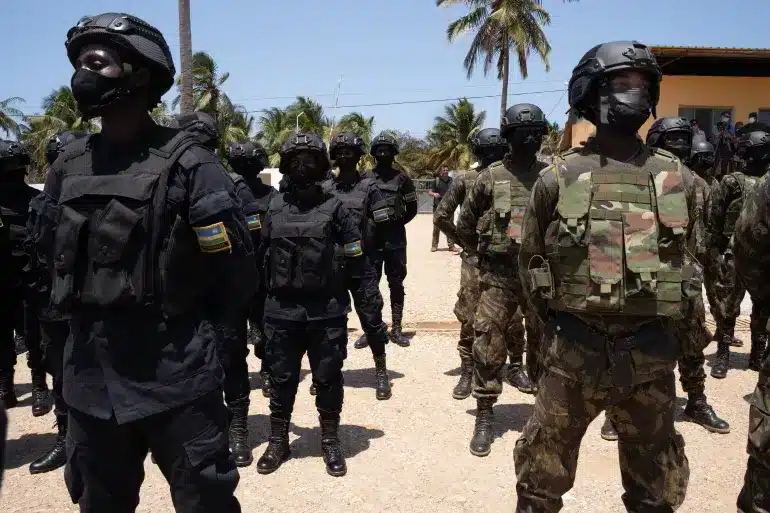
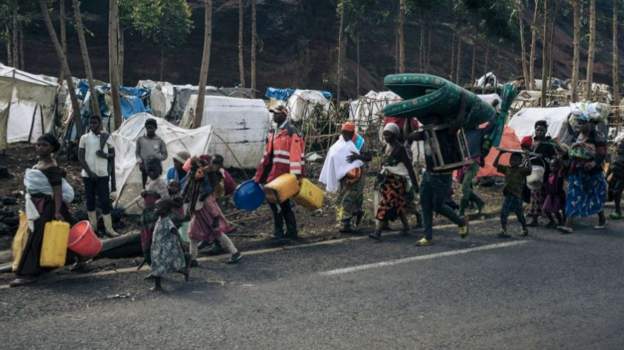
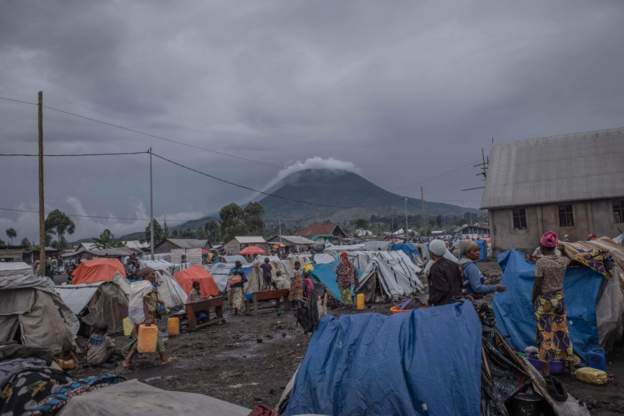
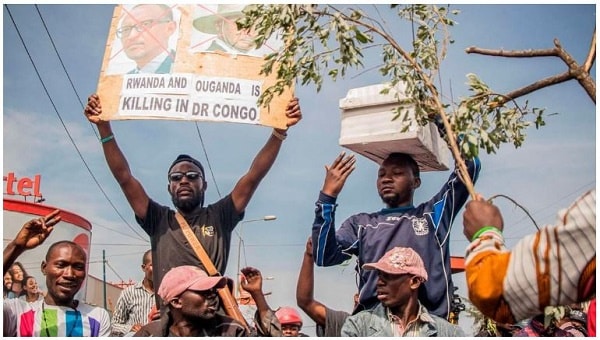
The media regulator in the Democratic Republic of Congo has ordered the local office of satellite television provider Canal+ to remove Rwandan channels from those it offers to the country.
Kinshasa accuses Rwandan channels of inciting civil disobedience, among many allegations, the Chronicles site reports.
The Canal+ offer has about 10 Rwandan TV channels, includingRwandan state broadcaster RBA, that air news and commentary programmes about the ongoing war in eastern DR Congo, the news site adds.
Regional heads of state have called for an immediate ceasefire by all parties in the east of the Democratic Republic of Congo.
Tensions there have grown amid talk of war as Congo and neighbouring Rwanda trade allegations of backing armed rebels.
The ceasefire call was issued in a communique at the end of the East African Community (EAC) summit in Burundi.
Secretary General of the EAC, Peter Mathuki, said: “There must be immediate ceasefire by all political parties.
He added: “The withdraw including all foreign armed groups and directed the chief of defence forces of all the partners states of East African Community to meet urgently within the next one week and set new timelines for the withdrawal and the commend appropriate deployment matrix in different parts of eastern DRC.”
The calls follow international concern the two countries could slide into all-out conflict, as they did in the late 1990s and early 2000s.
Last month Rwanda fired on a Congolese military aircraft it alleged violated its airspace.
Mathuki said: “The heads of state called upon parties to respect and implement all the summits decisions and agreed upon themselves that any again violation should be reported immediately and the summit now will take the charge of this process.”
Congo for months has accused Rwanda of supporting the M23 armed group – whose origins lie in the region’s ethnic fighting – and powerful voices in the West have openly agreed.
Rwanda denies backing the M23, which is one of dozens operating in mineral-rich eastern Congo, and accuses Congo of backing another rebel group.
M23 rebellion, a showdown with Félix Tshisekedi, criticism from the international community, reception of migrants, but also longevity in power and the Rwandan presidential election of 2024… An exclusive interview with Rwanda’s president Paul Kagame.
Politically, diplomatically, and economically, Rwanda wants to box in a category that is superior to it, gaining access through sheer force of will and strictly enforced governance.
Ever more hotels, ever more malls, ever more order, cleanliness and security… Second, only to Cape Town in the number of congresses and conferences, Kigali offers itself up as the face of Rwandan success.
If in terms of notoriety and brand image, Rwanda Inc. now seeks to replace the thousand mass graves of the Tutsi genocide, it is to Paul Kagame that we owe this transformation, undoubtedly unique.
A two-day visit to Rwanda by the director of the International Monetary Fund is intended to “help developing resilience on climate.”
Kristalina Georgieva is expected to attend a roundtable discussion on climate change financing with East African finance ministers and governors of central banks, the East African newspaper reports.
She announced on Twitter that she was looking forward to “hearing local and regional perspectives on how the IMF can be even more helpful – especially in boosting climate resilience”.
Just arrived in Rwanda🇷🇼 the land of a thousand hills! Over the next 2 days, I’m looking forward to hearing local & regional perspectives on how the IMF can be even more helpful—esp. in boosting climate resilience. [1/2] pic.twitter.com/3UmOja0auo
The Rwandan government says “defensive measures were taken” on a Democratic Republic of Congo fighter jet that “violated” its airspace on Tuesday evening.
Images shared on social media show a military plane being shot at while flying at a low altitude between the towns of Goma in DR Congo and Gisenyi in Rwanda.
Other images show the damaged plane – a Soviet Union-made Sukhoi-25 – being cooled down with water at Goma airport.
In a statement, DR Congo’s information ministry condemned the incident and denied that its jet had flown over Rwandan airspace.
It said the government “does not intend to let this [incident] go” and had the “legitimate right” to defend itself.
“The government considers this umpteenth attack by Rwanda as a deliberate action of aggression that is equivalent to an act of war,” the ministry noted.
Rwanda said this was the third incident involving a Congolese fighter jet on its airspace and asked its neighbour “to stop this aggression”.
Last November, a Congolese Sukhoi-25 jet briefly landed at Gisenyi airport in Rwanda. Kinshasa said the fighter jet had “mistakenly landed” there.
DR Congo accuses Rwanda of supporting M23 rebels, which Kigali authorities have consistently denied.
The latest incident adds to the tensions between the two neighbours.
Well-known journalist and government critic died in a car accident in Kigali, the country’s capital according to police
The Chronicles news site editor John Williams Ntwali passed away on Tuesday night when the motorbike taxi he had boarded was struck by a car in the Kimihurura neighborhood. The police informed his brother Emmanuel Masabo.
In order to confirm the identity of the body in a mortuary, Mr. Masabo claimed that he was contacted by the police on Thursday afternoon.
“When I arrived, they took me to the mortuary. I saw that it was him and I confirmed to them,” Mr Masabo told the BBC.
He added: “They did not provide with me more details… maybe they will later. I also had no energy to ask for more [at that moment].”
The Chronicles news site has also confirmed the death of the 43-year old journalist in a tweet. He had been the publication’s editor since 2021.
Mr Ntwali was critical of the government and the ruling party in his reports that focused on injustice and social issues facing Rwandans through his YouTube channel, Pax TV-Ireme news.
Government sympathisers criticised him of being “an extremist” and repeatedly attacked him on social media.
Campaigners will now have another chance to argue their case after the court last month affirmed the legality of the government’s plan to deport asylum seekers back to their home country.
The government’s plan to deport asylum seekers to Rwanda was found to be legal by the High Court last month, but it has now allowed an appeal against that decision.
The contentious policy was implemented by Boris Johnson, but his successors have continued to advance it as part of their plans to address small boat crossings in the English Channel.
Campaigners have argued in court that sending people to the country is “a cruel policy that will result in significant human suffering.”
But Home Secretary Suella Braverman said the government was “proud of the ground-breaking agreement”.
In December, Care4Calais, the Public and Commercial Services Union, Detention Action, and eight asylum seekers brought their case to the High Court, along with a second case from Asylum Aid.
Their lawyers argued the plans were unlawful and that Rwanda “tortures and murders those it considers to be its opponents”.
But representatives from the Home Office argued the agreement between the UK and the country provided assurances that everyone sent there would have a “safe and effective” refugee status determination procedure.
Lord Justice Lewis ruled the first people who were set to be sent to Rwanda had not had their circumstances “properly considered” by the then-home secretary Priti Patel.
As a result, their cases would be referred back to the current minister, Ms Braverman, “for her to consider afresh”.
However, while he said the home secretary should look at people’s “particular circumstances” before deporting them, he ruled the overall scheme was “consistent with the refugee convention” and therefore lawful.
After today’s ruling by Judges Clive Lewis and Jonathan Swift, the groups and asylum seekers will be able to take their cases to the Court of Appeal.
2:16
https://imasdk.googleapis.com/js/core/bridge3.551.0_en.html#goog_2054728585Play Video – Braverman defends Rwanda policySuella Braverman has stood by the Rwanda policy, brought in by her predecessor Priti Patel and then PM Boris Johnson.
The Rwanda scheme was announced by Mr Johnson last April, with the first flight set to take off two months later.
But the deportation was blocked by a last-minute ruling from the European Court of Human Rights, which imposed an injunction preventing any further flights until the conclusion of legal action.
Ms Braverman praised the initial ruling on the policy as lawful, saying the plan was a “humane” and “practical alternative” for those who come to the UK through “dangerous, illegal and unnecessary routes”.
But opposition parties deemed it “unworkable”, “unethical”, and “extremely expensive”.
Asked if the appeal was a setback for the government’s plans, Ms Braverman told reporters: “The government is clear that we support and are proud of theground-breaking agreement and partnership that we have struck with Rwanda so that we can deliver our plans to swiftly detain and remove those people who come here illegally to our country.”
The Managing Director of the International Monetary Fund, Kristalina Georgieva, will visit Rwanda later this month after traveling to Zambia, Reuters has revealed.
Madam Georgieva on Thursday said she would visit Zambia the week after next, but her visit to Rwanda has not been previously reported. She will travel to Africa after speaking at the World Economic Forum in Davos, Switzerland next week.
Rwanda was the first African country to receive IMF funding under its new Resilience and Sustainability Trust.
The IMF in October reached a staff-level agreement with Rwanda on a 36-month financing package valued at $310 million.
At the time, the IMF said the funding would help the country move forward with its economic reforms and build resilience against climate change.
Since the conflict began in 2017, 4,500 people have died and nearly a million have been driven from their homes.
According toAmnesty International, a video showing soldiers tossing a corpse onto a pile of burning rubble in northern Mozambique “gives a glimpse” of what is going on in a “forgotten war.”
The video, which is thought to have been taken in November, shows a soldier dousing a corpse with liquid as bystanders, including one dressed in a South African uniform, observe and record the action on their cell phones.
“Human rights violations and violations of international humanitarian law are still occurring,” the rights watchdog said in a statement on Thursday.
An investigation has been opened by regional forces on the possible “involvement of its members in this despicable act”, the South African army announced on Tuesday.
The video “is another horrific event that gives a glimpse of what is going on away from the attention of international media in this forgotten war,” said Amnesty’s east and southern Africa director, Tigere Chagutah.
The crisis began in Cabo Delgado province in 2017, prompting the deployment of troops from Rwanda and neighbouring countries in mid-2021 to help Mozambique’s embattled army.
The conflict has led to the death of more than 4,500 people, while nearly a million have fled their homes, according to NGOs and the United Nations.
The government has regained control over much of the region since thousands of African troops were deployed in 2021.
But “security in Cabo Delgado must not come at the cost of human rights violations”, Chagutah warned.
The government of Rwanda has changed its position on President Paul Kagame’s stance that the nation will no longer provide asylum to individuals escaping conflict in the Democratic Republic of the Congo.
Refugees crossing the border into Rwanda, according to Mr. Kagame, are “not Rwanda’s problem.”
“I am refusing that Rwanda should carry this burden,” the president said.
But in a statement on Tuesday night, government spokesperson Yolande Makolo said Rwanda had no intention to expel or ban refugees.
She accused the media of misrepresenting President Kagame’s remarks.
“What the President addressed was the blatant hypocrisy in criticising Rwanda which simultaneously gets the blame for state failure in the DRC [DR Congo], and is then expected to accommodate those who seek refuge from the consequences of that failure,” she tweeted.
Rwanda has no intention to expel or ban refugees. We always welcome people fleeing insecurity, persecution and violence. We are asking for the international community to take responsibility for finding a durable solution for this forgotten group of refugees from the DRC. 4/4
Rwandan President Paul Kagame says his country will no longer offer refuge to people fleeing conflict in the Democratic Republic of Congo.
Decades of instability in the east of the country have forced scores of refugees across the border into Rwanda.
“This is not Rwanda’s problem,” said Mr Kagame, adding: “I am refusing that Rwanda should carry this burden.”
The presidency has shared Mr Kagame’s remarks in a tweet:
“We have had refugees here for over 20 years, from DRC. I am refusing that Rwanda should carry this burden and be insulted and abused everyday about it.” President Kagame. pic.twitter.com/laDAQrW05d
He said the rest of the world had completely missed the point when it came to eastern DR Congo.
The real threat to security – in his view – is what he describes as the remnants of Hutu extremist forces who tried to wipe out his Tutsi ethnic group in the 1994 genocide.
Rwanda is being accused of backing the M23 rebel group – which the country has always denied.
The rebel group has captured swathes of territory in recent months, sending tens of thousands of refugees across the border into Rwanda.
Rwanda and the Democratic Republic of Congo are trading accusations over alleged territorial violations and espionage, which could dampen the hope for any ebbing of tensions between the two countries.
On Wednesday, Kigali said a Congolese military plane had trespassed into Rwandan territory, the second such incident raised in more than a month. Kinshasa did not immediately respond, although it had admitted to an earlier violation in November, terming it as an “unfortunate” disorientation by the pilot.
The spark was touched off on Tuesday after authorities in DRC said they were holding two Rwandans and two Congolese citizens accused of spying for Kigali under the cover of their day jobs.
The four were presented in Kinshasa and described as “spies for Rwandan authorities who operate in Kinshasa under the cover of NGO African Health Development Organisation, AHDO.”
According to a brief from the Deputy Minister of Interior, Jean-Claude Molipe, one of the Rwandans is a medical doctor while the other is a soldier with the Rwandan Defence Force.
Mr. Molipe claimed that “these spies had infiltrated senior army officers, political figures, economic operators, and members of civil society.” The Congolese nationals are affiliated with AHDO. The Rwandans had, in fact, been arrested in August, a matter that caused a diplomatic protest from Kigali.
Rwanda’s Minister for Foreign Affairs Vincent Biruta on November 4 wrote to Congolese counterpart Christophe Lutundula to demand the “unconditional release” of the two Rwandans. In response to the incident in November, the DRC government said its jet “unfortunately” entered Rwandan airspace and that it had “never harbored intentions of violating that of its neighbor.”
Rwanda did not immediately respond to the latest espionage allegations but, on Wednesday, Kigali accused DRC of violating its airspace. A statement said a Sukhoi-25 fighter jet from DRC violated Rwandan airspace along Lake Kivu in the Western Province at around midday. Rwanda accuses DRC of repeated violations, against the spirit of Luanda and Nairobi peace initiatives.
“The authorities in the DRC seem to be emboldened by consistent coddling by some in the international community, who repeatedly heap blame on Rwanda for all ills in the DRC while ignoring the transgressions originating from the DRC,” the Rwandan government said in a statement issued December 29.
The Nairobi and Luanda peace initiatives are two peace-seeking processes for the eastern part of DR Congo, which is plagued by war between the M23 rebels and the Congolese army. Eastern DRC is also home to dozens of local and foreign armed groups, responsible for several massacres and abuses against civilians.
The Nairobi and Luanda process recommended a ceasefire and de-escalation between the DRC and the M23 rebels, but also to cool tensions between Rwanda and the DRC, who accuse one another of sponsoring rebels against their authorities. The Nairobi process was signed between the DRC government and about 50 armed groups (apart from the M23) in search of peace.
The DRC, now joined by France and the US, has sustained allegations that M23 receives backing from Rwanda, a charge Kigali rejects.
On Tuesday, Congolese officials made accusations about the four people arrested. Molipe said the four had acquired “a large amount of land in the areas [near] N’djili International Airport and the Kibomango military base.” The airport is Kinshasa’s biggest while the base lies east of Kinshasa, a few kilometers from the city center.
The Deputy Minister of the Interior and Security added that the fact that these people had acquired land near the airport suggested: “they were preparing for a Machiavellian plan.”
“The arrested Rwandan soldier revealed that he had access to different strategic sites in Kinshasa, in complicity with some general officers of the Congolese army.”
He said that investigations are continuing to arrest “military or civilian accomplices.” With the continual tensions between Kigali and Kinshasa, there is a risk of deteriorating the fragile relations between the two EAC partners.
The bloc made its remarks after a report by UNexperts revealed that Rwandan military had engaged in “direct engagement” within the DR Congo.
The M23 rebel group, which has taken over large portions of the North Kivu region in the neighboring Democratic Republic of the Congo, has received calls from the European Union urging it to cease helping Rwanda (DRC).
The DRC, the US, and a number of European nations have accused Rwanda, a smaller neighbor in Central Africa, of supporting the M23 on numerous occasions, though Kigali has always denied this.
Recently, the Tutsi rebel group has made strides that have brought Goma, the capital of North Kivu, within a few hundred kilometers.
EU foreign policy chief Josep Borrell on Saturday said the European bloc had urged Rwanda to “stop supporting the M23 and use all means to press the M23 to comply with the decisions taken by the EAC [East African Community]” at a November summit in Angola.
“It also firmly urges all states of the region to prevent the provision of any support to armed groups active in the DRC,” said Borrell.
He called on Kinshasa to “take all measures necessary to protect the civilian population in its territory”.
Under heavy international pressure to disarm, M23 joined a ceremony last week to deliver the strategic town of Kibumba to an East African military force as a “goodwill gesture” for peace.
The EAC also said the group had to withdraw to the border between the DRC, Uganda and Rwanda. However, the Congolese army promptly dubbed the Kibumba handover a “sham”.
Borrell’s comments came after a United Nations experts’ report on DRC indicated it had collected proof of “direct intervention” by Rwandan defence forces inside DRC territory between November 2021 and October 2022.
The report says Rwandan troops launched operations to reinforce the M23 against the mainly Hutu Democratic Forces for the Liberation of Rwanda (FDLR) – notably by supplying weapons, ammunition and uniforms.
Kigali sees the FDLR as a threat which justifies interventions inside the DRC.
Rwanda has also accused the DRC – where presidential elections are due next December – of using the conflict for political purposes as well as of “fabricating” a November massacre of at least 131 civilians.
A United Nations inquiry blamed the deaths on M23 rebels.
Prior to the massacre, Angola had been mediating peace talks designed to pave the way for a truce agreement.
In a statement on Saturday, Kinshasa welcomed the findings of the UN experts, which it said “put an end to the lies and manipulations” of Rwanda.
Given the gravity of the allegations, it called for the UN Security Council to examine the experts’ report with a view to possible sanctions against Rwanda.
Meanwhile, Rwanda’s President Paul Kagame blamed Kinshasa for the chaos in its volatile eastern regions in his New Year address.
“After spending tens of billions of dollars on peacekeeping over the past two decades, the security situation in Eastern Congo is worse than ever,” Kagame said in a statement on Saturday.
“To explain this failure, some in the international community blame Rwanda, even though they know very well that the true responsibility lies primarily with the government of the DRC. It is high time that the unwarranted vilification of Rwanda stopped.”
The British courts’ approval of the deportation of migrants who entered the UK unlawfully to Rwanda has been welcomed by the central African nation’s authorities.
The Rwandan government spokesman Alain Mukuralinda called the ruling a “positive step” towards solving the global migration crisis.
“And it is also a satisfying decision because we can find new solutions. New ways of doing things because today we have always hidden ourselves from international conventions, international law, to keep the status quo, but today we will evolve and implement distinct solutions, such as trying to solve this deadly migration problem.” Alain Mukuralinda, spokesman for the Rwandan government.
After hosting student survivors of the 1994 genocide for nearly three decades, the Hope Hostel is one of the major properties that will be the first home for migrants deported from the United Kingdom in Rwanda.The renovated 50-room facility in Kigali’s Kagugu neighborhood has a new coat of paint, fresh bedding, and new security cameras. This is just one of the ways Rwanda has prepared for this.
“There are Rwandans who study, there are Rwandans who have businesses, there are migrants who study here, we forget. There are refugees who have been living here for 10/15/20 years. And it’s not just 10,000/15,000/20,000, there are over 100,000 refugees. Why not use this experiment to solve this problem. So Rwanda, no matter what people think, is ready to try new ways of doing things and attract that human capital. Why not. ” Mukuralinda says.
Judges in London on Monday ruled that the UK government’s controversial plan was lawful, after a legal challenge by migrants and campaigners.
In July trade unions in the UK held demonstrations in a StopRwanda campaign, to protest the move.
The controversial UK government plan to send asylum seekers on a one-way trip to Rwanda is legal, according to judges.
Two High Court judges have ruled that the UK government’s plan to send asylum seekers on a one-way trip to Rwanda is legal, winning a victory for proponents of the divisive policy.
However, the judges also stated on Monday that the government did not take into account the unique circumstances of those it attempted to deport, indicating that additional legal disputes will arise.
The case has a court hearing scheduled for the following month, and appeals are most likely.
Several asylum seekers, aid groups and a border officials’ union filed lawsuits to stop the Conservative government from acting on a deportation agreement with Rwanda that would see refugees who arrive in the UK by boat sent to the East African country.
The asylum seekers would then have to present their asylum claims in Rwanda. Those not granted asylum in Rwanda would, under the plan, be able to apply to stay on other grounds or to try to get resettled in a third country.
“The court has concluded that it is lawful for the government to make arrangements for relocating asylum seekers to Rwanda and for their asylum claims to be determined in Rwanda rather than in the United Kingdom,” Judge Clive Lewis said.
But he added that the government “must decide if there is anything about each person’s particular circumstances which means that his asylum claim should be determined in the United Kingdom or whether there are other reasons why he should not be relocated to Rwanda”.
“The Home Secretary has not properly considered the circumstances of the eight individual claimants whose cases we have considered,” the judge said.
‘Very disappointed’
Ever Solomon, head of the charity Refugee Council, said the group was “very disappointed” by the ruling.
“Treating people who are in search of safety like human cargo and shipping them off to another country is a cruel policy that will cause great human suffering,” he said.
Al Jazeera’s Harry Fawcett, reporting from the Royal Courts of Justice in London, said the verdict, “a major decision made by the court in favour of the government”, could be appealed.
“If the road runs out in the UK, there is also the possibility that it could go to the European Court of Human Rights in Strasburg as well,” he said.
“And that’s where this potentially becomes even more controversial as the European Court of Human Rights has the power to rule government policy unlawful.”
A protestor holds a placard while demonstrating outside the High Court in London [Peter Nicholls/Reuters]
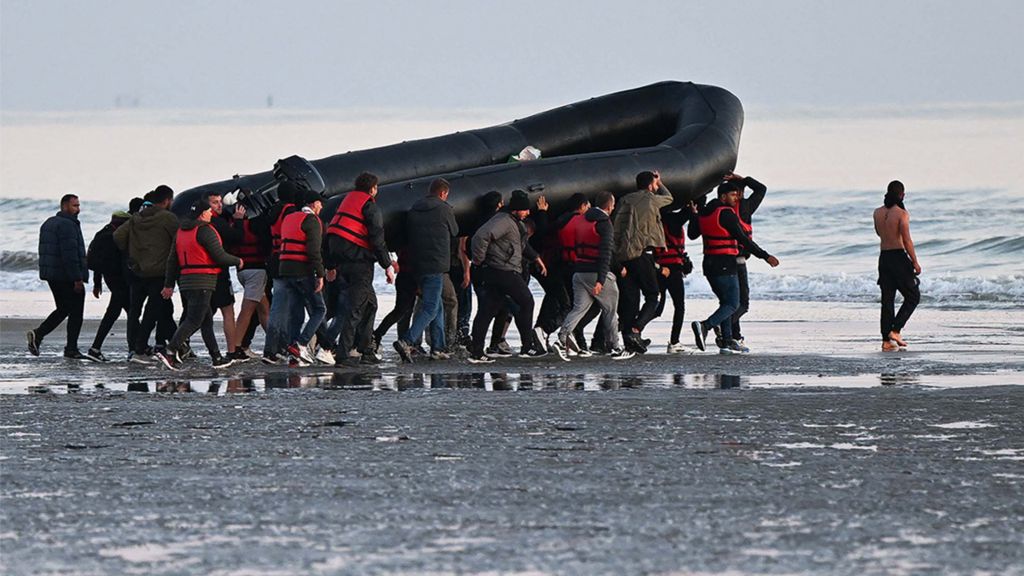
More than 44,000 people who crossed the Channel in small boats have arrived in Britain this year, and several have died in the attempt, including four last week when a boat capsized in freezing weather.
Human rights groups say the government’s deal with Rwanda is illegal and unworkable, and that it is inhumane to send people thousands of miles to a country they don’t want to live in.
They also cite Rwanda’s poor human rights record, including allegations of torture and killings of government opponents.
Britain has paid Rwanda 120 million pounds ($146m) under the deal struck in April, but no one has yet been sent to the country.
The UK was forced to cancel the first deportation flight at the last minute in June after the European Court of Human Rights ruled the plan carried “a real risk of irreversible harm”.
The British government is determined to press on with the policy, arguing that it will deter people-trafficking gangs who ferry migrants on hazardous journeys across the Channel’s busy shipping lanes.
Home Secretary Suella Braverman, who has called the Channel crossings an “invasion of our southern coast”, told the Times of London it would be “unforgivable” if the government did not stop the journeys.
Rwanda’s reaction
Rwandan government spokeswoman Yolande Makolo welcomed the British court’s decision.
“This is a positive step in our quest to contribute innovative, long-term solutions to the global migration crisis,” she said.
The UK government has argued that while Rwanda was the site of a genocide that killed more than 800,000 people in 1994, the country has since built a reputation for stability and economic progress. Critics say that stability comes at the cost of political repression.
The UK receives fewer asylum seekers than many European nations, including France, Germany and Italy, but thousands of refugees from around the world travel to northern France each year in hopes of crossing the Channel.
Some want to reach the UK because they have friends or family there, others because they speak English or because it’s perceived to be easy to find work.
The government wants to deport all people who arrive by irregular routes and aims to strike Rwanda-style deals with other countries.
Critics point out there are few authorised routes for seeking asylum in the UK, other than those set up for people from Ukraine, Afghanistan and Hong Kong.
In response to the US requestto free government critic Paul Rusesabagina, Rwandan President Paul Kagame stated that nobody would “bully us” regarding domestic matters in his country.
When discussing African issues outside of the US-Africa Summit in Washington, Mr. Kagame was asked if the US’s support of Mr. Rusesabagina through Antony Blinken was “helping or hurting” his case.
Mr. Kagame claimed that because “this person is a celebrity,” “somebody in America” wanted the case to be “nullified.”
On terrorism-related charges, Mr. Rusesabagina and 20 other defendants were found guilty last year.
“If we let him free, how about these other 20 who pointed him as even being their leader?” President Kagame asked.
“We have made it clear, there isn’t anybody going to come from anywhere to bully us into something to do with our lives – you can maybe make an invasion and overrun the country,” he added sarcastically.
Mr Rusesabagina, 68, was depicted as a hero in a Hollywood movie on the Rwandan genocide.
He was sentenced to 25 years in jail after being tricked into boarding a private jet from Dubai to Rwanda’s capital Kigali, thinking he was heading to Bujumbura in Burundi.
Mr Rusesabagina’s family has called the trial a sham, saying he was taken to Rwanda, from exile, by force.
The US has stated that Mr Rusesabagina is being “wrongfully detained” in Rwanda
In the Democratic Republic of the Congo, the M23 rebel group has condemned “genocide and targeted killings” against the Tutsi community by government forces and their allies in the east.
It asserted that the government’s coalition forces “attacked our positions in Bwiza and its surroundings on Tuesday, in total violation of the current ceasefire.”
The M23 claimed that government-allied forces had killed innocent civilians, destroyed their homes, looted and slaughtered their cattle, and that the ongoing attacks had displaced and injured many civilians.
“These targeted killings of Tutsi, and those who have rejected the genocide ideology by the said DR Congo government’s coalition, while the international and national community remained tight-lipped, take us back to the time prior to the genocide of 1994 perpetrated against the Tutsi in Rwanda,” it said in a statement.
The group has said that it will not “stand by and watch” as civilian populations get killed, adding that it’s “ready to intervene and stop these horrific massacres”.
The army has not spoken about the allegations but had last week accused the M23 of killing dozens of civilians in the eastern town of Kishishe, which they denied.
The statement by the M23 comes after the group agreed to withdraw from occupied territory following sustained pressure from the government and international community following resolutions agreed on by heads of states during a recent meeting in the Angolan capital, Luanda.
Over 50 Congolese armed groups that attended peace talks which concluded this week in Nairobi also announced that they had agreed to lay down their weapons.
Thousands of people have demonstrated across the Democratic Republic of Congo against the M23 rebel group, one of dozens fighting in the country’s east.
The Catholic Church encouraged people to take to the streets, and much of the rage was directed at Rwanda, which DR Congo accuses of supporting the M23 rebels, and something that Kigali denies.
People marched for peace after leaving Sunday services across the country.
The Catholic Church wields enormous power in the country. Some church leaders are urging Western countries to take a tougher stance against Rwanda’s government for its support for the M23 rebels.
Banners at protests in Kinshasa opposed the balkanisation of DR Congo and spoke of the hypocrisy of the international community.
Regional talks have been taking place to try to stop the violence.
Several East African countries are sending in troops but in the past the involvement of multiple armies has only complicated the conflict in the mineral-rich eastern DR Congo.
The M23 rebels in eastern Democratic Republic of Congo have said that a ceasefire supposed to take hold on Friday evening “does not concern” the group.
They called on the DR Congo government for direct dialogue.
The rebels’ spokesman, Lawrence Kanyuka, said that as they had no representatives at Wednesday’s mini-summit in the Angolan capital Luanda, they were not included in the accord.
The signatories – from Rwanda, the DR Congo, Angola and Burundi – said that under the cessation of hostilities, if the rebels did not withdraw from the area an East African regional force would attack their positions.
Kinshasa has refused to engage with the M23, calling them terrorists.
DR Congo accuses Rwanda of backing the rebels, who have been advancing on the regional capital, Goma.
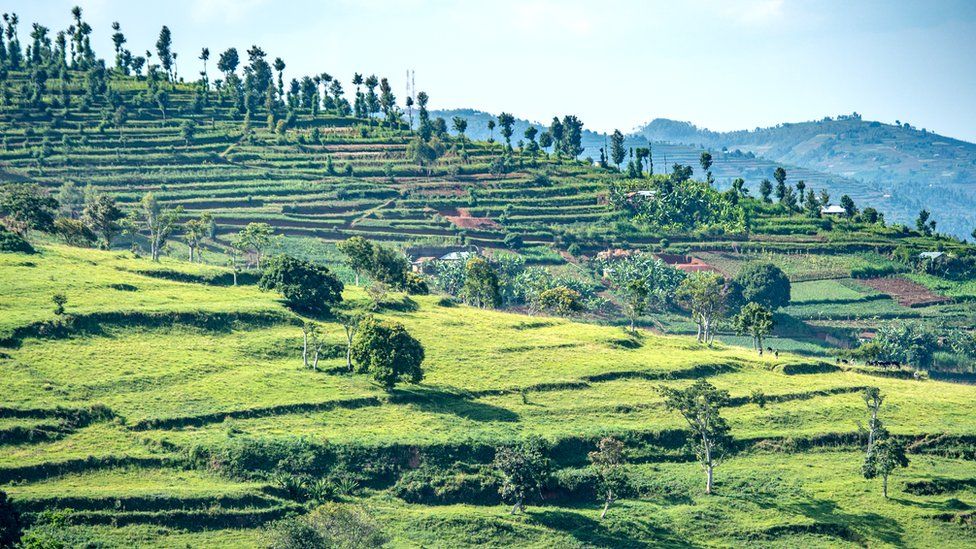
The rugged, rural terrain would be tough on any car, but particularly models that have to lug around heavy batteries.
But Rwanda’s president Paul Kagame wants to transform the economy of the tiny, landlocked country.
A key part of the plan is to cut greenhouse gas emissions and reduce the nation’s dependence on imported fossil fuels, which account for 40% of the country’s foreign exchange expenditure.
So, the government has launched a range of incentives to encourage electric vehicles.
Electric cars, their spare parts, batteries and charging station equipment have been exempted from VAT, import and excise duties.
Meanwhile, electric vehicles can be charged at a heavily subsidised electricity tariff. The government also offers rent-free land for charging bays.
IMAGE SOURCE, JEROEN VAN LOON Image caption, Volkswagen launched its e-Golf in Rwanda
First proposed in around 2019, but held-up by the Covid pandemic, the incentives came into effect in April 2021.
Germany’s Volkswagen was one of the first beneficiaries of the government strategy. It launched the e-Golf model in Rwanda in 2019. The pilot project started with four of the cars and two charging stations in Kigali.
VW’s original plan was to expand the service to 50 cars and 15 charging stations, as part of its cab-hailing app called Move.
However, three years later, only 20 of the cars are on the road and they have been removed from the ride-hailing service. Instead they ferry customers from several high-end hotels, the international airport and the Kigali Convention Centre.
“The unevenness in road infrastructure and the height of speed-bumps turned out to be too challenging for the e-Golf, which has a relatively low ground clearance,” says Allan Kweli, head of operations at Volkswagen Mobility Solutions Rwanda.
There was particular concern about damaging the underside of the car, where the batteries are located.
Despite that misfire, VW remains optimistic about Rwanda. It is planning to import its ID.4 electric car, which has a higher ground clearance.
“The beauty of Rwanda is that the government has created a test scenario whereby you can prove your work in an African setup,” Mr Kweli says.
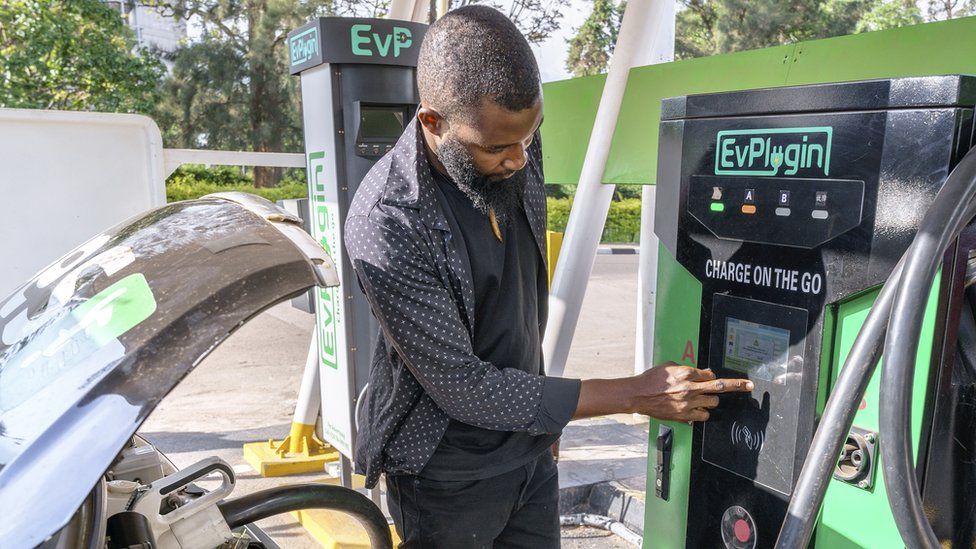
IMAGE SOURCE,JEROEN VAN LOON Image caption, Rwanda’s EvPlugin is planning to build 200 public chargers across the country
One glaring problem facing the carmakers is the lack of any charging facilities outside of Kigali.
In a developing country like Rwanda, it’s tough to justify large investments in a nationwide charging infrastructure.
Nevertheless, in partnership with the government and energy companies, Rwanda’s EvPlugin charging network is planning to build 200 public chargers across the country over the next two years.
Of those facilities, 35 will be suitable for cars while the others will serve electric motorbikes.
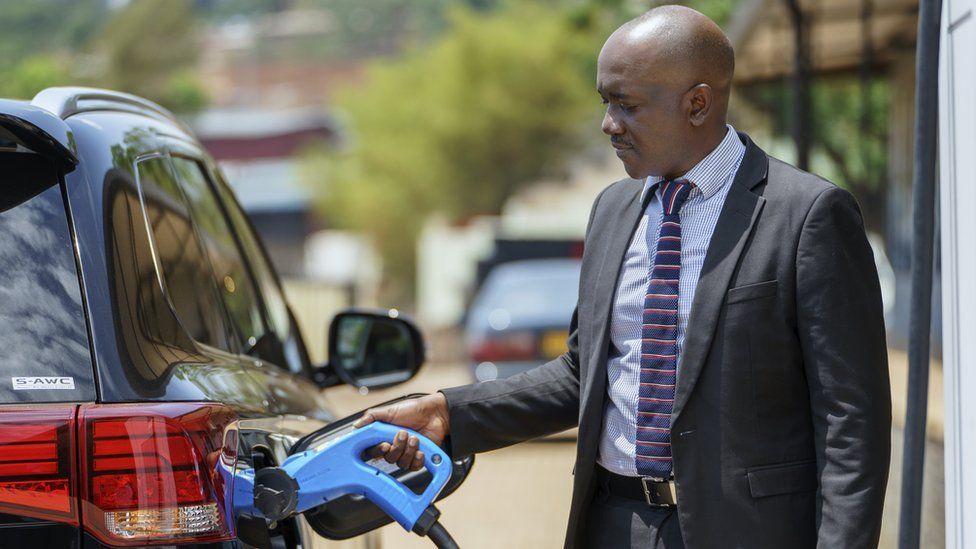
Japan’s Mitsubishi is dodging the problem by launching a petrol-electric hybrid car in Rwanda.
It has 135 of its Outlander cars on the roads of Kigali – 90 of which are leased, while the others are driven through a rental service.
“A hybrid vehicle eliminates the range anxiety as it can switch to gasoline, which is relevant as we are still far behind with charging infrastructure in Rwanda,” says Joshua Nshuti, from Greenleaf Motors, Mitsubishi’s official dealer in Rwanda.
He says demand has picked up recently.
“As fuel prices have increased by 60% in the last few months, we see a growing demand for the Outlander, as it gives clients the opportunity to half their fuel costs,” he says.
Critics question the positive environmental impact of the Outlander as, in hilly Kigali, it can only manage about 50km to 70km (30 to 44 miles) on battery power alone.
IMAGE SOURCE,JEROEN VAN LOON Image caption, Paul Mugambwa says his hybrid saves him more than $100 a month in fuel costs
That’s not a problem for Paul Frobisher Mugambwa, who works for an international accountancy firm in Kigali. His leased Outlander runs mainly on battery power, for his short 7km commute between his home and the office.
He says petrol used to cost him $150 (£128) a month, but reckons charging his Outlander costs $40 a month.
Ideally, he would like to switch to an all-electric car, but worries about the lack of mechanics in Rwanda who would be able to service and mend such a car.
“If you buy an imported Chinese electric SUV, who is going to fix your car when it breaks down,” Mr Mugambwa wonders.
Perhaps the biggest obstacle to developing an electric car market in Rwanda is the expense.
IMAGE SOURCE,GETTY IMAGES Image caption, In a rural, developing nation like Rwanda most people can’t afford to own a car
Although Rwanda has made economic progress over the last decade, about half the population still meets the UN’s definition of poverty – living on less than $2.15 a day.
While that makes owning an electric vehicle impossible, catching a ride on an electric motorbike is within the realms of possibility.
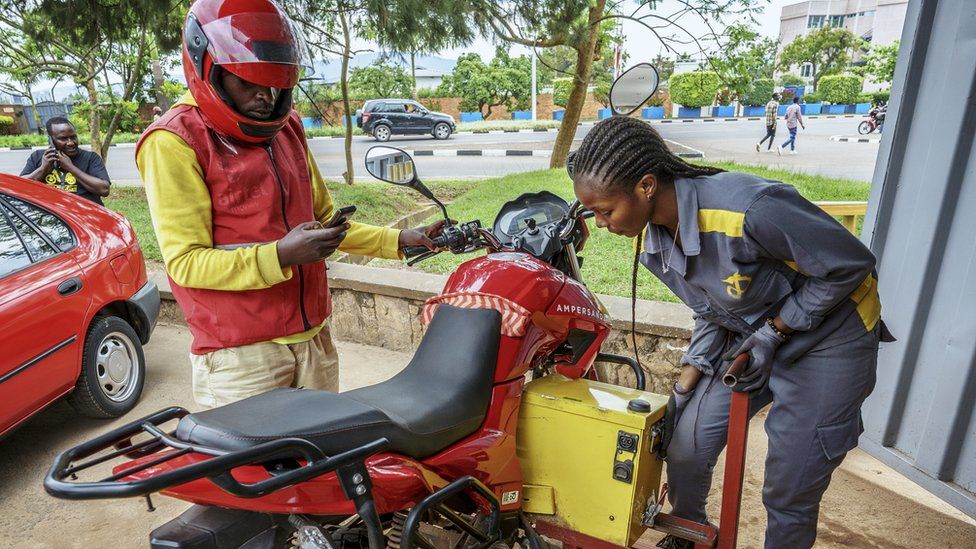
The company Ampersand has already managed to sell more than 700 e-motorbikes in Rwanda, where motor taxis are a very important mode of transport.
These so-called e-motos, with a battery swap system, are extremely popular, partly because they cost less to acquire and operate than a traditional motorbike.
IMAGE SOURCE,JEROEN VAN LOON Image caption, Electric motorbike taxis have had some success in Rwanda
Despite the challenges, many believe that Rwanda should push on with its electrification plans.
Michelle DeFreese, is a senior officer at Global Green Growth Institute, which assists the Rwandan government with training and advice regarding a plan for electric public buses.
She believes that Rwanda, which already produces 53% of its electricity from renewable sources, is in a good position to make the transition.
“The combination of transitioning to electric vehicles while investing heavily in renewable and clean energy resources is a powerful combination when it comes to reducing emissions,” she says.
Trade between Ghana and the United Kingdom (U.K.) is targetted to grow to £1.4 billion in value as the two countries commit to a new three-party partnership, including Rwanda, which is expected to boost trade opportunities between local businesses and their foreign counterparts.
According to the British High Commissioner to Ghana, Harriet Thompson, while increasing trade remains a key priority for both countries, it is expected that products going from the country to the U.K. meet market standards.
She observed that supporting Ghana’s exporters to meet the standards the UK markets require will help to remove one of the barriers currently stopping goods from the country from entering their markets.
The British High Commissioner to Ghana, speaking in an interview at the sidelines of the launching of the ‘Standards Partnership Pilot,’ reiterated that the platform created was fundamental to boosting trade between the country and the rest of the world.
“This programme will help put Ghanaian businesses on the global stage. By adopting and working within international trading standards, this new partnership will build greater capacity in Ghana’s Standard Authority (GSA), and better position companies to export Ghanaian products to the UK.
“The launch of the UK-Ghana Standard Partnership Pilot is timely. With the roll-out of the AfCFTA and the implementation of the U.K. – Ghana Trade Partnership Agreement, quality standardisation will play a critical role in driving further trading opportunities between our two nations and beyond,” she stated.
The programme is the first U.K. Government-backed initiative to use global standards to support trade in Africa. It is led by the British Standards Institution (BSI) in collaboration with and to support GSA.
It will focus on strengthening national quality infrastructure organisations and systems in complying with internationally recommended practices.
Also, the pilot will help deliver secondary benefits by enabling businesses to build resilient, diversified supply chains with high-quality products and services, resulting in greater choice and lower prices of goods for consumers.
The project is the first step toward the Standards Partnership programme – a Foreign, Commonwealth and Development Office-funded (FCDO) initiative to unlock sustainable economic development by increasing the capacity of developing countries to use and comply with standards and regulatory measures – enabling them to access new markets, and benefit from global supply chains.
The Deputy Minister of Trade & Industry, Michael Okyere Baafi, also speaking at the ceremony, said the project will, among other benefits, strengthen the long-standing relationship between Ghana and the U.K.
He added that it will also ensure that the products are vigorously checked and maintained so that they can be consumed locally and exported, which will enhance the country’s foreign exchange earnings.
On his part, the President of the African Organisation for Standardisation (ARSO) and Director-General of GSA, Prof. Alex Dodoo, acknowledged that the initiative holds the potential to transform intra-Africa and global trade.
He said the U.K. is one of Ghana’s leading trading partners, and goods from Ghana are always in high demand provided they meet strict international standards and related requirements.
Because of this, he observed that the Standards Partnership Programme provides a timely opportunity for Ghana to improve standards and quality infrastructure to expand trade with the UK and the world.
As the attempts to restore peace in the Democratic Republic of Congo(DRC) by the East African Community regional leaders continue, rebels from the March 23 Movement have advanced to capture territories in the eastern DRC.
The Congolese government still claims Rwanda is orchestrating the clashes between the two countries by supporting the M23 rebels.
In the past couple of months, many Kinyarwanda speaking Congolese also known as Banyamurenge and Tutsi have been announced killed in the DRC as they were suspected of being allies of the M23.
Congolese people make up over 60 percent of the total refugee population in Rwanda.
Living and doing businesses in country, they shared with Africanews their experiences of being Congolese in Rwanda in times like these and amidst the political war between the two countries.
Congolese business man, Vianney Saidi said: “We are not facing any issues in Rwanda, we the Congolese, we are not affected by the war at all.
“We are doing well and progressing with our businesses here in Rwanda, most technicians, hairstylists and tailors here in Rwanda are Congolese and they have no complaints at all.”
But Julien Mulatwe, a Congolese businesswoman has had a different experience.
“I used to import my jewellery products from Congo, now I have no way of importing them,” she explains.
“I can’t travel to Congo, I could get killed, my business has been affected badly, I have had to put it on hold.”
Kenyan forces have been deployed in the DRC with a mandate to create a buffer zone between the DRC forces and the M23 rebels so fighting can halt.
On Wednesday this week, Kenya Defence Forces (KDF) vowed to protect the strategic Goma Airport in eastern DRC from possible attacks.
Jean Baptiste Gasominari is a Political Lawyer in Rwanda.
“There have been a lot of issues between Rwanda and DRC and mostly they originate from the genocide perpetrated against the Tutsi in Rwanda,” he explains. “And those perpetrators that fled to Rwanda were welcomed with their weapons and ideologies, they were never disarmed, their military capabilities increased because they were being armed by the Congolese government.
“The involvement of Uganda, Kenya and Burundi are aimed at bringing peace and security, but if those root causes of the conflict are not addressed, then the conflict will never end.”
As the M23 rebels advance to control more regions in eastern DRC, over 89 refugees have crossed over the Kabuhanga border to seek refuge in Rwanda.
Rwandan President Paul Kagame has lamented the effects of the Ukraine conflict on Africa, declaring that the continent desires world peace.
On Tuesday, Kagame spoke at the G20 Summit in Bali, Indonesia, as chairperson of the African Union Development Agency’s (Nepad) Heads of State and Government Orientation Committee.
The setting was ideal for Kagame to say: “I commend the attention given to the priorities that matter to small and developing countries, including coping with the effects of the war in Ukraine and other crises.” The conference was held under the theme “Recover Together, Recover Stronger.”
Parts of Africa, particularly central and southern Africa, are currently experiencing or preparing for cropping seasons.
But the war in Ukraine has resulted in a shortage of fertiliser, which is mostly procured in Ukraine and Russia. This has led to a spike in the price.
One of the single most notable compromises to help alleviate this crisis this week was the release of a Russian fertiliser cargo which had been detained for months in the port of Rotterdam because of sanctions.
It’s now on its way to Malawi, one of southern Africa’s most food-insecure countries.
The 20 000 tons of fertiliser belong to a Russian who’s been on the United States sanctions list since the start of the war in Ukraine. However, he will not benefit from the cargo that’s now under the radar of the World Food Programme (WFP).
Since the start of the war, a number of African countries have been sitting on the fence, choosing not to vote against Russia or outright support the invasion.
It’s a diplomatic approach that seeks to please both sides of the divided world. But Kagame said Africa should not be blamed for allegedly taking sides.
He said:
What Africa wants to see is peace. We are confident that we cannot be accused of taking sides, simply by asking for peace. Africa is here for Africa and our productive relationship with the rest of the world.
Kagame also highlighted that Africa had specific challenges, made worse by external factors such as the war in Ukraine, and that “too often our people are left to pay the price”.
Climate change, the war in Ukraine, and conflicts in Africa are the major drivers of the widening gap between developing and developed countries. This has led to even more debt for the continent.
Kagame pleaded with the G20to reintroduce debt write-offs, and for more support from the International Monetary Fund through its Resilience and Sustainability Trust.
Rwandan president Paul Kagame over the weekend had cause to slam the police for not taking action on a Member of Parliament, MP, who was involved in a drink-driving offence.
According to local media reports, the MP was not arrested because he enjoyed ‘immunity,’ as a lawmaker.
MP Gamariel Mbonimana, in Parliament since 2018, belongs to the Liberal Party – which is an ally of the ruling party, the Rwandan Patriotic Front, RPF.
The embattled MP resigned from parliament on Monday, and apologized to the lawmaking chamber and the citizens.
On Monday, parliamentapproved his resignation stating that it was for “personal reasons”.
In a statement on Twitter, Mr Mbonimana apologized to Rwandans and the president, adding that he has “decided not to take alcohol anymore”.
Drink-driving carries a fine of 150,000 Rwandan francs ($140), and five days in police custody following an arrest.
A spokesperson for the presidency in the Central African Republic has denied that President Faustin-Archange Touadéra was evacuated to Rwanda on Sunday for medical treatment after “a serious fall”.
CAR and international media widely circulated the news after a pro-opposition website claimed Mr Touadéra was injured in a “serious fall” in the capital, Bangui, and flown to Rwanda.
The presidency’s spokesman, Albert Yaloke Mokpem, expressed “astonishment” at the claim, and said the president was at work in Bangui.
“The president has just arrived in his office. The information that Corbeau News put online is false and only concerns itself. We are astonished by such information,” he said.
Privately owned station Radio Ndeke Luka said that its reporters saw the president in Bangui on 14 November, a day after he was reportedly evacuated to Rwanda.
The Democratic Republic of the Congo’s capital is hosting talks aimed at resolving a diplomatic row with Rwanda and putting an end to a violent conflict in the country’s east.
Former Kenyan leader Uhuru Kenyatta and Angola’s President Joo Lourenço are mediating between representatives of the two governments.
This follows a meeting with Rwandan President Paul Kagame on Friday.
He has denied backing the M23 rebel group that recently re-launched an offensive that has left tens of thousands of people displaced.
The mediators will also speak to victims of the conflict.
DR Congo’s government is due to meet representatives of various armed groupslater this month in the Kenyan capital Nairobi.
The Rwandan government said a Democratic Republic of Congo (DRC) army fighter jet violated its airspace on Monday, just 48 hours after a deal to defuse rising tensions between the two countries.
The Congolese government has been facing an offensive by the armed group M23 (“March 23 Movement”) in eastern DRC in recent weeks, which has reignited historic tensions with neighbouring Rwanda, which it accuses of supporting the former Tutsi rebellion.
Kigali has always disputed these claims and in return claims that the DRC is collaborating with Rwandan Hutu rebels.
The DRC expelled the Rwandan ambassador in Kinshasa on 29 October and recalled its chargé d’affaires in Kigali.
In a statement on Monday, the Rwandan government said a “Sukhoi-25 fighter jet from the Democratic Republic of Congo violated Rwandan airspace at 11:20 am (local, 8:30 am GMT) this morning and landed briefly at Rubavu airport in Western province”.
“No military action was taken by Rwanda in response, and the plane returned to the DRC. The Rwandan authorities protested against this provocation to the DRC government, which acknowledged the incident,” the text added.
On Saturday, the foreign ministers of the two countries meeting in Angola announced their commitment to “maintain dialogue” and to define “a timetable to accelerate the implementation of the roadmap” signed in July and providing for a cessation of hostilities.
Relations between Rwanda and the DRC are as conflictual as they are historic, mired for nearly 30 years in the aftermath of the 1994 genocide.
The resurgence of the M23 in the east of the DRC since the end of 2021 has rekindled tension between the two neighbours.
While Kigali denies any support to the M23, a report by independent experts mandated by the UN Security Council had detailed in August the involvement of Rwanda, “unilaterally or jointly with the M23 fighters” in eastern Congo.
Washington reiterated last week its “concerns about Rwanda’s support for M23”.
Kenya announced on Wednesday the deployment of troops as part of a joint force of the East African Community (Burundi, Kenya, Rwanda, Tanzania, South Sudan, Uganda and DRC) agreed in April to help restore stability in the DRC.
According to the UN, fighting between the Congolese army and the M23 has displaced some 50,000 people since 20 October.
The African Union has called for an immediate cessation of fighting in the Democratic Republic of Congo where rebels have been advancing towards a provincial capital in the east of the country.
DR Congo has expelled the Rwandan ambassador, accusing Kigali of supporting the M23 rebels who are now threatening the city of Goma.
It follows the take-over by the rebels of a key transit town in the east of the country.
Rwanda has repeatedly denied the allegation that it supports the rebels.
The town of Kiwandja fell to rebel hands on Saturday, potentially cutting off the regional capital, Goma, from the north of mineral-rich North Kivu province.
The AU has urged all the parties to engage in a constructive dialogue and is calling them to peace talks in Kenya next month.
Rwanda’s president has said he’s had a “good discussion” with the UN secretary general about de-escalating the situation in the east of the Democratic Republic of Congo.
Conflict has been raging in the region for months between the DR Congo’s army and the M23 rebels who seized two more towns over the weekend.
The situation has prompted the DR Congo government to expel Rwanda’s ambassador to Kinshasa, a decision Rwanda has noted “with regret”.
In a tweet posted on Monday, President Paul Kagame wrote that the “ways and means to de-escalate and address the issues to a peaceful end are with us … We just have to commit ourselves to applying them”.
The African Union has expressed its “extreme concern” at the deteriorating security situation and called for called for an immediate cessation of fighting.
Kinshasa has repeatedly accused Rwanda of supporting M23, an accusation Kigali has always denied.
Different initiatives by the Angolan president and the East African Community – which both countries belong to – have been unable to stop the violence and resolve the decades-long conflict.
Ghana has been recognised as the only country in Africa to achieve 100% access to financial inclusion on the continent.
The honour was contained in this year’s State of Inclusive Instant Payment in Africa Report put together by AfricaNenda and launched at the ongoing Mobile World Congress Africa 2022 in Kigali, Rwanda.
This feat was achieved through the successful implementation of the Mobile Money Interoperability (MMI) system, which integrates all payments platforms across banks, fintechs and telcos, allowing every Ghanaian to make and receive instant payments.
Commenting on the monumental achievement at the ongoing Standard Chartered Bank Digital Banking, Innovation and Fintech Festival in Accra on Wednesday (26 October 2022), Vice-President Mahamudu Bawumia expressed delight that the government’s digitisation agenda, began in 2017 and touching almost every aspect of national life, is beginning to yield the desired results.
“In fact, because of mobile money interoperability, where fintechs, banks and telcos have essentially payment platforms that enable every Ghanaian to access and receive payments, Ghana was the only country to score 100% on financial inclusion in Africa at the ongoing Mobile World Congress Africa 2022 in Kigali, Rwanda. And it just makes you proud in this context that yes, we are doing what is actually quite right.
“You’ve seen mobile money interoperability; you’ve seen the national ID card; you’ve seen digital addresses, you’ve seen the paperless ports, universal QR code, Ghana pay, and so on. All of this is laying a particular foundation in this country that will allow us to fully participate in the Fourth Industrial Revolution.
“It is also comforting to note that even the credit reference agencies are leveraging on these infrastructure, the digital infrastructure that we have put in place, digital addresses, national ID and so on. We are expecting that individual credit scoring by the credit reference agencies will start taking place by the first quarter of next year, which will allow and underpin the development of a real credit system in Ghana which is very, very critical in terms of the development of this country,” Bawumia said.
Digital technology has changed the way Africa’s financial service industry offers products and services to consumers, Dr Bawumia pointed out, noting that new financial service business models based on digital technologies are enabling inclusive access to financial services across diverse product types for consumers.
“As a government, we realized it was imperative to adopt digital innovation to transform the economy. It is not a venture without opposition, and there are huge costs associated to get to our destination. However we are unwavering as we are convinced the benefits will outweigh the costs, and these benefits are already beginning to show.
“Thus far, we have introduced some interventions such as mobile money interoperability, digital renewal of National Health Insurance, implementation of the digital address system, the national ID card, paperless port system, QR-Code, among others.
“We are already seeing the impact of these digitisation initiatives including efficient public service delivery by all Ministries, Departments, and Agencies on the Ghana.gov portal, combating corruption by removing the middle man, and also ghost names in many transactions, bringing more Ghanaians into the formal sector and driving domestic revenue mobilization, amongst others.”
To achieve greater success and faster growth, Bawumia called for more collaboration between all players in the fintech ecosystem – banks, fintechs, telecom companies, governments, regulators and consumers – in order to position Africa as a fintech innovation hub.
“A strong regulatory framework is also necessary across the sub region to drive innovation. Central banks need to be ahead of the market and put in place regulations that are innovation friendly bearing in mind all associated risks.”
Award
The State of Inclusive Instant Payment in Africa Report examines all instant pay rollouts across the continent to identify the areas of commonality with the view to driving adoption to boost financial inclusion on the continent.
This year, the report focused on inclusive instant payment systems in 12 African countries and Ghana was the only country that scored 100% on access to financial inclusion.
The Chief Executive Officer of the Ghana Interbank Payments and Settlements Systems (GhIPSS), Archie Hesse, who was present at the launch of the report in Kigali, said from a humble beginning of integrating three instant payment platforms into what he called the ‘financial inclusion triangle’, GhIPSS has since improved the services by adding other services like Proxy Pay, Internet Gateway Payment, Request to Pay and the Universal QR Code dubbed GHQR, which can be linked to both bank accounts and digital wallets, with affordability as the key driving force.
GhIPSS, in collaboration with the banks, have also come up with a bank-wide wallet called GhanaPay to ensure that the banks also play a role in the mobile money space with the view to bridging the financial inclusion gap, he added.
Burundi’s foreign affairs minister officially declared that the border between the East African country and Rwanda has been reopened.
“All the borders of Burundi with its neighboring countries are open”, the ministry tweeted without much detail on October 22.
On October 25, minister Albert Shingiro confirmed in a press conference the border reopening with Rwanda.
He also indicated that Burundi maintained its position of calling on Kigali to return coup-plotters it alleges fled there after trying to overthrow former President Pierre Nkurunziza in 2015.
The border between Burundi and Rwanda had been closed for almost six years, first amid political tensions and then by the COVID-19 pandemic.
Rwanda for its part reopened its border with Burundi several months ago.
The border reopening comes after President Ruto William of Kenya urged his East African Community (EAC) partner states to knock off barriers that impede trade across the bloc.
The Rwandan parliament has rejected a bill to change a 2016 law to allow contraception to be supplied to females as young as 15 years old.
The plan was submitted by a group of MPs in order to reduce adolescent pregnancies, which have increased by 21% – from more than 19,000 in 2020 to 23,000 last year, according to officials.
Only 18-year-olds and above are legally allowed to access sexual reproductive health services – but there has been debate among health activists, and cultural and religious leaders about lowering that limit.
The rejection of the bill stops “the anticipated changes” in the law that “has gaps”, Aflodis Kagaba, a Rwandan reproductive health activist, told the BBC.
“Unfortunately, this has overshadowed everything else including the opportunity to re-open these important conversations in parliament,” Mr Kagaba said.
More than 30 MPs who rejected the bill cited their faith, and social and cultural reasons, local media report.
But Mr Kagabasaid the current law “has gaps” and believes “it still needs to be revised”.
“Today if you are under 18 and need [sexual and reproductive] health services you are required to be accompanied by parents for their approval!”
Rwandan troops deployed to help fight insurgents in northern Mozambique say they have discovered a stockpile of weapons and ammunition hidden by jihadists.
The Rwanda Defence Force (RDF) posted a tweet with pictures of weapons and ammunition which it said jihadists had hidden in Mbau in Mocimboa da Praia district.
The stockpile includes hundreds of weapons ranging from small arms and rockets as well as ammunition and shells.
They are said to have been hidden by the Islamist Insurgents as the RDF pursued and dislodged them from their strongholds in the area.
Cabo Delgado province has experienced jihadist attacks since 2017, which have so far displaced about a million people and caused the deaths of around 4,000 others.
The Democratic Republic of Congo’s representative at the UN, Georges Nzongola-Ntalaja, has accused Rwanda, without presenting facts, of taking gorillas from Congolese forests to Rwanda.
Mr Nzongola-Ntajala said this during the 11th emergency UN General Assembly session to debate and vote on a resolution on Russia’s annexation of four Ukrainian regions.
He accused Rwanda of occupying Congo “in 1998 to 2003” plundering gold and coltan “and many other resources”.
“They even take chimpanzees and gorillas from the Congolese forests taking them to Rwanda, all of this is well known,” Mr Nzongola-Ntajala added.
Rwanda, Uganda, and DR Congo share the massive volcanoes between their borders that are home to rare mountain gorillas.
Rwandan envoy Robert Kayinamura appeared to laugh at Mr Nzongola-Ntajala’s statement.
“These allegations of; every time there is no flowing water it is Rwanda, there’s no electricity it is Rwanda, there’s no roads it is Rwanda…We need to move beyond that kind of mentality.” Mr Kayinamura said.
In September during a UN general assembly, DR Congo President Félix Tshisekedi accused Rwanda “of direct aggression”, before his counterpart Paul Kagame replied that “blame game doesn’t solve the problems”.
Rwanda has continuously denied allegations of supporting M23 rebels who now control the border city of Bunagana and areas around it in DR Congo’s North Kivu province.
The Speaker of Parliament, Alban Bagbin has urged Parliamentarians across Africa to pay much more attention to climate change.
Addressing the 145th Inter-Parliamentary Assembly Conference in Kigali, Rwanda Ghana’s Speaker emphasized on the risk of climate change on the continent.
“I can tell from the Members of Parliament from CVF countries and observer states in attendance that as parliamentarians we have made a clear and conscious decision to rise to the challenge of ensuring action on climate change. That is very encouraging indeed.
“We should also consider what we can do to mobilize other key actors within the space to create a lot more awareness and readiness to act so that in a concerted manner, we can confront today’s climate change demands. In unity, as we told, lies strength. We can achieve a lot more together than if we leave national institutions, state and global actors to operate in silos,” he stated.
As the leader of the Ghana’s delegation to the conference, Mr. Bagbin touched on the effects, risks and challenges of climate change and the critical role of Parliaments and Parliamentarians have to focus on.
“Yes, the world is facing serious threats from the impacts and risks of climate change, but we also have an opportunity to seize upon new technologies and approaches that can help us adapt and build our resilience to this challenge.
“For example, today, a lot more people are using digital devices for their work, for communication and for storing information. Consequently, it has led to a reduction in the reliance on paper, which goes to reduce deforestation. Bear in mind that trees, by being an important source of oxygen and absorbing carbon dioxide, help to reduce climate change.”
The Speaker also commended Hon Dr. Emmanuel Marfo, who was confirmed Chairman of the GPG during the conference.
Dr. Emmanuel Marfo is also the Chairperson of the Environment Science and Technology Committee, which is the relevant Committee in whose remit climate change issues fall in the Ghana Parliament.
“I place my utmost faith in his capabilities to ensure the success of the priorities of the CVF GPG and in support of the CVF priorities of 1.5ºC Ambition, Adaptation, Loss and Damage and Finance.
“The Parliament of Ghana is committed to support the work of the CVF GPG through the Chairperson of the CVF GPG. May I also take this opportunity to thank our Host Parliament, the Parliament of Rwanda, and Rt. Honorable Speaker, Donatille Mukabalisa, for hosting us. My appreciation also goes to the Secretary General of the IPU for facilitating the meeting of the CVF GPG.”
Ghana has issued its first certificate of full commercial trading to a ceramic tiles production company to export its products under the African Continental Free Trade Area (AfCFTA) Guided Trade initiative.
In the same vein, the Customs Division of the Ghana Revenue Authority (GRA) has received the first consignment of goods under the initiative from Rwanda, with delivery already done.
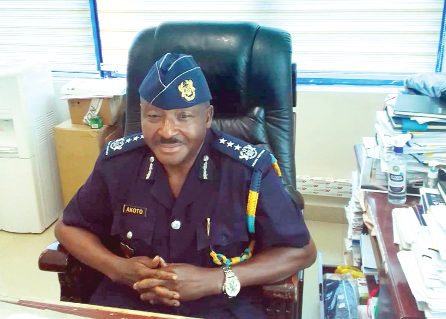
The Assistant Commissioner of Customs in charge of the AfCFTA Secretariat, F.Y. Akoto, who made this known in an interview with the Daily Graphic in Accra yesterday, said on September 30, this year, the Customs Division issued the certificate of trading to a tiles manufacturing company, Keda Ghana Ceramics Company Limited, located at Shama in the Western Region, to export a consignment of its products to Cameroun.
“It is expected that when the products reach Cameroun, their customs officials will give the necessary preferential treatment to Keda Ceramics for it to enjoy reduced tariffs and quota-free facility,” he said.
On the imports from Rwanda, he said they were made up of coffee products which were received at the Kotoka International Airport (KIA).
“Ghana Customs processed the Bill of Entry on the consignment, granting the importer the necessary tariff cuts after he had satisfied all the documentary requirements,” he said.
Mr Akoto added that a second consignment of tea products from Rwanda arrived at the KIA yesterday and documents on the goods were being processed for possible delivery, possibly before the close of work yesterday.
Second company
He further indicated that a second Ghana-based company, the Benso Oil Palm Plantation (BOPP) at Adum Banso, also in the Western Region, was expected to export palm kernel oil to Kenya in due course.
On the other hand, consignments of tea products were expected from Kenya, while meat products were also expected to arrive from Egypt, he said.
“This means that the AfCFTA agreement has come into full force and our manufacturers can take advantage of it to export to other countries,” he added.
F.Y. Akoto — Assistant Commissioner of Customs in charge of the AfCFTA Secretariat
Guided Trade
The Guided Trade initiative, which will be officially launched in Accra today, symbolises the commencement of commercially meaningful trade, starting with seven countries — Ghana, Cameroon, Egypt, Kenya, Mauritius, Tanzania and Malawi.
Mr Akoto explained that those countries volunteered to represent the eight economic groupings in Africa, namely: the Economic Community of West African States (ECOWAS), the Arab Maghreb Union (AMU), the Common Market for Eastern and Southern Africa (COMESA), the Community of Sahel-Saharan States (CEN-SAD), the East African Community (EAC), the Economic Community of Central African States (ECCAS), the Southern African Development Community (SADC) and the Intergovernmental Authority on Development (IGAD).
Under the initiative, the AfCFTA Secretariat will assist the countries to test AfCFTA trading documents and procedures on pre-selected shipments of goods among the countries.
It will guide shipments through customs clearance, including reduced tariff treatment under the AfCFTA in the receiving countries.
Foreign-owned companies
Explaining why Keda Ceramics, a Chinese-owned company, benefited from the agreement, the Customs officer said Keda, per its production process, qualified under the rules.
“Under the rules, a foreign company operating in an African country that has signed on to the AfCFTA agreement qualifies to participate in the trading if the raw materials for its production are sourced locally.
“In the case of Keda Ceramics, we visited the factory for inspection and realised that 99.97 per cent of its raw materials are internally acquired, so it qualifies to trade under the agreement,” he said.
Mr Akoto pointed out that AfCFTA was not set up solely for Africans, saying: “Once you set up in Africa and qualify under the rules, you are free to trade.”
He, therefore, encouraged foreign companies operating in the country to work towards benefitting from the agreement.
Allowing foreign-operated companies to participate in the trading activities if they fulfilled the requirements set out under the AfCFTA agreement would also improve foreign direct investments (FDIs) into Africa, he said.
FDIs into African countries hit a record $83 billion in 2021, according to the United Nations Conference on Trade and Development’s (UNCTAD’s) World Investment Report 2022.
Ghana ready
Emphasising Ghana’s readiness for the take-off of the AfCFTA, the Customs officer said: “We have the structures in place for an effective take-off.”
“The Ministry of Trade and Industry, the Ghana Chamber of Commerce, the National AfCFTA Coordinating Office, the Customs Division of the GRA, together with the AfCFTA Secretariat, are helping the companies to meet the requirements.
“The experiences gathered out of this will help streamline our processes for the smooth implementation of the policy,” he explained.
Addressing challenges
Mr Akoto said some challenges that had been identified were being addressed.
“We have been helping local companies to go through the systems. Some of them have been saying although they hear about free trade in Africa, they don’t believe it, so we need to educate them on what it takes to benefit from the free trade agreement,” he said.
Britain’s immigration minister said Tuesday that people who arrive by unauthorized means should not be allowed to claim asylum in the U.K. and she vowed to press on with a contentious plan to send some asylum-seekers on a one-way trip to Rwanda.
Home Secretary Suella Braverman acknowledged that a legal challenge to the policy means it’s unlikely anyone will be deported to the east African country this year.
Under a deal signed in April, Britain plans to send some migrants who arrive in the U.K. as stowaways or in small boats to Rwanda, where their asylum claims would be processed. Those granted asylum would stay in the African country rather than returning to the U.K.
The British government has said the policy will deter people-trafficking gangs who ferry migrants across the English Channel. Human rights groups say it is unworkable and inhumane to send people thousands of miles away to a country they don’t want to live in.
Braverman was appointed last month by new Prime Minister Liz Truss. Speaking at the ruling Conservative Party’s annual conference Tuesday, she said she would make the Rwanda policy work and was seeking to strike similar agreements with other countries.
She said she also would try to change the law so people who arrive in Britain by means other than established refugee programs can be deported.
“If you deliberately enter the U.K. illegally from a safe country, you should be swiftly returned to your home country or relocated to Rwanda,” Braverman said.
Tim Naor Hilton, chief executive of the group Refugee Action, said such a move would be “a blatant breach of the international refugee laws that the U.K. proudly helped create in the first place.”
Clare Mosley, the founder of refugee charity Care4Calais, said it was “barbaric, untruthful and unnecessary.”
“If this government truly wanted to stop small boat crossings it would offer safe passage to those who have a viable claim for asylum,” she said.
Britain has already paid Rwanda 120 million pounds ($145 million) but no one has been sent there as part of the deal.
The U.K. was forced to cancel the first deportation flight at the last minute in June after the European Court of Human Rights ruled that the plan carried “a real risk of irreversible harm.”
Braverman railed against the ruling. “We cannot allow a foreign court to undermine the sovereignty of our borders,” she said, though she has dropped an idea suggested by the previous government of pulling Britain out of the international human rights court.
Several asylum-seekers, aid groups, and a border officials’ union took legal action against the government in the British courts, with a hearing due later this month.
One of the alleged masterminds and financiers of the 1994 Rwandan genocide has gone on trial at a UN tribunal in The Hague.
Prosecutors say Félicien Kabuga aided and abetted hit squads in the slaughter of ethnic Tutsis, and used a radio station to incite hatred against them.
Some 800,000 Tutsis and moderate Hutus were killed in the genocide.
Mr Kabuga’s lawyers have filed a not guilty plea for him but he has refused to attend the opening of the trial.
Mr Kabuga, in his late 80s, was once one of Rwanda’s richest men and for decades he was among the world’s most wanted fugitives.
He was arrested in France’s capital, Paris, two years ago after evading capture for about 26 years.
French investigators spied on Mr Kabuga’s children to track him down to his third-floor flat in the Paris suburb of Asnières-sur-Seine, where he had been living under a false identity using a passport from an unidentified African country.
He is alleged to have previously lived in several countries in East Africa, including Kenya, where he and his family had business interests.
Mr Kabuga is accused of setting up what prosecutors have described as the most powerful weapon in the genocide’s execution – a radio station that was used to mobilize one ethnic group, Hutus, to take up arms against another, Tutsis.
The radio station is alleged to have broadcast hateful messages, describing Tutsis as “cockroaches”.
He is also accused of using his status as one of Rwanda’s richest businessmen to procure machetes, and provide them to death squads to carry out killings.
“In support of the genocide, Kabuga did not need to wield a rifle or a machete at a road block, rather he supplied weapons in bulk and facilitated the training that prepared the Interahamwe [militia group] to use them,” prosecutor Rashid Rashid said.
During a first appearance at the tribunal in 2020, Mr Kabuga’s lawyers entered a not guilty plea.
They have argued that he is too frail to stand trial, but judges ruled that it should go ahead but with shorter court sessions.
At the trial’s opening, the presiding judge said Mr Kabuga was well but he had decided not to appear in court or to follow proceedings via video link from his detention centre.
Mr Kabuga issued a statement, saying the court had refused to let him choose his own lawyer and he had “no confidence” in his current legal representative.
He is one of the last alleged masterminds of the genocide to go on trial at an international tribunal.
The prosecutor told the BBC the trial showed international justice was often slow but could ultimately prevail.
The Tanzania-based International Criminal Tribunal for Rwanda sentenced more than 60 ringleaders of the genocide before closing down in 2015.
Remaining cases were taken over by the tribunal hearing Mr Kabuga’s case. Judges decided he should face trial in The Hague, rather than Tanzania, because the travel could jeopardise his health.
Prosecutors are expected to call more than 50 witnesses in a trial that could last for years.
Survivors of the genocide have called for swift justice, fearing he may die under the presumption of innocence.
Before the pandemic, several sub-Saharan African economies saw record-breaking growth.
For instance, over the past 20 years, Ethiopia and Rwanda have experienced among of the fastest growth rates in the world, with annual growth rates averaging over 7.5%.
Due to a lack of income data at the sub-national level, it is less evident if the benefits of economic expansion have been distributed fairly throughout regions within nations.
We used satellite-recorded images of the earth’s evening lights as a stand-in for economic activity to gauge the extent to which sub-Saharan Africa’s excellent growth performance expanded across sub-national regions. The information demonstrates that, at least up to 2010, African nations made great strides toward reducing regional income inequality (differences in output per capita across regions of a country).
When compared to other regions of the world, where inequality either increased or convergence was slower, this stands out sharply.
Taking a closer look at the factors that affect regional inequality, we found that progress was largely due to improvements in basic infrastructure, which helped lagging regions converge faster to national levels. Night lights per capita increased several-fold in the poorest regions, with the biggest gains in oil exporters and frontier markets such as Ghana and Kenya.
However, not all lagging regions saw improvement. Fragile and conflict-affected states made little-to-no progress in reducing regional inequality. And even in countries that experienced decades of growth, progress stalled after 2010, with regional inequalities having likely widened post-pandemic.
Access to clean water, electricity and cellphone services, for example, is two to four times lower in lagging regions compared to leading ones, in part because public expenditure per capita is so much lower. Similarly, the share of residents who have completed primary and secondary education is two to three times lower in lagging regions.
In countries where access to public services is generally low and distribution very unequal, the gap is even larger. In Burkina Faso, for instance, access to electricity is nearly 20 times higher in leading regions.
Key drivers
What are the key drivers that helped reduce regional inequality in the past few decades? We find that there are four major factors that supported this improvement:
• Macroeconomic stability: Inequality tends to increase in countries with high, persistent inflation by eroding the purchasing power of consumers, reducing government spending in real terms and disincentivising private investment.
• Trade openness: Easier access to global markets supports convergence by increasing the value of a country’s resources such as raw materials, which are more abundantly available in lagging regions. It also brings more workers into urban centres, which could in turn lead to a decline in income per capita of more urbanised regions if infrastructure development and the overall increase in economic activity in city centres are unable to keep up.
• Strong institutions and political stability: Weak institutions impede the capacity of governments to provide services and civil wars destroy public infrastructure, raising the likelihood that regions are left behind.
• Well-targeted investments: We used mineral discoveries as a proxy for analysing the impact of investments on regional inequality and found that progress depended on the location. Investments that occur outside of the capital cities are the most likely to have impact by creating jobs and promoting economic activity in lagging regions.
Way forward
What can policy makers do to address these inequalities? Sub-Saharan Africa countries would need to pursue a broad-based policy framework anchored around three main pillars:
• Well-designed redistributive fiscal policy with a clear investment strategy to assist underserved regions,
• Macroeconomic stability to foster inclusive growth, and
• Building institutions to ensure political stability and equitable public service delivery.
Governments also need to invest in building local administrative capacity to collect and analyse data. Only 12 sub-Saharan African countries publish their public budget allocations at the sub-national level. Having this data more readily available would provide a more accurate picture of disparities across regions, helping policy makers better target policies.
A people smuggler says that his clients are unaffected by the UK government’s proposal to send asylum seekers to Rwanda. He is met by Jane Corbin at his Turkish headquarters.
The night is falling as I make my way up the creaking stairs of a safe house in an anonymous alleyway in Istanbul, Turkey. I’m here to meet a kingpin in the people-smuggling trade – it has taken months to arrange, working through a trusted intermediary. It is the culmination of a BBC Panorama investigation into how thousands of migrants end up on the beaches of southern England claiming asylum.
The people smuggler is from the Middle East – young and softly spoken, smartly dressed in black. He has agreed to tell me about his business if we do not reveal his identity. His bodyguards discreetly keep watch outside the house.
I challenge him that smuggling people is illegal: “I know this is not legal,” he says, “but for me, it’s about humanity – that’s worth more than the law. We help people, we treat them well, we respect women – we don’t disrespect or hurt anyone.”
Nearly 2,000 people died in the Mediterranean Sea last year.
In April, the UK government signed a £120m deal with Rwanda tosend some migrants, mostly single men, to Africa to have their asylum claims processed.
IMAGE SOURCE, GETTY IMAGES Image caption, More than 30,000 migrants have crossed the English Channel already this year
The government said the aim was to smash the business model of the people smugglers and stop record numbers of people making the dangerous English Channel crossing.
Already this year, more than 30,000 people have made the crossing in small boats, about as many as the whole of last year.
The people smuggler sends hundreds of migrants to the UK. He readily admits his trade is very profitable and says he runs it like a businessman.
“It doesn’t matter if it’s a whole family or an individual – each person pays the same price,” he says. “A trip to Britain will cost $17,000 [about £15,000] in total.”
So how can he justify putting people’s lives at risk in dangerous sea crossings in flimsy boats?
“Accidents can happen. We try and scare people to dissuade them,” he claims. “I say to them, ‘This road is dangerous and not worth it. You could die. And I tell his mum and his dad too.’”
He shows us a form – a disclaimer he says he gets customers to sign, acknowledging the risks.
Istanbul is the gateway between Asia, the Middle East, Africa, and Europe – and this black market trade is booming here.
Marketing is competitive. On social media, smugglers offer different rates depending on the destination.
Image caption, At night, migrants are taken in vans from Istanbul to the mountains, where they walk down to the Mediterranean
The people smuggler collects his clients in safe houses in this sprawling city, which is home to about five million refugees. They are packed into small rooms, where they can wait months while their passage is arranged. His gang brings them food and water from local supermarkets.
“We put them in a house and wait for everything to be prepared. And when it’s ready we take their phones so the cops can’t find out about us,” the people smuggler explains.
Then the migrants are taken in a van at night from Istanbul to the mountains. They walk in groups of six or ten, down to the Mediterranean, to one of the people smuggler’s boats.
The 2022 edition of Grow, Unite, Build, Africa (GUBA) Awardsis scheduled to take place on the September 29th, 2022 at the breathtaking Kigali Convention Center in Rwanda.
The ceremony, which is the 13th edition, will celebrate community organizations and role models from across the globe including entrepreneurs, charities, media moguls, and activists.
Commenting on the upcoming event, GUBA Enterprise president and CEO, Dentaa Amoateng MBEsaid, “The GUBA Awards this year seek to celebrate a historical hero within the Rwandan and African communities. Under the theme ‘Ndabaga – Drumbeat of Dreamers and Legends’ the Awards strive to convey the power of determination and focus. The story of Ndabaga is a keystone of Rwandan folklore, representing bravery and determination”.
“If ever there was a time to unite and celebrate the best of diversity, it is now. It is incredibly important to recognize the achievements of role models and community organizations across the world that deserve recognition for their work and impact, so that we as Africans, can tell our own stories. The GUBA Awards, therefore, aim to reward individuals who continue to persist and show great courage within their various fields,” she added.
Already, the Rwandan Convention Board and the government of Rwanda have both endorsed the awards and are hoping to welcome guests into the capital, Kigali.
Ticket link for the events can be obtained from www.gubaawards.com/tickets with all formal enquiry being handled by admin@gubaawards.co.uk .
Designed to highlight the most inspirational and trailblazing individuals within Africa and its diaspora community, the GUBA Awards continue to gain endorsements from high-profile figures such as H.E. Nana Akufo-Addo (President of Ghana), H.E Jean-Claude Kassi Brou (The President of the ECOWAS Commission) and more.
Past winners of GUBA awards include Dr. Ngozi Okonjo-Iweala, Dr. Natalia Kanem, Dr. Diane Karusisi, Vice President Epsy Campbell Barr, Sir Sam Jonah (Executive Chairman, Jonah Capital), and Cherie Blair (Barrister, Writer) Patrick Awuah (Founder of Ashesi University), Richelieu Dennis among several high profile individuals.
About GUBA awards
As a social enterprise, GUBA is dedicated to the advancement of diaspora Africans and Africans back home through various socio-economic programs and initiatives.
The GUBA Awards, an initiative of the enterprise, is instituted to celebrate, acknowledge, and support businesses and individuals in Africa and the African diaspora.
The Awards began in 2010 in the United Kingdom and have been held in the United States and Ghana respectively.
Despite a 12% decline in the species’ global population over the previous four years, the number of white rhinos that were transported to a sanctuary in Rwanda last year is growing.
The 30 white rhinos were sent from South Africa to Akagera National Park in Rwanda, where they became the first of their kind to live there.
They are now “thriving well” and their numbers have grown to around 35 after new calves were born recently, said Drew Bantlin, an official at the park.
“All calves are growing and healthy. They are starting to move widely with their mothers and are showing normal behaviours,” he added.
The International Rhino Foundation (IRF) says the global white rhino population continues to decline under pressure from poaching.
According to the government’s attorneys, the contentious relocation program the government is implementing gives it the legal right to send migrants to Rwanda.
Attorneys for the Home Secretary said that concerns raised by the United Nations were unfounded on the third day of a court challenge to the program.
The plan to fly migrants to Rwanda is on hold until the outcome of the case.
Liz Truss and her new Home Secretary, Suella Braverman, support the plan begun by Priti Patel and Boris Johnson.
The government is facing a highly unusual five-day legal challenge to the policy involving at least 10 migrants, campaign groups Care4Calais and Detention Action, and the Public and Commercial Services Union, which represents the vast majority of UK Border Force staff.
The claimants argue the home secretary has no legal right to send migrants to Rwanda and, furthermore, deciding the country is safe was irrational.
Evidence already aired in court has included warnings from a handpicked government adviser that the African country’s regime has murdered political opponents.
But opening the government’s defence of the policy, Lord David Pannick QC said it was clear the home secretary could send migrants to another country provided she could show it was safe under a law dating back to Tony Blair’s Labour government.
That 2004 legislation gave ministers the power to identify “safe third countries” and to relocate asylum seekers there, rather than handle their claims for refuge in the UK.
The law could only be used if the government was sure migrants would not be sent on to another more dangerous country – and Lord Pannick said the government had obtained those assurances.
“There is no other criteria stated by Parliament,” said Lord Pannick.
“It is not for the court to insert more criteria so as to limit the [home secretary’s powers].
“The [international law] obligation on the UK is to either assess the claim or return the asylum seeker to a safe third country,” said Lord Pannick.
“If we choose to return the individual to a third country that is safe, then we, the UK, have complied with our obligations under the Refugee Convention.”
On Tuesday, the court heard the UN’s Refugee Agency believes Rwanda has neither the capacity nor the expertise to deal with the numbers that could be sent.
Furthermore, it warned the government of Rwanda may not abide by the agreement it had struck with the UK.
But government lawyers said documents from the Rwandan government showed it has given point-by-point assurances that all migrants will be fairly treated.
“The home secretary has received detailed assurances from the government of Rwanda regarding both the processing of relocated individuals’ asylum claims and the reception and ongoing treatment of relocated individuals,” said written submissions.
During a recent trip to Rwanda, KalyJay, a well-known Ghanaian social media influencer, had the opportunity to meet Didier Drogba, his idol.
The teenage social media celebrity was thrilled to meet the famous person and have a brief conversation with him. KalyJay is a huge supporter of the football team Chelsea.
So it makes sense that he would look up to Didier, one of Chelsea’s all-time great players. Following their conversation, KalyJay took pictures with the football legend and gave him his business card.
People who watched the video were surprised by Kaly’s confidence because they had anticipated him to request Didier’s card. Others, however, had differing views on Kaly granting Didier his card.
KalyJay keeps growing as a brand and is widely respected by many important people. He has had the privilege to meet a lot of dignitaries and well-revered people in society.
Norway and Rwanda would be on the honor roll if nations were graded on their commitment to reducing plastic waste.
A “high-ambition” coalition of 20 nations was established this week by the two to seek to eradicate plastic pollution by the year 2040.
The organization intends to advocate for reducing plastic manufacturing, enhancing recycling, and creating mechanisms to keep nations responsible for their commitments.
The effort follows a major agreement earlier this year among more than 150 nations at the UN Environmental Assembly. Countries aim to hash out a treaty by 2024 to reduce plastic waste, which is piling up in landfills and waterways, harming marine life, and contributing to the climate crisis.
“This is an unacceptable burden to place on future generations,” Jeanne d’Arc Mujawamariya, Rwanda’s minister of environment, said in a statement. The largest source of that burden the US hasn’t yet signed on to the coalition, though that could change.
The US produces more than twice as much plastic waste as China, according to a report by the National Academies of Sciences. Plastic production has exploded since the 1970s and boosted the bottom lines of oil and petrochemical companies. The industry is investing in new plastic plants around the world to offset dropping demand for fossil fuels as countries try to combat the climate crisis.
Without radical action to curb demand, global plastic waste could triple in the coming decades, with less than one-fifth of it getting recycled. A State Department spokesperson said there is no one-size-fits-all solution to combating plastic pollution. The spokesperson also said a treaty should be flexible so individual countries can decide the best strategies to keep plastic out of the environment.
They added that US officials played an active role at the UN Environment Assembly and will also participate in the first meeting on a global treaty in Uruguay in November. Erica Nuez who worked on international marine litter and microplastics issues at the National Oceanic and Atmospheric Administration before joining
The Ocean Foundation told Insider that the US absence from the “high-ambition” coalition doesn’t mean much right now, because the government often takes a while to finalize its positions.Either way, Nuez was glad to see the coalition explicitly state a goal to “restrain” plastic production and eliminate “problematic” plastics, because recycling alone won’t solve the waste problem.
The coalition won’t push for limits on plastic production. Instead, the focus will be on reducing demand for new material through policies like banning plastics that are most likely to be littered or contain harmful chemicals. Creating markets for recycled plastic is also a priority, said Martin Lerberg Fossum, a spokesman for the coalition.
Researchers have identified some 10,000 chemicals associated with plastic manufacturing, with more than 2,400 of potential concern to human health and the environment.
“We don’t know how much plastic is being produced, where it’s going, what additives or fillers are used or their toxicity,” Neil Tangri, the science and policy director at the Global Alliance for Incinerator Alternatives, said. “We need harmonized standards and data to track and verify progress.”
Tonnes of reactions have followed the 2-year jail sentence given to Liliane for what is described as ” shameful dressing” by Rwandan authorities.
A 24-year-old woman, Liliane Mugabekazi, has been arrested for wearing indecent clothes to a musical concert by French singer, Tayc.
Liliane when found guilty of “public indecency’ will face up to 2 years imprisonment.
A statement by prosecutors said “She attended the concert while wearing clothes that reveal her private parts… clothes that we call shameful…It is on these serious grounds that we ask the court to remand Mugabekazi for 30 days.”
Article 143 of Rwanda law determining offenses and penalties in general, states that “any person, who performs an indecent act in public, commits an offense. Upon conviction, he/she is liable to imprisonment for a term of not less than six (6) months and not more than two (2) years.â€
Meanwhile, in an article cited by The Independent Ghana on the Rwanda National Police Service website, RNP spokesperson, Commissioner of Police (CP) John Bosco Kabera appealed to parents, guardians, owners, and employees in hospitality establishments, to be responsive against nudity, public indecency, and serving alcoholic beverages to children, which are considered unlawful acts and are punishable by law.
“Anyone, who dresses indecently in public and those who give alcoholic beverages to children will be breaking the law and will be arrested to face the law. We appeal to parents to educate and protect their children against these acts. Bar owners and employees should also take measures to ensure that children, who come to their establishments for other lawful activities, are protected and not served alcoholic drinks to prevent them from any related risks or danger,†CP Kabera said.
The story of Liliane Mugabekazi currently in police custody has attracted tons of reactions across the continent with a section of social media users calling for her release.
However, some authorities in the Central African country including the former Justice Minister, Johnston Busingye, have backed the move citing the high rate of immorality and indecency.
“The current issue of our young men & women who drink & drug themselves unconsciously, appear in public literally naked is objectionable. I support the efforts of leaders, RNP, parents, youth, media, etc to address it,” he tweeted on August 15.
Covering sports in Rwanda, which is hosting the Commonwealth heads of state gathering this week, is normally considered one of the safest beats for journalists, but for Prudence Nsengumukiza the constant fear of displeasing someone in power became too much.
After finishing a one-month journalism residency with the Royal Museum for Central Africa in Belgium last year, the 33-year-old stayed on as an asylum seeker in the former colonial power.
It was not a decision he took lightly – as he is now afraid he will be hunted down by agents of President Paul Kagame’s government, which has been known to target critics abroad.
When we speak, he does not want to reveal too much about his location.
“You know how security services from Kigali work. They have people everywhere. I can tell you where I am now and the same day they can get to me,” he laughs nervously.
He now works for a diaspora-run website critical of the government, one of about a dozen websites blocked in Rwanda.
A local site linked to the government has since accused him of “cowardice” and “making a living by tarnishing the country that gave you milk”, warning “it is also a betrayal and nobody betrays Rwanda and gets lucky”.
The sports presenter had worked at a pro-government media firm, one of whose shareholders, staff believe, is the military.
IMAGE SOURCE,AFP Image caption, Sports coverage dominates the airwaves in Rwanda – this is the last stage of the Tour du Rwanda in February
He gave an example of how even a football story could get you into trouble.
In 2019 the army-owned APR FC, record title-holders in the country’s premier league, sacked 16 players over poor performance – something Nsengumukiza wanted to investigate using his legal background as a law graduate.
“I had intended to interview a lawyer and explore law provisions [for the players]… But the idea was dismissed in the morning editorial meeting, with editors arguing it would not be well received.”
Campaign group Human Rights Watch has documented how little free speech is tolerated in Rwanda, citing in a recent report that at least eight YouTubers considered to be critical of the government had been prosecuted over the last year.
His channel Ishema TV, which is no longer available on YouTube, became popular when he covered the funeral in 2020 of gospel singer Kizito Mihigo and noted facial injuries on the corpse.
This appeared to contradict the official version of the peace and reconciliation activist’s death – that he had taken his own life while in a police cell a few days after being arrested trying to flee the country.
IMAGE SOURCE,KIZITO MIHIGO PEACE FOUNDATION Image caption, Gospel singer Kizito Mihigo (C) was one of Rwanda’s most popular performers
Anjan Sundaram’s acclaimed book Bad News reflects this repression, listing some 60 journalists who were physically assaulted, arrested, killed or forced to flee after criticising Rwanda’s government between 1995 and 2014.
One such journalist is 39-year-old Eleneus Akanga, who used to work for the pro-government New Times newspaper and also filed for the Associated Press and Reuters.
His journey to becoming a refugee in the UK started in 2007 after some local reporters were roughed up.
“I sat down with my editor and I said: ‘We need to find out who is beating these people because these journalists were claiming that it was government agents hitting them,’” he told the BBC.
It was agreed he could report this – but afterwards, the president’s office demanded his dismissal “for apparently authoring a story that sought to put Rwanda in disrepute with its development partners”.
After getting the sack, Akanga tried to set up a regional newspaper, the Weekly Post, but its maiden issue was confiscated and its licence revoked. A friend tipped him off that his arrest was imminent – on suspicion of being a spy – and he managed to flee. Fifteen years on, he is now a British national and lawyer.
“To be fair I haven’t had any specific threats in the UK. But I still take precautions if I have to and… avoid some of the areas that I feel have been taken over by some Rwandan agents.”
And he fails to grasp why the UK – the country that took him in as an asylum seeker – is sending those in need of support to a place with a noted poor human rights record, under the controversial Rwanda asylum plan.
“I think it’s a bizarre policy. I know how scary it can be when you are really fleeing somewhere and hoping to get some sort of refuge in a country that you’ve selected.”
The Rwandan government insists the agreement with the UK offers a solution to illegal migration, giving people safety and opportunities.
It also consistently dismisses concerns over its human rights record, saying no-one can lecture Rwanda on the topic, adding it has fair and transparent systems – and has never officially commented on the cases of Nsengumukiza and Akanga.
Commonwealth urged to act
For Belgian political scientist Prof Filip Reyntjens, one of the leading experts on the Great Lakes region, Nsengumukiza and Akanga’s experiences reflect what he calls the “two Rwandas”.
One is good at managing foreign aid, cracks down on corruption and performs well on a technocratic level compared with other African nations.
“But on the other hand… you are faced with unlevel playing fields, [a] de facto one-party state, huge restrictions to freedom of expression and freedom of the press, illegal and arbitrary arrests, disappearances and even persecutions of opponents across Rwandan borders,” he told the BBC.
IMAGE SOURCE,AFP Image caption, Agriculture remains the mainstay of Rwanda’s economy
The first Rwanda is what impresses donor nations, which see it as a success story for its 13 million inhabitants, even though it remains one of the 25 poorest countries in the world.
Rwanda was allowed to join the Commonwealth in 2009, despite a group set up to defend human rights in member countries voicing concern. It was hoped its membership would bring change.
“But it has certainly not improved over time. If anything it’s worse today than when Rwanda joined the Commonwealth,” Prof Reyntjens says, citing this year’s report by US-based rights group Freedom House that classifies Rwanda as “not free”, with an overall mark of 22/100.
In 2014, even BBC Kinyarwanda – which was initially set up in the aftermath of the 1994 genocide as a lifeline service -Â was banned (and remains off air) on FM following a BBC Two documentary challenging the government’s official version of the genocide.
The UN refugee agency says there are currently 287,000 Rwandans registered as refugees around the world – though it points out this is just a fraction of those living outside the country.
Ahead of the Commonwealth Heads of Government Meeting (Chogm), 24 international civil society groups wrote an open letter warning that the Commonwealth’s silence on Rwanda’s human rights record risked undermining the organisation’s human rights mandate.
The Commonwealth has not commented on this – or responded to BBC requests for comment on why it decided to hold its meeting in Rwanda’s capital, Kigali.
Prof Reyntjens suggests the international community’s failure to put a stop to the 100-day genocide, when an estimated 800,000 people died, plays a role in this reticence.
“This feeling of guilt is exploited fully by the regime in Kigali. Each time there is criticism of what is happening in Rwanda, they will say: ‘Where were you in 1994?’”
IMAGE SOURCE,AFP Image caption, Events are held every April to remember those who died in the genocide
And while the country seems peaceful now, the academic warns that resentment and underlying frustration have slowly been building over the past 25 years.
According to last week’s Africa Youth Survey, people in Rwanda had the most positive overall view of the 15 countries polled, with 60% of people expressing confidence in the future. However, this still leaves 40% of those interviewed feeling the country was heading in the wrong direction, and more may have felt reluctant to openly criticise the government.
That is something that Nsengumukiza could not agree with more.
“I don’t intend to keep silent,” he says. For him Belgium is not home and he would like to return to Rwanda one day – if it becomes safe to do so.
Rwanda is “not deterred” after the first flight due to take asylum seekers from the UK to the country was cancelled, according to the government spokesperson.
Up to seven people had been expected to be removed to the east African country.
But the flight was stopped after a late intervention from the European Court of Human Rights (ECtHR) led to fresh challenges in the UK courts.
“We are not deterred by these developments. Rwanda remains fully committed to making this partnership work. The current situation of people making dangerous journeys cannot continue as it is causing untold suffering to so many,” said Rwandan government spokesperson Yolande Makolo.
“Rwanda stands ready to receive the migrants when they do arrive and offer them safety and opportunity in our country.â€
The first flight due to take asylum seekers from the UK to Rwanda was cancelled minutes before take-off after legal rulings on Tuesday evening.
Up to seven people had been expected to be removed to the east African country.
But the flight was stopped after a late intervention from the European Court of Human Rights (ECtHR) led to fresh challenges in the UK courts.
Home Secretary Priti Patel said she was “disappointed” but added: “Preparation for the next flight begins now.”
However, James Wilson from campaign group Detention Action said the rare intervention from the ECtHR “shows how potentially dangerous” the Rwanda removals are.
He said the court had recognised no one should be forced on to a plane until the policy was fully scrutinised in a High Court hearing next month.
The Rwanda asylum plan, announced by the government in April, sees some asylum seekers who cross the Channel to the UK given a one-way ticket to Rwanda to claim asylum there instead. The government said the scheme would discourage others from crossing the English Channel.
The cancellation of the flight followed days of arguments in UK courts, ending with the home secretary getting the go-ahead to begin transporting some of the asylum seekers.
A Boeing 767, chartered at an estimated cost of £500,000, had been due to take off at 22:30 BST from a military airport in Wiltshire.
But a judgement from the ECtHR in Strasbourg halting the deportation of one of the men arrived just after 19:30, and triggered a series of legal challenges in London courts. By 22:15 all the passengers had been removed from the plane, which then returned to Spain.
The Strasbourg human rights court – part of the Council of Europe, which still counts the UK as a member, rather than the European Union – said an Iraqi man known as KN faced “a real risk of irreversible harm” if he remained on the flight.
Whereas the High Court in London had found that KN could be returned to the UK if his bid to overturn the Rwanda transportation policy succeeded, the ECtHR said there was no legally enforceable mechanism to ensure he could come back from east Africa.

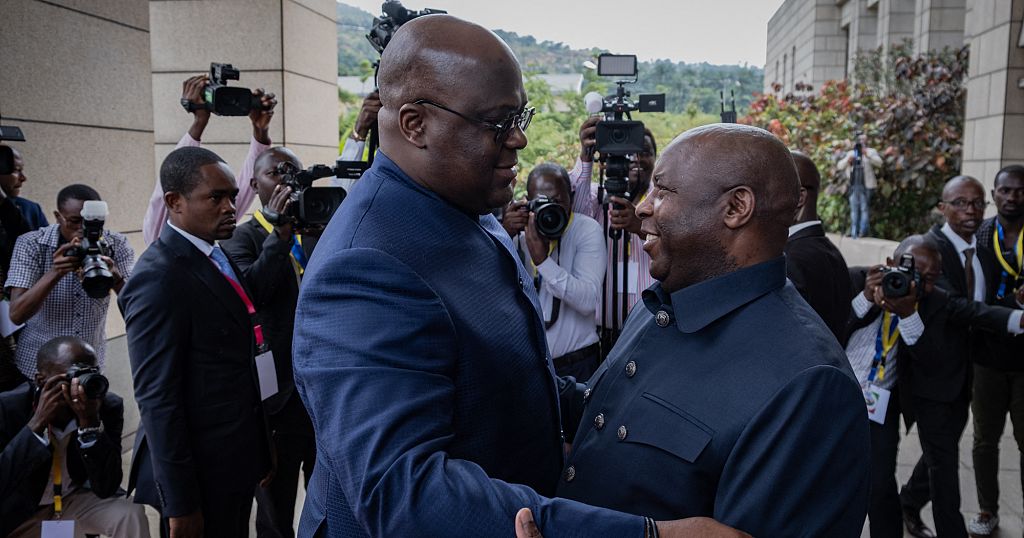
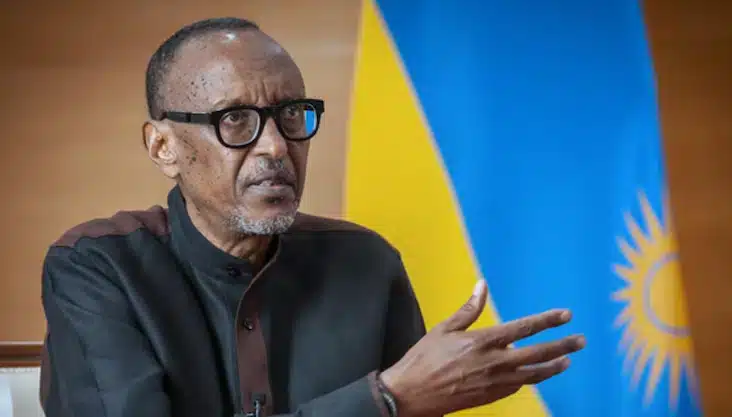
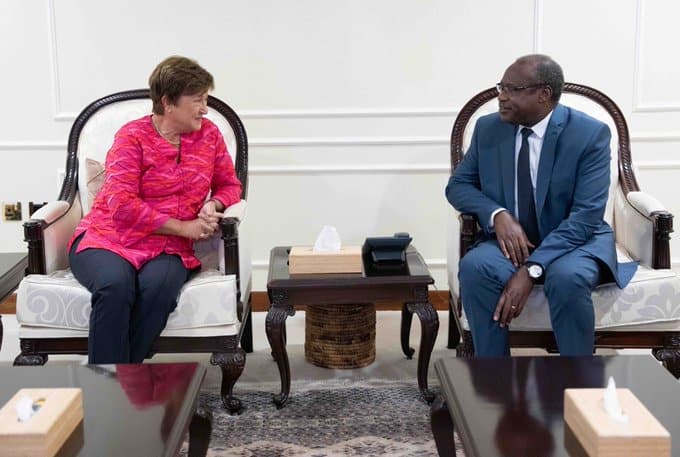
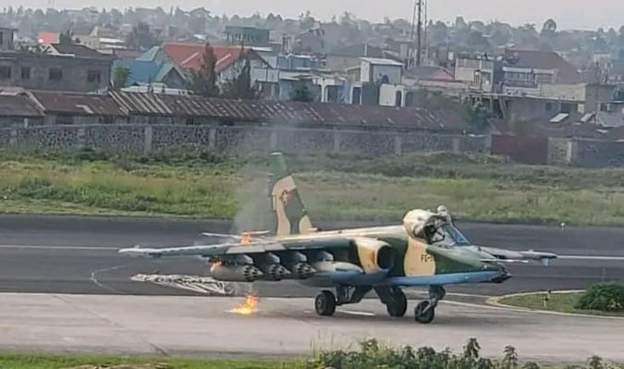
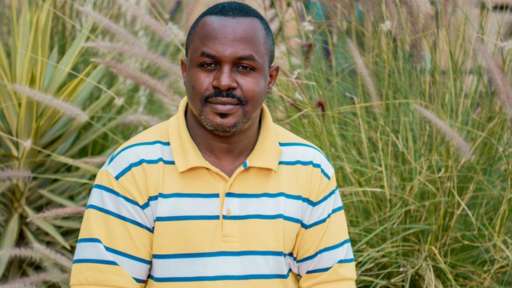
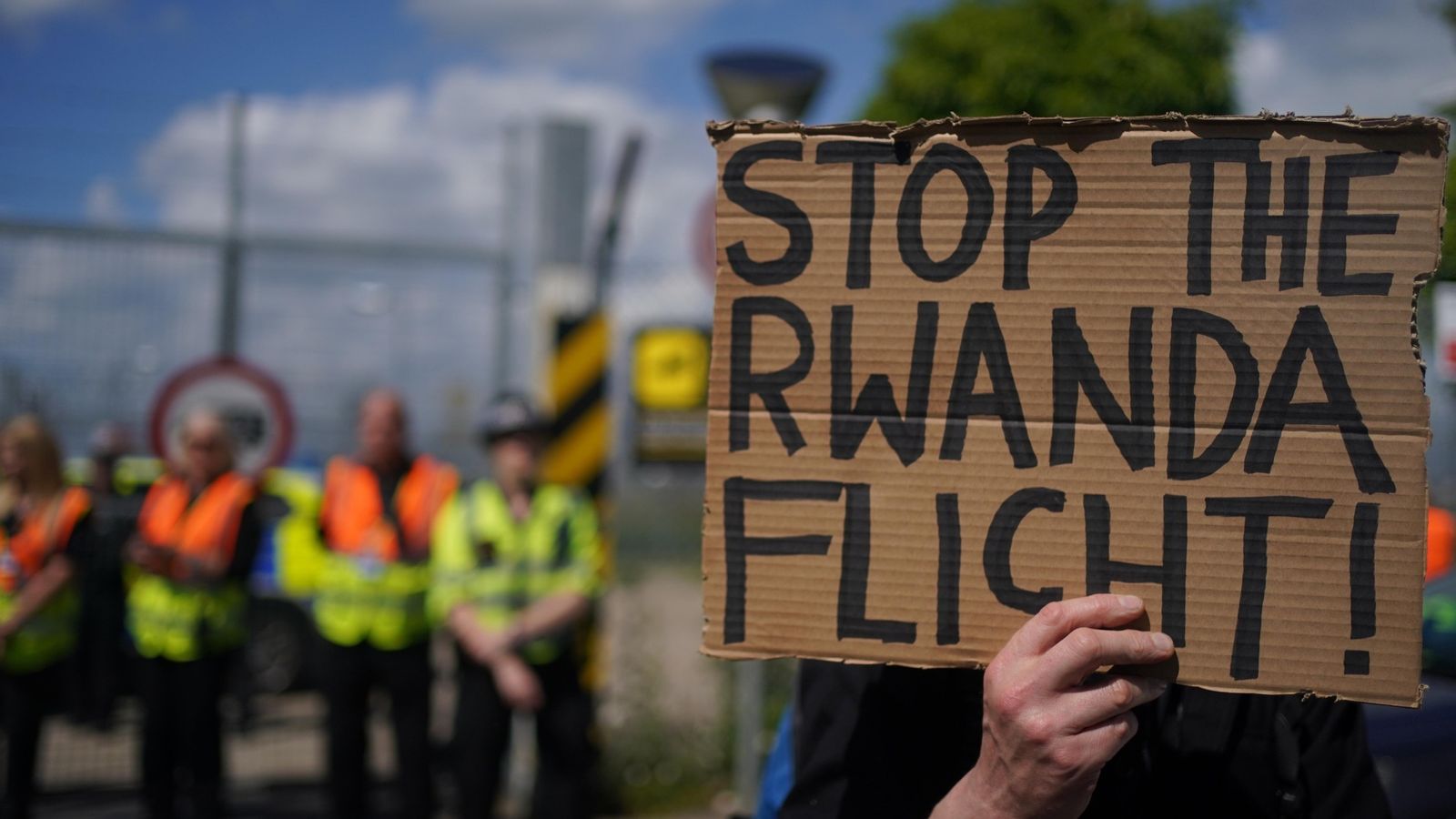
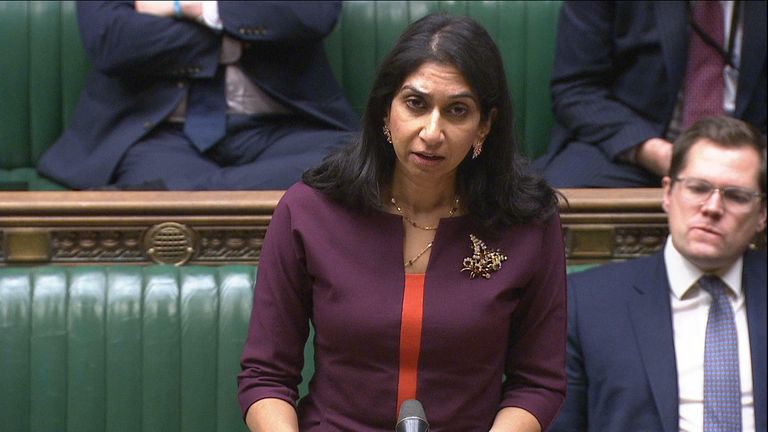 2:16
2:16