A government official from South Africa and three other members of the ANC political party have been found not guilty of corruption by a group in parliament.
Employment and Labour Minister Thulas Nxesi and MPs Cedric Frolick, Mosebenzi Zwane, and Winnie Ngwenya were accused of being involved in a big corruption scandal called “state capture” while Jacob Zuma was the president.
Mr Nxesi was accused of getting money from a well-known businessman named Edwin Sodi. The other three MPs were linked to different corruption accusations.
On Tuesday, the parliament’s Committee on Ethics and Members’ Interests said that the four lawmakers did nothing wrong.
The Zondo commission, led by Chief Justice Raymond Zondo, discovered that many government-owned organizations were involved in corrupt activities. This investigation took place from 2018 to 2022.
No one has been found guilty in a court case for a crime yet.
The President, Cyril Ramaphosa, said that suggestions from the inquiry will be put into action when the time is right.
In 2018, Zuma stepped down from his position as president before his second term was supposed to finish. He stepped down because of accusations of corruption.
Tag: South Africa
-
Ministers and MPs from South Africa exonerated of corruption
-
Ex-South African Airways official faces corruption charge
Former chair of South African Airways, Dudu Myeni, faces corruption charges, including receiving bribes and home security upgrades from Bosasa, a company implicated in various corrupt deals during Jacob Zuma’s presidency.
A Commission of Inquiry found that Myeni had influenced Zuma to favor Bosasa, which received over $100 million in government contracts.
Trevor Mathenjwa, a Bosasa subsidiary director, also faces corruption charges. Both have been released on bail, with a court appearance scheduled for November.
-
Kenya part of 10 countries ranked for efficient usage of Truecaller App
Kenya ranks among the top 10 countries worldwide in terms of monthly active users of Truecaller, a caller identification service, according to a company announcement.
Truecaller, which aids users in identifying potential spam calls, boasts a presence in 175 countries and a global user base of 356 million active monthly users.
In Africa, other leading users of the platform include Egypt, Nigeria, Algeria, and South Africa. Truecaller has offices located in seven different regions, spanning Sweden, India, Israel, Egypt, and Kenya.
“Truecaller’s 10 largest markets (are) India, Egypt, Nigeria, Algeria, South Africa, Malaysia, Iraq, Kenya, Colombia, and Jordan – based on monthly active users (MAU),” said the company.
Truecaller identifies a caller, detects and prevents spam calls and texts, allows call recording, allows users to search for the identification of a mobile number, and checks the availability of the person they are attempting to contact.
Local and international criminals, marketing firms, and digital credit providers (DCPs) are among the most prominent sources of spam calls and SMS in Kenya.
-
Western Cape in South Africa devastated by deadly floods
At least 11 people died when strong rain and winds hit South Africa’s Western Cape province, including Cape Town, over the weekend. There was a lot of damage caused.
Officials are cautioning that more people might die as the floodwater goes down.
The bad weather caused flooding in homes, and damaged roofs, crops, roads, and other things.
Rescue teams are still looking for people who may be stuck in homes that are partially under water.
72 children and 10 grown-ups couldn’t leave a resort in Oudtshoorn because the Le Roux River next to it flooded. They were saved on Wednesday morning, after the water went down.
Around 200 farm workers are stuck in places that have been separated due to flooding. We are trying hard to save them.
According to Electricity Minister Kgosientsho Ramokgopa, over 80 roads were shut down and approximately 15,000 homes lost electricity.
Train services in certain areas of the Western and Eastern Cape provinces have temporarily halted.
The floods had a big impact on the farmland in the area, which includes the famous vineyards. The harvests are expected to be very negatively affected.
The Mayor of Cape Town, Geordin Hill-Lewis, has asked for more help and support to deal with the consequences of the heavy rainfall.
The city has shut down the Steenbras Nature Reserve and Gorge hiking route to see how the floods have affected them.
Anton Bredell, a minister in charge of the environment, said that helicopters were looking for people who were stuck and needed help. “He said that we anticipate the most severe outcome there. ”
The heavy rains that caused damage stopped on Monday. These rains happened one week after unusually high tides during the spring season.
Climate change has been accused of causing certain recent weather events in South Africa.
In 2022, heavy rain caused flooding in KwaZulu-Natal and over 430 people died. The coastal city of Gqeberha also faced a shortage of water last year. -
Namibia bans South African chicken imports due to bird flu
“In a response to the severe bird flu outbreak in South Africa, Namibia has suspended all imports of live poultry and poultry products from its neighboring country.
The decision comes as a result of the rapid and alarming spread of highly pathogenic avian influenza (HPAI) in various regions of South Africa.
According to Namibia’s agricultural ministry, new cases of HPAI have been reported across several provinces in South Africa, including Kwazulu-Natal, Western Cape, Free State, Gauteng, Limpopo, Mpumalanga, and North West.
The outbreak has already resulted in the loss of over two million chickens. Namibian authorities have clarified that this suspension applies to the following:
Live poultry, Fresh frozen poultry meat, Table eggs, Day-old chicks, Hatching eggs.
This measure has been taken to safeguard Namibia’s poultry industry and prevent the spread of the virus across borders.”
-
South Africa names road after Mandela’s late wife
The city of Johannesburg in South Africa has given a road the name of Winnie Madikizela-Mandela, who fought against apartheid.
On Tuesday, the city changed the name of William Nicol Drive to Winnie Mandela Drive.
The city administration said that this achievement shows how determined the city is to remember and honor Winnie Madikizela Mandela’s important life and legacy.
William Nicol was a church minister and teacher during the time of apartheid. He believed that Afrikaans should be used in schools in South Africa.
The mayor of Johannesburg, Kabelo Gwamanda, said that renaming is a way to get rid of things that represent the bad treatment and control of people in South Africa.
The road will be revealed on 26 September, which is the same day Mrs. Mandela would have turned 87.
She passed away in 2018 after being sick for a while.
South Africa’s ruling African National Congress proposed a motion in 2018 to change the name of the road. They believe that this change will help future generations remember the brave people who fought against apartheid and other unfairness. -

Google unveils a doodle in honour of Late South African artist Matshikiza
Google paid tribute to South African jazz pianist, composer, and journalist Todd Matshikiza by unveiling a doodle on Monday.
Matshikiza, who passed away in 1968 at the age of 47, is celebrated as one of South Africa’s most significant trailblazers in the realms of arts and culture.
The doodle, prominently displayed on Google’s homepage, was crafted by South African artist Keith Vlahakis.
Google stated, “On this day in 1956, his commissioned cantata Uxolo (peace) was played by the orchestra at the 70th Johannesburg Festival,” explaining the choice to honor Matshikiza on September 25.
Notably, Matshikiza is recognized for his composition “Quickly in Love,” featured in the 2013 film “Mandela: Long Walk to Freedom.” He is also acclaimed for his musical contributions to stage productions like “King Kong” and “Mkhumbane.”
Google frequently employs its doodles, creative variations of its logos, to commemorate anniversaries or celebrate the lives of notable individuals.
-
South Africa ends power outages in Cape area due to flooding
Arranged control cuts in parts of South Africa have been suspended in the midst of overwhelming flooding.
Seriously storms caused broad harm within the Western Cape and Eastern Cape areas over the end of the week.
After flooding proceeded into Monday, state-owned control utility Eskom said the downpour had caused “broad harm to electricity infrastructure”.
Within the two influenced territories, load-shedding “will be suspended with prompt impact”, Eskom said.
In spite of being Africa’s most created economy, South Africa has been encountering load-shedding – or an composed arrangement of rolling power outages – for the past 15 a long time. The control cuts are required since the framework cannot adapt with the request for vitality.
Eskom included that the point of Monday’s suspension is to help the secure rebuilding of power supplies, whereas load-shedding will proceed in zones unaffected by the surges. -
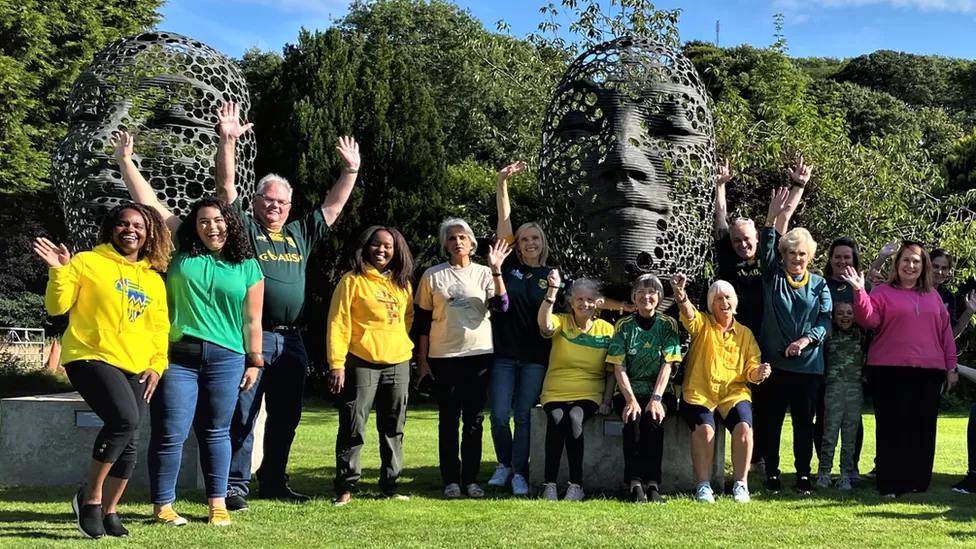
Isle of Man Island to honour South African culture
A festival to celebrate the culture, food, and music of South Africa will happen for the first time on the Isle of Man.
Approximately 1,200 individuals from our country currently reside on the island.
The organizer, Vanessa Naude, said that the event would help newcomers feel more comfortable and meet new people.
The festival is a joint effort between Isle Settle, an events company, and the Isle of Man Chapter of the UK South African Chamber of Commerce.
Ms Naude said that more people from South Africa are interested in moving to the island for work. This interest has been made stronger because the Manx government has been working to encourage business connections between the two countries.
Officials from Finance Isle of Man, a government agency, went to the country alongside the chief minister to build stronger connections and promote business opportunities.
Ms Naude said that the event on Saturday at the Nunnery in Douglas was planned to happen at the same time as the nation’s Heritage Weekend. It was a chance for people to gather and celebrate the special South African way of life.
The event was meant to help people fit in with the local communities in South Africa and the Isle of Man. Moving to a new country can be tough, so the event aimed to make it easier for them. -

South African students hospitalized over cannabis cookies discharged
Eighty-seven primary school students in South Africa have been released from the hospital one day after consuming cannabis-laced biscuits, colloquially known as “space cookies.”
According to provincial education authorities, three students from Pulamadibogo Primary School in Soshanguve, located northwest of the capital, Pretoria, are still under medical care.
All of the affected students had reported nausea, stomach cramps, and vomiting after consuming the snacks purchased from a street vendor near the school.
The potential legal consequences for the vendor remain unclear at this time.
-

Shortage of eggs, chicken in South Africa likely to get worse amid power cuts – Farmers
Poultry farmers and retailers in South Africa are cautioning residents to prepare for increased prices for eggs and chicken due to the ongoing deaths of millions of chickens caused by a combination of power outages and avian flu.
The outbreak of avian flu in South Africa’s Mpumalanga province was initially reported in April, followed by the more lethal H7N6 strain of the flu in May.
Since then, the avian flu has extended its reach to four additional provinces, compelling poultry farmers to carry out mass culling of their chickens.
“The bird flu has already caused short supplies of table eggs into the market, and it is expected that the supply of poultry meat into the value chain could be affected negatively in the coming months,” Astral Foods, one of South Africa’s biggest chicken producers said on Thursday.
The company reported a decrease in its financial performance, attributing it to losses linked to bird flu and rising operational expenses resulting from power shortages.
The company disclosed that it incurs monthly expenses of 45 million rand ($2.4 million; £1.9 million) to operate diesel generators.
Abongile Balarane, the leader of the South African Poultry Association, stated to the Daily Maverick earlier this month that the nation had suffered the loss of over four million chickens, equivalent to 15% of the country’s total production.
-
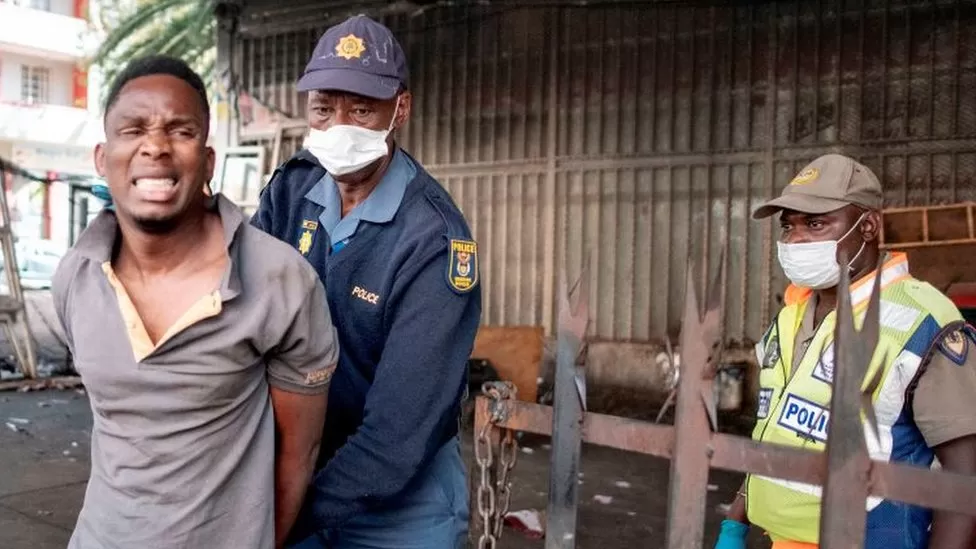
South Africa to remove criminal records from Covid lockdown
South Africa’s parliament has approved a law that will erase criminal records for people who were convicted of breaking Covid-19 lockdown rules.
South Africa had very strict rules which led to over 400,000 people getting arrested. These arrests were for things like not wearing masks, drinking alcohol, and breaking curfew.
People who admitted they did something wrong and paid money as a punishment will no longer have any official records of that wrongdoing.
Many South Africans are happy about this bill.
This text means that the approval of the National Council of Provinces and the signature of President Cyril Ramaphosa are required for it to become law. However, it is highly likely that it will become law.
The bill to make changes to the legal system received widespread political backing during discussions in parliament.
The African Christian Democratic Party (ACDP), which was in favor of the bill, pointed out how having a criminal record made it hard for some people to get jobs.
ACDP MP Steven Swart expressed his hope that we will not have any more unreasonable rules that were made without involvement or supervision from Parliament.
In April 2021, the police minister, Bheki Cele, stated that 411,309 individuals were taken into custody for breaking the rules during the lockdown.
It’s not known how many of the people who were arrested were eventually found guilty.
But, some MPs did not vote for the bill to become a law.
The EFF, a left-wing political party, liked some parts of the bill but couldn’t support the entire bill.
EFF MP Veronica Mente said that during the pandemic, the regulations from the Disaster Management Act led to prosecutions and persecutions. This showed how the judiciary system could be used to severely restrict people’s rights.
“May the law never be used for bad intentions like what happened during the Covid-19 pandemic. ” -

South African authorities detain suspected Grindr kidnappers
Seven people have been taken into custody for supposedly kidnapping a homosexual student at a university in South Africa. They enticed him into meeting them by using a dating app called Grindr.
The 18-year-old student, who is studying at the University of Witwatersrand, was reported as not being present by his roommate on Tuesday.
The police said that the people who took him away then asked his family for about $1,500 (£1,200) to let him go.
The group got caught after one of the criminals tried to take out the ransom money from a cash machine in Johannesburg.
He showed the police where the victim was kept – the officers found him tied up and not awake.
The people who are believed to be guilty have been connected to at least 85 incidents where members of the LGBTQ community were singled out and asked for money in return for their safety.
In simple terms, South Africa has a very fair constitution that supports the rights of gay people. It is the only African country where same-sex marriage is legal. However, many gay and lesbian individuals still experience unkindness and unfair treatment. -

Navy submarine catastrophe in South Africa claims three lives
Three sailors from the South African navy who were on a submarine died, and four others were injured because they were swept off the submarine‘s deck by big waves.
The boat was near Cape Town in the ocean when seven crew members were taken away by strong waves.
A helicopter was giving things to people while getting more fuel, according to the AFP news agency.
The South African National Defence Force (SANDF) said in a statement that the sailors were taking part in a navy training when the accident happened.
Please simplify this text for me.
The army said that all seven members were found, but unfortunately three people died, including a high-ranking officer who is in critical condition.
Five more people were rescued in another rescue mission, according to the report.
The police said they started an investigation after the accident in the navy.
The accident happened after a weekend with strong winds and rough waves. The weather service in South Africa said there would be big waves that could cause damage in Cape Town on Wednesday. -
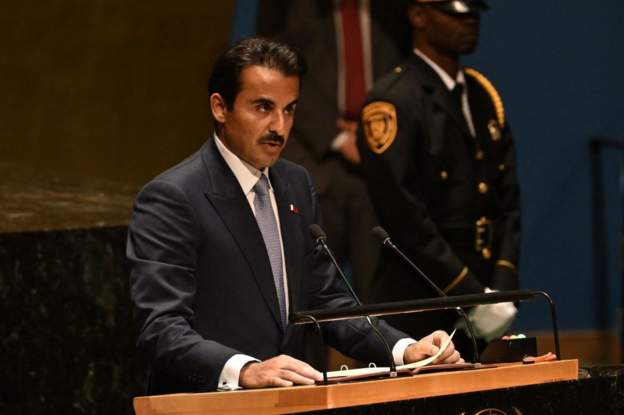
South Africa and Qatar prioritise world peace and development
We just received messages from the ruler of Qatar, Sheikh Tamim bin Hamad Al Thani, and the president of South Africa, Cyril Ramaphosa.
Al Thani spoke about many different regional topics including Lebanon’s economy, conflicts in Libya and Yemen, racism, the environment, and what he called “harsh and extreme” Israeli actions in the Gaza Strip.
He also praised Qatar for organizing the 2022 World Cup very well, saying it should be used as an example for future tournaments.
Ramaphosa mainly talked about how it is getting harder to achieve the goals of the UN’s Agenda 2030. He said that things like war and other disasters have made it more difficult to reach those goals.
He said that the wars in Africa and Ukraine can and should be stopped.
He also asked other countries to do more to help bring peace and stop violence in Africa, especially in Sudan and the Horn of Africa. -
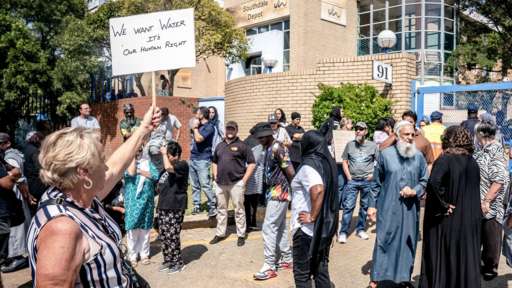
South Africans urged to shower for 2 minutes to curb water shortage
Water suppliers in Johannesburg, South Africa, have issued an urgent appeal to city residents and its suburbs to reduce water usage as a severe water shortage threatens to “cripple the system.”
Rand Water and Johannesburg Water issued a joint statement on Sunday sep 17 2023, expressing concern about the excessive water consumption by residents, which has led to a significant decline in water reservoir levels.
To address this crisis, the companies have requested that residents take several measures, including limiting showers to two minutes, flushing toilets only when necessary, washing cars using buckets on weekends, refraining from filling swimming pools until the water shortage is resolved, avoiding the use of clean water for gardening or lawn irrigation, and promptly reporting any water leaks.
Johannesburg, currently operates under annual water restrictions, typically enforced during South Africa’s dry season, which spans from September to March.
In recent weeks, water shortages have led to disruptions affecting some city residents and essential facilities like hospitals, leading to growing public dissatisfaction.
-
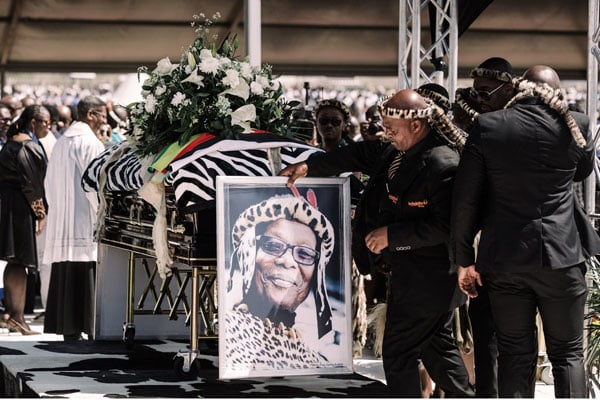
South Africa conducts state funeral to honor the Zulu leader Mangosuthu Buthelezi
Thousands of people, some in traditional warrior attire, gathered at a small stadium in Ulundi, the ancient Zulu kingdom capital, to honor Mangosuthu Buthelezi, the founder of the Inkatha Freedom Party (IFP) who passed away at the age of 95.
President Cyril Ramaphosa paid tribute to him, acknowledging his impact on South Africa’s modern history.
Family members led a procession with the coffin draped in an animal skin and an IFP flag, while mourners, some in traditional attire, sat around.
The IFP Women’s Brigade chanted in Zulu, and various dignitaries, including former presidents Jacob Zuma and Thabo Mbeki, attended the ceremony.
Buthelezi’s legacy remains contested, with some viewing him as a protector of Zulu culture and others as an apartheid collaborator and mass murderer due to the violence associated with the IFP.
-
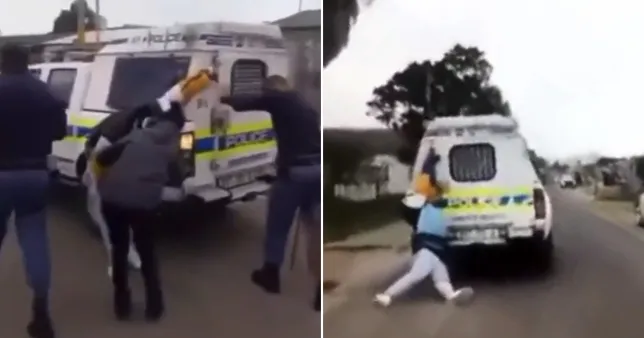
Outrage in South Africa after man shackled to police van and dragged down street
The police arrested a man and tied his hands together with handcuffs. Then, they pulled him along the road using their van and later physically attacked him.
A very upsetting video has become very popular in South Africa. It appears to show a man being pulled along a road in a very violent way on Friday evening around 6pm.
Police officers supposedly tied one of Milosh Basson’s hands to the back door of their car because they thought he had drugs.
A few people from the area chased after the van when it started driving in a neighborhood in Cape Town. They were yelling and screaming, and one person even tried to grab Milosh’s hand.
Milosh said he felt like he wasn’t fully awake for most of the difficult situation because he had been sprayed with pepper spray right before.
He was reportedly abandoned inside the van, injured and covered in blood, for a long time before being brought to the police station. He says that once there, officers kicked him and hit him with pipes.
Milosh said to SowetanLive that he was scared they might harm him at some time.
A video appears to show a person being handcuffed to a police vehicle in South Africa while it was moving.
Lawyer Keegan Lasker mentioned that he could only meet with his client after 10pm on that particular evening.
‘His clothes were covered in blood. He said that it was clear to him that he couldn’t help the person on a Friday because he was being treated badly by the police.
Milosh got out of custody on Monday after allegedly being accused of having drugs and not cooperating with the police.
The police are looking into what happened in a video that was shared and the officer who got hurt during the violent situation in Kensington.
The Ipid, which is in charge of overseeing the police in South Africa, said its investigators are going to meet with Milosh and ask him to share his statement.
A spokesperson said that they are starting to look into three people.
People often say that the police in South Africa are very violent and cruel. This reputation goes back to apartheid, when officers were used to make sure discrimination and segregation happened.
Although there have been big improvements, some of the old ways still exist as the country has become a democracy.
According to Ipid statistics, in the year 2019 to 2020, one person was killed every 20 hours because of police actions, on average.
In Johannesburg on August 26, 2020, a major case happened where a disabled 16-year-old named Nathaniel Julius was shot.
Police officers are being accused of causing his death because he was unable to respond to their questions due to his Down syndrome which made it hard for him to talk.
His family said he went out to buy biscuits and something really bad happened.
On August 16, 2012, the police in South Africa shot at a group of mine workers who were on strike in a place called Marikana, located in the North West province. This incident caused a lot of negative attention towards the police.
Around 34 people were killed and 78 people were severely injured when protests for higher wages turned violent, which is now referred to as the Marikana massacre.
Even the police minister, Bheki Cele, said that incidents of police violence in the country are concerning.
He recently explained to Parliament members that some police officers are doing a great job, but others are simply a result of the difficult social problems faced by all South Africans.
He said that these members are from very upset communities in our society.
Mr Cele continued, saying that the behavior we are currently seeing from South Africans should be the same behavior we expect from them. I heard that children are often similar to their parents.
He said that the state was trying to make things better for the police by hiring more psychologists and social workers to help with their well-being and mental health. -
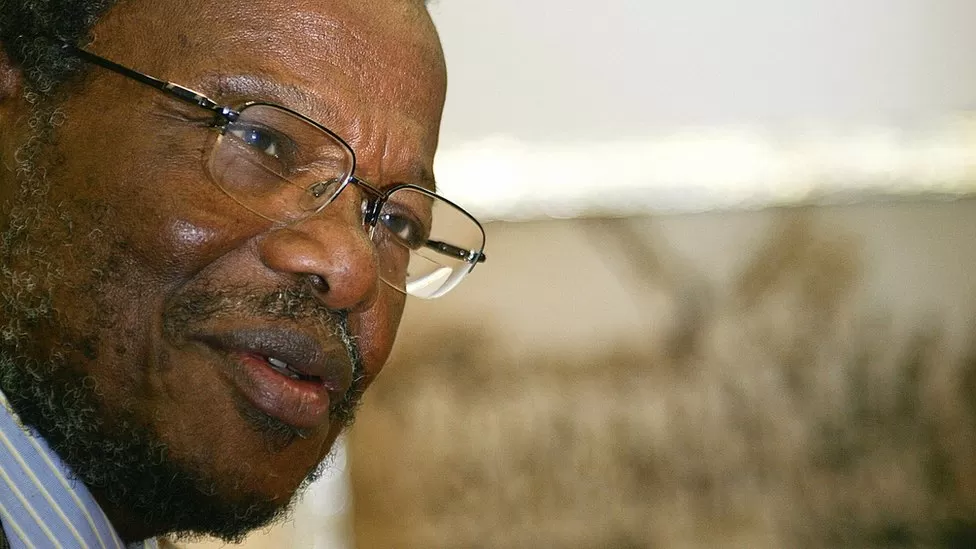
Chief Mangosuthu Buthelezi: The person who separated South Africa
Chief Mangosuthu Buthelezi, who has passed away at the age of 95, was a very important person in South African politics. President Cyril Ramaphosa called him an excellent leader.
During apartheid, he was the leader of the KwaZulu Bantustan, a region set aside for the Zulu people by the country’s white supremacist government.
Many people believed that his government was controlled by South Africa. It did not allow any political opposition and was mostly influenced by his own party, Inkatha, which he created in 1975.
He joined forces with the African National Congress (ANC) in fighting against apartheid and worked to free Nelson Mandela.
However, he disagreed with the ANC’s position on using weapons and imposing global penalties, because he believed it was detrimental to black South Africans.
During the change to having multiple political parties, Buthelezi was worried that he would lose his control and influence. He wanted a government system where the power is shared between the central government and the local government. He also wanted to make sure that the traditional leaders of the Zulu people would be treated with respect and their positions would be protected.
The ANC and Inkatha fought against each other, and around 12,000 people died in violent battles in the early 1990s. Many people think that the apartheid government caused these fights to happen.
Some people were afraid that the fighting would start a civil war, but Buthelezi later agreed to be part of Mandela’s government in 1994. Despite ongoing conflicts, he held the position of minister responsible for domestic matters for a period of ten years.
The Inkatha Freedom Party (IFP), led by Buthelezi, had a hard time gaining support outside of the Zulu people, who are the largest ethnic group in the country. However, Buthelezi was able to stay in charge and keep his position as the party’s leader despite efforts to remove him.
He stepped down as the IFP president in 2019. He was one of the few leaders from the old semi-autonomous areas who adjusted to the time after apartheid. He was admired for his ability to survive in South African politics.
Chief Mangosuthu Buthelezi was born on 27 August 1928 in a place that used to be in the southeast part of Zululand.
His mother was a princess named Magogo kaDinzulu. She was the sister of the Zulu king and was well-known for singing traditional songs.
The king wanted to fix a problem between their families, so he made a plan for her to marry Buthelezi’s father, who was the leader of a very strong group of people.
When he was 14 years old, someone told him that his dad had passed away.
He was brought to the family house. He poked the ground with a spear, like Zulus do, to mark where the hole for the grave should be dug. Then he shouted loudly that he was taking ownership of what he inherited.
Buthelezi went to Adams College, a famous missionary school near Durban. However, when he started university in the Eastern Cape in 1948, the National Party won the election and started enforcing apartheid.
He became a member of the ANC and campaigned against the new government with Nelson Mandela and Oliver Tambo.Because he was politically active and involved, he was kicked out of university. As a result, he went back to KwaZulu-Natal to become the leader of his family clan.
He got married to Irene, who is studying to become a nurse in Johannesburg. People said that his father had about 40 wives, but he didn’t want more wives because he was a practicing Anglican and didn’t want to give in to traditional Zulu pressure.
In 1954, King Cyprian chose him to be his traditional prime minister. The message was very important and often taken by a member of the Buthelezi family.
Ten years later, he acted in a movie called Zulu alongside Michael Caine. He acted as his own great-grandfather, King Cetshwayo, in the battle of Rorke’s Drift.
At that time, the first Bantu authorities were created and Buthelezi was picked as the Chief Executive of KwaZulu. A new set of laws gave him all the control over running the government, while the king’s duties became mostly symbolic.
He built his own group called Inkatha to advocate for the rights of Zulus and oppose white control.
However, supported by his new party, Buthelezi ruled with strict and firm control.
Being a part of the party was almost necessary for people who didn’t want to get fired from their jobs.
The prime minister decided to personally handle his country’s money matters and have full control over the police forces.
During apartheid, Buthelezi did not want to accept the limited amount of independence that the South African government offered the Bantustans.
“He said that South Africa is a single country. ” It only has one fate. The people who are trying to split up our country are trying to stop the flow of progress in history.
However, some people who opposed apartheid did not agree with his position.
Steve Biko, a prominent leader who fought for Black rights, was sadly killed by the South African security services. He believed that Buthelezi, another leader, was being taken advantage of by the apartheid regime. Buthelezi, on the other hand, believed that he was working alongside the system to bring it down.
His relationship with the ANC leaders who had been forced to leave the country got worse in the late 1970s.
The ANC and the South African Communist Party were working together, but Buthelezi strongly opposed communism. He believed that the group had a lot of Marxists and didn’t want to offer safe places for the armed members.
He worked to convince others to remove economic punishments against South Africa, strongly believing that he needed to make sure black children received food and clothing.
Buthelezi received compliments from British Prime Minister Margaret Thatcher for his method, but one ANC activist criticized him as a South African government follower who was living in a delusional world.
Archbishop Desmond Tutu had to ask him to leave a funeral because many black mourners were throwing stones.When Nelson Mandela was put in prison, Buthelezi and the ANC agreed on the same thing.
The leader of Inkatha was determined in his efforts to have the highly respected person released from prison on Robben Island. Afterwards, he proudly stated that he was solely responsible for making it happen.
However, fights between followers of the two groups became more intense leading up to the initial democratic elections.
Until he died, Buthelezi said that the ANC caused most of the violence. However, later on, it was found out that Inkatha received help from the South African military to fund groups of people who would commit attacks.
The Truth and Reconciliation Commission (TRC), which was made to find out the hidden wrongdoings of the apartheid time and encourage healing, blamed him of being involved in severe violations of human rights.
The allegations made people very mad.
Chief Buthelezi said he never allowed or supported violations of people’s rights. The TRC’s final report in 2003 was postponed because Buthelezi insisted on certain changes.
Many ANC activists disliked him, and he initially intended to not participate in the important 1994 elections. However, he had a last-minute change of heart and decided to participate after all. Buthelezi’s photo had to be stuck onto each voting slip because the ballot papers were already printed.
South Africa’s new constitution stated that the ANC, which won the election, must create a government with multiple political parties, sharing power temporarily until a permanent government is established.
As a result, Buthelezi was given the job of being in charge of Home Affairs. Sometimes, he would pretend to be the president when Nelson Mandela was away.
He kept his job after the 1999 elections, but his relationship with the ANC started to deteriorate again.
A disagreement about new rules for people moving to a different country resulted in an unusual event where President Thabo Mbeki sued a member of his own government.
“I don’t know of any other case where a president has sued his own minister and even tried to make him pay the legal costs personally,” Chief Buthelezi said afterwards.
After the 2004 elections, Inkatha, which changed its name to the Inkatha Freedom Party, went back to being in the minority group in the government.
Five years later, the IFP lost votes to the ANC’s new leader, Jacob Zuma, who was also Zulu.
The young members of the party in KwaZulu-Natal wanted new leaders, but they were kicked out of the party.
Chief Mangosuthu Buthelezi is a prominent leader who has played a significant role in South African politics.
In 2019, Chief Buthelezi said he would not run again for the IFP presidency. He left the job after being in it for 45 years.
But he still stayed as a member of the South African parliament and traditional prime minister in a place called KwaZulu-Natal.
In his 90s, he played a key role in the fight for the Zulu royal family’s leadership after King Zwelithini died in 2021.
Buthelezi’s chosen person to become king was successful, but there was a disagreement over who would be the leader of the Ingonyama Trust Board. This led to heated arguments and fighting. The trust board takes care of large areas of land that belong to the royal family.
In 2023, King Misuzulu kaZwelithini had to deny rumors that someone had given him poison. The royal family had arguments and this caused people to hear that the king’s relationship with his chief minister was almost broken.
Chief Mangosuthu Buthelezi was someone who had many different qualities and characteristics.
He was proud, liked to sue people a lot, and made impulsive decisions. He was well-known for his extremely long speeches in parliament. One of his speeches was 427 pages long and it took him over two weeks to finish.
He had a personality that could be described as intimidating. People said he was able to easily switch between being very charming and being exceptionally aggressive.
However, it was his actions and decisions during the time of apartheid that continue to cause disagreements and conflicts within South Africa.
Chief Buthelezi tried his hardest to keep his people safe from a bad government, even though he was secretly working against them.
However, his enemies will remember him as someone who held a powerful position comfortably, while “true” activists were being sent to prison, forced to leave their homeland, physically assaulted, and even killed. -
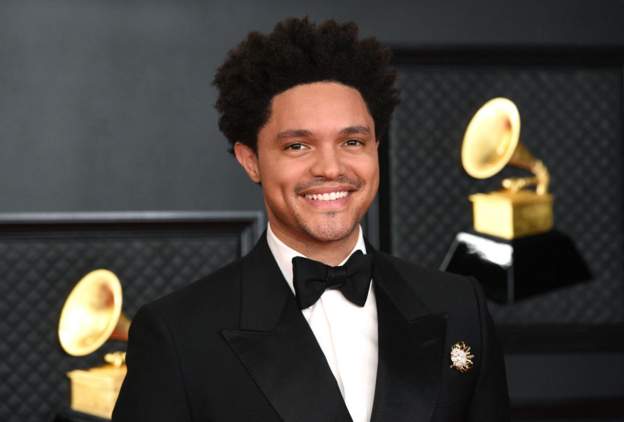
Conflict erupts in South Africa following Trevor Noah tourist agreement
A suggestion to give Trevor Noah, a famous comedian who has won an Emmy award, 33 million rand ($1. 7m, £13m) to promote South Africa as a place for people to visit has created a big controversy in the country.
South Africa’s Tourism Minister, Patricia de Lille, told parliament that they want to pay Trevor Noah to appear in a short video promoting tourism in South Africa.
A lot of MPs have disagreed with the idea, but Ms de Lille says that the South African comedian and TV host won’t receive money from the government.
She said that he would get paid using money from a private organization that represents the travel and tourism businesses in South Africa.
Some people in South Africa have also expressed their disapproval of the planned agreement on social media, saying that it is pointless. Some people say that its timing is not considerate because many South Africans are having money problems.
We hope the government doesn’t spend money we don’t have on things that aren’t useful. We are not concerned about his identity, but the country is in a state of chaos. They don’t have electricity and jobs, but they have 33 million to give to Trevor Noah. “What has Trevor Noah done to make this country better. ” a user on Twitter asked.
However, some people in South Africa believe that Noah’s popularity in Hollywood could help attract more tourists to the country.
In March, Noah and tennis star Roger Federer, who have both South African and Swiss nationalities, appeared in a campaign promoting Switzerland as a place to visit. -
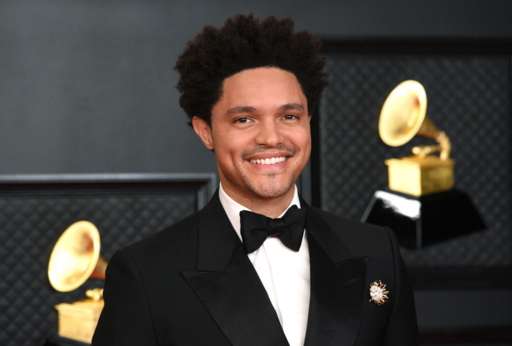
Chaos in South Africa over Trevor Noah tourist deal
The proposal to allocate 33 million rand ($1.7 million or £1.3 million) to enlist Emmy-winning comedian Trevor Noah for the promotion of South Africa as a tourist hotspot has sparked controversy within the nation.
South Africa’s Tourism Minister, Patricia de Lille, informed parliament about the intention to compensate Noah for his involvement in a five-minute promotional video aimed at showcasing South Africa’s tourism offerings.
Despite facing opposition from numerous Members of Parliament, Minister de Lille clarified that Trevor Noah’s remuneration would not be drawn from public funds. Instead, the funds would be sourced privately from the Tourism Business Council of South Africa, an overarching body that represents the interests of the country’s travel and tourism sector.
Critics of the proposed deal, both on social media and within South Africa, have deemed it unnecessary. Some argue that the timing is inappropriate, given the financial struggles faced by many South Africans.
One Twitter user expressed frustration, stating, “We expect the government not to waste money we don’t have on useless things. We don’t care who he is; the country is in shambles. No electricity, no employment, but they have 33 million to give to Trevor Noah. What has Trevor Noah contributed to the betterment of this country?”
On the other hand, some South Africans believe that Trevor Noah’s prominent status in Hollywood could potentially enhance South Africa’s tourism industry.
In March of the same year, Trevor Noah, alongside tennis legend Roger Federer, both of whom hold dual South African and Swiss nationalities, participated in a campaign aimed at promoting Switzerland as a travel destination.
-

No proof South Africa provided Russia with weapons – inquiry
President Cyril Ramaphosa has said that an investigation has concluded there is no proof that South Africa gave weapons to Russia.
The group disagreed with the statements made by the US ambassador to South Africa that a Russian ship was filled with weapons and ammunition in Cape Town in December of last year.
The claims caused people to doubt if the country was really staying neutral in the war with Ukraine.
Mr Ramaphosa said that it had hurt the country’s money and how people view them.
“The group determined that there was no proof to back up the assertion that the ship carried weapons from South Africa to Russia,” the president explained in a speech to the country on Sunday, broadcasted on television.
No permission was given to send weapons out of the country, and no weapons were sent out.
A representative from the US embassy in Pretoria said that the US understood that South Africa took the claims seriously, but they choose not to say anything about what was in the report.
The investigation discovered that the Russian cargo ship brought weapons from Russia to South Africa, which were ordered in 2018.
Ambassador Reuben Brigety talked about a boat called Lady R that arrived at the Simon’s Town naval base on December 6th to 8th, 2022.
In May, during a press conference in Pretoria, he said that he was sure that weapons and ammunition were put on the ship as it sailed back to Russia.
The next day, South Africa’s foreign ministry said Mr. Brigety had said sorry without holding anything back for the claims.
After the meeting, Mr Brigety expressed his thanks on social media for the chance to. Fix any misunderstandings caused by my public statements.
Mr Ramaphosa instructed a impartial investigation led by a judge, after Mr. Brigety made some remarks.
Mr Ramaphosa stated that none of the people who made these accusations were able to provide any proof to support the claims made against our country. This statement was made after the conclusion of the investigation.
The president will only share a brief summary of the report for safety reasons.
The investigation went to the navy base and talked to about 50 people and looked at over 100 documents, Mr.
South Africa has tried to be friends with Russia since it invaded Ukraine in February 2022. The US and other Western countries have criticized them for this.
This country is one of the few that didn’t vote in favor or against in several UN votes about the conflict. They chose not to openly criticize Russia regarding this issue.
The US has been worried before about Russia and South Africa doing naval exercises together. -

Families visit various mortuaries after Johannesburg fire
Families in Johannesburg, South Africa are looking for their loved ones in mortuaries after a very bad fire happened in a building, which is one of the worst in the country’s history.
At least 76 people died in the fire, including 12 kids.
Scared and very worried, a man from Malawi named Grif arrived at the Diepkloof morgue. He only told his first name.
There were a lot of bodies, some of them badly burned, and he found one of his two missing younger sisters.
The 26-year-old received a phone call early on Thursday morning about a fire. He quickly went to several hospitals in the city to search for Miriam and Fatima. After a few hours, he realized that he needed to look for something else.
On Friday, he started checking the morgues in the city and eventually went to Dieplkloof in Soweto, Johannesburg, where all the victims were taken.
He was standing outside a short building, crying and very tired. He told the BBC that he could recognize one of his sisters.
The word ‘lucky’ might not be suitable here, but the officials say that only 12 out of over 70 bodies can be recognized just by looking at them.
Grif said he will continue looking for his sister who is lost.
The two women lived together in a cramped and rundown five-story building in downtown Johannesburg. Grif lived in a place that was like the one close by.
It is believed that many of the victims are undocumented migrants who struggle to survive on the outskirts of South African society.
“Grif said he is feeling a lot of pain. ” And I’m afraid to share with my family. “It hurts a lot and there is nothing I can do. ”
Earlier today, the firefighters went back into the building to check if there were any more bodies.
We don’t know what caused the fire yet, but investigators are searching through the destroyed building to find out more.
The government said they will help all the victims, but it’s hard for many of them because they don’t have the right papers to be in the country. Some people are worried that if they speak up, they might be reported to the authorities.
According to Malawi’s foreign ministry, as reported by Reuters, it is believed that twenty people from Malawi have died.
Tanzania’s temporary leader, Peter Shija, stated that he has learned that five of his fellow Tanzanians passed away in the fire, and three others were hurt. He told a news broadcaster in South Africa called eNCA that 150 Tanzanians were living in the building before it caught on fire.
President Cyril Ramaphosa visited the central area of Johannesburg on Thursday evening. He said the tragic incident should make us realize that we need to start finding solutions for the housing situation in the city center.
The building used to be a safe place for women and children who were being hurt by others. But when the rental period ended, someone took control of it without permission, as President Ramaphosa told the journalists.
Several buildings near the location of the fire have been declared unsuitable for habitation.
However, these old buildings are left behind by their owners or the city authorities, and many families live in them. These families often have to pay rent to criminal gangs who control the buildings.
Some of the people who use the buildings are undocumented migrants, mainly from other African countries.
In many of these places, the living conditions are like shanty towns. The homes have weak walls, and there is hardly any access to water and electricity.
There are suggestions that a candle, paraffin stove, or a bad electricity connection could have caused the fire on Thursday.
The country is starting to come out of winter, and the nights in Johannesburg have been quite cold, with temperatures dropping to 4C. -

Gold Fields records 4% drop in gold production during first half of 2023
Gold Fields Limited reported that it produced 1,154,000 ounces (oz) of gold during the first half of 2023, marking a 4 percent decline in production compared to the same period in the previous year when they produced 1,201,000 oz.
The decrease in production is primarily attributed to the planned reduction in output at Damang, as stated by the company.
For the first half of 2023, the company’s all-in-costs stood at US$1,398/oz, reflecting a 3 percent increase compared to H1 2022, where it was US$1,352/oz. This increase is attributed to lower gold sales and higher cost of sales before amortization and depreciation, partially offset by reduced non-sustaining capital expenditure.
Conversely, the all-in-sustaining cost (AISC) for H1 2023 amounted to US$1,215/oz, in contrast to the US$1,148/oz recorded during H1 2022. This represents a year-on-year increase of 6 percent.
As a result of these developments, the company reported earnings of US$454 million for the six months ending in June 2023, equivalent to US$0.51 per share. This represents a 9 percent decrease compared to the US$498 million (US$0.56 per share) earned in H1 2022.
In light of these financial results, the company, in unaudited interim results shared with the press, declared an interim dividend of 325 South African cents per share, which accounts for 35.1 percent of normalized earnings.
This compares to the 2022 interim dividend of 300 South African cents per share, marking an 8 percent increase year-on-year. This dividend decision aligns with the company’s dividend policy of distributing between 30 to 45 percent of normalized profit as dividends.
The company’s performance comes on the back of a difficult operating period – marked by “elevated mining cost inflation and strong competition for skills in our key mining jurisdictions presenting significant headwinds”.
The Group made two significant corporate announcements that underscore our commitment to pursuing value-enhancing transactions to enhance the quality and value of our portfolio. These announcements included the proposed Tarkwa/Iduapriem joint venture in Ghana in March 2023 and the Windfall joint venture with Osisko Mining in Canada in May 2023.
Furthermore, we have expedited several internal initiatives designed to further reinforce the execution of our strategy. These initiatives are aimed at unleashing the full potential of our personnel and assets, ultimately driving increased business value.
During the first half of 2023, our primary focus was on two of these initiatives: the implementation of our cultural transformation journey, known as the “Gold Fields Way,” and the optimization of our assets.
Local production
Silver Fields During Q2 2023, Ghana delivered approximately 204,000 oz of gold, including 45 percent of Asanko, at an AIC of US$1,227 per ounce. Ghana produced 397 000 oz of gold in H1 2023 at an AIC of US$1,210 per
-

“External force not likely to be behind coup” in Gabon – Analyst
An investigation is ongoing to determine the cause of a tragic fire that consumed a five-story building in Johannesburg, which had been taken over for unauthorized housing. Officials from the city and the region, who visited the scene, have pledged to hold those responsible accountable for the devastating overnight fire.
Lebogang Maile, the MEC for Human Settlements and Infrastructure Development for Gauteng, affirmed, “If any city official is found to have disregarded their duties or neglected their responsibilities, there will be consequences.”
The fire occurred on Thursday morning and resulted in the loss of more than 70 lives, including children, as reported by Johannesburg city’s emergency services. An additional 52 individuals were injured, making it one of the deadliest recent fires on a global scale.
The bodies of the victims were discovered accumulated at a closed security gate, preventing their escape from the blaze, according to an official account. The building, situated in a deprived and crime-prone area, had been repurposed for illegal housing after being abandoned. Many of the occupants were foreigners.
Emergency Management Services spokesman Robert Mulaudzi shared, “We now have 73 fatalities and 52 injured individuals who have been transported to various healthcare facilities for further treatment.” Among the deceased were at least seven children, with the youngest being under two years old.
Kenny Bupe, a survivor caught in the fire while visiting a friend, recounted the Analyst
. “I’m thankful to be alive. Many of us were running, trying to find the fire exit, and unfortunately, many people lost their lives due to smoke inhalation.” He revealed that some individuals resorted to breaking open a locked fire escape gate, while others jumped out of windows to escape the flames.
Firefighters have managed to extinguish the fire, and search and recovery operations are ongoing. Mulaudzi explained, “We are systematically recovering bodies on each floor.”
This tragic event has left the city of Johannesburg deeply saddened, with Mulaudzi expressing, “It is indeed a somber day for Johannesburg… In my over 20 years of service, I have never encountered something like this.”
The cause of the fire is still under investigation, but Mgcini Tshwaku, a member of the city’s mayoral committee overseeing public safety, suggested that candles used for lighting inside the building could be a potential cause. The building had been repurposed for informal settlement, and the tragic outcome was exacerbated by a closed security gate that prevented people from escaping.
Illegal occupation of abandoned structures is widespread in Johannesburg’s city center, often controlled by criminal syndicates collecting rent from occupants. South Africa, as a significant economic hub on the continent, attracts numerous migrants, many of whom are undocumented, from various African nations.
This fire marks one of the deadliest incidents in the country’s recent history and stands as a stark reminder of the challenges associated with informal housing and urban development.
-

Authorities in South Africa pledges to investigate and prosecute culprits
An investigation is ongoing to determine the cause of a tragic fire that consumed a five-story building in Johannesburg, which had been taken over for unauthorized housing. Officials from the city and the region, who visited the scene, have pledged to hold those responsible accountable for the devastating overnight fire.
Lebogang Maile, the MEC for Human Settlements and Infrastructure Development for Gauteng, affirmed, “If any city official is found to have disregarded their duties or neglected their responsibilities, there will be consequences.”
The fire occurred on Thursday morning and resulted in the loss of more than 70 lives, including children, as reported by Johannesburg city’s emergency services. An additional 52 individuals were injured, making it one of the deadliest recent fires on a global scale.
The bodies of the victims were discovered accumulated at a closed security gate, preventing their escape from the blaze, according to an official account. The building, situated in a deprived and crime-prone area, had been repurposed for illegal housing after being abandoned. Many of the occupants were foreigners.
Emergency Management Services spokesman Robert Mulaudzi shared, “We now have 73 fatalities and 52 injured individuals who have been transported to various healthcare facilities for further treatment.” Among the deceased were at least seven children, with the youngest being under two years old.
Kenny Bupe, a survivor caught in the fire while visiting a friend, recounted the chaos. “I’m thankful to be alive. Many of us were running, trying to find the fire exit, and unfortunately, many people lost their lives due to smoke inhalation.” He revealed that some individuals resorted to breaking open a locked fire escape gate, while others jumped out of windows to escape the flames.
Firefighters have managed to extinguish the fire, and search and recovery operations are ongoing. Mulaudzi explained, “We are systematically recovering bodies on each floor.”
This tragic event has left the city of Johannesburg deeply saddened, with Mulaudzi expressing, “It is indeed a somber day for Johannesburg… In my over 20 years of service, I have never encountered something like this.”
The cause of the fire is still under investigation, but Mgcini Tshwaku, a member of the city’s mayoral committee overseeing public safety, suggested that candles used for lighting inside the building could be a potential cause. The building had been repurposed for informal settlement, and the tragic outcome was exacerbated by a closed security gate that prevented people from escaping.
Illegal occupation of abandoned structures is widespread in Johannesburg’s city center, often controlled by criminal syndicates collecting rent from occupants. South Africa, as a significant economic hub on the continent, attracts numerous migrants, many of whom are undocumented, from various African nations.
This fire marks one of the deadliest incidents in the country’s recent history and stands as a stark reminder of the challenges associated with informal housing and urban development.
-
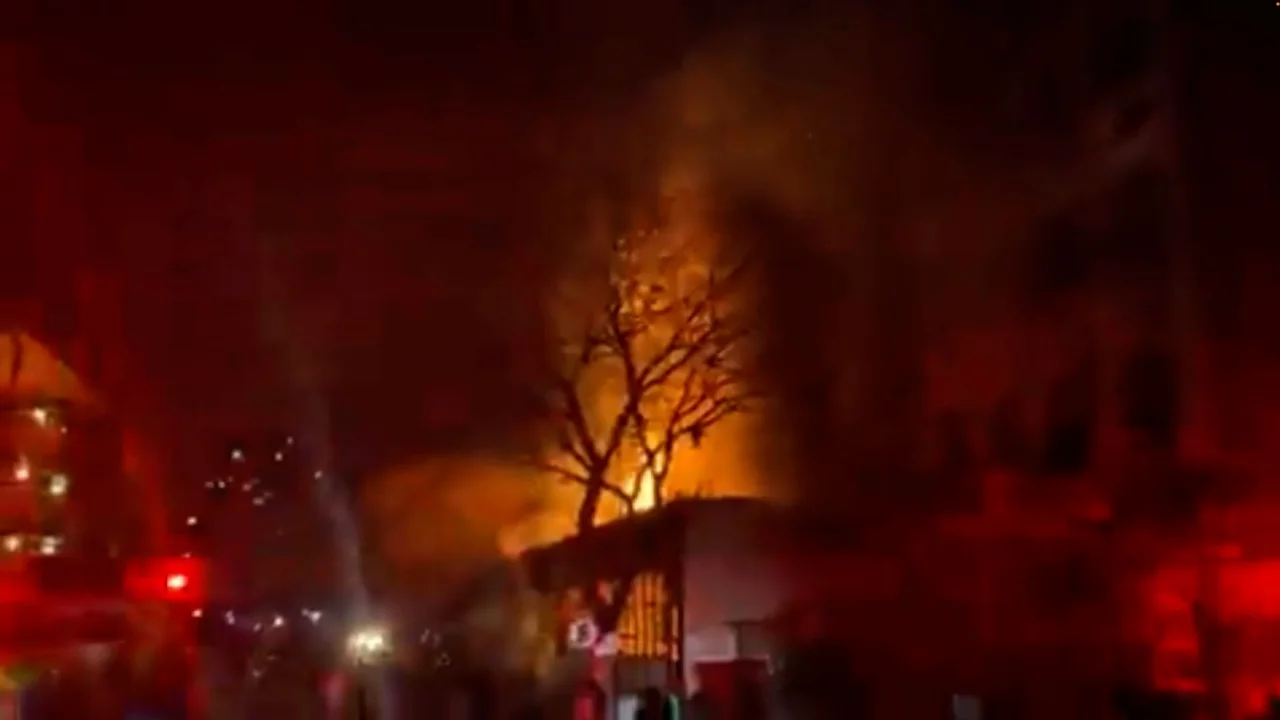
South Africa’s fire survivors to be housed in another city
The survivors of a fire that broke out in an early-morning building in Johannesburg will be given alternative housing in surrounding structures.
73 people have died as a result of the fire, and numerous others have been injured. At least 141 families have had to leave their homes.
Lebogang Maile, the Gauteng MEC for Human Settlements, stated that aid has already arrived at the tragedy site in inner-city Johannesburg.
“There will be social relief. We have already identified three buildings that the surviving victims will be allocated to and we have agreed that we are not going to deal with people on the basis of their nationality. At this point, anybody who’s affected, we are going to give humanitarian assistance. This is a tragedy that affects people, irrespective of their nationality.
“We must convey our condolences to the families who have lost their loved ones. This is a tragedy of monumental proportions and it is unfortunate that today we are here. This, for us, demonstrates a chronic problem of housing in our province as we have previously said, there’s at least 1.2 million people who need housing,” Maile said.
The MEC slammed what he called a “cartel” of people hijacking buildings in the inner city with no running water and limited services.
He added, however, that “if there is an official of the city found to have neglected their responsibilities…heads will definitely roll”.
“There are cartels who prey on poor vulnerable people. Some of these buildings, if not most of them, are actually in the hands of cartels who collect rental from our people. Some of these people who are in these buildings can afford to pay, therefore government must create stock for rental…that is affordable.
“There’s about 23 buildings that the Johannesburg Housing Company owns that are like [that building] that they have a plan but they don’t have money for. There’s a 100 buildings that are owned by the private sector and they are neglected. We have to be decisive in how we deal with that and one of the things might be to expropriate those buildings so that we can be able to house people,” he said.
Johannesburg mayor, Kabelo Gwamanda, confirmed that the building belongs to the city but was overrun by illegal occupation.
“The building does belong to the city. It was…leased to an NGO to run a non-profit organisation to house women that needed to be given relief of some sort. That’s when things escalated out of control. When the city leases a building, whoever is taking responsibility needs to make sure that the building is well kept that they can return it to the city in the condition in which they found it in.
“But I cannot project and predict how the business would then find itself in a situation where it’s abandoning its operation,” he said.
In response to inquiries about the city’s actions regarding the challenge of hijacked buildings, the mayor explained that the city is adopting a cautious stance to prevent potential legal actions.
“The city is currently approaching the matter of addressing hijacked buildings with careful consideration, aiming to avoid any legal complications that might arise. We are aware of various non-profit organizations that closely observe our approach to building evictions. Therefore, our approach is more measured and less forceful. We are actively striving to implement a highly sensitive strategy.
“We have engaged in discussions with both the MEC and the Minister of Human Settlements, where we discussed the possibility of activating a number of buildings for the purpose of offering alternative housing and social accommodations. Our primary focus lies in implementing a strategy that centers on providing viable alternative housing solutions. This way, we can repurpose these buildings for the greater purpose of social housing,” stated Gwamanda.
-

Ramaphosa describes Johannesburg fire deaths a ‘great tragedy’
President Cyril Ramaphosa of South Africa has publicly addressed the Johannesburg fire for the first time, deeming it a “profound tragedy.” During a visit to the Eastern Cape province, he extended his sympathy, stating, “Our thoughts are with all those impacted by this calamity.”
In response to the incident, he emphasized the collective responsibility to aid survivors in their recovery, both physically and emotionally, stating, “This situation underscores the need for us to unite and support survivors in rebuilding their physical and mental well-being.”
President Ramaphosa expressed optimism that the ongoing investigations into the fire would contribute to preventing any recurrence of such a devastating event, thereby enhancing community safety and resilience.
-
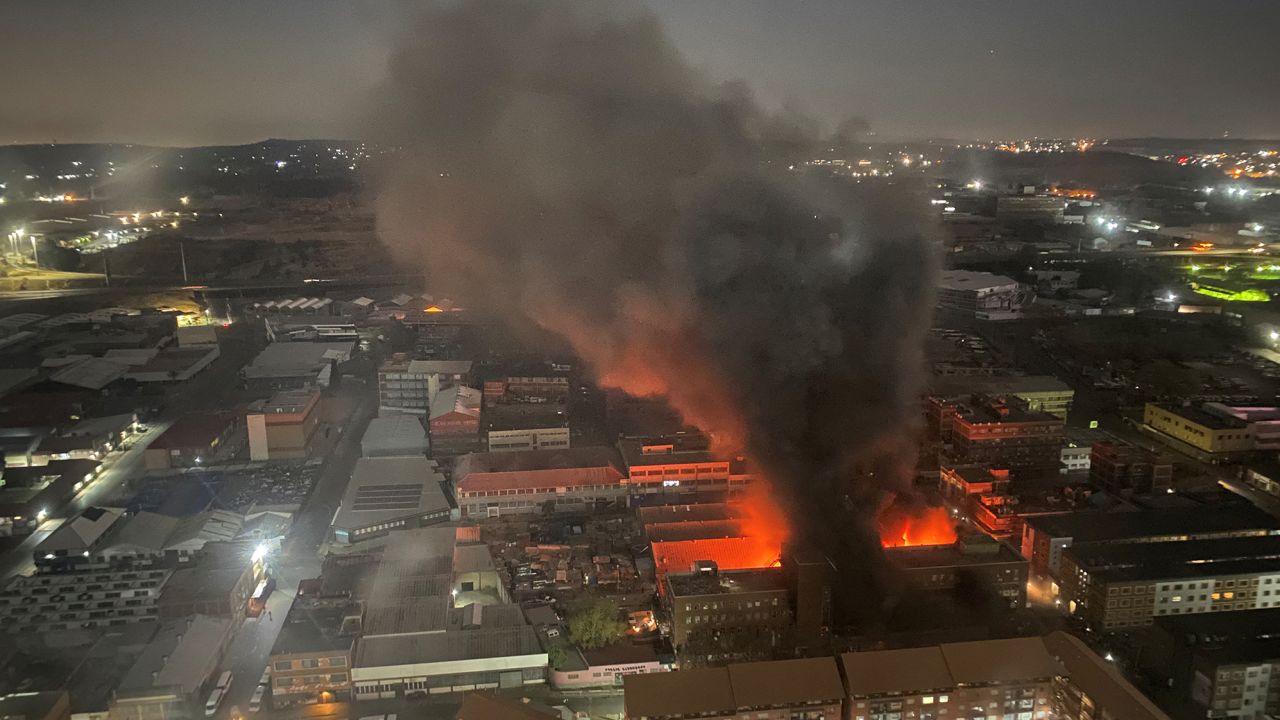
South Africa fire: Opposition leader calls it ” a catastrophe for our country”
Following the tragic fire in Johannesburg, South Africa’s opposition party, the Democratic Alliance (DA), is urging citizens to unite for improved and safer living standards for all.
Party leader John Steenhuisen conveyed the gravity of the situation, labeling it a national catastrophe that has inflicted unimaginable pain on innocent individuals.
He confirmed that the DA’s representatives in Johannesburg would be actively involved in aiding those affected by the fire. Simultaneously, Steenhuisen called for stronger measures from authorities to avert similar tragedies.
Steenhuisen stressed the party’s ongoing commitment to advocating for enhanced living conditions and adequate housing for inner city residents, emphasizing the importance of safety and well-being.
Minister in the Presidency, Khumbudzo Ntshavheni, noted that the national government and presidency are vigilantly monitoring the situation, prepared to extend assistance if additional support is required.
-
At least 63 people have died in building fire in South Africa
The number of people who have died in a big fire in a five-story building in central Johannesburg is now 63, according to the city’s emergency services.
According to spokesperson Robert Mulaudzi, 43 people were hurt.
Emergency services and firefighters are trying to extinguish the fire, as reported by public broadcaster SABC.
Videos from the scene show big orange flames covering the bottom floor of a building, and lots of people who seem to have escaped outside.
Emergency services spokesperson Robert Mulaudzi said on X, which is also known as Twitter, that several people were receiving medical attention and a few had been taken to healthcare centers.
SABC says they don’t know how the fire started.
The firefighters in Johannesburg got a call about a fire at about 1:30 in the morning. Thursday at the current time.
The statement said that the reason for the fire is still being looked into. The City of Johannesburg Disaster Management officials are starting to help families who have been affected. -

SA congratulates president of Zimbabwe while others denounce the poll
South Africa, Russia, and China have praised Zimbabwe’s President Emmerson Mnangagwa for winning the election, despite some controversy surrounding it.
Additionally, the United States, along with other countries, voiced their disapproval of the recent general election, claimed to be dishonest by the opposition.
The government of the United States said that there was a consistent unfairness against the opposition and pointed out trust worthy reports that showed election monitors were made to change certain result forms. The electoral commission said that these claims were not true.
A message from the government of South Africa
South Africa knew that the elections happened during a tough economic situation due to sanctions against Zimbabwe.
It also agreed with worries from independent election watchers about how real the outcome is.
Some people who watch over things said that the survey didn’t meet the rules of the whole world or Zimbabwe’s own laws.
Zimbabwe has important trade relationships with South Africa, Russia, and China. These countries supporting the poll is important because Zimbabwe may face more isolation and penalties from Western countries due to criticism of the poll.
The opposition Citizens Coalition for Change is currently counting their own results and hasn’t yet made a final decision on the next steps they will take. But the messages of congratulations to President Mnangagwa show that Zimbabwe’s main supporters are willing to move forward and agree with the outcomes. -
South Africa: Cyril Ramaphosa emphasizes neutrality ahead of Brics summit
President of South Africa, Cyril Ramaphosa, has reaffirmed that his nation will not be pulled into international power dynamics.
Prior to Tuesday’s gathering of the Brics countries — Brazil, Russia, India, China, and South Africa — in Johannesburg, Mr. Ramaphosa gave a broadcast speech.
“We will not be drawn into a contest between global powers. Instead, our country strives to work with all countries for global peace and development,” he said.
He noted, however, that this “does not mean that we are neutral on matters of principle and national interest”.
Vladimir Putin, the president of Russia, will take part virtually after agreeing with Mr. Ramaphosa not to go.
Following Russia’s invasion of Ukraine, an arrest order for him has been issued by the International Criminal Court. If he enters the nation, South Africa must detain him in accordance with the legislation there.
A fifth of the world economy is made up of the Brics nations, and this year has seen a significant increase in interest in joining the organization.
-
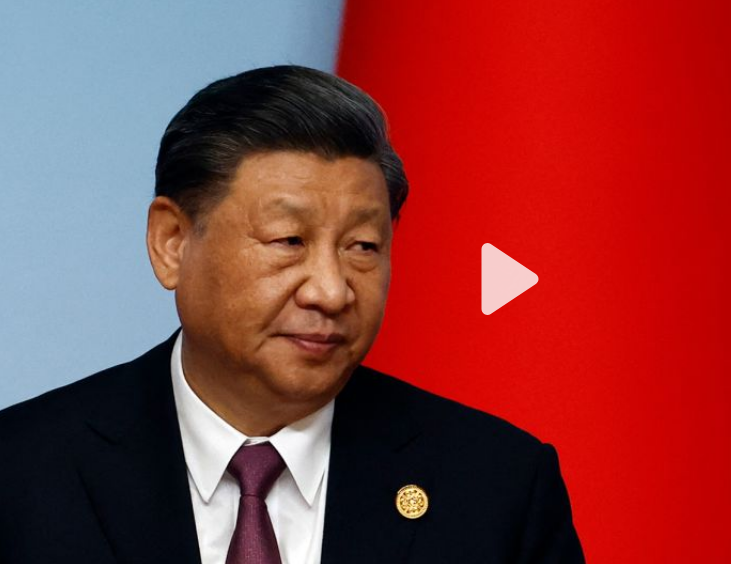
Xi of China visits South Africa for the second time this year while dealing with domestic economic problems
The Chinese president, Xi Jinping, will travel to South Africa on Monday in an effort to increase Beijing’s influence among rising and developing countries while relations with the United States remain extremely tense and domestic economic problems continue to grow.
A stark contrast to his globe-trotting days of diplomacy prior to the coronavirus outbreak is the three-day state visit, which also includes a summit with the leaders of the BRICS rising economies.
The last time the Chinese leader travelled outside of the nation was in March to meet with his “dear friend” Vladimir Putin in Moscow. There, the two authoritarian strongmen renewed their strategic alliance against the US and outlined their plans for a post-Western world order.
The BRICS grouping’s first in-person summit since the outbreak will give Xi another chance to pursue that ambition.
More than 40% of the world’s population resides in the countries that make up the bloc: Brazil, Russia, India, China, and South Africa. They both want a more multipolar world and more influence over international affairs.
“Xi Jinping is not attempting to subvert the US’s dominance of the current liberal international order. His long-term objective is to transform the global order into one that is Sino-centric, according to Steve Tsang, head of the University of London’s SOAS China Institute.
Tsang stated that in order to achieve this goal, “it makes sense for China to engage with the Global South, (which is) much more numerous than Western democracies and mostly authoritarian in its governance structure.”
Chen Xiaodong, China’s ambassador to South Africa, praised BRICS as “the backbone of international fairness and justice” and “an important platform for cooperation among emerging and developing nations” ahead of Xi’s arrival on Friday.
The established structure of global governance looks to be dysfunctional, unable to function, and nonexistent. The BRICS will soon “play a leading role in the international community,” Chen told reporters.
A few days ago, US President Joe Biden met with the leaders of Japan and South Korea in a show of power and unity against the growing dangers from China. Now, Xi is travelling to South Africa.
The US and its two closest allies in Asia strengthened their military and economic ties during the Camp Davis meeting, and China was criticised for its “dangerous and aggressive behaviour” in the South China Sea.
According to Paul Nantulya, a research associate at the Africa Centre for Strategic Studies, the BRICS have gained increased strategic significance to Beijing as China and the United States are embroiled in an increasingly bitter rivalry.
Vladimir Putin won’t be present in person, so Xi will be the focus of the BRICS summit, he claimed.
Putin, who is wanted internationally for allegedly committing war crimes in Ukraine, will participate by video from Russia.
“Another multilateral platform through which China can exert influence around the world, especially in the Global South,” was how Nantulya characterised BRICS.
But Xi, who is ten months into his historic third term, is also facing a number of domestic difficulties at the time of the summit.
The long-awaited economic recovery of China following its strict Covid lockdowns is struggling. Instead, a slew of issues, including a growing real estate crisis, rising local government debt, and deflationary pressure, plague the second-largest economy in the world.
The youth unemployment rate in the nation, which just reached back-to-back records highs, is so severe that the Chinese government has stopped disseminating data on it entirely.
Hear how other nations may be harmed and helped by China’s economic decline.
According to Yun Sun, director of the China programme at the Washington-based Stimson Centre think tank, Xi’s diplomatic charm offensive is severely hampered by the faltering economy, particularly in the Global South.
“When Xi travels to underdeveloped nations, it’s customary for China to offer sizable aid, financing, and collaboration packages. But Beijing is no longer as prepared to do that given the situation of the Chinese economy, she said.
His ability to portray the great power leader he once was is limited by the economy.
The populace in China has grown considerably more wary of their government’s extravagant expenditures abroad.
Xi’s premier international infrastructure initiative, the Belt and Road Initiative, has received a lot of criticism on Chinese social media, according to Nantulya.
“Chinese citizens are wondering why China is investing so much money abroad when there are so many issues at home.”
According to Nantulya, the Chinese government has become considerably more picky about which international projects it funds as a result of the economy’s slowdown.
Xi’s journey to Africa is his first in five years.
His most recent trip to the continent, which coincided with the BRICS conference in South Africa, included a flurry of stops in Senegal, Rwanda, and Mauritius, covering nearly the whole Sub-Saharan region.
Beijing has not yet confirmed Xi’s further stops this time.
On the margins of the BRICS meeting, the Chinese leader will co-chair the China-Africa Leaders’ Dialogue with his South African counterpart, Cyril Ramaphosa, according to China’s Foreign Ministry.
The conference has received invitations from 69 nations overall, including all African governments.
-

Parties in South Africa sign agreement to overthrow ANC
A coalition consisting of seven political parties in South Africa has formalized an agreement in their endeavor to dislodge the governing African National Congress (ANC) in the upcoming 2024 election.
Termed the Multi-Party Charter for South Africa, this pact outlines that in the event of their assumption of power, the coalition members will collaborate to assign ministerial roles and parliamentary seats.
Additionally, a significant aim of this alliance is to prevent the Economic Freedom Fighters (EFF) party, led by Julius Malema, from gaining ascendancy.
The initiative, spearheaded by the primary opposition party, the Democratic Alliance (DA), comes at a juncture when the nation grapples with challenges such as a struggling economy, corruption, crime, unemployment, and an unprecedented energy crisis.
Among the signatories are the Inkatha Freedom Party, Freedom Front Plus, ActionSA, United Independent Movement, Independent SA National Civic Organisation (Isanco), and the Spectrum National Party.
The coalition intends to expand its inclusivity by extending invitations to other parties in due course.
Observers suggest that the ANC faces the potential of relinquishing its parliamentary majority for the first time since South Africa’s transition to democracy in 1994.
However, the newly formed bloc has yet to determine the identity of the elected president in the event of a successful outcome in the election.
-

Ghanaian journalist, Ridwan Karim robbed of $1,000 and €200
Ghanaian journalist, Ridwan Karim Dini-Osman, known for receiving international awards, has recently shared a distressing incident during his stay at the Protea Hotel Fire & Ice by Marriott Johannesburg Melrose Arch in South Africa.
Allegedly, a considerable amount of money, totaling $1000 USD and €200 Euros, was stolen from his briefcase within his hotel room.
Expressing his shock at the incident, Dini-Osman felt compelled to share the incident as a stern caution for those who prioritize safety and trust in hospitality establishments.
His original purpose in South Africa was to attend an awards ceremony, with his accommodation pre-arranged by the event organizers at the aforementioned hotel.
However, what seemed like a reputable choice turned into an unfortunate situation that he believes cannot go unaddressed.
During his five-day stay in room 107, Dini-Osman’s briefcase, containing the stolen cash, remained untouched in his hotel room.
He emphasizes that there was no reason for him to withdraw cash from it since he had both his visa card on hand and a per diem allowance provided by the event organizers.
Dini-Osman alleges that the money was stolen by the hotel staff and suspects that the cleaning staff, who were the only ones with access to his room, were involved.
Upon discovering the theft on August 5, 2023, Dini-Osman promptly reported the incident to both the local police and the hotel management, expecting a thorough investigation.
However, he was disappointed to receive an email indicating that both the hotel and its staff were absolved of any responsibility.
Expressing genuine concern for the well-being of fellow travelers, Dini-Osman stresses that safety, security, and trust should be upheld and respected at all times when selecting accommodations.
He asserts that the Protea Hotel Fire & Ice by Marriott Johannesburg Melrose Arch failed to meet these fundamental expectations, highlighting the importance of choosing establishments that prioritize guest safety and security.
-

China’s leader to be received in South Africa on state visit
South African officials have verified that Chinese President Xi Jinping is scheduled to conduct a state visit to South Africa in the coming week. During this time, he will also participate in the Brics summit, which is to be hosted in the same country.
The acronym “Brics” represents the nations of Brazil, Russia, India, China, and South Africa. For some, this grouping is seen as a potential alternative to the G7, a collection of developed countries.
This upcoming journey will mark President Xi’s second international excursion this year, following his official state visit to Russia in March.
These developments coincide with an imminent meeting of Brics leaders, where one of the agenda items will involve discussions on potentially expanding the group’s membership. Various African countries, including Algeria, Egypt, and Ethiopia, have previously expressed their desire to become part of this bloc.
Initially, uncertainty surrounded the participation of Russia’s president in the summit. Subsequently, South Africa’s presidency clarified that he would not be in attendance.
It’s worth noting that there were concerns about the implications if Russia’s president had left the confines of his country. Specifically, he would have been susceptible to an arrest warrant issued by the International Criminal Court (ICC) due to matters related to the conflict in Ukraine.
Given South Africa’s status as an ICC signatory, the country would have been obligated to assist in executing the arrest had he set foot on South African soil.
-

South Africa parties agree to work together to overthrow ANC
In an effort to unseat the ruling African National Congress (ANC) in the 2024 elections, seven political groups in South Africa have formed an alliance.
According to the Multi-Party Charter for South Africa, if elected, the parties would cooperate to distribute ministerial and parliamentary seats.
Additionally, they want to prevent Julius Malema’s Economic Freedom Fighters (EFF) party from winning the election.
The main opposition Democratic Alliance (DA) party spearheaded the accord, which comes as the nation struggles with a failing economy, crime, corruption, unemployment, and an unparalleled energy crisis.
Seven political parties in South Africa have joined together to form an alliance in an effort toThe Spectrum National Party, United Independent Movement, Freedom Front Plus, Inkatha Freedom Party, Independent SA National Civic Organisation, and ActionSA are the other signatories.
According to the new coalition, invitations will be sent to additional parties as soon as possible.
Analysts claim that for the first time since South Africa’s return to democracy in 1994, the ANC may lose its legislative majority.
However, if the new bloc wins the election, it has not yet decided who will be chosen as president.
-
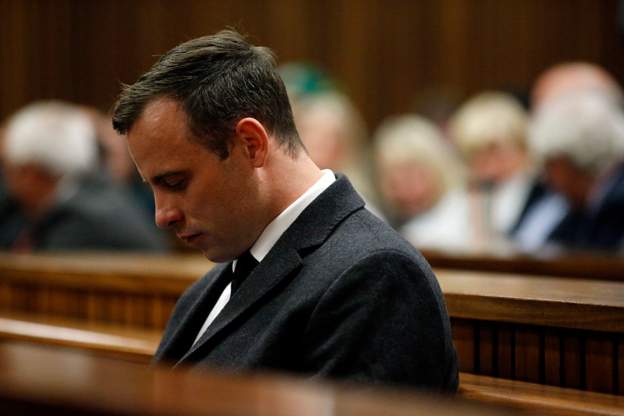
Oscar Pistorius requests a second opportunity for early parole
South African athlete, Oscar Pistorius, who has been incarcerated for six years following the conviction for the murder of his girlfriend Reeva Steenkamp, has formally petitioned the Constitutional Court to grant him eligibility for parole.
This move comes subsequent to his previous attempt for parole being rejected in March. The denial was rooted in the revelation that he had not completed the stipulated minimum sentence duration required to qualify for early release.
Pistorius was initially found culpable for murder and subsequently sentenced to 13 years in prison in 2017, following a protracted and highly publicized trial that involved numerous legal proceedings.
His conviction stemmed from the tragic incident in which he shot and fatally wounded Reeva Steenkamp by firing through the bathroom door of his heavily fortified residence on Valentine’s Day in 2013. Pistorius asserted that he believed Steenkamp was an intruder, leading to the fatal confrontation.
He believes he qualifies to be released on parole and that “staying longer in prison constitutes an infringement on his fundamental rights“.
The nation’s highest appeals court stated earlier this year, nevertheless, that the six-time Paralympic gold medalist must still serve an additional year and a half in prison before being considered for parole.
Confusion was caused by the fact that Pistorius’ prison sentence had been fragmented by house arrest and appeals.
-

Forex bureaus offer $1 at GHC11.60, BoG Interbank Rate at GHC11.00
NB: Please be aware that these rates could vary at forex bureaus in your vicinity. The provided forex bureau rates are sourced from Afriswap Bureau De Change situated in Osu, Accra.
The Bank of Ghana’s Interbank foreign exchange rates on August 17, 2023, indicate that the Ghana Cedi is currently being exchanged against the dollar with a purchase rate of 10.9991 and a selling rate of 11.0101.
At an Accra-based Forex bureau, the purchasing rate for the dollar stands at 11.20, while the selling rate is GHC11.60.
Against the Pound Sterling, the Cedi is trading at a buying price of 14.0019 and a selling price of 14.0181.
At a forex bureau in Accra, the pound sterling is being bought at a rate of 14.30 and sold at a rate of 15.00.
The Euro is trading at a buying price of 11.9746 and a selling price of 11.9874.
At a forex bureau in Accra, the Euro is being bought at a rate of 12.10 and sold at a rate of 12.70.
The South African Rand is trading at a buying price of 0.5748 and a selling price of 0.5751.
At a forex bureau in Accra, the South African Rand is being bought at a rate of 0.35 and sold at a rate of 0.95.
The Nigerian Naira is trading at a buying price of 70.3978 and a selling price of 71.4147.
At a forex bureau in Accra, Nigerian Naira is being bought at a rate of 11.00 Naira for every 1 Cedi and sold at a rate of 16.00.
For the CFA, it is trading at a buying price of 54.7205 and a selling price of 54.7790.
At a forex bureau in Accra, CFA is being bought at a rate of 16.50 CFA for every 1 Cedi and sold at a rate of 20.50 CFA for every 1 Cedi.
Our forex bureau rates are provided by Afriswap Bureau De Change in Osu, Accra.
-
Suspect in Rwandan massacre detained once more in South Africa
Fulgence Kayishema, a fugitive from justice from Rwanda who had been held in South Africa, was apprehended once more on a warrant for his extradition to Arusha, Tanzania, where he would face a genocide prosecution.
His attorneys appear to have been taken off guard by the most recent developments, which were requested by the UN International Residual Mechanism for Criminal Tribunals.
He was taken into custody earlier on Tuesday while being held in the high court’s holding area in Cape Town.
The tribunal wants him to respond to allegations that he planned the death of over 2,000 Tutsi refugees in Rwanda at a Catholic church during the 1994 genocide.
After being located at a wine vineyard in Paarl, in the Western Cape region, Mr. Kayishema is already detained in South Africa. He was initially detained for breaking the nation’s immigration restrictions.
Investigators in South Africa claimed that since his entrance in the country in 2000, he has been residing there using a fictitious name.
He is charged with crimes against humanity, involvement in genocide, and having a significant role in the 1994 genocide in his native Rwanda.
He gave up on his request for release during his most recent court appearance in June and declared that he will seek asylum in South Africa instead.
To give his attorneys and the regional prosecutors time to reply to the arrest and transfer order, the case against him has been continued until August 30.
Although he hasn’t yet entered a plea to the allegations brought against him, he has previously denied any involvement in the offences.
-

South African manhunt after ID-related shooting
Following a horrific shooting in which six people killed, a manhunt has been started in South Africa, according to authorities.
According to preliminary information, four suspects are suspected of shooting the victims in Umlazi, KwaZulu-Natal, just before midnight on Friday.
One of the suspects thought one of the victims had his identification since it had been dropped accidently during a previous murder for which he was wanted.
One of the highest murder rates in the world is found in South Africa.
According to a police statement, it is believed that the suspects shot four people: two inside the home, one in a back room, and one close to an outdoor toilet.
The suspects allegedly then shot three victims in a neighbouring cabin.
Later, a casualty was taken by ambulance to the hospital.
Police have identified three of the suspects, and they are asking anyone with information to come forward.
-

MultiChoice’s DStv halts operation in Malawi over court order
A pay TV operator headquartered in South Africa, MultiChoice, has taken the decision to temporarily cease its DStv service operations in Malawi. This move comes as a response to an injunction that restrains its local subsidiary from modifying the pricing structure of the DStv service.
MultiChoice Africa Holdings (MAH) stated that their choice was influenced by an injunction put forth by the High Court in Lilongwe. This legal matter emerged from a dispute involving MultiChoice Malawi (MCM) and the Malawi Communications Regulatory Authority (MACRA). The court order prevents any alteration to the tariffs associated with the DStv service.
MAH has maintained that its local subsidiary is not vested with the authority to determine the pricing of the service, as this responsibility rests with the parent company independently. It’s important to note that MultiChoice Malawi does not provide the DStv service to the general public in Malawi. Instead, the local entity oversees the digital-terrestrial GOtv service. For the latter, MultiChoice Malawi sought and obtained approval from the regulatory body for modifications to pricing.
Having consistently argued that the operations in Malawi were not responsible for the DStv service, MAH has conveyed that its subsidiary lacks the capability to comply with the court order mandating the implementation of MACRA’s pricing directive.
It declared it was pulling DStv out of the nation because disobeying may result in “grave consequences for the directors and management of MultiChoice Malawi, including imprisonment.”
Since failure to comply could have “grave consequences for the directors and management of MultiChoice Malawi, including imprisonment”, it said it was withdrawing DStv from the country.
The DStv service will be recognized for customers who have already paid their new membership fees up until the current 30-day viewing cycle expires on or before September 10, 2023. No new memberships or reconnections will be permitted after Wednesday, August 9, 2023.
The injunction was first imposed on July 31, but MultiChoice Malawi was successful in obtaining a stay of injunction, which was then extended until last Friday.
MultiChoice’s primary area of expansion outside of its home market of South Africa is the Rest of Africa segment. Inflation increased expenses and put pressure on its client base, which had a negative effect on its success in the South African market.
-

British physician killed in South Africa after making a mistake
Following a false detour from the airport, a British physician on vacation in South Africa was shot and killed.
Last Thursday, the unidentified 40-year-old man’s car ended up in Ntlangano Crescent in the Nyanga township together with two other family members, according to reports.
Police said: “Several suspects approached his vehicle, shot him, and killed him.” The fate of the other passengers in the automobile is yet unknown.
One of Cape Town‘s oldest townships, Nyanga, has previously been referred to as the most hazardous place in the country.
The doctor’s whereabouts remain a mystery, but the tragedy occurred as violent rioting tore through Cape Town.
Minibus taxi drivers in the city have been on strike in protest of a recent crackdown on offences such operating without a licence or licence plates.
They contend that local authorities unfairly single them out for impoundment for infractions that other drivers would only receive a fine for.
The campaign, according to the city’s mayor Geordin Hill-Lewis, is an effort to make commuting safer for many people who use taxis to move around.
Five people have died as a result of the rioting, including a police officer, as a result of looting, road blockades, stone-throwing, and burning.
The primary implicated union, the South African National Taxi Council (Santaco), has denied that any of its members are responsible for the violence and on Sunday made a formal demand for an end to it.
John HillLewis will not talk to unions until there has been a period of peace before engaging in negotiations with Santaco.
Travellers are advised by the British Foreign Office to avoid the disturbances since they “have the potential to turn violent and may impact multiple areas, including journeys to and from the airport.”
Similar to this, the British High Commission warned that using GPS services could lead to being diverted into unsafe places or into active protests.
Formerly referred to as the murder capital of South Africa, Nyanga is famed for its horrifying bloodshed.
Despite the fact that it no longer has the greatest murder rates (131 murders were reported in the years 2022–2022), it nonetheless frequently witnesses violent crimes committed during gang warfare in the township.
As a result of the migrant labour system used under apartheid to enforce segregation while giving cities access to cheap black workers, Nyanga was created in the 1940s.
Black men were effectively compelled to leave their rural family homes in search of jobs in urban centres where they could only find lodging in hostels or townships on the periphery.
There are currently more than 500 townships in South Africa, and while many of them have developed into distinct neighbourhoods, they are often crowded and impoverished, with residents being the ones most likely to be a victim of the high crime rates in the nation.
-

South African pay TV provider exits Malawi over regulatory prohibition on increasing prices
Multichoice, a South African entertainment business that owns and runs the satellite pay TV service DSTV, has left Malawi after a court ruled that its local franchise was not allowed to raise costs.
The business said that it will only continue to provide services to customers who had valid subscriptions through September 10 and that “no new subscriptions or reconnections will be accepted.”
The termination of services in Malawi signifies the culmination of a strained relationship between Multichoice and the regulatory authority.
In the previous month, Multichoice Malawi had unveiled plans to raise DSTV prices, but the Malawi Communications Regulatory Authority (Macra) secured a temporary court injunction to halt the proposed increase.
In response, MultiChoice Malawi managed to secure a temporary suspension of the injunction.
Earlier in January, Macra imposed a fine of 10 million kwacha ($9,220; £8,400) on MultiChoice and instructed the company to reimburse subscribers for the additional charges incurred due to MultiChoice’s unauthorized increase in DSTV prices.
MultiChoice Malawi contended that it was merely collecting subscription fees on behalf of MultiChoice Africa, the entity responsible for setting and adjusting prices.
Renowned as Africa’s premier entertainment platform, MultiChoice caters to 23.5 million households across 16 countries in sub-Saharan Africa.
Although DSTV offers a range of entertainment services, it is particularly recognized for its live sports event streaming, notably football.
In recent months, MultiChoice Africa has raised subscription fees for TV services in several markets, including South Africa, Nigeria, and Kenya.
The company has addressed criticisms from users in these nations by explaining that the price hikes are a consequence of inflation and the subsequent escalation in operating costs.
-

Five people, including police officer killed in South Africa taxi strike
In Cape Town, South Africa, violent protests over the taxi strike have claimed the lives of five individuals, including a 40-year-old British national and a police officer.
The South African National Taxi Council (Santaco) had previously called for a week-long strike.
Drivers who participated in the strike did so in protest of what they saw as “heavy-handed tactics” by police enforcement.
Following the strike, which was deemed to pose a serious security risk, the UK issued a travel advisory for South Africa.
After talks between Santaco and the Democratic Alliance-led provincial government collapsed, the taxi strike is anticipated to go on.
Meanwhile, the immediate release of minibus taxis seized by the local government has been ordered by Transport Minister Sindisiwe Chikunga.
She claimed that the city’s use of the law had been improperly applied and carried out.
Taxi drivers and owners complained that their vehicles were singled out and detained for infractions as small as failing to buckle up or using the emergency lane improperly, while other drivers received only penalties for the same violations.
-

Netherlands end South Africa’s dream in World Cup tournament
At the Sydney Football Stadium, the Netherlands brought an end to South Africa’s impressive journey to the knockout stages of the Women’s World Cup, securing a 2-0 triumph.
In the second half, a fortuitous strike by Lineth Beerensteyn proved to be the decisive factor, sealing the victory for the Dutch team against a resilient South African squad. This victory now paves the way for an exciting quarter-final clash between the Netherlands and Spain.
South Africa commenced the match with a spirited approach, employing their speed advantage to take the first shot on goal. However, Netherlands’ goalkeeper Daphne van Domselaar was quick to secure the ball, thwarting the attempt.
After withstanding the initial offensive, the Dutch team capitalized on their first cross during the afternoon. A failed clearance set the stage for a close-range header by Jill Roord, marking her fourth goal in the tournament.
Throughout the first half, South Africa’s defense appeared unsettled, leading to frequent squandered possession and maintaining pressure on their side.
Challenges increased as injuries forced Jermaine Seoposenwe and Bambanani Mbane to leave the field for South Africa. Despite this, the Netherlands couldn’t find the pivotal second goal to further secure their lead.
As the initial 45 minutes transpired, the majority of the time was spent with South Africa defending within their own territory. However, the balance of momentum shifted in South Africa’s favor as the clock reached the brink of added time.
Thembi Kgatlana, the striker renowned for her swiftness, managed to challenge the Dutch defense on several fleeting opportunities when she found herself in open spaces. Just before halftime, she came heartbreakingly close to leveling the score.
In an impressive display of speed, she outpaced the defense to collect a well-timed through ball, positioning herself perfectly. Nonetheless, the scrambling efforts of goalkeeper van Domselaar ensured that the Dutch maintained their lead as the first half concluded.
The Netherlands secured their second goal in the 68th minute. Lineth Beerensteyn launched a long-range attempt toward South Africa’s goalkeeper, Kaylin Swart.
Although Swart managed to get her hands on the ball, the shot slipped through her grasp and nestled into the net.
In the upcoming clash against Spain, the Dutch will be without midfielder Danielle van de Donk, who received her second yellow card of the tournament.
-

Ghana’s Prince Annor Amponsah joins Stellenbosch FC in South Africa
A team in the South African Premier Soccer League, Stellenbosch FC, has officially announced the signing of Prince Annor Amponsah, a talented 18-year-old defender from Ghana. The club confirmed the long-term deal on its website.
Amponsah’s journey to this professional contract began with his youth development at Scores Football Academy in Ghana, followed by a short stint at the Ubuntu FC Academy. His impressive performances at these clubs caught the attention of Stellenbosch FC, leading to a professional trial with the team.
During his trial period, Amponsah showcased his skills and potential as a center-back. Notably, he was part of Stellenbosch FC’s U-21 squad that traveled to India to participate in the prestigious Premier League’s international NextGen tournament. There, he displayed excellent defensive abilities, helping the team secure a second-place finish.
Impressed by his performances, Stellenbosch FC offered Prince Annor Amponsah a professional contract, securing his position in the team’s ranks. With his promising talent and dedication, the young Ghanaian defender looks set to make a significant impact in the South African football scene.
“We are massively excited about the signing of Prince and his addition to our squad,” head coach Steve Barker said. He is a young player with huge potential,” the club wrote on its website after finalizing the deal.
Stellenbosch FC added, “He has immense ability with the ball at his feet, a great passing range, and is all-round a really good defender, so we are excited to see him grow and develop with us at the club.”
After signing a large contract with the club, Prince Annor Amponsah will be looking to make the first squad and establish himself as a regular.
-

Italy’s coach blames defeat against SA on dwindled confidence from previous defeats
Coach Milena Bertolini attributed Italy’s surprising exit from the Women’s World Cup to their shaken confidence.
The dented morale played a significant role as South Africa’s 3-2 upset in Wellington brought an end to Italy’s campaign.
Italy’s expectation of progressing required only a draw against their lower-ranked opponents.
However, their failure to capitalize on crucial opportunities, coupled with Thembi Kgatlana’s stoppage-time winning goal, sealed their fate.
While they began with a promising 1-0 victory against Argentina, Italy faced a crushing setback with a 5-0 loss to Sweden in their subsequent match.
This devastating defeat left an enduring impact on the team’s psyche, making it difficult to regain their footing.
“I’m sure that the game against Sweden and also the goals we conceded effected our trust, our confidence, our peace of mind,” she told reporters via a translator.
“It’s clear that today the emotional side was actually important, (a) major factor but this is an aspect that is part of the growth that this team has to make.”
Their early exit marked the latest major disappointment for Italy after Euro 2022, where they finished bottom of their group following a demoralising 5-1 opening defeat by France.
It is a disappointing trajectory for the team four years after they stunningly reached the World Cup quarter-finals, following a two-decade-long absence from the tournament.
But Bertolini insisted there was cause for optimism.
“We’re in a transition period for that historical group of players in 2019 and now we’re actually inserting new players, young players,” she said.
“This is part of our pathway and perhaps in (the) future, in the next competitions, the Italian national team will have young players that are very experienced, have accrued experience.”
-

Less death of rhinos recorded in south Africa
South African authorities, have reported that efforts to combat poaching have resulted in a decline in the number of rhinos slaughtered for their horns in the first half of the year.
According to the environment ministry, 231 of the nation’s rhinos were murdered for their horns between January and June, which is a decrease of 28 over the same time last year.
The environment ministry reports that combined efforts by South Africa’s law enforcement agencies, customs officers, and private security have resulted in some convictions for poachers.
The endangered creatures, whose horns are still highly valued in China and Vietnam, are being killed by well-armed poaching gangs, but South Africa, Botswana, and Namibia continue to fight this battle.
-

Third richest person in Africa close to making $10b net worth – Report
South African billionaire Nicky Oppenheimer has experienced remarkable financial success this year, witnessing a surge in his net worth by over $1.3 billion, inching closer to the $10-billion milestone.
Currently ranking as Africa’s third-richest person and the second-richest man in South Africa, trailing behind Johann Rupert, Oppenheimer’s net worth has soared by a significant $1.38 billion since the beginning of the year.
According to Bloomberg Billionaire Index, his net worth has risen from $8.03 billion to an impressive $9.4 billion, elevating him to the 237th spot among the world’s wealthiest individuals.
The driving force behind Oppenheimer’s wealth gains lies in his private equity investments, particularly through his ventures, Stockdale Street in London, and Tana Africa Capital in Johannesburg. These shrewd investments have capitalized on lucrative opportunities, generating substantial returns and solidifying his position among the continent’s few billionaires who have witnessed substantial growth in their fortunes this year.
Oppenheimer’s financial success reflects his astute approach to wealth management and diversification of investments, which include stakes in various companies, notably Integrated Diagnostics Holdings (IDH), a healthcare services provider based in Cairo, led by Egyptian businesswoman Hend El-Sherbini.
Beyond his business interests, the billionaire is renowned for his unwavering commitment to wilderness conservation. Oppenheimer owns and operates Tswalu Kalahari, South Africa’s largest private game reserve, in partnership with his son Jonathan. The reserve serves as a sanctuary for wildlife, playing a crucial role in preserving the country’s natural heritage.
Additionally, Oppenheimer owns the Shangani Ranch, a sprawling 65,000-hectare property known for its wildlife sanctuary status. The ranch boasts a robust cattle operation and employs 400 workers, exporting beef to the United Kingdom since 1937. Moreover, it serves as a vital corridor for migrating animals, underscoring Oppenheimer’s dedication to wildlife preservation and ecological balance.
With a year-to-date wealth gain of $1.38 billion, Oppenheimer is poised to join the ranks of the few African billionaires with a fortune surpassing $10 billion. His impressive financial achievements and commitment to wildlife conservation have solidified his status as a prominent figure in the business and philanthropic spheres.