Tag: SSNIT

  • Pension benefits outweigh treasury bill returns – SSNIT

    Pension benefits outweigh treasury bill returns – SSNIT

    The self-employed and employees in the informal sector have been urged to join the Social Security and National Insurance Trust (SSNIT) Pension Scheme, which would provide them with a retirement income when they are unable to work.

    Mr. Charles Akwei Garshong, Public Affairs Manager of SSNIT, who gave the encouragement, cautioned the self-employed against preferring treasury bills to the SSNIT Pension Scheme, saying, “Investing your money in treasury bills will not yield you more returns than what SSNIT will be paying you during your retirement.”

    He said apart from regular annual increases on pension allowances, SSNIT also paid any contributor who is declared unfit (invalidity pension) to continue working, monthly pension allowances no matter his or her age before being declared unfit to continue working.

    He was speaking at a sensitisation workshop for media practitioners in Tamale on the SSNIT Pension Scheme to equip them with information to help create content to encourage the self-employed and workers in the informal sector to join the SSNIT Pension Scheme.

    Participants were drawn from the Northern and Upper East Region.

    The sensitisation workshop was in line with the Self-Employed Enrolment Drive (SEED) of SSNIT, which focuses on extending pension coverage to the self-employed and workers in the informal sector.

    Statistics show that about 85 percent of the country’s economy is informal, comprising 6.7 million self-employed people from a total working population of 9.9 million.

    However, only about 34,000 active SSNIT contributors are self-employed.

    This necessitated the SEED, which was a repackaging of the tier one pension, to provide social protection to such workers (self-employed and workers in the informal sector) by providing them with a regular source of income during retirement.

    He reiterated that the SSNIT Pension Scheme was not created for just public and formal sector workers but for all workers in the country, including the self-employed and informal sector workers.

    He said SSNIT was focused on reducing old-age poverty, which arose when people did not have pensions to rely on, hence the need for the self-employed and workers in the informal sector to join the pension scheme.

  • GIHOC staff call for removal of MD

    GIHOC staff call for removal of MD

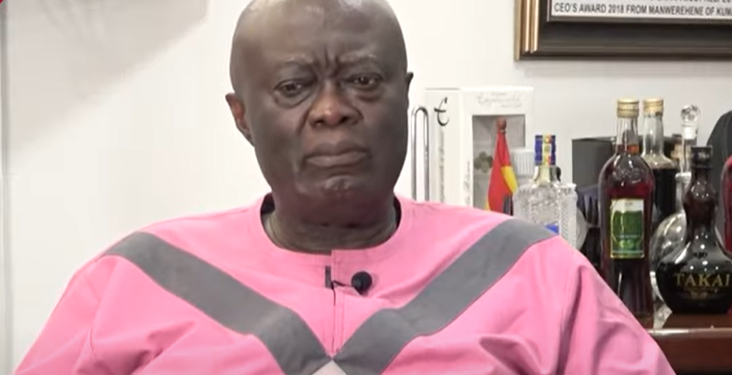
    Staff at GIHOC Distilleries Limited in Accra are requesting that the Managing Director, Maxwell Kofi Jumah, be immediately sacked for poor performance.

    The workers who embarked on a protest at the premises of the company amidst heavy police presence on Tuesday, May 16 insist that their salaries have been in arrears for the past three months.

    They also allege that their Social Security and National Insurance Trust (SSNIT) contributions and Provident fund have been in arrears for almost a year now.

    Maxwell Kofi Jumah

    According to the workers, the fortunes of GIHOC distilleries have taken a turn for the worse under the leadership of Mr. Jumah who has been the MD of the company for six years now.

    Clad in red armbands, the workers vented out their frustrations to Citi Business News and called on the government to immediately relieve him of his duties.

    “The workers cannot produce raw materials, neither is the company able to pay workers, provident fund, and SSNIT for almost a year. Earnings and salaries hardly come, As I speak to you about three months’ salaries haven’t come. There are several other concerns, goods are sold and monies don’t go to the company’s account,” a worker told Citi Business News.

  • UTAG throws out govt’s request to include pension funds in revised debt servicing deal

    UTAG throws out govt’s request to include pension funds in revised debt servicing deal

    The government’s newest alternative offer to include pension funds in the current debt restructuring has been rejected by the University Teachers Association of Ghana (UTAG).

    Government has said, the decision to include pension funds in the programme is aimed at alleviating the cash constraints on the government in the coming years, while fully compensating the Pension Funds for the value of their current holdings.

    But in a memo, UTAG said any move to add pension funds in the debt restructuring programme will overburden its already poor members.

    “We are still unable to participate in any intervention that would worsen the plight of the already impoverished Ghanaian University Lecturer. We therefore write to unequivocally reject the request to use our Pension Funds i.e GUSS, SSNIT and any other pension fund that affect our members for the new alternative proposed offer by government.”

    “his request by the government comes after organized labour fiercely rejected the inclusion of pension funds in the Domestic Debt Exchange programme.

    “We warn that governmental intransigence in this matter would not be countenanced as we are willing to fight to ensure that no one robs our members of their pensions funds”, UTAG added in its statement.

    What Finance Minister has been saying

    The Minister of Finance, Ken Ofori-Atta had explained that the proposal has been “crafted to facilitate the execution of the MoU, addressing the Government financial needs while maintaining the value of the pension funds.”

    “The proposed offer entails exchanging your current holdings of Treasury Bonds, ESLA bonds and Daakye Bonds for a menu of the currently outstanding New Bonds (issued in February 2023 and maturing in 2027 and 2028 respectively. New Bond 2027 and New Bond 2028 featuring an average coupon of 8.4 % with a ratio of 1.15x, thus entailing an increase in patrimonial value.”

    “This complemented by an additional cash payment of 10% (strip coupon). The stream of coupons to be received as part of this proposal will therefore be 21% compared to the current 18.5% of the outstanding old bonds,” he added.

    He further indicated that “in 2023 and 2024, both instruments will pay 5% coupon in cash and the remainder will be capitalized into the nominal amount of the two bonds in order to comply with the cash constraints and the macro-framework defined under the programme with International Monetary Fund (IMF).”

    He says the alternative offer has been designed to “(i) achieve the same average maturity as pension funds current holdings of the old bonds (currently between 4 and 5 years), (ii) achieve a similar average coupon (currently at 18.5%) while(iii) alleviating the cash constraints for the government over the first two years.”

    The Finance Minister thus urged the Board of Trustees of pension funds to consider the proposal, indicating that “government is targeting to settle the offer by end of April 2023.”

  • SSNIT reacts to claims its Cape Coast office has defaulted property rate payments

    SSNIT reacts to claims its Cape Coast office has defaulted property rate payments

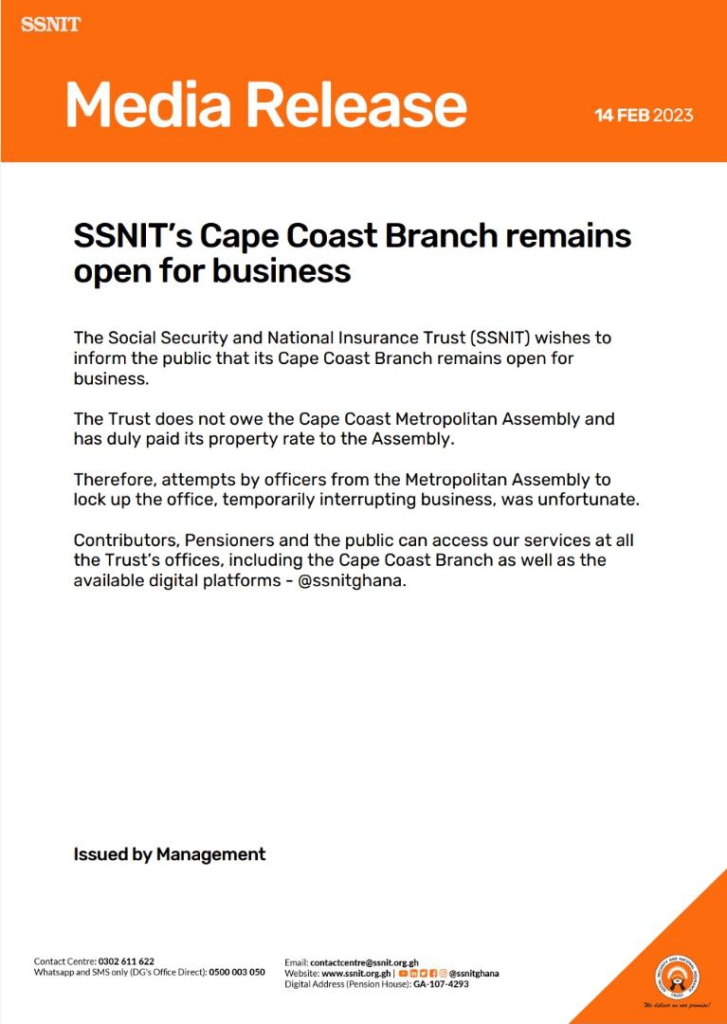
    The Social Security and National Insurance Trust (SSNIT) has fought off claims its Cape Coast Branch owes the Cape Coast Metropolitan Assembly a colossal amount of money due to failure to fulfill its property rate obligations.

    According to a statement from the Trust, it Cape Coast office remains open for business.

    “The Trust does not owe the Cape Coast Metropolitan Assembly and has duly paid its property rate to the Assembly.”

    Our Cape Coast office remains open - SSNIT

    “Therefore, attempts by officers from the Metropolitan Assembly to lock up the office, temporarily interrupting business, was unfortunate”, it pointed out.

    It further added that contributors, pensioners and the public can access our services at all the Trust’s offices, including the Cape Coast Branch as well as the available digital platforms.

    Source: Myjoyonline

  • SSNIT is concerned about public sector employee contribution delays

    SSNIT is concerned about public sector employee contribution delays

    The Social Security and National Insurance Trust is suffering from the government’s ongoing failure to secure prompt payment of social security contributions made by employees of the public sector (SSNIT).

    Public sector employees’ contributions are typically paid by the government on a quarterly basis through the Controller and Accountant General’s Department, but occasionally the arrears build up for three quarters, which SSNIT Director-General John Ofori-Tenkorang says is having a negative effect on the program.

    The Director-General, responding to questions before the Public Accounts Committee of Parliament concerning why the Trust recorded losses in 2018 and 2019, cited delays in payment of public sector workers’ contributions. He reiterated that the deficits recorded in revenue for the years in question were as a result of increase in benefits payments as well as shortfalls in expected contributions from the Controller and Accountant-General’s Department.

    His appearance before the Committee follows findings from the 2020 Auditor-General’s report on Public Accounts of Public Boards, Corporations and other Statutory Institutions which showed that SSNIT recorded deficits of GH¢442million in 2018 and GH¢427million in 2019.

    Although he did not state how long the contributions have been outstanding, the arrears stood at eight months in July 2022. Ideally, SSNIT invests these contributions in diversified portfolios that guarantee maximum returns for contributors. Any delays, therefore have the potential of disrupting investment decisions and the expected returns.

    Even though the situation may not immediately affect individual pension beneficiaries, Dr. Ofori-Tenkorang noted that long-term effects on the Trust could be dire.

    “The short-term answer is ‘no’, because if you retire today we would not say that your contributions have not been remitted. As long as it has been filed and acknowledged by your employer that you were working, we will go ahead and pay you everything that is due you; but there is going to be a time when we will not have the cash to pay,” he explained.

    Dr. Ofori-Tenkorang further pointed out that the Trust in 2020 recorded a surplus of about GH¢1.1billion, followed by a deficit of about GH¢302million in 2021. He is however projecting a surplus for 2022.

    Meanwhile, the Committee’s Chairman, James Klutse Avedzi, emphasised that the fluctuations do not look good and need to be addressed holistically.

    Regarding sustainability of the Trust, the SSNIT boss indicated that management is planning to initiate stakeholder engagement and collaboration to achieve a sustainable contribution rate.

  • Akufo-Addo appoints Baffour-Awuah as Minister for Pensions

    Akufo-Addo appoints Baffour-Awuah as Minister for Pensions

    The Minister for Employment and Labor Relations, Ignatius Baffour Awuah, has been named the Minister in charge of Pensions by President Akufo Addo.

    The appointment which is in accordance with section 211 of the National Pensions Act 2008 (ACT 766) will see the minister steering the affairs of the National Pensions Regulatory Authority (NPRA) and the Social Security and National Insurance Trust (SSNIT) effective January 30, 2023.

    Mr Baffour Awuah made this known when he appeared before the Public Accounts Committee on Wednesday, February 1.

    The new ministerial appointment which takes immediate effect comes after the Minority warned that any new ministerial appointment will not be tolerated as the country embarks on a domestic debt restructuring to revive the ailing economy.

  • Ensure your employer pays SSNIT contributions in full – Public Affairs Manager

    Ensure your employer pays SSNIT contributions in full – Public Affairs Manager

    Public Affairs Manager of the Social Security and National Insurance Trust (SSNIT), has encouraged formal sector workers to ensure that employers pay their full contributions to the Trust.

    Charles Akwesi Garshong revealed that in cases where some workers receive allowances that are separate from their salaries, some employers contribute based on the employee’s actual salary.

    “So it is up to you to ensure that your employer is paying contributions on your full earnings, because the higher the income on which contributions are paid, the better your pension”, he indicated on Wednesday.

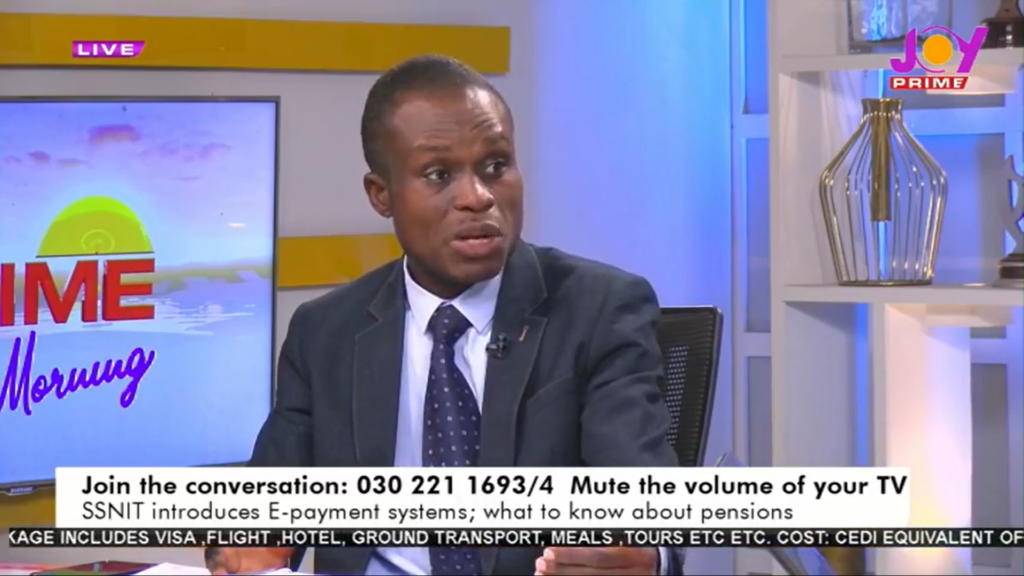
    Speaking on Prime Morning, he said the practice might look appealing to the worker but affect their pension payments in the long run.

    Ensure your employer pays SSNIT contributions in full - Public Affairs Manager
    Public Affairs Manager, Social Security and National Insurance Trust (SSNIT), Charles Akwesi Garshong

    “Because the employer is also looking at it that if I add it to your salaries, the responsibility I have by topping up the contribution you make will increase…”

    “For employer-employee relationship this is what happens, workers pay a portion and employers will have to top up so if they declare that salary, they feel like oh why don’t I reduce it so that you have huge allowances, you feel you’re okay but at the end of the day he’s only avoiding his responsibilities”,  Mr Garshong said.

    Mr. Garshong advised individuals in the informal sector to also contribute to SSNIT because of its benefits.

    He noted that self-employed persons who do not have fixed salaries can decide willingly on how much they can contribute and discuss with SSNIT, provided it meets the minimum amount.

  • Highest pensioner in Ghana to receive GH¢169,725 monthly – SSNIT

    Highest pensioner in Ghana to receive GH¢169,725 monthly – SSNIT

    Chief Actuary of Social Security and National Insurance Scheme (SSNIT), Joseph Poku, has disclosed that the highest pensioner in Ghana will from this year earn an amount of GH¢169,725.89 every month.

    According to him, this is a 19.05% increment from the previous GH¢142,564.97 received by the highest pensioner in 2022.

    Speaking at a press conference in Accra on Friday, January 13, 2023, Mr Poku said the lowest pensioner, on the other hand, will receive GH¢430.58, an increase of 43.53%.

    “The indexation rate for 2023 is 25% and this represents a 150% increase over the previous year’s indexation rate which was 10%…Having determined this rate, we don’t want to apply this rate across board because some people are earning far higher than the others so we need to take into account those who are low pension earners and this is what enabled us to introduce the mechanism called the redistribution,” Mr Poku announced.

    “So the lowest pensioner who as at last year was receiving GH¢300 is now going to receive GH¢430 and some pesewas and this represents 43.53% increase over the previous years…again, the highest earning pensioner who was having GH¢142,564.97 is now going to receive pension beginning January 2023 of GH¢169,725.89 very month,” he added.

    The redistribution method adopted by SSNIT is a mechanism applied to the indexation rate to cushion members on low pensions in conformity with the solidarity principle of social security.

    He noted that a total of GH¢5 billion will be distributed by the pension scheme this year to beneficiaries.

    Source: Ghanaweb

  • Pensions in payment are projected to go up by at least a fixed rate of 20% in 2023 – ACRR

    Pensions in payment are projected to go up by at least a fixed rate of 20% in 2023 – ACRR

    Background

    January is the most important time of the year for pensioners and their dependents, primarily because it is when the Social Security Administration announces the new rates by which monthly pensions of existing retirees will be increased.

    The import of indexation is to restore the purchasing power lost by pensioners in the previous year. Pensions in payment are therefore reviewed by applying an inflation-adjusted index.

    It is therefore expected that SSNIT in consultation with the National Pensions Regulatory Authority (NPRA) will soon announce the new pension indexation rate for 2023.

    How is the Pension Indexation Provision Applied by SSNIT?

    Pension indexation (as provided in section 80 of Act 766), as a means of restoring the purchasing power lost by pensioners in the previous year, is largely dependent on the price inflation index.

    In practice, SSNIT uses consumer price inflation as the main variable for increasing pensions. The Trust, in consultation with the Board of the National Pensions Regulatory Authority, agrees on what is termed as the ‘Overall Rate’ by which pensions will increase for the coming year.

    The overall indexation rate is based on the analysis of several variables which include in particular the projected increase in the cost of benefits for a given rate, and the resulting impact of the proposed indexation rate on the fund (fund ratios).

    Given the Agreed ‘Overall Indexation Rate’, the ‘Fixed Rate’, which is equivalent to the Annual Average Price Inflation Rate of the previous year, and the ‘Flat Amount’ are determined.

    Expected Indexation Rate of 2023

    Likely Fixed Rate of Increase

    As required by the Social Security Act, the Trust awards a fixed rate of increase for each pensioner based on average price inflation. In 2021, the consumer price inflation averaged 9.68% and therefore pensions were increased by a fixed rate of 9.68% in January 2022. In 2022, global economic challenges have eroded the purchasing power of pensioners due to rising prices of goods and services as measured by inflation. The consumer price inflation averaged 29.40%. If SSNIT sticks to the provisions and practice (spanning from 1992), each pensioner on the pension payroll as at 31st December 2022 could see a commensurate monthly increase rate of 29%.

    This level of indexation (29% fixed rate) could however expose the scheme to serious financial sustainability challenges (high inflationary risk). The Trust may apply a scheme sustainability adjustment factor (SSAF) in this year’s indexation. The scheme sustainability adjustment factor essentially ensures that the awarded Fixed Rate of increment is lower than the actual average inflation rate of the previous year. It is there expected that SSNIT might increase pensions by a fixed rate ranging between 20% to 25% in January 2023.

    In 2023, and from a policy perspective, if pensions would be increased at a rate lower than the annual average price inflation (29%), it is expected that the Trust will clearly explain or communicate the reasons for changes in the basis of indexation to stakeholders, especially contributors and pensioners.

    The Minimum Pension Amount Must be Reviewed Upward in 2023

    Both the Social Security Law, 1991, (PNDCL 247) and the National Pension Act, 2008, Act 766 have provided for the payment of minimum pension to poor pensioners (poverty relief).

    To practically sustain the economic welfare of pensioners, the minimum pension, which has stayed at GH300.00 for four successive years (2019, 2020, 2021, and 2022) needs to be reviewed significantly upward in 2023.

    Note that the minimum pension of GHS300.00 represents 30 dollars (using the current exchange rate) per month. This pension amount represents 50% of the value of the national poverty line.

    Trend analysis shows that the minimum pension had consistently increased each year since 2000, and in some cases doubled (2013 and 2014). For the period 2016 to 2021, the minimum pension grew by only 9% whilst the minimum salary of active contributors increased by 47.75% within the period.

    If the level of benefits provided by social protection systems is insufficient in terms of minimum living standards, or are not deliberately designed to protect the poor, and to minimize the social and economic inequalities between the rich and the poor the effort to reduce old age poverty will be jeopardized.

    ****************************************************************************************************************************************************************************************

    The author, Abdallah Mashud is the Executive Director, Africa Centre for Retirement Research (ACRR).

    Source: Myjoyonline| Abdallah Mashud

  • SSNIT electronic service makes significant uptick – Dr Ofori-Tenkorang

    Since the deployment of Social Security and National Insurance Trust (SSNIT) electronic services [mobile money services] two months ago, there has been a considerable increase in usage, Dr. John Ofori-Tenkorang, Director-General of SSNIT has said.

    SSNIT adopted mobile money services as part of measures to enhance service delivery. With the new services, members can pay their contributions and retirees can choose to receive their pensions via MoMo.

    Addressing the media during a conference held in Koforidua, the Director-General highlighted that the electronic channels will allow SSNIT to migrate its inflows from the normal channels which have been cumbersome for contributors.

    “What we have made available now is that in the comfort of your own office or home, you can go online and pay either through your debit card, your bank account; and more importantly also, through MoMo E-Levy exempt. Since we launched this about a month and a half to two months ago, we’ve seen quite a bit of a significant uptick on those channels,” he said.

    “We believe that in the next year or so, we will probably see a significant amount of our inflows migrating from the normal channels, which are a bit cumbersome, to the very easy electronic channels that we’ve made available,” Dr. Ofori-Tenkorang said.

    Given the scheme’s target of enrolling about a million self-employed in the country, Dr. Ofori-Tenkorang mentioned that these channels which have been opened up will come in very handy to get the self-employed to join SSNIT and pay without leaving their place of work.

    “I believe that these channels that we’ve opened up will also come in very, very handy when we get the self-employed to join SSNIT and pay without leaving their place of work. So far, so good. I think that there is a lot of improvement that can be achieved, and we hope that by the close of the next year we will see a very significant uptick,” he said.

    He further noted that the Scheme’s stakeholder engagements are yielding results, as while sensitising people we got a significant uptake.

    “Right now, within the three months that we’re doing the sensitisation we’ve jumped from 14,000 to 18,000 – which is an about-30 percent increase within just three months.

    “We hadn’t even launched, even though today you can walk into an office to write your name as a self-employed person. We haven’t gone out there and, you know, basically officially opened the channels. This 30 percent uptick was achieved even before we rolled out the electronic payment channels,” he said.

    “So, it is our hope that within the next year or two we should be able to get about a million self-employed people to sign onto this SSNIT scheme; and by so doing they will be assured that when they retire, they too will receive a monthly pension,” the Director-General stated.

    As of October 2022, the Trust had paid about GH¢3.4billion in pension payments as well as survivors’ benefits and lump sums.

    The Director-General said the Trust will close the year having paid about GH¢4.1billion.

    “This is a significant amount of money that gets pumped into the Ghanaian economy to help pensioners survive, and this shows you how systemic and how important our organisation is – and that we should take this business very seriously.”

    Source: Ghanaweb

  • GH¢3 billion paid to SSNIT pensioners in 11 months

    The Social Security and National Insurance Trust (SSNIT) has made pension payments totalling GH¢3.06billion to pensioners in the first 11 months of this year.

    The data show that the number of pensioners now stands at over 232,000 as of November 2022.

    Due to non-renewal of pensioner certificates from April 2018 to July 2022, SSNIT has withheld around GH¢320million as a result of deactivating some 21,337 pensioners.

    Insured Salaries

    According to the Trust, current available data indicate that more than 80 percent of Ghanaian workers have insured wages of GH¢2,500 or less, meaning that 80 percent are contributing GH¢275 each month.

    Additionally, GH¢ 2,500 or less is paid to 95.5 percent of pensioners each month. Only 5.3 percent of Ghanaian workers with incomes of at least GH¢5,000 pay a premium. However, 1.4 percent of retirees also earn a monthly pension of GH¢5,000 or more.

    Per the Trust, if this doesn’t change 80 percent of retirees will eventually receive a pension of GH¢1,500 or less. This simply means that the reality of your pension benefits may not be all that different from those of people who are currently receiving pensions if the contribution records of workers in active service do not dramatically improve.

    SSNIT and NIA Merger

    Some 1.9 million SSNIT numbers have been linked with the National Identification Authority numbers (Ghana Card); and according to the Trust, this has saved the Scheme about GH¢60million that would have otherwise gone into printing new cards.

    The printing of new biometric cards was halted in 2018 in anticipation of the Ghana Card, which according to the Trust cost the Scheme more than US$7 per card.

    The breakdown revealed 383,200 pensioners and lump-sum beneficiaries; 1,246,839 active members; as well as some 293,010 inactive members (members who have not contributed in the last 12 months).

    Between June 2021 and June 2022, SSNIT deployed its systems to allow members to merge their SSNIT and NIA numbers, as it issued a directive that the Ghana Card is the only identification that will be recognised by the Trust as of July 2022.

    This complies with Regulation 7 (1) of the National Identity Register Regulations, 2012, L.I. 2111, which requires use of the Ghana Card as identification for “transactions pertaining to individuals in respect of pensions” and “transactions that have social security implications”.

    With the integration of SSNIT numbers with the Ghana Card, SSNIT intends to leverage the national platform for a more effective and efficient identification system; for convenience, ease of doing business, eliminating the cost of printing cards, improved claims processing time, and expansion of coverage among others.

  • Don’t target domestic creditors in debt restructuring – Ato Forson to government

    The Minority Spokesperson on Finance, Dr. Cassiel Ato Forson says targeting domestic creditors in a possible debt restructuring will hurt the Ghanaian economy.

    Ghana’s debt stood at GH¢402.4billion as of July 2022.

    According to Dr. Forson, debt relief in excess of GH¢200 billion is needed to make Ghana’s current debt sustainable.

    Speaking at the “Building the Ghana We Want” lecture at the University of Professional Studies, Accra on Thursday, October 27, 2022, the former Deputy Finance Minister admonished the government to avoid a mickey mouse form of debt restructuring.

    “One of the biggest dilemmas in solving debt restructuring is the extent to which the burden should be borne by holders of the debt instrument governed by domestic and foreign laws and that’s what people call domestic foreign debt restructuring. Restructuring domestic dent is like surgery, you only do it if you must and you avoid it if it might do more harm than good. It is a dangerous tool,” Dr. Ato Forson stated.

    He added: Restructuring your domestic debt should be thought through well. Imagine the consequences of haircuts. On the face value of your interest on your bond, imagine waking up one early morning only to be told that your GH¢1 million in government bond has suddenly become GH¢700,000 to the extent that the government has taken GH¢300,000 of your money, imagine that! Pension funds will suffer a drop in value.”

    “Tier 2 and Tier 3 pension payout will drop from already low levels. Tier 1 SSNIT reserve will drop in value, SSNIT capacity to pay pensions will certainly suffer, and Insurance companies’ reserves will fall with implication for benefit payment, unfortunately. Local banks, other deposit-taking institutions, savings & loans, and rural banks will all suffer.”


  • Invest in the future of your employees – SSNIT Dir. Gen to employers

    The Director-General of the Social Security and National Insurance Trust (SSNIT), Dr John Ofori Tenkorang, has urged employers to view their contributions to the scheme as an investment and not a mandatory tax.

    Dr Tenkorang made the comments during a breakfast meeting with employers held in Takoradi.

    The one-day meeting was held to sensitise employers to the activities of SSNIT and their new policy direction.

    According to the SSNIT Director-General, the future of workers is of significant importance, therefore, employers should be interested in securing their employees’ future.

    “We are here to let you know how important you are to us and the need to contribute for the future of not only your workers but for you, as well,” Dr Tenkorang explained.

    He urged employers to invest in the future of their employees.

    “It is not my interest to send any employer to court; that should be clear, but there should be a conscious effort for you to invest in your company and your workers.”

    He also introduced an app, which will give employers easy access to pay the contributions of their companies and employees.

    He stressed that the country’s best insurance company is SSNIT and implored them to be actively involved in their contributions to the scheme.


  • SSNIT hands over $3.2m children’s library to GLA

    The $3.2 million Children’s Library initiated and constructed by the Social Security and National Insurance Trust (SSNIT) to promote education and reading among children, was yesterday handed over to the Ghana Library Authority (GLA).

    The facility located at the Airport Residential Area, near Kawukudi Junction in Nima, which started in 2015 was completed last year.

    The multi-purpose one-story library, equipped with modern technological equipment to help the visually and hearing impaired also use the facility, is stocked with about 22,000 books.

    In addition to the physical library, SSNIT also handed over a mobile library facility to the GLA.

    Speaking at the handing over ceremony witnessed by the board members of SSNIT and officials of Ministry of Education and the GLA as well as pupils from schools from Kanda, the Director-General of SSNIT, Dr John Ofori-Tenkorang, said SSNIT had been involved in education over the years.

    He said SSNIT started the Students Loan Scheme, which was later handed over to the Students Loans Trust and also financed the construction of students’ hostels and some community schools in some parts of the country.

    Dr Ofori-Tenkorang indicated that the state-of-the-art library facility was to help children to learn and discover themselves for the development of the country.

    “We believe that we need educated population, in order to get a good workforce, and, therefore, SSNIT this year launched supplementary readers developed in conjunction with the Ghana Education Service, to bring social security education to children at the younger age,” he said.

    The Director-General said the supplementary readers would help children to learn about social security and retirement planning.

    Dr Ofori-Tenkorang described the facility as ultra-modern because everything about the facility such as registration to use the library as well as searching for books, was computerised.

    In addition, he said the library had facilities for the visually and hearing impaired to read and learn, conference rooms, computer room, first aid room and media viewing room.

    Asked of the cost of the facility, he said about $3.9 million was budgeted for the project, but between $3.1 and $3.2 million was used to complete the project.

    The Minister of Education, Dr Yaw Adu-Twum, in a speech read on his behalf by the Director of Pre-Tertiary Education at the Ministry of Education, Nana Baffour Awuah, said education remained a priority of the government, most importantly, Pre-Tertiary education.

    He commended the SSNIT for financing the construction of the Children and Mobile Library for use by children from two years to the pre-tertiary level.

    Dr Adu-Twum entreated the GLA to take good care of the facility to benefit the not children around the Airport Residential Area, and the country as a whole.

    The Chief Executive Officer of GLA, Hayford Siaw said the new Children and Mobile Library, which had the capacity to serve 169 pupils, brought to 61 new libraries constructed around the country since 2016 and 14 in Greater Accra Region.

  • Workers to pay pensions on allowances — SSNIT moves for review of Pensions Act

    The Social Security and National Insurance Trust (SSNIT) is pushing for an amendment of the National Pensions Act, 2008 (Act 766) to compel employers to include the allowances of employees in the computation of their pensions.

    The move is to enable workers to earn bigger pensions when they retire.

    The Director-General of SSNIT, Dr John Ofori-Tenkorang, announced this at a breakfast meeting called at the instance of the Trust for employers from the Greater Accra and Eastern regions last Wednesday.

    “Some employees earn huge allowances but never allow for it to be included in their basic salary on which their pension is calculated. At retirement, they complain about earning small pensions but they forget that while in service, they ring-fenced their allowances for their pensions to be calculated only based on their basic salaries which may be small,” he said.

    Dr Ofori-Tenkorang said the scheme had been structured in a manner that the bigger the income on which the pensions were calculated, the better for the contributor when he or she retired.

    He said if some retired workers were earning between GHC10,000 and GHC120,000 per month while others were taking as low as GHc300, which is the minimum, it confirms the fact that the more the amount on which the pensions were based, the better for the employee.

    At the end of their active service, SSNIT will only pay pension of up to 60 per cent of the GHC4,000 and not the entire GHC10,000 which includes allowances earned.

    Against this background, Dr Ofori-Tenkorang said the amended Act would consolidate their earnings before their pensions were calculated and deductions made accordingly.

    “As it stands now, workers’ pensions were calculated on the basic salary and not gross income which includes allowances,” he explained.

    According to the Director-General, the amendment would also take into account the issue of penalty to make it obligatory for the employer to pay the prevailing interest rate when they delay in remitting to SSNIT pension deductions on behalf of their employees.

    Legacy investments

    The Director-General added that SSNIT was restructuring its non-performing investments to enable it to generate more returns to support the pension scheme.

    Dr Ofori-Tenkorang said many of the non-performing investments were inherited by his administration in 2014 .

    Consequently, an investment team had been put in place to re-trigger SSNIT’s investment portfolios for further action.

    Additionally, he said his outfit, would partner other investors in areas where SSNIT’s investments were underperforming.

    “What we are doing is to restructure some of the underperforming investments, especially those legacy investments that we feel are not suitable for us to be majority shareholders; we are going to invite investors who are in that business to partner us.

    “The restructuring is to make sure we get the necessary returns to support the pension scheme,” Dr Ofori-Tenkorang said.

    As part of efforts to boost investments, Dr Tenkorang explained that a transaction advisor had been engaged and was currently working on procurement processes to have shares in hotels belonging to SSNIT disposed to strategic investors.

    Electronic payment

    Also at the function, SSNIT introduced an electronic payment system to allow employers and self-employed workers pay their SSNIT contributions with ease.

    The payment platform, ssnitpay, went live on October 10, 2022.

    Members can now pay SSNIT contributions using their Mobile Money Wallet via USSD short code, Mobile Money POS – walk-in and Debit Card via the Trust’s Web Portal – portal.ssnit.org.gh. The innovation forms part of new measures to enhance service delivery to members and clients of the Trust.

    Dr Ofori-Tenkorang, who introduced the system, noted that members needed to dial *711*9# to access the Mobile Money payment platform.

    The adoption of the e-payment platform is expected to bring relief and convenience to employers and members, who hitherto had to travel long distances to a SSNIT branch or a SSNIT partner bank to pay their contributions.

    Dr Ofori-Tenkorang said payment of contributions via ssnitpay is E-Levy exempt.

    He encouraged the employers and self-employed workers to use the Mobile Money channels to pay their contributions.

    “The Trust has also enhanced its self-service portal. The portal now allows members and clients to perform a number of activities including viewing and downloading clearance certificates and requesting negotiation meetings for outstanding debts, among others.

    He encouraged employers to pay the right contributions for their workers by consolidating the earnings of their workers for enhanced pensions. This will motivate them to go the extra mile in the discharge of their duties.

    “We advise you to pay SSNIT contributions on or before the 14th day of the ensuing month. We also urge you as employers to pay contributions for yourselves because you also deserve a pension,” he stressed.

    Source: Graphiconline
  • SSNIT launches Mobile Service Week at Ho

    The Social Security and National Insurance Trust (SSNIT) has launched its annual Mobile Service Week at Ho in the Volta Region.

    The SSNIT Mobile Service (SMS) Week is an annual event that provides SSNIT branches the opportunity to pitch camp at various locations across the country to bring the services of the Trust to the doorsteps of its Members and Clients.

    A total of 69 vantage locations have been selected across the 16 regions of the country to provide services to Members and Clients to enable them access the services of the Trust with ease.

    Services being offered include issuance of Statements of Accounts, registration of employers and workers, benefits processing initiation, renewal of Pensioner Certificates, merging of SSNIT and NIA numbers, general enquiries about the business and operations of SSNIT among other services.

    The event being observed under the theme: “You also deserve a Pension; Join SSNIT today” began today, 3rd October, 2022 and is expected to end on Friday, 7th October, 2022.

    Speaking during his keynote address, the Director-General of SSNIT, Dr. John Ofori-Tenkorang, noted the theme for the occasion is borne out of the Trust’s commitment to ensure every worker in Ghana receives a decent pension.

    SSNIT launches Mobile Service Week at Ho

    He indicated that self-employed workers in the country constitute the largest working population but most of these workers have no social security cover and it is in their interest to register onto the Scheme and enjoy the benefits.

    “We assure you of our commitment to vigorously pursue and enrol all workers especially the self-employed.  This is because the Trust recognises that the self – employed and workers in the informal sector form the majority of the 10 million or so workers in Ghana, and like their colleagues in the formal sector, they also deserve a pension”.

    “The SSNIT Scheme is one of the surest ways to reduce and prevent poverty among the aged. So instead of re-echoing the misconceptions of low pensions which tend to discourage most self-employed, let’s share with them the value SSNIT provides and inform them that if their contributions or premiums are high, then their pensions will be high”, he said.

    SSNIT launches Mobile Service Week at Ho

    Dr. Ofori-Tenkorang further encourage everyone to support the Trust’s campaign by urging their families and friends within their circles to sign up onto the Scheme and enjoy the benefits the Scheme offers.

    As part of measures to enhance service delivery, Dr. Ofori-Tenkorang noted that the Trust will soon introduce an enhanced and interactive self-service portal which will allow Members and Clients to perform a number of activities on the SSNIT’s website. These activities he said will enable employers to request, view and download Clearance Certificate, request for a negotiation meeting for outstanding debts and also allow Members to initiate registration onto the Scheme, view nominee list, check member information, initiate and track benefits application, among other activities.

    “Pensioners will also be able to renew their Pensioner Certificates and view pension payment Advice. I am happy to announce that in about a week from today, members can pay their contributions using Momo and pensioners can also opt to receive their pensions through Momo (ELEVY exempt) and by close of the year, the SSNIT app will be fully functional”, he added.

    SSNIT launches Mobile Service Week at Ho

    In his address, the Volta Regional Minister, Hon. Dr. Archibald Yao Letsa commended Management of SSNIT for leveraging technology to make the services of the Trust more accessible to Members and Clients.

    “Technology has allowed for the reduction of administrative costs associated with printing of SSNIT Cards and reduced the time pensioners have to wait to collect their first pension as they can now payment within a maximum of two weeksafter submitting their application”, he noted.

    Since the beginning of the year, the Trust has been engaging stakeholders of the Scheme notably, players in the informal sector and self-employed as well as regional and district leaders of Organised Labour. The engagements formed part of deliberate efforts to extend coverage to the many self-employed workers who do not have any form of social security cover.

    The SMS Week will also provide the Trust the opportunity to intensify education of Members and the public about their rights and responsibilities under the Scheme as the Trust seeks to sign-on more Members, especially, self-employed workers onto the Scheme.

    Customer Service Week

    This year’s SMS also coincides with the Customer Service Week – an international celebration instituted in 1991 and observed in the first week of October. The week is commemorated to appreciate the importance of customer service and of the people who serve and support customers on a daily basis.

    Customer Service Week is observed in the first week of October and the event is celebrated annually across the globe to place emphasis on the importance of customer service and the people who provide those services.

    The celebration is aimed at raising awareness on the value of customer service, rewarding employees for the significant work outputs, improving morale at workplace and building on teamwork among other reasons.

    Source: Myjoyonline


  • SSNIT, other companies shut down Bawku office over security concerns

    The Social Security and National Insurance Trust (SSNIT) has moved its operations from the Upper East Region Town of Bawku.

    The decision, JoyNews understands is due to the insecurity situation in the Municipality.

    According to Joy News sources, other companies have also moved out of the city to forestall their staff being attacked.

    SSNIT has evacuated its staff and removed furnishings and other items from its office including chairs and air-conditioners on Saturday, October 1, 2022.

    Bawku has been the hotbed of decades-old ethnic conflict between the Mamprusis and Kusasis and has claimed several lives over the period.

    The Regional Security Council, (REGSEC) last month reviewed the security situation there and introduced additional measures, including the extension of curfew hours to cover Nayoka, Kpalgu and Manga communities and a ban on tricycle operations, a common means of transport for the people.

    A statement signed on behalf of the Regional Minister, Stephen Yakubu, by the Chief Director of the Regional Coordinating Council, Abubakari Inusah, said only personnel of the Ghana Police Service, the Ghana Immigration Service and the military were allowed to use official motorbikes between 6 a.m. and 6 p.m.

    The latest situation means pensioners will now have to travel to the regional capital, Bolgatanga, a two-hour journey by road, to be able to access their meagre pensions.

    In the afternoon of August 16, 2022, gunmen opened fire on a commercial vehicle on a highway near the Bawku Senior High School, killing three persons and injuring two others, including the driver.

    Last week, the Conference of Heads of Basic Schools (COHBS) in Bawku demanded the closure of schools there, citing the recent insecurity.

    COHBS, in a letter dated September 22, 2022, signed by its Municipal Chairman, Abugri Busia, and addressed to the Municipal Director of Education, said members of the association were saddened by the security challenges in the area.

    “Following the insecurity and the subsequent ban on tricycles, we wish to appeal to you to close down basic schools in the municipality, pending improvement in the security situation,” it said.

    The release added that the lives of school pupils and teachers could not be guaranteed in the wake of the renewed conflict in the area.

    “We wish to appeal to both factions to put their guns down for peace to prevail for the sake of school pupils and their future,” it added.

    In March, the Municipal Directorate of the Ghana Education Service (GES) granted the release of about 100 basic school teachers in the Bawku Municipality due to the volatile security situation in the area.

    Municipal Director of GES, Azeriya Ayeriga speaking in an interview with the Daily Graphic newspaper in March disclosed that some 2,247 pupils were also not in school for fear of their lives.

    On September 25, Interior Minister, Ambrose Dery led a high-powered delegation from Accra to visit the area and interact with the youth.

    With him were Defence Minister, Dominic Nitiwul, the Inspector General of Police, Dr George Akuffo-Dampare and the Chief of Defence Staff.

    The delegation pleaded with the youth to use peaceful means to resolve their disagreements.

    The security situation in the Upper East Region town was a subject of discussion in Parliament in March 2022, when the Interior Minister appeared to answer questions on what government was doing to address the problem.

    Source: Myjoyonline.com


  • Private pension fund assets rise to GHS31.4bn in first half of 2022 – BoG

    A report by the Bank of Ghana has revealed that Ghana’s pension industry has not been negatively impacted by the economic challenges facing the country.

    The latest Financial Stability Review by the central bank shows that private pension fund assets rose from GH¢28 billion in 2021 during the fourth quarter to
    GH¢31.4 billion by the end of June 2022. Pension funds’ assets are assets bought with contributions to a pension plan for the exclusive purpose of financing pension plan benefits.

    The report attributed the success to the “increased contribution mobilization through effective prosecution of defaulters and favourable investment
    outcomes.” However, the Bank of Ghana says “preserving the value of private pension funds and achieving a positive real rate of return on the investment of contributors’ funds, given the upsurge in the inflation rate, is becoming increasingly difficult.”

    The country’s inflation has been on a consistent rise since May (27.6%). In June, the inflation rate stood at 29.8%, increasing by 1.9% to 31.7% in July. It has so far risen to 33.9% as of August. Still on the downside of matters, assets available for benefits of the SSNIT-managed Basic National Social Security Scheme (BNSSS)
    dropped marginally by 2.3% to GH¢11.28 billion in March 2022.

    In the fourth quarter of 2021, the assets available for benefits were worth GH¢11.54 billion. “The benefits paid under the BNSSS continued to outstrip
    contributions received. The scheme also continued to post a negative real rate of return, recording -12.6 per cent at the end of the first quarter of 2022,”
    the central bank also noted in its report.

    The central bank, headed by Dr Ernest Addison, is optimistic about an improvement, which is dependent on public indebtedness being redeemed. Also, “it is expected that macroeconomic conditions will improve in the 2nd half of the year to enable the private pensions industry to achieve a positive real rate of return on investments of pension assets.”

    Meanwhile, the Social Security and National Insurance Trust (SSNIT) as intensified its outreach to the informal sector to improve pension coverage.
    Outlook of pension funds in 2021 Total pension funds of the Three-Tier Pensions Scheme, which is fully-funded and privately managed, increased to GH¢39.6
    billion at the end of December 2021.

    There has been an increase of 18% in pension funds (savings accumulated during the working life of an employee) as 2020s figure stood at GH¢33.5 billion. However, last year’s percentage increase was less compared to the growth witnessed from 2019 to 2020; 27 percent. According to the central bank’s
    report based on figures provided by the National Pensions Regulatory Authority (NPRA), the decreased growth rate can be attributed to “the ongoing lump sum payments under the private pension schemes and the marginal growth of the Basic National Social Security Scheme (BNSSS).”

    The Social Security and National Insurance Trust, a statutory public trust, is charged under the National Pensions Act, 2008 Act 766 with the administration
    of Ghana’s Basic National Social Security Scheme. SSNIT’s mandate is to cater for the First Tier of the Three-Tier Pension Scheme.

    Private pension funds, on the other hand, continued on a positive growth track in 2021, as it recorded GH¢28.02 billion from the GHc22.02 billion computed in 2020. “The sustained growth in private pension funds could be linked to better returns on investments and also the prosecution of defaulting Tier 2 employers, which increased contribution inflows,” the central bank explained.

    Tier 2 is a mandatory, fully- funded and privately managed occupational scheme. As part of its mandate, the
    NPRA prosecuted all employers who defaulted on their Tier 2 contributions in 2021. A total of 10 employers who defaulted in paying their Tier 2 contributions
    were prosecuted. In carrying out its mandate, the authority retrieved a total amount of GH¢7.8 million, the central bank added.

  • A-G report- GEPA failed to pay SSNIT contribution of contract workers of over GH¢ 500,000

    According to the Auditor General‘s report, the Ghana Export Promotion Authority failed to pay contract workers’ pensions to the sum of GH517,520.16 cedis

    Contrary to sections of the National Pensions Act that stipulate that “Management did not make regular contributions on behalf of the Contract workers to SSNIT during the period under review” i.e., July 2019 to December 2020, the report revealed


    “Management’s refusal to perform its obligation under the National Pensions Act accounted for this anomaly. Continued default of statutory payments would attract penalties which would affect the cash flow of the Authority. Legal actions can also be taken against the Authority by the affected employees.”

    The Auditor has therefore directed that the management with immediate effect settle all outstanding SSNIT payments of all affected staff.

    It also stated that measures should be put in place to ensure that monthly payments of statutory deductions are paid within 14 days of the ensuing month to avoid penalties.

    However, in response, “Management responded that they are investigating this issue and will ensure appropriate payments are done to SSNIT in favour of the affected staff immediately,” the report said.

    The report on Public Accounts Public Boards, Corporations, and other statutory institutions is for the period ended 31 December 2021.

  • Over GH¢400 million lost to ghost names on SSNIT, NSS payroll Bawumia

    The Vice President, Dr. Mahamudu Bawumia, has revealed that over GH¢400 million has been lost by the state due to ghost names on the Social Security and National Insurance Trust SSNIT pension scheme and the National Service Scheme.

    Speaking at the 2021 Civil Service Awards Night in Accra, Dr Bawumia, noted that the use of Ghana’s unique identification system helped government in identifying about 27,000 to 14,000 ghost names registered on SSNIT and NSS respectively.

    “14,000 ghost names were recently found at the National Service because there was no unique identity. Just a couple of days ago, SSNIT found 27,000 ghost names, and they were being paid GH¢327 million. Just these two institutions have cost us over GH¢400 million,” Dr. Bawumia said while speaking at the 2021 Civil Service Awards Night in Accra.

    The head of the economic management team noted that the unique identification system introduced by the Akufo-Addo government would deal with ghost names on the government’s payroll.

    Highlighting the relevance of the Ghana Card, Dr Bawumia asserted that the growing menace especially in public institutions will be nipped in the bud.

    For him, the National Identification Card is more beneficial than 1,000 interchanges.

    “Today, we have 16 million Ghanaians with unique identities, and that is a major transformation. A lot of people sometimes do not appreciate its impact. If you gave me 1000 interchanges and the Ghana Card, I would choose the Ghana Card because it has more impact,” Dr Mahamudu Bawumia said.

    Justifying his stand to choose the Ghana card over 1000 interchanges, Dr Bawumia stated that with the unique identification system, individuals who do not qualify to benefit from the scheme will be exposed.

    “It seems my Ghana card statement was misinterpreted. I want people to think about it critically. For the first time in our history, we have a unique identity system which is biometric, and so we can identify individuals. With this, the case of ghost names on our public sector system will become a thing of the past,” he explained.

    Source: The Independent Ghana 


  • SSNIT is the best pension scheme you can ever get – Ofori-Tenkorang

    The Social Security and National Insurance Trust (SSNIT) scheme is the best pension scheme workers can get anywhere, the Director-General, Dr John Ofori-Tenkorang has said.

    He explained that the management of SSNIT has been carrying out indexation to meet the rising rate of inflation in the country.

    This, he said, is part of the reasons the scheme is best for workers.

    “SSNIT undertakes indexation every year and the indexation match inflation. SSNIT is aware of that and we so we compensate for inflation,” he said during the Ghana National Association of Teachers (GNAT) Investment Forum held at the University of Ghana on Wednesday June 29.

    “I will urge people not to throw the baby out with the bad water. The narrative is that SSNIT is not good, people connived with their employers not to pay their SSNIT, the SSNIT scheme is the best that you can ever get anywhere else as far as pensions is concerned, if you don’t join to contribute you are harming yourself,” he added.

    He further indicated that the management is going to rollout a programme to educate citizens on the need to join the SSNIT.

    “We are going to rollout programme to get people to come and join SSNIT because it is the best thing, they can do for themselves,” he said.

    Source:ghanaweb.com

  • Ashanti Regional Fire Command embarks on simulation exercise at SSNIT office in Adum

    The Ashanti Regional Fire Command in collaboration with the Social Security and National Insurance Trust (SSNIT) embarked on a simulation exercise to ascertain the level of preparedness of institutions in the event of a fire outbreak.

    The unannounced simulation exercise saw SSNIT workers evacuate the edifice swiftly following the sound of the alarm.

    Speaking to Citinews, the Ashanti Regional Fire Commander, ACFO 1 Henry Giwah stated that although fire outbreak in the region is currently on the low, there is the need to prepare institutions.

    He cited the possible terrorist attacks in Ghana as another reason for the exercise. 

    Institutions’ preparedness, he said, will help reduce the number of casualties.


    “When we wake up, we hear terrorists left and right. So, if we also don’t get ready for them, it will take us unaware. So we need to make sure we are ready. The security will try to prevent it but should it happen, can we also respond to it?”

    He therefore urged other institutions to carry out such exercise.

    “So everybody should make sure they do some of these things so if it happens in your building, you can also be safe.”

    On his part, Adum Branch Manager for SSNIT, John Boateng, lauded the Regional Fire Service Command for initiative.

    According to him, the officers were swift and professional.

    “We expected them to do a professional work and to be frank with you, I really appreciate the way they conducted themselves. The time we called them, they were here within minutes.”

    He indicated that the simulation also showed how protected the edifice is as all firearm equipment triggered.

    In the early part of the year, more fire incidents were being recorded in the Ashanti Region.

    The Ashanti Regional Command of the Ghana National Fire Service said in January, 260 cases were recorded.

    Adum within the Central business district of Kumasi is among the many areas that was affected by a fire outbreak.

    The fire destroyed a shop with items estimated at around millions of Ghana cedis.

    ACFO 1 Henry Giwah blamed most of these fire incidents on negligence by residents.


    Source: The Independent Ghana

  • SSNIT reviews pensioners benefit upwards by 10%

    The Social Security and National Insurance Trust (SSNIT) has adjusted monthly pensions upwards by 10 per cent for 2022.

    This is to help maintain the purchasing power of pensioners.

    The decision was taken in consultation with the National Pensions Regulatory Authority (NPRA) pursuant to Section 80 of the National Pensions Act 2008 (Act 766).

    Section 80 of the Act states that “the Trust shall annually review the pension payment which shall be indexed to wage inflation rates of active contributors or another rate determined by the Trust in consultation with the Board of the Authority.”

    According to SSNIT in a press statement dated January 11, all pensioners on its pension payroll as at December 31, 2021, “will have their monthly pension increased by a fixed rate of 9.68% plus a redistributed flat amount of GH¢3.44.”

    The effective increase in pensions would therefore range from 9.683% for the highest earning pension to 10.83% for the lowest pension earner.

    “Accordingly, the highest earning Pensioner as at 31st December 2021 will receive GH¢ 142,564.97 and Pensioners receiving the minimum pension of GH¢300.00 as at 31st December, 2021 will have their monthly pensions increased to GH¢332.48.

    The minimum pension for all new Pensioners effective January 2022, will be GH¢300.00,” the statement further added.

    Meanwhile, SSNIT has stated that pensioners will be paid on the third Thursday of every month.

    Source: MyJoyOnline.com

  • SSNIT extends merger of NIA and SSNIT numbers to June 30

    The Social Security and National Insurance Trust (SSNIT) has announced an extension of the deadline for the merger of SSNIT and National Identification (NIA) numbers for members of the scheme.

    Announcing the extension in a release dated January 5, 2021, the management of SSNIT said the deadline initially fixed for December 31, 2021, is now slated for June 30, 2022.

    Management of the scheme has thus entreated members who are yet to merge their numbers or acquire their Ghana Cards to do so or risk being denied access to their pensions and other social security-related services from SSNIT.

    “From 1st July 2022, the Ghana Card will be the only identification recognised by the Trust. This is in compliance with Regulation 7 (1) of the National Identity Register Regulations, 2012, L.I. 2111 which requires the use of the Ghana Card as identification for “transactions pertaining to individuals in respect of pensions” and “transactions that have social security implications.”

    “Employers are to note that they will be required to use only the NIA numbers of their workers to process Contribution Reports and make payments. Voluntary contributors will also have to pay their contributions using their NIA numbers,” the statement said.

    The management of SSNIT added, “that Members who fail to merge their SSNIT and NIA numbers will be denying themselves access to pensions and other social security related services from SSNIT.”

    According to SSNIT, there will be no further extension of the June 30 deadline with the Ghana Card becoming the only card accepted for all transactions for the trust.

    Read the full release below:

    Source: www.ghanaweb.com

  • Pay employees contributions by 14th to avoid penalties – SSNIT to employers

    Social Security and National Insurance Trust (SSNIT) has entreated employers to pay the contributions of their workers by 14th of the month to avoid being surcharged for late payment.

    In cases where employers fail to meet the deadline, there’s an option available where they can negotiate terms of settlement with the Trust.

    In a press release sighted by GhanaWeb, management pointed out that the issue of the court comes up if the defaulting employers fail to pay their contribution and do not negotiate terms of settlement as well with SSNIT.

    It said, “The Trust encourages and reminds employers to pay the social security contributions of their workers by 14th of the ensuing month to avoid paying penalties. However, where employers fail to do so, they have the option to negotiate terms of settlement. Management of SSNIT initiates court action against defaulting employers who fail to take advantage of negotiations.

    “SSNIT continues to actively engage government, the largest employer, to pay the contributions of its employees,” parts of the release read.

    Social Security and National Insurance Trust (SSNIT) has entreated employers to pay the contributions of their workers by 14th of the month to avoid being surcharged for late payment.

    In cases where employers fail to meet the deadline, there’s an option available where they can negotiate terms of settlement with the Trust.

    In a press release sighted by GhanaWeb, management pointed out that the issue of the court comes up if the defaulting employers fail to pay their contribution and do not negotiate terms of settlement as well with SSNIT.

    It said, “The Trust encourages and reminds employers to pay the social security contributions of their workers by 14th of the ensuing month to avoid paying penalties. However, where employers fail to do so, they have the option to negotiate terms of settlement. Management of SSNIT initiates court action against defaulting employers who fail to take advantage of negotiations.

    “SSNIT continues to actively engage government, the largest employer, to pay the contributions of its employees,” parts of the release read.

    The Trust further assured the public that it will continue to ensure prudent management of funds to enhance the long term sustainability of the scheme.

    Source: www.ghanaweb.com

  • Employers to pay SSNIT contributions via MoMo, bank transfers – Director-General

    Very soon, employers and individuals will no longer have to worry about leaving their comfort zones to the Social Security and National Insurance Trust (SSNIT) office to pay pension funds.

    This is because SSNIT is gearing its head up to introduce a system where people can pay their contributions via Mobile Money (MoMo).

    Also, a platform would be launched to allow contributors pay their monthly contributions directly from their banks to SSNIT’s account.

    This was made known by the Director-General of the Social Security and National Insurance Trust (SSNIT), John Ofori-Tenkorang, at an operation conference held in the Eastern region.

    In a press release sighted by GhanaWeb, Mr Ofori-Tenkorang was optimistic his outfit will launch this platform before the year ends.

    The Director-General of SSNIT said, “If you want to pay your SSNIT, you either have to walk to our partner banks to pay there or come to our office but some people find that as a challenge especially when there is no bank near you or when you cannot walk to our offices. So what we are doing is that we are going to introduce the ability to pay by MoMo.

    “It is going to be tied to a new platform that we are going to launch and people can pay through mobile money and they can also pay directly from their bank account to our bank account without leaving their offices. I am hoping that we will launch this before the end of the year,” he added.

    A total of GH¢1.8billion has been made in benefit payments to pensioners during the first half of 2021.

    This represents an 8.17% increase in benefits paid compared to the 2020 figure of GH¢1.66 billion.

    Very soon, employers and individuals will no longer have to worry about leaving their comfort zones to the Social Security and National Insurance Trust (SSNIT) office to pay pension funds.

    This is because SSNIT is gearing its head up to introduce a system where people can pay their contributions via Mobile Money (MoMo).

    Also, a platform would be launched to allow contributors pay their monthly contributions directly from their banks to SSNIT’s account.

    This was made known by the Director-General of the Social Security and National Insurance Trust (SSNIT), John Ofori-Tenkorang, at an operation conference held in the Eastern region.

    In a press release sighted by GhanaWeb, Mr Ofori-Tenkorang was optimistic his outfit will launch this platform before the year ends.

    The Director-General of SSNIT said, “If you want to pay your SSNIT, you either have to walk to our partner banks to pay there or come to our office but some people find that as a challenge especially when there is no bank near you or when you cannot walk to our offices. So what we are doing is that we are going to introduce the ability to pay by MoMo.

    “It is going to be tied to a new platform that we are going to launch and people can pay through mobile money and they can also pay directly from their bank account to our bank account without leaving their offices. I am hoping that we will launch this before the end of the year,” he added.

    A total of GH¢1.8billion has been made in benefit payments to pensioners during the first half of 2021.

    This represents an 8.17% increase in benefits paid compared to the 2020 figure of GH¢1.66 billion.

    For the month of November, SSNIT has paid GH¢248.33 million to ¢223,539 pensioners.

    Source: www.ghanaweb.com

  • Airport workers demand payment of 13-month welfare, SSNIT arrears

    Workers of Ghana Airport Company are demanding the immediate release of their locked up deductions for Staff Welfare, Insurance, Credit union, and SSNIT benefits.

    The demand follows a physical assault of a worker by the Managing Director for the company, Yaw Kwakwa, during a staff meeting over their 13-month arrears.

    The said assault which was captured on video in possession of Starr News has heightened the agitations from the workers who have been demanding the removal of Mr. Kwakwa over mismanagement for a while now.

    SSNIT has, however, sued the Ghana Airport Company over its failure to pay the contribution of workers.

    Speaking to Starr News about the development, the chairman for the local chapter of the Public Services Workers Union, Abdul Isaka Bamba described the physical assault on the worker as unfortunate.

    SSNIT has, however, sued the Ghana Airport Company over its failure to pay the contribution of workers.

    Speaking to Starr News about the development, the chairman for the local chapter of the Public Services Workers Union, Abdul Isaka Bamba described the physical assault on the worker as unfortunate.

    According to Mr. Bamba failure to release the funds has brought untold hardship on staff who are unable to access loans from their credit union.

    Source: starrfm.com.gh

  • SSNIT – Ghana Card merger begins today

    The Social Security and National Insurance Trust (SSNIT) will from Monday June 28, 2021 commence the merger of members on its scheme and that of the card bearers on the National Identification Authority’s (NIA) database.

    This comes on the back of a meeting with stakeholders to sensitize them on the merger of SSNIT numbers with the NIA numbers of members of the scheme.

    A statement issued by the Trust and sighted GhanaWeb explained that the merger is expected to provide convenience and comfort as citizens will only use one card, the Ghana Card, for all SSNIT transactions.

    “The merger is also in compliance with directives from the National Pensions Regulatory Authority (NPRA) and Regulation 7 (1) of the National Identity Register Regulations, 2012, L.I. 2111 which requires the use of the Ghana Card as identification for “transactions pertaining to individuals in respect of pensions,” the statement explained

    “From January 2022, the Ghana Card will be the only identification recognised by the Trust. All employers will also be required to use only the NIA numbers of their workers to process Contribution Reports and make payments. Voluntary contributors will have to pay their contributions using their NIA numbers,” it added.

    The Trust urged members to visit their website https://www.ssnit.org.gh/member/ and follow the instructions to merge their numbers.

    It added that members can also visit the nearest SSNIT Branch with their Ghana Cards, valid email addresses and phone numbers to have the merger done.

    The intended merger is expected to improve the way of doing business with the Trust by enabling a convenient means to allow members to use one card, that is the Ghana Card, for all transactions.

    Source: www.ghanaweb.com

  • State to refile witness statements in SSNIT OBS Project scandal

    The Director of Public Prosecution, Mrs Yvonne Atakorah Obuobisa, has prayed an Accra High Court for some days to refile witness statements in the SSNIT $66 million Operational Business Suit (OBS) project case.

    She said: “In view of the fact that we have filed new charge sheet, we pray the court for two to three weeks to refile our witness statements.”

    “As soon as witness statements are filed we will call them (lawyers).”

    Mr Abednego Tetteh Mensah, one of the lawyers for Mr Ernest Thompson, former Director-General of SSNIT, said they had been informed of the State’s submission and agreed on Thursday, June 17, 2021.

    Defence Counsels of the accused persons prayed for a catalogue of the other documents filed by the State.

    Lawyers of the accused persons asked that the State should also ensure that defence teams were served with all witness statements.

    The Court, presided over by Justice Henry Kwofie, a Court of Appeal Judge, sitting with additional responsibility as a High Court judge, adjourned the matter to Thursday, June 17.

    The five persons are being held by the State over the $66m SSNIT Operational Business Suite project, which was meant to revamp the operations of SSNIT through Information and Communications Technology (ICT).

    They were initially dragged to court in July 2018, but the trial was put on hold following a legal tussle over the charges, which culminated in a ruling by the Supreme Court that 10 of the 29 charges relating to wilfully causing financial loss were defective and same did not have sufficient particulars as required by the 1992 Constitution.

    Based on the ruling of the apex court of the land, the Attorney-General (A-G) hauled the accused persons before the High Court again after amending the charge sheet to include sufficient particulars.

    Thompson is standing trial with four other accused persons: John Hagan Mensah, a former IT Manager at SSNIT; Juliet Hassana Kramer, the CEO of Perfect Business Systems; Caleb Kwaku Afaglo, a former Head of Management Information Systems (MIS) at SSNIT, and Peter Hayibor, the lawyer for SSNIT.

    They have pleaded not guilty to 29 charges, including various counts of conspiracy to wilfully cause financial loss to the State and wilfully causing financial loss to the State to the tune of $15.3 million.

    Thompson and Kramer separately pleaded not guilty to three counts of contravening the Public Procurement Act, 2003 (Act 663), while Kramer and Afaglo also pleaded not guilty to defrauding by false pretence.

    Afaglo is alleged to have secured his employment at SSNIT with fake certificates and was accordingly charged with various counts of possession of forged documents and uttering forged documents.

    Source: GNA

  • SSNIT OBS scandal: Supreme Court dismisses charges against Ernest Thompson, four others

    The Supreme Court on Wednesday ruled that charges preferred against Mr. Ernest Thompson, former Director-General of the Social Security and National Insurance Trust (SSNIT) and four others by the State were inappropriate

    Thompson and four others are being held for allegedly causing financial loss to the State of over $14.8 million in the SSNIT Operational Business Suite (OBS) project.

    The five member panel presided over by Justice Yaw Appau ruled that the charges preferred against the accused persons did not meet the constitutional requirements.

    The State had gone to the apex court to challenge the decision of the Court of Appeal, which held that the particulars of offence levelled against Thompson and others were inadequate and scanty.

    The five member panel ruled that, it was in agreement with decision of the Court of Appeal.

    It, therefore, dismissed the appeal by the state on the basis that it had no merit.

    The court tasked Mrs Yvonne Atakorah Obuobisah, the Director of Public Prosecution (DPP) who represented the State to take a look at the charges. Mr Thompson has been charged before an High court with John Hagan Mensah, a former Information Technology (IT) Manager at SSNIT, Juliet Hassana Kramer, the Chief Executive Officer of Perfect Business Systems (PBS); Caleb Kwaku Afaglo, a former Head of Management Information Systems (MIS) at SSNIT; and Peter Hayibor, the lawyer for SSNIT.

    They have denied the various charges before an Accra High Court.

    The former SSNIT boss wanted the charges against him struck out on grounds that the prosecution failed to provide adequate particulars of the offences as required by law.

    Thompson contended that the prosecution failed to provide sufficient particulars of the offences levelled against him as required under Article 19 (2) of the 1992 Constitution and Section 122 of the Criminal Offences (Procedure) Act, 1960 (Act 30).

    He contended that the particulars were scanty and did not afford him any concrete information to enable him mount his defence.

    The prosecution, on the other hand, insisted that the particulars of the offences contained adequate information, and argued that the contention of Mr Thompson when allowed to hold, would amount to the prosecution providing evidence in the particulars of offence.

    The offences levelled against Mr Thompson and the other accused persons included willfully causing financial loss to the State, conspiracy to commit the crime, defrauding by false pretence in contravention of the public procurement act and authoring of forged documents.

    Other Justices on the panel are Agnes M.A. Dordzie, Avril Lovelace-Johnson, Gertrude Torkonoo and Issifu Omoro Tanko Amadu.

    In June 2010, SSNIT initiated the $34 million OBS project to use Information and Communications Technology (ICT) to revamp its operations to enable it to provide a state-of-the-art pension administration system in the country.

    It is the case of the prosecution that between September 2013 and September 2016, the five accused persons engaged in various illegalities that caused financial loss to the State in relation to the said project.

    The prosecution said the contract sum also ballooned from $34 million to over $66 million, even though the OBS system failed to perform efficiently as the project contract had envisaged.

    Source: GNA

  • SSNIT reviews monthly pension up by 10%

    The management of the Social Security and National Insurance Trust (SSNIT) has increased monthly pension by 10 per cent for the year 2021.

    A statement issued and signed by SSNIT indicated that the increment was in accordance with Section 80 of the National Pensions Act 2008 (Act766).

    This means that current pensioners on SSNIT Pension as of December 2020 will have their pensions increased by a fixed rate of 9.34 percent.

    An additional flat amount of GH¢6.47 would also be paid per pensioner.

    Accordingly, pensioners on the current minimum monthly pension of GH¢300.00 will have their pensions increased to GH¢334.49, the statement said.

    It added that all fresh pensioners from January 2021 will receive a new minimum monthly pension of GH¢300.00.

    SSNIT is a Statutory Public Trust charged with the administration of the First-Tier Contributory Basic National Social Security Pension Scheme under the National Pensions Act, 2008 Act 766.

    The primary responsibility of SSNIT is to replace lost income of members of the Scheme due to Old age, Invalidity or Death.

    The Trust has over 1.2 million active contributors and over 150,000 pensioners.

    The Trust is currently the largest non-bank financial institution in Ghana.

    Below is the full statement:

    Source: www.ghanaweb.com

  • SSNIT Hospital shut down, 60 workers including doctors self-quarantine after two COVID-19 cases

    The main branch of The Trust Hospital (SSNIT Hospital), located on the Oxford Street of Osu, has asked about 60 workers comprising doctors, nurses and other staff to self-quarantine after recording two cases.

    The hospital has also been shut for fumigation following the development.

    Accra-based Joy FM reported on Friday that the patients have been on admission to the hospital for close to a week. They tested positive for COVID-19, after their samples were analysed following pronounced symptoms of the infection.

    Management had no choice but to instruct all persons who came into contact with the patients to self-isolate as close contacts have been quarantined.

    At the same time, samples of the contacts have been taken to the Noguchi Memorial Institute for Medical Research (NMIMR) for further analyses.

    Consequently, the hospital has shut down the facility with fumigation expected to take place on May 9 and May 10.

    “The main branch of the hospital will resume work on Monday, May 11, 2020”, a statement from the hospital said.

    Patients on admission have been transferred to the Sunkwa Road branch of the hospital, also at Osu, located at the Kuku Hills. Out Patients Department (OPD) and emergency services will be undertaken at the same branch.

    The hospital has also requested clients to seek services at its other branches dotted in the Greater Accra Region or consider telemedicine for medical services.


    Source: theghanareport.com

  • Technical of GBF commends SSNIT

    Coach Kwesi Ofori Asare, Technical Director of the Ghana Boxing Federation (GBF) has commended the Social Security And National Insurance Trust (SSNIT) for constructing the Trust Sports Emporium (TSE), which has in the past two years served as a one-stop venue for boxing.

    Coach Asare told the GNA Sport in an interview that, the facility which houses the Bukom Boxing Arena, with a Gym and Physio Center, Swimming Pool, Multi-Purpose Sports Hall, Conference Hall(s), Restaurant, offices of the Ghana Boxing Authority (GBA) and Ghana Swimming Association (GSA) is serving the good interest of sports in the country.

    He said the facility which has also hosted many conferences, boxing matches, international table tennis, badminton, basketball and swimming competitions had contributed immensely to the development of sports in the country.

    The three-star AIBA licensed trainer who also doubles as the Trainer of the National Amateur Boxing team, the Black Bombers called on the management of the TSE to ensure effective management of the facility to continue serving the interest of all stakeholders.

    The Black Bombers have two boxers who have qualified for the 2020 Olympic Games to be held next year in Japan.

    Source: GNA

  • TUC advocates date change in executing 3-Tier Pension Scheme

    The Trades Union Congress (TUC) is calling on government to postpone the full implementation of the three-tier pension scheme, citing some impediments that will affect the implementation.

    Currently, under the final implementation modalities, workers who turn 60 years from January 1, 2020 will no longer receive lump sum payments from the Social Security and National Insurance Trust (SSNIT) under PNDC Law 247. Such contributors will have to turn to the fund managers of their second-tier contribution for lump sums.

    Read: SSNIT engages employers, focal persons to deepen social security concept

    Speaking at the review of the 2020 budget by TUC, the General Secretary of TUC, Mr. Yaw Baah said, “there are various issues about pension that we have not talked about including data on the pension funds which were held in the Temporary Pension Fund Account (TPFA) at the central bank, as well as unification of pensions, among others key issues.”

    “It is for this we are calling on government to allow some time, maybe five or seven years before implementation begins,” Mr. Baah added.

    The PNDC Law 247 which enjoins SSNIT to pay the 25 percent lump sum to contributors, sunsets in December 2019. The last group of such workers will turn 60 years by December 31, 2019.

    Instructively, this implies that all workers who turn 60 years from next year will have their benefits processed under the three-tier pension scheme (Act 766).

    However, in addition to the lump sum from the second tier, SSNIT would be expected to pay a lump sum known as “past credit” accruing from earlier contributions by such workers before the coming into force of the National Pensions Act, 2008 (Act 766), which introduced the three-tier pension scheme.

    Read: SSNIT collects GH¢440m from indebted employers as of October

    Even though the law was passed in 2008, it was due to be operationalized from 2010, but the implementation was postponed to kickstart in January 1, 2020.

    Labour Bank

    The TUC has also proposed the establishment of a Labour Bank to support Ghanaian workers to secure decent housing, soft loans and safeguard their welfare.

    The Bank, upon establishment, would utilise the experienced retirees in its operations so that the nation would tap into their experiences and offer loans to workers on concessionary rates.

    The TUC is still undertaking feasibility studies and has already dispatched two persons to Japan to understudy how that country implemented its Labour Bank model.


    Source: goldstreetbusiness.com

  • SSNIT engages employers, focal persons to deepen social security concept

    The Social Security and National Insurance Trust (SSNIT), has given the assurance that it will pursue client-friendly and open-door policies for the benefit of the Ghanaian worker and public in general.

    “Our policies are always informed by the Trust’s desire to satisfy the needs of our cherished clients, with innovative and convenient products,” Mrs. Laurette Korkor Otchere, Deputy Director-General, Operations and Benefits, SSNIT, noted.

    SSNIT to stop paying monthly benefits to pensioners in 2020

    In pursuit of this mission, she said, the Trust for the first time, was distributing soft copies of annual statements of account to members through email and text messaging.

    Mrs. Korkor Otchere, who was addressing a seminar for employers and focal persons in Kumasi, said the Management was anticipating a pension system where employers voluntarily complied in the payment of workers’ contributions to avoid the payment of needless penalties.

    The programme was tailored to strengthen relationships with employers, deepen understanding of the operations of the First Tier Scheme and also promote the culture of social security within organisations and communities.

    The target group included; employers, representatives of corporate organisations, community representatives, the media, amongst others.

    Mrs. Korkor Otchere pointed out that their objective was to empower the people to take control of their pension, while increasing awareness and knowledge on the SSNIT Scheme.

    She lauded employers who paid their workers’ contributions diligently and encouraged others to do same, adding that: “SSNIT takes no delight in taking an employer to court.”

    SSNIT collects GH¢440m from indebted employers as of October

    As of October, 2019, SSNIT had collected arrears in the amount of GHC 439.6 million from employers, out of which, GHC 208.9 million was through prosecution.

    Commenting on the deactivation exercise and enrolment of pensioners aged 72 and above, she stated that the Trust saved an amount of GHC 62.9 million as of November 2019, having taken off 6, 268 names from the pension payroll.

    The Trust pays over GHC 227 million monthly pension payroll obligation to pensioners.

    Mr Alhassan A. Mahamadu, Kumasi Area Manager, SSNIT, urged the participants to be good ambassadors of the social security concept.

    Source: www.ghananewsagency.org

  • SSNIT investments stand at GH¢9.46 billion

    The total assets of the Social Security and National Insurance Trust (SSNIT) under management as at the end of 2018 stood at GH¢9.46 billion.

    About 96.5 percent of the asset is performing well, the Director-General of SSNIT, DR John Ofori-Tenkorang has disclosed.

    SSNIT drags 4,310 employers to court

    Addressing employers at a breakfast meeting in Accra Friday, the Director-General said those investments had boosted job creation, stimulated economic growth and contributed immensely to the development of Ghana’s capital markets.

    Additionally, he said the investments had also helped some banks to meet the minimum capital requirement by the Bank of Ghana (BoG) and reduced the housing deficit in the country.

    4,310 criminal cases pending against employers SSNIT boss

    He advised employers to contact their respective compliance officers for assistance if they encountered any challenge.

    Dr Ofori-Tenkorang also asked the employers to take advantage of the Trust’s digital platform to do business.

    Source: www.graphic.com

  • SSNIT investments stand at GH¢9.46 billion

    The total assets of the Social Security and National Insurance Trust (SSNIT) under management as at the end of 2018 stood at GH¢9.46 billion.

    About 96.5 percent of the asset is performing well, the Director-General of SSNIT, DR John Ofori-Tenkorang has disclosed.

    Read:4,310 criminal cases pending against employers SSNIT boss

    Addressing employers at a breakfast meeting in Accra Friday, the Director-General said those investments had boosted job creation, stimulated economic growth and contributed immensely to the development of Ghana’s capital markets.

    Additionally, he said the investments had also helped some banks to meet the minimum capital requirement by the Bank of Ghana (BoG) and reduced the housing deficit in the country.

    Read:Caterer granted bail for defaulting in SSNIT payments

    He advised employers to contact their respective compliance officers for assistance if they encountered any challenge.

    Dr Ofori-Tenkorang also asked the employers to take advantage of the Trust’s digital platform to do business.

    Source: www.graphic.com

  • SSNIT drags 4,310 employers to court

    A total of 4,310 criminal cases are pending in court against employers for various offenses as of June 2019.

    The affected employers either failed to register their establishments or workers or failed to submit contribution reports or employers’ records.

    Additional they might have failed to pay contributions and associated penalties as at the end of the first half of the year.

    Read: Reports on sacked hijabbed national service personnel false SSNIT

    The Director-General of the Social Security and National Insurance Trust (SSNIT) Dr John Ofori-Tenkorang stated this at a breakfast meeting with some employers Friday in Accra.

    He reminded employers and businesses that failure on the part of employers to pay the social security of their employees constituted a crime.

    Dr Ofori-Tenkorang said for instance that employers in the private sector owed SSNIT GHc63.67 million as at the end of June this year.

    He said the SSNIT did not take delight in prosecuting employers, “but accrued debts must be collected.

    Read: Supreme Court bounces ex-SSNIT boss

    “If we fail to collect these debts, it does not absolve us of our responsibility to and obligations to the worker,” Dr Ofori-Tenkorang insisted.

    He said SSNIT understood that businesses “go through hard times and that is we engage employers who might for one reason or the other delay in complying.”

    “So, when employers default and we show up with that demand notice, there is a 30-day grace period within which you can pay up or negotiate mutually beneficial terms of the settlement.

    “However, we are sometimes compelled to take legal action against recalcitrant employers because as I said, the law places an obligation on us to pay benefits to workers and or their dependents,” he said.


    Source: Graphic.com.gh

  • SSNIT allows hijab as part of corporate dress

    After MUYAD Social Services (MSS) petition against the Social Security and National Insurance Trust (SSNIT) about alleged religious dressing discrimination against Ms Rabiatu Mohammed, a national service candidate posted to SSNIT Tarkwa branch, SSNIT has responded to the petition.

    In the petition, MSS sought to request for response to an alleged constitutional and fundamental human right abuse against a citizen on grounds of religious discrimination for denying Mrs Rabiatu Mohammed as opportunity to do her mandatory national service with the Trust because she refused to comply to remove her hijab (obligatory hair cover for Muslim ladies).

    Read: Social media helping to promote hijab fashion trends

    The petition was to ensure that, Article 21(1)(c) of the 1992 Constitution of Ghana, which allows every citizen to observe and manifest their religion in the country was fully and duly respected and applied.

    SSNIT, in showing strong interest in the case responded to the petition through MSS and requested for some time to undertake investigation into the alleged case of abuse.

    After the investigation, the findings admitted knowing Mrs Rabiatu who posted to SSNIT Tarkwa Branch for her national service but do not agree with Ms. Mohammed on exactly what happened.

    However, it is heartwarming to MUYAD Social Services, the victim, lawyers and surely to the Muslim community in Ghana to learn that, SSNIT as law abiding entity that upholds human rights principles has decided to review its dress code policy to define requirements for hijab (obligatory dress rules for Muslim ladies) across the country.

    “In the wake of this occurrence, the Trust has reviewed its policy on dress codes. Management has, in principle, acknowledged that the hijab, in particular, be acceptable in the dress code. Deliberation on acceptable definition of the hijab for the dress code policy are ongoing and close to conclusion.” SSNIT stated in its response to the MSS petition.

    Read: Reports on sacked hijabbed national service personnel false SSNIT

    “We hope this clarifies the position of SSNIT”, it added.

    MUYAD Social Service and the Muslim community in general wish to thank The Board and Management, especially, Mr Michael Addo, the media, the Office of the Vice President and all stakeholders which helped for once again, Ghana being the winner in this peaceful coexistence among the various religious groupings in the country.


    Source: www.ghananewsagency.org

  • Reports on sacked hijabbed national service personnel false SSNIT

    Management of the Social Security and National Insurance Trust (SSNIT) has described reports that its outfit has sacked a national service personnel over her refusal to take off a hijab at work as false, ABC News can report.

    A statement authored by the Corporate Affairs office of SSNIT sighted by ABC News says there is no truth in the said reportage. Adding that SSNIT offers all people equal opportunities.

    “SSNIT therefore wishes to inform its cherished members and the general public.

    Muslim group threatens court action against SSNIT over anti-hijab posture

    that there is no truth whatsoever in the said publications. It is worthy of note that SSNIT is a law abiding corporate institution and a place of equal opportunity for all,” the statement noted.

    The statement adds, “The Trust would like to state further that in all instances, allegations of illegality against its staff shall be duly investigated and appropriate actions taken.”

    An Islamic Non-Governmental Organisation, MUYAD Social Service, earlier this week petitioned the Social Security and National Insurance Trust (SSNIT) over complaints it received about an alleged incident in which a national service personnel was turned away because of her hijab.

    The victim, Rabiatu Mohammed, explained that she reported on September 1, 2019 to the Tarkwa branch of SSNIT where she had been posted to do her national service but was asked by the HR Manager to remove her hijab upon arrival or pursue her national service elsewhere.

    SSNIT pensions: 13 defaulting employers to be prosecuted Employment Minister

    The petition, dated September 16, 2019 and signed by the Executive Director, Adnan Adams Mohammed, said the act is an affront to the constitution that gives room for people to belong to religious groups of their choice.

    “We see this act as an affront to Article 21(1) (c) of the 1992 Constitution of Ghana, which allows every citizen to observe and manifest their religion in the country. We do not want to believe that SSNIT bans all forms of religious expressions, including prayer at management and board meetings at its offices,” the statement said.

    Source: abcnewsgh.com

  • Less than 1% of FDI stakeholders concerned about SSNIT benefits Report

    A research report by the Ghana Investment Promotion Centre (GIPC), the World Economic Forum and CUTS Ghana, has indicated that most stakeholders in FDI inflows into Ghana do not see the payment of their Social Security and National Investment Trust (SSNIT) contributions by foreign companies as an important benefit of such investment inflows, despite their seeing job creation as the most important benefit of FDI.

    SSNIT pays GHC1.7 billion to pensioners as at July 2019

    The document seeks to identify the biggest benefits that foreign direct investments (FDIs) create and its possible contributions to sustainable development.

    The most important development benefits that stakeholders identified from FDIs include job creation, identified by 86 percent of respondents, followed by skills enhancement (68 percent).

    However, less than one percent of stakeholders surveyed do not consider the social security contributions paid by foreign direct investors on behalf of their employees as being a significant benefit.

    Though the report did not state why most stakeholders are not interested in the payment of their social security by investors, the phenomenon could partly be attributed to the high unemployment level, and how securing a job could actually be much more highly valued than the payment of SSNIT benefits.

    SSNIT to cease lump sum pension payments from 2020 Employment Minister

    Apart from the lack of interest in social security, the report also recorded minimal developmental benefits of the human resource potentials of employees and resettlement compensation for families affected by the setting up of companies that drive in FDIs.

    Meanwhile, other benefits including export of finished goods, legal compliance fair wages among others, rank high on the chart.

    Source: goldstreetbusiness.com

  • SSNIT sacks national service personnel with hijab

    MUYAD Social Service, an Islamic Non-Governmental Organisation (NGO) has petitioned the Social Security and National Insurance Trust (SSNIT) over complaints it received about an alleged incident in which a national service personnel was turned away because of her hijab.

    The victim, Rabiatu Mohammed, explained that she reported on 1 September 2019 to the Tarkwa branch of SSNIT where she had been posted to do her national service but was asked by the HR Manager to remove her hijab upon arrival or pursue her national service elsewhere.

    Muslim group threatens court action against SSNIT over anti-hijab posture

    The petition, dated 16 September 2019 and signed by the Executive Director, Adnan Adams Mohammed, said: “According to one of the affected national service persons, Miss Rabiatu Mohammed, she was denied the opportunity to undertake her mandatory national service because she was requested by your officials to choose between undertaking her national service at SSNIT without her hijab or undertaking her national service elsewhere if she insists on wearing her hijab.

    “We see this act as an affront to Article 21(1) (c) of the 1992 Constitution of Ghana, which allows every citizen to observe and manifest their religion in the country. We do not want to believe that SSNIT bans all forms of religious expressions, including prayer at management and board meetings at its offices”.

    The NGO is, therefore, calling on the hierarchy at SSNIT to put in measures to prevent any discriminatory acts, especially against Muslims.

    Below is the petition:

  • SSNIT pays GHC1.7 billion to pensioners as at July 2019

    The Social Security and National Insurance Trust (SSNIT) has paid over GH¢1.7 billion to more than 200,000 pensioners on the pension payroll as at July 2019.

    It has also reduced its average benefits processing time from 21 days in 2018 to 17 days and registered 106 per cent of its target leading to a sharp increase in the number of establishments’ contributions from 67,101 to 68,010.

    SSNIT pensions: 13 defaulting employers to be prosecuted Employment Minister

    Dr John Ofori-Tenkorang, the Director General of SSNIT, said this in an address at the Trust’s annual operations conference to deliberate on issues bordering on its operations.

    The three-day conference, which commenced on Thursday at Cape Coast, will provide the platform for the SSNIT Executive, department heads, and area and branch managers to discuss topical issues.

    They would review performance, proffer solutions and come up with new operational policies to ensure organisational growth.

    With the increasing demands for benefits payment, Dr Ofori-Tenkorang said the Trust must give prominence to collecting all monies in arrears to sustain its operations.

    This has become necessary due to increasing wage bill, hence the need to adopt innovative strategies to increase contributions while reducing operational cost and other administrative expenses to sustain the Scheme.

    Dr Ofori-Tenkorang said the Trust would no longer be paying the 25 per cent optional lump sum to pensioners from January 2020 because the 10 years transition period for the National Pensions Act, Act 766, ends on Tuesday, December 31, 2019.

    SSNIT to cease lump sum pension payments from 2020 Employment Minister

    “From then, all workers who turn 60 years will have their benefits processed under the National Pensions Act and consequently optional lump sum payment will be done by tier-two fund managers.”

    Mrs Laurette Korkor Otchere, the Deputy Director, Operations and Benefits, encouraged members to stick to best industry and global practices to ensure mutual benefits.

    She said her division was gearing to embark on massive registration exercise to rope in more workers.

    “As leaders of the operations division, we must embark on an aggressive expansion drive to improve social security coverage beyond the estimated 10 per cent of the economically active population,” she said.

    In that light, she mentioned intensified regular inspection of employer’s records to cover more eligible workers under the First Tier Scheme.

    The Management of the Trust, Mrs Otchere said, would soon publish the names of highly indebted companies and their directors in the print media and on the Trust’s website to remind employers of their obligations to employees.

    Source: ghananewsagency.org