Data available at the Ghana Revenue Authority (GRA), has it that betting companies have since 2019 paid an estimated GH450million to the government in various forms, including taxes and licensing fees.
The US$100 billion global sports betting industry has significantly aided in the growth of the world economy, including Ghana, according to secretary of the Ghana Association of Sports Betting Operators (GHASBO), Dr. Kweku Ainuson, who made this announcement at a compliance workshop organized for members of the Association in Accra.
GHASBO has urged the government, through the GRA, to reconsider the implementation date of the amended Act, which imposes a tax on all betting winnings, currently set for July 1, 2023.
Director of Betway Ghana, Mr. Ainuson, revealed that GHASBO has written a letter to the GRA, expressing their appeal.
Furthermore, GHASBO is actively working on establishing a self-compliance regulation mechanism to ensure that all its members adhere to the law.
The association also expressed its willingness to provide financial support for any corporate social responsibility initiatives initiated by the Gaming Commission.
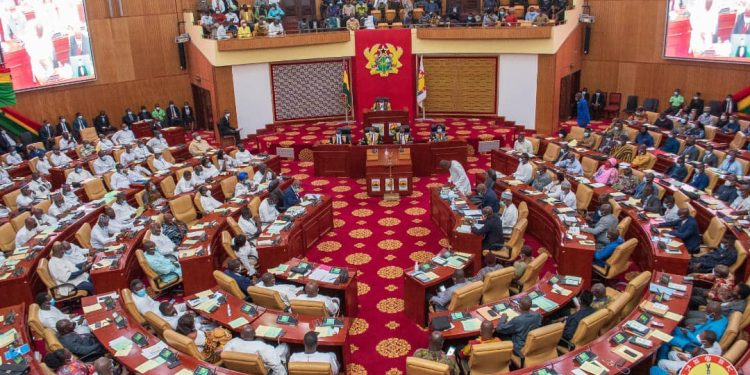
On March 31, 2023, Parliament passed the Income Tax (Amendment) (No.2) bill, 2022 into law, reintroducing a 10 percent tax on lottery winnings that had been eliminated in 2017.
The new tax, which affects betting and lottery winnings, will apply to domestic punters. In addition, betting companies operating in the country will face a 20 percent tax on their revenue.
Following the law’s passage, Ghanaians expressed diverse views. While some hailed the decision as a means of generating cash for the state, others criticised it as yet an additional burden on an already over-taxed population.
A representative of the GRA, Thomas Agorsor, said since passage of the act and its ascent into law, the Authority has not collected any taxes in winnings from operators. He however said that from July 1, 2023, operators which have failed to calibrate their system must cease operations.
He indicated that enough of a grace period – of almost two months – has been given for operators to re-calibrate and meet the deadline.
Currently, a total of twenty-one betting companies are operating in the country.
Board Chairman of the Gaming Commission, Gary Nimako Marfo, stated that the outfit has instituted sufficient monitoring systems to ensure all genuine winners receive their winnings from operators.
He urged aggrieved gamblers to address grievances to the Commission for immediate redress.
Head of Compliance at the Financial Intelligence Centre (FIC), Seth Nana Amoako, said the FIC is committed to ensuring that all betting companies are compliant with anti-money laundering laws and other international standards.
According to him, all betting companies are mandated to keep records of their customers and update the same at all times; and are expected to conduct risk assessments to ascertain delivery channels, geographical locations and customer base.
The Data Protection Act 2000, Act 843, mandates that all betting companies are registered by the Data Protection Commission and provides for the protection of data collected by online betting companies.
The sanctions regime of non-compliant companies is between 160 to 10,000 penalty units, in addition to 10 years imprisonment for data breaches.
The one-day GHASBO regulatory compliance workshop powered by Betway was organised in collaboration with the Gaming Commission and Ghana Revenue Authority.
Representatives of other stakeholders including the Criminal Investigations Department (CID) Unit of the Ghana Police Service, Data Protection Commission, Financial Intelligence Centre, and Telecommunications Service Providers were in attendance.
Associate Director, Tax Advisory Service at KPMG, Michael Boateng, has made claims that the majority of medium- and small-scale organizations (MSMEs) who are also paying double taxes, are burdened with too much.
He argues that the majority of MSMEs in the nation lack awareness of tax regulations and, as a result, do not maintain records.
He claims that this problem persists even after these businesses have faithfully completed their annual reports because they are frequently discovered to be ineligible when tax authorities visit them. Additionally, he claims that they frequently incur some extra, unnecessary charges because they are unable to furnish their operating and transaction details.
“There are several instances in which when doing tax audits you will realise some businesses are paying certain taxes they are not supposed to pay, because they are not in that category or have paid it already in another form; but because they do not keep records and lack the knowledge, when tax officers come after them they end up making payment again,” he said.
Speaking on the topic Strategies to optimise the potential impact of the IMF programme on businesses at the Ghana National Chamber of Commerce and Industry’s (GNCCI) dialogue series in Accra, the tax expert said while it is imperative for businesses to seek expert advice on tax-related issues in a bid to cut down cost as well as ensure proper record-keeping, the Ghana Revenue Authority (GRA) must do more in sensitising taxpayers.
Though he lamented there are several businesses which are going down due to non-compliance with tax rules, he added that businesses are overburdened with taxes and must be able to dialogue with government to introduce initiatives to widen the tax net without further burdening the few compliant ones.
CSO calls on govt to scrap Covid-19 tax
On his part, Director-Institute of Statistical Social and Economic Research (ISSER), University of Ghana, Prof. Peter Quartey, speaking on the topic ‘Understanding the IMF programme including its potential risks and opportunities’, urged businesses to adopt cost-cutting initiatives, create partnerships, focus on increasing efficiency and find alternative revenue streams.
Waning investor confidence
National President-GNCCI, Clement Osei-Amoako, taking his turn mentioned that the economic situation in which the country finds itself has led to high levels of uncertainties, waned investor confidence, rising inflation, weak local currency, high policy rate translating into high cost of borrowing, unsustainable debt, and impaired economic growth among others, which are all affecting businesses negatively.
The Chamber therefore urged government to work with the central bank to find innovative ways of addressing high inflation in the economy to enable businesses secure funds for expansion and recovery from the impact of COVID-19.
More importantly, it wants government to find innovative ways of increasing the efficiency of tax administration and expanding the tax net, rather than introducing new taxes and increasing tax rates.
“The negative effects of tax policies and reforms on businesses are clearly evident in recently released reports. The Chamber urges government to carefully examine the sectoral contribution to GDP and not overly-emphasise the reported 4.2 percent growth in first-quarter 2023,” he said.
He emphasised that a thorough analysis of the report suggests that while the public sector is expanding, the industrial sector is contracting – a situation he said is risky to sustainable growth of the economy.
The Institute for Liberty and Policy Innovation (ILAPI) has proposed the formulation of a new fiscal covenant in Ghana as a solution to address government expenditure waste.
The suggested fiscal covenant aims to define clear guidelines for government spending, specifying what, how, and when to spend within allocated budgets to avoid non-prioritized and extravagant expenses, as explained by Mr. Peter Bismark Kwofie, the Executive Director of ILAPI.
Mr. Kwofie emphasized that effective public finance management is crucial for any democratic state, and the fiscal covenant plays a pivotal role in determining the legal responsibilities of the government towards its citizens based on tax contributions.
The recommendation came after ILAPI conducted a representative perception poll, highlighting the necessity for legislators to establish fiscal responsibility laws and rules to ensure the efficient and prudent utilization of state resources.
Over the years, Ghana, as a democratic state, has faced challenges in rational decision-making without a fiscal covenant.
“A fiscal covenant leads to the development of consensus on norms, standards, and principles that must guide public policy delivery; the state must be guided, and there should be consistency in that behaviour in terms of how it collects resources and how they can be used,” he added.
To realize such expectations, political agreement among social actors regarding tax collection, usage, and accountability is essential. The fiscal covenant would also entail fiscal discipline, legislating on debt limits, and reducing executive discretions on revenue legislation with specific sunset clauses.
Transparency in public expenditure would be promoted by establishing regular engagement with all stakeholders involved in the development value chain.
Furthermore, the fiscal covenant would include developing efficient criteria for managing national resources, indexing revenue and expenditure, and adhering to the principles of budgetary unity and universality, among other tenets.
The United States Department of Agriculture (USDA), has indicated in it second quarter foreign agricultural service report that government plans to significantly increase import taxes on frozen seafood by 1,573 percent.
The current tax rate of GH¢15 per metric tonne will rise to approximately GH¢251 per metric tonne. The USDA’s second quarter foreign agricultural service report states that the tax will be paid in US dollars, which are currently in short supply. This tax hike could lead to a reduction in fish imports and a decrease in fish supplies on the local market.
In addition to the tax increase, the elimination of the benchmark value discount policy and an increase in Value Added Tax (VAT) are cited as potential challenges that could impact seafood imports in Ghana.
These tax measures are already discouraging importers, especially given the current economic situation, making business in the major port of Tema less attractive. Consequently, vessels are opting to unload their cargo in neighboring countries like Togo and Cote d’Ivoire, where they can avoid paying the import taxes.
Despite these tax measures, the seafood industry remains attractive to importers due to the rapid growth of Ghana’s hospitality industry, particularly the food services sub-sector. Ghana relies heavily on seafood imports, as it is a net importer of fish and seafood products. In 2022, the country imported approximately US$145 million worth of seafood, a decrease of 13 percent compared to 2021.
Mauritania was the top supplier of seafood to Ghana in 2022, followed by China and Morocco. Other significant seafood supplying countries include the Faroe Islands, Spain, Norway, South Korea, the Netherlands, Angola, and Singapore.
The United States ranked 13th as a seafood supplier to Ghana, with a value of US$4.2 million in 2022, an increase of 42 percent compared to 2021. Mackerel, sardines, and whiting/hake are among the most commonly imported fish species in Ghana.
Seafood plays a vital role in Ghanaian cuisine, accounting for 60 percent of animal protein intake and having one of the highest per capita consumption rates of fish in Africa, estimated at 26 kilograms per year.
While U.S. seafood sales to Ghana have recently experienced growth, the sustained export of seafood from the U.S. is at risk due to the substantial tax increase on frozen seafood. However, a previous USDA report highlighted that Ghana’s seafood market presents a long-term opportunity for U.S. suppliers if efforts are made to prioritize and enhance domestic production.
The Ghana National Chamber of Commerce and Industry (GNCCI) is calling on the government to consider incorporating tax reliefs in the upcoming mid-year budget review.
This measure is believed to provide much-needed relief for businesses and contribute to their recovery.
According to the Chamber, the austerity measures introduced in the 2023 budget as part of the IMF bailout program have had a significant negative impact on local businesses. With the current improvements in macroeconomic conditions, the Chamber argues that the government should remove some of these burdensome taxes.
Clement Osei-Amoako, the President of GNCCI, emphasized the importance of the mid-year budget review in demonstrating the government’s commitment to alleviating the challenges faced by businesses. As the Minister of Finance prepares to present the review, the Chamber hopes to see measures that will ease the suffering of businesses and support their growth.
“Government sought assistance from the IMF, and through that implemented a series of reforms. These reforms included tightening monetary policy, raising taxes and implementing automatic adjustments to utility tariffs among others. While these actions were intended to rectify fiscal imbalances and promote economic stability, they have resulted in higher operational costs for businesses operating in the country. Regrettably, numerous local businesses are collapsing while others are relocating in response to these challenges.
“It is crucial that government swiftly reconsiders its tax policies and streamlines the tax structure to ensure fairness, reasonableness and support for business development without any delay,” he fumed.
GNCCI tax
He spoke at an event dubbed ‘Chamber Bazaar’ in Accra, and lamented that tax measures such as the Excise Duty, Growth and Sustainability Levy, as well as high utility tariffs, currency depreciation and high fuel prices are having a negative impact on businesses.
While calling for some tax policies such as the COVID-19 Levy, Growth and Sustainability Levy among others to be relaxed or revised downward, Mr. Osei-Amoako said government must also consider innovative ways to widen the tax net.
The GNCCI is of the firm belief that by creating a favourable business environment, government can unlock the private sector’s true potential and drive resilient economic growth, leading to a prosperous Ghana.
Expensive ports thwarting growth prospects
Another area the Chamber believes needs a rethink is the country’s ports. It bemoaned the huge fees and charges producers pay when importing raw materials for onward production.
It said the current high import duties on raw materials and machinery meant for local production is not the way if government is serious about promoting industrialisation and supporting domestic businesses to be competitive within the African Continental Free Trade Area (AfCFTA).
Chamber Bazaar
The Chamber’s president made these strong requests on the sidelines of the three-day Chamber Bazaar launch in Accra, under the theme ‘Harnessing business potentials through trade fairs and exhibitions’. The Bazaar aims to provide a platform for businesses to showcase their products, services and innovative ideas to a diverse audience.
“The ‘Chamber Bazaar’ is yet another initiative by the GNCCI to support local businesses and contribute to overall economic growth of the country. The GNCCI remains fully committed to fulfilling its legislative mandate of promoting and protecting the commercial and industrial interests of our country,” he said.
Vice President of the Liberia National Chamber of Commerce, Natty Davis – a guest at the launch, expressed admiration for the GNCCI and its continuous efforts to introduce innovative initiatives that promote business growth in the country. He commended their commitment to supporting the business community.
Davis also mentioned that the Liberian Chamber is actively engaging with its counterparts in Ghana to foster collaboration, create synergies, and leverage each other’s competitive advantages. The goal is to enhance intra-African trade and strengthen economic ties between the two countries.
The exhibition featured various brands, including Extra Fashion, Salem Upholstery, African Diamond Cable Co. Ltd., Amalena Children’s Haven, T.T. Brothers Ltd., and others, showcasing their products and services.
First financial bill passed by Kenya’s administration, signed into law by President William Ruto, aims to increase revenue by hiking taxes on a variety of commodities.
One of the most controversial changes approved by parliament last week was the doubling of value-added tax to be charged on fuel – it’s rising from 8% to 16%.
Employees will also hand over 1.5% of their gross pay for a housing levy that will go into a fund that will then pay to build homes for low-income people.
President Ruto, who was elected last year, has said that the government needs more money in order to be able to pay off the debts racked up under the presidency of his predecessor, Uhuru Kenyatta.
But the opposition have said they would call for protests if the tax rises came into effect.
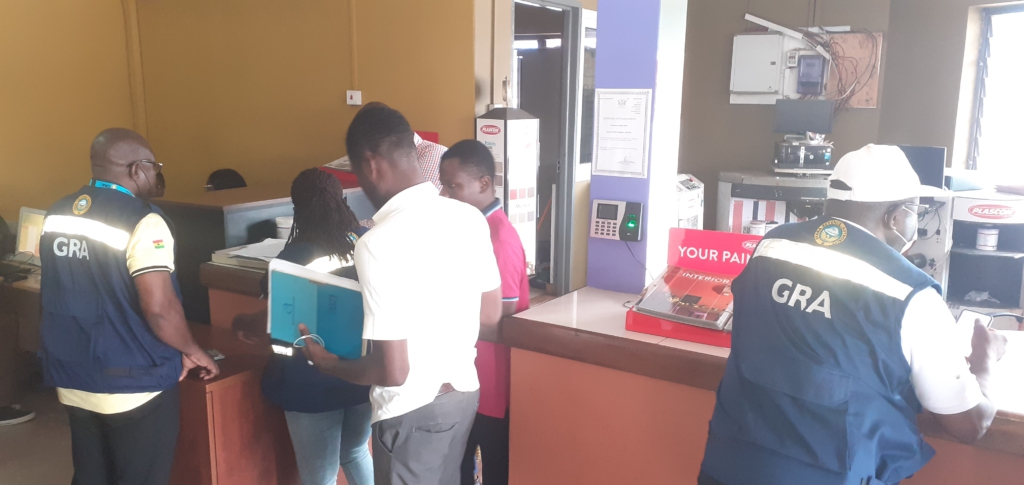
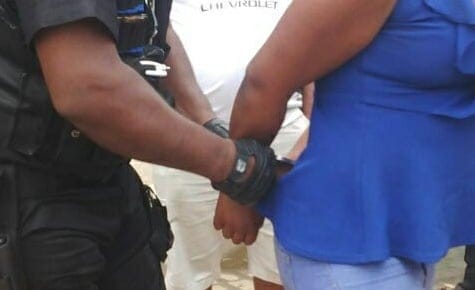
The Ghana Revenue Authority (GRA) unit has detained four Accra-based business owners for failing to issue tax bills.
The companies are Buildmart Company Ghana in Adabraka, Bedarts Cold Supplies in Lashibi, Yat Ventures in Mamobi and Excellence Boutique at Spintex Road.
The managers were taken to the headquarters of the Customs Office for their statements before being handed over to the Criminal Investigation Department of the Police.
The Area Enforcement Manager of GRA in charge of Accra Central, Mr Joseph Annan said the companies had not complied with Section 41 of the VAT Act which mandated them to issue the tax invoice at all times.
He said the exercise was part of the Authority’s plans to ensure tax compliance and retrieve taxes due the state.
He said the Division had several options at its disposal to aid in revenue mobilisation, including already existing initiatives such as auditing and test purchasing, among others.
Mr Annan said the test purchases conducted on 115 taxpayers that were sampled for a week revealed that a total of 93 taxpayers were not issuing the VAT invoice.
The figure, he stressed translated into a non-compliance rate of 80.9 per cent and said it was an offence for a registered taxpayer to fail to issue a VAT invoice for purchases made.
He said the division would continue with the enforcement exercises with an eye on the implementation of the electronic invoicing system and other tax types.
The government has tasked the GRA with raising a revenue target of GH₵106 billion for the 2023 fiscal year.
Out of this figure, the Domestic Tax Revenue Division is expected to collect 70 per cent of the total revenue.
Mr Annan said the Authority would continue to embark on surprise exercises across the country to apprehend culprits evading tax.
He urged the public, especially customers who make taxable purchases, to always request and insist on their VAT invoices.
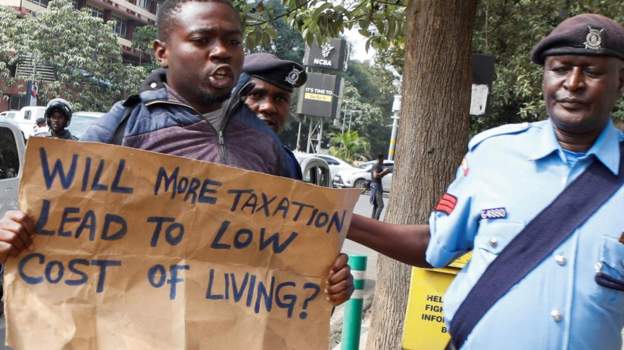
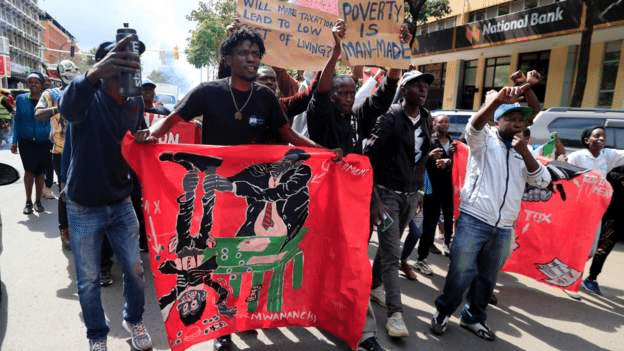
Kenyan protestors demonstrating in the nation’s capital against a number of the government’s proposed fuel tax increases have been dispersed by an open fire with tear gas.
One of the key contested measures in the unpopular finance bill is a new 3% housing fund levy for all salaried workers and to increase value added tax on fuel to 16%.
The bill also calls for taxes on beauty products, crypto-currencies and earnings by social media influencers. They are among the measures that have been opposed by many Kenyans.
The dozens of protesters had sought to gather at a park in the centre of Nairobi before marching to parliament to urge MPs to reject the tax proposals.
Local media reported that some of the protesters were arrested.
Legislators are set to debate the bill on Thursday, amid warnings issued by President William Ruto and his deputy Rigathi Gachagua against those opposed to the proposals.
Many Kenyans have been calling on MPs to reject the new tax proposals
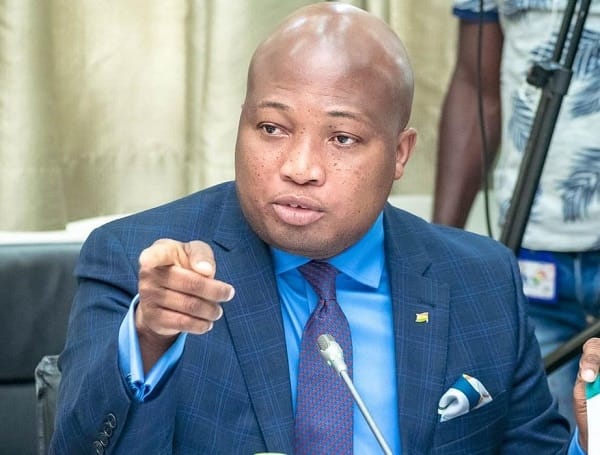
Member of Parliament from the North Tongu, Samuel Okudzeto Ablakwa, has predicted that government will soon introduce draconian tax measures as a result of the International Monetary Fund (IMF) deal.
He said about 50 new tax measures are likely to be introduced per analysis.
“The analysis we have shows that because of this (the IMF) bailout, there are going to be 50 new tax measures… income tax is coming to be progressive.
“There is going to be quarterly tariff adjustment. So, every quarter, electricity tariffs are going to go up, can you believe that, every quarter?” the MP asked.
Ghana has been able to secure an IMF loan of US$ 3 billion. On Wednesday, May 17, 2023, the Bretton Wood Institution approved the loan, with a $ 600 million immediate payout.
$350 million would be disbursed every six months for the three-year programme.
While some have described the loan as timely, others including the North Tongu MP, have expressed concerns over the conditions of the deal.
Mr Ablakwa intimated that: “this is going to be the most painful” and “the most bitter IMF programme.”
“I asked myself who negotiated this on behalf of Ghanaians? Does the person have a heart? Does the person care about Ghanaians?,” he asked in an interview with Metro TV.
Additionally, he said that the deal negotiated on behalf of the people of Ghana includes an additional debt restructuring programme.
Also, public sector employment will be restricted for the 3 years span of the IMF programme, he added.
About the IMF deal
On May 17, the Executive Board of the International Monetary Fund (IMF) approved a 36-month arrangement under the Extended Credit Facility (ECF) in an amount equivalent to SDR 2.242 billion (around US$3 billion, or 304 percent of quota).
The program is based on the government’s Post COVID-19 Program for Economic Growth (PC-PEG), which aims to restore macroeconomic stability and debt sustainability and includes wide-ranging reforms to build resilience and lay the foundation for stronger and more inclusive growth.
The program will help Ghana overcome immediate policy and financing challenges, including through its catalytic effect in mobilizing external financing from development partners and providing a framework for the successful completion of the ongoing debt restructuring.
Managing partner of Deloitte Ghana, Daniel Kwadwo Owusu, has urged the Ghana Revenue Authority (GRA) to foster an atmosphere that makes it easy for both individuals and businesses to file their taxes.
He also entreated businesses and individuals to adopt the culture of filing their tax returns annually.
Speaking at the 7th CEO Summit held in Accra on Monday, May 22, 2023, Mr Owusu said for government to expand its tax net, it needs to increase the formalization of the local economy and be fully digitalized.
This, he said, will help boost the internal revenue of government.
It will also help prevent government from borrowing externally to fix the nation’s problems.
“We want the government to continue to expand the tax net by increasing formalization of the economy, digitization. This will help boost internal revenue generation and reduce large external borrowing,” the Country Managing Partner of Deloitte Ghana said.
He indicated that, “GRA should make it easy for everyone to file their tax returns, especially, individuals. Build that culture of annual filing of tax returns.”
The domestic tax division taskforce of the Ghana Revenue Authority (GRA) has detained eight retail business and restaurant managers for willfully failing to issue VAT invoices to consumers.
The arrests add to a total of 93 individuals currently being investigated and prosecuted.
The taskforce conducted a targeted operation in East Legon and Adenta, specifically targeting non-compliant managers.
Shops the GRA cracked down on included Tasty Treats Catering Services at the University of Ghana, Legon, Luxi Wear, Obsession, Eco Furniture, Paladin Doors, AB Tissues & More and TF Eatry.
At Tasty Treats Catering Services for example, the GRA picked up some invoices and receipts for further assessment after suspicion of tax evasion.
According to the GRA, the eatery has been engaging in selective VAT issuance after sales.
The manager of the facility has been arrested for further interrogation.
The GRA team during the arrest said: “we have been here before, and we transacted business with you, and you were supposed to issue the Commissioner General’s invoice as a VAT registered taxpayer, and you did not and under our laws, Section 41, it is an offence, and so we are going to immediately hand you over to the CID to carry on with the next line of action.”
The Ghana Revenue Authority (GRA) taskforce has arrested two managers of restaurants and the staff of an electrical cable company in Accra for not issuing VAT tax invoices.
The companies are Waves Lounge and Pub, Chez Amis Pub and Grill, and Grand Pacific Limited, dealers in general electrical cables.
The managers were taken to the Customs Office at the headquarters for their statements before being handed over to the Criminal Investigation Department of the Police.
Mr Edward Appenteng Gyamerah, Commissioner, Domestic Tax Revenue Division, GRA, said the managers had refused to issue certified VAT invoices by the Commissioner-General at the point of purchase of goods at their outlets.
The initiative, he stated, was part of the Authority’s exercise to ensure tax compliance and retrieve taxes due the state.
He said the Division had several options at its disposal to aid in revenue mobilization, including already existing initiatives such as auditing and test purchasing, among others.
Mr Gyamerah said the test purchases conducted on 115 taxpayers that were sampled for a week revealed that a total of 93 taxpayers were not issuing the VAT invoice.
The figure, he stressed translated into a non-compliance rate of 80.9 per cent and said it was an offense for a registered taxpayer to fail to issue a VAT invoice for purchases made.
He said the division would continue with the enforcement exercises with an eye on the implementation of the electronic invoicing system and other tax types.
The government has tasked the GRA with raising a revenue target of GHc 106 billion for the 2023 fiscal year.
Out of this figure, the Domestic Tax Revenue Division is expected to collect 70 per cent of the total revenue.
This year, President Nana Akufo-Addo assented to the three amendments passed by Parliament.
They are the Excise Duty (Amendment), Act 2023 (Act 1093), the Income Tax (Amendment), Act 2023 (Act 1094), and the Growth and Sustainability Levy Act 2023 (Act 1095).
These amendments were to complement efforts to ensure the Authority met its revenue target.
Mr Joseph Annan, Area Enforcement Manager of GRA, in charge of Accra Central, said the Authority would continue to embark on surprise exercises across the country to apprehend culprits evading tax.
He urged the public, especially customers who make taxable purchases, to always request and insist on their VAT invoices.
Two restaurant managers and employees of an Accra-based electrical cable company were detained by the Ghana Revenue Authority (GRA) team for failing to issue VAT tax bills.
The companies are Waves Lounge and Pub, Chez Amis Pub and Grill, and Grand Pacific Limited, dealers in general electrical cables.
The managers were taken to the Customs Office at the headquarters for their statements before being handed over to the Criminal Investigation Department of the Police.
Edward Appenteng Gyamerah, Commissioner, Domestic Tax Revenue Division, GRA, said the managers had refused to issue certified VAT invoices by the Commissioner-General at the point of purchase of goods at their outlets.
The initiative, he stated, was part of the Authority’s exercise to ensure tax compliance and retrieve taxes due the state.
He said the Division had several options at its disposal to aid in revenue mobilization, including already existing initiatives such as auditing and test purchasing, among others.
Gyamerah said the test purchases conducted on 115 taxpayers that were sampled for a week revealed that a total of 93 taxpayers were not issuing the VAT invoice.
The figure, he stressed translated into a non-compliance rate of 80.9 per cent and said it was an offense for a registered taxpayer to fail to issue a VAT invoice for purchases made.
He said the division would continue with the enforcement exercises with an eye on the implementation of the electronic invoicing system and other tax types.
The government has tasked the GRA with raising a revenue target of GHc 106 billion for the 2023 fiscal year.
Out of this figure, the Domestic Tax Revenue Division is expected to collect 70 per cent of the total revenue.
This year, President Nana Akufo-Addo assented to the three amendments passed by Parliament.
They are the Excise Duty (Amendment), Act 2023 (Act 1093), the Income Tax (Amendment), Act 2023 (Act 1094), and the Growth and Sustainability Levy Act 2023 (Act 1095).
These amendments were to complement efforts to ensure the Authority met its revenue target.
Joseph Annan, Area Enforcement Manager of GRA, in charge of Accra Central, said the Authority would continue to embark on surprise exercises across the country to apprehend culprits evading tax.
He urged the public, especially customers who make taxable purchases, to always request and insist on their VAT invoices.
For failing to indulge the Ghana Union of Traders’ Association (GUTA), spokesperson on Governance and Security Palgrave Boakye-Danquah, has rendered an apology on behalf of government.
Parliament on March 24, 2023, approved Excise Duty Amendment Bill 2022, Growth and Sustainability Levy Bill, 2022, Ghana Revenue Authority Bill 2022 and Income Tax Amendment Bill 2022, which have been assented to by President Akufo-Addo.
This took place despite objections from stakeholders in the business industry such as GUTA.
Speaking on TV3 on Wednesday, GUTA’s President Dr Joseph Obeng noted that his outfit feels disrespected as government failed to engage them to come to an agreement.
Accepting the concerns raised by GUTA on the show, Mr Boakye-Danquah apologised to GUTA “for the lack of consultation”.
He, however, disclosed that the bills are not new as being perceived by the stakeholders.
“These bills that have been assented [to] by the President were already in place,” he stated.
“These are amendments that have been made to these bills to further boost our economy.”
Ghanaian actor turned politician, John Dumelo, is incensed by the 10% tax imposed on earnings from lotteries, games of chance, and sports betting.
The new tax policy is part of the government’s efforts to increase domestic tax revenue and expand the tax base.
In a tweet, Dumelo criticized the government’s decision and noted that the youth, who have created their own jobs through sports betting and other forms of gambling, would rise against the government if the tax policy is implemented.
He argued that instead of taxing the youth’s winnings, the government should focus on creating jobs and providing economic opportunities for the youth.
“Create jobs; you won’t create. The youth have created their own jobs too; ahhh, you want to tax their winnings…continue. That day will come when the youth will rise against you. It will be too late,” he said.
Dumelo’s comments have sparked a heated debate on social media, with some Ghanaians supporting his position and others criticizing him for promoting gambling and opposing a legitimate tax policy.
John Dumelo is not new to the political scene in Ghana. He contested for a parliamentary seat in the 2020 general elections under the ticket of the National Democratic Congress (NDC), but lost to his opponent from the New Patriotic Party (NPP).
However, he has remained vocal on issues affecting youth and has used his platform to advocate for their interests.
Ghanaian actor turned politician,John Dumelo, has expressed his opposition to the Ghanaian government’s decision to implement a 10% tax on earnings from lotteries, games of chance, and sports betting.
The new tax policy is part of the government’s efforts to increase domestic tax revenue and expand the tax base.
In a tweet, Dumelo criticized the government’s decision and noted that the youth, who have created their own jobs through sports betting and other forms of gambling, would rise against the government if the tax policy is implemented.
He argued that instead of taxing the youth’s winnings, the government should focus on creating jobs and providing economic opportunities for the youth.
“Create jobs; you won’t create. The youth have created their own jobs too; ahhh, you want to tax their winnings…continue. That day will come when the youth will rise against you. It will be too late,” he said.
Dumelo’s comments have sparked a heated debate on social media, with some Ghanaians supporting his position and others criticizing him for promoting gambling and opposing a legitimate tax policy.
Create jobs, you won’t create. The youth have created their own jobs too ahhh, you want to tax their winnings…..continue. That day will come when the youth will rise against you. It will be too late.
John Dumelo is not new to the political scene in Ghana. He contested for a parliamentary seat in the 2020 general elections under the ticket of the National Democratic Congress (NDC), but lost to his opponent from the New Patriotic Party (NPP).
However, he has remained vocal on issues affecting youth and has used his platform to advocate for their interests.
Parliament on Friday paid tribute to the late Kumawu Member of Parliament, Philip Atta Basoah.
The MPs took turns to recount fond memories of the 54-year-old as well as make some recommendations to the House on how to ensure the safety of Parliamentarians.
Mr Basoah was confirmed dead on Tuesday morning, March 28, 2023, while receiving treatment at the Korle Bu Teaching Hospital.
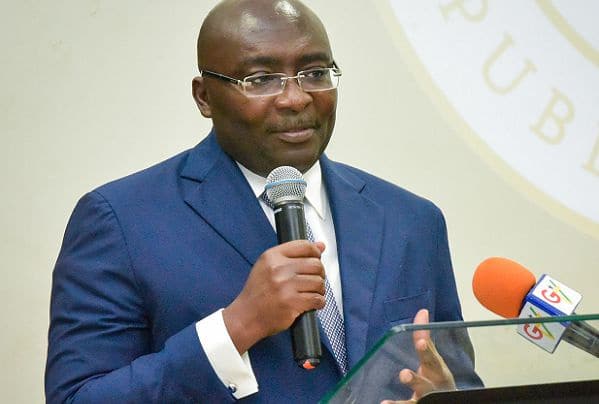
The Ghana Revenue Authority (GRA), according to Vice President Dr. Mahamudu Bawumia, is implementing a Unified Digital Property Platform for the purpose of property taxation.
On Monday, February 14, 2023, he declared via a social media post that the government’s investment in digitalization was the reason behind the policy that had resulted in the identification of more than 7 million unique properties.
“One of the problems Ghana has faced in the area of revenue generation since independence is that only about 9% of properties in Ghana pay property taxes. This is because we have not had a database of properties, the owners and their addresses. As a result, many property owners do not even receive bills for property taxes although they are willing to pay.
“Thanks to the implementation of the Digital Property Address System, the Ghanacard, and Mobile Money Interoperability, and after three years of painstaking work, Government has been able to put in place a Unified digital platform for property taxation which the Ghana Revenue Authority is now rolling out together with the Municipal and District Assemblies.
“The Unified Digital Platform for Property Taxation includes the list and details of over 7 million properties, uniquely identified by their addresses. This is a historic innovation for Ghana,” the statement shared by Dr Bawumia said.
He noted the Digital Property Address System as a platform will among other things offer assemblies, tax authorities and property owners the convenience of paying and collecting Property Taxes with ease.
He further underscored that the policy will lead to a significant increase in government revenue.
“On this digital platform, property owners can verify their property rates and pay same and receive receipts online. Also, the GRA and MMDAs can see, in real-time, which properties have or have not paid their property taxes. This unified digital platform will significantly increase property rate collection and revenues.
“The Unified Property Rate Platform can be accessed at www.myassembly.gov.gh and I encourage you to visit, login and explore the site,” the statement said.
In late 2022, President Akufo-Addo in a nationwide broadcast on various measures being undertaken to increase revenue generated to the state, announced that the government is looking at taxation on properties as a viable revenue generation measure.
The large oil companies, including ExxonMobil and Norway’s Equinor, as well as UK-based BP and Shell, have been announcing astounding profit numbers.
They are all profiting from the rise in oil and gas prices as a result of the invasion of Ukraine.
People around the world struggle to pay their energy bills and fill up their cars while these businesses make huge profits, which has prompted calls for higher taxes on these businesses.
What is their method of income generation, and should the government intervene to put a stop to it?
Why has the oil price soared?
Oil and gas are traded around the world, and if supplies are short and demand high, sellers can charge more, and the price goes up.
Before the Ukraine war, Russia was the world’s largest exporter of oil and natural gas.
A lot of the money that people paid to buy that oil and gas went to the Russian government – those exports made up 45% of the Russian government budget in 2021.
After the invasion, Western countries, including the UK and EU, tried to stop (or at least massively reduce) their energy imports from Russia, to avoid funding the Russian military and supporting a hostile regime.
Countries that didn’t want to buy from Russia had to pay much higher prices for oil produced elsewhere.
As economies recovered from the COVID-19 lockdowns and began to function normally, oil prices had already been rising.
The day after the Russian invasion, the oil price went above $100 a barrel, and peaked at over $127 in March, before coming back down to around $85. Gas prices also soared after the invasion.
Oil and natural gas are crucial to almost every aspect of modern life. Oil is used to make petrol and diesel, and natural gas is used for heating and cooking.
They’re also used in agriculture, electricity generation, and other industrial processes which make everything from fertilizer to plastics.
So a sustained rise in oil and gas prices pushes up the cost of many other things we buy, driving the cost of living crisis that has gripped the UK – and other countries – in recent months.
Why do soaring prices mean more profits?
Oil companies make money by locating oil and gas reserves buried in rocks under the earth’s surface, and drilling down to release them.
The costs don’t vary that much as the price goes up or down, but the money they make from selling it does.
So when oil prices soared after the invasion of Ukraine, the money these companies made from selling oil and gas massively increased as well.
How much profit did Shell and BP make last year?
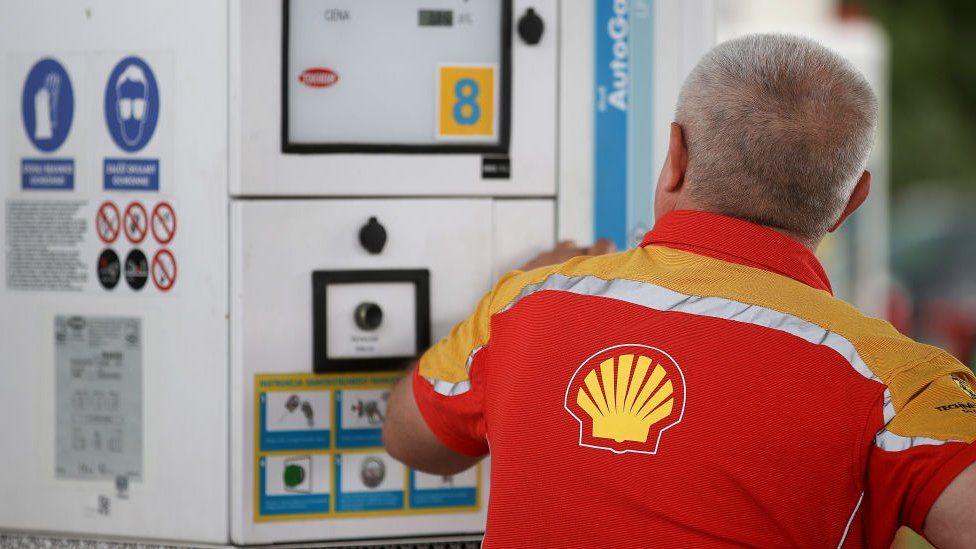
On Tuesday, BP reported record annual profits of $27.7 billion (£23 billion) for 2022 as it scaled back plans to reduce the amount of oil and gas it produces by 2030. Those profits were double the previous year’s figure.
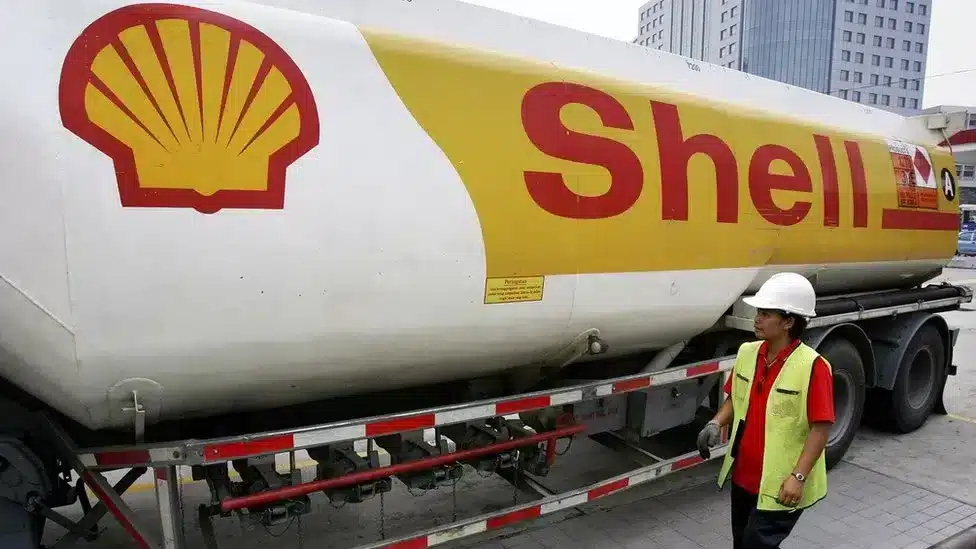
In February, Shell reported its highest profits in 115 years. Profits will reach $39.9 billion (£32.2 billion) in 2022, more than doubling the previous year’s total.
The profits they make don’t all disappear – lots of ordinary people own shares in BP, Shell, and other global oil companies. This may be via their pension funds, and they may not even be aware of it.
Some of the extra profits are paid to shareholders through higher dividends, and buying back shares (which increases the share price).
But as long as the billions roll in while customers struggle to pay their bills, the calls for higher taxes will continue.
How much tax do oil and gas producers pay?
Big oil companies made their record profits even after paying billions to governments around the world.
BP and Shell are in a complicated position because they are headquartered in the UK but produce a relatively small amount of oil and gas in UK waters. They make most of their profits from activities around the world.
Shell paid $134m (£110m) tax on its UK operations in 2022, out of a worldwide tax bill of $13bn.
BP paid $2.2bn (£1.8bn) in taxes on its UK operations, out of a global tax bill of $15bn.
How are oil firms taxed in the UK?
Oil companies already pay a tax on their profits from oil and gas production in the UK of 40% – which is higher than taxes on other companies.
But they can reduce that tax bill by deducting the cost of shutting down old oil rigs, or offsetting future investments and losses from earlier years.
In some years, BP and Shell have paid no tax on UK operations, and received payments from the UK government instead.
After the invasion of Ukraine, the government faced calls to introduce an extra “windfall tax” on energy company profits to help pay for soaring energy bills.
This was introduced in May 2022, and increased from 25% to 35% in November. It is now expected to raise around £40bn extra from all the companies operating in UK waters between 2022 and 2028.
However, the windfall tax only applies to the profits on UK oil and gas production, which only account for a small share of some firms’ profits.
And firms can deduct more than 90% of the cost of new exploration and production from their windfall tax bills, significantly reducing what they have to pay.
The windfall tax accounted for all of Shell’s UK tax bill and $700 million (£538 million) of BP’s.
They face calls to pay even more tax
Politicians, environmentalists, trade unions and poverty campaigners have attacked oil companies’ record profits, and argued for higher windfall taxes.
They say high prices are the result of something beyond the oil firm’s control – war, and that it’s not fair that oil companies are profiting from people’s suffering.
Some say higher windfall taxes are a good way for governments to raise money because they’re easy to collect and hard to avoid.
Even the former boss of Shell himself, Ben van Beurden, wondered if it was inevitable that governments would need to tax energy producers more to protect the poorest in society.
But oil firms argue that a higher windfall tax would make them less willing to invest in producing in the UK, and that they would search for oil elsewhere where taxes are lower.
Harbour Energy, which produces more oil and gas in the UK than anyone else, is cutting jobs and reconsidering its UK investments because of the windfall tax.
If the UK government decided totax BP and Shell on their globalprofits more heavily, they could potentially move their headquarters out of the country – escaping the new tax, and depriving the UK of much of the revenues they currently pay.
Image caption,A BP oil rig in North sea
Oil companies have to operate in a world where the price of oil can go down as well as up, with little warning. Money made in the good years helps to balance out years when oil prices are low.
Many oil companies lost billions from Russian investments last year – BP wrote off $24bn of investments in the Russian oil company Rosneft, for example.
They also have to invest billions to find new reserves of oil to keep supplies running until the world switches over to renewable sources of power.
Energy companies have a big role to play in that switch-over, too. BP and Shell invest some of the billions they make from oil and gas into renewable power such as solar and wind farms, and charging stations for electric cars.
BP boss Bernard Looney said the British company was “helping provide the energy the world needs” while investing the transition to green energy.
Shell chief executive Wael Sawan said that these are “incredibly difficult times – we are seeing inflation rampant around the world” but that Shell was playing its part by investing in renewable technologies. Its chief financial officer Sinead Gorman added that Shell had paid $13bn in taxes globally in 2022.
However, BP scaled back its plans to cut its carbon emissions this year because demand for oil and gas is so strong.
Does the energy cap reduce oil company profits?
The energy price cap was introduced in 2019 to stop companies from overcharging people who didn’t shop around for cheaper deals. It targets energy suppliers, and doesn’t affect the profits of oil and gas producers.
In its 115-year history, the company’s 2022 adjusted earnings of $39.9 billion (£32.2 billion) were the highest ever.
Following Russia’s invasion of Ukraine, oil and gas prices increased, which resulted in energy companies making record profits.
Given that households are struggling with inflation, the profits have increased pressure on businesses to pay windfall taxes.
Last year, the UK government introduced a windfall tax – called the Energy Profits Levy – on the profits of firms to help fund its scheme to lower gas and electricity bills.
Oil and gas prices had begun to rise after the end of Covid lockdowns but rose sharply after Russia’s invasion of Ukraine, resulting in bumper profits for energy companies.
The price of Brent crude oil climbed above $120 a barrel in March 2022, but has fallen back since. Oil prices are now below the level seen before the invasion of Ukraine.
Gas prices remain elevated but have been capped for consumers by the government.
Shell chief executive Wael Sawan said the firm’s results “demonstrate the strength of Shell’s differentiated portfolio, as well as our capacity to deliver vital energy to our customers in a volatile world”.
The finance ministers of Ghana and Zimbabwe have been delivering their annual budgets amid the cost-of-living crisis that has hit the whole world.
And both announced an increased in Value Added Tax (VAT), which you pay when you buy goods.
In Ghana, Finance Minister Ken Ofori Atta – who is under pressure to resign because of the deepening economic crisis – pushed it up from 12.5% to 15%.
But in some good news for Ghanaians, the finance minister cut the tax on all electronic transactions from 1.5% to 1%, barely a year after its introduction.
In Zimbabwe, the tax on foreign currency transactions has been halved to 2% while a banking tax for the purchase of wheat has been dropped to keep bread prices low.
Traders at Adum on Friday, reopened their shops following the intervention of the Asantehemaa, Nana Yaa Konadu.
The traders, most of whom deal in fast-moving consumer goods closed their shops on Monday, October 10, 2022, in protest of what they described as an unfavourable taxregime and the free fall of the Ghana cedis.
The closures left the Pampaso and PZ areas, considered as the busiest enclave in the Kumasi central business district empty while many traders who had come from near and far from Kumasi to buy some of these items were left stranded.
Mr Charles Kusi, Executive Secretary to the Kumasi Business Community told the Ghana News Agency in an interview on Friday that, they were opening the shops out of respect for the Asantehemaa.
He said the Asantehemaa sent a delegation to meet the executives of the Community to rescind their decision as they engaged the government to address their concerns.
“We are reopening our shops out of respect for the revered queen-mother, but we may be compelled to close the shops again if nothing good comes out of our engagement with the government”, he stated.
Mr Kusi said the Ashanti regional Minister had also invited their leadership to discuss their concerns and that he was looking forward to a fruitful deliberation.
Traders within the Central Business District in the Kumasi Metropolis in the Ashanti Region have closed down their shops to protest what they say are exorbitant taxes imposed on businesses by the government.
Most of the locked-up shops had red bands tied on them as traders say the protest will last for three days.
The traders are also kicking against a decision by the Ghana Revenue Authority to station their officers at each shop to record Value Added Tax (VAT) on products they sell.
The affected shops are for traders who deal in groceries and are situated at Pampaso and PZ in the Central Business District.
Some of the shop owners who spoke to Citi News want the government to reduce the taxes on businesses.
New chancellor Kwasi Kwarteng said the cut in the basic rate of income tax from 20% to 19% would benefit more than 31 million people.
The cut, which applies to people who earn between £12,571 to £50,270, comes a year earlier than planned.
In a surprise move, the 45% highest tax band for people who earn over £150,000 a year has also been axed.
The reduction in income tax, along with the reversal of the National Insurance rise, will see higher earners save more money.
A person earning £20,000 a year will save £167, according to analysts at EY.
Meanwhile, an individual with an income of £40,000 will save £617 and a person with earnings of £60,000 will save £969. A person on £100,000 will get an extra £1,469.
During his mini-budget, the chancellor said high tax rates “damage Britain’s competitiveness” and reduce incentives for new businesses, arguing that tax cuts are “central to solving the riddle of growth”.
Mr. Kwarteng said scrapping the highest 45% tax rate would also “reward enterprise and growth”.
The policy change means people earning more than £150,000 a year will instead pay the tax rate of 40%, which is applicable to earnings of more than £50,270 a year.
However, the change will not apply to Scotland where income tax bands are different. People in Scotland who earn more than £150,000 a year currently pay a 46% rate. The cut in basic rate tax to 19p in the pound also does not apply in Scotland.
Rachel McEleney, associate tax director at consultancy firm Deloitte, said under the new policy, higher rate taxpayers would save £377 next year, compared to this year.
She said the majority of taxpayers in England, Wales, and Northern Ireland, who will pay the basic rate of 19%, will see “some savings, albeit less” from April.
Ms McEleney said for a person will earnings of £200,000 a year, who do not live in Scotland, their income tax bill would be reduced from £74,960 this financial year to £72,083 in next year, resulting in a tax saving of £2,877.
Labour shadow chancellor Rachel Reeves said the mini-budget prioritized big business over working people by relying on a theory of “trickle-down economics”.
“The prime minister and chancellor are like two desperate gamblers in a casino chasing a losing run,” she said in response to Mr Kwarteng’s plans.
Households across the UK have been feeling the pinch of higher prices in recent months, with higher energy bills and rising food prices fuelling inflation to a 40-year high.
The government has announced support to help with energy costs, limiting the typical household bill to £2,500 a year until 2024, but bills are still set to rise in October.
Rebecca McDonald, the chief economist at the Joseph Rowntree Foundation charity, said the government had chosen to “turn its back on millions who are on the lowest incomes”.
“This is a budget that has wilfully ignored families struggling through a cost of living emergency and instead targeted its action at the richest,” she said.
“Families on low incomes can’t wait for the promised benefits of economic growth to trickle down into their pockets.”
However, Mark Littlewood, director general at free-market think tank the Institute of Economic Affairs, said the axing of the highest rate of income tax would mean higher earners would spend “more time boosting their own productivity”
“The additional rate of income tax (45p) was always performative politics rather than sound economics,” he said. “The 1p off the basic rate of income tax will put more money in people’s pockets.”
The abolition of the highest tax band, which was introduced in 2010, came as a surprise to many economists.
“It really is that kind of rabbit out of the hat..that not only is the additional rate going to be completely abolished, but also the cuts to the basic rate of income tax are going to be brought forward a year,” said Michael Brown, head of market intelligence at finance firm Caxton.
In response to the inflation crisis, the German Finance Ministry has unveiled a plan to reduce income taxes. However, critics claim the measures would benefit top earners the most, and squeeze public spending.  Â
The price of food, as well as energy, has increased with inflation hitting its highest in decades
German Finance Minister Christian Lindner on Wednesday announced measures to raise tax thresholds and increase child benefits slightly.
The plans are intended to help ease the burden of rising inflation for households, amid rising food and energy prices.
The Finance Ministry is set to raise the tax-free allowance from €10,347 (roughly $10,550) currently to €10,632 next year and €10,932 in 2024. People start paying income tax on earnings after this figure.
The top tax rate, which currently kicks in from €58,597 at present will increase to €61,972 next year and from €63,515 in 2023.
Meanwhile, child benefit payments for the first two children are set to rise by €8 to €227 per month, along with other increases for families with more than two children.
As a result, the Finance Ministry expects tax revenue to drop by €10.12 billion next year, and by €17.5 billion in 202
Politicians from fellow junior coalition partners the Greens have attacked the plans as regressive, saying they provide the greatest advantage to the already wealthy.
“Billions in tax relief from which high earners benefit three times as much in absolute terms than those with lower incomes — that is not in keeping with the times,” Katharina Beck, the Green Party spokeswoman on financial affairs, told the RND newsgroup.
“The opposite would be the right thing. Strong shoulders should have to bear more than those on a low income and should not be disproportionately relieved. These really hard times especially affect those who have little money.”
There was also criticism from Berlin Mayor Franziska Giffey, of Olaf Scholz’s Social Democrats — the leading coalition partner — who said more targeted relief was needed. She told the Welt news channel that tax cuts and across-the-board child benefit increases would not help those most in need.
“Another child benefit increase is nice for those who get it. But again, it doesn’t help pensioners, and it doesn’t help students either.”
Weak euro Good news for who?
Lindner defends measures
Speaking in response to the criticism, Lindner said that, in all, some 48 million would benefit from the tax changes.
He said the changes were aimed at relieving the pressure on people whose income was pushed into taxation at higher rates as salaries rise because of inflation. This, combined with higher living costs, would effectively push down their spending power — a phenomenon known as “cold progression.”
The measures would provide relief to those taxpayers with an annual income below €62,000, Lindner said.
“This is not about a relief, but about removing a burden,” Lindner said. The minister said he was also in favor of “strong shoulders bearing more than narrow shoulders.”
However, he said, the cold progression would also “burden people whose shoulders have not become broader at all.”
Left Party urges spending, not cuts
The chairman of the socialist Left Party, Martin Schirdewan, said the plan would squeeze public spending at the expense of ordinary people.
“Because Lindner refuses to give the rich and crisis profiteers a greater part in financing the costs of the crisis — and at the same time sticks to the debt brake, or better put, the investment brake — predictably money will be lacking for necessary social spending and investments,” Schirdewan told the AFP news agency.
“Those who unilaterally cut taxes also dry up the state budget and create a pressure to save money, usually at the expense of the general public and urgent public tasks.”
Street preachers in Koforidua who call themselves Christ Preachers Association (CPA) have raised a red flag over the New Juaben Municipal Assembly’s intention to accredit them at a fee in the coming weeks.Â
The Assembly’s intended step is to regulate the activities of the street preachers and to serve as a form of identity for all the preachers in the municipality.
The Municipal Chief Executive (MCE), Isaac Appaw-Gyasi, at a stakeholders meeting stated that there would be a need to provide identity tags to all the street preachers at a fee to be determined as soon as possible so that their activities can easily be tracked and regulated.Â
“They themselves (the preachers) suggested it. We are going to register them.Â
“Look, they don’t pay anything to the Assembly. What I even dislike about them is the noise level, okay. We have given them time but they never go about the time given. They always go beyond 9 am into the working hours and that is what is causing a problem.
“You know this issue was even brought about by the media. It tells you that a lot of people are not happy about this noise pollution and we are going to act on that,” the MCE said.
However, members of the Christ Preachers Association have expressed dissatisfaction about the step and have indicated their plan to meet again with the MCE to come to a consensus on the Assembly’s decision.
According to one of them who is popularly called Evangelist Octopus, the Assembly’s decision would be unconstitutional.
“Why should I pay money before I stand along the street to preach? I have a problem with the fee but I don’t have any problem with the registration or being given a permit to preach.Â
“Why is it that as a pastor when I come out of the church to go out to the market to preach Christ you want us to pay tax. You want me to pay money. I don’t understand. Unless they explain to us by law,” he expressed.
The preacher furthered that even though it would not be a bad idea for the assembly to give them permission, it would be distasteful for the Assembly to attach a fee to their being registered.Â
“I have a problem with the fee that is attached to it. It will boil down to the point that we have to pay something before we are given a tag preach in town.
“And this money that they may be collecting from us will be renewable. It means that any government that comes may choose to increase the fee.”
Evangelist Octopus averred that as pastors, they already contribute to the development of the nation and that since the Church is a non-profit organisation, the Assembly “can’t tax the church since it is against the law of Ghana to tax the church.”
Another preacher, Apostle Frederick Adu held the view that it would be unheard-of for the assembly to collect a fee from them for only projecting Jesus Christ to the society.
“It beats my imagination about MCE’s stance that they are going collect a fee from us the preachers.Â
“All we do is to project Jesus Christ to the world so that all who have not accepted Him will do so.
“There are drunks, armed robbers, and thieves on the streets as well as some prostitutes who hear what we preach and end up refraining from those social vices. This goes a long way to help society.
“We can decide to stop the preaching but what will we make of the society when social vices increase?” He said.
When referred to the offerings they receive from passersby as some of the profits they make, Apostle Adu said “Oh how many offerings do we even get?”Â
“Let me tell you the truth. It’s not possible for the preacher to carry his speakers on his head from one place to the other. It is money he will use to convey such items. If the offering is against the law, then it should be stopped in the churches. How much do we even get? It’s just a small amount we get from volunteers,” he explained.
Meanwhile, when approached, the Chairman of the CPA, Felix Amankwaa intimated that it is actually not a wrong call for the preachers to pay some fee to help develop the Municipality.
He said that “I don’t think it is wrong for us to pay something to help the Assembly. But what I know is that preaching the gospel cannot be taxed.
“But the Assembly being our home and our big brother, the MCE approached us in a nice way and assured us of a good relationship. We have also decided to relate with him well for the betterment of our society.
“We have taken it in good faith but we will still sit with him to discuss further,” he said.
The Ghana Revenue Authority (GRA) has started the implementation of six tax reliefs introduced by the government to lighten the tax burden on businesses and the citizenry.
The reliefs are to cushion taxpayers against COVID-19-induced challenges and quicken the recovery to sustain and create jobs.
They include the exemption of people whose annual incomes are up to GH¢4,500 or GH¢375 a month from paying taxes, as well as the suspension of the payment of Vehicle Income Tax (VIT) on selected vehicles, including intracity commercial vehicles (trotros) and taxis and intercity/long distance buses.
The GRA will also limit the application of the flat rate Value Added Tax (VAT) scheme to businesses whose annual turnover is up to GH¢500,000, an increase from the GH¢300,000 threshold for the tax.Â
The rest are the waiver of interest and penalty on tax arrears for all categories of taxpayers, the halving of the withholding tax on gold exports by small-scale miners and the exemption of local textile manufacturers from paying VAT.
The implementation of the reliefs follows the passage of relevant legislation by Parliament, on the request of the government, to help ease the burden on taxpayers in the midst of the gruelling pandemic and its impact on the economy.
Trade-off
The Commissioner of the Domestic Tax Revenue Division (DTRD) of the GRA, Mr Edward Appenteng Gyamerah, told the Daily Graphic last Friday that by granting the reliefs, the government was forfeiting part of the revenue that should have accrued to the state through taxes in a trade-off meant to reinvigorate businesses, as well as encourage individuals and firms to diligently honour their tax obligations.
He said the state had already sacrificed more than GH¢1.1 billion through the waiver on interest and penalty policy that was first introduced last year and extended to this year.
Mr Gyamerah added that under the first stage, the policy benefitted more than 2,000 taxpayers and led to the GRA writing off more GH¢1.1 billion that had accumulated as interest and penalty for the late payment of taxes.
In return, he said, the beneficiary companies paid about GH¢1.2 billion as the principal of their tax liabilities that were outstanding.
The beneficiary companies ranged from large-scale to micro enterprises in almost all sectors of the economy.
They include Polytank GH Ltd, Yara Ghana, Samartex Timber and Plywood Ltd, Duraplast Ltd, Zonda Tec Ghana Ltd, Nexans Kabelmetal Ltd and Multipro Private Limited.
Following the positive response, Mr Gyamerah said, the government decided to extend the policy to cushion businesses further, while helping them to honour their tax obligations.
He, therefore, appealed to taxpayers to take advantage of the policy to pay their taxes.
Relief for textiles
He said the government also extended the period of zero-rated VAT on locally manufactured textiles after it first introduced it in 2019.
He said the action was meant to resuscitate, as well as protect, the local industry from collapse by reducing cost of production to be able to compete against cheap imports.
Mr Gyamerah added that the policy, in its first term, had stabilised the garments sector, maintained and improved jobs for domestic manufacturers and set them up for expansion.
“As a result, the government, in the 2022 Budget, extended the concession for two more years, so that we can consolidate the gains for the companies to further upgrade their machines and improve upon production,” he said.
He said the government was aiming to use the policy to raise the market share of domestic manufacturers from the current 20 to 50 per cent by 2025 and also almost double employment in the sector from the current 2,500 to 4,500 by 2025.
“All these will translate into revenue because people will get employment, taxes will be paid and their consumption will increase,” he said.
He added that the tax measures implemented the previous year had already led to a significant improvement in corporate taxes from the players and expressed the hope that the situation would improve in the coming years.
Gold exports
The commissioner said the government had also reduced the withholding tax on gold exports by small-scale miners from three to 1.5 per cent to help arrest the smuggling of the precious metal and revive the business.
He said following the introduction of the three per cent withholding tax, the export of gold by small-scale miners slumped, resulting in the government losing revenue and the companies being pushed out of business.
“To help correct this anomaly and minimise the diversion of gold exports by small-scale miners, the government reduced the tax, which is significant,” he said.
He said the government hoped to use the policy to revive the small-scale mining sector’s contribution to gold production to about 50 per cent in the coming years.
The Minister for Finance, Ken Ofori-Atta says the government as part of efforts to improve its revenue mobilization has introduced innovative measures to collect property taxes in the country.
Presenting the 2022 budget statement and economic policy on the floor of Parliament on Wednesday, November 17, 2021, the Minister said the government is looking to assist the Metropolitan Municipal and Districts Assemblies (MDAs) to implement a common platform for property rate administration to enable them effectively collect property rates in the country.
He said: “Mr Speaker, property rates have the potential to increase revenue mobilization for MDAs and release resources for the provision of basic infrastructure as well as the needs of our localities. Property rate assessment and collection pose a challenge to most MMDAs and are fraught with inefficiencies.
“Government, through the Ghana Revenue Authority (GRA) will from January 2022, assist the MMDAs to implement a common platform for property rate administration to enhance property rate collections and its accountability. To ensure cost recovery by government in providing the infrastructure for the collection of the Rate, a sharing ratio will be agreed with the Assemblies,†he added.
With dwindling revenue streams attributable to the slowdown in business activities occasioned by the Coronavirus pandemic, Ghana is lagging behind most of its peers within the West African sub-region as far as the tax to Gross Domestic Product (GDP) ratio is concerned.
While Ghana is doing below 15 percent, countries in the sub-region like Cote d’Ivoire and Nigeria are hovering around an average of 18 percent, prompting the government to employ innovative ways of broadening its tax net.
This the Minister explained that while the hardship Ghanaians have been experiencing due to coronavirus pandemic is not lost on the government, it is also necessary that government improves its revenue mobilization in an economy put under extreme distress by the pandemic.
Revenue collectors from the Biakoye District Assembly of the Oti Region on Friday, October 16, 2020, were chased away from the Tapa Abotoase Market by chiefs and residents of the town.
Adom online reports that the chiefs and residents led by the Nkwakwahene of the of Tapa Traditional land accused the District Chief Executive of the area, Madam Comfort Akua Atta, of neglecting the area by refusing to heed to several appeals made on her by Nananom to construct the road to the market which is a major revenue haven for the assembly.
The Nkwakwahene revealing the refusal of the DCE to honour invitations by Nananom on three occasions, warned the assembly to desist from collecting revenue at the Abotoase Market until the market road was constructed.
Drivers plying the road and some youth also explained the cause of their actions, adding that, they were fully prepared to face off with revenue collectors from the Assembly.
The drivers said they will be compelled to regulate and manage the Abotoase market if the Assembly fails to construct the market road.
“The only public toilet in the area has also been locked up for more than four months now,†they stated.
According to the drivers, they have over the years had to pay several levies including parking fees, loading fees among others for which they are yet to witness any benefit, a situation they say has been compounded with poor waste management in the market.
The government of President Nana Addo Dankwa Akufo-Addo has shifted the local economy from taxation to production, Mr Kwaku Kwarteng, a Deputy Minister of Finance, has said.
He stated on TV3’s The Key Points programme on Saturday, October 3 that this forms part of efforts to grow the economy and also to ameliorate the hardships on Ghanaians.
“The government is shifting the economy from taxation to production. I could go to the 2017 budget and list all the tax lines that we either abolished or reduced,†he said.
In 2017, the government either abolished or reduced over 15 “nuisance†taxes.
These included abolishing the 17.5% VAT/NHIL on real estates, abolishing the 17.5% VAT/NHIL on selected imported medicines, that are not produced locally, abolishing of the 17.5% VAT/NHIL on financial services, and abolishing import duty on the importation of spare parts.
The government also abolished 1% special import levy, 17.5% VAT on domestic airline tickets, levies imposed on Kayayei by local authorities, reduced import duty for all goods excluding vehicles 50% and vehicles by 30%, abolished excise duty on petroleum, provided full corporate tax deduction for private universities who plough back 100% of profits into the university, reduced National Electrification Scheme Levy from 5% to 3%, reduced Public Lighting Levy from 5% to 2%, reduced special petroleum tax rate from 17.5% to 13% and introduced specific rates
The government also replaced the 17.5 VAT/NHIL rate with a flat rate of 3 % for traders and granted Capital Gains Tax Exemption on stocks traded on the Ghana Stock Exchange or publicly held securities approved by the Securities and Exchange Commission (SEC).
Mr Kwarteng, who is also Member of Parliament for Obuasi West, said: “We did introduce the GETFund levy and the NHIL Levy.
“We did make them tax lines that for which you could not repeat as input tax . But what you need to look at is that overall the interventions that we have brought by way of taxing, did they reduce the tax burden on Ghanaians or not?â€
His claims were, however, rejected by former Minister of Finance Seth Terkper, who indicated on the show that those taxes that were abolished have been reintroduced in different forms.
“They have not shifted the economy from taxation to production because each of the taxes they have gone back to use other means of reintroducing it,†he said.
On this particular point, Mr Kwrateng clarified that although the government had removed some taxes, it was also its responsibility to look at which of the taxes to be reintroduced to enable the government achieve its objectives.
“Even though in 2017 we had abolished some taxes, it is the responsibility of government as the economy moves to see which taxes will have to be reduced further, which other taxes will have to be reintroduced in order to achieve specific economic policy objectives,†he said.
The Chamber of Bullion Traders Ghana (CBTG), a representative body of Licensed Gold Exporters(LGE) and Ghana National Association of Small Scale Miners(GNASSM) have honored their tax obligation to government from the month of May to August 2020 alone to the tune of Gh¢90 million in withholding taxes.
In a press statement signed by the Chief Executive Officer(CEO) of the Chamber Mr. Daniel Krampah, he indicated that from the middle of May 2020, the Chamber in collaboration with the Ghana Revenue Authority(GRA) have been collecting withholding tax on gold exports from licensed gold traders and the small scale miners for the Government.
From mid May to end of August 2020 about nine tons of gold was exported which brought in about $526.32 million dollars in foreign exchange into the country.
The promotion of a sustainable mining industry in the country has been one of the cardinal points of the Chambers activities. Since its formation the Chamber and Ghana National Small Scale Miners Association(GNASSM) have been working hand in hand with the GRA to generate revenue for government.
Mr. Krampah stated that given what they were able to achieve or realized between just May and August, the Chamber is projecting round about Gh¢200 million tax collection by the close of year 2020 at 3% withholding tax on gold exports by the LGEs and its agents as well as the Small Scale Miners in the country.
He said, for the month of August 2020 alone, the Chamber in collaboration with GRA collected over GH¢12.96million as Withholding Tax on the export of gold.
The CEO also stated that the Chamber is currently in talks with the local refineries and are very optimistic that their discussions to get them on board will yield positive results so that gold bought from small scale miners will be refined here to add value before it is exported.
Again he hinted that by the first quarter of 2021 members of the Chamber and local refineries will formalise working relationship with overseas refineries for accreditation for the refining of gold in Ghana before it is exported.
The CEO pointed out that currently private gold refineries in the country (which are lying idle) have the capacity to refine about twenty-two (22) tonnes of gold per month and this capacity will increase to about twenty-six(26) tonnes per month when the refinery being put up at the Precious Minerals Marketing Company(PMMC) becomes operational. With this capacity gold produced by small scale and large scale mines in the country and even gold from the West African sub-region can be refined in the country.
The CBTG also supplies mining logistics and consumables as well as allied services to the mining sector in Ghana.
Its members offer buying, exporting and related services to the mining sector whilst promoting sustainable mining industry in the country as has been one of the cardinal points in the Chambers activities.
The Ghana Union of Traders Association (GUTA) is protesting what it calls unfair competition from players in the e-commerce space, due to failure of tax authorities to levy them appropriately.
According to GUTA President, Dr Joseph Obeng, “online traders are in serious competition with people who do physical trading in the markets. If care is not taken those who are paying taxes and can be visibly traced will lose their jobs.â€
While calling on government to employ strict digital means to capture and track all traders into a server so that they could be easily located, Mr Obeng said “the technicians should have a way to deal with it and register those people who do online trading and find a way to monitor them, otherwise there is a huge chock of resources in there.â€
The GUTA Boss said e-commerce was an indirect competitor to traders in the markets as they do not create legitimate access but derive almost the same income or even more than shop owners.
“Doing the same business with someone and paying more than you do is unfair. Put them all in competition and have them pay equal taxes,†he maintained.
To date, online shoppers continue to enjoy tax-free sales on items from e-commerce sites. Some online businesses had attracted customers across the globe and potentially increasing market shares.
Unlike physical shops that work within some limited time frame, sales on e-commerce platforms can be made at any time of the day or night which increases the likelihood of making sales.
In the wake of the COVID-19 pandemic in Ghana, businesses are gradually changing communication channels by patronizing e-commerce activities; giving it prominence among retailers and consumers.
The rapid shift in the business model had left a strain on businesses that have a physical presence in the market and were taxed yearly.
Dr Obeng said he was expecting government to capture people who trade online into the tax net.
He indicated that Ghana was losing millions in revenue as it lacked the required data to tax online companies and monitor their activities.
In times of the pandemic, it had also reduced the need to have physical contact with shop owners reducing the risk at which the virus could be spread.
African countries have made “significant†progress in reaffirming their commitments and building their capacity to achieve tax transparency.
This is the main conclusion of the recent report on “Tax Transparency in Africa†of the Africa Initiative, which shows that the five African countries committed to fighting these phenomena have recorded almost $12 million in additional revenue, and eight countries on the continent have collected $189 million in additional revenue between 2014 and 2019â€.
Somali economy weakened by COVID-19 Hundreds of companies dangerously impacted by Covid-19 are on the verge of bankruptcy.
The Somali economy is being hit hard by the coronavirus pandemic that is affecting the entire world. From SMEs to large companies, everything is affected, and even the fast-growing aviation sector is all in the red.
However, the country can rely on the cancellation of part of its debt and the approval of several IMF economic programmes to boost its economy.
Hundreds of traders from the Volta Region have begun flooding the Ghana Revenue Authority (GRA) Headquarters in Ho to get registered for the Tax Identification Number (TIN), to enable them to acquire loans from the GH¢600 million stimulus package allocated to the National Board for Small Scale Businesses Industries (NBSSI).
Following the economic hardship the COVID-19 pandemic has brought across the country and the world at large, the government has allocated some GHS600 million as soft loans to Micro, Small and Medium Enterprises (MSMEs), with up to a one-year moratorium and a two-year repayment period with an interest rate of three per cent.
Traders would have to provide identifications including the TIN to enabled them to get the loans.
On Tuesday, 26 and Wednesday 27, May 2020, some traders most especially women from across the region without TIN flooded the premises of the GRA in Ho to register.
Anthony Kwabla Dekagbe, Chief Revenue Officer at the Ho Small Taxpayer Office who is in charge of TIN registration, indicated that there have been a massive registration for the past weeks, especially for petty traders and artisans.
“Last week alone, we processed over 600, some are from outside the Ho Municipality, we got some of the forms from Keta, some are from Kpetoe and the rest, this morning the hairdressers association brought some forms from Kpetoe for us to process…this is the first time we are trying to ensure that every Ghanaian have the TIN.” he noted.
He noted that some Ghanaians have now seen the need to have a Tax Identification Number, “Those who are coming from outskirts don’t really see the need for the TIN, but now with this fund, the fund is going down to the grassroots (hence they all need the TIN),” he added.
The Volta/Oti Director of NBSSI, Seth Klutse said many traders who have interest in the loan but without TIN were referred to the GRA to get registered to enabled them to have a smooth process for the money.
“A lot of them come to the office without their TIN, they are not even aware, so when they come, with the education and orientation we realise they don’t have a TIN, an average of 20 to 30 per day come to the office, just the Ho Municipal office, so when you use that across the board, we’re working in about 26 districts, and we refer them to the GRA,” he said.
He noted that the intervention is not politically motivated hence the need for every Ghanaian to apply especially small scale business owners to enable them to sustain their businesses amidst the coronavirus hardships.
“Those who are market women, those who are farmers…I encourage them to apply, it is not political, it is not politically biased, it is for everybody, once you are a Ghanaian, you are eligible,” he said.
Some traders said the loan will help them in their businesses but the process to acquire the money is not favourable.
The Trade Union Congress (TUC) General Secretary, Dr. Yaw Baah, is quoted to have said recently that workers should exercise cool heads as Labour negotiates with the government to ensure that workers are properly cushioned in the wake of the partial lockdown leading to slow economic activities.
Besides, the government also needs to put in place mechanisms to cushion employers and for that matter businesses, in general, to stay afloat even in PostCOVID-19.
In all of this, some workers are appealing to President Akufo-Addo to completely waive taxes on their salaries in view of the hike in prices of food and basic needs and the continuous hardship brought to bear on families as a result of those who are home without earnings, as these people have become a burden on their families and many are afraid the situation could grow precarious if nothing is done soonest.
The National Petroleum Authority (NPA) has indicated it would burden consumers of their product with additional taxes especially not when the country is on partial lockdown and trying very hard to fight the deadly Coronavirus pandemic.
This debunks media reports that the LPG Marketing Companies Association of Ghana (LPGMCs) are calling for the withdrawal of GHp 13.5 Cylinder Recovery Margin which took effect April 1, 2020.
According to the NPA in a statement to GhanaWeb, the margin is to assist marketers to offset some of their financial expenses, the action, they averred is in accordance with the full cost recovery principle of petroleum products pricing in Ghana.
“Per our projection for this very pricing window (1st April to 15th April, 2020), consumers are expected to enjoy a price reduction of about 11.56 per cent even with the introduction of the Cylinder Recovery Margin. These projections were made before the decision to introduce the Cylinder Recovery Margin,†the statement reads further
The NPA then assured the general public of their commitment of ensuring product availability, affordability and accessibility, while their safety and the business viability of players across the value chain.
The Ghana Revenue Authority says it has taken action to distress Hippo General and Haulage Transportation company for owing tax to the tune of over GH?1.3 billion.
Personnel of the tax agency aided by some security officers on Friday, stormed the premises of the company to effect the action.
Financial distress is a condition in which a company or individual cannot generate revenue or income because it is unable to meet or cannot pay its financial obligations. This is generally due to high fixed costs, illiquid assets, or revenues sensitive to economic downturns.
Ghana’s tax system has been described as unfair to the poor as it places huge burden on them in terms of revenue mobilisation compared to the rich.
Dr Steve Manteaw, Co-Chairperson of the Ghana Extractive Industry Transparency Initiative, who stated this, mentioned the value added tax saying it was not a good instrument for addressing inequality because it made the poor and the rich to pay the same prices for goods, a situation, which further widened the inequality gap in the country.
He was making a presentation at a capacity building workshop on tax and public financial management reporting for media organised by the Tax Justice Coalition, Ghana with support from the Open Society Initiative for West Africa.
The two-day workshop held over the weekend in Accra, was to build the capacity of the media to help improve the state of public financial management and revenue mobilisation, and how the revenues so mobilised were utilised.
Dr Manteaw argued that the poor were rather contributing more in terms of taxes for national development adding subsidies in the energy sector, meant to cushion the poor, rather tended to benefit the rich compared to the poor.
He expressed the need for a tax system that ensured that people paid taxes based on their abilities to help address inequality in the country.
He also called for efforts to block loopholes that allowed especially big and multinational companies to avoid taxes using transfer pricing amongst other accounting systems to increase revenue mobilisation.
Mr Leonard Shang-Quartey, Coordinator of Tax Justice Coalition, Ghana assured of more collaboration with the media to strengthen their capacity on issues of tax justice to improve media coverage of the sector.
Some of the participants said while tax avoidance was not a crime, the processes leading to it such us over-invoicing and under-invoicing amongst others were crimes and must be singled out for prosecution to help curb the practice for the country to increase revenue mobilisation.
The call to let telecommunication companies pay taxes on fees they receive on mobile money transactions according to stakeholders in the mobile money industry, remains unpopular.
Telecommunication companies currently charge one percent fees on every mobile money transaction and that, according to the Ministry of Communications, generates about GHc71 million per month.
This has instigated calls from Communications Minister, Mrs. Ursula Owusu for government to consider taxing telcos on monies they earn on transaction fees to enable government to provide requisite developmental projects to the people.
However, the Head of Mobile Financial Services at MTN, Mr. Eli Hini, speaking on the proposed tax, said, the mobile money industry is still developing and should be left to grow without any constraints at this point in time.
He maintains that there are various ways to generate money with mobile money without taxing operators, since players in the industry are already paying the requisite tax on their business returns.
Mobile money can be used to generate more money for government particularly for tax collection purposes due to the wider penetration of the service to bring more people into the tax net.
Conversely, Mr. Hini explained that the decision could also trigger people to revert to the cash system in order to avoid consumer tax on mobile money.
This view is generally shared by users of MoMo services who fret that if applied the proposed tax would be passed on to consumers by the telcos. The general worry is that the proposed tax is a fall out from the recent dispute between the Communications Minister and the telcos over the implementation of the recent hike in the communications service tax from six percent to nine percent. There are widespread worries that the telcos would pass any new tax onto consumers in order to make government appear to be the villain of the situation.
Financial analysts have a different argument pointing out that the special purpose vehicles established by the telcos to operate MoMo under the regulation of the Bank of Ghana are already being taxed on their income and so taxing their user fees would amount to double taxation.
Instructively, even senior officials in government with responsibility for public finances, including Finance Minister Ken Ofori Atta himself are opposed to the tax.