Tag: U.S.

  • Coronavirus deaths in US top 100,000

    The US has passed 100,000 deaths in the coronavirus outbreak in less than four months.

    It has seen more fatalities than any other country, while its 1.69 million confirmed infections account for about 30% of the worldwide total.

    The first US infection was reported in Washington state on 21 January.

    Globally there have been 5.6 million people recorded as infected and 354,983 deaths since the virus emerged in the Chinese city of Wuhan late last year.

    The US death toll stands at 100,276, according to Johns Hopkins University in Maryland, which has been tracking the pandemic.

    It means that around as many Americans have died from COVID-19 than from the Korea, Vietnam, Iraq and Afghanistan wars combined.

    But on a per capita basis the US ranks ninth in its mortality rate behind the likes of Belgium, the United Kingdom, France and Italy, according to the university.

    The US death toll is still climbing, and health officials say the actual number is likely higher than the recorded count.

    What’s the national picture?

    Twenty states reported a rise in new cases for the week ending on Sunday, according to a Reuters study.

    North Carolina, Wisconsin and Arkansas are among those seeing a steady rise in cases.

    The caseload remains stubbornly high in a number of metropolitan areas, including Chicago, Los Angeles and suburban Washington DC.

    Some hard-hit states are seeing a drop in death rates, including New York, where 21,000 residents have died.

    During the peak of the crisis in the city, the daily death toll was in the hundreds. Hospitals were overwhelmed and makeshift morgues were built outside health facilities.

    What has been the political response?

    President Donald Trump has insisted that without his administration’s actions the death toll would be 25 times higher, though critics have accused him of a slow response.

    State governors have also been blamed for failing to grasp early enough the lethal threat that the virus posed to nursing homes.

    Initially, the Republican president downplayed the pandemic, comparing it to the seasonal flu. Back in February he said the US had the virus “under control” and that by April it could “miraculously go away”.

    He predicted 50,000-60,000 deaths, then 60,000-70,000 and then “substantially under 100,000”.

    Mr Trump also argued this month it was “a badge of honour” that the US had the world’s highest number of confirmed infections “because it means our testing is much better”.

    A study from Columbia University in New York suggested about 36,000 fewer people would have died if the US had acted sooner.

    Joe Biden, Mr Trump’s likely Democratic challenger in November’s White House election, issued a message directly to grieving families on Wednesday.

    “To those hurting, I’m so sorry for your loss,” the former vice-president said in a tweet. “The nation grieves with you.”

    He also criticised the Trump administration’s handling of the crisis. “This is a fateful milestone we should not have reached; it could have been avoided,” he said.

    How is the lockdown easing?

    With nearly 39 million Americans out of work during the pandemic, the US is pressing ahead state by state with reopening the coronavirus-frozen economy, even as the death toll continues to move upwards.

    All 50 states have begun to ease COVID-19 rules in some form.

    The world’s largest theme park, Walt Disney World in Florida, has plans to begin opening on 11 July, if the state governor allows it.

    Four Las Vegas casinos owned by MGM Resorts are also scheduled to reopen on 4 July. The company says employees will be tested for Covid-19 regularly.

    Currently, there is no vaccine for Covid-19. There is also no confirmed treatment for the disease, but there are several being tested.

    According to an AP-NORC poll conducted this month, just 49% of Americans said they would get a coronavirus vaccine if one became available.

    Source: bbc.com

  • George Floyd: Minnesota clashes over death in police custody

    There have been clashes between police and protesters in Minneapolis after the death on Monday of an unarmed black man in police custody in the US city.

    Police fired tear gas and protesters threw rocks and sprayed graffiti on police cars.

    Video of the death shows George Floyd, 46, groaning “I can’t breathe” as a white policeman kneels on his neck.

    Four police officers have been fired, with the mayor saying that being black “should not be a death sentence”.

    Mayor Jacob Frey also called on prosecutors to file criminal charges against the policeman who was filmed holding Mr Floyd.

    The incident echoes the case of Eric Garner, who was placed in a police chokehold in New York in 2014. His death became a rallying call against police brutality and was a driving force in the Black Lives Matter movement.

    What happened at the protests?

    They began in the afternoon on Tuesday, when hundreds of people came to the intersection where the incident had taken place on Monday evening.

    Organisers tried to keep the protest peaceful and maintain coronavirus social distancing, with demonstrators chanting “I can’t breathe,” and “It could’ve been me”.

    Protester Anita Murray told the Washington Post: “It’s scary to come down here in the middle of the pandemic, but how could I stay away?”

    A crowd of hundreds later marched to the 3rd Precinct, where the officers involved in the death are thought to have worked.

    Squad cars were sprayed with graffiti and protesters threw stones at the police building. Police fired tear gas, flash grenades and foam projectiles.

    One protester told CBS: “It’s real ugly. The police have to understand that this is the climate they have created.”

    Another said: “I got on my knees and I put up a peace sign and they tear-gassed me.”

    Police said one person had suffered non-life-threatening injuries after being shot away from the protest area but gave no further details.

    What happened to George Floyd?

    Officers responding to reports of the use of counterfeit money had approached Mr Floyd in his vehicle.

    According to police he was told to step away from the vehicle and physically resisted officers.

    A police statement said: “Officers were able to get the suspect into handcuffs and noted he appeared to be suffering medical distress.”

    The video taken at the scene does not show how the confrontation started.

    It shows a white officer using his knee to pin Mr Floyd to the ground by the neck.

    Source: bbc.com

  • US says Russia sent jets to Libya ‘mercenaries’

    The US military has accused Russia of sending fighter jets to Libya to support Russian mercenaries there.

    There was no immediate response from the Russian Defence Ministry to the US Africa command (Africom) allegation.

    Earlier this month a leaked UN report spoke of hundreds of mercenaries from the shadowy Wagner Group operating in Libya. Russia backs renegade Gen Khalifa Haftar’s army.

    The country has issued a new call for a Libya ceasefire and political talks.

    Russian Foreign Minister Sergei Lavrov discussed the conflict with an ally of Gen Haftar by phone on Tuesday, the foreign ministry said.

    He told Aguila Saleh Issa, a parliament speaker, that “there needs to be a constructive dialogue involving all the Libyan political forces” and “an immediate ceasefire”.

    Russia has not confirmed the presence of Wagner mercenaries in Libya. There have been many reports – though not from Russian officials – about Wagner deployments in Syria, eastern Ukraine and other hotspots, including the Central African Republic.

    The Russian government denies any state involvement in the militant group.

    On 18 May forces of the UN-recognised Tripoli government, fighting Gen Haftar’s army, were photographed at a captured airbase, al-Watiya, just south of the Libyan capital.

    According to the UN-recognised Government of National Accord (GNA), more than 1,000 Wagner fighters fled an area south of Tripoli aboard Russian transport planes, having been pushed back by GNA troops.

    That evacuation was not confirmed by Gen Haftar’s eastern-based Libyan National Army (LNA), nor by Russia.

    The US Africom statement on Tuesday said: “Moscow recently deployed military fighter aircraft to Libya in order to support Russian state-sponsored private military contractors (PMCs) operating on the ground there.”

    “Russian military aircraft are likely to provide close air support and offensive fires for the Wagner Group PMC that is supporting the Libyan National Army’s fight,” it said.

    “The Russian fighter aircraft arrived in Libya, from an airbase in Russia, after transiting Syria where it is assessed they were repainted to camouflage their Russian origin.”

    Source: bbc.com

  • Beijing vows to shield firms from US sanctions over Xinjiang

    Beijing on Monday vowed to shield a Chinese government institute and eight companies sanctioned by the US over alleged human rights violations in the restive Xinjiang region, where China is accused of mass repression of mostly Muslim minorities.

    The US Department of Commerce announced the sanctions on Friday, saying they were triggered by human rights abuses against Uighurs and other minority groups in Xinjiang in China’s far northwest.

    Beijing urged Washington to reverse the decision, saying the Commerce Department had “stretched the concept of national security” to “meddle in China’s affairs and harm China’s interests”.

    “China will take all necessary measures to protect the legal rights and interests of Chinese companies,” foreign ministry spokesman Zhao Lijian said at a regular press briefing.

    The Commerce Department said the nine parties were “complicit in human rights violations and abuses committed in China’s campaign of repression, mass arbitrary detention, forced labour and high-technology surveillance against Uighurs, ethnic Kazakhs” and other Muslim minority groups in Xinjiang.

    All nine are now subject to restrictions on exports from the US, the department added.

    Washington has been increasingly active in its criticism of China’s treatment of ethnic minorities in Xinjiang, and in October blacklisted 28 entities involved in alleged rights violation there.

    The US House of Representatives and Senate are yet to reconcile similar acts approved last year that would seek sanctions on officials over abuses, and restrict exports of surveillance gear and other equipment seen as assisting in repression in Xinjiang.

    An estimated one million mostly Muslim ethnic minorities are being held in internment camps in Xinjiang.

    Uighur activists say China is conducting a massive brainwashing campaign aimed at eradicating their distinct culture and Islamic identity.

    China describes the camps as vocational training sites intended to offer an alternative to Islamic extremism.

    Tensions are also growing between the world’s two largest economies after President Donald Trump accused China of misleading the world on the origins of the coronavirus, which first emerged in the Chinese city of Wuhan.

    Beijing has furiously denied the allegation, and its foreign minister Wang Yi said Sunday that Washington was pushing both sides to “the brink of a new Cold War”.

    Source: france24.com

  • U.S. grants tentative go ahead for 15 air carriers to suspend service to 75 airports

    The U.S. Transportation Department said late on Friday it had granted tentative approval to 15 airlines to temporarily halt service to 75 U.S. airports because of the coronavirus pandemic.

    Airlines must maintain minimum service levels in order to receive government assistance but many have petitioned to stop service to airports with low passenger demand.

    Both United Airlines (UAL.O) and Delta Air Lines (DAL.N) won tentative approval to halt flights to 11 airports, while JetBlue Airways Corp (JBLU.O), Alaska Airlines (ALK.N) and Frontier Airlines were approved to stop flights to five airports each. The department said all airports would continue to be served by at least one air carrier.

    The Transportation Department said objections to the order can be filed until May 28.

    U.S. air carriers are collectively burning through more than $10 billion in cash a month as travel demand remains a fraction of prior levels, even though it has rebounded slightly in recent weeks. They have parked more than half of their planes and cut thousands of flights.

    The department has previously granted airlines waivers to cancel some additional flights and denied others. On May 12, the department said it would allow carriers to halt flights to up to 5% of required destinations.

    Under the tentative order, Delta can halt service to Aspen, Colorado; Bangor, Maine; Flint, Michigan; Santa Barbara, California; and Lincoln, Nebraska, among other cities, while United can halt service to airports including Chattanooga, Tennessee; Hilton Head and Myrtle Beach, South Carolina; Key West, Florida; and Lansing and Kalamazoo, Michigan.

    JetBlue can halt flights to Albuquerque, New Mexico; Palm Springs and Sacramento, California; Sarasota, Florida; and Worcester, Massachusetts.

    Alaska can suspend flights to Charleston, South Carolina; Columbus, Ohio; El Paso and San Antonio, Texas; and New Orleans.

    Only half of eligible carriers have applied to cut more flights.

    Source: reuters.com

  • J&J to sell baby powder in UK despite stopping US sales

    Healthcare giant Johnson & Johnson says it will continue to sell its talc-based Johnson’s Baby Powder in the UK and the rest of the world, despite stopping sales in the US and Canada.

    It said North American sales had shrunk partly because of a “constant barrage” of advertising by lawyers seeking clients to claim against the company.

    J&J has been at the centre of claims for years that its talc causes cancer.

    It has always strenuously defended the product’s safety.

    Johnson & Johnson has been ordered to pay out billions of dollars in compensation, but has so far always successfully appealed against these verdicts.

    Almost 20,000 people in the US have so far lodged claims against the company.

    Talc is mined from the earth and is found in seams close to that of asbestos, a material known to cause cancer.

    The company said in a statement: “Johnson & Johnson remains steadfastly confident in the safety of talc-based Johnson’s Baby Powder.”

    It said “decades” of study by medical and legal experts around the world supported its view, and all verdicts against the company that had gone against it had been overturned on appeal.

    Dampened demand

    It will continue to sell its talc-based products in the US and Canada until stocks have sold out.

    It also sells a cornstarch-based powder which it will continue to sell in North America.

    It said both types of Johnson’s baby powder, talc-based and cornstarch-based, will continue to be sold in other markets around the world where there is “significantly higher” consumer demand for the product.

    The firm said changes in consumer behaviour had also dampened demand for the powder.

    The firm added that the move was also part of a reassessment of its consumer products prompted by the coronavirus pandemic.

    It said in October that its testing had found no asbestos in its baby powder after tests conducted by the US Food and Drug Administration discovered trace amounts.

    The firm is appealing against a 2018 order to pay $4.7bn (£3.6bn) in damages to 22 women who alleged that its talc products caused them to develop ovarian cancer.

    Source: bbc.com

  • Lori Loughlin: US actress to plead guilty in college cheating scam

    US actress Lori Loughlin, of the sitcom Full House, and her husband, designer Mossimo Giuannulli, will plead guilty to college admissions scam charges.

    They are among 50 people charged in an alleged criminal enterprise to get their children into top US schools.

    The couple had initially pleaded not guilty to the fraud charges.

    Officials say they have agreed to a plea deal of prison time, a fine, and community service under supervised release.

    According to the District Attorneys office in Massachusetts, Ms Loughlin will plead guilty to conspiracy to commit wire and mail fraud “on a date to be specified by the Court”.

    Mr Giannulli will plead guilty to the same, plus one count of honest services wire and mail fraud.

    Prosecutors had said Ms Loughlin and Mr Giannulli paid $500,000 (£408,000) in bribes to have their two daughters admitted into the University of Southern California (USC) as fake rowing-team recruits.

    Under the terms of the deal, Ms Loughlin will serve two months in prison, pay $150,000 in fines, have two years of supervised release and complete 100 hours of community service.

    Her husband’s sentence is similar: he will serve five months in prison, pay $250,000 and must complete 250 hours of community service.

    The pair will bring the total number of parents pleading guilty in the scam to 24.

    Source: bbc.com

  • Carlos Ghosn: US ex-Green Beret and son arrested over escape from Japan

    US authorities have arrested a former special forces soldier and his son for allegedly helping ex-Nissan boss Carlos Ghosn flee Japan last December.

    Former Green Beret Michael Taylor, 59, and his son Peter, 26, were detained in Massachusetts on Wednesday.

    Japanese prosecutors issued warrants for their arrest in January.

    Mr Ghosn, who was detained in Japan on charges of financial misconduct in 2018, made a dramatic escape from house arrest last year.

    He denies the charges against him.

    Despite being monitored 24 hours a day, on 29 December he managed to fly to Beirut, Lebanon, via Turkey.

    Details of the Taylors’ alleged involvement in the escape are unclear. But Japanese prosecutors have said the two were in Japan at the time and helped Mr Ghosn evade security checks as he left.

    Earlier this month prosecutors in Turkey charged seven people over the escape. The suspects – four pilots, two flight attendants, and an airline executive – are also accused of helping Mr Ghosn flee.

    Full details of the escape have never been fully explained. Mr Ghosn, who holds Brazilian, French and Lebanese nationalities, ran Renault and Nissan as part of a three-way car alliance.

    He is accused of misreporting his compensation package, but has insisted he can never get a fair hearing in Japan.

    Since his arrival in Lebanon, he has told reporters he was a “hostage” in Japan, where he was left with a choice between dying there or running.

    Source: bbc.com

  • Coronavirus: All 50 US states move toward reopening

    As the country’s death toll surpasses 92,000, all 50 US states have partially reopened after a two-month shutdown.

    On Wednesday, Connecticut became the final state to lift restrictions when it gave the green light to shops and restaurants under certain conditions.

    But wide discrepancies remain between states in terms of infection rates and the pace of their economic restart.

    Many have not met the federal guidance on how to reopen, including a 14-day “downward trajectory” of cases.

    The District of Columbia is expected to announce its reopening next week.

    Countrywide, the US is seeing an overall downward trend in new cases and deaths over time.

    Some of the hardest-hit areas, including New York, New Jersey and Washington state are now showing the sharpest declines, while majority of states have reached plateaus. Still, states like Arizona and North Carolina continue to report increases.

    What are different states doing? Many like Connecticut have started with a state-wide approach, with varying degrees of restrictions.

    In Maryland, for example, residents must stick to outdoor recreation, including golf courses, beaches and campgrounds, while states like Oklahoma now allow residents to attend religious services, get a tattoo, and even spend an evening at a nightclub.

    Slower moving states – mostly concentrated in the country’s North East and West Coast – have begun regional openings.

    In California, for example, some restaurants and retail locations will be allowed to open, but only in counties that meet standards for testing and declining infection rates.

    Last week, District of Columbia Mayor Muriel Bowser extended the city’s social distancing restrictions until at least 8 June.

    The guidelines may be loosened, however, if DC meets a series of reopening metrics set out by Ms Bowser, including a two-week decline in community spread of the virus.

    What does the new guidance say? In 60 pages of guidance released by the Centers for Disease Control this past weekend, the centre provides detailed guidance to particular sectors.

    In schools, for example, desks must be placed six feet apart and face the same direction, with temperature checks for all staff and students.

    In restaurants, the CDC advises establishments open first with limited seating to allow for social distancing, and place higher-risk workers in roles that limit their interaction with customers.

    Source: bbc.com

  • US hits top Iranian officials for human rights abuses

    The US government imposed sanctions on Wednesday on an Iranian government minister and senior law enforcement and military officials over human rights abuses.

    “The Iranian regime violently suppresses dissent of the Iranian people, including peaceful protests, through physical and psychological abuse,” Treasury Secretary Steven Mnuchin said in a statement.

    “The United States will continue to hold accountable Iranian officials and institutions that oppress and abuse their own people.”

    The sanctions, the latest in a series of measures against the Iranian regime, target Interior Minister and chair of Iran’s National Domestic Security Council (NDSC), Abdolreza Rahmani Fazli, seven law enforcement officials and an IRGC commander.

    The Treasury alleged that Rahmani Fazli has issued orders authorizing Iran’s Law Enforcement Force to use “lethal force in response to the November 2019 protests, resulting in violence against peaceful protestors and bystanders. His orders led to the killing of many protestors, including at least 23 minors.”

    Washington also targeted IRGC Brigadier General Hassan Shahvarpour Najafabadi, Law Enforcement Force Commander Hossein Ashtari Fard, and Deputy Commander Ayoub Soleimani.

    The sanctions block all US assets and property of the officials and prevent US financial institutions from dealing with them.

    The steps also have implications for foreign banks and businesses which can run afoul of US authorities if they engage in transactions with sanctioned officials or firms.

    The State Department also sanctioned Rahmani Fazli for “his involvement in gross violations of human rights,” barring him and his family from entering the United States.

    The US government said the LEF was “responsible for or complicit in serious human rights abuses that have occurred since the disputed June 2009 presidential election and ensuing protests.”

    The LEF also operates detention centers associated with physical and psychological abuses, and was implicated in the torture and drowning of Afghan nationals attempting to cross into Iran, according to the US government.

    Source: france24.com

  • US attacks WHO at World Health Assembly

    After a good four hours of countries pledging their support for the World Health Organization, the US took just three minutes to launch a scathing attack on the UN’s health agency.“We must be frank… There was a failure by this organisation to obtain the information that the world needed, and that failure cost many lives”, was one of the brutal opening lines from US Health Secretary Alex Azar. It didn’t get any prettier…

    He didn’t specifically name China, but talked about “at least one member state’s apparent attempt” to “conceal this outbreak”, and said the WHO “must become far more transparent and far more accountable”.

    Source: bbc.com

  • Firm’s share price jumps after vaccine trial

    US pharmaceutical company Moderna Inc has seen its share price shoot up after a promising early trial for a Covid-19 vaccine.

    The drug produced virus-neutralising antibodies akin to those found in patients who have recovered from the coronavirus.

    The company’s share price rose 25% as news spread of the trial.

    “We are investing to scale up manufacturing so we can maximise the number of doses we can produce to help protect as many people as we can from SARS-CoV-2,” Moderna Chief Executive Officer Stéphane Bancel told Reuters news agency.

    About 80 groups around the world are researching vaccines and some are now entering clinical trials.

    Most experts think a vaccine is likely to become available by mid-2021, about 12-18 months after the virus first emerged. But some have cautioned that there may never be one.

    Source: bbc.com

  • Coronavirus: How the pandemic is relaxing US drinking laws

    Coronavirus has Americans picking up two new summer accessories: a mask and an alcoholic to-go drink.

    After weeks of sheltering in place, many Americans are looking for ways to cut loose.

    With bars and restaurants closed to the public in most states, and summer weather approaching, that means that many are heading outdoors to relax and socialise.

    And for some, that means having a drink – sometimes in spite of the law.

    Veteran drinks writer Amanda Schuster says that in her neighbourhood of Brooklyn, New York, “it seems like everyone’s over” prohibitions on public drinking.

    “It’s as if people have the attitude that ‘no one’s going to arrest us for this when they have other things to do,’” Ms Schuster, who is the editor-in-chief for online magazine Alcohol Professor, told the BBC.

    This laissez-faire approach is something Americans used to have to go abroad to experience.

    While an 18-year-old can walk into a London pub and order a pint, the national minimum age to purchase alcohol in the US has been 21 since 1984, when Congress passed the Minimum Drinking Age Act, in part over concerns about drink-driving fatalities.

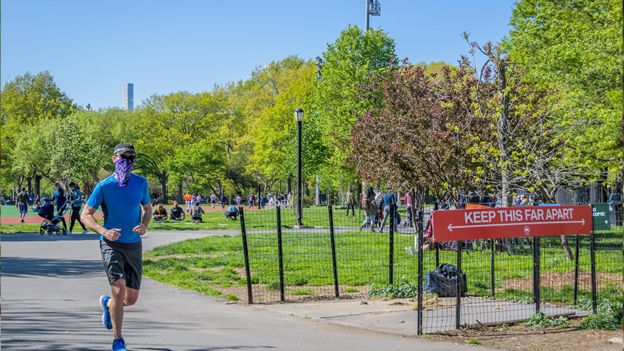
    Runners in a parkImage copyrightGETTY IMAGES

    In many countries in Europe like Germany, it is perfectly fine to go for a stroll with a beer or bring wine to a picnic. But in the US, carrying open alcohol in public is largely forbidden, except in a handful of municipalities.

    A notable exception in the US is New Orleans, Louisiana, a city that proudly boasts its relaxed open container laws, giving it the feel of a European town.

    “We are considered fairly puritanical when compared to other countries in regard to liquor laws,” Ms Schuster says.

    When the 21st Amendment repealed national prohibition in 1933, states were given the ultimate power to decide who could manufacture, sell and drink alcohol. That means that most states exercise tight control over who can sell alcohol, when, and where.

    But as the realities of the coronavirus pandemic transform many aspects of American social life, many states are relaxing their rules.

    Within days of enacting shelter-in-place ordinances and closing non-essential businesses, many states rescinded laws that previously restricted restaurants from selling alcohol to-go.

    Others loosened rules around online liquor sales, or made it easier for customers to buy directly from breweries and wineries.

    In most jurisdictions, the sale of alcohol was deemed “essential”, with the exception of the US state of Pennsylvania, which closed all state-run liquor stores.

    “It’s about creating revenue and helping these poor businesses,” said Ms Schuster.

    In addition to helping bars and restaurants stay afloat, states benefit from keeping their citizens buying booze. Taxes on alcohol serve as a large source of revenue for many states.

    And as the lockdown drags on, and coronavirus stress continues, the data shows that alcohol sales show no signs of dropping.

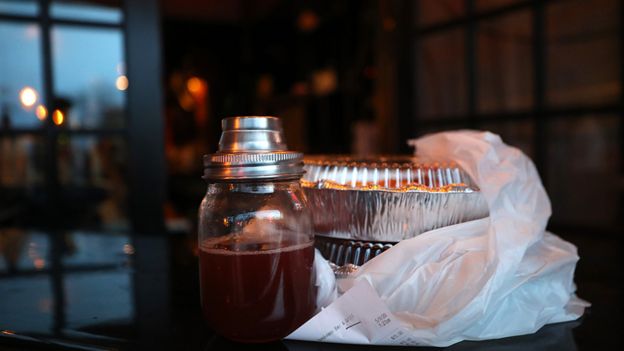
    Takeaway and a martini shakerImage copyrightGETTY IMAGES

    The week that New York announced the shelter-in-place, Nielsen reported alcohol sales had gone up significantly since the same time the previous year.

    And last week, they reported that the US saw the largest growth of alcohol sales since the pandemic shutdowns started in March.

    It’s a trend that is common in times of disaster, says Dr George Koob, the Director of the National Abuse of Alcohol Abuse and Alcoholism (NIAAA).

    “We know historically that during 9/11 and Hurricane Katrina there was an upswing in alcohol consumption,” he told the BBC.

    With more people drinking and to-go alcohol laws being loosened to protect businesses, many local governments have issued warnings that allowing to-go alcohol sales at restaurants and bars does not change open container laws.

    Alexandria, Virginia’s government website states:

    “Although the Virginia Alcoholic Beverage Control Authority has temporarily allowed licensed restaurants and bars to sell beer, wine and mixed drinks for carryout and delivery, the Alexandria City Code still prohibits carrying open containers of alcohol in public.”

    But in certain areas, there’s some indication that police aren’t focusing on people drinking in public.

    Just over an hour north, Baltimore, Maryland has said it will dismiss pending criminal charges for people arrested for many non-violent crimes, including breaking open container laws.

    The Baltimore City State’s Attorney Marilyn Mosby said that this in an effort to curb the number of people in jails that are proving to be a potential “breeding ground” of the virus.

    Dr Koob says it’s still too soon to tell how the new to-go cup policies will change alcohol behaviour, but the NIAAA is in the process of tracking it.

    However, he pointed out that with alcohol sales increasing and more people drinking, the loss of inhibition could lead to more people drinking outside.

    “Alcohol’s effect on the body is disinhibition. Some of these individuals who are drinking a little more because of the isolation and the stress are disinhibited so they might think it’s okay to go outside for a walk and take their beverage with them.”

    Whether or not alcohol to-go laws will remain the norm in the US after coronavirus passes remains to be seen, but Ms Schuster thinks it will be hard “to put the genie back in the bottle”.

    Beer in the grassImage copyrightGETTY IMAGES

    She may be right.

    On 28 April, Texas Governor Greg Abbott tweeted that the state would be extending the temporary rule that allowed restaurants to serve alcohol to-go to continue past 1 May, when it was initially set to expire.

    And he implied that this rule may be here to stay.

    “From what I hear from Texans, we may just let this keep on going forever,” Governor Abbott tweeted.

    Short presentational grey line

    Thank you for your comments.

    I ordered a burrito at my local cafe and got a beer to go. Sipped it on my 1/2 mile bike ride home. Andrew Finchamp, Chino, California

    Writing from Williamsport, PA (yes: Little League Country): to-go cocktails and drive-up six-packs are common. Two recent daytime keg parties observed in our sleepy quiet neighborhood township of Loyalsock. Both featured an open garage with visible taps, a yard full of partying Pennsylvanians, and large pick-up trucks parked along the street. We go for walks quite often and see stuff. I must admit I usually carry a cold beer along, and some peanuts for the squirrels. These are difficult times, my friends, and a nice buzz doesn’t hurt. Jeff Vetock, Williamsport, Pennsylvania

    In my neighborhood, have seen more and more people going on walks with bottles of beers and glasses of wine. You could expect to see it maybe once when the weather is nice – but even now with poor weather you see it more and more. Even at the local fishing pier, where having an open beverage before would often result in glares or warnings from officials, is now a sea of open containers while people aren’t working and trying to enjoy the outdoors. Rob Eckert, Detroit, Michigan

    Yes, I have definitely seen an increase in outdoor drinking in the metro Vancouver regional parks. The local police do not seem to be bothered by this in the slightest. Outdoor open drinks are NOT legal here in B.C., but people really do seem to be shunning the laws and carrying on with it. Colin Nellis, Surrey, British Columbia, Canada

    For the first time ever I have been able to buy liquor, beer in this case online from a local micro brewery. Also we have been given the okay to have an alcoholic drink with our neighbours in our front gardens. A first, but coming from Europe, about time. Not all is bad with the pandemic. Catie Oates, North Saanich, British Columbia, Canada

    In New York state, bars and restaurants will even deliver cocktails to your home right now. And every time we get takeout from one of our great local restaurants, we make sure to grab a few pints for the road, something unthinkable eight weeks ago. No one cares suddenly and there’s no true harm in it. I suspect the new economy in America will be far more tolerant of such things. Robert Holahan, Binghamton, New York

    In Fort Lauderdale the bars have opened the pavement outside their premises to clientele. This has led to a street party atmosphere and in some cases the social distancing has been non-existent. Overall the customers are enjoying the freedom of drinking outside. Mi Gael Dutton, Fort Lauderdale, Florida

    While this is a Florida beach resort city, and it was already legal to walk the streets with an open container, I would say that it is even more relaxed, and restaurants which are still selling only take-away food are also selling take-away package liquors as well. So you can get your coconut shrimp basket with a rum runner in a to-go cup. This is legal ON FOOT, but it runs afoul of the states open container laws in a vehicle. Nobody is paying any attention to that at this time. Bob Gassert, Madeira Beach, Florida

    Source: bbc
  • Space Plane: Mysterious US military aircraft launches

    The US Air Force has successfully launched its Atlas V rocket, carrying a X-37B space plane for a secretive mission.

    The rocket launched on Sunday from Cape Canaveral, a day after bad weather halted plans for a Saturday launch.

    The aircraft, also known as an Orbital Test Vehicle (OTV), will deploy a satellite into orbit and also test power-beaming technology.

    It is the plane’s sixth mission in space.

    The launch was dedicated to front line workers and those affected by the pandemic. A message including the words “America Strong” was written on the rocket’s payload fairing.

    X-37B is a classified programme and very little is known about it. The Pentagon has revealed very few details about the drone’s missions and capabilities in the past.

    “This X-37B mission will host more experiments than any other prior missions,” Secretary of the Air Force Barbara Barrett said earlier this month.

    One of the experiments will test the effect of radiation on seeds and other materials.

    The X-37B programme started in 1999. The aircraft resembles a smaller version of the manned space shuttles that were retired by the US space programme in 2011. It can glide back down through the atmosphere to land on a runway, just as the shuttle did.

    Built by Boeing, the plane uses solar panels for power in orbit, measures over 29ft (9m) long, has a wingspan of nearly 15ft and a weight of 11,000lbs (4,989 kg).

    The first plane flew in April 2010 and returned after an eight-month mission.

    The most recent mission ended in October 2019, after 780 days in orbit, bringing the aircraft’s time in space to more than seven years.

    The length of this mission is currently unclear.

    Source: bbc.com

  • Steve Linick: Democrats probe Trump’s firing of inspector general

    US Democrats have launched an investigation into President Donald Trump’s firing of the state department’s internal watchdog.

    Inspector General Steve Linick was investigating Secretary of State Mike Pompeo for suspected abuse of office, reports say.

    But he was sacked late on Friday after Mr Trump said he no longer commanded his full confidence.

    The move prompted angry criticism from senior Democrats in Congress.

    They accused Mr Trump of retaliating against public servants who want to hold his administration to account. Mr Linick was the third official responsible for monitoring government misconduct to be dismissed in recent weeks.

    The former prosecutor was appointed by Mr Trump’s predecessor, Barack Obama, to oversee spending and detect mismanagement at the state department.

    On Saturday, top Democrats on the House and Senate Foreign Relations Committees questioned the timing of Mr Linick’s removal and announced an immediate investigation.

    “We unalterably oppose the politically-motivated firing of inspectors general and the president’s gutting of these critical positions,” Congressman Eliot Engel and Senator Bob Menendez said in a statement.

    They said Mr Linick had “opened an investigation into wrongdoing by Secretary Pompeo himself”, adding that his firing was “transparently designed to protect Secretary Pompeo from personal accountability”.

    Mr Linick had begun investigating allegations that Mr Pompeo had improperly used staff to run personal errands, US media report.

    Mr Engel and Mr Menendez have requested that the White House and State Department hand over all records related to his dismissal by next Friday.

    Meanwhile, on Saturday, the White House said the decision to oust Mr Linick was prompted by Mr Pompeo himself. “Secretary Pompeo recommended the move, and President Trump agreed,” an official said.

    What happened on Friday? Mr Trump sent a letter to House Speaker Nancy Pelosi in which he declared his intention to fire Mr Linick.

    Under federal law, the Trump administration must give Congress 30 days’ notice of its plans to fire an inspector general. It is expected that Mr Linick will leave his post after this time, with some reports suggesting a political ally of Mr Trump is being lined up to replace him.

    “It is vital that I have the fullest confidence in the appointees serving as inspectors general. That is no longer the case with regard to this inspector general,” Mr Trump said in the letter.

    Not long after Mr Linick’s dismissal was announced, Mr Engel, the chairman of the House Foreign Affairs Committee, said Mr Linick had opened an investigation into Mr Pompeo.

    “Mr Linick’s firing amid such a probe strongly suggests that this is an unlawful act of retaliation,” he said in a statement.

    House Speaker Nancy Pelosi said Mr Linick was “punished for honorably performing his duty to protect the constitution and our national security”.

    It was the latest in a series of dismissals of independent government watchdogs.

    Last month, Mr Trump dismissed Michael Atkinson, the inspector general of the intelligence community.

    Mr Atkinson first alerted Congress to a whistleblower complaint that led to Mr Trump’s impeachment trial.

    Source: bbc.com

  • France resists idea of US getting vaccine first

    It would be “unacceptable” for French drug giant Sanofi to give priority to the US market if it develops a Covid-19 vaccine, a French minister has warned.

    Deputy Finance Minister Agnès Pannier-Runacher was responding to comments by Sanofi CEO Paul Hudson, who said “the US government has the right to the largest pre-order because it’s invested in taking the risk”.

    Many labs worldwide are involved in research to find a Covid-19 vaccine.

    Vaccines usually take years to develop.

    “For us, it would be unacceptable for there to be privileged access to such and such a country for financial reasons,” Ms Pannier-Runacher told France’s Sud Radio.

    Earlier this month the EU chaired a global online summit to boost coronavirus research, and secured pledges of $8bn (£6.5bn) from some 40 countries and donors. The funding is aimed at developing a coronavirus vaccine and treatments for Covid-19.

    The UK co-hosted the summit but the US and Russia did not take part.

    The EU insisted on Thursday that all countries should get equal access to a vaccine.

    “The vaccine against Covid-19 should be a global public good and its access needs to be equitable and universal,” said European Commission spokesman Stefan de Keersmaecker, quoted by AFP news agency.

    International collaboration

    Sanofi’s Coronavirus vaccine research is partly funded by the US Biomedical Advanced Research and Development Authority (Barda).

    But in recent years Sanofi has received tens of millions of euros in tax credits from the French government to help its research.

    On Thursday Sanofi’s chief in France, Olivier Bogillot, said “the goal is to have this vaccine available to the US as well as France and Europe at the same time”.

    Speaking on French news channel BFMTV, he said that would only be possible “if Europeans work as quickly as the Americans”, and added that the US government had pledged to spend “several hundreds of millions of euros”.

    Last month Sanofi also teamed up with Britain’s GlaxoSmithKline (GSK) to work on a vaccine, though trials have not yet started.

    Sanofi’s head of vaccine research, John Shiver, says “we are using an existing technology that was designed for influenza, and we’re applying it to the new virus that causes Covid-19 disease”.

    Sanofi says GSK “will contribute its adjuvant technology, an ingredient added to enhance the immune response, reduce the amount of vaccine protein required per dose and improve the chances of delivering an effective vaccine that can be manufactured at scale”.

    The candidate vaccine is expected to enter clinical trials in the second half of 2020 and to be available by the second half of 2021.

    Source: bbc.com

  • Coronavirus Sanofi: France resists idea of US getting vaccine first

    It would be “unacceptable” for French drug giant Sanofi to give priority to the US market if it develops a Covid-19 vaccine, a French minister has warned.

    Deputy Finance Minister Agnès Pannier-Runacher was responding to comments by Sanofi CEO Paul Hudson, who said “the US government has the right to the largest pre-order because it’s invested in taking the risk”.

    Many labs worldwide are involved in research to find a Covid-19 vaccine.

    Vaccines usually take years to develop.

    “For us, it would be unacceptable for there to be privileged access to such and such a country for financial reasons,” Ms Pannier-Runacher told France’s Sud Radio.

    Earlier this month the EU chaired a global online summit to boost coronavirus research, and secured pledges of $8bn (£6.5bn) from some 40 countries and donors. The funding is aimed at developing a coronavirus vaccine and treatments for Covid-19.

    The UK co-hosted the summit but the US and Russia did not take part.

    On Thursday Sanofi’s chief in France, Olivier Bogillot, said “the goal is to have this vaccine available to the US as well as France and Europe at the same time”.

    Speaking on French news channel BFMTV, he said that would only be possible “if Europeans work as quickly as the Americans”, and added that the US government had pledged to spend “several hundreds of millions of euros”.

    Sanofi’s Covid-19 vaccine research is partly funded by the US Biomedical Advanced Research and Development Authority (Barda).

    But Sanofi has received tens of millions of euros in tax credits from the French government in recent years to help its research.

    Last month Sanofi also teamed up with Britain’s GlaxoSmithKline (GSK) to work on a vaccine, though trials have not yet started.

    Sanofi’s head of vaccine research, John Shiver, says “we are using an existing technology that was designed for influenza, and we’re applying it to the new virus that causes Covid-19 disease”.

    Sanofi says GSK “will contribute its adjuvant technology, an ingredient added to enhance the immune response, reduce the amount of vaccine protein required per dose and improve the chances of delivering an effective vaccine that can be manufactured at scale”.

    The candidate vaccine is expected to enter clinical trials in the second half of 2020 and to be available by the second half of 2021.

    Source: bbc.com

  • Wisconsin high court overturns state’s stay-at-home orders

    Wisconsin’s Supreme Court overturned the state’s stay-at-home orders on Wednesday, as regions across the US grapple with the increasingly partisan decision of whether or not to reopen amid the coronavirus pandemic.

    Americans across the country have staged anti-lockdown demonstrations and President Donald Trump has pressed for rapid steps to rekindle the devastated US economy before his tough re-election battle in November.

    But public health experts, including the president’s top medical advisor Anthony Fauci, have warned that loosening restrictions on public gatherings too early could trigger fresh COVID-19 outbreaks.

    The Midwestern state’s high court sided with lawmakers from Trump’s Republican Party, who had challenged an extension of the quarantine imposed by Democratic Governor Tony Evers’s administration.

    Evers warned on Twitter that the decision risked undoing “all the work we have done and all the sacrifices Wisconsinites have made over these past few months.”

    “It’s a mess,” he later told CNN. “I mean, I can’t put it any other way.”

    While the state is not one of the hardest hit, it has still recorded more than 10,900 cases and more than 400 deaths.

    The legal challenge was filed against Wisconsin Department of Health Services chief Andrea Palm and other officials, who had extended stay-at-home orders to May 26 even as the state relaxed some restrictions on business.

    The state’s Republican House Speaker Robin Vos and Senate Majority Leader Scott Fitzgerald said the ruling allowed “people to once again gather with their loved ones or visit their places of worship without the fear of violating a state order.”

    Asked whether relaxing shutdown orders was a partisan issue, Treasury Secretary Steven Mnuchin told FOX News Wednesday: “I hope it’s not political, that would be terrible. I hope that all these governors care about the American workers, care about American jobs.”

    Source: france24.com

  • Coronavirus: Children affected by rare inflammatory reaction

    Scores of UK and US children have been affected by a rare inflammatory disease linked to coronavirus.

    A number of children have also been diagnosed with the disease – which can cause symptoms similar to toxic shock syndrome – elsewhere in Europe.

    Up to 100 UK children have been affected. Some have needed intensive care while others recovered quickly.

    In April, NHS doctors were told to look out for a rare but dangerous reaction in children.

    This was prompted by eight children becoming ill in London, including a 14-year-old who died.

    Doctors said all eight children had similar symptoms when they were admitted to Evelina London Children’s Hospital, including a high fever, rash, red eyes, swelling and general pain.

    Most of the children had no major lung or breathing problems, although seven were put on a ventilator to help improve heart and circulation issues.

    Doctors are describing it as a “new phenomenon” similar to Kawasaki disease shock syndrome – a rare condition that mainly affects children under the age of five. Symptoms include a rash, swollen glands in the neck and dry and cracked lips.

    But this new syndrome is also affecting older children up to the age of 16, with a minority experiencing serious complications.

    Coronavirus: ‘My son had symptoms of rare syndrome’

    Dr Liz Whittaker, clinical lecturer in paediatric infectious diseases and immunology, at Imperial College London, said the fact that the syndrome was occurring in the middle of a pandemic, suggests the two are linked.

    “You’ve got the Covid-19 peak, and then three or four weeks later we’re seeing a peak in this new phenomenon which makes us think that it’s a post-infectious phenomenon,” she said.

    This means it is likely to be something related to the build-up of antibodies after infection.

    ‘Exceptionally rare’

    Prof Russell Viner, president of the Royal College of Paediatrics and Child Health, said the majority of children who have had the condition have responded to treatment and are getting better and starting to go home.

    The syndrome is “exceptionally rare”, he said.

    “This shouldn’t stop parents letting their children exit lockdown,” Prof Viner added.

    He said understanding more about the inflammatory disease “might explain why some children become very ill with Covid-19, while the majority are unaffected or asymptomatic”.

    Children are thought to make up just 1-2% of all cases of coronavirus infection, accounting for less than 500 admissions to hospital.

    Source: bbc.com

  • ‘Serious’ consequences if US reopens too fast: top government expert

    The US government’s top infectious disease expert warned Congress Tuesday that ending lockdowns too quickly could bring severe consequences including new outbreaks of coronavirus just as the country tries to overcome the pandemic.

    Anthony Fauci told a Senate panel the federal government had developed guidelines for local jurisdictions on how to safely re-open activities, and a sustained decrease in cases for 14 days was a vital first step.

    “If a community or a state or region doesn’t go by those guidelines and reopens… the consequences could be really serious,” said Fauci.

    Fauci acknowledged that US deaths caused by the virus are likely higher than the roughly 80,000 fatalities in the current official government toll.

    This, he said, was because many people particularly in hardest-hit New York died at home before they could be admitted to a hospital.

    But he also said he was “cautiously optimistic” about the prospects of a vaccine, with eight candidates currently undergoing clinical trials.

    “We have many candidates and hope to have multiple winners,” he said. “In other words, it’s multiple shots on goal.”

    – Remote testimony –

    Fauci, who has become the trusted face of the federal government’s virus response, was one of four top medical experts testifying remotely at the hearing of the Senate Health, Education, Labor and Pensions Committee.

    The New York Times had earlier reported Fauci would warn the country would see “needless suffering and death” if it rushed too quickly to re-open, but the remarks did not eventually feature in his opening address.

    There has been frequent speculation that Fauci’s forthright approach has irritated President Donald Trump, who has been accused of downplaying the dangers of the crisis as he rushes to restart the economy.

    Tuesday’s hearing was Fauci’s first appearance before Congress since Trump declared the coronavirus pandemic a national emergency on March 13.

    The director of the National Institute of Allergy and Infectious Diseases, Fauci himself is in “modified quarantine” after Vice President Mike Pence’s spokeswoman — who he had no close contact with — tested positive.

    “Opening Up America Again” is name of the administration’s guidelines on a three-phase approach to help state and local officials reopen their economies, while observing medical advice on limiting the spread of the virus.

    Among the administration’s requirements before moving to a phased comeback, states should have a “downward trajectory” of documented cases or positive tests, as a percentage of total tests, over two weeks.

    There should be a robust testing program for at-risk healthcare workers, with asymptomatic cases screened as well, and contacts of positive cases traced.

    Trump has been criticized as essentially abdicating any leadership role during the pandemic, leaving states on their own to grapple with their outbreaks and even bid against each other to obtain critical medical equipment on the open market or abroad.

    While the situation has improved in New York — the epicenter of the US outbreak — progress has been slow elsewhere.

    The US has reported more than 80,000 deaths and 1.3 million infections.

    Source: france24.com

  • Coronavirus, low oil prices take toll on April US inflation

    Falling prices for just about everything besides food sent US inflation dropping in April by the largest amount since the global financial crisis in 2008, government data showed Tuesday.

    April’s consumer price index data were the first to fully capture the effects of the lockdowns to stop the coronavirus pandemic that have undone the world’s largest economy, sending the unemployment rate spiking to 14.7 percent and wiping out tens of millions of jobs, with 20.5 million rendered jobless last month alone.

    The disruptions have caused a dramatic fall in demand for oil which, together with a price war between top producers Russia and Saudi Arabia, pushed down energy prices dramatically, contributing to the fall in CPI.

    The CPI fell in April by a seasonally adjusted 0.8 percent, in line with analyst expectations but an acceleration of its 0.4 percent decline in March and its largest month-on-month fall since December 2008.

    The index’s last month of positive growth was February, in which it rose 0.1 percent, and over the last 12 months the index only increased 0.3 percent, not seasonally adjusted.

    Gasoline prices led April’s decline with a 20.6 percent fall, but other sectors badly affected by the business closure also saw prices drop.

    Apparel dropped by 4.7 percent compared to March, the same rate as transportation services, while airline fares fell by 15.2 percent and used cars and trucks by 0.4 percent.

    The “core” for all items except food and energy fell by 0.4 percent, its largest monthly drop since the index was created in 1957.

    As consumers pared back spending to the essentials, the food index registered spectacular growth of 1.5 percent, with food at home jumping by 2.6 percent — it largest-ever monthly increase.

    Meat, poultry, fish and eggs rose 4.3 percent, with eggs leading the charge with a 16.1 percent increase.

    However, Ian Shepherdson of Pantheon Macroeconomics said some of that increase was due to supply shortages at slaughterhouses as they struggled to fend off outbreaks of COVID-19, and the report didn’t indicate the US was set for protracted deflation.

    As the economy recovers from the coronavirus, “The collapse in clothing prices, for example, will be limited by the rotation of seasonal inventory and the reopening of retail stores, while airline traffic and hotel occupancy rates are now gradually rising, albeit from incredibly depressed levels,” Shepherdson said.

    Source: france24.com

  • Coronavirus: Pandemic sends US jobless rate to 14.7%

    The US unemployment rate has risen to 14.7%, with 20.5 million jobs lost in April, as the coronavirus pandemic devastated the economy.

    The rise means the jobless rate is now worse than at any time since the Great Depression of the 1930s.

    Since the pandemic began, the US has suffered its worst growth numbers in a decade and the worst retail sales report on record.

    Just two months ago, the unemployment rate was at 3.5%, a 50-year low.

    “It is historically unprecedented,” said economist Erica Groshen, former head of the government’s Bureau of Labor Statistics, who now teaches at Cornell University. “We have put our economy into a medically induced coma in order to heal it from the pandemic… and that has led to the most precipitous loss of jobs seen in any of the modern data.”

    The report from the Labor Department showed declines in every sector of the economy.

    Leisure and hospitality was hit especially hard, with payrolls falling by 7.7 million or 47%. Employers in education and health services cut 2.5 million positions, while retailers shed 2.1 million.

    The Labor Department said more than three-quarters of those without jobs described themselves as temporarily laid off, a sign that many of those currently without work are hopeful that the economy will be able to rebound.

    But economists warned that the pandemic is likely to force major changes to businesses – such as limits on how many people may be in a restaurant at one time – that could reduce the need for workers. And the longer the shutdown lasts, the more likely it is that a business will not survive.

    “Even a temporary layoff can turn into a permanent one if the business doesn’t survive or if the business has to change its business model so dramatically that it needs different numbers or a different kind of worker,” Ms Groshen said.

    The economic crisis is not unique to the US. In the UK, the Bank of England has warned of the sharpest recession on record, while Canada on Friday reported its unemployment rate had increased 5.2 percentage points to 13% last month.

    Statistics Canada estimated that about a third of the workforce was either out of work, or working less than half of their usual hours.

    In an appearance on the Fox News channel, US President Donald Trump shrugged off the 20.5 million jobs lost in the US as “totally expected” and “no surprise”.

    “Even the Democrats aren’t blaming me for that. What I can do is I can bring it back,” he said as the figures were released.

    But bankruptcies have already claimed retailers such as J Crew and Neiman Marcus, as well as many firms in the energy sector, where a collapse in oil prices, due in part to a pandemic-related drop in demand, has worsened the strains.

    While some states have already started to relax restrictions, re-starting the economy is likely to be difficult, as workers worry about the risk of infection and grapple with the impact of school closures.

    “I’m not certain what’s going to happen next,” said Tanya Nikolaevskaya, a legal assistant in New York, who was furloughed last month, after working from home in March.

    Ms Nikolaevskaya hopes to return to what she described as her dream job, but she has a medical condition that makes her worried about infection and is a single mother, whose 8-year-old daughter will need care if schools do not reopen.

    “It’s all about, ‘Is there childcare,’” she said. “If I will not have childcare, I will not be able to go back.”

    The number of people in the labor force – working or looking for work – fell 2.5% last month, to its lowest level since 1970, while those reporting reduced hours or an inability to find a full-time job nearly doubled.

    The Labor Department warned that the situation might be worse than estimated, pointing to the spike in the number of people who said they were employed but “absent from work”. Including those responses suggests an unemployment rate closer to 20%, it said.

    Among black workers, the unemployment rate jumped to 16.7%, the highest since 2010. Among Hispanics, it surged to a record 18.9%, while it climbed to a lower – but still record-setting – 14.2% among white workers.

    Overall, the unemployment rate was the highest recorded in data back to 1948, while the over-the-month jobs decline was the largest reported in data back to 1939.

    “The scale of the challenge cannot be overstated,” said Robert Alster, head of investment services at wealth manager Close Brothers Asset Management.

    Source: bbc.com

  • US accuses China of attempting to steal vaccine research

    The US Federal Bureau of Investigation and cybersecurity experts believe Chinese hackers are trying to steal research on developing a vaccine against coronavirus, two newspapers reported Monday.

    The FBI and Department of Homeland Security are planning to release a warning about the Chinese hacking as governments and private firms race to develop a vaccine for COVID-19, the Wall Street Journal and New York Times reported.

    The hackers are also targeting information and intellectual property on treatments and testing for COVID-19.

    US officials alleged that the hackers are linked to the Chinese government, the reports say.

    The official warning could come within days.

    In Beijing Foreign Affairs ministry spokesman Zhao Lijian rejected the allegation, saying China firmly opposes all cyber attacks.

    “We are leading the world in COVID-19 treatment and vaccine research. It is immoral to target China with rumors and slanders in the absence of any evidence,” Zhao said.

    The warning would add to a series of alerts and reports accusing government-backed hackers in Iran, North Korea, Russia and China of malicious activity related to the pandemic, from pumping out false news to targeting workers and scientists.

    The New York Times said it could be a prelude to officially-sanctioned counterattacks by US agencies involved in cyber warfare, including the Pentagon’s Cyber Command and the National Security Agency.

    Last week in a joint message Britain and the United States warned of a rise in cyber attacks against health professionals involved in the coronavirus response by organised criminals “often linked with other state actors.”

    Britain’s National Cyber Security Centre and the US Cybersecurity and Infrastructure Security Agency said they had detected large-scale “password spraying” tactics — hackers trying to access accounts through commonly used passwords — aimed at healthcare bodies and medical research organisations.

    Source: france24.com

  • Cases and deaths in the US

    These charts show the daily number of cases and deaths in the US, and the rolling average.

    In both cases, the rolling averages remain stubbornly high, although with a downward trend.

    Newly-released figures – not included in these charts – show the US had 776 deaths in the past 24 hours, the lowest figure since March.

    The US has the highest number of virus deaths and cases in the world – but it also has one of the biggest populations, and widespread testing.

    Source: bbc.com

  • Cases and deaths in the US

    These charts show the daily number of cases and deaths in the US, and the rolling average.

    In both cases, the rolling averages remain stubbornly high, although with a downward trend.

    Newly-released figures – not included in these charts – show the US had 776 deaths in the past 24 hours, the lowest figure since March.

    The US has the highest number of virus deaths and cases in the world – but it also has one of the biggest populations, and widespread testing.

    Source: bbc.com

  • First Pakistani repatriation flight from US takes off

    A flight carrying 200 Pakistani citizens stranded by the pandemic took off from Washington DC on Sunday.

    The flight, headed to Islamabad, is the first of six such charter flights arranged by the Pakistani government.

    Around 1,500 Pakistanis stranded in the US will be brought home via these flights, the Pakistani embassy said.

    Another flight, this one chartered by the US, will take home 150 Pakistani students on Monday. These students were in the US on various exchange programmes.

    Meanwhile, Pakistan continues to relax its lockdown, allowing some markets to reopen even as cases surged past 30,000 and deaths crossed 600.

    Source: bbc.com

  • Coronavirus: Pandemic sends US jobless rate to 14.7%

    The US unemployment rate has risen to 14.7%, with 20.5 million jobs lost in April, as the coronavirus pandemic devastated the economy.

    The rise means the jobless rate is now worse than at any time since the Great Depression of the 1930s.

    Since the pandemic began, the US has suffered its worst growth numbers in a decade and the worst retail sales report on record.

    Just two months ago, the unemployment rate was at 3.5%, a 50-year low.

    “It is historically unprecedented,” said economist Erica Groshen, former head of the government’s Bureau of Labor Statistics, who now teaches at Cornell University. “We have put our economy into a medically induced coma in order to heal it from the pandemic… and that has led to the most precipitous loss of jobs seen in any of the modern data.”

    The report from the Labor Department showed declines in every sector of the economy.

    Leisure and hospitality was hit especially hard, with payrolls falling by 7.7 million or 47%. Employers in education and health services cut 2.5 million positions, while retailers shed 2.1 million.

    The Labor Department said more than three-quarters of those without jobs described themselves as temporarily laid off, a sign that many of those currently without work are hopeful that the economy will be able to rebound.

    But economists warned that the pandemic is likely to force major changes to businesses – such as limits on how many people may be in a restaurant at one time – that could reduce the need for workers. And the longer the shutdown lasts, the more likely it is that a business will not survive.

    “Even a temporary layoff can turn into a permanent one if the business doesn’t survive or if the business has to change its business model so dramatically that it needs different numbers or a different kind of worker,” Ms Groshen said.

    The economic crisis is not unique to the US. In the UK, the Bank of England has warned of the sharpest recession on record, while Canada on Friday reported its unemployment rate had increased 5.2 percentage points to 13% last month.

    Statistics Canada estimated that about a third of the workforce was either out of work, or working less than half of their usual hours.

    In an appearance on the Fox News channel, US President Donald Trump shrugged off the 20.5 million jobs lost in the US as “totally expected” and “no surprise”.

    “Even the Democrats aren’t blaming me for that. What I can do is I can bring it back,” he said as the figures were released.

    But bankruptcies have already claimed retailers such as J Crew and Neiman Marcus, as well as many firms in the energy sector, where a collapse in oil prices, due in part to a pandemic-related drop in demand, has worsened the strains.

    While some states have already started to relax restrictions, re-starting the economy is likely to be difficult, as workers worry about the risk of infection and grapple with the impact of school closures.

    “I’m not certain what’s going to happen next,” said Tanya Nikolaevskaya, a legal assistant in New York, who was furloughed last month, after working from home in March.

    Ms Nikolaevskaya hopes to return to what she described as her dream job, but she has a medical condition that makes her worried about infection and is a single mother, whose 8-year-old daughter will need care if schools do not reopen.

    “It’s all about, ‘Is there childcare,’” she said. “If I will not have childcare, I will not be able to go back.”

    The number of people in the labor force – working or looking for work – fell 2.5% last month, to its lowest level since 1970, while those reporting reduced hours or an inability to find a full-time job nearly doubled.

    The Labor Department warned that the situation might be worse than estimated, pointing to the spike in the number of people who said they were employed but “absent from work”. Including those responses suggests an unemployment rate closer to 20%, it said.

    Among black workers, the unemployment rate jumped to 16.7%, the highest since 2010. Among Hispanics, it surged to a record 18.9%, while it climbed to a lower – but still record-setting – 14.2% among white workers.

    Overall, the unemployment rate was the highest recorded in data back to 1948, while the over-the-month jobs decline was the largest reported in data back to 1939.

    “The scale of the challenge cannot be overstated,” said Robert Alster, head of investment services at wealth manager Close Brothers Asset Management.

    Source: bbc.com

  • Coronavirus pandemic sends US jobless rate to 14.7%

    The US unemployment rate has risen to 14.7%, with 20.5 million jobs lost in April, as the coronavirus pandemic devastated the economy.

    The rise means the jobless rate is now worse than at any time since the Great Depression of the 1930s.

    Since the pandemic began, the US has suffered its worst growth numbers in a decade and the worst retail sales report on record.

    Just two months ago, the unemployment rate was at 3.5%, a 50-year low.

    Weekly figures released on Thursday showed a further 3.2 million Americans sought unemployment benefits last week. That brings the total number of jobless claims since mid-March to 33.3 million- or about 20% of the US workforce.

    In recent weeks, companies such as Uber, Lyft and Airbnb were among the firms that have announced cuts, as shutdowns halted significant amounts of travel.

    The impact has been felt across the economy, affecting medical practices, restaurants and administrative workers among many others. The number of new claims reported each week by the US Department of Labor has subsided since hitting a peak of 6.9 million in March.

    But they remain extraordinarily high.

    And the number of people collecting benefits has continued to rise, despite recent moves to start re-opening in some parts of the country.

    Source: bbc.com

  • Coronavirus mutations: Scientists puzzle over impact

    Researchers in the US and UK have identified hundreds of mutations to the virus which causes the disease Covid-19.

    But none has yet established what this will mean for virus spread in the population and for how effective a vaccine might be.

    Viruses mutate – it’s what they do.

    The question is: which of these mutations actually do anything to change the severity of infectiousness of the disease?

    Preliminary research from the US has suggested one particular mutation – D614G – is becoming dominant and could make the disease more infectious.

    It hasn’t yet been reviewed by other scientists and formally published.

    The researchers, from the Los Alamos National Laboratory in New Mexico, have been tracking changes to the “spike” of the virus that gives it its distinctive shape, using a database called the Global Initiative on Sharing All Influenza Data (GISAID).

    They noted there seems to be something about this particular mutation that makes it grow more quickly – but the consequences of this are not yet clear.

    The research team analysed UK data from coronavirus patients in Sheffield. Although they found people with that particular mutation of the virus seemed to have a larger amount of the virus in their samples, they didn’t find evidence that those people became sicker or stayed in hospital for longer.

    ‘Mutations not a bad thing’ Another study from University College London (UCL) identified 198 recurring mutations to the virus.

    One of its authors, Professor Francois Balloux, said: “Mutations in themselves are not a bad thing and there is nothing to suggest SARS-CoV-2 is mutating faster or slower than expected.

    “So far, we cannot say whether SARS-CoV-2 is becoming more or less lethal and contagious.”

    A study from the University of Glasgow, which also analysed mutations, said these changes did not amount to different strains of the virus. They concluded that only one type of the virus is currently circulating.

    Monitoring small changes to the structure of the virus is important in understanding the development of vaccines.

    Take the ‘flu virus: it mutates so fast that the vaccine has to be adjusted every year to deal with the specific strain in circulation.

    Drug development

    Many of the Covid-19 vaccines currently in development target the distinctive spikes of the virus – the idea is that getting your body to recognize a unique element of the spike will help it to fight off the whole virus. But if that spike is changing, a vaccine developed this way could become less effective.

    At the moment this is all theoretical. Scientists don’t yet have enough information to say what changes to the virus’s genome will mean.

    Dr Lucy van Dorp, UCL study co-author, said being able to analyze a large number of virus genomes could be “invaluable to drug development efforts”.

    However, she told the BBC: “I love genomes, but there is only so much they can say.”

    Source: bbc.com

  • US coronavirus deaths rise by 2,333 in 24 hours

    The US coronavirus death toll climbed by 2,333 in the past 24 hours, a tally by Johns Hopkins University showed Tuesday, more than twice as many as the day before.

    The Baltimore-based university said as of 8:30 pm (0030 GMT Wednesday) that the country had suffered a total of 71,022 deaths.

    On Monday, the United States recorded its lowest daily balance in a month, with 1,015 fatalities.

    President Donald Trump on Tuesday made his first major foray out of the White House since the coronavirus lockdown began, pushing for the US economy to reopen as Britain became the country with the second most deaths.

    The growing US death toll is by far the highest globally, while Britain’s rose to 32,000, putting it above Italy in the grim ranking of national fatalities.

    EUROPE

    Elsewhere in Europe, hard-hit Italy, Spain and France have reported a levelling off of figures, offering hope that life could slowly start returning to normal.

    With experts warning of a severe global recession, many governments have been easing stay-at-home measures in a bid to revive badly hammered economies.

    Financial markets hinted at some light at the end of the tunnel, with stocks and oil prices rallying Tuesday.

    “We can’t keep our country closed for the next five years,” Trump said on a trip to a mask-making factory in Arizona, conceding that some people would be “badly affected.”

    He urged US states to ease restrictions as he attempts to fire up the world’s biggest economy before the November presidential election when the high death toll and millions of lost jobs could cost him dearly.

    The US registered 2,333 more deaths over the 24-hours to Tuesday evening, according to a tally by Johns Hopkins University, with some scientific models suggesting the figure will rise to 3,000 a day by June.

    NEED TO REVIVE

    Countries are balancing the need to revive stalled economies against the risk of a new wave of deadly infections.

    In Germany, regional leaders pushed back against Chancellor Angela Merkel’s pleas for caution, with the biggest state Bavaria saying it would reopen restaurants and hotels this month.

    Hong Kong announced plans to reopen schools, cinemas, bars and beauty parlours from Friday, while Californian bookshops, florists and clothing stores will also be allowed to reopen at the end of the week.

    Authorities also unveiled plans to hand out reusable face masks to all 7.5 million city residents.

    “It’s better now that I’m waking up and doing something,” South African mechanic Milton Nkosi, 40, told AFP as he checked a new set of tyres at a garage in Johannesburg.

    “I’m used to working,” he added. “It’s the first time in my life to stay home so many days.”

    But the garage only called back four of its eight employees after being closed for five weeks and is only partially open — underlining the huge challenge to rebuild the global economy.

    250,000 GRIM MILESTONE

    At least 254,532 people have died of the novel coronavirus since the epidemic surfaced in China late last year, according to an AFP tally at 1900 GMT Tuesday based on official sources.

    Russia cemented its place as the European country reporting the highest number of new infections as its total cases soared past 155,000.

    Despite the increases, the Russian government has indicated it could gradually lift confinement measures from May 12.

    The economic casualties have also piled up from the impact of the pandemic.

    Spain added 280,000 people to its jobless ranks, while the Virgin Atlantic airline said it would have to fire one in three staff as the virus grounds planes worldwide.

    Walt Disney said it expected an impact of some $1.4 billion in the current fiscal quarter as a result of a massive hit to its theme parks and other operations.

    And home-sharing platform Airbnb announced it would slash one fourth of its workforce due to the collapse of the travel industry.

    In India, police used batons to beat back crowds jostling to buy alcohol for the first time in 40 days as the world’s biggest lockdown eased.

    The government in New Delhi credits its strict shutdown with keeping the official tally of COVID-19 deaths to 1,400 in a country with a population of 1.3 billion.

    But the policy has resulted in misery for millions of workers in India’s vast informal sector left suddenly jobless.

    India said Tuesday it had embarked on a “massive” operation calling up passenger jets and naval ships to bring back some of the hundreds of thousands of its nationals stuck abroad.

    Evacuees will have to pay for their passage and spend 14 days in quarantine on arrival.

    Polish voters were still in the dark on Tuesday as to whether their presidential election will go ahead as scheduled this weekend.

    The right-wing Law and Justice (PiS) government is seeking parliamentary approval to conduct the election by postal ballot — despite widespread concern that it would not be fair, legal or safe.

    In a ray of hope for the sports world, South Korea’s baseball players returned to action, albeit to empty stadiums.

    Banners with photos of masked fans stretched across the bleachers at the Incheon-based SK Wyverns club’s Munhak Baseball Stadium.

    Players have been asked not to shake hands or exchange high-fives, while spitting is prohibited.

    Friday will also see the delayed start of the country’s football K-League.

    Juventus players returned to individual training at the team’s sports centre in Turin on Tuesday, though star player Cristiano Ronaldo began two weeks’ quarantine after returning to Italy following two months of confinement on his native island of Madeira.

    But in Britain, sports leaders warned of the “catastrophic” impact of the virus, with football, cricket and rugby counting the cost of delayed or cancelled tournaments and leagues.

    Source: AFP

  • Coronavirus: US to borrow record $3tn as spending soars

    The US has said it wants to borrow a record $3tn (£2.4tn) in the second quarter, as coronavirus-related rescue packages blow up the budget.

    The sum is more than five times the previous quarterly record, set at the height of the 2008 financial crisis.

    In all of 2019, the country borrowed $1.28tn. The US has approved about $3tn in virus-related relief, including health funding and direct payouts.

    Total US government debt is now near $25tn.

    The latest spending packages are estimated to be worth about 14% of the country’s economy. The government has also extended the annual 15 April deadline for tax payments, adding to the cash crunch.

    The new borrowing estimate is more than $3tn above the government’s previous estimate, a sign of the impact of the new programs.

    Discussions are under way over further assistance, though some Republicans have expressed concerns about the impact of more spending on the country’s skyrocketing national debt.

    The US borrows by selling government bonds. It has historically enjoyed relatively low interest rates since its debt is viewed as relatively low-risk by investors around the world.

    But even before the coronavirus, the country’s debt load had been climbing toward levels many economists consider risky for long-term growth, as the country spent more than it took in.

    The US Congressional Budget Office last month predicted the budget deficit would hit $3.7tn this year, while the national debt soared above 100% of GDP.

    Last week, the chair of America’s central bank, Jerome Powell, said he would have liked to see the US government’s books be in better shape before the pandemic.

    However, he said spending now was essential to cushion the economic blow, as orders to shut businesses to slow the spread of the virus cost at least 30 million people their jobs.

    “It may well be that the economy will need more help from all of us if the recovery is to be a robust one,” he said.

    As part of its own relief efforts, the Federal Reserve has bought more than $1tn in treasuries in recent weeks.

    Investors from foreign countries are also historically significant holders of US debt, with Japan, China and the UK at the top of the pack as of February.

    Increased tensions between the US and China in recent years have renewed scrutiny of America’s debt position. According to the Washington Post last week, Trump administration officials had discussed canceling debt obligations to China, but US President Donald Trump reportedly played down the idea, saying “you start playing those games and it’s tough”.

    For now, continued low rates suggest investor appetite for US debt remains, allowing for a borrowing increase, Alan Blinder, a professor of economics and public affairs at Princeton University, told the BBC last month.

    “So far, the answer has been everything is fine, as to how much borrowing the United States government can do before investors start to feel satiated with US debt,” he said. “But there is a legitimate question.

    Source: bbc.com

  • Coronavirus: Chinese state media take aim at US ‘lab theory’

    Chinese state media has accused US Secretary of State Mike Pompeo of lying after he said there was “enormous evidence” the coronavirus emanated from a laboratory in Wuhan.

    Mr. Pompeo made the claim on Sunday, without going into specifics.

    In an editorial on Tuesday, the hawkish Global Times newspaper said Mr Pompeo was “degenerate”.

    The World Health Organization says the US claims are “speculative”, and that it has seen no “specific evidence”.

    What did Chinese media say?

    Editorials in Chinese state media often given an insight into the direction of government thinking, but there has been no official response to Mr Pompeo’s comments as yet.

    On Monday, the Global Times accused Mr Pompeo of “absurd theories and twisted facts”, and on Tuesday the attack continued.

    “Pompeo aims to kill two birds with one stone by spewing falsehoods,” it said.

    “First, he hopes to help Trump win re-election this November…second, Pompeo hates socialist China and, in particular, cannot accept China’s rise.”

    The editorial admitted there were “initial problems” in China’s response to the outbreak, but claimed “the overall performance is bright enough to outweigh the flaws”.

    It also said it was “conceivable that the virus first contacted humans in other places [than Wuhan]”.

    The Global Times is not the only Chinese outlet to take aim at Mr Pompeo and the US.

    The People’s Daily said Mr Pompeo had “no evidence”, while a piece on the CCTV site accused US politicians of “nefarious plotting”.

    What did Mike Pompeo say? In an interview with ABC on Sunday, Mr Pompeo said there was “enormous evidence” that the virus had emerged from the Wuhan Institute of Virology.

    “Remember, China has a history of infecting the world, and they have a history of running sub-standard laboratories,” he said.

    Mr Pompeo – a former director of the Central Intelligence Agency (CIA) – said he did not think the virus was man-made or genetically modified.

    The Wuhan laboratory is known to study coronaviruses in bats. In April, President Trump was asked whether “lax safety protocols” allowed such a virus to escape via an intern and her boyfriend.

    Mr Trump did not confirm the theory, but said: “More and more we’re hearing the story.”

    Media captionDonald Trump was recently asked if the virus emanated in a laboratory, rather than a market Last week, he was asked if he had seen evidence that gave him a “high degree of confidence” that the virus emerged in the Wuhan laboratory.

    “Yes I have,” he replied – but said he could not go into specifics.

    Last month, the Washington Post reported that US officials visited the laboratory in January 2018, and reported back their safety concerns.

    What do the experts say?

    On Monday, World Health Organization emergencies director Michael Ryan said it had received “no data or specific evidence” from the US about the virus origins.

    “So from our perspective, this remains speculative,” he said.

    Last week, the US intelligence community said it “concurred” that the virus “was not man-made or genetically modified”.

    But it said it would “continue to examine” whether the outbreak began via “contract with infected animals, or if it was the result of an an accident at a laboratory in Wuhan”.

    Australian Prime Minister Scott Morrison said on Tuesday that the most likely source of the virus was a wildlife market. However he said he would not rule out the theory that it originated in a lab.

    “What’s really important is that we have a proper review, an independent review which looks into the sources of these things in a transparent way so we can learn the lessons,” he told reporters.

    Meanwhile, Western “intelligence sources” have told several news outlets there is “no evidence” to suggest the virus leaked from a laboratory.

    Source: bbc.com

  • US family ‘murdered shop guard for enforcing mask policy’

    A woman has been charged along with her husband and son with killing a security guard who refused her daughter’s entry to a shop because she was not wearing a face covering.

    Calvin Munerlyn, 43, was shot in the back of the head on Friday at the Family Dollar store in Flint, Michigan, one of the US states hardest hit by the pandemic.

    He was attacked after telling 45-year-old Sharmel Teague’s daughter she could not come into the shop without a state-mandated mask.

    The mother’s husband, Larry Teague, 44, and son, Ramonyea Bishop, 23, are accused of going to the store shortly afterwards and fatally attacking Mr Munerlyn.

    Sharmel Teague has been arrested, but the two other suspects remain at large. All three face first-degree premeditated murder and firearms charges.

    Larry Teague is also charged with violating the governor’s order requiring face coverings inside stores in order to prevent coronavirus transmission.

    Her daughter has not been charged.

    After the initial verbal altercation at the store, Genesee County Prosecutor David Leyton told a news conference on Monday, Sharmel Teague shouted at and spat on Mr Munerlyn before driving away in a red GMC Envoy.

    She returned a short while later with her son and husband before the fatal confrontation ensued, according to officials.

    It was the son who allegedly pulled the trigger.

    The prosecutor told reporters: “The death of Calvin Munerlyn is senseless and tragic, and those responsible will be held accountable to the fullest extent of the law.”

    Mr Munerlyn’s mother, Bernadett, told the Associated Press news agency: “All my baby was doing was his job.”

    A GoFundMe page set up for Mr Munerlyn’s funeral has raised nearly $100,000 (£80,000). According to the page, he leaves behind eight children.

    Michigan Governor Gretchen Whitmer has ordered all residents in the Midwestern state to wear face coverings when inside business premises in order to fight Covid-19. Stores can refuse service to anyone who does not comply with this rule.

    As of Monday the number of confirmed coronavirus cases in Michigan stood at 43,950, including 4,135 deaths, state officials said.

    Last week, hundreds of protesters, some of them armed, converged on the statehouse in Lansing and demanded an end to the governor’s stay-at-home order.

    There has been angry resistance elsewhere in the US to rules imposed to deter the virus’ spread.

    An order that went into effect on Friday in an Oklahoma town requiring the use of face masks in business premises was rescinded within hours amid a furious backlash from customers.

    Store employees in Stillwater reported threats of violence, including one involving a gun. Mayor Will Joyce swiftly amended the order to strongly encourage, but not mandate, the wearing of face masks.

    Source: bbc.com

  • Australia: No support for US lab claim

    Australia, along with the US, has been one of the loudest voices calling for an investigation into the virus’ origins and spread in China.

    US Secretary of State Mike Pompeo has claimed the virus originated in a Chinese lab – a claim rubbished by Beijing.

    Australian Prime Minister Scott Morrison says his country is working closely with the US, but it isn’t endorsing the lab theory.

    “We can’t rule out any these arrangements… but the most likely has been in a wildlife wet market.”

    He reiterated: “But what really is important is that we have a proper review that looks into the sources of these things.”

    Source: bbc.com

  • Love during lockdown: Singles in US reinvent dating

    How do you find love when you’re stuck at home? The coronavirus pandemic has made that challenging, to say the least. But millions of single Americans are finding ways.

    Some have attempted socially distanced outings, others have turned to steamy video chats, while still others have tried international online dating as people adapt the art of seduction to the virus era, and dating apps are finding ways to adjust.

    In normal times, Kate Earle, a 30-year-old teacher in Washington, finds it fairly easy to connect in person with men she finds attractive at first glance on Tinder.

    “But because that’s not an option, the conversations are going on much longer,” she said.

    Earle said those conversations also seem to veer more often toward “online sexual interaction” but she added that, she has never considered breaking lockdown rules for an in-person date.

    “I think everybody is a little bit sexually frustrated, and I am as well,” she said.

    “And there’s definitely been temptation to meet up with somebody … but I think it’s not so much that I would actually do it.”

    Masks off

    The Great Lockdown has driven single people around the world to online dating apps in record numbers.

    Tinder saw an all-time high in usage on March 29, with more than three billion “swipes,” and the number of messages exchanged on rival app Bumble increased 26 percent over a two-week period in March in the United States.

    The lockdown order came at the worst possible time for Beatrice, who was newly separated from her husband and living in the US capital.

    A 30-something French woman, registered with several online dating apps in mid-March.

    Since then, she has found herself bending some of the confinement rules to improvise outings with her new acquaintances.

    “I was a bit nervous,” she told AFP. “It’s hard walking with a mask on your face when you’re meeting someone for the first time. So you end up taking off the mask after five minutes.”

    After a few disappointing outings during which she observed physical separation rules, she met someone she liked — “and we ended up not respecting social distancing,” she admitted.

    ‘The cherry on top’

    In the new normal created by the virus crisis, video dating is fast becoming the norm. While Tinder lacks this option, both Hinge and Bumble offer virtual dating.

    Zach Schleien launched his Filter Off app for video speed-dating just before the pandemic struck, and at first only a few thousand users signed up. But that changed quickly.

    “It’s like a 7,000 percent increase in less than a month,” said the 29-year-old New Yorker, who believes online dating is the best way to assess possible romantic interest before meeting in person. “It’s been nuts.”

    So, can a romantic candlelight dinner with a stranger, on a laptop screen really work?

    Dating coach Bela Gandhi cited the example of one client, a woman in her 60s, “who has fallen in love with somebody in the last six weeks, and they’ve only met via Skype.”

    Gandhi, who founded the Smart Dating Academy website, says video can make it easy to develop “emotional intimacy.”

    “And then it’s just the cherry on top of the sundae once you meet in person.”

    But Alexandra Solomon, a clinical psychologist on the faculty of Northwestern University outside Chicago, doesn’t see it quite that way.

    “Thank goodness we have video dating for now,” she said, but added: “When we come out of this, I really want people to go back to meeting across the table over a glass of wine or a cup of tea and having that old-fashioned organic experience of each other.”

    Meanwhile, for those interested in exploring possible matches abroad, Tinder is keeping its Passport feature free until Monday.

    After that, “matches will remain, so no one has to say goodbye to anyone new they’ve met,” said a Tinder spokesman.

    Source: france24.com

  • US Supreme Court to hold proceedings over phone

    The coronavirus pandemic is forcing the US Supreme Court to adopt some extraordinary changes.

    Over the next two weeks, America’s highest court will hear court arguments over the phone for the first time in its history. Audio from the proceedings will also be live-streamed.

    Most lawyers will be making their cases from the comfort of their homes – though the government’s lawyers will be in the office of the Solicitor General, a few blocks from the court.

    And in a nod to formality, they’ll wear their usual formal attire during the proceedings.

    Several high-profile cases are scheduled to go ahead, including one about President Trump’s financial records.

    Source: bbc

  • Coronavirus: Stock markets boosted by remdesivir drug hopes

    Shares in the US and Asia have risen on hopes that an experimental drug could help treat symptoms of Covid-19.

    A leading US infectious disease expert said that early results of a clinical trial on anti-viral treatment remdesivir were “quite good news”.

    Investors are betting the drug could help countries emerge from lockdowns aimed at curbing the outbreak.

    Gilead Sciences, which is developing the drug, saw its shares rise by more than 5.5% New York trading.

    White House health advisor Anthony Fauci said a National Institute of Allergy and Infectious Diseases’ (NIAID) study showed that the drug had a “clear-cut, significant, positive effect in diminishing the time to recovery” from the coronavirus.

    Markets had already begun to rise after Gilead said preliminary indications from a remdesivir trial showed that it helped patients recover more quickly.

    A potential medical breakthrough like this is seen as a key step towards governments being able to ease the tight restrictions they have imposed on the movement of people as they try to slow the spread of the infection.

    Lockdowns across the world have frozen economic activity, led to hundreds of millions of people being put out of work and raised concerns of a long, deep global recession.

    Shares also got a boost from a promise by the US central bank that it would continue to shore up the American economy against the impact of the pandemic.

    At the end of its two-day monetary policy meeting, the Federal Reserve left key interest rates near zero, while Chairman Jerome Powell warned that the US economy would drop at an “unprecedented rate” in the current quarter.

    But he also said growth would pick up as restrictions were lifted and vowed that the Fed would continue to support the recovery.

    Japan’s benchmark Nikkei 225 was up by 2.1% and Australia’s S&P/ASX 200 was 2.4% higher.

    That came on the back of strong gains for US stock markets. The Dow Jones Industrial Average closed 2.2% higher, the S&P 500 ended up by 2.7% and the Nasdaq gained 3.6%.

    Source: bbc.com

  • US records 2,502 coronavirus deaths in 24 hours

    The United States recorded 2,502 coronavirus deaths in the past 24 hours, according to the latest real-time tally on Wednesday reported by Johns Hopkins University.

    After two days of a relative easing in the toll on Sunday and Monday, the numbers have spiked again the past two days.

    At least 60,853 people have now died in the country, according to the Baltimore-based university

    Source: punchng.com

  • US ‘hasn’t seen’ North Korean leader Kim Jong-un recently, Mike Pompeo

    US officials “haven’t seen” North Korean leader Kim Jong-un recently and are watching reports about his health “closely”, US Secretary of State Mike Pompeo has said.

    He also expressed concern that the hermit state could be hit either by the coronavirus outbreak or a famine.

    Mr Kim, 36, last appeared in state media on 12 April, triggering speculation that he was seriously ill.

    But officials in South Korea later said such reports were not true.

    There have also been suggestions that North Korea’s “supreme leader” may be staying at the sea resort of Wonsan to protect himself from possible exposure to coronavirus.

    The secretive state shut its borders in late January due to the pandemic.

    What did Mike Pompeo say?

    Asked on Wednesday by Fox News to comment on the recent reports on Mr Kim’s health, Mr Pompeo said: “We haven’t seen him. We don’t have any information to report today, we’re watching it closely.

    “There is a real risk that there will be a famine, a food shortage, inside of North Korea too,” he added.

    “We’re watching each of those things closely, as they have a real impact on our mission set, which to ultimately denuclearise North Korea,” the secretary of state said.

    In the 1990s, a devastating famine is believed to have killed hundreds of thousands of North Koreans.

    On Monday, President Donald Trump said he had a “very good idea” about Mr Kim’s condition, but added that “I can’t talk about it”.

    “I just wish him well,” he added.

    Mr Trump has met Mr Kim three times since 2018 – but the denuclearisation talks have stalled in recent months.

    When did speculation start?

    Kim Jong-un recently failed to appear for the celebration of his grandfather’s birthday on 15 April. This is one of the biggest events of the year, marking the birth of the nation’s founder.

    Kim Jong-un has never missed this event – and it seemed very unlikely that he would simply choose not to turn up.

    Inevitably, his absence prompted speculation and rumour, none of which is easy to substantiate.

    Kim Jong-un last appeared in state media on 12 April “inspecting a pursuit assault plane group” in a handout that is undated. As ever, the images portrayed him as relaxed and at ease.

    He chaired a key political meeting the day before, from state media despatches. But he has not been seen since.

    The claim about Mr Kim Jong-un’s ill health first surfaced in a report for a website run by North Korean defectors earlier this month.

    An anonymous source told the Daily NK that they understood he had been struggling with cardiovascular problems since last August “but it worsened after repeated visits to Mount Paektu”.

    This led to a chain of reporting by international media on a single-sourced story.

    News agencies then began to run with that claim, and it was all they had until some reports emerged that intelligence agencies in South Korea and the US were monitoring the claim.

    But then came a more sensational headline in US media that the North Korean leader was in a critical condition after heart surgery.

    However, a statement from the South Korean government, and sources at Chinese intelligence – speaking to the Reuters news agency – said this was not true.

    Source: bbc.com

  • Coronavirus: US economy shrinks at fastest rate since 2008

    The US economy suffered its most severe contraction in more than a decade in the first quarter of the year, as the country introduced lockdowns to slow the spread of coronavirus.

    The world’s largest economy sank at an annual rate of 4.8%, according to official figures released on Wednesday.

    It marked the first contraction since 2014, ending a record expansion.

    But the figures do not reflect the full crisis, since many of the restrictions were not put in place until March.

    Sine then, more than 26 million people in the US have filed for unemployment, and the US has seen historic declines in business activity and consumer confidence. Forecasters expect growth to contract 30% or more in the three months to June.

    “This is off the rails, unprecedented,” said Mark Zandi, chief economist at Moody’s Analytics. “The economy has just been flattened.”

    The contraction in the US economy is part of a global slowdown as a result of the coronavirus pandemic.

    In China, where restrictions were in place for much of the quarter, the economy shrank by 6.8% – its first quarterly contraction since record-keeping began in 1992.

    And on Wednesday, Germany said its economy could shrink by a record 6.3% this year.

    “We will experience the worst recession in the history of the federal republic” founded in 1949, Economy Minister Peter Altmaier said.

    Consumer hit

    Before the coronavirus knocked the global economy off course, the US economy was expected to grow about 2% this year.

    But by mid April, more than 95% of the country was was in some form of lockdown. Although some states have started to remove the orders, they remain in place in many others, including major economic engines such as New York and California.

    Many companies have warned of significant hits related to the pandemic as they share quarterly results with investors.

    On Tuesday, General Electric said its revenues had fallen 8% in the first quarter, while Boeing – already in crisis after fatal crashes of its 737 Max plane – reported a 48% revenue fall, and said it planned to reduce output and cut jobs.

    “The Covid-19 pandemic is affecting every aspect of our business, including airline customer demand, production continuity and supply chain stability,” chief executive Dave Calhoun said.

    The Commerce Department said consumer spending – which accounts for about two thirds of the US economy – dropped 7.6% in the first three months of the year.

    Spending on food services and accommodation plummeted more than 70%, while clothing and footwear purchases were down more than 40%.

    Health spending also plunged – despite the virus – as concerns about infection prompted doctors to postpone routine treatments and other medical care.

    The economic pain in the US is expected to be even more severe in the April-June period, but economists say even the estimate for the first quarter is likely to be revised lower, as the government receives more data.

    “It’s very difficult to gauge the depth of the decline,” Mr Zandi said. “We won’t really know the extent of the economic damage for years.”

    The US has responded to the economic crisis with more than $3tn in new spending.

    The central bank has also mounted a significant intervention. Policymakers there are expected to speak about those efforts on Wednesday.

    Source: bbc.com

  • Iran tells US not to ‘plot’ against it amid Gulf tensions

    Iran’s President Hassan Rouhani on Wednesday told the United States it “should not plot against the Iranian nation every day”, amid fresh tensions between the arch foes in the Gulf.

    Tehran and Washington have traded barbs over a spate of incidents in the past year involving their forces in the sensitive waters of the Gulf.

    Their latest high-seas confrontation came on April 15, when the United States said 11 Iranian boats harassed its navy ships in what it described as the international waters of the “Arabian Gulf”.

    President Donald Trump then tweeted that he had ordered the US Navy to “shoot down and destroy any and all Iranian gunboats if they harass our ships at sea”.

    Iran’s president on Wednesday replied that “the Americans should know that this gulf is called the Persian Gulf, not the New York Gulf or the Washington Gulf”.

    “They must understand the situation by that name and by the coastal nation that has protected this waterway for thousands of years,” Rouhani said in a televised address during a cabinet meeting.

    “The soldiers of our armed forces in the guardians of the Revolution, the army, Basij (paramilitary organisation) and the police have always been and will be the guardians of the Persian Gulf.”

    Iran and the United States have been at loggerheads for decades.

    Tensions between them have escalated since 2018 when Trump unilaterally withdrew the US from a multinational accord that froze Iran’s nuclear programme and reimposed crippling sanctions on its economy.

    The arch enemies have appeared to come close to a direct military confrontation twice since June last year, when Iran shot down a US drone in the Gulf.

    On that occasion, Trump cancelled retaliatory air strikes at the last minute.

    Trump also opted not to take any military action in January after Iran fired a barrage of missiles at US troops stationed in Iraq.

    Iran launched the missiles after a US drone strike near Baghdad airport killed Qasem Soleimani, the general who headed the Revolutionary Guards’ foreign operations arm, the Quds Force.

    Source: france24.com

  • US Congress abandons return to Washington after lawmakers revolt

    The US House of Representatives will not reconvene next week following a revolt from lawmakers who complained that it was too soon to return.

    On Monday, members were told to return to the Democratic-controlled chamber.

    However, House Majority Leader Steny Hoyer said on Tuesday the plan was scrapped after consulting the House doctor.

    The Republican-controlled Senate still plans to return on 4 May.

    “We made a judgement that we will not come back next week but that we hope to come back very soon,” Mr Hoyer said.

    Washington DC remains under a stay-at-home order until 15 May. Officials say the infection rate is still climbing.

    Confirmed coronavirus cases in Washington DC have passed 13,600 and 764 people have died.

    Democrat leaders were faced with a backlash from members of their own party over the plans to return next week.

    On a private call with House members, Debbie Wasserman Schultz, a congresswoman from Florida, told party leaders the plan was “dangerous” and several complained that they had no way of managing childcare, according to the Politico US media outlet.

    However, there is pressure to reconvene the chamber in order to pass key legislation amid the coronavirus pandemic.

    The questions over how to reopen Congress for business are likely to renew calls for proxy sessions and remote voting, said BBC North America correspondent Anthony Zurcher. Currently, rules prevent members of Congress from voting remotely, though there are efforts to change.

    Source: bbc.com

  • Futures jump with focus on earnings, easing lockdowns

    U.S. stock index futures climbed higher on Tuesday ahead of the next round of quarterly earnings reports, with investors also keenly looking at the safety of reopening economies hit hard by the coronavirus-induced shutdowns.

    Wall Street kicked off the week on a strong note Monday as several U.S. states allowed businesses to reopen after a near-total halt in activity to contain the outbreak.

    Powered by a raft of U.S. monetary and fiscal stimulus, all three major stock indexes are now within 20% of their record closing highs, but analysts warn of further losses as economic data foreshadows a deep global recession.

    Consumer confidence figures for April due later in the day are expected to slide further from near three-year lows hit in March, as widespread production halts put millions of Americans out of work.

    Investors are also waiting for a two-day Federal Reserve policy meeting that kicks off on Tuesday, although expectations are low for more central bank easing at this time.

    Southwest Airlines (LUV.N) jump-started first-quarter reports for the day with its first quarterly loss in nine years, but shares rose 3.4% as it said its average daily cash burn will slow in the second quarter.

    Drugmakers Merck & Co (MRK.N) and Pfizer Inc (PFE.N) and industrial conglomerate 3M Co (MMM.N) are also scheduled to report results before the bell, while Google parent Alphabet Inc (GOOGL.O), Ford Motor Co (F.N) and Starbucks Corp (SBUX.O) are among the high profile companies reporting after markets close.

    At 05:41 a.m. EDT, Dow e-minis 1YMcv1 were up 283 points, or 1.18%, S&P 500 e-minis EScv1 were up 30 points, or 1.05% and Nasdaq 100 e-minis NQcv1 were up 98.25 points, or 1.11%.

    SPDR S&P 500 ETFs (SPY.P) rose 1.07%.

    The S&P 500 index .SPX closed up 1.47% at 2,878.48? on Monday.

    Source: reuters.com

  • Coronavirus: US death toll passes 50,000

    The US virus death toll has surpassed 50,000, according to data from Johns Hopkins University, in what is the world’s deadliest Covid-19 outbreak.

    More than 3,000 deaths came in the last 24 hours, and there are now over 870,000 confirmed cases nationwide.

    But the US still has a lower mortality rate than most European nations based on current case counts, as the White House task force has emphasised.

    The grim news comes as parts of the US reopen after weeks of lockdown.

    Some hair salons, bowling alleys and other businesses are opening on Friday in Georgia, Alaska and Oklahoma.

    The US has by far the highest death toll and case count in the world.

    However, it has a population of 330 million, much higher than other worst affected countries such as Spain and Italy.

    Dr Deborah Birx, an expert on the White House Covid-19 task force, has said the country has “one of the lowest mortality rates in the entire world”.

    On a per capita basis, the reported US death rate of 1.4 is lower than Spain, Italy, France, Belgium and the UK.

    The US is top of the grim league table for reported coronavirus deaths, but that’s not the whole picture.

    Part of the reason is population – many countries in Europe have reported more deaths per head of population than the US and Europe as a whole has reported more deaths overall.

    But beware of comparing huge countries in this way.

    The picture in New York is very different to the picture in the rest of the US and the same goes for other countries.

    Italy really has two epidemics – one in the north of the country that overran healthcare and another down south that is much less advanced.

    Death rates also depend on how you count – France’s and Belgium’s figures include suspected Covid cases, making their figures look a lot worse.

    Presentational grey line

    Recent steep rises in the daily US death toll are also partly due to the inclusion of “probable” virus deaths.

    The US Centers for Disease Control on 14 April said their case counts would include both confirmed and probable cases and deaths.

    A probable Covid-19 death is one that meets clinical and epidemiological criteria but has not been confirmed by testing.

    It is also important to note that many mild Covid-19 cases remain unreported, so the death rate from confirmed cases is not the same as the disease’s overall death rate.

    Testing efforts are key to tracking the actual mortality and spread of the disease.

    Vice-President Mike Pence, the taskforce leader, said the US has conducted 4.9 million tests thus far, and is working with governors to expand testing.

    The $484bn economic stimulus bill, passed yesterday by Congress, also includes funding for testing expansion.

    The US is top of the grim league table for reported coronavirus deaths, but that’s not the whole picture.

    Part of the reason is population – many countries in Europe have reported more deaths per head of population than the US and Europe as a whole has reported more deaths overall.

    But beware of comparing huge countries in this way.

    The picture in New York is very different to the picture in the rest of the US and the same goes for other countries.

    Italy really has two epidemics – one in the north of the country that overran healthcare and another down south that is much less advanced.

    Death rates also depend on how you count – France’s and Belgium’s figures include suspected Covid cases, making their figures look a lot worse.

    Presentational grey line

    Recent steep rises in the daily US death toll are also partly due to the inclusion of “probable” virus deaths.

    The US Centers for Disease Control on 14 April said their case counts would include both confirmed and probable cases and deaths.

    A probable Covid-19 death is one that meets clinical and epidemiological criteria but has not been confirmed by testing.

    It is also important to note that many mild Covid-19 cases remain unreported, so the death rate from confirmed cases is not the same as the disease’s overall death rate.

    Testing efforts are key to tracking the actual mortality and spread of the disease.

    Vice-President Mike Pence, the taskforce leader, said the US has conducted 4.9 million tests thus far, and is working with governors to expand testing.

    The $484bn economic stimulus bill, passed yesterday by Congress, also includes funding for testing expansion.

    Source: bbc.com

  • U.S. coronavirus deaths top 49,000, averaging 2,000 lives lost a day: Reuters tally

    U.S. coronavirus deaths topped 49,000 on Thursday as the number of lives lost in April rises by an average of 2,000 a day, according to a Reuters tally.

    At that rate, U.S. deaths will reach 50,000 no later than Friday.

    The total number of U.S. cases was approaching 860,000 with many states yet to report on Thursday.

    U.S. cases rose by over 30,000 on Wednesday, the biggest increase in five days but in line with an average of 30,000 new cases a day in April, according to a Reuters tally.

    Across the country, state officials say there remain bottlenecks in testing capacity, shortages of materials such as swabs used for taking samples and not enough workers to contact- trace infections.

    In addition to a staggering death toll, unemployment claims soared on Thursday and reaffirmed the grim economic toll of the coronavirus pandemic.

    Over 26.5 million Americans have sought unemployment benefits over the last five weeks, confirming that all the jobs gained during the longest employment boom in U.S. history have been wiped out as the novel coronavirus savages the economy.

    A Reuters/Ipsos survey this month showed a bipartisan majority of Americans want to continue to shelter in place to protect themselves from the coronavirus, despite the impact to the economy.

    Source: reuters.com

  • U.S.’s Mnuchin considers lending program for struggling oil companies

    Treasury Secretary Steven Mnuchin said he is considering a government lending program for U.S. oil companies looking for federal aid as they cope with a devastating plunge in prices, Bloomberg News reported on Thursday.

    Oil prices have crashed as demand has shrunk due to lockdowns during the coronavirus pandemic.

    “One of the components we’re looking at is providing a lending facility for the industry. We’re looking at a lot of different options, and we have not made any conclusions,” Mnuchin told Bloomberg News in an interview bloom.bg/2xTUBFK.

    U.S. crude oil futures collapsed to trade in negative territory for the first time in history on Monday, as desperate traders paid to get rid of barrels amid a dearth of storage space.

    Last week, Energy Secretary Dan Brouillette told Reuters he was working with Mnuchin to roughly double the size-limit on loans available to mid-tier U.S. energy companies under the recently passed CARES Act stimulus package to $200 million-$250 million.

    Crashing oil prices have prompted shale companies to slash spending and halt drilling activity.

    President Donald Trump said on Tuesday he asked his cabinet to devise a plan to inject cash into the ailing U.S. oil-drilling industry.

    Source: reuters.com

  • China to give WHO $30 million more after US freezes funds

    China announced Thursday it will give another $30 million to the World Health Organization to help in the global fight against the coronavirus pandemic, days after Washington said it would freeze funding.

    The US, which is the WHO’s biggest contributor, accused the organisation last week of “mismanaging” the COVID-19 crisis, drawing ire from Beijing as both countries spar over the deadly virus.

    Foreign ministry spokesman Geng Shuang said the new donation would be in addition to a previous $20 million committed, and would help “strengthen developing countries’ health systems”.

    He added that China’s contribution to the UN agency “reflects the support and trust of the Chinese government and people for the WHO”.

    In announcing the funding freeze last week, US President Donald Trump accused the WHO of covering up the seriousness of the coronavirus outbreak in China before it spread.

    He has also charged the WHO with being “very China-centric” despite Washington’s heavy funding.

    According to Trump, US taxpayers provided between $400 million and $500 million per year to the WHO, while “in contrast, China contributes roughly $40 million a year and even less”.

    Trump also claimed the outbreak could have been contained with “very little death” had the WHO assessed the situation in China accurately.

    The deadly virus, which has claimed more than 181,000 lives worldwide, first emerged in the central Chinese city of Wuhan, which was locked down in late January to curb the spread.

    It continued its global march, however, with cases reported in 193 countries and territories to date, ravaging economies around the globe.

    Beijing has urged the US to support WHO-led international action against the pandemic after it halted funding, while observers warned that the US freeze would have consequences for the WHO’s other disease control programmes around the world.

    China defends WHO

    China has denied Western suggestions that it covered up the extent of the virus outbreak, rejecting claims it has an overly cosy relationship with the WHO as well.

    But local authorities did silence doctors who tried to raise the alarm about the virus in Wuhan in December.

    An investigation determined that police “inappropriately” punished one of the whistleblowers, Li Wenliang, an eye doctor who later died of the COVID-19 disease.

    The WHO, under the leadership of Ethiopian Tedros Adhanom Ghebreyesus, has been accused by Washington of uncritically accepting China’s early assertions that the virus was not spread between humans, and of wrongly praising Beijing’s “transparency” over the magnitude of the crisis.

    The pandemic, combined with the threat of a halt in US funding, marks the biggest challenge to date in Tedros’ near three-year tenure.

    “Supporting the WHO at this critical time in the global fight against the epidemic is defending the ideals and principles of multilateralism and upholding the status and authority of the United Nations,” Geng said.

    The US is the country worst-hit by the coronavirus, with a death toll of around 46,000.

    Numbers in China have dwindled as it begins to cautiously lift virus control mea

    sures, although fears remain over a potential resurgence and imported infections from abroad.

  • U.S. Treasury releases US$2.9 billion in airline support, finalizes payroll agreements

    The U.S. Treasury Department said on Monday it had disbursed $2.9 billion in initial payroll assistance to 54 smaller passenger carrier and two major passenger airlines, while it finalized grant agreements with six major airlines.

    The Treasury is initially giving major airlines 50% of funds awarded and releasing the rest in a series of payments. In total, Treasury is awarding U.S. passenger airlines $25 billion in funds earmarked for payroll costs.

    Major airlines must repay 30% of the funds in low-interest loans and grant Treasury warrants equal to 10% of the loan amount, while airlines receiving $100 million or less do not need to repay any funds or issue warrants to the government.

    Treasury said on Monday it had finalized grant agreements with Allegiant Air, American Airlines Group Inc, Delta Air Lines Inc, Southwest Airlines Co, Spirit Airlines Inc, and United Airlines Holdings Inc.

    Air carriers have been devastated by the coronavirus pandemic and seen U.S. travel demand fall by 95%.

    Southwest said it would receive half of the $3.2 billion payroll award immediately and the remainder in installments during May, June and July.

    Separately, Treasury said Alaska Airlines, Frontier Airlines, Hawaiian Airlines, JetBlue Airways Corp and SkyWest Airlines had also indicated that they planned to participate. The 12 major airlines represent nearly 95% of U.S. airline capacity.

    Airlines receiving funds cannot lay off employees before Sept. 30 or change collective bargaining agreements and must agree to restrictions on buybacks, executive compensation and dividends.

    Treasury is now considering separate requests for additional assistance from another $25 billion loan fund for passenger airlines. United said on Monday it was seeking $4.5 billion in loans from the program, while American said last week it was applying for a $4.75 billion loan under that program, and Alaska and Horizon said they were applying for $1.1 billion in loans.

    United said on Monday it expected to cut passenger capacity by 90% in June.

    Treasury is still considering how to award $4 billion in payroll assistance to cargo carriers and $3 billion to airport contractors like airplane caterers.

    Estimated global airline losses from the coronavirus pandemic have climbed to $314 billion, 25% more than previously forecast, the International Air Transport Association said last week.

    Source: reuters.com

  • Trump says will sign order to ‘suspend immigration into US’ due to Covid-19

    Donald Trump said he would temporarily ban immigration to the United States because of the “invisible enemy” of the coronavirus, as angry Americans took to the streets to demand an end to crippling lockdowns.

    In just four months, the virus has turned the world upside down, confining half the planet indoors and killing nearly 170,000 on its march through virtually every country.

    Drastic measures never before seen in peacetime have shredded the global economy, resulting in the extraordinary spectacle of oil prices turning negative as demand evaporates.

    World leaders are agonizing over the right moment to loosen restrictions, terrified of a second wave but aware their citizens need to work and live amid growing signs of social tension.

    US President Trump, who has encouraged anti-lockdown protests roiling parts of the country, said Monday he would halt immigration – a theme long popular with his supporters.

    “In light of the attack from the invisible enemy, as well as the need to protect the jobs of our GREAT American Citizens, I will be signing an Executive Order to temporarily suspend immigration into the United States!” he tweeted.

    At least 22 million Americans have lost their jobs since sweeping lockdowns were implemented to slow the spread of the virus, and exasperation was growing in some parts of the country.

    Hundreds took part in a “Patriots Rally” in Pennsylvania, one waving a banner proclaiming “Give me liberty or give me death.”

    Rose Bayer, 50, said it was “crazy” to shut down the world over a disease she said has a recovery rate of about 98 percent.

    “People will starve, they’ll commit suicide, they’ll lose everything over this. The cure, like Trump said, cannot be worse than the disease,” she said.

    While such demos have captured much attention, more than four in five Americans would approve of a national stay-at-home order, according to a recent Quinnipiac poll.

    But isolated protests are also springing up elsewhere with hundreds defying social distancing rules in Vladikavkaz, in Russia’s Northern Caucasus, to demonstrate against the lockdown and economic hardship.

    Sporadic clashes also broke out in a downtrodden northern Paris suburb with protesters launching fireworks at police they accuse of enforcing the restrictions too harshly.

    ‘Like a war situation’

    In hard-hit Europe, several countries are cautiously creeping out from confinement measures, buoyed by mounting signs the worst of the virus may be behind them.

    Chancellor Angela Merkel warned Germany was “still a long way from being out of the woods,” as she allowed smaller shops from florists to fashion stores to reopen.

    There were also encouraging signs in other major European countries such as Italy, France and Britain, although authorities warned citizens against letting their guard down.

    Ghana became the first African country to lift its coronavirus restrictions, sparking a mixed reaction on streets in Accra teeming with citizens after a three-week lockdown.

    “It is a huge reprieve. We have a listening government,” hawker Jemima Adwoa Anim told AFP.

    “It was like a war situation. We had no money and at the same time couldn’t step out to work to earn some cash,” she added.

    But others were furious the restrictions had been lifted so early.

    “This is totally ridiculous. How is it possible?” asked 20-year-old student Francis Collison.

    “We just recorded over 1,000 positive cases of COVID-19 and suddenly the president decided to lift the partial lockdown.”

    ‘Nobody wants to buy’

    The fallout from the coronavirus has sparked fears of a second Great Depression with millions around the world losing their jobs as economies grind to a halt.

    A devastating supply glut resulted in oil producers effectively paying others to take crude oil off their hands, as a barrel of US benchmark West Texas Intermediate for May delivery closed at -$37.63.

    Futures prices rebounded back above zero in Asian trade Tuesday, but the historic moves sent shockwaves through global markets, sending the Dow Jones Index sharply lower and Asian markets into the red at the opening bell.

    “It’s a contract for something that nobody wants to buy,” said Matt Smith of ClipperData, as oil storage facilities are full and demand has plunged due to fast-shrinking economic activity.

    The virus has sent the aviation sector into a tailspin with cash-strapped Virgin Australia announcing Tuesday it had entered voluntary administration — the largest airline so far to collapse.

    But despite the virus, people around the world are finding imaginative ways to pierce the gloom.

    Police in Madrid are blaring their car sirens to celebrate birthdays of people stuck in their apartments.

    And in Paris, Carla Bianchi, an actress of Italian origin, sings for her neighbours every night from her window, dedicating her songs to caregivers.

    “It’s true that often Italian songs that are like serenades to be sung below the window work well,” she said.

    “As time goes by, a small audience is growing. Even on the other side, from afar, so I see my voice travels.”

    Source: France24

  • Coronavirus: Immigration to US to be suspended amid pandemic – Trump

    President Donald Trump has said he will sign an executive order to temporarily suspend all immigration to the US because of the coronavirus.

    In a late night message on Twitter, he cited “the attack from the invisible enemy”, as he calls the virus, and “the need to protect the jobs” of Americans.

    He gave no other details. Critics say the Trump administration is using the pandemic to crack down on immigration.

    The country has 782,159 confirmed cases of Covid-19 and 41,816 deaths.

    Mr Trump’s announcement comes as the White House also argues the worst of the pandemic is over and the country can begin reopening.

    The US has already agreed with both Canada and Mexico to extend border restrictions on non-essential travel until at least mid-May.

    Travel has also been sharply restricted from Europe and China, though people with temporary work visas, students and business travellers are exempted.

    Source: bbc.com