Tag: University of Ghana

  • University of Ghana rejects GTEC’s approved levies, order on the anniversary levy

    University of Ghana rejects GTEC’s approved levies, order on the anniversary levy

    The University of Ghana (UG) has responded to the Ghana Tertiary Education Commission’s (GTEC) published fees, which they noted had been approved for the upcoming academic year.

    On Monday, January 12, the tertiary universities regulator released a statement detailing a list of approved fees and levies for University of Ghana students, following high-level stakeholder meeting chaired by the Deputy Education Minister, Dr Clement Apaak, with the management of the University of Ghana made up of the Vice Chancellor, Professor Nana Aba Appiah Amfo, Pro VC Prof. Gordon Awandare, Governing Council Chair Marrita Brew, student leaders, and GTEC officials.

    GTEC’s in the statement noted that, “Academic Facility User fee to be pegged at the 2024/2025 rate. Student Representative Council (SRC) dues: 50gh. SRC Development Levy: 150gh. Graduate Students (GRASAG) Development levy: 250gh…”

    GTEC also mentioned that the Telecel broadband levy, which is pegged at GHS122, should be optional, and students should be properly educated about it so they know they have the right to opt out whenever they deem fit. Also, they ordered that the 75th Anniversary levy could not be charged beyond this academic year.

    “Telecel broadband Levy: 122gh across all levels for undergraduate students, including Freshmen. This should be treated as optional, and students must be properly educated about their right to opt out if they so decide.75th Anniversary levy: 100gh (this fee cannot be charged beyond this academic year)”, the statement continued, expressing hope that “this resolves the issues surrounding the 2025/2026 fee schedule for your institution.”

    In a rejoinder dated January 13, UG has highlighted some contradictions in the GTEC’s fees, stating that they differ from what they agreed on during their meeting with the Education Minister and other stakeholders earlier.

    They listed three contradictions; however, raised no objections on the academic facility user fees, general tuition and statutory charges, optional nature of the Telecel bundle.

    “Having noted the contents of your letter, I would like to draw your attention to a number of items that differ from the decisions reached at the consultative meeting held on Thursday, 8th January 2026, at the Ministry of Education”.

    According to UG, “the agreed rate for the University of Ghana Students’ Representative Council’s Development Levy was GH¢200. The Telecel bundle was agreed at the originally stated price of GH¢312, with emphasis on the fact that this is an optional service. Students were expected to enhance communication to that effect among their constituents. It was also noted that this bundle provides an enhanced data package, which was arrived at following a survey conducted by the students.”


    Ug also explained thatthe 75th Anniversary Levy. Prof. Amfo’s letter clarified that this levy, which funds a legacy Student Experience Centre project, was not discussed for discontinuation.

    “Additionally, there was no discussion or decision at the meeting regarding the 75th Anniversary Levy, which is not a new line item. This contribution is towards the legacy project for the University’s 75th anniversary, a Student Experience Centre for various student services. We are therefore unclear on the basis for the request to discontinue this levy after the current academic year.”

    About the UG fees hike and management response

    On January 2, last week, the university announced an over 25% upward adjustment in academic fees. Following the backlash faced by the school, the management, represented by Pro Vice Chancellor Gordon Awandare, attributed the hike to increased third-party fees during an interview with Citi TV.

    He said management has limited control over third-party charges included in the overall academic fees.

    He explained that these fees are imposed by student leadership bodies, namely the Students’ Representative Council (SRC) and the Graduate Students’ Association of Ghana (GRASAG), to support their programmes and activities.

    According to him, the charges were approved through the students’ own governance structures and communicated to students more than two weeks ago.

    “What is being reported as fee increases relates to third-party fees imposed by student leadership. University management did not impose these charges. If students have concerns, they should direct them to their SRC or GRASAG leadership,” he stated.

    Professor Awandare further stressed that the university’s core academic fees remain modest and affordable, with no marginal increase, especially when viewed against current economic conditions.

    “When you consider fees of about GH¢2,000 for an entire academic year at Ghana’s premier university, it is difficult to describe them as excessive. Utilities and operational costs have risen significantly, yet university fees have largely remained unchanged since 2022. Even students acknowledge that the previous fee levels were no longer sustainable, which is why they adjusted their own components to reflect the cost of running their activities,” he added.

    Management maintains that the current adjustments reflect economic realities rather than unilateral decisions by the university.

    The increase, according to the document shared by the school management, freshmen of the Humanities College will pay GH¢3,110 for the 2025/26 academic year, representing a 34% hike from the GH¢2,319 charged in the 2024/25 academic year, while continuing students at the college will pay GH¢2,253, marking a 27 percent increase from the previous GH¢1,777.

    Similarly, at the University of Ghana School of Law, undergraduate freshers under the College of Humanities will pay GH¢3,226, a 33 percent increase from GH¢2,435 last academic year. Continuing law students will also see their fees rise from GH¢1,890 to GH¢2,396.

    Other colleges, including Health Sciences, Basic and Applied Sciences, and Education, have also recorded fee hikes ranging between 25 and 35%.

    According to management, one of the major drivers of the hike is a result of an increase in third-party fees. While third-party fees stood at GH¢255 during the 2024/25 academic year, they have increased to GH¢767 for freshmen and GH¢455 for continuing students for the 2025/26 academic year.

    A breakdown of these charges includes an SRC Hostel Development Levy of GH¢300, a GH¢100 contribution towards the university’s 75th Anniversary Legacy Project, SRC welfare dues of GH¢50, and reprographic fees of GH¢5. Fresh Level 100 and diploma students are also required to pay GH¢312 for a Telecel data package, while continuing students may opt into a Telecel data and airtime package at GH¢10.22 per month.
  • University of Ghana announces a week extension for first semester 2025/2026 registration

    University of Ghana announces a week extension for first semester 2025/2026 registration

    Students of the University of Ghana will have a week more to do their academic registration, as the institution’s management has announced an extension for course registration.

    This comes after the school initially announced December 8 as the registration date.

    In a notice signed by the Academic Affairs Directorate, course registration for undergraduate students entering the First Semester of the 2025/2026 academic year will officially begin on Monday, 15th December 2025.

    The revised date, according to the school, is to allow more time for administrative preparations and ensure smooth registration for both fresh and continuing students. The Director of Academic Affairs, Mrs Lydia Anowa Nyako-Danquah, “…  encourage students to take advantage of this earlier start to secure their courses and complete registration promptly,” the statement read.

    Although the start date has been revised, the registration deadlines for all student categories remain unchanged. Students are advised to consult the university’s academic calendar available online at https://www.ug.edu.gh/academics/calendar for further details.

    Provision was also made for students who may need assistance during the registration process; they are to contact respective offices, including the finance among others.

    “Academic issues: Contact your respective College Academic Office. Financial issues: Contact the Students’ Accounts Office”.

    Also, UG announced Monday, 29 December and Monday, 12 January as dates for bed allocation for continuing and freshers, respectively, urging students interested to take note.

    “Continuing students: Monday, 29th December 2025, Level 100 students: Monday, 12th January 202. “Fresh students interested in participating in the random bed assignment must opt in after completing their academic registration, the statement added.

    The Academic Affairs Directorate thanked students for their cooperation and expressed optimism for a smooth and successful registration period.

    Meanwhile, following the release of the provisional 2025 WASSCE results, the University of Ghana (UG) has informed prospective applicants to check and update their records on its admission portal.

    https://www.ug.edu.gh/sites/default/files/2025-12/2025-2026%20Academic%20Calendar%20-%20Undergraduate%20programme%20%28Main%20Campus%29%281%29.pdf

    After the WASSCE, some students buy admission forms before their WASSCE results are released. They apply using “awaiting results,” meaning they submit their details but leave the grades section blank.

    Consequently, following the release of the results, the University, in a statement dated November 29, which was signed by the institution’s Director of Academic Affairs, Lydia Anowa Nyako-Danquah, has advised that they revisit the portal and upload and do a final check for accuracy, particularly of their full names and date of birth, before the formal admission process begins.

    The statement read, “Following the release of the 2025 West African Senior School Certificate Examination (WASSCE) results, applicants for undergraduate admission to the University of Ghana (UG) are advised to log in again to the UG applications portal to: 1. Review the accuracy of entries, particularly: Full Name and Date of Birth; Examination records (Index Number, Exam Month, Exam Year)”.

    UG advised students to be guided in their selection of programmes so they do not choose options they don’t qualify for. It also added that admissions are still open for applicants who wish to apply.

    “Refer to the UG 2024/2025 entry cut-off aggregates for various programmes at https://admissions.ug.edu.gh/undergraduate/cut-off

    and make realistic choices. Please note that applications for 2025/2026 admissions are still open, and interested persons may purchase e-vouchers at designated banks or through the USSD code 8879# on all mobile telecommunication networks”, UG noted.

    Both existing and new applicants have until 5 pm on December 5 to complete their applications.

    “The application portal will be closed at 5:00 p.m. on Tuesday, December 2, 2025”, the statement added.

    The West African Examinations Council (WAEC) released the provisional results of the 2025 West African Senior Secondary Certificate Examination (WASSCE) on Saturday, November 29.

    The results show that a massive surge in outright failure rates (Grade F9) across all four core subjects compared to the 2024 performance.

    According to the provisional results released by WAEC, the percentage of students who failed Social Studies increased steeply from 9.55% in 2024 to 27.50% in 2025, representing a 188% increase.

    The other core subjects, that is, Integrated Science and English Language, also saw a doubling of their previous failure rate.

    For Integrated Science, the failure rate increased by 8.93%; that is 2024 rate was 7.12% and in 2025 it increased to 16.05%.

    The failure rate for the English Language also rose from 5.88% in 2024 to 12.86% in 2025. Core Mathematics recorded the sharpest decline, with the proportion of candidates who failed rising from 6.10% in 2024 to an alarming 26.77% in 2025, more than four times higher.

    Consequently, only 48.73% of candidates achieved grades A1 to C6, a steep drop from the 66.86% recorded in 2024. In absolute terms, 209,068 candidates passed Core Maths, while 114,872 (26.77%) failed outright with an F9. Put simply, for every four students who sat for the exam, one failed Core Mathematics.

    The Core subjects are foundational: English, Mathematics, Integrated Science, and Social Studies are the backbone of Ghana’s education system. Failure in these means students lack the basic skills needed for higher education or employment.

    The failure of core subjects by candidates this year comes with several major concerns. Career opportunity-wise, social consequences and the impact it is likely to have on the country’s economy.

    Students with F9 grades or who failed in any of the core subjects now have their dreams of pursuing higher education, whether in Ghana or abroad, truncated. They will also be limited in securing many formal jobs, which will in turn create long-term barriers to social mobility.

    It goes a long way in terms of the effect it has on national development as well as a large cohort of underqualified youth weakens the skilled workforce, affecting productivity and innovation. High failure rates can lead to frustration, unemployment, and in some cases, social unrest. Also, if failure rates are concentrated in certain regions or schools, it highlights inequality in access to quality teaching and resources.

    Aside from these disturbing failures, WAEC’s data shows a massive crackdown on examination malpractice.

    The Ghana Examinations Committee approved severe sanctions against thousands of candidates and dozens of educational personnel.

    The subject results of 6,295 candidates have been cancelled over their smuggling of unauthorised materials like notes, textbooks, and printed material into the examination hall.

    Also, the entire results of 653 candidates have been cancelled for smuggling mobile phones into the examination hall, while the subject results of 908 candidates and the entire results of 158 candidates remain withheld pending investigations into various suspected offences.

    Results for candidates from 185 schools were withheld for alleged collusion.

  • 2025 WASSCE: Cut-off set by UG “unacceptable” – Hamza Suhuyini

    2025 WASSCE: Cut-off set by UG “unacceptable” – Hamza Suhuyini

    The University of Ghana’s (UG) decision not to adjust its admission requirements for the 2025/2026 academic year has been criticized by Hamza Suhuyini, a member of the National Democratic Congress (NDC) communication team.


    Speaking to the media on Wednesday, December 3, Hamza Suhuyini described the decision as “unacceptable,” noting that the 2025 West African Senior School Certificate Examination (WASSCE) results show a sharp rise in Grade F9 failures across all four core subjects compared to 2024.


    “The UG’s decision not to increase their cut-off point is extremely unacceptable. I think the universities need to be flexible. It is possible that this failure could be due to factors beyond the students themselves,” he said.


    Just after the West African Examinations Council (WAEC) released the provisional 2025 WASSCE results, the University of Ghana, through a statement, directed its prospective applicants to check and update their records on its admission portal until December 5 at 5 pm.


    The statement, dated November 29 and signed by the institution’s Director of Academic Affairs, Lydia Anowa Nyako-Danquah, advised applicants to revisit the portal and upload and do a final check for accuracy, particularly of their full names and date of birth, before the formal admission process begins.


    The statement read, “Following the release of the 2025 West African Senior School Certificate Examination (WASSCE) results, applicants for undergraduate admission to the University of Ghana (UG) are advised to log in again to the UG applications portal to: 1. Review the accuracy of entries, particularly: Full Name and Date of Birth; Examination records (Index Number, Exam Month, Exam Year)”.


    UG advised students to be guided in their selection of programmes so they do not choose options they don’t qualify for. It also added that admissions are still open for applicants who wish to apply.


    “Refer to the UG 2024/2025 entry cut-off aggregates for various programmes at and make realistic choices. Please note that applications for 2025/2026 admissions are still open, and interested persons may purchase e-vouchers at designated banks or through the USSD code 8879# on all mobile telecommunication networks”, UG noted.


    After the WASSCE, some students buy admission forms before their WASSCE results are released. They apply using “awaiting results,” meaning they submit their details but leave the grades section blank.


    Meanwhile, the Ghana Education Service (GES) has indicated that the results obtained by candidates who sat for the 2025 WASSCE reflect their true abilities. Speaking to the media on Monday, December 1, Daniel Fenyi of the GES Public Relations Unit noted that the West African Examinations Council (WAEC) cannot be blamed for the results, as they only assess what the candidates produce.


    According to him, “Indeed, we perfectly agree, and not that we just agree, but we work closely with WAEC. We monitor, we supervise, we collaborate with them to conduct these examinations. And so it is not that we agree, that is actually the case, that the results you see are a true reflection of the competencies of our learners.


    “You wouldn’t train your learners for three good years, take them through all the lessons, teach them, expose them to all the necessary books and content they have to be exposed to, only for them to churn out these results.”

    According to the provisional results released by WAEC, the percentage of students who failed Social Studies increased steeply from 9.55% in 2024 to 27.50% in 2025, representing a 188% increase.

    The other core subjects, that is, Integrated Science and English Language, also saw a doubling of their previous failure rate.For Integrated Science, the failure rate increased by 8.93%; that is, the 2024 rate was 7.12%, and in 2025 it increased to 16.05%.

    The failure rate for English Language also rose from 5.88% in 2024 to 12.86% in 2025. Core Mathematics recorded the sharpest decline, with the proportion of candidates who failed rising from 6.10% in 2024 to an alarming 26.77% in 2025—more than four times higher.

    Consequently, only 48.73% of candidates achieved grades A1 to C6, a steep drop from the 66.86% recorded in 2024. In absolute terms, 209,068 candidates passed Core Maths, while 114,872 (26.77%) failed outright with an F9. Put simply, for every four students who sat for the exam, one failed Core Mathematics.

    The core subjects are foundational: English, Mathematics, Integrated Science, and Social Studies are the backbone of Ghana’s education system. Failure in these means students lack the basic skills needed for higher education or employment.

    The failure of core subjects by candidates this year comes with several major concerns—career opportunities, social consequences, and the impact it is likely to have on the country’s economy.

    Students with F9 grades or who failed in any of the core subjects now have their dreams of pursuing higher education, whether in Ghana or abroad, truncated. They will also be limited in securing many formal jobs, which will, in turn, create long-term barriers to social mobility.

  • UG distances itself from land investment ad, cautions against fraudsters

    UG distances itself from land investment ad, cautions against fraudsters

    The University of Ghana (UG) has distanced itself from a fake ad circulating on social media, purportedly inviting investors for a joint venture project involving 80 acres of land at Legon.

    The school’s management, in a statement dated October 20, denied any involvement in the ad, citing that it has no intention of releasing any such into the public domain, as the land which has been mentioned in the form part of the University’s lands.

    “The attention of the Management of the University of Ghana has been drawn to a circulating social media advertisement that seeks to invite investors to invest in a Joint Venture (JV) in eighty (80) acres of land located in a prime area in Legon. The University wishes to advise and warn the public that the said parcel of land forms part of the larger University of Ghana Lands, and that the University has neither commissioned anyone to put that advert in the public domain nor has any intention to establish one,” the statement said.

    It further cautioned the public against falling for such fraud, urging that any suspecting individual or syndicate suspected to be behind these activities be reported to the police or the University of Ghana Management.

    The university reaffirmed its commitment to transparency in all official development and land-related activities, noting that any legitimate investment or partnership opportunities would only be announced through its official communication channels.

    Quite recently, the University of Ghana was in the news again for dismissing students whose Cumulative Grade Point Average (CGPA) was below 1.0 at the end of the 2024/2025 academic year.

    The dismissal, which was announced in an official statement dated 2nd October and signed by Mrs Lydia Anowa Nyarko-Danquah, Director of Academic Affairs, with reference number AA.0IE/10-25, UG, explained that the move was in line with its academic regulations.

    The University of Ghana’s decision is based on Section 9.26 of the University Regulations for Junior Members (2017). It states that “A student who at the end of any academic year has a Cumulative Grade Point Average (CGPA) below 1.00 shall be withdrawn from the University. A candidate who does not qualify to progress to the next level shall be asked by the Registrar to withdraw from the University,” the regulation stipulates.

    It further clarifies that there will be no probation for students who fail to meet this academic benchmark.

    As a result, students who fail to achieve the minimum CGPA requirement are considered not to be in good academic standing and are required to withdraw from their respective programmes with immediate effect.

    The affected students have until the end of next month to confirm their withdrawal from the academic institution.

    “Affected students are required to confirm their withdrawal from the University via their official UG email addresses not later than Thursday, 30th November 2025,” parts of the statement warned.

    The University didn’t explicitly say what the penalty would be for students who fail within this category’s failure to heed the orders, but noted that for some programmes, withdrawal letters would also be sent directly by the relevant schools or departments.

    The current withdrawal by the University marks their second in three years. In 2023, the University of Ghana announced in a letter dated 6th October, informing students that continuing students in level 200 and 300 with a Cumulative Grade Point Average (CGPA) below 1.0 will be dismissed from the University.

    Urging students to confirm their academic status via their MIS Web, the school management informed affected students to expect dismissal mails via their official student emails.

    “In this respect, current level 200 and level 300 students are hereby directed to review their academic performance from their online provisional transcripts in their MISWeb. Students who have received examination results for all 2022/2023 registered courses and obtained a CGPA below the approved minimum for their college should expect official withdrawal letters from the University via their Official UG email addresses soon”, UG noted.

    Meanwhile, the University of Education, Winneba (UEW), embarked on the same exercise in March this year. It dismissed 38 first-year students for failing to meet the institution’s academic requirements.

    A letter dated March 7, signed by Dr Mohammed Adam, Acting Head of Department, and addressed to the Department of Social Studies Education, communicated the decision.

    “This action is based on the students’ failure to meet the minimum Cumulative Grade Point Average (CGP requirement of 1.0 and/or exceeding the permissible number of failed courses after resits, as stipulated in section 4.2.1 of the Revised Undergraduate Students Handbook (2019).

    This decision was made after an audit and review of their First and Second Semester Examination results (2023/2024 Academic Year), during which the affected students received counselling before their withdrawal,” the letter explained.

    As a result, these students cannot proceed to Level 200, attend lectures, or participate in examinations. The department was also instructed to update its records accordingly.

    “Please ensure appropriate measures are taken to reflect these changes in your course register.

    “The attached document details each student’s index number, name, and reason for withdrawal. Your prompt attention to this matter is crucial,” the letter added.

    Among the 38 withdrawn students, 32 had a CGPA below 1.0, while six failed more than three courses by the end of the 2023/2024 academic year.

  • University of Ghana to dismiss students with GPA below 1.0

    University of Ghana to dismiss students with GPA below 1.0

    University of Ghana (UG), Legon, has announced the dismissal of all students who acquired a Cumulative Grade Point Average (CGPA) below 1.0 at the end of the 2024/2025 academic year.

    The dismissal, which was announced in an official statement dated 2nd October and signed by Mrs Lydia Anowa Nyarko-Danquah, Director of Academic Affairs, with reference number AA.0IE/10-25, UG, explained that the move was in line with its academic regulations.

    The University of Ghana’s decision is based on Section 9.26 of the University Regulations for Junior Members (2017). It states that “A student who at the end of any academic year has a Cumulative Grade Point Average (CGPA) below 1.00 shall be withdrawn from the University. A candidate who does not qualify to progress to the next level shall be asked by the Registrar to withdraw from the University,” the regulation stipulates.

    It further clarifies that there will be no probation for students who fail to meet this academic benchmark. 

    As a result, students who fail to achieve the minimum CGPA requirement are considered not to be in good academic standing and are required to withdraw from their respective programmes with immediate effect.

    The affected students have until the end of next month to confirm their withdrawal from the academic institution.

    “Affected students are required to confirm their withdrawal from the University via their official UG email addresses not later than Thursday, 30th November 2025,” parts of the statement warned.

    The University didn’t explicitly say what the penalty would be for students who fail within this category’s failure to heed the orders, but noted that for some programmes, withdrawal letters would also be sent directly by the relevant schools or departments.

    The current withdrawal by the University marks their second in three years. In 2023, the University of Ghana announced in a letter dated 6th October, informing students that continuing students in level 200 and 300 with a Cumulative Grade Point Average (CGPA) below 1.0 will be dismissed from the University.

    Urging students to confirm their academic status via their MIS Web, the school management informed affected students to expect dismissal mails via their official student emails. 

    “In this respect, current level 200 and level 300 students are hereby directed to review their academic performance from their online provisional transcripts in their MISWeb. Students who have received examination results for all 2022/2023 registered courses and obtained a CGPA below the approved minimum for their college should expect official withdrawal letters from the University via their Official UG email addresses soon”, UG noted. 

    They continued, “For those who have already remitted their tuition fees for the 2023/2024 academic year, please be assured that a refund will be processed upon request.  Affected students were encouraged to make enquiries about the issue as they fit, the statement disclosed.

    The CGPA minimum also applied to courses that were taken in the previous semester in the 2022/2023 academic year.

    “For those who have already remitted their tuition fees for the 2023/2024 academic year, please be assured that a refund will be processed upon request. We recognise the significance of this announcement and extend an invitation to any student who has questions or requires support to contact the relevant College Academic Affairs Office. We appreciate your understanding and cooperation in this matter.”

    Founded on August 11, 1948, as the University College of the Gold Coast, the University of Ghana is the country’s premier university.

    It operates a collegiate administrative structure comprising various colleges, alongside a central administration that includes the School of Graduate Studies and the Office of International Programmes.

    Meanwhile, the University of Education, Winneba (UEW), embarked on the same exercise in March this year. It dismissed 38 first-year students for failing to meet the institution’s academic requirements.

    A letter dated March 7, signed by Dr Mohammed Adam, Acting Head of Department, and addressed to the Department of Social Studies Education, communicated the decision.

    “This action is based on the students’ failure to meet the minimum Cumulative Grade Point Average (CGP requirement of 1.0 and/or exceeding the permissible number of failed courses after resits, as stipulated in section 4.2.1 of the Revised Undergraduate Students Handbook (2019).

    This decision was made after an audit and review of their First and Second Semester Examination results (2023/2024 Academic Year), during which the affected students received counselling before their withdrawal,” the letter explained.

    As a result, these students cannot proceed to Level 200, attend lectures, or participate in examinations. The department was also instructed to update its records accordingly.

    “Please ensure appropriate measures are taken to reflect these changes in your course register.

    “The attached document details each student’s index number, name, and reason for withdrawal. Your prompt attention to this matter is crucial,” the letter added.

    Among the 38 withdrawn students, 32 had a CGPA below 1.0, while six failed more than three courses by the end of the 2023/2024 academic year.

  • UG’s ban on social gatherings due to COVID-19 resurgence lifted

    UG’s ban on social gatherings due to COVID-19 resurgence lifted

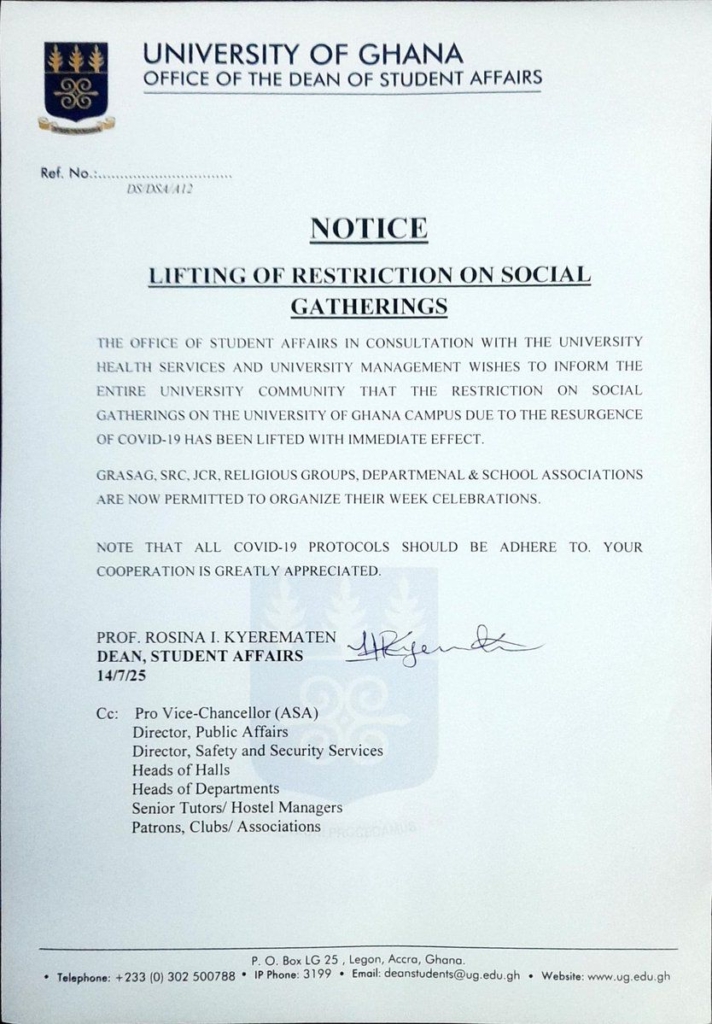
    The University of Ghana (UG), Legon, has lifted the ban placed on social gatherings on campus due to the resurgence of COVID-19 cases.

    As such, all student bodies, including the Graduate Students’ Association of Ghana (GRASAG), Students’ Representative Council (SRC), Junior Common Rooms (JCRs), and departmental and school associations, can now conduct week celebrations.

    Parts of a notice by the management on Monday, July 14, read “The restriction on social gatherings on the University of Ghana campus due to the resurgence of COVID-19 has been lifted with immediate effect”.

    Management had earlier restricted social events, excluding lectures, in response to the resurgence of COVID-19 on campus.

    This directive came ahead of the National Annual Delegates Conference at the UG Sports Stadium from July 18 to 19, to be held by the New Patriotic Party.

    The Health Services Directorate reactivated its COVID-19 Response Protocols, including screening and triage measures at health facilities.

    Subsequently, all staff, students, and visitors were strongly advised to remain vigilant and strictly adhere to recommended preventive measures to reduce the risk of infection and community spread.

    The preventive measures included wearing face masks properly, especially in enclosed or crowded spaces, and washing hands frequently with soap under running water or using alcohol-based hand sanitizers.

    The university community encouraged physical distancing of at least one metre where possible as well as avoid large gatherings unless absolutely necessary.

    “Ensure good ventilation in offices, lecture halls, and meeting rooms,” one of the preventive measures mandates.

    Individuals who experience any flu-like symptoms were advised to stay at home and seek prompt medical attention.

    COVID-19 is the disease caused by the SARS-CoV-2 coronavirus. It usually spreads between people in close contact.

    COVID-19 vaccines provide strong protection against severe illness and death. Although a person can still get COVID-19 after vaccination, they are more likely to have mild or no symptoms.

    According to the World Health Organisation (WHO), COVID-19 symptoms typically appear 5 to 6 days after exposure and can last between 1 and 14 days, ranging from common symptoms like fever, chills, and sore throat to less common ones such as muscle aches, severe fatigue, nasal congestion, headache, sore eyes, dizziness, a persistent cough, chest pain, shortness of breath, hoarseness, numbness, appetite loss, nausea, vomiting, abdominal pain, diarrhoea, altered taste or smell, and difficulty sleeping.

    In 2020, COVID-19 was declared a public health emergency of international concern. In March of the period in question, Ghana recorded its first case.

    In May 2023, the UN World Health Organization declared an end to COVID-19 as a public health emergency, stressing that it does not mean the disease is no longer a global threat.According to the Ghana Health Service (GHS), significant portions of the population remain either partially vaccinated or unvaccinated, posing ongoing vulnerability to the disease.

    In July 2024, the GHS initiated a nationwide COVID-19 vaccination campaign where it administered 500,000 doses of COVID-19 vaccines to all individuals aged 18 years and above, intensifying efforts to bolster vaccination rates.

    Vaccination teams operate at hospitals, clinics, and health centers, ensuring accessibility to COVID-19 vaccines.

    Additionally, teams conduct outreach activities at residences, markets, places of worship, workplaces, and other venues to facilitate widespread access.

    According to GHS, COVID-19 vaccination is now a routine for adults, available at all vaccination sites nationwide.

    As of 2023, the cumulative cases worldwide stood at 765,222,932, with nearly seven million deaths. As of 30 April, a total of more than 13.3 billion vaccine doses have been administered worldwide.

    According to data provided by the UN WHO, Europe recorded the highest number of confirmed cases, approaching 300 million, whereas Africa recorded the least. The highest number of deaths, exceeding 2.5 million, was recorded in Europe. Africa recorded the least number of death cases.

  • National Day of Prayer: Gratitude without patriotism is hollow – Dr Asah-Asante

    National Day of Prayer: Gratitude without patriotism is hollow – Dr Asah-Asante

    Political Scientist and Senior Lecturer at the University of Ghana, Dr. Kwame Asah-Asante, has indicated that a national prayer without actions is meaningless in transforming the country.

    Speaking to the media, Dr. Asah-Asante noted that although uniting in prayers and worship is necessary, it is not enough to resolve national challenges.

    “There is nothing wrong with the national prayer. At some point, we must remember our Maker and give thanks; that is undeniable. But hear this: Gratitude without patriotism is hollow or empty.”

    “Thanks without dedication to work, without hard work, without discipline, without people who are truly results-driven, that kind of thanks is meaningless,” he said.

    He argued that prayers must be matched with responsible leadership and citizen action to make a lasting impact.

    “And most importantly, thanks without holding our leaders accountable, without standing firm against corruption—I’m afraid that is a waste of everyone’s time.”

    “If we have leaders like this, and men of God cannot look our Heads of State in the eye and tell them, ‘You are going wrong’ when the need arises, then we have a serious problem. Too often, they merely watch and seek to glorify those in power. No more! The time for change is now. Men of God must stand firm and speak truth boldly, that is what sets them apart from you and me,” he stated.

    National Day of Prayer is a new initiative under the Mahama-led administration that will bring Ghanaians together to pray, worship, unite, and reflect for the nation’s prosperity.

    The service was grouped into two sessions; the Christian service will take place at the forecourt of the State House at 8:00 am.

    It was led by His Eminence Peter Cardinal Kodwo Appiah Turkson, the Chancellor of the Pontifical Academy of Sciences and Social Sciences.

    While the Muslim service was held at the National Mosque in Kanda at 12:30 pm and led by Chief Imam, His Eminence Dr. Sheikh Osman Nuhu Sharubutu.

    Tuesday, 1st July, Republic Day has been reinstated as a statutory public holiday after Parliament on Wednesday, June 25, passed the Public Holidays and Commemorative Days (Amendment) Bill, 2025, which amends Act 601.

    However, the government has noted that statutory holidays that fall on Tuesday, Wednesday, or Thursday will be commemorated on Monday or Friday. As such, the government’s decision to declare July 4 a holiday.

  • Women who ventured in highlife music were judged as immoral – Mimi Andani

    Women who ventured in highlife music were judged as immoral – Mimi Andani

    Ghanaian musician Mimi Andani has revealed that women hesitated to venture into highlife music in the past because they were judged as lacking morals.

    She referenced her stance to research conducted by renowned ethnomusicologist Professor John Collins at the University of Ghana, which traces highlife’s roots to Osibisaba, an early 20th-century genre, indicating that such women came across as promiscuous.

    “Music, then, wasn’t really seen as something serious. Not to mention women venturing into it. When a woman ventures, she is seen as loose. So women were not encouraged to venture into it, she explained.

    Although highlife has evolved, merging with jazz and shaping the rise of Afrobeat, the lingering stereotype continues to deter many young women from entering the genre.

    “Afrobeats is trending now, but if you look closely, highlife is in it. Yet, women still face judgment when they enter this space,” she stated.

    Mimi Andani is a talented Ghanaian musician who became well-known after representing Ghana on season 3 of Big Brother Africa.

    She gained fame with her first album, Music in Me, released in 2009 by Movingui Records and managed by Empire Entertainment.

    Mimi is known for mixing different music styles like R&B, Highlife, Hiplife, Techno, Rock, and Afropop.

    She has released popular songs like “Leave Me Alone, DJ, Fa Ma Me, and Tattoo, which helped make her a strong and unique voice in Ghana’s music industry.

    In 2024, legendary rapper Kwame Nsiah-Apau known professionally as Okyeame Kwame expressed disappointment in the current state of hiplife in Ghana, asserting that the genre is in a coma.

    Okyeame Kwame asserted he bears responsibility for not passing it on to the next generation.

    In an interview on Starr Chat with Bola Ray, Okyeame Kwame explained that the lack of young artists interested in carrying the torch for hiplife is a major issue.

    He further admitted that he and other pioneers have failed the younger generation of hiplife artists.

    Comparing the success of hiplife in the Western world to Ghana, Okyeame Kwame emphasised that not enough has been done to uphold the genre in Ghana.

    He noted that the passing of the mantle, as seen with artists like Big Daddy Kane and Jay Z, has not been effectively implemented in Ghana.

    “People like myself have failed the young generation completely, because when I took on the mantle of hiplife in 1996, the last thing I knew was anthropology, sociology or marketing. I didn’t know I was supposed to carry this thing upfront and give it to someone else.

    “This thing we’re doing, this is not how it’s done. Big Daddy Kane will carry to a point and give it to Jay Z, Jay Z will give it to another person, another person will give it to Kanye, that is how we keep it moving,” Okyeame Kwame stated.

  • Precious Bonsu Kodo appointed Council Member of UG

    Precious Bonsu Kodo appointed Council Member of UG

    Mrs Precious Bonsu Kodo, the founder and director of WIT School, has been appointed as a council member of the University of Ghana, Legon.

    The council members of the University of Ghana, chaired by Madam Marietta Agyeiwaa Brew, comprise dedicated academics, respected industry professionals, influential alumni, and visionary student leaders.

    In a post on Instagram, Mrs Bonsu Kodo expressed her elation upon the recent appointment while assuring her commitment to contributing her best possible to aid the work of the council.

    “Serving on the Council of one of Africa’s leading universities is a responsibility I hold in the highest regard. I look forward to contributing my experience and passion for innovation, academic excellence, and student welfare to this important role.”

    She added, “I am grateful for the opportunity to collaborate with fellow Council Members and the University leadership to advance the institution’s mission of producing world-class graduates, fostering impactful research, and driving national development.”

    Since her appointment, Precious Bonsu Kodo has received kind words from members of the general public who wished her the best in her service to the country.

    In turn, the council member thanked her well-wishers, stating, “Thank you to everyone who continues to support and inspire my journey. Grateful for your support and congratulatory messages.”

    The reconstituted Council includes Vice-Chancellor Prof. Nana Aba Appiah Amfo, Naa Dr. Alhassan Andani, Dr. Kwesi Amakye-Boateng, Dr. Abdul Karim Hatsu, Ms. Doris Kisiwa Ansah, Prof. Nana Akua Anyidoho, and Mr. Michael Owusu Ansah.

    Others are Mr. John Dadzie Mensah, Prof. Folassade Tolulope, Rev. Fr. Stephen Owusu Sekyere, Mr. George Agyekum Donkor, Ms. Tina Sackeyfio, Major Daniel Ablorh-Quarcoo (Rtd), Mrs. Yvette Adounvo Atekpe, Dr. Inusah Abdul-Nasiru, Mr. Maradona Adjei Yeboah, Mr. Bright Amansiah, and Mr. Benjamin Nkumsah.

  • EPA issues alert on imminent flooding as rainy season nears

    EPA issues alert on imminent flooding as rainy season nears

    Environmental Protection Authority (EPA) has raised concerns about the risk of severe flooding in multiple regions as the rainy season approaches.

    Acting CEO Prof. Nana Ama Browne Klutse has called for an immediate stop to the encroachment of wetlands, emphasizing that such actions are crucial in mitigating the potential devastation caused by floods.

    Addressing the media following her inaugural lecture at the University of Ghana on Thursday, March 27, 2025, Prof. Klutse underscored the urgent need to halt construction on Ramsar sites to safeguard flood-prone areas.

    Her warning follows a heavy downpour and storm on Tuesday, March 26, which triggered flooding in parts of the Greater Accra Region. The storm also brought down trees and billboards, causing damage to vehicles.


    A case in point is the collapse of solar panels at the A&C mall’s car port which caused severe damages to customers cars.

    “We see flooding happening, and this year, we are going to have a lot of flooding happening. Two days ago or even yesterday [Wednesday, March 26], we had heavy rain for a short period, but heavy and stormy,” she said.

    “These are some of the extreme events we are going to be having this year, and we need to prepare our adaptation plan so that we can survive the impacts when they happen.

    “There are a few things we do that actually cause us the flooding. We have to stop building on waterways. So no matter how heavy it rains, water should find its way running into wetlands or areas that are supposed to store water,” Prof. Klutse added.

    Prof. Klutse, former Head of the Department of Physics at the University of Ghana, delivered the lecture titled “Physics, Policy, and Politics of Climate Change: The Foundation of Human Survival.”

    The event attracted several distinguished figures, including the Vice President of the Republic, H.E. Prof. Jane Naana Opoku-Agyemang.

  • Video: Jackie Appiah bags a Masters Degree in Communication Studies at the University of Ghana

    Video: Jackie Appiah bags a Masters Degree in Communication Studies at the University of Ghana

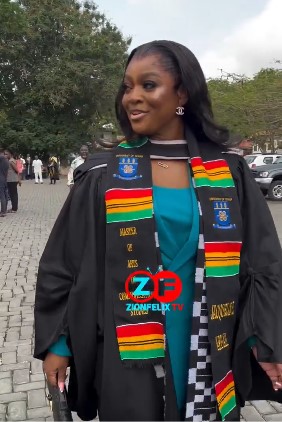
    Ghanaian actress Jackie Appiah has earned a Master’s degree in Communications from the University of Ghana.

    In a video shared on X (formerly Twitter) by social media blogger @SIKAOFFICIAL1, the actress is seen walking gracefully in her graduation gown, wearing a stylish turquoise blue two-piece outfit consisting of trousers and a top.

    Jackie Appiah began her Bachelor’s degree program in Political Science and Information Studies at the University of Ghana in 2019. She successfully completed the program and graduated with a First Class Honors degree in 2022.

    Following her undergraduate studies, she pursued a Master’s degree in Communication Studies, which she completed in 2025.
    Jackie Appiah is a Canadian-born Ghanaian actress who has made a significant impact in both the Ghanaian and Nigerian film industries. Born on December 5, 1983, in Toronto, Canada, she moved to Ghana with her mother at the age of 10.

    She began her acting career in the late 1990s and gained widespread recognition for her role in the Ghanaian film “Princess Tyra” in 2003.

    Throughout her career, Jackie Appiah has starred in numerous successful films, including “Divine Love,” “The Heart of Men,” “Beyoncé – The President’s Daughter,” “The Perfect Picture,” and “Black Soul”. Her talent has earned her several awards, including Best Actress in a Leading Role at the 2010 Africa Movie Academy Awards and Best Actress in a Supporting Role in 2007.

    In addition to her acting career, Jackie Appiah is also a movie producer, fashion model, and humanitarian

  • Don’t watch NPP collapse; we need a vibrant opposition to keep the government in check

    Don’t watch NPP collapse; we need a vibrant opposition to keep the government in check

    University of Ghana Professor Ransford Gyampo has emphasized the importance of keeping the New Patriotic Party (NPP) united after their loss in the 2024 elections.

    He believes Ghana needs a strong opposition to hold the government accountable.

    To achieve this, he has suggested removing the current NPP executives, claiming they were influenced by President Akufo-Addo.

    “Let me call on the owners of the NPP to rescue the party from the claws of Akufo-Addo and the entire executive of the party.

    “They have to stop the imminent disintegration of the party because we need a strong opposition to keep the government on its toes.

    “The party risks disintegrating if people do not come together to take the party from the claws of Akufo-Addo and his remnants, kick all the executives of the NPP and let the party restore its own tradition,” he said on the Key Points on TV3 Saturday, December 14.

    Meanwhile, Dr. Matthew Opoku Prempeh, the running mate to the NPP Flagbearer in the 2024 elections, has expressed disappointment in the party’s loss in the December 7 polls.

    He emphasized the need for the party to reflect on the reasons behind the outcome to bounce back stronger.
    “I have had extensive discussions with our flag bearer, Dr. Mahamudu Bawumia, to reflect on the outcome of the elections and, in good time, we shall reflect further as a political party on the causes of our 2024 election loss,” Dr. Prempeh stated.

    Following the party’s significant loss in the elections, many have interpreted the results as a reflection of Ghanaians’ verdict on Akufo-Addo’s governance.

    Despite this, Dr. Prempeh remains confident that the NPP will “emerge stronger and bounce back to win the trust, confidence, support, and affection of Ghanaians.”

    Dr. Matthew Opoku Prempeh in a statement on December 11, 2024 explained that the party did not expect this monumental loss in the 2024 elections.

    “The 2024 Presidential and Parliamentary elections resulted in a vic tory for the National Democratic Congress (NDC). This was not the outcome we, in the NPP, envisaged; but we respect the verdict of the Ghanaian people.

    “To Ghanaians, we have heard you clearly and with humility we accept. We will work with you to get it right,” he stated.

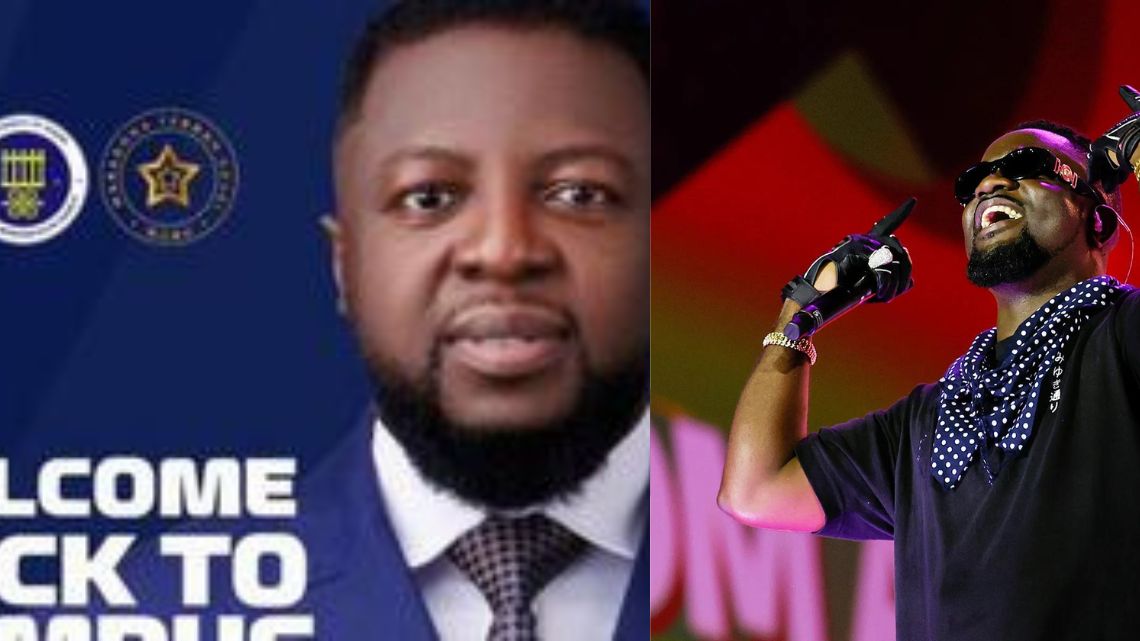
  • Guru thanks Stonebwoy, Sarkodie, LilWin, others for support in winning UG SRC presidency

    Guru thanks Stonebwoy, Sarkodie, LilWin, others for support in winning UG SRC presidency

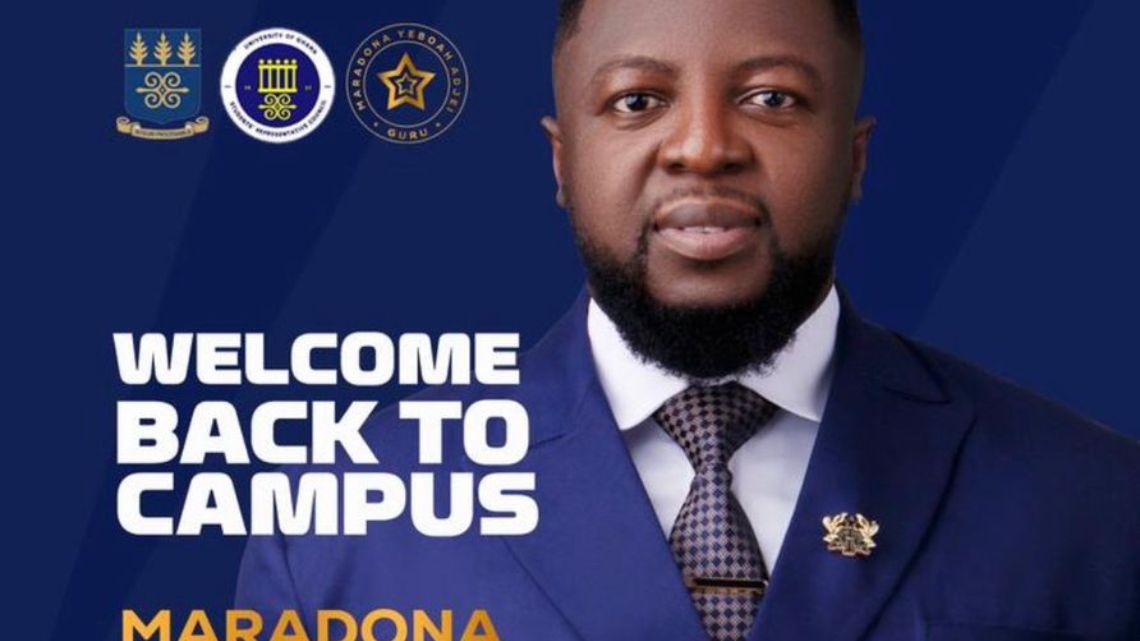
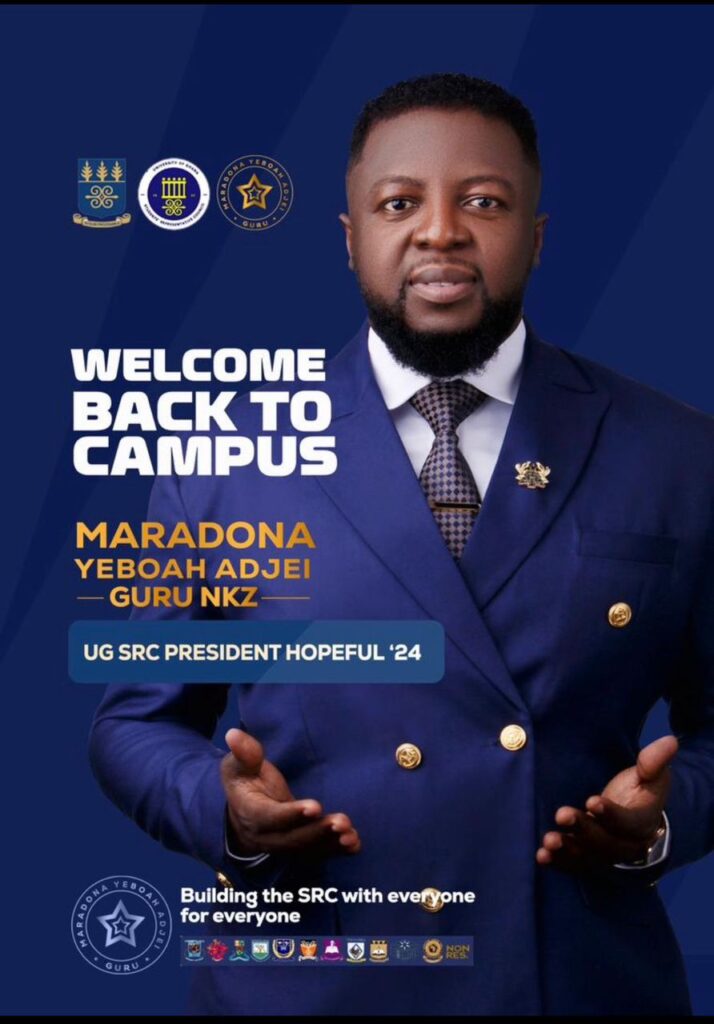
    Ghanaian artist Maradona Adjei Yeboah, better known as Guru, revealed that support from fellow musicians, including Sarkodie, LilWin, Dr. Cryme, and Stonebwoy, significantly contributed to his triumph in the University of Ghana Student Representative Council (SRC) elections.

    In an interview with Hitz FM on October 8, 2024, Guru noted that Sarkodie’s endorsement was especially impactful and played a crucial role in securing his victory.

    “Big shout out to Dr. Cryme, Lil Win, and other artistes who campaigned door-to-door with me. They truly helped me, and a big thank you to Stonebwoy for his endorsement when we went to GIMPA.

    King Sark’s endorsement was a game-changer,” he said.

    He also expressed gratitude to his fans and everyone who supported him during his campaign.

    Background

    Earlier this year, Guru announced his intention to run in the 2024 University of Ghana Student Representative Council (SRC) elections.

    Despite facing disqualification due to his non-resident status after weeks of campaigning, the “Lapaz Toyota” artist fought back through legal challenges and successfully regained his eligibility to run for president.

    Together with his running mate, Jeffery Adu-Yeboah, Guru received 50.7% of the votes, amounting to 9,455 out of approximately 18,659 cast, ultimately winning the UG SRC elections this year.

  • University of Ghana denies rumours of compulsory Apple devices for Computer Science students

    University of Ghana denies rumours of compulsory Apple devices for Computer Science students

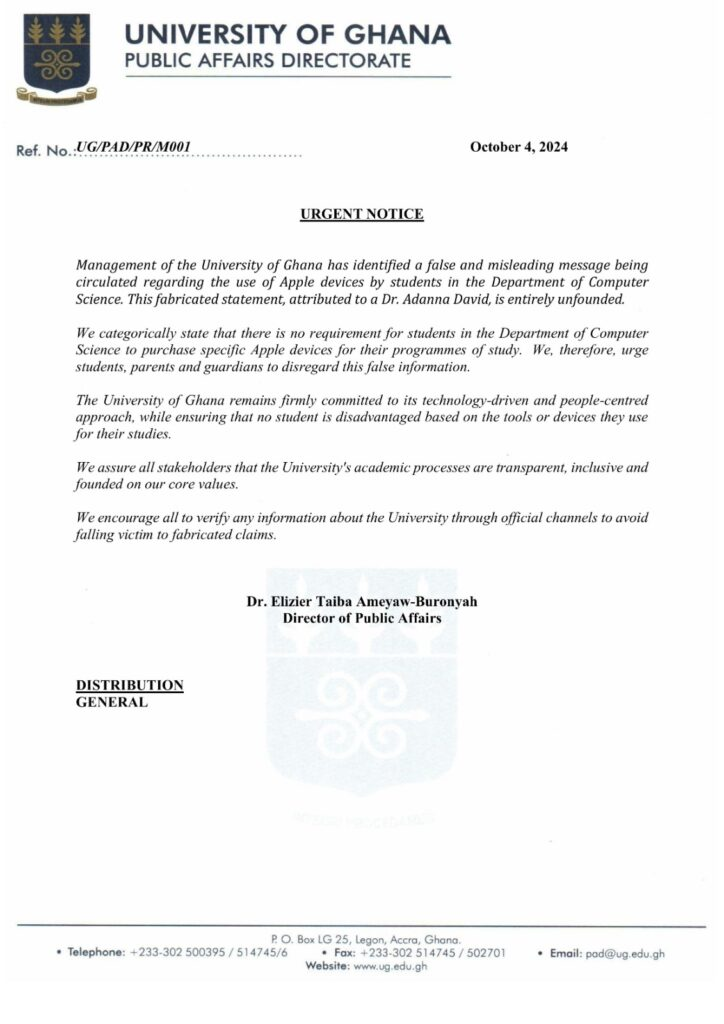
    University of Ghana has publicly refuted a misleading rumour claiming that students in the Department of Computer Science are required to purchase Apple devices for their studies.

    This unfounded assertion suggested that acquiring Apple products was necessary for academic completion.

    In an official statement, the University firmly denied these allegations, clarifying that there is no mandate for any students to acquire specific Apple devices for their courses.

    The administration urged students, parents, and guardians to ignore this misinformation.

    The University emphasised its dedication to offering a technology-driven and inclusive educational environment, ensuring that students are not at a disadvantage based on the devices they opt to use.

    Additionally, the management reassured all stakeholders that its academic procedures are transparent and uphold the institution’s core principles.

    The confusion appears to have originated from a fabricated message alleging that performance issues within the Department of Computer Science were linked to non-Apple devices.

    This false claim implied that students using Android devices were experiencing software compatibility issues that negatively impacted their academic performance.

    It further stated that Apple devices were essential for better outcomes and suggested students invest in iPhones and laptops with specific features.

    University urged everyone to confirm future information through official sources and to be cautious of falling for such misleading narratives.

  • Feeding crops ‘galamsey water’ more lethal than gutter water – Prof Oteng-Yeboah

    Feeding crops ‘galamsey water’ more lethal than gutter water – Prof Oteng-Yeboah

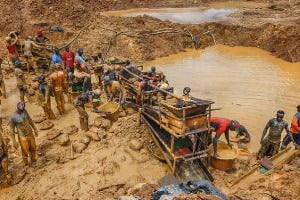
    Retired Professor of Plant and Environmental Biology at the University of Ghana, Prof. Alfred Apau Oteng-Yeboah, has raised concerns about the use of water polluted by illegal mining activities on farm crops, stating that it poses a far greater danger than water from gutters.

    Speaking with Accra-based JoyNews, the professor explained that while water from gutters, commonly used in urban farming, poses short-term illnesses caused by microbes on crops, the produce grown with water affected by illegal mining activities when consumed can lead to the accumulation of chemicals such as mercury in an organism, leading to significant health risks.

    “We have urban farming systems where many people use gutter water to irrigate small vegetable farms. You can immediately see the impact of microbes on the crops’ surfaces, but these microbes are not visible to the naked eye. We only realize their presence when people consume the crops, resulting in diseases like cholera.”

    “When water is polluted by illegal mining, particularly with heavy metals, the danger is even greater. These metals are deliberately used to extract gold, but the remnants left behind are often ignored, and they have serious environmental consequences. This is why we refer to it as an existential threat. If we do not act now, we will face a situation of bioaccumulation where living organisms, including humans, absorb these metals through the food they consume from the soil, leading to dire consequences,” he clarified.

    Prof. Oteng-Yeboah stressed the urgent need to address this issue to avert long-term harm to both human health and the environment.

    Rivers such as the Bonsa in the Western Region and the Pra in the Ashanti Region have been heavily contaminated by toxic chemicals used in mining, while forest reserves like the Tano Nimiri in the Western North Region and the Draw River in the Western Region have also suffered extensive damage.

    The pollution of the Pra River due to illegal mining activities is causing severe repercussions that extend beyond the immediate destruction of the water source and the lack of potable water for nearby communities.

    Recent developments reveal that the contaminated river water is now being used to irrigate crops, putting public health at significant risk. A cocoa farmer from Twifo Praso in the Central Region disclosed this concerning practice

    There are incessant calls from the government to take pragmatic measures to finally address the issue of illegal mining. Organized Labour, led by the Trades Union Congress (TUC), has issued a stern warning to the government, threatening a nationwide strike by the end of September if decisive action is not taken to address the escalating illegal mining crisis.

    In a statement issued by Secretary General of the TUC, Organised Labour, Joshua Ansah, demanded the immediate declaration of a state of emergency in all areas affected by illegal mining.

    The group also called for a halt to all mining activities in forest reserves, the establishment of special courts to fast-track the prosecution of galamsey operators, and the deployment of the military to remove and destroy all mining equipment in affected areas.

    Watch video below:

  • Poisoned water from galamsey activities can affect sperm quality – Prof Osafo

    Poisoned water from galamsey activities can affect sperm quality – Prof Osafo

    Head of the Centre for Ageing Studies at the University of Ghana, Professor Joseph Osafo, has thrown his support behind ongoing protests against illegal mining, highlighting the health risks associated with the practice.

    During a panel discussion on Peace FM on Tuesday, October 1, 2024, he stressed that consuming water contaminated by galamsey activities poses serious threats to the reproductive system, reinforcing the urgency to put a stop to illegal mining operations.

    “It affects your sperm quality; it affects your egg quality. So the direction the youth have taken is very good, but there are issues with their actions. We have to do it again and show Ghanaians and our leaders that we deserve better.

    This is not the state of the water bodies left to us by our forefathers. You could drink directly from the rivers, but now you can’t try that. All the water bodies are poisoned,” he stated.

    Prof. Osafo’s statement was in response to the arrest of over 50 protesters by the police during a recent anti-galamsey demonstration organized by Democracy Hub.

    While lauding the police, Prof. Osafo charged the protesters not to relent in their pursuit but to ensure decency in their quest.

    “So I applaud the police and also advise our brothers that the protest is good, so they have to come again and do it decently this time,” he stated.

    Police have reported that the protesters were involved in acts of disorder, leading to their arraignment before the court. More than 50 of them have since been remanded in custody after their court appearance.

    In the meantime, another protest against illegal mining is set to take place in Accra from October 3 to October 5, 2024.

    The demonstration aims to intensify pressure on the government to tackle illegal mining while also calling for the release of the detained protesters.

  • Strike action forces UG management to postpone  2024/25 academic year commencement

    Strike action forces UG management to postpone 2024/25 academic year commencement

    The University of Ghana has postponed the start of the 2024/2025 academic year due to an ongoing strike by several key tertiary employee unions.

    This development was confirmed in a statement released by the Office of the Registrar on Wednesday, September 25, 2024, notifying students and stakeholders of the decision, which affects the entire academic community.

    While the strike continues, the university assured that special programmes will proceed as scheduled. However, a new commencement date for the general academic year will be communicated once the labour disputes are resolved, and the situation stabilizes.

    The postponement stems from unresolved labour issues between university management and major unions, including the Teachers and Educational Workers Union (TEWU), the Senior Staff Association of Universities of Ghana (SSA-UoG), and the Federation of University Senior Staff Association of Ghana (FUSSAG). These unions have been on an indefinite strike, pressing for long-standing demands to be met.

    The striking unions are advocating for improved working conditions, with their grievances ranging from delayed pension contributions and the non-payment of vehicle maintenance allowances to the suspension of certain agreed-upon benefits.

    The University of Ghana’s management remains engaged in efforts to resolve these disputes, but the strike continues to disrupt normal operations, leading to the academic year’s postponement. Further updates on the new start date for the 2024/2025 academic session will be provided once the situation is resolved.

  • Guru NKZ wows UG students with live performance

    Guru NKZ wows UG students with live performance

    Maradona Yeboah Adjei, popularly known as Guru NKZ, an acclaimed Hiplife artist and current candidate for the University of Ghana‘s Students’ Representative Council (SRC) presidency, recently delighted his peers with an impromptu live performance following a lecture.

    In a video posted on EDHUB’s official X page, Guru NKZ, introduced by a course representative, took to the podium to deliver a lively rendition of his hit track, ‘Lapaz Toyota.’

    The spontaneous concert transformed the lecture hall into a vibrant celebration, with students enthusiastically dancing and singing along.

    Should Guru NKZ advance and win the SRC presidential race, he would join the ranks of notable musicians who have run for SRC positions.

    The first was Reggae Dancehall artist Samini, who successfully won the presidency at the Ghana Institute of Management and Public Administration (GIMPA).

    Guru NKZ’s campaign has garnered significant backing from the entertainment industry, with prominent figures like Sarkodie, Ghana’s leading rapper, and Kumawood star LilWin publicly endorsing him and encouraging students to support his candidacy.

    Watch video below:

  • This is why using dildos, vibrators and anal sex may land you in jail

    This is why using dildos, vibrators and anal sex may land you in jail

    On July 24, 2024, Ghana’s highest court upheld Section 104 of the Criminal Offences Act, 1960 (Act 29), dismissing a challenge brought by Dr. Prince Obiri-Korang, a Law Lecturer at the University of Ghana.

    The Supreme Court ruled that Section 104, which criminalizes ‘unnatural carnal knowledge,’ is constitutional.
    This section of the law defines ‘unnatural carnal knowledge’ as sexual intercourse conducted in an unnatural manner with another person or an animal.

    Convictions under this provision can result in imprisonment ranging from five to twenty-five years.

    The court, led by Justice Baffoe-Bonnie, found the challenge to be without merit, thereby affirming the continued criminalization of certain consensual sexual practices.

    A panel of seven Supreme Court judges, led by Justice Baffoe-Bonnie, unanimously ruled that the plaintiff’s case lacked merit.

    “There is no merit in the action. In the circumstances, the whole action fails and is dismissed,” the court stated in a report on Graphic.com.

    According to Section 104 of the Criminal Code 1960, unnatural carnal knowledge is defined as engaging in sexual intercourse with a person in an unnatural manner or with an animal.

    This same section mandates that individuals found guilty of violating this provision could face imprisonment for a minimum of five years and a maximum of twenty-five years.

  • Presidential candidates are not obligated to participate in debates – Lecturer

    Presidential candidates are not obligated to participate in debates – Lecturer

    Senior Political Science lecturer at the University of Ghana (UG), Dr. Kwame Asah-Asante, has stated that presidential debates cannot be mandated in Ghana’s electoral process since they are not yet institutionalized.

    Dr. Asah-Asante explained that in countries where presidential debates are a standard part of the electoral process, they are formally incorporated into the system.

    His comments come in response to calls from the majority in Parliament for NDC flagbearer John Mahama to accept a debate invitation from the NPP’s flagbearer, Dr. Mahamudu Bawumia, in the lead-up to the December elections.

    In an interview with Citi News, Dr. Asah-Asante emphasized that without formal institutionalization, no presidential candidate can be compelled to participate in debates.

    “Unfortunately, we have not institutionalised it, though it’s a good programme, since you have not institutionalised it, you can’t call anybody. You can make the call but if the person says no, there’s nothing you can do, it will just fall completely from your hand.

    “What the vice president is asking for, if NDC wants to, fine, yes they can, but if they don’t want, and that’s it. You recall the NDC when they were in office they also called and the NPP also didn’t accept that,” he said.

    Dr. Asah-Asante also emphasized that Ghanaians should actively interrogate presidential candidates about their policies during campaign events.

    “Let us see the campaign itself, that one, the two parties and all the parties have no choice but to give us their manifestos, give us the ideas. And we will ask them the questions, that they will answer.

    “But this one [debate], you realise that one party will be ready and another will not, and that will not support the whole exercise. I think the least said about it the better,” the Senior Political Science lecturer at the University of Ghana said.

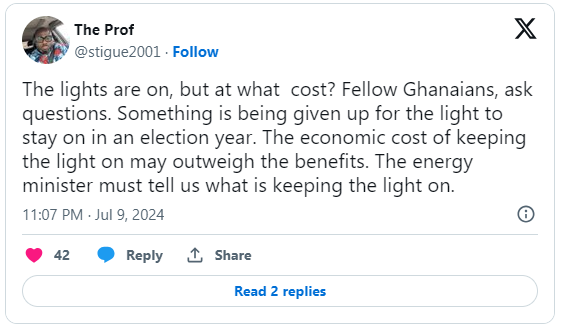
  • “The lights are on, but at what cost?” – UG professor asks Energy Minister

    “The lights are on, but at what cost?” – UG professor asks Energy Minister

    Professor Lord Mensah, a senior lecturer at the University of Ghana (UG), has raised concerns about the recent stability in Ghana’s power supply.

    In a post on X (formerly Twitter), he urged Ghanaians to question the underlying costs of maintaining this stability, particularly in an election year.

    “The lights are on, but what are we sacrificing for it?” Prof. Mensah questioned in his tweet. He highlighted potential economic implications and suggested that political motives might be influencing decisions related to power supply.

    He called on the Energy Minister to provide transparency about the factors ensuring power stability, emphasizing the need for a balanced approach that considers both short-term benefits and long-term economic sustainability.

    See post below:

  • We will never develop if we fail to produce enough for ourselves and Export – Dr. George Domfe

    We will never develop if we fail to produce enough for ourselves and Export – Dr. George Domfe

    We A development economist at the University of Ghana, Dr. George Domfe, has asserted that the cedi, the local currency, will continue to face challenges until Ghana can produce sufficient goods for its citizens and for export.

    Expressing his perspective at the Economic Symposium organized by ABC News on Thursday, June 13, 2024, at the GNAT Hall in Accra, Dr. Domfe emphasized that the fundamentals of the economy remain weak.

    Until these fundamentals improve, the cedi will keep struggling against the US dollar.

    “We have not been producing enough for ourselves and for export, and we have been depending so much on foreign products; there is no way we can get out of this situation. We must produce more to balance the situation,” he said.

    He also emphasized the necessity for Ghana to prioritize its industrial development, as this is crucial for the cedi to maintain strength against the dollar.

    He concurred with the assertion that weak economic fundamentals are revealed by the exchange rate. In his opinion, the country cannot withstand the dollar’s strength due to its weak economic foundations.

    The Economic Symposium is the first in a series of events that ABC News will be hosting in the upcoming months.

    The inaugural edition featured speakers such as Professor Isaac Boadi, Dr. George Domfe, Dr. Frank Bannor, David Amoateng, and Dr. Charles Atuahene, with Dr. Edwin Obodai Provençal serving as the chairman of the occasion.

  • We did not cancel Shatta Wale’s concert – UG management clears the air

    We did not cancel Shatta Wale’s concert – UG management clears the air

    A recent controversy erupted at the University of Ghana (UG) involving popular dancehall artists Shatta Wale and Stonebwoy.

    The Dean of Students, Prof. Rosina Kyeremanten, addressed the allegations, stating that the university and hall representatives had no issues with Shatta Wale.

    The cancellation of Shatta Wale’s performance at TF Hostel was due to the organizers proposing a Karaoke Night rather than an Artiste Night, which required additional security measures amid a ban on student gatherings.

    Prof. Kyeremanten explained that any event in university halls must be approved by her office with a detailed program outline. Stonebwoy’s performance at Limann Hall proceeded because the organizers submitted a request for an Artiste Night, including Stonebwoy, which was approved after necessary security arrangements were made.

    The controversy arose when Shatta Wale accused Stonebwoy of influencing the cancellation, alleging they were prevented from performing at the same venue. The event’s organizers confirmed receiving instructions not to allow Shatta Wale’s performance, despite earlier resolutions with the Dean’s office.

    The Dean emphasized the importance of peace and security on campus, noting the gradual opening up for alumni reunions and events, with the potential for lifting the ban on gatherings in the future.

    Watch video below:

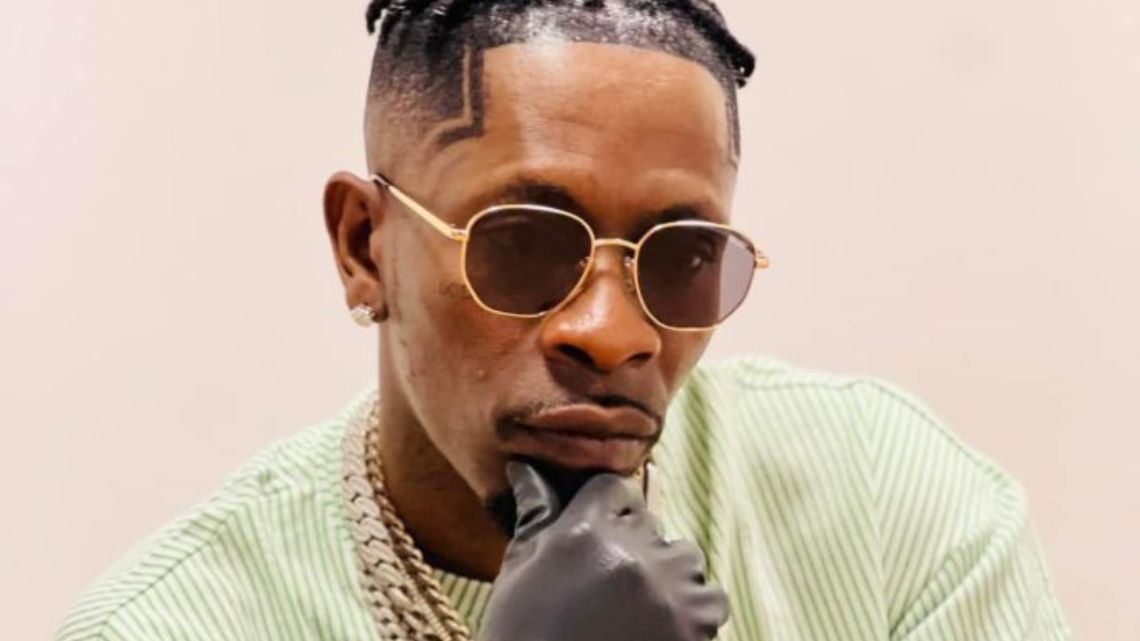
  • I planned on delivering a memorable impact at Legon concert – Shatta Wale

    I planned on delivering a memorable impact at Legon concert – Shatta Wale

    Ghanaian artist Shatta Wale recently discussed the cancellation of his planned performance at the University of Ghana, Legon. He mentioned that besides wanting to deliver a memorable show, he had intended to gift a car to a deserving student during the event.

    This gesture was his way of expressing gratitude to his fans at Legon for their significant support throughout his career.

    He explained that his connection with the university community was special, citing how a particular hall played a crucial role in the success of one of his songs. Shatta Wale aimed to reciprocate this support by giving back to the students.

    However, he expressed disappointment at the cancellation, attributing it to what he perceived as industry bias and favoritism. Shatta Wale felt that the decision to cancel his performance was influenced by factors such as the release of another artist’s concert flyer.

    Despite his outspoken nature, Shatta Wale clarified that his actions were not intended to incite violence or security concerns. He highlighted that his principles and quest for fairness sometimes led to controversial perceptions.

    Shatta Wale shared these thoughts during a TikTok live session with his fans, addressing the situation candidly.

  • UG congratulates Afronitaaa, Abigail on BGT success

    UG congratulates Afronitaaa, Abigail on BGT success

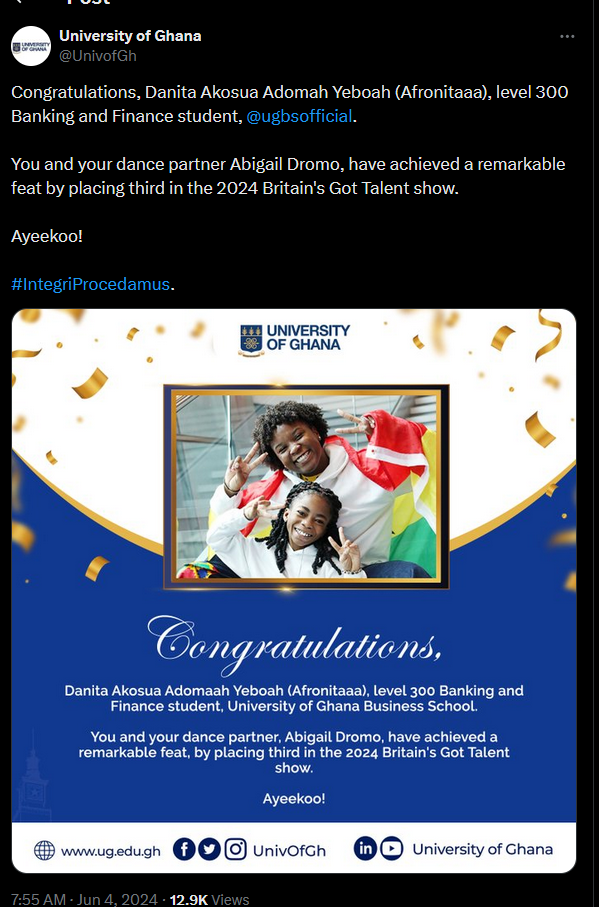
    The University of Ghana, Legon, recently took to social media to celebrate the impressive accomplishment of Afronitaaa and her dance partner Abigail at the recently concluded Britain’s Got Talent competition.

    The university’s congratulatory message praised the duo’s role in elevating Ghana’s presence on the global stage.

    “Congratulations to Danita Akosua Adomah Yeboah (Afronitaaa), a third-year Banking and Finance student at the University of Ghana Business School, and her dance partner Abigail Dromo. Your achievement of securing the third-place position at the 2024 Britain’s Got Talent is truly remarkable. Well done!”

    Afronitaaa and Abigail secured the third position in this year’s edition of Britain’s Got Talent, competing for the substantial £250,000 prize and the opportunity to perform at the Royal Variety Performance.

    Even though they didn’t win the top prize, their performance captured the hearts of both the audience and the judges.

    The winner of Britain’s Got Talent this year was Sydnie.

    Following the event, Afronitaaa expressed gratitude for the opportunity to showcase their talent on such a prestigious platform and thanked the people of Ghana and the diaspora for their unwavering support.

    Britain’s Got Talent is judged by Simon Cowell, Amanda Holden, Alesha Dixon, and Bruno Tonioli and hosted by the popular duo Ant and Dec.

    See post below:

  • Final year Legon student passes away two months to completion

    Final year Legon student passes away two months to completion

    The University of Ghana, Legon community is in mourning following the untimely passing of a final year Accounting student.

    Identified as Jeroon, she was known for her dedication and vibrant presence on campus, serving as the Legon Hall representative for PENSA and actively participating in evangelism and other activities.

    Despite being just two months away from completing her four-year degree, Jeroon’s life was tragically cut short after a brief illness following her involvement in an evangelism program.

    Reports suggest that complications related to malaria led to her demise.

    Her passing has deeply saddened friends, classmates, and faculty members, who remember her as a bright and promising student with a positive impact on those around her.

    The news has sent shockwaves throughout the university campus, leaving many in grief and disbelief.

  • Sarkodie backs Guru’s UG SRC presidential bid

    Sarkodie backs Guru’s UG SRC presidential bid

    Renowned rapper Michael Owusu Addo, popularly known as Sarkodie, has thrown his support behind Guru’s bid for President of the Students’ Representative Council (SRC) at the University of Ghana.

    During his performance at the Pent Hall Week Artiste Night on Friday, May 24, 2024, Sarkodie urged students to vote for Guru, emphasizing the positive impact he believes Guru’s leadership would bring to the university.

    Sarkodie stated that Guru’s leadership would not only improve the school but also enhance opportunities for creatives within the campus community.

    Addressing the crowd, Sarkodie exclaimed, “If you want me to return here, then make Guru the SRC President,” expressing his confidence in Guru’s ability to lead effectively.

    Guru’s candidacy adds to the growing trend of public figures seeking political roles within educational institutions, following in the footsteps of Samini, who led the SRC at the Ghana Institute of Management and Public Administration (GIMPA).

    The “Pooley” rapper aims to take charge of the University’s student body, bringing a fresh perspective and promising leadership akin to his musical prowess.

  • University of Ghana to commercialize plastic-to-fuel conversion project

    University of Ghana to commercialize plastic-to-fuel conversion project

    With the aim of combating plastic waste, contributing to sustainable energy solutions, and ensuring affordable fuel, the University of Ghana (UG) is set to commercialize its plastic-to-fuel conversion project.

    Professor David Dodoo-Arhin, Director of the Institute of Applied Science and Technology (IAST), revealed that the decision to scale up the project followed successful proof of concept trials involving vehicle testing with fuel derived from plastic waste.

    He made this announcement during the university’s 7th industry-academia interaction series and exhibition, themed ‘sustainable energy transitions and climate change: the role of partnership’.

    “We will be moving into large-scale production. We have successfully proven the concept, and it worked. So, we intend to scale it up and look forward to welcoming potential partners,” he stated.

    The research project began in 2018 through a partnership between the School of Engineering Sciences and IAST at the University of Ghana, with assistance from the French embassy.

    While there are various methods for recycling plastics, the approach employed in this endeavor is known as valorization. Its objective is to assign value to plastics while gradually reducing their presence in the environment.

    On the particular plastics utilised in the conversion process, he said: “We are looking at single-use plastics including polyethylene bags, polyethylene terephthalate (PET) bottles, among others”.

    He mentioned that his organization has completed installations of the locally constructed reactor or processor for plastics-to-fuel in Osu Alata.

    Additionally, they plan to conduct a training program in June to educate approximately 50 youths in the community on the processes of washing, cleaning, and segregating plastics.

    “By mid-June, we will start the training project. The training is to empower the youth, especially those who are not employed. They will get into the value chain of collecting the plastics.

    “We will train them on how to wash the plastics, how to clean them and segregation, then take them through the process of conversion which is a little bit technical. But currently, we intend to train about 50 community members on this project,” he added.

    Furthermore, he elaborated that the objective of the plastic project in Osu is to intercept plastics destined for the ocean and to encourage fishermen to view plastics as a valuable resource for fuel production.

    Dr. Dodoo-Arhin described the project as a “game changer” and expressed confidence in the fuel’s affordability advantage, saying: “Looking at what we have done, it’s going to be a little cheaper if we go the way we are running”.

    Nana Osei-Bonsu, Chief Executive Officer (CEO) of the Private Enterprise Federation, expressed concern over the adverse effects of high electricity costs on businesses during his presentation.

  • Current currency trends driven by market sentiment – Economist

    Professor Lord Mensah, an economist at the University of Ghana Business School (UGBS), attributes the ongoing depreciation of the local currency to market sentiment.

    According to him, individuals are holding onto the dollar in anticipation of its value increasing in the near future, resulting in reduced trading activity at present.

    “If you take what is happening now, I will attribute it to more of a market sentiment other than the structural issues.”

    “The reaction of the next level of the dollar at any point in time. If you are holding the dollar as to whether to sell it or to hold it depends on your anticipation of the dollar price in the next few moments or the next day, that is what is happening now.

    “So we have gone past the structural issues which used to be the balance of payment crisis that we had. Where our balance of payment depleted so as a result of that, the dollar buffer went down but what we see now is a self-fulfilling crisis,” he said.

    Presently, the cedi, previously trading at GH₵ 11.98 against the dollar, has surged to approximately GHC 14.80 at forex bureaus. This marks a depreciation rate of nearly 20% since the year commenced.

    In the meantime, Minority Leader Dr. Cassiel Ato Forson has urged NPP flagbearer Vice President Dr. Mahamudu Bawumia to refrain from off-beat dancing on the campaign trail and instead prioritize efforts to stabilize the depreciating cedi.

    During a press briefing in Parliament on Wednesday, May 15, Dr. Ato Forson expressed concern about the negative effects of the cedi’s depreciation on businesses in areas like Okaishie, Abossey Okai, Kejetia, and other commercial hubs.

    The Caucus also highlighted worries regarding the lack of economic improvement despite the funds received from the International Monetary Fund (IMF) and the World Bank as part of the ongoing bailout program.

    He said, “In spite of the huge inflows of foreign exchange from the IMF and the World Bank, into the Ghanaian economy, and I’m talking of billions of Ghana cedis, billions of US dollars, the government’s action and its management of the cedi have continued to fuel steep depreciation with no end in sight unfortunately.”

    “So far, the decisions of the Economic Management Team, chaired by our Vice President Alhaji Bawumia leaves a lot to be desired. The reality of the Ghanaian economy today exposes the credentials of the so-called economic wizkid who was marketed as the savior of Ghana’s economy. Alhaji Bawumia’s credibility is now tatters.”

    GUTA decries high exchange rate

    According to Dr. Joseph Obeng, President of the Ghana Union of Traders Association (GUTA), the depreciation of the cedi against major trading currencies, particularly the dollar, has led to rising business expenses in Ghana.

    Dr. Obeng noted that businesses are facing challenges servicing their debts with banks due to the exchange rate fluctuations.

    GUTA, in a statement on May 14, expressed “deep frustration over the current depreciation of the cedi, which is creating a big mess for the business community, especially, the trading sector. This seeming crisis coupled with the ever-rising freight charges from Asia are rendering the cost of doing business unbearable.”

    Weak fundamentals?

    Meanwhile, a lecturer at the Department of Finance at the University of Ghana Business School (UGBS) has attributed the depreciation of the cedi to “weak fundamentals.”

    Dr. Benjamin Amoah said, “The fundamentals are definitely weak. We should not play jokes about it. The truth is that the fundamentals are very weak. What is the fundamental here? What is the inflation rate as we speak now and what is has been the inflation rate over time, very high. What is interest rate, that is the fundamental factor, it is very high.”

    “What is unemployment rate now? Unemployment rate is very high. What is our balance of payment position, it is very high and these are the very fundamentals that is used in accessing the exchange rate.”

    According to him, the government addressing just one of the indicators does not resolve the depreciation of the cedi, stating that “it requires effective management of each of these factors.”

  • Rapper Guru intensifies campaign for UG SRC Presidency

    Rapper Guru intensifies campaign for UG SRC Presidency

    Renowned Hiplife artiste Maradona Yeboah Adjei, popularly known as Guru, is intensifying his campaign to secure the Student Representative Council (SRC) Presidency at the University of Ghana.

    The artiste, who is also a fashion designer, is currently pursuing a degree in Political Science and Information Technology and has officially declared his candidacy.

    Guru, famous for hits like ‘3nny3 Nwanwa,’ is driven by a passion to address the challenges faced by his fellow students on campus.

    His decision mirrors the successful bid of Samini, another celebrated Ghanaian artiste, who recently clinched the SRC Presidency at the Ghana Institute of Management and Public Administration (GIMPA).

    In a social media post welcoming students back to campus, Guru shared his aspirations: “Maradona Yeboah Adjei (GURU NKZ) welcomes all students back to campus; Dear Legonites, it’s great to see you back. Here’s to starting the semester with a burst of positivity and excitement!”

    See post below:

  • I will pick 1st class degree over $1m so I can make more money – UG student

    I will pick 1st class degree over $1m so I can make more money – UG student

    A female student at the University of Ghana (UG) has sparked debate with her decision between receiving a million dollars and attaining a first-class degree.

     In a widely circulated video, the determined lady passionately expressed her prioritization of academic achievement.

    While acknowledging the considerable value of a million dollars, she emphasized the significance of earning a prestigious degree. 

    According to her, attaining a first-class degree not only brings personal satisfaction but also garners substantial recognition and opportunities.

    She further elaborated that achieving a first-class degree would pave the way for lucrative career prospects, enabling her to earn significant income in the long term. 

    In contrast, she suggested that a one-time sum of a million dollars might provide temporary financial relief but would not guarantee sustained prosperity.

    “Definitely a 1st class, I am going to make millions out of that with my profession. Because taking just one million dollars and spending will not last, but my profession will always be with me. I can make more money with my profession,” she added.

    Watch video below

  • Guru NKZ sets sights on UG SRC Presidency; promises to introduce Legon TV

    Guru NKZ sets sights on UG SRC Presidency; promises to introduce Legon TV

    Well-known musician and a student pursuing studies in Political Science and Information Studies at the University of Ghana (UG), Guru NKZ  is gearing up for a significant shift in his career trajectory.

    He has officially announced his candidacy for the presidency in the forthcoming 2024/2025 Student Representative Council (SRC) elections at the university.

    In a recent interview with Accra-based TV3, Guru expressed his determination to address critical issues affecting the university community.

    He stressed the urgency of providing concrete solutions to the prevalent challenges faced by students within the institution.

    “I’m currently studying with the University of Ghana in Political Science and Information Studies and I’m in my third year. I want to start there because I have seen the happenings and the kind of leader that people want,” Guru remarked during the interview.

    His proposed initiatives include the establishment of Legon Television, improving campus transportation services by adding more buses, and introducing recreational activities to help alleviate student stress.

    “I’m looking forward to bringing Legon TV; students are tired of the radio station. We should have a Legon TV, the buses on campus are very few, we need to add more,” Guru emphasised.

    Furthermore, Guru aims to revive the University of Ghana’s prestige, attracting prospective students and restoring the institution’s former glory.

    If successful in his bid, Guru will join the ranks of musicians like Samini, who previously secured the SRC Presidency at GIMPA in 2022, showcasing a notable fusion of music and student leadership.

    Watch video below:

  • You can’t act anyhow just because you are a “dead-goat” leaving office – Gyampo slams Akufo-Addo

    You can’t act anyhow just because you are a “dead-goat” leaving office – Gyampo slams Akufo-Addo

    A professor at the University of Ghana, Ransford Gyampo, has criticized President Akufo-Addo, alleging that he has adopted a “dead goat syndrome” attitude after completing his two terms in office.


    According to Prof. Gyampo, it’s time to enact legislation against what he terms “Presidential Dead-Goatism” to prevent leaders from behaving recklessly as their terms wind down.


    During an appearance on TV3’s Key Points program on Saturday, March 30, Gyampo stated, “The President appears to be telling Ghanaians that he’s exiting and hence he’s a dead-goat and doesn’t care about what anyone say or does. Even when the general will of the good people of Ghana has been resoundingly expressed against LGBT, the President seems to want to swim against the tide by resorting to surreptitious and disingenuous maneuverings just to undermine the will of the people.


    “But we cannot allow a President to behave any how he pleases just because he’s exiting and so he’s a dead-goat. We must act on presidential dead-goatism before it overly frustrates Ghanaians and pushes unscrupulous people to act in an unorthodox manner.”


    Expressing concern over the President’s apparent disregard for public sentiment, especially regarding issues like LGBT rights, Gyampo stressed the need to curb such behavior before it causes frustration among Ghanaians and encourages unscrupulous conduct.

    Addressing the dismissal of a suit filed by South Dayi Member of Parliament, Rockson-Nelson Dafeamekpor, against the consideration of new ministers, Gyampo emphasized that the dismissal doesn’t equate to automatic approval of the ministerial nominees.


    Asserting the primacy of parliamentary oversight, Gyampo remarked, “It is not a marching order to act on the ministerial nominees of the president”.


    “Parliament is superior to the executive arm…President Akufo-Addo has a nation to govern and so the responsibility lies on him to act in a manner that shows cooperation because if the hung parliament decides to frustrate the government we will all suffer,” he added.

    He urged President Akufo-Addo to collaborate with the legislature for the nation’s benefit.


    Meanwhile, the Supreme Court dismissed Dafeamekpor’s injunction application, deeming it frivolous and an abuse of the judicial process.

    The application sought to block Parliament from vetting and approving new ministers announced by President Akufo-Addo.

  • John Dumelo offer free lecture for UG students as they prepare for exams

    John Dumelo offer free lecture for UG students as they prepare for exams

    Actor and politician, John Dumelo, showcased his dedication to aiding University of Ghana students in their academic pursuits by hosting a free tutorial session on Thursday, March 28, 2024.

    Through a post on social media, he emphasized the importance of the tutorial, focusing on Academic Writing and Critical Thinking, to assist students in gearing up for their forthcoming semester exams.

    Mr. Dumelo urged students to prioritize their studies and shared images from the fruitful session across his online platforms.

    Dumelo’s caption read: “Yesterday, in preparation for their exams next week, we conducted tutorials on Academic Writing and Critical Thinking for select University of Ghana first-year students.”

    “We wish them all the best in their exams. #idey4u #AyawasoWest”

    Below is the post

  • Tender Notice: University of Ghana seeks consulting Firm for health literacy and COVID-19 assessment

    Tender Notice: University of Ghana seeks consulting Firm for health literacy and COVID-19 assessment

    UNIVERSITY OF GHANA COLLEGE OF HEALTH SCIENCES

     REQUEST FOR EXPRESSION OF INTEREST 

    ENGAGING A CONSULTING SERVICES OF A FIRM TO CONDUCT END OF PROJECT NEEDS ASSESSMENT AND COMMUNITY MEMBER TESTING ON HEALTH LITERACY INCLUDING COVID-19 FOR GIZ DEVELOPPP PROJECT AT SCHOOL OF PUBLIC HEALTH

    Reference No. GR/UG/CHS/CS/GIZ/REOI/001/24 

    The University of Ghana, College of Health Sciences, intends to engage the services of a consultant to help conduct End of Project Assessment survey and Community Member Testing on Health Literacy with emphasis on COVID-19 as part of the Private Sector PANDEMIC PREPAREDNESS to COVID-19 project (develoPPP.de) been implemented by the school. 

    The exercise seeks to select an eligible consulting servicing firm to offer or conduct end of project Assessment Survey for selected MMDAs and Health Literacy Test including COVID-19 for community members in selected catchment communities: Project to assess the achievements of project intervention by comparing results to the baseline results. Also, at the end of the project, it is envisaged that MMDAs and specific health facilities will be well-resourced in dealing with the current and future pandemics. Also, specific relevant policy frameworks will have been developed. As an outcome of this project, partnering companies will have well-established PPPs and BCPs and enhanced EWPS whereas the employees will have increased access to health and safety, improved financial wellbeing as well as have their jobs secured. 

    The University of Ghana now invites expression of interest to engage the services of a Consultant for School of Public Health-GIZ DEVELOPPP PROJECT, from firms with a verifiable truck record of similar kinds of assignment. The terms and conditions of the assignment will be spelt out in details in the Terms of Reference (TOR) after the successful shortlisting of potential firms. 

    The Firms will be selected in accordance with the procedures set out in the Public Procurement Act, 2003 (Act 663) as amended, Act 914, Act 2016; of the Republic of Ghana. 

    Eligible Firms must submit Expression of Interest (EOI) indicating the following: 

    • Firm’s profile indicating relevant truck records of similar assignment undertaken.
    • A brief of the Firm’s vision and plans for the assignment.
    • Evidence of Firm’s capability to do an assignment of this nature. 

    Expression of Interest (EOI) must also include copies of the following documents: 

    • Renewed / Valid Business Registration Certificates issued by the Registrar Generals Department, Ghana.
    • Form A (Enterprise) and or Form 3 and 4 (Limited Liability) 
    • Valid GRA Tax Clearance Certificate 
    • VAT Registration Certificate
    • Valid SSNIT Clearance Certificate 
    • Valid Public Procurement Authority (PPA) Registration Certificate or Evidence of Registration 

    Further information can be obtained at the address below during office hours from 9:00 am to 4:00 pm local time from Monday to Friday: 

    COLLEGE OF HEALTH SCIENCES (ADM BLOCK). 

    THE PROCUREMENT OFFICE, (ROOM 27) K

    ORLE-BU, NEAR THE DENTAL SCHOOL 

    Telephone: 233-0244-075529 

    Email: doloffice@ug.edu.gh / Procurement@ug.edu.gh 

    Expression of Interest (EOI) must be delivered to the address below: 

    Charles Easmon Conference Room of the College of Health Sciences Administration block at 11.30am local time, Monday 8 April, 2024.

  • University of Ghana’s School of Performing Arts facility neglected for 20 years

    University of Ghana’s School of Performing Arts facility neglected for 20 years

    As visitors step into the space, they are greeted by a thick blanket of dust, mirroring the depth of the memories it holds. Once vibrant with creative energy, the air now feels burdened by the weight of neglect and abandonment.

    Over the years, the relentless passage of time has allowed debris to accumulate, claiming every corner and crevice as its own.

    Cobwebs drape loosely, swaying in the stillness of the humid air, serving as silent witnesses to the passage of time.

    Inside the 20 years abandoned University of Ghana school of Performing Art multi-purpose building.
    Inside the 20-year abandoned University of Ghana School of Performing Arts’ Multi-Purpose Facility. Photo Credit: Clement Edward Kumsah/The Fourth Estate

    This structure, known as the School of Performing Arts’ Multi-Purpose Arts Facility, was initiated with a sod-cutting ceremony and subsequent construction commencement two decades ago.

    However, it now stands as a haunting symbol of neglect on the University of Ghana campus.

    “I just think we are not anybody’s priority. People don’t think the arts deserve the best,” the Acting Dean of the School of Performing Arts, Prof. Awo Mana Asiedu, lamented to The Fourth Estate.

    “I don’t think the science building would be left for this long. But I say, take the performing arts out of society and we will all be miserable. Imagine a society without music, dance, or performance. What kind of society would that be? We are the soul, but we are being neglected,” she posited.

    In 2004, President John Agyekum Kufuor ceremonially inaugurated the commencement of the facility’s construction.

    The architectural blueprint envisioned spaces dedicated to practical courses in music, dance, and theatre, along with rehearsal rooms, costume storage, offices, and faculty spaces.

    Yet, two decades since the groundbreaking ceremony, the edifice has transformed into what some describe as a ‘white elephant,’ symbolizing unfulfilled promises and neglected potential.

    Side view of the abandoned University of Ghana school of Performing Art Multi-Purpose Arts Facility with mounted air conditioner inverters left at the mercy of the weather
    Side view of the abandoned University of Ghana School of Performing Arts’ Multi-Purpose Facility with mounted air conditioner inverters left at the mercy of the weather. Photo Credit: Clement Edward Kumsah/The Fourth Estate

    Contract documents acquired from the University of Ghana state that Micsat Limited was awarded the contract in 2004 with an estimated cost of slightly over GHS18.5 million.

    “They kept increasing the scope of work and demanding more money for it,” a source at the Ghana Education Trust Fund (GETFund), which is the financier of the project, told The Fourth Estate on condition of anonymity.

    “GETFund couldn’t cope with the demands because we had projects across the country that were equally financially demanding,” the source said.

    Frustrated students, unhappy industry experts

    Arial view of the University of Ghana School of Performing Art. Photo Credit: Clement Edward Kumsah/The Fourt Estate.
    Arial view of the University of Ghana School of Performing Arts. Photo Credit: Clement Edward Kumsah/The Fourth Estate

    The Efua T. Sutherland Drama Studio, the sole studio for the school, serves as a central hub for research, workshops, and performances.

    However, its open-air layout renders it vulnerable to weather disruptions, resulting in canceled rehearsals and impractical productions during inclement weather.

    The current condition of the UG School of Performing Arts facility, utilized by both lecturers and students, exacerbates the issue.

    For Sarah Doh, a level 400 student, the absence of dedicated facilities proves frustrating, a sentiment echoed by many others. She conveyed to The Fourth Estate that the lack of designated space impedes her ability to refine her skills through practical experiences, an essential aspect of her education.

    “That building was there before I came to this school. We just don’t know what has happened to it because it’s rotting while we need a place to learn and do our practicals,” she said. “The completion of that building [will be] a crucial step towards nurturing a vibrant and thriving community of performing artists at the university because we need it so badly.

    “Our collective plea is not merely for a building but for a creative sanctuary that fosters growth, innovation, and the realisation of [our] artistic aspirations as students of performing arts,” she noted.

    George Quaye, a well-known actor and Team Lead at Image Bureau and a graduate of the School of Performing Arts, told The Fourth Estate that the creative arts sector would suffer if the facility is not finished.

    george-quaye
    Team Lead, Image Bureau, George Quaye

    “The absence of such a facility hampers the development of the arts industry, limits opportunities for artists, and hinders the potential economic benefits that a thriving arts sector can bring to the country,” he said. “It’s even worse when one considers the fact that the nation is currently grappling with lack of venues for events.”

    Using internally generated funds on rent

    The administrative set up of the University of Ghana creates a competitive environment where each school/college is compelled to be financially viable to invest in infrastructure, programmes and activities.

    Acting Dean of the School of Performing Arts, Prof. Awo Mana Asiedu
    Acting Dean of the School of Performing Arts, Prof. Awo Mana Asiedu

    This means that other schools/colleges in the university don’t give out their spaces including conference facilities out for free. The School of Performing Arts is, therefore, forced to rent spaces from other departments of the university.

     That, Prof Asiedu said, can be financially draining as the school spends a lot of its internally generated funds on renting space for its events.

    “We are going to hold two international conferences in July this year. We were hoping that this auditorium will be completed so that we will use it for our preliminary sessions and so on. But look at it, we can’t use it.” She lamented.

    “We had to pay money to other departments, such as the Economics Department, having to pay over GHS100,000 for the spaces for those conferences. So that is money we could have used for something else for the conference. We are losing money because that building is not completed,” she revealed.

    IN PICTURES: The current state of the 20 years abandoned University of Ghana school of Perform…

     GETFUND & GTEC

    GETFUND announced in May 2022 that it had obtained Parliamentary approval to finalise all projects that were awarded before 2017, “within the upcoming three years.”
    However, the Deputy Director of Physical Planning and Municipal Services Directorate (PDMSD) at the University of Ghana, Mr Peter Abalansah, told The Fourth Estate that the project’s completion had stalled due to “lack of funding” from GETFund.

    He said if the project is to continue today, it would need an additional GHS20 million to be completed. That will double the project’s cost.

    “The consultants are yet to provide the information on payments made to date,” Mr Abalansah responded when asked about the amount spent on the project since construction began.

    When The Fourth Estate contacted GETFund to find out why the project had delayed, it said its tertiary projects were financed through the Ghana Tertiary Education Commission (GTEC) and therefore it does not speak on stalled projects.

    Ghana Education Trust Fund (GETFund), the Financier of University of Ghana School of Performing Arts Abandoned Facility.
    Ghana Education Trust Fund (GETFund), the Financier Responsible for the completion of the University of Ghana School of Performing Arts Abandoned Facility.

    The Head of Project Management at GTEC, Mr Anthony Debre, said that historically, universities in Ghana operated autonomously in terms of project financing until GTEC instituted a policy of project financing.

    He said each year, GETFUND allocated funding to universities, which then determined their project priorities. This autonomy, according to him, sometimes resulted in projects being initiated and later abandoned after changes in university leadership.

    Mr Debre said that cash flow constraints, as well as changes in university leadership, had impacted the progress of the facility at the School of Performing Arts, leading to shifts in project priorities.

    He said GTEC did not have direct control over the execution of specific projects. He added that the University of Ghana was responsible for selecting and managing contractors for its projects.

    UG, rich enough to complete project

     Regarding the university’s resources, Mr Debre encouraged institutions like the University of Ghana, which had significantly increased their student intake and generated substantial funds internally, to allocate a portion of these funds to complete existing projects.

    “If GETFund has invested in the University of Ghana and now it has been able to increase its intake from 18,000 to almost 80,000, they should be able to use the money. They should be able to allocate a percentage from every department to clear all projects on campus,” he said.

    “GETFund was financing your project, and you [University of Ghana] were building a multi-million-dollar stadium. When the government wanted to use it for the African games, they came to top it up and complete it. So, you [University of Ghana] can also complete anything that GETFund started on your campus,” he stressed.

    Engineer’s warning

    However, the issue may not just be about completing a project that has been abandoned for 20 years. The Institution of Engineering and Technology, Ghana, is worried that the structure might have suffered from physical defects due to years of neglect, making physical assessment and inspection necessary to identify potential dangers lurking beneath the brick and mortar.

    “Because of years of abandonment, the facility may have been exposed to weather and environmental factors, which could have implications for its structural integrity. A thorough assessment is required to determine whether the building should be demolished or continued, similar to what happened at Okomfo Anokye where a building was proposed for demolition after its integrity assessment,” President of the Institution, Henry Kwadwo Boateng, told The Fourth Estate.

    WhatsApp Image 2023 12 19 at 10.04.28
    President, The Institution of Engineering and Technology, Ghana, Henry Kwadwo Boateng

    He said the delay in completing the structure would significantly impact the project’s overall cost, adding that factors such as currency depreciation, time value of money, and the deterioration of materials and equipment would lead to additional expenses.

    To ensure the completion of the building and save cost, Mr Boateng suggested that if the assessed cost surpasses a certain threshold, the project could be terminated, repackaged, and awarded to the same or a different contractor.

    However, this approach might come with disadvantages such as potential legal disputes, he warned.

    Mr Boateng suggested that passionate appeals to the government can be a major avenue to get the project completed. While it may not be easy to obtain external loans for such abandoned projects, alternatives such as government guarantees for the university to secure loans could be explored, he said.

  • Unemployment in Ghana must be addressed with practical solutions – Lecturer to govt

    Unemployment in Ghana must be addressed with practical solutions – Lecturer to govt

    A Senior Lecturer in the Department of Economics at the University of Ghana, Dr. Priscilla Twumasi Baffour, has advocated for a solution-oriented approach to tackle the country’s unemployment challenges.

    Emphasizing the importance of addressing challenges in the production sector, she believes it is crucial for restoring the economy and curbing unemployment.

    Responding to the proposal of a 24-hour economy by John Mahama as a potential solution, Dr. Twumasi Baffour asserts that additional measures need implementation.

    She questioned the proposed policy’s impact on removing hurdles faced by small and medium-sized enterprises and its focus on enhancing the education, training, and skills of individuals entering the labor market.

    “What is the intervention doing in terms of removing challenges that small and medium-sized enterprises face in this country?

    “What is the proposed policy doing in terms of the supply side, the education, training and skills of the people that are moving into the labour market?” .

    “Skills in terms of digital skills, soft skills and all the relevant skills that the changing labour market requires in this economy,” she added.

    Dr. Twumasi Baffour highlights the rapid influence of technology on production organization and stresses that any policy intervention should deliberately eliminate barriers to production while equipping the workforce with essential skills. These skills encompass digital proficiency, soft skills, and other relevant abilities demanded by the evolving labor market.

    Background:

    The Ghana Statistical Service reported an average unemployment rate of 14.7% for the first three quarters of 2023, marking a 1.1% increase from the 2022 figure.

    Gender disparities were notable, with consistently higher unemployment rates among females.

    The report revealed a widening gap in unemployment rates between urban and rural areas, with the urban rate almost twice that of rural areas in the second and third quarters of 2023. Only four regions (Eastern, Bono East, Oti, and Upper West) recorded unemployment rates lower than the national average across all quarters.

  • ‘You’re not my class’ – ‘Trotro’ driver recounts betrayal from ex after sponsoring her education in UG Law School

    Commercial driver from Ghana, Benjamin Kwame Tornyegah recently shared a touching tale of devotion and subsequent heartbreak.

    He recounted the challenges he faced while supporting his girlfriend through three years of law school at the University of Ghana, only to be unceremoniously dumped after her graduation with a dismissive remark about social class.

    Hailing from Ada in the Greater Accra Region, Benjamin revealed that his then-girlfriend, originally from Wa in the Upper West Regional capital, seemingly appreciated his support without any signs of disloyalty until she completed her university education.

    During a call to Accra-based 3FM’s Drive Show on Thursday, February 22, where he requested Rudeboy’s ‘Reason With Me’ song, Benjamin explained the emotional toll of the betrayal.

    “I was working to pay the bills, and I took care of the girl from the University of Ghana Law School and paid her school fees for three years. She finished and said, ‘Benjamin, I do not know you; you are not my class,’” he narrated to Giovanni Caleb on Accra-based 3FM’s Drive Show on Thursday, February 22, when he called into the show to request Rudeboy’s ‘Reason With Me’ song.

    Responding to host Giovanni Caleb’s inquiry about the song’s dedication, he nostalgically revisited the painful episode from six years ago but expressed that he has since moved on, attributing his recovery to his faith.

    Benjamin admitted that the heartbreak initially left him unable to eat for a month, plagued by distressing thoughts.

    However, he chose to confront his emotions, gradually healing and learning valuable life lessons along the way.
    Despite the tumultuous past, Benjamin shared that his life took a positive turn after the breakup.

    He now resides in his own house and owns two commercial vehicles, serving as a significant source of income.

    In the face of adversity, Benjamin’s resilience has become a beacon of inspiration, proving that one can overcome heartbreak and emerge stronger on the other side.

    Watch video below:

    https://fb.watch/qpwGk88JL6/
  • I rejected a GHS30k job offer in Ghana to study in US – Openly gay Ghanaian fashion designer, Xorlali Plange reveals

    I rejected a GHS30k job offer in Ghana to study in US – Openly gay Ghanaian fashion designer, Xorlali Plange reveals

    Openly gay Ghanaian fashion designer, Xorlali Plange, has revealed that he declined a 30,000 Ghana cedis monthly salary job offer in Ghana to pursue his master’s degree at Tisch School of the Arts in the United States.

    According to the top graduate of the School of Performing Arts department at the University of Ghana (UG) in 2021, initially, his mother was incredulous at the thought of turning down a job offer with such a lucrative salary.

    However, he found himself at a crossroads, having to choose between the promising job in Ghana and the opportunity to pursue higher education at Tisch.

    Taking to the X platform he indicated that the tempting job offer was from one of the high commissions/embassies, through a connection made at the vice chancellor’s award ceremony at UG

    “Before getting admission into schools abroad I had a job offer in Ghana. It was in one of the high commissions/embassies. It was paying 30,000+ cedis a month. (The rate was in dollars). It was an offer from a man I met at the vice chancellor’s award ceremony at UG. I got admission into Tisch 2wks after so I declined the offer. My mother wouldn’t hear it at the time, “meba yi wagyimi o, 3 hundred million????,” he stated.
    However, he stated that just two weeks later, he faced a significant turning point in her life when he received admission to Tisch.
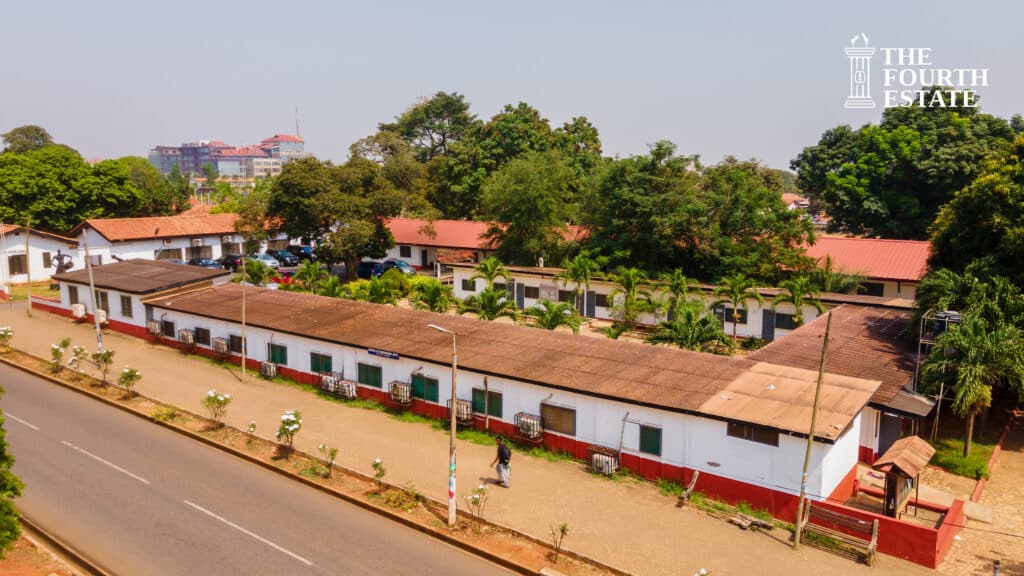
    He added that his decision was influenced not just by the allure of America but also by the renowned Tisch program and a scholarship offer from Susan Hilferty.
    Xorlali expressed surprise at his employment prospects in Ghana, especially after becoming the center of attention during his graduation over his unconventional look, leading to multiple job offers.

    Despite the sense of accomplishment, he decided to manage the influx of offers by crafting a generic offer declined letter.

    “I never thought I’d be employed in Ghana. I didn’t even imagine myself making it into interviews, talk less getting a job. I had multiple job offers upon going viral during my graduation. I didn’t desire any, but it felt good. So I drafted a generic “offer declined letter.” Which I’d copy and paste and send to all of these people who talked to me about hiring. The 30+k job offer was a challenge. however, I decided to choose school. It wasn’t about America, it was about Tisch and Susan Hilferty’s offer of scholarship. Do you have any idea what that meant? Lmaoooo. So I left everything and traveled. If getting first class in Legon and going viral for wearing heels can get me all these offers, let’s see what Tisch can do,” he added.

    In 2022, Xorlali Plange Fiamafle garnered attention after he showered praises on his mother for her unwavering commitment and sacrifices that contributed to his educational success.

    Expressing profound gratitude, he disclosed that his mother went above and beyond, sacrificing her entire salary, depleting her savings, and even taking out loans to ensure he could live a life at the pinnacle of the social class.

    He demonstrated his appreciation by commissioning a specially designed sash for his mother on the day of his graduation.

    Beyond his academic achievements, this young man is recognized for breaking societal norms, often seen wearing heels and women’s clothing, which have not well accepted by some section of the public.

    In a testament to his unique style, he invested in a $755 pair of shoes for an award ceremony where he was recognized as the best student in Theatre at the university.

  • PAC reprimands University of Ghana over repeated procurement breaches

    PAC reprimands University of Ghana over repeated procurement breaches

    The Public Accounts Committee (PAC) of Parliament has issued a stern warning to the University of Ghana following repeated breaches of required procurement processes in its projects. The warning came during a PAC sitting on Wednesday, February 14, 2024, where concerns were raised over the university’s continuous flouting of procurement regulations highlighted by auditors.

    Chairman of the Committee, James Klutse Avedzi, expressed his disappointment at the university’s persistent violations despite assurances made during previous appearances before the PAC. “You have been appearing here, and this issue has been coming up. You always promise that you will not do it again, but you are still committing the same crime,” remarked Klutse Avedzi.

    In response, the Vice-Chancellor of the University of Ghana, Prof. Nana Aba Appiah Amfo, acknowledged the challenges faced by the institution and outlined measures being taken to rectify the situation. Prof. Amfo attributed the breaches to structural issues within the university and inadequate procurement resources, which the university is actively addressing.

    “The challenge has to do with the nature of our business, our institution, and also the complexities because we operate in four colleges and the central administration,” stated Prof. Amfo. She further elaborated on efforts to enhance procurement resources, including the appointment of procurement officers across all colleges and improvements in resource allocation for procurement functions.

    The PAC also summoned representatives from the University of Professional Studies, Accra, and the University of Media, Arts and Communication to address irregularities identified in their accounts by the Auditor General.

    The repeated admonition from the PAC underscores the seriousness of the procurement breaches and the need for swift corrective action by the University of Ghana. As the institution pledges to strengthen its procurement processes, stakeholders will be closely monitoring its progress to ensure compliance with regulatory standards and accountability in financial management.

  • Dean of University of Ghana School of Law calls for an overhaul of outdated banking laws

    Dean of University of Ghana School of Law calls for an overhaul of outdated banking laws

    Dean of the University of Ghana School of Law, Professor Raymond Akongburo Atuguba, has raised concerns regarding the outdated nature of many of Ghana’s laws, particularly within the banking sector. This is according to a report by graphic.com.gh.

    During the GCB Platinum Thought Leadership Conference in Accra, Professor Atuguba expressed worry that Ghana’s legal framework hampers adherence to ethical principles due to its lack of alignment with contemporary times.

    “Our laws are not in tune with the times; how do you determine ethics with such a legal framework?” Professor Atuguba questioned.

    He highlighted that Ghana still upholds approximately 10 English laws in its statutes, which were passed between 1539 and 1863. 

    Given the significant advancements since the enactment of these laws, he emphasized the urgent need for new legislation to reflect current trends, a step that has not been adequately pursued.

    In his presentation titled “Ethics, financial conduct, and the political economy in Ghana and other emerging markets,” Professor Atuguba defined ethics as an extension of the law. He pointed out that this makes it challenging for individuals to comply with ethical principles governing businesses within the current legal framework.

    The conference, attended by bankers and subject matter experts from the finance and economics fields, covered various topics within the banking and finance sectors.

    Notable attendees included the President of the Council of Foreign Relations Ghana, Ambassador D. K. Osei; former Vice-Chancellor of the University of Ghana, Prof. Ernest Aryeetey; Head of the Economics Department at the University of Ghana, Prof. William Baah-Boateng; and former Country Senior Partner of PwC Ghana, Felix Addo.

    Professor Atuguba cited examples such as the Public Procurement Act, 2003 (ACT 663), which he deemed costly to obey, surpassing the benefits it aims to bring. He also highlighted the Supreme Court’s intervention in declaring portions of the Companies Act, 2019 (ACT 992), unconstitutional.

  • University Basic School temporarily shut amid ongoing senior staff strike

    University Basic School temporarily shut amid ongoing senior staff strike

    The University Basic School (UBS) will temporarily be shut down, as announced by the University of Ghana (UG).

    Consequently, students from KG1 to Junior High (JH) 3 are advised to stay home until further notice.

    However, specific arrangements are being made to recall Junior High 3 students for the resumption of their preparations for final examinations.

    The official statement from the University emphasized, “I write to inform the University Community and the general public that the KNUST Basic School is being closed down, effective Tuesday, 30th January, 2024, until further notice.”

    “Our JH 3 students will however be called back to school in due course to continue with their preparation towards their final examinations after the necessary arrangements have been put in place to that effect.” the statement noted.

    This is in light to an ongoing strike initiated by the Senior Staff Association – Universities of Ghana (SSA-UOG) and the Federation of Universities Senior Staff Association of Ghana (FUSSAG).

  • NDC’s Edudzi Tamakloe bags Masters Degree in Law from UG

    NDC’s Edudzi Tamakloe bags Masters Degree in Law from UG

    Lawyer Godwin Edudzi Tamakloe, a prominent member of the National Democratic Congress (NDC) Legal team, has recently achieved a significant milestone.

    He has graduated from the University of Ghana Law School, where he focused on Natural Resources.

    Known for his legal acumen and diligent work ethic, Tamakloe has gained recognition for his extensive knowledge, particularly in the political landscape associated with the NDC.

    Today, January 26, 2024, actor turned politican, John Dumelo, also graduated with a Masters Degree in Law (Natural Resources) from the University of Ghana Law School. This is his third Masters Degree.

    This course was studied in a year where the two-semester programme comprises lectures, seminars and dissertations.

    MASTER OF LAWS (LL.M.) IN NATURAL RESOURCES LAW & MASTER OF ARTS (M.A.) IN NATURAL RESOURCES LAW

    NATURAL RESOURCES LAW (M.A. & LL.M.)

    The Natural Resources sector is crucial for Ghana and Africa’s developmental trajectory. The policy, legal and regulatory frameworks, and the right practitioner approaches of the sector are, however, essential to enable an economy reap the touted benefits. It is in recognition of this that UGSoL has gone great lengths to mount this Natural Resources Law programme.

    The overall objectives of the M.A./LL.M Natural Resources Law programme are to:
    1.    Provide students with an in-depth insight into relevant legal, political and economic issues related to natural resources law at the regional, national, and international levels.
    2.    Provide an understanding of the dynamics of past and current natural resources laws, policies and governance mechanisms, as well as likely future developments in the area.
    3.    Offer students an in-depth understanding of the legal aspects governing the key challenges of natural resources protection.
    4.    Train students for practice in the areas of natural resources investment and trade, project finance and infrastructure development, with a focus on the specific natural resources and sustainability challenges of Africa.
    5.    Offer students an exclusive opportunity to learn from recognized academics very well-versed in the industry along with reputable, knowledgeable and experienced industry practitioners so as to know the subjects in a thorough and comprehensive manner.


    COURSE DURATION
    One (1) Academic Year

    Venue: University of Ghana – Accra City Campus, Adabraka.

    Format: Hybrid (in-person and online lectures)

    Time:

    • Mondays – Thursdays: 5:00pm – 8:00pm
    • Fridays:                     3:00pm – 8:00pm

    Fees:

    • GHS 22,355.00 (Ghanaians)
    • USD 9,178.00 (Non-Ghanaians)
    • GHS 2,445.00 (Admission Processing Fees)

    ENTRY REQUIREMENTS:

    • First degree from a recognized University.
    • Shortlisting / Interview
    • M.A.     – proven interest, exposure or experience in Natural Resources Law.
    • LL.M.      – Bachelor of laws degree or its equivalent.

    PROGRAMME STRUCTURE:
    This two-semester programme comprises lectures, seminars and dissertations. Continuous assessment shall be the main mode of examination.

    Students are therefore expected to actively participate in topical seminars and contribute to discussions on pertinent issues in Natural Resources Law. Research works leading to dissertations and papers are expected to be selected according to student interests. Industry practitioners shall facilitate seminars to increase student exposure to the job market and industry needs.

    PROGRAMME CONTENT

    The M.A. programme has the following courses:

    •    Legal Research Methods
    •    The Political Economy of Natural Resource Regulation
    •    Environmental Protection in Natural Resources Extraction: Law, Policy and Trends
    •    Renewable Energy Law and Policy
    •    Basic Geology of Oil and Gas
    •    Environmental Aspects of Oil and Gas Law
    •    Corporate Social Responsibility in Natural Resources
    •    M.A. Seminar
    •    On-Shore Mining Law
    •    Regulation of Trees and Forest Resources in Ghana
    •    Regulation of Inland, Ground, Coastal Water and Seabed Resources
    •    Marine Ecology & Environmental Protection
    •    International Maritime Conflict Management
    •    Law of the Marine Environment
    •    M.A. Dissertation

    The LL.M. programme has the following courses:

    •    Legal Research Methods
    •    The Political Economy of Natural Resource Regulation
    •    Environmental Protection in Natural Resources Extraction: Law, Policy and Trends
    •    Renewable Energy Law and Policy
    •    Basic Geology of Oil and Gas
    •    Environmental Aspects of Oil and Gas Law
    •    Corporate Social Responsibility in Natural Resources
    •    LL.M Seminar
    •    On-Shore Mining Law
    •    Regulation of Trees and Forest Resources in Ghana
    •    Regulation of Inland, Ground, Coastal Water and Seabed Resources
    •    Marine Ecology & Environmental Protection
    •    International Maritime Conflict Management
    •    Law of the Marine Environment
    •    LL.M Paper

  • Individuals who assaulted alleged gay will be sanctioned – UG pledges

    Individuals who assaulted alleged gay will be sanctioned – UG pledges


    The University of Ghana (UG) has strongly condemned the assault on a young man suspected to be homosexual at its Legon campus, as depicted in a circulating video on social media.

    In an official statement released on Tuesday, January 16, UG’s management affirmed its unwavering commitment to the safety and well-being of all individuals within its community.

    The statement reads, “The University of Ghana strongly denounces the assault and denigration perpetrated by the prospects seen in the videos posted on social media, and strongly condemns such acts of lawlessness. The University of Ghana would like to affirm its commitment to the safety, dignity and inclusivity of all persons.”

    “Management takes its commitment to the enforcement of the rules and regulations governing the university seriously and any member of the university community identified to be involved in this cruel incident will be appropriately sanctioned,” it stated.

    It further emphasized that management takes its commitment to the enforcement of the rules and regulations governing the university seriously, and any member of the university community identified to be involved in this incident will face appropriate sanctions.

    UG assured the public of its collaboration with the police for a thorough investigation into the matter to ensure the safety of all members of the university community and visitors to its campuses.

    READ THE FULL STATEMENT ON THE ASSAULT HERE

    Meanwhile, Africa Education Watch (Eduwatch), an education-focused think tank has condemned the assault.

    Eduwatch in a statement issued on Tuesday, January 16 said it “condemns in no uncertain terms this criminal, inhuman and degrading act which violates the individual’s right to dignity and freedom from inhuman and degrading treatment, as enshrined in Article 15 of the 1992 Constitution.”

    “Eduwatch wishes to remind all and sundry that, Ghana is a country governed by Laws which abhors instant injustice.”

    It called on the Vice Chancellor of UG and the Ghana Police Service to initiate rapid investigations into the act, bring the perpetrators to justice, identify the victim and provide the necessary health support.

    “We call for increased security on our tertiary campuses to ensure the safety of human lives,” it added.

    Additionally, Africa Education Watch (Eduwatch), an education-focused think tank, condemned the assault in a statement issued on the same day.

    Eduwatch expressed firm opposition to the criminal and inhumane act, emphasizing that it violates the individual’s right to dignity and freedom from inhuman and degrading treatment.

    Eduwatch called on the Vice Chancellor of UG and the Ghana Police Service to swiftly initiate investigations, bring the perpetrators to justice, identify the victim, and provide necessary health support. The think tank also urged increased security on tertiary campuses to ensure the safety of human lives.

  • Suspected gay stripped naked, ridiculed, assaulted on Legon campus

    Suspected gay stripped naked, ridiculed, assaulted on Legon campus

    A young man, suspected to be a homosexual has been assaulted on the campus of the University of Ghana, Legon.

    In a video making rounds on social media, a group of young men can be seen following the suspected gay who had been stripped naked; one flogging him with a stick, while the others followed closely. 

    In other videos, students are heard making fun of the young man, while they looked on for him to be assaulted. 

    https://twitter.com/originalobeng/status/1746885351526809717?s=46

    The young man was marched from the Elizabeth Frances Sey Hall to the Dr Hilla Limann Hall, per videos intercepted by The Independent Ghana.                      

    The video has triggered mixed reactions from the general public with some condemning the act while others have commended the guys behind the assault.

    Meanwhile, management of the University is yet to comment on the matter or confirm whether the victim is a student of the University or not.

  • Dr Augustina Naami donates wheelchair ramps to foster accessibility for PWDs

    Dr Augustina Naami donates wheelchair ramps to foster accessibility for PWDs

    Senior Lecturer at the University of Ghana, Dr Augustina Naami has demonstrated her commitment to inclusivity by donating eight wheelchair ramps to the Ghana Society of the Physical Disadvantages in Kaneshie.

    The donation, which was carried out on Sunday, December 10, 2023, was in an effort to create a barrier-free environment for persons with disabilities.

    The wheelchair ramps were strategically placed to enhance accessibility at key locations within the society’s premises. Six ramps were installed at the entrances of bathroom facilities, ensuring that individuals with disabilities can navigate these spaces with ease. Additionally, two ramps were dedicated to toilet facilities, while another was placed at the sales outlet, providing accessibility to the point where products are sold.

    One of the notable improvements was the installation of a concrete cover over a previously open gutter in the middle of the school. The concrete cover replaced a split metal cover, which was identified as a potential hazard for individuals with disabilities. Dr. Naami’s donation addressed this concern, making the environment safer and more accessible for everyone.

    Dr. Augustina Naami expressed her motivation for the donation, stating that the primary goal was to empower individuals with disabilities to move freely without the fear of falling or encountering unnecessary stress. Her commitment to the Breaking Barriers campaign is rooted in the belief that every person, regardless of physical ability, should have equal access to facilities and opportunities.

    The centre manageress of the Ghana society for the socially disadvantaged in Kaneshie, Mrs Evelyn Ampadu on behalf of the occupants and management of the centre expressed gratitude for Dr Naami’s generosity, emphasizing the positive impact these wheelchair ramps will have on the daily lives of their members. 

    “The management and students utilizing the facility extend a warm and sincere thank you to Dr. Augustina Naami for her invaluable donation of wheelchair ramps. The impact of this philanthropic gesture transcends the mere installation of ramps; it extends to the profound transformation of daily experiences for individuals with disabilities within the facility.

    Prior to the installation of these ramps, occupants faced significant challenges accessing essential areas such as bathrooms and other facilities. The fear of falling and sustaining injuries created a barrier that impeded their freedom of movement and, consequently, their overall quality of life. However, with the introduction of the wheelchair ramps, a palpable sense of relief and empowerment now exist in the facility.

    The positive impact of Dr. Naami’s donation is already resonating throughout the facility. Students and staff alike express their newfound sense of security and comfort, as these ramps not only address physical barriers but also alleviate the emotional toll associated with navigating a world that may not always be designed with inclusivity in mind.

    This act of generosity has created a ripple effect, inspired hope and fostering a stronger sense of community within the facility. The management and students look forward to a future where such acts of kindness continue to pave the way for a more inclusive and compassionate society. Dr. Augustina Naami’s donation has not only built physical ramps; it has constructed bridges of understanding, empathy, and support, creating a legacy that will resonate for years to come.”

    About the ‘Breaking the barrier campaign”: Barrier-Free Environment for Persons with Disabilities

    Dr. Augustina Naami, a distinguished senior lecturer and the Head of the Department of Social Work at the University of Ghana Legon, is leading a transformative initiative with the Breaking Barriers campaign. Focused on the creation of a barrier-free environment for persons with disabilities, Dr.Naami’s campaign is rooted in extensive research conducted in 2018, revealing the profound impact of access barriers on the socio-economic, political participation, and psychological well-being of individuals with disabilities.

    The culmination of this research effort resulted in an evidence-based manual that serves as a practical guide to address major physical and transportation barriers faced by persons with mobility disabilities. Dr. Naami’s vision is to bridge the gap between research and actionable change, ensuring that the insights gleaned from her academic work translate into tangible improvements in the lives of those facing accessibility challenges.

    Putting her ideas into practice, Dr. Naami initiated the campaign in 2020 by designing an accessible, portable, and foldable wheelchair ramp. The campaign gained further momentum in 2022 when she constructed six accessible ramps across five public basic schools in the Ga East Educational Directorate. 

    On December 10th, Dr. Naami took a significant step forward by donating eight wheelchair ramps to the Ghana Society of the Physical Disadvantages in Kaneshie. This donation, strategically placed at key points within the society, including bathroom and toilet facilities, as well as the sales outlet, signifies a commitment to enhancing accessibility, inclusion, and safety for persons with disabilities.

    The Breaking Barriers campaign sets a goal of constructing a minimum of five ramps annually, contributing not only to local communities but also aligning with Sustainable Development Goal 11, “Make Cities And Human Settlements Inclusive, Safe, Resilient And Sustainable.” Dr. Naami emphasizes that persons with disabilities are integral to the vision of a sustainable future, as underscored by the theme for the International Day of Persons with Disabilities in 2023: “United in action to rescue and achieve the sustainable development goals for, with, and by persons with disabilities.”

    Dr. Naami advocates for increased representation of persons with disabilities in decision-making processes, urging a departure from tokenism to ensure their voices are genuinely heard. 

    She is calling upon governments and stakeholders to align their rhetoric with action by allocating budgets for disability inclusion. Dr. Naami emphasizes the importance of collaboration, noting that, despite not being an engineer herself, she collaborates with a mason without formal education to construct ramps that are more accessible for persons with disabilities.

    In her rallying cry, Dr. Augustina Naami invites everyone to join hands in making environments more accessible, fostering an inclusive society that paves the way for the full participation and integration of persons with disabilities. The Breaking Barriers campaign stands as a testament to the power of grassroots efforts in driving meaningful change and breaking down the barriers that hinder the progress of an inclusive society.

  • UG lecturer advises NDC to choose an Akan as a running mate

    UG lecturer advises NDC to choose an Akan as a running mate

    Head of the Political Science Department at the University of Ghana, Dr. Alidu Seidu, has suggested that John Dramani Mahama, the flagbearer of the opposition National Democratic Congress (NDC), should consider selecting an Akan as his running mate for the 2024 election.

    Dr. Seidu emphasised the importance of this suggestion, citing the significant influence of Akan votes and their potential contribution to the NDC’s success in the 2024 election.

    During an interview on Joy FM’s Top Story on Thursday, December 14, Dr. Seidu highlighted that while the Volta region, Oti region, and the five northern regions traditionally support the NDC, relying solely on these areas might pose challenges in securing victory in the upcoming election

    “So, I think a lot of people are calling for him to look beyond the Volta region and go to maybe an Akan-dominated region. The running mate should be an Akan, either from the Ashanti region or any of the Akan-speaking regions,” he told Evans Mensah.

    Dr. Alidu Seidu, Head of the Political Science Department at the University of Ghana, has advised the National Democratic Congress (NDC) to carefully consider a running mate for John Dramani Mahama, who could seamlessly assume leadership after Mr. Mahama’s potential one-term tenure if he secures victory in the upcoming 2024 election.

    Dr. Seidu’s remarks come amid growing pressure on Mr. Mahama to announce his choice for a running mate. This pressure has intensified, with traditional leaders in the Bono and Western North regions expressing their preferences during Mr. Mahama’s recent campaign tour.

    Similarly, youth groups in the Volta and Oti regions, NDC strongholds, are urging the former President to select a running mate from their regions.

    Dr. Seidu explained that the lobbying by traditional rulers may stem from the expectation that their respective regions would benefit significantly in terms of development.

    Additionally, he noted that individuals being lobbied may find it appropriate to engage with traditional leaders due to the influence and respect they command.

    In response to the growing anticipation, Mr. Mahama has stated that the chosen candidate for the running mate position will be announced in February 2024.

    “I don’t choose a running mate alone. Myself, together with the Functional Executive Committee and Council of Elders, pick from a list and decide on one person,” he pointed out.

    He urged those appealing for their preferred candidates to exercise restraint.

    “I would pray for your patience, as we all know that God grants the King and the NDC doesn’t discriminate.”

    Mr Mahama was partnered by Professor Jane Naana Opoku Agyemang in the 2020 election, and there are suggestions she may be retained, although others want to see a new face.

  • Video: UG students beat ‘thief’ caught on CCTV camera

    Video: UG students beat ‘thief’ caught on CCTV camera

    A suspected thief who allegedly tried to break into some rooms at the Bani Hostel on the University of Ghana (UG) campus was caught and beaten by some students on Monday.

    The incident was captured on camera and shared on X by user @yawlegacyy_.

    According to the tweet, the thief was armed with homemade master keys and was seen attempting to open locked doors with them. He was apprehended by some students who recognized him from the CCTV footage and handed him over to the Legon Police Station.

    The video captures a crowd od alleged UG students physically restraining and assaulting the suspect. In one instance, the supposed culprit is seen seated in a cordoned area, where some of the young men engaged him in physical confrontations, including a flying kick.

    The incident has sparked discussions about the safety and security measures within university hostels, prompting the involvement of law enforcement as the alleged thief is handed over to the Legon Police Station.

  • Over 60 French students of University of Ghana on the brink of deferring their courses for a year

    Over 60 French students of University of Ghana on the brink of deferring their courses for a year

    Scores of French students at the University of Ghana bear visible expressions of profound despair and distress.

    Their aspirations for a year-abroad study program have become a source of painful regret due to the delayed disbursement of funds from the Scholarship Secretariat.

    Over 60 students find themselves entangled in a pressing issue that jeopardizes their academic pursuits, leaving them stranded and dependent on their parents.

    “We wake up every morning with your parents asking us ‘when are you going’, this and that. Our parents are very disturbed. We are on the brink of deferment,” an affected student told TV3 in an interview.

    For some of these affected students, what was to become their dream to hone their proficiency in French is gradually becoming their nemesis.

    The seriousness of the problem is because a lot of time has passed since they first asked about their trip.

    The academic semester is almost over, and the students going through this are feeling really bad.

    Because they don’t know when they can leave, they couldn’t sign up for their semester courses.

    Now, they’re worried they might spend a whole year doing nothing at home.

    “This isn’t a luxury or it isn’t something that we are demanding for, it’s part of our curriculum.  And we have been waiting on the Scholarship Secretariat since September; we haven’t had any news.”

    “We know what we want for the language [French] so we can’t just give up in this whole process. That is why we are still at home at the moment, waiting to hear from the Scholarship Secretariat,” another affected observed.

    About the year abroad programme

    Every year, the Scholarship Secretariat gives scholarships to students from different universities and colleges across the country.

    With this support, students can join the yearly study abroad program to learn more about their specific subjects.

    This program is especially great for students studying modern languages, including French. It lets them experience living in a country where the language is spoken, improving their language skills in a real-world setting.

    But this year, the Secretariat hasn’t been able to release the funds on time. This has made language students worried about what will happen to them. They’re stuck in a situation with no clear information, and the Scholarship Secretariat hasn’t given them any assurances or timelines.

    “We don’t also know whether school has resumed in Ivory Coast and we don’t know if we are joining them at the middle of the semester or they will have a new academic year for us. It’s very worrying.”

    “Personally, I don’t have a problem deferring my course because I know what I want and what I want to do with the language I am studying.  But the fact that school is in session and we are just home, we don’t even know what we are doing, is now the problem,” a distressed student said.

    What is the UG Department of French doing?

    The Head of the French Department mentioned that they’ve tried multiple times to fix the issue, but nothing has worked.

    Dr. Samuel Koffi pointed out that the Scholarship Secretariat hasn’t shared any useful information, even though they promised they would.

    “I have written a letter earlier than the time our Vice-Chancellor and the Dean contacted the Scholarship Secretariat. We never had any reply to our letter, not even a phone call and anytime we call, they might not pick it up.”

    “The worry is a very impacting one in the sense that we have done what we can; our Dean also has done a lot including our own Vice Chancellor who kept calling. Even, right now, I’m sure if she sees and hears this she will still contact them again,” he explained.

    Students from other schools affected

    French students at Kwame Nkrumah University of Science and Technology (KNUST), University of Cape Coast (UCC), and the University of Education, Winneba (UEW) are also stuck due to the delayed funds.

    Even those who managed to leave the country are having problems getting the funds on time, causing a lot of stress.

    The language immersion program was supposed to happen in any French-speaking African country.

    In the midst of their regrets and letdowns, the students have a straightforward request.

    “I would like to appeal to the Scholarship Secretariat to release the funds for the year abroad. I just pray that this year’s abroad programme will be possible,” the students appealed.

    No response from Scholarship Secretariat

    The Registrar wasn’t around when the news crew visited the Scholarship Secretariat to ask questions.

    As of the time of filing this report, all efforts to contact him again have been unsuccessful.

  • Bawumia has a “huge task ahead of him” to gain the trust of Ghanaians again – Gyampo

    Bawumia has a “huge task ahead of him” to gain the trust of Ghanaians again – Gyampo

    Professor at the University of Ghana has noted that Dr. Mahamudu Bawumia, as the flagbearer of the New Patriotic Party (NPP), will encounter a substantial challenge in persuading Ghanaians that the economy has improved during his time as Vice President in comparison to when he assumed office.

    While recognising Dr. Bawumia’s political acumen, Professor Gyampo highlighted that clarifying that the present economic situation is superior to when he assumed the role of Vice President will be a daunting undertaking for him.

    He also commended Dr. Bawumia for his political acumen and ability to connect with various segments of the population.


    “How he is able to defend the track record and embarrassing situation of this government is an issue. Explaining that things are better today than when he became vice president is a huge task ahead of him.

    “I congratulate him for winning. He has mastered the game of politicking, he knew how to talk to those who mattered; he knew how to reach out to those whom others could not reach out to,” he said on TV3.


    Vice President Dr. Mahamudu Bawumia secured victory in the NPP’s presidential primary, receiving 118,210 votes, which accounted for 61.47% of the total, while Kennedy Agyapong garnered 71,996 votes, or 37.41%. Dr. Owusu Afriyie Akoto came in third with 1,459 votes (0.76%), and Francis Addai-Nimoh received 731 votes (0.41%).


    The 2024 election is anticipated to be a fierce contest between Dr. Bawumia and John Mahama, with both candidates vying for the presidency, one as a returnee and the other seeking to retain the seat for the NPP, making it a closely watched race.