Tag: Water

  • Here’s why you shouldn’t drink water immediately after eating

    Drinking water immediately after a meal can be detrimental to health.

    And a lot of things have been said about the time and the amount of water you should be having before, during and after meals.

    But according to experts and nutritionists, it’s not a great idea to sip water while eating or immediately before or after meals.

    The problem is that when you drink water too soon before or after a meal, it dilutes your essential gastric juices, causing difficulty in digestion and an upsurge in insulin levels.

    When food remains undigested in our stomach, it can be harmful to the body, leading to several health problems, such as an increase in uric acid levels, high cholesterol, high triglyceride levels – a major cause of heart diseases – obesity, diabetes, etc.

    Experts recommend a 30-minute window both before and after meals.

    The bottom line is that while it is important to keep yourself hydrated by drinking enough water every day, you should also know how long you will need to wait to drink before or after having a meal.

    Source: Pulse.com

  • Boats take over as homes at Weija ‘drown’ under water after dam spillage

    Like the floods of Accra that have become a perennial occurrence, residents of Weija have once again had to wake up to the devastating effects of the spillage of the Weija Dam by the Ghana Water Company Limited.

    The annual spillage of the dam is meant to release excess water from the dam.

    The maximum level of water the dam is built to hold is about 46 feet, but the level came up to 48 feet, thereby threatening its safety, hence the decision to spill.

    Residents have been forced to move around in canoes, as many houses have been completely submerged under the water.

    GhanaWeb has been to the area and has captured videos of the extent of damage caused after the spillage of the dam on Monday, October 3, 2022.

    Meanwhile, the management of the GWCL has assured the public that despite the challenges, it is in control and has put in measures to ameliorate the situation to minimize the impact on consumers.

    The management explained further, “the Weija dam is currently at a level of 49.5ft as against the maximum operating level of 48ft. Spillage normally begins when the level gets to 46.5ft. As a result, four (4) spill gates have been opened to safeguard the integrity of the dam, save the dam from collapse, and save lives and properties.”

    Watch the latest episode of The Lowdown below:

    The Lowdown: Role of the diaspora in the development of Africa

    CEO of the Aaron Manvel Foundation Millie Lorene Tucker and Gary Hope, the CEO of FLCC – Bring Back Hope Foundation underscore the need for the African diaspora to help develop the continent in this episode of The Lowdown on GhanaWeb TV. According to the women trying to make and create a change in Ghana, our forefathers were sold away and made to develop strange lands. Thus, coming back home and developing their home country is the best thing to do especially when resources are available.

  • Weija residents displaced after dam spillage

    Some residents of Weija and its environs in the Weija/Gbawe Constituency are displaced following the spillage of the Weija Dam by the Ghana Water Company Limited (GWCL).

    Some videos and photos available to GhanaWeb show that most homes within the catchment area have been flooded.

    Some residents who spoke to GhanaWeb on the condition of anonymity say they were not informed by GWCL of the spillage that occurred early Monday, October 3, 2022.

    The annual spillage of the dam by Ghana Water Company Limited is meant to release excess water from the dam.

    The maximum level of water the dam is built to hold is about 46 feet, but the level came up to 48 feet, thereby threatening its safety, hence the decision to spill.

    Meanwhile, the GWCL has indicated that the recent spillage was brought about following the recent heavy rains but “it is in control”.

    GWCL said, the situation has gravely affected its operations leading to “considerable havoc to some water treatment plants” across the country.

    The management of the GWCL assured the public that despite the challenges, it is in control and has put in measures to ameliorate the situation to minimize the impact on consumers.

    The management explained further, “the Weija dam is currently at a level of 49.5ft as against the maximum operating level of 48ft. Spillage normally begins when the level gets to 46.5ft. As a result, four (4) spill gates have been opened to safeguard the integrity of the dam, save the dam from collapse, and save lives and properties.”


  • Woman claims to have been living on water alone for the last 41 years

    A Vietnamese woman claims to have given up solid food over four decades ago and survived on water spiked with a bit of salt, sugar and lemon juice ever since.

    63-year-old Ms. Ngon is famous in her native Tan Trach commune, Vietnam’s Long An province, for her very unique diet. For the last 41 years, she has allegedly been living on water with a few grams of salt and sugar, as well as a bit of lemon juice, completely shunning all other nutrients. She not only appears to be in tip-top shape for her age, but she is in great health, is always full of energy and can execute Yoga poses that people decades younger than her wouldn’t even dream of attempting. She considers water vital to her health in the same way that watering is to a tree.

    Ms. Ngon used to eat rice and other solid foods until the age of 21, when she started dealing with serious health problems. Her vision started deteriorating, her stomach ached constantly and she would vomit on a daily basis. Blood tests revealed that she suffered from a blood disease. After attempting the prescribed treatment without seeing any significant improvement to her health, she decided to quit her medication, thinking she didn’t have long to live.

    That’s when a doctor allegedly came to her and advised her to start drinking water mixed with a bit of salt and sugar and quit eating solid foods. He told her he could squeeze some fruit juice in the water if she wanted, but nothing else. The mystery man told her that following this diet would help save her vision and maybe even cure her blood disease, but he insisted that she never reveal his name to anyone, because the method was completely unscientific and people would criticize him for it.

    The woman kept her promise even after her benefactor passed away. No one, not even her family knows his name, and no one ever will. The one thing she can say is that his advice worked, and she is living proof of that. However, she doesn’t recommend the water-based diet to anyone, because she acknowledges that it can be dangerous. She considers her case a miracle, and credits her religious beliefs for the diet’s success.

    Ms. Ngog recalled that when she started living exclusively on water, 41 years ago, her family was completely against it, accusing her of wanting to starve herself to death. At one point, they threatened to go on a hunger strike with her, so they could die together, but she managed to convince them that she wasn’t trying to end her life, but that the exact opposite was true. When her health started improving, they stopped asking her to eat regular food.

    The 63-year-old admitted that living on water alone can get a little boring from time to time, even when adding a few drops of fruit juice to give it a bit of flavor. She sometimes takes a sugar cube in her mouth and drinks water to disolve it, just as a way of spicing things up.

    After her health improved as a result of switching to a water diet, Ms. Ngog started her journey of trying to become a physician. She is currently a member of the Long An Acupuncture Association, is a Yoga teacher and is an advocate for yoga and exercise. She considers her dedication to promoting an active and healthy life a “payback” to the doctor who once saver her life.

    In the past, we’ve covered several people with such unusual diets – a man who claimed to live exclusively on tree leaves and grass, a breatharian who only survived on “energy”, and a man who lives on beer alone for Lent.

    Source: Oddity Central

  • The surprising benefits of fingers that wrinkle in water

    Spend more than a few minutes soaking in a bath or paddling around a swimming pool and your fingers will undergo a dramatic transformation. Where there were once delicate whorls of lightly ridged epidermis, engorged folds of ugly pruned skin will now be found.

    This striking change is familiar yet also baffling. Only the skin on our fingers and toes wrinkle when immersed in water, while other body parts such as our forearms, torso, legs and face remain no more crinkled than before they were submerged.

    This water-induced wrinkling of skin on our fingertips and toes has occupied the thoughts and work of scientists for decades. Most have puzzled over what causes this puckering in the first place, but more recently the question of why, and what purpose it may serve, has attracted the attention of researchers. Perhaps more intriguing still, however, is what our shriveled fingers can reveal about our own health.

    It takes around 3.5 minutes in warm water  40C (104F) is considered the optimal temperature for your fingertips to begin wrinkling, while in cooler temperatures of about 20C (68F) it can take up to 10 minutes. Most studies have found it takes around 30 minutes of soaking time to reach maximum wrinklage, however.

    Fingertip wrinkling was commonly thought to be a passive response where the upper layers of the skin swelled as water flooded into the cells via a process known as osmosis  where water molecules move across a membrane to equalise the concentration of the solutions on either side. But as long ago as 1935, scientists have suspected there is more to the process than this.

    Doctors studying patients with injuries that had severed the median nerve one of the main nerves that run down the arm to the hand found that their fingers did not wrinkle. Among its many roles, the median nerve helps to control so-called sympathetic activities such as sweating and the constriction of blood vessels. Their discovery suggested that the water-induced wrinkling of fingertips was in fact controlled by the nervous system.

    The skin on our feet and hands shrivel and wrinkle in the bath, while other parts of our body do not undergo the same transformation (Credit: Andrii Biletskyi/Alamy)
    The skin on our feet and hands shrivel and wrinkle in the bath, while other parts of our body do not undergo the same transformation

    The skin on our feet and hands shrivel and wrinkle in the bath, while other parts of our body do not undergo the same transformation (Credit: Andrii Biletskyi/Alamy)

    Later studies by doctors in the 1970s provided further evidence of this, and they proposed using the immersion of the hands in water as a simple bedside test to assess nerve damage that might affect the regulation of unconscious processes such as blood flow.

    Then in 2003, neurologists Einar Wilder-Smith and Adeline Chow, who were working at the National University Hospital in Singapore at the time, took measurements of blood circulation in the hands of volunteers as they soaked them in water. They found that as the skin on the volunteers’ fingertips began to wrinkle, there was a significant drop in blood flow in the fingers.

    When they applied a local anesthetic cream that caused the blood vessels in the fingers of healthy volunteers to temporarily constrict, they found it produced similar levels of wrinkling as water immersion.

    “It makes sense when you look at your fingers when they go wrinkly,” says Nick Davis, a neuroscientist and psychologist at Manchester Metropolitan University, who has studied fingertip wrinkling. “The finger pads go pale and that is because the blood supply is being constricted away from the surface.”

    Wilder-Smith and his colleagues proposed that when our hands are immersed in water, the sweat ducts in our fingers open up to allow water in, which leads to an imbalance in the salts in our skin. This change in the salt balance triggers the firing of nerve fibres in the fingers, leading to the blood vessels around the sweat ducts to constrict. This in turn causes a loss of volume in the fleshy area of the fingertip, which pulls the overlying skin downwards so that it distorts into wrinkles. The pattern of the wrinkles depends on the way the outermost layer of skin the epidermis is anchored to the layers beneath it.

    You might also like:

    There have also been suggestions that the outer layers of skin may also swell a little to enhance the wrinkling. By osmosis alone, however, our skin would need to swell by 20% to achieve the wrinkles we see in our fingers, which would leave them hideously enlarged. But when the upper layers of skin swell slightly and the lower levels shrink at the same time, the wrinkling becomes pronounced far sooner, says Pablo Saez Viñas, a biomechanical engineer at the Technical University of Catalonia, who has used computer modelling to examine the mechanism.

    “You need both to have normal levels of wrinkles,” he says. “If you don’t have that neurological response, which happens in some individuals, wrinkles are inhibited.”

    But if wrinkling is controlled by our nerves, it means our bodies are actively reacting to being in water. “That means it is happening for a reason,” says Davis. “And that means it could be giving us an advantage.”

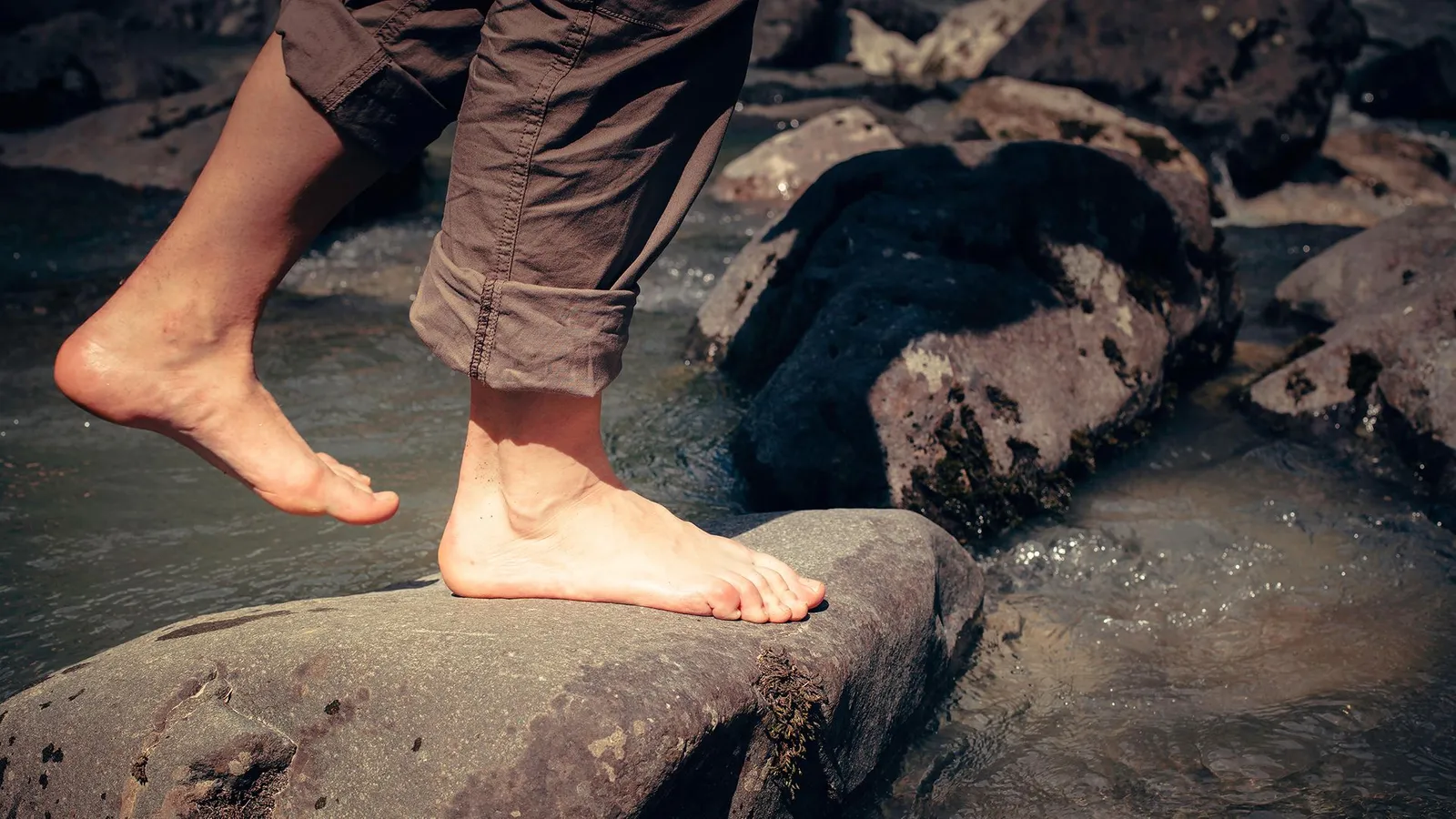
    Water-induced wrinkles may have given our ancestors better grip when walking on wet rocks or foraging for shellfish (Credit: Alamy)
    Water-induced wrinkles may have given our ancestors better grip when walking on wet rocks or foraging for shellfish

    It was a question from one of his children during a bath about why their fingers had gone wrinkly that recently led Davis to dig into what this advantage could be. With the help of 500 volunteers who visited the Science Museum in London during 2020, Davis measured how much force they needed to use to grip a plastic object. Perhaps unsurprisingly, those with dry, unwrinkled hands needed to use less force than people whose hands were wet so their grip on the object was better. But when they submerged their hands in a water bath for a few minutes to turn their hands wrinkly, the grip force fell between the two even though their hands were still wet.

    “The results were amazingly clear,” says Davis. “The wrinkling increased the amount of friction between the fingers and the object. What is particularly interesting is that our fingers are sensitive to this change in the surface friction and we use this information to apply less force to grip an object securely.”

    The object that Davis’ volunteers were gripping weighed less than a couple of coins, so the amount of grip required was small. But when performing more arduous tasks in a wet environment, this difference in friction could become more important.

    “If you don’t have to squeeze as hard to grip something, the muscles in your hands get less tired and so you can do it for longer,” he says.

    His findings match those by other researchers who have found that the wrinkling of our fingertips makes it easier for us to handle wet objects. In 2013, a team of neuroscientists at Newcastle University in the UK asked volunteers to transfer glass marbles of varying sizes and fishing weights from one container to another. In one case the objects were dry, and in the other they were at the bottom of a container filled with water. It took 17% longer for the participants to transfer the submerged objects with unwrinkled fingers than when they were dry. But when their fingers were wrinkled, they could transfer the submerged marbles and weights 12% quicker than when their fingers were wet and unwrinkled. Interestingly, there was no difference in transferring the dry objects with wrinkled or unwrinkled fingers.

    There are other baffling mysteries women take longer to develop wrinkles than men do

    Some scientists have suggested that the wrinkles on our fingertips and toes may act like rain treads on tyres or the soles of shoes. The channels produced by the wrinkles help to squeeze water away from the point of contact between the fingers and an object.

    This suggests that humans may have evolved fingertip and toe wrinkling at some point in our past to help us grip wet objects and surfaces.

    “Since it seems to give better grip under water, I would assume that it has to do with either locomotion in very wet conditions or potentially with manipulating objects under water,” says Tom Smulders, an evolutionary neuroscientist at Newcastle University who led the 2013 study. It could have given our ancestors a key advantage when it came to walking over wet rocks or gripping branches, for example. Alternatively, it could have helped us when catching or foraging for food such as shellfish.

    “The latter would imply it is unique to humans, whereas if it’s the former, we would expect it to happen in other primates as well,” says Smulders. Finger wrinkling has yet to be observed in our closest relatives in the primate world such as chimpanzees, but the fingers of Japanese macaque monkeys, which are known to bath for long periods in hot water, have been seen to also wrinkle after they have been submerged in water. But the lack of evidence in other primates does not mean it doesn’t happen, it may simply be because no-one has looked closely enough yet, says Smulders. “We don’t know the answer to this question yet.”

    There are some other interesting clues about when this adaptation may have appeared in our species. Fingertip wrinkling is less pronounced in saltwater and takes longer than it does in freshwater. This is probably because the salt gradient between the skin and surrounding environment is lower in saltwater, and so the salt imbalance that triggers the nerve fibres is less dramatic. So, it could be an adaptation that helped our ancestors live in freshwater environments rather than along coastlines.

    But there are no firm answers, and some believe it could just be a coincidental physiological response with no adaptive function.

    Only one other primate has so far been found to have water-induced wrinkling of the fingers  Japanese macaques (Credit: Benjamin Torode/Getty Images)
    Only one other primate has so far been found to have water-induced wrinkling of the fingers

    Only one other primate has so far been found to have water-induced wrinkling of the fingers Japanese macaques (Credit: Benjamin Torode/Getty Images)

    Strangely there are other baffling mysteries  women take longer to develop wrinkles than men do, for example. And why exactly does our skin return to its normal state normally after 10-20 minutes  if there is no clear disadvantage to our grip on dry objects of having wrinkly fingertips? Surely if having wrinkly fingers can improve our grip in the wet, but not harm it when dry, why would our fingertips not be permanently wrinkly?

    One reason for that could be the change in sensation the wrinkling also causes. Our fingertips are packed with nerves, and the pruning of our skin changes the way we feel things we touch (although one study has shown it does not affect our ability to discriminate between objects based on touch).

    “Some people have a real aversion to it because picking something up with wrinkly fingers feels weird,” says Davis. “It could be because the balance of skin receptors have changed position, but there could be a psychological dimension too. It would be fun to investigate why. There could be other things we can do less well with wrinkly fingers.”

    But the wrinkling of our fingers and toes in water can reveal key information about our health in surprising ways too. Wrinkles take longer to form in people with skin conditions like psoriasis and vitiligo, for example. Patients with cystic fibrosis experience excessive wrinkling of their palms as well as their fingers, and this has even been noticed in people who are genetic carriers of the disease. Patients suffering from type 2 diabetes also sometimes show markedly decreased levels of skin wrinkling when their hands are placed in water. Similarly reduced wrinkling has been seen in people who have suffered heart failure, perhaps due to some disruption in the control of their cardiovascular system.

    Unsymmetrical wrinkling of the fingers where one hand wrinkles less than the other despite the same immersion time has even been suggested as an early sign of Parkinson’s disease as it indicates the sympathetic nervous system is not functioning correctly on one side of the body.

    So, while the question of why our fingers and toes began wrinkling in water in the first place remains open, our pruney digits are proving useful to doctors in other surprising ways.

    Source: bbc.com

  • Sachet water vendors lament poor sales after increment, call for government’s intervention

    Pure water sellers within the Kumasi metropolis have complained bitterly over poor sales feedback they are receiving following the recent increment in prices of sachet water.

    The price of a bag of sachet water which increased from Gh¢3.00 to Gh¢4.50 has adversely affected the price of single sachet water which has now moved from 0.20pessewas to 0.30pessewas.

    This increment has got many Ghanaians complaining.

    Sharing their hard experience with GhanaWeb’s Nana Peprah, the vendors said the hikes in prices of pure water (sachet water) have brought an absolute reduction in their sales.

    According to them, people are not patronising the sachet water at the 0.30 pesewa cost as it used to be.

    They sadly revealed that most people now resort to filling bottles with water and putting them inside their bags at the expense of buying sachet water.

    The sellers in the Ashanti regional capital Kumasi also expressed their displeasure about the increment of pure water which is sadly collapsing their businesses.

    “This is what I do to support my family. There are no jobs in this country, and if this little one I do for a living is also going to collapse, then where do we go. I can’t be a prostitute or thief. The increment has seriously affected us,” a woman narrated her ordeal.

    “I am a single mother with four children. My husband died last two years, and this is what I’ve been doing to support my children. Now the business is collapsing due to the increment of price. My brother, it will interest you to know that we stand under this scorching sun for the whole day and receive nothing,” another woman recounted.

    “In fact, business was very good when the increment had not taken place. Now nobody wants to buy our pure water anymore due to the increment. We’ve heard that the government’s taxes which have affected manufacturers has brought all these increments.

    “We’re pleading with Nana Addo and his executives to do something about this because we’re suffering. We trusted them and that’s why we voted for them to be in power,” a young lady said.

    While some of them attributed the cause to the tax increment, others were also of the view that people cannot buy sachet water at 0.30 Pesewas due to the fact that there is no money in the system.

    The sellers have therefore called on the government to do something to curb the situation.

    Meanwhile, other customers speaking to GhanaWeb said they prefer to see the old type “Panin De Panin” back into the system. They’re of the firm belief that the Panin De Panin will cost less.

    Source: www.ghanaweb.com

  • Government steps up protection of water bodies

    The government has announced a ramping up of efforts to protect Ghana’s water bodies from the activities of small scale miners.

    The renewed efforts include the enforcement of the ban on mining on water bodies across the country.

    This was announced by Water and Sanitation Minister, Cecilia Abena Dapaah at the start of a national tour of water bodies.

    Minister Abena Dapaah was joined on the tour by the Minister for Lands and Natural Resources, Samuel Abu Jinapor, Minister for Information, Kojo Oppong Nkrumah and other key government functionaries.

    The delegation first visited the Sekyere Hemang water treatment plant that supplies water to large parts of the Central Region before heading to examine the Daboase water treatment plant that supplies water to parts of the Western and Central Regions.

    Speaking to journalists on Monday, April 19, 2021, Mrs Dapaah said the tour forms part of the government’s collaborative efforts to systematically root out illegal small scale mining and restore the sanctity of water bodies in the country.

    She disclosed that the government is embarking on several water projects but the intake points of these water bodies have been compromised by activities of illegal miners stressing that as a result, the government has tasked Regional Security Councils to move in and help clamp down on illegal mining in these areas.

    The Minister used the opportunity to appeal to chiefs and other traditional leaders within these areas to support the government in stamping out the galamsey menace.

    Source: www.ghanaweb.com

  • Government extends free water policy to end of 2020

    President Nana Addo Dankwa Akufo-Addo has extended the free water policy dubbed, “Free Water for All Ghanaians” for another three months from October 1, 2020, to December 31, 2020.

    A statement signed by Madam Cecilia Dapaah, the Minister of Sanitation and Water Resources, and copied to the Ghana News Agency on Wednesday, explained that the step was to enable Ghanaians to continue adhering to the protocols, especially the washing of hands with soap under running water, to help fight the COVID-19 pandemic.

    The Ministry appealed to consumers to use water judiciously in the observance of the protocols.

    “The Ministry further wishes to urge all landlords and tanker service providers to refrain from charging or selling water to consumers as Government is paying for the water,” the statement said.

    The President introduced the free water policy from April 2020 as part of measures to alleviate the hardships of COVID-19 and to enhance the observation of the COVID-19 hygiene protocols.

    It was initially to cover three months but has since been extended.


    Source: GNA

  • Bibiani-Jona township hit with water shortage

    An acute water shortage has hit the residents of Jona, a suburb of Bibiani in the Bibiani Anhwiaso Bekwai Municipality of the Western North Region, for the past two months.

    Residents say the situation has brought pressure on the few Hand-dug wells in the area and the development is getting worse by the day.

    Some of the residents, who spoke to the Ghana News Agency, said the local authorities had left them to their fate and threatened not to vote in the December elections.

    Mr. Frank Boakye, Accountant of the Bibiani Community Water and Sanitation Board, admitted the problem and explained that it was due to an ongoing road project in the area.

    He said many of the pipelines were affected because of the rehabilitation works and gave the assurance that everything was being done to resolve the problem.

    Source: GNA

  • I live on 4 cedis a day with my one year old daughter – Sachet water seller

    Vida Nsor, a single mother who sells sachet water on the streets of Tema, has disclosed to SVTV Africa that she and her child feeds on 4 cedis each day.

    Sharing her story, she said, she has 4 kids with the same father whom after their last born, left them in Bolgatanga and has since not seen him till date.

    Being a single mother, she had to follow friends to Accra, exactly three days prior to the partial lockdown to hustle her way out of life.

    She now sells pure water on the streets of Tema, making an average income of 8 cedis on a good market day.

    According to her, together with the child, she spends 4 cedis on food, one cedi on pampers, pay one cedi for bathing and save the remaining 2 cedis.

    This means anything below 8 cedis a day, will prevent her from saving or fail to do any of the aforementioned.

    Vida believes her one-year-old child, contributes to why she was denied many job opportunities, unlike her friends.

    She added that her other three kids are with her mother in the Upper East region. According to her, she dreams of going back home, but money for transportation has become a problem.

    With strong belief, the mother of 4 is certain that with a cash amount of 300 cedis, she can start pastry business or cook something and sell.

    Watch video below

    Source: svtvafrica.com

  • Water shortage affecting coronavirus fight in Assin Central – Health Director

    Dr Benjamin Amoako, the Assin Central Municipal Director of the Ghana Health Service (GHS), has warned of dire health consequences if immediate steps are not taken to end the weeks of water shortage in the Municipality.

    He indicated that the lack of reliable and portable water supply over the last three weeks was a drawback to Government’s efforts to ensure reliable supply of water to encourage handwashing as part of measures to contain the spread of the Coronavirus pandemic.

    Briefing the media on interventions to contain the spread of the virus in the area, the Municipal Director of Health said the situation had compelled residents to resort to wells and polluted rivers as their water sources.

    The government in its bid to curb the spread of COVID-19 pledged to foot the water bills of Ghanaians for April, May and June 2020 to provide relief to all Ghanaians.

    The President also directed water service providers to ensure a stable water supply during the period.

    The Municipal Health Director explained that one of the cheapest, easiest, and most important ways to prevent the spread of a virus was to wash one’s hands frequently with soap under running water.

    The provision of safe water and sanitation should be regarded as a social good that protects the public from various diseases including outbreaks such as COVID-19.

    Currently, the Coronavirus disease had become a Global Pandemic and the Health Director highlighted the importance of health protocols as directed by experts, including regular handwashing as one of the most effective ways of preventing the spread of the virus.

    In that light, he called on government and all stakeholders, particularly the Ghana Water Company Limited (GWCL) to work hard in resolving the challenges and ensure people have water for all essential uses at this time.

    However, some residents who spoke to the Ghana News Agency (GNA), said they had been drinking untreated water for weeks.

    Narrating their ordeal, Mr Emmanuel Gyamfi, a resident of Bantama, said apart from the struggle they go through in search of unsafe water, they risked contracting water-borne diseases and even the Coronavirus.

    Source: GNA

  • Coronavirus free water relief program lacks monitoring Jantuah

    Nana Yaa Jantuah, Vice Chair of the Consumer Protection Agency, has noted that there is lack of supervision in ensuring that all Ghanaians benefit from the free water supply to homes as one of the reliefs by the government to deal with the effect of the COVID-19 pandemic.

    She told Alfred Ocansey on the Sunrise show on 3FM Tuesday, May 19 that people are complaining that they are not benefiting from the programme weeks after the implementation

    She attributed this to a lack of supervision by authority.

    President Akufo-Addo in his televised address to the nation announced that for the months of April, May and June, his government is taking the water cost burden off Ghanaians.

    “All water tankers, publicly and privately-owned, are also going to be mobilised to ensure the supply of water to all vulnerable communities,” he said.

    But Ms Jantuah said: “People are saying they are not piped, they are not metered and so they are not enjoying the reliefs so we thought that there should be some form of interventions to ensure that they get free water.

    “We need water to do many things especially in this time of COVID-19.

    “What I see lacking in all this is that stakeholders are not monitoring because you need to monitor to find out what exactly is going on because an instruction has been given, adherence to that instruction, so there should be monitoring.”

    Source: 3 News

  • Coronavirus: Free water relief program lacks monitoring – Jantuah

    Nana Yaa Jantuah, Vice-Chair of the Consumer Protection Agency, has noted that there is lack of supervision in ensuring that all Ghanaians benefit from the free water supply to homes as one of the reliefs by the government to deal with the effect of the COVID-19 pandemic.

    She told Alfred Ocansey on the Sunrise show on 3FM Tuesday May 19 that people are complaining that they are not benefiting from the programme weeks after the implementation

    She attributed this to a lack of supervision by authority.

    President Akufo-Addo in his televised address to the nation announced that for the months of April, May and June, his government is taking the water cost burden off Ghanaians.

    “All water tankers, publicly and privately-owned, are also going to be mobilized to ensure the supply of water to all vulnerable communities,” he said.

    But Ms Jantuah said: “People are saying they are not piped, they are not metered and so they are not enjoying the reliefs so we thought that there should be some form of interventions to ensure that they get free water.

    “We need water to do many things especially in this time of COVID-19.

    “What I see lacking in all this is that stakeholders are not monitoring because you need to monitor to find out what exactly is going on because an instruction has been given, adherence to that instruction, so there should be monitoring.”

    Source: 3 news

  • Residents of Beposo cry for potable water

    The chiefs and people of Beposo in the Sekyere Central District, have appealed to the Ghana Water Company (GWC) to restore water supply to the community.

    Water supply to the community, which is the district capital, has been erratic for some time now due to the inability of the GWC Bolster Station at Asante Mampong, to pump adequate water to the area.

    Currently, the inhabitants get water supply once every month and this even lasts for a few minutes, making it difficult for the majority of them to get water for their daily activities.

    The residents told the Ghana News Agency that, the situation was terrible especially during the outbreak of the coronavirus and the need to wash their hands regularly as part of measures to prevent further spread of the virus in the country.

    The Ghana News Agency investigations at the GWC Bolster Station at Asante Mampong indicated that the pumping machines are now very weak and that had forced the company to ration water supply to the various catchment areas.

    A source at the Bolster station told the GNA that, the problem had come about as a result of technical problems facing the electricity transformer at the station.

    He said the station required a new transformer to help improve water supply in the area.

    Source: GNA

  • West Africa’s largest water park sets to launch in Nigeria

    The largest water park in West Africa, Park Vega is set to launch in Nigeria.

    Park Vega is a member of International Association of Amusements & Attractions ( IAAPA) and WWA World Waterparks Association(WWA) and acclaimed to be the first international standard water park in Nigeria and West Africa.

    Experts’ ratings show that the park boasts internationally recognised features and standard facilities of a water park that ranks it matchless. These include: multiple water slides for adults and children, wave pools and splash pad, amongst others.

    Speaking on the project, Public Relations Officer of the park, Anthony Elikene stated that the park which is sited at Delta state has answered government’s call for economy diversification and put Nigeria and West Africa on global tourism map.

    He said, “This is long overdue. Nigerian families deserve to experience undiluted fun without worrying about getting passports, visas and scaling through immigration from both ends. The park is equipped with the best in class equipment compared with any international standard water park in the world. We aim to provide the best day ever experience for friends and family seeking fun, excitement and bonding.”

    Describing the park further, Elikene said , “Sitting on 1,500m2 and containing close to half a million gallons of water, the wave pool mimics the ocean waves by pneumatically producing waves up to 1.1m height. It is the most up to date technology in the international market and the centrepiece of the waterpark, offering hours of splashing fun for all ages and swimming levels.

    “Park Vega’s adult slides are aptly named: space-hole slide, free-fall slide, multi-surf slide, and black hole – wave combo slide. These slides offer different experiences to riders. The space hole slide is probably a favourite slide to many because of the twists and turns before being thrown into a jumbo bowl where centrifugal forces keep guest riders high on the wall for several rotations, then they are plunged into a slash pool.

    “Whether sitting on an inner tube with a friend or riding solo, this slide is so much fun that there are repeat rides.

    The multi-surf slide takes riders on an electrifying head-to-head competition over a series of gut-wrenching bumps propelling guest riders to the finish line to see the fastest.

    “This ride was installed for our competitive guests to enjoy a high-volume of fun.

    The freefall slide packs an extremely thrilling slide that gives riders a momentary feeling of weightlessness and pushes fun-seekers valour to the limits. We believe that the youths will be drawn to this slide.

    “The freefall-slide is designed to have an extra enclosed tube at the top to build anticipation, this is a perfect recipe for those who appreciate the adrenaline rush.”

    He said, “Blackhole-wave combo slide both add remarkable experience to the traditional waterslide. It features a steep drop that takes riders up a nearly vertical wall for a moment of weightlessness before they are swish-swashed down to the shutdown lane.

    “With this slide, guests can enjoy their double raft while sharing laughter with family and friends. The children will experience a very colourful aqua tower and splash pad fitted with over 50 interactive elements such as tipping bucket, bubbler jets, slides, umbrella jets, water guns, water wheels, the pipe falls, net bridge, net climber etc. The kid’s pools have very shallow depth and are finished with anti-slip tiles for all-day safe play.

    “There is also an activity pool which has an obstacle course, water volleyball and water polo for activity fanatics. In addition to all these, Park Vega has a swim-up bar that offers cocktails and mocktails.”

    Source: allafrica.com

  • Ghana Meteo urges public to harvest rainwater

    The public has been urged to plan towards collecting as much rainwater as possible, towards ensuring that the high sanitary standards required to fight against the spread of the COVID-19 pandemic is attained.

    This is because the frequent washing of hands and the human body as a whole, and the washing of clothing, surfaces and all other objects that humans often come into physical contact with, was highly recommended by experts as a major means of battling the pandemic.

    Mr Tettey Portuphy, Head of Forecasting Session, Ghana Meteorological Agency (GMet), told the Ghana News Agency in an interview that when the country entered into its major rainy season, one of the best uses the season could be put to, was the harvesting of water to help fight against COVID-19.

    He said rainwater was not hard because it was in its raw form and had not been processed, which made it ideal for the washing.
    Mr Portuphy said cleaning agents such as soap, easily got broken down into ladder when applied with rainwater, because of the raw and pure form of the water.

    He urged both individuals and organisations to find means of harvesting enough rainwater, because the current COVID-19 pandemic required much more water usage than usual.

    He said although the country was generally expected to be in its major rainy season, the eastern coast of the country was not having rains because of the pertaining weather systems, which is causing the rains meant for that part of the coast to fall into the sea.

    “We are supposed to be getting south-westerly winds in order to have rain cloud formation but for the past few days we have only had north-easterly winds,” Mr Portuphy said.

    He said an upsurge of dry haze in Burkina Faso had brought in dust particles, which were almost gone at the moment and added that cloud formation was therefore to be expected from the weekend.

    Mr Portuphy said the western coast had however been experiencing rainfall.
    Mr Portuphy touched on the current atmospheric heat and rising temperatures saying,”We have cut down a lot of trees and replaced them with pavements. Trees protect the earth from the direct heat of the sun.”

    He said the rains would naturally reduce the pertaining atmospheric heat.
    The senior meteorologist urged farmers to also endeavour to harvest lots of rainwater, to prepare for land cultivation with an aim to produce enough, in the wake of the COVID-19 pandemic.

    He said the pandemic had created significant shortages in the food chain, and it was important to make use of any situation available, to make up for these shortages.

    Mr Portuphy also advised that gutters and drains be de-silted, to prevent unnecessary flooding during the rains.

    Source: GNA

  • We compete with animals for water Damwaateon women

    Some women at Damwaateon, a deprived farming community in the Wa West District of the Upper West Region have experienced concern about the manner in which they compete with both wild and domestic animals for water from a stream in the community.

    That, they said, was as a result of the lack of alternative source of water in the community for domestic purposes such as cooking and drinking, which had compelled them to rely on dugouts at the stream for water.

    Madam Mercy Dasaa, a resident of the community told the Ghana News Agency (GNA) that the streams dried-up in the dry season and they had to dig dugouts before they could get water to fetch.

    “Sometimes if you are not lucky, you will dig and fetch and the time you will return the next day animals would have come to drink and destroy, so you have to dig again to fetch”, she explained.

    Madam Dasaa said they had only one borehole in the community of more than 500 inhabitants and added that it did not produce enough water during the dry season.

    Madam Agnes Diesob, another resident of the community said the situation impeded their economic activities in the community as the women had to spend several hours at the stream or borehole in search of water for the family.

    The residents appealed to the District Chief Executive, Mr Edward Larbiri Sabo and the Member of Parliament for the area, Mr Joseph Yiele Chireh to come to their aid by providing them with a source of potable water.

    They said if nothing was done to alleviate their plight in accessing potable water in the community, they would not entertain any politician who would come to the community to campaign for votes during the electioneering.

    Meanwhile, Mr Yussif Gizuure, the Assembly Member for the area told the GNA that he was aware of the challenges facing the people including the challenge in accessing potable water.

    He gave the assurance that he would negotiate with the DCE to find solutions to those challenges.

    Ghana, as a signatory to the 17 United Nations Sustainable Development Goals (SDGs), was required to, among other things; ensure availability and sustainable management of water and sanitation for all by 2030.

    Source: GNA

  • West Africa’s largest water park set to launch in Nigeria

    The largest water park in West Africa, Park Vega, is set to launch in the country.

    Park Vega is a member of International Association of Amusements & Attractions( IAAPA) and World Waterparks Association (WWA), and it is acclaimed to be the first international standard water park in Nigeria and West Africa.

    Expert’s ratings show that the park boasts internationally recognized features and standard facilities of a water park that ranks it matchless. These include: multiple water slides for adults and children, wave pools and splash pad, amongst others.

    Speaking on the project, Public Relations Officer of the park, Anthony Elikene stated that the park, which is sited in Delta state has answered government’s call for diversification of the economy and has put Nigeria and West Africa on global tourism map.

    He said, “This is long overdue. Nigerian families deserve to experience undiluted fun without worrying about getting passports, visas and scaling through immigration from both ends. The park is equipped with the best in class equipment compared with any international standard water park in the world. We aim to provide the best day ever experience for friends and family seeking fun, excitement and bonding.”

    Describing the park further, Elikene said, “Sitting on 1,500m2 and containing close to half a million gallons of water, the wave pool mimics the ocean waves by pneumatically producing waves up to 1.1 metre height. It is the most up to date technology in the international market and the centrepiece of the water park, offering hours of splashing fun for all ages and swimming levels.

    “Park Vega’s adult slides are aptly named: space-hole slide, free-fall slide, multi-surf slide, and black hole – wave combo slide. These slides offer different experiences to riders. The space hole slide is probably a favourite slide to many because of the twists and turns before being thrown into a jumbo bowl where centrifugal forces keep guest riders high on the wall for several rotations, then they are plunged into a slash pool.

    “Whether sitting on an inner tube with a friend or riding solo, this slide is so much fun that there are repeat rides.The multi-surf slide takes riders on an electrifying head-to-head competition over a series of gut-wrenching bumps propelling guest riders to the finish line to see the fastest.

    “This ride was installed for our competitive guests to enjoy a high-volume of fun.

    The freefall slide packs an extremely thrilling slide that gives riders a momentary feeling of weightlessness and pushes fun-seekers valour to the limits. We believe that the youths will be drawn to this slide.

    “The freefall-slide is designed to have an extra enclosed tube at the top to build anticipation, this is a perfect recipe for those who appreciate the adrenaline rush.”

    He said, “Blackhole-wave combo slide both add remarkable experience to the traditional waterslide. It features a steep drop that takes riders up a nearly vertical wall for a moment of weightlessness before they are swish-swashed down to the shutdown lane. With this slide, guests can enjoy their double raft while sharing laughter with family and friends. The children will experience a very colourful aqua tower and splash pad fitted with over 50 interactive elements such as tipping bucket, bubbler jets, slides, umbrella jets, water guns, water wheels, the pipe falls, net bridge, net climber etc. The kid’s pools have very shallow depth and are finished with anti-slip tiles for all-day safe play. There is also an activity pool which has an obstacle course, water volleyball and water polo for activity fanatics. In addition to all these, Park Vega has a swim-up bar that offers cocktails and mocktails.

    Source: allafrica.com

  • Use free water and electricity wisely Akufo-Addo begs Ghanaians

    President Nana Addo Dankwa Akufo-Addo has urged the vulnerable in society to use electricity wisely.

    He made this statement in his sixth Coronavirus broadcast on Thursday, April 9, 2020.

    In the recorded broadcast, the president announced that those who will enjoy free electricity and water, as well as other consumers who fall outside of this category, who will also enjoy a 50 per cent reduction in the cost of electricity for the next three months should judiciously use the utilities provided.

    In his address, he said: “We have decided further measures of mitigation for Ghanaians for the next three months…Government will fully absorb electricity bills for the poorest of the poor, i.e.: lifeline consumers. This will cover persons who consume 0 to 50-kilowatt hours per month for this period. This forms part of relief interventions by the state amid the novel coronavirus pandemic. Other categories of consumers will enjoy a 50 percent discount within the same period. For all other consumers, residential and commercial, the government will absorb 50 percent of your electricity bill for this period using your March 2020 bill as the benchmark.”


    “Nevertheless, I urge all Ghanaians to exercise discipline in the use of water and electricity,” he stressed.

    President Akufo-Addo in his previous address to the nation announced that the government will absorb the water bills for all Ghanaians for the next three months, that is, April, May and June.

    Nana Addo Dankwa Akufo-Addo urged all water tankers operators, both public and private, to mobilize and ensure that there is constant water supply to all vulnerable communities.

    Source: www.ghanaweb.com

  • Youll be arrested if you sell water or lock your tap Gomoa residents warned

    The DCE for Gomoa West District Hon. Bismarck Baise Nkoom has vowed to cause the arrest and prosecution of anyone who will sell water or lock his tap in the area after President Akufo-Addo has declared free water supply for Ghanaians for three months.

    According to the DCE, he has begun a monitoring exercise with the Police Commander to arrest anybody who flouts the Presidential directive.

    The Paramount Chief for Gomoa Akyempim Traditional Area Obrefo Ahunako Ahor Ankobea II assured to help the DCE to discipline anyone who will be caught selling water or have his tap locked.

    “It is unacceptable for anybody in my land to sell his or her pipe water to people as the president has declared. Anybody who will be caught selling water or lock his or her pipe should be brought into my palace for we the Chiefs to also ask the motive behind that action. Any offender will be dealt with.”

    The DCE and Chief made the comment when the Gomoa Akyempim Traditional Area donated items that will help fight COVID 19 to the Gomoa West District Assembly and the Health Service.

    President Nana Addo Dankwa Akufo Addo early this week in a national address announced that the government will absorb all water bills of Ghanaians for the next three months. Individuals who sell water have also been asked to make the commodity free to the public as the government will pay them.

    This move by the President forms part of measures put in place by the government to ease the financial burden on Ghanaians in the wake of the outbreak of coronavirus in Ghana as most businesses have come to a halt during this partial lockdown.

    Source: kasapafmonline.com

  • Water to flow to thousands of homes in Accra today as production resumes

    Water production at the Weija Treatment Plant in Accra is expected to resume Wednesday morning following the completion of repair works on a major transmission pipeline burst at Malam-Gbawe Tuesday.

    The pipeline which burst Tuesday morning caused water production at the plant to be shut, cutting water supply to thousands of homes and business in western part of Accra.

    No water for about 3 million Accra residents today Water Company

    Engineers of the Ghana Water Company Limited marshaled all available resources and worked throughout the night to fix the burst pipe, which authorities say, was caused by construction of illegal structures on the 36 inch pipeline.

    The affected areas were Sakaman, Odorkor, Dansoman, Agege, Mamprobi, Chorkor,Korle-Gonno, Korle-bu Hospital, Latebiokorshie, Mataheko,Russia, Sukura, Abbosey Okai, Kaneshie, Palladium, James Town, Sraha , Abeka, Mallam, Gbawe, Ablekuma, Tesano and surrounding areas.

    “We are almost done with repair works and production is just about starting,” Head of Communications at the GWCL, Stanley Martey told 3news.com Wednesday morning.

    Notre-Dame: How an underwater forest in Ghana could help rebuild a Paris icon

    He assured customers to expect water supply by close of day Wednesday, noting production was stopped for almost 24 hours.

    The shutdown of the plant and the repair works, he said, would cost the company some revenue loss, noting a lot of water went waste due to the pipe burst.

    Mr Martey appealed to city authorities to be “up and doing” in clearing individuals who illegally put up structures, particularly containers as shops, Ghana Water Company pipelines.

    The weight of theirs structures, he explained, put pressure on the pipes resulting in the pipe burst.

    Source: 3news.com