Author: Abigail Ampofo

  • Body of Okada rider found with slit throat at Kwabenya

    Body of Okada rider found with slit throat at Kwabenya

    Residents of Kwabenya are yet to recover from the gruesome murder of an immigration officer in the community, they have been hit by news of another murder, this time the victim, is a 24 year old okada rider, John Ganyo.

    Fear has gripped residents after the rider was found with a slit throat around Kwabenya Comet. The discovery has intensified anxiety in the community with residents citing concerns about the effectiveness of security measures in the neighbourhood.

    During a media engagement, father of the deceased Gideon Konuba shared final moments of his son.

    “Monday morning, he went to work around 10:00. He came back and bathed. When he finished bathing, it was around 4:00, then he went again. Around 7:00, he returned and said, ‘Oh, the weather is cold. I want to put on a pullover before I go.’ So by 7:00, he went again, and that was it,” he recounted.

    After his son bid him a goodbye following his last visit to the house, little did he know that, he had said his final goodbye.

    Later, he was called that, John had been “slaughtered”. He rushed to the scene and met the police already to help convey his body to the police hospital.

    “I went to work when my wife called me that they had slaughtered my son. I came to carry my wife and we rushed down here. When I got here, the police car was already here. They told me to go and buy the things for the ritual before we could take him away. So when I came, we did something there. They put him in a sack before I took him to the police hospital,” he recounted.

    According to the John’s father, days before his murder, he had a misunderstanding with his motor owner after he resolved to quit working for him.

    “Two weeks ago, somebody bought a motorbike for my son. But he said he was not going to use that motorbike again. Then another motorbike came. That is why he said he would not ride the other one again. Because of that, the former boss was not happy.”

    According to reports, no arrests has been made in connection to the reported murder,  but the Ghana Police Service has launched investigations into the case.

    Per reports, the community’s population and it’s history of of being poorly lit makes it a target for such criminal activities.

    Many streets are poorly lit or completely dark at night, including residential areas like Comet Estate and Abuom Junction.

    An earlier murder case

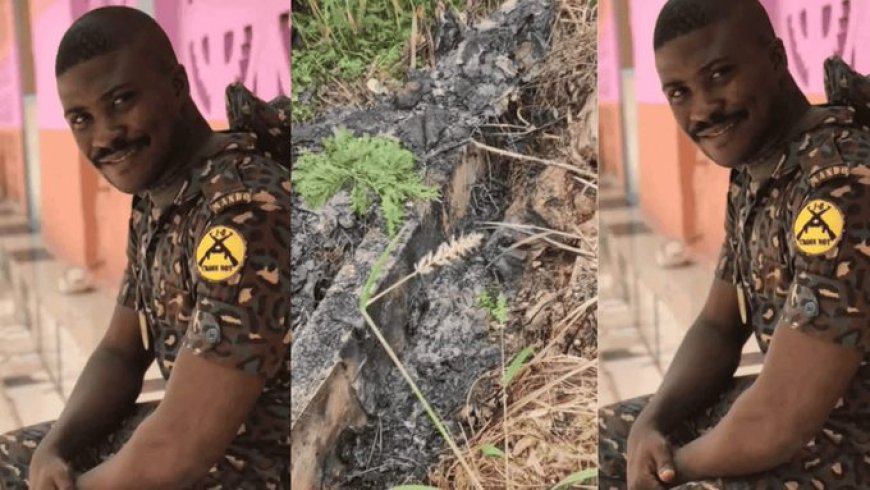
    The lifeless body of an immigration officer identified as Stephen King Amoah, also known as Nana Kofi, was discovered in a drainage system near GBC Satellite, opposite Comet Estate, Accra, on Wednesday, July 9.

    The deceased is said to have gone missing five days (since July 3) before his tragic death. This was contained in a press statement by the Ghana Police Service on Thursday, July 10.

    Providing more details about the tragic incident, the police noted that the murderer(s) of the 38-year-old also set his body on fire.

    The deceased’s remains have been conveyed to the Police Hospital morgue after the relatives positively identified the body as Stephen.

    The police have disclosed that their preliminary investigations indicate the deceased had gone to meet his debtor, one Bright Aweh, who had promised to pay the outstanding debt owed on Thursday, July 3, in the evening.

    The victim never returned home that night, and his phone remained switched off throughout, raising concerns among family and friends who later reported him missing.

    “Investigations revealed that on 3rd July 2025, at about 8:00 p.m., the deceased left his residence at Ashongman Estate after receiving WhatsApp images of cash bundles from one Bright Aweh, who requested to meet him at a spot at Ashongman Estate to settle an outstanding amount.

    “According to the complainant, the deceased never returned home that night, and his phone remained switched off thereafter,” the police said.

    After the deceased’s family filed a complaint at the police station, Bright Aweh was arrested to assist with the investigation.

    He admitted that he met with the deceased and alleged that he gave a cash of GHS500,000 to the deceased, instructing him “to use part of the money to pay off some debts and hold the remaining amount for later collection.”

    But the police in their statement noted that “the suspect could not clearly explain the source of the funds and gave conflicting statements.”

    Meanwhile, the police  pledged to get to the bottom of the case and ensure justice is served to the perpetrators.

    “The Regional Police Command strongly condemns such violent and criminal acts and assures the public that it is working diligently to uncover the full circumstances surrounding this incident and bring all responsible persons to justice,” it added.

    Subsequently, the Ghana Police announced the arrest of the prime suspect in the gruesome murder of immigration officer Stephen King Amoah, also known as Nana Kofi on August 4.

    This follows the discovery of weapons believed to have been used in the murder of Immigration Officer Stephen Amoah.

    During a press briefing on Monday, August 4, the Director-General of the CID, COP Lydia Yaako Donkor, revealed that bloodstains were found in the living room, on a burnt, blood-soaked carpet, and on a fufu pestle suspected to have been used in the murder by the suspect.

    According to the Police, the forensic conducted on Thursday, July 24, also exposed freshly sprayed walls, hinting at an attempted cleanup by the suspect.

    “The Kwabenya Teshie Police visited the suspect’s residence, and the forensic inspection revealed the following bloodstains in the living room and evidence of attempted cleanup, freshly sprayed walls, and an empty can of spray paint. A search of a secondary crime scene near the GBC satellite area also uncovered a burnt woolen carpet and partially burnt camouflage fabric.”

    “These items were photographed, retrieved and photocopied for forensic analysis. On 24th July, the police received a warrant to search a particular room in the suspect’s house. A search in the room revealed more bloodstains, which were photographed and samples collected for forensic analysis. A further search in the bushes about 100 metres from the suspect’s house also led to the retrieval of the…” the Police said.

    The Service has noted that in the coming days, undertake a DNA exercise on the bloodstains with samples from the deceased mother and son, aiding with the process.

    “I wish to say that the initial blood sample collected was positive for human blood. To aid the investigations, the deceased mother and son has provided sample for DNA profiling. In the face of these pieces of evidence the suspect who was initially charged with kidnapping has since been rearrested and formally charged with murder. He is currently on remand following his appearance with the Adabraka District Court and is scheduled to reappear on 8th August 2025.

    “A special operation is currently underway to identify and arrest his accomplices and we are following other vital leads to gather all necessary evidence against the suspect and his accomplices. The Ghana Police Service wishes to assure the public that the investigations is ongoing and every effort is being made to ensure that all the perpetrators are prosecuted,” she added.

    Meanwhile, recent reports suggested that the third suspect involved in the murder of Stephen King Amoah, an Immigration Officer, has succumbed to an illness.

    According to sources, the victim’s brother, Kwasi Amoako, revealed this information to the media.

    “Yesterday we went to court and I can confirm that the third suspect has passed on. I was told by the Police CID, the one who is in charge of the case. We thank God that our brother has started seeking justice for himself,” he is quoted to have said by MyJoyOnline.

    The police are yet to issue a formal statement on the suspect’s death.

    The Adabraka District Court on August 22, continued hearing the case after remanding the prime suspect into police custody for two weeks.

    The court has adjourned the case involving the murder of immigration officer, Stephen King Amoah, to October 9 following the police’s request for more time to gather the due evidence against the accused parties.

    The adjournment of the case was announced during the court hearing at the Adabraka District Court on Thursday, September 4, where the prosecutors prayed the court that the Ghana Police Service needed more time and specialised gadgets to advance investigations.

    According to them, a court order had been secured to facilitate the process and prayed that the suspects, Bright Aweh and Thomas Ziggah, remain in custody.

    However, Counsel for the suspects, Gordon Aboagye, expressed concerns about the state of his clients, who appeared visibly distressed, suggesting that they may have been held under harsh conditions while in custody.

    Referring to the need to uphold democratic principles, he prayed that the court reveal the detention location of the suspects in order for their families to visit them and check their well-being while in custody.

    “In line with democratic principles, families of the suspects should be aware of their location to enable visitation”

    “My Lord, my client has appeared in court limping and with bloodshot eyes. He has already been treated twice at the Police Hospital without improvement. We respectfully request that he be sent to Korle Bu Teaching Hospital for independent medical attention,” he argued.

    However, the prosecution objected, urging the defence to formally apply if it insists on the transfer of its client.

    He further appealed to the bereaved family to remain calm and allow the law to take its course. He commiserated with them for their loss.

    “We sympathise with the family of the deceased and plead with them to remain calm and allow the law to take its course,” he added.

    The court, on the other hand, admonished the family of the bereaved family to stay patient, assuring them that justice would be duly served.

    Meanwhile, a dramatic scene unfolded at the court when the aunt of the late officer performed rituals, breaking eggs and invoking curses on those she believes are responsible for his death.

    She reportedly said, “Anyone responsible for his death should also suffer the same fate. All your generation will suffer the same fate; the gods should deal ruthlessly with anyone responsible for his murder. The gods shouldn’t spare anyone involved.”

    The case is now scheduled to continue on October 9.
  • BoG announces a month suspension of TapTap Send, Send App, 3 others over breach of remittance laws

    BoG announces a month suspension of TapTap Send, Send App, 3 others over breach of remittance laws

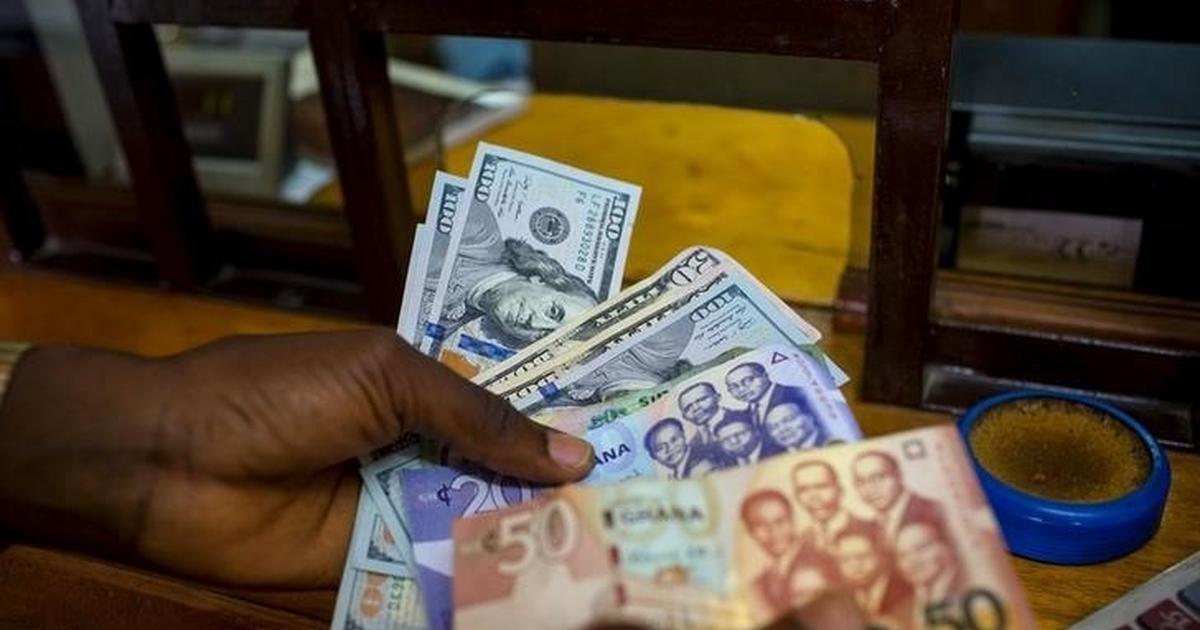
    The Bank of Ghana (BoG) has temporarily suspended the licenses of five money transfer companies to operate remittance services in Ghana for a month. This follows a breach of the country’s remittance service guidelines by these Money Transfer Operators (MTOs).

    In an official statement dated September 4 and shared on September 6, the suspension is expected to take effect from Sept 18 to October 18, 2025.

    The companies include “Taptap Send, Top Connect, Remit Choice, Send App, Afriex. This is as a result of various breaches of the Updated Guidelines for Inward Remittance Services by Payment Service Providers, 2023, as amended by Bank of Ghana Notice No. BG/GOV/SEC/2025/25”, parts of the statement read.

    The Money Transfer Operators (MTOs), Taptap Send, Top Connect, Remit Choice, Send App, and Afriex, according to BoG, worked with Halges Financial Technologies Limited, Cellulant Limited, and Flutterwave Inc., using UBA Ghana as their settlement bank, without prior approval from the Bank of Ghana (BoG). 

    This, according to BoG’s updated Remittance laws, is a breach of the Updated Guidelines for Inward Remittance Services by Payment Service Providers, 2023, specifically paragraphs 5 and 7.17.3.

    Paragraph 5 of the Updated Guidelines states that all remittance partnerships between MTOs and PSPs must be explicitly approved by BoG before operations begin. Paragraph 7.17.3, on the other hand, details operational standards, including reporting obligations, consumer protection, and anti-money laundering protocols.

    By overlooking these requirements and doing otherwise, the MTOs and PSPs operated outside the regulated financial ecosystem, which risked money laundering vulnerabilities, undermined consumer protection mechanisms and violated foreign exchange market rules, prompting BoG to suspend UBA Ghana’s forex trading license as well.

    Consequently, “…the aforementioned MTOs shall be permitted to re-engage in remittance activities only upon the re-application by their partner PSPs or banks for the Bank of Ghana’s consideration, following the expiration of the suspension period”.

    BoG has therefore cautioned all forex market players to abide by the market’s regulations to protect consumers and ensure the smooth running of the market.

    “By this statement, we caution foreign exchange market players to adhere strictly to the applicable forex market regulations and guidelines. END”, the statement said.

    Meanwhile, the Updated Guidelines for Inward Remittance Services by Payment Service Providers, 2023, as amended by Bank of Ghana Notice No. BG/GOV/SEC/2025/25, regularises how Payment Service Providers (PSPs) in Ghana operate in terms of their partnerships with  Money Transfer Operators (MTOs) in the delivery of remittance services. 

    As quoted from the  official document, “These Guidelines seek to: (i) provide a framework to guide DEMIs and EPSPs in partnering with MTOs to deliver inward remittance services to beneficiaries; (ii) stipulate the minimum standards and requirements for providing inward remittance services; (iii) provide competitive market conditions for the inward remittance industry through the use of innovative digital payment channels; (iv) promote compliance with consumer protection and recourse mechanisms.”

    The guidelines apply specifically to Dedicated Electronic Money Issuers (DEMIs) and Enhanced Payment Service Providers (EPSPs), emphasising compliance with the Bank of Ghana Act, 2002 (Act 612), the Foreign Exchange Act, 2006 (Act 723), and the Payment Systems and Services Act, 2019 (Act 987).

    Meanwhile, this is not the first time BoG has suspended MTo over remittance regulations breaches.

    In November last year, it announced a one-month suspension of the Foreign Exchange Trading Licence of Consolidated Bank Ghana (CBG), effective from 26th November 2024.

    The suspension was issued under section 11 (2) of the Foreign Exchange Act, 2006 (Act 723).

    According to the Bank of Ghana, the suspension was enforced following multiple breaches by CBG of the foreign exchange market regulations, including the Updated Guidelines for Inward Remittance Service for Payment Service Providers, issued in November 2023. The breaches also relate to violations of the Anti-Money Laundering/Combating the Financing of Terrorism & the Proliferation of Weapons of Mass Destruction (AML/CFT&P) Act, as well as the Accountable Institutions Guideline, dated December 2022.

    BoG gave conditions that, before CBG’s license will be restored, it would have to be satisfied that CBG has implemented effective controls to ensure compliance with foreign exchange market regulations.

    For customers, this suspension meant limited access to essential foreign exchange services. During the suspension period, CBG was unable to handle any currency exchange transactions, including buying or selling foreign currencies. This restriction mostly impacts customers who may need to convert their cedi accounts into foreign currencies like the dollar or pound for travel, business, or international payments.

    TapTap sends suspension marks the second in ten months, all for breach of the same remittance guidelines.

    Effects of such suspensions on MTO

    During such strikes by BoG, these MTOs tend to lose revenue due to a halt in their operations. Consumers’ trust in their genuineness and reputation also dwindles as they are likely to develop cold feet in their engagements with flagged companies by the BoG.

    Also, sometimes these suspended firms are placed under tighter watch, and future approvals may be harder to secure.

  • Govt to compensate victims assaulted during 2024 electoral violence  – President Mahama

    Govt to compensate victims assaulted during 2024 electoral violence  – President Mahama

    The government has promised relief to victims of electoral violence, particularly those who suffered attacks during the 2020 and 2024 elections.

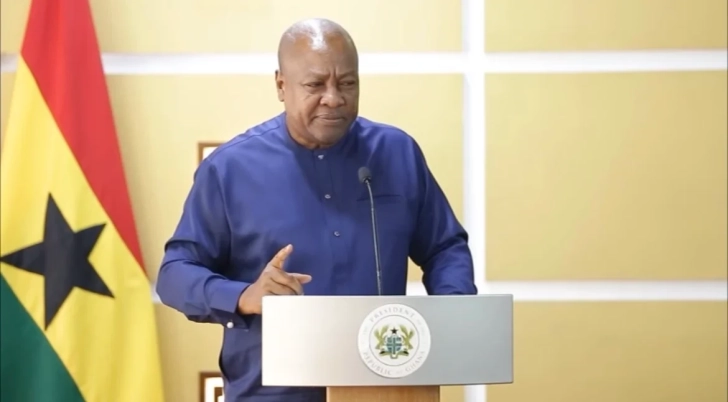
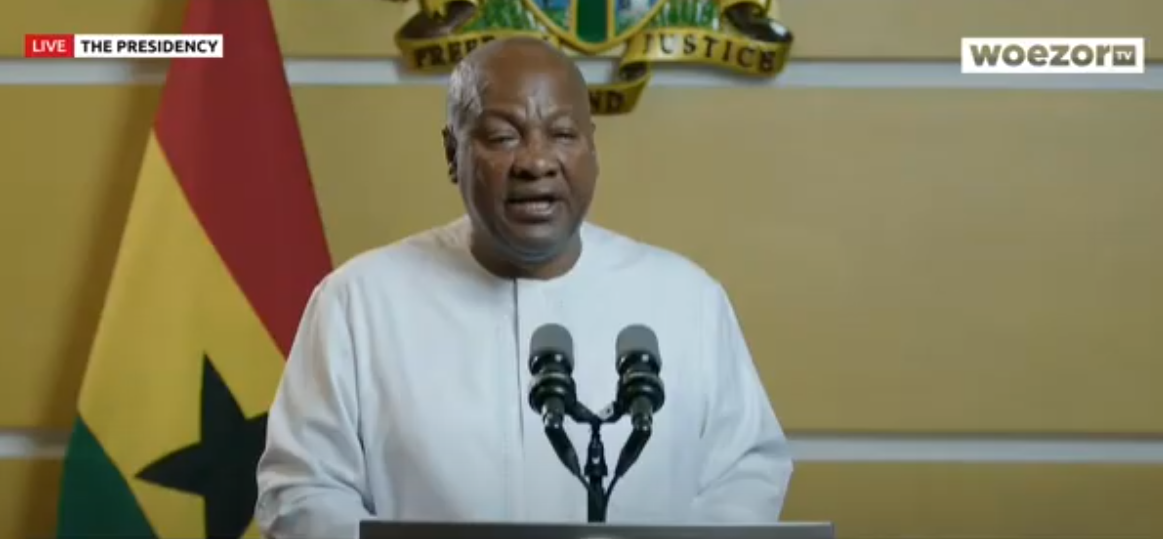
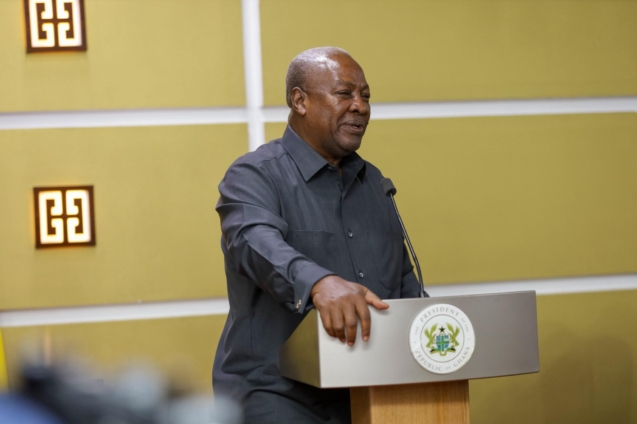
    Speaking during a courtesy call by the  Ghana Journalists Association (GJA) at the Jubilee House in Accra, on Friday, September 5,  President John Dramani Mahama revealed that, he has received a report from the Ghana Police Service with records of all victims of electoral violence citing that fater all the necessary review is completed on the report, victims will be rightly compensated.

    According to him, this comes after he tasked the Inspector-General of Police (IGP) to investigate the incidents upon assuming office, adding that the IGP has delivered on his mandate by presenting him with a comprehensive report detailing all those affected, including individuals who lost their lives and those who sustained various degrees of injury.

    His outfit has submitted the report to the Attorney General for perusal, to determine the rightful compensation package for the victims.

    “I wish to inform you that last week, I received the investigative report on the two incidents, and they have detailed and catalogued everybody who was affected by the violence and the circumstances that led to the violence.”

    “We have given him [the Attorney General] the terms of reference to look at what adequate compensation would be for people who have been the victims of violence, including those who died, their families are still there, and then those who were some have been injured and are living with injury.“What is the adequate compensation that we can give to people like that?”, President Mahama noted.

    He continued, “ We have handed it over to the Attorney General, and he’s going to go through, and if there’s the need to hold some people culpable and bring them to book, the Attorney General will do that”.

    Additionally, President Mahama has assured that the compensation package will also include journalists who, over the years, have been victims of electoral violence on multiple occasions.

    “…And so once that is done, I’m sure that if there were journalists involved, they would also be considered for compensation,” he added.

    His comments follow a reminder by the Ghana Journalists Association (GJA) President, Albert Kwabena Dwumfour, to President Mahama to fulfil his campaign promise of protecting and ensuring the safety of journalists. He appealed to the president to ensure that, 

    “Unwarranted attacks on journalists must end. We call on you to ensure that perpetrators of violence against media personnel are held accountable.”

    During a media engagement on August 16, 2024, President Mahama gave his word to journalists that, when he assumed power, the media would have their freedom to execute their mandate without intimidation. He said:

    “The best thing you can give the media is to give them the freedom to do their work. Unfortunately, that hasn’t happened under this government. Media people have been hounded, some have run into exile, some have been threatened, their lives have been threatened, and indeed some have paid the ultimate price like Ahmed Suale did.”

    He continued with a personal pledge:

    “You can trust that as a person who is a member of the Ghana Journalists Association (GJA) myself, I am not the kind of person who would hound the media, and so one gift I can give to you is the freedom to do your work without anybody intimidating and harassing you.”

    Consequently, Mr. Dwumfour urged President Mahama to exercise his executive powers by enacting stronger laws that would empower security agencies to protect journalists.

    According to the GJA President, attacks on journalists are often premeditated, making them serious offences that require tougher laws to curb such conduct.

     “Your Excellency, we encourage you to invoke your executive powers to enact a law to empower security agencies to protect journalists. Since most of these attacks are premeditated, they must be treated as aggravated offences. If we continue to treat them as misdemeanours, it will not serve as a deterrent,” he stressed.

    History of attacks on journalists 

    Ghana has a troubling history of attacks on journalists. Recent cases of assaults, particularly during by-elections in recent times, have affected our ranking in press freedom on the global level, as confirmed by President Mahama.

    Over the years, journalists have been attacked in their line of duty, some by civilians and in other cases by some security officials who are mandated to protect them.

    Barely two months ago, about three journalists were assaulted during the coverage of the Ablekuma North by-election held on July 11.

    During the election, a police officer deployed to one of the polling stations, Church of Pentecost, North Odorkor 4 polling station, slapped and pushed a GHOne TV journalist, Kwabena Agyekum Banahene. According to the journalist, the police officer singled him out during his coverage of the by-election. When he refused to leave, explaining that he was doing his duty to report the electoral process, the officer still went ahead to assault him without justification, even after presenting him with an ID card. He sustained mouth injuries and was treated at Cocoa Clinic.

    Another disturbing attack was that on ATV-Ghana’s journalists, Vida Wiafe, who was hit with pepper spray by police officers at St. Peter’s Society Polling Station while interviewing voters. She lost consciousness and required medical attention.

    Sally Martey, a JoyNews reporter, was assaulted on live TV by a masked thug who slapped her from behind and shoved her to the side while reporting at the same polling station. The incident was captured on video and widely condemned.

    Also, about two journalists who have faced repeated assaults in their line of duty are JoyNews’ Latif Iddrisu and galamsey reporter Erastus Donkor.

    Latif’s case is currently still being dragged in court. On  March 27, 2018, he was brutally beaten by police officers at the CID Headquarters in Accra, which nearly cost him his life.

    According to reports, this near-fatal assault occurred while he was covering a protest. During an engagement with some of the protesters, officers turned on him, striking him repeatedly. He suffered head injuries, including a fractured skull, with the trauma leading to long-term neurological complications.

    Latif underwent extensive medical treatment and therapy, including care in California, USA. Despite attempts to return to frontline reporting, he continues to struggle with pain and trauma. 

    The officers involved have not been publicly prosecuted to date.  In a separate incident this year, March 27, Latif was covering a protest at the Economic and Organised Crime Office (EOCO) in Accra related to the arrest of NPP’s Ashanti Regional Chairman, Bernard Antwi Boasiako (Chairman Wontumi) when he was physically assaulted by NPP supporters, threatened, and later received death threats via text message warning him to withdraw his police complaint. Latif was forced into hiding due to threats against him and his family. He requested police protection, but no tangible response was provided.

    However, one suspect, Theophilus Thompson, has since been arrested. On June 7, Theophilus was apprehended and is currently in police custody. On the other hand, investigations are ongoing to identify other perpetrators.

  • Kofi Akpaloo still in EOCO’s custody for money laundering, fraud; fails to meet bail conditions – A-G

    Kofi Akpaloo still in EOCO’s custody for money laundering, fraud; fails to meet bail conditions – A-G

    The Office of the Attorney General has broken its silence on the reasons behind the Liberal Party of Ghana (LPG’s) Percival Kofi Akpaloo’s arrest, three days after his apprehension.

    In a post on Facebook detailing the causes of his arrest, the Deputy Attorney General, Justice Srem-Sai,  confirmed that Percival Kofi Akpaloo, leader and 2024 presidential candidate of the LPG, is under active investigation for alleged financial misappropriation and other related misconduct.

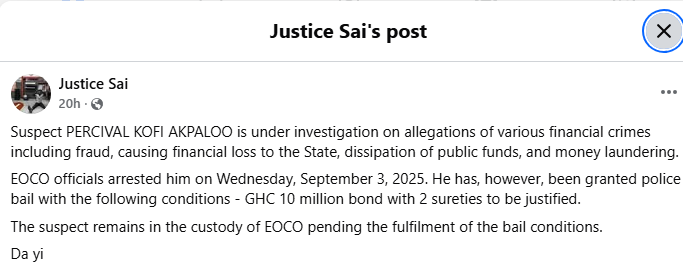
    According to the A-G’s post, “Suspect PERCIVAL KOFI AKPALOO is under investigation on allegations of various financial crimes, including fraud, causing financial loss to the State, dissipation of public funds, and money laundering”.

    He continued that, while a GH¢ 10million police bail has been approved for Akapaloo, he remains in custody as he has yet to meet the conditions. Akpaloo was arrested by the Economic and Organised Crime Office (EOCO) on Wednesday, September 3, in Kumasi. 

    “EOCO officials arrested him on Wednesday, September 3,2025. He has, however, been granted police bail with the following conditions – GHC 10 million bond with 2 sureties to be justified. The suspect remains in the custody of EOCO pending the fulfilment of the bail conditions”, the A-G highlighted.

    Mr Akpaloo vied for presidency in the 2024 general elections. Prior to the election, Akpaloo expressed strong confidence in his chances for a decisive win, predicting victory over major contenders. However, he obtained 5,219 being 0.09%.

    The new development has got many questioning the circumstances surrounding Kofi Akpaloo’s arrest. Recently, EOCO has been investigating high-profile political figures and business leaders.

    The Economic and Organised Crime Office was established by the Economic and Organised Crime Office Act , 2010 (Act 804) as a specialized agency to monitor and investigate economic and organised crime and on the authority of the Attorney-General prosecute these offenses to recover the proceeds of crime and provide for related matters.

    The EOCO has similar mandates to the Office of the Special Prosecutor (OSP). Recently, the OSP released a fifty-page report covering investigations and prosecutions carried out between January 1 and July 31 this year.

    The OSP’s Seventh Half-yearly Report is pursuant to Section 3(3) of the Office of the Special Prosecutor Act, 2017 (Act 959). The document also outlines key developments in the Office’s operations.

    According to the OSP, despite resistance from powerful interests, it stayed focused on executing its mandate during this period. As such, the Office successfully progressed significant corruption-related investigations to the stage of court proceedings, while also initiating new inquiries into suspected acts of corruption.

    “Then again, the Office, as one of three implementing partners of the new National Ethics and Anti-Corruption Strategy and Implementing Plan, is fashioning and moulding anti-corruption structures that would stand the test of time. The task ahead remains formidable. Much more so is our resolve to perform.

    “This reporting period was characterised by intensification of the Office’s prosecutorial mandate. We advanced high-profile investigations to court and initiated bold inquiries into suspected corruption, often in the face of deep-seated resistance from entrenched interests.

    “Notwithstanding these expected challenges, the Office remains resolute and guided by the rule of law, fairness, firmness, evidence-based action, and the interest of the public. We recognise that the fight against corruption cannot be waged and won only through punitive action and incarceration,” parts of the report read.

    The legislative framework of the Office of the Special Prosecutor mandates the Authority to crack down on corruption, recover assets, and confiscate illicit property.

    “Indeed, the legislative set-up of the Office leans heavily on corruption-prevention and asset recovery and disgorgement of tainted property. Consequently, we proceed on sustainable anti-corruption outcomes by pairing enforcement with robust prevention and asset recovery, especially founded on our unique plea bargaining regime.

    In this spirit, the Office scaled up its preventive mandate through active engagement with public institutions, private sector actors, civil society- and secured convictions and asset recovery through impactful plea bargaining. We also reckon that the nation’s anti-corruption legal framework requires re-imagination, modernisation and retooling to address the immense scale and complexity of modern corruption in the context of our social, economic and political constructs.

    “On this score, the Office has proposed the inclusion of a new chapter in the Constitution dedicated to the fight against corruption through definitive constitutional expression by the institution of proposed concrete measures to effectively and comprehensively suppress and repress corruption in public life as well as in the private sector chief among which include lifestyle audit non-conviction-based asset recovery, enhanced asset declaration and verification regime, and reverse onus presumption of corruption as the foundation of both anti-corruption criminal proceedings and civil asset recovery proceedings,” parts of the report added.

    The Office is also leading the charge in respect of the passage of a comprehensive Corrupt Practices Act and Conduct of Public Officers Act.

    Currently, sixty-seven(67) cases are being handled by the Office, all of which are undergoing comprehensive review.

    The corruption cases being investigated by OSP include: Minerals Income Investment Fund, Ghana Airports Company Limited, Ghana Education Service, National Commission on Culture, Ghana Revenue Authority/Tata Consulting Services, National Service Authority, Ministry of Health/Service Ghana Auto Group Limited, National Cathedral.

    The others are: Tema oil refinery and Tema Energy and Processing Limited and the Electricity Company of Ghana Limited, State lands, Stool lands, and other Vested lands, Illegal Mining, National Sports Authority, Customs Division of Ghana Revenue Authority, Bank of Ghana and Estate of Kwadwo Owusu-Afriyie, alias Sir John.

    It further hinted that “There were seven (7) convictions and one (1) acquittal in respect of the cases pending before the criminal courts during the period under review. The Office has filed an appeal in respect of the case in which the accused was acquitted.

    Additionally, one hundred and fifty-two (152) cases are at the preliminary investigation stage, with the OSP assuring that details will be made public once they progress to the next stage.

    The Office is also seized with one hundred and fifty-two (152) other cases at the preliminary investigation stage. These may be publicised if the Special Prosecutor determines that they are within the mandate of the Office and that they should be moved past the preliminary investigation stage.

    This is a policy intended to protect the privacy of individuals and the business operations of institutions and companies, and to avoid unnecessary stigmatization.

  • Such disrepect to Ghanaians will not continue under my watch – Sam George to MultiChoice

    Such disrepect to Ghanaians will not continue under my watch – Sam George to MultiChoice

    Minister for Communication, Digital Technology and Innovation, Sam Nartey George, has reacted to MultiChoice’s statement denying its purported initial agreement to cut their subscription fees.

    Taking to his official X (formerly Twitter) account, Sam George highlighted his commitment to protecting the interests of Ghanaians without compromise. He affirmed that he would not allow any form of disrespect to consumers from any company.

    If MultiChoice has objected to price cuts as they earlier agreed to, then the proposed shutdown of their services in Ghana would hold as earlier communicated, Sam George noted.

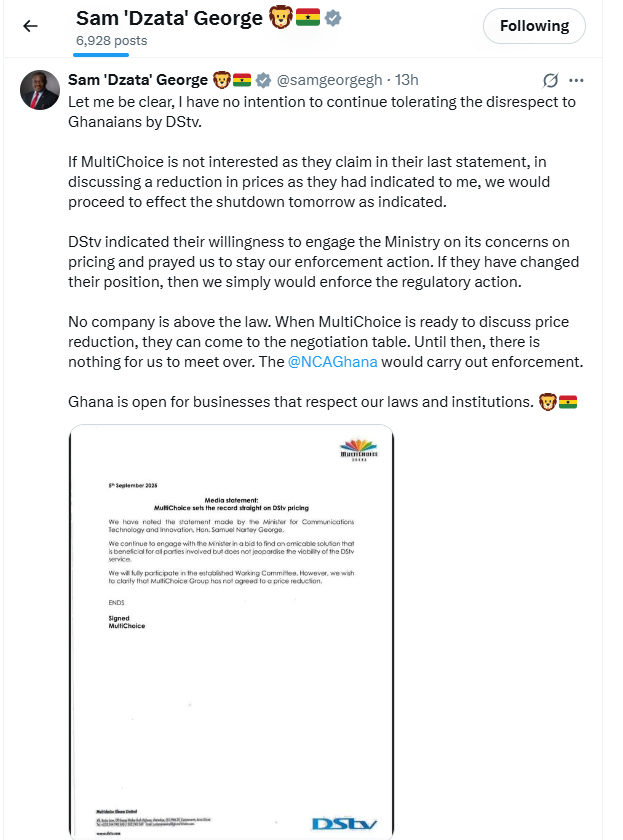
    “Let me be clear, I have no intention to continue tolerating the disrespect to Ghanaians by DStv. If MultiChoice is not interested, as they claim in their last statement, in discussing a reduction in prices as they had indicated to me, we would proceed to effect the shutdown tomorrow as indicated,” he indicated.

    He reiterated that “DStv indicated their willingness to engage the Ministry on its concerns on pricing and prayed us to stay our enforcement action. If they have changed their position, then we simply would enforce the regulatory action”.

    The Ningo-Prampram Member of Parliament stressed that Ghana is ready to partner with international firms, but only in full respect of the country’s laws and consumer protection.

    “No company is above the law. When MultiChoice is ready to discuss a price reduction, they can come to the negotiation table. Until then, there is nothing for us to meet over. The @NCAGhana would carry out enforcement. Ghana is open for businesses that respect our laws and institutions,” he stressed.

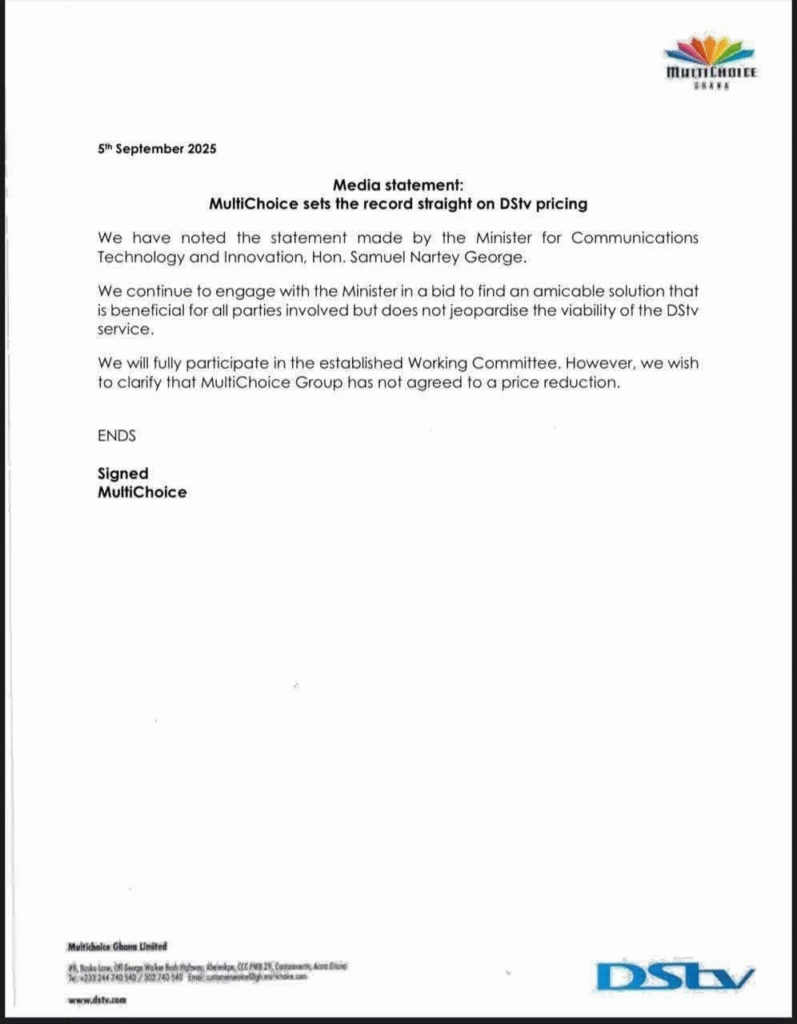
    His remarks follow the broadcaster’s in a response statement titled “MultiChoice sets the record straight on DStv pricing” and shared on Friday, September 5. MultiChoice announced its readiness to cooperate with the Working Committee established by the Communications Ministry to find a solution to the discussion concerning the reduction of DSTV fees for the Ghanaian populace.

    However, it objected to claims by the Minister that their outfit is ready for a price reduction.

    “We have noted the statement made by the Minister for Communications Technology and Innovation, Hon. Samuel Nartey George. We continue to engage with the Minister in a bid to find an amicable solution that is beneficial for all parties involved, but does not jeopardise the viability of the DStv service.

    “We will fully participate in the established Working Committee. However, we wish to clarify that MultiChoice Group has not agreed to a price reduction”, the statement explained.

     The said Committee, according to Sam George, will be chaired by him to ensure transparency and fairness.

    This committee includes representatives from the Ministry of Communication, Digital Technology and Innovation, the National Communications Authority (NCA), MultiChoice Ghana, and MultiChoice Africa.

    The statement follows Communications Minister Sam George’s claims in an earlier press briefing held yesterday, Friday, September 5, that the satellite television provider has agreed to a price reduction.

    During the briefing, he also revealed that, following their agreement to reduce prices, they have asked for thirty days to conclude discussions and arrive at a final decision. But

    Sam George outrightly declared that the 30-day window is too much, hence they have just fourteen days to reach a decision. With the 14-day window, MultiChoice has until September 21 to arrive at a solution.

    “Let us be clear—they have finally accepted that there will be a reduction, and they want us to discuss the level of reduction. I believe that as a minister, we do not need 30 days. 14 days is enough for us to reach this decision, inclusive of weekends,” the Minister said.

    Earlier, the Minister for Communications, Digital Technology and Innovation, announced that should Multichoice fail to reduce the prices of its subscription services, the DStv broadcast license will be suspended nationwide, effective August 7, 2025.

    Engaging the public yesterday as part of the Government Accountability Series, the minister noted that he received a 9-page document from Multichoice on July 21 over its inability to reduce its subscription fees.

    The company cited depreciation of the cedi in past years, despite the recent cedi appreciation, as the reason for its inability to reduce prices. Sam George noted that it is unacceptable for Nigerians to be paying less for the same packages offered Ghanaians at higher costs when the naira has depreciated at an accelerating rate against the cedi.

    As such, he has directed the National Communications Authority (NCA) to suspend the broadcast of DStv should Multichoice fail to reduce prices of its packages.

    “Their reasons included that the cedi had depreciated in the preceding eight years by 240%, and they claimed that my request for a reduction on the basis of the appreciation of the cedi was unfounded because, in their words, the appreciation of the Ghana cedi over the last 6 months has been a fluke which could not be sustainable.

    “As Minister, my fidelity is to the Ghanaian people. I have to act in the interest of the Ghanaian people, and I believe the Ghanaian people have been fleeced and exploited for too long. I wrote back to the NCA on Monday and directed the NCA in that letter to suspend the broadcasting license of dstv effective 7th of August 2025 if they fail to effect a reduction in their bundle prices.

    “I can’t as minister serving the Ghanaian people, continue to watch what can be best described as plain stealing happening to the Ghanaian people. In my letter to them, I gave them scenarios from seven markets that dstv is operating in. The same content in the premium bouquet that is offered to Ghanaians for the $83 equivalent is offered to Nigerians for the $29 equivalent.

    How can anyone explain this price disparity to me? Enough of the mistreatment of the Ghanaian consumer. In Nigeria, in the same timeframe, they say the Ghanaian cedi has depreciated by 240%, the Nigerian naira has depreciated by 409%. If Nigerians are paying the equivalent of $29, dstv must charge the same here in Ghana,” he said.

    The minister has sought a 30 percent reduction in the price of packages provided by Multichoice. In reaction, MultiChoice Ghana responded to the directive demanding an adjustment of its subscription services.

    As per a statement signed by its Managing Director, Mr. Alex Okyere, on August 3, the company emphasized that the Minister’s proposal to drastically review its prices is not workable.

    According to the company, it acknowledges the positive impact of the local currency, the cedi, against foreign currencies, specifically the U.S. dollar. However, a significant decrease in prices cannot be attained by the company.

    “While we appreciate the recent appreciation of the cedi— which we have never referred to as a ‘fluke’— it is not tenable to reduce the DStv subscription fees in the manner proposed by the Minister,” the statement read.

    Should both parties fail to reach common ground, the suspension of the DStv broadcast license is imminent.

    On July 4, Minister of Communication, Digital Technology and Innovation, Samuel Nartey George, engaged the leadership of MultiChoice Ghana to discuss a possible reduction in fees for DSTV subscriptions.

    This comes after issues of affordability became topical in recent months after an increase in subscription fees in April.

    The sector minister made this known when he engaged the media on July 3 on key initiatives and developments within the sector under the second quarter.

    “Last week, I invited the senior leadership of MultiChoice Ghana to a formal dialogue on DSTV’s subscription pricing in Ghana. The meeting addressed public concerns about affordability, value for money, and fairness in service delivery. I made it clear the ministry’s expectation that pricing structures must be responsive to Ghana’s economic context,” he said.

    “I have a meeting scheduled for tomorrow, Friday, even though it’s a public holiday, with the Ghana team and their South African counterparts, the management from South Africa, they arrived tonight to agree on a way forward on the issues raised,” the minister indicated.

    He further said; “The outcomes will be shared with the public in due course. This engagement reflects our commitment to regulatory accountability and our resolve to ensure that digital services in Ghana remain fair, accessible, and responsive to the needs of citizens. I’ll make you one promise, I won’t leave tomorrow’s meeting without securing a drop in the pricing of DSTV. That is a solemn promise I make to you.”

    Subscribers of DStv across Africa, effective April 1, 2025, experienced a price increase of over 15% on their monthly subscription fees, a decision that left many Ghanaian customers aggrieved.

    The pay-TV provider cited rising consumer inflation and economic challenges as key factors influencing the decision. According to the new pricing structure, in Ghana, the cost of the premium package rose from GHC750 to GHC865, representing a 15.33% increase.

    The Compact Plus package moved from GHC495 to GHC570, marking a 15.15% jump, while the Compact package increased from GHC330 to GHC380, also reflecting a 15.15% rise.

    The Family package now costs GHC190, up from GHC165, indicating a 15.15% increase, whereas the Access package went up by 16.47%, from GHC85 to GHC99.

    Subscribers to the DStv Lite package experienced the highest percentage surge of 18.00%, moving from GHC50 to GHC59. The DStv-Asia Standalone package climbed by 14.75%, from GHC305 to GHC350. The Great Wall Add-on increased from GHC70 to GHC80, marking a 14.29% rise.

    For those subscribed to the French content add-ons, the French Add-on now costs GHC250, up from GHC215 (16.28% increase), while the French Plus Add-on rose from GHC435 to GHC500, reflecting a 14.94% increase. The French Touch Add-on costs GHC150, up from GHC130, marking a 15.38% increase.

    The cost of premium packages with add-ons has also been adjusted. Premium with Asia Add-on increased from GHC1,055 to GHC1,215 (15.17% increase), while Premium with French Add-on now costs GHC1,365, up from GHC1,185 (15.19% increase). The HD-PVR service rose by 15.00%, from GHC100 to GHC115.

    Following this, consumer rights organization CUTS International pushed for government intervention in MultiChoice Ghana Limited’s decision to raise subscription fees, arguing that customers were given inadequate notice ahead of the increase.

    About a month ago, MultiChoice Ghana announced an upgrade in all of its DStv and GOtv packages as well as a reduction in the price of its decoders, from GH¢169 to GH¢89, due to the rebound of the economy.

    The Minority caucus in Parliament has requested the appearance of the Minister for Communications and Digitalisation, along with representatives of MultiChoice Ghana, to address concerns over the recent reduction in package prices.

    A statement signed by the Member of Parliament for Kpandai, Matthew Nyindam, on behalf of the Minority, on Sunday, August 3, indicated that the invitation has become crucial in order to strike a better deal between the two parties.

    Meanwhile, the Minority has also emphasized that “We agree that subscription fees must be set fairly and reflect the realities of Ghana’s economy”.

    “We fully support the advocacy initiated by patriotic citizens, which has now attracted the attention of the Ministry of Communications and Digitalisation. We agree that subscription fees must be set fairly and reflect the realities of Ghana’s economy”.

  • MultiChoice Group has not agreed to a price reduction – Company reacts to Sam George’s claims

    MultiChoice Group has not agreed to a price reduction – Company reacts to Sam George’s claims

    Satellite television provider MultiChoice Ghana has finally denied its purported decision to cut prices for Ghanaian consumers.

    In a responsse statement titled “MultiChoice sets the record straight on DStv pricing” and shared on Friday, September 5, MultiChoice announced its readiness to cooperate with the Working Committee established by the Communications Ministry to find a solution to the discussion concerning the reduction of DSTV fees for the Ghanaian populace.

    However, it objected to claims by the Minister that their outfit is ready for a price reduction.


    “We have noted the statement made by the Minister for Communications Technology and Innovation, Hon. Samuel Nartey George. We continue to engage with the Minister in a bid to find an amicable solution that is beneficial for all parties involved, but does not jeopardise the viability of the DStv service.

    “We will fully participate in the established Working Committee. However, we wish to clarify that MultiChoice Group has not agreed to a price reduction”, the statement explained.

     The said Committee, according to Sam George, will be chaired by him to ensure transparency and fairness.

    This committee includes representatives from the Ministry of Communication, Digital Technology and Innovation, the National Communications Authority (NCA), MultiChoice Ghana, and MultiChoice Africa.

    The statement follows Communications Minister Sam George’s claims in an earlier press briefing held yesterday, Friday, September 5, that the satellite television provider has agreed to a price reduction.

    During the briefing, he also revealed that, following their agreement to reduce prices, they have asked for thirty days to conclude discussions and arrive at a final decision. But

    Sam George outrightly declared that the 30-day window is too much, hence they have just fourteen days to reach a decision. With the 14-day window, MultiChoice has until September 21 to arrive at a solution.

    “Let us be clear—they have finally accepted that there will be a reduction, and they want us to discuss the level of reduction. I believe that as a minister, we do not need 30 days. 14 days is enough for us to reach this decision, inclusive of weekends,” the Minister said.

    A few hours after MultiChoice publicly objected to the Minister’s claims of their price cuts, Sam George, in a (X ) formerly Twitter post, stated that their denying their earlier position of being ready to reduce prices suggests that their services in Ghana will end today, September 6, as earlier discussed 

    “If MultiChoice is not interested, as they claim in their last statement, in discussing a reduction in prices as they had indicated to me, we would proceed to effect the shutdown tomorrow as indicated, ” he noted.

    He stressed Ghana’s openness to work with any international company, however, in accordance with our laws.

    “No company is above the law. When MultiChoice is ready to discuss a price reduction, they can come to the negotiation table. Until then, there is nothing for us to meet over. The @NCAGhana would carry out enforcement. Ghana is open for businesses that respect our laws and institutions,” he added.

    Earlier, the Minister for Communications, Digital Technology and Innovation, announced that should Multichoice fail to reduce the prices of its subscription services, the DStv broadcast license will be suspended nationwide effective August 7, 2025.

    Engaging the public yesterday as part of the Government Accountability Series, the minister noted that he received a 9-page document from Multichoice on July 21 over its inability to reduce its subscription fees.

    The company cited depreciation of the cedi in past years, despite the recent cedi appreciation, as the reason for its inability to reduce prices.Sam George noted that it is unacceptable for Nigerians to be paying less for the same packages offered Ghanaians at higher costs when the naira has depreciated at an accelerating rate against the cedi.

    As such, he has directed the National Communications Authority (NCA) to suspend the broadcast of DStv should Multichoice fail to reduce prices of its packages.

    “Their reasons included that the cedi had depreciated in the preceding eight years by 240%, and they claimed that my request for a reduction on the basis of the appreciation of the cedi was unfounded because, in their words, the appreciation of the Ghana cedi over the last 6 months has been a fluke which could not be sustainable.

    “As Minister, my fidelity is to the Ghanaian people. I have to act in the interest of the Ghanaian people, and I believe the Ghanaian people have been fleeced and exploited for too long. I wrote back to the NCA on Monday and directed the NCA in that letter to suspend the broadcasting license of dstv effective 7th of August 2025 if they fail to effect a reduction in their bundle prices.

    “I can’t as minister serving the Ghanaian people, continue to watch what can be best described as plain stealing happening to the Ghanaian people. In my letter to them, I gave them scenarios from seven markets that dstv is operating in. The same content in the premium bouquet that is offered to Ghanaians for the $83 equivalent is offered to Nigerians for the $29 equivalent.

    How can anyone explain this price disparity to me? Enough of the mistreatment of the Ghanaian consumer. In Nigeria, in the same timeframe, they say the Ghanaian cedi has depreciated by 240%, the Nigerian naira has depreciated by 409%. If Nigerians are paying the equivalent of $29, dstv must charge the same here in Ghana,” he said.

    The minister has sought a 30 percent reduction in the price of packages provided by Multichoice. In reaction, MultiChoice Ghana responded to the directive demanding an adjustment of its subscription services.

    As per a statement signed by its Managing Director, Mr. Alex Okyere, on August 3, the company emphasized that the Minister’s proposal to drastically review its prices is not workable.

    According to the company, it acknowledges the positive impact of the local currency, the cedi, against foreign currencies, specifically the U.S. dollar. However, a significant decrease in prices cannot be attained by the company.

    “While we appreciate the recent appreciation of the cedi— which we have never referred to as a ‘fluke’— it is not tenable to reduce the DStv subscription fees in the manner proposed by the Minister,” the statement read.

    Should both parties fail to reach common ground, the suspension of the DStv broadcast license is imminent.

    On July 4, Minister of Communication, Digital Technology and Innovation, Samuel Nartey George, engaged the leadership of MultiChoice Ghana to discuss a possible reduction in fees for DSTV subscriptions.

    This comes after issues of affordability became topical in recent months after an increase in subscription fees in April.

    The sector minister made this known when he engaged the media on July 3 on key initiatives and developments within the sector under the second quarter.

    “Last week, I invited the senior leadership of MultiChoice Ghana to a formal dialogue on DSTV’s subscription pricing in Ghana. The meeting addressed public concerns about affordability, value for money, and fairness in service delivery. I made it clear the ministry’s expectation that pricing structures must be responsive to Ghana’s economic context,” he said.

    “I have a meeting scheduled for tomorrow, Friday, even though it’s a public holiday, with the Ghana team and their South African counterparts, the management from South Africa, they arrived tonight to agree on a way forward on the issues raised,” the minister indicated.

    He further said; “The outcomes will be shared with the public in due course. This engagement reflects our commitment to regulatory accountability and our resolve to ensure that digital services in Ghana remain fair, accessible, and responsive to the needs of citizens. I’ll make you one promise, I won’t leave tomorrow’s meeting without securing a drop in the pricing of DSTV. That is a solemn promise I make to you.”

    Subscribers of DStv across Africa, effective April 1, 2025, experienced a price increase of over 15% on their monthly subscription fees, a decision that left many Ghanaian customers aggrieved.

    The pay-TV provider cited rising consumer inflation and economic challenges as key factors influencing the decision. According to the new pricing structure, in Ghana, the cost of the premium package rose from GHC750 to GHC865, representing a 15.33% increase.

    The Compact Plus package moved from GHC495 to GHC570, marking a 15.15% jump, while the Compact package increased from GHC330 to GHC380, also reflecting a 15.15% rise.

    The Family package now costs GHC190, up from GHC165, indicating a 15.15% increase, whereas the Access package went up by 16.47%, from GHC85 to GHC99.

    Subscribers to the DStv Lite package experienced the highest percentage surge of 18.00%, moving from GHC50 to GHC59. The DStv-Asia Standalone package climbed by 14.75%, from GHC305 to GHC350. The Great Wall Add-on increased from GHC70 to GHC80, marking a 14.29% rise.

    For those subscribed to the French content add-ons, the French Add-on now costs GHC250, up from GHC215 (16.28% increase), while the French Plus Add-on rose from GHC435 to GHC500, reflecting a 14.94% increase. The French Touch Add-on costs GHC150, up from GHC130, marking a 15.38% increase.

    The cost of premium packages with add-ons has also been adjusted. Premium with Asia Add-on increased from GHC1,055 to GHC1,215 (15.17% increase), while Premium with French Add-on now costs GHC1,365, up from GHC1,185 (15.19% increase). The HD-PVR service rose by 15.00%, from GHC100 to GHC115.

    Following this, consumer rights organization CUTS International pushed for government intervention in MultiChoice Ghana Limited’s decision to raise subscription fees, arguing that customers were given inadequate notice ahead of the increase.

    About a month ago, MultiChoice Ghana announced an upgrade in all of its DStv and GOtv packages as well as a reduction in the price of its decoders, from GH¢169 to GH¢89, due to the rebound of the economy.

    The Minority caucus in Parliament has requested the appearance of the Minister for Communications and Digitalisation, along with representatives of MultiChoice Ghana, to address concerns over the recent reduction in package prices.

    A statement signed by the Member of Parliament for Kpandai, Matthew Nyindam, on behalf of the Minority, on Sunday, August 3, indicated that the invitation has become crucial in order to strike a better deal between the two parties.

    Meanwhile, the Minority has also emphasized that “We agree that subscription fees must be set fairly and reflect the realities of Ghana’s economy”.

    “We fully support the advocacy initiated by patriotic citizens, which has now attracted the attention of the Ministry of Communications and Digitalisation. We agree that subscription fees must be set fairly and reflect the realities of Ghana’s economy”.

  • 2026WC: This is what it will take for Ghana to qualify after Chad draw

    2026WC: This is what it will take for Ghana to qualify after Chad draw

    Four-time African champions Ghana Black Stars stirred excitement among fans when Jordan Ayew found the back of the net at the 17th minute. However, at the eleventh hour, just three minutes before the final whistle blew, Célestin Ecua notched an equaliser for his side, securing for Chad a point.

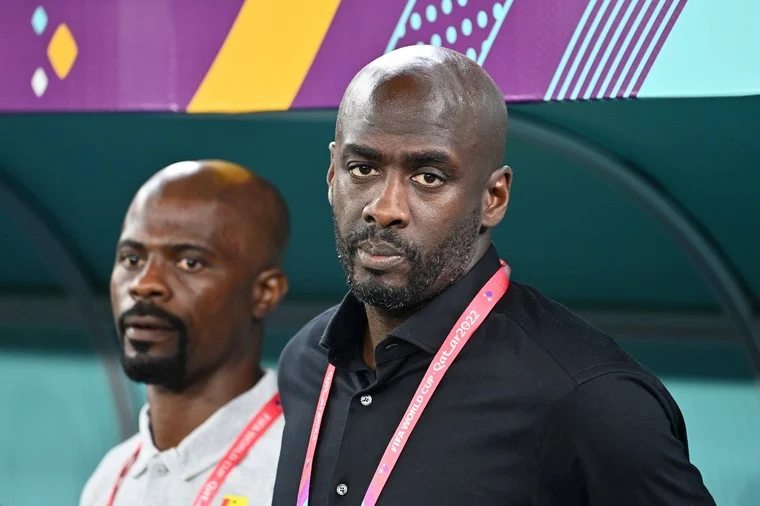
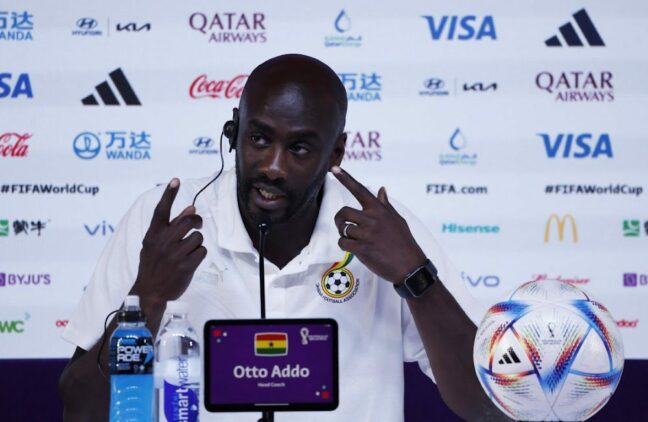
    Black Stars head coach Otto Addo has admitted that Ghana’s performance was below par following the squad’s draw with Chad in yesterday’s clash at N’Djamena.

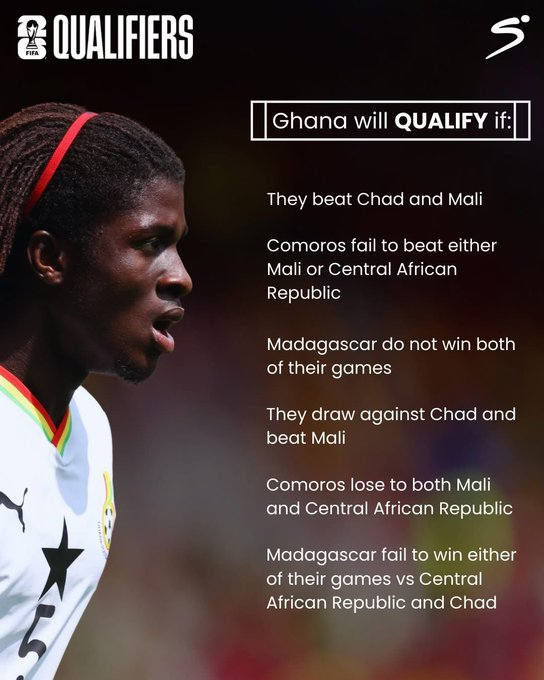
    However, Otto Addo’s side faces mounting pressure ahead of their final fixtures. To secure their ticket to the global level, the Black Stars would have to win their match against Mali. They will qualify if Comoros fails to beat either Mali or the Central African Republic. Also, Madagascar must not win both of their remaining games.

    Speaking during the post-match press conference, the head coach slammed his side for their wastefulness despite dominating play in the 2026 FIFA World Cup qualifiers. According to him, the team wasted opportunities they got from their several dead-ball situations.

    “I can’t say we played excellently, or we played well, because it was a draw. The result is everything; we had a lot of corners, we did nothing out of that…We had a lot of shots, goal attempts, we had a lot of ball possession, and normally we have to win this game. This, in the end, surely, is not good enough, and we have to improve, especially on our execution,” Otto Addo said.

    He blamed the poor condition of the pitch in N’Djamena for slowing down Ghana’s tempo and limiting their ability to break down Chad’s defence.

    “It’s very difficult to play on this terrain when it’s not watered. We can’t play fast, so it’s a disadvantage for us,” he continued.

    He then went on to applaud Chad for their defensive effort and late equaliser, which earned them their late goal.

    A few hours before the clash with Chad, Otto Addo expressed his discontent with the state of the pitch set to host the 2026 FIFA World Cup qualifiers clash between the Ghana Black Stars and Chad today.

    During a pre-match interview, Otto Addo questioned how FIFA could approve such a deteriorating pitch for the game, describing it as being as hard as concrete and raising concerns about players’ comfort and ability to perform at their best.

    “Yeah, so, yeah, I’m really surprised that they have allowed this pitch for an international match. The pitch is really, really not good. It’s very, very hard for the players; it’s like playing on concrete. But yeah, what can we do? We have to take it as it comes, and we are prepared,” he assured.

    He continued that his outfit discovered the sorry state of the pitch today, September 4, a few hours ahead of the clash with Chad, stressing that several better options could have been chosen.

    “We observed everything today. Like I said, it’s not a good AstroTurf, to be honest. Nowadays, there are far better Astroturfs, which are also much healthier for the players,” Coach Otto Addo shared as quoted on the ghanafa.org,” he added.

    Even after the match, he still insisted that the poor state of the field affected his side’s tempo on the pitch.

    “It was difficult playing on the pitch because when it’s not watered, we can’t play fast, so it’s a disadvantage for us. The boys play in Europe, so when the pitch is right, they can play fast.” “The pitch is very slow; it made it difficult for us to outplay the defenders.”

    Addo expressed disappointment that the Black Stars will have little time to regroup as they prepare to host Mali in a crucial Matchday 8 encounter at the Accra Sports Stadium on Monday, September 8, with kick-off at 19:00 GMT.

    Despite the setback, Ghana remain top of Group I with 16 points.

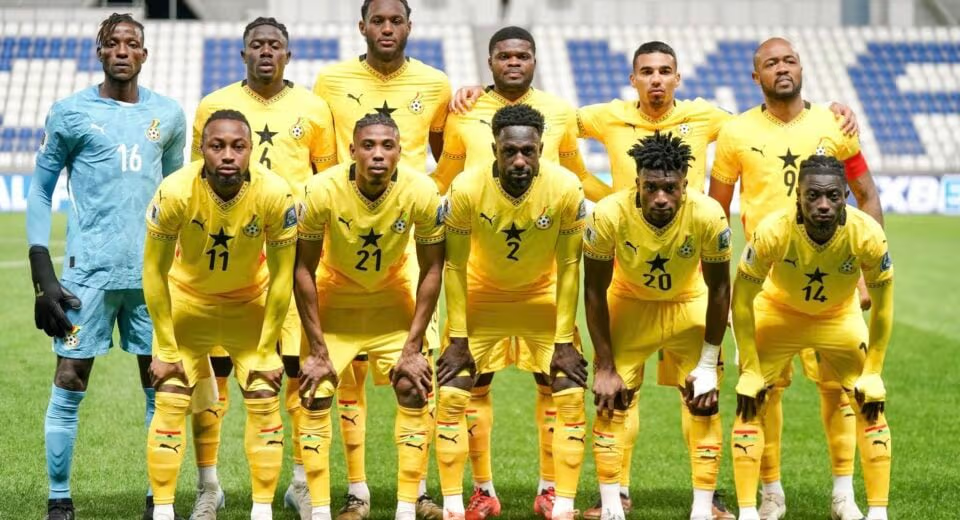
    Ghana’s starting lineup against Chad featured Benjamin Asare in goal (Hearts of Oak); a back four of Tariq Lamptey (Fiorentina), Gideon Mensah (Auxerre), Mohammed Salisu (AS Monaco), and Jerome Opoku (İstanbul Başakşehir); midfielders Thomas Partey (Villarreal) and Elisha Owusu (Auxerre); Mohammed Kudus (Tottenham Hotspur) in the attacking midfield role; Antoine Semenyo (Bournemouth) and Caleb Yirenkyi (FC Nordsjaelland) on the wings; with Jordan Ayew (Crystal Palace) leading the line as captain.

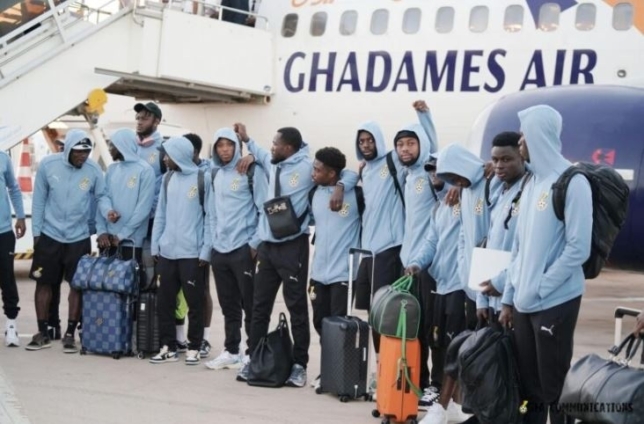
    Also, all twenty-four invited players were reported to travel to N’Djamena with Otto Addo. The Black Stars will wrap up their qualifiers against the Central African Republic and Comoros in October.

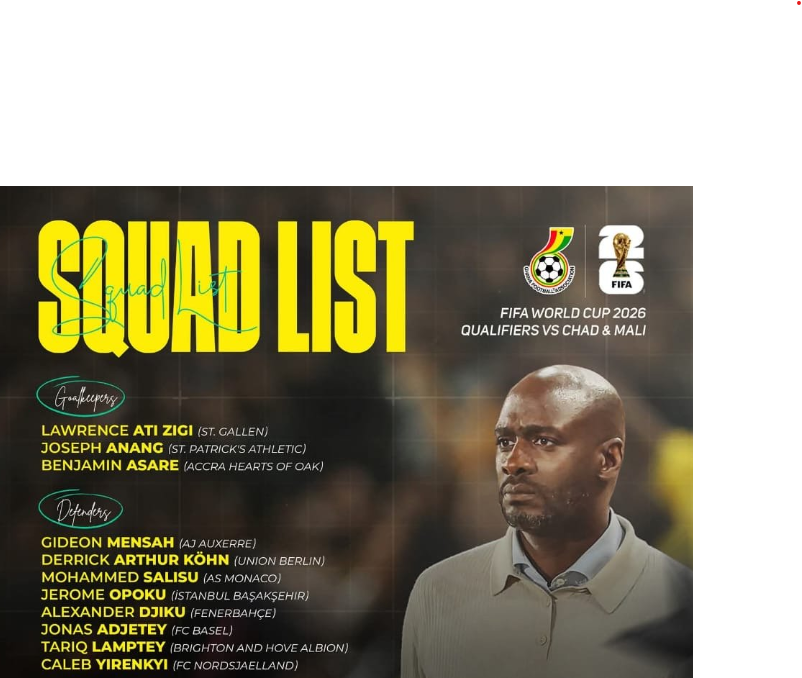
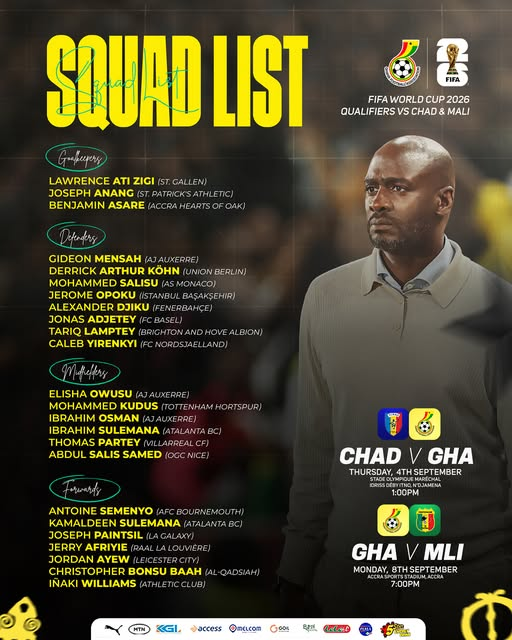
    Coach Otto Addo formally announced the Black Stars squad for Ghana’s upcoming 2026 FIFA World Cup qualifiers against Chad and Mali on the evening of Tuesday, August 26.

    The release included a full list of 24 players, featuring both returning stars and debutants. Some players were rewarded for their stellar performances in the Unity Cup and also in their respective clubs.

    Out of the twenty-four-man squad, four of them are debutants for the senior national team.

    Union Berlin forward, Derrick Arthur Köhn, secured a call-up after an outstanding season in Germany, and Caleb Yirenkyi of FC Nordsjaelland was also called up again following his display of maturity and excellent form during the Unity Cup and at the club level.

    Christopher Bonsu Baah of Al-Qadsiah was also included in Otto Addo’s squad. Following his giant strides in the Saudi.

    Goalkeeper Joseph Anang of St. Patrick’s Athletic, based in Ireland, also got his first senior nod.

    Players like Tariq Lamptey, who has been away following an injury, have also been called back.

    According to Otto Addo’s list, the goalkeepers include Lawrence Ati Zigi, Joseph Anang and popular Hearts of Oak keeper Benjamin Asare, who earned admiration of many following his impressive display in his last call-up.

  • We need to get better, particularly on our execution – Otto Addo admits Black Stars poor play

    We need to get better, particularly on our execution – Otto Addo admits Black Stars poor play

    Black Stars head coach Otto Addo has admitted that Ghana’s performance was below par following the squad’s draw with Chad in yesterday’s clash at N’Djamena.

    Speaking during the post-match press conference, the head coach slammed his side for their wastefulness despite dominating play in the 2026 FIFA World Cup qualifiers. According to him, the team wasted opportunities they got from their several dead-ball situations.

    “I can’t say we played excellently, or we played well, because it was a draw. The result is everything; we had a lot of corners, we did nothing out of that…We had a lot of shots, attempts on goal, we had a lot of ball possession, and normally we have to win this game. This, in the end, surely, is not good enough, and we have to improve, especially on our execution,” Otto Addo said.

    He blamed the poor condition of the pitch in N’Djamena for slowing down Ghana’s tempo and limiting their ability to break down Chad’s defence.

    “It’s very difficult to play on this terrain when it’s not watered. We can’t play fast, so it’s a disadvantage for us,” he continued.

    He then went on to applaud Chad for their defensive effort and late equaliser, which earned them their late goal.

    Ghana appeared on course for another victory in Group I when Jordan Ayew put them ahead in the 17th minute. But the Chadians struck late, with Celestine Ecua equalising in the 88th minute to frustrate the four-time African champions in N’Djamena.

    Speaking after the match, Addo expressed disappointment that the Black Stars will have little time to regroup as they prepare to host Mali in a crucial Matchday 8 encounter at the Accra Sports Stadium on Monday, September 8, with kick-off at 19:00 GMT.

    Despite the setback, Ghana remain top of Group I with 16 points.

    Ghana’s starting lineup against Chad featured Benjamin Asare in goal (Hearts of Oak); a back four of Tariq Lamptey (Fiorentina), Gideon Mensah (Auxerre), Mohammed Salisu (AS Monaco), and Jerome Opoku (İstanbul Başakşehir); midfielders Thomas Partey (Villarreal) and Elisha Owusu (Auxerre); Mohammed Kudus (Tottenham Hotspur) in the attacking midfield role; Antoine Semenyo (Bournemouth) and Caleb Yirenkyi (FC Nordsjaelland) on the wings; with Jordan Ayew (Crystal Palace) leading the line as captain.

    Meanwhile, a few hours before the clash, Ghana’s head coach Otto Addo had expressed his discontent with the state of the pitch set to host the 2026 FIFA World Cup qualifiers clash between the Ghana Black Stars and Chad today.

    During a pre-match interview, Otto Addo questioned how FIFA could approve such a deteriorating pitch for the game, describing it as being as hard as concrete and raising concerns about players’ comfort and ability to perform at their best.

    “Yeah, so, yeah, I’m really surprised that they have allowed this pitch for an international match. The pitch is really, really not good. It’s very, very hard for the players; it’s like playing on concrete. But yeah, what can we do? We have to take it as it comes, and we are prepared,” he assured.

    He continued that his outfit discovered the sorry state of the pitch today, September 4, a few hours ahead of the clash with Chad, stressing that several better options could have been chosen.

    “We observed everything today. Like I said, it’s not a good AstroTurf, to be honest. Nowadays, there are far better Astroturfs, which are also much healthier for the players,” Coach Otto Addo shared as quoted on the ghanafa.org,” he added.

    Also, all twenty-four invited players were reported to travel to N’Djamena with Otto Addo. The Black Stars will wrap up their qualifiers against the Central African Republic and Comoros in October.

    Coach Otto Addo formally announced the Black Stars squad for Ghana’s upcoming 2026 FIFA World Cup qualifiers against Chad and Mali on the evening of Tuesday, August 26.

    The release included a full list of 24 players, featuring both returning stars and debutants. Some players were rewarded for their stellar performances in the Unity Cup and also in their respective clubs.

    Out of the twenty-four-man squad, four of them are debutants for the senior national team.

    Union Berlin forward, Derrick Arthur Köhn, secured a call-up after an outstanding season in Germany, and Caleb Yirenkyi of FC Nordsjaelland was also called up again following his display of maturity and excellent form during the Unity Cup and at the club level.

    Christopher Bonsu Baah of Al-Qadsiah was also included in Otto Addo’s squad. Following his giant strides in the Saudi.

    Goalkeeper Joseph Anang of St. Patrick’s Athletic, based in Ireland, also got his first senior nod.

    Players like Tariq Lamptey, who has been away following an injury, have also been called back.

    According to Otto Addo’s list, the goalkeepers include Lawrence Ati Zigi, Joseph Anang and popular Hearts of Oak keeper Benjamin Asare, who earned admiration of many following his impressive display in his last call-up.

    See the list below:
    Goalkeepers
    Lawrence Ati Zigi – St. Gallen

    Joseph Anang – St. Patrick’s Athletic

    Benjamin Asare – Accra Hearts of Oak

    Defenders
    Gideon Mensah – AJ Auxerre

    Derrick Arthur Köhn – Union Berlin

    Mohammed Salisu – AS Monaco

    Jerome Opoku – İstanbul Başakşehir

    Alexander Djiku – Fenerbahçe

    Jonas Adjetey – FC Basel

    Tariq Lamptey – Brighton & Hove Albion

    Caleb Yirenkyi – FC Nordsjaelland

    Midfielders
    Elisha Owusu – AJ Auxerre

    Mohammed Kudus – Tottenham Hotspur

    Ibrahim Osman – AJ Auxerre

    Ibrahim Sulemana – Atalanta BC

    Thomas Partey – Villarreal CF

    Abdul Salis Samed – OGC Nice

    Forwards
    Antoine Semenyo – AFC Bournemouth

    Kamaldeen Sulemana – Atalanta BC

    Joseph Paintsil – LA Galaxy

    Jerry Afriyie – RAAL La Louvière

    Jordan Ayew – Leicester City

    Christopher Bonsu Baah – Al-Qadsiah

    Iñaki Williams – Athletic Club

  • Murder case of Immigration Officer postponed to October 9

    Murder case of Immigration Officer postponed to October 9

    The court has adjourned the case involving the murder of immigration officer, Stephen King Amoah, to October 9 following the police’s request for more time to gather the due evidence against the accused parties.

    The adjournment of the case was announced during the court hearing at the Adabraka District Court on Thursday, September 4, where the prosecutors prayed the court that the Ghana Police Service needed more time and specialised gadgets to advance investigations.

    According to them, a court order had been secured to facilitate the process and prayed that the suspects, Bright Aweh and Thomas Ziggah, remain in custody.

    However, Counsel for the suspects, Gordon Aboagye, expressed concerns about the state of his clients, who appeared visibly distressed, suggesting that they may have been held under harsh conditions while in custody.

    Referring to the need to uphold democratic principles, he prayed that the court reveal the detention location of the suspects in order for their families to visit them and check their well-being while in custody.

    “In line with democratic principles, families of the suspects should be aware of their location to enable visitation”

    “My Lord, my client has appeared in court limping and with bloodshot eyes. He has already been treated twice at the Police Hospital without improvement. We respectfully request that he be sent to Korle Bu Teaching Hospital for independent medical attention,” he argued.

    However, the prosecution objected, urging the defence to formally apply if it insists on the transfer of its client.

    He further appealed to the bereaved family to remain calm and allow the law to take its course. He commiserated with them for their loss.

    “We sympathise with the family of the deceased and plead with them to remain calm and allow the law to take its course,” he added.

    The court, on the other hand, admonished the family of the bereaved family to stay patient, assuring them that justice would be duly served.

    Meanwhile, a dramatic scene unfolded at the court when the aunt of the late officer performed rituals, breaking eggs and invoking curses on those she believes are responsible for his death.

    She reportedly said, “Anyone responsible for his death should also suffer the same fate. All your generation will suffer the same fate; the gods should deal ruthlessly with anyone responsible for his murder. The gods shouldn’t spare anyone involved.”

    The case is now scheduled to continue on October 9.
    Early last month, the Ghana Police rearrested the prime suspect in the gruesome murder of immigration officer Stephen King Amoah, also known as Nana Kofi.

    This followed the discovery of weapons believed to have been used in the murder of Immigration Officer Stephen Amoah.

    During a press briefing on Monday, August 4, the Director-General of the CID, COP Lydia Yaako Donkor, revealed that bloodstains were found in the living room, on a burnt, blood-soaked carpet, and on a fufu pestle suspected to have been used in the murder by the suspect.

    According to the Police, the forensic investigation conducted on Thursday, July 24, also exposed freshly sprayed walls, hinting at an attempted cleanup by the suspect.

    “The Kwabenya Teshie Police visited the suspect’s residence, and the forensic inspection revealed the following bloodstains in the living room and evidence of attempted cleanup, freshly sprayed walls, and an empty can of spray paint. A search of a secondary crime scene near the GBC satellite area also uncovered a burnt woollen carpet and partially burnt camouflage fabric.”

    “These items were photographed, retrieved and photocopied for forensic analysis. On 24th July, the police received a warrant to search a particular room in the suspect’s house. A search in the room revealed more bloodstains, which were photographed and samples collected for forensic analysis. A further search in the bushes about 100 metres from the suspect’s house also led to the retrieval of the…” the Police said.

    The Service noted that in the coming days, they’d undertake a DNA exercise on the bloodstains with samples from the deceased mother and son, aiding with the process.

    “I wish to say that the initial blood sample collected was positive for human blood. To aid the investigations, the deceased mother and son have provided samples for DNA profiling. In the face of these pieces of evidence, the suspect, who was initially charged with kidnapping, has since been rearrested and formally charged with murder. He is currently on remand following his appearance with the Adabraka District Court and is scheduled to reappear on 8th August 2025.

    “A special operation is currently underway to identify and arrest his accomplices, and we are following other vital leads to gather all necessary evidence against the suspect and his accomplices. The Ghana Police Service wishes to assure the public that the investigations are ongoing and every effort is being made to ensure that all the perpetrators are prosecuted,” she added.

    The suspect is scheduled to appear in court on August 8th. The lifeless body of the immigration officer was discovered in a drainage system near GBC Satellite, opposite Comet Estate, Accra, on Wednesday, July 9.
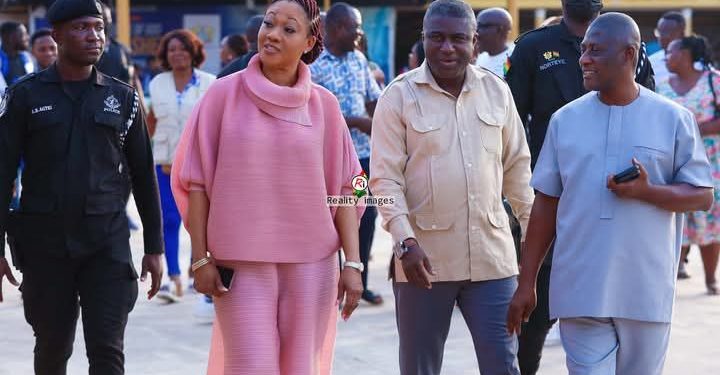
    The deceased is said to have gone missing five days (since July 3) before his tragic death. This was contained in a press statement by the Ghana Police Service on Thursday, July 10.

    Providing more details about the tragic incident, the police noted that the murderer(s) of the 38-year-old also set his body on fire.

    The deceased’s remains have been conveyed to the Police Hospital morgue after the relatives positively identified the body as Stephen.

    The police have disclosed that their preliminary investigations indicate the deceased had gone to meet his debtor, one Bright Aweh, who had promised to pay the outstanding debt owed on Thursday, July 3, in the evening.

    Recent reports suggest that the third suspect involved in the murder of Stephen King Amoah, an Immigration Officer, has succumbed to an illness.

    According to sources, the victim’s brother, Kwasi Amoako, revealed this information to the media.

    “Yesterday we went to court and I can confirm that the third suspect has passed on. I was told by the Police CID, the one who is in charge of the case. We thank God that our brother has started seeking justice for himself,” he is quoted to have said by MyJoyOnline.

    The police are yet to issue a formal statement on the suspect’s death.

  • You won’t lose your jobs – Sam George assures staff as govt announces AT, Telecel merger 

    You won’t lose your jobs – Sam George assures staff as govt announces AT, Telecel merger 

    Minister for Communication, Digital Technology and Innovations, Samuel Nartey George, has pledged job security for the staff of AT Ghana (formerly AirtelTigo) and Telecel Ghana, despite the government’s decision to merge the two companies.

    He gave this assurance during a staff engagement at AT Ghana’s Head Office in Accra on Thursday, September 4. The meeting was specifically organised to address concerns of AT Ghana employees regarding the merger with Telecel Ghana.

    In his address, he stated that all 300 employees of AT Ghana would be duly absorbed, with no layoffs expected unless an employee personally decides to quit.

    “This is not a re-application process. It is a continuation of your contracts. Everyone of you will be absorbed, unless you personally choose to leave,” he assured.


    The Minister assured staff that the move is not just about cost-cutting but about building a resilient, competitive telecom company that can serve Ghanaians better and thrive in the long term.

    Airtel Tigo’s merger with Telecel Ghana has been necessitated due to the former’s current financial crisis. In April this year, the Communications Minister revealed the huge financial losses AT Ghana was incurring and the need for swift action to be carried out to save the dwindling state entity.

    He called out the erstwhile government for being “ill-informed, reckless, and unpatriotic” following its symbolic purchasing of Airtel Tigo when it was wallowing in a $400 million debt, which was later downed following the Domestic Debt Restrusturing Programme (DDEP). Sam George lamented the firm’s monthly losses of GH₵20 million, describing it as “ …..is failing and obsolete; its systems haven’t been upgraded in five years and are no longer fit for purpose.”

    Consequently, having recorded losses of $10 million in just eight months, Sam George stressed that,

    “These losses are funded by taxpayers. That is money that should be building roads, water systems, and schools. We cannot keep pouring public funds into unsustainable operations”.

    According to the Minister, the consolidation with Telecel would help reduce costs, eliminate duplication, and build a stronger competitor in Ghana’s highly competitive telecom market.  “It makes no sense for two networks to operate separately on the same tower, both paying twice while both struggle. A merger is the smart and sustainable choice,” he added.

    Already, more than 3.2 million AT Ghana subscribers are being seamlessly migrated onto Telecel’s network through a national roaming arrangement, a process the Minister described as “98% smooth.” Sam George explained that the integration process will be carried out in three phases: Technical migration, which is near completion, with roaming already operational. Human resource alignment, which ensures all staff are absorbed by the end of September.

    Commercial restructuring, expected within 120 days, setting the framework for the merged operator. On financing, Sam George was frank about the capital demands of the venture, pegging it at $600 million over the next four years. 

    He confirmed that the government will contribute resources, including proceeds from spectrum sales, while encouraging Telecel and other partners to co-invest.  Meanwhile, the AT staff’s concerns about their job security are quite valid due to the history of potential job losses associated with company mergers in Ghana.

    Between August 2017 and December 2018, the Bank of Ghana (BoG) under the former government, launched a bold initiative to sanitise and stabilise the financial system in Ghana, aimed at eliminating insolvent institutions and restoring public confidence.

    Following the implementation of this cleanup policy programme, there were reports of about 6,000 direct job losses across the financial sector.

    While others were merged, several others had their licences revoked. The licences of  9 universal banks were revoked, 347 microfinance companies, 39 microcredit firms, 15 savings and loans companies, 8 finance houses, and 2 non-bank institutions, alongside an increase in the minimum capital requirement for banks from GHS 120 million to GHS 400 million, which also forced mergers and consolidations to meet new regulatory standards.

    Another case in point is AngloGold Ashanti’s Obuasi Mine restructuring, which occurred between 2014 to 2019, leading to over 5,000 job losses when the mine was temporarily shut down for redevelopment.

    In an unrelated development, Minister for Communication, Digital Technology and Innovations, Sam Nartey George, revealed that effective July 1, telecommunication companies will review the amount of data provided for their bundle packages. Subsequently, the Telcos complied with the Minister’s directive and offered consumers an increase in their data packages.

    Airtel Tigo (AT) and Telecel increased their data offers by over 10%, whereas MTN reviewed their data offers by 15%, Mr Sam George revealed while engaging the press on Tuesday, June 10.

    AT’s GHC400 data package, providing 195 GB, is now offering 236 GB. Telecel’s GHC400 data package is now worth 250 GB and not 190 GB since July. MTN has reintroduced its GHC399 data package, which offers 214GB, and has discontinued the GHC350 package that provided 92.88GB

    The reduction is a fulfilment of the Minister’s assurance of working to reduce data cost burden on Ghanaians on May 18, during an event commemorating World Telecommunications and Information Society Day in Accra.

    A committee that was set up in February had developed a roadmap meant to drive plans for data reduction. A section of Ghanaians chided the sector minister for failing to reduce data costs immediately after he assumed office some months ago.

    Mr George, during his vetting as a minister-designate, pledged to ensure the cost of data packages is revised to ensure subscribers are provided value for money and quality services. “Look, we are dealing with 8 years of the distortion of the market. I wish I could fix it arbitrarily. But it takes a very calculated attempt not to create further distortions by acting irrationally,” Mr George said in reaction to calls for immediate reduction in data prices.

    Meanwhile, the minister has arranged for cheaper data bundles on five national holidays in the year. These selected holidays are Independence Day, May Day, Republic Day, Founders’ Day, and Farmers’ Day. According to him, the initial plan was to offer discounted packages on all 18 public holidays in the year, but this proved unfeasible as telecommunications companies pushed back against the proposal.

    Nonetheless, Ghanaians on March 6th (Independence Day) enjoyed discounted data bundles for the first time on a public holiday. On May 1 (May Day), a similar offer was made with Ghanaians enjoying discounted packages with the same benefit for the three remaining selected upcoming holidays ahead in the year.

    Meanwhile, Samuel Nartey George has vowed to impose financial penalties on Mobile Network Operators (MNOs) that fail to meet service quality standards before the end of the year. According to Mr George, 40 per cent of the fines imposed on telecom companies that fail to provide quality services will be used to provide data or call-time bonuses to affected customers.

    The Communication Ministry announced a nationwide service quality test, covering all district capitals in the third quarter of 2025. Based on its findings, adding that, the government will take “decisive action” if no significant improvements are seen.

    With regard to the spectrum rollout, the minister noted that “the Ghanaian people must feel the impact by the end of this year.” “We know you can’t complete upgrades in three months, but we must see that the process has begun,” he added, providing a short-term deadline of June 30.

    On their part, the executives of the telcos provided their strategies and investments made so far to provide quality services. MTN Ghana CEO Stephen Blewett revealed that the company had invested $230 million in 2024 to strengthen its network and IT systems.

    Plans include launching 300 new franchise outlets, hiring 400 new staff, and rolling out secure self-service tools for SIM swaps and PIN resets.

    Telecel Ghana COO Mohamad Ghaddar revealed that the company has over 400 retail shops, and there are ongoing plans to add 100 more. He also noted the company’s commitment to supporting customers with special needs and welcomed regulatory engagement.

    AT CEO Leo Skarlatos said significant network upgrades are underway, and by the first quarter of 2026, customers will begin to observe the impact.

  • TDC MD announces former staff sold public land to wife at just GHS 2k

    TDC MD announces former staff sold public land to wife at just GHS 2k

    Tema Development Company (TDC) Limited has alleged that a former staff member of the company, who also served as the Tema Central Constituency Secretary of the New Patriotic Party (NPP), illegally sold a public plot of land in Tema Community 5 to his wife for GHS 2,000.

    During a press briefing held in Accra, Thursday, September 4, the Managing Director of TDC, Courage Makafui Nunekpeku, revealed that the former staff member in question served as a protocol officer to a former TDC Managing Director. 

    However, he disclosed that, he has reclaimed the land which was originally earmarked for the construction of a public toilet for the constituents after a successful intervention.

    “The NPP Tema Central Constituency Secretary sold that place to the wife at the cost of GHS 2,000. The documents are with me; I can make them available. When I went into the matter, I said no way; I engaged the woman, and I terminated the contract. I am not grabbing any land; I am just doing the right thing for the Ghanaian. I terminated that contract, and now the place is for the state to be used as a public toilet,” he announced.

    He firmly stated that this reclaiming of state property is not land grabbing, as some media houses may report it, but a step in the right direction.

    “The likes of the crusading guys captured it as though I was grabbing land. I am not grabbing any land. I am just doing the right thing. For the past 10 years, I have terminated that contract. It’s not for me. So, I am not grabbing any land in this case”.

    In light of this, he educated the public that, when a land allocation is made for someone, whether through a license, a deed, or direct allocation, it doesn’t mean the person automatically owns it forever or that the arrangement can never be changed.

    “…whether through a license, a deed, or direct allocation,  it doesn’t mean the person automatically owns it forever or that the arrangement can never be changed”, he noted.

    The pre-briefing held by the TDC was aimed at addressing and exposing illegal land transactions and affirming their commitment to cracking down on such actions. The briefing forms part of TDC’s broader campaign to recover illegally acquired lands and redirect them toward public infrastructure and housing development.

    This comes at a time when President John Dramani Mahama has lifted the ban on transactions on state land. The ban was announced in an official statement dated January 10 and addressed to the Executive Secretary of the Lands Commission, citing the need to protect public lands for the benefit of current and future generations. 

    Eight months on, President Mahama, on Tuesday, September 2, announced that he had lifted it with immediate effect.  He made this announcement during his speech at the inauguration of the newly constituted Board of the Lands Commission on Tuesday, September 2, highlighting that the pause exposed major shortcomings in the country’s land transactions, which called for a reset.

    “In pursuit of this reform agenda, my government placed a temporary ban on all state land transactions to enable a thorough review of existing processes. That exercise has yielded valuable insights into the weaknesses of our current system and the urgent reforms that are required. 


    “So today, with the integration of the new commission and the adoption of robust accountability measures, I’m pleased to announce that the ban on land transactions has been lifted,” President Mahama explained.

    TDC’s revelation about the former staff member, his connections to the corridors of power, and the events surrounding his sale of state land to his wife, affirms President Mahama’s remarks pointing to influential people and politicians as the culprits behind the country’s broken and decaying land administration system.

    “Ladies and gentlemen, the unrestrained dissipation of state lands is not the work of the ordinary Ghanaian citizen. It is spearheaded by influential individuals who wield public office not as a trust but as a personal entitlement.

    “ Prime government lands, ecological buffer zones, school land reserves, forest enclaves, Ramsar sites, and even lagoons have been appropriated by individuals who had been given the responsibility of protecting them. This must end with this commission.

    “Over the years, these actions by corrupt individuals have consistently led to Ghana’s land administration system being flagged as one of the most corrupt, making it one of the institutions most in need of urgent reform”, he lamented.

    He continued, “Indeed, no area of our national life is in greater need of a reset than our land administration system. Our ancestors taught us that land is sacred. However, successive years of mismanagement, compounded by political interference and institutional decay, have left our land governance system broken and vulnerable.

    “ Independent anti-corruption surveys have consistently ranked the Lands Commission amongst the most distrusted institutions in our country. Public lands made for the benefit of all Ghanaians have been illegally sold, rezoned, or encroached upon with little accountability or consequences,” he fumed.

    Meanwhile, following the president’s announcement on the ban on state land transactions, the Minority caucus in Parliament demanded the immediate reversal. Speaking on the floor of Parliament on Tuesday, July 15, the Member of Parliament (MP) for Subin, Kofi Obiri Yeboah, admitted the President’s intention to safeguard public lands.

    However, he expressed concerns about the potential of the directive to halt economic activity and disrupt the works of legitimate land owners.

    “Although the President’s decision may aim at safeguarding public lands, these directives may also affect individuals and corporate entities who may have legitimately acquired interests in these lands,” the MP said. 

    They further argued that if the government genuinely believes the private sector is the engine of growth, then such a ban undermines its own economic principles.

    Consequently, the MP admonished the government to “…as a matter of urgency, should lift the ban”. 

    The MPs also expressed concern about potential revenue losses to the state, noting that the Lands Commission generates significant income through stamp duties, consent fees, and lease preparations, all of which contribute to the Consolidated Fund.

  • Cedi ranks as worst-performing currency in the latest Bloomberg report 

    Cedi ranks as worst-performing currency in the latest Bloomberg report 

    The Ghana cedi’s strong performance was a central theme highlighted by President John Mahama in an interaction with potential investors in Singapore and Japan, barely a week ago. President Mahama emphasised the robust performance of the local currency to underscore Ghana’s macroeconomic stability and attractiveness as a destination for foreign capital.

     However, the cedi’s brief gains have proven short-lived, after its rapid depreciation made it the worst-performing currency in a latest report by a global financial news outlet, Bloomberg. According to Bloomberg’s recent report released on Thursday, September 4, the Ghana cedi is the worst-performing currency among all trading currencies, attributing the depreciation to a surge in demand for dollars by companies paying for imports. “A surge in demand for dollars by companies paying for imports has ended the Ghana cedi’s recent strong performance,” Bloomberg said. 

    Bloomberg explained that the new development is attributed to the“strong gold prices”, while emphasizing that Ghana’s cedi has seen more than a ten percent (10%) depreciation in the current quarter.  This, Bloomberg noted has erased the fifty percent gain against the dollar in April and June, Bloomberg detailed. According to the Bloomberg the cedi traded 0.1 per cent weaker at GH¢11.9507 per dollar at 1:50 a.m. Despite the losses, it has gained 23 per cent so far this year.

    “Now, the currency, which had ranked first globally on the back of strong gold prices, has weakened by 13 per cent in the current quarter. Bloomberg data showed this was the steepest fall worldwide, erasing part of the 50 per cent gain recorded between April and June”, the report said.

    But Bloomberg has indicated that “Despite the losses, it has gained 23 per cent so far this year based on market data. Reacting to Bloomberg’s report, the Bank of Ghana (BoG), noted “The cedi should be stable within a reasonable range,” the central bank said in an emailed response. Our role is to ensure fluctuations remain orderly, that they reflect fundamentals, and that they do not undermine confidence in the broader economy”.

    Bloomberg in April this year,  ranked the cedi as the best-performing currency with a sixteen per cent (16%) gain against the dollar. What made the cedi earn the tag as the worst-performing currency is as a result of it seeing the steepest decline on the global level. The cedi’s appreciation in the last eight months helped ease inflationary pressures, pushing consumer inflation down to 21.2 per cent, the lowest in eight months at the time.

    Ghana’s import-dependent economy brings in a wide range of goods, from food to machinery, with demand typically rising toward the end of the year as businesses prepare for the Christmas season. The higher demand for dollars has piled pressure on the cedi, while the Bank of Ghana’s (BoG) limited supply of foreign exchange has added to the strain.

    Head of Market-Risk Management at UMB Bank, Mr Hamza Adam, said banks that submitted dollar requests on behalf of clients to the Bank of Ghana last week received only half of what they asked for. 

    “This week the central bank is trying to meet all demand,” he said by phone from Accra on September 3, 2025. 

    Meanwhile, before Bloomberg reported on the cedi, BoG addressed the concerns of Ghanaians concerning the fast depreciation of the cedi, calling for calm. Bank of Ghana Governor, Dr. Johnson Asiama, during an interview with Joy Business, which was aired on Wednesday, August 27, mentioned that the current depreciation of the cedi was temporary, assuring a comeback soon.

    “The Bank of Ghana operates a managed floating system in terms of framework; therefore, these blips will happen. But the assurance is that this is a short-term issue, and the challenges are being addressed,” he assured.

    According to data from the Bank of Ghana which was shared on 23rd August, the Ghana cedi had seen a five percent (5%) depreciation. Between August 23 and August 28, the Ghanaian cedi depreciated from GH¢10.43 to around GH¢11.00 per US dollar.

    The sharpest movement was between August 23 and 24, where the cedi depreciated from GH¢10.43 to GH¢10.90. The dollar was selling at GH¢10.43 on August 23, GH¢10.90 on August 24, and between August 25–27, it staggered between GH¢10.85–11.00. 

    As of August 28, it had crossed GH¢11 cedis, sparking major concerns. On Dr. Johnson Asiama’s part, the current depreciation is a result of the temporary shortage of foreign exchange supply in the market, resulting from the effects of the currency appreciation coupled with other phenomena that, “…we are beginning to see those phenomena at play. Imports become a lot cheaper, so it’s just natural to begin to see pressure build up on the currency”.

    He said there is no need for panic as the economic indicators are obviously strong, giving signs of a cedi recovery soon enough. Dr Asiamah attributed the depreciating cedi to the decline in remittance inflows, sharp appreciation of the cedi and limited interbank trading.

    ”…what is happening is just because of the sharp appreciation, we are beginning to have some cash flow problems, specifically because we have seen some decline in terms of remittance inflows. Also, imports become a lot cheaper, so it’s just natural to begin to see pressure build up on the currency

    “Over the last two months, we have also seen very limited interbank trading, he stated.”

    The Ghana cedi saw a remarkable appreciation against major trading currencies worldwide over the past six months. During the presentation of the 2025 Mid-Year Fiscal Policy Review, July 24, the Minister for Finance, Dr. Cassiel Ato Forson, revealed that the cedi has recorded a remarkable turnaround in the first six months of 2025, appreciating by 42.6% against the US dollar.

    Dr Forson described the cedi’s performance as “impressive” and the first of its kind in the history of Ghana’s economy. The cedi, which was initially always experiencing depreciation, is currently showing resilience against the dollar. 

    He noted that the cedi, which was previously trading at about GH¢17.0 to the US dollar, had strengthened to GH¢10.4 as of July 23. 

    “Mr. Speaker, the cedi’s performance in the first half of this year has been impressive! The Ghana cedi experienced significant appreciation against all major trading currencies in the first six months of 2025. I am happy to inform the House that our precious cedi, which once upon a time was trading at about GH¢17.0 to the US dollar, was trading at about GH¢10.4 as of yesterday, 23rd July, 2025,” he revealed. In high spirits, the minister adopted the catchphrase from Ghanaian highlife musician King Paluta’s energetic party anthem “For the Popping (Apicki),” released on December 27, 2024, and said, “This level of appreciation of the Ghana cedi has never happened in the history of our nation. Ghanafo, cedi no apicki! Apicki apicki apicki!”

    He continued that the strength of the cedi has not appreciated against just the US dollar but against the British pound as well. The cedi also gained 30.3% against the British pound and 25.6% against the euro during the same period. 

    This marks a sharp contrast to the same period in 2024, when the cedi depreciated by 18.6% against the dollar, 17.9% against the pound, and 16.0% against the euro.

    “Similarly, the cedi, which was once trading at GH¢21.0 to the Great British Pound, was trading at about GH¢14.1 as of yesterday, 23rd July. Mr. Speaker, as of end-June 2025, the cedi appreciated by 42.6% against the US dollar, 30.3% against the British pound, and 25.6% against the euro,” he added.

    With these gains over the past few months, Dr Cassiel stated that all the losses in the previous years had been reversed. “Mr. Speaker, I repeat, so far, we have almost reversed all the cedi depreciation in 2022, 2023, and 2024,” he mentioned.

  • 2026 WCQ: Pitch is as hard as concrete – Otto Addo laments ahead of Chad clash

    2026 WCQ: Pitch is as hard as concrete – Otto Addo laments ahead of Chad clash

    Black Stars head coach Otto Addo has expressed his discontent with the state of the pitch set to host the 2026 FIFA World Cup qualifiers clash between the Ghana Black Stars and Chad today.

    During a pre-match interview, Otto Addo questioned how FIFA could approve such a deteriorating pitch for the game, describing it as being as hard as concrete and raising concerns about players’ comfort and ability to perform at their best.

    “Yeah, so, yeah, I’m really surprised that they have allowed this pitch for an international match. The pitch is really, really not good. It’s very, very hard for the players; it’s like playing on concrete. But yeah, what can we do? We have to take it as it comes, and we are prepared,” he assured.

    He continued that his outfit discovered the sorry state of the pitch today, September 4, a few hours ahead of the clash with Chad, stressing that several better options could have been chosen.

    “We observed everything today. Like I said, it’s not a good AstroTurf, to be honest. Nowadays, there are far better Astroturfs, which are also much healthier for the players,” Coach Otto Addo shared as quoted on the ghanafa.org,” he added.

    The matchday 7 game of the African qualifiers in Group I will be played at Stade Olympique Maréchal Idriss Déby Itno on Thursday, September 4. Although the Stadium is stunning, the pitch is an astroturf.

    Thursday’s clash between Chad and Ghana will kick off at 1 pm.

    Meanwhile, Otto Addo has expressed optimism about winning in the clash against Chad in the 2026 FIFA World Cup qualifiers.

    Speaking during a pre-match conference held in Accra on September 1, ahead of Black Stars’ game against Chad, Otto Addo said

    “The next focus is the Chad game, and I hope that we can win”.

    While acknowledging the injuries recorded before camping, he noted that his squad is more than ready to face their opponents on Thursday, expressing excitement about seeing the debutants on the pitch.

    “Sure, we had some issues with injuries again, but nowadays there are so many games in the world. There’s so much intensity that it’s kind of normal that a lot of injuries could occur.”

    “But we still have a very, very strong squad together, really, really good, really impressive, some new players, and I’m really excited to see them playing tomorrow,” he noted.

    Speaking on the team’s readiness in terms of tactics, Otto Addo mentioned that the squad are expected to attack more to earn excellent ball possession for a win.

    “I think surely we will have a lot of ball possession and we have to attack. This is for sure. But other than that, I can’t go too deep. I hope you understand that,” he continued, adding that his leadership, i.e. the skippers of the squad, including Thomas Partey and Jordan, are also ready for the game.

    “Surely the experienced players know their role in our team. They have to be the best in our team. This is for sure”

    “We spoke a lot in the last months and both are very, very ready. So I’m looking forward to them combining well, to talk, to lead the team. And surely, I think if they’re in good shape, then we will be successful,” he added.

    Otto Addo further expressed his gratitude to the President of Ghana, John Mahama, and the President of the Ghana Football Association (GFA), George Kurt Okraku. He also thanked Ghanaians for their support and warm welcome after the Black Stars suffered a humiliating 0-5 defeat to Chad in March.

    The loss was a heavy blow not only because of the scoreline but also due to the long-standing history between the two sides, as Chad had never defeated the Black Stars until that qualifier.

    “First of all, I really, really appreciate the support. I know we are not going to talk about it, but after the bad outcome, how the people of Ghana and Accra, especially welcomed me has been good.”

    “I would also like to use this opportunity to thank the head of state, our president (H.E. John Mahama), for his visits, also the sports minister who has been there watching all our training and supporting us, having really, really, really inspiring words.”

    “Same as our President (Kurt Okraku) and also former players visiting the ground and having really, really good talks with our players. And surely this is the support we need.”

    Also, all twenty-four invited players will travel to N’Djamena with Otto Addo today.

    The Black Stars will wrap up their qualifiers against the Central African Republic and Comoros in October.

    Coach Otto Addo formally announced the Black Stars squad for Ghana’s upcoming 2026 FIFA World Cup qualifiers against Chad and Mali on the evening of Tuesday, August 26.

    The release included a full list of 24 players, featuring both returning stars and debutants. Some players were rewarded for their stellar performances in the Unity Cup and also in their respective clubs.

    Out of the twenty-four-man squad, four of them are debutants for the senior national team.

    Union Berlin forward, Derrick Arthur Köhn, secured a call-up after an outstanding season in Germany, and Caleb Yirenkyi of FC Nordsjaelland was also called up again following his display of maturity and excellent form during the Unity Cup and at the club level.

    Christopher Bonsu Baah of Al-Qadsiah was also included in Otto Addo’s squad. Following his giant strides in the Saudi.

    Goalkeeper Joseph Anang of St. Patrick’s Athletic, based in Ireland, also got his first senior nod.

    Players like Tariq Lamptey, who has been away following an injury, have also been called back.

    According to Otto Addo’s list, the goalkeepers include Lawrence Ati Zigi, Joseph Anang and popular Hearts of Oak keeper Benjamin Asare, who earned admiration of many following his impressive display in his last call-up.

    See the list below:
    Goalkeepers
    Lawrence Ati Zigi – St. Gallen

    Joseph Anang – St. Patrick’s Athletic

    Benjamin Asare – Accra Hearts of Oak

    Defenders
    Gideon Mensah – AJ Auxerre

    Derrick Arthur Köhn – Union Berlin

    Mohammed Salisu – AS Monaco

    Jerome Opoku – İstanbul Başakşehir

    Alexander Djiku – Fenerbahçe

    Jonas Adjetey – FC Basel

    Tariq Lamptey – Brighton & Hove Albion

    Caleb Yirenkyi – FC Nordsjaelland

    Midfielders
    Elisha Owusu – AJ Auxerre

    Mohammed Kudus – Tottenham Hotspur

    Ibrahim Osman – AJ Auxerre

    Ibrahim Sulemana – Atalanta BC

    Thomas Partey – Villarreal CF

    Abdul Salis Samed – OGC Nice

    Forwards
    Antoine Semenyo – AFC Bournemouth

    Kamaldeen Sulemana – Atalanta BC

    Joseph Paintsil – LA Galaxy

    Jerry Afriyie – RAAL La Louvière

    Jordan Ayew – Leicester City

    Christopher Bonsu Baah – Al-Qadsiah

    Iñaki Williams – Athletic Club

  • I blame politicians, elites for our broken land system – President Mahama cries

    I blame politicians, elites for our broken land system – President Mahama cries

    President John Dramani Mahama is unhappy about the state of the country’s land administration system. He has described it as broken and vulnerable.

    Delivering a speech during the inauguration of the newly constituted Board of the Lands Commission on Tuesday, September 2, the president lamented the sorry state of the land administration system, which has been riddled with confusion, corruption, and violence.

    He highlighted that this has sunk public trust in land governance to an all-time low. President Mahama blamed the country’s “broken” land administration system on individuals connected to the corridors of power, who wield their influence for personal gain rather than for the good of the general public.

    “Ladies and gentlemen, the unrestrained dissipation of state lands is not the work of the ordinary Ghanaian citizen. It is spearheaded by influential individuals who wield public office not as a trust but as a personal entitlement.

    “ Prime government lands, ecological buffer zones, school land reserves, forest enclaves, Ramsar sites, and even lagoons have been appropriated by individuals who had been given the responsibility of protecting them. This must end with this commission,” he lamented. 

    He continued that the actions of these elites and politicians have made way for the land administration system to be listed consistently as one of the most corrupt institutions in Ghana.

    “Over the years, these actions by corrupt individuals have consistently led to Ghana’s land administration system being flagged as one of the most corrupt, making it one of the institutions most in need of urgent reform,” he added.

    “Our land administration system has become a symbol of everything we seek to change in Ghana: confusion, conflict, and expropriation. Public confidence in land governance is at an all-time low. Land acquisition is fraught with multiple sales, unending litigation, extortion, and even violence.

    “These problems persist in rural, peri-urban, and predominantly urban areas, nowhere more pronounced than in the Greater Accra Region, which is the capital region. From the illegal alienation of forest reserves in the Eastern Region to the conversion of public lands in the North, we’ve witnessed a national tragedy of greed, impunity, and dysfunction,” he added.

    It was due to the decay in Ghana’s land administration system that informed the president’s decision to place a ban on state land transactions in January this year. 

    The ban was announced in an official statement dated January 10 and addressed to the Executive Secretary of the Lands Commission, citing the need to protect public lands for the benefit of current and future generations. 

    Eight months on, President Mahama, on Tuesday, September 2, announced that he had lifted the ban, highlighting that the pause exposed major shortcomings in the country’s land transactions, which necessitated a reset.

    “In pursuit of this reform agenda, my government placed a temporary ban on all state land transactions to enable a thorough review of existing processes. That exercise has yielded valuable insights into the weaknesses of our current system and the urgent reforms that are required. So today, with the integration of the new commission and the adoption of robust accountability measures, I’m pleased to announce that the ban on land transactions has been lifted,” President Mahama explained.

    Following the review, the President urged all stakeholders to join the reset train and not to return to business “as usual,” citing four major reset pillars set to be implemented to sanitise land transactions in Ghana.

    “Henceforth, all land transactions—allocation, lease, or sale—must strictly comply with transparent processes, digital verification, and oversight mechanisms. The lifting of this ban must not signal a return to business as usual. It is a signal that a new, disciplined era of land management has begun

    “That is why we are embarking on a bold reset, an agenda that is rooted in four pillars: To restore public confidence in land administration through transparency, fairness, and justice. To reverse illegal land transactions, reclaim encroached lands, and protect public assets. To digitise, modernise, and decentralise land services to ensure access and efficiency. To harmonise customary and statutory land systems to promote equity and coherence,” he noted.

    Consequently, President Mahama has directed the Ministry of Lands and Natural Resources and the Lands Commission to immediately undertake a comprehensive audit of all state lands allocated, leased, or sold, particularly between 2017 and 2024.

    According to him, “This audit will cover lands acquired for schools, hospitals, public institutions, forests, and ecological zones unlawfully converted to private use. Any transaction tainted by conflict of interest, abuse of power, or political patronage will be reversed, and the land will be recovered by the government by law”. 

    Meanwhile, following the president’s announcement on the ban on state land transactions, the Minority caucus in Parliament demanded the immediate reversal. Speaking on the floor of Parliament on Tuesday, July 15, the Member of Parliament (MP) for Subin, Kofi Obiri Yeboah, admitted the President’s intention to safeguard public lands.

    However, he expressed concerns about the potential of the directive to halt economic activity and disrupt the works of legitimate land owners.

    “Although the President’s decision may aim at safeguarding public lands, these directives may also affect individuals and corporate entities who may have legitimately acquired interests in these lands,” the MP said. They further argued that if the government genuinely believes the private sector is the engine of growth, then such a ban undermines its own economic principles.

    Consequently, the MP admonished the government to “…as a matter of urgency, should lift the ban”. 

    The MPs also expressed concern about potential revenue losses to the state, noting that the Lands Commission generates significant income through stamp duties, consent fees, and lease preparations, all of which contribute to the Consolidated Fund.

    “Revenue generated by the Lands Commission through stamp duties, consent fees, lease reparation fees, premium costs, and all charges embedded in offer letters will, by virtue of this directive, become non-existent. This revenue loss will adversely affect the Consolidated Fund,” they warned.


  • Our current land administration is vulnerable and broken – President Mahama

    Our current land administration is vulnerable and broken – President Mahama

    President John Dramani Mahama has bemoaned the current state of the country’s land administration system.

    Speaking during his speech at the inauguration of the newly constituted Board of the Lands Commission on Tuesday, September 2, the president expressed his disdain for the current land administration system, describing it as broken and riddled with confusion, corruption, and violence, which has sunk public trust in land governance to an all-time low.

    The president expressed his disdain for the current land administration system, describing it as broken and riddled with confusion, corruption, and violence, which has sunk public trust in land governance to an all-time low.

    “Our land administration system has become a symbol of everything we seek to change in Ghana: confusion, conflict, and expropriation. Public confidence in land governance is at an all-time low. Land acquisition is fraught with multiple sales, unending litigation, extortion, and even violence.

    “These problems persist in rural, peri-urban, and predominantly urban areas, nowhere more pronounced than in the Greater Accra Region, which is the capital region. From the illegal alienation of forest reserves in the Eastern Region to the conversion of public lands in the North, we’ve witnessed a national tragedy of greed, impunity, and dysfunction,” he added.

    He blamed the country’s “broken” land administration system on individuals connected to the corridors of power, who wield their influence for personal gain rather than for the good of the general public, lamenting the takeovers of prime lands by these individuals.

    “Ladies and gentlemen, the unrestrained dissipation of state lands is not the work of the ordinary Ghanaian citizen. It is spearheaded by influential individuals who wield public office not as a trust but as a personal entitlement.

    “ Prime government lands, ecological buffer zones, school land reserves, forest enclaves, Ramsar sites, and even lagoons have been appropriated by individuals who had been given the responsibility of protecting them. This must end with this commission,” he lamented. 

    “Over the years, these actions by corrupt individuals have consistently led to Ghana’s land administration system being flagged as one of the most corrupt, making it one of the institutions most in need of urgent reform.

     “Indeed, no area of our national life is in greater need of a reset than our land administration system. Our ancestors taught us that land is sacred. However, successive years of mismanagement, compounded by political interference and institutional decay, have left our land governance system broken and vulnerable. Independent anti-corruption surveys have consistently ranked the Lands Commission amongst the most distrusted institutions in our country. Public lands made for the benefit of all Ghanaians have been illegally sold, rezoned, or encroached upon with little accountability or consequences,” he lamented.

    It was due to the decay in Ghana’s land administration system that informed the president’s decision to place a ban on state land transactions in January this year. 

    The ban was announced in an official statement dated January 10 and addressed to the Executive Secretary of the Lands Commission, citing the need to protect public lands for the benefit of current and future generations. 

    Eight months on, President Mahama, yesterday, Tuesday, September 2, announced that he has lifted the ban, highlighting that the pause exposed major shortcomings in the country’s land transactions, which necessitated a reset.

    “In pursuit of this reform agenda, my government placed a temporary ban on all state land transactions to enable a thorough review of existing processes. That exercise has yielded valuable insights into the weaknesses of our current system and the urgent reforms that are required. So today, with the integration of the new commission and the adoption of robust accountability measures, I’m pleased to announce that the ban on land transactions has been lifted,” President Mahama explained.

    Following the review, the President urged all stakeholders to join the reset train and not to return to business “as usual,” citing four major reset pillars set to be implemented to sanitise land transactions in Ghana.

    “Henceforth, all land transactions—allocation, lease, or sale—must strictly comply with transparent processes, digital verification, and oversight mechanisms. The lifting of this ban must not signal a return to business as usual. It is a signal that a new, disciplined era of land management has begun

    “That is why we are embarking on a bold reset, an agenda that is rooted in four pillars: To restore public confidence in land administration through transparency, fairness, and justice. To reverse illegal land transactions, reclaim encroached lands, and protect public assets. To digitise, modernise, and decentralise land services to ensure access and efficiency. To harmonise customary and statutory land systems to promote equity and coherence,” he noted.

    Consequently, President Mahama has directed the Ministry of Lands and Natural Resources and the Lands Commission to immediately undertake a comprehensive audit of all state lands allocated, leased, or sold, particularly between 2017 and 2024.

    According to him, “This audit will cover lands acquired for schools, hospitals, public institutions, forests, and ecological zones unlawfully converted to private use. Any transaction tainted by conflict of interest, abuse of power, or political patronage will be reversed, and the land will be recovered by the government by law”. 

    Meanwhile, following the president’s announcement on the ban on state land transactions, the Minority caucus in Parliament demanded the immediate reversal. Speaking on the floor of Parliament on Tuesday, July 15, the Member of Parliament (MP) for Subin, Kofi Obiri Yeboah, admitted the President’s intention to safeguard public lands.

    However, he expressed concerns about the potential of the directive to halt economic activity and disrupt the works of legitimate land owners.

    “Although the President’s decision may aim at safeguarding public lands, these directives may also affect individuals and corporate entities who may have legitimately acquired interests in these lands,” the MP said. They further argued that if the government genuinely believes the private sector is the engine of growth, then such a ban undermines its own economic principles.

    Consequently, the MP admonished the government to “…as a matter of urgency, should lift the ban”. 

    The MPs also expressed concern about potential revenue losses to the state, noting that the Lands Commission generates significant income through stamp duties, consent fees, and lease preparations, all of which contribute to the Consolidated Fund.

    “Revenue generated by the Lands Commission through stamp duties, consent fees, lease reparation fees, premium costs, and all charges embedded in offer letters will, by virtue of this directive, become non-existent. This revenue loss will adversely affect the Consolidated Fund,” they warned.

  • BBL will always be a no, even if it’s free – Selina Boateng

    BBL will always be a no, even if it’s free – Selina Boateng

    Ghanaian gospel artiste, Selina Boateng, has ruled out the option of undergoing cosmetic surgery to fix her weight after she was ridiculed and trolled on social media for her fashion sense, particularly her choice of clothes.

    After she announced her divorce, speculations arose that her body size may have contributed to the split. Netizens trolled her, with many suggesting she hit the gym to shed some weight.

    She hit back at critics, the ridiculing and condescending comments about her weight sometimes make her happy. Responding to those recommending some gym sessions, she stressed that, her decision to hit the gym will only be for health reasons and to help keep her body in shape.

    “I don’t go to the gym because I want to slim down. My goal is to stay healthy and maintain my body.“I’m not bothered at all. In fact, sometimes those comments even make me happier,” she said during an interview on Hitz FM’s Hitz Praise Zone with gospel promoter Nii Noi, published on August 20.

    Reiterating her stance on her body weight, she added that she is under no pressure, and will never be under any, to conform to trending beauty standards by going under the knife to get the kind of body people would appreciate. That she says violates God’s will concerning her life.She will rather stay in the gym to keep healthy and keep her body in shape.

    “BBL is against the will of God. I don’t know which part of the Bible said that Sarah had any body enhancement.”

    “Even if someone is paying the fee for me to undergo BBL surgery, I will never do it. I cherish the body that God has given me.”

    The gospel musician also revealed that she is currently surrounded by suitors, just a few weeks after announcing her divorce from her husband.

    She made these remarks during an appearance on Joy Prime on Monday, September 2.

    While she expressed interest in remarrying, she mentioned that “…As to whether I will marry a pastor again, only time and God will tell.“My line is choked… I have suitors. I am ready,” she stated.

    Selina was married to pastor Isaac Berchie in a beautiful ceremony at the Church of Pentecost, Maakro Central Assembly in Kumasi, on December 2019. But the union didn’t survive for even a decade when the musician announced her divorce during an interview on Okay FM with Nana Romeo on August 14.
    While the will of God concerning the kind of man she should settle with for a second time is paramount, Selina mentioned that she is naturally drawn to fair men.

    “I’m naturally drawn to fair-complexioned men, especially those of mixed heritage. What matters most is spiritual compatibility and someone who understands my calling. I’m not looking for someone who is necessarily handsome.”

    But Selina believes that while the divorce, particularly ones involving gospel musicians, attract some mixed reactions, it does not affect their music ministry.

    “Divorce comes with a lot of issues but I can say boldly that it doesn’t affect our ministry because we are human beings working for God. We are not perfect. The focus is on making an impact on people’s lives

    “There is no way Gospel musicians cannot minister to people just because they have a broken home. So are they telling me all those who have failed marriages are not going to heaven? It’s not in the Bible that when your marriage ends, you won’t make heaven.”

    She believes that judging an individual just because he or she went through a divorce citng the need to regard the devastating effect the divorce has on people.

    “No one has the right to judge. Even the Bible frowns on that… Divorce is often beyond an individual’s control and can have devastating, emotional and psychological effects, yet society chooses to mock and criticise instead of being supportive,” she added.

    She elaborated that many people enter marriage without being emotionally or mentally prepared, often driven by external expectations. Selina cautioned young people to take their time, evaluate themselves and their partners thoroughly, and not be swayed by pressure from society, especially from those who may be hiding their own unhappy marriages.

    “It takes very matured people to deal with some of these things in marriage.”

    Selina Boateng is known for several hit songs including Alpha and Omega featuring Uncle Ato, Menku Meho, Medofo Pa, and Eda Papa. Her music has earned her recognition as one of Ghana’s respected gospel voices.

    Meanwhile, Selina is not the only Ghanaian gospel musicians who has faced divorce.The likes of Ohemaa Mercy,Joyce Blessing, Empress Gifty, Obaapa Christy, who change her name from Christiana Love following her divorce from her then husband Pastor Love.

    In the case of Ohemaa Mercy, she came under heavy criticism after she openly declared her decision to divorce her husband who also doubled as her manager, Isaac Twum-Ampofo, was by divine guidance. She claimed that the Holy Spirit led her to end the marriage, saying, “I had the confirmation from God. If I didn’t, I wouldn’t have done it.”

    Joyce Blessing’s divorce from her husband and manager, Dave Joy, was one of the most public and bitter splits in Ghana’s gospel scene. Allegations of infidelity and a controversial DNA test dominated headlines. She lost access to her official social media accounts and had to rebuild her brand from scratch. Joyce admitted she never imagined herself among divorced women and described the experience as a “big blow.”

    Empress Gifty’s divorce from Prophet Elisha Osei was deeply painful. She revealed that her husband asked for a divorce in 2012 while she was in Canada, and though she tried to save the marriage, it collapsed in 2016. The emotional toll was immense — she battled depression and struggled with the public perception of her “perfect” marriage. She later remarried Hopeson Adorye and has since become an advocate for reframing divorce. She’s said, “Divorce is not a curse, it’s a transition of life”.

    Court battles and media drama marked Obaapa Christy’s divorce from Pastor Love. The couple, once seen as a gospel power duo, split in 2011 after serious allegations. Pastor Love accused her of infidelity, while she cited emotional and physical abuse.

  • My line is choked with many suitors; I will marry again – Selina Boateng

    My line is choked with many suitors; I will marry again – Selina Boateng

    Ghanaian gospel artiste Selina Boateng has revealed that she is currently surrounded by suitors, just a few weeks after announcing her divorce from her husband.

    She made these remarks during an appearance on Joy Prime on Monday, September 2.

    While she expressed interest in remarrying, she mentioned that “…As to whether I will marry a pastor again, only time and God will tell.“My line is choked… I have suitors. I am ready,” she stated.

    Selina was married to pastor Isaac Berchie in a beautiful ceremony at the Church of Pentecost, Maakro Central Assembly in Kumasi, in December 2019. But the union didn’t survive for even a decade when the musician announced her divorce during an interview on Okay FM with Nana Romeo on August 14.

    While the will of God concerning the kind of man she should settle with for a second time is paramount, Selina mentioned that she is naturally drawn to fair men.

    “I’m naturally drawn to fair-complexioned men, especially those of mixed heritage. What matters most is spiritual compatibility and someone who understands my calling. I’m not looking for someone who is necessarily handsome.”

    But Selina believes that while the divorce, particularly ones involving gospel musicians, attract some mixed reactions, it does not affect their music ministry.

    “Divorce comes with a lot of issues, but I can say boldly that it doesn’t affect our ministry because we are human beings working for God. We are not perfect. The focus is on making an impact on people’s lives.

    “There is no way Gospel musicians cannot minister to people just because they have a broken home. So are they telling me all those who have failed marriages are not going to heaven? It’s not in the Bible that when your marriage ends, you won’t make heaven.”

    She believes that judging an individual just because he or she went through a divorce, citng the need to regard the devastating effect the divorce has on people.

    “No one has the right to judge. Even the Bible frowns on that… Divorce is often beyond an individual’s control and can have devastating, emotional and psychological effects, yet society chooses to mock and criticise instead of being supportive,” she added.

    She elaborated that many people enter marriage without being emotionally or mentally prepared, often driven by external expectations. Selina cautioned young people to take their time, evaluate themselves and their partners thoroughly, and not be swayed by pressure from society, especially from those who may be hiding their own unhappy marriages.

    “It takes very matured people to deal with some of these things in marriage.”

    It will be recalled that, when Selina announced her divorce, there were speculatuions that, her body size may have been a cause of her split from her partner. Netizens trolled her with many recommending she to hit the gym to cut down some flesh.

    In response, she hit back at critics, the ridiculing and condescending comments about her weight sometimes make her happy. “I don’t go to the gym because I want to slim down. My goal is to stay healthy and maintain my body.“I’m not bothered at all. In fact, sometimes those comments even make me happier,” she said during an interview on Hitz FM’s Hitz Praise Zone with gospel promoter Nii Noi, published on August 20.

    Reiterating her stance on her body weight, she added that she is under no pressure, and will never be under any, to conform to trending beauty standards by going under the knife to get the kind of body people would appreciate. That she says violates God’s will concerning her life.She will rather stay in the gym to keep healthy and keep her body in shape.

    “BBL is against the will of God. I don’t know which part of the Bible said that Sarah had any body enhancement.”

    “Even if someone is paying the fee for me to undergo BBL surgery, I will never do it. I cherish the body that God has given me.”

    Selina Boateng is known for several hit songs, including Alpha and Omega featuring Uncle Ato, Menku Meho, Medofo Pa, and Eda Papa. Her music has earned her recognition as one of Ghana’s respected gospel voices.

    Meanwhile, Selina is not the only Ghanaian gospel musicians who has faced divorce.The likes of Ohemaa Mercy,Joyce Blessing, Empress Gifty, Obaapa Christy, who change her name from Christiana Love following her divorce from her then husband Pastor Love.

    In the case of Ohemaa Mercy, she came under heavy criticism after she openly declared her decision to divorce her husband who also doubled as her manager, Isaac Twum-Ampofo, was by divine guidance. She claimed that the Holy Spirit led her to end the marriage, saying, “I had the confirmation from God. If I didn’t, I wouldn’t have done it.”

    Joyce Blessing’s divorce from her husband and manager, Dave Joy, was one of the most public and bitter splits in Ghana’s gospel scene. Allegations of infidelity and a controversial DNA test dominated headlines. She lost access to her official social media accounts and had to rebuild her brand from scratch. Joyce admitted she never imagined herself among divorced women and described the experience as a “big blow.”

    Empress Gifty’s divorce from Prophet Elisha Osei was deeply painful. She revealed that her husband asked for a divorce in 2012 while she was in Canada, and though she tried to save the marriage, it collapsed in 2016. The emotional toll was immense — she battled depression and struggled with the public perception of her “perfect” marriage. She later remarried Hopeson Adorye and has since become an advocate for reframing divorce. She’s said, “Divorce is not a curse, it’s a transition of life”.

    Obaapa Christy’s divorce from Pastor Love was marked by court battles and media drama. The couple, once seen as a gospel power duo, split in 2011 after serious allegations — Pastor Love accused her of infidelity, while she cited emotional and physical abuse.

  • I prefer a God-fearing half-cast man – Selina Boateng reveals

    I prefer a God-fearing half-cast man – Selina Boateng reveals

    Ghanaian gospel artiste Selina Boateng has announced her readiness to enter another marriage after she revealed she had divorced last month.

    She discussed her readiness to remarry during an appearance on Joy Prime on Monday, September 2. 

    Sharing that many men wish to marry her, she stated that she is naturally attracted to fair men; however, she emphasized that her ultimate preference is for God-fearing men.This trait she added overrides her personal attraction.

    “I’m naturally drawn to fair-complexioned men, especially those of mixed heritage. What matters most is spiritual compatibility and someone who understands my calling. I’m not looking for someone who is necessarily handsome.”

    Selina was married to pastor Isaac Berchie in a beautiful ceremony at the Church of Pentecost, Maakro Central Assembly in Kumasi, on December 2019. But the union didn’t survive for even a decade when the musician announced her divorce during an interview on Okay FM with Nana Romeo on August 14.

    While she expressed her interest to remarry, she mentioned that “…As to whether I will marry a pastor again, only time and God will tell.”

    In a society like Ghana, where gospel musicians are expected to live their lives according to the messages they preach in ther songs, often times when they doivorce they are judged and sometimes stigmatised.

    But Selina believes that while the divorce particularly ones involving gospel musicians attract some mixed reactions, it does not affect their music ministry.

    “Divorce comes with a lot of issues but I can say boldly that it doesn’t affect our ministry because we are human beings working for God. We are not perfect. The focus is on making an impact on people’s lives

    “There is no way Gospel musicians cannot minister to people just because they have a broken home. So are they telling me all those who have failed marriages are not going to heaven? It’s not in the Bible that when your marriage ends, you won’t make heaven.”

    She believes that judging an individual just because he or she went through a divorce citng the need to regard the devastating effect the divorce has on people.

    “No one has the right to judge. Even the Bible frowns on that… Divorce is often beyond an individual’s control and can have devastating, emotional and psychological effects, yet society chooses to mock and criticise instead of being supportive,” she added.

    She elaborated that many people enter marriage without being emotionally or mentally prepared, often driven by external expectations. Selina cautioned young people to take their time, evaluate themselves and their partners thoroughly, and not be swayed by pressure from society, especially from those who may be hiding their own unhappy marriages.

    “It takes very matured people to deal with some of these things in marriage.”

    It will be recalled that, when Selina announced her divorce, there were speculatuions that, her body size may have been a cause of her split from her partner. Netizens trolled her with many recommending her to hit the gym to cut down some flesh.

    In response, she hit back at critics that, the ridicling and condescending comments about her weights sometimes makes her happy. “I don’t go to the gym because I want to slim down. My goal is to stay healthy and maintain my body.“I’m not bothered at all. In fact, sometimes those comments even make me happier,” she said  during an interview on Hitz FM’s Hitz Praise Zone with gospel promoter Nii Noi, published on August 20.

    Reiterating her stance on her body weight, she added that she is under no pressure, and will never be under any, to conform to trending beauty standards by going under the knife to get the kind of body people would appreciate. That she says violates God’s will concerning her life.She will rather stay in the gym to keep healthy and keep her body in shape.

    “BBL is against the will of God. I don’t know which part of the Bible said that Sarah had any body enhancement.”

    “Even if someone is paying the fee for me to undergo BBL surgery, I will never do it. I cherish the body that God has given me.”

    Selina Boateng is known for several hit songs including Alpha and Omega featuring Uncle Ato, Menku Meho, Medofo Pa, and Eda Papa. Her music has earned her recognition as one of Ghana’s respected gospel voices.

    Meanwhile, Selina is not the only Ghanaian gospel musicians who has faced divorce.The likes of Ohemaa Mercy,Joyce Blessing, Empress Gifty, Obaapa Christy, who change her name from Christiana Love following her divorce from her then husband Pastor Love.

    In the case of Ohemaa Mercy, she came under heavy criticism after she openly declared her decision to divorce her husband who also doubled as her manager, Isaac Twum-Ampofo, was by divine guidance. She claimed that the Holy Spirit led her to end the marriage, saying, “I had the confirmation from God. If I didn’t, I wouldn’t have done it.” 

    Joyce Blessing’s divorce from her husband and manager, Dave Joy, was one of the most public and bitter splits in Ghana’s gospel scene. Allegations of infidelity and a controversial DNA test dominated headlines. She lost access to her official social media accounts and had to rebuild her brand from scratch. Joyce admitted she never imagined herself among divorced women and described the experience as a “big blow.”

    Empress Gifty’s divorce from Prophet Elisha Osei was deeply painful. She revealed that her husband asked for a divorce in 2012 while she was in Canada, and though she tried to save the marriage, it collapsed in 2016. The emotional toll was immense — she battled depression and struggled with the public perception of her “perfect” marriage. She later remarried Hopeson Adorye and has since become an advocate for reframing divorce. She’s said, “Divorce is not a curse, it’s a transition of life”.

    Obaapa Christy’s divorce from Pastor Love was marked by court battles and media drama. The couple, once seen as a gospel power duo, split in 2011 after serious allegations — Pastor Love accused her of infidelity, while she cited emotional and physical abuse. 

  • President Mahama lifts ban on state land transactions

    President Mahama lifts ban on state land transactions

    President John Dramani Mahama has lifted the temporary ban on state land transactions, which was imposed earlier this year.

    The ban was announced in an official statement dated January 10 and addressed to the Executive Secretary of the Lands Commission, citing the need to protect public lands for the benefit of current and future generations. 

    Eight months on, President Mahama, yesterday, Tuesday, September 2, announced that he has lifted the ban on all land transactions.

    He made this announcement during his speech at the inauguration of the newly constituted Board of the Lands Commission on Tuesday, September 2, highlighting that the pause exposed major shortcomings in the country’s land transactions, which called for a reset.

    “In pursuit of this reform agenda, my government placed a temporary ban on all state land transactions to enable a thorough review of existing processes. That exercise has yielded valuable insights into the weaknesses of our current system and the urgent reforms that are required. So today, with the integration of the new commission and the adoption of robust accountability measures, I’m pleased to announce that the ban on land transactions has been lifted,” President Mahama explained.

    Following the review, the President urged all stakeholders to join the reset train and not to return to business “as usual,” citing four major reset pillars set to be implemented to sanitise land transactions in Ghana.

    “Henceforth, all land transactions—allocation, lease, or sale—must strictly comply with transparent processes, digital verification, and oversight mechanisms. The lifting of this ban must not signal a return to business as usual. It is a signal that a new, disciplined era of land management has begun

    “That is why we are embarking on a bold reset, an agenda that is rooted in four pillars: To restore public confidence in land administration through transparency, fairness, and justice. To reverse illegal land transactions, reclaim encroached lands, and protect public assets. To digitise, modernise, and decentralise land services to ensure access and efficiency. To harmonise customary and statutory land systems to promote equity and coherence,” he noted.

    Consequently, President Mahama has directed the Ministry of Lands and Natural Resources and the Lands Commission to immediately undertake a comprehensive audit of all state lands allocated, leased, or sold, particularly between 2017 and 2024.

    According to him, “This audit will cover lands acquired for schools, hospitals, public institutions, forests, and ecological zones unlawfully converted to private use. Any transaction tainted by conflict of interest, abuse of power, or political patronage will be reversed, and the land will be recovered by the government by law”. 

    The president expressed his disdain for the current land administration system, describing it as broken and riddled with confusion, corruption, and violence, which has sunk public trust in land governance to an all-time low.

    “Our land administration system has become a symbol of everything we seek to change in Ghana: confusion, conflict, and expropriation. Public confidence in land governance is at an all-time low. Land acquisition is fraught with multiple sales, unending litigation, extortion, and even violence.

    “These problems persist in rural, peri-urban, and predominantly urban areas, nowhere more pronounced than in the Greater Accra Region, which is the capital region. From the illegal alienation of forest reserves in the Eastern Region to the conversion of public lands in the North, we’ve witnessed a national tragedy of greed, impunity, and dysfunction,” he added.

    He blamed the country’s “broken” land administration system on individuals connected to the corridors of power, who wield their influence for personal gain rather than for the good of the general public, lamenting the takeovers of prime lands by these individuals.

    “Ladies and gentlemen, the unrestrained dissipation of state lands is not the work of the ordinary Ghanaian citizen. It is spearheaded by influential individuals who wield public office not as a trust but as a personal entitlement.

    “ Prime government lands, ecological buffer zones, school land reserves, forest enclaves, Ramsar sites, and even lagoons have been appropriated by individuals who had been given the responsibility of protecting them. This must end with this commission,” he lamented. 

    “Over the years, these actions by corrupt individuals have consistently led to Ghana’s land administration system being flagged as one of the most corrupt, making it one of the institutions most in need of urgent reform.

     “Indeed, no area of our national life is in greater need of a reset than our land administration system. Our ancestors taught us that land is sacred. However, successive years of mismanagement, compounded by political interference and institutional decay, have left our land governance system broken and vulnerable. Independent anti-corruption surveys have consistently ranked the Lands Commission amongst the most distrusted institutions in our country. Public lands made for the benefit of all Ghanaians have been illegally sold, rezoned, or encroached upon with little accountability or consequences,” he lamented.

    Meanwhile, following the president’s announcement on the ban on state land transactions, the Minority caucus in Parliament demanded the immediate reversal. Speaking on the floor of Parliament on Tuesday, July 15, the Member of Parliament (MP) for Subin, Kofi Obiri Yeboah, admitted the President’s intention to safeguard public lands.

    However, he expressed concerns about the potential of the directive to halt economic activity and disrupt the works of legitimate land owners.

    “Although the President’s decision may aim at safeguarding public lands, these directives may also affect individuals and corporate entities who may have legitimately acquired interests in these lands,” the MP said. They further argued that if the government genuinely believes the private sector is the engine of growth, then such a ban undermines its own economic principles.

    Consequently, the MP admonished the government to “…as a matter of urgency, should lift the ban”. 

    The MPs also expressed concern about potential revenue losses to the state, noting that the Lands Commission generates significant income through stamp duties, consent fees, and lease preparations, all of which contribute to the Consolidated Fund.

    “Revenue generated by the Lands Commission through stamp duties, consent fees, lease reparation fees, premium costs, and all charges embedded in offer letters will, by virtue of this directive, become non-existent. This revenue loss will adversely affect the Consolidated Fund,” they warned.

  • SIGA reports GHS 28.3m rise in SOE spending in 2024

    SIGA reports GHS 28.3m rise in SOE spending in 2024

    A recent report from the State Interests and Governance Authority (SIGA) has revealed a massive increase in expenditure by most State Owned Enterprises (SOEs).

    The report highlights the performances of 54 State Owned Entities categorised under seven broad sub-sectors, such as Energy, Transport & Logistics, Financial & Allied Services, Manufacturing, Infrastructure, Communication, and Agriculture.

    In its 2024 report, the Authority highlighted that SOEs’ expenditure saw a sharp rise from GH₵103.8 million in 2023 to GH₵132.1 million in 2024, marking a 27% increase. This means their expenditure went up by GHS 28.3 million within that period.

    According to SIGA, seventy-two percent (72%)  of the expenditure was spent on direct costs like fuel, raw materials and other services.

    “Of the total GH₵132.1 million expenditure recorded in 2024, approximately 72% was attributed to direct operational costs, including fuel, raw materials, and essential services required for production and service delivery”, the report highlighted.

    SIGA attributed the spike partly to the volatility of the cedi, which depreciated by 27.8 percent against major foreign currencies, impacting costs and revenues of entities exposed to foreign transactions.

    It also listed the energy sector as one of the primary contributors to the hike in costs, with an expenditure of  Gh₵87.0 million in operating costs, i.e., a 32.5% rise from 2023.

    “The Electricity Company of Ghana (ECG) and Ghana National Petroleum Corporation (GNPC) dominated the spending, contributing GH₵43.2 million and GH₵18.7 million respectively,” parts of the statement mentioned.

    On the other hand, Tema Oil Refinery (TOR) spent the least, with only GH₵1.75 million in expenses. Also, spending in the Agric sector saw a rise. But this, SIGA said, was due to the Ghana Cocoa Board (COCOBOD) having to pay farmers much more for cocoa, even though less cocoa was produced. 

    “Agriculture revenues fell 21.3 per cent to GH₵16.5 billion, largely due to a 28.2 per cent slump in cocoa output, which hit COCOBOD’s earnings. Despite the revenue dip, expenses in the sub-sector surged to GH₵18.7 billion, reflecting higher cocoa producer prices, which rose from GH₵12,800 per tonne in 2022/23 to GH₵33,120 in 2023/24. This represents a 158.8 percent increase.

    Finance-related state bodies also spent a lot more, especially on contractors, social benefits, and services. Key cost drivers included the Ghana Road Fund (Gh₵5.4 million paid to contractors), GETFund (Gh₵3.6 million in social benefits), and Ghana Reinsurance (Gh₵1.1 million in service expenses).

    “The financial and allied sub-sector saw one of the steepest increases, with expenditure climbing 44.1 percent in 2024 after contracting slightly in 2023,” SIGA added.

     Over the years, SOEs have been long viewed as inefficient, bureaucratic, and prone to financial mismanagement. The massive net losses reported annually by these state enterprises subject them to massive scrutiny and public backlash. A case in point is the GH ₵14 billion losses recorded in 2022, which fueled public doubt about their value and sustainability.

    When the current president assumed power, several SOEs were wallowing in debt, with some operating with a bank balance of as low as GH₵25.08 at the Bank of Ghana (BoG).

    This was announced by Minister for Communications, Digital Technology, and Innovations,  Sam George, when he made headlines following the revelation on the National Information Technology Agency (NITA), which operates under SIGA’s oversight. 

    Consequently, President John Dramani Mahama issued a stern warning to Chief Executive Officers (CEOs) of State-Owned Enterprises (SOEs), making it clear that underperformers will not be spared as his government pushes for a complete overhaul of the sector.

    Addressing CEOs of specified entities under the State Interests and Governance Authority (SIGA) on Thursday, March 13, President Mahama emphasised that SOEs must operate efficiently and contribute meaningfully to the national economy. He warned that any enterprise failing to align with his administration’s reset agenda would face tough decisions, including mergers, privatisation, or closure.

    “I will assess you based on your performance. If you do not align with the pace of the reset agenda, you may be asked to step aside. If that adds to the horror movie, so be it,” he declared.

    He stressed that the days of financial mismanagement, unaccountability, and inefficiency in SOEs were over. “The era of impunity, mediocrity, and financial recklessness must end today,” he asserted.

    President Mahama’s remarks follow Finance Minister Dr. Cassiel Ato Forson’s revelation that several SOEs remain financially weak and continue to be a drain on the economy. Dr. Forson expressed deep concern over their ongoing losses, noting that their underperformance does not reflect their true potential.

    “Unfortunately, some of them are posing a significant fiscal risk to the economy of Ghana. The two most threatening, worrisome are the ECG, COCOBOD. We must implement a bold turnaround strategy that transforms loss-making SOEs into financially viable and self-sustaining institutions,” he stated.

    The Finance Minister outlined three key strategies aimed at improving SOE performance: capacity building to strengthen leadership and ensure effective management, enhanced corporate governance training to enforce regulatory compliance, financial discipline, and strategic decision-making to restore profitability.

    He urged the CEOs to fully embrace the government’s vision of reforming SOEs into productive entities that contribute to national development.

    “I want to end by urging all stakeholders, State-Owned Enterprises, and heads of state institutions to buy into your vision. A vision to restore hope, a vision to work in transparency and the determination that you have always led us – a determination to the people of the Republic of Ghana,” Dr. Forson said.

    With these directives, the Mahama administration has signalled its commitment to driving efficiency and accountability in the management of state enterprises, ensuring that only those who meet performance expectations retain their positions.

  • President Mahama strips Fmr Chief Justice Gertrude Torkonoo of Supreme Court Justice title

    President Mahama strips Fmr Chief Justice Gertrude Torkonoo of Supreme Court Justice title

    President John Dramani Mahama announced the removal of the Chief Justice from office on Monday, September 1, after receiving recommendations from the committee probing petitions seeking the removal of Chief Justice Gertrude Araba Esaaba Sackey Torkornoo.

    Having violated Article 146 (9), as mentioned in the Committee’s report and recommendations, President Mahama dismissed Madam Torkonoo not only from her position as Chief Justice but also as a Supreme Court Judge.

    In a statement dated September 1, the Presidency justified the dismissal of Gertrude Torkonoo as in accordance with Article 146 (9) of the 1992 Constitution.

    “NOW THEREFORE, KNOW YE ALL MEN that I, JOHN DRAMANI MAHAMA, President of the Republic of Ghana, in pursuance of the said Article 146(9), do hereby REMOVE the said Chief Justice, Justice Gertrude Araba Esaaba Sackey Torkornoo, from the office of Chief Justice and Justice of the Supreme Court, with effect from the date hereof,” parts of the statement noted.

    According to Article 146 (9), “A Justice of a Superior Court or a Chairman of a Regional Tribunal shall not be removed from office except for stated misbehaviour or incompetence or on grounds of inability to perform the functions of his office arising from infirmity of body or mind.”

    In the case of Madam Torkonoo (Esq), the committee found her guilty of stated misbehaviour, including unlawful expenditure of public funds, abuse of discretionary power, and interference in judicial appointments. These findings were tied not just to her role as Chief Justice, but also to her conduct as a Justice of the Supreme Court. Therefore, the committee recommended her complete removal from both roles, and President Mahama was constitutionally obligated to act on that recommendation.

    Outlining the charges against the Chief Justice on unlawful expenditure of public funds, the Committee’s report suggested that, “In the opinion of the committee, the travel expenses which the Chief Justice heaped on the Judicial Service when she travelled on holidays in September 2023, first to Tanzania with her husband and second, to the United States of America with her daughter, together with the payment of per diem to the spouse and daughter of the Chief Justice, constituted unlawful expenditure of public funds.”

    “Those acts… constitute avoidable and reckless dissipation of public funds and, in the view of the committee, to have been occasioned by the overall head of the Judiciary and the Judicial Service, whose duty is to guard public resources allocated by the Government, is caught within the spectrum of stated misbehaviour.” 

    According to the Committee, she abused her powers as a Chief Justice in the transfer of one Mr Baiden, adding, “The committee also stated without fear or favour that the Chief Justice unjustifiably breached the provisions in Article 295 (a) and (b) of the Constitution, 1992, in the way and manner that she transferred Mr. Baiden. It said her conduct amounted to misbehaviour.”

    On interference in judicial appointments, the Committee highlighted the Chief Justice’s deliberate actions of bypassing the designated system of selecting Spreme Court Judges.  Hence, the Committee labelled her as unacceptable and counted it as misconduct.

    “Justice Torkornoo… cannot lay claim to ignorance of the nomination process and procedure, notwithstanding the fact that the process and procedure are not spelt out in the Constitution but case law”

    “Therefore, to seek, wittingly, to outwit this known process and procedure for appointing Supreme Court Justices amounts to misbehaviour in the eyes of the Committee and the Committee finds it as such,” excerpts of the Committee report read.

    The committee, chaired by Supreme Court Justice Gabriel Scott Pwamang, includes Justice Samuel Kwame Adibu Asiedu, former Auditor-General Daniel Yaw Domelevo, Major Flora Bazwaanura Dalugo of the Ghana Armed Forces, and Professor James Sefah Dzisah of the University of Ghana.

    In July, an application for review regarding an ‘abuse of court processes’ by the embattled Chief Justice, Justice Gertrude Torkornoo, was dismissed by the Human Rights Division of the Accra High Court.

    The court presided over by Justice Amoako on Thursday, July 31, revealed that several claims, such as illegal composition of the committee and wrongful conduct of adversarial proceedings, were already before the Supreme Court.

    Justice Amoako argued that relitigating these issues would result in duplication of litigation and abuse of court processes. As such, such claims were dismissed. The judge also dismissed reliefs such as an order of certiorari to quash the committee’s proceedings and nullify its sittings on the basis that the Chief Justice did not receive a fair hearing, on jurisdictional grounds.

    The judicial review application filed on June 9 this year sought nine reliefs, which included a series of declarations that the Article 146 committee set up to probe her removal from office had acted unlawfully. She wanted the court to prevent the committee from proceeding with its work without providing her with authenticated copies of the petitions seeking her removal and the subsequent responses.

    The Chief Justice notes that the president’s purported prima facie determination contained no reasons or justification and was entirely devoid of the elements of judicial or quasi-judicial reasoning expected under the Constitution.

    As the proceedings of the Article 146 committee are to be held in-camera in accordance with Article 146(8) of the Constitution, the court noted that it could not inquire into matters raised by the suspended Chief Justice.

    In response, Justice Gertrude Torkornoo proceeded to the ECOWAS Community Court in Abuja, Nigeria, seeking compensation worth $10 million over her suspension from office by His Excellency President John Dramani Mahama.

    This forms part of the 10 reliefs being requested. The Chief Justice’s recent suit follows several unsuccessful cases at the Supreme Court this year after her suspension.

    The suspended Chief Justice wants the court to ensure she continues to enjoy the paraphernalia and entitlements of her office as the Chief Justice of Ghana pending the hearing and determination of the case.

    The measures are: “That the Republic of Ghana suspend the disciplinary removal from office as Chief Justice process against the Applicant, pending the hearing and determination of the complaint on the merits.”

    “That Ghana refrains from taking any other measures that may harm the rights claimed by the Applicant and /or aggravate or extend the dispute submitted to the Court, or compromise the implementation of any decision that the Court may render.”

    “Given the urgency of the situation, the Applicant respectfully requests the Court to hold a hearing on this request as soon as possible, and that the President of the Court ask Ghana to act in order to allow any order that the Court may issue on the Request for Assignment of Precautionary Measures to have its appropriate effect.”

    The other reliefs are as follows: “ A declaration that the panel instituted by the Respondent (Ghana) to investigate and determine the allegations of misconduct against the Applicant was not constituted to guarantee its independence and impartiality and as such has violated the Applicant’s human right to fair hearing guaranteed by Article 7 of the African Charter on Human and Peoples’ Rights.”

    “A declaration that the purported suspension of the Applicant as the Chief Justice of the Republic of Ghana by the President of the Respondent State on 22 April 2025, constitutes a violation of her human right to fair, equitable and satisfactory conditions guaranteed by Article 15 of the African Charter on Human and Peoples’ Rights.”

    “A declaration that the purported suspension of the Applicant as the Chief Justice of the Republic of Ghana by the President of the Respondent State on 22 April 2025 has exposed her to public ridicule and odium locally and internationally and the said act constitutes a violation of her human right to dignity guaranteed by Article 5 of the African Charter on Human and Peoples’ Rights.”

    “A declaration that by subjecting the Applicant to an illegal and unfair investigation and trial since April 2025, the Respondent has inflicted injuries on her professional standing and image, thereby ‘exposing her and her family to immeasurable public ridicule.”

    “An order to the Respondent Republic to act immediately to prescribe the rule of procedure to govern the investigation of allegations of misconduct against the Chief Justice of the Republic of Ghana in conformity with the right to fair hearing guaranteed by the Constitution of Ghana and the African Charter on Human and Peoples’ Rights.”

    “An order directing the Respondent to immediately lift the suspension and restore the Applicant to full office until the conclusion of fair constitutional proceedings.”

    “An order restraining the Respondent from continuing with the purported inquiry for the removal of the Applicant as the Chief Justice of the Republic of Ghana in its current form, until it conforms to fair hearing guarantees.”

    “An award of USD 10 million as compensation for moral and reputational damages suffered by the Applicant as a result of her illegal suspension and unfair investigation, and lastly, “Any other relief(s) as the Honourable Court deems just.”

    On Thursday, August 14, the Bar Council of England and Wales and the Commonwealth Lawyers Association called for the immediate reinstatement of Ghana’s Chief Justice by President John Dramani Mahama and the Executive arm of government.

    “Immediately and without delay, reinstate the Chief Justice of Ghana to her Office. consistent with both the hitherto strong attachment to the rule of law demonstrated by Ghana and also the constitutional duties incumbent upon it.

    “And afford the Chief justice due and fair process in the investigation and determination of the disciplinary matters brought against her, including but not limited to full and transparent access to that process by her legal representatives,” the group demanded in a joint statement issued on August 14.

    Additionally, the group asked the government for a proper and impartial investigation of the disciplinary charges against her, with her lawyers given full and transparent access to the proceedings.

    Also, both groups demanded the establishment of transparent procedural rules to guide the disciplinary process, including a definite timeframe within which the investigative committee must conclude its work and communicate its decision.

  • 2026 WCQ: Black Stars to leave for N’Djamena today

    2026 WCQ: Black Stars to leave for N’Djamena today

    The Ghana Football Association (GFA) has announced that the Black Stars will depart for N’Djamena today, Tuesday, September 2, ahead of their 2026 FIFA World Cup qualifier clash on Thursday, September 4, against Chad.

    The local football governing body shared this in a post on their official X (formerly Twitter) handle yesterday, Monday, September 1, noting that twelve of the players began training at the Accra Sports Stadium, with the rest of the squad expected to join the team travel later today.

    “The Black Stars will depart Accra for N’Djamena on Tuesday, September 2, for the 2026 FIFA World Cup qualifier against Chad.

    Ghana has been training in Accra for the crucial match, with Otto Addo set to travel with all 24 invited players.

    The Black Stars need a win to solidify their grip on Group I further (sic), having won five matches and lost one in their six matches so far. Twelve players trained at the Accra Sports Stadium on Monday, with the rest of the squad expected to join the team for Tuesday’s trip”.

    GFA also mentioned that “The Stars will train in N’Djamena on Wednesday ahead of the game on Thursday.”

    The match is scheduled for 1 pm on Thursday, and GFA expressed optimism in Ghana qualifying for the World Cup.

    “Ghana will face Chad at the Stade Olympique Maréchal Idriss Déby Itno at 1 pm on Thursday, September 4, 2025. Otto Addo’s team currently leads Group I with 15 points from six matches, keeping them well-positioned for a fifth World Cup appearance”, GFA added.

    Also, all twenty-four invited players will travel to N’Djamena with Otto Addo today.

    “The Black Stars will wrap up their qualifiers against the Central African Republic and Comoros in October”, the statement added.

    While they await the arrival of the former Arsenal defensive midfielder and current Villarreal forward, Thomas Partey and Spurs’ Mohammed Kudus, about 14 players have arrived at the team’s hotel in Accra. They are reported to have arrived yesterday, Sunday, August 31.

    Those already in camp include Antoine Semenyo, Tariq Lamptey, Elisha Owusu, Ibrahim Osman, Lawrence Ati-Zigi, Abdul Salis Samed, Jerry Afriyie, Joseph Anang, Christopher Bonsu Baah, Benjamin Asare, Jonas Adjetey, Ibrahim Sulemana, Mohammed Salisu, and Caleb Yirenkyi.

    Coach Otto Addo formally announced the Black Stars squad for Ghana’s upcoming 2026 FIFA World Cup qualifiers against Chad and Mali on the evening of Tuesday, August 26.

    The release included a full list of 24 players, featuring both returning stars and debutants. Some players were rewarded for their stellar performances in the Unity Cup and also in their respective clubs.

    Out of the twenty-four-man squad, four of them are debutants for the senior national team.

    Union Berlin forward, Derrick Arthur Köhn, secured a call-up after an outstanding season in Germany, and Caleb Yirenkyi of FC Nordsjaelland was also called up again following his display of maturity and excellent form during the Unity Cup and at the club level.

    Christopher Bonsu Baah of Al-Qadsiah was also included in Otto Addo’s squad. Following his giant strides in the Saudi.

    Goalkeeper Joseph Anang of St. Patrick’s Athletic, based in Ireland, also got his first senior nod.

    Players like Tariq Lamptey, who has been away following an injury, have also been called back.

    According to Otto Addo’s list, the goalkeepers include Lawrence Ati Zigi, Joseph Anang and popular Hearts of Oak keeper Benjamin Asare, who earned admiration of many following his impressive display in his last call-up.

    See the list below:
    Goalkeepers
    Lawrence Ati Zigi – St. Gallen

    Joseph Anang – St. Patrick’s Athletic

    Benjamin Asare – Accra Hearts of Oak

    Defenders
    Gideon Mensah – AJ Auxerre

    Derrick Arthur Köhn – Union Berlin

    Mohammed Salisu – AS Monaco

    Jerome Opoku – İstanbul Başakşehir

    Alexander Djiku – Fenerbahçe

    Jonas Adjetey – FC Basel

    Tariq Lamptey – Brighton & Hove Albion

    Caleb Yirenkyi – FC Nordsjaelland

    Midfielders
    Elisha Owusu – AJ Auxerre

    Mohammed Kudus – Tottenham Hotspur

    Ibrahim Osman – AJ Auxerre

    Ibrahim Sulemana – Atalanta BC

    Thomas Partey – Villarreal CF

    Abdul Salis Samed – OGC Nice

    Forwards
    Antoine Semenyo – AFC Bournemouth

    Kamaldeen Sulemana – Atalanta BC

    Joseph Paintsil – LA Galaxy

    Jerry Afriyie – RAAL La Louvière

    Jordan Ayew – Leicester City

    Christopher Bonsu Baah – Al-Qadsiah

    Iñaki Williams – Athletic Club

    Meanwhile, Black Stars head coach Otto Addo has expressed optimism about winning in the clash against Chad in the 2026 FIFA World Cup qualifiers.

    Speaking during a pre-match conference held in Accra on September 1, ahead of Black Stars’ game against Chad, Otto Addo said on September 1, “The next focus is the Chad game, and I hope that we can win”.

    While acknowledging the injuries recorded before camping, he noted that his squad is more than ready to face their opponents on Thursday, expressing excitement about seeing the debutants on the pitch.

    “Sure, we had some issues with injuries again, but nowadays there are so many games in the world. There’s so much intensity that it’s kind of normal that a lot of injuries could occur.”

    “But we still have a very, very strong squad together, really, really good, really impressive, some new players, and I’m really excited to see them playing tomorrow,” he noted.

    Speaking on the team’s readiness in terms of tactics, Otto Addo mentioned that the squad are expected to attack more to earn excellent ball possession for a win.

    “I think surely we will have a lot of ball possession and we have to attack. This is for sure. But other than that, I can’t go too deep. I hope you understand that,” he continued, adding that his leadership, i.e. the skippers of the squad, including Thomas Partey and Jordan, are also ready for the game.

    “Surely the experienced players know their role in our team. They have to be the best in our team. This is for sure”

    “We spoke a lot in the last months and both are very, very ready. So I’m looking forward to them combining well, to talk, to lead the team. And surely, I think if they’re in good shape, then we will be successful,” he added.

    Otto Addo further expressed his gratitude to the President of Ghana, John Mahama, and the President of the Ghana Football Association (GFA), George Kurt Okraku. He also thanked Ghanaians for their support and warm welcome after the Black Stars suffered a humiliating 0-5 defeat to Chad in March.

    The loss was a heavy blow not only because of the scoreline but also due to the long-standing history between the two sides, as Chad had never defeated the Black Stars until that qualifier.

    “First of all, I really, really appreciate the support. I know we are not going to talk about it, but after the bad outcome, how the people of Ghana and Accra, especially welcomed me has been good.”

    “I would also like to use this opportunity to thank the head of state, our president (H.E. John Mahama), for his visits, also the sports minister who has been there watching all our training and supporting us, having really, really, really inspiring words.”

    “Same as our President (Kurt Okraku) and also former players visiting the ground and having really, really good talks with our players. And surely this is the support we need.”

  • Otto Addo eyes a win in Chad clash, shares more at pre-match conference

    Otto Addo eyes a win in Chad clash, shares more at pre-match conference

    Black Stars head coach Otto Addo has expressed optimism about winning in the clash against Chad in the 2026 FIFA World Cup qualifiers.

    The two sides are set to face off on Thursday, September 4, at the Stade Olympique Maréchal Idriss Déby Itno in N’Djamena for Matchday 7 of the qualifiers.

    Speaking during a pre-match conference held in Accra on September 1, ahead of Black Stars’ game against Chad, Otto Addo said on September 1, “The next focus is the Chad game, and I hope that we can win”.

    While acknowledging the injuries recorded before camping, he noted that his squad is more than ready to face their opponents on Thursday, expressing excitement about seeing the debutants on the pitch.

    “Sure, we had some issues with injuries again, but nowadays there are so many games in the world. There’s so much intensity that it’s kind of normal that a lot of injuries could occur.”

    “But we still have a very, very strong squad together, really, really good, really impressive, some new players, and I’m really excited to see them playing tomorrow,” he noted.

    Speaking on the team’s readiness in terms of tactics, Otto Addo mentioned that the squad are expected to attack more to earn excellent ball possession for a win.

    “I think surely we will have a lot of ball possession and we have to attack. This is for sure. But other than that, I can’t go too deep. I hope you understand that,” he continued, adding that his leadership, i.e. the skippers of the squad, including Thomas Partey and Jordan, are also ready for the game.

    “Surely the experienced players know their role in our team. They have to be the best in our team. This is for sure”

    “We spoke a lot in the last months and both are very, very ready. So I’m looking forward to them combining well, to talk, to lead the team. And surely, I think if they’re in good shape, then we will be successful,” he added.

    Otto Addo further expressed his gratitude to the President of Ghana, John Mahama, and the President of the Ghana Football Association (GFA), George Kurt Okraku. He also thanked Ghanaians for their support and warm welcome after the Black Stars suffered a humiliating 0-5 defeat to Chad in March.

    The loss was a heavy blow not only because of the scoreline but also due to the long-standing history between the two sides, as Chad had never defeated the Black Stars until that qualifier.

    “First of all, I really, really appreciate the support. I know we are not going to talk about it, but after the bad outcome, how the people of Ghana and Accra, especially welcomed me has been good.”

    “I would also like to use this opportunity to thank the head of state, our president (H.E. John Mahama), for his visits, also the sports minister who has been there watching all our training and supporting us, having really, really, really inspiring words.”

    “Same as our President (Kurt Okraku) and also former players visiting the ground and having really, really good talks with our players. And surely this is the support we need.”

    https://www.youtube.com/watch?v=vy0m-o7hb9o

    About fourteen Black Stars players have touched down in Ghana to prepare for their clash against Mali and Chad ahead of the 2026 World Cup qualifiers.

    Ghana Football Association (GFA) on Wednesday, August 27, announced that the senior national team, Black Stars, will open camp on Monday, September 1.

    Consequently, the team’s official social media handles shared updates on the players’ arrivals as they checked into camp.

    While they await the arrival of the former Arsenal defensive midfielder and current forward of  Villarreal forward, Thomas Partey and Spurs’ Mohammed Kudus, about 14 players have arrived at the team’s hotel in Accra. They are reported to have arrived yesterday, Sunday, August 31.

    Those already in camp include Antoine Semenyo, Tariq Lamptey, Elisha Owusu, Ibrahim Osman, Lawrence Ati-Zigi, Abdul Salis Samed, Jerry Afriyie, Joseph Anang, Christopher Bonsu Baah, Benjamin Asare, Jonas Adjetey, Ibrahim Sulemana, Mohammed Salisu, and Caleb Yirenkyi.

    The team will travel to N’Djamena to face Chad at the Stade Olympique Maréchal Idriss Déby Itno on September 4, before returning home to host Mali at the Accra Sports Stadium on September 8.

    They will round off their qualifying campaign in October against the Central African Republic and Comoros.

    Currently, Black Stars sit atop Group I in the African Qualifiers with 15 points following five wins and one loss from six matches.

    Coach Otto Addo formally announced the Black Stars squad for Ghana’s upcoming 2026 FIFA World Cup qualifiers against Chad and Mali on the evening of Tuesday, August 26.

    The release included a full list of 24 players, featuring both returning stars and debutants. Some players were rewarded for their stellar performances in the Unity Cup and also in their respective clubs.

    Out of the twenty-four-man squad, four of them are debutants for the senior national team.

    Union Berlin forward, Derrick Arthur Köhn, secured a call-up after an outstanding season in Germany, and Caleb Yirenkyi of FC Nordsjaelland was also called up again following his display of maturity and excellent form during the Unity Cup and at the club level.

    Christopher Bonsu Baah of Al-Qadsiah was also included in Otto Addo’s squad. Following his giant strides in the Saudi.

    Goalkeeper Joseph Anang of St. Patrick’s Athletic, based in Ireland, also got his first senior nod.

    Players like Tariq Lamptey, who has been away following an injury, have also been called back.

    According to Otto Addo’s list, the goalkeepers include Lawrence Ati Zigi, Joseph Anang and popular Hearts of Oak keeper Benjamin Asare, who earned admiration of many following his impressive display in his last call-up.

    See the list below:
    Goalkeepers
    Lawrence Ati Zigi – St. Gallen

    Joseph Anang – St. Patrick’s Athletic

    Benjamin Asare – Accra Hearts of Oak

    Defenders
    Gideon Mensah – AJ Auxerre

    Derrick Arthur Köhn – Union Berlin

    Mohammed Salisu – AS Monaco

    Jerome Opoku – İstanbul Başakşehir

    Alexander Djiku – Fenerbahçe

    Jonas Adjetey – FC Basel

    Tariq Lamptey – Brighton & Hove Albion

    Caleb Yirenkyi – FC Nordsjaelland

    Midfielders
    Elisha Owusu – AJ Auxerre

    Mohammed Kudus – Tottenham Hotspur

    Ibrahim Osman – AJ Auxerre

    Ibrahim Sulemana – Atalanta BC

    Thomas Partey – Villarreal CF

    Abdul Salis Samed – OGC Nice

    Forwards
    Antoine Semenyo – AFC Bournemouth

    Kamaldeen Sulemana – Atalanta BC

    Joseph Paintsil – LA Galaxy

    Jerry Afriyie – RAAL La Louvière

    Jordan Ayew – Leicester City

    Christopher Bonsu Baah – Al-Qadsiah

    Iñaki Williams – Athletic Club

  • Semenyo, Jordan, 12 others arrive at camp ahead of 2026 World Cup qualifiers

    Semenyo, Jordan, 12 others arrive at camp ahead of 2026 World Cup qualifiers

    About fourteen Black Stars players have touched down in Ghana to prepare for their clash against Mali and Chad ahead of the 2026 World Cup qualifiers.

    Ghana Football Association (GFA) on Wednesday, August 27, announced that the senior national team, Black Stars, will open camp on Monday, September 1.

    Consequently, the team’s official social media handles shared updates on the players’ arrivals as they checked into camp.

    While they await the arrival of the former Arsenal defensive midfielder and current forward of  Villarreal forward, Thomas Partey and Spurs’ Mohammed Kudus, about 14 players have arrived at the team’s hotel in Accra. They are reported to have arrived yesterday, Sunday, August 31.

    Those already in camp include Antoine Semenyo, Tariq Lamptey, Elisha Owusu, Ibrahim Osman, Lawrence Ati-Zigi, Abdul Salis Samed, Jerry Afriyie, Joseph Anang, Christopher Bonsu Baah, Benjamin Asare, Jonas Adjetey, Ibrahim Sulemana, Mohammed Salisu, and Caleb Yirenkyi.

    The team will travel to N’Djamena to face Chad at the Stade Olympique Maréchal Idriss Déby Itno on September 4, before returning home to host Mali at the Accra Sports Stadium on September 8.

    Currently, Black Stars sit atop Group I in the African Qualifiers with 15 points following five wins and one loss from six matches.

    Ghana Black Stars coach, Otto Addo, has released the lineup for the upcoming 2026 FIFA World Cup qualifiers against Chad, Mali.

    Coach Otto Addo formally announced the Black Stars squad for Ghana’s upcoming 2026 FIFA World Cup qualifiers against Chad and Mali on the evening of Tuesday, August 26.

    The release included a full list of 24 players, featuring both returning stars and debutants. Some players were rewarded for their stellar performances in the Unity Cup and also in their respective clubs.

    Out of the twenty-four-man squad, four of them are debutants for the senior national team.

    Union Berlin forward, Derrick Arthur Köhn, secured a call-up after an outstanding season in Germany, and Caleb Yirenkyi of FC Nordsjaelland was also called up again following his display of maturity and excellent form during the Unity Cup and at the club level.

    Christopher Bonsu Baah of Al-Qadsiah was also included in Otto Addo’s squad. Following his giant strides in the Saudi.

    Goalkeeper Joseph Anang of St. Patrick’s Athletic, based in Ireland, also got his first senior nod.

    Players like Tariq Lamptey, who has been away following an injury, have also been called back.

    According to Otto Addo’s list, the goalkeepers include Lawrence Ati Zigi, Joseph Anang and popular Hearts of Oak keeper Benjamin Asare, who earned admiration of many following his impressive display in his last call-up.

    See the list below:
    Goalkeepers
    Lawrence Ati Zigi – St. Gallen

    Joseph Anang – St. Patrick’s Athletic

    Benjamin Asare – Accra Hearts of Oak

    Defenders
    Gideon Mensah – AJ Auxerre

    Derrick Arthur Köhn – Union Berlin

    Mohammed Salisu – AS Monaco

    Jerome Opoku – İstanbul Başakşehir

    Alexander Djiku – Fenerbahçe

    Jonas Adjetey – FC Basel

    Tariq Lamptey – Brighton & Hove Albion

    Caleb Yirenkyi – FC Nordsjaelland

    Midfielders
    Elisha Owusu – AJ Auxerre

    Mohammed Kudus – Tottenham Hotspur

    Ibrahim Osman – AJ Auxerre

    Ibrahim Sulemana – Atalanta BC

    Thomas Partey – Villarreal CF

    Abdul Salis Samed – OGC Nice

    Forwards
    Antoine Semenyo – AFC Bournemouth

    Kamaldeen Sulemana – Atalanta BC

    Joseph Paintsil – LA Galaxy

    Jerry Afriyie – RAAL La Louvière

    Jordan Ayew – Leicester City

    Christopher Bonsu Baah – Al-Qadsiah

    Iñaki Williams – Athletic Club

    On Thursday, September 4, the team will face Chad at Stade Olympique Maréchal Idriss Déby Itno and Mali on Monday, September 8, at the Accra Sports Stadium.

    Meanwhile, Partey and Mohammed Kudus have been called back following their absence in the last call-up for the Unity Cup in May.

    In an unrelated development, two notable players in the Black Stars were missing from Otto Addo’s squad list, which was released to feature in the upcoming 2025 Unity Cup, set to take place in London, England.

    Arsenal midfielder and West Ham’s ‘goal machine,’ Mohammed Kudus, were both anticipated to miss the four-nation tournament, which was set to kick off in the next two days and three days, right after the end of the Premier League.

    Though the reasons behind their absenteeism remained unknown, this was a major blow for Ghana, given the two players’ performances so far, both in the just-ended Premier League and in the last few matches they featured in for Ghana.

    In Ghana’s last two matches, both players were instrumental. Partey controlled the midfield in Ghana’s 2-1 win against Mali, making crucial interceptions and distributing the ball effectively.

    Kudus, meanwhile, was the standout performer in Ghana’s 3-0 victory over the Central African Republic, scoring a brace and assisting another goal.

    Other absentees also included Antoine Semenyo, Kamaldeen Sulemana, and Inaki Williams.

    Meanwhile, a few new faces joined the squad, among them was Barcelona youngster Abdul Aziz Issah.

    Some returnees also included Abdul Salis Samed, who has recovered from injury; Asante Kotoko striker Kwame Opoku, who received his first call-up since 2021; and Felix Afena-Gyan, returning for the first time since 2022.

    However, Captain Jordan Ayew, Gideon Mensah, Mohammed Salisu, and Benjamin Asare all retained their spots from the previous call-up.

    The senior national team was scheduled to participate in a four-nation tournament that features Nigeria, Jamaica, Trinidad, and Tobago in the United Kingdom in May.

    The four-day tournament began from the 28th to the 30th of May, where Ghana faced long-time West African rivals Nigeria’s Super Eagles in the semifinal.

    The tournament was played at Brentford’s Gtech Community Stadium, with a kickoff at 19:00 GMT.

    The winner of that encounter qualified for the final slated for May 31, with a 12:30 GMT kick-off, to take on either Jamaica or Trinidad and Tobago.

    The Unity Cup fixtures served as a key part of Ghana’s preparations for their 2026 FIFA World Cup qualifying campaign.

  • Bayer Leverkusen announces dismissal of Erik Ten Hag

    Bayer Leverkusen announces dismissal of Erik Ten Hag

    Bayer Leverkusen has parted ways with Dutch coach Erik ten Hag after barely two months of his stint with the club.

    Management of the club confirmed his dismissal early today, Monday, September 1, in a statement on its official website and social media handles.

    The statement, which included comments from the CEO and the Managing Director for sports, mentioned the discomfort relating to their parting due to the short term the Dutchman has with them.

    “Bayer 04 has parted ways with head coach Erik ten Hag with immediate effect. The assistant coaching staff will temporarily take over training duties”, parts of the statement read.

    It continued with remarks from the CEO, Fernando Carro, who stated that,

    “A separation at this early stage of the season is painful, but from our perspective, it was necessary. Our goal remains to achieve the set season objectives – for that, we need the best possible conditions at all levels and across the entire licensed division. Now the focus is on fully reinstating and utilizing these conditions.”

    Also, Bayer Leverkusen’s Managing Director for Sport, Simon Rolfes, highlighted that the team have had to make this decision for the general good of the team, citing the club’s performance over the last few weeks.

    “This decision was not easy for us. No one wanted to take this step. However, the past few weeks have shown that building a new and successful team with this lineup cannot be done effectively. We firmly believe in the quality of our team and will now do everything possible to take the next steps in development with a new configuration.”

    In an interesting turn of events, before the club announced Ten Hag’s dismissal, they shared a teaser on their (X) handle, formerly Twitter, which stirred speculations concerning Ten Hag’s dismissal.

    They shared a picture of a teapot placed alongside a half-filled glass of tea and a tea leaf with a caption “We’ve got some tea to spill”. This stirred reactions from netizens, with many suggesting that it was a hint of Ten Hag’s imminent dismissal.

    Meanwhile, while some have criticised the club for being unfair to the Dutchman, others have also commended them for the decision.

    Many believe, just as the club’s management mentioned in their statement, that they believe in the capacity of their team. The team with which the former coach Xavi Alonso attained success.

    Under former Liverpool midfielder Alonso, Leverkusen won a league and cup double in 2023-24.

    They finished second in the Bundesliga this season, 13 points behind champions Bayern Munich.

    Ten Hag’s record at Bayern Leverkusen

    Ten Hag had a promising start when he began his term at Bayern with a dominant 4-0 win against Sonnenhof Großaspach in the DFB-Pokal (Cup) which was played on August 10.

    However, thirteen days after his triumph, his side suffered a 1-2 loss against Hoffenheim in the Bundesliga MD1 clash.

    In his final game, which appears to seal the club’s decision to sack him, was the draw against Werder Bremen in Bundesliga MD2 on August 30.

    Ten Hag’s dismissal sets a record as one of the shortest managerial stints in Bundesliga history.

    When Hag joined Leverkusen

    On May 26, this year, the former Manchester United boss Erik ten Hag was named the new coach for German club Bayer Leverkusen in a two-year contract.

    The club announced this in an official statement on Monday, May 26.

    Leverkusen sporting director Simon Rolfes said, “With Erik ten Hag, we have brought in an experienced coach with impressive success on the pitch.

    “With three league titles and two domestic cup wins, he and Ajax dominated Dutch football from 2018 to 2022.”

    “And Erik demonstrated his quality as a coach with the ensuing success at Manchester United under difficult circumstances at times,” he noted.

    He continued that Erik ten Hag will officially start his new role on 1 July this year. In an acceptance speech, Ten Hag stated that Leverkusen are “one of the best clubs in Germany and also among the top clubs in Europe.”

    “I’ve come to Leverkusen to continue with the ambition shown in recent years. It’s an attractive challenge to set up something together in this period of change and develop an ambitious team,” he said.

    Ten Hag took over from Spanish coach Xabi Alonso, who replaced Real Madrid’s long-standing coach, Carlo Ancelotti.

    Alonso was confirmed as the new boss of Spanish giants Real Madrid on Sunday, May 24.

    This contract marks the Dutchman’s first managerial role since his dismissal by Manchester United in October last year after a disappointing start to the season.

    Despite winning the Carabao Cup and FA Cup during his two-year stint at Old Trafford, United struggled in the Premier League.

    Sitting 14th on the Premier League table, Ten Hag was sacked after United’s 2-1 loss to West Ham, which left the club with just four wins from their opening 14 matches.

    Before his appointment as United’s head coach, the 55-year-old enjoyed a successful stint with Ajax in 2022.

    A record of some of the shortest stints by coaches in football history

    Meanwhile, having confirmed Ten Hag’s dismissal as one of the shortest in Bundesliga history, there have been even shorter stints by coaches in football history.

    In 2007, Torquay United appointed Leroy Rosenior as manager. In just 10 minutes, he was dismissed following an unexpected club takeover.

    Marcelo Bielsa also resigned in 2026, just two days after signing at Lazio, over the club’s failure to deliver on promised transfer targets.

    Fast forward to 2021, and Gennaro Gattuso found himself in a similar predicament at Fiorentina. Appointed with high hopes, Gattuso parted ways with the club after 22 days, citing irreconcilable differences over transfer strategy after overseeing just a match.

    Sam Allardyce led the England team and resigned after just sixty-seven days. During that time, he had a win over Slovakia.

    Finally, Fabio Grosso, World Cup-winning hero turned manager, endured a bruising spell at Brescia in 2019. His tenure lasted three matches, all of which ended in defeat. The club wasted no time in pulling the plug, making Grosso one of the shortest-serving managers in Serie A history.

  • List of contributions from Akufo-Addo, Dr. Bawumia, Ken Agyapong, others at Daddy Lumba’s one-week

    List of contributions from Akufo-Addo, Dr. Bawumia, Ken Agyapong, others at Daddy Lumba’s one-week

    Loved and admired by many for his thrilling and profound lyrics, the death of highlife legend Charles Kwadwo Fosu, popularly known as Daddy Lumba, was a major blow to his fans both locally and internationally.

    As a result, his one-week observance was nothing short of a national mourning, drawing scores of mourners—including politicians, former and current statesmen, fellow musicians, actors, and other celebrities—who came to pay their respects to Lumba’s legacy.

    Among these statesmen were former President Nana Akufo-Addo, former Vice President Dr. Mahamudu Bawumia, Kennedy Agyapong, former Chief of Staff Frema Osei-Opare, and current Majority Leader and Effutu MP, Alexander Afenyo-Markin.

    Among the music legends and celebrities present were Amakye Dede, Sarkodie with his wife Tracy, Pat Thomas, Kofi Nti, Kay Bless, Oheneba Kissi, and Kojo Antwi, all of whom came to honour the icon.

    The ceremony featured heartfelt tributes and generous donations from notable personalities to assist with funeral and burial arrangements for the music legend.

    See the list of donations from some statesmen and former government officials below:

    • Former President Nana Akufo-Addo – GH¢100,000
    • Former Vice President Dr. Mahamudu Bawumia – GH¢50,000
    • Ghana Police Service – GH¢30,000
    • Kennedy Agyapong – GH¢10,000
    • Dr. Matthew Opoku Prempeh – GH¢5,000
    • Alan Kyerematen’s Movement for Change – GH¢5,000

    These were in addition to other donations given at the ceremony.

    In Ghana, donations or contributions at funerals are deeply rooted in culture, often referred to as “nsawa” or “ayɛdeɛ.” While nsawa is mostly given at funerals to support the families of the deceased, it is also regarded as a reflection of the impact the deceased had on the lives of the donors.

    It is often believed that the greater the donations, the greater the impact the deceased has had on the lives of the donors.

    The official program began at around 10:15 AM with a prayer led by Prophet Amoako Atta of Parliament Chapel, asking for God’s guidance over the day’s activities.

    The ceremony then unfolded with a solemn yet celebratory tone.

    Since the news of his passing, scores of Ghanaians have poured in tributes to honour his memory and the legacy he leaves behind.

    A book of condolence was been opened in honour of the late highlife legend Charles Kojo Fosu, popularly known as Daddy Lumba, the family of the musician has announced.

    In an official statement issued on July 27 by his lawyers, Baba Jamal & Associates, on behalf of the bereaved family, the family invited all well-wishers, friends, fans, and family to sign the condolence book, which will be available at Daddy Lumba’s private residence in East Legon.

    He died at 60 leaving behind thirty-three (33) albums to his name.

    He is celebrated as one of Ghana’s greatest Highlife musicians with a career spanning more than three decades.

    Daddy Lumba was renowned for his incredible talent as a singer, composer, songwriter, recording artist, and producer.

    With an illustrious career that has spanned over three decades, Daddy Lumba was widely regarded as the greatest and most influential musician in Ghanaian history.

    Many artists in Ghana, including Ofori Amponsah, Sarkodie, Kuami Eugene, Paa Solo of Sibo Brothers, Oheneba Kissi, KiDi, and others, consider him their major inspiration in the music industry.

    Daddy Lumba was born 60 years ago to Mr. Johnson Kwadwo Fosuh and Madam Comfort Gyamfi, also known as Ama Saah, in Nsuta, near Mampong in the Ashanti Region of Ghana. Both of his parents were teachers, and he was the second of three siblings.

    His educational journey began in Nsuta Kyebi, and he completed junior high school at Suame Methodist, Kumasi in 1979. Subsequently, he attended Adu Gyamfi Senior High School in Jamasi, but later transferred to Juaben Senior High School, where he completed his secondary education in 1984.

    Daddy Lumba’s music career took off in the early 80s when he formed the Nkwanta Wesley Singers, gaining fame at the Anokye Krom Cultural Centre.

    At the celebration, a long-time friend and former manager of the late highlife legend suggested that the persona of his old friend as a musician be studied, stating that he is an institution worth emulating.

    Mr Ernest Toah Akonor made these recommendations during a media engagement on the sidelines of Lumba’s one-week observation held at Independence Square on Saturday, August 30.

    Even as a former manager and close friend, he expressed his shock at how coded and profound some of Lumba’s lyrics are. Referring to excerpts from one of his songs, “Obi Ate Me So Buo,” which translates as “someone has devalued me” or “reduced my value,” he noted that many people sang it differently, with an interpretation suggesting that a stone had been thrown at them.

    “I said it before somewhere that the man is a moving institution. Okay. People must study his music. As of today, we’re now beginning to understand some of the lyrics he wrote.

    “Even today, I found out one which everybody sings differently. For example, one song people don’t understand. It is not….Another one. ….There are two things. So that’s the difference.

    “I’ve told you that he is an institution. So we must have some kind of a museum or something where his works can be showcased and get value for them for generations…”, Mr Akonnor mentioned.

    Despite having thirty-three albums to his name before his passing, the Ghanaian highlife legend, according to his former manager, Ernest Toah Akonor, still has songs that were never released.

    Mr. Akonor hinted that these songs could be released on his birthday this month, September 29, which would have been his 61st.

    According to the former manager and old friend of Lumba, despite having several unreleased tracks, about six of them were fully worked on and mastered, while the others were still in the works.

    “…But before he passed, he had done six songs that were complete, and I know where they are. We should be expecting it maybe on his birthday, which would have been his 61st on September 29. So maybe that will be when the first song will be released,” Akonor disclosed.

    Despite the hint of a release of one of these songs on his birthday, Mr. Akonor, however, noted that it would not be an easy process given the current misunderstanding and tensions within the family of the late musician.

    “Well, this is, I thought, it has legal implications because we need to deal with families and children. So we have to go through that legal list before we can come out and say that we are releasing. But we wish that by that time we’ll be able to go through all that because already there’s too much tension, as you can see.

  • Daddy Lumba is an institution; his works must be studied, showcased in a museum for value – ET Akonor

    Daddy Lumba is an institution; his works must be studied, showcased in a museum for value – ET Akonor

    Long-time friend and former manager of the late highlife legend, Charles Kwadwo Fosu, popularly known as Daddy Lumba, has suggested that the persona of his old friend as a musician be studied, stating that he is an institution worth emulating.

    Mr Ernest Toah Akonor made these recommendations during a media engagement on the sidelines of Lumba’s one-week observation held at Independence Square on Saturday, August 30.

    Even as a former manager and close friend, he expressed his shock at how coded and profound some of Lumba’s lyrics are. Referring to excerpts from one of his songs, “Obi Ate Me So Buo,” which translates as “someone has devalued me” or “reduced my value,” he noted that many people sang it differently, with an interpretation suggesting that a stone had been thrown at them.

    “I said it before somewhere that the man is a moving institution. Okay. People must study his music. As of today, we’re now beginning to understand some of the lyrics he wrote.

    “Even today, I found out one which everybody sings differently. For example, one song people don’t understand. It is not….Another one. ….There are two things. So that’s the difference.

    “I’ve told you that he is an institution. So we must have some kind of a museum or something where his works can be showcased and get value for them for generations…”, Mr Akonnor mentioned.

    Despite having thirty-three albums to his name before his passing, the Ghanaian highlife legend, according to his former manager, Ernest Toah Akonor, still has songs that were never released.

    Mr. Akonor hinted that these songs could be released on his birthday this month, September 29, which would have been his 61st.

    According to the former manager and old friend of Lumba, despite having several unreleased tracks, about six of them were fully worked on and mastered, while the others were still in the works.

    “…But before he passed, he had done six songs that were complete, and I know where they are. We should be expecting it maybe on his birthday, which would have been his 61st on September 29. So maybe that will be when the first song will be released,” Akonor disclosed.

    Despite the hint of a release of one of these songs on his birthday, Mr. Akonor, however, noted that it would not be an easy process given the current misunderstanding and tensions within the family of the late musician.

    “Well, this is, I thought, it has legal implications because we need to deal with families and children. So we have to go through that legal list before we can come out and say that we are releasing. But we wish that by that time we’ll be able to go through all that because already there’s too much tension, as you can see.

    “So, people have taken sides, as you would expect. People have taken sides, belonging to one faction or the other. All these things have to be ironed out so that it will pave the way for the release of the song,” he said.

    Lumba always wanted to produce the best for his consumers, according to Mr. Akonor. While efforts will be made to release some of the said songs, they will have to be done in a way he would have done it, citing that Lumba was known for recording his songs in Ghana; however, the mastering of the tracks was mostly done by an engineer in Germany who passed some years before the legend’s passing some weeks ago.

    “He records here (Ghana), but he masters it in Germany. Unfortunately, the guy doing the mastering for him also passed away some years ago.”

    Meanwhile, Daddy Lumba’s one-week observation was held at Independence Square on Saturday, August 30th. Originally scheduled to be held at the University of Ghana Stadium, it had to be moved due to the ban on drumming and noise-making in the La Traditional Area which had effected a 25-day ban.

    According to the Council, the University of Ghana Stadium falls within its jurisdiction, and currently, a ban on drumming and noise-making is in effect, hence the need for a reconsideration of the venue, cancellation or postponement.

    The Council noted that, while they acknowledge the legend’s impact, it shall not compromise the traditions, as during this sacred period their leader, Niimei, would have visited the spiritual realm and noises that jeopardise the spiritual order shall not be accepted.

    “…On behalf of Niimei and the good people of La, the La Homowo Planning Committee wishes to first express its deepest condolences to the bereaved family, friends, and the entire nation for the loss of such a towering international music icon whose legacy remains undeniable.

    “However, the Council wishes to firmly remind the general public that, effective Monday, 11th August 2025, a ban on noisemaking came into force across the entire La Traditional Area stretching from the main La township to Maalejor on the Dodowa road and Ayi Mensah at the foot of the Aburi mountains. Aside from the general noisemaking, this ban also strictly prohibits funerals and all funeral-related activities of any kind.

    “During this sacred period, Niimei would have entered the spiritual realm, and as such, no activity that contravenes the cultural and spiritual order will be tolerated.” Any such planned activity must be postponed, rescheduled, or cancelled outright,” the Council noted in a statement.

    The iconic musician passed away at age 60 on the morning of Saturday, July 26, while receiving treatment at the Bank Hospital in Accra, following a short illness, as announced by the family through their lawyer.

    Though some government officials visited earlier following his passing, while President Mahama also mourned the musician publicly in a heartfelt tribute, on Sunday, July 27, through his official X (formerly Twitter) account. In his message, President Mahama described Daddy Lumba as a “national treasure” whose music provided the “soundtrack to our lives”.

    While President Mahama expressed his condolences to the family and Ghana as well as fans beyond Ghana, he paid no visit to Lumba’s residence, seemingly waiting for an official notification from the family.

    On Monday, 25 August, the family paid a courtesy call on Chief of Staff Julius Debrah at the Jubilee House to observe traditional protocol and formally communicate the news.

    Discussions on the funeral arrangements and possible state support to honour the late music icon were held.

    During the discussion, the Chief of Staff, Julius Debrah, noted that, if money could save a life, maybe a try would have been given, citing that “If money could save a life, we would have found a way. This is not just a loss for the family but for the entire nation.”

    Mr Debrah eulogised the musician for his soul-lifting songs, which resonate with many, including himself and the president.

    “The President loved Daddy Lumba’s songs. When he sits in his car and sings along, you’d be amazed — so this is a great loss to us all,” assuring the family that “We can’t say we won’t honour him, especially considering how well he honoured Ghana with his music,” Julius Debrah noted.

    Since the news of his passing, scores of Ghanaians have poured in tributes to honour his memory and the legacy he leaves behind.

    A book of condolence was been opened in honour of the late highlife legend Charles Kojo Fosu, popularly known as Daddy Lumba, the family of the musician has announced.

    In an official statement issued on July 27 by his lawyers, Baba Jamal & Associates, on behalf of the bereaved family, the family invited all well-wishers, friends, fans, and family to sign the condolence book, which will be available at Daddy Lumba’s private residence in East Legon.

    He died at 60 leaving behind thirty-three (33) albums to his name.

    He is celebrated as one of Ghana’s greatest Highlife musicians with a career spanning more than three decades.

    Daddy Lumba was renowned for his incredible talent as a singer, composer, songwriter, recording artist, and producer.

    With an illustrious career that has spanned over three decades, Daddy Lumba was widely regarded as the greatest and most influential musician in Ghanaian history.

    Many artists in Ghana, including Ofori Amponsah, Sarkodie, Kuami Eugene, Paa Solo of Sibo Brothers, Oheneba Kissi, KiDi, and others, consider him their major inspiration in the music industry.

    Daddy Lumba was born 60 years ago to Mr. Johnson Kwadwo Fosuh and Madam Comfort Gyamfi, also known as Ama Saah, in Nsuta, near Mampong in the Ashanti Region of Ghana. Both of his parents were teachers, and he was the second of three siblings.

    His educational journey began in Nsuta Kyebi, and he completed junior high school at Suame Methodist, Kumasi in 1979. Subsequently, he attended Adu Gyamfi Senior High School in Jamasi, but later transferred to Juaben Senior High School, where he completed his secondary education in 1984.

    Daddy Lumba’s music career took off in the early 80s when he formed the Nkwanta Wesley Singers, gaining fame at the Anokye Krom Cultural Centre.

  • New songs of Daddy Lumba may be released on his birthday – Former manager hints

    New songs of Daddy Lumba may be released on his birthday – Former manager hints

    Despite having thirty-three albums to his name before his passing, the Ghanaian highlife legend, according to his former manager, Ernest Toah Akonor, still has songs that were never released.

    During a media engagement on the sidelines of Daddy Lumba’s one-week observance, held on Saturday, August 30, at Independence Square, Mr. Akonor hinted that these songs could be released on his birthday this month, September 29, which would have been his 61st.

    According to the former manager and old friend of Lumba, despite having several unreleased tracks, about six of them were fully worked on and mastered, while the others were still in the works.

    “…But before he passed, he had done six songs that were complete, and I know where they are. We should be expecting it maybe on his birthday, which would have been his 61st on September 29. So maybe that will be when the first song will be released,” Akonor disclosed.

    Despite the hint of a release of one of these songs on his birthday, Mr. Akonor, however, noted that it would not be an easy process given the current misunderstanding and tensions within the family of the late musician.

    “Well, this is, I thought, it has legal implications because we need to deal with families and children. So we have to go through that legal list before we can come out and say that we are releasing. But we wish that by that time we’ll be able to go through all that because already there’s too much tension, as you can see.

    “So, people have taken sides, as you would expect. People have taken sides, belonging to one faction or the other. All these things have to be ironed out so that it will pave the way for the release of the song,” he said.

    Lumba always wanted to produce the best for his consumers, according to Mr. Akonor. While efforts will be made to release some of the said songs, they will have to be done in a way he would have done it, citing that Lumba was known for recording his songs in Ghana; however, the mastering of the tracks was mostly done by an engineer in Germany who passed some years before the legend’s passing some weeks ago.

    “He records here (Ghana), but he masters it in Germany. Unfortunately, the guy doing the mastering for him also passed away some years ago.”

    The former manager also recommended that, the music of Lumba and his persona as a musician be studied, stating that “I said it before somewhere that the man is a moving institution. Okay. People must study his music. As of today, we’re now beginning to understand some of the lyrics he wrote

    “I’ve told you that he is an institution. So we must have some kind of a museum or something where his works can be showcased and get value for them for generations. And there are several songs that I know he has written that have not come out, and it will be a platform to begin to launch some of these things as time goes on,” he added.

    Meanwhile, Daddy Lumba’s one-week observation was held at Independence Square on Saturday, August 30th. Originally scheduled to be held at the University of Ghana Stadium, it had to be moved due to the ban on drumming and noise-making in the La Traditional Area which had effected a 25-day ban.

    According to the Council, the University of Ghana Stadium falls within its jurisdiction, and currently, a ban on drumming and noise-making is in effect, hence the need for a reconsideration of the venue, cancellation or postponement.

    The Council noted that, while they acknowledge the legend’s impact, it shall not compromise the traditions, as during this sacred period their leader, Niimei, would have visited the spiritual realm and noises that jeopardise the spiritual order shall not be accepted.

    “…On behalf of Niimei and the good people of La, the La Homowo Planning Committee wishes to first express its deepest condolences to the bereaved family, friends, and the entire nation for the loss of such a towering international music icon whose legacy remains undeniable.

    “However, the Council wishes to firmly remind the general public that, effective Monday, 11th August 2025, a ban on noisemaking came into force across the entire La Traditional Area stretching from the main La township to Maalejor on the Dodowa road and Ayi Mensah at the foot of the Aburi mountains. Aside from the general noisemaking, this ban also strictly prohibits funerals and all funeral-related activities of any kind.

    “During this sacred period, Niimei would have entered the spiritual realm, and as such, no activity that contravenes the cultural and spiritual order will be tolerated.” Any such planned activity must be postponed, rescheduled, or cancelled outright,” the Council noted in a statement.

    The iconic musician passed away at age 60 on the morning of Saturday, July 26, while receiving treatment at the Bank Hospital in Accra, following a short illness, as announced by the family through their lawyer.

    Though some government officials visited earlier following his passing, while President Mahama also mourned the musician publicly in a heartfelt tribute, on Sunday, July 27, through his official X (formerly Twitter) account. In his message, President Mahama described Daddy Lumba as a “national treasure” whose music provided the “soundtrack to our lives”.

    While President Mahama expressed his condolences to the family and Ghana as well as fans beyond Ghana, he paid no visit to Lumba’s residence, seemingly waiting for an official notification from the family.

    On Monday, 25 August, the family paid a courtesy call on Chief of Staff Julius Debrah at the Jubilee House to observe traditional protocol and formally communicate the news.

    Discussions on the funeral arrangements and possible state support to honour the late music icon were held.

    During the discussion, the Chief of Staff, Julius Debrah, noted that, if money could save a life, maybe a try would have been given, citing that “If money could save a life, we would have found a way. This is not just a loss for the family but for the entire nation.”

    Mr Debrah eulogised the musician for his soul-lifting songs, which resonate with many, including himself and the president.

    “The President loved Daddy Lumba’s songs. When he sits in his car and sings along, you’d be amazed — so this is a great loss to us all,” assuring the family that “We can’t say we won’t honour him, especially considering how well he honoured Ghana with his music,” Julius Debrah noted.

    Since the news of his passing, scores of Ghanaians have poured in tributes to honour his memory and the legacy he leaves behind.

    A book of condolence was been opened in honour of the late highlife legend Charles Kojo Fosu, popularly known as Daddy Lumba, the family of the musician has announced.

    In an official statement issued on July 27 by his lawyers, Baba Jamal & Associates, on behalf of the bereaved family, the family invited all well-wishers, friends, fans, and family to sign the condolence book, which will be available at Daddy Lumba’s private residence in East Legon.

    He died at 60 leaving behind thirty-three (33) albums to his name.

    He is celebrated as one of Ghana’s greatest Highlife musicians with a career spanning more than three decades.

    Daddy Lumba was renowned for his incredible talent as a singer, composer, songwriter, recording artist, and producer.

    With an illustrious career that has spanned over three decades, Daddy Lumba was widely regarded as the greatest and most influential musician in Ghanaian history.

    Many artists in Ghana, including Ofori Amponsah, Sarkodie, Kuami Eugene, Paa Solo of Sibo Brothers, Oheneba Kissi, KiDi, and others, consider him their major inspiration in the music industry.

    Daddy Lumba was born 60 years ago to Mr. Johnson Kwadwo Fosuh and Madam Comfort Gyamfi, also known as Ama Saah, in Nsuta, near Mampong in the Ashanti Region of Ghana. Both of his parents were teachers, and he was the second of three siblings.

    His educational journey began in Nsuta Kyebi, and he completed junior high school at Suame Methodist, Kumasi in 1979. Subsequently, he attended Adu Gyamfi Senior High School in Jamasi, but later transferred to Juaben Senior High School, where he completed his secondary education in 1984.

    Daddy Lumba’s music career took off in the early 80s when he formed the Nkwanta Wesley Singers, gaining fame at the Anokye Krom Cultural Centre.

    During his time at Juaben Senior High School, he led the school choir and composed the song “Lumba Lumba,” dedicated to the freedom fighters in South Africa. This song’s popularity earned him the nickname “Daddy Lumba”, which later became his stage name. He also formed the Lumba Brothers band during his school days, which included his girlfriend at the time, Theresa.

    After completing school, Daddy Lumba, with the help of his high school sweetheart, Theresa Abebrese, travelled to Germany. There, he met Ernest Nana Acheampong, and they formed another Lumba Brothers group, recording their debut album, “Yee Ye Aka Akwantuom,” in 1986. Financial constraints delayed the album’s release until 1989, and eventually, the duo split.

    Daddy Lumba then launched his solo career and released his debut solo album, “Obi Ate Meso Buo,” in 1990. The album received immense popularity and critical acclaim, featuring classics like the title track and “Theresa,” dedicated to his ex-lover. He has since released 33 albums, including notable ones like “Sika Asem,” “Aben Wo Ha,” “Wo Ho Kyere,” “Awosoo,” “Give Peace A Chance,” and “Ahenfo Kyiniye.” His latest project, “Ofon Na Edi Asem Fo,” was released in December 2022, reuniting him with longtime collaborator Kweku Mensah.


  • La Council unwilling to revoke noise-making ban for Daddy Lumba’s one-week event

    La Council unwilling to revoke noise-making ban for Daddy Lumba’s one-week event

    The La Council has forced a change in venue for the late highlife legend Charles Kwadwo Fosu, popularly known as Daddy Lumba.

    The traditional leaders are unwilling to compromise on their sacred tradition of the noise ban. Lumba’s one-week ceremony was initially slated for Saturday, August 30, at the University of Ghana Stadium; however, the Council has sent a stern caution to the late legend’s family and management to reconsider their plans or call a total cancellation of the event, as a ban on drumming and noisemaking is currently in effect in the La Municipality.

    According to the Council, the University of Ghana Stadium falls within its jurisdiction, and currently, a ban on drumming and noise-making is in effect, hence the need for a reconsideration of the venue, cancellation or postponement.

    The Council noted that, while they acknowledge the legend’s impact, it shall not compromise the traditions, as during this sacred period their leader, Niimei, would have visited the spiritual realm and noises that jeopardise the spiritual order shall not be accepted.

    “…On behalf of Niimei and the good people of La, the La Homowo Planning Committee wishes to first express its deepest condolences to the bereaved family, friends, and the entire nation for the loss of such a towering international music icon whose legacy remains undeniable.

    “However, the Council wishes to firmly remind the general public that, effective Monday, 11th August 2025, a ban on noisemaking came into force across the entire La Traditional Area stretching from the main La township to Maalejor on the Dodowa road and Ayi Mensah at the foot of the Aburi mountains. Aside from the general noisemaking, this ban also strictly prohibits funerals and all funeral-related activities of any kind.


    “During this sacred period, Niimei would have entered the spiritual realm, and as such, no activity that contravenes the cultural and spiritual order will be tolerated.
    “…Any such planned activity must be postponed, rescheduled, or cancelled outright,” the Council noted in a statement.

    Concerning the ban on drumming and noise-making, the La Traditional Area announced that the ban took effect on August 11, 2025, and will remain in place until September 5, 2025.

    They went on warning any individual who disregards this ban to be ready to face the rigour and sanctions of the traditional council.

    “Let it be made clear that there shall be no compromises whatsoever in the enforcement of this directive. Our duty is to protect, uphold, and preserve the rich cultural heritage and sacred traditions handed down to us by our forebears, and this will be done without fear or favour.

    “The La State Council further warns that any individual or group that disregards this directive does so at their own risk and will face the full weight of customary and lawful sanctions”.

    Consequently, in an official statement, the management and family of Daddy Lumba have announced the change in venue for his one-week observance through Lumba’s FM station on Thursday, August 28.

    “Important announcement – change of venue. Please be informed that while the date remains unchanged — Saturday, 30th August 2025 — there has been a venue change. New venue: Black Star Square,” the statement said.

    The statement continued with an apology to all fans and affected persons, citing their respect for cultural norms and traditions.

    “We thank all sympathisers and fans for your understanding. This decision was made in respect of the La State Council’s directive and our commitment to honouring tradition.”

    This comes after Lumba’s family initially announced the University of Ghana stadium as the venue for the one-week ceremony, slated for tomorrow, Saturday, August 30.

    The family of late Ghanaian highlife legend Charles Kojo Fosu, popularly known as Daddy Lumba, has formally informed the government of his passing.

    The iconic musician passed away at age 60 on the morning of Saturday, July 26, while receiving treatment at the Bank Hospital in Accra, following a short illness, as announced by the family through their lawyer.

    Though some government officials visited earlier following his passing, while President Mahama also mourned the musician publicly in a heartfelt tribute, on Sunday, July 27, through his official X (formerly Twitter) account. In his message, President Mahama described Daddy Lumba as a “national treasure” whose music provided the “soundtrack to our lives”.

    While President Mahama expressed his condolences to the family and Ghana as well as fans beyond Ghana, he paid no visit to Lumba’s residence, seemingly waiting for an official notification from the family.

    On Monday, 25 August, the family paid a courtesy call on Chief of Staff Julius Debrah at the Jubilee House to observe traditional protocol and formally communicate the news.

    Discussions on the funeral arrangements and possible state support to honour the late music icon were held.

    During the discussion, the Chief of Staff, Julius Debrah, noted that, if money could save a life, maybe a try would have been given, citing that “If money could save a life, we would have found a way. This is not just a loss for the family but for the entire nation.”

    Mr Debrah eulogised the musician for his soul-lifting songs, which resonate with many, including himself and the president.

    “The President loved Daddy Lumba’s songs. When he sits in his car and sings along, you’d be amazed — so this is a great loss to us all,” assuring the family that “We can’t say we won’t honour him, especially considering how well he honoured Ghana with his music,” Julius Debrah noted.

    Since the news of his passing, scores of Ghanaians have poured in tributes to honour his memory and the legacy he leaves behind.

    A book of condolence has been opened in honour of the late highlife legend Charles Kojo Fosu, popularly known as Daddy Lumba, the family of the musician has announced.

    In an official statement issued on July 27 by his lawyers, Baba Jamal & Associates, on behalf of the bereaved family, the family invited all well-wishers, friends, fans, and family to sign the condolence book, which will be available at Daddy Lumba’s private residence in East Legon.

    He died at 60, leaving behind thirty-three (33) albums to his name.

    He is celebrated as one of Ghana’s greatest Highlife musicians with a career spanning more than three decades.

    Daddy Lumba was renowned for his incredible talent as a singer, composer, songwriter, recording artist, and producer.

    With an illustrious career that has spanned over three decades, Daddy Lumba was widely regarded as the greatest and most influential musician in Ghanaian history.

    Many artists in Ghana, including Ofori Amponsah, Sarkodie, Kuami Eugene, Paa Solo of Sibo Brothers, Oheneba Kissi, KiDi, and others, consider him their major inspiration in the music industry.


    Daddy Lumba was born 60 years ago to Mr. Johnson Kwadwo Fosuh and Madam Comfort Gyamfi, also known as Ama Saah, in Nsuta, near Mampong in the Ashanti Region of Ghana. Both of his parents were teachers, and he was the second of three siblings.

    His educational journey began in Nsuta Kyebi, and he completed junior high school at Suame Methodist, Kumasi in 1979. Subsequently, he attended Adu Gyamfi Senior High School in Jamasi, but later transferred to Juaben Senior High School, where he completed his secondary education in 1984.

    Daddy Lumba’s music career took off in the early 80s when he formed the Nkwanta Wesley Singers, gaining fame at the Anokye Krom Cultural Centre.

    During his time at Juaben Senior High School, he led the school choir and composed the song “Lumba Lumba,” dedicated to the freedom fighters in South Africa. This song’s popularity earned him the nickname “Daddy Lumba”, which later became his stage name. He also formed the Lumba Brothers band during his school days, which included his girlfriend at the time, Theresa.

    After completing school, Daddy Lumba, with the help of his high school sweetheart, Theresa Abebrese, travelled to Germany. There, he met Ernest Nana Acheampong, and they formed another Lumba Brothers group, recording their debut album, “Yee Ye Aka Akwantuom,” in 1986. Financial constraints delayed the album’s release until 1989, and eventually, the duo split.

    Daddy Lumba then launched his solo career and released his debut solo album, “Obi Ate Meso Buo,” in 1990. The album received immense popularity and critical acclaim, featuring classics like the title track and “Theresa,” dedicated to his ex-lover. He has since released 33 albums, including notable ones like “Sika Asem,” “Aben Wo Ha,” “Wo Ho Kyere,” “Awosoo,” “Give Peace A Chance,” and “Ahenfo Kyiniye.” His latest project, “Ofon Na Edi Asem Fo,” was released in December 2022, reuniting him with longtime collaborator Kweku Mensah.

    In addition to his own success, Daddy Lumba is renowned for nurturing the careers of budding artists who went on to become legends in their own right.

  • Daddy Lumba’s one-week ceremony moved to new venue, see why

    Daddy Lumba’s one-week ceremony moved to new venue, see why

    The one-week ceremony of late highlife legend Charles Kwadwo Fosu, popularly known as Daddy Lumba, scheduled for Saturday August 30, has been moved to a new venue following the La State Council’s caution to the family and management of the late legend.

    According to the Council, the University of Ghana Stadium falls within its jurisdiction, and currently, a ban on drumming and noise-making is in effect, hence the need for a reconsideration of the venue, cancellation or postponement.

    The Council noted that, while they acknowledge the legend’s impact, it shall not compromise the traditions, as during this sacred period their leader, Niimei, would have visited the spiritual realm and noises that jeopardises the spiritual order shall not be accepted.

    “…On behalf of Niimei and the good people of La, the La Homowo Planning Committee wishes to first express its deepest condolences to the bereaved family, friends, and the entire nation for the loss of such a towering international music icon whose legacy remains undeniable.

    “However, the Council wishes to firmly remind the general public that, effective Monday, 11th August 2025, a ban on noisemaking came into force across the entire La Traditional Area stretching from the main La township to Maalejor on the Dodowa road and Ayi Mensah at the foot of the Aburi mountains. Aside the general noisemaking, this ban also strictly prohibits funerals and all funeral-related activities of any kind.


    “During this sacred period, Niimei would have entered the spiritual realm, and as such, no activity that contravenes the cultural and spiritual order will be tolerated.
    “…Any such planned activity must be postponed, rescheduled, or cancelled outright,” the Council noted in a statement.

    Concerning the ban on drumming and noise-making, the La Traditional Area announced that the ban took effect on August 11, 2025, and will remain in place until September 5, 2025.

    They went on warning any individual who disregards this ban to be ready to face the rigour and sanctions of the traditional council.

    “Let it be made clear that there shall be no compromises whatsoever in the enforcement of this directive. Our duty is to protect, uphold, and preserve the rich cultural heritage and sacred traditions handed down to us by our forebears, and this will be done without fear or favor.

    “The La State Council further warns that any individual or group that disregards this directive does so at their own risk and will face the full weight of customary and lawful sanctions”.

    Consequently, in an official statement, the management and family of Daddy Lumba have announced the change in venue for his one-week observance through Lumba’s FM station on Thursday, August 28.

    “Important announcement – change of venue. Please be informed that while the date remains unchanged — Saturday, 30th August 2025 — there has been a venue change. New venue: Black Star Square,” the statement said.

    The statement continued with an apology to all fans and affected persons citing their respct for cultural norms and traditions.

    “We thank all sympathisers and fans for your understanding. This decision was made in respect of the La State Council’s directive and our commitment to honouring tradition.”

    This comes after Lumba’s family initially announced the University of Ghana stadium as the venue for the one-week ceremony, slated for tomorrow, Saturday, August 30.

    The family of late Ghanaian highlife legend Charles Kojo Fosu, popularly known as Daddy Lumba, has formally informed government of his passing.

    The iconic musician passed away at age 60 on the morning of Saturday, July 26, while receiving treatment at the Bank Hospital in Accra, following a short illness, as announced by the family through their lawyer.

    Though some government officials visited earlier following his passing, while President Mahama also mourned the musician publicly in a heartfelt tribute, on Sunday, July 27, through his official X (formerly Twitter) account. In his message, President Mahama described Daddy Lumba as a “national treasure” whose music provided the “soundtrack to our lives”.

    While President Mahama expressed his condolences to the family and Ghana as well as fans beyond Ghana, he paid no visit to Lumba’s residence, seemingly waiting for an official notification from the family.

    On Monday, 25 August, the family paid a courtesy call on Chief of Staff Julius Debrah at the Jubilee House to observe traditional protocol and formally communicate the news.

    Discussions on the funeral arrangements and possible state support to honour the late music icon were held.

    During the discussion, the Chief of Staff, Julius Debrah, noted that, if money could save a life, maybe a try would have been given, citing that “If money could save a life, we would have found a way. This is not just a loss for the family but for the entire nation.”

    Mr Debrah eulogised the musician for his soul-lifting songs, which resonate with many, including himself and the president.

    “The President loved Daddy Lumba’s songs. When he sits in his car and sings along, you’d be amazed — so this is a great loss to us all,” assuring the family that “We can’t say we won’t honour him, especially considering how well he honoured Ghana with his music,” Julius Debrah noted.

    Since the news of his passing, scores of Ghanaians have poured in tributes to honour his memory and the legacy he leaves behind.

    A book of condolence was been opened in honour of the late highlife legend Charles Kojo Fosu, popularly known as Daddy Lumba, the family of the musician has announced.

    In an official statement issued on July 27 by his lawyers, Baba Jamal & Associates, on behalf of the bereaved family, the family invited all well-wishers, friends, fans, and family to sign the condolence book, which will be available at Daddy Lumba’s private residence in East Legon.

    He died at 60 leaving behind thirty-three (33) albums to his name.

    He is celebrated as one of Ghana’s greatest Highlife musicians with a career spanning more than three decades.

    Daddy Lumba was renowned for his incredible talent as a singer, composer, songwriter, recording artist, and producer.

    With an illustrious career that has spanned over three decades, Daddy Lumba was widely regarded as the greatest and most influential musician in Ghanaian history.

    Many artists in Ghana, including Ofori Amponsah, Sarkodie, Kuami Eugene, Paa Solo of Sibo Brothers, Oheneba Kissi, KiDi, and others, consider him their major inspiration in the music industry.


    Daddy Lumba was born 60 years ago to Mr. Johnson Kwadwo Fosuh and Madam Comfort Gyamfi, also known as Ama Saah, in Nsuta, near Mampong in the Ashanti Region of Ghana. Both of his parents were teachers, and he was the second of three siblings.

    His educational journey began in Nsuta Kyebi, and he completed junior high school at Suame Methodist, Kumasi in 1979. Subsequently, he attended Adu Gyamfi Senior High School in Jamasi, but later transferred to Juaben Senior High School, where he completed his secondary education in 1984.

    Daddy Lumba’s music career took off in the early 80s when he formed the Nkwanta Wesley Singers, gaining fame at the Anokye Krom Cultural Center.

    During his time at Juaben Senior High School, he led the school choir and composed the song “Lumba Lumba,” dedicated to the freedom fighters in South Africa. This song’s popularity earned him the nickname “Daddy Lumba”, which later became his stage name. He also formed the Lumba Brothers band during his school days, which included his girlfriend at the time, Theresa.

    After completing school, Daddy Lumba, with the help of his high school sweetheart Theresa Abebrese, traveled to Germany. There, he met Ernest Nana Acheampong, and they formed another Lumba Brothers group, recording their debut album, “Yee Ye Aka Akwantuom,” in 1986. Financial constraints delayed the album’s release until 1989, and eventually, the duo split.

    Daddy Lumba then launched his solo career and released his debut solo album, “Obi Ate Meso Buo,” in 1990. The album received immense popularity and critical acclaim, featuring classics like the title track and “Theresa,” dedicated to his ex-lover. He has since released 33 albums, including notable ones like “Sika Asem,” “Aben Wo Ha,” “Wo Ho Kyere,” “Awosoo,” “Give Peace A Chance,” and “Ahenfo Kyiniye.” His latest project, “Ofon Na Edi Asem Fo,” was released in December 2022, reuniting him with longtime collaborator Kweku Mensah.

    In addition to his own success, Daddy Lumba is renowned for nurturing the careers of budding artists who went on to become legends in their own right.

  • Attorney-General’s office has not lost any evidence in ongoing Adu-Boahene trial – Srem-Sai

    Attorney-General’s office has not lost any evidence in ongoing Adu-Boahene trial – Srem-Sai

    Deputy Attorney-General, Justice Srem Sai, has objected to allegations that the Attorney-General’s office has lost evidence in the ongoing criminal case involving former National Signals Bureau (NSB) Director-General, Kwabena Adu-Boahene.

    These claims surfaced from the defence team representing Adu-Boahene and his co-accused at a case Management Conference held on Thursday, June 26. Adu-Boahen’s legal team, under the leadership of lawyer Samuel Atta Akyea, alleged that the bank statements provided by the prosecution were incomplete, with essential pages allegedly missing.

    They suggested that these omissions might contain exculpatory evidence, and accused the Attorney-General’s office of “cherry-picking” documents to support its case while withholding material that could potentially clear the accused.

    In response to this, the Attorney-General’s office, in a statement shared on its official (X) yesterday, August 28, revealed that, his outfit is still in possession of the rightful evidence against the accused.

    Also, Justice Srem Sai continued that all the necessary documents needed to prove the charges levelled against all the accused have been filed. The said documents include contracts, bank records, property ownership documents, INTERPOL reports, and witness testimonies.

    “The Attorney-General’s office has not lost any evidence regarding the ongoing Republic v Adu-Boahene criminal trial.

    As of June 18, we had filed all the documents which we intend to rely on to prove the charges against the 4 Accused Persons in the case.

    The documents include contracts of sale, bank wire transfer records, bank account statements, company registration documents, property ownership records and purchase receipts, INTERPOL stolen vehicle records, investigative caution statements and charge statements of each Accused Person, records of asset non-declaration, a flow chart of money movements through a complex web of bank accounts, and testimonies of our 3 witnesses” he noted.

    According to him, Adu-Boahen’s legal team are in the wrong and illusory to believed government h as lost evidence in their against against their client. There is no cherry picking as all accused persons have been duly served.

    “Further, court-certified copies of each of these documents have been duly served on each of the Accused Persons. So, it is not even realistic that the documents could be lost to jeopardise the prosecution of the case”.

    On the current status of the case, the Deputy A-G revealed that before the court went on recess, three prosecution witnesses had already testified, proof that the case is still on track and not disrupted by a lack of evidence.

    ” …Before the start of the legal vacation on July 31, the first of our 3 prosecution witnesses had completed testifying and had been cross-examined by the lawyers of 3 of the 4 Accused Persons” adding that “The trial will resume in earnest in mid-October when the courts return from the legal vacation”.

    Read the full post below:

  • Ernest Yaw Kumi’s one-week funeral ceremony comes off today

    Ernest Yaw Kumi’s one-week funeral ceremony comes off today

    The one-week celebration of the late Akwatia Member of Parliament (MP), Ernest Yaw Kumi, is set to come off today, Friday, August 29, according to an official announcement from his family shared on August 11.

    The ceremony will take place at the Akyem Wenchi Funeral Grounds in the Eastern Region, at exactly 7:00 am, under the theme “My Hero Lives On.”

    The event is expected to draw family members, friends, colleagues, political figures, and community members who will gather to mourn the late lawmaker.

    Mr. Kumi passed away on Monday, July 7, 2025, after a brief illness, at the age of 40. He is survived by his wife and children.

    A close friend and fellow MP, Collins Adomako-Mensah, did speak emotionally about the family’s grief and urged Ghanaians to keep “the lady and her children” in their prayers. Currently, the number of children the late MP has not been publicly stated yet.

    A vigil was held last night in honour of the late Member of Parliament, which saw in attendance, the former Vice President and flagbearer of the 2024 elections, Dr Bawumia, spokesperson for the NPP campaign team in Akwatia, Kwame Owiredu, who was actively involved in organizing the vigil and made public statements urging the opposition NDC to stay away from the vigil night due to its solemn nature.

    The leadership of Parliament on Tuesday, July 8, visited the family of the late Member of Parliament for Akwatia, Honourable Ernest Kumi.

    The delegation was led by the Leader of the House, Majority Leader Mahama Ayariga. In attendance were Minority Leader Alexander Afenyo-Markin, Clerk to Parliament Mr. Ebenezer Ahumah Djietror, Oppong-Nkrumah, the legislator for Ofoase-Ayirebi Constituency and others.

    Clad in black amidst a sorrowful ambience, they signed a book of condolence on behalf of the House.

    Parliament adjourned shortly on Monday, July 7, after the Minority Leader, Hon. Alexander Afenyo-Markin, sadly informed the House about the sudden death of the Member of Parliament of Akwatia, Hon. Ernest Kumi.

    Hon. Ernest Kumi was reported dead in the early hours of Monday morning after a short illness.

    According to the Minority Leader, the New Patriotic Party (NPP) Caucus, Akwatia Constituency, and the Parliament of Ghana have been hit by the death of Hon. Ernest Kumi.

    He made the House aware that Hon. Ernest Kumi was seen going about his parliamentary duties wholeheartedly last week.

    The Minority Leader later appealed to the First Deputy Speaker, Hon. Bernard Ahiafor, who was in the Chair, to adjourn the House to allow Members to console themselves.

    He later agreed to the appeal of the Minority Leader to adjourn the House and continue public business and proceedings on 8th July.

    The House observed a minute of silence in memory of the late MP for Akwatia, Hon. Ernest Kumi, and adjourned.

    Meanwhile, the Eastern Regional Executive Committee of the New Patriotic Party (NPP) is mourning the passing of Ernest Yaw Kumi.

    In a statement on Monday, July 7, the regional leadership described the incident as heartbreaking and sudden.

    “This heartbreaking news has come as a great shock to the Party, the people of Akwatia, and the nation at large,” parts of the statement said.

    The party further conveyed its condolences to his family, the traditional leaders and people of Akwatia, and the wider NPP fraternity across the nation.

    “May the soul of our beloved brother and compatriot rest in perfect peace,” the statement concluded.

    Former Vice President Dr Mahamudu Bawumia has eulogised the late Kumi as a loyal patriot.

    The post read, “I have received with sadness the passing of Hon. Ernest Yaw Kumi, MP, Akwatia Constituency. Ernest was a loyal patriot. My condolences to the immediate family. May his soul rest in peace”.

    A close friend of the late Akwatia Member of Parliament (MP), Ernest Yaw Kumi, has revealed that he complained of chest pains before his sudden death on Monday, July 7.

    Hid friend, who is the former District Chief Executive for Denkyembour, Seth Birikorang, made this revelation during an interview on Asempa FM’s Ekosii Sen yesterday.

    Recounting their moments together two days before his passing, Mr Birikorang shared that they had travelled together to an event in Takoradi on Friday, July 4, in honour of an invitation by the Effia MP, Isaac Yaw Boamah Nyarko.

    They later returned to Accra on Sunday, July 6, in the evening.

    “After we got back to Accra on Sunday, around 6:30 pm, he dropped me off at Mallam Junction, and I took a taxi home,” he recalled.

    “He even teased me to be careful and to pray no one takes a photo of me in a taxi and posts it online just six months after we lost power. We laughed, and before parting ways, he reminded me we had a meeting at 2 pm the next day and told me to call him if I didn’t hear from him.”

    However, Mr. Birikorang said that around 9:00 am on Monday, he received a distressing call from Mr. Kumi’s wife, informing him that the MP had taken ill and was rushed to the Lister Hospital.

    “I was told he had been rushed to the hospital around 2:00 am. The doctors tried their best to stabilise him while waiting for a specialist to arrive. When I got there, I met his wife, his mother, and the doctor at the emergency ward—but everyone went silent when they saw me,” he added.

    He continued tearfully, “I was confused. Nobody said a word until the doctor asked his wife if he could speak to me. When she agreed, he told me that Yaw was no longer responding to treatment. I suggested trying another drug, but that’s when they broke the news—he was gone.”

    According to Mr. Birikorang, a few hours before his demise, Mr Kumi asked his wife to excuse him to rest, only for her to be told later on that her husband had passed between 9:00 and 10:00 am.

    “How can a good man die in this painful manner? Someone should tell me this is not true,” he cried.

    Mr. Kumi’s sudden death has shocked Parliament and the nation. Many, including political opponents and close friends, have described him as a calm, intelligent, and promising lawmaker.

  • Akwatia elections: Court quashes APP’s lawsuit against EC, election to still hold

    Akwatia elections: Court quashes APP’s lawsuit against EC, election to still hold

    Accra High Court in Accra has quashed the Action Peoples Party’s (APP) application, which sought to force a stop to the Akwatia by-election until a verdict was given on the suit challenging the Electoral Commission’s (EC) decision to disqualify its parliamentary candidate, David Ankomah.

    The Party, according to the Writ of Summons filed at the High Court in Accra, accused the EC of unjust disqualification, adding that the disqualification was made with “malice and fraud”, particularly in how it handled the demand for a tax clearance certificate on short notice.

    However, their demands have been dismissed after the court presided over by Justice John Eugene Nyanteh Nyadu ruled that granting the application would be an injustice to the rest of the contenders, for the time and resources spent in preparing for the elections.

    “Accordingly, the application for interlocutory injunction is hereby refused,” the court stated.

    However, after the court discovered the party’s financial investment in the elections, the Justice ruled that they should be compensated by the Electoral Commission.

    “In the opinion of this court, therefore, since the balance of convenience weighs in favour of the respondent and the injury to the second applicant can adequately be compensated for by the award of damages, an order for interlocutory injunction should not be granted” the court stated.

    The substantive suit would, however, continue at a later date.

    Part’s reaction to the ruling

    Following the ruling, the Founder of the party, Kenneth Nana Kwame Asamoah, who represented the parliamentary candidate and the party in court, admits his discontent with the ruling; however, as one who upholds the laws of the country, he will abide by it just as ruled by the court.

    “We are law-abiding citizens and we have to follow the rules and regulations, and so we will do so and advise ourselves on the way forward,” he stated.

    On whether the party would throw its support behind any of the two major political parties contesting in the election, he said the party was yet to make a decision since its candidate was not on the ballot paper.

    Background

    The APP dragged the EC to court over the disqualification of their candidate on grounds of failure to submit submit his tax clearance certificate on August 22.

    It further filed an application seeking to halt the elections until the final determination of the suit challenging the EC’s decision to disqualify Mr. Ankomah.

    In the substantive suit, the party was of the view that the EC notified Ankomah on short notice to present a tax clearance certificate, which he could not reasonably obtain in time.

    Ankomah argued that the Commission gave him too short a notice to produce the certificate through the Akwatia District Electoral Officer, which caused his inability to provide the required document.

    Additionally, he maintains that he has completed all necessary processes needed to participate in the race. He has therefore prayed the Court to suspend the by-election until the case is determined.

    The Akwatia by-election is scheduled for Tuesday, September 2. The election has become necessary following the tragic passing of the Member of Parliament for the constituency, Ernest Yaw Kumi, who had served for only six months.

    In a series of security operations in Akwatia, the Eastern South Regional Police Command has announced the arrest of ten persons and the confiscation of nine firearms ahead of the upcoming by-election.

    The seized firearms include eight pump-action shotguns and one locally manufactured single-barrel gun.

    This was announced in a statement shared on the Command’s official Facebook page earlier today. The statement noted that, “These seizures form part of intensified efforts to prevent the unlawful possession and use of weapons during the electoral process.”

    The first suspects were intercepted in a vehicle driven by one Bernard Kumi Ofosu near the St. Dominic Hospital in Akwatia. A search of the vehicle uncovered a Tulpar double-barrel pump-action gun, four AAA live cartridges, and two FTB blanks. Ofosu admitted ownership and presented a valid license. He is currently assisting with investigations while the exhibits undergo verification.

    The statement further revealed that another operation led to the arrest of suspect Joshua Amenuku, from whom 15 live cartridges were retrieved. A subsequent search at his residence uncovered an Adler Tulpar pump-action gun and five additional live cartridges.

    “In a separate operation at the Akwatia Y-Junction snap check, the Police arrested suspect Joshua Amenuku after retrieving 15 live BB cartridges from him. A subsequent search at his residence uncovered one Adler Tulpar pump-action gun and five additional live BB cartridges,” the police added.

    Later that evening, the police intercepted a Toyota Hilux pickup at the Boadua Livingstone snap checkpoint and arrested suspects Enoch Asiedu and Lu Youyan, a Chinese national, after retrieving four live BB cartridges from the vehicle.

    According to the statement, “Preliminary interrogation revealed that the ammunition allegedly belonged to their employer, one Mohammed, identified as the owner of the vehicle. Efforts are underway to trace and arrest suspect Mohammed for interrogation, while the two suspects remain in custody assisting investigations.”

    In another operation on Friday, August 23, police officers on duty at the Boadua Livingstone Junction snap checkpoint arrested suspect Pieterson Joseph after retrieving one Adler Tulpar pump-action gun and 46 AAA and BB cartridges from his vehicle. The suspect admitted ownership of the firearm.

    On the same day, officers on snap-check duty at Staff Village Boadua intercepted a Toyota Tundra pickup with registration number WR 5535-13 traveling from Asamankese towards Boadua.

    A search conducted on the vehicle revealed three pump-action guns, including one Pardus pump-action, one Huglu Atroe pump-action, and one other pump-action gun.

    Suspect Stephen Nkansah claimed ownership of two of the firearms and stated that the third belonged to his chief. Nkansah has since been arrested and detained for investigation.

    Following these successful operations, the police assured the public and all stakeholders that they will intensify efforts to ensure the integrity of the elections as well as maintain peace and security in the region ahead of the polls.

    Meanwhile, the Inspector General of Police (IGP), Mr. Christian Tetteh Yohuno, has assured that his outfit will remain vigilant to avert any form of misconduct or electoral violence during the Akwatia by-election.

    Engaging the media, the IGP stated that his officers are fully prepared. “We want to assure Ghanaians that the police are ready to handle any type of thing that may come in Akwatia. We are ready with the men. We have the men who can handle this situation, and then our eyes are red for Akwatia, and nobody, nobody should think of coming to cause trouble,” he said.

    The IGP also cautioned political parties participating in the by-election against mobilising supporters to disrupt the electoral process.

    “No political party should mobilise men to come and foment trouble, and nobody should have in mind the intention of snatching a ballot box. We have prepared our men adequately to handle this situation, and that, I informed the political parties as I met them yesterday [Tuesday],” he explained.

    The police have further warned that individuals who attempt to cause any form of violence during the by-election will be swiftly apprehended and made to face the full rigour of the law.

    According to the police, a mobile prison will be set up to detain suspects. The IGP revealed this to the media during the final day of a five-day intensive training at the High-Risk Operations Training Centre (HROT-C) at Akyeremanteng in the Eastern Region.

    “There is no fear for Akwatia; this will be one of the best and most peaceful elections because we are fully prepared. If you come quietly to vote, we will receive you quietly; if you have any intention of causing trouble, we will not allow you to go free, and we will change your location. We will house you in different forms before your trouble goes far. Under no circumstances will someone come to the polling station to create a problem, and we will allow the person to go free,” the IGP said.

    The training covered tactical drills such as rappelling, precision shooting, handcuffing, vehicle stop-and-search procedures, crowd control, and human rights considerations. Over 5,000 police personnel are expected to be deployed to Akwatia for the by-election.

    On August 12, 2025, the IGP and his team held a meeting with the Electoral Commission (EC) to discuss the broader roadmap for the polls. The discussions focused on coordination between the Police and the EC to ensure smooth operations before, during, and after the election. The EC also outlined its operational roadmap for the conduct of the by-election.

    Similarly, on August 13, 2025, the Police engaged the Institute of Democratic Governance (IDEG) at the National Police Headquarters. At the meeting, IDEG highlighted concerns related to electoral security, transparency, and the role of stakeholders in sustaining public confidence in the process.

  • GRA reveals perishable goods at the ports are subject to auction after 21 days, not 60

    The Ghana Revenue Authority (GRA) has responded to the Importers and Exporters Association of Ghana (IEAG)’s accusations of what the group described as a “mafia” system of illegal auctions at the country’s ports, particularly involving perishable goods.

    According to the association, in a statement signed by its Executive Secretary, Samson Asaki Awingobit, and released on Wednesday, August 27, perishable goods such as frozen fish are entitled to a 60-day grace period before being subjected to auction if left uncleared.

    The group claims its members are facing unfair treatment, with their consignments being auctioned within twenty-one days by customs officials, allegedly to the benefit of politically connected businessmen. This practice, they argue, disadvantages the original owners of the goods, particularly as many struggle with forex shortages needed to clear their consignments.

    “Due to importers’ inability to secure forex on time to clear their goods, their consignments are pushed onto the Undercleared Cargo List (UCL). Shockingly, the statutory 60-day grace period before auctioning has been arbitrarily reduced to 21 days. Politically-connected businessmen lie in wait for this window to elapse, after which goods are dubiously auctioned without recourse to the importer,” the statement explained.

    IEAG further alleged that, “Importers whose goods are seized are still compelled to pay demurrage on consignments they never had the chance to clear, while politically connected buyers escape such costs and instead pay only shipping lines’ service charges, which range between GH¢6,000 and GH¢10,000.”

    In response to these claims, the GRA issued a rejoinder, clarifying the legal framework under which customs operates. It cited Section 53(3)(a) of the Customs Act, 2015 (Act 891), which states: “Where goods deposited in a State warehouse are perishable, a Proper Officer may dispose of the goods by public auction after the goods have remained in the warehouse for twenty-one days.”

    To further clarify the laws governing the handling of goods at the port, the GRA highlighted Sections 52, 53, and 59 of the Customs Act, 2015 (Act 891), which outline procedures for managing imported goods, including vehicles not entered and cleared within the required timeframe.

    What do Sections 52, 53, and 59 say?

    According to Section 52: “Where goods imported are not delivered from a customs-controlled area within seven days after final discharge, or within a further period as the Commissioner-General may in special circumstances allow, a proper officer may deposit the goods in a State warehouse for a period of not more than fourteen days.”

    Section 53 elaborates that: “(1) Goods not cleared within the timeframe in Section 52 may be deposited in a State warehouse. (3)(a) If the goods are perishable, a Proper Officer may auction them after 21 days. (3)(b) For non-perishable goods, the auction may occur after 60 days.”

    Section 59 further provides that: “A motor vehicle imported into the country which is not entered and cleared within sixty days after final discharge shall be forfeited to the State.”

    In light of these provisions, the GRA described IEAG’s claims as “erroneous to indicate that importers have 60 days within which to clear perishable goods.” The Authority encouraged importers to take advantage of the pre-cargo arrival clearance process, which allows them to pay applicable duties before the arrival of consignments. Additional payments, it noted, may arise if discrepancies are detected during inspection.

    The tax authority also reassured stakeholders of its strict adherence to established rules and procedures.

    “GRA uses this opportunity to reassure all importers and the general public of its commitment and adherence to the relevant Customs laws and procedures while upholding our values of fairness, integrity, responsiveness, service and teamwork,” the Authority stated.

    Meanwhile, the Ghana Revenue Authority (GRA) recently clarified reports of a dispute with the National Identification Authority (NIA) said to be affecting business at the ports. On August 6, the NIA announced that it had blocked the GRA from using its identity verification system over a GH¢376 million debt owed to the Authority. Reports suggested that the development had disrupted clearance of goods at the ports, leaving importers stranded.

    However, the Commissioner-General of the GRA, during an appearance on JoyNews’ PM Express Business Edition on Thursday, August 21, dismissed the claims. He described suggestions that importers were unable to clear their goods due to the Ghana Card dispute as “not an accurate account.”

    “What also came out was the negative or incorrect news to say that because NIA has taken that action, people cannot clear their stations. As you speak right now, it is not an accurate account. If you look at the tax administration system today, we have individuals, which we are using the Ghana Card, and businesses which GRA generates by itself. Most of these importers run on a business TIN.”

    He stressed that the Authority does not depend solely on the Ghana Card for successful imports. “We don’t rely on the Ghana Card. And therefore it couldn’t have been that if you don’t have your Ghana Card at use, you cannot import,” he assured, adding that importers can continue their businesses without distractions. “So I want to use this medium to assure all importers that one, that is not the situation. We have not had a single complaint from any importer,” he emphasised.

    He further assured that the GRA was working with the NIA to resolve the matter.  “As far as the demand for debt is concerned, when I took over, I have from leadership perspective engaged the Director-General of NIA. We met here in the GRA offices, and we discussed the matter, and we agreed that as leaders, we need to look at the issues and resolve them subsequently.

    “I’ve also had a conversation with them on how GRA believes the matter should be handled. So for us as GRA, it came as a matter of surprise. The general public should be assured that that is not the situation. And then we are also working with NIA to resolve the matter.”

  • GES extends 2025 teacher promotion application deadline

    Ghana Education Service has responded to complaints from teachers applying for promotion this year by extending the application deadline.

    The portal, initially scheduled to be closed on September 5,  following its opening on August 18, has been announced to be extended.

    Before the extension, some applicants faced technical glitches on the application portal. While some applicants faced issues accessing the forms, others also struggled to upload their documents, such as their last appointment letters and education certificates.

    In response to this, GES, in a formal statement shared on the service’s official Facebook page today, August 28, detailed that the extension is to ensure a smooth application process for all eligible applicants.

    “The Ghana Education Service (GES) wishes to assure all teachers that the deadline for the  2025 Teacher Application Promotion Application will be extended.

    Our ultimate goal is to ensure that every eligible teacher who has served at least four (4) years on their current rank and is due for promotion is fully supported to go through a stress-free application process”, excerpts of the statement read.

    The educational authority assured applicants of a swift resolution to the challenges experienced during the initial process. While no date has yet been announced for the extension, officials have promised to set a new one once the system is restored.

    “We, therefore, encourage all prospective applicants to remain calm while the technical team works diligently to restore and improve the application portal. As soon as the portal is restored, applicants will be duly informed to proceed with their submissions,” GES pledged.

    Also, the service in response to an applicant who sought clarity on how he will know whether applicants who have already submitted their application can confirm whether they were successful or not, the education authority assured that all those glitches were being worked on.

    Concerned applicant asked, “ (sic) I want a clarification on those who have applied but are not sure if it was successful, because there’s no indication to that effect”.

    GES response, “ that is exactly what we’re working to restructure. For surety, you may want to resubmit when the portal is fully restored. In all events, be assured that we will ensure you’re able to submit everything successfully. Thank you”.

    GES has also pledged to notify all applicants immediately when the portal is fully restored and ready for submissions. “Every teacher deserves a fair chance at promotion, and no eligible applicant will be left behind,” the Service emphasised.

    GES announces  portal opening for interested teachers who seek promotion

    GES about a week ago announced that qualified teachers and officers can now apply for promotion to higher ranks within the service. The ranks for which applications were opened included Deputy Director, Assistant Director I, Assistant Director II, and Principal Superintendent.

    Applicants who meet the eligibility requirements are encouraged to submit their applications before the deadline on Friday, September 5, 2025. Application forms can be obtained from the Ghana Education Service’s website or by scanning the QR code provided online.

    Applicants have been advised to attach a clear and legible passport-sized photograph in JPEG, JPG, or PNG format, along with their last promotion, appointment, or upgrading letter, and their highest academic certificate when applying for promotion.

    The GES has emphasised that, except for the passport-sized photograph, all other documents must be in PDF format. This was contained in a press statement issued by the Ghana Education Service.

    “An applicant should upload the following documents: passport-size photograph (in jpeg, jpg, or png format), last promotion or appointment or upgrading letter, highest academic certificate used for applying for the promotion. All documents uploaded MUST be in PDF (except the passport picture) and should be clear and legible. Application window opens from Monday, 18th August to Friday, 5th September 2025. SCAN TO APPLY,” parts of the statement read.

    In detailing the eligibility criteria, the Service indicated that applicants for the Deputy Director rank must have held the position of Assistant Director I in or before 2020 and must have remained active in the service. Applicants for Assistant Director I must have been promoted to the rank of Assistant Director II in or before 2020 and remained continuously at the post. Similarly, applicants for Assistant Director II should have been promoted to the rank of Principal Superintendent in or before 2020 and must have been consistently at the post since then. For the Principal Superintendent rank, applicants must have attained the position of Senior Superintendent I in 2020 or earlier.

    “Deputy Director: An applicant should have been promoted to the rank of Assistant Director I in or before 2020 and should have been continuously at post since the date (except for the periods of approved leave of absence).

    “Assistant Director I: An applicant should have been promoted to the rank of Assistant Director II in or before 2020 and should have been continuously at post since the date (except for the periods of approved leave of absence).

    “Assistant Director II: An applicant should have been promoted to the rank of Principal Superintendent in or before 2020 and should have been continuously at post since the date (except for the periods of approved leave of absence).

    Principal Superintendent: An applicant should have been promoted to the rank of Senior Superintendent I on or before 2020 and should have been continuously at post since that date (except for the periods of approved leave of absence). An applicant who has obtained an approved undergraduate degree will be automatically placed on this rank,” the statement added.

    Additionally, applicants who wish to apply with Master’s or Doctorate degrees must ensure their certificates are in courses recognised by the GES.

    “For the avoidance of doubt, applicants who wish to rely on Master’s/Doctorate degrees to join the interviews out of turn should note the following: Master’s/PhD programme should be on the approved GES course of study.”

    Additionally, applicants who wish to apply with Master’s/Doctorate degrees must ensure their certificates are in courses recognised by the GES and should have been acquired before their most recent promotion.

    “The Master’s/PhD certificate should not have been obtained before the previous promotion. Applicants who wish to use the Master’s/PhD certificate for ADI, ADII, and Deputy Director promotion should have obtained their certificate in or before 2022,” it concluded.

    Meanwhile, the Service continues to grapple with unresolved issues concerning newly trained teachers. On Monday, June 23, over 100 aggrieved teachers picketed at the GES headquarters in Accra, demanding the payment of several months of unpaid salaries.

    The intended peaceful protest turned chaotic, prompting police intervention. However, the teachers refused to disperse. The group’s spokesperson, Eric Darfuor, explained to the media that their decision to protest stemmed from unmet assurances by the GES that their outstanding salaries would be paid by the end of July.

    “The PRO said there has been an official communiqué from GES, so we have suspended our picketing for now, and we are hoping to receive our salaries by the end of July. The PRO said they are at the final stage of resolving our issue, so very soon we will receive our salary.

  • Cedi’s pressure is temporary, we will bounce back – BoG governor assures

    Cedi’s pressure is temporary, we will bounce back – BoG governor assures

    Bank of Ghana (BoG)  has called for calm following the sharp depreciation of the cedi against the major trading currencies in the last few days.

    Per data from the Bank of Ghana shared in the last five days, the Ghana cedi saw a five percent depreciation.  

    Between August 23 and August 28, the Ghanaian cedi depreciated from GH¢10.43 to around GH¢11.00 per US dollar. The sharpest movement was between August 23 and 24, where the cedi depreciated from GH¢10.43 to GH¢10.90.

    The dollar was selling at GH¢10.43 on August 23, GH¢10.90 on August 24, and between August 25–27, it staggered between GH¢10.85–11.00. As of yesterday, August 28, it had crossed GH¢11 cedis, sparking major concerns.

    However, in reaction to this, the Bank of Ghana Governor, Dr. Johnson Asiama, during an interview with Joy Business, which was aired on Wednesday, August 27, mentioned that the current depreciation of the cedi was temporary, assuring a comeback soon.

    “The Bank of Ghana operates a managed floating system in terms of framework; therefore, these blips will happen. But the assurance is that this is a short-term issue, and the challenges are being addressed,” he assured.

    Reiterating BoG’s stance on exchange rate targeting on June 17, during the “Banking the Last Mile” forum hosted by the Ghana Association of Banks and Absa Bank Ghana, where he made clear that Ghana operates a system which makes the cedi susceptible to shocks particularly from the market, a reason why his outfit will not peg or state a specific target for the country’s foreign exchange.

    He said, “Let me be clear, we are not pursuing a rigid exchange rate target or a predetermined band. The Bank of Ghana remains committed to a flexible exchange rate regime, one that is anchored in fundamentals, responsive to shocks, and supported by credible policy tools.”

    “Through that entire phenomenon, we kept saying that there wasn’t a specific exchange rate that we were targeting. Remember, the exchange rate, as we always say, is an endogenous variable; it must move — it can move by the minute, it can move by the second, it can move by the day — and that is the framework we have, what we call a flexible floating system”, he added during his interview with Joy Business.

    On his part, the current depreciation is a result of the temporary shortage of foreign exchange supply in the market, resulting from the effects of the currency appreciation coupled with other phenomena that, “…we are beginning to see those phenomena at play. Imports become a lot cheaper, so it’s just natural to begin to see pressure build up on the currency”. 

    He said there is no need for panic as the economic indicators are obviously strong, giving signs of a cedi recovery soon enough.

    “For us, what you see out there as pressure is just the cash flow. The macroeconomic fundamentals are very strong; as of the very end of June, you saw all the numbers grow stronger. The external sector is very much viable, and the current account surplus, as you’ve seen in the trade accounts, is stronger than ever before”.

    Dr Asiamah attributed the depreciating cedi to the decline in remittance inflows, sharp appreciation of the cedi and limited interbank trading.

    ”…what is happening is just because of the sharp appreciation, we are beginning to have some cash flow problems, specifically because we have seen some decline in terms of remittance inflows. Also, imports become a lot cheaper, so it’s just natural to begin to see pressure build up on the currency

    “Over the last two months, we have also seen very limited interbank trading, he stated.”

    The Ghana cedi has seen a remarkable appreciation against major trading currencies worldwide over the past six months.

    During the presentation of the 2025 Mid-Year Fiscal Policy Review yesterday, July 24, the Minister for Finance, Dr. Cassiel Ato Forson, revealed that the cedi has recorded a remarkable turnaround in the first six months of 2025, appreciating by 42.6% against the US dollar.

    Dr Forson described the cedi’s performance as “impressive” and the first of its kind in the history of Ghana’s economy. The cedi, which was initially always experiencing depreciation, is currently showing resilience against the dollar. He noted that the cedi, which was previously trading at about GH¢17.0 to the US dollar, had strengthened to GH¢10.4 as of July 23.

    “Mr. Speaker, the cedi’s performance in the first half of this year has been impressive! The Ghana cedi experienced significant appreciation against all major trading currencies in the first six months of 2025. I am happy to inform the House that our precious cedi, which once upon a time was trading at about GH¢17.0 to the US dollar, was trading at about GH¢10.4 as of yesterday, 23rd July, 2025,” he revealed.

    In high spirits, the minister adopted the catchphrase from Ghanaian highlife musician King Paluta’s energetic party anthem “For the Popping (Apicki),” released on December 27, 2024, and said, “This level of appreciation of the Ghana cedi has never happened in the history of our nation. Ghanafo, cedi no apicki! Apicki apicki apicki!”

    He continued that the strength of the cedi has not appreciated against just the US dollar but against the British pound as well. The cedi also gained 30.3% against the British pound and 25.6% against the euro during the same period. This marks a sharp contrast to the same period in 2024, when the cedi depreciated by 18.6% against the dollar, 17.9% against the pound, and 16.0% against the euro.

    “Similarly, the cedi, which was once trading at GH¢21.0 to the Great British Pound, was trading at about GH¢14.1 as of yesterday, 23rd July, 2025. Mr. Speaker, as of end-June 2025, the cedi appreciated by 42.6% against the US dollar, 30.3% against the British pound, and 25.6% against the euro,” he added.

    With these gains over the past few months, Dr Cassiel stated that all the losses in the previous years had been reversed. “Mr. Speaker, I repeat, so far, we have almost reversed all the cedi depreciation in 2022, 2023, and 2024,” he mentioned.

    The cedi’s appreciation, the minister continued, can be attributed to the government’s strategic economic policies and programmes, including strong fiscal consolidation, tight monetary policy, improved external sector balances, renewed investor confidence, positive market sentiments, recent credit rating upgrades, and the successful completion of the IMF programme’s fourth review.

    He said, “Mr. Speaker, these gains are largely due to strong fiscal consolidation, tight monetary policy, improved external sector balances, renewed investor confidence, positive market sentiments, credit rating upgrades, and successfully securing staff-level agreement and subsequent Board approval on the 4th Review of the IMF programme.”

    The current status of the cedi is proof of a growing economy whose foundations are being stabilised. “The cedi’s rebound signals that Ghana’s economic foundations are once again beginning to firm up.”

    To maintain the cedi’s appreciation, Dr Ato Forson recommended, “Sustaining this stability will require continued fiscal discipline, supportive monetary policy, strong liquidity sterilisation, robust reserve accumulation supported by activities of the GoldBod and the credible implementation of structural reforms.”

    In a related development, Bank of Ghana Governor Dr. Johnson Asiama also highlighted the cedi’s appreciation during the Graphic Business/Stanbic Bank Breakfast Meeting held on Tuesday, 15th July, at the Labadi Beach Hotel under the theme “Sustaining Forex Gains: Business and Economic Impact.”

    Delivering his keynote address, the Governor stated, “the Ghanaian Cedi has appreciated by over 42% year-to-date as of June 2025, reversing nearly all the losses incurred in 2022 and 2023,” stressing that the rising cedi must go beyond numbers and lead to real change.

  • “I will not be a candidate in the next elections” – President Mahama sets record straight

    “I will not be a candidate in the next elections” – President Mahama sets record straight

    President John Dramani Mahama has set the record straight that he has no intention of extending his two-term tenure as Ghana’s president.

    He has silenced allegations that his government is plotting to extend his term beyond the legal presidential limits, reaffirming that he will not be on the ballot in 2028.

    President Mahama made these remarks during a bilateral meeting with Singaporean President Tharman Shanmugaratnam as part of his three-day state visit.

    He said this position places him in a stronger position to enforce fiscal discipline and curb the recurring election-year overspending that has contributed to Ghana’s cyclical economic crises.

    According to him, he has no reason to bend fiscal rules and embezzle state funds just to win elections, assuring that this is his last term as president.

    “I will not be a candidate in the next elections, and therefore I can hold the line when it comes to fiscal discipline,” he assured.

    The President highlighted economic gains recorded since his return to office in 2024, including rapid declines in inflation and interest rates, as well as a significant appreciation of the cedi.

    His remarks come amid claims by some critics, particularly members of the opposition party, NPP General Secretary, Justin Frimpong Kodua, who alleged that the attempts to sack the Chief Justice Gertrude Torkornoo were part of a broader scheme to reinterpret Article 66(2) of Ghana’s Constitution to favour the president to contest another term.

    Kodua claimed that some individuals were pushing the idea that the two-term limit only applies to consecutive terms, which would allow Mahama, whose terms were non-consecutive, to run again.

    “I am telling you, certain people plan to interpret Article 66(2) of the Constitution to mean that the two-term limit refers to two successive terms. Therefore, because Mahama contested and lost before winning later, they argue that he is eligible to contest again since his terms were not successive. Mark today’s date, April 24, 2025; we will return to this issue. If that were not the case, the Chief Justice would not have been asked to stay home based on a frivolous petition, he stated during an appearance on Peace FM’s Kokrokoo on April 24, 2025.

    Another opposition member and leader of the Minority Caucus in the President’s appointment of seven Court of Appeal judges to the Supreme Court, calling it a “ploy” to advance a third-term agenda.

    At a press conference on May 1, 2025, he warned that the move threatened judicial independence and constitutional balance.

    “It is obvious that Mr. President’s bold attempt to nominate, out of the blue, seven judges to the Supreme Court is the first major step in what appears to be a rehearsed third-term agenda. All that the NDC is doing, everything our President is doing, under the advice of the hawks within the NDC, is aimed at setting the stage for a third-term bid.”

    He went on to caution:

    “We must not be silent. This is a national issue that transcends partisan lines. The integrity of our justice system is at stake, and we must resist any attempt to convert it into a political tool.”

    These claims were widely rejected by Mahama himself and by senior figures in the National Democratic Congress (NDC), including Chairman Johnson Asiedu Nketiah, who reaffirmed the party’s commitment to the constitutional two-term limit.

    However, these claims were largely rejected by the government, which assured Ghanaians of its respect for the public mandate.

    Additionally, Johnson Asiedu Nketiah, National Chairman of the National Democratic Congress (NDC), publicly rejected the idea of Mahama seeking a third term, saying:

    “No, please. We have never run our party in ways that conflict with the national constitution. And we don’t intend to do that.”

    The bilateral talks in Singapore also focused on strengthening economic cooperation and boosting investment opportunities between Ghana and Singapore.

    Per the constitution, a president has at most two terms to serve the country. A term comprises four years. 

    Article 66 of the 1992 Constitution indicates the following:

    (1) A person elected as President shall, subject to clause (3) of this article, hold office for a term of four years beginning from the date on which he is sworn in as President.

    (2) A person shall not be elected to hold office as President of Ghana for more than two terms.

    (3) The office of President shall become vacant—

    (a) on the expiration of the period specified in clause (1) of this article; or

    (b) if the incumbent dies or resigns from office or ceases to hold office under article 69 of this Constitution.

    (4) The President may, by writing signed by him, and addressed to the Speaker of Parliament, resign from his office as President.(1) A person elected as President shall, subject to clause (3) of this article, hold office for a term of four years beginning from the date on which he is sworn in as President.

    (2) A person shall not be elected to hold office as President of Ghana for more than two terms.

    The late President Atta-Mills, who won the 2008 elections passed away in July 2012, and as such, his then Vice President, Mahama, became President due to the vacancy left.

    He completed Mills’ tenure and in 2013, managed to win the elections to be elected President. He lost the seat to now President Akufo-Addo in the 2016 elections. As such, he governed Ghana for one term, and per the constitution, he is entitled to another as he laces his boots for the 2024 elections.

    Mahama won the 2024 elections, as such he would not be able to contest the 2028 elections.

    Former Vice President Dr Mahamudu Bawumia lost the 2024 presidential election, with John Dramani Mahama of the National Democratic Congress (NDC) securing 6,328,397 valid votes, representing 56.55%, against Dr. Mahamudu Bawumia’s 4,657,304 votes, representing 41.61%.

  • GES warns candidates against exam malpractices, offenders to face 12-15 years jail term

    GES warns candidates against exam malpractices, offenders to face 12-15 years jail term

    The Ghana Education Service (GES) has warned 2025 candidates sitting for the 2025 West African Senior School Certificate Examination (WASSCE) against examination malpractice, threathening a twelve to fifteen-year jail term for culprits.

    This was announced by the Dormaa Central Municipal Public Relations Officer of the GES in the Bono Region, Nana Kumi Agyemang, during an engagement with the Ghana News Agency.

    According to him, offenders risk a cancellation of their entire examination, and he also said that offenders risk having their entire results cancelled or withheld.

    He also revealed that 2,179 candidates—comprising 1,075 males and 1,104 females, from four Senior High Schools (SHSs) are writing the exams in the Municipality. The schools include Christ Apostolic Church SHS, Dormaa SHS, Adehyeman SHS and Salvation Army SHS.

    As part of the measures put in place to ensure compliance with exam rules, Nana Kumi also revealed that the police have been deployed to various centres to monitor the students. This is also to prevent the students from using AI’s to solve their questions.

    “A monitoring team has been deployed to ensure the successful conduct of the exams, while the police have also been engaged to maintain law and order. Mobile phone use at the centres has been banned, and invigilators and supervisors are strictly enforcing the directive.”

    “The candidates are also under strict supervision to prevent the use of Artificial Intelligence (AI) for the examination,” Nana Agyemang added.

    He also warned candidates to stay away from sneaking prohibited materials like papers with answers of anything of that sort to the exam halls, urging them to face their papers with courage.

    “Candidates must avoid carrying prohibited materials into the examination halls. They should rather be confident and courageous in tackling their papers.”

    He also remarked on the rise in female participation:

    “The steady increase in the number of female candidates is encouraging. This can be attributed to government interventions such as the Free SHS policy, the distribution of free sanitary pads, and intensified education and counselling by girl-child education coordinators.”

    The West African Examinations Council has cancelled and withheld the subject results and entire results of some two thousand, two hundred and twenty-eight (2,228) candidates who sat for the 2025 Basic Education Certificate Examination (BECE).

    The Council made this known after revealing that it had released provisional results of candidates who sat for the BECE for School Candidates, 2025.

    Following the completion of investigations into a number of cases of irregularity detected during the conduct of the examination and marking of scripts, the 36th Meeting of the Final Awards and Examiners’ Appointment Committee for the BECE, 2025, held on Friday August 15, 2025 approved the cancellation of the subject results of 718 candidates and the entire results of 177 candidates.

    The committee also withheld the subject results of 1,240 candidates and entire results of 93 candidates.

    Meanwhile, the subject results of some candidates from 119 schools have been cancelled. In addition, the subject results of some candidates from 87 schools have been withheld for further scrutiny. The withheld results may be cancelled or released based on the outcome of investigations by September 6, 2025.

    WAEC has indicated that candidates whose results have been cancelled or withheld should visit their website for details and reasons for withholding or cancelling the results.

    Meanwhile, the Council will dispatch the results of school candidates to their respective schools through the Metropolitan/Municipal/District Directors of Education.

    The results are also available on the Council’s official website at www.waecgh.org for candidates who so desire to access them online.

    A total of 603,328 candidates, comprising 297,250 males and 306,078 females from 20,395 participating schools, entered for the school examination that commenced on June 11.

    This includes 72 candidates with visual impairment, 239 with hearing impairment and 161 candidates with other test accommodation needs. The examination was conducted at 2,237 centres across the country. Out of the total number, 2,526 candidates were absent.

    Ahead of the exams, Minister for Education, Haruna Iddrisu, entreated the candidates to remain focused and stay away from exam malpractices.

    Barely 72 hours after the commencement of the exams, the West African Examination Council announced that 10 individuals had been caught engaging in exam malpractice.

    “These 10 culprits have been handed over to law enforcement agencies. Their actions are criminal under WAEC law, and the police will now work to prosecute them in court.”

    “There was one supervisor who had a mobile phone. He had taken smart shots of the questions and posted them on social media. In addition, six other invigilators were found with mobile phones containing pictures of the examination questions,” Head of Public Affairs John Kapi told JoyNews.

    Two months ago, four persons were handed a 30-day prison sentence by the Kintampo Circuit Court in the Bono East Region for their involvement in examination malpractices during the recent Basic Education Certificate Examination (BECE).

    Presiding Judge Lily Amoah Kankan issued the ruling on Tuesday, June 17. Two others were fined, while three were remanded into police custody for further investigation.

    Diana Tii, a teacher at Krabonso D/A School, was caught distributing photocopied materials to candidates in the exam hall. In addition to her 30-day sentence, she signed a two-year bond to be of good behaviour.

    Sylvester, also a teacher, was found to have aided one Diana, a candidate, in sneaking the photocopies into the exam hall. He received the same 30-day sentence.

    Paul Busi, a student of Kintampo College of Health, was caught with computing questions on his phone. After pleading guilty with remorse, he was fined 100 penalty units, equivalent to GHS1,200.

    Edmond Merrato Boi, a teacher at Just Love International School in Kintampo, was caught solving computing questions at the school’s dining hall.

    He pleaded guilty with explanation and was sentenced to 30 days in prison with hard labour. Samuel Waabero, an administrator at the same school, was also caught solving computing questions in the dining hall.

    He received the same sentence after pleading guilty with explanation. Three other suspects are to reappear in court on July 2, 2025.

    Belinda Yaa Adjeiwaa, a fashion designer from Techiman, was found with photocopied answers to the Computing Paper 2. She has been remanded into police custody.

    Haruna Mohammed, a teacher at Kintampo SHS, was caught with a mobile phone containing Social Studies questions during the exam. He is also on remand.

    Sadique Abubakar, another teacher, was caught with answers to the Computing Paper 1 Objective Test. He was granted court bail of GHS10,000 with two sureties and is expected back in court on the same date.

    Proprietor of The Big Six Educational Complex located at Meduma in the Kwabre East Municipality, Afoakwa Sarpong, was also apprehended over an alleged case of assault by imprisonment.

    On Monday, June 17, the Educational Director for Kwabre East Municipal, Nana Adu Mensah Asare, accompanied by Ms. Mavis Okyere Anane, Public Relations Officer of the Education Directorate, effected the arrest of Mr. Afoakwa Sarpong.

    The arrest stemmed from a disturbing incident that occurred on 16th June during the just-ended Basic Education Certificate Examination (BECE).

    Mr. Sarpong is said to have unlawfully prevented two Junior High School (JHS) candidates, whose names have been withheld, from writing the Mathematics paper, citing their failure to pay registration fees.

    Preliminary reports indicate that the suspect confined the two candidates in a separate room at the examination centre and released them only after the examination had concluded. He has been handed over to the Mamponteng District Police Command.

    The number of candidates that registered for this year’s BECE (SC) is 5.99% higher than the 2024 entry figure.

    Overall, 569,236 candidates participated in the 2024 BECE, comprising 282,703 boys and 286,533 girls from 19,505 schools.

    Special accommodations were provided for 59 visually impaired candidates, 263 with hearing impairments, and 161 others requiring specific assistance.

    The exam took place at 2,123 centres nationwide, though 3,845 candidates were marked as absent.

    The BECE for Private Candidates had 1,390 participants, 750 males and 640 females, taking the exam at 15 centres across the country’s regional capitals. Among them, 57 candidates did not show up for the exam.

    Some 33 school candidates and 3 private candidates had their results withheld due to investigations into possible irregularities. WAEC also flagged subject results from 149 schools, pending further investigations into reported malpractices.

    Following thorough investigations, the Final Awards and Examiners’ Appointment Committee, at its 35th meeting on October 16, 2024, decided to nullify the subject results for 377 school candidates and 3 private candidates.

    Also, two teachers were arrested in Jachie Pramso, Ashanti Region, over alleged examination malpractice, following the earlier arrest of three teachers and two residents in Bekwai.

  • GFA announces September 1 as day for Black Stars camp opening

    GFA announces September 1 as day for Black Stars camp opening

    Ghana Football Association (GFA) has announced that the senior national team, Black Stars, will open camp on Monday, September 1, ahead of the 2026 FIFA World Cup qualifiers.

    This forms part of their preparations for their game against Chad on Thursday, September 4 and Mali on Monday, September 8. The game will be hosted at the Stade Olympique Maréchal Idriss Déby Itno at the Accra Sports Stadium, respectively.

    According to the schedule, “The Black Stars will open camp in Accra on Monday, September 1, 2025, ahead of the 2026 FIFA World Cup qualifiers against Chad and Mali. The team will train at the Accra Sports Stadium on Monday and Tuesday before departing for N’djamena Tuesday evening for the Matchday 7 fixture on Thursday, September 4, 2025,” parts of the statement.

    After the match, they’ll return to Accra for a recovery session on September 5, which will be open to the media and public.

    “The Black Stars will then face Mali on September 8, 2025, at the Accra Sports Stadium. “Ghana will come up against Mali on Monday, September 8, at the Accra Sports Stadium,” parts of the statement said.

    Currently, Black Stars sit atop Group I in the African Qualifiers with 15 points following five wins and one loss from six matches.

    Ghana Black Stars coach, Otto Addo, has released the lineup for the upcoming 2026 FIFA World Cup qualifiers against Chad, Mali.

    Coach Otto Addo formally announced the Black Stars squad for Ghana’s upcoming 2026 FIFA World Cup qualifiers against Chad and Mali on the evening of Tuesday, August 26.

    The release included a full list of 24 players, featuring both returning stars and debutants. Some players were rewarded for their stellar performances in the Unity Cup and also in their respective clubs.

    Out of the twenty-four-man squad, four of them are debutants, for the senior national team.

    Union Berlin forward, Derrick Arthur Köhn, secured a call-up after an outstanding season in Germany and Caleb Yirenkyi of FC Nordsjaelland was also called again following his display of maturity and excellent form during the Unity Cup and at the club level.

    Christopher Bonsu Baah of Al-Qadsiah was also included in Otto Addo’s squad. following his giant strides in the Saudi.

    Goalkeeper Joseph Anang of St. Patrick’s Athletic, based in Ireland, also got his first senior nod.

    Players like Tariq Lamptey, who has been away following an injury, have also been called back.

    According to Otto Addo’s list, the goalkeepers include Lawrence Ati Zigi, Joseph Anang and popular Hearts of Oak keeper Benjamin Asare, who earned admiration of many following his impressive display in his last call-up.

    See the list below:
    Goalkeepers
    Lawrence Ati Zigi – St. Gallen

    Joseph Anang – St. Patrick’s Athletic

    Benjamin Asare – Accra Hearts of Oak

    Defenders
    Gideon Mensah – AJ Auxerre

    Derrick Arthur Köhn – Union Berlin

    Mohammed Salisu – AS Monaco

    Jerome Opoku – İstanbul Başakşehir

    Alexander Djiku – Fenerbahçe

    Jonas Adjetey – FC Basel

    Tariq Lamptey – Brighton & Hove Albion

    Caleb Yirenkyi – FC Nordsjaelland

    Midfielders
    Elisha Owusu – AJ Auxerre

    Mohammed Kudus – Tottenham Hotspur

    Ibrahim Osman – AJ Auxerre

    Ibrahim Sulemana – Atalanta BC

    Thomas Partey – Villarreal CF

    Abdul Salis Samed – OGC Nice

    Forwards
    Antoine Semenyo – AFC Bournemouth

    Kamaldeen Sulemana – Atalanta BC

    Joseph Paintsil – LA Galaxy

    Jerry Afriyie – RAAL La Louvière

    Jordan Ayew – Leicester City

    Christopher Bonsu Baah – Al-Qadsiah

    Iñaki Williams – Athletic Club

    Currently, Black Stars sit atop Group I in the African Qualifiers with 15 points following five wins and one loss from six matches.

    On Thursday, September 4, the team will face Chad at Stade Olympique Maréchal Idriss Déby Itno and Mali on Monday, September 8, at the Accra Sports Stadium.

    Meanwhile, Partey and Mohammed Kudus have been called back following their absence in the last call-up for the Unity Cup in May.

    In an unrelated development, two notable players in the Black Stars were missing from Otto Addo’s squad list, which was released to feature in the upcoming 2025 Unity Cup, set to take place in London, England.

    Arsenal midfielder and West Ham’s ‘goal machine,’ Mohammed Kudus, were both anticipated to miss the four-nation tournament, which was set to kick off in the next two days and three days, right after the end of the Premier League.

    Though the reasons behind their absenteeism remained unknown, this was a major blow for Ghana, given the two players’ performances so far, both in the just-ended Premier League and in the last few matches they featured in for Ghana.

    In Ghana’s last two matches, both players were instrumental. Partey controlled the midfield in Ghana’s 2-1 win against Mali, making crucial interceptions and distributing the ball effectively.

    Kudus, meanwhile, was the standout performer in Ghana’s 3-0 victory over the Central African Republic, scoring a brace and assisting another goal.

    Other absentees also included Antoine Semenyo, Kamaldeen Sulemana, and Inaki Williams.

    Meanwhile, a few new faces joined the squad, among them was Barcelona youngster Abdul Aziz Issah.

    Some returnees also included Abdul Salis Samed, who has recovered from injury; Asante Kotoko striker Kwame Opoku, who received his first call-up since 2021; and Felix Afena-Gyan, returning for the first time since 2022.

    However, Captain Jordan Ayew, Gideon Mensah, Mohammed Salisu, and Benjamin Asare all retained their spots from the previous call-up.

    The senior national team was scheduled to participate in a four-nation tournament that features Nigeria, Jamaica, Trinidad, and Tobago in the United Kingdom in May.

    The four-day tournament began from the 28th to the 30th of May, where Ghana faced long-time West African rivals Nigeria’s Super Eagles in the semifinal.

    The tournament was played at Brentford’s Gtech Community Stadium, with a kickoff at 19:00 GMT.

    The winner of that encounter qualified for the final slated for May 31, with a 12:30 GMT kick-off, to take on either Jamaica or Trinidad and Tobago.

    The Unity Cup fixtures served as a key part of Ghana’s preparations for their 2026 FIFA World Cup qualifying campaign.

  • Otto Addo releases squad list for 2026 FIFA World Cup qualifiers against Chad, Mali

    Otto Addo releases squad list for 2026 FIFA World Cup qualifiers against Chad, Mali

    Ghana Black Stars coach, Otto Addo, has released the lineup for the upcoming 2026 FIFA World Cup qualifiers against Chad, Mali.

    Coach Otto Addo formally announced the Black Stars squad for Ghana’s upcoming 2026 FIFA World Cup qualifiers against Chad and Mali on the evening of Tuesday, August 26.

    The release included a full list of 24 players, featuring both returning stars and debutants. Some players were rewarded for their stellar performances in the Unity Cup and also in their respective clubs.

    Out of the twenty-four-man squad, four of them are debutants, for the senior national team.

    Union Berlin forward, Derrick Arthur Köhn, secured a call-up after an outstanding season in Germany and Caleb Yirenkyi of FC Nordsjaelland was also called again following his display of maturity and excellent form during the Unity Cup and at the club level.

    Christopher Bonsu Baah of Al-Qadsiah was also included in Otto Addo’s squad. following his giant strides in the Saudi.

    Goalkeeper Joseph Anang of St. Patrick’s Athletic, based in Ireland, also got his first senior nod.

    Players like Tariq Lamptey, who has been away following an injury, has also been called back.

    According to Otto Addo’s list, the goalkeepers include Lawrence Ati Zigi, Joseph Anang and popular Hearts of Oak keeper Benjamin Asare, who earned admiration of many following his impressive display in his last call-up.

    See the list below:
    Goalkeepers
    Lawrence Ati Zigi – St. Gallen

    Joseph Anang – St. Patrick’s Athletic

    Benjamin Asare – Accra Hearts of Oak

    Defenders
    Gideon Mensah – AJ Auxerre

    Derrick Arthur Köhn – Union Berlin

    Mohammed Salisu – AS Monaco

    Jerome Opoku – İstanbul Başakşehir

    Alexander Djiku – Fenerbahçe

    Jonas Adjetey – FC Basel

    Tariq Lamptey – Brighton & Hove Albion

    Caleb Yirenkyi – FC Nordsjaelland

    Midfielders
    Elisha Owusu – AJ Auxerre

    Mohammed Kudus – Tottenham Hotspur

    Ibrahim Osman – AJ Auxerre

    Ibrahim Sulemana – Atalanta BC

    Thomas Partey – Villarreal CF

    Abdul Salis Samed – OGC Nice

    Forwards
    Antoine Semenyo – AFC Bournemouth

    Kamaldeen Sulemana – Atalanta BC

    Joseph Paintsil – LA Galaxy

    Jerry Afriyie – RAAL La Louvière

    Jordan Ayew – Leicester City

    Christopher Bonsu Baah – Al-Qadsiah

    Iñaki Williams – Athletic Club

    Currently, Black Stars sit atop Group I in the African Qualifiers with 15 points following five wins and one loss from six matches.

    On Thursday, September 4, the team will face Chad at Stade Olympique Maréchal Idriss Déby Itno and Mali on Monday, September 8, at the Accra Sports Stadium.

    Meanwhile, Partey and Mohammed Kudus have been called back following their absence in the last call-up for the Unity Cup in May.

    In an unrelated development, two notable players in the Black Stars were missing from Otto Addo’s squad list, which was released to feature in the upcoming 2025 Unity Cup, set to take place in London, England.

    Arsenal midfielder and West Ham’s ‘goal machine,’ Mohammed Kudus, were both anticipated to miss the four-nation tournament, which was set to kick off in the next two days and three days, right after the end of the Premier League.

    Though the reasons behind their absenteeism remained unknown, this was a major blow for Ghana, given the two players’ performances so far, both in the just-ended Premier League and in the last few matches they featured in for Ghana.

    In Ghana’s last two matches, both players were instrumental. Partey controlled the midfield in Ghana’s 2-1 win against Mali, making crucial interceptions and distributing the ball effectively.

    Kudus, meanwhile, was the standout performer in Ghana’s 3-0 victory over the Central African Republic, scoring a brace and assisting another goal.

    Other absentees also included Antoine Semenyo, Kamaldeen Sulemana, and Inaki Williams.

    Meanwhile, a few new faces joined the squad, among them was Barcelona youngster Abdul Aziz Issah.

    Some returnees also included Abdul Salis Samed, who has recovered from injury; Asante Kotoko striker Kwame Opoku, who received his first call-up since 2021; and Felix Afena-Gyan, returning for the first time since 2022.

    However, Captain Jordan Ayew, Gideon Mensah, Mohammed Salisu, and Benjamin Asare all retained their spots from the previous call-up.

    The senior national team was scheduled to participate in a four-nation tournament that features Nigeria, Jamaica, Trinidad, and Tobago in the United Kingdom in May.

    The four-day tournament began from the 28th to the 30th of May, where Ghana faced long-time West African rivals Nigeria’s Super Eagles in the semifinal.

    The tournament was played at Brentford’s Gtech Community Stadium, with a kickoff at 19:00 GMT.

    The winner of that encounter qualified for the final slated for May 31, with a 12:30 GMT kick-off, to take on either Jamaica or Trinidad and Tobago.

    The Unity Cup fixtures served as a key part of Ghana’s preparations for their 2026 FIFA World Cup qualifying campaign.

  • DVLA to roll out RFID vehicle plates in 2026 to curb smuggling of cars

    DVLA to roll out RFID vehicle plates in 2026 to curb smuggling of cars

    The Driver and Vehicle Licensing Authority (DVLA) is set for a massive overhaul in 2026, following the announcement of a new vehicle number plate system aimed at tackling smuggling and preventing the registration of vehicles that evade import duties.

    This move comes in response to the rising cases of car smuggling into West Africa, including Ghana. On August 26, the Economic and Organised Crime Office (EOCO) Head of Legal and Prosecutions, Leo Antony Siamah, revealed during a media engagement that 100 stolen luxury vehicles shipped into Ghana through dubious means had been recovered.

    Mr. Siamah cautioned the public to exercise extreme vigilance when purchasing vehicles, particularly high-end ones, to avoid becoming unwitting accomplices in criminal activities. He further disclosed that the anti-graft agency is currently investigating about 300 additional cases of suspected stolen vehicles in collaboration with Interpol, the Federal Bureau of Investigation (FBI), and the Royal Canadian Mounted Police (RCMP).

    Earlier in May 2025, an INTERPOL-led operation codenamed “Safe Wheels” dismantled a major vehicle trafficking network in West Africa. The exercise detected about 150 stolen vehicles and seized over 75 across 12 countries, including Ghana and Nigeria. The two-week operation also launched 18 new investigations and exposed two organised crime syndicates. Most of the stolen vehicles were trafficked from Canada, with others originating from France, Germany, and the Netherlands.

    In response, DVLA Chief Executive Officer, Julius Neequaye Kotey, in a statement shared on Facebook on Monday, August 25, 2025, announced that the new plates will be fitted with Radio Frequency Identification (RFID) technology and linked directly to a central database. This innovation, he explained, will make it impossible to register “Togo cars” or vehicles smuggled into the country without proper documentation.

    “The new system will ensure that every vehicle can be authenticated against our database. This way, smuggled cars or those that have avoided the payment of duties cannot slip through the cracks,” he explained.

    He emphasized that the new number plate system is designed not only to ensure compliance but also to enhance road safety.
    “The introduction of a new number plate system is a significant step forward for vehicle regulation and security. The new plates will be equipped with RFID technology and other features to modernise vehicle management and improve road safety,” he said.

    According to the DVLA, the new plates will also facilitate toll payment in the future, as the embedded chip will allow vehicles to make automatic, cashless payments at toll points. Instead of showing the year of registration, the plates will display a regional code to simplify the identification of a vehicle’s origin. Other security features include a reflective surface to improve visibility at night and in bad weather conditions.

    Mr. Kotey added that although the nationwide rollout is expected in 2026, work is still ongoing to finalise the design and ensure the plates meet both local and international security standards.
    “This is about more than just plates — it is about creating a secure, transparent, and modern vehicle management system that benefits both motorists and the general public,” he added.

    Beyond the new plates, the DVLA has also revealed that it will soon roll out an e-licence as part of its broader digital transformation agenda to modernise service delivery and improve convenience for Ghanaian drivers.

    This was disclosed by Mr. Kotey on Tuesday, August 5, 2025, during the launch of the DVLA Lorry Terminal Project at Circle.
    He said: “The launch of the Lorry Terminal Project aims to bring DVLA services closer to drivers. The services provided are acquisition of a driver’s licence, renewal of licence, replacement of missing and expired licences, and conversion of a foreign driver’s licence.”

    According to him, the DVLA has significantly improved its operations by adopting digital solutions in line with global technological trends. He noted that the introduction of the e-licence will enable drivers to prove their eligibility to drive without necessarily carrying their hardcopy licence.
    “Most of us don’t carry our licenses with us, and it shouldn’t be the case that the police or any other party takes advantage of that. If I don’t have my license with me and I am a driver, I’m still a driver. I should have an app that allows me to identify myself as a legitimate driver on the street, and that’s what the e-licence is about.”

    He clarified that the e-licence will not replace the traditional one but will serve as a complement.
    “It is not here to replace the physical licence but rather to provide an additional option to access your licence on your Android or iPhone.”

    Meanwhile, the DVLA has cautioned the public against the misuse of Defective Vehicle (DV) plates. Shedding light on their proper usage, Mr. Kotey explained that DV plates are exclusively designated for car dealers and are only valid when a car has not yet been certified as roadworthy.
    “Only car dealers are supposed to use DV plates. It stands for ‘Defective Vehicle’ because the vehicle hasn’t yet been inspected by us for roadworthiness. That’s why we call it a DV plate. It’s not meant for any other person, only for dealers when they’re working on the vehicle,” the DVLA CEO stated.

    He further explained that, in partnership with the State Insurance Company (SIC), a two-week insurance cover is provided for cars at the ports. These vehicles are then given a DP sticker, after which they must be registered.
    “SIC is providing two weeks of insurance cover. After that, you must register your car because DV plates are not supposed to be used by ordinary citizens,” he clarified.

    The use of DV and DP plates is governed by the Road Traffic Act 683/04, as amended by Act 761/08, and the Road Traffic Regulations 2012, L.I. 2180.

    Speaking on the persistent presence of “goro boys” — unofficial middlemen who often pose as helpers at DVLA offices — Mr. Kotey acknowledged that they have long been part of the Authority’s environment. These individuals typically offer assistance with vehicle registration, licensing, and other administrative processes for a fee, despite not being officially employed by the DVLA.

    He noted that the operations of “goro boys” have spanned decades, from the era of the late Jerry John Rawlings to the present Mahama-led administration, forming an informal but persistent part of the Authority’s ecosystem.

  • NPP’s voter register expanded ahead of presidential primaries in 2026

    NPP’s voter register expanded ahead of presidential primaries in 2026

    The New Patriotic Party (NPP) has made room for new additions to its already approximately 220,000 delegates who are eligible to vote in its presidential primaries slated for Saturday, January 31, next year.

    In a statement dated August 26, signed and shared by the Secretary of the Presidential Elections Committee, Williams Yamoah, the party announced that registration has been opened for an additional 60,000 new delegates, which include nineteen new categories of people. This directive follows reforms adopted at the party’s National Annual Delegates Conference held in Accra on Saturday, July 19.

    The statement explained: “In accordance with Article 13(1)(11) of the Constitution of the New Patriotic Party (NPP), and pursuant to the motion on transitional provisions adopted at the National Annual Delegates Conference held in Accra on Saturday, July 19, 2025, the following new categories of Party officials and dignitaries have been included in the upcoming Presidential Primary voter register.”

    The updated voter register, also known as the party album, will now include several new categories of officials and dignitaries. These are: all former regional and constituency executives, members of the National Council of Elders, 30 members of the National Council of Patrons, all past national officers, former party-card-bearing MPs and parliamentary candidates, as well as former party-card-bearing ministers and deputy ministers.

    Other groups added to the list are external branch executives, former external branch executives, and key members of the Tertiary Students Confederacy (TESCON), including presidents of recognised institutions, the National TESCON Coordinator, regional coordinators, and one TESCON patron from each institution.

    Additionally, 10 members from each Regional Council of Elders, 10 patrons from each region, and five members and patrons from each constituency have also been included.

    The statement directed that “all officers that fall under the categories above are requested to register their names with their respective organisational structures, including the National Secretariat, Regions, Constituencies and External Branches, as applicable, with immediate effect.”

    To make the registration process easier, the statement clarified that a digital link would be circulated to External Branch Executives for online registration. All other qualified members were advised to liaise with their respective regions and constituencies to register.

    However, the forms are to be accessed via the party’s official website. “The registration form may be downloaded from the Party’s official website. For ease of reference, a sample copy is hereby attached,” excerpts of the statement read. The statement further warned that the registration was strictly for the aforementioned categories of people, with a deadline set for Friday, September 19.

    “The deadline for registration is Friday, September 19, 2025. Please be advised that this registration exercise is exclusively open to officers and members who meet the aforementioned criteria. The Presidential Elections Committee shall undertake a comprehensive verification and validation of the Party’s album to ensure that only an authentic and credible register is used for the conduct of the presidential election,” the party cautioned, while expressing confidence in members’ cooperation.

    “We count on your usual cooperation and adherence to this directive in furtherance of the Party’s commitment to fairness, inclusiveness, and transparency.”

    The NPP is on a journey of reset, reinforcement, and healing following its historic defeat in the 2024 elections. Dr. Bawumia lost the 2024 presidential election, with John Dramani Mahama of the National Democratic Congress (NDC) securing 6,328,397 valid votes, representing 56.55%, against Dr. Mahamudu Bawumia’s 4,657,304 votes, representing 41.61%.

    Since the beginning of this year, the party has undertaken several reforms to position itself strongly against its main opponent, the NDC, and to recapture power.

    Among these reforms is the abolition of the electoral college in favour of a broader base of delegates. The party has also added 19 new delegate categories and granted amnesty to suspended members.

    The NPP has announced that suspended members have been reinstated, and all charges against those facing the disciplinary committee have been dropped.

    This decision was taken by the National Council during an emergency meeting held on July 25. In a statement dated August 16 and signed by the Acting National Chairman of the Party, Mr. Danquah Smith Buttey, members were informed that as part of measures to ensure unity and cooperation, all banned members had been given the right to return.

    “This measure reflects the Party’s unwavering commitment to fostering internal cohesion, strengthening solidarity, and preparing collectively for the political tasks ahead.

    “I write to inform you that the National Council, at its Emergency Meeting held on Friday, July 25, 2025, resolved, in the interest of unity and reconciliation, to grant a General Amnesty to all Party members who have been suspended or whose disciplinary cases are currently pending before the appropriate disciplinary bodies,” parts of the statement read.

    The party further urged all relevant bodies, including Regional and Constituency Executive Committees, to reinstate suspended members in accordance with laid-down rules and guiding principles.

    “We hereby serve notice that this directive lifts all such suspensions and nullifies any ongoing proceedings against affected members,” the statement added.

    However, the party clarified that this recall does not apply to members who willfully forfeited their membership. In cases where such individuals wish to return, they are required to submit a formal reinstatement request to the party’s secretariat. Upon acceptance, a two-year ban will be imposed, preventing them from contesting in any internal elections.

    Meanwhile, on Tuesday, July 29, the NPP opened nominations for its 2028 flagbearer position. Dr. Mahamudu Bawumia, the party’s 2024 flagbearer and former Vice President, Kennedy Agyapong, Kwabena Agyepong, and Dr. Osei Adutwum have all picked up nomination forms.

    Former General Secretary of the NPP, Kwabena Agyei Agyepong, officially filed his nomination forms on Tuesday, August 26. Party executives are also expected to receive the nomination forms from former Assin Central MP and presidential hopeful Kennedy Ohene Agyapong today, Wednesday, August 27, 2025, ahead of the party’s 2026 presidential primaries.

    In the meantime, Dr. Mahamudu Bawumia has received strong backing from 268 former Metropolitan, Municipal, and District Chief Executives (MMDCEs), who paid him a visit in June to pledge their support.

  • Oti Region records 10,233 typhoid cases in 1st half of 2025

    Oti Region records 10,233 typhoid cases in 1st half of 2025

    Authorities in the Oti Region have adopted a town-council-style sanitation enforcement approach following a sharp rise in typhoid cases in the first half of 2025. This decision follows a report by health authorities indicating 10,233 confirmed cases of typhoid within the period.

    Speaking on August 21 during the inauguration of a 21-member Regional Environmental Sanitation Taskforce in Dambai, Environmental Health Officer Cynthia Sekyere revealed that two out of every twenty people selected in Oti suffer from typhoid fever.

    “Just in the first and second quarters of typhoid, we have recorded 10,233 cases of typhoid, which is quite troubling. Deducing from the report of the Ghana Health Service, out of every 20 people selected in the Oti Region, 2 of them have typhoid,” she noted.

    She continued that as part of the measures to deal with this alarming surge, health authorities are set to roll out a task force to enforce strict community sanitation. She associated the task force’s role with that of what was previously called the town council, where personnel of the local government task force used to conduct house-to-house inspections to monitor hygiene standards in homes and surroundings. They ensured compliance with sanitation bylaws, issuing fines or warnings for poor conditions, among other responsibilities.

    However, the practice of the town council gradually became unpopular in the late 1990s and early 2000s, following changes in the local governance structure. Consequently, resource constraints and a lack of personnel to sustain regular inspections eventually phased it out. The Oti Region now intends to revive it.

    In addition, Oti Regional Director of Health Services, Dr. Bismarck Owusu, has attributed the spike in typhoid cases to poor sanitation practices such as open defecation, indiscriminate waste disposal, and contaminated water sources. He stressed that sanitation is not just an environmental problem but a health emergency requiring swift action.

    He commended the formation of the task force, describing it as a “timely intervention” and a “game-changer” in reducing the region’s outbreak burden. He also called on traditional leaders, assembly members, and youth groups to support the enforcement of sanitation bylaws and help drive behavioural change.

    Municipal Chief Executive for Krachi West and Dean of MMDCEs in the Oti Region, Prosper Addo, also expressed concern about the impact of the outbreak on vulnerable groups. He pledged that municipal and district assemblies would roll out initiatives to curb the spread while stressing the need for residents’ active participation.

    “The outbreak is hitting vulnerable populations the hardest. Community involvement is essential in promoting hygiene practices and supporting efforts to curb this public health challenge. We can only win this fight if communities themselves adopt good sanitation and hygiene practices,” Addo urged.

    Typhoid statistics in Oti in the last few years: progress or worsening cases

    The 2025 typhoid cases represent the highest since 2020. Since then, the Oti Region has recorded a disturbing rise in typhoid cases, with occasional declines between 2020 and 2025.

    In 2020, the region recorded 1,853 confirmed cases of typhoid fever. However, in 2021, the situation escalated sharply, with cases surging to 5,807—an increase of 3,954 cases, representing a staggering 213.4% rise compared to the previous year. This spike was largely attributed to deteriorating sanitation conditions and improved diagnostic capacity across health facilities.

    The upward trend continued into 2022, with 6,242 cases, an increase of 435 over 2021, representing a 7.49% rise. In 2023, the numbers showed some improvement after the huge rise in previous years, particularly in 2021. Data from January to June showed a slight decline with 4,935 cases reported in the first half of the year. This represented a decrease of 1,307 cases from the full-year total of 2022, amounting to a 20.94% drop.

    Following that decline, late 2024 saw a troubling escalation in typhoid cases in the Oti Region, though exact figures for the period were not publicly broken down. However, reports from early 2025 described the situation in Dambai, the regional capital, as “bad” and “scary,” with the disease spreading rapidly and claiming lives, including those of a traditional chief and a former Municipal Chief Executive (MCE).

    What is typhoid

    Typhoid fever is a life-threatening bacterial infection caused by Salmonella enterica serovar Typhi, commonly referred to as Salmonella Typhi. The disease is primarily transmitted through the ingestion of food or water contaminated with faeces or urine from infected individuals. It is mostly prevalent in areas with poor sanitary conditions, unsafe drinking water, and inadequate hygiene practices—conditions especially common in areas with limited financial, medical, or infrastructural resources.

    Symptoms of typhoid typically appear between one and three weeks after exposure. These include a high fever, persistent headache, and general fatigue. Patients may also experience gastrointestinal symptoms such as constipation or diarrhoea. In some cases, rose-coloured spots may appear on the chest, and the spleen and liver can become enlarged as the infection progresses.

    In severe cases, where the disease is left untreated or poorly treated, complications may occur, which can lead to death. Even after apparent recovery, approximately 2 to 5 per cent of individuals become chronic carriers of the bacteria. These carriers continue to shed Salmonella Typhi in their stool or urine, posing a risk of transmission to others and contributing to the persistence of the disease in affected communities.

  • Fear of a possible cyberattack after govt’s emails go down for nearly two days

    Fear of a possible cyberattack after govt’s emails go down for nearly two days

    Experts fear a possible security breach into the government’s communication system after the government’s emails have been down for about two days now.

    This has sparked national security concerns, coming at a time when cyber crimes are rife in the Region (Africa).

    However, the National Information Technology Agency (NITA) says it is collaborating with its technical partner, eSolutions, to restore the official Government of Ghana email service, which has been down since early Monday morning.

    During an engagement with JoyNews Chief Executive Officer of NITA, Mark Oliver Kevor explained that the disruption, which began around 5:00 a.m. on Monday, August 25, describing it as a  “technical challenge” which would be resolved as soon as possible.

    “There has been a technical challenge which we are addressing with our technology partners,” he said.

    Mr Kevor was, however, unable to give a particular timeline as to when the mail would as and when work on the system is completed.

    The current downtime has caused disruptions in the duties of government officials, staff Ministries and Departments that rely on the domain to go about their usual official correspondence.

    According to reports, they are likely to resort to using alternative platforms, including their personal platforms, raising questions about data privacy, service continuity and efficiency.

    Experts warn that prolonged downtime could erode confidence in government digital infrastructure, delay critical policy communication, and leave gaps for misinformation to thrive. It may also trigger calls for stronger investments in cybersecurity, more resilient government IT systems, and transparent communication protocols during such disruptions.

    Meanwhile, the government, through the Office of the President, has temporarily suspended the Director-General of the National Cyber Security Authority (NCSA), Divine Selasi Agbeti, for breaching security protocols.

    The two-week suspension follows a viral video on social media platforms where a military officer acted as a personal bodyguard to Divine Selasi Agbeti during an event organized by the Member of Parliament (MP) for Ho West, Emmanuel Bedzrah.

    In an official letter issued by the Office of the President and signed by the Secretary to the President, Dr. Callistus Mahama, the Ministry of Communication, Digital Technology and Innovations has been tasked to investigate the matter.

    Also, the Ministry is to review the Director-General’s conduct and take any necessary disciplinary action in line with established protocols.

    According to the Presidency, “this development suggests a troubling lapse in judgment and a disregard for established security protocols governing the interaction between civilian institutions and the armed forces.”

    Divine Selasi Agbeti’s interdiction comes a few days after the government withdrew military protection for all civilians who are not legally entitled, including public officials, former ministers, and businesspeople.

    The Defence Minister, Dr. Edward Omane Boamah, has explained the move as the government’s efforts to curb the misuse of military personnel for private purposes.

    According to him, the exploitation of military personnel undermines the professional standards of the armed forces. “This decision aims to STOP the misuse of military personnel for personal gain,” he wrote.

    The withdrawal of the military began during the ex-president, Akufo-Addo’s tenure. Some four military officers assigned to the office of the Speaker of Parliament, Alban Bagbin, were withdrawn by the Ghana Armed Forces, citing improper procedure.

    The action prompted national debate on whether security services should be involved in non-military roles. Also, the Electoral Commission (EC) Chairperson, Jean Mensa, was denied military protection in 2021; however, she has now been placed under the protection of the Ghana Police Service this year.

    Meanwhile, the Road Traffic Legislative Instrument (L.I.) excludes the Speaker of Parliament and the Chief Justice from the list of high-ranking public officials permitted to use a siren and motorcade in their official vehicles.

    The L.I. was laid before Parliament in 2024 for amendment. It had been previously withdrawn following public backlash over a proposal to grant Members of Parliament (MPs) similar privileges. Critics argued that such privileges for MPs would create inequality on the roads and undermine road safety measures.

    Claims that suggest that the Ghana Armed Forces (GAF) are not equipped with the necessary equipment to operate effectively have been dismissed by the Deputy Director-General of the Cyber Security Authority (CSA), Dr. Jamaldeen Tonzua Seidu.

    Speaking to the media on Monday, August 11, Dr. Seidu, noted that such assertions are baseless and lack evidence, adding that, GAF is remain well-resourced to carry out their mandate.

    However, he maintains that there is still room for further improvement within the Armed Forces to enhance efficiency.

    “What’s the basis for saying we don’t have many operational aircraft or that they are not functioning well? Such conclusions may have no basis without evidential proof. We need to weigh what we have statistically against the overall operations they undertake, and then decide whether the Ghana Air Force should be commended.

    “Under very trying circumstances, our men and women in uniform particularly the Ghana Air Force are doing their best. We are probably doing well, but there is always room for improvement,” he noted.

    Many have raised concerns about Ghana’s aviation safety and the operational capacity of the Ghana Armed Forces after a military helicopter crash claimed eight lives, including those of two senior government ministers.

    Background

    The Ghana Armed Forces (GAF) earlier reported that its airforce helicopter Z9, which took off this morning at 0912 hrs from Accra and headed for Obuasi, was off the radar.

    Hours later, the Chief of Staff Julius Debrah confirmed the unfortunate demise of the 8 individuals comprising three crew and five passengers.

    The deceased are Dr. Edward Kofi Omane Boamah, Minister for Defence; Alhaji Dr. Murtala Mohammed, Member of Parliament for Tamale Central and Minister for Environment, Science, and Technology; Alhaji Muniru Mohammed Limuna, Acting Deputy National Security Coordinator; Samuel Sarpong, Vice Chairman of the National Democratic Congress; Samuel Aboagye, Deputy Director-General of NADMO; Squadron Leader Peter Anala of the Ghana Air Force; Flying Officer Tsum Ampadu of the Ghana Air Force; Sergeant Ernest Addo of the Ghana Air Force.

    As part of the 3-day national mourning, the “Evening of Reflections and Memorials” took place at the Forecourt of the State House on Saturday, August 9. The event was opened to all Ghanaians, including the general public, friends, and family of the departed.

    On the first day of mourning, which began Thursday, August 7, a public laying of flowers and lighting of candles at the Ceremonial Garden at the front of the Presidency took place to honour victims of the tragic GAF helicopter crash. Members of the public, families, and friends were present. President John Dramani Mahama and the Chief of Staff Julius Debrah shed tears while laying a wreath in honour of the eight victims.

    The public laying of flowers and lighting of candles at the Ceremonial Garden at the front of the Presidency to honour victims of the tragic GAF helicopter crash continued on August 8. It was held at the Ceremonial Garden, Presidency. This provided more time and space for citizens unable to attend Day 1 to pay their respects and join the national act of mourning.

    Last week, the samples of the remains of the deceased involved in the tragic Ghana Armed Forces helicopter crash in the Adansi Akrofuom District of the Ashanti Region on August 6 were transported to South Africa for DNA analysis to aid in their identification.

    Per reports, the autopsy and identification procedures were to have been carried out by the 37 Military Hospital; however, the conditions of the bodies have called for advanced forensic processes.

    Recent development

    Member of Parliament for Tamale Central and Minister for Environment, Science, and Technology, Alhaji Dr. Murtala Mohammed, and Acting Deputy National Security Coordinator Alhaji Muniru Mohammed Limuna—two out of the eight who perished in the August 6 helicopter crash—have been buried in accordance with Islamic Tradition, Custom and Practices.

    They were buried following the arrival of the DNA results on Saturday, August 9

    On Sunday, August 10, Muslim Jannaza prayers were offered at the forecourt of State House. Following that, the deceased were buried at the Military Cemetery, Accra. The Chief Imam, Sheikh Osman Nuhu Sharubutu, led the prayers.

    President John Dramani Mahama and Speaker of Parliament Rt. Hon. Alban Sumana Kingsford Bagbin attended the prayers, which were also attended by Ministers of State, Members of Parliament, religious leaders, and institutional heads, among many other Ghanaians.

    At the burial site, President Mahama used the opportunity to thank all who were present and showed their sympathy to the family and country as a whole. He also expressed gratitude to the family for their patience in ensuring the DNA tests are carried out to aid the identification of the two deceased.

    “Today is not a day for talking; I want to thank you for your sympathy. I want to thank the two families for their patience. I want to thank the family for accepting my decision for the two brothers to be buried here. The families are free to visit anytime they want to do so,” he added.

  • We will honour him – Chief of Staff to Lumba’s family

    We will honour him – Chief of Staff to Lumba’s family

    Chief of Staff, Julius Debrah, has assured the family of the late Ghanaian highlife artist, Charles Kwadwo Fosu, popularly known as Daddy Lumba, that the family will be supported to honour his legacy.

    Lumba’s family paid a courtesy call on the government yesterday to officially inform them about the legend’s passing at the Jubilee House. They were well received by the Chief Justice.

    During conversations on the funeral arrangements, among other things, Julius Debrah eulogised the musician for his soul-lifting songs, which resonate with many, including himself and the president.

    “The President loved Daddy Lumba’s songs. When he sits in his car and sings along, you’d be amazed — so this is a great loss to us all,” assuring the family that “We can’t say we won’t honour him, especially considering how well he honoured Ghana with his music,” Julius Debrah noted.

    He continued that, if money could save a life, maybe efforts could have been made to save his life.

    “If money could save a life, we would have found a way. This is not just a loss for the family but for the entire nation,” he added.

    The iconic musician passed away at age 60 on the morning of Saturday, July 26, while receiving treatment at the Bank Hospital in Accra, following a short illness, as announced by the family through their lawyer.

    Since the news of his passing, scores of Ghanaians have poured in tributes to honour his memory and the legacy he leaves behind.

    A book of condolence was been opened in honour of the late highlife legend Charles Kojo Fosu, popularly known as Daddy Lumba, the family of the musician has announced.

    In an official statement issued on July 27 by his lawyers, Baba Jamal & Associates, on behalf of the bereaved family, the family invited all well-wishers, friends, fans, and family to sign the condolence book, which will be available at Daddy Lumba’s private residence in East Legon.

    He died at 60 leaving behind thirty-three (33) albums to his name.

    He is celebrated as one of Ghana’s greatest Highlife musicians with a career spanning more than three decades.

    Daddy Lumba was renowned for his incredible talent as a singer, composer, songwriter, recording artist, and producer.

    With an illustrious career that has spanned over three decades, Daddy Lumba was widely regarded as the greatest and most influential musician in Ghanaian history.

    Many artists in Ghana, including Ofori Amponsah, Sarkodie, Kuami Eugene, Paa Solo of Sibo Brothers, Oheneba Kissi, KiDi, and others, consider him their major inspiration in the music industry.


    Daddy Lumba was born 60 years ago to Mr. Johnson Kwadwo Fosuh and Madam Comfort Gyamfi, also known as Ama Saah, in Nsuta, near Mampong in the Ashanti Region of Ghana. Both of his parents were teachers, and he was the second of three siblings.

    His educational journey began in Nsuta Kyebi, and he completed junior high school at Suame Methodist, Kumasi in 1979. Subsequently, he attended Adu Gyamfi Senior High School in Jamasi, but later transferred to Juaben Senior High School, where he completed his secondary education in 1984.

    Daddy Lumba’s music career took off in the early 80s when he formed the Nkwanta Wesley Singers, gaining fame at the Anokye Krom Cultural Center.

    During his time at Juaben Senior High School, he led the school choir and composed the song “Lumba Lumba,” dedicated to the freedom fighters in South Africa. This song’s popularity earned him the nickname “Daddy Lumba”, which later became his stage name. He also formed the Lumba Brothers band during his school days, which included his girlfriend at the time, Theresa.

    After completing school, Daddy Lumba, with the help of his high school sweetheart Theresa Abebrese, traveled to Germany. There, he met Ernest Nana Acheampong, and they formed another Lumba Brothers group, recording their debut album, “Yee Ye Aka Akwantuom,” in 1986. Financial constraints delayed the album’s release until 1989, and eventually, the duo split.

    Daddy Lumba then launched his solo career and released his debut solo album, “Obi Ate Meso Buo,” in 1990. The album received immense popularity and critical acclaim, featuring classics like the title track and “Theresa,” dedicated to his ex-lover. He has since released 33 albums, including notable ones like “Sika Asem,” “Aben Wo Ha,” “Wo Ho Kyere,” “Awosoo,” “Give Peace A Chance,” and “Ahenfo Kyiniye.” His latest project, “Ofon Na Edi Asem Fo,” was released in December 2022, reuniting him with longtime collaborator Kweku Mensah.

    In addition to his own success, Daddy Lumba is renowned for nurturing the careers of budding artists who went on to become legends in their own right.

    Some of these artists include Felix Owusu, for whom he produced the debut album “Vida” in 1992, Afia Ampofowaa, Kwabena Sunkwa, Ofori Amponsah with the “Woho Kyere” album in 1999, Selina Orleans, Akua Serwaa Bonsu, Borax, Ateaa Tina, and many others.

    His contributions to Ghanaian music and the support he provides to upcoming talents have solidified his status as an iconic figure in the country’s music industry.

    With his passion, talent, and dedication to the craft, Daddy Lumba continues to be a role model for aspiring musicians, leaving an indelible mark on the rich musical landscape of Ghana.

    Following his death, Ghana’s twin spiritualists, McMaine and McKenzie, suggested that it was good he died at the time he did.

    According to them, if Daddy Lumba had lived any longer, his reputation would have been ruined. They believe legends like Daddy Lumba barely live long.

    During an interview on Daybreak Hitz on Hitz FM, hosted by Kwame Dadzie, the twin brothers said that Lumba’s death at age 60 is proof that indeed legends do not live long.

    “If Daddy Lumba had lived up to 70 or 80, his name would have been spoilt. Legends don’t live for long. He lived too long,” they explained.

    They emphasised that artists like Lumba are spiritually sent to deliver messages through music, and once that mission is complete, their time ends. “We are messengers from God; you’ll go after you’re done delivering your message,” they stressed.

    They continued that while Lumba was alive, some people had already begun circulating negative stories about the legendary highlife musician.

  • Daddy Lumba’s family formally informs government of legend’s death

    Daddy Lumba’s family formally informs government of legend’s death

    The family of late Ghanaian highlife legend Charles Kojo Fosu, popularly known as Daddy Lumba, has formally informed government of his passing.

    The iconic musician passed away at age 60 on the morning of Saturday, July 26, while receiving treatment at the Bank Hospital in Accra, following a short illness, as announced by the family through their lawyer.

    Though some government officials visited earlier following his passing, while President Mahama also mourned the musician publicly in a heartfelt tribute, on Sunday, July 27, through his official X (formerly Twitter) account. In his message, President Mahama described Daddy Lumba as a “national treasure” whose music provided the “soundtrack to our lives”.

    While President Mahama expressed his condolences to the family and Ghana as well as fans beyond Ghana, he paid no visit to Lumba’s residence, seemingly waiting for an official notification from the family.

    On Monday, 25 August, the family paid a courtesy call on Chief of Staff Julius Debrah at the Jubilee House to observe traditional protocol and formally communicate the news.

    Discussions on the funeral arrangements and possible state support to honour the late music icon were held.

    During the discussion, the Chief of Staff, Julius Debrah, noted that, if money could save a life, maybe a try would have been given, citing that “If money could save a life, we would have found a way. This is not just a loss for the family but for the entire nation.”

    Mr Debrah eulogised the musician for his soul-lifting songs, which resonate with many, including himself and the president.

    “The President loved Daddy Lumba’s songs. When he sits in his car and sings along, you’d be amazed — so this is a great loss to us all,” assuring the family that “We can’t say we won’t honour him, especially considering how well he honoured Ghana with his music,” Julius Debrah noted.

    Since the news of his passing, scores of Ghanaians have poured in tributes to honour his memory and the legacy he leaves behind.

    A book of condolence was been opened in honour of the late highlife legend Charles Kojo Fosu, popularly known as Daddy Lumba, the family of the musician has announced.

    In an official statement issued on July 27 by his lawyers, Baba Jamal & Associates, on behalf of the bereaved family, the family invited all well-wishers, friends, fans, and family to sign the condolence book, which will be available at Daddy Lumba’s private residence in East Legon.

    He died at 60 leaving behind thirty-three (33) albums to his name.

    He is celebrated as one of Ghana’s greatest Highlife musicians with a career spanning more than three decades.

    Daddy Lumba was renowned for his incredible talent as a singer, composer, songwriter, recording artist, and producer.

    With an illustrious career that has spanned over three decades, Daddy Lumba was widely regarded as the greatest and most influential musician in Ghanaian history.

    Many artists in Ghana, including Ofori Amponsah, Sarkodie, Kuami Eugene, Paa Solo of Sibo Brothers, Oheneba Kissi, KiDi, and others, consider him their major inspiration in the music industry.


    Daddy Lumba was born 60 years ago to Mr. Johnson Kwadwo Fosuh and Madam Comfort Gyamfi, also known as Ama Saah, in Nsuta, near Mampong in the Ashanti Region of Ghana. Both of his parents were teachers, and he was the second of three siblings.

    His educational journey began in Nsuta Kyebi, and he completed junior high school at Suame Methodist, Kumasi in 1979. Subsequently, he attended Adu Gyamfi Senior High School in Jamasi, but later transferred to Juaben Senior High School, where he completed his secondary education in 1984.

    Daddy Lumba’s music career took off in the early 80s when he formed the Nkwanta Wesley Singers, gaining fame at the Anokye Krom Cultural Center.

    During his time at Juaben Senior High School, he led the school choir and composed the song “Lumba Lumba,” dedicated to the freedom fighters in South Africa. This song’s popularity earned him the nickname “Daddy Lumba”, which later became his stage name. He also formed the Lumba Brothers band during his school days, which included his girlfriend at the time, Theresa.

    After completing school, Daddy Lumba, with the help of his high school sweetheart Theresa Abebrese, traveled to Germany. There, he met Ernest Nana Acheampong, and they formed another Lumba Brothers group, recording their debut album, “Yee Ye Aka Akwantuom,” in 1986. Financial constraints delayed the album’s release until 1989, and eventually, the duo split.

    Daddy Lumba then launched his solo career and released his debut solo album, “Obi Ate Meso Buo,” in 1990. The album received immense popularity and critical acclaim, featuring classics like the title track and “Theresa,” dedicated to his ex-lover. He has since released 33 albums, including notable ones like “Sika Asem,” “Aben Wo Ha,” “Wo Ho Kyere,” “Awosoo,” “Give Peace A Chance,” and “Ahenfo Kyiniye.” His latest project, “Ofon Na Edi Asem Fo,” was released in December 2022, reuniting him with longtime collaborator Kweku Mensah.

    In addition to his own success, Daddy Lumba is renowned for nurturing the careers of budding artists who went on to become legends in their own right.

    Some of these artists include Felix Owusu, for whom he produced the debut album “Vida” in 1992, Afia Ampofowaa, Kwabena Sunkwa, Ofori Amponsah with the “Woho Kyere” album in 1999, Selina Orleans, Akua Serwaa Bonsu, Borax, Ateaa Tina, and many others.

    His contributions to Ghanaian music and the support he provides to upcoming talents have solidified his status as an iconic figure in the country’s music industry.

    With his passion, talent, and dedication to the craft, Daddy Lumba continues to be a role model for aspiring musicians, leaving an indelible mark on the rich musical landscape of Ghana.

  • What we need is not charity but investments, capital at right prices – Mahama to global system

    What we need is not charity but investments, capital at right prices – Mahama to global system

    President John Mahama has admonished the global community to treat Africa fairly in the fight against huge financial gaps in their respective economies.

    While acknowledging the impact of financial support and aid provided to African countries over the years, he made a direct yet diplomatic appeal to stakeholders to invest in the continent’s economies and provide access to capital at fair rates, rather than relying solely on charity.

    He made these remarks during the opening of the 8th Africa–Singapore Business Forum in Singapore on Tuesday, citing the need for justice instead of the old and conventional system where Africa is always considered for charity.

    Africa is working to fill the financial gaps in their system, including the climate change finance gap, President Mahama added.

    “As the African Union Champion on Financial Institutions, I must be candid: the current global financial architecture remains inequitable for low- and middle-income countries

    “Africa faces an annual financing gap estimated at $1.3 trillion. Infrastructure needs alone run between $181 and $221 billion per year through 2030, and the climate finance gap is about $213 billion annually. We are taking steps to build an African financial system that works for Africa… Yet this opportunity must be matched with capital at the right price and with the right instruments,” he mentioned.

    President Mahama also revealed that, while Africa is currently working around the current financial gaps, work is underway to “build an African financial system that works for Africa; accelerate the African Monetary Institute as a precursor to the African Central Bank, and link ten major stock exchanges through the African Exchanges Linkage Project to enhance liquidity.

    “We are also scaling the Pan-African Payment and Settlement System to enable businesses to settle cross-border trade in local currencies.”

    He added that Africa holds vast renewable energy potential and is already a global leader in mobile money and fintech adoption. “This is a market ready for scaled solutions. Yet this opportunity must be matched with capital at the right price and with the right instruments.”

    With the current constraints on financial access, weak supply chains, and countries becoming more protective of their own economies, President Mahama insists that cooperation among developing countries and South-South cooperation, with countries in the South such as Singapore, is non-negotiable.

    “In a world of tightened financial conditions, fragile supply chains, and rising protectionism, South–South collaboration is not optional; it is essential. Africa and Singapore must be champions of open markets, trusted rules, and practical partnerships that deliver jobs, technology transfer, and shared prosperity,” he said.

    He pointed to trade growth as evidence of stronger ties. “Africa–Singapore trade rose by about 50 per cent between 2020 and 2024 to nearly US$14 billion, with West Africa accounting for more than half of that. Ghana–Singapore trade has also grown, reaching over US$215 million in 2024.”

    In a recommendatory remark, President Mahama sold Ghana as the “most stable and reliable gateway” to Africa describing it as investable doubled with its vibrant youth population.

    “Our message is simple: Africa is investable, and Ghana is your reliable gateway to the continent. The continent is the world’s most dynamic emerging market. We are 1.4 billion people today—young, fast-urbanising, digitally connected, and by 2030, Africa’s cities will host more than 700 million consumers. The African Continental Free Trade Area is the largest new free trade area in the world by number of countries, creating a $3.4 trillion market and lowering barriers across supply chains,” he recommended.

    A proof of Ghana being a stable and best choice for investors is the country’s current macro-economic indicators, such as reduced inflation, stabilising cedi and removal of minimum capital thresholds for foreign investors. He added that Ghana’s economy is open to operating businesses, citing the effectiveness of the 24-Hour Economy.

    “Our economic strategy is anchored in productivity, exports, and jobs. We call it the 24-Hour Economy—for a reason. Ghana is OPEN FOR BUSINESS 24 hours a day. We are aligning infrastructure, incentives, and skills so factories, farms, ports, and service centres can operate round-the-clock shifts safely and competitively. At the core of this is the Volta Economic Corridor—our most ambitious integrated development to date.”

    He continued that Ghana is offering a stable and profitable environment for investment, consequently requesting collaboration, technology, and expertise from Singapore to help both sides grow.

    “Our proposition is straightforward: a stable, reform-minded country, connected to the AfCFTA, designed for scale. A 24-Hour Economy that matches your need for speed, reliability, and standards. A pipeline of investable projects in agribusiness, logistics, manufacturing, energy, digital, and tourism. A partner that values integrity, predictability, and long-term relationships. In return, Ghana and Africa ask for what Singapore does best: practical collaboration, technology transfer, disciplined project execution, blended finance, and a shared commitment to skills development.”

    President Mahama closed with an invitation to investors: “On day three of this State Visit, as part of the Africa Forum, we will host a Presidential Business Roundtable. Join us. Bring your teams. Put Ghana’s readiness to the test. We will showcase bankable projects, provide direct access to our regulators, outline incentives for strategic investors, and offer a one-stop investor concierge so decisions can be made quickly and confidently.”

    Meanwhile, the President is currently on a working visit in Asian. He made a first stop in Japan. He stayed in Japan for the three-day 9th Tokyo International Conference on African Development (TICAD), scheduled for August 20–22, 2025, in Yokohama. The conference was co-hosted by the Government of Japan, the United Nations, UNDP, the World Bank, and the African Union Commission.

    The visit was aimed at deepening bilateral relations, expanding trade and investment links, and advancing cooperation on shared development priorities.

    The objectives have been accomplished, according to Minister for Foreign Affairs Samuel Okudzeto Ablakwa.

    In a post on the Facebook platform on Sunday, August 24, listed eight (8) key outcomes of the president’s engagement.

    The key accomplishments are as follows:

    1. Volivo to Dorfor Adidome Bridge across the Volta River has been revived. Both nations commit to immediately provide the additional funding required.

    2. Kumasi inner city ring way project to commence shortly;

    3. New agreement signed with Toyota to expand its operations in Ghana and make Ghana its West African hub;

    4. Groundbreaking space agreement signed with Japan to leverage space science for Ghana’s development;

    5. Ghana to benefit from training of a targeted 300,000 youth in AI, modern agriculture, green transition, tech-startups, and biotechnology;

    6. Special cooperation anchored on latest scientific research to boost rice production in Ghana and attain food security;

    7. US$100 million secured for new agricultural projects;

    8. Arranged a strategic industrialization partnership with Japan, as Japan considers investing a dedicated US $1.5 billion in Africa in the short term.

  • I think it is more of a witch hunt – Bullet claims after Shatta Wale’s detention

    I think it is more of a witch hunt – Bullet claims after Shatta Wale’s detention

    Ghanaian dancehall artist, Shatta Wale, was invited for questioning by the Economic and Organised Crime Office (EOCO) following his alleged involvement in a fraud case regarding his purchase of a Lamborghini Urus.

    He was detained and later granted bail. While in detention, a mass of his fans gathered in front of the EOCO office on Thursday, demanding his release.

    While in detention, several of his associates, including his media manager, Sammy Flex, and Leslie Quaynor, CEO of the now-defunct Fantasy Dome, both of whom worked to ensure that the artiste met his bail conditions. Other industry colleagues, such as Bullet of Rufftown Records and Captan, were also spotted at the scene.

    Bullet, whose real name is Ricky Nana Agyemang, during an engagement with the media on Thursday, August 21, described EOCO’s dealings with Shatta Wale as witch-hunting by the security system in Ghana.

    He believes the Ghanaian system is built to restrain creatives and musicians.

    “I think it is more of a witch hunt. There is more to it than people might not even understand. The system has been designed for musicians and celebrities to be poor so that they can suppress us,” Bullet said.

    He insists that the establishment was unsettled by Shatta Wale’s financial success and influence in the industry.

    “They don’t understand that a musician has been able to make so much money. They don’t understand that a musician has been able to buy a house in Trassaco, own Shaxi company, own estates and do oil business. So the system will hold you back and tell you that you can never make it or shouldn’t make it. Nobody should be happy that Shatta Wale has been arrested,” he added.

    Bullet expressed his admiration for Shatta Wale and his contribution to transforming the lives and fortunes of Ghanaian musicians, setting new standards for performance fees.

    Before Shatta Wale raised the bar so high, charging even thousands of dollars, high-profile artists were being paid as little as GHS 2,000 to 3,000 per show.

    “Back in the day, even when we were A-list artistes, the highest we received was GH¢3,000. Shatta Wale came into the industry and changed everything. Now, artistes can charge GH¢200,000 or GH¢300,000 for a show. Shatta Wale came into the industry and started taking $100,000 or $150,000 for a show, so he changed something. He showed the way that musicians, too, can make money,” Bullet added.

    Left for what he describes as “the system”, artists would still be struggling to even afford a BMW, much less to purchase luxurious cars like Rolls-Royce and Lamborghini. “The systems” are unhappy with the wealth some artists have amassed and are currently enjoying.

    “Before, musicians couldn’t even afford a BMW, but now boys are building mansions, boys are buying Range Rovers and Rolls-Royces. Boys are making money and owning estates, so the system is not happy; they want us to be poor,” he stated.

    Shatta Wale, Lambourghini and EOCO

    These comments come on the back of Shatta Wale’s release from the custody of the Economic and Organised Crime Office (EOCO) after a bail variation.

    Shatta Wale was on Wednesday night granted bail of GHC10,000,000 with two sureties to be justified in investigations surrounding a 2019 Lamborghini Urus, a car identified by the FBI and the US Justice Department as proceeds of a $4 million crime.

    The $4 million crime involves Nana Kwabena Amuah, a Ghanaian who is currently serving an eighty-six (86) months jail term in federal prison in the USA, which is just over 7 years.

    However, he was not able to make bail, prompting his legal counsel to apply for a variation of bail. Subsequently, EOCO granted the singer bail of GHC5 billion with two sureties to be justified.

    Under the new conditions, Shatta Wale is required to report to EOCO three times a week as investigations continue.

    Shatta Wale was invited by the Economic and Organized Crime Office (EOCO) following a public claim on August 5 that he purchased the car in question at a price of US$150,000 from an unidentified party.

    According to EOCO in a press statement issued on August 21, an invitation was issued to Charles Nii Armah Mensah to report on August 13.

    This was, however, rescheduled for August 20, 2025 at 10am.

    “Counsel for Charles Nii Armah Mensah, indicated to EOCO officers that they would prefer to report at 11am. EOCO readjusted its schedule to align with their time. Shortly before 11am, Counsel for Nii Armah called EOCO to claim that his client was not available and that he was also busy,” a part of the statement noted.

    EOCO indicated to the singer’s Counsel that he and his client were expected to report as scheduled.

    Charles Nii Armah Mensah arrived in the Office around 3pm and, according to EOCO, insisted that he was not going to cooperate until his counsel arrived, a right which he is entitled and was accorded him.

    “EOCO investigators and Charles Nii Armah Mensah waited from 11am till 5pm before his Counsel showed up. Incidentally, EOCO’s closing time is 5pm. Nevertheless, EOCO staff and the entire operational team chose to carry on with the interrogation which ended around 9pm. Officers eventually left the Office around 11pm,” the statement further revealed.

    Nii Armah was only granted bail around 9pm shortly after interrogation ended.

    Charles Nii Armah Mensah would only leave EOCO’s custody after it undertakes surety inspection, which is a standard protocol.

    According to EOCO, Charles Nii Armah Mensah has been unable to identify the person from whom he purchased the said Lamborghini Urus vehicle.

    He is reported to have said he purchased it from the “Street” and from someone possibly called “ZAK” who may have contacted him on WhatsApp but whose identity he does not know and whose contact he has thrown away.

    Also, EOCO states that Charles Nii Armah Mensah does not also possess any documentation in terms of receipt or transfer documents which shows that he owns or purchased the said vehicle except a customs declaration document in his possession bearing the name of Nana Kwabena Amuah, who is currently in jail.

  • Saka suffers another hamstring injury, set to be sidelined for weeks

    Saka suffers another hamstring injury, set to be sidelined for weeks

    Bukayo Saka is expected to be sidelined for about a month following an injury setback.

    He picked up the injury at the 53rd minute of Arsenal’s game with Leeds on Saturday, August 23.

    He had just completed a sprint and was wrestling with a defender when he felt discomfort in his left hamstring. He was quickly attended to on the pitch for treatment. However, after the game resumed, he signalled to Mikel Arteta, Arsenal’s coach, to replace him as he couldn’t continue. He was then substituted for Leandro Trossard.

    With his current injury, he is anticipated to miss Arsenal’s game at Liverpool on Sunday as well as England’s World Cup qualifiers against Andorra and Serbia next month.

    Saka’s current hamstring injury in his left leg appears to be less severe than the previous ones he has had in his right leg late last year.

    In December last year, during a game with Crystal Palace, Saka suffered a severe hamstring injury, with Arsenal medics fearing a complete muscle detachment from the bone.

    Such an injury is considered the most severe, which cannot be managed with rehabilitative therapy; hence, he went through surgery, sidelining him for about a hundred and one (101) days of the pitch.

    He missed eighteen matches during his time out until his recovery in April this year.

    Saka finished 21st in the voting for last year’s Ballon d’Or, won by Manchester City midfielder Rodri ahead of Vinícius Júnior, and asked winning the prize was a target of his, the 23-year-old replied: “It’s a dream. I think it’s a dream for a lot of players. I’m just working hard to do my best for my team, and any individual awards that come of it, I’ll accept it.”

    Arsenal manager Mikel Arteta urged his players to create their own legacy as they prepare for only their second Champions League quarterfinal in the past 15 years.

    Last season, the Gunners were knocked out at this stage by Bayern Munich. Speaking ahead of the match, Arteta said,”Building those experiences is something necessary.

    Meanwhile, Saka isn’t the only player who suffered an injury during their win match against Leeds on Saturday.

    Arsenal captain Martin Odegaard is also doubtful for the match at Anfield as a result of a shoulder injury suffered in the victory against Leeds.

    He picked up the injury when he landed on his right shoulder during a challenge.

    Ødegaard initially tried to play on but was clearly in discomfort and was replaced by Ethan Nwaneri in the 38th minute.

    However, according to Mikel Arteta, during a post-match engagement confirmed it was a shoulder issue, and scans were scheduled the next day to assess the severity.

    According to reports, the captain left Emirates with his shoulder in a sling, a confirmation of the pain the injury may have caused him.

    The Norway playmaker has not yet been ruled out of the game against the Premier League champions, and there is optimism at Arsenal that neither the 26-year-old nor Saka will be long-term casualties.

    There is particular relief regarding Saka, who missed three months of last season with a hamstring injury.

    Arsenal have a much deeper pool of attacking talent this season, though, having signed Viktor Gyokeres, Noni Madueke and Eberechi Eze this summer.

    Gunners manager Mikel Arteta also has Gabriel Martinelli, Leandro Trossard, Ethan Nwaneri and Max Dowman to mitigate the absences of Saka and Odegaard.

  • 10 arrested weapons seized ahead of Akwatia by-election -Police announce

    10 arrested weapons seized ahead of Akwatia by-election -Police announce

    Following the disturbance and violence that erupted during the Ablekuma North by-elections, police have beefed up efforts to prevent a similar occurrence at Akwatia.

    The Akwatia by-election is slated for Tuesday, September 2. The election has become a necessity following the tragic passing of the Member of Parliament for the area, Ernest Yaw Kumi, who had only served for six months.

    In a series of security operations in Akwatia, the Eastern South Regional Police Command has announced the arrest of ten persons, confiscating nine firearms ahead of the upcoming by-election.

    The firearms include eight pump-action shotguns and one locally manufactured single-barreled gun.

    This was announced in a statement shared on their official Facebook page earlier today. They revealed that “These seizures form part of intensified efforts to prevent the unlawful possession and use of weapons during the electoral process”.

    The first suspects were intercepted in a vehicle being driven by one Bernard Kumi Ofosu near the St. Dominic Hospital in Akwatia.

    Following a search, of the vehicle, they found a Tulpar double-barrel pump-action gun, four AAA live cartridges, and two FTB blanks.

    Ofosu admitted ownership and presented a valid license. He is currently assisting with investigations while the exhibits undergo verification.

    Also, the statement continued that another operation led to the discovery of 15 live cartridges from another suspect, Joshua Amenuku. A latter search at his residence led to the discovery of a gun and more live catridges.

    “In a separate operation at the Akwatia Y-Junction snap check, the Police arrested suspect Joshua Amenuku after retrieving 15 live BB cartridges from him. A subsequent search at his residence uncovered one ADLER TULPA pump-action gun and five additional live BB cartridges” the police added.

    They also revealed that “later that evening, Police intercepted a Toyota Hilux pick-up at the Boadua Livingstone snap check point and arrested suspects Enoch Asiedu, and Lu Youyan, a Chinese national, after four live BB cartridges were retrieved from the vehicle.

    “Preliminary interrogation revealed that the ammunition allegedly belonged to their employer, one Mohammed, identified as the owner of the vehicle. Efforts are underway to trace and arrest suspect Mohammed for interrogation, while the two suspects remain in custody assisting investigations,” the statement said.

    The police continued that “Four live BB cartridges were retrieved from the vehicle. Preliminary checks linked the ammunition to their employer, identified as Mohammed, owner of the vehicle. Police are pursuing him for questioning while the two suspects remain in custody.

    In another operation on Friday, August 23, “Police officers on duty at the Boadua Livingstone Junction snap check point again arrested suspect Pieterson Joseph, after retrieving one (1) ADLER TULPAR pump-action gun and 46 AAA and BB cartridges from his vehicle. The suspect admitted ownership of the firearm”.

    On the same day, the police “officers on snap-check duty at Staff Village Boadua, intercepted a Toyota Tundra pick-up with registration no WR 5535-13 from the Asamankese direction towards Boadua. A search conducted in the Tundra pick up revealed the three pump-action guns, including (1) Pardus pump-action gun, one (1) Hulglu Atroe pump-action and one (1) other pump-action gun. Suspect Stephen Nkansah claimed ownership of two of the pump-action guns and stated that the third pump-action gun belongs to his chief. Meanwhile, suspect Stephen Nkansah has been arrested and detained for investigation”.

    Following such successful operations, the Police assured the public and all other stakeholders that, it will intensify operations to ensure the sanity of the elections as well as maintain peace and security in the region ahead of the elections.

    Meanwhile, the Inspector General of Police (IGP), Mr. Christian Tetteh Yohuno, has noted that his outfit will stay alert and avert any form of misconduct and electoral violence during the Akwatia by-election slated for Tuesday, September 2.

    Engaging the media, the IGP noted that his officers are up to the task.

    “We want to assure Ghanaians that the police is ready to handle any type of thing that may come in Akwatia. We are ready with the men. We have the men who can handle this situation and then our eyes are red for Akwatia and nobody, nobody should think of coming to cause trouble,” he said.

    IGP Christian Tetteh Yohuno cautioned the political parties participating in the by-election against marching men to the polling stations to distrupt the electoral process.

    “No political party should mobilise men to come and foment trouble, and nobody should have in mind the intention of snatching a ballot box. We have prepared our men adequately to handle this situation, and that, I informed the political parties as I met them yesterday [Tuesday],” he explained.

    has noted that individuals who attempt to cause any form of violence during the Akwatia by-election will be quickly whisked away by police personnel to face the full rigor of the law.

    According to the police, a mobile prison will be set up to detain suspects. The IGP made this information known to the media during the final day of a five-day intensive training at the High Risk Operations Training Centre (HROT-C) at Akyeremanteng in the Eastern Region.

    “There is no fear for Akwatia, this will be one of the best and peaceful elections because we are fully prepared. If you come quietly to vote, we will receive you quietly, if you have any intention of causing trouble, we will not allow you to go free, we will change your location. We will house you in different forms, before your trouble goes far.”

    “Under no circumstances will someone come to the polling station to create a problem, and we will allow the person to go free,” the IGP said.

    The training included tactical drills such as rappelling, precision shooting, handcuffing, vehicle stop and search, crowd control, and human rights considerations. Over 5,000 police personnel are expected to be deployed to Akwatia for the by-election.

    On 12th August 2025, the IGP and his team held a meeting with the Electoral Commission (EC) to discuss the broader roadmap for the polls. The discussions centered on coordination between the Police and the EC to ensure smooth operations before, during, and after the election. The EC also outlined its operational roadmap for the conduct of the by-election.

    Similarly, on 13th August 2025, the Police engaged the Institute of Democratic Governance (IDEG) at the National Police Headquarters. At the meeting, IDEG highlighted concerns related to electoral security, transparency, and the role of stakeholders in sustaining public confidence in the process.