Author: Amanda Cartey

  • Govt workers directed to wear official uniforms for identification at Asantehemaa’s funeral

    Govt workers directed to wear official uniforms for identification at Asantehemaa’s funeral

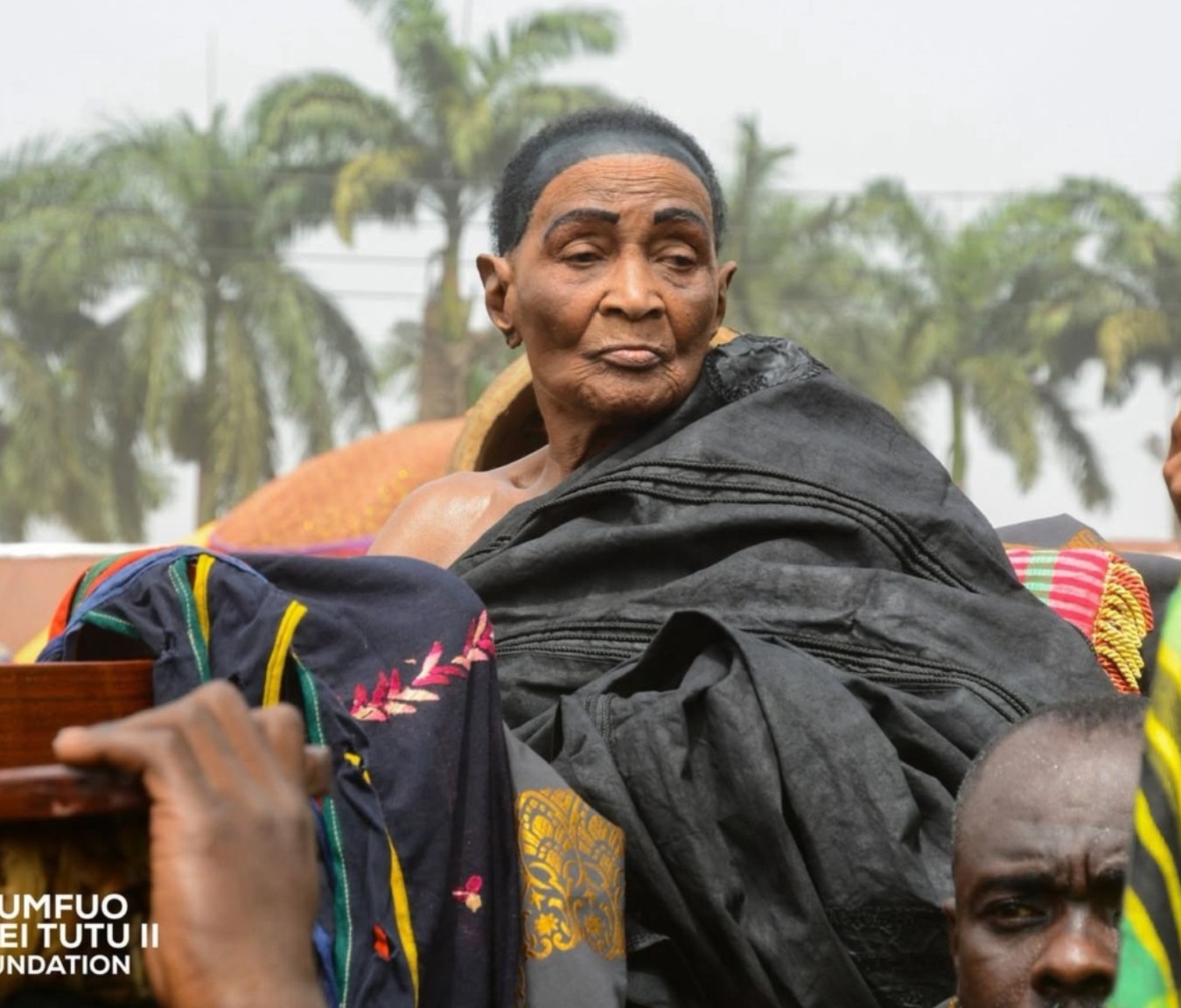
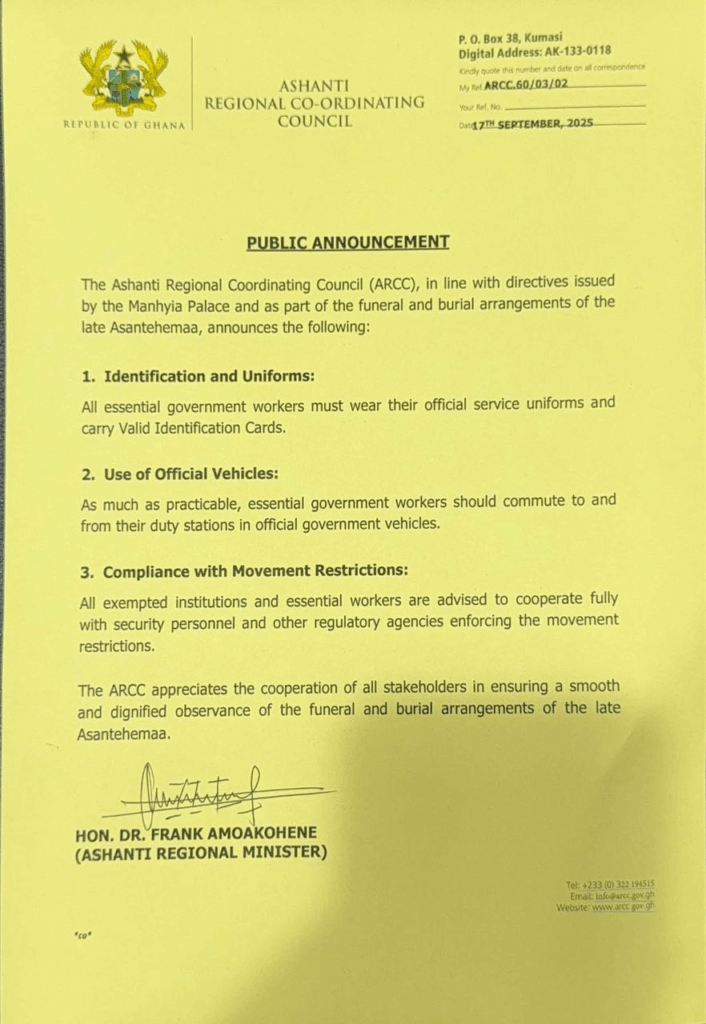
    Residents in the Greater Kumasi metropolis have been advised by the Ashanti Regional Coordinating Council (ARCC) to adhere to  instructions from Manhyia palace while the late Queenmother Nana Konadu Yiadom III is being laid to rest today.

    According to a press statement signed by the Greater Accra Regional Minister, Dr Frank Amoakohene, essential government employees are obliged to wear their prescribed uniforms and hold authentic Identification Cards.

    The workers have also been required to travel to and from their offices in official government vehicles. 

    “All exempted institutions and essential workers are advised to cooperate fully with security personnel and other regulatory agencies enforcing the movement restrictions,” portions of the statement noted.
    The final funeral rites for the late Asantehemaa, Nana Ama Konadu Yiadom III, commenced on Monday, September 15, in Kumasi and will span four days, climaxing today, Thursday, September 18.

    The funeral committee announced that as part of tradition to honor the Queen Mother, residents are to remain indoors in the evening when the procession moves from Bantama to Breman. Shops, schools, banks, markets, and offices will also shut down for the day.

    “On Thursday, as we bid a final farewell to the Queen Mother, we wish to give this important notice. The procession will move from Bantama to Breman, and we humbly ask everyone to remain indoors in the evening. In the past, when events involving the King took place, people would stand in respect even in the afternoon. In this case, since it will be held in the evening, we ask simply that you stay in your homes.”

    “With utmost humility, we remind all that Thursday is the funeral of the Asantehemaa. On that day, shops are to remain closed. Schools, banks, and offices will also be closed in observance of the occasion,” the committee announced at a press briefing.

    The committee also outlined the schedule for paying homage. Religious groups, political parties, and corporate bodies are expected to pay their respects on Monday; the judiciary, security agencies, and financial institutions on Tuesday; traditional leaders, ministers of state, diplomats, parliamentarians, and MMDCEs on Wednesday; and the President, former Presidents, and former Vice Presidents on Thursday.

    Nana Ama Konadu Yiadom III’s passing has drawn nationwide mourning and reflection on her reign as Queen Mother of Asanteman.

    She passed away at age 98 occupying her position as the 14th Queen of the Asante Kingdom,

    She died at nearly 100 years old. Her passing was announced on August 11 at an emergency sitting of the Asanteman Traditional Council, which was presided over by the Asantehene, Otumfuo Osei Tutu II.

    On August 21, a one-week observation was held at the forecourt of the Manhyia Palace in Kumasi for the late Queen Mother.

    It followed a display of traditional Asante customs, with chiefs, queen mothers, and government officials.

    On Wednesday August 13, the Archbishop of Kumasi, Most Rev. Gabriel Justice Anokye, led a delegation to the Manhyia Palace to pray for the Asantehene and to express their condolences to the King, after the demise of the Asantehemaa.

    They also visited the late Ohemaa’s court to formally convey their sympathies to the family and offer prayers as well.

    Profile of Asantehemaa Nana Ama Konadu Yiadom III

    Asantehemaa was named Nana Ama Konadu at birth and is also known by all as Nana Panin or Naa Panin. She later became Nana Konadu Yiadom III, after her enstoolment as the 14th Asantehemaa on February 6, 2016.

    She was born in 1927 at Benyaade Shrine at Merdan, a small town located at Kwadaso, Kumasi, in the days of the restoration of the Asante Confederacy.

    She was born to Nana Afia Kobi Serwaa Ampem II, Asantehemaa, who reigned from 1977 to 2016. Her father was known as Opanin Kofi Fofie, known popularly as Koofie or Keewuo, a carpenter by profession from Besease near Atimatim in Kumasi.

    At a very tender age, just when she was a little over a year old and being breastfed, Nana Konadu Yiadom III, Asantehemaa, was separated from her biological mother and given to her aunt (mother’s sister), Nana Afia Konadu, at Ashanti New Town (Ash-Town), a suburb of Kumasi.

    Nanahemaa never had any formal education, but she underwent a rigorous and quality informal education, learning a lot of things that were not taught in the classroom.

    She was initiated and underwent puberty rites together with her niece, Nana Abena Ansa, in their early teens. She married Opanin Kwame Boateng, a blacksmith by profession from Aduman in Kumasi.

    She was religious, kindhearted, calm, fair and firm, hardworking, very humble, unassuming, and accommodating. In the mid-1990s, Kwaku Firi Bosomfo, the priest of Kwaku Firi, prophesied through Baffour Akoto, a Senior Linguist of Asantehene, that Nanahemaa would be Queen of Asante someday, and surely, it came to pass.

    Nanahemaa achieved a lot and has been recognized as such. Through her constant generosity in doing God’s work, the Saviour Church named a school after her, Nana Konadu Saviour School. She exhibited a high level of equity, justice, and fairness, and all cases brought before her have been settled amicably to the satisfaction of both parties involved.

    In celebrating her 5th Anniversary as Asantehemaa, she made a huge donation to the mothers at the Mother-Baby Unit (MBU), Pediatric Emergency Care Unit (PICU) and Pediatric Emergency Unit (PEU) and paid for all the medical bills and expenses for new mothers at the Mother-Baby Unit (MBU) at Komfo Anokye Teaching Hospital and Manhyia Government District Hospital.

    Nanahemaa started a vigorous campaign and instituted an annual event to encourage mothers to breastfeed their young ones, the main reason why she made a generous donation to the Mother-Baby Unit at Komfo Anokye Teaching Hospital and Manhyia Government District Hospital.

  • Foreign Affairs Ministry grants diplomatic passports to Anita Erskine, Ibrahim Mahama, Wode Maya, 2 others

    Foreign Affairs Ministry grants diplomatic passports to Anita Erskine, Ibrahim Mahama, Wode Maya, 2 others

    Minister of Foreign Affairs, Samuel Okudzeto Ablakwa, has granted diplomatic passports to five distinguished individuals.

    They are Dentaa, Wode Maya, Rocky Dawuni, Anita Erskine, and Ibrahim Mahama. 

    These individuals were recognized at the Media launch of the Diaspora Summit 2025 based on their contributions in promoting Ghana and Africa’s image on global stages.

    The Office of the President, Diaspora Affairs, and the Ministry of Foreign Affairs collaborated to organize the event.

    According to the ministry, the event is aimed at empowering cultural ambassadors whose global demand and influence can strengthen trade, tourism, cultural exchange, and soft power diplomacy 

    Meanwhile, A total of 40,648 visas have been issued by Ghana’s missions in Washington, D.C., and New York from January 2025 to date.

    Out of this, 28,626 are multiple-entry visas to Ghana.

    The Ministry of Foreign Affairs made this information known while debunking reports that it is responsible for the United States government’s revision of the reciprocity schedule for a considerable number of African countries, including Ghana, reducing the B1/B2 visa validity from 5 years multiple entry to 3 months single entry.

    Ghanaian visa applicants can no longer access the 5-year visa and multiple-entry.

    It was reported that the Foreign Ministry had also limited the number of entries and duration given to US passport holders, hence the reciprocity by the US government.

    However, in a statement, the Ministry refuted this claim, noting that consistent with bilateral arrangements, US passport holders are entitled to a maximum visa validity of five years, and in most instances, five-year multiple-entry visas are issued upon request.

    “Some applicants, however, apply for single-entry visas owing largely to limited validity of their passports,” the statement read.

    Besides the maximum five-year multiple visas, Ghana also issues multiple-entry 6-month, one-year, two-year, three-year, and four-year visas based on various considerations.

    The statement further indicated that “The official statistics clearly demonstrate that contrary to false narratives, Ghana has issued, on average, an impressive 70.42% of multiple long-term visas to US passport holders, consistent with our bilateral arrangements.”

    The Foreign Ministry noted that the present limitations imposed by the United States vary substantially from the prior reciprocal arrangements that Ghana has kept with the United States.

    The US’ decision has sparked concerns, and the Ministry has acknowledged the legitimate concerns of Ghanaian travellers to the United States for professional, business, educational, touristic, medical and family purposes inconvenienced.

    The Ministry has expressed its firm solidarity with all thoseGhana recognizes the sovereign right of every country to determine its visa regime.

    While the Government of Ghana studies the current developments more closely and considers its options, it remains committed to working expeditiously with its longstanding partner, the US Government.

    “We hope for an early resolution of the concerns that have led to the revision of the schedule which have been confirmed to be overstays, including by ensuring that the conduct of applicants align with the visa application procedures and requirements of the United States,” the statement added.

    Government has stated that it will, at its highest levels, sustain best efforts in strengthening relations with the United States in a manner that further enhances people-to-people relations in the mutual interest of both countries.

    The updated guidelines, published under the U.S. Visa, reveal that Reciprocity and Civil Documents by Country for Ghana also affect student visa applicants.

    F-1 visa holders, who are typically enrolled in full-time academic programmes in the U.S., will now be issued visas that allow for only one entry and expire after three months.

    Diplomats and government officials will, however, continue to receive multiple-entry visas with validity ranging from 24 to 60 months.

    The K1 visa, issued to the foreign-citizen fiancé(e) of a US citizen intending to marry within 90 days of arrival in the United States, and the K2 visa, provided to the unmarried dependent child (under 21 years old) of a K1 visa holder, are single-entry visas that will be valid for 6 months.

    The K3 visa, for the foreign-citizen spouse of a US citizen, and the K4 visa, for their unmarried dependent child (under 21 years old), are multiple-entry visas that will be valid for 24 months.

    All other visa applicants, including those applying for B-class visas, which cover business and tourism travel, will now be issued single-entry visas valid for just three months.

  • Leila Djansi’s warning on YouTube distribution gets support from Adjetey Anang

    Leila Djansi’s warning on YouTube distribution gets support from Adjetey Anang

    Renowned Ghanaian actor Adjetey Anang, popularly known as Pusher, has added his voice to filmmaker Liela Djansi’s discussion, warning filmmakers against using YouTube as a primary platform for distributing their works.

    During the National Film Dialogue on September 16, 2025, with GhanaWeb’s Joseph Henry Mensah,  Adjetey Anang stressed on why Leila’s statement must be taken seriously by filmmakers.

    “From her own experience, you can’t ignore a statement like that. She has seen it all, and there is truth in the sense that when we overdo something or somewhere is saturated, and we’ve seen even in distributions and in marketing, some of our movies show how we flood a certain platform.”

    “We have to be very particular about the content we’re churning out in that space. It can’t be mediocre because whatever you put out there represents us and our abilities or inabilities, and so for me, there’s some truth in that. And it’s up to us to really ensure that we do not make that the reality. And therefore, we need to seek advice as to how we’re exploring or patronizing that space.”

    “Therefore, people should not just see that as an opportunity to just put in. But how do we sustain that so that quality is always achieved? And our values, our culture, are loud in that space as well. And I would also look for alternatives as well, because then if you have alternatives,” he expressed. 

    The Ghanaian-American filmmaker Leila Djansi had asserted that YouTube will soon become a thing of the past due to saturation by filmmakers.

    She further argued that a government-backed film fund would be wasted if movies are only released on YouTube.

    She added that piracy also undermines the platform’s viability for film distribution.

    “Personally, I don’t believe the film fund. I really don’t. I think it is premature because there is no distribution. If you give the film fund how are they gonna [make profit].”

    People think that we are just gonna put it on YouTube. I’m sorry YouTube is gonna collapse very soon. There is so much congestion on YouTube and they are always changing their policies. So if you go in now a I think it is seriously over-saturated. If you over-saturate it, they’re gonna reduce the earning. So how much are you gonna earn if you just put your film on YouTube,” she said.

    Meanwhile, James Gardiner, a leading Ghanaian actor, recently discussed the crucial role social media, particularly YouTube, plays in boosting the Ghanaian film industry.

    In an interview with media figure Doreen Avio, the star of ‘Taste of Sin’ pointed out that many are not fully harnessing the potential of these digital platforms.

    Gardiner emphasized that YouTube remains underutilized, despite its potential for significant impact.

    He noted that individual productions can amass millions of views, potentially translating into considerable earnings.

    “YouTube is a goldmine that’s being overlooked. The fact that just one of our productions can hit around 29 million views indicates that African films are resonating widely,” he said.

    While acknowledging the importance of major streaming services like Netflix, Gardiner stressed the value of concentrating efforts on YouTube.

    He shared insights from his recent experiences in Nigeria, highlighting how Nigerian TV stations swiftly adopt and popularize films from YouTube, further amplifying their reach.

    “Work is thriving in Nigeria, and it’s not just Ghanaian audiences that are engaged. In fact, Nigerian platforms quickly pick up new releases from YouTube, often within 20 to 30 minutes, which boosts viewership numbers,” Gardiner observed.

    Despite the hurdles the Ghanaian film industry faces, Gardiner remains hopeful about its future.

    He believes that with a positive outlook and persistent effort, the industry is poised for continued growth and success.

    Popular Nollywood actress Ruth Kadiri recently shared her insights on why she chose YouTube as the platform to showcase her movies.

    In an interview with BBC Pidgin, she highlighted YouTube’s significance as a major income source for independent filmmakers and content creators, emphasizing its pivotal role in sustaining livelihoods within the industry.

    Kadiri emphasized that YouTube has become indispensable, stating that without it, many individuals, not just filmmakers, would face financial hardships. She underscored the platform’s contribution to feeding people by providing opportunities for filmmakers to monetize their content effectively.

    Reflecting on her journey into YouTube, Kadiri revealed her frustration with the constraints of traditional production processes, which motivated her to seek a space where she could freely express her creativity. She discussed her desire to explore and implement innovative ideas without excessive regulations, noting that YouTube offered the flexibility she craved.

    Despite encountering skepticism and discouragement from others, Kadiri viewed YouTube as a platform for reaching a broader audience and honing her skills. Her decision to venture into YouTube was fueled by a passion for storytelling and a determination to overcome challenges, even if it meant learning from initial setbacks.

    Kadiri’s experience on YouTube has been marked by the production of several films, each contributing to her growth as a filmmaker and entrepreneur. Her journey exemplifies the evolving landscape of film distribution and the opportunities that digital platforms like YouTube offer to aspiring creators.

    The surge and mass production of AI-generated content on YouTube has prompted the video-sharing platform to announce a review and update of its monetisation policy under the YouTube Partner Program (YPP).

    The YouTube Partner Program is how creators earn money from their content.

    In a formal statement shared on July 7 on YouTube’s Support page- a platform where the company shares updates and announcements- it spelt out modifications concerning content and its monetisation policy.

    “We’re updating our guidelines to better identify mass-produced and repetitive content. This update better reflects what inauthentic content looks like today,” parts of the statement read.

    According to the statement, effective July 15, content would now be subjected to strict scrutiny, and those found as repetitive with no intention to educate or entertain would be demonetised.

    “On July 15, 2025, we’re updating our guidelines to better identify mass-produced and repetitive content. This update better reflects what inauthentic content looks like today”, it continued.

    Also, content that has been created with heavy use of AI with little to no human effort would be demonetised.

    “AI-assisted content is acceptable, but only if it includes considerable human input. Content created with little to no human effort may not be eligible for monetisation.”

  • Mama Esther’s mother dies at age 109

    Mama Esther’s mother dies at age 109

    Renowned gospel musician Mama Esther, has disclosed that her 109-year old mother, Deaconess Hannah Opoku, affectionately known as “Maame Hannah” is dead. 

    She shared the news on Facebook on September 15, 2025 expressing devastation over the tragic news.

    “It is with deep sorrow that we share the passing of my beloved mother, Deaconess Hannah Opoku (Maame Hannah), at the remarkable age of 109.

    “She lived a full and blessed life, leaving behind a legacy of faith, love, and strength. Kindly keep us in your prayers during this difficult time,” she wrote.

    Adding that, the family have asked the public to remember them in their prayers to be comforted in this trying time. 

    Love ones, fans and well-wishers have since poured their love and support for the bereaved family.

    In 2023, John Dumelo  also lost his beloved mother, Mrs. Veronica Ama Ampoma Dumelo.

    In remembrance of her, a one-week observation was held on Tuesday, August 29, 2023, at the Holy Spirit Cathedral in Adabaraka, Accra. The event was attended by a gathering of showbiz figures, friends, and family, including personalities such as Yvonne Nelson, Bola Ray, and Soraya Mensah.

    Madam Veronica, aged 71, passed away on Tuesday, August 15, 2023. The renowned Ghanaian actor took to social media to confirm the heartbreaking news of his mother’s passing, stating that she had left the world on August 15th.

    Retired from her role as a customs officer, John Dumelo’s mother’s cause of death remains undisclosed.

    Ghanaian gospel singer Empress Gifty shared the heartbreaking news of her mother’s passing last year. Her mother, Evangelist Agnes Aba Annan, affectionately known as ‘Agaga,’ passed away after a short illness.

    Empress Gifty announced her mother’s death on social media on Saturday, December 14, 2024, as messages of sympathy flooded in from family, friends, and fans.

    She mentioned that more details about her mother’s passing and funeral plans would be shared later.

    View this post on Instagram A post shared by Empress Gifty (@empress_gifty)

    ‘Agaga,’ a well-known actress, appeared in several TV commercials and was known for her lively personality.

    Despite her age, she remained outspoken and energetic, always supporting her daughter and defending her against online criticism.

    Empress Gifty and her mother often went live on social media, sharing fun moments and jokes with their followers. During these sessions, ‘Agaga’ also shared faith-based messages and advice for young people.

    Besides her close relationship with her daughter, ‘Agaga’ had a strong bond with her son-in-law, Mr. Hopeson Adorye.

    In 2024, Mzbel made public the loss of her mother, who passed away late on Tuesday, August 6, 2024.

    The cause and details of her mother’s death have not been disclosed. Mzbel shared a photo of her late mother on Instagram with a heartfelt tribute, “Rest in power mummy.”

    This recent loss follows the death of Mzbel’s father, Albert Amoah, in January 2022. Fans and supporters have been sending their condolences and offering prayers for strength during this difficult time.

    In a recent interview with Fiifi Pratt on Kingdom FM, Mzbel opened up about her personal life, revealing that she has never been married and has no plans to marry. She explained, “Marriage is not something I’m interested in. Though I’ve been in several relationships, I’ve never tied the knot and don’t intend to.”

    Mzbel also shared that she has been given rings in past relationships, including one she currently wears. She clarified, “This ring was given to me by a partner after I had a child. It’s not a promise ring, but rather a symbol of our enduring relationship.”

    Actress Roselyn Ngissah received an outpouring of love and support from the entertainment community following the passing of her mother, Madam Elizabeth Ngissah, earlier this year.

    In a show of solidarity, key figures from the industry, including renowned filmmaker Peter Sedufia, Ghana’s Most Beautiful star Araba, and actress Jessica Williams, visited Roselyn to offer their condolences in person.

    Beyond the visits, many others have reached out with heartfelt messages, sharing words of comfort and strength to help her through this period of grief.

    The visit came just two days after the actress announced the passing of her mother, who succumbed to a brief illness.

    Madam Elizabeth Ngissah was a revered educator who dedicated over 40 years of her life to teaching. 

    She touched the lives of countless students with her patience, kindness, and unmatched grace.

    Her passing has left a deep void not only in her family but also among the many lives she impacted throughout her decades-long career.

    Popular music duo Keche grappled with a profound loss as Eche Andrew, one-half of the renowned duo, mourned the passing of his beloved mother, Mrs. Gladys Cudjoe (Nee De-graft Asmah), who departed from this world at the age of 66.

    The devastating news was publicly disclosed by Keche Andrew himself through his social media platforms. In an emotionally charged post, he conveyed his deep anguish and disbelief over the sudden loss of his mother.

    Keche Andrew’s tribute read, “You Broke Our Heart Mum, Trust Me You Have Broken Our Heart ….. You Made Me An Orphan Mum, Why ????, Who Do I Share My Secrets With ??? I’m In Pains Mama Gladys …. I Miss You, I Really Love You.”

    In memory of Mrs. Gladys Cudjoe, the family announced a one-week anniversary gathering to commemorate her life. This memorial event took place today, April 9, at the family residence.

    The unfortunate news elicited an outpouring of sympathy and condolences from friends, followers, and fans of Keche Andrew. The music community and fans alike stood in solidarity with the grieving artist during the challenging time.

    Losing a parent is undeniably one of the most difficult experiences one can endure, and the Keche family’s unity and the support of their community undoubtedly played a crucial role in navigating the period of grief.

    As the family cames together to honor and remember Mrs. Gladys Cudjoe, it serves as a reminder of the importance of cherishing our loved ones and holding onto cherished memories.

    Thoughts and condolences went out to the Keche Andrew family as they navigate this heartbreaking loss.

  • Is Sista Afia having a second thought on pursuing music?

    Is Sista Afia having a second thought on pursuing music?

    Multiple award-winning Ghanaian singer and songwriter, Francisca Gawuga, popularly known as Sista Afia, appears to express regret over pursuing music.

    Sista Afia admitted that she sometimes questions her decision because she doesn’t seem to see her sacrifices and investments paying off.

     “Since I released ‘Jeje,’ was when I realised that I may never be a favourite in the industry. I’ve invested so much effort and funded everything with my own money. If I had saved that money, I would have likely achieved more by now. It’s frustrating because I put my heart and soul into each project, even spending my last penny on a music video, because you don’t know which song might blow,” she said on the Delay Show.

    According to her, she sometimes reflects that her struggles in music aren’t just about talents or efforts but about the perception people carry about her. 

    “Many thoughts cross my mind. Sometimes, I wonder if my background is a factor; it seems people tend to prefer artists who come from the slums, those who were once unknown and then became popular. Some people say, ‘Afia comes from abroad, so why is she trying to make music here?’” she explained.

    Months ago, she voiced her frustration over the lack of recognition for her relentless efforts in the music industry. Despite dedicating herself fully to her craft, she feels overlooked compared to her male counterparts.

    Speaking in an interview with DJ Slim, the ‘Weather’ hitmaker shared how deeply invested she is in her music career, revealing that she barely gets any rest due to her demanding schedule.

    “I mean, I’ll speak for myself—I can’t speak for everyone—but I’ll speak for myself. I work tirelessly; I work more than everyone, especially Adey grind waaa, and I need this thing. I’m somebody that needs it; it’s like without music, there’s no Sista Afia,” she said.

    She emphasized that her commitment to music is undeniable, yet the industry seems to disregard her contributions.

    “I don’t sleep; I sleep like three hours, almost four, then I’m back to business. I hardly sleep. Right now, I feel like it’s time to talk. It’s so sad that people don’t really see the work you put in, and that hurts me,” she added.

    Sista Afia, known for her powerful vocals and versatility in blending highlife, Afrobeat, and dancehall, has performed on various major platforms. However, she believes that female artistes, regardless of their talent and work ethic, often struggle to receive the acknowledgment they deserve.

    Her comments highlight a broader issue within the Ghanaian music industry, where female musicians frequently face challenges in gaining visibility despite their hard work and dedication.

    Ghanaian female musicians are not making the needed impact on the continent due to lack of resources.

    Nigerian female artistes have over the past years dominated the Africa music circles with the likes Tiwa Savage, Simi, Yemi Alade, Sinach, among others making a significant impact across the globe, only a few The multiple award-winning had said earlier on this year that Some Ghanaian female artistes including their male counterparts have been unable to hit the top list of various African music charts.

    In an interview with GNA Entertainment, she said the Nigerian music setting is well resourced, helping them thrive with the works in Africa and beyond.

    “Ghanaian female musicians are doing what they can at the moment. When it comes to vocal delivery, songwriting, and stage performances, Ghana has me, Efya, Freda Rhymez, and more to boast of.

    “The thing is, the Nigerians have the resources which include investors, connections, support and music exposure than Ghanaian musicians,” she said.

    However, the “Weather” hitmaker was highly optimistic about how Ghanaian female artistes can match up with their counterparts in other countries in the near future.

    “We are progressing each and every day. Recently my new song with Victor AD is one of the biggest songs in Nigeria and Cameroon. I had a call from one top international musician who wants to remix his song with me.

    “We are getting there gradually just that the pace is a bit slow. But as the saying goes, slowly but sure. We will get there and we hope we (female musicians) get that positive support from the media and everyone,” she said.

    Sista Afia who is undoubtedly Ghana’s hottest female singer at the moment and she is set to release another banger with Stonebwoy, as they were recently spotted in the studios.

    Meanwhile, in 2023, Sista Afia said that if she had not chosen to pursue music, she would have been married by now with children.

    When asked about her life as a celebrity during a discussion of the celebrity lifestyle section of Neat FM’s entertainment program, sister Afia responded, “If I wasn’t a musician I would have been married by now, if I was in your position I would have been married,” she stressed referring to a fellow panelist.

    “…of course, I wish I would have been married with kids by now,” she emphasized.

    Meanwhile, Sista Afia is out with a new song titled ‘Carry Go.’

    The track is her first official single and release for the year 2023. It was produced by one of Ghana’s talented producers, Abochi

    The song discusses her romantic life and lays out her goals.

    She emphasizes the enjoyable aspects of relationships, the quality time she can spend with a partner, and the importance of money at this time.

  • Tiwa Savage narrates how she was cheated on, disrespected for dating a celebrity

    Tiwa Savage narrates how she was cheated on, disrespected for dating a celebrity

    Nigerian Afrobeats star Tiwa Savage has opened up about her past relationship with a fellow celebrity who cheated on her and treated her with disdain.

    According to Tiwa Savage who spilled the beans on Joe Budden’s podcast Show,  she was also discouraged from making the relationship public because her ex boyfriend claimed it was necessary to avoid suspicion of their romantic affair. 

    “It’s disrespectful. I’m a public figure, and he is as well. He did this thing where he is like. I don’t want us to go public; I don’t want people to know. So, when we go out, I might be talking to other people, but I’m just doing it, so people don’t suspect, “she shared.

    Revealing more details about the bizarre experience, Tiwa stated that his ex, whose name she did not disclose on the show, cheated on her with other women, and she was made to be calm and quiet about it.

    “We might be in the same event and he would be with other people, talking and touching people, and he looks over at me and is like… ‘I’m just doing it so…I couldn’t say anything. And it was happening right in front of me,” she said.

    The Nigerian Afrobeats queen shared her expectations regarding the caliber of man she is looking forward to settling down with.

    According to her, the man expecting ther to accept his proposal should not be accompanied by the baby mama drama.

    “I am still looking for someone’s son and I’d prefer someone that has a private plane and doesn’t have baby mama dramas,” she confidently said in a video sighted by The Independent Ghana on X.

    Weeks ago, she opened up about her challenges before rising to fame in the music industry.

    Speaking on a recent episode of the Afrobeats Intelligence podcast, Tiwa revealed that her sense of fashion received massive criticism, preventing her from performing at shows.

    “I was really hurt. I would go to shows and wait backstage, and they wouldn’t call me because maybe the governor’s wife had said I couldn’t come up. Or they’d say.

    “Make sure you don’t wear any of those skimpy dresses.’ I’m not making this up.”My fashion sense attracted criticism. Then, I ran back to L.A.,” Tiwa said.

    The backlash, she said, forced her to relocate to United States of America, Los Angeles.

    According to her, it took the intervention of her longtime manager, Bizzle, to get her back to Nigeria.

    Despite her return, Tiwa said she faced rejection from all the top record labels back then.

    “I’ve told the story where I went to all the labels and they all said no—Storm Records, Mo’Hits, Banky W’s EME, everyone,” she noted.

    Tiwa added that Bizzle motivated, encouraged, or supported her at a crucial time.

    “I remember Bizzle called me and told me that ladies were loving me, so I came back to Nigeria,” she stated.

    Initially drawn to acting as her first love, Tiwa disclosed that it was a man in the music industry who caught her attention and influenced her career choice.

    She shared that her crush’s close association with musicians led her to abandon acting and pursue a career in music instead.

    “I’ve always wanted to do acting. Acting was one of my first loves before music. I got into music because I had a crush on a guy, and he was always around musicians, so I said, ‘yeah, forget acting and just go into music,’” Tiwa revealed.

    Last year, she revealed a surprising view on relationships, saying cheating wouldn’t end things for her.

    During an appearance on the Receipts Podcast on Spotify, the “African Bad Gyal” shared that every partner she has been with has cheated on her.

    Despite this, Tiwa said she has forgiven them all and moved past the pain they caused.

    “I’ve been cheated on before. I found out and forgave every time. Every man I’ve ever been with has cheated, and I’ve never left them because of it. I’ve left for other reasons, but not because they cheated. Cheating is not my hill,” Tiwa revealed.

    The singer also argued that cheating has long been part of societal dynamics, stating, “I know you say it’s bad that we’ve gotten to a point where cheating isn’t a deal-breaker. But I feel like we’ve always been here—even back in the day, even going back to the Bible and history.”

    Tiwa Savage explained that while she can overlook cheating, she won’t accept dishonesty, disrespect, abuse, or theft in a relationship.

    She also spoke about her personal experiences, admitting she has never had an orgasm and hasn’t tried using sex toys, even though she’s open to exploring new things.

    Her candid comments have sparked conversations online, with some applauding her honesty and others debating her views on love and loyalty.

     She also shared a playful story of how she tried to make advances at American actor and activist Kendrick Sampson from of ‘Insecure’ fame.

    During a candid interview on ‘The Receipts Podcast,’ the ‘All Over’ hitzmaker talked about trying to spark a romantic connection with actor Kendrick Sampson during the filming of her Forgiveness music video.

    Initially unaware of his fame from Insecure, Tiwa became intrigued by Sampson’s charm and good looks. She admitted to making some subtle advances, though they were unsuccessful in forming a romantic bond.

    “When he came on set, my makeup and hair stylist was like, ‘That’s the guy from Insecure,’ and I was like, ‘Okay?’ And he was just lovely. Like, really, really sweet,” Tiwa recounted.

    After watching Insecure following the video shoot, Tiwa found herself even more intrigued and decided to reach out to Kendrick while she was still in Los Angeles.

    Despite her subtle efforts to express interest, Tiwa humorously admitted that her attempts didn’t land.

    “I tried to paint and throw signs—but nothing. A little bit of me died,” she joked. “I want to unfollow him [laughs]. I’m angry [laughs].”

    Tiwa concluded by praising Kendrick as “lovely” and “so cute,” despite her playful frustration over the unreciprocated signals.

  • Govt allocates GHS5bn annually for road maintenance – President Mahama

    Govt allocates GHS5bn annually for road maintenance – President Mahama

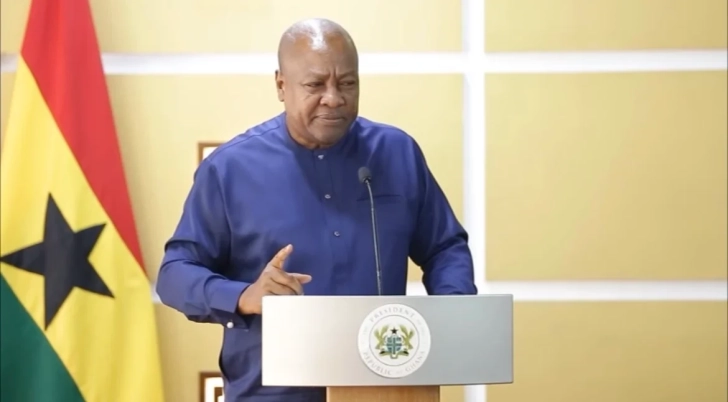
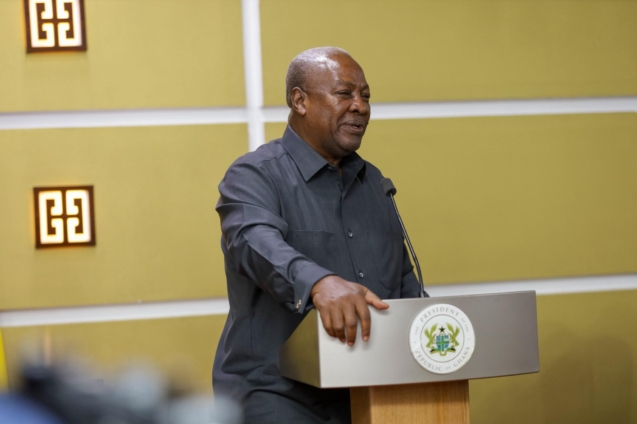
    President John Dramani Mahama has announced that five billion Ghana Cedis (GHS5bn) will be allocated annually for road maintenance.

    According to him, one hundred and sixty-six (166) constituencies identified as having the country’s worst roads have been earmarked to receive ten kilometres of roads, drains and pavements annually over the next four years. 

    Speaking during the official launch of the government’s flagship infrastructure development initiative, the Big Push programme, at Afienya on Tuesday, September 16,President Mahama explained that this will provide each constituency with  forty kilometres by the end of the period. 

    He added that the initiative will not only focus on new road construction but also ensure proper maintenance of existing ones.

    “So every year the Ghana road fund is going to put aside about five billion cedis a year on road maintenance alone. Pothole patching, desilting, grass cutting, and all the things that keep the road in good shape,” he said.

    He added that while some communities may not find their roads listed under the Big Push, there is still a separate allocation for ongoing road works across the country. 

    He assured traditional rulers, farmers, and citizens that these funds will continue to improve roads that are  not captured under the new initiative. 

    According to him, beginning next year and through to 2027, Ghanaians will notice a significant improvement in the quality of roads nationwide.

    Parliament on July 30 unanimously endorsed the government’s proposal to divert all royalties that will be received from oil revenues and mineral royalties to support the implementation of the Big Push Programme.

    This comes after the government requested Parliament approve committing funds to assist in the construction of certain road projects. Mr Isaac Adongo, the Chairman of the Parliament’s Finance Committee, while presenting the report by the Budget and Finance joint committee to the plenary, said, “The Committee has carefully considered the Referral, and it is of the opinion that the request is in the right direction.”

    The Committee also noted that Parliament had already approved the policy and the allocation to the “Big Push” Programme in the 2025 Budget Statement. Granting the request would enable the Government to enter into multi-year contracts to execute the road infrastructure projects under the Programme.

    “The Committee accordingly recommends to the House to approve the Request for the multi-year commitments for the selected road projects under the “Big Push” Programme contained in the Mid-Year Fiscal Policy Review of the 2025 Budget Statement and Economic Policy of the Government of Ghana, in accordance with Section 33 of the Public Financial Management Act, 2016, (Act 921),” Mr Adongo said.

    The initiative aimed at improving road infrastructure across the country is estimated at GHC13.8 billion, and it is expected to be completed by 2028 with support from the country’s own financial resources. According to the 2025 budget, GH¢5.75 billion is owed by the Road Fund, with an allocation of GH¢2.81 billion programmed for road maintenance.

    This represents a 155.5% increase from the 2024 allocation of GH¢1.1 billion, underscoring the government’s emphasis on sustaining Ghana’s road network. The Minister for Roads and Highways, Kwame Governs Agbodza, on Wednesday, July 30, revealed that his ministry has undertaken studies and prepared comprehensive engineering interventions and cost estimates for road projects under the Big Push Programme.

    However, the Minister for Roads and Highways, Governs Kwame Agbodza, has projected a two-year timeline for the completion of all current and upcoming road projects under the government’s “Big Push” initiative. 

    The Ministry of Finance has since issued commitment authorizations for some twenty-nine (29) road infrastructure projects under the Big Push Programme, which include: Upgrading of Akosombo-Gyakiti-Kudikope Road, Road Dualization of Winneba-Mankessim Road, Rehabilitation of Mankessim-Ajumako-Breman Asikuma-Agona Swedru, Construction of Nchi-Elubo Road, and Rehabilitation of Atimpoku-Asikuma Junction Road.

    The government has also selected several abandoned road projects for which no dedicated funding was allocated by the previous administration. They include rehabilitation and upgrading of Kasoa-Winneba Road, construction of Suame Interchange and Local Roads, reconstruction of Navrongo-Chuchuliga-Sandema Road, and upgrading of Tumu-Chuchuliga-Navrongo, including construction of a 36m span reinforced concrete bridge over the Kanyibie River and a 24m span reinforced concrete bridge over the Bechelihu River.

    The government will, by the end of July, settle GHC4 billion out of the large debt owed to road contractors. Currently, the government owes road contractors GHC21 billion, according to the Roads Minister. President John Mahama emphasized his government’s commitment to infrastructure development under his administration’s 24-hour economy agenda. On his part, prioritising road construction and the swift resumption of stalled road projects holds the key to promoting economic growth and productivity by ensuring adequate regional connectivity.

    The announcement has been met with excitement and optimism by many stakeholders in the construction sector. The Ghana Institute of Engineers and the Association of Road Contractors have largely welcomed the president’s announcement, but they have called for transparency. They have called on the government to publish clear timelines and payment schedules to ensure that contractors can plan and mobilize resources effectively.

    In March this year, Deputy Minister for Roads and Highways Alhassan Suhuyini acknowledged the significant financial burden facing the government to clear outstanding debts owed to contractors and suppliers. His remarks followed the presentation of the 2025 budget by Finance Minister Dr. Cassiel Ato Forson, who disclosed that the government’s total commitments to contractors stand at a staggering GH¢67.5 billion.

    He emphasized the importance of prioritizing road maintenance, a sector that has suffered due to poor upkeep. “The minister has stressed that a significant portion of these funds will be directed toward road maintenance. This is a smart move because our poor maintenance culture has resulted in roads deteriorating within 8 to 10 years instead of lasting longer,” he explained.

    Mr Suhuyini noted that, in addition to paying off some existing road maintenance debts, the government is looking at a broader infrastructure push. “With GH¢10 to GH¢13 billion allocated under the ‘Big Push’ initiative, several new road projects will commence, while some outstanding debts will also be retired,” he added.

  • Ghana generates £100m from UK tax partnership in 2024 

    Ghana generates £100m from UK tax partnership in 2024 

    The United Kingdom Development Minister, Jenny Chapman has disclosed that Ghana raised an additional £100 million in 2024 through a UK-supported tax partnership. 

    She described the collaboration as proof of a thriving UK-Ghana relationship driven by innovation and expertise, creating new opportunities for both nations.

    “The UK is unlocking economic growth and trading opportunities in Ghana, as part of its modernised approach to international development,” Jenny Chapman said in a statement issued on Monday, September 15, 2025, after a three-day visit.

    Beyond tax revenue, she noted that the UK’s growth partnership with Ghana has also mobilised over £125 million to strengthen sectors such as automotive, pharmaceuticals, and garments, creating more than 5,000 jobs. 

    According to her, this support has improved the production of advanced medicines and enabled Ghanaian textile exports across Africa and to the United Kingdom.

    She stressed that Ghana’s preference for trade over aid aligns with the UK’s development model, which prioritises investment and long-term partnerships.

    During her visit, the minister toured Atlantic Life Sciences, where UK expertise is advancing the production of essential medicines, and visited a garment company backed by British International Investment, which she described as a leading example of empowering women and boosting exports through ethical practices.

    She also held discussions with President John Dramani Mahama on ways to expand the United Kingdom’s growth and investment partnership.

    Trade between the UK and Ghana is valued at about £1.5 billion annually, with British firms such as Tullow Oil, Unilever, Standard Chartered, and Blue Skies operating in the country.

    Beyond trade, the government partnered the UK-Ghana Gold Programme to strengthen regulatory frameworks and curb illicit trade in March this year. 

    Finance Minister Dr. Cassiel Ato Forson revealed that about 60 tonnes of gold were illegally exported from Ghana at the height of the country’s economic crisis. “Imagine the impact if that wealth had stayed in our economy,” he stated, emphasizing the urgency of addressing illegal mining and gold smuggling.

    During a meeting with officials from the UK-Ghana Gold Programme, Dr. Forson discussed strategies to “ensure Ghana benefits fully from its gold resources while combating smuggling and illegal trade.” 

    One of the key measures being introduced is the establishment of the Ghana Gold Board (GoldBod), a regulatory body aimed at overseeing the gold sector and promoting responsible trade.

    Dr. Forson explained that through the partnership, the Economic and Organised Crime Office (EOCO) would be actively working to prevent gold smuggling at key border points, including Bole. Additionally, GoldBod is collaborating with the Precious Minerals Marketing Company (PMMC) to improve pricing mechanisms, introduce pre-financing for gold dealers, and encourage whistleblower reports to expose smuggling operations.

    To enhance the sector’s financial stability, the government has committed to funding GoldBod to “purchase three tonnes of gold every week,” a move aimed at bolstering the country’s foreign exchange reserves. In a major policy shift, the finance minister also announced plans to remove the 1.5% withholding tax on unprocessed gold as part of the 2025 Budget, describing it as a step towards “encouraging more legal gold trade and driving economic growth.”

    These reforms, according to Dr. Forson, will help Ghana regain control of its gold industry, dismantle illegal networks, and ensure that the country’s natural resources contribute directly to national development. “This is just the beginning—together, we will build a stronger, more prosperous Ghana,” he affirmed.

    Of all UK exports to Ghana in the four quarters to the end of Q4 2024, £435 million (58.2%) were goods and £312 million (41.8%) were services.

    UK exports of goods to Ghana increased by 11.8% or £46 million in current prices, compared to the four quarters to the end of Q4 2023 while UK exports of services to Ghana decreased by 3.4% or £11 million in current prices, compared to the four quarters to the end of Q4 2023.

    Total UK imports from Ghana were £793 million a decrease of 15.2% or £142 million in current prices, compared to the four quarters to the end of Q4 2023.

    In the same period, UK imports of goods from Ghana decreased by 32.2% or £93 million in current prices, compared to the four quarters to the end of Q4 2023, while UK imports of services from Ghana decreased by 7.6% or £49 million in current prices, compared to the four quarters to the end of Q4 2023.

    This means the UK reported a total trade deficit of £46 million with Ghana, compared to a trade deficit of £223 million in the four quarters to the end of Q4 2023.

    The UK had a trade in goods surplus of £239 million with Ghana, compared to a trade in goods surplus of £100 million in the four quarters to the end of Q4 2023.

    Meanwhile, the UK reported a trade in services deficit of £285 million with Ghana, compared to a trade in services deficit of £323 million in the four quarters to the end of Q4 2023.

    Ghana has been ranked as the United Kingdom’s 80th largest trading partner, accounting for 0.1% of total UK trade. It was the UK’s 78th largest goods trading partner and the 71st largest services trading partner, both also representing 0.1% of trade in their respective categories.

    Ghana ranked 64th for goods exports and 83rd for services exports, both making up 0.1% of their respective totals.

    On the import side, Ghana was the UK’s 79th largest import market, also accounting for 0.1% of total imports. 83rd for goods imports, with a share of less than 0.1%, and 62nd for services imports, which made up 0.2% of UK services imports.

    Meanwhile, then United Kingdom (UK) High Commissioner to Ghana, Harriet Thompson, has emphasized the UK’s commitment to strengthening a lasting relationship with Ghana.

    “Our ambition is to increase the UK-Ghana economic partnership. So partly that is about trade, and it’s very much in two directions. I’m very pleased to say that even after the difficult economic issues we have all seen around the world since the pandemic, the UK-Ghana trade partnership has grown, and that stands at £1.5 billion,” she said during a media engagement on July 16.

  • I won’t join NPP’s apology to Ghanaians, I didn’t fail them – Dr Adutwum

    I won’t join NPP’s apology to Ghanaians, I didn’t fail them – Dr Adutwum

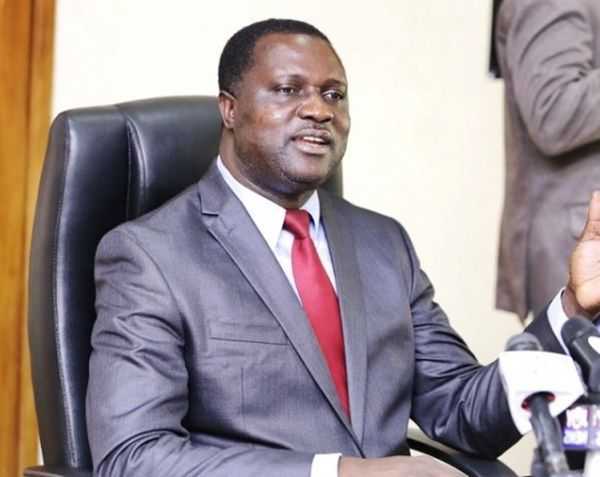
    Former Education Minister and flagbearer aspirant, Dr. Yaw Adutwum, has distanced himself from efforts by the New Patriotic Party (NPP) to issue an apology to Ghanaians over poor governance during its tenure.

    On Monday, May 19, Former Vice President Dr. Mahamudu Bawumia, under the Akufo-Addo government, took responsibility for the government’s shortcomings and issued an apology to Ghanaians on behalf of his former ministers during a recent engagement in London.

    Reacting to this, the former Education Minister insisted he has no reason to apologise to Ghanaians, arguing that he delivered on the mandate entrusted to him under the Akufo-Addo government.

    He believes the former Vice President failed Ghanaians in his leadership of the economy and therefore should be the one to render an apology, rather than involving individuals who delivered in their respective sectors.

    “I am not a part of the apology. I came to the education sector, and many have said that if every other minister had worked like me… If you are working, you will certainly not please everyone. However, as the vice president who led the economic management team, if he wants to apologize, he should focus on the failed economy under him. 

    “In education, we did not fail the people of Ghana. Mo Ibrahim ranked us second. The people of Ghana are in awe of what I did in the sector. People see me and hail me for the work that I did for the sector, and so I owe no apology,” Yaw Adutwum stated.

    He added that the former Vice President must own up and apologize for his failures in the sector that he led, and not just issue apologies en bloc.

    During an address in London, United Kingdom (UK), the former Vice President linked the party’s historic failure in the 2024 general elections to the party’s shortcomings while in power.

    “The NPP did a lot of work, there’s no doubt about that, but we did not get everything right. We got quite a few things wrong, and I think that, on my own behalf and on behalf of the party, I apologise to all of you for us not getting the figures right,” he said.

    In April, the 2024 running mate of the Movement for Change, Kwame Danso, criticized the New Patriotic Party (NPP) during the party’s “Thank You Tour” agenda. Kwame Danso urged the party to launch an apology tour in response to growing public frustration.

    In an interview with Nana Jantuah on Nhyira FM’s Kuro Yi Mu Nsem, Mr. Danso described the NPP’s nationwide tour as “tone-deaf” and “misplaced,” particularly at a time when, in his view, economic hardships and poor policy decisions had contributed to the party’s electoral defeat.

    “Instead of a ‘Thank You Tour,’ the NPP should embark on an apology tour to Ghanaians,” he declared.

    He pointed to controversial initiatives such as the Electronic Levy (E-levy), the betting tax, and the National Cathedral project as examples of missteps that have alienated the public and damaged the party’s credibility.

    “To regain appeal, the NPP should apologize for the introduction of the E-levy, betting tax, and the National Cathedral, in which they invested so much, just to dig a manhole for Ghanaians. Your ‘Thank You Tour’ lacks purpose without reconciliation with the people of Ghana,” he stressed.

    Mr. Danso also called on the party to reposition itself as a responsible opposition in the current political climate, advising it to contribute constructively to national discourse rather than remain defensive.

    “They should focus on offering constructive ideas rather than obstructing efforts aimed at national progress,” he said.

    The NPP sought to “break the eight” and extend its governance for another four years under the leadership of Dr. Bawumia, who received the support of then-President Nana Akufo-Addo.

    Dr. Bawumia contested against the National Democratic Congress’ (NDC),  John Dramani Mahama, and lost. At the end of the polls, the Electoral Commission (EC) declared that the NDC flagbearer polled 6,328,397 total valid votes, representing 56.55%, whereas Dr. Mahamudu Bawumia garnered 4,657,304 votes, representing 41.61%.

    Before the EC officially declared its results, the former vice president conceded defeat. The parliamentary election also saw the NPP fall drastically in terms of seats won. The NDC obtained an absolute majority in Parliament by securing 183 seats, while the NPP lost its majority, securing only 88 seats.

    Following the just-ended polls, the opposition party has gone into retrospection. A 12-member committee led by former Speaker of Parliament, Professor Mike Oquaye, investigated the factors behind the party’s failure.

    Although the report by the committee has been withheld from the general public, the General Secretary of the NPP, Justine Kodua, noted that the party’s downfall centered around its inability to focus on key projects in its strongholds, economic instability  particularly the worsening value of the cedi against major trading currencies including the dollar aarrogance displayed by previous government officials, internal conflict, among other issues.

    Presently, Dr. Bawumia believes the way forward for the party is to correct its errors and seize opportunities to reclaim power from the NDC government.

    “I believe that, by the grace of God, if we are given another opportunity, we will get many things right because we have learnt the lessons of where we are going.”

    Meanwhile, leadership of the NPP has directed its members to desist from discussing internal party matters on media platforms, citing Article 10(7)(5) of the NPP Constitution.

  • Life is tough abroad, stay in Ghana if you have a good job – Piesie Esther

    Life is tough abroad, stay in Ghana if you have a good job – Piesie Esther

    Gospel artiste Piesie Esther has advised young Ghanaians to reconsider their decision to travel outside the country if they have a thriving job.

    According to her, living abroad is not as luxurious as many perceive it to me.

    “If you are in Ghana and you have a good job and can take care of yourself. Please stay. If you want to travel, you can go out and get further education or experience, but make sure you come back and stay in Ghana,” she told Nana Romeo on Okay FM on September 15, 2025.

    “What I’ve noticed is that people who have relocated abroad are not having it easy. They can work very hard, make money, but bills and other expenses will make them want to come back.

    She noted that while studying or gaining experience abroad has its benefits, the real value lies in coming back to make an impact at home.

    According to her, many Ghanaians eventually return because, despite earning and working hard overseas, the high cost of living and constant expenses make life difficult. She further observed that the pressure of working abroad often comes with health-related challenges.

    “Many Ghanaians who have gone out there to work even develop body pains and health complications from the stress and hard work. So when they come back, they are so relieved. That’s why many people who relocate abroad eventually come back after a while,” she said.

    She acknowledged the efforts of Ghanaians who move abroad for work, especially in Europe, but explained that her own trips are solely for her music career, after which she always returns home.

    Her remarks feed into the broader discussion on brain drain, migration, and the availability of opportunities for young people in Ghana.

    Several public figures have also voiced similar concerns, urging young professionals to remain in the country and support its growth.

    Do you want me to keep it neutral and factual (news style) or give it a slightly opinionated edge to emphasize the brain drain debate?

    A woman advises Africans against traveling abroad without securing accommodation beforehand.

    She stresses the importance of thorough planning, highlighting the significant challenges and differences between life abroad and in Africa.

    “You are travelling abroad, you don’t have where to stay and you are still coming. Whose house do you think you want to come and live in? I know I am the same person that said some Africans are very wicked towards people that travel outside, but I am the same person also saying that prepare your back before you come,” the young lady expressed.

    She encourages prospective travelers to refrain from burdening those already residing in their destination with their stress.

    A retired Ghanaian man who lives in Frankfurt, Germany, has expressed bitterness over going abroad.

    The man, identified only as Expensive Joe, remembered that despite being able to use his abilities as a shoemaker and a carpenter to run his own business back in Accra, Germany did not permit him to do so.

    “I travelled to Nigeria and Libya and finally settled in Frankfurt in 1991. We normally don’t say it, but if I am to speak for myself, I will it is the wasted years of my life. Travelling abroad didn’t help me. I was a shoemaker and carpenter back in Ghana. I was my own boss back in Accra.

    “But when I came to Germany, I couldn’t make use of my skills because the system here is different. I believe if I had been given that chance, I would have made fortunes while I was here,” he explained.

    Touching on his family, he reiterated that he was also not fortunate with women, as he has suffered 2 divorces – from a German woman who removed her womb, and from a Ghanaian woman he sponsored abroad.

    “About family, my first wife, who was a German, told me she had removed her womb so she divorced me after 3 years. After that, I brought a Ghanaian woman here. She came with her 2-year-old child. We had 2 children later together. However, we have been divorced for almost 10 years now,” he said.

    Even though he is being taken care of by the German government, Expensive Joe advised young Ghanaians to think deeply about travelling overseas for greener pastures.

    “Now I am a pensioner, but my first child is 21 years. I am not working at the moment, so I am being taken care of by the government. I will advise young people to really take their time. If you have the money to travel, it would be proper to stay and work in Ghana with that,” he advised.

    Meanwhile, a Ghana Human Development Report, titled “The Future Value of Work in Ghana,” released last year raised alarms about the potential deterioration of the country’s health system if urgent measures are not taken to address the significant outflow of locally trained doctors and nurses.

    The report highlights a troubling trend: 24 percent of nurses trained in Ghana are currently employed abroad due to unfavorable working conditions. The situation is even more severe for doctors, with half of the country’s trained physicians having left for better opportunities overseas.

    Authored by the United Nations Development Program (UNDP) in collaboration with the Statistical Service and the National Development Planning Commission, the report emphasizes that the Ghanaian health sector is in a precarious state.

    It calls for immediate policy and pragmatic interventions to prevent a total collapse of the healthcare system.

    During the COVID-19 pandemic, Ghana’s health system showcased its ability to handle emergencies effectively. However, the sector continues to face significant challenges, including shortages of essential materials such as personal protective equipment (PPE) and a dwindling workforce due to the emigration of qualified health personnel.

    The Global Partnership Network’s 2024 data underscores the gravity of the situation, estimating that 50 percent of doctors and 24 percent of nurses trained in Ghana are working abroad.

    This migration is attributed to poor working conditions for healthcare professionals within the country. The report stresses that without prompt intervention, the already fragile health system could deteriorate further.

    To address these issues, the Future of Work report outlines several strategies to make the healthcare system more responsive to the nation’s evolving health needs. As the disease burden grows more complex due to factors like environmental issues, changing age structures, and lifestyle shifts, the healthcare system must adapt accordingly.

    The report identifies 11 critical areas within Ghana’s health policy that require strengthening, including health promotion, palliative care, and rehabilitative care, which have traditionally lagged behind preventive and curative care. It advocates for a greater focus on health promotion, particularly primary healthcare and environmental health, to enhance both direct and indirect impacts on human capital development.

    Furthermore, the report suggests adopting a life course approach to health delivery. This approach would address the needs of various population groups, such as the elderly, individuals with disabilities, and marginalized communities in urban slums, who often cannot fully benefit from existing curative and preventive care services.

  • I’m single because my crush is not paying attention to me – Sista Afia

    I’m single because my crush is not paying attention to me – Sista Afia

    Female artiste Sista Afia has shared why she has not committed to a romantic relationship.

    According to her, she is in love with a man who does not feel the same way about her.

    For this reason, she has been single for the past eight years.

    ”There’s someone I love, but he doesn’t love me. You know how funny this world is? Somebody will want me on a silver platter, will pay for everything to be with you”.

    Sista Afia is hopeful that the man she loves will soon pursue her to take the relationship further.

    ”I mean we’ve been together for a very long time and there are signs I have shown but…I have time for him but he doesn’t have time for me. That is why I say that I love him more than he loves me,” an emotional Sista Afia said.

    In 2024, she stirred curiosity with her ambitious romantic goals, revealing her wish to date a President in a recent interview.

    The ‘Asouden’ singer boldly discussed her unique relationship ambitions, stating her intention to aim for the highest echelon of love after experiencing several heartbreaks.

    Sista Afia openly shared her dream of becoming a First Lady, indicating her willingness to date any President, regardless of their nationality.

    “I don’t have a specific President in mind that I wish to date. Even if it’s the President of Chad, I am open to it,” she asserted, demonstrating her willingness to explore diverse possibilities.

    When faced with potential complications of dating a married President or one with several spouses, Sista Afia took a practical approach.

    She explained that she has no objections to such situations and is willing to accept them, even if it means becoming a fourth wife.

    “All I desire now is to establish a romantic connection and eventually marry a President,” she reiterated, emphasizing her unwavering determination to pursue her romantic aspirations at the highest level of leadership.”

    Meanwhile, in a 2023 post on Facebook, she unequivocally expressed her decision to distance herself from Ghanaian men, giving rise to a flurry of discussions and conjecture.

    The cryptic message left many wondering about the reasons behind her decision and whether she had experienced a broken heart or faced other undisclosed issues.

    On June 6, 2023, Sister Afia took to her official Facebook page to share her sentiment, leaving her followers puzzled and eager for more information.

    The post, which simply read “done with men with Ghana flag,” immediately attracted attention and ignited discussions in her comment section.

    While Sister Afia did not provide any further details about her post, it has led fans and followers to speculate about the potential reasons behind her decision.

    Some suggested that she might have encountered a heartbreaking experience.

    “Masa u go date wrong guy, n he broke ur heart fior n shout up there,” a follower said

    “You know it, Ghana ladies wen u go date wrong guy n broke ur heart then u add all of us up,” another added.

    In an entirely different story, Fella Makafui appears to have embraced the popular notion that success is the best form of post-breakup revenge after her split from Medikal.

    She has not only focused on rebuilding her life but has also achieved remarkable milestones in quick succession, radiating happiness along the way.

    Reflecting on her recent journey, Fella shared, “I’ve finally accomplished things that have always been dear to my heart.”

    Her progress has been evident, as she transformed from merely being known as an actress and former wife to becoming a dynamic businesswoman, successfully reviving ventures that had previously stalled.

    Fans have been amazed by how many of her long-held ideas have finally come to fruition, with some even suggesting that her marriage may have limited her full potential.

    Support from colleagues has poured in as well, with many applauding her ability to reach such heights in a short period — a challenge many who go through divorce often struggle to overcome.

    Let’s take a look at the series of successful feats Fella Makafui has accomplished just months after her divorce

    Sold-out movie premieres across the country

    Following the social media buzz surrounding Fella Makafui’s divorce and her ex-husband Medikal’s public outbursts, her film Resonance became an instant hit, drawing large crowds to five major cinemas across the country.

    The movie’s success extended beyond the cinemas, with sold-out shows even on university campuses in other regions.

    In addition to the film’s success, Fella has landed new endorsement deals, including one with Harmony Diapers, while also renewing her contracts with Skinzone Spa and Farmhouse Productions, the creators of the popular Yolo series.

    After a long break from Yolo, Fella has also been offered a lead role in a new spin-off, Serwaa TV Series, marking her return to the screen in a major way.

    View this post on Instagram A post shared by Biggest Fella (@fellamakafui)

    Certification in cosmetic micropigmentation

    Recently, Fella Makafui took to social media to announce that she has completed her studies in cosmetic micropigmentation in Dubai and has successfully earned her certificate.

    She focused on areas including lips, SPMU, BB glow face rejuvenation, and paramedical cosmetic micropigmentation, among others.

    View this post on Instagram A post shared by Biggest Fella (@fellamakafui)

    Launch of sports wear brand

    Fella Makafui recently launched her sportswear brand, a new extension of her ‘Simply Snatched’ weight loss brand.

    This move aims to revamp the weight loss brand’s image, which suffered a loss of public trust after her ex-husband alleged that she underwent surgery to promote her tummy trim products, causing many customers to withdraw their support.

    View this post on Instagram A post shared by Biggest Fella (@fellamakafui)

    Most coveted movie role in popular Netflix series

    Fella Makafui has been cast in a leading role for the second season of the popular Nigerian Netflix series Anikulapo.

    She celebrated this milestone on her Instagram, disclosing that she will portray the character Abena in Anikulapo, a show that explores life in pre-colonial times.

    View this post on Instagram A post shared by Biggest Fella (@fellamakafui)

    The Chief Executive Officer of the National Film Authority (NFA), Juliet Asante, also shared the news of Fella’s role along with a picture of the actress in action.

    Directed by the renowned Kunle Afolayan and greenlit by Netflix, the movie seeks to position Ghana as an emerging destination for film production under the NFA’s #ShootInGhana agenda.

  • UK minister lauds growing partnership with Ghana, cites over £125 boost

    UK minister lauds growing partnership with Ghana, cites over £125 boost

    UK Development Minister Jenny Chapman has highlighted the strength of the UK-Ghana partnership, noting that innovation and shared expertise are opening new opportunities for both nations.

    After a three-day visit to Ghana, she announced in a statement on Monday, September 15, 2025, that a UK-backed tax initiative enabled Ghana to raise an extra £100 million in 2024.

    “The UK’s growth partnership with Ghana has also helped raise over £125 million to support key sectors like automotive, pharmaceuticals, and garments, creating over 5,000 jobs. The partnership has improved the production of essential and advanced medicines and enabled exports of textiles across Africa and to the UK,” she said.

    Jenny Chapman explained that the UK aims to tap into Ghana’s economic growth and trade prospects as part of its renewed strategy for international development.

    “The UK is unlocking economic growth and trading opportunities in Ghana, as part of its modernised approach to international development,” she said.

    The statement noted that; “Ghana’s leaders have said they ultimately want a fair opportunity to trade rather than our aid, and our relationship is typical of the UK’s new modernised approach to international development, one where we invest in and work with countries, as partners.”

    Jenny Chapman toured Atlantic Life Sciences during her three-day visit, where UK expertise helped to produce vital and advanced medicines, including snake venom anti-serum.

    She visited a garments company supported by British International Investment, describing it as “a leading example of how investment can empower women and boost exports, while maintaining ethical practices.”

    She further held talks with President John Dramani Mahama on broadening the UK’s growth and investment partnership.

    “Our goal is to make it easier for businesses to invest, create jobs, and foster collaborations across private sector, government, and research institutions,” she said.

    The statement added that, “Trade between the UK and Ghana currently totals approximately £1.5 billion annually, with major UK companies such as Tullow Oil, Unilever, Standard Chartered, and Blue Skies operating in the country.”

    Months ago, the Jamaican government, under a special bilateral partnership, was set to receive nurses and teachers from Ghana, the Minister for Foreign Affairs, Samuel Okudzeto Ablakwa, announced.

    The sector minister shared the good news on his Facebook page on Saturday, May 24, following diplomatic discussions with Jamaica’s Foreign Minister, Senator Kamina Johnson Smith, during the Organisation of African, Caribbean and Pacific States (OACPS) summit in Brussels.

    “Ghana and Jamaica are set to expand the frontiers of our inseparable historical relations,” he wrote in his post. Mr Ablakwa added that both “Ghana and Jamaica have also agreed to hold high-level political consultations to deepen our cooperation in trade, education, agribusiness, tourism, cultural and sports exchange.”

    Presently, the Ministry of Health recruits Ghanaian registered nurses to Barbados, a small island country in the southeastern Caribbean Sea.

    In the same month, the High Commissioner of Barbados to Ghana, Juliette Byone-Sutherland, called for opportunities for Barbadian nurses to undergo health training in Ghana, emphasizing the benefits of hands-on experience in the country’s healthcare system.

    During a meeting with the Minister of Health, Honourable Kwabena Mintah Akandoh, discussions centered on strengthening healthcare collaboration between the two nations.

    The minister outlined key initiatives to enhance healthcare delivery in Ghana, including incentives for rural health workers such as salary bonuses, accelerated promotions, and scholarships for further education. Plans to improve regional and teaching hospitals and the need for additional healthcare facilities in Ghana’s newly created regions were also highlighted.

    Meanwhile, the government of Germany was willing to sign a labour mobility agreement with Ghana to allow thousands of youth to be employed abroad under a special bilateral agreement.

    Mr Ablakwa has noted that the agreement, which is currently under discussion, will guarantee “safe, rewarding and dignified employment.” “We expect actual implementation soon,” Mr Ablakwa added.

    In April, Minister for Employment and Labor Relations Dr. Rashid Pelpuo made mention of work ongoing between his outfit and the Foreign Ministry to craft a strategy to export skilled Ghanaian labour to countries requiring workers to curb the rising unemployment.

    “Beyond the domestic set, what we can do to tackle unemployment is to look at how we can export Ghanaian labour to places that require our labour force,” he said in an interview on Joy FM.

    He added: “What I am working on is to get the foreign minister to sign bilateral relations with all the countries needing Ghanaian labour, and I will sign agreements with companies that want to export the labour.”

    A projection made by Fitch has it that the unemployment rate in Ghana in 2025 will remain at an average of 4.0% of the labour force.

    The Ministry of Labour, Jobs & Employment, in partnership with the Youth Employment Agency (YEA) and GIZ Ghana, has launched the Work Abroad Programme.

    The initiative seeks to address youth unemployment by facilitating access to jobs in various sectors beyond Ghana’s borders.

    In 2022, the UK-Ghana Standard Partnership Pilot, the first U.K. government-backed initiative, was expected to help trade between the two countries increase to £1.4 billion in value.

    British High Commissioner to Ghana, Harriet Thompson, while speaking on the sidelines of the launch of the UK-Ghana Standard Partnership Pilot, noted that the expected growth was hinged on meeting market standards.

    “The launch of the UK-Ghana Standard Partnership Pilot is timely. With the roll-out of the AfCFTA and the implementation of the U.K. – Ghana Trade Partnership Agreement, quality standardisation will play a critical role in driving further trading opportunities between our two nations and beyond,” she stated.

    Madam Harriet Thompson noted that, aside from supporting Ghana’s exporters to meet the standards of the UK market, the programme helped put Ghanaian businesses on the global stage.

    The UK-Ghana Standard Partnership Pilot was being led by the British Standards Institution (BSI) to collaborate with and support the Ghana Standards Authority (GSA).

    Ghana’s inability to meet international standards is one of the barriers that is currently stopping Ghanaian goods from coming to the UK.

    Deputy Minister of Trade & Industry, Michael Okyere Baafi, is optimistic that the project will, among other benefits, strengthen the long-standing relationship between Ghana and the U.K.

    Ghana earns foreign exchange every time it exports its goods to other foreign countries. It is projected that more foreign exchange earnings will be raked in by the government after it meets the necessary standards required for exporting to the UK.

    U.K. is one of Ghana’s leading trading partners. The implementation of the African Continental Free Trade Area (AfCFTA) is expected to see Ghana trade with more countries.

    According to Director-General of the Ghana Standards Authority, Professor Alex Dodoo, the UK-Ghana Standard Partnership Pilot will boost Ghana’s hopes of becoming a major business hub in Africa.

    “The Standards Partnership Programme is one of the critical tools that will make our vision of Ghana Beyond Aid a reality,” he added.

  • Efia Odo dismisses claims that her association ruins artists’ music careers

    Efia Odo dismisses claims that her association ruins artists’ music careers

    Ghanaian actress and musician, Efia Odo has dismissed claims by netizens that her association ruins artists’ music careers.

    There have been assertions that her closeness to artistes like Kwesi Arthur and King Promise coincided with a decline in their progress.

    In response to the claim, Efia Odo expressed in an exclusive interview with Ghana Weekend on Tuesday, September 9, “Was I not the same person promoting Kwesi Arthur’s songs all the time? I’ve also worked with Likee. Has Likee stopped what he’s doing? I’m close to Shatta Wale. Has he stopped doing music? I’ve supported so many people in the industry, from Darkovibes to Gyakie to Black Sherif.”

    She further described such claims as “negative projections, from people who hold a wrong perception about her.

    She stressed that the challenges artistes encounter are largely tied to their own issues and not her influence.

    Months ago, the socialite shared the details of why she is unable to flood social media expressing support for her music idol, Black Sherif, publicly.

    According to her, she wants to avoid any drama by Ghanaians who will be quick to say she has a romantic relationship with the musician.

    In a live session with her fans on social media, Efia Odo said, “I’m one of Blacko’s biggest fans. But I don’t like to promote it because of Ghanaians and their foolishness. You begin promoting someone’s songs, and they start saying all sorts of things about you two.”

    Efia Odo’s comment seemed to be emerging from her past experiences with artists like Kwesi Arthur and King Promise.

    She previously championed Kwesi Arthur’s music, often sharing his work and making appearances at his shows.

    But that connection with Kwesi fueled widespread rumours of a romantic relationship between the duo. The rumours further attracted intense trolls from netizens.

    Efia Odo encountered the same situation when she publicly expressed admiration for musician King Promise ahead of the 2024 Ghana Telecel Music Awards, which for the second time led to speculations and criticisms, especially after King Promise missed out on the Artiste of the Year title.

    She has clarified the nature of her relationship with fellow musician King Promise, emphasizing that they are nothing more than friends.

    In a statement, Efia Odo stressed that their bond is purely platonic, and there are no romantic or sexual ties between them.

    She acknowledged that their close friendship often leads to misunderstandings, with some assuming they are romantically involved.”King Promise and I are just good friends. I’ve known him for a long time before he even became King Promise, I knew him as Greggi. There’s absolutely no sexual relationship between us,” Efia Odo explained.

    In a different conversation, Efia Odo fiercely reacted to a comment from one X user questioning why she doesn’t have a child at age 30.

    It is not clear how a comment from @GOKUUL on X [“and you still not ready to give birth yet] made its way to Efia Odo.

    However, she responded by stating confidently that she won’t succumb to any societal pressure that leads to bringing forth an innocent child into a broken home.

    “One thing yall not gone do is pressure me to give birth. I’m not bringing a child into a broken home, neither am I bringing a child into the world cuz society has told me that by 30’s I should’ve given birth.” she wrote on X.

    Efia Odo added that she will be prouder to usher in a child into a stable home at age 40 than to do so at age 30 with a broken home.

    “I’d rather wait till I’m even 40 knowing I’m bringing a child into a loving healthy home built on love and union. Y’all always talking down on born ones but stay pressuring women to give birth cuz you feel their time is up. No one can tell me what to do with my life and when to do it.”

  • Guru to release new song titled “Ashawo” after completing Legon University

    Guru to release new song titled “Ashawo” after completing Legon University

    Ghanaian rapper Nana Yaw Adjei Yeboah Maradona, popularly known in showbiz as Guru, has announced plans to release a new song after completing studies at the University of Ghana.

    The “Lapaz Toyota” hitmaker told Myjoyonline’s Albert Kuzor on the university’s campus during an event last Thursday that the journey has been tough with the balance of family and music.

    Nonetheless, he deeply cherishes every bit of it.

    Guru is swiftly back into music, preparing to drop a new track soon.

    “I have a new song called Ashawo, it will be coming out shortly, and hopefully I will be coming back for more content,” he stated.

    Meanwhile, gospel musician Reverend Christiana Twene, popularly known as Obaapa Christi, has clearly stated that she will not further her education due to mockery.

    The “Meti Ase” hit singer did not specify the level she would start from, but she feels she is too old to enroll in a school and take on the identity of a student again.

    Speaking to Andy Dosty on Hitz FM, the woman of God indicated that, “I am not shy to go back to school. But I am quite old and I will be made a mockery of, even though I will also make a mockery of them. However, I am trying to learn as much as I can.”

    Despite her reluctance, she is ready to employ other options to equip herself with any knowledge she lacks.

    “I am not going to enroll in school and officially become a student. But I can hire someone to teach me privately,” she said.

    Though she may struggle to sing an English song, Obaapa Christi sees nothing strange about it because she believes it’s the same way a white person struggles to sing a Twi song.

    The gospel musician said she strives to give her all in worship, as her struggle with fluent English cannot be a hindrance to her ministry progress.

    Obaapa Christi disclosed in an interview last year that she deliberately chose not to take her Basic Education Certificate Examination (BECE) results after completing the exam.

    The artist explained that she had a feeling that she wouldn’t pass all the subjects and, as a result, opted not to return to the school to retrieve her results.

    Speaking with Roselyn Felli on Joy Prime’s Prime Morning, Obaapa Christy shared insights into her educational background, revealing her unconventional decision regarding the BECE results.

    “I reached JHS, but it’s not that I stopped; I wrote BECE, but I didn’t go for the results,” she said.

    “Did you pass”? Roselyn asked.

    “I didn’t even go for it to see whether I passed or not because I foresaw that I wouldn’t pass,” the singer replied.

    The “Hyebre Sesafo” and “W’asue Me,” hitmaker opened up about growing up underprivileged.

    She told Andy Dosty on Hitz FM, July 31, that she was not raised by parents who were well-to-do, as she had to sell ice water on the streets to survive.

    “I’m a poor man’s child. I’m a shoemaker’s daughter and I used to be a hawker. My mother used to sell thrift clothes, I move from one village to another to sell them. I even sold ice water and ice-kenkey.”

    “When I close from school, I used to peddle oranges’ and I’ve sold a lot of things. We used to live in a single room” she said.

    She added, “My parents gave birth to nine children, and I was the second born. I’ve really suffered but I’m not a lazy woman. I worked so hard to get to where I am today.”

    Gospel artist Celestine Donkor recently opened up about her upbringing during the ‘Grass to Grace’ edition of Just Being Us.

    She recounted the challenges of growing up in a compound house alongside 11 neighbors, where her parents raised a total of 15 children in a single hall and chamber.

    In a heartfelt tribute to her mother, Celestine shared how her mom worked tirelessly to provide for the family, ensuring that all her children were well-fed despite their limited resources.

    She fondly recalled a particular pot that her mother used for cooking, which her siblings affectionately dubbed the “miracle pot.”

    “It was not easy for parents like mine to take care of 15 siblings. I remember how we all had to eat from one pot. There is a particular pot my mom cooked in. At a point, we all agreed it was a miracle pot because when she had 7 kids, the pot was full and enough for everyone. We were 15, and the same pot was full and was enough for everyone, so we called it a miracle pot.”

    Celestine also discussed the financial struggles her family faced, noting that her mother engaged in various forms of petty trading to support them.

    “My mom did everything to make sure we were fed, like selling everything. I do not know what my mom hasn’t sold in this life.”

    Reflecting on her childhood memories, she described the experience of sleeping on a couch in their cramped living situation.

    “I grew up in a compound house. It was like 12 different families in one compound at Flat Top, Abeka. I remember very well, it was a chamber and hall, so I grew up sleeping on a couch. I thought the couch was actually the bed. It was strange for me, later in life, to have my own bed.”

    The gospel musician also recounted her upbringing in a crowded compound house where she lived alongside 11 neighbors while her parents raised a total of 15 children.

    Reflecting on the challenges of her childhood, she praised her mother for her unwavering dedication to ensuring that her family was well-fed despite their difficult circumstances.

    She recalled how her siblings and she were amazed at how one particular pot seemed to have miraculous qualities.

    “It was not easy for parents like mine to take care of 15 siblings. I remember how we all had to eat from one pot. There is a particular pot my mom cooked in. At a point, we all agreed it was a miracle pot because when she had 7 kids, the pot was full and enough for everyone. We were 15, and the same pot was full and was enough for everyone, so we called it a miracle pot.” she shared.

    Celestine also highlighted the financial struggles her family faced, which compelled her mother to take on various small trading ventures to support the household.

    “My mom did everything to make sure we were fed, like selling everything. I do not know what my mom hasn’t sold in this life.”

    Nostalgically, she recalled the crowded living conditions in their home, where sleeping arrangements were quite limited.

    “I grew up in a compound house. It was like 12 different families in one compound at Flat Top, Abeka. I remember very well, it was a chamber and hall, so I grew up sleeping on a couch. I thought the couch was the bed. It was strange for me, later in life, to have my own bed.”

    Renowned musician King Paluta shared insights into his upbringing during an interview on The Delay Show aired on March 23, 2024.

    He was raised by his mother for the nineteen years (19) in the absence of his father.

    He humorously likened his family dynamics to biblical figures, jestingly referring to himself as ‘Jesus.’

    Drawing parallels, he highlighted his mother’s name, Mary, and his father’s name, Joseph, alongside his birth out of wedlock.

    “I didn’t see my father often,” he said. “I think I was raised by a single mother. Before I was born, my parents weren’t married. When I came into the world, my dad was away. He was in Ghana, but we had no idea of his whereabouts.”

    The musician recalled his first encounter with his father when he visited their home, revealing that he was approximately nineteen years old at the time.

    “It wasn’t until I was 19 or 20 years old that I met him,” said King Paluta. “He came to my mother, and she discussed marriage with him. My father was the only man my mother had.”

    He recounted that throughout this period, his mother consciously chose not to pursue relationships with other men. However, he remained uncertain about her specific reasons, speculating that “her interest in men dwindled after the separation, leading her to prioritize her children.”

    King Paluta shared that his father passed away in 2022, but before his death, there had been a reconciliation between his parents.

    Reflecting on his musical journey, King Paluta disclosed that he penned his debut song in 2004, demonstrating his dedication to music by investing his school fees in studio sessions.

    Today, he has emerged as a respected musician, with his tracks amassing significant views. His notable works include ‘Aha Akye,’ featuring Samini, ‘Sika Aba Fie,’ ‘YaHitte,’ and ‘Aseda.’

  • “Queen of Afrobeat” title makes me uncomfortable – Tiwa Savage

    “Queen of Afrobeat” title makes me uncomfortable – Tiwa Savage

    Nigerian musician Tiwa Savage has stated that she is not comfortable with being referred to as the “Queen of Afrobeats.”

    “Yeah, they call me the Queen of Afrobeats, but there are a lot of us that are Queens,” she said on GhanaWeb’s X Space on September 12, 2025.

    The award-winning artist believes that many other female artists deserve such a title.

    Meanwhile, renowned event MC and entertainment pundit, MC Portfolio, has shared his view on whether Stonebwoy deserves recognition as one who introduced the Afro-Dancehall genre or not.

    During a conversation on GhanaWeb Entertainment’s X Space on Friday, July 4, MC Portfolio emphasized that an individual cannot claim ownership of the English word “Afro‑Dancehall,” as a genre.

    He asserts that it demands a clear brand and an ambassador to carry it forward.

    “You cannot leave out Stonebwoy. He has been someone who is very vocal and intentional about drumming the genre. We are not being fair to Stonebwoy if we don’t give him his flowers,” he asserted.

    In an unrelated event, veteran dancehall musician Samini has warned netizens to resist attempts likely to spark a feud between him and Stonebwoy, another dancehall artiste.

    This comes after the “My Own” hitmaker was questioned on X about his contribution to championing the Afro-dancehall genre.

    The user with an account name Repost King noted, “Smh… assuming you right, how well did you champion this. What has been your effort in bringing to light Afro-dancehall. The fact that you advised him on fusing ayigbe to his songs doesn’t make you the originator. You are a legend undisputed but Afro-dancehall has always been 1Gad’s.”

    In response, Samini stated, “Put some respect on my name G. SMH I blame @stonebwoy. Tell me the difference. After that tell me who named it and who renamed it. Don’t make me and @stonebwoy fight ooo. He knows the truth I beg. DONT. Man start vex these foolish newbies. Massa talk to your fans oooo. Yooooo.”

    Stonebwoy takes pride in being the pioneer of the Afro-dancehall genre, which has provided a nurturing environment for numerous emerging artists.

    The award-winning singer, who has earned the title of one of the country’s greatest exports, is fulfilled to have witnessed the growth and widespread use of Afro-Dancehall tunes.

    “It is literally broken down as Afrobeat and dancehall. It is very simple in that context. I am only very confident enough to have coined this name more than a decade ago and I have been living up to it till today.

    “I believe that it is a very beautiful space to be in. It will interest you to know that there are tons of African youths who are into the Afro-dancehall style and paying a lot of respect to the name, Stonebwoy for being a fierce force and pushing this to the world,” the dancehall musician elaborated in an interview on +44 Podcast with Sideman & Zeze Millz in May 2023.

    Article image 1

    Stonebwoy paid tribute to the founding founders and big names who created the dancehall genre and saw it grow.

    Afro-Dancehall was birth when young Stonebwoy received a calling back in 2007. It took careful deliberation and hard work to come out with the perfect name that suits this kind of music which combines African sounds and dancehall.

    “My history with Afro-dancehall is that I should be, you know what they say that an idea is not in one man’s head…it will interest you to know that I have been pushing Afro-dancehall as a coin as a term from early when I started my career before I launched properly. It was the calling I had…I sat and wonder what I was going to call it and as far as 2007 and 2008, I have been about it,” he said.

    The hitmaker has been making waves following the release of his 17-track album titled ‘5th Dimension’ in April 2023.

    Stonebwoy was adjudged the Best Reggae/Dancehall Artiste at the 24th edition of the Vodafone Ghana Music (VGMA).

    Last year, he triumphed at the 2024 International Reggae and World Music Awards (IRWMA) by clinching the prestigious title of Best African Dancehall Entertainer.

    The event, held at the Lauderhill Performing Arts Center in Fort Lauderdale on March 22nd, 2024, marked the 41st anniversary of the awards ceremony and highlighted exceptional talent while also promoting Health Awareness.

    Among the other notable winners were Nigerian star Wizkid, who secured the Best Afrobeat Entertainer award, and Burna Boy, who took home three awards for Best African Entertainer, Best Music Video, and Best Crossover Song with “Talibans II.”Additionally, Seun Paul was honored with the esteemed Emperor of Reggae & World Music category.

  • Asantehemaa’s 4-day burial begins today; shops, schools, and markets to be closed on Thursday

    Asantehemaa’s 4-day burial begins today; shops, schools, and markets to be closed on Thursday

    The final funeral rites for the late Asantehemaa, Nana Ama Konadu Yiadom III, commence today, Monday, September 15, in Kumasi and will span four days, climaxing on Thursday, September 18.

    The funeral committee has announced that as part of tradition to honor the Queen Mother, residents are to remain indoors on Thursday evening when the procession moves from Bantama to Breman. Shops, schools, banks, markets, and offices will also shut down for the day.

    “On Thursday, as we bid a final farewell to the Queen Mother, we wish to give this important notice. The procession will move from Bantama to Breman, and we humbly ask everyone to remain indoors in the evening. In the past, when events involving the King took place, people would stand in respect even in the afternoon. In this case, since it will be held in the evening, we ask simply that you stay in your homes.”

    “With utmost humility, we remind all that Thursday is the funeral of the Asantehemaa. On that day, shops are to remain closed. Schools, banks, and offices will also be closed in observance of the occasion,” the committee announced at a press briefing.

    The committee also outlined the schedule for paying homage. Religious groups, political parties, and corporate bodies are expected to pay their respects on Monday; the judiciary, security agencies, and financial institutions on Tuesday; traditional leaders, ministers of state, diplomats, parliamentarians, and MMDCEs on Wednesday; and the President, former Presidents, and former Vice Presidents on Thursday.

    Nana Ama Konadu Yiadom III’s passing has drawn nationwide mourning and reflection on her reign as Queen Mother of Asanteman.

    She passed away at age 98 occupying her position as the 14th Queen of the Asante Kingdom,

    She died at nearly 100 years old. Her passing was announced on August 11 at an emergency sitting of the Asanteman Traditional Council, which was presided over by the Asantehene, Otumfuo Osei Tutu II.

    On August 21, a one-week observation was held at the forecourt of the Manhyia Palace in Kumasi for the late Queen Mother.

    It followed a display of traditional Asante customs, with chiefs, queen mothers, and government officials.

    On Wednesday August 13, the Archbishop of Kumasi, Most Rev. Gabriel Justice Anokye, led a delegation to the Manhyia Palace to pray for the Asantehene and to express their condolences to the King, after the demise of the Asantehemaa.

    They also visited the late Ohemaa’s court to formally convey their sympathies to the family and offer prayers as well.

    Profile of Asantehemaa Nana Ama Konadu Yiadom III

    Asantehemaa was named Nana Ama Konadu at birth and is also known by all as Nana Panin or Naa Panin. She later became Nana Konadu Yiadom III, after her enstoolment as the 14th Asantehemaa on February 6, 2016.

    She was born in 1927 at Benyaade Shrine at Merdan, a small town located at Kwadaso, Kumasi, in the days of the restoration of the Asante Confederacy.

    She was born to Nana Afia Kobi Serwaa Ampem II, Asantehemaa, who reigned from 1977 to 2016. Her father was known as Opanin Kofi Fofie, known popularly as Koofie or Keewuo, a carpenter by profession from Besease near Atimatim in Kumasi.

    At a very tender age, just when she was a little over a year old and being breastfed, Nana Konadu Yiadom III, Asantehemaa, was separated from her biological mother and given to her aunt (mother’s sister), Nana Afia Konadu, at Ashanti New Town (Ash-Town), a suburb of Kumasi.

    Nanahemaa never had any formal education, but she underwent a rigorous and quality informal education, learning a lot of things that were not taught in the classroom.

    She was initiated and underwent puberty rites together with her niece, Nana Abena Ansa, in their early teens. She married Opanin Kwame Boateng, a blacksmith by profession from Aduman in Kumasi.

    She was religious, kindhearted, calm, fair and firm, hardworking, very humble, unassuming, and accommodating. In the mid-1990s, Kwaku Firi Bosomfo, the priest of Kwaku Firi, prophesied through Baffour Akoto, a Senior Linguist of Asantehene, that Nanahemaa would be Queen of Asante someday, and surely, it came to pass.

    Nanahemaa achieved a lot and has been recognized as such. Through her constant generosity in doing God’s work, the Saviour Church named a school after her, Nana Konadu Saviour School. She exhibited a high level of equity, justice, and fairness, and all cases brought before her have been settled amicably to the satisfaction of both parties involved.

    In celebrating her 5th Anniversary as Asantehemaa, she made a huge donation to the mothers at the Mother-Baby Unit (MBU), Pediatric Emergency Care Unit (PICU) and Pediatric Emergency Unit (PEU) and paid for all the medical bills and expenses for new mothers at the Mother-Baby Unit (MBU) at Komfo Anokye Teaching Hospital and Manhyia Government District Hospital.

    Nanahemaa started a vigorous campaign and instituted an annual event to encourage mothers to breastfeed their young ones, the main reason why she made a generous donation to the Mother-Baby Unit at Komfo Anokye Teaching Hospital and Manhyia Government District Hospital.
  • Confirmed Mpox cases in Ghana reach 519

    Confirmed Mpox cases in Ghana reach 519

    The total confirmed cases of monkeypox (Mpox) in Ghana now stand at five hundred and nineteen (519).

    The current update by the Ghana Health Service follows the confirmation of 25 new cases recorded as of Thursday, September 11. It reflects a surge from August 28, when 21 new cases brought the total to 467. On August 25, the Service reported 22 cases, which pushed the cumulative figure at the time to 446.

    On August 20, 15 new cases were recorded, making the number at the time 424. Currently, there’s no patient on admission. As of August 14, four hundred and nine (409) total cases were confirmed after thirty-seven (37) new cases were recorded.

    According to previous reports, twenty-six (26) new cases of infection were confirmed on August 11, increasing the total to 372, compared to 346 cases reported on August 7. However, the national death toll remains at one.

    Unfortunately, all 16 regions have recorded cases of the disease so far in the country. The increasing number of cases in the country continues to raise concerns. In the meantime, the country can breathe a sigh of relief as 33,600 vaccines have been secured by the Health Ministry to strengthen Ghana’s fight against the monkeypox (Mpox) virus.

    “This is another milestone in safeguarding the health and well being of our citizens,” the ministry said in a Facebook post.Months ago, the Ministry of Health received a significant boost in its fight against the ongoing Mpox outbreak following the donation of essential medical supplies and public health materials from the World Health Organization (WHO).

    During a brief ceremony held at the Ministry, the WHO Regional Director for Africa, Professor Mohamed Yakub Janabi, reaffirmed the organization’s commitment to supporting Ghana’s public health response and acknowledged the country’s commendable leadership in managing the outbreak.

    The donation, valued at USD 36,700, includes personal protective equipment (PPE) for frontline health workers, 780 GeneXpert cartridges to improve diagnostic capacity, and 9,000 risk communication posters along with 40 pull-up banners to support community sensitization efforts.

    The PPE will help enhance infection prevention and control, while the GeneXpert cartridges are expected to facilitate rapid and accurate testing, particularly at decentralized levels.

    The risk communication materials are aimed at promoting public awareness and behavioural change. The Minister for Health, Honourable Kwabena Mintah Akandoh, who received the items on behalf of the government, thanked the WHO for its continued support.

    He indicated that Ghana is keen to adopt vaccines as part of its response strategy and called on the WHO to expedite assistance in that regard. He also encouraged the public to maintain good hygiene practices and to seek prompt medical attention if they experience symptoms such as fever, cough, headache, or skin rashes.

    He noted that the Ministry remains committed to strengthening public health systems and working closely with partners to contain the outbreak and protect the health of all Ghanaians.

    Health officials explained that the Mpox disease primarily spreads through direct contact with an infected individual. Common signs include fever, skin rashes, and swollen lymph nodes.

    The Ghana Health Service is urging the public to avoid close interactions with symptomatic persons, maintain regular handwashing with soap and water, refrain from frequently touching the face, and use masks when caring for patients.

    The Service added that it is closely monitoring the outbreak, conducting contact tracing, and strengthening public education with the support of regional health directorates.

    Following the detection of twenty (20) new infections as of Wednesday, July 30, the Ghana Health Service (GHS) on Monday, July 27, reported the unfortunate demise of one of the individuals who had contracted the disease.

    Since Ghana recorded its first Mpox case in June 2022, with five cases, this is the first time any of the infected persons has succumbed to the disease. In its regular updates, the Ghana Health Service noted that as of July 22, twenty-three (23) new cases were recorded, pushing the total confirmed cases to 257 at the time.

    Ghana’s confirmed Mpox cases rose to 234 following the detection of sixteen (16) new cases as of July 18.The number of cases stood at 218 after twenty-one (21) new infections were detected as of July 14.

    The Ghana Health Service reported 197 confirmed cases following the detection of eleven (11) new infections as of July 11.The Service, while revealing this information, described the trend as a gradual yet manageable increase and called for sustained public vigilance.

    The country has seen a slight uptick in infections. Health officials, however, maintain that the overall situation remains under control. Although many cases are mild, early medical care is crucial to avoid complications.

    In light of the growing Mpox cases, the GHS is boosting nationwide information campaigns to ensure citizens remain aware and cautious.

    Preventive actions such as avoiding direct contact with sick individuals, practicing proper hygiene, and promptly seeking care when symptoms show are being emphasized.

    Officials stress the importance of swift case detection and notification, with field teams and community health workers diligently monitoring developments.

    The public is being encouraged to stay watchful, adhere to health precautions, and contribute to collective efforts to stop the virus from spreading.

    The government is engaging international organizations for assistance in procuring vaccines to help curb the rising number of cases being reported.

    The World Health Organization (WHO) in Ghana has provided laboratory PCR reagents to enhance the country’s diagnostic capacity. The donation was officially handed over to the Ghana Health Service (GHS) at the National Public Health Reference Laboratory.

    Receiving the supplies on behalf of the GHS, Acting Deputy Director General Dr. Caroline Reindorf Amissah expressed gratitude for WHO’s ongoing logistical and technical support. “We promise from our end to do our bit, collaborate, go out there, and look for the cases to make sure that this is really brought under control,” she stated.

    WHO Country Representative Dr. Fiona Braka emphasized that the organization hopes the reagents will enable rapid diagnosis and prompt public health responses. The supplies are capable of testing 3,400 suspected Mpox samples, and additional kits provided will allow clade determination for 625 confirmed positive cases.

    Global Data

    The monkeypox virus was first discovered in Denmark in 1958 in monkeys kept for research, according to the World Health Organization (WHO). A nine-month-old boy from the Democratic Republic of Congo in 1970 was the first person to contract the virus.

    According to the World Health Organization, following the eradication of smallpox in 1980 and the end of smallpox vaccination worldwide, Mpox steadily emerged in central, east, and west Africa.

    “Since then, mpox has been reported sporadically in central and east Africa (clade I) and west Africa (clade II). In 2003, an outbreak in the United States of America was linked to imported wild animals (clade II).

    Since 2005, thousands of cases have been reported in the Democratic Republic of the Congo every year. In 2017, mpox re-emerged in Nigeria and continues to spread between people across the country and in travellers to other destinations,” the WHO reports.

    In May 2022, an outbreak of Mpox appeared suddenly and rapidly spread across Europe, the Americas, and then all six WHO regions. Since 2022, there has also been an upsurge in Mpox cases and deaths in the Democratic Republic of the Congo.

    In some areas of the country, a new offshoot of clade I, called clade Ib, has been spreading person-to-person. As of mid-2024, the clade has also been reported in other countries.

    Over 120 countries have reported Mpox between January 2022 and August 2024, with over 100,000 laboratory-confirmed cases and more than 220 deaths among confirmed cases.

    Following the meeting of the International Health Regulations (2005) Emergency Committee regarding the upsurge of Mpox in 2024, held on June 5, 2025, the World Health Organization stated that “Over the past 12 months, the majority of mpox cases have continued to be reported from the African continent, largely driven by outbreaks of MPXV clade Ib in East African countries, including the DRC, where clade Ia is co-circulating.

    Sierra Leone, however, is experiencing a rapidly evolving outbreak, which, based on available genomic sequencing results, appears to be driven by MPXV clade IIb.

    “Outside of the African region, there continues to be a steady report of monthly cases (between about 500 – 1000 monthly), from all regions, mostly reflecting ongoing circulation of MPXV clade IIb among men who have sex with men (MSM),” the WHO added.

    WHO Director-General Dr. Tedros Adhanom Ghebreyesus has declared Mpox a Public Health Emergency of International Concern (PHEIC) twice. The first was in May 2022, and the second time was in August 2024.

    The World Health Organization continues to work with member states and partners to prevent and respond to outbreaks of Mpox.

    This includes coordinating research on vaccines and treatments, strengthening country health systems, and working to facilitate equitable access to vaccines, therapeutics, diagnostics, and other tools.

  • GTEC shuts down 149 unaccredited distance learning centres

    GTEC shuts down 149 unaccredited distance learning centres

    Some 149 institutions running open distance learning across the country without accreditation have been closed down by the Ghana Tertiary Education Commission (GTEC).

    According to the Director-General of GTEC, Professor Ahmed Abdulai Jinapor, the centres of such institutions are “unfit for purpose.”

    At a two-day workshop in Accra last week on implementing Ghana’s Open and Distance Learning (ODL) policy for quality assurance and tertiary education stakeholders, he noted that the operations of several institutions fall short of being recognized as legitimate distance learning.

    “Unfortunately, distance education seems to be replaced with distance education. Distancing education manifesting in institutions moving across this country to replicate what is happening in traditional classrooms cannot be deemed as distance education.”

    “In fact, as we speak, the Ghana Tertiary Education Commission has flagged some 149 distance learning centers that we think are not fit for purpose. These centers are found in second cycle institutions, institutions that are overstretched as a result of the double track”

    “We have centers being organized in churches, public services, public works departments, and electricity companies. In fact, we cannot allow this to happen,” he stated.

    He further emphasized that distance learning is not merely an alternative to conventional education but a central pillar for expanding access, promoting equity, and fostering innovation in tertiary education.

    Consequently, the Commission gave institutions a grace period to follow the proper procedures and secure authorization to run these programmes in approved facilities.

    “As a commission, we’ve issued a moratorium to all these institutions to teach our students in these centers and to seek accreditation for facilities that are fit for purpose. Today, we are launching this particular policy involving quality assurance.”

    “What we’ve realized as a commission is that quality assurance in most of these institutions becomes overly transactional. Institutions do what they are supposed to do to please us and once we leave, then it’s business as usual. We cannot allow that,” he noted.

    Commonwealth Consultant for the Open Distance Learning Policy, Professor Olugbemiro Jegede, stressed the need for Ghana to reach a consensus on the definition of open distance learning and provide clear guidance for its implementation.

    “What are you doing? Which is fantastic. However, we must begin from the beginning. And that’s where we think it’s better for us, not only to listen to aspects of the policy that has been put out, we should actually come to a concerted, a negotiated agreement as to what distance-learning means.”

    “What does distance-learning mean? If I ask everybody, we’ll have more than 40 different answers. But we want to have a single, negotiated understanding of what distance-learning means, as well as what open-learning means. There’s a difference between distance-learning and open-learning,” he added.

    Last month, operations at the Nyarkotey University College of Holistic Medicine and Technology were brought to a halt following a directive by GTEC.

    The order came after GTEC’s investigations uncovered that Nyarkotey University College had been operating against the standards for tertiary education in the country. The university college was said to be offering an unapproved Bachelor of Technology (BTech) programme in Naturopathy and Holistic Medicine with various specializations.

    According to GTEC, the university does not hold the required accreditation. The college had also been instructed to cease promoting the school through advertising until all regulatory requirements are fully met. The Authority has demanded that Nyarkotey University College fast-track the necessary processes to acquire the proper certification as a condition for resuming its academic services.

    Speaking to the media on Friday, August 1, GTEC’s Director of Corporate Affairs, Jerry Sarfo, indicated that the university had been given until August 8 to provide evidence of compliance with the Authority’s order.

    “We have asked the institution to shut down and provide evidence of the same latest by the 8th of August, so they are to cease operations, as it were, and not admit any more students until they have sought accreditation. We have also advised that should they wish to continue operations, then they are to initiate their accreditation processes immediately so that they can go through the processes for that to be done. For now, they are supposed to shut down the institution.

    “Again, what we have asked them to do is that they pull down all adverts. They had a lot of advertisements; some of them they had placed on their billboards, some were on their website, and all that. They are to pull down all of those adverts, especially those advertising those tertiary education programmes there. So once the institution is being shut down, it goes down with all those things as well,” the GTEC’s Director of Corporate Affairs added.

    Meanwhile, the institution’s founder, Raphael Nyarkotey Obu, along with its registrar and director, was arrested on Wednesday, July 30, by GTEC and the Criminal Investigations Department (CID) of the Ghana Police Service. The institution’s founder had been stripped of the honorary title “Professor” and instructed to issue a public disclaimer disassociating himself from the title, as it lacks any legitimate basis.

    “We have informed Mr. Nyarkotey to desist from using the title ‘Professor,’ as there is no evidence he earned it. He is also to issue a public disclaimer to that effect,” Mr. Sarfo added.

    GTEC has been working to ensure that all tertiary institutions in the country meet the required accreditation standards. In April, the Commission raised alarm over the increasing trend of individuals adopting honorary titles such as “Doctor” and “Professor” after receiving such recognitions from institutions in Ghana and abroad.

    GTEC noted that these titles, often used by awardees, tend to confuse and mislead both the public and academic communities. The Commission said it is compelled to clarify its stance on the matter to safeguard academic integrity.

    “In light of this trend, the Commission has observed the use of the titles Doctor (Dr) and Professor (Prof) by recipients of such awards. These practices are deemed misleading and serve to misinform both the academic community and the general public. Consequently, the Commission seeks to clarify its position on this matter for the benefit of the public and those affected,” the Commission said in a statement.

    GTEC has explained that honorary degrees must only be awarded by accredited institutions recognized under Ghana’s higher education system. The Commission has also stressed that the title should be given only to individuals deemed fit.

    The Commission warned that using honorary titles as part of one’s official name or professional identity is improper and violates sections of the Education Regulatory Bodies Act, 2020 (Act 1023), along with other relevant laws.

    “The Mandate of GTEC: Section 8 (3) d of the Education Regulatory Bodies Act mandates the Commission to regulate the use of higher education nomenclature and titles, including ‘university,’ ‘college,’ ‘Emeritus,’ ‘Professor,’ ‘Doctor,’ ‘Chartered,’ and related terms,” the statement pointed out.

    GTEC urged individuals to take personal responsibility by avoiding the misuse of honorary titles and cautioned stakeholders in the education sector to act with restraint when conferring such distinctions. GTEC is mandated to impose sanctions on individuals or institutions involved in practices that could erode the value of academic credentials or mislead the general public. Its general function is to ensure the highest quality standards and relevance of teaching, learning, and research programmes and outcomes.

    The National Service Authority (NSA) in June raised concerns over some tertiary institutions’ reluctance to renew their licenses. As such, the NSA gave a 30-day ultimatum to the affected institutions to enable their students to be eligible for placement.

    The Authority, in a press release dated Tuesday, June 17, cautioned that unaccredited tertiary institutions that miss the deadline to regularize their status will negatively impact their students’ chances of participating in the 2025/26 national service. According to the Authority, it received 135,990 submissions for this year from 122 tertiary institutions; however, 3,597 submissions are pending verification of accreditation.

    “This figure is part of a total of 135,990 final-year Ghanaian students submitted by 122 tertiary institutions across the country. However, 3,597 of these submissions, representing graduates from 22 institutions, have not been processed, as those institutions are currently not accredited and remain unknown to the Ghana Tertiary Education Commission (GTEC).

    “NSA also urges institutions with expired accreditation to engage with GTEC and regularise their status within the next 30 days,” it added. The NSA is yet to give details of the tertiary institutions that currently possess expired accreditation.

  • Farmers across 9 regions to each receive 100 water pumping machines seized from galamsey sites – MoFA

    Farmers across 9 regions to each receive 100 water pumping machines seized from galamsey sites – MoFA

    Farmers in nine regions will each receive 100 water-pumping machines seized from galamsey sites to support the implementation of the government’s Feed Ghana Programme.

    This was announced by the Minister for Food and Agriculture (MoFA), Mr Eric Opoku while presenting the machines at the Agricultural Engineering Service Directorate Office at Amrahia in Accra last week.

    According to him, nine hundred(900) machines were seized by a task force in the fight against galamsey and will be handed to farmers in Upper East, Upper West, North East, Savannah, Northern, Greater Accra, Volta, Oti, and Bono East for agricultural use following a court order.

    “We wanted to avoid a situation where these machines, after being distributed, end up at galamsey sites again. That is why we deliberately chose regions without active illegal mining operations,” Mr. Opoku explained.

    Mr. Opoku stated that the equipment had undergone inspection by the Ministry of Food and Agriculture’s technical personnel, who found them in safe condition for use on farms.

    Speaking on behalf of the beneficiary regions, the Northern Regional Minister, John Ali Adolf, assured that the machines would be used for their intended purposes and would never be returned to any galamsey site. He added that, as regional ministers, they would periodically monitor the use of the machines.

    “We wouldn’t want anyone, for any reason, to ever attempt galamsey activities in our regions. These machines will be used to help farmers on their farms so that they can water crops across the seasons, especially during the dry season,” he explained.

    Mr. Adolf expressed gratitude to President John Dramani Mahama for his dedication to the fight against galamsey in the country.

    Government’s efforts to clamp down on illegal mining activities

    The government has rolled out an official order requiring all machinery used in mining operations to be registered with the Driver and Vehicle Licensing Authority (DVLA) by August 1. A statement issued by the Ministry of the Interior on Tuesday, July 15, states that the state will confiscate unregistered mining equipment after the deadline.

    “The Government, as part of efforts to reform the mining sector in the country, requires that all machinery used in mining activities must be registered with the Driver and Vehicle Licensing Authority (DVLA) by 1st August 2025. Equipment that remains unregistered after this deadline will be confiscated by the State,” the Ministry stated on its website.

    Mr. Mubarak empowered the Ghana Police Service and DVLA to begin strict enforcement of the new rule from August 2. “The Ghana Police Service and DVLA have been directed to enforce this directive from 2nd August 2025 onward rigorously. The general public, especially those who use mining machinery, are advised to take note and comply with the directive,” he wrote.

    The Ministry reiterated its resolve to maintain national peace through effective internal security and law enforcement. Meanwhile, a similar directive was issued months ago, asking excavator owners and operators to register their machines with the DVLA within two weeks or risk losing them to the state as the government intensifies efforts to clamp down on illegal mining activities.

    The Chief Executive Officer (CEO) of the DVLA, Julius Neequaye Kotey, issued the directive in Accra, warning that effective June 1, any excavator not registered with the DVLA would be confiscated. Speaking at a press briefing, Mr. Kotey announced that the Ghana Police Service and the DVLA’s operational team had commenced nationwide enforcement after the deadline, arresting and impounding excavators being used at mining sites or for commercial purposes without proper documentation.

    “This exercise will help identify every excavator that enters the country and trace how it is being used. The goal is to ensure we can monitor and hold people accountable,” Mr. Kotey said.

    The directive aligns with Section 38 of the Road Traffic Act, 2004 (Act 683), which mandates the registration of all motor vehicles and trailers, including farm and heavy-duty equipment. Despite the law, the DVLA found many unregistered excavators operating in mining areas, some of which had been used in illegal activities.

    Mr. Kotey emphasized that the DVLA, with its 34 offices nationwide, could register all excavators and farm machinery within two weeks and was ready to strictly enforce the directive. “Excavators in the hands of illegal miners have worsened the destruction of our environment. This is why we must act,” Mr. Kotey said.

    To further control the situation, the DVLA, in collaboration with key agencies like the Minerals Commission, National Security, the Ghana Ports and Harbours Authority (GPHA), and the Customs Division of the Ghana Revenue Authority (GRA), commenced tagging all newly imported excavators.

    In addition to tagging new imports, the Minerals Commission was tasked with leading a team to tag all excavators already in the country. Legal small-scale mining sites have also been geo-fenced, with their site coordinates integrated into the Ghana Mine Repository and Tracking software for better oversight.

    The move is part of broader government efforts to combat illegal mining. Three months ago, Lands and Natural Resources Minister Emmanuel Armah-Kofi Buah announced the rollout of a system to monitor excavator imports and usage, involving port tagging and digital tracking in partnership with several state agencies. According to the sector minister, the third most valuable item imported into the country is excavators, worth GHC6.2 billion.

    Crackdown on illegal mining activities

    In April, a total of 47 individuals were arrested for engaging in illegal mining activities along the Tano River and within the Aboi, Subri, and Nimiri forests in the Western Region. This followed a special four-day intelligence-led operation that commenced on April 17 within the Samreboi enclave.

    According to the Ghana Police Service, the suspects included 39 Ghanaians and 8 Chinese nationals. The Police indicated that a significant amount of equipment and materials believed to have been used for the mining operations were retrieved, including seventeen excavators, one bulldozer, four motorbikes, two Toyota Hilux vehicles, one Rav4 vehicle, four pump-action guns, one single-barrel gun, fifty-four live BB cartridges, and eight pumping machines.

    Prosecution began for the arrested suspects. On Tuesday, 41 of them were arraigned, with 29 remanded into police custody to reappear before the court on April 30, 2025. Twelve others were also remanded to return to court on May 2, 2025. The remaining seven were put before the court on April 23, 2025.

    Two coordinated operations conducted on Friday, June 20, at Nikanika and Adeade in the Central Region led to the arrest of three suspects and the seizure of several pieces of mining equipment. The operations were executed by the Ghana Police Service through its Special Anti-Galamsey Task Force.

    The task force proceeded to a mining site at Nikanika. Although no operators were found at the scene, the team retrieved one single-barrel shotgun loaded with a cartridge and three water-pumping machines. The task force extended its operation to Adeade, where three suspects—Prosper Quansah, Chrispin Nartey, and Owusu Gambra—were arrested with an excavator on a lowbed trailer.

    One SANY excavator, four unregistered Haojin motorbikes, and one lowbed vehicle with registration number GN 2136-24 were seized from the scene. All exhibits were secured in police custody.

    Some 12 accused persons standing trial for engaging in illegal mining activities at Tumetu near Princess Town in the Ahanta West Municipality of the Western Region were remanded into prison custody. While 10 of the accused persons were arrested at a palm plantation, two were arrested at the Elluabo Chavene Ghana Rubber Estate Limited (GREL) plantation.

    This was due to a coordinated police intelligence-led operation within the Ahanta West Municipality. The accused persons are Lord Yankey, Caleb Adu Kwaw, Stephen Agyei, Ebenezer Barnes, Mathew Somagevi, Paa Grant, Bashiru Kaviru, Joseph Borney, Aminu Issah, Kofi Sogah, Albert Normah, and Robert Mensah. Four water-pumping machines, one tricycle with registration number M-20-WR 1045, and two motorbikes were retrieved from the sites, according to the police.

    All twelve accused persons admitted to the offence during police interrogations. They were subsequently put before the Takoradi Harbour Area Circuit Court ‘A’ and remanded into prison custody at Sekondi, reappearing before the court on Tuesday, July 8.

    Additionally, fifteen individuals are in police custody for engaging in illegal mining activities at Manso Adubia. They were arrested following a special intelligence-led operation at Watreso and Preacher Krom.

    The suspects include Tahiru Ibrahim (24), Shaibu Idrissu (23), Boateng Emmanuel (27), Jamon Kwaku Samuel (21), Yaro Patrick (29), Kofi Boakye (21), Gubong Mathew (45), Fatawu Zackari Seidu (26), Abdul Malik Seidu (22), Dauda Tahiru (23), Sampson Grace (21), Boolangkpuo Freda (24), Arima Hagar (26), Kwarteng Vasco (30), and Kwame Adutwum (24).

    Two excavator control boards, two automatic pump-action guns, two Musler 12 firearms, 59 BB cartridges, three AA cartridges, one water-pumping machine, two power generators, one vulcanizing machine, and one Apsonic motorbike were seized from the site.

  • Hilda Baci successfully ends GWR attempt to cook jollof with biggest pot

    Hilda Baci successfully ends GWR attempt to cook jollof with biggest pot

    Celebrity Chef Hilda Baci reached a culinary milestone by preparing the biggest pot of jollof rice in a Guinness World Record attempt.

    According to Reports by News Agency of Nigeria (NAN), she completed the exercise on Saturday, September 13, cooking about 200 bags of rice in a 22,619-litre pot, measuring six metres wide and six metres tall, in about nine hours.

    Reacting to this, the Minister of Information and National Orientation, Mohammed Idris, said the effort was another demonstration of Nigeria’s global excellence.

    He gave the commendation through Dr Olalekan Fadolapo, the Director-General of the Advertising Regulatory Council of Nigeria, at the event venue.

    “We encourage more young Nigerians to channel their creativity and talents into ventures that will not only benefit them personally but also contribute to national development and global recognition,” he said.

    Adding that her record attempt would inspire a new generation and creatives.

    In 2023, the Guinness World Record (GWR) committee said on social media that the Nigerian Chef has been officially recognised as the new record holder for the longest cooking marathon.

    Nearly a month after the GWR had looked through the four-day cookathon’s video, the record had been established.

    An adjudicator who only went by the name Mark made the announcement in a video uploaded on the official Twitter account of the Guiness World Records on Tuesday. “I can now announce that with a time of 93 hours and 11 minutes, Hilda Baci is the new holder for the Guiness world Records title of the longest cooking marathon,” he said.

    The 26-year-old cooked in a makeshift kitchen for four days, starting on Thursday, May 11, and finishing on Monday, May 15, producing almost 100 pots of food, GWR said on its website.

    “When I found out, I cried, prayed and screamed,” Bassey told CNN after learning of her record-breaking feat.

    “Then I called my mum and we cried some more. I am so happy. Everything and all the hard work was worth it. I said I wanted to be a record holder and now I am. This is for all my team members and for all the hard work,” Bassey added.

    Although Bassey cooked for 100 hours, she was penalized for an error in her scheduled rest breaks, according to the world record committee.

    “There was a miscalculation when it came to Hilda’s rest breaks, meaning we are unable to award the 100 hours claimed,” the adjudicator said.

    The longest cookathon title was previously held by Indian chef Lata Tondon, who cooked for 87 hours and 45 minutes in 2019.

    Basey’s record attempt made her star and was so popular that it crashed the GWR site for two days, “due to the immense volume of traffic we received from her legion of loyal fans,” the organization said.

    “I also want to thank Nigerians. They are so awesome. The support was so great. We really did something amazing,” Bassey said.

    Afua Asantewaa Owusu Aduonum, the Ghanaian women’s rights advocate, journalist, and event organizer, on Friday concluded her captivating singing marathon Guinness World Record attempt after an impressive 126 hours and 52 minutes.

    In a Facebook post on December 30, Mr Ablakwa noted that he is excited a courageous woman would step up to break a world record and in so doing, unite Ghanaians.

    He wrote: “It’s such a great feeling when a fellow Ghanaian breaks a world record and sets her own record in the process — more so, when it’s a feat achieved by an exceptionally courageous woman from a relatively small country of 32 million people, breaking the Guiness World Record set by Sunil Waghmare, a man from a mighty 1.4billion populated India.

    “The patriotic and unifying support from all Ghanaians regardless of artificial strictures must be highly commended. That is testament that when we come together, we are unstoppable and unbreakable.

    “I wish Afua Asantewaa a successful reign — may she bring more glory to herself and our dear nation, and become an ambassador of great renown.”

    While the verification process from Guinness World Record judges is still pending, Ghanaians are anxiously awaiting the official statement.

    The suspense intensified when a Ghanaian named Abrantie Kwasi Gyamfi tagged the awarding body in a Facebook post, prompting them that Ghana is ready to join the ranks.

    In response, Guinness World Records conveyed:

    “Thank you for bringing this to our attention. We are aware of Afua Aduonum’s feat, and we eagerly await the evidence to officially crown her as the world’s new individual singing marathon champion.”

    “Hi Abrantie, we look forward to receiving evidence, this event certainly seems to have captured the public’s imagination.”

    Below is Ablakwa’s congratulatory message.

    Even though my attention has been focused on supervising the rapid construction of resettlement homes for my beloved displaced constituents, I wish to take a moment to congratulate the inspirational Afua Asantewaa Aduonum on her historic sing-a-thon journey.

    It’s such a great feeling when a fellow Ghanaian breaks a world record and sets her own record in the process — more so, when it’s a feat achieved by an exceptionally courageous woman from a relatively small country of 32 million people, breaking the Guiness World Record set by Sunil Waghmare, a man from a mighty 1.4billion populated India.

    The patriotic and unifying support from all Ghanaians regardless of artificial strictures must be highly commended. That is testament that when we come together, we are unstoppable and unbreakable.

    I wish Afua Asantewaa a successful reign; may she bring more glory to herself and our dear nation, and become an ambassador of great renown.

  • Police arrest man for inciting violence against public officials

    Police arrest man for inciting violence against public officials

    The Ghana Police Service has arrested a man believed to be in his thirties over accusations of inciting violence against public officials.

    This was announced on the Service’s facebook page last week Saturday disclosing the name of  the suspect as one David Kwadwo Prah Afful.

    According to the police, Prah Afful was captured in a viral video inciting violence against public officials.

    “The Ghana Police Service, through sustained intelligence operations, has today, 13th September 2025, arrested suspect David Kwadwo Prah Afful, who was seen in a viral video calling for violence against public officials and other government workers,” part of the post read.

    The police added that, “The suspect is in custody and will be put before court.”

    The post, which was captioned, “POLICE ARREST SUSPECT INCITING VIOLENCE AGAINST PUBLIC OFFICIALS,” had a screenshot of the video which revealed the suspect’s identity.

    Last month, the Ghana Police Service apprehended another suspect as part of its investigation into a viral TikTok video where the lives of President John Dramani Mahama and First Lady Lordina Mahama were threatened.

    Two suspects, Prince Ofori and Yayra Abiwu, were imprisoned and made to assist with investigation including Emmanuel Kwakye who was the third suspect. 

    The lives of the first family were threatened after the Adansi Akrofuom helicopter crash on August 6, which claimed the lives of eight individuals, including two Ministers of State.

    In one of the videos, Yayra Abiwu accused the president of having a hand in the crash and threatened to end his life before the end of the year.

    The Police Service reiterated its unwavering commitment to ensuring the safety and security of all citizens by rooting out criminal elements and preventing the proliferation of illegal arms.

    “We urge the public to continue providing credible information to assist us in these crucial operations. Further updates will be provided as investigations progress, strictly adhering to due process,” the Police noted in a statement.

    The New Patriotic Party (NPP) condemned such comments and distanced itself from such individuals.

    “The NPP would never wish death on anyone, not even a worst enemy. These kinds of remarks are unhealthy for our democracy. Death is something that not even your worst enemy would wish upon you.”

    “Some are claiming that the NPP is behind these events, while others have gone so far as to say they expected more people to have died. Such remarks are dangerous and must be condemned by all well-meaning Ghanaians,” General Secretary of the party, Justin Frimpong Kodua, said.

    As it stands, the cause of the August 6 helicopter crash is yet to be made known to the public. The security agencies are still probing the unfortunate incident and have assured the general public of releasing new details upon conclusion of their investigations.

    Deputy Minister for Defence, Brogya Genfi, has indicated that the government of Ghana had formally requested international support in its quest to ascertain the cause of the airforce helicopter Z9 crash that occurred on August 6.

    Engaging the media on August 13, he stated that “We have requested international collaboration and have received a positive response.” “We also want to assure you that the Ghana Armed Forces has already begun investigations into the incident,” the Deputy Minister announced.

    Brogya Genfi assured the general public that all pieces of information discovered as part of investigations will be made known.

    “And so we want to assure you, our Chiefs, that nothing will be covered; it will be transparent, and the public will know exactly what happened in the course of this tragic accident,” he said.

    On the other hand, the Deputy Defence Minister has cautioned against dissemination of unconfirmed reports with regard to the death of the eight individuals involved in the helicopter crash.

    “We also want to caution the media and some analysts who have been churning out misinformation and untruths about this whole incident. All I want to say is that Ghanaians should trust that the Ministry and the Ghana Armed Forces will be diligent in the investigations and transparent about it. Whatever was the cause will be made known to the people of Ghana, and we will take some lessons from that. I don’t want to say anything beyond that.”

    In September 2017, Frank Kwaku Appiah, popularly known as Appiah Stadium Under President Nana Akufo-Addo (NPP Government), was arrested for calling President Akufo-Addo a “wee smoker.” His arrest sparked national debate over free speech and political bias.

    Also in May 2023, under the NPP government, Raphael Okoe Ankrah, also known as Okoe Killer, was arrested and remanded for posting a video on social media in which he used highly offensive language against President Akufo-Addo. He was charged with offensive conduct conducive to breaches of the peace.

    “Nana Akufo-Addo, this is me Oko the Killer… We dey hung, your Excellency, in 2024, you won’t get anything”… he said.Other unprintable and offensive well he other.

  • Youtube is not the ultimate film distribution platform –  Big Ghun to filmmakers

    Youtube is not the ultimate film distribution platform –  Big Ghun to filmmakers

    Filmmaker and rapper Big Ghun, has stated that YouTube is not the ultimate distribution platform for filmmakers.

    He asserts that the platform is great for starters in the industry; however, stakeholders must avoid imiting its growth to YouTube alone.

    “YouTube gives young filmmakers a chance to start, to build an audience, to learn and gain experience in the industry. Its standards are less rigid than premium platforms, which makes it perfect for fresh talent.

    “But not every project belongs there, although some films perform very well on a free-to-view platform like it. That’s why we need to stop limiting the African film conversation to YouTube alone. Filmmakers must consider their vision and goals when selecting a distribution platform,” he said.

    Ghanaian-American filmmaker Leila Djansi has asserted that YouTube will soon become a thing of the past due to saturation by filmmakers.

    She further argued that a government-backed film fund would be wasted if movies are only released on YouTube.

    She added that piracy also undermines the platform’s viability for film distribution.

    “Personally, I don’t believe the film fund. I really don’t. I think it is premature because there is no distribution. If you give the film fund how are they gonna [make profit].”

    People think that we are just gonna put it on YouTube. I’m sorry YouTube is gonna collapse very soon. There is so much congestion on YouTube and they are always changing their policies. So if you go in now a I think it is seriously over-saturated. If you over-saturate it, they’re gonna reduce the earning. So how much are you gonna earn if you just put your film on YouTube,” she said.

    Meanwhile, James Gardiner, a leading Ghanaian actor, recently discussed the crucial role social media, particularly YouTube, plays in boosting the Ghanaian film industry.

    In an interview with media figure Doreen Avio, the star of ‘Taste of Sin’ pointed out that many are not fully harnessing the potential of these digital platforms.

    Gardiner emphasized that YouTube remains underutilized, despite its potential for significant impact.

    He noted that individual productions can amass millions of views, potentially translating into considerable earnings.

    “YouTube is a goldmine that’s being overlooked. The fact that just one of our productions can hit around 29 million views indicates that African films are resonating widely,” he said.

    While acknowledging the importance of major streaming services like Netflix, Gardiner stressed the value of concentrating efforts on YouTube.

    He shared insights from his recent experiences in Nigeria, highlighting how Nigerian TV stations swiftly adopt and popularize films from YouTube, further amplifying their reach.

    “Work is thriving in Nigeria, and it’s not just Ghanaian audiences that are engaged. In fact, Nigerian platforms quickly pick up new releases from YouTube, often within 20 to 30 minutes, which boosts viewership numbers,” Gardiner observed.

    Despite the hurdles the Ghanaian film industry faces, Gardiner remains hopeful about its future.

    He believes that with a positive outlook and persistent effort, the industry is poised for continued growth and success.

    Popular Nollywood actress Ruth Kadiri recently shared her insights on why she chose YouTube as the platform to showcase her movies.

    In an interview with BBC Pidgin, she highlighted YouTube’s significance as a major income source for independent filmmakers and content creators, emphasizing its pivotal role in sustaining livelihoods within the industry.

    Kadiri emphasized that YouTube has become indispensable, stating that without it, many individuals, not just filmmakers, would face financial hardships. She underscored the platform’s contribution to feeding people by providing opportunities for filmmakers to monetize their content effectively.

    Reflecting on her journey into YouTube, Kadiri revealed her frustration with the constraints of traditional production processes, which motivated her to seek a space where she could freely express her creativity. She discussed her desire to explore and implement innovative ideas without excessive regulations, noting that YouTube offered the flexibility she craved.

    Despite encountering skepticism and discouragement from others, Kadiri viewed YouTube as a platform for reaching a broader audience and honing her skills. Her decision to venture into YouTube was fueled by a passion for storytelling and a determination to overcome challenges, even if it meant learning from initial setbacks.

    Kadiri’s experience on YouTube has been marked by the production of several films, each contributing to her growth as a filmmaker and entrepreneur. Her journey exemplifies the evolving landscape of film distribution and the opportunities that digital platforms like YouTube offer to aspiring creators.

    The surge and mass production of AI-generated content on YouTube has prompted the video-sharing platform to announce a review and update of its monetisation policy under the YouTube Partner Program (YPP).

    The YouTube Partner Program is how creators earn money from their content.

    In a formal statement shared on July 7 on YouTube’s Support page- a platform where the company shares updates and announcements- it spelt out modifications concerning content and its monetisation policy.

    “We’re updating our guidelines to better identify mass-produced and repetitive content. This update better reflects what inauthentic content looks like today,” parts of the statement read.

    According to the statement, effective July 15, content would now be subjected to strict scrutiny, and those found as repetitive with no intention to educate or entertain would be demonetised.

    “On July 15, 2025, we’re updating our guidelines to better identify mass-produced and repetitive content. This update better reflects what inauthentic content looks like today”, it continued.

    Also, content that has been created with heavy use of AI with little to no human effort would be demonetised.

    “AI-assisted content is acceptable, but only if it includes considerable human input. Content created with little to no human effort may not be eligible for monetisation.”

    Meanwhile the surge and mass production of AI-generated content on YouTube has prompted the video-sharing platform to announce a review and update of its monetisation policy under the YouTube Partner Program (YPP).

    The YouTube Partner Program is how creators earn money from their content.

    In a formal statement shared on July 7 on YouTube’s Support page- a platform where the company shares updates and announcements- it spelt out modifications concerning content and its monetisation policy.

    “We’re updating our guidelines to better identify mass-produced and repetitive content. This update better reflects what inauthentic content looks like today,” parts of the statement read.

    According to the statement, effective July 15, content would now be subjected to strict scrutiny, and those found as repetitive with no intention to educate or entertain would be demonetised.

    “On July 15, 2025, we’re updating our guidelines to better identify mass-produced and repetitive content. This update better reflects what inauthentic content looks like today”, it continued.

    Also, content that has been created with heavy use of AI with little to no human effort would be demonetised.

    “AI-assisted content is acceptable, but only if it includes considerable human input. Content created with little to no human effort may not be eligible for monetisation.”

  • Nigeria bans advertising agencies from shooting commercials overseas

    Nigeria bans advertising agencies from shooting commercials overseas

    Nigerian has banned the use of foreign models and voice-over artists on any advertisement targeted or exposed on the Nigerian advertising space with effect from 1st October 2022.

    “In line with the Federal Government’s policy of developing local talent, inclusive economic growth, and the need to take necessary steps and actions aimed at growing the Nigerian advertising industry, the Advertising Regulatory Council of Nigeria (ARCON), being the apex advertising, advertisement and marketing communications’ regulatory agency of the Federal Government, has in accordance with its statutory mandates, responsibilities and powers as conveyed by the Advertising Regulatory Council of Nigeria Act No. 23 of 2022 banned the use of foreign models and voice-over artists on any advertisement targeted or exposed on the Nigerian advertising space with effect from 1st October 2022.”

    This is according to the Advertising Regulatory Council of Nigeria (ARCON).

    Nollywood actor and President of the Association of Voice Over Artists in Nigeria  Segun Arinze has explained that the directive does not ban foreign models and voice-over artists from its advertising space.

    Rather, it stops Nigerian models from choosing foreign locations over local ones when shooting for clients.

    Segun Arinze explained in an interview with Kwame Dadzie and Doreen Avio on Accra-based Hitz FM that;

    “CNN had an interview with me on that. So this is it. We said ‘stop taking it out of the country. The Director General of the Advertising Regulation Council of Nigeria called me and said this is what they were going to do. I knew what they were going to do.”

    “He said they were tired of advertising agencies taking the jobs to the UK and South Africa to shoot. Because they were trying to make money and then you were leaving the young talents. So why don’t leave all those things here, do them here? No voice-over talent in America will come to Naija to come and produce or shoot the advert. They won’t, unless it’s intentional. Unless there is a reason for it.”

    “It wasn’t like a blanket ban. We just said please stop taking them out for now. Even for modelling, do them. Why would take Ghanaian for like ‘bofrot’ to the UK and go and shoot [an advert for] it with white kids and bring it back and say ‘bofrot.’ So how do the kids relate to it. So you do it in such a way that you shoot it in Ghana here so the kids can relate. So that is what exactly the Advertising Regulation Council was saying,” he explained.

    Meanwhile, in Ghana, in the year 2024, in a majority decision, the Supreme Court upheld the Food and Drugs Authority’s (FDA) directive that prevents celebrities from endorsing alcoholic drinks.

    This ruling concludes a nineteen-month legal battle initiated by Mark Darlington Osae, CEO of Black Kulcha Music, against the FDA.

    Chief Justice Gertrude Torkornoo delivered an abridged version of the ruling on Wednesday, June 19, stating that the FDA’s directive does not violate the constitution.

    As a result, well-known personalities or professionals are permanently prohibited from appearing in advertisements that promote alcoholic beverages.

    The FDA’s directive, which was implemented in 2015 to regulate alcohol consumption in Ghana, includes guidelines that restrict celebrities from advertising alcoholic beverages. The FDA justified this restriction by citing the influential nature of celebrities, which could potentially influence minors to engage in alcoholism.

    Representing the plaintiff, Mark Darlington Osae, was Bobby Banson from the Robert Smith Law Group, while the FDA was represented by Justine Amenuvor. Osae filed a writ at the Supreme Court on November 11, 2022, challenging the FDA’s regulations as discriminatory against the creative arts industry.

    According to Osae, the FDA’s directive is inconsistent with and in contravention of articles 17(1) and 17(2) of the 1992 Constitution, which guarantee equality before the law and prohibit discrimination based on social or economic status, occupation, among others.

    Many figures from the creative industry, including Wendy Shay, Shatta Wale, Brother Sammy, Kuami Eugene, and Camidoh, have spoken out against the FDA’s directive. They argue that endorsements or advertisements for alcoholic beverages are crucial income streams for them and that any law restricting such activities deprives them of their livelihood.

    Reacting to this, Baba Sadiq, the Founder of 3Music Network, has expressed his concern over the directive issued by the Food and Drug Authority (FDA) that prohibits the use of celebrities in alcoholic beverage advertisements.

    He believes that this directive is putting a constraint on the creative industry’s growth and opportunities.

    Sadiq pointed out that the beverage industry had been a significant sponsor of creative content in the past, but the FDA’s restrictions have limited their ability to collaborate with celebrities for promotional campaigns.

    This change in sponsorship dynamics could have a negative impact on the revenue generation and development of the creative sector, as it restricts potential partnerships with alcohol brands and hinders the industry’s ability to access financial support from this significant advertising source.

    According to him, the regulation robs celebrities of potential sources of income and hampers the entertainment industry’s growth.

    Mr. Sadiq raised these concerns at Joy FM’s Showbiz Roundtable in Accra.

    “The beverages used to be the biggest sponsors of a lot of creative contents or creative experiences in town, but due to regulation and also their inability to get the full benefit… Today, even if you promised them [beverage companies] media for the experience that you’re creating, they’ll know that they will not get the full extent of it.”

    “If it is an alcoholic brand, he knows that it cannot be seen at certain times. So first and foremost, he’s not actually getting the full benefit. So they’ll probably zero down and come down to the experiential benefit that they’ll get,” he said.

    According to FDA guidelines, celebrities cannot be used to promote alcohol in any form.

    As part of government efforts to protect minors from alcoholism, the policy aims to protect them.

    Many industry players, including Baba Sidiq, say this move is detrimental to the showbiz industry.

    Moreover, the time restrictions on beverage advertisements in the media also make it difficult for industry players to develop a suitable package for alcoholic drink producers.

  • MzGee appeals to men to be kind to women struggling with childbirth

    MzGee appeals to men to be kind to women struggling with childbirth

    Media personality MzGee has appealed to men to be kind and compassionate to women struggling to have children

    She made this comment at the “Stronger Together Women’s Health Conference organised by Adwoa Amofa Osei,

    “Please tell people to be kind to us, especially the men. Nobody wants to go through that. Be kind to women,” she urged.

    “If you have a man who understands you, that we’re in this together, it’s helpful,” MzGee added.

    She had opened up about the harsh cyberbullying she endured during her years of childlessness, revealing that “barren” was a common insult thrown at her by netizens.

    she recounted the painful comments she received from strangers on social media, some of whom had the audacity to enter her inbox to hurl insults and offer unsolicited advice.

    “Some people even entered my DMs to insult me and say all sorts of things. If I type the word ‘barren’ in my DMs right now, you’d be amazed at the number of messages that will pop up,” she shared.

    MzGee emphasized the need for compassion towards women who are struggling to conceive, noting that many face reproductive challenges that make conception or carrying a pregnancy to full term difficult.

    “Women go through a lot when it comes to childbirth. There are medical conditions beyond our control, yet society is quick to judge and shame us instead of offering support,” she said.

    She also credited her unwavering faith in God for keeping her strong through the difficult moments. MzGee, who announced the birth of her child in January 2025 at the age of 39, acknowledged that many consider that age too late for childbirth but urged women to focus on their own journey rather than societal pressures.

    “What have the doctors said? What are you saying to yourself? What are you doing about it? What has God said about your situation?” she asked. “These are the questions that should guide you in handling your circumstances.”

    The ‘Stronger Together Women’s Health Conference,’ organized by media personality Adwoa Amofa Osei on International Women’s Day, created a safe space for women to discuss health-related challenges. The event brought together medical professionals and women from various backgrounds to share their experiences.

    Participants praised the conference for fostering vulnerability and meaningful conversations, with many looking forward to future editions.

    MzGee opened up about how women can sometimes be insensitive to their fellow women, particularly in the workplace.

    She recalled a moment early in her career when her commitment to chasing exclusive stories was downplayed by a colleague simply because she had no children.

    “I used to hop. Wherever there was an event, you’d find me there. Even if you didn’t invite me, I’d show up because I wanted to get exclusives,” she said on her Gee O’clock show.

    “One day, a colleague said, ‘Gee, you don’t have a child, so you’re all over the place. If you had a child, you wouldn’t have had the time to be roaming and scouting for news.’”

    MzGee described the remark as more than just a passing comment, noting that such statements could deeply hurt, especially if someone was quietly dealing with fertility struggles. She questioned how a woman advocating for empowerment could make such a comment to another woman.

    She further pointed out that women are often the ones behind body-shaming comments, sharing that she had personally suffered such attacks—mostly from other women.

    “I am a victim of body shaming, and it mainly came from women. I even had to write on my Facebook page that the rate at which women confidently body shame women is alarming. It gives men the pleasure to do same,” she noted.

    MzGee emphasized the need for a change in how women relate to each other, calling for kindness, grace, and respect.

    “I get excited when women are excelling… but the things women do to women!” she exclaimed. “You’ll see people who cannot go a day without makeup come and say ‘look at her face without makeup’… and it’s mostly women writing those ill, nasty comments.”

    She stressed that if women treated each other better, it would set a stronger standard that discourages men from disrespecting women.

    MzGee began her media journey in 2005 at Eagle FM while studying at Cape Coast Technical University.

    She later worked with Skyy TV, Pravda Radio, and TV3, before rising through the ranks in the media industry. In 2023, she joined Despite Media as the host of UTV’s United Showbiz.

    In January this year, she thrilled fans with the announcement of the arrival of her baby.

    She shared the happy news on Monday, January 13, 2025, posting a series of photos of her baby bump on Instagram.

    However, the baby’s gender was not immediately disclosed.

    After some time away from the spotlight, MzGee made a joyful return to social media, sharing exciting news that quickly grabbed attention.

    View this post on Instagram A post shared by Mamaga MzGee (@iammzgee)

    Fans, colleagues, and supporters were quick to congratulate her on her announcement.

    Her update is especially meaningful, as MzGee had spoken publicly in 2022 about her struggles with childbirth, including a miscarriage, following her marriage in 2017.

    Her news has brought happiness to many of her followers, who are now eagerly awaiting more details or a glimpse of the baby.

  • Man chooses date with Gyakie over $20,000

    Man chooses date with Gyakie over $20,000

    While many Ghanaian young men are busily chasing money, Yaro Pounds on social media believes that money is the root of all evil.

    Thus he would choose a date with Gyakie over 20k pounds.

    Yaro Pounds’ preference came following an online portal, Yen, asked its fans and Ghanaians at large to choose between 20k dollars and a date with Gyakie.

    “A date with Gyakie or 20k dollars?”, Yen, via their official socials questioned.

    He hurriedly took to the comment section and wrote, “A date with Gyakie of course and it will be a dream come true”.

    hanaian Afro-pop and Afro-fusion singer Gyakie has been named in Forbes Africa’s 30 Under 30 Class of 2025.

    The announcement was made on X by Forbes Africa with the caption, “The FORBES AFRICA 30 Under 30 Class of 2025 has officially landed — and this year’s trailblazers are rewriting the rules of what it means to lead.”

    The recognition highlights Gyakie’s soulful sound, cross-border collaborations and influence as a cultural ambassador for Ghana and Africa.

    The songbird took to Instagram to express her gratitude for the acknowledgment.

    “Grateful to be a part of the @forbesafrica 30 under 30 prestigious list with other amazing people. thanks for the recognition. this is for my fans, family, friends and country,”

    She also spoke at the 2025 Forbes Woman Africa Leading Women Summit, sharing insights on her artistic evolution and her genre-blending approach, incorporating Afro-fusion, R&B, hip-hop, and highlife.

    She stated recently that her fans in Japan are buzzing her phone as they can’t wait for her performance at the maiden edition of the Afro Jam Festival.

    “I’ve been getting a lot of dms from my people in Japan that they cannot wait for me to get there.”

    “When I got the information that they needed me for the performance, I had to actually take in that I was going to Asia. I can’t believe it,” she told Kwame Dadzie on Joy FM’s Showbiz A-Z.

    The Afro Jam Festival, slated for July 18 to 27, 2025, will feature other artists including Jason Derulo, Rema, Ruger, and Shenseea.

    Gyakie will be performing on July 18 in Okinawa, July 24 in Osaka, and July 27 in Tokyo.

    The goal of Afro Jam Fest is to introduce and celebrate Afrobeats culture in Japan.

    Japan is fast becoming a market for Afrobeats, the festival is expected to cement the global appeal of the music form.

    The “Rent Free” hitmaker has joined Ghanaian musicians, who are making strides in Asia. King Promise, KiDi and the Santrofi band are among artistes in this league.

  • Ghana losing its largest processing company to Ivory Coast over survival challenges

    Ghana losing its largest processing company to Ivory Coast over survival challenges

    Ghana’s largest cashew processing company, Usibras Ghana Limited, has made public its intention to relocate operations to the Ivory Coast.

    This, according to them, is as a result of severe challenges such as lack of raw materials, high utility costs, unfavorable export tariffs, and the difficulty of sustaining continuous operations threatening its survival.

    Usibras Ghana Limited has operated a 24-hour production cycle in Ghana for the past decade with an installed capacity to process 35,000 metric tonnes of cashew annually.

    However, it was only able to secure 7,000 metric tonnes of raw cashew nuts this year.

    “Ghana’s cashew supply cannot sustain industrial-scale processing,” the company noted, warning that the shortage has crippled its ability to remain competitive.

    In March this year, Finance Minister Dr. Cassiel Ato Forson, has disclosed that renowned pen manufacturer BIC has shifted its production operations to the Ivory Coast due to Ghana’s prevailing economic challenges.

    Below is the full statement

    Usibras Ghana Limited Set to Relocate Operations to Ivory Coast Due to Persistent Challenges

    Ghana Tourism Guide

    Usibras Ghana Limited, the largest cashew processing company in Ghana, is considering moving its investment and operations from Ghana to Ivory Coast, where raw materials are more readily available to sustain year-round processing.

    The company, which has been operating a 24-hour production cycle for the past ten years, cites the following key challenges as the reasons behind this potential relocation:

    1. Lack of raw materials Ghana’s cashew supply cannot sustain industrial-scale processing. With a plant capacity of 35,000 MT per annum, Usibras Ghana Limited was only able to secure 7,000 MT of raw cashew nuts this year.
    2. High cost of utilities electricity and other operational inputs have become increasingly expensive, impacting competitiveness.
    1. Unfavorable export tariffs – the company’s major market is largely in the USA, and with the 15% tariff imposed on products from Ghana, Usibras is struggling. Not having raw materials to process, combined with the heavy tariff burden, makes the market unsuitable to explore competitively.
    2. Difficulty in sustaining continuous operations.

    Economic and Social Implications

    The relocation of Usibras Ghana Limited will have significant ripple effects across Ghana’s economy and social structure:

    • Job Losses: Out of its current workforce of 700 employees, the company has already begun gradually reducing staff strength after processing the limited volumes of raw cashew nuts available. A complete shutdown would displace all employees, creating severe social and economic distress for hundreds of households.
    • Impact on Farmers: Farmer associations that supply cashew to the company will lose a key market for their produce, disrupting livelihoods and discouraging production.
    • Effect on Exports: Usibras is one of the few companies generating substantial foreign exchange inflows into Ghana through its banking operations with Standard Chartered Bank. The move will further reduce Ghana’s export earnings.
    • Collapse of Industry Association: As a major player in the Association of Cashew Processors Ghana, the relocation is expected to weaken the association and reduce its ability to advocate for the industry.
    • Impact on Service Providers: Numerous businesses and service providers that support Usibras will be negatively affected, forcing them to seek alternative opportunities or close down.
    • Social Security and Tax Implications: As a company that contributes significantly to SSNIT (Tema East District) and PAYE taxes, the relocation will reduce government revenue streams in the long term.

    A Looming Disaster

    The potential relocation of Usibras Ghana Limited poses a major threat to Ghana’s cashew processing sector and industrialization agenda. The move represents not just the loss of an employer but also a weakening of the entire cashew value chain from farmers to exporters to service providers.

    Unless urgent interventions are made to address the critical issues of raw material availability and utility costs, Ghana risks losing one of its most consistent and reliable cashew processing firms. The inability of a factory with a capacity to process 35,000 MT to secure more than 7,000 MT this year is a clear signal of systemic challenges in the sector. If left unresolved, this crisis will cost Ghana hundreds of jobs, millions in foreign exchange, and a setback in the country’s agribusiness development efforts.

    Ghana Tourism Guide

    Government’s Role in Safeguarding the Sector
    The government needs to urgently safeguard the future of Usibras and other processors and future investors by:

    1. Ensuring that all rules and regulations in the cashew sector are properly applied to protect local processors.
    2. Introducing tax policies similar to those in Ivory Coast to protect processors and make the sector competitive.
    3. Establishing a task force to control and regularize the system, ensuring both processors and farmers are protected.

    Without swift intervention, Ghana risks losing not only Usibras but also investor confidence in the cashew sector and beyond.

    Ghana Tourism Guide

    Dr. Ato Forson attributed this relocation to Ghana’s ongoing economic downturn, stating that neighboring countries are now reaping the benefits of Ghana’s crisis as companies opt to move their manufacturing operations elsewhere.

    Following President Akufo-Addo’s 2024 State of the Nation address on Monday, March 11, Dr. Ato Forson, who represents Ajumako-Enyan-Essiam, urged the Akufo-Addo administration to swiftly implement measures to address the situation.

    “Mr Speaker, I am sad to point out that the almighty BIC, the pen-producing company, has stopped producing its pens in Ghana. It has relocated its production to Ivory Coast.”

    “By relocating BIC pen’s production to Ivory Coast, we have exported those jobs. This is bad news for Ghanaian employees!”

    “Again, Mr Speaker, Unilever Ghana, which has for a very long time been producing its famous Lipton tea in Ghana, has stopped its tea production here. Unilever has relocated its tea production to Nigeria.”

    He also highlighted the growing discontent among Ghanaian youth with the country’s management, emphasizing that this should be a significant concern for all individuals in positions of authority.

  • I have confidence in Kennedy Agyapong – Charles Bissue declares

    I have confidence in Kennedy Agyapong – Charles Bissue declares

    Former Secretary of the Inter-Ministerial Committee against Illegal Mining (IMCIM), Charles Bissue, has expressed confidence in Kennedy Agyapong New Patriotic Party (NPP) flagbearer hopeful.

    “I have confidence in Kennedy Agyapong because for him, empathy [and] compassion… you know, hitherto we look at politics from the point where we come up with a lot of theories and then in the end we say IMF or World Bank, when I think that we should have factored all those in,” Bissue stated in an interview on Citi Eyewitness News on Thursday, September 11.

    He expressed frustration over Ghana’s continued reliance on imports despite its vast natural resources, stressing the need for a shift toward value addition and industrialisation.

    Thus, contending that Kennedy Agyapong, entrepreneurial background and strong connection with the grassroots ties makes him well-suited to address Ghana’s economic challenges and lessen reliance on external bodies like the IMF and World Bank.

    “I believe that Ghana, with the natural resources that we have, I think that we should be an exporting country [of] finished goods, but we are actually importing a lot. “So I think having an entrepreneur as our leader, I think it will actually transform Ghana, ” he said.

    Mr Bissue adds that several Ghanaians are vouching for him to take over the presidential seat

    “Looking at the qualities of Kennedy, most Ghanaians are saying that ‘bring Kennedy, we will vote for him,’” he added.

    In the same vein, Former Western North Regional Minister Joojo Rocky Obeng has lauded New Patriotic Party (NPP) presidential aspirant Kennedy Agyapong as the only candidate openly advocating for unity in the party.

    Mr Rocky Obeng stated on the Asempa FM’s Ekosii Sen show, warned that the party risks losing or struggling to maintain power in the 2028 elections if it does not remain united.

    “He is currently on his unity tour ahead of the primaries. His message and actions clearly demonstrate that he is the only one who has boldly called for unity within the party. He believes that the only way we can win the 2028 elections is through unity. If we are not unified, even if we win the elections, we cannot hold on to our victory. Unity matters to him, and to practice what he preaches, he is currently on this tour,” he stated.

    “He started in Western North, visiting constituency by constituency and meeting with all the stakeholders involved. He is working to bring peace and unity to the party. Every delegate will tell you that their takeaway from every conversation with Ken Agyapong is the importance of unity,” he added.

    His comment comes at a time when he claims Mr Agyapong is embarking on a Unity Tour ahead of the primaries.

    He said the tour began in the Western North Region, and he is moving constituency by constituency as well as engaging with stakeholders.

    A former presidential hopeful of the New Patriotic Party (NPP), Kennedy Ohene Agyapong, has officially withdrawn from the party’s ongoing “Thank You” tour.

    Mr Agyapong’s decision comes on the heels of a stabbing incident that occurred during a gathering at the Pentecost Church in Bantama, where a student from the Kwame Nkrumah University of Science and Technology (KNUST) sustained serious injuries.

    The student, a member of Unity Hall’s Jama group, had been contracted by Agyapong’s campaign team to perform at the event.

    According to individuals close to the politician, tensions erupted when a wealthy supporter of Agyapong offered money to the Jama performers.

    Shortly after the gesture, a group of armed men—allegedly affiliated with the NPP—stormed the venue and forcibly retrieved the cash. The confrontation escalated, resulting in gunshots and the eventual stabbing of one Jama group member.

    The injured student was promptly rushed to the Komfo Anokye Teaching Hospital, where he is currently undergoing treatment. Agyapong’s team has since filed a formal complaint with the Kumasi Central Police Command.

    Speaking to journalists on Wednesday, Agyapong expressed deep concern about the safety of his team and supporters, confirming his decision to pull out of the national tour.

    “Because of what happened yesterday, my team and I want to pull out because lives are threatened. I don’t think I can protect my team enough. So we want out so that Dr Bawumia can do his campaign,” he declared.

    Meanwhile, tensions within the party’s leadership flared earlier in Berekum during a stop on Vice President Dr. Mahamudu Bawumia’s tour. A sharp exchange between Kennedy Agyapong and Bono Regional Chairman, Kwame Baffoe (popularly known as Abronye), highlighted internal divisions over the party’s post-election direction.

    Abronye, in his address, stressed the need for stricter discipline and criticized members whose public statements, he claimed, had damaged the NPP’s image ahead of the elections. Citing a review by former Speaker of Parliament Prof. Mike Oquaye, he blamed internal dissent for empowering the opposition National Democratic Congress (NDC).

    He firmly opposed Agyapong’s call for reconciliation with estranged or suspended members, warning that such a move would only “encourage more indiscipline and weaken party structures.”

    In a passionate response, Agyapong defended his stance, advocating for unity and inclusion rather than harsh enforcement of party rules.

    “Even poor people want to speak their mind—how much more those of us who have sacrificed for this party?” he remarked, a statement that drew a mixed reaction from the audience. His comment was widely interpreted as a subtle jab at Abronye.

    He also criticized the Bono Regional leadership for neglecting the grassroots, which he argued contributed to the party’s disappointing performance in the recent polls.

    The series of confrontations and security incidents have added layers of controversy to what was meant to be a unifying effort to thank supporters and reposition the party ahead of future contests.

    Meanwhile, former Chief of Staff Kwadwo Mpiani has called on the New Patriotic Party to suspend its ongoing “Thank You Tour” and rather focus on rebuilding the party following its defeat in the 2024 general elections.

    He announced his intention to join the race for the party’s flagbearer position in April if nominations opened ahead of the 2028 general elections.

    Speaking publicly after withdrawing from the NPP’s nationwide ‘Thank You Tour’, Agyapong declared his unwavering commitment to the party and his readiness to contest, undeterred by what he describes as ongoing threats and intimidation.

    “I am taking this opportunity to inform all that I am going to contest; nobody can stop me from doing that. They should be ready. We were part of those who built the party and sacrificed for it,” he affirmed.

    The Assin Central Member of Parliament made the comments following a violent incident in Kumasi, where a young supporter reportedly suffered a stabbing attack. According to reports, the incident stemmed from the supporter’s refusal to hand over a cash gift allegedly given to him by a friend of Kennedy Agyapong.

    Though Agyapong has chosen not to respond directly to accusations or previous incidents of assault, he expressed a strong resolve to seek justice for the injured student.

    “In my normal style, I would have retaliated easily because we know the guy,” he noted, referring to the individual believed to have led the assault.

    The case has already been reported to the police, with spent bullet shells found at the scene serving as evidence of firearms being discharged by some heavily built men.

    Citing safety concerns, Agyapong explained his decision to pull out of the party’s thank-you engagements, stating that the security of his team could no longer be guaranteed.

    “My team and I will have to pull out after what happened yesterday. Lives are threatened; I don’t think I can protect my team enough,” he stated.

    He further expressed frustration over what he sees as deliberate attempts to marginalize his presence at party events, alleging that attendees linked to his camp have received threats and that false reports are frequently circulated to damage his reputation.

    “From Berekum to Kumasi, all that has happened tells me that we are not needed. Let them do their own thing,” he remarked.

    “We will also regroup ourselves, in the appropriate time we will do whatever we have to do for the party, and anything that will improve our chances,” he added.

    While acknowledging Vice President Dr Mahamudu Bawumia as the party’s elected flagbearer, Agyapong insisted that the spirit of unity intended by including him in the ongoing tour has been undermined by recent developments.

    “I admit Dr Bawumia was the flagbearer, so if he is going round and for the sake of unity, he invites us and it turns out to be something different, I have to stay away, so they do.”

  • Kennedy Agyapong lauded for preaching unity in ongoing tour ahead of primaries

    Kennedy Agyapong lauded for preaching unity in ongoing tour ahead of primaries

    Former Western North Regional Minister Joojo Rocky Obeng has lauded New Patriotic Party (NPP) presidential aspirant Kennedy Agyapong as the only candidate openly advocating for unity in the party.

    Mr Rocky Obeng stated on the Asempa FM’s Ekosii Sen show, warned that the party risks losing or struggling to maintain power in the 2028 elections if it does not remain united.

    “He is currently on his unity tour ahead of the primaries. His message and actions clearly demonstrate that he is the only one who has boldly called for unity within the party. He believes that the only way we can win the 2028 elections is through unity. If we are not unified, even if we win the elections, we cannot hold on to our victory. Unity matters to him, and to practice what he preaches, he is currently on this tour,” he stated.

    “He started in Western North, visiting constituency by constituency and meeting with all the stakeholders involved. He is working to bring peace and unity to the party. Every delegate will tell you that their takeaway from every conversation with Ken Agyapong is the importance of unity,” he added.

    His comment comes at a time when he claims Mr Agyapong is embarking on a Unity Tour ahead of the primaries.

    He said the tour began in the Western North Region, and he is moving constituency by constituency as well as engaging with stakeholders.

    A former presidential hopeful of the New Patriotic Party (NPP), Kennedy Ohene Agyapong, has officially withdrawn from the party’s ongoing “Thank You” tour.

    Mr Agyapong’s decision comes on the heels of a stabbing incident that occurred during a gathering at the Pentecost Church in Bantama, where a student from the Kwame Nkrumah University of Science and Technology (KNUST) sustained serious injuries.

    The student, a member of Unity Hall’s Jama group, had been contracted by Agyapong’s campaign team to perform at the event.

    According to individuals close to the politician, tensions erupted when a wealthy supporter of Agyapong offered money to the Jama performers.

    Shortly after the gesture, a group of armed men—allegedly affiliated with the NPP—stormed the venue and forcibly retrieved the cash. The confrontation escalated, resulting in gunshots and the eventual stabbing of one Jama group member.

    The injured student was promptly rushed to the Komfo Anokye Teaching Hospital, where he is currently undergoing treatment. Agyapong’s team has since filed a formal complaint with the Kumasi Central Police Command.

    Speaking to journalists on Wednesday, Agyapong expressed deep concern about the safety of his team and supporters, confirming his decision to pull out of the national tour.

    “Because of what happened yesterday, my team and I want to pull out because lives are threatened. I don’t think I can protect my team enough. So we want out so that Dr Bawumia can do his campaign,” he declared.

    Meanwhile, tensions within the party’s leadership flared earlier in Berekum during a stop on Vice President Dr. Mahamudu Bawumia’s tour. A sharp exchange between Kennedy Agyapong and Bono Regional Chairman, Kwame Baffoe (popularly known as Abronye), highlighted internal divisions over the party’s post-election direction.

    Abronye, in his address, stressed the need for stricter discipline and criticized members whose public statements, he claimed, had damaged the NPP’s image ahead of the elections. Citing a review by former Speaker of Parliament Prof. Mike Oquaye, he blamed internal dissent for empowering the opposition National Democratic Congress (NDC).

    He firmly opposed Agyapong’s call for reconciliation with estranged or suspended members, warning that such a move would only “encourage more indiscipline and weaken party structures.”

    In a passionate response, Agyapong defended his stance, advocating for unity and inclusion rather than harsh enforcement of party rules.

    “Even poor people want to speak their mind—how much more those of us who have sacrificed for this party?” he remarked, a statement that drew a mixed reaction from the audience. His comment was widely interpreted as a subtle jab at Abronye.

    He also criticized the Bono Regional leadership for neglecting the grassroots, which he argued contributed to the party’s disappointing performance in the recent polls.

    The series of confrontations and security incidents have added layers of controversy to what was meant to be a unifying effort to thank supporters and reposition the party ahead of future contests.

    Meanwhile, former Chief of Staff Kwadwo Mpiani has called on the New Patriotic Party to suspend its ongoing “Thank You Tour” and rather focus on rebuilding the party following its defeat in the 2024 general elections.

    He announced his intention to join the race for the party’s flagbearer position in April if nominations opened ahead of the 2028 general elections.

    Speaking publicly after withdrawing from the NPP’s nationwide ‘Thank You Tour’, Agyapong declared his unwavering commitment to the party and his readiness to contest, undeterred by what he describes as ongoing threats and intimidation.

    “I am taking this opportunity to inform all that I am going to contest; nobody can stop me from doing that. They should be ready. We were part of those who built the party and sacrificed for it,” he affirmed.

    The Assin Central Member of Parliament made the comments following a violent incident in Kumasi, where a young supporter reportedly suffered a stabbing attack. According to reports, the incident stemmed from the supporter’s refusal to hand over a cash gift allegedly given to him by a friend of Kennedy Agyapong.

    Though Agyapong has chosen not to respond directly to accusations or previous incidents of assault, he expressed a strong resolve to seek justice for the injured student.

    “In my normal style, I would have retaliated easily because we know the guy,” he noted, referring to the individual believed to have led the assault.

    The case has already been reported to the police, with spent bullet shells found at the scene serving as evidence of firearms being discharged by some heavily built men.

    Citing safety concerns, Agyapong explained his decision to pull out of the party’s thank-you engagements, stating that the security of his team could no longer be guaranteed.

    “My team and I will have to pull out after what happened yesterday. Lives are threatened; I don’t think I can protect my team enough,” he stated.

    He further expressed frustration over what he sees as deliberate attempts to marginalize his presence at party events, alleging that attendees linked to his camp have received threats and that false reports are frequently circulated to damage his reputation.

    “From Berekum to Kumasi, all that has happened tells me that we are not needed. Let them do their own thing,” he remarked.

    “We will also regroup ourselves, in the appropriate time we will do whatever we have to do for the party, and anything that will improve our chances,” he added.

    While acknowledging Vice President Dr Mahamudu Bawumia as the party’s elected flagbearer, Agyapong insisted that the spirit of unity intended by including him in the ongoing tour has been undermined by recent developments.

    “I admit Dr Bawumia was the flagbearer, so if he is going round and for the sake of unity, he invites us and it turns out to be something different, I have to stay away, so they do.”

  • BoG to begin operations at The Bank Square, from September 15

    BoG to begin operations at The Bank Square, from September 15

    Bank of Ghana (BoG) has announced that its banking department will officially relocate its operations to The Bank Square, effective Monday, September 15.

     In a statement shared on its Facebook page on Thursday, September 11, the central bank said the new Head Office is located at 42 Castle Road, Ridge, Accra. 

    The banking Hall will be situated on the ground floor of the Tower Block, while all other services will be offered on the first floor of the same building. The Bank of Ghana emphasized that from the effective date, all official correspondence, banking services, visits, and deliveries should be directed to the new location. However, it clarified that telephone numbers and email addresses remain unchanged unless otherwise communicated. The BoG further urged customers and the general public with enquiries to contact the Bank via the following lines: +233-30-2666174–6, +233-30-2666361–5, +233-30-2666902–8, and +233-30-2666921–5.

    BoG has expressed appreciation for the public’s continued support and said it looks forward to welcoming clients to its new premises. Meanwhile, in February, Dr. Johnson Asiama revealed that the government paid $230 million out of the total cost of $261.8 million for the new BoG building, which was constructed by the previous New Patriotic Party government when Dr. Ernest Addison was Governor.

    He made this revelation during a presentation in Parliament following demands from National Democratic Congress (NDC) Members of Parliament (MPs) for a breakdown of the project’s financing, cost variations, scope, and timeline. The projected cost of the project was pegged at $81.8 million; however, it increased after multiple reviews and adjustments, Mr Asiama added.

    “Mr Speaker as of February this year, a total of 280 million approximately has been paid toward the project with an outstanding balance of 31.8 million dollars yet to be paid to the contractor,” he said.

    The governor also noted that $48.3 million had been paid in taxes and levies, and separate contracts were awarded for supporting infrastructure, including ICT systems, integrated electronic security systems, and furniture. 

    The official inauguration of the Bank Square by former President Nana Addo Dankwa Akufo-Addo on November 20, 2024. The facility was designed to integrate advanced technology with modern architecture to enhance the BoG’s capacity in regulating Ghana’s financial system.

    During the inauguration, former President Akufo-Addo highlighted the significance of the new headquarters in strengthening Ghana’s financial infrastructure and aligning it with global standards. 

    The facility was designed to integrate modern technology and security systems, enhancing the efficiency of Ghana’s financial regulatory framework. During the commissioning, Akufo-Addo emphasized its significance in strengthening Ghana’s financial system to meet global standards.

    Key features of the building were highlighted by the former Governor of the Bank of Ghana, Dr. Ernest Addison, who described it as being clad in durable stone. He explained that the building symbolizes permanence and resilience, much like ancient monuments that have withstood the test of time. The choice of material not only conveys the Bank’s stature but also requires minimal maintenance, supporting the building’s sustainability goals. This architectural form, he added, reflects the Bank’s role as a regulatory authority and affirms its importance within the nation’s economic framework.

    Standing at 100 meters, it is not only the tallest building in Ghana, but also the most sustainable EDGE Advanced structure of its size in the country and in the sub-region. This landmark complex is entirely powered by its own harvested solar energy, setting a new standard for environmentally conscious civic and public buildings across Africa.

    Together, the four buildings will accommodate over 2,500 staff and alongside offices and public banking facilities, there is a currency museum, conference and press amenities, 1,500 seat auditorium and rooftop terraces.

    Currently, the Office of the Special Prosecutor (OSP) is investigating potential corruption in the procurement process of the BoG headquarters. This probe was initiated in response to a petition from Bawku Central MP Mahama Ayariga, who raised concerns over cost escalations without approval from the Public Procurement Authority (PPA).

    The investigation targets former BoG Governor Dr. Ernest Addison, former Deputy Governors Dr. Maxwell Opoku-Afari and Mrs. Elsie Addo Awadzi, as well as the project contractor, Goldkey Properties Ltd.

    Mr Ayariga disclosed that in response to his inquiries, Dr. Addison cited “National Security” as the reason for withholding details on project cost variations in a letter dated August 22, 2023. The OSP has yet to release its findings to the public.

    But Governor of the Bank of Ghana (BoG), Dr. Johnson Asiama, has disclosed that $48.3 million was paid in taxes and levies related to the construction of the central bank’s new headquarters at Ridge.

    Appearing before Parliament on Wednesday, March 5, Dr. Asiama provided a financial breakdown of the project in response to inquiries from National Democratic Congress (NDC) MPs. Lawmakers had demanded clarity on the total cost, funding sources, and variations in expenditure.

    He explained that out of the total project cost of $261.8 million, an amount of $230 million had already been paid as of February 2025, with $31.8 million still outstanding.

    “Mr. Speaker, as of February this year, a total of 230 million dollars approximately has been paid towards the project with an outstanding balance of 31.8 million dollars to be paid to the contractor,” he stated.

    Beyond the main structure, additional contracts were awarded for key infrastructure, including; ICT systems and network infrastructure – $8.6 million, Integrated electronic security systems – $15.8 million, Furniture and furnishings – $11.1 million. 

    Explaining the rationale behind these expenditures, Dr. Asiama said, “These elements were included to ensure the Bank operates in a secure and technologically advanced environment in line with the needs of a modern central bank.”

    According to the Governor, despite all the innovative features of the building, by acquiring the services of local partners, the Management of Bank of Ghana has ensured that the value for money assessment of the project can boast of a lower cost per square meter than comparable projects in Accra.

    “In addition, the construction of THE BANK SQUARE has provided an invaluable opportunity for hundreds of local workers to upskill their trades and crafts. It has equipped them with expertise to create buildings that set new standards in sustainability and craftsmanship, positioning them at the forefront of modern construction in Africa.

    “This state-of-the-art facility will foster creativity, collaboration, and efficiency, and undoubtedly it will enhance productivity in the Bank and further drive our success. We envision this building as a hub for innovation, where more groundbreaking ideas will be born and nurtured. It will be a place where our new generation of officials will thrive and achieve new heights in modern central banking,” he added.

    The ceremony was graced by the President, the Vice President, the Governor of the Bank of Ghana, alongside other dignitaries in the industry.

  • Retail sector legally reserved for Ghanaians – President Mahama affirms

    Retail sector legally reserved for Ghanaians – President Mahama affirms

    President John Dramani Mahama has reaffirmed that Ghana’s retail sector is legally reserved for citizens, stressing that foreign nationals are not permitted to operate in that space.

    Speaking during a media engagement on Wednesday, September 10, 2025, the President pointed to the provisions of the Ghana Investment Promotion Centre (GIPC) Act, 2013 (Act 865), which restricts participation in retail trade to Ghanaians only.

    “The current law restricts the retail sector to only Ghanaians. Some argue it is anti-competitive, but in most countries, certain parts of the economy are protected for the benefit of the people,” he said

    The President, however, announced that  Parliament will review the law, urging citizens to abide by whatever outcome is attained. 

    His comments follow renewed pressure from the Abossey Okai Spare Parts Dealers Association, which has been calling for the closure of shops owned by foreign traders in the local retail market. The Association insists that the activities of non-Ghanaian retailers amount to unfair competition, threatening the survival of local businesses.

    Section 27(1) of Act 865 prohibits foreigners from engaging in retail activities such as hawking or selling goods in market stalls, yet traders have repeatedly accused authorities of failing to enforce the law effectively.

    Meanwhile, Simon Madjie, Chief Executive Officer of the GIPC, has reiterated the government’s dual commitment to both attracting foreign investment and safeguarding sectors reserved for locals. He revealed that a new GIPC bill under review seeks to introduce administrative fines for offenders and establish a national register of investors and businesses to enhance compliance.

    Last year the Ghana Union of Traders’ Association (GUTA) has urged authorities to take decisive action against foreigners operating in the country’s retail market.

    GUTA argues that this sector, traditionally reserved for Ghanaians, is now dominated by foreign traders, particularly Chinese, who flood the market with inexpensive products.

    At the Customs, Controls, and Regulations Forum organized by the Ghana Investment Promotion Centre (GIPC), GUTA President Joseph Obeng highlighted the issue.

    He pointed out that foreign traders, notably those associated with China Mall and China Town, control around 40% of the market, undermining local manufacturers’ efforts.

    “We have China Mall and China Town, which have taken over 40% of the market, and are derailing the efforts of local manufacturers.”

    “All they do is to have their subsidized goods being dumped here (in Ghana) and we do not have the courage to clamp on them,” he opined.

    These foreign entities, according to Obeng, import subsidized goods that are then dumped in Ghana, harming local businesses.

    Obeng expressed concern that Ghanaian traders’ market share has dwindled to just 20%, with the majority of goods being imported by foreign traders.

    “The local traders’ component is only 20%. The bulk of the goods is brought in by foreign traders.”

    He also noted that foreign traders often repatriate their earnings, exacerbating the depreciation of the cedi, as they do not bring in the necessary foreign exchange for trading but instead turn to the black market.

    “They don’t bring the correspondent forex for trading, they only go to the black market and change the forex and destroy our economy.”

    Despite existing laws that mandate certain retail businesses to be operated by Ghanaians, enforcement has been lacking, allowing foreign traders to increasingly encroach on this space.

    The forum organized by the GIPC serves as a platform to address issues affecting businesses and investors, aiming to prioritize concerns and inform policy reforms.

    On Monday, November 20, 2023, chaos unfolded in Koforidua, the Eastern Regional Capital, as clashes erupted between members of the Ghana Union of Traders Association (GUTA) and predominantly Nigerian foreign retailers.

    The incident unfolded as GUTA escalated efforts to shutter shops and businesses operated by foreigners engaged in retail activities.

    Heated confrontations and physical altercations ensued on the streets as mobile phone accessories and bags were seized.

    In an unexpected turn of events, dozens of Nigerians mobilized and stormed the New Juaben South Municipal Assembly, where GUTA members had gathered for debriefing after their operations.

    Demanding the release of their confiscated items and seeking justice for what they perceived as mistreatment of their compatriots, the Nigerians created a tense atmosphere at the assembly.

    The intervention of Michael Okyere Baafi, Member of Parliament for New Juaben South and Deputy Minister for Trades and Industry, was necessary to restore order and pacify tempers.

    GUTA’s actions are rooted in concerns over competition and the potential impact of foreign retailers on the local market. Samuel Victor Aikens, Eastern Regional Vice Chairman of GUTA, emphasized the association’s commitment to enforcing the Ghana Investment Promotion Centre (GIPC) Law, which prohibits foreigners from engaging in retail trade.

    “Every country has its laws and regulations. GIPC ACT 865 forbids foreigners from entering into retail trade so that is why we are stopping them from operating in retail. We are asking them not to retail. They can bring the goods, and give them to Ghanaians to sell at retail price. So that is why we are trying to prevent them from doing retail. We are not stopping. There are foreigners retailing rice, oil, and motors we are going to stop them,” Samuel Aikens stated.

    Not all Ghanaians, nevertheless, agree with GUTA’s policies. Bystanders claim that because Nigerians have competitively priced mobile phones, Ghanaian dealers are no longer able to cheat.

    The Member of Parliament for New Juaben South, Okyere Baafi, stressed the need of upholding national laws in spite of efforts made on a continental and regional level to encourage free trade. He emphasized that the GIPC Act forbids foreign nationals from working in the retail industry, and the Ministry is in favor of closing overseas retail locations while promoting a nonviolent strategy.

    “Because of what we call ECOWAS UTLS, citizens of countries in the ECOWAS region can enter every market to do business which is duty-free, quota-free, however, you have to get documents to prove that you can do legitimate business. So if you don’t have those documents to prove then you will not be allowed to do business and exactly what is happening.”

    This clash follows the closure of 38 shops belonging to foreign retailers by GUTA’s Eastern Regional branch two weeks ago. The association remains steadfast in its commitment to intensify these efforts during the Yuletide season and beyond.

    The confrontations between GUTA and foreign retailers contribute to diplomatic strains between Ghana and Nigeria, where Nigerian citizens have flooded the local market engaging in retail activities.

    In an attempt to address this issue, a joint communique was signed in 2021 between Ghana and Nigeria during the Extraordinary ECOWAS Summit. The agreement proposed a reconsideration of the 1-million-dollar minimum requirement for foreigners in trading enterprises under section 28(2) of the Act.

    This move aimed to resolve a 25-year retail dispute between Ghana and Nigeria and was officially presented by Ghana’s Speaker of Parliament, Alban Bagbin, to Nigeria’s House of Representatives following the summit. Speaker Bagbin expressed that this intervention marked the conclusion of the retail impasse between the two nations.

    The adjustment sought to facilitate the regularization of businesses run by affected Nigerian retail traders previously excluded from the market. Additionally, a special concession was introduced, reducing the stamp duty requirement to 0.5%, with the assurance that it would not apply to Nigerian traders.

  • Tema Aflao-highway to stall if govt fails to release $105m funding – Contractor

    Tema Aflao-highway to stall if govt fails to release $105m funding – Contractor

    The construction firm working on the Tema-Aflao Highway, BHM International Construction (UK) Ltd, has warned that work may stall again if the government does not immediately disburse  $105 million. 

    Construction work on the Tema-Aflao highway recommenced in April after the Ministry of Roads and Highways assured BHM Construction Company Limited that the necessary funding for the project would be restored.

    However, the contractors say the funds are yet to be released. Speaking to the media on Thursday, September 11, one of the contractors, Wisdom Adonoo, revealed that, “We are still waiting for the funds…the loan to be reinstated. In the meantime, we are working in good faith based on the Minister’s assurance”.

    The project had been put on hold since December 2022, when the debt restructuring initiative led to a freeze on several major infrastructure projects nationwide. BHM Construction responded promptly to the Minister’s call and resumed work on the highway, although they have also requested the government to expedite outstanding payments to ensure the smooth continuation of the project.

    The Country Managing Director for BHM Ghana, Adrian Wilson, shared his optimism during a press briefing on April 7.

    “We are happy to resume work on the Tema-Aflao Interchange Programme project, especially after receiving the government’s continued assurance regarding funding. This reassurance has given us the confidence to restart the work,” he said.

    This highway is a key road that connects Ghana to Togo and other West African countries, so fixing it is important for both local travel and trade across the region. If completed, the project will alleviate the plight of motorists traversing the Tema-Aflao stretch, and tie into the Trans-African Highway Project, from Lagos to Abidjan, with the current two-lane dual carriageway being expanded into a three-lane carriageway in each direction, he said.

    With commuters having to spend over four hours traversing the road along with the Dawhenya township, the President described the situation as unproductive, hence the move by the government to address the situation on that road and other areas along other national corridors.

    The 17-kilometer road project begins one kilometer east of the Tema Expressway Roundabout, incorporating mixed-use towns such as Dawhenya, and ends approximately 3km east of the Central University intersection. 

    Meanwhile, Parliament on July 30 unanimously endorsed the government’s proposal to divert all royalties that will be received from oil revenues and mineral royalties to support the implementation of the Big Push Programme.

    This comes after the government requested Parliament approve committing funds to assist in the construction of certain road projects. Mr Isaac Adongo, the Chairman of the Parliament’s Finance Committee, while presenting the report by the Budget and Finance joint committee to the plenary, said, “The Committee has carefully considered the Referral, and it is of the opinion that the request is in the right direction.”

    The Committee also noted that Parliament had already approved the policy and the allocation to the “Big Push” Programme in the 2025 Budget Statement. Granting the request would enable the Government to enter into multi-year contracts to execute the road infrastructure projects under the Programme.

    “The Committee accordingly recommends to the House to approve the Request for the multi-year commitments for the selected road projects under the “Big Push” Programme contained in the Mid-Year Fiscal Policy Review of the 2025 Budget Statement and Economic Policy of the Government of Ghana, in accordance with Section 33 of the Public Financial Management Act, 2016, (Act 921),” Mr Adongo said.

    The initiative aimed at improving road infrastructure across the country is estimated at GHC13.8 billion, and it is expected to be completed by 2028 with support from the country’s own financial resources. According to the 2025 budget, GH¢5.75 billion is owed by the Road Fund, with an allocation of GH¢2.81 billion programmed for road maintenance.

    This represents a 155.5% increase from the 2024 allocation of GH¢1.1 billion, underscoring the government’s emphasis on sustaining Ghana’s road network. The Minister for Roads and Highways, Kwame Governs Agbodza, on Wednesday, July 30, revealed that his ministry has undertaken studies and prepared comprehensive engineering interventions and cost estimates for road projects under the Big Push Programme.

    However, the Minister for Roads and Highways, Governs Kwame Agbodza, has projected a two-year timeline for the completion of all current and upcoming road projects under the government’s “Big Push” initiative. 

    The Ministry of Finance has since issued commitment authorizations for some twenty-nine (29) road infrastructure projects under the Big Push Programme, which include: Upgrading of Akosombo-Gyakiti-Kudikope Road, Road Dualization of Winneba-Mankessim Road, Rehabilitation of Mankessim-Ajumako-Breman Asikuma-Agona Swedru, Construction of Nchi-Elubo Road, and Rehabilitation of Atimpoku-Asikuma Junction Road.

    The government has also selected several abandoned road projects for which no dedicated funding was allocated by the previous administration. They include rehabilitation and upgrading of Kasoa-Winneba Road, construction of Suame Interchange and Local Roads, reconstruction of Navrongo-Chuchuliga-Sandema Road, and upgrading of Tumu-Chuchuliga-Navrongo, including construction of a 36m span reinforced concrete bridge over the Kanyibie River and a 24m span reinforced concrete bridge over the Bechelihu River.

    The government will, by the end of July, settle GHC4 billion out of the large debt owed to road contractors. Currently, the government owes road contractors GHC21 billion, according to the Roads Minister. President John Mahama emphasized his government’s commitment to infrastructure development under his administration’s 24-hour economy agenda. On his part, prioritising road construction and the swift resumption of stalled road projects holds the key to promoting economic growth and productivity by ensuring adequate regional connectivity.

    The announcement has been met with excitement and optimism by many stakeholders in the construction sector. The Ghana Institute of Engineers and the Association of Road Contractors have largely welcomed the president’s announcement, but they have called for transparency. They have called on the government to publish clear timelines and payment schedules to ensure that contractors can plan and mobilize resources effectively.

    In March this year, Deputy Minister for Roads and Highways Alhassan Suhuyini acknowledged the significant financial burden facing the government to clear outstanding debts owed to contractors and suppliers. His remarks followed the presentation of the 2025 budget by Finance Minister Dr. Cassiel Ato Forson, who disclosed that the government’s total commitments to contractors stand at a staggering GH¢67.5 billion.

    He emphasized the importance of prioritizing road maintenance, a sector that has suffered due to poor upkeep. “The minister has stressed that a significant portion of these funds will be directed toward road maintenance. This is a smart move because our poor maintenance culture has resulted in roads deteriorating within 8 to 10 years instead of lasting longer,” he explained.

    Mr Suhuyini noted that, in addition to paying off some existing road maintenance debts, the government is looking at a broader infrastructure push. “With GH¢10 to GH¢13 billion allocated under the ‘Big Push’ initiative, several new road projects will commence, while some outstanding debts will also be retired,” he added.

  • You owe too many actors, it’s unfair – Van Vicker tells Abdul Salam 

    You owe too many actors, it’s unfair – Van Vicker tells Abdul Salam 

    Ghanaian actor Van Vicker has rebuked seasoned movie producer Abdul Salam for allegedly refusing to pay off several actors after engaging them in his movie projects.

    He told Nana Romeo in an interview on Okay FM, that, he still carries the pain from Abdul Salam’s actions and has called on filmmakers to end the exploitation of actors.

    “Salam owes a lot of people, and I hear all these stories, and I am grieved because a seasoned producer… It is not fair to have actors work, and we don’t get what they are worth,” he stated.

    He further explained that Mr. Salam expressed interest in working with him, and they shot a series in 2015. It has been 10 years and he is yet to receive the payment for his services.

    Van Vicker’s concerns add to the growing complaints that Ghanaian actors and actresses are underpaid, earning very little from acting despite their fame.

    Award-winning Ghanaian actress, Pascaline Edwards has said that her colleagues who claim to have earned a great deal of money from just acting are telling lies.

    In a media engagement on Onua Fm, the 53-year-old actress-turned-fashion designer said the movie industry alone as a stream of income would not be able to provide anyone with the requisite resources to build a house or start a business.

    “Whoever in the industry says they’ve made a fortune from making movies is a liar,” she said.

    Pascaline Edwards also mentioned that acting was a passion-driven job and could propel you to celebrity status.

    “The movie industry propels you to a certain level. It gives you a brand. You may get Brand Ambassadorial deals and endorsement which can be lucrative but the income from the movies and set is inadequate,” she pointed out.

    She also admonished the youth and upcoming actors not to rely entirely on the funds they receive from movies but to venture into other profitable businesses.

    “If you have to sell groundnut and maize as your regular day job do that and add the acting as your side hustle because it’s really a hand-to-mouth industry,” she said

    “GBC still owes me 5000 cedis old currency, which is now about 50 pesewas in the new Ghana currency,” Edwards who has had a career spanning over 30 years said, also citing the failure of production houses and filmmakers to pay them their wages.

    Pascaline Edwards was Ghana’s Best Female Actress in 2002 and is celebrated as an iconic actress who played several diva roles in her prime. She has acted in over a hundred movies and a number of stage productions.

    Ghanaian music icon Samini has opened up about why he prefers music over acting, citing the significant pay disparity between the two industries. According to him, acting is a physically and financially draining profession, yet actors in Ghana are not compensated fairly for their efforts compared to musicians.

    Speaking on a podcast, Samini explained that while he has dabbled in acting, he finds the financial returns unimpressive.

    He revealed that top musicians can earn between GHS 150,000 and GHS 250,000 for a single full-band live performance, with even lesser-known artists making between GHS 15,000 and GHS 20,000 for a 30-minute set in Accra.

    However, the situation is entirely different for actors, who often spend weeks on set but earn significantly less.

    Samini disclosed that even A-list actors struggle to secure GHS 10,000 to GHS 25,000 for an entire movie project, which could take up to three weeks of filming.

    He pointed out that some of the biggest names in the industry might push for GHS 20,000 or GHS 25,000, but that largely depends on the production house hiring them.

    Meanwhile, lesser-known actors reportedly earn as little as GHS 2,000 for weeks of work—an amount far below what musicians make for just a few songs on stage.

    “It’s crazy when you think about it,” Samini said. “A musician can go on stage for 30 minutes and earn GHS 15,000, while an actor spends weeks filming and barely makes that. Something has to be done about it.”

    As an advocate for fair pay, Samini called for the introduction of a standardized salary structure for actors, similar to what exists in the music industry.

    He proposed that A-list actors should not be paid below GHS 50,000 per movie, B-list actors should earn at least GHS 30,000, and no mainstream actor should be paid less than GHS 15,000 per role.

    “If for nothing at all, there should be some form of regulation so that actors are fairly compensated,” he emphasized.

    Samini believes that a structured pay system would not only improve the livelihoods of actors but also enhance the quality of Ghanaian films. He urged producers and industry stakeholders to re-evaluate their compensation structures to ensure actors receive what they truly deserve.

    His comments have reignited discussions about the financial realities of acting in Ghana and whether reforms are needed to bridge the pay gap between musicians and actors.

    Popular Kumawood actor and filmmaker Kwadwo Nkansah, known in the entertainment industry as LilWin, has also opened up about the financial struggles of Ghana’s film industry, revealing that many filmmakers are forced to fund their own productions due to a lack of investors.

    In an interview with Graphic Showbiz, LilWin emphasized that the film sector is grappling with financial constraints, which has left actors and producers with no choice but to invest their own resources to keep the industry alive.

    “At the moment, our industry is struggling mainly due to a lack of investment. This has forced some of us to finance our own film productions,” he stated.

    Despite these challenges, LilWin encouraged his colleagues to take control of their careers by exploring filmmaking and directing rather than relying solely on acting opportunities.

    “I encourage my colleagues to take action because you can’t sit idle, waiting for a producer to give you a role. If you have what it takes, create your own movie,” he advised.

    Having personally experienced the burden of self-financing, LilWin noted that all his projects have been executed without external financial support.

    “Today, I can proudly say that all my movies and TV productions were financed solely by me, without any external backing. So you can imagine the quality I could achieve if I had an investor supporting me,” he added.

    He cited his latest film, A Country Called Ghana, as a testament to what Ghanaian filmmakers can accomplish despite financial hardships.

    “A Country Called Ghana is the best production in recent times, just like the classic I Told You So. It has won several awards, including Best Indigenous Film at the 2024 Nollywood Film Festival, as well as Best Production Design and Best Makeup at the 2024 Imo International Film Festival,” he revealed.

    The movie, which was also nominated for Movie of the Year at the 2024 Black Star International Film Festival (BSIFF), features top Nollywood stars such as Ramsey Nouah, Charles Awurum, and Victor Osuagwu, popularly known as Awilo Sharp Sharp.

    LilWin remains hopeful that with the right investment, the Ghanaian film industry can thrive, attract international recognition, and create more opportunities for talents in the sector.

  • How do we encourage new actors if we prioritize fame and fine face? –  Kanayo O. Kanayo quizzes

    How do we encourage new actors if we prioritize fame and fine face? –  Kanayo O. Kanayo quizzes

    Veteran Nigerian filmmaker, Kanayo O Kanayo, has questioned how the industry can nurture fresh talents when producers continue to prioritize fame and physical appearance over skill.

    According to him, many were unfairly labeled as “not good enough” or “not marketable,” and those judgments ended the careers of some talented actors.

    “Some sponsors woke up and started branding actors: ‘this one is not a good one, this one does not sell films.’ They killed the careers of those guys,” he said.

    But Kanayo believes that acting should be about skill and delivery, and not about who has the most attractive face.

    He asserted that the industry cannot continue producing quality content if producers rely on such a small pool of actors who are hardly ever free.

    “Some of these guys will tell you they are not free from September 2025 till August 2026. How then do we sustain the content you watch? How do we create magic? How do we encourage new actors to come into the business?” he asked.

    In light of this challenge, he said, “I have decided to take my destiny in my own hands as it pertains to my platform on YouTube. Movie making is not about having a fine face, it’s about being a good actor, a good performer. So, with or without a fine face, that’s what I’ve decided to do. If you don’t like it, well, that’s quite unfortunate,” he said.

    Popular Nollywood actress and filmmaker, Funke Akindele has recounted how she was denied playing major roles during her days as a struggling thespian because people tagged her as “not fine.”

    Speaking in the latest episode of the TokeMoments podcast, hosted by Toke Makinwa, Akindele said she lost major roles even in Yoruba indigenous movies because of her physique.

    She recalled that actress Iyabo Ojo helped her several times during her altercations with filmmakers who turned her down because of her looks.

    The ‘Jenifa Diary’ actress said producers were giving her just minor roles which made her cry.

    “I remember people telling me, ‘You are not fine. You don’t have ass. You don’t have boobs. You will not be in this film,” she recalled.

    “And, I remember crying. A lot of times I would cry, break down, get into the bathroom and cry.”

    Similarly, Ghanaian actress Beverly Afaglo shared how difficult it was for dark-skinned actors to get roles in the movie industry when she started her career.

    Speaking in an interview on Joy Learning TV, she revealed that many producers preferred casting light-skinned actors, believing they looked better on screen.

    “Our time, what most of the producers were doing was, you have to be a half-cast. I think Jackie Appiah was the only person because she was a star already so they needed her.

    “Producers thought light-skinned actors looked better on TV. As a result, most of them preferred casting light-skinned individuals,” she said.

    Beverly also described how tough auditions were, as actors had very few chances to impress casting directors.

    “There was talent. It wasn’t about beauty or what you were wearing or anything. Everybody was ready to act. People were acting. We were really daring.

    “People can master lines in one minute because when you get that chance to audition for a role, it was your only chance and the queue behind you was so long that you don’t want to make a mistake. But the casting for producers made it difficult for us to get into the acting field,” she narrated.

    According to her, things only changed when movie storylines required diverse actors, forcing producers to work with dark-skinned talents.

    “It got to a time that they didn’t have a choice but to use us because, at that time, most of the stories that were out were about kingdoms, princesses, girls-girls, those stories. So girls-girls, you will need us. You can’t use just one person; you need everybody. So they knew that they had to work with us,” she explained.

    On the contrary, Ghanaian actress Vicky Zugah has revealed that her interest in movies began when someone discovered her potential.

    In an interview with Akua Sika on Ayekooo, a show available on Happy TV’s YouTube channel, she shared how this chance encounter led her to transition from studying cosmetology to becoming a successful actress and TV presenter.

    “I went to school to study cosmetology, but someone discovered me while I was still in school,” she revealed during the interview. The individual who spotted her potential was working on a movie project and believed she had the perfect features for one of the roles.

    Interestingly, Vicky had never considered acting at the time. “I wasn’t into movies at all,” she confessed. However, the opportunity to act in her first film became a turning point.

    “When I had my first experience on set, it made me realize that I had the confidence to do it,” she added, reflecting on how stepping into the acting world felt natural despite her initial reservations.

    That single experience ignited a passion she didn’t know she had. “I started going for auditions and getting cast in roles,” Vicky shared. “And that’s how my journey in acting began.”

    She credits her transformation to the person who discovered her and gave her the nudge she needed. “If that person hadn’t seen the potential in me, I probably would have still been doing cosmetology,” she admitted, expressing gratitude for the serendipitous encounter.

    Today, Vicky Zugah is a celebrated name in Ghana’s entertainment industry, known for her versatility and confidence, qualities she attributes to that pivotal moment when someone believed in her abilities.

    Her story is a testament to the power of opportunity and recognizing untapped potential.

    Meanwhile, Veteran Ghanaian actor, Fred Nii Amugi has advised actors and actresses not to fight over roles in movies because it does not bring the best in them.

    According to him, before a director assigns a particular role to an actor he (the director) measures the strength, hence fighting for a change in role isn’t the best.

    “Don’t fight for roles. Whatever the role a director gives you, do it to perfection because the director knows you can perform”, Mr. Fred Amugi said in an interview on Movement TV.

    Article image 1

    Mr. Fred Nii Amugi also urged actors and actresses also cautioned actors over such acts adding that it does not bring out the best in them.

    He added it is better for an actor to appear in one scene in a movie and perform it well than to be in an entire film without having an impact.

    “It is better than roaming in a movie without doing anything relevant. You do it, convince the director for the next movie or for a future role”, he advised.

  • YouTube may become a thing of the past due to saturation by filmmakers – Leila Djansi

    YouTube may become a thing of the past due to saturation by filmmakers – Leila Djansi

    Ghanaian-American filmmaker Leila Djansi has asserted that YouTube will soon become a thing of the past due to saturation by filmmakers.

    She further argued that a government-backed film fund would be wasted if movies are only released on YouTube.

    She added that piracy also undermines the platform’s viability for film distribution.

    “Personally, I don’t believe the film fund. I really don’t. I think it is premature because there is no distribution. If you give the film fund how are they gonna [make profit].”

    People think that we are just gonna put it on YouTube. I’m sorry YouTube is gonna collapse very soon. There is so much congestion on YouTube and they are always changing their policies. So if you go in now a I think it is seriously over-saturated. If you over-saturate it, they’re gonna reduce the earning. So how much are you gonna earn if you just put your film on YouTube,” she said.

    Meanwhile, James Gardiner, a leading Ghanaian actor, recently discussed the crucial role social media, particularly YouTube, plays in boosting the Ghanaian film industry.

    In an interview with media figure Doreen Avio, the star of ‘Taste of Sin’ pointed out that many are not fully harnessing the potential of these digital platforms.

    Gardiner emphasized that YouTube remains underutilized, despite its potential for significant impact.

    He noted that individual productions can amass millions of views, potentially translating into considerable earnings.

    “YouTube is a goldmine that’s being overlooked. The fact that just one of our productions can hit around 29 million views indicates that African films are resonating widely,” he said.

    While acknowledging the importance of major streaming services like Netflix, Gardiner stressed the value of concentrating efforts on YouTube.

    He shared insights from his recent experiences in Nigeria, highlighting how Nigerian TV stations swiftly adopt and popularize films from YouTube, further amplifying their reach.

    “Work is thriving in Nigeria, and it’s not just Ghanaian audiences that are engaged. In fact, Nigerian platforms quickly pick up new releases from YouTube, often within 20 to 30 minutes, which boosts viewership numbers,” Gardiner observed.

    Despite the hurdles the Ghanaian film industry faces, Gardiner remains hopeful about its future.

    He believes that with a positive outlook and persistent effort, the industry is poised for continued growth and success.

    Popular Nollywood actress Ruth Kadiri recently shared her insights on why she chose YouTube as the platform to showcase her movies.

    In an interview with BBC Pidgin, she highlighted YouTube’s significance as a major income source for independent filmmakers and content creators, emphasizing its pivotal role in sustaining livelihoods within the industry.

    Kadiri emphasized that YouTube has become indispensable, stating that without it, many individuals, not just filmmakers, would face financial hardships. She underscored the platform’s contribution to feeding people by providing opportunities for filmmakers to monetize their content effectively.

    Reflecting on her journey into YouTube, Kadiri revealed her frustration with the constraints of traditional production processes, which motivated her to seek a space where she could freely express her creativity. She discussed her desire to explore and implement innovative ideas without excessive regulations, noting that YouTube offered the flexibility she craved.

    Despite encountering skepticism and discouragement from others, Kadiri viewed YouTube as a platform for reaching a broader audience and honing her skills. Her decision to venture into YouTube was fueled by a passion for storytelling and a determination to overcome challenges, even if it meant learning from initial setbacks.

    Kadiri’s experience on YouTube has been marked by the production of several films, each contributing to her growth as a filmmaker and entrepreneur. Her journey exemplifies the evolving landscape of film distribution and the opportunities that digital platforms like YouTube offer to aspiring creators.

    The surge and mass production of AI-generated content on YouTube has prompted the video-sharing platform to announce a review and update of its monetisation policy under the YouTube Partner Program (YPP).

    The YouTube Partner Program is how creators earn money from their content.

    In a formal statement shared on July 7 on YouTube’s Support page- a platform where the company shares updates and announcements- it spelt out modifications concerning content and its monetisation policy.

    “We’re updating our guidelines to better identify mass-produced and repetitive content. This update better reflects what inauthentic content looks like today,” parts of the statement read.

    According to the statement, effective July 15, content would now be subjected to strict scrutiny, and those found as repetitive with no intention to educate or entertain would be demonetised.

    “On July 15, 2025, we’re updating our guidelines to better identify mass-produced and repetitive content. This update better reflects what inauthentic content looks like today”, it continued.

    Also, content that has been created with heavy use of AI with little to no human effort would be demonetised.

    “AI-assisted content is acceptable, but only if it includes considerable human input. Content created with little to no human effort may not be eligible for monetisation.”

  • Curfew in Sawla-Tuna-Kalba township set from 8pm to 5am daily

    Curfew in Sawla-Tuna-Kalba township set from 8pm to 5am daily

    The Ministry of the Interior has announced an adjustment to the curfew hours in the Sawla-Tuna-Kalba Township and surrounding communities in the Savannah Region.

    The revised curfew, set from 8:00 p.m. to 5:00 a.m. daily, will take effect on Tuesday, September 9, 2025.

    This replaces the earlier curfew, which was enforced on Wednesday, August 27, and ran from 6:00 p.m. to 6:00 a.m. each day.

    In a statement signed by Interior Minister Muntaka Mohammed-Mubarak, the Ministry explained that the decision was based on the advice of the Regional Security Council and implemented by Executive Instrument as part of efforts to maintain peace and security in the area.

    It added that “Government continues to urge chiefs, opinion leaders, youth, and people of the area to exercise restraint in the face of the challenges confronting them and to use non-violent means to channel their energies into ensuring peace in the area.”

    The directive further reminded residents of specific rules that must be strictly observed. It stated that there is a complete ban on carrying firearms, ammunition, or offensive weapons, and anyone found guilty will be arrested and prosecuted.

    It also prohibited two or more persons from riding together on a motorbike during the day. In addition, it strictly forbade the wearing of war regalia.

     The curfew was imposed in response to recent land disputes that have heightened security threats in the area.

    Last month, President John Mahama initiated steps to restore peace in the Sawla-Bole area of the Savannah Region following renewed tensions between the Gonja and Brifor communities.

    Upon his return from a state visit to Singapore, the President received a full briefing from the National Security Coordinator and the Minister for the Interior on the latest developments in the conflict.

    While abroad, Mr. Mahama held a telephone conversation with the King of Gonja, Yagbonwura Jira Bikunuto Jewu Soale I, during which they discussed measures to end the clashes and foster lasting peace in the area.

    As part of efforts to de-escalate the situation, the President has dispatched a government delegation led by the Minister for the Interior, Hon. Muntaka Mohamed-Mubarak, to engage the Yagbonwura and other key stakeholders.

    Meanwhile, security has been reinforced with the deployment of additional police and military personnel to the conflict zone. President Mahama has urged all parties to support the peace initiatives being rolled out, stressing the importance of dialogue in resolving outstanding disputes.

    He has further directed the government delegation to work closely with the Regional Security Council, traditional authorities, and community leaders to ensure calm is restored and law and order upheld.

    Minister for the Interior, Muntaka Mohammed-Mubarak, has assured the Overlord of Gonja, Yagbonwura Bii-Kunuto Jewu Soale I, that the government will take every necessary step to restore peace in the Sawla-Bole area.

    “We have taken note of all the concerns, and we have also assured him that we will do everything humanly possible to ensure that peace will be restored. But we need his cooperation and the cooperation of all others. Surely, what talking can solve, dance cannot solve,” he stated.

    “Surely, what talking can solve, dance cannot solve, so we are hoping that after all the lengthy discussion and the conclusion that we have come to, we will go and implement our part, we are hopeful that they will also listen to us and also adhere to whatever agreement that we’ve had,” he noted.

    Less than a week ago, the sector minister imposed a curfew on the Sawla-Tuna-Kalba township and its surrounding communities in the Savannah Region. The curfew runs from 6:00 p.m. to 6:00 a.m., effective Wednesday, August 27, 2025, until further notice. This measure was taken in response to the recent outbreak of conflict in the area.

    In addition to the curfew, there is a total ban on the possession of firearms, ammunition, or any offensive weapons. Any individual found with such items will be arrested and prosecuted. Furthermore, no two or more persons are permitted to ride on motorbikes throughout the day, and the wearing of war regalia has also been prohibited.

    Last year, intense security measures were implemented in the Bole and Sawla districts of the Savannah Region due to the chieftaincy dispute between the Bolewura and the Jahori clan. This heightened security response followed a ruling by the Tamale High Court concerning the dispute between the Jahori and Bolewura factions.

    In response to the court ruling, youths from Bole set fire to houses belonging to members of the Jahori community residing in both Bole and Sawla districts. The devastating fires resulted in significant property losses for the affected individuals, leaving many tenants in despair and tears. In recent years, the country has witnessed a number of casualties and destruction of property arising from chieftaincy disputes.

    The Minister for the Interior, Muntaka Mubarak, has also reviewed the earlier curfew hours imposed on Bawku and Nalerigu townships following recent attacks. The previous curfew, which ran from 6 a.m. to 2 p.m., has been revised to 6 p.m. to 6 a.m. The minister took this decision after receiving advice from the National Security Council.

    The Bawku Municipality in the Upper East Region and the East Mamprusi Municipality in the North East Region are affected by the new directive. The curfew has created an environment conducive for the evacuation of students from educational institutions in the affected areas, some of whom had unfortunately been targeted during the conflict.

    In a statement issued on July 27, the government announced that it is stepping up its approach from peacekeeping to peace enforcement in Bawku and other affected areas due to the recent escalation of violence, which threatens to derail the peacebuilding process.

    These heightened tensions and conflicts have had an impact on the country’s global peace ranking. Ghana has been ranked 61st out of 163 countries in the 2025 Global Peace Index (GPI), marking a continued decline in its standing on peacefulness. The latest ranking follows a downward trajectory from 55th in 2024, 51st in 2023, and 40th in 2022.

    Despite the decline, Ghana still ranks ahead of several of its West African neighbors, including Senegal (69th), Liberia (70th), and Nigeria (148th).

    The Global Peace Index, compiled annually by the Institute for Economics and Peace (IEP), measures the peacefulness of nations based on 23 indicators across three broad domains: societal safety and security, ongoing domestic and international conflict, and militarisation.

  • GoldBod seals $1bn pact to establish 300 responsible mines

    GoldBod seals $1bn pact to establish 300 responsible mines

    A US$1 billion Memorandum of Understanding  (MoU) has been signed by Ghana Gold Board (GoldBod) and Goldstream Global DMCC for the purpose of developing more than 300 responsible mines across the country.

    The Memorandum of Understanding will be centered on working with concession owners to develop reserved mineral-rich zone, however, it  is expected to transform into a commercial agreement by November 2025

    CEO of GoldBod, Sammy Gyamfi, stated that the initiative will promote sustainable mining and bolster Ghana’s gold output with the support of the Ministry of Lands and Natural Resources and its relevant agencies.

    “Under this program, GoldBod will collaborate with the Ministry of Lands and Natural Resources and its allied agencies, such as the Minerals Commission of Ghana, to develop mineralised areas. We will also partner with concession owners and local communities to maximise Ghana’s gold output through sustainable mining,” he said, while announcing the signing at the maiden Mining and Minerals Convention on September 8, 2025.

    Mr Sammy Gyamfi further introduced a Mining Support Program designed to generate employment for young people and enhance mining operations across the country.

    “This crucial Mining Support Program (MSP) will increase national gold output and create thousands of jobs within the mining ecosystem for our teeming unemployed youth. The Minerals Commission has released ten blocked-out mineralised areas to GoldBod for this program and has pledged to release more in the coming weeks,” he added.

    The Minerals Commission has so far allocated ten areas to GoldBod for the first phase of this project.

    In April this year, the Gold Board (GoldBod) successfully secured an agreement with nine large-scale mining companies to purchase 20 percent of their gold output locally, as part of a national effort to strengthen Ghana’s gold reserves and reduce foreign dependency.

    The strategic pact follows extensive negotiations between GoldBod officials and mining companies outside the scope of the Bank of Ghana’s Domestic Gold Purchase Program.

    The companies participating in this initiative include Golden Team Mining Company Limited, Akroma Gold Limited, Adamus Resources Limited, Cardinal Namdini Mining Limited, Goldstone Akrokeri Limited, Earl International Group (GH) Limited, Xtra Gold Mining Limited, Prestea Sankofa Gold Limited, and Gan He Mining Resource Development Limited.

    According to the agreement, each of the nine companies was required to deliver 20% of any gold they intend to export to GoldBod in the form of doré bars. These deliveries were said to be made at a designated collection point, Assay Laboratory at the Kotoka International Airport.

    Payments for the gold were made in Ghana cedis, calculated using the London Bullion Market Association (LBMA) AM spot price with a 1% discount, and settled within two working days of delivery. The prevailing Daily Interbank FX (Weighted Median) Rate, as published by the Bank of Ghana, were be used as the standard exchange rate.

    Acting Chief Executive Officer of the GoldBod, Mr. Sammy Gyamfi Esq., expressed appreciation to the mining firms and the Ghana Chamber of Mines for their support and alignment with the government’s strategic objectives.

    He remarked, “This agreement is part of the GoldBod’s bid to boost gold and foreign reserve accumulation by the Bank of Ghana in line with the vision of the President.”

    Mr. Gyamfi further lauded the companies for their willingness to contribute to President John Dramani Mahama’s broader goal of ensuring the nation derives optimal value from its mineral wealth.

    To formalize this new framework, all parties involved were expected to sign the official agreement on May 15 as the program officially began on June 1.

    In a contrasting development, the Ghana Gold Board (GoldBod) implemented a significant regulatory change aimed at tightening control over the country’s artisanal and small-scale mining (ASM) gold trade.

    Effective immediately, all current gold trading licenses issued by the Precious Minerals Marketing Company (PMMC) or the Minister for Mines, with the exception of those held by large-scale mining companies, were considered invalid.

    This decision was supported by the Ghana Gold Board Act (Act 1140), which was approved by Parliament on March 29 and received the President’s assent on April 2.

    Under the new framework, GoldBod assumed exclusive authority as the official buyer, seller, assayer, and exporter of all gold produced by licensed Artisanal and Small-Scale Mining (ASM) operators in Ghana.

    This measure is intended to combat illegal activities, improve trade efficiency, and ensure comprehensive government oversight of the ASM industry.

    “No individual or entity, other than the Ghana Gold Board, is authorized to export ASM gold from the country,” the statement clarified.

    To ensure a smooth transition, GoldBod announced a grace period for holders of existing licenses. 

    These entities continued their operations until April 30, 2025. However, starting May 1, 2025, engaging in gold transactions without a GoldBod-issued license was treated as a criminal offense.

    In a bid to enforce monetary control and encourage domestic transactions, the new directive required  all licensed local gold buyers to conduct business exclusively in Ghanaian cedis, with exchange rates sourced from the Bank of Ghana’s official website.

    In a significant shift, foreign nationals were required to exit the local ASM gold trading market by April 30, 2025. While foreign entities were permitted to still apply to GoldBod for the right to purchase gold, they were no longer allowed to operate independently within the ASM trade.

    “It is important to note that beginning May 1, 2025, purchasing or trading in gold within Ghana without a valid GoldBod license will constitute a punishable offense,” the statement emphasized.

    Starting April 22, 2025, Ghanaian citizens and wholly Ghanaian-owned companies wishing to enter the gold trade were permitted to apply for new licenses through the GoldBod Licensing and Regulations office in Accra or via their online portal.
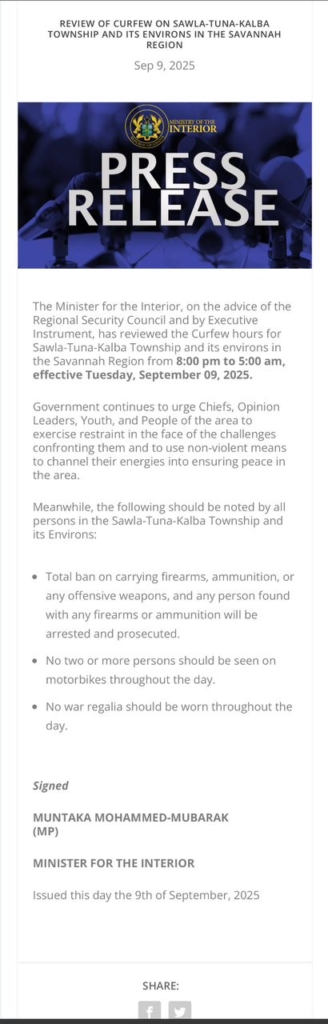
    This overhaul of the regulatory framework was intended to increase transparency, eliminate illegal players, and enhance government revenue from Ghana’s booming ASM gold industry, which contributes over 30% to the nation’s total gold production.

  • Children of August 6 crash victims get full scholarships from B5 Plus, DPS International

    Children of August 6 crash victims get full scholarships from B5 Plus, DPS International

    The eight families affected by the August 6 helicopter crash have received a full educational scholarship for their children.

    The package, announced at the Office of the Staff, is the result of partnership between B5 Plus Group and DPS International School.

    Under the arrangement, two children from each family will be enrolled at DPS International in Tema, with full costs covered from basic school through to A-Levels.

    The scholarship includes tuition, uniforms and boarding where required.

    Chief of Staff Julius Debrah, who accepted the offer on behalf of the families, described the gesture as a clear demonstration of private sector commitment to nation-building.

    Former Attorney-General and Presidential Advisor on Legal Affairs, Marietta Brew Appiah Oppong, also lauded the initiative, stressing that investing in the education of the children is a long-term solution that will secure their future. 

    The government laid to rest eight victims of the Adansi helicopter crash as of August 15.

    The deceased were Dr. Edward Kofi Omane Boamah, Minister for Defence; Samuel Sarpong, Vice Chairman of the National Democratic Congress; Samuel Aboagye, Deputy Director-General of NADMO; Squadron Leader Peter Anala of the Ghana Air Force; Flying Officer Tsum Ampadu of the Ghana Air Force; and Sergeant Ernest Addo of the Ghana Air Force.

    Among the eight victims, two Muslims, Minister for Environment, Science, Technology and Innovation, Dr. Ibrahim Murtala Mohammed, and Acting Deputy National Security Coordinator in charge of Human Security, Alhaji Muniru Limuna Mohammed — were laid to rest earlier, on Sunday, August 10, where Janazah prayers were also held at the Forecourt of the State House in Accra before they were buried at the Military Cemetery in Tse Addo.

    In solidarity to the bereaved families, a new Children Support Fund initiative, established by government to provide financial aid to the children of the victims received a GHS500,000 donation from Stanbic Bank Ghana. 

    President John Dramani Mahama made this known at the State Funeral on August 15, 2025, held in honour of the eight gallant men who lost their lives in the line of service to the nation.

    The bank expressed condolences to the bereaved families, especially the children who have lost their parents in a statement signed by the bank’s Chief Executive, Kwamina Asomaning,

    “In the wake of the heartbreaking helicopter crash that claimed the lives of dedicated servicemen, our hearts go out to the families left behind, especially the children who now face life without their parents,” Mr. Asomaning said.

    Mr Kwamina Asomaning added that, “We hope this contribution will serve not only as financial support, but as a message of hope, that these children are not alone, and that Ghana stands with them.”

    As of August 19, the Support Fund had accrued a total of GHS 2,315,000.00 represents collective donations from corporate organizations and individuals. This information was disclosed by the Governmental Affairs and Coordinator of the Fund, Dr. Valerie Sawyerr.

    Persons who wish to make donations to the Fund have been urged to do so through Stanbic Bank Ghana Limited (Stanbic Heights Branch, Accra) using the following accounts: US Dollar (USD) Account – 9040013628534 and Ghana Cedi (GHS) Account – 9040013628372.

    According to the Fund Coordinator, cheques and bank drafts should be made in the name CHILDREN SUPPORT FUND 6825. She emphasized that the names of individuals who make payments into the Fund will be published weekly.

    The establishment of the Fund was officially launched by President John Dramani Mahama while speaking at the State funeral organized for the victims at the Black Star Square on Friday, August 15.

    President Mahama also expressed his gratitude to Stanbic Bank Ghana for donating GHS 500,000 to the Fund, as well as to companies including Procus GH Limited, GB Foods Ghana, Sunda FM Manufacturing Ltd, Sage Distribution Ltd, Quantum Oil Terminals, Quantum LPG Logistics Ltd, Newgas Cylinder Ltd, and Quantum Terminals PLC for their generous contributions.

    The support extended to families of six out of the eight individuals who lost their lives receiving GHC 2 million in donations from Ghana’s leading insurance company, GLICO General Insurance.

    The beneficiaries include the families of Acting Deputy National Security Coordinator in charge of Human Security, Alhaji Muniru Limuna Mohammed; Vice Chairman of the National Democratic Congress, Samuel Sarpong; Deputy Director-General of NADMO, Samuel Aboagye; Wing Commander Peter Baafemi Analaa; Flight Lieutenant Manaen Twum Ampadu; and Flight Sergeant Mensah Ernest Addo.

    The families of the two ministers—Minister for Defence, Dr. Edward Kofi Omane Boamah, and Minister for Environment, Science, Technology, and Innovation, Dr. Ibrahim Murtala Mohammed—have also received benefits under the personal accident cover, as both were insured with the company.

    Speaking during the presentation, Managing Director of GLICO, Andrew Achampong-Kyei, urged the families of the deceased to take advantage of insurance packages as a safeguard against unforeseen circumstances. “I’ll encourage you all that it’s important we protect our lives. Having insurance should be part of our social fabric, so we safeguard our lives and investments,” he said.

    The Group Chief Executive Officer, Edward Forkuo Kyei, expressed sympathy to the grieving families while assuring them of the company’s support during these difficult times. “You are not standing alone; we are with you. It is for this reason we express our deepest condolences,” he noted.

    Meanwhile those wishing to contribute have been directed to make donations through Stanbic Bank Ghana Limited (Stanbic Heights Branch, Accra) using the following accounts: US Dollar (USD) Account – 9040013628534 and Ghana Cedi (GHS) Account – 9040013628372. According to the Coordinator, cheques and bank drafts should be made payable to CHILDREN SUPPORT FUND 6825. She emphasized that the names of individuals making payments will be published weekly.

    The Fund was officially launched by President John Dramani Mahama while speaking at the State funeral organized for the victims at Black Star Square on Friday, August 15.

  • Exposed invigilators in JoyNews’ BECE documentary exposé to be blacklisted – WAEC 

    Exposed invigilators in JoyNews’ BECE documentary exposé to be blacklisted – WAEC 

    Officials implicated in acts of corruption during the Basic Education Certificate Examination (BECE) will be blacklisted from ever taking part in West African Examinations Council (WAEC)-related activities again.

    This was announced by WAEC’s Director of Public Affairs, John Kapi, following a JoyNews Hotline investigation broadcast led by GH Probe’s Francisca Enchil. The investigation revealed alarming instances of cheating at examination centres, including Derby Avenue RC Basic School and St. George’s Anglican Basic School in Accra.

    As part of measures to penalize the officials involved in the exposé, Mr. Kapi stated, “Yes, that is what we usually do. We blacklist them, they no longer take part in any activity that has to do with the WAEC,” on JoyNews’ PM Express on September 8.

    He further emphasized that the Council cannot continue to work with individuals who have betrayed the trust placed in them during national examinations.

    “These are people who certainly have not proved that they are worthy of the trust that we repose in them. As far as this job is concerned, let me also indicate that when it comes to BECE, most of the decisions are taken by the Ghana Education Service. For example, the selection of supervisors and invigilators is done by the district exams officer,” he explained.

    The WAEC Director of Public Affairs added that whenever such issues arise, they expect the Ghana Education Service (GES) to take decisive action, respond appropriately, and ensure the right measures are taken against those involved.

    Dark World of BECE Documentary

    The 2025 Basic Education Certificate Examination (BECE), a crucial entry point to secondary education, has been marred by what appears to be one of the most alarming cases of organised malpractice ever exposed.

    A JoyNews Hotline investigation, spearheaded by GH Probe’s Francisca Enchil, uncovered how officials of the Ghana Education Service (GES), together with supervisors, headteachers, and invigilators, turned the national assessment into a coordinated racket—sacrificing academic integrity for monetary gain.

    At both Derby Avenue RC Basic and St. George’s Anglican Basic in Accra, invigilators asked for GH¢60 daily, supervisors accepted GH¢400 cash envelopes, and candidates were told to contribute to an ‘Aseda Offertory.’

    Instead of upholding strict monitoring, supervisors doubled as guards for invigilators, tipping them off whenever WAEC or National Security officials approached. Teachers and headteachers, though prohibited from the premises, roamed exam centres, bribed their way through, and in some instances fed answers straight to candidates.

    The exposé has triggered outrage. The Acting Director-General of the Ghana Education Service, Prof. Ernest Kofi Davis, has warned that teachers face dismissal if caught. Civil society voices, such as Kofi Asare of Africa Education Watch, caution that Ghana is “teaching children corruption in basic schools”—a dangerous normalisation of dishonesty.

    Meanwhile, the West African Examinations Council (WAEC) announced that at least 14 individuals had been arrested across the country for their involvement in malpractice in the 2025 West African Senior School Certificate Examination (WASSCE).

    The victims, according to the Council, were teachers, students, and invigilators.

    Speaking to the media on Friday, September 5, Head of Public Affairs at WAEC, John Kapi, noted, “As part of our commitment to upholding the integrity and credibility of our examination, we have deployed—for we had to employ a number of staff, as well as our own specialized personnel—to monitor the examination centres. Our monitoring teams have observed irregular activity at a number of the examination centres.”

    Three of the convicts were sentenced to a combined 20 months behind bars, as declared by the Kasoa-Ofaakor District Magistrate Court. The convicts include a teacher at Ghana College SHS, Samuel Armah, and two university students, Kwame Oteng Nkansah and Amedeka James.

    Armah, an invigilator, was sentenced to eight months imprisonment with a fine of 80 penalty units. He was caught dictating answers from his mobile phone to candidates during the Social Studies Paper 1.

    Nkansah, a level 100 student of Accra Technical University, impersonated one Quayson Francis Atta of Ghana College SHS. He received a jail term of six months with a fine of 80 penalty units.

    A level 100 student of the University of Ghana, James, was also granted a six-month jail term after attempting to write the exam in place of his twin brother, Amedeka Justice.

    On Monday, August 25, authorities caught an invigilator at the Forces SHTS with a phone loaded with exam questions while the West African Senior School Certificate Examination (WASSCE) was in progress. His phone contained exam questions on Picture Making and Oral English.

    On Wednesday, August 20, WAEC commenced the 2025 WASSCE with a total of 461,640 candidates who sat for the Oral English exam. The practical papers commenced on August 4. The number of students who sat for this year’s exams saw a 0.22 percent increase from 2024, when a total of 460,611 candidates sat for the WASSCE. This year’s candidates comprise 207,381 males and 254,259 females.

    Ahead of the exams, the Ghana Education Service (GES) released funds to cater for the 2025 WASSCE practical examinations for all Senior High Schools (SHSs) and Senior High Technical Schools (SHTSs) across the country. An amount of GH¢15,849,920 was released, according to reports.

    According to GES, in a statement issued on Saturday, July 27, and signed by the Head of Public Relations, Daniel Fenyi, the funds were expected to provide all necessary materials and supplies for the practical exams.

    “The Management of the Ghana Education Service (GES) announces that funds had been released to all Senior High Schools (SHS) and Senior High Technical Schools (SHTS) across the country to cover the fees for the 2025 WASSCE practicals. This payment ensures that all practical examinations scheduled for the 2025 WASSCE are fully supported, including the provision of the required materials and other essential resources,” the Service noted.

    WAEC cancelled and withheld the subject results and entire results of some 2,228 candidates who sat for the 2025 BECE. The Council made this known after revealing that it had released provisional results of candidates who sat for the BECE for School Candidates, 2025.

    Following the completion of investigations into several cases of irregularity detected during the conduct of the examination and marking of scripts, the 36th Meeting of the Final Awards and Examiners’ Appointment Committee for the BECE, 2025, held on Friday, August 15, 2025, approved the cancellation of the subject results of 718 candidates and the entire results of 177 candidates.

    The committee also withheld the subject results of 1,240 candidates and entire results of 93 candidates. Meanwhile, the subject results of some candidates from 119 schools have been cancelled. In addition, the subject results of some candidates from 87 schools have been withheld for further scrutiny.

    The withheld results may be cancelled or released based on the outcome of investigations by September 6, 2025. WAEC has indicated that candidates whose results have been cancelled or withheld should visit their website for details and reasons for the withholding or cancellation of results.

  • Mama Esther recounts dream that foretold her struggle to have a child

    Mama Esther recounts dream that foretold her struggle to have a child

    Renowned Ghanaian gospel musician Mama Esther has recounted a dream that foretold her struggle to have a child.

    According to her, she had earlier lost her first child, however she went through a 10-year battle to have another. 

    Sharing in an interview dated  September 9, and sighted by The Independent Ghana, Mama Esther said, “I had a dream after I lost one of my children. In the dream, I saw that I was in labour and someone was asking me to push my baby out. After I had given birth, I saw the person running away with everything.

    “I then asked her to give me my baby, and she laughed at me, saying that I had taken your womb away. And that I won’t give birth again. But I didn’t take it seriously because I had a baby. She noticed the dream was coming through later.”

    She added that as part of the challenges she faced, many accused her of tampering with her womb.  Nonetheless, God’s Grace made it possible for her to become a mother.

    “Some people accused me that after giving birth to two in a span of two years, I went to tamper with my womb. Some even said that I went to change my womb so I can give birth to a lot of children, and that didn’t go in my favour.

    “All these rumours happened after I had lost one of my children. The hard part was that it took me 10 years to conceive. But it took the grace of God for me to have another child after constant prayers,” she added.

    Mama Esther joins a few personalities who have struggled to conceive a baby. After eight years of marriage, it was appropriate for TV personality and actress Selly Galley and her husband, Steven Fiawoo, also known as Praye Tietia, to express their immense joy at the birth of their twin children.

    The celebrity couple, who got married in September 2015, had always been candid about delivery difficulties. The official announcement of their bundle of joy’s arrival on August 27 has, however, calmed the storm.

    Selly Galley had been sharing her gratitude ever since on social media, calling her twin pregnancy and birth “a long and almost hopeless journey” while clinging to her faith.

    “Holding on to FAITH… that’s what brought me this far.It’s been a long and almost hopeless journey. But I wasn’t to decide that.

    “WHAT THE LORD HAS DONE!, my tongue is heavy with praise and worship, our hearts are heavy with immense gratitude, she added.

    Selly Galley-Fiawoo took the opportunity to discuss the personal and emotional challenges she and her husband, Praye Tietia, faced throughout their journey.

    Selly revealed at the christening of their twins that their path to expanding their family was marked by a long nine-year wait to conceive. Despite the difficulties, she expressed heartfelt gratitude to God for the blessing of their twins.

    In her candid reflections, Selly also addressed the impact of social media scrutiny, admitting that the ridicule and negative comments she received were tough to ignore, even with her best efforts to stay resilient

    “Last year, I cried a lot, but it is all to the glory of God. About sixteen years ago, this man came into my life and changed it completely. I am incredibly blessed to have him. We are deeply in love and fortunate to have something so special.”

    “The bond we share has completed us. It was nine challenging years, but God did not shame us. Although I faced mockery on social media, and some comments were hard to ignore, here we are, blessed with twins,” she said in a video shared by Zionfelixdotcom on Instagram.

    Selly Galley also disclosed that during the nine years of waiting, she had experienced a pregnancy, which unfortunately ended in a loss.

    “I did get pregnant along the way, but God said it wasn’t the right time. We cried, but God assured us there was something greater ahead. Now, we are celebrating double blessings, twins, a boy and a girl,” she added.

    The celebration was attended by notable celebrities including Nana Ama McBrown, Fella Makafui, Stacy Amoateng, and Gifty Osei, who all came together to mark this joyful event.

    Actress Nana Ama McBrown has made an emotional revelation of how she struggled for two decades to have a child.

    The new mother, who turned 42 on Thursday, recounted the agony she endured from family, friends and society because she was childless.

    In an emotional Facebook Live on Thursday, Nana Ama McBrown who recently delivered in Canada urged woman going through similar challenges not to give up.

    She advised such women to rather count on God just as she did.

    Meanwhile she has expressed a strong desire to have another child, even considering surrogacy if necessary.The award-winning actress, who gave birth to her first child, a daughter, in Canada at age 41, shared her concerns about not being able to conceive when she was 32.

    In a Twitter post at the time of her childbirth, McBrown, whose real name is Felicity Ama Agyeman, encouraged other women facing similar challenges to keep their faith in God.Reflecting on her journey, she mentioned the difficulties she faced, including feelings of loneliness and moments of doubt, but emphasized that her faith helped her persevere.

    “I’ve had many tears and sorrows; I’ve had questions for tomorrow. There have been times I feel so alone, but in my lonely hours, God let me know that I was his own. I thank God for the mountains, the storms, the valleys, and the ridicule. Through it all, I learned to trust in Him, and God has given me a blessed consolation.

    “This is what faith in God could do. Believe in him for your TESTIMONY. #Mytestimony is here,” she captioned one of the photos showing her baby bump.

    During a recent interview with Starr FM on August 22, 2024, McBrown reiterated her determination to have another child.She revealed her plan to explore all available medical options, including surrogacy, to fulfill her dream of expanding her family.

    The actress, who is particularly hoping for a son, stated that she intends to pursue this goal before or as she approaches the age of 50.She is committed to ensuring that her daughter, Baby Maxin, has a sibling to grow up with.

    “I want to have another baby. I have not started, but if I don’t get, I will surrogate. I really want to have another child. After 50, I want to have a baby running in my house. Baby Maxin (her child) must have a brother or sister.

    “I am just putting together a few things, and then I will. If my doctor says I cannot, I will go for surrogacy. I want to have a boy, especially now that there are options. After 50, or when I am hitting 50, I will go through the right process to have another child,” the charming TV presenter said.

  • Open letter to Okudzeto Ablakwa: A minister soaring in Accra while his people languish at home

    Open letter to Okudzeto Ablakwa: A minister soaring in Accra while his people languish at home

    Dear Hon. Samuel Okudzeto Ablakwa,

    I write this letter with a heavy heart, but as a constituent, it is the only channel left to make my concerns heard.

    Drawn from personal experiences and conversations with many in North Tongu, this message may be blunt and may feel like a call-out, but such frank accountability is a necessary dose in every true democracy.

    Now, to the main thrust of my letter:

    You have built a reputation in Ghanaian politics as a fearless crusader, an anti-corruption advocate, a sharp debater, and now the country’s Minister for Foreign Affairs.

    To many outside North Tongu, you are a near-national hero. But to those of us at home, the question we keep asking is simple: Is this enterprise all about you?

    North Tongu is blessed with many brilliant young men and women, yet you have chosen to play it solo. You have not cared to build a database of these sharp minds who could support your work.

    This strategy might have been forgivable if results were evident. But the absence of outcomes from this one-man approach is a glaring problem.

    Almost eight months into your ministerial role, the people of North Tongu have yet to see meaningful change.

    Our roads remain deplorable, our youth remain jobless, and critical facilities continue to struggle.

    In your pursuit of national acclaim, your own people, the very ones who gave you the highest electoral margin in Ghana, are being left behind.

    We remember vividly the Akosombo Dam spillage in Mepe about three years ago. While the cameras captured your presence, many of us felt your efforts were more about showmanship than sustainable solutions.

    Sadly, that same pattern seems to be repeating itself today: more gallery than groundwork, more attention to image than to infrastructure.

    Take the roads, for instance. The Mepe–Sege stretch, which leads directly to the Battor Catholic Hospital, has been in a deplorable state for over a decade.

    How do we talk about healthcare access when patients must endure such dangerous routes to reach our major hospital?

    Other critical connections – from Mepe to Dove, Juapong to Podoe, Podoe to Ayiwata, and Ayiwata to Titikope- are equally neglected.

    Then there is the painful matter of jobs. Along the Aveyime–Mepe stretch, unemployment has forced many young men into crime.

    Night after night, homes are raided and belongings stolen. A single factory, one deliberate push for local industry, could redirect this restless energy into productivity. Yet, no such initiative has been championed.

    North Tongu has never failed you.

    Election after election, we have given you overwhelming support. But loyalty is not a blank cheque. If this neglect persists, trust will erode, not only in you, but in the NDC government you represent.

    Honourable Ablakwa, leadership is not measured by how brightly one shines on the national stage, but by the tangible difference made in the lives of one’s people.

    Like many of our compatriots across Ghana, North Tongu does not ask for charity. We ask for what is rightfully ours: safe roads, decent jobs, and a fair share of the national cake.

    The clock is ticking. Will you be remembered as the minister who soared in Accra while his people languished in Mepe, Battor, Aveyime, and other North Tongu towns?

    Or, will you be remembered as the leader who balanced ambition with responsibility, ensuring that North Tongu was never forgotten?

    The choice and your legacy are in your hands.

    Sincerely,

    Joshua Kwasi Tigo, A not-too-proud constituent of yours.

    Source: Adomonline.com

    DISCLAIMER: Independentghana.com will not be liable for any inaccuracies contained in this article. The views expressed in the article are solely those of the author’s, and do not reflect those of The Independent Ghana 

  • Ghana owes over GHS1bn in UK Scholarship – Scholarship Secretariat

    Ghana owes over GHS1bn in UK Scholarship – Scholarship Secretariat

    Ghana is currently owing one billion cedis in scholarship commitments to the United Kingdom, according to the Registrar of the Scholarship Secretariat, Kwaku Asafo Agyei.

    He made this known in an exclusive interview with Nana Kwadwo Jantuah on Nhyira FM’s Morning show, stating that deep concerns are being raised over the disappearance of Crown Agency in the UK, which previously managed short courses for Ghanaian beneficiaries.

    “Ghana currently owes over one billion cedis in scholarships in the UK. This has to be paid to allow beneficiaries to access their tuition,” he stated. “The Crown Agency in the UK, which was responsible for organizing short courses for beneficiaries, has disappeared.”

    Mr. Safo said according to an audit report, the previous government administration prioritized funding for short courses while neglecting regular academic programs, a practice that undermined the Secretariat’s core mandate.

    “I called for an audit into suspected scandals at the Secretariat. The report shows that the previous administration prioritized paying for short courses while avoiding regular academic programs,” he indicated.

    He stressed that the Secretariat has no responsibility to cover expenses for dependents who travel with beneficiaries. Yet, he claimed his predecessor unlawfully extended sponsorship to these dependents and even provided them with monthly stipends, calling it a clear misuse of office.

    “The National Scholarship Secretariat is not responsible for the cost of any dependent who accompanies a beneficiary. However, my predecessors paid billions of cedis to sponsor beneficiaries which is unnecessary cost to the state,” he said.

    Mr. Asafo Agyei further revealed that certain appointees in President Akufo-Addo’s administration were granted authority letters for 10-year visas, even though the short courses they were attending lasted barely two weeks.

    Last year, it was reported that a group of Ghanaian students studying at the University of Birmingham, UK, were facing deportation after their student visas were revoked.

    According to a statement from the UK Visas and Immigration, this visa cancellation was due to the students’ failure to pay their tuition fees.

    The majority of these students were on the Government of Ghana Scholarship Scheme, but due to the government’s delay in sending the necessary funds, they were unable to meet their financial obligations.

    A letter from the UK Visa and Immigration Office sent to the affected students outlined their limited options: either leave the country voluntarily or face legal consequences, including possible detention and prosecution. The students were faced with the threat of deportation if no resolution was found immediately

    “You still have permission until 09 November 2024, and the current conditions of your stay will continue to apply until then. Please ensure that you comply with these conditions.”

    “You now have until 09 November 2024 to either leave the United Kingdom (UK) or make another application to stay here. You do not have a right of appeal or administrative review against the decision to cancel your permission.”

    “If you leave or are already outside the Common Travel Area (the UK, the Channel Islands, the Isle of Man, and the Republic of Ireland) before 9 November 2024, your permission will end immediately, and you will have to make a new application to re-enter the UK,” part of the letter stated.

    In contrast, Foreign Affairs Minister Samuel Okudzeto Ablakwa has revealed that Ukraine is committed to reinstating medical scholarship programs for Ghanaian students once the ongoing war with Russia comes to an end.

    He made this known after separate discussions with the Foreign Ministers of Ukraine and Georgia during the Raisina Dialogue in India.

    In a Facebook post, Ablakwa stated that Ukraine is keen on strengthening its educational partnership with Ghana and expanding bilateral agreements in the sector.

    “Ukraine is seeking to restore medical scholarship opportunities and an expanded bilateral educational partnership agreement with Ghana after the war,” he wrote.

    The discussions also explored mutually beneficial agribusiness ventures, particularly as Ukraine works towards reviving its economy.

    The Ukrainian Foreign Minister reassured that his country remains committed to ending the conflict with Russia, stressing that Ukraine does not intend to be an obstacle to lasting peace.

    Meanwhile, Ablakwa noted that Georgia was considering opening a diplomatic mission in Accra as part of efforts to deepen relations with Ghana.

    “I am deeply grateful to His Excellency Andrii Sybiha of Ukraine and Her Excellency Maka Botchorishvili of Georgia for their warmth and great respect for Ghana,” Ablakwa added.

    The Deputy Director of the National Service Secretariat (NSS), Gifty Oware-Mensah, had been implicated in a recent exposé by The Fourth Estate, spearheaded by investigative journalist Manasseh Azure.

    The investigation had unveiled the identities of affluent individuals who allegedly obtained scholarships meant for academically gifted but financially disadvantaged Ghanaians.

    Per reports, Gifty who had denied receiving any scholarship, “obtained a government scholarship of GBP18,450 (GBP means Great British Pound) to study at the University of Birmingham in the United Kingdom in 2020 to pursue an MSc in Development Policy and Politics.”

    It said that she received the scholarship three years after she started working for the Secretariat.

    According to the Fourth Estate, they reached out to her on January 19, 2024, and her response was “From 2019, my name has been Gifty Oware-Mensah. Let me call Kingsley [Agyemang] and get back. I don’t know what you’re talking about. Let me speak to them and get back to you.”

    The Fourth Estate further reported that “She later sent a text message that she was driving to Sunyani and would revert. Subsequent calls to her did not yield result.”

    Madam Gifty is said to own Berry Ladies FC, a female football formerly known as Halifax Ladies FC, which is currently playing in Ghana’s women premier league.

    In other matters, the 2023/24 NSS personnel are calling on the government to settle the allowance arrears owed them. Per reports, government has not payed personnel for the previous two months.

  • We have problems, but it doesn’t mean Nollywood made Ghanaian actors – Kofi Adjorlolo

    We have problems, but it doesn’t mean Nollywood made Ghanaian actors – Kofi Adjorlolo

    Veteran Ghanaian actor Kofi Adjorlolo has maintained that while the Ghanaian movie industry has its challenges, it was never Nollywood that made Ghanaian actors.

    He was on The Real Talk Podcast with Elizabeth Essuman, where he stated that the Ghanaian film industry had carved out its own stars and strong productions long before Nigerian filmmakers reached out.

    “Though the Ghana Movie Industry may be having its own problems; it does not mean that Nigerians made us, Ghana Films made Ghanaian actors,” he declared. “Ghana movie industry and the movies produced made us popular before the Nigerian producers noticed, and called us.”

    He noted that Ghana’s film industry, popularly called Ghallywood, had established itself strongly on the continent, forming the basis for much of the present cross-border narrative.

    “Ghana movie is not down, actors are acting daily, producers are producing daily, work is ongoing daily; rather, it is the promotion and marketing that is lacking – and we’ve got to fix that area,” he stressed.

    Mr Adjorlolo added that many well-known actors, Majid Michel, Van Vicker, Jackie Appiah, John Dumelo, Juliet Ibrahim, Nadia Buari, Yvonne Nelson and others, earned domestic acclaim before their Nollywood breakthroughs. 

    “Ghanaian actors gained their breakthroughs in their home country before being introduced to Nollywood,” 

    Renowned Ghanaian filmmaker and comedian, Kwaku Simtim-Misa, widely known as KSM, has offered a candid assessment of Ghana’s movie industry, stressing that it cannot yet be compared to the Nigerian film industry in terms of growth, structure, and contribution.

    Speaking on The Career Trail program on Joy Learning TV and Joy News, KSM said that while Ghana is blessed with talented filmmakers and promising content, the absence of a sustainable and efficient system continues to hinder the industry’s growth.

    “Unfortunately, it is still a growing industry. We can’t compare the film industry in Ghana to that of Nigeria. The Nigerians have had a longer time of being exposed to making films. And the more they make them, the better they get. The more they produce, the more they devise ways of distributing them. Eventually, you realize you’ve developed a system that works for you,” KSM stated.

    On the other hand, he said Ghana’s film industry is still trying to find its feet.

    Most filmmakers struggle to raise money at every stage, from writing the story, shooting the film, paying actors, to finally getting the movie out there for people to watch.

    “Somebody will hustle to make money, then hustle to pay for the film. And after paying for the film, the actors, and everyone else involved, they now have to hustle again just to distribute the film. There are no proper distribution outlets,” he lamented.

    Ghana’s film industry, once vibrant in the CD/DVD era, now struggles with structure, funding, and proper distribution.

    Unlike Nigeria’s Nollywood, which has grown into a globally recognized industry through consistent production, strong distribution networks, and digital platforms, Ghana’s sector remains largely informal.
    Filmmakers often self-fund and face hurdles getting their movies widely seen.

    While a few initiatives and talented individuals are pushing forward, veteran filmmaker KSM says the lack of a solid system continues to limit growth and makes it difficult to compare Ghana’s industry with Nigeria.

    In contrast, Ghanaian musician Ben Brainy has raised concerns about the state of Ghana’s music industry during an interview on Bryt TV.

    He expressed disappointment that Ghanaians have not properly preserved their cultural and musical heritage, which has allowed Nigerians to take the lead in Highlife music.

    Highlife, a key part of Ghana’s musical history, has influenced African music for years. Legends like E.T. Mensah, Nana Ampadu, and Agya Koo Nimo helped shape the genre. However, Ben Brainy feels Ghana has not done enough to protect and promote it.

    He explained that many Ghanaian artists abandon traditional sounds in favor of modern trends, creating an opportunity for Nigerian musicians to step in. By blending Highlife with Afrobeat, Nigerians have made the genre more appealing worldwide, while Ghana struggles to maintain its impact.

    “We don’t hold onto our own for long. We started highlife, but now it’s the Nigerians who are making it big with it. We leave what we have and chase other things,” Ben Brainy lamented during the interview with El Baby.

    Ben Brainy encouraged Ghanaian musicians and industry leaders to focus on preserving and promoting Ghana’s unique musical style. He stressed that to keep Highlife music alive, Ghanaians must invest in it, share it with the world, and take pride in their cultural roots instead of letting outside influences take over.

    Meanwhile, he has released the music video for his song Location. The track, which mixes Afrobeat and Highlife, highlights his signature style and storytelling skills. The video brings the song’s message to life with colorful and engaging visuals.

    Through Location, Ben Brainy is not only gaining attention in the music industry but also reminding people of the importance of embracing Ghana’s musical heritage.

  • Why Prof Adei’s SHS devalues BECE as requirement for enrollment

    Why Prof Adei’s SHS devalues BECE as requirement for enrollment

    Renowned educationist Professor Stephen Adei has revealed that for the past eleven years, the Basic Education Certificate Examination (BECE) has not been a requirement for admission at his school, his school, Ghana Christian International High School.
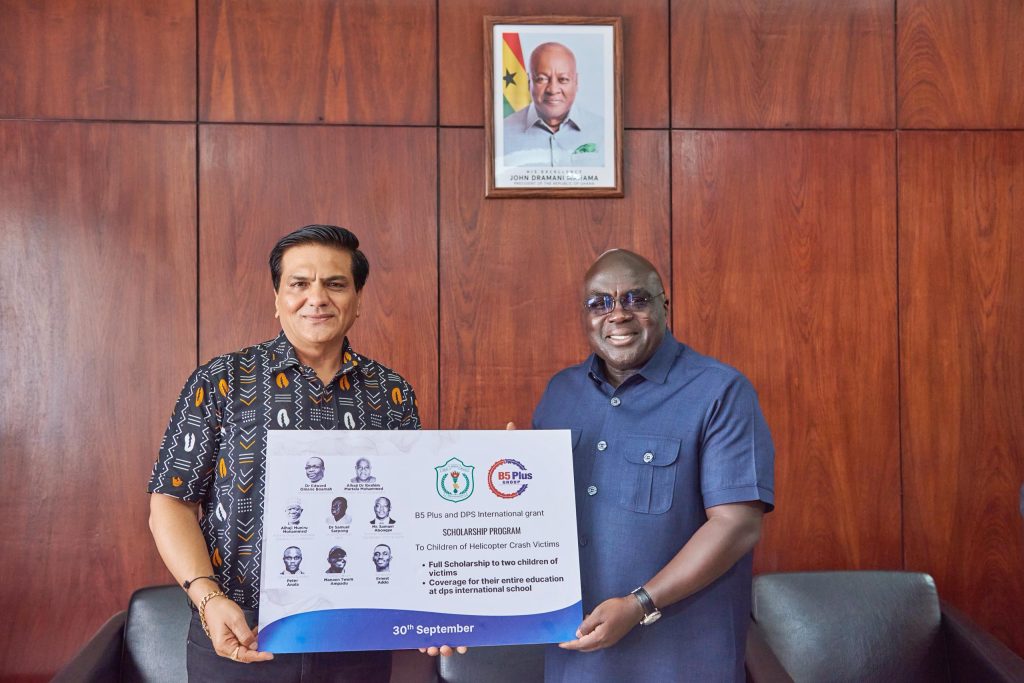
    He made this known in an interview on Joy FM’s Super Morning Show during a discussion on the Hotline Documentary: Dark World of BECE.
    “For 11 years, Ghana Christian International High School in Accra has not used BECE as an entrance requirement because we don’t trust them,” Mr Adei.

    He further mentioned some discrepancies by WAEC that undermine their credibility.

    “I must say that WAEC has been trying to catch up; there is a catch-up game. It seems the things are entrenched and always the things happen before they try. For example, deploying monitoring teams, some of whom have also been corrupted; arrest and prosecution of only a few; cancellation of results… so they are trying, but there are many against the tide,” he said.

    The former Rector of the Ghana Institute of Management and Public Administration (GIMPA) said that the issue of cheating in schools mirrors the wider decay in national values.

    “What is happening is a reflection of the moral degradation or degeneration in our society. When you see politicians openly bribing their way, giving money in the open to everybody else. When we see galamsey, people say that ‘so long as we get money, even if we poison the whole nation, we don’t care’. Corruption in the public sector, the decadence in the homes, because it’s parents who are sponsoring these,” he stated.

    According to him, the core issue lies in society’s demand for success, which often pushes people to cut corners or act dishonestly.

    “Now the question is why? There are a lot of ills in our society and pressure to perform, and, irrespective of how you do it. So people now have a lot of mansions they cannot explain and cars that their income does not support. And that is going down into the schools to say that once you achieve, irrespective of how, society will recognise you. Then there is a very big problem which the World Bank in 2016 called schooling without learning,” Prof. Adei warned.

    He added that the poor quality of education at the basic level was worsening the challenge.

    “Our primary schools in the public sector; practically, the children go through school totally illiterate. If you go to a place like Togo, by the second year in primary school, every child is literate. And if it is not addressed, these people will therefore go through and will have a way of getting some certificates anyway. And because of that, most of the children have very poor study habits,” he explained.

    This comes after a JoyNews Hotline investigation, led by GH Probe’s Francisca Enchil, exposed how some Ghana Education Service (GES) officials, together with supervisors, headteachers, and invigilators, turned the national exams into a money-making scheme — sacrificing integrity for profit.

    At two centres in Accra — Derby Avenue RC Basic School and St. George’s Anglican Basic School — investigators uncovered shocking levels of collusion. Invigilators openly demanded daily “tokens” of GHS60, supervisors received envelopes containing GHS400, and candidates were even made to contribute to a so-called “Aseda Offertory.”

    The West African Examination Council (WAEC) has announced that at least 14 individuals have been arrested across the country for their involvement in malpractice in the 2025 West African Senior School Certificate Examination (WASSCE).

    According to the Council, the victims include teachers, students, and invigilators Speaking to the media on Friday, September 5, Head of Public Affairs at the West African Examination Council, John Kapi noted, “As part of our commitment to upholding the integrity and credibility of our examination, we have deployed for we had to employ a number of staff, as well as our own specialized personnel, to monitor the examination centres. Our monitoring teams have …. of irregular activity at a number of the examination centres”.

    Three out of the victims will spend a combined 20 months behind bars, the Kasoa-Ofaakor District Magistrate Court has ruled. The convicts include a teacher at Ghana College SHS, Samuel Armah, and two university students, Kwame Oteng Nkansah and Amedeka James.

    Armah who is an invigilator has been awarded an eight months in prison with a fine of 80 penalty units. He was caught dictating answers from his mobile phone to candidates during the Social Studies Paper 1.

    Nkansah, who is a level 100 student of Accra Technical University, impersonated one Quayson Francis Atta of Ghana College SHS. He therefore received a jail term of six months with a fine of 80 penalty units.

    A level 100 student of the University of Ghana, James, has been granted a six-month jail term after an attempt to write the exam in place of his twin brother, Amedeka Justice.

    On Monday, August 25, authorities caught an invigilator at the Forces SHTS with a phone loaded with exam questions during the ongoing West African Senior School Certificate Examination (WASSCE).

    His phone contained exam questions on Picture Making and Oral English.On Wednesday, August 20, the West African Examination Council commenced the 2025 WASSCE. A total of 461,640 candidates sat for the Oral English exam.

    The practical papers commenced on August 4. The number of students who sat for this year’s exams saw a 0.22 percent increase. In 2024, a total number of 460,611 sat for the WASSCE. This year’s candidates compromise 207,381 males and 254,259 females.

    Ahead of the exams, the Ghana Education Service (GES) released funds to cater for the 2025 WASSCE practical examinations for all Senior High Schools (SHSs) and Senior High Technical Schools (SHTSs) across the country.

    An amount of GH¢15,849,920 was released, according to reports. According to GES, in a statement issued on Saturday, July 27, and signed by the Head of Public Relations, Daniel Fenyi, the funds are expected to provide all necessary materials and supplies for their practical exams.

    “ The Managaement of the Ghana Education Service (GES) announces that funds have been released to all Senior High Schools (SHS) and Senior High Technical Schools (SHTS) across the country to cover the fees for the 2025 WASSCE practicals.

    “This payment ensures that all practical examinations scheduled for the 2025 WASSCE are fully supported, including the provision of the required materials and other essential resources,” the Service noted.

  • Here is what Akumaa said about her iconic headgear

    Here is what Akumaa said about her iconic headgear

    Veteran Ghanaian media personality Joyce Akumaa Dongotey-Padi, popularly known as Akumaa Mama Zimbi, has shared the inspiration behind her iconic headgear.

    In an interview on Delay’s Show, Akumaa was questioned about whether her headgear was too heavy for her to carry around.

    She responded by saying “It’s my brand.”

    Akumaa further explained that the headgear she had on during the interview was made from eight yards of fabric, though at times it extended to twelve yards.

    “I own many scarves in different velvet colours, but because of my skin tone, I usually prefer wine. I often tie four yards of wine-coloured fabric together with an additional multicoloured piece, making a total of eight yards,” She told Delay in a video sighted by The Independent Ghana.

    The media personality stirred a reaction on social media by opting for a makeup-free and headgear-free look months ago.

    For some reason, Akumaa appeared unfamiliar or, let’s say, different without her signature headgear. Without makeup, she undergoes a complete transformation.

    Social media users commented that Akumaa resembled a Nollywood witch without makeup and her scarf. Some drew other comparisons, attributing her look to old age setting in.

    Visible wrinkles on her face and hair loss were noticeable changes.

    Despite these observations, Akumaa is seen engaging in her usual provocative activities to garner attention.

    In a separate engagement, she revealed that she has been verbally abused on multiple instances for hosting her ‘Odo Ahomaso’ show, a sex education programme on Adom TV.

    The host of Odo Ahomaso said that some pastors and members of the community accused her of being a ‘Krobo prostitute’ aiming to ruin Ghana’s youth with the aforementioned programme.

    Akumaa Mama Zimbi stated in an interview with Neat FM, on March 13, 2023, explained that the programme does not intend to harm the youth of the country in any way but rather seeks to provide the entire population with sex education.

    “I have been to several programs whereby people get up from my side just because they claimed sitting beside me will make their children listen to me.

    “People didn’t want to associate with me, they were saying I was evil even including some men of God…a lot of people, and they thought we the ‘Damgbes’, the “Krobos” people think we’re prostitutes, so I’m coming to destroy the world.

    By way of advice, she explained: “I’m telling you that, give proper training to your children the moment the person begins to menstruate.

    “Tell her not to allow men to sleep with her because she will get pregnant and become a school dropout…

    “Let me tell you, in this country, uncles have broken their own nieces’ virginity, aunties have done it, and some fathers are sleeping with their own daughters and sons.

    “It is happening, what did you tell your daughter, what did you tell your son…Odo Ahomaso is gospel.” she stressed.

    Meanwhile, she has cautioned men to avoid spending money to win the favor of women,

    According to her, until God approves the relationship, no man should spend even 10 Ghana cedis on a woman.

    Speaking in an interview, Akumaa Mama Zimbi insinuated that a man must seek approval from God through prayer before deciding to spend on a woman.

    She added that for the avoidance of doubt and heartbreak, men must be spiritually conscious about their potential partners and must only spend after getting the go-ahead from God.

    To the young guys: “Before you want to spend even 10 cedis on a lady, first pray about it. Seek God’s approval first to know if the person is the right partner for you before you go ahead and spend money on her. This will not leave you disappointed later on in life,” she said.

    Adding her voice to the prevalence of hook-up business in Ghana, Akumaa said the culture is a clear form of prostitution.

    According to her, regardless of the fanciful names – hookups or slay queens – individuals offer casual sex in return for a fee or favour.

    The marriage counsellor made these comments as a guest hostess on the 6th Sense Show on Joy Prime.

    “It is prostitution. Crystal clear prostitution, and you can’t say anything about it. Then there’s the threesome and the foursome. The lady alone can hook the guys. It has gone to the next level,” she said.

    There are concerns over the practise of hooking up girls and boys in our society and how it is eroding Ghanaian values.

    Despite being a criminal offence in Ghana, people are finding ways and means to engage in illegal activity for various reasons.

    Akumaa Mama Zimbi said prostitution takes different forms, and one does not need to be in an obscure location or wait until the night to be able to engage in the act.

    She mentioned that hookups are largely done on social media and that the proliferation of cell phones, websites, and hookup apps has modernised the practice, which is gradually gaining popularity in Ghana.

    The guest hostess revealed instances where ladies are flown to Dubai just for one-night stands, as well as hookup girls taking their trade into churches to lure unsuspecting pastors.

    “We even have those who go to the church places and then lure some of the pastors who are not really godly. Their dressing alone; their makeup alone; and the kind of perfume…I will see the man of God after church for consultation’ and if you don’t know God and you’re not strong, in your office, that lady, that woman, will rape you beautifully, nicely, and romantically,’ the host of Adom TV’s Odo Ahomaso Show indicated.

    Mama Zimbi also suggested that there are ten forms of prostitution, and hookup is just one of them.

    She was of the opinion that individuals who engage in hookups to earn money are lazy.

    She, however, advised ladies, especially, not to engage in such culture, as it has the potential of jeopardising their lives.

  • Come to my office, sign the papers, and go home – Duncan Williams advises against expensive weddings

    Come to my office, sign the papers, and go home – Duncan Williams advises against expensive weddings

    Young people preparing to enter into a Holy Matrimony have been counseled by the Founder and General Overseer of Action Chapel International, Archbishop Nicholas Duncan-Williams, to embrace cost effective weddings rather than extravagant ones.

    His comment came while preaching to his congregation, cautioning couples against borrowing money to organize lavish weddings, which often leave them facing frustrations at home due to the intense pressure from creditors demanding repayment.

    “If I were you, I would take that money that they are going to use for the wedding to do other things for the marriage itself. Just come to the office, sign the document, we bless you, you kiss one another, go home.”

    Duncan Williams went on to share his experience on how he got married unprepared at the age of 21 or 22.

    “You could tell that this guy is confused. I was like a sheep carried to the slaughter. I had no idea of what I was doing. I had no idea of what marriage was – I was just told I should marry, so me too, I married.”

    He counselled, “So let me say to some of you, when you get it all right, don’t do a wedding.”

    Meanwhile, in Bole, efforts have been made by the Chief Imam of the Bole Traditional Area, Alhaji Mohammed Iddrisu to curb the rising financial burden of lavish wedding ceremonies.

    He announced a ban on extravagant Islamic weddings within his jurisdiction.

    The directive, which took effect from March 5, 2025, was outlined in an official statement signed by the Chief Imam.

    “I am grateful to inform your esteemed office that I, the Chief Imam (Alhaji Mohammed Iddrisu) of Bole Traditional Area, after several council meetings with the Islamic clergy, wish to put a ban on extravagant Islamic weddings within my jurisdiction which do not conform to Islamic practices, starting on Wednesday, March 5, 2025,” the statement read.

    According to the Chief Imam, the decision seeks to promote modest and affordable weddings that align with Islamic teachings, ensuring that financial constraints do not prevent young people from getting married.

    “This decision aims to curb deviant practices which set high wedding costs, therefore making it difficult for many youth to get married,” he stated.

    Islamic weddings, much like Christian white weddings, have evolved into elaborate celebrations involving expensive receptions, multiple outfits, and high-end photography.

    The move by the Chief Imam is expected to ease financial pressures on families and restore simplicity to the marriage process.

    Nonetheless, weddings have evolved into a fashion statement in Ghana today, with couples practically competing with one another for the most lavish and opulent ceremonies.

    This trend is often associated with huge wedding costs and items, to somewhat display the grand lifestyles of brides and grooms, or their respective families.

    A report by Graphic Daily in 2018 revealed that for couples who want lavish ceremonies, anything less than GH¢90,000 means that their dream ceremony will be a mirage. This situation has landed many couples in huge bank debts as many go for loans just to fulfil their lavish wedding ceremonies.

    It is against this backdrop that a young man has said that he would not spend more than GH¢1,000 on his wedding ceremony. He said, he would focus on getting only the items listed by the woman’s family, as the rest will be unnecessary to him.

    “I would only spend 1k on my wedding. I would only buy the items on the wedding list provided by the girl’s family. When I do that, I know I have married the lady. Any other expenses would not be featured in my budget. If the lady wants anything extra, she must pay for it,” he explained in a viral video sighted on Twitter.

    Another youth also said he would be willing to spend GH¢10,000 only for his wedding.

    He said this is as a result of the country’s poor economy state. He believes there is life after a wedding, as such, it would be unwise for couples to empty their wallets for a single day’s event.

    “So my wedding, I am not going to exceed more than GH¢10,000, if we exceed that amount, how are we going to survive when we finally settle together. The economy is very bad and so we must be very strategic and economic on spendings for wedding. If you pressure me for a GH¢50,000 and more wedding, I would quit,” he explained.

    In 2023, a couple from a French African country gained attention on social media for their low-budget wedding ceremony. The couple got many excited over their unconventional wedding photos.

    In a world where the pressure to have a lavish wedding ceremony can be overwhelming, this couple proved that simple is just as beautiful.

    They ditched the traditional wedding attire and opted for matching T-shirts with their own faces printed on them. How cute is that?!

    And the wedding ceremony itself? Well, it was nothing short of intimate. The couple had only a handful of guests to witness the exchange of vows and that special first kiss.

    Their low-budget wedding has received a lot of love online, with many applauding the couple for not giving in to societal pressure. Some even joked about how they wish they had done the same to avoid the debt that comes with expensive weddings.

  • Ghana earns US$75m from mango exports in 2024 – Report

    Ghana earns US$75m from mango exports in 2024 – Report

    Report by the Ghana Export promotion Centre (GEPC) shows that Ghana earned US$75million from mango exports in 2024, an increase from US$62.05 million in 2023.

    The figures further indicate that the United Kingdom was the largest importer of Ghanaian mangoes, with exports to the UK rising by 21% between 2020 and 2024.

    In 2023 the United Kingdom imported mangoes valued at US$218.43 million rising to US$286.95 million in 2024.

    This positioned the UK as the fourth-largest importer globally behind the UNited States of America, China and the Netherlands.

    Ghana Export promotion Centre’s analysis placed Ghana 13th among global mango exporters in 2024.

    Ghana was also ranked second as a supplier to the UK after Brazil and maintained the second position in Africa after Egypt.

    Exports to Belgium fell by 14% in quantity and 16% in value between 2020 and 2024, but shipments to Germany and the Netherlands grew in both areas during the same period.

    Despite recording an overall negative growth in exports to Switzerland between 2020 and 2024, a turnaround occurred with a 17% increase between 2023 and 2024.

    Global mango imports expanded by 3% over the past five years. In 2024, the leading importers were the United States (23.2%), China (15.6%), the Netherlands (6.9%), the United Kingdom (6.6%), and Germany (6.1%).

    The report advised Ghana to diversify its export markets by targeting emerging economies with strong growth prospects, high demand for imports, and favourable tariff policies. Suggested destinations included Canada, the UAE, Kazakhstan, and Nigeria.

    It further pointed out that Ghana holds a comparative advantage in trading with Nigeria because of their close geographical ties, common language, and supportive tariff arrangements.

    Meanwhile, the United States (U.S.) President Donald J. Trump’s new executive order, issued on Friday, July 31, imposes a fifteen percent (15%) ad valorem tariff on Ghana’s exports.

    This means that Ghanaian goods shipped to the U.S. will be charged a 15% tax based on their price. Thus, a product at $100, would be $115 as a result of the $15 tariff. The U.S. government explains that the new development forms part of the efforts to protect its economy, as the country buys more goods from other countries than it sells to them.

    According to the Executive Order, “These modifications shall be effective with respect to goods entered for consumption, or withdrawn from warehouse for consumption, on or after 12:01 a.m.” The policy is expected to reflect on Ghanaian goods entering the U.S. in the coming days, which will affect many countries, including Nigeria, Zimbabwe, Zambia, Uganda, Mozambique, Mauritius, Malawi, Lesotho, and Madagascar.

    Also, countries such as South Africa and Libya face a 30 percent tariff, while Tunisia will face a 25 percent steeper duty. Meanwhile, the Ghana Export Promotion Authority (GEPA) and Ghana’s Trade Ministry are yet to react to the new tariff. The new tariff adjustment comes at a time when the Ghanaian government is implementing tax reforms to ensure the elimination of successive charges of taxation that increase the cost of goods and services.

    Although the measure is premised on the principle of reciprocity, President Trump insisted in the executive order that the United States had been unfairly disadvantaged by trade barriers erected by other countries. This policy affects numerous Ghanaian exports, notably those under the African Growth and Opportunity Act (AGOA), which previously allowed duty-free access to the U.S. market.

    Ghanaian officials have criticized the move, arguing that the U.S. cannot claim the tariffs are to protect domestic industries. Ghana is not facing the issue in isolation; as such, the African Union and the African Continental Free Trade Area (AfCFTA) are coordinating a collective response.

    Some African nations, such as Lesotho, could face import duties of up to 50 percent. The African Growth and Opportunity Act (AGOA), which was passed by the U.S. Congress in 2000 to provide duty-free access for African exports to the U.S. market, remains in effect but faces new scrutiny in light of the latest U.S. trade policy shift.

    In 2022, two-way trade between AGOA members and the US exceeded $46 billion, with $13.5 billion more in imports than exports. That year, AGOA recipients exported $30 billion worth of goods to the US, of which $10.2 billion were sold under the duty-free AGOA preference.

    However, with AGOA’s framework set to expire in September, there are growing concerns that the Trump administration’s stance may hinder any renewal. The U.S. government in May announced a new 10% tariff on exports, but the then U.S. Ambassador to Ghana, Virginia Palmer, insisted that the new global tariff adjustments could benefit Ghana, unlike other countries.

    In an interview with Citi News on Monday, May 26, she explained that the 10% tariff on exports to the U.S. is in favor of Ghana, as the nation’s key exports, oil and gas, are not affected, as it is imposed on rival countries.

    “There were 10% applied globally, which the new US administration has taken, that may in the short term [be] to Ghana’s advantage, vis-à-vis its competitors. Oil and gas, which is being [a] major exporter to the US, is not subject to the tariff. If Ghana faces a 10% tariff, Bangladesh and Vietnam face 47% and 63%,” she said.

    According to her, Ghana is currently in a better position in the U.S. market as compared to 60 countries that are facing a much higher rate of the 10% imposed tax. “There were 60 countries where tariffs were much higher than 10%, which may be an advantage for Ghana in the near term. I hope that Ghana will be the one making that point to the American legislature when it expires at the end of September [2025],” she added.

    Virginia Palmer therefore urged the country’s leadership to seize the advantage to persuade the U.S. government to renew a trade benefit before its expiry in September this year. She emphasized that Ghana remains a valued partner. Trade analysts, on the other hand, suggest the U.S. is unintentionally nudging African countries toward deeper engagement with China.

    In July, The U.S. Department of State—Bureau of Consular Affairs limited the number of entries and duration given under non-immigrant visa classifications.

    Ghanaian visa applicants, including those applying for B-class visas—covering business and tourism travel—will be issued single-entry visas valid for just three months. They can no longer access the 5-year visa and multiple-entry. The updated guidelines, published under the U.S. Visa, reveal that Reciprocity and Civil Documents by Country for Ghana also affect student visa applicants.

    F-1 visa holders, who are typically enrolled in full-time academic programmes in the U.S., will now be issued visas that allow for only one entry and expire after three months. Diplomats and government officials will, however, continue to receive multiple-entry visas with validity ranging from 24 to 60 months.

    The K1 visa, issued to the foreign-citizen fiancé(e) of a US citizen intending to marry within 90 days of arrival in the United States, and the K2 visa, provided to the unmarried dependent child (under 21 years old) of a K1 visa holder, are single-entry visas that will be valid for 6 months.

    The K3 visa, for the foreign-citizen spouse of a US citizen, and the K4 visa, for their unmarried dependent child (under 21 years old), are multiple-entry visas that will be valid for 24 months. All other visa applicants, including those applying for B-class visas, which cover business and tourism travel, will now be issued single-entry visas valid for just three months.

    The Ministry of Foreign Affairs has debunked reports that it is responsible for the United States government’s revision of the reciprocity schedule for a considerable number of African countries, including Ghana.

    The ministry noted that, consistent with bilateral arrangements, US passport holders are entitled to a maximum visa validity of five years, and in most instances, five-year multiple-entry visas are issued upon request. “Some applicants, however, apply for single-entry visas owing largely to limited validity of their passports,” a statement released by the Ministry read.

    Besides the maximum five-year multiple visas, Ghana also issues multiple-entry 6-month, one-year, two-year, three-year, and four-year visas based on various considerations. From January 2025 to date, 40,648 visas have been issued by Ghana’s missions in Washington, D.C., and New York. Out of this, 28,626 are multiple-entry visas to Ghana.

    The statement further indicated that “The official statistics clearly demonstrate that, contrary to false narratives, Ghana has issued, on average, an impressive 70.42% of multiple long-term visas to US passport holders, consistent with our bilateral arrangements.”

  • Ghana’s drop in global ranking tied to assaults on journalists – President Mahama

    Ghana’s drop in global ranking tied to assaults on journalists – President Mahama

    President John Dramani Mahama has attributed the country’s decline in global rankings to issues related to assaults on journalists, including the murder of investigative journalist Ahmed Suale.

    He made this known while addressing members of the Ghana Journalists Association (GJA) during a courtesy call at the Jubilee House on Friday, September 5, 2025.

    “… We’ve seen a consistent decline in our international rankings, and that is an issue of concern for us. And part of it is because of issues to do with harassment of journalists and even the unfortunate murder of Ahmed Suale which caught international attention and I think that since then, other incidents that have occurred have diminished our ranking,” he said.

    He believes that these issues continues to persist due to the lack of legal sanctions against perpetrators.

    Acknowledging the role of journalists in the country, the President advocated for an environment that permits them to perform their duties freely and without fear of assault.

    “And so, we need to find a way of ensuring that when people do that kind of thing, they face sanctions or are punished because once there’s no deterrent, they continue to do it. Aside from that, educate and create awareness that Journalists are not enemies. They are reporting something that is happening, and so they must be given a free leverage to be able to do their reporting,” he said.

    Assaults on journalists in the country remain a troubling issue, often making headlines, with the most recent incidents drawing widespread concern.

    President of the Ghana Journalist Association (GJA) Albert  Kwabena  Dwumfuor condemned the attack on journalists during the Ablekuma North rerun election in July.

    At the Odorkor Methodist 1 polling station in the Ablekuma North constituency, some individuals engaged in a fisticuff with the police personnel. Also, a JoyNews journalist was slapped by an unknown individual.

    A journalist with GH One Television, Banahene Agyekum, was also slapped by a police officer.

    The Ghana Police Service interdicted one of its officers who was caught on camera slapping a journalist with GH One Television, Banahene Agyekum, during the rerun election at Ablekuma North.

    In line with internal disciplinary procedures, he was referred to the Police Professional Standards Bureau (PPSB) for investigation.

    The officer concerned was withdrawn from the ongoing election duty at Ablekuma North.

    The Police assured the public that a thorough investigation will be conducted into the matter and further updates will be communicated.

    It is unknown what exactly transpired between the reporter and a group of police officers that led to him being slapped.

    The Police officer’s action has been condemned by all, including the mayor of Accra, Michael Kpakpo Allotey, who witnessed the unfortunate incident.

    Engaging the media after the assault, Banahene Agyekum expressed distress and pain.

    “Yes, (I won’t be able to continue work today) because my right eye is shaking and I don’t know what happened to my forehead. I have to go for a medical checkup,” he stated.

    Former Minister of Fisheries and Aquaculture Development and Member of Parliament for Ewutu Senya East Constituency, Hawa Koomson, was also assaulted by a group of men at the Ablekuma North rerun election.

    Per reports, the former legislator received treatment at a health facility.

    Due to the chaos that erupted, Inspector General of Police Christian Tetteh Yohuno visited some polling stations in the constituency.

    Minister of State for Government Communications and spokesperson, Felix Kwakye Ofosu, for President John Dramani Mahama, rejected allegations that the government is behind the recent attacks on journalists.

    On February 18, Ghana Journalists Association (GJA) President Kwabena Dwumfour sharply criticized the Mahama administration, citing a surge in assaults on media professionals.

    He noted that seven of such incidents had been recorded since Mahama took office, describing the situation as unprecedented. Dwumfour also accused the government of failing to ensure justice for the victims.

    Addressing the press in Accra on February 19, Kwakye Ofosu dismissed the claims as unfounded, arguing that they unfairly tarnish the government’s reputation.

    The Minister stated that he had contacted the GJA President to discuss the matter and gain insight into the reasons behind the press conference.

    “It was claimed that seven journalists had been attacked and statements were made that sought to create the impression that there is some design by Mahama and his government to attack journalists. It is a most regrettable narrative. We do not think that it is fair to President Mahama, it is fair to the government, it is even fair to the GJA or even to the journalists who are reported to have been attacked,” Kwakye Ofosu stated.

    Following their discussion, they scheduled a direct engagement between his office and the GJA early next week to resolve any issues affecting journalists.

    “I sought to find out exactly what informed that press conference and why other alternative approaches were not adopted to discuss the matters with the view to seeking redress for those who might have been affected. After the conversation, we agreed that early next week there should be a direct interaction between my office and the GJA,” he explained.

    Kwakye Ofosu challenged the way the issue was framed, arguing that it unfairly misrepresented both the government and President Mahama.

    He highlighted Mahama’s approachable and amiable personality, emphasizing his long-standing association with the Ghana Journalists Association (GJA).

    According to him, it was inconceivable that the President would preside over an administration that permits attacks on journalists.

    “All of you are aware that President Mahama is an easy-going, down-to-earth, affable individual who relates well with all manner of people. He is a member of the GJA in good standing. Essentially, he is one of you and therefore he will be the last person to supervise a dispensation where journalists are attacked,” he stressed.

    He further dismissed suggestions that the government was retaliating against certain journalists, describing such claims as completely unfounded.

    “The way that the press conference was addressed and the way that the matters were couched created the impression that some journalists had perhaps said or written something that the government was unhappy about and therefore the government was carrying out reprisals against them.

    “But that is completely incorrect. It is not true and nothing of the sort has happened,” he affirmed.

  • How a false accusation almost landed me in Addis Ababa prison – Don Little

    How a false accusation almost landed me in Addis Ababa prison – Don Little

    Ghanaian actor, Don Little, has narrated how a man at Addis Ababa airport nearly caused his arrest after accusing him of being a thief.

    In a video sighted on social media, Don Little explained that he could not convert his Ghanaian cedis into foreign currency before leaving Ghana on one of his usual travels.

    After arriving in Addis Ababa, Don Little said he became very hungry. With no local currency on him, he approached a man at the airport to request some Ethiopian birr, offering to pay back with Ghana cedis. Rather than assist, the man accused him of attempting to swindle or steal and even threatened to call the police.

    “Within minutes, he was calling me a thief,” Don Little recalled, noting that the confrontation drew attention from bystanders. Fortunately, another traveller recognised him from his movies and intervened, defusing the situation before officers arrived.

    He described the situation a scary one and advised fellow Ghanaians to exchange their cedis before boarding international flights to avoid similar embarrassment.

    Talking about Don Little’s love life, he has invited women interested in a romantic relationship with him to feel free to express their interest.

    In a post shared on X, Don Little shared that he is wealthy enough to accommodate the love of his life.

    Unfortunately, his search for the love of his life has been nothing but unsuccessful.

    “I have suffered to build a 10-bedroom house but I live in it alone. I occupy just one bedroom. I need someone to live with me, but that has been challenging. I need a woman o…All efforts to find the love of my life have been unsuccessful,” Don Little shared in a video sighted by The Independent Ghana.

    Due to his status as a Bachelor, Mr Little says he often feels lonely, describing his home as being as quiet as a cemetery.

    “So the ladies who are interested, comment. Let me see your comment in the comments section. The ladies, I am single and still searching, so if you are interested, comment,” he stated.

    Meanwhile, Nigerian rapper and actor Falz has revealed that he has no plans to settle down anytime soon, as he enjoys his single life at the age of 34.

    In an interview with Chude Jideonwo, Falz shared his thoughts on commitment, explaining that a combination of challenges in the entertainment industry and personal hesitation has kept him from pursuing a relationship.

    According to Falz, balancing a fulfilling love life or family life with the demands of his career in entertainment is extremely difficult. He admitted that his fear of “ruining things” and not knowing how to properly manage a serious relationship has made him hesitant about getting involved.

    Despite his fame and success, the rapper stated that he has yet to find a woman who is genuinely interested in him. He also confessed that he has never experienced romantic heartbreak or expressed his love to anyone.

    “I’ve never been heartbroken. In a romantic way, I’ve never told somebody that I love you. I’ve not found anybody that likes me,” Falz admitted. “Honestly, it’s incredibly tough to maintain a healthy love or family life while being in entertainment. Not knowing how to navigate that, along with the fear of messing things up, has led me to avoid relationships.”

    The rapper made it clear that he is not ready for a relationship and would not deceive himself or others by pretending otherwise.

    As for the rumors of relationships with various women, Falz dismissed them with a lighthearted comment, saying that they were simply the product of fans’ imaginations.

  • Family sets October 4 for Osanju’s burial

    Family sets October 4 for Osanju’s burial

    The burial date for popular Ghanaian TikToker Osanju has been released by his family

    Ghanaian blogger, ZionFelix shared a video anouncing that October 4 has been slated for the deceased.

    According to the family, there will be no one-week observation before the burial.

    The announcement was made in the presence of Osanju’s father and several family members, who appeared in the video to confirm the details. It will take place at Atwima Koforidua in the Ashanti Region.

    Though Osanju was humorous and engaging on TikTok, Osanju, bravely battled leukemia for some time.

    Unfortunately, his death was confirmed on September 1, 2025, leaving fans and loved ones across Ghana and beyond in shock.

    Tributes have since poured in on social media, with many highlighting his creativity, energy, and ability to bring joy to others.

    Reports revealed that the social media star passed away on Sunday, 31st August, 2025.

    Hours before his passing, Osanju had posted a video of him watching Barcelona’s 1-1 draw with Rayo Vallecano in the Spanish La Liga hours before his death.

    He appeared healthy in the video despite his sad countenance due to the Barcelona results

    Thus, the sudden news of his death has left several fans shocked and the online community, especially coming shortly after his last post.

    It was not immediately known the cause of his death, however, Osanju had previously shared in an interview that he was battling blood cancer.

    He was once heard in an interview explaining that “My blood is clotting, and I’m yet to figure out what is causing this. I’m running some tests, the quality clotting profile test. I hope everything turns out great,” he had said in one of his interviews.

    He went on to reveal that he had to sell some of his properties for medical care due to the high cost of treatment.

    “It got to a point where the treatment had become expensive, and I had to sell my personal belongings to pay for my medical bills. Through TikTok, I met some kind people who donated money to help me buy my medicines,” he said.

    In 2023, Ghanaian social media sensation Ahuofe died in Kumasi, according to reports that circulated on social media.

    How Ahuofe passed away is unknown but reports surfaced online on Thursday, March 30, 2023.

    While YEN.com.gh’s calls to independently verify the reports did not go through, a popular Kumasi-based rapper, Jay Bhad of Asakaa Boys fame, gave credence to the reports.

    In a tweet, Jay Bhad shared a video of Ahuofe jamming to one of his songs with a caption about how life is short.

    “Life too short rest well ahoufe U gonna be miss 4ever,” he said.

    Later, TV3 posted one of the old videos Ahuofe as a tribute to him.

    Who is Ahuofe, the TikTok sensation?

    Ahuofe, who is based at Oforikrom in Kumasi, burst onto the stage as a TikToker some years ago and got many loving him.

    His videos on the app showed him mimicking the personality of the late American rapper Tupac Amaru Shakur. He often dressed and acted like a ‘gangster’.

    Within his relatively short time on the app, Ahuofe was able to garner an impressive 3.9 million followers and amass over a whopping 39.8 million views on his 217 videos.

    Legendary Ghanaian highlife musician Daddy Lumba, born Charles Kojo Fosu, is among famous entertainment figures who have passed away.

    A statement by the counsel for the Fosu family confirmed that the music veteran died on, July 26, after a short illness.

    He succumbed to the illness at the Bank Hospital in Accra, per reports.

    The statement reads: “With profound sorrow and deep grief, the Fosu family announces the passing of Ghana’s beloved musical icon, Charles Kojo Fosu, popularly known as Daddy Lumba, who passed away earlier today, Saturday, July 26, 2025, after a short illness.”

    “Daddy Lumba was more than a musician; he was a cultural icon whose music touched countless lives. His soulful voice provided the soundtrack to our love stories, and his poignant lyrics captured the poetry of our struggles, dreams, and resilience.”

    The bereaved family respectfully requested privacy as they navigated their grief. 

    Profile of the late veteran musician

    Daddy Lumba was renowned for his incredible talent as a singer, composer, songwriter, recording artist, and producer.

    With an illustrious career that has spanned over three decades, Daddy Lumba was widely regarded as the greatest and most influential musician in Ghanaian history.

    Many artists in Ghana, including Ofori Amponsah, Sarkodie, Kuami Eugene, Paa Solo of Sibo Brothers, Oheneba Kissi, KiDi, and others, consider him their major inspiration in the music industry.

    Daddy Lumba was born 60 years ago to Mr. Johnson Kwadwo Fosuh and Madam Comfort Gyamfi, also known as Ama Saah, in Nsuta, near Mampong in the Ashanti Region of Ghana. Both of his parents were teachers, and he was the second of three siblings.

    His educational journey began in Nsuta Kyebi, and he completed junior high school at Suame Methodist, Kumasi in 1979. Subsequently, he attended Adu Gyamfi Senior High School in Jamasi, but later transferred to Juaben Senior High School, where he completed his secondary education in 1984.

    Daddy Lumba’s music career took off in the early 80s when he formed the Nkwanta Wesley Singers, gaining fame at the Anokye Krom Cultural Center.

    During his time at Juaben Senior High School, he led the school choir and composed the song “Lumba Lumba,” dedicated to the freedom fighters in South Africa. This song’s popularity earned him the nickname “Daddy Lumba”, which later became his stage name. He also formed the Lumba Brothers band during his school days, which included his girlfriend at the time, Theresa.

    After completing school, Daddy Lumba, with the help of his high school sweetheart Theresa Abebrese, traveled to Germany. There, he met Ernest Nana Acheampong, and they formed another Lumba Brothers group, recording their debut album, “Yee Ye Aka Akwantuom,” in 1986. Financial constraints delayed the album’s release until 1989, and eventually, the duo split.

    Daddy Lumba then launched his solo career and released his debut solo album, “Obi Ate Meso Buo,” in 1990. The album received immense popularity and critical acclaim, featuring classics like the title track and “Theresa,” dedicated to his ex-lover. He has since released 33 albums, including notable ones like “Sika Asem,” “Aben Wo Ha,” “Wo Ho Kyere,” “Awosoo,” “Give Peace A Chance,” and “Ahenfo Kyiniye.” His latest project, “Ofon Na Edi Asem Fo,” was released in December 2022, reuniting him with longtime collaborator Kweku Mensah.

    In addition to his own success, Daddy Lumba is renowned for nurturing the careers of budding artists who went on to become legends in their own right.

    Some of these artists include Felix Owusu, for whom he produced the debut album “Vida” in 1992, Afia Ampofowaa, Kwabena Sunkwa, Ofori Amponsah with the “Woho Kyere” album in 1999, Selina Orleans, Akua Serwaa Bonsu, Borax, Ateaa Tina, and many others.

    His contributions to Ghanaian music and the support he provides to upcoming talents have solidified his status as an iconic figure in the country’s music industry.

    With his passion, talent, and dedication to the craft, Daddy Lumba continues to be a role model for aspiring musicians, leaving an indelible mark on the rich musical landscape of Ghana.

  • Sista Afia features King Paluta in new song title ‘Baabiaa’

    Sista Afia features King Paluta in new song title ‘Baabiaa’

    Ghanaian songstress, Sista Afia, has feature King Pauta in a new song titled ‘Baabiaa’.

    She released the song earlier today, and it is already making rounds on social media as well as Sista Afia’s YouTube channel.

    The song communicates Sista Afia’s preference in bedroom performance, stressing that she’s in it for love and not money.

    For his part, King Paluta disclosed that he had fallen in a pool of love and praised his lover’s beauty and complexion.

    Earlier this year, Ghanaian music sensation Black Sherif, teamed up with Nigerian superstar Fireboy DML for their first official collaboration, So It Goes, which was released under RBA/EMPIRE.

    The track, produced by Sherif’s longtime collaborator SamSney with additional input from Louddaaa, serves as a compelling introduction to his highly anticipated sophomore album, IRON BOY, scheduled for release in the coming months.

    Bringing together two of Afrobeats’ most electrifying vocalists, So It Goes portrays Black Sherif’s relentless drive to overcome obstacles, while Fireboy DML reflects on the highs and lows of his journey, honoring his roots and striving to make his loved ones proud.

    Black Sherif’s rise to prominence has been remarkable. Born in Ghana’s Ashanti Region, he has garnered a devoted international fanbase with his distinct voice and deeply introspective lyrics. His breakthrough moment came in 2020 with songs like Money and Destiny, which resonated strongly across the Ghanaian music scene.

    His Sermon freestyle series further cemented his place in the industry, leading to the explosive success of Kwaku the Traveller. The song became a worldwide sensation, earning the title of the most Shazamed track globally and inspiring millions of TikTok creations.

    With collaborations alongside heavyweights such as Burna Boy, Vic Mensa, and Darkoo, Sherif continues to push creative boundaries. His impact has earned him major accolades, including a nomination for Best International Flow at the 2022 BET Hip Hop Awards. So It Goes marks another significant chapter in his career, uniting two of West Africa’s most celebrated artists.

    Fireboy DML, renowned for his smooth vocals and hit-making prowess, brings a refined and emotional contrast to Sherif’s raw intensity. Best known for songs like Vibration and Peru (featuring Ed Sheeran), Fireboy is also preparing for a career-defining moment—a headlining concert at London’s prestigious Royal Albert Hall this April.

    As the release of IRON BOY draws closer, Black Sherif continues to prove himself as a multifaceted artist with a rare depth of storytelling. With themes of perseverance, purpose, and ambition woven into his music, he continues to transcend borders. So It Goes is yet another powerful statement, solidifying his reputation as one of contemporary music’s most compelling voices.

    Award-winning Ghanaian gospel musician Celestine Donkor also teamed up with fellow gospel powerhouse Diana Hamilton to release a new song titled ‘Akorfala’.

    The song, which was released on April 1, 2025, is an Ewe word meaning “comforter” and continues Celestine’s mission to promote unity among female gospel musicians in Ghana.

    ‘Akorfala’ follows earlier collaborations with Obaapa Christy and Piesie Esther and was produced by Joseph Amoah of Springboard Studio.

    Both Celestine and Diana have, over the years, ministered healing and hope through their music, and this latest joint effort is being hailed as a spiritually uplifting project that strengthens bonds within the gospel music fraternity.

    Adding to the list, Ghanaian sensation Akleh also released a new single titled “Amele” months ago.

    It was produced by beatmaker Tubani Music with a blend of Afrobeat and subtle Highlife set to captivate audiences at home and abroad.

    Aklerh says life’s journey inspires the song as he marks an exciting departure from his signature reggae and dancehall sound.

    Aklerh explained that, “I’ve always wanted my music to show all sides of who I am. With ‘Amele,’ I’m stepping out of my comfort zone and revealing new layers of my personality—letting my fans see more of me than ever before.”

    Fans and critics alike are hailing “Amele” as a timeless addition to his catalog. His compelling sound keeps resonating with fans both locally and internationally.

    Aklerh’s impressive track record includes hits like “Odo,” “Money,” “Labadi Gyal” featuring Jah Lead, “Body Good” featuring Yaw Gray, and “Run D Town.” With “Amele” now available on Spotify, Apple Music, Boomplay, and more, fans can easily experience her evolving musical journey.

    Months ago,Ghanaian musicians Edem Goget’em and KiDi also joined forces on a new song, Higher, delivering a message of hope and resilience to listeners facing life’s challenges.

    Released as Edem’s first single of 2025, Higher blends highlife with contemporary Afro sounds and draws inspiration from a popular Ghanaian church praise song.

    Edem revealed that the idea came to him while watching a youth choir perform, saying, “It struck me—why not turn this into a beautiful highlife song that could resonate globally? And I believe I’ve done just that.”

    Beyond its vibrant melody, the song highlights struggles faced by young people today.

    Edem noted that financial difficulties and fear of failure are pushing many into unwanted paths, adding, “This song reminds us to hold on—everything will work out, and we will count our blessings one by one.”

    Speaking about KiDi’s feature, Edem praised his delivery, saying, “KiDi on the song—because why not? He delivered beautifully, and his message fired up the hope that joy will come to us like a river.”

    Higher is now available on all streaming platforms, serving as an anthem of encouragement for those looking forward to better days.