Kwadwo Nkansahaka LilWin, says marriage isn’t a ‘do or die’ affair. According to the Ghanaian actor, a marriage partner can leave his/her spouse anytime he or she so desires.
LilWin was speaking about his shocking his breakup with his former wife, Patricia Afriyie. Justifying his divorce, he said even men who are wealthier than him are leaving their marriages due to unfavourable conditions.
According to LilWin, marriage is a ‘road journey,’ hence, not all vehicles will get to their destinations.
“It’s not by force to stay in marriage till the end. Just as you impregnated two women at the same time, it’s not your wish but things happen. You can’t force it, it’s a journey. For instance, it’s not all cars that travel from Accra to Kumasi that arrive safety.
Some either get burnt, collide and damaged on the way. That’s how life is,” he told Ghanaian blogger Zion Felix, who was interviewing him.“You start with someone and the person gives up at a point.
You cannot force that person to continue. A lot of wealthier men have even left their wives,” he added.Addressing reports that he ditched his wife after several years of struggling together, he explained that “it is a normal talk.
People say that all the time and there is some sense of entitlement because she has kids with you. I find it normal. She once fed me, gave me kids and washed my clothes so it’s okay. Although I built my wealth alone without any contributions from her but it’s okay for her to say that”.
Fred Amugi has never been to any university but has been awarded a degree by Wikipedia.
According to the biography of the Ghanaian actor on google, he is a graduate of the University of Ghana.
However, the actor says the information is wrong. “I was not there,” he said when Giovani Caleb mentioned Legon as a possible starting point for his acting career.
Clearing the air about his educational background, the veteran actor said “I have never been to the university.
That is what people don’t understand“. According to Fred Amugi, he was discovered right after senior high school and his acting career began in no time.
“I just came from secondary school form 5. In fact, during my last year in school, Nungua Secondary school, the late Nick Teye, who used to work at Ghana films, saw the potential in me. He decided, ‘we’ll do a stage thing, and I want you to play a character. That’s how it all started,” he explained
The Ghanaian actor, who will turn 72 years old in November, has acted in over a hundred movies since he started acting in 1970.
He can boast of an active career that spans over five decades, making one of the Ghanaian film industry legends.
In an interview on Accra FM, the artiste manager revealed that he never met his mother, hence, he does not have an idea of what she looked like.
According to Bullet, his mother died from complications of childbirth. He also revealed that he did not have enough bond with his father who denied responsibility of the pregnancy and childcare.
Sadly, Bullet’s father died before he tuned an adolescent, therefore, he never had a chance conversations with him.
“I have been living as an orphan since childhood. I wish I grew up with parental love. I don’t even know my mother. I really want to know a little about her but don’t have a single photo of her. When I grew up, I dug into some albums and I was shown only one single picture of her. It was black and white and I only saw her cheek area, not her full face because the picture was very old,” he said.
The CEO of Rufftown Records disclosed that he grew up under the care of guardians who nurtured him from childhood till he completed Senior High School at St Augustine’s College.
Bullet says his childhood experience was a painful one because he had no experience of parental love, and no siblings to enjoy their company.
“When I was hustling in the ghetto, I fell ill and I had to do surgery. Nobody visited me. The nurses kept asking me if I have nobody in my family or if my relatives did not like me,” he said as he struggled to hold back tears.
Ghana’s two-time grammy nominee Rocky Dawuni is headlining the LEAF Festival in Asheville, NC, on Saturday, October 22nd.
Rocky will also perform at the SOKA Performing Arts Center in Aliso Viejo, CA on Saturday, October 29th.
‘Neva Bow Down’ his latest single has been submitted for consideration for the Best Global Music Performance and the Best Song for Social Change categories for the 65th Annual GRAMMY Awards.
Rocky teams up with rising Jamaican star Blvk H3ro for ‘Neva Bow Down’, a global roots anthem, distilling elements of pop, dub, and reggae for a modern take on rebel music. The collaborative spirit of the song reconnects Africa and the Afro-Descendant Diaspora, drawing on Jamaica’s powerful culture of resistance.
Together, Rocky and Blvk H3ro weave a tapestry of melodies with an unforgettable chorus on top of producer Bob Riddim’s speaker-busting production.
This protest anthem is a meditation on the current, dire state of global affairs and our collective power to change the course of history. It also serves as an inspiration for people to stand up for what is right and true.
The striking video for ‘Neva Bow Down” recently premiered on Afropop Worldwide and simultaneously on terrestrial TV in Ghana.
For Rocky, “the video is a thoughtful and beautifully shot visual feast of confrontation of an awakened people and the systems that impede expression.”
Directed by Slingshot, the rising young Ghanaian director and cinematographer who has already partnered up with Rocky on his ‘Wickedest Sound’ video (Beats of Zion) and on the ‘Beautiful People’ video (Voice of Bunbon, Vol. 1).
Slingshot describes the ‘Neva Bown Down’ video as “a visual depiction of the fatigue in the very fabric of the tolerance level of the masses who are tired of the elitism and are on a quest to break loose of their mind control.”
The video was shot on the streets of Accra, while Blvk H3ro was filmed at the beautiful Hen House Studios in Venice, CA.
“We can always count on Ghanaian Reggae veteran Rocky Dawuni to deliver robustly, Reggae earworms that provoke and delight. He’s done it again in the company of Jamaican reggae star BLVK H3RO.
“Neva Bow Down’ is a defiant rebel anthem well suited to boost morale in a troubled time,” Afropop Worldwide.
Rocky Dawuni straddles the boundaries between Africa, the Caribbean, and the Americas to create his appealing Afro Roots sound, which fuses Reggae, Afrobeat, Highlife, and Soul, uniting generations and cultures.
Dawuni’s charisma and galvanizing performances have endeared him to crowds around the globe, where he has shared the stage alongside luminaries, including Stevie Wonder and John Legend, among many others.
Rocky has been a leading voice for social and environmental transformation as a dedicated activist. He currently serves as UN Goodwill Ambassador for the Environment for Africa. Rocky believes “that music is the medium to strike a chord that transforms our collective intentions into a vehicle for positive social change.
Blvk H3ro (pronounced Black Hero) is one of Jamaica’s most exciting and original young artists, but he’s far from new to the scene. Over the past half-decade, he built an impeccable track record and fervent following with his uplifting and ambitious modern reggae sound. While collaborating with the likes of Bunny Wailer, UB40, Equiknoxx, and Skillibeng.
Jamaica’s Prime Minister, Andrew Holness sang Rocky’s praises, commending his song, ‘It Nuh Easy’, for its positive influence on Jamaican youth.
Rocky will be headlining alongside Angelique Kidjo, Dhaka Bhraka, and Rising Appalachia on the main stage of the 50th Anniversary edition of the LEAF Festival in Asheville, NC.
Migraine is a neurological condition that leads to recurrent headaches characterized by intense throbbing or pulsing pain. According to the National Institute of Neurological Disorders and StrokeTrusted Source, about 12 percent of people in the United States have migraine.
There are two types of migrainetreatment: abortive and preventive. Abortive treatments work to stop a migraine attack as it’s happening, while preventive treatments aim to prevent additional migraine attacks.
There are several different types of medications that are used as abortive migraine treatments. Keep reading to learn what they are, how they work, and more.
What are abortive migraine medications?
Abortive migraine medications are used to relieve the symptoms of a migraine attack as it’s occurring. You may also see abortive migraine medications referred to as acute migraine medications.
These medications are most effective when taken early in a migraine attack. Because of this, it’s important to take them as soon as you feel the symptoms of migraine begin to come on.
The specific type of abortive medication that’s recommended will depend on several factors. These include things like the severity, frequency, and symptoms of your migraine.
Now let’s explore the different types of abortive treatments in greater detail.
Over-the-counter (OTC) medications
A variety of over-the-counter (OTC) medications can be used to treat a migraine attack. Some examples include:
nonsteroidal anti-inflammatory drugs (NSAIDs), such as ibuprofen (Advil, Motrin), naproxen (Aleve), aspirin, acetaminophen (Tylenol)
a combination of aspirin, acetaminophen, and caffeine (Excedrin Migraine)
OTC medications are typically used as one of the first-line treatments for migraine. They’re taken as an oral pill or tablet.
These medications can typically help to ease mild migraine pain. However, if you have more severe migraine pain, they may not be as effective at alleviating your symptoms.
The side effects of the OTC abortive medications depend on which one is used:
NSAIDs. Digestive side effects like stomach upset, nausea, and diarrhea are some of the most common side effects of NSAIDs.
Acetaminophen. Some people may experience an allergic reaction to acetaminophen. In rare cases, it may cause liver damage.
Caffeine (in combination pills). Some potential side effects of caffeine include nervousness, nausea, and dizziness.
Prescription NSAIDs
In addition to OTC NSAIDs like ibuprofen and naproxen, it’s possible that prescription NSAIDs may sometimes be used for abortive migraine treatment.
These NSAIDs have a similar mechanism of action and side effects to OTC NSAIDs and can include:
diclofenac (Voltaren)
ketorolac (Toradol)
piroxicam (Feldene)
Triptans
There are seven different types of triptans that have been approved by the Food and Drug Administration (FDA) for the treatment of migraine. They include:
sumatriptan (Imitrex)
rizatriptan (Maxalt)
zolmitriptan (Zomig)
almotriptan (Axert)
eletriptan (Relpax)
naratriptan (Amerge)
frovatriptan (Frova)
Triptans are available in many different forms, including:
a pill or capsule
a tablet or wafer that you dissolve on your tongue
a nasal spray
an injection
Triptans are the preferred first-line abortive treatment for migraine pain that’s moderate to severe in intensity. You’ll likely be prescribed a triptan if OTC medications haven’t been effective at relieving your migraine symptoms.
Some of the common side effects of triptans include:
fatigue
muscle aches and pains (myalgia)
a feeling of pressure or tightness in the chest, jaw, or throat
a sensation of heaviness in the limbs
Ergot derivatives
There are two types of ergot derivative that are used as abortive migraine treatments. These are dihydroergotamine (Migranal) and ergotamine tartrate.
Ergot derivatives are often used as a second-line abortive treatment. For example, you may be prescribed an ergot derivative if your migraine attacks don’t respond well to OTC medications or triptans.
Similar to triptans, ergot derivatives can be found in a variety of forms, such as:
a pill or capsule
a tablet or wafer that you dissolve on your tongue
a nasal spray
an injection
Some of the potential side effects of ergot derivatives are:
nausea or vomiting
diarrhea
abdominal cramps
leg cramps
chest discomfort
numbness or tingling in the hands or feet
Anti-nausea medications
Some people may experience migraine that happens with nausea. Because of this, a few different anti-nausea medications, also called antiemetics, may be prescribed in combination with an OTC medication, triptan, or ergot derivative.
Anti-nausea medications are typically taken orally. Some examples of medications that may be used for migraine are:
metoclopramide (Reglan)
prochlorperazine (Compazine)
chlorpromazine (Thorazine)
The possible side effects of anti-nausea medications can include:
headache
fatigue
restlessness
trouble sleeping
confusion
In rare cases, a group of symptoms called extrapyramidal symptoms can occur with these medications. Extrapyramidal symptoms can include tremors, involuntary muscle contractions, and involuntary movements.
Lasmiditan (Reyvow)
Lasmiditan (Reyvow) is a newer abortive migraine medication that was approved by the FDA in October 2019Trusted Source. It’s taken orally as a pill or capsule.
Some of the most common side effects of lasmiditan are:
fatigue
sleepiness
dizziness
paresthesia, a feeling of pins and needles
Ubrogepant (Ubrelvy)
Ubrogepant (Ubrelvy) is another new type of abortive migraine medication. It was approved by the FDA in December 2019Trusted Source. It’s taken orally as a pill or capsule.
The most common side effects associated with ubrogepant are:
nausea
feeling tired
dry mouth
BEZZY COMMUNITY
Join a judgment-free Migraine community
Bezzy Migraine provides meaningful peer connections, empathetic ears, and real-world ideas for living well — inspired by guides and members who truly understand what it’s like living with migraine.
How do abortive migraine medications work?
Now that we’ve covered the different types of abortive migraine medications, let’s take a look about how each type works.
OTC medications
The OTC medications that are used in abortive migraine treatment have different mechanisms of action:
NSAIDs. NSAIDs work by inhibiting an enzyme called cyclooxygenase (COX) 1 and 2. This blocks the production of chemicals called prostaglandins, which contribute to pain and inflammation.
Acetaminophen. The exact way in which acetaminophen works to alleviate symptoms like pain and inflammation has yet to be determined.
Caffeine (in combination pills). Caffeine can work to tighten, or constrict, blood vessels. This can reduce blood flow in the brain, helping to ease migraine symptoms. It also has anti-inflammatory properties.
Triptans
Triptans work through binding to certain types of receptors in the brain that are specific for the neurotransmitter serotonin.
When triptans bind to these receptors, blood vessels in the brain constrict. This decreases pain signaling. Triptans can also reduce inflammation levels.
Ergot derivatives
Ergot derivatives work in a similar way to triptans in that they bind to certain serotonin receptors in the brain. This constricts blood vessels and reduces pain signaling.
However, ergot derivatives are less specific than triptans and can potentially bind to other receptors as well. Because of this, they often have more side effects than triptans.
Anti-nausea medications
The common types of anti-nausea medications used for migraine work by blocking a certain type of receptor in the brain. These are receptors that are specific for the neurotransmitter dopamine.
When these medications bind to the dopamine receptor, they help to prevent nausea or vomiting.
Lasmiditan (Reyvow)
Lasmiditan (Reyvow) works by targeting a specific serotonin receptor in the brain called 5-HT 1F. It’s the first type of migraine medication to do so.
The exact mechanism by which lasmiditan eases acute migraine symptoms is unknown.
Unlike triptans and ergot derivatives, lasmiditan doesn’t cause blood vessels to constrict. This may make it a good treatment option in people with health conditions that impact the blood vessels.
Ubrogepant (Ubrelvy)
Ubrogepant (Ubrelvy) inhibits a receptor called a calcitonin gene-related peptide (CGRP) receptor. It’s the first type of abortive migraine medication to act through this mechanism.
Ubrogepant prevents CGRP from binding to its receptor. When this occurs, it helps to stop the pain and vasodilation associated with migraine.
Additional tips for acute migraine
In addition to taking your abortive medications, some other things may also help during a migraine attack. These include:
laying down in a room that’s quiet and dark
placing a cool compress onto your forehead
drinking water to stay hydrated, particularly if your migraine happens with vomiting
It’s important to avoid taking your abortive medications more than 3 timesTrusted Source in a week, as this can lead to a medication overuse headache. This is where your headache symptoms go away, but come back when your medication wears off.
If you find that you’re taking your abortive medications frequently, make an appointment with your doctor. It’s possible that they may need to adjust the dosage of your medication or switch you to a different one.
There are also several ways that you can prevent a migraine attack from happening in the first place. Let’s take a look at these now.
Know and avoid your triggers
In many people, migraines come on in response to different triggers. Some examples of migraine triggers include:
stress
overexertion
lack of sleep
skipped meals
bright lights, loud sounds, or strong odors
changes in the weather
changes in hormones, such as during the menstrual cycle or during pregnancy
caffeine or alcohol
certain compounds in foods and drinks, such as nitrates, monosodium glutamate (MSG), and aspartame
Knowing and avoiding your triggers is a good way to prevent a migraine from happening. Depending on your specific migraine triggers, this typically involves specific lifestyle changes like:
making sure to get enough sleep
taking steps to lower stress
avoiding certain types of foods and beverages
aiming to eat regularly scheduled meals
Take preventive medications
In addition to abortive medications, you can also take preventive medications for migraine. When taken as directed, these medications can help to keep migraine attacks from occurring.
Some examples of preventive migraine medications include:
beta-blockers like propranolol (Inderal) or timolol (Blocadren)
calcium channel blockers like verapamil
tricyclic antidepressants like amitriptyline (Elavil)
selective-serotonin reuptake inhibitors (SSRIs) like fluoxetine (Prozac)
antiseizure drugs like valproate and topiramate (Topamax)
CGRP monoclonal antibodies like fremanezumab-vfrm (Ajovy), erenumab-aooe (Aimovig), galcanezumab-gnlm (Emgality)
Try dietary supplements
According to the National Center for Complementary and Integrative HealthTrusted Source, several types of dietary supplement may be beneficial at helping to prevent migraine. These are:
butterbur
feverfew
magnesium
riboflavin (vitamin B2)
coenzyme Q10
If you’d like to add dietary supplements to your migraine treatment plan, be sure to talk to your doctor first. They can advise you of any potential side effects or interactions with your current medications.
Finding a neurologist
If you have migraine, a neurologist is the type of medical professional that will work with you to diagnose and treat your condition. You can use the following tips to get started on finding a neurologist.
Talk with your doctor. It’s possible that your primary care doctor or other healthcare professional can give you a referral for a neurologist that has a practice nearby.
Ask friends and family. If you have a family member or close friend that has migraine, they might be able to recommend a neurologist to you.
Search online. The National Headache Foundation has a searchable list of headache specialists. Additionally, the Migraine Research Foundation has a list of headache centers throughout the country.
BEZZY COMMUNITY
Meet Bezzy for Migraine, a community that cares
Bezzy Migraine provides meaningful peer connections, empathetic ears, and real-world ideas for living well — inspired by guides and members who truly understand what it’s like living with migraine.
What is migraine?
Migraine causes a recurrent headache with an intense pulsing or throbbing pain. Most of the time, this impacts only one side of the head. Other symptoms can include nausea, vomiting, and sensitivity to lights, sounds, or odors.
Some people may also have a set of symptoms called aura that happens prior to a migraine attack. Some examples of aura symptoms are:
vision changes, such as seeing bright spots or partial vision loss
pins and needles sensation in the face or hands
muscle weakness impacting one side of the body
trouble speaking, such as mumbling or slurred speech
Migraine attacks can be brought on by various triggers, which can include stress, changes in hormones, or sudden changes in the weather. Without treatment, a migraine attack can last between 4 and 72 hoursTrusted Source.
The exact cause of migraine is unknown. It’s believed that changes in certain neurotransmitters, such as serotonin, play a role.
The takeaway
Abortive medications work to ease the symptoms of a migraine attack. They’re most effective when taken early, so be sure to take them as soon as you begin to experience symptoms.
Typically, the first-line treatments for migraine are OTC medications or triptans. Other medications may be used if these aren’t effective at alleviating your symptoms. You may also take medication to ease nausea that happens with migraine.
It’s important to take your abortive medications exactly as directed by your doctor. If you find that you’re needing to take them more than 3 times in a week, make an appointment with your doctor to discuss this.
Migraine is a neurological disease that causes a severe headache and other symptoms, like nausea, vomiting, and sensitivity to lights, sounds, and smells.
The head pain associated with migraine can be debilitating. It can prevent people from going to work or school and participating in their usual routine.
In an ideal world, you would not get behind the wheel of a car and drive during a migraine episode. The physical limitations and impaired thinking ability can make driving unsafe.
The reality, though, is that many people with migraine find themselves needing to get home from work, pick up a child after school, or go to the doctor’s office.
So, just how unsafe is driving with a migraine, and are there any ways to reduce the risks? Here’s what the science says about driving with migraine.
What is migraine?
While more than 10%Trusted Source of people worldwide experience migraine, it’s often misunderstood as just a “bad headache.” Migraine can be infrequent or chronic, occurring multiple timesTrusted Source per week or month. Episodes can last for hours or days.
During a migraine episode, many people will have pulsing, throbbing pain on one or both sides of their head that gets worse with movement. This often forces them to retreat from their daily lives until the pain passes.
There may also be stages of migraine before and after the episode that cause:
brain fog
irritability
dizziness
extreme fatigue
visual disturbance
Although it can be hard to avoid driving during a migraine episode, especially if your migraine is chronic and you have frequent episodes, driving is not considered a safe activity.
ResearchTrusted Source into the effects of migraine on driving is sparse, but there are two potential issues: the neurological symptoms that occur during an episode and the side effects of any medications you may be taking to prevent or treat episodes.
When prescribing your migraine medication, your doctor or pharmacist will tell you whether any of the medications will limit you from driving.
Common medications like sumatriptan can make you dizzy or sleepy. Anti-nausea medications can make you drowsy, too.
Doctors usually recommend that you avoid driving or operating heavy machinery after taking these types of medications. In fact, one newer medication, lasmiditan, has a specific warning that you cannot drive or operate heavy machinery for at least 8 hours after taking it.
When it comes to assessing your own symptoms against your ability to drive, it can get tricky. You might feel confident in your ability to safely travel.
But the American Migraine Foundation advises people with migraine to avoid driving during any stage of a migraine episode since symptoms can get suddenly worse.
BEZZY COMMUNITY
Join a judgment-free Migraine community
Bezzy Migraine provides meaningful peer connections, empathetic ears, and real-world ideas for living well — inspired by guides and members who truly understand what it’s like living with migraine.
FREE SIGN UP
There are several migraine symptoms that can make driving an unsafe activity. Here are some of the most common ones, along with how they interfere with driving.
Nausea and vomiting
Nausea is hard enough to deal with while driving. It’s nearly impossible to keep your eyes on the road while you’re actively vomiting.
Dizziness
Dizziness is a common symptom of migraine, and one that can get worse with frequent head movements.
This type of vestibular disturbance can make driving difficult. According to a 2020 research reviewTrusted Source, many people with vestibular disorders say their symptoms limit their ability to drive.
Visual disturbances
If a migraine episode occurs with aura, you might experience visual disturbances, like:
flashing lights
seeing spots or stars
temporary partial loss of vision
These disturbances can affect your ability to assess your surroundings while driving.
Brain fog
Migraine episodes often involve a number of cognitive impairments, like:
memory loss
slowed or confused speech
difficulty concentrating
This brain fog can make it hard to navigate safely from one place to another while behind the wheel.
Sensitivity to light and sound
The cabin of a car presents increased sensitivity to light and sound. This can make it difficult to keep your eyes open, fixed on the road, and focused on your environment.
Drowsiness
Sleepiness and traffic collisions go hand in hand. Since migraine can cause extreme fatigue and drowsiness, it may be physically impossible to stay alert and awake enough while driving to keep yourself and others safe.
Weakness
This is less common, but there is a type of migraine that causes an aura involving weakness on one side of the body: hemiplegic migraine. Its symptoms often feel similar to a stroke.
If you can’t control your physical movements at any stage of a migraine episode, you can’t safely drive a vehicle.
While it’s not the safest choice to drive during a migraine episode, it is legal to do so in all 50 U.S. states.
Unlike other neurological conditions (like epilepsy, narcolepsy, and seizure disorders), a migraine diagnosis doesn’t come with any extra steps or limitations, such as:
automatic restrictions
physician reporting requirements
need for a physical exam or exemption from a doctor to obtain a driver’s license
However, state laws do vary about which medications and medical conditions require licensing restrictions — and just because something is legal doesn’t mean it’s always safe.
Make sure to check with your state’s Department of Motor Vehicles (DMV) if you have questions. You can also ask your doctor whether they have concerns about your ability to drive while taking any prescribed medications.
If a migraine episode begins or worsens while you’re behind the wheel, there are ways to mitigate the risks.
You can:
Pull over somewhere safe and try to wait out the worst of your symptoms by closing your eyes and resting or dozing.
Park your car somewhere safe and call for a ride from a friend or family member, ride-share, or taxi.
Drive slowly. Turn on your hazard lights or drive in the far-right lane.
Pull over and take any medication you have on hand, or pull over at a pharmacy for over-the-counter pain relievers. Check whether any of these drugs impair driving. If you can, ask a pharmacist.
Regulate your sensory input while you drive. Open the windows or turn on the air conditioning, turn off the radio, put on sunglasses, or turn down your sun visors.
Stop for frequent breaks. Give yourself a chance to rest.
Ultimately, if you have migraine and know that an episode is possible before or during driving, think about your options and have a plan for what you can do to manage your symptoms or avoid driving entirely.
Keep medications in the car, know where you can pull over safely along your route, and have a few people in mind whom you can call if you need a ride.
For some people, the act of driving is a migraine trigger in itself. You might have felt fine when you left the house, but now that you’re driving on the highway — with sunlight reflecting off the windshield and the smell of exhaust fumes seeping into your car — you’re struggling.
If this sounds like you, the best strategy for avoiding migraine episodes while driving is to identify your migraine triggers.
Since migraine can come with sensitivities to lights, sounds, and smells, consider whether any of these sensory inputs are more likely to trigger an episode, and work on troubleshooting them:
If bright light is a trigger, consider using window films that reduce glare and wearing sunglasses designed to block a maximum amount of light. There are even some eyeglasses and sunglasses marketed toward people with migraine. (Research is lacking on whether these clinically work, but there are anecdotal reports they can help.)
If smells are a trigger, keeping aromatherapy tools inside your car, like essential oil diffusers, can help offset some of the smells coming from outside.
If sound is a trigger, there are ways to soundproof your car with foam mats or panels and weather seals to reduce noise inside the cabin. You could also listen to soothing sounds or even white noise on your car’s stereo system.
You may also want to think about migraine prevention strategies if you know you’re more susceptible to getting an episode before driving.
If you’re an infrequent driver or expect the driving or weather conditions on a particular day to be a migraine trigger, you might be able to avoid an episode by taking preventive medications before getting in the car. Just be sure they are not drugs that cause drowsiness.
Talk with a doctor about preventive migraine medications before taking them. These drugs may have specific restrictions about how much can be taken before driving.
Like most other conditions, if migraine is affecting your daily functioning, it’s time to talk with a doctor.
It’s one thing to occasionally be inconvenienced by a migraine episode. But if you’re finding that migraine episodes are disrupting your ability to drive on a recurring basis and interfering with your life, don’t ignore it.
If you’re already receiving treatment for migraine but your inability to drive is a new symptom, also speak with a doctor. You could be moving from episodic migraine to chronic migraine, which requires a different treatment approach.
BEZZY COMMUNITY
Get Real Answers About Managing Migraine
Tap into powerful articles on migraine relief backed by a community that understands. Bezzy Migraine: empowered by each other.
People with migraine are legally allowed to drive without restrictions, but that doesn’t mean it’s a safe choice when you’re in the middle of a migraine episode.
The physical symptoms and cognitive side effects of a migraine episode can make driving hazardous to both you and others on the road.
Avoid driving during a migraine episode as much as possible. Have a plan for what to do if an episode starts while you’re driving, or if you need to get from one place to another.
A Senate race in Georgia will be crucial to determining control of Congress. But can a controversial football legend deliver the state back to the party of Trump?
“Bad to the Bone” seemed a daring song to blast as Herschel Walker’s bus pulled up to a recent campaign stop in Carrollton.
After all, the Republican Senate candidate, 60, has faced serious accusations from women in his past.
An African-American former professional football legend now seeking to deliver the upper chamber of Congress to former President Donald Trump’s party, Mr Walker has run on a platform of social conservatism rooted in anti-abortion, anti-transgender rights and pro-‘traditional family’ policies. However, he has made national headlines in recent weeks after it emerged that he allegedly paid for a former girlfriend’s abortion, and was accused by one of his sons of abuse and neglect.
Yet the rollicking strains of George Thorogood’s ode to womanising played on as several dozen supporters cheered Mr Walker.
“I’ll make a rich woman beg, and I’ll make a good woman steal,” Mr Thorogood crooned. “I’m here to tell ya, honey, that I’m bad to the bone.”
But before Mr Walker emerged, the soundtrack abruptly switched to God Bless the USA, a squeaky-clean patriotic ballad that became popular after the 11 September 2001 attacks. Mr Walker stepped into the Georgia sunshine, and the crowd went wild.
As it turns out, this auditory choreography is a good analogy for Mr Walker’s unconventional campaign.
The Republican is attempting to pull off a similar about-face with his image, as a Senate race that could decide which party controls Congress comes down to the wire.
Running on a message of redemption, renewal and rejection of the left, Mr Walker is taking a page out of a playbook that worked well for his political inspiration, Mr Trump – betting that it is the vision of America he represents, not the “sinner” that he was, that will matter to voters in this crucial southern US state.
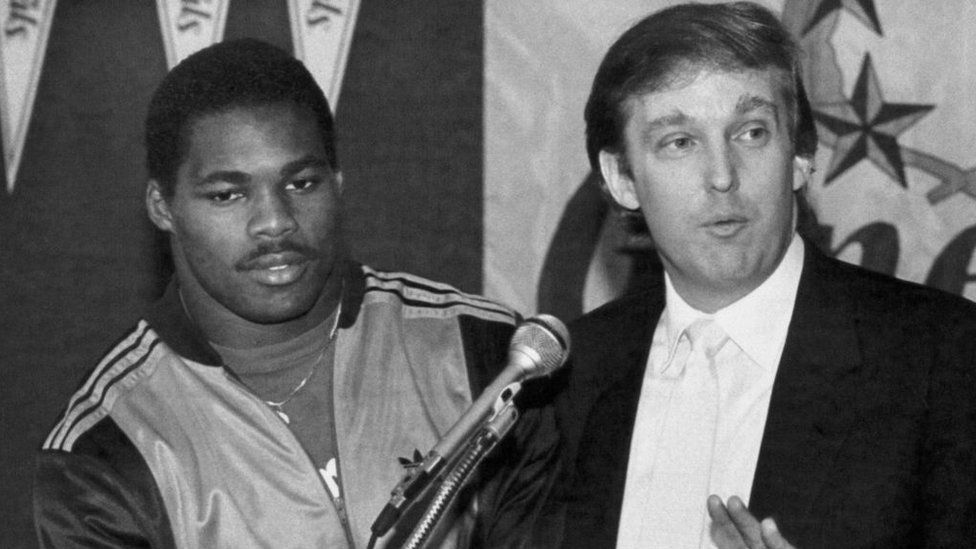
Image source, Getty ImagesImage caption, Mr Walker with Mr Trump during a New Jersey Generals press conference in 1984
Just as many people first knew Mr Trump not from politics but from his stint on the reality television show The Apprentice, many Georgians know Mr Walker for his status as a home-grown sports god. He was the superstar player of his university American football team at the University of Georgia and had a professional career of over a decade – including playing for the New Jersey Generals, a team then owned by Mr Trump.
That set him up to barnstorm the Republican Senate primary earlier this year – against Mr Walker’s enormous name recognition and Trumpian bona fides, his conservative competitors didn’t stand a chance. Republicans itched for a celebrity who could square off against Georgia’s well-known sitting Senator, Raphael Warnock.
But while Mr Walker enjoyed public adoration during his prime football years, privately, he struggled with personal demons.
The more troubling details from this period in his life have become a foundational narrative in his campaign, overshadowing any of his positions, except on abortion.
Unlike Mr Trump – who frequently denies misdeeds attributed to him – Mr Walker says that he has, quite literally, been an open book. In 2008, he wrote a confessional memoir – Breaking Free: My Life with Dissociative Identity Disorder – in which he publicly acknowledged many of the darker aspects of his past, including his struggle with the mental illness and the violent behaviour he said it caused.
(In a recent debate, Mr Walker said he no longer has dissociative identity disorder and is not receiving treatment for the condition.)
Two women, including his ex-wife Cindy Grossman, have accused him of domestic abuse, with Ms Grossman previously telling ABC News that he once pointed a gun at her head.
At another point, he threatened a shootout with police, the Associated Press reported – and was accused of threatening to shoot another former girlfriend, which he denied.
Some of this behaviour allegedly happened 20 years ago and has been known for over a decade. But as the general election unfolded, it was claimed that his previous confessions had skipped some details.
According to the Daily Beast this month, Mr Walker paid for a former girlfriend’s abortion in 2009, despite now supporting a nationwide ban on the procedure. The news outlet also reported that Mr Walker, who has spoken out against absent fathers in the black community, has a 10-year-old son he does not see, and that he had three more children than he’s publicly acknowledged during the campaign, all with different mothers.
His most publicly visible child, a conservative social media influencer named Christian Walker, has accused his father of abandoning and threatening him and his mother.
The Republican has denied that he’d concealed his other children or that he’d paid for an abortion – though he did admit that he wrote a cheque to the woman, saying he didn’t know what it was for.
Image source, Getty Images
All that did not seem to bother Nancy Hollingshed, 68.
Carrying a pink “Women for Herschel” sign and sporting fuchsia sunglasses to match, the Dallas, Georgia, resident told the BBC that those who believe in Mr Walker “all believe in redemption”, too.
“I know that he came out and talked about his past,” she said. “But you know, we all have a past. Herschel has asked for forgiveness. He wrote a book about it. He’s gotten help. His wife now is travelling everywhere with him. If you’ve met him you’ll see that he [received] the redemption that he has asked God for.”
Several people arrived at the Carrollton rally with anti-abortion signs, though they said their intention was to support, not shame Mr Walker.
Over and over again, Mr Walker’s supporters said they believe he has already atoned. Some wrote off the reports of the abortion. Other said they cared less about whether or not the reports were true, and more about the person Mr Walker says he is today.
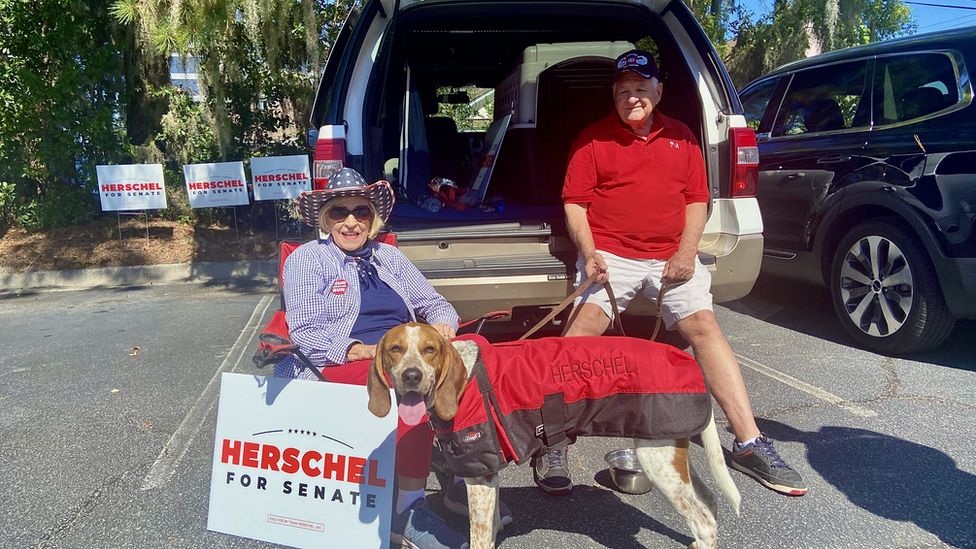
“There’s people that have murdered people and they’ve been forgiven,” said Bobbi Mohlman, a pensioner, who turned up with her husband, Ted, at a Republican party event in Savannah with their boisterous rescue hound, “Herschel Walker”.
The dog wore a bright red jacket monogrammed with the candidate’s name.
“I’ve done things in my life that I’m not happy with. But the best part of being a Christian is Jesus forgives you and gives you another chance,” Mrs Mohlman said.
Image caption, Bobbi and her husband, Tedl brought their hound to the Savannah event
Hanging on to religious conservatives is essential for a Republican in Georgia, and Mr Walker’s talk of redemption is ideally calibrated for keeping them, said Charles Bullock, a political science professor at the University of Georgia.
By contrast, Mr Walker accused his rival, Mr Warnock – a pastor who preaches at the church once presided over by Martin Luther King Jr – of being a man who does not “believe in redemption”.
During their televised debate, he assailed Mr Warnock over reports that his church has been evicting low-income tenants from apartments it owns. Walker supporters have also aired an attack ad reminding voters of an allegation by Mr Warnock’s ex-wife that he ran over her foot in a car during a March 2020 domestic dispute.
On the campaign trail, Mr Walker evinces a persona halfway between a self-help guru and a soft-spoken preacher. His cadence sometimes seems more suited for the pulpit than the podium. He tends to speak in parable, and told the car park crowd in Carrollton an extended tale about the need to choose heaven over hell.
For some voters, it was difficult to reconcile that image with what allegedly took place behind closed doors.
“I keep on hearing on TV that, you know, he paid for a woman’s abortion, you know, he stuck a gun to his ex-wife’s temple, to her head,” said Brian Ramsey, 49, who waited in line for Mr Walker to sign his hat after the rally. “Just to me, it doesn’t seem like him.”
Whether the forgiveness of his supporters can propel him to the US Senate remains to be seen.
Recent polling has Mr Walker in a dead heat with Mr Warnock – even though Georgia’s Republican governor Brian Kemp has opened up a double-digit lead against his Democratic opponent.
The problem for Mr Walker, said Mr Bullock, is that though he can rely on a solid base of conservative voters for whom “it doesn’t matter if he [paid for] a dozen abortions or 16 illegitimate children” – each new revelation is likely to cost him others.
“Five thousand here, ten thousand there – it’s a death from a thousand cuts.”
And, perhaps ironically for Mr Walker – who wrote poignantly of his childhood fears of the KKK in the segregated US South – he is struggling to make up the difference with appeals to Georgia’s other powerful voting bloc: African Americans.
Both of Georgia’s Senate candidates are black, but Mr Walker is only winning 2% of the black vote, compared to Mr Warnock’s 89%, a University of Georgia poll found.
This is partly due to partisan preferences: Georgia’s black voters tend to vote for Democrats.
Image source, Getty ImagesImage caption, Raphael Warnock is winning 89% of the black vote, according to a University of Georgia poll
But critics say Mr Walker has made explicit appeals to white voters by decrying “wokeness” and condemning critical race theory, a teaching that racism is systemic in US institutions and that this serves to maintain the dominance of white people.
Ultimately, Mr Walker’s fate rests in the hands of more moderate Republicans in the suburbs, whom he is counting on to vote for the conservative policies he supports despite his personal flaws.
Jennifer Almond, 49, opposes abortion and government spending, and said she would certainly vote for Mr Kemp, a Republican, for governor.
But she paused on Mr Walker for Senate.
“I had heard briefly about the stuff going on with his ex-wife,” she said. “And that kind of bothers me.”
High turnout during the early voting period suggests Georgians are engaged in this year’s elections, and they might have to make more than one trip to the polls. Should no Senate candidate win 50% of the vote on 8 November, the top two vote-getters will advance to a runoff in early December. Those exact conditions, in 2021, propelled Mr Warnock to the Senate.
Only when the race is finally called will it be clear whether Mr Walker’s redemption tour has worked.
In our series of letters from African journalists, Ismail Einashe meets migrants on the Italian island of Sicily concerned about the political direction of the incoming government.
Her far-right Brothers of Italy party is a part of a coalition that has made reducing immigration a key part of their agenda.
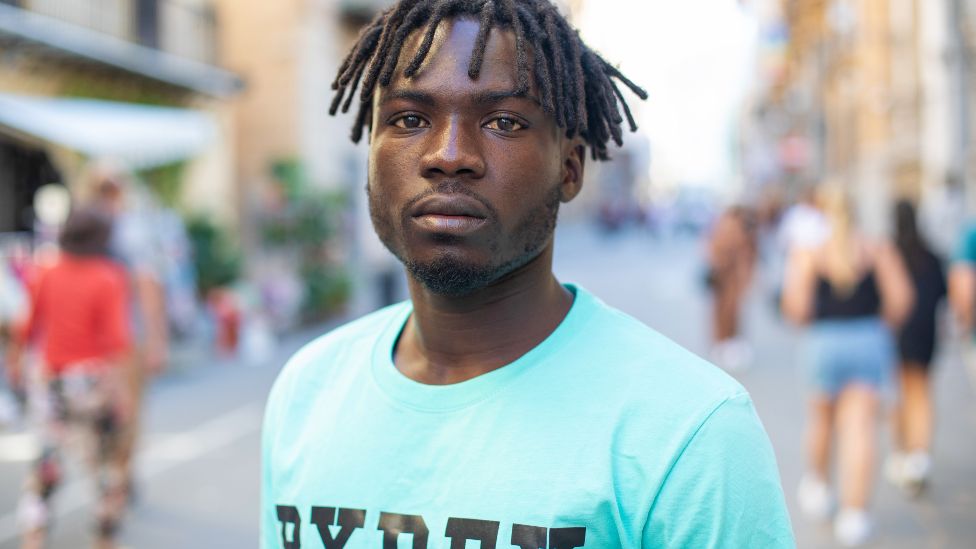
For African migrants like Mustapha Jarjou in Palermo, the capital of Sicily, it heralds frightening times ahead: “I am very worried it’s going to create a lot of negative impact on the lives of migrants like me.”
The 24 year old, who is a spokesperson for the Gambian Community Association in Palermo, says the policy might fan divisions and hatred towards migrants.
He cites the murder in daylight of the disabled Nigerian street vendor, Alika Ogorchukwu, on the mainland in August as an example.
Italy is one of the main entry points into Europe and since the start of the year 70,000 migrants have arrived on boats on the country’s shores.
Ms Meloni wants to tighten the system for asylum seekers to choke off this irregular migration, which she says threatens the security and quality of life of its citizens.
She also wants to increase repatriations, target charity ships that rescue migrants who get into trouble during the Mediterranean crossing and has called for a naval blockade of North Africa.
Mustapha Jarjou, who is studying to become a nurse, fears for the safety of African migrants
Mr Jarjou’s journey to Italy – like that of many others – was incredibly dangerous.
He arrived here aged 17 in December 2016 having left his home in West Africa in search of a better life.
It is a miracle he made it – after leaving The Gambia and getting to Libya, his nightmare began as he was held there in prison on three occasions, each time managing to escape.
He survived a terrifying sea crossing on a dinghy before landing in Sicily, only to end up working as a farm labourer for very low pay in terrible conditions growing watermelons and tomatoes on the island’s hinterlands.
But his fortunes changed when he was issued with official documents, which he had applied for as an asylum seeker. This allowed him to move to Palermo to pursue his education.
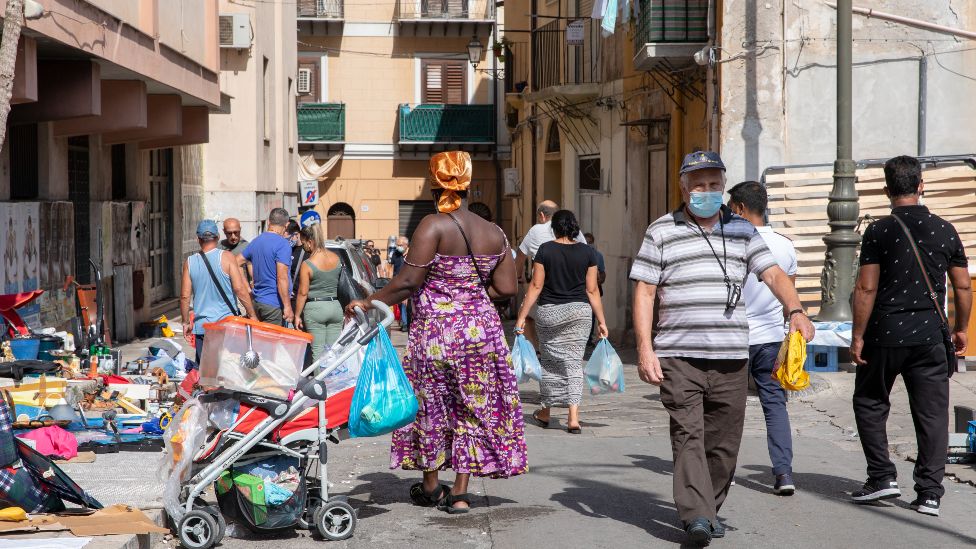
Image source, Kate StanworthImage caption, Palermo has long had a reputation for welcoming migrants
He is currently in the second year of his nursing degree and hopes to work in a hospital in the city when he graduates.
If Ms Meloni makes good on her promises, it will be more difficult for migrants to make their status official.
“Documents are an important gateway into integration,” Mr Jarjou says – adding that without them many migrants will simply become “invisible” and be forced to eke out a bleak existence on the margins of Italian society.
He is especially worried about the threats to make it tougher for migrants to make sea crossings by criminalising charity rescue ships. This would simply lead to more deaths in the Mediterranean, he says.
‘World’s largest cemetery’
But the migrants have a powerful ally in Pope Francis, who in a speech at St Peter’s Square in the Vatican last weekend gave a passionate defence of them.
Although the pontiff did not mention Italy by name, his intervention could be seen as a rebuke of the incoming coalition’s policies.
He said the exclusion of migrants was “scandalous, disgusting and sinful”, dubbing the Mediterranean “the world’s largest cemetery” in reference to the thousands of migrants who have perished in its waters over the last few years.
“It is criminal not to open doors to those who are needy,” he said.
Despite Mr Jarjou’s fears, the city of Palermo has a long-standing reputation for being welcoming to migrants.
Image source, Kate Stanworth
Image caption, Saint Benedict, depicted here in a mural by artist Igor Scalisi Palminteri, is one of the patron saints of Palermo
Situated as it is on the edge of Europe, the city became a cultural melting pot in ancient times, and one of its patron saints is Saint Benedict the Moor, the first black saint in history.
Fausto Melluso, the head of Arci Palermo, an umbrella association for 16 community groups in the city that represents 7,000 members, points out that most people in Sicily and southern Italy did not vote for Ms Meloni or vote at all. Many backed the populist Five Star Movement, led by former Prime Minister Giuseppe Conte.
Until recently an independent left-wing politician in the Palermo municipality, Mr Melluso admits he too is worried about the anti-migrant positions Ms Meloni may pursue.
He says her victory should be a “wake-up call” to challenge such attitudes and instead focus on integrating migrants into Italian society.
Image source, Kate StanworthImage caption, Fausto Melluso says Giorgia Meloni’s victory should be a wake-up call to challenge anti-migrant attitudes
A 23-year-old Guinean migrant I met in the city is anxious to leave before life becomes even more difficult.
Having lived in Palermo since the age of 17, he has struggled to sort out his documents and believes Italy’s asylum system already makes it hard for migrants to integrate, often leaving them in limbo.
He speaks fluent Italian, volunteers for community groups, studies and also works as a waiter yet continually faces an uphill battle.
Every two years he has to renew his documents, which takes up a lot of time and is a tough process for migrants.
He is about to give up his job and move to France, where he has relatives and wants to go to university – though he does not know what he will do once his Italian documents expire next year.
“After six years here, nothing has changed for me. I feel like I arrived yesterday.”
There has been an overnight curfew in Chad’s capital, N’Djamena, and other towns, in the wake of violent clashesbetween pro-democracy protesters and security forces on Thursday.
Around 50 people have died, the military-led government says.
In an unusual move, the US embassy to Chad posted a photo of its ambassador kneeling on a blood-stained street.
A US statement expressed deep concern and called for de-escalation but the opposition says protests will continue.
The BBC is not responsible for the content of external sites.View original post on Facebook
Thursday’s unrest took place on the day when President Mahamat Idriss Déby Itno was originally intended to step down, but a meeting earlier this month extended his rule for another two years.
He was named president by the military in 2021 following the death of his father, Idriss Déby Itno, who had been in power since 1990.
The US has also written of its support for the cause of the protesters– a transition to democracy: “The United States believes that a government selected by the people of Chad in a free and fair election, overseen by independent institutions, will offer the best hope for Chad to emerge from decades of conflict.”
This came after people dressed as civilians cleared checkpoints and killed four people outside US embassy gates. It is not clear why the US embassy was targeted.
The African Union (AU) has also condemned the violence.
“I strongly condemn the repression of the demonstrations which led to the death of men in #Tchad,” Moussa Faki Mahamat, the chair of the AU commission, posted on Twitter., using the French name of the country.
The UN and EU have also called for calm.
The authorities say an investigation will be launched, and those responsible for the deaths of members of the security forces will be tried by a special commission.
One of the acts allegedly committed by the protesters was to ransack and torch the headquarters of the newly appointed Prime Minister Saleh Kebzabo’s political party.
Mr Kebzabo described the acts of protesters as “an armed popular uprising to seize power by force”, according to the Reuters news agency.
In a press conference, the country’s spokesperson accused protestors of taking part in an insurrection, qualifying their actions as “not peaceful”.
Chad recently formed a new unity government after negotiations between the military junta, political parties, and armed groups. However, part of the opposition boycotted the initiative that they deemed not inclusive.
Let’s hear now from Henry Hill, the deputy editor of the ConservativeHome website, which supports – but is independent of – the Tory Party.
Hill says he’s “slightly baffled” as to why Sunak hasn’t yet declared he’s running, despite racking up the necessary 100 supporters.
Boris Johnson, meanwhile, is “sucking up nearly all of the oxygen” in the race so far (he also hasn’t confirmed he’s running).
Quote Message: “Boris is still being a bit cautious. He is fundamentally a storyteller. He is acutely aware that this could go horribly wrong for him. If he comes back and it blows up or – even worse – he loses the bid to Rishi Sunak – that’s just a terrible final chapter of his book.” from Henry Hill Deputy editor of ConservativeHome
“Boris is still being a bit cautious. He is fundamentally a storyteller. He is acutely aware that this could go horribly wrong for him. If he comes back and it blows up or – even worse – he loses the bid to Rishi Sunak – that’s just a terrible final chapter of his book.”
Henry HillDeputy editor of ConservativeHome
What about their policies? Hill thinks trying to pin down what Johnson will do is “almost impossible”.
Sunak is almost certainly on the same page as Chancellor Jeremy Hunt when it comes to calming the markets, he says, while Johnson’s pitch will be the manifesto he was elected on in 2019.
The problem, Hill says, is the economic circumstances now are completely different – and the markets might not react well.
Penny Mordaunt, the first and only MP to officially enter the race so far, has released a glossy campaign video which she says shows “the real me”.
She retraces her origins in Portsmouth – “it likes a pie and a pint and quite frankly, so do I” – and she recalls personal events that have shaped her professional career.
The leadership race makes the front page in the majority of Saturday’s papers.
The Daily Express reports that Boris Johnson has declared he’s “up for it” as he prepares to launch an “extraordinary political comeback”.
The Daily Telegraph says Rishi Sunak is pushing towards a “coronation” in the Tory leadership race by securing the majority of MPs as Boris Johnson backers began warning of a stitch-up.
Penny Mordaunt has told the paper that she promises a government of all the talents and puts a Whitehall shake-up at the heart of her Tory leadership pitch.
The Daily Mirror says Boris Johnson has been plotting a return as prime minister “in a move that could split the Tories”.
Boris Johnson was pictured last night flying home from his holiday in the Dominican Republic, after reports that he planning to join the Conservative leadership contest.
A Sky News reporter shared a photo of the former PM on the plane. He is due to arrive in London this morning.
A BBC reporter who was also on the flight said some passengers who tried to take selfies were stopped from doing so by his sizeable security team.
The flight is full and passengers are sitting reading, watching the latest movies on screen…and amongst them is one very recognisable former PM who could possibly become PM again.
Boris Johnson has kept a low profile since resigning six weeks ago and continues to move quietly as he makes his way back home to the UK from his holiday in the Dominican Republic.
Even his arrival at airport was shrouded in secrecy, but then he eventually took his seat in economy alongside his wife and children.
Some passengers were amazed to see him there. A few who tried to take selfies were stopped from doing so by his sizeable security team that surround him, including Met police officers.
A man and woman a few seats down look totally bemused: “It’s just a bit mad…it’s made our flight home less boring. We want to try and see him before we get off in London.”
How do they feel about his return to office? “I’d rather an election.”
The politicalsituation in the UK has clearly had a bit impact on the markets, and now the ratings agency Moody’s has lowered its outlook from “stable” to “negative”.
Rating agencies, in essence, rate a country on the strength of its economy.
It affects how much it costs governmentsto borrow money in the international financial markets. In theory, a high credit rating means a lower interest rate (and vice versa).
Moody’s said there were two “drivers” behind its decision to change the UK’s economic outlook.
It said the first was “the increased risk to the UK’s credit profile from the heightened unpredictability in policymaking amid a volatile domestic political landscape”.
The rating’s agency said it viewed the government’s mini-budget, the reversal of the majority of the policies in it, and the change in prime minister as a “continuing reflection of the weakening predictability of fiscal policymaking seen in previous years”.
All day yesterday, Conservative MPs were setting out who they are backing to become the UK’s next prime minister – and we can expect more of this today.
Penny Mordaunt is the only candidate to confirm they are running so far, but that hasn’t stopped MPs speaking up for others. A few them shared their thoughts on Newsnight last night.
Tory MP Brendan Clarke-Smith, who’s backing Boris Johnson to be next the party leader and prime minister, said the reason Johnson has not formally declared his campaign is because “he’s probably waiting to see whether he felt he’d got the support… I’d say he’s certainly up for it”.
Rishi Sunak backer, Conservative MP Craig Williams, said Sunak will likely respond to calls to run for leader “in the coming hours or days… there are clearly over 100 colleagues publicly declaring parliamentary support.”
Declaring her run earlier, Penny Mordaunt, the current leader of the House of Commons, said she had been encouraged by colleagues.
One Tory MP who has publicly backed her is Bob Seely who said: “I think we owe the country a collective responsibility to apologise” adding that he believes Mordaunt has the best chance of providing “unity and leadership” within the Tory Party.
A 19-year-old Zambian woman has been arrested on charges of faking her own abduction.
The woman, whose identity has been withheld by police, is alleged to have told her uncle that she had been abducted by unknown people as she was going to church.
Zambia police spokesperson Rae Hamoonga says the woman left home on the pretext that she was going to church, but instead went to her boyfriend’s house where she allegedly falsely claimed to have been abducted.
Her uncle was called by the “abductors” who claimed that she had been injected with an unknown substance and was being held captive at a secret place.
The “abductors” further demanded a ransom of 50,000 Zambian kwacha ($3,100; £2,800) otherwise they would harm her.
Policethen investigated the claim which they say turned out to be false, and were able to retrieve the woman from her boyfriend’s house.
She has since been charged and arrested for the offence of cheating, which is against Zambian law.
If found guilty, she could be fined and sentenced to prison for up to three years.
She hasn’t been able to comment on the allegations, but is set to appear in court soon.
Abductions are not common in Zambia, but recently, police arrested two suspects responsible for the abduction of 13 women and girls who had been held captive for varying periods up to six months.
Source: BBC
DISCLAIMER: The Views, Comments, Opinions, Contributions and Statements made by Readers and Contributors on this platform do not necessarily represent the views or policy of Multimedia Group Limited.
Despite making history and spending only 45 days in the job before resigning, Liz Truss is set to be offered the same package all former residents of No 10 have received.
But what are the perks she could get?
Public allowance
All former prime ministers are able to claim the Public Duty Costs Allowance (PDCA), currently set at a maximum of £115,000 per year.
The payment was introduced to meet the cost of continuing public duties after someone leaves Downing Street.
This can include office costs, salaries for staff, or travel to events where they are appearing in their capacity as an ex-prime minister.
John Major, Tony Blair, Gordon Brown, David Cameron and Theresa May have all claimed at least part of the allowance. It is not yet known whether Boris Johnson has made a claim, as this year’s figures are yet to be published.
Former holders of the office have not always claimed the full amount.
There is also a severance payment, which amounts to a one-off payment of 25% of the annual salary for the post that ministers have left.
As it stands, only Penny Mordaunt has officially declared she is standing to be the next Tory Party leader and prime minister – with 21 Tory MPs publicly supporting her bid so far.
Rishi Sunak leads Tory MPs’ nominations to take over from Liz Truss, with 95 colleagues backing him by our count – although his supporters say he has already reached the 100 needed by 14:00 BST on Monday to get on the ballot.
Boris Johnson, who is currently flying back to the UK from a holiday in the Caribbean, told an ally he’s “up for” entering the race – and is second to his former chancellor with 45 MPs pledging support.
Our tally is based on MPs telling the BBC who they’re backing, or publicly declaring for a potential candidate.
Meanwhile, other names mentioned as potential runners are former leadership hopefuls Suella Braverman and Kemi Badenoch – but neither have much in the way of supporters, and time is of the essence.
Other big names that have ruled themselves out include Michael Gove, Ben Wallace and Jeremy Hunt.
It’s a fast-moving situation in Westminster, so stick with us for updates as soon as we get them.
Boris Johnson, the man ousted as UK prime minister by his own government just three months ago, has emerged as an early front-runner to be the next prime minister.
A second Johnson premiership would be an extraordinary turnaround even for a politician who has made miraculous comebacks before.
The last time anyone returned to the office of prime minister after losing the leadership of their party was 140 years ago, when William Gladstone returned to lead the Liberals – although some party leaders have had two stints as PM, including Sir Winston Churchill and Harold Wilson.
The final months of Johnson’s time in office were dogged by accusations he had broken ministerial rules by not telling the truth about Covid lockdown-busting parties in Downing Street.
He remains under investigation by the Parliamentary Standards Committee, which could, in theory, lead to him being suspended from Parliament, or even being kicked out as an MP.
Johnson has yet to officially announce he will stand, but his former press secretary Will Walden has told Sky News Johnson is “clearly taking soundings” on a leadership bid.
He could only have dropped a heavier hint that he was not finished yet if he had used another catchphrase from the Terminator films: “I’ll be back.”
Let’s hear now from Boris Johnson’sformer deputy prime minister Dominic Raab, who is backing Rishi Sunak as the next PM.
Sunak is yet to declare he’s running – but Raab is “very confident” he will.
He tells BBC Breakfast the economy is the “critical issue” and “Rishi had the right plan in the summer and I think it is the right plan now”.
Raab thinks Johnson could eventually make a return to front-line politics, but says it’s impossible to do so while he faces a parliamentary investigation into whether he misled MPs over Covid rule-breaking.
“There’s going to be oral testimony from people from No 10 and he’s going to have to give oral testimony; I just can’t see how the new PM could give the country the attention and focus that it needs,” he says.
“We cannot have another episode of the Groundhog Day of the soap opera of Partygate.”
Aisha Buhari, the wife of Nigeria’s president, has said “we must apologise to Nigerians” as her time as first lady draws to an end.
Speaking to BBC News Pidgin, she said:
Quote Message: People expected so much from us. And maybe, after seven years, we haven’t done to their expectation. Only God knows what is in somebody’s mind…
People expected so much from us. And maybe, after seven years, we haven’t done to their expectation. Only God knows what is in somebody’s mind…
Quote Message: So the government… they have really tried. They have done their best, but maybe it is still not the best to others.
So the government… they have really tried. They have done their best, but maybe it is still not the best to others.
Quote Message: To them, they have done their best… only God knows. So we must apologise to Nigerians. Whether we have met with their expectation or not.” To them, they have done their best… only God knows. So we must apologise to Nigerians. Whether we have met with their expectation or not.”
Mrs Buhari did not clarify in which areas she thinks the Nigerian government could have done a better job.
But President Muhammadu Buhari’s administration has faced criticism for failing to bring Islamist violence and armed gangs under control, failing to end corruption and deliver more jobs, as well carrying out brutal crackdowns on citizen protest movements such as #EndSARS two years ago.
“I’m not into government activities. My own is to support them, either on health or education. I don’t go into details of what they do,” the first lady told the BBC.
“My office, I run it like an NGO – just to receive people.”
As President Buhari prepares to step down after two terms in office, Nigerians are guaranteed a new president when they go to the polls in February next year.
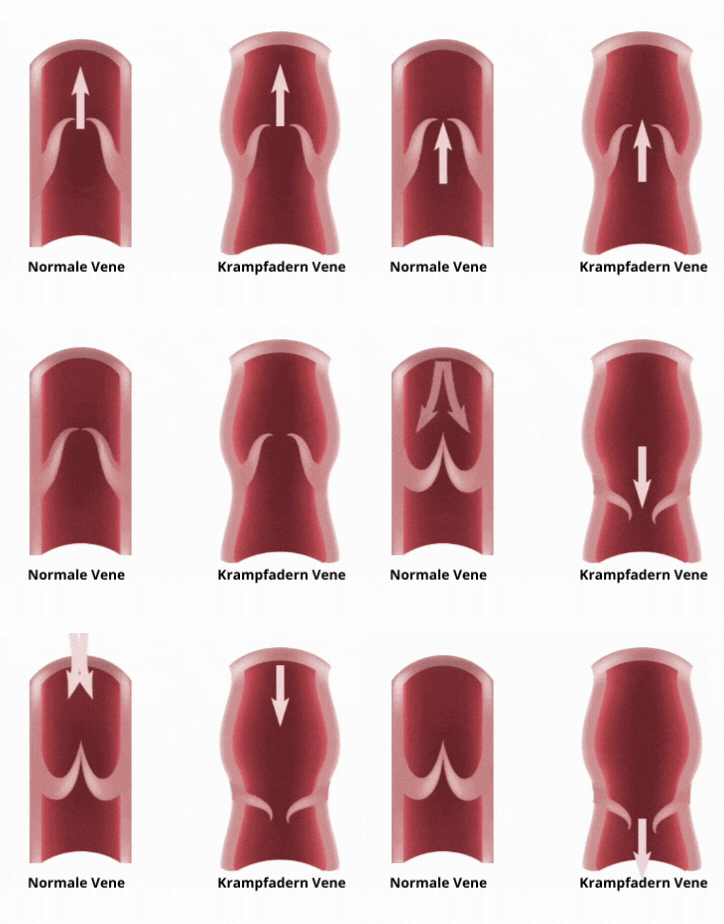
Hi there, I’m here once again! I would like to share my little joy with you…In spite of everything, I managed to GET RID of varicosity at home within a week!
Do you remember that about a year ago I wrote about having terrible pain in my legs and developing varicose? I asked for your advice on how to get rid of it.
Well, I tried all sorts of methods including birch buds and other worthless stuff, plus medications to improve the bloodflow, compression tights, and so on. IT’S ALL TOTAL RUBBISH. It doesn’t help. No use.
I went to the doctors, but instead of helping me, they scolded me for delaying the treatment. I took a week of unpaid leave at work. I had depression. I pondered over the ways to get rid of varicose and return beauty and health to my legs and searched for different methods of treatment on the internet.
Salvation from varicosity has finally beenfound
Once, when surfing blogs on the web, a small note written by a phlebologist from New York on some medical forum caught my eye. It said that treatment for varicose veins is not effective in our country because traditional medicine doesn’t treat the cause of the disease, only its symptoms.
The doctor referred to a new anti-varicose cream (100% Herbal Medicine for Spider and Varicose Veins), which had a very high percentage of positive results. I searched for information concerning where to find this cream and found this store.
At first, I didn’t really trust any of that because there are so many things advertised on TV…but I found many good reviews on this cream, so I decided to order.
So, I ordered the cream. The package was delivered approximately in a week. I unpacked everything, read the directions and started to use it.
What are the results? Was the problem cured ?
I started to use the cream following the directions and guess what?
Just 7 days after that, the swelling and varicose veins started to disappear right before my eyes.
I was so pleasantly shocked! I got rid of VARICOSITY! In just 7 days!
Can you believe that?
I couldn’t believe my eyes…
My legs cleared of varicose spider veins, they became beautiful and stopped hurting!
I wasn’t wrong and I didn’t go nuts! I can’t describe how happy I am. The last time I was so happy was maybe 20 years ago or so 🙂
Now I feel I’m an absolutely healthy person.
goodbye to varicose veins !
Ha! I’m actually grateful for my illness – the varicose veins have taught me to appreciate the things I have and to see life’s little problems with different eyes. I try not to think about what a wreck I would have become if it hadn’t been for the cream.
Now there is no more room in my life for dark and grumpy thoughts, only positive ones!
I am incredibly happy that things have turned out this way. I got rid of varicose veins and at the same time realised that the problem for many of us is that the simplest things don’t seem to work. And the more complicated things like surgery seem to be more effective. But they aren’t. Anyone can cure varicose veins with a simpler, faster and safer method. It is verified!
For those who are interested, I placed my order on this website. This is the only certified company in our country that is selling the cream.
The price is now reduced, so hurry up and order!
Well, I hope this information was useful for you and you will finally be able to regain the beauty and health of your legs in a few days! Good luck!
The Central Bank of Nigeria (CBN) and Nigeria Inter-Bank Settlement Systems (NIBSS) Plc, in conjunction with Bankers’ Committee will soon float a national card scheme to improve the payment system in Nigeria.
Mr Premier Oiwoh, Managing Director, NIBSS, said this at a Bankers’ Committee press briefing on Thursday.
He said the scheme, which had been approved, was the brain work of the apex bank.
“Part of the proposition of the bank is that this National Domestic Card scheme will be created to help drive acceptance and efficiency and reduce operating cost of cards in the country.
“This card will be configured to address the unique eco-system that we have, to help improve payment across the nation.
“We also expect the card to provide affordable pricing; on this card the charges will be lower because it’s expected to be charged for in Naira as against foreign currency.
“We also expect to customise local content uniquely for the Nigerian landscape, which will support micro payment and credit, e-government, identity management, transportation, health sector and agriculture in terms of payment,” he said.
He explained that the card was expected to reduce the dependence on cash across the landscape and help promote the cashless initiative of the CBN.
“The operational effectiveness of this card is expected to be robust and it should drive a lot of innovation, standardisation, then full end-to-end visibility to improve fraud management and better dispute resolution process around the card operating system.
“Local competence for the card and payment scheme will also be deepened within the eco-system,” said Oiwoh.
He said the card would incorporate products ranging from debit card, credit card, and non interest card, among others.
The News Agency of Nigeria (NAN) reports that the committee also discussed the outcome of the last meeting of the Monetary Policy Committee meeting, particularly some of the key decisions that were taken to rein in inflation.
The meeting also discussed the ongoing implementation of the RT200 FX policy and the key initiatives of the CBN in collaboration with the Bankers’ Committee to set up a National Fusion Centre.
The centre is an industry response aimed to address Cyber Security and safeguard the critical information infrastructure.
Governor Babajide Sanwo-Olu of Lagos State on Thursday reiterated the need for creation of state police in Nigeria.
Sanwo-Olu reiterated the call when the Commissioners of Police Service Commission (PSC), led by the acting Chairman, Retired Justice Clara Ogunbiyi, paid him a courtesy visit at the Lagos House, Marina.
He said this would help governors to protect the life and property of their residents, which they had sworn to, as well as ensure peace and tranquillity within their states.
The governor said that his administration would continue to provide adequate first-class security for the entire local and foreign residents within the state.
”We reiterate and seek your cooperation on our collective agitation for a State Police. This is my view and the view of a lot of my colleagues and citizens.
”Giving the age of our democracy, policing at the community level is not only desirable, but it is also important and it is what should be done and what we require.
”We will continue to advocate for State Police. We have said that State Police is not in any form to retrench or reduce whatever the Nigerian Police is doing now.
”There would still be clear responsibility that would be federal in nature; they would still have direct responsibility and oversight to continue to address.
”We also know that if you look at the ratio of policemen to our huge population, we are still far from what it should be.
”So, for us, it is really another level of employment generation; providing what we are sworn to do, which is the protection of life and property; ensuring there is peace and tranquillity within our state,” he said.
The governor said the move was constitutional and has been pushed at various stakeholders’ levels.
”The population is growing on a daily basis and we need to be proactive to be able to respond and be able to ensure that we don’t have space for criminal-minded people or people that have other intentions within our own territory,” he said.
Sanwo-Olu, who commended the work of the Lagos Police Command led by the State Commissioner of Police, Abiodun Alabi, said his administration would continue to encourage the Police to do what was right at all times.
Speaking earlier, Justice Ogunbiyi commended Gov. Babajide Sanwo-Olu’s administration on the issue of security, as security remained top-notch in Lagos State.
She called on other states in the country to emulate Lagos’ security situation, which he said was top notch, as ”Lagos is a model of how to handle security situations”.
”The Police are doing a good job in Lagos and they could also replicate in all other states and parts of the country.
“This is basically why we are here, to appreciate the governor and that he should continue with the good work,” Ogunbiyi said.
She said that the Police Service Commission would ensure that the Nigeria Police worked within the ambit of the law and ensure that they were well looked after.
Ogunbiyi, however, said that the commission would make sure the community had confidence in the Police.
THE Chief Executive Officer, of Partnership for Africa’s Development (NEPAD) Nigeria, Princess Gloria Akobundu, has urged members of the All Progressives Congress, APC, National Integrity Movement (ANIM) to focus on issues-based campaigns rather than criticising and castigating the candidatesof other parties.
Akobundu made the call after the APC support group conferred matronship status on her during a courtesy call in Abuja yesterday.
She said the call was necessary in view of the fact that President Muhammadu Buhari made a vow at the 2022 UN General Assembly to ensure that next year’s elections are violence-free and credible.
“Our party should lead by example by conducting a violent-free sensitisation, campaigns and elections just as the President had vowed at the UN General Assembly, where he promised the world to conduct free, fair and credible elections. So, as members of the APC and Nigerians, we should help him to realise that mandate.
“We must refrain from bringing down any character of persons of our country. It is not the best way to go. Because at the end of the day, when the elections are over, what you have said during the electioneering campaigns will be used to judge your country, not our party.
“When a leader emerges, he emerges for the country, not for the party. We must be able to work harmoniously so that we can be able to deliver the next leader for our country.
“Let’s join hands and work for the Africa and Nigeria we all desire to have. So, let us go out and make sure we discuss issue based campaign.”
Akobundu also stated that though there were still some challenges in the country, President Buhari had acquitted himself remarkably well as the leader of the country.
According to her, those who said Buhari had not done well were either playing politics or refusing to check the facts.
She explained the president had achieved a lot in the areas on which he anchored his development agenda despite the herculean problems he met on the ground.
“This administration has done its best so far and I encourage the party to be able to speak up on these achievements and advocate for peace. It is good to build on the gains of this administration.
“I encourage us to shun violence and embrace a peaceful campaign in line with His Excellency President Muhammadu Buhari’s pledge to conduct a peaceful election and to uphold the integrity, vision and legacy of the APC.”
Akobundu added that the second peer review conducted by AUDA-NEPAD Nigeria has supported national planning and boosted investors’ confidence in the country.
Delta State Commissioner for Information, Mr Charles Aniagwu has said that ravaging flood has sacked thousands of residents in several communities in nineteen local government areas of the state.
Speaking on “News Across the Nation” on Channels Television on Thursday, Aniagwu said that over sixty thousand Deltans have been displaced while goods and property worth billions of naira have been destroyed by the rampaging flood.
He stressed that the state government through the State Bureau of Orientation had earlier alerted residents on low plain areas of the imminent flooding.
He added that Governor Ifeanyi Okowa immediately directed the setting up of camps and provision of food and relief materials to the flood victims.
He commended well meaning Deltans for their support to the flood victims and called for more assistance.
According to him, 19 out of the 25 Local Government Areas of Delta state, have been largely submerged by water. That is not to say that the remaining 6 are entirely free but that those 6 are better off.
“We have been able to set up as much as 11 camps and we are still sending relief materials to individuals in some affected communities that are not in the camps.
“There are some communities that would not want to come to the camps because they see their communities as their ancestral homes. So we also try as much as possible to send relief materials to them even when they are not in camps.
“We are hoping that the members of these communities, individuals and the private sector would try and see how they can come to the aid of these persons in camp.
“The state government is doing a lot and what has helped us so far to mitigate casualties, is that we started our sensitisation on time. The state Bureau of Orientation has been very busy in the last three months, making it known to the people that this flood would come.
“So that has helped some persons move away from flood prone areas before the flooding; otherwise, it would have been worst than what it is now.
“We do hope that as we make progress, the Federal government just like the Governor said, in the course of his visit, should come to take steps to address this issue of flood, by seeing how the rivers Niger and Benue can be dredged.
“There is also the need to establish dams to help contain some of these waters whenever it is released, so that we do not continue to go through this perennial crisis of flooding of different communities,” he said.
On the total number of persons displaced by the flood, Aniagwu said it was difficult to estimate the figure because majority of the victims were not in camps.
“You can’t easily put a number to those affected, because of communal spirit, some of them have moved to stay with their relations.
“In the camp we have over 20,000 persons as at few days’ ago. The challenge is that more persons keep moving in on daily basis because the flood is yet to recede, you have more number of persons trooping to the camps so the number has gone beyond 26,000 at the moment.
“Displaced persons is over 60,000, their farmlands have also been submerged and the State Government has continued to provide electricity and other facilities in the camps to make them at least comfortable.
“The Governor transversed these areas even when it was raining to see a number of our people who have been displaced on account of the very disturbing flood.”
Accord presidential candidate, Professor Christopher Imumolen says his status as a youth makes him eminently qualified to solve the many and varied problems of the youths in the country.
Professor Imumolen, 39, and the youngest amongst the 18 candidates vying for the seat of Nigeria’s president come 2023 says no one can know the psychology and unique peculiarities of the youth more than a youth.
He is not amused by the attempts of some of his fellow contestants to create the impression that they are youths when they are actually not, saying it would be a colossal error by the youths themselves to be hoodwinked into endorsing such candidates.
“The clamour by the younger segment of the population for a president of the youth extraction probably led to some persons migrating to other political parties and attempting to dress in the garbs of youths,” Professor Imumolen said during a recent interview in Lagos.
“But we all know that once a person growspast a certain age bracket, he can no longer be referred to as a youth.
“So, strictly following that analogy, I can unabashedly say that I am the only authentic youth going into the 2023 presidential elections. I need to make this categorically clear in order to sensitise the youths in this regard.
“Now, beyond making that clarification, I want to let the youths know that I represent their voices, that I am the one who knows their problems and therefore naturally positioned to solve them.
“They should know that this is a unique opportunity for them to make a bold statement about the much sought-after paradigm shift in the power equation of this country.
“I want them to know that being in the most active and largest segment of the population, they hold the aces as regards wresting power from the older generation that hasn’t offered them anything for decades.
“I want them to be analytical, and clear-minded in making their choices. They should not be moved by the globe rhetorics of some candidates who are trying vainly to not only pass themselves off as youths but claim knowledge of their deepest desires and aspirations.
“I, Professor Christopher Imumolen, is offering the youths a future. A future where they will be appreciated, where their talents, intellect, abilities, innovativeness and resourcefulness would be positively engaged and utilised for the good of themselves, and the country.
“I make a solemn promise to them today. No hardworking, progressively-minded youth in Nigeria will be left abandoned and uncatered for if I earn their mandate to become the country’s next president,” he added.
The recent floodshave killed at least 50 persons in 11 communities in Adamawa and injured 71 others.
Executive Secretary of Adamawa Emergency Management Agency (ADSEMA), Malam Suleiman Mohammed, made the declaration on Friday in Yola when he spoke with the News Agency of Nigeria (NAN).
He blamed the flooding on the release of water from Lagdo Dam in neighbouring Cameroon.
Mohammed said also that the flood destroyed 172,000 farmlands and food crops worth millions of naira.
“Some of the affected local government areas are Numan, Shelleng, Yola South, Yola North, Demsa, Mayo Belwa and Michika,’’ he said.
He added that the agency had provided clothes, foodstuffs, drugs, mosquito nets, blankets and buckets for victims to assuage their suffering.
“The items were donated by the state government, the Federal Government and by other donors,’’ he said.
Mohammed also told that ADSEMA would collaborate with the National Emergency Management Agency to move affected communities to safer areas.
“We will continue to sensitise the communities about the dangers of living in flood-prone areas,’’ he said.
The Society of Landscape Architects of Nigeria (SLAN) has proffered workable solutions to prevent flooding ravaging the country and called for the Federal Government collaboration.
SLAN said this in a statement signed by its President, Mr Amos Alao, on Friday in Lagos.
Alao, in the statement, said flooding could be preventable if basic architecture techniques were adopted in landscape planning and building engineering.
Alao was quoted by the statement as saying that the major aim of SLAN is to change the narrative of the adverse effect of climate change and flooding on the landscape.
“We are of the opinion that we can change the narrative using landscape techniques and nature based solutions to solve environmental challenges and mitigate the adverse impacts of climate change on our environment.
“The Society of Landscape Architects of Nigeria wants to make our voice heard on this issue of flooding in some parts of the country and to offer her services to mitigating the impact of this natural disaster.
“Over the years, SLAN has been overlooked because the public does not realise we have solutions to environmental challenges and are purpose built for the impacts of climate change by virtue of our professional training as landscape architects.
“We have several policies, we can discuss with government and relevant stakeholders to solve periodic problems of climate change with sustainable solutions.
“As custodians of the earth, we are set to collaborate with the Ministry of Environment and other stakeholders in the climate change community to proffer solutions to curb the increasing menace of flooding in the Country which has negatively impacted on the nation’s socio-economic growth,” Alao said.
He also said that changing landscape from ‘grey’ (concrete-based) to ‘green’ would ameliorate most climate change and flooding situation across the country.
“While we are aware that we cannot halt the rains, we can ensure our cities handle water management efficiently and have better flood preparedness policies using nature based solutions and green infrastructure.
“Flooding is no longer a farmer’s problem in the corridors of the city and rural areas, it is now a scourge in urban areas and city cores.
“Although there are unconfirmed reports in some quarters that this year’s flood has been attributed mainly to the Lagdo Dam in Northern Cameroun, releasing water to its environs.
“Climate change has also played a significant role in worsening the impact of the flood,” Alao added.
According to him, rising global temperatures have increased evaporation in the atmosphere leading to high precipitation conditions in the affected areas.
“It is time we changed the city landscape model from colour ‘’grey’’ to ‘’green’’.
“SLAN hopes with the help of public-private partnerships, we can begin to implement the ‘Sponge City’ approach in states like Kogi, Niger, Benue and Delta which have been the most affected,” Alao said.
The News Agency of Nigeria (NAN) reports that SLAN which began in 2003 is affiliated to the International Federation of Landscape Architects (IFLA), which is the world body of landscape architects.
IFLA currently represents 77 national associations from Africa, the Americas, Europe, Asia Pacific and the Middle East.
SLAN is one of five registered Landscape Architecture Associations on the African continent.
The Supreme Court, on Friday, affirmed the Speaker of Delta State House of Assembly, Sherrif Oborevwori, as the bonafide candidate of the Peoples Democratic Party, PDP, for the forthcoming governorship election in Delta State.
The apex court, in a unanimous decision by a five-man panel led by Justice Amina Augie, dismissed an appeal that was lodged against Oborevwori by an aggrieved governorship aspirant of the PDP in the state, Olorogun David Edevbie.
Edevbie had in his appeal, alleged that Oborevwori submitted false and forged documents to the PDP, in aid of his qualification to contest the election billed for March 11, 2023.
He told the court that whereas Oborevwori had in an affidavit he deposed to, claimed that he was born in 1963, he, however, tendered a West African Examination Council, WAEC,certificate that was issued to someone that was born in 1979.
The Appellant insisted that all the documents Oborevwori tendered to his party, in support of his qualification to contest the election, did not match his name at birth.
Besides, Edevbie, contended that the case provided a unique opportunity for the Supreme Court to make a pronouncement on “the new legal regime introduced by section 29(5) of the Electoral Act, 2022”.
He said the section provided that any aspirant that participated in the primary of a political party and has reasonable ground to believe that any information given by his political party’s candidate, in relation to constitutional requirement for qualification for the election was false, could approach the court to challenge the eligibility of such candidate.
However, in its judgement, the apex court held that allegations the Appellant raised before it was rooted in criminality and therefore ought to be proved beyond reasonable doubt.
It noted that in view of “sundry allegations of fraud, false representation and forgery of documents” raised against Oborevwori, the Appellant, ought to have commenced his action through a Writ of Summons that would have allowed the trial court to adjudge the matter through oral and documentary evidence.
It held that Edevbie allegations against Oborevwori could not be resolved through affidavit evidence or Originating Summons.
More so, the apex court, held that Edevbie’s case was premature as PDP had not submitted Oborevwori’s name to the Independent National Electoral Commission, INEC, before he filed the suit.
“Only upon the submission of particulars of a candidate to INEC by a political party will a cause of action crystallize”.
In its lead judgement that was delivered by Justice Tijjani Abubakar, the apex court, said it saw no reason to set-aside the Court of Appeals verdict that earlier upheld Oborevwori’s nomination.
“In conclusion, I found no merit in this appeal and it is accordingly dismissed”, Justice Abubakar held.
The African Union has announced a new date for peace talks between Ethiopia’s warring factions that will be held in South Africa, according to the Ethiopian prime minister’s national security adviser, Redwan Hussien.
The talks were initially scheduled for early this month but did not go ahead as planned.
In a tweet, Mr Hussien said the talks with the Tigray People’s Liberation Front (TPLF) will now be held on 24 October and confirmed the government’s participation.
New date set for AU peace talks in Ethiopian conflict
He added: “We are dismayed that some are bent on pre-empting the peace talks and spreading false allegations against the defensive measures.”
Violentclashes have erupted in Chad between police and protestors in the capital N’Djamena.
Reports say there have been a number of fatalities, and that dozens of people have been injured.
The demonstrations are against Chad’s transitional military government, with protestors calling for a return to civilian rule.
Policeused gunfire and tear gas to disperse the protestors and some parts of the city have been cordoned off.
Angry protesters attacked the party headquarters of the recently appointed Prime Minister Saleh Kebzabo in the capital, pro-government news website Alwihda reported.
It said the protesters set fire to the main entrance of the premises.
Residents and health officials in southern Sudan say at least 15 people have been killed after a dispute over land in Blue Nile state escalated.
The clashes were reportedly sparked by arguments between members of the Hausa people and rival groups in the small town of Wad al-Mahi, about 500 km (310 miles) south of the capital, Khartoum.
Residents described hearing intense gunfire and said homes had been torched.
Staff at the town clinic said a number of bodies had been brought in.
The violence broke out despite a heavy security presence in the area, which is subject to an overnight curfew following a land dispute last week in which more than a dozen people were killed.
The BBC has found that nearly 2,450 severely malnourished children have died in Ethiopia’s Tigray region since last year, as the civil war there escalates.
The discovery comes despite communications being cut off in Tigray and access restricted by the central government.
In the three years before the conflict, a total of 508 severely malnourished children died, but by last year that number stood at over 1,900 and nearly 2,500 this year.
Doctors believe the true figure is higher because most sick children do not get to hospital due to the conflict and a lack of fuel for transport.
The region has been cut off for many months, leaving a catastrophic humanitarian situation, with thousands of people killed, and over 2 million displaced.
On Wednesday, the head of the WHO, Tedros Adhanom Ghebreyesus, who is Tigrayan, warned that there was a “very narrow window to prevent genocide in Tigray”.
The Ethiopian government has previously accused the head of the WHO of abusing his position.
Ethiopian forces supported by Eritrea have been engaged in a power struggle with Tigrayan regional forces for nearly two years.
New night-time satellite images from Nasa, shared with the BBC show how light levels have dropped in key cities in Tigray.
This is an indication that they have been cut from the national power grid – compounding a worsening humanitarian crisis.
Ethiopia’s central government denies blocking Tigray from key resources and aid.
Madagascar’s president has sacked the country’s foreign minister because he voted in favour of a UN resolution condemning Russian referendums to annex parts of Ukraine’s territory, sources say.
Richard Randriamandrato pressed ahead with the vote without talking to the rest of the government, the AFP news agency reports, citing state TV channel TVM.
Two sources at the president’s office also told Reuters news agency this was why he was sacked.
There were 142 other countries that also voted in favour of the resolution to condemn Russia over the referendums which were viewed as a sham by much of the international community.
Until now Madagascar has taken a neutral position on the Ukraine war, as have several other African countries.
The majority of the countries that abstained were African. Belarus, the Democratic People’s Republic of Korea, Nicaragua, Russia and Syria were the only countries to vote against the resolution.
The head of the African Union (AU), Moussa Faki Mahamat, has condemned violent clashes which have erupted in Chad between police and protesters in the capital city, as we reported earlier.
“I strongly condemn the repression of the demonstrations which led to the death of men at #Tchad,” the AU’s chair of the commission, Mr Mahamat said.
“I call on the parties to respect human lives and property and to favour peaceful ways to overcome the crisis,” he continued.
People are demonstrating against Chad’s transitional military government and calling for a return to civilian rule.
Police used gunfire and tear gas to disperse the protestors and some parts of N’Djamena have been cordoned off.
A journalist and a policeman have reportedly been killed during the protest, but there are no official casualty figures.
Meanwhile, France’s spokesperson condemned the use of lethal weapons against protesters and denied Paris’ involvement.
ReutersCopyright: Reuters
Social embed from twitter
Je condamne fermement la repression des manifestations ayant entrainé mort d’hommes au #Tchad. J’appelle les parties au respect des vies humaines et des biens et à privilegier les voies pacifiques pour surmonter la crise.
Campaign group Amnesty International says more than 40 protesters arrested during the anti-police brutality demonstrations in Nigeria two years ago are still locked up in various prisons across the country.
In a statement marking the second anniversary of the protests on Thursday, Amnesty says panels set up by the authorities to investigate rights abuses by the police have “failed to deliver justice to hundreds of victims”.
While dozens are “still languishing” in prisons, some of the arrested protesters said they were tortured while in detention and released without charge, Amnesty says.
Human rights violations by police officers have continued in the country after the End Sars protests, the rights group continued.
The protests in October 2020 swept through Nigeria, with security forces opening fire on protesters at the Lekki Toll Gate in the country’s commercial hub, Lagos.
Amnesty said the Nigerian army killed at least 12 people at Lekki toll Gate and in the Alausa district.
The Nigerian authorities have repeatedly denied claims that security forces had perpetrated a “massacre”.
The protests forced the government to disband the Special Anti-Robbery Squad of the Nigerian police (Sars) – which was the catalyst for the demonstrations.
Its officers were accused of gross human rights violations including torture, illegal detention and extortion.
The reports of several committees set up by state authorities to investigate allegations of brutality by the police have yet to be implemented.
But some victims of police brutality had been given compensation following investigations by a panel set up by the National Human Rights Commission – while several senior officers had been recommended for dismissal and prosecution.
Uganda’s latest four-star general, Muhoozi Kainerugaba, has rejected reports that he would be banned from using Twitter.
His recent tweets on leading Ugandan military to invade neighbouring Kenya raised a Twitter storm that ended with his father, President Yoweri Museveni, issuing an official apology over the tweets.
He was head of Uganda’s Land Forces till the controversial tweets caused his promotion to General and replacement as Commander of the Land Forces.
In a tweet responding to alleged calls for him to be banned from the micro-blogging site, he said he was an adult who could not be banned from anything.
“I hear some journalist from Kenya asked my father to ban me from Twitter? Is that some kind of joke?? I am an adult and NO ONE will ban me from anything!” his tweet of October 18, 2022 read.
His father was quoted in a recent interview with a Kenyan outfit as saying: “He will leave Twitter. We have this discussion. Twitter is not a problem. The problem is what you are tweeting about.”
President Museveni had earlier this month apologized for his son’s comments, saying it was wrong for public officers to meddle in the affairs of other nations.
“I ask our Kenyan brothers and sisters to forgive us for tweets sent by General Muhoozi, former Commander of Land Forces here, regarding the election matters in that great country,” Museveni wrote in a statement released Wednesday on his official website.
Museveni justified Muhoozi’s promotion from Lieutenant General to full General: “Why, then, promote him to full General after these comments? This is because this mistake is one aspect where he has acted negatively as a public officer,” the Ugandan leader said.
“There are, however, many other positive contributions the General has made and can still make,” he added while describing Kainerugaba as “a passionate Pan-Africanist.”
Muhoozi has himself offered an apology for his comments.
In June 2022, Kizz Daniel said a prayer on Twitter: “God I want to perform [my song] ‘Buga’ for [the] world cup with a mass choir” and asked fans to “help me say amen.”
Four months after, the prayer has been answered.
The Nigerian singer-songwriter born Oluwatobiloba Daniel Anidugbe announced the good news by tweet-quoting his June post with the words: “and the Lord said see you in Qatar.”
Initially, Kizz’s fellow Nigerian Davido was announced as the African singer billed to grace the world stage in Qatar.
Other artistes involved with the 2022 FIFA event are Americans Lil Baby and Trinidad Cardona and Doja Aisha from Qatar.
The first time the World Cup is taking place in the Middle East, 32 countries will compete for the coveted trophy starting from Sunday, November 20.
Meanwhile, Kizz Daniel, nicknamed Vado the Great, has earned another number one hit just days after release with a song titled ‘Cough’. It features EMPIRE.
He has also announced the 2023 release of a new album named ‘Alcohol and Cigarettes’.
My life is bizarre in many ways. My parents were born in Ghana in the early 1940s; I was born in London. I am 41, single and a Conservative MP. I am also a published historian, a Cambridge graduate, a former scholarship boy at Eton.
I am not writing this as an idle boast. I am just saying that modern life is complicated. When I started thinking about being a Conservative MP, about 15 years ago, the idea of a black Conservative was much more strange than it is now.
I remember people saying, ‘How can you be a Conservative? You’re black!’ But I got in. My constituency, Spelthorne, is just outside London. It’s a wonderful area to represent in parliament. A vibrant, dynamic and economically successful place. The funny thing about it, from the point of view of a British Conservative of Ghanaian origin, is that 90 per cent of the population is white British.
Some people think this strange, but the fact that Spelthorne is represented by me should be celebrated in British democracy.
There aren’t many countries where representatives are elected from a different faith or background to the vast majority of constituents. This is what an advanced democracy looks like.
In the borough itself, people are generally courteous and friendly. The constituency is imbued with an old-world charm, a sense of decorum and a degree of politeness. One lady at a summer fair, speaking to me, recently said that running a second EU referendum would be something ‘an African tyrant’ might do. She then said sorry. This made any offence I might have taken worse!
In Westminster, the atmosphere is different. There is a consistent expectation in the media that MPs from ethnic minorities will engage with ‘black’ issues, like knife crime in London. But they never talk about the incredible appetite for entrepreneurship found among parts of the African community in Britain. It’s as if being from a particular background gives a politician a God-given right to speak on behalf of every single person from that background. This is the heart of identity politics, which has dominated the left for a couple of decades.
Of course, linking ethnic background to a political party is a fairly crazy thing to do. There are certain patterns but it’s not as if mere skin colour or ethnicity should proscribe the political choices an individual makes. It seems to me the very definition of racism is to believe all members of an ethnic group will think the same thing, politically. To expect all Chinese people to have the same views on political economy, ethics, and religion would rightly be thought of as racist.
Taken at its most extreme, this way of thinking assumes that only women can represent women, only men can represent men, and only gay men can represent gay men. The only representative a black lesbian can have is, you’ve guessed it, a black lesbian. I would only be able to represent privately educated, single, 40-something black men.
Of course, this is the road to madness and this kind of thinking contradicts a very basic premise of representative democracy. The MP should not be expected to be an identikit replica of some mythical ‘average voter’ in the constituency. If this is what we want, why not ask the voters directly themselves? We could have referendums, like the one we had in Europe, on every issue under the sun: gay marriage, climate change bills and so forth. Death penalty, anyone?
I make a point of attending diaspora events – when the organisers give me enough notice. It’s mostly because I remember that when I applied to be on the Conservative Candidates’ list in 2003, there were no ethnic-minority Conservative MPs. There were none. There were no ‘role models’, or mentors, or anything of that kind. It was only with the election of Shailesh Vara in North West Cambridgeshire and Adam Afriyie in Windsor, both in 2005, that the modern era of MPs from ethnic minorities in the Conservative party really began.
Last year in 2015, Alan Mak, an MP from a Chinese background was elected to the British parliament for the first time. He is quite active in debates and questions in the Chamber of the House of Commons.
As immigrants settle in Britain, I expect more members of parliament will be drawn from the diverse ethnic and cultural heritages found in the UK. This is an exciting development, but we must not expect them all to be mouthpieces for their ethnic communities. The first job, and by far the most important, for an MP is to represent his or her constituents, from whatever race, creed or social background they come. It’s that simple.
This article was published on www.trueafrica.co on September 9, 2016.
Source: Kwesi Kwarteng via True Africa
DISCLAIMER: Independentghana.com will not be liable for any inaccuracies contained in this article. The views expressed in the article are solely those of the author’s, and do not reflect those of The Independent Ghana
I admired my future husbandfrom afar for a couple of years before we finally met at a horse show where we were both competitors. He had a great sense of humour, was a terrific horseman, and looked like Frank Sinatra. I was hooked.
He was recently divorced and looking. Of course, I had been looking at him for a long time already. I was 20 and he was 45. I saw nothing but his smile. Neither the age difference nor the fact that he was two inches shorter than I am made any difference. T
here was something about him that caught and held my attention. Perhaps it was the way he treated his horses…he talked baby talk to them and I loved it.
Our first date followed that show.
We put our horses away in their respective barns then he picked me up for dinner in his Rolls Royce. He was wealthy, but it made no difference to me. He could have been a starving, out-of-work cowboy; I didn’t care. It was love at first sight.
Within a year, I was marrying an older man.
We were married and continued our winning ways together.
One of our horse trainer friends invited us to dinner one evening. The wife was older than I was but she, too, was many years younger than her husband. After eating, the men talked about horses and training while we girls sat in the kitchen over a cup of tea and talked about being married to men twice our age.
She mentioned that although she loved her husband dearly, he was slowing down and she was still rearing to go. She warned me about what was to come. Aches, pains, and illnesses…she didn’t paint a pretty picture.
Some years later my husband had a stroke. He was 58. Within the year, I found myself alone, running a ranch without my best friend and confidant. I was only 34.
Things that had been so routine suddenly seemed strange and out of place. I began to doubt my abilities in the show ring. I was no different, but my life certainly was. The vultures came out of nowhere, and I had no one to watch my back.
I had to keep telling myself that although my partner was gone, I was still the same person, I held the same knowledge, and my talents were still as great as ever. Yet a part of me was missing. It was hard to function as a whole person.
I had known for a year that his life was ebbing and he would be leaving me. I often thought of what would be worse: a knock at the door informing me that my husband had been killed in a car wreck or watching him slowly slip away, hour by hour, day after day.
I was with him when he took his last breath. I felt as though it was mine. One second he was there and the next he was gone. We had said all there was to say between two people in love. Sharing the good times and the sad times, we relived our entire married life within a few days. Then he was gone.
I missed hearing him in the barn, talking to the horses. I expected him to walk around the corner any second to ask me a question or ask for my help. Instead, there was only silence. Day after lonely day … silence.
I no longer had the desire to go to the shows, let alone win. I questioned what would happen to me. I wanted to shrivel up and die with him. My life as I had known it was over.
My saving grace was running into the woman that had long ago warned me about what I was in for by marrying a much older man. She too had lost her husband.
She had continued running their ranch after her husband’s death. I figured that if she could make it, so could I. I asked her to tell me the steps to dealing with the pain and the emptiness. She shared her grieving process with me, advising me to continue my life as it had been before he died. It helped, but still, the pain and numbness remained.
Slowly, I dug into my horse business again, realizing that my late husband wouldn’t be happy if I quit and walked away from what we had built. I started showing again…and winning. With each blue ribbon, I’d raise it in the ring as though showing it to my love. I could feel his approval and could picture that ice-melting smile.
Over time I realized that he wasn’t “gone,” he was just in a different form. I can still feel his presence at times. Love never dies — not even death can end it.
Before he died, he told me to remarry and live happily; I was too young to be single and alone. It took a couple of years to get to know myself again before finding my current husband. He, too, is perfect for me. We’re a match made in Heaven if you know what I mean.
Falling in loveisn’t a choice; it’s an irrational chain of events that simply cannot be stopped. It can happen slowly, over time, or quickly in a matter of moments. One glance. One touch. One eight-hour phone conversation. And it’s all over.
Falling in love is the easy part — the excitement that comes with learning what makes another person tick, and the equally terrifying counterpart of exposing your soul to somebody else. It’s interesting, unique. It never happens the same way twice.
But staying in love is a choice. An active decision-making process that requires work and dedication.
It’s easy to fall in love with somebody for all their good qualities: they’re smart, sexy, funny. These things are easy to love.
Staying in love is the hard part. The rush dissipates and there are just two flawed people trying to come up with new ways to fall in love.
You start running out of things to talk about, you catch yourself telling the same stories over and over again. And the blinders you once had to each other’s imperfections slowly disappear.
Maybe it’s little things — like he always seems to forget important days or isn’t as thoughtful as he used to be when he was trying to win your affection. Maybe it’s big things — like he screams stuff when he’s mad that he can’t take back.
At the end of the day, nobody’s perfect and everybody comes with their own unique set of flaws and features.
People who stay in love don’t do so because they have no choice; every single day is a choice.
Over the course of time, you begin to realize that the person you fell in love with is imperfect, and the true act of love, the true definition of loving someone, is loving those imperfections as wholly and completely as you love the good.
Love is saying I see you, all of you, exactly how you are — the good, the bad, the things that you don’t want anybody else to see. I see what you’re ashamed of, what you wish you could hide.
I see these things, and I still love you. I still choose you.
And you hope and pray and plead for the other person to do the same.
To take your set of shortcomings and love them in the same way.
To see you at your worst, as a mess on the floor, and they decide to lay down with you and help you through it.
To stick around when sh*t gets unimaginably hard and tough and complicated.
You feel betrayed, your trust is destroyed, your self-esteem is ravaged, and you can’t stop questioning what you did wrong, why he cheated on you, and what signs of infidelity you must have missed.
The one thing I wish I had realized a decade ago, when the guy I considered to be the love of my life cheated on me, is that it really had nothing to do with me, it was the result of his own internal issues. And that’s how it usually goes.
The reason I was so confused back then is I didn’t have an understanding of the male psyche, and I didn’t know the internal psychological factors that cause men to cheat.
I am not saying there is an excuse for why he did it, but there is a reason. And knowing the reason can be therapeutic in a way.
So here is the real reason why he cheated on you.
Men don’t cheat because they’re scumbags or scoundrels. It’s not because they can’t control themselves and oftentimes it’s not because they no longer desire you. Men usually are tempted to cheat when they no longer feel like winners in their relationship.
This isn’t true of all men, but it is for most. I’m not talking about narcissists or sociopaths or guys with major commitment issues. I’m talking about normal, stable dudes.
A man’s most fundamental drive in this world is to feel like a winner. He needs to feel like he is “conquering,” like he is significant, like he is having an impact on the world, like he is pursuing his mission in life.
Women are typically more driven by the desire to connect and build interpersonal relationships. When a woman cheats, it’s usually because her emotional needs are no longer being met — maybe she no longer feels seen or cared for, or understood.
When a man cheats, it is most often because he feels like a loser in the relationship. He feels like he is constantly disappointing his woman and nothing he does is good enough.
He may feel like she no longer desires him sexually, like she doesn’t appreciate him, like she’s disappointed in him, like she isn’t impressed by him. If these feelings converge with him meeting a woman who is turned on by him, who does value him, who does appreciate him, who makes him feel like a man, well…
I’m not saying cheating, in this case, is okay or acceptable. I’m not giving excuses; I’m just giving a reason.
When my ex cheated on me I was devastated and thought he was the world’s biggest scumbag. I hated him and I hated her and I hated myself for getting involved with him and expending all that time and energy on him and the relationship.
However, in looking back I can understand exactly why it happened.
You see, his life was in utter shambles when he and I started dating. He had just been dumped by a girl he loved, he was failing miserably at his job, he was in debt, and he was completely lost with no direction or purpose in life.
Being young and naive and having no real understanding of what love is except for what I saw in the movies, I thought my love could heal him somehow. I thought if I loved him enough then he would snap out of his funk and be the man I knew he could be.
But I did it all wrong. I didn’t encourage him to get his act together and instead, tried to take care of everything for him.
I thought if I made his life as easy and manageable as possible he would love me even more and would suddenly find the motivation to get his life in order.
I paid for our dates because he couldn’t afford to, I did his laundry (because he couldn’t afford to), I cleaned his apartment, I fixed his resume, I searched for job listings online and applied to them for him, I kept doing and doing and was baffled as to why he kept sinking deeper into his rut.
After many months of things going from bad to worse, of our once passion-filled relationship drying up into an almost platonic, mother-son type of dynamic, he cheated on me and swiftly entered into a relationship with said mistress.
If that wasn’t bad enough, within a few weeks of them dating he all of a sudden transformed into the man he could never be with me! He got a real job, he committed to her, he took her on romantic dates, he was happy and alive.
I felt devastated and I beat myself up over it for months. What does she have that I don’t have? Where did I go wrong? Why wasn’t I good enough?
The answers didn’t come until several years later with both the wisdom that comes with experience and my somewhat hasty decision to reach out to him and ask the questions that had been haunting me.
The short version of this very long conversation is that while he did love and care for me, being with me made him feel like an even bigger loser.
The more I tried to “fix” him, the more damaged he felt. The more I did for him, the more useless he felt. The more I tried to make his life easier, the more comfortable he became with his own misery.
Cheating usually is the result of an easy opportunity and him feeling like a loser, either in life or in his relationship.
In order to feel valuable and significant again, he may give into temptation, it doesn’t matter how much he loves his partner. I know it may sound ridiculous to you, but this really is a testament to how vital a man’s need to feel like a winner is.
Men will often sacrifice things that they truly hold dear simply to temporarily get rid of the feeling of being a loser.
Affairs usually start when a man feels misunderstood, like the areas of his life that are important to him are being criticized or deemed not important. Then he finds a woman who appreciates him, who gives him something he isn’t getting from his primary relationship, and he strays.
It’s not that he doesn’t love his partner, she just can no longer connect to him in the way he wants most and when that sort of pure appreciation comes from another source he can’t help but be drawn to it.
For example, let’s say a guy is a programmer. During the workday, he is on fire with passion and thrives off of meeting the daily challenges of his job. After killing it all day, he comes home feeling on top of the world and wants to share that energy with his girl.
She quickly dismisses him and says, “You know I don’t understand all that technical stuff, it just makes no sense to me. Can we talk about something else?”
Bam — he has officially shut down. He feels like she doesn’t accept the most important part of his life, the thing that makes him feel effective and worthwhile.
Since she doesn’t care about what he does, he seeks that type of understanding elsewhere. He may spend more time with people who are part of that world or are passionate about the same kind of mission.
Maybe a girl will come along who finds what he does sexy, and she appreciates him for the effort and passion he puts into it.
When he’s with her, he gets all this validation and appreciation for the man he is and the mission he’s on. He feels good about himself around her, he feels seen, he feels desired, and these things combined have the potential to take him down a bad path.
You don’t have to study code or take programming classes. It doesn’t even matter if you’re the most technologically challenged person on the planet.
You don’t have to connect to the technical side at all, what you should try to connect with are the emotions he feels about it. It’s easy to recognize when a man is excited about something when he’s driven to win and succeed.
You aren’t responsible for his entire emotional well-being, he also needs to live his life in a way where he feels good about himself and that doesn’t only come from you. You can’t change him or control him, all you can do is try to build a meaningful connection and support his aspirations in life (and he should do the same for you as well).
When a man is with a woman who taps into his vision and what he wants out of life and tries to connect to these areas, he feels empowered and inspired and he won’t ever want to do anything to jeopardize the relationship.
In an article revealing the most common things men complain about in marriage counseling, psychotherapist and Neuman Method co-creator M. Gary Neuman revealed the biggest complaint he hears from men who have cheated usually isn’t a lackluster sex life, but rather feeling under-appreciated by their wives.
“The problem is, too many women think that if they are overly appreciative to their husbands, they’ll reduce their husband’s desire to please her. It’s quite the opposite. actually. Men are energized when they feel their wives are appreciating them,” he said.
I want to just add that I do not think it is ever okay to cheat. I think it is cruel and selfish and I am not excusing it in any way — I’m explaining it.
More than anything I hope by understanding the reason, you won’t blame yourself for his transgression and think it said something about you, which is the huge mistake I made.
Rachel Décoste landed in West Africa’s Republic of Benin in August 2018, anticipating an important journey of self-discovery, but not predicting the extent to which the trip would change her life.
On her first day exploring Benin, Rachel asked a passerby for directions. Two weeks later, Rachel and the stranger were engaged. Within six months, they were married.
Rachel grew up in Ottawa, Canada, the daughter of Haitian parents who’d immigrated to Canada in the late 1960s. As an adult, Rachel relocated to Washington DC for college, later working for a bipartisan tech program associated with the United States Congress.
Rachel loved this job, she loved the diversity of Washington and loved working in public service. When her US visa was up for renewal, Rachel, then in her early 40s, figured she’d work remotely for a few months before returning to DC.
But rather than working from Canada, she hatched a plan to set up her desk further afield.
Earlier that year, Rachel had submitted her DNA to an online ancestry site. Rachel had long known she was the descendent of enslaved Africans, but until she got the results, she hadn’t known where her forebears had lived. Now, she had a list of countries where she had roots: Senegal, Ivory Coast, Togo, Ghana and Benin.
“DNA tests for a descendant of enslaved Africans has very deep significance for us,” Rachel tells CNN Travel. “Even though it’s not a precise science when you get the map of where your ancestors came from, it’s an emotional journey.”
Rachel arrived in Benin towards the end of her five-month remote working trip. She’d already visited the other countries on her list, and her African trip was shaping up to be an extraordinary journey of self-discovery. Nevertheless, Rachel didn’t know what to expect from Benin.
“Honestly, I don’t know if I could find Benin Republic on a map before this,” she says.
She booked a room in a bed and breakfast in the port city of Cotonou, planning to stay there for two weeks — working from the B&B and exploring the country in her spare time.
Following a couple of days settling in, Rachel ventured out for the first time. She planned to visit Ouidah, once one of the most active slave trading ports in Africa. She expected this would be a moving and thought-provoking experience.
“I’m sure that one of my ancestors passed by there, just because of my DNA test,” says Rachel.
Exiting her room, Rachel searched around for the manager of her bed and breakfast — she was looking for guidance on how best to travel to Ouidah.
“She’s nowhere to be found. And then I look for the security guard, and the security guard is on break.”
Rachel figured her next best bet was asking a passerby outside, so she opened the gates and glanced around.
The first person she spotted was a man about to get on a motorcycle, parked just outside.
Rachel greeted the stranger in French — as a French Canadian, French is her first language and it’s also the official language of Benin — and politely asked him how to get to Ouidah.
“You have to go to a certain intersection downtown, where all the bush taxis are,” explained the stranger. “You find the taxi going to your destination, you pay for your seat, and then you’ll get there.”
He started passing on directions to the intersection, but then, realizing they were a bit complicated, changed his tune.
“If you want. I can bring you there, it’s about 10 minutes away,” he suggested, gesturing to his bike.
It was about 9 a.m. Rachel was wary of trusting someone she didn’t know, but she decided she was unlikely to come to harm in broad daylight. She agreed.
“I take a chance, hop on the back of his motorcycle, no helmet,” she recalls.
Traveling together
The motorbike-riding stranger was Honoré Orogbo, a single father and business owner in his thirties who’d lived in Cotonou all his life and just happened to be passing by that morning.
When Rachel opened the bed and breakfast door, Honoré had just finished eating some breakfast he’d grabbed from a nearby street kiosk.
From the outside, Rachel’s accommodation wasn’t obviously a B&B. Honoré says he assumed she was the owner of the house. It was only when she asked for directions that Honoré realized Rachel was a visitor.
When Rachel and Honoré arrived at the taxi rank in Cotonou city center, they realized the one heading to Ouidah was pretty empty. Honoré explained it would be some time before it departed — the driver wouldn’t leave until the taxi was full.
Rachel was disheartened. She didn’t have time to wait around — she wanted to spend the whole day in Ouidah without feeling rushed and to safely return to Cotonou before sundown.
Sensing her disappointment, Honoré came up with a suggestion. He had a friend in Ouidah he’d been hoping to visit — while he hadn’t been planning to go that day, he could, he had a day off.
“I’m like ‘Cool. I’ll pay for gas. Let’s go,’” recalls Rachel.
Just over an hour later, they arrived in Ouidah.
“He shows me how to get back — where the bush taxes are that I can get back that afternoon — and he shows me where the Slave Museum is. And I’m like, ‘Okay, good to go. Thanks, sir,’” recalls Rachel.
But before they were due to go their separate ways, Rachel asked Honoré if he wanted to get brunch. She wanted a bite to eat before she started her tour — and extending the invite to Honoré felt like the polite choice, he’d gone out of his way to help her, after all.
Honoré agreed, touched by the gesture. The two sat down to eat.
Rachel was aware that she was a woman traveling alone, and while Honoré had been nothing but polite and respectful, he was still a stranger, so she told him she was married.
She also didn’t share details of her job or her life in the US. But she did explain how she was hoping to travel around Benin over the coming days.
She asked Honoré if he had any friends or contacts who worked as chauffeurs or tour guides, and who might be interested in escorting her around over the next couple of days. She figured that might be easier than relying on taxis.
Honoré contacted a tour guide friend, but he was fully booked
“So I said, ‘Well, how about you? Can you be my escort? You helped me out this morning, can I just pay you to do that for three days?’” recalls Rachel.
“No, I’m not a I’m not a tour guide,” said Honoré. “I don’t know my country’s history by heart, and that’s not what I do.”
Rachel backtracked. She didn’t really need a tour guide — there would be experts at all the historical sites she planned to visit — she just needed a ride.
After a bit of back and forth, Honoré agreed to drive Rachel.
“When she insisted, I said ‘Why not?’” Honoré recalls today.
He wanted to help Rachel, Honoré says. She seemed like a “good person,” based on the way she’d approached him, the way she’d asked him questions and the way she’d invited him to brunch.
The two agreed Honoré would drive Rachel around for the next few days, starting that day in Ouidah, and Rachel would pay him for his services.
Growing closer
Here’s Rachel at Ganvie Lake Village in Cotonou, Benin.
For the rest of the week, Honoré took Rachel to Benin’s most important sites.
Touring Benin was a powerful experience for Rachel. She says visiting the slave fort, inside Ouidah’s Museum of History, “is a pilgrimage that every afro-descendant should visit to remind us of the cruelty that our ancestors survived.”
“I didn’t know this before going there in person, but if Las Vegas was taking bets on the survival of enslaved Africans, the odds of my being alive today would have been slim to none,” says Rachel. “I am a walking, talking miracle. I am the ‘one percent.’ I owe it to those who didn’t make it to live my best life.”
While traveling around Benin, Rachel and Honoré talked. While Rachel still didn’t disclose many details about her personal circumstances, but she found herself opening up to Honoré about her thoughts and feelings. Honoré opened up in turn.
“First conversations were about learning about myself, my family, my situation, who I am, who I really am,” he says.
“We were very open and very candid because we were strangers and we’ll never see each other again,” recalls Rachel.
She remembers being touched when Honoré explained that he didn’t have a new model of motorcycle because he put all his money towards his son’s education.
“He says ‘I’d rather have my kid have those opportunities than drive a fancy motorcycle.’ And I thought, ‘Wow, those are the values of my parents.’ I saw myself in those values,” says Rachel.
In one of their many conversations, Honoré mentioned his brother was a tailor. On their fourth day together, Honoré took Rachel to a market to help her buy fabric that his brother could make into a dress.
Rachel was overwhelmed by the choice — so much so that she asked Honoré to pick his favorites. He opted for two pieces of colorful, bright Ankara fabric. The third option was a white, gray, lace style, called lessi. Rachel loved it, and figured the resulting dress could be “appropriate for a baptism or some kind of special occasion.”
Honoré’s brother made clothing for Rachel and Honoré out of the fabric he picked for her at the market.
In one of their many conversations driving to Benin landmarks, Honoré mentioned to Rachel that he would usually travel to Lomé, the capital of the neighboring country of Togo, when he and his friends wanted a night out.
Rachel was intrigued.
“I can’t guarantee that I’ll ever come back here. This is a once in a lifetime trip where I’m getting paid while I’m working in a foreign country. I want to take advantage of every opportunity,” she remembers thinking.
“So I said, ‘Well, I have to go back to work this week. But next weekend, if you’re willing, I could get two hotel rooms and we could go to Togo together.”
The following weekend, Honoré took Rachel to a poetry slam night in Lomé, followed by a bar with live music. They stayed out all night.
“We’re dancing. It’s just pure joy,” says Rachel.
It was around this time that Rachel started to feel things shift. She felt comfortable around Honoré in a way she’d never felt before.
“We get along great. He laughs at my jokes,” she recalls thinking. “I had a bit of a meltdown a couple times — which I’m not proud of — where he didn’t freak out, because usually angry Black women scare people. But he took it all in his stride.”
Rachel even briefly met Honoré’s son.
Rachel and Honoré, pictured here on a beach in Cotonou, grew closer and they soon realized they had feelings for each other.
She described the situation in an email to one of her close friends back in Ottawa.
“I think I think this person should be my husband. But am I crazy? I’ve known this guy for a week. Is that stupid? Tell me if I’m crazy,” she wrote.
Her friend wrote back: “Rachel, you are not a stupid person. You have good judgment. You are a good judge of character. If he’s the one, grab him.”
For Honoré, the trip to Togo was a turning point too.
“I think it’s that night that the lightning struck,” he says. “It was not lightning but it was a feeling of love. I think that’s where the feeling of love started.”
Rachel only had one more week in Benin before she was set to return to North America. She decided she had no time to waste.
“I told him that I really wasn’t married. And he was very happy to hear that. And we got together,” she says.
“I was kind of surprised,” says Honoré now. “I thought a woman like that would probably have a husband.”
“Next day I saw her differently,” he adds. “Not like a tourist but my soulmate. That’s how the relationship started. Step by step.”
For the remainder of Rachel’s time in Benin, Rachel and Honoré spent as much time together as they could.
Long distance engagement
Honoré and Rachel often wear clothing made from matching fabric, a Benin tradition.
On the evening of Rachel’s departure, Honoré recalls sitting with her on a beach. He was enjoying the moment, but also considering Rachel’s impending return to Canada, and what it meant for their burgeoning romance.
“We were facing the ocean. In my head, I was thinking ‘the past two weeks that I’ve spent with you, I have no regrets. We had a great time together. I was really happy to meet you.’”
The two talked about the future, and if and how they could make a long-distance relationship work. They realized they were both equally committed, and so they decided to get engaged, and that Honoré would relocate to North America.
It was a big decision. They’d only known one another for a couple of weeks. And for Honoré, emigrating had never been a goal. It would be a big change for his son. But Honoré says he decided to “follow my instincts, to follow my heart.”
Meanwhile, Rachel quit her life in DC and went back to Canada. Rachel says her friends were shocked, but supportive and happy when she told them about the whirlwind romance. Her parents were more skeptical, she says. But they came round when they met Honoré and saw how in love he was with their daughter.
Rachel returned to Benin six months later, in January 2019, for her wedding to Honoré. She wore the dress made from the white lace fabric Honoré had picked for her in the market the summer before. It felt like fate.
Here’s the couple at Canadian wedding celebrations.
Meanwhile, the couple planned a Canadian wedding celebration for the following year, navigating Honoré and his son’s immigration journey in the meantime.
“I took the time during the separation to start preparing myself mentally and psychologically for a big move,” recalls Honoré. “I had to think about the huge life change that was going to be ahead of me, the cultural differences. I know people who went to the Americas and it wasn’t necessarily easy.”
Honoré also prepared his child for the move.
“I explained to him that, ‘My son, we will go to a different country and we will start over together. With time, you will have new friends, you will have new cousins. You will have everything you wish for. everything that you have here you will have over there, in time.”
Canadian reunion
Today, Honoré and Rachel live in Canada together. Here they are pictured at Niagara Falls.
Honoré and his son arrived in Canada in the middle of winter.
“It was really really really cold,” he recalls. “I just didn’t understand how cold it could be outside. Because the cold of Africa is a whole different kettle of fish, than the cold in Canada.”
Still, once Honoré was kitted out with Canada-appropriate boots, coat and mittens, he started adapting to life in a new country.
Rachel and Honoré say they were over the moon to be together. The months apart waiting for Honoré’s visa approval had been long.
Honoré’s son settled in very quickly, and Rachel adapted to becoming his stepmother, a role she says she loves.
“I’m embracing the challenge and the joys of motherhood,” she says now.
“It’s not easy when you’ve been single since forever to adjust to having to share your life. But he’s a good kid.”
Today, Honoré and Rachel live in Ottawa. Rachel works as a diversity and inclusion expert, while Honoré is studying.
Here are Honoré, Rachel and their son in Ottawa together
Rachel and Honoré are also bringing up their son together, and run a business selling warm, Canada-winter-appropriate pajamas with African prints, called Woke Apparel.
The pandemic put a stop to their big Canadian wedding celebration plans, but they enjoyed a small ceremony in summer 2020.
Reflecting on their journey together, Honoré says their story makes him consider that “sometimes you shouldn’t force fate.”
He sees meeting Rachel as “destiny” but considers moving across the world to be with her as proof of the importance of trusting your gut.
“Just follow your heart,” he says. “Follow your heart with reckless abandon.”
As for Rachel, she says their love story is a reminder to her that “it’s never too late.”
“You’re not too old to just travel alone by yourself, in a country that you don’t know, where you don’t know anybody. You’re never too old to find love. You’re never too old to become a mother.
There is no expiration date on opportunity. And grab life by both hands. If I can do it. You can.”
Paraplegic at 13, Gladys Foggea says she has found her freedom of movement through dance. Like other professional dancers with disabilities, she is seeking to be recognized above all as an artist.
A handful of associations have been working in this direction for more than a decade in France, such as “La Possible Echappée”, founded in 2007 in Paris by Kathy Mépuis, dancer, choreographer and teacher.
“The handicap is there, we can’t deny it, but it is part of a difference that gives rise to another aesthetic. It is transcended by the dance”, says to the AFP Mrs. Mépuis.
– Towards the Paralympics –
With an educational department (500 dance and live performance workshops per year) and an artistic creation department (with about fifteen professional dancers), the association has evolved well.
Fifteen of its artists, including Gladys, will launch from October 24 in a project of creation dedicated to the ceremony of the Paralympic Games of 2024, under the leadership of Robert Swinston, former dancer and assistant of the great American choreographer Merce Cunningham.
The company, which has eight creations to its credit, has also been working for months on two shows, “Esquisses” and “Passage”, which will be presented in November in theaters in Ile-de-France.
“La Possible Echappée” is also working with the Univi group (medico-social) on a study to measure the impact of dance on health through workshops in Ehpad.
The word “possible” appeals to me because it allows us to go towards paths that we think are closed,” says Ms. Mépuis. “Escape” evokes both a classical dance term (escaped) and escape as a breath of oxygen.
The artist prefers to avoid the terms “inclusive dance” or “adapted”, just like Gladys Foggea. “It moves differently but we find this same freedom as an able-bodied person”, explains the Guadeloupean dancer.
Today she lives her passion to the fullest, notably with “Passage”, where she performs a duet with a dancer from the Paris Opera, Maxime Thomas.
“He did not know the disability, I had never worked with dancers of the Opera, and surprisingly, we have +matched”, she smiles.
During rehearsals at the Maurice Ravel Center (12th arrondissement of Paris), the dancer let himself be carried by her and by the wheelchair that she spins around, or leans on it to do an arabesque.
Gladys also dances an amazing tango with Sabrina Roger, also in a wheelchair.
“You have to combine the movements of the wheelchair and the arms, that’s what will make the beauty of the movements”, says the artist, who had been hit by a car and thought her dream of dancing had been broken forever.
More than an object to get around, the wheelchair is an integral part of the creation.
“Often when you’re paraplegic, you feel like you’re cut in half. Dance really allowed me to reattach my legs with my trunk and reconcile myself with this body,” she adds.
– “Playing with inertia” –
Sabrina Roger wants people to come “not to see people in chairs but to see a show.” She remembers being hired once on video by someone who thought the chair was an artistic prop.
With a genetic disease that causes her to have coordination problems, the ballet-trained artist can stand for moments on her legs, which still opens up possibilities for alternating standing and sitting positions.
“The day I lost my balance (…), I started dancing with imbalance, playing with inertia,” she recalls, hoping to collaborate with other choreographers.
Maxime Thomas, for his part, says that his creativity was “stimulated” by the mere fact of looking for different solutions. And to note that there are finally “many common points”.
We’ve all noticed it in recent months: energy and power prices have gone through the roof. Anyone who doesn’t want a sky-high utility bill would do well to save as much as possible. We will help you on your way by listing some handy saving tips for you.
8. Devices not on standby
Many electrical appliances automatically go into standby mode when you are not using them.
That still consumes quite a bit of power and therefore money. By unplugging appliances you are not using, you can save quite a bit. Don’t feel like constantly going through all the appliances? Then buy a “smart plug” that allows you to turn off all appliances at once.
7. Ensure good insulation
If you don’t live in a brand-new house, chances are the insulation leaves something to be desired.
By filling in gaps at doors, windows, the floor and the chimney, you ensure that a lot less air escapes.
Heat from your stove will then hang around much better. If you don’t want to do it yourself, you can hire a professionalto do it. This will save you a lot of energy and money in the long run!
Wondering what other ways can save you some money? Read on quickly on the next page!