Fourteen suspects accused of raping and sexually assaulting a group of women in South Africa in July have had those charges dropped.
The National Prosecuting Authority (NPA) said on Thursday that DNA evidence taken from the suspects, described as illegal miners, failed to link them to thecrime.
“Upon consultation with the complainants on the matter and evidence at had it became apparent we cannot proceed with prosecution. We have insufficient evidence to continue with the case,” said the NPA’s spokesperson Phindi Louw Mjonondwane.
The suspects were arrested and charged after some of the victims pointed them out as the alleged rapists during a police identity parade.
Eight women had been filming a music video on 30 July near a disused mine outside Johannesburg when they and the film crew were attacked by a large group of men.
Reports of the gang rape by the so-called Zama Zamas, a colloquial term used for illegal miners, led to violent protests by communities in the area where the mine is located.
It also led to xenophobic rhetoric and threats against undocumented immigrants.
Although the group have been cleared on the sexual violence and robbery charges, the NPA says the suspects will still be charged for allegedly contravening immigration laws.
That matter will be heard on 1 November.
The police have meanwhile told the BBC that they will continue investigating the rape cases and intend to bring the attackers to justice.
The dropped charges will be seen by some as an embarrassment to the country’s police and courts, which are often criticised for failing victims of sexual crimes.
South Africa has one of the highest reported cased of sexual violence in the world.
Two terror suspects were apprehended by DSS operatives who stormed the Trademore Estate in the Lugbe area of the Federal Capital Territory, Abuja, on Monday.
During the operation, security personnel were said to have closed the estate’s entrance and exit gates.
According to our source, the two suspects, who are said to be siblings, were apprehended on terrorism charges.
This occurred less than 24 hours after the United States and the United Kingdom issued a warning about a possible terror attack in Abuja, specifically targeting government buildings, places of worship, and schools.
As a result of this development, the United States government has authorised the departure of non-essential employees and their families from Nigeria.
On Tuesday evening, the US State Department issued an updated Nigeria travel advisory.
According to residents of Trademore Estate who spoke to The PUNCH on Wednesday, the operation was carried out by the DSS and some foreign security operatives.
A resident, speaking on the condition of anonymity, revealed that residents of the estate were effectively held hostage during the operation.
He stated, “We were in our houses when our estate was locked up. They did not allow us to go out and they didn’t allow people to come in. Those that came for the operation were DSS and some American soldiers. What I heard was that they were looking for some suspected terrorists. When they finished what they were doing, all we saw was that they drove away with some people from the estate.”
The German non-governmental organization Sea-Watch on Wednesday accused the Libyan coast guard of threatening to shoot down their monitoring plane that helps the group document the interception of migrants in the Mediterranean Sea.
According to an audio recording of the threats, the Libyan coast guard vessel allegedly ordered the NGO plane to “get out of Libyan territorial” waters despite being in international waters where Malta is responsible for coordinating search and rescue operations.
The incident occurred Tuesday.
“Please be informed that you are within European Search And Rescue Area, this is not Libyan territorial waters. This is not Libyan territorial waters, over,” a member of the Sea-Watch crew flying overhead responded to the Libyan authorities via radio.
“Get away from Libyan territorial otherwise we’ll shoot you by SAM (surface-to-air) missiles,” the Libyan Coast Guard vessel allegedly responds back.
The Libyans ultimately pulled dozens of migrants onto their vessel and proceeded to shoot the rubber boat with what appeared to be incendiary ammunition, setting it on fire, according to footage of the interception released by Sea-Watch.
A spokesman for the Libyan coast guard did not immediately answer phone calls and messages seeking comment.
Maltese authorities have also not yet responded to questions sent by AP via phone and email.
It is not the first time European NGOs operating in the Mediterranean reported threats or violent behavior by the Libyan Coast Guard.
Last year, the European Union-funded and trained Libyan coast guard was caught on camera chasing and shooting in the direction of a migrant boat.
The Central Mediterranean is known as the deadliest migration route in the world with nearly 3,000 deaths since January 2021 according to the International Organization for Migration.
The EU, Italy and Malta have for years been criticized for outsourcing migrant interceptions and rescues to the war-torn country.
Upon their return to Libya, migrants and refugees are held in government-run detention centers.
Namibiawants Germany back at the negotiating table to discuss the genocide agreement reached last year between the two governments.
“Technical committees of Namibia and Germany discussed the issue and proposed that amendments be made to the joint declaration in the form of an addendum which was submitted to the German government,” Namibia’s vice president Mbumba told a meeting of traditional leaders in the capital Windhoek, on Thursday (Oct 27).
No details of the changes being sought were given. Namibia now awaits a response from Germany.
The request to review the deal was made in July following discussions in the Namibian National Assembly. The government was coming under mounting criticism from the opposition.
Germanyacknowledged in May last year that it had committed “genocide” in the southern African territory which it colonised between eighteen eithy four and 1915.
After over 5 years of negotiations, Germany offered about a billion dollar in development aid spread over 30 years to benefit descendants of the Herero and Nama ethnic groups. Stressing it would be paid on a “voluntary basis” and that the agreement was not comparable to “reparations”.
Many Namibians rejected the agreement, arguing that the descendants of the Herero and Nama had not been sufficiently involved in the talks.
At least 60,000 Hehero and about 10,000 Nama were killed between 1904 and 1908.
The World Bankhas approved US$275 million in assistance to help Zambia recover from the effects of the Covid-19 pandemic and deal with the fallout from the war in Ukraine.
The money is to help Zambia, which is “over-indebted”, return to sustainable fiscal and debt levels and promote private sector-led economic growth, the World Bank (WB) said in a statement on Thursday.
The funds are made available by the International Development Association (IDA), a subsidiary of the World Bank that helps vulnerable countries through grants or credits at zero or very low interest.
In 2020, Zambia became the first African country to default on its external debt – estimated at $17.3 billion – since the start of the Covid-19 pandemic.
Lusaka had already received approval in September from the International Monetary Fund (IMF), the WB’s sister institution, for a total of $1.3 billion in financial support to help restructure its debt.
The accession to the presidency of Hakainde Hichilema, who was elected in 2021 on promises to root out rampant corruption and resuscitate the economy, has improved Zambia’s relations with its creditors and international donors.
the country’s debt had exploded under his predecessor, Edgar Lungu, who was criticized for taking out massive loans to finance a spate of infrastructure projects during his six-year presidency.
According to the latest IMF data, Zambia, which is one of the world’s largest copper producers, has seen its economy grow by 4.6% in 2021 after the 2.8% GDP contraction recorded in 2020.
Meghan Markleand Prince Harry Foundation has donated an unspecified amount to charities working in Nigeria to ‘help provide relief following devastating flooding’ that has ravaged parts of Nigeria.
This is coming after Duchess Sussex, 41, revealed she is 43 percent Nigerian after doing a genealogy test a couple of years ago. She said this in her latest Archetypes Podcast series released on Tuesday.
In a press release that accompanied the episode, a Spotify representative confirmed that the couple’s Archewell Foundation made donations to Save the Children and UNICEF.
The devastating floods have been blamed on heavy rain and water released from a dam in neighbouring Cameroon.
More than 600 people have been killedand around 1.4 million have been displaced in the floods which destroyed 440,000 hectares of farmland across Nigeria.
Save the Children Nigeria tweeted: “More than 1.5 million children are at risk after devastating flooding in Nigeria.
“Prince Harry and Meghan Markle’s Archewell Foundation has donated to Save the Children in Nigeria as our teams deliver life-saving supplies to affected families.”
The U.S. embassy on Wednesday issued an alert warning of a possible attack on Saturday against “large gatherings” in northern Johannesburg, which the South African government.
“The U.S. government has received information that terrorists may be planning to carry out an attack targeting large gatherings in the area around Sandton,” a wealthy suburb north of the historic city center, said the alert, published on the embassy’s website and widely shared on social networks.
“There is no further information regarding the timing, method, or target of this possible attack,” the alert adds, noting that embassy staff have been advised to avoid crowds in that part of the metropolitan area next weekend.
In response, the South African presidency noted the US’s “terror alert” was part of “the US government’s standard communication to its citizens”.
The presidency said it was the responsibility of the South African security forces to ensure security and safety for all people in the country.
It said law enforcement agencies were monitoring any threats to the citizens and the nation.
“Should the need arise, the South African government will be the first to inform the public about any imminent threat,” the presidency said in a statement.
A minister in the presidency was quoted by local media on Wednesday as saying that the “alarm has been going on but up to this point it is not backed up by any evidence”.
More than 1,000 South African troops have been fighting in neighboring Mozambique since July 2021, helping the army deal with armed jihadist groups that have been wreaking havoc for the past five years, killing 4,300 people and displacing a million.
On Monday, several Western embassies, including that of the United States, advised their citizens to limit their travel to Nigeria because of the increased threat of terrorist attacks.
Human Rights Watch has called for the Malian security forces and UN peacekeepers to offer more protection in the north of the country following dozens of attacks by Islamist militant groups.
It says tens of thousands of people have been displaced over the last eight months in the Ménaka and Gao regions.
Witnesses described a pattern of heavily armed men on motorbikes and in other vehicles surrounding villages, shooting indiscriminately and summarily executing men.
Community leaders say nearly 1,000 people have been killed.
The rights group says fighters linked to the Islamic State group had mainly targeted Tuareg communities that they saw as loyal to former rebel groups now allied to the Malian government.
The Confederation of African Football (Caf) has set 11 November as the deadline for countries to declare interest in staging the 2025 Africa Cup of Nations.
The continent’s governing body expects finalised bids, including documents, proposed host cities and government guarantees, to reach its Cairo headquarters by 16 December.
Caf inspection teams will tour bidding countries from 5 to 25 January next year in its quest to find a suitable replacement for Guinea.
Findings from the inspections will be submitted to the 24-member Caf executive committee, which will announce the successful country or co-hosts to stage the 2025 finals on 10 February.
A top Caf official told BBC Sport Africa that the body wants to avoid the embarrassment of awarding the event to countries who are “unable to raise good infrastructure and hospitality to show to the rest of the world”.
Cameroon was the venue for the 2021 Nations Cup earlier this year while Ivory Coast is set to host the 2023 finals, which will be played in early 2024.
Morocco expected to bid
Some countries have already shown interest in bidding for the 35th edition of the continent’s showpiece, but they are yet to make official declarations.
Morocco, which hosted this year’s Women’s Africa Cup of Nations finals in July, intends to apply to host the 2025 men’s finals, a source within the Royal Moroccan Football Federation indicated.
Nigeria’s early interest to step in and co-host with Benin has gone quiet since Amaju Pinnick’s exit as president of the country’s football body (NFF).
Bids from Algeria, South Africa and Senegal have only been speculative, although public interest is overwhelmingly in favour of the latter staging the competition.
BBC Sport Africa understands the Tunisia Football Federation (FTF) was seeking government assurance before the 1994 and 2004 host nation can join in the race.
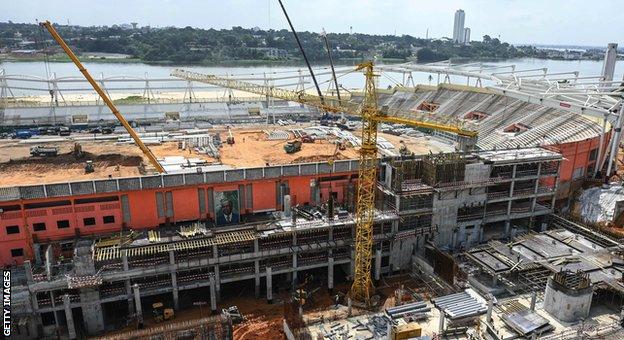
Some stadia for the 2023 Nations Cup in Ivory Coast – including the Felix Houphouet Boigny Stadium in Abidjan, pictured in August – are still under construction
Mr Museveni has been in power since 1986 and there are frequent rumours that Gen Kainerugaba is being groomed to follow him.
In May this year, the military man asked on Twitter if people thought he should run for president and earlier this month he wrote
: “To the Ugandan opposition, after my father, I will defeat you badly in any election. Ugandans love me more than they’ll ever love you.”
The 48-year-old is no stranger to controversy on Twitter.
At the beginning of October, he threatened in a tweet to invade neighbouring Kenya, prompting a public apology and diplomatic meetings to reaffirm ties.
Then after President Museveni directed that he stops commenting on government affairs on Twitter, Gen Kainerugaba said that “no-one will ban him from anything”.
Presidential candidateof the African Democratic Congress, ADC, Dumebi Kachikwu, has described money as the greatest challenge to the 2023 general elections.
Addressing newsmen in Abuja, Kachikwu explained that before elections, politicians take advantage of poverty-stricken Nigerians with money in order to buy their votes.
He further stated that election time is seen as a season for the “show of money,” in some quarters, adding that it should not be so and that impoverished Nigerians shouldn’t be taken advantage of.
He said, “The biggest challenge we have towards the 2023 general elections is the role of money, we see what’s already going on. Poverty has been weaponised in Nigeria; the reality is that because of the level of poverty, on election day, somebody who has not eaten for two days and sees N5,000, do you expect the person not to take that money?
“That’s what we need to be talking about, this is what INEC, civil society organisations need to be talking about because that’s the greatest threat to the next elections, the role of money and what these people will do with it.
“I tell you something, they know they have the money, they know it’s going to be a money contest, they are prepared for that money contest. He who pays the most as far as they are concerned, is likely to win the 2023 general elections.
“This happens because we allow those who are at the lower run of the ladder to continue to dictate for us who will be president of Nigeria. We have 40 million Nigerians who don’t need that money, who are not as financially challenged.
“If Nigerians decide to exercise their democratic franchise, do the patriotic thing in the next elections, trust me Nigeria will change.”
American singer, Selena Gomez has canceled her appearance on ‘The Tonight Show’ starring Jimmy Fallon, over contacting Covid-19.
The 30- year-old, uploaded a photo of herself on her Instagram story, lying on a couch on the morning of her scheduled appearance on the show, to inform her fans of the cancellation.
She said, “I’m not going to be on Fallon tonight.
“I ended up getting covid but am resting and feeling ok. A friendly reminder that covid is still out there.”
she stated further, “Get updated on your boosters.
“I was actually scheduled to get mine this week. Love you all,” she added.
Former governor of Ondo State, Dr Olusegun Mimiko, yesterday, vowed not to ditch Governor Nyesom Wike of Rivers State and other governors of the Peoples Democratic Party, PDP, or abandon the agitation for regional equity within the party.
Mimiko, in a statement by his Special Assistant on Media and Digital Communications, John Akinduro faulted the Presidential Campaign Council list which included his name as the leader of the campaign in Ondo State.
The statement noted that the inclusion of the former governor’s name was “a deliberate attempt to muddle things up and smear Dr Olusegun Mimiko.”
It reads: “Dr Olusegun Mimiko has been inundated with calls and messages from the general public, his political friends and concerned individuals around the nation; and in particular, his teeming supporters across the length and breadth of Ondo State.
“They are seeking clarity on fake news making the rounds that he had ditched Governor Nyesom Wike, Seyi Makinde and their colleagues’ governors, and abandoned the agitation for regional equity within the PDP; and in particular, making a party member of southern extraction its national chairman before the 2023 elections.
“The report and the list that triggered it, are fake and a deliberate attempt to muddle things up and smear Dr Olusegun Mimiko.
“It must be stated with emphasis that Dr Mimiko was neither consulted by anyone nor consented to his inclusion in any Ondo state PDP Presidential Campaign Council list.
“For the avoidance of doubt and to set the record straight, Dr Mimiko is unwavering in his commitment to the principle of equity, fairness and justice through which he believes a credible push for a PDP victory is possible.”
Nigeria will need to invest up to $425 billion in mixed energy sources in order to attain stability by the year 2060, a new report has found.
The report entitled Nigeria Leading Africa to Net Zero”, was released today by the global technology group, Wartsila and made available to Vanguard in Abuja.
In the new report, the technology company provides a comprehensive roadmap on how the country should proceed to build a 100% renewable energy power system by 2060.
Watsila said, “As Nigeria seeks to take the lead in climate action whilst meeting the nation’s growing energy needs and secure universal access to electricity for its population, the need to build a data-driven and cost-effective energy strategy becomes crucial.
“Using advanced energy system modelling techniques, Wärtsilä’s analysts have outlined the most cost-effective power system that can be built in Nigeria year after year to reach net zero by 2060.
According to Wärtsilä’s report, the optimal power system will consist of 1,200 GW of renewable energy capacity and require a total of 283 GW of energy storage and 34 GW of engine-based power plants for grid balancing purposes.
The research shows that investing in renewable energy and flexibility from gas engines and energy storage is the best way to reduce energy costs, increase energy access and improve grid reliability.
“With this strategy, the cost of electricity generation is predicted to drop by 74% by 2060 compared to 2022 levels, and carbon emissions will drop to zero.
“This in-depth energy modelling exercise also reveals the key role that Nigeria’s domestic gas will play to enable a smooth energy transition. Nigeria’s vast domestic gas reserves can be mobilised as an inexpensive bridging fuel, to power balancing engines in support of intermittent renewable energy generation, until gas engine power plants begin to be converted to run purely on green hydrogen starting in the early forties.
“If the power system expansion roadmap presented to the report is successfully implemented, by 2060 Nigeria’s power system will be fully decarbonised and able to meet the energy needs of our country’s rapidly growing population.
“The key components of our power system will be renewables, supported energy storage technologies, together with grid-balancing engines that have been converted to run on green hydrogen.
” As early as 2032, Nigeria can reach universal access to electricity, and the inefficient, expensive, and polluting diesel generators still widely used today will be ancient history.”, said Wale Yusuff, Managing Director of Wärtsilä in Nigeria.
‘”However, delivering on this ambitious plan will require enormous investments, estimated at $18.7 Billion until 2030 and $425 Billion until 2060.
“Attracting that level of investment is possible, but not without significant policy reforms.
” Despite the many government efforts to implement an increasingly strong legal framework, project developers and sponsors must still navigate a very complex and uncertain system that adds excessive investment risk.”, warned Wale Yusuff.
‘With its huge gas reserves and high renewable energy potential, Nigeria has all the natural resources necessary to lead the country to a successful energy transition.
” If the country can improve its power transmission infrastructure, develop a sound policy framework, and deploy a data-driven power expansion plan based on renewable energy and flexibility; it will take a giant step towards its goal of securing universal access to affordable, reliable and fully decarbonised electricity,” the report suggested.
The Federal Fire Service said property valued at more than N8 billion were destroyed by fire in Cross River from Janauary to Oct. 26.
Mrs Olumayowa Olomola, Commanding Officer, Calabar Command of the Federal Fire Service, disclosed this to the News Agency of Nigeria (NAN) in Calabar on Thursday.
The commanding officer said the destruction took place in 13 fire incidents reported within the same period.
She said one death was recorded while three persons were injured in the incidents.
Giving an instance of the value of destroyed properties, she said, “A transformer at the TCN 33 KVA sub station line at Adiabo, Calabar, that was gutted by fire in August is put at a cost of N2.6 billion.
“We also had the fire incident at Marian fruits market that affected over 13 lock-up shops with goods and also the Airtel Mast near governor’s office.
“We also responded to two fire incidents at the University of Calabar; another one at a Catholic school, and one mobile base transformer,” she stated.
Olomola, who said that the command responded swiftly to the incidents, however, noted the challenges of the Service in Cross River.
She particularly noted the high price of diesel and lack of water tankers and ambulance on its stable as hindrance to their efficiency.
“Again, we have challenges of crowd invading the scene of fire incidents which in most times, denied us access.
” Most times, the aim of some persons in the crowd is to steal from the fire incident.
“We also have the problem of traffic and travel distance to scene of fire incidents,” she said. (NAN)
President Muhammadu Buhari has said that the Warri refinery rehabilitation works, when completed, will deliver fuel production before the first half of 2023.
The Special Adviser on Media and Publicity to the President Mr. Femi Adesina, made this known in a statement on Thursday in Abuja.
According to him, President Muhammadu Buhari expressed delight as he witnessed the signing of the Memorandum of Understanding (MoU) between Nigerian National Petroleum Company Ltd and Daewoo Group for the rehabilitation of the Kaduna refinery.
He said the president was particularly excited as the signing came against the back of ongoing rehabilitation works at the Warri refinery by the same Daewoo Group of South.
Adesina quoted Buhari saying, “Daewoo Group has massive investments in the automobile, maritime, and other sectors of our economy.
”I am also aware that Daewoo is currently engaged in the execution of the NLNG train seven project and also constructing sea-going LPG vessels for NNPC and her partners.”
“I looked forward to the delivery of ongoing projects, especially at the Warri and Kaduna refineries, and the NLNG Train Seven.
”This no doubt will open many more windows of opportunities for Daewoo and other Korean companies in Nigeria”
Presidential candidate of the Peoples Democratic Party, PDP, Abubakar Atiku has departed Nigeria the United States of America to intensify his political campaigns ahead of the 2023 elections.
Atiku is proceeding on a weeklong political campaign in the US, where he would be meeting Nigerians and business community during the visit.
While in the US, Atiku would be meeting with Nigerians in Diaspora as well as with the PDP members in North America.
According to report, the PDP presidential candidate would also meet with top Nigerian business leaders based in the US, as well as young Nigerian professionals in the diaspora.
Atiku will also hold meeting with some other business communities in the US during the visit.
Recall that Atiku flagged off his campaign in Uyo, Akwa Ibom State three weeks ago. He has also followed his campaign flag-off with the Kaduna campaign last Saturday, with another campaign in Benin, the Edo State capital respectively.
Atiku is expected to return to Nigeria on Monday. He is expected to resume his campaign Ekiti state on Tuesday, November 1, 2022, while the campaign rally in Ondo State would hold on Wednesday November 2.
Atiku’s trip to the US has laid to rest controversies that the former vice president could not travel to the US.
Some financial expertshave commended the Central Bank of Nigeria (CBN) for its decision to redesign the naira, saying that it would have positive effect on the economy.
The experts spoke in separate interviews with the News Agency of Nigeria (NAN) in Abuja on Thursday.
They spoke against the backdrop of announcement by the CBN that new designs of the N200, N500 and N1,000 denominations would be produced and circulated on Dec. 15.
According to Prof. Umhe Uwaleke, a financial economist and professor of capital market at the Nasarawa State University, Keffi, the decision will be positive for the economy in the medium to long term.
Uwaleke said the measure would go a long way to ensure that the naira in circulation outside the banking system were brought into the banking system.
He said the measure would also provide enough liquidity for banks, and more money for the banks to lend.
“The measure does not amount to demonetisation of big currency notes often carried out by central banks to curb black money and corruption.
“But it will go a long way in ensuring that a lot of naira notes circulating outside the banks are crowded in.
“If it leads to large deposits in banks, it means the banks will have more money to lend which may reduce interest rates.
“Perhaps more importantly, with increased currency in circulation now in the vault of banks, I expect to see improvement in monetary policy transmission,” he said.
Uwaleke said it might also have the effect of reducing speculative attacks on the naira in the parallel market in the medium term.
“I expect that the Financial Intelligence Unit will be on the look out for huge deposits as a way of monitoring illegitimate transactions.
“Despite the huge cost involved in changing currency notes, I think it’s time to sanitise the system, especially now that electioneering activities have kicked off,” he said.
He, however, said the deadline of Jan. 31, 2023 was too short, considering the number of naira denominations involved, urging the CBN to consider extending it.
An economist, Dr Tope Fasua, also said the measure would have significant effect on the economy, adding that it was essentially about “black money.”
He suggested that the CBN should take such measures more frequently.
“When central banks do this, they try to pull in monies people are hiding; illegal money, corruption money, kidnapping money. Nigeria has managed to become a hub for these kinds of illegalities.
“I will even suggest that the CBN does this more often, maybe every 10 years. You will see a scenario where the banks are awash with liquidity.
“There are many people sitting on billions in naira, and even in dollars. The CBN should also see how it can pull in the dollars,” he said.
Fasua advised that the idea of individuals operating personal domiciliary bank accounts should be banned, adding that nobody needed it.
“People are speculating against their own currency in their own country. That is not allowed in any economy.
“They should pull in illegal, black naira and then see how they can pull in illegal dollars. The CBN can control these things through the Deposit Money Banks,” he said.
However, Mr Okechukwu Unegbu, a financial expert, and past President of the Chattered Institute of Bankers of Nigeria (CIBN), said redesigning the naira was not the most important problem facing the economy.
Unegbu, said the apex bank should have simply ensured that the scarce lower naira denominations, like N100 and N200 were readily available by printing more. (NAN)
The presidential campaignteams of the ruling All Progressives Congress, APC, and main opposition Peoples Democratic Party, PDP, were at each other’s jugular, yesterday, as Messrs Festus Keyamo and Dele Momodu fought dirty.
Keyamo is the chief spokesperson of the Tinubu/Shettima APC Presidential Campaign Council, PCC, while Momodu is the director of strategic communications of the Atiku/Okowa PDP Presidential Campaign Council.
The duo exchanged brick-bats over the manifestos of Asiwaju Bola Ahmed Tinubu and Alhaji Atiku Abubakar. While attacking themselves they also rubbished the chances of Tinubu and Atiku in the 2023 presidential poll.
Momodu had dismissed Tinubu’s 80-page manifesto as “APC manifesto of lies” while the APC countered that Atiku’s manifesto was not original and merely copied President Muhammadu’s projects.
Momodu, Publisher of Ovation Magazine, in his response said Keyamo’s attack was “erratic vituperation” while on a counter Keyamo described Momodu as “a hopeless owambe clown” who has begun “his dance of shame in the open.”
Keyamo’s erratic vituperation — Momodu
The Ovation magazine publisher attacked Keyamo saying that Keyamo has failed as a minister and ought to have resigned. He also attacked Tinubu describing him as a leader who uses and abandons his followers.
“I have just read Festus Keyamo’s response to my critique of the APC Manifestoof lies. I’m not surprised that all he could do was yell as usual without examining or practically addressing the content of my article.
“Let me take a few minutes to educate this young friend of mine who has since become a shadow of his old self since he was offered an appointment that makes him look so incompetent, by President Muhammadu Buhari. Any self-respecting soul would have since resigned but Festus Keyamo was not at home the day shame came visiting. The Ministry in which he’s a mere figurehead is in total shambles and only a Bola Tinubu would have given the job of a spokesperson to such a certified nuisance.
“What did Festus say I did wrong? He quoted copiously from an article I wrote about two years ago, which the Tinubu media teams have been using to campaign endlessly because they have no stronger voice of their own. I’m indeed flattered.
There is no doubt that I love Tinubu the Man but I disagree vehemently with Tinubu the Politician. This is not the first time I will say it publicly. Since I now have the opportunity of presenting the bones of my disagreement with Tinubu, courtesy of Festus Keyamo, I will lay them bare.”
He continued: “Tinubu has declined in the last few years. I used to see him as a man of his people but no supposed generalissimo would ever abandon his people in days of trouble and tribulation. None of the people around him could tell him the truth for pecuniary reasons. He knows it himself but he desperately wants to be President of Nigeria, by fire by force, after he has lost most of his formidable foot soldiers, and now relying on outsiders to activate and actualize his lifelong ambition for him, which is his legitimate right. But Nigerians have the right to scrutinise his action plans
Recalling Tinubu’s hard-line posture and maltreatment of loyalists, he said: “When he (Tinubu) was to be impeached for some infractions, and many of his so-called loyalists were washing off their hands clean, like the Biblical Pontius Pilate, my very dear friend, Tokunbo Afikuyomi, stood by him like the Rock of Gibraltar. But how did he repay Tokunbo who took all the bullets? This shameless Festus Keyamo was one of those who wanted to run Tinubu out of town. Nduka Obaigbena and I had to step in at some point before he could consider Tokunbo for anything. Tokunbo had wanted to be the Governor of Lagos State and Tinubu goaded him on and allowed him to waste his resources. It was when I got Chief Harry Akande to give Tokunbo the ANPP Governorship ticket for Lagos State that Tinubu suddenly realised he had offended his “suicide bomber!
“Nigeria is looking for a President, with compassion and competence, not an Emperor! Tinubu is a man who loves to bait the Masquerade with a goat but will never release the rope. That’s why he kept losing his best friends like Musiliu Obanikoro, Ambode, Muiz Banire, Opeyemi Bamidele, Rauf Aregbesola, Fuad Oki, Yemi Osinbajo, etc.”
A hopeless Owambe clown begins open dance of shame — Keyamo
Responding, Keyamo said: “After reading through Mr Dele Momodu’s rather emotional outburst in response to otherwise salient points raised in the statement we issued asking him to point out specific areas of plagiarism in Asiwaju’s Action Plan, my feeling oscillated between delirious laughter and outright pity for the pathetic wreck his life has actually become. Here is a miserable fellow who having previously overrated himself, crashed down like a wingless bird from a futile presidential ambition (for which he got zero votes in the PDP Presidential primaries), and ended up as a hyperactive hireling and attack dog of perhaps the worst serial loser in Nigeria’s electoral history.
“Funnily enough, the only curriculum vitae he truly possesses to even make an attempt at the Presidency is no more than mere photo ops with celebrities and the high-and-mighty in society. This is the sad story of a hopeless clown in his 60s who is desperately looking to pick whatever pieces are left of his life by shamelessly worming his way into the pockets of Atiku Abubakar and making himself available to execute dirty jobs against his long-standing benefactor, Asiwaju Bola Ahmed Tinubu.
“Mr Momodu’s epistle of lamentations is again a re-affirmation of his manifest lack of rigour. In his latest rambling piece, he failed again to redeem himself on the gross theoretical deficiency identified in his earlier writing. One would have thought he would seize this “second chance” to copiously point out portions or areas plagiarized by the Tinubu/Shettima Campaign Council from MKO’s 1993 campaign manifesto named “Hope 1993”.
“Typically, what the readers were then subjected to was another orgy of almost interminable name-dropping of socialites and the likes in Nigeria. But he seems oblivious of the fact that not many serious-minded Nigerians are easily swayed by such tabloid show-boating.
“For instance, this time around, Mr Momodu was quick to don the toga of ‘freedom fighter’ on behalf of Akinwunmi Ambode for not getting a second term ticket in APC in 2018 ahead of the Lagos governorship polls in March 2019. Well, let us pretend that we do not know the open secret that he was a well-serviced ‘PR consultant’ to the same Ambode. “
Keyamo a mere attention seeker — Momodu
Countering, Momodu described Keyamo as an attention seeker, saying among others: “You and I never interacted much other than on occasions when you needed free publicity as always and would do anything for attention.
“You will recall that you practically photobombed yourself into our picture the day I walked into Major General Muhammadu Buhari’s apartment in London because it was an opportunity for you to trend. You’re a media creation and we supplied you with oxygen regularly.“
Six school children in Uganda’s capital have tested positive for Ebola, the health minister said Wednesday, marking a serious escalation of the outbreak declared just over a month ago.
The children, who attend three different schools in Kampala, are among at least 15 people in the city confirmed to have been infected with Ebola, according to a statement by Health Minister Jane Ruth Aceng.
The children are members of a family exposed to the disease by a man who traveled from one Ebola-hit district, sought treatment in Kampala, and died there, the statement said.
“He is responsible for infecting the family of seven, including the neighbors and many others,” the statement said, speaking of the traveling Ebola patient. “We were able to get this cluster, plus one other, because of the ministry’s vigilance in contact tracing and field case management.”
Authorities are “following up” 170 contacts from schools the six children attend, it said.
Fears that Ebola could spread far from the outbreak’s epicenter compelled authorities to impose an ongoing lockdown, including nighttime curfews, on two of the five districts reporting Ebola cases on Oct. 16. The measures were put in place after a man infected with Ebola traveled to Kampala and died there, becoming the city’s first confirmed Ebola case.
Tracing contacts is key to stemming the spread of contagious diseases like Ebola.
The head of the Uganda Medical Association on Tuesday urged health authorities to impose a lockdown in Kampala, a stringent measure that the country’s president has previously said he doesn’t want to implement.
That official, Dr. Samuel Oledo, told reporters the situation was alarming because some “people are not even reporting cases” of Ebola.
Ebola, which manifests as viral hemorrhagic fever, has infected 109 people and killed 30 since Sept. 20, when the outbreak was declared several days after the disease began spreading in a rural community in central Uganda.
Ugandan health officials in the district of Mubende, the epicenter, were not quick to confirm Ebola partly because the disease’s symptoms can mimic those of the more prevalent malaria.
Ebola is spread by contact with the bodily fluids of an infected person or contaminated materials. Symptoms include fever, vomiting, diarrhea, muscle pain, and, at times, internal and external bleeding.
For years, illegal sand mining otherwise known as sand poaching has been a growing cancer in Zimbabwe. Thousands of hectares of land in the country’s capital city, Harare have been left extensively damaged
“We have resorted to sand poaching and brick laying because there are no jobs. It’s easy for us to find the sand we need because its easily accessible at at the nearby graveyard. We have to survive even if it means breaking the law.A lot of young man in this community are into the venture”. one sand poacher told our correspondent.
With places where a sizable amount of sand can be illegally mined dwindling everyday, sand poachers have resorted to digging in a cemetery in one of Harare’s high density suburbs, Epworth. Not only are they exhuming the dead in their bid to get sand, they are also disposing corpses they would have dug up in a nearby river, a move that has upset residentswhose buried relatives are disappearing each day.
The areas community leaders are concerned. “As a community leader who had taken part in the burial of more than 100 kids, I’m saddened that a huge chunk of the graves at which we laid them to rest has disappeared, all that left is a shallow ditch”.
Another laments about the condition of some of the graves. “Some of the graves are now exposed. The sand poachers have removed a lot of corpses and thrown them in the nearby river”.
Government authorities are not unaware of the situation.
“What you find is currently within particularly Chitungwiza and Epworth. We have got rampant sand poaching. Sand poachers are basically going into areas where there is river sand and any other form of sand used for construction”, says Tafadzwa Muguti, secretary for provinvial affairs and devolution in the office of the president and cabinet for Harare Metropolitan province.
“The challenge we have as we approach the rain season is that when the rains come and fill up most of these places we have children who will drown. As it is our laws need to be reviewed. EMA, our environmental management authority is in the process of reviewing all their ACTS so that we can criminalize most of the aspects of land degradation”.
Known for its famous monuments (The balancing rocks) Epworth, one of Harare’s forgotten surburb has for years been subject to illegal sand mining otherwise known as sand poaching. It remains to be seen whether thousands of hectares of land in Epworth’s Zinyengere’s cemetery will recover from the immense environmental degradation its being subjected to on a daily basis.
Burundi’s foreign affairs minister officially declared that the border between the East African country and Rwanda has been reopened.
“All the borders of Burundi with its neighboring countries are open”, the ministry tweeted without much detail on October 22.
On October 25, minister Albert Shingiro confirmed in a press conference the border reopening with Rwanda.
He also indicated that Burundi maintained its position of calling on Kigali to return coup-plotters it alleges fled there after trying to overthrow former President Pierre Nkurunziza in 2015.
The border between Burundi and Rwanda had been closed for almost six years, first amid political tensions and then by the COVID-19 pandemic.
Rwanda for its part reopened its border with Burundi several months ago.
The border reopening comes after President Ruto William of Kenya urged his East African Community (EAC) partner states to knock off barriers that impede trade across the bloc.
Malawi government through Minister of Home Affairs Grace Chiumia is alleged to have issued a declaration to South Africa’s politician Julius Malema As prohibited immigrant as he was about to come to the country to speak at conference of political movement Transformation Alliance.
The letter purportedly written by Minister ChiumiaMalema: TA wants him at its conferenceSaviour Chishimba: Cancels Malawi trip
According to documents circulating on social media, Chiumia informed State chief spy Elvis Thodi that Malema is a persona non grata in Malawi and Immigration Department should refuse him entry in the country.
“Please note that in exercise of the powers conferred on me by Section 4 (1) of the Immigration Act, I declare the following persons to be prohibited immigrants to Malawi, namely Saviour Chishimba and Julius Malema.
“You are therefore directed to cause appropriate notices to be prepared and disseminated to them and relevant officers in order to restrict or refuse their entry in Malawi,” reads the notice signed by Chiumia.
Malema is the leader of the Economic Freedom Fighters, a South African political party, which he founded in July 2013. He previously served as President of the African National Congress Youth League from 2008 to 2012.
While Chishimba is the leader of the United Progressive People (UPP) in Zambia.
The authenticity of the latter has not been verified as both Thodi and Immigration Department could not immediately comment.
Chiumia herself also said she was busy to grant an interview.
Meanwhile, Chishimba has cancelled his trip to Malawi where he was expected to attend and deliver a keynote speech at the Transformational Alliance (TA) inaugural conference.
Chishimba has confirmed the cancellation of his trip citing security risks as the main reason observing that he does not trust that his life would be safe in Malawi since the Zambian and Malawian Governments are partners in corruption and dictatorship.
“I was about to leave for the airport a while ago, but I have decided to cancel my travel due to, inter alia, security risks. Intelligence information just received indicates that I may either be refused entry into Malawi or be exposed to the dangerous cartel that connived with State House in Zambia over the Zambia-Malawi K345 million maize exportation scandal,” explained Chishimba.
He said it was clear that Zambian and Malawian Government officials colluded with Transglobe Limited of Malawi to defraud the public in the two countries and the direct involvement of State House in Zambia has frustrated the independent investigations of the ACC in the saga.
“The corruption of the agriculture sector is responsible for low pricing of maize so that grain hoarding cartels can continue to rip off farmers. It is evident that the PF regime is pioneering the diplomacy of state capture through the corruption industry and dictatorship. Zambia was known as a force for good, but this has changed under the visionless leadership of the current government,” said Chishimba.
He declared that the future of the UPP Government, will reform the agriculture sector and make it the mainstay of the economy.
Chishimba added: “The UPP, in Government, will also seek to work with Zimbabwe and Malawi to build a strong Central African Economic Hub, which will eventually be extended to Mozambique and the DRC. Thus, fighting for good governance and democracy in this region will be strategic and for the good of all our peoples.”
Chishimba is also named in the circulating letter purportedly written by Minister of Home Affairs as another prohibited immigrant.
TA which is led by the former cabinet minister Moses Kumkuyu, is a political pressure group and anti-corruption movement which has emerged with a view to eliminating all forms of corruption and bad governance.
Apparently, TA booked the government owned College of Medicine conference centre in Blantyre, but three days ago the booking was cancelled.
However, the Catholic Church in Blantyre bailed out TA by offering an alternative Catholic owned Conference venue two days ago at St Pius Catholic Church. The conference is scheduled to start Friday, August 25, 2017.
The Gambian parliament will on Wednesday convene for an extraordinary session to debate the deaths of nearly 70 children linked to cough syrups made in India.
The children were diagnosed with serious kidney problems.
Wednesday’s session in parliament will be the first by lawmakers in the country since the tragedy happened earlier this month.
Gambian health authorities said there were no more new cases, but there are 82 existing cases and 12 recoveries.
Most of the existing cases involve children aged one and two years.
Civil societyorganisations in the country are mounting pressure on the authorities to take action against those responsible for importing the drugs.
Health officials and the Red Cross have started a second phase of recalling the cough syrups.
Police investigations have established that the Medicine Control Agency was established without a laboratory to test the safety of the drugs.
President Adama Barrow has set up commission of inquiry to investigate the deaths.
Ahead of a decisive conference of South Africa’s historic ruling party, the ANC, President Cyril Ramaphosa is looking weakened as he seeks to win a second term in the 2024 elections.
A scandal linked to bundles of cash found in one of his properties during a burglary in 2020 is tarnishing the image of the man who presented himself as a “clean hands” champion when he succeeded Jacob Zuma, who was himself brought down for corruption, and putting him on the defensive. South African experts are looking at possible scenarios:
Can Ramaphosa still be nominated by the ANC?
“He remains the best-placed candidate,” says political scientist Susan Booysen. “Ramaphosa will probably make it, but the degree of certainty has gone down. He remains the clear favourite but his credibility has been shaken like never before,” says political commentator Eusebius McKaiser.
“He is not in the strongest position, but he is still the most likely to win,” says Pearl Mncube, a political scientist at Frontline Africa Advisory, given the lack of well-positioned opponents and the support he continues to enjoy within the party.
Cyril Ramaphosa, a former protege of Nelson Mandela who became a wealthy businessman before returning to politics, has fallen from his pedestal.
“He used to be an icon of the fight to clean up” the country from corruption, “a paragon of virtue, even though he came from the business world,” says Susan Booysen. The scandal linked to his property in Phala Phala (north-east) makes “doubts about his probity and reminds us that he is not a superman”.
But “despite all the weaknesses of the current president, compared to other candidates, he remains the best chance” for the ANC to stay in power, says Eusebius McKaiser.
Recent polls show that the ANC, which fell below 50 percent for the first time in its history in local elections in 2021, could repeat that performance in 2024.
Who are his opponents within the ANC?
There are many, but for the time being, there is no single name that unites the opposition to Cyril Ramaphosa. Former Health Minister Zweli Mkhize, who resigned in August 2021 after being accused of misappropriating budgets allocated to Covid’s prevention campaigns, “has a chance” and remains popular, says Susan Booysen.
The other known candidates, Lindiwe Sisulu and Nkosazana Dlamini-Zuma, “have not garnered support in the provinces, whereas Mr. Ramaphosa and Mr. Mhize have.
“All the other candidates are flawed, so there is no real threat” to Cyril Ramaphosa, says Eusebius McKaiser.
Many of the delegates who vote “are aware that their own careers are linked to the ANC’s success in the elections,” he said. Therefore, “whatever their inclination, they will also selfishly consider which candidate gives them the best chance of retaining their position.
The ANC has never been so contested in the country and Cyril Ramaphosa being “the least bad of the candidates”, some delegates could “support him”, pushed by this context, he insists.
Former President Zuma recently called Cyril Ramaphosa a traitor and corrupt. How much influence can he have on the vote?
It is “less than he thinks,” says Eusebius McKaiser. Jacob Zuma’s press conference on Saturday was “the diatribe of a guy desperate to be an influencer, not the calm, persuasive communication of a man convinced of his power,” the veteran commentator says.
If he had real influence, his candidate, his ex-wife Nkosazana Dlamini-Zuma, would have had the support of her region, zulu country, which is not even the case, several experts point out.
Burkina Faso this week launched a drive to recruit 50,000 civilian defense volunteers to help the army fight jihadists, the authorities said.
“A recruitment is launched of 35,000 communal VDP, that is to say, 100 VDP per commune,” said a statement by the commander of the Brigade of Vigilance and Patriotic Defense (BVDP), Colonel Boukaré Zoungrana, Minister of Territorial Administration, Decentralization and Security on Tuesday.
“The mission of these communal VDPs is to protect, alongside the defense and security forces, the people and property of their communes of origin”, in the face of jihadist attacks, he said.
This local recruitment is in addition to the one on Monday when the BVDP announced its intention to build a force of 15,000 VDPs “that can be deployed throughout the national territory.
The status of the VDP is defined by law since January 21, 2020. It is defined as “a person of Burkinabe nationality, auxiliary to the Defense and Security Forces (FDS), voluntarily serving the security interests of his village or sector of residence.
VDPs receive 14 days of civic and military training before being armed and provided with means of communication.
They pay a heavy price in the jihadist attacks that regularly strike Burkina Faso, particularly in the north and east.
To date, no data is available on their exact number, even though the initial objective was to recruit 13,000 people.
These massive recruitments are in addition to a one-time recruitment campaign of 3,000 soldiers to bolster the ranks of the army in the fight against jihadists.
These campaigns come after a September 30 coup led by Captain Ibrahim Traore, whose stated aim is to strengthen the anti-jihadist fight.
At least ten soldiers were killed and about 50 wounded Monday in a “terrorist attack” in Djibo, a town under jihadist blockade for three months in northern Burkina.
Malawi’s President Lazarus Chakwera has fired Agriculture Minister Lobin Lowe and his deputy Madalitso Kambauwa Wirima over what he termed “incompetence and gross negligence”.
President Chakwera made the announcement in a televised address on Tuesday evening.
The agriculture ministry is accused of botching the implementation of a programme in which Malawian rural farmers are provided with subsidised fertiliser and farm inputs.
Mr Lowe has not commented on the accusations.
The president has since appointed Sam Kawale, formerly the lands minister, to replace Mr Lowe.
The president said more changes in his cabinet would be coming in due course.
Malawi’s President Lazarus Chakwera has fired Agriculture Minister Lobin Lowe and his deputy Madalitso Kambauwa Wirima over what he termed “incompetence and gross negligence”.
President Chakwera made the announcement in a televised address on Tuesday evening.
The agriculture ministry is accused of botching the implementation of a programme in which Malawian rural farmers are provided with subsidised fertiliser and farm inputs.
Somalia has executed by firing squad two militants from the Islamic State (IS) group.
The state-owned Somali National News Agency (Sonna) reported that a military court found the two “guilty of assassinations” in the capital, Mogadishu, and Bosaso town in north-eastern Bari region.
The two were identified as Adan Mohamed Ali Mohamud and Mohamed Ali Mohamed Farah.
Local media reports said many al-Shabab and Islamic State militants are still in prisons waiting to be executed after being sentenced to death.
The Islamic State insurgentsmainly operate in north-eastern Puntland where they had claimed attacks in the past.
World leaders are set to discuss action to tackle climate change, at the UN climate summit in Egypt.
It follows a year of climate-related disasters and broken temperature records.
What is the UN climate summit?
UN climate summits are held every year, for governments to agree steps to limit global temperature rises.
They are referred to as COPs, which stands for “Conference of the Parties”. The parties are the attending countries that signed up to the original UN climate agreement in 1992.
COP27 is the 27th annual UN meeting on climate. It will take place in Sharm el-Sheikh from 6 to 18 November.
Why are COP meetings needed?
The world is warming because of emissions produced by humans, mostly from burning fossil fuels like oil, gas and coal.
Global temperatures have risen 1.1C and are heading towards 1.5C, according to the UN’s climate scientists, the Intergovernmental Panel on Climate Change (IPCC).
If temperatures rise 1.7 to 1.8C above 1850s levels, the IPCC estimates that half the word’s population could be exposed to life-threatening heat and humidity.
To prevent this, 194 countries signed the Paris Agreement in 2015, pledging to “pursue efforts” to limit global temperature rises to 1.5C.
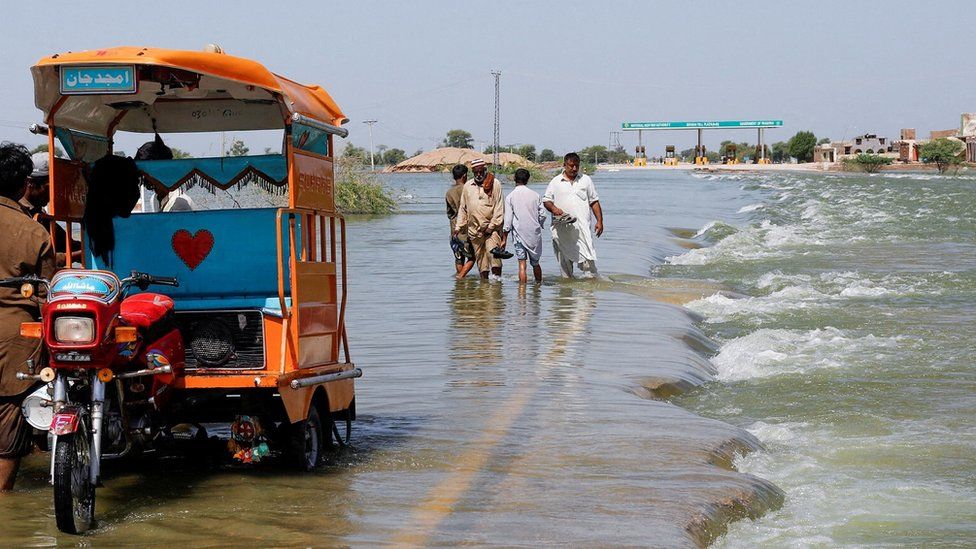
Image source, ReutersImage caption, The Pakistani floods this year are a “wake-up call” to the world on the threats of climate change, experts have said
Who will be at COP27?
More than 200 governments are invited.
However, some leaders of major economies including Russian leader Vladimir Putin are not expected to attend. Delegates from the country are still expected.
Other countries, including China, have not confirmed whether their leaders will take part.
Hosts Egypt have called on countries to put their differences aside and “show leadership”.
Environmental charities, community groups, think tanks, businesses and faith groups will also take part.
Why is COP27 in Egypt?
This will be the fifth time a COP has been hosted in Africa.
The region’s governments hope it will draw attention to the severe impacts of climate change on the continent. The IPCC says Africa is one of the most vulnerable regions in the world.
Currently, 17 million people are estimated to be facing food insecurity in east Africa because of drought.
However, choosing Egypt as the venue has attracted controversy.
Some human rights and climate campaigners say the government has stopped them attending because they have criticised its rights record.
What will be discussed at COP27?
Ahead of the meeting, countries were asked to submit ambitious national climate plans. Only 25 have – so far.
COP27 will focus on three main areas:
Reducing emissions
Helping countries to prepare and deal with climate change
Securing technical support and funding for developing countries for these activities
Some areas not fully resolved or covered at COP26 will be picked up:
Loss and damage finance – money to help countries recover from the effects of climate change, rather than just prepare for it
Establishment of a global carbon market – to price the effects of emissions into products and services globally
Strengthen the commitments to reduce coal use
There will also be themed days for focused talks and announcements on issues including gender, agriculture and biodiversity.
Do we expect any sticking points?
Finance has been long been an issue at climate talks.
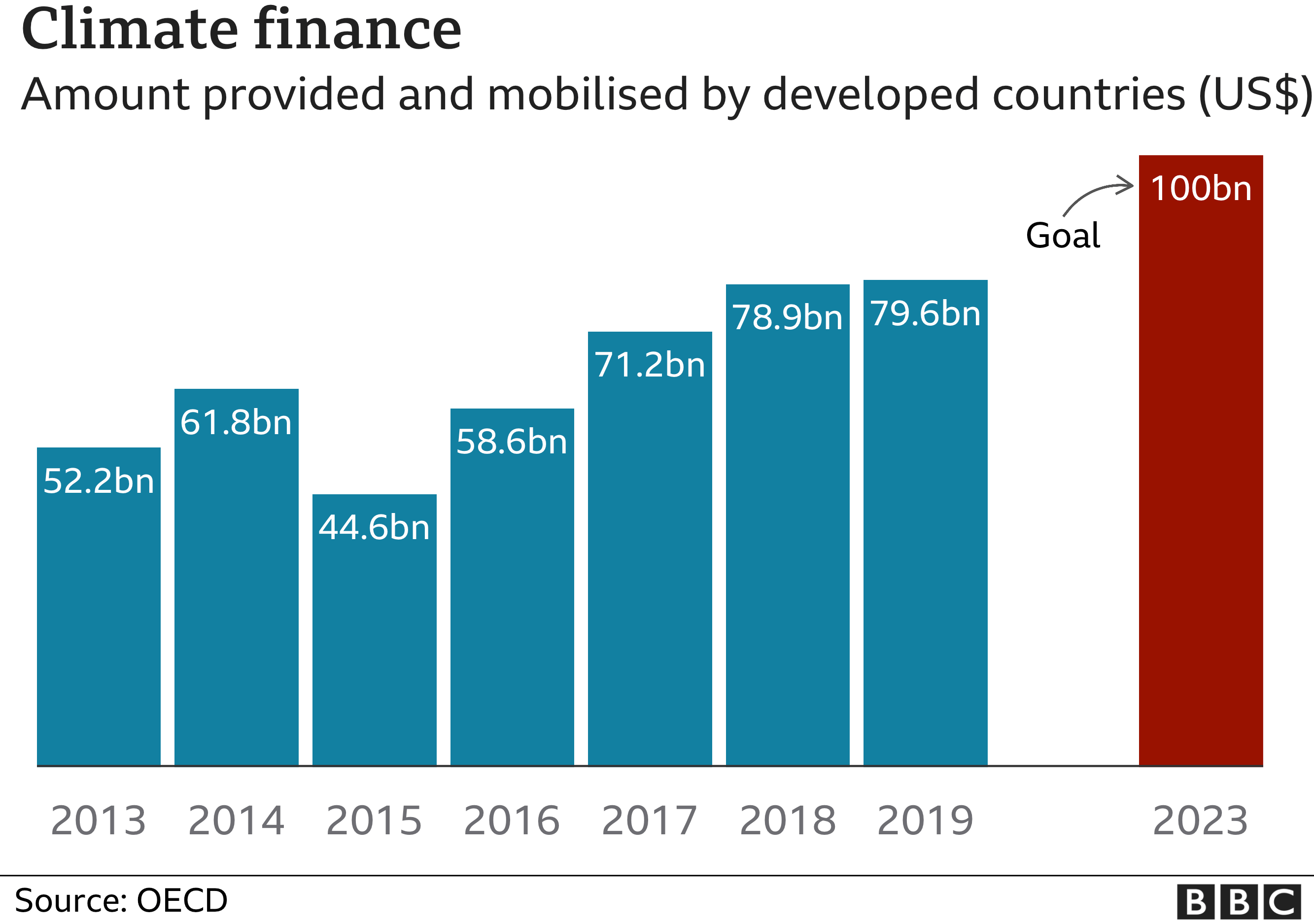
In 2009, developed countries committed to give $100 billion a year, by 2020, to developing countries to help them reduce emissions and prepare for climate change.
The target was missed and moved back to 2023.
But developing nations are also calling for payments for “loss and damage” – the impacts faced now.
An option for making payments was excluded from the Bonn climate talks, after pushback from wealthier nations who feared they would be forced to pay compensation for decades.
The EU agreed discussions should take place at COP27.
You will hear a lot of jargon:
Paris accord: The Paris Agreement united all the world’s nations – for the first time – in a single agreement on tackling global warming and cutting greenhouse-gas emissions
IPCC: The Intergovernmental Panel on Climate Change examines the latest research into climate change
1.5C: Keeping the rise in global average temperature below 1.5C – compared with pre-industrial times – will avoid the worst impacts of climate change, scientists say
How will we know if it has been successful?
It depends who you speak to.
Developing countries, as a minimum, will want loss and damage finance to be an agenda item. They will also be pushing to have a date set for when they might start to receive payments.
Developed nations will be looking for more commitment from large developing countries – such as China, India, Brazil, Indonesia and South Africa – to move away from coal, the dirtiest of the fossil fuels.
There are also pledges from last year – on forests, coal, and methane – that more countries may sign up to.
However, some scientists believe world leaders have left it too late and no matter what is agreed at COP27, 1.5C will not be achieved.
Tanzanian authorities say more than 400 porters and tour guides have joined groups battling a fire that broke out in Africa’s highest peak, Mount Kilimanjaro, which has been spreading due to strong winds.
It comes as the fire reignited in areas that were previously under control.
More than 500 officers from the defence and security forces alongside tourism stakeholders have been fighting the fire that started on Friday.
The permanent secretary in charge of tourism, Prof Eliamani Sedoyeka, said the fire had reignited in three areas by early Tuesday and they had only managed to contain one of the areas by evening.
Two years ago, a week-long inferno destroyed thousands of hectares of woodland on the slopes of the mountain.
Mount Kilimanjaro, which is 5,895m (19,341 ft) high, is a popular tourist.
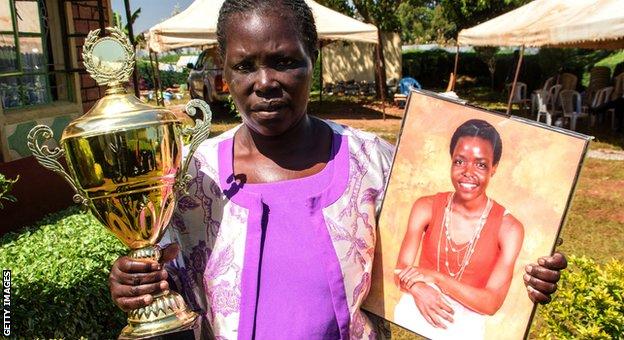
A year on from the murder of Agnes Tirop, her parents Vincent and Dinah are still desperately waiting – and hoping – for justice.
The 25-year-old runner was found dead at her house in Iten, Kenya, on 13 October last year, with multiple stab wounds in her neck and abdomen.
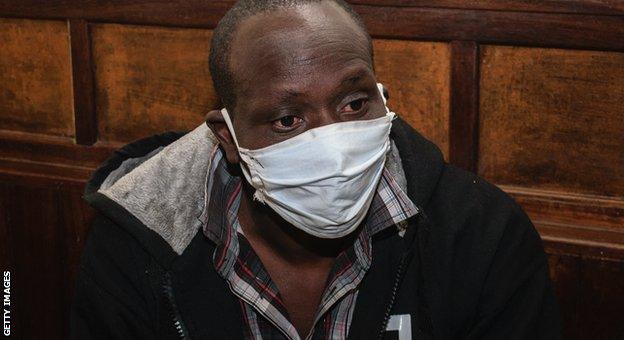
Over 12 months on from not just her murder but also her burial, the anniversary of which came last Sunday, the man accused of killing Tirop – namely, her husband Ibrahim Rotich – has yet to stand trial.
“I have been going through a lot of pain and sadness every single day since Agnes was murdered,” Dinah tells BBC Sport Africa, fighting back tears.
“I am still mourning her. I haven’t been alright since my daughter passed on.”
It is of little surprise given the horrific nature of Tirop’s death, which came on top of a promising career having been brutally cut short.
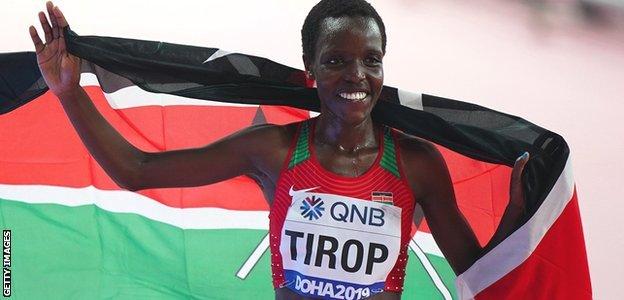
A two-time bronze medallist at the World Athletics Championships over 10,000m, Tirop had finished fourth over 5,000m at the delayed Tokyo Olympics last year.
The month before she died she set the world record
While the mental scars are never far away for her distraught parents, nor is the geographical location of Tirop’s body, which lies next to their house.
Nearly every day Dinah cleans the grave of the world record holder where dust is continually settling, just as with the case itself.
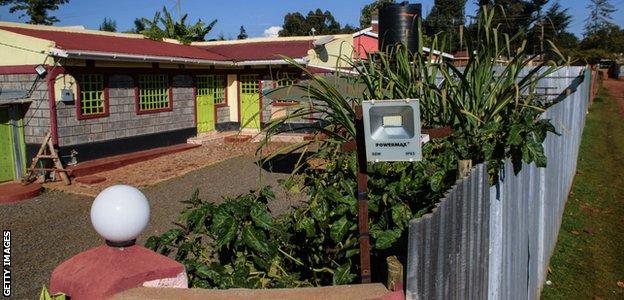
Agnes Tirop’s house in Iten, a town where many of Kenya’s most successful athletes are based
Rotich, who denies wrongdoing, was arrested as the prime suspect in her murder and has been in jail since then, but the wheels of justice for Tirop are moving at a different pace to the speed the athlete showed on the track.
“It’s going very slowly,” Vincent says. “Every time we attend the court it’s just a hearing. The case is not on. They keep telling us to come back next month.
“Sometimes they say the judge is not available and I don’t know why. Time is passing. It doesn’t look good because one year is already gone and there is not much progress.
“We were in court in August and we were told to go back in September. Nothing happened. We were told the magistrate wasn’t available. We heard from the lawyer the next date will be 11 November.
“We don’t understand why the case is taking this long. The government should push to settle this matter and ensure this case comes to a close. We want justice for our daughter.”
Shortly after her murder, Kenya’s then president Uhuru Kenyatta urged his country’s authorities to track down Tirop’s killer in order to “face the full force of the law”.
The homicide section of Kenya’s Directorate of Criminal Investigations (DCI) did not comment when asked about the status of Rotich’s case.
“Big cases drag on for so many years – that is my biggest fear,” says Kenyan marathon runner Viola Cheptoo Lagat.
Dinah Tirop says the family are yet to recover all of Agnes’ property
Ensuring Tirop is more than ‘a statistic’
Tirop’s murder instantly raised wider issues in Kenya, specifically surrounding domestic abuse and gender-based violence, and how to tackle them.
It also highlighted the pressures faced by the country’s female athletes, and women in society as a whole.
“People started recognising there is a problem,” says Lagat.
“There was this misconception that people who get abused or beaten in their house are poor people who have nothing – all they do is fight because they have too many problems. The death of Agnes was a big shock. She was very successful.”
Along with fellow Kenyan athletes and Vincent Tirop, Lagat has formed a group called Tirop’s Angels
which aims to stand in unity against gender-based violence.
“It just feels like her death was just a statistic – she was just another person who died from violence,” says Lagat, sister of five-time world champion Bernard.
“I don’t want that to happen to Agnes. I promised myself I’m not going to sit and wait for that to happen. I understand gender-based violence and I’m not afraid to speak about this.”
Tirop’s Angels’ aim is to offer a system of support in a country where a combination of fear, stigma and a lack of trust in the police mean the majority of cases are never reported.
“We don’t want one more person to go through this,” Lagat, 33, says.
“Within a very short time, we were so overwhelmed with phone calls from people going through issues.”
Some of Kenya’s female athletes say they have endured controlling behaviour by their husbands.
“With what happened to Agnes, the world came to light on what is happening,” says long-distance runner Mary Ngugi.
“As athletes, we have a platform, and we can use that platform to change this.
“Even if we don’t change what is already happening, we can help other girls to know that they don’t have to be in such a relationship. They don’t have to endure being used.
“We have seen Athletics Kenya doing some workshops, where they’re talking about these issues but it’s not that much support. I would like to see male athletes coming out and supporting it.
“When we preach more equality, and when we empower more women, this is when we are going to stop domestic violence.”
Tirop won bronze medals in the women’s 5,000m at the 2017 and 2019 World Athletics Championships
Running solutions
A programme officer with Equality Now, which campaigns for improved human rights, gender equality and legislative change, says gender-based violence is “the most widespread human rights issue in the world”.
“In Kenya, it’s a huge problem, deeply rooted in power dynamics,” says Equality Now’s Peninah Masore.
Figures supplied by Kenya’s Ministry of Health earlier this year disclosed that 45% of women and 44% of men aged 15-49 have experienced physical violence since age 15.
The main perpetrators of physical violence against women are husbands, whereas the main perpetrators against men are parents or teachers.
Meanwhile, 14% of women and 6% of men in the same age bracket report having experienced sexual violence at least once in their lifetime.
Last year former President Kenyatta stated he wanted to end gender-based violence in the country by 2026.
“There has been that knowledge that the state actually sees this as a huge issue that needs action,” Masore adds.
“The government needs to ensure that they’re putting in place measures to prevent gender-based violence. We need to have structures to support people, with safe houses and people in the justice chain knowing their mandate and responsibility.”
In a bid to combat the issue, Ngugi has established a women’s-only running club – the Nara Track Club – where she is encouraging more females to become running coaches.
“When we are young athletes, that’s when we started being recruited by people,” she says.
“Maybe some coach or guy says ‘I’ll support you in your career’, because they know it’s an investment – this girl is going to be winning – and it’s a lot of money involved.
“That’s when people start manipulating them, when you’re young and naive you just follow what people say.
“I feel the more female coaches there are, then girls will be more safer because they’re surrounded by women.”
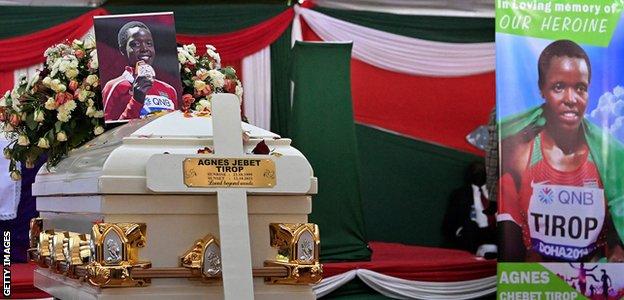
Tirop’s funeral and burial were held in Kapnyamisa village on 23 October last year
Filling the void
In Mosoriot, Nandi County, Vincent and Dinah’s living room highlights the success their daughter had as an athlete, with her medals hanging across the four walls.
“We feel joy every time we see those medals,” Vincent says.
“We thank God for the medals she brought and the efforts she put in to bring them and fly the Kenyan flag. She was an asset to the country and she would have added some more.”
Looking around the room as a proud father, Vincent briefly breaks into a broad smile.
But the sad reality is that Tirop’s murder has also left her parents struggling financially, as her success helped pay school fees for two younger siblings, as well as nieces and nephews.
They also now have to cover the cost of travelling to repeated court hearings in Eldoret, over half an hour’s drive away.
“Since she passed on, life hasn’t been easy,” Vincent says.
“We are struggling to make ends meet and it’s very hard because we are jobless. Our children need school fees and other needs.”
In their quest for justice, the family also hope to recover some of Tirop’s assets.
“We want justice to be done because we haven’t received all of Agnes’ property – we have just received a small portion,” Dinah says.
“Agnes put in a lot of work but most of her property, such as buildings, is out there.”
Still grieving, Vincent and Dinah have not yet deleted their daughter’s number from their phone contacts because they want to keep seeing her name.
The eventual resolution of Tirop’s murder trial may bring some form of closure to her family, but the campaign to eradicate gender-based violence has much further to run.
Burkina Faso’s military ruler, Captain Ibrahim Traoré, has appointed a government of 23 ministers.
The new cabinet will run the country until civilian is restored in July 2024.
It will be led by Prime Minister Apollinaire Joachim Kyelem de Tembela, a 64-year-old lawyer who was appointed to the post on Friday.
The new cabinet is composed of five ministers from the former cabinet of Lieutenant Colonel Paul-Henri Sandaogo Damiba – the coup leader overthrown in a subsequent coup in September.
Two military officers occupy the key ministries of defence and security.
The new cabinet includes five women. Olivia Ragnagbnewendé Rouamba remains Foreign Affairs Minister. She had earlier led negotiations with regional bloc, Ecowas, on the timetable and deadline for the transition to civilian rule.
A charter providing for a government of no more than 25 ministers and a 71-member assembly was adopted on 14 October.
It stated that the transitional president’s term will end with the holding of a presidential election in July 2024.
Sudanese authorities on Tuesday cut internet service and imposed a tight cover of the capital Khartoum as the country marks a year since the coup that toppled the transitional government of Prime Minister Abdalla Hamdok.
Processions against military rule were expected as has been the case every week since October 25 last year.
And Khartoum State Government declared an official holiday in all government and private institutions while the authorities deployed reinforcements from the army and police in the central Khartoum area. They also closed all roads leading to the Presidential Palace and the General Command of the Army, the headquarters of the military.
But an analysis by internet service watchdog Net Blocks said there had been internet disruption for most of Tuesday.
“Confirmed: Live metrics show a nation-scale internet disruption in #Sudan; the incident comes amid planned pro-democracy protests on the first anniversary of the 25 Oct 2021 military coup that seized power from the transitional government,” the watchdog tweeted.
All Nile bridges closed
The authorities also announced the closure of all Nile bridges linking the central Khartoum area with the rest of the cities of the state, except for the Soba and Halfaya bridges. In a statement published by the state news agency, the Khartoum State Security Committee stressed said it was keen “to protect the participants in peaceful processions and marches that express the will of the youth,” noting that “the security services are working to save the lives and property of citizens.”
No formal government
Sudan has been without a formal government since, and the authorities are controlled by the junta leader Lt-Gen Abdel Fattah al-Burhan, who is the chairman of the Sovereignty Council. His bid to re-form a transitional government has often fallen through as civilian movements reject any role of the military in the transitional government.
On Monday, US Secretary of State Anthony Blinken said Sudanese people must be given their democratic aspirations, praising civilian movements “who continue to demand freedom, peace, and justice under a democratic government and remember those who died while pursuing those goals”.
“The Sudanese people have shown themselves as unshakeable in their aspiration for a civilian-led government that shows respect for their dignity and is responsive to their needs. The continued willingness of Sudanese protests, often in the face of violent suppression by security forces, to demonstrate in support of an end to military rule is deeply inspiring.”
Blinken said only an inclusive initiative to find an exit from Sudan’s political crisis that ends military rule and restores the country’s democratic transition will be sufficient.
“We continue to support the UN, AU, and IGAD Tripartite Mechanism and urge all Sudanese actors to prioritise engaging constructively in dialogue,” said the US top diplomat, referring to a joint bid by the United Nations, the African Union and regional bloc the Intergovernmental Authority on Development (IGAD).
Reject military rule
“We stand ready to use all the tools at our disposal against those who seek to derail progress toward Sudan’s democratic transition. As we did a year ago, we continue to reject military rule and stand with the people of Sudan in their demands for freedom, peace, and justice for all Sudanese,” the statement said.
Events have accelerated in Sudan since the morning of October 25, 2021, with deterioration in the political and economic situation while security is out of control in several states.
On October 25, the army chief declared a state of emergency, suspended several articles of the constitution, and dissolved the Sovereign and Ministerial Councils ostensibly to “correct the course of the revolution” that ousted former president Omar al-Bashir.
On his first day, Al-Burhan vowed to form a government of independent technocrats, achieve the requirements of justice and transition, and form a constitution-drafting commission. He also pledged to form an electoral commission, a council of the high judiciary, a constitutional court, and a parliament, and set the end of the month following the coup, last November, as a deadline for the implementation of those promises, according to his first statement.
Constitutional vacuum
But a year has passed since the coup and its promises and al-Burhan has been unable to implement any of the previous promises.
The country continues in a state of constitutional vacuum that may be the longest in the history of Sudan.
President Nana Addo Dankwa Akufo-Addo is scheduled to meet the New Patriotic Party Members of Parliament who want Finance Minister, Ken Ofori-Atta removed from office.
The Media understands the meeting will come off this evening.
The NPP MPs claimed several efforts to have government address the plights of their constituents with regard to the ailing economy had proved futile.
They thus held a press conference on Tuesday, October 2022, to voice their disquiet and demanded the head of Ken Ofori-Atta and the Minister of State at the Ministry of Finance, Charles Adu Boahen.
Andy Kwame Appiah-Kubi, the Member of Parliament for the Asante-Akim North Constituency and spokesperson for the disgruntled Majority group, told the media on Tuesday that sacking Ofori-Atta and Adu Boahen will help restore confidence in Ghana’s economy.
“The recent development within the economy is of major concern to our caucus and our constituents. We have made our grave concern known to our president through the parliamentary leadership and the leadership of the party without any positive response.”
“We are by this medium communicating our strong desire that the president changes the Minister of Finance and the Minister of State at the Finance Ministry without further delay in order to restore hope to the financial sector and reverse the downward trend in the growth of the economy,” he added.
Several Ghanaians had mounted pressure on President Nana Addo Dankwa Akufo-Addo to remove Mr. Ofori-Atta from office in light of the country’s current economic predicament, which has compelled government to seek support from the International Monetary Fund (IMF).
The Member of Parliament (MP) for Team West, Carlos Ahenkorah, has explained why more than two-thirds of the majority caucus, including himself, are demanding that President Nana Addo Dankwa Akufo-Addo sacks the Finance Minister, Ken Ofori-Atta.
According to Ahenekorah, the MPs came to the decision after feedback from their constituents during their recess disclosed that most Ghanaians were unhappy with the government because Ofori-Atta was still at post.
He said that most of the majority caucus MPs spoke about how their constituents were suffering due to the economic challenges in the country.
Speaking in a Neat FM interview monitored by GhanaWeb, Ahenkorah intimated that they had to inform the president of the difficulties of their constituents so that it does not affect the NPP’s fortunes in the future.
“Most of the majority caucus came to this decision because it is what our constituents wanted. This is not something we wanted to do but it is what the people who voted for us, our constituents wanted. This was not by a rebel group in the caucus.
“There is a lot of pressure on us. If you go to your constituency office and you listen to the concerns of your constituents it is very disheartening. Just yesterday, three women visited my office and they were crying while narrating how they had lost their businesses because the price of a gallon of oil they used to purchase for GH¢60[600] is now selling for GH¢1000.
“The other MPs also shared their experience and we saw that it all boils down to the same thing. So, this is how we came to the decision that we have to let the president know what our constituents want. We had to let him know, otherwise, our people will not listen to us if we go to them again,” Ahenkrorah said in twi.
A group of New Patriotic Party (NPP) Members of Parliament has petitioned President Nana Addo Dankwa Akufo-Addo to sack the Minister of Finance, Ken Ofori-Atta, and the Minister of State at the finance ministry, Adu Boahen, to restore public confidence in the economy.
This was announced in a media briefing by their spokesperson, Andy Kwame Appiah-Kubi, who is the Member of Parliament for Asante-Akim North, in parliament on Tuesday, October 25, 2022.
The group said it will not do business with the government nor support the 2023 budget if the president fails to heed their calls.
According to them, the move follows previous concerns sent to the government that have not yielded any positive results.
The presidential candidate of the Labour Party, Peter Obi has reacted to comments that he distributed loaves of bread when he visited a community ravaged by flood.
Recall there were rife rumors that Obi on his visit to a flood-ravaged community donated 24 loaves of bread to flood victims.
Members of the opposition party, Ahmed Bashir and Reno Omokri made a mockery of him when the rumors broke.
Reacting in an interview on Arise TV, he said: “I never provided any food. Be it one bread. Whatever you might have seen is what people brought on their own to where I visited. What I have rather done is to ask those who are involved in places I have been to give me a bank account so I can help.”
MyNigeria had earlier reported how a rampant flood situation across the country ravaged many communities, washed away farmland, and destroyed people’s property.
Commuters passing through these communities have been made to take longer routes to get to their destinations.
Many roads were washed away, and many farmlands, houses, vehicles, and other structures also succumbed to the overpowering effect of flooding.
The Rivers State Governor, Nyesom Wike has revealed a romantic conversation with his wife, Eberechi Wike.
The governor, who spoke on Monday night during a dinner/reception organized in his honour to celebrate the ‘Distinguished Award in Infrastructure Delivery’ recently presented to him, said he has delivered his campaign promises.
Wike, who claimed he no longer has a job as governor, revealed that he earlier promised his wife full attention saying, “you will kiss me till you get tired”.
The governor expressed delight that he had fulfilled his promise to the people of the state, stressing that he would be leaving the government house in 2023 with excitement.
He said, “So people should try to keep agreements reached with people. Agreement is agreement. When I agree with you, I will keep to it. That is why they are having problems there. They can sleep.
“I am going, and I am also happily going. I don’t have any regrets. In fact, I told my wife that now I have no job, you will kiss me till you get tired.”
Peace talks to end Ethiopia’s Tigray conflict have begun in South Africa.
It is the highest-level effort yet to end two years of fighting that has killed thousands of people.
The talks are taking place under the auspices of the African Union.
“The peace talks, which have been convened to find a peaceful and sustainable solution to the devastating conflict in the Tigray region started today, 25th October, and will end on 30th October.
As a country committed to the African Union’s objectives of silencing the guns, South Africa is ready to serve as a host and provide assistance to the peace talks”, said Vincent Magwenya, spokesperson for the South African President, Cyril Ramaphosa.
Former Nigerian presidentand AU envoy Olusegun Obasanjo and former Kenyan president Uhuru Kenyatta are facilitating the talks with the encouragement of the United States special envoy, MIke Hammer.
The talks are scheduled to last until Sunday.
Over the past few days, Ethiopian and allied forces from Eritrea have made progress in urban areas in the Tigray region.
Thousands of demonstrators took to the streets of Sudan’s capital Tuesday (Oct 25).
They marked the first anniversary of a military coup that upended the nation’s short-lived transition to democracy.
Videos published on social media showed protestswith flags and drums, most of them bound for the Presidential Palace. Other footage showed protesters standing in front of convoys of security forces or calling out that the “revolution continues”, to demanded the creation of “a civil democratic Sudan”.
“This is the first time in history that we have seen a man lead a coup and not make any progress in a whole year despite the support of foreign countries”, a man says.
“But the Sudanese people are determined and especially this generation that has decided to do away with military coups forever”, he adds.
Last year, army chief Abdel Fattah al-Burhan seized power and arrested the civilian leaderswith whom he had agreed to share power in 2019, when mass protests compelled the army to depose one of its own, long-time ruler Omar al-Bashir.
Since its takeover, the military has cracked down and suppressed near-weekly pro-democracy marches, with as many as 118 protesters killed, according to statistics published by the Sudan Doctors Committee.
Eyewitnesses said thousands also took to the streets in the cities of Wad Madani and El Obeid south of theKhartoum, Gedaref and Port Sudan in the east, Atbara in the north and Nyala in the southwestern Darfur region.
Online monitor NetBlocks claimed authorities restricted internet access across the country in an attempt to stem protests.
The new British prime-minister, Rishi Sunak, the first British-Asian to reach the UK’s premiership has sent shockwaves throughout the world.
The origins of the new British prime-minister, Rishi Sunak, can be traced back to Kenya where his grandparents settled after immigrating to the Continent from India.
After Kenya’s independence in 1963, many opted to leave migrating to the UK.
Members of Kenya’s Asian community reacted with joy to the news, an achievement that coincided with the celebrations of Diwali.
“In 1963 Kenya got independence, then there were many Asians staying in the Eastleigh area, they were not well to do so they were given a choice whether to become Kenyan citizens or go to Britain, using British passport, so most of them opted, there was great migration, exodus as we call it, to Britain.
So many of them struggled from very humble beginnings and then came up and now they are quite wealthy and well to do, and they are also highly educated and doing good jobs and also participated in the politics and so on. Even there they have built temples like this one in England.
Then the second wave was from Uganda in 1972 when Amin (Idi Amin, Ed.) told the Asians to leave”, explained Bhalendu Bhatt, professor in chemistry, biochemistry and biotechnology at the University of Nairobi.
On Monday Rishi Sunak won the race to lead the Conservative Party making him the first British PM of Asian descent.
Many Asians see Sunak’s achievement with pride.
“Myself and all of us Asians are very proud that one of us has made it to the top job in UK.
As you tell me, I do not know but you tell me that he has been elected the prime minister of UK so we are very happy that we are all represented. Similarly not only UK if you remember the USA, the vice president is also from India, from South India, Kamala Harris.
So even in Canada there quite a few MPs (Members of Parliament) and so on of Asian origin, so wherever they have gone, even in politics they are coming up. So we are very pleased about that”, said the professor.
At 42 years old, Rishi Sunak is the youngest British leader in more than 200 years.
Chadian leader Idriss Deby has slammed recent protests experienced in the country terming them insurrection with foreign support.
The protests were violently repressed and resulted in at least fifty deaths.
Deby denounced the demos and further warned the opposition against insurrection insurgency.
In a televised speech on Monday, Deby said a “meticulously prepared insurrection” had taken place with the “support of foreign powers”, which he did not name.
“These were not simple demonstrations that were brought under control but a real, carefully orchestrated insurgency to create chaos in the country,” Déby said.
“external actors have provided arms and money to opportunistic Chadianswho have not hesitated for a moment to destroy our country to satisfy their personal interests and foreign agendas. Even today, Chadian actors have sought the support of foreign powers to pressure and blackmail me so that they can accede to power,” Déby lamented.
Chad’s opposition had called for peaceful protests on Thursday to mark the date when the military had promised to hand over power in the unstable Sahel country.
On the other hand, Derby called for national unity for the sake of peace in the country.
” I will not accept that the nation be divided, the country fragmented and our unity mortgaged. I will use all legal means at my disposal to prevent these projects that are harmful to our country,” he said.
Junta head Mahamat Idriss Deby, a 38-year-old five-star general, has been in power since his iron-fisted father was killed in an operation against rebels in April 2021.
The World Organization against Torture (OMCT) on Monday accused the Chadian authorities of summary executions and torture after 50 people died during clashes in the capital N’Djamena and the south.
The Geneva-based NGO listed “serious human rights violations” during protests on Thursday against a move by Chad’s military ruler to extend his junta’s grip on power for two more years.
The OMCT and three Chadian human rights groups said they have taken up the case with United Nations special rapporteurs, or experts, appealing for an urgent inquiry.
Chad’s opposition had called for peaceful protests on Thursday to mark the date when the military had promised to hand over power in the unstable Sahel country.
Junta head Mahamat Idriss Deby, a 38-year-old five-star general, has been in power since his iron-fisted father was killed in an operation against rebels in April 2021.
The transitional government has admitted 50 people died on October 20, including a dozen members of the security forces, and blamed an “insurrection”.
There was a “clear desire to trigger a civil war” he said, claiming opposition and rebel groups had “recruited and used terrorist and paramilitary groups to carry out gratuitous mass killings”.
But medical sources and ONGs spoke of dozens shot by live fire from the security forces.
The OMCT reported at least 80 deaths in a provisional casualty toll in N’Djamena and four southern towns — Moundou, Doba, Koumra and Bebedjia.
“Bodies of slain protesters were recovered from the Chari River in N’Djamena over the weekend,” the OMCT statement said noting school classrooms had been turned into prisons at the Abena Communal high school in the capital.
“Young people were reportedly summarily executed there this morning (Monday),” the statement said, adding that hundreds had been arrested, and some tortured.
The United Nations said it “deplored the lethal use of force” and called for an investigation into reports of human rights violations.
The African Union and the European Union have also condemned the repression of the protests.
Several Guinean political leaders were questioned and held in custody all day on Monday 24 October, leading the country’s opposition to denounce what they say is a fresh attempt, by the ruling junta, to silence dissent.
According to one of their lawyers, Fodé Oussou Fofana, Cellou Baldé, Bano Sow, Mamadou Sylla, Dembo Sylla, Pépé Francis, Etienne Soropogui and Bouya Konaté are being prosecuted for their participation in, or support for, last week’s anti-juntaprotestsin which three people died.
“We believe that our clients benefit from the presumption of innocence and have already told their part of the truth in relation to the charges brought against them, which were even mentioned in the letters of convocation, namely prohibited assembly, provocation of prohibited demonstrations and several other assaults and injuries, and others.” Me Salifou Béavogui, Lawyer of some of the indicted political leaders said.
The politicians were later released in the evening, but are due to appear again on Thursday.
The National Front for the Defence of the Constitution (FNDC) had called for the protest to demand a quick return to a civilian led government and the release of all prisoners detained for political reasons.
In a statement released last week, the group called the ruling junta “dictatorial.” and identified the three people killed as Thierno Bella Diallo, Boubacar Diallo and Thierno Moussa Barry. It also added that 20 people suffered gunshot wounds while many others were arrested.
Justice Minister Alphonse Charles Wright confirmed their deaths in a statement on Friday, but said the causes “remain to be clarified by autopsy”.
He ordered prosecutions, without commenting on the alleged perpetrators but stressed that the authorities’ were determined to combat impunity.
– ‘More severe sanctions’ –
Rights activists regularly accuse Guinean police and gendarmes of using excessive force, and the authorities of turning a blind eye in a country with a history of political violence.
The justice minister ordered the identification “without delay” of a member of the security forces whose image has gone viral on social networks. A video shows him firing a pistol at a target who is not visible in the footage.
The poor but mineral-rich West African state has been under military government since a September 2021 coup that ousted president Alpha Conde after more than 10 years in power.
An alliance of political parties, trade unions and civil groups, the FNDC spearheaded protests against Conde before his ouster.
It was officially dissolved in August by the junta-appointed government.
The coalition had called for peaceful demonstrations to take place in Conakry on Thursday, followed by nationwide protests on October 26.
West African leaders suspended Guinea from the Economic Community of West African States (ECOWAS), and imposed sanctions last month on a number of individuals.
It gave the ruling junta one month to present a “reasonable and acceptable” timetable for the return of civilian rule, an ultimatum that theoretically expires this weekend.
If they fail to do so, ECOWAS has warned that it will adopt “more severe sanctions”.
Of the hundreds of winemakers in the country, Africa’s top wine producer, just over 80 black-owned brands, according to the SA Wine Industry Transformation Unit.
Paul Siguqa inspects his flowering grape crop in Franschhoek (Western Cape province), a town located in a South African region dotted with centuries-old vineyards.
The 41-year-old bought Klein Goederust farm (Afrikaans for “a little good rest”) after saving up for 15 years to achieve a dream of his. He renovated it and opened it last year, 3 years after he purchased the farm.
His mother had for 37 years worked at a farm in South Africa’s Cape winelands under the white minority apartheid regime. Sigupa’s fate was not a preordained destiny.
“If you grow up on a farm as children of farm labourers, black farm labourers, you are raised to be the next crop of labour for that farmer”, the owner of the Klein Goederust wine estate said.
“The farmer doesn’t look very far for labour, the children of labourers that in most cases become the next generation of labour.”
Perseverance pays off
The first vineyards were established in the 1600s by White French Huguenots.
Since then, land has passed down through generations and when sales do occur, it has often been to neighbours leaving little opportunity for new comers.Yet they not give up.
More Black South Africans are starting to smash the barriers in the country’s renowned industry.
Carmen Stevens is a 51-year-old and un unlikely winemaker. She grew up in the Cape Flats — an area marred by poverty and gangsters.
Her mother, a factory worker, would buy her Mills & Boon fiction novels, many set in vineyards and involving wine.
South Africa was still under the racially segregated apartheid regime when Stevens made her first attempt to study winemaking in 1991. After being repeatedly refused, she was accepted at a college in 1993.
Her perseverance has paid off. In 2011, she launched Carmen Stevens Wines, became South Africa’s first fully black-owned winery.
She was supported by SA Wine Industry Transformation Unit, an organization which organises grants and internships for startupse espically non-White entrepreneurs.
Accelerate the pace of change
Carmen Stevens joined the Wine Arc tasting room which was launched by the organization. The group promotes budding producers in South Africa’s wine producing hub Stellenbosch. However, other barriers remain.
“Investment-wise it’s a big challenge and that is partly why I think there is not a lot of black stakeholders because we don’t come from a background where we have the financial backing”, the 51-year-old explains.
The increasing number of entrepreneurs of colour often faces a lack of resources to be spread thinly among them. Even for organizations like the SA Wine Industry Transformation Unit, dividing resources bewteen candidates is no easy task.
This new generation of Black winemakers isn’t dettered by the odds.
This year Carmen Stevens took home three gold medals at a South African wine and spirits award event for her sauvignon blanc and newly-released rose named after her mother Julie.
But like many black-owned brands, she procures her grapes from farmers in the region, not yet having her own land to cultivate.
The United Arab Emirateshas reportedly banned nationals of some 20 African countries from entering its capital city, Dubai.
“This is to inform you that we will not be posting 30 days visa applications for these nationalities effective today October 18, 2022,” the notice read in part.
countries affected by the visa ban include Uganda, Ghana, Sierra Leone, Sudan, Cameroon, Nigeria, Liberia, Burundi, Republic of Guinea, Gambia, Togo, Democratic Republic of Congo, Senegal, Benin, Ivory Coast, Congo, Rwanda, Burkina Faso, Guinea Bissau, Comoros, and the Dominican Republic.
In a notice issued to trade partners including travel agents, authorities indicated that all applications should be rejected.
“Any applications from the above-mentioned countries will be sent back or canceled.” According to reports.
this is not the first time some African countries have been banned from entering Dubai.
In December 2021, Emirates Airlines announced that eight African countries will not be accepted to travel through Dubai until further notice due to the spread of Covid 19.
It is however not clear the reason behind the latest ban.
5 priests, 1 religious sister and 3 laypeople who were kidnappedon Sept. 16 in the Cameroonian diocese of Mamfe are now free, the diocese announced.
“It is with great joy that I announce the release” of five Catholic priests, one consecrated sister and two laypeople, Bishop Aloysius Fondong Abangalo wrote in his communiqué dated October 23.
The Mamfe diocese located in South West region is one of two restive regions in Cameroon where separatists have been waging war to the federal authorities since 2017.
[🇨🇲#cameroun] DEO GRATIAS ! c’est avec une joie infinie que nous avons appris la libération des 9 prêtres, religieuse et laïcs enlevés le 16 sept. Le diocèse de #Mamfe “remercie sincèrement tous ceux qui ont prié pour la sécurité et la libération de nos frères et sœurs kidnappés” pic.twitter.com/WqKHoakETn
On the evening of September 16, the Christians were abducted and St Mary’s Church in Nchang (South West region) was burned down.
Murders, ransackings and kidnappings have become frequent in this region, where armed separatist groups regularly target schools and teachers in particular, but also Catholic and Protestant churches and their prelates. But the bishops of the region assure that Friday’s kidnapping is “completely unprecedented” in its scale.
Last month, Archbishop Andrew Nkea, the president of the Ecclesiastical Province of Bamenda, did not give any details of the attack, did not attribute it to anyone in particular and said that the kidnappers had given “no concrete reason” for the act.
In the communiqué issued by Bishop Aloysius Fondong Abangalo, Sunday, no information on the kidnappers was given.
“Taking away the freedom of our brothers and sisters to make money at all cost is inhumane”, the bishop of Mamfe simply condemned.
One of the largest rice farmers in the Yagaba-Kubori Constituency of the North East Region has criticised the Minister of Agriculture, Dr Afriyie Owusu Akoto, for not doing enough to achieve sustainability in rice production in the country.
He said the government is not making deliberate efforts to encourage people to go into rice production.
According to Alhaji Abdul Rauf Tanko, the country has the potential to achieve sufficiency in rice production but the Minister is not doing enough in those directions.
If people are encouraged to go into rice production we can meet demand and export the rest, he posited.
He minced no words to say that the sector minister is just not serious about achieving sufficiency in riceproduction in the country nor encouraging people to go into rice farming.
He doesn’t know his job, Mr Tanko charged.
Alhaji Tanko who was a one-time Member of Parliament for the Yagaba-Kubori Constituency on the ticket of the main opposition National Democratic Congress (NDC) gave this description to the sector Minister while speaking on the improving rice production series ahead of the yuletide on the 505 evening news analysis programme on Accra-based Class 91.3 FM on Friday, October 21, 2022, hosted by Korku Lumor.
The former lawmaker alleged the Agric Minister thinks that policies for Agriculture are all the time made on paper as against actual implementation.
“You cannot implement Agriculture policy on paper and achieve results,” he said.
He said there must be a deliberate attempt for achieving rice sufficiency in the country.
He claimed that as it stands now there are no such attempts to achieve that feat.
All the Minister thinks about is the Planting for Food and Jobs, which only provides fertilisers to small-holder farmers, he asserted.
He said for the Minister to claim credit for the bumper harvest in the rice industry in 2019 was unfortunate.
Mr Tanko expressed the view that 70 per cent of the bumper harvest in the northern regions was from the commercial farmers and not the peasant farmers who were part of Planting for Food and Jobs (PFJ).
He charged that for farmers to go and credit fertilisers, only for them to experience a foreign bird invasion during harvest while the Minister sits in Accra and drinks tea without seeing the need to go to their aid and then claiming credit for their efforts is not in order.
He argued that with the needed support, rice farmers in his area (Yaadiri) could help the country cut back on the importation of rice.
He further commended the individuals who have made efforts in the rice production industry.
Ghana’s ruling party lawmakers on Tuesday called for the sacking of the country’s finance minister, adding pressure on the government to deal with record inflation.
President Nana Akufo-Addo has come under fire as Ghanaians face 37 percent inflation and the collapse of their currency – the cedi – in an economic hardship worsened by the Russian invasion of Ukraine.
Finance Minister Ken Ofori-Atta has just returned from Washington, where he was in talks with the International Monetary Fund (IMF) to secure a loan of $3 billion.
In addition to Mr. Ofori-Atta, a majority of parliamentarians from Mr. Akufo-Addo’s New Patriotic Party (NPP) have called for the dismissal of another finance official.
The president must immediately fire the two officials “to restore hope to the financial sector and reverse the downward trend in the growth of our economy,” the parliamentary group’s spokesman, Andy Appiah-Kubi, told reporters.
“Until the aforementioned individuals resign or are removed from office, we in the parliamentary majority group will not participate in any government activity,” Appiah-Kubi warned.
“If our request does not receive a positive response, we will not be present at the session on the budget, nor will we participate in the debate,” he said.
The call was supported by 80 of the 137 legislators in the NPP parliamentary caucus.
In Ghana’s parliament, the NPP and the National Democratic Congress (NDC) have the same number of seats. Lawmakers are scheduled to begin debating the 2023 budget in November.
On social media, the call by the majority caucus in parliament has been leading the trends with minority MPs also calling for the same motion.
The video below by local media TV3 shows minority MPs addressing the media.
President Nana Akufo-Addo has been criticized for his economic management of the country, including his decision to enter into discussions with the IMF, which he once promised would lead to an “aid-free Ghana.
This decision has raised fears that the government will impose austerity measures that will further burden the population, which is already facing soaring prices.
Last week, shopkeepers in the capital, Accra, shut down their stores to protest against the soaring cost of living.
A Nigerian court has ordered a final seizure of two properties and cars owned by former oil minister Diezani Alison-Madueke, the country’s economic crimes commission said on Monday, in the latest ruling related to graft allegations against her.
Alison-Madueke who was a key figure in the administration of former President Goodluck Jonathan served as petroleum minister from 2010 to 2015.
According to reports, the former minister has been tagged with several corruption allegations since she left office but denies the charges.
The Economic and Financial Crimes Commission (EFCC) said in a statement that High Court Judge Mobolaji Olajuwon issued the final forfeiture of the former minister’s $3 million homes and cars in Abuja.
Alison-Madueke’s whereabouts are unclear, but she was last known to be in Britain.
A court has previously ordered the seizure of her upmarket property in the commercial capital Lagos and frozen funds that were said to be part of the rent collected from the property.
In 2017, the U.S. Justice Department filed a civil complaint aimed at recovering about $144 million in assets allegedly obtained through bribes to the former minister.