Author: Amanda Cartey

  • Closure of Equatorial Guinea’s borders impacts Cameroonian traders

    Cameroonian traders living on the border with Equatorial Guinea are “suffer(ing) a lot” since the closure of Equato-Guinean land borders in preparation for the presidential campaign that will begin on November 3 in this small Central African country.

    On October 25, Vice President Teodorin Nguema Obiang justified this measure as a way ‘to prevent the infiltration of groups that may try to destabilise the campaign’, without giving an official date for the reopening of borders and specifying that only airports would remain open.

    Many are taking prohibited routes through the bush to attend to their usual errands at the popular Kye Ossi.

    Guinea shuts land borders ahead of election campaign

    Equatorial Guinea on Monday closed its land borders with Cameroon and Gabon to prevent what it describes as “infiltration” groups intent on “destabilising” the presidential election campaign starting this week.

    Vice President Teodoro Nguema Obiang Mangue had said the measure would “prevent the infiltration of groups who may attempt to destabilise the (election) campaign”, which begins on Thursday.

    He did not fix a date for the reopening of the borders when he announced last Tuesday that only airports would remain open.

    A local official in the northern border town of Ebebiyin told AFP on condition of anonymity that the frontier had been closed since Monday morning.

    Initially scheduled for April 2023, the presidential poll was brought forward to November 20 to coincide with legislative, senate and local elections following a decree by long-serving leader Teodoro Obiang Nguema Mbasogo.

    The war in Ukraine and the Covid-19 pandemic were cited as the reasons behind the decision to hold the costly votes simultaneously.

    The central African nation has heightened border security since what the authorities described as an aborted coup attempt in late 2017 that aimed to kill President Obiang.

    The coup was allegedly orchestrated by Equatorial Guineans and foreign mercenaries crossing from Cameroon.

    Equatorial Guinea regularly shuts its borders on security grounds despite a regional agreement on the free movement of people and goods with Cameroon, Gabon, Congo-Brazzaville, the Central African Republic and Chad.

    The country possesses major oil and gas resources, but a majority of its 1.3 million people live below the poverty line, according to the World Bank.


    Source: Africa News
  • Protesters in DRC set fire to UN vehicles in Goma

    Protesters set fire to UN vehicles in Goma on Tuesday night, protesting against the presence of the United Nations Mission in the Democratic Republic of Congo (MONUSCO).

    The blazes started after rumours about the UN allegedly transporting rebels from the M23 group had spread among displaced people and residents in the city.

    Earlier on Tuesday, MONUSCO announced a “strategic and tactical withdrawal” from embattled Rumangabo, where the M23 is trying to advance.

    The mission posted on Twitter that the decision was taken “in consultation with our partners, to better prepare the next steps together.”

    It added that “MONUSCO remains mobilised alongside the FARDC (DRC Armed Forces).”

    The situation in the country’s east has worsened in recent months, and on Saturday, rebels seized control of two major towns and doubled the territory they hold after fierce fighting with the military.

    The M23 rose to prominence more than a decade ago when its fighters seized Goma, the largest city in Congo’s east, which sits along the border with Rwanda.

    After a peace deal, many of the M23′s fighters were integrated into the national military.

    Then the group re-emerged last November, saying the government had failed to live up to its decade-long promises.

    By June, they had seized the strategic town of Bunagana near the border with Uganda.

    Nearly 200,000 people already had been displaced over the past year even before the latest surge in violence, which is now blamed for forcing at least 40,000 people to flee in a week.


    Source: African News

  • This is what snoozing does to your health and how to stop it

    This is what snoozing does to your health, did you know this?

    The era of alarm clocks like the one pictured is pretty much over, and even clock radios and digital alarm clocks have given way to our smartphones. And let this beautiful device have just one very tempting feature: the snooze button, also known as snooze. On most devices this is set to ten minutes by default. Your alarm clock rings, you press ‘snooze’ and after ten minutes you are woken up again. It gives you a wonderful feeling, as if you can sleep a little longer. Unfortunately, this is not good for your health, so you’d better unlearn it.

    Snooze
    Snoozing involves setting an alarm clock where you have a snooze option, the snooze button. Pressing (or swiping) this button delays the alarm for five, ten or fifteen minutes. In between these alarms you can have a nice sleep, also called snoozing. Many people love this and even we on the editorial team have been late for work because we pressed the snooze button one time too many. Unfortunately for us, according to scientists, snoozing is not useful at all.

    Sleep quality
    The naps you take between alarm clocks are so light that they don’t actually benefit you. You are interrupting your long, deep sleep by taking a series of naps. Instead of waking up, you’ll feel sleepier and wake up dull and tired. In Margriet, sleep expert Alies Coster explains: “During the time you snooze, your sleep quality is not good enough to contribute to recovery of your body and brain. That’s because your sleep is interrupted each time.”

    So it is better for you to set your alarm clock when you really need to get up. That way, you can sleep as long as possible and enjoy a deep sleep. In the long run, this makes you feel better and fresher. You also run an increased risk of cancer and cardiovascular disease if you do not get enough sleep or sleep of poor quality.

    With the following step-by-step plan, you can unlearn your snoozing habit

    1. Enough sleep

    Exactly how much sleep you need is personal. On average, adults need seven to nine hours of sleep per night. Go to bed on time so you’ve actually had enough sleep as soon as your alarm goes off.

    2. Sleep Rhythm

    The best thing for your overall well-being is to keep a steady sleep rhythm, even on the weekends! So go to bed at the same time every night and get up at the same time every day. Your body will get used to this rhythm and will already wake up at the time you need to wake up. Are you really a snoozer? Then try to go to bed half an hour earlier than you are used to, so that your body gets enough sleep anyway.

    3. Move your alarm clock away

    Force yourself to wake up by putting your alarm clock or phone on the other side of the bedroom. You do have to get out of bed now to turn off the alarm clock. And well, once you’re up you might as well actually get up. That way you don’t run the risk of falling asleep after your alarm has gone off.

    4. New alarm clock

    Do you not wake up properly because it is dark in your bedroom? Then you might benefit from a wake-up light. Do you wake up every day very sleepy? Then download an app that asks you to solve a puzzle before it turns off, such as the “I Can’t Wake Up” app.

    5. Prepare your breakfast

    Bribe yourself with a nice breakfast and a cup of tea or coffee! Put a nice breakfast in the fridge the night before that you can eat right away. Make yourself a cup of coffee or tea and allow yourself a moment of pleasure in the morning.

    6. Appointment

    Make sure you actually have something to do in the morning, whether it’s work or exercise. This will simply keep you from lying down longer than necessary. Good luck!

    Source: tips-and-tricks.co

  • Tanzania deploys army to fight Kilimanjaro fires

    Tanzania’s army has deployed hundreds of troops to help firefighters who have been battling fires on Africa’s highest peak, Mount Kilimanjaro, for close to two weeks now.

    Army officials say the Tanzania People’s Defence Forces (TPDF) will co-operate with other agencies and volunteers to ensure the fire is controlled before it causes more damage to vegetation on the mountain.

    “Officers and men of TPDF have already arrived in Siha and Mweka areas in Kilimanjaro Region ready to fight the fire,” a statement by the TPDF says.

    A BBC team on the slopes of the mountain witnessed some of the soldiers arriving at the two entry points to the mountain on Tuesday.

    A series of wildfires have been breaking out in different areas on the mountain, after an initial fire started near a camp along a popular hiking route on 21 October.

    Hundreds of people, including firefighters, national park staff, tour guides and civilians, have been battling to put out the fires with little success.

    The cause of the fires is not known yet but the government says human activities are most likely to blame.

    The government says a prolonged drought, layers of decaying organic material and strong wind are part of the reasons the fire has been hard to control.

    Two years ago, a week-long inferno destroyed thousands of hectares of woodland on the mountain’s slopes.

    Source: BBC

  • US sanctions IS group in Somalia over arms smuggling

    The US has sanctioned the Islamic State group (IS) in Somalia and several of its alleged members said to be smuggling arms in East Africa.

    The IS mainly operates in the country’s north-east where it targets security forces and civilians in attacks.

    Despite receiving regional and international support, Somalia continues to grapple with deadly militant violence.

    IS Somalia has been active in the Horn of Africa nation since 2015.

    The sanctioned individuals are accused of providing support to the group’s intelligence unit, smuggling arms across East Africa and co-ordinating high-profile attacks.

    Some were former members of the al-Shabab group.

    In October, the US blacklisted several al-Shabab members also said to be trafficking weapons between Somalia and Yemen where al-Qaeda and the Islamic State are entrenched.

    Violent attacks by Somalia’s militant groups have claimed many lives and instilled widespread fear.

    Somalia is heavily dependent on international support to disrupt illicit arms and financing networks aiding activities by al-Shabab and the Islamic State.

    Source: BBC

  • Nigerians displaced by insurgency struggling – HRW

    Human Rights Watch is warning that more than 200,000 people in north-east Nigeria who have been displaced by an Islamist insurgency are struggling to meet their basic needs for food and shelter.

    The rights group said the problem was exacerbated by the Borno state authorities shutting down camps for internally displaced people.

    It said by August this year more than 140,000 people had been removed from the camps and told to go home.

    The state government said they needed to be weaned off humanitarian aid and that the security situation had improved.

    Source: BBC

  • Malaria mosquito from Asia spreading to Africa

    Scientists say that an invasive species of malaria-carrying mosquito from Asia has spread to Africa, where it poses a particular threat to city-dwellers.

    In Africa, where the majority of global deaths from malaria occur, the disease is mostly spread by a mosquito specific to rural areas.

    But the Anopheles stephensi species of mosquito, which is responsible for most of the cases seen in Indian and Iranian cities, breeds in urban water supplies – and is resistant to most insecticides in common use.

    The mosquito has already caused cases in Djibouti and Ethiopia to rise, seriously complicating efforts to eradicate the disease.

    Researchers say that if it spreads widely in Africa it could put nearly 130 million people at risk.

    Source: BBC

  • Kenya due to deploy army to fight DR Congo rebels

    Kenya is deploying the first contingent of a regional peacekeeping force to eastern Democratic Republic of Congo.

    President William Ruto will on Wednesday morning preside over a flagging-off ceremony in Nairobi for the Kenya Defence Forces (KDF) battalion joining the regional forces.

    The Kenyan troops, who will be in DR Congo as part of the East African Community (EAC) force, will help the Congolese army’s efforts to quell the violence in the region.

    Some Kenyan troops have already been installing logistical support systems in DR Congo since September in readiness for the planned operations against the rebels.

    The EAC agreed on a troop deployment deal to combat rebels early this year.

    The Kenyan contingent’s first mission will be to help recapture the border city of Bunagana that was seized by the M23 rebels in June.

    DR Congo has consistently accused Rwanda of supporting the M23 group. Kigali has always denied those accusations.

    Source: BBC

  • How will DR Congo defeat rebels in the east?

    The Congolese government has expelled the Rwandan ambassador, accusing Kigali of supporting rebel group.

    Relations between the Democratic Republic of the Congo (DRC) and Rwanda have hit a new low.

    The Congolese government has expelled the Rwandan ambassador.

    The DRC has long accused Kigali of backing the M23 rebel group in North Kivu province in the east.

    A recent United Nations report found evidence to support the accusation but Rwanda has repeatedly denied this.

    Fighting between the M23 and the Congolese army has intensified in the past few months, with the rebels capturing two towns last week.

    This has forced nearly 40,000 people from their homes.

    So, why has it been difficult to end this conflict?

    Is it time for a new approach?


    Source: Aljazeera

  • My dad, the claw hair clip inventor’

    It was the hair accessory of choice in the 1990s – fashionable yet functional – making a comeback in Covid lockdown when a trip to the salon wasn’t possible.

    But few people realise the claw clip started life in a humble workshop in France, and it was invented by my foster dad.

    “We had a saying: ‘Wherever you go in the world, you’ll find a bottle of Coke, a poster of Michael Jackson and our hair clip,’” he remembers.

    I was brought up in France between two families. My birth mother, Maria, is from Cape Verde off the West African coast. She fled the islands when she got pregnant with me, aged 24, eager to leave behind her life of hardship for a better future in Europe.

    That meant escaping in the middle of the night to catch a plane to Guinea-Bissau. From there it was a turbulent journey of several months to reach Portugal and then France, aided by friends and family along the way.

    I was born weeks later in December 1976 in Riom, a small town in eastern France. We slept on the streets in deepest winter until she discovered an abandoned shed. Her health has never been the same since.

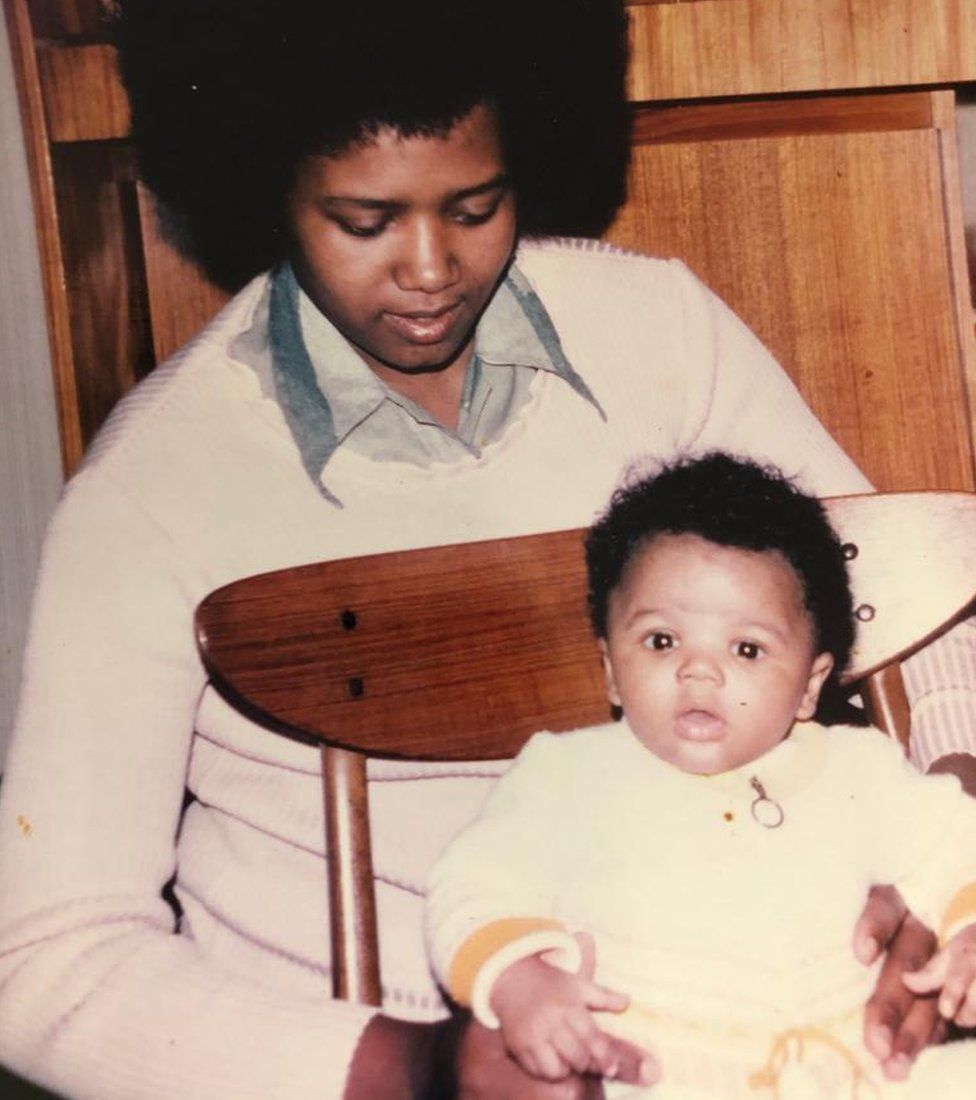
    Anne-Marie Dias Borges and Maria Filomena in 1977Image source, Anne-Marie Dias Borges
    Image caption, Me with my birth mother Maria in 1977
    1px transparent line

    A young French couple, Christian Potut and his wife Sylviane, heard of our plight and offered to take me in for one night, and help my mother find us a home.

    Yet, somehow, I never left.

    My birth mum Maria always said the Potut family would be repaid for their generosity. It turned out she was right.

    Fast-forward to the 1980s – a time of big phones, big hair – and for Christian – big dreams too.

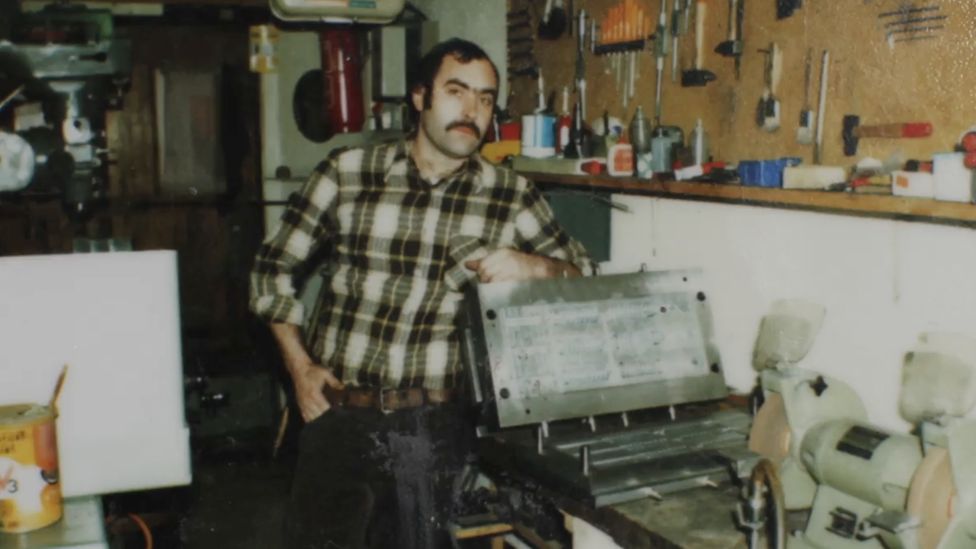
    He had left school at just 14 with no qualifications but a passion for making things. Aged 27 and broke, he set up a small workshop in a 17m-sq- (180-sq-foot) old bread oven at the back of his parents’ garden.

    But the business slowly expanded and by 1986 Christian and Sylviane’s company, CSP Diffusion, opened its first factory in our hometown, Oyonnax, making various plastic items such as hairbands, combs and even yo-yos.

    Then came the moment that changed our fortunes forever.

    “One day I kept crossing and uncrossing my fingers,” says Christian. “And that’s when I had my lightbulb moment. I said to myself: ‘I sell combs and clips, why don’t I combine the two?’”

    And so the iconic claw hair clip was born.

    “It was for any type of hair – curly, fine, thick, long, short,” he says proudly.

    Media caption, Christian Potut explains how he came up with the idea for the iconic hair claw clip

    Did having me, an African daughter, make my dad reflect more deeply on why it mattered that designs worked for all hair textures, I ask him?

    “Not really,” he says, or at least it wasn’t a connection he remembers consciously making all those years ago.

    But their universality was right for the times.

    This was an era when high fashion and the high street were growing ever closer, and claw clips were inexpensive and democratic – coveted by the rich and ordinary people alike.

    “This clip takes me right back to my childhood, when my mother used it every day on her clients,” says hairdresser and L’Oréal brand ambassador Alexis Rosso. “It was also a game-changer for women of colour, for whom having long, relaxed hair was in fashion at that time. This clip changed the game for women of all races.”

    Eventually claw clips were everywhere you looked – even gracing the iconic hairdo of Rachel in the hit TV show Friends, played by Jennifer Aniston.

    A scene from FriendsImage source, NBC/Photo 12/Alamy
    Image caption, Friends is one of the most popular TV shows of all time

    But it wasn’t until all my schoolfriends kept bugging me for more and more clips that I realised just how big a hit it was.

    By the mid-1990s our family company was selling hundreds of thousands of hair clips worldwide per month, the factory was extended and staff numbers ballooned to 50-odd to meet the ever-growing demand.

    During school holidays I’d sit in the workshop alongside Christian and Sylviane’s children, Sandrine and Jean-François, checking each clip one by one, cleaning any marks and removing any excess plastic before packing them for shipping.

    One thing that stays with me is the scent of melting plastic. It may seem strange, but for me, that smell sums up warm childhood memories.

    It’s hard to believe the amount of work that goes into such a tiny item.

    “First comes the drawing,” says Christian. “Then we make a resin scale model, a plaster mould, and pour a type of metal alloy on top to give us the final mould. This mould is then attached to a huge press machine. Hot, liquid acetate is poured inside. As it cools, the claw takes shape and is injected.

    “It’s a real labour of love. It used to take me around 200 hours to create a single mould.”

    Christian Potut in his small workshop, in the early 1980s. This is the bread oven, where he started working in 1978.Image source, Sylviane Potut
    Image caption, ‘I always knew that I was clever enough to change my life,’ says Christian Potut

    The biggest markets were the US and Japan, but European countries like Greece couldn’t get enough of the claw clip either.

    “It was brilliant… so innovative,” recalls Fanny Lappas in Athens, who was one of my parents’ first and biggest clients, ordering up to 100,000 clips at a time.

    Today we mostly associate claw clips with classic colours like black and tortoiseshell.

    But in the 1980s and 1990s, keeping up with the latest trends meant bringing in fashion and colour consultants to offer a vast palette – and enlisting the jewellery brand Swarovski for an exclusive diamanté range fit for royalty.

    “One of our clients was the sole supplier for Sweden’s royal family – her shop in Stockholm was like a fairy’s shop,” recalls my foster mum Sylviane. “She had rows and rows of our clips with rhinestones – our most expensive items – and she would sell every single one of them.

    Britain also had a taste for our fresh and exciting designs. Client Paul Criscuolo tells me it was the first such clip he had seen.

    “I had been in the business for years but when Christian arrived in our London office with that clip… we knew straight away that it would be big.”

    As the business grew, so did my parents’ belief in their principles. Trust was paramount. “We sold a lot of clips, but we also made a lot of friends,” says Sylviane.

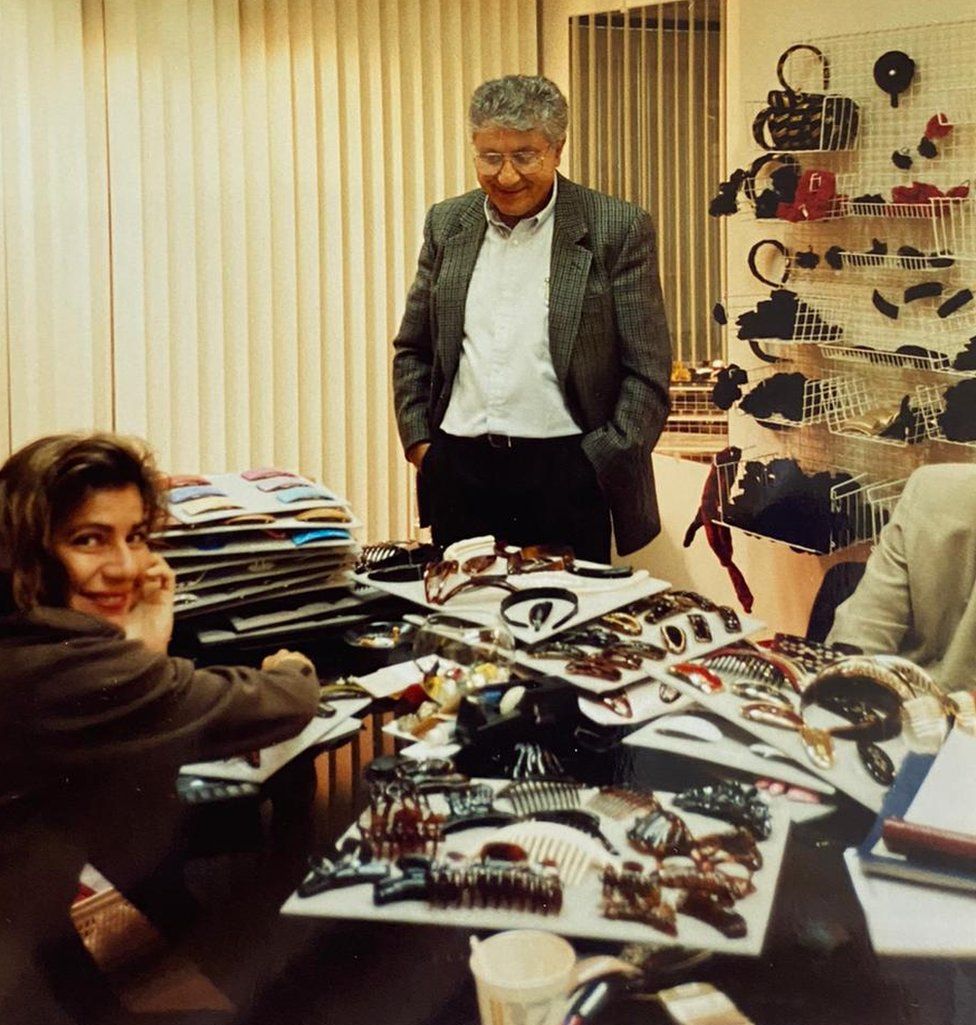
    Showing the clips to clientsImage source, Christian Potut
    Image caption, Clients in the 1990s check out CSP Diffusion’s latest designs
    1px transparent line

    Success brought the opportunity for travel.

    “I had never left our region of France before, but with this clip I was meeting clients in Tokyo, Toronto or Morocco,” says Christian.

    By this time I was a teenager and could speak some English, which made me an asset to the team on business trips abroad.

    I was agog the first time I saw New York. We stayed in one of the city’s fanciest hotels and I remember looking out of the window and promising myself that I, too, would follow my dreams.

    It was hard work but there were some memorable failures too – such as the time I assembled hundreds of mis-matched clips for a very important client in New York.

    Yet I learned a lot from the experience, and now double- or triple-check everything I do.

    My birth mother says she doesn’t regret the challenges we faced because “I knew, deep in my soul, that my daughter would avenge me and make me proud”.

    My foster parents opened their home and their hearts to me, gave me the audacity to dream big and encouraged me to come to the UK.

    How amazing it is to witness the revival of my dad’s invention 30 years on.

    “We know that fashion tends to repeat itself – and just as ponytails and flared trousers have made a comeback, so has this vintage item,” says L’Oréal’s Mr Rosso.

    Model Bella Hadid wearing a claw clip last yearImage source, Getty Images
    Image caption, Model Bella Hadid wearing a claw clip last year
    1px transparent line

    “We still feel the same pride and excitement today when we see the younger generations wearing our clip. It’s truly a classic design,” says Sylviane.

    But with all that success, were there any regrets for Christian and Sylviane?

    “We should have applied for a patent. It was protected in France but not abroad,” Christian says. “There are copies all over the world… But it’s been copied because only good things are worth copying.”

    And I know that one thing they don’t regret at all is taking me in.

    “People called us mad because they were African immigrants and we barely had enough for ourselves, but when I held you in my arms, it was love at first sight,” my foster dad tells me.

    “When I saw you, I felt that you were mine,” adds my foster mum.

    Essential business tips from Christian and Sylviane Potut:


    • Love what you do, it’s a must
    • Have faith in yourself and your product
    • Pay close attention to your clients’ needs
    • Patent your product – coughing up the money earlier on will be worthwhile in the end
    • Keep new projects close to your chest, only telling the people you trust.


    Source: BBC
  • New pathways in Singapore aims to promote active cycling

    In recent years, the popularity of cycling in Singapore has skyrocketed. You should expect more bikers on the roads today, particularly with the upcoming park connections, in addition to the already popular riding routes like Singapore Round Island Loop, Mandai Loop, and Seletar Loop.

    Meanwhile, the Land Transport Authority (LTA) has been working to improve connections to keep Singapore’s active travel environment safe and sustainable as part of the Islandwide Cycling Network (ICN) plan.

    To ensure the convenience of cycling enthusiasts, the government of Singapore has committed to developing the island-wide bike pathways under the ICN to over 1,300km by 2030.

    Why Singaporeans and Tourists Love Cycling

    Biking around Singapore is a fantastic way to get fresh air and see more of the city, including some lesser-known spots. Numerous nature bike paths can be found across the island, perfect for any Eco-tourists among you!

    The most excellent part about riding a bike in Singapore is that you can do it whenever you choose. Night-time cyclists may take advantage of well-lit routes, including food stops where you can unwind and eat.

    List of Top Cycling Routes in Singapore

    • Singapore Round Island Loop
    • Seletar Loop
    • Mandai Loop
    • Rower’s Bay Park
    • Coast to Coast Trail
    • Pulau Ubin
    • Ketam Mountain Bike Trail
    • Bukit Timah Mountain Bike Trail
    • Kent Ridge Mountain Bike Trail
    • Chestnut Nature ParkKranji Marshes Loop
    • East Coast ParkMount Faber Loop
    • John’s & Lazarus Island
    • Jurassic Mile
    • Marina Bay Loop
    • Coney Island
    • Northern Explorer Loop
    • Central Urban Loop
    • Sentosa Island
    • Punggol Waterway Park
    • Lorong Halus Park Connector

    Don’t worry about not having a bike; just rent one!

    The most excellent part about living in a small nation like Singapore is that you can reach any of the city’s many cycling routes with little more than a day’s worth of pedalling.

    You may always hire a bike from a shop conveniently located along your intended path if you don’t have your own.

    But what if you own a bike and want to ride it but don’t feel like making the additional effort to ride the long distance to the meeting place? 

    Bike Transport in Singapore

    In Singapore, obtaining a vehicle large enough to transport bikes or other bulky equipment can be challenging. To protect your bikes, you should select a service that can deliver them safely and without incident by well-trained pros, giving you peace of mind.

    When do you require Bicycle Transport in Singapore?

    • If you plan to go cycling alone or with family and friends to a cycling route far from home.
    • If you and your loved ones plan on taking bike rides together on an outing.
    • If you get a flat or your bike is not working correctly, you need it brought to a bike shop for repairs.
    • If you have a customer anywhere in Singapore who needs a bicycle delivered.
    • If after hours of cycling, you may be too tired to haul your bicycle home.

    Is there a service available to arrange pick-up?

    To save the day, some companies will come and pick up your bike. A bicycle transport service is the most convenient way to transport your bikes from one place to another in Singapore.

    Maxicab Transports Bikes in Singapore

    There is no shame in booking a Maxi cab to bring your bike to the ferry terminal if you wish to come rested for your off-road excursion on Pulau Ubin and save your energy for the trip to Changi Point.

    Bikes can fit in seven, and thirteen-seater taxis that Maxicab offers. It is a good idea for you and your riding companions to load up all your bikes at one spot (additional stops cost extra). The service is offered 24/7, which is the best part.

    Prices include ERP and range from S$40 (for a seven-seater maxi cab traveling less than 5 km) to S$60 (for a 13-seater maxi taxi traveling less than 5 km).

    Why use Maxicab for Singapore Bicycle Transport?

    • Maxicab has the best prices in Singapore.
    • Maxicab is open 24 hours a day, seven days a week.
    • The Maxicab fleet consists of premium vehicles.
    • Maxicab safeguards and guarantees your bike’s safety while traveling to and from different places.
    • Maxicab welcomes special/custom orders.
    • Maxicab is transparent, and there are no hidden fees.


    Source: ameyawdebrah.com

  • Violence inflicted on Morocco-Spain border migrants – International media

    On 24 June 2022, disturbing videos started circulating online, showing violent clashes between African migrants and Moroccan border guards. The footage was filmed on a small piece of land where Morocco meets Spain – a gateway into Europe. These videos revealed shocking evidence of migrants being restrained and severely beaten. Twenty-four people died in the incident, and dozens more are still missing.

    For months, BBC World Service’s award-winning investigative strand, BBC Africa Eye, has been searching for the truth. In the documentary Death on the Border, viewers are taken through the events of that deadly day in forensic detail. The BBC Africa Eye team verified and geolocated dozens of videos posted on social media and obtained from sources on the ground.

    The film retraces the steps taken by migrants on the morning of 24 June 2022, when an estimated 2,000 people descended on the Moroccan border post, trying to storm the fence and cross into the enclave of Melilla, Spain.

    Throughout the film, survivors share their testimonies, giving the most comprehensive account yet of what happened. They reveal how Moroccan border forces drove the group into an enclosed courtyard inside the border post, then blocked their path out. Videos show how the Moroccan border forces continued to throw teargas and smoke bombs into the enclosed space where migrants were trapped. This led to a deadly crush of people.

    One anonymous survivor describes how hundreds of migrants were kept on the ground for several hours, with injured and dead people among them. He claims they received no medical care and security forces stopped medics from helping the injured.

    While most migrants were detained inside the border post, hundreds did make it across into Spanish controlled territory. The investigation by BBC Africa Eye reveals new evidence of ‘pushbacks’ by Spanish security forces – a practice where migrants are taken back across the border, without being given the opportunity to claim asylum. One migrant told Africa Eye he was returned to Moroccan authorities who beat him so badly he lost consciousness for several hours.

    Survivors said security forces placed them on buses and drove them to cities across Morocco, far from the border. During that journey, at least one injured migrant died. His name was Abdelnasir, and his brother reveals the impact on his family in Sudan. He said: “My mother didn’t accept the news at first when I told her. We were waiting for his body…we managed to ask the people that were with him to tell us what happened, but we couldn’t get any details.”

    Several sources allege that the bodies of dozens of migrants are still being held in a morgue in Nador, the Moroccan city closest to Melilla.

    Omar Naji, Vice-President of the Moroccan Association for Human Rights told BBC Africa Eye that they witnessed authorities in the cemetery of Nador digging 21 graves. He said: “The authorities wanted to bury the bodies without making the necessary investigations and without identifying them.”

    The Moroccan government declined BBC Africa Eye’s request for an interview and did not respond to the allegations made in this film. The Moroccan Ministry of the Interior has publicly maintained that its security forces responded in line with legal protocols, and that all migrants received necessary medical assistance and care. They claim the huge group of migrants were armed with sticks and sharp tools and were extremely violent.

    Both Morocco and Spain have since faced questions about the tragedy, and both have begun internal investigations into what happened that day. But to date, neither have released any CCTV footage or taken responsibility for the deaths.

    One of the anonymous survivors in the film appeals to authorities to disclose the evidence they have. He says: “The whole border area in Melilla is covered by surveillance cameras, there are cameras along almost the entire fence and in the area where we were trapped and some of us died.”

    The Spanish Ministry of Interior denied the allegations in the film, stating: “Any rejections at the border were made according to Spanish law, endorsed by the European Court of Human Rights. The claim that ‘300 migrants were forced back to Morocco from Spanish territory’ is absolutely false.” The statement added: “All CCTV recordings have been handed over to the Spanish judiciary and Ombudsman as part of their investigations.”

    However, in October, the Spanish Ombudsman released the initial findings of its investigation, stating that 470 migrants were pushed back across the border, without considering the legal provisions, and that the Ministry of the Interior had not shared all available CCTV with investigators.

    Death on the Border also explores the wider question of how tensions between Morocco and Spain on migration control could have contributed to the events on the 24th of June.


    Source: ameyawdebrah.com

  • This former teacher built a million-dollar business with nothing

    Meet Ashley Booker, she is the founder of Complete Logistics Service Inc., an asset-based company that provides intermodal drayage services for small and large clients in the southern seaboard region of Texas. Her company is listed as one of the top 10 small business drayage companies in the Houston, TX area. She also owns a Brokerage firm.

    In a year, she has transported over 2,500 containers. Aside from breaking barriers and setting standards for herself, she continues to create opportunities for future female minority-owned companies to excel in the United States Port Authority business, according to Authority Magazine.

    Booker was introduced to her career by a friend, who taught her how to dispatch and within her first week, she organized a group of carriers and helped them grow their fleet. She made around $8,000 that week. By 2014, she had launched her own company.

    Booker grew up in the Northside of Houston. She schooled at Westfield High School and continued to Texas Southern University where she obtained a Bachelor’s degree in Business Management with a minor in accounting.

    Her parents separated when she was only five years old. Although she was raised by her mother, her father was financially and physically present in her life. In other words, she didn’t experience hardship growing up.

    Her father was a trucker but switched his profession to construction to be closer to his children and have more home time while her mother stayed in a middle-class neighborhood in spring and worked for a hospital for more than 28 years.

    However, she felt a shift in her life when her father passed away when she was in high school. Although her mother was still receiving hundreds of dollars in weekly allowance, purchasing whatever she wanted came to an immediate stop.

    “I always had a job due to the Co-op (highschool working program). After my father passed my money couldn’t just be spent on whatever I wanted, I had to pay for things that I needed. This is when I learned the difference between wants vs needs,” she told Authority Magazine.

    The mother of three also has an entrepreneurial spirit. According to her, she has never been content with working for any company despite her broad job history.

    “I have worked in the ER & life flight in patient access, tech support, I used to do hair & sale bundles, I had a construction company, financial planning, insurance, CPS, and I was a geometry teacher for 5 years,” she said.

    “I feel that I am so resourceful due to the connections I have made through my multiple career paths. When an old friend showed me how to dispatch, I then fell in love. I feel in love with the freedom of not having to clock-in, making my own schedule, and of course the money.”

    As people continued to contact her to help them in the trucking industry, Booker created Surviving Intermodal to assist them with the process of how to operate in the port, railroads, and dispatch. She also wrote a book Surviving Intermodal, which is available on Amazon. Her Complete Logistics Service is now worth $3.5 million.


    Source: Face2faceafrica

  • Women and children suffer a great deal from South Sudan’s dehumanizing crimes

    Conflict Related Sexual Violence (CRSV) has been a problem in South Sudan. In 2021, the United Nations Office for Coordination of Humanitarian Affairs estimated at least 3,414 civilian deaths, injuries, abductions, or sexual violence related to the CRSV in South Sudan. A report published by the United Nations Mission in South Sudan (UNMISS) and the Office of the United Nations High Commissioner for Human Rights (OHCHR) stated that 87 per cent of rape survivors experienced rape from multiple perpetrators.

    South Sudan needs to improve the assessment and treatment of CRSV victims. It is also imperative that a free and fair justice system exists. In addition, there needs to be public education campaign about sexual violence.

    Government and military leaders instrumentalize CRSV against women as a weapon of war. Military men, warring parties, and small armed groups carry out sexual violence to mete out retribution against perceived enemies and their people. Over time, the usage of CSRV as a weapon of war has served to destroy the fabric of personal relationships, families, and communities. Measures targeted against the vices have failed due to bad leadership.


    An inclusive meeting is the first step in the right direction. A national conference involving government officials, civil society representatives, traditional rulers, and religious leaders is necessary. In this meeting, the purpose should be to identify the root causes of CRSV, such as systemic impunity and inefficient legislation. Understanding South Sudan’s root causes of sexual violence, therefore, can provide insight into why it has lasted so long. The leaders can, then, determine what course to take based on understanding the origins of the problem. Moreso, such a conference would strengthen the momentum for action.

    Access to a free and fair justice system is critical. There is a need for a fairer justice system since many CRSV perpetrators get away with punishment for their crimes. The South Sudanese government needs to amend its legislation to meet international law standards against sexual violence. Currently, in the South Sudan constitution, there is a lack of clarity in the definition of rape and a lack of specific rules on consent for rape. There also exists a lack of protection for rape victims. The amendment needs to, therefore, target these areas and prioritize zero tolerance for sexual violence crimes.

    Education is key to curbing the long-standing sexual violence against women and children in South Sudan. South Sudan’s Ministry of General Education and Instruction can set up schemes to educate children, teenagers, and young adults. Information campaigns about CRSV, especially in conflict areas, will further sensitize the people in South Sudan. Such an educational scheme will encourage more sexual violence victims to speak out. Furthermore, security personnel needs to undergo second-level education on how to tackle sexual violence. Specialized investigative training on health-related cases needs to follow too.

    According to Borgenproject, in South Sudan, less than half of the population has access to health care. There is an urgency to tackle the latter since women in this country have severe post-traumatic stress disorder (PTSD) due to sexual violence. The provision of rapid medical assessment and treatment of sexual violence victims can adequately alleviate this health crisis. Rapid medical assessment can be done by setting up an emergency health system, including mobile hospitals and clinics near localities. Such medical intervention will allow victims to receive swift and adequate medical care. Quick treatment for CRSV victims in the early stages will prevent not only primary health issues but also Sexually Transmitted Infections (STIs).

    In South Sudan, CSRV against women and children now sits alongside the uncertainties of everyday life. Over time, sexual violence has become increasingly damaging to the right of every human. It will take a concerted effort from all sectors to end this epidemic of violence. However, it is achievable with commitment and determination.

    Muyiwa Adekojede is a writing fellow at the African Liberty.


    Source: face2faceafrica

    DISCLAIMER: Independentghana.com will not be liable for any inaccuracies contained in this article. The views expressed in the article are solely those of the author’s, and do not reflect those of The Independent Ghana

  • Sudanese journalists can only move up in their defense of media freedom

    On August 28, 2022, forty members of the Sudanese Journalists Syndicate were elected into office. The team is tasked with defending the freedom of the press in Sudan. Since the 2021 coup, press freedom has declined. The military junta stifled private media reporting. Several journalists were detained and tortured. The new journalists need to form a strong network with other pro-democracy groups to stand up to the government backlash.

    Press freedom is a fundamental human right in every society. The Syndicate needs to create a strong network with fellow liberty fighters. The network stands a risk of defeat if they fight alone. This strong network can be built by journalists working with other pro-democracy unions in Sudan, like the Local Resistance Committees (LRCs). The LRCs are effective against the military junta. Due to their stand against the junta, the LRCs have gained the people’s trust, especially the youth. Such trust in the resistance committeesfuels the people’s drive to seek a democratic government.

    Sudanese journalists will contribute to the ongoing activism by fine-tuning the LRCs’ political watchdog narrative through their news coverage. The publication of their message is vital because the LRCs need to be independent of the junta. Partnership with Sudanese journalists will bring clear-cut coverage of the LRCs’ struggle. It will be without contamination from the people they seek to unseat from power. In addition, factual reporting on the LRCs’ activities will keep the group in check and see that they do not become autocratic.

    The Syndicate must tell the stories of the Sudanese. Stories could be deployed in fighting military oppression. Interviewing underrepresented people will highlight the perils of the military’s authoritarian government. When the damage brought on the people by the junta is properly broadcast, ideas for solutions will come up. The best ideas will morph into movements that awaken people to challenge tyranny. In this way, a voice is given to those that the military junta wants to stay quiet.

    The Sudanese press has to remind the youth that a government that respects and upholds all human rights is best. A Sudanese press that educates young people on the tenets of democracy and the doctrines of the rule of law will build a citizenry that thinks and speaks freely. Sensitization of democracy is the way to ensure the fight for press and civil freedoms continue. The press can carry it out by publishing editorials that clearly state the need for and benefits of freedom. These editorials should be published in local newspapers that will reach everyone.

    The leadership election for the Sudanese Journalists Syndicate is a good sign, but that is only what it will be if there is no following action. These journalists must take a more attacking posture in their defense of media freedoms. The contribution of the press to the general freedom of the Sudanese people will come from speaking for the people with a pro-democratic strategy.

    Arinze Nwafor is a writing fellow at the African Liberty 


    Source: Face2faceafrica

    DISCLAIMER: Independentghana.com will not be liable for any inaccuracies contained in this article. The views expressed in the article are solely those of the author’s, and do not reflect those of The Independent Ghana

  • Sadio Mané: from Senegal to the pinnacle of international football

    Senegalese forward Sadio Mané was born on April 10, 1992. He now plays for the Bundesliga club Bayern Munich and the Senegal national team. His pushing, dribbling, and speed have earned him a reputation as one of the world’s top players and among Africa’s greatest of all time.

    Mané came in second place at the 66th annual Ballon d’Or awards, losing out to Karim Benzema. In his final season at Anfield, 2021/22, Liverpool finished as Premier League runners-up and Champions League finalists, thanks to the efforts of Mané.

    In acknowledgment of his charitable activities in his native Senegal, Mané was honored with the inaugural Socrates Accolade, France Football’s humanitarian award, presented at the 2022 Ballon d’Or ceremony.

    The Senegalese striker joined Bayern Munich during the offseason. He had 23 goals and five assists in all competitions for the 2021/22 season. He also won the Africa Cup of Nations at the start of the year for his country, Senegal.

    Mané’s achievements both on and off the field are noteworthy. He began his career at the renowned football academy Generation Foot in Senegal. Because of how well he played, the French club FC Metz invited him and offered him a professional contract.

    After a challenging first year in Europe, Mané began to realize his full potential at Red Bull Salzburg, where he won a domestic double in 2013–14 (league and cup). After scoring 45 goals in two years, he was moved to Southampton, which helped him get promoted to the Premier League.

    Mané joined Liverpool FC in 2016, assisting the team to consecutive UEFA Champions League Final appearances in 2018 and 2019, with the latter victory. The Premier League Golden Boot went to him because he concluded the 2018–19 season as the league’s joint-best goal scorer. He received the African Footballer of the Year award that same year. Mané then contributed to Liverpool’s 2019–20 Premier League victory, which helped break their 30-year league title drought.

    When he scored three goals against Porto in February 2018, he made history by becoming just the second player to record an away hat trick in the Champions League. Per a report from PlanetSport, Mané scored in the championship game as well, but the Spanish giants, Real Madrid, defeated Liverpool 3-1.

    Off the field, Mané is renowned for his benevolent support of his neighborhood and his native Casamance. Mané was raised in a household that placed a high priority on education, and he has carried this attitude with him throughout his life.

    He recently provided funding for a school in the hometown of his family to improve access to education and offer kids a better chance at the future, Right to Play—an NGO championing children’s education—where Mané serves as its Global Ambassador—wrote about the Bayern Munich forward.

    Mané is presently tenth all-time in terms of appearances and is fifth all-time in goals for Senegal. He competed for Senegal in the 2015 and 2017 Africa Cup of Nations as well as the 2012 Olympic Games. Mané served as the team’s captain in 2019, guiding Senegal to a runner-up finish.

    Due to the COVID-19 pandemic and the ensuing restrictions, the 2021 African Cup of Nations was contested early this year, and he guided his nation to victory. Mané also served as the captain and campaigner for his country at the 2018 FIFA World Cup, which was their second participation in the event.

    Mané’s career is an extraordinary success story that is not yet complete. The 30-year-old forward will lead Senegal to Qatar for the 2022 FIFA World Cup tournament, which kicks off on Sunday, November 20 to December 18, 2022.

    Source: Face2faceafrica

    DISCLAIMER: Independentghana.com will not be liable for any inaccuracies contained in this article. The views expressed in the article are solely those of the author’s, and do not reflect those of The Independent Ghana

  • ‘Woman King’ critics wrong! Dahomey did fight European slavers

    I loved “The Woman King”—which I saw recently—starring the outstanding Viola Davis, with an excellent cast. The movie opened No. 1 at the box office with $19 million. As of October 10, it’d earned $64.8 million globally ($54.8 million domestically) eclipsing the $50 million production cost. “Woman King” Critics Wrong! Dahomey Did Fight European Slavers

    It’s about an all-female army, the “Agojie” led by Gen. Nanisca (Davis) that guarded the Dahomey empire during the reign of King Ghezo who ruled from 1818 to 1859. Some critics called for a boycott, over allegations that the film glossed over Dahomey’s role in slavery. Part of this criticism could have been deflected had the film’s director, Gina Prince-Bythewood, included in the preface script, some of the information I now share.

    The Dahomey kingdom fought European slavers for years under Agaja Trudo; he was described as the empire’s “greatest king” by the late Walter Rodney, one of the most celebrated historians of Africa. “Between 1724 and 1726, he looted and burned European forts and slave camps; and he reduced the trade …to a mere trickle, by blocking the paths leading to sources of supply in the interior,” Rodney wrote of Agaja, in his classic work “How Europe Underdeveloped Africa” which celebrated its 50th year in print this year. “European slave dealers were very bitter, and they tried to sponsor some African collaborators against Agaja Trudo.”

    Agaja wasn’t the exception, and many African leaders—until they were weakened by the invaders’ superior weapons—fought the European slavers who came searching for labor for the mines and plantations in the New World, where they were busy exterminating indigenous people, considered unfit for hard labor.

    Matamba, in present-day Angola, resisted Portuguese slavers for decades beginning in the 1630s under Queen Nzinga. Portugal worked with African collaborators in neighboring territories to attack Matamba, isolating it from commerce with the outside world. In 1656, her empire diminished through warfare, Queen Nzinga yielded and allowed slaving.

    Tomba, leader of the Baga people who inhabit parts of modern Guinea, resisted European slavers in the 1720s until he too was vanquished. “The Woman King’s” setting is the reign of King Ghezo, beginning in 1818. The film errs by not recalling King Agaja’s heroism in the 18th century. To its credit, the film does depict King Ghezo’s dilemma; should he resist the deplorable slave trade like Agaja or face economic ruin?

    I suspect some of the critics haven’t seen the film. After I praised it in an Instagram post, a social media friend responded: “I’m very surprised to see that you supported this film, professor. Are you aware of the history? Would be interested in your perspective if so.” When I asked if she’d seen the film, she posted: “I personally can’t support the film, although I adore Viola Davis, the revisionist history the film poses…is extremely problematic.”

    There’s no “revisionist” history. But why would many people denounce the film and presume that it wasn’t transparent about Dahomey’s role in the enslavement of Africans? Because the role of some African leaders—the collaborators—is rarely discussed.

    “Many guilty consciences have been created by the slave trade,” Rodney wrote. “Europeans know that they carried on the slave trade, and Africans are aware that the trade would have been impossible if certain Africans did not cooperate with the slave ships.”

    Even on the plantations in the New World, enslaved Africans were betrayed by collaborators, so-called “house negros.” Nat Turner, who led one of the most serious slave rebellions, was also betrayed by enslaved Africans. In our modern era, we have people like Ugandan dictator Gen. Yoweri Museveni, who once told the Atlantic magazine, “I have never blamed whites for colonizing Africa; I have never blamed these whites for taking slaves. If you are stupid, you should be taken a slave.” He would have likely sided with the European slavers had he lived between the 16th and 19th centuries.

    In many African societies, the captives, or their descendants, became integrated into the society. Some became political or military leaders. The subjugation came from warfare. Africans didn’t go to inspect and purchase other Africans on auction blocks. (Africans enslaved in the Arab world in north Africa and the Indian ocean island of Zanzibar were subjected to the auctions).

    “The trade in human beings from Africa was a response to external factors,” Rodney wrote. To ignore the outside stimulus for the Atlantic Slave trade is preposterous. It would be as if “without European demand there would have been captives sitting on the beach by the millions!” Rodney wrote.

    “The Woman King’s” celebration of Dahomey’s female soldiers could spark major studio interest in other epic stories from Africa: Queen Nzinga’s brave anti-slavery resistance is an obvious candidate.

    Another one happens to be the subject of my recently completed dramatic-history graphic book, “Adwa: Empress Taytu and Empress Menelik In Love and War.” The book chronicles Ethiopia’s March 1, 1896 victory over an invading Italian army seeking to colonize it.

    Before setting off to battle Gen. Oreste Baratieri had vowed to Italy’s King Umberto that he’d return with Menelik II in a cage. The Ethiopians—to the astonishment of European nations who didn’t believe an African army could defeat a white one—annihilated the Italian army in a mere six hours at the Battle of Adwa. Empress Taytu was one of the war heroes; she had 6,000 men under her command.

    With the box office success of “The Woman King” hopefully the studios will now finance similar productions instead of the past Tarzan-saves-Africans “jungle” narratives.


    Source: Face2faceafrica

  • Abdissa Aga: The unsung Ethiopian hero who terrorized Fascist Italians

    He was one of Ethiopia’s greatest Patriots during the era of Italian Occupation yet his story is little-known. Abdissa Aga, born in Welega, Oromia, was just 14 when he joined the Ethiopian Army and fought against Fascist Italy in 1936 in Ethiopia. He was captured while fighting the Italian troops and imprisoned in a concentration camp on the island of Sicily in Italy.

    That was where he met Captain Julio, a Yugoslav hero. The two became friends while in prison and started planning their escape. They succeeded and escaped secretly with a dozen prisoners to the woods. A few days later, Aga and his men returned to the camp at night to help other prisoners escape. They did so while fighting the Fascist forces, many of whom feared Aga.

    According to writer Dr. Fikre Tolossa, Aga “choked and silenced the guards. He and Julio took off the uniforms of the guards. Two of the former prisoners wore the uniforms, held the guns of the dead soldiers, and stood at the gate of the camp pretending to be Fascist watchmen. Abdissa and Julio, followed by the other partisans Penetrated the camp, released all of the prisoners, fought with some of the Fascist officers, robbed them off their ammunitions and supplies, as well as trucks full of weapons, and drove back to the woods.”

    With more men and ammunition, Aga went on to fight the Fascist Italians in their own land. He and his army of partisans (former prisoners) freed other prisoners and robbed concentration camps, government warehouses, banks, and others. Their numbers continued to grow, and as they grew, the Italian government started fighting them strongly.

    At the time, the partisans had chosen Aga as their leader, calling him Major. Italian forces tried so hard to capture Aga and when they failed, they tried to woo him by promising him “a big post”. He refused their offer.

    Then came the Second World War. The Allied forces, Britain, the U.S., France and Russia supported Aga and his men with arms and provisions. They asked him to lead the international army of partisans consisting of the French, Americans, English, Ethiopians and other nationals. His friend Julio became the commander of the Yugoslav partisans. This arrangement was made to defeat the Italians.

    According to Ethiopian history, Aga was “the first hero who entered and captured the city of Rome sitting in a jeep, waving first and foremost the flag of Ethiopia, which was also tied around the arms of his international soldiers including Americans, French and English.”

    The Allies honored him for his bravery and he was made the Commander of the British Military Police by the British who sent him to Germany to fight against the German Army. After fighting the Nazis and conquering many cities and villages there, Aga reportedly “entered Berlin triumphantly again waving Ethiopian and British flags.”

    He became famous across the world but when the war ended, and the British, the Americans and the Canadians asked him to join their armies, he refused, saying he would want to return home to his country Ethiopia. This didn’t go down well with the Allies, who then accused him of “ravaging the Italian Fascists when he was a partisan.” In the end, Aga was forced to pay a large fine to avoid being imprisoned. The Ethiopians, the British and Aga himself paid the fine.

    The Ethiopian hero returned to his country where he surprisingly graduated as a first lieutenant before his rank was finally raised to colonel and ultimately became the head of the Emperor’s personal bodyguard. Aga passed away a few years after the 1974 Ethiopian Revolution.

    Source: Face2faceAfrica

  • Entrepreneur becomes first Black woman designer to partner with Kohl’s

    Meet Barbara Clarke Ruiz, she is a design expert with more than 20 years of experience and has a resume that includes some of the notable names in the fashion industry. She has broad international and U.S. experience in designing and executing activewear apparel collections for global brands.

    She has worked with international household names that include Nike Europe, Adidas US/Germany, Fila US/Italy, New Balance US/UK, Speedo UK, Hanes, Jockey, Asics Europe, Disney, Colosseum, and Zoggs International, according to Black News.

    Ruiz also served as the Creative Director for Walmart for six activewear divisions, which grossed close to $750 million per season. In addition, she served as the design director of Venus’ line Eleven by Venus.

    She has created for herself a strong “track record of driving brand development, strategy, marketing, sales, and customer experience,” according to Black News. “A fiscally responsive creative strategist with experience in implementing diverse brands and products that leads to impact.”

    Ruiz has now teamed up with Kohl’s to design the company’s latest Tek Gear capsule collection, available online and in select stores. According to Black News, the move forms part of the company’s strategy to become the destination for the active and casual lifestyle. In addition, the new limited edition seeks to strengthen the company’s active and athleisure private-label offerings.

    “I’m blessed to have had so many dreams come to life. I don’t take any of it for granted because I’ve had to put a lot of work to bring these dreams to fruition and that takes time,” she said. “It doesn’t happen overnight and every opportunity leads you to a bigger opportunity or a bigger door. I feel blessed to be granted this opportunity of being the first black female designer to partner with Kohl’s. This is bigger than I could have ever imagined!”

    The collection, according to Black News, features vibrant colors, statement-making prints, and body-positive fits. The limited edition also includes styles for men, women, and kids designed to make customers feel confident, stylish, and energized. What is more, each of the collections utilizes super soft fabrics and trend-forward design features.

    The outlet writes that “the ladies’ collection includes peek-a-boo cutouts, wide satin drawstrings, ruching, and extra-long unfinished hems on the palazzo pants that allow customers to personalize to their preferred lengths. The Men’s and Boy’s collections are a play on active streetwear classics updated with functional fabrics and bold digital and graffiti prints. The girl’s collection is fun and functional for the season, utilizing buttery Soft Tek fleece with a bold pastel floral.”

    Source: Face2facafrica

  • Migos member Takeoff fatally shot in Houston: Report

    Award-winning rapper and Migos group member Takeoff was shot and killed in Houston in the wee hours of Tuesday, TMZ reported. The fatal incident is said to have occurred at 810 Billiards & Bowling Houston.

    The 28-year-old, born Kirshnik Khari Ball, was with fellow band member Quavo when he was shot and killed. An individual at the scene is said to have opened fire after an altercation escalated while Takeoff and Quavo were playing dice.

    The deceased rapper was struck in the head or close to that area of his body. Authorities reportedly pronounced him dead at the scene.

    Quavo did not sustain any injury, but two people sustained wounds from the shooting. They were transported to the hospital for treatment.

    Hours before the fatal encounter, Takeoff took to Instagram Stories to share a photo of him at the bowling alley.

    A video of the fatal encounter was obtained by TMZ. The news outlet reported that the footage showed Quavo and others coming to Takeoff’s aid after he was shot.

    Quavo, who is Takeoff’s uncle, also shouted for someone to seek help.

    This is a developing story. The international media will provide updates when they’re made available.


    Source: face2faceafrica

  • Oklahoma man charged with intentionally spreading HIV

    Authorities in Oklahoma have brought charges against a male HIV patient who is said to have knowingly infected at least three women with the virus. In an interview with FOX 25, one of Ernest Lacour’s victims said she decided to share her story to caution others.

    Lacour faces three counts of knowingly engaging in conduct to transfer HIV. “It’s a deadly disease, but you can still live your life,” Lacour’s victim said. “I don’t have AIDS and I still have a life to live.”

    The victim said Lacour and her started being intimate in 2021. She said she was diagnosed with the virus after she sought treatment for an illness.

    “I would just faint and pass out,” she recalled. “I would get so lightheaded that I would have these episodes and throw up for weeks.”

    The victim said her diagnosis has taken a mental toll on her. “It is hard mentally,” she said. “They had to tell me about programs and medicine and treatments.”

    According to documents, Oklahoma police moved to arrest and charge Lacour after evidence revealed he was aware of his HIV diagnosis during sexual activities with people.

    “I am here to tell my story,” Lacour’s victim said. “I am strong. I can do this. I have support.”

    The woman also said that others could be at risk. “I just want to tell everyone that they need to get tested and to be careful,” she said. “You never know who someone really is.”

    People who may have been sexually involved with Lancour are being urged to get in touch with the police and the local health department.


    Source: Face2faceafrica

  • 5 little-known black female slave traders who changed the course of history

    Whenever slave masters or slave traders are mentioned, the images of men usually come to mind.

    History books mainly reflect the involvement of men while brushing aside the involvement of women in upholding the institution.

    During the slave trade, about two million Africans were uprooted from their homes.

    Through their harrowing experiences on the ships, many of these enslaved Africans even died before reaching their new homes.

    For the many who survived, it was the beginning of sleepless nights, several hours of work on plantations on empty stomachs and the constant reminder that in their new lives they were nothing but a commodity to their owners.

    Most of these owners were thought to be mostly wealthy, white individuals but historical accounts have shown that black people were also involved in the sale and ownership of slaves.

    What has become more surprising is the fact that black women were also active participants in the selling and buying of slaves.

    Hitherto, these women were seen as passive people, who were just looking on as their men wreaked havoc. But recent writings and documentaries have sought to reverse these thoughts.

    Just as the men who owned the enslaved, these women built up their own plantations and others inherited estates from deceased husbands.

    Below are some of the biggest black female slave owners who are not widely discussed but changed the course of history:

    Source: Face2faceafrica

  • Black-American high school student told to ‘go back to Africa’

    Several residents in Torrance have reportedly registered their displeasure over a video showing a group of teenage girls hurling a racial epithet while laughing. According to CBS News, the video in question was recorded five years ago. But the footage was recently shared among South High School students.

    “It really hurt me first seeing that it was an African American leading them on to say it, which makes everybody think that it’s OK,” South High School junior Jayla Lewis said about the video. Lewis added that on Monday, the video was sent to a Black classmate with offensive texts that read, “You don’t fit in with the rest of us” and “go back to Africa.”

    Lewis said the incident brought back memories of a personal experience in the 8th grade. “I experiences [sic] two boys telling me to go back to Africa and pick cotton with my ancestors,” Lewis recalled.

    Lewis claimed the boys involved in that incident weren’t punished. The junior added that with that being the case, the chances of the girls being held accountable are also slim. Lewis said a majority of them are currently seniors who hold leadership roles in the school’s Associated Student Body and sports.

    Blacks constitute 3% of South High’s student population. In the wake of the recent incident, most of them say they have reservations about returning to school.

    “There’s barely any African American staff,” Lewis said. “It’s not really anybody I can go to for personal, cultural problems.”

    In a statement, the Torrance Unified School District said it had dealt with the issue. “I can assure our school community that if ever students have conflicts with one another while at school or at a school event, we will work with them and their families to offer the support and supervision necessary to help them address their conflict respectfully and productively,” the district stated.

    The district also urged students and parents to bring such incidents to their attention. They also said they prioritize “student safety and well-being.” But Linda Morris, who is Lewis’ mother, said the district has to determine the cause of the problem – so an incident of such nature doesn’t occur again.

    “My message to the district is to try to find out why these children don’t like African Americans,” Morris said. “We couldn’t choose our color. What is this that we have done, especially the students who are going there for academics, and trying to get a good education, why do they feel like we don’t deserve it but they do?”

    Morris also said she’s “hoping for an apology” and “hoping for the girls to finally realize that what they’ve done wasn’t right.”


    Source: face2faceafrica

  • Kenya’s largest tusked elephant is dead

    A female elephant, believed to be Kenya‘s largest tusked elephant, has died of old age in the east African country, the Kenya Wildlife Service (KWS) said Tuesday (November 1).

    Dida, known for her long tusks, was estimated to be between 60 and 65 years old. The life expectancy of elephants in the wild is estimated at around 60 years.

    “She died of natural causes due to her old age,” the Kenya Wildlife Service announced in a tweet.

    The elephant lived in the vast Tsavo National Park in south-eastern Kenya, known for its wildlife.

    Dida “led her herd through many seasons and difficult times,” according to the KWS.

    Female elephants often live in close-knit families and often have young calves by their side, while males tend to be more solitary.

    Dida’s death comes almost a month after the death of another famous elephant in the Samburu Reserve, an arid expanse in northern Kenya that is facing one of the worst droughts in 40 years.

    Monsoon (“Monsoon” in English), a female in her sixties and mother of seven calves, had survived poachers five times. The elephant was euthanized at the end of September, with the NGO Save the Elephant stating that the elephant’s poor health was due to her age, but that it had been “aggravated by the drought”.

    Kenya, the economic engine of East Africa, is suffering from a drought of unprecedented intensity for 40 years, and hunger affects at least 4 million people out of a population of over 50 million.

    Four consecutive poor rainy seasons have created the driest conditions since the early 1980s.

    Rivers and wells have dried up, and pastures have turned to dust, causing the death of more than 1.5 million livestock in Kenya alone.


    Source: African News


  • World Cup: Senegal ‘will give everything to play a great tournament’ – Diatta

    4 years after the latest World Cup, the trophy awaits its new champion. The tournament will kick off on November 20 in Qatar.

    Senegal started the year on a high by capturing their maiden Africa Cup of Nations title.

    One of its stars Sadio Mané won the CAF best player award in July. In September he became the second African player to reach the podium of the Ballon d’Or prize.

    As the world tournament in Qatar approaches, the Teranga Lion winger Krepin Diatta craves for an equally rewarding end to 2022.

    “We won’t hide from the fact that we know we have a good team, with great players in each position”, the AS Monaco player says.

    “Now it is the World Cup, the biggest competition, so we won’t hide and we will give everything to play a great tournament, I think this is what we have to do.”

    If their mind is already set, the men of Alliou Cissé can build on what they’ve accomplished so far. In their friendlies ahead of the Qatar World Cup, they secured a win and a draw.

    The African champions will evolve in group A with hosts, Qatar.

    “There are so many good teams overall, and we will have to be ready from the start and do everything to make it out of this group”, the 23-year-old winger says.

    “We should not say that we are supposed to qualify from this group, it would be a mistake because we have to play and stay focused on it, and I think that if we do that then we have a chance to qualify.”

    Senegal’s first game will take place on November 23 against the Netherlands.

    They’ll also have to face Ecuador for a spot in round 2.

    On November 20, the world cup will start at the sixty-thousand-seat Al Bayt Stadium.

    All 64 games over the course of 29 days involving 32 team


    Source: African News

  • France midfielder Paul Pogba to miss World Cup with knee injury

    France midfielder Paul Pogba will miss the World Cup due to ongoing knee problems.

    Pogba returned to training with Juventus only this month following surgery on his right knee in early September.

    He hasn’t played since returning to Juventus from Manchester United and was injured again. Tests in Turin and Pittsburgh confirmed the 29-year-old Pogba will not be fit in time for the World Cup.

    A Juventus spokesman told reporters on Monday that Pogba won’t be available for now until 2023 after the world cup.

    His agent, Rafaela Pimenta also confirmed his absence.

    The Blues will now heavily depend on the likes of Madrid’s Karim Benzema and PSG strike Kylian Mbappe to defend their trophy.

    “After medical exams yesterday and today, it is extremely painful to announce that Paul Pogba needs more rehabilitation after his operation,” she said.

    “For that reason, Paul can’t be part of the France team in Qatar.”

    Pogba underwent surgery after tearing his meniscus during Juventus’ preseason tour of the United States in July — having rejoined the Italian club two weeks earlier from Manchester United to much fanfare.

    However, it has been a rough period for him since. He has also been mired in an extortion scandal involving his older brother and childhood friends.

    Pogba last played in an official match in April.

    Defending champion France opens in Qatar against Australia on Nov. 22. Denmark and Tunisia are also in Group D.

    France coach Didier Deschamps is slated to announce his squad in 10 days, on Nov. 9.

    France will be without its 2018 World Cup-winning midfield as Chelsea’s N’Golo Kanté is out for several months after surgery on a hamstring injury.

    Source: Africa News


  • Egypt to celebrate the centenary of the discovery of King Tut’s tomb

    It’s almost 100 years since the tomb of King Tutankhamun was discovered in the Valley of the Kings.

    He has become the most famous Ancient Egyptian pharaoh in the world, thanks to the incredible condition of his final resting place and the grave goods found alongside his body.

    King Tutankhamen (Tutankhamun) was the young pharaoh whose ancient tomb and opulent artifacts have fascinated generations since they were first discovered.

    For many, “King Tut” is the ultimate symbol of ancient Egypt’s glory.

    Tutankhamun ascended the throne at age nine, ruling until his death at age 18 or 19.

    His tomb was found by British Egyptologist Howard Carter in 1922.

    “This year in 2022, we are celebrating not only in Egypt, all over the world with the discovery of Tutankhamun a hundred years (ago). It is the centennial of the discovery tomb of the boy king Tutankhamun. He drove the entire world crazy because of the intact objects that were found inside his own tomb,” says Mostafa Waziri, Secretary General of the Supreme Council of Antiquities in Egypt.

    The discovery of the 3,000-year-old tomb was a watershed moment in archaeology.

    Tutankhamun’s outer most coffin is made from wood and gilded with gold.

    It was found alongside thousands of other treasures, undisturbed by graverobbers.

    “The tomb of Tutankhamun was the only tomb (that) was discovered almost intact in the Valley of the Kings. That’s such a nice long story. When (Howard) Carter discovered the tomb on November 4th 1922, he found 5,398 pieces. Most of them, they were gold. The tomb itself is a very modest tomb, it’s a very small tomb comparing with the rest of the tombs in the Valley of the Kings,” says Waziri.

    Mystery has surrounded Tutankhamun since his discovery, from a supposed curse on his tomb to uncertainty around how he died.

    But in 2005, researchers took CT scans of his body and were able to shed some light on that particular puzzle.

    “He died because of this accident and chariot and the left wheel and stuff like this. And he died on the second day of this accident,” says Waziri, adding that the pharaoh also had severe malaria and weak bones.

    Tutankhamun and his grave goods will eventually go on show together at the new Grand Egyptian Museum in Giza when it opens.

    “It will be the first time in history to see those 5,398 pieces displayed in one museum,” says Waziri.


    Source: Africa News

  • 800 schools forced to close in the ‘Three Borders’ regions in Niger

    Hundreds of children, with their blue Unicef-stamped school bags on their backs, walk down small sand dunes to study on the outskirts of Ouallam, a town in south-western Niger that has been plagued by jihadist violence for five years.

    But these children are not like other students and carry with them memories of the horrors they witnessed at the hands of the jihadists.

    They come from 18 villages close to Mali, whose inhabitants found refuge in Ouallam at the end of 2021, fleeing the killings by jihadist groups linked to Al-Qaeda and the Islamic State (EI) that led to the closure of schools.

    In Niger, 817 schools with a total of 72,421 students, including 34,464 girls, have closed, mainly in the Tillabéri region, the so-called “three borders” area between Mali, Niger and Burkina Faso, according to the United Nations Children’s Fund (UNICEF).

    Some 17,000 students have already been able to return to the education system and soon more than 55,300 others will go to about 20 of these dedicated centres in several towns in the south-west hosting displaced people, according to the Nigerien government.

    In Ouallam, nearly 1,600 schoolchildren, some of whom had dropped out three years ago, are enrolled in three centres built near a site for displaced people.

    “We are happy to be back in school,” say Fatima and Aïssa, two girls from Ngaba, a town near Mali, jubilantly, slates in hand.

    The euphoria of a return to school has not, however, erased the memories of the horrors that some of the children witnessed.

    “My uncle was the village chief, he was killed (in 2020, editor’s note) by jihadist bandits “in front of our eyes, there was a lot of blood”, recalls Mariama, who also lived in Ngaba.

    Nassirou, Malick, Hasane, Abdou and their parents “walked for miles on foot” to flee Adabdab, a village in the commune of Banibangou, which has been targeted several times by jihadist attacks, the last of which cost the lives of 11 civilians on 22 October.

    “It was the bandits who chased us away, they killed many men”, whispers Nassirou, who we met in the schoolyard.

    – Signs of distress” –

    When they arrived, many of the children showed “signs of distress and trauma, some were isolating themselves, others were very aggressive”, said Morou Chaïbou, head of education. Some recounted in great detail how “their parents were shot in front of them”, he sighed.

    “To stabilise these children in the face of the shocks they have experienced, we provide them with psycho-social follow-up in addition to the official programme,” says Adamou Dari, the director of the region’s centres.

    “They are now concentrating in class and the results are encouraging,” confirms a teacher playing in the courtyard with a dozen pupils.

    However, “minor cases” of absenteeism worry the managers of the Ouallam centres, which have free canteens. Some children skip school to go “to work in town and feed their families”, says Adamou Dari.

    Very poor, “families tend to make their children work” or “to start early marriages of young girls”, deplores former French Secretary of State Harlem Désir, Vice President Europe of the NGO International Rescue Committee (IRC), who recently visited the site of the displaced people of Ouallam.

    Morou Chaïbou warns: “If these children are left behind, they risk being recruited by armed groups”.

    In 2021, Amnesty International warned of the recruitment of young boys aged 15-17, mainly by the al-Qa’ida affiliated Groupe de soutien à l’islam et aux musulmans (GSIM), particularly in the Torodi area near Burkina Faso, in agreement with their parents.


    Source: African News

  • Eight questioned over Davido son’s death in Nigeria

     The death of Davido’s three-year old son has been confirmed  by the Police in Nigeria

    Information came in that the toddler got drowned in a swimming pool at his father’s house in Banana Island in the city of Lagos.

    The spokesperson of the Lagos state police command, Benjamin Hundeyin, told the  that eight people were being questioned in connection to the incident.

    “Eight people were brought in for questioning and after a thorough investigation, anyone found culpable of the child’s death would be arrested,” he said.

    Davido and his girlfriend, Chioma, are yet to comment on the incident.

    Source: BBC

  • DR Congo diplomatic duties in Rwanda on hold amid tensions

    The Congolese government has instructed its new ambassador to Kigali “to hold on the presentation of letters of credence to Rwandan officials until further notice”.

    The presentation of such letters marks the formal start of diplomatic duties.

    It has also recalled its chargé d’affaires ad interim at the Congolese embassy in Kigali “for consultation”, according to a statement by the Congolese foreign ministry.

    The announcement was made on Monday, just as the expelled Rwandan ambassador to Kinshasa, Vincent Karega, left the Congolese territory. Rwanda said it noted “with regret” his expulsion.

    DR Congo accuses its neighbour of aggression under the proxy of M23 rebels.

    Rwanda has consistently denied the accusation and instead accuses DR Congo military of collusion with Rwandan Democratic Forces for the Liberation of Rwanda (FDLR) rebels based in the east of the country with the intention to attack Rwanda.

    DR Congo has in turn denied that accusation, with President Félix Tshisekedi telling a UN general assembly meeting in September the FDLR had been “decapitated” as a result of previous joint military operations against the FDLR by DR Congo and Rwanda.

    He said the accusation was “an unsubstantiated alibi” for Rwanda to “justify repeated aggressions against DRC”.

    The UN Secretary General, António Guterres, on Sunday called on “the M23 and other armed groups to immediately cease hostilities and to disarm unconditionally”.

    At the weekend, M23 captured the towns of Rutshuru and Kiwanja – some 70km (43 miles) away from Goma, the provincial capital of North Kivu.

    Since June it has also been holding the town of Bunagana at the border with Uganda.


    Source: BBC

  • Cough syrup not yet confirmed as cause of child deaths in Gambia

    Gambia has not yet confirmed that toxic cough syrup was the cause of the deaths of 70 children from acute kidney injury, a representative of the country’s Medicines Control Agency said this Monday.

    The small West African state has been investigating a mysterious slew of child deaths in recent months, which police said in a preliminary investigation was linked to four cough syrups made in India.

    World Health Organisation investigators have found “unacceptable” levels of diethylene glycol and ethylene glycol in the products, which were made by New Delhi-based Maiden Pharmaceuticals Ltd.

    But Gambia’s Medicines Control Agency, a national regulatory body, has not yet pinpointed the exact cause of the deaths, said Tijan Jallow, an officer at the agency.

    “We haven’t concluded yet it is the medicine that caused it. A good number of kids died without taking any medications,” Jallow told a news conference.

    “Other kids died, the medication that they took, we have tested them and they are good,” he added.

    The agency is trying to establish exactly which medications if any, each child took.


    Source: Reuters


  • Mercury-free mining technology introduced to fight galamsey

    To bolster the fight against illegal mining, which has become a national canker and raised serious concerns about pollution of rivers in mining areas, a new mineral processing technology has been introduced by a Ghanaian company to promote sustainable mining.

    The mineral processing technology ensures a cleaner gold mining and extraction process that prevents the use of mercury and prevents tailings being directing of into water-bodies and mounting machinery, such as Changfas, in/on rivers.

    The mining plants are supplied as fully comprehensive modular solutions from ore through gold dore or bagged mineral concentrates, as appropriate, without using toxic mercury. The machines improve the operations of miners in terms of high productivity and ensure superior gold recovery.

    In an interview with the B&FT, Stephen Yeboah – Chief Executive Officer (CEO) of Commodity Monitor Ltd., a Ghanaian-owned trading, logistics and research company – said his outfit’s aim of introducing the new technology is to join the fight against illegal mining, especially considering the devastation it is having on water-bodies in mining areas across the country.

    “The goal of rolling out the mercury-free mineral processing technology is to assist artisanal and small-scale miners with efficient mining plants and equipment that achieve three basic goals – high tonnes per hour processing, no mercury use, and high gold recovery.

    “Our technology ensures very high gold recovery. The current processing method allows miners to recover just about 35 percent of their gold. This new mercury-free technology recovers more than 90 percent of gravity-recoverable gold.

    “Our technology contributes to the fight against galamsey. The good news is that government, through the Minerals Commission, has made our technology the main mineral processing technology for all community mining areas. The 100 plants purchased were commissioned by the President Nana Addo Dankwa Akufo-Addo in June 2022. This is a significant and critical step taken by government,” he stated.

    Mr. Yeboah further stated that the new technology will ensure that mercury in mining, which is extremely hazardous to humans due to its serious health implications, will be a thing of the past.

    “More worrying is the unregulated, high use and exposure of mercury in gold recovery by artisanal and small-scale miners. Mercury use in this sector, globally, is estimated to be over 2,000 tonnes each year – with virtually all of the chemicals released finding their way into the atmosphere, water-bodies and land.

    “This puts miners and communities at risk of permanent brain-damage,seizures, vision and hearing loss, and delayed and impaired childhood development,” he added.

    The mining sector contributes significantly to the country’s merchandise export earnings as well as domestic revenues. The sector contributed circa US$6.8billion in export earnings for 2020 and US$5.1billion in 2021.

    The Artisanal and small-scale mining subsector contributes about 40 percent of the country’s total gold production and generates both direct and indirect employment, with more than one million people directly engaged in the subsector and an additional four million people indirectly dependent on it for their livelihoods.

    Thus, Mr. Yeboah said, given the mining sector’s contribution to the country’s economic development, instead of banning these activities appropriate technologies must be used and the traditional approach changed to eliminate the present devastating impacts on the environment.

    “The small mining sector is a huge one with about one million people. If you go to some communities, more than 90 percent of the young people are into mining; so imagine stopping it. Small-scale mining was banned initially for two years but the problems still persisted, so the sustainable way of dealing with it is to change the way they work and not a blanket ban on the activities,” he said.

    For the many decades of small scale mining operations, there has been unfettered dependence on mercury as the main source of gold recovery in Ghana. The consequence is that abandoned mine waste usually contains high mercury concentrations due to inefficiency.

    “Our mercury-free technology utilises ‘soil-washing’ as a remediation technique – which means mercury contents are extracted from the mine waste and tailings to prevent further washdown into rivers and water sources.”

    Mr. Yeboah is confident the fight against galamsey can be won by making this technology available to all artisanal and small-scale miners, saying a mercury-free way of mining is the right path to take.

    “It is the surest way of leveraging transformation in the artisanal and small-scale mining sector,” he said. It will accelerate implementation of the Minamata Convention on Mercury, which Ghana ratified in 2017 to reduce and eliminate mercury-use in the minerals sector.

    Currently, he said, over 20 of the mercury-free mining machines have been deployed in mining communities such as Wa, Bongo and Tarkwa, among others.


    Source: thebftonline

  • Removal of Ofori-Atta won’t solve Ghana’s problems – Joe Jackson

    Joe Jackson, a financial analyst with Dalex Finance, has stated the removal of Ken Ofori-Atta, the Finance Minister, won’t solve Ghana’s current economic hardships.

    According to him, real change will happen only after the entire process of managing the economy and problematic policies are given a second look.

    Speaking on Accra-based TV3, in an interview monitored by GhanaWeb, Mr Jackson explained “the most important thing we can do today is cut the size of government, send a signal to all of us that we are prepared to face our problems.

    “If we change the people and we don’t challenge the policies, we don’t change the process, if we don’t change the thinking, nothing will change. I wish that those backbenchers had not just demanded somebody be changed but some people completely removed.

    “It is not handing over from Ofori-Atta or Charles Adu Boahen to another person who will do the same thing.”

    Some members of the Majority caucus on Tuesday, October 25 demanded the removal of Ken Ofori-Atta, and the Minister of State at the Ministry, Charles Adu Boahen.

    The MP’s during a press conference stated “we are by this medium communicating our strong desire that the President changes the Minister of Finance and the Minister of State in the Finance Ministry without further delay.”

    “We want to serve notice, and notice is hereby served that until such persons as aforementioned are made to resign or removed from office, we members of the Majority Caucus here in Parliament will not participate in any business of Government by or, for the president by any other Minster,” leader of the bloc, Andy Appiah-Kubi, Asante-Akyem North MP said.

    After a subsequent meeting with President Akufo-Addo, it emerged that the president had appealed for some time for his embattled ministers especially as Ghana is negotiating a deal with the International Monetary Fund (IMF) and the 2023 budget is also being compiled.


    Source: Ghanaweb

  • Over 180 die in Malawi as cholera death toll rises

    The number of deaths from cholera in Malawi rose to 183 at the end of October from 110 at the beginning of the month, the health ministry announced on Monday.

    The rate of infections has been rising, with the cumulative number of cases since the outbreak began in March now at 6,056, the ministry said in a statement.

    Cholera is an acute diarrhoeal infection usually caught by eating or drinking contaminated food or water and is closely linked to poor sanitation.

    Malawi’s health ministry attributed the deaths to poor food hygiene among the communities, lack of safe water and a lack of and improper use of toilets.

    Health Minister Khumbize Chiponda also noted that some patients were not seeking treatment for religious reasons, while others were visiting hospitals when it was already late.

    He appealed to religious institutions to encourage their members to seek proper health services to avoid “unnecessary” loss of lives.

  • Fiscal policy must incentivise investment in digital inclusion – Ken Ashigbey

    Chief Executive of the Ghana Chamber of Telecommunications (GCT), Ing. Dr. Ken Edem Ashigbey has underscored the need for fiscal policy to focus on incentivising players in the tech industry to invest in areas that will boost digital inclusion across the continent.

    He was speaking with the media at this year’s Mobile World Conference Africa in Kigali, Rwanda from October 25 – October 27, 2022.

    Dr. Ashigbey is one of two Ghanaian industry CEO’s who spoke at this year’s conference. The other one is the CEO of Ghana Interbank Payments and Settlements Systems, Archie Hesse.

    Dr. Ashigbey was on two panels – Assessing the impact of telecoms traffic monitoring systems in Sub-Saharan Africa and Accelerating digital transformation through fiscal policy reforms.

    He noted that the conference comes at a time when the Chamber is rounding up on its periodic total tax report for telecom operators in Ghana, and the figures show that the tax component of the revenue the industry generates has inched up a bit to 47Gp of every one cedi, which is a huge disincentive to investments by industry players into innovations that will boost digital inclusion.

    According to him, the situation in Ghana is not necessarily a peculiar one, as many African governments tend to front-load when it comes to revenues they expect from the telecoms industry.

    He explained that African countries tend to treat telecoms a lot differently from other sectors, and that is reflected in the loads of industry specific taxes, fees, charges, surcharges and more, plus very high licensing fees.

    Citing the sale of 4G LTE license to MTN Ghana at US$67.5 million in 2015, Dr. Ashigbey said that was a typical example of how governments front-load their revenue expectations from the industry, instead of incentivising players so they could invest their remaining resources to expand accessibility.

    Dr. Ashigbey said it is high time African governments reconsidered their approach to generating revenue from the technology sector and looked at reducing the cost of licenses and taxes so the industry players will be in a position to conveniently drive the digital inclusion agenda.

    Free Wi-Fi in Rwanda

    The Telecoms Chamber CEO noted that in Rwanda, where MWC Africa 2022 was held, free Wi-Fi is very widespread and that is largely because government’s fiscal policy in that country incentivises industry players rather than muscling them for huge taxes and licensing fees.

    He believes that such an approach is deliberate, and it rather creates growth in the ecosystem giving rise to more sustainable sources of revenue for government.

    “It is my fervent hope that the panel discussion on fiscal policy reforms will come out with innovative ways of making fiscal policies a driver of investments to bridge the digital gap faster. I expect that government representatives and regulators like the NCA (National Communications Authority) and their counterparts on the continent will be present at the session on fiscal policy reforms so they could pick some of the lesson to inform their approach to generating revenue from the industry,” he said.

    He also lauded the government and people of Rwanda for the speed with which they have and are developing their country, not just in infrastructure but even in the attitudes of the people and the orderliness with which things are done in that country. “I believe as a country we can take a leaf from Rwanda in terms of our own development,” he said.

    Dr. Ashigbey also expressed his gladness about the fact that MWC this year is focusing on Africa, saying that “When such conferences are organised at the global level, the African context is often left out, but this time the focus is mainly on Africa and it is refreshing because it creates room for a closer look at opportunities available in Africa and the challenges thereof, so they could be addressed.”


    Source: Ghanaweb

  • Government suspends subsidy on Residual Fuel Oil

    The Bank of Ghana has dismissed claims that it was actively collaborating with some operatives at Cowlane in Accra to illegally transfer funds offshore.

    This comes after the Director of Research at the Trades Congress (TUC), Dr. Kwabena Nyarko Otoo had alleged there was ‘evidence or growing suspicion’ of the said activity.

    Dr. Otoo made the claims while speaking on the October 29 edition of Newsfile on Joy News TV.

    But the Central Bank in a statement sighted by GhanaWeb categorically denied the allegations and also considered them as extremely reckless on the part of Dr. Kwabena Nyarko Otoo.

    “We would have expected that such strong allegations would have been supported by the requisite evidence, and not left at pure conjecture, mere suspicion or hearsay. This is especially so considering the quarters from which the allegations were made,” the statement said.

    “We advise the general public to completely disregard these comments and be assured that we, as a Central Bank, are focused on our mandate of price stability, and doing all within our power to reduce the rising general level of prices. We are doing this guided by our core values of accountability, professionalism and integrity, and in accordance with law,” the BoG added.

    The Bank of Ghana, therefore, urged the public to desist from making such unfounded allegations in the future.

    It further assured collaboration with relevant stakeholders including law enforcement agencies to discourage and penalize the activities of illegal foreign exchange operators in the country.

    Source:

  • We are not engaged in any illegal transfer of funds offshore – BoG refutes claims

    The Bank of Ghana has dismissed claims that it was actively collaborating with some operatives at Cowlane in Accra to illegally transfer funds offshore.

    This comes after the Director of Research at the Trades Congress (TUC), Dr. Kwabena Nyarko Otoo had alleged there was ‘evidence or growing suspicion’ of the said activity.

    Dr. Otoo made the claims while speaking on the October 29 edition of Newsfile on Joy News TV.

    But the Central Bank in a statement sighted by GhanaWeb categorically denied the allegations and also considered them as extremely reckless on the part of Dr. Kwabena Nyarko Otoo.

    “We would have expected that such strong allegations would have been supported by the requisite evidence, and not left at pure conjecture, mere suspicion or hearsay. This is especially so considering the quarters from which the allegations were made,” the statement said.

    “We advise the general public to completely disregard these comments and be assured that we, as a Central Bank, are focused on our mandate of price stability, and doing all within our power to reduce the rising general level of prices. We are doing this guided by our core values of accountability, professionalism and integrity, and in accordance with law,” the BoG added.

    The Bank of Ghana, therefore, urged the public to desist from making such unfounded allegations in the future.

    It further assured collaboration with relevant stakeholders including law enforcement agencies to discourage and penalize the activities of illegal foreign exchange operators in the country.


    Source: Ghanaweb

  • ‘Akufo-Addo goofed’ – Ato Forson insists there will be ‘haircuts’ on investments

    Dr Cassiel Ato Forson, MP, Ajumako-Enyan-Esiam, has insisted that Ghana’s debt restructuring will include the country experiencing some “haircuts” in order to curb the current economic crisis.

    His view is contrary to that of the President Nana Addo Dankwa Akufo-Addo, who has stated categorically in his address to the nation on Sunday, October 30, that there will be no loss of funds of persons and institutions that have invested in various public schemes.

    The president noted that steps would be taken to protect the investment of citizens as the government pushes for a deal with the International Monetary Fund (IMF).

    “I also want to assure all Ghanaians that no individual or institutional investor, including pension funds, in government treasury bills or instruments will lose their money, as a result of our ongoing IMF negotiations. There will be no ‘haircuts’ so I urge all of you to ignore the false rumours, just as, in the banking sector cleanup, government ensured that the 4.6 million depositors affected by the exercise did not lose their deposits,” President Akufo-Addo said.

    But speaking on Accra-based Joy FM, the Ranking Member on Parliament’s Finance Committee, indicated that there would definitely be a ‘haircut’ as Ghana awaits a bailout from the IMF.

    “I don’t know the basis the President made that statement and if you run the maths, it doesn’t add up and I will be surprised that Ghana will get an IMF programme without a haircut.

    “I can say on authority that there would be some form of a haircut. Clearly, someone is not briefing the President properly or probably the writing did not come out well. ‘The President goofed’, he shouldn’t have said it in a categorical manner because what it has done is that, it has sent additional uncertainties to the market clearly indicating that someone is not on top of his job.

    “I do not know how our debt will be sustainable by the year 2028 brings to over 100 per cent…clearly indicating that we are to [remove] 50 per cent of debt without a debt restructuring, it is impossible,” Dr. Ato Forson explained.


    Source: Ghanaweb

  • Cedi Rates: Forex Bureaus sell $1 at GH¢13.55 BoG GH¢13.01 as of November 1

    On the Interbank forex rates from the Bank of Ghana as of November 1, 2022, the Ghana Cedi is trading against the dollar at a buying price of 13.0021 and a selling price of 13.0151.

    As compared to yesterday’s trading of a buying price of 13.0026 and a selling price of 13.0156. At a forex bureau in Accra, the dollar is being bought at a rate of 12.85 and sold at a rate of 13.55.

    Against the Pound Sterling, the Cedi is trading at a buying price of 14.9459 and a selling price of 14.9622 as compared to yesterday’s trading at a buying price of 15.0583 and a selling price of 15.0747.

    At a forex bureau in Accra, the pound sterling is being bought at a rate of 14.20 and sold at a rate of 16.00.

    The Euro is trading at a buying price of 12.8545 and a selling price of 12.8674 as compared to yesterday’s trading at a buying price of 12.9267 and a selling price of 12.9385.

    At a forex bureau in Accra, Euro is being bought at a rate of 12.40 and sold at a rate of 13.50.

    The South African Rand is trading at a buying price of 0.7075 and a selling price of 0.7081 compared to yesterday’s trading at a buying price of 0.7159 and a selling price of 0.7166.

    At a forex bureau in Accra, South African Rand is being bought at a rate of 0.65 and sold at a rate of 1.10.

    The Nigerian Naira is trading at a buying price of 33.9937 and a selling price of 34.0775 as compared to yesterday’s trading at a buying price of 33.9522 and a selling price of 33.9783.

    At a forex bureau in Accra, Nigerian Naira is being bought at a rate of 16.00 Naira for every 1 Cedi and sold at a rate of 20.00.


    Source: Ghanaweb

  • GRA Customs intercept 1,200 ‘Togo cars’ in two years

    The Customs Division of the Ghana Revenue Authority (GRA) has said an estimated 1,200 ‘Togo cars’ have been intercepted, in the Greater Accra Region alone, within the last two years.

    These cars initially entered the country legitimately but became illegal after exhausting their stay – falsifying documents to merit legal status and thereby evade import taxes.

    Ag. Commissioner of Customs, Seidu Iddrisu Iddisah, told B&FT that the Division seizes an average 50 cars every month in hotspot regions – including the Greater Accra, Ashanti, Western and Northern Regions.

    The scourge, accordingly, has resulted in an estimated US$30million revenue loss in the past two years since 2020.

    The concept of ‘Togo cars’

    Commissioner Iddisah, in demystifying the concept of ‘Togo cars’, explained that though the majority of these cars come from Togo, a chunk of them is also brought in from Ivory Coast and Burkina Faso, with Nigeria being the new hotspot for the vice.

    He said the practice results from abuse of temporary legal importation of vehicles, captured under the ECOWAS protocols to allow easy movement of goods and people across member-states.

    The treaty allows for a maximum 90-days for such cars to stay in the visiting country after a tangible reason is given. The conditions attached stipulate that the vehicle must belong to the driver; and he/she must be a citizen of the country of origin of the car, as well as having appropriate documents for evidence.

    The age-old abuse/crime

    Over the years, some Ghanaians have made it their trade – taking undue advantage of Togo’s free port and collaborating with Togolese nationals and people from various nationalities in the sub-region to bring these cars into the country through the ECOWAS protocol and illegally change the vehicles’ identity after arrival in Ghana.

    “Though most of these foreign nationals are caught at the borders through the fake documents they present, some manage to drive these cars to their owners in Accra and Kumasi by using their identity cards as Togolese nationals who are in Ghana to visit friends and family or to do business,” Commissioner Iddisah disclosed.

    These original Ghanaian owners of the said cars, according to Mr. Iddisah, later make fake documents of the ‘Togo car’ to match with similar cars that are already legally imported into the country – they tamper expertly with the chassis-number beyond recognition of the layman.

    He said only a trained Customs officer can detect that the chassis-number has been altered or tampered with, as two cars cannot have the same chassis-number even if they were manufactured the same day and time by the same company.

    Greed as a factor

    Though the Division indicates that it is progressively tackling the menace, Commissioner Iddisah blames the greed of some Ghanaians as the fuelling factor of this illegality.

    “A car that sells for GH¢70,000 should not be offered to anybody for GH¢30,000. Unfortunately, that is what excites most buyers. Worse case, they do not involve the services of Customs officials in the purchase of such cars. That is greed, to some extent,” he noted.

    Punishment

    The punishment for this offence, according to the Division, is an outright seizure of the vehicle; and in some cases prosecution after the original ‘importer’ of the vehicle is found. However, it is often difficult to trace the importer as more than 70 percent of buyers become the first and original victim. These vehicles usually have fake registration numbers and number plates, and do not go through the DVLA system.

    The capacity to detect

    The Customs Division, according to Commissioner Iddisah, has trained officers who have the capacity and expertise to detect such crimes.

    “We have capable officers who have been clamping-down on these illegal cars. They can look at the chassis-number and within seconds tell you if it has been tampered with. Additionally, the Division deploys modern gadgets and technologies to check the legal status of any of these cars upon suspicion,” he said.

    Remain vigilant

    Commissioner Iddisah asked the general public to remain vigilant and visit the nearest GRA office to check the status of vehicles before purchase. The Division is also undertaking ongoing education about the public’s need to be cautious of where such vehicle purchases are made.

    “You don’t buy a car and hide it in your room; you want to drive the car around and the Customs will occasionally stop you upon suspicions. It is therefore important to know the status of your car,” the Commissioner said.

    Collaborations

    Commissioner Iddisah, disclosed that the Division is finalising processes to begin collaboration with other Customs departments in Africa and the sub-region to track the smuggling of these cars and other applicable goods.


    Source: THEBFTONLINE

  • Tanzania population grows nearly 40% in a decade

    Tanzania’s population grew from 44.9 million in 2012 to more than 60 million in a decade, according to the results of the national census announced on Monday.

    The population rise by more than 37% prompted President Samia Suluhu Hassan to warn about the challenges posed by the expanding numbers.

    “Such population might not be a big deal for a huge country like ours but it’s a burden when it comes to allocating resources and delivering social services,” President Samia is quoted as saying by the AFP news agency.

    Women represent 51% of the general population, according to the census results.

    Population in the capital, Dodoma, rose by a million to 3.1 million, while the commercial hub, Dar es Salaam, remains the most populated region with around 5.4 million residents.

  • Buhari travels to UK for medical check-up

    Nigerian President Muhammadu Buhari has left for the UK for a routine medical check-up, his special adviser said on Monday.

    He is due to return to Nigeria in the second week of this month, Femi Adesina said in a statement on Twitter.

    Mr Buhari, 79, has regularly sought treatment abroad since he assumed the presidency in 2015.

    He has often been criticised for seeking treatment outside the country while Nigeria’s healthcare system suffers from mismanagement and under-funding.

    His time as president for two consecutive terms comes to an end in February when the country holds a general election.

    Source: BBC

  • Mozambique Islamist militants surrender after pardon

    Mozambican authorities say close to 90 Islamist militants alongside their hostages have surrendered to the government over the past two months in Mocimboa da Praia in Cabo Delgado province.

    The province has grappled with a brutal jihadist insurgency that has created a massive humanitarian crisis in northern Mozambique.

    President Filipe Nyusi in September announced a pardon for all surrendering jihadists during a tour to the province.

    Local administrator Sérgio Cipriano said the militants were well received and the process of reconciliation and reintegration was underway.

    “We ask communities to welcome the repentant as brothers, forgive all wrongs done, leave the past and pick up a new page. They are children of Mocimboa da Praia who return to their homes, to their origins,” he said.

    Since 2017, militants have carried out abductions, beheadings, and the burning of homes in the province forcing hundreds of thousands to flee for their safety.

    Source: BBC

  • Ethiopia peace talks marred by ‘foreign interference’ – PM

    Ethiopia‘s Prime Minister Abiy Ahmed says there is “heavy foreign interference” in the continuing talks between the gov ernment and Tigray administration but remains hopeful a peace pact will be reached.

    Speaking to the China Global Television Network (CGTN), Mr Abiy said Ethiopians can solve their matters despite international pressure for a ceasefire.

    “Of course, if there are lots of interventions from left and right, it’s very difficult,” Mr Abiy said.

    “Ethiopians should understand we can solve our own issues by ourselves.”

    He also confirmed the federal army’s capture of the Tigray towns of Shire, Axum and Adwa last month from the rebel Tigray People’s Liberation Front (TPLF).

    “We are trying to convince TPLF to respect the law of the land, to respect the constitution and to act as one state in Ethiopia,” he said.

    Meanwhile, a spokeswoman for the African Union Commission chairperson Moussa Faki Mahamat on Monday said “there was no date limitation” on the talks, according to the AFP. news agency.

    The negotiations, which began on 25 October in South Africa, continued on Monday although they were initially expected to end on Sunday.

    Source: BBC

  • Meet Yasmine – Guinea-Bissau’s kizomba queen

    It’s not often when I ask an artist about the challenges they faced getting into music that I get Yasmine’s answer. For her, it was basically plain-sailing – open doors all the way:

    Quote Message: It was pretty cool and easy and flowed well. I was doing covers on YouTube and I did a cover of Badoxa, [an Angolan Portuguese musician] and they actually contacted me and said they really liked my stuff, [so] let’s just try.

    Quote Message: And we tried a first song and it actually worked! Then the second song worked, and the third song worked – and it was like this wave of a lot of good songs.”

    Yasmine gave up her midwifery studies to follow her heart. Her family thought she was crazy, she says.

    Quote Message: You have to be crazy to go for your dreams, you need to get out of the comfort zone and that’s what I did. I wanted to sing.”

    Yasmine’s Kizomba love songs which often tell stories of heartache and heartbreak are now incredibly popular in Lusophone Africa, especially with women. They get millions of hits on YouTube, obviously not all from Guinea-Bissau which has a population of just two million, many of whom are not online.

    Quote Message: I have a lot of countries following my music. Portugal is one of them, then Angola, Mozambique, France, England…”

    Yasmine was born and grew up in Portugal, but says she’s always been immersed in the culture and music of Guinea-Bissau, the homeland of both her parents, and was overwhelmed when she finally visited the country last year for a concert:

    Quote Message: I’m a daughter of the land, so I was really well welcomed. It was amazing, one of the greatest experiences I’ve had, being able to go to the house my mum grew up in, and meeting the family I had never met. I was so close to my inner self, it was crazy, a lot of feelings, mixed feelings.”

    The song that introduced me to Yasmine is called Pega Nha Mon

    It’s about the traditional Guinea-Bissau rituals that happen when a man asks a family for their daughter’s hand in marriage. The video for the song depicts joyful faces and much celebration and feasting.

    I can only imagine that Yasmine’s homecoming looked very similar.

    Source: BBC

  • C.Africa special court sentences three for crimes against humanity

    A UN-backed court in the Central African Republic on Monday convicted three militiamen of crimes against humanity and handed them jail tng from 20 years to life.

    Issa Sallet Adoum, Ousman Yaouberms rangia and Tahir Mahamat were accused of taking part in an attack by the 3R armed group in May 2019 in which 46 villagers in northwest CAR were massacred.

    After its first-ever trial, the Special Criminal Court, a tribunal of local and international judges, sentenced Adoum to life and the others to 20 years.

    One of the poorest and most volatile countries in the world, CAR plunged into civil war in 2013 largely along sectarian lines.

    Violence fell back in intensity in 2018 but as recently as early 2021, two-thirds of the country lay in the hands of armed groups spawned in the conflict.

    The 3R (Return, Reclamation and Rehabilitation) is one of the most powerful of these militias, drawing its members mainly from the Fulani ethnic group, also called Peuls.

    The special court’s mandate applies to war crimes and crimes against humanity dating back to 2003.

    The tribunal was set up in 2015 with UN backing but struggled for years to get going in the face of logistical hurdles, lack of money and local hostility.

    After a faltering start caused by a lack of defence lawyers, its first trial opened on April 25 to a panel of national and international judges, with prosecutors from the CAR, the Democratic Republic of Congo, France and Togo.

    – Murder and rape –

    Prosecutors had requested life terms for the three, accused of slaughtering civilians in the villages of Koundjili and Lemouna on May 21, 2019.

    In a statement, the court said the trio were guilty of murder, inhumane acts and humiliating and degrading treatment.

    Adoum, as “military chief”, was additionally convicted over rapes committed by subordinates and of war crimes.

    The three were acquitted on charges of torture committed as a crime of war.

    Defence attorney Manguereka Andre Olivier said the defendants would file an appeal against the ruling. They have three days in which to submit their petition.

    Mahamat, who protested his innocence, went on hunger strike three weeks earlier. He was brought in for sentencing on a stretcher.

    The two other defendants, appearing behind a thick glass screen wearing orange prisoner clothing and with their backs turned to a packed courtroom, betrayed little emotion as the sentence was pronounced.

    Victims of the 2019 atrocity hailed the court’s ruling, after years of despair about the prospects for justice in a country sapped by weak governance, poverty and other ills.

    “We are very happy with the verdict — it’s a message to the murderers: sooner or later, justice will catch up with them,” said Fernand Made-Djapou, a lawyer who acts as spokesman for an alliance of civilian plaintiffs.

    “I was there at the attack on Koundjili, where my elder brother… was killed, along with 13 other people I knew,” a 34-year-old man said, speaking on condition of anonymity.

    “I am pleased with the ruling and also that the court mentioned the rape, which affected six of my sisters.”

    – ‘Triumph’ –

    Justice Minister Arnaud Djoubaye Abazene, speaking outside the court, said the ruling was a “triumph of justice” and “a strong signal… against impunity”.

    “The verdict is a milestone for the victims and communities that have been terrorised during the country’s conflicts,” said Elise Keppler, associate international justice director of Human Rights Watch (HRW).

    Two other major cases are also pending, in the CAR and in The Hague.

    In September 30, the court announced that it had charged an army commander, Vianney Semndiro, with crimes against humanity, torture, rape, sexual slavery and “forced disappearance of persons”.

    The alleged atrocities were committed at the Bossembele military camp north of the capital, Bangui, between 2009 and 2013, during the regime of former president Francois Bozize.

    Part of the secretive camp had been transformed into jails for “political” prisoners, according to international NGOs and journalists who visited the camp in 2013 after the fall of Bozize.

    In a separate case, the International Criminal Court (ICC) in The Hague last month began the trial of Mahamat Said Abdel Kani, an alleged commander of the mainly Muslim Seleka armed group that ousted Bozize.

    He faces seven charges of war crimes and crimes against humanity relating to atrocities at a police compound where suspected Bozize supporters were beaten and tortured.


    Source: Africa News

  • Somalis donate blood for victims of Saturday’s deadly twin bombings

    Somali students are descending on hospitals to donate food and water as well as their blood to the victims of a twin bombing in the country’s capital. More than 100 people died in the blasts near the Somali Education Ministry. “I have nothing more I can do for them except to donate my blood to save lives,” says 23-year-old student Ismail Muse Mohamed.

    “As young Somali people, specially university students, these blasts hurt us a lot, therefore, the universities and schools were closed so that the students are able to take part in blood donations and other rescue efforts for the victims.” university student Mohamed Yusuf Kariye said.

    On Sunday, Somalia’s president has issued an urgent plea for international help for the wounded victims of the devastating car bombings. Bulldozers were still clearing the blast site in the capital Mogadishu on Monday in the hunt for bodies feared trapped under the rubble.

    Saturday’s attack, which also wounded more than 300 people, was claimed by the Al-Shabaab jihadist group and was the deadliest in the fragile Horn of Africa nation in five years.

    “We appeal for the international community, Somali brothers, and other Muslim brothers and or partners to send doctors to Somalia to help the hospitals treat the wounded people,” President Hassan Sheikh Mohamud said in a statement.

    He warned that the death toll could rise, as ill-equipped hospitals were swamped. Somalia has been mired in chaos since the fall of president Siad Barre’s military regime in 1991 and has one of the world’s weakest health systems after decades of conflict.

    “We cannot airlift all these numbers of wounded people… anyone who can send us (help) we request to send us,” said Mohamud.

    Prime Minister Hamza Abdi Barre has ordered schools closed so that students can take part in a national blood donation drive. Mohamud said he himself was among several hundred people who had donated blood to hospitals for the victims.

    The World Health Organization said on Sunday it was ready to help the government treat the wounded and provide trauma care.

    One of the doctors, Dr. Abdirazak Yusuf Ahmed explained when the hospital doors for blood donors were opened and free blood bags were given, some 2000 (two thousands) people mainly young men, politicians and other locals,wanted to donate their blood.”. “We ran tests on their blood samples and sent them to the hospitals in need for the blood donations.” sqid Ahmed.

    – We are ‘at war’ –

    Al-Shabaab, an Islamist group linked to Al-Qaeda, claimed responsibility for the attack in which two cars packed with explosives blew up minutes apart near the city’s busy Zobe intersection, followed by gunfire.

    It said it had targeted the country’s ministry of education.

    The explosions tore through walls and shattered windows of nearby buildings, sending shrapnel flying and plumes of smoke and dust into the air.

    Ali Yare Ali, a local government official in Mogadishu, told reporters that between seven and nine bodies were suspected to be under the rubble of buildings destroyed by the blasts.

    The attack took place at the same junction where a truck packed with explosives blew up on October 14, 2017, killing 512 people and injuring more than 290, the deadliest attack in Somalia.

    Somalia’s allies denounced the bombings, with the United States, the United Nations and the African Union among those issuing messages of support.

    The attack tests the government’s ability to secure the conflict-weary nation, including the capital of nearly 2.5 million people.

    “The Somali nation and these terrorists are at war, as I speak now, there is fighting ongoing in many parts of the country,” Mohamud said Sunday.

    “We are at war with them, and we are killing each other.”

    – ‘Horrible scenes’ –

    Mohamud called on all Somalis to show solidarity and support those affected by the attack.

    “We must get united in providing assistance to the families, children and parents of those who were martyred,” he said, lauding donations of water, food and clothes to survivors.

    It was not immediately clear how the cars loaded with explosives evaded the numerous checkpoints that ring-fence the coastal city.

    Witnesses said the road was busy with rows of tuk-tuks and other vehicles when the first blast hit.

    First responders were met with a second explosion, killing the elderly and women with children strapped on their back, police said.

    “I could not sleep last night because of the horrible scene,” police officer Adan Mohamed told AFP on Sunday.

    Al-Shabaab fighters have stepped up their attacks in Somalia since Mohamud was elected in May and vowed an “all-out-war” on the Islamists.

    In August, the group launched a 30-hour gun and bomb attack on the popular Hayat hotel in Mogadishu, killing 21 people and wounding 117.

    The insurgents have been seeking to overthrow the fragile foreign-backed government in Mogadishu for about 15 years.

    They were driven out of the capital in 2011 by an African Union force but the group still controls swathes of countryside and continues to wage deadly strikes on civilian, political and military targets.

    Source: African News

  • Yaba Buluku Boyz out with their next big song, ‘Wa Kula’ featuring Jah Prayzah

    Mozambique’s DJ Tárico, Nelson Tivane, and Preck, best known as the Amapiano collective, Yaba Buluku Boyz deliver another panoramic shot of what African music should be – a melange of its rich culture and Zimbabwe’s Jah Prayzah is the perfect musician to make their energetic new cut, ‘Wa Kula’.

    If there’s one thing the Yaba Buluku Boyz have gained popularity for, it’s breaking into big spaces despite debuting from a relatively tiny corner of the continent. Like Mount Rushmore, so too does the trio plan on etching their sound into Africa with the help of a pan-African label, Geobek Records.

    Through mega-hit collaborations with continental heavyweights like Burna Boy, Yemi Alade, Iyanya, DJ Consequence, and more, the trio promotes African values of unity and cultural diversity. “Wa Kula” is the latest release from the Yaba Buluku Boyz since the success of their Yemi Alade-assisted record ‘Tell Somebody’.

    With their latest single, ‘Wa Kula’ (Growing Up), featuring Zimbabwean star Jah Prayzah, they show love to a united Africa again. Supported by South Africa’s Amapiano soundscape, the Yaba Buluku Boyz and Jah Prayzah wax lyrical about their journey from the streets to continental stardom. True to the ethos of the Boyz, the song demands all persons, regardless of cultural background, unite in song and dance.


    Source: Ghanaweb

  • Presidency confirms SaharaReporters’ story as Buhari departs for UK Monday to see doctors

    The Presidency has confirmed the SaharaReporters’ exclusive report that President Muhammadu Buhari who recently travelled to Seoul, South Korea on a five-day official visit will also be going to London, UK where he will be seeing his doctors.

    SaharaReporters earlier reported that Buhari would visit Royal Brompton Hospital situated at Sydney St, London SW3 6NP between November 1 and 2, 2022 to see his doctors.

    A source had told SaharaReporters, “President Muhammadu Buhari is scheduled to depart Abuja for Seoul, South Korea on a 5-day official visit to the Asian country.

    “The President who wanted to visit Doha, Qatar last month but was snubbed by the Qatari leader is poised to go on a merry-go-round around the world between now and his eagerly awaited exit from power in about 7 months.

    “From Seoul, Buhari will proceed to London where he is scheduled to undergo a medical procedure at the Royal Brompton Hospital situated at Sydney St, London SW3 6NP, between November 1 and 2, 2022.”

    Confirming the report on Monday, the Special Assistant to President Buhari on Media and Publicity, Femi Adesina, on his Twitter account said the President would be back in Nigeria in the second week of November.

    Adesina said, “President Buhari leaves for London October 31, 2022, for routine medical checkup. He returns to the country 2nd week of November, 2022.”

    This is despite the rising tension and fear in the country, especially in Abuja over the terror alert by the US, UK and Canadian commissions.


    Source: Sahara Reports

  • Another fire breaks out on Africa’s highest summit, Mount Kilimanjaro

    Another fire has broken out on Mount Kilimanjaro in northern Tanzania, the highest mountain in Africa.

    The fire started on Sunday on the north-eastern flank of the mountain, Charles Ngendo, a spokesperson for the Tanzanian National Park Authority, told DPA on Monday.

    The cause of the fire remains unknown.

    A week ago, a fire had broken out on the mountain at an altitude of around 3,900 metres.

    According to the authorities, the first fire has yet to be extinguished.

    “The biggest problem is the strong winds blowing from different directions, making it impossible to contain the fire,” Ngendo said.

    The first fire had affected 2.5 square kilometres of the mountain, he said.

    A total of 600 people are working on the mountain to fight the flames, he said.

    At around 6,000 metres, Kilimanjaro is the highest mountain in Africa, and a popular tourist destination. Every year, about 50,000 people reach its summit.


    Source: GNA/DPA