More now fromcabinet minister Oliver Dowden, who is doing the media rounds this morning.
He said Rishi Sunak is “totally committed” to dealing with the issue of migrants crossing the Channel.
Mr Dowden told the BBC that there was no easy “panacea” but that voters were entitled to expect ministers to “grip” the problem.
“This is a totally deplorable situation. It is dangerous for the people concerned. It enriches (people trafficking) gangs. That is exactly why the prime minister is totally committed to gripping this,” he said.
“I do not dispute for a second that this situation has gone too far and why people are angry about it. Clearly we need to do more on this.
“The prime minister is totally seized of this to make sure that we work through each aspect of this to make sure that we start to control these numbers. I am not saying this is going to be easy at all.”
Britons will get an extra day off next year thanks to the King’s coronation.
Just as was the case for the Queen’s coronation back in 1953, a bank holiday will give people across the country an opportunity to come together to celebrate.
It will fall in all four nations of the UK on Monday 8 May, following the coronation on Saturday 6 May.
The coronation will be held at Westminster Abbey, conducted by the Archbishop of Canterbury, Justin Welby.
Tipped to be shorter and more modest than previous ceremonies, with some suggesting it will last an hour, it will see King Charles crowned alongside his wife, Camilla, the Queen Consort.
The palace has said the ceremony would “reflect the monarch’s role today and looks towards the future” while staying “rooted in long-standing traditions and pageantry”.
By comparison, the Queen’s coronation on 2 June 1953 took three hours with a congregation of 8,000 dignitaries.
Karela United suffered a heavy defeat last week in the Ghana Premier League and so the best way to respond is to account for Bechem United on home turf on Sunday, 6 November 2022.
The Passioners were humbled 3-0 at newly-promoted Nsoatreman United and that was a bit of surprise scoreline for week 4.
Bismark Kobby Mensah and his boys have won all previous two matches played at the Crosby Awuah Memorial Park.
The opening day 1-0 win over Tamale City and then a resounding 2-0 victory over Dreams FC.
But they have to dig deep to maintain their 100% home record.
Bechem United are on cloud nine after the midweek 2-0 success over defending champions Asante Kotoko at home in an outstanding fixture.
However, they are without a point on the road this season after losing at Great Olympics and Bibiani Gold Stars.
Ghanaian duo Kwadwo Opoku and Latif Atta Blessing have won the 2022 Major League Soccer championship with Los Angeles FC.
Opoku came on as a second half substitute as the game between LAFC and Philadelphia Union ended in a thrilling 3-3 draw at the Banc of California Stadium. The game had to be settled on penalties with LAFC triumphing after a 3-0 shootout victory.
Compatriot Blessing was an unused substitute in the final.
LAFC opened the scoring through Kellyn Acosta after 28 minutes but Philadelphia Union levelled after the break through Daniel Gazdag,
The match then produced a dramatic finish when LAFC took the lead again with seven minutes remaining after Jesus Murillo finished off a Carlos Vela assist but Jack Elliot responded two minutes later to force the game into extra time.
Jack Elliot then gave Philadelphia Union the lead in the final minute of extra time. Former Real Madrid forward Gareth Bale made his experience count on the biggest stage in America by equalizing just before the final whistle.
The game was then settled from the spot with LAFC emerging champions for the first time in their history.
Opoku played 37 times in the regular season, scoring eight goals before adding three appearances in the play-offs, scoring a goal.
Blessing made 20 appearances in the regular season, providing an assist but failed to feature in the play-offs.
The Ghana Football Association (GFA)and the Ministry of Youth and Sports have settled on four coaches to travel with the Black Stars to the World Cup on a working attachment.
The trip will give them an opportunity to pick useful lessons from the biggest global showpiece and learn from the Black Stars Technical team.
The quartet include, Dr. Prosper Narteh Ogum, a Premier League winner, formerly of Asante Kotoko who works as an Assistant Coach of the Black Galaxies, Samuel Boadu, Premier League and FA Cup winner with Hearts of Oak, Black Meteors Coach Ibrahim Tanko and Ignatius Osei Fosu, Assistant Coach of the Black Starlets.
The move forms part of strategies designed by the Ministry and the GFA to enhance the capacity of Ghanaian Coaches and to equip them with the modern trends of football.
Dr. Narteh Ogum and Boadu have been selected on the basis of their success with Asante Kotoko (League winner) and Accra Hearts of Oak (MTN FA Cup winner) last season.
For Ibrahim Tanko and Ignatius Osei Fosu, they were selected due to their role as Technical Instructors for the Technical Directorate of the GFA.
The four coaches will depart Accra next week with the rest of the backroom staff for the trainings camp in Abu Dhabi and later to Doha, Qatar for the World Cup.
The CID of the Ghana Police Headquarters in Accra is looking for Baba Adamu Armando for allegedly scamming a woman of GHC450,000 according to sportsworldghana.com
A DVLA employee Melissa wanted to travel to the United States of America and contacted Baba through a football-playing churchgoer named “Miller.”
“I met Baba Armando through a guy in our church. The guy is called Miller, he is a footballer. I told my pastor I want to travel to USA, we were walking with the guy and I told the pastor that day and the guy told me he knows one former footballer called Baba Armando, who is a godfather to him.
“He linked me up to Baba and he gave me an account to send 450,000 cedis to for the process.” said Melissa
“It has been several months now Baba has vanished with all his numbers not going through. I have reported to the Police CID and he is a wanted man. I learnt he is hiding in Kumasi now. He has defrauded many people and he is on the Police wanted list,” she added.
Baba was a member of the Ghana squad that played in the 2006 African Cup of Nations. He was however not selected for the Ghana squad that played in the 2006 FIFA World Cup.
Ghana goalkeeper Richard Ofori on Saturday won his second trophy with South African giants Orlando Pirates.
Ofori joined the Pirates in October 2020 and has been their first-choice goalkeeper ever since.
He has become so important in the last two years that he now captains the team.
He wore the armband and led the team to victory in the MTN8 competition on Saturday.
Orlando Pirates won this year’s title with a 1-0 victory over AmaZulu, thanks to a stunning free-kick from Monnapule Saleng at Moses Mabhida Stadium.
The Buccaneers have won the competition for the second time in three years, their eleventh MTN8 championship overall.
“Special feeling and a great win. This win is for the fans. They have supported us every moment along the way and time for us to dedicate this trophy to them,” the 29-year-old said in a post-match interview.’
Ofori is expected to be in Qatar for the 2022 World Cup which starts on November 20. Ghana will play Portugal, South Korea and Uruguay in the group stage.
Nurses across the UK are set to strike in the first ever national action over a pay dispute.
The strike ballot among more than 300,000 members of the Royal College of Nursing (RCN) was the biggest ever in the union’s 106-year history.
Although counting is still under way, it is understood that RCN officials believe enough members have voted for winter industrial action which is set to take place within a few weeks, possibly before Christmas.
RCN general secretary Pat Cullen said: “Our strike action will be as much for patients as it is for nurses – we have their support in doing this.”
The exact nature of the strike action is yet to be determined, but it will likely see patients face disruption to operations and appointments while already facing record NHS waiting lists.
A union source told the Observer newspaper: “This will see the majority of services taken out, and picket lines across the country.”
The RCN said there are record nursing vacancies and in the last year 25,000 nursing staff around the UK left the Nursing and Midwifery Council register.
Prime Minister Rishi Sunak has sworn to get the UK off polluting fossil fuels and on to more clean power in order to secure energy supplies, bucking claims by his predecessor Liz Truss that oil and gas expansion was vital.
Addressing world leaders at COP27 in Egypt on Monday, Mr Sunak will argue the “shock” to global energy markets triggered by Russia’s invasion of Ukraine underscores the need to move to cheaper, cleaner, safer energy sources.
Amid domestic economic woes, the PM had declined the invite to the biggest climate summit of the year.
But this week, Mr Sunak made a dramatic U-turn following intense criticism he was missing an environmental and geopolitical opportunity.
In a statement before his departure on Sunday for Sharm El-Sheikh on the Red Sea, Mr Sunak said fighting climate change is not just a “moral good” but “fundamental to our future prosperity and security”.
“Russia’s invasion of Ukraine and contemptible manipulation of energy prices has only reinforced the importance of ending our dependence on fossil fuels,” he said.
Number 10 will hope the promise to make the UK a “clean energy superpower” smooths the way for negotiations at COP27, where almost 200 countries must each bring something to the table in the expectation others do the same.
Madam Rebecca Asempa, a businesswoman in Hohoe has resurrected the selling of “ice water” after more than 10 years switch to the consumption of “pure water.”
She resumed the business on Tuesday, October 25 and so far, it is becoming a favourite to all special drivers at the Hohoe lorry station.
The Ghana News Agency (GNA) contacted Madam Asempa after a video popped up showing her selling to some drivers.
She said she was selling the “ice water” for 20 pesewas adding that, she sold the water at the price despite the cost of the polyethene bag she used for the water.
She said she was also taking into consideration all the hygienic factors to sell a well ‘self-produced’ water and, “I am just doing this thing for doing sake, but they are buying it. I started yesterday and people are buying.”
The sachet or pure water is now selling at 50 or 60 pesewas due to recent hikes in the cost of production and fuel prices resulting from global turbulence.
Mr Emma Boakye, a driver told GNA that the cost of water despite its production being done in the country was disturbing, hence, they would continue to buy the “Ice water” as far as it is produced under hygienic conditions.
He said it was the “ice water” they used to drink before they switched, hence, “Sankofa is not a crime.”
Mr Boakye also lamented on the price increase in fuel and lorry fares, which would continue to affect the prices of goods including water.
GNA survey proves that similar business of iced water is emerging in some parts of Ho, an indication that if care is not taken, the phenomenon would become the norm going forward, a worry for public health experts.
Mr Gorden Akurugu, Volta Regional Director, Food and Drugs Authority (FDA), has warned the public against the consumption of “ice water.”
He said it was not safe and consumers could easily get typhoid and other diseases since there was a direct contact processing where sellers blew air into the rubbers before filling them with water.
Mr Akurugu said consumers must be wary of their health and strictly go by drinking the sachet water or have clean and hygienic water in their houses to drink.
TWI NEWS
Mr Emmanuel Yawlui, the Hohoe Environmental Health Officer, when contacted, said the Department was unaware of any developments regarding the sale of “ice water.”
However, he said the only water in a rubber sanctioned, is the one which solidifies into, “ice blocks.”
The convener of political pressure group, #FixTheCountrymovement, Oliver Mawuse Barker-Vormawor has added his voice to calls for the President, Nana Addo Dankwa Akufo-Addo to step down.
According to him, the president has failed in his mandate, hence the call for the first gentleman of the land to do the honourable thing by bowing out.
Mr. Barker-Vormawor made the call in an interview with citinewsroom.com on Saturday when he joined the “Ku me preko” demonstration in Accra.
The social activist who is also one of the organisers of the protest accused President Akufo-Addo of not living up to expectations.
“Democratic culture is built on accountability, and demand of citizens for their lot. It is written into the fabric of democracy that, if the leadership, those who have sought the mandate of the people fail to deliver that mandate, people have the right to take back that mandate from them.”
We say sovereignty belongs to us as the people. So from time to time, we must demand it be returned to the people. This is what this demonstration is all about.”
The willingness to stand up against brutality, against a regime that is continuously being oppressive, this is what we are here to do, this is what the people have come here to speak against,” he fumed.
The protestors who were clad in red and black attires holding placards with inscriptions such as: Adinkra Symbol of failure, Boo the President, Sika mpɛ mismanagement, Protect Journalists, impeach the President, the battle over the Lord sef, among others.
Some of the protestors holding placards
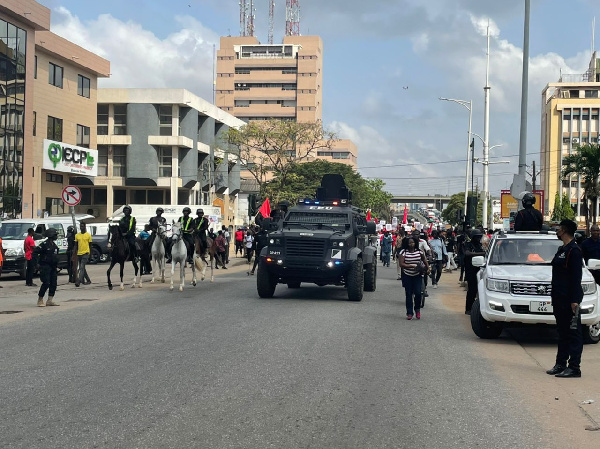
A number of police personnel with horses, and armoured vehicles were spotted at the demonstration grounds.
Ghanaians are faced with incessant increases in fuel prices, general economic hardship, soaring inflation, depreciating currency among others.
Government is currently seeking support from the International Monetary Fund to help salvage the ailing economy.
The Ghana Police Service has deployed personnel to oversee and ensure calm and orderliness at the ongoing Kume Preko Reloaded demonstration which commenced at Obra Spot in Accra on Saturday, November 5, 2022.
Live photos and videos coming from GhanaWeb reporter, Nimatu Yakubu, shows police personnel in their full gear comprising of helmets, bullet proof jackets, and face shields.
Also, trained horses and armoured cars have been stationed at vantage points to protect lives at the protest which has recorded an impressive turnout.
The ‘Kume Preko Reloaded’ protest led by Lawyer Martin Kpebu was organized to register Ghanaians’ displeasure over the current economic hardship and failed economy under President Nana Addo Dankwa Akufo-Addo and his New Patriotic Party government.
Protesters displayed several placards calling on the president to step down from his position including his vice president, Dr Mahamudu Bawumia as well as the Finance Minister, Ken Ofori-Atta.
According to our reporter, the demonstration has so far not recorded any causalities.
Of all the things I’ve lost during the pandemic, my partner’s relationship with his girlfriend is the last I would have expected to mourn.
I first met Sophie over Instagram about three years ago. Preston showed me her account at Thanksgiving with his family, back when she was just a pretty girl he’d gone out with three or four times. He’d scrolled a little too long for my liking, held the phone an inch closer to my face than seemed strictly necessary.
Perfect beach sunsets, perfect healthy breakfasts, perfect coffees with steam rising off them in handmade ceramic mugs. Yoga handstands, artfully messy mermaid hair, legs for days. “OK, yep, I get the picture,” I said, leaning back and away.
Preston and I had been together for two years at that point, polyamorous from the start. I had been in open relationships before, and despite my immediate sense that he was a person I wanted to be with for a very long time, I knew I wanted to keep dating women.
He was making a late-20s escape from a conservative upbringing and was eager to try out new ways of living. For us, polyamory meant the freedom to sleep with other people, but also the ability to fall in love with those people. It meant moving into a Brooklyn apartment together, but making sure it was a two-bedroom.
Sometimes, when he was out on a date and I happened to be at home and not on a date myself, I did feel jealous. If I couldn’t find a friend to distract me, I would scrub the kitchen and listen to podcasts, organize my bookshelves, anything to quell the roar in my head.
And then he would come home to me — sometimes at night, sometimes in the morning — smiling and full of gratitude. I knew that feeling of gratitude, because I felt it myself, each time I came home to him.
Each return was a conscious choice, not an obligation. That we could be in love and also allow each other intimate connections to other people seemed a minor miracle. Still, for those first couple of years, neither of us got involved in anything very serious.
“I had the chance to meet Sophie in person when I went to visit Preston just before Christmas … I figured I might as well see what I was dealing with, and I also wanted to meet the person responsible for the new glow of happiness in Preston, so bright I could even hear it in his voice.”
And then, along came Sophie. Preston and I were living about 1,000 miles apart, as I’d moved down South for a one-semester teaching job, and he’d moved out to the very tip of Cape Cod for a seven-month writing residency. I wasn’t thrilled to learn about her, could not manage my usual vicarious excitement. She was so beautiful, and, more threateningly, she was local, while I was not. She would be part of his big creative adventure, and I would mostly be a harried voice on the phone, with papers to grade. He and I would not have the grounding experience of coming home to each other. It didn’t help that I felt too busy and stressed to find anyone to date in the small, conservative town where I worked. My apartment got cleaner and cleaner.
I had the chance to meet Sophie in person when I went to visit Preston just before Christmas. I took deep breaths as we walked through the chilly gunmetal twilight, past closed T-shirt shops and bookstores, Provincetown yawning into the off-season. I figured I might as well see what I was dealing with, and I also wanted to meet the person responsible for the new glow of happiness in Preston, so bright I could even hear it in his voice.
We found Sophie behind the counter at the pizza place her family owns, helping customers, and I was glad to have time to observe her before we spoke. She wore a red-and-black checked flannel shirt, and her smile revealed a funny incisor, an asymmetry which made her look less perfect, but even more charming. Her movements were confident and sure, and she handled the customers with a firm sort of friendliness. After they left, she came out and said hello, slipping us free slices and quick hugs before more people came in.
As Preston and I slid into a sturdy wooden booth, I thought of the pizza joint in my hometown in Maine, which I had only known as a child. The pizza was perfect, crispy and blackened on the bottom. The restaurant was so warm and bright, its wide windows glowing with the dark blue outside, a safe place over which Sophie presided.
Over the next few visits, Sophie and I crafted an intimate friendship. When she came over to Preston’s apartment, tucked under the eaves in an old clapboard house, the three of us hung out late into the evening. When we watched movies together, Sophie and I often fell asleep, heads on Preston’s wide shoulders. Our affection for him spilled over onto each other. It felt natural to take her hand on a walk, to push her long hair from her face if her hands were full.
Sophie and Preston at OysterFest in Wellfleet, Massachusetts.
One day, I was sitting on the kitchen counter, and she leaned on my thigh absent-mindedly while talking to him. Startled by her own easy familiarity, she turned to me and apologized. But the contact made sense, in that strange middle space between friendship and romance, something that was quickly beginning to feel like family.
These visits kept us from becoming adversaries. She was never simply Preston’s Girlfriend, or worse, The Other Woman. She was Sophie. Sophie, with the surprisingly deep laugh, who always prepares elaborate snacks for outdoor adventures with friends. Sophie, doing foolish British accents too early in the morning. Sophie, fielding all the calls and texts from her large, close-knit family, the stable base of support whenever there’s trouble.
Sophie did her research. She read my memoir, sending me a heartfelt, detailed note afterward. New to polyamory, she bought all the guidebooks, listened to all the podcasts, to wrap her heart and mind around this new way of approaching love. She learned the term “metamours,” which described us — dating a person in common, but not dating each other. It still didn’t come naturally to her, to share. And despite our cozy friendship, I was finding it uniquely hard to share with her.
From afar, I began to sense a deepening connection between Sophie and Preston. He called a little less often, seemed distracted. He said it was the writing, but I wasn’t so sure. I started asking him questions to which I couldn’t get clear answers. How did he feel about her? What were their plans for after his residency, when he and I would move back to New York? How did she feel about him — what did she want? What were they, exactly?
In my loneliness, I grew frustrated, reading his ambiguity as dishonesty. There was too much room for him to tell me, out of love, what he thought I wanted to hear. I insisted that I didn’t care what they were, that I could adapt, but that I just wanted to know. What I was really trying to determine was: How much room did I need to make? What role would this person have in my life? I’ve since learned that the heart can expand much more than we think. But it’s work, that expansion. I wanted to know how far I would be asked to stretch, so I could figure out if I could really do it. In her research, Sophie was doing the same thing.
Sophie and Preston in Provincetown, Massachusetts, February 2019.
Curiosity, I’ve learned, is the best antidote to jealousy. Sophie once used Preston to restage my favorite picture of David Bowie — black jeans, leather jacket, shirtless. I’d never seen him look so intense. On another day, I got to see him bartending at a charity fundraiser, head thrown back, laughing, center stage in a way he usually doesn’t allow. Sophie’s texts and photos meant I was never forgotten or disregarded, never excised from the equation. She could easily have imagined me away, but she never did.
Finally, she sent a selfie of them together, big flakes of snow suspended around them. He’s wearing a faux fur hat he bought with me on a trip to Maine, and his gloved hand is reaching over to snug her scarf closer to her smiling face, protecting her from the wind. As I looked, the knowledge that they were falling in love bloomed slowly within me. It seemed they hadn’t even realized it yet, and there was an odd safety in being the first one to see it.
That unfiltered image told me more than any strained conversation ever could have. I realized I’d been asking him for the impossible. Who can articulate their intentions, their exact, true feelings, at the beginning of a developing relationship? How could he answer me with precision if he wasn’t yet sure where it all would go? Like snow, love requires a delicate set of circumstances, slightly different each time. The air is heavy with possibility, and then, suddenly, beauty. Through Sophie’s eyes, I could see it.
In March 2020, as the pandemic fell upon us all, Preston and I were living together once more, and Sophie was home in Provincetown, preparing her restaurant for an unprecedented season. He and I had once again moved far away for jobs, this time together, to the middle of the country. Over the previous year, they had been visiting when they could. But finally, when it became clear that travel would remain fraught indefinitely, she called off their romantic attachment.
“Like snow, love requires a delicate set of circumstances, slightly different each time. The air is heavy with possibility, and then, suddenly, beauty. Through Sophie’s eyes, I could see it.”
Back when they were falling in love, when I was coming to understand the long-term realities of this polyamory thing, I might have been relieved at their transition back to friendship. I would have welcomed how much simpler it made my life. Less ambiguity, less worry, more time one-on-one. Instead, I thought about Sophie working to feed a community, to keep a decades-old business going, to care for her ailing mom. I knew she was more than capable, but I also knew how helpful Preston could have been, had he been there with her. As I read on our porch, my knee pressed to his, or sat in Zoom calls at my desk, hermetically safe, I had the hollow feeling of having won a contest no one had entered.
The pandemic robbed us all, for a time, of the ability to see our partners through other people’s eyes, to watch them tell a story to someone else at dinner, to see them perform onstage, to witness the adorable and infuriating regression that happens when they visit their parents. During these long periods of isolation, I had the daily companionship that I had sometimes envied. But I had only my own limited, myopic view. I missed those photos from Sophie — the surprise of a new expression, the evidence that my partner was appreciated by people other than me, that he was receiving abundant, varied love. I missed teasing him together, having the perfect witness to his peccadilloes and quirks. And I missed, too, the friendship Sophie and I had before, the two of us peering at each other with bemused expressions, as if to say, Who would’ve thought?
Last year, when the world opened back up and we accessed the immense privilege of vaccination, we each cautiously began dating again. There’s a woman I see in New York, although I don’t yet know what that connection will be. Preston has a local girlfriend, and this time, I don’t have to work so hard to open up space for her. It’s already there, ready to flex and change. There is always a spot on our couch for her, for movie nights and “Saturday Night Live,” and we trade notes on the weird daily habits of this person we love. Sophie has reconnected with a love from long ago, and this time, to her surprise, they’re trying polyamory. She recently met a new metamour, and told me that she’s extending the same welcome that I gave her.
The other day, Sophie texted a photo she once took of Preston and me. He’s sitting in a chair and I’m leaning over his shoulder, arms wrapped around his chest. The image is carefully framed, and close up. It’s a shot that was taken with love.
DISCLAIMER: The Views, Comments, Opinions, Contributions and Statements made by Readers and Contributors on this platform do not necessarily represent the views or policy of Multimedia Group Limited.
Some of the demonstrators at the “Ku me preko” protest on Saturday chanted and called on the President, Nana Addo Dankwa Akufo-Addo to resign over current economic woes.
The protestors who massed up at the Kwame Nkrumah Interchange were clad in red and black attires holding placards with inscriptions such as: Adinkra Symbol of failure, Boo the President, Sika mpɛ mismanagement, Protect Journalists, impeach the President, the battle over the Lord sef, among others.
Speaking with the media, one of the organisers of the demonstration and a social activist, Oliver Barker-Vormawor explained that the protest is to kick against the Akufo-Addo government’s abysmal performance.
He claimed that government appointees have enriched themselves with state funds at the detriment of the ordinary Ghanaians, adding that the government has failed to deliver on its mandate hence the need for Ghanaians to sack him from office.
“Democratic culture is built on accountability, and demand of citizens for their lot. It is written into the fabric of democracy that, if the leadership, those who have sought the mandate of the people fail to deliver that mandate, people have the right to take back that mandate from them. We say sovereignty belongs to us as the people. So from time to time, we must demand it be returned to the people. This is what this demonstration is all about. The willingness to stand up against brutality, against a regime that is continuously being oppressive, this is what we are here to do, this is what the people have come here to speak against,” he fumed.
Though the turn-out was not what they expected, Mr. Baker-Vormawor said he was happy about the number of people who gathered to support the demonstration.
He said the gathered protestors are witnesses to the government’s terrible ruling of the country.
“I’m not disappointed at the numbers, l thought l was coming to walk alone, but l came and met people more than l thought. People have showed up, so we are ok with it,” he said.
A number of police personnel with horses, armoured vehicles were spotted at the demonstration grounds.
Police in Duayaw Nkwanta in the Tano North Municipality of the Bono Region are on a manhunt for men who attacked and inflicted bodily wounds on two Policemen for the release of two miscreants they arrested.
A Police situational report sighted by MyNewsGh.com indicates that machete-wielding hoodlums numbering about 15, had earlier attacked the residence of the Chief of Adrobaa, a drug store and two other houses.
Following the attack, machete wounds were subjected on occupants of the residence after which they escaped from the scene
One PoliceCorporal Philip Sion and Constable Bernard Amoah upon getting wind of the attacks rushed to the scene. While on their way to the scene at Adrobaa, they spotted the machete-wielding young men who were riding at top speed towards Terchire.
The Police suspected that these young men could be part of the people who attacked the Chief’s Palace and therefore decided to stop them but they defied the Police and sped off.
The Police gave them a wild chase and captured them some 200 meteres close to the Terchire Police station and handcuffed them. A few minutes after they were arrested and handcuffed, thirteen young men came to the scene and demanded the release of the two arrested young men but the Police stood their ground and insisted they will not release the arrested suspects.
A scuffle ensued between the Police and the thirteen men and unfortunately, Police Corporal Philip Sion discharged his firearm on one of the men. He was attacked by the thirteen men. The Police officer was hit on the back of his neck with a club and fell and he was pounced on whiles Constable Bernard Amoah struggled with others over the release of the two handcuffed men.
Sensing danger, the Police ran for cover to the Terchire Health Center where they received treatment.
Meanwhile, when a reinforcement team arrived from the District Command, it combed through health facilities in the area where they met one of the suspects called Bilari Fuseini receiving treatment while Mutakiro Fuseini had been pronounced dead.
Police are currently on a manhunt for the remaining suspects.
About 27 years ago, the biggest demonstration to have occurred in Ghana’s history took place.
Those at the forefront of this protest were Nana Addo Dankwa Akufo-Addo, Dr Charles Wreko Brobbey, Kwasi Pratt Jnr, Dr Nyaho Tamakloe, Abdul Malik Kwaku Baako, Akoto Ampaw, Victor Newman, Kwaku Opoku, Napoleon Abdulai and was also joined by some 100,000 people.
What was termed as the high cost of living and particularly, the imposition of Value Added Tax (VAT) on items fuelled the demonstration against the then Rawlings administration?
According to reports, it was a period in which able-bodied and hardworking citizens could not afford one decent meal a day for a family.
In addition, the drop-out rate in educational institutions was said to be rising at a very alarming rate.
However, what started as a peaceful protest turned gory when some unidentified assailants opened fire on the demonstrators.
Many sustained severe injuries and others died from the attacks.
Read the full story originally published on May 23, 1995 by The Statesman
The Stateman’s article on ‘Kume Preko’ and its aftermath
Kume Preko the demonstration against the high cost of living in Ghana particularly, the imposition of Value Added Tax (VAT) on items – has come and gone. But the after-effects of the bloody confrontation between the ACDRs and the marchers are far from over. For some families, the pain has just started. For those who lost husbands, the pain is even more as the burden of caring for the family will now fall on fewer shoulders. Naturally, reports of the horrors committed during the match keep filtering in. Ghana Review presents the story below which is culled from the Ghanaian Chronicle.
Tales of horror – Kume Preko victims recount their ordeal by Olivia Nyarko
After the dust slowly settled on the “Kume Preko” march, tales of untold horror and homicide have started filtering in.
CHRONICLE interviewed some of the relatives of those who were on admission at Korle-Bu for injuries sustained during the demonstration.
Kwabena Gyan, the brother of Yaw Atta who was shot in the chest and scrotum recounted what could well have happened in the back streets of war tone Liberia. The 26-year old secondhand shirts dealer said on that fateful Thursday, most of the sells around the Accra Central Railway station went to the station with the intent of watching the march just as they had done on other occasions when there were demonstrations.
Kwabena Gyan said the savage scene of a beggar who was shot in cold blood by the ACDRs sent all the boys running towards the Central Police Station for refuges, but the ACDRs would not let them go unscathed.
During this chase the brothers were separated. Each fled in the opposite direction. Narrating their ordeal, the wounded Yaw Atta said while standing at the Police station, he saw that his brother, who was at the Cocoa House, which is opposite the Police Station, was stranded on the almost empty street. “Out of panic I tried the last resort of calling and signalling to him to come over to my “safe haven”. Before I was through, blood was dripping from my jeans. I fell backwards, but hemmed in by the ACDR men who were shooting indiscriminately at this time, my brother could not cross over to pick me up”, he recounted.
Moved by his brother’s attempt to save his life, Kwabena Gyan said he braved it out on the street to his injured brother’s side. ” I lifted him from the pool of blood and by a hair’s breadth another bullet missed us from the same guy who shot my brother. After the firing died down, some sympathizers helped them to take him to the Accra Central District Police Headquarters, were he was sent first to the Police Hospital and then later to the Korle-Bu Emergency Ward”, he intimated.
With their double encounter with the ACDR man, Kwabena Gyan swore that he can easily identify him wherever and whenever
he meets him.
Abdulai Rahman Omanu, a cargo truck driver with registration number GM 5756 was also shot in the head at the Rawlings Park on the same Thursday.
Osmanu, who was on admission at Korle-Bu could not talk for three days. Finally when he could talk, he gave a tearful account of what happened to him. He said, that morning, he had just arrived from Kumasi at the CMB station but had no idea of the “Kume Preko” march , so he told his mate to look after the foodstuffs while he went to deliver an important message to a relative.
However, Osmanu never got to his destination. He said: “At the Rawlings Park I suddenly felt a sharp pain in my head. Then I fell on my face. Afterwards, I woke up in hospital”.
Meanwhile, a sympathiser, Mr Kwadjo Kusi, who had come to visit a friend at the Emergency ward is taking care of him and making efforts to contact Osmanu’s wife and two children in Kumasi.
According to another eyewitness who wanted to remain anonymous, a young boy was selling yoghurt was confronted by ACDRs around UTC. He said they seized his yoghurt, consumed some and threw the rest into a nearby gutter. Then one of them hit the boy’s head with an akpeteshie bottle.
Fearing for his life, the boy attempted to run, but about four of the ACDRs grabbed him from behind, while another shaved his hair clean with the broken bottle. Then they started a deadly game of piercing his clean-shaven head with pieces of the broken bottle. The more blood spattered out, the more the boy cried in agony, and the more thugs continued with their new found game, until he dropped unconscious in his own blood.
On that same street, about 25 men in ACDR T-shirts rushed on and beat workers at the Republic House mercilessly.
A worker of the Ghana Supply Commission (GSC) gave CHRONICLE an eye witness account. He said some of the workers were standing on the frontier of the Commercial Bank as they normally do, when a group of ACDR men attacked them. Mr Amoah, a worker at GSC sustained injuries on his shoulder. “We later sent him to the State Insurance Clinic, where he was treated.”
The source also revealed that the thugs hit Mr Dramanu, a Commercial Bank Official on the mouth with he leg of a broken chair. He said what infuriated him most was when a man who was standing by to pick a taxi was beaten until he was forced to obey nature’s call on the street. “Even when the man was trying to pick his file and mobitel which had been scattered on the floor, these ACDRs wouldn’t allow him. They rather ordered him to run towards the Bank for Housing and Construction”, the source said.
Hundreds of Ghanaians hit the streets of Accra Saturday morning to demand better living conditions.
The protestors, wielding placards and clad in red and black attires, want the resignation of the current leadership of the country.
They also bemoaned the rate at which the prices of goods and services keep rising in Ghana.
According to them, most Ghanaians are not able to afford a decent livelihood due to the mismanagement of the country’s resources by the government.
Spotted in the early hours of the morning were Lawyer Martin Kpebu and Lead Convener of the “#FixtheCountryMovement”, Oliver Barker Vormawor.
Written on placards the protestors held in their hands are inscriptions line “Power belongs to the people. Resign Now!!! Over 10 million Ghanaians may be homeless & 85% sleep rough”; “Mr. President, You are wearing a pair of oversized shoes. Step down.”; “Nana, Ghanaians are tired of your government”; “New Constitution Now”, among others.
Kume Preko reloaded: Demonstrators hit the streets of Accra in charged mood
In the midst of economic hardships fueled by high inflation rates, some Ghanaians have dedicated today, November 5, 2022, to demonstrate in demand for better living conditions.
0 seconds of 3 minutes, 18 secondsVolume 90%
Meanwhile, the organizers have charged protestors to eschew any form of violence.
Self-acclaimed investigative journalist, Kemi Olunloyo, claims there is a generational curse in Davido’s family.
According to her, she believes the curse can only be broken by Davido spiritually.
Her comment comes a few days after the death of Davido’s son, Ifeanyi who drowned in a swimming pool on Monday, October 31.
The controversial journalist also hinted at releasing a documentary series on the numerous deaths and generational curses in the Adeleke family.
Kemi alleged that her father told her about Davido’s late uncle, Isiaka Adeleke. She further stated that she was friends with Davido’s late mother, Vero Imade Adeleke and she babysat Davido.
She wrote: “Today I’m launching #TheAdelekeCurse TikTok DOCUSERIES based on true life stories my father told me about several years ago. Late Uncle Isiaka was very close to my dad. I was very close to Late VeroImade in ATL, babysat David a few times in my ATL days 1992, 2003. This will be the sequel to my underrated YouTube docuseries #SurvivingDavido.There is a generational curse no one can fully explain BUT I personally believe only DAVIDO can BREAK IT SPIRITUALLY.”
Davido has over the years lost some close friends and aides with many having different opinions on the reason for his loss.
DJ Cuppy, the daughter of billionaire businessman, Femi Otedola, has disclosed why her father spent a whopping €3 million to rent a luxurious yacht to celebrate his 60th birthday.
The billionaire rented the yacht belonging to late Greek shipping magnate, Aristotle Onassis, who was once regarded as the richest man in the world.
Mr Otedola, his wife, children, and soon-to-be son-in-law singer, Mr Eazi, were spotted in a video entering the luxurious yacht on Wednesday, November 3.
Taking to her Instagram page on Thursday, Cuppy wrote: “My father Femi Otedola, always dreamt as a little boy to visit the iconic 99m super-yacht Christina O because it was owned by his (and my) role model Aristotle Onassis.
“To celebrate his 60th, not only did he visit the yacht, but has chartered it for his loved ones so we can live here for the next 3 weeks! Looking at my father I can see how happy, accomplished, and still in disbelief he is. This is what love looks like.
Going blind made me worry I would never be able to enjoy a holiday again. What would be the point of sightseeing? And yet, I have just been on one of the most amazing trips of my life.
Wearing my lovely new walking boots, I suddenly realise I have stumbled on a “midden” – a pungent pile of rhinoceros poo. With every gust of wind I get a fresh whiff.
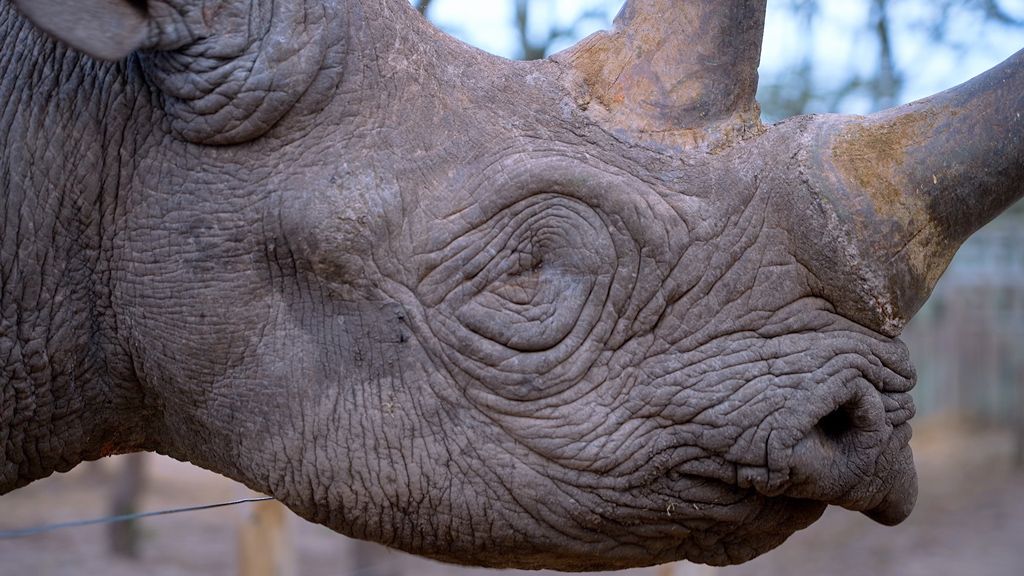
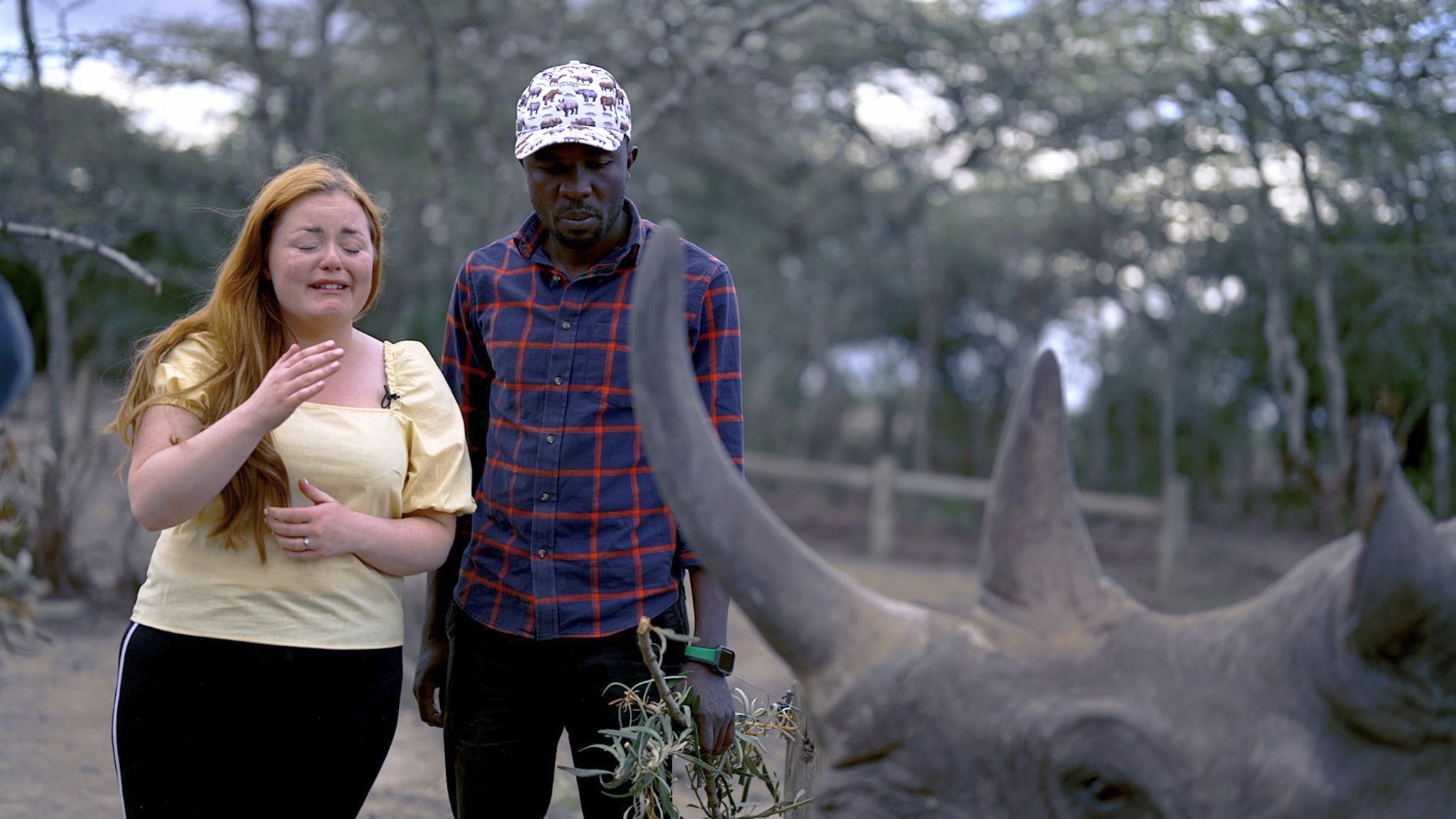
I am at the Ol Pejeta Conservancy – a 90,000-acre wild animal sanctuary on the equator in Kenya. The keepers there let me reach out and touch the skin of a rhino called Baraka. Like me, Baraka is blind
His skin is not as smooth and lizard-like as I expected it to be – it feels rough, like cardboard.
He lost his right eye in a fight with another rhino – and a cataract stops him from seeing out of his left eye. He has to be kept alone because other rhinos would attack him – and his keepers tell me he can be nervous about moving around. Trees in his big enclosure have damaged trunks and broken branches, from where he has walked into them.
I sympathise with him. I was also nervous when I was asked to travel halfway around the world on a trip which, for most people, would be the opportunity of a lifetime
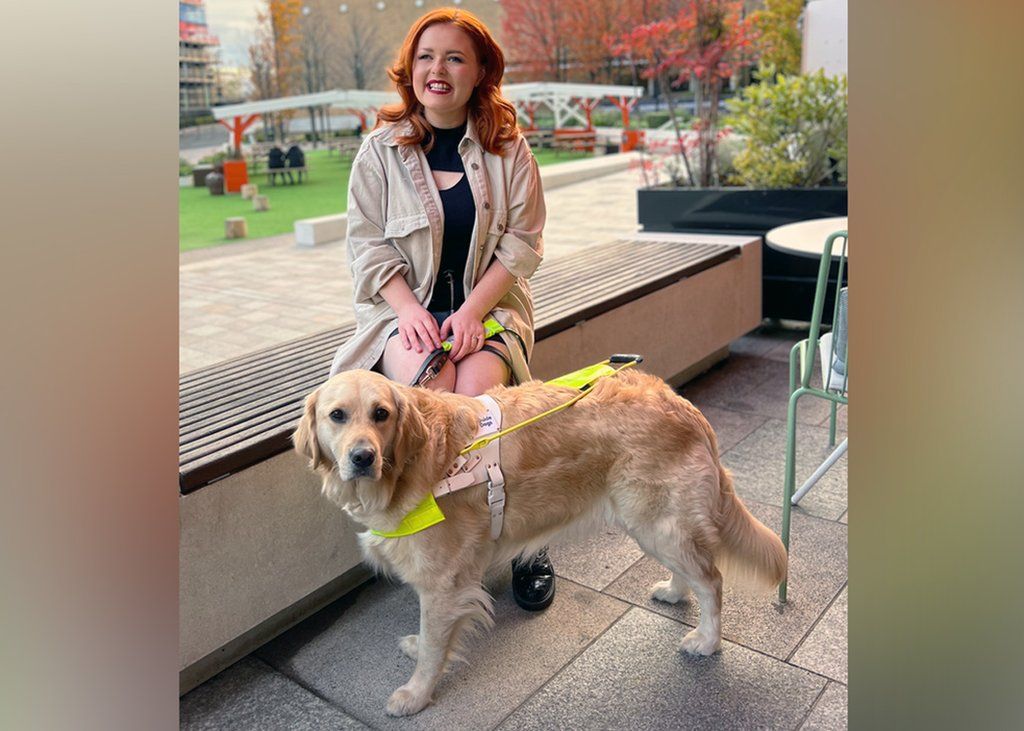
Not only would it be very different from my usual life of advocacy work for the UK’s blind and partially sighted community – both in person and on YouTube – but it would also mean leaving behind my beloved guide dog, Molly.
Image caption, Baraka lost his right eye in a fight with another rhino
Image caption, Meeting Baraka brought Lucy to tears
I lost my sight nearly 10 years ago – when I was 17 – due to a genetic condition. It took me a while to get used to going on holidays as a non-sighted person, which I used to view as just a really expensive way of basically being in my back garden.
I now know I can still enjoy foreign travel, despite not being able to see – but going on a safari? Surely it’s a “must see” experience?
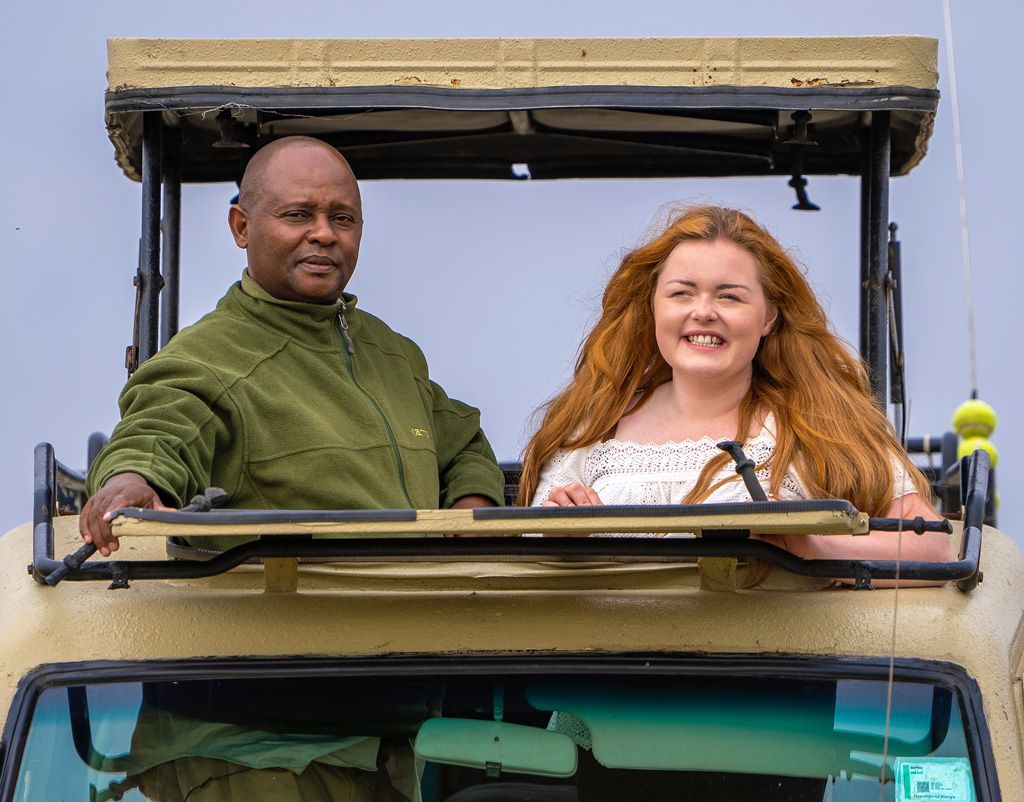
I felt a lot better after I met my safari guide, William. He had taken a blind person on a similar trip once before – but, because every non-sighted person has varying levels of visual acuity, we still needed to get to know each other.
Image source, Lucy EdwardsImage caption, Back home, Lucy relies on guide dog Molly to get around
My visual memories of most things – including wild African animals – are almost completely gone. Those that remain are like a series of photos which have been locked in a drawer in my brain for the past decade. If I try to recall an elephant for example, a visual memory comes out of the drawer of an animal tapestry my sister had on her bedroom wall when we were children.
So I was going to have to start from scratch and make sure I got a great experience from using my other senses. I know it may sound weird, but I genuinely don’t miss having my eyesight, and even in Kenya I didn’t spend time wishing I still had it.
First, William took me to a museum in Nairobi where I was allowed to touch stuffed exhibits. I rely so much on my other senses now, so to be able to reach out and feel the skins of elephants and giraffes really helped me start to “see”.
Image caption, “We were in the wild Africa of storybooks,” says Lucy – pictured with her guide William
My senses then really started to awaken as we drove out from the city in our four-wheel drive vehicle. The ground became so bumpy as we sped along, and the car smelled of sand which wafted into my face in the wind. I wore sunglasses and put my head out of the window – I really wanted to drink in the atmosphere.
At the Ol Pejeta sanctuary, William and the keepers brilliantly described the rhinos and elephants in front of us – how they were moving, eating, reacting to us and each other. It all helped paint pictures in my head. James Mwenda, a global ambassador for the sanctuary, crouched down with me and we felt the footprint of a rhino in the dusty ground.
We then put our hands in a pile of dung. Much of it is just semi-digested grass, he told me. I gave it a good sniff – it just smelled of grass that had “gone off”.
Visually impaired social media star Lucy Edwards heads to Kenya to experience one of the largest animal migrations in the world.
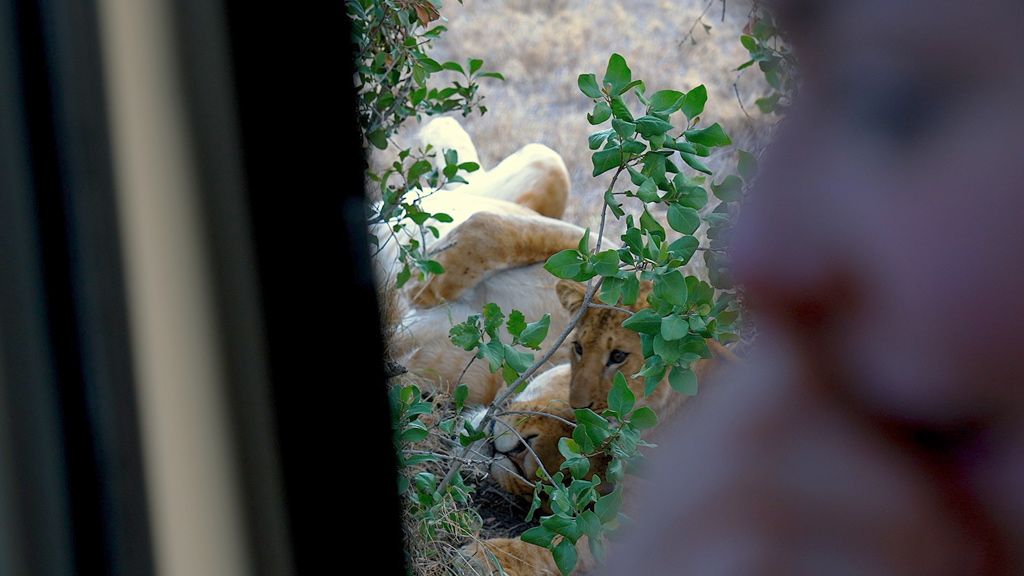
We drove in search of lions – tracking a special collar worn by one of the lionesses who, like me, is called Lucy. We pulled up slowly alongside her – she was fast asleep. We were so close I could hear her breathing through the window.
I asked William if she looked like the lions in The Lion King? That was the last image of the animals I had stored in my memory vault. Yes – he told me. And her cubs, close by, looked just like the movie’s young hero, Simba.
Image caption, Lucy the lioness, and one of her cubs, relax – as Lucy the human listens intently
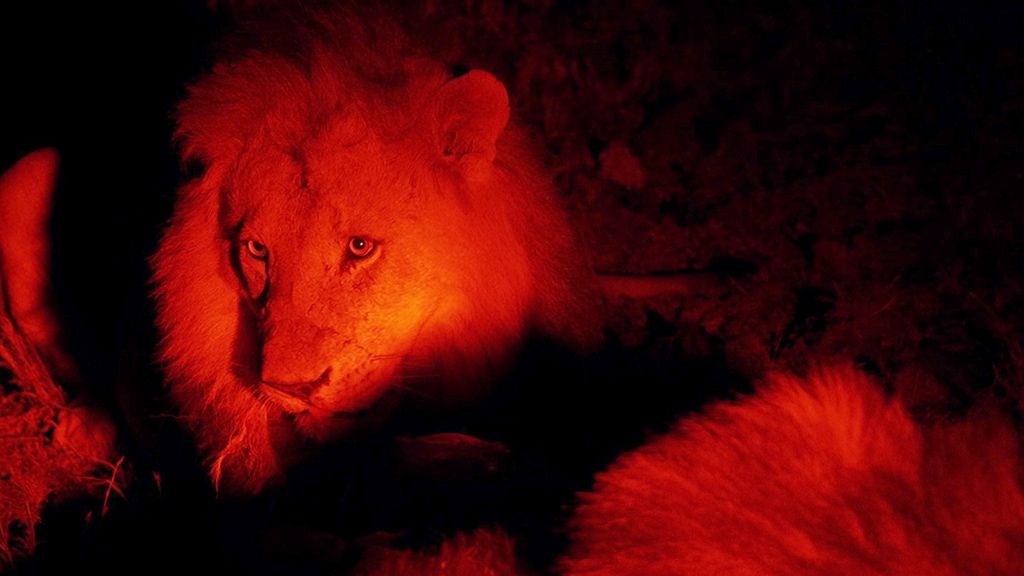
Image caption, The lions were out hunting the Masai Mara at night
The sensory overload continued on our midnight safari. It seemed as though I could smell so much more than in the daytime, and hear every little sound. I was so lucky to experience a bush kill.
We had suddenly heard a loud screeching noise. We drove quickly, over really bumpy ground, down into a ditch. I then listened as two lions chased a herd of buffalo – before hearing the sound of bones cracking and flesh being chewed. It was such a privilege.
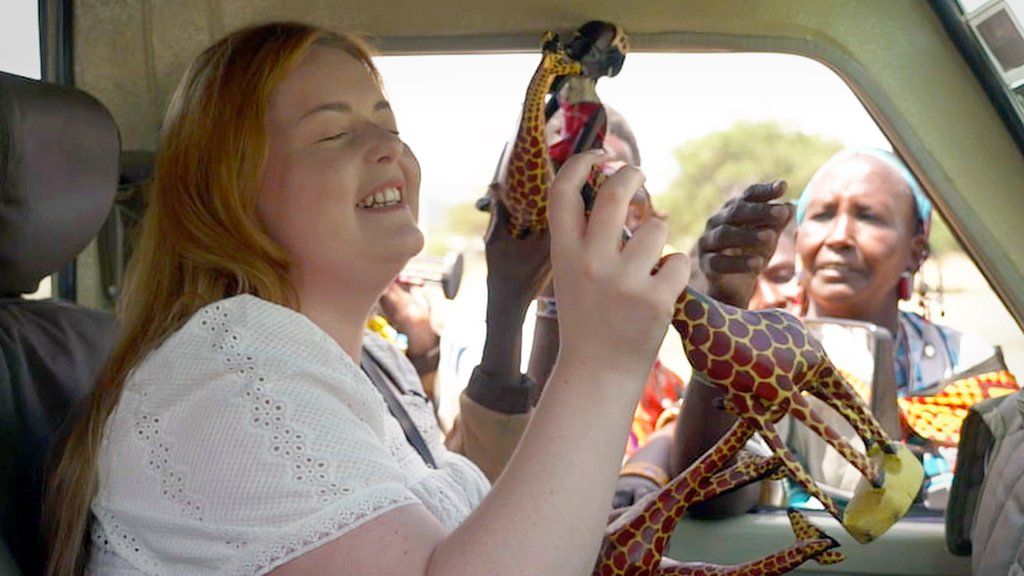
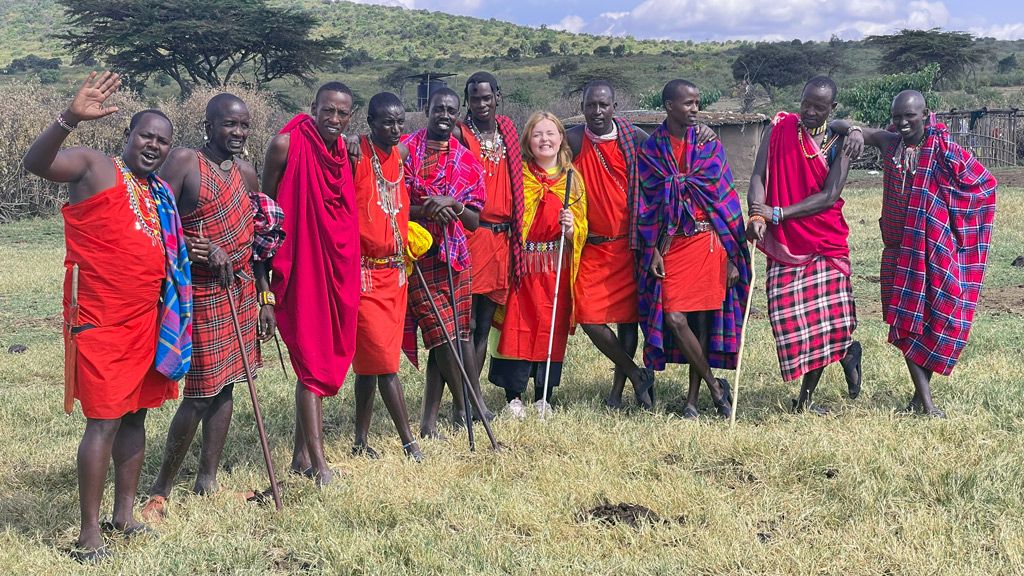
We then headed south to the Masai Mara game reserve – the wild Africa of storybooks. We pulled into a village of the Maasai tribe and, before I even had the chance to get out of the car, we were surrounded by local women trying to sell us carved wooden animals. It was crazy. I bartered with them and bought two giraffes.
Flies buzzed around my face as we walked, and I could hear bells clanking – I was told they were tied around the necks of goats. In a hut, with the smell of wood all around me, I tried on some traditional Maasai clothing. Tartan patterns and lots of red, I was told. I loved the feel and noise of the beaded jewellery which I also wore.
Outside, I was then treated to an amazing audio experience – traditional Maasai singing and chanting. A wall of sound was all around me.
Image caption, Lucy decided to name the wooden giraffes she bought “Lenny and Gerald”
Image caption, Lucy was given a traditional welcome by Maasai villagers
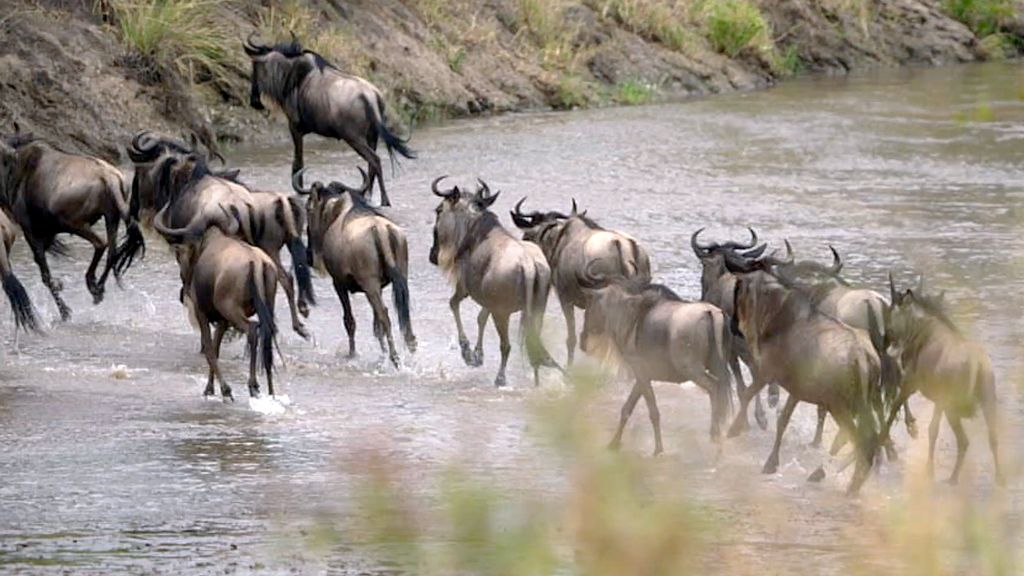
I had really wanted to experience the sounds and smells of the “great migration” – when millions of wildebeest and other herbivores, like zebras, make the dangerous trip from the Serengeti in Tanzania to Kenya in search of fresh grass. Predators – big cats and crocodiles – wait to pick off the weakest travellers.
Deep in Masai Mara, in the early morning, we found tens of thousands of the animals. They were all around us. Herd leaders were calling out, making moaning sounds. The noise was everywhere – like it was in 3D.
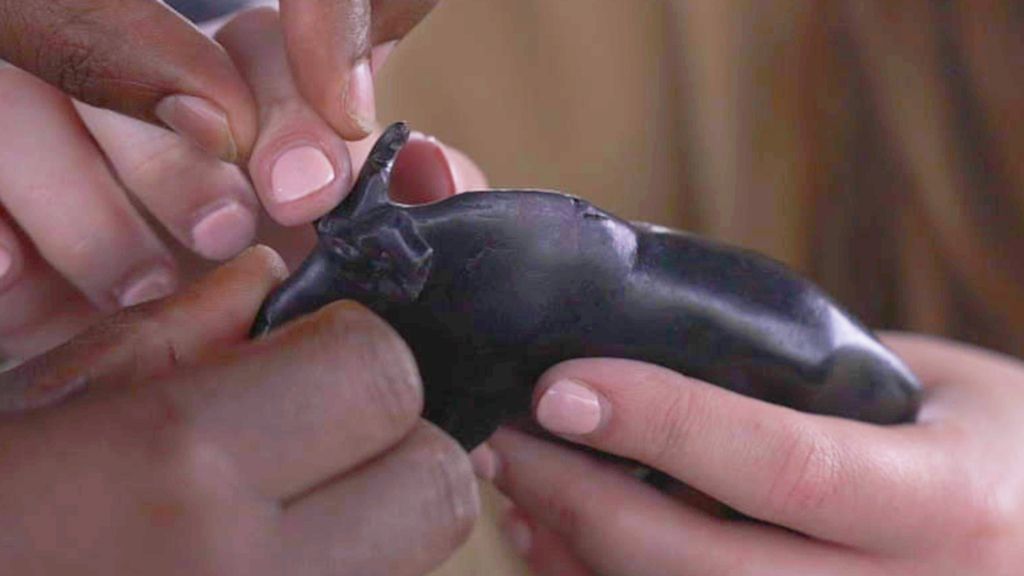
I held a small wooden model of a wildebeest, as William described the sight before us. Wildebeest have very weak legs compared to the size of their bodies, he told me, and some will break bones when they jump in rivers to cross. The top is like a horse, with horns like a cow and a beard like a goat.
Image caption, William guided Lucy’s fingers over a wooden model to help her visualise a wildebeest
Image caption, Lucy heard the pit-pat of hooves and water sloshing as wildebeest crossed a river
The giant herd set off for another day’s travelling. I could hear the pit-pat of hooves on the ground and then, as they tumbled down a riverbank, the sound of water sloshing around.
Being on safari had been amazing, but there was one experience which I had really worried about – because I wasn’t going to be able to see it. It was the so-called “sundowner” moment, when people sit and have a drink at the end of the day, watching the sky turn orange and red as the sun disappears over the horizon.
But when the moment actually came, there was no sunset – it poured with rain instead. I cried happy tears. It was as though the world was letting me know that I didn’t need to see the sun.
It hadn’t rained for weeks and weeks, but the heavens had opened just for me. The giant raindrops, and the sound they made as they splashed down, felt like a perfect sensory end to what had been the best trip of my life.
In our series of letters from African journalists, Tony Vinyoh looks at how his cousin’s medical school rejection was one of the many examples of why a secessionist rebellion has dogged English-speaking parts of Cameroon for nearly six years.
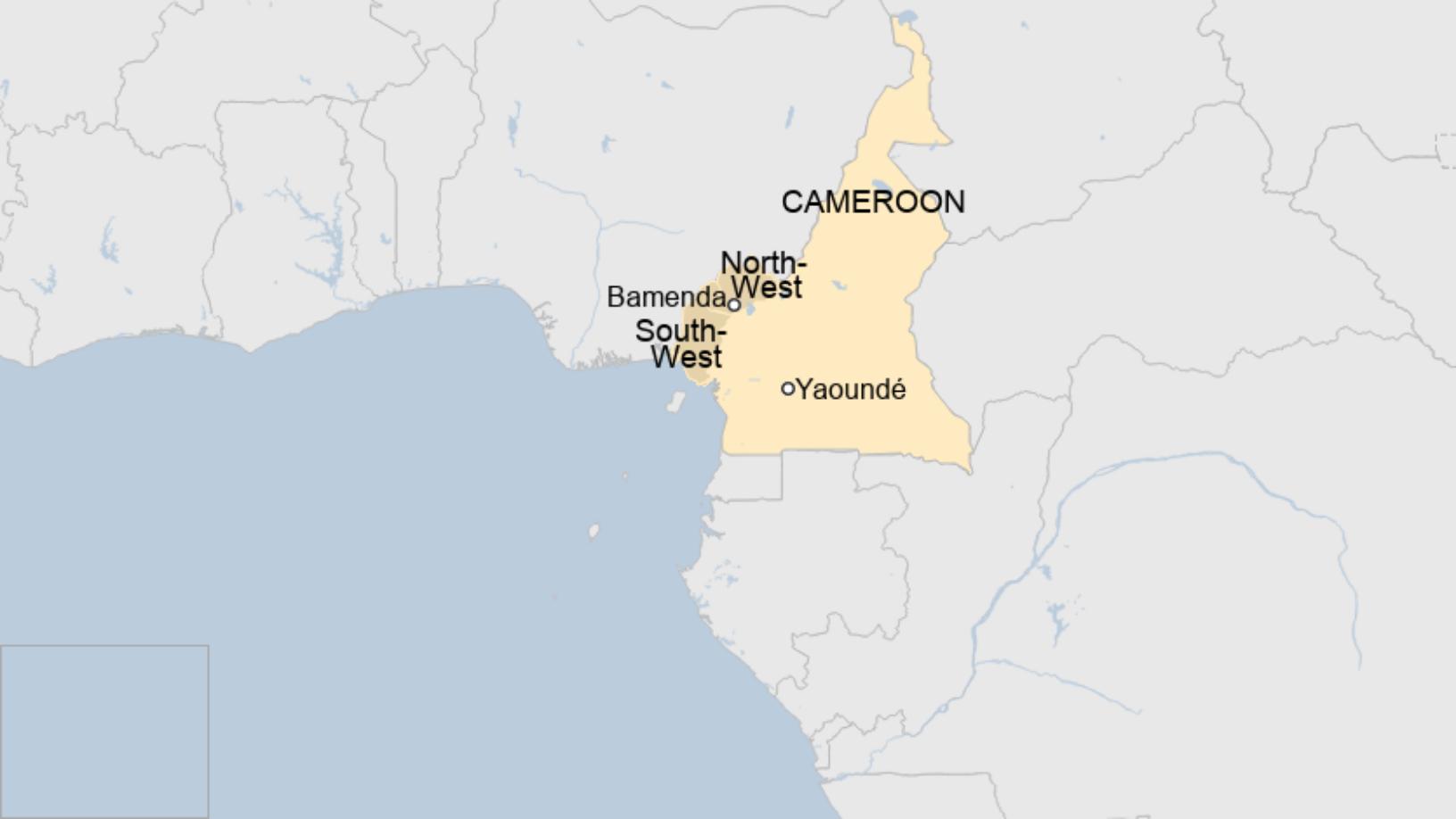
It is easy to classify the war in Cameroon’s English-speaking regions of North-West and South-West as a clash over language. What this conflict really embodies, however, is a battle for fairness and access.
When I accompanied my uncle and his daughter in 2016 to check her medical school entrance results, I knew she would not make it.
At the entrance of a campus in Bamenda – the main city in the North-West region – were hundreds of science students, who had all passed their A-Levels, scrambling to find their names on the notice board. Most of them had not made it.
Some were bemused, others cried, some laughed about it. Together, they were all sharing their first real experience of living as English-speaking Cameroonians.
The odds were stacked against my cousin – and against all English-speaking Cameroonian candidates – trying to get into a government-run medical school.
It was a stark example of their marginalisation by Cameroon’s French-speaking majority.
T Vinyoh
Some Francophone students and even lecturers would hurl insults when they heard English or picked up the accent in our well-rehearsed French
The medical school entrance paper my cousin sat was in English – with questions often poorly translated from French making some of them incomprehensible and marked by those who are not proficient in English. So very few English-speaking students are accepted.
It effectively bars many English speakers from attending state-run universities, where students receive subsidised tuition. It is also common to hear allegations of bribery, which is rife throughout Cameroon, with wealthy parents “buying” a place for their child.
We were just one of the many families going through disappointment in Cameroon’s Anglophone zone – and by November 2016 the demands for education, judicial and other reforms escalated into calls for a two-state federation. It later erupted into a secessionist war that has claimed tens of thousands of lives.
Lost in translation
The prevailing system means there are fewer doctors from North-West and South-West Cameroon practising at home. Even for the Francophone doctors who speak English, it is hard for them to relate to a culture and environment they were not raised in.
Those I have met are dedicated to their work, but sometimes it takes more than desire to apply medicine. Medics at a hospital in the North-West region told me about a man who had surgery for testicular cancer and went home believing he was cured.
His French-speaking doctor could not get it across that he had to return for a follow-up. He only came back when he started feeling pain. The man died.
In rural areas, for example, not everyone can speak lingua francas like English or Pidgin.
I once interviewed a woman in my village for an article I was writing about cataracts. She only spoke Lamnso, with which I am familiar but not fluent, so I employed a translator to put us both at ease.
The fact that she did not consider me an outsider also allowed her to talk freely about her eye surgery and encourage others to try it.
Some health professionals believe the government’s push to improve issues in the medical field has borne fruit over the last six years.
There are now two functioning government-run medical schools in the two English-speaking regions – there was only one when my cousin applied – and an oversight committee to implement reforms. Students also report better translations of exam questions but nothing near professional standards.
Trainers say more is being done to improve the cultural awareness of doctors and they are seeing more English-speaking Cameroonians in their classrooms than they ever met when in medical school themselves.
While medicine may be slowly starting to improve, there is a lot more to achieve in public life.
Harassment and humiliation
Many Anglophones feel that French has been used as a language of intimidation from the earliest days of the union between French Cameroon and what was British-controlled territory.
And since the uprising began, many more French-speaking police officers have been sent to patrol the streets of Bamenda, where they constantly check IDs. They get angry if someone cannot speak French, demand money at roadblocks and sometimes force young women to share their phone numbers.
When I go around Bamenda with those fluent in administrative French, we have no bother with such harassment. I am in awe of the way their use of French gives me a pass in my hometown.
Image source, Tony Vinyoh
Image caption, Silly mistakes and bad spelling are common in textbooks chosen by the government for Anglophone schools
The challenge for Anglophones is that we simply cannot hide.
While studying biochemistry at the University of Yaoundé, I – like many English-speaking students – never bothered asking questions in class because of the abuse we got. Some Francophone students and even lecturers would hurl insults when they heard English or picked up the accent in our well-rehearsed French.
Thousands in state-run universities have to buy translated notes or pay for extra classes in English to compensate.
Our parents are often humiliated by French-speaking civil servants when they have to travel to Yaoundé to chase up their unpaid pensions, victims of bureaucracy that seems intent on cheating them.
More the Anglophone crisis:
Set texts for Anglophone schools, chosen by the government, are often poorly edited and written – leading to falling standards.
Yet it is ironic that in spite of the conflict prestigious private Anglophone schools have become sought-after by affluent Cameroonian parents who cannot speak a word of English themselves.
They understand that the best opportunities will eventually go to graduates immersed in both cultures, speaking flawless English and French.
A graduate who was raised speaking French at home while studying in English from nursery school is a formidable asset. They are the perfect fit for scholarships and international jobs in bodies like the UN.
Even during a war that was triggered by discrimination, they are the right fit for global organisations trying to wade through Cameroonian bureaucracy.
Some English-speakers see this influx as an opportunity for their children to learn French, but others are uneasy about the change.
Image source, Tony VinyohImage caption, Schools have been destroyed in the conflict – this one in Bamenda has now been rebuilt, but most lie abandoned
With a focus on those who can pay fees upfront – and can extend generous donations – English-speakers are finding it more difficult to go to these schools.
Until the late 1990s some parents in English-speaking areas, like my mother, still paid fees in instalments or with food crops like beans, maize and vegetables. Their children got an education and the food was used to feed students.
The reality now is that the vast majority of children in the conflict-hit areas have gone from receiving a sub-standard education to little or no education at all.
Would-be students with too much time on their hands have turned to crime, scamming and the all-too-easy life that bitcoin trading promises. At a time when they should be at school, many teenage girls are raising babies from unplanned pregnancies and rape.
Back in 2016, after months of anguish, my uncle took out a huge loan and sent my cousin to Uganda to pursue her dream as she could not do it in her own country – and when she qualifies she may opt not to return home.
The war is now also driving many healthcare workers, teachers and students away, a trend that will have dire consequences for the region and the economy.
But what most in the English-speaking regions want – from those calling for federalism to those wanting secession – is to live in a country where their children will not have to start life with an insurmountable handicap.
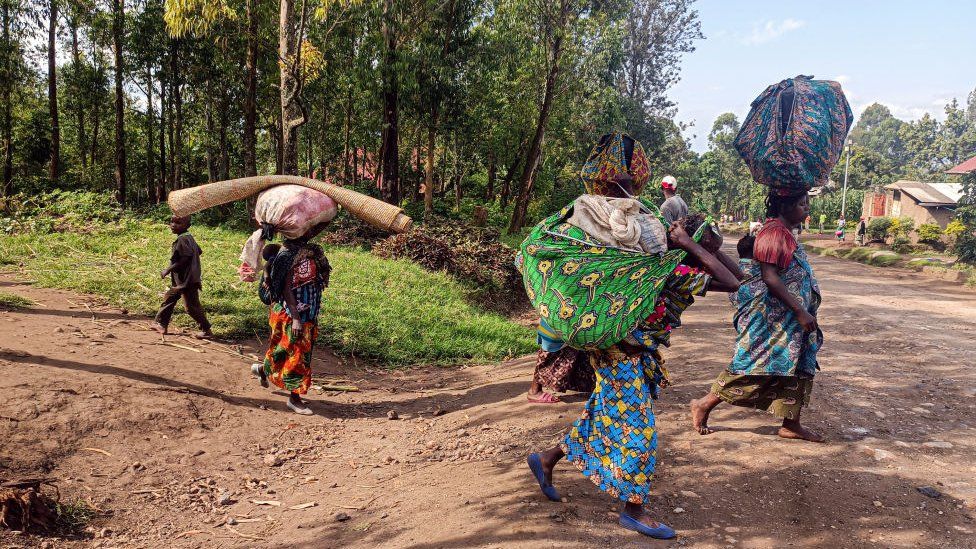
More than 100,000 people have fled their homes and dozens been killed after fighting reignited between Congolese soldiers and the M23 rebel group, in one of the world’s longest and deadliest conflicts.
Now, Kenyan forces are joining the battle to support the Congolese military, in a bid to bring peace to the mineral-rich country which is being fought over by numerous different armed groups.
What is the fighting about?
Conflict in the Democratic Republic of Congo erupted three decades ago and has left more than six million dead and forced 4.5 million from their homes.
In the past year, violence has increased once more as security forces battle against more than 100 armed groups in the east of the country, despite the presence of a large United Nations peacekeeping operation.
Both the M23 and the Congolese army have accused each other of starting the clashes leading to the current crisis.
The intensity of the escalation has been such that President Félix Tshisekedi issued a call to arms on Thursday. He urged the country’s youth to “organise themselves into vigilance groups” to support the army.
The affects of the conflict are not restricted to DR Congo, but are also souring diplomatic relations between Rwanda and DR Congo, which accuses its neighbour of backing the M23 rebels and even expelled the Rwandan ambassador last week. Rwanda denies the claims.
The M23, which was formed a decade ago, claims to defend the interests of ethnic Tutsis living in DR Congo against Hutu militias.
Rwanda’s President Paul Kagame came to power at the head of a rebel Tutsi army fighting Hutu extremists who slaughtered hundreds of thousands of ethnic Tutsis during the 1994 genocide. Many of those responsible then fled to DR Congo after Mr Kagame’s forces took over in Rwanda, taking the conflict across the border with them.
In an attempt to ease the latest crisis, leaders of the East Africa Community (EAC) agreed to send a force to quell the fighting in eastern DR Congo, just months after that country joined the regional grouping.
How many troops will go to DR Congo?
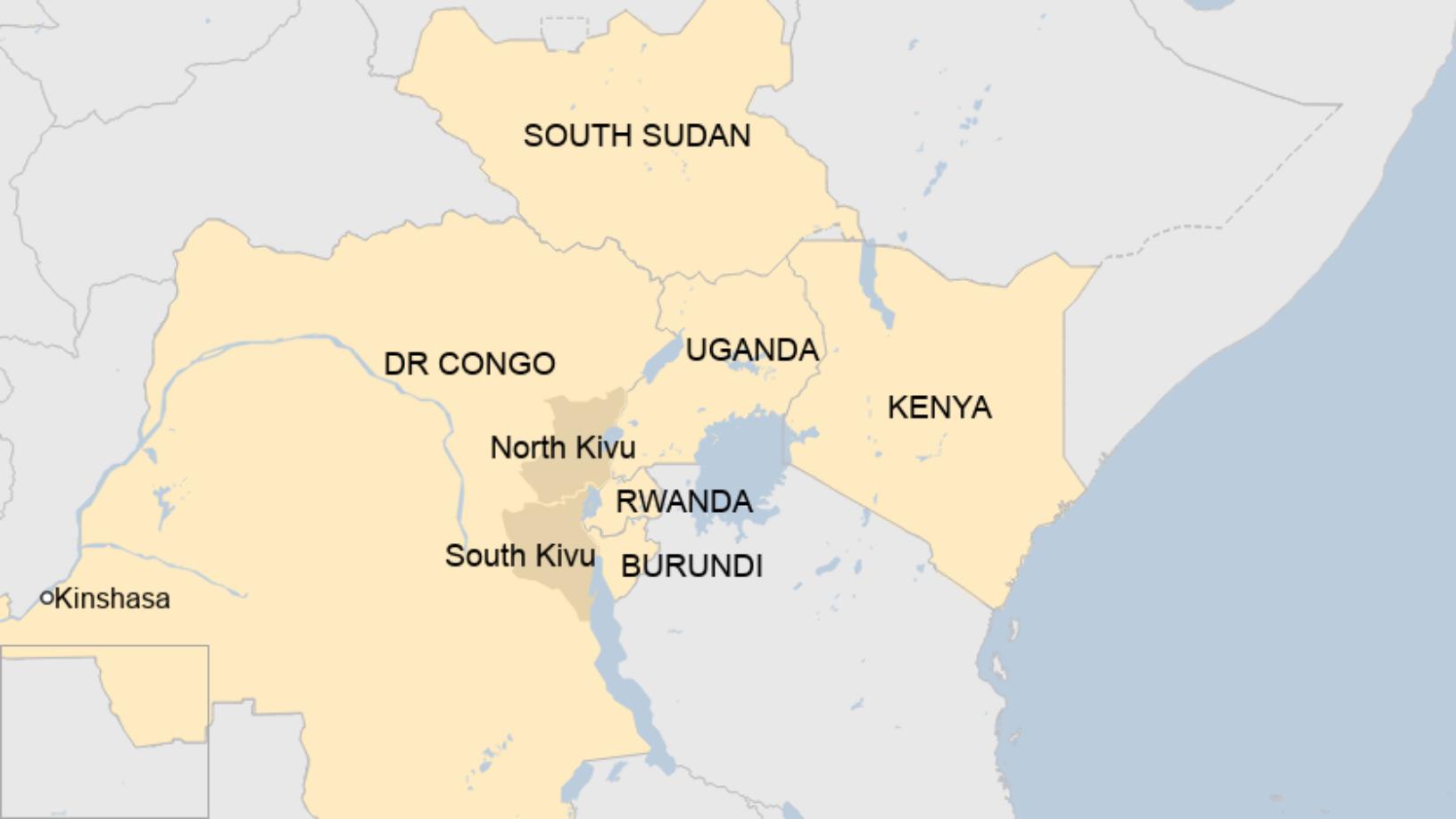
There is no specific figure on the number of troops that will be deployed. What we know so far is that only four countries – Kenya, Uganda, South Sudan, and Burundi – are sending their soldiers.
One thousand Kenyan troops will join their Burundi counterparts who arrived in DR Congo in early August for the joint mission against the rebels. It is not clear if Tanzania will deploy troops.
Military officials have declined to reveal the numbers of soldiers involved, citing security and strategic reasons.
Burundian soldiers are currently based at Luberezi near Bukavu in South Kivu. The Kenyan contingent will be stationed near Goma in North Kivu and will command the East African Community Regional Force.
Rwanda is also a member of the EAC but it has been agreed it should not contribute to the regional force.
What difference will the East African force make?
M23 rebels have seized several towns in eastern DR Congo and have gained further ground in recent weeks but they are not the only group the East African force will be fighting in the three most troubled provinces – North Kivu, South Kivu and Ituri.
The different contingents will each have distinct missions. Kenyan soldiers will focus on rebels in the North Kivu area where some of their counterparts are already embedded in the UN force.
Ugandan troops will pursue the Allied Democratic Forces who are linked to the Islamic State in North Kivu and Ituri, and have staged attacks in Uganda.
Burundian troops will concentrate in South Kivu, where they will battle the Tabara milita. South Sudanese forces will fight remnants of the Lord Resistance’s Army.
How is the East African force different to the UN mission?
The role of the East Africa regional force is clearly defined as targeting armed groups.
The UN has had a peacekeeping mission in DR Congo since 2000 and was previously limited to protecting civilians and supporting operations of the Congolese army.
However, the UN later approved the creation of a combat force with the mandate of carrying out targeted offensive operations to pacify armed groups in the region.
Image source, Getty Images
Image caption, People have been fleeing fighting and heading to the border area
The intervention brigade is comprised of troops from South Africa, Tanzania, and Malawi.
Many Congolese are strongly critical of the UN mission, known as Monusco, accusing its 13,000 troops of failing to protect them against the rebels. Earlier this year, there were deadly protests against the UN and these have resumed in recent days as the M23 has advanced.
Security analysts says the East African force and Monusco will need to coordinate closely if they are to be effective.
What interests does Kenya have in DR Congo?
Kenya has been instrumental in trying to broker a permanent peace deal between DR Congo and the rebels.
In July, former Kenyan President Uhuru Kenyatta – who played a key role in DR Congo joining the EAC in March – was appointed to facilitate peace talks and oversee the implementation of a peace deal the two sides had agreed in Nairobi.
Defence and security analysts say DR Congo has been lobbying Mr Kenyatta’s successor, William Ruto, on the peace initiative and deployment of the regional force.
As East Africa’s most advanced economy, Kenya has been keen to advance its business ties across the region through trade and investment.
Why is eastern DR Congo so unstable?
Eastern DR Congo is endowed with extraordinary natural wealth. Minerals have played a key role in more than three decades of armed conflict there.
Numerous rebel groups have funded their occupation of the region through exploiting minerals such as tin, tungsten, tantalum and gold.
President Tshisekedi says that Rwanda wants to destabilise the region because it wants to appropriate its minerals, but Rwanda has denied any role in DR Congo’s unrest.
However, it did twice send its troops into its much larger neighbour in the 1990s – saying it was trying to to halt attacks by Hutu militias based there.
This led to a conflict which ultimately drew in the armies from seven African states.
A report by a UN panel of experts in 2002 revealed that criminals linked to the security forces of Uganda, Rwanda, Zimbabwe and DR Congo had all benefited from exploiting that country’s minerals.
Ukrainian soldiers and pro-Ukrainian activists are receiving death threats, threats of rape against their relatives and other horrific abuse after systematic sharing of their personal information on pro-Kremlin social channels, a BBC investigation has found.
The “doxxing” – leaking of private information online – is apparently intended to demoralise the fighters.
‘Hundreds of messages with threats’
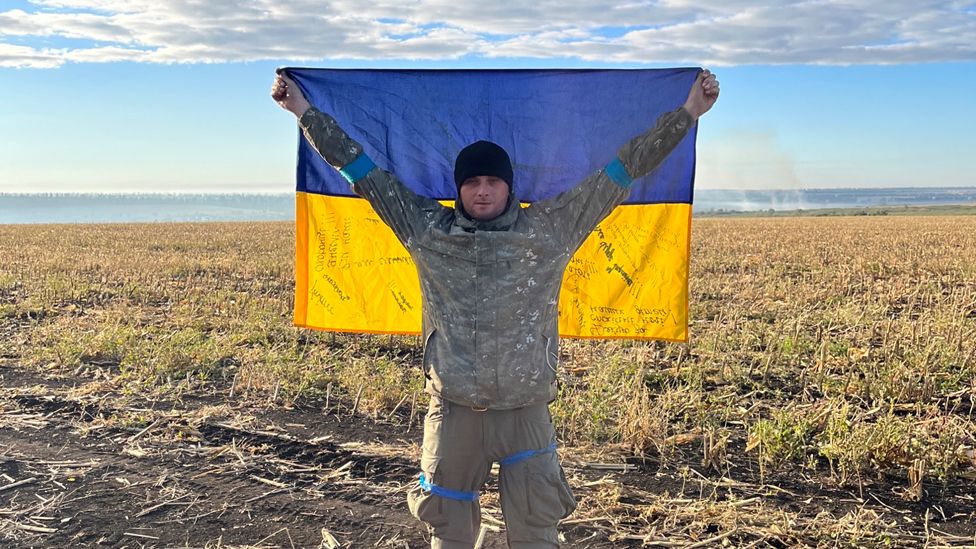
“We were among those few citizens who tried to physically oppose the Russian invasion of our town,” recalls Oleksii from Berdyansk, a Ukrainian port city that has been occupied by Russian forces since the first days of the war. Oleksii and his wife Anastasiya threw a Molotov cocktail at a Russian armoured vehicle driving through their city. They immediately went into hiding.
“We knew Russians would be searching for us,” says Anastasiya. “We tried not to use our phones, so we couldn’t be tracked. But when we turned them on, we saw hundreds of messages with threats from strangers, saying they would hang us, they would burn us with our own Molotov cocktails. It was an absolute nightmare.”
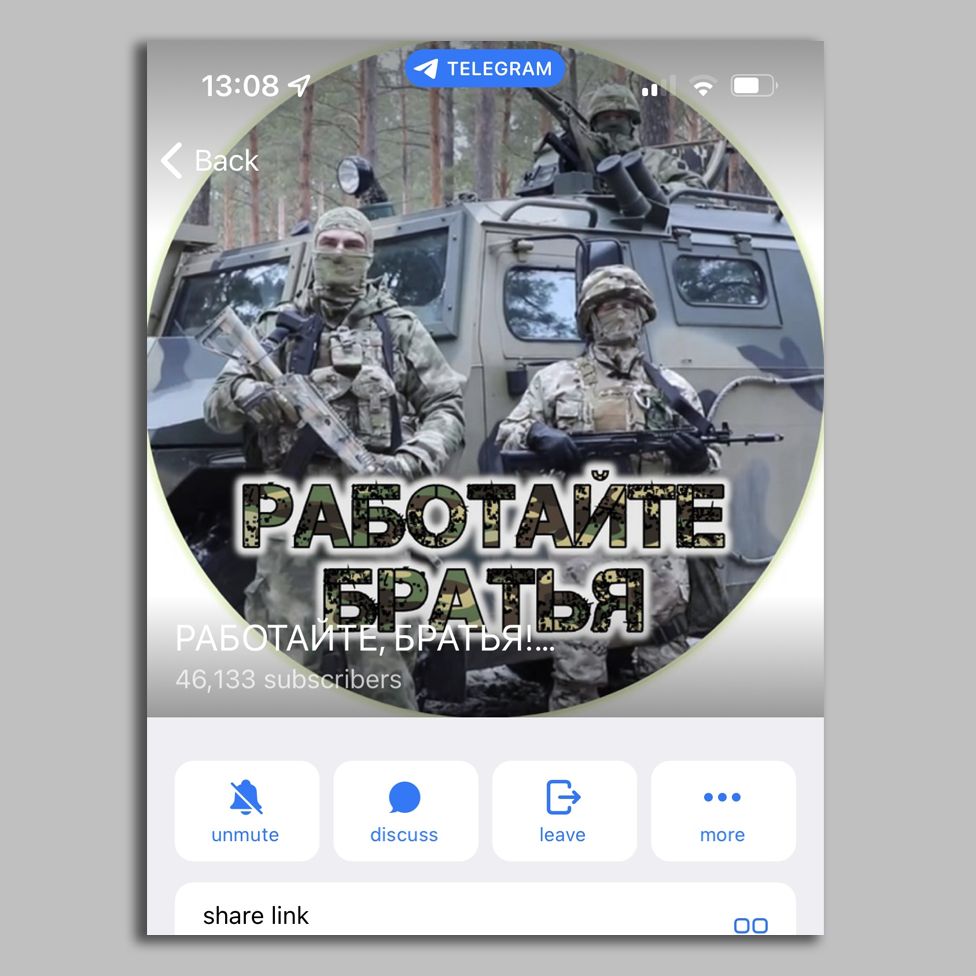
Russian state TV reported on the couple’s actions, and revealed their identities. On the same day their birth dates, home addresses, telephone numbers, tax information, social media accounts and even their car’s number plate were posted on Telegram, in a pro-Kremlin channel called “Work, brothers”. The account has more than 46,000 subscribers.
The Telegram post called Oleksii, who used to be a member of the right-wing organisation “Right Sector”, and Anastasiya “Nazis”, an insult often thrown at Ukrainians by Russian state media.
The couple would sometimes receive more than 1,000 offensive messages a day.
“All my social media accounts were full of abuse. I tried not to read them,” recalls Anastasiya.
Image source, TelegramImage caption, One of the channels that has shared private information
“Where are the pictures of your dead bodies?” read one of the messages. Another said: “We know where you live.”
“It was terrifying,” says Anastasiya, “When you go to bed you can’t sleep because you’re listening to every noise, wondering if somebody has come for you.”
After two months in hiding, they managed to escape to Ukrainian-controlled territory.
Private information – at the click of a button
The BBC has found that the “Work, brothers” channel and another pro-Russian channel – “Tribunal” – has shared the private data of almost 300 Ukrainian activists, soldiers and their relatives, to more than 120,000 subscribers.
Both channels were created on 1 March 2022; the sixth day of the Russian invasion of Ukraine. Alongside private information, the channels regularly promote Russian disinformation and pro-Kremlin narratives.
Oleksandr, a Ukrainian soldier currently fighting on the front line in eastern Ukraine, recalls how in August he discovered that a video of his battalion destroying a Russian armoured vehicle was posted on Telegram, alongside his date of birth, phone number and email address.
Image source, Oleksandr
Image caption, Oleksandr was on the front line when he heard his flat had been burgled
The post was published in “Work, brothers”, and said that Oleksandr’s family was living in Nova Kakhovka, a town in the Kherson region, which is occupied by Russian troops.
“In the texts that I received, they called me a ‘bloody khokhol’ [a derogatory Russian term for Ukrainians] and threatened to find my mum and sister in Nova Kahovka and rape them,” said Oleksandr. His mother died in 2015 and his sister had moved to Turkey seven years ago.
His home address was also published. Soon afterwards, his flat was broken into and his possessions stolen.
Who is behind the doxxing channels?
The BBC has tracked down some of those closely associated with the Telegram channels.
Olesya Orlenko, 41, from Moscow, describes herself as a historian and journalist. She was one of the founders of an online project called “Tribunal”, which runs a website and the Telegram channel we have been monitoring. In the past she has promoted this work on Russian state media.
Ms Orlenko claims she is no longer associated with Tribunal, but uses familiar Kremlin narratives when describing the objectives of the project.
“It was created to collect information about Ukrainian Nazis [a term used by Russian state media] who committed crimes during the conflict in Donbas [in eastern Ukraine], so that later this information could be used by Russian or international courts,” she said.
She denied she had anything to do with the sharing of soldiers’ personal details. However, she was still one of those in charge of Tribunal when the doxxing started on its Telegram channel.
The BBC has also contacted one of the administrators of the chat group associated with the channel “Work, brothers”.
Tatyana is 39 and an office worker from Podolsk in the Moscow region. She told the BBC that in her free time she “helps ‘Work, brothers’ as a volunteer”.
She denied seeing Ukrainian soldiers’ personal information and threats on the channel. We sent Tatyana a screenshot with a profile of a Ukrainian soldier and her comments below the post. She stopped replying to us.
Systemic violence
“These channels break Telegram’s terms of service because they promote violence in a systematic way”, says Julia Smirnova, a senior analyst at Institute for Strategic Dialogue focused on disinformation and online hate speech.
“They call for ‘punishing’ people whose data they publish, use hateful terms and slurs to describe them,” says Ms Smirnova. “The channels also publish posts that celebrate killings of Ukrainian military personnel or violence against people supporting the Ukrainian army.”
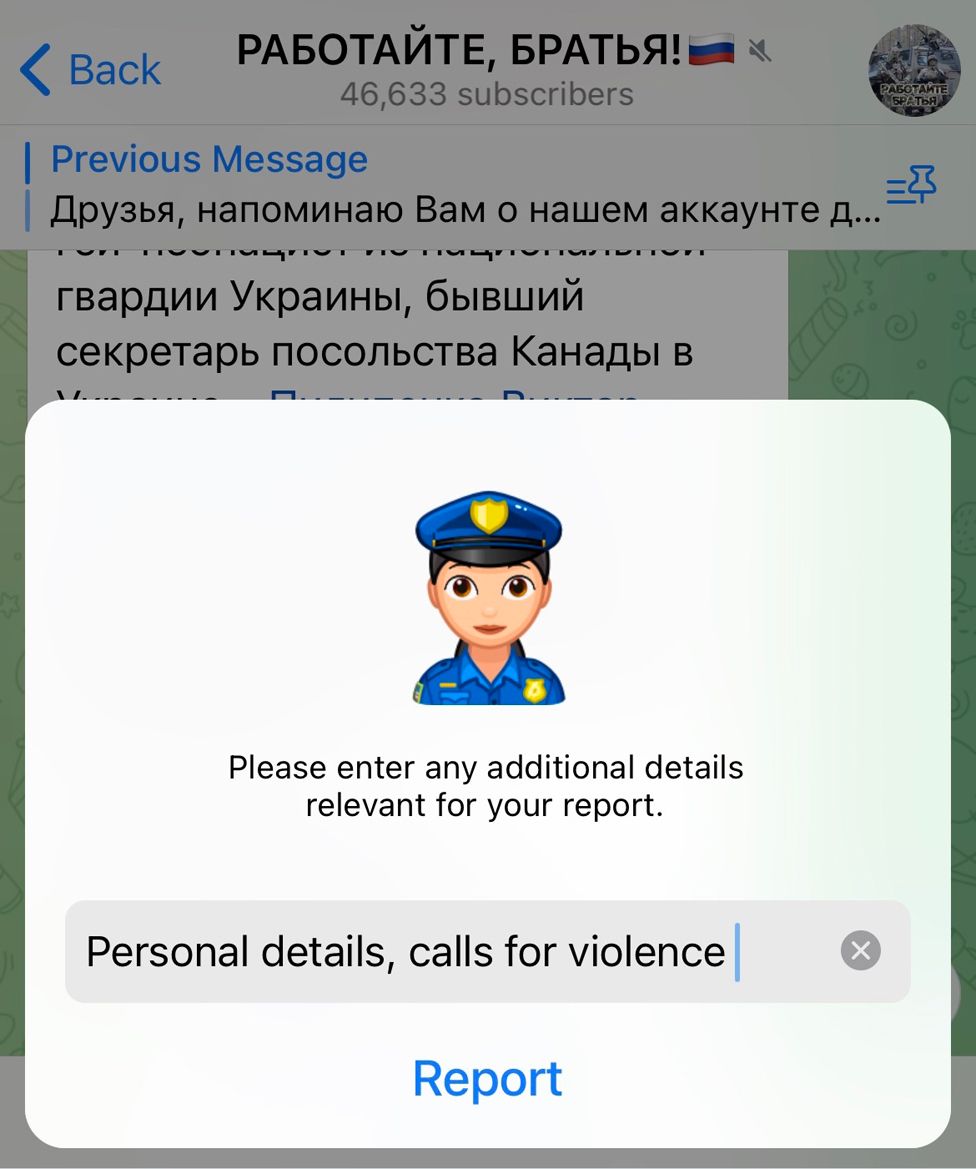
Image caption, We reported the posts that shared private data and calls for violence, but they are still accessible.
Telegram prohibits the promotion of violence on public channels. It also has an in-app reporting feature where users can flag violence and shared personal details.
Remi Vaughn, Telegram’s spokesperson, told the BBC that the company “actively moderates” the publication of private data and “diligently removes” content that breaches its terms of service.
To test this, we used the in-app feature to report 50 posts which included the personal information of Ukrainian soldiers and comments with clear calls for violence. A week later the posts and comments remained online.
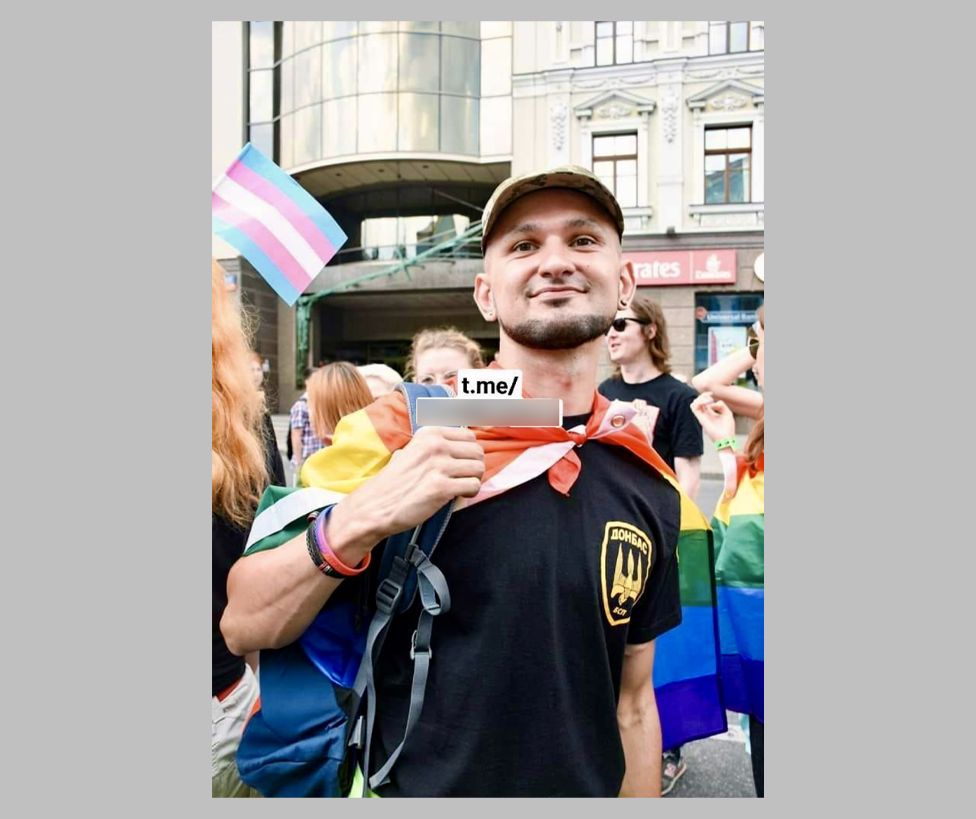
This comes as no surprise to Viktor, another Ukrainian solider who had previously experienced harassment online for being an LGBT+ activist.
“I always reported such things to Telegram, but I’ve never heard back from them. There was no reaction at all,” he says.
Image source, ViktorImage caption, Viktor and his sister received threats after his information was shared on Telegram
Earlier this year, his personal details and pictures were again posted on Telegram. There were death threats in the comments, but what really angered him was that this time the abuse went further, and targeted his family.
“They shared addresses of my parents and even of my granny. They texted my sister. They even posted her address in Mykulichi that was occupied by Russians.”
The village is near Bucha, where dozens of civilians were killed by Russian troops.
“It’s good they posted it after the village was liberated. But what if they did it earlier?” says Viktor. “There were real cases when relatives of Ukrainian soldiers were shot dead. These people [who share it] and Telegram itself should be held to account.”
Former Kotoko midfielder Salifu Mudasiruhas been handed his maiden Black Stars call-up ahead of the 2022 FIFA World Cup in Qatar.
Mudasiru has been one of the consistent performers for FC Sheriff Tiraspol this season, featuring in 21 games.
He put up a Man of the Match performance against Manchester United in the UEFA Europa League.
The 25-year-old will hope to make the final squad when the list is whittled down to 26 for the tournament which is scheduled for Qatar from November 20 – December 18, 2022.
Black Stars make a return to the tournament after missing out on the 2018 edition in Russia and have been drawn in Group H alongside Portugal, South Korea and Uruguay.
Ghana will take on Portugal in their first game on November 24 before playing South Korea and Uruguay on November 28 and December 2 respectively.
Black Stars will play Switzerland in an International friendly on November 17, before travelling to Qatar for the World Cup.
Auri Katariina, a cleaner from Finland, began posting videos on social media which became an instant hit. a cleaner from Finland, began posting videos on social mediawhich became an instant hit.
People started reaching out to her for help and she now cleans homes around the world for free.
Auri’s videos get millions of views and the BBC went to meet her on a recent trip to the United Kingdom.
Ghana international, Baba Abdul Rahman was in action for Reading FC on Friday night when the team played against Preston in the English Championship.
In a matchday 19 encounter of the league campaign, Reading FC played at home and hoped to bag maximum points to climb higher on the Championship League table.
Both Baba Rahman and Andy Yiadom started the game for the home team in a game that the first half ended in a goalless draw.
After recess, Preston got the better of Reading as a brace from Ched Evans propelled the away team to a 2-1 win.
The only consolation goal for the hosts was scored by Lucas Joao.
In a reaction after the game, Baba Rahman admitted that the performance of Reading FCwas the best.
He also assured that Reading will fight for the three points in the next outing.
“Today wasn’t good enough and I’m the first to admit it Royal fans
Ghana coach Otto Addo has managed to drop fifth highest scorer in the Portuguese top flight Abdul-Aziz Yakubu from Ghana’s 55-man provisional WC squad.
The Ghana forward has had a great start to the season so far in the Portuguese Primeira Liga for his club.
Abdul-Aziz Yakubu has scored five goals in 11 league games in the Portuguese Primeira Liga which means he’s the fifth-best scorer but third in terms of goals scored as three players are tied on six goals.
In the Portuguese the top-flight this season, he has also provided three assists for Rio Ave who returned to the top-flight league in Portugal this season.
The forward has formed a formidable partnership with Emmanuel Boateng in Rio Ave’s attack, complementing each other quite well and banging in the goals for the Green and Whites outfit.
Aziz has scored more goals than Felix Afena-Gyan, Kwasi Wriedt, Caleb Ekuban and Antoine Semenyo and has the same number of league goals as Inaki Williams.
The young attacker was tipped to make the final 26-man squad but has surprisingly been excluded from the 55-man squad submitted by the Ghana head coach Otto Addo.
Late one night in early April, Ukrainian military medic Mariana Mamonova was travelling towards a combat position in Mariupol, south-east Ukraine, with soldiers from her unit.
The fighting was close; the sound of gunfire and bombs came from every direction. One of them could have hit their vehicle at any moment. It was freezing and pitch dark, but at times the sky lit up with what looked like phosphorous weapons, illuminating the road ahead.
Mariana had been serving on the front line in Mariupol since the war began in February, but now the stakes were even higher than usual – she had discovered she was pregnant two weeks earlier.
The city was besieged by Russian forces, bombarded day and night, targeted relentlessly and indiscriminately with Russian missiles.
Her battalion was stationed at the Illich steel plant – one of the city’s last Ukrainian holdouts. But the Russians were closing in, and travelling any distance from base meant risking death or capture.
With no safe way of escaping the front line, Mariana had little choice but to stay with her unit despite her pregnancy, and hope for the best for her and her baby. But she was unlucky.
“Our car was stopped and we were told: ‘from this moment on you are prisoners of the Russian Federation’,” she told the BBC. “‘A step to the right, or a step to the left, and we shoot,’ they said.
“I turned to the guys I was with and said ‘tell me we’re not being captured. Tell me they’re not taking us prisoner!’ I was so scared.”
But her worst fears had become reality.
Mariana and her colleagues were transferred to a storage warehouse for three days before being taken to the Olenivka prison in the occupied part of eastern Ukraine.
The facility, notorious for its squalid conditions, abusive staff and chronically overcrowded rooms, was the site of a rocket attack that killed dozens of Ukrainian prisoners of war. Both sides blame the attack on each other.
For Mariana, it was the start of a six-month ordeal during which she slept on the floor and was deprived of access to healthy food and fresh air. She was intimidated and threatened during interrogations and at one point prevented from using the toilet while nine-months pregnant. She was also terrified her baby would be born in captivity and taken from her.
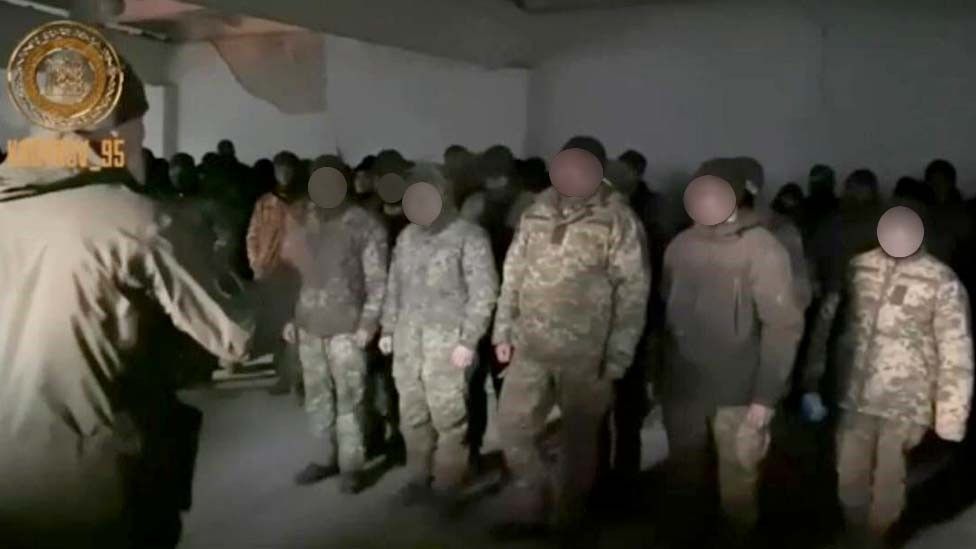
Image source, TelegramImage caption, Mariana was taken to a warehouse where she appeared in a video of prisoners published on social media
Soon after she was captured, she was questioned by a Russian official.
“He said if I don’t answer the way he needs me to, he’ll send me to a camp in Russia and my baby will be taken away,” Mariana said.
Her interrogator threatened to ensure that her child was transferred from one orphanage to another, making it impossible to ever track down.
“It was really terrible, I cried so much,” she said quietly.
At other times, barking dogs were used to intimidate Mariana into making false statements.
Throughout her ordeal, Mariana’s medical training gave her reassurance that her pregnancy was developing normally. But conditions in the prison were poor.
“We lived in a small room meant for six people, but there were 40 women in there,” she said.
“The older women slept two or three in a bunk. I slept on the floor, underneath a bed with a friend. I had a couple of pillows and a blanket.”
Later, Mariana was transferred to a smaller room where she slept on a wooden pallet on the floor.
For the first few months, she was treated exactly the same as all the other female prisoners. But when she was seven-months pregnant, a doctor advised that she needed more fresh air and she was allowed to walk around the yard.
“It depended on which guard was on shift though,” she said. “Sometimes I could spend half a day outside, other times they didn’t let me out at all.”
In July, she developed a complication and was taken to hospital for an ultrasound. It was Mariana’s first glimpse of her baby.
“I saw its little arms and legs. It unfurled its fist and showed me its five little fingers. I cried and cried. They told me the baby was fine, but it was very small and I need to eat more and take more vitamins.”
When she returned to the prison, some guards took pity on her and brought her home-cooked food and vitamins.
Image source, Mariana MamonovaImage caption, Mariana’s husband, Vasyl, campaigned for her release
As Mariana entered the final weeks of her pregnancy, there was talk of a prisoner swap but still no sign of it happening.
Her husband Vasyl, frustrated at a perceived lack of urgency from the Ukrainian government in negotiating her release, appealed for her to be freed on humanitarian grounds.
“A mother and her children are sacred everywhere… Let them free her,” he told the BBC just days before her release.
Mariana was transferred to a maternity ward in Donetsk where she was treated well, but the threat of being separated from her baby remained.
Two possibilities emerged; either Mariana would be sent to a prison in Donetsk where she could live with her baby for as long as she was breastfeeding. Or she would be taken to a facility in Russia where her baby would be taken from her when it turned three. She was too scared to ask where her child would go in either scenario.
Mariana felt that an exchange was her last hope. But one Friday in September, she received the news she had been dreading.
“They told me the exchange was off. The situation on the frontline had intensified, and the two sides couldn’t agree. I understood it was the end,” Mariana said. By then she could have given birth any day.
But over the weekend, something changed. Mariana doesn’t know why but all of a sudden the swap was given the green light.
Image source, Armed Forces of UkraineImage caption, Mariana appeared heavily pregnant in a video of the prisoner exchange
The following Tuesday, she was transferred with dozens of other prisoners to a city in Russia near the Ukrainian border. There, she was blindfolded, her hands tied, and put on a military plane with other prisoners to a location in Belarus.
The journey took 20 hours but the Russian soldiers guarding Mariana refused to let her use the toilet, despite her being nine-months pregnant.
“‘Use this bottle,’ they joked. I told them ‘I won’t be able to get it in’ and ‘I’m in pain’. But they just told me to hold it in,” Mariana said with a resigned laugh.
From Belarus she was driven the short distance across to the border to Ukraine, and she was back in the relative safety of her homeland.
Just four days later, Mariana gave birth to a healthy baby girl called Anna. She weighed 3.2kg (7lb) – within the normal range.
As for the future, Mariana would like to continue working in medicine, but her husband has made his views clear.
“He says he won’t cope if I go back to the front line,” she laughs. “He said he’d leave me.” For now, the couple are content adapting to their new life as a family.
“I already got used to the fact that I have a little baby, who has completely changed my life,” she said. “I even had time to get used to the idea of being a mum. It’s just unfortunate that I had to do that in prison.”
Image source, Mariana MamonovaImage caption, Anna was born just four days after Mariana was released
Russian President Vladimir Putin has publicly approved the evacuation of civilians from parts of Russian-occupied Kherson in southern Ukraine.
Kyiv’s forces have been steadily advancing on the strategic port city.
Mr Putin said people living in dangerous areas should leave as “the civilian population should not suffer”.
At least 70,000 people are reported to have been moved already from Kherson – the only major city gained by Moscow since its troops invaded in February.
Civilians at risk from shelling and attacks should be “removed”, Mr Putin said, during the Unity Day holiday in Moscow’s Red Square.
Kyiv accuses Russia of forcibly deporting Ukrainian civilians – which is considered a war crime – although Moscow denies this.
Russia’s intensive missile and drone strikes on civilian infrastructure across Ukraine have caused heavy casualties and damage, and forced Kyiv to impose frequent electricity blackouts.
Mr Putin’s comments followed reports on Thursday that Russian soldiers, too, had been leaving Kherson – in what would mark a major withdrawal.
A Kremlin-installed official in the region, Kirill Stremousov, told Russian media that Moscow was “likely” to pull its troops from the area.
Ukrainian officials remained cautious, warning that the reported move could be a trap to lure their soldiers into dangerous areas.
Kherson was captured soon after Russia attacked its neighbour on 24 February, but recently Ukrainian forces have steadily recaptured territory on the city’s outskirts.
Civilians were first urged to leave Kherson in the middle of last month, as the Russian army switched the city to defensive mode.
Military commanders later said they had completed an operation to evacuate the city’s residents, ahead of an expected battle there.
Russia claims the Kherson region and three other Ukrainian regions as its own territory, though it does not fully control any of them. It hastily arranged local “referendums” to justify the claim – a move condemned internationally.
Russia also annexed Ukraine’s Crimea peninsula in 2014.
During Friday’s speech in Red Square, Mr Putin also said some 318,000 military recruits had signed up for duty during a mobilisation, now complete – exceeding his target of 300,000.
Of these, Mr Putin said 49,000 were already involved in active fighting – a figure not independently verified by the BBC.
Meanwhile, a Russian private military company, the Wagner Group, has opened its first official headquarters, in St Petersburg.
Its fighters are reported to be active in the Russian campaign in Ukraine, and it has recruited prisoners to fight there, in exchange for their sentences being commuted in Russia.
Image source, ReutersImage caption, The new Wagner headquarters in St Petersburg
Wagner soldiers have repeatedly been accused of human rights violations, including in Syria, Libya and other conflicts.
Mr Putin has now amended the Russian law on calling up reservists to include men convicted of serious crimes who recently left prison.
The change means that convicted murderers and drug dealers who have recently been released could be conscripted to fight in Ukraine.
Former prisoners convicted of sex crimes against children or terrorism are still excluded from serving.
In his latest comments on the war, Ukrainian President Volodymyr Zelensky attacked the “absolutely insane stubbornness of the owners of today’s Russia”.
He said his enemy was uninterested in peace talks, but was instead sending “people to the meat grinder” – both mobilised troops and mercenary fighters.
Referring to the week’s “fiercest fighting”, Mr Zelensky singled out the eastern towns of Bakhmut and Soledar.
Twitter’s new owner Elon Musk has defended sacking about half the company’s workforce, saying he had “no choice” as Twitter was losing more than $4m (£3.5m) a day.
A tweet from Yoel Roth, Twitter’s head of safety and integrity, referred to “approximately 50% cuts company-wide”.
But Mr Musk said the social media giant’s commitment to content moderation was “absolutely unchanged”.
Mr Musk, the world’s richest man, took over Twitter in a $44bn (£38.7bn) deal.
The billionaire insisted in his own tweet that all those losing their jobs were offered three months of severance pay, “which is 50% more than legally required”.
As reports emerged on Friday that thousands of staff at Twitter around the world were losing their jobs, questions were asked over the future of employees responsible for taking down harmful material.
Online safety groups and campaigners have suggested Mr Musk might relax moderation policies, making Twitter less effective at removing hate-speech and disinformation from the platform.
Permanent Twitter bans given to controversial figures – including former president Donald Trump – could also be removed.
These concerns were fuelled by Mr Musk’s comments on Friday, which sought to blame Twitter’s “massive drop in revenue” on “activist groups” who were “trying to destroy free speech in America”.
But Mr Roth’s tweet thread, posted later in the day, confirmed that most of the more than 2,000 content moderators working on “front-line review” were not impacted.
He said the “reduction in force” affected around 15% of those working in Twitter’s trust and safety organisation – compared with what he said was a 50% cut seen across the company.
Mr Roth added that combating misinformation remained a “top priority” during the US midterm elections. Most Americans will vote on Tuesday, in a key test for Joe Biden’s presidency.
The president voiced his concern about the takeover on Friday, saying “Elon Musk goes out and buys an outfit that sends – that spews lies all across the world… How do we expect kids to be able to understand what is at stake?”
As the scale of the job cuts became clear, notices provided by Twitter to officials in California revealed that around 983 staff were being laid off in that US state alone.
It concerns 784 employees in San Francisco, 106 in San Jose, and 93 in Los Angeles, according to filings seen by the BBC.
An internal email sent to staff earlier on Friday said the mass job cuts were “unfortunately necessary to ensure the company’s success moving forward”.
Staff confirmed on Twitter they had been logged out of work laptops and Slack, a messaging system.
Many staff revealed that they had been axed in posts on the platform, painting a picture of cuts that spanned the globe and hit departments that ranged from marketing to engineering.
They included communications, content curation and product development employees.
A team that focused on research into how Twitter uses algorithms – an issue that was a priority for Mr Musk – was also sacked, according to a tweet from a former senior manager at the company. But that was later denied.
Almost all of Twitter’s revenue currently comes from advertising, and Volkswagen is among the brands that has stopped spending with it since Mr Musk bought Twitter.
“We are closely monitoring the situation and will decide about next steps depending on its evolvement,” Europe’s biggest carmaker said.
On Thursday, food manufacturer General Mills, which owns brands including Cheerios and Lucky Charms, did the same.
It said it was continuing to monitor Twitter’s “new direction” and wanted to “evaluate [its] marketing spend”.
Other brands to have paused paid activity on the platform include car firms General Motors and Audi, and drugs giant Pfizer.
Mr Musk has been looking for ways to cut costs and make money in different ways from the platform, including plans to charge a monthly subscription fee for users to be verified on the platform.
He also proposed that those paying the $8 per month fee would get their Tweets boosted in replies, mentions, and searches, prompting criticism from some people on Twitter that he was creating a two-tier system that would benefit those willing to pay.
Twitter employees filed a class action lawsuit on Thursday which argued the company was making big job cuts without giving 60 days’ notice, in violation of federal and Californian law.
After conducting the literature review I realized that: Who doesn’t love a great kiss? And everyone has a favorite kissing story, a favorite movie kiss, a kiss they wish had never happened, and a kiss they long for so much they can almost taste it.
In short, every kiss is a cause for celebration. Just imagine that study found that the exchange of saliva through kissing can boost your immunity by exposing you to new germs that strengthen your immune system. Just read the article for your opinion.
Kissing, science
Improves “ happy hormones”
One article by Adrienne Santos- Longhurst(2018) explained that Kissing triggers the brain to release a combination of chemicals that makes one feel good by igniting the pleasure centers of the brain.
The chemicals are oxytocin, dopamine, and serotonin, which can make you feel euphoric and encourage feelings of affection and bonding. It also lowers your cortisol (stress hormone) levels.
Improves Bonding
Wlodarski and Dunbar (2013) found that kissing your partner can improve relationship satisfaction and could enhance long-term relationships. This is due to the production of Oxytocin, a chemical linked to pair bonding. Hence, partners kissed, there is a release of oxytocin linked to feelings of affection and attachment.
Kissing improves Self-Esteem
One study by Lupis et al.(2016) found that participants who were unhappy with their physical appearance had higher cortisol levels after kissing. This means that apart from improving our happy hormones, kissing can reduce cortisol levels — potentially improving your feelings of self-worth.
Kissing reduces stress, anxiety
An old study by Floyd et al.(2009) agreed that when partners kissed, cortisol levels and stress reduces. Therefore, Kissing and other affectionate communication, like hugging and saying “I love you,” “You mean so much to me” and behaviors and supportive activities (doing favors for someone) impacts the physiological processes related to stress management (Thompson, T. L. 2014). Also, (Esch & Stefano, 2005) found that when partners kissed, oxytocin decreases anxiety and increases relaxation and wellness.
Kissing reduces Blood Pressure
In the book, Kissing: Everything You Ever Wanted to Know about one of Life’s Sweetest Pleasures, Andrea Demirjian(2006), found that Kissing increases the heart rate in a way that dilates the blood vessels. This means that when the blood vessels dilate, the blood flow increases and causes an immediate decrease in our blood pressure. So this means that kissing is good for the heart, literally and metaphorically!
Not only blood pressure alone, but the effect of dilated blood vessels and increased blood flow can help relieve cramps and headaches. Kissing may also help you prevent headaches by lowering stress, which is a known headache trigger.
Kissing improves your immune system
Korta et al.(2014) found that couples that kiss frequently share the same microbiota in their saliva and their tongues. This means that when partners exchange spit can boost their immunity by exposing them to new germs that strengthen their immune systems.
One study by Dave et al.(2011) found that kissing provides significant relief from hives and other signs of allergic reaction associated with pollen and household dust mites. Stress also worsens allergic reactions, so kissing has an effect on stress and may also reduce allergic responses that way.
Kissing reduces cholesterol
Floyd et al. (2009) study found that couples who frequently kissed improved their total serum cholesterol. This means as your cholesterol is reduced your risk of several diseases, including heart disease and stroke reduces.
Kissing improves the salivary gland
Others held that when partners kissed, their salivary glands stimulate, which increases saliva production. Saliva lubricates your mouth, aids in swallowing, and helps keep food debris from sticking to your teeth, which can help prevent tooth decay and cavities.
Kissing enhances compatibility, boosts sex drive
One 2013 study found that kissing may help you assess the suitability of a potential partner. According to women surveyed, a first kiss can make it or break it when it comes to her attraction. It further boosts sexual drive, especially for women. Saliva also contains testosterone — a sex hormone that plays a role in sexual arousal. The longer and more passionately you kiss, the more testosterone gets released. Testosterone is also good, especially for men’s health.
Kissing tones muscles, burns calories
The act of kissing can involve anywhere from 2 to 34 facial muscles. Kissing often acts like a workout for your face — and neck if you’re really into it!
This may help firm up your facial muscles. Working out your facial muscles can also increase collagen production, which contributes to firmer, younger-looking skin.
Joseph S. Alpert(2013), the article explained that when we use facial muscles also burn calories. Depending on the minute you kissed passionately, you can burn anywhere from 2 to 26 calories. This may not be the best workout regime if you’re trying to lose weight, but it sure beats sweating on the elliptical trainer!
Take Home
In conclusion, Adrienne Santos-Longhurst(2018) explained that kissing, irrespective of whom you’re kissing, can be a game changer for your emotional and physical well-being. She notes: “Kissing makes both parties feel good about themselves and can help strengthen relationships of all kinds, so kiss and kiss often. It’s good for you”!
NB:
Prof. Nyarkotey has strict sourcing guidelines and relies on peer-reviewed studies, academic research institutions, and medical associations to justify his write-ups. My articles are for educational purposes and do not serve as Medical advice for Treatment. I aim to educate the public about evidence-based scientific Naturopathic Therapies.
The writer is a Professor of Naturopathic Healthcare, President, of Nyarkotey College of Holistic Medicine & Technology (NUCHMT)/African Naturopathic Foundation. He is also an Honorary Professor, Vinnystia State Pedagogical University, Ukraine. E-mail: collegeofholisticmedicine@gmail.com. For more information, contact: Stephanie(PRO)on 0244433553
References
Ninabahen D.Dave, LianbinXiang, Kristina E.Rehm, Gailen D.MarshallJr(2011) Stress and Allergic Diseases. Immunology and Allergy Clinics of North America. Volume 31, Issue 1, February, Pages 55-68
Adrienne Santos-Longhurst(2018)16 Reasons to Smooch: How Kissing Benefits Your Health. https://www.healthline.com/health/benefits-of-kissing#TOC_TITLE_HDR_1
Joseph S. Alpert, MD(2013) Philematology: The Science of Kissing. A Message for the Marital Month of June. https://amjmed.org/science-of-kissing/
Wlodarski, R., Dunbar, R.I.M. Examining the Possible Functions of Kissing in Romantic Relationships. Arch Sex Behav 42, 1415–1423 (2013). https://doi.org/10.1007/s10508-013-0190-1
Andrea Demirjian(2006), Kissing: Everything You Ever Wanted to Know about One of Life’s Sweetest Pleasures.
Lupis, S.B., Sabik, N.J. & Wolf, J.M. Role of shame and body esteem in cortisol stress responses. J Behav Med 39, 262–275 (2016). https://doi.org/10.1007/s10865-015-9695-5
Kory Floyd ,Justin P. Boren,Annegret F. Hannawa,Colin Hesse,Breanna McEwan &Alice E. Veksler(2009) Kissing in Marital and Cohabiting Relationships: Effects on Blood Lipids, Stress, and Relationship Satisfaction. Pages 113-133 | https://doi.org/10.1080/10570310902856071
Thompson, T. L. (2014). Affection exchange theory. In Encyclopedia of health communication (Vol. 1, pp. 48-49). SAGE Publications, Inc., https://dx.doi.org/10.4135/9781483346427.n17
Tobias Esch & George B. Stefano(2005) The Neurobiology of Love. Neuroendocrinol Lett 2005; 26(3):175–192 PMID: 15990719 NEL260305R01
DISCLAIMER: The Views, Comments, Opinions, Contributions and Statements made by Readers and Contributors on this platform do not necessarily represent the views or policy of Multimedia Group Limited.
In six months since emerging as the winner of the seventh season of popular Nigerian music reality TV show, Nigerian Idol, Progress Chukwuyem has been basking in the euphoria of his coronation as one of the winners of one of Nigeria’s most storied music competitions.
In addition to that, the 21-year-old singer has been staking a claim for himself as a musician to watch out for in his own rights, performing back-to-back shows and releasing a single titled ‘Lift Me Up’.
‘Lift Me Up’, released on the back of his Nigerian Idol win found the singer suavely contemplating the doubts that plagued him before his win and what direction his life might take in light of his momentous win. Produced by Dreybeatz, the song saw him showcase the pruned vocal textures and silky voice that powered him to his win.
Progress’ next song, ‘Jo’ is a hard reset on all that has come before as the singer flings himself into the territory of Afro-pop with an Afrobeat-inspired track that channels euphoric joy. Atop a skittering instrumental spun again by Dreybeatz, Progress summons his listeners to the dancefloor with his stylish voice and dulcet flow, while reasserting his presence as a bonafide breakout star.
The singer, according to those close to him, mulls the idea of dropping a debut project early next year, a move that will hopefully stamp him as a legitimate success story from the Nigerian Idol music reality show.
A French member of Parliamentbecame the subject of a racist jibe by a fellow lawmaker, causing the House to be temporarily suspended amid protestations.
The offending MP, Gregoire de Fournas of the National Rally party’s use of the term “return to Africa,” phrase during a submission on migration triggered outrage in the polity and on social media.
It turns out that the MP who was speaking when the remark was made is a Black, which in turn triggered racist connotations.
Below are five facts about the Black MP
1. His name is Carlos Martens Bilongo, born on December 31, 1990 in Paris.
2. He is the MP for Val-d’Oise (8th district).
3. He is 31-year-old from a Congolese background, according to a TRT report.
4. Bilongo is member of left-wing France Insoumise party
5. He was elected on 19 June,2022 and took office two days later. He is a member of the Foreign Affairs Committee and also the Committee for the evaluation and control of public policies.
Background:
Bilongo was on his feet making a submission on immigration when a colleague in the far-right National Rally party, Gregoire de Fournas, yelled at him from across the benches.
A visibly shocked stopped his speech whiles colleagues on his side of the House vehemently protested at the phrase.
Subsequently, a leader of the Parliament demanded which particular MP had uttered the phrase, which triggered shouting by the far-right bloc.
The session was temporarily suspended.
Speaking outside Parliament after the incident, Bilongo expressed grave reservations at the comment and described it as a “shame,” and something he never in his life thought would be raised in Parliament.
Equatorial Guinea‘s President Teodoro Obiang Nguema Mbasogo, has explained why he is running for a sixth consecutive term in office.
According to an AFP report, the 80-year-old told a rally that his party had chosen him to run “because I am the symbol of peace that reigns in Equatorial Guinea.”
He has ruled the oil-rich Central African country for 43 years, the longest for a serving president.
His party launched their presidential campaign on Thursday with the vote expected to take place on November 20.
Obiang seized power in 1979 from President Francisco Macias Nguema, who was the leader at independence and whose rule prompted a mass exodus and thousands of deaths.
AFP adds that the country has 425,000 registered voters out of a population of around 1.4 million.
A UK subsidiary of Swiss mining and trading group Glencore has been ordered to pay a fine of more than $310 million by a London court for bribing officials across Africa to gain access to oil.
Judge Peter Fraser at Southwark Crown Court said the offenses Glencore Energy UK pleaded guilty to constituted “corporate corruption on a widespread scale, deploying very substantial sums of money in bribes”.
“The corruption is of extended duration, and took place across five separate countries in West Africa, but had its origins in the West Africa oil trading desk of the defendant in London. It was endemic amongst traders on that particular desk,” the judge added.
According to the BBC, the court heard from prosecutors that Glencore Energy UK employees and agents used private jets to transfer cash to pay the bribes.
The investigation, according to Energy Live News, uncovered a trail of text messages, large cash withdrawals and deliberately concealed payments that showed Glencore paid bribes worth $29 million (£25.9m) in total to gain access to oil in Cameroon, Equatorial Guinea, Ivory Coast, Nigeria and South Sudan between 2011 and 2016.
The investigation into the activities of Glencore was launched in 2019 by the Serious Fraud Office (SFO). The investigation focused solely on the activity of Glencore Energy UK’s West Africa desk, which sourced and traded in crude oil from countries across Africa.
Glencore reportedly used well-connected local agents to funnel bribes into state-owned oil companies and government ministries in Nigeria, Equatorial Guinea and the Ivory Coast. The payments were disguised as an unspecified “service fee”, “signing bonus” or “success fee” in financial reports.
In addition, two Glencore executives flew in a private jet in 2011 to Cameroon and South Sudan carrying $800,000 in cash in which they withdrew from the cash desk at the company’s Swiss headquarters and recorded as expenses for “opening [the] office in South Sudan”.
The money paid to agents in the newly-established government in South Sudan was followed by a further $275,000 in cash, according to Energy Live News.
Meanwhile, Glencore executives represented by Clare Montgomery said “they regret the harm caused by these offences and recognise the harm caused, both at national and public levels in the African states concerned, as well as the damage caused to others.”
Founded in 1974, Glencore is one of the largest multinational commodity trading and mining companies in the world. It has subsidiaries in more than 35 countries.
Prosecutors in Chicago said a pregnant woman fatally stabbed the father of their unborn child after they got into an argument over who should use a microwave. The fatal incident happened hours after their baby shower, the Chicago Sun-Times reported.
The suspect, Keshia Golden, is eight months pregnant. Her court-appointed attorney said her next court appearance will be held barely two weeks before she is expected to deliver.
The fatal October 23 incident occurred after Golden together with her boyfriend Calvin Sidney and some family members returned to her home after their baby shower. In the wee hours of that morning, prosecutors said that Golden and Sidney got into a dispute over who should warm leftovers with the microwave. Sidney is said to have “pushed” Golden “down on the counter” after she struck a plate he was holding.
Sidney subsequently entered a bedroom after his uncle separated them. But Golden, who had a knife in her possession, entered the bedroom and stabbed her boyfriend in the leg, prosecutors said. She subsequently exited the apartment.
The stabbing resulted in Sidney sustaining a femoral artery injury. He was taken to a hospital where he died. Golden’s mother, Tarsha Ellis, told the Chicago Sun-Times that her daughter “didn’t mean to kill anyone.”
“She’s broke up about it. She didn’t know you could kill someone by stabbing them in the leg. She just wanted him to leave because he was acting out, and she was worried about hurting the baby. And he wouldn’t go,” she added.
Golden was said to be unaware her boyfriend had died when she went back to the apartment hours after the altercation. Officers who responded to the scene arrested her. Prosecutors also said she did not deny stabbing Sidney. The suspect also sustained injuries from the physical altercation with her boyfriend. She was admitted to the hospital as a result.
During her bail hearing, prosecutors said the fatal incident wasn’t the first time Golden and Sidney had gotten into an altercation that had escalated. Police, between June and September, were said to have received multiple domestic violence-related calls involving the couple. And they had to go to the suspect’s home on each of those occasions. On four of those occasions, Golden alleged she had been choked, punched, slapped, or pushed by her boyfriend.
Court records and police reports also stated that in July, the pregnant woman obtained an order of protection against Sidney after claiming he physically assaulted her. The next month, prosecutors said that Sidney opted not to file charges against Golden after she injured him during another altercation.
“It was just toxic with those two,” Ellis, said. “But they loved each other. If he could raise up right now, they wouldn’t have no case because he would never want charges against her.”
Golden is currently being held on a $2 million bail. Her attorney, Julie Koehler, said prosecutors asked for Golden to be denied bail despite a 2019 Illinois law which stipulates that pregnant women should not be jailed before a trial unless it is determined she poses a public threat.
“To not only force Keshia to give birth in jail but then to immediately take her child away after birth is cruel to the mother and the baby,” said Koehler. “This heartless decision is contrary to Illinois law. All the evidence shows Keshia acted in self-defense. The only person she’s ever shown any violence toward was the man that was beating her.”
A Federal High Courtsitting in Kaduna has on Friday, struck out the case challenging Senator Uba Sani as the gubernatorial candidate of the All Progressives Congress ( APC) for lack of jurisdiction and affirmed him him as the party’s candidate for the 2023 election.
An APC aspirant who contested the primary election, Alhaji Sani Sha’aban, was in court where he sought for the nullification of Uba Sani’s election as Kaduna APC governorship candidate.
Sha’aban had alleged that irregularities marred the conduct of the primary election,among others.
In his judgement after 2 adjournments, the presiding Judge, Justice Mohammed Garba Umar struck out the case for contravention of provision of the National Judicial Council policy direction.
The court declined in hearing the suit saying it has no jurisdiction to deliver judgement on the said matter, adding that it’s a party affair and not a post or pre-election matter.
In a statement entitled “We Welcome the Federal High Court Judgement” issued by
Professor Muhammad Sani Bello,DG Kaduna State Campaign Council of the APC,he said that the judgement by the Federal High Court in Kaduna reaffirming the candidature of Senator Uba Sani as the flag-bearer of the All Progressives Congress (APC) in the 2023 gubernatorial elections in Kaduna State is a hallmark of justice.
It is a thorough and timely intervention in the nation’s quest to deepen democracy, minimise intra-party divisions and entrench the rule of law.
“We congratulate Malam Sani Mahmood Sha’aban for resorting to the justice system in his quest to right perceived wrongdoings. Sha’aban challenged the method used in the primary election that produced Uba Sani as the party’s flag bearer in the state. This is the mark of a true democrat.”
Now that the allegations of discrepancies and fraud said to have characterised the conduct of the primary election of the party in the state have been dismissed, the APC can comfortably carry on with the campaign to win the hearts and minds of the electorate.
Although Senator Uba Sani had been declared winner of the primary election after polling 1,149 votes while Sha’aban and Bashir Abubakar scored 10 and 37 votes respectively, the APC needs all hands on deck for the forthcoming general elections.
The Kaduna State Campaign Council will continue to engage with all the APC aspirants for the success of the party in next year’s polls.
“No doubt, the achievements of the Governor Nasir El Rufai administration in the last seven and half years, coupled with Senator Uba Sani’s stellar performance as a legislator, including his noble agenda as our gubernatorial candidate, have endeared the good people of Kaduna State to our party.”
Similarly, the APC Gubernatorial candidate, Senator Uba Sani in a statement entitled
” Time to work together to ensure our victory in 2023″,called on Sani Sha’aban to join him in ensuring victory for the APC in 2023.
According to him,”the Federal High Court today affirmed my candidature as the flag-bearer of the All Progressives Congress (APC) in the 2023 gubernatorial elections in Kaduna State. I commend my dear brother, Malam Sani Mahmood Sha’aban for ventilating his grievance through the courts. That is the best way to grow and deepen our democracy.”
“I want to use this medium to call on Malam Sha’aban to join hands with me as we make the final push for Kashim Ibrahim House. He can add value to our incoming administration. All hands must be on deck to consolidate on the gains made in Kaduna State. Our people deserve the best.”
“Our party men and women must see the conclusion of the case in court as an opportunity to build a united front for the 2023 electoral battle. Everybody is important. No one should be left behind. Inclusivity must be our watchword.I give thanks to Almighty Allah for this day.”
The Economicand Financial Crimes Commission, EFCC, on Friday, docked a former Attorney-General and Commissioner for Justice in Lagos State, Olasupo Shasore, SAN, before the Federal High Court in Abuja.
The erstwhile Lagos AG was arraigned alongside his company, Middlesex Investment Limited,on a 14-count charge that bordered on his alleged complicity in money laundering to the tune of about N109.8million.
EFCC equally alleged that the defendant failed to report to it, in writing , a single lodgment of N60m he made into his company’s account number; 0005659394 which he operated with a commercial bank.
It told the court that the defendant, by his action, committed an offence that was contrary to Section 10 of the Money Laundering Prohibition Act 2011.
Besides, the anti-graft agency accused the defendant of also failing to report a single lodgment of another N48.8m into the same account, in breach of extant money laundering laws.
The charge sheet further indicated that Shasore had in November 2017, committed same offence by transferring $300, 000 single lodgment into his company account where he is a sole signatory.
The defendant was alleged to have failed to establish an anti-money laundering desk or to designate a Compliance Officer in his company as required by law.
Meanwhile, after the charge was read to him, the defendant pleaded not guilty to all the allegations against him.
EFCC’s counsel, Mr. Bala Sanga, said he was not opposed to his release on bail.
Consequently, trial Justice Inyang Ekwo allowed the defendant to go home on the of administrative bail that was earlier granted to him by the EFCC.
The matter was later adjourned till March 13 for the commencement of trial.
Former President of the United States, Donald Trumphas hinted that he may contest for the office of the president in 2024 and stage a comeback to the White House.
Trump disclosed this where a crowd gathered in Iowa on Thursday while speaking at the first of four rallies in five days in his campaigns for Republican candidates in next week’s midterm elections.
The former Republican President has been subpoenaed by the January 6th Committee for not calling to order his alleged mob of supporters over the invasion of the Capitol Building on January 6, 2021, when he lost to President Joe Biden in the 2020 elections.
He reiterated his baseless claim that he lost in 2020 because of widespread election fraud, as per Reuters.
“I ran twice,” he said. “I won twice and did much better the second time than I did the first, getting millions more votes in 2020 than I got in 2016.
“And likewise, getting more votes than any sitting president in the history of our country by far.
“And now in order to make our country successful, and safe and glorious, I will very, very, very probably do it again. Very soon. Get ready,” Trump said to the cheering crowd.
Reports revealed that Trump won the most votes ever – 72 million – for a sitting president in 2020, but still lost to his challenger then and now president, Biden, a Democrat, who polled 81 million.
The Ijaw Monitoring Group, IMG, on Friday, faulted the statement attributed to the Minister of Humanitarian Affairs, Disaster Management and Social Development, Mrs Sadiya Farouq that “Bayelsa State is not among 10 worst hit states affected by flood disaster, describing the remark as reckless and provocative.
Recall that Minister had said Bayelsa State, which is reeling under floods, was not among the 10 most hit states.
She also said Jigawa State, which recorded the highest number of deaths and number one of the states was most affected by the disaster.
But in a statement by the coordinator of IMG, Mr Joseph Evah, the ijaw demanded an apology from the Federal Government without delay over the Minister’s comment..
The statement reads: “If we were In a fair and just country, Bayelsa State should be number one among the 10 worst hit states because 99 percent of the state was submerged and the state capital was the only state capital that was cut-off from the rest of Nigeria. We wish to remind the minister that gone are the days when the Niger-Delta oil money will be used to find solution to the country’s problems, while the source of the funds are neglected with excuses.
The reason the minister, who made this provocative and embarrassing statement, in a federation has not been sacked within 72 hours is unacceptable. We expected what happened in advanced countries to happen here when a minister misbehaves in public.”
He stated that since the creation of the Ministry of Humanitarian Affairs, Disaster Management and Social Development, the people of Niger-Delta has not felt the impact of the ministry “because of the hostile attitude of the leadership of the ministry.”
In addition, Eva said: “The National Assembly members from the Niger Delta should, as a matter of urgency, request for the sack of the Minister of Humanitarian Affairs on the floor of Parliament for insulting our region and its people.”
The United Kingdom has warned that terrorists are planning to attack the United States while advising its citizens in the country to be vigilant and avoid public gatherings.
According to the UK, in an updated travel advisory to its citizens in the US on Friday, the terrorists might target places where foreigners gather or crowded areas as well as transportation channels.
This is coming barely a week after the US and the UK issued security alerts that terrorists were planning to attack Nigeria’s capital city, Abuja.
It could also be not unconnected with the security alert by the Federal Bureau of Investigation (FBI) to Americans in New Jersey that terrorists were planning to attack synagogues.
The FBI said it received credible information about a “broad” threat to synagogues in New Jersey urging them to “take all security precautions to protect your community and facility.”
The UK said, “Terrorists are very likely to try to carry out attacks in the USA. Attacks could be indiscriminate, including in places visited by foreigners, crowded areas, and transportation networks. You should monitor media reports and be vigilant at all times.”
“The main threat comes from individuals who may have been inspired by terrorist ideology to carry out so-called ‘lone actor’ attacks targeting public events or places. Attacks could take place with little or no notice.”
In connection the alert, the UK government said the US might deploy security agents in public places to foil possible attacks adding that the US Department of Homeland Security (DHS) issued information on credible threats.
“The US Department of Homeland Security (DHS) provides public information about credible threats. Expect an increased presence of law enforcement and tight security at public places and events.
“This may include a heavy police presence, additional restrictions and searches on bags, and the use of screening technologies. For all current alerts within the USA and its territories, visit the DHS website.
“There’s a heightened threat of terrorist attack globally against UK interests and British nationals, from groups or individuals motivated by the conflict in Iraq and Syria. You should be vigilant at this time,” it said.
Tigrayan authorities accused Ethiopia’s government on Friday of carrying out a drone strike against civilians.
The announcement was made less than 48 hours after the warring parties signed a deal to end two years of conflict.
According to the spokesman for the rebel Tigray People’s Liberation Front (TPLF) the target of Thursday attack was the city of Maychew.
The attack by drone was followed by artillery shelling that killed and wounded civilians.
The TPLF claims could not be independently verified. The Tigray region has been under a communications blackout for more than a year.
The agreement between the Ethiopian government and the Tigray rebels was signed this week in Pretoria.
Both parties agreed “to permanently silence the guns” but so far, key details and a clear roadmap are still absent.
Ethiopian Prime Minister Abiy Ahmed, a Nobel Peace Prize laureate, sent troops into Tigray on November 4, 2020 to topple the TPLF, the region’s ruling party, in response to what he said were attacks on federal army camps.
The largest theater festival on the continent is currently celebrating its 20th anniversary in Ouagadougou. In a context marked by political instability and the resurgence of terrorist violence, this 12th edition of Récréâtrales had a sad theme that reflects an equally sad reality – violence in the Sahel.
The festival chose for one of the two opening shows, a play entitled “Tu dis PDI” [You say IDP, internally displaced person, editor’s note], which mixes dance and theater and song, performed in Pulaar and Moré by women victims of terrorism and refugees in the town of Kaya, in the north-central part of the country.
Mariame Ouédraogo is one of these women victims of terrorism and refuged in Kaya that became an actress thanks to Recreatrales. She agreed to act in the play to serve the cause of social reconstruction and the de-stigmatization of relations between Peuhl and Mossi by participating in a play in which Peuhl and Mossi play together.
“This work has done me a lot of good, most of us almost lost our memory in sadness, but this show has allowed us to find the joy of living” she says.
These women are also featured in “Face-“, a photographic series created by the Cameroonian photographer, director and novelist Osvalde Lewat, which seeks to highlight the dignity and greatness of these women by offering them a different view of their situation, that of strong and fighting women.
“I met these women and I must admit that the first word that came to my mind was the word of the exhibition…FACE. Women who stand up, who face, who fight. Women who faced the disaster that became their life, since they had to abandon everything to live in improvised dwellings, sometimes in the market. I was particularly moved to see that in spite of all that, it was their faces that gave this abstract term, internally displaced people, meaning,” stated Lewat.
Throughout the festival, which as always takes place in the family courtyards of the Bougsemtenga neighborhood and in the famous Rue 9.32, host of the Récréâtrales, the woman on the photos from the “Face-” series will be present.
In a country fractured politically, socially and security-wise, these women who did not speak to each other before, who lived in different refugee camps, and who today perform together in the same show, are the symbol of a possible convergence and reconciliation, thanks in particular to art. Moreover, as Aristide Tarnagda, festival director says, devoting an exhibition to these women, who until now have been drowned in the flood of internally displaced persons, “is to participate in their recovery, in the return of their dignity, their beauty, their faith in themselves that has been stolen by those who kill, pillage, rape, and humiliate.”
In Burkina Faso alone, approximately two million people have fled their homes because of terrorist and armed gang attacks.
The organizers of this 12th edition of the festival are unanimous, when a country goes through difficult times; it is felt in the artistic creation because the pain as any feeling cannot be ignored.
Since 2002, the Récréâtrales are “a pan-African space for writing, creation and theatrical dissemination. A space that allows young artists authors, directors, scenographers and actors, to create, share and live from their art.
Ethiopia’s Prime Minister Abiy Ahmed says he has achieved “100%” of what his government demanded in a deal signed Wednesday with rebel authorities in the Tigray region to end two years of conflict in northern Ethiopia.
The agreement, reached in Pretoria where the two parties have been discussing since 25 October under the aegis of the African Union, provides for an immediate cessation of hostilities, disarmament of rebel forces and the delivery of humanitarian aid.
“In the negotiations in South Africa, 100% of the ideas proposed by Ethiopia were accepted,” Abiy Ahmed boasted on Thursday before a crowd of supporters in Arba Minch, in the south of the country.
“Among the victories achieved (in the agreement), Ethiopia’s sovereignty and territorial integrity have been accepted by both parties,” he said, as well as the principle of “one-armed force in a given country.
The agreement has not been published but a joint statement read publicly by the delegations reveals its main features. The agreement includes the disarmament of the rebel authorities’ forces in Tigray.
But it does not specify the modalities and does not address the future of the forces of the country’s regional states or the presence on Ethiopian soil of the army of neighbouring Eritrea, which has provided crucial assistance to the Ethiopian army in Tigray.
The press does not have access to northern Ethiopia and communications are haphazard, making it impossible to know whether the ceasefire is being respected.
The toll of the conflict, marked by countless cases of abuse and largely behind closed doors, is unknown, but the International Crisis Group (ICG) and Amnesty International (AI) describe it as “one of the deadliest in the world”.
The conflict began on 4 November 2020 when Abiy Ahmed sent the federal army to arrest Tigrayan executive leaders who had been challenging his authority for several months and whom he accused of attacking a federal military base.
The war has caused a humanitarian catastrophe in northern Ethiopia, displacing more than two million Ethiopians and plunging hundreds of thousands into near-famine conditions, according to the UN.
Popular Instagram celebrity, Ramon Abbas AKA Hushpuppi has been sentenced to 11 years imprisonment by the United States Central District Court in California for fraud and money laundering.
Recall that Hushpuppiwas arrested in June 2020 in Dubai over an extensive fraud scheme that has robbed victims of their money in the U.S, Qatar, the United Kingdom, and other places.
He was then extracted to the United States where he was charged with fraud and money laundering, multiple counts of hacking, impersonation, scamming, banking fraud, and identity theft.
He, however, pleaded guilty to the charges of conspiracy to engage in money laundering.
Following the sentence on Friday (November 4), Hushpuppi will now spend only nine years in prison as he had already spent two years incarcerated in the US.
Hushpuppi had appealed to Judge Otis Wright narrating his source of wealth, criminal adventure, and regrets.
He commended the Federal Bureau of Investigation (FBI) for doing a thorough job in bringing him to justice and apologized to his family.
Two Kenyanairport workers and a police officer have won praise after returning a bag carrying about $19,000 (£17,000) and other valuables to a British tourist.
Benson Nickolson was in a group that had just returned from a safari at Maasai Mara game reserve when he lost the bag at Wilson airport in the capital, Nairobi.
The airport workers and policewoman found the bag and screened it for explosives before the owner was contacted.
“All the money totalling to around $19,000 and some thousands of Kenya shillings were all intact. All my cards were found intact. All other valuables which included a regalia given to me by my late grandmother was also intact. It was a daydream for me,” Mr Nickolson said in a gratitude email to Kenyan police.
He said he had carried the substantial amount to facilitate his group’s movement and comfort.
The airport’s security supervisor, Joseph Kabangi, told the local Citizen TV that “integrity is a core value” among staff at the airport.
Twelve Tunisian policemenhave been jailed for two years over the death of a football fan.
Nineteen-year-old Omar Laabidi drowned in a stream in 2018 while trying to escape as the police chased a group of fans to the edge of the stream.
Laabidi is reported to have screamed that he could not swim before jumping into the water to escape the police. Laabidi’s dead body was found the following day.
Witnesses say they had heard officers shout at him “you just have to learn how to swim”, which has since become a rallying cry on social media with the hashtag #ApprendsÀNager used by people seeking justice for police abuses.
The victim’s family has said they will appeal against the sentence, calling the conviction for manslaughter a “charade of justice”.
Modern slavery. Domesticservitude. Trafficking. Exploitation. Whatever name you want to call it, increasing numbers of vulnerable people – many of them children – are being brought into England and Wales, often having been fed lies about employment, education and an elevated standard of living.
What they face instead is an unrelenting, and apparently inescapable, cycle of being used and abused. For money, for sex, for household drudgery. For errands that flirt with criminality until they become full-time, albeit unofficial and low-paid, jobs.
The latest Home Office figures indicate that in the first three months of 2022, nearly 4,000 potential victims of modern slavery were identified – and more than a third of those said they had been exploited when they were children.
These young victims come from all over the world: Albania, Eritrea, Nigeria, among other countries. Some of them manage to escape their captors and make it to a place of safety – some to relatives or friends, others into the care system.
But the care system is not the haven it could and should be.
One in three of the trafficked children (378 out of 1,231) in local authority accommodation, whether hotels, hostels, or foster families, went missing in 2020.
In London specifically, numbers have gone up too, seeing a 63% increase between 2018 and 2020.
It is unsurprising to people who work in the system.
Image source, Getty ImagesImage caption, Foster carer John Stokes says victims of trafficking felt going missing was their only option to stay in the UK
John Stokes is a charityworker in London who lives with his foster children in Bristol.
He has been fostering for more than 30 years. Six years ago he started fostering child victims of trafficking.
“Until I started working with children who come into contact with the Home Office, I didn’t realise how it operated or how dismissive they are of these people,” he said.
He believes victims of trafficking are being criminalised by the government as soon as they enter the country.
“They are interviewed for seven or eight minutes and that determines their next few years.
“But traffickers obviously tell them what to say, so they just say that.”
Research by children’s rights organisation Every Child Protected Against Trafficking UK (ECPAT UK) suggested trafficked children continue to be one of the groups of looked-after children most at risk of going missing in the UK.
Chief executive Patricia Durr explained: “We have to find out whether children are going missing because of a pull or push factor.
“If you don’t feel safe, and nobody’s listening to you, and you don’t feel believed – that is a key reason why you might then decide to go.”
The charity echoed Mr Stokes’s observation: the traffickers tell their victims what to say to the authorities. They also give them a phone number to contact once they arrive, with the aim of pulling the children out of the care system and back into modern slavery.
Image caption, Patricia Durr, chief executive of ECPAT, said children go missing for both “pull and push” reasons
Mr Stokes’s foster son was trafficked from Albania. He was allowed to stay in the UK, but when he turned 18 he was told he had to go back.
The Stokes family has been fighting this decision, believing he would be killed if he returns to Albania.
“The choice for these kids is to either give themselves up and so they are taken back to Albania, or go missing. And they know they are likely to be re-trafficked,” the charity worker said.
“They may get forced back into the cannabis farms as the only way to survive.”
Image source, Getty Images
A scruffy child unwilling to make eye contact.
A lad who does not have a change of clothes.
A woman who, on the rare occasions she is seen, scurries to the shops and hurries straight back.
A man who gets picked up and dropped off at the same time and place every day.
A house where the curtains are always closed.
All are indicators that a person has been forced into modern slavery.
Image source, Getty Images
One girl we spoke to was taken from her parents in Nigeria aged 12. Pulled into the shadows of society, she was forced into a life no child should have to tolerate.
Rather than experiencing the normal highs and lows of entering her teenage years, she endured domestic slavery, abuse, isolation and oppression.
“The only time I got a rest would be when it was time for bed. [The woman I worked for] was obsessed with the bathroom. I had to clean it two or three times a day, every day.
“It was spotless. But I had to keep cleaning,” she explained.
“There was no talking to the neighbours – she especially emphasised that. She said no talking to anybody. I go to a place to get the shopping then I come home. If anyone asks me anything I say I don’t know. She said if I did say something they will take me back to Nigeria.
“One elderly neighbour, I think she was concerned and she called the police. And then the police came they asked if I was OK.
“I was scared. I just said ‘I don’t have anything to say’, because that is what my mum had told me to say. The police went away. They never came back for me.”
Image source, Getty Images
The domestic drudgery continued, but in time, more onerous duties were forced upon her. She was expected to have sex with multiple men.
And then she became pregnant.
It was the catalyst she needed: “It pushed me to leave. Before I didn’t have a reason but then I got pregnant and that was a reason.
“I had been raped, I had been used, I had to do things against my will. It was bad. I thought ‘I’m not going to have a child here. I need to protect them’.
“I remembered how my mum used to protect us and I thought ‘I want to do that’.”
She is now free from her trafficker, has become a mother, and is part of a group of trafficking survivors who meet every month to help advise charity workers on how to improve services.
Her trafficking story has an optimistic end. Many don’t.
Mr Stokes says he feels like he is working to feed the abusers, rather than the people he looks after.
“These kids are just fodder for the gangs and the traffickers, ” he said.
Image source, Getty Images
The government insists protecting vulnerable children “is one of the most important legal duties” for local authorities, which are responsible for all looked-after children in their area.
“If a child goes missing, they operate missing persons protocols with other local safeguarding agencies, including the police, to find them and make sure they are safe,” it said.
The government has also introduced “independent child trafficking guardians” to all local authorities in London and is rolling the scheme out across the country.
They are meant to provide one-on-one support to trafficked children where there is no-one with parental responsibility for that child.
But another survivor, a young man from Nigeria, said he did not even realise he had been trafficked.
He said he understands why some young people go missing. If they do not know they are victims, how do they know to ask for help?
“Some carers don’t actually care, it’s about the allowance they receive from the government. And it feels like they are working for the government, not for us.
“So imagine you are a trafficking victim – you just want to move or go missing,” he said.
“There are so many lies and negative things said about us that are untrue.
“We are human. We are not here to steal jobs. We have value. We need love and care.”
The World Banksaid in a statement on Friday that South Africa, a significant emitter of greenhouse gases and a country struggling with its energy transition, had been awarded $497 million to convert one of its old coal-fired power plants.
The continent’s leading industrial power, whose delegation will accompany President Cyril Ramaphosa to COP27, which opens Sunday in Egypt, still gets 80% of its electricity from coal, a pillar of the South African economy employing nearly 100,000 people.
But the country is plagued by continuous power cuts, with debt-laden state-owned Eskom unable to produce enough electricity with ageing facilities that are on average 41 years old and poorly maintained.
The World Bank “approves $497 million in financing to reduce greenhouse gas emissions in South Africa and support a just transition,” the institution said.
The funding, in the form of loans and a grant, will be used to convert the Komati power plant in the northern province of Mpumalanga.
The plant was shut down on Monday after more than 60 years of operation. The plant, which had nine generating units, consumed up to 12,000 tonnes of coal daily and produced twice as much electricity as all the country’s existing plants when it was completed.
It is to “serve as an example” for the energy transition of mighty South Africa and be converted into a renewable energy production site powered by 150MW of solar, 70MW of wind and 150MW of battery storage, the World Bank said.
“Reducing greenhouse gas emissions is a difficult challenge worldwide, particularly in South Africa given the high carbon intensity of the energy sector,” said the organisation’s president, David Malpass, quoted in the statement.
South Africa last year secured $8.5 billion in loans and grants from a group of rich countries to finance the transition to greener alternatives.
Tense negotiations on how the money should be spent were due to start ahead of COP27.
According to the World Bank, the country needs at least $500 billion to achieve carbon neutrality by 2050.