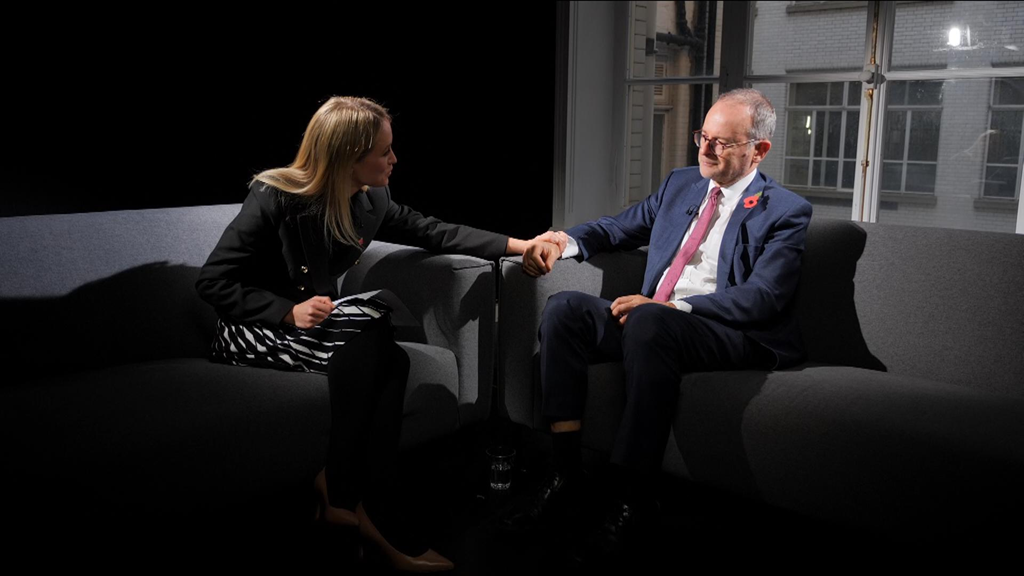
A mixed-race family has complained about encountering casually discriminatory remarks, claiming a small percentage “still lives in the ’50s.”
These have been in the form of jokes and being socially excluded.
Medwen Edwards, 43, lives in Bethesda, Gwynedd, with partner Lamin Touray, 39, who is originally from The Gambia.
Microaggressions are “everyday slights, indignities, put downs and insults” people suffer in their day-to-day life, RaceAlliance Wales said.
Medwen, a mother of nine, has three children with Lamin – Leo, three, Koby, two, and nine-week-old Aminata.
“I’m very lucky to have him in my life, and the children are too. He is so kind and loving towards us all,” she told the Newyddion S4C programme.
Having grown up in the Ogwen Valley, Medwen explained racism was a rare occurrence on the whole, but her family had experienced microaggressions several times.
“I still get comments now, it’s like some people still live in the ’50s,” Medwen said.
“We only get a few slight remarks. Comments and things like that, but otherwise everyone here is lovely with him.”
The United Nationshas welcomed the release of 21 teenagers – most of them girls – abducted by gunmen in the north-western state of Katsina.
The victims were working on a farm when they were seized by armed kidnappers last week in Faskari area.
In a statement, the UN children’s agency, Unicef, says the news of their release is “pleasant”.
But it adds that the children shouldn’t have been kidnapped in the first place, saying “no one, especially children should be a target of abduction or violence of any kind”.
The UN agency has offered to support the Katsina state governmentto rehabilitate the freed hostages.
State police spokesperson Gambo Isa told the BBC the victims were aged 15 to 18. Seventeen of them were females.
He declined to say whether a ransom was paid but added that the underage farm workers were targeted after the farm owner refused to pay a levy imposed on farmers by gangs.
The Nigerian authorities have been struggling to tackle the country’s widespread insecurity with armed gangs kidnapping people for ransom. Schoolchildren have been frequently targeted in the past.
Nigeria is due to hold presidential elections in February and the insecurity is one of the key issues dominating the campaigns.
The Malian Armed Forces (FAMa) have denied allegations that the Islamic State (IS) group, whose presence there has grown since French forces departed the nation in August, is about to take control of the north-eastern Menaka region.
“This is not true. These are falsehoods, attempts at propaganda, attempts to destabilise the Malian armed forces… Menaka is not under siege, less still Tessit or Ansongo [in neighbouring Gao region],” FAMa’s public relations director-general Col Souleymane Dembele said in a briefing on Monday.
He also said the army has been frequently patrolling the region.
The remarks coincide with plans by leading trade unions in Gao to begin a two-day strike today to protest against the military government’s apparent inaction against growing Islamist militant attacks.
This is worsened by nearly daily reports of kidnappings, armed robberies and livestock theft by criminalgangs that move between the volatile borderlands.
Reports emerged on Monday of an audio message purportedly belonging to the leader of a prominent pro-government militia – the Self-Defence Group of Imghad Tuaregs and Their Allies (Gatia) – urging members of the Tuareg community in Mali and neighbouring countries to take up arms against the IS.
Tuareg militia have been at the frontline of fighting against the IS, which has been accused of massacring hundreds of civilians in Menaka since March.
Late last month, deadly clashes between fighters from IS and rivals from al-Qaeda’s Jamaat Nusrat al-Islam wal-Muslimin (JNIM) erupted over the control of Menaka, forcing thousands of residents to flee.
Although the army has been receiving support from Russian mercenaries who arrived in December, French troops’ hasty departure upended nearly a decade of efforts to stabilise the Sahel nation.
Since the insurgency broke out in 2012, Malian authorities have lost control of vast parts of the country.
South Africais heavily dependent on coal for energy, but frequent power outages are one of the nation’s largest issues. How then can it increase its electricity supply while using fewer fossil fuels and switching to greener sources?
The precariousness of South Africa’s national electricity grid was highlighted in a single tweet by the state-owned power company Eskom one morning last month.
Before many people had even had a chance to eat breakfast, the newsflash read: “Stage four loadshedding was implemented at 05:30 due to breakdowns of five generators at five power stations overnight.”
Despite being Africa’smost developed economy, the country has been experiencing load-shedding – or an organised series of rolling blackouts – for the past 15 years. But this outage felt like something new.
Five units at five different power stations simultaneously suffering breakdowns is an indication of the fragility of the electricity infrastructure and shocked many.
“This is scary because you cannot have five units at five power stations failing overnight. What was happening?” asks energy expert Lungile Mashele.
“Your units are a reflection of how they are maintained… They tell a story that Eskom is not resilient, that Eskom has not been doing the necessary maintenance and that all interventions that they have been putting in place over the last couple of years have come to nought,” she tells the BBC.
Eskom has 14 coal-fired power stations, which produce around 80% of the country’s power. Most of them are old, inefficient and prone to breakdowns.
The two newer coal-fired power stations, whose construction started in 2007, are plagued by cost overruns and design flaws and are still not operating at capacity.
As a result of all these problems, South Africa has a shortfall of around 4,000-6,000MW of power every day – about 10% of current use.
The resulting blackouts are a source of deep anger and resentment for many South Africans.
The power-cuts are a huge problem for businesses, big and small. Roads become gridlocked when traffic lights stop working, people can’t cook when they get home from work and food rots when the fridge has no power.
And things could get worse as most of the old coal plants are being decommissioned as part of plans to move away from fossil fuels.
In October, the 1,000MW Komati power station in Mpumalanga province became the first to shut down. On the positive side, Komati will be repurposed into a renewable energy generation site using solar and wind power, and it has already secured funding of nearly $500m (£440m) from the World Bank to financethe project.
However, much more funding will be needed as more coal-fired power stations are going to be closed down in the coming years. Overall, Eskom plans to decommission half of its 45,000MW installed capacity by 2035.
The need to find replacement energy sources is urgent.
Luckily, South Africa is blessed with abundant wind and sunshine but it will require time, and lots of money, to harness their power.
In 2010, the government established the Independent Power Producer’s Procurement Programme (IPP), which looks for private sector investment into the country’s energy market from renewable sources such as onshore wind, solar power, biomass and small hydroelectric plants.
Some progress has been made. Speaking at a recent wind energy conference in Cape Town, Energy Minister Gwede Mantashe said that IPP projects had created more than 6,000MW of electricity capacity.
But that is not nearly enough.
In 2020, just 7% of the country’s energy came from renewable sources, according to the International Energy Agency.
South Africa’s energy woes and how to solve them are a global problem.
The country is among the world’s biggest emitter of greenhouse gases, such as the carbon dioxide produced by coal-fired power stations.
This is why there is a concerted effort from wealthier countries to help finance the country’s move away from coal.
The proposed $8.5bn deal announced at the last COP meeting in Glasgow was seen as an important first step in supporting South Africa.
But a year on, the deal is still subject to negotiations between South Africa and Germany, France, the UK, the US and the European Union, and what exactly happens could have far-reaching ramifications.
Its success or failure could influence whether or not other developing nations decide to decarbonise their economies.
But whatever happens, the development of renewable sources is not going to be a quick fix for South Africa’s massive energy shortfall.
Ahead of this year’s meeting in Egypt, President Cyril Ramaphosa mapped out a five-year plan to move from coal to greener sources of energy, but said it would cost $84bn – an astronomical sum.
Unveiling the plan, the president highlighted the need to decarbonise, create jobs and generate power at the same time. The aim is that the money will come from private investors as well as grants from donor nations.
In the meantime, the country is looking at another fossil fuel to answer the immediate problem of not having enough power.
Located 250km (155 miles) south-west of the buzzing commercial hub of Johannesburg is the quiet old mining town of Virginia. Where miners used to dig up gold, engineers are now sucking up precious helium and methane, even though that is also a greenhouse gas.
The Virginia Gas Project, owned by Johannesburg Stock Exchange-listed company Renergen, oversees vast gas fields covering some 190,000 hectares.
“There is gas in pretty much every direction that you look,” Renergen head Stefano Marani says as he walks around the plant, which used to be farmland.
Methane and helium are plentiful.
Gas was discovered in the 1950s, but is only now being produced on a commercial scale.
The gas extracted has a number of uses but most crucially for South Africa right now is that it can be used for power generation. Mr Marani believes that it can be added to the energy mix very quickly.
But it will not be a magic solution for the country’s chronic power problem and goes against moves to decarbonise power production.
And there is no speedy solution to Eskom’s infrastructure problems.
“The country is going to go through a tough time,” admitted the public utility’s Jan Oberholzer at a recent conference. “We need another year or year-and-a-half to get out of this.”
South Africa’s path to a cleaner and more secure energy is not straightforward and requires commitment and money – the success of which will be closely watched around the world.
A Guinean association based in the neighbourhood of Alto da Glória on the outskirts of the capital of Cabo Verde, Praia, is working hard to keep the culture and traditions of their home country alive.
Older members of the cultural association, Cabaz di Terra, are teaching their children about the song, dance, and poetry of Guinea-Bissau.
They believe it is important that the young people born in Cape Verde understand the culture of the country their families come from.
‘They’ve never been to Guinea-Bissau and don’t know what it’s like. Through the association they’ve heard about our home country, they see how they dance, hear how they sing, they keep that culture alive. We don’t want to lose sight of that culture,’ says the association’s secretary, Carlos Djasi.
Guineans are the largest community of foreigners living in Cape Verde, and like most of his fellow countrymen, Diasi’s children have never been to Guinea-Bissau.
Keeping the traditions alive
Twelve-year-old Nayara Mané was born in Cape Verde and has never known her parents’ land, but she can sing and dance as if she had always lived there, thanks to the commitment of the association’s elders.
‘Here I learn our history,’ she says after reciting the poem ‘Cabaz di Terra’, although she confesses that she prefers singing and dancing.
Veracia Nhanco, 13, came to Praia with her parents just four years ago. She practiced traditional dance in Bissau and has continued with it through the association.
Formed in 2013, the association in the informal neighbourhood gives Guineans the opportunity to ‘return’ to their roots every week, even if for a few hours, and in the process, pass on their culture and traditions to the younger generation.
An Accra Circuit Court heard testimony from a 28-year-old Nigerian who attempted to rob a woman of the GHC12,000 she withdrew from a bank in the African Union Village.
Godfrey Caleb Chukwuebuka Nnwaiu, charged with attempt to commit crime to wit robbery, pleaded not guilty.
Mr. Jerry Avenorgbo, who represented the accused, prayed the court to admit his client to bail because the matter, as presented by the prosecution, was not what took place.
Defence Counsel said the accused was not going to interfere with police investigations and he had people who would stand surety for him when granted bail.
Counsel disagreed with the prosecution’s assertion that the accused would commit further offences when granted bail.
“You are not Jesus to see the future and you cannot therefore say that the accused was going to commit further crimes when granted bail, kindly do away with that illusion, this is not part of the law.”
Prosecution led by Chief Inspector Isaac Anquandah who held brief for Inspector Princess Tetteh Boafo said the accused was a flight risk and could commit more offences when granted bail.
The court presided over by Mrs Susana Eduful, admitted accused to bail in the sum of GHC50,000 with three sureties, two of whom are to be direct relatives earning not less than GHS2,500 a month.
Prosecution was ordered by the Court to file disclosures for Case Management Conference.
The matter has been adjourned to December 14.
The prosecution case was that the complainant (name withheld) is a private cook at Au Village, Cantonment in Accra. The accused is a trader residing at Kasoa.
On October 26, this year, the Police received intelligence to the effect that a suspected robber had been arrested by some bystanders after he attempted to rob the complainant of cash in the sum of GHC12,000 and attempted to bolt with the booty.
Prosecution said the Police motorbike patrol team were dispatched to the scene and apprehended the accused person.
The prosecutor said investigations revealed that the complainant had arrived in a taxi from Ecobank, Airport branch and she was crossing the road to her workplace at the AU Village after purchasing vegetables.
The prosecution said a motorbike with registration number M-20-GR-2940 with the accused as a pillion rider crossed the complainant and demanded that she handed over a polythene bag containing money to him.
The prosecutor said the complainant refused the demand from the complainant and a struggle ensued, which led to the complainant throwing the money into the middle of the road.
The accused jumped off the motorbike and rushed to pick up the money and attempted to bolt.
Luck, however, eluded the accused when some witnesses in the case, seized him and handed him over to the Police.
A boycott of the World Cup in Qatar, which is scheduled to begin on November 20, doesn’t make sense in Thomas Hitzlsperger’s opinion as a former Germany player.
“The stadiums are ready, everything has been prepared and the damage, such as the deaths in connection to the construction of the stadiums, can no longer be repaired,” he told an interview to the news portal t-online published on Monday.
“We have to continue addressing the irregularities, and point out to the fact that how the World Cup has materialized is not working,” he said.
A boycott is not a constructive solution any more, Hitzlsperger said. “If everyone involved would participate in the boycott, then ok. But if only a few were to take part, that would not be effective.”
After the end of his career, Hitzlsperger came out as homosexual, and has taken a position at the German football federation (DFB) as ambassador for diversity.
About the fact that homosexuality is illegal in Qatar, he said, “when we talk about homosexual rights, such as the fact that two men aren’t allowed to show affection to each other in public, we must also remember that a man and a woman aren’t allowed to do that either.”
In Nigeria’s Kano State, two Tiktok celebrities were convicted guilty of defaming the governor, Abdullahi Umar Ganduje.
The magistrate’s court also found them of engaging in actions that could disturb public peace.
The sentence included offering a public apology to the governor, being given 20 lashes each, an order to sweep the court premises for a month to pay a fine of 10,000 naira ($23) each.
The two, Mubarak Isa Muhammad, alias Unique Pikin, and Nazifi Muhammad Bala mocked the governor in skits that accused Ganduje of land grabbing, corruption and dozing off in public.
A BBC Africa LIVE report said, they were found guilty on Monday of defaming Kano state governor Abdullahi Ganduje in a comedy video they recorded and shared on TikTok and Facebook.
They pleaded guilty and asked for leniency, with their lawyer stating that they would not appeal the ruling.
Kenya Airways was forced to cancel 75% of its flights on Monday due to the ongoing pilots’ strike, leaving thousands of passengers stranded.
Members of the Kenya Pilots’ Association began their industrial action on Saturday, despite a court suspension order, after it failed to reach an agreement in talks with management on better working conditions.
Their demands include the companylifting a suspension of payments to the staff provident fund and for salaries owed from the Covid-19 pandemic period to be paid.
Impacting travel
The cancellation of flights by Africa’s second largest airline, is having a huge impact on travel across the continent. While some people have managed to find alternative flights, others have not been so lucky.
‘The government of Kenya is doing nothing about it to make sure that people go back to their homes. There are people who have work to do and now we are stuck here. Like four days, it’s a long time,’ says South African, Martha Magumbu.
Others, like Ifebusola Shotunde, are disappointed as the alternative flights they have been offered have substantially increased their travel time.
‘I was supposed to go home today from Nairobi to Lagos, but due to the strike they have postponed our flight to 4:30 am tomorrow. Now I need to think about what I am going to do tonight and also the plans I made back at home,’ he says.
Jeopardizing recovery of airline
The strike is exacerbating the woes of the troubled national carrier which has been running at a loss for years, despite the government pumping in millions of dollars to keep it afloat.
It is also expected to have a negative impact on Kenya’s exports as the airline transports some 150 tonnes of fresh produce on average to Europe and the Middle East.
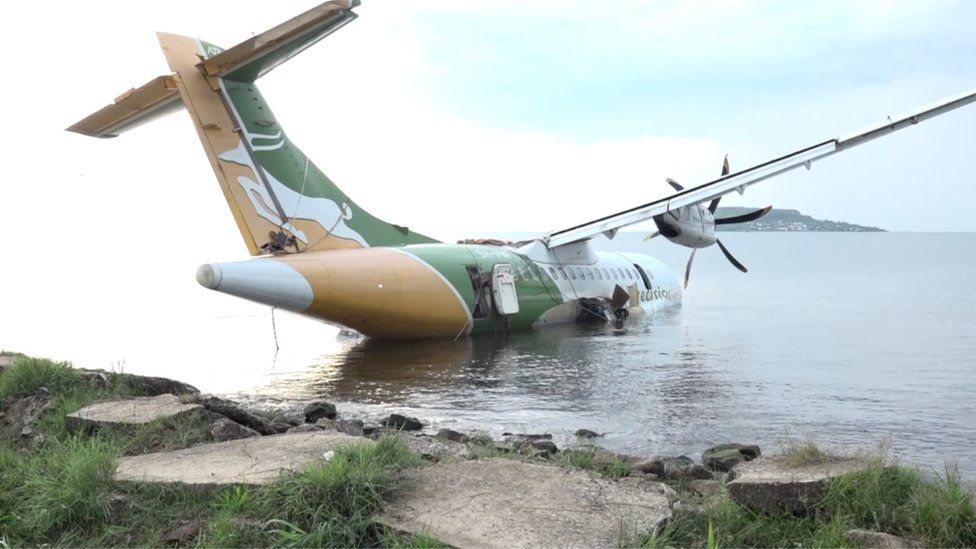
A passenger plane with 43 people on board crashed into Tanzania’sLake Victoria on Sunday as it approached the northwestern town of Bukoba.
The accident is being blamed on bad weather.
43 people, including 39 passengers, the two pilots and two crew members, were on the flight from the economic capital Dar es Salaam to Bukoba, a town on the shores of the lake, Africa’s largest and the source of the Nile.
Rescuers on Sunday afternoon worked to recover survivors and lift the plane out of the water using cables and cranes.
Commander of Police, Kagera province, said: “It is true that there has been an accident in Kagera province and everything is under control as all rescues and safety equipment have been deployed to help out.
“We have managed to save quite a number of people and we will give a brief statement after we finish with our rescue efforts.”
The French-Italian-built ATR 42 plane was operated by Precision Air, which is Tanzania’s largest private airline and is partly owned by Kenya Airways and operates flights to popular tourist destinations such as the Serengeti National Park and the Zanzibar archipelago.
William Mwampaghale explained: “When the aircraft was about 100 metres midair, it encountered problems and bad weather.
“It was raining and the plane plunged into the water. Everything is under control. The army’s head of rescue missions and firefighters from the province of Kagera are on the scene.
“They are fully equipped to deal with rescues and safety. Rescue efforts are currently underway in order to retrieve the aircraft.”
At least 26 people have been rescued and evacuated to a hospital.
Tanzanian President Samia Suluhu Hassan has expressed her condolences to those affected by the crash and asked people to remain calm while the rescue operation continues.
Sunday’s accident comes five years after 11 people were killed when a plane belonging to a safari company crashed in northern Tanzania.
Celebrities enjoy a lot of benefits from their careers, like wealth that most of us can only dream of, special treatment, and larger than life experiences.
However, it does come with the cost of personal freedom. That’s why so many celebrities have to invest in serious security.
Life in the spotlight comes with the real fact that they can’t go anywhere without bodyguards.
Here are some celebrities with the most expensive and exclusive bodyguards.
Adele
Adele is one of the greatest voices of this generation, and fans absolutely love her down to earth personality. Her net worth is at about $190 million, so it makes sense that she has hired security that follows her day and night. She hired Lady Gaga’s former body guard Pete Van Der Been in 2017, who charges $70,000 per year for his services.
Over a century after his posthumous presidentialpardon, Jack Johnson remains widely famous for being the greatest to ever do it boxing-wise. The first Black heavyweight champion and out-doored inventor, Johnson had more than punches, uppercuts and jabs.
Below-the-belt moves were not the only talents Jackson had. While he possessed undeniable skills for the ring, tucked away in the treasure cave of his mind was the idea and technical know-how to invent an improved wrench.
Johnson was arrested in 1912 for violating the Mann Act, also known as the White Slave Traffic Act. The law made transportation of white women or girls for prostitution or debauchery illegal, and Johnson was found guilty of it. An all-white jury determined that when Johnson made a trip with his 19-year-old white girlfriend, he was illegally carrying a woman across state boundaries.
The conviction was intended to punish Johnson for his romantic affairs with white women. Johnson had a preference for white women. Apart from his white girlfriends, he married white women several times. He was apprehended after several failed arrest attempts. In 1915, he lost his title to Jess Willard. He served a year in jail.
He developed an enhanced wrench while imprisoned in Kansas and got a patent for it in 1922. Johnson’s wrench became known as the “monkey wrench” and the tag “monkey” has become a debate as Black people take offense at the racially derogatory slur often used on Black people. But, according to others, the attachment of the word “monkey” to the wrench had nothing to do with Johnson being an African-American man.
According to the American Cowboy Chronicles, the term “monkey wrench” can be traced back to 1807 in Great Britain, where it appears in E.S. Dane’s “Peter Stubs & Lancashire Hand Tool Industry” catalogue. The “monkey wrench,” also known as “gas grips” in the United Kingdom, is adjustable. The term “monkey wrench” refers to the pipe wrench, which is still used by aircraft technicians when dealing with large low torque fasteners.
While it is true that boxer Johnson received a wrench patent while incarcerated, his patent was only for improvements to an existing wrench that had nothing to do with a monkey wrench, therefore, the claim that it was named “monkey wrench” because Johnson was an African American is false.
Johnson made great improvements on a tool and received his flowers for it by way of a patent. Indeed, he was not the first inventor of the tool. Wrenches had been in existence for a long time before Johnson was born. In fact, the first wrench was awarded a patent in the 1840s, over 35 years before Johnson was born.
Irrespective of the hoax and controversies surrounding Johnson’s invention, it does not change the fact that he made something legendary at a point in his life when the stars were not aligning in his favor.
Eventually, Johnson was released in 1921 after serving his one-year-and-a-day sentence. 105 years later in 2018, President Donald Trump gave him a posthumous presidential pardon for his racially motivated conviction.
Meet Sisa Ngebulana. He is the founder of Rebosis Property Fund, the first black-managed property fund to be listed on the Johannesburg Stock Exchange (JSC). He is also the founder of Billion Group, a commercial and retail property developer.
Ngebulana was born and raised in Mthatha (in Eastern Cape province of South Africa) by his grandparents following the death of his father. He was taught at a very young age that success does not come on a silver platter. He was taught the importance of behaving well, being disciplined, purposeful and the almost responsibility of being accountable for his actions.
“At any given time, there were between 12 and 15 of us in the house, cousins, brothers and sisters, and we were all always working. Every day, my grandmother woke us up early and instructed us to find something to do. “‘You have two hands and two eyes,’ she’d say, ” he recollected in an interview with the Entrepreneur. “‘You’re blessed. Now go and use them.’ She gave us the tools to make something of ourselves, but it was up to us to use them. “
With these principles, Sisa launched his first company, a trucking and transport company, which failed. He was determined to achieve success, so he re-launched the company while doing his articles at a law firm in Cape Town.
By the time he was done with his articles of service, his trucking and transport company had reached a level where he decided to pursue it as a full-time job.
No sooner had he decided to pursue the trucking and transport business as a full-time job than his early success hit a snag. He had accumulated so much debt that he could not even pay his creditors.
The challenges in his business soon began to affect his general well-being. According to him, he blacked out three times in a matter of weeks. Initially, his doctors thought it might be kidney stones.
“The second time, they decided the problem was my appendix, and they scheduled an appendectomy. I was still recovering from the operation when I had my third blackout. It was at that point that my aunt, who is a doctor, told me that my problem was stress. It was clear: it was the business or me. I had to make a choice,” he noted.
At the time, he owed the bank $50,000 (around 800,000 South African Rand). To pay settle his debt, he decided to auction off his trucks and get a job to start repaying the loan, which his bank turned down and gave him time to pay off the debt. Within 32 months, he settled his debt.
Aside from the challenges he faced operating a trucking and transport company, Sisa pursued other fields of endeavour until 2010, when he formed a company called Rebosis Property Fund. The following year, the company was listed on the JSE.
According to Entrepreneur, the company also became the first black-managed and held property company on the JSE, as well as the largest IPO in the property sector. Rebosis Property Fund and sister company Billion Group have an asset value of over $200 million and a market cap of around $180 million.
Building the first black company to be listed on the stock exchange did not come easy. Sisa faced multiple challenges but never gave up on his dreams. He faced advisories and saboteurs but remained steadfast in his quest to achieve success.
The Rwandan government said a Democratic Republic of Congo (DRC) army fighter jet violated its airspace on Monday, just 48 hours after a deal to defuse rising tensions between the two countries.
The Congolese government has been facing an offensive by the armed group M23 (“March 23 Movement”) in eastern DRC in recent weeks, which has reignited historic tensions with neighbouring Rwanda, which it accuses of supporting the former Tutsi rebellion.
Kigali has always disputed these claims and in return claims that the DRC is collaborating with Rwandan Hutu rebels.
The DRC expelled the Rwandan ambassador in Kinshasa on 29 October and recalled its chargé d’affaires in Kigali.
In a statement on Monday, the Rwandan government said a “Sukhoi-25 fighter jet from the Democratic Republic of Congo violated Rwandan airspace at 11:20 am (local, 8:30 am GMT) this morning and landed briefly at Rubavu airport in Western province”.
“No military action was taken by Rwanda in response, and the plane returned to the DRC. The Rwandan authorities protested against this provocation to the DRC government, which acknowledged the incident,” the text added.
On Saturday, the foreign ministers of the two countries meeting in Angola announced their commitment to “maintain dialogue” and to define “a timetable to accelerate the implementation of the roadmap” signed in July and providing for a cessation of hostilities.
Relations between Rwanda and the DRC are as conflictual as they are historic, mired for nearly 30 years in the aftermath of the 1994 genocide.
The resurgence of the M23 in the east of the DRC since the end of 2021 has rekindled tension between the two neighbours.
While Kigali denies any support to the M23, a report by independent experts mandated by the UN Security Council had detailed in August the involvement of Rwanda, “unilaterally or jointly with the M23 fighters” in eastern Congo.
Washington reiterated last week its “concerns about Rwanda’s support for M23”.
Kenya announced on Wednesday the deployment of troops as part of a joint force of the East African Community (Burundi, Kenya, Rwanda, Tanzania, South Sudan, Uganda and DRC) agreed in April to help restore stability in the DRC.
According to the UN, fighting between the Congolese army and the M23 has displaced some 50,000 people since 20 October.
Nike has cut ties with Brooklyn Nets star Kyrie Irving. The development comes following a controversial social media post about a book and movie containing antisemitic tropes.
In a statement, Nike said it will no longer launch Irving’s new shoe, the Kyrie 8. The shoe, said to be his eighth, was due to be released on November 8, according to ESPN.
Earlier, the Brooklyn Nets had suspended Irving for at least five games after he “stopped short of fully disavowing the documentary on two occasions,” according to Reuters. He has since apologized for promoting a project he said contained “false anti-Semitic statements.”
“To All Jewish families and Communities that are hurt and affected from my post, I am deeply sorry to have caused you pain, and I apologize,” Irving wrote on Instagram.
“I initially reacted out of emotion to being unjustly labelled [antisemitic], instead of focusing on the healing process of my Jewish Brothers and Sisters that were hurt from the hateful remarks made in the Documentary.”
However, the apology did little to stop Nike from pulling out of its partnership with him. “At Nike, we believe there is no place for hate speech and we condemn any form of antisemitism,” the Beaverton, Oregon-based company noted in a statement. “To that end, we’ve made the decision to suspend our relationship with Kyrie Irving effective immediately and will no longer launch the Kyrie 8.”
“We are deeply saddened and disappointed by the situation and its impact on everyone,” Nike said. Irving first signed a deal with Nike when he became the No 1 pick in that year’s NBA draft in 2011. According to the Guardian, he released his first signature shoe three years later and made $11m annually just from the Nike endorsement.
Irving becomes the second black celebrity in less than two weeks to lose a major shoe deal over antisemitism. Adidas cut ties with Kanye West, now known as Ye, over antisemitic tweets. It cost Ye $1.4 billion. He now has a reported net worth of $400 million and is no longer part of the billionaires’ club.
The nurse who tried to help Takeoff after he was fatally shot recently opened up about what she witnessed and why she decided to respond to the scene. As previously reported by Face2Face Africa, the Migos band member was shot and killed at a bowling alley in Houston on November 1.
In an interview with KHOU, the infusion nurse,who opted not to disclose her identity, said there was nothing she could do to keep the 28-year-year old rapper alive. She also recalled what she heard and saw before she went to the scene of the incident.
“I live close by and I heard, ‘Pow pow pow pow pow,’ and it stopped and I went, ‘That’s so weird so I got up in my pajamas, go over to the balcony, my neighbors were underneath me. I said ‘Did yall hear that?’ And they said ‘Yeah.’ And I said ‘I don’t think that was a car or firecrackers. That sounded like gunshots,’” she said.
The nurse said she initially chose not to leave her home because she suspected it was an active shooter situation. But she said she heard someone scream after things calmed down.
“I’m thinking that’s the victim. That’s the person who’s shot,” she recalled. “It sounded like a cry of agony. It was a cry of agony but emotional not physical.”
The nurse said she later got to know the person who screamed was fellow band member and Takeoff’s uncle Quavo. The 31-year-old was said to be asking for assistance as well as an ambulance. And in the wake of his plea, the nurse said she rushed to the scene after she took her equipment from her car. She added that she later got to know the victim was Takeoff.
“You can hear my voice in a video yelling ‘I’m a nurse. No, no, no. I’m a nurse,’ because I wanted to let them know,” she said. “I was scared, but I had to go.”
But she said there was nothing she could do to resuscitate the deceased rapper. “His head was way up and his eyes were rolled back and fixed,” she recalled. “And I saw a pile of blood behind his head.”
The nurse also told KHOU that she checked the victim’s pulse several times. And though social media users said she should have performed CPR on Takeoff, she said that could have aggravated his condition.
“Would not be appropriate, especially with a gunshot wound,” she said. “You would never do CPR because you would be circulating the blood and the blood would go right out of the hole.”
The nurse said she commiserates with Takeoff’s family as her son’s age is around that of the deceased rapper. She also said she decided to speak on the incident because she wants “somebody to know that good people sometimes show up, just because.”
And though she had conversations with the Houston Police Department in the wake of the fatal shooting, she said she could not provide any concrete information because she wasn’t at the scene when the shots were fired.
The nurse also said she hopes the person who fatally shot the rapper would be identified by someone who knows him. The fatal incident is currently being investigated by the Houston Police Department.
General Mahamat Idriss Deby Itno on Monday appointed by decree 104 more members of his “parliament” as he leads Chad’s two-year transitional government after taking power on the death of his father.
In early October, a national reconciliation dialogue (DNIS), which gave him an additional 24 months as transitional president, recommended increasing the number of “deputies” in the National Transitional Council (CNT), which has acted as parliament since Mr Déby was first proclaimed head of state on 20 April 2021, at the head of a junta of 15 generals, from 93 to 197.
The enlargement of the CNT aims to integrate personalities from parties, civil society organisations and rebel movements that joined the national dialogue, which was boycotted by a large part of the opposition and some of the most powerful armed groups.
The latter denounce a “dynastic succession” in Chad, ruled for 30 years with an iron fist by Idriss Déby Itno, Mahamat’s father, who was killed on the front line against rebels a year and a half ago.
In a decree consulted by AFP, General Déby named 104 “additional members of the CNT” on Monday, including representatives of the former opposition that rallied to the regime during the DNIS and rebel groups that signed a peace agreement in August.
On 20 April 2021, a junta of 15 generals announced the death of Marshal Idriss Déby and proclaimed his son Mahamat, a 37-year-old general at the time, “President of the Republic” for a “transitional” period that should lead to “free and democratic elections” after 18 months, renewable once.
The generals immediately abrogated the Constitution, dismissed the government and dissolved parliament, only to replace it five months later with a 93-member CNT appointed by the new strongman of N’Djamena. This transitional “parliament” is in charge of drafting a new constitution and preparing elections.
Mahamat Déby immediately received the support of the international community – led by France, the European Union (EU) and the African Union (AU) – which nevertheless demanded that the transition not exceed 18 months, and also ensured that General Déby would not stand in future elections.
Eighteen months later, the DNIS not only reappointed him for two years as head of Chad but also authorised him to run for the supreme magistracy in two years’ time.
On 20 October last, opposition demonstrations were violently repressed, resulting in about fifty deaths in the country’s major cities, more than 300 injured and hundreds of people arrested.
The EU “strongly” condemned the “excessive use of force” and “serious violations of freedom of expression”.
Hundreds of young Congolese volunteer to join the army to fight the M23 (“March 23 Movement”) rebels who are making increasing advances in eastern Democratic Republic of Congo.
Army officials say more than 3,000 applicants aged between 18 and 30 are registered across the province, in part as a response to a message to the nation by President Felix Tshisekedi calling on young people to enlist in the army to fight the M23 rebels.
The Rwandan government, which has repeatedly denied supporting M23, meanwhile said that a Congolese fighter plane had “violated Rwandan airspace” by landing briefly at Rubavu airport.
“No military action was taken by Rwanda in response, and the jet returned to the DRC,” the Rwandan government said in a statement.
The M23 rebels rose to prominence more than a decade ago when they seized Goma, the largest city in Congo´s east that sits along the border with Rwanda. After a peace deal, many of M23´s fighters were integrated into the national military. But then a year ago, the group re-emerged saying the government had failed to live up to its decade-long promises.
Tensions have mounted as the M23 rebels have advanced in recent weeks, seizing several key towns including Kiwanja. Congo’s government has blamed Rwanda and expelled the Rwandan ambassador about a week ago.
Representatives from the two countries met over the weekend in Angola where they agreed to “maintain dialogue.” Other peace talks are expected to resume in Kenya next week. However, Congolese government spokesman Patrick Muyaya said representatives of M23 will not be allowed to take part unless conditions are met.
“The M23 must withdraw from occupied positions before being reintegrated into the process like other armed groups,” he told journalists over the weekend.
In Goma on Monday, North Kivu military spokesman Lt. Gen. Guillaume Djike Kaiko said more than 3,000 people had stepped forward to join the military’s efforts against M23.
Among them was Clarisse Mahamba, a 19-year-old who said she’s been interested in the military since childhood and wanted to serve her country.
“I see that things are not going well in our country,” she told The Associated Press. “I saw the Rwandans coming to invade us because I was in Rumangabo. I saw how our soldiers were suffering, I fled and that´s why I have also joined the military service.”
Edison Butsira, 27, has a college degree in economics but said he wants to follow the example set by young Ukrainians who took up arms to defend their country.
“Young people decided to abandon their activities – they left to enlist in their army to fight because Ukraine was invaded,” Butsira said. “Here I also gave up my job and I joined my friends to go fight.”
Congolese President Felix Tshisekedi also has called on his citizens to mobilize against “Rwandan aggression” in Rutshuru territory on Thursday.
“We must be aware that no one but ourselves will save our nation and that this requires from each of us a mobilization all around,” he said on RTNC radio.
More than fifty drivers of these box carts, which are handmade vehicles mounted on four wheels and pushed by human strength and gravity alone, competed on Sunday in Cape Town.
Along with speed, each team is judged on their final position, creativity and showmanship.
“So the BF Goodrich cart is modeled on the Jurassic Park vehicle. We are here today to race and to bring awareness to the Kariga Save the Rhino Fund and the foundation that runs it,” said Antonio Pereira, the Brand Manager, BF Goodrich.
The principle is simple: arrive first at the bottom of the hill, by direct elimination. The creativity of the design and the staging at the time of the departure is then largely taken into account in the designation of the winners.
“Well, we built a pink tank because we think there’s a lot of violence in the world at the moment and we don’t think there’s anything that shows peace more than painting a weapon in like a soft, happy color and just showing that we, we want to spread love and we want to spread peace instead,” on spectator said.
The races have been organized by Red Bull in about 50 countries around the world, but this was the first time in Cape Town, where 12,000 spectators gathered behind the straw bales along the slope of the Muslim neighborhood of Bo-Kaap, with its typical low, colorful houses.
A fisherman who was one of the first responders at the site of Sunday’s plane crash which killed 19 people in Tanzania’s Lake Victoria, has described how he tried to save the pilots stuck in the cockpit and how he nearly lost his life trying to rescue them.
Majaliwa Jackson has been officially declared a hero, awarded 1 million Tanzanian shillings ($430; £370), and offered a job in the fire and rescue brigade for his efforts.
Speaking to the BBC from his hospital bed in the lakeside town of Bukoba before the governmentannouncement, Mr Jackson said he panicked as he saw the passenger plane approach from the wrong direction, before plunging into the lake.
He rushed to the scene with three fellow fishermen and helped to open the rear door by smashing it with a rowing oar which helped passengers seated towards the rear of the plane to be rescued.
Mr Jackson said he then moved to the front and dived into the water. He and one of the pilots then communicated with each other by making signs through the cockpit window.
pilots
“He directed me to break the window screen. I emerged from the water and asked airport security, who had arrived, if they have any tools that we can use to smash the screen.
“They gave me an axe, but I was stopped by a man with a public announcement speaker from going down and smashing the screen. He said they were already in communication with the pilots and there was no water leakage in the cockpit,” Mr Jackson said.
He added that after being stopped he “dived back and waved goodbye to the pilot”.
But the pilot then indicated that he still wanted to be rescued.
“He pointed out the cockpit emergency door to me. I swam back up and took a rope and tied it to the door and we tried to pull it with other boats, but the rope broke and hit me in the face and knocked me unconscious. The next thing I know I was here at the hospital,” Mr Jackson said.
Both pilots are among the 19 confirmed fatalities after the plane – operated by Precision Air, Tanzania’s largest private airline – crashed near the shore of the lake.
Image source, Charles Mwebeya TBC Image caption, Ropes were used to pull the plane closer to the shore of Lake Victoria
Of the 43 people on board there were 24 survivors, according to Precision Air.
Mourners on Monday paid tribute to the 19 victims at a service held at the local football stadium in Bukoba.
Speaking at the service, Tanzania’s Prime Minister Kassim Majaliwa said the government would cover the cost of the funerals.
Earlier, he said an extensive investigation would be carried to establish the cause of the crash.
The plane left the commercial capital Dar es Salaam on Sunday and made a scheduled stop at Mwanza before it crashed at around 08.50 local time (05:50 GMT) as it was approaching Bukoba airport.
An all-White jurce in Maine awarded $3 million to a Ghanaian native after it determined that his former employers racially discriminated against him when he was relieved of his duties.
According to WGME, the plaintiff, identified as David Ako-Annan, filed a lawsuit against Northern Light Eastern Maine Medical Center alleging the organization terminated him in 2019 because of his race and sex.
The 46-year-old worked as the practice manager of the organization’s Orono primary care location. In the lawsuit that was filed in October 2019, Ako-Annan claimed he was racially discriminated against by his supervisor because of the aforementioned reasons. But the hospital refuted those claims, arguing that their former employee did nothing to look into concerns of a high turnover rate at its Orono location after management raised issues about his performance.
The trial, which took seven days, commenced last two weeks. Up until his termination, Ako-Annan had been employed at the facility since 2013. And the hospital is said to have fired him a day after he came back to the U.S. after traveling to Ghana to visit his sick mother.
At the time of his termination, Ako-Annan told the jurors that his managerial role made him the only Black and only male to hold such a position in the organization’s five primary care locations.
The Ghanaian native is said to have gotten into disagreements with his supervisor a few months after the hospital employed her. She was identified as Donna Ashe. The plaintiff’s lawyer, Ryan Schmitz, told jurors that after Ako-Annan registered his worries to Ashe about White female practice managers being treated better than him, she responded by saying that could not have anything against the plaintiff because she has a “Black foster child, so please don’t talk to me about discrimination.”
But during the trial, jurors got to know that though Ashe looked after a biracial minor in the 1980s, she wasn’t a foster mother when she made the aforementioned claim to Ako-Annan, WGME reported. Ashe also testified during the trial.
The organization’s attorney, Kasia Park, informed the jury that Ako-Annan was relieved of his duties because he was underperforming. She also claimed the work environment at the facility the plaintiff was posted was “tense, stressful and negative.”
“David was the captain and his ship, the office, was going down fast,” said Park.
Prior to the jury selection at the beginning of November, Ako-Annan’s attorneys raised worries over the trial being held in northern Maine. The state’s southern area is said to be more diverse with regard to race and ethnicity. And though the Black man’s lawyers attempted to have the trial moved to Portland because they could be afforded a jury pool that was more diverse, the presiding judge rejected the motion.
Ako-Annan filed the lawsuit seeking compensatory damages such as back pay as well as the salary and benefits that he would have been entitled to if his employment was not terminated. He also sought punitive damages. During his testimony at the trial, Ako-Annan claimed he was yet to gain another job in his area of expertise, adding that it takes four hours to search for jobs on a daily basis. At the time of his termination, Ako-Annan said he had $120,000 in savings. But he said has had to spend $100,000 of that for living expenses.
Black marketeers grease the wheels in Central Africa’s petrol crisis. On the side of the roads of Bangui, vendors sell petrol to passersby. In the past two months the Central african Republic has faced a severe petrol shortage. In the capital, motor taxi drivers are giving up their trade or paying higher prices to get fuel.
“When you go to the stations, you can’t find any fuel, whereas in the stations you buy a litre for 885 CFA francs. But now the stations are not working. This makes the prices high.“ said Job, motor-taxi driver.
“Some drivers have parked their motorbikes because of this shortage. Because they don’t want to have problems with their bosses. If you don’t buy at the stations, at the roadside it’s more expensive and you lose revenue. So some people are handing over the motorbike to the boss at the moment to avoid this,” he added.
For years the price of petrol has been blocked by the government at 865 CFA francs (1.32 euros) a litre. On the street, a bottle costs up to 40 percent more.
“We pay taxes there and on the Central African side we also pay the customs officers. On their side, it’s 100 FCFA per can. Here it’s 250 FCFA. What we do, we don’t earn billions. But we are looking for ways to survive,” added Max Andjiba, a street vendor.
Petrol sellers buy on the black market where the product is often of poor quality from cheap additives.
Hundreds of petrol station workers around Bangui are out of a job and have been replaced by curbside sellers.
Despite mineral resources such as gold, diamonds and potentially even plenty of oil reserves, the World Bank estimates that 71 percent of Central Africa’s six million people live below the international poverty line of $2.15 a day.
Guests and actors walk the red carpet of the historic Africa premiere of Marvel Studios’ “Black Panther: Wakanda Forever” in Nigeria.
“The story is Africa, the story even though you know ‘Wakanda’ is a fictional country, we pull from real places in terms of culture that we represent and our inspiration,” says movie director Ryan Coogler.
In anticipation of its release this coming week, Disney/Marvel’s Black Panther: Wakanda Forever continued its promotional tour with a historic premiere in Lagos, Nigeriaon Sunday evening.
This was a major event — and the first time a Marvel movie has held a premiere locally — with a large group of talent, filmmakers and press on hand for the black carpet rollout.
The sequel to the $1.348B grossing original pic played across multiple screens at Filmhouse Cinemas IMAX Lekki.
In attendance on Sunday were director Ryan Coogler and stars Letitia Wright, Lupita Nyong’o, Danai Gurira, Tenoch Huerta Mejia, Winston Duke and Michaela Coel. Producer Nate Moore was also on hand along with soundtrack artists and producers.
The team has been making the rounds, including a world premiere in LA and a European debut at Cineworld Leicester Square in London last week.
The Nigeria premiere was held in association with the Africa International Film Festival (AFRIFF) and FilmOne Entertainment and celebrated the movie’s African heritage.
Chioma Ude, the founder of AFRIFF (which runs from November 6-12 and where Coogler will give a masterclass on Monday), recently reflected on the significance of the African premiere being hosted in Nigeria and its association with the festival.
“We are excited and proud to be a part of the premiere of this milestone film here in Africa. This is huge for the continent of Africa as it symbolizes to us further bridging of the gaps between the global film industries,” she said.
The first Black Panther remains the No. 1 film in both East and West Africa. It had its premiere on the continent in Johannesburg, South Africa in 2018.
Wakanda Forever is distributed in English West African territories by FilmOne Entertainment whose co-founders, Moses Babatope and Kene Okwuosa, said, “Being instrumental to the release of Black Panther: Wakanda Forever in West Africa is a proud achievement and a milestone for us and the entire FilmOne team, it will be celebrated for a long time.”
Wakanda Forever opens in Nigeria on November 11, in step with the U.S. International release begins on November 9 in France among others with global rollout continuing through the weekend.
A new manager and the return of an exiled player are ingredients for an intriguing World Cup finals for Morocco.
It’s a baptism of fire for Walid Regragui, who took the top job in September – three months before the Qatar showpiece event.
The former Morocco international replaced Vahid Halilhodzic, who was fired due to disagreements with the country’s football federation over preparations for the World Cup.
Regragui will be looking to lead the Atlas Lions into the knockout round after failing in their last three attempts.
The North African nation came agonizingly close in 2018 Russia, conceding a last-gasp own goal to lose 1-0 to Iran and allowing Spain to steal a 2-2 draw with a late goal.
Can Hakim Ziyech turn the tide for Morocco?
Redemption is on the cards for the Chelsea winger, who returned from exile following Halilhodzic’s exit. The 29-year-old was so unhappy under the disciplinarian Halilhodzic that he even announced his international retirement.
Ziyech is clearly part of Regragui’s plans after he was deployed alongside Angers winger Sofiane Boufal to support Sevilla striker Youssef En-Nesyri in a 2-0 friendly win over Chile last month.
The new-look attacking trident should get plenty of scoring chances if Achraf Hakimi is in form. The Paris Saint-Germain right back is one of the best attacking fullbacks in world soccer and has pace, skill, good passing and an eye for shooting with eights goals in 53 games for Morocco.
Morocco, which is playing in its sixth World Cup after making its first appearance in 1970, became the first African team to reach the knockout round in 1986.
The Atlas Lions will need to be at their best as they face 2018 World Cup finalists Croatia in the tournament opener (23 November), before meeting European heavyweights Belgium four days later. Their final Group F clash will be against Canada (1 December).
Malawi is facing an influx of refugees fleeing the recently intensified unrest in the eastern Democratic Republic of Congo, the World Food Programme (WFP).
The Dzaleka camp, the only refugee camp in the small, poor southern African country located about 40 km from the capital Lilongwe and initially designed to accommodate 10,000 people, now has nearly 56,000 refugees, the majority of whom are Congolese, according to the WFP.
“The situation is alarming,” said Paul Turnbull, the UN food aid agency’s representative in Malawi. “Conflicts in the Great Lakes region, particularly in the Democratic Republic of Congo, have resulted in a steady flow of refugees into Malawi for more than two decades, with a recent surge in new arrivals.
According to the UN High Commissioner for Refugees, 560 new arrivals were recorded in September alone. In March of last year, there were just over 49,000 refugees in the camp.
The vast majority are Congolese (62%), but there are also Burundians (19%) and Rwandans (7%), with the rest coming from Ethiopia and Somalia.
This overpopulation is causing tensions. This week, refugees seized a WFP car to show their displeasure after 600 families were removed from the lists of food distribution beneficiaries, out of the 11,000 in the camp.
“Food assistance should be provided on the basis of vulnerability,” Turnbull said, noting that some refugees have opened small businesses or found alternative livelihoods.
Romain Bijangala, a Congolese community representative in the camp, said some were “sleeping on an empty stomach” and “without food aid, they will certainly die.”
Eastern DRC has been plagued by violence from armed groups for nearly three decades. Fighting has recently intensified between the “March 23 Movement” (M23), a former Tutsi rebellion that has taken up arms, and the Congolese Armed Forces.
More than 232,000 civilians have been displaced since hostilities began in March, according to the U.N. Office of Humanitarian Affairs in the DRC, and at least 183,000 have been displaced since October 20th, when tensions flared.
In a new attack on the country’s impending presidential election, Jacob Zuma, the former president of South Africa, charged Cyril Ramaphosa on Sunday with “buying” his position as leader of the governing ANC party. The election is less than a month away.
The African National Congress (ANC) is due to meet in mid-December to decide whether or not to invest Mr Ramaphosa as a candidate for a second term in the 2024 presidential election by re-electing him as party president.
“Cyril Ramaphosa has clearly been accused of spending a lot of money to buy his position as ANC president,” Zuma told supporters in Durban. Dancing on stage and chanting “Amandla!” (“Power!”), he accused the current head of state of having “manipulated the democratic process”.
The financing of Mr Ramaphosa’s campaign for the ANC leadership in 2017 caused controversy. He was accused of lying to parliament about a 500,000 rand (about 28,000 euros) donation from an industrial group.
Mr Ramaphosa, 69, was finally cleared by the Constitutional Court and took over the reins of the country after the resignation 2018 of Jacob Zuma, mired in scandal.
Sentenced to 15 months in prison for stubbornly refusing to answer an anti-corruption commission, Mr Zuma, 80, finished serving his sentence last month. He was on conditional release for health reasons.
His incarceration in July 2021 triggered a wave of deadly violence and looting in a difficult socio-economic context.
The former president, who remains Cyril Ramaphosa’s biggest political rival, had already made a violent accusation against him last month, accusing him of “treason” and of being “corrupt”.
Mr Ramaphosa was elected on a promise to eradicate corruption and has been in turmoil for several months. He is the target of an investigation into mysterious cash found during a break-in at one of his properties.
An independent commission appointed by parliament is due to report back next week. The results of the enquiry could lead to a possible vote in parliament to remove Ramaphosa from office, who has denounced it as a political move.
A new round of talks began on Monday between Ethiopia’s government and Tigrayregional representatives to work out military and other details of last week’s signing of a “permanent” cessation of hostilities in a two-year conflict thought to have killed hundreds of thousands of people.
The meetings in Kenya involved the military commanders of both sides along with the lead political negotiators.
Discussed were expected to focus on how to monitor the deal, disarming Tigray forces and the resumption of humanitarian aid access and basic services to Ethiopia’s northern Tigray region, which has been cut off for months.
“Maybe by the end of this week or the middle of next week” trucks of humanitarian aid will be allowed to go in, the Ethiopian government’s lead negotiator Redwan Hussein told journalists.
Tigray’s lead negotiator Getachew Reda said the delivery of aid would increase confidence in the talks.
He also reiterated that military leaders have the responsibility to ensure the implementation of the deal.
“It is for them (military leaders) to figure out how effectively to carry out the deal and to make sure that we continue to hold our fire and of course silence the guns forever,” Reda said.
Former Kenyan President Uhuru Kenyatta, who’s facilitating the talks in Nairobi, said he was fully confident that warring parties would be able to reach a resolution. .
“These brothers who know each other well will be able to work and formulate together the best way to bring a permanent cessation, and resolution to the problem that has confronted our brothers and sisters, our mothers and children from Ethiopia in a peaceful way,” he said.
Others who were facilitating and attending the talks included African Union envoy and former Nigerian President Olesegun Obasanjo and Nigerian, South African and Kenyan military officers.
The United States and the regional Intergovernmental Authority on Development were listed as observers.
Following a report that a single sheep consumed a pile of for sale fried fish, the Borno State Police Command in Maiduguri apprehended the sheep and her two lambs.
The incident occurred at Bulabulin Ward in the Maiduguri Metropolitan Council on Saturday.
The sheep and her lambs were said to still be detained as at Sunday morning.
The arrest was made following a complaint lodged at the Bulabulin Divisional Police headquarters by one Yusuf Ibrahim who sells fish along a busy road in the neighbourhood.
According to Zagazola Makama, a Counter-Insurgency Expert and Security Analyst, Ibrahim complained that the sheep had been ‘terrorising’ him for years.
He said he had endured the intrusion and criminal behaviour of the animal for five years, but that its action on Saturday caused him huge losses.
Ibrahim further remarked that the sheep had formed the habit of coming around his shop and patiently keeping watch from a distance while he fried fish.
“And then as soon as my attention shifts, the sheep makes a dash towards the table and before I knew it, it had eaten as much as it could before being sent away,” he said.
He added that he had tolerated it for five years and had asked the owner to take action by putting the sheep on a leash. He, however, said his appeals were to no avail.
The owner of the sheep, one Luba Mohammed – a housewife, lamented that she does not know how and when the sheep developed a liking for fried fish.
She admitted that the fish seller had indeed complained to her several times over the years about the actions of the sheep.
The woman begged Ibrahim to temper justice with mercy and release the sheep, with a promise that she will either sell, slaughter or put it on a leash.
All lotto operators, agents, and writers are invited to an emergency stakeholders meeting on Tuesday, November 8, 2022, in the Teachers Hall in Accra, beginning at 9:00 a.m., hosted by the Ghana Lotto Operators Association (GLOA) and the Concerned Lotto Agents Association of Ghana (CLAAG).
The main Agenda is Sensitisation and mode of enforcement of the 20% commission to Writers directive by NLA.
“All Lotto Operators, Agents and Writers must attend without fail and be punctual,” management noted.
Meanwhile, a statement signed earlier by the Secretary of GLOA, Seth Asante Amoani, noted that GLOA and PLO have entreated its writers to accept the 20% commission noting to its members that refusal to comply with the directive will lead to the forfeiture of licence and banning of the operator.
“In line with the directive from the NLA, the executives and members of the Ghana Lotto Operators Association (GLOA) and Private Lotto Operators (PLO) wish to bring to the attention of its writers that payment on lotto commission is twenty percent (20%) effective 14th October 2022,” part of the statement read.
Some members of GLOA and PLO have assented their signatures in compliance with the Lotto Commission determined by the Governing Board of NLA.
Nyombi Morris, a young environmental activist from Uganda, had great expectations for participating in the fight for environmental justice when she traveled to Egypt for the UN’s COP27 climate meeting.
But his expectations were quickly dashed by Egypt’s strict security measures, as rights organizations fear the North Africannation has suppressed rallies with “dozens” of arrests.
“I was so happy when they announced that COP would be in Africa,” said Morris, who founded the Earth Volunteers youth organisation campaigning for “climate justice”.
“I thought maybe I would get a chance to be in the room where the negotiations are taking place.”
Instead, “with the questions we received at the airport, it will not be easy for us to continue with our plan”, the 24-year-old said.
In 2008, when Morris was 10, devastating flash floods hit Uganda’s eastern Butaleja district — an area where the illegal extraction of riverbank sand for construction was common. Some 400 people, including Morris’s family, lost their homes.
Morris, who has said the digging “exacerbated flooding already made worse by climate change”, said they had to move to the capital Kampala.
“I am here to represent my mother who lost a farm, who lost a home,” he said. “I am here to ask for compensation for my community.”
– ‘Abusive security measures’ –
Activists wanting to demonstrate at COP27, held in the Egyptian resort town of Sharm el-Sheikh, must request accreditation 36 hours in advance, providing information such as the names of the protest organisers and details of the proposed march.
Approved demonstrations are only allowed during working hours and in a specific purpose-built area.
That accreditation process is risky, Morris fears.
“When they started asking about our locations, where we will be staying, our passports, our names, we were worried,” he said.
“What if they follow one of us and (we) get arrested?”
He cited the case of Indian climate activist Ajit Rajagopal, who was arrested after setting off to march from Cairo to Sharm el-Sheikh. He was later released after an international outcry.
Human Rights Watch on Sunday warned that “dozens of people” calling for protests had been detained.
“Egypt’s government has no intention of easing its abusive security measures and allowing for free speech and assembly,” the watchdog said.
Rights groups say at least 138 people have been arrested ahead of a rally slated for November 11 — planned nationwide but not in Sharm el-Sheikh — against what they decry as repression and sharp increases in the cost of living.
– ‘Watching online’ –
Africa is home to some of the countries least responsible for planet-heating emissions but hardest hit by an onslaught of weather extremes.
On top of security restrictions, Morris lamented that activists like him were excluded from the talks.
“I am watching online because our ‘observers’ badges don’t allow us to enter,” he said.
A journalist who operates a news website critical of the Senegalese government has been detained by policein Dakar on suspicion of spreading “information likely to endanger” security, according to his lawyer.
Pape Alé Niang, who runs the private news website Dakar Matin, is famous in Senegal for his regular columns on current affairs.
He was arrested and taken into custody on Sunday at 2pm (local and GMT) at the central police station in Dakar for three “offences”, his lawyer Ciré Clédor Ly told AFP.
The police accused him of “having brought to the knowledge of the public information whose disclosure is likely to harm national defence and acts and manoeuvres likely to compromise public security and cause unrest.
The third offence relates to “a violation of professional secrecy”, according to Me Ly, who denounced “a mountain of heresy, intimidation and an attempt to muzzle the press”.
The Coordination of Press Associations (CAP), which brings together local press organisations, said in a statement that it would “provide all the assistance required” to the journalist.
The arrest of Pape Alé Niang had been announced by local media and the CAP before being confirmed to AFP by a police source. The latter did not specify the reason.
According to the local press, the arrest comes after the journalist published articles in recent days about rape accusations against Senegal’s main opposition figure, Ousmane Sonko.
Mr Sonko, 48, a declared candidate in the 2024 presidential election, was charged with rape and death threats and placed under judicial supervision in March 2021, after being targeted in February 2021 by a complaint from an employee of a beauty salon where he was going to get a massage to, according to him, treat a backache.
He was heard Thursday for the first time in this case by an investigating judge in Dakar, a case that is very closely followed in the country.
In addition, Fatou Dione, a videographer for the Buur News website, was the victim of “police violence” on Saturday during a banned demonstration in Dakar, the CAP said in a statement.
The journalist “fainted when the police came to evacuate her with unprecedented brutality,” the CAP added.
Some 20 people arrested on Saturday afternoon during the demonstration, which was banned by the Dakar prefect, were still being held on Sunday, according to the press.
The demonstration, initiated by a group of activists, was aimed at demanding the release of “political detainees”, people in prison for several weeks and presented in the press as close to the opposition.
Senegal is ranked 73rd out of 180 countries in the world press freedom index established in 2022 by the NGO Reporters Without Borders (RSF).
Wealthiest man in Africa, Aliko Dangote, saw a considerable boost in his net worth at the end of the first week of November.
Shares of his flagship company, Dangote Cement Plc, surged by double digits, staging a recovery from their slump in October.
Dangote’s net worth climbed by $700 million in the past week, going from $17.6 billion on November 1 to $18.3 billion on November 7, according to the Bloomberg Billionaires Index, which measures and compares the fortunes of the world’s 500 richest people.
The performance of his 86 percent investment in Dangote Cement, a publicly traded company, can be blamed for the large increase in his net worth over $18.3 billion, as the share price of the industry leader rebounded quickly after hitting a one-year low near the end of October.
The $700-million bump in his wealth figures was fueled by an 8.8 percent increase in the company’s share price on the Nigerian Exchange from N220.5 ($0.502) on November 1 to N240 ($0.546) at the time of writing this report, as investors on the local bourse renewed buying interest in the company’s shares, which continue to trade below their fair value.
According to Simply Wall St, a Sydney-based research firm, the company’s shares are trading below analysts’ calculated fair price-to-earnings ratio, a financial ratio that compares a company’s valuation to earnings and tells investors how much a company is worth.
The Australian company also revealed that the cement maker’s earnings are expected to grow by 18.83 percent per year and that analysts are unanimous in their prediction that the company’s stock price will rise by 38.8 percent in the short to medium
Leaving aside these estimates, Dangote Cement is struggling to outperform last year’s financial results, with profits falling by double digits at the end of the first nine months of its current fiscal year due to lower demand and rising energy costs.
The group’s earnings dropped by 23.4 percent to N213.1 billion ($486.5 million) at the end of the first nine months of its 2022 fiscal year, from N278.25 billion ($635.2 million) the previous year, according to figures contained in the group’s recently published financial statement, as rising energy and distribution costs ate into its earnings.
In light of the drop in earnings, the billionaire businessman, who is not only Nigeria’s richest man but also Africa’s richest billionaire, may receive a lower dividend next year than the N293 billion ($704.1 million) he received this year.
A strike by Kenya Airways pilots led to dozens of flights being cancelled, affecting thousands of passengers.
The airline has faced years of losses and pilots are striking over retirement funds and the payment of all salaries stopped during the Covid-19 pandemic.
The pilots announced the strike in defiance of a court order against industrial action and gave no indication of how long it will last.
General Secretary of the Kenya Alliance Pilots Association (KALPA), Murithi Nyagah, they had tried to negotiate with the airline.
“We worked tirelessly throughout last night and shared our revised proposals with Kenya Airwaysmanagement,” he said. “Until now, we are yet to hear back from them. This once again demonstrates that it is Kenya Airways management’s failure that has gotten us to this point.”
Kenya Airways is jointly owned by the Kenyan government and Air France-KLM and earlier warned the strike would jeopardise its recovery, estimating losses at $2.5 million per day if the action took place.
Transport Minister, Kipchumba Murkomen, suggested the strikers were being unreasonable.
“We respect the views and the concerns of the pilots,” he said. “We believe they went about it the wrong way and the company and the government of Kenya is willing to listen to the issues they are raising.”
Angry passengers described huge queues at airports, with many only learning their flights were cancelled when they arrived to check in.
Among them was Chief Operating Officer, Mobex Africa, Alain Gbeasor, who complained about the lack of communication.
“I think that the least respectful thing KQ [Kenya Airlines] could have done to its passengers was to at least send us an email to notify us of this,” he said.
“I checked out of my hotel room, I get to the airport and all they do is brandish this paper in front of me, I call back to the hotel and there is no accommodation and I have been standing here for 3 hours. Is that how you work in this country?”
The Kenya Airline Pilots Association said no Kenya Airways flight flown by its members had departed Nairobi’s Jomo Kenyatta International Airport from early on Saturday.
At 89 years, Paul Biya of Cameroonis Africa’s oldest president and second longest serving Head of State.
Over the weekend, parties have been held across the Central African country to commemorate the 40 years he has been in power.
Reports indicate that the celebrations were held with life-sized portraits of Biya but he was not present at any of the events.
Thousands of people danced in front of the city hall in the capital Yaoundé. It was draped in an enormous portrait of Mr Biya emblazoned with the slogan “An exceptional president,” a BBC Africa LIVE report noted.
The main opposition leader Maurice Kamto said Cameroon under Mr Biya was a highly corrupt country where people’s basic rights were trampled upon in a ruthless and arrogant manner.
The administration has become even more repressive since 2017 when separatists launched a violent uprising in English-speaking parts of the country, the BBC report added.
A prominent journalisthas been arrested in Senegal over accusations that he distributed information liable to harm the country’s security.
Pape Alé Niang, who runs the news website Dakar Matin, is well-known for his columns on current affairs, which are often critical of the Senegalese government.
Mr Niang’s lawyer said his client had been detained at the central police station in Dakar on Sunday over three alleged offences.
Local media say the arrest came after the journalist published recent articles about rape charges against Senegal’s main opposition leader, Ousmane Sonko.
Tanzania’s Prime Minister Kassim Majaliwa will on Monday lead mourners in paying their respects at a funeral service for 19 people killed after a passenger plane crashed into Lake Victoria in Tanzania.
The plane crashed on Sunday morning near the shore at the end of the Bukoba airport runway.
Of the 43 people on board, there were 24 survivors, according to the operator Precision Air.
The prayers will be held at the Bukoba football stadium, according to the area’s regional commissioner Albert Chalamila.
Precision Air is Tanzania’s largest privately-owned passenger airline.
Kenya’snational carrier, Kenya Airways, has threatened to start disciplinary action against its pilots whose strike has entered its third day.
The airline maintains that the strike is unlawful, a position that has been backed by government officials who say the actions of the 400 pilots amount to economic sabotage.
The national carrier says it cancelled 56 flights over the weekend, affecting some 12,000 passengers.
Export and importation of cargo such as fresh produce and pharmaceutical products has also been affected.
The airline now warns that the window for negotiation is closing, and the pilots involved in the strike could face dismissal or legal proceedings.
The labour ministry on Sunday said the airline was at liberty to take necessary lawful measures against its pilots.
The government, which is the biggest shareholder at Kenya Airways, said it had invested nearly $500m (£442m) to keep the carrier afloat in the last three years.
The pilots say the strike is still in full force until their demands are met.
They want the airline to reinstate contributions to their retirement fund, as well as top managers including the CEO to be fired with immediate effect among other grievances.
The parties are due to appear in court on Tuesday after the airline acquired an injunction days to the strike.
Somalia’s religious affairsministry has banned the use of the name al-Shabab – “the youth” in Arabic – and asked the public to refer to the militant group as “Khawarij”, a derogatory term meaning a deviant sect.
In a statement, the ministry also prohibited clerics from dealing with the al-Qaeda-allied militants or meeting them.
The government said the directive to brand al-Shabab as “Khawarij” was part of the war against the group.
It is not the first time the Somali government has coined another name for al-Shabab.
In 2015 the government told the media to refer to the militant group as “Ugus”, a Somali acronym for “the group that massacres the Somali people”.
In response, the al-Shabab had threatened to punish anyone, including journalists, who obeyed government directives or used the term.
Last month, the federal authorities banned local media outlets from reporting on al-Shabab activities.
In the wake ofElon Musk’stakeover of Twitter, some users have been seeking alternative platforms. One of the biggest beneficiaries has been Mastodon. But what is it?
The social network says it now has over 655,000 users – with over 230,000 having joined in the last week.
On the surface Mastodon looks like Twitter – account users write posts (called “toots”), which can be replied to, liked and re-posted, and they can follow each other.
Under the bonnet, though, it works in a different way.
That’s one of the reasons it is attracting fresh users, but it has caused some confusion to new people signing up.
The BBC is not responsible for the content of external sites.View original tweet on Twitter
The platform is six years old but its current activity is unprecedented and it is struggling under the weight of new joiners.
Here’s a brief guide to finding your way around it.
What are all these servers?
The first thing you have to do when you sign up is choose a server. There are loads of them, They are themed – many by country, city or interest – like UK, social, technology, gaming and so on.
It doesn’t hugely matter which one you are on because you will be able to follow users on all the others anyway, but it does give you a starting community who are more likely to post things you are interested in as well.
Some of the popular ones – such as social and UK – are currently running very slowly because of demand.
Ryan Wilding, who is running the Mastodon.UK server via his firm Superior Networks, said he had over 6,000 new joiners in 24 hours and had to pause registration.
“I wanted to see what the hype was about,” he said.
“I stood the server up at 10pm Friday night, and I woke up next morning to 1,000 people I didn’t know would rock up.”
How do you find people?
The server you choose becomes part of your user name – so for example, I used my current Twitter handle, zsk, and chose the UK server, making my user name @zsk@mastodon.uk. And that’s my address there – what you would look up to find me.
If you are on the same server, you can search just using the person’s name, but if they are on a different server you will need their full address.
Unlike Twitter, Mastodon won’t suggest followers you may be interested in.
You can also search hashtags.
Why are the servers there?
Okay, this is complicated, but I’m going to try to keep it very simple.
Mastodon is not one platform. It’s not one “thing” and it is not owned by one person or firm. All of these different servers link together, and form a collective network, but they are owned by different people and organisations.
This is called decentralised, and fans of decentralised platforms like them for exactly this reason – they can’t be run at the whim of a single entity, bought or sold.
However the downside of this is that you are instead at the whim of the person or organisation running your server – if they decide to abandon it, you lose your account. Mastodon is asking server owners to give their users three months notice if they decide to close it.
The original founder of Twitter, Jack Dorsey, is working on a new network called BlueSky, by the way – and he has said he wants that to be decentralised too.
How is Mastodon moderated?
This is a real hot potato. At the moment all the servers have their own moderation rules, and some have none. Some servers are choosing not to link to others that are full of bots or seem to have a high quantity of hateful content – this means they will not be visible to those on the servers where they are blocked. Posts can also be reported to the server owners.
If it’s hate speech or illegal content then those owners can delete it – but that does not necessarily delete it everywhere.
It’s going to be a huge issue if this platform continues to grow.
There are already reports of people being targeted by hateful content and the BBC has seen examples of homophobic abuse.
Are there any ads?
No. There are no ads although there’s also nothing to stop you writing a post promoting your company or product.
Mastodon also doesn’t offer a curated experience like Twitter does in terms of how you view posts – you generally see what your followers are saying, as they say it.
Is it free to use?
It depends which server you are on – some are asking for donations, as they don’t get paid, but it is largely free.
Oliver Dowden, the Chancellor of the Duchy of Lancaster, is speaking to Sophy Ridge on Sunday this morning as turmoil continues to plague the Tory party.
Today, Rishi Sunak is facing calls to sack minister Gavin Williamson.
Sir Jake Berry, the former chairman of the Conservative Party, claims he told Mr Sunak a bullying complaint had been made against Mr Williamson days before he appointed him to the job.
Messages were shared overnight alleging to be from Mr Williamson, relating to the fact he had not been invited to the funeral of the Queen.
Asked about this, Mr Dowden says these messages were sent “in the heat of the moment, expressing frustration”.
“I think he now accepts that he shouldn’t have done it and he regrets doing so,” he said. “That’s right, and thankfully we’re in a better place now as a party.”
Mr Dowden said Mr Sunak continues to have confidence in Mr Williamson as a minister.
He added that the PM was aware “there was a difficult relationship with backbenchers and chief whip”.
However, Mr Dowden claims he was not aware of these specific messages “until they were leaked to newspapers last night”.
Mr Dowden adds that Mr Williamson “played a big part in the Conservative Party,” adding he thinks it is right he “should be a part” of Mr Sunak’s team.
The UN’s climate change summit has opened in Egypt with a warning that our planet is “sending a distress signal”.
Secretary-General Antonio Guterres was responding to a UN report released on Sunday saying the past eight years were on track to be the warmest on record.
More than 120 world leaders are due to arrive at the summit known as COP27, in the Red Sea resort of Sharm el-Sheikh.
This will kick off two weeks of negotiations between countries on climate action.
COP27 president, Egyptian Foreign Minister Sameh Shoukry, urged leaders to not let food and energy crises related to Russia’s invasion of Ukraine get in the way of action on climate change.
“It is inherent on us all in Sharm el-Sheikh to demonstrate our recognition of the magnitude of the challenges we face and our steadfast resolve to overcome it.”
The need for action was laid bare in the latest report from the UN’s World Meteorological Organization.
Mr Guterres sent a video message to the conference in which he called the the State of the Global Climate Report 2022 a “chronicle of climate chaos”.
In it, scientists estimate that global temperatures have now risen by 1.15C since pre-industrial times and said the latest eight years were on track to be the warmest on record.
The report also warned of the other wide-ranging impacts of climate change, including the acceleration of sea level rise, record glacier mass losses and record breaking heatwaves.
Mr Guterres said that in light of these findings, COP27 must be the place for urgent and credible climate action.
COP27 will really begin in earnest on Monday with a World Leaders’ Summit, when heads of state and government leaders deliver five-minute addresses outlining what they want from the meeting.
UK Prime Minister Rishi Sunak is expected to urge world leaders to move “further and faster” in transitioning to renewable energy.
He will also tell leaders not to “backslide” on commitments made at last year’s COP26 summit in Glasgow.
World leaders will speak on Monday and Tuesday, and once they depart, conference delegates get down to the business of negotiation.
At last year’s summit in Glasgow a number of pledges were agreed:
to “phase down” the use of coal – one of the most polluting fossil fuels
to stop deforestation by 2030
to cut methane emissions by 30% by 2030
to submit new climate action plans to the UN
Developing nations – which are at the forefront of climate change – are demanding that previous commitments to finance are upheld.
But they also want there to be discussion on “loss and damage” finance – money to help them cope with the losses they are already facing from climate change rather than just to prepare for future impacts. Following intense negotiations, the issue is on the official agenda of COP27.
Image source, Anadolu AgencyImage caption, Developing countries are seeking money to recover from ongoing climate disasters. Flooding after tropical Storm Nalgae in Philippines
As well as all the formal negotiations there will be hundreds of events over the two weeks with exhibitions, workshops and cultural performances from youth, business groups, indigenous societies, academia, artists and fashion communities from all over the world.
Protests – which are normally a vibrant feature of COP summits – are likely to be subdued.
Egypt’s President Abdul Fattah al-Sisi, in power since 2014, has overseen a widespread crackdown on dissent. Rights groups estimate the country has had as many as 60,000 political prisoners, many detained without trial.
Mr Shoukry has said that space would be set aside in Sharm el-Sheikh for protests to take place. However, Egyptian activists have told the BBC that many local groups had been unable to register for the conference.
A Tanzanian passenger plane has crashed into Lake Victoria as it attempted to land in the lakeside town of Bukoba, killing at least three people.
The Precision Air flight was carrying 43 people, 26 of whom have been rescued and sent to hospital, an official said.
The two pilots survived the crash but remain trapped inside the cockpit and have been speaking to local officials.
Rescue workers and local fishermen are on the scene trying to rescue those still inside the aircraft.
Emergency workers have used ropes to pull the ATR-42 aircraft closer to the shore of Lake Victoria, Africa’s largest lake. One end of the runway at Bukoba airport lies right next to the shore.
After the crash, the plane was almost completely submerged with only the brown and green tail fin above the water.
Top regional official Albert Chalamila said that three bodies had been recovered so far following the crash, which has been blamed on bad weather.
President Samia Suluhu Hassan has expressed her condolences to those affected and called for calm as the rescue operation continues.
The plane was flying from Tanzania’s biggest city, Das es Salaam, to Bukoba via Mwanza.
Precision Air is Tanzania’s largest private airline and is partly owned by Kenya Airways. It was founded in 1993 and operates domestic and regional flights.
It is rare for Donald Trump to deliver the same message as Barack Obama and Joe Biden – but it happened when the Republican and two Democrats campaigned in Pennsylvania on the same day.
The political foes all urged Americans in the crucial state: go vote.
Mr Biden and Mr Obama cast the election as a battle for democracy, while Mr Trump said the country’s safety and security were on the line.
Tuesday’s US midterm elections will determine control of Congress.
All 435 seats in the House of Representatives are being contested, while 35 are up for grabs in the Senate.
In Pennsylvania a razor-thin margin separates Democratic Senate candidate John Fetterman, 53, from Republican Mehmet Oz, 62. The appearances of two ex-presidents and President Biden on the last weekend before the election signalled the state’s importance.
Mr Trump’s victory in Pennsylvania helped deliver him the White House in 2016, when his message of populist anger struck a chord with blue-collar votersin the state.
An opposing sentiment of pragmatism and liberal politics in urban centres gave it back to Democrats in 2020, when Mr Biden won his home state by a margin of less than 2%.
Speaking in Philadelphia on Saturday, Mr Biden declared that it was “good to be home” as he stumped for Mr Fetterman and Josh Shapiro, the Democratic candidate for governor.
He warned the crowd that failing to return Democratic majorities in the House of Representatives and the Senate would mean further restrictions to abortion rights and cuts to public healthcare.
Though Democrats currently hold both chambers of Congress, they are expected to lose the House and are in a dead heat for control of the Senate, according to polls.
“Here in Philadelphia, a place that defines the soul of America, today we face an inflection point,” Mr Biden said. A vote for Democrats would be a vote for women’s health, gun control and healthcare, he said.
Outside the rally, voters queued early to see two presidents – Mr Biden and his Democratic predecessor Mr Obama – on the same stage.
One Pennsylvanian, Steve Phillips, told the BBC’s Sarah Smith he hoped it would get people out to vote, regardless which party they supported.
But some of the crowd admitted it was really Mr Obama they had come to see, and they might not have turned up if Mr Biden had been here alone.
Midterms are often seen as a referendum on the sitting president, and with Mr Biden’s approval hovering at 40%, Republicans have found plenty to criticise as Americans worry about high inflation, guns and immigration.
Some 250 miles (402km) west of Philadelphia, Mr Trump warned Pennsylvanians in the small town of Latrobe that continued Democratic control in Washington would lead to more crime and unfettered immigration.
Supporters there, too, gathered hours early to see Mr Trump.
“If you want safety and security for your family, you need to vote every single Democrat out of office,” he said.
“There’s only one choice – if you support the decline and fall of America then you must vote for the radical Democrats. If you want to stop the destruction of our country then you must vote Republican in a giant red wave.”
The former Republican president also hinted again at the possibility of running for office in 2024 – even as he has continued to make false claims that the US election system is fraudulent. “The election was rigged and stolen – it’s a shame,” Mr Trump said.
One attendee told RSBN, a conservative network, that he was there to support Mr Trump because the former president had helped ensure that people could “live a life without suppression and being told what we need to do”.
Fears and false claims of fraud have haunted these midterms, with many arguing that the 8 November vote will be a test of the fidelity of the election system.
Back in Philadelphia, taking the marquee speaking slot after Mr Biden, Mr Obama warned: “Truth and facts and logic and reason and basic decency are on the ballot. Democracy itself is on the ballot – the stakes are high”.
Tina Stege, Climate Envoy for the Marshall Islands, today told Sophy Ridge on Sunday that her home has “no time to lose” in the fight against climate change.
She says: “Sea levels are rising – it is already happening.
“We’ve been impacted by this crisis and we’re already seeing islets that have disappeared.
“We’re having to think about when people may have to move to higher ground – we don’t have any higher ground.”
She adds this is an “existential issue.”
“We don’t accept a future in which we have no future, and it is for that reason that we’re here at COP27 – making the case and fighting for our future.”
She adds: “We really have no time to lose.”
Ms Stege says what is needed now is “delivery” on climate pledges.
“That is what leads to success. Every COP needs to be a success.”
She says it “cannot be a PR exercise… the COPs have produced some real and significant progress – the commitment to 1.5C is there because we have engaged in this process.”
Ms Stege says the process could be “a lot better”, adding: “We need a lot more action”.
But she says it is a process that gives small countries a “voice”.
Paul Blomfield, the Labour MP for Sheffield Central, is speaking to Sophy Ridge about assisted dying – after he lost his terminally ill father to suicide.
He says the act is “illegal”, and even “discussing their plans would make family members complicit – and of course some people have been prosecuted for that”.
In a moving interview, Mr Blomfield says he wants to see a “change in the law which gives people choice – which means that for people who have a terminal diagnosisof six months or less and know the end is certain, that they can choose the point at which they pass instead of, in many cases, having to live out a fairly miserable death”.
He then shares the story of his father, Harry, who took his own life.
“He was brought up in poverty, the war changed it for him because he became an RAF pilot and that opened up opportunities,” Mr Blomfield says.
“He had a very good life and he enjoyed it.
“He was a great father. I think he would want me to talk about his death because he always believed in giving people choice. In a sense, that should have given me an indication of what he might do after he was given a terminal diagnosis. I didn’t really factor it in.”
Mr Blomfield says Harry remained “positive” after his diagnosis of terminal lung cancer, and so the news of his death was a “shock”.
The MP says the diagnosis itself was a “shock for him, and it was for us”.
He adds he was “walking between meetings” in Westminster when he heard of his father’s death, and immediately travelled back to Sheffield.
The night before, he says: “We had a perfectly normal conversation.”
Mr Blomfield adds that a lot of the discussion on assisted dying should move to what the law “already does” to people – and the “misery it causes”.
He says this matter causes “deep harm” for people.
“If the law had been different… he could have talked to us, we’d have planned together, he’d have probably lived longer.
“I think he took the decision to go prematurely because he wanted to act while he still could.”
Prime Minister Rishi Sunakhas written to the family of a jailed British-Egyptian writer as he demanded an end to the detainee’s “unacceptable treatment” in prison in Cairo.
Alaa Abd El-Fattah has been kept behind bars in Egypt for most of the past decade and was sentenced in December after being accused of spreading fake news.
His sisters, Sanaa and Mona Seif, along with other family members, are protesting the imprisonment of the pro-democracy writer and activist.
They started a sit-in in Whitehall on 18 October and intend to continue it until the COP27 conference.
In an official letter, shared by the prisoner’s family with Sky News, Mr Sunak said he had been “following Alaa’s case closely and was concerned to hear about his deteriorating health”.
He added: “I appreciate this must be an extremely painful time for your time for your brother’s case; he remains a priority for the British government, both as a human rights defender and as a British national.
“Ministers and officials continue to press for urgent consular access to Alaa as well as calling for his release at the highest levels of the Egyptian government.”
Mr Sunak told El-Fattah’s family his predecessor Boris Johnson had raised the case with Egyptian President Abdel Fattah al Sisi.
However, his sister Sanaa told Sophy Ridge on Sunday that it might be “too late” by the time the COP27 conference is over, because her brother has stopped drinking water.
She adds she believes Mr Sunak can make a difference – but he needs to work hard with the Egyptians to do so.
Sanaa has also urged the British government to secure proof of life.
Sir Keir Starmer has said immigration is not the solution to solving the challenges facing the NHS.
The Labour leader has said his party will not support open borders and will instead back a “fair” points-based system.
He hit out at the crises facing the health sector as he accused the UK government of “short-term fixes” and sticking “plasters over problems”.
Speaking to the BBC, Sir Keir was asked about the numbers he would like to reduce immigration to.
He said: “What I would like to see is the numbers go down in some areas.
“I think we are recruiting too many people from overseas in, for example, the health service, but on the other hand if we need high-skilled people in innovation and tech to set up factories, etc, then I would encourage that, so I don’t think there’s an overall number here, some areas will need to go down, other areas will need to go up.”
Workers are set to see more money in their pay packets as a rise in National Insurance is being reversed today.
National Insurance contributions rose by 1.25 percentage points in April as part of plans to help pay for social care and deal with the NHS backlog.
Most employees will see a cut to their contribution directly via their employer’s payroll in their November pay – although some may be delayed until December or January.
Almost 28 million people will keep an extra £330 of their money on average next year, while 920,000 businesses will save an average of almost £10,000, the Treasury said.
The measure, introduced by Boris Johnson’s government with Rishi Sunak as chancellor, was reversed by former chancellor Kwasi Kwarteng in his controversial mini-budget last month.
Its scrapping is one of few economic policies planned by Liz Truss and Mr Kwarteng that has not been ditched by new chancellor Jeremy Hunt.
It is possible this is a dig at Gavin Williamson, who has been accused of “bullying” in relation to a series of texts sent to the former chief whip, Wendy Morton.