A Kenyan court has allowed prosecution’s request to withdraw a 7.4bn shilling ($60m; £53m) corruption case against Deputy President Rigathi Gachagua and nine others.
In a ruling, magistrate Victor Wakumile granted the application by the Director of Public Prosecutions (DPP) but warned the accused that they could be re-arrested should investigators find evidence incriminating them.
The DPP’s office had applied to drop the case citing lack of evidence, and blamed police investigators for not concluding investigations.
The public prosecutor has recently come under criticism for withdrawing corruption cases against high-profile individuals, including cabinet ministers.
The deputy president had previously denied the charges levelled against him when he was an MP as having been politically motivated.
General Sergei Surovikin, who was made Russia’s commander in Ukrainejust weeks ago, announced the planned withdrawal of his troops from Kherson on TV.
Alongside other military top brass, he confirmed Russian troops would pull back entirely from the western bank of the River Dnipro.
It is a significant blow to Russia‘s military ambitions as it faces a Ukrainian counter-offensive.
Surovikin said: “I understand that this is a very uneasy decision. At the same time, we will save the lives of our servicemen and the combat capability of our troops.”
He added: “The manoeuvre of the troops will be carried out in the near future, formations and units will occupy prepared defensive lines and positions on the left bank of the Dnipro River.”
Ukraine’s President Volodymyr Zelenskyhas said his country is moving “very carefully” following Russia’s announcement that it plans to withdraw its troops from the southern city of Kherson.
Zelensky called for Ukrainians to be cautious, saying that their enemy did not give out gifts, and did not make “goodwill gestures”.
Russia’s announced pullout comes just weeks after President Putin said he was annexing Kherson and three other Ukrainian regions, none of which were wholly occupied by Russian forces.
The commander of Russia’s forces in Ukraine, General Sergei Surovikin, described the decision as difficult. He said defences would be consolidated to the east, on the other side of the Dnipro river from Kherson.
The most senior US general estimates that around 100,000 Russian and 100,000Ukrainian soldiers have been killed or injured in the war in Ukraine.
Mark Milley, chairman of the US Joint Chiefs of Staff, also suggested that around 40,000 civilians had died after being caught up in the conflict.
The estimates are the highest offered yet by a Western official.
But he observed that signs Kyiv was willing to re-enter talks with Moscow offered “a window” for negotiations.
In recent days, Ukraine has signalled a willingness to hold some discussions with Moscow, after President Volodymyr Zelensky dropped a demand that his opposite number, Vladimir Putin, must be removed from power before negotiations could resume.
Let’s hear from political scientist Mark Galeotti now, who describes Russia’s withdrawal from Kherson as “making sense militarily” – and claims generals have wanted to do so for weeks.
Instead, President Putin has “stubbornly held on” for fear of political embarrassment, he tells BBC Radio 4’s Today programme.
The author of Putin’s Wars: From Chechnya to Ukraine, says one of the most “striking” qualities of this war has been “Putin’s desire to micromanage” – despite having barely any military experience himself.
It isn’t yet clear whether Kherson signals a change in that – and Putinwill now let the “generals do the generaling” – or if it’s simply a one-off, Galeotti says.
But what is clear, he adds, is that after eight months there’s been a “major shift in Putin trying to win this war to trying not to lose it”.
Over in Moscow, our Russia editor Steve Rosenberghas filmed a quick press preview, mopping up the Russian media’s framing of the announced pullout from Kherson.
What’s interesting, he notes, is the Kremlin’s decision to distance President Putin from the decision – putting it all on the military men: Defence Minister Sergei Shoigu and General Sergei Surovikin.
See that and more in Steve’s clip below.
In today’s Russian papers: reaction to Russia’s Kherson retreat. Plus: “Our system is geared to the search for a great leader. His decisions are not up for discussion. So he mustn’t make mistakes, for there’s no mechanism to correct them.” #ReadingRussiapic.twitter.com/KvVaaBvWcT
Russianforces swept across southern Ukraine from annexed Crimea at the start of the war in February, seizing Kherson city in early March.
But yesterday the Russian defence minister ordered the withdrawal of his forces from the city, and the west bank of the Dnipro river.
Russia’s commander in Ukraine, Sergei Surovikin, said it was no longer possible to keep supplying the city.
Kherson has been the biggest prize in Russia’s invasion but Ukrainian forces have mounted a concerted counter offensive over recent weeks to try to recapture the city.
So this is the biggest setback yet for President Putin’s invasion.
US President Joe Biden has expressed relief after Democrats fended off major Republican gains in the midterms.
Republicans are inching towards control of the House of Representatives, but Mr Biden noted that a “giant red wave” did not materialise on Tuesday night.
Either party could still win the Senate, which hinges on three races that are too close to call.
The party in power, currently the Democrats, usually suffers losses in a president’s first midterm elections.
Republican strategists had been hopeful of sweeping victories, given that inflation is at a 40-year-high and Mr Biden’s approval ratings are relatively low.
But exit poll data suggests voters may have punished Republicans for their efforts to restrict access to abortion.
Speaking at the White House on Wednesday afternoon, Mr Biden said the results so far had made him breathe a “sigh of relief”.
“It was a good day, I think, for democracy,” he said.
He added that his optimism had been vindicated, and ribbed journalists who had predicted heavy Democratic losses.
Buoyed by the better-than-expected night, Mr Biden said he plans to stand for re-election in 2024. “Our intention is to run again, that’s been our intention,” Mr Biden, who turns 80 this month, told reporters.
Republicans, meanwhile, were closing in on the 218 seats they need to wrest control of the House from Democrats.
If Republicans win either chamber of Congress, they will be able to block the president’s agenda. The White House is also braced for congressional investigations into the Biden administration.
Mr Biden said he was prepared to work with Republicans and would host bipartisan talks next week.
But the president also said he believed the American people would view any Republican-led inquiries as “almost comedy”.
“To think that your home, all you’ve ever known, could just be gone – can you imagine that?”
An international student at Aberystwyth University has spoken of the “terrifying” impact climate change is having on her country.
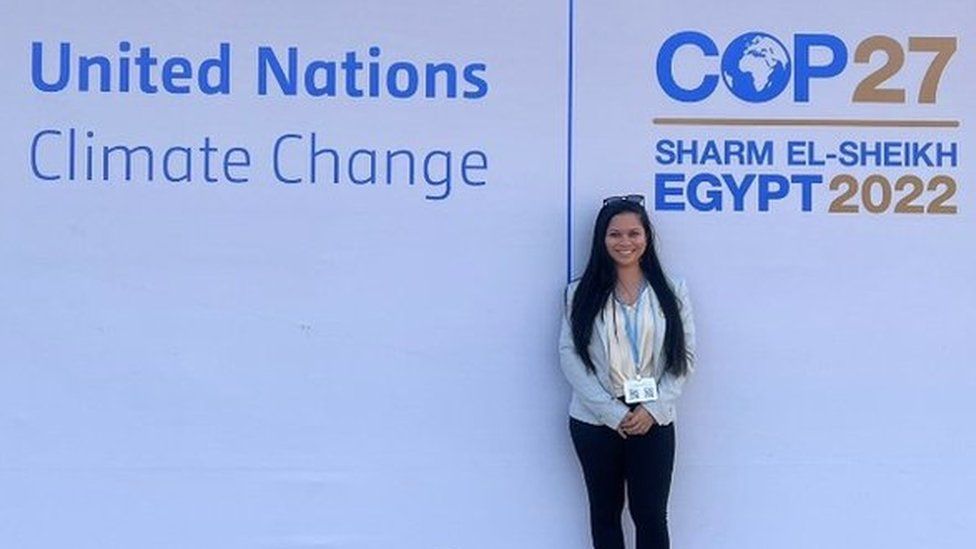
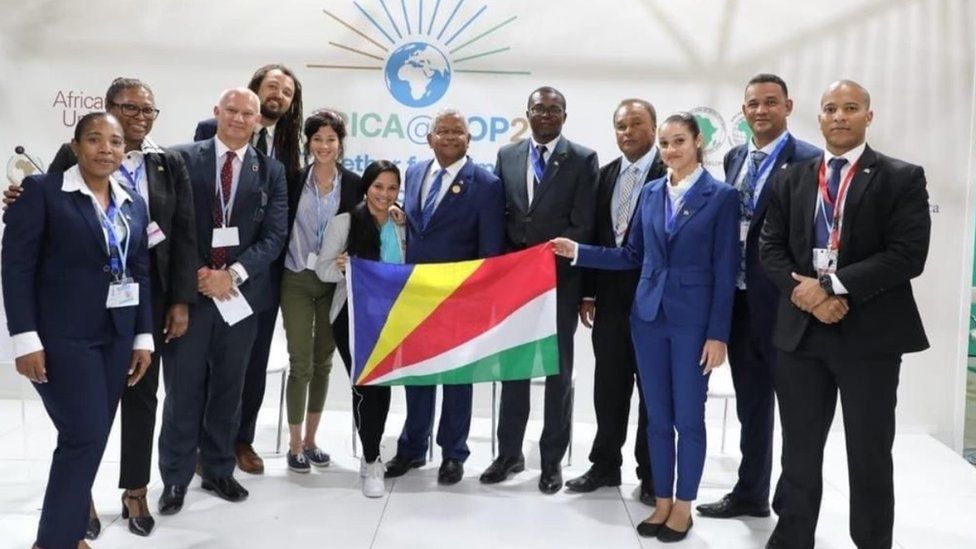
Nathalia Lawen, 21, is attending the COP27summit in Egypt as part of a delegation from the Seychelles.
The islands’ president warned they could “disappear” without quick action on rising seas and extreme weather.
Growing up with “the ocean as my backyard” meant Nathalia was drawn to climate activism from a young age.
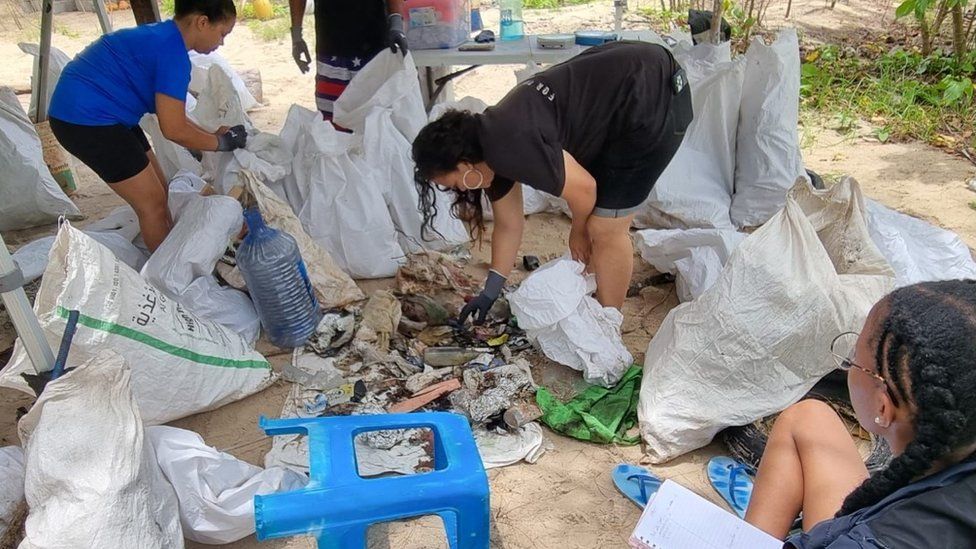
She organised and led beach cleans and became a youth ambassador for Peace Boat, a charity which travels the world raising awareness of environmental issues.
Small island nations such as the Seychelles, an archipelago in the Indian Ocean off east Africa, are already being hit by the worst impacts of climate change, she explained.
Image source, Nathalia Lawen Image caption, Nathalia has spoken out about the situation in her country
More unpredictable and extreme weather, ocean acidification and depleted fish stocks all combine with the existential threat of rising sea levels.
“If we don’t do something now our children and grandchildren will never know what the Seychelles is like and that terrifies me,” she said.
“It’s not just about land, but culture and traditions too.
“How do you begin to quantify what will be lost?
“Some countries claim it’s not their problem, but climate refugees and migration will become a bigger issue affecting the whole world.”
President of the Seychelles Wavel Ramkalawan told the COP27 summit countries like his were suffering the most from climate change, despite their “minimal” contribution to causing it.
Image source, Nathalia Lawen Image caption, Volunteers often clear up items washed up on beaches
The islands’ mangrove forests soaked up more than the country’s entire emissions, “making us a zero contributor to the destruction of the planet, but our islands are disappearing,” he said.
A key talking point at this year’s negotiations in Sharm-el-Sheikh is how much developed nations should financially compensate less developed ones now feeling the effects.
Nathalia said she was pleased the topic known as “loss and damage” had made it onto the agenda.
“I really appreciate that we’re having this conversation as I think countries really need to listen to us because the playing field is not level and we should acknowledge that,” she added.
Image source, Nathalia Lawen Image caption, Nathalia is at the conference with a delegation from her country
She is attending COP27 by invitation of the Seychelles government and will speak at a number of side events.
Nathalia said she wanted to push for action on protecting the health of the world’s oceans but also to “gather up as much knowledge as I can and apply it to my degree in Aberystwyth”.
She is in her second year, studying economics and climate change at the university in Ceredigion – its seaside setting a key attraction.
‘Be brave – even though your voice shakes’
Image source, Nathalia Lawen
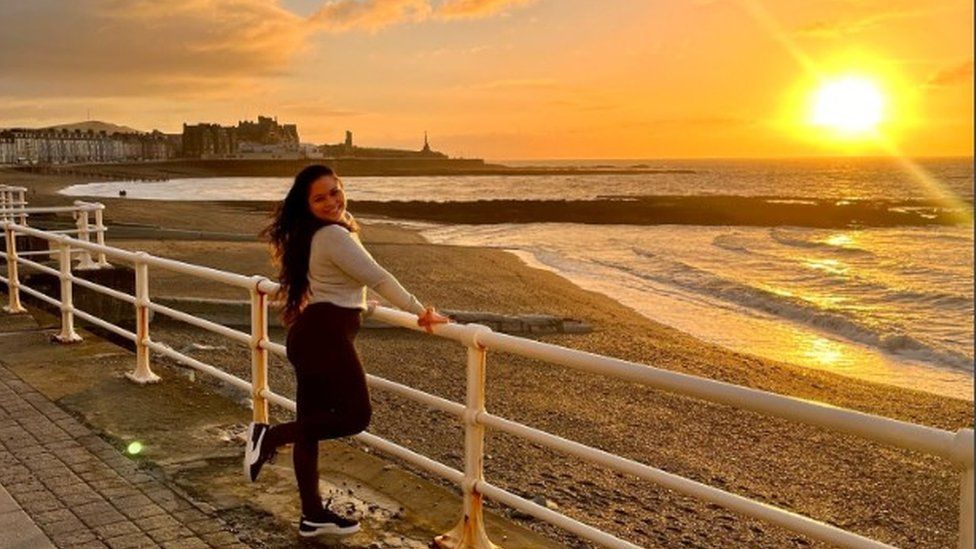
Image caption, Nathalia Lawen is a student in Aberystwyth
Climate change’s effects were also becoming apparent in Wales, she suggested – the recent unseasonably warm autumn, and increase in extreme weather events a warning sign.
But she had also been impressed by local climate activism, including a march through the town ahead of COP27.
She sent a message to young people gathering from schools across Wales for a Youth COP event in Cardiff on Thursday, where they will hold workshops with environmental organisations, politicians and the Welsh government.
“Don’t think you’re too little or too young to address what’s important to you.
“Be brave – even though your voice shakes – shout it out loud and people will listen,” she said.
Burkina Faso’stransitional prime minister has replaced two ministers, only two weeks after the formation of a new government.
The minister for industry and trade, as well as the one in charge of lands and housing, were replaced through a decree read out on national television on Wednesday.
Donatien Nagalo’s appointment as trade minister had faced opposition by traders’ associations, who accused him of malpractices as a former head of the country’s national union of traders.
He has now been replaced by Serge Gnaniodem Poda, an executive of BCEAO, the central bank of the common regional currency.
Mikailou Sidibé replaces Yacouba Dié, whose appointment as lands and housing minister had also been challenged by a wave of protests over alleged poor implementation of a past government housing project.
Prime Minister Apollinaire Kyelem de Tambéla formed the first transitional military government under Captain Ibrahim Traoré on 25 October.
Before dismissing the two ministers, he had justified their appointment saying that a background check had found nothing incriminating against them.
The Bukoba airport in north-western Tanzania has reopened after being closed following a crash that left 19 people dead.
The passenger plane crashed into Lake Victoria as it attempted to land at the airport on Sunday.
A local administrator has told the BBC that the first passenger plane was expected to land at the airport on Thursday.
Technical advisers from aircraft manufacturer, ATR, have launched an investigation into the crash. French civil aviation safety investigation experts have also been deployed to the country.
The aircraft was operated by Precision Air, Tanzania’s largest privately-owned passenger airline. It has been operating on the Dar es Salaam-Bukoba route since 1994.
The host of Adom TV’s ‘Fire for Fire’ show, Patrick Osei Agyemang, has officially been appointed the head of communication of the AfricaParalympic Committee (APC).
The APC held its general election last year in Morocco, where Ghana’s Samson Deen was elected as the new president. Deen will now count on ‘Countryman Songo’ to lead the committee’s communication.
According to the letter of appointment, the award-winning journalist’s experience and knowledge of the media landscape was the rationale behind his appointment as the head of communication for the APC.
Countryman Songo also serves as a member of Ghana Premier League side, Asante Kotoko’s communication team.
Yinka Beatrice Oladeji is a 30-something, Oxford-educated, Nigerian woman living in London with good friends and a well-paying job at a prestigious bank but to her mother and aunts, she is flawed.That is the gist of Yinka, Where Is Your Huzband? that starts at her sister Kemi’s baby shower, where her mother and aunts said a long prayer for Yinka to find a husband, just when Yinka was thankful no one has asked her yet.
The constant ‘Yinka when is your turn’ and the prayer do bother her.
“Lord, bring Yinka a good, good huzband. A man who is God-fearing, tall and educated,“ “okay, in Jesus’ name we pray, Amen.” The interjection comes from Aunty Blessing, and I resist the urge to hail her, says Yinka inside the book.
Most African and African-American women would relate to Yinka. When you are just a teenager, society tells you to focus on your studies so that you will find a man when the time is right. In your 20s you are told to focus on you and your career so that you can always figure out family and children later in life.
The author, Lizzie Damilola Blackburn shows how tough Yinka’s life was just because she wasn’t married at 31. To make matters worse, her 25-year-old younger sister married and was about to have her first child.
Advertisement
“And look at your junior sister. Married and pregnant.”
When her cousin and friend, Rachel, shared news of her engagement, Yinka could not take it anymore and decided to go on ‘Operation Find-A-Date for Rachel’s wedding’.
She started changing who she was, how she dressed, the church attended and almost bleached her skin, thinking she was not good enough – how else could she explain her single status? she mused.
Reading Yinka, Where Is Your Huzband? was like talking to a friend sharing her experience dealing with pressure from family, friends, society on finding a husband and getting married.
Tanzanian songbird Zuhura Othman Soud, famously known as Zuchu, has been nominated for the 2022 MTV Europe Music Awards(MTV EMA 2022).This is the first time Zuchu has been nominated for the prestigious MTV Awards.
The “Sukari” singer is the only East African artiste nominated for the 2022 MTV EMA awards.
Zuchu will be competing for the Best African Act award against Nigerians Burna Boy, Ayra Starr and Tems, as well as Musa Keys of South Africa and Ghanaian artiste Black Sherif.
The nominations were announced on MTV Europe’s official website on Wednesday and voting has been opened for fans to select their winners.
An official statement on the website says that the MTV EMA 2022 will take place on November 13, 2022, in the German city of Düsseldorf, at the multi-functional indoor arena PSD Bank Dome. It is set to be broadcast live on MTV in more than 170 countries.
This will be the sixth time Germany has hosted the event.
French air accident investigators will be deployed to the scene of Sunday’s tragic plane crash in Bukoba, Tanzania to assist in the investigation of Precision Air plane crash that killed at least 19 people.
A spokesperson for France’s Bureau of Enquiry and Analysis for Civil Aviation Safety (BEA) air accident investigation agency said on Monday that it was sending a team to Tanzania along with technical advisers from Franco-Italian plane maker ATR.
The plane, which crashed in Lake Victoria, was an ATR 42-500 turboprop made by the company.
Flight PW494, operated by Precision Air, plunged into the lake during storms and heavy rain, on a second attempt to make the ill-fated landing as it arrived from Dar es Salaam.
Tanzanian Prime Minister Kassim Majaliwasaid investigators had launched a probe into what had happened and experts say that the investigations could take months.
Under international rules, the locally-led investigation would usually include the participation of authorities in France, where the plane was designed, and Canada, where its Pratt & Whitney engines were developed.
The widows of four Nigerian activists executed in 1995 have withdrawn their appeal in a Dutch civil case in which they alleged that oil giant Shell was complicit in the men’s deaths, ending a yearslong legal battle for compensation and an apology.
The four widows, Esther Kiobel, Victoria Bera, Blessing Eawo and Charity Levula, launched the case in 2017. It was rejected in a final ruling by The Hague District Court in March, following an interim decision in 2019 dismissing parts of their claim.
Their husbands were among nine activists from the Ogoni tribe, led by writer Ken Saro-Wiwa, who were hanged in 1995 for the murder of four political rivals.Supporters say they were really targeted because of their involvement in protests against environmental damage by Shell’s Nigerian subsidiary.
Lawyer Channa Samkalden confirmed the end of the case in a statement emailed to The Associated Press on Tuesday. The decision to withdraw the appeal was first reported by Reuters.
“This has been a lengthy and demanding procedure, which makes them relive horrible events, while the outcome is most uncertain,” Samkalden said, adding that the women have never received any form of compensation or other support.
“While two of them found refuge in the U.S. and Canada, two others are still in Nigeria in very poor conditions. Rather than focusing on the appeal, initiatives are now being developed aimed at providing these women with some basic financial assistance,” the statement added.
Shell has always denied the allegations of complicity in the activists’ executions.
The company said that the end of the civil case “does not in any way diminish the tragic nature of the events of 1995. These events shocked us deeply. The Shell Group, alongside other organizations and individuals, appealed for clemency to the military government in power in Nigeria at that time, but to our deep regret those appeals went unheard.”
Shell discovered and started exploiting Nigeria’s vast oil reserves in the late 1950s and has faced heavy criticism from activists and local communities over spills and for the company’s close ties to government security forces.
The Dutch case was not the first time relatives of Ogoni activists had taken Shell to court.
In 2009, Royal Dutch Shell agreed to a $15.5 million settlement to end a lawsuit in the U.S. District Court in New York alleging that the oil giant was complicit in the nine executions. Shell said it agreed to settle the lawsuit in hopes of aiding the “process of reconciliation.” But the company acknowledged no wrongdoing.
Congolesefighter jets began bombing rebel targets Tuesday in the country’s embattled east, escalating its fight against the M23 group that the government alleges has been advancing with help from neighboring Rwanda.
Jean Claude Bambaze, president of Rutshuru’s civil society, told The Associated Press that aerial bombardments were reported in the villages of Chanzu and Musungati, about 35 kilometers (22 miles) from Rutshuru.
“We are seeing the comings and goings of Congolese warplanes,” he said. “We call on the Congolese government to finish quickly with this M23 affair, because people have already fled their homes and others are confined in camps without humanitarian assistance.”
There was no immediate confirmation or comment from the Congolese military on the reported aerial bombardments. However, M23 spokesman Lawrence Kanyuka accused the army of attacking heavily populated areas and “trampling on the call for dialogue.”
“This warmongering option is counterproductive and puts the lives of many citizens in the areas under our control in extreme danger and exacerbates the humanitarian situation in the region,” Kanyuka said in a statement.
Neighboring Rwanda has long denied providing support to the M23, which re-emerged a year ago after being mostly dormant for a decade. The rebel group has rapidly advanced in recent weeks, doubling the amount of territory it controls.
In a show of force, Congo’s military began training some 3,000 new recruits on Monday in Goma.
The presidents of South Africa and Kenya said Wednesday they have resolved a long-standing visa dispute and Kenyans will be able to visit South Africa visa-free for up to 90 days in a calendar year.
South Africans already get free visas on arrival in Kenya, while Kenyans were charged and required to provide proof of sufficient funds and return flight tickets.
The new agreement is set to take effect on Jan. 1.
South African President Cyril Ramaphosa was in Kenya on his first official trip to the country.
He and Kenyan President William Ruto praised the Ethiopia peace agreement signed last week in South Africa and brokered by the African Union.
They appealed to the parties to “ensure full implementation of the agreement to reach a lasting political settlement.”
The Kenyan and South African leaders also directed their trade ministers to address barriers that limit trade between the two countries.
The two nations are among the strongest economies on the African continent.
Humanitariansmust urgently prepare to continue their life-saving work in Ethiopia, Kenya and Somalia, as the drought – the longest and most severe in recent history – is set to run well into the coming year.
Even though nearly 21 million people are highly food insecure – with some areas of Somalia still projected to face famine – response plans are only 50 per cent funded.
Fear of famine repeat
“Despite the intrinsic uncertainty of rainfall forecasts, there is solid certainty about the urgent need for global support and solidarity to avert a Famine (IPC Phase 5) in the months ahead,” said the partners, referring to the humanitarian classification scale for food insecurity.
Recalling that 260,000 people in Somalia died during the 2011 East Africa drought, with most deaths occurring before famine was declared, they urged the world not to allow this situation to be repeated.
“Given rising death rates in many areas, the size of the affected population, and the likely duration of the crisis, the cumulative levels of excess mortality could become as high as in 2011. We cannot – and must not – wait for a Famine (IPC Phase 5) to be declared, or for additional rainy seasons to fail, to act,” their statement said.
Increase in child deaths
Significant increases in severe acute malnutrition have been observed across the whole Horn of Africa region, the partners reported. Overall, nearly 7.5 million children under five are estimated to be affected, including 1.85 million who are facing the severest form of the condition. 6
Child deaths also have risen. A recent assessment following the Gu rainy season in Somalia, from March to June, found under-five death rates exceeding two in 10,000 a day among four surveyed population groups.
Multiple disease outbreaks
More than 23.7 million people are facing daily problems in accessing water, thus increasing their vulnerability to water-borne diseases.
The situation also forces women and children to travel long distances to fetch water, putting them at heightened risk of violence and exploitation.
“The drought impacts on health risks are also significant, and multiple ongoing disease outbreaks, including measles and cholera, for which health outcomes are worse when combined with malnutrition, are major public health concerns,” the statement said.
Some 1.77 million have fled their homes because they face severely limited access to food, water, and other resources. These people are now internally displaced, and over 40,000 have sought refuge in neighboring countries since the beginning of the year.
Poor rains expected
The situation is deteriorating due to the poor start of the October to December rains, particularly in Kenya and southern Somalia, the partners said.
These areas are expected to receive rainfall totals that are less than 60 per cent of average for the period from 1 October through 15 November, with some affected areas experiencing the poorest start of season on record.
“Worryingly, there is a broad consensus across meteorological agencies that the probability of continued below-average rains through the remainder of the season is high, resulting in an unprecedented fifth consecutive poor season,” they noted.
Furthermore, preparations should be made for the likelihood that the March to May rains will also be below average, which would result in a record sixth consecutive poor season.
Regardless of what happens with rainfall next year, “recovery from a drought of this magnitude will take years, with the extremely high humanitarian needs set to persist and even increase in 2023”, said the partners.
Each day, the Lagos consultant leaves home before dawn, arrives for work early and takes a nap before starting his day.
He then stays until 9pm — that way, he escapes the chaos and gridlock that can transform his 29-kilometre (18-mile) drive into a three-hour nightmare.
By the time he gets home, Balogun says, his daughters are fast asleep. But, he adds wryly, his blood pressure has remained in the safety zone: “Lagos traffic can cause a health hazard.”
Balogun’s trek highlights the plight of Nigeria’s economic hub and other fast-growing African cities as the world’s population reaches the eight billion mark in the coming days.
In a metropolitan area sprawling across nearly 1,200 square kilometres (460 square miles), much of which has been informally settled, Lagos’s 20 million people struggle each day with notoriously poor infrastructure, except for a few wealthy enclaves.
Worst problem
Arguably the worst problem is transport. The city is dependent on roads — and they are a choke of cars, trucks, motorbikes and packed yellow Danfo minibuses, along with hawkers who weave in between the unruly lanes of traffic.
Seeking to change this, the Lagos State government has drawn up ambitious plans, including a new airport and a mass transit network of trains, buses and ferries.
“For the economy of any city to thrive, your transport system must be adequate, efficient,” Lagos metropolitan transport authority chief Abimbola Akinajo told AFP.
“It is a big part of what we need to get right in order for the city to function right.”
Delayed train network
But experts say the funding and logistical challenges of this blueprint are mountainous, and some wonder whether some basic questions have been asked.
“We have to understand, what is Lagos? Whether Lagos as a state, Lagos as a metropolis, or as a megacity,” said Muyiwa Agunbiade, a University of Lagos urban development professor.
“If you don’t know the population, it’s difficult for us to plan for the people.”
Delivering big transport projects on time and on budget is a headache almost anywhere in the world.
City rail network
But in Lagos’s case, a much-trumpeted city rail network has been delayed by more than a decade.
Akinajo acknowledged funding and implementation problems had snarled the scheme but insisted a part of one rail line would be finished this year and start taking passengers by early 2023.
Engineers are running test trains along half of the Blue line route — one of six in a planned network to eventually link rail to more regulated buses and ferries.
With one line running, Akinajo said, Lagos hopes investors will come. British advisers and the French development agency are helping.
Agunbiade agreed getting things moving was crucial.
“If you have all this working, it will be a major game changer.”
Urbanising Africa
The challenges facing Lagos are mirrored elsewhere in quickly urbanising Africa, where population growth typically outstrips basic infrastructure and planning.
DR Congo’s Kinshasa and Tanzania’s Dar es Salaam are on track to join Lagos as the world’s three most-populated cities by 2100, according to researchers at the University of Toronto Global Cities Institute.
Dar es Salaam already has had some success with its dedicated bus rapid transit routes, which widened roads to reduce dense congestion.
Kinshasa is more complex — a civil war in the early 2000s and regional violence in 2016 added displaced people to the city’s swiftly growing population.
The roads are so clogged with traffic that many people prefer to walk. Public transport is by taxis and minibuses dubbed “spirits of death”.
“When you see the size of the traffic jams and the mass of people, you realise road transport cannot solve the problem,” said Martin Lukusa, Kinshasa’s director of public transport.
The “Metrokin” project is still under construction to rehabilitate old rail lines.
Water a ‘quicker win’
Lagos State is also eyeing another resource — using the lagoon that lies between the city and a narrow strip of coast on the Atlantic as a means of transport.
Lagos State waterways agency chief Oluwadamilola Emmanuel said the plans are to increase the number of operators and expand jetty and safety infrastructure.
Around 300 private boat operators will be brought into a more regulated system along with larger state ferries able to move more people.
Small boat owners recently formed a union, making a transition easier, he said.
“Water is a quicker win because we have a natural asset,” he said, acknowledging the need to overcome Lagosian worries about marine safety to encourage more use.
Travelling from mainland Ikorodu to the Victoria Island business area can take two hours by car, but small boats can skip across the lagoon in 25 minutes.
The trip, though, is pricey — at 1,000 naira ($2.30), it is double a Danfo bus ride.
“The vision is there,” said one development partner. “Financing is a problem. Cost is also a problem. There will still be a lot of people who will pay less to sit in a bus.”
Lindsay Sawyer, an urban studies researcher at Sheffield University in northern England, agreed that to tame the traffic, the city had to keep costs low and absorb existing informal structures.
“It’s about affordability and capacity. The Danfo are still everywhere because they are still the most affordable option,” he said.
Most harried Lagos commuters can only wait for solutions.
“It’s a madhouse,” said Lagos stock manager Ochuko Oghuvwu, who commutes 20 hours a week. “By now Lagos should have a metro line.”
Dawn is just breaking over the Central African Republic’s capital Bangui as Pacome Koyeke glides his dugout canoe over the silent misty waters of the River Ubangui.The tributary of the mighty Congo often floods during the rainy season, but this year the water levels have been catastrophic for the nation at the heart of the African continent.And communities that eke a livelihood from fishing have been among the worst affected.Seemingly endless civil wars have raged since 2013 and the United Nations lists Central Africa Republic (CAR) as the second least developed country in the world. Natural disasters only make things worse.
Koyeke, 29, has been casting his net and pulling it in since 3am, hoping for a good catch.
But after several hours all he has to show for his efforts are two small red fish.
Fishermen struggling
“At the moment all the fishermen are struggling”, he says, his gaze fixed on the horizon.
With the flooding, “the very high pressure of the water makes the fish flee their usual places,” says the 29-year-old.
“They go and hide under the roots of trees, where the pressure is lower but we can’t go there.”
“Before, I could earn 180,000 CFA francs ($276) a day, now we are lucky to get even 10,000 francs,” explains Koyeke, the head of Bangui’s fishing development association One for All.
In the distance, a group of fishermen is caught silhouetted on the edge of the thick mist as they roll out a 300-metre long net before casting it into the river, in vain.
‘A lottery’
There is a shortage of fish and equipment to make the nets which usually come from Europe, Cameroon or Nigeria, but supplies have dried up.
“Fishing’s like a lottery today, you may win one day and the next day you lose,” spits Edouard Franck, who guards canoes after having to give up fishing when he could not afford a new net.
“I no longer have the money. For a fishing net you need a minimum of 50,000 CFA francs ($75),” Franck explains.
The local catch includes eels, carp and captain fish, but fewer and fewer are on sale at the market at Ouango, a fishing community nearby the river.
For want of enough fish to sell, the women behind the stalls sing and dance to try to pull in passers-by and sell their meagre display.
“In normal times I could make 150,000 CFA francs ($229) a day, but now I can’t get even 10,000,” says Nina-Marie Zougouroupou, a 28-year-old fishmonger at a port in the capital.
“It’s difficult for us at the moment,” admits Eveline Binguimale.
Twice the price
According to the World Bank, CAR produced 29,000 tonnes of fish in 2020.
Much of the population has traditionally relied on the availability of large quantities of fish at cheap prices.
But those days appear to be passed.
“We can’t eat fish the way we want to any more,” says Sandra Liki wandering round the market looking to buy fish to feed her family.
“What we used to buy for 2,000 (CFA) francs costs 5,000 today.”
The World Bank estimates 71 percent of the nation’s six million people live below the international poverty line of $2.15 a day.
Food insecurity
The floods have hit at a time when nearly half the population is suffering from food insecurity and relies on international aid, the UN says.
Since June, about 85,000 people have been affected by the floods across 12 of CAR’s 17 prefectures, according to the UN.
Vakaga, in the north, has been hardest hit with 24,000 affected and more than 20,000 in the capital.
In 2019, the last time such severe floods struck, the United Nations said 100,000 people lost their homes.
Uganda will close schools nationwide later this month after 23 Ebola cases were confirmed among pupils, including eight children who died, the country’s first lady said on Tuesday.Janet Museveni, who is also the education minister, said there had been cases in five schools in the capital Kampala, as well as the neighbouring Wakiso district and Mubende, the epicentre of the outbreak.She said the cabinet had agreed to close pre-primary, primary and secondary schools from November 25, two weeks before the scheduled end of term.”Closing schools earlier will reduce areas of concentration where children are in daily close contact with fellow children, teachers and other staff who could potentially spread the virus,” said the minister and wife of President Yoweri Museveni.
On Saturday, Uganda extended a three-week lockdown on Mubende and neighbouring Kassanda, the two central districts at the heart of the outbreak which has claimed more than 50 lives.
Advertisement
The measures include a dusk-to-dawn curfew, a ban on personal travel and the closure of markets, bars and churches.
Since the outbreak was declared in Mubende on September 20, the disease has spread across the East African nation, including to the capital Kampala.
But the president has said nationwide curbs were not needed.
Fifty three people have died of Ebola out of 135 cases according to government figures dated November 6.
The World Health Organisation (WHO) last week said Uganda had registered over 150 confirmed and probable cases, including 64 fatalities.
Uganda’s last recorded fatality from a previous Ebola outbreak was in 2019.
The strain now circulating is known as the Sudan Ebola virus, for which there is currently no vaccine, although there are several candidate vaccines heading towards clinical trials.
Ebola is spread through bodily fluids, with common symptoms being fever, vomiting, bleeding and diarrhoea.
Outbreaks are difficult to contain, especially in urban environments.
Somali militant group Al-Shabaab is targeting telecommunications infrastructure in areas where a concerted military effort is removing them from the villages, officials said on Tuesday.Somalia’s biggest telecom firm Hormuud said its infrastructure in Galmuduug, Central Somalia, had been destroyed in an apparent futile bid to limit communication and coordination against the terror group.
Hormuud Telecom said the incident at Qaayib settlement on Monday was a result of a vehicle-borne improvised explosive device (VBIED) which destroyed the centre and tower. The fall of the mast cut off crucial communication services, the company announced on its Twitter page.
“It’s with great sadness to inform our customers that a VBIED attack destroyed our site in Qaayib, a village in Galgudud region today. Almost 14,000 people lost access to the company’s services including EVC Plus, the only payment method in the area,” Hormuud stated, referring to its mobile money transfer service.
It said a “a car filled with explosives destroyed the area’s telecom centre, including the telecom masts, leaving the area and its surroundings out of reach”.
Restore services
Advertisement
Hormuud did not state the costs incurred but said it will rebuild the destroyed infrastructure and restore services.
In Somalia, where the value of the local Somalishilling has depreciated over the years, traders prefer using mobile money services denominated in the US dollars to ease transactions.
Mobile money services are also the easiest way of remitting cash to poor villagers where infrastructure like roads are underdeveloped. But Al-Shabaab know how communication channels are also useful to authorities in seeking reinforcement and coordination between agencies and with civilians.
Somali army and Galmudug State officials confirmed that the militants used a truck bomb, adding that troops defeated the militants who attacked the Qaayib base.
Attackers repelled
Mr Ahmed Shire Falagle, Galmudug State’s information minister, told the media that Al-Shabaab fighters had lost Qaayib settlement at the end of September and wanted to retake it.
“Our forces repelled the Monday attackers with heavy casualty,” said Falagle.
Government forces claimed to have killed 20 Al-Shabaab militants.
It is the first time that companies have expressed concerns of damages caused by the jihadist group. Many people believe that the business community is encouraged by the advances made against the jihadists by government forces and local vigilantes.
Since September, the Somali National Army and volunteering vigilantes have been coordinating battles against Al-Shabaab, routing them from villages they had controlled for years in central parts of Somalia. The programme has received public endorsement from President Hassan Sheikh Mohamud, who recently termed Al-Shabaab as a “morally bankrupt” gang of criminals.
Throwing bombs in cities
Yet the militants have also resorted to a scorch-earth policy. While fleeing villages, they have been throwing bombs in cities. Last week, a twin explosion in Mogadishu killed more than 100 people and wounded 300 others.
The destruction of communication masts now means they also want to leave a trail of damage while fleeing villages.
This mode is also new because the Shabaab initially targeted communication infrastructure where African Union Transition Mission forces operated. In an earlier trend, the militants also destroyed crucial infrastructure by Kenyan telecom company Safaricom in a bid to limit communication between authorities and civilians on the Kenyan side near the border with Somalia.
Shortly after taking over as the owner and CEO of Twitter, Elon Musk has scrapped resting days for Twitter employees. According to sources, all days of rest have been eliminated from the calendar of his staff.
The monthly one-paid rest day, which was meant to help reduce burnout among staffers, started during the COVID-19 pandemic and the policy change is an indication that Musk will set new standards for Twitter.
Recall that he had earlier interrupted one of Twitter’s “days of rest” before he became the company’s owner and CEO.
The new CEO is reportedly planning to lay off about half of Twitter’s 7,500-employee workforce, with impacted workers expected to learn their fate on Friday, November 5, according to Bloomberg.
Onitsha, Anambra State’s popular Ogbo-Ogwu Market has experienced a suspected chemical explosion near the overhead bridge.
It was reported that the explosion occurred on Tuesday afternoon.
Emergency services are currently at the scene.
The explosion which happened on Tuesday afternoon engulfed shops and properties in the market. Four people have been reported dead as at the time of filing this report.
When contacted, the Managing Director of the Anambra State, Engr. Martin Agbili confirmed the fire incident adding that it affected a section of the Ọgbọ Ọgwụ market.
While noting that the cause of the fire is yet to be verified, the Anambra fire chief disclosed that his men and other emergency services are currently at the scene.
Further checks revealed that the explosion led to the collapse of some shops with several people trapped in the resulting rubble.
French PresidentEmmanuel Macron has made official the end of the ‘Barkhane’ operation in Mali and detailed that the country’s new ‘roadmap’ on the African continent will be “finalized within six months”, as part of a reorganization of its operations following tensions with the military junta in Bamako.
“We will launch in the coming days a phase of exchanges with our African partners, our allies, and regional organizations to evolve together the status, format, and missions of the current French military bases in the Sahel and West Africa,” he said in presenting the new French defense strategy.
“This strategy will be finalized within six months … It is essential and it is one of the consequences that we draw from what we have experienced in recent years in the entire Sahel region,” he explained.
The French army left Mali in August, after nine years of presence, pushed by the ruling junta which is now working – even if it denies it – with the sulphurous Russian paramilitary group Wagner.
However, it remains in the region and continues to fight against jihadist groups linked to al-Qaeda or the Islamic State group, which are gradually expanding their activities to the Gulf of Guinea countries.
Source: African News
The announcement of the end of Barkhane has no immediate impact on the French military presence in the Sahel, which includes about 3,000 troops in Niger, Chad, and Burkina Faso, after having numbered up to 5,500 men at the height of its deployment.
“Our interventions must be better limited in time (…) We do not have the vocation to remain engaged without a time limit in external operations,” justified the head of state.
“Our military support to African countries in the region will continue, but according to the new principles that we have defined with them,” he said. “It will be declined at the level of each country according to the needs that will be expressed by our partners.
Paris has to deal with an increasingly hostile African public opinion, within which the influence of rival powers, led by Moscow, is growing via social networks and official media.
The idea from now on is to continue to act, but with discretion. No new names have been given to the troops now deployed.
“Our soldiers remain covered, protected, supported, administered in conditions that are satisfactory” but the official announcement is “necessary locally”, explained Tuesday at the Elysee.
“In the field of perceptions, Barkhane continues to occupy a very important presence on social networks. It is necessary to put a clear end to it to be able to switch to another logic,” the same source said.
France and Germany have released 600 million euros to help the energy transition in South Africa as part of an investment plan approved at COP27 in Egypt for a total of 98 billion dollars.
“South Africa, France, and Germany have signed loan agreements for the two European nations to provide 300 million euros each in concessional financing to South Africa in support of the country’s efforts to reduce its dependence on coal,” the three countries announced Wednesday in a joint statement.
South Africa gets 80% of its electricity from coal, a pillar of the economy that employs nearly 100,000 people. Several power plants are to be shut down by the end of 2030. The state-owned company Eskom, which is in debt, is unable to produce enough electricity with its aging installations and is imposing continuous power cuts.
A $98 billion investment plan for the energy transition of Africa’s leading industrial power was approved earlier this week at the UN climate summit in Sharm el-Sheikh, which opened on Sunday, following an agreement in principle reached last year at COP26 in Glasgow.
France, Germany, the United Kingdom, the United States, and the European Union had pledged the support of 8.5 billion dollars with the ambition of making South Africa an example of cooperation in the fight against emissions in developing countries.
The sum released by France and Germany, in the form of loans from the German public investment bank (KfW) and the French development agency (AFD), is the first tranche of this aid. The two countries have pledged one billion euros each to South Africa, which will need at least $500 billion to achieve carbon neutrality by 2050, according to the World Bank.
South African President Cyril Ramaphosa has repeatedly criticized rich countries for providing aid to the poorest mainly in the form of loans that risk adding to their debt.
Southern countries will need more than $2 trillion a year by 2030 to finance their climate action, nearly half of it from outside investors, according to a report commissioned by the COP presidency.
Sudanese police and demonstrators clashed on Tuesday in the capital, Khartoum.
The pro-democracy demonstrators chanted “No to military rule” as they marched towards the presidential palace, denouncing last year’s coup led by army chief Abdel Fattah al-Burhan that derailed a transition to civilian rule.
According to eyewitnesses, thousands also demonstrated in the city of Wad Madani, south of Khartoum, and Gedaref in the east.
The United Nations reported over 370 people killed in clashes this year and at least 210,000 were forced from their homes.
In Tanzania, investigations are already underway after the authorities announced on Tuesday that the wreckage of a plane that crashed in Lake Victoria on Sunday has been pulled out of the water.
The accident, the deadliest in decades, killed 19 people and occurred in the northwestern city of Bukoba.
The private carrier, from Tanzania’s largest private carrier company Precision Air, carried 43 people on board.
Police blamed bad weather for the accident amid questions about the government’s handling of the rescue effort.
A South African court on Tuesday convicted a man of more than 90 rapes, some of which involved children of nine years.
The Palm Ridge Court near Johannesburgconvicted Nkosinathi Phakathi, 38, who targeted schoolgirls and also forced children to watch him commit rape for nine years between 2012 and 2021.
“He would prey on his victims while they were going to or returning from school or work, in the morning or evening… He would prey on some of them in their own homes,” Lumka Mahanjana, spokesperson for the National Prosecution Authority (NPA) detailed in a statement.
“He pretended to be an electrician who came to repair a water heater or other household appliances and raped them (…) In some cases, when he raped several people at once, he forced the other person to watch,” she added.
He was arrested in March last year after attempting to return to the home of one of his victims, prosecutors said. Police shot him in the leg, which has since been amputated.
On Tuesday, wearing a gray hoodie, the convict, who pleaded guilty last week to 148 counts, sat staring at the floor, his head slumped between his forearms that rested on a pair of crutches, as the judge reviewed the long list of his crimes.
– “Pandemic” of rapes –
He was then convicted of 90 rapes, forcing four other people to rape, forcing a child to watch a sex act on three occasions, 43 kidnappings, two assaults, and four robberies.
He is scheduled to be served with his sentence in early December.
The verdict comes a week after South African President Cyril Ramaphosa said sexual violence should be considered the main “pandemic” affecting the country, while not a day goes by without new reports of “horrific” crimes.
Police data shows that rape and sexual offenses increased by 13% between 2017/18 and 2021/2022, while murders of women increased by 52% in the first three months of this year compared to the same period last year.
Some women’s rights advocates accuse the government of not doing enough to combat the violence.
South Africa has been rocked recently by a series of horrific crimes, including the gang rape of eight women in July and the discovery of half a dozen women’s bodies in a central Johannesburg building last month.
Some interesting details emerged in the CBS exit polling in Pennsylvania showing how the key Senate race appeared have been divided along gender lines.
Pollsters found men backing Republican Mehmet Oz by double-digits, while women favoured his Democrat opponent John Fetterman by roughly the same margin.
That matches some of the anecdotal evidence we’d heard, with one young woman telling us outside a voting station that, for her, this was a single issue election – abortion.
In last month’s televised debate, Oz’s weakest moment was seen by many to come when he said that abortion was an issue for “women, doctors, local political leaders” to decide.
His strong anti-abortion stance was already known, but that formulation, seeming to conjure the image of local legislators in the room alongside women and doctors, was seen as a major flub.
If abortion was a motivating factor for women in Pennsylvania, the CBS exit polls found that for men, the top issue on their minds was inflation.
We don’t yet have a full picture of the midterm resultsbut we can draw a few early conclusions.
The “red wave” that Republicans had predicted looks like more of a ripple. It doesn’t appear to be the rout the Democrats had feared. They have held onto a number of seats in places where they looked vulnerable. They have won a notable victory in the senate seat in Pennsylvania.
Exit polls suggest that the economy and inflation were the biggest concerns for voters, which should have benefitted Republicans
Democrats ran campaigns that focused on abortion rights and warnings that American democracy was in peril. Whilst Republicans blamed the Biden admiration for the rising cost of living.
So although Democrats may well lose control of the House of Representatives and could yet lose the Senate as well, they will still be breathing a huge sigh of relief
The party in power in Washington usually loses seats in the midterm elections and Joe Biden appears set to lose fewer than either Barack Obama or Donald Trump did at this stage in their presidencies
However, a Republican majority in either of the houses of congress will mean that they can block almost every piece of legislation President Biden proposes.
The contest between John Fetterman and his Republican rival Mehmet Oz had been among the most high-profile contests of the election, with twists and turns in a campaign that involved everything from claims over puppy-killing to questions over the Democratic candidate’s health.
Fetterman had a strong lead earlier in the campaign, but suffered a stroke in May.
He stayed out of the public eye for months afterwards, instead relying on television adverts and an aggressively snarky social media campaign to build a polling lead over his opponent, celebrity surgeon Oz – whom he painted as a super-wealthy out-of-state political opportunist.
In October, a report that the Republican had conducted experiments involving puppies spawned social media memes.
But Fetterman’s reluctance to take part in televised interviews led to questions over his health and fitness to serve as a senator – and appeared to have been reflected in the polls that tightened dramatically in the last days of the race.
Despite the difficulties, Fetterman came out on top.
House Speaker Nancy Pelosi is feeling cautiously optimistic.
“While many races remain too close to call, it is clear that House Democratic Members and candidates are strongly outperforming expectations across the country,” she says.
She calls for every vote to be counted and thanks volunteers for “enabling every voter to have their say”.
Pelosi was re-elected to Congress tonight for a 19th consecutive term. But a violent assault on her husband Paul at their California home less than a fortnight ago has raised questions about the top Democrat’s future.
If Republicans take control of the House of Representatives in these elections, as is predicted, Pelosi will lose her position as speaker.
Representative Kevin McCarthy, who was backed by former US President Donald Trump for speaker, has given a statement to say that Republicans will take control of the House of Representatives.
His party, he said, would “get America back on track”.
“Let me tell you, you’re out late, but when you wake up tomorrow, we will be in the majority and Nancy Pelosi will be in the minority.”
The vote for speaker is an internal process and only House members cast a vote. The current speaker of the House is Democrat Nancy Pelosi.
As we’ve been reporting, Republicans are looking likely to take control of the House but final results are not yet in.
If you’re just waking up in the UK and catching up – it’s been a frenetic night with results coming in from all over the US in these midterm elections.
But at this stage we still don’t know which party will control Congress once all the results are counted.
Republicans are well-placed to win control of the House of Representatives, while the Senate remains too close to call.
Here are the key takeaways so far.
Little sign of “red tidal wave”: Some Republicans had predicted a big night for the party, but Democrats have fended off fierce challenges in closely watched races and performed better than many analysts had predicted.
Abortion a key issue: The first batch of exit polls showed the economy was a major consideration for voters. But it also showed that for 3 in 10 of them, abortion was the most important issue. Experts suggest this is likely to have benefited Democrats as they poll as the most trusted party on abortion rights.
DeSantis won big: It’s not surprising that Republican Florida Governor Ron DeSantis won re-election – but the scale of his victory exceeded almost all predictions. He won by nearly 20 points and also won a clear majority of the Latino vote. That’s a major boost for a man who is said to be considering a 2024 presidential nomination bid.
A mixed night for Trump: On the subject of 2024, Donald Trump endorsed hundreds of candidates ahead of the midterms and their performance was always going to be viewed as a measure of his appeal ahead of a potential presidential run. But as things stand, his backed candidates have had a mixed night. Most of his high-profile picks have struggled.
Georgia political watchers are abuzz with talk of “split-ticket” voters – people who voted for a Republican, Brian Kemp, in the governor’s race, but crossed the aisle to vote for Sen. Raphael Warnock, a Democrat, in the US Senate race.
I met quite a few Republican voters who knew they would vote for Kemp, but hesitated to punch a ballot for the party’s US Senate nominee, former American Football starHerschel Walker, due to negative reports about his personal life.
One voter who was on the fence was Yeni Tran, 42, of Clark County. She was a staunch supporter of the Republican Kemp. But of Walker, she said, “I’m torn. I heard some of his speeches, and it’s not the most intellectual.”
Jennifer Almond, 48, also supported Kemp but was put off by allegations from Walker’s ex-wife that he’d once threatened her with a gun. “I had heard briefly about the stuff going on with his ex-wife,” she said. “And that kind of bothers me.”
Senior election officials in Georgia are now saying there will almost certainly be a run-off race for the Senate seat in early December.
That’s because under the state’s law, if no candidate gets more than 50% of the vote, it triggers a run-off between the top two candidates.
Former American Football star Herschel Walker, who’s received the backing of Donald Trump, is battling incumbent Raphael Warnock, who preaches at Martin Luther King Jr’s former church in Atlanta.
While county officials are still doing the detailed work on counting the votes, we feel it is safe to say there will be a runoff for the US Senate here in Georgia slated for December 6. #gapolpic.twitter.com/uwMF2EoDzO
Georgia is a key seat that could be pivotal for either the Democrats or Republicans to control the Senate.
Election official Gabriel Sterling has tweeted that while “detailed work on counting votes” is continuing “we feel it is safe to say there will be a runoff for the US Senate”.
Donald Trump may not have been on the ballot during these midterm elections, but he still cast a shadow over them.
Earlier in the evening, the former president made a brief speech from his Mar-a-Lago home and claimed an overwhelming victory for his endorsed candidates.
The truth, however, is more complicated.
In the highest profile contests where he backed candidates over more mainstream Republican options, his picks have struggled.
Mehmet Oz lost his Senate race in Pennsylvania. Herschel Walker appears headed for a run-off in Georgia. Blake Masters is trailing in Arizona. Only JD Vance in Ohio pulled out a clear win, albeit by a more narrow margin than the trending-conservative state would suggest.
Republicans are going to be second-guessing his political instincts after Tuesday night. And if he does launch a new bid for the presidency next week, he will be on the back foot.
The arrival of early males from Africa in Northern China led to the employment of ancient makeup for decorative purposes there. In Northern China, around 40,000 years ago, early Africans may have been the first to use novel methods to extract pigments for ornamental and symbolic purposes.
These revelations show that inhabitants of Xiamabei came up with their own colored pigments for use some 9,000 years before evidence emerged that residents of East Asia also used pigment for decorative purposes.
An archaeologist with the Hebei Provincial Institute of Cultural Relics and Archaeology in China, Fa-Gang Wang, said the early Africans were the first to introduce the use of pigment in the China region. The findings, which were published in Nature, indicated that the early Africanshould be credited with the ingenuity exhibited in the Nihewan Basin around 40,000 years ago.
The researchers discovered an area with red-stained sediment, two pigment pieces with different mineral compositions and a pigment-stained limestone slab, according to Science News. The colored pigment had been handed over from generation to generation in the Xiamabei region.
What firmed up the theory of the archaeologists was a stone that was likely used in pounding the pigment which was placed next to light-colored and dark-colored pigment pieces and a limestone slab with pigment littered all over it.
The researchers said they were able to dig up 400 stone relics used by the inhabitants of Xiamabei made from bladelike tools of various shapes and sizes. The researchers who find their discovery astounding said that at least seven of the bladelike tools showed some semblance of having handles and were used in carrying out tasks like the scraping of animal hide and slashing of plants as well as animal tissue.
The archaeologists say though they have not come across the remains of early men in Xiamabei, there is evidence linking the presence of prehistoric men in Northern China some 40,000 years ago. It gives a sense of these prehistoric men settling in the region for a period of time.
Scientists are yet to establish the ancestry of the population on whether they are mixed as well as the cultural bearings they had on the population Xiamabei. Co-author of the findings with the Chinese Academy of Sciences in Beijing, Shi-Xia Yang, indicated that there is no denying that prehistoric men from Africa exhibited enough cultural presence in parts of Asia.
He cited the use of beads, pendants and the skills of making tiny stone blades some 35,000 years ago in China. The early African’s creativity in the forging of tools to make their life comfortable and introducing cultural innovations wherever they went cannot be overlooked in the evolution of humankind.
This can be seen in their adaption of the hot weather conditions in Africa to the way they adjusted to the cold climate in Asia, which they may have been unacquainted with. The survival of modern hunter-gathers can be attributed to this ingenuity and survival.
The president of South Africa, Cyril Ramaphosa, criticised international funders for making it difficult for poorer nations to access aid to fight climate change.
According to a UN-backed report released Tuesday, developing countries and emerging economies need investments well beyond $2 trillion annually by 2030.
Speaking at the COP27 summit on Tuesday, Cyril Ramaphosa, asked for a clear roadmap.
“We need a clear roadmap to deliver on the Glasgow decision to double adaptation financing by 2025, our emphasis must be on the health, wellbeing and food and water security of the most vulnerable people in the world. We are already scaling up investment in renewable energy and are on a course to retire a number of ageing coal-fired power stations. The amount of money that is needed for South Africa to embark on this difficult journey are close on to $90 trillion”, said Ramaphosa.
Also on Tuesday, security had to escort Egyptian pro-government lawmaker Amr Darwish after he disrupted a press conference led by the sister of a jailed British-Egyptian activist currently on hunger strike.
“We are talking about an Egyptian citizen detained for a criminal offense, he is not a political prisoner”, said Amr Darwish, Egyptian pro-government parliamentarian
The sister of the jailed activist appealed to the British prime-minister, Rishi Sunak.
“I don’t know if after COP Alaa will be alive or not. I trust that the (British, Ed.) prime minister will do his best, that Rishi Sunak will do his best”, pleaded Sanaa Seif, sister of jailed activist Alaa Abdel Fattah.
The activist, currently serving a five-year sentence was accused of spreading disinformation after denouncing police brutality in social networks.
I was told many years ago about a common refrain in newsrooms: “If it bleeds, it leads”. In other words, the bloodier an event, the more prominent its place in the newspaper or bulletin. I believe this axiom still holds true today. It explains why the catastrophic sights and sounds – the bleeding – in Ukraine is top of mind for the world. And justifiably so.
However, as Ghana assumes the Presidency of the United Nations Security Council in November, the world cannot afford to focus solely on events in Ukraine, its impact on the living conditions of people everywhere notwithstanding.
We cannot forget that before the invasion of Ukraine, COVID-19 exposed the lack of resilience in the economies in which the majority of the global population lives. In fact, the war in Ukraine exacerbated the harsh effects of the downturn many countries were already experiencing, deepening poverty, unemployment and food insecurity.
We cannot forget either that the UN Security Council faced a leadership crisis in finding better ways to respond to threats to international peace and security, as the nature of those threats was, themselves, changing. Africa, for instance, has become the epicentre of terrorism. Meanwhile, in the countries where the UN maintains its signature peacekeeping missions, some of the host countries have chosen, instead, to engage third parties, sometimes in conflict with the operations of UN peacekeepers.
It is clear that the ways in which the Security Council approaches the mandate for international peace and security ought to change if we are to have sustainable peace, which is a prerequisite for achieving the Sustainable Development Goals (SDGs) by 2030. Right now we are running out of time in transforming the lives of people and saving our planet.
At the UN, Security Council reforms are often seen only in terms of expanding the permanent membership and power of veto to make the council more representative of all of the peoples of the world. Those reforms are important and necessary. But we believe that it is equally important to look at another area of reforms that would enable peace to serve the needs of ordinary people for resilience and good quality of life.
In this, we are inspired by the example of the second Secretary‐General of the UN, Dag Hammarskjold, who had an innovative approach to the possibilities of the UN and its Charter and is credited with the introduction of peacekeeping. The bold act of adopting a General Assembly Resolution on 7 November 1956, which launched the first peacekeeping operation in history, the UN Emergency Force in the Middle East (UNEF), at a time when it was urgently needed, should inspire us in our time to act equally boldly because circumstances have changed.
Like Hammarskjold, we must recognise that “the purposes of the Charter (are) fixed and binding, but the working methods of the Organization must be flexible and innovative”.
President Nana Addo Dankwa Akufo-Addo of Ghana and I are calling on the Council to consider that time has come for another departure from the norm as Hammarskjöld did when UNEF was established.
As my country, Ghana, prepares to preside over two high-level debates of the Council, we want to focus, like a laser beam, on the security gap and the need for a new and innovative template for success. That template should take into account the factors that make peacekeeping operations almost permanent, and why individuals and communities become susceptible to radicalisation and recruitment as terrorists, driving the new face of threats to international peace and security.
In the Sahel and coastal West Africa, the countries that were the most successful in reaching striking distance of the SDGs, especially on poverty reduction and education, now find themselves struggling, as poorer countries rather shoulder the worst impacts of the COVID-19 pandemic, Climate Change and conflict in Europe. High fiscal deficits, escalating debt and downturns in economic activity are pushing us out of the bond markets at a time when inequality soars and unemployment and underemployment of millions are turning frustration into hopelessness. Increasingly, even some, among the middle classes in Africa and other developing countries, are beginning to lose faith in the democratic systems they fought so hard to establish.
The road back to robust growth, which Ghana and a number of African countries experienced successively in the years before COVID-19 struck, is currently a choice between the devil and the deep blue sea. We have to either impose IMF-guided austerity, potentially leading to labour retrenchment and accompanying social instability, as witnessed in Argentina and elsewhere, or home-grown yet equally tough decisions to satisfy the markets and, hopefully, pave the way back to a functioning economy. The harsh sacrifices required, themselves, have become a source of instability and an invitation to malign actors.
In the Sahel, climate-induced insecurity, poverty, high illiteracy rates and education that neither teaches skills nor a culture of peace and non-violence (SDG Target 4.7), youth unemployment and the absence of the State in large swathes of territory have created the environment in which terrorists thrive and undermine the effectiveness of the kinetic military operations to root them out.
It is clear that the critical need to fill the security gap brought on by economic and other root causes of conflict should be a priority for the promotion and maintenance of international peace and security. Secretary-General Antonio Guterres has been insistent on the need for funding the entire peace continuum, including increasing resources for programmatic financing, and for a mechanism for fighting terrorism in Africa.
The Council can no longer turn a blind eye to the accumulating evidence before us. That means ensuring that UN Security Council-mandated peace support missions or counter-terrorism have a balanced approach to both the military and civil components, with as much resources devoted to building community resilience, access to good quality education and training, and mitigating climate impacts and reclaiming land and water bodies on which communities depend.
It means standing with other organs of the UN to advocate a new model of development cooperation that reinforces the capacity of developing countries to deepen their development resilience. I know that these may not make for easy headlines but we must bring attention to, and act on them as a matter of preventive urgency.
It is time for bold thinking and bolder action or we shall simply run out of time, leaving us with neither peace nor development – except bloodier headlines.
The term “social impact era” may very well be new to some and very familiar to others. It first began to gain global popularity during or around the time of the global financial crises between the years 2007 and 2009.
These financial crises occurred when banking systems and global financial markets underwent a never-before great deal of tension and pressure. The actual cause and catalyst were the US housing markets crashing and coming to what appeared to be an abrupt and shocking halt.
It was recorded that millions and millions of people lost their jobs all in one fell swoop. In addition, several banks worldwide had to rely on their governments for fiscal and financial bailouts to avoid nearly equally destructive bankruptcy issues. This was the most severe global economic shakeup since the Great Depression in the 1930s. (The Global Financial Crisis | Explainer | Education, n.d.)
Now that we know the core impetus that sets the world of social impact in motion let us examine what it is.
WHAT IS SOCIAL IMPACT?
Social impact occurs when activities, projects, or programs create a positive change in the lives of people, usually low-income people, within a community. This positive impact ideally tackles and ameliorates or solves a crucial social challenge.
Social Impact rarely occurs through fate or sheer luck – it is a structured, intentional, well-executed list of activities with lucid goals to meet and a theory of change to prove.
Social Impact plays an exceedingly crucial role in ensuring that low-income communities and Persons of Concern (including asylum seekers, people living below minimum wage, refugees, stateless people, unaccompanied minors, migrants, et cetera) are given back their agency, have their human dignity restored to them, and are afforded opportunities that are often purposed to facilitate economic inclusion and social cohesion.
In short, social impact is clutch for those who may be temporarily or situationally brought low in society. But, of course, this also applies to deprived/low-income communities.
WHY IS SOCIAL IMPACT NECESSARY?
Social impact is not simply another captivating term that happens to be in vogue for the time being – It is certainly not about to disappear around the bend at the slightest push. Au contraire, it is here to stay!
Social impact has several arms and interests across a plethora of industries and within a myriad of offices (big and small) all over the globe. Even within the business of the corporate world, social impact is often in the form of ESG (Environmental, Social, and Governance).
Now ESG defines, measures, and tracks a company’s adaptability, confluence, and contribution to some of the world’s most pressing issues in the areas of the environment.
· Environmental: reducing, delaying, and halting the effects of climate change on our planet;
· Social; the welfare of actual individuals, actual groups of people, and actual communities that are in peril; and
· Governance; internal corporate structures and external corporate/governmental structures that collaborate with all parties and elements involved to strengthen and safeguard the regulations that keep the processes functional, competent, and competitive.
ESG metrics are used by socially conscious investors who, through these (ESG) metrics, can better determine where or with whom to invest (for the continued benefit of Persons of Concern and low-income or impoverished communities). The CFA Institute had the following to say concerning investors and ESG investing:
“Investors are increasingly applying these non-financial factors as part of their analysis process to identify material risks and growth opportunities. ESG metrics are not commonly part of mandatory financial reporting, though companies are increasingly making disclosures in their annual report or in a standalone sustainability report. Numerous institutions, such as the Sustainability Accounting Standards Board (SASB), the Global Reporting Initiative (GRI), and the Task Force on Climate-related Financial Disclosures (TCFD) are working to form standards and define materiality to facilitate the incorporation of these factors into the investment process“ (ESG Investing and Analysis, n.d.)
THE IMPORTANCE OF THE CRAFT?
The works of social impact include things such as social justice matters. Most of them include:
• Gun violence: This pandemic of gun violence has arguably interfered with the peace of nations, including the United States (the many mass shootings cannot be ignored), the Congo, and numerous Middle Eastern nations like Iraq and Syria. The prevalence of gun violence has led healthcare specialists in nations like the US to classify it as a public health problem.
• Refugee crises: Just over a decade ago, the UNHCR recorded a registered number of 10.55 million refugees (UNHCR Global Trends 2010, 2010); today, according to UNHCR, there are 26.6 million registered refugees (The Largest Refugee Crises to Know in 2022, 2022). This number is on a steady rise each year!
• Climate change: In our coldest places, ice caps are melting. Coastal communities are seeing rising sea levels. Each passing year, the planet warms, and storms get more intense.
• Civil rights and racial discrimination: Racism has been on the rise. In several places worldwide, minority groups, such as black and brown people, Asians, Latinos, et cetera, are fighting for their lives as they battle racial injustice, discrimination, and race-based violence and homicide (Richardson et al., 2022).
• Childhood obesity: In the United States alone, it is reported by the Centres for Disease Control (CDC) that 1 in 5 children suffers from obesity. This condition leads to poor health, susceptibility to heart-related illnesses, high blood pressure, et cetera (Childhood Overweight & Obesity | Overweight & Obesity | CDC, 2022).
• Healthcare availability: This is one of the most pervasive issues we face today; it affects and potentially affects everyone on the planet. According to the World Head Organization (WHO) and the World Bank, approximately half of the world’s population lacks essential healthcare services. Some 100 million people are pushed into extreme poverty due to health expenses (World Bank and WHO: Half the World Lacks Access to Essential Health Services, 100 Million Still Pushed into Extreme Poverty Because of Health Expenses, 2017).
ANYONE CAN INFLUENCE SOCIETAL IMPACT.
Practically, anyone can become a catalyst for social impact. One only needs to look around them and systematically or structurally solve societal issues. You could tackle climate change issues through self-organizing to plant 1000 or 100 trees in your city or town, or village. You could organize weekly food giveaways for homeless people.
You may unite your neighbourhood to build neighbourhood libraries worldwide for children from disadvantaged backgrounds. It merely requires making a list of kid-friendly books and committing to purchase them within predetermined time frames. However, you can create a child-based community health awareness program that runs in cycles and incorporates practical education by reintroducing fruits as a regular part of your children’s diets, thoroughly explaining the health benefits of each individual fruit, and setting up a reward system (for your children) for when they educate another child in the same way.
CONCLUSION
Ashoka, the social change-focused organization whose founder, William “Bill” Drayton coined the term “social entrepreneur“, believes that everyone can be a change-maker. Unarguably, everyone can be, either directly or indirectly. One only needs to observe, listen, and decide what needs to be altered before addressing the problems recognized using a systematic or structured method.
I hope you enjoyed the read. Hit me up, and let’s keep the conversation going! I read all the feedback you send. Also, feel free to throw at me topics you’d like to read or hear my thoughts on. You can always head to my Calendly at calendly.com/maxwellampong or connect with me your own way through my Linktree: https://linktr.ee/themax.
Have a blessed week!
The Global Financial Crisis | Explainer | Education. (n.d.). Reserve Bank of Australia. https://www.rba.gov.au/education/resources/explainers/the-global-financial-crisis.html
ESG Investing and Analysis. (n.d.). CFA Institute. https://www.cfainstitute.org/en/research/esg-investing
UNHCR Global Trends 2010. (2010). https://www.unhcr.org/4dfa11499.pdf
The Largest Refugee Crises to Know in 2022. (2022, April 25). Concern Worldwide. https://www.concernusa.org/story/largest-refugee-crises/
Richardson, A. V., Humphry, J., Wright, C., Bloom, P., Harris, L. M., Lamb, C., Lentin, A., Simien, E. M., Klein, A. G., Williams, C., Cassese, E. C., Inwood, J. F. J., Ray, R., Alderman, D. H., & Perliger, A. (2022, May 15). Racial violence News, Research and Analysis. The Conversation. https://theconversation.com/nz/topics/racial-violence-15604
Childhood Overweight & Obesity | Overweight & Obesity | CDC. (2022). Centers for Disease Control and Prevention. https://www.cdc.gov/obesity/childhood/index.html
World Bank and WHO: Half the world lacks access to essential health services, 100 million still pushed into extreme poverty because of health expenses. (2017, December 13). World Health Organization (WHO). https://www.who.int/news/item/13-12-2017-world-bank-and-who-half-the-world-lacks-access-to-essential-health-services-100-million-still-pushed-into-extreme-poverty-because-of-health-expenses.
Source: Classfm
DISCLAIMER: Independentghana.com will not be liable for any inaccuracies contained in this article. The views expressed in the article are solely those of the author’s, and do not reflect those of The Independent Ghana
President of the African Paralympic Committee and Ghana Paralympic Association, Samson Deen, has expressed confidence in Ghana’s paralympic team to make a statement at the upcoming 2023 All African Games and the 2024 Olympic Games in Paris, France.
His comments come on the back of the paralympic team’s exploits at the just ended 2022 Cairo African Open Championship where Ghana clinched 14 medals in total.
In the women’s category, Ghana’s Patricia Nyamekye set a new world record in the 67kg category. Her lift of 91kg is the new African/World Record in the Youth and New Generation category and positions her to make a qualifying mark for the Paris 2024 Paralympic Games.
Emmanuel Nii Tettey Oku also won two silver medals and two gold in the 72kg of the men’s category.
In the other category, Tahiru Haruna, following his suspension for flouting COVID-19 rules in Manchester 2021 and hence not making it to the Paralympic Games in Tokyo, came back strongly to win a silver and bronze medal in the African/World category event of up to 107kg, with a lift of 205kg.
Prince Nyarko and Abdulai Abubakar are the para powerlifting team coaches who led the contingent to victory in Egypt.
Ghana sent four athletes to the championship; one female and three males.
Patricia Nyamekye who had two gold medals.
Isaac Obeng recorded his first ever appearance and placed fourth but qualified for Paralympic Games, Paris 2024, with a lift of 170kg.
Emmanuel Nii Tettey Oku had the best of lifts in the entire competition with a gold medal awarded to him in the African Championship with a lift of 176kg in the up to 76kg category event. He was again awarded two silver medals for placing second in the World event.
Speaking at the medals’ presentation to the Minster for Youth and Sports, Mustapha Ussif, Samson Deen expressed optimism in the para-athletes to continue to hoist the flag of Ghana high in their upcoming assignments.
“We in the paralympic family are most grateful to the minister and his ministry for this support they have given us,” he remarked.
“We will still come back and ask for more because 2023, Ghana is hosting the African Para Games and this is the first time a paralympic team has gone outside Ghana and won 14 medals. I am very hopeful that with this continuous support, we are going to make a great mark in Paris 2024,” Mr Deen projected.
Ghana is set to host the 13th edition of the African Games in 2023 commencing on August 4, and will now combine the event with the African Paralympic Games in the same year. This is the first time a continental paralympic competition has been held in Africa.
Later in 2024, the summer Olympics, officially the Games of Paris 2024, an international multi-sport event is scheduled to take place from 26 July to 11 August, with Paris as its main host city together with 16 cities spread across metropolitan France.
A prominent police official, Inspector Entwie Bio, was detained by the police for driving recklessly near the airport.
On Monday November 7, 2022, the officer was taken into custody after being observed in his Toyota Land Cruiser with the license plate GT 8086 – 13 driving in the middle of the road.
He has undergone preparation for court.
The incident comes on the back of the arrest and conviction of Madina lawmaker Francis-Xavier Sosu for similar offense last Friday.
Janet Kataha Museveni, Uganda’s minister of education, announced on Tuesday that the country would cut the length of the school year by two weeks in an effort to decrease everyday contact between pupils and slow the spread of the Ebola virus.
Since the pandemic spread to Kampala, the country’s capital and home to some two million people, authorities have been battling to contain the extremely contagious and lethal haemorrhagic fever.
According to the health ministry, the nation has 135 confirmed cases overall as of Monday, along with 53 fatalities.
Preschools, primary schools, and secondary schools would be closed on November 25 due to the significant risk of infection posed by overcrowded classrooms, according to the ministry.
In a statement signed by Museveni, he said “Closing schools earlier will reduce areas of concentration where children are in daily close contact with fellow children, teachers, and other staff who could potentially spread the virus.”
Currently, students in Uganda are completing their third and last term of the academic year, which is followed by their promotional exams.
According to Museveni, who is also the president’s wife, there have been 23 confirmed cases in youngsters, eight of which have resulted in fatalities.
A NASArocket carried it first-ever domestic satellites of Zimbabwe and Uganda into orbit.
Three Zimbabwean scientists who received support and training in Japan created and put together the country’s first satellite, known as ZimSat-1.
Uganda’s satellite, the PearlAfricaSat-1 was also built by three of its own aerospace engineers, and hope that it will be able to set up its own command station to manage it.
Once in orbit, the two satellites will collect images to help support research into weather forecasting, as well as monitoring border security, and disaster prevention for their countries.
Outrage on social media
But for Zimbabweans, facing tough economic times, the launch was not without controversy and has provoked strong reactions on social networks. The cost of the project was not disclosed.
‘Launching a satellite when the economy is fragile is stupid. Poverty has increased in the last five years. You can’t buy a car when your family is starving,’ posted @patriot263.
Zimbabwe has been in a deep economic crisis for the past two decades and remains under international sanctions. In September, the IMF announced that growth forecasts were still down due to a drop in agricultural production.
Journalist Pape Alé Niang was detained over the weekend, and the Coordination of Press Associations (CAP) of Senegal is requesting his immediate release without conditions.
He was detained by police over allegations that he distributed information the authorities say is ‘liable to harm’ national security.
Niang runs the website, Dakar Matin, which is critical of the government.
Older members of the cultural association, Cabaz di Terra, are teaching their children about the song, dance, and poetry of Guinea-Bissau.
They believe it is important that the young people born in Cape Verde understand the culture of the country their families come from.
‘They’ve never been to Guinea-Bissauand don’t know what it’s like. Through the association they’ve heard about our home country, they see how they dance, hear how they sing, they keep that culture alive. We don’t want to lose sight of that culture,’ says the association’s secretary, Carlos Djasi.
Guineans are the largest community of foreigners living in Cape Verde, and like most of his fellow countrymen, Diasi’s children have never been to Guinea-Bissau.
Keeping the traditions alive
Twelve-year-old Nayara Mané was born in Cape Verde and has never known her parents’ land, but she can sing and dance as if she had always lived there, thanks to the commitment of the association’s elders.
‘Here I learn our history,’ she says after reciting the poem ‘Cabaz di Terra’, although she confesses that she prefers singing and dancing.
Veracia Nhanco, 13, came to Praia with her parents just four years ago. She practiced traditional dance in Bissau and has continued with it through the association.
Formed in 2013, the association in the informal neighbourhood gives Guineans the opportunity to ‘return’ to their roots every week, even if for a few hours, and in the process, pass on their culture and traditions to the younger generation.
In April 2021, a representative of Greenpeace Internationalholds a sign in front of the Maersk Launcher, a vessel rented by DeepGreen, one of the businesses leading the effort to mine the little-known deep sea habitat.
But as the ISA Council, the organization’s policymaking body, concluded its first week of meetings on Friday, a growing number of countries were calling for a halt to the rush to enact mining regulations by July 2023, a deadline established last year.
The world’s poorest nations will bear much higher expenses as a result of being excluded from the natural gas market due to Europe’s unexpectedly rabid demand. It’s left emerging market countries unable to meet today’s needs or tomorrow’s, and the most likely consequences — factory shutdowns, more frequent and longer-lasting power shortages, the foment of social unrest — could stretch into the next decade.
“Energy security concerns in Europe are driving energy poverty in the emerging world,” said Saul Kavonic, an energy analyst at Credit Suisse Group AG. “Europe is sucking gas away from other countries whatever the cost.”
After a summer of rolling blackouts and political turmoil, cooler weather and heavy rains have alleviated the immediate energy crisis in Pakistan, India, Bangladesh and the Philippines. But any relief promises to be temporary. Colder temperatures are on the way — parts of South Asia can be more bitter than London — and the chances of securing long-term supplies are slim. The strong US dollar has only complicated the situation, forcing nations to choose between buying fuel or making debt payments. Under the circumstances, global fuel suppliers are increasingly wary of selling to countries that could be heading for default.
The center of the issue is Europe’s response to tightening fuel supplies and the war in Ukraine. Cut off from Russian gas, European countries have turned to the spot market, where energy that isn’t committed to buyers is made available for short-notice delivery. With prices soaring, some suppliers to South Asia have simply canceled long-scheduled deliveries in favor of better yields elsewhere, traders say.
“Suppliers don’t need to focus on securing their LNG to low affordability markets,” Raghav Mathur, an analyst at Wood Mackenzie Ltd. said. The higher prices they can get on the spot market more than make up for whatever penalties they might pay for shirking planned shipments. And that dynamic is likely to hold for years, Mathur says.
Damage caused by global warming, such as the devastating floods in Pakistan, is also wreaking economic havoc on emerging nations, prompting leaders at UN climate talks in Egypt this month to discuss how richer countries can help provide more support.
At the same time, Europe is speeding up construction of floating import terminals to bring in more fuel in the future. Germany, Italy and Finland have secured the plants. The Netherlands started importing LNG from new floating terminals in September. European demand for natural gas is expected to surge by nearly 60% through 2026, according to BloombergNEF.
Exporters in Qatar and the United States are now entertaining bids from European importers looking to buy fuel to fill the new capacity. For the first time, emerging nations like Pakistan, Bangladesh and Thailand are forced to compete on price with Germany and other economies several times their size.
“We are borrowing other people’s energy supplies,” said Vitol Group Chief Executive Officer Russell Hardy. “It’s not a great thing.”
Usually when there’s a short-term shortage, nations can sign long-term supply contracts, paying a fixed rate for the assurance of reliable deliveries for years. That hasn’t worked this time. Even bids for deliveries starting years into the future are being rejected.
India failed in its latest attempt to lock in shipments starting in 2025. Bangladesh and Thailand essentially abandoned efforts to get contracts that start before 2026, when massive new export plants in Qatar and the US plan to start shipping fuel. Pakistan last month was unable to close a six-year deal that would have started next year, after several attempts at short-term purchases also failed.
“We’d thought the crisis would be over by the end of the year, but it isn’t,” said Kulit Sombatsiri, permanent secretary of Thailand’s energy ministry, at a briefing on Monday. If LNG prices continue to rise, he added, the government would have to consider measures such as closing down convenience stores and other high-energy businesses.
LNG suppliers fear that these nations won’t be able to pay for promised deliveries. Fuel is priced in US dollars, and a single shipment currently costs nearly $100 million. For comparison, LNG shipments averaged $33 million during the 2010s. And costs are higher still in domestic currencies because the dollar has been rapidly appreciating, adding to pressure on the countries’ beleaguered finances.
Pakistan’s foreign exchange reserves dropped to the lowest level in three years last month, pushing the nation’s credit rating by Moody’s Investors Service deeper into junk. Reserves for Bangladesh, India and the Philippines are at two-year lows. In Thailand, where inflation is already at a 14-year high and reserves at a five-year low, the central bank warned that the situation will worsen if the baht doesn’t stabilize soon.
Without Russian gas flowing into Europe, the global gas markets will stay tight. Spot prices will remain high, and without the ability to secure long-term supplies, developing countries may look to dirtier fuels or other partners.
Momentum behind natural gas growth in developing economies has slowed, notably in South and Southeast Asia, putting a dent in the credentials of gas as a transition fuel, the International Energy Agency said in its World Energy Outlook 2022. Natural gas is the cleanest burning fossil fuel, and emits less CO2 than coal when combusted.
The energy shortage has already brought the emerging world and Russia closer together. Russia’s been more than happy to offer fuel to Pakistan, India and others who’ve been shut out of the spot market.
“We have established contact with the Russian side. We are, of course, very much interested in procurement of LNG,” Shafqat Ali Khan, Pakistan’s ambassador to Russia, told the state-run Tass news agency. “If the rich countries take away all the LNG, what is going to happen to us?”
While China’s LNG imports have dropped overall in part because of high spot prices, the nation has increased purchases of Russian LNG at a deep discount. Deliveries from Russia to China are up about 25% so far this year, according to ship-tracking data compiled by Bloomberg.
Poorer countries may also turn to cheaper fuels like coal and oil. Or they’ll look to develop their own domestic resources. The International Chamber of Commerce-Bangladesh urged the government to move faster with natural gas exploration both on-shore and off-shore to replace expensive LNG. Critics of Pakistan’s government are asking why they haven’t tapped gas reserves in parts of the country.
“The only saving grace will be if it doesn’t get too cold,” said Shaiq Jawed, managing director at JK Group, a Pakistan-based supplier of textiles to global hotel chains. This summer, for the first time in 25 years, the company only received half of the gas it needed, he said. If it needs to, it can rely on electricity and coal-generated power. “This is the last resort, but closing down is not an option.”
For people worried about climate change and the environment, none of those are good options. Coal and oil are much dirtier than gas. The process of extracting new fossil fuels is energy-intensive and linked to increased pollution and earthquake activity.
“If natural gas is going to be beyond our means, obviously you’re looking at reverting to coal to an extent because you need the base level of electricity to be generated,” Nirmala Sitharaman, India’s finance minister, said last month. “And that just cannot be done only through solar or wind energy.”
Renewables, like solar, could provide relief eventually. Until then, high prices will do some of the work. Emerging Asia’s gas demand growth slowed “markedly” between January and July as sky-high prices dragged down consumption, according to the IEA. Thailand, the region’s top gas user, saw a 12% drop in demand over that period as high prices squeezed power sector use and falling domestic production reduced supply.
Governments will have to do the rest, rationing fuel and scheduling blackouts when there isn’t enough energy to go around.
It will take up to four years for the market to balance, said WoodMac’s Mathur. Until then, volatile prices will be the norm and, he said, “LNG will belong first to the ‘developed,’ with the leftovers for the ‘developing.’”
Countries in South America, like Brazil and Argentina, may be slightly more insulated, given investments in hydropower. Even so, Brazil’s import bill more than doubled during the first seven months of this year to $3.7 billion, the result of surging overseas prices and delays on a domestic pipeline project. If the rainy season is late this year, Brazil may need to buy time with still more LNG imports.
“We shouldn’t forget that the part of the LNG that we get, somebody else doesn’t get,” said Gunvor Group Ltd.’s Chief Executive Officer Torbjorn Tornqvist.
Meanwhile, the Philippines and Vietnam are rethinking plans to start importing LNG. The Philippines continues to delay the start of their first import terminal, while the government in Vietnam is considering cutting capacity for planned gas-fired power plants. Those projects were designed to meet surging domestic demand. Policymakers have yet to put forward an alternative.