TheDemocratic Republic of Congo (DRC) is yet to fulfil its promise by taking action to protect its people despite promise, local sources have revealed.
“We woke up to heavy fighting in Rugari,” a resident of the town, about 30km north of Goma, the capital of North Kivu province, told AFP by phone.
He said the population had fled north. “I am in Rumangabo (10 km from Rugari), where we can hear the sound of the bombs,” he said.
Even from Kiwanja, about 30 km from Rugari, residents said they heard “a lot of shooting” from the area of clashes.
The artillery fire is coming from the south, from Kibumba, another town on the National Road 2 to Goma, said another resident.
On the outskirts of Goma, an AFP correspondent saw at least one tank and an army truck carrying ammunition passing by on their way to the battle zone.
“The fighting continues in Rugari, we are progressing towards Rumangabo,” a security source confirmed on condition of anonymity.
The high-voltage line linking Goma to the Matebe hydroelectric plant, built by Virunga National Park in Rutshuru territory, was hit by the fighting, its operator said.
Electricity supply was disrupted in the afternoon in the town of more than one million people.
The bombing comes three days after two Congolese army fighter jets and two helicopter gunships struck rebel positions.
The 23 March Movement (M23) is a former Tutsi rebellion that took up arms at the end of 2021 and conquered several localities in Rutshuru territory, including Bunagana, a strategic town on the border with Uganda.
After several weeks of calm, the rebels resumed their offensive on 20 October and extended their hold westwards, occupying localities on the RN2.
The DRC accuses neighbouring Rwanda of supporting this rebellion, which Kigali denies, accusing in return the Congolese army of receiving support from the Rwandan Hutu rebels of the FDLR (Forces démocratiques de libération du Rwanda).
Sadio Mane, who finished second in this year’s Ballon d’Or, was named to Senegal’s World Cup squad by coach Aliou Cisse on Friday in spite of a recent injury.
Senegal coach Aliou Cissé named the Bayern Munich forward in his 26-man squad to the relief of a nation that had been fretting over whether Mané would be able to lead Senegal’s challenge in Qatar.
Cisse said he hoped the condition of the Bayern Munich attacker would improve within a few weeks and declared himself “really optimistic” that the injury would not require an operation.
“The good news today is that there is no need for operation. Sadio is a special player in our squad so it is important to follow his injury and hope that in two or three weeks there will be a change but we are optimistic,” said Aliou Cisse.
Mane’s involvement in the tournament was in doubt after he limped off during his club Bayern Munich’s 6-1 win over Werder Bremen on Tuesday.
The 30-year-old was diagnosed with an injury to his right fibula and will undergo further tests.
“I preferred to keep him in the group,” Cisse told reporters.
“Sadio Maneis an important player in our squad, it is important to continue to follow his injury, hoping that in two or three weeks there will be progress. But we are really optimistic.
“We will give ourselves all the necessary means to allow Sadio Mane to recover.”
Mane’s fitness has been a major cause of concern in Senegal, the current African champions, with state president Macky Sall tweeting on Wednesday: “Sadio, heart of a Lion! All my heart is with you!”
The African champion team has been slightly reshuffled. There is a clear absence of the best left-back at the last CAN Saliou Ciss who is currently without a club. His brother Pathé Ciss, who plays in Spain, has been included. Ismail Jakobs, Illiman Ndiaye, Nicolas Jackson, Formose Mendy have also been selected for the first time for an official competition.
Senegal opens its World Cup campaign against the Netherlands in Group A on Nov. 21, giving Mané 10 days to recover.
The Lions of Teranga will also play host Qatar and Ecuador in Group A.
The Kwanza River stretches nearly 1000 kilometres across Angola. During Portuguese colonial times, it was a major shipping route for millions of slaves.
In a voyage of remembrance and natural beauty, Euronews accompanied a family from Virginia, in the United States, on their historic journey to retrace the path of their ancestors Antoney and Isabel who were taken as slaves from the Ndongo Kingdom in Angola in 1619.
The Tucker family follow the so-called Kwanza Corridor that took their ancestors from the Malanje Province, with its Calandula Falls and Pedras Negras — or Black Rocks — to the Atlantic coast.
Six million enslaved Angolans, including Antoney and Isabel — who ended up in the then English land of Virginia — were sent abroad.
“I cannot imagine what it was like, to have to walk 100 miles to be enslaved and in bondage to this place, and then shipped off in the bottom of a boat…I can’t imagine that experience that they survived”, said Wanda Tucker, Vincent’s sister.
The Tucker Family traced their DNA to what is now Angola’s Malanje Province — with its breathtaking Calandula Falls — where their journey began.
“Just looking at this beauty, and just feeling a sense of “wow”, this is where my family is from”, Wanda Tucker said.
For the Tucker family, their trip to Angola is revealing both in its beauty and in the shocking history. They hope this experience will raise awareness.
“The story needs to be told”, said Carolita Jones, a cousin of the Tucker family. “I wish everybody could experience it, especially those African Americans who know that they have roots in Africa and they want to start somewhere. This is the place they can start.”
Which is why Jones says this point of departure for African slaves needs global recognition by UNESCO.
“The Kwanza corridor is such an excellent place…to become a World Heritage site. There are so many locations that mean so much, that have so much history”, she added.
African Union Chairman and Senegal President Macky Sall is set to attend the upcoming G20 summit in Bali, officials say.
Sall would have “two hats” at the meeting, representing both the AU and Senegal, one of the officials told Reuters news agency on Friday.
The visit, his first to a G20 summit, comes as Africa looks to hold wealthier nations to account for their climate pledges.
It will follow Sall’s attendance at the United Nations COP27 climate meeting in Egypt where he was a leading advocate for rich countries to contribute more cash to help Africa adapt to climate change.
The summit in Bali, Indonesia, takes place on November 15-16, overlapping the second week of the COP27 conference.
Senegal is in discussions with G20 members about a deal to support its transition to low-carbon energy.
The Just Energy Transition Partnership (JETP) was pioneered by South Africa’s deal last year with countries including the United States, the United Kingdom, Germany, and France, providing funding to speed up its transition away from coal power.
“He will be there at the conference and one of the agenda items he will be discussing with the G20 partners is the Senegal JETP,” said the official.
In September, while addressing the 77th session of the UN’s General Assembly, Sall had advocated for a seat for the AU within the G20, “so that Africa can, at last, be represented where decisions are taken that affect 1.4 billion Africans”.
Kampala International University yesterday yielded to pressure from the female lawyers and rescinded its planned mandatory pregnancy tests for nurses and midwives.
The university had on November 8 ordered all female nurses and midwives to get a pregnancy test and vowed to block them from sitting for the Uganda Nurses and Midwifery Examinations if they failed to do the test, a situation that sparked mixed reactions in the public.
An internal document from the private university, obtained by AFP, required all nurses and student midwives to take a pregnancy test for 5,000 Ugandan shillings (US$1.30). “If you don’t do it, you will not write the end-of-year exams”, the text stated.
The controversy reached the National Assembly, with Speaker Anita Among calling the directive “very unfortunate”. She pointed out that even younger students who were pregnant were allowed to take the exams.
MLA Sarah Opendi called on the National Assembly to check that no other schools had issued such a directive. “This is complete rubbish, discriminatory and unacceptable,” said women’s rights activistCatherine Kyobutungi on Twitter.
Frank Kaharuza Mugisha, one of the heads of the campus where the nursing and midwifery schools are located, later rescinded the directive but did not explain why it had been taken.
“Concentrate on preparing for your exams. I wish you all the best for the upcoming exams,” he added in an internal note.
Kampala International University is a not-for-profit institution established in 2001 and has more than 12,000 students from across Africa with campuses in Uganda, Tanzania and Kenya, according to its website.
Adjata Kamara is one of the 20 winners of the For women in science initiative of the L’Oréal Foundation and UNESCO, which aims to give visibility to women researchers worldwide.
The 25-year-old Ivorian was chosen for her work on biopesticides to protect yamcrops, a root that is highly prized in sub-Saharan Africa.
Her passion for research stems from her childhood when her father’s mango crops were ravaged by fungi.
“It allows me to show my research to other women, to other countries and it puts a little pressure on me because I tell myself that now, I have to be a role model for young girls in science,” said Adjata.
Adjata explains that her goal is to develop “biopesticides based on plant extracts, fungi and beneficial bacteria,” in order to treat without chemicals this anomaly that disrupts the production of a plant that is the basis of staple food in several regions of Africa.
“I work on the development of biopesticides based on plant extracts, bacteriaand also fungi. But these bacteria and fungi are said to be beneficial and so I’m trying to find methods to control the fungi that attack post-harvest yams,” said Adjata.
Adjata is one of the twenty laureates of the For women in science’s young talent prize from sub-Saharan Africa – excluding South Africa – who will receive between 10,000 and 15,000 euros to help them in their work.
“From an early age, my father had a mango plantation. And this plantation was attacked by mushrooms, but at that time we did not know it. And as the years passed, there was a drop in production. And from then on, I wanted to know why these mangoes were being attacked (by fungi), and why production was falling. And it’s since then that I devoted myself to it and that I loved science,” said Adjata.
The 71 deputies appointed to Burkina Faso’s new Transitional Legislative Assembly (TLA) took office on Friday, more than a month after the coup d’etat that brought Captain Ibrahim Traore to power.
This assembly is responsible for voting on the texts of reforms planned during the transition.
The 71 deputies were appointed by the head of state (20), the defence and security forces (16), civil society organisations (12), representatives of the country’s regions (13, one per region) and political parties (10).
They replace their predecessors who had been invested according to a similar mode of appointment in March, when the junta led by Lieutenant-Colonel Paul-Henri Sandaogo Damiba, who was overthrown at the end of September, set up the assembly.
A dozen deputies from the previous assembly were reappointed, such as Abdoulaye Soma, a former candidate in the November 2020 presidential election, or Ousmane Bougouma, a 41-year-old law professor, who was elected president of the assembly on Friday.
“Our country, Burkina Faso, is going through difficult times in its history. This is not the time for celebrations or rejoicing but rather for commitment and self-sacrifice.
“I urge you to be sober, to make a collective effort and to show patriotic commitment,” he said, addressing the deputies, calling for “an uncompromising control of government action”.
The establishment of this legislative body follows the adoption in mid-October of a Transitional Charter, drawn up after consultation between the ruling junta and the “active forces” of the nation (parties, unions, civil society, etc.).
This charter stipulates that the members of the LTA have a “free mandate” and will not be paid, apart from session allowances.
Since 2015, Burkina Faso has been caught up in a spiral of violence attributed to jihadist movements affiliated with Al-Qaeda and the Islamic State (EI) group, which has left thousands dead and some two million displaced.
The deteriorating security situation has been used to justify two coups this year: the first at the end of January, when a military junta led by Lieutenant-Colonel Damiba overthrew elected president Roch Marc Christian Kaboré, and another at the end of September, which brought Captain Traoré to power.
Captain Traoré, who was sworn in as president of the transition on 21 October by the Constitutional Council, has set himself the goal of “reconquering the territory occupied by hordes of terrorists”.
Volunteers in eastern Democratic Republic of Congo sing and dance trying to bring not just food but some happiness, to the thousands of children displaced by the violence and living in precarious conditions in the improvised camps for displaced persons in Nyiragongo region.
Members of the collective Goma Actif, which draws together artists, musicians, businessmen and other Goma residents to help those in need, prepare porridge to distribute among the families fleeing from the fight between the Army and the M23 rebel group.
“We come every morning to give porridge and bread to between 2-thousand and 5-thousand children depending on the day,” said Patrick Mundeke, a volunteer member of the Goma Actif collective, after cooking a meal at Kayembe where one of the camps is located.
The humanitarian consequences of the resumption of clashes between the Congolese Army (FARDC) and the M23 in Rutshuru Territory have concerned the UN, who in a statement on Thursday said that 188,000 people had been displaced since the fighting resumed on October 20.
The new displacements, the UN said, bring the number of displaced people to at least 237,000 since March when the first clashes broke out. About 60 percent of the displaced are children (less than 18 years old). More than 76,000 children have had their schooling interrupted.
“In less than a week, we have already- UNICEF with its partners- have already identified more than 190 children who were separated from their families but more than half of them have been reunited,” said Dounia Dekhili, UNICEF chief of Emergencies for DRC’s eastern region.
Most of the displaced fleeing from the conflict in the last weeks, left their homes suddenly, with families running in different directions with nothing other than the clothes they were wearing.
“We heard bullets, after that everyone fled in their own direction, we had no opportunity to return to our homes and we came here without anything,” explained Stephanie Merida, who arrived in Kayembe where she built a precarious tent with some plastics, to have a place to sleep.
About 54 percent of the displaced are living with host families, while thousands more are occupying schools, hospitals, churches and other makeshift sites.
“It’s really a race against time because we find ourselves overnight with needs that triple, that multiply by five,” Dekhili said.
She said the precarious camp conditions were a health risk – with the possibility of a cholera outbreak- as well as the risk of exposing the displaced to another kind of violence, “the conditions of proximity (living too close one to the other) also concern us, about the risk of exposure of children and women to gender-based violence.”
Approximately 2,000 children are benefiting from a psychosocial program and awareness sessions are being organized to mitigate risks of gender-based violence, sexual abuse and exploitation, while care for victims is being set up, the UN said.
Some of the families have been fleeing to different places during the last eight months, since the conflict started, being displaced several times from one town to the other.
The situation in North Kivu is in addition to an already very complex and deteriorating humanitarian situation suffered by several regions, mainly in the East.
Ituri and North Kivu provinces are home to 64 percent of the country’s 5.7 million IDPs.
“You see many NGOs here but these children are in famine, these children do not have food and when they bring donations, they are incompatible with the customs and eating habits of our displaced people,” said Mundeke, adding that people were aware and helping the displaced families but that sometimes the aid did not arrive on the ground.
“While humanitarian assistance is paramount to saving lives,” according to a statement by Bruno Lemarquis, the UN Humanitarian Coordinator in the DRC, “it is not the only solution to humanitarian problems, which will come from restoring security and peace.”
Humanitarian aid will start reaching people who face hunger and disease in the northern Ethiopian region of Tigray by the end of the week, according to the national security adviser to the prime minister of Ethiopia.
Millions of people in the region are in urgent need of food, medicine, and other basic supplies.
Redwan Hussien is quoted as saying by the US State Department that “aid would flow unhindered” as was agreed in the peace talks.
(1/2) @RedwanHussein said in Nairobi that by week’s end humanitarian aid would flow unhindered as agreed in Pretoria. Vulnerable Ethiopians in Tigray, Afar, and Amhara need aid now…
The final round of talks between representatives of Tigray and the government in Addis Ababa are expected to end on Friday in Kenya.
Both parties have been meeting to discuss the implementation of the peace deal signed last week in South Africa.
Ethiopia’s government and the TigrayPeople’s Liberation Front have committed to ending two years of fighting.
The deal calls for aid deliveries to restart in Tigray and for essential services to be restored. Millions of people there urgently need food and medicine.
Many civilianshave been killed in an air strike in the Ethiopian western town of Mandi, about 500km (310 miles) west of the capital Addis Ababa, sources have told the BBC.
Residents said the strike happened around lunchtime on Wednesday in the town where Oromo Liberation Army (OLA) militias have been in control for days after a fight with government security forces.
A resident anonymously told the BBC that the government was targeting the militias but majority of those who were killed and wounded were civilians.
He said an OLA vehicle parked by the roadside with some of its members inside was hit by a drone causing bombs that the fighters had to explode, killing civilians around the area.
His friend and a gospel preacher Tariku Wanna, a father of one daughter, was among those who died. He said they had lunch together at the area before he left him to go somewhere.
“After five minutes the drone bombed them. When I returned to that place I found his body lying down on the ground. I saw many scattered bodies but didn’t count, but the majority of them were civilians,” he said.
The BBC tried to reach Tariku’s wife but she was in a state of complete shock and disbelief.
Another resident of the town, who spoke to the BBC anonymously for the sake of his own safety, put the number of civilians killed in the air strike to at least 20.
He said around seven to eight people died instantly while another 13 were admitted to hospital and died there from their injuries.
The OLA’s spokesperson Oda Tarbi put the number of civilians killed at 30, but didn’t mention the number of their soldiers who were killed.
The BBC couldn’t verify the number of casualties from the hospitalsources.
Politicians have condemned the attack with the Oromo Liberation Party calling it “barbaric” asking the government not to target civilians.
The Ethiopian government has not commented on the matter. The BBC reached out to the Oromia region’s security official but he declined to comment.
The World Health Organization has said that 99% of the planet’s population breaths air that threatens their health.
It’s a shocking statistic, and nowhere is that more apparent than the Egyptian capital, Cairo. With the eyes of the world on the country as it hosts COP27, Egyptians don’t have to look far for the devastating effects of pollution.
This greater area of this sprawling metropolis is home to 21 million people, one of the biggest cities in Africa. For years though, its residents have been breathing air that contains high levels of some of the most poisonous pollution particles.
The government admits two million people seek treatment nationwide for respiratory problems caused by bad air, with the World Bank saying there are around 2,600 premature deaths in Cairo alone annually because of it.
You certainly notice it as soon as you step out of your door.
In several neighbourhoods in the city, you can feel the soot at the back of your throat, and you feel conscious of the taste of the air. On several occasions, despite the heat, I found myself sneezing, a visceral reminder of the fumes around me.
The city’s streets are a constant throng of congestion, with vehicles, some modern, others battered relics of the 70s and 80s, battling their way through the traffic. They are not the only cause of the problem though. Cairo is heavily industrialised and also sits in a valley, which can trap bad air. Sand and desert dust can also add to the air pollution.
Authorities here know there is a problem. An official from the Ministry of Environment tells me that tackling air pollution is one of their main priorities, and that they have introduced 116 air monitoring stations across the country.
One of the main factors of the issue used to be farmers burning rice straw at the end of their harvest, which would create an annual black cloud over the city. This has now been mainly stopped and recycling encouraged.
Someone looking upwards for a solution to the problem is 18-year-old Maha Abdalla Ahmed.
I meet her on the roof of a dilapidated block of apartments in a working class part of the Arab al-Maadi district. It’s a maze of crumbling buildings, with the sounds of traffic and crowing cockerels filling the air. I can taste the dust and pollution as we speak.
She and her friend are using these rice husks as a compost to place plants and foliage on the flat roofs of buildings across Cairo. She tells me that for every one square metre she plants, it removes 100 grammes of pollutants a year.
When I ask if she is worried for the future of the planet, a concerned look crosses her face. “Of course I am. We need to start applying the sustainable development goals so that we can have a sustainable and green planet. Everyone can make a difference.”
There is no doubt that the lungs of the city are choking, but with schemes like Maha’s and governmental action, the residents of Cairo will be hoping it’s not too late to save their hometown’s environment.
Malawian President Lazarus Chakwera has joined other African leaders in criticising wealthy nations for not wanting to pay for climate loss and damage.
Speaking to the BBC at the ongoing COP27 meeting in Egypt, President Chakwera said African countries had contributed little to pollute the climate and that wealthier countries should take on more responsibility.
“That’s why we’re saying if you’re really serious about this [then] it’s not about charity. This is paying for what you have deliberately used and benefitted you and you don’t want to pay up,” he said.
He also accused wealthy nations of not matching their promises with actions in the fight against climate change.
“Many came hesitantly, including myself, because of this. From COP1 all the way to COP27what has happened? Why are we continuously going around the same issue over and over again? It’s because somebody does not want to pay up,” he said.
The authorities in Nigeria say there has been an increase in snake bites as severe floods continue being experienced in parts of the country.
Snakes are jostling with humans for shelter in most cities experiencing floods, according to Nasir Sani Gwarzo of the Ministry of Humanitarian Affairs.
“After the increase in snake bites, what will follow is the outbreak of epidemics, such as cholera, typhoid fever and many other diseases,” Dr Gwarzo told BBC Hausa.
He said the ministry had urged health facilities to stock sufficient antivenoms due to the increase in snake bites.
Nigeria is being hit by some of its worst flooding in over a decade. The authorities say that more than one million people have been displaced.
People in Botswana have expressed anger over a requirement not to be married so as to join the army.
An advertisement posted on Facebook by Botswana Defence Force (BDF) has announced ‘very limited’ vacancies of officer cadet posts that require potential candidates not to be married.
The army said applicants should also have “no dependents or legal obligation to support a child or children,” the public poster
read.
A section of public have urged the army to revise that requirement terming it discriminatory.
“Why does being married deprive one’s right to join army?” Moses Angel asked.
“BDF wants to find a partner for the recruit? Why is being married and having dependents an issue? Titoga Ding Ketlhabanetswe, wondered.
The army also requires female candidates not to be pregnant
An official from the war-torn area of Tigray has refuted the Ethiopian government’s claim that its federal forces now control 70% of the northern region of Tigray.
Ethiopian Prime Minister’s national security adviser, Redwan Hussien tweeted that “70% of Tigray is under the Ethiopia National Defence Forces] and that aid was “flowing like no other times” including in areas he said were not under the control of the government’s forces.
The spokesman of the Tigray People’s Liberation Front (TPLF), Getachew Reda, has however denied the claim, the AFP news agency reports.
“He is plucking his facts out of thin air,” Mr Getachew is quoted as saying.
Representatives of Tigray and the government in Addis Ababa have been meeting in Kenya this week to discuss the implementation of the peace deal signed last week in South Africa.
The two parties signed an agreement committing to end two years of fighting in Tigray.
The state-owned News Agency of Nigeria alleges that the Nigerian government is “closely monitoring” Twitter in the wake of the billionaire Elon Musk’s takeover.
It quotes Information Minister Lai Mohammed as saying the government will not allow any social media platform to plunge the country into crisis.
In January, Twitter agreed to demands to register in Nigeria and pay local taxes in order to end a seven-month ban after the government had accused it of siding with secessionists.
The minister on Thursday raised concerns for “what will become of our agreement with Twitter in view of the change in its ownership”.
He is quoted as saying:
Quote Message: We are closely monitoring the evolving developments at Twitter. It has never been our intention to ban any social mediaplatform or stifle free speech. Not at all. But we will also not sit by and allow any platform whatsoever to throw our nation into crisis.”
We are closely monitoring the evolving developments at Twitter. It has never been our intention to ban any social media platform or stifle free speech. Not at all. But we will also not sit by and allow any platform whatsoever to throw our nation into crisis.”
The news agency adds that the minister said he and the government were engaging positively with the different social media platforms, including Facebook, Google (which owns YouTube) and Twitter.
Liberiadeclared a public holiday on Friday so people can stay at home to be counted in a much-delayed census, yet none of the 71,000 counters hired for the job are out counting because of a dispute over their fees.
There was also a last-minute disagreement between top officials of the Liberia Institute of Statistics and Geo-Information Services – it’s head insists preparations are complete, but another senior official in charge of statistics disagrees, and warns that any attempt at premature counting will not be accurate or credible.
In their confusion, people in rural places have been phoning others in Monrovia to find out if the census will actually happen.
President George Weah– out of Liberia for weeks to attend officials events including watching his son, Timothy, play for the US side in the football World Cup in Qatar – is under heavy criticism for not staying at home himself for the census and setting an example to others.
Some lawmakers had suggested a postponement of the event to allow for more adequate preparation, but this wasn’t considered.
The Liberian constitution calls for a census to be conducted every 10 years. The results are needed to define electoral constituencies for the 2023 general election.
A Commonwealth team will arrive in Zimbabwe over the weekend to assess the country’s suitability for readmission to the group.
Harare voluntarily withdrew from the body in 2003 after being suspended for breaching core values following human rights abuses under former leader Robert Mugabe.
The visit comes as Zimbabwe’s opposition says there is renewed crackdown on its supporters.
The week-long mission led by assistant secretary-general Luis Franceschi will assess the progress made on implementing political and economic reforms.
It’s the third visit since Zimbabwe applied for readmission in 2018 – part of President Emmerson Mnangagwa’s re-engagement plan after years of isolation from the West.
But there are growing claims of political persecution here.
On Thursday, opposition MP Godfrey Sithole was freed on bail after five months in jail without trial for allegedly inciting violence.
His co-accused, fellow MP Job Sikhala, remains behind bars on charges that rights groups describe as malicious.
The Commonwealthteam will meet members of government and the civil society and produce a report.
Members of the Commonwealth will then come up with a position on Zimbabwe’s suitability for readmission.
Officials from Electricity Supply Corporation of Malawi (ESCOM) say Wednesday evening’s national blackout was as a result of vandalism on one of its towers in Blantyre.
Director of systems and market operations at the power utility company, Charles Kagona said the development has led to the loss of about 30 percent of its power supply.
“We discovered that the fault was caused by vandalism in Blantyre on power towers that carry two power lines from Nkula to Blantyre and also from Tedzani Power Station to Blantyre,” disclosed Kagona.
However he has assured that the situation will be resolved by saturday November 12, 2022.
Meanwhile, emergency restoration works for Malawi’s main hydropower plant Kapichira will not meet the December 22 deadline as earlier projected.
EGENCO’s Publicist, Moses Gwaza, disclosed this when the Natural Resources and Climate Change Committee of Parliament visited the plant on Thursday to appreciate the progress of the maintenance.
“The rehabilitation works have now begun after being halted for some time due to issues pertaining to designs and others,” said Gwaza.
Gwaza added he could not commit to new completion dates for the project saying EGENCO is waiting to hear from a World Bank Consultant and Contractor under the Shire Valley Irrigation Project.
Kapichira power station which generates 129.6 megawatts stopped functioning in January this year due to damage it suffered as a result of Tropical Cyclone Ana.
The station is under emergency rehabilitation using a $60 million World Bank credit facility.
All rights reserved. This material, and other digital content on this website, may not be reproduced, published, broadcast, rewritten or redistributed in whole or in part without prior express written permission from News Central TV.
The Nigeria Centre for Disease Control has received 1,601 suspected yellow fever cases from 463 local government areas throughout 36 states of the country and the Federal Capital Territory.
The incidents were recorded between January 1 and September 30, 2022.
In 10 of the states, a total of 15 deaths from suspected cases were reported on Wednesday November 9, 2022 according to the status report our correspondent was able to get.
Yellow Fever is described as an Acute viral hemorrhagic disease which is spread by infected mosquitoes.
The word “yellow” in the name alludes to the jaundice that some patients experience.
Yellow fever symptoms include fever, headache, jaundice, muscle aches, nauseousness, vomiting, and exhaustion.
When a patient contracts the virus, a tiny percentage of them experience severe symptoms, and between seven and ten days later, half of them pass away.
According to the report, 1,601 suspected cases overall—from January 1, 2022, to September 30, 2022—have been recorded from 463 LGAs in 36 states, including the FCT.
“The cases were reported from the following states: Abia (48), Adamawa (21), Akwa Ibom (9), Anambra (94), Bauchi (81), Bayelsa (25), Benue (28), Borno (139), Cross River (41), Delta (10), Ebonyi (31), Edo (22), Ekiti (44), Enugu (67), FCT (7), Gombe (16), Imo (77), Jigawa (103), Kaduna (14), Kano (15), Katsina (107), Kebbi (33), Kogi (20), Kwara (29), Lagos (6), Nasarawa (27), Niger (27), Ogun (41), Ondo (74), Osun (22), Oyo (94), Plateau (70), Rivers (28), Sokoto (22), Taraba (51), Yobe (41) and Zamfara (17).
“Total of 15 presumptive positives and eight inconclusive results were recorded from the Nigeria Laboratory network.
“These presumptive positives were from UBTH Benin (3), MDH Abuja (2), CPHL Lagos (6), YDMH (2) and NRL Abuja (2). These were reported from Edo -1 (Egor), Cross River -1 (Akabuyo). Niger -1 (Suleja). Rivers-1 (Port-Harcourt), Taraba -1(Karim Lamido), Anambra -1 (Ogabaru), Sokoto-2 (Dange-shuni, Tambuwal), Ogun-1 (Ijebu East) Osun-1 (Atakunmosa East), Ondo-3 (Akure South), Ekiti-1 (Irepodun/Ifelodun), Kwara-1 (Kaiama). The inconclusive cases were reported from Oyo -1 (Olorunsogo) and Anambra-2 (Idemili South (1), Ayamelum (1) and Imo -2 (Nwangele (1), Ahiazu Mbaise (1)), Enugu -1 (Agwu (1), Ogun-1 (Ijebu Ode) and Osun -3 (Irewole (1). These samples have been shipped to IP Dakar for confirmation.
“Seven confirmed cases have been reported from IP Dakar from Anambra-2 [Idemili South (1), Ogbaru (1)], Imo -1 [Nwangele (1)], Ondo-1 [Akure South (1), Osun-2 [Atakunmosa East (1), Irewole (1)], Sokoto-1 [Dange-shuni (1)].
“Fifteen deaths recorded from suspected cases in Abia (1), Bayelsa (1), Benue (1), Imo (1), Kaduna (2), Katsina (2), Kebbi (1), Taraba (2), Yobe (1) and Zamfara (3) States [CFR = 1.0 per cent].
“Male-to-female ratio for suspected cases was 1.2:1 with males 871(54.4 per cent) and females 730(45.6 per cent).
“74 per cent of cases were predominantly aged 30 years and below.
“One hundred and seventy-four (11 per cent) of 1,601 suspected cases received at least one dose of the yellow fever vaccine
“The NCDC is coordinating response activities through the National Multi-agency Yellow Fever Technical Working Group.”
China has slightly relaxed some of its Covid-19restrictions even as case numbers rise to their highest levels in months.
Quarantine for close contacts will be cut from seven days in a state facility to five days and three days at home.
Officials will also stop recording secondary contacts – meaning many people will avoid having to quarantine.
The slight easing comes weeks after Xi Jinping was re-instated as party leader for a historic third term.
Mr Xi held his first Covid meeting with his newly elected Standing Committee on Thursday.
China’s zero-Covid policy has saved lives in the country of 1.4 billion people but also dealt a punishing blow to the economy and ordinary people’s lives.
There is increasing public fatigue over lockdownsand travel restrictions.
Stories of suffering and desperation have also circulated on social media, fuelling many outbursts of civic anger.
China’s National Health Commission (NHC) insisted the changes did not amount to “relaxing prevention and control, let alone opening up”, but were instead designed to adapt to a changing Covid situation.
The NHC also said it would develop a plan to speed up vaccinations.
On Friday, the changes were announced even as the country grapples with its worst wave of Covid in months.
The cities of Beijing, Guangzhou and Zhengzhou are currently seeing record numbers.
On Thursday, China recorded over 10,500 new Covid cases – the highest daily total since April when China shut down its largest city Shanghai to combat a wave there.
Despite the small changes however, most restrictions still remain in place. Mr Xi has insisted on sticking to a stringent zero-Covid policy involving lockdowns even as the rest of the world has moved on.
That means in many cities residents have been subject to sudden restrictions on their movement and disruptions to work and schooling.
For example, this week in Guangzhou – the current epicentre of the Covid wave in China – locals in one district were barred from venturing outside and only one member of each household was allowed outside to grocery shop.
Public transport has been suspended while schools and workplaces are also shut down.
In Zhengzhou, another Covid centre at the moment, lockdowns there prompted many workers living at a vast factory owned by Taiwanese iPhone-maker Foxconn to flee the area on foot to escape restrictions.
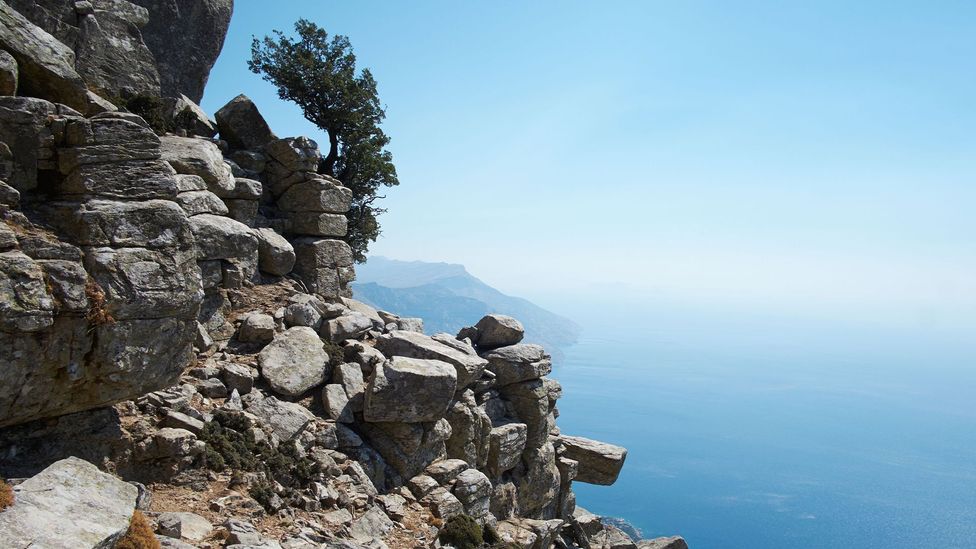
Faced with the threat of invaders, Ikaria residents adopted an audacious strategy: moving their homes into the mountains so that the island would appear abandoned from the sea.
Sailing towards the North Aegean islandof Ikaria around dusk, its craggy peaks rising steeply from the narrow strip of rocky shore, I noticed the twinkles of lights from houses were not primarily along the coast, as is the case with most Greek islands, but were predominantly scattered in the mountains behind. I wondered: why would inhabitants make life tougher for themselves by choosing to live up on the precipitous slopes, far from the more level ground near the sea?
I soon found out that the sea was both Ikaria’s blessing and curse. It allowed the island to spread its reputation for its excellent – and potent – Pramnian wine, and trade its prized product across ancient Greece, along with olives and honey. But the sea also brought pirates, lured by the island’s highly regarded produce and the prosperity it brought.
Ikaria was not unique within Greece in being beleaguered by pirates, but it suffered the additional complication of a revolving door of rulers. The Persian Empire, the Delian League association of Greek city states, the Romans, the Byzantine Empire, the Republic of Genoa and the Knights of St John all exercised varying degrees of influence over Ikaria between 500 BCE and 1521 CE, at which point Ikaria fell firmly into the Ottoman Empire, where it would remain for more than three centuries.
Historically, Ikarians have retreated into the mountains to escape threats from the sea (Credit: Percy Ryall/Alamy)
But due to its geography, the island was always an outpost of whichever territory it was within, and regular periods of instability, along with inadequately policed coastlines, allowed piracy to flourish.
While piracy was first reported on Ikaria in the 1st Century BCE, it became a more-or-less unchecked threat during Roman rule (late 3rd Century BCE to 5th Century CE) and Byzantine rule (5th to 12th Centuries CE). Then, after the arrival of the Genoese in the 14th Century, Ikarians resorted to destroying their own ports to deter invaders. Even this act was not enough.
Lacking resources to repel their aggressors, islanders decided to call their bluff. They withdrew deep into their mountainous interior, going to every possible length to convince anyone sailing past that Ikaria was deserted by building communities that were ostensibly invisible – at least, in the days before electricity. It was this elaborate and audacious disappearing act, pulled off by islanders for several centuries, that I’d come to learn more about.
I met Eleni Mazari in her office in the north coast port of Evdilos. Mazari runs a real estate business, but the wall inside the entranceway indicated her other long-standing passion: Ikaria history. Here, shelves were lined with models of the types of homes the retreating islanders decided to build, commonly known as “anti-pirate houses”.
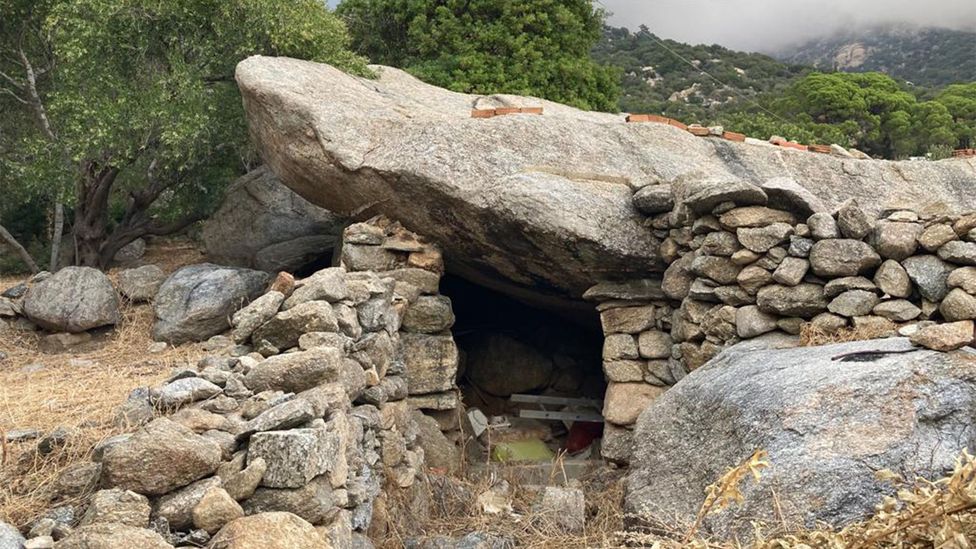
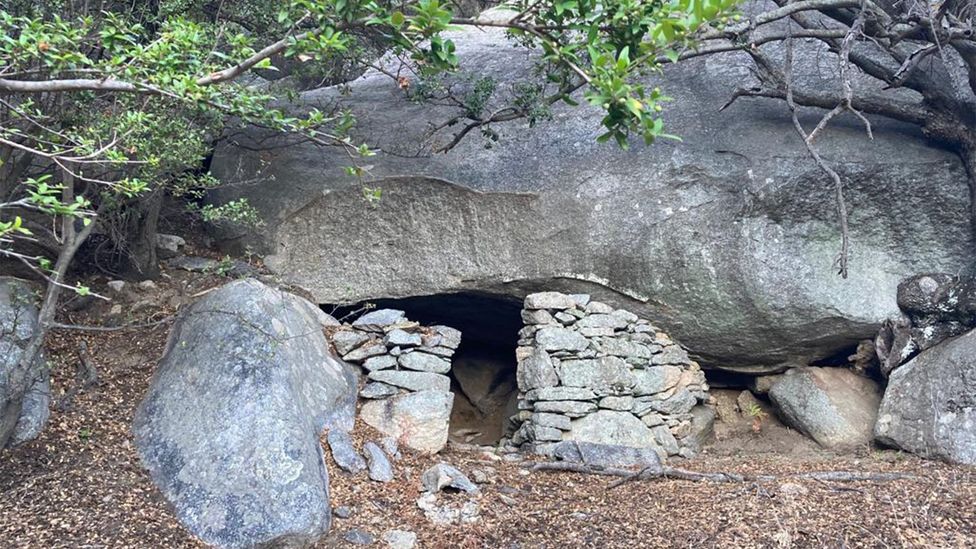
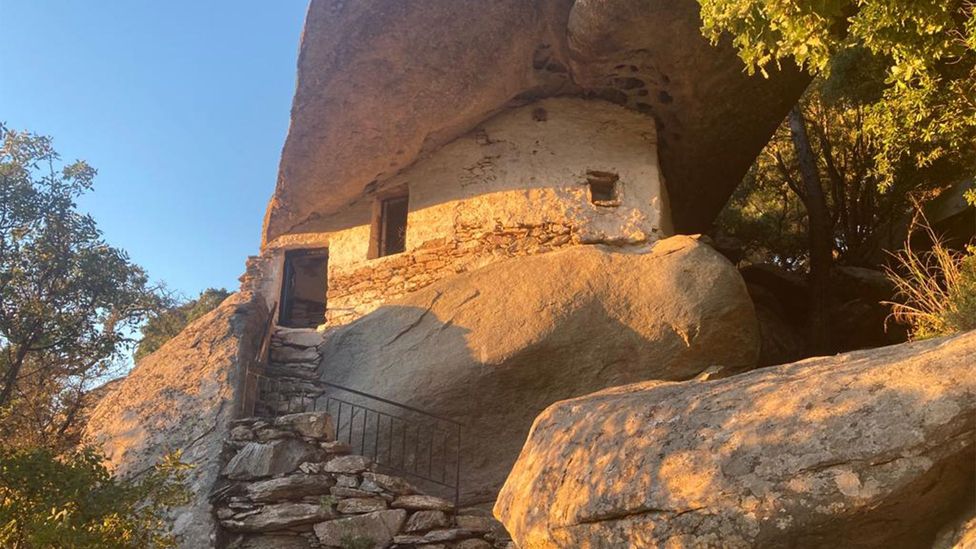
“Anti-pirate houses” are squat, stone-built dwellings that blend into Ikaria’s landscape (Credit: Luke Waterson)
These squat, stone-built dwellings incorporated natural features of the landscape, such as rocks, cliff overhangs and thickets. Boulders, which were strewn over the high mountain slopes, often formed much of the walls and ceiling, while dry-stone walls made up the other walls. Living arrangements were simple – houses had little more than a door and a hearth, as islanders would spend the majority of their time outdoors.
“It was a total reversal of the sort of structure most people associate with Greece,” said Mazari, who has been fascinated by anti-pirate houses for years, photographing them and collecting all available literature on them. “The age of grand temples was over. Ikarians were building homes designed to be seen by no-one, and to do it they had to go high up into the wilderness where they could not be observed from sea. There would have been many occasions from Roman times onward when they would have temporarily hidden in the mountains from invaders, so the possibility of doing so was always in their minds, if it were needed.”
It was the incorporation of Ikaria into the Ottoman Empire that persuaded Ikarians to completely decamp from the coast to the crags. The Ottomans proceeded to rule Ikaria laxly, allowing buccaneering to run rife as a means of disrupting and discouraging sea trade from other states. The choices facing Ikarians under such threat were limited: fight, with scant means at their disposal, to their probable deaths; vacate the island for safer shores; or seek sanctuary in the safety of the mountains.
This time, however, it would be a long-term move. Islanders would conceal their society in the rocky upper reaches of Ikaria’s Aetheras range for the next 300 years. This period was dubbed the “piratiki epochi” (pirate era), with the early years tellingly known as the “century of obscurity”.
Even today, it is hard to move from Ikaria’s coast up to its craggy interior (Credit: Luke Waterson)
“It was a self-sustained society, down to the courthouse, the narrow terraces on which they grew wine, olives, reared goats, made honey,” explained Mazari. “Ikarians have always been used to creating something out of not very much. So, what to outsiders might seem like uninhabitable mountain land was not so to our ancestors. If people’s homes stayed invisible to pirates, it was worth resettling.”
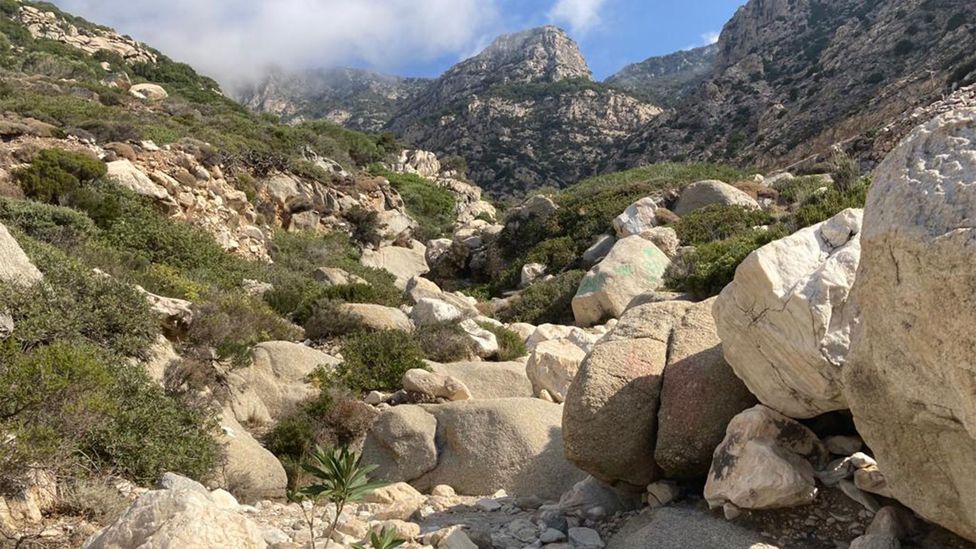
As I drove along the island’s north coast and looked up into what is affectionately known as Ikaria’s “wild west”, it seemed to me that the craggy island interior would be hard to inhabit even today. The terrain was arid, rocky and virtually deserted; mountainsides plummeted so sharply into the sea there was scarcely enough level ground to carve out a plot for a house or for a road to twist along its edge.
My destination was Lagkada, the place to which many Ikarians decided to retreat. This upland refuge holds a sacred spot in islanders’ hearts: without it, the population would likely have died out. The track to get there was too steep and rough for me to attempt driving, so I walked up a route that wound hair-raisingly around the rockface into a lush valley you never could have seen from below.
Here, still without any sign to indicate it, and further concealed behind olive groves and surreally shaped boulders, was the cradle of Ikaria’s anti-pirate civilisation.
Today, Lagkada is something of a ghost village of stone dwellings (Credit: Luke Waterson)
Despite knowing there were numerous anti-pirate houses in the vicinity, I wandered up and down the valley for several hours and found none. It was only on a final scan of the valley from above that I caught sight of an aperture in a rock too angular to be naturally occurring. I had found the community’s old jail.
The effort I’d expended (there’s no information boards or options for a guided tour) made me appreciate how adept islanders were at constructing dwellings that completely merge into the landscape. Life must have been tough for them, constantly under the threat of pirate attack and knowing that camouflaging into this harsh landscape was their sole defence.
My next stop was further inland to the Afianes family winery. Besides being producers of some of Ikaria’s finest wine, owner Nikos and his daughter Eftychia are well-regarded experts on the island’s history. And they had agreed to show me the anti-pirate house on their property.
“On Ikaria we have no shortage of boulders,” smiled Eftychia, explaining that boulders determined the location and aspect of most anti-pirate houses. “The boulder formed as much of the house structure as its shape allowed, one or two walls and maybe, if the boulder had an overhang, the roof. If the land was too steep to make a flat plot, as it usually was, people would labour to dig the rocks out of the earth to create level terraces.”
Boulders often provided the walls and sometimes roofs of structures (Credit: Luke Waterson)
She added that traditionally, you would always build back from the boulder on the landward side, so the structure could not be seen from the sea. “And because suitable boulders are naturally widely dispersed, so the communities became [too], which meant there was less chance of everyone being discovered if pirates did invade,” she said.
We stepped inside their anti-pirate house, now used for storing wine. The thick walls, Nikos explained, would have ensured it stayed cool during hot summers and retained heat in winter.
Locals went to additional efforts to make their settlements invisible to outsiders. “The structure would be low, one storey only, and lower than the maximum height of the boulder,” said Eftychia. In addition, houses were built without chimneys to avoid giveaway columns of smoke. Instead, one stone on each side of the mortar-less walls would be removed while the hearth was in use, allowing smoke to subtly dissipate. People would only interact at night. According to Mazari, in the pirate era, they would rarely even keep dogs for fear the sound would alert invaders.
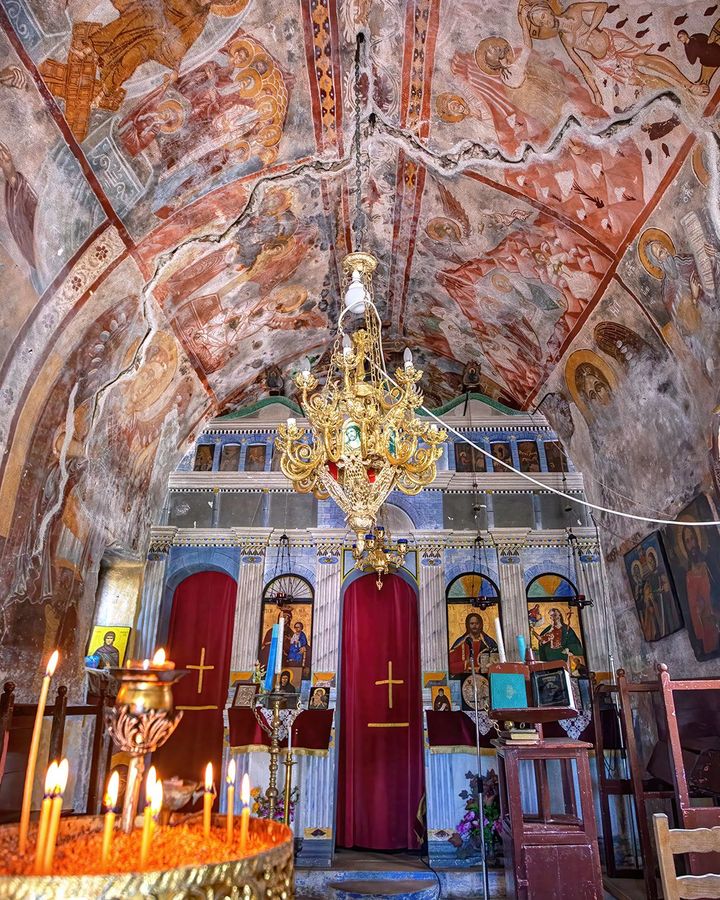
Anti-pirate houses may have been erected as emergency retreats, but they had a lasting effect on Ikarian society, long after warships dispatched by the US, Britain, France and Russia finally brought privateering in the Aegean to an end during the 1820s. The tendencies for villages to remain mountain-based and scattered, and for islanders to enjoy staying up late into the night, are both attributed to the pirate era. Even places of worship built in anti-pirate style survive, such as Theoskepasti Chapel thaat dramatically squeezes into a boulder overhang near Evdilos.
Despite being inside a rock, the interior of the Theoskepasti Chapel is quite ornate (Credit: Leoman/Getty Images)
As for Lagkada, while it seemed to be that the one-time centre of pirate era life is now abandoned, that’s not quite true.
“There is still at least one man living there permanently,” Nikos said. “His family never moved away. Most of us see him only when we go to Lagkada’s panigýri [festival], which he organises. The rest of the year, he must be surrounded by ghosts.”
Heritage Architecture is a BBC Travel series that explores the world’s most interesting and unusual buildings that define a place through aesthetic beauty and inventive ways of adapting to local environments.
Nowhere has Xi Jinping’s assertive foreign policy had a greater impact than in South East Asia, China’s strategic backyard.
But as Beijing’s power has grown, so has Washington’s unease – and now after years of see-sawing, the US is trying engage with the region again.
When he attends the annual summit of the Association of South East Asian Nations or Asean this week in Cambodia, President Joe Biden becomes the first US leader to make that trip since 2017. He was there virtually last year too. And then he goes to Indonesia, another important player in the region, where he is scheduled to meet Chinese leader Xi Jinping before they both attend the G20 meeting.
But the US is now operating in a more treacherous diplomatic environment than in the past.
Asean, once considered essential for diplomacy in the Asia-Pacific, has struggled to remain effective in an increasingly polarised world. It has fashioned itself as a zone of peace and neutrality, where its 10 member states seek consensus, avoid criticising each other and feel free to engage different powers. Its small and weak secretariat, and lack of any process for enforcing decisions on members, reflects this mindset.
This worked well while there was a broad, US-led global consensus that championed trade and growth. But China’s arrival on the global market and growing influence from the early 2000s coincided with diminishing US interest, as it focussed on the Middle East.
China embarked on a charm offensive in the region, following former leader Deng Xiaoping’s mantra “hide your strength, bide your time”. But under Mr Xi, now in power for 10 years, China’s strength was no longer hidden.
In the last decade, China’s occupation and military development of reef islands in the South China Sea has brought it into direct conflict with other claimants, particularly Vietnam and the Philippines. Attempts by Asean to get China to agree to a “code of conduct” in the disputed areas have gone nowhere. Beijing has simply stalled negotiations for 20 years. It has also dismissed an international court ruling in 2016 that its claims are invalid.
It has been just as evasive on problems caused by its large-scale damming of the Mekong River.
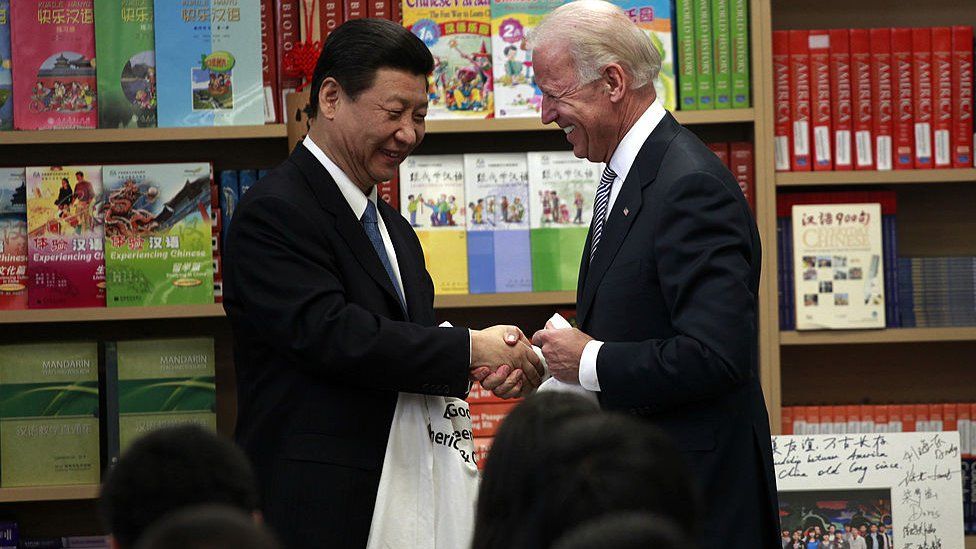
Image source, Getty ImagesImage caption, Mr Xi with Mr Biden in 2012, when the latter was the US vice-president
But the countries that make up Asean are in a sticky position. First, China is so important economically, and so powerful militarily, that few dare confront it openly.
Even in Vietnam, which went to war with China only 43 years ago and where anti-China sentiment runs high, the ruling communist party is cautious when dealing with its giant neighbour. They share a long border, China is Vietnam’s largest trading partner, and a vital link in the supply chain that fuels its world-beating exports.
Second, China has effectively destroyed Asean unity by picking off smaller states, such as Laos and Cambodia, which are now so dependent on Beijing’s largesse they are more or less client states. This was clear even in 2012, when Cambodia last took the rotating Asean chair, and blocked a final statement critical of Beijing’s position in the South China Sea.
While wariness of China might sound like good news for the US, the truth is South East Asian countries have also become disenchanted with Washington.
They see it as an unreliable partner, too preoccupied with human rights and democracy. The US forced the region to accept hugely unpopular and tough economic measures after the 1997 Asian financial crash, disengaged almost completely during President George Bush’s war on terror, and has since flipped from President Obama’s much-hyped “pivot” to Asia, to President Trump’s narrow approach to what he called unfair Asian trading practices.
The US focus today on the Quad alliance with Japan, India and Australia has also weakened Asean, leaving it feeling stuck between two powerful sides. And Washington’s willingness to challenge China in Asia frightens them because they have a great deal to lose from a superpower confrontation.
For all its overtures, no US administration has been willing to pursue free trade agreements – and that has certainly soured the deal for what is perhaps the most trade-dependent region in the world.
A relationship with China, on the other hand, has already led to the world’s largest trading bloc linking Asean, China, Japan, South Korea, Australia and New Zealand.
Even Indonesia, the largest Asean state and with the region’s most China-sceptic foreign policy, has under President Joko Widodo eagerly sought Chinese investment, loans and technology.
The US can draw comfort from the knowledge that Asean will still engage other powers as much as possible – as a counterweight to China. And China is unlikely ever to have close military allies here, in the way the US does in Japan and Australia.
But all Asean countries – to varying degrees – now accept that China will be the dominant power in this region and one that is unwilling to make concessions where its own interests are at stake.
The question for Mr Biden: is it too late for the US to reshape alliances in China’s backyard?
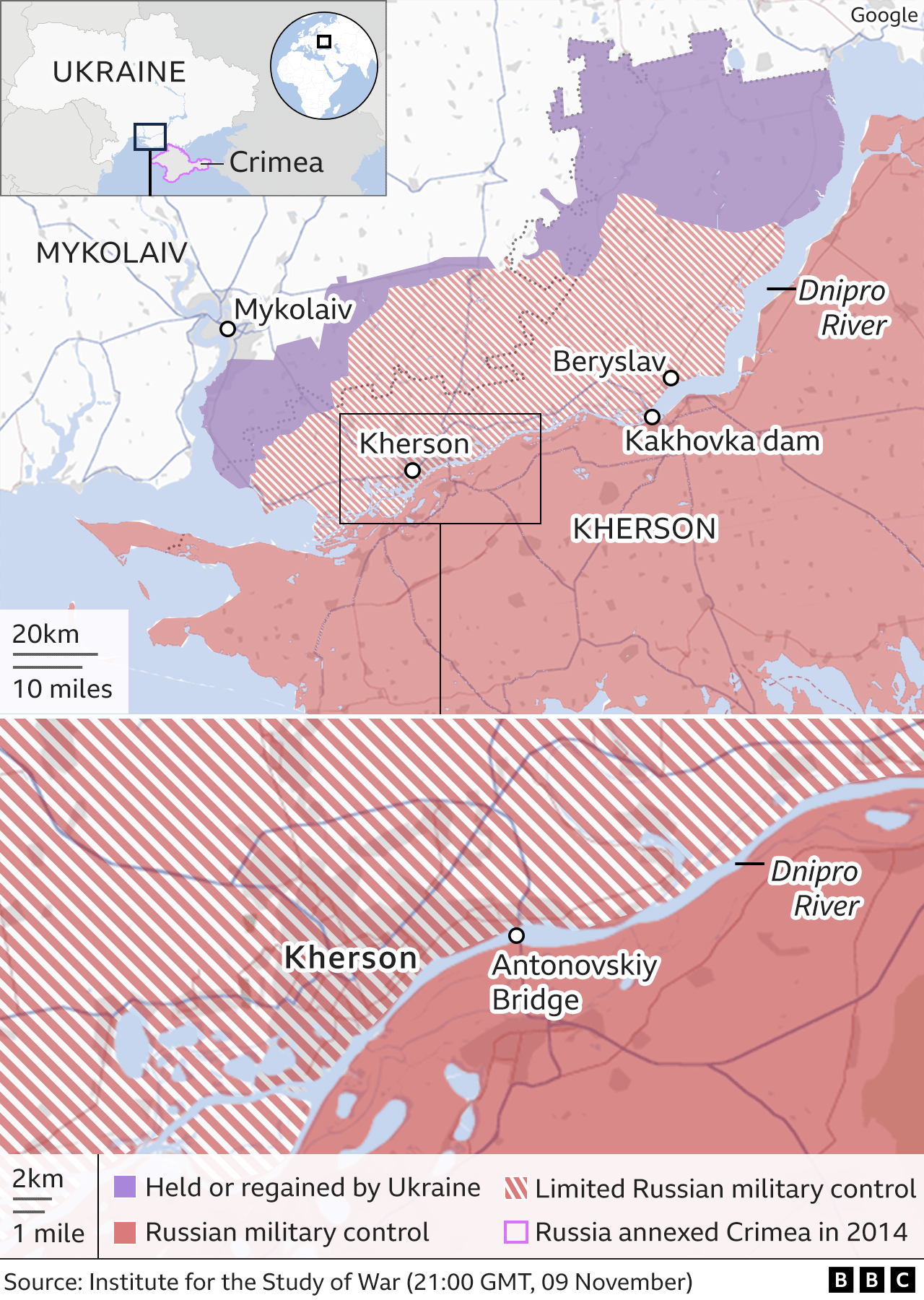
The Ukrainian armysays it has made major gains over the last day around Kherson, after Russia said it was withdrawing from the southern city.
Ukrainian troops say they have taken back the key town of Snihurivka, 50km (30 miles) to the north of Kherson.
Kyiv has also claimed big pushes on two fronts near Kherson, including advances of 7km in some places.
Russia says it has started to exit the city – its top gain in the invasion – but the process could take weeks.
Wednesday’s announcement was viewed as a major setback for Moscow’s war effort, though Ukrainian officials were sceptical – warning that the manoeuvre could be a trap.
There was no immediate evidence of any mass-scale Russian withdrawal from Kherson.
Ukraine’s commander-in-chief Valeriy Zaluzhny said on Thursday that he could not confirm or deny the pull-out – but said his own forces had made important advances.
Gen Zaluzhny said his soldiershad driven forward on two fronts on the western bank of the Dnipro river – an area of land which encompasses Kherson – taking control of 12 settlements.
The 7km gains were made “during the past day”, he said, as troops advanced along a northern-eastern axis and a separate western axis.
Video footage showed soldiers being greeted by locals in a square, apparently after entering the town of Snihurivka.
Snihurivka sits at a major road junction and is a rail hub for Mykolaiv region, which borders Kherson to the north and west.
The regional administration in Mykolaiv posted on the Telegram messaging app touting “lots of good news today”.
It fuelled speculation on Thursday night that Ukrainian troops had reached the outskirts of Kherson itself, after cryptically posting a single letter – “ch” in Ukrainian.
This was taken as a possible clue that troops had reached the suburban village of Chornobayivka.
In total, Ukrainian troops have recaptured more than 40 settlements from Russian control during their advances in southern Ukraine, President Volodymyr Zelensky said.
It was not possible for the BBC to independently verify the details of the latest territorial gains and losses – but the reports come after weeks of steady advances from the Ukrainian military.
Kherson was the first – and only – regional capital to fall into Russian hands after it invaded Ukraine on 24 February.
From late September, it was viewed by the Kremlin as Russian territory – following so-called “referendums” in occupied areas of Ukraine that were widely discredited by the international community.
On Wednesday, Moscow said it was no longer possible to supply the city, saying it would step back from the western bank of the Dnipro – a river which bisects Ukraine.
Notably, Russian President Vladimir Putin did not take part in the televised announcement.
Ukraine’s Gen Zaluzhny said Russia was left with no option but to flee, after its supply lines were destroyed and its command systems disrupted.
Later on Thursday, Ukraine’s defence minister said it would take Russia at least a week to withdraw and that it was not easy to predict the actions of his enemy.
Jens Stoltenberg, the chief of the Nato military alliance of Western nations, said it was clear Russia was under “heavy pressure” but that it was important to see “how the situation on the ground develops”.
The UK defence secretary said Russia appeared to be setting up a defensive line on the other side of the Dnipro river using concrete installations.
Commenting on the withdrawal, Ben Wallace said that “the world shouldn’t be grateful for Russia handing back stolen property”.
A Ukrainian presidential adviser said it was too early to celebrate – accusing his enemy of wanting to turn Kherson into a “city of death” by leaving mines and plotting to shell it from afar.
That could add to the casualty count of a war which has already killed or injured 100,000 soldiers on each side and 40,000 civilians, according to the latest estimate from a senior US general.
Separately, the US has announced another $400m (£341m) military aid package for Ukraine – including Avenger air defence systems and Hawk missiles.
Ukrainian President Volodymyr Zelensky earlier said he had also discussed defence support from the UK with British Prime Minister Rishi Sunak.
Ex-US President Donald Trump has lashed out at Florida Governor Ron DeSantis, as the simmering rivalry between the two top Republicans boiled over.
Mr Trump belittled his former political apprentice as an “average” governor, lacking in “loyalty”.
Mr DeSantis, 44, won re-election in a landslide in Tuesday’s midterms, sealing his status as the Republican party’s brightest rising star.
He is widely expected to run for the party’s 2024 White House nomination.
But Mr Trump, 76, looks increasingly likely to stand in his way.
The former president – who has a massive campaign war chest and remains hugely popular with the party’s base – would be a formidable opponent for Mr DeSantis, or any other Republican who dares challenge him.
In a lengthy statement on Thursday night, Mr Trump dismissed the Floridagovernor as a political lightweight who had come to him “in desperate shape” when running for his first term in office in 2017.
“Ron had low approval, bad polls, and no money, but he said that if I would Endorse [sic] him, he could win,” Mr Trump said. “I also fixed his campaign, which had completely fallen apart.”
He went on to complain that Mr DeSantis – whom he is nicknaming “Ron DeSanctimonious” – was “playing games” by refusing to rule out a presidential bid.
“Well, in terms of loyalty and class, that’s really not the right answer,” Mr Trump added.
The former president is widely expected to announce his own plan for a White House comeback as soon as next week.
While Mr DeSantis is bathing in the glow of his re-election victory, Mr Trump has been blamed for the Republicans’ disappointing performance in the midterm elections.
The race for control of the House of Representatives and Senate went down to the wire. Two days after Americans went to the polls, it remains unclear which party will control the twin chambers of Congress.
Voters by and large rejected candidates who backed Mr Trump’s baseless claims of election fraud in 2020, and many of his high-profile picks for office struggled or lost outright.
Even close allies of the ex-president have called for him to reconsider what he has teased to be a big announcement on 15 November.
“Republicans have followed Donald Trump off the side of a cliff,” one former Trump adviser, David Urban, told the New York Times.
“I think he needs to put it [his campaign announcement] on pause,” Kayleigh McEnany, Trump’s former press secretary, told Fox News.
Mr DeSantis’ 20-point win over his Democratic rival Charlie Crist has, by contrast, drawn universal acclaim from conservative commentators.
His margin of victory in Miami-Dade county – traditionally a Democratic stronghold – was the largest won by a Republican in four decades.
According to an October Ipsos poll, 72% of registered Republicans said Mr DeSantis should have a great deal or good amount of influence on the future of the party. Some 64% said the same of Mr Trump, 76.
The governor did not immediately respond to Mr Trump’s jibes on Thursday.
President of the Republic, Nana Addo Dankwa Akufo-Addo, has once more asked for the United Nations Security Council to be reformed, claiming that the existing system is unfair to African nations.
Speaking at an event organised by the Konrad Adenauer Foundation, on Wednesday, 10th November 2022, in New York, President Akufo-Addo noted that the Security Council is constrained by its anachronistic structure and methods, which undermine efforts to tackle contemporary challenges in the most effective manner.
“The conversations around reforms, which have been going on for three decades without an end in sight, must, therefore, yield real changes to the structures of the Council to make it innovative in its approach,” he said.
According to the President, the current structure of the UN Security Council represents a long-standing injustice toward the countries of Africa, and the time is long overdue in addressing it.
“It is obvious that the contemporary world has moved on significantly from the post-1945 world, which gave rise to the birth of the United Nations and the structure of the Security Council. The world of 2022, and even less that of 2050, is not the world of 1945. The crisis of the multilateral financial institutions and the United Nations system, which were born from the rubble of the Second World War, is a deep crisis,” President Akufo-Addo said.
He continued, “It will continue until a fair system is put in place; a system that reflects the new balances, no longer based on who lost or won the Second World War, but on the major contemporary and future balances. These balances must take into account new realities such as demographic dynamics or access to resources, in a context of scarcity.”
In its current state, the President noted that the Security Council is finding it increasingly difficult to propagate the rule of law and democratic principles.
“The use of the veto as an instrument of great power and interest is denuding the Security Council of a great deal of legitimacy as the principal instrument for the maintenance of international peace and security. The African Common Position on UN Reform, based on the Ezulwini Consensus, is of even greater relevance today than it has ever been. It is essential that it be brought back to the centre of global discourse,” he stressed.
President Akufo-Addo was confident that it will only be through the reforms that are suggested in the African Common Position that will enable the Security Council to be effective in addressing the challenges of our time.
“And it is only through its effectiveness at maintaining international peace and security that the Council can remain credible, legitimate and relevant,” he added.
France,who won the 2018 FIFA World Cup, has announced their final 26-man roster for the 2022 FIFA World Cup in Qatar.
Without the three star midfielders they relied on for the 2018 edition in Russia (Ngolo Kante, Paul Pogba, and Blaise Matuidi), coach Didier Deschamps will have to place his hopes in the young French players who are rising through the ranks.
In the absence of Paul, Kante, and Matuidi, Didier Deschamps has invited Adrien Rabiot (Juventus), Aurélien Tchouaméni (Real Madrid), Youssouf Fofana (Monaco), Mattéo Guendouzi (Marseille), Jordan Veretout (Marseille), Eduardo Camavinga (Real Madrid) as his midfielders for the World Cup.
His goalkeepers2018 FIFA World Cup champions are Hugo Lloris (Tottenham Hotspur), Alphonse Areola (West Ham), and Steve Mandanda (Rennes).
Benjamin Pavard (Bayern Munich), Jules Koundé (Barcelona), Raphaël Varane (Manchester United), Presnel Kimpembe (PSG), William Saliba (Arsenal), Lucas Hernandez (Bayern Munich), Théo Hernandez (Milan), Ibrahima Konaté (Liverpool) and Dayot Upamecano (Bayern Munich) will be the defensders for France in the 2022 FIFA World Cup.
2022 Ballon D’or winner, Karim Benzema, returns to the squad after missing out on the 2018 edition due to a national team ban.
Ousmane Dembélé (Barcelona), Kylian Mbappé (Paris Saint-Germain), Olivier Giroud (Milan), Antoine Griezmann (Atlético Madrid), and Christopher Nkunku (RB Leipzig) will be the other attackers for France.
Group opponents for Ghana in the 2022 World Cup Cristiano Ronaldoof Manchester United is the captain of Portugal’s team, which has been announced for the competition.
The star-studded squad lined up by Portugal includes Premier League players like Bruno Fernandes, Jose Sa, Joao Cancelo, Ruben Dias, Ruben Neves, Joao Palhinha and Bernardo Silva.
Paris Saint-Germain midfielder Renato Sanches did not make the squad for the tournament despite playing huge roles in the team in the past years.
39-year-old defender, Pepe has been named in the squad as well as defenders like Raphael Guerreiro and Nuno Mendes at the back.
Portugal will open their campaign at the tournament against Ghana and then face South Korea and Uruguay.
The North Americans were the second nation to release their squad. Joel Campbel, Kaylor Navas, and Bryan Ruiz are the key names on the list.
Brazil
Brazil head coach, Adenor Leonardo Bacchi popularly known as Tite, named a star-studded squad on Monday, November 7.
Arsenal duo, Gabriel Jesus and Gabriel Martinelli, who missed the last call-ups in September, were included in the final list this time.
Some constants like Thiago Silva, Marquinhos Alisson, Ederson, Casimero, and Vinicius Jr were also named in the squad.
Meanwhile, Dani Alves made a shocking appearance in the squad at age 39.
Australia
The Socceroos named their squad on Tuesday, November 8. Matthew Ryan and Aaron Mooy lead the Australian squad.
Sengal
The Tarenga Lions of Senegal are the first African to announce their squad. Head coach Aliou Cisse has named a star-filled squad for the tournament.
Edouard Mendy, Kalidou Koulibaly, Sadio Mane, Idrissa Gueye, Cheikou Kouyate, Ismaila Sarr all made the squad.
Demark
Denmark have also announced their 26-man squad. Christain Eriksen, Christensen, Simon Kjaer, Kasper Schmeichel, and Emile Hojbjerg are the key men leading the Dens’ list.
???? ????????????????????????????????: Denmark have announced their squad for the World Cup. ???????? pic.twitter.com/SzRE3Hrz1m
Luka Modric will lead Croatia’s 26-man squad in Qatar. Modric won the best player at the last edition and will hope he leads his Country to clinch the ultimate this time after finishing second in 2018.
England head coach, Gareth Southgate has named his final squad with some suprises misses.
Tammy Abraham, Fikao Tomori, and Jadon Sancho are the big misses in the squad. Whereas Kalvin Philips, and Kyle Walker who are nursing injuries made the cut.
Robert Lewandowski, Kamal Glik, Aljkadiuz Milik and Zielinski lead the Polish 26-man squad for the tournament.
They announced their squad on Thursday, November 10, 2022.
Uruguay
Ghana’s World Cup Group opponent, Uruguay, have named their final 26-man squad for the upcoming 2022 World Cup in Qatar.
Barcelona centre-back, Ronald Araujo, who was said to be a major doubt for the tournament due to an adductor longus avulsion injury in his right thigh, made the list, which was released on Thursday, November 10, 2022.
Some key names like Luis Suarez, Edison Cavani, Darwin Nunez, and in-form Real Madrid midfielder Federico Valverde were all named in the big squad.
Despite exhibiting a strong recovery from the COVID-19 pandemic and exceptional wealth growth that caused their total net worth to exceed $84.9 billion at the end of 2021.
When compared to their collective net worth of $73.8 billion in 2020, the amount implies a rise of 15%, or $4.7 billion. Many of Africa’s greatest billionaires will likely struggle to make the Forbes 400 list in 2022.
With 14 of Africa’s 18 billionaires missing from this exclusive list, it’s critical to understand who these people are and what industry they work in, as well as their potential to join the list in the not-too-distant future.
Despite the fact that it now takes $6 billion to make the Forbes 400 richest list, up from $6.4 billion at the start of the year, African billionaires such as Nigerian telecom mogul Mike Adenuga, Algerian billionaire Issad Rebrab, and Egyptian businessman Naguib Sawiris rank among the 14 billionaires who are still far short of the $6-billion mark.
According to data tracked by Billionaires.Africa, these 14 billionaires are presently ranked in this order.
#1 Mike Adenuga
Net worth: $5.7 billion
Nationality: Nigerian
Mike Adenuga, the founder of Nigerian telecom company Globacom Limited and the majority owner of Nigeria’s pioneer petroleum marketer, Conoil Plc, is now the third-richest man in Nigeria, the seventh richest on the African continent, and the 426th richest person in the world.
His net worth has dropped by $1 billion since the beginning of the year, from $6.7 billion in January to $5.7 billion at the time of writing this report, due to a decline in the value of his stake in Globacom Limited, Nigeria’s third-largest telecom service provider.
#2 Issad Rebrab
Net worth: $5.1 billion
Nationality: Algerian
Issad Rebrab, the founder and CEO of Cevital and Algeria’s richest man, ranks 483rd in the world. The Algerian billionaire’s net worth has increased from $4.2 billion in 2020 to $5.1 billion at the time of writing this report, representing a net worth gain of $900 million.
His $5.1-billion fortune stems from the valuation of Cevital, his well-diversified manufacturing conglomerate, which has increased significantly due to increased capacity and robust earnings growth.
#3 Naguib Sawiris
Net worth: $3.4 billion
Nationality: Egyptian
According to Forbes, Naguib Sawiris, the elder brother of Egypt’s richest man Nassef Sawiris, is the second-wealthiest man in Egypt and the 815th richest man in the world, with a fortune of $3.4 billion.
The billionaire amassed his fortune after selling Orascom Telecom to Russian telecom firm VimpelCom (now Veon) in a multibillion-dollar transaction in 2011. He is presently a shareholder in Orascom TMT Investments and Ora Developers, a real estate developer.
#4 Patrice Motsepe
Net worth: $2.7 billion
Nationality: South African
With a net worth of $2.7 billion, Motsepe is the richest Black South African and the world’s 1,067th richest man. The majority of his wealth is derived in gross terms from his 40-percent stake in African Rainbow Minerals (ARM), a South African diversified mining and minerals company.
His net worth has dropped by $200 million as a result of the recent decline in the market value of his stake in ARM, a company he founded in 1997, from $2.9 billion to $2.7 billion at the time of writing this report.
#5 Mohammed Mansour
Net worth: $2.5 billion
Nationality: Egyptian
Mohamed Mansour, an Egyptian billionaire businessman and the world’s 1,151st richest man, is the chairman of Mansour Group, a family conglomerate worth more than $6 billion, according to Forbes.
Mansour derives the majority of his $2.5-billion net worth from the company, alongside his brothers Yasseen and Youssef Sawiris, who are also billionaires.
The Egyptian billionaire played a crucial role in the group’s growth, primarily through GM dealerships in Egypt, which he established in 1975.
Mansour Group has since grown into one of the biggest GM distributors worldwide.
#6 Koos Bekker
Net worth: $2.1 billion
Nationality: South African
Koos Bekker is a South African billionaire businessman and the chairman of Naspers, a leading South African multinational media group.
He was instrumental in the establishment and growth of Prosus, a Naspers subsidiary established as the company’s global Internet assets division under Bekker’s leadership.
The majority of the South African billionaire’s wealth is derived from his holdings of Naspers and Prosus. Since the start of the year, his net worth has decreased from $2.7 billion to $2.1 billion.
#7 Mohamed Al Fayed
Net worth: $1.8 billion
Nationality: Egyptian
Mohamed Fayed, an Egyptian businessman and retail mogul whose primary residence and business interests have been in the United Kingdom since the late 1960s is the world’s 1,504th richest man, according to Forbes, with a net worth of $1.8 billion.
Fayed amassed a fortune in retail after selling his stakes in the London department store Harrod’s to Qatar in a deal valued at $2.4 billion in 2010. Following the sale of Fulham Football Club in 2013, he received a whopping $300 million from U.S. auto parts billionaire Shahid Khan.
#8 Aziz Akhannouch
Real-time net worth: $1.8 billion
Nationality: Moroccan
Aziz Akhannouch is a Moroccan businessman and the country’s Prime Minister since September 2021. His fortune is derived from the Akwa Group, a Moroccan conglomerate with oil and gas investments.
The company also has interests in telecommunications, tourism, hotels, and real estate. The Afriquia brand is used by its service stations.
Akhannouch has a net worth of $1.8 billion, making him one of Africa’s wealthiest men and the world’s 1,586th richest man, according to Forbes.
#9 Mohammed Dewji
Net worth: $1.5 billion
Nationality: Tanzanian
Mohammed Dewji is a Tanzanian billionaire businessman and former politician. He is the owner and CEO of MeTL Group, a Tanzanian conglomerate founded in the 1970s by his father.
MeTL Group has active operations in East, Southern, and Central Africa in textile manufacturing, flour milling, beverages, and edible oils.
Dewji has an estimated net worth of $1.5 billion as of press time, making him the world’s 1,784th richest person and the African continent’s youngest billionaire.
#10 Youssef Mansour
Net worth: $1.5 billion
Nationality: Egyptian
Like his younger brothers, Mohamed and Yasseen Mansour, Youssef Mansour, a director in the family-led Mansour Group, is worth more than $1 billion.
With a net worth of $1.5 billion, the Egyptian billionaire businessman who co-owns Mansour Group with his brothers ranks 1,854th in the world.
He is in charge of the consumer goods division, which includes the Metro supermarket chain and the exclusive distribution rights for L’Oreal in Egypt.
#11 Michiel Le Roux
Net worth: $1.4 billion
Nationality: South African
Michiel Le Roux is a South African billionaire businessman and the founder of Capitec Bank, one of Africa’s largest retail banks.
According to Forbes, the billionaire is worth $1.4 billion, making him the world’s 1,941st richest man.
His net worth has dropped by $300 million since the beginning of the year, from $1.7 billion on Jan. to $1.4 billion at the time of writing.
#12 Strive Masiyiwa
Net worth: $1.2 billion
Nationality: Zimbabwean
Zimbabwe’s richest man Strive Masiyiwa presently ranks as the world’s 2,132nd richest man, with a net worth of $1.2 billion.
Econet Wireless Zimbabwe, which he founded in 1998, has grown to become the country’s largest mobile phone company.
He owns slightly more than half of Econet Wireless Zimbabwe, which is part of his larger Econet Group. The company has stakes in mobile phone networks in Burundi and Lesotho, as well as investments in African fintech and power distribution firms.
#13 Yasseen Mansour
Net worth: $1.1 billion
Nationality: Egyptian
Yasseen Mansour, Egypt’s sixth-richest man and the 2,294th wealthiest man in the world, owns a stake in the family-owned conglomerate Mansour Group.
Aside from his business interests in Mansour Group, Mansour is the chairman of Palm Hills Development, a leading Egyptian real estate group.
#14 Othman Benjelloun
Net worth: $1.1 billion
Nationality: Moroccan
According to Forbes, Othman Benjelloun, who is worth $1.1 billion at the time of writing this report, is the world’s 2,363rd richest man and one of Africa’s richest billionaires.
The Moroccan billionaire is best known for co-founding BMCE Bank of Africa, where he currently serves as chairman and CEO.
Based solely on market capitalization, Benjelloun’s stake in the bank was worth $4 billion in 2021.
After purchasing the Mali-based Bank of Africa, his banking firm BMCE Bank now has a presence in at least 12 African countries.
Nigerian musician, Divine ‘Rema’ Ikubor, terrified his fans in the UK after he ‘collapsed’ on stage during a recent performance at the O2 Brixton.
In a viral video, Rema was seen performing during his ‘Rave and Rose’ world tour, where he sold out a two-day concert at the 4,921-capacity O2 Brixton Academy Arena, yesterday.
Then, all of a sudden, he dropped to the floor, pretending to have passed out.
The rescue team took him away from the stage, while they tried to stabilise him.
However, the singer returned a few seconds later, jumping back on stage to perform his hit song, ‘Woman’.
A tweep reacted by saying if a real emergency happens, people will think it’s a prank, while others urge the singer to rest more situations like this.
iam_kelvinossai said: “People should not be pranking with things like this. No one will know when the real emergency happens.
“CPR should be initiated within minutes of a collapse if no pulse is felt… and if people think it’s a prank and let him be… hmmmm.”
Seybyth: “Stop artiste slavery… stop overworking artiste. na human them be (they are humans).. give them some rest.. carry other artiste join… but una go dey do only my circle only our circle (stop working by cliques).”
__thegoodman: “U know say as dem famous na steady drugs and hard tins dey enter the blood! (They are on drugs).
“The number one thing that can end a man’s life is when you decide to run after money without resting! Show to show, events to events. Money growing in the aza but you dey go small small (savings increasing while your health is decreasing).
“Secondly, if you dey do drugs! All dis things na one body! Make una dey sorry for the body self (Have mercy on your body).
hubertson__ said: “Lol internet is always misleading with half videos. Now everyone in the comment thought it was real.
“He stood up and ran to the stage and continued performing, if you saw the complete video. He’s very fine and sound it was all acting.”
The Inspector-General of Police, Usman Alkali Baba, on Thursday, confirmed the arrest of suspected terrorists connected to the plan to attack the Federal Capital Territory, FCT, Abuja, disclosing that there were plans by security agencies to prosecute those arrested.
IGP Baba also denied insinuations that the government tried to dismiss the security advisory from the United States, US and theUnited Kingdom, UK, though he said that the terror alert created panic and apprehension among the citizens.
Fielding questions from State House correspondents when he appeared at the 57th weekly ministerial briefing organized by the Presidential Communications Team at the Presidential Villa, Abuja, the Police boss explained reasons why security agencies engage criminals and bandits in negotiation to secure release of kidnapped victims.
IGP Baba at the briefing gave the scorecard of the force in performing its duties.
Responding to a question on the recent security advisories issued by the United States which generated some level of panic in the federal capital a couple of weeks ago, he confirmed that some suspected terrorists were rounded up and would be facing prosecution soon.
He, however, denied insinuations that the government tried to dismiss the advisory, noting that it drew criticisms from security stakeholders because it caused apprehension on the citizens.
According to him, “Nobody has dismissed as just an alarm. Governmenthas never dismissed it as alarm but we only said it was blown or made in such a way that our people became apprehensive to the situation or to the way it was done.
“The embassies have their own responsibilities to their citizens and they can make their advice and the government has not dismissed what has happened because they have also informed us of what they foresee as threats.
“And we on our parts have also looked at what they put as threat as something that has been with us and efforts are being made daily to see they those threats are mitigated or prevented from happening and that is what has been happening in Abuja and all over the country.
“Sometimes, these threats or things happen but nobody has dismissed it as mere alarm and a lot of efforts have been made, like you said to douse tension.
“Yes, actually arrest have been made for those, we believe are planning to commit crime in whatever form and we have done that arrest and as at when due, those arrested will be charged to court by any of the services which have them.”
On why security operatives negotiate with bandits and criminals for the release of kidnapped victims, Baba said it would be an exercise in futility if terrorists who are armed abduct persons and the police go in search of them under captivity using extreme force.
The IGP’s explanations were on the backdrop of over 80 Chibok girls still in Boko Haram captivity, including 29 students of FGC Birni Yauri who have not been set free several years after their abduction.
He said, “You see, the issue of kidnapping is an issue that borders almost all the security agents, including the military, it is a crime that once it is committed, you have to thread very softly and with all sense of professionalism.
“If you do not rescue the person, safely, unhurt, you have not achieved anything and once somebody is in the captivity of an armed person, then you need to do a lot of things, it is not all about guns and other things.
“There are a lot of other things that can be done. We were able to rescue the whole of Forestry students in Kaduna through negotiation, we were able to rescue many others, which I can give you example, for those that we are in contact with, there are things that we are doing, it is a new crime and requires new ways of approaching it and new ways of dousing it.
“Clearly it is under study. For instance the issue of Train negotiators and so forth, were not an issue before, but now we are looking into it and we are putting our personnel to undergo such training and courses. So, we will not say hope is lost. We are still on it”.
The IGP also made a stunning revelation, saying some of the Chibok girls who have been put into family way and were rescued while wandering in the bush, made moves to return to their captors.
He said, “The issue of Chibok girls you know they are coming out one after another and gradually. Sometimes they come out and say yes, we have come to see our parents and we want to go back.
“So maybe they have been assimilated or acclimatized with the situation and being indoctrinated and had become part and parcel of those who have abducted them and so forth. But like as I’m saying, it is a continuous effort and even last month, you saw a Chibok girl coming out with two or three kids and said she only came to greet her parents and she wants to go back. So, we are still on it, there is hope”, he assured.
The police boss acknowledged that some aspects of police duties have been commercialized to generate more revenue through the Police Specialized Automated Services (POSSAB) portal but the service has been abused.
He, however, threw out the idea that unscrupulous persons can use the portal to gain protection from the police.
The IGP said he was against the withdrawal from security personnel being attached to VIPs, saying some of them might be exposed to dangers.
“On the issue of security personnel being attached to VIPs to be withdrawn, for every rule there are exemptions, these people need to be protected but we try to do it with all sense of humility. VIPs need to be protected because some people are really, if left unattended to can be easy target and we will make too much noise.
“So we’re not withdrawing personnel, or I am not of the view of completely withdrawing security aides from VIPs. But that we will manage what we have and also checkmate crime and criminality without actually leaving them bare”, he said.
President Muhammadu Buhari has said he is not interested in having assets all over the place.
Buhari stated this in an interview in the United Kingdom after meeting with His Royal Majesty, King Charles III in Buckingham Palace on Wednesday.
He said, “And he (King Charles III) asked me whether I have a house here (UK) and I said no. I said even in Nigeria the only house I have is the house I had before I got into government. I am not very much interested in having assets all over the place. I feel much freer when I have nothing.”
Meanwhile, Buhari has expressed confidence that the ruling All Progressives Congress, APC and its pfesidential candidate, Asiwaju Bola Tinubu will in the forthcoming 2023 general elections.
According the President, APC is lucky to have Tinubu as its presidential candidate ahead of the 2023 general elections.
When asked the chances of the APC in the 2023 elections, Buhari said, “What are the chances of my party not winning the election? We are going to win the election.
“Tinubu, the presidential candidate, a very well-known politician in the country, he was a two-term governor in Lagos State, the most resourceful state and the most visited state. So, I think the party was lucky to get him to be the candidate,” he added.
Tension enveloped Asaba, Delta State capital, following the partial collapse of a two-storey building at the multiple sports complex of the Stephen Keshi Stadium, where some persons were reportedly injured.
Three persons reportedly died in the incident but the State Commissioner for Information, Mr. Charles Aniagwu, said no one died but that three were injured.
Meanwhile, three journalists who arrived the scene of the incident were beaten up by hoodlums on the orders of Tonobok Okowa, Chairman, Delta State Sports Commission.
Vanguard learned that those injured were working at the building site, and that they were immediately taken to a hospital.
Part of the two-storey building, which is under construction in preparation for the 21st National Sports Festival, NSF, to be hosted at the stadium from November 28, reportedly collapsed around 10a.m.
Public Relations Officer, Delta State Police Command, DSP Bright Edafe, said the building did not collapse, explaining that it was one of the roofing bars that slid off of the track.
Reacting to the development, the State Commissioner for Information, Mr Charles Aniagwu, said no loss of life was recorded in the accident which occurred at the construction site of the indoor sports complex of the stadium.
Aniagwu said the accident was caused by misalignment of the crane by its operator, which led to the heavy duty equipment crashing on the wall of one of the floors.
According to him, contrary to reports of loss of lives, only one person sustained minor injury and has since been treated while other workers have also returned to site.
Aniagwu said: “Right behind me is the premises of the indoor sports hall under construction at the Stephen Keshi Stadium.
“The accident was caused by the crane operator, who couldn’t properly align the lift while trying to take some very heavy duty equipment up.
“It fell on the wall, which led to a crash of a part of it. “One person sustained minor injury and has since been treated and they have returned to work. The workers are very much on site and we are moving with speed.
“The unconfirmed reports of loss of life are not true and anybody saying the Stephen Keshi Stadium has come crashing down is also peddling the wrong information.
“As a matter of fact the Stadium is undergoing some renovation work ahead of the National Sports Festival.
“The contractor has assured us that in less than 48 hours the part of the wall that collapsed on account of the misalignment of the crane would be fixed.”
Journalists beaten
Meanwhile, the first team of journalists including Paul Osuyi of the Sun, Monday Osayande of Guardian and Amaechi Okwara of Blueprint, who went to access the level of damage, were beaten up and bundled out of the stadium on the orders of the Chairman, Delta State Sports Commission, Mr. Tonobok Okowa.
Mr. Okowa, who doubles as Co-Chairman of the Local Organising Committee (LOC) for the festival tagged Asaba 2022, reportedly ordered boys around to confiscate the working tools of the journalists.
The boys, who were initially reluctant to carry out the order, forcefully took out the reporters after manhandling them.
“Take them out of this place. Journalists are not needed. Are they still here? Collect their gadgets and bundle them out of here,” Okowa roared.
At the time of filing this report, top government officials were seen moving in and out of the stadium.w
President Muhammadu Buhari has expressed confidence that the ruling All Progressives Congress, APC and its presidential candidate, Asiwaju Bola Tinubu will win the forthcoming 2023 general elections.
Buhari stated this on Wednesday in an interview in the United Kingdom after meeting with His Royal Majesty, King Charles III in Buckingham Palace.
According the President, APC is lucky to have Tinubu as its presidential candidate ahead of the 2023 general elections.
When asked the chances of the APC in the 2023 elections, Buhari said, “What are the chances of my party not winning the election? We are going to win the election.
“Tinubu, the presidential candidate, a very well-known politician in the country, he was a two-term governor in Lagos State, the most resourceful state and the most visited state. So, I think the party was lucky to get him to be the candidate,” he added.
Recall Tinubu contested presidential primary in June alongside Vice President Yemi Osinbajo; Senate President Ahmad Lawan and former Minister of Transportation, Rotimi Amaechi.
More than 2,300 delegates voted in the contest that produced Tinubu, who polled a total of 1,271 votes – over four times the votes scored by his closet rival, Amaechi who had 316 votes.
Osinbajo, Lawan, and Governor Yahaya Bello of Kogi State came behind the duo with 235, 152, and 47 votes respectively.
Tinubu will be contesting the presidency in 2023 alongside frontline contenders including Atiku Abubakar of the Peoples Democratic Party (PDP), Rabiu Kwankwaso of the News Nigeria People’s Party, NNPP and Peter Obi of the Labour Party (LP).
It was all tears of joy when Nigerian-born WWE star Omos reunited with his family in his native country after 14 years of not seeing them.
According to TMZ, the gigantic athlete, whose real name is Tolulope “Jordan” Omogbehin, made the trip to the country of his birth after his November 5 WWE Crown Jewel matchup with Braun Strowman in Saudi Arabia.
In the video, “The Nigerian Giant” is seen quietly making his way into his family’s Lagos home before his relatives swarm over him with hugs and kisses after seeing him. And though the 28-year-old athlete is very conspicuous because of his height (7’3″) and weight (more than 400 pounds), that did not prevent him from pulling off the surprise. The emotional moment was also captured by a camera crew that accompanied.
Omos’ family was reportedly unaware of the visit. It is also anticipated that the WWE star will make a huge announcement during his trip to his native Nigeria.
The rising WWE star was born in Lagos in 1994. He and his family later resettled in the United States. And he is said to have initially played basketball during his high school and college years in the United States.
The WWE signed Omos in 2019, and he went ahead to win the WWE Raw tag team title with AJ Styles.
Gunshotswere heard during the visit of Nigeria’s presidential candidate, Atiku Abubakar, to Borno State in the northeast of the country where an Islamist insurgency has uprooted millions.
The region also faces extreme food shortages as farmers were also forced to abandon their fields.
During the rally in the state capital, Maiduguri, the former vice-president and presidential candidate promised to restore peace to the region and the rest of the country.
“If PDP is elected we shall restore peace in Borno State, not only Borno State but throughout the country. We will reactivate Chad Basin development authority so that our farmers can go back to the farm, so that we can produce food for our own people and so that we can reduce unemployment we promise you that”, said the PDP presidential candidate, Atiku Abubakar.
Nigerians will go to the polls on the 25th of February 2023 to pick a new president and vice president.
Kenya’s parliament has approved the deployment of nearly 1,000 troops for a new regional force in eastern Congo amid questions about the $37 million cost for the first six months of the mission.
A parliament committee report says the money will be spent on equipment, allowances, and operations for the more than 900 troops joining the East African Community Regional Force that will support Congolese forces against armed groups.
Opposition lawmakers questioned why Kenya is spending so much money on the regional mission while the country faces its own security issues. Kenya also faces rising inflation and high public debt.
Kenyan President William Ruto last week called the mission “necessary and urgent” for regional security. Violence by armed groups in eastern Congo has led to a diplomatic crisis between Congo and neighboring Rwanda, which accuse each other of backing certain groups.
The Kenyan forces will be based in Goma, eastern Congo’s largest city. The regional force, agreed upon by heads of state in June and led by a Kenyan commander, also has two battalions from Uganda, two from Burundi, and one from South Sudan.
There is a possibility that international financing may be secured for the mission, the committee report said.
The two leaders of the main politicalopposition movements in Chad, Succès Masra and Max Loalngar have gone into hiding for their safety, three weeks after a bloody demonstration by their movements.
They both told the AFP on Wednesday that the repression continued with arrests and “deportations” and “extra-judicial executions”.
Mr. Masra, president of the Transformers party, assured AFP by telephone that he had to “cross” the land border illegally to “another country” because he was wanted by “the presidential guard”.
Mr. Loalngar, coordinator and spokesman of the main opposition platform Wakit Tamma, said he “went underground somewhere in the country” to avoid arrest.
On October 20, some 50 people were shot dead and more than 300 injured in N’Djamena and several other cities, according to the authorities, but many more according to the opposition, when the police violently repressed rallies organized by Les Transformateurs and Wakit Tamma to protest the two-year extension of General Mahamat Idriss Déby Itno’s term as president.
On April 20, 2021, following the death of Marshal Déby, who was killed by rebels on his way to the front, the army proclaimed his son, Mahamat Déby, a 37-year-old general, president of the republic at the head of a junta of 15 generals, for a transitional period of 18 months, at the end of which the army promised to hand over power to civilians through “free and democratic” elections.
But in early October, on the recommendations of a national reconciliation dialogue boycotted by the opposition but also by two of the three main armed rebel movements, who denounced it as a “charade,” the transition was extended for two years, as was General Déby as transitional president.
The Chadian Convention on Human Rights (CTDH) says more than 600 people have been arrested since October 20, most of them “deported” to two high-security prisons far from the capital.
More than 2,000 people have been arrested, according to the World Organization Against Torture (OMCT).
The government claims that the demonstrators, with the support of “foreign powers” that it did not name, had planned an “insurrection” to overthrow the government and that they had begun to violently attack and ransack institutions before the forces of order began to repress.
On Tuesday, Prime Minister Saleh Kebzabo, an ex-opposition leader appointed by President Déby, told AFP that his country accepted the principle of an “international investigation” under the aegis of Chad’s “partners.
In a report made public Wednesday, the chairman of the African Union (AU) commission, Chadian Moussa Faki Mahamat, stressed “the urgency of a serious and credible investigation” to bring those responsible to justice.
Mr. Masra and Mr. Loalngar assured AFP that a real “manhunt” had been going on for three weeks, particularly in N’Djamena, targeting supporters of their organizations.
“On October 21, soldiers of the presidential guard came to look for me at our headquarters. When they did not find me, they arrested 27 members of my team,” Mr. Masra told AFP from a country he did not wish to name, adding: “Only four of them are still alive, and they are being interrogated, the others are dead, some of those who were with them told me, even if we do not have the bodies.
“The manhunt continues throughout the country, targeting our cadres and activists, specifically those from my community, the Sara,” said the 39-year-old opponent, who accuses the authorities of “extrajudicial executions.
“The police go from house to house, they arrest people for anything, like all our activists, I had to go into hiding,” said Loalngar in a WhatsApp conversation from a location he did not wish to reveal but assured that he is “still in Chad.
Asked by AFP, various government officials would not say how many people had been arrested since October 20, promising to comment on the ongoing investigation and the upcoming international inquiry at a press conference “in the coming days.
In Paris on Wednesday, the lawyers for Mr. Masra and the Transformers, Vincent Brengarth and William Bourdon announced that they had sent the ICC a “report of facts likely to qualify as crimes against humanity.
Thousands of public servants began a one-day strike in South Africa on Thursday over wage demands, professional organizations said.
The work stoppage is being led by one of South Africa’s largest public service unions, the Public Servants Association (PSA), which has some 235,000 members.
The dispute over public servants’ salaries flared up after Labour Minister Thulas Nxesi announced last week that he would increase salaries by 3 percent, while the unions were demanding 6.5 percent.
Picket lines were observed during the day around central government offices in Pretoria by strikers in the health, immigration, and police sectors.
According to the PSA, the strike was expected to have a “serious impact” on the Department of Home Affairs, transport and customs services.
According to the union, “the minister’s irresponsible attitude has degraded already fragile social relations and deepened the lack of trust” with the social partners.
South African Finance Minister Enoch Godongwana said in an October budget presentation that the government could only afford a 3.3 percent wage increase, well below the 7.8 percent inflation rate in July.
South Africa’s economy has already been hit hard by several weeks of strikes in the railways and port services, which have affected mineral and fresh fruit exports.
The public prosecutor’s office and the penitentiary administration has said that 23 prisoners broke out of the jail in Moroni, the capital of the Indian Ocean archipelago of Comoros, on Wednesday night under circumstances that are still unknown.
According to reports, six were quickly found.
The 17 escapees who remain wanted have all been identified and an investigation has been opened to determine the circumstances of this escape, the public prosecutor, Ali Mohamed Djounaid, told AFP.
“What is certain is that the prisoners were able to escape without outside intervention,” he said.
According to the prison services, the inmates would have taken advantage of a transfer from the yard to their dormitories to take the powder but the modus operandi remains to be determined.
The prisoners complained of “too much promiscuity in the dormitories, of the lack of water”, which affects the whole archipelago, but also of “the irregularity of the food rations”, said to AFP a member of the family of a prisoner, reached by phone.
The Moroni prison was built in the 1960s to accommodate 80 people. It now holds some 340, according to the prison administration.
The prison is dilapidated and regularly faces protests demanding improved prison conditions.
Two years ago, more than 40 inmates escaped from Moroni prison as the entire country celebrated the national soccer team’s victory over Kenya.
Among them was Inssa Mohamed, known as Bobocha, who was accused of participating in an attempted assassination attempt against the head of state, Azali Assoumani.
He was found in Madagascar and extradited to Moroni less than two months after his spectacular escape.
Walid Regragui, the Moroccan coach, presented his 26-player World Cup roster on Thursday.
The Chelsea winger Hakim Ziyech, who has rejoined the national team after being benched by the previous coach Vahid Halilhodzic, will be relied upon by the Atlas Lions for his offensive skills.
Another returnee is Abderrazak Hamdallah (Ittihad FC), who publicly apologized for having slammed the door at the CAN 2019
The big surprise in the selection is a teenager from Belgium by the name of Bilal El Khannouss, who is only 18 years old.
“We have an amazing team, to be honest, with a lot of quality, a lot of players who play in big leagues in Europe, also for big teams. I think we can do something special, something nobody is thinking, I think we can achieve that,” said Noussair Mazraoui, Morocco and Bayern Munich defender.
Morocco will play in group F and will on November 23 play their first match against Croatia. The Atlas Lions will then face Romelu Lukaku’s Belgium before meeting Alphonso Davies of Canada.
For over a year, the staff of Twitter Africa worked remotely while preparing to move into their Accra Headquarters to begin operations physically.
It, therefore, came as great news when, on November 1, 2022, all the Africa staff of the global microblogging and social networking service got to have their first taste of a physical working environment with their colleagues.
The remote operations had ended, and that was supposed to be good news for the staff and the African region, knowing that Twitter had established an office to serve its direct interests, but something big and unexpected hit them some 24 hours after.
By Friday, November 4, 2022, the fates of the Africa HQ staff had been determined: none of them was spared the big cut.
“The company is reorganizing its operations as a result of a need to reduce costs. It is with regret that we’re writing to inform you that your employment is terminating as a result of this exercise.
“Your last day of employment will be December 4, 2022. You will be placed on garden leave until your termination date,” the termination notice sent via email to them read.
This was made available by Larry Madowo, a Kenyan journalist working with CNN.
SCOOP – CNN has obtained the termination notice sent to staff at Twitter’s only office in Africa – in Accra ????????
It was sent to their personal emails but didn’t mention any of them by name. Unlike in the US, it doesn’t offer next steps or severance pic.twitter.com/R868moImlh
“The company is reorganizing its operations as a result of a need to reduce costs. It is with regret that we’re writing to inform you that your employment is terminating as a result of this exercise,” the email told Twitter Africa staff. And then silence
On October 28, 2022, after months of processes for a complete takeover of the microblogging platform, the world’s richest man and billionaire businessman, Elon Musk, earned control of the site after a $44 billion deal.
According to the New York Times, the closing of the billion-dollar deal, amidst a lot of drama and a lot of legal challenges, had “set Twitter on an uncertain course.”
In one of his very first decisions at the helm of the social media giant, Musk fired three top executives, including CEO Parag Agrawal.
How Twitter Africa staff were fired:
Giving further details into the mysterious way the staff of the African office received their termination notices, Larry Madowo said that everything happened in four days.
This, he said, happened after the staff physically moved into their office space in Ghana’s capital, Accra.
He added that this move by Musk, and ultimately Twitter, now question its commitment to the continent because “when it opened the African office in Ghana, Africans – more than a billion of us, felt seen, and now all of that seems to have all gone up in the smoke.
“On Tuesday, after working remotely for about a year, Twitter’s Africa staff in Ghana finally opened the physical. On Friday morning, they were locked out of their email accounts, and their work laptops stopped working.
“They then received email notifications on their personal email accounts that they were getting terminated,” he explained.
The 20-member Africa team of Twitter are not alone, as many of the company’s staff in parts of the world have also been hit with this unexpected blow.
No severance for Africa staff:
While there has been an understanding communicated to especially staff of Twitter in the United States about receiving certain severances after the termination of their employment, CNN reported that that is not the case too in Africa.
Explaining how this has come to be the case, Larry added that following their termination notifications, the Africa staff are to stay put, doing almost noting until their last day at the company.
“Typically, the remaining employees of Twitter will receive full payment and benefits until December 4 but until that time, they are not allowed to communicate with other staff, suppliers, customers or clients and they are to remain available at Twitter’s disposal in case they need to have a proper handover,” he added.
But again, he said that for the Africa staff, one other thing that has given them a reason to be further worried is that the email they received did not even mention any severances for them.
Larry explained it as, “At least for the African staff, that email did not even mention them by name; it just said ‘see attached.’ And even though Elon Musk said everybody who got fired would be getting at least three months severance above the law – that’s in the US, those in [the] Africa office didn’t get a next step, or if they’re going to get any severance at all, which some lawyers in Ghana are now pointing out could be a violation of Ghanaian employment law.”
It is, however, unclear what the next move by the staff for the Twitter Africa office will be, even as there are suggestions that this termination violates Ghana’s laws.
You can also watch this edition of GhanaWeb Special:
The power of social media – Are virtual interactions taking over reading among the youth?
Wonder Hagan produces a documentary on the impact of social media on the reading habits of today’s youth.
Daughter of former United States (US) president, Donald Trump, Tiffany, and her fiancé, Michael Boulos, are allegedly set to wed on 12 November, 2022.
According to sources, the upcoming bride, Tiffany Trump, and her Nigerian-born fiancé, Michael Boulos, will host their opulent nuptials at Donald Trump’s Palm Beach estate in Florida with 500 guests expected.
“There has been a lot of planning and a lot of staging. This is Tiffany’s big moment, and it will be lavish. It is going to be a huge and beautiful affair,” the source said.
The couple got engaged on January 19, 2021, at the White House rose garden a few hours to the end of Trump’s tenure as US president.
Boulos was said to have engaged Tiffany with a 13-carat emerald-cut diamond from Dubai, worth $1.2 million.
Michael Boulos’ background
Boulos was raised in Lagos although he is of Lebanese and French descent.
Per reports, he moved to Nigeria at a young age where his family’s business is based and while in Nigeria, he studied at the American International School of Lagos.
He is the son of Massad, the Chief Executive Officer of SCOA Nigeria, and his mother, Sarah, is the founder of the Society for the Performing Arts in Nigeria.
According to a ‘Page Six’ report, Boulos was studying project management at City University of London when he met Tiffany, a law student at Georgetown, while she was on vacation in Mykonos, Greece, with Lindsay Lohan in 2018.
President of Liberia, George Weah, has drawn criticism from his countrymen after it was revealed that he will attend the World Cup in Qatar for nine days.
The former Ballon d’Or winner informed the Senate of his nine-day World Cup schedule last week, and then he took out for a number of international trips.
Critique has come in the form of call-ins into radio and TV shows as well as on social media platforms.
Critics say it would be inconsiderate of the president to go to Qatar at a time when many people were dealing with a crippling food crisis, and other pressing issues at home.
The BBC Africa LIVE page reports that the president’s son Timothy, who is American, will be in the US squad at the World Cup tournament, which kicks off on 20 November.
The 56-year-old former AC Milan and Chelsea forward was elected president of Liberia in 2017. He was a serving senator at the time of his second-round victory over Joeph Boakai.
Mr Weah’s staff – who haven’t responded to questions about the cost of the trip – have hit back at his critics, saying the president’s foreign visits would “yield huge dividends” for the country.
The World Health Organization says no food or medicine has reached the Ethiopian region of Tigray despite the signing of a ceasefire last week.
The United Nations has accused Ethiopia of using starvation as a weapon of war in Tigray, where it says a humanitarian blockade put 90% of the population at risk.
“Nothing is moving,” said WHO head Dr Tedros Adhanom Ghebreyesus.
“I was expecting food and medicine to start flowing immediately after the ceasefire. That’s not happening.”
He said people were dying from starvation and treatable diseases.
Dr Tedros, who comes from Tigray, called for the restoration of telecom, banking and other basic services.
He said six million people had been shut off from the rest of the world for two years as if they didn’t exist.
An Ethiopian official said Dr Tedros was trying to undermine the peace agreement – and that food and medicine were reaching Tigray.
He said electricity and telecom services had been restored in some areas.
Hundreds of thousands of civil servants inSouth Africa have embarked on a nationwide strike over wages and working conditions.
Local media have described it as the first major strike by public servants in the decade.
It is expected to cause disruptions in some government departments and airports.
Members of the Public Servants’ Association (PSA) had for weeks staged lunchtime pickets, but have now decided on a full-scale shutdown in major cities across South Africa.
It follows a breakdown in negotiations between the union and the government.
The union is holding firm on its demand for a 6% increase in wages, rejecting the government’s final offer of 3%.
Services such as the issuing of passports, death certificates and driver’s licenses will be affected.
Meanwhile airport authorities have warned that the industrial action may cause delays at passport control and have warned travellers to arrive for their flights at least four hours before departure time.
The Nigerian leader said the meeting was initially scheduled to take place in the Rwandan capital, Kigali, during the Commonwealth Heads of Government Meeting in June but it was postponed.
President Buhari has been in London since last week for what his office called a “routine medical check-up”. He is expected back in Nigeria next week.
King Charles will later this month host the first state visit of his reign when he welcomes the South African president to Buckingham Palace.
The visit will take place from 22-24 November.
It will be the first time a South African leader has visited the UK in an official capacity in more than a decade, with the last state visit being in 2010 when Jacob Zuma visited the late Queen.
Ghana’s Finance Minister Ken Ofori-Atta will face a vote of censure on Thursday for his handling of the economy as annual inflation rate hit 40.4% for October.
The cost of essential commodities like staple food, fuel and utilities have all surged to push price increases to a record high.
NEW PATRIOTIC PARTY ASKS MEMBERS OF THE MAJORITY CAUCUS TO ABSTAIN FROM VOTE OF CENSURE AGAINST THE MINISTER FOR FINANCE. pic.twitter.com/eFaFxIVjMX
Ghana’s opposition MPs filed the censure motion against the minister for mismanagement of the economy among other reasons.
But the ruling New Patriotic Party has ordered its MPs to abstain from the vote and asked its chief whips to ensure the order is complied with.
In a statement, the party said the censure vote was “ill-intended and aimed at derailing government’s efforts at resolving current socio-economic upheavals”.
Two people have been killed and 10 others kidnapped by members of the Allied Democratic Forces in Kabasha area near the city of Beni in north-eastern Democratic Republic of Congo.
This comes in the wake of aerial assaults by Congolese forces targeting militia groups in Runyoni, Musangati, Chanzu and Bunagana in the troubled east.
There are reports that several villages seized by rebels in Rutshuru have been cut off leaving residents without access to food and emergency services.
More than 90,000 people have been displaced by renewed fighting in the region in the past few months, according to aid agencies.
The DR Congo government has accused neighbouring Rwanda of backing the M23 group by providing them with logistical and financial support. Rwanda has repeatedly denied those allegations.
President Félix Tshisekedi last week urged the youth to form vigilance groups and join the army to protect the country against external aggression by armed groups.