The head of Liberia’s census body and one of his deputies have been sacked with immediate effect amidst confusion over the country’s much-postponed population count.
President George Weah announced the dismissal of acting director general Wilmot Smith and his deputy Alex Williams in a statement released on Monday.
The decision “is based on administrative reasons”, the statement said.
President Weah has appointed Lawrence George to act as the head of the agency.
The sacked officials had publicly disagreed on whether the country was ready to conduct the census.
President Weah has been out of Liberia for weeks to attend to official functions – including watching his son, Timothy, play for the US in the football World Cup in Qatar.
He is under heavy criticism for not staying at home for the census and setting an example to others.
His press secretary Isaac Solomon Kelgbeh told a radio programme last week that the president had been counted before departing the country, while an official at the census agency said President Weah would be counted on his return.
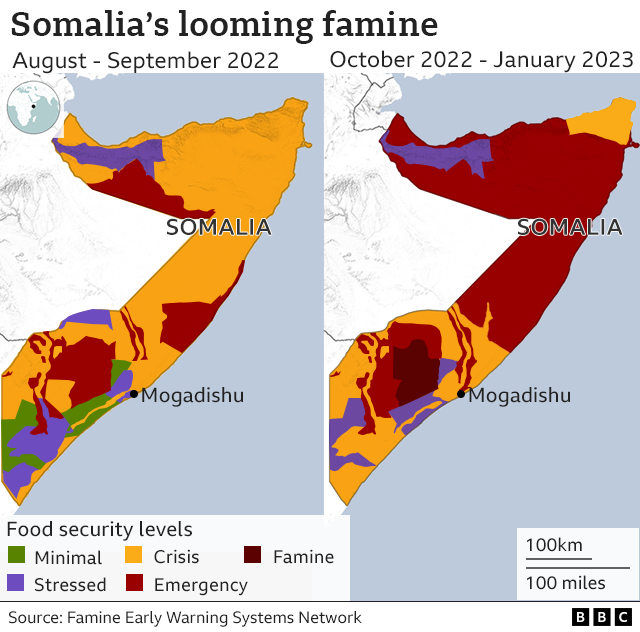
Dahir’s brother died of hunger. Now two of his sisters are fighting sicknessand malnutrition. The BBC’s Andrew Harding returns to Baidoa to revisit a family forced to flee Somalia’s worst drought in 40 years, as authorities urge the international community to recognise the crisis as a famine.
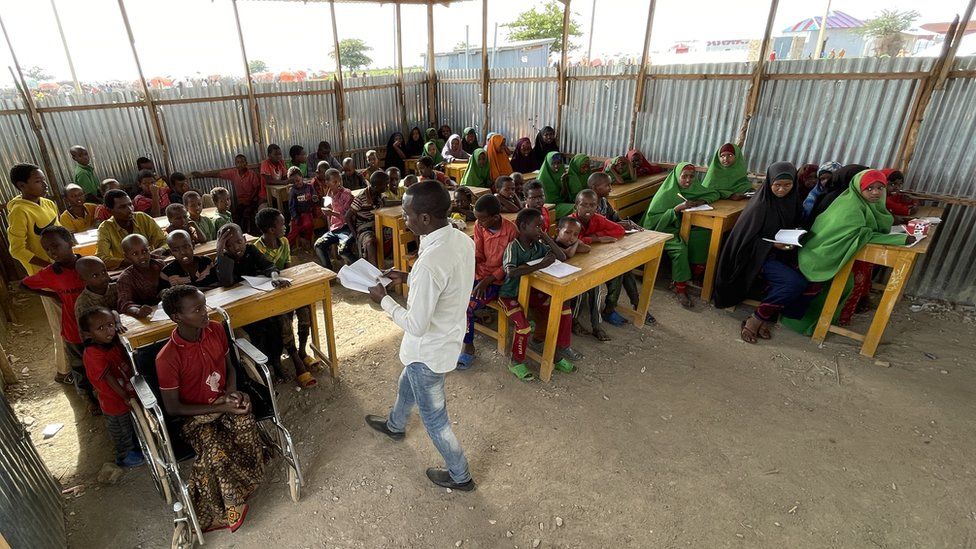
Eleven-year-old Dahir weaves his way between a growing cluster of homemade huts on the edge of Baidoa, heading to a tin-roofed schoolbuilding near the main road. He is wearing his only shirt and trousers, and clutching his one other possession – a new schoolbook.
The school’s sole teacher, Abdullah Ahmed, 29, writes English days of the week on the blackboard, as Dahir, and perhaps 50 classmates, recite: “Saturday, Sunday, Monday…”.
For a few minutes, a burst of interest energises the children, but soon the yawns and coughs resume – signs of the hunger and sickness that echo, like a grim soundtrack, across the plateau of rocky ground around Baidoa that has become home in recent months for hundreds of thousands of civilians, displaced by the worst drought to hit Somalia for 40 years.
“I think at least 30 of these children have not had breakfast. Sometimes they come to me to tell me of their hunger,” says Mr Ahmed. “They struggle to concentrate, or even to come to class.”
Image source, BBC/ Ed HabershonYoung children have been dying in growing numbers in the country’s fight against drought
Six weeks ago, on our last visit to this part of southern Somalia, Dahir sat, weeping, beside his mother Fatuma, outside the family’s flimsy home-made hut.
A few days earlier, his younger brother, Salat, had starved to death on the journey into Baidoa from the drought-parched countryside.
Salat was buried a few metres away. Now the grave is surrounded by huts built by newer arrivals.
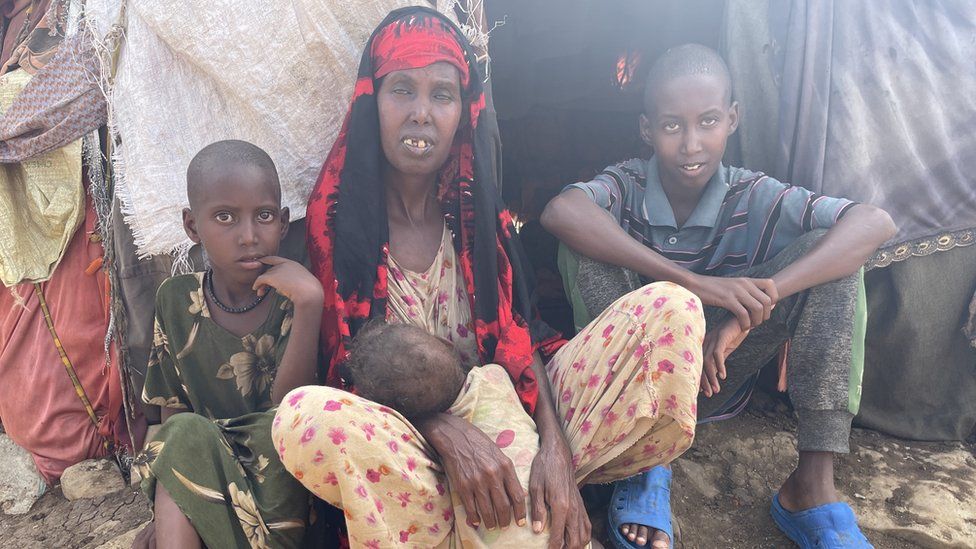
“I’m worried about my sisters. I wash for them. I wash their faces too,” says Dahir, glancing across at six-year-old Mariam, who coughed hoarsely and complained of a headache, and then at four-year-old Malyun, sitting lethargically and with sunken eyes on her mother’s knee.
“She is warm. I think she has measles. They may both have measles,” says Fatuma, putting her hand to Malyun’s forehead.
Image source, BBC/ Ed HabershonImage caption, Fatuma (centre) had no time to grieve the death of her son, she told the BBC
Measles and pneumonia have swept through Baidoa in recent months, killing many younger children whose immune systems have been weakened by malnutrition.
At the provincial hospital in the centre of Baidoa, doctors and nurses move between beds in the intensive care ward, inserting fluid drips into emaciated infants’ arms, and oxygen tubes into tiny nostrils.
Several children’s limbs are dark and blistered – as if from severe burns – one painful reaction to prolonged starvation.
“We have received some more [aid] supplies. But still not enough,” says Abdullahi Yusuf, the hospital’s head doctor.
“The world is paying attention to Somalia’s drought now. We see visitors from international donors. But that doesn’t mean we are getting enough support. I hope it will come soon. It is a desperate situation.”
Six weeks ago, he described the situation as “terrifying.” Today he acknowledges a slight drop in admission numbers but explains that was probably due to a few days of rain which had disrupted some dirt roads and prompted some families to focus on trying to plant crops rather than bringing sick children to hospital.
The situation is ‘getting worse’
Back at the camp, Fatuma lugs a plastic jerrycan of water home from a communal tap. Dahir emerges from the hut to help her clean a battered metal bowl while her ailing daughters lie, wearily inside the hut.
“My boy is a big help. He does so much to help the girls,” says Fatuma.
While she boils water, her phone rings. Her husband, 60-year-old Adan Nur, is calling from their home in a village three days’ walk away, in territory controlled by Islamist militant group al-Shabab.
“He says he’s planted sorghum. He’s okay. He will return soon. But we have lost all our livestock. There is no way we can make a living from just the crops, so I will stay here. That way of life is over,” says Fatuma after the call is over.
Her decision is backed up by the views of many experts, who warn that this rainy season appears to be failing, just like the last four – spreading a blush of green across the wilderness outside Baidoa but making no real impact on the crisis.
“It’s still getting worse. A lot of people are still coming here to seek food, safety, and water. And many children are dying of malnutrition. We urge [the government and international community] to consider the situation… as a famine,” says Baidoa’s Mayor Abdullah Watiin, stepping briefly out of a community meeting in a heavily guarded compound.
Inside the hall, an army general warns local people about the growing threat from al-Shabab, telling them to be on the look-out for explosive devices and ambushes.
Somali government troops and militias are expected to widen an offensive that appears to have been met with some success further north, but that risks making it even harder to access some rural communities hit hardest by the drought.
Later in the day, Fatuma settles her two sickest children – Mariam and four-year-old Malyun – on a blanket on the dirt floor of their hut.
An offer to take the children to hospital was rejected in favour of a course of traditional herbal remedies. Then Fatuma, weary too, lies down beside the girls.
“I just want them to get better,” says Dahir, watching from his own small blanket, then solemnly repeating the phrase two more times.
Ukrainian President Volodymyr Zelensky has called for Russia’s “destructive war” to end.
“I am convinced now is the time when the Russian destructive war must and can be stopped. It will save thousands of lives,” he told the G20 summit in Balivia video address on Tuesday, according to a speech in Ukrainian obtained by AFP.
He addressed leaders like US President Biden and Chinese leader Xi – and made a point of leaving out Russia.
“There cannot be any excuses for nuclear blackmail,” he added, specifically thanking the “G19” – and excluding Russia – for “making this clear”.
Russian President Vladimir Putin is not attending the summit, but his foreign minister Sergey Lavrov is there instead.
Three weeks to the day into the job; Rishi Sunak is on the world stage.
At the formal opening session of the G20 Summit, he said the “Putin regime” had “stifled domestic dissent and fabricated a veneer of validity only through violence” and is hearing “a chorus of global opposition to its actions”.
Sunak also addressed Russia’s representative in the room, the Foreign Minister Sergei Lavrov – the first time a British Prime Ministerhas confronted a senior Russian figure face-to-face since the war began.
Vincent Piket, the EU Ambassador to Indonesia and Brunei Darussalam, has tweeted a picture of Ukrainian leader Volodymyr Zelensky delivering his speech to the G20 via video link.
Ukraine President Zelensky addressing the G20 summit in Bali. Impassioned yet detailed speech calling for the restoration of peace in and respect for the UN Charter, the principle of territorial integrity in Ukraine. pic.twitter.com/fxsXIpsuKV
Russia’s FM Sergei Lavrov was present as Zelensky delivered his comments, AFP reported.
As we reported earlier, Zelensky told the assembled leaders that “now is the time when the Russian destructive war must and can be stopped. It will save thousands of lives”.
The G20 leaders and various heads of global organisations have arrived for lunch at the luxury Apurva Kempinski hotel – and some got the extra VIP treatment.
Upon arriving at the hotel entrance, Indonesian President Joko Widodo decided to hop into the driver’s seat of a golf buggy and ferry several guests, including Kristalina Georgieva of the International Monetary Fund, to the beachfront venue.
Everyone seemed to be in high spirits, especially Mr Widodo who was grinning ear to ear – except the two stern-faced bodyguards sat at the back. They were trailed by a contingent of black-suited delegates and aides.
The luncheon is being held under a vast bamboo structure where guests are dining in a massive circular table. Indian Prime Minister Narendra Modi and Saudi Arabia’s leader Mohammed bin Salman were spotted milling around, while the International Olympic Committee’s Thomas Bach gave an opening address.
Fifa president Giovanni Infantino sat and listened – with a football inexplicably placed in front of him, in case anyone had any doubt of who he was.
No word yet on what’s on the menu, but we’re sure it’ll be delicious.
Analyst James Crabtree of the Institute of Strategic Studies has been telling the BBC’s Karishma Vaswani about what would constitute success for the summit.
“This is the body that came together in 2008 and 2009, and was the focal point of getting the world out of the global financial crisis. Now we have comparably complex challenges,” he said.
“So inflation, food insecurity, the climate transition, a whole host of issues… but because the United States and Chinaand Russia are unable to cooperate with one another, then any progress on those issues is going to be incremental at best. So you have a body that is now much less than the sum of its parts,” he said.
However, he adds that there will some success – and opportunities created – as a result of the summit.
“The fact that Xi and Biden [are meeting], or Xi to meet Australian President Albanese… these are not insignificant things. So I think the success will simply be that some of the leaders will talk to one another, and maybe there’ll be tiny bits of progress on the broader G20 agendain areas like climate change.”
The fact that the meeting is happening at all, is another success in itself, he adds.
“When the Ukraine invasion happened, people worried that this entire G20 would collapse… that there simply wouldn’t be able to be a meeting because of the disagreements,” he said.
At the 2008 and 2009 leaders’ summits, during the financial crisis, leaders agreed on a host of measures to rescue the global economic system.
However, some critics argue that subsequent summits have been less constructive – often as a result of tensions between rival powers.
But that hasn’t always been the case – in 2019 in Japan, then-US President Donald Trump and China’s President Xi Jinping agreed to resume talks to settle a major trade dispute.
The office of Indian Prime MinisterNarendra Modi tweeted a picture of the two of them speaking.
We don’t know the details of the conversation yet, but the first meeting between Modi and Sunak – the UK’s first Indian-origin Prime Minister – was much anticipated in India. The 42-year-old is also married to Akshata Murty, daughter of Infosys founder NR Narayana Murthy.
Modi had congratulated Sunakon a phone call after he came to power, and tweeted that they had “agreed on the importance of early conclusion of a comprehensive and balanced [free trade agreement]”.
A trade pact aims to double bilateral trade by 2030 – the two countries are now looking to finalise the agreement by the end of March, according to Reuters.
On the plane to Bali, Rishi Sunak was asked whether he would commit, like his predecessor Liz Truss, to recategorising China as a “threat” to national security.
During the leadership campaign Liz Truss had pledged to reopen the integrated review, published last year, which lays out the UK’spriorities in diplomacy and defence.
Sunak said he believed China posed a “systemic challenge” to the UK’s values but he did not say he would stick with Truss’ commitment to officially reclassify China in the integrated review.
“My view on China is straightforward. I think that China unequivocally poses a systemic threat – well, a systemic challenge – to our values and our interests and is undoubtedly the biggest state-based threat to our economic security… that’s how I think about China,” he said.
“That’s why it’s important that we take the powers that we need to defend ourselves against that. For example the National Security Investment Act National Security Investment Act is a good example of that.
“But I also think that China is an indisputable fact of the global economy and we’re not going to be able to resolve shared global challenges like climate change, or public health, or indeed actually dealing with Russia and Ukraine, without having a dialogue with them.”
The Prime Minister was also asked whether he thought the UK should send arms to Taiwan.
He said: “We’re looking at all of these policies as part of our refresh of the integrated review. Our policy on Taiwan is obviously there should be no unilateral change to the status and there should be a peaceful resolution to that situation. We stand ready to support Taiwan as we do in standing up to Chinese aggression.”
Global leaders are debating topics like debt relief and food security at the G20 summit, which has begun on the Indonesian island of Bali.
Here’s what’s happened so far:
Ukraine President Volodymyr Zelensky made a virtual appearance at the summit, where he called for Russia’s “destructive war” to end
Similarly, UK PM Rishi Sunak criticised the “Putin regime”, saying it had “stifled domestic dissent and fabricated a veneer of validity only through violence”
Russian Foreign Minister Sergei Lavrov was in the room listening to Sunak’s comments – Vladimir Putin has decided not to attend.
Sunak also said he believed China posed a “systematic challenge” to the UK’s values, but did not clarify if he would commit – like his predecessor Liz Truss – to recategorising China as a “threat” to national security
About an hour ago, the leaders took a break from the summit to head for lunch at the luxury Apurva Kempinski hotel – with some of them being driven to the venue by Indonesian President Joko Widodo himself
A draft of a statement that has been viewed by the media states that “majority” of the G20 summit participants “strongly oppose” the invasion of Ukraine.
The war is “causing immense human suffering and exacerbating existing fragilities in the global economy”, the delcaration says, though it seems there is not unanimous support for the statement.
“There were other views and different assessments of the situation and sanctions,” the draft says, which is yet to be adopted by leaders at the meeting.
Yesterday Russia’s foreign ministry said that the G20 was not the place to discuss security issues and should instead prioritise the world’s economic challenges.
President of Ukraine, Volodymyr Zelensky, has said that during his virtual conference with G20 leaders that Russia’s war “must end now.”
He also ruled out a third “Minsk agreement,” which alludes to two failed cease-fire agreements between Kiev and Moscow over the future of the eastern Donbas region.
Mr Zelensky said during his video call: “We will not allow Russia to wait, build up its forces, and then start a new series of terror and global destabilisation.
“There will be no Minsk 3, which Russia will violate immediately after the agreement.”
However, Russia has been critical of the Ukrainian president’s statement.
The RIA Novosti news agency reports that Kremlin spokesman Dmitry Peskov said Zelensky’s comments over the “Minsk 3” deal shows Russia that Kyiv is not interested in holding peace talks.
High-level communication between the two nations was discontinued as a result of disagreements over trade, human rights, and foreign meddling.
Australian PM Anthony Albanese has said he hopes his meeting with Chinese President Xi Jinping is constructive.
“Dialogue is always a good thing,” he said.
“We enter this discussion with goodwill… [and] no preconditions.”
But Jennifer Hsu, a Research Fellow at the Lowy Institute in Australia, has warned the meeting is unlikely to bring any real progress.
While the talks are a significant step towards stabilising the relationship and are “a small victory” to be celebrated, too many points of conflict remain, Hsu told the BBC.
And many of them are rooted in “fundamental” differences between the countries, like system of governmentor values, she adds.
“It would be wrong for us to have great anticipation of this meeting resolving all those issues that have percolated over the last six years,” Hsu said.
Albanese’s government – elected in May – has toned down Australia’s rhetoric towards China, but has repeatedly said its policy approach is no different to that of the previous government.
We looked at whether the two countries are likely to patch things up earlier this year.
Prime Minister of India, Narendra Damodardas Modi, has called for a “return to the path of ceasefire and diplomacy” in Ukraine.
Speaking at a session on food and energy security, he said that global supply chains were “in ruins” because of problems caused by climate change, the Covid pandemic and the ongoing war in Ukraine.
He also emphasised the role of G20 leaders in “creating a new world order” after the pandemic.
“Over the past century, World War Two wreaked havoc in the world. After that, the leaders of that time made a serious effort to take the path of peace. Now it’s our turn,” he said.
At the session, which also had US president Joe Bidenand Russian FM Sergey Lavrov in attendance, Modi said that India’s energy security was crucial for global growth.
“We must not promote any restrictions on the supply of energy and stability in the energy market should be ensured,” he said.
Indian leaders have repeatedly said that the country will continue buying oil from Russia despite Western pressure to isolate Putin.
In the Egyptian resort of Sharm el-Sheikh, where the COP27 United Nations Climate Conference is taking place, activists from all over the world flocked to the streets on Monday November 14 2022.
They were calling on industrialised nations to pay for global warming’s impact on the most vulnerable nations. And there was a strong contingent from the Democratic Republic of Congo (DRC).
‘We wanted to organise this march to show the whole world that it is time to react. It is not normal to be here without any significant progress, especially since we, the DRC, are a climate change solution country,’ said Héritier Mpiana, deputy director, cabinet of the vice-prime minister in charge of environment.
Call for help
The group, gathering outside the conference centre where the talks are taking place, sang songs calling for help for African countries.
Africa is responsible for less than four per cent of global gas emissions, but countries on the continent are the most vulnerable to climate changes. However, experts say they are the least equipped to respond to them.
African negotiators have been calling for the delivery of promised financing for adaptation and mitigation efforts. With the summit concluding on Friday, talks are expected to intensify over the next few days in a bid to reach a final declaration that is acceptable to all delegates.
The Zambian governmentannounced on Monday that a 23-year-old student from Zambia who was imprisoned in Russia after being found guilty and was presently residing in a prison on the outskirts of Moscow had been discovered dead in battle in Ukraine. Zambian officials have asked Russia for an explanation.
Lemekhani Nathan Nyirenda “died on 22 September 2022 in Ukraine,” Foreign Minister Stanley Kakubo said in a statement, “on the frontline of the conflict between Russia and Ukraine.
Zambia said it had asked Russia to explain “the circumstances under which a Zambian citizen, who is serving a prison sentence in Moscow, could have been recruited to fight in Ukraine and lost his life.
The boss of the paramilitary group Wagner, Russian oligarch Yevgeny Prigozhin, who is reputed to be close to Vladimir Putin, is accused by Ukraine of sending thousands of fighters to the front, recruited directly from Russian prisons in exchange for the promise of a salary and an amnesty.
Lemekhani Nathan Nyirenda had been convicted of breaking Russian law in April 2020, according to the Zambian government, which did not give further details.
The student of nuclear engineering at the Moscow Engineering Physics Institute (MEPhI), had been sentenced to nine years and six months in prison. He was serving his sentence in a medium-security prison on the outskirts of Moscow.
The Zambian Foreign Minister said he was “deeply saddened by the untimely death of Mr Nyirenda in such circumstances”, adding that his remains had been taken to the Russian border town of Rostov for repatriation.
At this point in the pandemic, it’s easy to think of COVID-19 as something closer to the flu than a dangerous disease. But even though the latest Omicron variants do cause less severe symptoms than the original strain of SARS-CoV-2, COVID-19 is still far from a typical disease—especially if you get it more than once.
In a study published in Nature Medicine, researchers report that COVID-19 reinfections could be taking a toll on some important organ systems. That risk applies to both short-term and long-term health effects, says Dr. Ziyad Al-Aly, clinical epidemiologist at Washington University School of Medicine in St. Louis, and the study’s senior author.
He and his team analyzed 5.3 million health records from the U.S. Department of Veterans Affairs involving people who did not test positive for SARS-CoV-2 from March 2020 to April 2022, and compared their health status to 443,000 people who tested positive once during that period—then to another 41,000 who tested positive two or more times. (Most in the latter group had two or three infections, although a small proportion had four.) They studied adverse outcomes, like hospitalizations and deaths, in the health records for these groups for six months.
People who had more than one COVID-19 infection were three times more likely to be hospitalized and twice as likely to die than those who only had one infection. Those with multiple infections were also more vulnerable to other dangerous conditions; they were 3.5 times more likely to develop lung problems, 3 times more likely to have heart conditions, and 1.6 times more likely to have brain changes requiring care than people who had only had COVID-19 once.
The findings support other studies that are also documenting the effects that COVID-19 may have on the body. Most recently, in several presentations at the Society for Neuroscience’s annual meeting in November, scientists reported that the inflammation caused by COVID-19 can have lasting effects on the brain, including in children; 14 kids ages 10-13 who had recovered from COVID-19infections showed changes in the sensorimotor regions of the brain on MRI up to 15 months after their infection, compared to 35 children who hadn’t been infected. In another study presented at the same conference, adults who had even mild COVID-19 symptoms also demonstrated brain changes four months after infection.
Studies are showing that getting infected more than once—an increasingly common scenario as the pandemic drags on and variants become more transmissible—may have compounding effects. “We wanted to know, if you get multiple infections, do they matter? Are these infections consequential, or has the immune system adapted because it has seen the infection before and developed a way of dealing with it?” says Al-Aly. “We found that if people are infected a second or third time, those infections certainly contribute to additional health risk, even if they are vaccinated.”
With each infection, the body’s resilience drains a bit more, until, with enough assaults, it reaches the danger zone. “Cumulatively, each infection could get you closer and closer to the edge,” says Al-Aly. “That’s why avoiding a second or third infection is important to try to continue preserving health.”
Repeat infections may also raise the risk of Long COVID. It’s not clear yet what puts people at risk of developing symptoms that can persist long after the active infection is gone, and any encounter with SARS-CoV-2 could trigger whatever process is driving Long COVID. Repeated infections only increase the odds. “People will say, ‘I got infected with COVID last Christmas, and I didn’t get Long COVID.’ That’s wonderful, and that person is very fortunate,” says Al-Aly. “But just because you dodged the Long COVID bullet one time doesn’t mean you will dodge the bullet every time. Every time you get infected, you are trying your luck again.”
A deluge of COVID-19 reinfections could pose a problem for health care providers this winter, when rates of other respiratory disease, such as influenza and RSV, could also climb. Health systems across the country are already reporting high numbers of urgent care and emergency department visits due to respiratory illnesses, and Al-Aly’s findings suggest that people experiencing multiple COVID-19 infections may add to that burden.
The best way to avoid reinfection is to take familiar precautions: get vaccinated and boosted, wear masks when in public indoor settings, and avoid gatherings if you are feeling sick. “We’re not calling for lockdowns or draconian measures,” says Al-Aly. “We want people to be informed of the risk and take precautions to reduce their individual risk of infection. The health consequences of second and third infections are not zero, as some people think it is.”
How often do you watch Netflix? For most people, watching TV has become a trusted companion while they get ready for work in the morning, cook or clean their house, while they eat dinner or take a bath, and as they return from work. Accidentally, Netflix and other on-demand streaming services have become an integral part of our daily routines. And, it’s become a common way to spend time with our significant other.
But, and this is a big but, how many of us are paying attention to how TV is actually impacting our relationships?
Not many.
Of course, a movie night or a designated time to binge-watch a new show with your partner (or even family and friends) is great, but here are five things to consider.
More: Is an open relationship right for you?
1. Is it impacting your sex life?
I am not saying “don’t stream.” I am just saying to pay attention to the ratio of TV to other activities. Anytime we choose to watch something, we need to be aware that we are choosing not to do something else with that time. When we say yes to a 30-minute episode, we are simultaneously saying no to something else. Such as, for example, sex.Many couples feel too exhausted for intimacy after they have played “just one more episode” and consumed all their snacks.
And sex is not the only thing that may be neglected. Often we postpone important conversations or opportunities for deepening our understanding and connection with our partner.
2. Is it all that you do together?
I get it, most of us don’t feel like we have the energy to do much else a lot of the time, but we have to be intentional about our relationships, and our shows can get in the way of that. And – let’s be clear – this is not our TV’s fault, it’s the way we choose to consume it.
More: 4 tips for keeping things fun, sexy in your long-term relationship
Here are some alternative activities you can do with your partner:
Try a new recipe together or explore new coffee shops in your area
Play cards or a game
Do a physical activity you both enjoy (sex, jogging, tennis)
Read a book together
Invent a cocktail or bake a dessert for your partner and make them guess what’s in it
3. Why are you watching so much TV together?
If Netflix is one of the things you do together, great. If it’s the only thing you do together, ask yourself why.
Are you lacking things in common? Have you entered a rut? Are you avoiding the stress that comes with life, or maybe a difficult conversation or decision you need to make as a couple? Are you too intimidated to suggest a different activity in case they don’t like it?
Even if binging shows is your favorite way to relax, can you think of ways to make it more personalized, more special and more of a bonding experience?
4. What is the content teaching you about relationships?
The hours we spend watching stories unfold shapes and challenges our opinions and beliefs. With so much storytelling, we can start to set unrealistic expectations for our relationships, partners and romance in general, or – at the other end of the spectrum – normalize abusive or detrimental behaviors that we are constantly seeing (e.g. lying, cheating, abuse, etc.). Make sure to check in and evaluate how watching TV has impacted both of your expectations.
5. Where is Tv on your list of priorities?
Lastly, let’s not forget about the impact streaming can have on your relationship with yourself (which then impacts your relationship with others). In the process of tuning out the stress and the demands of the world, we sometimes tune out ourselves.
Before you start watching that movie or episode, check-in: Did you already do things that will keep you physically and mentally healthy? Are you prioritizing watching TV over people or important tasks in your life? Are you using streaming as a crutch or an escape instead of making changes or doing hard things? There is nothing wrong with finding a way to cope, but ask yourself: Is there a better way I can offer myself support?
Sara Kuburic is a therapist who specializes in identity, relationships and moral trauma. Every week she shares her advice with our readers. Find her on Instagram @millennial.therapist. She can be reached at SKuburic@gannett.com.
Why am I still hung up on my ex?: The answer is more complicated than you realize.
Quiet quitting is a trend at work. Can you also quietly quit your relationship?
I keep widening my dating app preferences: Is that a bad idea?
This article originally appeared on USA TODAY: Neflix, sex and your relationship: Are you watching too much TV?
You may have heard the saying, “Sitting is the new smoking,” which acknowledges the detrimental effects of a sedentary lifestyle and working behind a desk all day. Excessive sitting cause’s weight gain, high blood pressure, high cholesterol, Type 2 diabetes, and cardiovascular disease, in addition to back and neck pain, according to research. In fact, a 2017 study published in Annals of Internal Medicine in October indicated that spending a lot of time sitting, whether continuously or intermittently, raises the chance of mortality.
One of the most appealing options to hit the market for the many people who spend countless hours sitting at a desk is the standing desk, an apparatus touted as a way to improve posture, relieve back pain and neck pain, and increase productivity. Because standing desks are still relatively new products, more evidence is needed to determine how they benefit our health and the optimal ratio of sitting to standing. However, preliminary data suggest that standing rather than sitting during the workday has advantages.
Advantages of Standing Desks
Calorie expenditure
Standing burns slightly more calories than sitting, but not significantly more. Standing burned.15 more calories per minute than sitting, according to a November 2017 study published in Circulation. To put this in context, a 154-pound (70 kg) person who stands for six hours a day will burn an additional 54 calories.
Productivity has increased.
Using a standing desk may also increase your productivity, whether you’re working on a large sales presentation or your personal budget. According to a small 2016 study, employees in a call center who used a standing desk were 45 percent more productive than their seated colleagues on a daily basis.
Back pain is reduced.
It has been shown that using a standing desk and moving more throughout the day can help with back pain. According to a small 2018 study, patients who used a sit-stand desk and received sedentary behavior counseling experienced a 50% reduction in low back pain compared to a control group that received neither intervention.
Is a standing desk appropriate for you?
Although a standing desk may help with back pain, it is unlikely to be a cure-all. A standing desk, for example, may help improve your posture and relieve pressure on your neck and lower back; however, it is insufficient to correct more serious issues, such as scoliosis or a bulging disc.
Standing for too long can also cause some health problems. Patients who are predisposed to heart or vascular disease may develop deep vein thrombosis or varicose veins as a result of spending too much time on their feet. Back pain caused by poor posture, leg or foot pain, or swelling in the legs are all possibilities.
Before deciding on a standing desk, consider the type of work you do. Some people find that standing and shifting their weight back and forth while taking phone calls or typing helps they concentrate. Some people’s brains aren’t wired that way, and they struggle to perform creative tasks like writing or designing while standing.
How to Use a Standing Desk Correctly
Adjust it to the proper height.
Our bodies are designed to be in a neutral position with an arched or slouched back. This position, whether sitting or standing, can strain your bones and muscles, causing pain. Adjust the height of your standing desk so that your head, neck, and spine are aligned. Your head should be slightly back, your hips straight ahead, and your spine should be curved in a “S” shape. Your wrists should be flat on the desk, your elbows at a 90-degree angle, and your computer monitor should be at or below eye level.
Begin using the desk gradually.
If you don’t give your body time to adjust from sitting for eight hours straight to standing all day, it can be taxing on your back. Begin by standing for 30 minutes several times per day. Over several weeks, gradually increase to one-hour, two-hour, and four-hour blocks. You should eventually be able to stand for as long as you want.
Take good care of your feet.
Standing in one place can cause foot and leg pain, especially if the floor is cement or not carpeted. To protect your feet, wear supportive shoes (preferably athletic shoes if permitted). Additionally, stand on an anti-fatigue mat, which is a cushioned mat that supports the arches to reduce foot and leg pain.
Alter between standing, walking, and sitting.
Standing still can be as harmful as sitting still. Change positions, shift your weight, and go for short walks every 30 minutes or so. Take advantage of this time by getting a drink of water, walking to a colleague’s desk instead of sending an email, or performing a few squats or lunges at your desk.
Make sure your lower back is supported, your head and neck are in a neutral position, and your shoulders are relaxed when you sit. When your feet are firmly planted on the floor or a footrest, your knees should be in line with your hips.
Consult your doctor if you suffer from chronic back or neck pain. A standing desk may help relieve pain caused by excessive sitting during the day.
A recent reportabout a cancer-causing chemical being detected in some dry shampoos may have you rethinking your hair care routine. But experts say there isn’t a one-size-fits-all answer to how often you should wash your hair — or what you can do to maintain it on the off days.
“Some people just think that they have to wash their hair every day or they’re going to get very greasy hair,” said Dr. Anthony Rossi, an assistant attending dermatologist at Memorial Sloan Kettering Cancer Center in New York City and a fellow of the American Academy of Dermatology Association. “If they give themselves a chance, they may see that they don’t actually have that greasy scalp or hair. And on the other hand, they may not be able to tolerate going too long or too infrequently because they feel that their scalp becomes very greasy.”
How frequently you should cleanse your locks depends on multiple factors, including hair type and style, how oily your scalp tends to get, and your activity levels.
“It’s sort of a personal endeavor,” Rossi said. Washing too often can dry and dull hair, while the oil buildup from not washing enough can also lead to odor and flakes.
Here’s how to figure out what works for you.
Rossi generally tells his patients they should wash their hair once or twice per week. But if you’ve had chemical treatments that can make your hair drier — such as bleach, perms or relaxers — you might want to wash it less than once weekly to avoid breaking or brittle hair or split ends, he said.
If your scalp is very oily, you might need to wash it as often as once per day, according to the American Academy of Dermatology Association’s website. Your age can play a role, too.
“During puberty we have this surge in hormones, and so the oil glands can become enlarged. It’s a reason why people get teenage acne,” Rossi said. Kids might experience more oily scalps during pubescent years, so washing their hair more often could be helpful, he added.
Our scalps produce less oil as we get older, according to the association.
Your hair might be more prone to get dry or break if it’s curly or coily, the association says. Washing it too often can exacerbate this, so thick, curly hair generally doesn’t need to be washed daily or even weekly, according to the association.
But you should wash it at least every two to three weeks to keep your scalp and hair clean and healthy.
Hair and scalp care doesn’t only happen in the shower. In between washes, you can do certain things to maintain its cleanliness and appearance — and protect it from harm.
“I do think it’s important to have scalp hygiene. Just like beard hygiene, you want to take care of the skin that’s underneath,” Rossi said. “Tend to it and comb (your hair). That loosens up the dead skin cells, the debris. You want to wet it if you can.
“At least massaging your scalp skin will really help to also loosen up debris. So you don’t necessarily have to wash it with a shampoo itself, but keeping it clean is very helpful,” Rossi added. “You can also use things like leave-in conditioner or scalp oils that help nourish and moisturize the scalp.”
If you regularly sweat from exercising, you don’t need to shampoo your hair every time unless there’s an overgrowth of bacteria or your hair or scalp starts to smell, Rossi said. You can rinse it with water if you want.
Most dry shampoos have been considered safe for hair, but don’t rely on them often, Rossi said. “If you’re super oily, it’s good in a pinch. But you want to wash that out. You don’t want to build up that on the scalp as well.”
If you notice excess oil just around your hairline, you could wipe it with cosmetic blotting papers, he added.
If you swim in a pool with your hair exposed to the water, chlorine can make it dry and brittle. Protect your hair by wetting and conditioning it beforehand, wearing a snug swim cap and, immediately afterward, replacing any lost moisture by using a shampoo and deep conditioner specially formulated for swimmers, according to the American Academy of Dermatology Association.
If you’re experiencing perpetual issues with your scalp or hair — such as dandruff, hair loss or brittle hair — you should see a board-certified dermatologist who treats conditions in these areas, Rossi said.
You burn about 50 calories per hour while you sleep, which is approximately 400 a night.
Most of your calorie-burning takes place during REM sleep, so extending REM may help burn more.
You can do this by sleeping at about 18º C, limiting light exposure before bed, and exercising regularly.
If you think physical activity is the only way you can burn calories, think again. Your body actually burns calories non-stop, even while you sleep.
Calories are essentially energy. Your body needs energy from calories in order to function and stay alive, both during your waking life and sleep.
The amount of calories that you burn just to keep your body going is called your basal metabolic rate (BMR), and this includes calories burned overnight.
Here’s what you need to know about burning calories in your sleep and how to burn more.
How many calories do you burn while asleep?
You burn an average of about 50 calories per hour while you sleep, says Dr. Ramiz Fargo, sleep medicine specialist and chair of pulmonary and critical care medicine at Loma Linda University Health.
This means that if you sleep for eight hours, you’ll burn about 400 calories — that’s around 85% of the calories you would burn if you were awake and stationary.
Note: Your basal metabolic rate and how many calories you burn at rest varies based on factors such as your age, gender, genetics, activity level, and any underlying health conditions You burn calories when you’re asleep because your body is still hard at work — even while you’re unconscious. For example, your body still needs to tend to your heart, lung function, brain, liver, kidneys, and much more while you sleep, says Fargo.
“When your brain or any organ in your body is active, the cells in that organ need ‘food’ in the form of ATP that can be made indirectly from the calories you consume in your diet, such as carbohydrates like glucose,” says Dr. Rajkumar Dasgupta, sleep medicine specialist and pulmonologist with Keck Medicine of USC.
Your brain is the organ that requires the most “food” in the form of glucose to function — particularly during rapid eye movement sleep (REM) sleep.
The brain is very busy during REM sleep. This is the stage of sleep where you’re most likely to have vivid dreams, and it’s also when memories are consolidated, Fargo says. In healthy adults, REM sleep accounts for about 20% to 25% of your total sleep.
The metabolism, or breakdown, of glucose increases in the second half of your night’s sleep since you have increased REM sleep towards the morning, says Dasgupta. This means, as long as you’re getting the recommended seven to nine hours of sleep each night, you’ll burn the most calories during sleep in the latter half of your slumber.
Can I burn more calories while asleep?
It is possible to burn more calories while sleeping if you improve the quality and quantity of your sleep.
Dasgupta says the quality of your sleep includes how much REM sleep you’re getting, since this is when you’re burning the most calories, and quantity refers to how many hours.
You can improve the quality and quantity of your sleep by improving your sleep hygiene, which involves your habits surrounding bedtime, which have a great impact.
Here are eight sleep specialist-approved ways to improve your sleep hygiene and burn more calories in your sleep:
Create the ideal sleep environment: Dasgupta says it’s best to keep your room cool, quiet, and dark. The brain produces melatonin in response to darkness, so winding down in a dark bedroom can help your body know it’s time to sleep. As for temperature, around 18º C is ideal.
Limit light exposure before bed: Looking at bright screens like phones or computers that emit blue light can suppress melatonin production, Fargo says. If your melatonin production is suppressed, you may have trouble falling asleep. Therefore, Fargo recommends limiting the use of these devices before bed. Ideally, you should cut off use 30 minutes before bed.
Keep a consistent sleep schedule: Being consistent with your bedtime and wake-up time is key, even on the weekends, says Dasgupta. Keeping a steady sleep schedule will help your body’s internal clock, or circadian rhythm, stay predictable.
Have a wind-down bedtime routine: Especially when you have stressful, busy days, it can be hard to shut your mind off and switch into sleep mode. Dasgupta recommends having a wind-down routine that includes relaxing activities that get you ready for bed such as reading, stretching, or meditating.
Limit or avoid caffeine and alcohol intake: Caffeine and alcohol can both negatively affect your sleep, so you shouldn’t have either too close to bedtime, Fargo says. Since caffeine can stay in your system for a while, it’s recommended that you ideally stop drinking caffeine six hours before bed.
Don’t eat big meals too close to bed: Eating too much too close to bedtime can negatively affect sleep, Dasgupta says. Ideally, you should aim to cut off eating three hours before going to sleep.
Exercise regularly: There are multiple reasons why regular exercise can help improve sleep and your calorie burn. First, Dasgupta says that exercise can help improve your sleep in and of itself. Additionally, if you build muscle from regular exercise, this is beneficial because muscles burn more calories than fat, Fargo says.
Treat underlying health conditions: Various health conditions can impact your ability to get good quality sleep, such as obstructive sleep apnea, heart failure, and insomnia, says Dasgupta. It’s important to treat any conditions that can be affecting your sleep –– not just to burn more calories, but to be in better health overall.
Insider’s takeaway
You burn calories while you sleep because your body is utilising calories and subsequent energy 24/7 to keep all your organs and bodily functions up and running. You burn the most calories while you sleep during the REM stage, when your brain is the most active. If you want to burn more calories while you sleep, ensure that you’re getting enough high-quality sleep, which also increases your chances of getting more REM sleep. Practicing good sleep hygiene and treating any underlying health conditions that might be affecting your shut-eye are great ways to increase your overnight caloric burn.
Some of her goods and other drugs were also confiscated by the policemen with the condition that another huge amount of money must be paid to them.
Personnel of the Nigeria Police Force, Delta State Command, have extorted N385,000 from an auxiliary nurse and a patent medicine store owner, Blessing Ejike, in Azagba-Ogwash community, Aniocha North Local Government Area of Delta State.
SaharaReporters learnt that six policemen committed the fraud, when they accosted the nurse, who was arrested and taken to the Azagba-Ogwash police post.
Some of her goods and other drugs were also confiscated by the policemen with the condition that another huge amount of money must be paid to them before the goods and other drugs could be released to her.
Narrating the incident to SaharaReporters, a witness, simply identified as Monica, said trouble started when the policemen stormed the nurse’s patent medicine store at Azagba-Ogwash community with an unmarked sienna vehicle, alleging that she sold tramadol tablets that had been banned by the federal government.
Monica said, “The six policemen from the Delta State Police Command, Asaba, were working in synergy with the Divisional Crime Officer, Ina Lekam Ikoi, in charge of the Azagba-Ogwash police post. The six police officers arrested the nurse and seized some of her goods and drugs and took them to the Azagba-Ogwash police post. Thereafter they took the nurse to her house where a search was conducted without even a search warrant and nothing incriminating was found. At this stage, the nurse was taken back to the police post where the sum of N350,000 was extorted from her and she was released.
“But her seized goods and other drugs from her store were taken away with a condition that unless she pays another money, her seized goods and other drugs will not be released to her and that was how they were taken away to unknown destination.
“That is how the police officer in charge of Azagba-Ogwash police post collaborates with his colleagues from Asaba and other police stations to extort money from indigenes every now and then.”
Speaking with SaharaReporters on her ordeal, the nurse cried out and demanded the unconditional release of her goods and other drugs and refund of her hard earned N385,000 allegedly extorted from her by the police.
“After that arrest, just on Thursday night last week, a man who was owing me N1,500 for the treatment of his son, because of a disagreement between us, he arrested me to the Azagba-Ogwash police post. After my statement, one of the policemen, called Saturday, extorted N5,000 from me that I must report back the following day which is Friday. The following day I reported and another sum of N30,000 was again extorted from me through one of the female officers bringing the total money I paid to N385,000.
“The DCO and his officers who extorted the N35,000 from me are already denying that I should show the receipt given to me for the extortion and they are threatened me seriously. The man who is owing me N1,500 for the treatment of his son that arrested me also threatened me and should anything happens to me he should be held responsible. I am calling on the state Commissioner of Police, Ari Muhammed Ali and the Inspector-General of Police, (IGP), Usman Usman Alkali Baba, to intervene in this my case and have my seized goods and other drugs released as well as the refund of my N385,000,” she pleaded.
As at the time of filing this report, Ejike’s goods and other drugs confiscated by the police team from Asaba had not been released to her and when contacted on the issue, the Divisional Crime Officer, (DCO), Ina Lekam Ikoi, in charge of the Azagba-Ogwash police post said he was aware of the two cases concerning the nurse.
He also declined comments on the alleged N385,000 extorted from the nurse.
In a video, he narrated how he arrested so many smugglers on Wednesday, November 2, at Malabo Checkpoint on Belel Road, Adamawa state.
Owombo Segun John, a detained officer of the Nigerian Customs Service (NCS) who exposed how refined petroleum products, particularly Premium Motor Spirit (PMS), also known as petrol, are being trafficked into Cameroon, Chad, Niger Republic and other African nations,has been transported to Abuja from Adamawa State.
Owombo is expected to meet with the Comptroller General of Customs while in detention.
This was confirmed to SaharaReporters on Monday during a phone conversation with his brother, who also stated that Owombo informed him that his life had been threatened since he was incarcerated.
“Last four days when I called him, he told me the customs officers have been threatening him. They say they would terminate him. Since then, we could not reach him again. It seems they have collected his phone.
“But a source within the office told me this morning that he has been taken to Customs National Headquarters in Abuja,” Owombo’s brother said.
He also described the claims by some people that his brother, Segun is suffering from a mental disorder as untrue.
He continued: “My brother is a very brilliant man. Someone that was posted to Adamawa and has been working there since, how can you now say he is insane? That is a lie. They are just trying to cover up.”
“The claim that he was found naked is also not true. He told me that immediately after he released the video, he was attacked by some customs officersand tanker drivers. He even told me that if he is allowed, he has some evidence to back up his claim,” he added.
When asked why Owombo was calling on Bola Tinubu, the ruling APC presidential candidate, in his video, he said Owombo did that due to inexperience.
“I also found that not good. He should have followed a proper channel to report what he found and not necessarily call out anybody’s name,” he said.
Last Friday, multiple sources told SaharaReporters that Owombo, an officer attached to the Federal Operations Unit, Zone D in Adamawa State had been arrested and detained.
In a video, he narrated how he arrested so many smugglers on Wednesday, November 2, at Malabo Checkpoint on Belel Road, Adamawa state.
He however said senior officials of the NCS called him to release the suspects.
Recently, the Minister of State for Petroleum Resources, Chief Timipre Sylva said Nigeria loses at least 700,000 barrels of crude oil to thieves daily.
Military conquest was a key attribute at the peak of colonization. One reason the Europeans suddenly became interested in Africa was to show how good they were at war. It was believed that the number of territories a country colonized showed how strong its military was.
This culminated in the famous Berlin Conference of 1884–1885, where African countries were shared among the Europeans to possess colonies. Ethiopia was no exception to these colonial battles. But the Ethiopians taught lions to hunt down enemy soldiers and fought with cheetahs and bees. This helped them win colonization battles and become one of two African countries that have never been colonized.
At the Battle of Adwa, a group of Ethiopian swordsmen called Shotel beat the Italian forces that were occupying the area. The First Italo-Ethiopian War or Battle of Adwa served as its decisive confrontation. On March 1, 1896, an Italian invasion force was stopped by Ethiopian troops near the town of Adwa. The resounding victory stopped the Kingdom of Italy from trying to make the Horn of Africa part of its colonial empire.
Ethiopia became one of the two countries in Africa that were never colonized after the victory at Adwa (Liberia was the other country). Adwa transformed Ethiopia into an international icon of black liberation. A report by The Conversation says that this event also led to the formation of a new government in Italy.
The Conversation says that at the Berlin Conference, it was decided that Italy would be able to colonize Ethiopia in the future. Before the Conference, Europeans reigned over just around 10% of Africa, while the remaining 90% was under the power of traditional and indigenous leaders. Beginning in 1882, Italy held colonial sway over the port of Assab.
Treaty of Wuchale
Italy and Ethiopia’s Emperor Menelik II agreed to terms in the Treaty of Wuchale in May 1889. Amharic and Italian were used to draft the agreement. This treaty eventually led to the Adwa war. To Menelik’s dismay, he found out that the two treaty texts used different terminology. In contrast to the Amharic version, the Italian one made Ethiopia an Italian protectorate.
On September 17, 1895, Menelik called for all troops to prepare for war with Italy. He told all Ethiopians to stand up for their country, their families, and their religions. The Conversation states that Menelik told everyone who could fight to do so and told those who couldn’t to pray for Ethiopia to win.
The New Times says that when Ethiopia won at Adwa, it was a big turning point that showed both Europeans and Africans that colonial conquest was not inevitable. There were some small protests in Italy against colonialism as a whole, but they were met with a larger call for revenge.
Adwa made Ethiopia the emblem of liberation for black people. Marcus Garvey, W.E.B. Du Bois, Bob Marley, George Padmore, and others were inspired. After they avoided colonial rule, many African countries adopted the red, yellow, and green colors of the Ethiopian flag.
She was shattered, broken and confused when it became apparent her dream of attaining a Ph.D. was a pipedream after she failed her entry exam on the first attempt.
To make matters worse, she was fired from her post by her mentor during her trying moment. Instead of allowing herself to be overwhelmed by the misfortune, she took another leap of faith to give herself another shot at her Ph.D. dream.
That is how Roger Arliner Young became the first African-American woman to attain a doctorate in zoology, after considerable years of research and lecturing under the pressure of taking care of her sick mother.
She had her early upbringing in Burgettstown, Pennsylvania. She applied to study at Howard University in 1916, according to sdsc.edu.
Prominent Black biologist and head of the zoology department at Howard University Ernest Everett Just offered Young her first opportunity to study science. Though Young had poor grades, he decided to mentor her because he sensed greatness in her. Young was able to complete her bachelor’s degree in 1923.
She excelled in her academics under the mentorship of the Black biologist. There are arguments that Just picked Young to mentor because men were susceptible to abandoning the classroom to chase lucrative careers in medicine. Just was responsible for sourcing funding for Young to pursue graduate school.
She got admission to the University of Chicago as a part-time student in 1924. She recorded impressive grades thereafter and was asked to sign up for Sigma Xi, an unusual honor for a master’s student.
She published her first article “On the Excretory Apparatus in Paramecium” in 1924 in the Science. Young graduated with a master’s degree in 1926.
After completion, Just asked her to work with him during the summers at the Marine Biological Laboratory, Woods Hole, Massachusetts, starting in 1927.
She was involved in Just’s research on the fertilization process in marine organisms. Young was mainly focused on the processes of hydration and dehydration in living cells. Just at one point described her as a real genius in zoology.
At some point, Young held the fort as the Head of the Howard zoology department while Just pursued other interests in Europe with regard to a grant project in Europe.
But Young’s misfortune began when she returned to Chicago to start her doctoral program under the tutelage of embryologist Frank Lillie. Young failed her entry exam in 1930.
This was a hard blow to her, especially at a time her mother was seriously ill. She shut herself away from her friends and family with no clue of her whereabouts.
Her supervisor in Chicago, Lillie, became alarmed and alerted the president of Howard about her mental condition. She was recalled to Howard University to teach and continue work at the Woods Hole in the summers. But, she was fired by Just in 1936 for missing her classes and mistreating lab equipment.
She saw that as an opportunity to prove herself and applied to the University of Pennsylvania to commence a doctorate under L.V. Heilbrunn in 1937. She earned her Ph.D. in 1940.
She took an assistant professorship at the North Carolina College for Negroes in Raleigh. She worked short contracts in Texas and at Jackson State College in Mississippi.
While in Mississippi in the late 1950s, she was hospitalized at the State Mental Asylum. She was discharged in 1962 and she went to Southern University in New Orleans. She died, poor and alone, on November 9, 1964.
When the Spanish Crown decreed in 1680 that an enslaved person would acquire their freedom when they accept the Catholic faith, many slaves dreamed of making it to its colonies. It did not matter the cost or risk involved, all that mattered was for them to embrace the air of freedom.
This was firmed up by a related declaration made in Venezuela in 1704. It left the Spanish Crown no other alternative but to give its royal decree oxygen by making a bold statement that slaves who managed to run away from protestant-governed states will be legally free as Catholic converts.
The news made rounds on many plantations in the Caribbean, sparking intense scheming among slaves on how to escape from their owners, according to Clements Library.
Even those enslaved people confined to hard-to-reach plantations became aware of the news through traders, rebels, deserters, sailors, and anyone interested in these overtures made by the Spanish Crown.
Slaveholders and plantation owners were deeply concerned by the grave implications it had on the economy of their business and the subtle opposition it will breed. It almost proved impossible to suppress the spread of the fast-moving information of the royal decree like seeking to slow the pace of the very ships that were transporting the slaves to the plantations.
The naval routes of the transatlantic slave trade were not left out as they were flooded with the reality creating a sense of anxiety among sailors and smugglers of possible attempts to escape by the slaves.
The most daring of these runaways however was carried out in 1770 by escapees from the then-British Caribbean colony, Carriacou, an island few meters away from Grenada in the southeastern Caribbean through the turbulent waves.
According to a report by the British Windward Islands’ governor William Leybourne in 1773, the freed slaves made it to the Spanish colonies in boats from the plantations. They were however at loss as to how they learned about the royal decree granted by the Spanish Crown.
Governor Leybourne conceded that pleas to the Spanish authorities to reverse their stance proved fruitless placing intense pressure on them on how to prevent the slaves from escaping. Historical records indicate that the Carriacou slaves were part of some 2,700 enslaved people on a cotton plantation under the watchful eye of about 100 white settlers.
But, with determination and bracing against all odds, the Carriacou fugitives undertook one of the most dangerous attempts at freedom. How they managed to escape through dangerous waters in a boat has become a mystery and folklore on the Caribbean islands.
Historical accounts captured in the Henry Strachey papers indicated that the slaves managed to escape because of ample information provided to them by unknown agents.
The Governor said he was convinced that the fugitives did not escape on their own efforts but relied heavily on intelligence from these unknown agents. He admitted that they failed in their attempts to control the seepage of information to the enslaved people on the plantations despite the keen tactics they employed.
The British authorities were also worried about the subversive information that were making rounds and the competing interest among the various colonial powers. The Governor noted that these unknown agents who aided the fugitives had ulterior interests, hence, the decision to back the Carriacou escapees with their knowledge of the geography of the territories.
South Africa’s President Cyril Ramaphosa will “step aside” if charged over an alleged cover-up of a robbery at his private farm, according to his spokesman.
“Should the president be charged he would gladly step aside – should it be the case,” presidential spokesman Vincent Magwenya told journalists.
He added: “But as things stand there are no criminal charges against the president. What you have is a series of investigations that he’s fully co-operating with and he will continue to do so.”
Dubbed “farmgate”, the controversy surrounds the robbery at Phala Phala farm back in February 2020 and the alleged aftermath.
The theft was allegedly committed by Namibian nationals who conspired with a domestic worker at the farm.
The presidentis accused of kidnapping, bribery and acting unlawfully by allegedly authorising the pursuit of the suspects who stole an estimated $4m (£3.2m) from his farm. He denies any wrongdoing.
The top five (including four Black artists) richest hip-hop starsamassed a combined wealth of $3.8 billion, according to a report by former Forbes editor Zack O’Malley.
The report also noted that Diddy has overtaken Kanye West on the list of 2022’s wealthiest Hip Hop artists. West, who recently changed his name to Ye, saw his net worth drop to $400 million after a series of antisemitic tweets saw major brands cut ties with him, including German sneaker brand Adidas.
His deal with Adidas reportedly accounted for $1.4 billion of his nearly $2 billion net worth. “Adidas does not tolerate antisemitism and any other sort of hate speech. Ye’s recent comments and actions have been unacceptable, hateful and dangerous, and they violate the company’s values of diversity and inclusion, mutual respect and fairness,” Adidas said in a statement.
Also, with $1.5 billion, Jay-Z takes the top spot as the wealthiest Hip Hop artist. Below are the top four Black richest hip-hop artists:
Shawn “Jay-Z” Carter($1.5 billion)
Jay-Z is the wealthiest hip-hop artist with a fortune of $1.5 billion. The bulk of his wealth comes from his Armand de Brignac champagne and Roc Nation Entertainment Company. He also has stakes in startups like Rihanna’s Savage x Fenty lingerie line among others.
Sean “Diddy” Combs($1 billion)
Diddy replaced West on the list with $1 billion, thanks to his Cîroc partnership with Diageo. He also has stakes in DeLeón tequila and Revolt, along with his music catalog, startup investments and other assets. Diddy becomes hip-hop’s third billionaire.
Kanye “Ye” West ($500 million)
West lost nearly $1.5 billion of his net worth after making a series of antisemitic tweets, although he has since apologized. He currently has a 5% stake in ex-wife Kim Kardashian’s $3.2 billion shapewear line. There is also his lucrative music catalog and Yeezy, his battered but still valuable footwear line.
Andre “Dr. Dre” Young($400 million)
The legendary Dr. Dre comes in fourth with $400 million thanks to his Beats partnership, music catalog and ongoing projects. According to O’Malley, documents from Dre’s recent divorce revealed his net worth had dwindled to just over $450 million before the first half of a $100 million settlement was paid to his ex (the second half is said to be due by the end of 2022).
The school Michael Blackson built for his hometown in Ghana is scheduled to open its doors to students in January. In a Twitter post on Wednesday, the 49-year-old comedian and actor also announced that admission is free for everyone.
“My village is so excited about their new school I built,” Blackson shared alongside a video of the edifice. “Opens January and it’s free for them all.”
As previously reported by Face2Face Africa, Blackson cut sod for the school project after he returned home in 2020. Taking to his Instagram, the Meet the Blacks actor shared a video of the supposed site currently under construction.
“Only thing that matters to me are the kids,” he captioned at the time. “Education can help them understand everything so I’m building them a school in my village. By the grace of God they will be in class next year.”
In the video, Blackson was surrounded by some excited kids and was also in the company of Ghanaian Afrobeats star Fuse ODG, assuring them the educational facility would be completed soon.
Blackson’s initiative follows a similar gesture by Lil Jon. The award-winning rapper and producer has so far built two schools in the West African nation.
“I’m all about helping children,” he told CNN in 2019. “Children are our future and every child deserves to have an environment where they can learn and flourish and gain knowledge.”
According to the musician, he was inspired to provide support when he visited the West African nation in 2017.
“When I saw the conditions where these children were trying to learn, one community they had a big mango tree and two classes were sitting under the mango tree and that’s not a condition conducive with learning,” he said. “Kids are going to get distracted, plus it’s extremely hot. It compelled me to want to do more.”
He added that being a father was also a contributing factor. “Children shouldn’t have to suffer for any reason,” he told CNN. “One of these kids could grow up to be a scientist, a lawyer, an astronaut, the president of their country. I could create an environment where all these things could happen.”
In Tunisia, the first floating solar station on a lake next to a Tunis industrial park has started to operate.
The expectation is that the 200-kilowatt project from a French renewables company, Qair, can be a prototype for bigger projects nationwide.
“When we started at the time, it was the first project in Africa for a floating solar power plant, i.e. in the water. The originality of this project means we can use water instead of taking up land that can be used for other things like farming or homes”, said Omar Bey, executive for the French-based renewables group Qair.
Using floating solar panels helps to conserve water resources whilst making the panels more energy efficient.
“Floating solar panels first of all allow the reduction of water evaporation when they are installed on a water body. So this evaporation of water in countries like Tunisia, Which is water-stressed, certainly allows the dams to keep more water reserves”, concluded the executive.
In 2015 Tunisia set ambitious targets for renewables but last year green sources accounted for only 2.8 percent of the country’s energy mix and the rest came from natural gas.
“We’re blessed with a lot of sunshine in Tunisia, and it’s not like in other places such as the Gulf, the solar panels have the characteristics and the sunshine is good, and we can exploit it, so why not let everyone put up solar panels? The field is developing and will keep on doing so”, said Hassen Amiri, manager of Sater Solar energy company.
Tunisia’s neighbour, Morocco, is leading in the region. The country currently produces around a fifth of its electricity from clean sources.
Some 30 quad bikes, motorcyclesand four-wheel vehicles are participating in the Al-Hamada rally, the third event of its kind since the launch in 2013.
The organisers claim this marks a return to normality.
“The message is that I was able to bring together competitors from abroad, or from outside Libya, to come here and be able to attend. Our message to the world is that our country is moving towards stability and we’re working on holding big events in the future”, said rally organiser Khaled Drera.
Competitors from Libya and Tunisia have taken to the drivers’ seats, one of them a woman, a first in a Libyan rally.
“My love for motor sports came from my father, who was passionate about them. When I was young, I was in love with motor sports and I participated in a number of motorcycle events, and once took part in a car rally o n a road and not in the desert. I participated in the Fenix International Rally in Tunisia, which was in a desert”, said the 29 year-old Shaima Ben Ammou, Tunisian competitor and first female to compete in a rally in Libya.
Despite the general sense of optimism, the situation in Libya remains tense.
Two rival governments have been vying for power, one based in the capital Tripoli in the country’s west, and the other appointed by the parliament, based in the east.
Muna and Mary believed they were beginning a fresh life when they relocated to Anambra, in southeast Nigeria.
But for the trans man and his lover, the dream quickly turned into a nightmare.
They had no choice but to leave after receiving rape threats and other insults from the neighborhood.
“It destroyed me. We didn’t know where to go. I felt like killing myself,” says Muna, 26, with tears in her eyes.
Today, the couple lives in a house that looks like any other, hidden away in a gated community in a deprived suburb of Lagos.
It is in fact one of the few refuges for LGBT+people – they can be counted on the fingers of one hand – in Nigeria’s vibrant economic capital. A rare haven of peace that welcomes eight gay, lesbian, bisexual or trans men and women for three to six months free of charge.
They have been rejected by their families, living mainly off the streets, but at least they don’t have to pay rent as Nigeria, Africa’s largest economy, faces a severe economic crisis three months before the presidential election.
“This place means a lot. We’ve come back from a very dark phase. Here you feel loved and safe, away from danger,” Muna whispers, sitting on a sofa in the living room where daylight barely filters through the curtains.
law on LGBTQ+
In 2014, Africa’s most populous country – a very religious one – passed a law against “same-sex marriage”. Since then, homosexuality is punishable by 10 to 14 years in prison. In practice, this law is rarely enforced but it has legitimised widespread intimidation and violence against the LGBT+ community.
Even the police are frequently accused of extortion and humiliation.
The country is divided between the predominantly Muslim north, where Islamic law is applied alongside the judicial system, and the predominantly Christian south, where the church retains considerable influence.
As in much of Africa, homosexuality is often seen as imported from the West and contrary to local ‘values’. But in Nigeria, homophobia is at its worst.
– “Kito” –
The Nigerian NGO La Crème de la Crème, which campaigns for the rights of transgender people, provides the three-room shelter at its own expense.
Next to Muna, in front of the open window, Mary, 25, laughs yellow at the idea that her mother often asks God “what she did to deserve a lesbian daughter”.
“Almost everyone is homophobic. It’s funny, this country is full of LGBT+ people but we have to stay hidden in the wardrobe. And if one of us is caught…”
In the shelter, distrust and silence reign. Everyone tells their story in a low voice, for fear of being overheard. The coordinator, Richard, 26, admits that “nobody talks to each other”.
“But we shouldn’t blame them, we don’t know what they have been through. We’re doing our best to ensure that they’re at peace here,” he says.
One word explains this climate of mistrust and is a source of fear in the Nigerian LGBT+ community: “Kito”. It refers to the numerous photos, videos and stories of humiliation – or worse – of gay Nigerians posted on social networks.
This common practice, which mainly targets gay men, consists of creating a fake account on a gay dating application, mainly Grindr, and “tricking” a “target” by inviting him somewhere.
Once there, the victim is filmed, beaten, humiliated, insulted, sometimes raped and killed. They also have to pay large sums of money if they want to stay alive.
– Poverty” –
Diego, 29, says he is “lucky” when he hears these stories. The young man in the blue polo shirt and long fingernails says he takes every precaution, including waiting “months” or even “years” to invite someone over or to travel.
“You have to be invisible and really pay attention to the people around you,” he says.
There are, however, a few ephemeral pockets of freedom in Lagos, the tumultuous megalopolis of 20 million people, especially at parties and in the bustling art scene. Shrubs that hide a forest of dangers.
The country of over 215 million people is preparing to elect a successor to President Muhammadu Buhari in February. During the presidential campaign, no candidate mentioned sexual and gender minorities.
The authorities in Burkina Fasolaunched an inquiry on Saturday into the shellfire that reportedly caused dozens of deaths in the region of Djibo.
According to the UN’s High Commission on Human Rights, the army is accused of shell firing a number of villages situated around 10km from the army base last Wednesday.
Reports on social networks refer to dozens of dead.
Speaking on Saturday, the government’s spokesman announced an inquiry whilst blaming jihadist extremistsactive in the region.
The degradation of the security situation in the country has prompted two coups this year, the last one at the end of September.
Since 2015, Burkina Faso has been regularly plagued by increasingly frequent jihadist attacks that have killed thousands and forced some two million people to flee their homes.
Cyril Ramaphosa, the president of South Africa, has stated that he will “step aside” if accused of covering up a robbery that occurred on his private farm.
“Should the president be charged he would gladly step aside – should it be the case,” presidential spokesman Vincent Magwenya told journalists.
He added: “But as things stand there are no criminal charges against the president. What you have is a series of investigations that he’s fully co-operating with and he will continue to do so.”
US news agency Associated Press had reported in the past half hour that Russia’s foreign minister Sergey Lavrov – in Bali as Russia’s G20 representative – had been taken to hospital.
Rishi Sunak’s only been in office for a matter of weeks.
This is his second overseas trip in the job — he dashed to the COP27 climate summit last week.
This summit will provide the first chance for a British PM to condemn Russia’s war in Ukraine to a senior Russian minister face to face.
Sunak will do that when all the countries’ representatives get together for a discussion involving all of them.
Russia’s Foreign Minister Sergei Lavrov is representing Vladimir Putin.
The prime minister confronts what he calls “the biggest economic crisis in a decade.”
It is a crisis, shared; big chunks of the world economy are already shrivelling or expected to soon.
But Rishi Sunakalso has to patch up what he calls the “mistakes” of his predecessor Liz Truss, and take on critics in his own party who fear cranking up taxes while simultaneously cutting spending risks making a bad situation worse.
On the first leg of this long flight to Bali, he told us the UK has stabilised “because people expect the government to take the decisions that will put our public finances on a sustainable trajectory… and that’s what the chancellor will do.”
In less than an hour, the presidents of the US and China will meet.
A lot of people will be keeping an eye out for pyrotechnics, but some experts predict a calmer meeting than we anticipate.
“I don’t see any big shoot-out or clash,” says John Kirton, a political science professor and founder of the G20 Research Group.
“Both of these leaders have overwhelming incentives not to go, at the end of their meeting, in front of TV cameras and say: ‘We failed’.
“Too much is at stake for both of them and for all the countries they want to keep on their side, and there are so many things they can agree on.”
These include keeping North Korea from veering into nuclear recklessness and tackling climate change, Mr Kirton told the BBC.
He also pointed out that the meeting comes as the two leaders make their rounds in the region at high-level meetings, such as the Asean and Apec summits.
“It’s not just a date, it’s a relationship, and it means they can’t betray one another, because there’ll be payback in the next encounter. So there’ll be co-operation.”
But they are certain to stick to their guns on a number of things – both have signalled they will not concede on their respective positions on Taiwan, for instance.
Mr Kirton said Biden may use Russia’s recent setback in the Ukraine war to to Xi that “look, given what’s happened in Kherson… Mr Xi it’s probably a bad idea to invade Taiwan as soon as you might like”.
Biden will also be keen to show other leaders that democracy “is a model of the future internationally, and the kind of authoritarianism under Xi, dictator for life, is not really working at home for China any more”, said Mr Kirton.
The world’s richest businessman recently virtually attended the B20, a business gathering that takes place concurrently with the G20.
Musk has had an interest in Indonesia for some time – ostensibly to invest in nickel mines here that would come in handy for his electric vehicle business.
Musk, dressed in a bright green batik shirt, appeared via video link.
Perhaps a physical visit would have been a distraction because of what’s going on with his ownership of Twitter, so are the Indonesians really all that disappointed?
When I mentioned the notable absence to Arsjad Rasjid, host of the B20 and the head of the Indonesian Chamber of Commerce, he jokingly asked – “Who?”, and then seemed to downplay his absence.
“Of course, we are disappointed,” he told me on the sidelines of the summit. “He is an investor, I hope he invests in Indonesia. But there’s a lot of other investors who are here you know, from many countries.”
Few leaders can claim the familiarity Biden and Xi have with each other – the first of their many meetings came in 2011, just before then-Vice-President Biden was asked by President Obama to try to establish a rapport with the incoming Chinese leader.
But a great deal has changed since those friendly, exploratory encounters, a time when Biden said the US did not fear but welcomed the rise of China.
Back then differences over human rights and trade could be managed more easily behind the broader consensus over issues like the need to promote economic recovery from the 2008 financial crash and countering terrorism.
Over his ten years in power Xi Jinping has turned out to be a more ruthless, authoritarian and nationalist leader than expected, determined to restore his country’s status as a world power and to resist what he sees as US efforts to contain and encircle China, perhaps eventually even to overthrow its one-party system.
As president Biden’s descriptions of Xi have been much harsher: “He doesn’t have a democratic bone in his body”.
So what hope, in this frosty superpower stand-off, is there for any progress at this first face-to-face meeting of the Biden presidency?
Biden seems to be putting his faith in straight-talking – outlining clearly what the US red lines are over most of all Taiwan, but also the Russian invasion of Ukraine, nuclear weapons and many other disagreements – and in using the residue of their past, easier familiarity to rebuild trust, and in a conviction that both sides need and want to avoid a dangerous escalation.
He is a stronger figure now after the results of the US mid-term elections, though will still be viewed by the Chinese side as a leader with probably only two years left in power. He has insisted that for all his willingness to listen, he will not be offering concessions at this meeting.
And Xi, after entrenching his power indefinitely after last month’s Communist Party Congress? His goals, and readiness to overcome his mistrust of the US are much harder to guess.
Joko Widodo, the president of Indonesia and G20 host, met with president of the United States Joe Biden.
Jokowi, as he is known, expressed his hopes that the G20 would “produce concrete cooperation that will help the recovery of the global economy”.
In response Biden said he looked forward to Widodo – his “good friend” – visiting the White House in May. He described Indonesia as a vibrant and critical partner.
Indonesia and US were “two of the largest democracies in the world” and could help uphold the international order, he said.
He also mentioned US investment in Indonesian transport and clean energy projects.
Jokowi hopes to play chief dealmaker at the G20 – can he do it?
China has made it clear that it does not want a deadlock in its relationship with the US – but the ball is now in the US court, says one Chinese expert.
Yawei Liu, director of the Carter Center’s China Program, told BBC Chinese: “I think China’s attitude is now very clear… it wants to restore the relationship.”
He noted that before the recent 20th Communist Party Congress, Foreign Minister Wang Yi had visited the US and made clear to US officials that China and the US “must find certainty in peaceful coexistence”.
But Mr Liu was also pessimistic that the meeting would lead to a breakthrough.
“The US does things, often in a very hardline style,” he said, pointing out the recent US ban on exporting chips to China.
He also noted that Biden has emphasised that they are not seeking conflict.
“But China’s perception is that it talks the talk but often does not walk the walk. For example, the US says it adheres to the One China policy, but it has made a lot of small moves on the Taiwan issue,” he said.
Prior to his meeting with Xi, Biden is trying to be accommodative, but there has been a noticeable thawing of the relationship.
China faces an ongoing trade war with the US and a fresh attempt to deny China access to high-end American chip-making technology that, according to some commentators, is designed to slow China’s rise “at any price”.
Beijing argues that the chill is being driven by America’s desire to maintain its position as the pre-eminent world power.
President Joe Biden’s National Security Strategydefines Beijing as a bigger threat to the existing world order than Moscow. And Washington has begun to talk about a Chinese invasion of democratic Taiwan as an increasingly realistic prospect rather than a distant possibility.
This is a long way from the days when both US and Chinese leaders would declare that mutual enrichment would eventually outweigh ideological differences and tensions between an established superpower and a rising one.
Read more from the BBC’s John Sudworth here – Can the US live in Xi Jinping’s world?
Reporters have been briefed by a US official on Chinese Premier Li Keqiang’s remarks regarding Russia’s invasion of Ukraine at the East Asia Summit in Cambodia on Sunday.
The US official said Li spoke at length about China’s views on the war, and condemned the “irresponsibility of nuclear threats”. Putin has repeatedly hinted at a readiness to use nuclear weapons.
The unnamed US official said that despite China’s allyship with Russia there was clear “discomfort in Beijing” over Russia’s rhetoric.
“I think it is also undeniable that China is probably both surprised and even a little embarrassed by the conduct of the Russian military operations,” the US official said.
Meanwhile the Financial Times quotes a Chineseofficial as saying that Putin did not tell Xi that Russia was about to invade Ukraine when the two leaders met in February to seal a “friendship without limits”.
Leaders from the world’s largest economies are meeting at the G20 in Bali to find solutions to our shared challenges. Over the coming days, I’ll be holding meetings with leaders from Indonesia, China, France, India, the UK, and others. pic.twitter.com/uQQrmkFC1S
A US official has been briefing reporters on Chinese Premier Li Keqiang’s comments about Russia’s invasion of Ukraine at the East Asia Summit in Cambodia on Sunday.
The US official said Li spoke at length about China’s views on the war, and condemned the “irresponsibility of nuclear threats”. Putin has repeatedly hinted at a readiness to use nuclear weapons.
The unnamed US official said that despite China’s allyship with Russia there was clear “discomfort in Beijing” over Russia’s rhetoric.
“I think it is also undeniable that China is probably both surprised and even a little embarrassed by the conduct of the Russian militaryoperations,” the US official said.
Meanwhile the Financial Times quotes a Chinese official as saying that Putin did not tell Xi that Russia was about to invade Ukraine when the two leaders met in February to seal a “friendship without limits”.
“Putin didn’t tell Xi the truth,” the unnamed Chinese official told the newspaper.
Russian President Vladimir Putin is unlikely to attend the G20, but the war and its global impact are a major concern at the summit.
The Melia hotel, where Biden and Xi will have their first face-to-face meeting in about two hours, is starting to fill with reporters from across the world.
While a row of flags is being positioned, images of the meeting room’s setup are purportedly being shown on Chinese official media.
JUST IN: Chinese President Xi Jinping has landed in Bali and is expected to meet his US counterpart Joe Biden later today. This will be their first in person meeting since Mr Biden took up the presidency about two years ago. Flurry of activity at the meeting venue pic.twitter.com/jsIKQbUMWZ
Ukrainian President Volodymyr Zelensky says that investigators have uncovered more than 400 war crimes in areas of Kherson abandoned by Russian forces as they retreated.
Mr Zelensky said the bodies of civilians and soldiers had been found.
The BBC has been unable to verify the allegations. Moscow denies its troops intentionally target civilians.
Meanwhile Ukrainian authorities imposed an overnight curfew and restricted travel in and out of Kherson.
“In the Kherson region, the Russian army left behind the same atrocities as in other regions of our country, where it was able to enter,” Mr Zelensky said in his nightly video address.
“We will find and bring to justice every murderer. Without a doubt.”
Since the start of the war, mass graves have been found in areas including Bucha, Izyum and Mariupol. Ukraine has accused Russian troops of being behind the atrocities.
A UN commission last month said that war crimes had been committed in Ukraine and that Russian forces were responsible for the “vast majority” of human rights violations at the start of the invasion.
Kherson was the only regional capital to be captured by Russia since the February invasion of Ukraine.
The region, along with three others, was proclaimed by President Vladimir Putin to be part of Russia, at a ceremony in the Kremlin in September.
But Kherson city was liberated by Ukrainian troops on Friday. Crowds of flag-waving Ukrainians greeted Kyiv’s soldiers with hugs and kisses.
Officials have returned to run Kherson’s administration after the retreat of some 30,000 Russian occupation troops.
Ukrainians see it as a major national victory and humiliation for the Kremlin, on a par with the Russian withdrawal from the Kyiv suburbs in March.
There are fears that some Russian soldiers may have remained behind in disguise, while collaborators who helped the Russians during the occupation are now liable to be prosecuted.
Mr Zelensky said detention of Russian soldiers and mercenaries “who were left behind in this territory and neutralisation of saboteurs are also ongoing”.
Ukrainian forces are working to restore internet and television connections, while electricity and water supplies will be fixed “as soon as possible”, he said.
There are fears that Russian troops, now digging in on the opposite bank of the Dnipro river, may resume shelling.
Kherson officials have banned use of river transport from 13 to 19 November.
Russian explosives litter the region, and locals who fled have been warned not to return until their homes have been checked for mines or booby traps.
Kherson governor Yaroslav Yanushevych has told citizens to avoid crowded places and stay away from the city centre on Monday because the military will be de-mining there.
The overnight curfew was put in place from 17:00 to 08:00 (15:00 to 06:00 GMT).
When Vladimir Kara-Murza announced he was returning to Moscow earlier this year, his wife Evgenia knew the risk but did not try to stop him.
Russia had invaded Ukraine and made it a crime to call it a war. Thousands of protesters had been arrested. Vladimir himself was a sworn opponent of President Vladimir Putin and an outspoken critic of atrocities committed by his military.
Still, the opposition activist insisted on being in Russia.
Now he has been locked up and charged with treason and Evgenia has not been allowed to speak to him since April.
But in a series of letters to me from Detention Centre No. 5, Vladimir – who has twice been the victim of a mysterious poisoning – says he has no regrets, because the “price of silence is unacceptable”.
Opposing President Putin was dangerous even before the invasion, but since then the repression of dissent has intensified. Almost all prominent critics have either been arrested or left the country. Even so, the treatment of Vladimir is especially harsh.
All the charges against him are for speaking out against the war and against President Putin and yet his lawyer calculates he could spend 24 years behind bars.
“We all understand the risk of opposition activity in Russia. But I couldn’t stay silent in the face of what’s happening, because silence is a form of complicity,” Vladimir explains in a letter from his cell.
He felt he could not stay abroad either. “I didn’t think I had the right to continue my political activity, to call other people to action, if I was sitting safely somewhere else.”
‘I could kill him’
The first Evgenia heard of her husband’s arrest was a call from his lawyer, who had been tracking the activist’s phone as he always did when his client and friend was in town. On 11 April, the phone had come to a stop at a Moscow police station.
Vladimir was eventually allowed to call his wife, who lives in the US with their children for safety. There was just time to say: “Don’t worry!”
Evgenia smiles at the absurdity of that instruction.
The couple were children of perestroika, growing up during Russia’s democratic awakening after the Soviet collapse. Vladimir then studied history at Cambridge, and simultaneously began a career in Russian politics as an adviser to the young reformer Boris Nemtsov.
This is the longest the pair have been apart since their marriage on Valentine’s Day in 2004 and the activist says not seeing his family is the hardest thing. “I think about them every minute of every day and cannot imagine what they’re going through,” he says.
“I love and hate this man for his incredible integrity,” Evgenia told me on a recent trip to London.
“He had to be there with those people who went out on the streets and were arrested,” she said, referring to the many Russians detained for opposing the war. “He wanted to show that you shouldn’t be afraid in the face of that evil and I deeply respect and admire him for that. And I could kill him!”
Image caption, Evgenia has not been allowed to speak to her husband since he was jailed
Vladimir was initially detained for disobeying a police officer, but once in custody the serious charges began raining down.
The activist was first accused of “spreading false information” about Russia’s military and “higher leadership”.
The rights group OVD-Info has recorded more than 100 prosecutions under that so-called “fake news” law since the war began: a local councillor, Alexei Gorinov, was sentenced to seven years in July and activist Ilya Yashin will go on trial soon after referring to the murder of civilians in Bucha.
Vladimir’s case is based on a speech in Arizona where he said Russia was committing war crimes in Ukraine with cluster bombs in residential areas and “the bombing of maternity hospitals and schools”.
That has all been independently documented, but according to the charge sheet I have seen, Russian investigators deem his statements to be false because the defence ministry “does not permit the use of banned means… of conducting war” and insists that Ukraine’s civilian population “is not a target”.
The facts on the ground are ignored.
Another charge stems from an event for political prisoners at which the activist referred to what investigators term Russia’s “supposedly repressive policies”.
Then last month he was charged with state treason.
The activist responded to that in his latest letter: “The Kremlin wants to portray Putin’s opponents as traitors… the real traitors are those who are destroying the well-being, the reputation, and the future of our country for the sake of their personal power, not those who are speaking out against it.”
Political persecution
The treason charge is based on three speeches abroad, including one in which Vladimir said that in Russia political opponents were persecuted.
Investigators maintain that he was speaking on behalf of the US-based Free Russia Foundation, which is banned in Russia, where any “consultancy” or “assistance” to a foreign organisation considered a security threat can now be classed as treason.
No secrets have to be divulged.
“State treason for public speeches? That’s just absurd. It’s quite simply persecution for free speech. For opinion. Not for any real crime,” Vladimir’s lawyer, Vadim Prokhorov, argues by phone from Moscow.
He says the activist had no link to the foundation at the time.
“This is a political case. They’re trying to stigmatise the absolutely normal, civilised Russian opposition.”
Image source, Evgenia
Image caption, Vladimir has written to the BBC from his jail cell
Vladimir himself points out that the last person accused of treason for political opposition was the Nobel Prize-winning writer Alexander Solzhenitsyn in 1974. “All I can say is that I am honoured to be in such company.”
Evgenia finds it harder to sound so calm.
This is not the first time she has been scared for her husband. He nearly died, twice, in Moscow, and the cause of his poisoning has never been identified.
When he first collapsed in 2015 and slipped into a coma, Evgenia was told he had a 5% chance of survival, but he defied the odds.
She nursed him back to health, helping him learn to function again, even to hold a spoon. He would then insist on working on his laptop on their couch, despite being sick every half hour.
“The moment he could walk, he packed his bags and went to Russia. That fight is bigger than his fears.”
For Evgenia, that has meant seven years sleeping with her phone, ”afraid I will get that call from him, or from someone else because he can’t talk anymore”.
She gave up persuading he husband not to go to Moscow long ago: her only protest was to refuse to help pack his bags. But before his last visit, after the war started, Evgenia accompanied him first to France.
“I wanted to make the trip beautiful,” she remembers, forcing back tears as she recalls long strolls through the streets of Paris, talking endlessly. “Deep inside, I knew what was coming.”
Nemtsov’s Place
Since Vladimir’s arrest, Evgenia has taken on his advocacy work: speaking out about the war in Ukraine and political repression in Russia, as well as her husband’s case.
On Monday she will unveil the Boris Nemtsov Place in London, the result of a long campaign by Vladimir to honour his mentor and friend. The prominent opposition politician was shot beside the Kremlin in 2015 in a contract killing for which the contractor has never been caught.
The renamed London street, actually a roundabout, is close to the Russian trade delegation in Highgate.
Image source, Evgenia Kara-Murza
Image caption, Boris Nemtsov (left) was a friend and mentor to Vladimir (right)
“The idea was that every car that comes to the big gate will see the Boris Nemtsov plaque,” Evgenia explains. Her husband hopes a different Russia will one day be proud of that name.
For several years, the politician worked closely with Vladimir to lobby Western governments to sanction senior Russian officials for human rights violations. Their success infuriated a political elite that had enjoyed travelling abroad and channelling funds there.
In Moscow once, Vladimir told me he had concluded that those “Magnitsky” sanctions are why both he and Mr Nemtsov were targeted.
Standing-in for her husband is taking a heavy toll on Evgenia, but it is also kept her going.
“I am doing what I need to do so that he can be brought back to the kids and this hideous war stops and this murderous regime can be brought to justice.”
Vladimir is not staying silent, either.
His long, handwritten prison letters set out his convictions that Russia is not doomed to autocracy and its people are not all brainwashed Putin devotees.
He points to the large number of letters he gets from supporters who openly criticise the Ukraine invasion and the Kremlin, and to those who still protest publicly, despite the risk. He urges the West not to isolate that part of Russian society that “wants a different future for our country”.
He also warns that the Ukraine war will not stop whilst Vladimir Putin remains in power.
“For Putin, compromise is a sign of weakness and an invitation to further aggression,” he says. “If he’s allowed a face-saving exit from the war, then in a year or two we will have another one.”
Vladimir tells me he is coping with imprisonment with a mixture of exercise and prayer, books and letters. As a historian, he has a particular interest in Soviet-era dissidents and has been reading more about them as he awaits trial.
“Their favourite toast back then was ‘To the success of our hopeless cause!’” he writes. “But as we know, it wasn’t so hopeless after all.”
Home Secretary Suella Braverman will fly to Paristo sign a revised agreement in an effort to discourage individuals from navigating the English Channel in small boats.
According to the amended agreement, the sum that the UK pays France to cover the expense of extra patrols at their end will climb from approximately £55 million year to £63 million.
The number of officers patrolling the French coast to try to stop people setting off will rise from 200 to 300.
In recent weeks, Ms Braverman has come under growing pressure over the issue.
So far this year, more than 40,000 people have made the perilous crossing, the highest number on record.
BBC News home affairs correspondent Daniel Sandford said that while the expanded deal would further disrupt the people smugglers operating in France it was unlikely to end their trade.
The British government has always stressed that there is no single solution to the problem of thousands of migrants risking their lives crossing the Channel in small boats.
But one approach tried in recent years has been to try to stop migrants leaving French shores. There are thousands of people in coastal towns there, who have travelled from other countries and are waiting for their opportunity to cross the Channel to claim asylum in the UK.
As well as extra officers and patrols, the British money will allow more use of drones and night vision equipment, and will also be spent on boosting reception and removal centres in France.
French ports will receive investment to increase the use of CCTV and detection dog teams to prevent illegal entry to the UK via lorries. UK observers will be embedded in French control rooms, and French observers embedded in UK control rooms – to help inform each other’s deployments.
The deal had been close for several months but the French government were reluctant to finalise it until there was a stable government in the UK, our correspondent says.
Home Secretary Suella Braverman will travel to Paris to sign the deal with her French counterpart
It comes after weeks of criticism aimed at the government for severe overcrowding at the migrant processing site in Manston, Kent, and for its spending on housing for those waiting for their asylum applications to be completed.
Last month, the Home Affairs Committee heard that the UK is spending almost £7m a day on hotels for asylum seekers.
MPs also heard that only 4% of asylum claims by migrants who crossed the English Channel in 2021 had been processed.
Ms Braverman has previously admitted the system was “broken” and Prime Minister Rishi Sunak has said not enough asylum claims were being processed.
The home secretary will hope a new agreement with the French can ease pressure on the process.
More than 40,000 people applying for asylum have waited between one and three years for a decision on their claim, according to a Refugee Council Freedom of Information request, reported in The Guardian.
It also reported that a further 725 migrants have been waiting for more than five years to have their claim processed.
Once people who cross the English Channel in small boats reach UK shores, those who are detained are sent to Manston Airport in Kent where they undergo security and identity checks.
They are only meant to be held there for a short period before moving into the Home Office’s asylum accommodation system while their claims are processed.
However, last month it emerged there was severe overcrowding at Manston, with 4,000 people staying there rather than the 1,600 for which the site was intended.
Numbers have since been reduced to less than 1,600, according to immigration minister Robert Jenrick.
On Saturday it emerged people at Manston centre are to be vaccinated against highly contagious and sometimes fatal diphtheria after an outbreak.
The higher numbers of migrants making the crossing this year has been partly blamed on a big rise in the number of Albanian nationals making the journey.
So far this year 12,000 Albanians have arrived in the UK using small boats, compared to just 50 in 2020.