The governor of Kenya’s Nairobicounty has said that he intends to import palm trees from Malaysia as part of a measure to make the capital a “green city”.
Governor Johnson Sakaja also announced as part of a “greening” initiative that a tree planting programme for unemployed youths would be introduced.
The environmental programme would grant the young participants Sh2,400 ($20; £17) every week in collaboration with Kenya Forest Services.
Some Kenyans on social media have criticised Governor Sakaja’s plans, questioning why Kenyacan’t just plant its own trees instead of importing them from the south-east Asian country.
The governor of Kenya’s Nairobi county has said that he intends to import palm trees from Malaysia as part of a measure to make the capital a “green city”.
Governor Johnson Sakaja also announced as part of a “greening” initiative that a tree planting programme for unemployed youths would be introduced.
The environmental programme would grant the young participants Sh2,400 ($20; £17) every week in collaboration with Kenya Forest Services.
Some Kenyans on social media have criticised Governor Sakaja’s plans, questioning why Kenya can’t just plant its own trees instead of importing them from the south-east Asian country.
Govenor Sakaja, it’s an insult to Kenyans to import trees from Malaysia. Get a plot of land, buy some seedling, plant them at an appropriate time all over the city. Will Kenya be importing everything, even water?
He has since responded to the reaction by clarifying that the Malaysian trees are just “donations” and that there will also be a programme for planting indigenous species, too.
Don’t be swayed by the sensationalization about trees 😅. We’re engaging KFS, our nursery at City Park as well as local groups whom we shall help establish nurseries for our tree planting program. Indigenous & fruit trees. Za Malaysia etc are donations we will gladly accept. pic.twitter.com/Vw8qsA1kMV
South Sudan’s Wau Local Football Association (WLFA) has banned two Al-Hali FC team members from playing in the local league after they insulted and physically attacked a female referee during a match.
The prominent female referee in Wau, Sezarina Gabriel, who officiated the match between Al-Tadamun FC and Al-Hali FC on Sunday, was targeted after she warned the footballers over rough play and sent one of them off after repeated offences.
Four other players from Al-Hali FC were also suspended for three years for openly uttering offensive and discriminatory words against the refereeand for supporting their teammates who assaulted her.
Al-Hali FC head coach, Hassan Ali, was suspended from all sporting activities until he appears before a disciplinary committee. He was accused of urging his players to continue despite the attack.
The match ended in chaos.
WLFA secretary-general John Baptist Abakar said his association “maintains zero tolerance to all kinds of discrimination, unjust behaviour and misconduct” in the local league.
A Nigerian soldier has opened fire at a military base in the north-eastern state of Borno, killing a fellow trooper and a humanitarian worker.
A UN helicopter pilot was severely injured.
The Nigerian army has confirmed the incident – a statement said the attacker had been shot dead.It also said the injured pilot was in a stable condition.
The motive for the attack was not immediately clear.
The Nigerian armysays a “detailed investigation” into the “highly regrettable incident” has commenced.
For more than a decade now, Nigerian troops have been fighting an Islamist insurgency in the north-east of the country.
The two-week COP27 climate summit in Egypt is entering its final day as delegates continue to grapple with a number of sticking points.
These include what level of scrutiny countries should face for delivering on climate targets, and funding for developing countries most affected by climate impacts.
UN Secretary General António Guterres said that a “blame game” was a recipe for mutually assured destruction.
He said trust between rich and poorer countries had broken down, and he urged them to agree on what he called an “ambitious and credible” deal.
Failure to resolve outstanding issues could see negotiators working into the weekend.
Priscilla Sitienei dite Gogo nous a quitté à 100 ans. J’avais écrit avec Pascal Plisson GOGO, film qu’elle enchantait de sa grâce. Au Kenya, choquée que ses petites-filles n’aillent pas à l’école, elle s’y inscrit. Pour l’exemple. Son message sur l’éducation des filles demeure❤️ pic.twitter.com/BOTANoPAbE
Kenya’s Priscilla Sitienei, who was thought to be the world’s oldest school pupil, has died peacefully at home at the age of 100.
“Gogo”, which means grandmother in the local Kalenjin language, was how Ms Sitienei was affectionately known by many.
Her grandson Sammy Chepsiror, told Kenya’s The Standard newspaper:
“She died peacefully in the presence of some family members. We are thankful for the 100 years of her life. She made all of us proud.”
Priscilla Sitienei dite Gogo nous a quitté à 100 ans. J’avais écrit avec Pascal Plisson GOGO, film qu’elle enchantait de sa grâce. Au Kenya, choquée que ses petites-filles n’aillent pas à l’école, elle s’y inscrit. Pour l’exemple. Son message sur l’éducation des filles demeure❤️ pic.twitter.com/BOTANoPAbE
Ms Sitienei’s story became the inspiration for the French film Gogo Priscilla which led to a meeting with France’s first lady, Brigette Macron.
In a tribute on Twitter, one of the film’s co-writers said Ms Sitienei’s “message on girls’ education remains”.
Ms Sitienei began attending Vision Preparatory School with her great-great-grandchildren after she decided aged 90 to return to primary education, having worked for several decades as a traditional midwife.
She wasn’t able to attend school as a child but, when the Kenyan government began subsidising primary school fees in 2003, it allowed her and other senior citizens another chance.
Ms Sitienei told the BBC back in 2015 that she wanted to inspire older children who were not attending school to go back, saying: “They tell me they are too old.
“I tell them, ‘Well I am at school and so should you’.”
France has suspended development assistance to Mali after finalising its move to end its 10-year military presence in the country, a foreign ministry source told the AFP news agency.
French media quoted the foreign affairs ministry as saying it had suspended aid over “the attitude of the Malian junta allied to the Russian Wagner mercenaries”.
The decision was said to have been taken “two to three weeks ago”.
A group of French NGOs are said to have denounced the decision in a letter sent to President Emmanuel Macron on Tuesday, calling on him to review the position.
According to the NGOs, the suspension of aid jeopardises dozens of development projects that are under way or planned in the country over the coming years.
This suspension comes amid the increasing isolation of Mali.
The UK on Monday said it would withdraw its 300 troops deployed in support of the UN peacekeeping mission there, a decision prompted by the junta’s partnership with the controversial Russian group Wagner.
Kenyansonline have been ridiculing the governor of the capital city, Nairobi, over a plan to import full-grown palm trees from Malaysia.
“And [Nairobi governor Johnson] Sakaja looked at everything he had done in Nairobi, and he was very pleased…For all drainage had been unclogged, sewage fixed, waste managed, roads repaired and more… With nothing left to do, he went to look for Malaysian trees,” one Twitter user said.
Another user posed
: “Why would you consider shipping in palm trees from Malaysia while we have thousands of them at the coast in Kenya? I personally can offer 100 1ft plants of palm trees from my plot free of charge. Use that money to feed the hungry for now.”
But the governor has dismissed those criticising him, saying the trees are donations and the city county government will not be paying for them.
Mr Sakaja, who says he is on a mission to make the city look more beautiful and greener, says said the trees will be planted along a street in the city where many governmentbuildings are located.
Don’t be swayed by the sensationalization about trees 😅. We’re engaging KFS, our nursery at City Park as well as local groups whom we shall help establish nurseries for our tree planting program. Indigenous & fruit trees. Za Malaysia etc are donations we will gladly accept. pic.twitter.com/Vw8qsA1kMV
Following the online criticism, the governor asked Kenyans not to be “swayed by the sensationalisation about trees” and said he was also seeking help from Kenya Forest Service (KFS) for the project.
Campaigning is due to end on Friday for the country’s presidential and legislative elections.
More than 300,000 voters have been registered to take part in the Sunday elections.
Opposition leaders Andrés Esono Ondo and Buenaventura Monsuy Asumu are expected to challenge long-time President Teodoro Obiang Nguema, who is seeking his sixth consecutive term in office.
UN climate talks head to a conclusion on Friday with nations deeply divided over cash to help poor countries cope with the impacts of climate change.
The idea of phasing down the use of all fossil fuels to limit the rise in temperatures is also the subject of a deep rift as the COP27 talks wind up.
The Egyptian hosts are trying to broker an agreement among almost 200 countries after two weeks of negotiations.
But such is the scale of division the talks may overrun into the weekend.
There’s a real sense of urgency in the Red Sea resort of Sharm el-Sheikh as negotiating teams try to conclude agreement on a range of complex questions.
The Egyptian presidency has presented a draft document that sums up the positions of the different countries.
Here’s a breakdown of the major areas of disagreement.
1 – “Loss and damage”
The big sticking point here is the need for a new fund to help countries deal with the immediate impacts of climate change.
The issue is known as “loss and damage” in the framework of UN talks. Rich countries have resisted this discussion for 30 years, fearing that since they played a major role in causing climate change, they will have to pay for it for centuries to come.
But the impacts of flooding in Pakistan, Nigeria and elsewhere in recent years have tipped the balance – here in Egypt the issue of the losses and damages due to rising temperatures has finally made it onto the negotiating agenda.
One of those taking part in the discussions is Tuvalu’s minister for finance Seve Paeniu.
“People are now going without water, they are being rationed to two or three buckets of water a day,” he told BBC News.
Drought is hitting the island hard, while at the same time the rising seas are threatening their future as a nation.
Developing countries like Tuvalu want a new financing facility to be established here in Egypt. The US is not in favour. It prefers a “mosaic” of financial arrangements, not a new dedicated fund.
The EU has said it would accept a new fund on loss and damage, with some conditions. EU Vice-President Frans Timmermans wanted to expand the number of countries that would pay into this fund to include China. He also wants to tie the establishment of the fund to tougher language on the phasing down of all fossil fuels and greater efforts to keep 1.5C alive.
Developing countries have also extended an olive branch.
Image source, Getty Images
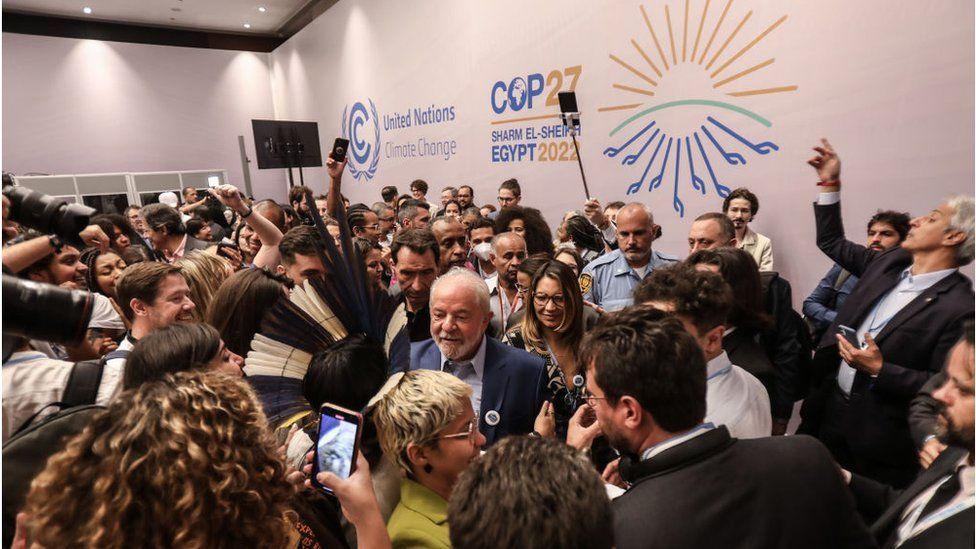
Image caption, Brazil’s president elect was the superstar of the COP
“For those countries that are that are worried or anxious about liabilities and judicial proceedings, I think we can work around all those anxieties,” said Sherry Rehman, Pakistan’s climate minister, who chairs an important group of emerging economies at these talks.
2 – Phasing out all fossil fuels
The final discussions at COP26 in Glasgow last year almost fell apart on the issue of coal.
Richer countries wanted to phase out the use of the most polluting fossil fuel.
Larger developing economies including India and China did not.
Cue frantic huddles on the plenary floor as diplomats tried to find a compromise.
They settled on “phasing down” rather than “phasing out”.
Here, India and a number of other countries wanted to expand this phrase to include oil and gas.
However, the draft document published on Thursday did nothing more than restate the Glasgow formula.
Image source, Getty Images
Many countries, rich and poor, were disappointed – and are pushing for the wider range of fuels to be included.
“This is supposed to be an implementation COP and that means when it comes to climate change, addressing the transition away from fossil fuels and toward renewable energy,” said Catherine Abreu from the Destination Zero campaign group.
“So they should be having that debate at the global scale in these halls.”
3 – Keeping 1.5C alive
This was the mantra of the UK Presidency of COP26, and after Glasgow the concept was on life support, according to Alok Sharma, the minister in charge of the talks.
A rise of 1.5C is viewed by scientists as the threshold to very dangerous levels of warming – but there has been considerable worry here that the commitment to the idea would be watered down, especially as India and China were concerned it was no longer scientifically feasible.
Indeed the draft text published by Egypt is seen as a step back to the language of the Paris agreement, where the world would aim to keep the rise in global temperature “well below” 2C and to make best efforts to keep it under 1.5C.
“I see the will to keep to the 1.5C goal,” said UN Secretary General Antonio Guterres as he returned to the talks.
“But we must ensure that commitment is evident in the COP27 outcome.”
4 – US & China
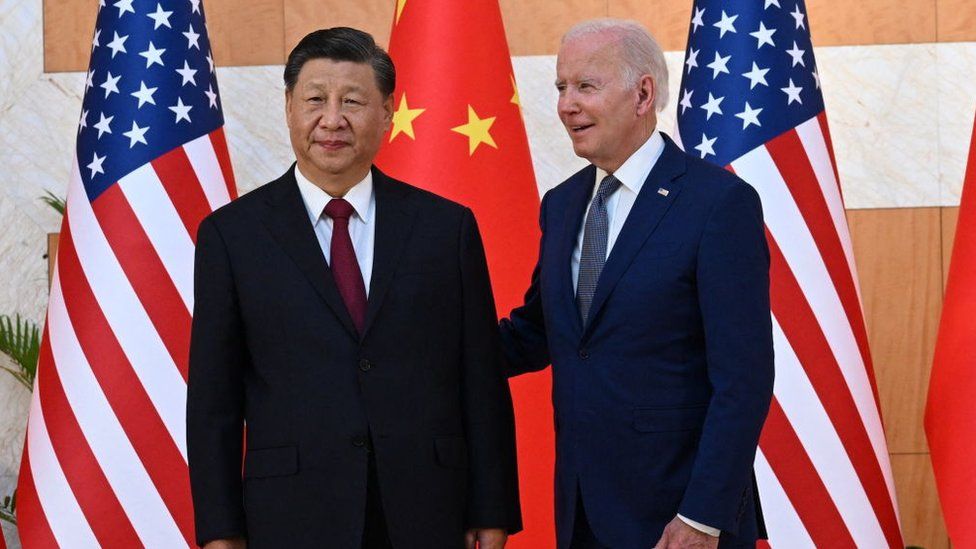
While the recent meeting between Presidents Biden and Xi Jinping has seen some thawing of relations between the world’s two biggest emitters, the lack of concrete areas of co-operation between them is hampering the UN climate process.
Image source, Getty Images
Image caption, The meeting between the US and Chinese presidents may aid climate talks
A key example is “loss and damage” and climate finance more generally. Traditionally, the developed nations paid and the larger emerging economies, such as India, China and Brazil did not.
Now the US and EU want to expand the number of countries that contribute – and China is top of their list.
“By the end of this decade, China could overtake the US in terms of its historical cumulative emissions, and is the world’s second largest economy, and yet in UN terms it still counts as a developing country,” said Bernice Lee, from Chatham House.
“But the US has consistently failed to deliver climate finance and shoulder its responsibility as the world’s largest emitter to support the the developing world.
“If China and the US can come to terms, a whole new solution space opens up for the rest of the world.”
North Korea has launched an intercontinental ballistic missile with enough range to hit the US mainland, Japan’s defence minister says.
The missile landed in the sea roughly 210km (130 miles) west of Hokkaido.
The US has condemned the launch, while South Korea has ordered stronger deterrence measures against the North.
On Thursday North Korean FM Choe Son Hui warned of a “fiercer” response to any increased US military presence in the region.
It also launched a short range ballistic missile the same day.
That followed Sunday’s meeting between South Korean President Yoon Suk-yeol, US President Joe Biden and Japan’s PM Fumio Kishida in Cambodia, in which the three countries agreed to increase their military co-operation.
On Friday US National Security Council spokeswoman Adrienne Watson said Mr Biden had been briefed and the US would consult with partners.
North Korea has fired more than 50 missiles over the past two months, most of them short-range. These long-range launches are rarer, and pose a direct threat to the US, as the missiles are designed to carry nuclear warheads to anywhere on the US mainland.
The latest intercontinential ballistic missile (ICBM) was fired at 10:15 local time (02:15 GMT) from near the North Korean capital Pyongyang, military chiefs in Seoul said.
It reached an altitude of 6,100km on a lofted trajectory and travelled 1,000km (621 miles), reaching a speed of Mach 22, South Korea’s military said.
A lofted trajectory means the missile flies much higher into space but across a shorter distance than it would if fired on a normal trajectory.
But Japan’s defence minister Yasukazu Hamada said the missile had sufficient range to reach the US.
“Based on calculations taking the trajectory into account, the ballistic missile this time around could have had a range capability of 15,000km, depending on the weight of its warhead, and if that’s the case, it means the US mainland was within its range,” he said.
“We have told (Pyongyang) that we absolutely cannot tolerate such actions,” Mr Kishida told reporters in Thailand.
North Korea’s pattern over the past months has been to launch missiles in response to US military activity around the Korean Peninsula.
In October, North Korea launched a ballistic missile over Japan – the first time it had done so in five years.
The North is currently developing a new type of long-range missile, the Hwasong-17. It is larger than the ICBMs it has successfully tested in the past, and experts believe could be capable of carrying multiple warheads, which would make it harder to defend against.
Several attempts to launch the Hwasong-17 are thought to have failed. Earlier this month the North launched an ICBM but it failed mid-flight, according to the South Korean military.
“Even if the North does successfully launch the Hwasong-17, the threat will not have significantly increased”, said Yang Uk, a military expert from the Asan Institute. “It must prove it has mastered the technology to be able to mount enough small nuclear warheads onto the ICBM”, he said.
Pyongyang has conducted six nuclear tests between 2006 and 2017, and it has completed preparations for a seventh test. Experts believe it may use the opportunity to test a compact nuclear device.
It is also working to improve its short-range missiles and conventional military capabilities.
The US has determined that Saudi Arabia’s de facto leader – Crown Prince Mohammed bin Salman– has immunity from a lawsuit filed by murdered journalist Jamal Khashoggi’s fiancée.
Mr Khashoggi, a prominent Saudi critic, was murdered at the Saudi consulate in Istanbul in October 2018.
US intelligence has said it believes Prince Mohammed ordered the killing.
But in court filings, the US State department said he has immunity due to his new role as Saudi prime minister.
Mr Khashoggi’s ex-fiancée, Hatice Cengiz, wrote on Twitter that “Jamal died again today” with the ruling.
She – along with the human rights group Democracy for the Arab World Now (Dawn), founded by Mr Khashoggi – had been seeking unspecified damages in the US from the crown prince for her fiancée’s murder.
The complaint accused the Saudi leaderand his officials of having “kidnapped, bound, drugged and tortured, and assassinated US-resident journalist and democracy advocate Jamal Khashoggi”.
Prince Mohammed was named crown prince by his father, King Salman bin Abdulaziz Al Saud, in 2017. The 37-year-old was then handed the role of prime minister in September this year.
He denies any role in the killing of Mr Khashoggi.
Justice Department lawyers said in quotes cited by Reuters that as “the sitting head of a foreign government,” the crown prince “enjoys head of state immunity from the jurisdiction of US courts as a result of that office.”
“The doctrine of head of state immunity is well established in customary international law,” Justice Department lawyers said.
But the Biden administration was keen to emphasise that the ruling was not a determination of innocence.
“This is a legal determination made by the State Department under longstanding and well-established principles of customary international law,” a spokesperson for the White House National Security Council said in a written statement.
“It has nothing to do with the merits of the case.”
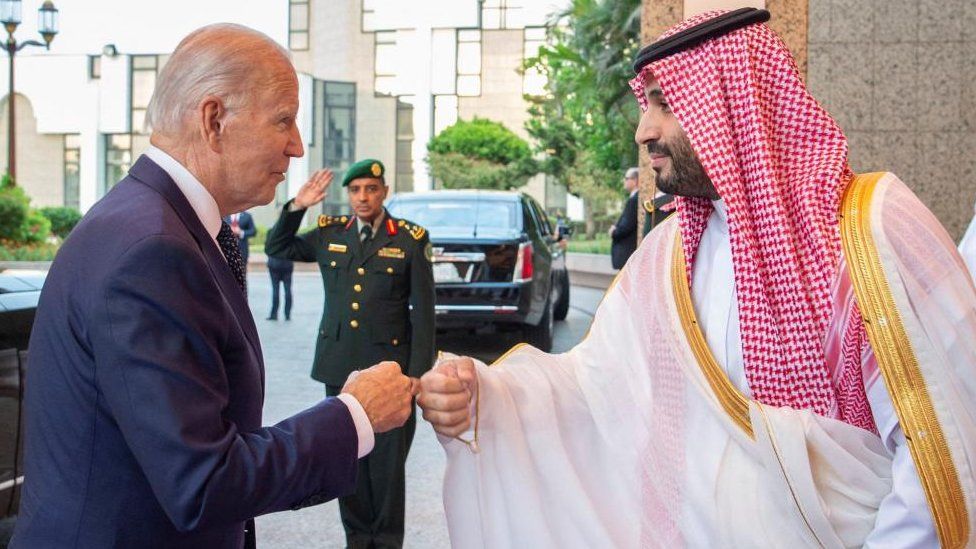
Image source, ReutersImage caption, President Biden fist bumped the Saudi crown prince in July
Saudi Arabia said the former Washington Post journalist had been killed in a “rogue operation” by a team of agents sent to persuade him to return to the kingdom.
However, US officials said the CIA had concluded, “with a medium to high degree of certainty”, that MBS – as the prince is known – was complicit.
The murder caused a global uproar and damaged the image of Prince Mohammed and his country.
It also led to a major downturn in US-Saudi relations, with Mr Biden vowing to make Saudi Arabia a “pariah” while he was campaigning for the presidency in 2019.
Mr Biden declined to talk to Mohammed bin Salman when he first became president.
But over the summer, President Biden said he wanted to “reorient” relations, ahead of a visit to Saudi Arabia in July.
His visit – in which he was pictured fist-bumping the crown prince – was criticised as validating the Saudi government following Mr Khashoggi’s murder.
Sarah Leah Whitson, a spokeswoman for Dawn, wrote on Twitter that it was “beyond ironic that President Biden has single-handedly assured MBS can escape accountability when it was President Biden who promised the American people he would do everything to hold him accountable”.
One day after retaking a majority in the US House of Representatives, Republicans have said they will investigate the president’s family as a “top priority”.
The lawmakers said the inquiry would focus on overseas business dealings of the president’s son, Hunter Biden.
The 52-year-old is already under federal investigation, but has so far not faced any charges.
The younger Biden is not involved with the administration in any capacity.
But top Republicans insist their inquiry will determine the extent of Joe Biden’s alleged involvement in his son’s business dealings, including during the elder Biden’s time as vice-president.
In an interim report released at a press conference on Thursday, they argued that the president had lied to the American people about his alleged involvement in his family’s business dealings.
“The president’s participation in enriching his family is, in a word, abuse of the highest order,” said James Comer, the incoming chairman of the House Oversight Committee.
“I want to be clear: this is an investigation of Joe Biden, and that’s where our focus will be next Congress.”
They accused Hunter Biden of crimes including tax evasion and wire fraud, but did not announce any immediate plans to summon him to testify.
Christopher Clark, a lawyer for Hunter Biden, told the BBC his client had no comment about the Republican announcement.
Mr Comer was joined at the press conference by congressman Jim Jordan, who is expected to become chairman of the House Judiciary Committee.
The Ohio Republican later tweeted: “The Biden Family’s business deals are a national security threat.”
What we know about Biden-Ukraine corruption claims
Officials with the Democratic National Committee have hit back by circulating a memo that refers to Mr Comer, a Kentucky congressman, as “a Trump apologist who has made clear that his phony investigations are political exercises designed to hurt President Biden”.
The White House said the inquiries were politically motivated.
Spokesman Ian Sams said: “Instead of working with President Biden to address issues important to the American people, like lower costs, congressional Republicans’ top priority is to go after President Biden with politically motivated attacks chock-full of long-debunked conspiracy theories.”
A report released by Senate Republicans in September 2020 found that Hunter Biden had “cashed in” on his father’s position, but the findings did not implicate his father in wrongdoing.
The newly announced investigation is one of many that House Republicans could lead. Others include the Biden administration’s troop withdrawal from Afghanistan and its handling of the coronavirus pandemic.
The select committee investigating the 6 January 2021 riot by Trump supporters on Capitol Hill will be dissolved when the new Congress takes over.
Rank-and-file Republican lawmakers have nominated Kevin McCarthy, the current minority leader, as their choice for House Speaker when a new Congress convenes in January.
If elected, the California congressman would succeed long-time Democratic leader Nancy Pelosi, who announced on Thursday that she is stepping down from her leadership post.
Mr McCarthy has suggested that a Republican majority will pull back on funding for Ukraine, but he must contend with a narrow majority in the chamber.
Democrats will meanwhile retain power in the Senate, the upper chamber of Congress.
In a message seen by the BBC, workers were told that the offices would reopen on Monday 21 November.
It did not give a reason for the move.
The announcement comes amid reports that large numbers of staff were quitting after new owner Elon Musk called on them to sign up for “long hours at high intensity” or leave.
The message went on to say: “Please continue to comply with company policy by refraining from discussing confidential company information on social media, with the press or elsewhere.”
Founder of Amazon Jeff Bezos has pledged to donate the majority of his money before he passes away.
Bezos, currently the world’s fourth richest person based on Forbes billionaires list, also admitted that he wants to ensure that the worthiest causes benefits from his charity.
Bezos made the pledge after donating $100 million to country singer Dolly Parton to give to charities of her choice as part of Bezos’s annual Courage and Civility award.
Without providing further details, Bezos said he and partner Lauren Sánchez were “building the capacity to be able to give away this money”.
Bezos founded e-commerce giant Amazon in 1994 out of his garage in Seattle.
He stepped down as chief executive to become executive chairman in July 2021 and now owns just under 10% of the company.
He and his wife MacKenzie divorced in 2019 after 25 years of marriage and he transferred a quarter of his then 16% Amazon stake to her.
Bezos has donated more than $400 million worth of stock to nonprofits in 2022, though it’s unclear which organizations received those shares.
Bezos owns The Washington Post and Blue Origin, an aerospace company developing rockets.
In the past, Bezos has been heavily criticized for his relative lack of largesse toward charity compared with some fellow billionaires.
Bezos is not a signatory to the Giving Pledge, which encourages the world’s wealthiest to give half their net worth to philanthropy and was set up by Bill Gates and Warren Buffett.
It has attracted more than 230 signatories including Elon Musk and Mark Zuckerberg.
Authorities in Rochester said an off-duty New York police officer fatally shot a woman and injured another victim before she killed herself. The deceased officer, identified as 29-year-old Tiffani Gatson, was with the Greece Police Department, NBC News reported. Authorities said the incident happened at a Rochester home on Monday night.
Gatson had been with the Greece Police Department for about 3 years. The department said she was off duty when the incident occurred. The other victim who survived the shooting was also a woman.
In a statement, Rochester police said they went to the residence after they received a “domestic related altercation” report. When officers arrived, they found Gatson, as well as the two other women with gunshot wounds, the state attorney general’s office said, adding that they were all outside the residence. The state attorney general’s office is mandated to investigate officer-related crimes.
The deceased victim, identified as 27-year-old Angely Solis, died at the scene. The other woman was also shot multiple times, but her injuries were said to be non-life-threatening. She was subsequently transported to the hospital for treatment.
Gatson, who turned the gun on herself in the aftermath of the incident, was also transported to a hospital where she was later pronounced dead. The attorney general’s office said the gun that was found at the crime scene was not the deceased officer’s service weapon.
And though WHEC reported that the women Gatson shot are related, police could not properly specify the relation the deceased officer had with the victims. In 2019, Gatson became the first African-American woman to be hired by the Greece Police Department.
“On behalf of the Town of Greece Police Department, I would like to express our collective sorrow and grief with respect to last night’s events in the City of Rochester,” Greece Police Chief Michael Wood said in a statement.
“Unfortunately, we have seen events of this nature occur all too frequently and struggle to find answers in the aftermath. The effects are far-reaching, from those who have lost loved ones to others throughout law enforcement organizations when a police officer commits such a horrible act, to our entire community.”
While all “metallic miniature humans” are termed as robots, there are distinctions and humanoids are one variation of a robot. Humanoids are generally termed non-living creatures with human features. The term was used to address indigenous people in European colonies.
Globally, the first Al-humanoid was named Sophia. Sophia was first actuated on February 14, 2016. The robot, modeled after the ancient Egyptian Queen Nefertiti, Audrey Hepburn, and its innovator’s woman, Amanda Hanson, is known for its mortal-like appearance and geste compared to former robotic variants. Before Sophia, there was Herbert Televox, a humanoid built in 1927 by Roy Wensley.
In Africa, many are recently doing amazing things with technology. Situated in the western part of Africa, Nigeria is one of Africa’s biggest economies and one of the largest African countries.
In Africa, it is touted as one of the leading countries in terms of technological advancement. This year, the countrytook another bold step towards being the leader of technology and innovation in the Sub Region. A tech firm in Nigeria, Uniccon, outdoored its first home-built robot named Omeife.
Omeife is a 6 feet female creation who takes her origin from the Igbo people in Nigeria and she speaks English, French, Arabic, Kiswahili, Pidgin, Hausa, Yoruba, Igbo and Afrikaans. The creation of Omeife started somewhere in 2020 and finally, in October 2022, she was unveiled. Omeife understands the right local languages and can take commands like normal robots.
According to TechCabal, Chucks Ekueme, the company’s CEO, shared that Omeife isn’t precisely multilingual but could switch languages and interact with specific hand gestures, smiles, and other body movements that match the tone of the discussion. He further reiterated that Omeife was created to fit into African society thereby programming it to understand basic African culture like greeting.
Omeife does not have full human tendencies as the bot cannot put on a sad face, but according to the designers she was mainly created to be friendly and to interact with children. As the world continues to develop and grow technologically, this invention means that Africa is not left out of the exponential growth the world is taking.
The first global humanoid, Sophia, as of 2018, included scripting software, a converse system, and OpenCog, an AI system designed for general logic. Sophia imitates mortal gestures and facial expressions and is suitable to answer certain questions and make simple exchanges on predefined motifs.
Nigeria’s Omeife includes software that enables her to interact with children and be super friendly when interacting in the multiple languages she speaks and understands. Slowly, Nigeria seems to be setting up itself as the West African technological hub as the country continues to pull off inventions.
For many African countries, the creation and launch of Omeife is hope and proof to invest in science and technology.
The World Health Organization (WHO) announced on Wednesday that three trial vaccines for Ebola will arrive in Uganda next week.
The announcement was made during the G20 meeting in Indonesia.
“Today I’m pleased to announce that the WHO committee of external experts, has evaluated three candidate vaccines and agreed that all three should be included in the planned trial in Uganda. WHO and Uganda’s minister of health has conceded and accepted the committee’s recommendation. We expect that the first dose of vaccines to be shipped to Uganda next week”, announced Tedros Adhanom Ghebreyesus, WHO Director-General.
An Ebola outbreak in Uganda was declared in late September. Since then, Ebola claimed at least 55 deaths.
“We hope – I dearly hope – that this epidemic goes away. And this epidemic is controllable without vaccines, it’s clear that we can get containment without vaccines. But it’s also clear from the Congo experience that you can get to control much quicker using effective vaccines and that’s where the answers we need to get”, said Michael Ryan, WHO health emergencies director.
Two of the three trial vaccines were developed in the UK, the third trial vaccine comes from the US.
Climate change was the main cause of the floods that killed over 600 people in Nigeria this year, according to scientists.
In a study revealed on Wednesday, scientists claim that the floods that affected Nigeria, but also Niger, Chad, and neighbouring countries were directly linked to human activity.
According to the experts the floods between June and October this year displaced more than 1.4 million people and were 80 times likelier to occur because of human activity.
The report comes as COP27 climate talks continue in Egypt’s Sharm el-Sheikh, where developing nations are demanding rich polluters pay for climate-change-linked calamities.
Africa is home to some of the countries least responsible for carbon emissions but hardest hit by weather extremes, with the Horn of Africa currently in the grips of a severe drought.
Mali gained independence from France in 1960, yet even today French is the language of governmentbusiness, used on road signs and in state TV broadcasts.
But on Bamako’s streets, French is rarely heard, and out in the bush even less so.
Mali has scores of its own languages — which is why, for some, it rankles that the tongue of the former colonial ruler is the only official language.
A few lines in the country’s draft constitution are now fanning calls for change, albeit at the cost of reminding the West African nation of some of its many problems.
“It’s been 60 years since independence — is it normal that French is our only official language?” asked Ali Guindo, a resident of the capital Bamako.
“We have lots of languages here in Mali,” he said outside his home in Torokorobougou district. “It would be good to cement them in our official culture.”
The debate has been sparked by the unveiling last month of a draft constitution, billed by the ruling junta as crucial for saving Mali from jihadist insurgents.
As in the 1992 constitution it is designed to replace, the charter identifies French as the “language of official expression.”
But, in a change, it also says local languages are “intended to become official languages.”
More than 70 languages are spoken in Mali, a deeply poor Sahel nation with a fast-growing population of some 21 million.
Of these 13 are recognised as “national” languages but French is the only official one, meaning that it is used for government and regulatory business, said Amadou Salifou Guindo, a specialist in sociolinguistics.
Among the major local languages, Songhay and Tamashek are widely spoken in the north; Fulfulde in central areas by the Fulani, an ethnic group also known as Peul; Bambara predominates in Bamako; and in the country’s far south, Senufo and Soninke prevail.
– Difficult debate –
The few words in the proposed Article 31 have now fired up discussion, from TV talk shows to chats over tea in informal get-togethers known as grins.
Among the questions: is it time to elevate vernacular languages to the status of official tongues? If so, which ones? And how can this be achieved?
But these questions also have swirling undercurrents.
One is Mali’s relationship with France, the country’s traditional ally, which has hit rock-bottom since the junta came to power in August 2020.
Some have used the bust-up to seize on Article 31 as a means to phase out French and make Bambara, the most-used language in Bamako, the official one instead.
But to do so touches on the sensitive question of national identity, potentially alienating speakers of other languages.
“Malians are afraid of an official language being imposed to the detriment of others,” said Guindo the linguist.
Another problem is rather more basic: teaching children to read and write in their local languages, which are rooted in oral traditions.
Tech support: A woman uses a dictionary app to help her type a message in Bambara on her smartphone
Under former president Moussa Traore who was ousted in 1991, experimental schools were set up that taught in vernacular languages.
The “revolutionary” idea foundered on a lack of state investment, and the schools came to be seen by parents and teachers as second class, writer and publisher Ismaila Samba Traore said.
– French dominates –
Local languages are still being taught, but on a small scale.
At the languages faculty at the University of Bamako, department head Mahamadou Kounta teaches Bambara to around 20 students.
The work, he says, is akin to sowing seed.
“When our students graduate, they will be able to read and write in the national languages and they in turn will be able to work to perpetuate them.”
Traore, who runs a publishing company called La Sahelienne, has been in business for 30 years.
He is one of the few publishers in Mali to bring out books in local languages — typically educational works ordered by international NGOs.
Other than that, publishing remains overwhelmingly in French.
Changing the constitution will not by itself alter habits that have been entrenched for decades, Traore admitted.
“Certain processes cannot be achieved from one day to the other — you have to let things incubate,” he said.
Long viewed as a multicultural and inclusive nation, Canada admitted recently that its immigration system is tinged with racism and concern has risen over high rejection rates for African students.
“I have met people who have had their visas refused more than five times,” says Serge Nouemssi, white coat and pipette in hand.
Originally from Cameroon, the 33-year-old biology student has been working on his doctorate for more than three years in a laboratory at the University of Quebec at Trois-Rivieres (UQTR).
Surrounded by greenery, the campus located halfway between Montreal and Quebec City hosts more than 15,000 students, including the largest proportion of Africans in the province — 65 percent of international students.
But “we have seen rejections of up to 80 percent of applicants coming from Africa,” says the school’s rector, Christian Blanchette, who noted it has been an ongoing problem “for several years.”
In a report quietly released at the end of September, the national immigration department said it “recognizes the presence of racism in Canada and within our own organization.”
According to federal data, Quebec is the Canadian province with the highest rejection rate of African students — around 70 percent from French-speaking African nations between 2017 and 2021.
The data says applications from France, Britain or Germany to study in Quebec are almost always accepted — approximately a 90 percent approval rate.
‘Absurd’ refusals
As well as having to pay tuition ranging on average from Can$17,000 (US$12,750) to Can$19,000 per academic year to study in Quebec and rising up to Can$50,000, African students must also provide financial guarantees.
“For us Africans, generally they (immigration officials) insist on proof of financial means” to be able to afford to live and study in Canada, explains Nouemssi.
“There are cases where we have demonstrated financial resources that were close to one million dollars,” explains Caroline Turcotte-Brule, an immigration lawyer. “The agent replied that our client did not have enough financial resources.”
“I have the impression that it’s a bit random,” she adds, specifying that the reason for refusal is often the same: “a fear that the person will not return to his country of origin after” his studies.
“It’s a bit of hypocrisy,” said Krishna Gagne, another lawyer who notes that students have the legal right to consider staying in Canada after their studies.
Ottawa has even been encouraging foreign students to do so as it rolled out incentives in recent months in order to help deal with a labor shortage.
Sitting at her desk in a small laboratory at the end of a maze of underground corridors, Imene Fahmi says that she had to try twice before being able to come and study in Quebec.
“I encountered a lot of difficulties”, explains the Algerian-born doctor, who was refused the first time because the program she’d chosen was “not related to her previous studies,” even though she had been aggressively recruited by her future research director.
She had to apply a second time and wait eight months before finally getting approvals.
“In regards to immigration, there doesn’t seem to be an understanding of the nuances and backgrounds of certain students, so we have refusals which are a bit absurd,” her research supervisor Mathieu Piche says, unable to hide his frustrations.
Refusals and delays have consequences on the students but also “on the work of the teachers,” he adds.
‘Systemic racism’?
The problem does not only affect students. In July, Canada faced a backlash over its denials of visas for hundreds of delegates, including Africans, that were to attend the AIDS 2022 conference in Montreal.
In its September report, the government promised better training for its immigration agents, consider creating an ombudsman post to manage disputes and review its much maligned case processing software.
Those efforts are welcomed by Turcotte-Brule, but she underscores that there has been “a problem of systemic racism for a long time” in Canada and that “it will not be resolved overnight.”
A long-awaited report on an alleged corruption scandal targeted at South African President Cyril Ramaphosa a month before a crucial deadline for his political future, will be examined on December 6, the parliament announced Thursday.
An independent parliamentary committee was tasked in September with examining President Ramaphosa‘s accountability in the 2020 case and issuing findings that could lead to a possible vote for his impeachment.
“The parliamentary committee met this morning. The date for the submission of the report was extended to November 30. It was decided that the National Assembly would examine this report on December 6,” ten days before the congress of the historic ruling party, the ANC, parliamentary spokesman Moloto Mothapo told AFP.
The parliamentary recess that was supposed to start on December 1 has been postponed to consider the report, which was originally due by Thursday.
The African National Congress (ANC) must meet from December 16 to choose whether or not to invest Mr. Ramaphosa’s candidate for a second term in the presidential election of 2024, re-electing him president of the party.
The successor to Jacob Zuma, who was forced to resign in 2018 after a series of scandals, the current president is expected to tackle the corruption front that he has vowed to eradicate.
According to a complaint filed in June by former South African intelligence chief Arthur Fraser, burglars broke into a farm owned by the president in Phala Phala, in the country’s northeast, in February 2020. They found large sums of money in cash.
Cyril Ramaphosa is accused of concealing the robbery from the police and the money from the tax authorities, organizing the kidnapping and interrogation of the robbers, and then bribing them to keep quiet.
The President, who was repeatedly attacked on the subject during heated sessions in the Assembly, denied the accusations, questioning the amounts mentioned and maintaining that the money found was in fact from the sale of livestock. He also denounced the political aims of his opponents.
In South Africa, the impeachment of the head of state is subject to a two-thirds majority vote in the National Assembly. The ANC led by Cyril Ramaphosa holds more than two-thirds of the seats.
Feared by many, the Gule Wamkulu dancers of Zimbabwe are often described as a secretive and ritualistic society.
The negative image goes hand in hand with a reputation for violence, something that the organiser of the first Gule Wamkulu festival in Harare wants to change.
“We are celebrating our ancestors who brought the culture from Malawi but have since passed on. Look at my age, I am young. What pains me is that people see our culture as belonging to people who can’t think and are not educated”, said festival organiser, Notice Mazura.
The society’s reputation has been tarnished in Zimbabwe due to the proliferation of copycat groups that commit crimes such as extortion, theft, sexual abuse and assault.
“These people are evil. They move around with weapons and are violent criminals. If they meet someone they don’t like, they sometimes attack them”, denounced Mufakose township resident, George Desha.
The leader of the Gule Wamkulu organization claims it is necessary to distinguish between the genuine practitioners and copycat dancers.
“The appearance of Gule Wamukulu and sometimes the behaviour of the Nyau dancers are the ones that make people assume and think that they may be violent, or they’ve got other things attached to it. Some even attach Gule Wamukulu with witchcraft, which is not it, that’s not it. But, of course, people from Gule Wamukulu Nyau dance know a lot of medicines (traditional medicines, Ed.) just like the others”, said Kennedy Kachuruka, leader of the Gule Wamkulu Organization.
The origins of this dance can be traced back to the 17th century and the Chewa people spanning the countries of Malawi, Mozambique and Zambia in southern Africa.
Like most companies, technology companies this year have also been hit with the global economic crisis which many experts say is fuelled by the Russian-Ukraine war and the impact of covid 19.
This has resulted in massive layoffs across the sector with a total of 1138 layoffs at tech companies globally, affecting 182,605 people, according to TrueUps tech layoff tracker.
Below is a list of top tech giants that have announced job cuts this year or embarked on massive layoffs.
Twitter
It didn’t take long for Twitter’s new owner, Elon Musk to lay off almost half of the company’s staff. This was just a week after officially closing the acquisition process to take over the company.
“…the Nov. 4 layoffs only affected “15% of our Trust & Safety organization (as opposed to approximately 50% cuts company-wide), with our front-line moderation staff experiencing the least impact.” Twitter’s then-head of content moderation, Yoel Roth said.
These job cuts also affected the company’s only African office in Ghana’s capital, Accra. According to reports, employees were fired with the exception of one.
While these layoffs represent the biggest workforce cull Twitter has seen, it’s not the first time this year the company has sought to slim down its employee base. After initially implementing a hiring freeze, in July 2022 the company went on to lay off 30% of its talent acquisition team.
Amazon
On Tuesday (November 15), the company notified regional authorities in California that it would lay off about 260 workers at various facilities that employ data scientists, software engineers, and other corporate workers. Those job cuts would be effective beginning on Jan. 17, 2023.
Amazon would not specify how many more layoffs may be in the works beyond the ones confirmed through California’s Worker Adjustment and Retraining Notification Act, also known as WARN, which requires companies to provide 60 days’ notice if they have 75 or more full-time or part-time workers. Amazon employs more than 1.5 million workers globally, primarily made up of hourly workers.
The online retail giant, like other tech and social media giants, saw sizable profits during the COVID-19 pandemic, as homebound shoppers purchased more items online. But revenue growth slowed as the worst of the pandemic eased and consumers relied less on e-commerce.
Netflix
In June this year, Netflix announced it laid off 300 employees in the second round of job cuts after losing subscribers for the first time in more than a decade.
The cuts amounted to about 4% of the streaming giant’s workforce and mostly affected US employees. They came after the company cut 150 jobs last month.
“While we continue to invest significantly in the business, we made these adjustments so that our costs are growing in line with our slower revenue growth,” Netflix said in a statement.
Netflix said in February it had lost 200,000 subscribers globally at the start of 2022, and projected a decline of 2 million users in the upcoming quarter.
The company blamed the drop on a range of factors, including increased competition, the economy, the war in Ukraine, and the large number of people who share their accounts with non-paying households.
Facebook
On Wednesday, November 9, the CEO of Facebook’s parent Meta, Mark Zuckerberg announced the company is laying off 11,000 people, about 13% of its workforce, as it contends with faltering revenue and broader tech industry woes.
Zuckerberg said that he had made the decision to hire aggressively, anticipating rapid growth even after the pandemic lockdowns ended.
“Unfortunately, this did not play out the way I expected,” Zuckerberg said in a statement. “Not only has online commerce returned to prior trends, but the macroeconomic downturn, increased competition, and ads signal loss have caused our revenue to be much lower than I’d expected. I got this wrong, and I take responsibility for that.”
Meta, like other social media companies, enjoyed a financial boost during the pandemic lockdown era because more people stayed home and scrolled on their phones and computers. But as the lockdowns ended and people started going outside again, revenue growth began to falter.
Tesla
In June 2022, Elon Musk confirmed that the salaried workforce at Tesla Inc. would be cut by about 10% over the next three months, but said the overall reduction in the electric-car maker’s headcount would only be some 3.5% as hourly staff numbers are still expected to grow.
“We grew very fast on the salaried side,” Musk said in an interview with Bloomberg News Editor-in-Chief John Micklethwait at the Qatar Economic Forum on Tuesday. “A year from now, I think our headcount will be higher” in salaried and hourly workers, but for now the reduction will be 3% to 3.5%, he said in a report by Bloomberg.
The comments brought more clarity to the situation with Tesla’s staffing, after Musk made varied internal and public statements about reductions over the past month.
A second tragedy in three days. In the outskirts of Kenya’s capital, a multi-story building under construction collapsed on a neighboring home, killing at least two people on Thursday (Nov 17), authorities said.
Housing is in high demand and unscrupulous developers often bypass regulations.
Construction authorities have warned of unsafe buildings. Fredrick Kamau’s parents didn’t make it alive.
“Mum and Dad were inside the house when the building started collapsing, then collapsed on them. When the ambulance came to rescue them they found them already dead and the construction was not fully completed.”
Three other people have been rescued alive from the family home that was next to the collapsed building located in the Ruaka suburb.
“This is not the first story or rather instance. In the course of this one week we have had two buildings that have collapsed. We have lost innocent lives”, resident Willy Kamau lamented.
Last month we had a woman and her children that were buried; innocent they were also same case. They were not in the building, but a building near their house collapsed and the mother and the children just died like that. So we are asking this is the work of the county government it is not even the national government. The approvals, the drawings and everything is the work of the county government.”
After building collapses in Kenya in 2015, the presidency ordered an audit to see if the country’s buildings were up to code. The National Construction Authority found that 58% of the buildings in Nairobi were unfit for habitation.
South African police have announced the arrest of an Israeli suspected of belonging to a mafia gang and wanted for attempted homicide.
The 46-year-old man is associated with a major crime organization called Abergil, named after brothers Meir and Yitzhak Abergil who were extradited more than a decade ago to the United States, and had been the subject of an Interpol red notice since 2015, the police said in a statement on Thursday.
“Israel’s most wanted man,” according to South African police, was arrested in the early hours of the morning along with seven other suspects in a house in Bryanston, an affluent suburb north of Johannesburg.
Photos and videos of the arrest, shared by the police, have circulated widely on social networks, showing stocky men in shorts or pajamas, sitting on the floor hiding their faces or lying on their stomachs, their hands shackled with plastic handcuffs.
According to information from their Israeli counterparts, the South African police say the main suspect belongs to “a notorious gang involved in drug trafficking, extortion, and other criminal activities.
In 2003 and 2004, he “allegedly placed a bomb under a man’s car in Israel on two occasions. As a result of the first explosion, five people were seriously injured, but all miraculously survived,” the statement said. In the second incident, again targeting the same person, this time he placed a bomb on the roof of a vehicle, leaving three people seriously injured.
The police also seized 12 firearms, including five assault rifles and seven pistols, 40,000 U.S. dollars and three stolen motorcycles, the statement said.
Ghanahas announced an increase in the national daily minimum wage that will take effect from the beginning of next year.
It will rise by 10% to 14.88 cedis ($1; £0.84) from 1 January.
It is designed to help alleviate the burden caused by the rise in the cost of living. However, as annual inflation is now running at 40%, a 10% increase in the minimum wage will not cover the rise in prices.
Ghana is the world’s second largest cocoa producerand Africa’s leading gold producer, but the country is battling an economic crisis with a declining currency and high debt levels.
The country is currently negotiating a $3bn bail-out plan from the International Monetary Fund aimed at stabilising the economy.
Midwifery Officer and Certified Life Coach, Rev. Maria, has explained what vaginal sweetness is and why it is important to women.
According to her, vagina sweetness refers to doing some specific things to make the vagina feel fresh and nice always. However, God in His wisdom created women with the flora to protect and keep the vagina.
In an exclusive interview with Mercy Bee the Ekumfi Princess on e.tv Ghana’s ‘Girl Vibes’ show, Rev. Maria said “Due to our lifestyle and growth as women like pregnancy and childbirth, things change along the line in our vagina which pushes us to use certain things to keep the place as it were”.
She highlighted that there are a lot of natural remedies that can be used to do this which are not normal, but now due to its high demand in the market makes it seem normal.
“It is not normal to insert things in the vagina, and introducing something different to the vagina is called douching. It’s the introduction of chemicals into the vagina and this removes the normal flora in the vagina whereas it is this normal flora that maintains the PH of our vagina and protects us from infections,” she explained.
She furthered that the introduction of these chemicals clears the flora and also increases the risk of vaginal infections in the lady.
“This is why I always say that once you douche, make sure you’re doing it forever or don’t do it at all,” she advised.
The majority of people have degraded roadside sales, particularly in selling by the roadside..
‘Hausa Koko,’ as it is known, is a Ghanaian, locally made porridge, and it is one of the trades that is downgraded.
It is deemed a trade with low profit that if not done well, one may run at a loss.
Alimatu Sadia, from the Northern Region, is a porridge vendor in Accra. She has been selling porridge for over 30 years, since her youthful days.
According to her, selling porridge has been the only means for survival, as her parents were financially handicapped when she was a child.
After moving to Accra upon divorcing her husband with whom she had a daughter, Alimatu recounted how she was able to cater for her daughter’s education up to the nursing college.
She began with no capital, but borrowed to buy ingredients to prepare the porridge. However, she has managed to cater for her daughter.
“By then, the school feeswas less expensive. So, I speak with the teachers to pay half at the beginning of the year and complete the payment by the end of the year,” she said.
She also indicated how the sacrifices and help of her daughter encouraged her to work harder to be able to feed themselves.
“I’ve really suffered with my daughter. During her junior high school years, she would wake up at 3:00am to buy bread for me because I had no workers. Because of this, she was frequently late and was caned. I didn’t want to stop because I wanted her to have an educational foundation and go far.”
“So, when she comes home crying, I usually tell her everything will be fine. After high school, she got the opportunity to continue at a nursing training college. She is now working while she continues to achieve more educational status. She’s now married with two kids,” she narrated.
Alimatu stated that even after graduating from nursing school, her daughter continues to assist her in selling porridge.
Even though her sales amount to at least GH₵400 and at most GH₵900 in a day, the porridge seller has two employees who help with the daily activities. “I pay them GH₵100 every week and feed them three times a day,” she said.
When asked if her daughter had ever told her to stop working so that she would cater for her, madam Alimatu responded, “Yes, but I refused because I also want to help her cater for her children as she did for me.”
She wishes to travel across the world to sell ‘Hausa Koko’ to people across the globe.
Though she is passionate about traveling to Mecca, Madam Alimatu is bent on building the foundation for a house before traveling to the holy city.
‘Hausa Koko,’ known for its nutritional value, contains 4.2 g (5% total fat), 5 mg (2%) sodium, and 11 g (22% protein).
DISCLAIMER: The Views, Comments, Opinions, Contributions and Statements made by Readers and Contributors on this platform do not necessarily represent the views or policy of Multimedia Group Limited.
Football fans in Qatar who are supporting Argentina, have been filmed chanting racist abuse targeted towards France’s national football team ahead of the World Cup.
In the footage a group of men can be seen chanting that all the French players are from Angolawhile also referencing the Nigerian and Cameroonian heritage of some of the players.
In one of the chants they make an explicit remark about star Kylian Mbappé, who plays for France and is of Cameroonian and Algerian heritage.
After a few seconds, the fans making the insulting remarks are cut off by the TV reporter.
Racism in football has been prevalent for many years, with black players receiving abuse whilst on the pitch and on social media.
At least three people have died after a building collapsed in Kenya’s capital, Nairobi.
As we reported earlier, a search operation was underway to rescue at least 10 people, most of whom were thought to be construction workers.
Reports now say that six people have been rescued from the seven-storey building which was still under construction.
A supervisor in charge of the site twice ignored warnings from authorities to stop construction work following concerns over its stability, the Nation news site reports.
The collapse of buildings under construction is not uncommon in the city.
The World Food Programme (WFP) says the first food aid trucks to enter Ethiopia’s northern Tigray region since the signing of a peace deal earlier this month are rolling into the region.
“Critical food assistance will now be delivered to communities in coming days. More food, nutrition, medical cargo will follow,” WFP tweeted, along with a video of the aid trucks driving.
In #Ethiopia@WFP trucks are rolling into #Tigray with critical food assistance—this is the first movement since the peace agreement was signed.
Critical food assistance will now be delivered to communities in coming days. More food, nutrition, medical cargo will follow. pic.twitter.com/NiFrUESM9Q
On 2 November the warring sides – Ethiopia’s government and Tigrayan fighters – agreed, in a surprise move, to halt their two-year conflict which led to thousands of deaths and warnings of a famine.
Half of Tigray’s 5.5 million people need food aid, with many of them starving.
The authorities in Nigeria’s north-western state of Kaduna have confirmed the death of a top militia leader during a shootout with the army on Sunday.
A state government spokesman said Kachalla Gudau was among scores of gunmen killed when they attacked a military facility.
It’s alleged he was responsible for multiple kidnappings, killings and illicit drugs operations.
It came as the Nigerian Air Forcesaid it had carried out air strikes on bandits’ hideouts in several locations within the state, killing scores of them.
With three months to go before Nigeria’s presidential election, security forces appear to have stepped up their attacks on suspected gangs.
Serbia is introducing visasfor Tunisian and Burundian citizens, responding to EU criticism that the country is a backdoor into the bloc for migrants.
Turks and Indians are expected to join them shortly.
In October, the EU Commission said it would consider suspending Serbia’s own visa-waiver rights to the bloc if it failed to curtail migrants using it as a gateway to the European Union.
PresidentAleksandar Vucic held talks with Austrian and Hungarian leaders on Wednesday, when he agreed to deploy more police resources along Serbia’s southern border, a major route for undocumented migrants.
Rescue workers in Kenyaare trying to reach members of a family believed to be trapped after a six-storey building under construction fell on to their home at dawn on Thursday.
The building came down in the Ruaka area of Kiambu county, which neighbours the capital, Nairobi, according to St John Ambulance Kenya.
RUAKA COLLAPSED BUILDING UPDATE.
6 storey building under construction collapsed at around 5am.
A neighboring private home affected with a family who were sleeping at the time it collapsed believed to be trapped. Rescue team trying carefully to reach the family members alive. pic.twitter.com/hygKJdUcYS
A new study has found that climate change severely worsened the heavy rains that caused large-scale flooding across swathes of Nigeria and Niger this year, killing hundreds of people.
The floods were recorded as the worst-ever in the two countries.
The report by World Weather Attribution says extreme seasonal rainfall and the release of water from dams caused the flooding from June to October.
They concluded the event was made 80 times more likely by climate change.
Almost 1.5 million people were displaced, hundreds of thousands of homes were swept away and over half a million hectares of farmland was devastated by the floods.
For the first time since he stopped drinking water earlier this month, the mother and sister of famed incarcerated British-Egyptian writer and democratic activist Alaa Abdel Fattah are scheduled to visit him later on Thursday.
On Tuesday, the family received a note from him saying that he had broken the hunger strike he began in April, and would explain everything on their next monthly visit.
Mr Abdel Fattah refused food in the hope that it would at least help secure him a visit from British diplomats – though this was never allowed.
Britain, with several other countries, has called for his immediate release.
A Kenyanman and his wife’s bodies have been recovered from the wreckage of their home, which was demolished when an adjacent, six-story structure under construction collapsed on top of it, an emergency worker confirmed to the BBC.
The bodies have been taken to a local mortuary.
Emergency responders say three survivors have been taken to hospital, the Nation news site reports.
Officials from the Disaster Response Unit have arrived at the scene near the capital, Nairobi, it adds.
Ethiopia’s Government Communication Service Minister Legese Tulu has said that all forces fighting in the Tigray region who are not part of the federal army will withdraw
as soon as the Tigrayan rebels disarm.
Amhara and Afar regional forces, as well as Eritrean troops, have been fighting alongside the federal forces in the two-year war against the rebels of the Tigray People’s Liberation Front (TPLF).
The government and the TPLF signed a peace agreement on 2 November in Pretoria, South Africa, to end the war in the north of the country, and the army and rebel commanders also signed a cessation of hostilities agreement in Nairobi, Kenya, on 12 November.
Meanwhile, an opposition party in Tigray region, Baytona Tigray, has rejected the peace agreement, saying the TPLF does not represent the Tigray people.
A basketball player from Cameroon, Nkwain Kennedy, uses social media to display his skills and demonstrate his desire to compete in the premier National Basketball Association (NBA) tournament.
In videos that he posts to his millionsof followers on TikTok, Instagram and Facebook, Kennedy captures his intense training sessions in the humble settings of his village in Bamenda.
The region is gripped by conflict between English-speaking secessionists and the mainly French-speaking government.
But Kennedy appears unperturbed as he practises his drills on clay courts or works out using makeshift weights.
He is hoping to eventually land a chance at the NBA where fellow Cameroonian Joel Embiid plays.
South African Hollywood star Charlize Theron has faced a mountain of criticism for suggesting that her mother tongue Afrikaans is “a dying language”, news site Times Live reports
She made the comments on the SmartLess podcast
(12 minutes in) when she was explaining that she grew up speaking only Afrikaans and then learned English when she was 19, which was why she speaks it with an American accent, she said.
She added that Afrikaans was a “dying language” which was “not very helpful” and spoken by “about 44 people”.
Some of the millions who do speak in South Africa were angered.
Times Live quotes one critic saying “it’s not dying… there are new songs and poems being written every day, movies made etc”.
Another Twitter commenter accused Theron that she “forgot where she came from. I am Afrikaans and will never talk bad about my mother tongue language! it is a beautiful language! Lots of people wish they could speak or understand it.”
Afrikaans is highly politicised in South Africa.
The imposition of the language in schools was the main reason behind the 1976 Soweto uprising against the apartheid regime, in which at least 170 people were killed, mostly schoolchildren.
It is the mother tongue of 13% of South Africans, mainly mixed-race people, known as coloureds, and white South Africans – the descendants of Dutch, German and French settlers who arrived in the 17th Century.
South African police have arrested an Israeli fugitive, who they describe as Israel’s most wanted gang leader.
He was picked up in a suburb of Johannesburg together with seven others during an early morning house raid, according to a police statement
The 46-year-old man is believed to be connected to a criminal organisation in Israel called the Abergil Organisation. The gang is said to deal in drug trafficking, extortion and other criminal activities.
The suspected gang leader has been on Interpol’s red notice from 2015. He is wanted in Israel for conspiracy to commit murder and attempted murder.
The authorities are not naming him until he appears in court, which is expected within 48 hours.
The police seized five assault rifles, seven pistols and three suspected stolen motorcycles during the raid.
The UK has a legal minimum wage which all firms should pay and all workers should receive.
Today, the Chancellor is expected to announce an increase for the National Living Wage from the current level of £9.50 an hour for over-23s. There are suggestions it could increase to about £10.40 an hour.
The Trades Union Congress has called for the minimum wage to increase to £15 an hour to help households cope with “eye-watering bills and soaring prices”.
As it stands, the UK has:
A National Minimum Wage – the minimum pay per hour workers are entitled to
A National Living Wage, which is higher than the National Minimum Wage – workers get it if they’re over 23
And the Real Living Wage, which is calculated by the Living Wage Foundation
charity. It’s above the level of the legal minimum wage, reflecting what the charity thinks people need to earn to cover everyday needs. There are about 11,000 Living Wage-accredited employers in the country
Paul Johnson, director of the Institute for Fiscal Studies, told the BBC that the Chancellor will want to provide reassurance after the turmoil that followed the mini budget in October.
Interest rates rose on government debt and there was concern in foreign markets, he said.
Johnson added: “What the Chancellor is really going to be aiming to do is to provide reassurance there and the way he’s going to try and provide reassurance is to say, ‘look, I’ve got this target, which is to make sure that debt isn’t ever rising and this is my plan for getting to that target’.”
It’s been an early start for 5 Live’s Wake Up to Moneyat Cinderhill Farm in Gloucestershire. We’ve been chatting to the kitchen team, who produce handmade sausage rolls sold to suppliers across Britain, about the chancellor’s upcoming statement.
Kirsty says rising costs have impacted how much she’s able to save for her own place. “I’m still living with my mum and dad, and it has affected things. Things are costing more and I’m trying to help them out with bills as well.”
Head chef Michael says he would like to see tax cuts – both to income tax and VAT. “It would affect everything. They promised the income tax cut and then they’ve taken it away.”
Funding for training is important for Toby: “I’m an apprentice, so I want the governmentto keep funding that.”
But on the soaring cost of living, Tom adds: “I’m not a very political person – I just want to be able to afford to live.”
The Government’s key goal today is to restore stability and credibility when it comes to the economy.
You can expect the chancellor to talk about the need to balance the books and fill a fiscal black hole. The Treasury believes it is around £54bn pounds.
Slightly more of it will be filled by cutting spending that raising taxes, the ratio is around 55% to 45%.
But not all of this is popular or accepted by everyone. Some believe the spending cuts will go too far and return the UK to a form of austerity.
Others – among them some Tory MPs – believe the tax rises are a problem and could make a recession longer and deeper.
Let’s rewind a moment. In July, Boris Johnson resigned. The leadership contest to replace him took all summer, meanwhile a crisis was brewing over soaring energy prices, largely driven by the war in Ukraine.
Liz Truss became prime minister in September, and her chancellor, Kwasi Kwarteng, quickly unveiled an emergency mini-budget, including help with energy bills for households and businesses.
But it wasn’t clear how the government was going to pay for its plans, which included a raft of tax cuts promised in order to boost economic growth.
This triggered turmoil on financial markets, and the value of the pound plummeted.
Three weeks after the mini-budget, Truss sacked Kwarteng, and replaced him with Jeremy Hunt, who ditched most of her plans. He also promised he would give a detailed statement on the economy.
Then Truss resigned, and Rishi Sunak was selected to replace her and Hunt stayed on as chancellor.
Hunt delayed unveiling his plan, and decided it would be a full Autumn Statement.
The governmentis set to announce tens of billions of pounds worth of spending cuts and tax rises, which will affect the take-home pay and household budgets of millions of people, as well as money for key public services.
Autumn Statements take place annually, between yearly Budgets (which happen in the spring). But this one is a bigger deal than usual.
When Rishi Sunak became prime minister, he said the UK faced a “profound economic crisis”. This will be the moment where we learn exactly how his government is going to tackle the crisis.
We’re expecting Chancellor Jeremy Huntto outline what’s going to happen to some of the things that shape our daily lives, such as taxes, benefits, pensions and help with energy bills.
Hunt has said his priorities are economic stability and restoring confidence. It comes in the wake of his predecessor Kwasi Kwarteng’s disastrous so-called mini-budget. That caused market turmoil and led to the resignations of both Kwarteng and former PM Liz Truss.
We don’t know exactly what the chancellor will say, but the BBC has been told Jeremy Huntis set to announce around £30bn in spending cuts and £24bn in tax rises.
These could include:
Income tax: There has been speculation that the government could raise money through income tax changes. For example, it could decide to freeze the amount people can earn before they have to pay a higher rate of tax
Benefits and pensions: It’s likely we’ll find out whether they will rise in line with inflation
Energy prices: The chancellor will set out details about further help for those struggling with bills. However, he has warned there will be limits on help. The current energy price guarantee ends on 1 April
Windfall tax: The government may decide to raise money by increasing taxes on the profits of energy companies
Social care: Hunt may also postpone the introduction of a cap on social care costs in England. The cap is due to come into effect in October 2023, and means people would not pay more than £86,000 towards care during their lifetime
Spending cuts: The government is expected to announce billions of pounds worth of cuts to public spending. This could affect services including the NHS, schools and the police