The Centre for Social Justice (CSJ) hosted the 13th edition of its influential Leadership Dialogue Series (LDS) on Friday, July 12, 2024, presenting robust economic recovery proposals for Ghana.
The event, themed “Ghana’s Economy from 2025 – 2028: The Hard Choices,” featured insightful discussions aimed at guiding the next government on revitalizing Ghana’s economy.
Haruna Alhassan, a finance fellow at the left-of-centre policy think tank, delivered the keynote address, highlighting that the next government will face significant challenges in addressing the current economic hardships.
“The road ahead will be tough. Tough, rough and bumpy,” Alhassan warned, adding that from 2025, the ideal government for the country would be one led by an experienced person.
The seasoned finance expert emphasized that the next government must take decisive collective actions due to inheriting a high cost of living, elevated unemployment, low accountability, high debt levels, limited fiscal space, and a sluggish economy.
The hard choices
The Nana Akufo-Addo administration has attributed the current economic conundrum to the Russia-Ukraine war and Covid-19. However, Haruna Alhassan argues that factors such as the decision to spend GH¢339 million on the National Cathedral, a poorly executed financial sector clean-up and domestic debt exchange programme, the large size of government, and the central bank’s financing of the government with GH¢40 billion provide a more comprehensive explanation for Ghana’s economic challenges.
For the CSJ fellow, the first hard decision for the next government, if it is truly determined to fix the economy quickly, will be to move away from the making pomp and pageantry of its appointments. The next government must hit the grounding running.
“The time we spend forming a new government in Ghana [3 to 6 months] can be very long,” he said. In my opinion, the new government should be ready before January 2025, and given the enormity of the situation, we really do not have time to waste.”
CSJ’s Leadership Dialogue Series, where Alhassan made his submissions, is the flagship civic education platform of the think tank. It aims to nurture mass political participation and patriotic values through stimulating discussions with experts and prominent national leaders.
According to Alhassan, the next administration must also prioritise stabilising the high cost of living by introducing policies that tackle food inflation. It can do this by making use of available arable lands, reviewing the taxes that hike price build-up for commodities like fuel, which directly impacts the cost of transport, and making accommodation cheaper.
“Look at how the cost of building is going up. You wonder how many Ghanaians can afford to continue to stay in decent accommodation, especially going into the future,” he noted.
A second round of debt restructuring is imminent
Next, he wants the government that takes over from the current administration to tackle youth unemployment head-on, beat down corruption, encourage accountability, and take a second look at the current debt management regime.
On debt management, he said if the next administration fails to reverse the often-criticized “borrowing for consumption” and instead wisely invest monies borrowed, Ghana will perpetually be in bankruptcy.
“We may come out [of bankruptcy] temporarily because of the debt restructuring, but overall, we will still have a debt burden that we will struggle to pay. Going into 2025 to 2028, if you look at the payment profile of the restructured bonds, we cannot run away from having a second round of debt restructuring and it is important that we start that engagement right from 2025,” he urged.
Bigger minimum capital requirement for Banks
Alhassan noted that the debt exchange and depreciating currency have significantly reduced banks’ capital, making it difficult for them to finance essential projects at reasonable costs.
“With the current bank minimum capital, banks cannot finance impact-making projects on their own and sometimes even when they come together,” he said.
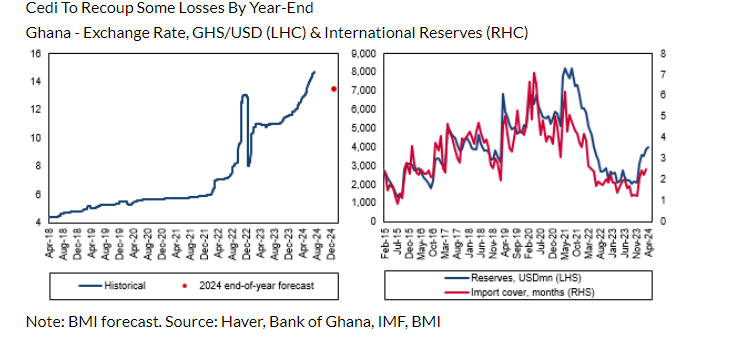
The Bank of Ghana increased the minimum capital requirement for banks to GH¢400 million between 2018 and 2019. Back then, this amount was equivalent to $100 million.
However, due to the cedi’s depreciation, GH¢400 million is now worth less than $40 million. Haruna Alhassan pointed out that this nearly 60% reduction in capital poses significant challenges for banks.
“For banks to be able to have that same strength as we envisaged in 2018 and 2019, we would need to look at raising the minimum capital requirements again,” he stated.
He added that because some banks will struggle when a new minimum capital requirement regime is introduced, the Bank of Ghana must not introduce a “one-fit-all” capital requirement.
Ghana needs more than mere rhetoric
During the virtual event streamed live on Facebook, YouTube, and Zoom, businesswoman Georgina Danso shared her insights on how businesses are managing in the current economic climate and what measures the next government should take.
“The next government has its work cut out… It is no mean feat what they would have to deal with. What we generally need is a conducive business environment because the business community in Ghana has lost a lot of trust in the government,” she stated.
Danso also emphasized that the next government must build confidence through concrete actions instead of just rhetoric.
The CSJ serves as a think tank and a forum for academics, activists, and Ghanaian patriots who seek to promote greater social inclusion in the distribution of wealth, privileges, and opportunities within society.