Author: Andy Ogbarmey-Tettey

  • 19.1% Ghanaians don’t have enough drinking water – GSS

    19.1% Ghanaians don’t have enough drinking water – GSS

    The Ghana Statistical Service (GSS) has reported that the 2022 Ghana Demographic and Health Survey (GDHS) found that approximately one in every five (19.1%) individuals in Ghana lacked sufficient drinking water in the month before the survey.

    The Northern Region had the highest percentage, with one in every three (32.1%) individuals facing inadequate drinking water access.

    Oti (31.2%) and North East (26.2%) followed as the regions with the next highest percentages of insufficient drinking water.

    In contrast, the Upper East (14.0%) and Ashanti (14.5%) regions had the lowest percentages of individuals without enough drinking water, with figures less than half those of the Northern and Oti regions.

    The GSS released this information in a statement to mark this year’s World Water Day, celebrated annually on March 22nd. The theme for 2024 is ‘Water for Peace’.

    The GSS also noted that nationally, 6.5% of the population had to travel more than 30 minutes round-trip to access drinking water.

    “More than a quarter (27.5%) of the population in the North East Region reported travelling more than 30 minutes to access water, the highest recorded, followed by the Northern (18.6%) and Upper West (18.6%) regions.

    “Three in every five (59.9%) persons in Ghana did not have water on their premises. Nine in every ten persons (89.8%) in the Savannah Region did not have water on their premises, the highest recorded and 1.5 times higher than the national average. North East (86.5%) and Oti (83.5%) regions have the second and third highest percent of the population without water on their premises.”

    “Greater Accra (22.0%) recorded the lowest percentage of the population without water on the premises. Volta Region (47.1%) is the only other region where less than half of the population does not have water on the premises. More than 90.0 percent of the population in the lowest wealth quintile (93.6%) were without drinking water on their premises, more the five times the percentage recorded for those in the highest wealth quintile (17.5%),” it stated.

    According to the Ghana Statistical Service (GSS), 83.8% of the population nationwide had access to at least basic drinking water services. This was defined as having an improved water source that required no more than a 30-minute round-trip for collection, or having water available on the premises.

    “The percentage is lowest in the North East Region (43.4%) where less than half of the population has access to basic water services. Savannah (54.2%), Oti (57.8%), and Northern (64.4%) regions have the next highest percentage of the population with access to basic water services.

    Greater Accra (97.7%) and Ashanti (94.8%) were the regions with the highest percentage who have access to basic services, recording figures that are more than twice that of the North East Region.”

    “Persons in the poorest wealth quintile have the lowest percentage with at least basic water services (52.1%), almost half the percentage for persons in the highest wealth quintile (97.9%). Eight in every 10 (82.3%) of persons using unimproved water sources did not treat their water. Unimproved water sources refer to unprotected dug wells or unprotected springs,” it stated.

    The Service underscored that eight in every 10 (84.3%) persons using surface water (i.e., drinking water directly from a river, dam, lake, pond, stream, canal, or irrigation canal) did not treat their water.

    The 2022 Ghana Demographic and Health Survey report, resources, and microdata are available to download at no cost from www.statsghana.gov.gh.

  • Enrol in training programmes, you have our support – Lands Minister urges Women in Mining Ghana

    Enrol in training programmes, you have our support – Lands Minister urges Women in Mining Ghana

    Minister for Lands and Natural Resources, Samuel Jinapor, has reaffirmed the government’s strong commitment to collaborating with Women in Mining Ghana and industry stakeholders to drive meaningful changes for a more inclusive and prosperous mining sector.

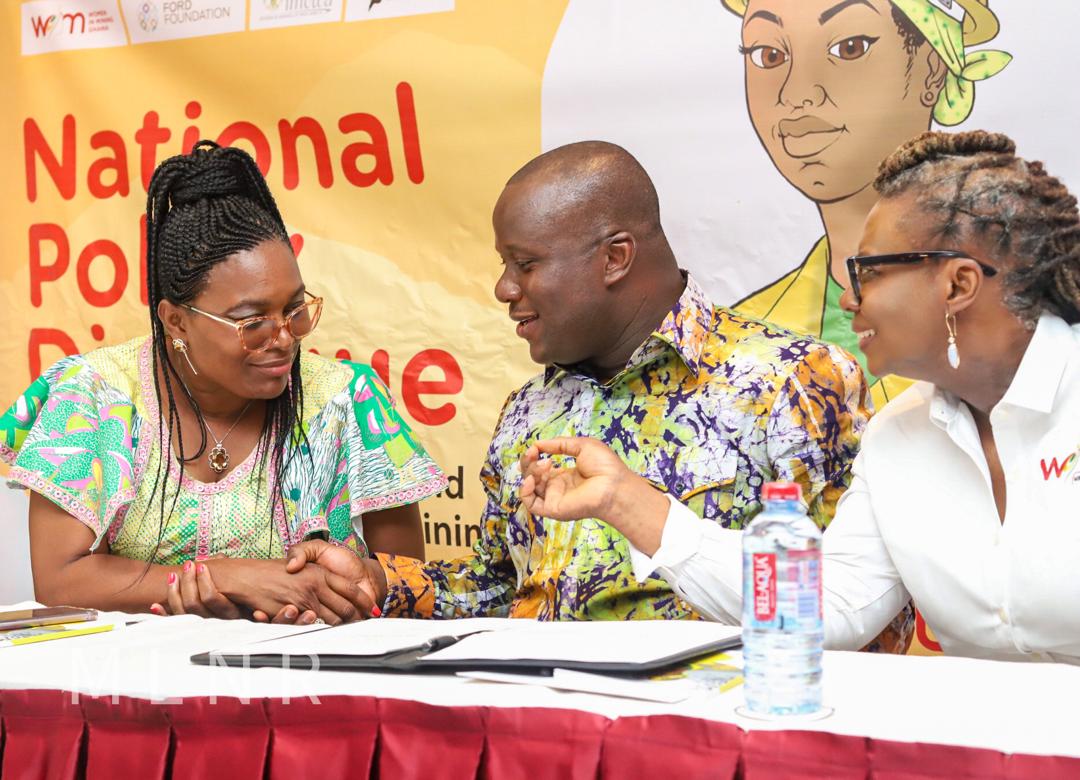
    During a National Policy Dialogue organized by Women in Mining Ghana in Accra on March 21, 2024, under the theme “Diversity, Inclusion, and Belonging: Actions for the Mining Sector,” Mr Jinapor emphasized the importance of empowering women, aligning with recent International Women’s Day celebrations.

    He highlighted Ghana’s significant mining history and its crucial role in the national economy, expressing the government’s vision to position Ghana as Africa’s primary mining hub.

    Mr Jinapor emphasized inclusivity and justice in expanding industry participation, commending Women in Mining Ghana for its advocacy and commitment to industry values. He also noted women’s substantial contributions to the mining sector, citing examples such as catering services, which generate significant revenue.

    In terms of economic empowerment, the Minister highlighted the need to create opportunities for women in all aspects of the industry, including administration and leadership roles. He emphasized the importance of training and education support, particularly in fields like geology and chemical engineering, to enhance women’s participation and advancement in the sector.

    “So I charge the Women in Mining to pay particular attention to training because part of inclusion is training and educating the women to become part of the process from the very beginning. Taking relevant programmes that will make them qualified from the word go so that there is no reason not to include them”

    Expressing determination to align government policies with the needs of women in mining, Hon. Jinapor called for collaborative efforts to enhance inclusivity and promote women’s success in the sector.

    “There is the need to come together to twick polices and practices that promote gender equality, creating opportunities for women to advance in their careers, and fostering a culture of respect and inclusivity within mining companies”. He added.

    The Minister in his statement reaffirmed the ministry’s commitment to fostering an environment conducive to women’s advancement, echoing the sentiment that when women succeed, the nation prospers.

    The Chairman of the occasion, Mrs. Judy Nakuor Crayem, CEO of Rapport Services and Member of the Board of the Minerals Commission in addressing the state of women in artisanal mining noted that, although women constitute 50% of labour in the mining sector, they are left out in critical decision making in the industry.

    She affirmed that challenges faced by women can be dealt with by providing a level playing field without discrimination for all women in the sector.

    Mrs. Crayem announced that, WIM in partnership with Ghana National Association of Small-Scale mining (GNASSM) are offering women other avenues for training in jewellery making and lapidary as a alternative livelihood and also as a way to address the lagging issues in the mining industry.

    The President of Women in Mining, Ghana, Mrs. Georgette Barnes Sakyi-Addo, in her welcome statement explained that subsequent to significant researches made, aimed at shining light on the realities faced by women in the mining sector, challenges such as access to information, financial resources, and inadequate policies to support active involvement have been identified.

    The President continued that the policy dialogue is not just to acknowledge the challenges, but to focus on actionable solutions.

    She called on all stakeholders and participants to take the agenda of diversity, inclusion and belonging forward, not just within borders but to the broader African Union and ECOWAS.”Let us make this a collective effort, a united stand for a more inclusive and prosperous mining sector”

    There were also Solidarity messages given by other Presidents of Women in Mining Africa from Congo, Niger, Nigeria and Namibia.

  • 2,260 road crashes in first two months of 2024 killed 369 – NRSA

    2,260 road crashes in first two months of 2024 killed 369 – NRSA

    The National Road Safety Authority (NRSA) has revealed a slight increase in road crashes during the first two months of January and February 2024.

    According to the Director-General of the NRSA, Ing. David Osafo Adonteng, 2,260 road crashes were reported, involving 3,910 vehicles. These incidents resulted in 369 fatalities, 2,552 injuries, and 381 pedestrian knockdowns.

    Comparatively, the same period last year saw 2,249 cases involving 3,857 vehicles, with 330 fatalities, 2,502 injuries, and 382 pedestrian knockdowns.

    “This is an increase of 0.49% for crashes, 1.37% for vehicles involved and 2.0% for persons injured. Notably, persons killed/fatalities increased by 11.82%, all compared to the first two months in 2023,” Ing. David Osafo Adonteng added.

    The NRSA is currently intensifying its efforts to improve road safety, especially as the Easter season approaches, to prevent further tragedies on the roads.

  • NDC allegedly holds party for Jaane Naana Opoku to celebrate running mate position

    NDC allegedly holds party for Jaane Naana Opoku to celebrate running mate position

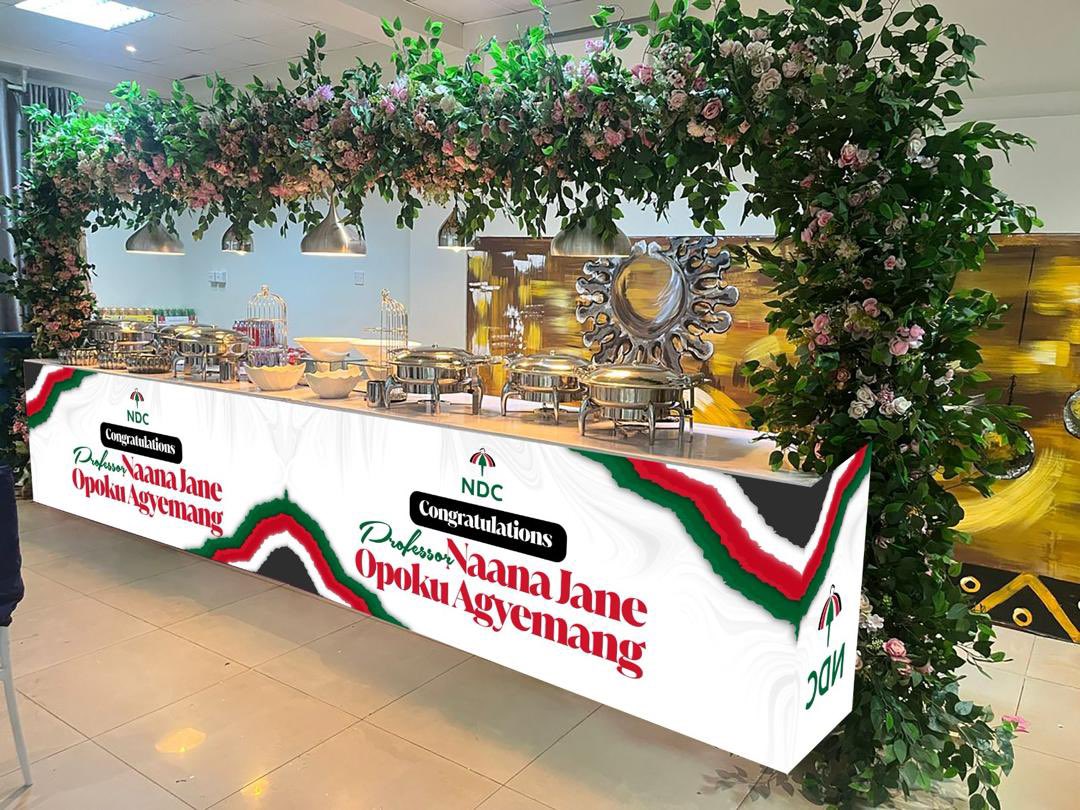
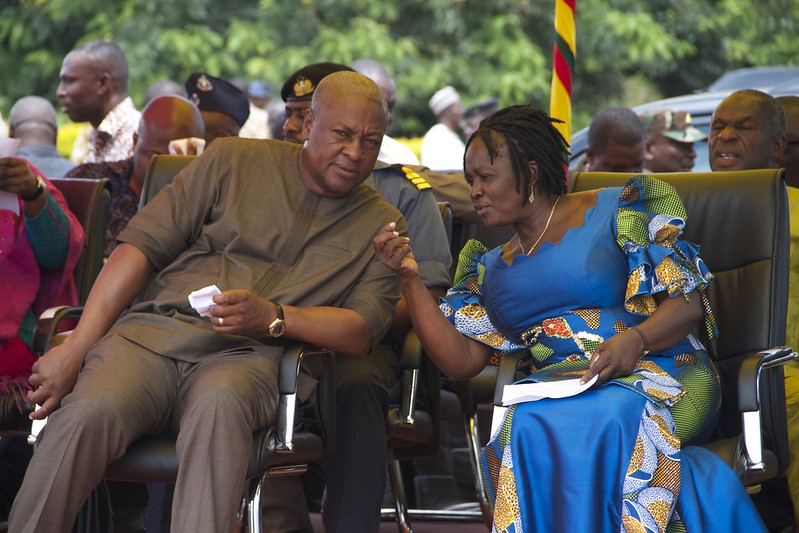
    Former Deputy General Secretary of the National Democratic Congress (NDC), Koku Anyidoho, has alleged that on Thursday, March 21, the party held a party to celebrate the appointment of Naana Jane Opoku Agyemang as the running mate of the party’s flagbearer, John Mahama

    In a post on X, the Chief Executive Officer of the Atta Mills Institute accused the leadership of the opposition party of prioritising their welfare over that of foot soldiers.

    According to him, no foot soldier was invited to the event, despite the vital role they play during elections.

    He described the alleged actions of the party leadership as “infantile fanfare behaviour.”

    Professor Naana Jane Opoku-Agyemang has been formally declared the running mate of John Dramani Mahama, the flagbearer of the opposition National Democratic Congress (NDC).

    Prof. Opoku-Agyemang previously held the position of running mate to Mr. Mahama during the 2020 general elections.

    The National Executive Committee (NEC) of the party held a meeting on Thursday, March 7, 2024, during which they officially approved Mahama’s selection for the running mate position.The National Executive Committee on March 7, 2024, officially endorsed Professor Naana Jane Opoku-Agyemang as the running mate for the party’s flagbearer, in the upcoming 2024 general elections.

  • Anyidoho goes after NDC for hosting ‘running mate’ party without foot soldiers

    Anyidoho goes after NDC for hosting ‘running mate’ party without foot soldiers

    Former Deputy General Secretary of the National Democratic Congress (NDC), Koku Anyidoho, has accused the leadership of the opposition party of prioritising their welfare over that of foot soldiers.

    In a post on X, the Chief Executive Officer of the Atta Mills Institute alleged that on Thursday, March 21, the party held a party to celebrate the appointment of Naana Jane Opoku Agyemang as the running mate of the party’s flagbearer, John Mahama.

    According to him, no foot soldier was invited to the event despite the vital the role they play during elections.

    He described the alleged actions of the party leadership as “infantile fanfare behaviour.”

    Professor Naana Jane Opoku-Agyemang has been formally declared the running mate of John Dramani Mahama, the flagbearer of the opposition National Democratic Congress (NDC).

    Prof. Opoku-Agyemang previously held the position of running mate to Mr. Mahama during the 2020 general elections.

    The National Executive Committee (NEC) of the party held a meeting on Thursday, March 7, 2024, during which they officially approved Mahama’s selection for the running mate position.The National Executive Committee on March 7, 2024, officially endorsed Professor Naana Jane Opoku-Agyemang as the running mate for the party’s flagbearer, in the upcoming 2024 general elections.

  • WANTED: Police on manhunt for Kofi Dankwa Asante-Antwi for $80,000 fraud case

    WANTED: Police on manhunt for Kofi Dankwa Asante-Antwi for $80,000 fraud case

    The Adentan High Court One has issued an arrest warrant number 0065360 dated January 9, 2024, for the immediate arrest of suspect Kofi Dankwa Asante-Antwi.

    Kofi Dankwa Asante-Antwi is wanted by the Airport Police to assist with investigation into an issue of a false cheque with a face value of eighty thousand US dollars ($80,000), and all efforts made to trace him have proved futile.

    The suspect is about 46 years old, 5 feet 6 inches in height, dark in complexion, has a bald head, and stoutly built. He is a native of Akyem Moseaso in the Eastern Region. He was last seen at Imperial Grove, Cantonments in Accra.

    He is suspected to be hiding in and around the Imperial Grove Cantonments or Dodowa new site.

    Anyone with information on the whereabouts of suspect Kofi Dankwa Asante-Antwi should kindly contact the Airport District Police on telephone numbers 0246428220, 0208381975 0208712107 or contact the Emergency Command Centre on 191 (all networks) 18555 (MTN and Vodafone networks) or report to the nearest police station.

  • SA billionaire Markus Jooste reportedly commits suicide

    SA billionaire Markus Jooste reportedly commits suicide

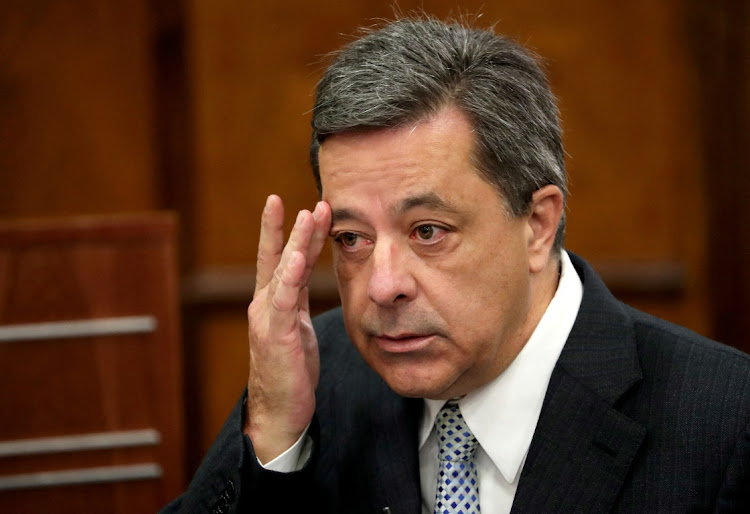
    South African authorities revealed on Thursday that the 63-year-old man who died from an apparent suicide was Markus Jooste, the former chief executive of Steinhoff, as reported by local media.

    Jooste played a significant role in Steinhoff’s growth from a small furniture business in Johannesburg to a multinational retail giant. The day before his death, Jooste was fined for his involvement in accounting fraud.

    According to a police spokesperson, an investigation has been launched into the incident.

    The 63-year-old man sustained a gunshot wound in Kwaaiwater, near Hermanus, and died while being transported to the hospital. The police stated that they are treating the case as a suicide and do not suspect foul play.

    Reports from South African media suggested that Jooste shot himself during an arrest, while the Financial Times cited sources confirming his death from a gunshot wound. However, Reuters could not independently verify these reports.

    In 2023, the Financial Sector Conduct Authority fined Jooste 475 million rand ($25.2 million) for publishing false and misleading financial statements for Steinhoff between 2014 and 2017.

    Steinhoff’s financial irregularities were first revealed in December 2017, leading to a crisis for the retail group. Jooste resigned in 2017, claiming no knowledge of any accounting irregularities, and had been under investigation by South African police for fraud.

  • NSS personnel likely to strike over unpaid allowance

    NSS personnel likely to strike over unpaid allowance

    The National Service Personnel Association is calling for the immediate payment of two-month outstanding allowances owed to members serving in the public sector.

    In an interview with Joy News, the Association expressed concern over the delay in disbursement of the allowances, which has become a recurring issue, causing hardship for graduates who depend on the stipend for their survival.

    The Association is demanding the immediate payment to prevent the possibility of an industrial action. This comes as National Service Personnel in the public sector have been struggling to meet their basic needs due to the delay in the payment of their monthly allowances.

    Nana Adu Gyamfi, Secretary Of the National Service Personnel Association

    Nana Adu Gyamfi Mensah, Secretary of the National Service Personnel Association, stated that the association is currently engaged in negotiations with the government. However, he emphasized that if the government fails to honor the agreement reached during these negotiations, the association will be compelled to initiate a strike action.

    “In the coming days, after probably our last meeting with the board and government, we will announce our next line of action which is to call for a strike and subsequently a demonstration,” he said.

    Some personnel from the 2023-2024 batch have reported not receiving their allowances since January 2024. One personnel, Prince Boadi, expressed worry about the delayed payment of allowances.

    “The delayed payment is a worry to us because as graduates our parents someway want us to be fending for ourselves so most of us depend on the allowance. If it delays, we really get worried,” he indicated.

    “With the concerns of allowance, we had about four unpaid allowances with two months settled…this is not something that must happen. We are telling the scheme and government that this is unacceptable” he said.

  • Telecel Ghana operating at optimal level, secures 100% internet capacity

    Telecel Ghana operating at optimal level, secures 100% internet capacity

    Telecel Ghana has announced that they have successfully secured 100% of their internet capacity and are currently in the process of restoring their services.

    They expressed gratitude to their users for their patience and assured them that they would work on refunding expired bundles and ensuring refunds.

    The telecommunications service provider’s announcement comes after a major Internet disruption hit West and Central Africa, as reported by the Internet observatory, Netblocks.

    The disruption was caused by multiple subsea cable failures, affecting countries such as Ivory Coast, Nigeria, Liberia, Benin, Ghana, and Burkina Faso.

    The National Communications Authority (NCA) of Ghana explained in a press statement that the disruptions were caused by cable failures in Senegal and Cote d’Ivoire, as well as some disruptions in Portugal.

    These disruptions have significantly impacted data services across Ghana.

  • Ashanti Region: I’ll sleep on Dec 7 rather than waste my time to vote for NPP or NDC – Electorate

    Ashanti Region: I’ll sleep on Dec 7 rather than waste my time to vote for NPP or NDC – Electorate

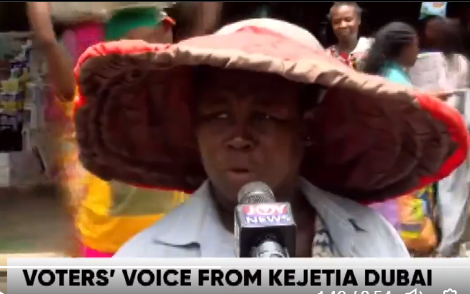
    Electorates at Kejetia Dubai in the Ashanti Region have shared details on what exactly would persuade them to vote for a candidate in the upcoming polls.

    Speaking on JoyNews’ Voters’ Voice, citizens shared diverse reasons they would vote for a particular candidate from a political party.

    A trader noted that if she had her way, there would be no election. She noted that the two major political parties, namely the New Patriotic Party (NPP) and the National Democratic Congress (NDC), are cut from the same cloth.

    “They are all the same. They come to squander money. If I had my way, I’d cancel the elections”, a trader said.

    A trader who shared a similar position noted that she would prefer to sleep than vote. According to her, the ordinary citizen is left to fend for themselves as the leaders continue to enrich themselves and their families.

    “They are all the same. They only know family and neglect us. So I will sleep, when NDC comes, I suffer alone and it is same for NPP. They are spending our money but they don’t even look after us. I will sleep or work rather than get a job for somebody.

    Others were against the idea of former President Mahama making a comeback.

    “If we follow Mahama, it will not help us. Under Atta Mills’ era, they collapsed the one time premium for us. It didn’t help us. He will cancel free education.

    “We want change in the country and so if you can bring the development we want. So whether NPP or NDC, we need someone to bring more industries.

    A trader noted that her vote is for the ruling NPP due to the Free Senior High School programme implemented by President Akufo-Addo’s in 2017.

    “We have benefited a lot from the free SHS. I will vote for Bawumia.”

    Others who decided that they would vote for NPP flagbearer, Dr Bawumia cited his digitalisation agenda as reason.

    NDC’s Mahama received no support from electorates. It is important to note that the Ashanti Region is the stronghold of the NPP.

  • John Mahama and his running mate are actually husband and wife?

    John Mahama and his running mate are actually husband and wife?

    There are reports that the National Democratic Congress’ (NDC) flagbearer, John Dramani Mahama, and his running mate Naana Opoku Agyemang, are married.

    The Chairman of the New Patriotic Party (NPP) in the Ashanti Region, Bernard Antwi Boasiako, popularly known as Chairman Wontumi, is the source of this claim.

    During an interview on Northern Go TV, Chairman Wontumi made this controversial claim but failed to provide any form of proof.

    He alleged that former First Lady Lordina Mahama is being toiled with by the two NDC personalities.

    “In 2012, John Mahama married Prof Jane Opoku Agyeman secretly, I’m speaking the gospel fact, so they are husband and wife, they are not flagbearer and running mate, they are deceiving Lordina (Mahama’s wife),” he said.

    According to him, Mahama and Naana Jane managed to allegedly tie the knot after the latter divorced her husband of twenty years.

    Check out the interview granted by Chairman Wontumi.

  • 6 dead in Upper West Region due to cerebrospinal meningitis

    6 dead in Upper West Region due to cerebrospinal meningitis

    Six people have succumbed to cerebrospinal meningitis (CSM) in the Upper West Region, bringing the total death toll from the disease to ten this year.

    The Regional Health Directorate has confirmed 34 out of 124 suspected cases, according to a report my MyJoyOnline.com.

    Dr. Collins Boateng Danquah, the Deputy Director of Health overseeing Public Health in Upper West, revealed that the majority of the deaths were among individuals aged 10 to 19.

    Cerebrospinal meningitis, also known as bacterial meningitis, is a serious infection of the membranes (meninges) surrounding the brain and spinal cord.

    It is caused by bacteria, most commonly Neisseria meningitidis, Streptococcus pneumoniae, or Haemophilus influenzae type b.

    The infection is usually spread through respiratory droplets from coughing or sneezing of an infected person. Symptoms of meningitis can include fever, headache, stiff neck, sensitivity to light, and confusion.

    In severe cases, it can lead to brain damage, hearing loss, or death if not treated promptly with antibiotics. Vaccines are available to prevent some forms of bacterial meningitis.

  • VIDEO: Woman caught stealing beef, turkey wings, cans of sardine from employer on second day of employment

    VIDEO: Woman caught stealing beef, turkey wings, cans of sardine from employer on second day of employment

    An employer has shared footage detailing how her employee stole from her barely a week after being employed.

    She caught her employee stealing on camera on January 30th, which was day 2 of her employment.

    “She stole 2 beef and turkey wings from her freezer,” she said.

    According to the employer, she had already fed her employee with breakfast and lunch. But the employee decided to keep her lunch and not eat it.

    “I gave her breakfast. I gave her Koko, I bought her doughnut. When she got her lunch, maybe she felt she didn’t need to eat it. She wanted to send it home. I don’t know.

    “I gave her jollof with egg. Maybe the egg was not enough for her.”

    She wondered if her staff’s thirst for more protein led her to steal so much food from her.

    “..or she needed more protein she couldn’t ask me for, but she had to go steal two beef and turkey wings from the deep freezer,” she noted in disappointment.

    The employee also allegedly stole some cans of sardines on her day two heist.

    According to the employer, the culprit had started stealing the very day she started work and had been doing so until the third day when she confronted her.

    Watch the video below.

    @mariamsenouu My Employee steals from the first day of employment. Second day, steals thrice. ##ghana #fouryoupage #trending ♬ original sound – mariamsenou
  • Govt to pay monthly service fee to Zipline despite not exhausting capacity – Mintah Akandoh raises red flag

    Govt to pay monthly service fee to Zipline despite not exhausting capacity – Mintah Akandoh raises red flag

    Members of Parliament from the governing New Patriotic Party (NPP) and the National Democratic Congress (NDC) clashed over the terms of the Zipline medical drone delivery service contract.

    The Minority in Parliament described the contract as a rip-off, insisting that contrary to claims made by Vice President Dr. Mahamudu Bawumia, the state is spending millions on the service.

    The Juaboso legislator, Kwabena Mintah Akandoh, highlighted that the government has a contract with Zipline that requires it to pay for the service even if it is not used.

    “Accordingly, the monthly service fee shall be paid to Zipline irrespective of whether the Ministry of Health fully utilizes the available capacity in any given month. So, whether we utilize the services of Zipline or not, every month we are supposed to pay.”

    He noted that the contract with Zipline includes a clause that allows for interest to be charged if the government fails to make payments on time.

    “Nobody is saying we are against the services of Zipline but we must probe this agreement. We must know the deliveries because other countries are paying per delivery. If you go to Tanzania and Rwanda that is what is done and we must even define what they should fly. So they won’t go and fly paracetamol syrups just because they want to do more deliveries and get back to us to pay.”

    Parliament has approved GH₵70 million from the National Health Insurance Levy to pay for the service in 2024.

    Ranking Member on the Health Committee, Kwabena Mintah Akandoh, also argued that the Vice President misled the public.

    “You recall that the Vice President, his Excellency Dr Alhaji Bawumia touted this particular project as his brainchild and convinced Ghanaians that we should all accept the project because it was not going to have financial implications on the state budget.

    “Now only to discover there is an agreement between the Ministry of Health, and they represented the state and Fly Zipline. Not only is the state going to pay and commit to the activities of Zipline but the provisions in that agreement are injurious and those provisions are not in the interest of the state.”

    Mr. Akandoh clarified that the NDC is not opposed to the services of Zipline. However, he emphasized that the public deserves to know the full details of the agreement between Zipline and the government.

    Chairman of the Health Committee in Parliament, Dr. Nana Ayew Afriyie, stated that Zipline operated in Rwanda and not in any other part of the world.

    “If Rwanda was not the reason for several countries to join after four years and Ghana’s inclusion has brought several countries, then you have every reason to look at the new agreement.

    “Having piloted for four years in Ghana, we need to modify what we studied from Rwanda because, after all, Rwanda has changed this about six months ago. So we must also change and I think that is the only way to make it sustainable.”

    But the NDC MP for Bawku Central, Mahama Ayariga emphasised that if State funds are to be used to pay for Zipline’s services, the proper procurement procedures must be followed.

    “We are being requested to approve public funds for payment of services that have not been procured in accordance with the Procurement Act.

    “That is the more fundamental and serious issue that we must be looking at. If we approve money under the NHIS and it’s going to be used to pay Zipline, then the services of Zipline must be procured in accordance with the Procurement Act,” he said.

    However, the Second Deputy Speaker of Parliament, Andrew Amoako Asiamah refused the Minority’s request to form a committee to investigate the Zipline contract.

    Mr Asiamah stressed that if the Minority wishes to form a committee to investigate the Zipline contract, it must follow the proper procedures.

    “If you want me to set a committee of enquiry, it should come appropriately. It should be by motion and evoke the appropriate orders. It’s not just a matter of saying set a committee of enquiry, so just be guided. If you want something like that to be done, it’s not a problem. This is a house that is supposed to do that but come appropriately,” he said.

  • William Amponsah clinches silver medal for Ghana in half marathon of 2023 African Games

    William Amponsah clinches silver medal for Ghana in half marathon of 2023 African Games

    Ghanaian long-distance runner William Amponsah clinched the silver medal in the men’s half marathon at the ongoing African Games in Accra.

    Amponsah, the national 10,000m record holder, finished the race in one hour, five minutes, and thirteen seconds (1:05:13) at the University of Ghana campus, just nine seconds behind the winner, Amare Hailemicael of Eritrea.

    Zimbabwe’s Isaac Mpofu secured the bronze medal with a time of 1:05:37. Another Ghanaian athlete, Koogo Atia, finished fifteenth in a time of one hour, twelve minutes, and fourteen seconds (1:12:14).

    Despite finishing fifth, Amponsah set a new national record in the men’s 10,000m event, improving his previous record by 2.79 seconds.

  • Renegotiate terms of Zipline agreement for drone delivery of emergency medical supplies – Govt told

    Renegotiate terms of Zipline agreement for drone delivery of emergency medical supplies – Govt told

    In Parliament, Members of Parliament from the governing New Patriotic Party (NPP) and the National Democratic Congress (NDC) clashed over the terms of the Zipline medical drone delivery service contract.

    The Minority in Parliament described the contract as a rip-off, insisting that contrary to claims made by Vice President Dr. Mahamudu Bawumia, the state is spending millions on the service.

    Parliament has approved GH₵70 million from the National Health Insurance Levy to pay for the service in 2024.

    Ranking Member on the Health Committee, Kwabena Mintah Akandoh, argued that the Vice President misled the public.

    “You recall that the Vice President, his Excellency Dr Alhaji Bawumia touted this particular project as his brainchild and convinced Ghanaians that we should all accept the project because it was not going to have financial implications on the state budget.

    “Now only to discover there is an agreement between the Ministry of Health, and they represented the state and Fly Zipline. Not only is the state going to pay and commit to the activities of Zipline but the provisions in that agreement are injurious and those provisions are not in the interest of the state.”

    Mr. Akandoh clarified that the NDC is not opposed to the services of Zipline. However, he emphasized that the public deserves to know the full details of the agreement between Zipline and the government.

    The Juaboso legislator also highlighted that the government has a contract with Zipline that requires it to pay for the service even if it is not used.

    “Accordingly, the monthly service fee shall be paid to Zipline irrespective of whether the Ministry of Health fully utilizes the available capacity in any given month. So, whether we utilize the services of Zipline or not, every month we are supposed to pay.”

    He noted that the contract with Zipline includes a clause that allows for interest to be charged if the government fails to make payments on time.

    “Nobody is saying we are against the services of Zipline but we must probe this agreement. We must know the deliveries because other countries are paying per delivery. If you go to Tanzania and Rwanda that is what is done and we must even define what they should fly. So they won’t go and fly paracetamol syrups just because they want to do more deliveries and get back to us to pay.”

    Chairman of the Health Committee in Parliament, Dr. Nana Ayew Afriyie, stated that Zipline operated in Rwanda and not in any other part of the world.

    “If Rwanda was not the reason for several countries to join after four years and Ghana’s inclusion has brought several countries, then you have every reason to look at the new agreement.

    “Having piloted for four years in Ghana, we need to modify what we studied from Rwanda because, after all, Rwanda has changed this about six months ago. So we must also change and I think that is the only way to make it sustainable.”

    But the NDC MP for Bawku Central, Mahama Ayariga emphasised that if State funds are to be used to pay for Zipline’s services, the proper procurement procedures must be followed.

    “We are being requested to approve public funds for payment of services that have not been procured in accordance with the Procurement Act.

    “That is the more fundamental and serious issue that we must be looking at. If we approve money under the NHIS and it’s going to be used to pay Zipline, then the services of Zipline must be procured in accordance with the Procurement Act,” he said.

    However, the Second Deputy Speaker of Parliament, Andrew Amoako Asiamah refused the Minority’s request to form a committee to investigate the Zipline contract.

    Mr Asiamah stressed that if the Minority wishes to form a committee to investigate the Zipline contract, it must follow the proper procedures.

    “If you want me to set a committee of enquiry, it should come appropriately. It should be by motion and evoke the appropriate orders. It’s not just a matter of saying set a committee of enquiry, so just be guided. If you want something like that to be done, it’s not a problem. This is a house that is supposed to do that but come appropriately,” he said.

  • “It was a painful experience” – Man recounts first sexual encounter with Gay Biology teacher at age 16

    “It was a painful experience” – Man recounts first sexual encounter with Gay Biology teacher at age 16

    A 25-year-old man has shared how his male biology teacher back at Senior High School (SHS) allegedly initiated him into homosexuality.

    In an interview on Onua FM, Kofi (not his real name) disclosed that he was the teacher’s favorite student as he performed well in class, hence preferential treatments did not cause him to be alarmed.

    “I was a very intelligent student, so he became fond of me, the same as some other teachers. He often sends me to get something for him, or he asks that I escort him to places. He also sometimes supports me financially.”

    But the advances became clear when he was in his final year at age 16, when he had to reside on campus despite being a day student.

    Per his account, one night, he was invited by his teacher for dinner, a gesture he believed was the kindness of his tutor. Apparently, that day was when his teacher made a pass on him and eventually had sexual intercourse with him.

    He narrated, “After we were done eating, I told him I had to go home and prepare because I would be returning for preps. He told me there was no need for me to go home and return to school, as I could shower at his place and even have my prep time in his bungalow, after which I could return home. So, I went to his bathroom to take my bath, and while there, he joined me naked. Because he was my teacher, I sought to cover myself because I was shy around him, but he told me not to worry,” he stated.

    According to Kofi, his teacher sought his consent but could not tell how he gave in to his request as he was shell-shocked.

    “… At that instant, he began to fondle my penis. At that instance, it did not occur to me that he was gay and he could have sex with me. All of a sudden, he held my penis into his mouth and was licking it. He asked me if I could have sex with him. I stood quiet for a long time because I didn’t know what to say, and then it happened. It was a painful experience, but he was my teacher, and he helped me sometimes, so whatever he said, I did,” he added.

    Per the man’s narration, he was not defiled.

    The Criminal Offences Act, 1960 defines defilement in Section 101(2) of Act 29 as natural or unnatural carnal knowledge of a child under sixteen years of age with or without the child’s consent. 

    But this revelation comes at a time when Ghana is close to criminalising the activities of the LGBTQ+ community.

  • Prof Naana Jane Opoku Agyeman is from the Northern Region not Central – Chairman Wontumi

    Prof Naana Jane Opoku Agyeman is from the Northern Region not Central – Chairman Wontumi

    The Chairman of the New Patriotic Party (NPP) in the Ashanti Region, Bernard Antwi Boasiako, popularly known as Chairman Wontumi, has stirred controversy by accusing the running mate of National Democratic Congress’ (NDC) flagbearer, Naana Opoku Agyemang, of misrepresenting her regional origins.

    In an interview on Northern Go TV, Chairman Wontumi claimed that Naana Opoku Agyemang is not from the Central Region as she claims, but rather from the Northern Region.

    He challenged her to be proud of her true heritage, stating, “I challenge Nana Opoku Agyemang that she is not from the Central Region. Wherever you come from, you must be proud of it.”

    Prof Naana Jane Opoku-Agyemang

    He further alleged that Nana Opoku Agyemang’s husband, who is from the Ashanti Region, worked with her at the Cape Coast University.

    According to Chairman Wontumi, they studied each other while working and eventually got married, with Nana Opoku Agyemang taking her husband’s name.

    Chairman Wontumi claimed that their marriage lasted for 20 years before collapsing. Despite this, he stated that Nana Opoku Agyemang has continued to use her husband’s name.

    In the interview, Chairman Wontumi provided no evidence to back his claim. Also, the accused is yet to comment on the matter.

  • Supreme Court denies Justice Baah was biased towards Anas

    Supreme Court denies Justice Baah was biased towards Anas

    The Supreme Court has stated that it dismissed an application by investigator Anas Aremeyaw Anas because his claim that a High Court judge was biased towards him lacked legal support.

    Anas had filed a certiorari application at the apex court seeking to nullify a High Court’s decision that dismissed his defamation suit against Member of Parliament for Assin Central, Kennedy Ohene Agyapong.

    The defamation suit was based on public statements made and a broadcast by the MP, accusing Anas of being evil and blackmailing people in the name of investigative journalism.

    Anas’ grounds for the certiorari application challenging the judgment were that the trial judge, Justice Eric Baah, a Justice of the Court of Appeal sitting as a High Court judge, had no jurisdiction to hear the suit and that the judge was biased towards him.

    On February 25 this year, the Supreme Court, in a 3-2 majority decision, dismissed the application and reserved the full reasoning in the judgment, which was later filed at the court’s registry, making it public.

    Chief Justice Gertrude Sackey Torkornoo, Justices Henrietta Mensa-Bonsu, and Samuel Asiedu were on the majority side, while Justices Issifu Omoro Tanko Amadu and Emmanuel Yonny Kulendi dissented.

    In the High Court judgment dated March 15 last year, Justice Baah held that although the words spoken by Mr. Agyapong against Anas were capable of defamation, they were factual and therefore could not be considered defamatory as the defence of justification exonerated the MP.

    Justice Baah then made certain findings based on his analysis of the evidence before him and held that the MP was justified in calling Anas “evil, blackmailer, an extortionist, criminal, and corrupt.”

    Furthermore, the judge described Anas’s work as “investigative terrorism” and not “investigative journalism.”

    “It should be understood that as officers caught by plaintiff in his investigations have lost their jobs, an entrapped President may be compelled to resign out of shame or public pressure.”

    “That means the plaintiff, through his investigative antics can cause the removal of a President, and thereby the mandate given to him at the election. This is not investigative journalism.

    “It is investigative terrorism. It is an exercise of indirect political power under the cloak of journalism,” Justice Baah held in the judgment.

    The above statement by Justice Baah was one of the statements in the judgment, Anas relied on to support his assertion that the judge had a real likelihood of bias towards him.

    In its decision, the Supreme Court, as authored by Justice Asiedu, dismissed the ground of bias. The court held that Justice Baah’s strong words did not indicate bias or a dislike towards Anas. Instead, the statement was deemed an analysis of the evidence presented in the trial court, which is a judge’s duty when adjudicating a matter.

    The court noted that Justice Baah’s statement was not made in isolation, as there was video evidence before the trial court. This evidence allegedly showed Anas, along with one Amakye and a Sheikh, plotting to entrap the Prime Minister of Ivory Coast and the President of Ghana.

    “Is the applicant (Anas) saying that a trial judge has no right to examine and analyse the evidence placed before him and draw inferences and make findings of fact?

    “In my opinion, the statements referred to are the inferences and findings of facts which the learned trial judge dutifully made and for that matter they cannot reasonably be described as constituting bias and be clothed with the garb of prejudice against the applicant,” the apex court held.

    In a concurring opinion supporting the majority decision, the Chief Justice stated that Justice Baah’s statements were his findings and inferences based on his evaluation of the evidence presented to him.

    The Chief Justice further explained that whether or not Justice Baah’s evaluation of the evidence was erroneous would require a re-evaluation of the evidence, which was not possible in the current judicial review application brought by Anas. Such a re-evaluation, the Chief Justice noted, should be done on appeal.

    “My conclusion is that the issue of the sustainability of the judge’s words used to describe the applicant can only be a matter determinable by the appellate court.

    It is not the place of this court to question the basis for any findings and conclusions that have been reached by a trial judge when the court does not have the full records of proceedings,” Justice Torkornoo held.

    In his dissenting opinion, Justice Kulendi argued that Justice Baah’s words indicated a clear prejudice against Anas. He questioned why the court, which was hearing a civil matter of defamation, ended up making criminal findings against Anas.

    “I find it even more perplexing that a court exercising civil jurisdiction would find that the applicant is guilty of having taken bribes, and being dishonest, fraudulent, a cheat, an extortionist, a thief, a blackmailer and corrupt,” Justice Kulendi held.

    Justice Amadu disagreed with the majority’s view that Anas’s remedy was an appeal rather than a judicial review application. He argued that this interpretation would diminish the supervisory jurisdiction of the Supreme Court as prescribed by the Constitution.

  • BVDs used for District Level Elections still in possession of EC Regional Directors

    BVDs used for District Level Elections still in possession of EC Regional Directors

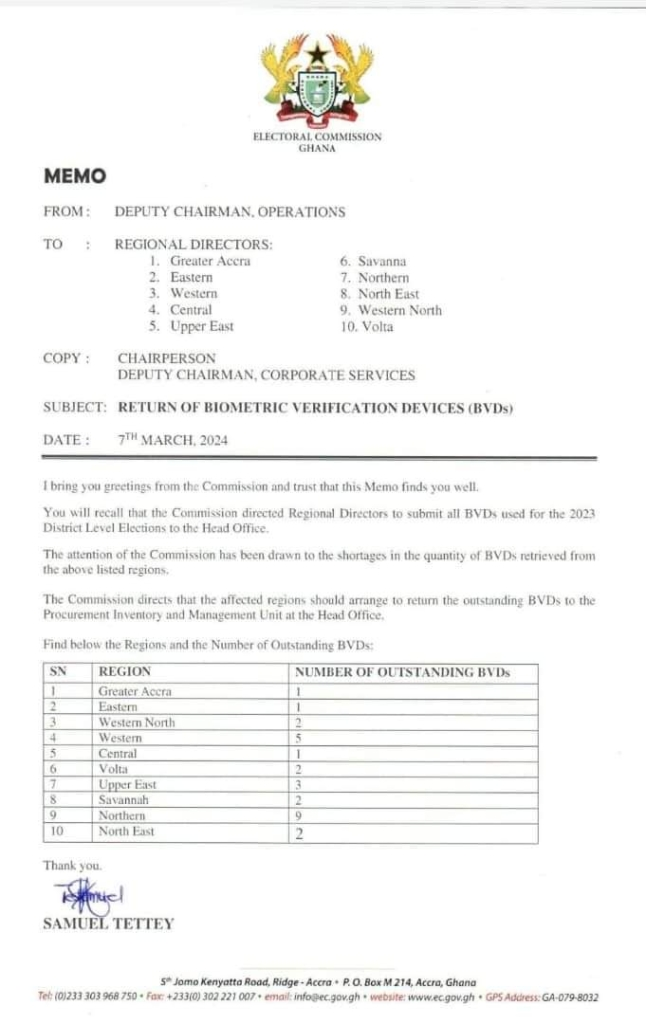
    The Electoral Commission (EC) has directed its Regional Directors to promptly return specific Biometric Verification Devices (BVDs) used during the 2023 District Level Elections.

    The Commission has requested the immediate return of the specified BVDs without any delays.

    A memorandum dated Thursday, March 7, and signed by the Deputy Commissioner, Samuel Tettey, instructs the BVDs to be returned to the Procurement Inventory and Management Unit at the Head Office.

    The memo includes a detailed list specifying the number of BVDs to be returned by each Regional Director.

    “You will recall that the Commission directed Regional Directors to submit all BVDs used for the 2023 District Level Elections to the Head Office.”

    “The attention of the Commission has been drawn to the shortages in the quantity of BVDs retrieved from the above-listed regions.”

    “The Commission directs that the affected regions should arrange to return the outstanding BVDs to the Procurement Inventory and Management Unit at the Head Office.”

  • Postpone March 22 meeting – Teacher Unions to NLC, Employment Ministry

    Postpone March 22 meeting – Teacher Unions to NLC, Employment Ministry

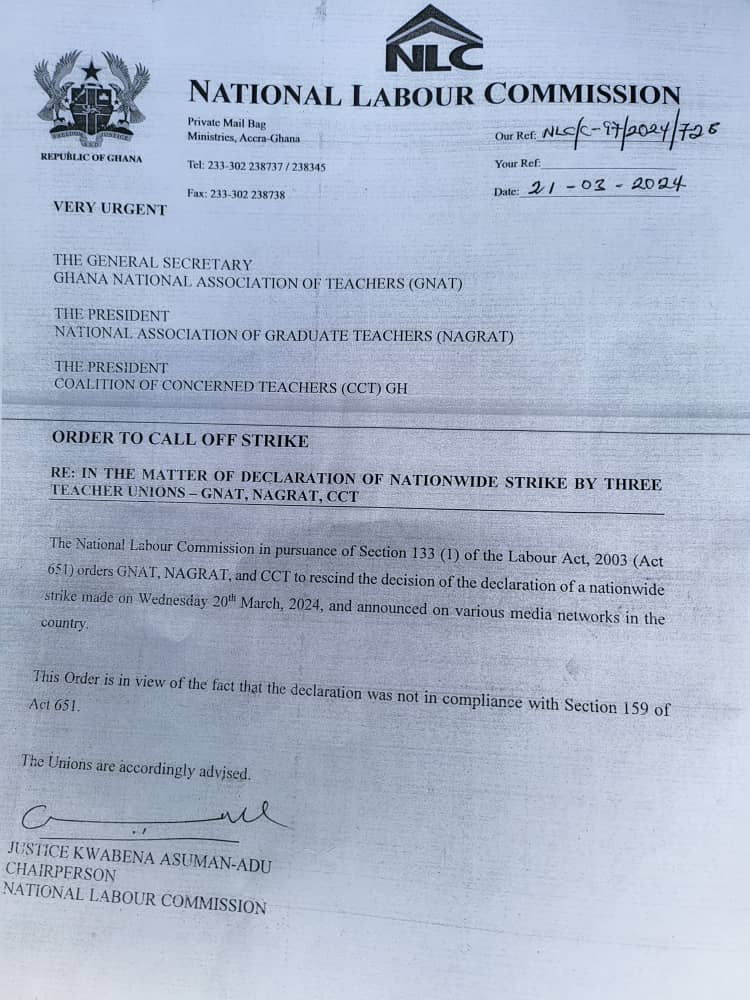
    The three striking teacher unions have requested the Ministry of Employment and Labour Relations to postpone their meeting with the National Labour Commission, initially scheduled for today, March 22, to Monday, March 25.

    The unions, which include the Ghana National Association of Teachers (GNAT), the National Association of Graduate Teachers (NAGRAT), and the Coalition of Concerned Teachers, commenced a nationwide strike on Wednesday, March 20.

    They cite the government’s alleged reluctance to address their conditions of service as the reason for their action.

    Despite the National Labour Commission’s directive for the unions to halt the strike, it continues unabated.

    Herbert Arko Forson, the general secretary of the Coalition of Concerned Teachers, explained to Citi News the unions’ rationale for requesting the rescheduling of the meeting.

    “We have responded to the invitation by the Ministry of Employment and Labour Relations, indicating that they want to meet us so that we can have the discussion. Honestly, we can’t refuse to attend such meetings, but most of our leaders do not stay in Accra, so we would like to organize ourselves. Therefore, we are proposing rescheduling the meeting to Monday, March 25, so that we can honour the invitation and then proceed with the discussion as expected.”

  • VIDEO: Cheddar, Empress Gifty’s ‘VIP’ jubilation as Ghana beat Nigeria to clinch gold in African Games

    VIDEO: Cheddar, Empress Gifty’s ‘VIP’ jubilation as Ghana beat Nigeria to clinch gold in African Games

    It was all excitement on the stands the moment Ghana’s Black Princesses secured gold in women’s football at the ongoing African Games by defeating Nigeria on Thursday evening (March 21).

    The match, held at the Cape Coast Sports Stadium, ended 2-1, with the Princesses overcoming a goal deficit to defeat the defending champions.

    Gospel musician, Empress Gifty, Nana Kwame Bediako, known as Cheddar, leader of the New Force Movement, and his wife were captured in a blissful mood in the VIP section Ghana when scored their second goal, a low drive by forward Mukarama Abdulai in extra time, breaking the 1-1 deadlock.

    Empress Gifty could not help but keep jumping as she expressed her excitement in a video gone viral. Cheddar was more composed. Nonetheless, he could not hide his excitement.

  • Stop sabotaging GRA for votes, only “vegetable minds” will believe your tax amnesty game – Lecturer to Bawumia

    Stop sabotaging GRA for votes, only “vegetable minds” will believe your tax amnesty game – Lecturer to Bawumia

    A lecturer at the University of Ghana Business School (UGBS), Professor Kobby Mensah, has criticized Vice President Dr Mahamudu Bawumia‘s recent pledge to grant tax amnesty to all businesses and individuals if he wins the 2024 elections.

    Professor Mensah argued that if Bawumia, who also serves as the flagbearer of the New Patriotic Party (NPP), has the capability to deliver on such a commitment, he should implement it during his current tenure in government rather than waiting for electoral victory.

    In a series of messages on social media, he accused the Vice President of potentially inciting businesses and individuals against the government, particularly the Ghana Revenue Authority (GRA), with his recent comments.

    “Because of political expediency a Vice President decides to illegitimise the business processes of a public institution, potentially inciting the people against the state,” he said in one of his posts.

    He added, “Only vegetable minds will believe Bawumia’s tax amnesty.

    “You are in govt, grant it now! You can only play with veggie minds.”

    Dr. Mahamudu Bawumia has pledged to grant tax amnesty to businesses and individuals with outstanding tax arrears if he is elected to lead Ghana in 2025. He believes this measure will allow businesses to start anew and encourage tax compliance.

    Speaking at an event organized by the Ghana National Chamber of Commerce & Industry and the Ghana Bar Association on March 20, 2024, Dr. Bawumia emphasized the importance of providing businesses and individuals with a fresh start.

    “I am going to start with a clean slate in 2025, and that is why in 2025, we are going to grant a tax amnesty to all businesses and individuals and start afresh.

    “All businesses and individuals will have a tax amnesty, and we will start afresh,” he said.

  • Akufo-Addo commiserates with John Kumah’s family

    Akufo-Addo commiserates with John Kumah’s family

    President Akufo-Addo expressed his condolences to the family of the late Dr. John Kumah, Member of Parliament for Ejisu and Deputy Finance Minister, after being officially informed of his passing.

    The President praised the late Minister as a vibrant member of the ruling New Patriotic Party (NPP) with the potential to achieve great heights in his political career.

    He described Dr. Kumah, who passed away on March 7, as a truthful and hardworking young man and lamented his death as a painful loss.

    The family of the late Minister, led by Kwasi Owusu Twumasi, the Spokesperson, accompanied by some NPP executives, paid a courtesy call on the President at the Jubilee House in Accra to inform him of the death.

    They provided details of the sudden passing of the Minister and the scheduled one-week funeral observation on March 28 in Ejisu-Onwe, Ashanti Region.

    President Akufo-Addo assured the family that he would attend the one-week funeral rites of the late Minister to pay his respects.

    He had earlier in a tribute to the deceased, posted on social media, noted that: “He was a Ghanaian patriot par excellence”. 

    “His unwavering dedication to service, his tireless commitment to the betterment of our nation, and his profound passion for uplifting the lives of the people of Ejisu and Ghana were evident to all who had the privilege of knowing him.” 

    The President said he was saddened by the sudden exit of the Deputy Finance Minister, “whose untimely passing has left us all bereft of a bright, energetic light in our midst”. 

  • ‘Trotro mate’ jailed a year and half for stealing sales worth GHc17,500

    ‘Trotro mate’ jailed a year and half for stealing sales worth GHc17,500

    A 21-year-old driver’s mate has been sentenced to one and a half years in prison by an Accra Circuit Court for stealing GH¢17,500 at Lashibi in Accra.

    According to the prosecution, led by Inspector Ansah DaCosta, the complainant, Patience Appiah, is a trader residing at Lashibi, while Akuffo hails from Dewu in the Eastern Region. Appiah employed Akuffo as a salesperson at her cement shop.

    On June 23, 2023, the complainant found the shop open but Akuffo was missing. Appiah reported the incident to the police at Sakumono, leading to Akuffo’s arrest at his hideout in the Eastern Region.

    Samuel Akuffo, who was charged with stealing, admitted to siphoning sales worth GH¢17,500 and requested the court to allow him time to work and repay the amount.

    Presided over by Kizita Naa Koowa Quashie, the court convicted Akuffo based on his plea, considering him a first-time offender. However, it noted that Akuffo had violated the trust placed in him by the complainant.

    The court also ordered Akuffo to refund the money to the complainant.

  • VIDEO: Illegal miners attempt to bury gold thief alive

    VIDEO: Illegal miners attempt to bury gold thief alive

    A suspected thief was forced to recite his last prayers as a group of illegal miners (galamsey operators) held a gun to his head after catching him red-handed raiding their site.

    In a video that went viral, the miners are heard giving instructions to the alleged thief, who was caught trying to steal their processed gold ore.

    The exact location and time of the incident are unknown, but the miners can be seen directing the thief to enter a pit while telling him to prepare for the worst.

    “I am pleading with you. Please forgive me… this is goodbye to my family…” the alleged thief said amid tears.

    In the video, the enraged miners are also seen pumping a shotgun while compelling the thief to enter a pit.

    However, the outcome for the alleged thief remains unknown as the video abruptly ends when he is forced into the pit with a pan on his head.

  • Your control ends at Madam Butterfly Restaurant – Ablakwa fires Akufo-Addo’s Secretary

    Your control ends at Madam Butterfly Restaurant – Ablakwa fires Akufo-Addo’s Secretary

    Member of Parliament for North Tongu, Samuel Okudzeto Ablakwa, has criticized the Executive Secretary to President Akufo-Addo, Nana Bediatuo Asante.

    Nana Bediatuo made headlines for a letter he wrote to the Clerk of Parliament, urging him to halt the transmission of the anti-LGBT+ Bill to the presidency for assent, citing two legal suits against the Bill.

    The letter’s tone and contents have been seen as contemptuous of the House, particularly by opposition lawmakers and Speaker Alban Bagbin.

    Mr Ablakwa, in a social media post dated March 20, 2024, reiterated the view that the Presidency should not assume it can control Parliament through its actions.

    “I hope President Akufo-Addo’s Secretary, Nana Asante Bediatuo, isn’t assuming he can control the Ghanaian Parliament like he controls Madam Butterfly Restaurant Limited, which he incorporated after becoming Secretary to the President of Ghana.

    “Parliament’s constitutional independence must be respected. We shall not be subjected to the control of familial appointees at the presidency!” Ablakwa’s post, which was accompanied by company documents with Bediatuo’s registration details, read in part.

    “I shall reserve the activities of Madam Butterfly for another day. By the way, how different is Bediatuo’s butterfly from Alan’s butterfly? Interesting days ahead,” the post concluded.

    In his formal response to President Akufo-Addo’s refusal to receive the anti-LGBT+ Bill, as stated in Bediatuo’s letter, Speaker Bagbin accused the presidency of acting contrary to the Constitution.

    Bagbin also communicated Parliament’s inability to approve some of the president’s ministerial nominees at the tail end of his statement, read in Parliament, citing an injunction brought against him and Parliament by an opposition MP.

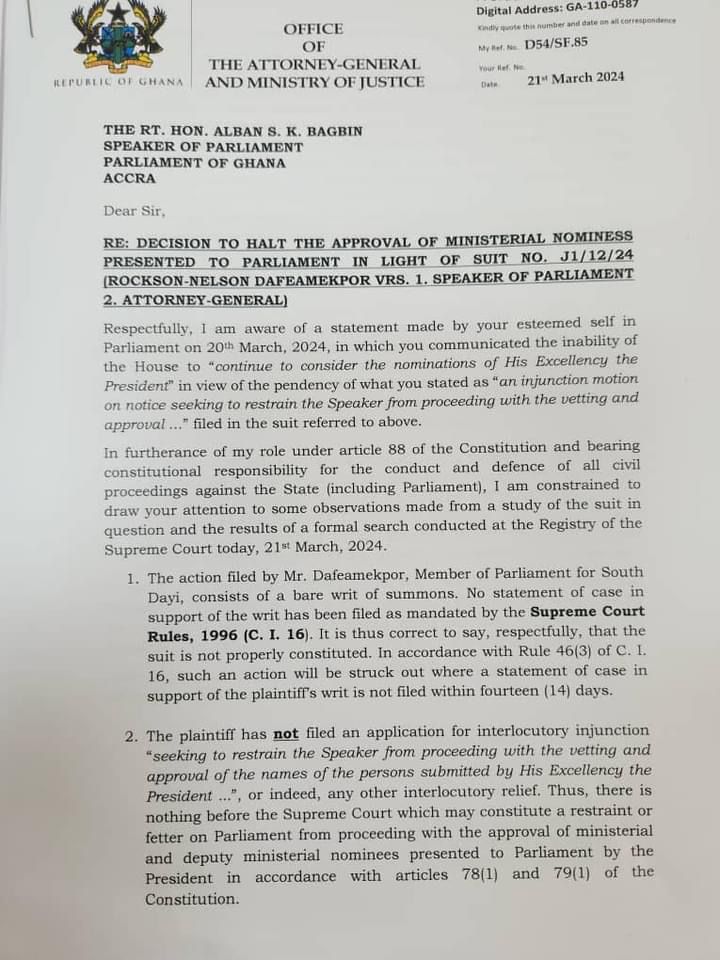
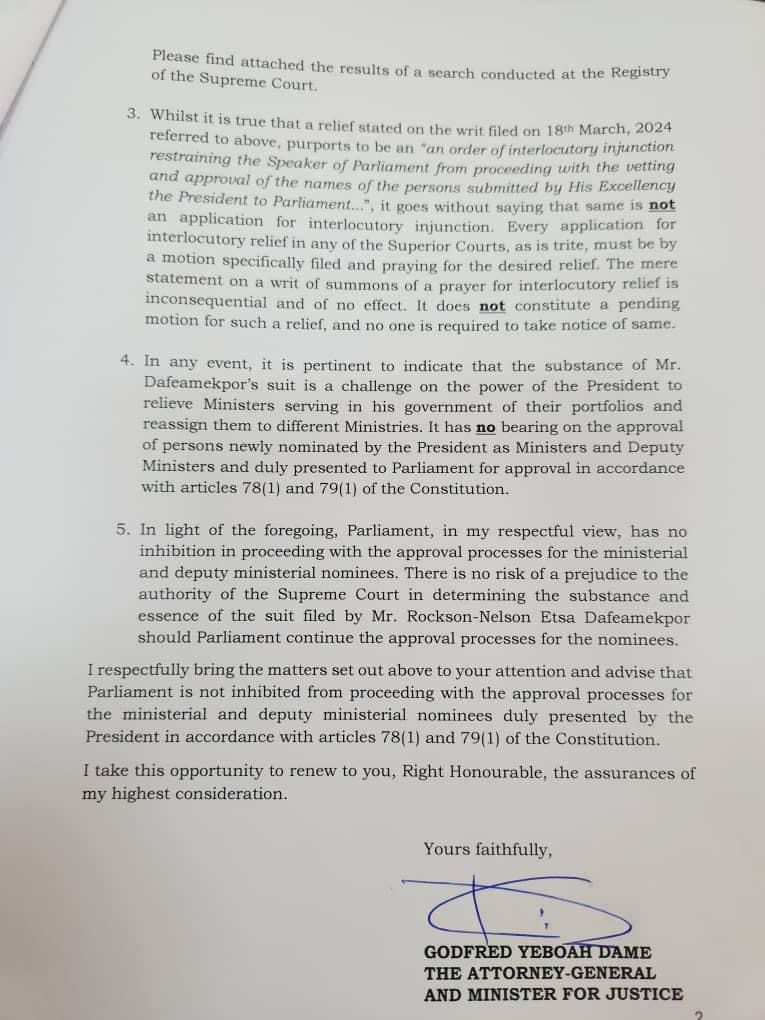
    Attorney-General and Minister for Justice, Godfred Yeboah Dame, has denied receiving any interlocutory injunction related to the case brought by Member of Parliament for South Dayi, Rockson-Nelson Etse K. Dafeamekpor over the ministerial appointment made by President Akufo-Addo.

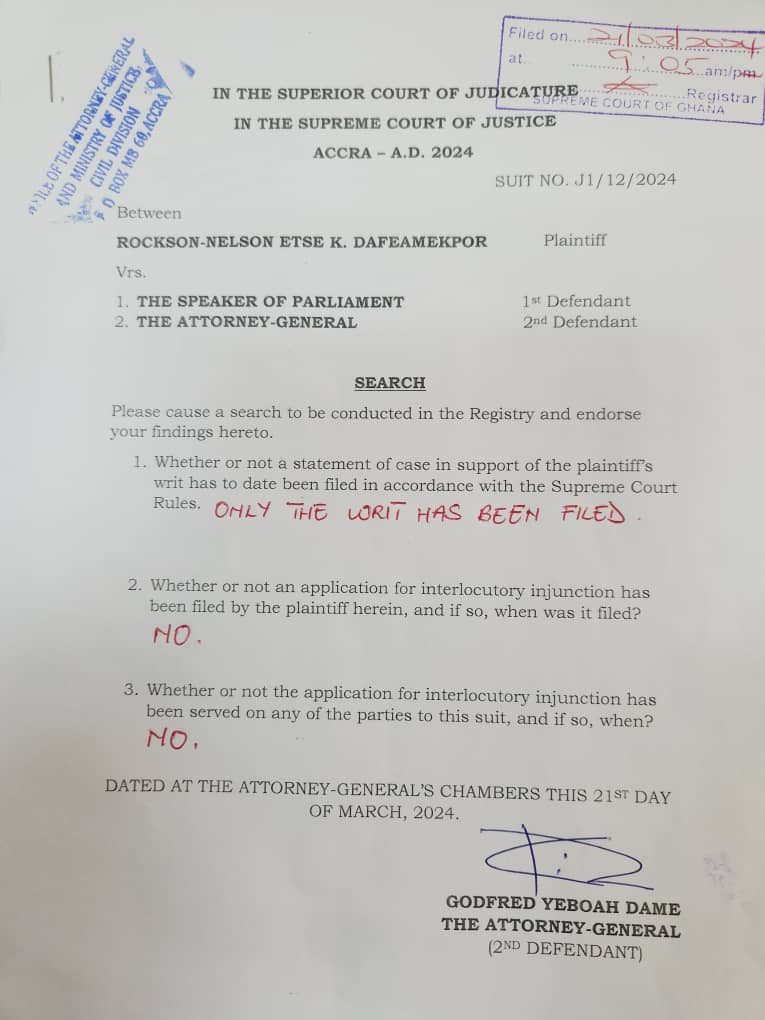
    Mr. Dame, in a letter addressed to the Speaker on Thursday, March 21, clarified that he has not been served with any legal documents regarding such court proceedings.

    “The plaintiff has not filed an application for interlocutory injunction seeking to restrain the Speaker from proceeding with the vetting and approval of the names of the persons submitted by His Excellency the President…”, or indeed, any other interlocutory relief.”

    “Thus, there is nothing before the Supreme Court which may constitute a restraint or fetter on Parliament from proceeding with the approval of ministerial and deputy ministerial nominees presented to Parliament by the President in accordance with articles 78(1) and 79(1) of the Constitution.”

  • Health Minister-designate, Okoe-Boye unveils COVID-19 book

    Health Minister-designate, Okoe-Boye unveils COVID-19 book

    Health Minister-designate Dr. Bernard Okoe-Boye’s book chronicling Ghana’s experience with the COVID-19 pandemic has been officially launched in Accra.

    President Akufo-Addo launched the book, titled “Fellow Ghanaians: Telling Ghana’s COVID-19 Story: A Journey of Fear, Facts, Faith, and Fortune,” at the College of Physicians and Surgeons in Accra on Wednesday, March 20, 2024.

    The book aims to serve as a study document presenting original research into the pandemic and engaging directly with all sections of Ghanaian society and beyond.

    President Akufo-Addo praised the book as a timely masterpiece, lauding Dr. Okoe-Boye for providing a comprehensive analysis of Ghana’s COVID-19 experience. He commended Ghanaians for adhering to safety protocols and urged reflection on the lessons learned and progress made toward nation-building.

    Dr. Okoe-Boye expressed his intention to share knowledge on Ghana’s efforts in fighting the pandemic with the world through his book.

    “The legacies of the pandemic lie in these intangible, priceless changes in attitude. Another intangible legacy of the pandemic going into the future has to do with the rekindling of the can-do spirit.

    “The experience we have had as a nation and the battles we have fought against the virus under the banner of ‘This too shall pass’ and the grace of the Almighty has established our belief in the Ghanaian. It is now clear that no problem can continue to persist, and no challenge can continue to linger on when we dare ourselves to be frontal with the issues and rise to the occasion.”

    He acknowledged the contribution of all key stakeholders in Ghana’s health ecosystem, especially the frontline health staff at various health facilities, whose hard work resulted in the official documentation of the book.

    Dr. Okoe-Boye announced that the monetary gains from the book launch would be used for the construction of new wards at the Lekma Hospital in the Greater Accra Region and an identified health facility in a deprived community in the Nkoranza district of the Bono East Region.

    Vice President Alhaji Dr. Mahamudu Bawumia commented that two features of the book stand out.

    “First, the language is highly accessible; everyone can read and understand the contents. This is good for both basic and advanced lovers of knowledge. Secondly, the story is told in detailed chronological accounts, making it easy for readers to follow the story as it is told. Future students of contemporary Ghanaian history or even global health history will find this book invaluable. The book is certainly a good record of the collective audacity of Ghanaians and our ability to fight the COVID-19 pandemic with such courage and alacrity. To get a copy of this book is to keep a piece of history on your bookshelf,“ he said.

    The First Lady, Rebecca Akufo-Addo assessed the book and stated, “The COVID-19 pandemic taught as many lessons and showed as that we are a resilient nation. Dr Okoe Boye’s book encapsulates that so succinctly. The book gives insight into our transition from the first reported case to our unique responsiveness to the global pandemic as it evolved. We are made to appreciate how the vulnerable in society adapted, as well as what the government did, to facilitate the survival of the whole nation.

    The simplistic vocabulary book dovetails a detailed account of how Ghana in the Sub-Region handled the COVID-19 pandemic using the whole-of-government and whole-of-society approach.”

  • African Games 2023: Black Princesses secure gold for Ghana after beating Nigeria

    African Games 2023: Black Princesses secure gold for Ghana after beating Nigeria

    Ghana’s U-20 women’s team, the Black Princesses, claimed their 11th gold medal at the African Games by staging a remarkable comeback to defeat Nigeria in a thrilling final at Cape Coast Stadium.

    The game, which took place on Thursday night, saw the Ghanaians fall behind early when goalkeeper Afi Amenyeku’s error allowed Nigeria’s Edeh Njideka to score in the 23rd minute.

    However, the Black Princesses fought back valiantly and dominated the rest of the first half, creating several scoring opportunities but failing to convert. The breakthrough finally came in the 77th minute when Tracy Twum equalized with a powerful shot from the left flank.

    With neither team able to find a winner in regulation time, the game went into extra time. In the 99th minute, Mukarama Abdulai scored the decisive goal with a well-placed shot into the bottom corner, sending the home crowd into a frenzy.

    Despite late pressure from Nigeria, the Black Princesses held on for a historic victory. This is Ghana’s second gold medal in women’s football at the African Games, with their first coming in the 2015 edition, also under the guidance of coach Yussif Basigi.

  • Maame Serwaa causes stir on social media with new video

    Maame Serwaa causes stir on social media with new video

    Kumawood actress, Maame Serwaa, also known as Clara Amoateng Benson has made her return to social media after her relatively long hiatus.

    The actress can be seen at a popular hair saloon in a video shared on Instagram.

    Maame Serwaa wore a brown blouse paired with ash-colored leggings, while flaunting her freshly braided hair.

    The Kumawood star, who was in sporting glasses and a nose ring exuded a newfound radiance and displayed a curvier figure, drawing attention as she gracefully turned for a full 360-degree view.

    The video has sparked diverse reactions from netizens.

    As some admirers praise the 24-year-old, others are interested about the cost of her makeover.

  • Stop the propaganda against Bagbin – Minority tells Majority

    Stop the propaganda against Bagbin – Minority tells Majority

    The Minority in Parliament has criticized the Majority for challenging the Speaker’s decision to suspend the approval process for Ministers and Deputy Ministers of State.

    According to the NDC MPs, the Majority should accept responsibility for the situation rather than shifting blame. They accused the Speaker of intentionally stopping the approval process, thereby impeding the President and his government from receiving necessary support.

    In a press release issued on Wednesday, March 20, the NPP MPs called on the public to condemn Speaker Alban Bagbin’s actions.

    However, their counterparts, in a subsequent press statement, described their position as “bizarre and unfortunate” and urged Ghanaians to ignore their rhetoric.

    The Minority reiterated that the Majority Caucus is engaging in deliberate distortions and extensive propaganda to provoke public sentiment against the Speaker.

    “After falling on its own dagger in Parliament on Wednesday, our attention has been drawn to a mischievous statement issued by the Majority Caucus blaming the Rt. Hon. Speaker of Parliament and the Minority Caucus for the development in Parliament.”

    “It is bizarre and unfortunate that the Majority Caucus accuses Mr. Speaker of arbitrariness and falsely claims that the Speaker and the Minority are sabotaging so-called government business.”

    “The Majority Caucus is engaged in deliberate distortions and grand propaganda to whip up public sentiments against the Rt. Hon. Speaker and the Minority Caucus with these false claims,” an excerpt the Minority’s statement said.

  • Verification fee for nurses, midwives increased from GHC550 to GHC3000

    Verification fee for nurses, midwives increased from GHC550 to GHC3000

    The initial fee for foreign verification for nurses and midwives, set at GHC550, has been raised to GHC3,000, marking a staggering 445.45% increment.

    This development has alarmed the National Council of the Ghana Registered Nurses and Midwives Association (GRNMA) which has announced plans to protest against the recent significant increase in the cost of verification fees for nurses.

    Efforts to persuade Parliament, Health Ministry and the Nurses and Midwives Council to reconsider the fee hike have been unsuccessful, according to the Association.

    As a result, the nursing leadership has scheduled a series of actions from March 22 to April 3, 2024, to express their dissatisfaction with the new fees.

    Starting from March 22 to 27, nurses and midwives across the country will wear red bands on their departments and wards while also wearing head and armbands in protest.

    A major press conference is scheduled for March 27, 2024, followed by the withdrawal of outpatient department services from March 28 to April 2, 2024.

    If their demands are not met, the health workers intend to escalate their actions by fully withdrawing all services, including in-patient care, on April 3, 2024.

    The group, led by National President Perpetual Ofori-Ampofo, stated that despite writing letters to the health ministry and the nurses and midwives council to reconsider the fee hike, they have not received any acknowledgment.

    The Council says they can only contain a maximum of 25% increment on the previous cost given the current economic difficulties.

    “We wish to reiterate that, considering the current economic challenges and the fact that our salaries are not the best, nurses and midwives of Ghana can only contain a maximum of 25% increment which in our view can be borne by all grades of nurses and midwives,” the statement read.

    The council entreated the nurses and midwives to oblige with the directive as it is a civic right.

    “All nurses and midwives are expected to fully participate in the above-stated actions because it is their right to do so and therefore under no circumstance should they be threatened or coerced,” the statement said.

    PROCEDURE AND REQUIREMENTS FOR REGISTRATION

    Upon passing the Council’s licensing examination, a Nurse Assistant, Nurse or Midwife is required to go through the following procedure to be registered to practice legally in the country:

    Go to the Council’s Regional Office (the Region in which your institution of training is located).

    Present your Results Slip (Letter from the Council indicating that you have passed the licensing examination). You will be required to complete a Registration Form and pay a non-refundable Registration Fee.

    You will be issued with:

    A log book for rotation.

    Provisional License and Code for National Service registration.

    After completing the Rotation/National Service, you would be required to return the Log Book and Provisional License to the Regional Office where you registered and await your PIN and Certificate of Registration.


    The Council issues Professional Identification Numbers (PIN) to Nurses and Midwives upon completion of the Registration process.  Nurse Assistants are also issued with Auxiliary Identification Number (AIN) after registration.


    Registration of Foreign-Trained Nurses and Midwives (Permanent):


    Foreign-trained Nurse Assistants, Nurses and Midwives who wish to practice in the country would be required to pass a Licensing Examination and satisfy other requirements before they are registered.

    Requirements:
    1. Transcript of training
    2. Three (3) passport-sized photographs
    3. A copy of Birth Certificate
    4. Photocopies of Professional Certificates (original copy to be presented for inspection)
    5. Marriage certificate where applicable
    6. Two (2) testimonials from previous/current employers where you have practiced for at least one year
    7. Copy of last appointment letter
    8. Verification of registration from the original Council/Board.
    9. Copy of certificate of proficiency in English from approved school of languages.
    Upon fulfilling all eligibility requirements, applicants are required to sit for a written examination. The fee for the examination is …..? The amount is subject to review from time to time. The examination is organized twice a year that is, June and December.

    After the written examination successful candidates will:
    1. Complete Registration Forms and pay a fee of $ 125 or its Ghana cedi equivalent to the Council.
    2. Undergo a three- month practical orientation programme in a Teaching, Regional or any hospital accredited by the Council.
    3. Be registered to practice based on satisfactory performance during the practical orientation programme.
    A provisional license for newly qualified foreign trained Nurses and Midwives would attract a fee of $ 125 or its Ghana cedi equivalent.

    NB:
    Documents which are in Languages other than English should be translated into English with a copy of the document in the original language attached to it.

  • Nurses to withdraw services, wear red headbands in protest against verification fee increment

    Nurses to withdraw services, wear red headbands in protest against verification fee increment

    The National Council of the Ghana Registered Nurses and Midwives Association (GRNMA) has announced a series of activities to express their dissatisfaction with the recent increase in the cost of verification fees for nurses.

    The cost of foreign verification has been raised from an initial 550 Ghana cedis to GHS 3,000, representing a 445.45% increase. Despite calls for the Health Ministry and the Nurses and Midwives Council to reconsider the cost, no action has been taken.

    As a result, the nurses’ leadership has outlined a plan of action from March 22 to April 3, 2024, to protest against the new fees.

    Starting from March 22 to 27, nurses and midwives across the country will wear red bands on their departments and wards while also wearing head and armbands in protest.

    A major press conference is scheduled for March 27, 2024, followed by the withdrawal of outpatient department services from March 28 to April 2, 2024.

    If their demands are not met, the health workers intend to escalate their actions by fully withdrawing all services, including in-patient care, on April 3, 2024.

    The group, led by National President Perpetual Ofori-Ampofo, stated that despite writing letters to the Health Ministry and the nurses and midwives council to reconsider the fee hike, they have not received any acknowledgment.

    The Council says they can only contain a maximum of 25% increment on the previous cost given the current economic difficulties.

    “We wish to reiterate that, considering the current economic challenges and the fact that our salaries are not the best, nurses and midwives of Ghana can only contain a maximum of 25% increment which in our view can be borne by all grades of nurses and midwives,” the statement read.

    The council entreated the nurses and midwives to oblige with the directive as it is the civic right.

    “All nurses and midwives are expected to fully participate in the above-stated actions because it is their right to do so and therefore under no circumstance should they be threatened or coerced,” the statement said.

    PROCEDURE AND REQUIREMENTS FOR REGISTRATION

    Upon passing the Council’s licensing examination, a Nurse Assistant, Nurse or Midwife is required to go through the following procedure to be registered to practice legally in the country:

    Go to the Council’s Regional Office (the Region in which your institution of training is located).

    Present your Results Slip (Letter from the Council indicating that you have passed the licensing examination). You will be required to complete a Registration Form and pay a non-refundable Registration Fee.

    You will be issued with:

    A Log Book for rotation.

    Provisional License and Code for National Service registration.

    After completing the Rotation/National Service, you would be required to return the Log Book and Provisional License to the Regional Office where you registered and await your PIN and Certificate of Registration.


    The Council issues Professional Identification Numbers (PIN) to Nurses and Midwives upon completion of the Registration process.  Nurse Assistants are also issued with Auxiliary Identification Number (AIN) after registration.


    Registration of Foreign-Trained Nurses and Midwives (Permanent):


    Foreign-trained Nurse Assistants, Nurses and Midwives who wish to practice in the country would be required to pass a Licensing Examination and satisfy other requirements before they are registered.

    Requirements:
    1. Transcript of training
    2. Three (3) passport-sized photographs
    3. A copy of Birth Certificate
    4. Photocopies of Professional Certificates (original copy to be presented for inspection)
    5. Marriage certificate where applicable
    6. Two (2) testimonials from previous/current employers where you have practiced for at least one year
    7. Copy of last appointment letter
    8. Verification of registration from the original Council/Board.
    9. Copy of certificate of proficiency in English from approved school of languages.
    Upon fulfilling all eligibility requirements, applicants are required to sit for a written examination. The fee for the examination is …..? The amount is subject to review from time to time. The examination is organized twice a year that is, June and December.

    After the written examination successful candidates will:
    1. Complete Registration Forms and pay a fee of $ 125 or its Ghana cedi equivalent to the Council.
    2. Undergo a three- month practical orientation programme in a Teaching, Regional or any hospital accredited by the Council.
    3. Be registered to practice based on satisfactory performance during the practical orientation programme.
    A provisional license for newly qualified foreign trained Nurses and Midwives would attract a fee of $ 125 or its Ghana cedi equivalent.

    NB:
    Documents which are in Languages other than English should be translated into English with a copy of the document in the original language attached to it.

  • I will not allow you undermine the will of the people – Speaker tells Akufo-Addo

    I will not allow you undermine the will of the people – Speaker tells Akufo-Addo

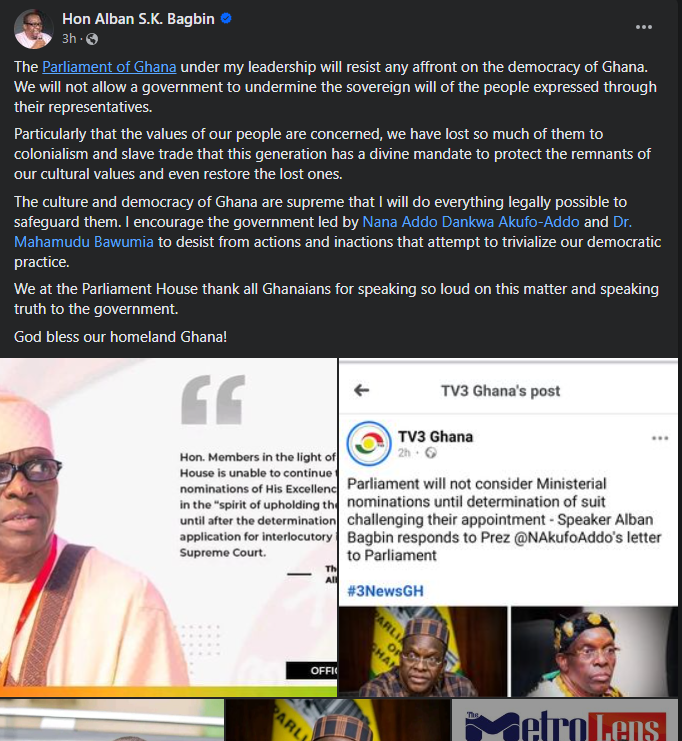
    Speaker of Parliament, Alban Bagbin, has reaffirmed his commitment to safeguard Ghana’s sovereignty and uphold its democratic principles amidst potential government interference.

    This firm stance follows a directive from President Akufo-Addo, dated March 18, 2024, instructing Parliament not to transmit the anti-LGBTQ bill for his approval.

    In a Facebook post, Speaker Bagbin unequivocally stated, “The Parliament of Ghana under my leadership will resist any attempts to undermine our democracy.

    “We will not allow the government to disregard the will of the people as expressed through their elected representatives.”

    The Speaker emphasized the significance of protecting Ghana’s cultural heritage and reclaiming elements lost due to historical injustices.

    “Our cultural values have suffered greatly due to colonialism and the slave trade. It is our duty as the current generation to protect what remains and even restore what has been lost,” Bagbin emphasized.

    He urged President Akufo-Addo and Vice President Dr. Mahamudu Bawumia to avoid trivializing the democratic process.

    “I urge the government, led by Nana Addo Dankwa Akufo-Addo and Dr Mahamudu Bawumia, to avoid actions that undermine our democratic traditions,” Bagbin cautioned.

    He urged President Akufo-Addo and Vice President Dr. Mahamudu Bawumia to avoid trivializing the democratic process.

    The Speaker concluded by expressing gratitude to Ghanaians for their steadfast commitment to upholding truth and democracy.

  • Lawsuit in court does not affect approval of Akufo-Addo’s appointees – A-G to Speaker

    Lawsuit in court does not affect approval of Akufo-Addo’s appointees – A-G to Speaker

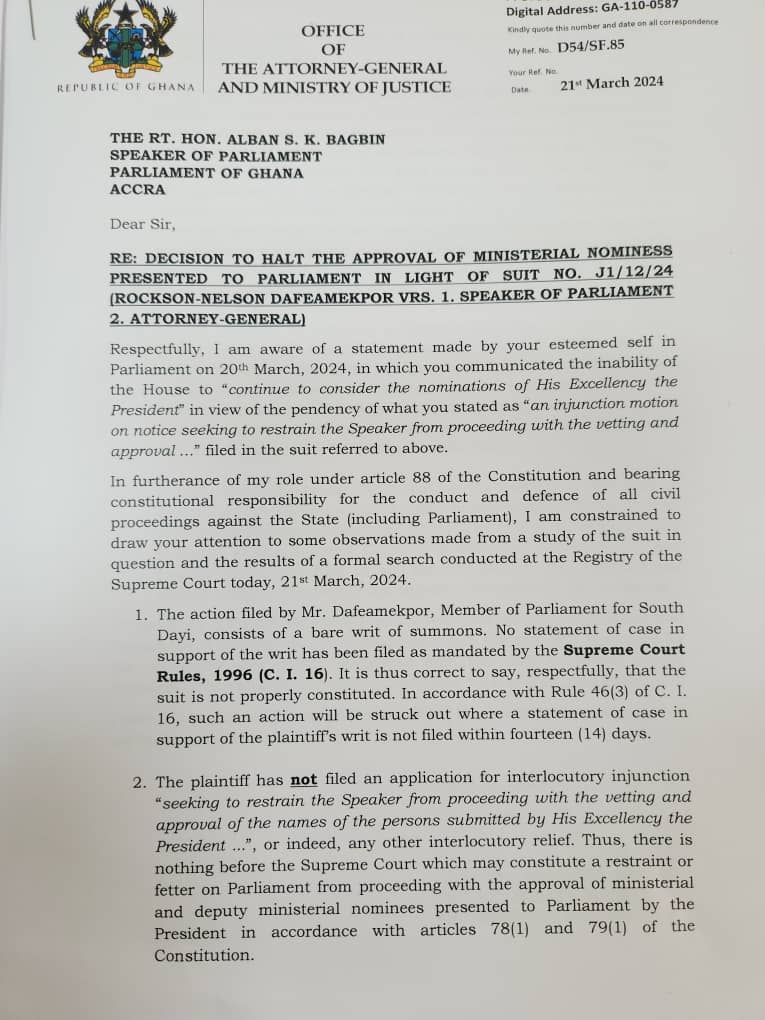
    The Attorney-General and Minister for Justice, Godfred Yeboah Dame, has stated that Parliament is not restricted from proceeding with the approval processes for ministerial and deputy ministerial nominees.

    This comes in response to the Speaker of Parliament, Alban Bagbin’s decision to suspend consideration for Ministers and Deputy Ministers of State nominated by President Akufo-Addo.

    Bagbin’s decision was based on an interlocutory injunction filed at the Supreme Court by the Member of Parliament (MP) for South Dayi, Rockson-Nelson Etse K. Dafeamekpor.

    Bagbin explained that this injunction prevented Parliament from approving new ministers nominated by President Akufo-Addo.

    The suspension followed a directive from the presidency, instructing Parliament to halt the transmission of the Bill on Human Sexual Rights and Family Values for President Akufo-Addo’s assent, citing an ongoing interlocutory application at the Supreme Court.

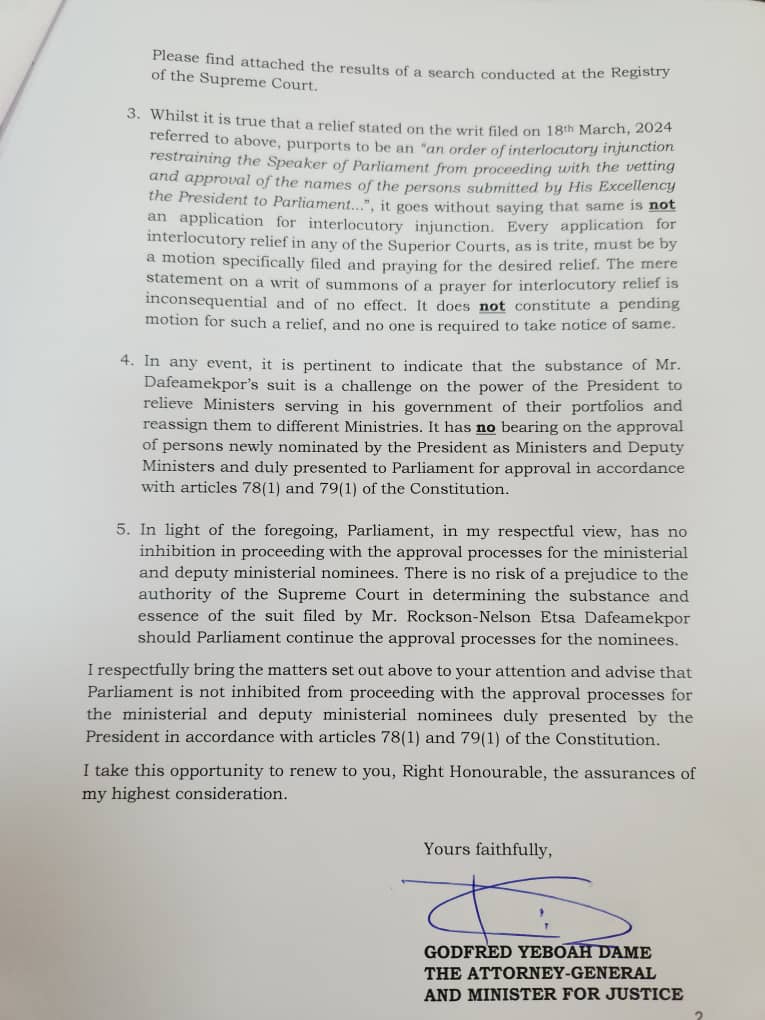
    In response, Godfred Yeboah Dame argued that there was no risk of prejudice to the authority of the Supreme Court if Parliament continued with the approval processes for the nominees.

    He explained that the substance of Dafeamekpor’s suit was a challenge to the President’s power to relieve ministers and reassign them to different ministries, which did not impact the approval process for new nominees as outlined in the constitution.

    “The substance of Mr Dafeamekpor’s suit is a challenge on the power of the President to relieve Ministers serving in his government of their portfolios and reassign them to different Ministries.”

    “It has no bearing on the approval of persons newly nominated by the President as Ministers and Deputy Ministers and duly presented to Parliament for approval in accordance with articles 78(1) and 79 (1) of the constitution.”

  • “We are not afraid of anyone” – Video of heavily armed men in Kumasi causes stir

    “We are not afraid of anyone” – Video of heavily armed men in Kumasi causes stir

    A video making rounds on social media has highlighted the grave danger citizens in Kumasi, Ashanti Region, are exposed to.

    A group consisting of three men has been sighted in a video expressing their intent to terminate any individual who opposes their actions.

    These men held machetes and other weapons while making their threats verbally and through gestures.

    “We have arrived. We fear no one except God,” one of the three armed men said, as the others gestured, slicing throats.

    Netizens who have chanced on this video have called on the Police Service to identify the group and ensure they face the law lest they have the blood of Ghanaians on their hands.

  • We will shock Akufo-Addo with an impeachment proceedings soon – Minority

    We will shock Akufo-Addo with an impeachment proceedings soon – Minority

    President Akufo-Addo may face impeachment proceedings in parliament soon, as announced by the Minority MPs.

    The Minority Leader, Dr Cassiel Ato Forson, stated their intention to undertake this action due to their belief that the president’s actions have led the country into difficulties.

    They allege that President Akufo-Addo’s approach to governing contradicts the constitution of Ghana, prompting them to initiate impeachment processes.

    “The NDC Minority is ready to protect the sanctity of the constitution of the republic of Ghana, and we stand with the Speaker of Parliament in this. Let the president of Ghana and his government be aware that where this country is going is strange under his watch and the NDC Minority will not countenance it.

    “But I want to urge that it is obvious that His Excellency the president has breached the constitution and we’ll advise ourselves. In the coming days, he’s going to be surprised that we’ll begin impeachment proceedings against the president,” he stated.

    The NDC MPs responded to the president’s decision not to assent to the recently-passed anti-gay bill, formally known as the Promotion of Human Sexual Rights and Family Values Bill.

    They expressed concerns about a letter from the Executive Secretary to the President, Nana Bediatuo Asante, which instructed Parliament to stop transmitting the bill to the president for action, citing ongoing legal issues.

    In what appears to be a retaliatory move, Speaker of Parliament Alban Bagbin suspended the approval of some ministerial and deputy ministerial nominees following a lawsuit against the appointment by South Dayi MP, Rockson Nelson-Dafeamekpor.

    He stated that this decision was made to uphold the rule of law and that the House would reconsider the appointments after the Supreme Court rules on an application for interlocutory injunction.

  • Teacher unions oppose Labour Law revision call by FWSC amid strike

    Teacher unions oppose Labour Law revision call by FWSC amid strike

    The teacher unions currently on strike have expressed disappointment with the Fair Wages and Salaries Commission (FWSC) for calling for a revision of the labor law.

    The unions, including the Coalition of Concerned Teachers (CCT), Ghana National Association of Teachers (GNAT), and the National Association of Graduate Teachers (NAGRAT), began a nationwide strike on Wednesday, March 20, citing the government’s failure to address their poor conditions of service.

    Key grievances highlighted by the unions include the continuous withholding of teachers’ salaries, changes in timetables without union consultation, and delays in distributing laptops to teachers.

    The FWSC has urged the unions to reconsider their decision, with CEO Benjamin Arthur expressing surprise at the strike. He noted that negotiations to address the teachers’ demands were ongoing and suggested that the unions’ decision to strike was inappropriate, considering the ongoing negotiations.

    He subsequently called on stakeholders “to begin vigorously to change our labour laws.”

    Herbert Ako Forson, the General Secretary of the CCT, criticized the FWSC CEO’s remarks during an interview with Umaru Sanda Amadu on Citi FM’s Eyewitness News on Wednesday.

    “I am very disappointed in Eng Arthur for calling on stakeholders to start the process of revising the labour laws. He is very aware, and he knows what happened in Koforidua… Negotiations began in Koforidua; it didn’t end well. You waited, then yesterday at 8 pm, we received letters from Fair Wages inviting us to come and continue with the negotiation. Is that fair? He is calling for fairness. He also mentioned that three people would go and sign. This is an affront to us; this is disrespect to us. I mean, it is not fair, you don’t have to use such statements,” he stated.

    Angel Carbonu, the President of NAGRAT, also expressed disappointment in the FWSC CEO’s comments, stating “I am very disappointed in the choice of words of the [FWSC CEO].”

  • Call off strike – NLC to teacher unions

    Call off strike – NLC to teacher unions

    The National Labour Commission (NLC) has issued a directive ordering the three striking teacher unions to immediately cease their strike action.

    The Commission stated that the declaration of the strike was non-compliant with the law, citing Section 159 of Act 651.

    In a press statement released on Thursday, March 21, the NLC, chaired by Justice Kwabena Asuman-Adu, invoked Section 133 (1) of the Labour Act, 2003 (Act 651) to enforce its decision.

    “In pursuance of Section 133 (1) of the Labour Act, 2003 (Act 651) orders GNAT, NAGRAT, and CCT to rescind the decision of the declaration of a nationwide strike made on Wednesday 20 March 2024 and announced on various media networks in the country.”

    The Ghana National Association of Teachers (GNAT), the National Association of Graduate Teachers (NAGRAT), and the Coalition of Concerned Teachers (CCT) collectively declared a nationwide strike on Wednesday, March 20, 2024.

    They cited government negligence in addressing their conditions of service as the primary reason for their action.

    Among their grievances were the continued withholding of teachers’ salaries, unilateral changes to timetables without union consultation, and delays in the distribution of laptops to teachers.

  • Ghanaians are ‘sadder’ than they were in 2023 – Report

    Ghanaians are ‘sadder’ than they were in 2023 – Report

    According to the 2024 World Happiness Report, Ghanaians are reportedly feeling sadder than they were in 2023.

    Ghana is ranked 120th for happiness among countries worldwide, scoring 4,289 points.

    In contrast, in 2023, Ghana was ranked 111th on the United Nations (UN) list of the happiest 150 countries in the world. Unfortunately, Ghana did not make it into the top 10 happiest countries in Africa once again.

    Similarly, all 54 African countries failed to make it to the top fifty countries in the World Happiness Report.

    In 2023, Mauritius, the happiest African country, ranked 52nd globally. This year, Libya is deemed the most joyful country in Africa, with a happiness score of 5.866, ranking 66th globally.

    This year’s World Happiness Report has once again ranked Finland as the happiest country for the third consecutive year. The United States went down to 23rd place from 15th place. Afghanistan, Lebanon and Lesotho were at the end of the list.

    John Helliwell, a Canadian economist and founding editor of the World Happiness Report, said on Wednesday that younger people are not as happy as they were 10 or 12 years ago.

    “The older people have not experienced many changes, and their life circumstances have stayed the same. This is causing them anxiety. ”

    The report looks at information from 140 countries and uses six important factors to understand how people feel about their lives: how much money they have, how much support they get from others, how long they are expected to live, how much freedom they have, how generous they are, and how they feel about corruption.

    The 2024 report was the first to rank people by age, showing big differences between young and old in some countries.

  • Resume vetting of ministerial appointees, there is no injunction application at Supreme Court – A-G directs Parliament

    Resume vetting of ministerial appointees, there is no injunction application at Supreme Court – A-G directs Parliament

    The Attorney-General and Minister for Justice, Godfred Yeboah Dame, has denied receiving any interlocutory injunction related to the case brought by Member of Parliament for South Dayi, Rockson-Nelson Etse K. Dafeamekpor over the ministerial appointment made by President Akufo-Addo.

    Mr. Dame, in a letter addressed to the Speaker on Thursday, March 21, clarified that he has not been served with any legal documents regarding such court proceedings.

    “The plaintiff has not filed an application for interlocutory injunction seeking to restrain the Speaker from proceeding with the vetting and approval of the names of the persons submitted by His Excellency the President…”, or indeed, any other interlocutory relief.”

    “Thus, there is nothing before the Supreme Court which may constitute a restraint or fetter on Parliament from proceeding with the approval of ministerial and deputy ministerial nominees presented to Parliament by the President in accordance with articles 78(1) and 79(1) of the Constitution.”

    Parliament suspended the vetting process for the nomination of Ministers and Deputy Ministers of State by President Akufo-Addo on Wednesday, March 20, following a reported interlocutory injunction filed at the Supreme Court by MP Rockson-Nelson Dafeamekpor.

    In his closing remarks to the House before adjourning on Wednesday, Speaker of Parliament Alban Bagbin cited the lawsuit as the reason for suspending the vetting process, as it prevented Parliament from proceeding with the nominations.

    “Hon Members, I also bring to your attention, the receipt of a process from the Courts titled Rockson-Nelson Etse K. Dafeamekpor vrs. The Speaker of Parliament and the Attorney-General ( Suit no. J1/12/2024) which process was served on the 19th of March 2024 and an injunction motion on notice seeking to restrain the Speaker from proceeding with the vetting and approval of the names of the persons submitted by His Excellency the President until the provisions of the constitution are satisfied.”

    Now, the Attorney General has noted that since no injunction has been filed, Parliament ought to proceed with the vetting and approval of Ministers and Deputy Ministers appointed by the President.

    “The substance of Mr Dafeamekpor’s suit is a challenge on the power of the President to relieve Ministers serving in his government of their portfolios and reassign them to different Ministries.”

    “It has no bearing on the approval of persons newly nominated by the President as Ministers and Deputy Ministers and duly presented to Parliament for approval in accordance with articles 78(1) and 79 (1) of the constitution.”

  • BREAKING: Impeachment process against Akufo-Addo to begin

    BREAKING: Impeachment process against Akufo-Addo to begin

    President Akufo-Addo may face impeachment proceedings in parliament soon, as announced by the Minority MPs.

    The Minority Leader, Dr Cassiel Ato Forson, stated their intention to undertake this action due to their belief that the president’s actions have led the country into difficulties.

    They allege that President Akufo-Addo’s approach to governing contradicts the constitution of Ghana, prompting them to initiate impeachment processes.

    “The NDC Minority is ready to protect the sanctity of the constitution of the republic of Ghana, and we stand with the Speaker of Parliament in this. Let the president of Ghana and his government be aware that where this country is going is strange under his watch and the NDC Minority will not countenance it.

    “But I want to urge that it is obvious that His Excellency the president has breached the constitution and we’ll advise ourselves. In the coming days, he’s going to be surprised that we’ll begin impeachment proceedings against the president,” he stated.

    The NDC MPs responded to the president’s decision not to assent to the recently-passed anti-gay bill, formally known as the Promotion of Human Sexual Rights and Family Values Bill.

    They expressed concerns about a letter from the Executive Secretary to the President, Nana Bediatuo Asante, which instructed Parliament to stop transmitting the bill to the president for action, citing ongoing legal issues.

    In what appears to be a retaliatory move, Speaker of Parliament Alban Bagbin suspended the approval of some ministerial and deputy ministerial nominees following a lawsuit against the appointment by South Dayi MP, Rockson Nelson-Dafeamekpor.

    He stated that this decision was made to uphold the rule of law and that the House would reconsider the appointments after the Supreme Court rules on an application for interlocutory injunction.

  • Respect the constitution by assenting to anti-LGBTQ bill – Catholic Bishops Conference tells Akufo-Addo

    Respect the constitution by assenting to anti-LGBTQ bill – Catholic Bishops Conference tells Akufo-Addo

    Reverend Father Clement Kwasi Adjei, the Secretary General of the Catholic Bishops Conference, has urged President Akufo-Addo to reconsider his decision not to assent to the recently passed Human Sexual Rights and Family Values Bill, popularly known as the anti-LGBTQ+ bill.

    Speaking on JoyNews’ PM Express, the cleric argued that the presidency’s letter to Parliament, instructing them not to transmit the bill to the presidency, contravenes the established constitutional process wherein all laws enacted by Parliament must be forwarded to the presidency for consideration.

    He reminded the president of his vow to uphold the constitution of the country.

    Despite this, the presidency’s letter addressed to Parliament on Tuesday cited the acknowledgment of two pending applications for an order of interlocutory injunction before the Supreme Court as the basis for the decision.

    Expressing dismay over recent events, Reverend Father Adjei called for a dialogue between religious bodies and the president to address the apparent deviation from constitutional norms.

    “The constitution is the supreme law of Ghana and any law that is inconsistent with any provision in the constitution, for the sake of its inconsistency is null and void.

    “So how can you write a letter telling parliament not to transmit the bill to the presidency? The constitution must be seen as the supreme law of the country. And in that constitution, any law enacted by parliament must be sent to the presidency,” he told host Aisha Ibrahim.

    Tensions among MPs have escalated since Parliament received the letter from the presidency. Parliament suspended the consideration of the nomination of Ministers and Deputy Ministers of State by President Akufo-Addo, which appears to be a retaliatory move by the Speaker over the president’s position on the controversial bill.

    Speaker of Parliament, Alban Bagbin, stated that the legislature could not approve the President’s appointees due to an interlocutory injunction filed at the Supreme Court by MP for South Dayi, Rockson-Nelson Dafeamekpor.

  • Former Bantama MP, Okyem Aboagye, laid to rest

    Former Bantama MP, Okyem Aboagye, laid to rest

    Former Member of Parliament (MP) for Bantama Constituency in the Ashanti Region, Daniel Okyem Aboagye, was laid to rest over the weekend.

    Daniel Okyem Aboagye, who owned 2M Transport Services and other businesses died on Saturday, September 23, 2023 after a short illness.

    Over the weekend, per a video shared on X platform, the funeral ceremony which took place at Atwima-Dwehenso in the Ashanti Region saw hundreds of individuals wailing. Clad in black and red, they cried their hearts out as they recalled Daniel Okyem Aboagye’s time on earth.

    The businessman after spending one term in Parliament became a spokesperson for the New Patriotic Party (MP) on economic issues. In Parliament, he was a member of the Economic Committee.

  • It is undemocratic to prevent leadership from speaking before adjourning sitting – Majority leader tells Bagbin

    It is undemocratic to prevent leadership from speaking before adjourning sitting – Majority leader tells Bagbin

    Majority Leader, Alexander Afenyo-Markin, has voiced his dissatisfaction with Speaker Alban Bagbin’s decision to adjourn the house sine die on March 20, 2024, without allowing room for commentary from both sides.

    Afenyo-Markin underscored the fundamental principles of democracy, expressing his disappointment at the Speaker’s abrupt action.

    This came after the Speaker disclosed his own opinions regarding a letter received from the Presidency via the Clerk of Parliament directing the House to stop sending the recent anti-LGBT+ Bill to the president for his assent.

    “It is very disappointing that after Mr. Speaker had made known his own views about the letter sent from the presidency through the clerk of parliament, he adjourned the house sine die without giving room for the leadership of the house to even comment; this we find very strange, but this is a democracy,” he said.

    Speaker of Parliament, Alban Bagbin, suspended the consideration of ministerial nominees, citing a case challenging a part of the process.

    Bagbin explained that an interlocutory injunction filed at the Supreme Court by Member of Parliament for South Dayi, Rockson-Nelson Etse K. Dafeamekpor, restricted him from proceeding with the process.

    However, the genesis of this parliamentary deadlock is a cease-and-desist letter issued by the Presidency to the Parliament of Ghana.

    The letter cautioned Parliament to restrain from transmitting the recent anti-LGBT+ Bill for President Akufo-Addo’s assent, citing two yet-to-be-determined interlocutory applications at the Supreme Court.

    In response to these legal entanglements, Speaker Bagbin emphasized Parliament’s commitment to upholding the rule of law and reiterated the institution’s inability to proceed with the approval of new ministers given similar circumstances.

  • Greenhouse Gas Emission: Walk the talk by providing funds to developing nations – Energy Minister to developed countries

    Greenhouse Gas Emission: Walk the talk by providing funds to developing nations – Energy Minister to developed countries

    Energy Minister Dr. Matthew Opoku Prempeh has called on developed countries to fulfill their funding pledges to help developing nations achieve their net-zero targets.

    He emphasized the importance of these countries redeeming their commitments to support developing nations in reducing greenhouse gas emissions.

    Dr. Prempeh made this appeal during a panel session on Funding Resilience: Post-COP28 Path Forward for Loss and Damage.

    He highlighted the challenge faced by developing countries in meeting the Sustainable Development Goal 7 target of providing clean and affordable energy by 2030, citing the significant financial commitment required.

    Many developing countries, he noted, still heavily rely on wood fuel for their energy needs. He cautioned that if not controlled, this reliance could undermine the progress made in combating climate change in recent years, particularly in the context of the global energy transition.

    “It is not about the number of funds we establish, but it is about the commitment to these funds in terms of supporting developing countries, less emitters,” he said

    As the Member of Parliament for Manyia South, the Minister emphasized that energy is crucial for economic growth and must be sufficient to support Africa’s socio-economic development and improve the well-being of its citizens.

    “Our right to develop our energy resources for the benefit of our people must therefore be respected and with no interference,” he said.

    “We recognize that the electricity, cooking and transportation sectors are key areas in reducing greenhouse (GHG) gas emissions. Consequently, steps must be taken to transition these sectors towards a net-zero emissions future” he added

    He continued, “To attain this, we must transition to the production and utilization of clean energy and the implementation of measures to mitigate any emissions that occur in the process. This will ensure that we contribute our quota to the reduction of global GHG emissions, and more importantly, achieve decarbonization, energy access, security, and efficiency.”

    The Ministry of Energy is actively promoting clean cooking, aiming to achieve 50% access to LPG as a fuel source and distribute 3 million improved efficient charcoal stoves by 2030.

    “We have rolled out a number of programs, notably, the LPG for Development, Cylinder Recirculation Model, and Carbon-for-Free Stoves program for the biomass sector,” he remarked.

    The lawmaker from Manhyia South reiterated Ghana’s commitment to partnering with investors to explore new energy frontiers, supporting sustainable, environmentally sound, and gender-responsive economic growth.

  • “We neither confirm nor deny investigations” – UK Customs on alleged £15 million seizure from Ghana

    “We neither confirm nor deny investigations” – UK Customs on alleged £15 million seizure from Ghana

    The rumour of the seizure of £15 million from a politically exposed person in Ghana by law enforcement agencies in the United Kingdom (UK) has been circulating on social media for more than a week.

    “Dark rumours circulating in Accra of a politically exposed Ghanaian bigshot knocking heads with British airport customs about millions of sterling being moved through the UK without the necessary paperwork. Frantic digging for trusted sources all over,” the originator of the claim, Bright Simons, stated on X.

    Following Bright Simon’s post, some media houses including Citinewsroom, Daily Guide Network, Asaase Radio, Modern Ghana and Peace FM published reports indicating that the UK authorities have denied seizing any monies.

    “Following checks by Citi FM from both agencies to verify the claims, the two agencies stated that they have no record of any such amount seized from any Ghanaian,” the March 18, 2024, Citinews report said.

    Fact-Check Ghana sent the UK’s His Majesty’s Revenue & Customs (HMRC) office questions on Monday, March 18, 2024.

    In response to Fact-Check Ghana on Wednesday, March 20, 2024, the HMRC says it could not confirm or deny investigations into the matter.

    “We neither confirm nor deny investigations,” the email response signed by Ashleigh Prince, Press Officer – Law Enforcement, HMRC stated.

    Security expert Colonel Festus Aboagye (Retired) says the response from the HMRC could mean that “given the sensitivity of the case, the authorities may not want to jeopardize the investigations, if any.”
    “It can also mean they don’t have enough information or evidence to definitely confirm or refute the claim or statement. It indicates ambiguity or lack of clarity to acknowledge the uncertainty rather than making a definitive statement without proper evidence,” he said.

    The United Kingdom’s His Majesty’s Revenue and Customs (HMRC) is the tax authority of the U.K. government. The agency is responsible for collecting taxes, paying child benefits, regulating tax and customs laws, and enforcing the payment of minimum wage by employers. According to the HMRC, it has a range of powers and specialist investigation capabilities that enable it to uncover even the most complex and determined frauds and bring the perpetrators to account. The agency also tackles international tax crime and money laundering.

    Source: Fact Check Ghana

  • Bawumia supporter takes on Bagbin for suspending vetting of Akufo-Addo’s appointees

    Bawumia supporter takes on Bagbin for suspending vetting of Akufo-Addo’s appointees

    A member of NPP flagbearer Mahamudu Bawumia’s 2024 campaign team, Krobea Kwabena Asante, has criticized Speaker of Parliament Alban Bagbin’s decision to suspend the consideration of President Akufo-Addo’s ministerial nominees.

    Mr Asante questioned the legal basis for the suspension, arguing that there is no direct link between the court case mentioned by the speaker and the vetting and approval process of ministerial and deputy ministerial nominees.

    He described Bagbin’s decision as flawed and based on erroneous reasoning.

    “Assuming Dafeamekpor Etse Rockson Nelson even has a case which I think does not have, how does a suit in relation to reassigned ministers got to do with vetting ministerial and deputy ministerial nominees? What is the linkage?

    “Bagbin should come again. He and his hatchet guy got the plan wrong,” he said in a Facebook post on March 20, 2024.

    On March 20, 2024, Speaker of Parliament Alban Bagbin suspended the consideration of ministerial nominees, citing a case challenging part of the process. The suspension was prompted by an interlocutory injunction filed at the Supreme Court by Member of Parliament for South Dayi, Rockson-Nelson Etse K. Dafeamekpor, which restricted him from proceeding with the process.

    However, the underlying cause of this parliamentary deadlock can be traced back to a cease-and-desist letter issued by the presidency to Parliament. The letter advised Parliament to refrain from transmitting the recent Anti-LGBT+ Bill for President Akufo-Addo’s assent, citing two pending interlocutory applications at the Supreme Court.

    In response to these legal complexities, Speaker Bagbin reiterated Parliament’s commitment to upholding the rule of law and explained the institution’s decision to suspend the approval of new ministers due to similar circumstances.

  • Man jailed 30 years for abetment in murder of former UG law lecturer, Prof. Benneh

    Man jailed 30 years for abetment in murder of former UG law lecturer, Prof. Benneh

    Ebenezer Kwayisi, a mason apprentice, has been sentenced to 30 years in prison by an Accra High Court for his role in the murder of former University of Ghana law lecturer Professor Emmanuel Yaw Benneh.

    The 28-year-old pleaded guilty to abetment to manslaughter and was sentenced by Justice Mary Maame Ekue Yanzuh on Wednesday, March 20.

    Initially charged with abetment to commit murder, Kwayisi opted to plead guilty to abetment to manslaughter under Section 239(2) of the Criminal and Other Offenses (Procedure) Act, 1960 (Act 30), following an agreement with the prosecution. This decision resulted in a reduced sentence compared to murder.

    After the agreement, the prosecution recommended a 30-year sentence, which the court accepted. Kwayisi will serve his sentence with hard labor.

    The tragic murder of Prof. Benneh occurred in September 2020 at his residence, where he was found dead in a pool of blood with multiple assault marks on his body.

    The prime suspect, James Nana Womba, a cleaner at Prof. Benneh’s residence, confessed to the crime but died in police custody on October 17, 2020. Womba implicated Kwayisi as an accomplice in the murder.

    Investigations revealed that Womba had planned the murder in August 2020 and enlisted Kwayisi’s help two weeks before the crime.

    Kwayisi admitted to conspiring with Womba to kill Prof. Benneh in his house on September 10, 2020.

  • FULL TEXT: Speaker Bagbin’s take on Akufo-Addo’s position on anti-LGBTQ+ bill

    FULL TEXT: Speaker Bagbin’s take on Akufo-Addo’s position on anti-LGBTQ+ bill

    On March 20, 2024, Speaker of Parliament, Alban Bagbin, issued a formal statement addressing the growing rift between the Executive and Legislative branches of government.

    The statement primarily focused on a letter from the Executive Secretary to the President, directing the Clerk of Parliament to halt the transmission of the anti-LGBT+ Bill to the presidency.

    The letter cited legal challenges before the Supreme Court regarding the constitutionality of the Bill and advice from the Attorney-General to refrain from presidential action on the Bill.

    Speaker Bagbin strongly disagreed with the letter, considering it contemptuous of Parliament. In his four-part statement, he discussed the legality of lawmaking, emphasizing its nuances, and addressed the issue of injunctions, particularly those seeking to obstruct Parliament from fulfilling its fundamental responsibilities.

    Read the full statement below:

    FORMAL STATEMENT BY THE RT. HON. SPEAKER ON THE REFUSAL OF THE PRESIDENT TO ACCEPT THE TRANSMISSION OF THE HUMAN SEXUAL RIGHTS AND FAMILY VALUES BILL, 2021.

    INTRODUCTION

    1. Honorable Members, I address you today amid circumstances that profoundly challenge the core principles of our constitutional democracy.

    2. At the outset, I must express my profound regret concerning the conduct displayed by the Presidency following Parliament’s successful unanimous passage of the Human Sexual Values Bill, 2021.

    3. The behaviour exhibited by the Presidency in refusing to accept the transmission of this bill not only deviates from established democratic practices but also undermines the spirit of cooperative governance and mutual respect for the arms of government.

    4. This is a principle that forms the cornerstone of our political system. Such actions, if left unchecked, risk setting dangerous precedents that threaten the integrity and functionality of our democratic institutions.

    5. To situate this statement in the appropriate context, it is crucial to acknowledge a disturbing pattern emerging from the Executive branch, which points to a concerning disregard for the foundational principles enshrined in the Constitution, 1992.

    6. This pattern has once again been made evident in the President’s recent refusal to accept the transmission of the Human Sexual Values Bill. The recent move is not isolated. It forms part of a series of actions that undermine the legislative process. As you may recall, I addressed this House on 22nd December, 2023 in a formal statement. The purpose of that statement was to draw your attention to the President’s refusal to assent to three critical bills that had been duly passed via a Private Members’ Bill.

    7. During that address, I underscored the troubling nature of the President’s justifications for his actions, or rather, the lack thereof, particularly highlighting that his failure to assent on grounds of alleged unconstitutionality, paradoxically stood in violation of the very constitution he invoked.

    8. Despite the gravity of this matter, it is disheartening to note that there has been no progress in rectifying the situation concerning those significant pieces of legislation. They remain in a state of limbo, unacted upon following the President’s communication, which lacked substantial legal justification.

    9. This ongoing scenario poses a grave threat to our legislative authority and, by extension, the democratic principles we strive to uphold. The implications of such executive actions extend far beyond the immediate legislative items at hand. They erode the foundational checks and balances that our forebearers painstakingly established to ensure a vibrant and functioning democracy.

    10. When important legislative work, the product of rigorous debate and consensus-building within this House, is disregarded without just cause, it not only disrespects the legislative branch but also disenfranchises the citizens we are sworn to serve. This blatant disregard for legislative processes and constitutional mandates risks setting a perilous precedent that could weaken the very fabric of our governance structure.

    11. Honorable Members, on 19 March, 2024, my attention was drawn to a letter issued by the Executive Secretary to the President, Nana Asante Bediatuo, addressed to the Clerk to Parliament which letter is clearly in my opinion contemptuous of Parliament.

    12. The letter outlined that the Clerk ought to “cease and desist” from attempting to transmit the Human Sexual Values Bill, 2021 to the President for necessary action in accordance with the Constitution. In the said letter, the Executive Secretary indicated that the Office of the President was aware of two pending applications for an order of interlocutory injunction seeking to restrain the Clerk and Parliament from transmitting the Bill to the President.

    13. It further indicated that the Hon. Attorney General had on 18 March 2024 informed the President that he had received the two applications and had advised the President not to take any step in relation to the Bill until matters raised by the suit are determined by the Supreme Court. As a result, the Presidency conveyed to the Clerk that it was unable to accept transmission of the Bill.

    14. My attention has also been drawn to the 18 March, 2024, letter from the Hon. Attorney General being referred to by the Executive Secretary to the President, Nana Asante Bediatuo above. In the said letter, I note that the Attorney- General used the phrase “…I will respectfully advice that a decision to assent to the Bill be made after the determination of the application for interlocutory injunction…”.and not an advice to the President not to receive the Bill from Parliament.

    15. It is therefore interesting that in view of this clear and unambiguous advice from the Attorney- General to the President, the Presidency has taken this decision.

    16. In the face of these developments, it is important for us to reflect upon the manner in which these events have unfolded. On the 28th of February, 2024, this august House took a decisive step in passing the Bill, a move that was the culmination of rigorous debate, thoughtful deliberation, and the collective will of the representatives of our people.

    17. Following this, the Bill underwent the customary process of winnowing which is an important procedure designed to ensure that all amendments and changes proposed during the legislative process were accurately incorporated.

    18. After the successful completion of the winnowing process, the Clerk to Parliament, fulfilling his duties as the procedural intermediary between the legislative and executive branches, endeavoured to send the Bill to the Presidency in accordance with section 5 of the Interpretation Act, 2009 (Act 792).

    19. This action, steeped in established parliamentary practice and procedure, signifies the final step in the legislative process, enabling the President to review and, if in agreement, assent to the Bill, thereby enacting it into law in accordance with Article 106(7) of the Constitution.

    20. The refusal to accept the Bill for transmission did not occur in isolation but persisted across multiple attempts, with the third attempt to transmit the Bill forming the basis of the letter I have previously alluded to.

    21. Notably, the Presidency’s refusal to accept the transmission of the Bill has not been formally communicated to this House through the established channels of official correspondence from the President to this House. The absence of an official communication to the House regarding the Presidency’s refusal is troubling, yet it does not diminish the gravity of the situation nor our responsibility to address it.

    22. The contents of the letter, albeit not formally presented to us, have come to our attention, compelling us to confront the issues it raises. It is a matter of great concern that the executive branch has chosen to disregard the established constitutional structures that facilitate constructive dialogue and collaboration between the branches of government.

    23. In light of these circumstances, it is incumbent on this House to stand united in its response to this affront to the legislative authority vested in it by the Constitution and the people we serve. We must articulate a collective voice that unequivocally condemns the disregard for our constitutional structures and reaffirms our commitment to upholding the rule of law. This situation calls for a principled stance, emphasizing the importance of adherence to the procedures and norms that govern our democratic institutions.

    LEGAL FRAMEWORK FOR ACTIONS TO BE TAKEN AFTER A BILL HAS BEEN PASSED

    24. Article 106(7) of the Constitution provides:
    Where a bill passed by Parliament is presented to the President for assent he shall signify, within seven days after the presentation to the Speaker that he assents to the bill or that he refuses to assent to the bill, unless the bill has been referred by the President to the Council of State under Article 90 of this Constitution.

    Section 5 of the Interpretation Act, 2009 (Act 792) provides:
    (3) As soon as a Bill is passed by Parliament, the text of the Bill as passed shall be sent by the Clerk of Parliament to the Government Printer, who shall print four copies of the Bill on vellum paper or on paper of enduring quality and send the copies to the Clerk.

    (4) On receiving the copies, the Clerk shall carefully compare them with the text of the Bill as passed and if the Clerk finds the copies to be correct, shall sign on each copy a statement in the form set out in the First Schedule, and shall send the copies so authenticated to the President for the assent.

    (5) Where the Bill was passed in accordance with the relevant provisions of article 108 of the Constitution, the Clerk shall, before causing the copies to be presented to the President, submit them to the Speaker who, if satisfied that the Bill was passed in accordance with the Constitution shall sign on each copy a certificate in the Form set out in the First Schedule.

    (6) After the assent, the Clerk shall enter on the copies the appropriate number of the Act.

    25. The combined effect of these provisions read together is that after a bill is passed by Parliament, it undergoes a meticulous process designed to ensure its conformity with the nation’s legal and constitutional standards before it can become law. Initially, the passed bill is sent to the Government Printer, who is responsible for printing four copies on high-quality, durable paper.

    26. Following this, the Clerk to Parliament conducts a thorough verification of these printed copies against the original bill to ensure their accuracy. Upon successful verification, the Clerk authenticates each copy by signing a statement that certifies their correctness. In Article 108 matters, an additional step is introduced. The authenticated copies are presented to the Speaker of Parliament, who must certify that the bill was indeed passed in accordance with Article 108 by signing a certificate on each copy.

    27. The final and perhaps most critical phase of the process involves the presentation of the bill to the President for assent. Pursuant to Article 106(7) of the Constitution, the President has a seven-day period to either assent to the bill, signifying its enactment into law, or refuse to assent, which may involve referring the bill to the Council of State for further advice. Upon the President’s assent, the Clerk of Parliament assigns an official Act number to the bill, formally marking its transition into law.

    INJUNCTION APPLICATIONS AND ITS EFFECT ON THE LAW-MAKING PROCESS

    28. Honorable Members, this House has been duly served with two injunction applications in respect of the Bill. The applications titled Richard Sky v The Parliament of Ghana & the Attorney-General, and Dr. Amanda Odoi v The Speaker of Parliament & the Attorney General.

    29. Honorable Members would recall that on 19 July 2023, the Supreme Court considered and dismissed an application for interlocutory injunction that sought to injunct the proceedings of Parliament in respect of the Bill. The Court in that case, Dr. Amanda Odoi v the Speaker of Parliament & the Attorney General (J1/13/2023) reasoned that the application failed to meet the threshold for the grant of interlocutory injunctions.

    30. The Executive Secretary to the President, noted in his letter that “it is settled law that during the pendency of an interlocutory injunction application, the status quo ante ought to be preserved, and no action be taken that would result in prejudicing the injunctive relief sought and undermining the authority of the court”.

    31. Honorable Members, an injunction is a judicial order that restrains a person from beginning or continuing an action that threatens or breaches the legal right of another, or that compels a person to carry out a certain act, such as correcting a wrongful state of affairs. In the context of our law, interlocutory injunctions serve as an important tool for maintaining the status quo pending the resolution of a legal dispute, ensuring that the parties involved do not engage in actions that could cause irreparable harm or fundamentally alter the situation before the court has an opportunity to decide the case.

    32. The only grounds for the grant of an injunction in law is “… in all cases in which it appears to the Court to be just and convenient to do so…”.

    33. The Executive Secretary to the President’s reference to the preservation of the status quo ante during the pendency of an interlocutory injunction application is a highlight of the fundamental principle intended to prevent any action that might prejudice the injunctive relief sought or undermine the authority of the court. However, the interpretation of this principle has given rise to two distinct schools of thought regarding the effect of an application for an injunction.

    34. The two schools of thought concerning the effect of an application for an injunction during its pendency, particularly in the absence of a clear authoritative position from the Supreme Court, offer contrasting views on how parties should conduct themselves. Each perspective carries significant implications for the administration of justice, the rights of the parties involved, and the overall legal process.

    35. One school argues that the mere application for an injunction should act as a de facto ‘injunction,’ compelling parties to refrain from taking any further actions that could affect the matter at hand. This view is predicated on the notion that, to ensure the administration of justice is not interfered with, parties should err on the side of caution and halt any actions that could potentially influence the outcome of the dispute or render the court’s eventual decision ineffectual.

    36. Conversely, the other school of thought maintains that an application for an injunction does not, in itself, constitute a court order. Accordingly, parties are not legally obligated to cease their activities merely because an injunction application has been filed. Proponents of this perspective argue that until the court issues a formal injunction, the parties retain their rights to proceed as they see fit, provided they do not engage in unlawful conduct or actions explicitly prohibited by law.

    37. In the context of Ghana’s constitutional and legislative framework, the debate over the effect of an application for an injunction, particularly when such an application targets legislative processes, warrants careful consideration. Given the clear constitutional and statutory provisions outlining the President’s obligations and powers after a bill has been passed by Parliament, adopting the stance that an application for an injunction acts as a de facto injunction presents several challenges and potential pitfalls.

    38. The Constitution, specifically in Article 106(7) and 106(8), along with relevant statutory provisions, delineates a precise procedure for the passage, transmission, and assent or refusal of bills. These procedures are designed to ensure a smooth operation of the legislative process, providing checks and balances between the branches of government while safeguarding against undue delay or obstruction in the enactment of laws.

    39. Adopting the de facto injunction perspective, wherein the mere filing of an injunction application is seen to necessitate a halt in the legislative process, runs the risk of unduly fettering the work of Parliament. Such a stance could enable parties to strategically file injunction applications, not necessarily on the strength of their legal position, but as a tactic to delay or complicate proceedings of this House. This approach risks transforming the legal system into a tool for political maneuvering rather than a mechanism for justice, effectively crippling Parliament’s ability to function and bringing legislative processes to a standstill.

    40. In considering the implications of applying for an injunction against the legislative process, particularly in relation to the transmission of a bill to the President for assent, the concept of irreparable harm must be examined. This concept, an important consideration for granting injunctions, requires that it is demonstrated to a sufficient degree that the harm which would occur in the absence of an injunction is both significant and incapable of being adequately remedied through damages. In the specific context of transmitting a bill for presidential assent, it’s imperative to understand that this step in the legislative process does not inherently lead to irreparable harm.

    41. The act of transmission merely represents the procedural progression of a bill within the structured framework established by the Constitution. It does not, in and of itself, guarantee the bill’s enactment into law, as the President is accorded the authority, as clearly outlined in the Constitution, to either assent to the bill or refuse it under Articles 106(7) and 106(8).

    42. Additionally, in the event that a bill is assented to by the President and becomes law, the Constitution provides a mechanism for judicial review. Articles 2(1) and 130 empower the Supreme Court to scrutinize the constitutionality of any Act of Parliament. Should the Court find that the law is unconstitutional, it possesses the authority to invalidate the Act. Given these considerations, it is evident that the transmission of a bill to the President for assent, does not result in irreparable harm that would justify the granting of an injunction much less the halting of parliamentary processes on account of the application for an injunction.

    43. Generally, the Supreme court has upheld the position of the law that the official acts by Organs of the State and Government Departments are presumed to be regularly performed unless there is strong evidence in rebuttal.

    44. Arising out of this, it is imperative to note that the Courts have been very reluctant in injuncting and placing impediments on arms of government and constitutional bodies from performing their constitutionally mandated duties.

    45. The Supreme Court has always resisted attempts to unfairly and unnecessarily place a clog on the work of this House through the use of injunction applications. In Welford Quarcoo v the Attorney General, the Supreme Court per Dr. Date-Bah JSC noted that: Where the relief sought relates, as here, to a public law matter, particular care must be taken not to halt action presumptively for the public good, unless there are very cogent reasons to do so, and provided also that any subsequent nullification of the impugned act or omission cannot restore the status quo. Given the reliefs that the plaintiff is seeking in the substantive suit in this case, it is clear that if he succeeds in securing the declarations he has claimed, the impugned provisions of the Local Government Act, 1993 (Act 462) will be declared void and any actions made in pursuance of them nullified.

    Accordingly, no irreparable damage will have been caused the plaintiff during the period between the issue of the writ and the date of judgment.

    46. In Dr. Amanda Odoi v the Speaker of Parliament & the Attorney General (J1/13/2023) the court refused to grant the injunction application because no prima facie case had been made to restrain the work of Parliament and further the applicant was unable to prove irreparable damage should the work of Parliament continue in respect of the Bill.

    47. The Court’s cautious approach in dealing with injunction applications against parliamentary processes further underscores the importance of not hastily impeding the legislative functions of Parliament. The precedents as I have just set out, shows that courts have been slow to grant injunctions that would halt the work of Parliament, recognizing the profound implications such actions could have on the legislative autonomy and the balance of powers within the government.

    48. This judicial reticence is rooted in a recognition of the fundamental principles underpinning a democratic society, where each branch of government, operates within its own sphere of influence, with specific duties and powers that are designed to complement each other, ensuring a robust system of checks and balances.

    49. The courts, in exercising their discretion in matters of injunctions against Parliament, demonstrate a careful consideration of these principles, opting to intervene only when absolutely necessary and when the legal thresholds for such intervention are unequivocally met. The implications of allowing injunction applications to unduly influence or halt the legislative process are profound. It undermines the constitutionally outlined procedures and also poses a significant threat to the functioning of democracy. Such a perspective could stultify not only the work of Parliament but also that of other arms of government or statutory agencies, based merely on the potential for an injunction. This approach, therefore, is legally unfounded given the clear constitutional mandates and potentially dangerous, as it could serve to undermine the principles of separation of powers and the efficient functioning of government.

    CONCLUDING REFLECTIONS

    50. Honourable Members, several critical points emerge that underscore the importance of adhering to constitutional and legal frameworks within our democratic governance. Firstly, the President’s refusal to accept the transmission of the bill is, by all accounts, not supported by the constitutional and statutory provisions that guide our legislative process. The Constitution clearly delineates the steps to be followed once a bill has been passed by Parliament, mandating the transmission of the bill to the President for assent or rejection.

    51. Therefore, the refusal to even accept the bill for consideration falls outside the legal bounds established by our constitutional framework. It is incumbent upon the President to accept the bill and take the necessary action within the prescribed constitutional limits, whether that action is assent, refusal, or referral to the Council of State for advice.

    52. It is instructive to note that the Executive, has in the past proceeded with its actions, although, there has been pending before the court, injunction application against the State.

    53. Secondly, there must be a steadfast rejection of any attempts to unduly fetter or hinder the work of Parliament. The Parliament of Ghana operates as a crucial part of our democracy, embodying the will and voice of the people. Any efforts to obstruct its work disrespects this fundamental institution and threatens the principles of governance by consent and representation.

    54. Thirdly, it is imperative to remain vigilant against setting dangerous precedents that could potentially undermine the foundation of our democracy. The rejection of a bill’s transmission without constitutional basis introduces a precarious deviation from established democratic practices and norms. Such actions, if left unchallenged, may embolden future attempts to circumvent the legislative process, thereby weakening the integrity and efficacy of our democratic institutions.

    55. Lastly, in alignment with our constitutional mandates and the principles of good governance, it is essential for the President to adhere to the lawful course of action by accepting the transmission of the bill. Upon receipt, the President has the constitutionally provided options to assent to the bill, refuse it, or seek further consultation, as deemed necessary.

    56. As we move forward, it is the collective responsibility of all branches of government, and indeed all citizens, to uphold the constitution and ensure that our democratic practices are not only preserved but strengthened.

    57. The current impasse presents an opportunity for reflection and reaffirmation of our commitment to the principles of democracy, rule of law, and the unequivocal respect for the legislative process that forms the bedrock of our nation’s governance.

    58. I reiterate that the refusal to even accept the bill for consideration falls outside the legal bounds established by our constitutional framework. It is incumbent upon the President to accept the bill and take the necessary action within the prescribed constitutional limits, whether that action is assent, refusal, or referral to the Council of State for advice.

    59. Article 106(7) says
    “Where a bill passed by Parliament is presented to the President for assent, he shall signify within seven days after the presentation, to the Speaker that he assets to the bill or that he refuses to assent to bill, unless the bill has been referred by the President to the Council of State under article 90 of this Constitution”

    60. The Parliament of Ghana will comply with the existing legal framework and reject the attempts by the Executive Secretary of the President, through his contemptuous letter, to instruct the Clerk to Parliament, an Officer of Parliament whose position is recognizably under the Constitution. We shall not cease and desist!

    61. Be that as it may, Hon Members, I also bring to your attention, the receipt of a process from the Courts titled Rockson-Nelson Etse K. Dafeamekpor vrs. The Speaker of Parliament and the Attorney -General ( Suit no. J1/12/2024) which process was served on the 19th of March 2024 and an injunction motion on notice seeking to restrain the Speaker from proceeding with the vetting and approval of the names of the persons submitted by His Excellency the President until the provisions of the constitution are satisfied.

    62. Hon. Members in the light of this process, the House is unable to continue to consider the nominations of His Excellency the President in the “spirit of upholding the rule of law “ until after the determination of the application for interlocutory injunction by the Supreme Court.

    Hon. Members, I thank you for your attention.