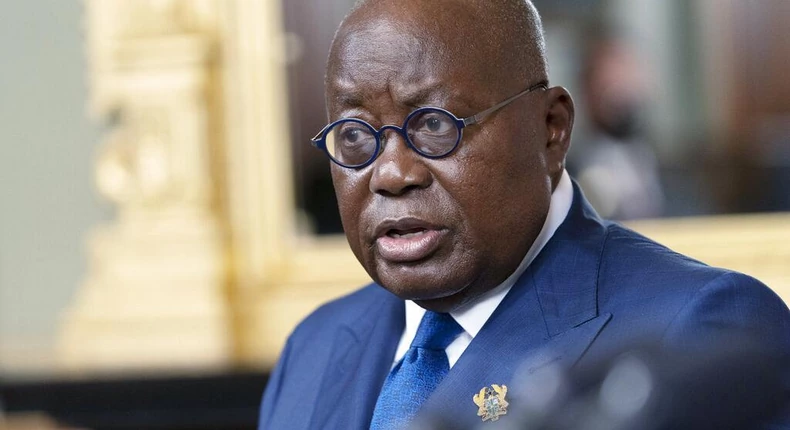
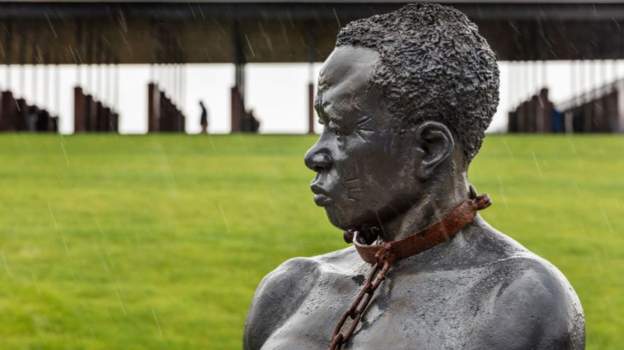
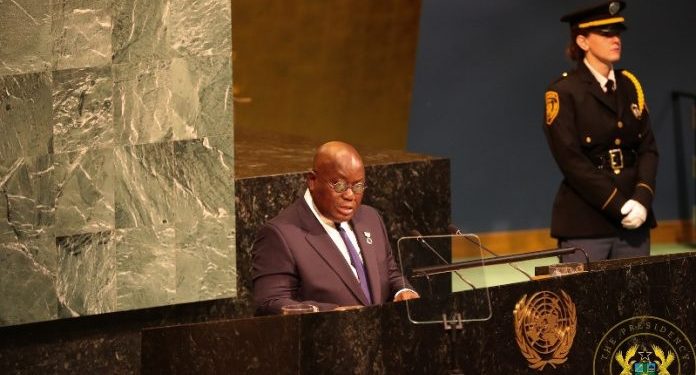
Speaking at the United Nations General Assembly’s 78th session, His Excellency urged European countries to make amends for the harm caused to Africa by this tragic historical episode.
Akufo Addo expressed his dissatisfaction with the international community’s persistent unwillingness to acknowledge and address the severe consequences and atrocities of the slave trade, emphasising that such delicate issues should no longer be ignored.
President Akufo-Addo emphasised that although the slave trade was a state-sanctioned and intentional activity with long-lasting economic implications for the nations that organised it, the current generation cannot be held accountable for it. Nevertheless, he argued that it is high time the subject of reparations is brought to the forefront of international discussions.
He argued that making reparations would be a significant acknowledgement of the severe injustices done to Africans, even though he understood that no amount of money could fully make up for the horrors endured by them during the slave trade.
“Reparations must be paid for the slave trade. No amount of money will ever make up for the horrors, but it would make the point that evil was perpetrated, that millions of productive Africans were snatched from the embrace of our continent, and put to work in the Americas and the Caribbean without compensation for their labor”
In addition, President Akufo-Addo noted that because slaves were viewed as commodities, owners of slaves received compensation for the loss of their “property” when slavery was outlawed.
The African Union (AU) has given Ghana permission to host a world conference on reparations in November in Accra, he declared, arguing that this historical precedent highlights the necessity of addressing the issue of reparations head-on.
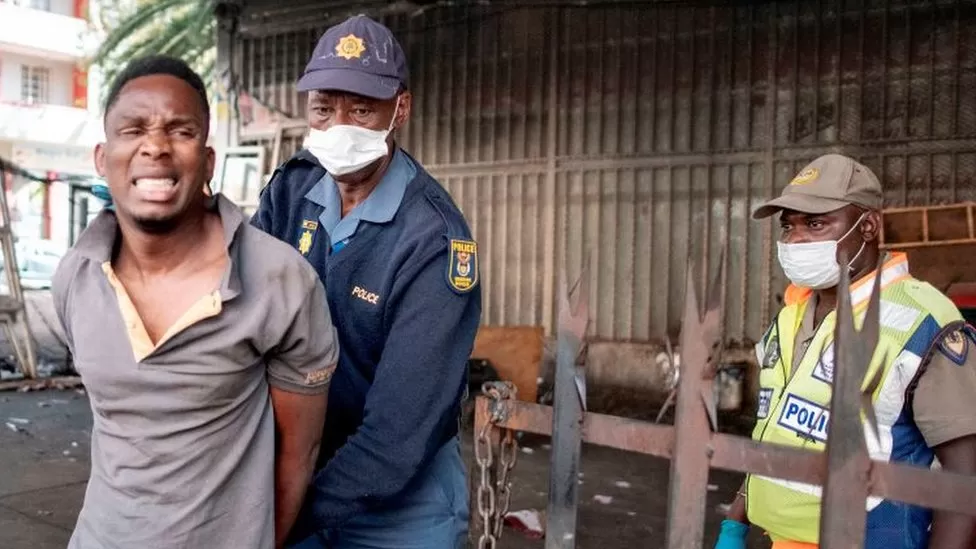
South Africa had very strict rules which led to over 400,000 people getting arrested. These arrests were for things like not wearing masks, drinking alcohol, and breaking curfew.
People who admitted they did something wrong and paid money as a punishment will no longer have any official records of that wrongdoing.
This text means that the approval of the National Council of Provinces and the signature of President Cyril Ramaphosa are required for it to become law. However, it is highly likely that it will become law.
The bill to make changes to the legal system received widespread political backing during discussions in parliament.
The African Christian Democratic Party (ACDP), which was in favor of the bill, pointed out how having a criminal record made it hard for some people to get jobs.
ACDP MP Steven Swart expressed his hope that we will not have any more unreasonable rules that were made without involvement or supervision from Parliament.
In April 2021, the police minister, Bheki Cele, stated that 411,309 individuals were taken into custody for breaking the rules during the lockdown.
It’s not known how many of the people who were arrested were eventually found guilty.
But, some MPs did not vote for the bill to become a law.
The EFF, a left-wing political party, liked some parts of the bill but couldn’t support the entire bill.
EFF MP Veronica Mente said that during the pandemic, the regulations from the Disaster Management Act led to prosecutions and persecutions. This showed how the judiciary system could be used to severely restrict people’s rights.
“May the law never be used for bad intentions like what happened during the Covid-19 pandemic. ”
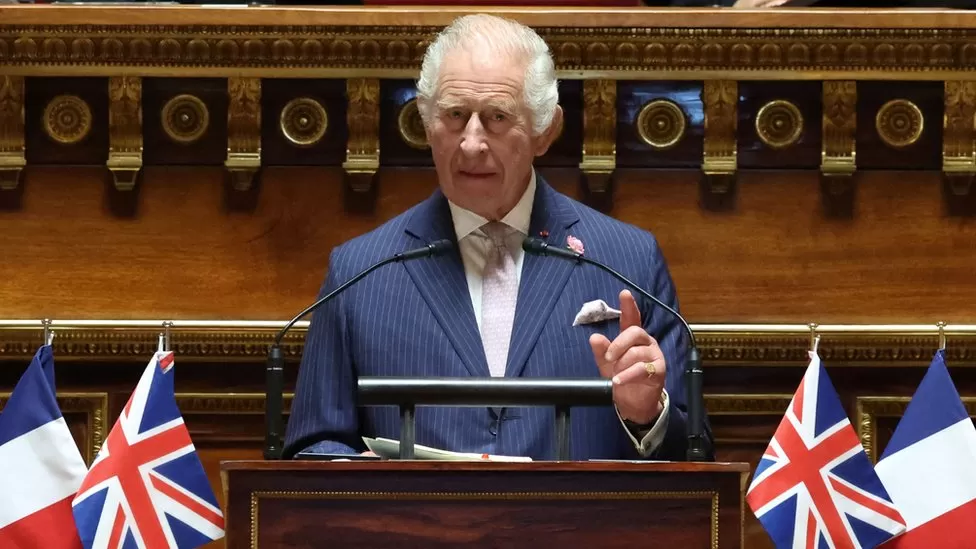
The speech talked about the serious problem of climate change and had parts in both French and English.
People were waiting to see if the King would respond to Prime Minister Rishi Sunak’s decision about achieving net zero.
However, the speech carefully chosen words to prevent any indirect criticism.
The King said that while the problem our planet is facing is big and serious, it is encouraging to see that our governments, people, and private companies are taking action.
Kings and queens listen to their advisors, so when they give a speech, they are expected to stay neutral on political issues.
However, it was definitely uncomfortable timing to have the prime minister suddenly change his stance on achieving net zero emissions at the same time as a state visit that prioritized environmental protection.
So it is possible that people will be watching closely for any disagreement on climate change between the government and the royal family. In his speech, the King expressed his desire to strengthen and maintain the good relationship between France and Britain. He also wanted this relationship to focus on preserving the environment and supporting lasting development.
The King, who glanced around the fancy meeting room and appeared touched by the long clapping, mentioned how Britain and France came together during war as an inspiration for working together in current battles.
In addition to climate change, he mentioned the conflict in Ukraine as a fight for democracy and freedom because of the unexpected aggression happening on our continent.
The King said in French that we are united and determined for Ukraine to succeed and for our cherished freedoms to win.
The King mentioned that his mother, who has passed away, really loved France. He talked about the strong friendship between France and our country.
The speech was serious and didn’t have many jokes, but people liked it, especially because the King used a lot of French.
Malcolm Massey, a French language expert from the Babbel app, said that the King’s French pronunciation was good and he had a decent accent. In a rainy Paris, he will later go to another famous place called Notre Dame. He will see how they are fixing the cathedral after it was badly damaged in a fire.
There was a meeting with famous sports players like Didier Drogba from Chelsea football team. Queen Camilla started a prize for literature between England and France.
At a gathering in the French national library, she informed the attendees that she had been a student in Paris 60 years ago.
On the last day of the three-day trip, the King and Queen will be going to see environmental projects in Bordeaux.
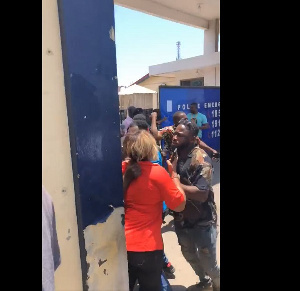
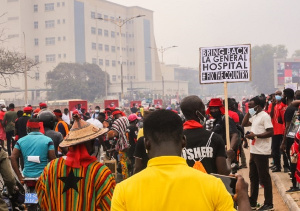
A Pan-Africanist who actively participated in the #OccupyJulorbiHouse demonstration found himself in police custody while in the midst of granting a live interview on national television.
This individual, who chose to be identified solely as ‘Safani,’ was in the midst of conducting an interview with the media at the 37 Lorry Station in Accra when a group of police officers suddenly disrupted the interview, detaining him without providing any formal explanation for their actions.
The arrest was captured on video and swiftly circulated across various social media platforms. Following his apprehension, Safani was placed on a bus alongside other protestors who had been earlier apprehended.
These events transpired against the backdrop of the #OccupyJulorbiHouse protest, which had been organized by Democracy Hub but faced a significant setback due to the series of arrests.
These incidents unfolded after the protestors decided not to comply with a police injunction issued merely one day before the scheduled demonstration.
Democracy Hub emphasised that they had not been officially served with the court order, which led to their decision to proceed with their peaceful march.
The arrested protestors have since been transported to the Greater Accra Region Police Headquarters near Tudu, further intensifying the ongoing developments surrounding the protest.
If the two powerful countries make an agreement, it would be a big change in the area.
In a rare interview with Fox News, Mohammed bin Salman emphasized that the Palestinian issue is still a very important part of talks mediated by the US.
During negotiations, the Wall Street Journal reported that Israeli and US officials were developing a plan that may allow Riyadh to openly enrich uranium.
Enriched uranium can be used to create fuel for nuclear reactors, but it can also be used for making nuclear weapons.
The office of Israeli Prime Minister Benjamin Netanyahu has not yet responded publicly to the article, even though Netanyahu has previously warned about the dangers of countries in the Middle East acquiring nuclear weapons at the same time.
The Fox News interview was shown soon after Mr. Netanyahu and US President Joe Biden met during the UN General Assembly in New York.
They also said it’s possible that Israel and Saudi Arabia may become friends and start talking to each other officially for the first time. The US is a very good friend of both countries.
A statement from Israel said the meeting in New York was mainly about finding ways to make a peace agreement between Israel and Saudi Arabia. This agreement could help bring an end to the conflict between Arab countries and Israel.
Israel’s Foreign Minister, Eli Cohen, said that a basic agreement could be ready by early next year. Mr Cohen said that it is possible to close the gaps. He mentioned this to Israel’s Army Radio. It will require some time. But things are getting better.
The Biden administration wants to finish the ratification process in the US Congress within that time. Many people in the Democratic Party, including the president, are concerned about Saudi Arabia’s human rights history. This would be a major accomplishment in the country’s foreign relations before the upcoming US presidential election.
Saudi Arabia, like many other Arab nations, has chosen not to acknowledge or acknowledge the existence of Israel because they want to show support and stand together with the Palestinians.
But in recent months, the United States has been working towards achieving a significant development that would continue the progress made through the Abraham Accords. These accords, facilitated by the Trump administration, resulted in Israel and the United Arab Emirates as well as Bahrain signing agreements to normalize their relations in 2020.
Saudi Arabia wants to improve its relationship with Israel. In return, they are asking the United States for help with their military, assistance in starting a civilian nuclear program, and for Israel to make important compromises for the Palestinians.
The Palestinian issue is really important to us. We have to figure out how to solve this part: Crown Prince Mohammed, who is the real leader of Saudi Arabia, told a reporter from Fox News named Bret Baier in English.
He said: “Our plan for negotiations has been good so far. ”
Earlier this month, leaders of the Palestinian Authority discussed their demands for a potential agreement involving the US, Saudi Arabia, and Israel during a meeting with Saudi officials in Riyadh. The BBC found out that these involved getting a lot of money and being able to have more power over land in the West Bank, which is currently under occupation.
When asked about working with Mr. Netanyahu’s strong government, Prince Mohammed said that if they can make progress and reach an agreement that satisfies the needs of Palestinians and brings peace to the region, they will collaborate with whoever is in power.
Many people in Israel’s current government disagree with the idea of the two-state solution that is supported by countries around the world to solve the conflict between Israel and Palestine. This means that there will be a separate country called Palestine, which will be next to Israel in the West Bank and Gaza Strip. The main city of Palestine will be in East Jerusalem.
Before the prime minister’s discussions in New York, 11 politicians from his own right-wing Likud party stated together that they would prevent any efforts to provide land to the Palestinians in return for peace with Saudi Arabia.
Israeli politicians are worried about the issues brought up in The Wall Street Journal report.
“Turning Saudi Arabia into a nuclear power with a right-wing government’s support is extremely dangerous and crazy,” Tali Gottlieb, a member of parliament from the Likud party, said on X platform, previously known as Twitter.
The US newspaper reported that Mr. Netanyahu asked important nuclear and security experts in Israel to work together with American negotiators on a plan for the United States to manage the process of enriching uranium in Saudi Arabia. Unnamed officials provided this information. They promised that protections would be added, and the plan still needs to be approved by President Biden.
The topic of Saudi Arabia’s nuclear plans was mentioned during Prince Mohammed’s interview on Fox News.
The Saudi leader expressed worry about any country, including Iran, having a nuclear weapon.
He repeated a point that he had made before, that if Iran gets a nuclear bomb, Saudi Arabia would have to get one too to maintain security and balance of power.
The prince said that it’s not a good idea for any country to have a nuclear weapon. He said that if a country uses a nuclear weapon, it means they are fighting against all other countries.
The 18-year-old student, who is studying at the University of Witwatersrand, was reported as not being present by his roommate on Tuesday.
The police said that the people who took him away then asked his family for about $1,500 (£1,200) to let him go.
The group got caught after one of the criminals tried to take out the ransom money from a cash machine in Johannesburg.
He showed the police where the victim was kept – the officers found him tied up and not awake.
The people who are believed to be guilty have been connected to at least 85 incidents where members of the LGBTQ community were singled out and asked for money in return for their safety.
In simple terms, South Africa has a very fair constitution that supports the rights of gay people. It is the only African country where same-sex marriage is legal. However, many gay and lesbian individuals still experience unkindness and unfair treatment.
A tragic incident unfolded in Pusiga, located within the Upper East Region, where a harrowing attack resulted in the loss of nine lives.
As reported by Citi News, the assailants fired on buses heading to Bawku from Cinkaasi in neighbouring Togo at the Gbewaa College of Education police barrier.
In a brazen display of violence, the attackers opened fire on the buses, leading to this devastating loss of life.
In response to this dire situation, security agencies have promptly mobilized to assess and address the unfolding crisis.
Currently, the identities of the victims have yet to be disclosed by the Police, leaving their families and the community in anguish and uncertainty.
The reason behind this shocking attack is still unknown, which heightens the suspense surrounding it.
Notably, this tragedy occurs against the backdrop of heightened tension within the Upper East Region, marked by several clashes among ethnic groups in recent months.
In the aftermath of the assault, the injured individuals have been swiftly transported to a nearby hospital to receive vital medical treatment, while the deceased have been respectfully moved to a morgue.
Within the expansive landscape of financial services, the enduring tale of the ‘missing middle’ has continued to afflict economies globally. Ghana, renowned for its dynamic economy and thriving entrepreneurial zeal, has not remained untouched by this predicament. Nevertheless, amidst this persistent gap, a distinctive solution has arisen in the shape of Savings and Loans companies (S&Ls). These entities are now providing a ray of hope to businesses that have found themselves ensnared in this particular quandary.
Chasm in the Financial Ecosystem
Traditional financial systems have often presented a binary perspective: universal banks cater to large corporations and formal high-net-worth individuals, while microfinance institutions reach out to grassroots communities and informal markets. This dichotomy, while effective in their respective spheres, has left SMEs – often the lifeblood of economies – struggling to secure adequate financial resources for growth and sustenance.
SMEs constitute over 90% of businesses in Ghana, making significant contributions to employment and forming a substantial portion of the Gross Domestic Product (GDP).
Globally, SMEs generate more than 50% of jobs and account for around 35% of GDP in many emerging markets. These enterprises are pivotal for job creation, economic diversification and fostering innovation. Furthermore, they serve as a conduit for integrating marginalised groups such as women and youth into the economic mainstream. However, their potential impact remains hamstrung due to their limited access to credit and other financial services.
Savings and Loans Companies: An Innovative Response
Amid this economic conundrum, Savings and Loans companies (S&Ls) have emerged as a potent solution, designed explicitly to address the glaring gap between formal banking institutions and microfinance entities. These companies represent a hybrid model that incorporates the strengths of both formal and informal financial systems.
While universal banks typically extend substantial, long-term loans, S&Ls have recognised the potency of smaller, short-term advances. Borrowing from the practices of individual savings collectors prevalent in West Africa, S&Ls have crafted a unique approach that emphasises immediacy, accessibility and personalisation. This amalgamation of practices has paved the way for S&Ls to provide SMEs with tailored, swift and readily accessible financial solutions.
Empowering the Backbone of the Economy
The impact of S&Ls on Ghana’s economic fabric has been transformative. These institutions address a critical void by providing specialised financial services tailored to the distinctive requirements of SMEs. S&Ls serve as a bridge that empowers local businesses, granting them the tools to seize growth opportunities, navigate challenges and contribute more effectively to the nation’s economic trajectory.
It’s essential to highlight that World Bank data underline the criticality of SMEs. In many low-income countries, these enterprises account for more than 70 percent of employment. By fostering the SME sector, S&Ls not only stimulate job creation but also bolster the economy’s resilience and sustainability.
Moreover, S&Ls exhibit a profound understanding of the nuanced risks entailed by SMEs. This awareness equips them to make well-informed lending decisions that strike a balance between financial inclusivity and sustainable growth.
Navigating Challenges and Pioneering Innovation
The journey of S&Ls hasn’t been without obstacles. Positioned between the capital levels of microfinance institutions and commercial banks, S&Ls are tasked with a delicate balancing act. While their strategic placement enables them to serve both the lower and upper echelons of the missing middle, it also curtails their ability to extend larger loans.
The rapid progression of technology has been instrumental in shaping their evolution. Through digital transformation, S&Ls have optimised operational efficiency, expanded their reach and enhanced customer engagement. Mobile banking, digital lending platforms and inventive credit assessment methodologies have fortified their ability to serve both urban and remote SMEs.
GHASALC: A Collective Voice for Progress
The Ghana Association of Savings and Loans Companies (GHASALC) stands as a testament to the unifying force of S&Ls. Serving as the umbrella organisation for all Savings and Loans Companies, GHASALC brings all the S&Ls together under a shared platform – fostering networking, advocacy, policy engagement and financial literacy initiatives. GHASALC’s role in nurturing collaboration, sharing best practices and amplifying the collective impact of S&Ls cannot be overemphasised. It embodies the sector’s commitment to collective growth, development and shared learning.
Shaping the Future: Trends and Challenges
The S&L sector’s trajectory is marked by several defining trends. These include the rapid advancement of technology, fortification of governance frameworks, enhancement of risk management practices, and cultivation of collaborative partnerships. These trends are poised to shape the sector’s progression, ensuring its adaptability and capacity to navigate both opportunities and challenges.
In the context of Ghana’s economic landscape over the past five years, the sector has weathered transformative developments. These include a comprehensive sector clean-up, upheaval caused by the COVID-19 pandemic, repercussions of global geopolitics, dynamics of the national economy and the Domestic Debt Exchange Programme (DDEP). These events have not only underscored the sector’s resilience but also spotlighted the imperative of risk management, innovation and customer-centric strategies.
While developments such as the rapid digitisation of financial services have significantly improved accessibility, they have also brought forth challenges. Panic withdrawals, non-performing loans and implications of the Domestic Debt Exchange Programme have all presented hurdles to overcome. However, the sector’s positive trajectory is poised to prevail, propelled by its capacity for innovation, adaptability and the pursuit of inclusive growth.
Addressing Challenges and Charting the Course Ahead
The challenges are being met head-on. Constant engagement with regulators remains a cornerstone strategy. Market sensitisation and the enhancement of investor knowledge are pivotal; as informed investors are inherently better equipped to drive progress. Furthermore, S&Ls are fostering innovation and diversification beyond the confines of fixed income, transforming themselves from mere purveyors of financial services to innovative problem-solvers.
Collaboration, both within the sector and with organisations like the Ghana Microfinance Institutions Network (GHAMFIN), has been instrumental in addressing challenges and seeking solutions. The network’s engagement in advocacy, capacity building and information-sharing further amplify the sector’s voice and impact.
The Road Ahead: Potential and Aspirations
Looking ahead, the journey of S&Ls remains one of promise and potential. During Ghana’s evolving economy, S&Ls remain resolute in their mission – to empower SMEs, fuel economic growth and close the financial gap that has inhibited the missing middle. The trajectory of S&Ls – fortified by technological innovation, a commitment to financial literacy and the unity fostered by industry associations – is set to reshape Ghana’s economic canvas, one SME at a time.
The narrative of S&Ls in Ghana is a testament to the potency of innovative financial solutions in nurturing inclusive growth and steering sustainable development. As they continue to evolve, adapt and innovate, S&Ls emerge as a beacon of hope – redefining the role of financial institutions in fostering economic prosperity. The journey of S&Ls in Ghana underscores this future of opportunities and hope.
Minority Chief Whip, Governs Kwame Agbodza, has expressed sharp disapproval of the actions of the Electoral Commission (EC) and its Chair, Mrs Jean Adukwei Mensa. He addressed his concerns in response to a recent press conference held by the EC Chair.
Agbodza emphatically rejected what he perceived as an unjust strategy by the Commission to suppress the number of first-time voters. He particularly took issue with one of the justifications presented by EC Chair Madam Jean Adukwei Mensa during her press conference. He contended that her claim, which implied that the Commission’s actions were constrained by its approved work-plan and budget from Parliament, was unsubstantiated and feeble.
Agbodza vehemently challenged the validity of the EC boss’s assertions, specifically contesting her statement that the Commission lacked the budget to decentralize the registration process to the electoral area level. He firmly asserted that the approval of the EC’s budget for 2023 by Parliament did not involve any reductions that would justify the claimed limitations.
“Parliament, in considering the Electoral Commission’s budgetary estimates for 2023, its Medium Term Expenditure Framework (MTEF) from 2023-2026, and the Electoral Commission’s actual appropriation for 2023, did not take a pesewa out of the Commission’s requests,” he emphasised.
The budget figures presented by Agbodza paint a stark picture. “Indeed, both Appendix 4A (MDA Expenditure Allocation) of the 2023 Budget Statement and the Third Schedule of the Appropriations Act 2022 (Act 1090), as well as the EC’s own Programme-Based Budget Estimates contained in its MTEF, put the EC’s total budget for 2023 at GH₵386,047,606. Out of this figure, the EC budgeted a rounded figure of GH₵56,059,846 for registration of voters in 2023.”
Mr Agbodza stressed that Parliament approved a generous budget for the Electoral Commission, stating, “It is important to state that the Electoral Commission’s budgetary allocation for 2023 is far more than all the budgetary allocations of the Ministry of Information and its agencies, the National Development Planning Commission, the National Media Commission, the Ministry of Parliamentary Affairs, and the Right to Information Commission, put together.”
“There can be no justification on the part of an Electoral Commission that is hell-bent on disenfranchising voters by placing strictures and fetters on the inalienable rights of Ghanaians to register to vote in public elections and referenda, instead of implementing programmes to expand that right as it is enjoined by law to do”, the Adaklu MP stated.
Mr Agbodza had a stern warning to the EC and its Commissioners; “Jean Mensa will not be allowed to use Parliament as a convenient excuse for her lawless conduct, and as representatives of the people, we will soon be demanding accountability from her and the other Commissioners.”
Political parties and civil society organizations have criticized the EC’s voter registration exercise in its district offices across the country, claiming that the EC failed to justify its decision to limit the exercise to its district offices.
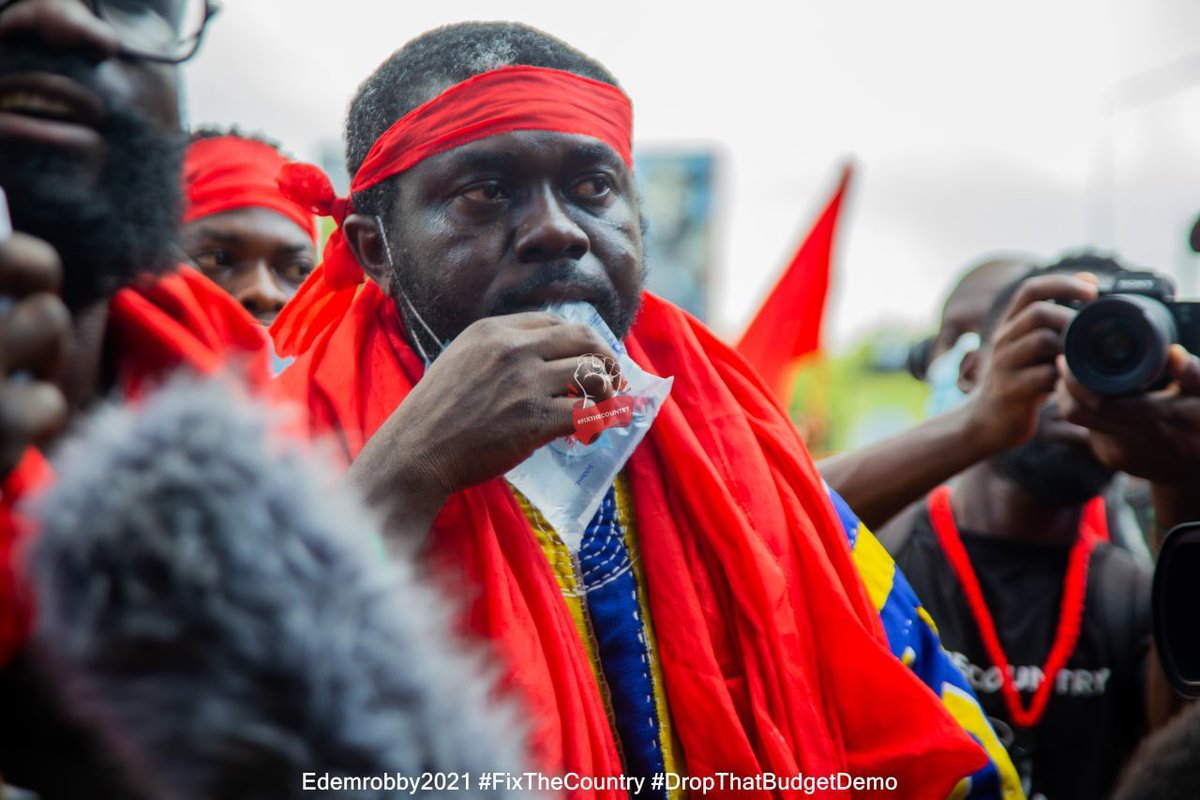
Broadcast journalist Bridget Otoo has leveled accusations against Ghana Police Service personnel, claiming that they subjected her and other protestors to brutality during the #OccupyJulorbiHouse anti-government demonstration, which witnessed significant public participation.
In an audio recording, which was made available during a Twitter discussion, Bridget Otoo strongly criticized the actions of the police officers stationed at the Accra Regional Command.
She alleged that these officers had engaged in acts of violence against peaceful demonstrators, even brandishing their firearms during the incident.
“You are corking your guns, you are corking your guns! Try it!” Bridget Otoo said.
The emotionally charged audio comes in the wake of a series of arrests of protestors who were prevented from peacefully demonstrating on September 21, 2023. The reports indicate that more than 350 protestors, including the organizers affiliated with the Democracy Hub group, are presently in police custody for contravening a police order linked to a court injunction that had been issued against the planned demonstration.
Consequently, on various social media platforms, a number of individuals have expressed their disapproval of the actions taken by the Police and the government in apprehending the protestors, asserting that these individuals were simply exercising their right to engage in a peaceful protest.
‘Try it’ – Bridget Otoo fumes as police ‘corks gun’ during #OccupyJulorbiHouse demo
Background
The protestors had initially informed the Ghana Police Service about their intention to hold a demonstration on Nkrumah Memorial Day. Their purpose was to urge the President and members of the Economic Management Team to address various issues under the banner of #FixTheCountry. These issues included concerns about economic mismanagement and alleged corruption within the government.
However, in response to the planned protest, the police took legal action by filing an application for an injunction to halt the demonstration. This legal move occurred on the eve of the scheduled event, effectively seeking to prevent it from taking place.
👨🏾🍳🇬🇭✊🏾: One of my colleague journalists who was a victim of the ‘Rambo’ style apprehension and manhandling action by the @GhPoliceService narrates her harrowing experience.
A viral video circulating online captures a notable act of solidarity from Ghanaian singer Cina Soul towards the arrested #OccupyJulorBi protestors who were demonstrating near the Jubilee House on Thursday, September 21, 2023.
In the video, Cina Soul is seen engaging with the family members and friends of the detained protestors at the Accra Regional police headquarters. Her presence and support stand out, as she is the only celebrity featured in the footage, showing empathy and concern for the arrested demonstrators.
This development unfolded after Democracy Hub, led by Oliver Barker-Vormawor, raised the alarm on social media about the arrest of the protestors, emphasizing that their constitutional rights had been stifled. Barker-Vormawor voiced his concern, alleging that the authorities had utilized the police force to suppress demonstrators, which he regarded as a breach of democratic principles.
“We don’t know where they are taking us. They have no right to arrest demonstrators in the country. This is not the democracy we signed up for. This is not a democracy.”
Background
The protestors had initially informed the Ghana Police Service about their intention to hold a demonstration on Nkrumah Memorial Day. Their purpose was to urge the President and members of the Economic Management Team to address various issues under the banner of #FixTheCountry. These issues included concerns about economic mismanagement and alleged corruption within the government.
However, in response to the planned protest, the police took legal action by filing an application for an injunction to halt the demonstration. This legal move occurred on the eve of the scheduled event, effectively seeking to prevent it from taking place.
👨🏾🍳🇬🇭🎶✊🏾: Currently, @Cina_Soul is the only Ghanaian music personality I’ve personally seen here at the Accra Regional Police Station. She’s engaged a number of the friends and family of some of the detained protestors at the entrance of the police station. She looks very… https://t.co/dQ6j1T8ycMpic.twitter.com/jWycgDBrn8
A student rode a bike for 4,000km (2,500 miles) through West Africa, even though he was arrested and had to endure extremely hot weather. He did all of this because he wanted to get into his dream university.
Mamadou Safayou Barry started his journey from Guinea to Egypt’s well-known Al-Azhar in May, in the hopes of being accepted.
The 25-year-old rode a bicycle for four months through countries that were greatly affected by Islamist militants and coups.
He said to the BBC that he was extremely pleased to have received a scholarship once he arrived in Cairo.
The man, who is married and has one child, said that even though he couldn’t afford the Islamic Studies course at Al-Azhar or the flights to Egypt, he decided to take a risk and travel through Mali, Burkina Faso, Togo, Benin, Niger, and Chad because he was inspired by the university’s good reputation.
Al-Azhar is a very important place for Sunni Muslims to learn about Islam. It is also one of the earliest, being established in the year AD670.
Mr Barry left his home to find out more about Islam, but he faced doubt and difficult situations in some of the countries he traveled through.
In Mali, Burkina Faso, and Niger, there are often attacks by terrorists on innocent people, and recent government takeovers have made the situation politically unstable.
“It is difficult to travel through these countries because they currently lack security,” he explained.
There are many problems in Mali and Burkina Faso, and the people there are very scared. In these places, people were looking at me like I am a bad man. “I saw lots of soldiers with their large weapons and vehicles,” Mr. Barry explained
He said that he was taken by the police three times without any valid reason – two times in Burkina Faso and one time in Togo.
However, Mr Barry’s luck changed when he got to Chad. A reporter talked to Mr. Barry and shared his story on the internet. This led kindhearted people to donate money for him to go on a trip to Egypt.
This means he didn’t ride his bicycle through Sudan because some areas there are currently in war.
He made it to Cairo on 5 September. His strong passion helped him get a chance to meet with the head of Islamic studies, Dr Nahla Elseidy. After talking to Mr. Elseidy gave him the opportunity to join Al-Azhar University’s Islamic Studies program. He also provided a full scholarship for Mr.
The dean posted on her social media accounts that the university wants to share its knowledge with students all over the world. This includes not only students from other countries studying in Egypt but also students studying outside of Egypt. Al-Azhar accepts students from every country, looks after them, and provides them with financial aid.
Mr Barry said he was “extremely happy” to have received the scholarship.
I was so happy, but I can’t explain to you how much. “I said thank you to God,” he explained.
Mr Barry said that he has forgotten about the difficult times during his expedition because he is now very happy to be able to call himself an al-Azhar scholar.
South Africa and the United States will try out a new HIV vaccine to help prevent the spread of the virus. They have started to sign up people to join the testing of this medicine in a controlled experiment.
The National Institutes of Health (NIH), a research organization in the United States, has found that.
The VIR-1388 vaccine helps the body’s T-cells, which are a part of the immune system. T-cells patrol and check other cells for issues.
The vaccine is designed to teach the immune system to make special cells called T-cells. These T-cells can identify HIV and tell the immune system to fight back and stop the virus from causing long-lasting infection.
The vaccine testing is financially supported by the NIH, the Bill and Melinda Gates Foundation, and the US company Vir Biotechnology.
The research will include 95 people who do not have HIV. They will be chosen from four places in South Africa and six places in the US.
The first findings from the vaccine study will be shared in late 2024. However, a few people will stay in the study for an additional three years.
In 2020, the NIH stopped testing a different HIV vaccine in South Africa because a review showed that it didn’t work to stop HIV from spreading.
Social media videos showed the sound of guns in the capital city of the territory.
Azerbaijan said that the reports are not true.
The two groups had discussions to discuss the inclusion of the enclave into Azerbaijan after Karabakh forces agreed to surrender after a day of intense fighting.
The day after the truce started, Armenian forces in the area said that Azerbaijan was breaking the agreement on the ceasefire by using different weapons.
They said that people could hear gunshots in the center of the main city of the region, called Khankendi, also known as Stepanakert by Armenians.
Videos showed people in the city running for safety and there was the sound of what seemed to be gunfire from small weapons in the background.
Neutral observers have not been able to go to the area since Azerbaijan imposed a strong blockade in December 2022.
Azerbaijan’s defense ministry quickly said that the news about fighting restarting is not true. They strongly disagree with this information.
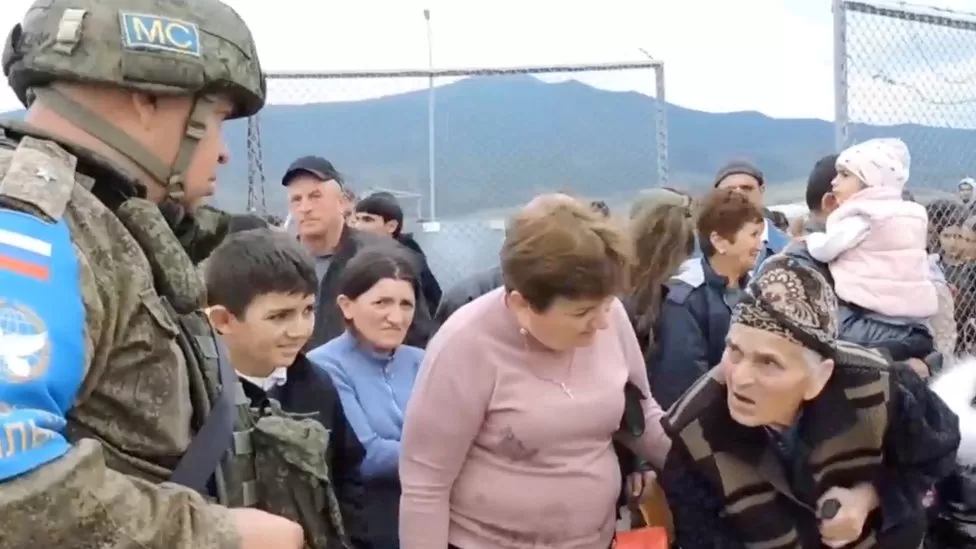
At the same time, Armenian and Azerbaijani representatives met in the town of Yevlakh, which is about 100km (60 miles) north of Khankendi, to talk about what will happen next in Nagorno-Karabakh.
Photographs on state media in Azerbaijan showed the two groups sitting together with members of Russia’s peacekeeping team.
After the ceasefire, Azerbaijan wants to gain full control over a breakaway region in the South Caucasus. Around 120,000 ethnic Armenians live there. Nagorno-Karabakh is known by the whole world as a part of Azerbaijan.
According to the agreement, the local Karabakh forces have to completely stop existing and also give up their weapons.
There is also a promise to Armenian forces leaving, even though their government says they don’t have any soldiers there.
Armenians are worried that if Azerbaijan gains control, there might be a possibility of removing Armenians from the area and making them leave Karabakh forcefully.
Azerbaijan’s President Ilham Aliyev mentioned that his country has no issues with the general population, but rather with their “criminal junta”.
Russia’s news agency, Interfax, reported that their peacekeepers had helped around 5,000 people leave dangerous places since the attack started.
According to Russia’s Kommersant newspaper, at least four peacekeepers were killed in shelling. One of them was the mission’s deputy commander.
President Aliyev expressed his sympathy and informed Vladimir Putin that there will be an investigation into their deaths, according to the Kremlin.
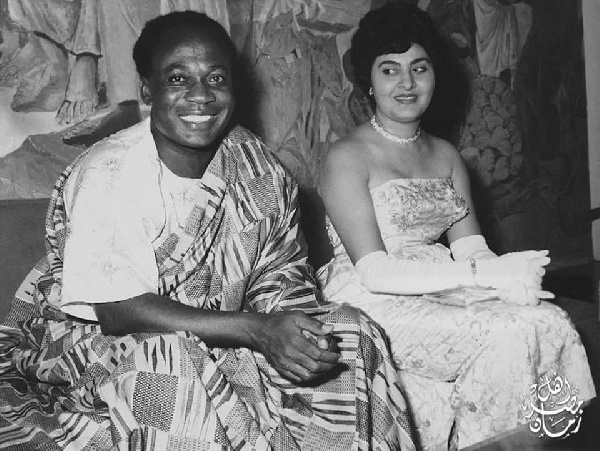
The story of Fathia Halim Ritzk, who would become the wife of Ghana’s first President, Kwame Nkrumah, is a tale of cultural diversity, political intrigue, and personal courage.
Born into a middle-class Egyptian family in 1932, Fathia faced early challenges as her father, a telephone company clerk, passed away when she was young. Her family adhered to the Coptic faith, and she received her education at Zeitoun’s Notre Dame des Apôtres, where she became proficient in French.
After completing her education, Fathia initially worked as a teacher at her alma mater but reportedly found the job unfulfilling. Subsequently, she transitioned to employment at a bank, setting the stage for a fateful encounter with destiny.
Approximately 2,500 miles away in the Gold Coast (present-day Ghana), Kwame Nkrumah, an emerging intellectual and champion of independence, was actively challenging British colonial rule. His efforts garnered widespread attention but also opposition from colonial administrators.
Amid this struggle, Nkrumah became involved with Isis Nashid, an Egyptian working for the colonial government, and she became pregnant with his child. However, due to the secrecy surrounding their relationship, Nashid had to return to Egypt to give birth and quickly married to avoid the stigma of having a child out of wedlock.
Nkrumah’s friend and businessman Said Saleh Sinare convinced him to consider marrying the woman in Egypt who had borne his child. However, when the arrangements were made, it was Fathia who became available and willing.
Despite not having met before, Fathia‘s marriage to Nkrumah took place in 1957. She embarked on this journey with just one uncle’s support, as her family did not approve of the union. This move signified her commitment to marrying a man she knew primarily through his reputation as a freedom fighter.
Fathia faced multiple challenges in this new chapter of her life. Language barriers were among the first hurdles to overcome, as she spoke little to no English, and Nkrumah did not speak French or Arabic. However, her determination led her to learn English, and within a year, she was delivering speeches in the language.
Fathia found herself in a different social environment in Ghana, where women were fiercely independent, educated, and economically empowered. She endeared herself to these women, particularly the “market women” who were influential and powerful. They even named a type of kente cloth “Fathia fata Nkrumah” in her honor.
However, Fathia initially faced resistance from some quarters, as people were initially taken aback by her foreign background. Nkrumah had to clarify that despite her skin color, Fathia was African, highlighting the ongoing debate over the Africanness of North Africans.
Fathia’s marriage to Nkrumah was not just a personal union but also had political implications. Some speculated about whether it aimed to create a political alliance between Egypt and Ghana. Regardless of the motivations, Fathia played her role effectively.
She hosted influential leaders, acted as an unofficial envoy for Egypt, and supported her husband amid threats to his life. However, in 1966, Nkrumah was overthrown in a coup, and Fathia had to leave Ghana with her three children. She lived in Egypt, away from the country she had come to call home.
Although she returned to visit Ghana in 1997, Fathia eventually left Ghana for good, choosing to live in Egypt. Her mother-in-law, Nkrumah’s mother Nyaneba, passed away in 1979, and Fathia’s sense of loss contributed to her departure.
In 2007, Fathia passed away in Cairo at the age of 75. Her life was marked by grand ambitions, political complexities, and the pursuit of her dreams, making her a compelling figure in the annals of history.
A legal case was filed in court on Monday asking for Mr. Bazoum to be freed and made president again. This is because he was arrested without reason and his freedom to move was taken away after the coup in July. His lawyer, Seydou Diagne, said all this.
“We are asking for. ” According to the AFP news agency, someone said that because political rights were violated, Niger should be told to give power to President Bazoum right away. President Bazoum should keep using the power until his term is over.
The military junta is holding his wife and son, and their names are mentioned in the application, according to the Associated Press.
Ecowas said they might use military force if talking doesn’t work to help Mr. Bazoum become the leader again.
Around 11,000 security officers were sent to Tocorón prison, which had been controlled by prisoners for a long time.
Prisoners could move around easily within the prison. The prison was like a hotel with a pool, nightclub, and mini zoo.
The minister in charge of prisons said that all the prisoners would be removed from the jail.
Tocorón not only had imprisoned bad people but also had their partners and relatives living there with them, to be close to them.
Gladys Hernández, a woman, said she was waiting to find out where they were taking her husband, according to AFP news agency.
“She said she used to live there, but they made us leave. ”
The jail was also used as the main base for the Tren de Aragua, which is Venezuela’s most powerful international gang.
Tren de Aragua, who was in jail, controlled a criminal group that operated in many Latin American countries, even reaching Chile.
The people involved in this group do bad things like forcing people into slave labor, operating illegal sex businesses and taking money from immigrants by threatening them.
The group made sure the prison had lots of nice things, like rooms to play games and a small zoo with flamingos and an ostrich. Prisoners were able to bet on horse races, borrow money from an informal bank, and party at a nightclub called “Tokio”.
During Venezuela’s economic crisis, it was difficult to find food and basic items. A newspaper said that people would go to Tocorón to buy things they couldn’t find anywhere else.
The AFP journal reported that security guards were taking motorcycles, TVs, and microwaves out of the jail when the prisoners were being transferred.
Ronna Rísquez, who wrote the book Tren de Aragua: The gang that changed organized crime in Latin America, spoke to BBC Mundo’s Valentina Oropeza and said that Tocorón operated like a small city.
The writer also said that getting rid of the prisoners does not automatically mean the gang is gone too.
She said that their main place of work has been shut down, but the leaders of this group and its branches in other countries can still keep working.
Officials did not provide much information about how they entered the prison. The military said that someone had been hurt, a mayor who passed away from hitting his head on the armored car’s door.
The authorities are wondering if they made a deal with the Tren de Aragua because the operation at the dangerous gang’s jail went smoothly.
The government of President Nicolás Maduro praised the security forces for restoring order at the prison and praised their quick and effective actions.
However, a later announcement said that a “second part” of the operation had started, and the government said they were trying to catch all of the criminals who had escaped.
A few local news have said that the leader of the Tren de Aragua gang, Héctor Guerrero Flores, might be one of the people who ran away, but the government hasn’t identified any of the escapees.
Guerrero Flores was in jail for 17 years because he committed murder and sold drugs.
But, according to Carlos Nieto, a coordinator with a group that fights for prisoners’ rights called A Window to Freedom, he was very strong and could apparently move in and out of the prison whenever he wanted, even though he eventually became a full-time inmate.
CREATING A NEW PARADIGM OF TRADE BETWEEN THE GLOBAL NORTH AND THE GLOBAL SOUTH
I want to begin with a story. Let’s call it “A Tale of Two Cities.”
Accra is the capital city of Ghana, which used to be a British colony. Lomé is the capital city of Togo, which used to be a French colony.
It takes approximately three-and-a-half to four hours to travel by road from one city to the other.
Not so long ago — and by that, I mean within my lifetime — if you mailed a letter from Accra to someone in Lomé, that letter would first be sent directly to London for processing. Then, next, it would be sent to Paris, where it would also be processed before it would be forwarded to Togo and delivered to its recipient in Lomé.
Until not so long ago, the same thing used to be true of telephone calls and air travel between any two countries on the African continent. They would all be routed, first, through a colonial country before reaching their intended destination.
It seems silly and illogical. And yet, that was the norm, the standard, the way things were done.
I have been asked to speak with you this morning about creating a new trade paradigm between the Global North and the Global South. What would that look like? What would it entail? How would it be implemented?
Let me point out very quickly that the labels “Global North” and “Global South” are misnomers because Australia, considered part of the Global North, is pretty far South, and most of Asia, considered part of the Global South, is East.
So, the labels aren’t actually indications of cardinal points; they are illusory, simply a pleasant and inoffensive way to identify nations that are considered developed and thus hold power and those that are not and thus do not. This is something that should not be overlooked or forgotten. I will speak more about it in a short while.
For this address, I will concentrate primarily on the continent of Africa, which contains 54 of the 78 nations that make up the Global South. I began with that story, the tale of two cities, because even though, on its surface, it has nothing to do with trade, at its core, it brings into sharp focus many of the impositions, limitations, and forced dependencies that were created by the “scramble for Africa.”
It is only possible to create a new paradigm by first understanding the current one. And it is only possible to understand the current paradigm with a full comprehension of the foundation upon which it was built. A foundation that was reliant upon the acquisition and maintenance of complete power.
It is common knowledge that a divide-and-conquer strategy was executed within the individual colonised territories. But we don’t often consider that the same intentional or consequential strategy was set in motion on the continent as a whole.
There were various colonial powers in many places and at different times, drawing artificial borders that had no consideration for any of the pre-existing social structures or alliances.
Take Ghana and Togo, for example. They have in common several ethnic groups because the border splits the traditional terrain of those peoples between the two countries. And depending on which side of the divide they were on, those groups’ languages, cultures, and customs were shaped in drastically different ways.
The Germans and the French colonised Togo; Ghana was colonised by the British. The Portuguese, enterprising navigators and explorers, were the first Europeans in that region and exerted tremendous influence.
The point I am making is that we Africans, except Ethiopia and Liberia, have been under the consistent authority of Europeans, who were not of our land for several centuries.
And yet, we do Africa a tremendous disservice to centre our stories around colonisation, to ignore or dismiss the sophistication of its precolonial empires and the success of their trade and commerce.
The Mali Empire, which existed from the 12th to the 17th centuries, stretched from as far North as modern-day Mauritania, South as Burkina Faso, East as modern-day Niger, and West as the Gambian coast. A famously rich empire gained most of its wealth from trade. They traded throughout North Africa and into the Mediterranean lands.
At the height of the empire’s power, it was ruled by Mansa Musa, who is said to be the wealthiest man in history. Some sources have estimated his wealth to be as much as the equivalent of 400 billion modern US dollars.
The Aksumite Empire in East Africa also exported gold and ivory throughout East and North Africa, Southern Saudi Arabia, and Yemen. The Great Zimbabwe Kingdom traded with China, Persia, and the Arab world. I could go on and on; there were many notable empires and kingdoms from the top of the continent to the bottom.
While we should not centre our stories around colonialism, we cannot deny how it has shaped our stories into this present-day narrative of Africa as poor, politically incompetent, eternally developing, incapable of handling its own affairs…a place full of shithole countries.
The African continent has been so misrepresented and misjudged that it is often difficult to have constructive conversations about it without ensuring that everyone involved has an accurate purview.
So, let’s agree on this: when it comes to African nations, sovereignty and independence, though often used interchangeably, are not synonymous.
Regarding sovereignty, the first sub-Saharan nation to liberate itself from colonial rule, Ghana, turned 65 earlier this year, on March 6th, making it a year older than me. And even though my children probably think of me as ancient, I do not consider myself that pretty old.
The last African nation to gain its freedom from colonial rule was Namibia in 1990, making it 33, younger than many of you in the audience today. You don’t need to be a historian to realise that these stretches of time are brief in the larger scheme of things, filling anywhere between a paragraph and a page in a textbook.
And though we manage our governmental affairs, it is not without impositions and interference from the so-called Global North. In many significant ways, we are not independent, certainly not, when it comes to trade.
The world system has made Africa out to be the supplier of raw materials. We have been placed as the primary product exporters and finished goods importers. I worded this the way I did—placed in the position of being—because African countries hold little to no power in any part of the process.
Through their trade and stock exchanges, the Global North determines the prices for the raw materials. African countries supply the Global North with rare earth minerals and other products and natural resources such as timber, lithium, cobalt, copper, bauxite, manganese, gold, oil, cocoa, tea, coffee, and spices.
The Global North processes these items to make furniture, jewellery, computers, mobile phones, cars, and chocolate bars and then sells them back to us at prices they determine.
The Global North owns the shipping lines. The Global North controls the trade channels, and the routes are between North and South, not within Africa.
Let’s return to the issue of development and power. If we are considered developing nations, how, within this paradigm, can we ever develop? Or are we, as the late Pan-Africanist historian Dr Walter Rodney posited, woefully underdeveloped within this paradigm?
One of the hallmark issues in every analysis of the relationship between the Global North and the Global South is power. And it’s an issue that has its roots in colonialism.
In their book “A New Weave on Power, People, and Politics,” social justice advocate Lisa VeneKlasen and author Valerie Miller explore the concept of power through four different expressions.
These expressions of power offer tremendous insight into the past relationship between the Global North and the Global South and vital clues on what is necessary to ensure the success of the new paradigms already being built.
One expression—the power over—adequately describes the dynamic of colonisation, whereby one group exerts power over another.
Another expression—the power to—is what currently exists. Though the Global South comprises sovereign nations because we have economic dependence on the Global North, they hold the power to dictate the terms of engagement, which will always be favourable to them.
A third expression—the power within—is one that African nations are already forging. Most African countries have ratified the African Continental Free Trade Area protocols.
This common-sense instrument for removing trade barriers between African countries is expected to boost trade among those countries from a paltry 11% to about 50% in the next few decades.
Switzerland is known for chocolate, but does Switzerland even grow cocoa? Imagine Ghana and Cote d’Ivoire, the largest cocoa exporters, able to export their brands of chocolate widely.
English Breakfast Tea is a popular breakfast beverage all over the world. But does England even grow tea? Imagine if Kenya, one of the largest exporters of tea and coffee, could export their brands worldwide.
The power within is also a reclamation of a consciousness that has been with us all along. It’s the consciousness of Mansa Musa and the great kingdoms. It is the consciousness of Nana Yaa Asantewaa and those who fought in the war she led, those involved in the Chimurenga, as well as the Mau Mau Resistance movements, and people like Nelson Mandela, Samora Machel, Agostinho Neto.
It is the consciousness of our dignity, inherent worth, and limitless possibilities.
Once Africa has established the power within—that is to say, once we have empowered ourselves—we will then be in the position, insofar as trade is concerned, to negotiate with the Global North the fourth expression of power—the power with— and that is a relationship based on mutual respect, cooperation, and decree.
Only then can we honestly say that a new paradigm has been created?
In conclusion, I would like to revisit the story of Lomè and Accra, that tale of two cities. Though it was once, not so long ago, the norm to route mail, phone calls, and travel from one African country to another through Europe, that is no longer the case—at least not with mail and phone calls…we still have a way to go with air travel, but we are getting there.
Contrary to the constant barrage of pessimistic news and negative commentary about the African continent, much progress has been made. And it will continue to be made. Look at what we have already accomplished. Moreover, time and technological advances are on our side.
Still, more is needed. We also need the determination and momentum that stems from solidarity. The sort of solidarity that broke the chains of colonialism in rapid succession—one country after another, after another, after another—like dominoes falling. The kind of solidarity that recognises us as one united force, one continent of wonderfully diverse people whose destinies are intertwined.
Thank you so much for the invitation to be here today. Thank you so much for your time and kind attention.
About 472,000 people will be allowed to stay in the country legally for 18 months.
Democrats want to give new immigrants more chances to work.
Many people from Venezuela are leaving their country because of economic and political problems. US cities are trying to deal with the large number of people coming from Venezuela.
To be eligible for temporary deportation relief and work permits under TPS, individuals need to have been living in the US on or before July 31st.
About 243,000 Venezuelans have a legal status that came from a policy in 2021 which was extended last year.
The US government wants to help Venezuelans because their country is not safe and things have gotten worse recently.
Homeland Security Secretary Alejandro Mayorkas said that temporary protected status helps people in the United States who cannot go back to their home country because it is not safe.
This is referring to the current situation of Venezuelans who came to this place on or before July 31st of this year.
New York Mayor Eric Adams asked President Joe Biden to let migrants have jobs.
The city is having a hard time finding places for many migrants, who are mostly from Venezuela. They are staying in over 200 hotels, shelters, tent cities, and other places.
Mr Adams, who is a member of the Democratic party, said that the federal and state government did not give enough help to the city for providing housing and other social services to new people coming to the city.
“Our city’s leaders, along with our partners, have been advocating for allowing Venezuelan asylum seekers to work. I want to express my gratitude to President Biden for listening to our entire group, which also includes our diligent congressional delegation. This action is significant as it will give hope to the thousands of Venezuelan asylum seekers under our care, who will now be able to qualify for Temporary Protected Status without delay,” he said on Wednesday.
The amount of people crossing the US-Mexico border without permission has increased again lately, after decreasing in May due to the stricter asylum rules introduced by the Biden administration.
Republican states are bringing migrants to places controlled by Democrats as a way to show their disagreement with border policies.
They stated that the action was created to push President Biden to do more to decrease the amount of people entering the southern US border.
According to the United Nations, over seven million people have moved away from Venezuela because the country’s economy has fallen apart under President Nicolas Maduro, who has been in charge since 2013.
Surprising revelations have emerged from an individual who was present at the hospital where the late MohBad was admitted prior to his unfortunate passing. These eyewitness accounts provide additional insight into the tragic sequence of events that unfolded on that fateful Tuesday, September 12.
According to one eyewitness who left a voicemail message to reiterate their account, MohBad was still very much alive upon his arrival at the hospital. This eyewitness disclosed that they had been in the hospital’s lobby when MohBad, accompanied by his friends, arrived seeking medical attention.
When the witness approached the artist, expressing a desire to take a photograph with him despite his evident condition, MohBad displayed no signs of arrogance or reluctance. In fact, he readily agreed and posed for the photograph, although the weariness in his eyes was noticeable. Following this interaction, MohBad proceeded to check into a designated medical room.
Approximately 30 minutes later, the eyewitness observed a sudden surge of activity among the medical staff and individuals present in the room where MohBad had been admitted. These details shed light on the circumstances surrounding MohBad’s visit to the hospital and the events leading up to his untimely demise.
He claims that the staff told him MohBad had died. The witness thought it strange that MohBad’s buddies had removed his “lifeless” body from the hospital so quickly, even though he was completely naked.
This eyewitness raised a crucial point: “Why did MohBad’s companions not leave him in the hospital for a longer amount of time, allowing the medical professionals to at least attempt to save him? Many others were puzzled and looking for answers as they hurried out of the hospital.”
Due to the fact that this narrative is based solely on the testimony of one eyewitness, its credibility cannot be verified. MohBad’s death is still unknown.
The legal representatives of individuals who have been arrested in connection with the alleged money theft case involving Cecilia Abena Dapaah, the former Minister for Sanitation and Water Resources, have expressed concerns regarding their clients’ inability to meet the requirements for their bail bonds.
An Accra Circuit Court has granted bail to four out of the seven accused persons in this case. Mr. Augustine Gyamfi, who served as legal counsel for Sarah Agyei, the second accused individual, conveyed that their clients were not deliberately avoiding complying with the court’s bail conditions; rather, they were encountering difficulties in interpreting and meeting those conditions.
Consequently, the legal team sought a modification of the bail terms and resubmitted their bail application. The court, presided over by Mrs. Afia Owusua Appiah, advised the lawyers to formally file applications for bail variation while providing comprehensive information about the proposed sureties.
The court also recalled instances where individuals, upon being granted bail, had absconded, highlighting the importance of prudently handling such cases. Earlier, the court had instructed the Registrar of the Family and Juvenile Unit to furnish the court with the record of proceedings pertaining to Patience Botwe, the first accused person, within seven days. This was to determine whether she had already been granted bail by the Family and Juvenile Court.
The court emphasized the need for a professional approach to the matter and underscored its commitment to upholding the rule of law, despite external pressures. It pointed out that multiple allegations had been made, and public sentiment should not sway the legal proceedings, as people’s lives were at stake. The court urged the lawyers to prioritize the legal process over public sentiment in their handling of the case.
The trial judge made this statement in response to Mr. Raymond Felli, who was serving as counsel for Yahaya Sumaila, urging the court to instruct the prosecution to refrain from seeking adjournments and to provide clarity on the case.
Shortly after the judge’s remarks, Mr. Felli issued an apology and retracted his comments against the prosecution.
Following these developments, the court proceeded to grant bail to Malik Dauda, the fourth accused in the case, setting the bail amount at GHC100,000 and requiring two sureties to substantiate their ability to meet the bail conditions. Additionally, the sureties were mandated to reside within the court’s jurisdiction.
The prosecution, led by Akosua Agyapong Agyeman, a State Attorney, explained that the investigators had already submitted the case file to the Attorney General’s (AG) office but had not yet received a response. She expressed her intention to follow up on the matter with the AG’s office and requested the court to instruct the defense counsel to formally present the bail variation for her to address.
Patience Botwe and Christiana Achab, both nursing mothers, along with Job Pomary and Malik Dauda, have been granted bail in this case. However, Sarah Agyei, Benjamin Sowa, and Yahaya Sumaila have not been admitted to bail. Additionally, Franklin Sarakpo is reportedly at large. All of the accused individuals are facing a total of eleven charges related to alleged theft of money and items from the former Minister’s residence.
These charges encompass six counts of stealing and five counts of dishonestly receiving stolen property. Earlier, the prosecution, led by Deputy Superintendent of Police (DSP) Emmanuel Nyamekye, indicated that the fact and charge sheets had been amended.
Meanwhile, the court has discharged Kwaku Botwe, who is the father of Patience Botwe, also known as Maabena. The prosecution has noted that one of the accused, Franklin Sarakpo, remains at large.
The complainants in this case are Mr. Daniel Osei Kufour and his wife, Mrs. Cecilia Abena Dapaah, who reside in Abelemkpe, Accra. According to the prosecution, the first accused, Patience Botwe, worked as a house helper for the complainants, while the second accused, Sarah Agyei, was unemployed and had previously worked as a house helper for the couple.
The third accused, Benjamin Sowah, was romantically involved with Patience Botwe, the fourth accused, Malik Dauda, was the former boyfriend of the first accused, and the fifth accused is Christiana Achab, a trader. The court learned that the sixth accused is Job Pomary, who is the husband of the fifth accused, and the seventh accused, Yahaya Sumaila, is an excavator operator residing in Sagnarigu, Tamale Metropolis. Franklin Sarakpo, the eighth accused, is the son of the fifth accused and is currently evading arrest.
The prosecution has explained that the police initiated investigations after the complainants reported the theft of their cash and personal belongings in June 2023. These investigations led to the apprehension of the first and third accused individuals at their hideouts in Tamale, Northern Region. During a search of their premises, the police discovered $40,000 and GHC7,619.70.
The prosecution added that further investigation revealed that when Mr. Kufour returned home from town in October of the previous year, he noticed that their bedroom had been opened and heard unusual noises in the house. Upon entering the room, he encountered the first accused hiding behind the storeroom door with duplicate keys to the master bedroom.
Subsequently, the complainants realized that money and personal items had been stolen from the room. During police interrogation, the first accused confessed to giving $70,000 of the stolen money to the fifth accused to purchase a three-bedroom property in Amrahia, as well as various brand-new items that were later recovered from the house.
The case has been adjourned to October 3, 2023, for further proceedings.
The money will also be used to help more than 4. 2 million people in the provinces most affected by the earthquake.
The palace announced on Wednesday that the money will be used to help people find new homes, build houses again, and fix damaged infrastructure over the next five years.
The big earthquake in Morocco, which was the strongest in over 60 years, caused the death of over 2,900 people and injured more than 5,000 others.
The earthquake also broke infrastructure and ruined over 50,000 houses in the High Atlas Mountains.
Morocco has gotten $700 million in donations to assist with its efforts to recover from the earthquake.
The country will use money given by the Moroccan government, help from other countries, and ongoing donations to the earthquake recovery fund to fix the borrowing they owe.
The bill was suggested in 1996 but wasn’t approved for a long time because some political parties didn’t agree with it.
On Wednesday, almost everyone in the Lok Sabha agreed to pass it after a long and intense discussion.
Lawmakers in the upper house of the Indian parliament, called the Rajya Sabha, will need to approve the bill now.
If this is approved, it will be sent to the Indian president and become a law.
However, it is still a long way from being put into action because it relies on India finishing their census.
The exercise is usually done every 10 years. It was supposed to happen in 2021, but because of the coronavirus pandemic it got postponed. Now, it is planned to happen in 2025 instead.
Proposed changes to the boundaries of assembly seats, to increase the total number of constituencies, known as delimitation, could make it even more difficult to put the bill into action.
The BJP, the ruling party in India, hopes that the approval of this law will help them do well in the upcoming elections.
On Wednesday, the Prime Minister, Narendra Modi, expressed gratitude to the Members of Parliament who supported the bill in the Lok Sabha. He described it as an important law that will allow more women to get involved in politics.
The bill got approved when 454 MPs from different political parties voted for it, and only two MPs voted against it.
The Lok Sabha talked about the new law for almost eight hours. Some people from the Opposition spoke up about how it will work, but overall, they still backed it.
Sonia Gandhi, who used to be the president of Congress, said that the party agrees with the planned law but wants it to be put into action right away.
Ms Gandhi asked how many years they would have to wait, will it be two, four, or eight years. Delaying this would be very unfair to women. Some MPs who oppose the current system have also asked for a special rule that reserves spots specifically for women from the Other Backward Classes.
In the middle, there are many groups of people, considered to be around 52% of the population, called Other Backward Classes or OBCs. India’s census has always included information about the population of Dalits and Adivasis, but it has never collected data on the Other Backward Classes (OBCs).
The new bill suggests that out of all the seats, which are already set aside for Dalits and tribespeople, one-third of them should also be set aside for women. But it doesn’t include a similar rule for women who are part of Other Backward Classes (OBCs).
Ms Gandhi spoke in parliament and suggested that the government should count and gather information on people belonging to different castes, especially those from Other Backward Classes (OBCs). She also proposed that the benefits of the proposed law should be given to women from these groups too.
Some other Members of Parliament from opposing parties said that the ruling party’s action was just pretending to make things better.
MP Asaduddin Owaisi, one of the two votes against the bill, believes that the current bill will only help women belonging to the upper caste.
The Convention People’s Party (CPP) is calling upon the citizens of Ghana to take a moment for introspection and consider the developmental legacy of Dr. Kwame Nkrumah as a foundational reference point for evaluating the performance of subsequent governments.
The party emphasized that Dr. Nkrumah’s strategic investments in vital sectors of the economy and his ambitious industrialization initiatives played a pivotal role in steering the country toward economic independence. This progress continued until his “painful” overthrow in 1966.
In an interview conducted with the Ghana News Agency in anticipation of the Kwame Nkrumah Memorial Day, Nana Yaa Akyempim Jantuah, the General Secretary of the CPP, asserted that Dr. Nkrumah should serve as the ultimate “yardstick of good governance.”
She encouraged the citizens to engage in a critical examination of the current state of Ghana’s economy and to contrast it with the remarkable achievements of Dr. Nkrumah, who had unwaveringly worked towards elevating the nation to greatness following its independence in 1957.
“Ghana was on the road of gaining economic independence, but Nkrumah was painfully taken out of power.
“Kwame Nkrumah developed and industrialised this nation. He created a good healthcare system for the nation and was very prudent with the resources that we had and used it to build a lot of infrastructure, including the Akosombo Dam and the Harbour,” she said.
According to Nana Yaa Jantuah, the current state of Ghana’s economy, characterized by higher inflation, weak local currency, and unachievable debts, reflected the collapse of the dream of economic independence.
“It is time for us to arise to make our government accountable. Ghanaians should let governments who come into power understand that they cannot do what they like and that the yardstick should be what Kwame Nkrumah did,” she said.
On Thursday, September 21, 2023, Ghanaians will observe the Kwame Nkrumah Memorial Day, which has been designated as a Statutory Public Holiday.
This day is dedicated to the remembrance and commemoration of Ghana’s inaugural President, Osagyefo Dr. Kwame Nkrumah, who previously served as Prime Minister and was a prominent advocate for African unity and the liberation of the black population across the continent.
The historical significance of this day can be traced back to March 6, 1957, when Ghana achieved independence after 83 years under British colonial rule.
This historic milestone made Ghana the first sub-Saharan African nation to attain independence from British colonial governance. It was Dr. Kwame Nkrumah who passionately declared Ghana as “free forever” from the shackles of colonialism, marking a momentous turning point in the nation’s governance and history.
The boat was near Cape Town in the ocean when seven crew members were taken away by strong waves.
A helicopter was giving things to people while getting more fuel, according to the AFP news agency.
The South African National Defence Force (SANDF) said in a statement that the sailors were taking part in a navy training when the accident happened.
Please simplify this text for me.
The army said that all seven members were found, but unfortunately three people died, including a high-ranking officer who is in critical condition.
Five more people were rescued in another rescue mission, according to the report.
The police said they started an investigation after the accident in the navy.
The accident happened after a weekend with strong winds and rough waves. The weather service in South Africa said there would be big waves that could cause damage in Cape Town on Wednesday.
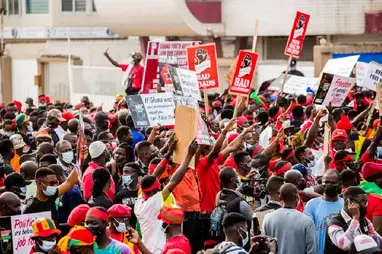
The organizers of the #OccupyJulorbiHouse protest, known as Democracy Hub, have effectively launched their planned demonstration, even in the face of a police-secured injunction. This development took an unexpected turn as participants affiliated with Democracy Hub convened for the #OccupyJulorbi protest, openly defying the police-issued injunction that had been announced just a day earlier.
The organizers were resolute in their assertion that they had not received official service of the court-ordered injunction, thus firmly maintaining their intent to proceed with their peaceful march. As the day of the protest unfolded, demonstrators gathered at the 37 stations in Accra, where they passionately expressed their concerns and called for decisive action regarding the #OccupyJulorbi issue.
The protest garnered significant attention on social media platforms, with a multitude of tweets and posts amplifying the cause and its impact. Several of these tweets encapsulated the essence of the event:
Below are some of the tweets that captured the essence of the event:
@ActivistGhana: “Democracy in action! Despite the odds, the #OccupyJulorbi protesters are showing their commitment to their cause. Let’s stand in solidarity for justice and accountability.”
@JusticeNowGh: “The spirit of #OccupyJulorbi is inspiring. Injunction or not, the people’s voice will be heard.”
@YouthPower: “When citizens unite for change, nothing can stand in their way. The #OccupyJulorbi protesters are writing history today.”
He spoke at the UN General Assembly and said that now is the right time to focus on reparations.
He said that for many centuries, the world has not wanted or been able to deal with the effects of slave trade.
”It’s time to openly recognize that a lot of Europe and the United States have been built using the immense wealth gained from the hard work, suffering, and terrible experiences of the transatlantic slave trade.
He stated that reparations should be given. He mentioned that even though no amount of money could fully make up for the terrible experiences of the slave trade, it would highlight the fact that millions of hardworking Africans were forced to work without being paid.
The Ghanaian president has talked about reparations before. Last year, he said it was time to have more serious discussions about the topic.
He asked European countries to say sorry officially for their involvement in the slave trade. He also encouraged the African Union to involve the dispersed African population in supporting the reparations movement.
The transatlantic slave trade was a very big and cruel event in history where millions of Africans were forcefully taken away from their homes and treated very badly. The United Nations (UN) says it was the biggest forced movement of people ever and one of the most terrible.
Many Africans left their homes and went to different parts of the world for 400 years.
Many people who were forced into slavery in West Africa started their journey from Ghana.
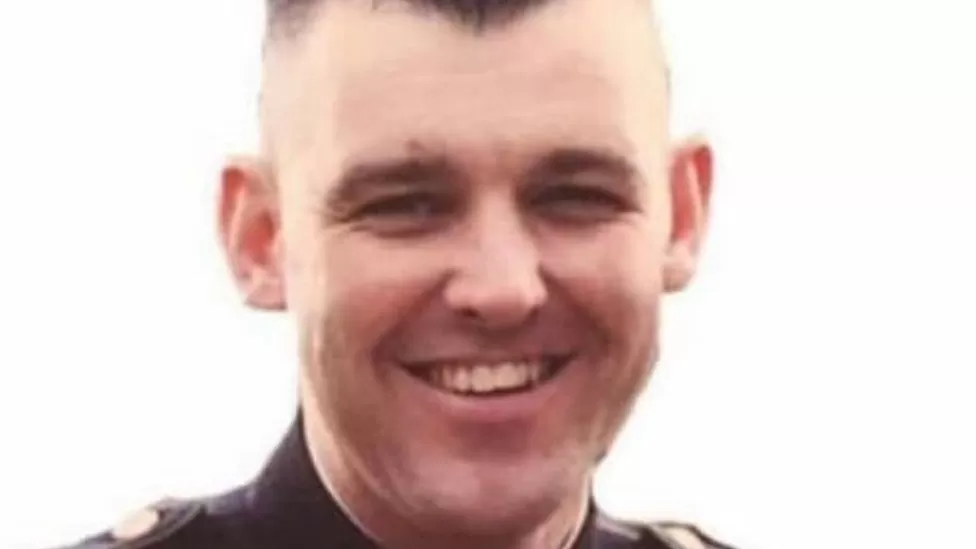
Colour Sgt Anthony Oxley was working away from home in June 2016 when he was in a car accident at the RAF Akrotiri base.
The man, who was 40 years old and lived near Wakefield, was hit by a vehicle while riding a motorcycle.
A meeting to plan for an investigation before a formal inquiry happened in Cyprus in June.
‘Unanswered questions’
The newest investigation is the second one in less than two years, both done by the government of Cyprus.
The first event was postponed last year because Sally, the wife of Colour Sgt Oxley, received a document with statements from witnesses just one hour before the meeting was supposed to begin.
In 2018, a UK investigation concluded that he died based on the information available, without pointing to a specific cause.
They discovered that he had died because his head was hurt badly in the accident.
Mrs Oxley, who lives close to Barnsley, has requested for a new investigation to take place in the UK.
The woman, who is 45 years old, said she still has a lot of questions without answers. She felt that the investigation in 2018 was not thorough enough.
Sally Oxley says she still has a lot of things she doesn’t understand about her husband’s passing.
In April, her lawyers asked the attorney general for England and Wales if they could go to the High Court and request a new investigation.
KRW Law, who is representing Mrs. Oxley, stated that the US Air Force led the investigation into the crash and very little information was shared with the public, even though the incident occurred in British territory.
Mrs Oxley reported that she was told by a US general during a meeting that the US serviceman who caused the accident would not be held responsible and that there would be no further action taken.
Christopher Stanley, a lawyer from KRW Law, mentioned that there were differences in the evidence provided by witnesses. He believes that a new investigation should be conducted for the sake of justice.
Mrs Oxley said that she understands that the result will never be different, but she feels that her husband’s 21 years of service should not be summed up as dying from blunt force. “It is not satisfactory. ”
A brutal accident on the road from Bole to Mankuma, in the Bole District of the Savannah Region, claimed the life of a chief from Mankuma.
The chief, Kantewura Justice Iddisah Dari, was hit by a Burkina Faso-bound articulated truck while he was riding a motorcycle after the driver reportedly lost control, slid into a pothole, and hit the Chief.
A report from the Savannah Region Public Relations Officer (PRO) of the National Fire Service on September 17, 2023, said; “Firefighters from the Bole Fire Station responded to an accident on the Bole-Sawla highway involving an articulator truck with registration number BH 7758 MD and a motorcycle”.
“The truck driver was reported to have lost control after falling into a pothole and ran into the motorcycle, which was moving in the same direction as the truck”.
The report added that; “The truck, which was loaded with tea bags, fell on the motor rider, killing him instantly, while the driver of the truck and his assistant were seen at the scene with no injuries”.
The public relations representative added that the dead body of the chief was discovered underneath the truck by the Bole District National Fire Service duty crew, who then turned him over to the police who were on the scene with the help of a Zoomlion towing truck. 8
Toshiba, a big and old company from Japan, will stop being on the stock market after 74 years because a group of investors has bought most of the company’s shares.
The company says that a group led by a private investment company called Japan Industrial Partners has bought 78. 65% of its shares.
By owning more than two-thirds of the firm, the group has the ability to finalize a $14 billion deal to make it a private company.
The company’s history goes back to 1875 when it first started making devices for telegraphs.
According to the agreement, the company’s shares may be removed from the stock market by the end of this year.
The company’s president and CEO, Taro Shimada, said that the company is making a big move towards a new future with a new owner, Toshiba.
Toshiba’s stocks began being bought and sold in May 1949 when the Tokyo Stock Exchange opened after World War Two ended.
The company has different parts that make things for homes and even nuclear power plants. It became a symbol of Japan’s economic improvement and its technology industry for many years after World War 2.
In 1985, Toshiba introduced the first laptop computer that was available to the general public.
For many years after World War Two, Toshiba represented Japan’s economic comeback and its advanced technology industry.
But the company in Tokyo has had many big problems in the past few years.
“Toshiba’s disaster happened because the people in charge of the company did not do a good job of making important decisions,” said Gerhard Fasol, who runs a company that gives advice to businesses called Eurotechnology Japan, when talking to the BBC.
In 2015, the company admitted to saying its profits were higher than they actually were by over $1 billion for six years. They were fined 7. 37 billion yen (equivalent to $47 million or £38 million), which was the largest fine ever given in that country at that time.
Two years later, it was discovered that its US nuclear power business, Westinghouse, had experienced significant financial losses. This led to a 700 billion yen reduction in the company’s value.
To prevent going broke, the company decided to sell its memory chip business in 2018. This business was highly valued and important for the company.
Since then, Toshiba has been offered to be taken over by different companies, including one from a UK private equity group called CVC Capital Partners in the year 2021. However, Toshiba did not accept this offer.
In that same year, it was discovered that the company had worked together with the Japanese government to harm the profits of investors from other countries.
Mr Fasol explained that many Japanese people, including the government, consider Toshiba to be very important and valuable. However, he also mentioned that this view of Toshiba is causing some issues.
The company then said it would split into three different businesses. The plan was changed within a few months. The company’s board decided to divide the company into two parts instead.
The company’s board said they were thinking about accepting JIP’s offer to make the company private, before they started the breakup plan.
“The company must make significant changes to itself after separating some of its main business divisions, particularly its semiconductor group,” explained Marc Einstein, the main analyst at ITR Corporation, a research and consulting firm located in Tokyo.
Toshiba was also a well-known company that joined the trend of Japanese firms becoming privately owned in order to avoid being responsible to shareholders.
One of the #OccupyJulorbi protesters, Oliver Barker-Vormawor, has questioned the fundamentals of democracy as he and other protesters have been detained by the police.
As Barker-Vormawor spoke amidst the unfolding events, stated, “We have just been arrested and taken to the police headquarters. We will provide legal assistance to all those who have been arrested today. This is not democracy.”
The arresting scenes are shown in videos that have since been shared on social media, showing police boarding a bus with protesters.
The incident took place as the Democracy Hub-organized #OccupyJulorbiHouse protest suffered a serious setback as a result of the arrests.
These incidents happened as a result of the protesters’ defiance of a police injunction that was issued just one day prior to the planned demonstration.
The court order had not been formally communicated to Democracy Hub, which prompted them to continue their nonviolent march.
Australia will host the first-ever international academic conference on the influence of Taylor Swift.
The “Swiftposium” is a gathering where people will talk about how the famous singer has affected things like the music industry, culture, and the economy.
The people planning the event that will last for three days are wishing that it will attract researchers from different countries in the Asia-Pacific area.
It will happen in February – during the same week Taylor Swift’s record-breaking Eras Tour comes to Australia.
Swift became really famous when she was young. She has been involved in many important events and discussions throughout her career.
The person who is 33 years old has become very successful and respected in the art world. They have earned a lot of money and won many awards. They have also started discussions about different topics like how much artists get paid for their music and who owns the music. They have also talked about treating women badly and the practice of canceling people.
Swift’s Eras Tour is having a big impact. Ticketing sites have crashed because so many people are trying to buy tickets. Experts have even come up with a new trend called “Swiftonomics. ” In Victoria, Australia, they are quickly changing the laws about scalping.
“She’s really incredible,” said Swiftposium organizer Jennifer Beckett from the University of Melbourne in an interview with the BBC.
The event was initially suggested as a joke on Twitter, but it gained support from seven universities in Australia and New Zealand.
Dr Beckett said that Taylor Swift has a significant influence worldwide in areas that affect everyone, such as the role of women in industries, entertainment laws, and even the overall economic growth.
“Leaders from around the world are desperately asking her to bring the Eras Tour to their country because it brings economic advantages,” she said.
Swift has been taught in American universities before, but this is the first time people from all over the world are coming together to talk about her impact.
The people planning the conference want to cover topics like the popularity of fans, Swift’s team’s effective marketing strategies, and the singer-songwriter’s influence on conversations about gender, identity, race, and intersectionality. They also say that it is good to carefully examine and judge her brand and influence.
The people who will be speaking will be decided in the next few months, and there are plans to organize an event where fans can buy tickets to participate.
But they have kept an empty spot in the lineup for the superstar herself, just in case she wants to join.
Dr Beckett said that if Taylor Swift decides to come, we would all be very surprised, but she is definitely welcome to come.
“TayTay, if you want to join us, we would be very happy to have you. ”
The Ghana Police Service has initiated the process of arresting numerous protesters who were intending to take part in an anti-government demonstration called #OccupyJulorbiHouse.
This action follows the police’s denial of allegations that they had not effectively served an injunction application to the organizers of the protest, Democracy Hub.
Reportedly, a number of police officers—over 400 of them—are currently arresting the protesters and transporting them to the Accra Regional Headquarters of the police.
For further updates on this situation, please refer below.
📍These guys came out with horses and rifles like this is a civil war. All this to stop people from peacefully protesting about the bad economic conditions they’re being made to live through. You can’t make this up.#OccupyJulorbiHousepic.twitter.com/Dlu1qMgvmP
The countries Haiti and Kenya have made an agreement to become friends and work together. This was announced in a statement that they both released together.
The paper signed by both Haiti and Kenya’s government officials states that they will send ambassadors to each other’s countries.
Kenya wants to send 1,000 police officers to Haiti to help with international support.
The government of Haiti asked for assistance from other countries last year to deal with a lot of gang violence happening.
The United States is leading the United Nations in arranging a mission to rescue people.
The Producer Price inflation rate witnessed a notable decline, decreasing to 28.3% from the previous month’s figure of 32.9%, marking a substantial 4.6% point reduction in August 2023.
Breaking it down by sectors, the Industry sector experienced a marginal decline of 0.6%, resulting in an inflation rate of 30.6% for August. Conversely, the construction sector witnessed an increase of 6.8%, reaching an inflation rate of 24.6% during the same month. In contrast, the Services sector’s inflation rate remained steady at 15%.
The Government Statistician, in a formal statement, attributed this decline to specific sectors within the economy. Notably, the Electricity and gas sector recorded a significant inflation rate of 68.3%, while the Transportation and storage sector reached 37.3%. The Mining and Quarrying sub-sector, on the other hand, saw a modest decrease of 0.3 percentage points, settling at an inflation rate of 32.8% in August 2023. Accommodation and food services registered an inflation rate of 27.0%, while the Manufacturing sub-sector experienced a decrease of 1.0 percentage points, resulting in an inflation rate of 23.5% for August 2023. In addition, the Water Supply, Sewerage, and Waste Management Sub-sector reported an inflation rate of 38.1%, and the Information and Communication sector recorded an inflation rate of 11.0%.
Prime Minister Mateusz Morawiecki stated that Poland’s main priority is to protect itself using advanced weapons.
Poland has already given Ukraine 320 old tanks from the Soviet era and 14 fighter jets called MiG-29. Poland does not have much else to offer to Ukraine.
But, the comments happen at the same time as there is a lot of anger or conflict between the two countries next to each other.
Poland called Ukraine’s ambassador on Tuesday because President Volodymyr Zelensky made comments at the United Nations. Poland, Hungary, and Slovakia had extended a ban on Ukrainian grain.
Mr Zelensky said it’s concerning how certain European countries who are supposed to be friends with Ukraine are acting for their own political benefit instead of showing real support. It’s like they are using the situation to create drama and make a big deal out of something that is not really important. Warsaw criticized his words as “not fair about Poland, which has helped Ukraine since the war started”.
On Wednesday night, Mr. Morawiecki talked to Polsat news TV channel after the Ukrainian ambassador was called to the foreign ministry in Warsaw because of the Ukrainian leader’s speech.
The prime minister said that we are not giving weapons to Ukraine anymore because we are giving better weapons to Poland.
He strongly believed that Poland was supporting Ukraine in its fight against Russia. However, he did not want Poland’s economy to be negatively impacted by the import of grain.
“Our center in Rzeszow is doing the same job as it always has, working together with Americans and NATO. This will continue in the future. ”
Poland’s military has given away approximately one-third of its own military to Ukraine and is now in the process of replacing it with new, Western-made equipment.
The Polish company PGZ will continue to send about 60 Krab artillery weapons to Ukraine in the coming months.
When asked about what the prime minister said, Jacek Sasin, the Polish state assets minister, told Radio Plus on Thursday that “right now, things are uncertain, but we will find out more in the future. ”
The grain dispute started when Russia invaded Ukraine and blocked the main Black Sea shipping lanes. This caused Ukraine to have to find different overland ways to transport their grain. This caused a lot of grain to end up in central Europe.
As a result, the European Union stopped the import of grain to Bulgaria, Hungary, Poland, Romania, and Slovakia for a while. They did this to support the farmers in those countries who were worried that the cheap grain from Ukraine was making their prices go down.
The ban stopped on 15 September and the EU decided not to continue it, but Hungary, Slovakia, and Poland chose to keep using it.
The European Commission has said many times that individual EU countries can’t make trade policies for the group on their own.
The Economy Minister of Ukraine, Yulia Svyrydenko, said that it is very important for Ukraine to show that countries cannot stop Ukraine from selling their products to them.
However, Poland has stated that they will continue to enforce the ban, and they are not concerned about a complaint made to the WTO.
Mr Morawiecki said that if Ukraine makes the grain dispute worse, they will ban even more products from Kyiv. Poland’s foreign ministry said that trying to pressure Poland in group conversations or filing complaints with international courts are not the right ways to solve problems between our countries.
Even though there is a ban, the three countries said they will still let grain pass through them to reach other markets.
Kyiv asked Poland to put aside their emotions and instead take a constructive approach to solve the dispute, after their ambassador was summoned.
The French Foreign Minister, Catherina Colonna, said on Wednesday that a study conducted by the European Union showed that Ukrainian grain imports would not cause harmful effects to European farmers. She also stated that she found the tensions between the two countries to be unfortunate.
Poland has helped Ukraine a lot in its fight against Russia. They have asked Germany to give tanks to Ukraine and promised to give fighter jets to Ukraine. Poland has also welcomed over 1. 5 million refugees from Ukraine.
The final funeral right of the late highlife musician, Kwadwo Akwaboah, is set to take place on Saturday, September 30, in his hometown of Trede, situated in the Ashanti region of Ghana. The commemorative events include a wake-keeping session scheduled for Friday, September 29, at Trede, with the deceased’s body being laid in state at his family residence on Saturday, September 30.
However, the mortal remains will be conveyed to Heroes Park within the Kumasi Sports Stadium for the burial service, following which they will be returned to Trede for interment. The Thanksgiving service is slated for Sunday, October 1, still to be held in Trede.
Akwaboah Jnr, the son of the late musician, has extended invitations to various prominent musicians, such as Kojo Antwi, Oheneba Kissi, Daddy Lumba, Amakye Dede, Akosua Adjepong, Nicholas Omane Acheampong, among others, in the hopes of having them join in mourning and commemorating his father’s legacy alongside his family on the designated day.
The passing of Kwadwo Akwaboah was officially announced by his son, Akwaboah Jnr, on Tuesday, May 16, 2023, through his social media platforms. A poignant Instagram post featured a photograph of his father with the caption “RIP DADDY.”
Kwadwo Akwaboah, a highly regarded musician, guitarist, producer, and keyboardist, breathed his last at the Okomfo Anokye Teaching Hospital in Kumasi during the early hours of Tuesday, May 16, 2023, at the age of 60. His illustrious career included collaborations with celebrated Ghanaian musicians like Kojo Antwi, Rex Omar, the late Nana Kwame Ampadu, Jewel Ackah, and C.K. Mann. He also contributed his musical talents to various bands, including Akwaboah International Band, Marriot Band, and Oheneba Ntim Barima Band. Among his notable compositions are songs like “Awerekyekyere,” “Face To Face,” and “Hini Me.”
The organizers of the #OccupyJulorbiHouse protest, known as Democracy Hub, have demanded that the police substantiate their claim of serving an injunction notice intended to halt the scheduled protest spanning from September 21 to September 23.
In the lead-up to the protest, the police had successfully obtained an injunction, publicly announcing this fact. However, the Democracy Hub group promptly countered this announcement by asserting that they had not received any formal court documents or been officially served with the injunction notice, maintaining their intent to proceed with their planned march.
In response to these claims, the police issued another statement, asserting that they had, in fact, served the injunction notice to Democracy Hub through their legal representatives. In turn, the Democracy Hub group challenged this assertion, contending that their lawyers had not received any such document and demanding concrete evidence from the police to substantiate their claim of service, including proof of proper reception of the legal notice.
In response to the police statement posted on Twitter (Now X):
1. Our lawyers have categorically denied having received any such service.
2. All legal processes when served are signed for by someone.
Who received service?
3. When was the process served?
4. Under law, no originating process can be served on a lawyer. A process can only be served on a lawyer after the Respondent has entered appearance through a lawyer.
Simply, show proof of service. No long talk!
1. Our lawyers have categorically denied having received any such service.
2. All legal processes when served are signed for by someone.
Who received service?
3. When was the process served?
4. Under law, no originating process can be served on a lawyer. A process can only… https://t.co/itfSIo70mW
Visa service provider BLS shared a message from India’s mission stating that the decision was made due to operational reasons.
This week, tensions increased after Canada said it was looking into believable claims that India was involved in the murder of the separatist leader.
India strongly denied the accusation, describing it as ridiculous.
Experts say that the relationship between the countries, which has been tense for many months, is now at its worst point ever.
The news that visas were being stopped was shared on the BLS website on Thursday.
The Indian Mission has an important announcement. Starting from September 21st, 2023, Indian visa services have been stopped for now because of certain problems.
India’s government department that deals with relations with other countries declined to give any opinions on the issue and told the BBC to look at the BLS website.
The decision was made one day after India advised its citizens who are going to or living in Canada to be very careful due to increased activities against India and supported hate crimes and violence in the country.
Delhi reported that there were threats towards its diplomats and some Indians who are against the anti-India plans.
Canadian Prime Minister Justin Trudeau said that investigators are looking into whether the government of India played a part in the murder of Hardeep Singh Nijjar, who is a Canadian citizen. India had labeled him as a terrorist in 2020.
Nijjar was killed when two men with masks shot him while he was in his car outside a Sikh temple in British Columbia on June 18th.
Mr Trudeau said that if a foreign government is involved in killing a Canadian citizen in Canada, it is not allowed and goes against our country’s independence.
India responded strongly, claiming that Canada was attempting to divert attention away from the Khalistani terrorists and extremists they had provided refuge to.
The Indian government strongly opposes the requests of Sikh separatists living in Western countries for Khalistan, which means a separate place for Sikhs to live.
The Khalistan movement was at its highest point in India during the 1980s. It involved a violent rebellion that mainly took place in the state of Punjab, where a majority of the population belonged to the Sikh community.
It was stopped by using force and doesn’t have much impact in India anymore, but some people in the Sikh community in countries like Canada, Australia, and the UK still like it.
Canada has a lot of Sikhs who are not from Punjab, and they have had many protests and demonstrations supporting Khalistan.
In June, it was reported that India had made a “serious complaint” to Canada about the safety of its diplomats in that country.
India has told its people in Canada to be careful and watchful because there could be hate crimes that are supported by the government. This warning comes after Canada accused India of possibly being responsible for the killing of a Sikh activist in Canada.
According to an advisory from the Indian Ministry of External Affairs, there have been recent threats specifically aimed at Indian diplomats and members of the Indian community who are against anti-India plans. Due to the increasingly unsafe situation in Canada, Indian students are strongly recommended to be very careful and stay alert.
It said that if you are from India or a student, you should register with the High Commission of India or the Consulates General of India in Toronto and Vancouver. This is so that they can contact you in case of any emergency or bad happening.
Later, a company in Canada that helps people get visas said on its website that India had stopped giving visas to Canadians starting from Thursday. They said they received a notice from the Indian embassy.
BLS International, the company that manages visa applications for India in Canada, said that the Indian mission has temporarily stopped providing visa services for operational reasons. There is no specified time for when the services will resume.
On Thursday, the notice was taken away for a short time and then appeared again, but nobody explained why.
CNN has contacted India’s foreign ministry and BLS International.
The travel warning happened a few days after Canadian Prime Minister Justin Trudeau said that the government had been looking into serious accusations that there might be a connection between people from the Indian government and the murder of Hardeep Singh Nijjar. Hardeep was a Canadian citizen who was shot by masked men in June.
New Delhi strongly rejects the accusations, stating that they are ridiculous and driven by ulterior motives.
But Trudeau’s statement has caused tension between India and Canada, with both countries expelling high-ranking diplomats in response. This could potentially strain the relationship between these important allies of the United States.
Nijjar strongly supported the idea of making a separate Sikh homeland called Khalistan. This place would be in India’s Punjab state.
The Khalistan movement is not allowed in India and the government sees it as a danger to the nation’s security. Several groups linked to the movement are considered “terrorist organizations” according to India’s Unlawful Activities (Prevention) Act (UAPA).
Nijjar is on the list of UAPA terrorists by the Home Ministry. In 2020, the Indian National Investigation Agency claimed that he was trying to persuade the Sikh community worldwide to support the creation of ‘Khalistan’. They also accused him of encouraging Sikhs to vote for separation, protest against the Indian government, and engage in violent activities.
The local police say that he was shot and killed by two people with masks while he was in his truck outside a Sikh temple in Surrey, British Columbia, in June.
The Sikh community in Canada, which is one of the biggest communities outside India and has over 770,000 members, felt very surprised and angry about his death.
The Canadian police have not taken anyone into custody for Nijjar’s murder. In August, the police said that they were looking into three people as possible suspects in a crime. They also told the public about a car that might have been used to escape and asked for help in finding more information about it.
The prolonged period of time during which Member of Parliament for Dome Kwabenya, Sarah Adwoa Safo, has been absent from her parliamentary duties has been attributed to a series of deeply distressing events. These include threats made by the United States government concerning the potential loss of custody of her two children.
Seth Kofi Osei Kissi, acting as the spokesperson for Adwoa Safo, provided these details during an interview conducted by Kwabena Mensah Abrompah on Radio Univers on September 20, 2023.
Kissi elaborated that one of the primary reasons for Adwoa Safo’s prolonged absence was the grave threat she received, which revolved around the possibility of her losing custody of her two children. Additionally, he disclosed another tragic event that has contributed to her absence, which was the heartbreaking loss of her newborn baby shortly after giving birth.
Kissi further explained that Adwoa Safo had traveled to the United States, where she was confronted with the distressing ultimatum, indicating that “if she doesn’t take care, her children will be taken away from her.” It is noteworthy that Adwoa Safo has two children, one male and one female, and it was the male child who faced a significant medical condition.
“You see, the white culture and ours are two separate things, they have a way of taking care of children, ladies, and animals, but when you come here, it is different, so the whites were serious about that.
“The issue overpowered her, she thought it was something minor but when she went and realized the severe nature of it, and how her child had been going to the hospital to-and-fro, her own father and her family even lost communication with her.
“The issue took over her life to the extent that she didn’t know what to do because going to give birth and losing your child and your other one is also having a problem but God was able to intervene on her behalf, so, it is all about pleading with everybody for forgiveness.”
Meanwhile, the former Gender Minister broke her silence on her extended absence from Parliament last week.
During this communication, she extended an unreserved apology to her political party and its members. In doing so, she also shared some insights into the personal challenges that she and her family had been grappling with during that extended period of absence.
Adwoa Safo openly recognized that her absence had not been deliberate, emphasizing that it had been unintentional. She conveyed profound regret for any inconvenience her absence might have caused to her party and its members.
Sunak said on Wednesday that he will delay the ban on selling new petrol and diesel cars from 2030 to 2035. He will also slow down the process of phasing out gas boilers and will not enforce regulations on homeowner efficiency.
The prime minister said again that they want to increase the extraction of oil and gas from the North Sea in Britain, despite criticism from environmental groups. He also said that they will allow onshore wind again.
This represents a major change in the UK’s stance on climate change, going against the previous agreement. This shift comes soon after the important COP26 climate conference in Glasgow, where the UK aimed to show its leadership in fighting the climate crisis. However, this decision undermines those efforts.
The decision strengthens Sunak’s new and controversial plan to win elections by getting rid of ambitious efforts to reduce emissions and arguing with climate activists. This risky move aims to attract the support of regular Conservative voters.
Sunak is trying to improve his public image before the upcoming election. He wants to show that making these changes is a practical and sensible way to achieve net zero emissions. He is portraying these changes as a necessary and overdue adjustment to our approach to climate policies.
Sunak criticized past Conservative prime ministers by saying that just wishing for something won’t lead to achieving net zero. But that is exactly what the governments before have done, both the Labour and Conservative parties.
“He said that the idea of us reducing our goals is incorrect. He also mentioned that if we keep going in this direction, there is a possibility that the British people might no longer support us. ”
He stated that he will explain his next plans for the environment in the following weeks before COP28.
Boris Johnson, who was the Prime Minister during COP26 and supported the goal of reaching net zero emissions, recently made a rare public criticism of his former chancellor, who has now become his political opponent. Johnson wants businesses to be certain about our commitments to achieving net zero emissions. He is asking Sunak to assure firms that the government is still dedicated to this goal and has a clear plan for the future.
Johnson said that we must not stumble or lose our desire for this country.
Sunak tried to find a compromise in his speech by saying his plans will help Britain reach its goal of net zero emissions by 2050. He also mentioned that the previous plans were too strict and not fair to British workers.
“Sunak said that we have come to an agreement about the future of our country that nobody seems to be satisfied with. ” “Many times, politicians have chosen the quick and simple option due to thinking about the short-term. I have decided that we will change this. ”
This argument is unlikely to convince climate experts who have already warned that the UK is not meeting its targets. The UK government’s climate change adviser, the Climate Change Committee, released a report in June. The report criticized the UK’s plans to achieve net zero emissions and stated that there was not enough sense of urgency to meet the country’s goals.
Britain must make sure that by the year 2050, it has reduced the same amount of pollution that it releases into the atmosphere.
But because we are taking a long time to stop using petrol and diesel vehicles and gas boilers, these things will still be around in Britain until after 2040. This might make it harder for future governments to try to reduce emissions quickly.
On Wednesday, there was a strong reaction in politics. Johnson’s statements caused many members of Sunak’s Conservative party to express their worries about the plans. It seems that the plans were rushed after they were leaked to the media on Tuesday. Opponents from different political parties, business organizations, and climate advocates joined the environmental faction of the party in criticizing the change.
Alok Sharma, a Conservative politician who was in charge of the important COP26 conference, said that if the government changes its position on net zero, it would greatly harm business confidence.
Honestly, I don’t think it will benefit any political party in terms of getting votes if they choose to follow this direction, Sharma said. Chris Skid more, who used to work in the government handling energy matters, said that these actions were the biggest error during his time as the prime minister.
Wednesday’s announcement coincides with the Climate Ambition Summit at the UN General Assembly summit in New York, but Sunak is not attending.
During the UN summit, Al Gore, the former US vice president, told CNN’s Christiane Amanpour that he believed Sunak made a mistake.
I received messages from my friends in the UK, some of whom belong to the Conservative party. They used the term ‘utter disgust’ and some young people there feel betrayed by their generation. I find it very surprising, but once again this is something that the UK needs to deal with,” he kept talking.
The climate campaigner said that the world does not need this from the UK, when looking at the whole world.
Romain Ioualalen, a representative for an organization called Oil Change International, said at a meeting called UN that Sunak’s announcement is an indication of how the UK is not doing well in leading efforts to combat climate change.
People from different countries and organizations in society are very worried about what is happening in the UK. And it shows that the government is not paying attention to science anymore, “Ioualalen said.
Sunak has embraced a stance against environmental initiatives, following his party’s unexpected win in a local election in the far west of London. The election’s main focus was the extension of a low-emissions zone in London, which would require drivers with heavily polluting cars to pay a fee for each day they used their vehicle in that area.
People don’t like the prime minister’s Conservative party. Opinion polls show that they might lose the next election by a lot. The election must happen before January 2025.
In that situation, and with a weak economy that limits the government’s ability to make big changes to its finances, Sunak has focused on various cultural issues and promoted policies that are conservative in nature, in order to attract the support of the party’s right-leaning members.
The climate crisis is becoming a greater concern for British voters, according to polls. The opposition Labour party has criticized Sunak, saying he is no longer positioning Britain as a global leader. Mike Childs, who is in charge of policy at Friends of the Earth, said that it would be morally wrong to go against important climate promises, especially when the world is experiencing severe flooding and wildfires.
British businesses didn’t like Sunak’s plans when he announced them on Wednesday. Lisa Brankin, the head of Ford UK, stated that they require three things from the UK Government: the desire to achieve something, dedication, and reliability. Relaxing the rules in 2030 would weaken all three.
According to Ed Matthew, who works for an independent group called E3G that focuses on climate change, these actions will make our household bills go up and harm our ability to compete with other countries in clean technology.
“He said that while the United States, China, and the European Union are making progress in green growth, Rishi Sunak seems to be giving up. ” “The UK could suffer severe economic consequences. ”
Member of Parliament representing South Dayi under the National Democratic Congress (NDC), Rockson-Nelson Dafeamekpor has expressed his view that the decision of the Electoral Commission (EC) not to conduct the ongoing limited voter registration outside of its district offices is not justifiable.
Mrs. Jean Mensa, the Chairperson of the Electoral Commission, has attributed their inability to expand the voter registration exercise partly to Parliament’s actions, specifically the failure to approve the new Constitutional Instrument (C.I) that the Commission had presented for endorsement.
In addressing the various concerns and criticisms surrounding the ongoing registration process, Mrs. Jean Mensa conveyed that the Commission finds itself in a highly challenging predicament due to these circumstances.
In an interview with Joy News, “As you are all aware, the Commission prepared a draft C.I for continuous registration in all district offices nationwide. This initiative started last year and the registration we were envisioning under the draft C.I was for a sustained long-term basis.
“Indeed, had the C.I been passed we would have had some six months this year to register voters at any time of their choice. Our 2023 budget and work plan were prepared along those lines. Our 2023 work-plan and budget were based on a continuous registration of voters in our district offices nationwide, we did not factor electoral area registration in our 2023 work plan and budget,” she explained.
Mr Dafeamekpor,explained why the EC’s use of the C.I. as an excuse is flawed.
“The EC Commissioner and her deputies lied against the institution of parliament. Sometime in November 2022, after the 2023 budget was read, the EC came to parliament with what they called Medium-Term Expenditure Framework as well as its budgetary expenditure for 2023. The MTEF run from 2023, 2024, 2025, and 2026 as its work program. Parliament never tainted anything in that work program. In addition to that, parliament approved the budget that the EC asked for. The EC actually asked for as much as GHS 386,047,606 as its budget for 2023.
“Out of that budget, the EC specifically asked for GHS 66, 059,846 as the budget for its continuous registration, and that is the language of the C.I. The EC never needs a new law in order to carry out its mandate as this present registration has demonstrated. The position of the minority has always been that you don’t need a new law to carry out your mandate. What does the existing law say about registration? If you go to C.I. 91, Regulation 2, sub-regulation 1(a) which is on registration centres, speaks of the fact that the EC can conduct registration at its district offices.
He further explained that, “in sub-regulation 2(2) it says that the EC in designating other registration centres may take certain factors into consideration especially access and convenience. In sub-regulation 2 sub-regulation 4 of C.1. as amended by C..I. 126, parliament was very clear that in granting that discretion to the Electoral Commission to designate additional registration centres, it could be abused. So what did parliament do? Parliament said, you must take into consideration the existing gazetted polling stations when you want to consider additional registration centers in the district.
The National Democratic Congress (NDC) and five other political parties have already filed a lawsuit against the Electoral Commission (EC) over the choice.
The political parties that are up in arms believe that the EC’s decision to limit the registration centres to district offices could potentially deny many eligible voters their right to register as voters and cast ballots in public elections.
According to Dr. Serebour Quaicoe, director of electoral services for the Commission, eligible voters who are unable to register at one of the Commission’s district offices nationwide will have to do so in the following election.
He stated that once the EC receives parliamentary approval for its Constitutional Instrument, C.I., special arrangements will be made for difficult-to-reach areas. He claims that the Commission will also conduct a continuous registration process in its offices, which will accommodate potential voters whenever they come in.
According to Ukrainian prosecutors and investigators from the United Nations and other international organizations, there is growing evidence that Russian troops are using rape and sexual violence as a method of terror in Ukraine. This is similar to how the Bosnian Serb army used rape during the Bosnian war in the 1990s. Russia says it didn’t do it.
The New Lines Institute for Strategy and Policy, which is a think tank in the US, has written a report. This report will be shared and talked about in a debate in the UK Parliament on Thursday.
This means that in order to prevent a similar tragedy from happening again in Ukraine, the world should prioritize helping the victims. In Bosnia, a lot of people have waited a long time before speaking up, and most of the sexual crimes that happened there have not been punished.
Emily Prey, one of the main people who wrote the report, said that during the war in Bosnia, rape was a big part of what happened. However, when we look at the Dayton Peace Accords, which ended the war in 1995, women who survived sexual violence during the conflict were not included in the discussions.
She told CNN that the people were not involved in the peace talks, and as a result, the Dayton Accords only temporarily stopped the fighting instead of achieving a long-lasting and stable peace.
Prey said that it is very important to forget about prejudices and negative judgments and ensure that all individuals affected by sexual violence in conflicts are included.
Many times, we believe that sexual violence only happens to women, but it actually happens to everyone. Prey said that this includes both women and girls, as well as men, boys, and people with different gender identities.
Men who experienced sexual violence in the Bosnian war are just now starting to speak up about it. These men have suffered for many years without getting the help they require. And we can see this happening in Ukraine too.
Prey also mentioned that children who are born as a result of rape during war are often overlooked and ignored. Between 2,000 and 4,000 kids were born from the recorded instances of war rapes in Bosnia, but there are probably even more than that.
When we don’t pay much attention to sexual violence during conflicts, we tend to overlook the children who are born as a result of rape during wars. In Bosnia, there were children who were not noticed or given attention. They have been struggling for a long time to be seen and acknowledged because they have faced many obstacles and problems in their lives,” she said.
The report also states that it is very important for Ukraine’s friends to be prepared to punish those responsible for their actions on behalf of Ukraine. This can occur either through the UN’s Genocide Convention or in national courts using the principle of universal jurisdiction. Universal jurisdiction allows courts to prosecute individuals for crimes against international law that were committed in other countries.
Prey mentioned a recent incident where a Bosnian Serb soldier was accused of murder and rape. The accused person was moved from Bosnia to Montenegro, where they were currently residing. This incident is seen as a successful example of this system at work.
The International Criminal Court has accused Russian President Vladimir Putin of crimes and is looking into whether Russia committed war crimes in Ukraine. Multiple countries such as Lithuania, Germany, Sweden, and Spain are looking into the accused Russian crimes.
However, Prey mentioned that these situations can be expensive and take a long time. This means that it is important to prioritize giving immediate assistance to the victims. This can include help with their mental and social well-being, as well as providing them with free healthcare and legal aid.
“They may have to wait 10 or 20 years to reach a decision in the court case,” she said. Survivors of sexual violence in conflicts deserve better treatment than what they are currently receiving. They should be treated fairly and held responsible, but they also have to support themselves, take care of their families, and pay their bills. They need help to do all of this.
It appears that Hon Adwoa Safo, the Member of Parliament for Dome Kwabenya Constituency, faced a series of personal challenges in the lead-up to the 2020 election.
The story begins with the revelation that Hon Adwoa Safo was pregnant during the 2020 election season. However, it took a tragic turn as she tragically lost her child after childbirth. Her experience was one of great sorrow and despair, as she narrowly escaped losing her own life during the process.
But the challenges didn’t end there. While grappling with her personal loss and health recovery, the MP received a heart-wrenching call from the United States, where she has a son and a daughter. The call conveyed devastating news that her son had fallen seriously ill, facing the grim prospect of a life-altering disability.
To make matters even more difficult, Hon Adwoa Safo was confronted with another emotional hurdle: the potential threat of having her children taken away from her. The prospect of losing custody of her children must have added immense pressure to an already challenging situation.
Seth Osei Kissi, an aide to Hon Adwoa Safo, expressed his sympathy and admiration for the MP, saying, “Excuse me to say, you suffered stillbirth, nearly lost your own life, your child suffers a serious illness, and you are again told they might be taken away from you. Where do you start from in such a difficult situation?”
Despite these formidable personal obstacles, Hon Adwoa Safo continued to fulfill her duties as a Member of Parliament and remained committed to serving her constituents in Dome Kwabenya. Her ability to persevere in the face of adversity is a testament to her dedication to public service and the resilience of the human spirit.
The story of Hon Adwoa Safo serves as a reminder that public figures often face personal challenges behind the scenes while carrying out their public responsibilities. Her strength and determination in overcoming these hardships exemplify the qualities of leadership and fortitude.
Apostle Elijah Kofi King, the leader of the Fire Nation Arena Ministries in Lusaka, Zambia has made some interesting predictions about the flagbearer race of the New Patriotic Party.
In a sermon in his church that has been in circulation on social media, Apostle Elijah King disclosed that there will be instances of backbiting and betrayal from some of the candidates.
According to him, one of the leading candidates who is an an anti-christ will will break away from the NPP and set up his own party.
This person, he claims will win the general elections and set the country on the path of autocracy and military rule.
He will send military men to invade and disrupt church activities; and The angel of the told me he’s an an-anti, the prophet added.
“The Lord shows me that there will be confusion in the present government of Ghana. There will be confusion in the NPP and they will end up fighting each other and setting each other up. There is this race of the next presidential candidate. I won’t go into details but there is one particular man amongst the candidates that the Lord focused on and spoke to me about.
“I saw that the man will be set up and betrayed by the party. Out of the betrayal and anger, he will walk away and set up his own political party. He will buy people and Lord says, he will rule like a military government. Whatever he says will become final,” he said.
The three leading candidates in the NPP race are Vice President, Dr Mahamudu Bawumia, Trades, and Industry Minister, Alan Kyerematen, and Assin Central MP, Kennedy Agyapong.
Though the first two names are yet to officially announce their interest in the race but Kennedy Agyapong has announced his, detailing his plans for the primaries and the national election.
The New Patriotic Party (NPP) is gearing up for its presidential primary to elect a flagbearer for the 2024 general elections.
The party has set November 4th 2023, as the date for its national congress to choose among the 10 aspirants who have filed their nominations. However, the race has been marred by allegations of vote-buying and inducement by some of the candidates.
According to some NPP communicators, who spoke on condition of anonymity, some of the aspirants have been splashing cash on delegates to secure their votes. They claimed that one of the aspirants, Kennedy Agyapong, a Member of Parliament for Assin Central and a businessman, paid $5000 each to three delegates in the North East Region.
“When NPP conducted their Super Delegates Conference, everyone got a share of the money distributed. Everyone gave money out. If fact, Kwabena Agyepong said when we went round to do his campaigns, people were asked to leave their various places to meet you (candidate) and so giving them a token for transportation is not wrong. Another candidate (Kennedy Agyapong) also selected 3 individuals in North East Region and gave them $5,000,” they said.
The communicators said that Kennedy Agyapong was not the only one who engaged in such practices, as other aspirants also distributed money and gifts to delegates across the country. They cited an example of another aspirant, who gave GH20,000 each to some selected executives in a region.
“So if you gave someone GHS100 and other gave GHS500, why do you make a fuss about it. Meanwhile, when investigations are over, it could be said that you paid GHS1000. I know a Region where an authority said some of the executives are not in support of him. He selected those who supported him and gave each GH20, 000,” they added.
They said that such acts of bribery and corruption were undermining the credibility and integrity of the party and its internal democracy. They called on the party leadership and the Electoral Commission to investigate and sanction the culprits. They also urged the delegates to vote based on merit and vision, not on money and material benefits.
Kennedy Agyapong has not responded to the allegations yet. He is one of the frontrunners in the NPP flagbearership race, along with Vice President Mahamudu Bawumia. He has declared his intention to transform Ghana into an industrialized nation with his wealth of experience and expertise in business.
President Akufo-Addo has appealed to the global community for assistance in addressing the issues of terrorism in the Sahel and the surge in coups across Africa.
Addressing the 78th Session of the United Nations General Assembly in New York, President Akufo-Addo expressed concern over the instability in the Sahel, which has placed significant political and economic stress on West African nations.
He called upon the international community to offer immediate support to help the region recover and improve the living conditions of those affected.
Furthermore, President Akufo-Addo emphasized that it’s time for Europe and its allies to reciprocate the support Africans provided during the Second World War by assisting Africa in eliminating terrorism and coups.
“Instability in the Sahel and widespread terrorist activities have put West African countries under severe political pressure and economic strain. Several countries in the region have lost vast stretches of territory to the rampaging terrorists. Coup d’états have reemerged as what some mistakenly hope would be the solution to the threats that confront their nations,” he said.
“We, in the West African Region, are trying as best as we can, under the very trying conditions we face, to deal with the situation. We are convinced that the conflicts that continue to plague our continent and our Region, in particular, would be more satisfactorily resolved if the international community was to support, not undermine, the efforts of our regional and continental organisations to deal with them,” he added.
“Africans fought and died in the Second World War in defence of Europe and her Allies, who reset the world towards the path of peace and prosperity that their nations and citizens have enjoyed for decades now. It is surely time for the world to reciprocate in our time of need,” President Akufo-Addo said.